Diagram H20
The Sixteen States of Consciousness and Seven Theosophic Principles of Man Mapped on to the Dignities of the Metaphysical Chart Arranged as a Table
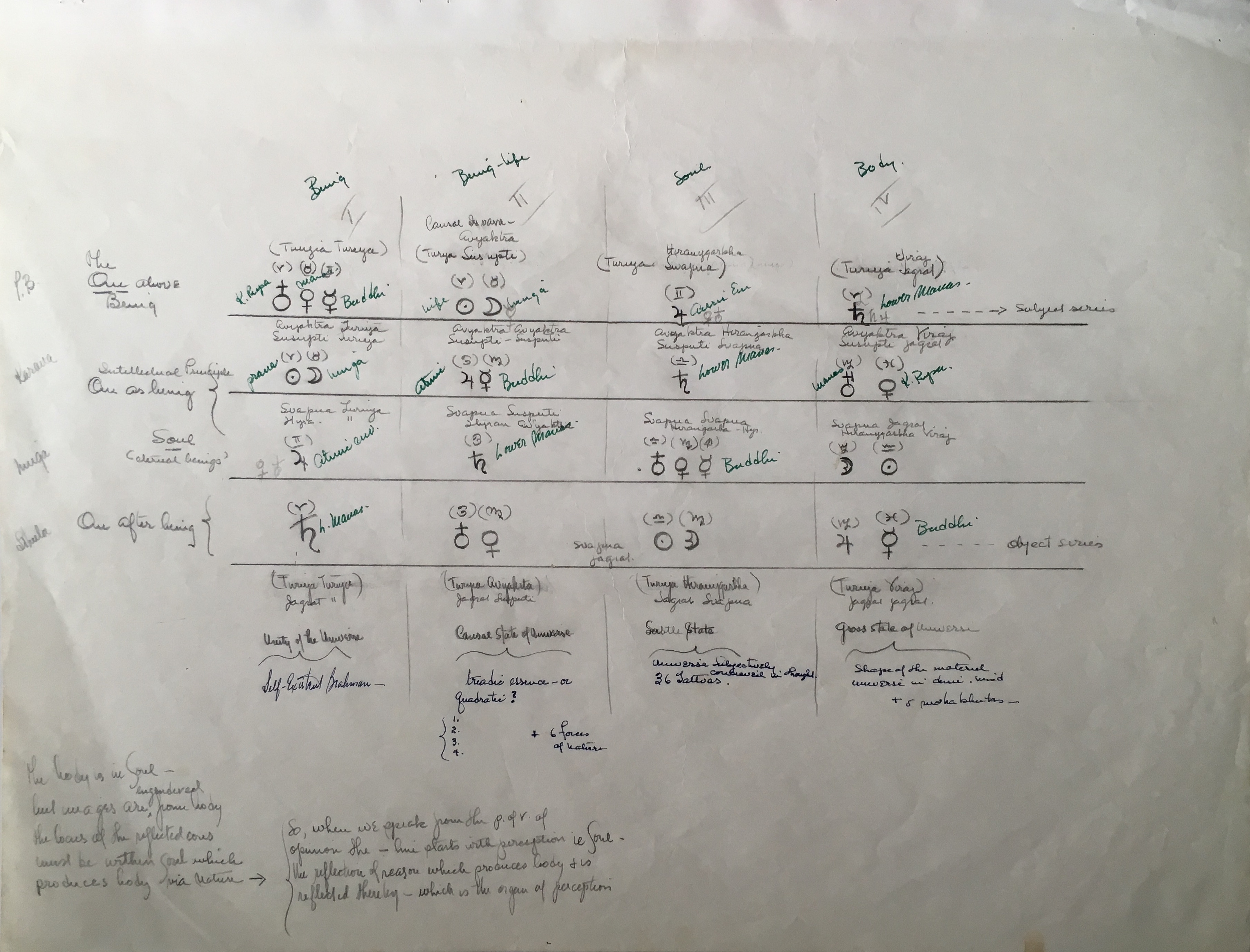
The Sixteen States of Consciousness and Seven Theosophic Principles of Man Mapped on to the Dignities of the Metaphysical Chart Arranged as a Table
Metaphysical Chart
This is a 4-row by 4-column table. (For ease of reference, the columns will be referred to as columns 1-4, reading from left to right, and the rows will be referred to as rows 1-4, reading from top to bottom.)
Columns 1-4 are the quadrants of the metaphysical chart, with one exception: row 1, labeled “the One above Being,” consists of the dignities of the first quadrant, and the columns divide them by rulerships, exaltations, Soul detriments, and falls, not by quadrant.
Row 2, labeled “Intellectual Principle,” consists of the exaltations; row 3, labeled “Soul,” consists of the Soul detriments; and row 4, labeled “One after being,” consists of the falls. Rows 2 and 3 are bracketed as “One as being.”
Each entry in the table is associated with one of the sixteen states of consciousness, where each of the four states—turiya, sushupti (deep sleep), svapna (dream), and jagrat (being awake)—is, in turn, divided into four, so there is, for example, turiya-turiya, turiya-sushupti, turiya-svapna, and turiya-jagrat.
In this diagram, when determining the name of the state that applies to a dignity, the ring determines which of the states comes first, and the quadrant determines which of the states comes second.
Each entry in the table is also associated with one of the sixteen aspects of Brahman, where each of the four aspects—Turiya, Avyakta (unmanifest), Hiranyagarbha (subtle), and Viraj (gross)—is, in turn, divided into four, so there is, for example, Avyakta-Turiya, Avyakta-Avyakta, Avyakta-Hiranyagarbha, and Avyakta-Viraj.
In this diagram, when determining the name of the aspect of Brahman that applies to a dignity, the ring determines which of the aspects comes first, and the quadrant determines which of the aspects comes second.