Diagram H36
The Indeterminate Dyad, Intellect Inbound with Being, and Intellectual-Principle as Including the Completing Act of Being
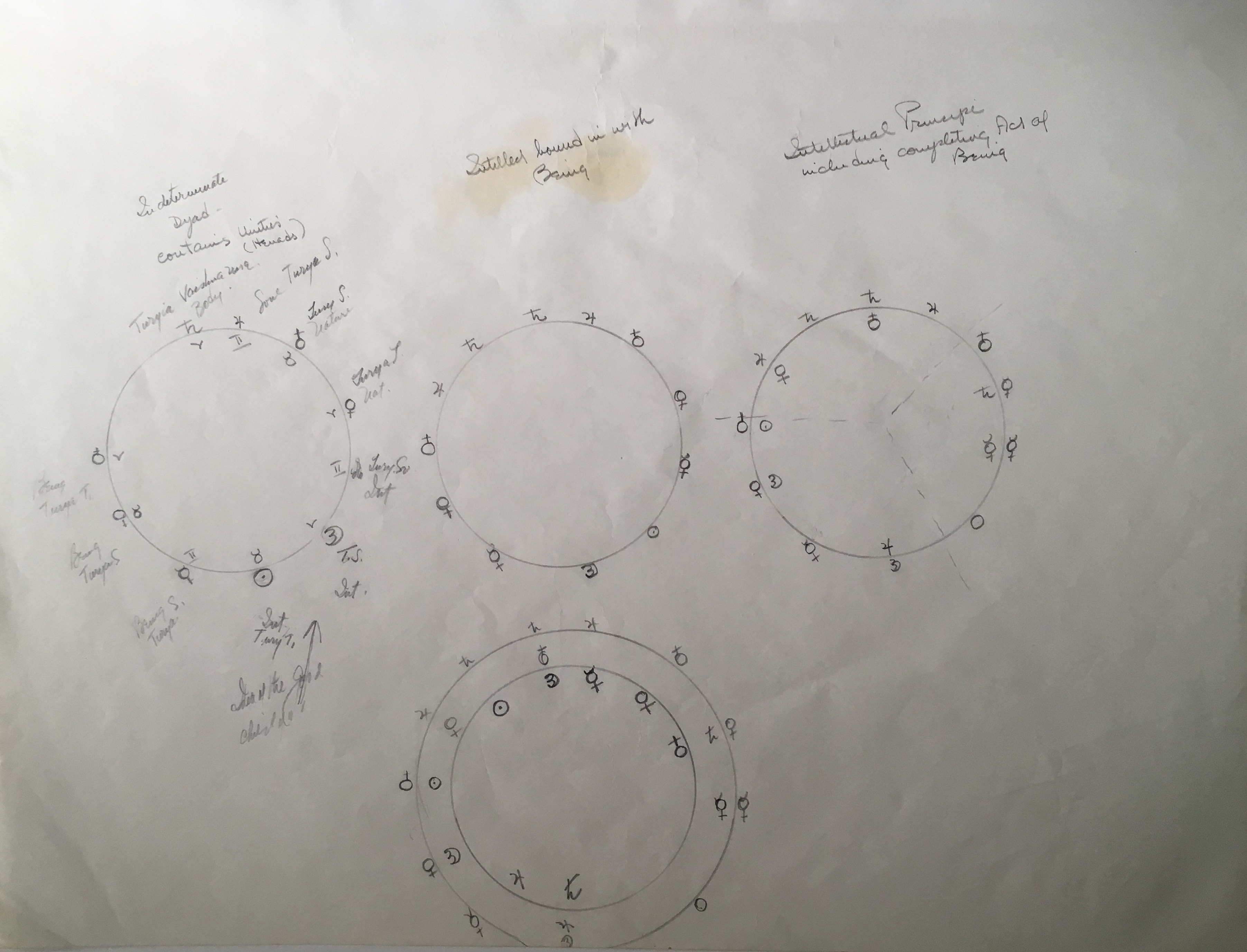
The Indeterminate Dyad, Intellect Inbound with Being, and Intellectual-Principle as Including the Completing Act of Being
The One and Intellectual-Principle
There are three circles at the top and one at the bottom. The way in which the planetary glyphs are distributed around these circles suggests the circles are divided into twelve houses, although the divisions are not explicit.
The left circle distributes the ten dignities of houses 1-3 of the metaphysical chart across houses 1-10, but note that the signs for the Sun and Moon are transposed.
Each of these dignities is associated with one of the sixteen states of consciousness, where each of the four states—turiya, sushupti (deep sleep), svapna (dream), and vaishvanara (being awake)—is, in turn, divided into four, so there is, for example, turiya-turiya, turiya-sushupti, turiya-svapna, and turiya-vaishvanara.
In this diagram, when determining the name of the state that applies to a dignity, it seems that the quadrant determines which of the states comes first since all the dignities are in the first quadrant and the names all begin with “turiya.” Unlike in some other diagrams, where the ring position then determines which name comes second, here it seems that all the Aries dignities are labeled “turiya,” all the Taurus dignities “sushupti,” and all the Gemini dignities “svapna,” although this pattern doesn’t hold for Saturn in Aries, which is labeled “turiya-vaishvanara,” not “turiya-turiya.”
The middle circle lists the twelve rulerships of houses 1-12.
The right circle lists the rulerships of houses 1-12 on the outside and the exaltations on the inside and is also divided into thirds.
The bottom circle lists the rulerships of houses 1-12 on the outside of the circle, the exaltations on the outside of the smaller concentric circle, and the Soul detriments on the inside of the smaller concentric circle.