DIAGRAMS FOR 1972 1201
Class
Friday, December 1st, 1972
Verbatim, unedited transcriptCLASS at Wisdom's Goldenrod, Hector, NY
with Anthony Damiani (AD)
December 1, 1972
JUNG; ARCHETYPES
TOPIC: Jung
SUBJECT: Archetypes
SUBSUBJECTS: Three Circles Diagram(s), Soul, Demiurge, Idea of Man, Categories of Imagination, Bacchus/Dionysus
CONTENTS:
Three Circles Diagram(s)
Discussing middle circle as Soul
In which circle can Jung's absolute knowledge be placed?
In which circle can Jung's archetypes/categories of imagination be placed?
Idea of Man in top circle
Demiurge in middle circle
Creatures/world-image in bottom circle
Distinguishing Overself and Idea of Man
The Demiurge and Bacchus/Dionysus
BOOKS READ FROM OR REFERENCED:
Plotinus, The Enneads (MacKenna translation, 4th ed.)
C.G. Jung, CW 9, Part 1, The Archetypes and the Collective Unconscious
C.G. Jung, CW 14, Mysterium Coniunctionis
Thomas Taylor (tr.), The Parmenides: A Dialogue on the Gods (Vol. 3), in The Works of Plato, viz. His Fifty-Five Dialogues, and Twelve Epistles
DIAGRAMS appended to this transcript:
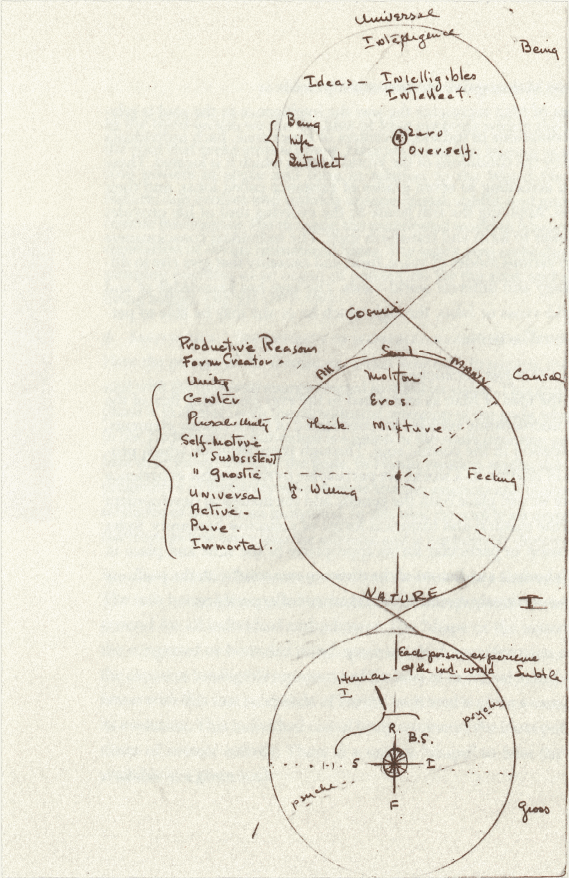
FIGURE AD_G_012. Three Circles Diagram: Divine Intellect, Soul, Psyche.
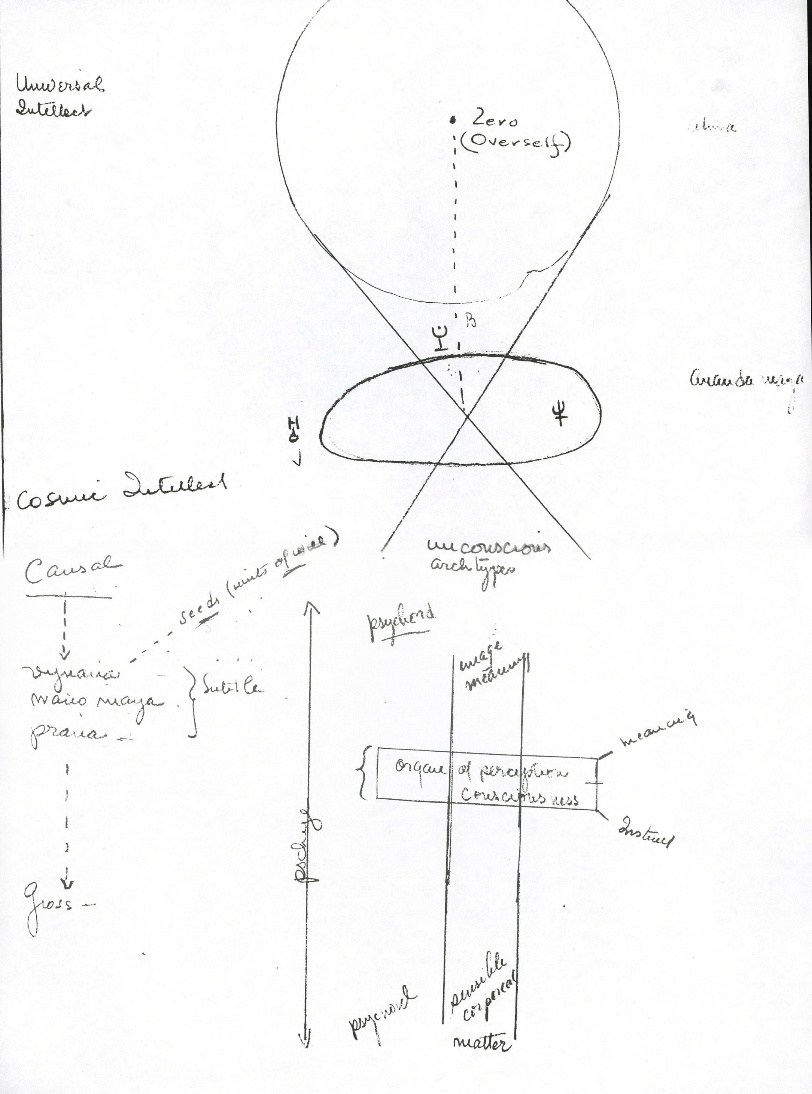
FIGURE AD_G_019 merged. Universal Intellect, Cosmic Intellect, Psyche.
These diagrams are not from this class but are close enough to help follow along. Other diagrams also referred to are not with this transcript version. [Transcriber note: [diagram] means the speaker is referencing a diagram as he or she is speaking. If someone is drawing or writing, with audible sounds of chalk on a blackboard, I indicate this by [drawing] or [writing].]
TRANSCRIBED Verbatim by IT 2023. In 2025, IT updates prefatory matter, adds more notes within transcript referencing the diagrams, shortens first diagram note, updates audio file markers to match new REP audio. Archival verbatim transcript – V12a.
AUDIO FILES: 1972 1201a (formerly 1972 1208a). [Note 1: "Tape" refers to original audio cassette tapes that were later digitized into .MP3 Audio Files. Note 2: We only have audio for the tail end of the class, we are missing the rest. Note 3: Originally found on Audio File 1972 1208a; REP Studio fixes in 2024.]
1972 12/01 at Wisdom's Goldenrod
Jung; Archetypes
[Audio File 1972 1201a (formerly 1972 1208a) Begins]
AD: Ok? This is the diagram I worked with originally [diagram]. Ok? That's all. Then, if I wanted to make a sensible world, so to speak, I would make another diagram, ok, [drawing] and over here this individual ray, the absolute consciousness of the Overself, so to speak, creates one world here and another world here [diagram]. Now, all I'm doing is taking this circle, so to speak, out here [diagram]. [drawing] [Note: See FIGURES AD_G_012, AD_G_019 merged for the following.] Alright, and you can do it this way, ok. You could have three circles here. Because basically this is what I'm talking about, the-- the graded Triad that Plotinus refers to, the One, the One-Many, the One-and-Many. Alright? Now, does the One-and-Many, so to speak, coincide with the One-Many? Does the One-Many coincide with the One? You see what I'm trying-- the problem I'm trying to get out in the open? In other words, this here [diagram], this-- this is the-- this is where the problem really lies, the soul [middle circle]. [drawing] [short pause] What he speaks over here, body and mind [bottom circle]. [drawing] We spoke of this as the Witness-I. The cosmic Intellect. In other words, we spoke of this as the creative aspect of the Logos, the soul [middle circle]. Well you follow what I'm trying to do, Paul.
PD (faint): I'm not sure.
S: Tony, is it true that you can see that middle circle [diagram] either as like the top of the bottom circle from one point of view, or the bottom of the top circle from the other point of view?
AD: You can see is the bottom of this [diagram]-- this second [S simultaneously: Yeah.] circle you see the bottom of this here [diagram]?
S: In other words, can that middle circle be seen as either a body or a god depending on your point of view?
AD: A body?
S: A sheath. A body.
[short pause]
AD: Well, wouldn't-- aren't you trying to say that this is what that is? [drawing] The subtle realm of creation, the Hiranyagarbha principle? What do you think, Richard? Come on, try to get into this.
S (faint): Will it be [one/two words inaudible]
AS: Well--
S: For Plotinus, yeah.
AS (simultaneously): That's the last of the eternal natures-- it's the last eternal nature, it is the first of the generated natures, both. Soul, that middle realm.
AD: Would you say that louder?
AS: Well, [S simultaneously: That's my question.] that-- for what it's worth. Well Proclus talks about the soul as the-- the last of the eternal natures-- Ok, coming-- if you look at it from coming down it's the last of the eternal natures. It's-- it's sort of its-- he says it's connascent with time. Ok but-- but that's-- that's something else. It's the last eternal natures and looking up it's the first of the generated natures. So depending on the way that you look at it it can be both together.
AH: You said that a couple weeks ago is the level of the Witness-I and it looks down toward manifestation and it looks up toward--
AD: That's what he just said [AS assents, faint] in terms of Proclus. Yeah. Well then, what world do you think Jung is referring to? [short pause] Go ahead, let's take a chance.
RG (faint): Yeah there's a-- well just that one sentence, there's a quote here, something about archetypes as the patterns of behavior and clothed in images. Says--
C.G. Jung [CW 9, Part 1, The Archetypes and the Collective Unconscious, "Psychological Aspects of the Mother Archetype," p. 78, paragraph 152, RG reading]: "These images…"
AD: Louder Richard, I can't hear.
C.G. Jung [CW 9, Part 1, The Archetypes and the Collective Unconscious, "Psychological Aspects of the Mother Archetype," p. 78, paragraph 152, RG reading]: "These images are"primordial" images in so far as they are peculiar to whole species, and if they ever "originated" their origin must have coincided at least with the beginning of the species."
[short pause]
AD: Yeah. How do you want to connect this?
RG (faint): Well I was thinking [couple words inaudible] there that the question of origination of these archetypes is really up in the air and to say that-- that the origin's (always just--) Says--
C.G. Jung [CW 9, Part 1, The Archetypes and the Collective Unconscious, "Psychological Aspects of the Mother Archetype," p. 78, paragraph 152, RG reading]: "They are the"human quality" of the human being, the specifically human form his activities take."
RG (faint): Said-- I mean it seems the question of origination of these archetypes, put it in the causal realm, Jung really leaves up to grabs in that sentence, he, you know-- he's leaving it open. I mean I would infer there that, you know, he would just as much imply that they're not-- that they're-- that they're never originated.
AD: Well, look at it this way. If we try this here, if we have a dog here [bottom circle], the entire intelligence of the dog species is embodied in that dog, alright, whether you have one dog, a thousand, or a trillion. Now if we try to-- if we try to conceive of this intelligence that's in the species in terms of categories of thinking, you're forced [one/two words lost due to poor tape quality] categories that are applicable here in terms of-- in other words, this is a stadia-- one stadia [drawing] of existence, this is another stadia. This is also Samkhya language. You cannot take the categories that apply here [diagram] and bring them up here [diagram]. So we have to work here and try to understand what comes down here [diagram]. But if-- if we say that there are one do-- one dog or a thousand dogs that embody this intelligence in once-- in one animal, alright, then if we take the Idea of the Dog up here [transcriber thinks middle circle], alright, and I don't know if we can even use the word 'Idea', let's imagine a dog soul up here, you know, the embodiment of the species of Dog, it would have to manifest in here, in this-- in this one down here [bottom circle]. You think that that might be the ground that he's talking about? Paul? [short pause] In other words, when he speaks of absolute knowledge you think he's speaking about here [middle circle], or do you think he's speaking about up here [top circle]? Yeah, go ahead.
AH: He's speaking about the middle circle [diagram].
AD: I would-- I would assume that much.
AH: But then in one quote you read I think he implied because it's [one word inaudible]
AD: Yeah.
AH: But he doesn't talk about that.
AD: Isn't that so? Don't you think so?
PD (very faint): Well I agree. Life is subtle, (maybe) that's [couple words inaudible] Whose fault is that?
AD: Well, that's the Hindu terminology, let it out.
[AD drawing]
PD (very faint): Well, you told before you [couple words inaudible]
AD: Huh? Paul, leave it out now. I'll explain why (later). I don't mean subtle according to our five classifications. [short pause] Would you buy-- would you buy what was just said?
S (very faint): Yes.
AD: Well then, when he speaks about an archetype, he's speaking about-- he says these are the categories of the imagination. In other words, this formulates, determines how we're going to imagine, how a certain image is going to arise in our mind. Where would you put that? [short pause] In here [bottom circle] or would you put it up here? [Note: Transcriber thinks reference is to middle circle or right below middle circle, as in FIGURE AD_G_019 merged.]
AS: Part of that thing up there [one/two words inaudible] context of these and more. I mean unless-- unless of course they'll be in some other realm before [one/two words inaudible] I mean--
AH/S(?): Isn't that what he's trying to say here (by equation)?
S (faint): Uh-hm.
AS: Well, yeah. No, besides-- besides what he says about psychoid. [student assents] Like if you take something which is like eternal, it's always going to exist, all the time, never-- it never changes or it's beyond time and everything. And you take the idea which we get in our mind which just comes up every-- every-- every moment in time, then-- then how it-- how it's something which is-- which doesn't change--
AD (simultaneously): So you're putting the archetype back here [diagram], aren't you?
AS: Well something which doesn't-- it has to-- well, the ori-- the archetype per se I have-- you'd have to put up there.
AD (simultaneously): You have to put it up there.
AS: Because otherwise you have to postulate something before that and you get into an infinite regress. So you have to start from the assumption that there's something which always exists beyond time and leave it at that, it's beyond everything. And then-- and then-- and that doesn't change, that always stays there. On the other hand, since like it's of such a nature or whatever that doesn't change at all and always exists, it can't-- it's not the thing that directly structures us down here every minute in time. I mean, essential nature would have to be up there.
AD (simultaneously): Alright, so-- Avery, so what you're saying is the Idea of Man as an archetype is up here [diagram].
AS: I-- I-- that's what I would say, I mean when you-- it depends what you mean by Idea.
AD (simultaneously): How about that, Paul, would you?
PD (faint): I don't know what the Idea of Man is.
AS: Yeah, I don't know what-- I'm not sure what you mean by Idea but-- but Idea per se would have to exist eternally, so that it can--
PD (faint): (If/But) it's called Idea, so that Ideas must inhere in the universe I would say in that top circle [diagram].
AD: I'm sorry, repeat. Repeat it.
PD (faint): The principle of Ideas, that there's a necessity for Ideas to govern manifestation is in that top circle [diagram].
AD: Would you put the Idea of Man up here [diagram]?
PD (faint): I don't know what that means.
AD: Definition of man you want?
PD (faint): I don't know what that means.
AS: Well, according to-- according to-- well, it depends, according to Plato anyway. 'Cause Plato talks about the eternal paradigm which is like the-- the-- the thing that the Demiurgus looks at to produce the world down here. And if you put the Demiurgus in that middle circle then looking up to the eternal paradigm where it has to be the essential Idea of Man in order for him to produce man down here. But--
AD (simultaneously): In other words, if the Image of Man is up here [top circle], alright, if the Image [AS assents] of Man is up here, and then the Demiurgus looks at that image and he's got to create it in space and time, he's going to take this image here, so to speak, and little by little it's going to be in here [bottom circle]. [drawing] But it's going to be in time, so it [AS assents] has to be broken off into sections. Would you buy that, Richard?
RG/AS(?): I don't know.
RP (faint): It's not really valid, in one sense it's not really-- I think the Demiurgus only contempli-- contemplates one paradigm. Now that's true that that becomes man, becomes the world, becomes everything. Because the image of Man makes the question, there's really only one, like the World-Idea. And it gets differentiated into man, world, etc, in the middle.
AS: But that--
AD (simultaneously): You say it gets differentiated, what do you mean by that? Over here we have the Idea of Man [diagram] and [RP simultaneously, faint: (Of) Man (couple words inaudible)] it has to get to-- huh?
RP (faint): The Idea of-- Idea, it's not man, it's the Idea of forms per se.
AD: Alright.
RP (faint): It's not man yet, you know, like in the middle realm [AS simultaneously: Right, in other words--] [couple words inaudible] so you can make the distinction between man, angel, god(s).
AS: In other words, up there you can't make any distinction of up and down on the circle, yeah.
RP (simultaneously): No, exactly, eternal paradigm of which everything is a replica, circle within circle. [AD hits board] But it's true that (if) you want to take man and trace him back ultimately, ultimately, ultimately, you have to reach this eternal paradigm, which is based on the universal paradigm of everything, not only man.
AD: So I would find the paradigm for instance of lion, horse, right?
RP: In its-- in the essence of when every-- everything that makes a lion a lion is [one word inaudible] removed and only Being remains, then yes.
AD: Well, for instance the notion-- besides the abstract notions like sameness, you know, justice, if I-- if I think of one particular form, the form of man. Alright? Now when I say the form of man of course, that would include it the way we define man. I mean not the physical body, but all those sheaths that we spoke. This is the man to me that I'm talking about, I don't know what man you're talking about.
RP (faint): Including the Atman?
AD: Huh?
RP (faint): Does it include the Atman?
AD: Well, what would be up here [top circle]?
RP (very faint): [couple words inaudible]
AD: Well, in PB's terminology that will be the Overself, wouldn't it?
S (very faint): Yeah.
RP: But then why is that [couple words inaudible] higher? So-- then that becomes the Idea of Man, the Overself.
AD: That's the Idea of Man, ok.
RP: It's also the Idea of Lion.
S: Yeah.
AD: [AD hits board] Would you say it's the Idea of Lion?
RP: Well, all cases(--) if man is a better, a more perfect [one word inaudible]
AD (simultaneously): You remember the example Taylor gives? He says, this is the Principle of Unity [diagram], alright. That's the Principle of Principle. And you have in it all these Ideas. And he gives the example, these are like trees, all these trees are rooted in the earth. But each tree is distinct from every tree and yet they all, so to speak, participate in earthiness. But the principle, earthiness, remains always the principle, the Principle of Principle. [Note: See Thomas Taylor (tr.), The Parmenides: A Dialogue on the Gods (Vol. 3), in The Works of Plato, viz. His Fifty-Five Dialogues, and Twelve Epistles, p. 162, footnote 1.] Alright? Now, if you have these Ideas within the World-- [AD hits board with chalk] so to speak, up there [top circle], and this Idea has to be brought down here [bottom circle] and manifested down here, the Word has to be made flesh, alright. So we take the notion of the Overself and we gotta-- we've got to by steps and degrees as you say differentiate out the meaning of that into this here [bottom circle]. But this has to be in time and space so it cannot be like it is over here [top circle]. It has to go through this whole transformation process. [drawing] So that, when we come up and we have this Idea of Man, the Overself here, [drawing] we may have to consider it this way [diagram]. In other words, in order to get the image of this Man, the Overself, the Idea of the Overself here [top circle], down here we would have to have the whole world-image presented or we'd have to go through the whole process to see what this originally meant. But what takes this here and differentiates it and separates it and projects it out into this world? There has to be this thing here [middle circle], that intermediary realm. [short pause] Now, if this is difficult, it's obvious it's difficult because even Jung has trouble here!
S (faint): I don't follow your answer to Richard's [S simultaneously: Right.] question but--
AS: That still leaves a slight question open which is I guess (you were about) to answer.
AD (simultaneously): Ask. Go ahead.
AS: Which is, is it this one Over-- is it-- is it the one principle of Overself which manifests as both human beings and let's say all entities, which--
AD: I'm sorry?
AS: Is it this one principle-- is there just this one principle of Overself which, so to speak, the Demiurgus manifests as man and animals and everything, or is it that just this one principle of Overself is manifest as men and it's a different principle of-- different principle of Overself manifest as animal, so to speak, is there an Overself of horses let's say.
AD: There's an Idea of Horse.
AS (simultaneously): Or the I-- Yeah, ok now-- Is that the-- is that different from the--
AD (simultaneously): There's an Idea of a Lion. There's an Idea of Man.
AS: Then that's-- that's different from the Idea of Overself though. Or-- [AD hits board with chalk] I mean what is-- [short pause] It seems like the Overself is like the principle of entity, so to speak, the unmanifest principle of-- of a Self, you know, of-- the general-- this is just this more generalized principle of-- of entity, of-- or Self.
AD (simultaneously): No, not at all, not at all.
AS: Well-- well don't they [AD simultaneously: No.] speak-- well don't they speak of like a--
AD: Let's look at it this way, let's say you have the Idea of Man, let's forget the word Overself. [AS: Ok.] [drawing] Let's say we have the Idea of Man here, the Idea of Lion [top circle], ok? And down here we will have many lions, many men [bottom circle], ok? It's one Idea up here [diagram], but over here it's many [diagram]. We have one dog here, the Idea of one Dog, the Idea of Dog down here you could have trillions of dogs. In no way have you exhausted, ok, the Idea of Dog.
RG: That's why-- and Richard's [couple inaudible student words simultaneous with RG] saying that the-- that the conception even of-- of one man or one lion only comes about in the middle realm [diagram]. You can't speak of that.
AD: Can you speak of one here [diagram]? Or here [diagram]? Can you speak of one man here or the Idea of Man?
RG (faint): Well, you can speak of the Idea of Man as--
AD: That excludes, that excludes any possibility of numerical signification, [RG simultaneously, faint: But in a differentiated--] ok? Over here is Man, [RG assents, faint] the Idea of Man [top circle].
AS (very faint): Yes but, what is it?
AD (simultaneously): Wait a minute.
S (very faint): [few words inaudible]
AD: Richard, let me see-- let me see if I follow. Over here we speak of many souls [FIGURE AD_G_012, middle circle]. Alright? Many souls. Let's say these many souls become these many men [bottom circle].
RG: But even to speak of the I-- the Idea of Man differentiated against the Idea of Lion in the World-Mind Richard's saying is a problem. You can't speak of that, there's only one Idea. It's not an Idea of any entity, just one Idea.
AD: You see, Richard is talking [AD hits board] now for instance, he's talking now of the Divine Mind grasping the entirety of Ideas as an intelligible content that is Himself. Now I'm speaking from down here looking up. That intelligible content of this, the Divine Intellect, is splintered down here.
RG (faint): Right.
AH/S(?) (very faint): Right.
AD: Ok.
VM (faint): (And therefore) you can't put archetypes in the top circle [diagram].
AD: Huh?
VM: If that's the case then you can't put archetypes in the top circle.
S: Except as looking up.
VM/S(?): If you're looking up.
RG (simultaneously, faint): No, not even as looking up.
VM: Not even as looking up. If I understand what Richard's argument is and if you seem to understand it then the logical consequence is that archetypes don't belong in that top circle [diagram].
RP (faint): I think that's where they do belong because that's the way it looks to the guy in the middle.
VM/S(?): From the point of view of the third circle or from the top?
AS: Yeah, from the guy in the middle, he sees it as archetypes, he--
S (very faint): No it doesn't.
AS: That's what he sees. But that's not--
VM (simultaneously): Ok but from the point of view of the middle, from the point of the soul looking up there appears to be archetypes but when in the World-Mind there is only one Idea, you can't speak of archetypes within that.
AS: That's Richard's point.
AD: Yes but I'm pointing out now that what Richard is saying is this one Idea that he's speaking about contains the unity of all the Ideas. Now the point that I'm trying to get at and-- is something like this. You remember the quotation from Tertullian? He says the soul looks upon Nature and learns from Nature as a disciple what it's supposed to (encourage) and then manifests according to Nature's principles, Nature in turn being the agent of the All-Soul [FIGURE AD_G_012, middle circle]. But the All-Soul [drawing] gets the Ideas from above itself. I'm sorry we got to make this digression into metaphysics but, for Jungian purposes it'll be useful, alright. Because he has this chapter on the Unus Mundus in the-- in the big work, the Mysterious Conjunction, this is what the chapter is about. [Note: C.G. Jung, CW 14, Mysterium Coniunctionis.]
RP(?) (very faint): You don't (bring in--)
AD: You--
RP (faint): But if we bring in then as man, there are two fabricators. There's a-- there's a [student assents] point directly above all the physical Nature which is Dionysus, Bacchus.
AS: Bacchus.
AD: Uh-huh.
RP (faint): And then there's the one that-- like the cosmic 'I', you know [few words inaudible]
VM(?) (simultaneously): (Creative) soul.
AD: That what?
RP (faint): That-- Bacchus is not Demiurgus like we-- like we determine it in the broadest sense. It's just the one directly-- it takes all these things and splits it up into maya. That's its only job.
AD: What does that sound to you like? The principle of individuation.
S (very faint): Yeah.
AD: Right?
RP: Ok. But above him is like the fabricator and the maker of the world as a whole. Maker of wholes.
AD: So-- [drawing]
RP (faint): The division there, I think that's the one who takes care of the whole thing.
AD (simultaneously): Yeah. You see how complex this whole thing is. On the one hand, now, and this-- this is exactly the way the Platonists look at it, and even I think you'll see that most of the other traditions. On the one hand, you have the first creator. [drawing] He's one creator. He's always looking up here contemplating that [top circle], alright? Within that there's another creator here [diagram] taking-- taking that and bringing it down here [bottom circle]. They refer to one as Dionysus and the other as Bacchus.
RP (faint): I don't know if it's [S simultaneously: No, the same guy.] Bacchus, I thought Bacchus is Dionysus.
AD: I'm sorry?
RP (faint): Bacchus-- Bacchus (rhymes) with Dionysus.
S (simultaneously, faint): That's Dionysus, (uh-hm).
S (faint): Dionysus and Bacchus.
AD: Dionysus?
S: Yeah.
AD: Well what'd I say?
S (simultaneously): And the other one is Apollonius.
MB (simultaneously, faint): It's the same thing.
AD: The other one is Apollonius?
S (very faint): Yeah.
AD: [one/two words inaudible]
S: Dionysus [S simultaneously: Yeah.] and Bacchus is the same.
AD (simultaneously): Alright, alright.
AS: Yeah, [AD simultaneously: Alright so--] with a different name.
AD: How do they name them?
AS: Just-- they're both this-- Bacchus and Dionysus are the same guy, just down, the lower one.
RP (faint): (He's) the fabricator of all divisible natures and bodies, but that's--
AD: Alright. [drawing] And the gazer?
RP (faint): Well, they don't give it a name, just called the [couple words inaudible] just called the-- the fabricator and--
AD: Fabricator? Alright. [drawing/writing] Fabricator, that's enough.
RP (simultaneously, faint): Demiurgus.
S (faint): Tony it's going to snow.
AD: Snow? Alright.
S (very faint): No.
AD: Well, there's an archetype out there that tells me stop.
S: Is it snowing out?
AD: Yeah.
S (very faint): What kind of snow?
S: Uh-oh.
AD: Now the reason I'm bringing this up is because I want to see where Jung lives. Which one of these circles he's living in.
LS: All three like the rest of us. (bit of laughter)
[few seconds of background student talking; continues till the end]
AS (faint): That doesn't really (help us) follow it, we--
AD (faint): No, it's ok.
AS: The problem-- the problem that was brought-- yeah except that we had never been discu-- we had been trying to do that, like where-- where is this Demiurgus. I mean it seems pretty clear (as you said), in the paradigm he's up at the top circle [diagram].
S (very faint, possibly part of background): Yeah.
AD: This is the paradigm, three circles, ok.
AS (simultaneously): Yeah. And that's what he contemplates.
AD: And this is what he contemplates. And, the point-- the point I'm trying to reach is this where he contemplates, alright, Jung calls the absolute knowledge.
AS: Yeah.
AD: Now that absolute knowledge certainly cannot be the archetypes.
AS: That-- that's a--
AD: Because if (it--) that absolute knowledge depends upon the archetypes.
AS: I mean that certainly had to be Plato's Ideas, you know, with the Good up-- yeah, with the Good up way beyond that.
AD (simultaneously): Yeah, these are Plato's Ideas [top circle], (sure). So what he's talking about all the time is this realm here [transcriber thinks middle circle], he's not-- And well, if you put the archetypes here the whole thing (had to--)
AS: [three words inaudible] Weren't we just saying, like he's got all kinds of levels of intelligible. And there's the intelligible which is right at the-- the summit of-- of his-- what you call soul, which reaches-- you know, which bridges the gap, so to speak, of the-- this upper-- uppermost [one word inaudible]
[Audio File 1972 1201a (formerly 1972 1208a) Ends]
1972 12/01 V12a: CLASS: Jung; Archetypes. Copyright 2025 Wisdom's Goldenrod p. i