DIAGRAM FOR 1973 0223
Class
Friday, February 23rd, 1973
Verbatim, unedited transcriptClick the series name to view more
CLASS at Wisdom's Goldenrod, Hector, NY
with Anthony Damiani (AD)
February 23, 1973
JUNG; ALCHEMY
TOPIC: Jung
SUBJECT: Alchemy
SUBSUBJECTS: "The Psychology of the Transference," Rosarium, Astrology
CONTENTS:
Jung, "The Psychology of the Transference": quick review of some previous sections followed by a discussion of conjunction and its meaning
Mysterium Coniunctionis and astrological examples (with focus on progressed Sun Moon conjunction) are used to elucidate the notions of conjunction and transformation of personality
Guenther (Naropa) quote on Tantra as ground, actuality, and inalienableness as description of astrological processes of the transformation of personality
Used to demonstrate that you can't speak of impersonal astrological processes as happening to an ego, that it's important to stop identifying with these processes as "you"
Jung's "psychic non-ego" defined as impersonal astrological processes
BOOKS READ FROM OR REFERENCED:
C.G. Jung, CW 16, The Practice of Psychotherapy, "The Psychology of the Transference"
C.G. Jung, CW 14, Mysterium Coniunctionis, "The Conjunction"
Herbert V. Guenther, The Life and Teaching of Naropa
DIAGRAM appended to this transcript:
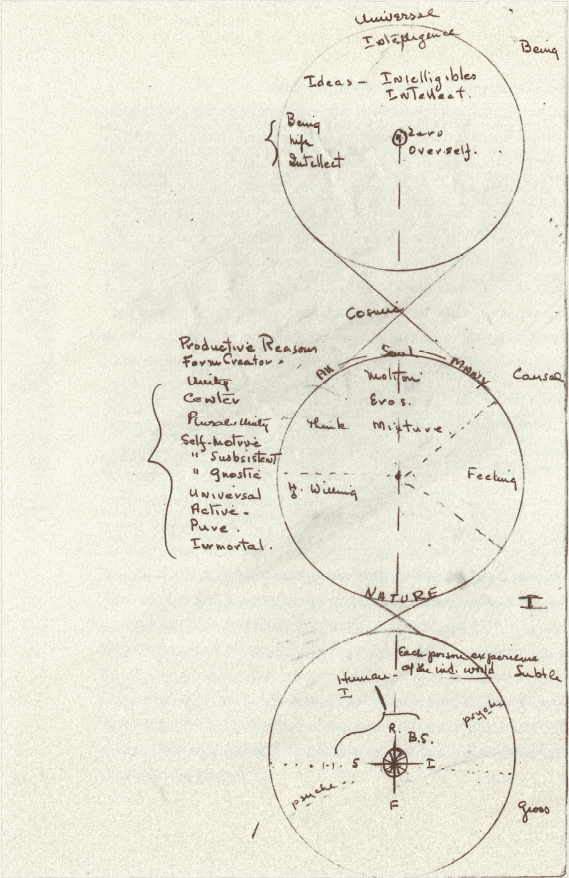
- FIGURE AD_G_012. Three Circles Diagram: Divine Intellect, Soul, Psyche.
NOTE: For readability's sake, the following substitutions/edits made in Verbatim Transcript: cuz = because; yeah = yes.
TRANSCRIBED Verbatim by IT prior to 2017, reformatted by jf 2017. In 2023, IT uses new more complete audio file and adds two paragraphs at the very beginning of the transcript, updates prefatory matter, footer, and audio file name, fixes errors/typos, adds new notes within transcript, adds one diagram and reference within transcript to this diagram,. reformats to accord with new conventions. Archival verbatim transcript – V12a.
AUDIO FILES: 1973 0223a. [Note: We only have one audio file for this class, we are missing the rest.]
1973 02/23 at Wisdom's Goldenrod
Jung; Alchemy
[Audio File 1973 0223a Begins]
AD: --a mineral, vegetative, rational [couple words inaudible] or symbolized in three different ways, six stars (contained in) Mercurius, Mercurius being the father and mother of itself and the others. And I often refer to this as the rulership and exaltation of Mercury. [student assents, faint] And then we have three pipes, you know, leading out from the fountain. If I remember, he said something like "sun and moon, [who] are [AD reads: was] the indispensable acolytes and parents of the mystic transformation" that we're interested in. (C.G. Jung, CW 16, p. 206, paragraph 403) And they were located above the star, the symbol of the unity of the four hostile planets. Louder? Above that was the divided serpent, binarius vaporius, which initiated the process or conflict between the [one word inaudible]
The Greeks were acquainted with that and they refer to that process as the tetrameria, the transforming process, as the four elements, states of change, would be the-- the triple Mercurius which represented the inorganic and organic realm, and the spiritual. But I don't like that word 'spiritual', I prefer the word 'mental' or 'rational' like the Greeks. And after attaining a Sun Moon conjunction, and, after that happened of course, they claim that there-- there was formed the one indivisible anima. And the second part arose in the picture of course, in picture 2, the product of the three living things, and you have the king and the queen and the Holy Ghost. (C.G. Jung, CW 16, p. 213) The Mercurius can now only be thought of as spirit, a spirit which has three forms, if we remember, masculine, feminine, divine. This was, so to speak, the representation of the Primordial Man, which was quite in contrast with the original Mercurius in the first chapter, who as we just said represented the three realms of the inorganic, organic, and the rational.
S (very faint): Uh-hm.
C.G. Jung [CW 16, The Practice of Psychotherapy, "The Psychology of the Transference," p. 216, paragraph 416, AD reading]: "He is [AD says/reads: Symbolically he was supposed to represent] man's totality, which is [AD reads: was] beyond the division of the sexes and can only be reached when [AD adds: the] male and female come together in one."
AD: And of course, you can see, and-- and those of you who read Tantrik Yoga will see that there's very close correspondences here. And, then Jung went into the notion of the incest motif and explained the ideas about kinship libido.
C.G. Jung [CW 16, The Practice of Psychotherapy, "The Psychology of the Transference," most likely p. 218, paragraph 420, AD reading/paraphrasing]: "(And) projection by transference…"
AD: Well, thank you (Linda). Pretty hard for a waitress to get around here, isn't it? (laughter, student words) She has to be one of those aerial creatures from the pictures. (laughter)
S: She just got bitten.
S: She got bitten by the Holy Ghost. (laughter)
S: Thank you. (more laugher, student words)
AD: And in the second chapter he goes on and points out that this-- the projections that take place by transference-- you got to remember, this Rosarium, he uses it to peg or to hang a lot of his ideas of psychology on it. He points out that in the transference between the patient and the analyst this always comes up, there's an appearance of these projections and a tendency towards very archaic and regressive tendencies. Then in the third-- third chapter, I think, he points out the first encounter with the shadow which is a moral and psychological task, a huge task. It's almost an encounter with reality. Almost, not quite. In the fourth there was the bath, the picture of the bath, a sort of "return to the dark initial state." And he-- he quotes Dorn as pointing out that this was the solution also to the problem. (C.G. Jung, CW 16, p. 241, paragraph 454) The birth of a new being takes place here, when there's this bath, if you remember the king and the queen immerse themselves in the bath of water, came from below. Yes?
RG (faint): (It's) after (the fifth) picture that you just described was after the confrontation with the (shadow)(--/?)
AD: I can't hear you Richard.
RG (faint): After the-- the fifth picture you just described after the confrontation with the shadow, the shadow like--
AD (simultaneously): Fifth picture?
LR: Before fourth.
RG (simultaneously, faint): Before you get to the fourth. Is that essentially-- does the fifth one sort of represent like the clean identification with the anima? (bit of laughter)
S (very faint): [few words inaudible]
S (very faint): [couple words inaudible] what?
AD: What's that?
RG (faint): Well I mean apart-- apart from contents of the shadow attracting to it.
AD: I didn't hear you. Again.
RG (faint): Is it like a clean identification with the sha-- with the anima?
[short pause]
AD: I don't know, I must be deaf, what'd he say?
S (very faint): (Nothing.) (laughter)
S (amidst laughter): Clean ide-- identification.
S (faint): Identification with the anima.
S (simultaneously, very faint): (Possibly.)
S: He uses the-- the word 'well-washed'.
AD: A clean identification with the anima?
S (simultaneously): Go on, Richard.
S: Yes. He asked this question.
RG(?) (simultaneously, very faint): [couple words inaudible]
LS: What is he talking about?
S: No clue.
S (simultaneously): I have no idea.
LS (simultaneously): Hey, what's a clean identification with the anima?
RG (faint): In that it's not contaminated by the projections of the shadow or--
S: [couple words inaudible]
S: But why?
AD: Wait a minute, Richard, you better follow me and not Jung. We said in the third part there's a first encounter with the shadow, and previous to that we pointed out, in the second part, we pointed out the notion of the-- he hangs his notion or his ideas of projection onto this Rosarium picture. And, in the projection or in the transference of the projection onto the analyst, the whole notion of the kinship libido come up, the infantile archaic vestiges of the personality. And he brings in the shadow here and points out that there's a confrontation with what a person really is like. But I don't see it in relationship to the pictures (in) Rosarium. So you have to keep in mind that, on the one hand, you have an alchemical text and on the other hand, he's hanging his notions onto that. Go ahead.
VM: But Tony, perhaps he derives that idea from the nakedness of the figure, this big experience. Is this the first time they don't have their clothes on?
S: [couple words inaudible]
VM: You know, if there's a certain stripping down to what you really are without your clothes on, which would be a persona or something, I mean, that's been really pushing it (hard).
AD: (You/It) can be free?
VM: Yes, I mean that's the first time that they-- you know, they're divested of their outer garments, of the persona if you like, and in that sense you confront who you really are and the shadow is revealed and so on. Didn't the queen look much nicer (with all) her royal robes on? (bit of laughter)
VM/S(?): Maybe [couple words inaudible] (laughter)
S (amidst laughter): [couple words inaudible] couldn't bring the shadow in. (more laughter)
[laughter, background student talking/whispering, silence, 21 seconds]
AD: I don't know, I still don't see it as a shadow conflict, you know? I see it as fear, but I don't see it as a shadow conflict.
VM: Fear, where does the fear come from Tony, the nakedness you mean?
AD: Yes, uh-hm.
S: Hm.
S: Isn't fear somehow tied up with the shadow?
AD (simultaneously): That's why I'm trying to separate them, you know.
S: Isn't fear very often tied up with the shadow though?
AD: Yes, it very often is but that doesn't necessarily mean that it's a shadow. There could be legitimate fear when you undertake to do something. What-- what these people were undertaking to do would certainly had-- they have reason to be legitimately fearful.
[short pause]
S (faint): Yes.
AD: You can, if you wish, you can [couple words inaudible]
VM (simultaneously): I can (do this obstructing) [one word inaudible]
AD: It's expressing a point I'm-- I'm inclined to think, because that whole third chapter he seemed to be kind of concerned with getting his ideas across, rather than what the picture actually means.
LS: Yes, I thought it was very different from the second one where he really seemed to make an attempt to elaborate the picture, yes.
AD (simultaneously): Where he was sticking to the point there and was collaborating and bringing out the point in the picture. [student assents, very faint] In the-- in the fourth one where he says the bath-- when he starts speaking about the bath, or he refers to it as the unconscious psyche, and it's supposed to return to a dark initial state. Now naturally, if the alchemists were studying(,) simultaneously(,) they were projecting onto the retorts or their physical laboratory of work, they were projecting onto these things certain images, then they had two systems to follow. At the one time they-- they were watching the projections that were going onto the retort and at the same time they were, so to speak, collating the symbols, you know, with some sort of theoria to bring-- bring the two of them together. But I still don't see a need to call it the shadow yet. At-- at any rate, he says that this is where the birth of a new being was being prepared. The quotation here is--
C.G. Jung [CW 16, The Practice of Psychotherapy, "The Psychology of the Transference," pp. 242, 244, paragraph 454, AD reading]: "[As the text to our picture explains:]"Our stone is to be extracted from the nature of the two bodies." … [The Rosarium remarks (p. 239) that] "[the] body is Venus and feminine, the [AD reads: and] spirit is Mercurius and masculine"; hence the anima, as the "vinculum," [the link] [AD: or the function of relationship] between [AD adds: the] body and [AD adds: the] spirit, would be hermaphroditic, i.e., a coniunctio Solis et Lunae [AD reads: a conjunction between the Sun and Moon]. … [In our pictures] the bond is effected by the dove [from] above and [by] the water [from] below."
AD: And this is-- would be equivalent to the soul, the dove above and the water below, the two aspects that we spoke about this as the two aspects of the instinct and its meaning.
S (faint): The what?
AD: Instinct and its meaning.
S (very faint): (Oh ok.)
C.G. Jung [CW 16, The Practice of Psychotherapy, "The Psychology of the Transference," p. 244, paragraph 454, AD reading]: "…an [AD reads: a] hermaphroditic being capable of uniting [AD reads: united] the opposites, but who is [AD reads: and] never complete in the [AD reads: an] individual unless [AD adds: it's] related to another individual [AD reads: to other individuals]."
AD: And here I'd ask you to look at note 15, where the-- the-- the point here which was important--
C.G. Jung [CW 16, The Practice of Psychotherapy, "The Psychology of the Transference," p. 245, footnote 16, AD reading]: "16 I do not, of course, mean the synthesis or identification of two individuals, but the conscious union of the ego with everything that has been projected into the"You." Hence wholeness is the product [AD reads: result] of an intrapsychic process which depends essentially on the relation of one individual to another. [AD adds: Such a] Relationship paves the way for individuation and makes it possible, but is itself no proof of wholeness."
C.G. Jung [CW 16, The Practice of Psychotherapy, "The Psychology of the Transference," p. 246, paragraph 455, AD reading]: "[AD adds: Here] Opposition and identity at once…"
AD: Then in, I think sections five and six, he speaks about the conjunction and the two (air or) two [one/two words inaudible]
C.G. Jung [CW 16, The Practice of Psychotherapy, "The Psychology of the Transference," most likely p. 252, paragraph 462, AD paraphrasing]: "Sun and Moon or consciousness and unconsciousness are brought together in a higher copulation which results in a death and in a new conception."
AD: And, in a sense, w-- we try to speak about this a little when we in astrology point out that whenever there is a put-- a conjunction in terms of a progressed Sun and Moon, it's usually a very big affair. It indicates the-- a new birth, something coming, and we have to wait on events, we can't force events.
LS: Is that your conjecture, that the progressed Sun and progressed Moon conjunction is where this begins? [S: What?] Is that the meaning of that picture, number five?
AD: That's my conjecture, yes. Because any of you, I think, (and/in)-- if-- maybe we can look up material in this matter, I think any of you who have had a Sun Moon conjunction would recognize that there's a combination of two things, alright, the daylight principle consciousness and the unconscious. Now, if the Moon represents the unconscious, let's speak just from a man's point of view, and the Sun represents the higher spiritual impulse that's going to be reflected in the Moon, then the conjunction of these two means that there will be a-- a sort of third thing coming into being. And this-- this I have found to be fundamental in progression where the-- this conjunction takes place. I know a few people who've had this and over a period of years you do see a new conception, a new being come forth but it's a long drawn-out process. Don't-- don't assume that these things happen overnight.
LS: Yes, but I wouldn't like to make the assumption that that's-- that's necessary, that that conjunction, the progressed Sun and Moon, is nec-- when-- I went through it, and I know it's very powerful, but it seems we need a lot of empirical material before we could come to a conclusion like that, couldn't we-- wouldn't we?
AD: Yes, yes.
S: What do we need?
LS: Because it may be so [three/few inaudible student words simultaneous with LS] symbolically but not necessarily so empirically, empirically two other planets might do. You might have the progressed Sun on Venus that might (tick/kick) it off or the progressed Sun on Uranus. Because all the planets are in all of them. Just talking empirically, ok, that the main-- the symbol is still the Sun and Moon, say.
AD: Uh-hm. [short pause] Alright, I'll accept, I'll-- I'll take that as I go along. I'll sti-- stick to my Sun and Moon and you could--
LS: No, I like the sound of the progressed Sun and Moon too, I just wouldn't like to make that kind of conclusion without seeing lots of facts, because that's an empirical statement the way you made it.
AD: Well we could-- we could leave out the word Sun and Moon and point out that when there's a collision between the conscious and the unconscious, ok, something is going to come about that wasn't there before, [LS/S(?): Oh.] a third is going to come about. I could see where you can take other planets and say to some thing, there's a collision between (it) and the unconscious.
LS (simultaneously): Between the conscious and the unconscious, sure, transiting Saturn on Uranus? [AD simultaneously: But--] That could be a big collision of that sort.
AD (simultaneously): Yes. Except that when we speak of the Sun we're speaking about almost in a sense the integrator of the chart, the spiritual impulse, the meaning, the myth that's going to be worked out in a lifetime, so--
LS (simultaneously): Yes it's the principle of the conscious.
AD: So I-- we'll use that just as an analogy, ok?
LS: Alright.
[12 second pause, flipping of pages]
AD: You say we were up to seven, huh?
[students assent, faint]
[short pause, flipping of pages]
AD: Chapter six, the death scene, "corpse left over from the feast…" (C.G. Jung, CW 16, p. 258, paragraph 468) [short pause] In six he says-- he says--
C.G. Jung [CW 16, The Practice of Psychotherapy, "The Psychology of the Transference," p. 260, paragraph 469, AD reading]: "…there is [in] the [AD reads: a] coniunctio [AD reads: conjunction] a union of two figures, one representing the daytime principle…[AD adds: and] the other a [AD reads: the] nocturnal light, the unconscious. Because the latter cannot be seen directly, it is always projected…"
AD: And-- [short pause] I always felt in a sense that the-- the Moon was like at the bottom of the ladder, you know, and the Sun on the top, and these transformation-- well, is revealed in terms of the progressed Moon. The Moon-- the Moon-- the Moon progresses in 28 years and moves around in 28 days, you know, so it's really a very big thing in the chart. It's the one I think we're most intimately acquainted with although the most difficult to discuss because of that identification with it. He points out anyway in that chapter that the most important thing is a man's relationship with his own feelings and of course the woman with the development of her own animus in terms that this brings about a furthering of conscious unfoldment. [short pause] The [AD flipping pages] 470 was pretty good. [short pause] But let's see if, just for a moment-- [12 second pause, flipping of pages] I'm going to bring in a few things from the Mysterious Conjunction. At the very beginning of that he points out that Silberer [S: Who?] calls the conjunction the most important thing in alchemy, alright, and-- he says this is mainly symbolical. Now, Sun Moon conjunction will give you some kind of clue, ok, conjunction, these two forces come together, whatever they represent. And they speak of it as a union of substances.
C.G. Jung [CW 14, Mysterium Coniunctionis, "The Conjunction," p. 457, paragraph 654, AD reading]: "The union of the"natures" which "embrace one another" was not physical and concrete, for they were "celestial natures" which multiplied "by the command of God.""
AD: So if you try to recall in astrology, when you have two planets coming into conjunction, there's some kind of fusion of different parts of your personality that those would come together and work it out. [short pause] At any rate, in-- in the Mysterious Conjunction he says--
C.G. Jung [CW 14, Mysterium Coniunctionis, "The Conjunction," pp. 459-460, paragraph 657, AD reading]: "The alchemical description of the beginning corresponds psychologically to a primitive consciousness which is constantly liable to break up into individual affective processes--to fall apart, as it were, in four [AD adds: different] directions. As the four elements represent the whole physical world, their falling apart means dissolution into the constituents of the [AD reads: that] world, that is, into a purely inorganic and hence unconscious state. Conversely, the combination of the elements and the final synthesis of male and female is an achievement of the art and a product of conscious endeavour. The result of the synthesis was consequently conceived by the adept as self-knowledge, which, like the knowledge of God, is needed for the preparation of the Philosopher's Stone. Piety is needed for the work, and this is nothing but knowledge of oneself."
S: I'm sorry Tony, what was that, pi-- piety?
S (very faint): Uh-hm.
AD: Pie-- piety actually.
S (simultaneously, faint): Piety (and wisdom) [student assents] too.
S (very faint): Thank you.
C.G. Jung [CW 14, Mysterium Coniunctionis, "The Conjunction," p. 460, paragraph 657, AD reading]: "…it is said [AD: in one of the books that he quotes] that [a] perfect knowledge of the soul enables the adept to understand the many different names which the Philosophers have given to the [AD reads: this] arcane substance. [The"Liber quartorum"] [AD reads: And] emphasizes that there must be self-observation in the work as well as of events in due time."
AD: You evidently can't force these processes.
C.G. Jung [CW 14, Mysterium Coniunctionis, "The Conjunction," p. 460, paragraph 657, AD reading]: "It is evident from this that the chemical process of the coniunctio [AD reads: conjunction] was at the same time a psychic synthesis. Sometimes it seems as if self-knowledge brought about the union, sometimes as if the chemical processes were [AD reads: process was] the efficient cause. The latter alternative is decidedly the more frequent: the coniunctio [AD reads: conjunction] takes place in the retort or, more indefinitely, in the"natural vessel" or matrix."
AD: That means in the personality.
C.G. Jung [CW 14, Mysterium Coniunctionis, "The Conjunction," p. 460, paragraph 657, AD reading]: "The vessel is also called the grave, and the union a"shared death." This state is named the "eclipse of the sun.""
AD: Alright, so we-- we'll pick it up from here. [students assent, faint] Now, Stevie, in regard to your question the last time--
C.G. Jung [CW 14, Mysterium Coniunctionis, "The Conjunction," p. 461, paragraph 658, AD reading]: "The coniunctio [AD reads: conjunction] does not always take the form of a direct union, since it needs--or occurs in--a medium:"Only through a medium can the transition take place," [and], "Mercurius is the medium of conjunction." Mercurius is the soul [(anima)], which is the "mediator between [AD adds: the] body and [AD adds: the] spirit." The same is true of the synonyms for Mercurius…"
[11½ second pause, flipping of pages]
S: What'd you do?
AD: I just want to answer your question and go back to this.
C.G. Jung [CW 14, Mysterium Coniunctionis, "The Conjunction," p. 471, paragraph 670, AD reading]: "Dorn [AD: Now this is Dorn, alright.] correctly recognized [AD reads: recognizes] that the entity in which the union took place is the psychological authority which I have called the self."
AD: Ok?
SD (faint): Read that again.
C.G. Jung [CW 14, Mysterium Coniunctionis, "The Conjunction," p. 471, paragraph 670, AD reading]: "Dorn correctly recognized [AD reads: recognizes] that the entity in which the union took [AD reads: take] place [AD: In which these operations of unfoldment of the archetypes and their conjunction."…takes place…" "…in which the union took place] is the psychological authority which I have called the self."
AD: Ok?
SD: That was in reference to the (same thing)?
AD: You remember the question we brought out, and I pointed out, where does this conjunction [AD taps on board] take place? It certainly can't take place in the psychological functions [FIGURE AD_G_012, cross in little circle in bottom circle], but it can be considered to take place in the Intellect [middle circle] which overlooks all these. And this Intellect, which he wants to call the self and which we call the cosmic or the Witness-I, is equivalent to what he calls the self. But certainly the unfoldment of this process and the conjunction of these archetypes cannot take place in terms of one's psychology. It would be quite meaningless. Anyway, to go back to-- That's in the Mysterious Conjunction.
S: Tony? When I had that-- that conjunction, I had progressed Sun in Scorpio in conjunction, when I had it, I had a dream that I had to bury myself in a wedding gown.
AD: You had to what?
S: That I-- that I got married and then I had to bury myself in my wedding gown.
AD: And many times that's the way we die. (laughter, student words) You might talk to Ella May, (laughter) Ella May had something-- Ella May had something similar too. These things are, you know, very peculiar.
S: Uh-hm.
C.G. Jung [CW 14, Mysterium Coniunctionis, "The Conjunction," p. 462, paragraph 659, AD reading]: "Mercurius, however, is not just a medium of conjunction but also that which is to be united, since he is the essence or"seminal matter" of both man and woman."
[9¼ second pause]
AD: Alright, I'm going to stop here for Mysterious Conjunction and then pick it up again because in the-- in the Mysterious Conjunction he's much more clear and [student assents] much-- much more to the point, he understands better here.
SD: What's seminal matter?
AD: The-- so to speak, the spermatic or the reason-- the reasoning in the sense, the germinal reason that's going to make something to be what it is. In other words, when we speak of a thing, define a thing, and we say it is this here and we give it a definition, well the-- the objective qualities that this thing possesses as far as its appearance in the objective world, these qualities are contained in a miniature or-- miniature form or in germ form before they expand to become-- ok. In other words, like the acorn, the-- the oak is in the acorn, alright, or if you take a-- the lotus flower for instance is a good example where it's actually imprinted in the seed and you can, I understand, see the flower in the seed, there's almost like a schematic representation of it. So, that would be a kind of gross representation of spermatic or seminal reason. [short pause] Alright, let's go to, what was it, seven? Is that where we were?
C.G. Jung [CW 16, The Practice of Psychotherapy, "The Psychology of the Transference," p. 267, paragraph 475, AD reading]: "Out of the decay the soul mounts up to heaven. [AD adds: And] Only one soul departs from the two, for the two have indeed become one. [AD adds: And] This brings out the nature of the soul as a…function of relationship. … The One born of the two represents the metamorphosis of both, though it is not yet fully developed and is still a"conception" only. Yet, contrary to the usual meaning of conception, the soul does not come down to animate the body, but leaves the body and mounts heavenwards. The "soul" evidently represents the idea of unity which has still to become a concrete fact and is at present only a potentiality."
AD: And here again if we go back to the example we've been using in astrology Lenny, alright.
C.G. Jung [CW 16, The Practice of Psychotherapy, "The Psychology of the Transference," p. 267, paragraph 475, AD reading]: "Only one soul departs from the two, for the two have indeed become one."
AD: These-- these things are, of course, very difficult to grasp but in astrology we've been working with a lot of unknown, you know, we have to get a feeling. You see a conjunction coming up and you know that there's some transformation that's going to take place. And you have to wait, it takes its time, its due time. Every minute that it's going to take, it's going to take. And we notice that the personality gradually, without being aware of it, is being transformed, ok? So we have the kind of-- we have this kind of a feeling now. We have the ground and we have the activity on which, so to speak-- the ground is this activity. And we have this continuity, and yet, like I try to point out, there is no identity here.
[short pause]
LS: I could say it another way, the way I was [AD simultaneously: Go ahead.] describing it the other night, that I was aware of the Mars cycle in terms of what relationships were being worked out. In other words, I was kind of aware of the retort in which the process was taking place, but of the nature of the process itself I couldn't tell you. I just knew where the energy was going all the time, in other words, I-- it was a circle drawn around it at least and-- ok?
[short pause]
AD: Well, let me see if you get some inkling of what we're saying. There was this process that Mars symbolically represented going on, [LS simultaneously: Right, right.] alright, and there was-- it was going on in something although you don't know what to call that something.
LS: Except symbolically.
AD: Symbolically, yes. The alchemists would call it--
LS (simultaneously): I mean I could speak of certain-- certain relationships, alright.
AD (simultaneously): Yes, the alchemists would call it the rose, the rotundum, the wheel, any of these things. And, the point here is that, there was no "I." You can't speak about this happening to an "I."
S (faint): Uh-hm, no.
LS (simultaneously): No, because then I would have had to have spoken of a purpose, a-- [AD simultaneously: Yes, uh-hm.] a human purpose in it, and I couldn't, I could only say well that's where the energy is and I'm going to stay there till I find out better.
AD: Uh-- I want to show you how, in a sense, the Buddhists speak of this but very differently. Is there a copy of the Naropa book behind you, uh-- It's a paperback copy, Naropa. The Buddhists, as you know, especially the Tibetans, made tremendous use of astrology.
S (simultaneously, faint): (Well), I don't understand why it can't be the hardcover of (it).
AD: No, I have the hardcover. Paperback should be there. It's a red paperback. And let's try to get this picture like in astrology, because maybe it's a little more concrete in astrology. You see two planets coming into conjunction, something is going to come into being, there's a transforming creative process of what we call the personality, personality in the higher sense, not in the physical sense. So-- [short pause] I find Guenther kind of willful so, rough rea-- reading for me. [17 second pause, flipping of pages] Anyway, you want to try repeating what you said to them, see if-- (or if you--)
LS (simultaneously): Well it's like a big projection goes out, and that projection is like a vas hermeticum, it's like a hermetic retort in which something happens, which a process of transformation happens. [short pause] And it's-- it's not like I can say that I'm-- I can speak of myself in that situation as a human being with a purpose trying to accomplish certain things, but simply that the energy is working there and that's where I have to work with it. That make any sense to you?
LR: I could say it another way too Lenny. I-- it-- I particularly felt this with Saturn on Venus, that something-- the way you know them has nothing to do with them-- you can never say I in it, is that what you normally call "I" seems irrelevant in the sense that you may have been trying to accomplish this fact for years, to will yourself or to really want to feel a certain way or to think a certain way or something, and been totally unsuccessful. And-- and when it comes it like creeps in the back door and you don't have anything to do with it.
AD: Alright, look at the way-- this is the Buddhist from one of the Tantric texts, yes.
[Transcriber note: I am using The Life and Teachings of Naropa by Herbert V. Guenther, Oxford: Clarendon Press, 1963.]
Herbert V. Guenther [The Life and Teaching of Naropa, p. 114, AD reading, quoting Guhyasamajatantra]: ""Tantra" is continuity, and this is threefold:
Ground, Actuality, and Inalienableness.
"Actuality" is immanent causality, "Inalienableness" is the effect,
"Ground" is the process."
AD: You see, never once is there any identity here even spoken of, there's no such thing as an "I", as you know, to the-- to the Buddhists, that's a dirty word, 'ego'. Let's see, for further clarification.
Herbert V. Guenther [The Life and Teaching of Naropa, pp. 114-115, AD reading]: "[Thus] 'actuality' is a particular individuality which, in its own peculiar fashion, is what it is and which cannot be described or referred to otherwise than being itself. Actualized in a human being it is its own unique contribution to the 'particular concrete occasion'…which is this particular human being. Although identical in so far as being itself, it varies from one occasion to another according to the difference of its actualization on that occasion. Thus there is [a] gradation in actuality, because there are other occasions or human individuals. The reference to an individual who is like a precious jewel is meant to point to the actuality in its fullest and unrestricted actualization. In other words, every actual occasion is defined as to its character by how this 'actuality' is actualized for that occasion. However, since this actualization is determined as it goes along by causes which are intrinsic to the actualizing process itself, [AD: Immanent causality.] we can speak of 'actuality' as immanent causality. Being continuous it is not linear and dotted like the traditional causal sequence, in which every event is linked to the preceding and succeeding event with rigid unalterability. The causal situation here is rather a fluid one, and within it new patterns of performance are possible at any moment. The idea of immanent causality indicates the presence of an active agency which is within the process itself, or rather is the process."
AD: Now that's a very beautiful description of astrology. Never once did they mention the planets, the zodiac or anything and yet that's it. Do you-- do-- do you follow what we're saying? [few inaudible student words simultaneous with AD] I mean, I know this is obscure and we're trying to explain the obscure by the more obscure. But you-- you really have to work with a feeling first. Those-- many of you who already observed these changes in your-- in-- in yourself taking place, and they have no identifying label or tag. All you know is that that thing there is changing and you come up with all sorts of reasoning and you call the planets, cosmocrators, everyone else, and what's going on, you know. Of course, part of the whole business was to kind of detach you from the aspects or the functioning of your mind and make you realize more and more that it isn't yours, never was yours, that the idea of an ego is kind of irrelevant here, ok. They're processes that are going on. And the causality is immanent in the very process itself and you're becoming that. And the sooner you learn to get rid of these fanciful notions that you are those processes, the better it's going to be. At least it'll be a little easier. You want to read that again, see if-- [student assents] It's a very worthwhile description of astrology. S-- starts at the paragraph down at the bottom.
LS: You started up here before.
AD: Yes, I read the quote and then started the-- the second paragraph. You could read the quote because these men like Naropa, you know, Tilopa, Ma-- Milarepa, they-- they're quite unusual. You know, again, there we have the legend, these people went to India, brought back the traditional teaching to Tibet and established schools in Tibet, you know. And we had-- we had someone go to India, bring back the teachings, [LS assents] establish them in the West, and now we have to do something with it. Why don't you read that now and read it slowly and we'll try to follow.
LS (simultaneously): Now this is a-- the first thing is a quote from a Tibetan Buddhist called Tson-kha-pa [Note: Tsongkhapa]. I don't know how to pronounce that at all.
Herbert V. Guenther [The Life and Teaching of Naropa, p. 114, LS reading]: "'The meaning of the term "Tantra" is continuity, and Naropa has explained this as meaning that "actuality" is the experimenter, an individual likened to a precious jewel as an individual as such, or continuity as immanent causality; "ground" is the four techniques communion and realization by means of the two Stages [(Developing Stage and Fulfilment Stage)] or continuity as an operational process; and "inalienableness" is the unlocalized Nirvana, [rDo-rje-'chan (Vajradhara)], the pattern of identity, or continuity as effect.'
"At first sight this commentary does not seem to be very enlightening…" (laughter, student words)
VM: What language are you reading in Len?
LS: Tibetan.
VM: Ooh. (laughter) Tony, maybe this is supposed to really be obvious but--
LS: Well they-- (laughter) No, no, no, no, I'm just-- I'm just reading it.
Herbert V. Guenther [The Life and Teaching of Naropa, p. 114, LS reading]: "At first sight this commentary [S simultaneously: (Just) reading it. (S laughing)] does not seem to be very enlightening, (laughter, student words) because it makes use of too many terms which need clarification."
S (faint): [couple words inaudible]
LS (simultaneously): No, he's with it here man. (bit of laughter)
AD: No, you do have to pay very close attention, you know-- Just make out it's Bhattacharyya. [S, very faint: Yes.] Put on your thinking hat.
Herbert V. Guenther [The Life and Teaching of Naropa, p. 114, LS reading]: "Thus 'actuality'-- [S simultaneously, faint: I need real clothes.] [S, faint: Yes.] 'actuality'…"
LS: Well now is the time I could start reading slow 'cause now he's starting to say something, you know.
Herbert V. Guenther [The Life and Teaching of Naropa, p. 114, LS reading]: "Thus 'actuality' is a particular individuality which, in its own peculiar fashion, is what it is and which cannot be described or referred to otherwise than being itself."
LS: Ok, we all know what that means, right?
S: No.
AD: When you say "I," "me." (AD bangs on something) Go on.
Herbert V. Guenther [The Life and Teaching of Naropa, pp. 114-115, LS reading]: "Actualized in a human being it is its own unique contribution to the 'particular concrete occasion'…which is this particular human being. Although identical in so far as being itself, it varies from one occasion to another according to the difference of its actualization on that occasion. Thus there is a gradation in actuality, because there are occasions or human individuals. The reference to an individual who is like a precious jewel is meant to point to the actuality in its fullest and unrestricted actualization. In other words, every actual occasion is defined as to its character by how this 'actuality' is actualized for that occasion. However, since this actualization is determined as it goes along by causes which are intrinsic to the [actualizing] process itself, we can speak of 'actuality' as immanent causality. Being continuous it is not linear and dotted like the traditional causal sequence, in which every event is linked to the preceding and succeeding event with rigid unalterability. The causal situation here is rather a fluid one…"
LS: In other words, first you have the Sun on Uranus and the next thing is Saturn on the Moon, alright. Now there's no-- there's no linearity from one to the other but the-- but the flow is-- is continuous. Alright?
S (very faint in background): (Whatever you say.)
Herbert V. Guenther [The Life and Teaching of Naropa, p. 115, LS reading]: "The causal situation here is rather a fluid one, and within it new patterns of performance are possible at any moment. The idea of imminent causality indicates the presence of an active agency which is within the process itself, or rather [LS emphasis] is the process."
[short pause]
AD: Now this is a kind of-- it's transparent, you know, clarity of their conceptualization of these developments, the transformations of the personality but, you go over that a few times and you'll see that that's as accurate a description of astrology that you can come across. Whereas with the alchemists, of course, there is a great deal of confusion and even as we read this you'll find that very often Jung strays from the point or maybe perhaps the obscurity could not be resolved or intellectually understood and he goes on and brings in his own ideas and then he goes back to the picture and-- My feeling was that there wasn't that continuity which I was led to suspect. At any rate, you have to simply remember that from the Buddhist point of view, there is no God, there is no Soul, there's just these processes that are going on, alright, and these processes-- In other words, you're self-creating all the time, ok, put it that way. And the self-creation that takes place doesn't have any sort of time schedule or time table that you can look at and say "Well let me see, in twelve years from now I'll be doing such and such," you see. Alright so, it's their way of handling the whole notion of karma and working with it. You know li-- like I've mentioned to you, they-- they tell you somewhere that they're not particularly interested in the occult but, if you read on Tibetan Buddhism you find out you go to a Guru (there/the) first thing he does is make out your chart. Then he keeps it for himself, he doesn't tell you what he sees in it. (some laughter) But they push you away from astrology. [short pause] Alright so, if we go on and try to keep that kind of as a framework or a background to work and try to understand these processes, alright, you won't be looking for these very actual concrete concepts to manipulate and put in your pockets and say, "I got it, I got it," I mean he-- You'll see that basically you're working with a great deal of the unknown, and Jung, as you remember we quoted couple weeks ago where the Jungian process is really facing your own unknown. [short pause] Alright, in 476 he says--
C.G. Jung [CW 16, The Practice of Psychotherapy, "The Psychology of the Transference," p. 267, paragraph 476, AD reading]: "This picture corresponds psychologically to a dark state of disorientation. The decomposition of the elements indicates dissociation and the collapse of the existing ego-consciousness. It is closely analogous to the schizophrenic state, and it should be taken very seriously because this is the moment when latent psychoses may become acute…"
AD: Well, we try to point out in astrology for instance that very often when there is a conjunction, a major conjunction, there is an in-- inhibit-- inhibition of consciousness. In other words, the way you've been functioning all of a sudden gets stopped. In other for the-- in order for the new thing to come into operation, the previous way of functioning is brought to a halt and that's when man-- many people say, "I just don't know what's going on," and you feel completely lost. At any rate--
C.G. Jung [CW 16, The Practice of Psychotherapy, "The Psychology of the Transference," p. 267, paragraph 476, AD reading]: "…when the patient becomes aware of the collective unconscious and the psychic non-ego."
AD: Now, that may sound like foreign-- Yes--
VM: Tony, I-- I want to maybe differ with what you just there. I've been thinking of--
AD (simultaneously): Well why not?
VM: I've been thinking about this business here [student assents] and I think in some sense it doesn't make any sense that there should be a death after the conjunction, one would think that that conjunction would give rise to a new birth. However, I-- I can turn it around and see it a little bit differently. The thing that you're talking about, let's say you're having, I don't know, Saturn on some planet, Moon, Sun or something, and the beginning of the-- the transit or let's say the first two-thirds of it or something like that, there is this inability to function in the usual way. Those two psychological functions represented by the planet let's say are blocked or [AD: Yes.] somehow you don't have access to them. And perhaps this is what these pictures are referring to when the people become naked, that aspect of it. Then, let's say, the actual conjunction takes place and there is this-- this real union of these opposites but after it there is a death, in the sense that the old way you operated with is no longer available and in a sense you have to strike out in a somewhat new direction and there is this initial state of chaos and potential schizophrenia and so on.
AD: Yes well, I would put it that way, sure.
LR: What are you disagreeing with Vic?
VM: Well, what I'm disagreeing is the thing that you were talking about, this inability of the-- the psychological functions to operate at the beginning of these-- of a conjunction doesn't seem to be the same thing that he's talking about here, because this appears to come after the conjunction, at least in a time sequence. The conjunction has been completed. The-- in the sexual symbolism, the act of coitus is over now, [LR simultaneously: Yes but--] and now that that takes place.
LR: But you know, when you were-- when you were just talking, it seems to me that when you have the big conjunction-- you know the whole thing about when you have the big conjunction it usually hits more than once? It'll go over and back and over again?
VM: This is all in retrograde, huh? (some laughter)
LR: And it seems like the first time it hit, [VM: Yes.] that's when you feel [AD simultaneously: Would--] (sub--) I mean you feel totally stripped, and it's not till the other ti-- and that's I guess why you have to have those other-- you have to have it happen more than (once).
AD (simultaneously): Is it that you feel stripped, Linda, or is it that you've come into collision with the so-called non-psychic ego?
LR: Well I don't know what that means so I would say you feel stripped.
AD (simultaneously): But that's what I'm trying to explain.
LR: Well I mean I wouldn't-- if I had to describe it to someone I would--
AD (simultaneously): Well that's why I'm-- I'm using-- I'm using his terminology, he says over here, you come across the psychic non-ego. Now all of a sudden there's certain contents that rush into your consciousness or inundate your consciousness and they seem very foreign and they seem in a-- like alien, you know. This is what he means when he says the "psychic non-ego". I mean it's a nice fancy word but what-- what does he mean by it?
LR: Well I'm not talking about coming into anything that feels foreign, I'm talking about a feeling of coming-- of totally being stripped before you feel anything new, before you feel anything--
AD: But that's what I'm talking about.
LR: Well I wouldn't call it--
AD (simultaneously): That's the psychic non-ego. Here you are, you're going along very beautifully, living your life, and all of a sudden (bit of laughter) something's come into your consciousness which forbid that kind of activity anymore, alright, and you recognize that there's a power operating within your consciousness which is non-conscious as far as you understand consciousness, or non-psychic. And it's not your ego, you know it's not your ego.
LS: See, it may be that you don't feel anything new but you see new things and new things are happening and you can't quite grasp them in feeling, that's the co-- that's the unconscious, alright, that's the psychic non-- the non-ego coming in, you're doing things that you've never done before and you can't grasp what they are, but they're there certainly.
S: Uh-hm.
AD: You see, we have to take these terms and try to make them, so to speak, available to our understanding, and to say "psychic non-ego," what does that mean?
S (whisper, possibly part of background): Right, yes.
LR: No, I'm not--
AD (simultaneously): But take an example, take an example from the chart [AD snaps fingers] and right away it's nice.
LR: Or is it-- I think then there's two sides, I was only trying to point out--
[Audio File 1973 0223a Ends. We are missing the rest of the audio files for this class.]
1973 02/23 V12a: CLASS: Jung; Alchemy. Copyright 2023 Wisdom's Goldenrod p. ii