DIAGRAM AND CHART FOR 1973 0302
Class
Friday, March 2nd, 1973
Verbatim, unedited transcriptCLASS at Wisdom's Goldenrod, Hector, NY
with Anthony Damiani (AD)
March 2, 1973
JUNG; ARCHETYPE; ASTROLOGY
TOPIC: Jung
SUBJECT: Archetype
SUBSUBJECTS: Astrology, Sabian symbols, Psychology
CONTENTS:
Reading Jung, "The Psychology of the Transference," on microcosm in man
Using astrology to illustrate the meaning of man as a microcosm
360 degrees as collective unconscious/archetypes
Always read degree and its opposite
360 degrees can be multiplied
Planet on a degree in a sign: sign as element/matter, degree as archetype whose meaning gets incorporated in man
Reading/discussing Neumann, The Great Mother, on four components of archetype; using RG's experience of Saturn Sun conjunction to illustrate these four
RG Saturn at Libra 9, Sun at Taurus 26; was with Kirpal Singh, in a state of exalted feeling, minimal thinking
After transit, feeling of stagnation, doubts; Saturn trying to correct/balance/structure the feeling in the Sun
Archetype determines human behavior unconsciously; can transcend cosmic clock only with a differentiated consciousness
Conscious and unconscious components of a symbol; Taurus 26 example
Reading Jung, "The Psychology of the Transference," on philosopher's stone; equated with degree meaning; can't dictate to the stone, can only work with it
Unconscious (360 degrees) is flowing in all the time through transits, progressions, conditioning consciousness to operate in a certain way; growth of entity not left to its own devices
Symbol remains symbol until you've exhausted its meaning
Jung: all philosophy is nothing but a mouthing of archetypes; AD: what Jungians call consciousness is a sheath, matter, not consciousness
Symbol as energy transformer; what is being transformed?
What happens to the energy after the transit?; energy used up in the process of transformation
Freud's notion of sublimation nonsensical, only archetypal dynamism can change personality structure
Consciousness is a sliding scale, can go up or down; conscious attitude determinative of which way it will go
PB: "It is for man himself to rise into the grade of philosopher and make his partnership a conscious relation"
Can't repress an archetype but can cooperate with it; can speed up your evolution but difficult
The more developed the consciousness, the more meaningfulness will flow through the symbol
More discussion of psychic energy
Human life in the beginning more determined by unconscious than by consciousness; tribe examples
You don't undertake to seek the Self on your own, "unconscious" gives you a kick from behind
Vedanta diverges from Jung: you cannot understand philosophy truly until you get behind all thinking
Language a formulation by the racial unconscious of a group of people
Formation of the personality takes place through the incorporation of the archetypes that are embedded in the zodiacal substance; Li and Qi
Reading Jung, "On the Psychology of the Unconscious," on archetypes
BOOKS READ FROM OR REFERENCED:
C.G. Jung, CW 16, The Practice of Psychotherapy, "The Psychology of the Transference"
C.G. Jung, CW 7, Two Essays on Analytical Psychology, "On the Psychology of the Unconscious"
Erich Neumann, The Great Mother: An Analysis of the Archetype
Marc Edmund Jones, The Sabian Symbols in Astrology
Marc Edmund Jones, The Astrology of Concepts
Ralph Waldo Emerson, Essays: Second Series, "Experience"
Paul Brunton, The Wisdom of the Overself
C.G. Jung, CW 8, The Structure and Dynamics of the Psyche, "On the Nature of the Psyche"; "On Psychic Energy"
DIAGRAM and CHART appended to this transcript:
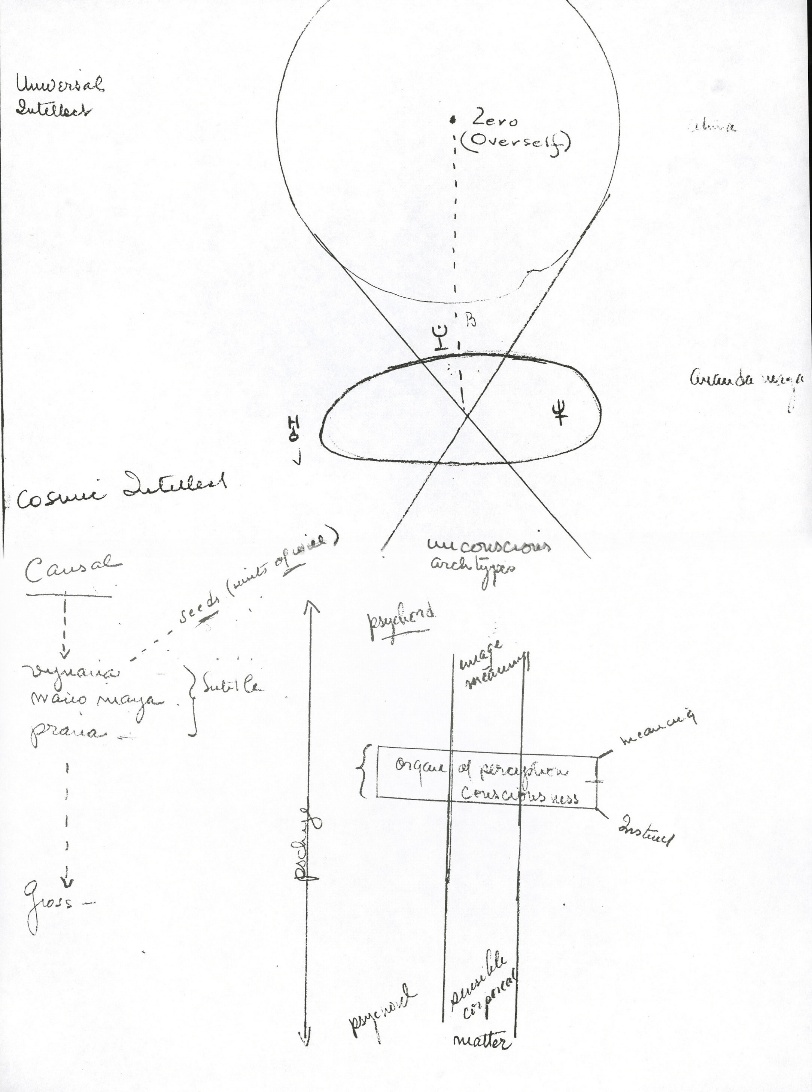
FIGURE AD_G_019 merged. Universal Intellect, Cosmic Intellect, Psyche.
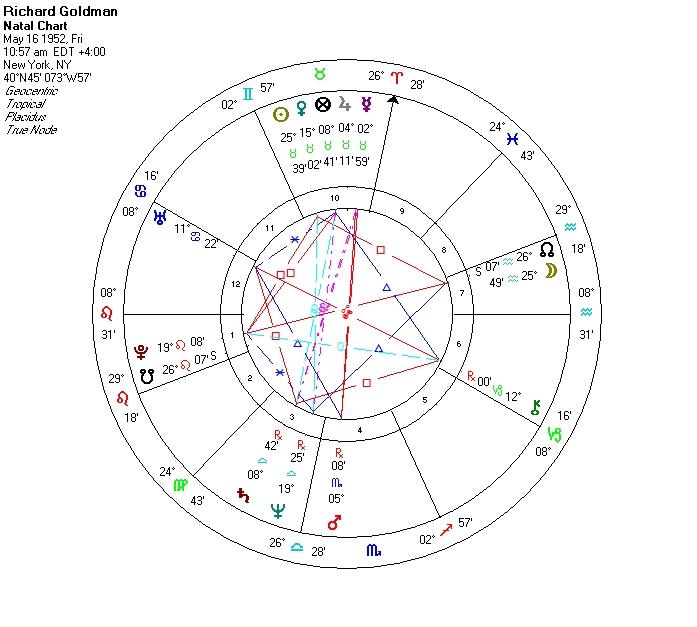
FIGURE 1973 0302-2. Richard Goldman Natal Chart.
Other diagrams also referred to are not with this transcript version. [Transcriber note: [diagram] means the speaker is referencing a diagram as he or she is speaking. If someone is drawing or writing, with audible sounds of chalk on a blackboard, I indicate this by [drawing] or [writing].]
SABIAN SYMBOLS: Taurus 26, Libra 9
TRANSCRIBED Verbatim by IT 2021. In 2024, IT completes TOC, adds new note within transcript, corrects errors/typos, adds one diagram and references to this diagram. In 2025, IT updates audio file markers to match new REP audio. Archival verbatim transcript – V11a.
AUDIO FILES: 1973 0302a, 1973 0302b, 1973 0302c. [Note 1: "Tape" refers to original audio cassette tapes that were later digitized into .MP3 Audio Files. Note 2: In 2025, REP Studio cuts dead air from file a and improves its sound quality.]
1973 03/02 at Wisdom's Goldenrod
Jung; Archetype; Astrology
[Audio File 1973 0302a Begins]
AD (faint): I think we were in [S, very faint: Yeah.] Chapter 9 but I don't remember the way.
S (very faint): The chapter, (but) Ram read it.
AD: No I'm going to skip by the long poem. That's-- [short pause] About 501, [student assents, faint] 503, around there somewhere.
S (very faint): He's been coming.
[11 second pause, flipping of pages]
AD: 503? "Process of differentiating the ego from the unconscious…"
S (very faint): Fine.
S (very faint): [one word inaudible]
AD: You got it down in your notes? Ok.
[11½ second pause with faint background student talking]
IF (faint): Want to read?
S (very faint): (What are you reading?)
[short pause]
IF (faint): We read chapter 505.
AD: 505?
IF (faint): Yeah the [few words inaudible]
[short pause, flipping of pages]
AD: 505, paragraph 505.
S (faint): Uh-hm.
S (faint): Uh-hm.
AD: Well, I wanted to let go of the feminine aspect so, until we-- because maybe tonight we can start off with the Two Essays and then go back to the feminine-- well-- [short pause] It's um-- [short pause] If we look to paragraph 530, I want to pick something out in paragraph 530.
C.G. Jung [CW 16, The Practice of Psychotherapy, "The Psychology of the Transference," p. 312, paragraph 530, AD reading]: "One gathers from this discourse that, owing to his [AD reads: to the] position between the four world-principles, man contains within himself a replica of the world in which the unequal elements are united. This is the microcosm in man, corresponding to the"firmament" or "Olympus" of Paracelsus: that unknown quantity in man which is as universal and wide as the world itself, which is in him by nature and cannot be acquired. [AD adds: And] Psychologically, this corresponds to the collective unconscious, whose projections are to be found everywhere in alchemy."
AD: I was hoping maybe we can use a can-opener on this paragraph and see what he means here. I think you'll find that the best way to get this out into the open is if you think of astrology. The astrology I have been using, although it provides us with a comedy hour Wednesday, is really very purposive. (laughter) My Libran nature likes to laugh once in a while but the Virgo sees that there's something really worthwhile in it. It's--
S: Yeah.
[shuffling about, noises]
AD: I don't know if Richard was aware, he had given us a clue to this paragraph some time ago. [drawing] And he had spoken about it in-- We'll call this Jung's collective unconscious [diagram]. There's 360 degrees there. And you have one planet sitting here [diagram], and you know that the opposite over here [diagram] was operating, ok? Mars prime, ok? That's--
[9¾ second pause with noises, bit of background student talking, bit of laughter]
S (very faint): [few words inaudible]
AD: That's alright. You're transferring your neuroticism onto me, honey. (bit of laughter) That's a good shadow operating, huh? Thanks.
LS: That's one way to get rid of it. If you can't handle it, give it to somebody else. (bit of laughter)
AD: You give it to your wife.
S (simultaneously, faint): The unconscious has a other side.
S (simultaneously, faint): If you look who smokes in our family, you know.
AD: But you remember what Jung said: show me a [LS simultaneously: Good thing.] saint and I'll show you a neurotic wife.
LS (simultaneously): I can't handle it. (LS laughing, laughter)
S (amidst laughter, faint): Vice versa though.
AD: Vice versa? Alright, yeah, you could turn it around.
[few second of laughter, background student talking]
S (faint): Well it works the other way too, Lenny.
AD: Alright, you remember when we were discussing the opposites, the archetypes, the planet on one degree and you had to read the opposite? And we did it psychologically. And we pointed out that there was a lower kind of person, then a middling kind of person, and a superior kind of person. One person wants to get rid of the houses, another person wants to get rid of the planets, and another fellow wants to get rid of the whole thing--planets, houses, and signs [AD indicates on diagram], ok. Mundane peace, supermundane peace, supreme peace. Ok, we s-- kidded around about that, you remember? And, I think it was Richard who pointed out, he thought that there was a superior value in the zodiacal substance, the substance and not the planets. And, in this-- Oh, you have to remember that you got the elements here, right? [drawing/writing] Pisces and earth and air, ok? These are the four elements. He says over here--
C.G. Jung [CW 16, The Practice of Psychotherapy, "The Psychology of the Transference," p. 312, paragraph 530, AD reading]: "One gathers from this discourse that, owing to his position between the four world-principles, man contains within himself a replica of the world in which the unequal elements…"
AD: You know, [drawing] one, two, three, four, the unequal elements [diagram].
C.G. Jung [CW 16, The Practice of Psychotherapy, "The Psychology of the Transference," p. 312, paragraph 530, AD reading]: "…are united. This is the microcosm in man, corresponding to the"firmament" [or "Olympus"] of Paracelsus: that unknown quantity in man which is as universal and wide as the world itself, which is in him by nature and cannot be acquired."
AD: You can't buy it.
C.G. Jung [CW 16, The Practice of Psychotherapy, "The Psychology of the Transference," p. 312, paragraph 530, AD reading]: "[AD adds: And] Psychologically, this corresponds to the collective unconscious, whose projections are to be found everywhere…"
AD: You can cross out "in alchemy".
C.G. Jung [CW 16, The Practice of Psychotherapy, "The Psychology of the Transference," p. 312, paragraph 530, AD reading]: "I must refrain from adducing more proofs of the psychological insight of the alchemists, since this has already been done elsewhere."
AD: Now, paragraph like that, perhaps this might help us open some-- I'm quite convinced that words like this here, 'four world-principles', 'unequal elements', 'microcosm', I'm quite sure that those words are very carefully chosen by Jung, you know, I mean they're not just put in there. Now, in the-- in the chart, you know, we have 360 degrees, right? That's all.
LS: That's all? Right, right.
AD (simultaneously): That's all. And, you have a chart. Everyone has a chart. And the planets go around. And even over here [diagram] where for instance there's-- there's no-- there-- let's say in your chart there is no planet there, ok, it's an empty spot, but still, down comes Saturn on that point and then the next point, then the next point. Ok? Go ahead. And naturally at the same time it's activating the opposite point. It can get pretty complicated because sometimes it's making aspects to a lot of other points at the same time. [AD hits board] So, maybe that 360 degree could really be multiplied.
S (very faint): Yes (that's true).
AD: Hm? What do you think?
S (very faint): I think (but--)
AD: Well when Saturn is on a degree, the Sun on that degree, Pluto on that degree, it doesn't mean the same thing in each case.
S (faint): Uh-hm.
LS: I'll buy.
AD: Right? This complicates it, I thought we only had 360 degrees.
S (faint): But then every aspect is a new one.
AD: Yeah. And he says that we have a-- a sort of-- we're a sort of replica of all this. [9 second pause] Well, again let's repeat.
C.G. Jung [CW 16, The Practice of Psychotherapy, "The Psychology of the Transference," p. 312, paragraph 530, AD reading]: "…owing to his position between the [AD reads: these] four world-principles, man contains within [AD reads: with] himself a replica of the world in which the unequal elements are united."
AD: Alright, can you try to get something out of that sentence? Have I got bad aspects tonight?
S (very faint): Uh-hm. Yeah.
LS: You got bad aspects(?/.)
AD: Yeah? I mean by bad aspects, you know--
S (faint): Just your aspects [S simultaneously, very faint: Yeah, good question.] to the South Node.
AD: What?
S (faint): Just your aspects to your South Node, the comedian?
S (faint): [few words inaudible]
AD (simultaneously): The comedian? Oh, alright. (bit of laughter) Richard, how about you, you made the remark. (bit of laughter) I mean maybe you can see the import of what you're saying now. If this element for instance, alright, fire, and you got a Mars degree on it, alright, you got, so to speak, this matter which is increative, uncreative, ok? And you got an archetype here [diagram] signifying something, meaning something. Your Mars is on that degree.
RP (faint): [one word inaudible] think like me 'cause then I (struggle). There's a-- man's a microcosm which contains (the whole process).
AD: Yeah.
RP (faint): All the whole (process). Nothing-- nothing [few words inaudible] that material body corresponding and that means material body corresponding (with the matter of the world), and intellect corresponding to the (Logos).
AD: And then you get the feeling that here, for instance, whatever meaning is at this degree, alright, is incorporated somehow in man.
RP (faint): And each man('s) [one word inaudible] each man has a window.
AD: Alright so if-- if we try to-- if we try, I think Neumann has a nice write up on meaning of an archetype, and I think we can apply this almost indiscriminately to the meaning except among the Traditionalists 'cause there they would want to take you up to the third circle [FIGURE AD_G_019 merged, top circle], there's no archetypes downstairs. [17 second pause, flipping of pages] He says--
[Transcriber note: I am using The Great Mother: An Analysis of the Archetype by Erich Neumann, Bollingen Series XLVII, Princeton University Press, Princeton, NJ, 1963.]
Erich Neumann [The Great Mother: An Analysis of the Archetype, p. 3, AD reading]: "In order to explain what analytical psychology means by an"archetype," we must distinguish [AD adds: four things] its emotional-dynamic components, its symbolism, its material component, and its structure."
AD: Ok.
Erich Neumann [The Great Mother: An Analysis of the Archetype, pp. 3-5, AD reading]: "…emotional-dynamic components, its symbolism, [its] material component, [and its] structure. …
"By the material component of an archetype we mean the sense content that is apprehended by consciousness. When, [however], we say that an archetypal content of the unconscious is assimilated, this assimilation…refers to the material component."
"The structure of the archetype is the complex network of psychic organization, which includes dynamism, symbolism, [and] sense content, and whose center and intangible unifier is the archetype itself.
"The archetype is manifested principally in the fact that it determines human behavior unconsciously but in accordance with laws and independently of the experience of the individual. …
"When the unconscious content is perceived, it confronts consciousness in the symbolic form of an image. [For]"A psychic entity can be a conscious content, that is, it can be represented, only if it has the quality of an image and is thus representable." … The function of the image symbol in the psyche is always to produce a compelling effect on consciousness. Thus, for example, a psychic image whose purpose it is to attract the attention of consciousness, in order, let us say, to provoke flight, must be so striking that it cannot possibly fail to make an impression. The archetypal image symbol corresponds, then, in its impressiveness, significance, energetic charge, and numinosity, to the original importance of instinct for man's existence. …
"The representation of the instincts in consciousness, [that is to say], their manifestation in images, is one of the essential conditions of consciousness in general…"
AD: Let me repeat this.
Erich Neumann [The Great Mother: An Analysis of the Archetype, pp. 5-7, AD reading]: "The representation of the instincts in consciousness, [that is to say], their manifestation in images, is one of the essential conditions of consciousness in general, and the genesis [AD adds: or the becoming] of consciousness as a vital psychic organ is decisively bound up with this reflection of the unconscious psychic process in it. This fundamental constellation is itself a product of the unconscious, which thus constellates consciousness, and not merely an"activity" of consciousness itself. … [short pause]
"Symbolic images, as archetypal representations, must be distinguished from the"archetype an sich [AD reads: as such]." "The archetype an sich [AD reads: as such] is [an] 'irrepresentable' [factor], a 'disposition' [AD: Or a tendency as we might call it.] which starts functioning at a given moment in the development of the human mind and [AD emphasizes following word] arranges the material of consciousness into definite patterns."
"For this reason Jung says that"the archetypes exist preconsciously, and presumably they form the structural dominants of the psyche in general. …" … [11¾ second pause]
"We designate the symbols belonging to an archetype as its symbol group or symbol canon. A difficulty arises, [however], from the fact that this co-ordination is not unequivocal. [For]"[the] single archetypes are not isolated from each other in the unconscious, but [are] in a state of contamination, of the most complete, mutual interpenetration and interfusion." This contamination is proportionately greater as the differentiating consciousness is weaker; [AD adds: And vice versa.] it diminishes as consciousness develops…"
AD: Ok?
[18 second pause, flipping of pages]
Erich Neumann [The Great Mother: An Analysis of the Archetype, p. 9, AD reading]: "The difficulty of describing the structure of an individual archetype arises in part from the fact that the archetype and the symbol erupt on a number of planes, [AD: Different planes.] often at the same time."
AD: Ok?
Erich Neumann [The Great Mother: An Analysis of the Archetype, p. 9, AD reading]: "The phenomenology of the workings of the archetype extends [AD reads: extend] from the unconscious instinctive drive of the primitive individual, contained in the group, to the formulation of concepts and beliefs in the philosophical [AD reads: philosophic] systems of the modern individual. In other words, a vast number of forms, symbols, and images, of views, aspects, and concepts, which exclude one another and overlap, which complement one another and apparently emerge independently of one another, but all of which are connected with one archetype, e.g., that of the Great Mother…"
AD: So of course here we have to speak of a symbolic polyvalence, you know. [short pause] Another point we'd like to bring in and--
[short pause]
Erich Neumann [The Great Mother: An Analysis of the Archetype, p. 11, AD reading]: "…the appearance of archetypal images and symbols is in part determined by a man's individual typological structure, by the situation of the individual, his conscious attitude, his age, and so on."
AD: You have to keep this in mind too. [short pause, flipping of pages] Again--
Erich Neumann [The Great Mother: An Analysis of the Archetype, pp. 15-17, AD reading]: "The archetype is not only a dynamis, a directing force, which influences the human psyche, as in religion, for example, but corresponds to an unconscious"conception," [AD adds: that is] a content. In the symbol, i.e., [AD adds: in the] image of the archetype, a meaning is communicated that can be apprehended conceptually only by a highly developed consciousness, and then only with great pains. For this reason the following remark of Jung's [AD reads: Jung's remark about]…"Myth is the primordial language natural to these psychic processes, and no intellectual formulation comes anywhere near the richness and expressiveness of mythical imagery. Such processes deal with the primordial images, and these are best and most succinctly [AD reads: briefly] reproduced by figurative speech." …
"As we have elsewhere shown [AD reads: seen elsewhere], early man--like the child--perceives the world"mythologically." That is, he experiences the world predominantly by forming archetypal images that he projects upon it. The child, for example, first experiences in his mother the archetype of the Great Mother, that is, the reality of an all-powerful numinous woman…
"Human life in the beginning is determined to a far higher degree by the unconscious than by consciousness; it is directed more by archetypal images than by concepts, by instincts than by the voluntary decisions of the ego; and man is more a part of his group than an individual. [And] similarly, his world is not a world seen by consciousness, but one experienced by the unconscious. … [9 second pause]
"The symbolic imagery of the unconscious is the creative source of the human spirit in all its realizations. Not only have consciousness and the concepts of its philosophical [AD reads: philosophic] understanding of the world arisen from the symbol but also religion, rite [and] cult, art and customs. And because the symbol-forming process [AD reads: processes] of the unconscious is the source of the human spirit, language, whose history is almost identical with the genesis and development of human consciousness, always starts out as a symbolic language. …
"The symbol intimates, suggests, excites. Consciousness is set in motion and must employ all its functions to assimilate the symbol, for a merely conceptual assimilation proves totally inadequate. The symbol also acts with greater or less force upon feeling, intuition, and sensation."
AD: I-- [tape break] But then again I'm from south New York.
S (faint): Go ahead.
S: Why is it a--
[short pause]
AD: Because the entire externally manifested world which you become aware of in knowledge is the result of sensation operating first [tape goes blank for a few seconds] or intelligible (reason(s)). [short pause] Then again our definition of sensation would disagree. Jung says it's really no problem [tape goes blank for a few seconds] Couple of thousand years of philosophical thinking still hasn't come to a conclusion as to what sensation is. And besides, we don't want to get rid of the problem prematurely. That could be a disaster. Alright let's-- let's see now if we can understand some of these things we've said here, ok?
Erich Neumann [The Great Mother: An Analysis of the Archetype, p. 3, AD reading]: "…emotional-dynamic components, [its] symbolism, [its] material component, and its structure."
AD: I'm going to ask you to give me a hand, try to work up an example in astrology.
Erich Neumann [The Great Mother: An Analysis of the Archetype, pp. 3-4, AD reading]: "Every mood that takes hold of the entire personality is an expression of the dynamic effect of an archetype, regardless whether this effect is accepted [AD reads:"is affected-- accepted", I'm sorry.] or rejected by the human consciousness [AD reads: the human in question, the human being in question]; whether it remains unconscious or grips the consciousness."
AD: Now, I'd like to use a nice good example, one that there's no kidding about, ok? [drawing] Alright, we use something like that. Or Saturn in opposition-- did I get that from you? Saturn [drawing] let's say in opposition to the Moon or to the Sun or to anything, when we have no illusions that these things aren't working.
LS: Yeah.
S (very faint): Uh-hm.
AD: First of all--
Erich Neumann [The Great Mother: An Analysis of the Archetype, p. 4, AD reading]: "The symbolism of the archetype is its manifestation in specific psychic images, which are perceived by consciousness and which are different for each archetype. The different aspects of an archetype are also manifested in different images. [Thus], for example, the terrible aspect and the life-giving,"kindly" aspect of an archetype appear in diverging images."
AD: Well, could you think of one? Can we think of a Saturn Sun conjunction, for instance taking place over here [diagram], ok? [drawing] Would anyone volunteer who had a Saturn Sun conjunction?
OG (faint): Yeah.
S (faint): What'd you say?
S (very faint): Yeah. (bit of laughter)
S: Uh-huh.
AD: Go ahead.
OG (faint): By progression, by--
AD: No, no, no, no, no, natal, natal.
OG (faint): Natal.
AD: Saturn going over the Sun.
OG (faint): Yeah.
AD: You got a good historical memory, come on Om. What degree was it in?
OG: Which one?
AD: I don't know, whichever one you had-- (some laughter) you had on the degree, what-- your Sat-- [OG simultaneously, faint: (Big transit.)] your Sun is where? Taurus?
OG: Taurus, yeah.
AD: What degree?
OG: Sabian symbol [few words inaudible]
AD (simultaneously): No. Yeah, what degree is it, yeah.
OG: A long hall-- a--
AD: What degree, the number.
LS/S(?): Numbers.
S (simultaneously): Number.
OG: Number is 9.
AD: 9?
S (very faint): Yeah.
AD: That would be a few years ago, you remember it?
OG (faint): Oh my God.
AD: Well do you remember was it-- (laughter) what was happening at that time? Because you're going to have to try to-- you're going to have to try to give me the fantasies that were going on at that time. I don't care that you broke your leg. Do you remember the fantasies that were going on about that time?
OG: I don't remember the fantasies of the morning, how can I remember a few years ago?
AD/S(?) (faint): (Om--)
RG (faint): Tony?
AD: Yeah Richard?
RG (faint): I remember very well Saturn on the Sun.
AD: Ok. What degree, Richard?
RG (faint): 26 Taurus. [Note: See FIGURE 1973 0302-2 for RG Natal Chart.]
AD: 26 Taurus. [drawing/writing]
LS/S(?): What degrees?
AD: That was what, your Sun.
RG (very faint): Yeah.
AD: Ok. And your Saturn is from where?
RG (faint): 9 Libra.
AD: 9 Libra. We could put it anywhere, right? [drawing/writing] (LS laughs, laughter)
LS: Philosophical license, huh? (bit of laughter, student words)
AD: Alright.
S: Poor Jenny.
S (faint): [few words inaudible]
AD (simultaneously): Uh-- (LS laughs)
S (very faint): You got the right houses.
LS: Right.
AD: Have I got-- yeah.
S (simultaneously): Traffic's a liability.
AD: Do you remember your Taurus symbol?
RG (faint): Yeah, I think it's a Spanish gallant serenading his senorita under the (window).
AD: Ok. That was-- that was your Sun degree, and that's in Taurus. And you remember your Saturn?
RG (faint): Three Old Masters hanging in an art gallery in a room to themselves hold converse.
AD: Alright. Do you remember about that period of time what was going on when Saturn went to your Sun?
RG (faint): I was in this state of very exalted feeling(s), uh--
AD: Very what?
RG (faint): Exalted feelings, that's-- that's all-- I was inundated by these archetypal feelings. And, I ba-- I didn't barely think at all, I was just over-- overwhelmed by--
AD: Was there any sort of fantasies accompanying that-- that period of time, fantasies coming up, imagery coming up?
LS: Is that when you were with Kirpal Singh or--
RG (faint): Yeah, that was the time when I was doing that. You know, fantasies up in the-- (I mean) very devoted soul, you know, very pure, very-- It was very antithetical to what I do now. (laughter)
AD: Yeah. You make it sound pretty bad. (bit of laughter)
RG (faint): But I-- it was like I was wiped out, I mean, I was barely-- I-- I-- just catapulted into this state. And that I just lived on (these) high feelings for weeks. And-- (I don't know).
AD: And then after the conjunction--
RG (faint): Well, after the feelings I started-- I started-- I was star-- I started to question the validity of what-- of what I was doing, you know, I mean what that-- that all meant, and how much of it (still related) to me, to what I was doing, I started to feel trapped, like I wasn't going anywhere, I wasn't growing. And, then it seemed like a few months later-- well that was in-- in the end of May the conjunction hit, it was just a few months after that a lot of doubts started arising, a lot of fear about what I was doing, and I wouldn't-- my-- my mind was so fixed in the image of what I was doing that I couldn't really see myself from-- for a long time.
AD: Well on the one hand, something like this happened it seems, alright? Correct me if I'm wrong. You were operating with the Sun symbol, ok, which is in Taurus, and how do we put it, you know, willing feeling, ok. And as Saturn started getting near to that, it started coming out more and more into consciousness, alright. And you started getting inundated by these feelings. And then after Saturn made the transit over the Sun, and your Saturn is three Old Masters hanging in a gallery? After your Saturn went over your Sun there's a sort of correctiveness brought into the situation. In other words, this image that you had of yourself as a really holy man sitting up (in/on) Mount Kalidas meditating with purity of feeling for the next eighteen millenniums, alright, was really torn down, alright? And there was a kind of introduction into your consciousness that there should be a more balanced understanding of what was going on. Your Saturn coming from Libra, alright, the Saturn was coming from Libra, and that's-- that's a Saturn where you might say the ego-complex there is manifested as something known, alright, and it hits the Sun. Alright now, if we go back to this-- to what he is saying here, ok. He says that we have these four components to deal with. We have the material, the emotional-dynamic aspect, ok, the structure. Can you see-- can you see that in relationship to this aspect? [9¾ second pause] How about the symbolism, that will be the most difficult.
LS: That seems to say that's gotta be a cosmic senorita you're so-- you're serenading.
RG (simultaneously, faint): Yeah, def-- definitely, I mean any-- any particular feeling(s) couldn't-- couldn't hold [couple words inaudible] It dissolved, it had to be a very-- a very universal feeling component that (it contained/is retained).
AD: Do you notice for instance he speaks here of emo-- emotional-dynamic components. Were they inherent in that-- in that period?
RG (faint): Yeah. Anyway I mean-- It was amazing now that-- I mean I--
AD: That you had to do these things, right? You were compelled to operate this way. To sit down and meditate.
RG (simultaneously, faint): It was very-- (it's a) very beautiful, I mean-- it was very-- it was very unreal. You know, it was very exalted. It was very unreal at the same time. It was very inflation-- inflationary as well. That was probably my inability to handle the situation. I mean the influx of these feelings, like, there was a lot of inflation-- inflationary sort of (function in) those feelings. Like I think primarily like a Great Mother image. Those feelings were really-- really projecting [couple words inaudible] a Great Mother image, all these feelings will take care of me and I don't have to worry. I was just-- this is just within the feeling [one word inaudible]
AD: We're getting a little closer to the archetype, let's try again. You want to try? What we're trying to do here is we're going to speak about the archetypes, and I want-- I want to really pin it down, alright. Not the archetype as such. But his definition, Neumann, as he deals with it in terms of these four ways of trying to get to the archetype, emotional-dynamic aspect, alright, the material content, the structure, and the symbolism. These are the four components he says will-- will get us around to understanding an archetype. Alright?
[short pause]
LS: Well just-- just to start us off. Seems the Sun, the symbol, represents let's say the-- mostly the emotional-dynamic part. And that Saturn coming along represents the structuring element that says, "Ok, yes, we've recapitulated this devotion and how to do it, now let's find the right level, the right-- you know, the right degree."
S: Hm.
IF: Yeah but we always got to remember that with Jung a Sun it would be-- for Dickie there would be a Great Mother, but let's say if it would be for me it would be animus so-- or any kind of--
LS: Yeah well it's-- the symbol seems to invoke the feminine, alright.
RG (very faint): Right.
AD: But, in the Rosarium for instance he made the point too again and again that the Sun in a man's chart represents the conscious and the Moon represents the unconscious. And, if we saw that Saturn went on that Sun, alright, in a sense you can almost realize that you were almost being forced to become conscious of how and what the basic presuppositions were in terms of your lifestyle.
RG (faint): Yeah. It like had to be so completely exaggerated. And like up to that time I would say primarily my motivation-- I mean they operate from a Taurean base, they're-- they-- they're always trying to get into the feelings of the situation. They have to operate from that base.
AD: Well now in terms of just the-- just the Sun degree, you can see how this can be exaggerated, right? And along comes Saturn where it says there's three Masters, which by the way is very beautiful alchemical symbolism, right? Corpus, Anima, Spiritus, alright. And these things have to be brought-- brought into proper relationship, there has to be a-- let's say some sort of balance between the three of them. And Saturn is sitting on the Sun, alright, and kind of is like a cookie-cutter, alright, and says "Well wait a minute. I know you got the Sun in Taurus but this has to be defined, molded." Alright. Now, was there any painful affair at that time?
RG (very faint): Uh--
AD: There was?
RG (faint): Well, I mean--
AD: I'm sorry I got to ask these questions but I want to show how it erupts into different planes, ok. Not only on a mental plane where you're becoming aware of some of your presuppositions. But I would assume that on a physical plane there will be a rupture of relationship.
RG (faint): Well that happened when Saturn was on Venus [couple words inaudible] a couple months before.
AD (simultaneously): Before?
RG (faint): Well the Saturn-- after that like the-- that was the only time in my life I would say I had no need for a-- for a woman.
AD: When Saturn was on Venus?
RG (faint): No, when Saturn was on the Sun.
AD: When Saturn was on the Sun?
RG (faint): Because these feelings were utterly projected into one image, and it, you know, didn't need it. It couldn't contain it in specifics.
AD: Well let me ask you this, Richard. Were the feelings projected into an image or wad-- was the image conveying the feelings, bringing you these feelings?
RG (very faint): Yeah.
AD: See because if the image contains this-- these feelings, then it has this compulsiveness about it, you have to operate that way. Alright? Because that's-- that's what emotions mean, they're very compelling. If the emotions get too strong then they inundate the personality and just drown him, alright. Then the ego is wiped away. So, assuming that you have some-- some structural element, you know, a strength in your ego structure, and these feelings come and inundate you, you stand up to them, you get battered somewhat but you can stand up to them, and you have to become conscious in your case, you know Saturn coming from Libra, alright. Let's see.
RG (faint): [couple words inaudible] I mean one more-- entire time before that, like a lot of that desire for the feeling or the-- or the-- the necessity to operate from a feeling base would always spill over into my thinking or my intellect and the intellect was basically a tool in order to live out those feelings you might say.
AD: Uh-hm.
RG (faint): When Saturn went on the Sun that was just wiped away, I wasn't-- it wasn't allowed to happen, I mean, it was just feelings, (feelings) weren't going anywhere. In a way they were much more introverted than they had ever-- than they had ever been. And after that, I think the separation between the feelings and the projection of feelings into other situations without those feelings was a lot clearer.
[short pause]
AD: Ok now, let's review what he just said, ok, and let's see if we can apply what we heard from Dickie. First of all, "The effect appears…"
Erich Neumann [The Great Mother: An Analysis of the Archetype, pp. 3-4, AD reading]: "This [AD reads: The] effect appears, for example, in positive and negative emotions, in fascinations and projections, [and also in] anxiety, [in] manic and depressive states, and in the feeling that the ego is being overpowered. Every mood that takes hold of the entire personality is an expression of the dynamic effect of an archetype, regardless whether this effect is accepted or rejected by the human consciousness…"
AD: Ok?
Erich Neumann [The Great Mother: An Analysis of the Archetype, p. 4, AD reading]: "By the material component of an archetype we mean the sense content that is apprehended by consciousness. When, [however], we say that an archetypal content of the unconscious is assimilated, this assimilation--if we disregard the emotional character of the archetype--refers to the material component."
AD: Can you see that definition fit in with what happened?
RG (very faint): Well, uh--
Erich Neumann [The Great Mother: An Analysis of the Archetype, p. 4, AD reading]: "[By] the material component of an archetype we mean the sense content that is apprehended by consciousness."
LR: Yeah, the person on whom these feelings are projected, huh?
Erich Neumann [The Great Mother: An Analysis of the Archetype, p. 4, AD reading]: "The structure of the archetype is the complex network of psychic organization, which includes [AD adds: the] dynamism, symbolism, and [AD reads: the] sense content, and whose center and intangible unifier is the archetype itself."
AD: Can you see that, you-- can you relate it directly? I hope others are following now.
RG (faint): Well, I don't (understand). I mean the material component of the archetype there was Kirpal Singh.
AD: It was what?
RG (faint): The material component was Kirpal Singh at the time who was the figure that all these feelings got projected into.
AD: Uh-hm.
RG (faint): But it was clear that-- it was clear after a while that he was just a carrier of this archetype.
AD: A hook to hang it with, yeah. [RG, very faint: Yeah.] Coat hanger, alright. But nonetheless he had, let's say-- he provided-- he had something there that you could hang the hook on, you couldn't hang-- you couldn't hang the projection indiscriminately onto anyone, ok, because like some others would just throw it right back at you. Huh? Again, he says here--
Erich Neumann [The Great Mother: An Analysis of the Archetype, p. 4, AD reading]: "The archetype is manifested principally in the fact that it [AD emphasizes following word] determines human behavior unconsciously but in accordance with laws and independently of the experience of the individual."
AD: Now, I think you're willing to see how accurate that description is. All the time you keep on saying "But I'm free. I got free choice. I can do what I want." It's a good thing we have it.
RP (faint): But, I had-- I tried to fight it for a long time. I mean before-- before the projection really [couple words inaudible] I tried to with (fantasy), and uh, I-- you know, I couldn't. Like it had to happen. I mean I tried to stand in my ego and say-- and tried to reject the--
AD: What do you want to do with this cosmic clock? You want to-- you want to transcend it? Yes. But only at a certain level of differentiated consciousness is that possible. Certainly a primitive consciousness wouldn't have any idea what was going on. [short pause] Again--
Erich Neumann [The Great Mother: An Analysis of the Archetype, p. 5, AD reading]: "When the unconscious content is perceived, it confronts consciousness in the symbolic form of an image. [For]"A psychic entity can be a conscious content, that is, it can be represented, only if it has the quality of an image and is thus representable.""
AD: How about that?
RC (faint): That the symbolism again has a material-- material component. Like the symbol can be an image also, right?
AD: Yeah.
RC (faint): So would we say like what we normally call a subjective perception is it like my dream (or) my dream like-- That type of an image would be symbolic?
AD: Well-- Richard, what was your Sun degree, the symbol?
RG (faint): Spanish gallant serenading his senorita.
AD: Ok? Now what do you see in that de-- [short pause] A Spanish gallant serenading a senorita.
RG (faint): Well, I mean the fact that it operates through feeling, I mean through--
AD: Well I mean, let's break down that symbol so we can try to help him with the--
RC (very faint): Skillful application of [couple/three words inaudible]
AD: I'm sorry?
RC (faint): It's also a skillful application of [couple words inaudible] you know, on--
AD: Wait a minute Randy. You asked the question, right? [RC, very faint: Yeah.] You want to know the difference between the symbolism and the material component. Let's-- let's answer that first. Ok let's try, go ahead Richard.
RG (faint): The whole symbol's a Spanish gallant serenades his senorita by the window grill with the softer melodies of night.
AD: Now there-- there you have-- there you have a pictorial representation, an image, right? Alright. This-- this image has a kind of meaning which is not readily available, alright, you really have to keep poking at it, ok? So the symbol, so to speak, would be the conscious and the unconscious material that goes into the formation of that image. Ok? In other words, there's contributions by the conscious point of view, there's contributions from the unconscious. The two of them are combined, alright, and you get-- you get a feeling for its significance on one level but on another level you feel you're always missing something. [student assents, faint] Basically that would be the symbol, right?
RC (faint): Like the felt implications of the material component?
AD: Felt, thought, willed implications. A symbol is basically remains unknown to the conscious mind. Otherwise it wouldn't be a symbol. This is Jung. This is not me. Ok? [student assents, very faint] Alright, and in that symbol and in that image we have the material components would constitute let's say the pictorial representation or the image would be composed of these feelings, alright, the symbolic significance, it has a certain structure, a certain dy-- dynamic structure in terms of relationship with other parts of the personality. Alright. So when we deal with one degree for instance on-- on the chart, alright, you're bringing in an awful lot of material that you may not be aware of. Now let's say that this degree is intrinsic to the zodiacal substance upon which that planet is sitting. In other words, this Aries degree or Taurus degree has a certain matter and intrinsic in that matter, ok, there's a certain meaning which gets, let's say, manifested when a planet is there. Ok? If-- if we go back to Jung for instance--
[Transcriber note: The first paragraph below is translated differently in the 1954 and 1966 editions and is also on a different page. AD is using the 1954 edition. I transcribe the paragraph from the 1954 edition but I list page numbers for both editions. I go back to using the 1966 edition for all the paragraphs following the first.]
C.G. Jung [CW 16, The Practice of Psychotherapy, "The Psychology of the Transference," p. 311 (1954 edition) or p. 313 (1966 edition), paragraph 531, AD reading]: ""[Therefore] the philosopher is not the master of the stone [AD: A master of the self, alright, the stone.] but rather its minister. Consequently, whoever tries, by means of the art and by unnatural artifice, to introduce into it anything which does not by nature exist in the arcanum, [AD hits board] [AD: The matter.] he will fall into error and repent of his [AD reads: this] error.""
AD: You're not going to change that degree's meaning, alright?
RC/S(?) (very faint): Uh-hm.
C.G. Jung [CW 16, The Practice of Psychotherapy, "The Psychology of the Transference," p. 313, paragraph 531, AD reading]: "This tells us plainly enough that the artist does not act from his own creative whim, but is driven to act by the stone. [AD: By the self.] This almighty taskmaster is none other than the self."
AD (aside): Put it right here.
S (faint): Yeah.
C.G. Jung [CW 16, The Practice of Psychotherapy, "The Psychology of the Transference," pp. 313-314, paragraph 531, AD reading]: "The self wants to be made manifest in the work, and for this reason the opus is a process of individuation, a becoming of the self [AD reads: of becoming a self]. The self is the total, timeless man and as such corresponds to the original, spherical, bisexual being who stands for the mutual integration of conscious [AD reads: consciousness] and unconscious [AD reads: unconsciousness]."
AD: And a good example was when we argued the other night, right? He says I'm going to be my way! And I says like hell you are, you're going to be that way. And he shut up, right? The shadow shut up and wasn't that a feat? (laughter) But he saw right away what-- what was said and he intuited. You can't dictate to this arcanum what you're going to become. You can work with it. You can work against it and get your head bashed. Alright, so let's go back here.
Erich Neumann [The Great Mother: An Analysis of the Archetype, p. 5, AD reading]: "[For]"A psychic entity can be a conscious content, that is, it can be represented, only if it has the quality of an image and is thus representable.""
AD: So in the Sabian symbols it becomes very obvious, unless they're put into some kind of form, alright, in other words, if they're not clothed in some sentence where some meaning-- where the anthropomorphic meaning can be grasped, they remain inaccessible to us. So very oft--
[Audio File 1973 0302a Ends]
[Audio File 1973 0302b Begins]
Erich Neumann [The Great Mother: An Analysis of the Archetype, p. 5, AD reading]: "[The representation of the instincts in consciousness, that is to] say, their manifestation in images, is one of the essential conditions of consciousness in general, [and] the genesis of consciousness as a vital psychic organ is decisively bound up with this reflection of the unconscious psychic process [AD reads: processes] in it."
AD: Now here is the unconscious [diagram], ok, all these degrees, alright, and they have to be reflected in consciousness. Somehow they have to be translated into a mode where the human being can comprehend something of its significance. So when you had that conjunction, so to speak, this was forcibly being brought into your consciousness, alright. Your consciousness is being manipulated, it's being conditioned to operate this way rather than another.
Erich Neumann [The Great Mother: An Analysis of the Archetype, p. 5, AD reading]: "This fundamental constellation is itself a product of the unconscious…"
AD: 360 degrees, you know?
Erich Neumann [The Great Mother: An Analysis of the Archetype, pp. 5-6, AD reading]: "…which thus constellates consciousness, and not merely an"activity" of consciousness itself. …
"Symbolic images…"
AD: And this is to continue, we're working-- we're trying to get now to what an archetype means, ok, and we're going to use whatever resources we have.
Erich Neumann [The Great Mother: An Analysis of the Archetype, p. 6, AD reading]: "Symbolic images, as archetypal representations, must be distinguished from the"archetype an sich [AD reads: as such]." "The archetype an sich [AD reads: as such] is [an] 'irrepresentable' [factor], a 'disposition' which starts functioning at a given moment in the development of the human mind and arranges the material of consciousness into definite patterns.""
AD: Now how about that? [short pause] Go ahead Richard, it was your chart, try to explicate a little bit. [RG simultaneously, faint: Well--] We should have had a couple examples.
RG (faint): The energy that was flowing in me at that time was more structured than it-- the image was more universal but the energy was structured more particularly than I've hardly ever experienced energy. Like the energy was disciplining me, I wasn't-- or I couldn't say I was really disciplining myself. I mean I was meditating more than I ever had but I-- I didn't have anything (to do with it).
AD (simultaneously): But it wasn't you that willed it, right? You were compelled to do it more than you ever did it before.
RG (simultaneously, faint): Yeah. It was obvious that it was this influx of feeling that did it-- did it all, I mean I-- I was eati-- eating-- eating hardly anything at all during this period. One-- one faint meal a day and I lost fifty, sixty pounds just--
AD: Well you look better for it. (bit of laughter)
RG: And-- but I-- you know, I didn't have anything to do with it. It just-- it happened.
AD: Well, it's becoming obvious then that the-- the growth of this entity, Richard X, ok, growth of this entity is not left to his devices. Huh? [short pause] Now of course when he says over here for instance--
Erich Neumann [The Great Mother: An Analysis of the Archetype, pp. 6-7, AD reading]: "[For"the] single archetypes are not isolated from each other in the unconscious, but are in a state of contamination…"
AD: I-- I really reject that word 'contamination'. 'Cause that's quite meaningless and besides it-- it has a tendency towards profanation. But--
S (faint): Interpenetration?
AD: No I said profanation. It's vulgarizing something.
S (simultaneously, faint): No I said instead of contamination they're in a (state) of [one word inaudible]
Erich Neumann [The Great Mother: An Analysis of the Archetype, p. 7, AD reading]: ""…but [are] in a state of contamination, of the most complete, mutual interpenetration and interfusion.""
AD: So when let's say you have-- let's say over here [diagram], let's say like Uranus is going through Libra now and you got no planets in Libra, ok. And Libra is more or less not emphasized, there's no activity going on, there's no real emphasis. But that doesn't mean that that's not functioning in your chart, alright? Then comes along a big planet. And if you were-- if you are in any where-- in any sense self-aware, as Uranus hits [AD hitting board] one degree and then another degree, you start becoming aware of the meaning of these degrees if you just observe. You can see certain contents come into consciousness. Otherwise the meaning of-- for instance when we progress a planet, you-- let's say a progression, Saturn from 10 degree to 11 degrees Libra, that period of life where Saturn is progressed to 11, that consciousness would be inundated by the meaning of the 11th degree, ok. So that this unconscious is flowing in all the time. Yes Richard.
RG (faint): If-- I know-- I-- I don't want to (transfer astrology) [one word inaudible] now I have Saturn on the progressed Sun. Now I also have a progressed Moon opposite the Sun, opposite that Taurus degree. And it just seems like I'm experiencing the exact opposite of what I experienced when Saturn was on the Sun. Like all the contents that had to be repressed in my personality so that archetype could-- could manifest so com-- so much in me, it's those-- the aspects of Saturn on progressed Sun and the progressed Moon opposite the Sun seem to be calling out all those--
AD: Well, alright Richard, I don't want to complicate.
RG (very faint): Yeah, (fine).
AD: I want to-- I want to get out as precisely as I can, in the boldest relief possible what an archetype means. And, I-- I regarded Jung's operation as insufficient, yeah. I'll give some examples of why I consider that so.
S (very faint): May I ask a question, Tony?
AD: Yeah?
S (faint): [couple words inaudible] you know, distinguish. In-- in Richard's example, you say the material component was Kirpal Singh, was the actual figure upon whom these feelings were hung. Now what would be the symbol though? [student assents, very faint] What would be the symbolism of, you know [couple words inaudible] and in this-- this situation?
AD: I'm sorry, what will be the symbol?
S (faint): As a figure if you want to call him the material component, well [couple/three words inaudible] also have (other ones).
AD: Well what do you think Richard?
RG (faint): No, he was the image for what the-- the relationship was trying to [one word inaudible]
LS (simultaneously): Yeah.
S (very faint): Can you repeat that again?
RG (faint): Well and he-- it was only-- he was that image that-- the import of these feelings let's say could-- could be universalized, experienced as universal feeling, and through the image of that, but the symbol was still one of, you know, a more greater consciousness.
S (very faint): Not necessarily.
AD: Let's look at-- let's-- let's try looking at it this way, Crystal, because we might-- we might get lost. If let's say you come across an object in your experience which, for some reason or another, fascinates you, hypnotizes you, ok, this object that suddenly penetrates or is apprehended by your consciousness, alright, is first grasped as a whole, alright, and then to explain what is happening they start dividing up or differentiating concepts about it. And they'll point out one factor. Ok, that's what you apprehend. Let's say it was a triangle with, you know, wings on it. The visually apprehended triangle, alright, the sensual components is one thing, alright. Another thing would be the compulsion that you feel when you saw it, alright, that would be another aspect, alright. The meaning that it has for you but which is not clearly in your consciousness yet, that would be let's say a symbolical significance, ok? Alright? But it's one, alright. It's one, it's one thing that's going on, alright. It's only to differentiate and start separating all the various factors that go into that. There may be more. There may be more. But we're using Neumann's concepts because it's easy to work with. Ok?
LS (simultaneously): So when you say a-- you speak of a symbol, let me try and clarify that, you don't mean its-- the sensuous image or even the feelings that are-- that are around them. But what you mean is more like a meaning content that's unfolding.
AD: Yes, yes.
S (faint): Oh.
S (faint): Not the concrete part. I mean that [AD simultaneously: No.] refers to the material (basis).
AD: That would be the material, yeah. Ok? But-- but he's-- as he points out, some kind of meaning starts coming to you-- towards you, alright. And you can see that that symbol will remain a symbol until you've exhausted completely what the meaning is and then it's lost as a symbol. It no longer is a symbol for you. Now it becomes a very concrete. For the ordinary person for instance, this [diagram] is no longer a symbol because he knows what it's all about. But let his intelligence deepen and all of a sudden this becomes a symbol again.
S (very faint): Uh-hm.
S (faint): Tony, did you want to set up a second transit?
S (very faint): He doesn't want to (confuse) it.
AD (simultaneously): Well, let me finish this. Let me finish this, uh-- Why, you have something in mind?
S (faint): Well I was just thinking of Saturn on the Moon for me.
AD: Saturn on the Moon?
S (very faint): Uh-hm.
AD: Yeah that's usually a-- a nice one. And usually a catastrophe--marriage, something like that.
S: Right.
S (faint): Right. (AD laughs, bit of laughter)
AD: Karma.
S (faint): (Yeah.) (bit of laughter)
[10¼ second pause]
AD: Alright, maybe we will, let-- let me finish 'cause I-- I want to drive home this archetype into their brain once and for all.
LS: That's getting very material.
AD: Yeah, definitely.
Erich Neumann [The Great Mother: An Analysis of the Archetype, p. 8, AD reading]: "The material component of the symbol sets consciousness in motion; aroused by the symbol, consciousness directs its interest toward [AD reads: towards] it and seeks to understand it. That is to say, the symbol, aside from its dynamic effect as an"energy transformer"…"
AD: "As an energy transformer…." That's pretty good, huh?
Erich Neumann [The Great Mother: An Analysis of the Archetype, p. 8, AD reading]: "…is also a"molder of consciousness," impelling the psyche to assimilate the unconscious content or contents contained in the [AD reads: that] symbol. This assimilation culminates in the formation of views, orientations, and concepts by consciousness; although these have their origin in the sense content of the symbol and hence in the collective unconscious, of which the archetype is a part, they now, independent of their origin, claim an existence and validity of their own."
AD: Yes Randy.
RC (faint): Does the-- does the symbolic aspect transcend the structure or is that within the structure? Speak of the structural component here.
AD: Does the symbolic aspect transcend--
RC (faint): The structural component. Or is that also within the structural component without (them).
AD: Well I would say yes, the symbolic significance is much more important. [student assents, faint] But it's kind of hard to conceive of how you can get to the symbol unless you get all the other things with it.
RC (faint): I'm just trying to see how far this structure goes, like whether the meaning is included within the structure.
AD: Uh, you-- you are using a scalpel, aren't you?
RC (very faint): Yes.
AD: It's kind of hard to do that to life. I just made it ver-- I just tried to make it clear (that/how) this is the way it comes to you, alright, the symbol, here it is, ok. Now you take out a knife and you want to shear away parts of it and be left just with the meaning. That's like, you know, cutting the stick, "I only want one end. Here, you can have the other end." (bit of laughter)
LS: Keep doing that long enough it might work. (laughter)
AD (amidst laughter): Oh sure. (laughter) It would-- I'll get a pointed head. (more laughter)
S (very faint): (Unless) you want to do it [couple/three words inaudible]
S (faint): [few words inaudible]
S (faint): Could you read over that part again about the symbol has the transforming power?
S: And is the [one word inaudible]
Erich Neumann [The Great Mother: An Analysis of the Archetype, p. 8, AD reading]: "The material component of the symbol sets consciousness in motion; [AD: Ok?] aroused [AD emphasizes following word] by the [AD reads: this] symbol, [AD adds: now] consciousness directs its interest toward [AD reads: towards] it and seeks to understand it [AD reads: the symbol]. That is to say, the symbol, aside from its dynamic effect as an"energy transformer" is also a "molder of consciousness," impelling the psyche to assimilate the unconscious content or contents contained in the symbol."
AD: And this was an example, like Richard, ok?
Erich Neumann [The Great Mother: An Analysis of the Archetype, p. 8, AD reading]: "This assimilation culminates in the formation of views, orientations, and concepts by consciousness..."
AD: And this is of course what leads Jung and the whole Jungian school to claim that all philosophy is nothing but archetype represented. It doesn't occur to them that maybe they have some people who've transcended their paltry notion of what consciousness is. Nor do they consider it even possible. But we'll get into that criticism later on. Because if you notice, what they're speaking of as consciousness from the Hindu point of view is matter, a form, an upadhi, a sheath. A dud. (laughter)
S: Huh.
S (faint): Would you read that again Tony?
Erich Neumann [The Great Mother: An Analysis of the Archetype, p. 8, AD reading]: "The material component of the symbol sets consciousness in motion; aroused by the symbol, consciousness directs its interest toward [AD reads: towards] it and seeks to understand it. [That is to say], the symbol, aside from its dynamic effect as an"energy transformer" is also a "molder of consciousness," impelling the psyche to assimilate the unconscious content or contents contained in the symbol. [AD adds: And] This assimilation culminates [AD reads: results] in the formation of [AD adds: certain concepts or] views…"
AD: Ok? And consequently then the man starts talking about philosophy. And the Jungians would say that's nothing but the assimilation of archetypal contents into consciousness. You really have no philosophy.
S (faint): In other words, they're prejudging from their limited framework.
AD: Of course, they got a presupposition: Jungian psychology is the basis and the framework for the structure of truth. (laughter)
S (faint): It's really presumptuous.
AD: Yeah.
S (faint): The transformation was like that emotional dynamism [one/two words inaudible]
AD (simultaneously): Well let's go back to Richard's example, alright?
S (simultaneously, faint): That's right. That's right, uh-hm.
AD (simultaneously): In Richard's example before, he was talking about before Saturn came up to the Sun, as it was coming close, there was an inundation by feeling, alright, and he was operating in a certain way. Then Saturn comes up to the Sun and now something happens. This energy which was inundating him in terms of feeling starts becoming transformed. Is that right Richard?
RG (faint): It was more than that though.
AD: Louder.
RG (faint): I mean I didn't-- the last sentence you just read, (when energy) gets transformed--
AD: Well did it remain what it was?
RG: Not after it left, no.
AD: What happened after it left? You reexamined your views and they weren't adequate.
RG: I started coming down, you know, from the high-- from the high. (RG laughing)
S (faint): Oh.
AD: From the high, yeah. (bit of laughter)
RG: Uh-- um-- and my questioning attitude started operating again as to what it was I was doing, as to what validity it had.
AD: So the unin-- the uninhibited operation of the Sun degree, so to speak, in terms of feeling was being taken up a peg. You were starting to reflect on it. In other words, it had to be transformed. That's what-- what he means when he says this is going to be transformed. When this content arises, ok, the symbolism, so to speak, points out that there's need for a transformation of this energy.
RG (faint): Right.
AD: Alright, so it's a-- it's an energy transformer. All symbols do that.
RG: Right, it certainly elevated the level of feeling, I mean-- um but-- After it left it seemed the energy from that feeling, the w-- from where it was transformed it seemed to have dissipated again and it wasn't allo-- I mean it couldn't contain that-- that degree.
AD: Yeah.
RG (faint): And it seemed that energy started going in other places.
AD: Ok.
S (faint): Could you say that what happened there was that the symbol was assimilated. That's what's coming down from above.
AD (simultaneously): It was made conscious, yeah, was made conscious.
S (simultaneously, faint): It's no longer a symbol that brought in the unconscious and it was fully conscious now.
AD: Not fully.
S (faint): Well-- (Just assimilated) but what do you mean--
AD: Yeah but not fully. Because you're not going to exhaust the meaning of that degree with just one conjunction.
S (faint): But he said-- like I felt like he said I-- there was no growth, you know, I think he said [couple words inaudible]
RG (simultaneously): [few words inaudible] the image left. It-- it wasn't adequate anymore.
S: So-- so in--
AD: So your functioning was changed, wasn't it?
RG (very faint): Yeah, uh-hm.
AD: And that's what he means when he says it's transformed. There's no annihilation, there's only transformation. Nothing could be dead, nothing could be annihilated, it can be transformed, there's no such thing as annihilation, right, even in physics. Energy gets transformed from one form into another.
S (faint): The archetype remains but the material image changes.
S (very faint): Yeah.
S (faint): That's what gets transformed, the material image.
AD: The material image? No, the material image is only a vehicle by which that energy gets transformed.
S (faint): So in Dickie's case the transformation was-- was internalizing that energy and an assimilation of that energy for his own growth?
AD: For his own growth. Otherwise he would have responded, let's say that-- if there wasn't that conjunction, that archetype would have gone operating the way it had been previous [S, faint: It wouldn't (think).] without any growth taking place or expansion. Yes, Avery?
AS (faint): So, what exactly is-- is it that's being transformed, I mean-- The archetype per se isn't really being transformed.
S (faint): Uh-hm.
AD: The archetype per se, no.
AS (simultaneously, faint): I mean, the archetype (you/they) say is what it is.
AD: And it's kind of in-- it's kind of a moot point to say that the image is being transformed [AS simultaneously, faint: Right, so that's a--] because-- ok. So what's being transformed?
AS (faint): Well that's the thing, what is [S simultaneously: Right.] being transformed?
AD (intensely): Well come on, you tell me!! (some laughter)
S (very faint): Go ahead, Avery.
AD: It's so obvious, you just finished the Rosarium!
S (very faint): (No) but--
AS (faint): Yeah but--
AD: The rebirth of the soul, you know, all this fancy talking of Rosarium, that's all it's about, the rebirth of the soul. Astrology's so direct, it gets right to the point! So what's being transformed, Avery? You're being changed, aren't you? Whoever this "you" is, we'll put an "x" there.
AS (very faint): Well, that's ok.
AD: But you're not going to be the same after that. You're not going to be the same.
AS (faint): No I--
AD: So there's a creative transformation of the personality taking place with all these major conjunctions. I'm sorry Avery, did I interfere? With your thinking. (bit of laughter)
AS (faint): I'm--
S (very faint): It's ok, not really. (laughter)
AD: Well you got abstracted for a minute, (AD laughing) I had to apologize.
AS (very faint): (Prior.)
S (very faint): He-- he just says the energy [one/two words inaudible] transformed.
AD: Lou-- loud-- louder.
S (very faint): He says the energy is being transformed.
AD: Yeah. So?
S (faint): And you're saying that's the soul?
AD: Soul, energy, whatever you want to call it, operational, the function, the entity.
AS (faint): I don't-- I-- I don't see where that's-- I-- maybe I'm dense or something, I don't see where that fits into this-- that it-- to what he's talking about right now and-- I mean--
LS: You mean in Dickie's experience?
AS (faint): Well no, not-- not particularly in Dickie's experience, I mean I assume that, you know, Dickie's-- Dickie's personality, (or that) you call personality has gone through some kind of change, you know, different person.
AD: Ok.
S (faint): Paul's a good guy.
AS (faint): So-- so the [one word inaudible] to that--
AD: Go on Avery, more.
AS (simultaneously, faint): --enlarged consciousness.
AD: Yeah.
AS: But-- well, in terms of energy, I mean, if you talk about energy, I don't see first of all how can you talk about an energy change.
RG: The direction of the energy [few words inaudible]
AS (simultaneously): The di-- ok, [S: Yeah.] the direction of the energy changed.
AD: So instead of having light you have heat. (bit of laughter) In his case instead of heat he got light.
AS (simultaneously, faint): But, I mean, for example for Jung-- (laughter)
AD: Go on Avery.
AS (simultaneously): For Jung for example, where does-- where does this thing reside that's changing, what is the nature of this thing that's changing for Jung? I mean ok we get there's a soul, it's the soul that's changing, but what is-- what is his conception of it? What does he think, [AD: Oh.] what does-- I mean--
AD: Let's push that question aside. Let's stick to the point, archetype, we'll get to that soon enough, and you'll regret it.
AS (simultaneously): Ok, but in terms [S simultaneously, faint: Yeah.] of archetypes-- (LS laughs) ok at least just in terms of archetype(s). The archetype of the thing doesn't change.
LS (simultaneously): That's the thing [couple words inaudible] Randy.
AD: Huh?
AS: The archetype per se doesn't change. [couple words inaudible]
AD (simultaneously): The archetype per se, yeah.
AS (simultaneously, faint): It's the--
AD: In other words, on this degree, alright, you have your Mars, I have my Saturn but it's the same archetypal degree.
AS (simultaneously): Ok. The S-- the Sun hits the Saturn and this archetype let's say that-- this archetype per se associates itself with this energy. This archetype structures the way that this energy is going to come out in terms of this material image and in terms of these feelings which themselves--
AD (simultaneously): Or these fantasy contents.
AS: Or fantasy, which themselves [AD simultaneously, faint: Ok.] are only finite.
AD: Ok.
AS: They-- whereas the archetype itself is, so to speak, infinite.
AD: Yeah it could be used again and again, you know, it doesn't wear out.
AS (simultaneously): Yeah. Ok. So then as soon as-- as soon as these contents, so to speak, become fully manifested or fully conscious, so to speak, now that may take a while to really realize that, then the energy-- the archetype sort of recedes back into the background again and these things just-- they are whole and they've lost all their energy, their power, and yet they're fully-- they're-- they're manifest. Ok, that doesn't make any sense to say that these images change. Now-- so then what happens to this energy, does it-- it goes-- it's redirected into another archetype? Or just for a while it's like, so to speak, goes back down into the unconscious? I mean what-- what happens-- what happens after you-- after you reali-- you know, after the thing-- Ok, you began to have some doubts about what you were doing let's say. And after-- after a while you realize that this wasn't quite what you needed to do. Ok now, did-- did you still feel all that-- this-- is there-- after a point this-- this energy must have sort of dissipated.
RG (faint): No. Well it had to-- (I'd say/it's a--) very concrete. The devotion or devotional energy of that time started going into Bhattacharyya, started going into thinking.
AD: Could we say, could we say that the energy was used up in the process of transfor-- transformation? If you want to say it-- something happened to it, it went somewhere, just to make you happy.
LS (simultaneously): Or, you could look at it this way.
AS (simultaneously): Ok, well-- [LS simultaneously: You--] Or in terms of converting let's say energy into matter, so to speak, your consciousness is enlarged, the-- the-- so to speak the energy which went into enlarging the consciousness would be this energy which was used up.
AD: Yeah if that makes you happy that's alright. [few inaudible AS words simultaneous with AD] But I really don't know what happened to the energy.
AS (faint): No it doesn't make me happy at all, (I mean--) (bit of laughter)
AD: Lenny, could you help him?
LS: Well there's-- before that happened, you were operating in this kind of [tape goes blank for a few seconds] [one word inaudible] activity. And after you came down from that you couldn't do that anymore, that energy that-- there's something additional in the personality because what used to be a mental operation externally, always using other people, was turned inward, the mental energy wasn't going out anymore. So that something in addition, some-- some other light, ok, its first burst was like a big flash and then it subsided but it was still there, there's still something present.
AS (faint): Yeah.
S (faint): [couple words inaudible]
LS (simultaneously): This-- then the old personality comes back, you know. At-- and first when the light first goes on the room is extinguished because it's so bright. And then it-- it subsides a little and you begin to see the old room but there's a different light on.
AS (faint): What-- well one more question, I'm sorry but--
AD: Go ahead. It's fine.
AS (faint): Would-- would Jung speak of--
AD (simultaneously): We're all going to encounter archetypes sooner or later.
AS: Would Jung speak of sort of this way of operating, would Jung speak of what structures your way of operating as an archetype also? Let's say before Dickie was operate-- was-- had this certain mode of operating with respect to Kirpal Singh for example, ok, and it-- and it-- this whole, you know-- the feeling-tone he had towards Kirpal Singh, the image that he projected and everything was [couple words inaudible]
AD (simultaneously): I didn't have anything on him.
AS (faint): But like--
S (very faint): Well, good for you. (bit of laughter)
AS: I'm talking about--
AD: Go on.
AS: I'm talking like this--
AD: Go on.
AS: Let's say you had-- this whole thing we could speak of as being part of an archetype let's say.
RG: Yeah well Jung-- let me interrupt a minute, (Avery/Ave).
AS (simultaneously): Yeah.
RG: It's not this-- that that was the first time that-- that that archetype operated in me, I think that archetype in-- in underground forms operated in me almost my whole life, that that archetype was trying to be realized but it was only getting frustrated. And, you know, with the image that came out when Saturn was on the Sun it was able to be manifest to such a degree that I could disidentify myself to a degree from having to live-- live out that type of image or arch-- you know, that-- that type of archetype. Because now-- I mean I don't-- that's dead for me now. I can't-- I couldn't do it (anymore). It (had/has) no numinosity for me anymore. [short pause] Does that make sense?
AD: Well, I kind of think the answer lies in the fact that when there's a change of a mode of operation, you know, from one way to another, that the energy gets used in that sublimatory process. And that's why in a sense I considered Freud's notion of sublimation as ridiculous because the amount of energy needed to sublimate is inconceivable. And it's only an archetypal dynamism that could change the personality structure. That energy gets used up in transforming you, now, I don't know if you're aware, Avery, but to change your habit it requires half the cosmos pushing behind you. (laughter)
S (faint): You have (a big planet/big planets)?
AH/S(?): Is that--
AD: Go ahead Andy.
[Note: See FIGURE AD_G_019 merged for the following.]
AH: Are we implying that contact with an archetype always produces a kind of ascent-- ascent in consciousness, like from the infrared to the ultraviolet in terms of our old diagram? Like--
AD (simultaneously): Well, I don't follow you Andrew.
AH: Are we saying that con-- the contact with an archetype--
AD: Seizes you.
AH: Seizes you or--
AD (simultaneously): Yeah.
AH: But, does it imply an ascent in consciousness, like--
AD: A set?
S: Ascent.
S: Ascent.
S: Ascent.
S (faint): Ascent, yeah.
S (simultaneously): Going up.
S: A ride, a-s-c--
AD: Oh no, you can go down too.
S (very faint): (You could) go down.
AD: You can go down too. [student assents] By the way that sliding scale of perception, if you're interested in it, Emerson has it in his essay on "Experience".
S (faint): Who?
AH: Well if the-- if the archetype manifests at two levels, the infrared and the ultraviolet--
AD: Yeah. Well--
LS: Uh-hm.
AH (faint): How can it-- how can-- how can an archetype go down, I mean how can that--
[AD drawing]
S (faint): Uh-hm.
AD: Consciousness as we pointed out was a-- like a sliding scale, ok. And this represents the Gods up at the top, ok, and down here their representation in matter in terms of the instincts [diagram]. And this scale can go up or down. It can go up here [diagram] or it can go down there [diagram]. There's no guarantee it's got to go up.
AH (faint): Well if it does--
AD: It depends basically on the attitude [drawing] that the person's working with, the conscious attitude he's working with.
RP (simultaneously, faint): For example, spring's coming and people didn't see it as an archetype. He said it can go up or down. (RP laughing, laughter)
AH: I'm talking about sometimes if it-- if it does go up and he used Lenny's analogy of the light going on, which is appropriate, what happens when your room comes back? The scale drops back towards the infrared again?
AD: Uh-hm. What happens if this goes up and then comes down again?
AH: Does that ex-- that ex-- (laughter)
S (very faint): What'd he say?
RG: What?
S (very faint): (Why don't you ask him.)
AD: It'll never be the same.
RP (very faint): Never be the same.
AD: Never be the same again. Because in the very process of assimilating that experience it itself is changed.
AH: Well that's-- I guess that's what I'm driving at. It drops down and comes up, that place would never be the same again either. From another point of view that is an ascent or--
AD: That is a what? An ascent?
AH (simultaneously, faint): Evolution, an evolution of consciousness, a--
LS: It can be an extinguishing of consciousness. He could identify with it and become a prophet of it. You can become the new Messiah from something like that.
AD: Sure, he can go down. And-- (so now) many people do. (laughter)
LS: Lots of messiahs around. (LS laughs, laughter)
AD: You seem to think just because-- just because an archetype seizes you therefore you-- you must rise. Could be the very opposite.
AH: But that's why, let's say, the sliding scale is at a certain place. And, that-- let's say it goes off-- let's say it goes down.
AD: Yeah, and try to remember, this sliding scale, let's say we've got here, ok, all these [drawing] structures, ok? Ok, this is pretty highly structuralized. He wants to know what happens to the energy. Just try to change this up and down, you'll find out what happens to the energy. Ok? Just imagine it that way [diagram]. That's the organ of consciousness sliding up and down, ok? And to slide this organ of consciousness, like I said, it's going to take-- it's going to take quite a bit of energy. It rises up, let's say sees something, or let's say that it assimilates certain unconscious content and then falls down again, alright, to where it was before. But it'll never be the way it was before. It can't. Why? Because on the one hand, by assimilating that content, alright, it is changed or transformed to some extent. Ok? On the other hand, you can see that sometimes a content could force this down lower than it was.
AH: But, it may go back to its previous position.
AD: Yeah.
AH: But if it does that position can't be the same either.
AD: Never can be the same.
S (faint): No.
AD: So even-- even ordinary mysticism knows that you cannot repeat an experiment-- you cannot repeat a mystical experience twice--under any conditions--it's im-- impossible.
S (faint): But sometimes-- and sometimes you-- it is always, so to speak, that you're rising or assimilating more and more.
AH (faint): That's what I'm trying to get at.
S (faint): And your consciousness is always growing.
AD: Yeah but it--
S (faint): Even if it goes down and you become (assimilable/a symbol).
AH: It's always changing.
AD: Well, you don't know what samsara means then. You eat today and you eat tomorrow and you're not s-- you're not satisfied. The next day you want to eat again, right? Or you like purple today, you like it tomorrow and you like it the next year. And on and on it goes. And, if you see a nece-- some ascent in this, go right ahead. (laughter) You'll be going around a circle too. [S, faint: Oh.] Sam and Sara's coffee shop. (laughter)
S (amidst laughter): Yeah.
S: Up.
AD: Go ahead. Let me finish with Andrew. Go ahead Andrew.
AH: We're saying that-- we said earlier tonight even that this-- there's this process, this process toward wholeness or whatever is going on [AD simultaneously: Uh-hm.] whether we like it or not. And, from some point of view, whichever way the scale slides, change [couple/three words inaudible] and turns it toward wholeness, it must be. But-- but I guess what I'm asking is, what is this business about hastening the process? Is it a question of-- of-- of driving energy up in-- like I (gotta see) some beneficial vasanas and some that are--
AD: Yeah, basically, basically the ascent can only come about through an intelligent understanding and conscious cooperation. And if anyone has the-- the Wisdom-- You have the Wisdom with you?
S (faint): Yeah.
AD: May I see it? And the-- the philosophic path seems to be more of a guarantee, you know, uh-- Let me repeat one of my favorite paragraphs, ok, from The Wisdom of the Overself. [short pause, flipping of pages] And I don't get tired of repeating this thing because I have to be reminded as often as you. Perhaps more.
[short pause, flipping of pages]
[Transcriber note: I am using The Wisdom of the Overself by Paul Brunton, North Atlantic Books, Berkeley, California, new edition 2015; original 1943, Rider & Co., London.]
PB [The Wisdom of the Overself, "The Immortal Overself," pp. 179-180, AD reading]: "Thus it is for man himself to rise into the grade of philosopher and make his partnership a conscious relation [AD reads: relationship] instead of an unconscious and stunted one as it is at present. When we [can] comprehend what life is seeking to achieve in us, then the universe will cease to oppress us and become more acceptable. An important value of such a message is the peace which the larger outlook [AD reads: the peace it] brings…"
AD: Alright. It's in the chapter on "The Immortal Overself". So, you see, in a sense what we're working at is in a-- trying to understand consciously what's going on and cooperate what-- with that. Ok? Then in that case there's-- there's bound to be some ascent. You're bound to rise a little. Little at a time. Go on Larry.
S (faint): (Answer/After) you said before about what happens when you frustrate the-- the archetype or vasana, what's trying to come out--
AD: Go on with your question please.
S: Well isn't that emotional affect, doesn't it increase if an archetype is repressed?
AD: I don't think you understand what an archetype is if you think you can repress it. Evidently you haven't got clubbed over the head yet. Why don't you try repressing hunger? (bit of laughter)
S (very faint): Certainly.
AD: Reproduction, thinking. Just try. These are forces that you really don't understand until you confront them. An archetype isn't something you can tell what to do. You're going to do what that thing says. You remember PB made the remark? He said the results are guaranteed. You got a choice as to the means. The results are guaranteed.
S (faint): But what are we doing [few words inaudible] (some laughter)
AD (laughing): So what? (laughter) You got excited, go ahead. (laughter)
S: But what are we doing trying to push this thing up? Isn't that a kind of repression?
S: Yeah, uh-hm.
S (simultaneously, faint): We're trying to frustrate the archetype.
AD (simultaneously): Repression?
S (faint): We're trying to frustrate the archetype, we're trying to-- we're trying to change it.
AD: No, you're cooperating with it. When you get an experience in life, the sooner you understand the significance and meaning of that experience, the quicker you could move. If you refuse to understand it, you get left back and you get it again. The second time is worse. The fifth time is really rough! (laughter)
S (laughing): Ah-ha, oh.
AD: You can get left back and the Overself will be impatient, you know? It could get impatient and then give you a nice boot. You know, these things can happen. But the point is you can go faster than it, you know. In other words, it is possible, and even PB has mentioned this to some of the people who've seen him, that you can speed up your evolution. You can, you do have some choice there. But it's difficult.
S: Is there any--
S (simultaneously, faint): [couple words inaudible] may be the point there.
S (simultaneously): An emotional affect increase and emotional affect(--) the degree that that archetype is according to consciousness.
AD: Yeah, and the more you repress that archetype, the stronger it gets.
S (very faint): That archetype? (laughter)
S: It's a symbol.
AD: I mean you can try, you know, and then after a certain period of time (you'll/you) see that it just explodes.
IF: Well it's-- it's a little bit similar question.
LS (simultaneously): Like the Hulk. Every time you hit it it gets stronger.
IF (simultaneously): When that Sun is the female Sun which would be-- means unconscious, yes? How-- how could [AD simultaneously: No.] [couple words inaudible] material and-- [AD: Huh?] in material conscious? You know, what kind of material conscious it-- would be worked out, or what kind of-- what damage it would do with that unconscious.
AD: You mean in a woman's chart what would the Sun represent?
IF (simultaneously): Yeah, would Sun-- (you know/yeah), Sun Saturn conjunction, you know, besides that we all the time hear that you're wiped off and so on and so on but what's the transformation (LS laughs) (of) the archetype?
S (faint): (It's gone)(./?)
AD (simultaneously): Well wouldn't-- wouldn't basically if in a woman's chart the Sun is there, it's like whatever relationship has to be made more obvious comes out more and more into the open? It's one of the degrees in-- In other words, in a-- in a man's chart we would say the-- the Moon would represent more of his unconscious [IF assents, faint] and the Sun more of his conscious. But you can see like, he tried to point out in "The Nature of the Psyche", he pointed out that these are relative terms. When you say conscious and unconscious, you don't have an equation one equal to the other, alright, it's a relative [IF assents, faint] thing so-- In a man let's say he has to be a little more conscious than he was before. And I think that's what will-- what happened with Dickie, alright. In a woman the same thing would have to happen. She'd-- the Logos would have to become more differentiated. I think we have an example here, who was it--
IF: [couple/three words inaudible]
AD: Who had a Saturn Sun conjunction in Taurus? I think it was Lillian? Are you here Lillian? Didn't you have to become much more conscious and aware of what was going on, that an old style of life was dying and something new had to come to birth when Saturn went on your Sun?
S (very faint): It was just a constant feeling of [few words inaudible]
IF: Yeah, so we wanted to know if you feel like [AD simultaneously: Yeah, what--] that constructive [one word inaudible] which I never picked up in classes we talked about, you know.
S (faint): [one word inaudible] Tony(--/.)
AD: Yeah well we want to keep the females in their proper place, don't we?
IF: Yes, yeah, I [S simultaneously: Ooh.] just said that, that's another question. (some laughter)
AD: Let's try to finish this and then we could--
Erich Neumann [The Great Mother: An Analysis of the Archetype, p. 15, AD reading]: "The archetype is not only a dynamis, a directing force, which influences the human psyche, as in religion, [for example], but corresponds to an unconscious"conception," a content. In the symbol, i.e., [AD adds: in the] image of the archetype, a meaning is communicated that can be apprehended conceptually only by a highly developed consciousness…"
AD: Alright Richard? I'll-- how did you feel about that? Now don't flatter yourself, I mean just offhand.
RG (faint): Can you read it again?
Erich Neumann [The Great Mother: An Analysis of the Archetype, p. 15, AD reading]: "In the symbol, i.e., [AD adds: the] image of the archetype, a meaning is communicated that can be apprehended conceptually only by a highly developed consciousness, [short pause] and then only with great pains."
AD: I didn't want to bring that in. (bit of laughter)
RG (very faint): Yeah well I-- I mean--
AD: Now for instance, tell us-- tell us now for instance what you think that meant.
RG (faint): I think it had a-- that Sun degree, or let's say the whole power behind my life you might say through that degree was always operating in-- in all the experiences I went through, but I was very unconscious of it, I was very unconscious let's say that all my experiences with (women) was (just/this) desire to experience the feeling aspect.
AD: So in other words affectivity was the basic presupposition of your life and Saturn came along and wanted to correct that.
RG (faint): But the affectivity was constantly projected in-- into situations, I wasn't relating to it in myself.
AD: The affectivity was projected onto situations?
RG (faint): Yeah, like in the situations I expected to find this emotional satisfaction.
AD: --faction. Alright so, you began to see that, right? Now he says over here--
Erich Neumann [The Great Mother: An Analysis of the Archetype, p. 15, AD reading]: "…a meaning is communicated that can be apprehended conceptually only by a highly developed consciousness…"
AD: Ok? So suppose we take what meaning that it was-- it had for you and we said-- we say something like this, that perhaps it's the beginning of a process where a separation has to take place, the a priori assumption of the mother, alright, and the separation from the mother so that the willing can become operative and creative. Let's say that that would represent the next step. You see what I'm driving at?
RG (very faint): Uh-hm.
AD: The more developed the consciousness, ok, the higher or the more meaningfulness will flow through that symbol.
RG (faint): Yeah, I-- I would-- I would agree with that, I mean after-- after the conjunction I think the-- the image didn't hold 'cause Saturn [one/two words inaudible] the emotion although it was very much universalized through perception, and I wasn't relating to it really in myself. Again I wasn't relating directly to it and that image fell apart. So now, I'm much more aware of that functioning (in me). When the emotion gets projected I'm much more aware of the intensity, consciously relate to it in myself.
AD: Well do you-- do you-- do you think, Avery, that the energy will get used up that way? I think that and more besides. [short pause] Go ahead Anna.
AP (faint): Yes but the energy, could-- couldn't you say though that this would give a more choice of-- that that [few inaudible student words simultaneous with AP] energy would become more available to reach that? Emotional energy would become more available at this point, you know, that's reasonable in that sense. [few words inaudible] emotional capacity(./?) It doesn't-- doesn't disappear.
AD: No, it doesn't disappear at all.
AP (faint): I mean in the transformation from [one word inaudible] [S, faint: Yeah.] Because I was thinking what-- what Jung says, you know [few words inaudible] too far away from-- from your instinctual nature and then you-- you had to go down [few words inaudible]
AD (simultaneously): Well tell me, tell me, don't you think it takes a more amount of energy to maintain a highly differentiated consciousness than a less developed consciousness?
AP: But the energy--
[short pause]
AD: What do you think Avery?
S (very faint): Well, seems that's useful.
AS (faint): If you don't have a highly differentiated consciousness, [S, very faint, possibly part of background: Yeah, I'm sorry.] you don't have to make use of any kind of energy doing anything, everything just happens.
AD: I'm sorry. Say this again? (some laughter) I've got to find the secret here. Go on, say it again.
AS (faint): Well, maybe I sh-- I'll say it again. Seems if you don't-- if you don't have this-- if you don't have a-- if-- if your consciousness is less highly differentiated, then there won't be a lot of energy expended in trying to figure out what's going on, it'll-- things will just happen to you, so to speak. You know, I think-- you know, you won't-- you'd go along and you'll be like operated, you'll (stop) the-- (bit of laughter) I wouldn't say controlled but it seems like that, it seems like that's what's going to happen to you. If you don't-- if you don't ever get this meaning, assuming that this archetype is operating in you with the purpose of you grasping some kind of meaning eventually, but if you don't-- you don't grasp this meaning too quickly, I mean if you don't-- if you're not capable of understanding this meaning, or trying to understand it, then there's not going to be any energy expended on--
[Audio File 1973 0302b Ends]
[Audio File 1973 0302c Begins]
AD (faint): You don't have it.
RG (faint): But if you had-- if you have like the-- within that you become aware that it's-- it's (valuably), and in that it's valuable to withdraw the energy from projecting and relate to the-- to the archetype without the projection, the energy involved in-- in trying to do that is tremendous, I mean if you try and keep withdrawing the projection from-- from circumstances and bringing it back to yourself.
S: Uh-hm.
S (faint): Yeah.
RG: I mean you need that energy. (RG laughing)
AS: Yeah but if you're-- if you're not-- if your consciousness is not differentiated you're not going to do that.
RG (simultaneously): That's (what) I'm saying, (there's a) differentiated consciousness (needs) that energy that comes through the process in order to do that.
AS: That's what I'm saying, that maybe you're spending less energy.
BS (very faint): Equating energy with [three/few words inaudible] or energy with lack of [one/two words inaudible] I'm--
S (very faint): (Yes.)
S (faint): Uh-hm.
S: No.
S (faint): What?
S (very faint): No?
S (very faint): [few words inaudible]
S (very faint): Uh-hm.
S (faint): Tony are you trying--
AD: Yeah go ahead, David.
AH (simultaneously, faint): One-- one possible approach to-- to where the energy goes might be-- [AS, faint: Yeah but--] might be to a dis-- if you're looking (at) Jung's discussion of the manas personality, where-- where there (is) availability of energy because of a certain kind of process. It doesn't necessarily imply freedom from one's circumstances. It's a very interesting point that Avery brought up in-- about how the energy is disposed of or used, where the will fits in here. That tells you something about why am I always [couple/three words inaudible] (or/of) one. I'm sure this whole matter is inappropriate.
AD: Alright then, let's leave it aside for a while, ok? (laughter)
AS: Think of all the energy I'm going to expend, you might understand it. (bit more laughter)
S (faint): Oh dear.
LS: Yeah when you get Saturn square the Sun the same energy will pop up in a much more differentiated form. (bit of laughter)
S (faint): [few words inaudible] this-- it's--
S (faint): Can you give an example?
LS: Well with myself with Saturn on the Sun it was mathematics that became very numinous and with Saturn square the Sun it was astrology. That's the same energy.
AD: So then maybe it has to do with the efficiency or ine-- the inefficiency of the organ of perception, you know, how much energy flows into it. You know, maybe this valve gets shut off, like the Sun [AD hits board] here, and this valve gets shut off and the energy isn't flowing in. Maybe it's something like that. Of course then we'd have to come back and say now let me see, is there a certain quan-- quantum of energy fixed, you know, the way they postulate in science, or is there an ever-increasing flow of energy as far as mani-- the manifestation of a universe? I don't want to get into that. Speak to Richard.
RC (faint): In this case was the energy-- [S, very faint: Right.] say the energy that was inherent in the-- in the Sun was transformed to-- (bit of laughter)
AD: We don't know if there was energy inherent in the Sun.
RC (faint): Well-- well I'm trying to [one word inaudible]
AD (simultaneously): We speak of the Sun as the will, we don't speak of it as energy, [RC simultaneously, faint: Well--] we speak of-- we speak of Mercury as thinking. Evidently here we have one energy activating all these different functions.
RC: But like this happened when Saturn came to the Sun, alright, it didn't happen just at any old time. Now, it seems that-- that the one that came out on top with this whole thing is the Saturn. I mean like Saturn seems to be the archetype that did the transformation.
LS: Hey Randy, if (you/we) take a look at the history of physics, it shows that when you're dealing with the archetypal idea of energy we have a lot of trouble deciding what happens to matter. And that we (will) eventually may decide there isn't any matter at all. You're really trying to understand something that-- that just isn't there.
RC (faint): Well it's like-- like an archetype came into operation, right? And as a result of an archetype coming into operation there was a transformation with the-- with the resulting product--
LS: Transformation of his personality.
[9 second pause]
RC (faint): Yeah but it's like-- it seems like-- if the archetype in the Sun and the archetype of Saturn--
LS: What universe are you talking about in which Saturn and the Sun are separate?
RC (faint): Universe of an individual's consciousness.
LS: They aren't separate.
S (simultaneously, very faint): [one word inaudible] yeah.
[short pause]
AD (faint): Well--
AP (faint): Could I try [three words inaudible]
AD: You see you-- we're going to come up with fictitious question, let's wait, we'll handle the energy problem by itself because right now what we're doing like in a sense is remember when PB speaks about the twin function of karma and its ideation. Remember? And we're emphasizing right now the ideational aspect. As far as the power aspect or the energy aspect we'll-- we'll put that off now, you can't simultaneously carry on with both in your mind. Just assume that there's an energy available now and then we'll pick up--
RC: Ok I'm just trying to look at a dominant and--
AD: Well look, look at it this way, that if you don't follow a trend of thought, if you don't start with an axiom and you come up with a conclusion and you let every little byway steer you away, you're never going to get to an understanding of what the archetype is. And we keep doing this all the time.
RC (faint): But I lose--
AD: And I hate to assert my authority but I will. (bit of laughter, student words) You have to learn to think a thing out to the very conclusion like you do in meditation, no matter how much it guts you. (bit of laughter)
RC (faint): I'm only talking about how different planets on the same degree, it's a different archetype. Now [AD simultaneously: Activate.] if Mars went on there it would've been a whole different thing.
AD: Yeah.
RC (faint): If Venus went on there it would've been a whole--
AD: Yeah.
RC (very faint): But [one/two words inaudible]
AD (simultaneously): What about the energy? Isn't the energy always energy? We're talking about the transformations that take place.
RC (simultaneously, faint): (Well), in this case it was the bringing of the Saturn into consciousness.
AD: And? [short pause] Go on Randy, and? You've activated a certain archetype, alright, let's say-- Now what? What are you following up, the energy, or are you following up the ideation, the idea behind the notion of the archetype here? He has a whole essay devoted to psychic energy. [Note: C.G. Jung, CW 8, The Structure and Dynamics of the Psyche, "On Psychic Energy".] If you wait we'll get to it. I promise you an interesting time. That drove Meyers [sic; Mayer] crazy, didn't it? [Note: Reference is to Julius Robert Mayer, one of the founders of thermodynamics.] The idea of energy? Wasn't that so, Richard?
RP (faint): Meyers?
AD: Meyers [sic; Mayer], the fo-- fellow who formulated the concept of energy, didn't he go insane, committed suicide? [Note: He attempted suicide unsuccessfully after two of his children died rapidly in succession and was institutionalized. He re-entered public life in 1860 and continued to work as a physician until his death.]
RP (simultaneously, very faint): Uh-hm [couple words inaudible] in nineteenth century.
AD: Nineteenth century, Robert Mayer?
S (very faint): That's right.
S (faint): No.
AD: You have the same problem in philosophy, right? One picks point of view starting with ideation, another one picks point of view starting from energy. The energetic point of view which like the Buddhists represent a continuous flow, [student assents, faint] ok, the others represent another point of view, static, the image, the manifested content, totally fixed. Alright? Can we proceed now and finish this archetype?
Erich Neumann [The Great Mother: An Analysis of the Archetype, p. 16, AD reading]: "Human life in the beginning is determined to a far higher degree by the unconscious than by consciousness; it is directed more by archetypal images than by concepts, by instincts than by [the] voluntary decisions of the ego; and man is more a part of his group than an individual. [And] similarly, his world is not a world seen by consciousness, but one experienced by the unconscious."
AD: Ok? How about that? You take for instance, you take some of the tribes that live in the Congo, alright, where the heat is considerable. And they're sitting around there and they have quite a difficult time. So the witch doctor's gotta conjure up some kind of scheme to arouse their energy so they can go on a lion hunt. Of course I would go on a rabbit hunt but they gotta get some food. So he conjures up some kind of ritual dance, alright, and little by little they get aroused and he beats out a certain rhythm, alright. Then they get aroused, then they go into a frenzy and they start running around a circle. And then off they go, alright, and they go hunt a lion. (laughter) As soon as the lion hunt is over, (blah), no more energy, they go back and sit under the tree. (laughter) That's a primitive consciousness, you know? You have to really evoke it through ritual, evocation, imagery, everything to get them aroused, alright? Alright, let's try again.
Erich Neumann [The Great Mother: An Analysis of the Archetype, p. 16, AD reading]: "Human life in the beginning is determined to a far higher degree by the unconscious…"
AD: And naturally, the unconscious likes to sit under the tree and say dolce far niente, you know? (laughter) Right? (more laughter, student words)
S (faint): His unconsciousness is pretty boring. (S laughs)
AD (simultaneously): That's my unconscious, I don't know about yours.
LS: What does that mean?
S (faint): That's Italian.
AD: Sweet to do nothing. [few seconds of laughter, background student talking] Alright so--
Erich Neumann [The Great Mother: An Analysis of the Archetype, p. 16, AD reading]: "Human life in the beginning is determined to a far higher degree by the unconscious than by consciousness; it is directed more by archetypal images than by concepts…"
AD: You can't go over to this primitive and tell him "Look, you're hungry." Because it won't work. He's got to wait till he gets hungry to find out he is hungry. Then the unconscious forces him. How about those tribes, they go out on a hunt and they bring five days supply of food. They get in the canoe and they're ready to go. And they eat it all within a couple hours. (laughter) Now they're really hungry, you know, and they've gotta hunt! See the unconscious took care of everything, right? Made them eat everything up, now they got no food and here they got five days to hunting? So they're going to find food fast. [student assents, faint] Uh--
LS (simultaneously): What kind of aspects you got tonight? (LS laughs, laughter)
S (amidst laughter, faint): [few words inaudible]
AD (simultaneously): You have them for me, will you? (AD laughs, some laughter)
RP (faint): Well (let's get back--) [one/two words inaudible] can only happen in primitive society, they (have soul) theory. (laughter)
AD: That's not fair Richard! (AD laughing, laughter)
RP (faint): I see it every day, they're running around [few words inaudible] (laughter)
AD: I guess this is-- I guess this is what Jung means when he says kindly advice does not prevail and only necessity. (AD laughing, bit of laughter) Alright, so--
Erich Neumann [The Great Mother: An Analysis of the Archetype, p. 16, AD reading]: "…it is [AD reads: it's] directed more by [AD adds: these] archetypal images than [by] concepts, by instincts [AD adds: rather] than by [the] voluntary decisions of the ego; and man is more a part of his group than an individual. [And] similarly, his world is not a world seen by consciousness, but one experienced by the unconscious."
AD: And you look outside if you don't believe what he just-- you just heard. (bit of laughter)
Erich Neumann [The Great Mother: An Analysis of the Archetype, p. 17, AD reading]: "The symbolic imagery…"
AD: They got to have red neon signs. They can't be subtle violet, they're red, glaring red. The unconscious notices it. (AD laughs, bit of laughter)
Erich Neumann [The Great Mother: An Analysis of the Archetype, p. 17, AD reading]: "The symbolic imagery of the unconscious is the creative source of the human spirit in all its realizations."
AD: Alright? And very often it's very obvious, you see that you won't undertake to seek the Self. Although you think so, you like to take credit for it. But actually somebody really comes behind and gives you such a kick, you know?
Erich Neumann [The Great Mother: An Analysis of the Archetype, p. 17, AD reading]: "Not only have consciousness and the concepts of its philosophical [AD reads: philosophic] understanding of the world arisen from the symbolic [AD reads: symbol] but also religion, rite [and] cult, art and customs."
AD: Now this is where for instance we would disagree from the Vedantic point of view. Because from the Vedantic point of view, you cannot understand philosophy truly as it is until you get behind all thinking. And that immediately knocks out any imagery, any representation, any words, any thoughts. You'll never get to the truth that way. Alright. So the Japanese Zen Master says if you want to know the truth of thinking, you have to do it by not thinking.
Erich Neumann [The Great Mother: An Analysis of the Archetype, p. 17, AD reading]: "And [AD reads: But] because the symbol-forming process of the unconscious is the source of the human spirit, language, whose history is almost identical with the genesis and development of human consciousness, always starts out as [a] symbolic language."
AD: I think we spoke about this last night in the class where we pointed out that even language is basically formulation by the racial unconscious of a group of people. And, if you study languages, I think you'll see that. In some languages there's a sub-- a predominance of nouns, in others there's a predominance of verbs, there's really a-- a variety which becomes obvious soon as you study a couple languages, you know, and you can start thinking in them. And you can feel that alteration, you know, of thinking in one language and thinking in another. [9 second pause, flipping of pages] Ok let's-- for the sake of it, let's pick up something now in--
S (very faint): Sanskrit.
AD: In Sanskrit?
S (faint): Uh-hm. (bit of laughter)
[short pause, flipping of pages]
AD: From the Two Essays. I'm going to start working on the notion of the archetype basically. Because there's no sense talking about shadow, anima, animus, mother, father, godfather, godmother, you know.
[26¼ second pause, flipping of pages]
LS: Mark, why don't you turn that fan on back there, [S simultaneously, faint: (Can) someone open the door?] suck some of this [S simultaneously: Yeah.] out, huh?
S: Well open the door.
AD (simultaneously): Open the door, open the door [S simultaneously: Yeah.] for a while, Om. You should-- you come and s-- (some laughter) come and sit over here Om.
S (very faint): (He always) [couple words inaudible]
AD: He'll-- [S simultaneously, faint: Yeah, just sit down and (couple words inaudible)] he feels warm, he feels warm anywhere.
S: Yes.
AD: Come over here.
S (faint): Please. Could everybody cut down on cigarettes just a little bit please?
OG: Not a little bit, quite a bit.
S: Alright, quite a bit, (laughter) yeah, ok.
S (simultaneously, faint): Quite a bit, same thing.
[43 second pause, flipping of pages, faint background student talking]
LS: So if she hears the material component of awakening.
[few seconds of background student talking, laughter]
AD: By the way, before we go on-- Now, this was obvious to me, I don't know if it helped you but, insofar that we were talking about the unconscious psyche or the collective unconscious, and that the archetypes were the psychic determinants which structuralized the consciousness of a person, [S, faint: Yeah.] and, Jung said that this basically conditioned and manipulated the consciousness. Can-- is this a kind of radical portrayal of that? Can you see it in the chart when you work with a chart astrologically? Can you see it Myra?
LS: Well little by little, you know, if we talk about the Mars cycle, alright, which is the one I'm most acquainted with, I can see--
AD (simultaneously): Well, the Mars cycle would be easy compared to others like, you know, Saturn cycle, Jupiter and all that. The Mars cycle should be relatively easy and we saw that it took a lifetime-- will take a lifetime before that Mars cycle gets completed.
LS: I could see also, you know, look at the Jupiter cycle, you can see an archetypal pattern that comes out.
AD: Yeah.
LS: And at the squares and the opposition there's-- there's events that take place that--
S (very faint): Uh-hm.
AD: Well, now how about the other point, Richard, do you see the other point that you were making at, that you pointed out, that you consider the zodiacal substance, so to speak, containing the primordial Ideas embedded in it? And that these Ideas as they manifest gradually, you know, they revealed the person or they, let's say, lend a suspicion that the formation of the personality takes place through the incorporation of the archetypes that are embedded in the zodiacal substance. I mean, this is the whole thing that Paracelsus was talking about. The uncreated matter, alright, which will in due time exfoliate or manifest this individual. The inherent meaning is [AD hits board] hidden in these-- in the zodiacal degrees and-- (laughter) Does it make any sense to you? Otherwise I think-- (laughter)
S (faint): Yeah.
RP (very faint): [few words inaudible] (bit of laughter)
S (faint): Hey Om? Could you keep the door closed please?
AD: Alright, that's enough fresh air, we can close it. (laughter)
S (faint): I need to freak out (if you do).
[door slams shut]
AD: Let's see now if I could--
S (simultaneously, very faint): (Well, paradise.)
S (faint): Here.
S (faint): Hopefully don't.
LS: I still don't see that idea of the zodiacal substance.
AD: Well you know, you know like in Chinese-- in Chinese art especially, in Chinese philosophy they got two words, one meaning reason and the other meaning matter. And they speak of the Li and the Shih [sic; Qi or Ch'i] and-- Like if you look at a rock it has certain veins in it. And you can't take the veins out of the rock and still have the rock and you can't take the rock away and leave the veins, that they are enmeshed, interpenetrated one into-- into another as though the rock is an embodiment of the reason-principle and you can't separate one from the other. And in a sense the zodiacal substance represents-- let's say it has that kind of idea, that embedded in matter are these Ideas which are going to come to maturity at some time, ok? So that as the planets pass over a significant degree and then you incorporate the meaning of that degree into-- into your personality, assimilate that content, alright, that personality has to evolve and grow. Because we have to consider the entity, so to speak, is uncreated and uncreatable, alright, it's going on and on and on. And it's very possible to conceive of this entity, so to speak, starting at the stage of an amoeba and ending up as a solar galaxy, I don't know. But certainly there has to be a guide-- a guidance inherent or intrinsic to that form that's evolving. Because it's very obvious as we've seen already that the development of your consciousness is not left to you but it's being guided by processes in-- world processes or reason-principles in the soul, alright, which finally bring you to that level of understanding where you transcend the individual, the ego-complex, and you identify with the "I". And that will put you in the causal realm, but even there it doesn't seem to stop, it seems to go beyond that too.
LS: So you really see the planets that we're seeing going around just releasing these contents that are embedded in the matter to begin with.
AD: That will be one of their functions. The other function would seem to be that it-- it speaks of an individual, if we can speak of an individual entity(,) at a certain time. Because if you want to see how that individual or what that individual is like you usually look at the planets and the aspects they form to one another, right?
LS: Right.
AD: And then we complicated it by bringing in the archetypal degree. So here we have again, so to speak, another elaboration of that idea of the Li and the Shih [sic; Qi or Ch'i], the veins in the rock and the rock around the veins.
LS: So this lowest type of man is really the collective man who lives in a fantasy and the middling man is the empirical man who lives as a empirical individual and the superior man is the one who lives trying to transcend the substance of which he's made.
AD (simultaneously): And he can only transcend that according to, the way the alchemist says, what is in you. You can't impose on it. In other words, the way you're going to transcend is according to the structures inherent in-- in that-- let's say what-- whatever that personality is. You can't, so to speak, imitate someone else's way.
[short pause, flipping of pages]
S (faint): What happened to like the transference of selfhood (or--)
AD: I'm sorry?
S (faint): What happened to the transference of self when you said you-- when you get in a situation where there's, you know, somebody else and, you know, say they're coming-- the influence of somebody else in terms of, you know, like when you said of course you incorporate or use, and, so to speak, at that point comes there and, you know, in a way it is operating. [few words inaudible] in some way that maybe after you realize, you know--
AD: I'm sorry, I still don't understand unless you mean something like this--what happens when you're wrongly influenced?
[9¼ second pause]
S (faint): Well I guess I'm asking what [couple/three words inaudible] like, maybe-- maybe kind of view that from a personal point of view in terms of like, were they supposed to get wrongly influenced [couple words inaudible] get wrongly influenced in that manner before you can-- before you can [S, faint: Huh?] go off [couple words inaudible]
AD (simultaneously): Well if you need to get wrongly influenced then it seems to be the right thing.
S (very faint): That's (kind of) [one word inaudible]
S: Ok.
AD (simultaneously): You-- you don't want to allow for a true error, huh?
[9¼ second pause]
S (faint): Is there such a thing as a right influence [few words inaudible]
AD: I don't know, that's too theoretical a question, I couldn't possibly answer something like that.
S (simultaneously, faint): But it seems like the wrong (intuition) [couple/three words inaudible]
AD: I couldn't answer a spir-- a question that has to do with specifics generally. [short pause] Alright now, here's a-- here's a slightly different way of looking at the Jungian archetypes and I'm going to criticize this very heavily later on but, whatever it's worth.
C.G. Jung [CW 7, Two Essays on Analytical Psychology, "On the Psychology of the Unconscious," p. 69, paragraph 109, AD reading]: "[So] this idea…"
AD: For instance an archetype.
C.G. Jung [CW 7, Two Essays on Analytical Psychology, "On the Psychology of the Unconscious," p. 69, paragraph 109, AD reading]: "[So] this idea has been stamped on the human brain for aeons. That is why it lies ready to hand in the unconscious of every man. Only, certain conditions are needed to cause it to appear. [AD adds: And] These conditions were evidently fulfilled in the case of Robert Mayer. The greatest and best thoughts of man shape themselves upon these primordial images as upon a blueprint. I have often been asked where the archetypes or primordial images come from. It seems to me that their origin can only be explained by assuming them to be [AD adds: the] deposits of the constantly repeated experiences of humanity. One of the commonest and at the same time most impressive experiences is [AD reads: in] the apparent movement of the sun every day. We certainly cannot discover anything of the kind in the unconscious, so far as the known physical process is concerned. What we do find, on the other hand, is the myth of the sun-hero in all its countless variations. It is this myth, and not the physical process, that forms the sun archetype. The same can be said of the phases of the moon. The archetype is a kind of readiness to produce over and over again the same or similar mythical ideas. Hence it seems as though what is impressed upon the unconscious were exclusively the subjective fantasy-ideas aroused by the physical process [AD reads: processes]. We may therefore assume that the archetypes are recurrent impressions made by subjective reactions. Naturally this assumption only pushes the problem further back without solving it."
AD: And he gets mad if you try to.
C.G. Jung [CW 7, Two Essays on Analytical Psychology, "On the Psychology of the Unconscious," pp. 69-70, paragraph 109, AD reading]: "There is nothing to prevent us from assuming that certain archetypes exist even in [AD adds: the] animals, that they are grounded in the peculiarities of the living organism itself and are therefore direct expressions of life whose nature cannot be further explained. Not only are the [AD reads: there] archetypes, apparently, impressions of ever-repeated typical experiences, but, at the same time, they behave empirically like agents that tend towards the repetition of these same experiences. For when an archetype appears in a dream, in a fantasy, or in life, it always brings with it a certain influence or power by virtue of which it either exercises [AD reads: arises] a numinous or a fascinating effect, or impels [AD adds: us] to action."
AD: I'm sorry, I gotta answer to an archetype. (bit of laughter)
LS: Boy. That's very disappointing.
AD: That is, isn't it.
LS: Doesn't he know that's an archetypal idea that he expressed there?
AD: Well, I think-- I think he's got some little difficulties to work out.
[few seconds of background student talking]
LS: He never really did work out his materialism all the way.
AD: No he never did. Would you return this, Om, for me? I don't want to carry it.
LS (simultaneously): Om, sure.
[couple seconds of background student talking]
AD: No, he never worked it out in the de-- [LS/S(?): Yeah.] in detail. He was too interested in pushing this one vision that he had, you know, this one--
LS: From what we've seen from his chart he really-- he really couldn't.
AD (simultaneously, possible aside): [one/two words inaudible] small vehicle, small. Huh?
LS: It work-- from what we've seen from his chart he really couldn't, from how [AD simultaneously: Yeah, yeah.] the [one word inaudible] substance of his intellect wasn't projected properly. He never built that vehicle.
S: Tony, (it's just in the senate--)
[Audio File 1973 0302c Ends]
1973 03/02 V11a: CLASS: Jung; Archetype; Astrology. Copyright 2021 Wisdom's Goldenrod p. iv