DIAGRAM FOR 1973 0713
Class
Friday, July 13th, 1973
Verbatim, unedited transcriptClick the series name to view more
CLASS at Wisdom's Goldenrod, Hector, NY
with Anthony Damiani (AD)
July 13, 1973
JUNG; EPISTEMOLOGY
TOPIC: Jung
SUBJECT: Epistemology
SUBSUBJECTS: "Spirit and Life," Psyche, Brain, Ego, Self, Archetype
CONTENTS:
Jung, The Structure and Dynamics of the Psyche, discussion of footnote 130 on complementarity in physics and philosophy (observer involved in observation)
Comparison of collective unconscious with causal/prajna realm (middle circle in 3-ring diagram)
Jung's "Spirit and Life" as prelude to Hidden Teaching; necessary to combine senses as entrances and exits to understand Hidden Teaching
Reading/discussing Jung, "Spirit and Life"
Distinguishing body, psyche, and living being
Psyche as subtle body (including pranomaya, manomaya, and possibly buddhi and ahamkara)
Psyche's connection with nervous system/nadis
Three examples presented: 1) touching a hot object; 2) hearing an indistinct sound which is finally recognized as a rattlesnake; 3) baby warbler experiment
Discussion of psyche as reflected images of simple processes in the brain or the relation between psyche and brain
Penfield experiment demonstrating the location of memory in the brain
Brain as inherited physical substratum which determines behavior
Brain as organized matter
Brain as accumulated experience of mankind
Brain as karmically determined
Relation of brain to common sensorium
Ego–what is it?
Ego as critical point versus light of awareness/consciousness as critical point
Psyche as material
Distinguishing psyche and awareness/consciousness
Jung's notion of Self
Jung's notion of archetype compared to Schopenhauer's notion of Idea
BOOKS READ FROM OR REFERENCED:
C.G. Jung, CW 6, Psychological Types
C.G. Jung, CW 8, The Structure and Dynamics of the Psyche, "On the Nature of the Psyche"; "Spirit and Life"; "Synchronicity"
C.G. Jung, CW 9, Part II, Aion, "The Self"
C.G. Jung, CW 11, Psychology and Religion, "Psychological Commentary on The Tibetan Book of the Dead"
C.G. Jung, Letters, Vol. 1
Werner Heisenberg, Physics and Beyond: Encounters and Conversations
Paul Brunton, The Hidden Teaching Beyond Yoga
Paul Brunton, The Wisdom of the Overself
Elizabeth K. Osterman, "The Tendency Toward Patterning and Order in Matter and in the Psyche," in The Reality of the Psyche: The Proceedings of the Third International Congress for Analytical Psychology, Joseph B. Wheelwright (ed.)
Wilder Penfield, The Mystery of the Mind: A Critical Study of Consciousness and the Human Brain (possibly)
G.R.S. Mead, The Doctrine of the Subtle Body in Western Tradition
Arthur Schopenhauer, The World as Will and Representation
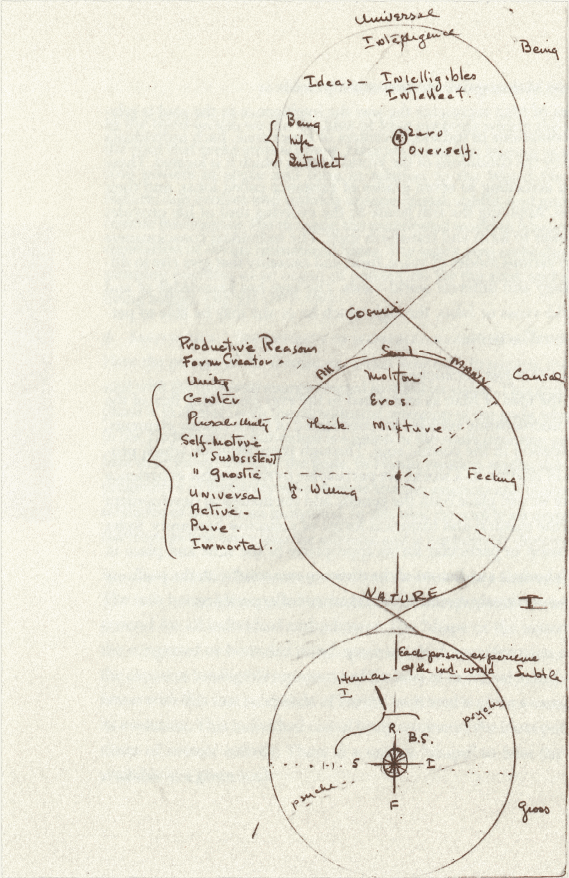
DIAGRAM appended to this transcript:
- FIGURE AD_G_012. Three Circles Diagram: Divine Intellect, Soul, Psyche.
Other diagrams also referred to are not with this transcript version. [Transcriber note: [diagram] means the speaker is referencing a diagram as he or she is speaking. If someone is drawing or writing, with audible sounds of chalk on a blackboard, I indicate this by [drawing] or [writing].]
NOTES:
This class is part of a series of classes where Jung's essay "Spirit and Life" is discussed. See also WG Classes 1973 0720, 1973 0803.
For readability's sake, the following substitutions/edits made in Verbatim Transcript: cuz = because; gotta = got to; yeah = yes; yous = you.
TRANSCRIBED Verbatim by IT prior to 2017, reformatted by jf 2017. In 2023, IT updates prefatory matter, footer, and audio file name, alters Subject and Subsubjects to make more accurate, completes Book List, fixes errors/typos, adds new notes within transcript, adds one diagram and references within transcript to this diagram, reformats to accord with new conventions. In 2025, IT updates audio file markers to match new REP audio. Archival verbatim transcript – V12a.
AUDIO FILES: 1973 0713a, 1973 0713b, 1973 0713c, 1973 0713d. [Note: In 2024, REP Studio cuts dead air from files b, d.]
1973 07/13 at Wisdom's Goldenrod
Jung; Epistemology
[Audio File 1973 0713a Begins]
JS: --summarize the whole thing and get it over with.
AD: Get it over with?
S: Get it over with.
JS: For now.
[10 seconds of background student talking]
AD: Well, it was a gallant effort.
JS: Uh-hm.
[13 seconds of background student talking]
S (in background): (No/Oh) it wasn't, what page was that?
JS: It ended on 439.
AD: We ended on 439, right?
S: Right.
[18 seconds of background student talking]
AD: Well, I don't feel strong enough to read 439 or-- Vic, how about reading the footnote, 130?
VM: You.
JS: Same spot.
AD: You got a footnote there?
VM: On page 130, "Aptly expressed…"? That footnote(./?)
AD (simultaneously): 439, the footnote, 130.
VM: [flipping through pages] 439, yes.
JS: Footnote Monday night.
VM: Ah. Ah, ok, long footnote, ok.
[short pause]
C.G. Jung [CW 8, The Structure and Dynamics of the Psyche, "On the Nature of the Psyche," p. 229, footnote 130, VM reading]: "130 It may interest the reader to hear the opinion of a physicist on this point."
VM: I don't know what point this is but let's--
AD: Well then don't--
VM (simultaneously): Well then maybe I go up and read the kind of warm up to this footnote?
AD: Go ahead, warm up.
VM: Ok.
C.G. Jung [CW 8, The Structure and Dynamics of the Psyche, "On the Nature of the Psyche," p. 229, paragraph 439, VM reading]: "The application of statistical laws to processes of atomic magnitude in physics has a noteworthy correspondence in psychology, so far as psychology investigates the bases of consciousness by pursuing the conscious processes until they lose themselves in darkness and unintelligibility, and nothing more can be seen but effects which have an organizing influence on the contents of consciousness."
VM: Now the footnote [one/two words inaudible]
AD (simultaneously): Well you might as well finish.
VM: Finish the whole paragraph?
AD: Finish the whole paragraph.
VM: Ok.
C.G. Jung [CW 8, The Structure and Dynamics of the Psyche, "On the Nature of the Psyche," p. 229, paragraph 439, VM reading]: "Investigation of…"
S: A whole paragraph.
S: Um, um, 439.
C.G. Jung [CW 8, The Structure and Dynamics of the Psyche, "On the Nature of the Psyche," pp. 229-230, paragraph 439, VM reading]: "[VM adds: The] Investigation of these effects yields the singular fact that they proceed from an unconscious, i.e., objective, reality which behaves at the same time like a subjective one--in other words, like a consciousness. Hence the reality underlying the unconscious effects includes the observing subject and is therefore constituted in a way that we cannot conceive. It is, at one and the same time, absolute subjectivity and universal truth, for in principle it can be shown to be present everywhere, which certainly cannot be said of conscious contents of a personalistic nature. The elusiveness, capriciousness, haziness, and uniqueness that the lay mind always associates with the idea of the psyche applies only to consciousness, and not to the absolute unconscious. The qualitatively rather than the quantitatively definable units with which the unconscious works, namely the archetypes, therefore have a nature that cannot with certainty be designated as psychic."
[short pause]
C.G. Jung [CW 8, The Structure and Dynamics of the Psyche, "On the Nature of the Psyche," pp. 229-230, footnote 130, VM reading]: "130 It may interest the reader to hear the opinion of a physicist on this point. Professor Pauli, who was good enough to glance through the ms. of this supplement, writes:"As a matter of fact the physicist would expect a psychological correspondence at this point, because the epistemological situation with regard to the concepts 'conscious' and 'unconscious' seems to offer a pretty close analogy to the undermentioned 'complementarity' situation in physics. [S: Well what is that?] [S: Uh-hm.] On the one hand the unconscious can only be inferred indirectly from its (organizing) effects on conscious contents. On the other hand every 'observation of the unconscious,' i.e., every conscious realization of unconscious contents, has an uncontrollable reactive effect on these same contents (which as we know precludes in principle the possibility of 'exhausting' the unconscious by making it conscious). Thus the physicist will conclude per analogiam that this uncontrollable reactive effect of the observing subject on the unconscious limits the objective character of the latter's reality and lends it at the same time a certain subjectivity. Although the position of the 'cut' between conscious and unconscious is (at least up to a point) left to the free choice of the 'psychological experimenter,' the existence of this 'cut' remains an unavoidable necessity. Accordingly, from the standpoint of the psychologist, the 'observed system' would consist not of physical objects only, but would also include the unconscious, while consciousness would be assigned the role of 'observing medium.' It is undeniable that the development of 'microphysics' has brought the way in which nature is described in this science very much closer to that of the newer psychology: but whereas the former, on account of the basic 'complementarity' situation, is faced with the impossibility of eliminating the effects of the observer by determinable correctives, and has therefore to abandon in principle any objective understanding of physical phenomena, the latter can supplement the purely subjective psychology of consciousness by postulating the existence of an unconscious that possesses a large measure of objective reality.""
VM: That's quite a mouthful. [short pause] Maybe I should say something about what complementarity is in physics (probably).
AD (simultaneously): Yes, go ahead.
VM: In-- Let me just write this down. This is a very-- this is a Pauli-- [writing] I mean the Heisenberg uncertainty principle, which says delta, let's say, x, times delta v, we can say it this way, has to be greater than or equal to h phi. We don't care what this thing is on the right [diagram]. But-- (some laughter, student words)
S: Saturn.
JS: That's Saturn.
S (simultaneously): That's not exactly Saturn.
VM: That's not exactly Saturn, that's a-- a constant, you don't care what the-- what it is, it's a constant, and all this says is delta x is the-- the positional accuracy of a certain measurement. In other words, you have a measurement between x plus a little bit, and that little bit is delta x, ok? And the velocity is correspondingly indefinite by delta v. So, the product of those two things in physics, in atomic physics, always has to be larger than this quantity on the right which is just a constant. Now you say, "Well, I'd like to really pin down the position with more accuracy." Well, that's possible but only at the expense of knowing its velocity. The more precise you know the position, the less precise you know the velocity. Or if you want to flip it around, you say "I want to really know the velocity, I'm not too interested in where the particle is in terms of position." Then you can know the velocity more precisely at the expense of the position. And what you'd call these two variables and you'd say they're complementary. You only know the one at the expense of the other or you can only know the two of them within these kind of limits given by this relationship. There are other complementary variables but these are just, you know, two of these, energy and time and so on and so forth. And-- Well, I don't think it's necessary to say much more about it but-- He's making a big thing about how the unconscious and the conscious are complementa-- complementary in the same sort of way that these two variables are in physics.
S (faint): So is (that) like a-- put it into-- to motion the same way. [few words inaudible] put it into motion.
VM: Well, it's really done in terms of momentum but I-- that's-- no sense in getting hung up in that, it's really just position and velocity. I don't think that I wanted to make too much-- I could have chosen other variables, I could have chosen, as I said, energy and time as an example. I don't think we should care too much about the particular physical quantities involved. The principle of complementarity is all I was trying to illustrate by using these two things. In other words, like in classical physics, the baseball will go by, you say, "Well, I can know its position and its velocity with infinite accuracy," you know, it's just a question of better measurements and so on and so forth. Well wasn't that the way that people looked at-- Well remember in the beginning of this essay Jung talked about this-- the philosophers, the old time philosophers thought that the soul was known very precisely and you merely enumerate the various aspects of the soul, you know, its qualities and its functions and this and that. And then the concept of the unconscious came in and people realized that you could never know the soul with as much precision as we previously thought, that something was always left unknown, there was always the unconscious background in a sense. Well the same principle comes down in microphysics level, [S: That there's--] that there's always-- you can only pin down something to a certain amount of accuracy and you leave the other quantity unknown and you just have to trade one off against the other depending upon what you want to do.
S: [few words inaudible]
S: Yes.
VM: Well, I don't know what you mean by that, it doesn't ring a bell.
S (faint): Or (there) might be (satisfying) it in two ways of (approaching the world) that you would [few words inaudible]
VM: Those would be complementary principles, right, either you're in [S simultaneously, very faint: Or you're-- right, yes, right.] Becoming or you're in Being. Is that what you mean sort of? And [few inaudible student words simultaneous with VM] they're complementary principles. They're-- Heisenberg and Bohr and those people who were really interested in the philosophical aspects of quantum mechanics, and that book Physics and Beyond by Heisenberg has got a lot of stuff in it. No, but this principle of complementarity should run up and down the gamut of reality, whether it's dealing with philosophy or atomic physics. And, he doesn't give exactly that analogy but he talks about many examples of complementarity outside of the realm of atomic physics. Yes John.
JL: Doesn't this then indicate a certain factor of subjectivity in an observation?
VM: That's precisely the whole [couple inaudible JL words simultaneous with VM] thing that they've come out of this, you know, [JL: Well--] that you always disturb the system when you're measuring it, and consequently you can't ever exclude the observer completely like we used to think in classical physics. And in this footnote Pauli talks about the same thing in psychology. When you start unearthing unconscious contents and integrating them into your conscious outlook or attitude, you correspondingly effect a change on the unconscious complex, it's the same sort of thing happening again, and that's that famous line where "the organ of consciousness is a transformer and itself transformed". Same idea, at least I think it is.
S (simultaneously): (Therefore--) In other words [couple words inaudible] also that I'm becoming aware of something that (no-- no one can) copy, they can call that an objective law, I mean, like to [couple words inaudible]
VM (simultaneously): I can't follow you.
S: Well to be able to say that the-- the observing subject, the knowing of the observing subject affects what it's observing, it seems that there-- that an element that enters into that statement that implies a [one word inaudible] (and subjective, what'd you call it) [few words inaudible]
JL: Well, above it or that the content itself is objective.
VM: I'm not sure I follow completely what you stated but the point that they always try and drive home is that the physical phenomena is not independent of the observation. And-- and that's so important like in mentalism, you know, the [student assents] whole idea that you're really involved in the perception of the objective world, it's not some static thing that's there and then you see it.
S (simultaneously): But then you see it as an objective law (then).
VM: Oh yes. I mean you can't get around it, you're really up against it all the time in atomic physics.
AD: You'd have trouble saying what is subjective or objective, wouldn't you?
S: I mean, the law.
AD: Yes, the law.
S: True but that doesn't [couple words inaudible] you can still [couple/three words inaudible]
VM: Oh no, I think [S simultaneously, faint: No.] what he's talking about is what other people have called the threshold between conscious and unconscious, he uses the word 'cut'.
S (simultaneously): It isn't-- it isn't decisive in any way.
VM: Not that I know of.
[short pause]
S: That cut, I don't believe it.
[short pause]
S: It's really interesting that as soon as this-- as soon as this cut, where you say you have a-- a sense of cut between conscious and unconscious, this is kind of a fluid concept, which means that there's not a very definite point [few words inaudible] It's kind of--
VM: That goes right along with this little equation I wrote down though, you can't-- I mean you can have a little more of the one at the expense of the other or-- it's not exact, it's not--
JL: But it doesn't (leak in).
VM: Yes, I mean you got a certain slack that you carry at one end or the other and the same thing with this cut I think. I don't know if this-- this is too hard but--
AD: Well, you can go over the 440, about the--
S: [three/few words inaudible]
S: Is that constantly to have observers?
S: (I think.)
S (simultaneously, very faint, possibly part of background): [one/two words inaudible] I don't think.
AH (very faint): Constantly.
S (faint, possibly part of background): What's wrong with you?
S (very faint): Constantly.
AD: That's a big one but--
VM(?): What, you'd want to read the whole chapter, I mean that whole thing?
AD: Well towards the end of it he says--
C.G. Jung [CW 8, The Structure and Dynamics of the Psyche, "On the Nature of the Psyche," p. 232, paragraph 440, AD reading]: "Professor Pauli formulated the physical side of the complementarity relationship here expressed, as follows:"It rests with the free choice of the experimenter (or observer) to decide…which insights he will gain and which he will lose; or, to put it in popular language, whether he will measure A and ruin B or ruin A and measure B. It does not rest with him, however, to gain only insights and not lose any.""
[student assents]
VM: Yes. [short pause] Yes that-- the business of measure A, ruin B or ruin A and measure B is exactly [AD: Yes.] what I'm talking about.
AD: Well, that's inevitable if the observer is part of the observat-- whatever he observes, the complementary relationship is inevitable. It's a natural-- natural deduction from relativity. For one to find out that he has knowledge, you know, and that that knowledge is relative, has no choice. Just like for instance, if you do-- if you do the breathing exercise where you just observe your breath, you're not supposed to interfere. Well, if you're very careful, you'll see that just observing it interferes with it. You can't be an impersonal observer. Pure objectivity is nonsense, ok.
VM: That was quite a revolution in physics, I mean-- and-- and (some of) its repercussions were felt in a lot of places.
S: Tony?
AD: I think the part we left off or that-- I don't know if there's any more questions.
C.G. Jung [CW 8, The Structure and Dynamics of the Psyche, "On the Nature of the Psyche," p. 230, paragraph 439, AD reading]: "The elusiveness, capriciousness, haziness, and uniqueness that the lay mind always associates with the idea of the psyche applies only to consciousness, and not to the absolute unconscious. The qualitatively rather than quantitatively definable units with which the unconscious works, namely the archetypes, therefore have a nature that cannot with certainty be designated as psychic."
[Note: See FIGURE AD_G_012 for the following.]
AD: And-- [short pause while drawing] That sort of catapulted this whole-- the whole conception, I think, of the collective unconscious. As soon as you said that they have a nature that cannot with certainty be designated as psychic, right away this one [middle circle] comes into operation.
S: [few words inaudible]
AD: Remember, we spoke about this as [drawing] prajna [middle circle] in the Sunday class, where knowledge is undifferentiated and motionless, no motion, and over here there would be motion [bottom circle]. So, right away, with that kind of a sentence, it's almost like a hint that he's hinting at the causal where there, so to speak, is-- we go beyond the notion of the psyche.
S: Well in that sense, wouldn't-- wouldn't we have to make a distinction then between-- I guess-- I guess the psyche we have to consider like the triple Mercurius which would be like the subjectivity and that-- the content as well as the process where the observer would influence whatever's happening but-- You know, there would have to be room for-- for that hidden observer which would want to fit up in that causal-- causal circle [middle circle] where, you know, somehow that-- that hidden observer would be observe-- observing even like the psychic (material) that's relating to unconscious contents. (And) I know that's a really tricky-- tricky point.
AD: [few words inaudible] [24 second pause while AD looks for quote] Those of you who have this book, (we turn) to Chapter 4 on synchronicity. [short pause] "Forerunners…" or Chapter 3 I think it is. One of these (times).
[short pause]
S: "Forerunners of the Idea…"?
AD: Yes, Chapter 3, it has some interesting-- [17 second pause] Any of you look at that? That kind of adds a few more remarks to that last paragraph. [15 second pause] Let's see. He says for instance--
C.G. Jung [CW 8, The Structure and Dynamics of the Psyche, "Synchronicity: An Acausal Connecting Principle," p. 485, paragraph 916, AD reading]: "The causality principle asserts that the connection between cause and effect is a necessary one. The synchronicity principle asserts that the terms of a meaningful coincidence are connected by simultaneity and meaning. [So] if we assume that the ESP experiments and numerous other observations are established facts, we must conclude that besides the connection between cause and effect there is another factor in nature which expresses itself in the arrangement of events and appears to us as [AD emphasis] meaning. Although meaning is an anthropomorphic interpretation it nevertheless forms the indispensable criterion of synchronicity. What that factor which appears to us as"meaning" may be in itself we have no possibility of knowing. As an hypothesis, however, it is not quite so impossible as may appear at first sight."
AD: And he goes on and speaks about the older civilization of China where they have a different perspective on that. He says--
C.G. Jung [CW 8, The Structure and Dynamics of the Psyche, "Synchronicity: An Acausal Connecting Principle," p. 485, paragraph 916, AD reading]: "Only in astrology, alchemy, and the mantic procedures do we find no differences of principle between our attitude and the Chinese. That is why alchemy developed along parallel [AD reads: similar] lines [AD: etc.]…"
AD: Alright, now we go to [one inaudible student word] paragraph 920, it's a short paragraph but if you read it very carefully--
C.G. Jung [CW 8, The Structure and Dynamics of the Psyche, "Synchronicity: An Acausal Connecting Principle," p. 487, paragraphs 919, 920, AD reading]: ""But it is on [AD: The quote from above."But it is on] the space where there is nothing that the utility of the wheel depends." [AD: That quotation from Lao-Tzu. The explanation:]
""Nothing" is evidently "meaning" or "purpose," and it is only called Nothing because it does not appear in the world of the senses, but is only its organizer."
AD: So the causal realm will of course appear as nothing. There's no way that you can apprehend it with the discursive faculty. He goes on and says--
C.G. Jung [CW 8, The Structure and Dynamics of the Psyche, "Synchronicity: An Acausal Connecting Principle," p. 487, paragraph 921, AD reading]: "Wilhelm describes it as"a borderline conception lying at the extreme edge of the world of appearances." In it, the opposites "cancel out in non-discrimination," but are still potentially present. "These seeds," [he continues], [AD: And again, this kind of reminds you of the Ishvara-Prajna situation where things are in a seed condition. "These seeds]"point to something that corresponds firstly to the visible, i.e., something in the nature of an image; secondly to the audible, i.e., something in the nature of words; thirdly to extension in space, i.e., something with a form. But these three things are not clearly distinguished and definable, they are a non-spatial and non-temporal unity, having no above and below or front and back.""
AD: Again at the beginning of paragraph 924-- Oh, 923, he says--
C.G. Jung [CW 8, The Structure and Dynamics of the Psyche, "Synchronicity: An Acausal Connecting Principle," pp. 488-489, paragraphs 923, 924, AD reading]: "The sages of old, [says Chuang-tzu],"took as their starting point a state when the existence of things had not yet begun. That is indeed the extreme limit beyond which you cannot go. The next assumption was that though things existed they had not yet begun to be separated. The next, that though things were separated in a sense, affirmation and negation had not yet begun. When affirmation and negation came into being, Tao faded. After Tao faded, then came one-sided attachments." …
"This Taoistic view is typical of Chinese thinking. It is, whenever possible, a thinking in terms of the whole, a point also brought out by [Marcel] Granet…"
AD: Paragraph 930.
C.G. Jung [CW 8, The Structure and Dynamics of the Psyche, "Synchronicity: An Acausal Connecting Principle," pp. 492-493, paragraph 930, AD reading]: "The idea that the inner and outer man together form the [AD emphasis] whole, [the (Greek word) of] Hippocrates, a microcosm or smallest part wherein the"great principle" is undividedly present, also characterizes the thought of Agrippa von Nettesheim. [He says:] The ancients had said [AD reads: had the saying]: "All things are full of gods.""
AD: [half/one word inaudible] Paragraph 931, this is just for your elucidation now, I'm-- I'm not going to go through this--
C.G. Jung [CW 8, The Structure and Dynamics of the Psyche, "Synchronicity: An Acausal Connecting Principle," pp. 493-494, paragraph 931, AD reading]: "Final causes, twist them how we will, postulate a foreknowledge of some kind. It is certainly not a knowledge that could be connected with the ego, and hence not a conscious knowledge as we know it, but rather a self-subsistent"unconscious" knowledge which I would prefer to call "absolute knowledge." It is not cognition but, as Leibniz [so excellently] calls it, a "perceiving"…"
[short pause]
AD: Well, I don't want to go into the causal-- into explanation of the causal right now, but you could certainly reread that chapter some benefit.
LS: Well when Jung speaks of the archetypes per se, does this-- the archetype per se, before there's any splitting up (them and) into opposites, then he's referring to the middle circle, the causal realm [diagram]?
AD: It seems to be that, doesn't it?
LS: And we can only distinguish them--
AD (simultaneously): They're not even psychic.
LS: Yes. We can only distinguish them--
AD: By their effects in the psyche.
LS (simultaneously): Down here in-- Yes.
S: When did we start referring to the middle circle as-- as causal? I thought that was subtle.
S: No.
AD: No, I always refer to this as the gross and the subtle over here [bottom circle]. [short pause while drawing, background student talking] Alright, body and mind, for instance, two aspects, ok, and this is causal [middle circle].
S: Do we still have a top circle in this--
AD: Huh?
S: [few words inaudible]
AD: I leave it out. It's more convenient.
S: [one/two words inaudible]
[short pause]
AD: Alright, I-- Before we go into a summary, I want to try an approach from a small selection here called (the) "Spirit and Life". I know you all [couple words inaudible] [short pause] Now, (I) spent a lot of time on these things because I have to start working with PB's works pretty soon, you know? I-- I'd like to do the Hidden Teaching and the Wisdom, but like I'd like for a lot of preliminary work to get done, I don't want to go through preliminary work. And, I really don't want to drag anybody through it so I hope none of you come. Kurt right now has started a class, and I'll let him bounce it around for a while. But I would put it to you this way. If you cannot in your understanding explain to yourself or at least have a schemata in your mind of how you can combine the-- the senses, so to speak, as the entrances and the exits of knowledge, then you don't understand the Hidden Teaching. And I'll leave it at that, ok? [9 second pause] Let's look at "Spirit and Life". This is another approach to the same problem, perhaps a little more difficult, maybe less. I think the Hidden Teaching is more difficult. It's kind of slippery like an eel. Every time you think you know it, you find-- find out otherwise.
VM: The rattlesnake [one/two words inaudible]
AD: Maybe a rattlesnake, yes.
VM (simultaneously): (Now) is this the one about the rattlesnake?
AD: Yes, this is the one about the rattlesnake.
VM: Ok.
AD: Would you read 605, start off [couple words inaudible]
C.G. Jung [CW 8, The Structure and Dynamics of the Psyche, "Spirit and Life," p. 321, paragraph 605, VM reading]: "The concept of the living body brings fewer difficulties to our task of elucidation than does the general concept of life, for the body is a visible and tangible reality that does not elude our grasp. We can easily agree, then, that the body is a self-contained system of material units adapted to the purpose of living and, as such, is a phenomenon of the living being apprehended by our senses."
AD: Now you want to read that sentence over and make sure (everyone--)
VM: Ok.
C.G. Jung [CW 8, The Structure and Dynamics of the Psyche, "Spirit and Life," p. 321, paragraph 605, VM reading]: "We can easily agree grasp…"
VM: Sorry.
C.G. Jung [CW 8, The Structure and Dynamics of the Psyche, "Spirit and Life," p. 321, paragraph 605, VM reading]: "We can easily agree, then, that the body is a self-contained system of material units adapted to the purpose of living and, as such, is a phenomenon of the living being apprehended by our senses."
AD: It's a phenomena of the living being.
C.G. Jung [CW 8, The Structure and Dynamics of the Psyche, "Spirit and Life," p. 321, paragraph 605, VM reading]: "More simply, it is a purposive arrangement of matter that makes a living being possible. To avoid confusion, I must point out that I do not include in my definition of the body proper something which I vaguely characterize as a"living being.""
AD: Go on.
VM: It makes a living being possible, on the other hand he does not include in his definition of the body proper "something which I vaguely characterize as a"living being.""
C.G. Jung [CW 8, The Structure and Dynamics of the Psyche, "Spirit and Life," p. 321, paragraph 605, VM reading]: "This separation of the two things, which I do not propose to either defend or criticize for the moment, is meant only to indicate that the body cannot be understood as a mere heaping together of inert matter, but must be regarded as a material system ready for life and making life possible, with the proviso that for all its readiness it could not live without the addition of this"living being.""
AD: Ok up to here? You follow clearly?
VM: (Yes?)
AD: Yes--
S: Except that he refers (to the) concept of living being first as "the living being"--
AD: Yes.
S: --and later "a living being." [couple words inaudible] a distinction in that [one word inaudible]
AD (simultaneously): No. No, he's trying to make a distinction here between the living being and the phenomena of the body which is not the same as the living being. Like I could be laying down here and I'd be a corpse, alright, dead. That's not the living being, you don't point to me and say "the living being" anymore, right? He makes a distinction, a very clear distinction here which you can very easily correlate with Vedanta, very easily, but I want you to (devalue) the paragraph.
C.G. Jung [CW 8, The Structure and Dynamics of the Psyche, "Spirit and Life," p. 321, paragraphs 605, 606, VM reading]: "For, setting aside the possible significance of"living being," there is lacking to the body by itself something that is necessary to its life, namely the psychic factor. We know this directly from our own experience of ourselves, and indirectly from our experience of our fellow men. We also know it through our scientific study of the higher vertebrates, and, for total lack of evidence to the contrary, we must suppose that some [such] factor is present in lower organisms and even in plants.
"Shall we now assume that this"living being" of which I spoke is equivalent to the psychic factor directly experienced by us in human consciousness, and so re-establish the ancient duality of mind and body? Or are there any reasons that would justify the separation of the "living being" from the psyche? In that case the psyche, too, would have to be understood as a purposive system, as an arrangement not merely of matter ready for life, but of living matter or, more precisely, of living processes."
AD: Alright, now let's go over this here part, ok? [VM assents] If you don't understand Jung, you're certainly not going to understand the Vedanta. Alright, because he's telling it to you in English words so you can't say "That's Sanskrit, I don't understand." Either you understand or you don't, alright? Did you follow what he said?
S: Uh-hm.
AH: All except for the very last part.
AD: Good.
VM: Let me read the last sentence, it's got a lot in it. (How--) Now he's talking about the possibility of separating out the psyche from the living being. [AH: Right.] He's got three things, the gross, you got a physical body, the psyche, and the living being that he's saying, "Let's just think about for a while separating the psyche and the living being."
AH: Ok, the first possibility of separation is between mind and body [one word inaudible]
VM (simultaneously): Well, psyche and body, as he's saying here. I don't know what 'mind' means now.
AH (simultaneously): Well, he said the age-old [one word inaudible]
S (simultaneously): [few words inaudible]
AH: (If--) The next possible separation is between psyche and the living being.
AD: Yes. Now what is this psyche the way he's speaking about it now? Read that sentence please.
VM: Ok.
C.G. Jung [CW 8, The Structure and Dynamics of the Psyche, "Spirit and Life," p. 321, paragraph 606, VM reading]: "Or are there any reasons that would justify the separation of the"living being" from the psyche? In that case the psyche, too, would have to be understood as a purposive system, as an arrangement not merely of matter ready for life, but of living matter or, more precisely, of living processes."
AH: It's almost-- it almost sounds as though he's willing to refer to the body as the psyche.
S: Oh no, no.
AD(?): No, no.
S: [few words inaudible]
VM: I don't think so.
JS (simultaneously): See, it's rather that he's referring to the psyche as a body.
AH: Calling-- calling the psyche an organization of principles, and you could call the body that too.
S: [few words inaudible]
VM (simultaneously): Well--
S: [couple words inaudible] One is so--
AH: What's the distinction then [one/two words inaudible]
S: One was--
VM (simultaneously): The body--
S: --material units ready for life, that is the body--
AH: Right.
S: --and the other was a [one word inaudible] living [one word inaudible]
VM: "…or, more precisely, of living processes."
JS: Also [student assents] ready for life. There's-- there are two different forms of body.
VM: Uh-huh.
AD: Go on.
JS: A physic-- a gross physical body and a mental body.
VM: Right.
AD: Oh, do [couple inaudible VM words simultaneous with AD] you-- can you think of any correspondences?
JS: It was down on the board a few times.
AD: Few times, go on. Go on [one/two words inaudible]
S (simultaneously): [few words inaudible]
AD: Hm?
S (simultaneously): [couple words inaudible]
S (simultaneously): [few words inaudible]
VM: Jung can come to the Sunday classes (and--) (some laughter)
AD: I had a long conversation with him many years ago.
VM: Did you?
AD: Yes.
VM: Really?
AD: I corrected some of his reflections.
VM (simultaneously): You're kidding, I didn't know you met [one word inaudible]
AD: Huh?
VM: You really met Jung?
AD: Yes, sure, in a vision. It was just as good as the real thing. Go on.
VM: I bet.
C.G. Jung [CW 8, The Structure and Dynamics of the Psyche, "Spirit and Life," pp. 321-322, paragraph 606, VM reading]: "I am not at all sure that this view will meet with general acceptance, [VM: No, it won't. (laughter)] for we are so accustomed to thinking of mind and body as a living unit that it is difficult for us to conceive of the psyche merely as an arrangement of life-processes taking place in the body."
AD: An arrangement of life-processes taking place in the body. You remember the, for instance, the Samkhya notion, Buddhi, Ahamkara, the whole arrangement of the mental body [VM(?): I don't remember.] separated from the [JS assents] gross body and the way the mental body, so to speak, inhabits the physical body and (that/like) you refer to yourself, "I am this person," you point to the body, you know. But when you're identified with the mind, then the body, so to speak, is extraneous, it's out there, and now you're that-- this mental being, ok? And there the identification with the subtle realm can be very very strong and one can see, so to speak, that you identify now with that subtle aspect of his being, which you will do when you drop dead. Go on. (some laughter)
S: If-- if he can find justification (he can) separate [couple/few words inaudible]. Does he do any justification (there)?
VM (simultaneously): Well, I think what he's doing here, I'm sure he's going to justify more as we go along, but he's taking a very characteristic scientific hypothesis point of view, says, "Let's start out trying this out and see what the ramifications of this are and if this fits in with our data. So I'm not quite certain [one/two words inaudible]" He's not saying, "This is the doctrine and here it is." He's trying to lead you through a scientific sort of rational approach.
AD: You know what the meaning in English is of Samkhya?
VM: Enumeration.
AD: Enumeration, discrimination. What do they discriminate? The principles, you know, that go into the making of a personality. Right? [S: Right, ok.] They (even) separate one from another and they show you, "Look, we got 25 principles. If you get these together we'll have a human being." [possibly one word inaudible] go ahead.
AH: There's one point that-- that's confusing me and-- but I'm sure that there must be a-- a-- a common understanding of Jung but-- what do-- what does he refer to as physical reality? Like, having been exposed to the mentalistic framework, I'm having some difficulty integrating Jung's distinction between physical and psyche. Could someone quickly--
VM: He makes reference to that problem in this essay we were still working on I guess, or finishing up, and he talks there about you can separate the gross, what we have always called the gross physical world, from the mental world but then you realize, I'm not using his exact words but the sentiment anyway, that they're really one and the same, or they stem from one and the same principle. I think he's, you know, really is very much aware. When he goes around saying things like, "All you can experience is the psyche," I mean he's including everything there. But we, you know, certainly--
S (simultaneously, faint): The whole bottom circle.
AD (faint): Yes.
VM: Yes, everything in the bottom circle [diagram]. So I think he certainly has a-- He may not use the word 'mentalism' but I think it's implicit or explicit.
S: Me too.
AD (simultaneously): Well, maybe this might clarify it more, you know, like when you think of the subtle and the gross, the gross would represent the sensual qualities, you know, corporeal qualities, and the subtle would represent the ideas in the imagination. Any idea you have would be like subtle, alright? But you-- the perception of this wooden shelf, for instance, that's a gross or corporeal quality. The dime-- the-- the hardness, the feltness, the color, all these would be corporeal.
AH: But any ideas you had about it wouldn't be.
AD: An idea wouldn't be the same thing, would it? You have [AH simultaneously: No.] an idea of the shelf, it doesn't have a color, a thickness, a length, a breadth. Does it?
AH: No, but--
S: What is it?
AH: Isn't there a point of view that would-- it would imply or suggest that-- that even-- even the sensory perception is itself an idea.
AD: Yes, you're correct but the point here that-- that you want to distinguish, you want-- you want to make them distinct, right?
AH: Right.
AD: And I'm-- I'm saying like the easiest way to distinguish them is like when PB says, when the mind operates through the senses, you have, so to speak, a thing. When it operates through the imagination, you have ideas, alright, and one is the gross and the other is the subtle. True, what you know of the gross world is an inference that can only arise through the subtle or the psyche. But there is this distinction that is being made.
AH: Ok.
AD: Ok.
AH: I mean ultimately--
S (simultaneously): Well--
AD: Ultimately, of course, for him there's nothing but the psyche, yes, but you do have to keep these distinctions in mind. If you want, even PB makes a distinction, he says they're not-- it's not a question that they're qualitatively different but a question of the intensity here. When consciousness, so to speak, operates through the senses, there's a much more intense awareness, it's much more sharper, whereas when your-- your attention is on ideas it's kind of fuzzy, weaker.
AH: And you said that-- you just said that-- you suggested it's not a qualitative. Did you mean quantitative?
AD: There's no qualitative difference, it's not a difference in kind really, and so he abolished in one stroke, so to speak, [AH: Right.] matter. That's your problem. You say, "Well if everything is mind, what's this matter you're talking about?" But, you're making the mistake of thinking that matter-- Not the mistake, that you're attributing it-- to it the notion that there's some thing there, you know, whereas in mentalism that something is a manifestation of mind, there's no thinghood there. Look at it this way. The psychological experience of the gross world is matter. The psychological experience of the subtle world through ideas is the so-called mentalistic framework. And there's a distinction. You won't say that it's ultimately valid but if you-- if you bumped into an idea, it won't do as much damage as if you bumped into a table.
RC/S(?) (simultaneously): [few words inaudible]
RC: In the case of like when there's a-- a projection operating that-- that colors the appearance of something sometime and at other times it doesn't, is it like gross matter you're perceiving in both cases? Would it be called gross matter?
AD: I'm sorry, try again.
RC: Or you could look at something (and sort of just) [S: (one word inaudible) this thing is about.] see something beautiful one time and another time that beauty isn't there. Now, (is/if) the matter [one/two words inaudible]
AD (simultaneously): Oh, come on, be more specific, give me specific an-- give me [RC simultaneously: Well--] specific [one word inaudible]
RC: Well in-- in many cases there's like an anima projection, you look at a woman, she looks different one day than another day according to, you know, when-- how the projection is operating or of it is or if it isn't. I'm wondering if in both cases this matter that you're supposed to be perceiving with the senses would be called gross.
AD: Well, I hope she is. [AH: So--] Otherwise you're going to be awfully disappointed.
RC: No, I mean like the difference between-- [AD simultaneously: You--] Is-- is gross what we're talking about the matter which is actually there like a camera would see?
AD: Of course Randy, I mean--
RC: Ok. Like, the camera doesn't tell any lies sort of thing, like a camera takes a picture of what is there.
VM: Yes, but then you can project on the picture though Randy. (bit of laughter)
S: [few words inaudible]
AD: I mean if there wasn't this girl here that you could project on, if there wasn't this gross girl that you could project on, ok-- (laughter, student words)
RC: [one/two words inaudible] regardless, we make all these subtle changes-- make all these subtle changes in the appearance of that person or object--
AD: Well, that wouldn't-- that wouldn't be-- that wouldn't be gross-- the projection wouldn't be gross, the projection is the imagination going out through that and coloring it for you, [RC assents] so that idea that's projected is not gross.
RC: That was the question. (And/Then) this matter which then composed, is it subtle matter?
AD: Yes, if you-- like you go over and hold her hand and she kicks you in the shin, that's all gross matter. (laughter) I don't know why you're making it sound so complicated, you-- you really don't know any more the difference between one and the other!? [RC: Well--] Oh boy! (AD laughs, laughter, student words)
RC (simultaneously, amidst laughter): I mean you still never answered [few words inaudible]
AD: Huh?
RC: It's kind of dabbling on-- I guess this is the receptacle business always running away. But according--
AD (simultaneously): This is the what?!
RC: Well according to what-- (laughter) (well) according to what feelings I have invested in I keep hoping there was that '57 Chevrolet and it's ugly at one point until it becomes yours and then it's beautiful.
AD: But it's still a '57 Chevrolet! (laughter, student words)
VM: Dave Bulkley's not here now, you can't use that in front of David Bulkley.
S (faint): (Well is he here?)
RC: But this matter that it's made up of to me [few words inaudible]
AD (simultaneously): All you're telling me is that you have-- you have a problem here because the two of them seem to be intertwined in your experience, but so what?
RC: Well, the question is like is all of that that appears to be seen like gross matter or is it [couple words inaudible]
AD (simultaneously): Well tell me, does the thought appear, the projection on this woman, does that appear, that she's lovely? [short pause] Isn't that in-- in your imagination? I'm not saying it's true or false, I'm just saying, isn't it there? [short pause] Hopefully she's really there when you want to go over and say hello.
JS: Didn't you just say that the-- the psychological experience of the gross physical world is matter? The--
AD: Psychological experience [JS simultaneously: Yes, I'm quoting you I think.] of the gross physical world. Alright.
JS: So that would include your projections on the object to a certain point.
AD: Yes, alright, but let's keep the distinctions together, you know, as distinctions.
JS: Yes, what you see out there is matter.
AD: Yes, all your experience of the corporeal world is-- is through these psychological qualities which we call matter. That's all.
AH: That even includes the bookshelf while you perceive it as bookshelf, but-- that doesn't--
[Audio File 1973 0713a Ends]
[Audio File 1973 0713b Begins]
AH: Is that all one side?
AD: Yes, you'll always have those two, sure.
[student assents, very faint]
AH: Well, then what--
AD: It's kind of hard to imagine a person having a perception, so to speak, you know, without that getting caught up in, let's say, the psychological qualities he works with. I can't imagine that kind of a person who has withdrawn all his projections from the world. [S: (But (sometimes--)] So you're always dealing with both, but you're making distinctions, so to speak, right now.
AH: But if the distinction was a-- a matter of experience, there'd be something quite different than-- than the way we normally experience the world.
AD: Well Andy, don't you know yourself in two different ways? Your body, so to speak, is gross and your mind is subtle?
S: (Right.)
AH: Yes. But that distinction is not very clear.
AD: It isn't? (AD laughs, some laughter)
S: I'm not worried.
S: [couple/three words inaudible]
AD: Anybody else? (AD laughs) You too?
S (simultaneously): [few words inaudible] (laughter, students assent)
S: Um--
AH: But--
AD: You too, yes? Alright.
AH: [couple words inaudible]
S (simultaneously): Is the imagination like-- is the imagination like--
AD: Let me finish with him. Go ahead.
AH: When we look at the bookcase, say "Ok, there's a wooden bookcase." I think what Randy might have been driving at, is it possible to experience just the bookcase or isn't there always--
AD: It is possible for a man to completely withdraw all projections. In that case, he wouldn't be here.
RC: There's a difference between my psychological projections onto an object and the object that's being thought to me by the World-Mind, and--
AD: Well we made that clear a couple of times, didn't we? [drawing] 12th house, 1st house--the ascendant is a combination of your past and your present [diagram]. As you can tell, I'm weary of explaining these things.
S: Go ahead.
AD: It's not possible to perceive without your samskaras being included.
RC: Ok.
AD: That language you understood, huh? Jung-- (laughter) Jung you don't understand. (AD laughing, laughter)
VM: That's why you got to use eleven different approaches.
AD: Eleven different approaches you suggest. Yes Anna, you have another one, huh?
AP: No.
AD: Good.
AP: What does he mean-- what does he mean by living processes?
AD: Yes, what does he mean by living processes? Like maybe breathing, alright?
VM (simultaneously): That's-- that's (such) a good example.
AD: How about breathing, you [student assents] start with that?
S: Yes.
VM: A good one to start with, yes.
AD: Ok.
VM: Eating, sleeping.
S: (Thinking.)
JS: Heart beating.
S: Then how do you--
AD (simultaneously): How many different kind of breathing do you know? [couple inaudible student words] There's five different kinds, you know.
VM: Of breathing?
AD: Yes.
AP: How do they relate to life, (does the function) relate to life?
AD: How does the--
AP: --the functions relate to life? (That's what-- other than my experience.)
AD: Read that sentence she's referring to, would you read that sentence? That these psychic processes are living processes.
VM: Uh-hm.
S: [one/two words inaudible]
VM: (Tony, I have to read through it again.)
AD: (Alright/Ok).
C.G. Jung [CW 8, The Structure and Dynamics of the Psyche, "Spirit and Life," p. 321, paragraph 606, VM reading]: "Or are there any reasons that would justify the separation of the"living being" from the psyche? In that case the psyche, too, would have to be understood as a purposive system, as an arrangement not merely of matter ready for life, but of living matter or, more precisely, of living processes."
AD: Do you remember some of the aspects, when we spoke about the subtle body, about the various constituents that go into the making of the subtle body like from the Vedantic point of view? Like pranomaya, you know, manomaya. These are-- these are organized ways of operating, alright, and like they're put into the physical body, alright, and then you turn the key and he goes off by himself. He's got a body, a physical body, and something in that body, so to speak, you know, that's mental, alright, a counterpart to the physical. So, these processes (like), they-- they would be it. Like, for instance, he's got instincts. Well, manomaya is basically where the animal instincts are and the manomaya, let's say, gets put into a physical body of an animal, then this-- this body of the animal with the manomaya principle operating in it, alright, has an organized system of references. (He/It) says, "Now let me see…" He doesn't think about, "(Well) should I eat? Is there such a thing?" It's-- it's really amazing, that-- I mean that's all he's talking about, I mean, that's all.
VM: Tony, but don't-- maybe this is jumping the gun a little bit but that living being, and before you talked about Samkhya as making this very distinct split between the mental world or what he's calling the psyche and the gross physical world which we (and) Samkhya have the-- [few words inaudible] (how many) principles there are on [S simultaneously: (Initially.)] initially the right hand side here [diagram], [three inaudible student words simultaneous with VM] tanmatras, the bhutas and so on.
AD (simultaneously): Uh-hm.
S: [one word inaudible]
S: [one word inaudible]
VM: Could it be that the living being he's referring to would then correspond to ahamkara, actually buddhi and ahamkara?
AD: It could be but why don't you wait and see, why don't you wait and see.
VM (simultaneously): Ok, I thought might be [one/two words inaudible] ok. Shall we go on (Tony)?
AD (simultaneously): Yes, let's go on.
JS: [few words inaudible]
VM (simultaneously): You want me to just read [couple words inaudible] huh?
AD: Yes, they're very worthwhile paragraphs.
C.G. Jung [CW 8, The Structure and Dynamics of the Psyche, "Spirit and Life," p. 322, paragraph 607, VM reading]: "So far as our experience permits of any inferences at all about the nature of the psyche, it shows the psychic processes as a phenomenon dependent on the nervous system."
VM: And in Vedanta they speak of the subtle body as being in the nadis.
AD: Yes.
S: Yes.
C.G. Jung [CW 8, The Structure and Dynamics of the Psyche, "Spirit and Life," p. 322, paragraph 607, VM reading]: "We know with tolerable certainty that disturbance of certain portions of the brain brings about corresponding psychic defects. The spinal cord and the brain consist essentially of interconnections between the sensory and motor tracts, the so-called reflex arcs. What is meant by this I can best show by means of an example. Suppose one touches a hot object with the finger: at once the nerve-endings are stimulated by the heat. This stimulus alters the condition of the whole path of conduction up the spinal cord and thence to the brain. In the spinal cord, the ganglion cells taking up the heat stimulus pass on the change of condition to the neighbouring motor-ganglion cells, which in their turn send out a stimulus to the arm-muscles, thereby causing a sudden contraction of the muscles and a withdrawal of the hand. All this occurs with such rapidity that the conscious perception of pain often comes when the hand has already been withdrawn. The reaction is automatic and is not registered consciously till afterwards. But what happens in the spinal cord is transmitted to the perceiving ego in the form of a record, or image, which one can furnish with names and concepts."
VM: I'll read that again.
C.G. Jung [CW 8, The Structure and Dynamics of the Psyche, "Spirit and Life," p. 322, paragraph 607, VM reading]: "But what happens in the spinal cord is transmitted to the perceiving ego in the form of a record, or image, which one can furnish with names and concepts. On the basis of such a reflex arc, that is, a stimulus moving from without inward, followed by an impulse from within outward, one can form some idea of the processes that lie beneath the mind."
VM: If I--
AD: Go on.
S: Can we please read once again what [one word inaudible] what happened in the spinal cord--
VM: Yes--
S: [few words inaudible]
VM (simultaneously): Yes.
C.G. Jung [CW 8, The Structure and Dynamics of the Psyche, "Spirit and Life," p. 322, paragraph 607, VM reading]: "The reaction is automatic and is not registered consciously till afterwards. But what happens in the spinal cord is transmitted to the perceiving ego in the form of a record, or image, which one can furnish with names and concepts. On the basis of such a reflex arc, that is, a stimulus moving from without inward, followed by an impulse from within outward, one can form some idea of the processes that lie beneath the mind."
S: Everybody [few words inaudible]
AD: He [S simultaneously: Yes.] gives you a better example next. Go on.
AS: So-- so in other words like, you-- you have this sort of subconscious-- below consciousness you have this reaction taking place. The hand feels the heat, travels through the nerve into the spinal cord and then from the spinal cord there's like two things are happening. One is that there's an automatic response to that and another thing is right sending to the brain from the spinal cord is this thing, this image which is call-- which can be called 'hot', but actually the hot only occurs after the-- the-- let's say, the-- the stimulus has gotten up to the brain and then you can say 'hot', you can give it a name; comes an image of something, you can give it a name [couple words inaudible]
AD (simultaneously): Alright, let's take the next example.
C.G. Jung [CW 8, The Structure and Dynamics of the Psyche, "Spirit and Life," p. 322, paragraph 608, VM reading]: "Let us now take a less simple example. We hear an indistinct sound the initial effect of which is no more than a stimulus to listen in order to find out what it means. In this case the auditory stimulus releases a whole series of images which associate themselves with the stimulus. They will be partly acoustic images, partly visual images, and partly images of feeling. Here I use the word"image" simply in the sense of a representation. [VM: So it's quite obvious he doesn't mean just a picture.] A psychic entity can be a conscious content, that is, it can be represented, only if it has the quality of an image and is thus representable. I therefore call all conscious contents images, since they are reflections of processes in the brain."
AD: Better read that a couple of times.
VM: Yes [couple words inaudible]
S: (Can I hear that one more time?)
RG(?): (Well) what paragraph is that?
VM: This is paragraph 608.
C.G. Jung [CW 8, The Structure and Dynamics of the Psyche, "Spirit and Life," p. 322, paragraph 608, VM reading]: "Here I use the word"image" simply in the sense of a representation. A psychic entity can be a conscious content, that is, it can be represented, only if it has the quality of an image and is thus representable. I therefore call all conscious contents images, since they are reflections of processes in the brain."
AD: They are reflections of processes in the brain.
S: So an image would be apperceptive rather than perceptive, if it's a re-- if he (propounds) it as a re-presentation.
AD: Tell-- tell them what you mean.
S: Louder.
S: Well he says that-- he call-- he calls these contents images because they're re-- re-present-- re-presentations or representations of these impulses that are taking place in the brain. So, since that-- since they're representations or re-presentations they fit into the category of apperceptive and not just perceptive where there would be a-- a mere perceiving of the object, it would be-- it would have a meaning content with it.
AH(?): When would it have a meaning content with it?
AD: Listen to this experiment. [AD possibly paraphrasing] [couple words inaudible] (make) an experiment at the University of Freiburg. It shows the relationship between the inner and the outer worlds. The work is on bird migration.
[Transcriber note: I am using the essay "The Tendency Toward Patterning and Order in Matter and in the Psyche" by Elizabeth K. Osterman in The Reality of the Psyche: The Proceedings of the Third International Congress for Analytical Psychology, edited by Joseph B. Wheelwright, New York: G.P. Putnam's Sons, 1968.]
Elizabeth K. Osterman [The Reality of the Psyche, "Patterning in Matter and Psyche," pp. 22-23, AD reading]: "It was known that baby warblers could take off and fly the route in advance of their parents. How did they chart the way? The bird was placed in a box so that it could view the night sky. Results were the same whether it was the natural sky or a sky projected in a planetarium. The observer beneath recorded the way the bird headed. When the dome was illuminated with diffuse light, the warbler was unable to choose a preferred direction. With the autumn sky projected, the bird took up the correct position for migration over the usual route. When the planetarium sky was rotated to show the stars at a different latitude, the warbler corrected its flight direction for that latitude. In other words the bird was apparently selecting its flight direction by the pattern of the stars. We have now arrived in the world of images."
AD: You want to read that again?
RG(?): What we read?
AD: Yes.
RG(?) (very faint): (Vic could do it.)
C.G. Jung [CW 8, The Structure and Dynamics of the Psyche, "Spirit and Life," p. 322, paragraph 608, VM reading]: "Here I use the word"image" simply in the sense of a representation. A psychic entity can be a conscious content, that is, it can be represented, only if it has the quality of an image and is thus representable. I therefore call all conscious contents images, since they are reflections of processes in the brain."
S: So he's-- he's speaking of feelings as images, too, even if--
VM (simultaneously): Sure.
S: --you don't associate them with a picture.
VM: Right, that's (when) I said-- I was reading along here and I-- I said, "Obviously he doesn't mean just pictures by images." It's not (fulfilling to) [few words inaudible]
AD (simultaneously): Well, if fantasy material arises in you, it has a como-- a component of emotional dynamism, so you will be compelled to act it out. But we're not interested in that now. Let's go back to the point.
VM: Yes.
AH: Within-- within a context of-- of that sentence, when he refers to "psychic entity," well what is he talking about before it's represented? (Well) how-- how could he-- how can he speak of the psychic entities without-- without its being represented?
VM: Because he could speak about an archetype without it's being--
AD (simultaneously): (Equally.)
S: [few words inaudible]
S (simultaneously): [couple words inaudible]
VM: Just like you can speak about an archetype--
AH: Ok.
VM (simultaneously): --per se without thinking of a particular-- In fact, you always do think of a particular representation but it's [AH: But--] conceptual or--
AH: Alright.
AD: Read that sentence that he's referring to, I lost track.
C.G. Jung [CW 8, The Structure and Dynamics of the Psyche, "Spirit and Life," p. 322, paragraph 608, VM reading]: "A psychic entity can be a conscious content, that is, it can be represented, only if it has the quality of an image and is thus representable."
AD: "A psychic entity…"
VM: Uh-hm, "…can be a conscious content…"
AD: "…can be a conscious content…"
C.G. Jung [CW 8, The Structure and Dynamics of the Psyche, "Spirit and Life," p. 322, paragraph 608, VM reading]: "…that is, it can be represented, only if it has the quality of an image and is thus representable."
AH: Uh-huh.
AD: Now we have to figure out what this means, [AH: Right.] alright?
AH (simultaneously): I think it-- I think (it's refer--) psychic entity, conscious content, and he tries to relate-- relate that idea to the physiological schema we [couple words inaudible]. I don't see the-- I don't see how this-- how these two descriptions of obviously the same phenomena parallel each other. A psychic-- a psychic entity becomes a conscious content. Within the construct that we just talked about of the ganglia and the nerves and the image in the brain, I can't put those two together. Now maybe [few words inaudible]
AD: Alright, let me try, let me try this here.
AH: There seems to be-- there seems to be something missing in the last sentence.
[short pause]
AD: Let me read you the whole paragraph (that follow), alright?
C.G. Jung [CW 8, The Structure and Dynamics of the Psyche, "Spirit and Life," pp. 322-323, paragraph 609, AD reading]: "The series of images excited by the auditory stimulus is now suddenly joined by a remembered acoustic image associated with a visual image: the rattle of a rattlesnake. This is immediately followed by an alarm signal to all the body muscles. The reflex arc is complete, but in this case it differs from the previous one in that a cerebral process, a series of mental images, interposes itself between the sensory stimulus [AD reads: impulse] and the motor impulse. The sudden tension of the body now reacts on the heart and blood-vessels and releases processes that are mentally recorded as terror."
AD: Suppose we try-- suppose we try, ok? [drawing] And we try to make a-- This is your brain, ok? Yours, not mine.
JS: (He just doesn't have any brain waves, right?)
AD: [drawing] That's spinal column, ok? And back here somewhere is medulla oblonga, etc, ok. Now let's see, he says here-- [9 second pause] There's an auditory image, I'll give you a big ear, there's a rattlesnake out here, ok, he makes the rattle, alright, then there's a series of disturbances in the brain.
C.G. Jung [CW 8, The Structure and Dynamics of the Psyche, "Spirit and Life," pp. 322-323, paragraph 609, AD reading]: "The series of images excited by the auditory stimulus is now suddenly joined by a remembered acoustic image associated with a visual image: the [rattle of a] rattlesnake."
AD: And then you run. So you got this sort of-- what do they say, [drawing] efferent and afferent? So you have the impulse coming into the brain. Then in here [diagram] something is interposed, a lot of images flow in here, ok. And then "Wow!" and you take off. Ok? Something like that. Alan--
AB: Wouldn't the visual image and the acoustic image be part of one big image and when you heard the sound of the rattlesnake that would have constellated that whole image which included the terror and the running and everything else and then it all (happens).
AD: I didn't follow you.
AB: I'm thinking of the image as this total picture the way he describes it [one word inaudible]
AD (simultaneously): Yes, now you have to imagine that you (miss--) you hear a sound, ok, you [AB simultaneously: Right.] just hear a sound.
AB: Right, and my-- and then, that's an acoustical image.
AD: Yes, the acoustical image.
AB: And that acoustical image sort of constellates this whole big image in me which is the image--
AD: Does it constellate a whole big image or a series of images? Now think.
S (simultaneously): (Uh-huh.)
VM(?): Series.
AD: It's usually a series. You go into a room and something frightens you and a whole picture [S: (Yes.)] starts taking place.
AB: Yes but they're all connected together, that's what I'm trying to say, they're not [one/two words inaudible]
AD (simultaneously): Well yes, they're all connected together, they're all separate snapshots all being (on film/unfilm)-- filmed out, so to speak.
S: But there's a part--
AD (simultaneously): But certainly it's a series of images, it's certainly not one whole image that comes in. Ok? Alright, then out of the-- out of so many images, one of them strikes you to corresponding to that danger you're faced with. And then the visual image of, let's say, a rattle comes into your mind. But I think the point he's trying to make here is, over here [diagram] there seems to be, between the efferent and the afferent system, you know, in other words between the intake and the output, alright, something comes in with the series of images, alright, and then gives you correct answer, let's say a rattlesnake, and now you run.
JS: But the running is still automatic. I mean, that's-- (I'm just/And his)--
MB (simultaneously): [couple words inaudible] Jenny, it's not automatic in the same way as you (would slide) your hand on a hot stove (and--)
S: Right.
MB: It's a totally different phenomenon [S simultaneously: Phenomenon.] [few words inaudible]
JS: Well if we speak not in terms of running, Myra, but in terms of the-- the increased output of adrenalin and the speeding up of the heartbeat and [couple words inaudible]
AD (simultaneously): That could only take place [MB simultaneously: After.] after the conscious thought. But, let's stick to this point here first.
AH: Well that-- that little arrow that you have--
AD: Yes--
AH: --at the end [diagram], is that the psychic entity? [one word inaudible]
AD: Well he says here--
C.G. Jung [CW 8, The Structure and Dynamics of the Psyche, "Spirit and Life," p. 322, paragraph 608, AD reading]: "A psychic entity can be a conscious content, that is, it can be represented, only if it has the quality of an image and is thus representable. I therefore call all conscious contents images, since they are reflections of processes in the brain."
AD: In paragraph 610, let's go on a little bit more.
C.G. Jung [CW 8, The Structure and Dynamics of the Psyche, "Spirit and Life," p. 323, paragraph 610, AD reading]: "In this way we can form an idea of the nature of the psyche. [AD: Now follow this carefully.] It consists of reflected images of simple processes in the brain…"
AD: The nature of the psyche consists of simple processes that are reflected in-- in the brain. It reflects-- In other words, whatever activity's taking place in the brain, alright, it's reflected in the psyche.
JS: Does he literally mean brain there, the phy-- physical brain?
VM: I think so.
AD: Well I assume that, you know, if a rattle strikes my ear and it goes up to the-- the brain, you know.
JS: I mean, he's not using brain to mean mind. But it's literally the-- the physical brain?
AD: Well I don't know what you're referring to. He says over here--
C.G. Jung [CW 8, The Structure and Dynamics of the Psyche, "Spirit and Life," p. 323, paragraphs 609, 610, AD reading]: "The reflex arc is complete, but in this case it differs from the previous one in that a cerebral process, a series of mental images, interposes itself between the sensory stimulus and the motor impulse. The sudden tension of the body now reacts [AD: etc, etc]…
"In this way we can form an idea of the nature of the psyche."
AD: Now he says in this way we can form a nature of-- an idea of the psyche. And what is this psyche?
C.G. Jung [CW 8, The Structure and Dynamics of the Psyche, "Spirit and Life," p. 323, paragraph 610, AD reading]: "It [AD reads: This psyche] consists of reflected images of simple processes in the brain, and of reproductions of these images in an almost infinite series. These images have the quality of consciousness. The nature of consciousness is a riddle whose solution I do not know. It is possible to say, however, that anything psychic will take on the quality of consciousness if it comes into association with the ego. If there is no such association, it remains unconscious."
AH: Tony?
AD: Yes--
AH: I-- I would like to repeat Jenny's question a little. Obviously he's not referring to the mind here when he says brain but, I thought earlier (we made) a distinction between mind and body was a kind of a formal one for the purposes of the discussion, but now in his summation here and his definition of psyche, it's almost (this is) postulating this physical lump of flesh, the brain, as something independent of the whole psychic system [S simultaneously: No.] you're talking about.
VM: Andrew, I think you're interposing something in here that really wasn't there to start with. And initially he started out separating a body, the [AH assents] gross physical body, that system of matter ready for life, living processes, he separates that out from the psyche.
JS(?): Psyche is the living (process/processes).
VM: (Or the/Only) psyche was the living process, the matter, the living matter-- (well--) well that's the psyche, living processes. The body is the gross physical organism.
AS: Yes, in other words, like say you have a--
VM (simultaneously): That's the separation he made. I think 'mind' is another term that we're pulling in now and I'm not sure exactly how we're using it.
AB: Yes, and there's also the living being which is separate from the [one word inaudible]
VM (simultaneously): We're leaving that out now.
AS: See what-- I think what he means is like if you take a dead body, then this image is still going to be transferred to these-- Let's say maybe the stimulus is still going to go to the brain but there isn't going to be any reaction and there isn't going to be any consciousness of anything. But you know, he still doesn't-- he-- he's still not-- he's still leaving out the point of how, you know [couple words inaudible] my point, of how the stimulus in the brain is going to become this image. He says himself, you know, "I can't explain this consciousness." But I think that's where the point of it being a living entity comes in. This living entity is this process, this imagining process, this process which includes the consciousness of something, and that's the living part because that's the link between what comes in and then the reaction, in this-- in this example, not in the one before, but in [possibly one/two words inaudible]
AH: (How would--) All I'm driving at, we agreed that the distinction was a formal one for the purposes of this discussion. (But) the last paragraph that we read I-- I interpreted as a kind of summation, a definition of what psyche is. But in that definition there seems to be an implication that the brain is somehow separate from the whole psychic system. But maybe that's just my misunderstanding.
AD: That might be. (some laughter)
AH: But he's still talking about a brain that's independent, almost independent of the psychic system. He doesn't really-- well he-- he doesn't tie the two together, does he?
AD: Well the problem here is, we're not really listening to what he's saying. Let me give you an example. Here's an experiment, ok? I read this before but maybe once more will help.
Elizabeth K. Osterman [The Reality of the Psyche, "Patterning in Matter and Psyche," p. 21, AD reading]: "How is memory stored in this remarkable tissue?"
AD: And we're speaking about what Penfield did. I'm going to give you just the gist, you can look it up for yourself.
Elizabeth K. Osterman [The Reality of the Psyche, "Patterning in Matter and Psyche," p. 21, AD reading]: "For example, during an operation under local anesthesia, [AD reads: During an operation, for instance, under local anesthesia] a young woman relived the experience of her mother singing a lullaby each time the same spot in the cortex was touched. Flashbacks carried more detail than could be recalled voluntarily. Penfield proposed that memories have specific representation in altered molecules in nerve tissues."
AD: You have a very meager opinion of the brain. You know everybody's brain is different? Amazingly different.
AH: Well then he's not talking about just the physical brain.
AD: Let's see, let's-- Let's see what he's talking about. He says--
C.G. Jung [CW 8, The Structure and Dynamics of the Psyche, "Spirit and Life," p. 323, paragraph 610, AD reading]: "In this way we can form an idea of the nature of the psyche. [AD: Alright.] It consists [AD: What does the psyche consist of?] of reflected images of simple processes in the brain…"
AD: The psyche consists of reflected images (or) simple processes that once took place in the brain? Is that what he's saying? Something like that? So then the psyche will be, so to speak, full of all kinds of images. There, you have a storehouse, you don't know how rich you are.
OG: But then you couldn't say that the psyche can [few words inaudible] blank in a newborn baby if it consists only [few words inaudible].
AD: He certainly would not say that because he points out that the brain is an inheriten-- inherited physical substratum on which your behavior is already patterned, otherwise a-- a newborn baby could act like a goat or a sheep or an eagle. The brain is an inherited disposition to operate as a man rather than something else. So therefore you will not operate like a goat or a sheep, although I could make exceptions. (laughter) Huh?
OG: But there are no (image on it), right?
AD (simultaneously): Huh?
OG: There are no images on the brain at that time.
AD: Well, you got a nice new baby brain, flat, right, nothing in it yet.
VM: Oh, come on Om.
AD: You know by the very structure of the brain that it's going to operate in a certain way, that there's instincts implanted in the substratum of the matter which he called organized matter, alright, and the-- the living-- the psychic processes that are embedded in this organized matter. Now let's follow him, don't follow your own fantasy. How the hell are you ever understand any (distinctions)!?
AS: Tony? [few words inaudible] or the-- the images are in the psyche, except it's true that these images are in the psyche.
AD: But we're not discussing that. We were discussing the point he was making, that the brain has no images, of a newborn babe. There's nothing on it, it's a nice new clean slat.
S(?): [few words inaudible]
S (simultaneously): Well [one word inaudible]
AD (simultaneously): Now-- now that's purely conjectural because you don't know, the child maybe dreamt for nine months.
JS: Then why do they cry when they're hungry?
S: It-- it seems like if you [few inaudible student words simultaneous with S] take the-- take the word 'reflected' literally, it would seem like you could-- you could speak of the psyche containing these images and like the structuring of the brain, so to speak, like the-- the way that that is-- the way the brain structure, so to speak, in terms of the inherited traces that particular brain has [couple words inaudible]
AD (simultaneously): Yes. In other words, if this brain represents the accumulated experiences of mankind, what are you talking about when you say it's not disposed to operate in a certain way?
S: Yes, that--
AD: It's organized matter, isn't it?
S: Yes, but that would-- that would-- that would, so to speak, give (then/them) the possibility of a, so to speak, organized-- organized reaction on the gross level, if you want, of psychic image itself.
AD: I didn't follow you Dave.
S: In other words-- in other words, so you have the psychic image. Now (he says) [one/two words inaudible] reflected images of simple processes in the brain, alright. A simple process could be like the inherited-- the inherited reaction, and so a particular person like (is used to) a particular reaction in his brain and so all brains are different, you know. [one/two words inaudible]
AD (simultaneously): Aren't they?
S: Yes. That would be like a sensorial or the-- you know, reaction on the gross level, that wouldn't be necessarily the-- the image. You know, like you could have-- you could have the same image strike two people but their--
AD: Yes, ok.
S (simultaneously): --sensorial reaction would be different in terms of their [few words inaudible]
Couple students simultaneously: Tony?
AD: Go on.
S: In what sense is the psychic image a reflection of brain process? I mean, normally when you say that something is an image of something else you might want to say that there's some kind of resemblance or, I mean there's something in common, you know, you say one is an image of the other. But when we're talking about brain processes, I mean--
AD: That's too difficult, too difficult. It's the same question that you would ask in another way and that Jung refused to answer. What's the correspondence-- In other words, I look out there and the sun is setting. Why does my psyche interpret that to mean Apollo is going home to bed?
S: Yes, (same way).
AD: Yes, alright, but one problem at a time, huh?
S: Oh, I just want to make sure that you got the (problem).
AD (simultaneously): Ok, good, that's a good point, but we'll get to that, you know-- I happen to be interested in this one problem right now. We-- we want to understand what he means by the psyche, right?
S: Well, but see, someone-- I mean, it is-- it is relevant because someone would object to that so--
AD: Yes, but one question at a time. Let's find out what he means by the psyche, then maybe we could answer that question. I agree with you. You're asking me for what-- what is the meaning of meaning. One question at a time. Let's find out what he means by psyche, huh? I got a small brain. Mine is only 1100cc's. (some laughter) I'm getting more and more simple-minded as I get older. Let's try again.
C.G. Jung [CW 8, The Structure and Dynamics of the Psyche, "Spirit and Life," p. 323, paragraph 610, AD reading]: "…we can form an idea of the nature of the psyche."
AD: Now we want to know what the psyche is. [couple words inaudible] you've-- you've been using this word, ok. Now maybe you'll get an idea of what it is. And he says, "It consists of reflected images of simple processes [AD adds: that go on] in the brain and of the reproduction of these images in an almost infinite series." Of course if I said a tattva and its vrittis you all get elated and carried away. (some laughter)
S: [couple words inaudible]
AD: [one word inaudible]
S (simultaneously): Tony, again, I think this is kind of picking up on Dave's point, but can't we say that the psyche includes the brain within it and that we as individuals participate only in a very limited portion of the psyche because of our particular brain? And the images, the simple processes--
AD (simultaneously): But you're saying the same thing he is.
S: Yes, that's what I'm saying.
AD: You're participating in that psyche to the extent that your brain functions. [student assents] Suppose you were Mongolian, you know, [S simultaneously: My brain--] the-- the whole attitude be different.
S (simultaneously): My brain determines what psychic entities I'm going to experience.
AD: Sure, even Samkhya points out that the substance of your being is karmically determined. I mean, you don't get any brain, you get the one you work for. (laughter)
S: Or didn't work for.
VM: [couple words inaudible] (prices) around here, huh?
AD: You know, he even makes the remark somewhere that when the big conjunction takes place, something happens on the other side. Nature, so to speak, overhauls you and then you come back and even your brain is a little altered. I'm surprised, but he makes that statement. [student assents] So imagine how important substance is, not only to Samkhya but to Jung. Being a doctor, he regarded it as important. Go ahead Anna.
AP: Could we go back to that--
AD: I don't want to go back, I want to stay with this thought. Until we get a feeling of what he means by psyche, there's no sense going anywhere else.
AP: Well, (I would think there is).
AD: Alright, then let me hear it Anna.
AP: The experiment with the bird, with the (migrating) bird--
AD (simultaneously): Yes.
AP: Something (in this different system) from (something on the board).
AD (simultaneously): Something's what?
AP: Something is different there from [couple words inaudible] on the (board).
VM: Uh-uh.
AD: Not really. After all, this bird has an image within him, alright, of the direction or flight he's supposed to take and he operates according to that image that's within him which has to have some sort of correspondence with the image out there. [AP simultaneously: (Well I--)] Because as soon as they altered or diffused the light, he got lost, he couldn't go any place.
AP: Yes, but in the bird is it out there, is (his/it) [one word inaudible] out there? (Is he--)
AD: The bird is what?
AP: For the bird the image is out there. There's no difference between the image in him and what is out there.
S (faint): No.
AD: Well then what would be the sense of having a brain that records these impulses?
VM: Anna, in this example can't you substitute for the rattling out there, substitute the picture of the sky? It goes [one inaudible AP word simultaneous with VM] into the bird brain. He says, "Well, I've got to leave now," and he takes off. We get the rattle, we say "I've got to leave now," (VM laughing) and we take off.
AD: There has to be a correspondence of the world without and the word within, otherwise you won't know what to do.
AP: Yes, but we can have images and we can [one/two words inaudible] "this image is in my fantasy and [few words inaudible] out there". But the bi-- for the-- the bird--
AD (simultaneously): But the bird has no such ability to choose.
AP: [couple words inaudible] the same thing, out there and [couple words inaudible].
AD (simultaneously): You have the difference. You can say, "Well that's not me. I don't care how many times that image comes back, that's not me." The bird can't say that. He says, "Aw!" He doesn't even say "Ah," he says "Aw".
AP: Yes, but the bird is-- it must feel very [few words inaudible]
AD (simultaneously): Yes, that's why I told you. You people think the bird is flying there, enjoying his freedom. I tell you he's looking for a worm!
S: I think-- I think one of the-- like what can be seen from this example is one of the points that Jung tries to make that consciousness is the transformation of the instinctual image and you might think of this bird with the-- with the whole image that he has and he like tries to continue to make the point that the psyche evolves more and more freedom of the will it seems between, let's say, one instinct and another or to operate in different ways according to an image, where the bird wouldn't have this freedom. He would-- the bird would operate, you know, maybe he would have one image and, you know, fly south if this image were presented in its entirety. But with-- with the-- the gradual increasing of freedom of-- of the will that comes with the-- this transforming process of the psyche that man becomes more conscious.
AD: Alright. Let's go back. So we read this chapter now, we read this paragraph.
C.G. Jung [CW 8, The Structure and Dynamics of the Psyche, "Spirit and Life," p. 323, paragraph 610, AD reading]: "In this way we can form an idea of the nature of the psyche. It consists of reflected images of simple processes in the brain, and of reproductions of these images in an almost infinite series. These images have the quality of consciousness. The nature of consciousness is a riddle whose solution I do not know. It is possible to say, however, that anything psychic will take on the quality of consciousness if it comes into association with the ego. If there is no such association, it remains unconscious. … We could therefore compare consciousness to a beam of a searchlight. Only those objects upon which the cone of light falls enter the field of perception. An object that happens to lie in the darkness has not ceased to exist, it is merely not seen. So what is unconscious to me exists somewhere, in a state which is probably no different from what it is when seen by the ego."
AD: Now how about that paragraph? You got a little feeling, you-- What we have to try to imagine is this huge storehouse here, ok, [drawing] psyche, ok, some sort of impulse comes to you from the external world, ok, entrance of knowledge, alright. And over here, some sort of images come in, put you in a position where you would know how to behave, and you run off. So this is the problem here. These-- this psyche consists of images, alright, which have been reflected in the brain. Now, evidently, after you live a 50 or 60 or 70 year life span, your brain is kind of loaded with a memory, you know? And then of course you die, you decompose(s), everything go, alright. And so does your memory.
S: [few words inaudible]
AD: Huh?
S: [few words inaudible]
AD: What does that mean?
S: I don't know but that's what it says.
AD: I thought we-- [few inaudible student words simultaneous with AD] I thought we're with-- I thought we're with-- we're with Jung.
S: Ok, alright.
AD: She says the etheric body gets it. [few inaudible student words] I thought maybe you might use the analogy that he spoke of, you remember?
VM: Common sensorium.
AD: Huh? Remember?
VM: The common sensorium [few words inaudible]
AD (simultaneously): Common sensorium. Now, [S simultaneously: (Oh yes.)] if all these images-- In other words, if all your experiences of the world, alright, leave traces behind in the brain, then these become like, to use PB's terminology, alright, like a structuralized energy pattern. Now this energy pattern, alright, so to speak, remains part of your possession. This again you will inherit in the future. Why? Because basically memory itself is not a material thing, but the traces it leaves there, alright, it operates from those traces. Remember the Penfield experiment where he shows that these traces are in the brain.
S: [couple words inaudible]
AD: Hm? So then it does drop off into-- into the common sensorium and this-- these images which, so to speak, fills up that whole collective unconscious, you know, mankind has been diligently filling up that bag.
S: Uh-hm.
OG: (What is the) common sensorium (Tony)?
VM: Ooh.
AD: Weren't you here three Fridays ago, do I have to repeat every lesson? After-- after a while it can be boring, but if you want to look it up, there's a book by Mead called The Subtle Body and you read it. [Note: G.R.S. Mead, The Doctrine of the Subtle Body in Western Tradition.] You don't mind, I'm getting old and tired. From now on you people are going to have to do your own work. A little bit. Common sensorium is a very common term. (some laughter) [short pause] Much easier to meditate.
C.G. Jung [CW 8, The Structure and Dynamics of the Psyche, "Spirit and Life," pp. 323-324, paragraph 611, AD reading]: "Consciousness can therefore be understood as a state of association with the ego. But the critical point is the ego. What do we mean by the ego? For all its appearance of unity, it is obviously a highly composite factor. It is made up of images recorded from the sense-functions that transmit stimuli both from within and from without, and furthermore of an immense accumulation of images of past processes. All these multifarious components need a powerful cohesive force to hold them together, and this we have already recognized as a property of consciousness. Consciousness therefore seems to be the necessary precondition for the ego. Yet without the ego, consciousness is unthinkable. This apparent contradiction may perhaps be resolved by regarding the ego, too, as a reflection not of one but of very many processes and their interplay--in fact, of all those processes and contents that make up ego-consciousness. Their diversity does indeed form a unity, because their relation to consciousness acts as a sort of gravitational force drawing the various parts together, towards what might be called a virtual centre. For this reason I do not speak simply of the ego, but of an ego-complex, on the proven assumption that the ego, having a fluctuating composition, is changeable and therefore cannot be simply the ego."
AD: (And) suppose we discuss.
S: Uh-hm.
[short pause]
JS: In a sense, he just did away with the ego.
VM(?): No.
S: [couple words inaudible]
AD: I don't think he did away with the ego. He [VM simultaneously: No.] presents you a certain mystery here, there is a certain mystery here.
JS: No, but he reduces it to the-- the contents which are in consciousness.
AD: Well, it seems, it seems that he-- he is saying that the ego is the totality of all your content, alright, all your experiences and the traces that they leave behind. But he says something else here, which--
C.G. Jung [CW 8, The Structure and Dynamics of the Psyche, "Spirit and Life," pp. 323-324, paragraph 611, AD reading]: "…because their relation to consciousness acts as a sort of gravitational force drawing the various parts together, towards what might be called a virtual centre."
S: Hm.
[short pause]
AH: I think what's difficult for me to understand is that it's almost as if he's saying-- looking at it from ano-- from another point of view, the ego we look at this common sensorium or Pisces and isolate a certain area of content-- Like, that aggregation or that propensity toward these contents going together is what produces the ego and consciousness simultaneously.
AD: Well what draws them together? And why are they arranged in the way they are?
AH: I don't know, that's where the confusion is.
S: [one word inaudible]
AD: Go ahead Vic.
S: Vic.
VM: Not in this essay but in other places, Jung talks about the archetypes which structures a given complex. In fact he even uses the analogy of-- Let's say the archetype would be analogous to the field of a magnet and the various experiences that one goes through would be analogous to the iron filings which group in a characteristic way around the magnet, the magnetic field. Now, it would be easy enough to think of, when we think of, let's say, the mother archetype, that's a universal, a relatively universal idea. Everybody has a mother. Your mother complex is different than mine essentially because you have slightly different--
[Audio File 1973 0713b Ends]
[Audio File 1973 0713c Begins]
VM: --you want to call it that, which, obviously he's referring to the Self [one word inaudible] which is a super ordinate organizing principle and all your kind of personal experiences go into forming that complex of your ego.
AH: I think-- I think if you do that, where you are forced--
VM: You're saying we're jumping out of the ego framework.
AH (simultaneously): Well-- well we're very much involved in your little equation up there.
VM: The complementarity principle.
AH: Sure.
AS: (Can I) [one word inaudible]
AD: Go ahead (now).
AS: But-- so what you're saying then is as the iron filings, so to speak, would represent like the experiences you go through--
VM: (Right), personal unconscious.
AS (simultaneously): --and as these change, as these change, the makeup of the ego is going to differ. It may get filled up with more iron filings or something like that, I don't know if that's a good analogy or not.
AD: Well, can we continue with a couple of verses here? He says--
C.G. Jung [CW 8, The Structure and Dynamics of the Psyche, "Spirit and Life," p. 324, paragraphs 612, 613, AD reading]: "This view of the ego as a composite of psychic elements logically brings us to the question: Is the ego the central image and thus the exclusive representative of the total human being? Are all the contents and functions related to it and does it express them all?
"[We must answer this question in the negative.] [AD summary of first sentence: And he says,"No!"] The ego is a complex that does not comprise the total human being; it has forgotten infinitely more than it knows. It has heard and seen an infinite amount of which it has never become conscious. There are thoughts that spring up beyond the range of consciousness, fully formed and complete, and it knows nothing of them. The ego has scarcely even the vaguest notion of the incredibly important regulative function of the sympathetic nervous system in relation to [the] internal bodily processes. What the ego comprehends is perhaps the smallest part of what a complete consciousness would have to comprehend."
AD: And he goes on like this a couple of paragraphs. He says--
C.G. Jung [CW 8, The Structure and Dynamics of the Psyche, "Spirit and Life," p. 324, paragraph 614, AD reading]: "The ego can therefore only be a fragmentary complex. Is it [AD reads: It is] perhaps that peculiar complex whose inner cohesion amounts to consciousness? But is not every cohesion of psychic parts consciousness? It is not altogether clear why the cohesion of a certain part of the sense-functions and a certain part of our memory-material should be consciousness, while the cohesion of other parts of the psyche should not. The complex [AD adds: for instance] of seeing, hearing, [etc.] has a strong and well-organized inner unity. There is no reason to suppose that this unity could not be a consciousness as well….I therefore think of [AD reads: that] ego-consciousness as a synthesis of the various"sense-consciousnesses," in which the independence of each sep-- separate consciousness is submerged [AD reads: merged] in the unity of the overruling ego."
AD: He gives an example here. Now let's see if this might help. [AD looking for page, talking to himself] Well-- (Oh, I found that, yes.) [51 second pause] Alright, here's the example.
C.G. Jung [CW 8, The Structure and Dynamics of the Psyche, "Spirit and Life," p. 333, paragraph 638, AD reading]: "I would not know how we could ever prove that a consciousness higher or wider than the ego-consciousness exists in us; but, if it does exist, the ego-consciousness must find it acutely disturbing. (some laughter) [AD reads, paraphrasing: Here's an example. Let's-- let's take for instance the image that our] optical system had [AD reads: has] a consciousness of its own and was therefore a kind of personality, which we shall call the"eye-personality.""
AD: E-y-e. [writing]
JS: [one/two words inaudible] a new paragraph.
AD: Eye-personality, alright?
S: Uh-hm.
C.G. Jung [CW 8, The Structure and Dynamics of the Psyche, "Spirit and Life," p. 333, paragraph 638, AD reading]: "This"eye-personality" has, let us say, discovered a beautiful view and is lost in contemplation of it. All of a sudden the auditory system hears the horn of an automobile. This perception remains unconscious to the optical system. From the ego there now follows, again in a way unconscious to the optical system, an order to the muscles to move the body to another position in space. Through this movement the object is suddenly taken away from the eye-consciousness. If the eyes could think, they would naturally come to the conclusion that the light-world was subject to all sorts of obscure disturbances."
AD: Alright? Just like you think that you're subject to all sorts of obscure disturbances, you know.
VM (simultaneously): (Oh yes?) (bit of laughter)
AD: Yes. What's your definition of God? Every time somebody interferes, that's Him, alright. (some laughter) [9½ second pause] Alright, so we get the feeling that in a sense, he refers to the ego almost as a working hypothesis. I mean more than that it's kind of hard to really grasp. [AD possibly drawing] It's a good working hypothesis. You're born and before you know it the whole thing is changed around and the totality of all your experiences and all that you went through, when you've fundamentally reached a position of, let's say, maturity you say, "But still that isn't me. I went through all that. It seems as though all of it added together is not the ego." So there's this sense of mystery he's trying to introduce--what is this ego? Alright?
[14½ second pause]
VM: Is he also maintaining that each complex has its own consciousness? I mean, he is in there, isn't he?
AD: Yes. [student assents] This is also the position of the Buddhist.
VM: Which makes a lot of sense. Of course like, you could say like the shadow in some sense, if one wants to hypostasize it, and I realize that's dangerous, but that has its own consciousness, or when you're gripped by the anima, that too has its own consciousness. Is that sort of the way he's--
AD: Well if you-- if you go to the sense-functions, even PB speaks about these as structuralized energy patterns and they're forms of consciousness, alright, and the totality of all the sense-functioning together [AD possibly drawing] are subsumed under the unity of the so-called ego. But certainly each one and in the-- in the Southern School of Buddhism, each sense-function is considered by itself. The eye, alright, and the eye-consciousness. You remember the whole point that we were making in one of the previous essays that Jung was pointing out was the way gradually what's brought into the ego structure is more and more content, alright, and there's this building up and expansion of the personality. You remember we pointed out, one psychic system and within that a second psychic system. The 12-fold chart represented the ego-personality [FIGURE AD_G_012, little circle within bottom circle] and the 3-fold chart [middle circle] represented that greater consciousness that we can't understand. We labeled it synchronistic and we put it up there for now and let it alone. But down here, [drawing] behind that 12-fold chart, with the 12 houses and the 7-- the planets functioning, you see the archetypes, the contents. [Note: Reference seems to be to the middle circle, per earlier discussion.] You remember he speaks of them-- he speaks of them as germinal luminosities that gradually come into consciousness and then the person assimilates them and the personality structure is-- is further expanded. And he shows that this is a continuing process that-- that keeps going on. But we haven't deviated really. If you've been following this man with a very careful calculating and shrewd way he's presenting his vision of what happened to him--
AS: Tony?
AD: --and-- Yes.
AS: Well wouldn't-- this-- this also seems to be a big help with that problem we had of the so-called unity of consciousness. If we sort of-- if (he) sort of make some kind of postulation of each of these complexes sort of having a-- a consciousness, then we can talk about not only the assimilation of contents but sort of the acquisition of the-- the consciousness of these contents in some sense.
AD (simultaneously): Yes. Yes.
AS: And uh--
AD: In other words, that would be the introduction of another universal in terms of Hiranyagarbha, brought into the manifold of the type, what we call Man, the expansion of that Man, alright, the eventual reaching of the redemption stage or Universal Man.
AS: I mean he really--
AD (simultaneously): This man is-- is so-- I mean it's really amazing the way he builds up his whole system, it's a very carefully brought out--
AS (simultaneously): It makes sense then saying "enlargement of consciousness". [few words inaudible]
AD: (I disagree/disagreed) with that, if you remember [AS: Yes.] because consciousness-- [AS simultaneously: No (couple words inaudible)] there is no inside, there's no outside, there's no-- there's no size, no shape, no-- alright? I mean, when he himself says here that he doesn't know what consciousness is, then don't-- don't say that it can get bigger or it can get smaller.
VM: But we can speak of enlargement of ego-consciousness.
AD: But then you're speaking about a form.
VM: A form of consciousness, a lower form.
AD (simultaneously): A form is not consciousness!
VM: I would agree, certainly. (Ok.)
AD: You want to see how he gives himself away in some of these things? This is interesting, I-- I think it's interesting. He's speaking to Walter Lewino [few words inaudible]
[Transcriber note: I am using C.G. Jung Letters, Volume 1, 1906-1950, selected and edited by Gerhard Adler, Routledge & Kegan Paul, Ltd, 1973.]
C.G. Jung [Letters, Vol. 1, pp. 498-499, AD reading]: "As long as you are under the influence of the anima you are unconscious of that archetype, i.e., you are identical with it and that explains your preoccupation with Indian philosophy. You are then forced to play the role of the Old Wise Man [AD reads: Wise Old Man]. The archetype fulfills itself through you. Only when you discriminate between yourself and this wisdom do you become aware of the male archetype of the [AD reads: that] spirit. The anima is the road that leads to it and appears to be also the source of it, but it is an appearance only. She herself is the archetype of mere life that leads into [AD adds: the] experiences and awareness. Indian thought [(f.i., Ramakrishna and many others)] is based upon a mentality still"contained in the mother," because the general mood of India is matriarchal."
AD: And he gives himself away. It's him that's matriarchal!
VM: I don't-- I didn't follow [few words inaudible]
AD (simultaneously): Didn't follow? Alright, never mind then. If you didn't follow it I don't want to go into that. What you say is true Avery. It's the expansion of the forms through which consciousness-- After all, it isn't-- How could I put it? [short pause] From the Hindu point of view, it's freeing consciousness as it operates through any of its sheaths or vehicles or upadhis or whatever you want to call them, alright, and the growth of this form is not to them liberation.
AS: (No), for them it's the losing of form, in some sense.
AD: It's-- yes, it's the absolute freedom from any form.
AH: Tony, as-- as we've been discussing the ego and according to Jung's description, (was) very fluid potential for integration of content, how would he explain the reluctance of a specific ego-consciousness to change? Like-- Well for instance, he speaks about anxiety of some patients, the image of anxiety. If this is indeed a kind of natural unfolding process and evolution, how is it that the-- that the ego experiences that evolution as a kind of catastrophe? It's only-- it's only-- it's only to the ego at that point in time and-- and after the integration there's a-- a kind of unity?
AD (simultaneously): Well it's kind of complex but he does make a remark somewhere to the effect that the psychic is the most conservative of all things known to man.
AH: The psychic?
AD: The psychic.
AH: It's resisting change.
AD (simultaneously): Yes. And he has a quotation here to the effect that the greatest passion of mankind is idleness. (some laughter) I have to agree [S simultaneously: Yes.] with him. The greatest passion is not sex, not creativity, but laziness.
AH: Ok, a kind of --
AD: Well, that's his way of saying, you know, that the psychic system is basically reactionary and inertia and all that. All you have to do is look at all the revolutionary changes that go on in government. (laughter, student words)
AH: The whole-- his whole description of this-- of the-- of the psychic-- psyche as a kind of-- infused with a tone of dynamism and change and movement. It seems to me a kind of contradiction here that-- that conscious-- that the conscious aspect of that system should be static.
AD: I think (that--)
AH (simultaneously): (It's a) passion for idleness, (it's not--)
AD: I don't get your point. You're trying to say that--
AH: On the one hand we're talking about a system that's dynamic--
AD: Yes, well it has these three points, he makes out this. He points out one aspect of the collective unconsciousness is its static aspect (and) the other-- the other was the transforming or the active or dynamic principle. But certainly one without the other doesn't exist. Well it's very natural for us to be lazy. Now you can go home and [few inaudible student words simultaneous with AD] goof off again. (bit of laughter)
VM (simultaneously): (Oh well, go home) and study.
AD: I don't think-- I don't think you've enquired into the meaning of the word 'attachment' yet. But, you're welcome to do so.
AH: Could-- could we--
AD: Alright, let's see, can we follow this up? Let's try to get to the important-- the fundamental point that we've covered up to date which, if you don't understand here, you're certainly not going to understand the Hidden Teaching, I don't care how accurately you can give it back to me. We have in a sense [drawing] this brain where processes are going on, and then like, if we could speak literally or, you know, metaphorically, there's a sort of mirror in the back of the brain, alright, and every time there's some sort of processes going on in the brain, there's these images that are reflected in the mirror. Ok? Now in a sense, he's saying, now look, here's the mirror, the psyche, here's the brain. Certain processes hit the brain and they're reflected in the mirror. Of course we could reverse that but let's follow through his way. Now, the funny part about this psyche or this mirror is that you can't see no images in there until there's some sort of light and the light he doesn't understand. Go ahead.
S: Well, when you-- when you make that kind of picture, the brain almost-- I'm trying to figure out the relation of the brain and the ego now, you know, because [AD drawing] everything we've said(,) (is/that) the brain is this-- is this (connective) kind of place between the psyche and the external world. Of course, you can-- you could substitute the word 'ego' there too, so somehow--
AD: I think that's how he was using it, wasn't he?
[9 second pause]
C.G. Jung [CW 8, The Structure and Dynamics of the Psyche, "Spirit and Life," p. 323, paragraph 611, AD reading]: "Consciousness can therefore be understood as a state of association with the ego. But the critical point is the ego. What do we mean by the ego [AD reads: it]?"
AD: Alright? And he goes on and says that they--
C.G. Jung [CW 8, The Structure and Dynamics of the Psyche, "Spirit and Life," p. 323, paragraph 611, AD reading]: "…transmit stimuli both from within and [from] without, and furthermore of an immense accumulation of images of past processes. All these multifarious components need a powerful cohesive force to hold them together…"
AD: So we get the feeling that in one way this ego is, so to speak, this treasure house of all kinds of images, alright. And here's-- here's the brain of the person, [drawing] and that when something strikes here, all kinds of images could (flow down). For instance, there's no such thing as color in the brain, yet you see color. Ok? Where did that color come from?
S (very faint): (Space.)
S (very faint): [one word inaudible]
AD: Huh?
S (very faint): [couple/few words inaudible]
AD: Alright. So some sort of images flow into the brain and then you take some sort of action according. And this is what's important, the psyche [diagram]. Now we could draw the psyche a better way, we could draw [drawing] the psyche this way [diagram]. Ok?
S: The point was that, [few inaudible student words simultaneous with S, very faint] you know, if you-- if you (touched/touch) a part of the brain, we also get this recall of the-- of yesterday [one word inaudible]
AD (simultaneously): Of a certain-- yes.
S: It seems like (a materialist so easily) would associate this ego with the brain. [couple words inaudible]
AD (simultaneously): Well, that's alright, there's nothing wrong, because that's too material, isn't it? The psyche is material.
S: The-- the what?
AD: Don't get [S simultaneously: (The what?)] carried away. What would an image be, wouldn't it be material, wouldn't it be matter, wouldn't it be a thing of some kind? Call it an idea in the imagination, it's still a mechanical gadget.
S: It has a consciousness part too.
AD: The consciousness, no!!
S: Really, no?
AD: No, no, no, that's the part that's difficult for Jung.
S: The image doesn't have any sort of conscious (experience)?
AD: If you could imagine like this mirror behind you, ok, and when something goes on here [diagram] all kinds of images crowd in on you, alright, these images don't appear unless they're associated with an ego which is conscious. But the whole trick here is consciousness, you know. The thing is nice, but there's got to be light coming in somewhere. (some laughter) Because you have a mirror, alright, there's processes in the brain, images, so to speak, are evoked, but they're not lit up. Let's-- let's see if we can follow the same thing with the experiment with the bird, right, the warbler. Let's see if we can get this distinction. If you get this distinction, you get the whole point in the Hidden Teaching. Then all you have to do is grab the eel by the neck and choke it. (laughter, student words) No, I meant that quite seriously. If you can't combine the two aspects, the sense-functions as entrances and exits, you don't understand the Hidden Teaching, you're kidding yourself. How long you're going to kid yourself is your concern. [short pause, flipping of pages] Let's see, "Matter and Psyche". We'll take this little experiment again. Now just try to put yourself in this bird's position, huh? (laughter)
Elizabeth K. Osterman [The Reality of the Psyche, "Patterning in Matter and Psyche," pp. 22-23, AD reading]: "[It was known that] [AD reads: The] baby warblers could [AD reads: would] take off and fly the route in advance of their parents. [AD: Now evidently a baby never went to wherever he's going, this is his first trip.] How did they chart the way? The bird was placed in a box so that it could view the night sky. [AD: He sees the sky with all the stars in it, ok.] Results were the same whether it was the natural sky [AD puts rest of sentence in his own words: or, let's say, the sky duplicated like in the planetarium. He would know which way to go.] The observer beneath recorded the way the bird headed. When the dome was illuminated with diffused light, the warbler was unable to choose a [preferred] direction. With the autumn sky projected, the bird took up the correct position for migration over the usual route. When the planetarium sky was rotated to show the [AD reads: that] stars at a different latitude, the warbler corrected its flight direction for that latitude. In other words the bird was apparently seeking its flight direction by the pattern of the stars [AD adds: out there]."
AD: But he's got to have a pattern within that's already setting him and telling-- setting him straight. Take for instance this little turtle, right, they deposit their eggs in the beach, alright, and then when the eggs hatch, the first thing the-- the-- what-- what did I say, turtle? The turtle, the first thing he does he runs for the water, right? He dives under because he knows those guys are after him, but he never had experience with those seagulls. Still he runs under there. Now, there was some sort of release, some sort of mechanism released an image of that bird and he knew that he was in danger. But how could he know? He never learned. Ok, that part you understand.
But this is the difficult part. There's an image, it's released. A psychic image is released in the consciousness of this animal. Now the consciousness of this animal, or your consciousness, or any consciousness will light up the same way whether it's an image of which way you're going to fly or whether you're going to go under the water or whether you're going to, so to speak, run away from the-- the rattle. The light is the same, isn't it? But there's all sorts of releasing mechanism. Like you don't have the bird of a brain, (laughter) I mean the brain of a bird [S, laughing: Bird.] [drawing] so the images that are released are not exactly about how to fly to Nova Scotia. [couple inaudible student words]
But notice the important thing here. I want you to try to understand that the bird, the human being, whatever center of consciousness you dealing with, has this world of the psyche behind it. And this world of the psyche, all these images that get released according to the brain mechanism, determine its behavior more or less. But that which lights up the image and the picture, the consciousness, is the thing that Jung doesn't want to talk about. Alright? Now the bird could say, "I got to get rid of my upadhi." [drawing] That upadhi includes not only his bird body and his bird brain but also the psychic images of a bird, whatever images they may be. The elephant would say the same. No, they got too strong a memory, they wouldn't do that. But human beings try it every now and then.
S: So like for Jung, the place where they [couple/few inaudible student words simultaneous with S] get lit up is the brain.
AD: The what?
S: The place where they get lit up is the brain, like--
JS: No.
S: It sounded [AS(?) simultaneously: No, it's a mirror.] like he (was--) you know, it's in the brain that these images [few words inaudible]
AD (simultaneously): Suppose, suppose you're dead, ok, you're lying down and your eyes are open. Do you see anything?
S: No.
AD: There's an image falling on the retina. And this is true, I mean, you can check it out, right? There's an image falling on the retina but nobody sees anything.
S: (So then) a cynic could say, "Well, the chemical reactions aren't going on in the brain."
S: Yes, but they are.
AD (simultaneously): But-- but they are!!!
S (very faint): Sure they are, (yes).
S (simultaneously, very faint): If I'm dead, they're not.
AD: Oh [S simultaneously: (one/two words inaudible) are.] yes they are!
S: There's no [one word inaudible]
AD (simultaneously): Let's not go by hearsay Crystal.
S: But the brain isn't consciousness unless there's a [couple/few words inaudible]
AD (simultaneously): Well what do you mean by that!?
S: Yes, that's what we always say, like [couple/few words inaudible]
AD (simultaneously): Alright, so you got the brain, you got the brain here, and you got the psyche [diagram], and these two coordinated together, alright, becomes a upadhi that consciousness shines through and operates with. In other words, when the Vedantists say, for instance, that the-- the consciousness with the upadhi is what we call the Jiva, the living being, alright-- In other words, like Jung was saying: you have a body that's matter organized in a certain way; psychic processes, living psychic processes, ok. These two together seem to be manipulated by a living being, a Jivatma. Ok? But the Jivatma, or the light that the Jivatma operates with, so to speak, is distinct from these things. Now, Jung is in a way saying, like for instance this bird here, alright, af-- after a while could expand its field of, let's say, images in the psyche. How? Well, because it has acquired a certain amount of experiences, more images flow into that psyche, alright, and as it steps out, so to speak, as the upadhi gets expanded or, let's say, it inhabits another species of intelligence, acquires more expa-- experience, that psyche keeps getting filled up with more and more images, so that it has a wider and wider field to fall back on. You follow this part? Does this make sense? Don't be agreeable, be disagreeable.
S (simultaneously): So-- so the psyche, the images in the psyche have their own life, Jung would say that, without any brain.
AD: I don't know if they have their own life. Is that what he said?
S: Well, they're-- they're living images.
C.G. Jung [CW 8, The Structure and Dynamics of the Psyche, "Spirit and Life," p. 323, paragraph 610, AD reading]: "It consists of reflected images of simple processes in the brain, and of reproductions of these images in an almost infinite series."
AD: I don't know anything about life.
VM: Well, they have to be connected with the ego, though, he makes that point. Otherwise, they cannot be considered conscious, according to Jung, right?
S: That's what I'm trying to separate, is this the psyche he doesn't give any light or life to it, it [one/two words inaudible]
AD (simultaneously): You're getting the point, you're getting the point, you're getting the point.
S (simultaneously): He gives that light to the brain, though, that's the place where this mysterious--
AD (simultaneously): Huh?
JS (very faint): No.
AD: I'm sorry?
S (simultaneously): It seems to me that that light comes in when he talks about the brain, this is the mysterious place where things become conscious. Rather than put the consciousness through the psyche, it's as though the psyche has to meet with this brain and then you have consciousness. You know, like, if there's a brain (that didn't) [one/two words inaudible]
AD (simultaneously): Well, could you imagine, so to speak, of a person separating himself from the body, alright, and living somewhere else? Could you imagine that?
VM: Yes, I dream every night.
S: [one/two words inaudible]
AD: Yes, but your body's still alive. But I mean there is that possibility that, you know, you can be liberated from the body, freed from the bondage to the body, alright, and still go on living, and for most people that means living in the subtle field, in the subtle world, you know--that is, in their imagination. Ok?
S: Would Jung agree with such a thing?
AD: Well, I think so. If you read the-- the commentary on The Tibetan Book of the Dead, he would conceive of that possibility because-- When he speaks about this living being, if we-- if we brought-- if we brought up what he says here about the living being, he (prefers--)
C.G. Jung [CW 8, The Structure and Dynamics of the Psyche, "Spirit and Life," p. 321, paragraph 606, AD reading]: "Shall we [AD reads: We shall] now assume that this"living being" of which I spoke is equivalent to the psychic factor directly experienced by us in human consciousness [AD reads: as human beings], and so re-establish the ancient duality of mind and body? [AD adds: But] Or are there any reasons that would justify the separation of the "living being" [AD emphasis] from the psyche?"
AD: So now what he wants to do is, you have the psyche on one hand, you have the body as organized matter on the other hand. But he says, is it possible, can we conceive of separating the living being from this combination? And he goes on and he says--
C.G. Jung [CW 8, The Structure and Dynamics of the Psyche, "Spirit and Life," p. 321, paragraph 606, AD reading]: "In that case the psyche, too, would have to be understood as a purposive system, as an arrangement not [merely] of matter [AD adds: only now but--"of matter] ready for life, but of living matter or, more precisely, [of] living processes."
AD: Now in a sense, this will be like stringing together or gathering together what the Samkhyas call the mental body, tying it up with the physical body, together these two operate, so to speak, the linga sarira and the sthula sarira operate as a unit. But presiding over that combination is the living entity, which is different from those two. Because you get rid of one body, you still go on with the mental body, and you acquire another physical body and you continue. Anyway, he says--
C.G. Jung [CW 8, The Structure and Dynamics of the Psyche, "Spirit and Life," p. 321, paragraph 606, AD reading]: "[AD adds: But] I'm not at all sure that this view will meet with [AD adds: the] general acceptance."
AD: So like he's trying to say well, really most people don't believe it, but he had to bring the point in.
C.G. Jung [CW 8, The Structure and Dynamics of the Psyche, "Spirit and Life," pp. 321-322, paragraph 606, AD reading]: "…we are [so] accustomed to thinking of mind and body as a living unit that it is difficult for us to conceive of the psyche merely as an arrangement of life-processes taking place in the body."
AD: Well he certainly threw, you know, a nice big hint there for anyone who's got eyes to see with. He's saying more or less, "Look, we got this psychic system, mental body, we got a physical body, and the two of them together are still not enough. We got to have a living entity." Go ahead Alan.
AB: Would that living being be the Self the way Ramana talked about [one word inaudible]
AD (simultaneously): No.
AB: I knew that.
AD: That's what they refer to as the Jivatma. Alright, so then we get this picture, we get this picture here [diagram], you begin to see what he's talking about, you get some idea how important-- In other words, these brain processes [half word inaudible] Most people who read the Hidden Teaching all of a sudden don't work with a brain. Like they ju-- they ab-- abolished it. Isn't that so?
JS: Oh yes.
AD: Yes, you got rid of the whole body, everything, you said it's only an idea. (bit of laughter) Yes Anna.
AP: [few words inaudible] what you said when we talked about the light of nature and [inaudible] (that it because) comes from a [few words inaudible]
AD (simultaneously): Let's leave that out Anna, let's leave that out. They have enough with this here.
C.G. Jung [CW 8, The Structure and Dynamics of the Psyche, "Spirit and Life," p. 325, paragraph 616, AD reading]: "Just as the activities of seeing, hearing, [etc.], create images of themselves which, when related to the ego, produce a consciousness of the activity in question, so the ego, as I have said, can be understood as an image or reflection of all the activities comprehended by it. We would expect that all psychic activities would produce images of themselves and that this would be their essential nature without which they could not be called"psychic." It is difficult to see why unconscious psychic activities should not have the same faculty of producing images as those that are represented in consciousness. And since man appears to be a living unity in himself, the conclusion would follow that the images of all his psychic activities [AD reads: activity] are united in one total image…"
[Audio File 1973 0713c Ends]
[Audio File 1973 0713d Begins]
C.G. Jung [CW 8, The Structure and Dynamics of the Psyche, "Spirit and Life," p. 325, paragraph 616, AD reading]: "…to be a living unity in himself, the conclusion would follow that the images of all his psychic activities are united in one total image of the whole man, which if known to him would be regarded as an ego."
AD: But, you know, now we have to be careful.
C.G. Jung [CW 8, The Structure and Dynamics of the Psyche, "Spirit and Life," p. 325, paragraph 617, AD reading]: "I could advance no conclusive argument against such an assumption, but it would remain an idle dream so long as it were not needed as an explanatory hypothesis."
AD: Here comes in his notion of the Self, little by little. Well-- You follow this so far Louie? How about you Connie?
S: Yes.
S: I mean I understand that part with the psyche and everything, I think I [few words inaudible]
AD (simultaneously): You got an idea there?
S: Yes.
AD: How about you Carol? Because I have to try to get this across, otherwise the Hidden Teaching will remain closed. The Hidden Teaching you first work with phy-- physiology, then you work with psychology, then you work, so to speak, with philosophy, you don't start off with philosophy. But if you don't have an elementary grasp of physiology, and I'm amazed, you know-- Don't they teach you about the body no more at school? No, probably not.
S: Forget it.
AD: Huh? Well, I would imagine that almost everyone would have to learn some physiology, anatomy. Even in Hygiene you had to learn it. After all, this is your immediate environment, this is where you live first before in the house. Do you agree?
S: Uh-hm.
AD: Might as well get to know some of it.
S: Yes.
AS: Yes, but they don't teach us that it goes out one eye and comes in the other. (laughter, student words)
AD: Look-- look, maybe this will give you an idea, I'm going to take Aion and I'm going to-- I'm going to quote from Aion. Maybe this will give you an idea of what this man is doing, alright. [S: Sure.] Because after all, [drawing] he's-- it's worthwhile to see the goal. He's aiming for instance here at the concept of the Self, ok. He says if you can imagine totality of all of its experiences, alright, this will be a superordinate concept, it will be the Self, not the ego. But he says in this book here, he says--
S (breaks into recording): Page 34.
C.G. Jung [CW 9, Part II, Aion, "The Self," p. 34, paragraph 65, AD reading]: "I regard these parallels as important because it is possible, through them, to relate so-called metaphysical concepts, which have lost their root connection with natural experience, to living, universal psychic processes, so that they can recover their true and original meaning. In this way the connection is reestablished between the ego and [AD adds: the] projected contents now formulated as"metaphysical" ideas."
AD: Yes, it's true!, it's true. If you speak to any of these blown up, inflated metaphysicians who don't realize that their concepts are nothing but their psychology blown up, and that they haven't experienced what they're talking about, Jung is a greater man for it. He goes on and he says this.
C.G. Jung [CW 9, Part II, Aion, "The Self," p. 34, paragraph 65, AD reading]: "Unfortunately, as already said, the fact that metaphysical ideas exist and are believed in does [AD emphasis] nothing to prove the actual existence of their content or of the object they refer to, although the coincidence of idea and reality in the form of a special psychic state, a state of grace, should not be deemed impossible, even if the subject cannot bring it about by an act of [AD adds: the] will."
AD: This man knows what he's doing, very carefully planning the whole plot, alright, telling you or trying to relate you directly to the natural inheritance that's yours in so far that you have any consciousness or any intelligence, and then tries to bring you back and relate you to the metaphysical structure of the universe. But he doesn't go that far. He goes only so far and then dumps you. [bangs on board]
S: [inaudible]
AD: That doesn't exclude you working for it. Don't sit around-- I knew some fellow who sat around waiting for it. He's still sitting there when I went to Brooklyn. Yes. You think I'm ex-- You remember, Bert, a fellow from Brooklyn College, he was waiting for liberation? That was 25 years ago, he's still waiting. Hasn't done a thing since. So, in a sense, these things are very directly related and unless it's brought home to you, unless when you say you're introspecting psychologically, you're trying to meditate, what are you really doing , if you don't understand this in a very concrete way, well why kid yourself? The Center's going to be very hard on you. I'm getting old, I'm not getting younger, I'm going to get nastier as I get older, I hope. Three planets in Virgo, there should be an assurance of that.
C.G. Jung [CW 8, The Structure and Dynamics of the Psyche, "Spirit and Life," pp. 325-326, paragraph 618, AD reading]: "From what has been said, it should be clear that the psyche consists essentially of images. It is a series of images in the truest sense, not an accidental juxtaposition or sequence, but a structure that is throughout full of meaning and purpose; it is a"picturing" of vital activities. And just as the material of the body that is ready for life has need of the psyche in order to be capable of life, so the psyche presupposes the living body in order that its images may live."
AD: Now I, if I were you, I'd take that word 'image,' he's got five pages in his dictionary, alright, and you go over it, [drawing] because it's really fundamental. [S: Tony--] I'll give you a hint: it's archetype.
S: Tony, would you read the last sentence please?
S (faint): [few words inaudible]
AD: This is exactly-- this is almost like a quote, bodily quote from Samkhya.
C.G. Jung [CW 8, The Structure and Dynamics of the Psyche, "Spirit and Life," p. 325, paragraph 618, AD reading]: "From what has been said, it should be clear that the psyche consists essentially of [AD reads: in] images [AD: or of images]. It is a series of images in the truest sense, not an accidental juxtaposition or sequence…"
AD: We got a couple of painters here. I wonder if they know what they're doing half the time. Probably they're better off not knowing.
C.G. Jung [CW 8, The Structure and Dynamics of the Psyche, "Spirit and Life," pp. 325-326, paragraph 618, AD reading]: "…but a structure that is throughout full of meaning and purpose; it is a"picturing" of vital activities. And just as the material of the body that is ready for life has need of the psyche in order to be capable of life, so the psyche presupposes the living body in order that its images may live."
AD: Next paragraph 620, and I'll have to cut short now.
C.G. Jung [CW 8, The Structure and Dynamics of the Psyche, "Spirit and Life," p. 326, paragraph 620, AD reading]: "Science has never been able to grasp the riddle of life either in organic matter or in the mysterious trains of mental imagery; consequently we are still in search of the"living being" whose existence we must postulate somewhere beyond experience."
AD: You remember-- you remember page 303 in the Hidden Teaching where PB says, he says it's not-- he says it is image that we have to postulate first and our experience is the result of that image. Remember that? In other words, Perception is Brahma. Perception is Brahma, quiescent Brahma. [drawing] (This guy I talked to, he used to-- he went) to study how to be a detective.
C.G. Jung [CW 8, The Structure and Dynamics of the Psyche, "Spirit and Life," p. 326, paragraph 620, AD reading]: "…we are still in search of the"living being" whose existence we must postulate somewhere beyond experience. Anyone who knows the abysses of physiology will become dizzy at the thought of them, just as anyone who knows the psyche will be staggered by the thought that this amazing mirror-thing should ever attain anything approaching "knowledge.""
S: Hm.
[11¾ second pause]
AD: For those of you who are going to study the Hidden Teaching, I recommend you take this-- these two essays of his very seriously. And they really, they really come at you-- they really come at you in a big way. They-- they could really reinforce what you understand and misunderstand about the-- the Hidden Teaching.
S (very faint): [few words inaudible] the same problem as scientists do (because he--)
AD: I'm sorry, you're talking to yourself or to me?
S: He has-- Jung has the same problem that the scientists do. He says there's the-- there are-- there are-- there are physiological processes, that the brain consciousness is a rep-- representation when consciousness comes. And-- and then it was assoc--
AD (simultaneously): When consciousness comes? When it's associated with an ego that it-- yes.
S (simultaneously): Well consciousness comes when there's an association with an e-- an ego but even the point of the-- the representation in terms of images of these--
AD: Processes.
S: --physiological processes is, you know, seems to pre-- presuppose this consciousness.
AD: Yes, yes, but we don't want to get into that, we want to let Jung have his field day, let him have it his way. He's honest enough to say, "I don't know what it is." (Alright.) [few highly inaudible words possibly to himself] Well, I better call it quits and go back to my little cubby hole. [short pause] Here, for instance, from Schopenhauer, those of you (who--) World as Will and Representation, paragraph 49. He speaks of the archetype in his way.
[Transcriber note: I am using The World as Will and Representation, Volume 1, by Arthur Schopenhauer, translated from the German by E.F.J. Payne, New York: Dover Publications, 1969.]
Arthur Schopenhauer [The World as Will and Representation, Volume 1, p. 233, AD reading]: "I certainly do not mean to assert that Plato grasped this difference clearly; [AD: No, neither did Schopenhauer.] indeed many of his examples of Ideas and [his] discussions [of them] are applicable only to concepts."
AD: No, that's not true because he knows the distinction between psychological concepts and metaphysical Ideas. But Schopenhauer, he was a f-- he was a full-- full blown genius, wrote his works, finished everything by thirty, and wasted the other forty years that he lived. Yes, any of you read his (life) [one word inaudible]
Arthur Schopenhauer [The World as Will and Representation, Volume 1, pp. 233-234, AD reading]: "[However], we leave this aside, and go our way, glad whenever we come across traces of a… [AD: Alright.] The concept is abstract, discursive, wholly undetermined within its sphere, determined only by [its] limits, attainable and intelligible only to him who has the faculty of reason, communicable by words without further assistance, entirely exhausted by its definition. The Idea, [AD: And this he capitalizes.] on the other hand, definable perhaps as the adequate representative of the concept, is [AD emphasis] absolutely perceptual [AD reads: perceptive], [AD: Perceptive.] and although representing an infinite number of individual things, is yet thoroughly definite."
AD: That sounds like the archetype, doesn't it?
Arthur Schopenhauer [The World as Will and Representation, Volume 1, p. 234, AD reading]: "It is never known by the individual as such, but only by him who has raised himself above all willing and all individuality to the pure subject of knowing."
VM (very faint): Hm.
AD: That could only be the living entity, the living being.
Arthur Schopenhauer [The World as Will and Representation, Volume 1, p. 234, AD reading]: "Therefore it is communicable not absolutely, but only conditionally, since the Idea, apprehended and repeated in the work of art, appeals to everyone only according to the measure of his own intellectual worth. For this reason the most excellent works of [any] art, the noblest productions of genius, must eternally remain sealed books to the dull majority of men, and are inaccessible to them."
AD: At any rate, if you read through, you'll see he speaks about the Idea in the same like Jung speaks about the archetypes. Like if you take the notion of an Idea in art, you know, you can see it dominating the whole period, a whole era, alright. Or you take simply, like music, the sonata form, and you see it carry right through for a few hundred years, it's productive, really-- it really needs time to be played out and it's productive in the sense that more and more comes out of it. Whereas a concept, he says nothing could come out of a concept except what you put into it. It sounds so striking to Schopenhauer's definition of a semiotic sign and a symbol. [VM assents] Alright. Take it your way. And we'll have to call it quits for now. You want to finish this essay or do you want to-- do you want to summarize "The Nature of the Psyche"?
VM(?): [couple words inaudible]
AS(?): (Do) "Spirit and Life".
AD (simultaneously): These two essays, "Spirit and Life" and "The Nature of the Psyche", really go very well together, they complement one another, you get a-- you get a real feeling of what he's talking about and the translation into other systems is available. So what do you want to do, you want to continue or shall I--
VM: No, let's--
S (simultaneously): Let's continue.
AS (simultaneously): Let's finish [couple words inaudible]
AD (simultaneously): "Spirit and Life"?
VM: Yes, [student assents] sure [one/two words inaudible]
AD: Alright, and then we'll try [student assents, faint] summarizing the two and I think you'll get a holistic view, a better, much better view.
[class ends, AD continues talking to a student]
S: That [couple words inaudible] in Psychological Types?
AD: I'm sorry?
S: Well you said that--
AD (simultaneously): Yes, you'll find-- in the Psychological Types he's got a book with a lot of definitions in the back of it, 'image' is in there, 'individuation', etc, blah blah. He uses his words very precisely. So if you don't know the words, if you assume that he means that by it or this, you could be dead wrong. (Let's go over this.)
[Audio File 1973 0713d Ends]
1973 07/13 V12a: CLASS: Jung; Epistemology. Copyright 2023 Wisdom's Goldenrod p. iii