DIAGRAMS FOR 1973 0803
Class
Friday, August 3rd, 1973
Verbatim, unedited transcriptClick the series name to view more
CLASS at Wisdom's Goldenrod, Hector, NY
with Anthony Damiani (AD)
August 3, 1973
JUNG; EPISTEMOLOGY
TOPIC: Jung
SUBJECT: Epistemology
SUBSUBJECTS: "Spirit and Life," Psyche, Vedanta
CONTENTS:
Opening remarks; epistemology is provisional for Vedanta
Reading/discussing Jung, "Spirit and Life"
Living processes
Visual vs. auditory space
Sound produces the necessary space for its manifestation; thought contains the space-time continuum
Reading/discussing paragraph 608 ff., "We hear an indistinct sound…"
What is a reflected image of a brain process?
Jung's approach vs. PB's approach in the Hidden Teaching
Reading/discussing Victor Zuckerkandl, Sound and Symbol, on Faraday and the dynamic field
Imagining a creature with a magnetic sense–what would their experience be like?
Reading T.M.P. Mahadevan, The Philosophy of Advaita
Knowledge in Advaita Vedanta is held to be self-luminous and self-valid
Reading/discussing K.C. Bhattacharyya, "Studies in Vedantism"; Perception is Brahman; there is no claim to knowledge
PB: the image is first; can't go back and explain its arisal
Purpose of perception is to reveal Brahman/Reality
We approach problem of perception from within psychology; Shankara approaches it from within epistemology
Consciousness is the necessary presupposition of all understanding
For Jung, critical point is the ego; for Vedanta, critical point is the revelation of Consciousness; therefore, Jung and Vedanta must diverge
Ego is a perishable form
If you suffer intensely enough, you know that there's no one there that suffers
Epistemology starts with perception as Brahman/total world-image as given; PB, Jung start in psychology, within the world-image
Cleavage between "I" and not-I is in terms of feeling, not in terms of knowledge
Hearing, seeing, etc. create images of themselves because they are embedded in a reflective consciousness
The recording of the image in the brain and the remembrance of the image are two different things
Memory, reasoning are mental faculties
BOOKS READ FROM OR REFERENCED:
C.G. Jung, CW 8, The Structure and Dynamics of the Psyche, "Spirit and Life"
Paul Brunton, The Hidden Teaching Beyond Yoga
Chandogya Upanishad
Victor Zuckerkandl, Sound and Symbol, Music and the External World
Ernst Mach, The Analysis of Sensations
Plotinus, The Enneads (MacKenna translation, 4th ed.)
Paul Brunton, The Wisdom of the Overself
T.M.P. Mahadevan, The Philosophy of Advaita
K.C. Bhattacharyya, Studies in Philosophy, Vol. 1, "Studies in Vedantism"
Wilder Penfield, The Mystery of the Mind: A Critical Study of Consciousness and the Human Brain (possibly)
PLOTINUS QUOTES READ OR REFERENCED: VI.4.4
DIAGRAMS appended to this transcript:
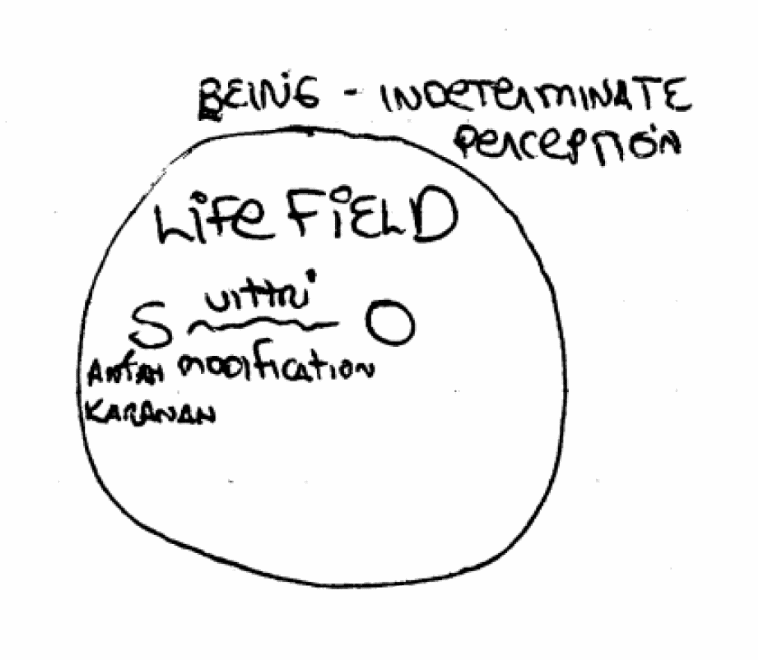
FIGURE 1973 0803-1-AB. Life Field.
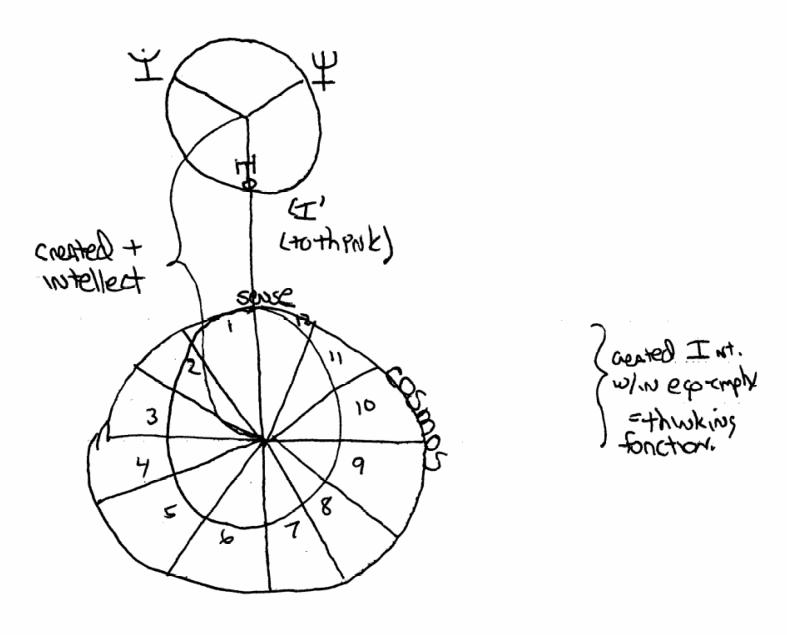
FIGURE 1973 0803-2-AB. Two Psychic Systems: Threefold and Twelvefold.
Other diagrams also referred to are not with this transcript version. [Transcriber note: [diagram] means the speaker is referencing a diagram as he or she is speaking. If someone is drawing or writing, with audible sounds of chalk on a blackboard, I indicate this by [drawing] or [writing].]
NOTES:
This class is part of a series of classes where Jung's essay "Spirit and Life" is discussed. See also WG Classes 1973 0713, 1973 0720.
For readability's sake, the following substitutions/edits made in Verbatim Transcript: gonna = going to; yeah = yes.
TRANSCRIBED Verbatim by IT prior to 2017, reformatted by jf 2017. In 2023, IT updates prefatory matter, footer, and audio file name, completes TOC and Book List, adds Plotinus quotes section, fixes errors/typos, adds new notes within transcript, adds two diagrams and references within transcript to these diagrams, reformats to accord with new conventions. In 2025, IT updates audio file markers to match new REP audio. Archival verbatim transcript – V12a.
AUDIO FILES: 1973 0803a, 1973 0803b, 1973 0803c. [Note 1: "Tape" refers to original audio cassette tapes that were later digitized into .MP3 Audio Files. Note 2: In 2024, REP Studio consolidates files c and d into one, improves sound quality of files b, c, and d (now part of c), cuts dead air from files b, new c.]
1973 08/03 at Wisdom's Goldenrod
Jung; Epistemology
[Audio File 1973 0803a Begins]
VM: I say the same mantra all the time. It's not boring.
AD: Most people don't even do that. [short pause] If you say the same mantram, you know, all the time, in a short while you should have some kind of success. So some people say it for years and never said it. [11¾ second pause] Well we were going to quickly review now the-- [short pause] It was "Spirit and Life" we were working on? Quickly review that; go over it. [41½ second pause; shuffling of papers, etc, background student talking] So many folders in here. [one word inaudible] know how he did it just [one word inaudible]
[students assent]
S: Yes, that's true.
[19½ second pause, background student talking]
AD: Could I ask, offhand, you know, I mean, don't feel-- Do you feel you understand "Spirit and Life"?
S: No.
AD: No? [short pause] Now you know, even in the Advaita Vedanta, when they try to explain epistemology, they tells you-- they tell you, look, this is tentative, it's provisional, ok, we'll try to fill in a gap, the gap being basically our inability to understand and-- It's not-- it's not something that can be understood, you know, you can't really understand these things, because they're basically in avidya, their very nature is avidya so definition of avidya is-- is enough to warn you that there's no final explanation in that realm, because the e-- very explanation that you're using is itself part of the illusion that you're living. And so you're using one illusion to try to explain another illusion, that can go on for a long time.
And then the other-- the other advantage is that when we pick up from Jung, and Sunday and Tuesday when we-- now we're getting into the Advaitic epistemology, and you've picked up and looked at a few times the Hidden Teaching. I'd like to bring in like the Yogacara school, you know, just to help matters along. This is a way of trying to get you to see if you understand what you think you understand. Now, it is true that you have to have-- you have to know-- in order to compare two systems, you have to know them. You can't compare what you don't know. By the way, comparison is one of the methods of knowledge that the Vedanta operates with. So it isn't something far fetched when I recommend the mastery of a couple of systems. And I do mean mastery, I don't mean dilettantism. You don't need it. Dilettantism belongs where you get your degrees and you got to get a union card and you want to get the hell out. But if you want to understand this for yourself you do have to develop some sort of mastery over at least the conceptual thoughts that you're trying to manipulate. If you don't have it, then work for it. Jung is a good way because he speaks to you in English, just like PB's Hidden Teaching, it's done to you-- it's done to you. [student assents] [short pause]
Now you see in the "Spirit and Life", Jung makes certain remarks that show the astonishing humility that this man operates with. This doesn't mean that we have to accept his statement(s). But he's so grounded in himself that he can't lie to himself. [11½ second pause; flipping of pages] Where do you want to start, 605? [16¼ second pause; flipping of pages] 608? Go right in-- right into the middle. Do we have an understanding, for instance, of when he speaks about, in 606, living processes?
C.G. Jung [CW 8, The Structure and Dynamics of the Psyche, "Spirit and Life," p. 321, paragraph 606, AD reading]: "In that case the psyche, too, would have to be understood as a purposive [AD adds: arrangement] system, [as] an arrangement not merely of matter ready for life, but of living matter or, more precisely, [of] living processes."
AD: Can you try to translate it into another terminology or another system?
[short pause]
RC: We spoke once in (the) astrology that (through) astrology you might get an appreciation for the-- [student assents] the being(s) (at/that) work to give you life.
AD: That the what?
RC: That through astrology you might begin to get an appreciation for the beings that work together to give you your life.
AD: That wasn't astrology, was it Randy?
RC: [one/two words inaudible] I don't know if it was in astrology class but you said it was through astrology you might get that appreciation.
AD: Yes, you might get a feeling for the g-- You know, you-- In mystical experience, that's one of the authentic marks of a true mystical experience, the gratitude and-- that arises within you when you realize how much of these beings, superior spiritual beings, are at work, you know, making possible for you-- making possible life, you know, in the body for us. And these processes that we take so much for granted (represented/representing) a tremendous outpouring of spiritual energies.
S: Tony, we can't hear back here at all.
AD (simultaneously): You can't hear? Do you want to shut that fan off maybe? If it gets too warm you could-- [16¼ second pause, faint background student talking] You got it off?
[21½ second pause]
S: He's not talking there about those beings though, is he?
AD: No, no, he doesn't bring in any mystical talk at all, Jung is-- Jung has to meet an academic world with 19th century materialism-- materialistic biology, so he's going to be as careful and he will avoid any-- any of that. Any mysticism he'll avoid because there's enough, you know, implied.
S: Well he's--
VM: He's accused all the time.
S: He's speaking there just of the-- the materiality or the-- the machine-likeness of the psyche as well as the body.
AD: Well what would you consider for instance under the heading of living processes, you know, what would that be?
S: Thinking.
AD: Thinking. Breathing?
S: Breathing, heartbeat, digestion.
AD: All this sounds like in Vedanta, like the prana principle, doesn't it?
S: Uh-hm.
AD: Living processes. And, those of you who are interested, like to carry on, if you pick up the Chandogya Upanishad, they point out that there's two steps to mastery, alright, or to Atma, and the first step is Prana-vidya, Prana-vidya or Agni or Surya, the Sun, alright. There again, the Sun represents prana, alright. And they refer to the Sun as the golden lid over reality through which one must go. So they have two (vidyas/avidyas) here, the Atma-vidya and the Prana-vidya and one must go through life before he can start talk-- talking about Brahma-vidya, you know? Now, if that's true that means that a person has to have some mastery over the principles which are manifested in him microcosmically that Prana represents. So breathing is-- is not-- I mean when we speak about pranayama exercises, they're not breathing exercises. That's-- that's an abuse of what Hatha-Yoga is all about. But certainly, and we just poin-- he just asked me this, certainly a person can see that his greatest efforts and concentration will come when the breath is retained or retention of the breath, kumbhaka. But that means that a person has some mastery over his life. And-- and those are not things to fool around with, you know, alternate breathing, retention and all that because that-- that implies a certain mastery which if you don't have you're going-- is going to bring a disaster. So we start out with the breathing exercise and you've come across that, for instance, PB points out how they're all tied together, breathing and thinking. So these living processes, alright, have to be embodied in a material organization, alright, and this combination of these two, he points out, still doesn't give us the living entity but makes possible the-- that living entity functioning through these.
C.G. Jung [CW 8, The Structure and Dynamics of the Psyche, "Spirit and Life," p. 322, paragraph 607, AD reading]: "So far as our experience permits of any inferences at all about the nature of the psyche, it shows the psychic process as a phenomenon dependent on the nervous system….[But] what happens in the spinal cord is transmitted to the perceiving ego [AD: he goes on to say] in the form of a record, or image, which one can furnish with names and concepts. On the basis of such a reflex arc, that is, a stimulus moving from without inward, followed by an impulse from within outward, one can form some idea of the processes that lie beneath the mind."
AD: And the enormous complications are already become, you know, rampant. "Let's take an example." And he uses the word 'image' in the example simply as a representation.
C.G. Jung [CW 8, The Structure and Dynamics of the Psyche, "Spirit and Life," pp. 322-323, paragraphs 608, 609, AD reading]: "A psychic entity can be a conscious content, that is, it can be represented, only if it has the quality of an image and is thus representable. I therefore call all conscious contents images, since they are reflections of processes in the brain.
"The series of images excited by the auditory stimulus is now suddenly joined by a remembered acoustic image associated with a visual image: the rattle of a rattlesnake….The reflex arc is complete but in this case it differs from the previous one in that a cerebral process, a series of mental images, interposes itself between the sensory stimulus and the motor impulse."
AD: Now, this is a very difficult thing to understand and-- Maybe if we can think of an analogy. How about those of you that read Sound and Symbol, there's a few of you who've read it here. (Your--) Anybody read it here? There again, Tim, you see the point here is-- The recommen-- The reason why I particularly recommended that book, it was a way of trying to understand something which is very difficult to understand for this reason. All your notions about objects in space, the prototype of that is the visual function, the eye, ok. Let's imagine, or let's conceive, that the eye locates a-- a color for you at a certain place. If I remember Sound and Symbol, this was a very beautiful analogy he gave. And-- This is the prototype of all arrangements within space. Anytime you think of space and the objects in space, the way they're ordered, it's the eyesight that more or less is the archetypal way of you thinking about it.
But now let's think of music, alright? If you close your eyes and you imagine yourself in the dark and you hear one note, that one note, so to speak, and the space it, let's say, presents you with, it fills up the entirety of that space. Alright? Try that for a minute if you want. You close your eye and you think of one note and you'll see that note as it comes out or as it manifests, the entirety of that space gets filled up with that note. That kind of spatial arrangement is different than the spatial arrangement that takes place when you look out through the eyes. Now imagine two notes sounding. Those of you who read the book correct me if the analogy falls back. Or, I think he used a chord. Now, if you imagine the second note sounding, alright, and then the third note sounding, the second note inter-- interpenetrates the first note and makes that space more filled, and the third note even more so. But it isn't that you take the note here and another note there and another note there. In other words, it isn't a spatial arrangement designed by the function of seeing, alright. So that means that there is the possibility of an ordering in audi-- auditory space which is quite different than the arrangement that takes place when you see something in space. Alright, now you come into a room, for instance, and you could smell various odors and you'd have an awful difficult time trying to spatially arrange them. Do you-- do you see the point I mean? This is a different kind of arrangement that could-- could take place. Go over the example in your mind, when you hear, for instance, a-- a chord being sounded, doesn't matter, a triad.
LR (simultaneously): But that's not the way I hear a chord being sounded.
AD: How do you hear a chord being sounded?
LR: First just I hear a note.
AD: Yes.
LR: When I close my eyes and hear a note, there's already a space of that note.
AD: No, there's not already a space. [LR: Well that's the way--] You're superimposing.
LR: Well that's the way it seems to me. When you-- when I close my eyes, there seems to be-- when-- as the note sounds, there seems to be a visual space that that note is taking up in my mind.
AD: Well then you're not listening, honey.
LR: What am I doing then?
AD: You're seeing, with your eyes.
LR: I always see music.
AD: You can't see music.
LR: Well, that's the way I-- I (see it).
AD: No, you cannot see music. You miss(ed) the whole point then in listening.
S: Uh-hm.
LR: Well [couple words inaudible]
AD (simultaneously): Because the point here to make, the point here to make is each note, as it is sounded, or let's-- let's take, for instance, when you sound one note, when you sound one note it has an-- an almost homogenous space of one quality. When you sound a chord there's an interpenetration of the three notes and they don't-- there's no juxtaposition between one note and another, they're all [AD snaps fingers] sounded simultaneously. So in polyphony you got this spat-- this arrangement of space which is quite different than the arrangement of space that you have visually.
LR: Yes, it's really different but it's-- but it's still, I mean, it-- I still visualize it.
AD: But that's-- that's an afterthought.
RG: What is it that you visualize?
LR: I don't know.
RG: What?
LR: I don't know. Um--
AD: You think (this--) you may think this is irrelevant, but I'm just trying to show you how you're-- you're bound hand and foot to the functioning of the eyes, and therefore you think that all space has to have the same arrangement that you conceive of with your vision.
LR: No, it's nothing like the same arrangement as-- as when my eyes are open. It's really different from that and yet it's still-- there's still the formulation of very very abstract visual images.
AD: But don't you see that's not the same, that's not the same thing. Take a very concrete example. If you look at this chair and that shelf and that person, they are in juxtaposition to one another, alright?
LR (simultaneously): Oh yes, (I see the difference).
AD: Alright, now close your eyes and hear a chord sounding. Are you going to put the notes in juxtaposition to one another? Don't they interpenetrate and are [LR(?) simultaneously: (Ok.)] mutually inclusive of one another, follow me, and order this space in their way? So that when Plotinus says that the Soul cannot be spatially configured or conspired in the mind, [Note: See Plotinus, VI.4.4, second to last para.] you cannot have a schemata of it, it's the same like when we say that music, alright, the notes of the triad or the-- whatever you're playing are mutually interpenetrating one another, and that you cannot conceive of it in the same way that you spatially visualize objects in space(./?) So if I say that the Souls are mutually inclusive of one another, or I-- if I quote Plotinus, [Note: See Plotinus, VI.4.4, last para.] what do you think he's talking about? The analogy is drawn from the life in the sense world. But here's-- here's one of the functions, space, and which by the way, in Hinduism, it's Shabda Yoga that creates the space within which manifestation appears. It's not geometrical space. Are you following me?
VM (simultaneously): [one/two words inaudible] I think so.
AD: I mean, you can see this in physics. You cannot conceive of a wave the same way as you do a particle. In other words, when you conceive of a particle you can conceive of it like it's out there in space, moving in space, [VM assents] but when you-- when you conceive of a wave, it's impossible to do that. You can't put it in space, it's creating its space. And the same way like when you have, let's say, one chord struck, alright, and then another chord and then another chord, it isn't that you have, so to speak, a space that's changing into another space and into another space, but it's change of dynamic state from one dynamic state to another dynamic state and another dyna-- There's no change of space. If you want to say anything, there's a change of everywhere from here, a change from everywhere here, it changes again to everywhere here. Just like when we say-- PB says that the thought comes first which contains the space-time continuum. That means each thought, alright, is (in/an) (everywhere and) everyplace, complete in itself, and then the next thought the same thing, and the next thought the same thing.
AH: I don't understand why-- why we are postulating auditory space.
AD: I'm not postulating it Andrew, I'm telling you that's-- that's a fact.
RC: Maybe he just doesn't like to call it space.
AD: Huh?
RC: Maybe he just doesn't like to call it space.
LR (simultaneously): (So) you don't know what the analogy is, is what you're saying.
RC: Maybe he just doesn't like calling it space. (I'm sure he senses) an ordering, maybe he doesn't want to call it space.
AH: I think that's what-- (I'm not--) I think that's what I was (confused--) what I'm confused about (but--) I guess it's just a way of thinking about space that's very unfamiliar to (us).
AD: It's not a question of it's a way of thinking about space. First of all, what I'm trying to do-- You see, like I'm trying to extract a tooth. Anytime I talk to you, anything I say or anyone else says, you're going to fit it into this mold, the way you think, alright, and PB very clearly says in the Hidden Teaching, "Perhaps there's something wrong with your mold." And all I'm trying to say is, now Jung is talking about here some-- some sort of phenomena which I know you're immediately going to take and pour into this mold and then say, "Gee, I don't understand Jung." Instead of getting rid of your mold, you say, "I don't understand him." That's all I'm trying to get you to do is to understand this habitual way of operating in terms of thinking processes which will deprive you all the time of understanding what's going on.
AH: Could-- could we [one word inaudible]
AD (simultaneously): So I'm using this for an analogy.
AH: Can I ask a question?
AD (simultaneously): The same way-- No, you can't. (laughter) The same way that I just ask(ed) you to conceive that when you hear a note, an actual musical note, inherent in that note, or that note produces the necessary space for its manifestation, they're almost simultaneous, in the same way when we think of a thought or a vasana, that vasana as it explodes and becomes that consciousness which becomes manifest, ok, is analogously similar. Otherwise you don't understand that sentence that we've used when we say, "With every thought there is a space-time continuum," which means the manifested universe within that thought. Alright, now ask (your question).
AH: Upon describing the analogy, you suggested that we can close our eyes. And upon closing your eyes imagine that we're in darkness. Well, from that point of view--
AD: Well the only reason I ask you to close your eyes is so that you don't get distracted by spatial objects. Not that you're [AH simultaneously: Ok.] not going to see space.
AH: Pardon me?
AD: Not that you're not going to see some kind of space.
AH: After you close your eyes.
AD: Yes.
AH: Ok, now that-- But I-- but I'm saying that that kind of space is-- is a product of, if not using (our/your) eyes, it's at least a spatial representation in terms of-- of our eyes. I--
AD: I don't want you to do that!
AH: But as soon as we hear the note, then-- then it-- then it flips over into auditory space.
AD: No! The auditory space and the note-- Oh, I started on to something, I guess. (AD laughing a bit, some laughter) I wanted to-- I wanted to bring in an analogy [AH assents] to help you understand something which is by definition very difficult to understand. So, as usual, I failed. But I-- I'll ask you to try the experiment. Try the experiment. When you listen to music very carefully, if you got a piano home or so-- some kind of instrument, concentrate very intensely, and you will see that the sound contains within itself the space necessary for its manifestation. And that if you can conceive of sound [AD snapping fingers] after sound as it-- as it breaks forth, alright, analogously like to a thought, which every thought as it breaks forth manifests within itself the ordering of all manifestation. But it's very difficult to say how can a vasana or a thought upon which all of perception depends be of such a nature. See, I'm only trying to give you a crutch to analogously think about what we're going to do. When they speak, for instance, in Samkhya of noumenal space, what [possibly couple words inaudible] talking about? The only space you know is phenomenal space. That means that object is there and the other one's there and there's a juxtaposition between these objects. What do you mean "noumenal space"?
AH: I guess all I'm saying is that for me, that that sort of-- that sort of perception of space is not possible. Because even if I did the experiment, and I think probably I have, I'm still aware of myself as being a center. I'm still aware of that like I have to represent space as a-- as a sphere around me and I'm the center of that sphere. Like, I guess all I'm (suggesting--)
AD (simultaneously): [snaps his fingers] Where did the sound come from?
AH: [possibly couple words inaudible]
AD: [snaps fingers again] And if I did this, wouldn't you locate two sounds in two different places?
AH: Yes.
AD: Then you're not the center.
AH: [few words inaudible]
S: (Uh-hm.)
AH: [possibly one word inaudible] if you're always--
AD: In the Vedanta they say, for instance, the mind flows forth, goes out to the object, envelops it and brings it back, so to speak. The eyes, same way. If, for instance, you saw colors the way you hear with-- you hear sound, there would be no place where color could stay. It-- it would all run into one another. But you don't-- you don't-- you don't see sound that way, but that's the way you hear sound. Before you transcend the senses, you better try to understand them. You may have a problem.
BS: You mean it's immediately qualitative rather than quantitative, sound? Like when you hear a chord, (it's actually) three notes, but they intermingle into one sound.
AD: They-- they all retain their original identity, don't they? If you play-- if you place a chord, you have three notes, each one retains its identity and yet there's a mutual interrelationship between all the dynamic qualities.
BS: Yes, but you can't say they're located. They're (altered).
AD (simultaneously): I can't say they are located?
BS: Yes, in a space, like visually (located) [couple words inaudible]
AD (simultaneously): No, you can't put them in space like you do with a physical object. But that space and that sound are simultaneously one-- so to speak, two sides of the same coin.
BS: It's more-- but what I mean is it's more inte-- intensive.
AD: That part I don't understand Bert.
BS: It's like space that gets more intense or less intense.
AD: Yes, you can look at it that way. For instance, if you remember some of the Bruckner symphonies, the way he goes on spiral-- spiraling and pyramiding chord after chord until finally it feels that the space, the musical space is crowded.
LR (simultaneously): It can't hold anymore.
AD: Yes, and it just powers up, alright. But what-- the point I'm trying to get here, and it's a [S simultaneously: (one/two words inaudible)] very simple point. It's really not complicated, it's just a question of looking, with your ears. (laughter) Concentrate intensely, concentrate intensely, and-- and you will see that the sound has its own way of ordering space and that way of ordering space is not the same way that your eyes locates objects in space by juxtaposition.
LR: But how-- ok--
AD: Let me tell you, get Ernest Mach's Analysis of Sensations and do it for yourself.
LR: Wait Tony, how do you-- You just said that the sound has it-- has its own way of ordering space.
VM: See for yourself.
LR: How do we perceive that space [VM/S(?): That's right.] that you're talking about, that ordered space that the sound creates, how do you-- how does one perceive it?
AD: How do you perceive this space? Can you see this space?
LR (simultaneously): With my-- Oh. I see order-- I see forms within the space.
AD: You see, you see-- I'm sorry.
LR: I see forms ordering the space. The only way I know of space is that there's certain forms within (it).
AD (simultaneously): That there's objects within it.
LR: Right.
AD: In other words, if you took out all objects you couldn't possibly have space.
LR: Ok.
AD: Alright, so they are, so to speak, interrelated, [LR: Ok.] objects and space, alright.
LR (simultaneously): Now, how-- how does one perceive (it)?
AD (simultaneously): Now try to do that with music.
LR: Well that's-- Try to do what with music?
AD: The analogy we just used.
LR: Order-- ordered space?
AD: Uh-hm.
LR: But that's-- that was my question, how-- I thought that I-- I see forms within that musical space. It seems to me that [S simultaneously: (couple words inaudible)] that's the way I listen to music. So I'm not sure what (you're) [one word inaudible]
AD (simultaneously): You must have saw Walt Disney's "Fantasia". (laughter)
RG: Linda, what do you see? Describe it.
LR: I can't describe the forms, they're not of the phy-- they-- they don't match-- They're not chairs and tables. (some laughter)
RG: Well what are (they)? Are they [S simultaneously: (one/two words inaudible)] images of any kind?
LR: I would say they were images but I wouldn't say that they were of any kind that you see, like a chair or the table.
S: Are they colored?
LR: Sometimes.
RG: You're not listening.
AD: Alright.
LR: What do you mean I'm not listening?!?
AD (simultaneously): Ernest-- Ernest Mach has a very good book called The Analysis of Sensation which has a lot of material you could look up. It's in paperback too, so I'm saving you money. And giving you a headache.
LR: What's this man's name?
AD: Ernest Mach.
LR: (Ok.)
AD: The-- the analogy that Zuckerkandl used, for instance, was if-- if you sound a chord, why is it you don't get a triangle?
RG/S(?) (very faint): [one word inaudible]
LR: Oh no. That's-- that's not-- that's not the kind of space.
AD: Well, alright, you can think about it. If you've got Sound and Music, it's a very good book that'll rip up all your-- your very prejudiced ways of listening and understanding music. You people fail to understand that music is a miracle. [short pause] How would-- for instance, you would say here--
C.G. Jung [CW 8, The Structure and Dynamics of the Psyche, "Spirit and Life," p. 322, paragraph 608, AD reading]: "In this case the auditory stimulus releases a whole series of images which associate themselves with the stimulus."
AD: What do we mean "associate"? What the hell are we saying? What do you take out the image and say, "Now I put-- plug it in here and I got two of them associated"?
RG: Tony, what does he mean that the images are reflections of the brain process?
AD: Ask (him). (laughter) [20 second pause; background student talking] [aside] Very strange, I threw away your (chalk/chart) today. (some laughter)
S: Listen better in person. (some laughter)
VM: You're hasty. (some laughter)
S: Should've known better Tony. (more laughter)
[short pause]
AD: Yes, I should've. Alright, what do you think?
RG: Well, that would seem to be the-- taking the physiological view of perception. The image-- The object transmits these sense-impulses through the brain and then after they go through the brain arises the image that we see, somehow.
VM: [possibly one word inaudible]
S: Somehow or other. (some laughter)
S (very faint): [few words inaudible]
RG: To say it's a reflected pro-- a reflected process in the brain seems to-- or, it seems that the process in the brain is coming before the image.
PD: [couple words inaudible]
[from here till almost the bottom of the next page most of the conversation is very difficult to hear; about 1¼ minutes]
RC: Before the image (as he's talking)-- Why [couple words inaudible] do it from a mentalistic point of view, from the heart (an impulse) goes into the brain and is con-- converted by that [couple/few words inaudible]
[AD drawing]
RG: Uh-hm.
S: Oh no, (the) brain's already part of it. The brain's already part of the (physical image).
VM(?): But that's not [few words inaudible]
RG: No, the brain is already part of the physical image. What are you [few words inaudible]
S: [few words inaudible]
RG: No, I agree, I'm not either. I'm talking about (fixed state of the brain) it can cause that empirical [possibly couple/few words inaudible]
S: [couple/few words inaudible]
RG: Well, I'm talking about physical image (here).
S: [few words inaudible]
AD (simultaneously): Alright, let's try, let's try Richard.
RG (simultaneously): [few words inaudible]
LR: (Oh.)
PD: (You have your) [RG simultaneously: (couple words inaudible)] (imagination going all the time).
AD: So let's, let's all get into it, let's all get into it.
LR: I can't hear them.
RG (simultaneously): But how could that be?
S (very faint): [few words inaudible]
RG: How could--
S (simultaneously): You'll never find one.
PD (simultaneously): How does the physical image come first? How does physical image-- He's-- he's saying the sensation before the personal imagination.
RG: (That'll agree with-- with whether--)
PD (simultaneously): Well that's image (that/is) (he) talking about.
AD: Well let's start, let's start with the example. There's a sound that comes from here [diagram], alright, which is supposed-- supposedly strikes the brain, alright, some sort of-- Read it off, will you?
C.G. Jung [CW 8, The Structure and Dynamics of the Psyche, "Spirit and Life," p. 322, paragraph 608, AB reading]: "We hear an indistinct sound the initial effect of which is no more than a stimulus to listen in order to find out what it means."
AD: Now he uses the word 'initial effect'.
S: Initial effect?
S: Read it again.
AD: Read it again.
S: [few words inaudible]
AD: Read it again.
C.G. Jung [CW 8, The Structure and Dynamics of the Psyche, "Spirit and Life," p. 322, paragraph 608, AB reading]: "We hear an indistinct sound the initial effect of which is no more than a stimulus to listen in order to find out what it means."
AD: Next sentence.
C.G. Jung [CW 8, The Structure and Dynamics of the Psyche, "Spirit and Life," p. 322, paragraph 608, AB reading]: "In this case the auditory stimulus releases a whole series of images which associate themselves with the stimulus."
AD: Now, is he saying that these images are all flowing in [drawing] into our consciousness, they're manifesting themselves in our consciousness, all kinds of images trying to figure out what that sound is? Can you-- can you conceive by the way, you know, that's why I was trying to bring in this analogy, how these images slide in? I mean, did you ever see images coming into your consciousness?
S: No.
AD: Yes, after they're there you see them.
VM: Sure, sure.
S (simultaneously): Yes.
AD: Isn't that so? Well how'd they make that transition from this realm here [diagram], the realm of the psyche, where let's say they're preserved, you know. Somehow, somehow they're in here [diagram]. [drawing] We don't know how, what-- what sort of dimensions, what sort of conditions. And then the next thing we know we become aware of them, they're in our consciousness. Ok? Go on. Read the next line. [sounds like AD whispering]
C.G. Jung [CW 8, The Structure and Dynamics of the Psyche, "Spirit and Life," p. 322, paragraph 608, AB reading]: "They will be partly acoustic images, partly visual images, and partly images of feeling. Here I use the word"image" simply in the sense of a representation. A psychic entity can be a conscious content, that is, it can be represented, only if it has the quality of an image and is thus representable. I therefore call all conscious contents images, since they are reflections of processes in the brain."
AD: Up to that last-- the last two, three words, ok? Is it-- is it clear? Clear as mud, huh? (some laughter)
[18 second pause]
AD: Start jumping around like grasshoppers now, come on. (laughter) [few seconds of background student talking] Every moment in your life, all you have is one image streaming in after another. You even gave James Joyce the Nobel Prize for being so great at (it), alright. That's all our life is, there's this stream of images flowing in. We don't understand what's going on. We talk about living too. Talking about philosophy.
[11½ second pause]
C.G. Jung [CW 8, The Structure and Dynamics of the Psyche, "Spirit and Life," p. 323, paragraph 610, AD reading]: "[It consists of] reflected images of simple processes in the brain, and [of] reproductions of these images in an almost infinite series….The nature of consciousness is a riddle whose solution I do not know."
AD: So we got-- We can put that aside for now. [17 second pause] Silence.
S: [one word inaudible]
S: [couple words inaudible]
AD: Hm?
AH: What's the question?
S: He hasn't asked the-- the most important question though, which is what happens before this whole world image of-- of body and snake is given.
RC/S(?): [few words inaudible]
AD: Well he doesn't-- he doesn't start out, in other words, with the question of epistemology, it seems?
S (simultaneously): No, well, what I'm saying is given this situation, yes, we're speaking of images which are reflections of processes in the brain and-- and all that, and it all makes sense if you just accept that-- that givenness.
S (simultaneously): [couple words inaudible]
S: (That/It) doesn't make sense.
RG: It (makes) sense to me.
S (simultaneously): He hasn't explained it.
AD: Well we know that, for instance, there's some sort of galvanic disturbance that takes place in the optic nerve, right, [drawing] and then goes to the brain and evidently leaves some kind of traces in the brain. And we're asking, well, if all this is taking place in a reflected consciousness, alright, then any activity that's going on there will automatically reproduce images of its own activity.
VM(?): Uh-hm.
AD: He's saying something like this, you think?
RG: But that's not the case.
AD: Well, go ahead, go ahead.
RG (simultaneously): Right, I mean, every-- everything that goes in-- goes in (through) the optic nerve or through the auditory canal doesn't reproduce images in our (consciousness).
AD: Does--
RG (simultaneously): If-- if it-- if it did, we would be-- we would be bombarded with so many-- so many sensations, we wouldn't know what to do with [one word inaudible]
LR: You'd have to have your awareness focused on one of them.
S: He's not saying anything about that Dickie.
RG: Well, I was just saying this is what Tony was, you know, summarizing him as saying.
AD: Well I don't think he would disagree with that Richard. I'm quite sure that he would say, yes, that's very true, that there is a constant flow of physiological processes which are converted into some kind of traces in the brain and they leave their traces there. We only become aware of those particular objects out there which are relevant to our attention.
VM: Ok.
AD: Alright, now, assu-- let's assu-- let's assume he would agree with that, alright. Still, you ask the question, number one, what is a reflected image of a brain process? Well, that's a-- that's a big unknown isn't it?
S (very faint): [few words inaudible]
LR: That's where PB leaves us in the Hidden Teaching.
AD: That he what?
S: Isn't that the question PB leaves in the Hidden Teaching?
AD: Well how would-- how would we duplicate PB over here? [one word inaudible, possibly S] [LR simultaneously: (one word inaudible)] I know, I know one thing for sure, we can change this [drawing] to a fountain pen. (laughter)
S: (Now) in the Wisdom he says (it's a) [few words inaudible]
AD (simultaneously): Fountain pen, or a cigar, I don't (care). (laughter) Well how does he treat it in the Hidden Teaching?
S: He gets to the--
AD: Go ahead.
S: He-- he starts out with the-- the same-- same stimulus which he called the sense impression, and he goes along the nerves to the-- to the center of your brain and after it's reached the brain [couple words inaudible] it releases a sensation. And I think the-- the sensation he's speaking about but-- might be similar to this-- this bag you have over there [diagram] and the sensations--
AD: But he-- he makes a point here, doesn't he? He says there's a hiatus here. [VM: Right.] It reaches here [diagram], alright, gets up to the brain, "then," he points out they say, "then" we become conscious of an object. So he says, "Wait a minute, what do you mean"then"?"
LR: That's the same question you're asking about Jung, how it gets transformed into a-- an image. Is it?
AD: Well, don't you know?
VM: Yes, it is.
LR: Sure. That is it. (some laughter)
PD: Is that what Jung is speaking about here?
C.G. Jung [CW 8, The Structure and Dynamics of the Psyche, "Spirit and Life," p. 322, paragraph 608, AD reading]: "In this case the auditory stimulus releases a whole series of images which associate themselves with the stimulus. These will be partly acoustic… [Here] I use the word"image" simply in the sense of a representation. A psychic entity can be a conscious content, that is, it can be represented, only if it has the quality of an image and is thus representable. I therefore call all conscious contents images, since they are reflections of processes in the brain."
AD: We've only read it ten times, you-- so [student assents] let-- let's be patient.
RG (simultaneously): [few words inaudible] Here are these electro-chemical--
AD: What'd you say Paul? Wait, let me-- What'd you say? You didn't say anything?
PD: [one word inaudible]
AD (simultaneously): Ok. Yes--
RG: Here are these electro-chemical activities going on in the brain and then we speak of these images that we perceive, (either) images of the ma-- the imagination or images of the-- of the world as-- as re-- as reflections of these processes. And, I don't see how you put them together.
LR(?): Well-- Dickie?
AD: Well don't keep asking the questions! Work on it!
LR(?): Dickie?
RG: I try, I--
AD: We-- we got these images, ok, which appear after that stimulus and we say, "Then a conscious content appears." And the whole point is, what do you mean "then"? What happened? Jung says, "It releases them."
S: (Releases) [couple words inaudible]
LR: He says that the stimulus goes in and contacts things in the unconscious and brings those things from the unconscious (in), right? He doesn't say how but he says-- So what-- I think what he's saying there is that we never perceive what the stimulus represents but we only perceive the image that we have of that which it contacts in the unconscious, which is basically un--
AD: Could you show me where-- where he says something like that? I'd like to see what you're referring to.
LR: Where were you just reading from?
AD: Go ahead Andrew.
AH: Tony, if you-- if you say "then something happens," doesn't that give the brain a kind of ontological existence, like it's [one word inaudible] It seems as if-- it seems no-- no matter how we talk about this from the psychological point of view, we're (going) to be left in a situation where the-- where there is-- there is a brain that's like a receiver, a radio receiver that's receiving the--
[Audio File 1973 0803a Ends]
[Audio File 1973 0803b Begins]
AH: --that ontological existence a priori to the whole discussion. It seems the only way to resolve it is to bring in, well, like PB's idea, the first of our thoughts is "I". [tape break and repetition of what was just said starting with "a priori…"] Somehow, somehow the brain and thoughts about the brain are constructed simultaneously with the reception of these images.
S: Yes. [one/two words inaudible] the brain [couple words inaudible]
AD: Go ahead, say it.
S: Go ahead.
LR: It seems that (when he gets into--) "The auditory stimu…" Ok, (and/uh) first this-- there's a sound, the initial effect is what-- is a stimulus to listen.
[tape goes blank for 11½ seconds]
AD: Well, there's many things in the unconscious that cannot become conscious.
LR: Well [three words inaudible, very bad tape quality] can become conscious.
AD: I know. It seems that that word 'then' is still there.
LR: Oh, [S simultaneously: (couple words inaudible)] and he doesn't say how it contacts them or how it's-- [student assents] Yes, it's still there but, I thought he was postulating that whatever the stimulus is we don't directly perceive it but we perceive the image that's contacted in our minds.
[couple students talking simultaneously, inaudible; bad tape quality]
LR: Yes, and that's what he-- that's what I thought he was-- He doesn't say how it contacts it or how it's brought into consciousness, but it seems to me he's saying that there is a stimulus and through contact it releases images in our own mind which is what we be-- then become aware of.
AD: Now the mystery is the word 'contact'!
LR: (I'm-- I--) Yes.
RG: He's also pre-- he's al-- he's presupposing a stimulus. I mean, he's saying there's the stimulus and then it-- this excites us to hear the thing which was the original [S simultaneously: But--] stimulus. But never-- but how do you account for the original hearing of the stimulus?
LR(?): [few words inaudible] (I mean--)
AD: You can see why in a few paragraphs later, [S: (couple words inaudible)] [AD flipping pages] when he says-- Remember what paragraph it was?
S: [one/two words inaudible]
S (simultaneously): (That would be) [one word inaudible]
AD: 620, he says--
C.G. Jung [CW 8, The Structure and Dynamics of the Psyche, "Spirit and Life," p. 326, paragraph 620, AD reading]: "Science has never been able to grasp the riddle of life either in organic matter or in the mysterious trains of mental imagery; [consequently] we are still in search of the"living being" whose existence we must postulate somewhere beyond experience. Anyone who knows the abysses of physiology will become dizzy at the thought of them…"
AD: I'm just trying to get you dizzy.
RC: I don't-- I don't know if this is what you're (going) at but, these processes he's talking about, the stimulus and the processes in the optic nerve and the brain, those aren't going on (consciously) but until contact is made (with that), until contact is made, which evidently [couple words inaudible], there isn't any "then", like the "then" arises with the contact of [couple words inaudible]
AD: Can you repeat the last sentence?
RC: Well these processes that he's talking about, they're not going on in what I call my consciousness. They're going on [couple words inaudible] in the unconscious part.
AD: Speak louder, it's alright, nobody's going to--
RC: Well as far as I'm concerned, this-- this process of stimulus, physiological response is going on not in my conscious mind but in part of what I'd call the unconscious. It's not a process that I perceive consciously. And (this--) "then" consciousness arises is a strange viewpoint. It seems that the "then" and the consciousness are coincident. There's no "then" till the two, the stimulus and the very-- very object and then the perceiving apparatus come in contact. I don't know if that was the direction you wanted to go in.
AD: Well don't worry about my direction, I have none. I'm a free-floater.
RC: I mean, rather than to put the unconscious off in some mysterious place, it seems that those processes that he's talking about are unconscious, or in the unconscious, if you want to talk about "in" an unconscious. They're certainly unconscious to me when they happen.
S(?): Randy, are you-- are you saying that the juncture between unconscious and consciousness is the "then"?
RC: I don't see any juncture between conscious and unconscious.
S(?): When you say "then", it's become [RC or another student assents] accessible to us consciously.
RC: Yes, the "then" and the consciousness arise together.
AD: Alright. "Then" and the consciousness arise together?
RC: Right.
S: I think-- I think the way that-- that Jung outline--
RC (simultaneously): It's not like (these things) were going on in some type of time.
S: [few words inaudible]
RG (simultaneously): Yes, that's the way it is Randy, that's what he's saying. He's putting an order to it. There's a stimulus from out-- He says--
C.G. Jung [CW 8, The Structure and Dynamics of the Psyche, "Spirit and Life," p. 322, paragraph 607, RG reading]: "On the basis of such a reflex arc, that is, a stimulus moving from without inward, followed by an impulse from within outward, one can form some idea of the processes that lie beneath the mind."
RG: So he's saying there is an order to these unconscious type of processes.
RC: Yes, but I think this is a kind of structuring of time, like we would (just put them in) space [few words inaudible]
VM: No, I think it's real time he's talking about.
RG: Yes.
RC: Real time?
VM: See, to me it's a mess because the-- he never really asks the question, "Who knows this?" Like there's all these physiological impulses coming in and in some ways one can study those with physiology or, let's say, chemistry, physics, and so on, all the nerve currents, the-- the neurons firing off. And then this big jump, the big hiatus that PB keeps harping on. Then one sees the psychic images and somehow there's no way to relate, for me anyway, on this scheme, there's no way to relate these physiological, or almost chemical, biological sort of processes, with these psychic ones. And he again never asks the question, "Who knows these images, who is aware of these images?" So, then he brings in consciousness and says, "Well, I don't understand consciousness, so I'm just going to set that aside," but it seems to me that the only way to understand these things is to ask this question about who knows it or what is this consciousness. So I-- it seems like we're at a dead end here, Tony, I'm-- I mean-- I don't want to downplay Jung's--
AD (simultaneously): No, no, no, please--
VM: I don't want to downplay--
AD (simultaneously): --I'd like-- I'd like to hear your opinion.
VM: I mean the man's, you know, as a little reading will convince one, he's obviously a very brilliant man but somehow it seems that he's trying to tie medicine and psychology in together and it's just not possible (in-- in) the way he's doing it.
AD (simultaneously): And philosophy and everything else and then say he's not a metaphysician, making all kinds of metaphysical statements like "Consciousness can therefore be understood as a state of association with the ego. But the critical point is the ego." (paragraph 611) My way is the reverse. I can negatively understand consciousness but I can't understand what you're talking about when you say "the ego"!! What is it!? Is there some kind of permanence, some kind of identity that I could point to and say, "There's the ego"!? He's-- he himself is the first to say there's nothing but this life processes going on all the time! But now he wants me to cut out a chunk and call it the ego.
S: (Yes.)
VM: I mean, he does like to call it a-- the ego-complex. I don't think he's--
AD: That doesn't make the problem any less. I mean you take someone like Harry Stack Sullivan who says "The ego? That's nothing but a hypothesis for empirical purposes. [VM: Yes.] You never will find any such thing under the-- under the Sun."
AH: Is it-- is it-- or least one of the points that's emerging here, that there is no resolution to the problem the way-- the way that we're looking at it. And isn't it also the point from which PB embarks in [one word inaudible] the discussion on mentalism? There has to (be--)
AD (simultaneously): There-- there is a resolution if we understand what we're talking about.
AH: If we look at it--
AD: If we can understand that a question is wrongly put, that is a resolution.
AH: It has to be looked at from the point of view of (the mental).
AD: That will be a secondary thing, but the primary thing is if someone's asking me a question, I got to see if it's a question that can be answered. I mean, if someone tells me square is circle, maybe-- maybe the question isn't askable and there's no sense getting involved in something that can't be asked to begin with.
AH: Well, I think-- I think it's very tricky because [couple words inaudible]
AD (simultaneously): Sure it's tricky, sure it's tricky.
AH(?): [few words inaudible]
AD (simultaneously): I know a lot of kids here who understand the Hidden Teaching backward and forward until you ask them what it says.
S: [possibly one/two words inaudible]
AH: (By the way) [couple words inaudible] Jung is talking about a mentalistic kind of [one word inaudible]-- It would appear as if he's-- he's approaching this problem from a mentalistic point of view. But I think he's always left-- he's always left with something that's not mental.
AD: Alright. Go ahead.
PD: If-- if you take the standpoint of individual psychology, the given fact which he's trying to look at, I think even from the framework of PB he comes up with a similar thing, only what he does later on is that he puts the-- a primary awareness behind that individual framework there. The individual imagination releases a set of images after the-- the epistemological situation is-- is given.
AD: Do you know where-- where he does that, where he points out that it's a posteriori, the image?
PD: Well that's the thing, it's not the image, the primary image that he's speaking of here, Jung.
VM(?): He's speaking of the secondary [few words inaudible]
AD (simultaneously): The derived, yes. Go on.
PD: And that-- that is what gets superimposed upon--
AD: The primary.
PD: The primary perception.
AD: Yes.
PD: He's not speaking of the primary perception and its construction here by the-- the mind.
AH: Talking about something afterwards though.
AD: After the fact.
RG: But that still doesn't answer the question because our fact is the fact of our perception, (what we see).
PD (simultaneously): Well that's not the question he's asking here though.
RG (simultaneously): But he is, talking about the co-- the images that we perceive in our consciousness. I'm not talking about the primary image that precedes our experience, I'm talking about our experience. Jung's trying to account for our perceptive experience, and he's saying there's a stimulus that's out there that somehow comes into the mind and then gets turned back into an image. And (you don't think) PB's saying the same thing?
S: [one word inaudible]
S: He says--
[Transcriber note: I am using The Hidden Teaching Beyond Yoga by Paul Brunton, E. P. Dutton & Co., Inc., New York, 1969.]
PB [The Hidden Teaching Beyond Yoga, "From Thing to Thought," p. 261, S reading]: "The whole series appears, then, as a stimulus to the sense-instrument by an outside object, then a sense-impression, next a nerve-transmission, fourth a brain-response, fifth, a subconscious mind-response, (sensation) and finally a fully conscious response…"
RG: But that (isn't--) wait a minute, that isn't PB's analysis--
VM (simultaneously): It's early in the book.
RG: --that's the physiologists analysis. He's going to refute that.
VM: The very fact that he says "outside," I mean, shows you he's very early in the book there.
RG (simultaneously): That's not his. He's just reproducing the physiological argument there.
AD: Alright, if we pick up the way PB just summarized it right there, ok. Would you say that Jung is doing something like that?
S: Yes.
S (simultaneously): Yes.
S: Right.
S (simultaneously): Yes, I think so.
AH: But, doesn't PB, in the chapter on "The Secret of the I," resolve the problem?
VM: [few words inaudible]
S(?): [one word inaudible]
AH: Like I think-- I think we're-- I think this is all true, you know, and wh-- and what-- I think Paul hit the nail on the head. It's all true, and there's no problem, as long as we stay at this level. But in order to-- in order to talk about the-- the primary awareness, we have to jump-- jump a step and get involved in this-- in a-- a whole different framework.
VM: No, but there is a problem at this level though, isn't there Andrew?
AH: What is it?
VM: For me there is, or my problem is this. You got these light waves or sounds waves, doesn't matter, some sort of mechanical stimulus is coming in, it goes in through the senses, whether it be the ear or the eyes, whatever, and there's this-- neurons fire off, these little electrical-- electro-chemical impulses go up to the brain, then [VM snaps fingers] bang!, there's an image of a rattlesnake. Man, I can't get those two together at this level.
PD: But that's not what he's speaking about, he's speaking about the sense impression, Jung, he's not speaking about the chemical analysis of sensation. There's a sense given, sense content given, [S(?) simultaneously: (one/two words inaudible)] which PB accepts also. There's a sensation which is given to the individual.
S: Yes when he-- when he says we hear an indistinct sound, you're already in the world, you're already in the image, you can't be speaking of the primary image.
RG: But that's not the question that Vic's saying either, it's not a question of the primary image, (it's just this fact of) hearing a sound is already in the world, [VM simultaneously: I'm already in the world, yes.] so what are you talking about?
AH: We're trying to (have) sequential thing, like--
VM: I agree it's sequential, Andrew. I'm-- I'm just trying to stay down on the gross physical level, [AD simultaneously, aside: Would you get me that Sound and Symbol, I see a copy.] but I still can't see how these-- And he is speaking, Paul, about brain-- I mean he speaks about the nervous system (and) going up the spine and all this business, and then it's up to the brain. Well how does it make this connection, "then it releases," he used this word 'release' these images of almost infinite series or infinite variety. I can't see how he-- How did he [few words inaudible] he says 'release'. But what is he talking about? You know, how does-- how do those little images get in touch or make contact or associated with this brain disturbance?
S: (Vic, can you give us an alternative?) And in any event, whatever sensation we have is already in-- in our personal disposition, association with past experience.
VM: Sure, sure.
S: But either way, we have our-- the world-image came first, or (when) we have within the world-image and then [few words inaudible] we have-- we have that same problem [few words inaudible]
VM: Well, I thought, I-- you know, it's-- I could be wrong but, I thought it was resolved from the point of view of the Hidden Teaching.
PD: Yes, but even at the end of the Hidden Teaching where he says that [one word inaudible] this analysis (only we) put a primary awareness before the whole thing.
VM: (Right/Alright).
PD: So the analysis isn't wrong.
VM: No, I agree the analysis isn't wrong.
PD: But then you can't just [one word inaudible] because it's the same analysis you just criticized.
RG(?): But you've [one word inaudible]
AD (simultaneously): That's a-- Go ahead, keep it up. I want the frustration to build up.
RG: He speaks of that analysis af-- as a fact after the perception of the thing, not of the world-image but of our actual perception. That process--
S (simultaneously): What's the difference?
RG: What's the difference?
S: (Thing and this world-image.)
RG: Let's say this room that we perceive, these books, ok, it's a slice out of the world-image. It's not the entire world-image.
VM (simultaneously): Ok, well then it's a problem.
[simultaneously with the next few lines, in background a student is saying a few things to AD about a quote he's looking for]
RG: Now where PB says that physiological view is correct but it's a-- it's a-- it's a process of how that image gets transmitted back to the brain after it's perceived.
PD: That's not what Jung is of though.
RG: Yes, I know, but that's what PB is speaking about when you said he accepts the analysis.
S: [few words inaudible]
AD: Well he works with the same analysis, doesn't he? I mean he speaks about a pen out there and he goes through that same--
RG (simultaneously): Yes, but he goes through the whole analysis and then shows how it can't be. But then even when he accepts it, he says all of it takes place after perception, not after sensation, but after perception, which means after we see the image.
S: No he doesn't say that.
RG: Yes he does.
S: [couple/few words inaudible] (some laughter)
S: Go ahead.
S: Somebody get the quote.
S (simultaneously): So as [VM simultaneously: Ok.] you ordinarily know [one word inaudible]
AD: You're both right and-- You know, you're both right, it's just that you haven't put them in juxtaposition.
S: You ordinary-- ordinarily know (only) the sixth stage in the series because it is-- (it is) your conscious experience. He says the other five come before that. So he is speaking about processes [VM simultaneously: Uh-uh.] (that come before).
RG (simultaneously): That's not his position.
VM: No sir, because that time where you can speak of before is already created within the thought that gives rise to all the sense organs, to the whole world in which this thought comes from, in which the sensation comes from, excuse me.
RC: Yes, but Jung is studying what you call your consciousness, you know--
VM(?): Yes.
RC: Like our (consciousness--)
S (simultaneously): That's not what Jung's speaking (about).
AD: Go on Randy, yes, go ahead.
RC: Like which is, at our level, bound to these sense-impressions, that consciousness is made up of the sensations that come to us through these five senses and maybe a little thinking and some feeling thrown in, and probably intuition (they say) I imagine. But this could be like in our consciousness, it's our [one word inaudible] sort of like, you know, at the state we're at. This is our consciousness I'm talking about. Now what PB's talking about isn't a consciousness I'd call mine. I mean maybe it's a larger consciousness that might be available to me but I certainly couldn't (study) it as it my consciousness.
VM: I agree with you Randy, that I'm not aware--
RC (simultaneously): (As far) as I'm talking about our consciousness, if you close your eyes and I hold up a certain number of fingers, you can't tell me what it is unless you open your eyes. The contact between, you know, your optical nerve and the sensations of this image out here is necessary.
AD: Can I-- can I try to throw a monkey wrench in? Here's an example that might be interesting.
[Transcriber note: I am using Sound and Symbol, Music and the External World by Victor Zuckerkandl, Bollingen Series XLIV, Princeton University Press, Princeton, 1969.]
Victor Zuckerkandl [Sound and Symbol, p. 304, AD reading]: "For Faraday, the dynamic field that emanates from a body belongs to the body itself in the same sense as do its mass, [its] shape, its hardness, its [AD reads: and] color; the dynamic field of a magnet is [AD emphasis] the thing,"magnet" no less than is the horseshoe-shaped piece of metal at the center of it [AD reads: this field]. The sharp distinction that we are accustomed to draw, in respect to existence, between the mechanical tangibility and visibility of a thing, its corporeality in the usual sense and its more distant effects, is abolished: a body is where it acts. The current criterion, according to which a body is where I see it or touch it, directly or by the aid of instruments, thus becomes untenable; a body is also where I neither see it nor touch it nor can in any other way find it physically present. Its existence, its presence, does not stop where its visibility and tangibility stops; its limits do not coincide with the limits of its material form. With its dynamic field it extends into space its limits are those of its field; that is--since a dynamic field is theoretically limitless--it has no definite limits at all. But with this the usual idea of a body being situated in a particular place loses its meaning. The body is not in a place but in all places, everywhere. And this is not true only of one body but of all bodies. All bodies are in all places, everywhere; all bodies are simultaneously in the same place."
VM: Oh, (this is good). (laughter)
AD: I just thought I'd throw it in to kind of--
LR (simultaneously): Isn't that what Jung speaks of as the energic?
[short pause]
AD: Well here's an example, you like to see the example?
LR: Yes.
AD: This might take you out of that whirlpool that you're in right now.
Victor Zuckerkandl [Sound and Symbol, pp. 304-305, AD reading]: "With some effort we can imagine a consciousness whose direct experiences of bodies would roughly correspond [AD reads: correspond roughly] to Faraday's views. Let us [AD reads: Let's] think of a creature that should possess none of our senses but instead should be endowed with a sensitivity to magnetic influences, and let us suppose that this sensitivity was equally distributed over the creature's entire body, not definitely localized--a sensitivity comparable perhaps to the dull sensations of the sense of orientation or to the sensations that plants [may] experience when they turn toward the light: in short, a piece of iron endowed with consciousness. Let this magnetic sense be a telesthetic sense--that is, one in whose sensations the creature would [AD reads: will] be given not only [a] consciousness of its own body but also of something coming from without, from a distance. Such a creature, then, would have an experience of"without," a space experience, and this space would never be completely dark, empty; as a result of the magnetism of the earth, there would always be "something" present; or better, it, space, would always be a something, a perceptible tension. What idea does such a creature have of a magnet that suddenly approaches it? It does not see it, [it] does not touch it, it can only have…"dynamic knowledge" of it. The horseshoe-[shaped (or otherwise shaped)] piece of matter [AD: That is, the magnet.] does not exist for it; nothing exists except the sudden changes in the dynamic state of the "without." For this creature, a magnet is not a body in a place, not an object in space, but [AD emphasis] a state of space. Let us surround our animated piece of iron by a ring of magnets, and let us assume that its magnetic sense has the same ability as our ear to distinguish the individual components in a combination of simultaneous influences. Our creature will experience these magnets not as bodies in different places but as superimposed, mutually interpenetrating dynamic states, all in the same place, [AD: that is] "without," everywhere. Let the magnets revolve in a circle around the piece of iron [AD reads: magnet]; the results will be identified not as "bodies changing place" but as "dynamic states changing direction and tension.""
VM: It's hard, (this--) this metaphor is difficult though, Tony, because he-- he keeps breaking into--
AD (simultaneously): Well the metaphor I'm using deliberately--
VM (simultaneously): --spatial metaphors, you know? Like he speaks of direction. And in a-- in a sense, if you're a magnetometer, which is this thing he's talking about, you really don't have direction like you do in sp-- in visual space. But it is a nice example. It really gets me messed up. (some laughter)
AD: Well then if, like the Sun and the Moon do exist, but it would not exist to this magnet like the Sun and the Moon does to us.
VM: Yes.
S: (What--)
AD: Let's try a little bit further now. How would that Sun and Moon exist for this magnet?
VM: As a change in its dynamic--
S: (Feeling/Field).
S(?): Living (process/processes).
VM: --dynamic [S simultaneously: (couple/few words inaudible)] intensity, let's say, or the intensity of the fields would be felt and changes in those fields and so on. There wouldn't be a direction.
AD (simultaneously): But then wouldn't we be saying, wouldn't you be saying that the known object and the knower of that object is a distinction that is not valid?
VM: No, there couldn't be a distinction like that, not for this magnetometer.
AD: Alright, let's go back to the human being.
LR: Ok.
VM: Oh, I don't know if I could do that.
AD: Alright, [LR simultaneously: (few words inaudible)] then let's continue. This magnet that perceives the Sun out there, alright, [S simultaneously: (Are you going)--] perceives it as a series of influences, dynamic changes, dynamic states, qualities, ok, alright. That's its Sun.
VM: Yes, its Sun is, let's say, a-- a change in its-- I don't want to make it into graphs and things like this, you know, where you have little-- or meters reading, because that's no good, but--
S: That's already visual when (you--)
VM: Yes, that's why I don't want to do it but that's the way I-- I keep-- I'm forced, I keep going into that mode of thinking.
AD: But if-- if this-- if this magnet which is receiving the influences from the Sun, Moon, and other terrestrial bodies, let's say, but doesn't see terrestrial bodies, only gets these dynamic influences and it is not only, so to speak, getting them from without but it has to be those very things that it claims to, let's say--
LR (simultaneously): It just [half/one word inaudible] It is whatever forces are (inflowing).
VM: You could do the same sort of example if you said that this [LR(?) simultaneously: (one word inaudible)] being transfo-- this magnetometer transforms magnetic fields into sound so that if you brought up another magnet, it changed the sound or it got more intense or it changed the pitch and so on, wouldn't that maintain the same sort of example?
AD: I saw a copy of The Philosophy of the Advaita here.
RG/S(?): [one/two words inaudible]
VM: So let's say its consciousness would be of sound, of its intensity, of its pitch, of its changes, and so on. That would be its-- its only mode of consciousness.
AD (simultaneously): But you do have to keep the stick like one, right, with two different ends to it, but it's one stick.
VM: It is one stick but--
AH: But Vic, in the case of sound, [VM: Where's the (subject)?] there has-- there has to be a-- an auditory apparatus to perceive the sound.
VM: Well, I'm not doing that.
AD (simultaneously): It doesn't matter, it doesn't matter.
VM (simultaneously): I'm just saying it's going to read these magnetic fields and just for the purpose of visualization, transform them immediately into sound. If it reads a weak magnetic field, it's very low intensity sound, if the magnetic field is stronger, it's higher intensity. And then maybe if the magnetic field is moving in relationship to it then it can get to a change in pitch or something like that, if those magnets are rotating around it, then (it make) a change in pitch. I think that still maintains the example but it makes it somehow easier for me, [AH simultaneously: (couple words inaudible) to sense.] anyways, to-- to follow it. I hope I haven't distorted the example, though, by doing that.
AD: Well I would prefer to remain with the [VM simultaneously: (couple words inaudible)] example as we started originally, and that is to conceive of these magnets, so to speak, as perceiving the body, the Sun, as an influence or changes in dynamic state. It itself, that is, the magnet, would have to respond, therefore be, those very magnetic states that it claims to be influenced by.
VM: But isn't that a trick here Tony, aren't we positing an observer that knows these states here?
AD: No, I'm [LR simultaneously: He's just--] trying to-- I'm trying to subtract the observer.
LR: He said the subject--
VM (simultaneously): You can't though.
LR: --is whatever states are influencing it. That's the-- that's the state of (the subject).
VM (simultaneously): Is there a process of knowing going on?
AD: I'm asking you.
AH: Knowing in a non-dualistic way.
AD (simultaneously): I'm asking you. In other words, I'm trying to get you to see, what is this knowing that we're talking about.
AH: Yes.
VM: Doesn't sound like knowing to me.
AD: But maybe then that is the knowing we're trying to reach.
VM (simultaneously): What if I don't know what I'm doing [one/two words inaudible] (VM chuckles)
AD: Let's see, everybody got mad at me Tuesday night and all I read was this here.
[Transcriber note: I am using The Philosophy of Advaita, T.M.P. Mahadevan, Ganesh & Co. (Madras) Private Ltd., Madras, 1957.]
T.M.P. Mahadevan [The Philosophy of Advaita, p. 10, AD reading]: "The process of knowing implies the subject who knows and the object that is known [AD reads: that knows]. An act of cognition involves the triple forms… The justification of the empirical usage of the cognizer, means of cognition, etc., is impossible, says the Advaitin [AD reads: The Advaitists claim that there is no justification for this empirical usage]…"
AD: And all hell broke loose.
VM: Yes, that's right.
AD: Let's see.
S: (I mean--)
VM (simultaneously): [one word inaudible] suppose--
AD: Let me use another Advaitist. I mean, this is not one man, ok, I'm going to read from another--
S: It's sort of what we mean when we say the [few words inaudible]
AD (simultaneously): You better-- you better (keep) what-- what I'm saying here and just put on your cap for a minute. Just for a minute, hold on to your cap.
[13 second pause, looking for quote]
VM: There's (a long) paragraph (in here).
AD: Oh, that don't mean anything. [short pause, looking for quote] Well, that's alright, I got another guy that we-- we could open that-- [to S] Open that, would you, to epistemology?
[Transcriber note: I am unable to locate the source of this quote, quote needs to be checked.]
[AD reading]: "Knowledge in the Advaita Vedanta is held to be self-luminous and self-valid. Knowledge is self-luminous because it reveals its own existence as soon as it is born. Had it been otherwise, there would be a doubt or error or certitude of its non-existence. Our very experience, therefore, carries indisputable proof of the self-luminosity of knowledge."
AD: I'm not going to go any further. Somebody shake their head, what's the matter?
[short pause]
S: Can I [few words inaudible]
AD: Go ahead.
S: It-- it just seems like if you take the Jung example of (sort of) like what we call an external stimulus, [student assents] alright, and then maybe it touches off, you know, images from the unconscious, the way he's using (the unconscious). It seems to me that there's any-- if you-- [S: Take.] if you take the first one, an external stimulus, so to speak, or if you imagine (stimuli) or the images that he [couple words inaudible], the perceiver, what we're calling the perceiver here or the brain and the body, (from) the physiology point of view, that-- that there (is--) that there isn't in a sense like a (unique) [one word inaudible] when the first stimulus and also in every image that we have like-- like a total content of what we perceive (of ourself) as a knower is postulated as part of that image. In other words, if there's a representation, that like I'm-- I have to be in that representation, otherwise I couldn't be aware. And it seems like in each case, in other words, I'm saying that-- myself as a felt knower is an image as well in my own imagination, so to speak, if I close my eyes or anything that I perceive, so to speak, in the so-called world, objective world.
AD: Now Richard, you come up with your objection.
S(?) (very faint): [couple words inaudible]
RG(?) (simultaneously): [possibly one word inaudible] (no).
S: But it seems like the-- the explanation comes after.
RG: Yes, you've already seen the thing, then you talk about how you saw it. You then-- then you try to-- You've already postulated the thing and then you go through this analysis of what-- of how you saw it, but you've already seen it.
S: Yes, but I'm saying that-- I'm saying that that-- that that [possibly one word inaudible] (light) is a total image in terms of-- in terms of-- Ok, I'm postulating, (in other words), simply because that's the-- that's the explanation already-- already presupposed.
RG: But that's no explanation. That doesn't tell you anything. You've already presupposed the-- the very object that can only arise after you've gone through this process.
S: No I'm-- no I'm [one word inaudible]
RG (simultaneously): You said what's-- what the stimulus is, is this book. But this book is what we perceive after this process has already arisen. So you're already postulating the stimulus as the thing you perceive. But how could you do that until you've perceived it? Because you don't know what it is.
AD: I don't-- I don't get the feeling of any frustration in this class.
S: [few words inaudible]
VM (simultaneously): (Tony), I don't-- I don't understand (this) [possibly one word inaudible]
AD (simultaneously): Does anybody have a copy of Bhattacharyya here, (no)?
S: (No.)
S: (Um--)
[few inaudible student words in background]
AD: You have one?
S: [one word inaudible]
[13 second pause, flipping of pages]
AD: Ah, good old Jupiter, always brings me what I need. [10 second pause] Uh, would you like to read this Richard?
S: [couple words inaudible]
AD: Pass it back. Let's see, page 71. [short pause] No wonder you kids are always duped.
LR: We're always what?
AD: Duped.
LR(?): Duped?
AD: Because you read words and believe them.
AH: I would think (there would be a good deal) of frustration because what we're trying to [one word inaudible]
AD (simultaneously): Naw, you don't know what frustration is yet.
AH: We're trying to resolve a-- a non-dualist argument with a dualist argument and [S simultaneously: (one word inaudible)] I don't think that's very profitable activity. (laughter)
S: I don't think it's clearly [one/two words inaudible]
S: [few words inaudible]
AD: Perception.
[Transcriber note: I am using Studies in Philosophy, Vol. 1, "Studies in Vedantism," by Krishnachandra Bhattacharyya, Progressive Publishers, Calcutta, 1956.]
K.C. Bhattacharyya [Studies in Philosophy, Vol. 1, "Studies in Vedantism," stanza 88, RG reading]: "88. Perception, as has already been explained [(section 23)] is Brahman itself…"
AD: Go on.
S: Uh-oh.
RG: (How can you go on to the next sentence?) (RG laughing, some laughter)
VM: (Well that's his) [one word inaudible]
AD: What paragraph does it say he explains it?
RG: Oh, section 23.
AD: Read section 23, just a paragraph or two.
S: [few words inaudible]
LR: It's like that little magnet guy. I like that little magnet creature.
VM: I know, it sounds great.
LR: I think he's wonderful.
K.C. Bhattacharyya [Studies in Philosophy, Vol. 1, "Studies in Vedantism," stanza 23, RG reading]: "Of knowledge, [VM: Magnetometer.] not of Brahman only, but of any object, the object is not the cause in any sense. The knowledge, as it shines forth, is felt to shine as it were in free grace. So neither the activity of the self nor the activity of the object can be said to be a means to it; as Sankara characteristically declares [RG adds: that] there is no claim to knowledge."
AD: Boy, that ought to make you hysterical. [short pause] What did Shankara said?
RG: That there's [S simultaneously: There's no claim.] no claim, and that's in-- in italics, to knowledge.
S: That means you can't [few words inaudible]
S: What's his next sentence?
K.C. Bhattacharyya [Studies in Philosophy, Vol. 1, "Studies in Vedantism," stanza 23, RG reading]: "All this is expressed in another way by saying that perception as an (apparently) processless accomplished cognition is Brahman or the self itself--of course in the murky atmosphere of sensation which, however, is only our limitation."
AD: Is that making any sense?
VM: It's murky.
PD (simultaneously): That doesn't explain anything.
AD: It's murky?
S (simultaneously): All-- all knowledge is just given--
VM (simultaneously): That doesn't explain anything, not to me. [S: --then.] It's "all is one," that's what it sounds like to me.
S (simultaneously): No, no, (that's not what it's saying).
AD (simultaneously): Well, like when PB says that the image is first, right--
VM: Yes.
AD: --and then we derive our experience from this image, evidently it's obvious that there is no way of going back and explaining the arisal of that image.
VM: And then I guess from that you pres-- you then state that-- that the image as well as the knowing of it is Brahman.
LR: No, but what Tony just said is (if--)
S (simultaneously): No, (just) let's see (Sam) what Tony said.
LR (simultaneously): --if you expla-- if you explain the image, it's already done.
VM: It's already too late.
LR (simultaneously): Yes, you're [RG simultaneously: Right.] already explaining an image which is already perceived and the-- and the-- It's already flashed, the luminosity, the knowledge in the image is already there and then everybody works their necks off--
AD: And each-- each one comes up with his own solution, right?
LR (simultaneously): --saying how you've already done it but you've already known the image.
S: [possibly one word inaudible] Well, Brahman knew the image and you're a little part of it.
S (simultaneously): (And you know it too.)
S: [half/one word inaudible]
LR: If you're going to describe how you see the fountain pen, you've already seen it.
AD: How about you, Terry, you're keeping quiet in this.
S: No, but I haven't anything to say.
AD: Very wise. (laughter)
S: I just can't get from there to saying that perception is Brahman. That-- that's a big (jump).
AD: Perception is Brahman--that's a big jump?
S: Yes, from what Linda (said). I can say, "Sure, cool." I probably don't understand it is what I'm saying.
AD: Well read it again, maybe you'll understand it a second (reading). Read a little bit from there. [short pause] I'd like you to try to keep in mind that example about the magnet, [student assents] alright, and translate it into a lot of different examples, like an ant, an amoeba, a human being, alright.
K.C. Bhattacharyya [Studies in Philosophy, Vol. 1, "Studies in Vedantism," stanza 23, RG reading]: "Of knowledge, not…"
S (simultaneously): [one word inaudible]
AD: Imagine a little amoeba going up to this other amoeba and saying, "Before I gobble you up, I got to figure out how I got to know about you. [student assents] You know, how do you enter into, you know, my theory of knowledge?" So the amoeba sits there and of course it'll never eat that other amoeba.
S: [few words inaudible]
S: Because that's the knowing.
K.C. Bhattacharyya [Studies in Philosophy, Vol. 1, "Studies in Vedantism," stanza 88, RG reading]: "88. Perception, as has already been explained [(section 23)] is Brahman itself, the immediate identity of knower and known."
AD: Immediate identity of knower and known.
S: Tony, is that just saying that consciousness isn't separate from-- it isn't separated out, (it's a--) there isn't an object and a-- and a knower, there's only the consciousness and it arises and fades?
AD: It ari-- arises and what?
S: It arises and fades as-- as something happens, it keeps on going, and there's no separation, separating out (through) the object and the perceiver, it's all together.
AD: It's all together?
S: Yes. It's a whole that just keeps flowing.
AD: Yes, you could say that, (you could) say that. But, I don't know how you say it. I don't know if you come to this conclusion after you sweated it out or you just, you know, read it somewhere. You know what I mean?
S: Yes, I know what you mean.
AD (simultaneously): It's like when you see that the problem cannot be solved, and this was one of the things that PB was doing in his analysis of epistemology, he kept bringing you back and showing you that you can't solve the problem, that you keep hitting a brick wall. Therefore, that cannot be the solution. You have to back off and retrace your steps and try (to) again. Now, if you don't go through the frustration, the answer is meaningless, there is no answer. It's just like saying there's only God. And anybody could make that answer, could say that. But I don't want-- I don't want that said unless you've gone through the-- the agony of trying to see that the problem cannot be solved.
S: But it seems to be-- in what seems to be an observation that one can--
AD: Yes, sure, I quite agree with you. (I agree.)
BS (simultaneously): How could the object of perception be a-- a-- Well, it doesn't seem that it could be an empirical-- an empirical object such as a fountain pen or a particular sound. This (object) of perception which is the unity of the knower and the known which he says is Brahman, if that is the case, empirically there would be a diversification of known objects. You know, like an ant doesn't see the way I do, an amoeba doesn't (know) the way I do, (and so forth). So this object is something else. [AD(?): (possibly one word inaudible)] It is not a fountain pen in the example. A fountain pen is produced by, (I don't know), maybe the brain which is structured in a certain way.
AD: Well, (please) try again, just cut it in half. The first part.
BS: The object that Bhattacharyya seems to be speaking of where there's an identity of knower and known--
AD: When he says that perception is Brahman.
BS: --perception is Brahman--what is being perceived is [one/two words inaudible] this--
AD: Well, when he says perception is Brahman, then what is this perception? You want to try that way?
BS: Well I don't know what this perception is but it'll [one/two words inaudible] it can't be, it can't be an empirical [S: Bert--] object of perception.
S: Uh-hm.
AD: Go ahead.
S (simultaneously): Would that be that-- what PB calls the total world-image?
BS: Yes, that's the only thing I could think of.
AD (simultaneously): Yes.
S: What?
AD (simultaneously): Go ahead, read a little more, otherwise we'll cut him up.
K.C. Bhattacharyya [Studies in Philosophy, Vol. 1, "Studies in Vedantism," stanza 88, RG reading]: "88. Perception, as has already been explained [(section 23)] is Brahman itself, the immediate identity of knower and known. In fact the attitude of nirvikalpa-samadhi is retained in the perception of phenomenal objects. There is a difference, no doubt, between the timeless knowledge of Brahman and the abrupt emergence of the perceptual knowledge…"
AD: Well, if there is an immediate identity between the knower and the known, then what would the purpose of perception be? What would the-- the purpose of, let's say, you know, the vritti (because--)
AS(?): Self-knowledge.
RG (very faint): To reveal (oneself).
VM (simultaneously): Self-intuition.
AD (simultaneously): To reveal this, alright.
S: Self-(revealing).
AD: It's a revelation of the--
VM: (God to Himself.)
AD (simultaneously): --of this knowledge, of this-- of this Brahman.
[short pause]
S: [few words inaudible]
LR (simultaneously): Well, if you can really see it that way--
VM (faint): You'd be a magnetometer.
LR: --you wouldn't have to sit here trying to figure out what perception is then. I mean, if every time-- if you knew that every time-- all the while perception was going on, you really wouldn't be here. Because-- because we really don't that so--
AD: Well, let me put it this way. Isn't it the purpose, then, that the thoughts you have are fundamentally concerned with revealing, so to speak, the nature of ultimate reality? Isn't this what it is concerned with?
LR: (That's what he's saying.)
S: It seems--
AD (simultaneously): Is that-- is that what you think?
RG: Knowledge [couple words inaudible]
S (simultaneously): It seems more the other way around.
RG: (--that they do, they--)
AD: That they do?
LR (simultaneously): But how come we don't know it?
RG: Well, that's our problem.
AD: In other words, our [LR simultaneously: (couple words inaudible)] thinking does reveal re-- reality?
RG: Not in its conception, (where you--) but it-- but in its facthood.
PD (very faint): He said perception, not-- not conception.
RG: Either one.
PD: Why don't you read the [couple words inaudible]
AD: Well, let me go back to this here. The perception of-- the perception is Brahman, alright. What perception is this, first of all, that we're talking about?
S (very faint): Perception, um--
RC: It-- it's [S simultaneously: It's not perception(s) of Brahman.] (immediate) that given (to self) perception [possibly one word inaudible]
AD (simultaneously): That will be the immediately given, whatever that may be.
S (simultaneously): Sensation? Is it what we've spoken of as (sensation)?
AD: As the world-image. In other words, this which appears, this world which appears, is given to us by Brahman. The appearance and Brahman we'll keep separate (for/from) now, alright, just for the purposes of talking. So you have this given manifestation. But this manifestation, so to speak, has to be manifested, like the word says. Now what is it that manifests, alright, this given total world-image or this Brahman? Well the only thing that we know would have to be our thinking that could reveal to us what this-- this appearance is. Now the Vedantists say if this appearance is not based on Reality, alright, then we-- we have no right to speak of there being anything real. When the Buddhists say that there's nothing that underlies the appearance or the illusion, Shankara says you're-- you're taking out the very rug from underneath our feet. If something appears, an illusory appearance, it has to be an appearance of some thing. [short pause] Now, that would be, more or less, a perception, an ontological perception, it will be the manifestation of Being. Now, we tackle the problem of perception from within our psychology.
[Audio File 1973 0803b Ends]
[Audio File 1973 0803c Begins]
AD: In other words, when we try to apprehend what is this object that I perceive, we're operating from within our psychology. When Shankara attacks the problem, he attacks it from the point of view of epistemology. Now can you see the difference in those approaches?
S: I mean, like when you say perception is Brahman, I mean, there's no-- there's not [VM simultaneously: Entrances and exits.] (even) an object (we have there).
AD: It's what?
S: There's not even an object you can speak of. It's only-- But that's (how) we see the difference. That perception doesn't involve a subject and an object at all, just a revealing of (power). [S: Back up.] (And on our--) we come down and talk percep-- (then) we always talk about perception of an object. But we don't-- but we actually (can see the/conceive of) perception without an object (as--)
AD: You could speak of perception without that object.
S: Yes we can speak of perception without an object (till) we have an idea of [one/two words inaudible]
[Note: See FIGURE 1973 0803-1-AB for the following. This diagram is not from this class but is used as a stand-in to help follow along.]
AD: So we're in-- we're caught up in some sort of tangled web, something like this here. If we take the blackboard [drawing] as an appearance of Brahman, ok-- Alright, on the other side let's say is Brahman, we don't know what it is, but on this side there's the blackboard, alright. Now, now we can take the person, put him in-- inside, alright, with his psyche, alright, and with the snake out here, and then, let's say, the-- the means of knowledge or, you know, the actual apparatus that is used, [S: Alright.] alright? This here [diagram] is, so to speak, embedded in that appearance of Brahman, this [diagram] is, and so is this here [diagram]. So we have consciousness and we have the pure-- [tape goes blank for 13 seconds] --to a reality. That's why it's a problem.
LR: Because to speak of any ego you'd already have to say the consciousness was it.
AD: If we say-- [LR simultaneously: (couple words inaudible)] if I refer to myself as an ego, alright, this is a process that's going on all the time. There isn't a self-identical creature there that could refer to itself all the time as the ego. So what I have here is this process, psychic matt-- psychic and material units of matter arranged purposely for living, and he himself is the one who says that this organ of "consciousness," quote unquote, alright, as it assimilates, alright, changes and in the process of assimilation changes as-- as it goes through the experiences. Well then what ego are you looking for!?
S (very faint): [couple words inaudible]
PD: Well he doesn't say that it's-- it's self-identical. There's a continuity to it.
AD: Yes, he also postulates some sort of unity. But that's not the point I'm making. The point I'm making here is why does he say that the critical point is the ego?
PD (faint): I'm lost (to the context) [few words inaudible]
S (simultaneously): Because he defines the ego as--
AD: Huh?
PD: I'm lost to the context. What are you referring to?
VM (simultaneously): Where are you pointing to?
C.G. Jung [CW 8, The Structure and Dynamics of the Psyche, "Spirit and Life," p. 323, paragraph 610, AD reading]: "These images have the quality of consciousness. The nature of consciousness is a riddle whose solution I do not know. It is possible to say, however, that anything psychic will take on the quality of consciousness if it comes into association with the ego. If there is no such association, it remains unconscious."
AD: Basically what he's saying here is, here's this world, alright, and the objects in this world exist, and my consciousness of the object, in other words, my awareness of the object or my lack of awareness of the object has nothing to do with the existence of that object. In other words, the fact that it manifests in my consciousness doesn't mean that I create the object. I-- I-- The object has to exist, otherwise, so to speak-- If the object doesn't exist I can't perceive it. So he postulates, there's the object, and when I'm looking at it I'm aware of it then when I turn away and look at something else the object still exists, but in what state, presumably in the same way that-- the way I left it, alright. So we have the problem here of distinguishing two points. Consciousness does not create the object, it only manifests the object which is already in existence, alright. You follow that?
S: Yes.
AD: The second point we have to also make clear-- the second point we have to try to understand therefore is when he speaks about consciousness as something that he doesn't understand, it should be very obvious that the very reason why it can't be understand is because it is the necessary pre-- presupposition [PD simultaneously: Right, right, but we--] of all understanding. So it cannot be grasped by the understanding.
PD: Tuesday night, when you were speaking of perceptual consciousness, (you were) saying that the mind provided the conditions in which perceptual consciousness can manifest but it didn't create that perceptual consciousness. Isn't Jung saying, when he says the ego's the critical point, that it provides the means whereby consciousness can be manifested?
AD: Go on.
PD: This is why he would make it the critical point in the whole analysis, because without that ego separating itself from the object, there would not be no position or place where consciousness can manifest.
AD: You think he-- he would-- he's pointing to that?
PD: Yes.
AD: I think you're pointing to that.
VM: Yes, he says consciousness is a state of association with the ego.
AD: You see the difference?
S (simultaneously): Well, he also [PD very faint: No.] says that without--
AD (simultaneously): No? You're-- you're-- you're orientated philosophically, he's not. That's the very thing he, I think, he would deny.
PD: He would deny that-- I don't follow.
AD: The very thing--
S (simultaneously): He says that further down, in that paragraph, to him consciousness without the ego is unthinkable.
PD (simultaneously, faint): (To him, consciousness just directly appears), it's not a manifestation.
AD (simultaneously): Whoa, whoa, whoa, whoa. (Whoa.) Huh?
PD: To him, consciousness just appears, it's not a manifestation of physical consciousness. But still the fact of its appearance is-- the conditions are the same. (And there's) not a viewpoint than-- than the one he's stating here.
AD: I lost your point Paul. Try again.
PD: The way he's speaking here, the ego provides the con-- the (conditional) framework with-- wherein consciousness can manifest.
S (faint): No.
PD: No, on Tuesday night when you were speaking of Vedanta, and they said that the mental modifications were the means whereby consciousness manifested, and it-- it seems very close with, or even identical, except that to them its consciousness is a manifestation of a higher Consciousness taking place (here), where Jung just doesn't (explain) that.
AD: I think I follow you, alright. Then, then we're back to where we started. The ego is the critical point for-- for Jung, and for the Vedantist that is not the critical point because the ego gets up-- gets lit up alongside with the object and the means of knowing that object. That's exactly the point, Paul. In other words, let me try this. Now thi-- this is a little slippery, ok. You have the subject and the object relationship and that relationship, so to speak, points in two directions--it points to the subject and it points to the object, alright. And this Consciousness which is behind lights up and makes possible the realization of the non-difference between the subject and the object. Well, if that-- if that becomes so, in other words, if the purpose of the vritti is to reveal Consciousness, certainly the critical point would not be the ego. The critical point will be to re-- the revelation of Consciousness, the pure Principle, the Reality. He makes it the ego. And if we can-- if you can grasp that distinction, then you can see the divergence between the Vedanta and Jung, why they have to separate, they have to go different ways.
S (very faint): Could you please repeat it?
AD: I'll try. In the Vedanta, we point out that there is the triple form of Knower, the knower, the knowing, and the known, ok? Now, from the point of view of the Knower, the ego is not the Knower. The only Knower is the pure Principle of Consciousness, there is no other knower. From the point of view of Jung, the ego is the knower. Alright. From the point of view of the Vedanta, this Consciousness lights up all three aspects, in other words, a thought, as it occurs, or-- or the means of knowing an object, as it occurs, alright, lights up the object and lights up the subject simultaneously. It has to work that way. Even in the case where the mind does not flow out but stays in its seat, in other words, let's say the mind is a desire or a feeling of anger, it doesn't have to go out anywhere, stays where it is, still it gets lit up by this pure Principle of Consciousness. Now the Vedantists are emphasizing and pointing out that the purpose of vritti or psychosis or whatever you want to call it, transformation of mind, is to reveal this pure Reality Principle.
LR: That the subject and object are both (part of) [one word inaudible]
AD (simultaneously): Yes.
LR: --the [one/two words inaudible]
AD: And the-- the-- the whole purpose that Jung is occupied with is the crystallization of this ego, the strengthening of this ego and the embodiment more of this ego. The mo-- the more it gets embodied, the greater he thinks it is. So naturally for him, the ego becomes the critical position, the critical point. Anybody follow this logic?
S: I don't think so.
LR (simultaneously): I (do).
S (simultaneously): Except for one thing. You keep saying that the purpose of the-- the psychosis is to reveal the Reality. I-- It still seems to me--
S (simultaneously): [couple words inaudible]
AD: The purpose of psychosis is to reveal the Reality.
S: It still seems to me that the purpose of the psychosis appears to be to veil the Reality.
RG: (Well) it's both.
VM: Well doesn't it [couple words inaudible] both aspects?
AD (simultaneously): Well it has both, but we have to emphasize here the fact that without the thinking processes going on, in other words, without the means of valid knowledge being available to an entity, then this entity cannot come to that ultimate Reality. Now if in the beginning there has to be a certain amount of veiling and obscuration going on and projection, we can't help that. But certainly the purposes of the thinking processes is eventually to get you to that point where you apprehend more and more Reality, not less and less.
AH: Isn't that the individuation process that Jung talks about, the apprehending of a-- of-- of more and more Reality?
AD: No.
VM: No, I don't think so.
RC: (It just/This) seems to be like a different-- When we talk about like for the Sage there's nobody there, whatever that means, if we connect it with that sort of thing. Maybe in one case it's the personal consciousness because-- [couple words inaudible] spoken of, is that your personal consciousness?
AD: I don't follow you Randy.
RC: Well, taking the ego as the critical point, it seems that we keep going on with personal consciousness, there's somebody there [couple/few words inaudible] It's often been said that in the case of like, when you speak of a Sage, there's nobody there, whatever that means. There's no personal appropriation anymore or something that's identified as other than-- Is this like the same transition? Like, on the one hand trying to acquire more and more personal consciousness and then that ego is the critical point.
[short pause]
AD: Well, it's-- it's kind of hard to understand how you can speak of consciousness as more or less.
RC (very faint): (Alright, but--)
[20½ second pause; possibly RC speaking; if so, completely inaudible]
AD: That's the-- that's the same mistake Jung keeps making.
RC: But the ego, taking the ego as the critical point, all you ever (know) is the content.
AD: It's a form, and that's all it ever will be. And it's a perishable form because, we've even noticed this in astrology, when you put up a person's chart, and you see this continuous transformation of all the psychic activities going on, alright, it is absurd if you don't realize that the basic reason-- and one of the basic reasons why I keep trying to tell you is, "Look at your chart, try to understand," is because you have to fundamentally give up the notion that you are an ego! When you see these cosmic functions operating, how could you say anymore, "It's me"!? And if you can stop saying "It's me," you're working towards that free-- that state of freedom. But if you go on saying more and more as these aspects pound you, and you say "This is me, this is me," and there's more and more of this getting bigger and bigger, you get more and more involved in the very thing that you're trying to get out of. Those planets that are in conjunction are not you!! There is no you there that you can find!
VM: Who's this guy that's suffering?
AD (simultaneously): Now-- Huh? (some laughter)
S: Yes.
S (very faint): Who is it?
S: [couple/few words inaudible]
AD (simultaneously): That's the human condition.
VM (simultaneously): It is a bit of a smart guy question, but who's the guy that's suffering? Is that just the empirical ego, that asmita functioning?
S: It's the feelings suffering (the--)
VM: I mean, [couple words inaudible] felt sick, what do you mean what's suffering there? Who's laying on the couch going, "Ooh, ooh"? (laughter)
S: [possibly one word inaudible] the couch (person).
AD (quietly): Depends on how much you suffered. If you suffer intensely enough, you know that there's no one there that suffers.
S: Well, we're not suffering that (bad).
VM: No, I just have a little cold.
S (very faint): [couple words inaudible]
VM: (Difference.)
AD: Let's-- now let's try to keep one thing in mind, alright? On the one hand, epistemology, it has to start out and it does establish the fact that you have to start out with the world-image or the Brahman as perception. Then you can pick up the argument and start talking about a snake here [diagram]. Now, PB starts in terms of psychology, right in the situation where you find yourself, and gets caught up, catches us, so to speak, in this dead end and we have to go back. Now let's see. What does Jung do? Does he do something similar?
S: It seems he's just got a whole different attitude to asmita. [few words inaudible] he says "Do it, do it a lot. That's what you're here for."
AD: I think Randy hit the nail on the head.
VM(?): [few words inaudible] (laughter)
AD: I-- I think he actually-- he actually encourages asmita, yes. Because after all, the critical point is the ego. Now I don't know if his way is right or wrong, don't misunderstand, I'm just pointing out this is where the Vedantists would disagree. Perhaps some of us do have to go through hell first before we seek heaven.
S: [one/two words inaudible] he encourages cosmic asmita.
AD: Cosmic? (some laughter)
RG: Which is a big-- I mean, which is a big point. Because he doesn't really believe in, you know, the-- the reality of the ego either.
[short pause]
AP: Tony?
AD: Go on.
AP: Could-- would you go over-- you were going to relate the example of the magnet to human being, can you do that?
[short pause]
LR: Isn't that what you just said, about there is really nothing there except for the forces that are acting? If there's a Sun Moon conjunction, we take it--
AD: I (tried/try) to point out that these processes, these psychic processes are very impersonal, biological processes--
LR: Isn't that--
AD: --and the tragedy is that we become so attached to them and appropriate them as very personal.
S: Uh-hm.
LR: But if we were not to, (I mean), isn't that the analogy of that magnet creature that you would be-- that he simply [AD simultaneously: Yes.] is whatever forces are happening?
AD (simultaneously): Yes. The analogy there would-- you can transpose it that way, that the reason we-- we picked on a piece of iron ani-- and animated it with consciousness is because there it is sufficiently removed so that you don't feel no pangs, you know, that-- that the ego is going to dissolve on you. It's just a piece of iron and this piece of iron, so to speak, is an indication of the forces that are all over the universe and which penetrate it inwardly and outwardly and so a change of dynamic state we say is a perception, but if you start looking at it, then you begin to realize it's this constant huge image, alright, which in the very process, as it-- as it's being manifested-- In other words, what Paul and I were talking about. The pur-- the purpose of thinking or the vritti is to reveal the identity or the non-difference between the knower and the known. Now, of course, you can see that in many people this seems to be the reverse. The more perception they have, the more isolated and alienated they feel, the more different they feel, other than the world that they're in. Alright, that-- that reaches an acme and then it has to-- it has to burst.
But, the point here to remember is that the cleavage between the-- the "I" and the not-I is basically in terms of feeling, not in terms of knowledge. You can't separate what you know from yourself. They exist simultaneously. But you can say, "Damn it, that's the alligator out there and this is the nice guy here." Alright? And that feeling can get very very pronounced, so intense that actually a person could be isolated and completely encircled in his own egotism. And that's when the, let's say, the egotism has reached the-- the maximum of separation. Usually it acquires a demonic will also at that time.
Alright so, if we go back now, if we pick up this problem, alright, it-- I think we can understand how Jung is attacking it and maybe we can see how you can get caught up in psychology and never be able to leave it. But, Paul indicates that Jung was not-- that he really was aware of that. Isn't that what you indi-- indicated? I think, I think what you say is true, somewhere he does say something like that. [short pause] How about going over those paragraphs now, quickly, just outlining them, alright? We have this-- we have this image which arises because it's released by a stimulus that comes to the brain, alright. This image, which he calls conscious-- Now this is the hard thing that we have to remember too, and this is very difficult. This total world-image, alright, which, let's say, is a manifestation of Brahman, also includes these psychic images that are within us. In other words, now what we have to do is start filling up this image or this manifestation of Brahman with all these things that he's talking about in order to make valid the premises that he operates with. You follow me Richard?
RG: Yes, but can you say the last sentence again?
VM: [few words inaudible]
AD: In other words, we have to first take for granted that there is this manifestation of Brahman, in other words, this perception, perception is Brahman, ok. Now, within that context, we can start talking about and relating and bringing together this stimu-- this object here and the person within it [diagram]. Do you follow? Alright. Now insofar that we come to the conclusion that the image, the total world-image, which is a perception of Brahman, we're in epistemology.
RG: Right.
AD: When we start talking about the way Jung is talking here and the way PB starts us off, we're in psychology.
RG: But you shouldn't try to establish epistemological principles psychologically.
AD: Psychologically, correct. Exactly. And that's why we're going to say that even though he says he's an empiricist, baloney! You're making claims that are really epistemological and even philosophical. So we get this-- we get this kind of an image coming up. We get an image because something here [diagram] releases in the brain mech-- Now the next question, the question you asked. Remember the question you asked? What is-- what do we mean when we say that these images are reflections of processes in the brain? [short pause; AD flips page] For instance, 616, he says--
C.G. Jung [CW 8, The Structure and Dynamics of the Psyche, "Spirit and Life," p. 325, paragraph 616, AD reading]: "[Just as] the activities of hearing, seeing, [etc.] create images of themselves which, when related to the ego, produces a consciousness of the activity in question, so the ego, as I have said, can be understood as an image or reflection of all the activities comprehended by it. We would expect that all psychic activities would produce images of themselves and that this would be their essential nature without which they could not be called"psychic." It is difficult to see why unconscious psychic activities should not have the same faculty of producing images as those which are represented in consciousness. And since man appears to be a living unity in himself, the conclusion would follow that the images of all his psychic activities are united in one total image of the whole man, which if known to him would be regarded as an ego."
AD: Again, another problem comes up. When we say that the activities of seeing and hearing create images of themselves, what is the basic presupposition that this has to operate with?
AH: The brain.
VM: No, no, no, the world-image--
AD (simultaneously): No sir!
VM: --the world-image is already there.
AD: I want a more specific thing though, something much more specific, although he hints at it and he thinks of its possibility.
VM: Oh, this idea of the living being you mean? (If--)
AD: If-- if we say for instance, look, if we say that this here, all the images in here [diagram], ok, [drawing] become, because of their association with the ego, become conscious, alright, now, if we go ahead and say this man's seeing creates images of itself, then what is this thing here that's all around [diagram]? I mean, if an-- if a sense functioning can produce an image of its-- of itself operating, then what is it embedded in? The psyche per se is not consciousness. Then what is it embedded in? In other words, if you have a reflection of an activity going on, it has to be embedded in a reflective consciousness. Otherwise no images will ever be produced.
PD: Well--
S: Ahh.
PD: --is it necessary that it-- for an image to be produced that there's consciousness?
AD: At this what?
PD: Is it a necessary condition for images to be produced that there be consciousness? An image (could be something in which) consciousness is not involved.
AD: Well that's the question I'm-- I'm asking.
PD: (That's--)
AD: And that's the presupposition I think that is necessary. In other words, if there's any activity that's going on, it certainly will not reduplicate itself unless there's some-- something in-- What do we mean when we say it reduplicates itself or makes an image of itself? What does that mean?
PD: That it's embodied in a larger framework of-- whether you call it the unconscious or some-- some psychic--
S: This image.
AD: You see what I'm talking about? In other words, [S: (couple words inaudible)] let's look at it this way. If I talk and I get an echo, alright, let's say that echo's a reproduction of my talking. Alright, let's say an eye sees and there's a reproduction of that seeing. But it has to take place in some medium. Otherwise it'll be just a process that doesn't reproduce itself. There's no necessity in saying that this has to reproduce itself.
AH: How do you mean (that/the) sight reproduces itself?
AD: Well--
VM: Somebody (sees).
AD (simultaneously): --that's what he's saying. He's saying that all these activities, alright, reproduce themselves or make images of their activity. Now is this in a vacuum? What is it in?
VM/S(?): Consciousness.
LR: Paul, (why don't) you state your own [one word inaudible]
PD: Well I would say that it's-- (it's in) the-- PB's (term), it's in the imaginative faculty that that gets produced, that the [one word inaudible] of this [few words inaudible]
AD: [drawing] You would say it's in the imaginative realm of the individual?
PD (simultaneously): [couple words inaudible] our faculty of imagination [few words inaudible]
LS: Is it conscious or unconscious? (some laughter)
PD: Well, it's unconscious-- I would say it's unconscious to the individual.
S: (Oh my God.)
AD: It's unconscious to the individual, I'll grant you that, because there are many [PD simultaneously: (couple words inaudible)] activities, for instance, when, just in ordinary functioning, if I'm paying attention to this, alright, and there's other processes that I'm awa-- let's say, subliminally aware of, alright, I'm-- I don't specify them, alright. But there, I'm looking at this book and I-- I don't hear this sound but later on you ask me and I say, "Yes, I heard that sound." So evidently, that sound was reproduced in me and, let's say, I was unaware of it or unconscious of it, but it certainly was contained in the memory. In other words, if there's a bank here that's re-- recording all these images, this bank has to be postulated as existing, otherwise these images will just come in and flow out again.
LR: Ok, so that's why we always separate, I mean, that's why we-- we had begun to separate what we called awareness from what we call consciousness, right?
RG: [few words inaudible] that-- that thing you just said, why-- I mean, what-- what a physiologist would say, they'd say that that bank is the brain. That bank would contain those images which came into you unconsciously [one word inaudible]
AD (simultaneously): In other words, it would be leaving these traces in the brain.
RG: Right.
AD: Alright.
RG (simultaneously): And that seems to be so because--
AD (simultaneously): Granted, granted.
RG (simultaneously): [couple words inaudible] Penfield-- Penfield [one/two words inaudible]
AD (simultaneously): But again, again, you're getting away from the point, even like if you want to take the Penfield [RG simultaneously: You have images in the brain, now you--] experiments, alright, if there is a structuralization of these processes which are left as engrams in the brain, you are again postulating that this energy does get structuralized. The structuralization of this energy or this memory pattern, alright, again [bangs on board].
PD: You have to posit that secondary psychic system.
AD: Exactly! [S simultaneously: (couple words inaudible)] You have to postulate it. Why is it that when you hear something you can remember it? I mean, memory is a mental faculty. You can't find it in the brain.
RG: Well, that's not (clear).
AD (simultaneously): Now listen to what I'm saying Richard, don't jump now.
RG: Go ahead, I [one word inaudible]
AD: The recording, the recording of the image, for instance, that you have in the brain, alright, and the remembrance of that image are two different things.
RC: Couldn't point to anything in the brain (that I just--)
RG: (Would you say--) Well remembrance takes place in consciousness.
AD: Exactly. It has to be in a reflective consciousness. Now perhaps, again, this starts becoming important, when I take this 3-fold thing and put it behind every 12-fold chart [diagram], because every activity that the individual operates or, let's say, every function that's going on in the individual, alright, is recorded. [Note: See FIGURE 1973 0803-2-AB, Two Psychic Systems: Threefold and Twelvefold, appended to this transcript. This diagram is not from this class but is used as a stand-in to help follow along.] Does that strike you strange?
S: (No.)
AD: No, that's a common scientific fact, alright?
RG (very faint): (Ok.)
AD: Alright, if we say that all the activity that we get in-- involved in is recorded, mentally recorded, alright, we're saying in a sense that there is an image made of this activity and it's stored away. It's stored somewhere, alright. Now, if the person ceases to be, alright, physically, and then he comes back, let's-- let's use an exaggerated example, there has to be a recording of these impressions which is going to determine the next kind of body he's going to have and experiences he's going to have. Then, how did PB speak of karma, you remember? Remember the phraseology he used?
S: The kinetic memory of Nature. [Note: PB, The Wisdom of the Overself, "The Birth of the Universe," p. 33, 1943 edition.]
AD: The kinetic memory of Nature. Now, of course, that's kind of complicated. [15 second pause] Well how would you carry it on then, Richard?
RG: Well you speak of memory as a mental activity and yet, somehow, it seems to me that the memory is also stored in the brain.
AD: Alright, let me give you an example. Suppose you're-- you're working on a problem, ok, any problem, calculus, geometry, or anything, and you have to bring into relationship a lot of other prob-- a lot of other information, alright. Is that process of reasoning and bringing together the relevant information necessary to come to a certain insight, is that something, so to speak, that you can point to in the brain, some sort of-- Like you remember the old signs, reasoning here, memory back here?
S: (Uh-huh/Definitely).
S: Yes.
AD: Remember?
[Note: Following three lines lost in new REP audio.]
S: Uh-hm.
AD: Huh?
RG (very faint): Yes.
AD: Well where would you pull this reasoning out of?
S: It just seems (that) [couple words inaudible]
RG (simultaneously, very faint): [one word inaudible] mental faculty [couple words inaudible]
AD: A mental faculty, reasoning is a kind of mental faculty. [short pause] Suppose, suppose we try this way. Like if you ever have a-- an insight into what your future unfoldment is going to be, or let's say you look back and you see the path of your life, alright, the whole of your life, like this kaleidoscopic view of it, that would be a memory of it. [tape break, 5¼ seconds] Well what would be the difference then between, let's say, the way you ordinarily know memory and when you have a kaleidoscopic view of the entirety of your life, let's say, within a second?
S: Would you have that feeling of identification with-- with the-- the seeing of it if you have that kaleidoscopic view of it [few words inaudible]
AD (simultaneously): No, there's no [couple words inaudible]
[Audio File 1973 0803c ends abruptly. We have no more audio files for this class.]
1973 08/03 V12a: CLASS: Jung; Epistemology. Copyright 2023 Wisdom's Goldenrod p. iv