DIAGRAMS FOR 1973 1120
Class
Tuesday, November 20th, 1973
Verbatim, unedited transcriptCLASS at Wisdom's Goldenrod, Hector, NY
with Anthony Damiani (AD)
November 20, 1973
ARCHETYPAL PSYCHOLOGY; HILLMAN
TOPIC: Archetypal Psychology
SUBJECT: Hillman
SUBSUBJECTS: Witness-I, Four Psychological Functions, Emotion, Feeling Function, Advaita Vedanta, Jung
CONTENTS:
Distinguishing Witness-I and ego/four psychological functions
Dream analogy
Reading James Hillman, "The Feeling Function"
Psyche never sick
Two psychic systems
Feeling feelings without judgment
Feeling and value
Drugs and cowardice
Psychological courage needed in meditation
Marriage
Psychological vs. Philosophical approach to development of feelings
Feelings conditioned by culture and society
Jung: "No morality without freedom."
Adjusting to society vs. adjusting to the inner life
Relating to your fantasies
Archetypal feeling positions
Emotion vs. Feeling
Prema
You are your mental states
Falling-in-love
Unified ego and differentiated functions
BOOKS READ FROM OR REFERENCED:
Brihadaranyaka Upanishad
Debabrata Sinha, The Metaphysic of Experience in Advaita Vedanta: A Phenomenological Approach, Volumes 1-2 (revised edition of The Idealist Standpoint)
Marie-Louise von Franz and James Hillman, Lectures on Jung's Typology
Krishnachandra Bhattacharyya, Studies in Philosophy, 2 Vols., "The Subject as Freedom"; "The Concept of Value"; "The Concept of Rasa"
C.G. Jung, CW 6, Psychological Types, "The Type Problem in Poetry"
Marie-Louise von Franz, Aurora Consurgens: A Document Attributed to Thomas Aquinas on the Problem of Opposites in Alchemy
Paul Brunton, The Quest of the Overself
James Hillman, The Myth of Analysis
C.G. Jung, CW 16, The Practice of Psychotherapy, "The Psychology of the Transference"
DIAGRAMS appended to this transcript:
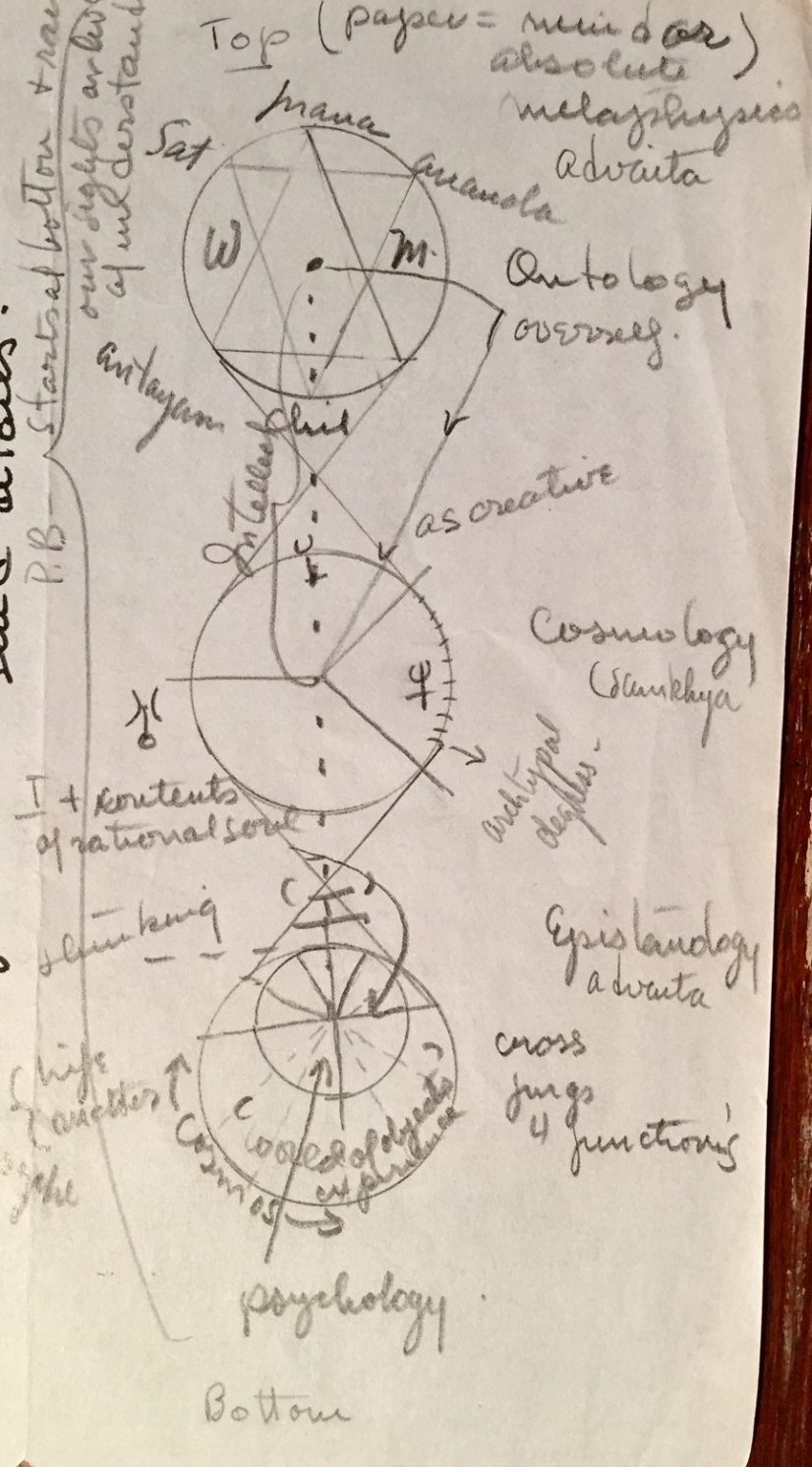
FIGURE IMG 3621. Three Circles Diagram: Divine Intellect, Soul, Psyche.
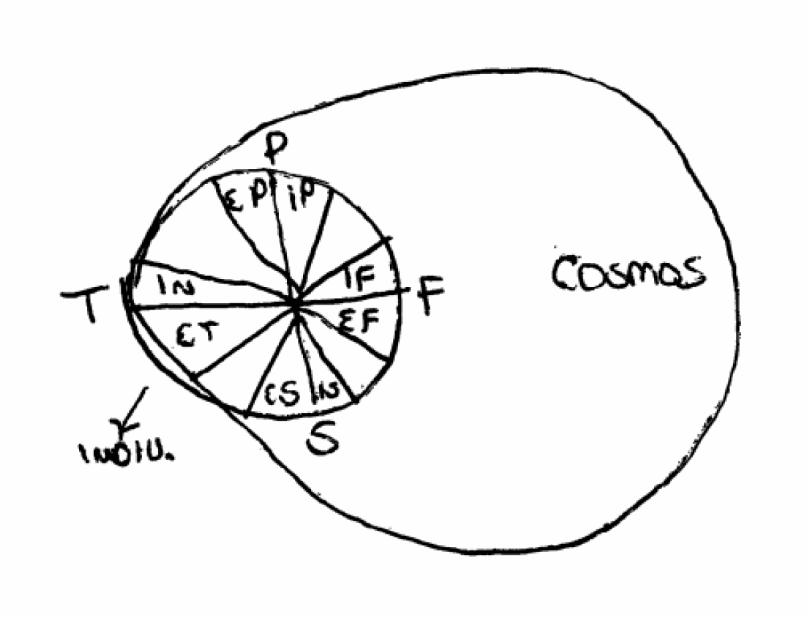
FIGURE 1973 1120-2-AB. Four Psychological Functions and Cosmos.
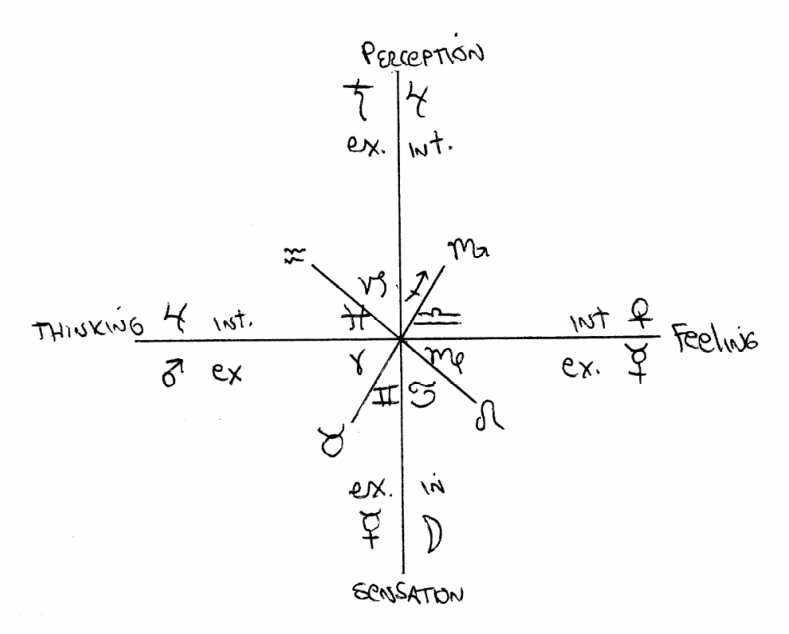
FIGURE 1973 1120-3-AB. Cardinal Cross, Fixed Cross, and Four Psychological Functions.
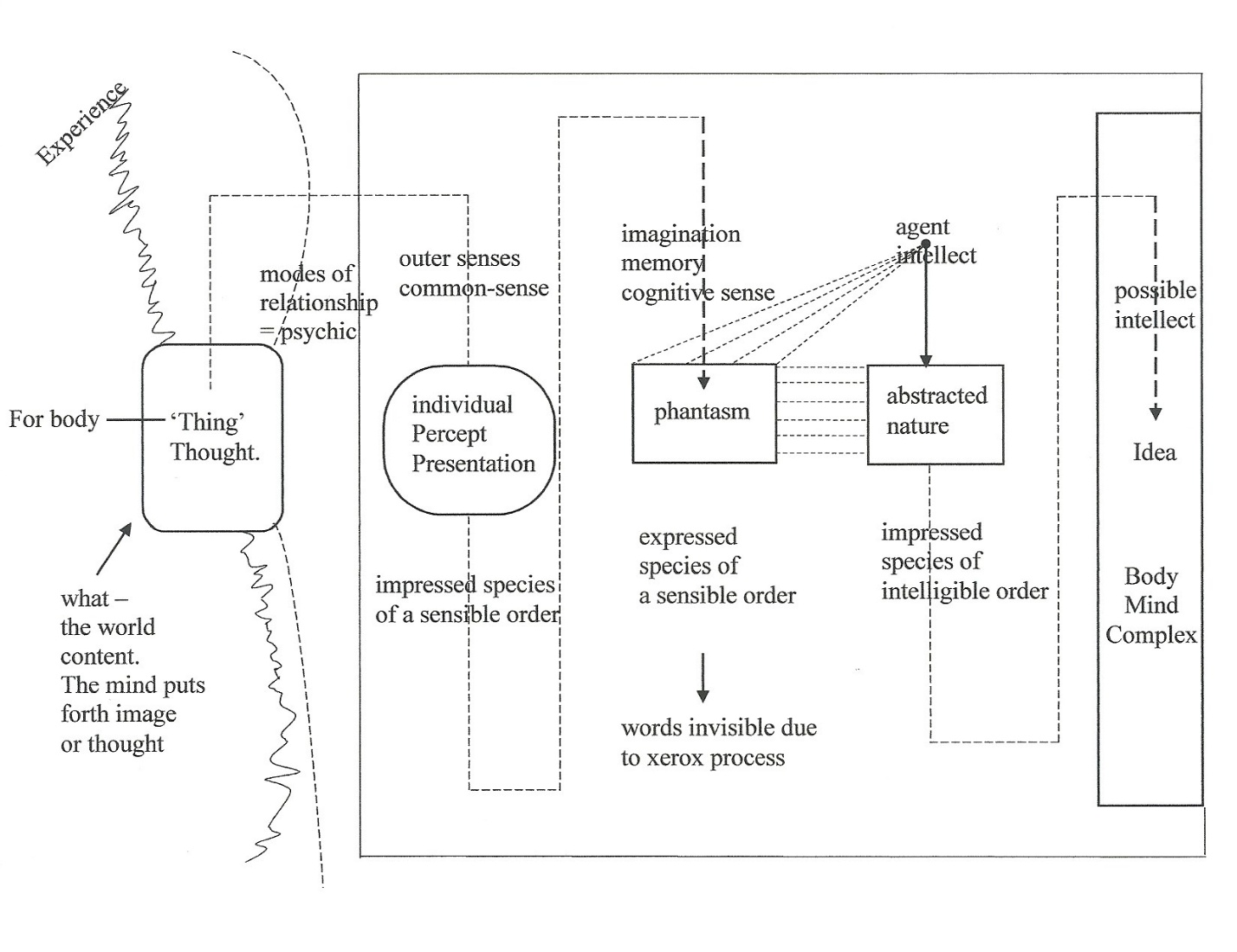
FIGURE AD Supp 107-digital. Scholastic Epistemology ("jukebox" diagram).
Other diagrams also referred to are not with this transcript version. [Transcriber note: [diagram] means the speaker is referencing a diagram as he or she is speaking. If someone is drawing or writing, with audible sounds of chalk on a blackboard, I indicate this by [drawing] or [writing].]
NOTE: For readability's sake, the following substitutions/edits made in Verbatim Transcript: cuz = because; gonna = going to; gotta = got to; yeah = yes; yous = you.
TRANSCRIBED Verbatim by IT (V12a) in 2023 from Audio Files using V11a as a basis. This V12a version has had another pass with various listening errors corrected; has been reformatted to current standards; has TOC and expanded Book List; has four diagrams appended and references within transcript to these diagrams; has new notes within the transcript. In 2025, IT removes two diagrams and replaces them with a diagram by AD, alters and adds diagram references within transcript. Archival verbatim transcript – V12a.
AUDIO FILES: 1973 1120a, 1973 1120b. [Note: "Tape" and "Side" refer to original audio cassette tapes that were later digitized into .MP3 Audio Files.]
1973 11/20 at Wisdom's Goldenrod
Archetypal Psychology; Hillman
[Audio File 1973 1120a Begins]
AD: I would like to try to keep the four functions in the perspective that I had mentioned to you, that was, you know, little circle within a larger circle. And, I think some time ago we quoted from the Brihadaranyaka Upanishad where Yajnavalkya was finally forced to admit that in the ultimate analysis we see-- we see by the light of the Self. And, this light of the Self of course is the transcendental ego. And, it's very difficult-- very difficult to make a demarcation between the empirical ego and the transcendental ego. It's something like the difficulty that was faced with, for instance, when Avicenna took a hold of Intellect and divide it up into three categories, the first category was Intellect, the pure substance, [AD hits board] [10¾ second pause] which the Scholastics work the term 'primary substance'. Then there's a s-- a second-- a second division of that pure Intellect into Soul, and then again int-- the third division into Body, so that you have Intellect, Soul, Body. And, we're in the realm of the Body, ok. I insist on making this point clear so that there'd be no confusion when we speak of psychology and when we're speaking epistemology or metaphysics. [students assent] In-- in the Brihadaranyaka you remember, this light that Yajnavalkya spoke of should be treated a little differently than light as we ordinarily understand it, including physical light. [short pause] It's, to quote-- to quote from a Vedantist, it's an unfailing light--
[Transcriber note: I am using The Metaphysic of Experience in Advaita Vedanta: A Phenomenological Approach, Volumes 1-2 by Debabrata Sinha and M. Ramakrishna Bhat, Motilal Banarsidass, Delhi, 1983. This is a revised edition of The Idealist Standpoint (1965).]
D. Sinha, M. R. Bhat [The Metaphysic of Experience in Advaita Vedanta: A Phenomenological Approach, p. 58, AD reading]: "…unfailing in character unlike physical agencies of manifestation. [AD adds: This Witness] Self is pointed out as the evidencing [AD reads: witnessing] agent in question, departing at the same time from the empirical individual comprising the congeries of bodily and mental factors. Here self [AD reads: the saksin or Witness] stands as the very essence of the individual [AD rereads with emphasis:"…stands as the essence of the individual…"] which marks the link between the empirical and the metaphysical regions. Thus, on the one hand, saksin which participates in the process of empirical activity, cognitive or otherwise, is not taken as completely transcendent in character. On the other hand, [AD adds: the] saksin need not [AD reads: doesn't necessarily] exhaust itself within the confines of the empirical individual (jiva) [AD reads: within the empirical activity of the ego]."
[short pause]
AD: [first part of sentence is a paraphrase from the book] In trying to approach this concept of the saksin and its jiva-transcending characteristic, alright, [short pause] we have to keep the primary point of departure in mind and that's that he's in the empirical ego, in here, out, around, surrounding, about [diagram]. He's the essence, the deepest essence of the empirical individual. And he not only cognizes but he feels and enjoys. Now you can see this is a kind of difficulty because the distinction you have to keep in your mind is-- will go on being obscured as you try to understand it. It's the-- it's-- if we use the analogy like for instance of the dream, where the dream character has dream thoughts about dream objects. And the dream character, so to speak, is experiencing the dream world. And, of course from the point of view of the person who's having the dream, he can say that he's transcendent to that whole dream. But from another point of view, from the point of view of the dream character, there are experiences that the dream character goes through which are very real to the dream character. And, sometimes so frightening that he calls them a nightmare and he gets up. So it's-- it's a very difficult concept to keep in mind, it constantly gets obscured, it--
[short pause]
D. Sinha, M. R. Bhat [The Metaphysic of Experience in Advaita Vedanta: A Phenomenological Approach, p. 58, AD reading]: "Even as [AD adds: witnessing or] evidencing, it is a unique activity--an activity that implies no agency. [AD adds: Although] From the common-sense point of view, [however], the cognizer would necessarily be involved in the act of cognition so far as the former is an agent of the act. The cognizer, for all practical purpose [AD reads: purposes], shares the same level as the other epistemic [AD reads: epistemological] categories, viz., cognition itself, the way of cognition and the object of cognition--all veering round [AD reads: around] the cognitive act. Now the transcendence of knowership in particular invites [AD adds: of course] opposition from the realist camp."
AD: And here I'm going to say that the realist for instance is Jung and psychological school that he had to work with. I mean it's only for polemical reasons. Could I-- Is this point becoming clear now?
S: Uh-uh.
AD: No?
S: What's your point?
AD: The-- the point I've been trying to make and-- is that there is this consciousness with you, this deeper essence, alright, which in one at the same time seems to participate or be involved in the empirical personality, alright, and the Witness. Yes, go ahead.
AH: (So you'd/Would you) call it-- you'd call that the transcendent ego?
[Note: See FIGURE IMG 3621 for the following.]
AD: No, that's the Witness that's immanent in the empirical ego. The transcendent ego would go beyond that. I'd like you to try to understand this point because it's only in the light of this l-- it's only in the light of this light that these functions mean anything. They are activities taking place within that light. In other words, when we make the-- when we make the sketch-- when we make the sketch here, [drawing] and we put the ego inside this and then outside of that, alright, you could see-- let's say that this is the ego [little circle within bottom circle], alright, and this is the world that he experiences [bottom circle], and that this saksin or this Witness-self [middle circle] seems to be involved in all of this [diagram]. Just like in a dream, right? You have a dream. Now your consciousness is the substa-- the substratum, the very substance of that being-- of that dream's possibility, alright. It is also, so to speak, the very ground for the empirical egos, the dream ego. Look at it this way. The dream character, dream Andrew, in the dream, has dream feelings, ok, dream thinking, dream sensation, dream intuition. Can you see it in that way? Like for-- for instance, in dream there's a brown bear there, ok. There's the brown, right there, that's a sensation that dream Andrew sees. Yet that brown that the bear let's say is walking towards you, that brown belongs to the real Andrew. He's the one who put it out there. And then the dream ego Andrew, alright, again it's the Andrew that put it out there. Follow? Is that really so difficult? True, it's only a distinction in your thought right now but it's an important distinction you have to try to keep in mind. It's like when PB in the Quest says that "I am not my thinking, I am not my feeling," alright. Yes, Anna.
AP: How about is there-- this is different? Is it different--
AD: Why would it be different?
AP (simultaneously): --on the dream, on the dream?
AD: In the dream don't you get the brown color from the bear, isn't that a sensation? It's true that when you wake up you realize that that brown that you saw was nothing but a thought first and then the sensation. Hm?
AP: Well that brown isn't usually [one word inaudible] but it's yours, maybe it's these functions.
S: Uh-hm.
AD (simultaneously): Well I don't want to discuss the-- the-- they-- functioning of these-- the meaning of these functions right now, I just want you to gain a point of view from which to look at thing.
S: Is what you're pointing to that these are mechanisms and not the consciousness?
AD: Well, that has to be included, yes. They're basically mechanisms and the consciousness lights them up, that's a machine that's going on.
S (simultaneously): Yes. And what you're saying are more than that?
AD: Hm?
S: Is what you're saying more than that?
AD: Well, yes, for one thing it's the very substance of this mechanism, you know.
S: Uh-hm.
AH (faint): According to this, is it some way a subject?
AD: Yes, in some way a subject but not the empirical subject.
S (very faint): Well that's (difficult to understand).
AD: I know, I know, this is very difficult to understand.
BS (faint): Well-- I've lost a word here. In the dream now, the dream character, while you dream (it) appears (to you) to say that the meaning of being(--) has taken place to that empirical ego which is the dream character.
AD: It's taking place for him.
BS (simultaneously, faint): For. Yes me too.
AD: Yes.
BS (faint): But on the other hand it looks to me that the whole dream is a revealing or an unfoldment of [one word inaudible] to the Witness-I. In other words, you say the tendencies that the dreamer has--
S (very faint): [couple words inaudible]
AD (simultaneously): Yes, both points of view are correct, aren't they.
BS (faint): Yes I can't separate the tendencies from the manifestation in the dream.
AD: No but what I'm making a point here is that both points of view are correct, that it's an experience, if we want to use that word in a very wide sense, for the dream subject, and it's also (the/an) experience for the person having the dream. It seems to be one consciousness but operating through two different way(s). Again we made this remark when we were talking Sunday the way Steiner picks up the whole argument. He tries to point out the need to relate to the perceptions that have taken place through thinking. And for Steiner of course observation and thinking are the two fundamental categories. There is no possibility of talking about anything without first observing it. And then if you observe it you must think about it, these are the two fundamental categories for Steiner. And it seems that-- if we were to do what we did last week we would put-- [Note: See FIGURE 1973 1120-2-AB for the following. This diagram is not from the class and is thus not exact but close enough to help follow along.] [drawing] we would put, so to speak, the person here [diagram], the mechanism of the-- the thought-functions inside this ego-complex [diagram], and out here let's say that this thinking and this is perception [diagram], and this thinking must take place through us in order to interpret what this perception is. We can't get other to thinking directly. Because as soon as you try to think about thinking it's already gone, it's already past. It's only in retrospection or reflection that you can think about thinking but this [diagram], so to speak, is the very guarantee of-- of this one [diagram]. They're mutually implicated in each other. [short pause] For instance if-- if you take even-- you take-- you take a point of view that Marie works with, you know.
S (faint): Uh-hm, uh-hm. (bit of laughter)
S (very faint): That's right.
AD: She says--
[Transcriber note: I am using Lectures on Jung's Typology by Marie-Louise von Franz and James Hillman, Spring Publications, 1986.]
Marie-Louise von Franz [Lectures on Jung's Typology, "The Inferior Function," p. 21, AD reading]: "I shall turn to a general consideration of the problem of assimilating the inferior function. Consciousness evolves in early childhood from the unconscious."
AD: Now, listen to this very carefully.
Marie-Louise von Franz [Lectures on Jung's Typology, "The Inferior Function," p. 21, AD reading]: "From our point of view, the unconscious is a primary, and consciousness a secondary, fact. Therefore the unconscious totality and the structure of the total personality exist in time before the conscious personality [and] could be looked at in this way…"
AD: Now, what she's saying is that the totality of the personality has already been sketched out, you know, in the unconscious. And, that kind of makes you think, well, if the totality of the personality is sketched out in the unconscious then it's already highly predetermined some extent how I am going to evolve, what contents I will assimilate from the unconscious. You see what I'm trying to get at? So that this postulation, so to speak, is a necessary factor in your understanding of psychology.
S: I may have missed it but I don't understand what (the laws of/allows her) that postulate, given her school.
AD: Well I-- I didn't lead up to that, [S simultaneously, faint: Oh you didn't.] I-- you know, I just quoted randomly.
S (very faint): Ok.
S (faint): Yes.
AD: I like to quote randomly. (some laughter) Jung pretty much said the same thing too, the Self is the presupposition of all possible experience. What he's calling the Self we've been referring to as this Witness or the saksin.
S: Yes but we [few words inaudible] [S simultaneously, faint: What do you mean?] could also be that this Self has an enormous number of possibilities at the disposal of any particular ego, not just one general direction but maybe a handful or the (essence(s)).
AD (simultaneously): I don't-- I don't think I follow you. Try again.
S: From what you said, it's-- it was unclear to me whether there's one general map for the development of the ego or whether there's a variety of possibilities available, given the material of the ground of the ego within the Self.
S: But--
AD(?) (faint): Yes.
AS/S(?) (faint): Well, ok.
AS (faint): Tony?
AD: Yes.
AS: In this view, the Witness would sort of correspond to the soul, what they would call the soul? And what we normally call psychology is sort of the-- the soul is within that body [few words inaudible] say the body point of view, is the distinction there?
AD: Yes, if you-- That's good, yes. [AS simultaneously, faint: If um--] If-- because when--
AS: Or (we tend) to call it the reason, the dianoetic half.
AD: Uh-hm. Yes and the soul, so to speak, sweating out this body, concretizing this body, building it out there, and then working through this body. And like, you [AS simultaneously: Isn't that saksin?] remember from the quote?
AS (faint): That's the saksin. That-- that's referring [AD simultaneously: Uh-hm.] to the saksin [AD simultaneously: Uh-hm.] [few words inaudible]
AD: Yes. Now, what they call the rational soul for instance in the Greek philosophers, and over here they call the saksin, alright, that would be like the lower aspect.
AS (faint): And the higher would be like the Nous (or the Intellect) [couple words inaudible] yes.
AD (simultaneously): The higher aspect of the same saksin-- in other words, saksin would be immanent, it would be the-- the Witness in-- it would be the Witness, the self-- the Witness-self, and this Witness-self is supposedly identical with Brahman, ok. But it's-- [AS simultaneously, faint: But only if you go to the upper.] it's not quite. Only by going to the upper story, the upper level.
[short pause]
AH: Tony, the quote you've read, the-- "From our point of view, the unconscious must be looked at as primary…"
AD: Yes.
AH: And therefore occurring first in time, it could be felt--
AD (simultaneously): (Development came) first, yes.
AH: And, is it because of this occurring before the conscious personality that it appears to it and is such a big dis-- one opportunity or one pattern of growth, the fact that it is placed in time in that way? Shall we look at it sequentially? I don't understand why you insert this concept of time in your-- to the comment, but as if it's somehow significant.
AD: No, not from the point of view of time, it's more from the point of view of principles, you know, that we or consciousness as we know it has evolved out of the unconscious. And this evolution of our consciousness from out of the unconscious, what she's suggesting is it's pretty much determined, the structure of how it's going to unfold is pretty much determined, it just doesn't happen haphazardly. This is basically (question), I don't think I follow, alright. There's a kind of natural unfoldment and growth of the ego-complex which is guided and, you remember Sunday we spoke somewhat about the Active Intellect. This is a kind of guidance that's going on even though we may not really be aware of him. The whole purpose of cognition, as we pointed out, was to make the person get to understand more and more what his-- you know, what his mean-- what (his/does) experience in the world mean(s). And, I just want for you to keep this in mind when we're speaking about the four functions so that you don't confuse them with that light. Thinking itself is a mechanism. [AH simultaneously: How--] It is not that light, it's a machine.
AH: Are we calling the unconscious that light?
AD: No, I wouldn't call the un-- they would. They would. They would call the unconscious, so to speak, that storehouse and-- [short pause] Alright so, we said we were going to try handling one of the functions and, we decided or you decided to pick up the feeling function, right? And, seems the way to start would be right at the very end of this little book, "Education of [AD reads: and] the Feeling Function". "Education of [AD reads: and] the Feeling Function". And I hope if you can pick up just enough information here-- Now if we could read a couple more sections but, I'd like to get to the philosophic version of the development of the feeling function of course as Bhattacharyya exhibits, ok, in the "Subject as Freedom" and in "The Concept of Value". Now, it is impossible, I would think, to understand some of those writings unless you do have some extent developed your feeling function, alright. And, it's kind of grotesque sometimes to see an academic man reading "The Concept of Value" or talking about it. Let's see if we can get acquainted with the feeling function, alright. By the way, this is also very beautifully illustrated in some of the writings of Bhattacharyya on the theory, the Indian theory of art or the concept of raga [sic; rasa], which again would show you quite-- quite a different idea of what they think feeling is.
James Hillman [Lectures on Jung's Typology, "The Feeling Function," p. 157, AD reading]: "Feeling education, in the sense of taste, values, relationships, is not the core of [AD adds: our] schooling today."
AD: You know when you go to school today this isn't exactly what they're in-- interested in, they're interested in system-making. And he suggests that it's possible that perhaps this is why psychotherapy arose in our century because of the lack of feeling. [student assents] And we all started getting sick, lack of feeling. And, the strange thing about feeling he says, (this is in--) this is by Hillman by the way, Jimmy Hillman. And speaking of Hillman, just wrote a book called The Myth of Analysis that Lenny pointed out to me, I'm going through it. It's really quite extraordinary because he's begun to see what we've been talking about, I'm sorry for the intrusion, but-- that perhaps this whole notion of analysis is really a myth, alright. That the psyche is never really sick. It may have to translate some of itself into life, you know, and at times there may be some difficulties but that doesn't mean the psyche is sick. And you can see from what was just read from Dr. Marie Tetra that (AD laughs a bit, bit of laughter) the psyche, if it already has a pretty good idea of how it's going to develop your ego and what functions are going to get developed, that it's very hard to believe it is sick, you know. It's going to put you through some paces but it doesn't necessarily mean that you're mentally ill. Well at any rate in the nineteenth century they did have, and they s-- they still do have that theory. Let's get right into the feeling function and see if you can get some grasp but he-- he points out that the Romantics were quite aware of this fact, they says--
James Hillman [Lectures on Jung's Typology, "The Feeling Function," p. 158, AD reading]: ""Feeling may err [AD: may be mistaken] but it can only be corrected by feeling" [(Herder)]."
S: Yes.
AD: So that, in a sense they're pointing out you can't correct feeling with thinking. Alright, this is what-- this is one of his claim.
James Hillman [Lectures on Jung's Typology, "The Feeling Function," p. 158, AD reading]: "Inferior feeling cannot be corrected from above by superior thinking. The beginning of feeling education is turning a deaf ear to one's superior functions, whose disapproval--even if tolerantly educative--of whatever is less acts mainly repressively. Feeling requires an education through faith; it begins to function only when we can trust it to function and allow it its errors.
"The psyche works at its own errors by means of [its] self-steering, self-correcting tendency."
AD: Of course this is the concept of homeostasis. [short pause] He points out that very often as we get older, we have dreams of early childhood and adolescence and dreams about our high school days. And he makes the remark here that this was the time when the affective life was beginning and was kind of nipped in the bud, you know, by repression and fear and what not, I don't know if that applies today. (bit of laughter)
James Hillman [Lectures on Jung's Typology, "The Feeling Function," pp. 158-159, AD reading]: "A first step in the education of feeling is lifting the repression of fear. The feelings must first be caught and held in consciousness and recognized as feelings. Since it is the feeling function which feels feeling, it must be allowed to feel what it actually does feel as it happens, admitting and accepting, without [the] intervention of superior functions [AD reads: by the superior function]. Not only the superior functions interfere. [AD: Shouldn't be made to interfere.] Feeling itself judges the psyche's contents with narrow evaluations. [AD: Feeling itself does this.] Our own stale moralisms, cheap tastes [and] intolerances work against us. It is as if feeling develops through a suspension of itself, holding in abeyance so that we can [AD emphasis] newly reflect rather than habitually judge what we feel."
AD: He said a-- he said a mouthful here, I don't know if he-- I don't know enough about Hillman, I haven't gone through enough of his works, whether he realizes the implications of a statement like this. When he [student assents] says--
James Hillman [Lectures on Jung's Typology, "The Feeling Function," p. 159, AD reading]: "The feelings must first be caught and held in consciousness and recognized as feelings."
S: Uh-hm.
[Note: See FIGURE IMG 3621 for the following.]
AD: I pointed out that there's only one way I can really understand and work with the chart. And any other-- [drawing] any other kind of work is just to me a closed book. When Jung speaks about two psychic systems, I can speak about two psychic systems in astrology. And in astrology I can't understand the chart unless these two sh-- these two are combined [diagram], simultaneously co-exist for me. If I think of this, for instance, having so many zodiacal degrees, and divide it into thinking, willing, and feeling [middle circle], ok, and then if I think of this as the cross, the four functions [in little circle in bottom circle], and then the 12-fold [little circle in bottom circle], the combination of these two is what makes the chart pertinent to me, otherwise I can't understand it. These unconscious content, these zodiacal degrees, will come through on the 12-fold chart, they're like the background to it. Do you follow what I'm trying to say here? [student assents, faint] Alright. And when he says something like this--
James Hillman [Lectures on Jung's Typology, "The Feeling Function," p. 159, AD reading]: "The feelings [AD reads: feeling] must first be caught and held in consciousness and recognized as feelings [AD reads: feeling]."
AD: He's speaking about something reflective going on. A reflective consciousness is a presupposition in his understanding of the function(s). Well let's see if we can understand this.
James Hillman [Lectures on Jung's Typology, "The Feeling Function," p. 159, AD reading]: "The feelings must first be caught and held in consciousness and recognized as feelings [AD reads: feeling]. Since it is the feeling function which feels feeling, it must be allowed to feel what it actually does feel as it happens, admitting and accepting, without the intervention of superior functions [AD reads: function]. Not only the superior functions interfere. Feeling itself judges the psyche's contents with narrow evaluations. Our own stale moralisms, cheap tastes and intolerances work against us. It is as if feeling develops through a suspension of itself…"
AD: Ok?
James Hillman [Lectures on Jung's Typology, "The Feeling Function," p. 159, AD reading]: "…holding in abeyance so that we can newly reflect rather than habitually judge what we feel."
AD: Yes.
RG (very faint): I don't understand it.
AD: I'm sorry?
RG (faint): I don't understand that sentence, "Feeling holds itself in abeyance."
AD: Well, Richard let's take an example, suppose-- suppose you're going down 90 miles an hour and I'm a trooper and I pull you over, ok. (bit of laughter) And I take out the book and I'm starting to write. Now, do you remain in your psychological nudity and experience your feelings or do you already have a remark ready for that son of a-- (some laughter)
RG (faint): Yes, ok.
AD: Ok? Now if you remain there in your psychological nudity, strip yourself of all rationalizations, just ignore them, and just say, "I've got to feel what's coming up" just to see-- you'll see it there. But if the feelings are already justifying, rationalizing or the superior functions, it's all over, you can't experience that situation. And a situation, an event, a person, you know, is basically a content of an archetype manifesting through that content, so to speak, or channeling through it, you know, whatever feelings are there, alright. Now, another example for instance is let's say you have a certain way of listening to music, you listen to a certain type of music and then I suggest something. Your feelings will blind you. The feelings will say "Go away," yes. Right Tim? [students assent, very faint] So unless feeling suspends itself, so to speak, stops being a judge, jury, executioner and authority all at once, and keeps a kind of open attitude, let-- permit things to happen.
RG (faint): But can the feeling function do that-- do that? Like if it's feeling all these feelings, how is it going to suspend itself?
AD: Again you're getting back to my presupposition, aren't you?
RG (simultaneously, faint): (It could) never be a reflective consciousness.
AD: We'll just follow them for a little while and then we'll try to get that out in the open, I think only someone like Bhattacharyya really can understand these things or (break out) some of these other men. [short pause] So he points out, he says--
James Hillman [Lectures on Jung's Typology, "The Feeling Function," p. 159, AD reading]: "These little mechanical defenses against feeling keep it attached to its affective roots…"
AD: I would use the word here 'emotional roots'.
James Hillman [Lectures on Jung's Typology, "The Feeling Function," p. 159, AD reading]: "…for anything newly coming into consciousness comes with a potential that is more affectively [AD reads: emotionally] charged than the ego-system itself, [AD adds: or] else it would not make itself felt, could not get in. Before the animal can be tamed, it must be caught. Before education can proceed, there must be something to educate. This implies a responsibility toward one's feelings, whatever it feels like, and not only a responsibility to the ideals of how one should feel. This responsibility in fact puts to [the] test one's ideals, for it requires courage and honesty to give place to all [that] a [AD reads: the] feeling would say once it is let in."
AD: And we'll try to-- again, let's aim for a couple of practical examples.
S: Could you say first why you would change the word 'affect' to 'emotional'?
James Hillman [Lectures on Jung's Typology, "The Feeling Function," p. 159, AD reading]: "These [AD reads: The] little mechanical defenses against feeling keep it attached to its affective roots…"
AD: As soon as I say emotion you know it's bodily, tied to the body. I even like the word better like passion, you know.
S: Uh-hm.
AD: 'Affectivity' is a nice sophisticated word, you don't know what it means, you're not quite sure. (bit of laughter)
RP (faint): They say it's a [few words inaudible]
S: Tony?
AD: What's that?
S (simultaneously): Would another example of what you're saying be something like, when somebody has a system of feeling-values that are posi-- positive values, let's say, or, you know, positive [AD simultaneously: Yes.] feelings, warmth, beauty, [AD, faint: Uh-hm.] these are these people who are always going, "Oh how beautiful, how lovely," they're constantly doing that and they refuse to recognize their own negativity about things [couple words inaudible] would that be something like that? When they say that they should feel this way, that they should be having--
AD (simultaneously): Well you have a responsibility, yes, you have a responsibility to the values and the mores that you have been brought up with assuming that they are yours. But you also have a responsibility to see the higher and the lower. In other words--
S (simultaneously): But he's saying that, he's saying that, that other [AD simultaneously: Yes.] people fall into this pitfall, isn't that-- that's (why/what) I was trying to give an example of, the pitfall that people fall into. Would--
AD: That they--
S: That they aren't feeling [AD simultaneously: That they don't permit that to happen, yes, yes.] what they actually feel, right, exactly, that's what I was trying to do.
AD: Yes. In other words, if you're a highly developed aesthete, let's say, and a-- a certain ugliness appears, you know, rather than look at that ugliness and accept it as part of the very world that you're living in, alright-- Again, this brings us back to the problem of psychological (unity/nudity), well a-- a very sincere honesty with what we are feeling. Yes, go ahead Lou.
S: Well in that case (there/their) feeling would be the superior function. How does that-- how does the superior function recognize the negativity of the inferior function(,) (one is/when it's) just trying to hold on to its reality, because it's-- it's tied up with the ego.
AD: What you're saying now is the superior function, in this case the feelier-- the feeler [couple words inaudible] alright, because-- because it is the dominant way that the ego operates, could not permit let's say some kind of thinking to come into it because this would more or less interfere with its established system of value. Yes, that's precisely the point.
S: [few words inaudible] that's why a great deal of primitivity is arising with the thinking function. That feeling function's so highly [few words inaudible] not to include what's coming up.
AD: Uh-hm. So even for a feeler there would be the problem. Of course it would be a mistake to think that in a-- a differentiated feeling type has reached the limit because these limits can be extended indefinitely. It's just that there comes a time when all of a sudden it starts getting, you know, kind of worn-out, you know, useless, burnt, it's burning oil and all that. Yes, go ahead.
S: Well are we saying that the feelings can observe the thinking? That seems to be implied.
AD: The feelings are evaluating your thinking: "I don't like that thought. Out."
S (faint): What'd he say?
AD: Feelings judge. You know, you judge with your feelings. The whole problem of value is based on your feeling function.
S (simultaneously): How do you know you're judging with your feelings and not with your thinking when you say "I don't like that thought"?
AD: Well as soon as you say that.
S: So that's bringing thinking.
S (faint): Why is it [one word inaudible]
AD (simultaneously): You're evaluating it.
S: With your thinking.
AD: Huh?
S: You're thinking and not feeling.
AD: Well if you were thinking you would say "Is it true or false," for instance, "Is it so or not so," you wouldn't be saying "I like it, I don't like it."
S (faint): But you did.
AD: As soon as you say "I like it" or "I don't like it" what you're expressing is the relationship of the object to your feeling function, not-- not in relation to your-- your knowing situation.
S: It's like the-- any thinking type would go beyond that and say "I don't like it because…"
S (faint): Uh-hm.
S: Uh-uh.
[few students at once, few words inaudible]
RG: (Harriet), what is this thinking about then because let's say you're conceptualizing feeling.
[students assent, very faint]
S (faint): That's (not--/nice.)
S (very faint): Tony, are you--
S (faint): [couple words inaudible]
S (simultaneously): I get lost [couple words inaudible]
AD (simultaneously): Go ahead, speak on.
S (very faint): Give me another example of feeling suspending itself in order to develop.
AD: In order to--
S (very faint): Develop itself properly.
AD: Well suppose you're a fan, rock 'n roll fan, ok. And I tell you, "Here, listen to this symphony," ok. You're going to have to suspend your feeling function.
S (very faint): Ok, so anything I do that I might just feel the [few words inaudible]
AD: Yes.
S (faint): Uh-hm.
MB: What about most of these guys [couple/three words inaudible]
AD (simultaneously): What about what? (laughter)
MB (faint): We have classical music fan [few words inaudible] rock 'n roll. (MB laughs, some laughter)
AD: Ok, why not, why not? I used to listen to the popular tunes of our times. (laughter, student words) That's tolerant. It's true, I broke the record after I heard it but I was tolerant. (some laughter, student words)
OG (very faint): What is-- what is--
AD: Go ahead.
OG (faint): Other example of [few words inaudible] (Sunday). I used to hear in the classes listening to rock 'n roll is bad, and I make my feeling function like [one/two words inaudible] to that, "Don't listen to rock." But, the feeling to me are revealing they like rock. (Are) we still not accepting that [few words inaudible] my feelings say I like rock [few words inaudible] there. [S: But--] (It's some kind of) interfering that type also or with that kind of feeling. The same way the feeling function that you think rock is bad.
AD: Yes.
OG (faint): As when you [couple words inaudible] And especially that listening to rock [few words inaudible] So that-- that's where I think they develop.
AD (faint): Uh-hm.
S (faint): That there's no value to the value(s).
AD: That--
OG/S(?) (simultaneously, faint): That the suspension is.
AD: The suspension. You see, what's the peculiar thing about an object, let's take an object-- take a look at a face of someone you love, ok. And, you got-- you got two different problems here. You got the knownness of this face, alright, and the feeling that's attached, so to speak, to this knownness. And these two, so to speak, are really-- are they combined in one consciousness or are they two types or speculative consciousness of both, you know? Is it a unity? I don't want to go into these now, I just want to try to open up the whole notion of what a feeling function is, alright. Knownness, valuation, and willing, these are the three functions that, even though in the twentieth century psychology they disbanded them as faculty psychology, what they really disbanded was their own un-- misunderstanding of faculty psychology.
James Hillman [Lectures on Jung's Typology, "The Feeling Function," pp. 159-160, AD reading]: "It is not what contents a person carries in his unconscious that reveals his character…but how one meets these contents. The criminal-twist that each complex has as [AD adds: a] part of its potential is a shock to feeling. I may ignore this shock and simply not feel that [AD reads: the] shadow of my nature. Or I may play social-worker towards my criminality, trying to help and understand [AD adds: it]; or the ego may play high-court judge or [AD reads: and] policeman. As the bomber is within, so is the"pig" who violently represses every sign of violence, never allowing an explosion, clubbing into insensate stupidity with pills, drink and distractions every exaggerated confrontation that the complexes would constellate."
AD: Pills too, drugs too. I'm-- I'm not, you know, condemning any of what's gone on but it is one of the reasons many people do take drugs, they're cowards. They're cowards, they can't stand to look and live with their own psyche. Just like I-- I used to work on an assembly line and people couldn't live because it was such a boring job. They couldn't live with their own psychic boredom. They couldn't accept these feelings of boredom. And that's a-- that's a sin. Sin, you know, underlined. I don't mean religious sin. But it's like not accepting a psychic state of yours. And boy it's going to come back. It'll be even more difficult to live. Anyway.
James Hillman [Lectures on Jung's Typology, "The Feeling Function," p. 160, AD reading]: "Feeling thus requires [AD adds: a sort of] psychological courage."
AD: Now-- I think we're-- many of us are getting acquainted with these facts. Well wait a minute, as long as you're going to carry [S simultaneously: Too late now.] [couple words inaudible] (Never mind.)
S (faint): Tony--
James Hillman [Lectures on Jung's Typology, "The Feeling Function," p. 160, AD reading]: "There is [AD adds: a] civil, moral, physical and intellectual courage -- so too a courage of the soul to encounter itself. To meet the contents one carries, to recognize the destruction in one's complexes, and to undergo -- which means as well to go under (laughter) -- the disintegration and [AD adds: the] absent places of one's inferiority…"
AD: I think most of you have begun to see that that-- a great deal of psychological courage is called for in meditation if anything starts coming up. And, if anything does come up from the unconscious you can almost-- it's like a rustling of the wind in the trees at night and you're all alone walking through a graveyard whistling to yourself. It has that kind of numinosity and you really are going to have to have some sort of psycholo-- psy-- some sort of psychological courage to accept this. This is one of the main reasons why I'm interested in speaking about the feeling function.
[short pause]
James Hillman [Lectures on Jung's Typology, "The Feeling Function," p. 160, AD reading]: "Psychological courage is a courage of the heart, for we may regard courage as a phenomena of eros which stands in defense of the heart, both [AD adds: in] its generosity and [AD adds: in] its folly. The courage of feeling toward [AD reads: towards] the phenomena of the soul…"
AD: And it's felt, you know, these degrees start coming through here [diagram].
James Hillman [Lectures on Jung's Typology, "The Feeling Function," p. 160, AD reading]: "The courage of feeling toward the phenomena of the soul, regardless [of] what they are, is an enactment of [the] Eros and [AD adds: the] Psyche tale, because eros gives love and encouragement to all the contents of the soul which it feels inferior about. The more we stand for eros, the more psychological strength we seem to gain, demonstrating that eros is indeed a dynamus, [AD: Dynamic principle.] not only in its desirous portion…"
AD: You know, eros, bring together, social relationship, you know.
James Hillman [Lectures on Jung's Typology, "The Feeling Function," p. 160, AD reading]: "…but altogether as a life-embracing impetus. Courage shows in the feeling function's willingness to take on whatever comes up. … [Then] we analyze what we feel…"
AD: Now here's an example, this is so common that I-- I think now it's probably recognizable by all of us.
James Hillman [Lectures on Jung's Typology, "The Feeling Function," p. 160, AD reading]: "This education through faith and courage can be sabotaged by analytical cleverness. [Then] we analyze what we feel, [AD emphasis] too soon…"
AD: Too soon. Remember that.
James Hillman [Lectures on Jung's Typology, "The Feeling Function," p. 160, AD reading]: "…too soon trying to figure it out: why, where it came from, what it"means" [AD reads: what does it mean]. Then, instead of feeling, we call what we feel a projection…"
AD: And we want to take it back of course. "I don't love the girl, I got my anima projected."
James Hillman [Lectures on Jung's Typology, "The Feeling Function," p. 160, AD reading]: "…or take it to the other person to"discuss." Everything, anything but the courage to live the feeling function's inferiority."
AD: I'm-- just because I'm looking around I'm not [couple words inaudible] (laughter, student words) I don't think I could [one/two words inaudible] (AD laughs, laughter)
[10¾ second pause after laughter]
James Hillman [Lectures on Jung's Typology, "The Feeling Function," p. 161, AD reading]: "Marriage provides a vessel for [negative] feelings of every sort…"
AD: Mostly negative feelings. (laughter, student words)
James Hillman [Lectures on Jung's Typology, "The Feeling Function," p. 161, AD reading]: "…even about marriage itself."
AD: This might help some of us, I don't know.
James Hillman [Lectures on Jung's Typology, "The Feeling Function," p. 161, AD reading]: "Although we may delusionally go into a marriage propelled by thrust of hope, desire [and] joy, the elaboration of marriage means bad temper, sarcasm, wheedling, meanness, boredom, (laughter) and so many complexities of negative feelings that marriage offers a superb vehicle for the feeling function. There are few places where we have the opportunity for a [AD emphasizes next three words] forced, prolonged relationship: jobs we quit, [AD adds: gurus we leave], (laughter) neighborhoods we move from, loves often fade [AD reads: love often fades] when the [wind blows cold]."
(Side 1 of original cassette tape digitized as 1973 1120a Ends; Side 2 Begins)
James Hillman [Lectures on Jung's Typology, "The Feeling Function," p. 161, AD reading]: "[But marriage seems ideally made for the] expression of every sort of negative feeling (some laughter) and thus for the differentiation…"
AD: You have to go through the negative part first, you know that from astrology. First the negative then the positive, first the inefficient then the efficient functioning. And, we are Buddha-heads, true, but we still don't emit light. It's going to take us a little time. (bit of laughter)
James Hillman [Lectures on Jung's Typology, "The Feeling Function," p. 161, AD reading]: "[But] marriage seems ideally made for the expression of every sort of negative feeling and thus for the differentiation of the feeling function. The fact that marriage seems the only place that these feelings are permitted, even expected, raises the question whether marriage might not be today forced to carry more than its share of both [AD reads: these] negative feelings…"
AD: And besides we have no other place.
James Hillman [Lectures on Jung's Typology, "The Feeling Function," p. 161, AD reading]: "…and inferior functioning…"
AD: And of course, most of us are married now, right? This inferior function of course can't be shown outside, he says. We know that too.
James Hillman [Lectures on Jung's Typology, "The Feeling Function," p. 161, AD reading]: "It is a standard joke of feeling that a man keeps up the front all day long only to come home to disintegrate in self-pity and vicious attacks on the family. (laughter) Of course marriage cannot be a"success" in the old-fashioned sense of a beautiful, loving, growing thing like a tree, just because of these negative feelings which thrive in the relationship of the [AD reads: a] couple. Yet, marriage is a success when it can live from these negativities and offer to the feeling function a chance for daily exercise. (laughter, student words) Marriage offers a chance for developing the feeling function because as an archetypal vessel it stands impersonally outside and implacably above whatever takes place within the relationship. The vessel may feel like a trap or [AD adds: a] cage in which the woman "can't breathe" and the man wants "out," but these experiences testify to the solidity of the impersonal structure."
S: Can I ask a question?
AD: Sure. You're not married, what do you want to ask a question for. (laughter)
S: Um--
S: No question from me.
S (simultaneously): Like I-- I'd like to figure out like where they talk (more of) suspending the feeling function comes in because it seems like there's a feeling content, it's given conceptualized form, and then on top of that there's a feel or a judging faculty which likes it, it doesn't--
AD (simultaneously): Start again slowly, go slowly, [S simultaneously: Alright.] start slowly.
S: It seems like there's a feeling content and that that's the thing.
AD: And there's a feeling content and a feeling function.
S: There's a feeling, right?
AD: There's a feeling function and a feeling content, yes.
S: Ok. And, on top of that--
AD (simultaneously): [yelling to some students] Where are you all going, just because I spoke about marriage!? (laughter, AD laughs, student words) Huh? Well you'll get used to it after a quarter of a century or so. (AD laughing, some laughter)
S: Um--
S (faint): Somewhere they're throwing a concert.
S (faint): See that-- it seems like there's a feeling that's given a contextualized form and then on top of that--
AD: I don't know what you're talking about.
S (faint): Well I'm trying to describe something, I--
AD (simultaneously): You got a feeling and then you [S simultaneously, faint: Well not a feeling.] got a conceptual form.
S: Well this is-- this is what I think is happening, alright. There's a feeling and the only way that I know this feeling is because I have a feeling reaction to the mental conceptions which are giving form to that feeling. So what I have is a feeling function on a conceptualization on a feeling. Now this-- [couple inaudible student words simultaneous with S] but-- but that's really what I think is happening with me all the time. Like I'm wondering if like this [one word inaudible] conceptualizing or suspending it that there's-- that is all the way on top of, you know, just like-- because--
AD (faint): Well [few words inaudible] question [three words inaudible] let's just repeat it again. Let's repeat. I can talk to you about that later but it's not the (question) I'm talking about.
S (very faint): (Ok/Uh-hm).
James Hillman [Lectures on Jung's Typology, "The Feeling Function," p. 162, AD reading]: "The education of the feeling function for the feeling type may even be more difficult than those with another superior function. [After all], the superior function does not age well; it is [the] adaptedly smooth system that copes, whereas personality development usually takes new steps through its breakdowns [AD reads: breakthroughs] of habit where the inferior parts have a chance to come forward. Feeling may extend its range to ever new areas of life, new people, new interests and activities, but unless there is a further differentiation of values, where they advance in subtlety and human comprehension, the function itself does not move, only the focus of its attention. Therefore, the feeling type often must suspend his superior function and its values in order to extend the function. A woman feels her son's mistake in marrying a negress; a wife sees the destructive aspect of her husband's best friend; a husband finds waste in his wife's social life. Each of these judgments has much going for it. Yet, [AD: yet] by including the position of the son the mother has a chance to discover new values. By judging the husband's friend the wife misses her opportunity to be led by her husband's"inferior" feeling for his "inferior" friend…"
AD: He misses the point here.
AS: Tony?
AD: Yes.
AS: It would seem from what he's saying then in terms of develop say any type function, I'm-- any of the functions that it would be necessary (for him) to find out when they're actually being used, differentiated and stretched to their limit. [student assents] From what he's saying there that [few words inaudible] that's probably a time to drop them, drop the function.
AD: Yes but except, and I'm surprised Richard hasn't come out and slammed this kind of remark down, this is a horizontal development that can go on indefinitely and in the realm [AS simultaneously: That's what I'm saying.] of samsara forever.
AS: I mean it seems like, you know, every time you reach a new limit, so to speak, you just drop off and pick up some more stuff and then keep going with it.
AD: Uh-hm.
AS: Something that isn't [couple words inaudible]
S (simultaneously): Well wouldn't that be that he talks about extending the focus of attention and not that feeling development?
AD: The development and the differentiation of the feeling is not a question of focusing the attention on continuous problems and items but vertically.
RG: Tony, doesn't-- isn't he implying that though, on one hand [student assents, faint] you understand more about-- Seems that he's not saying this extension is an act of the will but it's an attitude that-- (that/that's) [one/two words inaudible] in the feeling function.
AD: Well let me re-- let me recall, let me recall what we've read once from The Practice of Psychotherapy from Jung.
C.G. Jung [CW 16, The Practice of Psychotherapy, "The Psychology of the Transference," p. 174, paragraph 361, AD reading]: "Four stages [of eroticism] were [AD reads: are] known in the late classical period: [Hawwah] (Eve), Helen [(of Troy)], the Virgin Mary, and Sophia. The series is [AD adds: again] repeated in Goethe's Faust…"
AD: Etc, alright.
C.G. Jung [CW 16, The Practice of Psychotherapy, "The Psychology of the Transference," p. 174, paragraph 361, AD reading]: "The first stage--[Hawwah], Eve, earth--is purely biological; woman is equated with the mother and only represents something to be fertilized. The second stage is still dominated by the sexual Eros, but on an [AD reads: the] aesthetic and romantic level where woman has already acquired some value as an individual. The third stage raises Eros to the heights of religious devotion and thus spiritualizes him [AD reads: spiritualize it]… Finally, the fourth stage illustrates something which unexpectedly goes beyond the unsurpassable third stage: Sapientia. How can wisdom transcend the most holy and the most pure?--Presumably only by virtue of the truth that the less sometimes means the more. This stage represents [a] spiritualization of Helen and consequently of Eros as such."
[23¼ second pause]
AD: There's-- from this book which-- Aurora Consurgens, we have a tract which I read to you once, perhaps now it might come home. [short pause] Text is on one side, the commentary is-- is towards the middle of the book, it says--
[Transcriber note: I am using Aurora Consurgens: A Document Attributed to Thomas Aquinas on the Problem of Opposites in Alchemy, edited with a commentary by Marie-Louise von Franz, A Companion Work to C.G. Jung's Mysterium Coniunctionis, Bollingen Series LXXVII, Pantheon Books, New York, 1966. Originally published in German as part III of Mysterium Coniunctionis by Rascher Verlag, Zurich and Stuttgart, 1957.]
Marie-Louise von Franz [Aurora Consurgens, p. 33, AD reading, quoting Thomas Aquinas]: "All [good] things came [AD reads: come] to me together with her, that Wisdom of the south, who preacheth abroad, who uttereth her voice in the streets, crieth [AD reads: crying] out at the head of the multitudes, and in the entrance of the gates of the city uttereth her words, [saying]: Come ye to me and be enlightened, and your operations shall not be confounded; all ye that desire me shall be filled with my riches. Come (therefore), children, hearken to me: I will teach you the science of God."
AD: Now this is the (Virgin/version), third stage, feeling function differentiated at the third stage. Here's Marie's commentary.
Marie-Louise von Franz [Aurora Consurgens, p. 155, AD reading]: "The first chapter introduces a mystical female figure who appears at first as the personified Sapientia Dei… This feminine divine hypostasis is painted on a broad canvas, and is amplified by numerous Biblical sayings and comparisons."
AD: Now all I'm trying to point out here is, this is the level of feeling that supposedly Thomas Aquinas was functioning with. It wasn't the feeling that could go back to the biological level. Do you see a kind of feeling function that should-- I mean the way the feeling function should get differentiated? This is-- as a matter of fact if any of you get the opportunity to read some of these texts they're very ecstatic. And the feeling function is evolved considerably, highly differentiated. And they simply will not permit the lower kind, the coarse or the cruder kind of feelings to come in. It does not mean that they're repressed! Yes.
RG (simultaneously, faint): Yes that's the point, (that/of) the ecstatic acts of the will to the extent of those feelings because the feeling function has evolved to the stage(--/.)
AD: Yes, it had developed to this point, sure. That's the whole point.
RG (faint): [couple words inaudible] sometimes that we-- [AD simultaneously: Now--] that we can impress [couple/three words inaudible]
AD (simultaneously): Now the point I'm making here is, in this remark that he makes here in permitting certain incongruous acts as far as your feeling function, is to bring you down again.
S: But is that necessary in order to go up?
AD: How much is necessary?
S: But it's (frustrating).
RG (simultaneously): How much?
AD: That's the point we're making.
RG (faint): So what's the answer?
AD: You sure you're not going to go around living there, you know, like Freud says well, you know, Plato was born in the mud too. Oh, but his eyes were up looking at the stars, your-- yours are not. (bit of laughter)
S: Wait, yes, but you eventually are going to come full circle.
S (very faint): (Bless you.)
AD: I don't think we can get to that till we really bring out the nature of the feeling function. Because we're going to have to-- we're going to have to come with philosophical concepts or these people go around in a merry-go-around, keep trying to take a brass ring.
MB: Tony?
AD (faint): Yes.
MB: You do speak about a reflective consciousness that underlies the feeling function, and yet this can't be confused with thinking which would tend to reflect feelings in the first place as you mentioned it. So wouldn't that reflective consciousness then be-- is the underlie of both-- if it is a reflective consciousness which can be thought to underlie all four of the functions, couldn't we hypothesize that it would then have to [couple words inaudible] feeling itself?
AD: Try me again, I got lost [MB simultaneously: Well--] about halfway.
MB: I was just trying to-- I think Richard was talking about the question of reflecting the feelings or-- or elevating them on the vertical scale, and if-- and we said it can't really be done in terms of thinking because that would be a repressing of the feelings and not taking them in their bareness. And we also spoke about a reflective consciousness that underlies the whole act of thinking and feeling. At least you brought it up before and isn't that to say then that that reflective consciousness does not channel through the thinking but that it channels directly through the feeling somehow, that it's a consciousness that underlies all four of the functions but that can be reflected into any of them.
AD: I don't think I understand you, anyone could help me, Richard?
RG (simultaneously, faint): Yes I think she's saying that, when we just spoke before of this reflective feeling, it isn't the feeling function per se that somehow is the essence of it, its ground. And it's reflective feeling that elevates the feeling, that makes the evaluations and the judgments of the-- what level and development feelings are going to be at and it's not an act of will by the thinking function to look at them and say this is-- this is the most appropriate or something but it has to come from within feelings themselves.
AD: Yes I see what you mean, yes. I certainly too regard the feelings as a-- a much deeper layer, a higher grade of reality almost. Because that's where you're really situated. You know what I mean? [MB assents, faint] You can talk very freely but the feelings certainly show where your values really lie. And in terms of this here, you know, the fifth to the eighth house [diagram], the external world is a felt world. [Note: Reference is to FIGURE IMG 3621, fifth to eight house in little circle in bottom circle; also FIGURE 1973 1120-2-AB, fifth to eighth house, and FIGURE 1973 1120-3-AB, Leo through Scorpio.] And the feltness of the objective world, so to speak, shows the evaluation processes that are implicit in your thinking and in your feeling and in your willing. And so they tend to give this a higher grade. Now of course, once a person frees himself from his feelings then naturally he's freed from willing and freed from thinking too. Then he's free, period, alright. But this is about-- this is about one of the most important topics that he's going to try to investigate. Well, we'll try to first expand the meanings of feelings and try to understand what that function is. [short pause] Now--
James Hillman [Lectures on Jung's Typology, "The Feeling Function," p. 162, AD reading]: "In this respect, feeling may require education through the reverse of the usual values…"
AD: I have trouble with some of these things, you know?
James Hillman [Lectures on Jung's Typology, "The Feeling Function," p. 162, AD reading]: "…through lying, for instance." (bit of laughter)
RG (faint): Through lying? (RG laughs a bit)
James Hillman [Lectures on Jung's Typology, "The Feeling Function," pp. 162-163, AD reading]: "Truth is not an abstract principle only; it is also the reality of a concrete situation in which various values are operative. What may be the truth in a factual thinking sense may be a lie in order to protect higher values or to be true to the concrete situation. Parents conceal from their children and lie to them, yet expect their children always to tell the truth. Let us say there is a feeling truth and a thinking truth, and sometimes they clash."
AD: I can't follow this at all. I mean suppose a woman comes to me and I ask her her age and she tells me she's 35, I know she's 50. So I don't have to insist, true, I don't have to insist that, you know, "You're 50, what are you lying to me for?" I could recognize the fact that there's a psychological truth here. I could also recognize that there's a knownness which is a factual truth which has nothing to do with that psychological truth. But truth would have to include both of them. Why give a priority to one ov-- or the other in terms of these functions?
S (very faint): Isn't he trying to say there's a distinction? It seems like it might be the same thing as when you tell us not to let our psychology interfere with (that) [one/two words inaudible]
AD: Yes, that doesn't mean you're not aware of your psychology.
S (faint): Right.
AD: You-- (AD laughs a bit) [few very faint inaudible student words simultaneous with AD] as a matter of fact, if you're not aware of it, it certainly will interfere. And this is the point I'm making, sure there's a psychological truth, and there's a so-called abstract truth I assume that is being knownness of a factual facthood, you know. But that doesn't mean I can't operate with both. I don't have to lie. It's absurd. These people get carried away with their system(s). At any rate.
James Hillman [Lectures on Jung's Typology, "The Feeling Function," p. 163, AD reading]: "Let us say there is a feeling truth and a thinking truth, and sometimes they clash. Then we have the classical conflicts between Mercy and Justice or between Love and Truth. Psychological truth is usually duplex if not complex; that is, it has [AD reads: may have] many sides and therefore many truths. Hermes, who is the leader of souls [AD reads: soul], the one who points the way for psychological development, begins his life as a newborn child by stealing and lying."
S: He forgot (a fee/how to see).
AD: Huh?
S: He forgot (a fee/how to see).
AD: He forgot a fee.
S: Like (the ways of) [one word inaudible]
[short pause]
James Hillman [Lectures on Jung's Typology, "The Feeling Function," p. 163, AD reading]: "This problem can be difficult for the feeling function if it has not developed a sophistication and found a connection between the values of the soul and the values of society. The feeling type usually reflects the established values of a civilization, incorporating them into principles of conscience. He feels himself part of the law and supports the doctrine of truth that has resulted from a historical process. The relation to [AD reads: of] the values of society is another manner in which feeling can develop. Comfortable acceptance or absolute rejection shows [AD reads: show] the all-or-none reaction of inferiority."
AD: You follow it there? Yes.
S: But is that true?
S: Yes.
AD: Well what do you think, you answer it.
S: No.
S: Uh-hm.
James Hillman [Lectures on Jung's Typology, "The Feeling Function," p. 163, AD reading]: "Comfortable acceptance or absolute rejection shows [AD reads: show] the all-or-none reaction of inferiority."
S (faint): The complexity, ok?
S: Yes but then--
MB (very faint): Uh-hm, yes.
S (very faint): [few words inaudible] (bit of laughter)
AD (simultaneously): I thought you answered it.
S (very faint): No I didn't.
[short pause]
James Hillman [Lectures on Jung's Typology, "The Feeling Function," p. 163, AD reading]: "The feeling type…"
AD: How about this part--
James Hillman [Lectures on Jung's Typology, "The Feeling Function," p. 163, AD reading]: "The feeling type usually reflects the established values of a civilization, incorporating them into principles [AD reads: a principle] of conscience."
S (very faint): (Well, first of all--)
RG: But we all reflect those values, why just the feeling type?
AD: I'm sorry Richard.
RG: Why just the feeling type, it seems that we all reflect the zodiacal degrees.
AD: I don't see your point.
RG: I don't see why he just allowed it to a feeling type in that instance. Seems the feeling function would do that regardless of whether the person was a feeling type or not.
S: Yes.
RC (faint): Think he's talking about like a culturally established [one word inaudible] like a-- the higher level would be say the artist or (from) the body of art would be (subjugated) by certain values.
AD: Yes but, [S simultaneously: Well--] let's take it even down more, let's bring it down much more.
S (faint): You only have it (doing) the rational act?
AD: Try to see-- let's see if we can get this down into very practical example.
James Hillman [Lectures on Jung's Typology, "The Feeling Function," p. 163, AD reading]: "The feeling type usually reflects established values of a civilization…"
AD: And these basically constitute his principles of conscience. Isn't this like Freud's super-ego notion?
RG: Right, right, but I would have-- I mean I would say that (a third/if their) position isn't a feeling type but another kind of description of the same thing. His feelings, whatever they are, would adopt the cultural values that he's living in.
PD (simultaneously, faint): (Look--) but right but, if you're talking directed function is his feeling then he would just [one word inaudible] to develop values of that culture. And they [couple words inaudible] come with his feelings, presented values, whatever the values of the culture he's living in.
AH/S(?) (faint): Cultural values are accepted in hi-- marked in this life.
AD: Yes. And so you're born into a society where everybody does a certain thing at a certain time, like for instance Christians they all have-- run around wearing white beards. (laughter) And you brought up in that atmosphere and of course this gets incorporated into your feeling values and you associate(--/.) (It really) be-- becomes-- it becomes a way of feeling, so to speak. You see, I think the point he's trying to point-- make out here is that the same way most of your thinking is determined for you in terms of your culture and your society, so in terms of your feelings a similar thing takes place. [S, faint: It must, yes.] And isn't it true that you say that they're your feelings?
S (faint): Well (then I have a question) about the various-- this undifferentiated kind of [couple words inaudible] mode, but he's always saying, let's say that when a function start(s) to develop the first thing you have to do is you reflect (away/the way) your values from the values around you.
AD: Ok, suppose you have a differentiated feeling function in a sense, let's say you're a renowned musician capable of making the very finest nuances and all that. That feeling, alright, those feeling contents are really still determined by the society you live in, don't-- aren't they. I mean you wouldn't feel, you wouldn't feel like let's say some native of one of the Fiji Islanders deciding that the best enjoyment is to walk over hot coals. (laughter) I'm trying to prevent-- I'm trying to present the-- the most outlandish exaggeration to try to show you that these feelings are really inculcated in you, they're not yours!
S (very faint): But you know, when you speak of the feelings almost, like (they're the/there's a) function, you know, (of the most) personal kind of connotation but what you're saying is actually that--
AD: That that's really not so.
S (simultaneously, very faint): Really that's not so.
AD: Don't you say, for instance, a married man tells his wife, "We have a very unique relationship, ours is the only one of its kind," and everyone says that, every married [student assents, faint] couple. Isn't that so?
S (very faint): Oh yes.
S (very faint): [few words inaudible] (laughter, student words)
AD: Go ahead Willie. (AD laughing)
S (faint): It seems like there's a value, you talk about the differentiated feelings where there starts to be a kind of value to that left as-- which might be felt as a very personal thing because they wouldn't necessarily be the [one word inaudible] value. You know I think we see this a lot today. They were mentioning the existence (someone) like Pablo Casals. [student assents, very faint] You know, he really stood against a lot of those things. He had to [couple words inaudible] down is because he was expecting the higher sort of [couple words inaudible]
AD (simultaneously): Yes, but would it-- wouldn't-- wouldn't you be surprised if Pablo Casals for instance says "I like Hindu music very much?"
S: I don't know.
S (simultaneously, faint): (I don't know to say it.)
AD: Huh?
S (faint): (He wouldn't even know to say it.)
AD: Leave him out. He's got other reasons, he's subversive.
S (faint): Yes right. (laughter) [few words inaudible] ok I would be [S simultaneously: Oh.] [one/two words inaudible] (laughter) I want to be forgotten. (more laughter, student words)
AD: Yes that's what I'm tying to get at, you see. I'm not-- I'm not evaluating here, I'm just pointing it out, [S, very faint: Yes.] that the same way a great deal of our thinking is determined, a great de-- a great deal of our feeling, alright. And, if we go back to the definition, if we go back to the definition that Jung uses. You remember when he speaks about the definition of the rational? Remember that definition? And it wasn't, it wasn't reason the way for instance Richard speaks about the way the Greeks speak of reason. It's a kind of reason that we see in the chart when Neptune functions. In other words, certain values are being built into certain various cultures, and these values more or less seem to evolve right from that particular race. And as they evolve, so to speak, there's a conformity to those values by the individuals within it, alright, and we say that you're rational insofar that you act in conformity with those values that are coming up from within. But it isn't reason in the sense that we use the logos principle.
S (faint): Uh-hm, that's right.
S (simultaneously, faint): Yes in the sense that there's-- there's the values of the-- (the division) is relative to you.
AD: Very relative, yes. So we call this the rational axis [FIGURE 1973 1120-3-AB, vertical axis], you know, and everyone goes around puffed up.
S (faint): Yes why? (And/Because) it's not the logos, it has the form of reason but it isn't reason itself.
AD: Well I could-- I could for instance make the remark, well, that may be so Mr. Jung. And there's a possibility that the way society moves and what's implicit in its movement is towards a reason, you know, it might be so. Perhaps it has to go-- it has to go through this process of evolving these people and making them into human beings so that they could learn to use their reason so they have to go through certain of these changes and-- yes, and growth.
RG (very faint): [few words inaudible]
James Hillman [Lectures on Jung's Typology, "The Feeling Function," p. 163, AD reading]: "This [AD reads: The] problem can be difficult for the feeling function if it has not developed a sophistication and found a connection between the values of the soul and the values of society. The feeling type usually reflects the established values of a civilization, incorporating them into principles of conscience. He feels himself part of the law and supports the doctrine of truth that has resulted from a historical process."
PD (faint): Wait, I got a question, when it says the values of the soul there, that feeling func-- that feeling type, this is not some sort of way of (giving/doing) those-- the values of society and the values of the soul together, there's a problem. [student assents, faint] But then he's not saying that the individual-- the feeling-type values are only reflecting the society. He's saying it's a matter of reflecting [few words inaudible] as bringing it together outwardly.
AD: Yes in other words you have this problem, let's say that you're brought up in a certain society and your feeling function develops according to the mores of this society, whatever they mean--maybe. And yet the feeling values of the soul are quite different and perhaps even objectionable to those in the society.
PD (simultaneously, faint): Right, but what-- they have to agree with the historicity of the society in which he's living.
AD: Yes. Now, a really differentiated feeler, for instance, would be able to make allowances for the mores of the particular society he's functioning in, you know. In other words, there I see myself limited and I have to operate with a certain feeling, I have to express certain feelings in certain situations which are let's say prevalent in that particular type of society. But if I'm a real feeling type, I can distinguish that from my own feelings, let's say the soul's. A real feeling type, that's what I-- that's why quoted this passage about the levels. These levels that Jung speaks about, these four different levels, is exactly that point, when a person gets let's say to the point of third level, the concern is now no longer with the feeling structures that let's say is brought about by the-- the particular society, but they have to come from within.
RC (faint): And so, isn't that the idea he was getting at when he was talking about the little (lying)?
AD: About the little what?
RC: A little lying business.
S (faint): No [one/two words inaudible]
RC (faint): Like thinking and a genuine feeling seem to be at odds, thinking evaluates the situation, realizes that feeling has to [couple words inaudible]
AD (simultaneously): No, that-- that was a previous paragraph and I-- page before, that-- I don't think so, I mean I might be wrong, go ahead.
RG (faint): But what you just said, that if we consider the feeling type who has the possibility of differentiating his feelings [couple words inaudible]
AD: Yes, and evolving them higher.
RG (faint): Right, right. I agree, I would say that a person whose feeling function is more inferior would be more bound to the collective and the culture than a person who's feelings are really differentiated.
AD: Well, I wouldn't disagree with that, Richard.
RG (simultaneously, faint): You were just saying that he's saying the opposite (of me/opinion). You said a feeling type normally adopts to--
AD: Well, yes, generally, generally this seems to be the situation. A person with that kind of a feeling will develop with the society with those feelings. It's when that feeling function starts getting rickety, alright, now he has a choice, either to develop his feeling function further, alright, or the other function starts coming up, alright. Now this varies, there's no-- there's no pattern that I've been able to see. One person may evolve that feeling function to a much higher level. Another person, it's decayed, it's rotted, it's rattling, it's making noise. He says "Good morning" and his teeth showing, you know? (some laughter)
S: Good point.
RC: If a person's chart-- the chart is the chart of a soul that has to function (here).
AD: I'm sorry?
RC (faint): If the chart represents the soul that has to function then it seems that certainly Neptune has to get integrated into it, to the whole thing (to some degree).
AD: No, I would say you have to get integrated with Neptune. You got something squaring Neptune you going to do what that Neptune says.
RC (faint): Yes but that seems to be a concept between the ego and the soul and not sort of um--
AD: Yes because the soul, if this world is a school for the soul and the soul has to be educated in this world, up to a certain level, you know, you need the guidance of a superior wisdom. But then, like I said, Nature says "Now you're on your own son." "I don't want to, hold my hand!"
RC (very faint): But it seems [few words inaudible] connection if you say you know a lot about [AD simultaneously: Right.] how this process (evolves).
AD: Listen to this remark he makes from the type problem in one of the poetry section.
C.G. Jung [CW 6, Psychological Types, "The Type Problem in Poetry," p. 213, paragraph 357, AD reading]: "If the attainment of the middle path consisted in a mere surrender to instinct, as the bewailers of"naturalism" suppose, the profoundest philosophical speculation that the human mind has ever known would have no raison [d'être] [AD: reason for being]. But, as we study [AD reads: as the study of] the philosophy of the Upanishads, the impression grows on us that the attainment of this path is not exactly the simplest of tasks. Our Western superciliousness in the face of these Indian insights is a mark of our barbarian nature, which has not the remotest inkling of their extraordinary depth and astonishing psychological accuracy. We are still so uneducated that we actually need [AD adds: the] laws from without, and a task-master or Father above, to show us what is good and the right thing to do. And because we are still such barbarians, any trust in the laws of [AD emphasis] human nature…"
AD: I want you to remember this.
C.G. Jung [CW 6, Psychological Types, "The Type Problem in Poetry," p. 213, paragraph 357, AD reading]: "…seems to us [a] dangerous and unethical naturalism. Why is this? Because under the barbarian's thin veneer of culture the wild beast lurks in readiness, amply justifying his fear. But the beast is not tamed by locking it up in a cage. There is no morality without freedom. When the barbarian lets loose the beast within him, that is not freedom but bondage. Barbarism must first be vanquished before freedom can be won. This happens, in principle, when the basic root and driving force of morality are felt by the individual [AD emphasis] as constituents of his own nature and not as external restrictions. How else is man to attain this realization but through the conflict of the opposites?"
AD: I think Mr. Hillman has a little lear-- a little more to learn from Jung. [short pause] Now, there is a great deal of truth in us-- a great deal of truth in what we just read because certainly very few of us trust our feelings. And, this is witnessed very easily in any real session of meditation where you've got six, eight, ten hours of meditation going on for a few days. And then something starts pouring out of you and you see that you really do not trust yourself, that the-- the animal is built pretty strong, that beast [student assents] takes a long time to train.
AS: But Tony, (this) way, are you saying that it's right at this-- you know, at the point where you need the external laws, so to speak, it is right to not trust this--
AD: Yes.
AS: --this animal [couple words inaudible]
RC (faint): But that's what is meant by feeling, our feeling decides whether you're going to believe this authority. [student assents, very faint] Feeling (without) the reflective would be deeper.
[students assent, very faint]
AD: I don't follow you, Randy.
RC (faint): Well, in many cases someone is told that I should do something. If you can give reasons why I should do it, why I should feel a certain way, then a certain-- a certain (structure) maintains my way of operating. But occasionally someone would give-- my feelings would go out to a person in such a way what he said carried a lot more weight. And the feeling invested in-- in them would be stronger than my-- than my own process and feelings that were (dogging) me. And then I could say, "Ok, if he turns out to feel this way now for some reason it seems like maybe (I'm confused)." But [couple words inaudible] right away.
AD (faint): Yes but I don't see your point (yet). Point you're trying to make.
RC (very faint): [few words inaudible]
AD: Well, it's very obvious it was this extension of feelings, otherwise you wouldn't have followed him through.
[student assents, very faint]
RC (faint): It was more like a conscious [few words inaudible] [short pause] Like one feeling was stronger than another.
PD (faint): But altering of your own operational framework that allows another one to come in. That's meant to show you that other feeling will not even enter your consciousness.
S (faint): Well, but you might expect-- you might expect [student assents, faint] the idea [couple/three words inaudible] (spoken for), whatever is your process, your ideal (that) you-- you would be attached to a higher feeling.
S (very faint): [inaudible]
AD: Go ahead.
S (very faint): Yes.
AH (faint): To reply to Randy, Randy you remember (quoting) always a phrase about [few words inaudible] Isn't that-- isn't that a perspective of feelings in order to read the poem suddenly gets weak?
S: Ok.
AH (faint): It's like what-- which might represent a higher level of feeling.
[short pause]
AD: You know a few years ago, at any rate when I was just about your age, (laughter) Jungians-- the preoccupation of most psychologists and therapists was to adjust you to society. And, I went to a therapist and, you know, wanted to know what's wrong, I told him I just didn't want to do what everybody else did. (laughter) So, he assured me that that-- that would be the right thing, you know, healthy adjustment to the outer world and all that, it was very common in those days. But, today the atmosphere, especially ever since the Jungians have been making roadway, it's been reversed, now a person has to try to adjust to his inner life. He makes this-- he makes this remark here, he says--
James Hillman [Lectures on Jung's Typology, "The Feeling Function," p. 163, AD reading]: "[Where only] a few years ago a good deal of psychotherapy had as [AD reads: for] its goal the extraverted feeling aims of adjustment to the values of external reality, now [it] [AD: the same psychotherapy of course] has turned to the introverted goals of adjustment to internal values. There has been a sharp conversion from extraverted to introverted feeling. Before we adjusted the inner man with his symptoms and emotional demands for the sake of harmony with job, marriage, school, and society. Now, we dismiss the claims of squaring with society for the sake of adjusting to subjective images, affects and ideas.
"But adjustment to one's subjectivity [AD: he goes on] may prove as difficult as getting on with society. (bit of laughter) My affects and ideas…"
AD: Yes, some of you have this problem, I just can't get along with yourself. (AD laughs a bit, some laughter)
James Hillman [Lectures on Jung's Typology, "The Feeling Function," p. 163, AD reading]: "My affects and ideas can give me as much trouble as do other people. So, development of the feeling function refers as well to this relationship with the"inner," or psychic, world through feeling-fantasies. The "others" with whom one has to get along are also the little people of the complexes, (some laughter) and how much does feeling [AD reads: and how much feeling does one] give to their needs?"
AD: You know. We hardly give them any.
James Hillman [Lectures on Jung's Typology, "The Feeling Function," pp. 163-164, AD reading]: "The introverted feeler does [AD reads: does not] place value here; he puts time in on himself, developing his reactions and judgments [and] connecting with his relationship fantasies. He connects to his fantasies of other people before other people."
AD (rereads): "He connects to his fantasies about other people before other people."
S: And in front of them.
AD: First-- first he relates to his own fantasy about people and then he relates to those people.
S (faint): Just [one/two words inaudible]
S: No.
AD: No.
S (faint): Really?
AD: No. Not this at all, that's the whole point. If you don't relate to your fantasies first about other people, when you get to these other people you're never going to relate to them. Because that's just like trying to cross an ocean, two continents on either side. It's unfortunate that that-- Yes.
S (very faint): Louder.
S (very faint): Louder.
S (simultaneously, very faint): [few words inaudible]
AD: Speak louder please.
S (very faint): I don't know if he [few words inaudible]
AD: Sydney Hillman.
S (very faint): [few inaudible]
AD: No I think he's trying to show the relative emphasis that took place, even over here a couple years ago we had such thing as psycho-drama where everyone wanted to experience, to have (fits of) crying and fits of weeping, you know, (laughter) pat each other on the back. Whereas previous to that there was really a concern that people should be adjusted to society and be able to make a living in the world and get along with people.
S (very faint): [inaudible]
AD: I'm-- I'm not much there. But I-- I do know that for the past half a dozen years there's been sensitive groups and encounter groups and psycho-drama groups and all kinds of groups that were trying to get you to live with yourself, you know, feel your own feelings. After a while it got to be quite (a picnic/addicting).
S (very faint): (Get out.) (laughter)
S (very faint): [few words inaudible]
S (very faint): Right.
[short pause]
James Hillman [Lectures on Jung's Typology, "The Feeling Function," p. 164, AD reading]: "This takes time…"
AD: He goes on to say about these fantasies about other people and relating to those fantasies.
James Hillman [Lectures on Jung's Typology, "The Feeling Function," p. 164, AD reading]: "…and feelers are often silent; but in [the] time and silence they develop [AD adds: certain] security and power.
"On the other hand, the non-feeling types undermine themselves by neglecting the value of what takes place in their [AD reads: the] psychic world--dreams, symptoms, fantasies, depressions…"
AD: And this I think you're all familiar with. Instead of putting value on it you come over, you talk and you cry and you complain. And my attitude is: But it's such a lovely depression, why not enjoy it? (laughter) I mean you're not going to get these all the time. (laughter, student words) Well don't you have-- don't you have in your mind an image like you're walking along the surf with a big pipe and you're all alone and there's only the primeval, you know, elements, sky, earth, air, water. And there you are all alone. No, you never get--
S (faint): Never.
S (faint): [few words inaudible]
AD (simultaneously): And you're very melancholy and you contemplate 'em. You never relate to your fantasies, huh?
S (very faint): Never [few words inaudible] (some laughter)
S: [few words inaudible] (S laughing, some laughter)
AD: Well you just don't go at the right time, go in the dead of winter. This way you don't have reason to be scared.
S (very faint): That's very kind (of you). (laughter)
AD: [couple words inaudible] yes. Going to try to get a syllabus and see what literature they read in college.
S (very faint): [few words inaudible] (bit of laughter)
AD: Let's go to another page where--
James Hillman [Lectures on Jung's Typology, "The Feeling Function," pp. 165-166, AD reading]: "The creation of atmosphere [AD adds: for instance] also belongs to our topic. The feeling function gives value to a situation. It appraises, judges, and recognizes what values are inherent in the situation and can lead us then to function according to these values. Often the atmosphere is ruined by overvaluing with great expectations or undervaluing with recollective [AD: Excuse me.] associations that only distract from what is immediately present. … The recognition of value in a situation creates the atmosphere of importance without secondary efforts of decoration, dinner, or dress. [AD emphasis] Attentive listening alone gives intensity. Feeling in this context is an awareness of"now" and "here". [AD emphasis] "It" is right where you are. At its height this is the atmosphere of [AD reads: and] the mystery and the mood of the Mass."
AD: I hope also meditation. Soon as you sit down there's the mystery right there. You and I.
James Hillman [Lectures on Jung's Typology, "The Feeling Function," p. 166, AD reading]: "Feeling in this context is an awareness of"now" and "here." "It" is right where you are. At its height this is the atmosphere of the mystery and the mood of the Mass. Atmosphere is created by the evaluative focus brought to the moment."
AD: But that means you have to be kind of conscious.
S (very faint): Uh-hm.
[short pause]
James Hillman [Lectures on Jung's Typology, "The Feeling Function," p. 166, AD reading]: "At another extreme are the family evenings of boredom and the parties torn by"interesting discussion." But these too are feeling atmospheres [AD reads: atmosphere], and what mainly matters is the mirroring, the recognition of what is happening as it happens. The feeling-types know how to mirror. They can bring out the best in a situation simply by the way they place their attention."
AD: Feeling function, you know, evaluating.
James Hillman [Lectures on Jung's Typology, "The Feeling Function," p. 166, AD reading]: "They can suffocate the inappropriate and manipulate a conversation by the same method of placing values and showing or withholding interest.
"Mirroring is not only reflecting with the mind; it is as well something that happens in the body. It is a presence in posture, a registration in the flesh of [AD adds: the] events as they take place, those stomach swishes of fear or excitement, the blood draining from the hands and feet in coldness, the exhaustion from prolonged tension. In itself this is the sensation aspect of mirroring, yet feeling draws values from these reports and makes its judgments [AD reads: judgment].
"The education of feeling involves also the observance of objective patterns of relationship [AD reads: relation]. There are rules, for instance, about the relationship of guest and host, of senior and junior, between master and servant, between friends, even between husband and wife. In many cultures these forms of feeling are worked out in great detail. They describe archetypal feeling positions that can be transposed into other situations, even metaphorical and mystical, such as the feeling of the bride for [AD adds: the] bridegroom or the feeling of being a"guest" or a "servant."
AD: These are ar-- all archetypal situations. Try to remember that he's pointing out it's not only you as a subject but the situation and the events where the archetypes are manifesting.
S (faint): But why is it only feeling?
AD: It's not only feeling, it's just talking about only feeling.
James Hillman [Lectures on Jung's Typology, "The Feeling Function," p. 166, AD reading]: "We find it difficult to observe objective patterns, especially when they are [hierarchical]."
AD: You know, hi-- in a hierarchical order.
James Hillman [Lectures on Jung's Typology, "The Feeling Function," p. 166, AD reading]: "To hold a superior position without either arrogance or…"
[Audio File 1973 1120a Ends]
[Audio File 1973 1120b Begins]
AD: --that whole, that whole tradition is wiped away. Whereas in an Indian situation or in a traditional situation you're put into an archetype. Now you start functioning in that way.
S: Right and what was he saying about that, that-- the traditional relationship?
AD: Well it's pretty hard to maintain a democratic society where rugged individualism is everything. Kind of hard to maintain an archetypal situation.
S (very faint): What do you mean?
AD: And you read it--
James Hillman [Lectures on Jung's Typology, "The Feeling Function," p. 166, AD reading]: "They describe archetypal feeling positions that can be transposed into other situations, even metaphorical and mystical, such as the feeling of the bride for [AD adds: the] bridegroom or the feeling of being a"guest" or a "servant" [AD reads: host].
AD: Now I think most of you have experienced, you go to someone's house and they'll say you're a guest, you act like one. And that very acting like a guest almost like an input furthers, you know, your relationship with your host, alright, and demands (a) certain kind of manners and a certain way of acting.
S: Very few people learn how to do that anymore though.
AD: Of course. This is America, 1973.
S (simultaneously): [few words inaudible]
S (faint): That's what he's saying.
S: Because he's thrown into a situation like--
AD: "Well you know what I [S simultaneously: Yes.] mean, sure." "No I don't know what you mean," I tell them. Because I demand that we get into our archetypal situation so I can immediately relate with a minimum of wastage. "Oh, I know what you mean."
S: (Perfect.) (bit of laughter)
[short pause with very faint background student talking, laughter]
AD: Ok--
James Hillman [Lectures on Jung's Typology, "The Feeling Function," p. 167, AD reading]: "…all forms of the objective order are obliterated [AD adds: in the case of love, for love is a great leveler]. Love as an emotion-- (laughter) Love as an emotion is contrary to all structures and functions of consciousness, even feeling. [This affect or] emotion of love may infuse and transform the feeling function, but it cannot replace it [AD reads: the feeling function]. Love is archetypal, belonging [AD reads: it belongs] to the Gods and given by them as Eros [AD reads: and is given by Eros]. … But feeling does not depend upon the Gods; it is not a force, but an awareness…"
AD: Here again now, alright, question mark.
James Hillman [Lectures on Jung's Typology, "The Feeling Function," p. 167, AD reading]: "…not a redemption, but an instrument."
AD: Now I'm back with him.
[student assents, very faint]
James Hillman [Lectures on Jung's Typology, "The Feeling Function," p. 167, AD reading]: "And odd as it may sound to love's devotees, we can feel and have educated feeling without love, but we cannot love and have educated love without feeling."
AD: Let me reread this, you-- if any of you are married.
James Hillman [Lectures on Jung's Typology, "The Feeling Function," p. 167, AD reading]: "[And] odd as it may sound [to love's devotees], we can feel and have educated feeling without love…"
AD: You don't always have to be in love to, you know, have a feeling function operating and feeling a certain content.
James Hillman [Lectures on Jung's Typology, "The Feeling Function," p. 167, AD reading]: "…but we cannot love and have educated love without feeling. The affect of love is a simplification; feeling is a differentiation. Where love joins by fusion, feeling connects through discrimination. The patterns [AD reads: pattern] of these differentiations are coded in feeling forms that endure beyond the emotional movements of love. Community, the brotherhood of all men, [or] utopian societies of friends based on love all fall down because of the mistaken notion that love conquers all and can replace the forms of feeling."
AD: Let's talk about that for a moment. [students assent, very faint] (Ok/Huh)? I still insist: [drawing] this is emotion here [nadir], this is feeling here [descendant]. [Note: See FIGURE 1973 1120-3-AB. Emotion is equated with sensation.] My way of working with astrology. Emotion-- like the word itself, you know, e-hyphenated-motion, you know, it's-- runs right through your body or, this was once said in class that the Greeks consider a sensation, a passion, something that's done to you, and I would say that that's what love is, something that's done to you. You're ravaged-- ravaged, you're-- you're overwhelmed, everything is simplified, you see everything in a divine harmony and unity. (bit of laughter)
S (faint): Would you put the emotion in a relationship between feelings and one of the irrational (functions)?
AD: Would you speak louder?
S: Would you put emotion in a relationship between feeling and one of the irrational functions? I don't know which to say. In a relationship between feeling and intuition? The feeling is more [one word inaudible]
AD (simultaneously): But wait, Vic, let's see if we can answer this by discussing this point, go ahead Richard.
RG (faint): Yes. Like emotion in this case was sensation, in terms of feeling. Like the feelings start getting more and more something with the body and you call it emotion.
AD: In other words there's a quantitative difference, a difference of intensity which is quantitative. Emotion seems to be much more intense and feeling seems to be less intense, [student assents, very faint] and we can't draw the line and say here's where feeling begins and-- or emotions stop.
S (simultaneously): (Yes), you see the quantitative difference, what I'm asking is there a qualitative difference and if there might be some irrational content in emotion.
AD: Well, let's--
RG (very faint): Yes, the bo-- the body's got to do a certain--
AD: Go ahead. Why do you stop there? Go ahead.
RG (simultaneously, faint): When you-- when you're angry.
S (very faint): Yes, go ahead.
S (very faint): Go ahead.
S (very faint): Yes. Go ahead.
S (faint): Two sentences ago he sort of described how like at (the/this) situation does the feeling type listen to these reports in his body, like the clenching (in/of) his stomach or fear (or other things), and he (seems) to read this report for the awareness of the feelings. [student assents, very faint] And it's sort of like the conversion or the refinement from emotion to feeling. The differentiation [S, faint: That's right.] got disabused of the report and the sensations of those feelings get (conquered).
S (faint): Uh-hm.
AD: Go ahead.
AP: You could have-- you--
AD (simultaneously): You people don't-- are not having a discussion with our feeling function, go ahead.
S (very faint): Go ahead.
AP: Could have-- be then-- but emotion (will you say)?
AD: Why not? Your feeling certainly can evaluate this emotion and that emotion and say "I want nothing to do with neither."
S (very faint): That's true.
BS (very faint): Yes but is it-- is that the others? [student assents, faint] Isn't that--
AD: Speak up, Bert.
BS (very faint): (You then) have three levels. There seems to be emotions which report to my feelings (something that--) or there seems to be emo-- emotions that make a report and you can have feelings about this emotion. [student assents, faint] Then it seems to be--
AD: I don't follow you, emotions that have a report?
BS (faint): That report the awareness or-- or where would that lead to? But, we could say I like this emotion or I dislike it, ok, there would be different feelings (dependent/depending) upon the emotion.
AD: Yes.
BS (very faint): So that would be one type of feeling. Then there seems to be an awareness that discriminates between all the feelings. That seems to be singular.
AD: That seems to what?
BS (very faint): Singular, it's like the [one word inaudible] feeling itself does the-- Maybe I'm reading something in there, it's probably unimportant.
S (faint): You're definitely something [few words inaudible] which adds (to) in terms of which (primitive) value.
[student assents, very faint]
S (faint): No but you could have values about your feeling(s). There's a feeling--
AD: I don't follow you, you could have values about your feelings? Aren't feelings evaluative? I mean when you say this emotion or that emotion, I mean aren't you evaluating the feeling function, determining something about the emotions as far as you're concerned? There's a distinction here which you've got to try to maintain. Yes, go ahead. Just let me hear what your thoughts are about these things, yes.
S (very faint): I'm getting confused with a lot of things--
AD: Good.
S (very faint): --I don't really understand the difference between emotion and feeling. I just don't follow (kind of--) emotion comes up you can use the feeling function and say, "Yes, this is a terrible emotion." But-- and of course that doesn't transform the emotion (in my opinion), I mean, I don't really understand-- I even don't understand why emotions is a kind of evaluative thing too.
AD: The last sentence?
S (faint): I don't even understand why emotion isn't really a kind of evaluative thing too because when you see something you are afraid of or that you really like, you know, it's an emotion in the body. If you say it's the feeling function though you clearly [one word inaudible] with the body too.
S (very faint): Repeat.
S (very faint): (I think that--)
S (simultaneously, very faint): Yes.
S (very faint): How could you--
AD: Speak louder please so we could all hear.
PD (faint): Emotions happen to you. It's not that you can will emotion(s). It's not a function of consciousness.
S (faint): It happens to you, yes, but it still-- doesn't it also have some fun kind of evaluative-- you know, some people have emotions about roses and other people don't, you know, and I-- I have an emotion about roses that I really like (them).
AD: Is that an emotion?
S (very faint): Well what if I just-- what if my life was--
AD (simultaneously): Well, suppose we try this example. I get angry, alright. When I get angry my body and pulse rises, the pressure increases, all these things happen to me. I am totally and completely identified with what's sweeping over me. Ok? This is an emotion. Is there some reflection about it? It's not an emotion.
[student assents, very faint]
S (very faint): Exactly, you could have maybe-- you could have going on though at the times that emotion appear--
S: Uh-hm.
AD: About it?
S (faint): Yes.
AD: Or a thought about it? Yes but, what we're trying to do is distinguish, isolate emotion [S simultaneously, faint: Right.] from that, alright.
S (very faint): Ok.
AD: Now I'm asking you, think of a situation where you-- your emotions really inundated you. Now when the emotions, let's say, or a wave of grief overwhelms you, you are that grief.
S (very faint): Ok now-- when I think about it though, when I try to think--
AD: Now it's over.
S (faint): No, no, I'm trying to think of-- I'm just following along with the extreme emotions and they're always connected with-- they're always connected with some values I hold very dear (to me). I thought, oh you're going to get emotional when someone is going to accuse you of some-- you know, (it'd) probably have to do with some kind of value that I hold that the ego is identified with. Then I can really get angry at you because you're really pushing my [one word inaudible] You know what I'm saying, it-- I don't clearly-- like, what regulates emotion then? At the end it seems to imply the values-- the values that--
S (faint): But it's untested.
S (faint): You understand my question, yes?
AD: I'm getting some of it, go ahead.
AH (faint): [one word inaudible] you might be tending to r-- (almost) entirely may belong on the scale. Like, emotion is reaction by way of the body or--
S (very faint): But not just in an external way. Am I right?
AH: Well, how about when kick the door and hurt our foot and then we kick it again? (bit of laughter) That's certainly not a personal affront in terms of feeling.
AD: Go ahead. Let me hear you people.
S (simultaneously, faint): Yes, when you mentioned before love is an emotion contrast with a feeling, I would just now say someone who's really struck by love, say this girl falls in love with (me/you), something that (is) noticed by feeling. (laughter) You know, he doesn't evaluate the situation at all but he goes the way that is absolutely [one/two words inaudible] into his life.
S (very faint): Uh-hm. (laughter)
S (amidst laughter): You know, I--
S (faint): That's what it is [few words inaudible] (laughter)
S (amidst laughter): Wait, I don't get it.
AD: Go ahead, go ahead.
S: When feeling is ruled by emotion it's love [couple faint inaudible student words simultaneous with S] uncovered by-- uncovered by any of your evaluative feelings.
S (faint): [three words inaudible] values feeling does [one/two words inaudible]
RG: That was her value.
S (simultaneously): That wasn't her value, [S: Value.] that wasn't her value, that was like--
RG: Why not?
S: Well it was some complex and (a--)
PD (simultaneously, very faint): That's the whole point, the whole point [couple words inaudible] reaction.
AD (simultaneously): You never woke up from a hangover then.
S: Right. It was some [PD simultaneously, very faint: The inferior function is coming up.] complex that is going to press up. Maybe if you [couple words inaudible] animus that you feel, that wasn't a value, that was an instinct.
AD: Go ahead Richard, let me hear your prejudice.
RG (simultaneously): But what about the-- what ha-- (AD laughs, laughter)
S: Right, this is another example.
AD: Use it, go ahead, go ahead, what (were--)
[few students at once, few seconds of mostly inaudible student talking, some laughter]
S (faint): Go ahead.
RG (faint): What happens if it happens in-- in a reverse way, the woman is overwhelmed by-- by somebody who let's say is far above her in his own capacity?
S (faint): I'm not going to argue with what you're saying.
RG (faint): You would still call it an instinct?
S (faint): You can put your values on it.
RG: But isn't it her values?
S (faint): No, those are-- those are not her values. [S, very faint: No.] Those are instinctive values.
RG (faint): Well then all cultural [S simultaneously: You have instinctive values.] values are instinctive too. [student assents, faint] Then all emotion is [couple words inaudible]
S (faint): (Amazing.)
AD: Go ahead Crystal, you can get in.
S (very faint): [few words inaudible] I just can't-- any emotions [few words inaudible] ok, but as far as an emotional [few words inaudible]
S (faint): [few words inaudible]
S (faint): Well, but that's the way life goes, (laughter) but that's a certain value that you could have.
RG (simultaneously): That's right, that-- that's the point.
S (simultaneously, faint): The emotions-- [S simultaneously, faint: I don't seem to know.] like I don't think of a man and immediately have these emotions, it's got to be a certain kind of man who mirrors to me certain values I hold, they're not-- then this emotion will arise in me, not just a man.
AD (simultaneously): Maybe. Maybe.
S (very faint): Yes. (bit of laughter)
RG (faint): Yes right, they're both true.
S (simultaneously, faint): But the emotion lies well-- we making-- I can always make an appeal to the [one word inaudible]
AD (simultaneously): I mean, many women for instance do marry a man for whom they have feelings but not love.
S (faint): What's the difference there?
S (faint): What's the difference?
AD: That's what we're trying to get clear.
S (faint): Are you saying that that's what--
AD (simultaneously): And I'm just making the remark that there is a difference.
S (faint): Are you saying that that's what-- what your example would be?
AD: Yes. That's (it).
S (simultaneously, very faint): Yes it seems like it'd have to be a type of evaluation trigger-- some-- something to latch onto so [few words inaudible] also. [student assents, faint] Like-- like you said, not just any man but like-- what's the example you gave [couple words inaudible]
AD (simultaneously): Well suppose a tiger was facing you, right?
S (very faint): Ok.
AD: There's only one emotion you have: fear, and flight.
S (very faint): Ok.
S (faint, possibly part of background): [few words inaudible]
RG (faint): So essentially you were saying feeling-- the evaluation of feeling isn't necessarily conscious. [S, very faint: No.] I mean you listen to a piece of--
AD (simultaneously): Ok. Feeling would have to be [S simultaneously, very faint: That's what I'm saying.] conscious wouldn't it?
S (faint): Yes.
RG (faint): No [couple words inaudible]
AD (simultaneously): Otherwise it's not a discrimina-- discrimination at all.
RG (faint): Right, when you listen to a piece of music and-- [AD simultaneously: Yes.] and you either get overwhelmed by a disgust for the piece or a love of it are you going to say that that's an emotion because there was that kind of (feeling reaction)?
AD (simultaneously): Well if you're-- if you're an undifferentiated inferior feeler, yes, you will be overwhelmed by it. But if you're a differentiated feeler, it-- you'll just turn it off.
S (faint): The first time [few words inaudible]
RG (simultaneously): No, let's say you really enjoy it.
AD: Yes.
RG: Then would you say it's an emotion or a feeling?
AD: Well, if it starts having physiological connotations, for instance you faint or you swoon or your blood pressure goes up, now it's emotional. But up to that time it doesn't have to be. And a fine feeler will keep that distinction because if he permits that distinction-- if it overwhelms him then-- then the feeling function's gone.
S (simultaneously, very faint): Are you saying-- fine, you say it wouldn't allow the bodily reaction?
AD: I'm sorry?
S (very faint): You're saying a fine feeler would not allow the bodily reaction?
AD: No, no, if you're a fine feeler you will not permit that.
S (very faint): But Tony (though), can I ask you [one/two words inaudible]
AD (simultaneously): Just-- just im-- wait, wait. Just imagine yourself in a situation, alright. Now you're supposed to be a fine feeler. (some laughter) And you're in a situation where someone confronts you with some sort of, let's say insult. Are your emotions going to rule or your feelings? A fine feeler would politely say "I'll meet you at dawn." (laughter) An undifferentiated feeler would punch him right in the nose right then and there! (laughter) And you can't tell the difference?
S (very faint): I thought [few words inaudible] A fine feeler would [few words inaudible]
AD: Yes, just imagine trying to play that.
S (simultaneously): [couple words inaudible]
S (very faint): That's fine too. (bit of laughter)
AD: Just imagine him trying to play while all these emotions are pouring out.
S (faint): Ok, fine.
S (very faint): Oh, it would disintegrate [couple words inaudible]
S (faint): But I feel like [couple/three words inaudible] the chart down, you know, but I--
AD (simultaneously): Yes that's why I call it archaic, introverted, inferior, (laughter) alright, and undeveloped. [S simultaneously, very faint: But, I feel like--] Exactly. Then you got to go into the fertility rites, you got to go get the spear and dance around. (laughter) [couple very faint inaudible student words simultaneous with AD] You might call this fine feeling.
S (faint): I'll meet you at dawn tomorrow!!! (laughter)
S (amidst laughter): At Waterloo!
AD: At Waterloo! (laughter, AD laughing, student words)
S (very faint): I feel like that energy [few words inaudible] I mean I have to develop it a long time but that [few words inaudible]
AD (simultaneously): Yes that's true, that's true. Yes that's true, it hits you in the beginning, in the-- in the beginning of your emo--
S: Dave! (laughter)
AD: In the beginning of your development, sure it will be emotional. But eventually as there's a finesse and a development and a refinement, that feeling will not-- the feeling function will not permit that to arise because it will interfere with the enjoyment of that art object.
S (very faint): Ok.
S (very faint): But Tony, can it--
AD: It may be that this-- this might be so, you might not be-- you might not see this point of view right now. But s--
OG (simultaneously, faint): [few words inaudible] that you might emotionally be attached to a piece of music. If you cannot turn it off [one word inaudible] these feelings are developed for that. In that case [couple words inaudible] turn it off and you walk away.
AD: No problem. No problem. [S simultaneously, faint: Tony, I have-- I--] A-- a developed, a differentiated feeler could turn them off. Otherwise he's not a differentiated feeler, he is overwhelmed by the inferiority of his feelings, his emotions. [few very faint inaudible student words] You see-- you see, again, let me remind you of the psychodrama that's been going on, you know. These feelings do have to be developed and they come from the emotions let's say. They're basically bodily-orientated but they evolve out of that and they go beyond that.
S: But then Tony where does the cut-- where can that--
S: Like [three/few words inaudible] Before you were talking about that quality of wanting to-- wanting to feel with the repression, wanting to really get into the negative side of--
AD: A feeling type wouldn't run away from it.
S (faint): [couple words inaudible]
S (simultaneously): Right but where-- where does that [AD simultaneously: In other words suppose--] positive attraction to them come from, the-- because-- because using the word 'inferior' doesn't-- it's a-- it's a good quality too that drawing out of all of that stuff.
S (faint): Uh-hm. That-- (especially) [AD simultaneously: Yes I--] with the both of them you got to define them, there's a distinction.
S: Yes.
S (faint): When a thing is first coming out it's not distinct, it has to be defined and differentiated (and you need to expose).
AD: And di-- have you noticed for instance when we work astrology how you all recognize the negative first? In other words you look at a chart and you read the negative interpretation and the positive and you always recognize the negative first. It shows that it's inferior, undeveloped, alright, and has to reach this certain level of differentiation before you can start operating efficiently. But people have the notion that the more they get inundated with emotions the more they are feelers. This is a misunderstanding of the feeling function. And the example I just made to him is very clear. A very fine musician can appreciate a work of art but if he permits that emotional inundation it's all over right then and there. Ask Bert, he plays the piano, Michael, anyone who plays an instrument.
S (very faint): I [couple/three words inaudible] (instrument) I-- I can't-- I--
AD: I didn't know that. (bit of laughter)
S (very faint): Well I think-- but I can do both, you know, and I can appreciate a work of art as from a fine feeling [couple/few words inaudible]
AD (simultaneously): I don't think so. I don't think so, I don't think you have the years behind you. I've been listening to music for forty years.
S (simultaneously, very faint): I have-- I have sensations-- I have both sensations, I have both sensations it seems that I consider different, one a feeling type of feeling and one a very emotional [one/two words inaudible]
AD: Yes, and I can assure you that there'll come a time when the feeling function will simply not permit the emotions to interfere with the aesthetic enjoyment of a work of art because of its absolute murky quality.
S (faint): Tony?
AD: It's difficult to believe but if we remember what we were speaking about Sunday where we spoke about when the-- the-- the object that's apprehended, you-- you remember we spoke about, you try to apprehend this object, let's say this chair, and there's an attempt here on the part of the Active Intellect to remove the corporeality and the form, separate the form and the corporeality, and to assimilate that form. [Note: See FIGURE AD Supp 107-digital. Note that agent intellect = active intellect.] That's a higher level. In other words, the person who's basically orientated by a perception of the world which is dominated by his sensations, that's sufficient. For a person who wants to go on to his conquest of reality through the cognitive knowing, now it becomes subtler, becomes more of a mental thing. So now instead of trying to assimilate the chair, eat it and bring it into himself, (some laughter) he perceives the chair, he assimilates the form or the unders-- his understanding reaches right to the very essence of that chair and he assimilates it mentally. Now there's also a higher level beyond even that. The point I-- the point I'm making is that if you-- if you take for instance-- PB makes a-- makes a remark in "The Development of the Finer Feelings" in the Quest, [Note: Paul Brunton, The Quest of the Overself.] where if there is a very beautiful piece of music, you're listening-- listening to it and you feel that you're starting to get inspired. Right then and there you cut it off and you try to live in that level of inspiration, which means you have to remain very serene and tranquil to really get to the higher level from where this came from. Whereas you talk about going down to the most physiological basis of this thing and calling this really being saturated with the meaning of it, "I got it." Because the further down you go-- if you don't listen you're going to have trouble with your me-- music later on.
S (very faint): It's also [one/two words inaudible]
AD (simultaneously): Look I-- look I went through this. I mean at eighteen I was overwhelmed by Tristan, I couldn't even go through the third act, I collapsed. (laughter) I mean, I'm speaking about something we-- [S simultaneously, very faint: I can't-- I can't say I remember (couple words inaudible)] we can talk about in common. But I certainly wouldn't-- I wouldn't consider that appreciation as I would now.
S (very faint): Talk about something differently [couple words inaudible] talk about something having emotion [couple words inaudible] I've never felt overpowered or overwhelmed. I thought music would be like [one word inaudible] (bit of laughter) I thought-- I mean sometimes it comes up [few words inaudible] you know, and I had never felt overwhelmed. (laughter)
AD: Well, be patient, you'll get inundated.
S (very faint): [one word inaudible] (is) something about--
S (very faint): [few words inaudible] What about composers that-- I've heard anecdotes about composers composing in a fury of inspiration.
AD: Yes, and they were very very quiet and serene. As a matter of fact they even remarked of Schubert what an angelic look he had when he was writing. It's in calmness and serenity. They're not in a fury, I don't know where you heard your story.
S (very faint): [few words inaudible]
AD: Yes.
RC (very faint): It's all the same.
AD: As a matter of fact, any form of distraction is very repelling when they're composing.
RC (very faint): [couple words inaudible]
AD: It's a-- it's really quite a mental effort to compose, I don't know if you think they're in an ecstatic state, it's after it's written that they're ecstatic. It's done, it's finished, it's over with! Now I can be happy.
RC (faint): Some of these people have rituals that they go through that looks like they're going through [few words inaudible] express.
AD (simultaneously): Yes but that's not moment when they got to be quiet to listen. Sure a-- an author takes a-- a hundred pencils, starts sharpening them, working hard. Then he sits down, he starts to get concen-- but once he gets concentrated he's got to remain very still. And I think you're confusing the auxiliaries with the actual act of creation where real stillness is called for.
RC (simultaneously, faint): But [three/few words inaudible] concerned with action or an act that brings on an impulse or emotion, it's usually in the background [one/two words inaudible]
AD: You have to be very still, yes. [RC assents, very faint] Yes and I think you'll find this true of the development of any function. You take a highly introverted sensation type, the remark that Marie makes is like you tell them a joke today and tomorrow they laugh about it. (some laughter) And if they're differentiated and very introverted it's like dropping a stone in a pond. I mean we've seen a-- you know, you look at these fertility rites where they start dancing with spears and they go around, they have dances, war dances and all that, that's emotion there.
S (faint): Tony--
AD: Well go ahead.
AH: Well look at their bhakti tradition and its emotional aspect.
AD: What?
AH: The bhakti tradition.
AD: There's so many different levels.
AH: Well there's some-- some of them have--
AD (simultaneously): The trouble-- there again, you see, you're asking questions that are very difficult to-- The experience of prema, alright, is only noted when we come out of it. Then the body gets choked. In other words, you're-- you feel like you're choking, your eyes start tearing, you feel your hair is standing. But this is when you're coming out of it, not when you're in it. In the actual experience of prema there's-- there's a-- an utterly different kind of stage than anything you know with your emotions or feelings now. See it's-- it's very di-- it's just like when he-- the story (about) Ramakrishna, he took a bite of the apple and went into samadhi and then when he come out he finished the bite. (laughter) Like the last thought you have, you know, you die.
AH: But these are some of the things that I've read about that tradition, which again (it's just through the) emotional aspect that--
AD: That's only preliminary, that's only preliminary. The real prema is no experience of emotion. Yes.
S (faint): In that example you gave before about the lion of-- you're facing the lion. Suddenly you become very frightened, your hair [AD simultaneously: Uh-hm.] stands up. And then the moment he's got let's say-- or I'm frightened, is that, you know, [AD drawing] [one/two words inaudible] or an emotion?
AD: Knowledge [diagram], alright? There's two versions of this here, for instance the James-Lange theory of emotion. [Note: Proposed by William James (1884) and Carl Lange (1887).] One of them says first knowledge and then there's a physiological change [drawing] and then affectivity. Another one says knowledge, then affectivity, and then physiological change. Ok? You take your pick. But, from my way of seeing it, when you see a lion, the fear, alright, you are that fear. Philosophically, alright, when the antahkarana is an internal state of mind such as pleasure or pain, it is that pleasure or pain. [short pause] In India, for instance, they do not say if you killed someone you are a murderer. You are the murdering. [short pause] If you think that the antahkarana or the mind is two things or can be two things, the object and that which perceives the object, then of course you're going to get into all kinds of confusion but if the antahkarana, so to speak, is lit up by the saksin or the Witness-self, then the antahkarana or the mind can be that grief, that pl-- that love, that pain, whatever it is. And the Witness-self is lighting it up. Then the next thought is a reflection on, "I was in grief, I was in pain." The thought is first. Let's go on with just a little bit more, we don't have much time and I think he tries to explain this. For instance, he says--
James Hillman [Lectures on Jung's Typology, "The Feeling Function," p. 167, AD reading]: "Feeling, as a function of consciousness [AD rereads with emphasis: Feeling as a function of consciousness]…"
AD: And you got to see that this is a-- a sort of intentional mode of being for consciousness.
James Hillman [Lectures on Jung's Typology, "The Feeling Function," p. 167, AD reading]: "…has a discriminatory Logos aspect which it is the purpose of the Great Goddess [AD adds: Love] to overcome. She would end discrimination and separation."
AD: Wouldn't she? She sure would. That's why, you know, these emotions once they inundate you it's all over.
James Hillman [Lectures on Jung's Typology, "The Feeling Function," p. 167, AD reading]: "Therefore, the education of the feeling function does not by necessity have to go via falling-in-love…"
AD: And, he makes the remark--
James Hillman [Lectures on Jung's Typology, "The Feeling Function," p. 167, AD reading]: "…as the dream of romance and the Romantic dream of inferior feeling pretend.
"Yet experience tells [AD adds: us]--the analytical transference is one [AD reads: an] example--that falling-in-love…"
AD: Now, now let-- I think you'll find something interesting.
James Hillman [Lectures on Jung's Typology, "The Feeling Function," pp. 167-168, AD reading]: "…falling-in-love can and does produce a major development of the feeling function, and we must explore this a bit further [AD paraphrases: and let's go further]. Falling-in-love has an indirect, not a direct, effect upon the feeling function. The direct effect, mistaken for [AD adds: the] true feeling development, is the sudden experience of so many positive feelings. But their expression, under the intense domination of the love emotion, may still be over-subjective and distorted by love's inflation. [And] even when these positive feelings are felt and expressed adequately, this is more the gift of love itself and is an archetypally ritualistic part of anyone's behavior, impersonally, unconsciously, when he enters the state of being-in-love. The real development is later and indirect, when feeling begins its long appraisals and discriminations of what is going on, sorting out the feelings and responding to and from them. Then a refinement of the function takes place. [Hence] we find the value for psychology of love-letters [AD adds: here, ok?]…
"The main educative effect falling-in-love has on the feeling function is that through this experience we come to…"
(Side 1 of original cassette tape digitized as 1973 1120b Ends; Side 2 Begins)
James Hillman [Lectures on Jung's Typology, "The Feeling Function," pp. 168-169, AD reading]: "…sense of redemption: that our feelings, our heart are [AD reads: is]"good" and that even the feeling wounds of childhood and adolescence can be risked to exposure, experienced, and healed. To be in love makes us young again partly because it does return us to these wounds of negative feelings and their blurted, bleeding expression, redeeming them by finding for them acceptance within the structure of a relationship. Falling-in-love yields so many feelings that the feeling function is [AD emphasis] constellated…"
AD: You know what that means, constellated? All of a sudden you suddenly realize, "Wow I got feelings, look at that!"
S (very faint): There's what?
James Hillman [Lectures on Jung's Typology, "The Feeling Function," p. 169, AD reading]: "…[else] we cannot find our way through. It is put to the test each time lovers meet. No other function can substitute: we cannot think or puzzle out love's maze with perceptions. Because falling-in-love tends to wipe out feeling distinctions, the feeling function [AD emphasizes rest of sentence] is required to organize love. The experience of falling-in-love, where one is thrown into one's feelings and onto one's feeling function, is the overwhelmingly [AD reads: overwhelming] convincing proof that the feeling function exists as an independent, irreplaceable psychological agent."
AD: Now, does that make sense now?
RC (faint): Psychological agent. The higher levels he's talking about are [one word inaudible]
AD: Well, the psychological agent, like all modes of functioning, whether thinking, willing, or feeling, these are psychological agents, alright. They are modes through which consciousness (is/has) organized the experience of the world.
[short pause]
RC (faint): I think, well, maybe known, but I would think that when you speak of it as a differentiated function, it would be erroneous to call it a psychological agent.
AD: If you kept in mind what we spoke about last week, that's actually the point of view he's talking from, in other words from the point of view of the a-- from the point of view of the ego or the ego-complex or the saksin, any point of view, the mode of thinking for instance, the mode of feeling, sensation and intuition, these are modes through which consciousness operates. Consciousness could use thinking or feeling or intuition, whatever it wishes, alright. These are agents in the sense that the ego, when it does achieve any kind of unity, will be free of them and they will be like tools. I pick up the hammer and I nail a box, ok. I pick up the feeling function and I operate with it in terms to that-- of that painting or that symphony or that person. I put it down and then I pick up the thinking function and listen to what he's telling me. So these things are agents. You are not your feeling function. Get to the point, Randy. But, you can't achieve that organic unity where that ps-- the psychic which translates into-- itself into life, alright, (as/has) a unity of the ego unity, until these functions are sufficiently differentiated. And this is very commonsense psychology, a person really does not have an evolved ego until all his functions are somewhat differentiated.
Doesn't it sound to you very peculiar like-- I've had this experience again quite a few times. You go to college or university and you meet a professor of physics who's a very brilliant man. And yet his relationships with his wife are abominable. Now this man is under severe bondage to that feeling. He's not going to get out of it that way. He usually divorces her and goes to another one but the-- the problem continues. Alright, but he has a certain freedom let's say from his thinking. He can manipulate it as he chooses. But not with his feelings, they're manipulating him.
Now what he's saying here more or less is until these functions all get differentiated, the ego cannot achieve that unity, you know, that oneness, to operate, so to speak, like an entity in its own right. And that's when we were speaking about, [drawing] you know, the three-- the-- you know, the three levels of unconscious here [diagram], the ego-consciousness here with three functions [diagram]. You-- we had this diagram out, you remember. She has it something like this. And then this is the actualized part [diagram] and then down here is the plan, one, two, three, four, the four functions [diagram]. And the-- and between-- between these here [diagram] and the unconscious there's a tremendous amount of tension, ok. Now when the problem of the fourth function comes up, this-- these three functions so to speak come down into this area [diagram], this [diagram] gets actualized, then over here [diagram] what happens is you feel yourself as a distinct individual entity in your own right. This is what he refers to as the process of individuation, this is where it starts, (alright/ok). Now you're in a position where you could use any of these functions and put them down, drop them, pick them up and use them, ok. But if you have an emotion you can't-- you can't put it down. [few very faint inaudible student words] How can you put an emotion down? It puts you down, alright.
S (very faint): (That's) square Mars and Venus.
AD: Yes, and Crystal, if this might help you, over here for instance like we speak in astrology, over here you have the Moon, alright, and over here we had Mercury [diagram]. [Note: See FIGURE 1973 1120-3-AB, Moon in Cancer (fourth house), Mercury in Gemini (third house).] And the point that we made or was made once was that over here is where a kind of differentiation, instinctual differentiation [drawing] takes place. Ok? But that's not the feeling function. The feeling function was over here, in Libra, with Venus ruling that [diagram].
S (very faint): I began to see how what we call emotion is sort of more associated with willing [couple words inaudible]
AD (simultaneously): Much more with the physiological, sure, much more. What do you think it is [one word inaudible] Richard, are you around?
RG (faint): Yes.
AD: I can't hear you. What do you think it is? Capricorn, extroverted feeling? Cancer, introverted?
RG (very faint): You'd have to explain it a little more.
AD (simultaneously): Huh?
RG (very faint): You have to explain it a little [few words inaudible]
AD: Well write it down, we'll talk about it, class is over, go home. Go develop your feeling(s).
S: (I know) how to characterize it?
AD: Huh?
S: You just put up that diagram to characterize it [couple/three words inaudible]
AD: No that-- that's for a few who wanted to start thinking about it for the next time we get a workshop together.
[Transcriber note: AD talks to a student for a couple of minutes as other students get up to leave. It is mostly inaudible so I do not transcribe it. AD sings "Falling in love is wonderful…" towards the end of this interchange.]
[Audio File 1973 1120b Ends]
1973 11/20 V12a: CLASS: Archetypal Psychology; Hillman. Copyright 2023 Wisdom's Goldenrod p. iii