APPENDIX: AB CLASS NOTES FOR 1974 0122
[Alan Notes 1974 0122 Begin]
1/22/74 Psychology
Aion -- p. 32 [Note: C.G. Jung, CW 9, Part II, Aion, "The Self," second edition. AB notes indicate p. 60, most likely using a different edition.]
Psychological Types -- definition of Self, anima [Note: C.G. Jung, CW 6, Psychological Types.]
First level idea = apperceptive thinking -- "representationalism"
Second level idea = what we've been working on -- concept and thing
Third level idea = real super-sensible being
"It is precisely our experience in psychology which demonstrates…that the intellectual"grasp" of a psychological fact produces" a name, (Aion, p. 32) not a concept as Steiner uses it.
P. 1 [Aion] fact is an experience -- a mental process that the whole man goes through -- after you name.
The facthood of psychological experience is the concept. The concept is the thing (PB, Steiner, Aristotle). (second level)
Today concept and name are equivalent. (first level)
Knowledge in East is a condition of your being -- experience is knowledge.
Definition of Self:
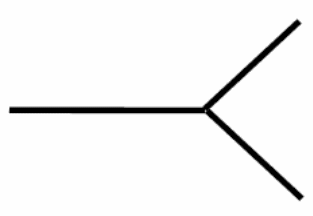 = definition of psyche as totality of processes -- forced into ego-complex
Haas [Note: William S. Haas, The Destiny of the Mind, East and West.] -- only when "contents" from the second psychic system are brought into you (by an aspect) is there a real experience. Changes from are ontological determinations -- much more than psychological.
Archetype or idea of plant (Goethe) → Samkhya satkaryavada -- effects contained in cause.
Third level of idea: Jung's Self, archetype of plant.
North Node -- moves backwards -- fulfillment of those experiences are already past in terms of third level. (?)
Jung admits reality of third level more in his letters than writing.
Self is a magnet which draws out meaning from archetypes.
Thinking activity -- second level.
Witness-I -- third level.
The thought that restricts the world-thought and combines "object external to thought" and "consciousness internal to thought" -- not Witness-I.
Soul-complex -- anima is inner attitude which faces the unconscious, the .
Because thinking is on both levels, unconscious will contaminate the function.
The kind of thinking is the attitude.
[Alan Notes 1974 0122 End]
DIAGRAMS FOR 1974 0122
Class
Tuesday, January 22nd, 1974
Verbatim, unedited transcriptCLASS at Wisdom's Goldenrod, Hector, NY
with Anthony Damiani (AD)
January 22, 1974
EPISTEMOLOGY; LEVELS AND TYPES OF THINKING
with Appendix: AB Class Notes 1974 0122.
TOPIC: Epistemology
SUBJECT: Levels and Types of Thinking
SUBSUBJECTS: Jung, Psychology, Witness-I, Antahkarana, Anima
CONTENTS:
AB class notes (for missing Audio File):
Three levels of idea/thinking
Self and ego
North Node
Verbatim transcript:
Witness-I as substratum of experienced world and experiencing ego
Thinking/concept manifests the thing, Witness is a level above that
Witness as inner controller
Reading from Sinha, Idealist Standpoint, on internal psychic organ (antahkarana) and Witness
Antahkarana–what is it and where does it go out to?
Witness has cosmic point of view; what restricts this to a space-time unit of experience?
What connects the things that seem external to thought and the consciousness which seems internal to thought?
Reading from Jung, Psychological Types, on definition of soul/anima
Soul as attitude towards subject/"inner object" acquired through repetition, an attitude which differentiates itself from the whole and becomes an individual attitude; translate this epistemologically
AD equates the subject/"inner object" with inner being/3-fold chart (cosmic)
Diagram: Thinking (as a function of manifesting the thing) located at ascendant in both 3-fold cosmic chart and 12-fold individual chart
Impersonal thinking activity is individualized/colored by some level of anima functioning in the individual chart; this is one way of looking at anima as functional attitude towards the inner psychic processes
Example of looking at a tree: utilitarian vs. aesthetic/contemplative point of view
Empirical ego/experience composed of four elements
Prior to descent of individual around time of Greeks, thinking function was universal, a revelation outside of individual; man did not exist in ego yet
BOOKS READ FROM OR REFERENCED:
Debabrata Sinha, The Idealist Standpoint: A Study in the Vedantic Metaphysic of Experience
Paul Brunton, The Wisdom of the Overself
C.G. Jung, CW 6, Psychological Types
C.G. Jung, CW 9, Part II, Aion, "The Self"
Rudolf Steiner, The Redemption of Thinking: A Study in the Philosophy of Thomas Aquinas
William S. Haas, The Destiny of the Mind, East and West
DIAGRAMS appended to this transcript:
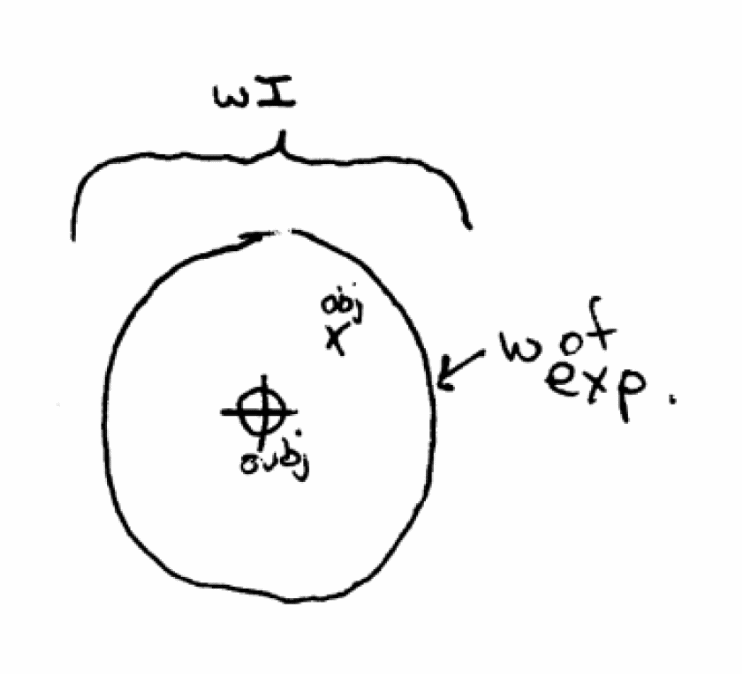
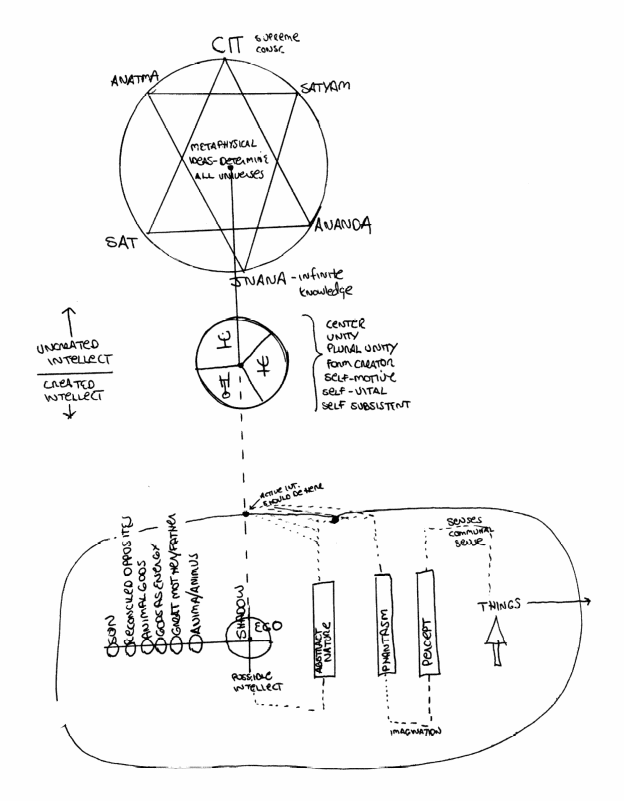
FIGURE 1974 0122-1-AB. Witness-I, Cosmos, Subject-Object.
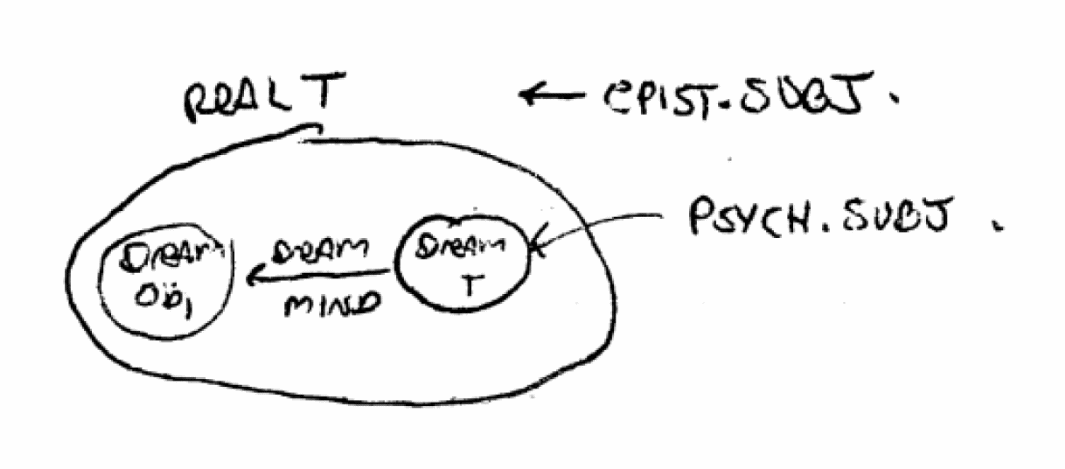
FIGURE 1974 0122-2-AB. Real Tony and Dream Tony Knowing Dream Objects.
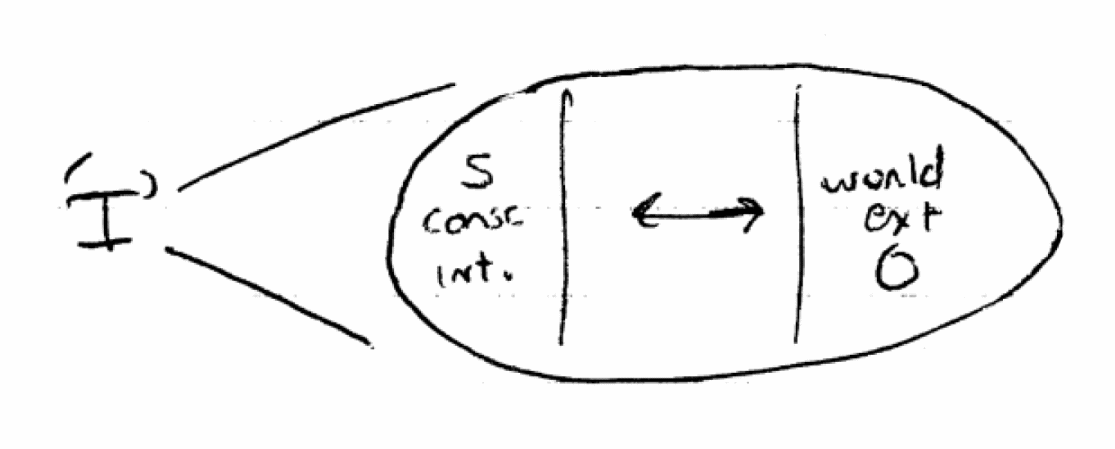
FIGURE 1974 0122-3-AB. Witness-I, Internal Consciousness, and External World.
FIGURE 1974 0122-4-AB. Three Circles Diagram: Divine Intellect, Soul, Psyche.
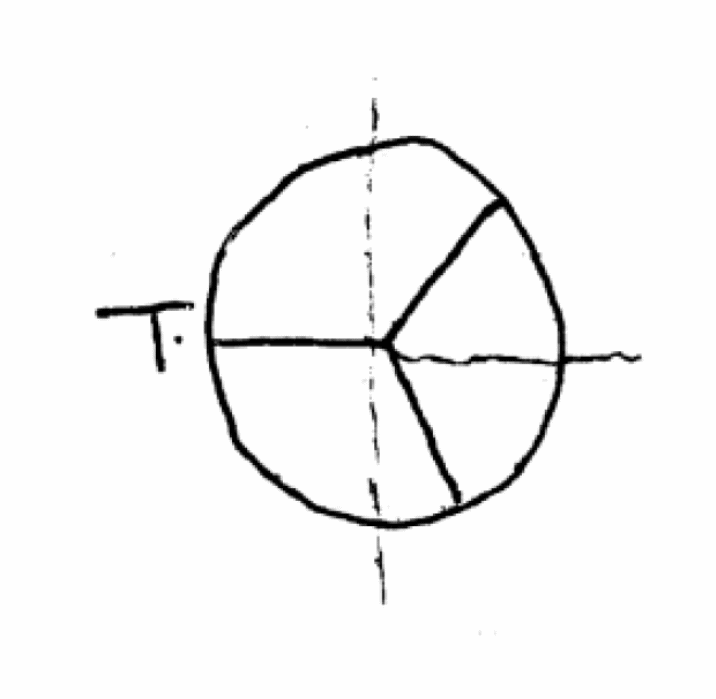
FIGURE 1974 0122-5-AB. Thinking on Ascendant in Threefold and Fourfold.
Other diagrams also referred to are not with this transcript version. [Transcriber note: [diagram] means the speaker is referencing a diagram as he or she is speaking. If someone is drawing or writing, with audible sounds of chalk on a blackboard, I indicate this by [drawing] or [writing].]
NOTES:
AB class notes have been appended because we are missing one or more audio files for the first part of this class. They thus help round out the class. Retyped from Alan Notes 3 1973 to 1975 psyche and soul.PDF. All spelling, capitalization, and punctuation corrected, all abbreviations and astrological glyphs spelled out in AB class notes.
For readability's sake, the following substitutions/edits made in Verbatim Transcript: cuz = because; gotta = got to; yeah = yes.
TRANSCRIBED Verbatim by IT prior to 2017, reformatted by jf 2017. In 2023, IT updates prefatory matter, footer, and audio file name, alters Topic, Subject, and Subsubjects to make more accurate, expands Book List and TOC, fixes errors/typos, adds new notes within transcript, appends AB class notes, appends five diagrams and references within transcript to these diagrams, reformats to accord with new conventions. In 2025, IT updates prefatory matter and audio file markers to match new REP audio. Archival verbatim transcript – V12a.
AUDIO FILES: 1974 0122a. [Note 1: "Tape" and "Side" refer to original audio cassette tapes that were later digitized into .MP3 Audio Files. Note 2: We only have an audio file for the last part of the class. It was originally recorded back to front, i.e., Side 2 followed by Side 1; REP Studio fixes in 2024. It is possible that there is some material missing in transition between sides.]
1974 01/22 at Wisdom's Goldenrod
Epistemology; Levels and Types of Thinking
[Audio File 1974 0122a Begins]
AD: [half/one word inaudible] [drawing] [Note: See FIGURE 1974 0122-1-AB for the following. This diagram is not from this class but is used as a stand-in to help follow along. In this context, based on AB notes, body refers to little circle, soul to big circle, and intellect to Witness-I.] On the one hand, intellect, soul, and body. Now if we ignore this bottom one [diagram], we-- we speak about the second one, soul, alright, the inner-- the inner organ of the being, the antahkarana, alright, the-- Almost sounds like anima, antah-karana, huh? No, not quite. But, this soul here [diagram] which, for the purposes of speaking (lightly/politely) right now we could equate with this part [diagram] and the-- the Witness-I [diagram] which contains the-- the-- let's say, is the substratum of the experienced world and the ego that experiences it. [Note: See FIGURE 1974 0122-2-AB for the following. This diagram is not from this class but is used as a stand-in to help follow along.] Just like for instance, you'll have a dream and the substance of your being, alright, manifests itself as a dream and as the dream characters and as the knowledge that comes up from the relationship the dream character has to the dream situations. You got this kind of a situation where, so to speak, in the dream, if you-- if you said to the dream character, "Now, dream John, you are the knower," (in--) on one sense you could see that this is so, he is the knower, he knows that this dream bear is chasing him. From another point of view, you know that he's not really the knower, there's only one consciousness, that's the consciousness of the person who's having the dream. There is no other consciousness. To speak of another consciousness is outside the point. So we have this kind of a situation when we're trying to understand the notion, so to speak, of the Self. What I-- what I'm trying to get at is-- is really very very intimate. You ca-- you've begun to accept to some extent, and you'll probably look into it further I hope, that in thinking-- in thinking concepts, alright, and getting to man-- get this reality to manifest for you, you can feel some truth in that. Ok? [couple/three very faint student words in background] Yes--
JL: Is that why he says that it invites a rea-- a-- it invites a duality?
RG (very faint): [few words inaudible] invites opposition.
S (simultaneously): (But that) [one words inaudible]
S (simultaneously with both students above): That's not what he said.
JL: Or invites opposition?
[short pause]
AD: In the-- no. In the definition that we've been working with in trying to understand the notion of the concept and the thing, alright, we feel a little comfort here, we're beginning to feel our way, we know that well, if there's no concept there's no thing because there's no experience that we can even speak about, alright. [student assents, very faint] Now the third level is-- is like-- is an attempt to try to force-- an attempt to try to force this-- get you to see that that activity, that thinking activity, alright, is the second level and the Witness-I or the Self, the concept of the Witness-I is the third level. That entity which so to speak supersedes or to which you were super-ordinate, so to speak, it's super-ordinate over your activity; that inner being which says "You do-- are going to do this and you're going to go through that and you're going to suffer this and you're going to experience that"; this Witness-I that we're talking about. Alright, le-- let's keep trying a little bit.
[9 second pause]
[Transcriber note: I am using The Idealist Standpoint: A Study in the Vedantic Metaphysic of Experience by Debabrata Sinha, Centre of Advanced Study in Philosophy, Visva-Bharati, 1965.]
Debabrata Sinha [The Idealist Standpoint: A Study in the Vedantic Metaphysic of Experience, pp. 74-75, AD reading]: "The Advaita [approach in reply would chiefly be with reference to the question of the evidencing of mental states, cognitive and otherwise] [AD paraphrases this as: would reply to the realist something like this]. The plain acceptance of mind as the organ of internal experience (antarindriya) [may explain--as in Nyaya--the internal perception of mental states through the medium of mind (manojanya-pratyaksa)] [AD paraphrases this as: may be explained]. [But such] mental perception of non-cognitive states is sharply distinguished in maya-- [AD: I'm sorry] in Nyaya from reflective knowing [or anuvyavasaya]. (bit of laughter) Behind both these cases, however, what must stand in common is internal evidencing in some form or other [AD reads: another]. [As] for mental states like pleasure [etc.], they can hardly remain in the mind unnoticed. Even with their seemingly unreflective character, the emotive-volitional states of mind have sharply to be distinguished from unreflective sense-perception. So, if both these types of apprehension--unreflective mental perception and reflective knowing--are characterized in common by internal evidencing, the law of parsimony [(laghava)] demands that there should be postulated an evidencing principle [AD adds: or a witnessing consciousness] more foundational than mental states [(cognitive or otherwise)] themselves."
AD: But we said these mental states represent the very functioning of thinking, the activity of thought.
Debabrata Sinha [The Idealist Standpoint: A Study in the Vedantic Metaphysic of Experience, p. 75, AD reading]: "Such a principle in the background may be characterized in terms of 'knowing by way of immediate evidencing [AD reads: witnessing]' [(saksatkari-jnanatva)]. Of course, the possibility of evidencing, independent of [AD adds: the] mind, may [well] be questioned. It may [then] be replied that at least the state of deep sleep [(susupti) (as discussed previously)] presents an outstanding case, when nescience (ajnana) [AD reads: where ignorance] itself seems to be evidenced as object [AD reads: an object that is evidenced or witnessed]--and when organs of valid knowledge [(pramana)], nay the psychic organ itself, do not function. The said evidencing [AD reads: witnessing] principle may prove to be the transcendental precondition in all particular instances of perceiving. Three interpretations have been presented [in later Advaita regarding] the relation of [AD adds: the] self to object in perception, mediated through [AD adds: the] antahkarana. The peculiar association of antahkarana with pure consciousness being granted, views may differ as to the exact process how antahkarana serves to bring about the manifestation of [AD adds: the] object to [AD adds: the] subject."
AD: Now, before we go on a little bit, you remember the definition of the antahkarana, I mean we use the term 'mind', (uh/um)--
S: You mean there's four different characteristics?
AD: Well, kind of general idea of what the antahkarana was.
S: Well-- well I just remember that in Hinduism, you spoke of the-- the mind as having four components: remembrance, and a reference to self-consciousness, and also doubt and certitude.
[short pause]
[one/two inaudible student words, possibly part of background talking]
AD: You-- can you think of anything else to that-- to add to that? The inner organ?
RG: I mean it-- it's that which manifest all the contents of your consciousness to you, to that-- that coloring you might say. That structure, whatever it be, would mani-- what-- that mental structure which manifests your world for you.
AD: Alright, s-- some more?
AS: Says about, when it goes out to the object then we have this empirical vritti or it stays in its own place then we have this state of like feeling-- feeling content and so on. He talks about this-- this--
AD: Kurt, would you get the anima definition in here? Go ahead.
SD: Didn't we also say that when it goes out to the object it assumes the form of that object?
RG/S(?): Right.
SD: And that we know the object through the antahkarana taking on the form of that object?
[short pause while flipping pages]
AD: Now, if-- if we say that-- this is the-- the division we just made, you know, the body, the soul, and the-- the "I" [diagram]. And if we say that the antahkarana or the mind goes out, where does it go out?
S (faint, in background): [couple words inaudible]
[student assents, very faint]
RC: Into manifestation.
AD: What?
RC: Into manifestation.
[sounds like student assents]
AD: Why, isn't the mind in manifestation? Your mind is not manifestation?
RC: Not when it doesn't go out.
AD: If it doesn't go out it's not in manifestation?
RC: No.
AD: You mean when your eyes are closed and you'll have an experience of pleasure it's [RC simultaneously: Well--] not in manifestation?
RC: But it's out. (RC laughs)
AD: Huh?
RC: Ok. I was going to say that was out but ok, ok.
AS (faint): It's out.
S: (But) wouldn't the going out be just what cognition is, where the mind has split itself into subject-object and a relationship?
[student(s) assenting]
AS: Well, didn't PB some place say that external could only be talked about with relation to the body and that in relation to thought there is no inside and outside in that sense. So I-- going out, I-- it seems like there could be only-- I mean what could be-- how could you talk about outside of the antahkarana [AD hits board with chalk or fist] from that point of view, I mean what-- the-- when you-- when you're talking about the antahkarana what could be, so to speak, outside it-- outside of it?
[Note: See FIGURE 1974 0122-3-AB for the following.]
AD: Alright, when-- when for instance we say-- PB makes the remark, he says things are what seem external, seemingly external to thought. [AS assents, faint] Consciousness is what seems internal to thought. [Note: PB, The Wisdom of the Overself, "The Birth of the Universe," p. 38, 1943 edition.] [AS assents, faint] What connects these things?
AS (very faint): It depends [couple/three words inaudible]
AD: On the one side you have things which seem external to thought, on the other side you have consciousness which seems internal to thought.
S: Seem--
AS: Have to be the thought itself.
AD: Now are you this whole thought?
AS (faint): Are you (thinking) [one/two words inaudible]
S (very faint): That's [one/two words inaudible]
AD (simultaneously): You said the thought itself, but the thought itself is the entirety of universal manifestation, what-- what-- you know, how do you get into this and how do you participate into this thought?
AS/S(?): Hm.
AD: You got the definition there?
S: The "I" that we know is created by that thought.
AD: Huh?
S: The "I" that we're familiar with is created by that thought. It sets up the distinction.
AD (simultaneously): Yes, but you still-- yes, but you still haven't helped me. What is it that combines these two, on the one hand what's external to thought, on the other hand what's-- what's-- what's internal to thought, consciousness? So on the one hand, on-- [drawing] on the one hand you have consciousness which seems internal to thought and on the other hand you have things which let's say seem external to thought, what connects them?
S: But they're not different.
S (simultaneously): (Oh no.)
RP: [one word inaudible] connects them, they're both-- they're both observed.
AD: They're both observed. Yes, and tell me, this observation, is it on a world-wide scale or is it restricted to like one point, you know-- point in space and time?
RP: It's restricted.
AD: Yes, it's restricted. So that means it's within this circle here [diagram] somehow, alright? This point that restricts, so to speak, this world-wide thought, alright, and that connects these two, what is that?
S: Phenomena.
S: The Witness.
AS: Well you're not going to say it's the Witness.
AD: No, it wouldn't be the Witness [AS simultaneously: I mean, that would be impersonal--] because to the Witness all of this is available. Huh?
AS (simultaneously): --I mean that's a-- [S simultaneously: (It's not) (one/two words inaudible)] that's about-- that's impersonal. The Witness is-- is not-- is-- is impersonal [one/two words inaudible]
AD (simultaneously): No, the Witness would-- the Witness-I consciousness would-- both these conditions are objective.
AS (simultaneously): Well somehow you have to-- I mean (some) [one/two words inaudible] [PD simultaneously: Well where (one/two words inaudible) (connect them)?] (along) and you're going to have to talk about the thing of identification. Somehow there's some-- there's some kind of-- something is being identified, like some part of this whole world-thought is being identified as an individual and there has to be something which-- if you-- if you-- if you take that within these thoughts there are the-- there are sort of like real entities, and something has to act as a-- as a focal point--
AD: I'm asking you [AS simultaneously: (What is--) what is that.] what is that focal point!
S (faint): [one/two words inaudible]
AS: I don't know.
S (faint): [couple/few words inaudible] (laughter)
RP (yelling in background): Brahman!
AD: That's all I'm asking for. (AD laughing) Go ahead Richard, Paul, anybody, go ahead. [S: It's your (choice).] I want you to see it, I don't want you to just give me a parrot, you know. No parrot please. [VM simultaneously: Can't help that.] I want you to see it.
S: Alright.
BS: You have an impersonal object in which there's a conjunction with your own personality but the conjunction is with the impersonal object so there's the connection between the two.
S: Uh-hm, uh-hm.
AD: Would you repeat Bert? You have an object.
BS: Yes, which is impersonal, universal.
AD: I don't know, what do you mean? You have an object, the tree, a table.
[student assents, very faint]
[student noise and couple faint inaudible student words in background]
AD: What object you talking about? [short pause] You don't mean the metaphysical object.
BS: Or like an archetype.
AD: Huh?
BS: An archetype. A tendency, a univers-- something that's universally available to all which the personality or the individual entity comes in contact with, [short pause] and therefore creates a content for it. But that content subsists in both. It's caused by the tendency and manifests because of the individuality or the personality.
AD: Let's try again, go from the beginning.
[short pause]
BS: Well I said there's an impersonal object which we'd call an archetype, which the individual comes in contact with. There's a conjunction between the two. We could say that archetype is the cause-- is the cause for what is going to be manifest but it's the individual-- but what is necessary--
AD: No, the archetype is not a cause. The archetype is a condition for manifest-- not a cause.
BS: Ok, that's what I mean then. It's a condition but then-- then the cause or the apparent cause or the individual's contact with this impersonal archetype would be the cause for manifestation, the contents, or what are called the contents of (your--)
AD (simultaneously): What is this individual you're talking about?
RP: (You) got to catch him first.
S (very faint): [one/two words inaudible] (laughter)
AD: I'm going to catch him, [RP/S(?) simultaneously: Right.] I'm going to catch him--
BS (simultaneously): You could s--
AD (faint): --Richard.
BS: You want me to say it doesn't exist?
AD (simultaneously): You got to have a (session/sesshin) for a week.
[student assents, faint]
S: That's something that you guys do.
PD (simultaneously): When Jung said that the Self acts like a magnet that draws the meaning out of the experience, that seems to be the only-- that type of connection that you're asking for. It's-- the Self somehow brings about this relation between what's external and what's internal. Before that, the-- there doesn't seem to be a relationship.
AD: Let me read a little bit from his definition of soul, ok?
S: (You're going--)
AD: He doesn't call it soul, he says anima, psyche, personality, persona, alright?
C.G. Jung [CW 6, Psychological Types, Definitions, p. 463, paragraph 797, AD reading]: "I have been compelled, in my investigations into the structure of the unconscious, to make [a] conceptual distinction between [AD adds: the] soul and [AD adds: the] psyche."
AD: Now the psyche is the totality of all psychic processes, conscious, unconscious processes. The psyche is a cosmic principle. Ok?
C.G. Jung [CW 6, Psychological Types, Definitions, p. 463, paragraph 797, AD reading]: "By psyche I understand the totality of all psychic processes, conscious as well as unconscious. By soul, on the other hand, I understand a clearly demarcated functional complex that can best be described as a"personality.""
[student(s) assenting, very faint]
AD: I don't have much time and I do want to work him with what Richard is going to attempt to do with that Redemption of Thinking, [Note: Rudolf Steiner, The Redemption of Thinking: A Study in the Philosophy of Thomas Aquinas.] where the notion of essence has to be revealed as in the soul but if we don't know what the soul is we-- we're just going to put it in a vacuum bottle.
C.G. Jung [CW 6, Psychological Types, Definitions, pp. 463-464, paragraph 797, AD reading]: "By soul, on the other hand, I understand a clearly demarcated functional complex that can best be described as a"personality." In order to make clear what I mean by this, I must introduce some further points of view."
AD: Alright. Let me pick out the important things. For instance, what is a functional complex(?/.) Alright.
C.G. Jung [CW 6, Psychological Types, Definitions, p. 464, paragraph 798, AD reading]: "One has only to observe a man rather closely, under varying conditions, to see that a change from one milieu [AD: or one environment] to another brings about a striking alteration of personality, and on each occasion a clearly defined character emerges that is noticeably different [from the previous one]."Angel abroad, devil at home"…"
AD: You know the old saying. (some laughter, student assents, student words)
C.G. Jung [CW 6, Psychological Types, Definitions, p. 464, paragraph 798, AD reading]: "…[AD adds: this] is a formulation of the phenomena of character-splitting derived from everyday experience. A particular milieu [AD reads: environment] necessitates a particular attitude [(q.v.)]. The longer this attitude lasts, and the more often it is required, the more habitual it becomes."
AD: Then of course he gives the example of split personality, double personality, you know, all these from the school of Flournoy and Charcot and all-- all the others.
C.G. Jung [CW 6, Psychological Types, Definitions, p. 465, paragraph 799, AD reading]: "These reflections show that even in normal individuals character-splitting is by no means an impossibility. We are, therefore, fully justified in treating personality dissociation as a problem of normal psychology. In my view the answer to the above question should be…"
AD: The question being here, you know, why is it that this man over here acts one way and in another environment acts another way. He says--
C.G. Jung [CW 6, Psychological Types, Definitions, p. 465, paragraph 799, AD reading]: "…the answer [to the above question] [AD reads: here] should be that such a [AD reads: this] man [AD emphasizes next word] has no real character [at all]: he is [AD emphasizes next word] not [AD adds: an] individual [(q.v.)] [AD: Not yet.] but [AD adds: a] collective [(q.v.)], the plaything of circumstance [AD reads: circumstances] and general expectations. … Naturally he is an individual, like every other living being, but [AD adds: only] unconsciously [so] [AD: he doesn't know it yet]. Because of his more or less complete identification with the attitude of the moment, he deceives others, and often himself, as to his real character. He puts on a mask, which he knows is in keeping with his conscious intentions, while it also meets the requirements and fits the opinions of society, first one motive and then the other gaining the upper hand [AD reads: first one motive gaining the upper hand, then another]."
AD: Now, here's an ana-- an analogy he's using to try to give you a feeling of what the soul is, alright, and he's trying to show that this soul is a kind of attitude which is acquired through definite repetition. It's an attitude, so to speak, that will persist. It's an attitude that, let's say, from the collective morass, you know, gradually this attitude becomes more and more rigid and starts becoming like a stream which has its own momentum. And in the same individual you may see two, three, or four attitudes like this and then possibly there could be the overwhelming of all these four and one attitude taking possession. And he's trying to, through these psychological devices, give you some kind of a feeling, alright, what a soul is. Now you have to think in this large way epistemologically, because he's speaking psychologically here what the soul is. In other words, this attitude which differentiates itself from that whole and becomes an-- a particular, an individual attitude. Now, analogously, can the soul be something like that in this terminology?
S: Would that-- Tony, can I use an example (for--)
AD (simultaneously): No, no, no, no, not yet.
[short pause]
AD: Now, you know about the persona--
C.G. Jung [CW 6, Psychological Types, Definitions, pp. 465-466, paragraph 801, AD reading]: "…is thus a [AD reads: is also another] functional complex that comes into existence for reasons of adaptation or personal convenience, but is by no means identical with the individuality. The persona is exclusively concerned with the relation to objects. The relation of the individual to the object must be sharply distinguished from the relation to the subject. By the"subject" I mean first of all those vague, dim stirrings, feelings, thoughts, and sensations which flow in on us not from any demonstrable continuity of conscious experience of the object, but well up like a disturbing, inhibiting, or at times helpful, [slight pause while fire engine goes by in background] influence from the dark inner depths, [AD adds: and] from the background and underground vaults of consciousness, and constitute, in their totality, our perception of the life of the unconscious. The subject, conceived as the "inner object," is the unconscious. Just as there is a relation to the outer object, an outer attitude, there is a relation to the inner object, an inner attitude. It is readily understandable that this inner attitude, by reason of its extremely intimate and inaccessible nature, is far more difficult to discern than the outer attitude, which is immediately perceived by everyone. Nevertheless, it does not seem to me impossible to formulate it as a concept. All those allegedly accidental inhibitions, fancies, moods, vague feelings, [and] scraps of fantasy [AD adds: etc.] that hinder [AD adds: the] concentration and disturb the peace of mind even of the most normal man, and that are rationalized away as being due to bodily causes and suchlike, usually have their origin, not in the reasons consciously ascribed to them, but in perceptions of unconscious processes."
AD: You get a feeling of what the anima is? I hope you don't, you know, go looking for a female figure. [short pause] "Perceptions of unconscious processes." And these perceptions of course are tainted or, let's say, accompanied by a certain attitude. [short pause] Now--
C.G. Jung [CW 6, Psychological Types, Definitions, p. 467, paragraph 802, AD reading]: "These entirely different ways of dealing with the stirrings of the unconscious are just as habitual as the attitudes to the outer object. The inner attitude, therefore, is correlated with just as definite a functional complex as the outer attitude."
[sounds like couple students assent]
AD: Do-- do we understand what this means?
S: No.
AD: You haven't?
S: Again.
AD: In other words, if you watch your behavior in regard to objects that exist in the world, there's a certain attitude that accompanies you all the time. And this attitude, so you-- so to speak, is usually pretty fixed and functions unless something big really disturbs it. Conversely, there's an attitude on your part towards facing the inner being, that threefold chart [FIGURE 1974 0122-4-AB, middle circle]. That attitude he refers to as the soul complex, the anima. Go ahead Richard.
RP: It's very helpful to conceive of it functioning as he does, that's the only way to grasp it. I (say/said) it's very helpful to conceive of it functioning as he does, that's the only way to grasp it. But how do you conceive it substantially? Say well, is-- it's one of the three kinds of substances. Now what kind of nature is-- what kind of substance is it?
RC: You have to get underneath it.
RP: Constantly changing for example. One usually thinks of substance as fairly permanent.
AD: Yes well, of course I don't want to answer that until I answer this one first, you know, what the soul complex is or the functioning complex is. [RP: The function.] But I-- I will have to get into that, sure. But are we beginning to get an idea or grasp, you know, in this very gingerly way what the anima is?
RC/S(?): Yes, it's a way (you've got--)
AD (simultaneously): You've got to-- you can feel it operating, you get up in the morning, (RP laughing) alright, you get up in the morning, the first thing you got a nasty mood on, alright. The next morning you get up you have a nice mood. As-- after a while you say "But who the hell's running the show?"
[students assent, very faint]
RC: It's expressed in other words when they talk about "As you think so you become" sort of thing.
AD: Huh?
RC: As you think so you become, your thoughts become your actions (and) live out the fan-- try live out the fantasies that you have internally.
[students assent, very faint]
AD: Yes, but I don't see your point, Randy.
RC (simultaneously): Well, (he/you) said that they were the same, that the attitude revealed inwardly would also manifest outward.
AD: You see, what we're coming up with, if I-- if I am permitted to try to schematize it, what we're coming out with is something like this. [drawing] If we say-- if we say that this is thinking [diagram], alright, and if we take the individual chart and we still have, so to speak, the same situation where thinking is over here [diagram], alright, thinking is still here, stays here [FIGURE 1974 0122-5-AB]. Whether we think of the individual chart or the cosmic chart, thinking is here as a function. [Note: See FIGURE 1974 0122-4-AB, bottom circle, for the following.] Now if we take, so to speak, one of the diagrams which is used, and this entirety refers to the ego-complex [little circle in bottom circle], over here you have the ego, the bright side, and over here, if you remember the diagram, over here you have the [S: Shadow.] the dark shi-- side and the light side [diagram]. And when there's a union of these two, so to speak, the ego complex feels as a whole. Instead of being split apart inside, instead of feeling that there's one thing carrying you here and another thing carrying you there, when this union takes place there's like one entity now, one psychic entity living out its life. But, what you can-- the point I want you to get to is over here, this thinking over here [ascendant in little circle inside bottom circle, not explicitly marked], alright. On the one hand, you can see that the shadow is here [left half of little circle inside bottom circle], the anima would be here [left of ascendant], alright? You can see that anything that sits h-- in here [diagram], so to speak, will dominate the kind of thinking that's going to take place. So, we spoke about four levels of the anima functioning. And any one that, so to speak, is at the ascendant or is dominant of the ascendant, that's the kind of thinking that's going to take place. This is one way of looking at that notion of an attitude. All thoughts, so to speak, that come through are-- will be contaminated by whatever anima level is functioning.
S: Hm.
EC: Tony?
AD: We pointed out-- Yes--
EC (faint): When you said soul, personality, persona together and I got [one word inaudible]
AD (simultaneously): I can't hear you, sorry.
EC (faint): Soul-- (it--) you put soul and personality and persona, to identify them a little bit, together and then I'm confused where the ego-- I thought that that was a-- soul-- the ego was separated too strongly.
AD: I'm sorry, I missed the last sentence.
EC: The-- I'm confused where the ego is presented in what you've just been discussing. You put personality with the soul and the persona with the soul and I thought the ego was a-- the personality or the soul and the soul was what carried that permanent mind.
AD (simultaneously): Well, you-- so far you're not too far, you could proximate the ego to the personality or the subject, alright, whereas the anima is only a functioning of that subject in a certain particular mode or certain particular way. I mean, after all, not everybody functions with the anima there, there are women in the world who would not function with the anima, they would be functioning with the animus. So, these aspects of the personality-- in other words, all these archetypes, alright, are something that are going to be superimposed on that ego subject and that ego subject is going to operate with that contamination.
The point that I'm trying to get here is--not that I could handle both questions at one time--Richard says what is the substance of this anima, alright. And, we'll take-- we'll pick up some texts, for instance, where in the Vedanta they-- they very clearly show that the formation of this person, alright, (has/is) got to take place through the-- the five-- the four elements. [Note: See FIGURE 1974 0122-1-AB for the following.] In other words, when-- when we make the chart [drawing] and we put one circle inside the other and this is the subject [diagram], I don't put Aries here [on ascendant of little circle], I would put Aries over here [on outside circle]. I would put, for instance, the-- if this [diagram] is the world of experience for the entity inside, the fire, earth, air, and water, alright, through which these various-- various functions [Note: Twelve functions associated with the twelve houses (not shown) of the little circle.] are going to-- that's where they have their origin, they-- they're pulled out of these-- they're composites of these things. In other words, for instance, earth or air for instance, is concerned with touch, ok. The intellect, so to speak, comes out of air, alright. So that the-- the-- the substantial nature of the being that gets evolved-- in other words, when we look at a chart and we says well this gives us a characterological disposition and also the physical disposition of the personality, this is co-- this is the very substance of the universe that he's made up of. Don't think of earth, air, fire, and water in the colloquial sense but think of it in-- in terms of-- or how we experience-- everything that we experience must come through one of these four modes. In other words, solids, fluids, gas, you know, things like that. There's psycholo-- it's a psychological interpretation of experience, not a chemical analysis. So when we say for instance that this being here, over here [diagram], has this thinking function permeated by a certain archetype, then a certain type of thinking is going to take place. This here [diagram] could be removed and another type of thinking let's say take place. These are functional modes, they're not permanent.
Now, if-- if I'm allowed to continue just a little bit and I'm going to stop. [Note: See FIGURE 1974 0122-4-AB, bottom circle, for the following.] If we can see that these here-- this-- this is the bridge [drawing] to the unconscious, the way he called it. Over here you (have/had) the various archetypes [diagram]. It is only when a-- the union of this takes place, shadow, so to speak, the day-- the daylight and nighttime consciousness come together, form a whole entity, the differentiation of the functions take place, that there's the possibility of the relationship to the anima. Not until then, alright? Now this anima here, the-- the stage of the anima, so to speak, is going to determine the kind of thinking that's going to take place here [ascendant of little circle]. The kind of thinking is the attitude. Does this make any sense at all? You're beginning to see anything at all here?
[students assent, very faint]
AH: Tony?
AD: Go ahead.
AH: We talk-- we talk about this attitude having a kind of fixity, as habitual both to the outside and to the inside(?/.)
(Side 1 of original cassette tape digitized as 1974 0122a Ends; Side 2 Begins)
[Note: Possibly some audio missing here.]
AH: --whatever it has experience(?/.) Like, if we looked at thinking as-- as reflection about experience, like that-- the very ground of that reflection--
AD: Thinking-- no, no, no, you're forgetting what you just learned. Thinking is not a reflection about experience.
AH: Well then I don't know what thinking is.
AD: But we just went through that. We just went through the notion that thinking is the activity which manifests the object or reality for us, [AH, faint: Ok.] this-- this evolving of these concepts.
AH: Right. But my que-- I still have a question because--
AD: Now, when you and I look at a-- let's say a tree, alright, you may look at the tree from the point of view, "Let me see now, what use can I make of this? I know, I'll chop it down and make fire out of it." Ok? That's one attitude. Another person looks at this tree and contemplates it, considers it without affirming it or denying it. That's an entirely different kind of attitude the soul is functioning with.
AH: Yes.
AD: Can you see that?
AH: Yes.
AD: The conceptual activity that's going on remains what it is, but notice the way the co-- contamination has taken place, the attitude that permeates into that conceptual activity that's going on. You're not going to change this thinking function [AD indicates on diagram]. [AH(?), faint: But--] When you see a tree and when I see a tree-- Go ahead.
AH: That-- ok, that whole-- but the whole grou-- ground of being, as we said earlier tonight, gets-- is-is altered through experience. H-- there has to be something that's fixed that allows the possibi--
AD (simultaneously): You'd like that, wouldn't you?
AH: But what allows (the way--)
AD (simultaneously): And you'd be turned into a stone man.
AH: But what allows the possibility of contact from one experience to the next, uh-- I-- even though the-- even though a whole-- the whole concept of thinking's changed, there's still the possibility of talking about prior experience. Like, when the conceptual activity is being used as-- as thinking, it can still reflect upon prior experience, there's--
AD: If you're saying that the lower kind of thinking, apperceptive thinking, can accompany the second kind of concept which we refer to as conceptual activity, a thinking that manifests object-- objects, true. So what? What's your point?
AH: Well then how could we talk about a fixed inner attitude?
[student assents, very faint]
AD: I'm trying to explain the attitude right now. I gave you a very easy example. There's one person no matter what he looks at, whatever object he looks at in the world, alright, he thinks of "How can I use it?" There's another person who looks at an object and contemplates it without thinking of how he can use it. You don't notice that in various peoples, their functioning?
AH: Sure.
AD: Well that's a fixed attitude isn't it? When I say "fixed" I don't mean it's nailed down with cement. Go ahead John.
JL: Does that mean in a sense then that-- that for the-- the man who contemplates the tree there is no subjective determination?
S: No.
AD: No, it doesn't mean that at all.
RG: That's his subjective determination.
S: The concentration (is different).
AD (simultaneously): Doesn't mean that at all.
JL (simultaneously with S above): In a sense there's no-- there is no--
AD: A man like da Vinci goes over, buys pigeons, opens a cage and lets them fly out. You go and buy them, you cook them. (laughter, student words) Another person goes to buy them, trains them. No, I don't mean you per-- I mean, there's the variety of attitudes, you know. (more laughter, student words)
JL (amidst laughter): Well then, what I was getting-- what I was getting [one/two words inaudible]
AD (simultaneously, amidst laughter): I'm trying to-- I'm trying to talk about something like Richard says, "You'll all catch it!" He's saying, you heard him--"You're not going to catch it!"
S: What?
AD: And maybe you caught it, come on!
AS: No, he's right! (AS laughing)
JL: Tony, what I was getting at was, is there a greater consciousness in that-- in that detached so-called attitude?
AD: Well definitely. That will be a condition, so to speak, that we spoke of before. A c-- an experiencing at this level will be an experiencing that includes a lower level within it and recognize it. I mean a man who can appreciate aesthetically can understand the needs of a man who wants to go chop it and sell it for firewood.
RC: And in both cases the individual has to establish a relation to that attitude in order to--
AD: If he does he's very conscious.
RC: Ok.
AD: Then the soul is no longer an unconscious psychic factor in his life but a very conscious thing. Now he's getting somewhere.
RC: Ok.
BS: (That--)
AD (simultaneously): I'm sorry, next week, I'm finished.
[disappointed "oh's" from students]
BS: (First), this entity that we can't catch--
AD: Huh?
S: What was it that we didn't catch?
BS: We refer to it as having subjective states. Would everything on that unconscious side be (according to) these subjective states?
AD: I'm sorry?
BS: This entity that we're trying to catch or we can't see, you know, we speak of it as having (a/uh) subjectivity.
AD: The only way I could show you this entity is to show you the various components and the way they're being guided in their activity, that something so to speak is guiding the activity of these various components of the person. And until you begin to see them as distinct-- In other words, when we spoke about the plant, the way the root grows and then the stem, and we-- we don't say that the root causes the stem. If you do then you're talking nonsense. In the same way, we don't say that this attitude causes that attitude. That's the whole modern mentality, this causes that, that cause-- And when you ask them, "What are you talking about?" all they can do is give you a description.
[students assent, very faint]
BS: Ok, my question is, what we call subjectivity, is that for instance on the side of the unconscious when the anima is contaminating thinking?
AD: I try to-- I try to make clear what we mean by subjective. Subjective is when it is an apperceptive mode of functioning. Within your subjectivity you think. When we start talking about the anima, this is not subjective. This is a very precise, clear-cut conceptualization of psychological facthood. [student(s) assenting] [student talking in background] I'm out of wind. (some laughter, student talking which continues as AD speaks) That's all. We'll continue with this because-- Richard is-- Richard is going to have to try to show how the medievals came up with the concept of the essence in the soul and unless you get the notion of what the soul is, how could you put the essence or the concepts in it, you know. You got to find the locus to put these concepts in.
[students getting up to leave, shuffling about, student talking; continues as AD and couple students have the following hard-to-hear side conversation]
AS: Tony? When you-- when you (were) talking about-- remember we talk about how the-- the descent of this anima right here, we were talking about being, that when the individual came into be-- into existence around-- around the Greek, the time of the Greeks and so on. So the idea here then is that this-- before that this thinking function was-- was like sort of universal, it wasn't-- it wasn't individualized, it wasn't colored in this way. Now, does that mean that when this anima function came in, somehow that-- I mean-- now that wasn't the fir-- there was still individual entities before that.
AD: Biologically speaking, yes.
AS: Biologically speaking (but--)
AD (simultaneously): Yes, but thought, thought was a revelation was outside the person.
AS: Thought was seen as outside. Ok, so now--
AD (simultaneously): He existed-- you might say he existed in the physical, the etheric, and the astral vehicle but not yet in the ego.
AS: So--
AD: If you think-- if you think of this-- if you think of the anima as a kind of astral consciousness (which/that's) (evolved) [few words inaudible]
AS: [possibly part of background talking: (Yes) (few words inaudible)] I think I've got an idea but it's still kind of hard. I can't-- I can't quite-- I can't quite link it up yet to, for example, the idea of vritti for example. I can't-- I can't quite fit-- I-- I can't quite fit (it). It seems like in order for there to be any kind of manifestation at all to a subject there would have to be this idea of vritti which manifests this object (here), you know, like before [possibly one/two words inaudible] [AD simultaneously: (couple/three words inaudible)] anytime that there's a [possibly one or more words inaudible]
AD (simultaneously): Yes, the vritti would have to manifest-- the vritti is for the purposes of manifesting the object, the object could be both, subjective or objective.
AS: Somehow it seems like this idea of anima comes within the idea.
AD: (Well/Oh) sure.
AS: I mean it (seems somewhat)--
AD (simultaneously): That's what I just told him, didn't I just say that? Didn't I say that? Didn't I say that this is an objective description of psychological facthood, which means that it's something that's lit up by a vritti. It's not something that you conjure up in your apperceptive thinking, because that's the very-- that's the thing that you're describing. [one/two words inaudible] do this [one word inaudible]
MB: Tony?
AS: [couple words inaudible]
MB: Once you says--
AD: I'm tired.
MB: You made the comment that maybe the women don't function with the anima but once you said that the anima was a Greek concept that wasn't determined by sex so they didn't have the anima [few words inaudible]
AD (simultaneously): As a matter of fact, the meaning of the anima or animus in Greek had neither connotations of male or female so it was something which was differentiated after the Greek period. Now you could search-- search this out in an etymological dictionary but I'm pretty sure that that's so.
MB: So then what-- so then but what-- what about the remark that you made, what we were talking about then would apply to the women also, wouldn't it?
AD: What?
MB: The anima as soul would apply to women in the same way, wouldn't it?
AD: Not now, not now.
S (simultaneously): It's a classic question, if woman had soul. [MB simultaneously: No, no, no--] [one word inaudible] Latin it's (required).
AD: Not now.
S (possibly part of background): Well, that maybe [couple/few words inaudible]
AD: June, would you have this returned to the library?
MB: What does he mean not now? What do you mean?
S (simultaneously, possibly part of background): Yes, I'll get [few words inaudible]
AD (simultaneously): It's too shot, I don't want to carry it around any more. I got a copy heres, I'll look through this copy. I'm sorry dear, I'm tired. But--
[Audio File 1974 0122a Ends]
1974 01/22 V12a: CLASS: Epistemology; Levels and Types of Thinking. Copyright 2023 Wisdom's Goldenrod p. iii