DIAGRAMS FOR 1974 0125
Class
Friday, January 25th, 1974
Verbatim, unedited transcriptCLASS at Wisdom's Goldenrod, Hector, NY
with Anthony Damiani (AD)
January 25, 1974
EPISTEMOLOGY; LEVELS AND TYPES OF THINKING
TOPIC: Epistemology
SUBJECT: Levels and Types of Thinking
SUBSUBJECTS: "The Meaning of Mentalism," The Destiny of the Mind (William S. Haas), Jung, Vedanta, Yoga, Steiner, Scholastics
CONTENTS:
EXCERPTS FROM "THE MEANING OF MENTALISM"
TWO KINDS OF CONCEPT
HAAS: LOVE OF WISDOM VS. LOVE OF ESSENCE; EAST VS. WEST; JNANA; REQUIREMENTS FOR UNDERSTANDING
REALITY UNREACHABLE THROUGH CONCEPTS; PLATO AND ARISTOTLE
CONSCIOUSNESS ITSELF (EAST) VS. OBJECTS OF CONSCIOUSNESS (WEST)
THREE PROPOSITIONS OF WESTERN THOUGHT
WESTERN THOUGHT CONCERNED WITH FINDING AN OBJECTIVE SUBSTRUCTURE CAPABLE OF PRESERVING THE PHENOMENA
MIND'S OBJECTIFYING TENDENCY GOES ON CREATING CONCEPTS ENDLESSLY WITHOUT EVER REACHING ITS GOAL; OBSERVER AND OBSERVED (PHYSICS EXAMPLE)
FIRST ESTABLISH THE TRUTH OF CONSCIOUSNESS
STATES OF CONSCIOUSNESS; PRATYAHARA, DHARANA, DHYANA
ALL COGNITION IS EXPERIENCE (EAST); REAL CONCEPTS AS STATES OF CONSCIOUSNESS; PURE CONSCIOUSNESS BEYOND ALL CONCEPTS
THINGS ARE THOUGHTS; DIFFERENCE OF DEGREE, NOT OF KIND; COMPARISON WITH STEINER
STEINER: INTUITIVE THINKING LEAVES TRACES IN THE BRAIN; THINKING OPERATING THROUGH THE BODY AS PERCEPTION IS ACCOMPANIED BY FELTNESS
MEDITATIVE THINKING AND THE EXPERIENCE OF LIGHT
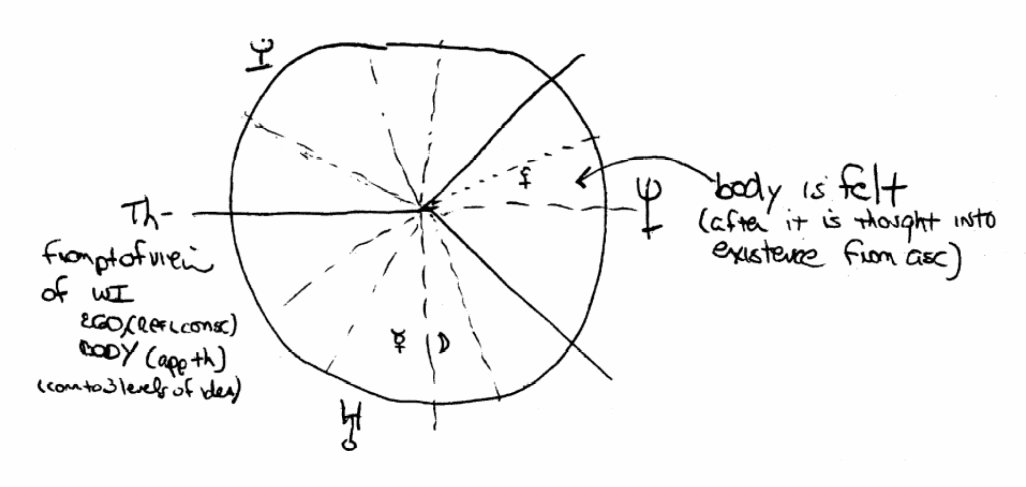
AD EXPLICATION OF DIAGRAM WITH THREE LEVELS OF THINKING AT ASCENDANT AND BODY AS FELT IN SEVENTH HOUSE
EMOTION AND FEELING; LISTENING TO MUSIC EXERCISE; HEGEL
ESSENCE IS ONE AND UNIVERSAL, EXPERIENCED IN A PARTICULAR WAY THROUGH THE BODY; ANIMA AND ANTAHKARANA
THREE LEVELS OF THINKING; WITNESS-I, AS-IF EXERCISES
MIND'S OBJECTIFYING TENDENCY AND THE POWER DRIVE
ALL IMAGES IMPRINTED IN THE BRAIN; IMPRESSIONS MADE ON SENSIBLE MATTER AND INTELLIGIBLE MATTER
EXISTENCE AND IS-NESS; MOSES; ANGER AS EXPRESSION OF SEPARATENESS
BOOKS READ FROM OR REFERENCED
Paul Brunton, The Wisdom of the Overself
Paul Brunton, The Quest of the Overself
Paul Brunton, The Hidden Teaching Beyond Yoga
C.G. Jung, CW 8, The Structure and Dynamics of the Psyche, "On the Nature of the Psyche"
C.G. Jung, CW 9, Part II, Aion
C.G. Jung, CW 14, Mysterium Coniunctionis, "The Conjunction"
Edward C. Whitmont, The Symbolic Quest: Basic Concepts of Analytical Psychology
William S. Haas, The Destiny of the Mind, East and West
Dorothy M. Emmet, The Nature of Metaphysical Thinking
Aristotle, Metaphysics
Jakob von Üxküll, Theoretical Biology
Rudolf Steiner, The Course of My Life (also published as The Story of My Life and Rudolf Steiner, An Autobiography)
Rudolf Steiner, The Philosophy of Freedom (also published as The Philosophy of Spiritual Activity)
Rudolf Steiner, The Redemption of Thinking: A Study in the Philosophy of Thomas Aquinas
Marie-Louise von Franz and James Hillman, Lectures on Jung's Typology, "The Feeling Function" (Hillman)
A. U. Vasavada, Tripura-Rahasya and A Comparative Study of the Process of Individuation
Vyasa, Bhagavad Gita
DIAGRAMS appended to this transcript:
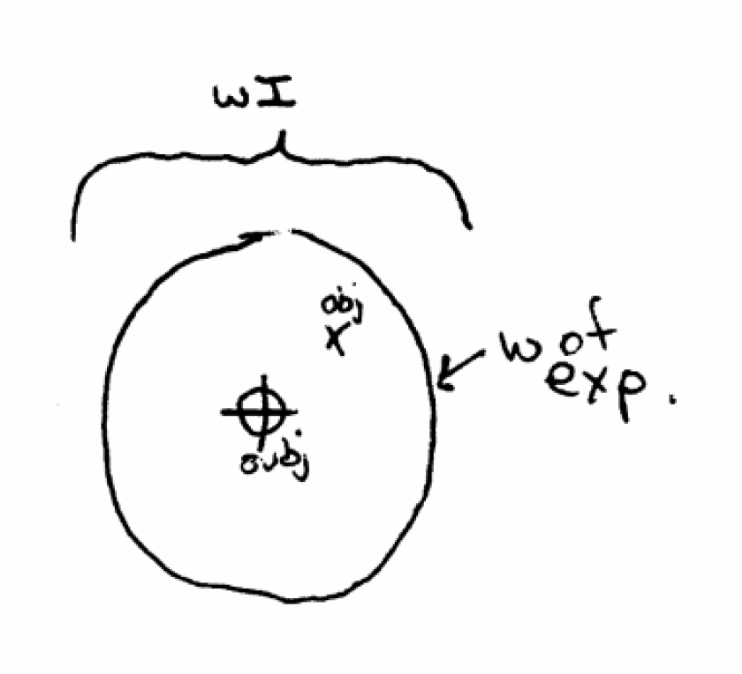
FIGURE 1974 0125-1-AB. Witness-I, Cosmos, Subject-Object.
FIGURE 1974 0125-2-AB. Threefold superimposed on Twelvefold, with Three Levels of Thinking at Ascendant and Body as Felt in Seventh House.
Other diagrams also referred to are not with this transcript version. [Transcriber note: [diagram] means the speaker is referencing a diagram as he or she is speaking. If someone is drawing or writing, with audible sounds of chalk on a blackboard, I indicate this by [drawing] or [writing].]
TRANSCRIBED Verbatim by IT 2019; reformatted by JRM & JF 2019-2020, with TOC/Subheads by JRM. In 2023, IT updates prefatory matter, footer, and audio file name, alters V code, Topic, Subject, and Subsubjects to make more accurate, removes grey and green highlights and hashtags (not a V14), alters Subhead style, alters Subheads to make more accurate, fixes/completes Book List, fixes errors/typos, adds new notes within transcript, adds two diagrams and references within transcript to these diagrams. Archival verbatim transcript – V12a.
AUDIO FILES: 1974 0125a, 1974 0125b. [Note: "Tape" and "Side" refer to original audio cassette tapes that were later digitized into .MP3 Audio Files.]
1974 01/25 at Wisdom's Goldenrod
Epistemology; Levels and Types of Thinking
EXCERPTS FROM "THE MEANING OF MENTALISM"
[Audio File 1974 0125a Begins]
[few seconds of shuffling about]
AD: I just thought maybe a plan that we do quotations from the Wisdom. And-- [short pause] He speaks about science, he says--
[Transcriber note: I am using The Wisdom of the Overself by Paul Brunton, Rider and Company, London, 1943.]
PB [The Wisdom of the Overself, "The Meaning of Mentalism," p. 15, AD reading]: "…in the end to see, [AD reads: In the end, scientists will see] through its own facts and its own reasoning, that the world-stuff is [of] the same tissue as that out of which our own ideas are made."
[short pause]
AD: Then next page--
PB [The Wisdom of the Overself, "The Meaning of Mentalism," p. 16, AD reading]: "Perception and thought are but phases of the mind's action with the first [AD: that is, perception] depending on the last. We think and the world appears. We lapse into thoughtlessness, and the world disappears."
AD: Then, page 27 in my book, this is from all the first chapter, "The Meaning of Mentalism".
PB [The Wisdom of the Overself, "The Meaning of Mentalism," p. 17, AD reading]: "By mentalism we mean [more] precisely this: [that] all things in human experience without any exception are wholly and entirely mental things and are not merely mental copies of material things; that this entire panorama of universal existence is nothing but a mental experience and not merely a mental representation of a separate material existence; that we can arrive at such conclusions not only by a straight-line sequence of reasoned thinking but also by a re-orientation of consciousness during advanced mystical meditation."
[short pause]
AD: I'm just opening randomly.
[16½ second pause]
PB [The Wisdom of the Overself, "The Meaning of Mentalism," p. 20, AD reading]: "The individual, therefore, stands behind the world although, paradoxically, he is also included in the world."
[14¼ second pause]
PB [The Wisdom of the Overself, "The Meaning of Mentalism," p. 21, AD reading]: "Even those who can understand that mind is both actor and spectator in this universal drama of lights, colours, sounds, smells and feels; who can comprehend that the very act of thinking is a creative one inasmuch as it manufactures its own time and space; who can appreciate that the cosmos in its entirety is but a thought-form and that nothing can come into human experience which does not come as thought…"
[short pause]
AD: If you could think of any-- [16 second pause] Well how about this here.
PB [The Wisdom of the Overself, "The Meaning of Mentalism," p. 23, AD reading]: "How is it possible to bring into one and the same category an idea like that of a memory of a tree, which represents the inner process of knowing about a tree, and the actual tree itself? Nobody finds that both the images of individual fancy and the objects [AD reads: object] of bodily experience are the same in his experience but everybody does feel a strongly-marked difference between them.
"This is perhaps one of the bulkiest stumbling-blocks in the path of most students of this doctrine. It is indeed this striking contrast which forces mankind to assume that the surrounding objects which make up its earthly environment are substantial and real whereas it assumes that thoughts, ideas, memories, fancies [and] mental pictures are comparatively unsubstantial and unreal. How then can they be one and the same in substance?"
AD: And then he goes on and answer it. He says--
PB [The Wisdom of the Overself, "The Meaning of Mentalism," p. 23, AD reading]: "The answer is that this distinction is certainly a genuine one but it is [AD reads: it's] only of degree and not of kind; it is a distinction without a difference; it does not destroy the essentially mental character of the world outside. … Now thoughts arise solely for the individual who has them whereas things exist for all alike. This is the second [AD reads: And this is an] important distinction between them."
AD: Would you say that this is a difference between apperceptive thinking and, you know, thinking orientated by the object? Well, just think about it.
[short pause]
PB [The Wisdom of the Overself, "The Meaning of Mentalism," pp. 23-24, AD reading]: "The comparative weakness of private fancies, the comparative strength of sense-impressions, [and] the undeniable difference in sharpness, actuality and immediacy between these two classes of thought, [AD: That is, the thought of a tree that you have and the tree that you actually perceive.] deceive us into non-recognition of their concealed sameness, of the fundamental oneness of stuff out of which they are wrought."
[14¼ second pause]
AD: And then finally he says--
PB [The Wisdom of the Overself, "The Meaning of Mentalism," p. 26, AD reading]: "In what, finally, has the mentalist's progress consisted? [AD reads: In what does our progress consist?] Not in moving from a lower reality to a higher one, but in moving from a lower concept of reality to a higher one; that is, from matter to consciousness itself."
[9¾ second pause]
TWO KINDS OF CONCEPT
AD: Alright. That was all-- those were excerpts from the second chapter, "The Meaning of Mentalism". And-- [short pause] as-- if we talk a little bit about what we were doing Tuesday, [Note: See WG Class 1974 0122.] there was a kind of recognition that Jung was making a distinction between apperceptive thinking, you know, the thinking that goes on, so to speak, in your private boudoir and the other kind of thinking that corrects the thinking that was going on in your private boudoir. And then the important point that I was trying to stress-- I review this because it's worthwhile. And Jung-- Jung makes this very very beautiful point. I think I brought it. From Aion. Remember the quotation from Aion? I didn't bring my (Aion/own).
S: Would you like it?
AD: Hm?
S: We have a copy if you'd like.
AD: Well we could remember the point without referring. He speaks-- he speaks about the fact that we're-- it's very easy to get a psychological concept. Remember? That is, we get an intellectual concept of something. Alright, why don't you get it. I think it was Aion, wasn't it? [student assents] It was from Aion? And, I thought that that-- that passage might-- might possibly be used as a wedge to get into what we're trying to understand-- what we're trying to understand, which is not the verbal concept but the real concept that makes a thing to be what it is. The difference between a verbal concept and the concept of the thing as it is, is-- You remember the passage?
S (faint): Yeah. It's right here.
AD: Yeah. He warns us about the use of words and how dangerous they are, how they deprive us-- deprive us of the possibility of real experience.
C.G. Jung [CW 9, Part II, Aion, p. 32, paragraph 60, AD reading]: "[This is] the common source of the illusion that one is then in possession of the thing itself. But actually one has acquired nothing more than its name, despite the age-old prejudice that the name magically represents the thing, and that it is sufficient to pronounce the name in order to posit the thing's existence. In the course of the millennia the reasoning mind has been given every opportunity to see through the futility of this conceit, though that has done nothing to prevent the intellectual mastery of a thing from being accepted at its face value. It is precisely our experiences in psychology which demonstrate as plainly as could be wished that the intellectual"grasp" of a psychological fact produces no more than a [AD adds: mere] concept of it, [AD: I would put here "verbal concept".] and that a [AD adds: verbal] concept is no more than a name, a flatus vocis [AD reads: hot air]. [AD adds: And] These intellectual counters can be bandied about easily enough. They pass lightly from hand to hand, for they have no weight or substance. They sound full but are hollow; and though purporting to designate a heavy task and obligation, they commit us to nothing. The intellect is undeniably useful in its own field, but [AD adds: it] is a great cheat and [AD adds: an] illusionist outside of it whenever it tries to manipulate values."
AD: Now, here's the point where I thought we might get in, you know, we might try to break in a wedge. If we say-- if we say what is a triangle and you say, well, 180 degrees or the sum of its angles, and you think of the definition, it's not so easy to identify yourself with that, you know. I mean, there's still a kind of distance between you and the definition that you're expounding. But if we say, what is the concept of the shadow or the anima, you know, something that you actually live through, someone who's lived through the concept of the anima, alright, one who's actually lived out the role of the anima or the shadow, and let's say drank-- drank the cup down to the-- to the dregs. When you tell them "the shadow" or you call it a renegade, no matter what the name you call it he knows what you're talking about. In other words, his experience, the condition of his being, went through that stage or let's say evolved through that stage, experienced that stage. Now if it evolves a concept it's alright for him to do so, he knows what that concept is. But previous to that he lived that concept, he was that concept. The activity of thinking was that concept, in him. And you, so to speak, you get up with it and you-- you live it out all day and you go to sleep with it and it even in your sleep disturbs you, you know, all kinds of nightmares and monster dreams, all that stuff comes up. Alright. This is the point that we're trying to-- trying to really emphasize, the concept of the anima here or the shadow, whatever, the verbal concept and the actual experiencing of the concept in the sense that you are this concept. Your activity of thinking, so to speak, and the concept are one and the same thing and that's why it's possible for that experience to be. I hate to bore you with repetition but this is a point that if I-- if you don't catch, then you-- we go back and start from a year ago.
HAAS: LOVE OF WISDOM VS. LOVE OF ESSENCE; EAST VS. WEST; JNANA; REQUIREMENTS FOR UNDERSTANDING
Then we went into the Haas. And I-- I mention this fellow because I just happen-- I happen to pick him up at random, and to see these same ideas expounded, you know, with considerable insight shows we're not too far from the world-- from some truth in this. He points out how most of civilization, in one chapter, most of what we call civilization today have come from the magical dimensions of consciousness. You remember when we were speaking at one time about-- about this from Whitmont's book? [Note: See Edward C. Whitmont, The Symbolic Quest: Basic Concepts of Analytical Psychology.] First stage was like the unitary stage, remember? Second stage was denigration. And you've-- I-- he referred to one dimension of consciousness is the magical stage. Remember what the magical stage of consciousness was? It's like a dream consciousness when a-- where anything could stand for anything else. The time and space is not occasioned by cosmic situations but is really fancy free. Any reason is good enough when you're dreaming, you know, there's no logic involved or-- the magical-- Well from that magical state of consciousness, of course, they-- they point out that the rational consciousness developed, the rational consciousness-- the Jungians, especially the union bearing, the union card bearers, are of the opinion that the rational consciousness developed from that magical state, it's an offshoot of it. And it's become so heavily one-sided that of course it produce a one-sidedness in our consciousness. This one-sidedness, so to speak, has brought about an unbalanced condition in the psyche. He makes a remark here for instance.
[Transcriber note: I am using The Destiny of the Mind, East and West by William S. Haas, The Macmillan Company, New York, 1956.]
William S. Haas [The Destiny of the Mind, East and West, p. 99, AD reading]: "All great world conceptions are the work of the conscious mind."
AD: Um-- [19½ second pause, flipping of pages] Alright. These are-- these are mostly reviewing a few extras.
William S. Haas [The Destiny of the Mind, East and West, p. 134, AD reading]: "[Thus] the Eastern mind is not concerned with the love of wisdom in the Western sense, but with [AD adds: the] love of reality or essence."
AD: He points out that in the West the-- even the meaning of the term 'philosophy' is love of wisdom. And what is this wisdom that we love? It's the logos, conceptual thought, alright. And he makes-- he makes the distinction here, he says, "Now, we have to oppose this to the Eastern conception." And, over here the Eastern conception is not concerned with the love of wisdom, which would correspond if you remember to the anima's role, third-- third level, the Virgin Mary. Not the love of wisdom, not the love of the logos, but, he says these people, and he wants to coin a new word for them, "the desire for essence or Isness," Isness. (Haas, p. 134) That's interesting, you know, Isness.
S (faint): Yeah.
William S. Haas [The Destiny of the Mind, East and West, p. 134, AD reading]: "…[and] by opposing philosophy to it [AD reads: this]. [In thus] by-passing whatever stood in the way of an immediate relation to the Real, the East emerged in that spiritual fulfillment which is evidenced by its early yet determining creations."
AD: I think what he's saying here is that actually these concepts, the thinking of concepts, no matter how exalted they may be, are actually an interference to penetrating into the real. Concepts, ideas, would actually interfere with this direct awareness of reality. So that, what's he's saying here is for the-- for the Easterners, reality would be a species of direct awareness without interference on the part of any concepts, no matter how exalted. You follow here? [short pause] Species of direct awareness and no concept, no matter how exalted, should get in the way and as a matter of fact if it does they have specially pre-- prepared programs to help you get out of it. (bit of laughter, student words) He shows, for instance, he gives a quotation here, he says--
William S. Haas [The Destiny of the Mind, East and West, p. 135, AD reading]: "…Aristotle's word appears to hold true--that what is prior in nature is perceived by us as the posterior. Applied to our statement [AD reads: statements] this means that even though the need for philosophical conclusions [AD reads: conclusion] appears at the end of a work, it is the hidden incentive for the whole undertaking."
[16 second pause, flipping of pages]
AD: Now, this we spoke about but--
EC: Isn't the path of Jnana concepts?
AD: Isn't the path of Jnana what?
EC (faint): Concepts.
AD: No.
EC: Working towards c-- working with concepts?
AD (faint): No.
EC: Not at all?
AD: Jnana is what I just said was Jnana.
EC: Without concept?
AD: A species [EC simultaneously: But--] of direct awareness.
EC: But the approach to Jnana.
AD: Well, that's preliminary, that's elementary. In other words they tell you, you know, about Brahman, ok, Thou Art That, and that's a concept maybe but they would prefer that you don't work with concept. But however for intelligences of a middling kind, [S, faint: Easy, yeah. (laughter)] they would have to start working with concepts. Well that's all of us. It's very rare like, there's very few Hui-Nengs around that hear a statement like "Thought has no abiding place" and gets enlightened. Most of us have to work through a lot of problems before that. But, you can see that you can use concepts in any of the paths. You have to use concepts in any of the paths. The experience of prema is a concept, I mean you experience yourself as nothing but emotion. That's a concept. Certainly not Jnana you see, so-- We're-- we get a picture after a while, like we were pointing out, we were discussing this Tuesday. [Note: See FIGURE 1974 0125-1-AB for the following.] We have the apperceptive realm of thinking which is the small circle [diagram], you know? And there, so to speak, there's these subjective tendencies and fancies that will get corrected by the correct concepts which are outside that small circle [diagram]. In other words, the reality of the object is such or the reality of the world is such that eventually it corrects your subjective prejudisms and misunderstandings, alright. That's-- that was the second level of the concept. The third level of the concept was to experience, so to speak, the-- the supersensible entity which rose above that [diagram]. But in the case of the human being the Vedantists have an entirely different approach. They don't want to go through all these scales. It goes on forever, yeah.
S (faint): [one/two words inaudible]
MB: Tony?
AD: Yes.
MB: If the love of wisdom corresponds to the third stage of the anima, the-- the Mary stage, then what corres--
RP: Westerners.
MB: (Western isn't--)
RP (faint): [one word inaudible]
MB (faint): Then the fourth stage [AD simultaneously: Oh Lenny, come here.] system.
RP: Thought he said that there's a We-- the way the Westerners use wisdom as the sum total of everything that-- the distillation of all experience, sum total, that would correspond to the love of cre-- and the Virgin Mary, the love of creation.
MB: Well-- Like if-- like almost [RP simultaneously: Divine child.] the second-- like you've reached levels of concept but you'd still be in the second level of concept?
AD: Yeah. [short pause] Alright, so according to the Western tradition, to continue where I am.
William S. Haas [The Destiny of the Mind, East and West, p. 161, AD reading]: "…philosophic wisdom is attainable by any clear and desiring mind, whereas the East believes in an ontological relationship between knowledge [of] which a man is capable and his general condition."
S: Alright.
AD: There has to be a sort of ontological cleaving or an ontological bent in your being towards the truth of what you are, otherwise you're not gonna seek this out. You'll go and use concepts to make good bridges. I don't know.
William S. Haas [The Destiny of the Mind, East and West, p. 161, AD reading]: "This knowledge in the East has a double aspect. On the one hand, it is a state of consciousness dependent on and relative to the condition of the whole subject."
AD: This is like 110% true with Patanjali and all the Yogas. You cannot, so to speak, practice many of the meditation technique unless your being is in a position to do so. If you do so you'll find very often that you get kicked in the face by a lot of let's say imperfections that reside, you know, seeking to come up to the surface, yeah. So we'll repeat this.
William S. Haas [The Destiny of the Mind, East and West, p. 161, AD reading]: "This knowledge in the East has a double aspect. On the one hand, it is a state of consciousness dependent on and relative to the condition of the whole subject."
AD: You remember the asangas [Note: AD means angas] that you have to have before you study yoga, practice it, purity, you know, contentment, non-stealing, non-cheating, all those things? Those are not incidental. Your being has to be in that condition. You can't say-- you remember that Sufi robber who wanted to be a-- a saint like the Saint and then the Saint told him, "Well, why don't you give up the things you stole?" he says, "Do I have to do that too?" (RP laughs, student words) You can't be like that. You would willingly have given that up before you even went to ask him that you wanted to follow his way. So, it's almost like the whole man is involved, not just a little part of (him/it).
William S. Haas [The Destiny of the Mind, East and West, p. 161, AD reading]: "On the one [AD reads: other] hand, it is a state of consciousness dependent on and relative to the condition of the whole subject. [On the other], once it is acquired it implies a change in the whole condition of the subject, and indeed this kind of knowledge only exists in so far as it effectuates this change."
AD: This knowledge only exists insofar that it affects the way-- this change in your being, otherwise you've just heard words. You don't have to be enlightened instantly right then and there but, so to speak, you know that you're changing. You know that there's a definite change and what you did a few years ago or a few months ago you can't do anymore. And even when you think about it you have some hesitations. It brings about changes in you. It is-- it is almost a commonplace in any kind of training that once a person commits himself in his heart to these teachings, that an esoteric development automatically proceeds, goes on simultaneously. And no one sends him a letter to inform him of the fact either. It just starts happening. Now, here's a point for instance Richard and I struggled with for a long time, trying to define the various levels, you know, of thought. But over here, in the East, he says--
William S. Haas [The Destiny of the Mind, East and West, p. 161, AD reading]: "The clear separation between man as a sentient being [AD: You know, a being capable of sense experience.] and as a reasoning being is one of the many distinctions of Western philosophy. While [AD reads: Now while this not-- is] not unknown in Eastern philousia [AD reads: in the East] this differentiation has never been allowed to occupy a central place. Doubtless, man felt that his deep consciousness of himself as a whole would be threatened by admitting the antagonism of reason and will. Hence the transformation from one level of consciousness to another appears to be as much a condition as a result of this new cognition."
[short pause]
S: Tony, could you amplify that a little bit more, the-- the difference between sense and--
AD (simultaneously): Alright, I'll finish this quotation, sure.
William S. Haas [The Destiny of the Mind, East and West, pp. 161-162, AD reading]: "If the import of this philosophical concept is as significant in the East as it is in the West, the reason is precisely this. In contradistinction to conceptual knowledge Eastern cognition involved not alone the thinking power and [AD adds: the] thought of man but his [AD emphasis] whole being."
AD: Ok? So, if we wanted to use like a Steiner terminology, you know, and a couple of Friday-- Fridays ago I put up a short sort of diagram where he speaks of the physical body, the etheric body, the astral body, and the ego. And, he shows there's a split, a duality. The astral and the ego, so to speak, work together and the physical and the etheric. When you go to sleep, the astral and the ego go away, you know, they go back to the world, ok, and the physical body, which is part of the physical cosmos and the processes, the physical and the etheric stay in the bed there and when you come back into them, so to speak, you awaken, you know. [AD snaps his fingers] Alright, now, you can see that-- you could see that in a sense a part-- there could be parts of you that disagree with other parts. Right? (bit of laughter, student words)
S: I give up.
AD: I give up. (AD laughs a bit, bit of laughter)
[few seconds of background student talking]
William S. Haas [The Destiny of the Mind, East and West, p. 162, AD reading]: "States which embrace the whole of man, not acts of thought or of will, move on. This is at least the Eastern idea. It matters little whether this apparent inflation of the idea of cognition is regarded as an exaltation or qualification. It can in fact be viewed from either angle. For [if] it requires cognition to embrace the whole of man, at the same time it makes cognition [AD emphasis] dependent upon the whole [AD adds: of] man. As a man is, so is his cognition, and as a man's cognition is so is he."
AD: Ok? [12 second pause] He mentions briefly about Zen and the Taoist school and a few others that--
William S. Haas [The Destiny of the Mind, East and West, p. 162, AD reading]: "…abounds [AD reads: abound] in techniques to transform the whole state of the ego, which transformation is considered indispensable for the attainment of cognition."
AD: Now this is quite different than the notion you have in school, right? In school everybody is entitled to get learning. And so everybody goes to school and everybody learns how to read. Some come up with cognition, some don't. (AD laughs)
LR: It's crazy.
REALITY UNREACHABLE THROUGH CONCEPTS; PLATO AND ARISTOTLE
AD: But he makes a point here which, I don't know, it may sound unbalanced but-- What-- I'd like to hear your comments on it.
William S. Haas [The Destiny of the Mind, East and West, pp. 163-164, AD reading]: "The more we weigh the Eastern notion of cognition, the stranger and more devious must our Western conception of it appear. The idea that man has the power of leaving his finite state behind in order to reach the realm of the Real by virtue of his reason alone seems to approach the highest degree of arrogance."
AD: What do you think of that?
LR: Say that again.
RP (simultaneously): He's talking about the scientific mode of thought.
AD: Uh-huh.
LR: Will you say that la--
RP (simultaneously): Don't use 'reason' then though.
S (very faint): Yeah.
William S. Haas [The Destiny of the Mind, East and West, pp. 163-164, AD reading]: "The idea that man has the power of leaving his finite state behind in order to reach the realm of the Real by virtue of his reason alone seems to approach the highest degree of arrogance."
AD: Even if we change-- even if [LR simultaneously: The word 'reason'--] we change the word 'reason' and use the term 'concepts', I think the point he's trying to make here is basically that the Real is something utterly transcendent to that whole notion.
RP: But, this came about in Western thought in misreading of like the Platonists.
S (faint): Yeah.
AD: Yeah but you [RP simultaneously: They thought--] can't convince them of that. (AD laughs a bit)
RP: Yeah, they thought they were talking-- I mean, modern scientists will grasp Plato as one of their own, "He's only doing-- he's-- he's doing in his imperfect way what we're doing a little better, with more-- with more subtlety." They think he's talk-- they think he was talking about what they were doing.
AD: I'd have to agree with you. That's why when I read the quotation from here, I refused to include Plato and I left him out. He includes Plato and I wouldn't for the same reason you're just stating now. It's their misunderstanding of Plato. As a matter of fact I have a quote here that might even be to this point, Richard. [flipping through pages] I was going through something in the-- I don't know where I wrote it but--
LR: You write from both (ends)?
AD: Huh?
LR: You write from both [couple/three words inaudible]
AD (simultaneously): Well I wasn't feeling well so I wasn't quite sure if I wrote it. It might be just in my imagination. [11¼ second pause, flipping of pages] Yeah, this is the way I summarize the chapter from somewhere from, what's his name, Wilson.
S (faint): Uh-hm.
[Note: The following quote is from Dorothy M. Emmet, The Nature of Metaphysical Thinking, London: Macmillan & Company, Ltd., 1945. AD is reading his notes, not the actual quote from the book.]
Dorothy Emmet [The Nature of Metaphysical Thinking, p. 171, AD reading his notes]: "For Thomism [AD: And this is the way I understand,"For Thomism] the object of metaphysical thinking is to understand the nature of being and that this being is prior to the ideas about it. We must start not from essences [AD: That is, definitions and conceptual terms.] but from existence. The problem then is to express the essence of existence in conceptual terms. Existence is prior to essence. How, starting from existence, we can transpose it into conceptual terms…" [Note: The actual quote reads: "Thomism claims that existence (not the idea of existence) is prior to essence, and that the problem of metaphysics is not to see how, starting from ideas, we can deduce existence, but how, starting from the prior fact of existence, we can transpose it into conceptual terms."]
AD: That's the problem. How can we do that, alright. And evidently this problem came up as soon as they attempted to translate Plato into a terminology that they could handle. Because, when they refer to the Idea of the Good, they'll point out that even the Idea of the Good, you know, is not adequate. They want to start from Isness, you know, the definition of Jehovah. But you can see from their Idea of the Good that they're thinking of it as another idea, [student assents, very faint] alright.
RP (simultaneously): On par.
AD: Yeah, on par, alright, with their-- with their notion of concepts. So, after a while, the confusion runs around in circles everywhere you go. Yeah, we'll get to them, yeah.
RP: I just want to know-- well I was reading-- Galileo is like-- These people, the very founders of modern empirical science, they're anti-Aristotelian and they claim Pato-- Plato as their patron god who was--
AD: But that's in-- that's--
RP (simultaneously): --who they were going to restore. You know, you say, "Well Aristotle was inferior to Plato, Plato (was a good guy)." But like, they weren't-- they weren't adequate to Aristotle, so that they-- so instead they grab a doctrine higher than their possible comprehension and drag it down to a lower [one/two words inaudible]
AD (simultaneously): If anything, I think they fulfill Aristotle more adequately than Plato. They really, they really worked Aristotle, they worked out his axioms, his theorems, how to work with concepts, you know, and--
RP: But they didn't know that, they didn't think they are.
AD: No, they didn't know that, no.
RP (simultaneously, faint): They didn't think they are.
[short pause]
William S. Haas [The Destiny of the Mind, East and West, p. 166, AD reading]: "For the experiences of the Western man are almost always aimed at or at least they are inseparably linked with the transformation of the outer and psychological environment."
CONSCIOUSNESS ITSELF (EAST) VS. OBJECTS OF CONSCIOUSNESS (WEST)
AD: Alright, that's the end of this paragraph here. Now we get to something that's closer to what we've been doing with Steiner.
William S. Haas [The Destiny of the Mind, East and West, p. 167, AD reading]: "[Whereas] in the West, experience and actions are connected with the objectifying concept, in the East experience lies in an immediate relation between world and subject, and hence in the immediate influence to be exercised by the subject on the non-subject."
AD: They don't even want to call that an object. Subject-non-subject, not subject-object. Subject-non-subject.
William S. Haas [The Destiny of the Mind, East and West, p. 167, AD reading]: "Therefore, the foremost task of [philousia] [AD: you know, Eastern thought] is to investigate the subject and its potentialities. Since for the East the subject is essentially consciousness, the task of philousia is better defined [AD reads: their task is to better define it] when it is termed an exploration of the realm of consciousness and its possibilities. Now returning to the problem of cognition the conclusion imposes itself [AD reads: the conclusion that imposes itself upon us]. Eastern cognition is interested in consciousness itself. Western cognition is interested in the objects of consciousness."
AD: These objects of consciousness are going to turn out to be the objectifying concept. The idea and consciousness. The same problem comes up finally when PB makes the remark, he says, "Now, we've reduced everything to idea but we're not going to reduce reality to an idea." (PB, Wisdom, p. 192, Rider 1943 edition) [students assent, faint] [20 second pause, flipping of pages] [to himself] 171, 172. [9¾ second pause] How about so far, we're pretty clear?
S (faint): I-- I really didn't understand the last thing that you said about-- PB said that you can reduce everything to an idea but you can't reduce reality to an idea, that's [one/two words inaudible]
AD: Well, yeah. You don't remember coming across that in the Wisdom? Over and over again he does it in many ways, subtle and otherwise. But, if we took the entirety of universal manifestation, considered it an idea, alright, you still won't, so to speak, equate that with the ultimately real. An idea is an object in consciousness no matter what that idea is, [S, very faint: Oh.] alright. Consciousness is other than that. An idea is always objective, even-- even your most subjective ideas are still objective. So when PB is operating, so to speak, he's taking an epistemological standpoint and he's delivering al-- he's delivering knowledge, so to speak, or he's delivering epistemology, he takes you-- If you remember, he starts off within psychology, alright. And then he branches out or he keeps-- he keeps pushing you into epistemology. If you-- The same thing like Jung does, he forces you to realize where you are and from where you are to work upward. The Eastern traditions don't work like that. They usually start at the top and come down. They start out, "The whole world's a lie, now we'll prove it to you," ok? But he starts out by saying, "Well look, you exist." And you say, "Sure I do." "Ok, let's start from there."
S: Is that why the Vedantists then are so exact in what they demand for--
AD: I'm sorry?
S: Is that why the Vedantists are so exact in what they demand from a disciple in that respect?
AD: Oh, they have their own reasons. (bit of laughter)
OG: Tony?
AD: Yeah?
OG: Consciousness itself is revealed by idea.
AD: Consciousness-- That's like putting the cart in front of the horse.
S (very faint): Exactly. (laughter, AD laughs)
OG: How can I know the consciousness otherwise, if there are no ideas in there, like--
AD: That's the only way you're ever going to get to know it. You're mixed up, aren't you?
OG: I wouldn't be here if I was not.
AD: I mean the only a-- (laughter, student words) the only way-- the only way you're ever going to get to know consciousness is by getting rid of all ideas. And then you're going to have to be that consciousness which you know. You can't know it like another thing, you can only be it. That's real knowing, you know. That's just like we were trying to give an example at a lower level where we speak about you really know the concept, anima, when you are, you know, inundated with it and you have to live it out. Until then you-- all you have is a verbal concept, a thought in your mind…more words. It's like, for instance, if you hold a mirror up and you see the objects in front of it and you keep concentrating on the objects, what's ever in front of the mirror, alright. But the idea is to get to know the mirror, [OG simultaneously: But mirror--] not the objects.
OG: Mirror itself couldn't be known if the objects are not there. (You call) that something mirror is revealing all this.
AD (simultaneously): Well it'll take us-- it'll take us a few years for me to convince you that it's the other way around. Take a little time, that the only possibility of knowing is through consciousness. The only thing that is knowing is consciousness. You can't know something which is, so to speak, in itself unknowable. Thoughts are unknowable in themselves. They're machines, it's a machine. A machine has no knowing in itself, whether you think or feel or will. They're just machines, in spite of what Steiner says. That's an interesting question, we'll get to it very soon. And by the way, that's quite Western.
S: Uh-hm.
S: Yeah. (laughter, student words)
S (amidst laughter): Shame on you Om.
RP: He's trying to get naturalized. (AD laughs, laughter)
THREE PROPOSITIONS OF WESTERN THOUGHT
AD: Alright, for instance he says--
William S. Haas [The Destiny of the Mind, East and West, pp. 171-172, AD reading]: "…[AD adds: in the] Hegelian philosophy--the Absolute is conceived as the consciousness which has no other object than itself. It therefore is pure thinking because it has itself as its object. Thus are there demonstrated with the utmost clarity three propositions. First, thinking is considered the highest form of consciousness. [AD: This is for the West.] Second, for this very reason even the highest form of consciousness must be conscious of something. Third, pure thought can only have itself as its object. In this way the hidden meaning of the term objective finds its fulfillment. The objectifying mind has itself undergone objectivation [AD reads: objectivization]."
AD: You want to go over that?
S: Yes.
AD: These are [S simultaneously, faint: Yeah.] the three main points.
S: For the West?
AD: Richard, you explain it, huh?
William S. Haas [The Destiny of the Mind, East and West, p. 171, AD reading]: "…the Absolute…"
AD: Whether Hegelian or Bradleyan, it doesn't really matter, he says Hegelian but it really doesn't-- this stands for almost all conceptions of the Absolute in Western terminology except, like we said, the Neo-Platonic tradition.
William S. Haas [The Destiny of the Mind, East and West, p. 171, AD reading]: "…the Absolute is conceived as the consciousness which has no other object than itself."
S (faint): Uh-hm.
AD: Alright, from this there are three very important points, the three important points.
William S. Haas [The Destiny of the Mind, East and West, pp. 171-172, AD reading]: "First, thinking is considered the highest form of consciousness. [AD: Alright.] Second, for this very reason [even] the highest form of consciousness must be conscious of something. Third [AD reads: Three], pure thought can only have itself as its object. [AD adds: And] In this way the hidden meaning of the term objective finds its fulfillment. The objectifying mind has itself [AD reads: itself has] undergone objectivation [AD reads: objectivization]."
AD: And this always happens at the peak of an idealistic philosophy, when it reaches the crest, I mean-- yeah, the peak.
S (faint): Could you read the second one again?
RP (simultaneously): Summit.
LR: I don't understand [AD simultaneously: The summit.] them Tony, I don't-- I don't follow them.
AD: So consequently whenever-- wherever you look around in the West you'll see the subject is always on the retreat. And this is-- he puts it here this way.
William S. Haas [The Destiny of the Mind, East and West, p. 172, AD reading]: "This is the logical consequence of a structure which absorbs all data in its objectifying process. The absorbing entity and power is the conceptual thought."
S (faint): Yeah.
AD: Would you please, Richard?
RP: [one/two words inaudible] (RP laughs)
S (faint): Come on Richard.
RP: Let's see, I'll take (them).
AD: Alright, the first point he says here-- (laughter) Well we'll take them one at a time.
William S. Haas [The Destiny of the Mind, East and West, p. 171, AD reading]: "[First], thinking is considered the highest form of consciousness."
S: I think therefore I am.
AD: Yeah.
S (faint): That's right.
AD: Yeah that's right.
RP (simultaneously): Be-- being becomes an idea, rather than idea presupposes being.
AD (simultaneously): Being.
RP: There's a new re-- an inversion.
William S. Haas [The Destiny of the Mind, East and West, pp. 171-172, AD reading]: "[AD adds: The] Second, for this very reason even the highest form of consciousness must be conscious of something."
AD: This is ingrained, I mean, you know, you speak to your psychology teacher and you speak to him about pure consciousness, he says, "Nonsense, what are you talking about? There's no such thing possible."
LS: Even Jung said it was-- (there) was nothing there but a blank.
AD: Yeah Lenny, that's true. He couldn't conceive of ego without consciousness, consciousness without ego. It's so ingrained in Western conceptions that it's impossible to abolish.
S (faint): What does he mean by 'form' there?
AD: Don't grumble, say it out loud.
S (faint): What does he mean by 'form' there, he calls thinking the highest form of consciousness?
S: Say--
AD: Does he?
LS: It's the mode of the mind with the most value.
William S. Haas [The Destiny of the Mind, East and West, pp. 171-172, AD reading]: "…the highest form of consciousness must be conscious [AD reads: consciousness] of something."
S: No but the-- the first one, "thinking is the highest form".
AD: Uh-hm.
S: Would we use-- we'd use 'mode' there?
S (faint): (Uh-hm.)
AD: You could use that, sure. Why not? It helps you understand it.
DR: That sounded more like to me that what we were just saying, (if) the Western tradition says that-- that consciousness is thinking, that they're almost equatable terms.
AD: Almost, yes, sounds like that, doesn't it?
S: Uh-hm.
DR (faint): Well, yeah.
RG: What's their first premise again, the one that so to say follows (from it)?
AD: Thinking is considered the highest form of consciousness?
RG: No, the one before that.
AD (simultaneously): No, before that?
William S. Haas [The Destiny of the Mind, East and West, p. 171, AD reading]: "…the Absolute is conceived as [the] consciousness which has no other object than itself."
RG: Right, now, [S (simultaneously, possibly part of background): I was looking (couple/three words inaudible)] it seems to me the three statements following it don't really follow from that kind of premise. I mean 'cause consciousness having no other object than itself wouldn't--
AD: Well you weren't here Sunday but I don't have an Aristotle with me, but the Absolute, whether conceived in Aristotelian terms or-- Aristotelian terms or Hegelian terms-- For instance, in Hegel the Absolute is-- the Absolute is conceived of as Being becoming itself, alright. Now this would not be tolerated in the Vedanta. [student assents, faint] I think it was book of-- book 12--
S: (Book 12.)
LS (simultaneously): Book 12, chapter 7. [Note: See Aristotle, Metaphysics.]
AD (simultaneously): (Right.)
RP: In the-- in the-- in Neo-Pl-- The primal energy of like the Intellect that creates the world is this dianoia and that corresponds to the Hegelian absolute. So by a thinking process the world is created. It's the created aspect of the Intellect, creative Intellect that corresponds to pure thought. Which is very objective, I mean it's not an individual's pure thought. Although when you approach pure thought in your own thinking, you approach-- you merge with the Logos, yeah.
S (faint): Yeah.
RG: And yet they say thinking is a form of consciousness, not consciousness itself.
RP (simultaneously): Yeah, that's the hi-- that-- that's their value judgment, that's the highest you can get, the creative Intellect, that's why it corresponds to Virgin Mary.
RG: But yet they posit something beyond that.
RP: No, who does?
RG: Because if consciousness has no other object in itself and then they say thinking is the highest form of consciousness--
AD (simultaneously): Thought thinking thought.
RP: Thought thinking thought.
AD: That's--
RP: Pure thought.
AD: Pure thought.
RP (simultaneously): Thought whose object is itself, like in Hegel. Contentless in some sense. Pure form. That's why he's-- that's why he's criticized for being pan-logical.
AH: Richard, would you call that dualism?
RP: That's-- well it's-- no, you know why? Because there's only an object, [couple inaudible student words simultaneous with RP] there's no subject. That's why it's not dualism. It's this pure objectification and is only pure thought.
S: Yeah but what is that?
RP: That's the primal light.
AD: He's got the quotation from Aristotle, the--
S (simultaneously): The other translation's here.
S (faint): [couple words inaudible]
AD (simultaneously): The other one's better?
S: Yeah.
AD: Yeah. Yeah, that chop the (lower).
S: [one word inaudible]
S (simultaneously): [possibly one word inaudible] did you read the third one yet?
RP: Not [one/two words inaudible]
[short pause]
William S. Haas [The Destiny of the Mind, East and West, p. 172, AD reading]: "[Third], pure thought can only have itself as its object."
LS/S(?) (faint): It's even more confusing.
S (possibly part of background, faint): Tell me.
AD: That's more confusing?
S: Yeah.
AD: Do we have another translation of Aristotle, I (didn't--)
S: (Yeah/Mm).
AD: Well there in the section that we're speaking about in Aristotle they refer to pure thought or thought thinking itself, you know, thinking itself out, the Hegelian notion of the Absolute is, as he pointed out, reason, so to speak, in a process of becoming itself. In the East that would-- that would not be taken up at all because Being would be a process absolutely accomplished, there's no becoming of Being.
RP: Oh. Like it-- it'll correspond in PB to the vibration of the World-Idea--
S: What is that?
RP: --which is constantly going on. And as far as the created world is concerned, that's the summit, its vibration. But it leaves out the World-Mind.
[short pause]
WESTERN THOUGHT CONCERNED WITH FINDING AN OBJECTIVE SUBSTRUCTURE CAPABLE OF PRESERVING THE PHENOMENA
AD: At any rate, those who are familiar with Western notions of Absolute know that this is what they refer to and what they mean by Absolute. Because somehow the West, like this man points out, they've got to save the phenomena. They can't permit this phenomena to disappear. It's very important that it's saved. So we'll move into that here. He says, [S, very faint: I see.] "The preservation of phenomena…" No matter what the cost, the West says we got to save it.
William S. Haas [The Destiny of the Mind, East and West, pp. 172-174, AD reading]: "The urge to objectify the data of consciousness implies an ever increasing expansion of conceptual constructions. … In all spheres of life and mind the original data recede to be superseded by constructions. These pretend to be objective reality and if they are not, they are at least a step on the way. …
"[AD adds: Since] The world of phenomena cannot stand by itself [AD: so to speak, they've got to go on objectifying it]. …
"This intellectual procedure--[AD: And I'm quoting now.] the preservation of phenomena--together with the profound metaphysical wonder which we have found to be the basic attitude of the Western mind in the search for the arche [AD reads: type], constitutes the triad of the components [of the Western mind]. … …[AD adds: even] Copernicus took up the idea with almost the same words--[apparentias salvare--to] save the appearances. [AD: And he has it in English-- in Latin, so--] Such is the organic nature of this great process of construction.
"The deficiencies and inconsistencies [AD: Now listen to this because I'm sure that you all recognize this in yourself."The deficiencies and inconsistencies] of sense-perception are revealed by the discerning intellect. But if that [AD reads: If the] discerning intellect is perspicacious enough to discover the insufficiency of the phenomenal world it is not competent to save the phenomena from the fatal consequences of its own criticism. Though a great achievement, this criticism is purely negative and it leaves man the despairing victim of his own discriminating perspicacity [AD reads: ability]. … The problem is to restore confidence in the world, and its solution is not within the reach of [AD adds: the] [discerning] intellect. To logos--creative reason--falls the task of preserving the phenomena from this [AD reads: the] devastating though legitimate criticism of [AD adds: a] discerning intellect."
AD: And you can see the whole attempt of Western philosophy is this. Even Kant, wasn't it Kant who said "We must, at all costs, preserve the phenomena. It's a scandal to reason that we can't." Remember? Remember that Richard? He was quite flabbergasted by the fact that the intellect would tear apart all pretenses of being able to save phenomena. I'm sorry Richard.
OG (simultaneously): What (if--) It is my psychological problem actually. (laughter) Because I'm so afraid that the whole world [S simultaneously: What?] is going [S simultaneously: Hold on.] to dissolve if I study Hidden Teachings.
AD: If what?
OG: If I study Hidden Teachings the whole world is going to dissolve. I have so much of psychological problem, that fear (cost) understanding.
LS (simultaneously): Got Mercury on the midheaven, it might really happen. (laughter)
AD: He sa-- Lenny says with your Mercury on the midheaven it might really happen. I would suggest that you go ahead full steam ahead. (laughter)
OG: I'm afraid.
S: Save the Om.
AD (simultaneously): [one word inaudible] Just keep saying Om. (laughter) I mean that's double-edged. Om, Om, Om! (bit of laughter)
MB: That does sooner or later anyway (laughter, student words) [few words inaudible]
[students assent, faint]
William S. Haas [The Destiny of the Mind, East and West, p. 174, AD reading]: "Measured by this standard, [AD: he goes on] the phenomenal world is not trustworthy. Nor does it possess objective reality."
AD: Alright, he goes on, most of this you're familiar with.
William S. Haas [The Destiny of the Mind, East and West, pp. 174-175, AD reading]: "If when measured by the standard of objective reality the phenomenal world lacks truth and reality [it] is the relation to logos alone which may confer [upon it a share in reality]."
(Side 1 of original cassette tape digitized as 1974 0125a Ends; Side 2 Begins)
William S. Haas [The Destiny of the Mind, East and West, p. 175, AD reading]: "[The eternal function of the genuine concept is to move to and fro between the phenomena and the ideas representing reality. By this process of mediation it produces the uninterrupted chain of constructions which bring the phenomenal world] nearer to reality."
AD: Now you can see that you're always doing this, constantly this process of thinking, thought, is going on without interruption. [student assents] You see this all the time, without this process there is no world for you. If you-- if you speak to an Easterner, and I'm not talking about him [in reference to OG], (laughter) but, generally if you speak to an Easterner and if you're very observant, and those of you who've been with PB too, if you're very observant you notice there's a point beyond which he does not exteriorize anymore. Have you ever noticed this with like Chinese restaurants or-- (some laughter) It's like their extroversion comes to a s-- a standstill at a certain point. Beyond that they don't push.
LR(?): (Have) noticed it in Chinese.
AD (simultaneously): Huh? You haven't-- Alright, let's forget it. Let's go on.
RP/S(?) (simultaneously): They have suey in--
LR: Chinese restaurants. (LR laughing)
S (very faint): Yeah.
S (very faint): Right.
AD: Well, this is especially [few inaudible student words simultaneous with AD] (noticing--) this is especially (known through/noticed) with Chinese people.
LS: You don't think you know what?
S (faint): Yeah.
S (very faint): Never mind.
AD: But then again, you people who were brought up with golden spoons, I wouldn't expect you to know it. There is another world, you know. And all you-- all you college graduates living in those mud huts don't fool me in the least. (laughter) Because you all have the same ideas! (AD laughing) Real mud hut is when you went down to the slums or the bowery or the ship, you know, the docks. There you saw a variety and you saw differences. And even when you worked on a Chinese ship, for instance, or a Japanese ship, it-- the difference is unbelievable. They only exteriorize so much, that's it, they stop. Like something inside says, "That's as far as you can go." Whereas the Westerner, you know, he spill his guts out. (laughter) Say "Good morning" and he starts telling you about lumbago. (laughter)
S: Think like he's out growing opium. (laughter)
AD: Alright, then there was another part that--
S: Hm.
[short pause]
MIND'S OBJECTIFYING TENDENCY GOES ON CREATING CONCEPTS ENDLESSLY WITHOUT EVER REACHING ITS GOAL; OBSERVER AND OBSERVED (PHYSICS EXAMPLE)
AD: This is of course for us as science people that are interested in science--
William S. Haas [The Destiny of the Mind, East and West, p. 177, AD reading]: "[However], the inevitable idea of a world-mechanics pushed to its end had to arrive at a strange conclusion. Not that it found any logical obstacle to its fulfillment. The objects, whatever their nature, remained what they were and waited, indifferently, to be known. But there was this. As a result of the Western mind-structure the objectifying process could not stop before the knowing subject itself. Thus, at the ideal moment when the knowing subject had been made the object of successful objectifying knowledge it would disappear as a subject."
S: [three/few words inaudible]
AD (simultaneously): You follow this? This happens in all your psychology classes, in all your philosophy classes. Alright.
S (simultaneously): [one/two words inaudible]
William S. Haas [The Destiny of the Mind, East and West, p. 177, AD reading]: "As a result of the Western mind-structure [AD adds: of] the objectifying process [AD: You know, creating concepts."…the objectifying process] could not stop before the knowing subject itself [AD reads: the subject himself]. [Thus], at the ideal moment when the [AD reads: this] knowing subject had been made the object of successful objectifying knowledge it would disappear as a subject."
AD: In other words, as the psychologists and the physiologists and the (anatomists/animists) and all of them went to work on the human being, alright, suddenly he disappeared, there was no more a subject there, there was just a collection of 90 cents worth of chemicals.
S (faint): Right.
S (faint): Uh-hm.
S (faint): Right [one word inaudible] (bit of laughter)
RP: Now with inflation--
S (amidst laughter, faint): Now [few words inaudible] (laughter)
AD (simultaneously): Right. (AD laughing)
RP: --we've gone up in value. (bit more laughter)
AD: Well--
William S. Haas [The Destiny of the Mind, East and West, p. 175, AD reading]: "At this moment, though, the term object would likewise lose all significance since its relation to a subject had disappeared. Hence it follows that the absolute object [AD emphasis] being an impossibility, the goal of the objectifying mind is itself impossible."
S (faint): Uh-hm.
AD: Let's go over this now because this is where even Steiner is gonna trip up and quite a few others. That's why I say, this man's insights into Eastern teachings are really quite remarkable.
S (very faint): What's the title?
AD: I'm sorry? The Destiny of Mind in the East and the West by the fellow by a name of William S. Hass, H-a-a-s, Dutchman, he spent most of his time in the Mideast. Ok.
William S. Haas [The Destiny of the Mind, East and West, p. 177, AD reading]: "[However], the inevitable idea of a world-mechanics pushed to its end had to arrive at a strange conclusion."
AD: And you remember, Steiner's work was 19th century physics and math, mechanics and all that.
William S. Haas [The Destiny of the Mind, East and West, p. 177, AD reading]: "Not that it found any logical obstacle to its fulfillment."
AD: That is, the scientists went on working, there was nothing there that was really preventing them from getting deeper and deeper.
William S. Haas [The Destiny of the Mind, East and West, p. 177, AD reading]: "[AD adds: But] The objects, whatever their nature, remained what they were and [AD adds: they] waited, indifferently, to be known. But there was this [AD reads: But there is this to consider]. As a result of the Western mind-structure…"
AD: The way the Western mind operates, you know this aggressive component, these-- "I got to see what this is" and he tears it down. And he tears it down and gets all the necessary concepts, builds it up and gets it to work. Now he's happy.
William S. Haas [The Destiny of the Mind, East and West, p. 177, AD reading]: "As a result of the Western mind-structure the objectifying process could not stop before the knowing subject itself. Thus, at the ideal moment when the knowing subject had been made the object of a successful [objectifying] knowledge [AD: Successful objectify-- successful scientific knowledge.] it would disappear as a subject [AD reads: the subject would disappear]. What was left would be the known object comprising all existence."
AD: But if everything is turned into an object, you know, you have no subject. If you have no subject, you have no object either. And instead of seeing that they were going to be left with one thought, or with a vritti, they again went around in some more circles.
William S. Haas [The Destiny of the Mind, East and West, p. 177, AD reading]: "At this moment, though, the term object would likewise lose all significance since its relation to a [AD reads: the] subject had disappeared. Hence it follows that the absolute object being an impossibility, the goal of objectifying mind is itself impossible."
AD: That is, you cannot exhaust the objectifying tendency of the mind. It can go on creating concepts endlessly. And this is of course a nice origin, and in many people we pointed out this is the Faust legend, you know, this desire for overweening power--power over things, over people, ok.
William S. Haas [The Destiny of the Mind, East and West, p. 178, AD reading]: "According to this, knowledge is not [the] sublimely [AD adds: an] indifferent instrument [AD adds: as] it was believed [to be] in classic [AD reads: classical] physics."
AD: You know, in classical physics they believed that you know an object and that your knowing the object did not interfere with knowing the object.
William S. Haas [The Destiny of the Mind, East and West, p. 178, AD reading]: "It is itself or at least it is through the means it uses, a phenomenon of nature."
AD: That is, the knowing itself is a phenomenon within nature, not outside of nature. Therefore it plays a role in constructing the object that you're going to know.
William S. Haas [The Destiny of the Mind, East and West, p. 178, AD reading]: "Therefore the object of knowledge cannot remain unchanged by the act of knowledge."
AD: And you remember, he has that quotation in Mysterious Conjunction from Pauli where he speaks about-- Was it in-- [Note: See C.G. Jung, CW 8, The Structure and Dynamics of the Psyche, "On the Nature of the Psyche," pp. 229-230, footnote 130.]
AB: Um, it's in "Nature of [AD simultaneously: Yeah.] the Psyche" I think.
AD: Yeah. [student assents, faint] Alright, you can look it up yourself, the way the-- the more the physicists attempted to penetrate into the nature of matter, the more the observation interfered, you know. And there again is another example of what we just said. Insofar that you see that the-- that which is observed is part of the observer, or you want to say the observer is part of that which is observed, you could right away see why we're all included in this one comprehensive thought. No, they go on again. Another cycle.
[12 second pause]
William S. Haas [The Destiny of the Mind, East and West, p. 179, AD reading]: "The whole intellectual activity [AD: I'm leaving out quite a bit."The whole intellectual activity] of the West is one and the same endeavour. It is to find an objective substructure [AD reads: structure] capable [AD emphasis] of preserving the phenomena--for they constitute our world."
[student assents, very faint]
RC/S(?) (very faint): That's deep.
AD: Ok?
RC (faint): I don't understand.
AD: You don't understand that?
RC (faint): No.
AD: Well suppose I took away all concepts, what would happen to your world?
RC (faint): It might be a lot better.
RP: (No.)
S (faint): (Right.)
S (faint): Yeah, right.
S: Yeah.
S (possibly same S as above): Yeah.
S: [few words inaudible]
AD (simultaneously): You'd first have to go through a kind of psychosis son. And that's something you'll preserve, you'll prevent at any cost.
RC: Well, can I [one/two words inaudible]
AD (simultaneously): Well, let's be very honest, Randy. [RC: Well I'm--] When I took this Bentley up to an Eskimo, what kind of reaction happened? He was really, so to speak, in a state of shock. Anytime you're faced with something you don't understand, if it's overwhelming it can be really a state of shock, if you can't fit it up-- if you can't fit it, so to speak, into your-- your framework. You remember that book, who was it that mentioned it to me, Theoretical Biology, Üxküll [Note: Theoretical Biology by Jakob von Üxküll, 1926.]. He speaks about the-- the ground, the phenomena that every animal must have. That is, for every animal, a simple animal, simple complex of environment. A complicated animal, co-- complex environment. You have to function within that. You can't function outside of that. I can't take you and put you let's say in a-- a Martian atmosphere with Martian thinking beings, alright. [student assents] It would-- it-- it just can't be done. So, you live only in that world of experience, so to speak, that's provided for you by your concepts. Take away those concepts, you're in trouble. Very serious trouble.
S (faint): Go ahead.
AD: Go ahead Richard.
FIRST ESTABLISH THE TRUTH OF CONSCIOUSNESS
RP: Well, (it's) [one word inaudible] but is like straw man. The Platonists too recognize a realm of Being, Intellect, and even beyond Being, but they want to save the phenomena in the sense of justifying it and showing how it's suspended from principles or eternal principles. I mean they feel that that's-- the world, the phenomenal world may not be true but it's beautiful.
AD: No, I don't think I would disagree with you, except that I would--
RP (simultaneously): There's just like an attitude, [AD simultaneously: Yeah.] they're not fleeing the world, (they--)
AD (simultaneously): No, they're not fleeing with it, no.
RP (simultaneously): They feel that they're-- there were-- they're a part-- they're-- to adorn the world, that this apperceptive thinking on the bottom per se (is not--)
AD (simultaneously): Well, doesn't PB say something similar [RP and another student assent] to that, he says, "After all, [RP simultaneously, faint: I think so.] what is the real authentic miracle? The fact of existence." Ok? And in a sense also the Vedantists point that out. But when we're speaking about the truth here, there can't be no compromising, you know. This is the truth, alright, let's say pure consciousness. Then anything after that we'll put in its place. You call it a chocolate cake. Alright. They call it something else. (bit of laughter) But the point is that [S simultaneously: Ok.] these principles have to be very clearly defined. This is-- this is the-- the thing that, in a sense, Steiner walks into. You-- you remember in his The Course of My Life [Note: The Course of My Life by Rudolf Steiner, 1951. Also published (in English) as The Story of My Life, 1928, and Rudolf Steiner, An Autobiography, 1977, etc.] he points out as a kid he had to look at the phenomena, he had to take mechanical things and understand them and all that? He was a product of that age. True, he was a spiritual person and went beyond them, but still he was caught in that-- in that very thing. It's a very difficult thing for Westerners I think to accept this fact that they're-- the sub-- the substance, you know, Being-in-itself is the ultimate reality and everything else is like the-- like PB would say, like a cloud in the sky. It's transitory. But that doesn't make it less beautiful. Far from it. The other way around. My assumption is that once (I've/I'm) glimpsed into the Reality, then the phenomena within that Reality appears as miraculous and enjoyed for what it is, alright, and I think the Buddhists catch that flavor very significantly. You see that in their Haiku poetry, you know. [short pause] And it's the point, again Richard, I'm going to take advantage of this, it's the point that must be held onto strenuously. Because the point that Plotinus made and Plato and some of the really great minds in the Platonic tradition can be lost easily.
RP: You can become a lover instead of a philosopher.
AD (whisper): Yeah.
RP: Which is what Western man's become.
AD (simultaneously): Yeah. So it's very easy for us to lose sight of that principle. Whereas in the Vedantic tradition, that is nailed, you know like Luther nailed his thesis to the door? (some laughter) That's nailed first and then everything else can be studied, but that has to be made very explicit. The principle of consciousness, pure consciousness, is the ultimate reality, everything else is a deviation. And they go through this enormous process of all their texts to wear away, you know, to wash, like-- You know, you've seen a scrub board when you wash clothes? Well when you read their texts, the Vedantic texts or the Prajnaparamita literature, that's precisely what it does. All this concepts in your brain (are) scrubbed out. (laughter) I hope we get to the Vedantic texts some-- some day, but I'm sure (laughter) by that time all of us will have retired, each to his own little igloo.
S (faint): Yeah, right.
LR: Well we can drive our [few inaudible student words simultaneous with LR] Bentleys up to each other. (laughter, student assents)
AD: Maybe you can drive a Bentley.
RP: Who's a silver spoon. (some laughter)
LR: (I'll go.) (LR laughs)
RP: No, go in your Rolls Royce. (bit of laughter)
AD: Alright, now, we compare, now we go to the Eastern tradition, and I'm not getting away from Steiner, I'm gonna go back to Steiner but I think you'll have a perspective with Steiner and even if we go into some of the occult stuff, you know, like his various theories of knowledge, his classification of the human-- human being into various principles, you won't get lost by this manifold of phenomena that he just throws at you, you know, astral consciousness, etheric, oh, you start looking around for manas, buddhi, you know. (some laughter) And each one has their own fancy name, you know. Jung would call it the anima, he would call it the astral, someone else would give it another name. But, I get mad after a while and I start making equations, astral [=] anima, you know, these people are all saying the same word, why they-- why can't they talk the same language? That's-- and I-- that's one of the reasons I really think PB is a mastermind. He said what had to be said with a-- with a terminology that was totally adequate for his purpose. These people bring in terminology that's frightening.
STATES OF CONSCIOUSNESS; PRATYAHARA, DHARANA, DHYANA
William S. Haas [The Destiny of the Mind, East and West, p. 181, AD reading]: "The way of the Western subject which tries to arrive at self-comprehension [AD: That is, at self-knowledge.] through objectifying conceptual thought [AD: And this is exactly what Steiner does.] is matched by the way of the Eastern subject which endeavours to achieve its [AD reads: this] aim by withdrawing from or shedding what there is of objective constructions."
AD: He's gonna start kicking out the etheric, the astral, the ego, (AD laughs) and everything else that you can pile on.
William S. Haas [The Destiny of the Mind, East and West, p. 181, AD reading]: "In so doing it turns away from intentional acts to live more and more exclusively in a particular form of consciousness which we have called state of consciousness."
AD: This is the definition of that word which is so difficult, how do they say it, pratyahara? Come on.
OG: [one word inaudible]
AD: P-r-a-t-y-a-r-a--
OG (simultaneously): Pratyahara.
AD: Huh?
OG: Pratyahara.
AD: Pratyahara, yeah. That's the yogic term, pratyahara. These are states of consciousness of which the being is the possessor and he has to be like those states of consciousness. It's a very technical term he's speaking about here but he doesn't use the term. Alright, to go-- get back to that notion of pratyahara.
William S. Haas [The Destiny of the Mind, East and West, p. 181, AD reading]: "The way of the Western subject which tries to arrive at self-comprehension [AD reads: self-knowing] through objectifying conceptual thought is matched [AD reads: contrasted] by the way of the Eastern subject which endeavors to achieve its aim by withdrawing from or shedding what there is of [AD adds: all] objective constructions. In so doing it turns away from intentional acts to live more and more exclusively in a particular form of consciousness which we have called states of consciousness. This state of consciousness is in contradistinction to intentional consciousness."
AD: Intentional consciousness, of course, whether its Brentano's intentional consciousness or Thomistic intentional consciousness, it's the same thing. It's that willing-- that willing consciousness which postulates or wills for something to be. And whether you know and feel this is an activity that takes place all the time.
S (faint): Uh-hm.
William S. Haas [The Destiny of the Mind, East and West, p. 181, AD reading]: "In principle it is self-sufficient and it embraces the whole subject. It is not, and certainly not primarily, oriented toward [AD reads: orientated towards] the perception of something. And there is nothing in it which is akin to the intentional act of the genuine concept which rises within the general frame of consciousness and then transcending it, reaches forth for its adequate object, the idea."
LS: Question.
S (faint): Uh-hm.
AD: Yeah.
LS: I was under the impression that pratyahara-- (you using) the same word for the way it's used in Yoga-Sutras?
AD: Uh-hm.
LS: That there it seems to be a re-- (powering) the consciousness from the senses, internalizing consciousness away from the senses and (referring) to common sense? [student assents, faint] [S: Uh--] Detachment from the sense(./?)
AD (simultaneously): It's the detachment of consciousness from the sense object, this is the way it's commonly used. And this is at the level of Hatha Yoga. At the level of Raja Yoga it now means that as you rise, so to speak, in other words, as-- as you succeed in concentrating on an object, then the object that you succeed in concentrating in that field, that content of consciousness and you are one and the same thing. In other words, if you are concentrating on this field of consciousness, let's say enclosed in this square [diagram], the subject that's concentrating on it is wiped out and he is that field. He is that state of consciousness. This is Raja Yoga. The step below, Hatha Yoga, you detach yourself from all sense functioning. Then you contemplate on an idea. Now you succeed in wiping out the subjectivity and you are that field of consciousness. [AD hits board with chalk] That state of consciousness and you are one and the same thing. This is the definitive cognitional state that they speak of.
LR: What did you say was Raja?
AD: Raja Yoga.
LR: Well what did you say it was?
AD: That's Raja Yoga. The one before that was Hatha Yoga.
LS: So you say it's dissolving of a distinction between yourself and the state of consciousness which you are?
AD: It's--
LS: Like we-- I don't--
AD: Alright, I'll repeat this. It is a-- it is a little difficult. In the first-- in the first level, Hatha Yoga is concerned with the detachment of consciousness from the senses. [students assent, faint] When-- when you succeed in finally eliminating all sensation-- You remember we spoke about this? It comes up, the light breaks in on you, alright, and now you've had some sort of mystical experience. You've separated the subject from the-- let's say the body and the sense organs in the body. Now he's capable of concentrating at a mental level. Now he takes a mental object, alright, let's say he concentrates on an idea. This idea is the only thing in the field of consciousness, alright. Let's say he's-- let's say he's concentrating on the notion of compassion, ok, or on the notion of space or time, any one of these objects, a mental object. He concentrates on it sufficiently until-- You can put it in two ways, you can say the subject is wiped out or you can say the subject becomes compassion. Now he knows what compassion is. It's a definitive state of knowing because he is that state.
LS: But this is much below samadhi you're speaking (right now).
AD (simultaneously): Oh sure, samadhi is another step above. This is what the-- this is what this man is trying to point out. For these people, cognition--
LS (simultaneously): So that-- so that they-- the stages that come after that, the stages leading to samadhi are within that pratyahara. They're a kind of a focusing within it?
AD: I'm sorry, would you repeat?
LS: And the stages that come out of that, that-- that come after that, dharana, dhyana, brought-- and samadhi, in Patanjali's yoga, [AD: Yeah.] would be self-definition within that pratyahara?
AD: Within that, yeah.
LS: You know, what he's talking about here is a kind of, the mind letting go of its intentionality, which is an externalizing tendency even in our active consciousness.
AD: That would be the first stage.
LS: So that we could, and in some way, by letting go of conceptualizing and externalizing tendencies, we could reach towards pratyahara even in our-- in our active lives.
S (faint): Yeah.
AD (simultaneously): Uh-hm, uh-hm.
LS: And it's a sense of a kind of trying to lapse back into the state of consciousness which you are. It's the state of existence which you are.
AD (simultaneously): Uh-hm. There, there the situation is something like this. Whatever object appears in consciousness, a sort of preparation is made for this object and only this object is attended to. Now, in making a preparation for only one object in consciousness, you also, so to speak, prepare for the appearance of the subject. It's a peculiar kind of way of knowing. It's just like that Zen anecdote that we use when we said, you know, the Zen Master says, "What's the difference between you eating rice and me eating rice?" And he points out, "When you eat rice, you do everything but eat rice. When I eat rice, all I do is eat the rice." But if all he does is eat the rice, then that means that there's only this one object in his consciousness. And if there's only this one object in his consciousness, he can fully devote himself to that object. [S: Right.] Whereas when I'm eating rice, I'm thinking about what I'm going to do tomorrow, what I did yesterday, who I'm going to talk to in a few minutes, and what's next on the menu. And I never touch the rice! See, the definitive mode of knowing to these people is that you are that actual state of consciousness that is flowing through you. [short pause] So let's repeat this and we'll see how peculiar they operate.
William S. Haas [The Destiny of the Mind, East and West, p. 181, AD reading]: "The way of the Western subject which tries to arrive at self-comprehension [AD reads: self-knowing] through objectifying conceptual thought is matched [AD reads: contrasted] by [the way of] the Eastern subject which endeavors to achieve its aim by withdrawing from [or shedding] what there is of objective constructions. In so doing it turns away from intentional acts to live more and more exclusively in a particular form of consciousness [which we have called states of consciousness]. This state of consciousness [AD emphasis] is in contradistinction [AD reads: contradiction] to intentional consciousness."
AD: Now, a simpler way to try to describe this is like for instance, if I say "Come for dinner," you know there-- there's this eagerness in you or you sit down and you start eating and there's this eagerness to go to the next thing and then to the next thing, alright. Whereas you invite the Zen Master come to dinner, he sits down and he eats his dinner. And there's no eagerness as to the next moment. He just doesn't-- he's not preoccupied with the next moment. The moment right here and now. Didn't PB said something about living in the moment, present moment? Well that's his uncomplicated anglicized way of saying the same thing.
[students assent, very faint]
S: What did he say?
AP: Living in the moment, in the now, you know, [S simultaneously: PB's (couple words inaudible)] in each moment.
AD: See, but if you notice, there's a kind of built-in anxiety, an eagerness. You don't sit down and do what you're doing now, you're thinking of what you're gonna do or what you have done. And the present is always ignored. That's why last night somebody came over to cure me, I says, "Can't I enjoy my illness?"
S (very faint): Tony, that sounds like [one/two words inaudible] (laughter)
William S. Haas [The Destiny of the Mind, East and West, p. 181, AD reading]: "In the East the subject is [AD emphasis] not an object of conceptual knowledge [AD reads: consciousness]."
AD: And that's what I think many of you people resented when you went to college. You can't know the subject through concepts.
William S. Haas [The Destiny of the Mind, East and West, p. 181, AD reading]: "Since it is a pure consciousness it will be reached by a thoroughly planned series of [AD emphasis] states of consciousness."
AD: They're gonna plan state-- stage by stage the various states of consciousness you have to go through.
William S. Haas [The Destiny of the Mind, East and West, p. 181, AD reading]: "And these in turn are acquired through an increasingly successful divertment [AD restates: diversion] of phenomena. This dismantling..."
AD: And that's what we wanted to name this place, right? The dismantling factory, dismantling ego factory. (laughter)
LS: Dragon's Tail.
AD (simultaneously): "This…" The Dragon's Tail.
S: Yeah.
William S. Haas [The Destiny of the Mind, East and West, pp. 181-182, AD reading]: "This dismantling embraces psychological as well as physical phenomena. All psychological and mental phenomena show a tendency to becoming entities pretending to a life of their own."
AD: You like that, huh Red?
RW(?): Yeah.
AD: Huh? You give-- you give this psychic organism, this cognitional apparatus life and then it goes around strutting, say "Look at me!" Alright, then later on it even starts telling you what to do and you submit. Well, he didn't buy (it). (laughter) Ok, alright. (AD laughing, bit more laughter)
S (faint): (That/It) means I couldn't watch them.
AD: All I'm trying to say is you give your mind the life, you give your body the life, you give it all these things, alright, and then you go around saying, "Look at what I am." Unless you give it, it don't have it. Unless you identify with it, you know, it can't say it's you.
RC: These-- these forms it would seem have as much reality as any other idea or any other form.
AD: Well, spoken like a true Westerner.
S (very faint): (Makes sense.)
S: [one word inaudible] (bit of laughter, student words)
RP (very faint): (Not in) here.
AD: Alright, I'll s-- I'll quote briefly from "The Contrasted Solutions, East and West" [Note: Chapter XII, "The Contrasted Solutions of Classic Problems".] and then we'll go right to Steiner, alright, and I think it should be very clear now what Steiner is doing.
LR: What was the chapter you were reading from last Friday?
AD: In where? In here?
LR: Oh, was it the same, was it the same you were reading--
AD (simultaneously): Tuesday [S simultaneously, faint: Oh no.] I was reading from this one here.
LR: No, last Friday also (from me to you). At the end you were talking about that the knowledge had to be in the whole man, the whole man--
AD (simultaneously): Yeah, from here.
S (very faint): From here.
[9 second pause]
ALL COGNITION IS EXPERIENCE (EAST); REAL CONCEPTS AS STATES OF CONSCIOUSNESS; PURE CONSCIOUSNESS BEYOND ALL CONCEPTS
William S. Haas [The Destiny of the Mind, East and West, pp. 236-237, AD reading]: "To the East all cognition is essentially experience. [And] as they draw nearer to pure consciousness these states of being defy description. They are that from which words turn away. …
"Nothing in the East resembles the creative exuberance, the universal versatility and the penetrating power of the Western concept as it everywhere unfolds and shrinks back from nothing."
AD: And you see this in the East. They got Buddha advertisements and Christ advertisements and everything, yeah?
William S. Haas [The Destiny of the Mind, East and West, p. 237, AD reading]: "In the East there is an almost deferential attitude toward experience--a respect [AD adds: is] felt for its immediacy and [AD adds: an] integrity which does not permit any assault upon it [by hostile means]. While experience should not be handed over to, and [be] processed by the concept, it may be completed or replaced by other experiences."
AD: Now, if you want to try-- Let me finish this and then we'll--
William S. Haas [The Destiny of the Mind, East and West, p. 237, AD reading]: "It is the East's [inherent] conviction that conceptual thought cannot penetrate to the root of experience. How then can cognition be obtained? [AD adds: And] The first paradoxical answer is--by experience. An experience 'a' is adequately understood by an experience 'b', if 'b' [AD misreads: 'a'] is of a higher order [AD: I mean if 'b' is of a higher than 'a']. The general implication here is that the higher understands the lower. And this stands in contradiction [AD reads: contradistinction] to the science-supported Western view that the lower explains and therefore understands the higher."
AD: Now, over here it's going to be a little difficult because I'm going to disagree with what he says here.
William S. Haas [The Destiny of the Mind, East and West, p. 237, AD reading]: "[While] experience should not be handed over to, and [be] processed by the concept, it may be completed or [AD reads: and] replaced by other experiences."
AD: Now generally speaking, in yoga practice, if you have certain experiences you speak about them to your Guru and that's it, you don't talk about these experiences to anyone else. But nonetheless, there is a need for some sort of reflection, some sort of understanding within your own framework, within your own apperceptive thinking so that it doesn't go too far astray and (then is) corrected by one who's had, let's say, higher types of experiences and he could point out what-- where you're going. The point that I object to, he says over here--
William S. Haas [The Destiny of the Mind, East and West, p. 237, AD reading]: "It is the East's inherent conviction that conceptual thought cannot penetrate to the root of experience."
AD: Now this ultimately is true, you cannot get to the pure principle of cons-- of consciousness by concepts. But through, as we pointed out before, the various stages that you go through, various stages or states of consciousness that you go through, I have previously defined this as the actual and the real concept. Ok? Now, what he is referring to here and what I'm referring to of course can be contrasted in this way. To me, if you speak about a real-- a real concept, when a thinking being, so to speak, is thinking a concept, in this concept that he's thinking is the experience that he is experiencing, alright, this is the way I understand concept which is not exactly toto, you know, total with his definition of concept. Because his-- his notion of concept doesn't go as deeply as Steiner's notion of the concept. You see what I'm saying here?
LR: Yeah, yeah. Or else everything you were talking about in Steiner would be meaningless it would seem.
AD (simultaneously): Yeah. So that the possibility for a person to go through various stages or states of consciousness, let's say one state A, state B, state C, alright, and each state would represent a certain concept, a working out of a certain concept. Let's say that in one state he experiences astral consciousness, alright, images and pictures divorced from their mooring in the so-called sensual world, alright. That will be an experience of consciousness where the actual experiencing of the consciousness, the knowing of that consciousness, are one and the same thing. Now this person knows what astral consciousness is. He doesn't know it through concepts. In other words, he didn't reach-- Steiner says, "Ah, there's such a thing that you can have a state of mind where you look and your thoughts become images and pictures and they come at you. And the brown which you see on the pole floats towards you and sounds come into you and you don't know which is which, which is a real entity and which isn't." See, that would be a verbal concept. But in that stage of actually experiencing that astral consciousness, you are that concept that he refers to as astral consciousness. You see the point I'm trying to make here? If you keep this in mind then we-- you won't get confused with what he's going to say.
William S. Haas [The Destiny of the Mind, East and West, p. 237, AD reading]: "It is the East's [inherent] conviction that conceptual thought cannot penetrate to the root of experience."
AD: Yes. Ultimately and finally, the ultimate experience is pure consciousness, which is not a concept, not an idea, not another thought. Right Om? But lights up all thoughts. And like, you could have a thought lit up and then a bigger thought and then a bigger thought, you know? Sooner or later I'm going to give up all thoughts and say "I want the light alone."
RC: It would also by definition be not experienceable.
AD: It'd be what?
RC: Not experienceable.
AD: By that definition it would be only true experience. By that definition all your life becomes worthwhile because it is true experience. That's a Malkani interpretation, that negative way of looking at it.
RC: I don't see how that comes (in with) what he said (here/there).
AD (simultaneously): Alright. Wait till we study the Vedanta.
S: [one word inaudible]
RC (simultaneously): Malkani just said there's no [AD simultaneously: (No/Oh).] greater concept like the experience which was the concept. And then he defines--
AD: The ultimate experience is pure consciousness, what I was saying, alright. This ultimate experience of pure consciousness underlies all your empirical experience. Without it, there is no empirical experience. It makes your empirical experience valid. It will ultimately sublate, sublimate-- or, I'm sorry, sublate that empirical experience. But it's always there.
RC: So then concept would apply only to something which could be made into an object.
AD: Yes. Concept is basically the objectifying process of the mind. This is-- when you read the Buddhist scriptures, you know, they keep telling you, will you stop that discriminating mind from functioning? Close up that dualistic leakage, "this, that, the--" Always they keep telling you, stop conceptualizing. And you think, of course, that all they're referring to is, you know, "If I stop thinking--" Which you never do anyways so you have no problem, really, I mean you can't stop that.
RC: So the concepts become the boxes you put the not-I in.
AD: I'm sorry?
RC: The concepts become the boxes you put the not-I in, the not-self.
AD: Well, you got to repeat, I--
RC: Well-- well anything that I should make-- anything that I can fit into the conceptual framework it seems is known from the standpoint of which it is not-I.
AD: Yeah.
RC: And then this ultimate experience you couldn't fit into that box.
AD: Yeah.
RC: It's another thing that I couldn't say "no" to.
AD: Yeah, what you have to keep in mind is now, like the East would point out that every experience that you have, alright, fits within that box. But the experiences become more and more sublimated, more and more refined, more and more etherealized. See, it isn't a question of a direct ascent, you know, we jump, so to speak, but this gradual series of stages of consciousness where it becomes more and more etherealized and so the person within, you know-- And this corresponds to a lot of other things that has-- have to go on simultaneously. Alright so, we end up--
William S. Haas [The Destiny of the Mind, East and West, p. 237, AD reading]: "The East lives in experience and to experience it gives the credit of definitive cognition."
AD: I think, I think now you have a pretty clear idea about [S: Avery's got--] what we've been--
AD: Huh?
S: Avery's got a question.
AD: Yes Avery.
AS: So, get this clear, it seems what he's talking about there is states of consciousness. The way we're using the word 'concept', these states of consciousness would somehow also have to be real concepts. I mean they're not pure consciousness because there's some-- in some way there's a content that we can't-- that can't be grasped with the-- with the-- with our normal-- normal ego-consciousness, but there is some-- some content, so to speak, or some covering or sheath to this consciousness, it's sti-- it's still not pure consciousness--
AD: Yeah.
AS: --in that sense, it's still some concept which is known.
S (very faint): Yeah that's right.
S (very faint): Yeah.
AD: Yeah, I agree with you there.
AS (faint): And that's kind of [one/two words inaudible]
[short pause]
AD: Alright so far, now we'll put this book down. Any questions up to here? You think you have a pretty, you know, strong grasp on what we've been talking about?
[short pause]
AB: If you look at Steiner's life I think you can really see that objectifying tendency 'cause he couldn't sit still. Like he had his finger in every pie.
AD: Gee, Richard brought me a book. There's a bibliography. I almost went insane!
RP: Every three days he's giving a different lecture, in a different place.
AB/S(?) (simultaneously): Yeah, he gave five thousand lectures [couple words inaudible]
AD: Different place, different lecture, endlessly.
S: His girlfriend would just stay home [couple words inaudible]
S: Yeah.
AD: What a karma. (AD laughs a bit)
S (very faint): Yeah.
[short pause]
LR: How did he die Severin?
AD: Think he had cancer. It wasn't a-- I think he was about 62, 63. [aside] Oh that's alright, go ahead. [18¾ second pause] I don't know where we left off, I--
LR (possibly part of background): Oh wow.
[16¼ second pause, faint background student words, noises]
THINGS ARE THOUGHTS; DIFFERENCE OF DEGREE, NOT OF KIND; COMPARISON WITH STEINER
AD: I would like to ask you this here. Is there-- is the-- is there a distinction, is it clarifying in your mind now, so to speak? Now, a distinction, you know, is-- it is really to help you there. In other words, you can distinguish the brown of the pole from the height of the pole, alright. But you're not separating it. You're distinguishing one aspect from the other aspect. And when you distinguish, so to speak, these verbal concepts one from the other, it's to help you to understand. And when PB, for instance, over here speaks about the stumbling block as far as mentalism concerned--
[short pause]
PB [The Wisdom of the Overself, "The Meaning of Mentalism," p. 23, AD reading]: "[This is] perhaps one of the bulkiest stumbling-blocks in the path of most students of this doctrine. It is indeed this striking contrast which forces mankind to assume that the surrounding objects which make up its earthly environment are substantial and real whereas it assumes that thoughts, ideas, memories, fancies and mental pictures are comparatively unsubstantial and unreal. How then can they be one and the same in substance? [AD: And then he goes on and he answers.]
"The answer is that this distinction is certainly a genuine one but it is only of degree and not of kind…"
AD: Now suppose we try to understand that a little bit, you know? Alright? You can see that also Jung in a certain way points-- points it out but really off-handed. He speaks of apperceptive thinking. Now this would correspond to the thinking that takes place which we would call subjective fantasies, memories, you know, reveries and all that, right? The private kind of fantasies. So, you go-- you go into your boudoir and you're thinking about something, alright, and that's the apperceptive thinking that Jung is speaking about, ok. And then when you s-- your thinking, so to speak, gets involved about the real object, the real chair, the real table, it's still apperceptive. Alright? The next level is the-- the next level is the difficult level because there we have to consider that the thought processes or thinking processes themselves are the object that are being revealed or which is being manifest. But this means that you have to make a transition. The same way, (in) apperceptive thinking you can see into it, alright, because you can identify from a broader point of view, to see the thinking processes as manifesting that objective reality for you, you've got to step back and you don't want to. Because to step back means you fall off that hundred-foot pole. To step back means that you identify with the Witness-consciousness. And you resist. You will not do that, come what may! No one's going to do that to you. You know, it'll happen at the right time. The point I'm trying to get at is that, when he says--
PB [The Wisdom of the Overself, "The Meaning of Mentalism," p. 23, AD reading]: "The answer is that this distinction is certainly a genuine one but it is only of degree and not of kind…"
AD: So you say to yourself, "Now, when I think about a triangle or a pole or an object, and it-- this reality is manifested to me, and when I think about my-- my ideas about that pole, now I know that my ideas about the pole seem weak, flimsy, whereas that pole seems very real and very solid." Alright. So you say now, "You mean to tell me they're the same nature," and PB says "Yes." The distinction here is not that they're two different kinds of thing, but there's one thing here but like there's a level of intensity of consciousness which varies between one and the other. You take a person and you hypnotize them and you tell them "Now, right in front of you, there's a very hot stove." And so he starts sweating. There's no stove there but he starts sweating and sweating, you know. The physical object isn't there but by being hypnotized he starts sweating so it shows that the idea has this tremendous affect on him, he actually experiences-- experiences it like a physical thing.
LR: Tony? Is this-- is this what Steiner means here when he says-- he says this following thing he's going to write is an error, and he says the error is--
[Transcriber note: I am using The Philosophy of Freedom by Rudolf Steiner, seventh English edition, translated from the German by Michael Wilson, Rudolf Steiner Press, London, 1964. English translations of this book were also published as The Philosophy of Spiritual Activity between 1922 and 1963.]
Rudolf Steiner [The Philosophy of Freedom, Ch. 3, "Thinking in the Service of Knowledge," LR reading]: "…the thinking that connects our observations [LR reads: observation] and weaves a network of concepts about them is not at all the same as that which we subsequently extract from the objects of observation in order to make it the object of our study. What we first weave unconsciously into the things is said to be quite different from what we consciously extract from them again."
LR: Is that the same distinction you're speaking about?
AD: Uh, more or less but I didn't catch all of it, I'd have to-- you'd have to read it again or I'll read it-- him. [12¾ second pause while AD looks over paragraph] Yes. Same point, same point.
LR: But he says it's an error to think of them as two different things.
AD: Yeah. Why don't you quote that page so they can take a (final) [LR simultaneously: Well--] in their copy, uh-- Well he also [LR simultaneously: Is it the same here?] picks up that point there.
AB (to LR) (simultaneously): 33, yeah.
LR: 33 in the-- in the--
S: Philosophy of Freedom.
[short pause]
AD: He says--
PB [The Wisdom of the Overself, "The Meaning of Mentalism," p. 23, AD reading]: "…it is a distinction without a difference; it does not destroy the essentially mental character of the world outside. What is usually called a thing is a creation, as will be shown later, primarily of the cosmic mind. What is usually called a thought is the creation solely of the human mind. But ideas differ in the force, the intensity and the vividness with which they arise in consciousness. Nevertheless they remain ideas. Although only mentalists accept the objects of physical experience as mental states, everybody [without demur] accepts the thoughts about them as such. [AD: Alright.] Now thoughts arise solely for the individual who has them whereas things exist for all alike. [AD adds: And] This is the second important distinction between them."
AD: Now the next paragraph, down at the bottom, he says--
PB [The Wisdom of the Overself, "The Meaning of Mentalism," p. 23, AD reading]: "Ordinarily we do not grasp the fact that we are here dealing with a difference only in the quality of our awareness but make the mistake of believing it to be a complete difference in kind. It arises not only because [of] the cosmic origin of our environment but also because the mind is sharply and continuously focussed when outward-turned but only vaguely and fitfully focussed when inward-turned. The consequence [AD reads: consequences] of the first activity is external physical experience and of the second, internal imaginative experience, but they are both of the same ultimate mental tissue."
AD: Now, can you see this point here that PB's making, is it-- [short pause while AD drinks something] Good. Pause that refreshes. Go ahead.
LR (simultaneously): Yeah here he-- can I just say one more sentence? Here he says--
Rudolf Steiner [The Philosophy of Freedom, Ch. 3, "Thinking in the Service of Knowledge," LR reading]: "If we want to distinguish between thinking before we have become conscious of it, and thinking of which we have subsequently become aware [LR reads: If we want to distinguish between thinking before we have become conscious of it and after we become aware], [AD simultaneously: Ok.] we should not forget that this distinction is [a] purely external [one] which [LR reads: and] has nothing to do with the thing [itself]."
AD: Ok.
LR (simultaneously): So it's the same thing as PB.
AD: Yeah. Now what's obvious or what should at least be obvious is that in a sense the-- the majority of mankind, alright, supposedly is unaware of the thinking that's unconsciously going on all the time. Correct, Linda? That mankind is always manufacturing, that is, his mental processes are always manufacturing this-- these concepts and this world which he experiences. And that it takes a real effort of will to try to stop that juggernaut, you know, to sit down and really-- It's almost like facing a tidal wave, you know, and say I'm gonna s-- I'm gonna peek at these mental processes that are always going on unconsciously, I want to see what they're like.
LR: Yeah, you're correct.
AD: No. I'm not correct, [OG simultaneously: No.] Steiner and PB are correct.
S (very faint): (Most of the time.)
S: Yeah.
STEINER: INTUITIVE THINKING LEAVES TRACES IN THE BRAIN; THINKING OPERATING THROUGH THE BODY AS PERCEPTION IS ACCOMPANIED BY FELTNESS
RP (simultaneously): To an idealist like Hegel, there's no problem when the inner fancies and the outer things are equally ideas. I mean how they-- how-- why-- Is there any way of accounting for the felt distinction between them or that-- that plays-- that has no naming system or--
AD: The felt distinction between them, well-- Let's bring that point up because that's a very important point.
RP: It's a question of being [couple/three words inaudible]
AD: How does-- how does Steiner explain that, you remember? The felt distinction between one object and another, one thought and another, one being external and one being internal. I think he has it somewhere here.
MB: There is one section where it talked about the unreality of thoughts and feelings and that-- And when we try to express a thought we don't have to actually build a real thing out of our mouths, remember that part?
S (faint): Yes, you asked me.
S (simultaneously, very faint): Uh-hm.
MB: It was a thing that [one/two words inaudible] (distinction) made.
[short pause]
AD: I think here's one quote that might help, Richard. [short pause] "The first…" This is in this book 163.
[Transcriber note: I am using The Philosophy of Spiritual Activity by Rudolf Steiner, second English edition, revised and enlarged, Rudolf Steiner Press, London, 1922. Also published as The Philosophy of Freedom, see previous note.]
Rudolf Steiner [The Philosophy of Spiritual Activity, Ch. 9, "The Idea of Freedom," AD reading]: "The first, the pressing back of the bodily organization, is also a consequence of the thinking activity, and indeed of that part of this activity which prepares the manifestation of thinking. This explains the sense in which thinking finds its counterpart in the bodily organization. And when this is recognized, one will no longer mistake this counterpart for thinking itself. If someone walks over soft ground, his feet leave impressions in the soil. But one is not tempted to say that the forces of the ground have formed these imprints from below. One will not ascribe to these forces any participation in the creating of the footprints. So too, one who, without prejudice, observes the nature of thinking will not ascribe to the imprints in the bodily organization any participation in the nature of thinking, for the imprints in the organization come about through the fact that thinking prepares its manifestation through the body.
"Now a significant question arises. If the human organism does not partake in the spiritual substance of thinking, what significance has this organism within man's being as a whole? [Now] what happens in this organism through thinking has nothing to do with the nature of thinking, but indeed it has to do with the arising of the I-consciousness within thinking. The real"I" exists within the being of thinking, but not so the I-consciousness. This will be recognized only if thinking is observed without prejudice. The "I" is to be found within thinking; the "I"-consciousness arises through the fact that the imprints of the activity of thinking are engraved upon the general consciousness in the sense explained above. (The I-consciousness therefore arises through the bodily organism. But by this is not meant that the I-consciousness, once it has arisen, remains dependent on the bodily organism. Once arisen, it is taken up into thinking and henceforth shares its spiritual nature.)"
S (faint): (Yeah.)
AD: Well, here's the passage and we'll talk about this in a little-- few moment. In a sense it almost seems as though he's saying something to the effect that our thinking leaves traces behind in the brain, alright, and this residue that's left behind on the bodily organism many people assume to be the thinking, alright, that's going on. The second point he makes is that the felt distinction-- the felt distinction between one concept and another rests upon that fact of identification with the bodily organism. In other words when you have a perception, in other words when I look out there and I see Richard, without this bodily organism and without the subjective apparatus, I cannot have a personal, individual representation of this experience which gives it the feltness. If I were a pure thinking being, there would be no feltness to this concept. [students assent, faint] [S simultaneously: Now (just as--)] Read it over again to the group, huh? I-- I'm a little hoarse.
S (simultaneously): Well [one/two words inaudible] I--
RP: You're saying perception is thinking through the body, is that right?
AD: Percep--
[Audio File 1974 0125a Ends]
[Audio File 1974 0125b Begins]
AD: --acknowledgement of physiological impressions. But this is going to require very careful, because this point is beautiful. Without this point you miss the whole thing, you know? In other words, if you were an absolute pure thinking being, no feelings alright, that's one kind of, alright. But then you get a body and now all of a sudden your thinking is accompanied by feeling and you start getting annoyed because every now and then it interferes with the thinking. Alright, follow this point, go ahead [couple/three words inaudible]
RP (simultaneously): I'll read the paragraph to them.
Rudolf Steiner [The Philosophy of Spiritual Activity, Ch. 9, "The Idea of Freedom," RP reading]: "When thinking is observed, two things coincide which elsewhere must always appear apart: concept and perception."
AB: Page 119 in the paperback book.
Rudolf Steiner [The Philosophy of Spiritual Activity, Ch. 9, "The Idea of Freedom," RP reading]: "If this is not recognized, then in the concepts which have been worked out according to perceptions, one is unable to see anything but shadowy copies of the perceptions, and will take the perceptions to be the full reality. Further, one will build up a metaphysical sphere on the pattern of the perceived world, and each person, according to his views, will call this world a world of atoms, a world of will, a world of unconscious spirit [RP reads: force], and so on. And he will not notice that with all this he merely hypothetically builds up a metaphysical world on the pattern of his world of perceptions. But if he realizes what he has before him in thinking, then he will also recognize that in the perception only a part of the reality is present, and that the other part that belongs to it and first allows it to appear as full reality, is experienced in the act of permeating the perception with thinking. Then in what arises in consciousness as thinking, he will also see not a shadowy copy of some reality, but spiritual reality itself. And of this he can say that it becomes present in his consciousness through intuition. Intuition is a conscious experience of a purely spiritual content, taking place in the sphere of pure spirit. Only through an intuition can the reality of thinking be grasped.
"Only when, by observing thinking without prejudice, one has wrestled one's way through to recognizing the truth that the nature of thinking is intuitive, is it possible to gain a real understanding of the body-soul organization of man. Then one recognizes that this organization cannot affect the nature of thinking. Quite obvious facts seem to contradict this at first. For ordinary experience, human thinking only takes place connected with, and by means of, the organization. [RP: Body so on and so forth.] This comes so strongly to the fore that the true facts can only be seen when it has been recognized that nothing from the organization plays into thinking as such. And then it is impossible not to notice how extraordinary is the relation of the human organization to thinking. For this organization has no effect at all on thinking; rather it withdraws when the activity of thinking takes place; it suspends its own activity, it makes room, and in the space that has become free, thinking appears. The spiritual substance that acts in thinking has a twofold task: first it presses back the human organization in its activity, and next, it steps into the place of it. The first, the pressing back of the bodily organization, is also a consequence of the thinking activity, and indeed of that part of this activity which prepares the manifestation of thinking. This explains the sense in which thinking finds its counterpart in the bodily organization. And when this is recognized, one will no longer mistake this counterpart for thinking itself. If someone walks over soft ground, his feet leave impressions [RP reads: his foot leaves impressions] [in the soil]. But one is not tempted to say that the forces of the ground have formed these imprints from below [RP reads: But you don't say that the ground formed these impressions]. One will not ascribe to these forces any participation in the creating of the footprints. So too, [one] who, without prejudice, observes the nature of thinking will not ascribe to the imprints in the bodily organization any participation in the nature of thinking, for the imprints in the organization come about through the fact that thinking prepares its manifestation through the body."
MEDITATIVE THINKING AND THE EXPERIENCE OF LIGHT
AD: Now I would like to interrupt here for a minute, this-- this is no-- no fancy, this is an actual truth. You probably have begun to realize to some extent, and some of you people have mentioned to me that in meditation you start bringing up these problems and you think about them and there's a kind of light. Ever-- have you noticed that, any of you bring any of these philosophical problems in meditation? You could do that, you know. I mean when you sit and meditate, sometimes you can meditate about a problem in philosophy. But I can assure you about this, alright. It's an actuality that Steiner speaks about and anyone who has experience. The more intensely you think about this here, like he points out, it seems as though you're pushing your body away. The more intense your thinking, like in meditation, the more intense your meditation, you're pushing the body away. And when the thinking becomes so intense, you may experience for a moment--you have no body, you know, and yous-- you look for it. It'll take you-- Usually it's preceded by a bombardment of light. You begin to feel light just bombarding you. It's an actual definite experience that comes from very intensive thinking. Now, you know in America they're really great, I mean when it comes to sports they can endure horrors that are unbelievable. (some laughter) Right? You see them mauled, massacred, butchered, taking them off the stadium and all that. But if they-- if they applied any of that to thinking, it would be unbelievable. (some laughter)
AD EXPLICATION OF DIAGRAM WITH THREE LEVELS OF THINKING AT ASCENDANT AND BODY AS FELT IN SEVENTH HOUSE
[Note: See FIGURE 1974 0125-2-AB for the following.]
Let me try, see if I can just for a second-- Those-- those who have some familiarity with astrology let me try for a moment here, would you put [couple/three words inaudible] You know, we often speak about this here chart. [S, faint: We agree with that.] You have to conceive of the two charts simultaneously [diagram], ok. Now, this is the 3-fold chart [diagram], alright, so to speak, the cosmic self behind the individual self. And this line [ascendant-descendant] remains the same whether we use the 3-fold chart or the 12-fold chart. So that [drawing] thinking over here [diagram], so to speak, we can speak of it from the point of view of the Witness-I or from the point of view of the ego-complex or from the point of view of the physiological "I". Ok? Now from the point of view of the physiological "I", it's very hard to speak about thinking because he's really-- it's really a process of doing. It's these houses [first four houses] that are really (just) willing. There's a doing, alright. But, over here, if we have thinking here [ascendant] and we have feeling here, this seventh house [diagram], the external world, so to speak, we put the body over here because we have to feel the body, it's something felt in the outside world. We have the perception, the immediate perception presented, alright, and then-- through the thinking. And then this presentation, so to speak, is broken down. Over here [descendant, seventh house] the body is felt. Over here [ascendant] we think it. But over here it has to be felt. Now this thinking [diagram] could operate simultaneously, either from the point of view of the Witness-I or from the point of view of reflective consciousness, but that's thinking about your perception of the body out in the external world. But if you perceive the body out in the external world, alright, then that means you must feel that because it must come through this realm, the felt-- the felt area [houses 5-8]. Is this making any sense now? Anything out here [diagram] is in the realm of feeling, from five through eight, is in the realm of feeling. Ok? The object in the seventh house, Libra. You remember how we referred to Libra?
S: As the inefficiency of the will.
AD: So that means the utmost manifestation of the object takes place and the personal will is absolutely incapable of interfering with that. Well that means that there's a feltness to the perception. In other words, there [diagram] it's presented to you, the image is presented to you. Ok? If we say that the image is presented, then through perception we take cognizance of psychological or physiological sensation. Just the same way like you say, in the dream, you first have the thought of the bear. But you don't know this when the bear is attacking you. All you do is smell it, see it, you know, and then you say, "Ah, it's a bear." But it first is presented to you as a thought. This whole thing is presented to you. But now the feltness of it is conceived out here [AD indicates on board]. The same way when he says for instance, you're born as a little child, there's willing, thinking, and feeling in you, alright. The thinking-- unless the thinking starts permeating the whole of the being, the feltness of your being doesn't come up into operation, nor does the willing. The willing and the feeling both have to be permeated by concepts, that means by thinking, before it becomes accessible to you. So if a person doesn't learn to think right, he can't feel right, he can't will correctly. So that's why in a sense this here has to stay out here [diagram]. This is a position that, so to speak, includes at one and the same time the Witness-I thinking, alright, let's say the reflective consciousness thinking, you know, the kind of thinking that goes on in reflective consciousness, and the third kind of thinking, the apperceptive thinking. Alright, this kind of thinking here [Witness-I] creates the world for you, the whole of this. This kind of thinking here [reflective consciousness] creates the concepts for you and you become those concepts. This kind of thinking over here [apperceptive] is subjective, within-- or what Jung would call apperceptive, within your framework this thinking goes on. So we have these three kinds or varieties of thinking which, if you remember from the Goethe excerpt, he speaks about the idea first as a subjective impression, could be right or wrong; second, as the actual concept of the thing, alright, manifesting reality to you; third, as a supersensible reality or entity that is guiding the development of these two [AD indicates on diagram]. And the chart very beautifully exemplifies (them/and) very carefully does that. [short pause] Yeah go ahead Tim, speak up.
TS: I thought that there was some more stuff [one/two words inaudible] section on that chart. 'Cause he says-- the way he talks about-- and at the end of the first paragraph he says [couple/three words inaudible] [short pause] So the difference between-- Yeah.
Rudolf Steiner [The Philosophy of Freedom, Ch. 9, "The Idea of Freedom," TS reading]: "Only if, by means of unprejudiced observation, one has wrestled through to the recognition of this truth of the intuitive essence of thinking will one succeed in clearing the way for an insight into the psycho-physical organization of man."
TS: I thought he was talking about the midheaven and nadir, 'cause he's--
AD (simultaneously): I'm sorry, you have to go over that again.
LR: Slower.
TS: It's--
Rudolf Steiner [The Philosophy of Freedom, Ch. 9, "The Idea of Freedom," TS reading]: "Only if, by means of unprejudiced observation, one has wrestled through to the recognition of this truth of the intuitive essence of thinking will one succeed in clearing the way for an insight into the psycho-physical organization of man."
TS: Now I thought that he was talking about the midheaven and nadir here where he's talking-- his notion of intuition would be the midheaven and his psycho-physical organization would be the nadir. 'Cause the way we've talked about the fourth house as the images, the birth of the ego takes place in the fourth house. And he says that here where it's those images that come up in-- in the psycho-physical organization that create the ego or the I-sense. It seemed like a very similar correspondence to what we'd said before.
AD: No I-- I-- I can't agree there, although like I-- I'll keep this tentative, Tim, that would be the second type, the middle type of thinking. Because if you notice you're locked out, so to speak, or let's say you're closed in between two walls. On the one hand, there's a sense-perceived world which prevents you from going beyond that sense-perceived world, and when you close your eyes, you go to sleep, there's another block there, alright, and you can't get beyond that. And it's only when a person, so to speak, gets through, so to speak, into himself, alright, that he gets into that kind of thinking that he's speaking about there.
TS: That intuition.
AD: Yeah.
TS: And you-- you wouldn't call that the-- the midheaven.
AD (simultaneously): I wouldn't call that perception because that's like getting-- that's-- He calls that the development of the mystic, when he gets into himself, that means getting into your own etheric and physical bodies. And the other is development in the opposite direction, when you get out into the world beyond the sense-realm. That's all thinking. [short pause] See, the concept of thinking is really quite enormous and it's-- And I told you, if you look it up, if you go to the library and catalogue, and you look up and try to find books on what is thinking, you will find a paucity that's appalling. We all do it and yet no one tackles the problem--what is it? You remember the quote from Anatole France. "Now what is thinking?" "Well this is how we do it. We're (a tribe) from the monkey," you know. And you get this kind of verbiage from almost all Western thinkers over and over again. To handle the problem of what is thinking means you have to tackle it from a point of view of intelligibility--what makes it to be what it is? Don't tell me how I do it! You don't know any more about it than I do. Tell me what it is, maybe you'll be telling me something. What am I really doing when I'm thinking? I mean, Steiner's attempt-- attempts to do that more than anyone else that I know of. Even Hegel got preoccupied with metaphysics rather than with, let's say, the more subjective thing first--what is it? That may be last.
S: (Uh-uh.)
S (faint): Yeah.
EMOTION AND FEELING; LISTENING TO MUSIC EXERCISE; HEGEL
AD: Anyway don't-- don't hold that scheme, you know, that's only tentative. I-- I personally can see the validity there because thinking which would be, you know, the rational axis, would simultaneously manifest the opposite end as feeling. And it is through the feeling function that one begins to draw from the emotions which the body provides him with [Moon in fourth house]. And we pointed out that the body is like a conjunction through which the external world and the internal world seem to meet. And the body, so to speak, when that conjunction takes place, there's an experience of emotion in the body. And these emotions are used by the feeling function they-- in other words, the feeling function extricates from the emotion the-- that's the ore, and it refines that ore and pulls out the necessary content. So through our bodily activities we develop a feeling function.
TS: And you say that those bodily activities then in this schema would all-- all be in the seventh house.
AD: No, no, the-- the rulership down at the fourth, at the nadir [diagram], that's where [TS simultaneously: That-- that's what-- yeah.] the emotions come from. Alright, that's the Moon. But they will not provide you, so to speak, with the feeling function. That's a sensation area, alright. The-- the seventh house is where the feeling function operates from.
TS: Yeah, ok. And when he says--
AD: Your feelings, in other words, cannot develop and function unless they can draw on emotions. You remember the-- you remember the quote-- remember the extracts we read from Hillman, when he speaks about marriage, speaks about falling in love, he says after this is over, he says now we could start developing the feeling function, but when we first fall in love it's out of the question. [Note: See Marie-Louise von Franz and James Hillman, Lectures on Jung's Typology, "The Feeling Function" (Hillman). See also WG Class 1973 1120.] 'Cause all you go through is this vast emotional turmoil and that provides the ore upon which the feeling function starts working and developing, alright. [TS simultaneously: Yeah, see, I thought--] Alright, so you see down at the nadir you have to provide for an awful lot. It's not only a question of feelings of love, but all kinds of feeling. The body is the conjunction and that's why it's subject to emotions.
TS: Yes, I thought that when Steiner was talking about the psycho-physical organization, he was talking about that nadir, that conjunction of the psyche and physical as-- as the experienced body, experiencing body.
AD: You'd still have to start with thinking.
TS: Yeah you'd have to start with thinking but he said--
AD (simultaneously): If-- if you notice, if you notice in the-- in the cosmic chart, you don't even have a nadir [diagram].
TS: Yeah.
RP: 'Cause nothing is embodied.
TS: There's--
AD: Huh?
RP: Doesn't have a body.
AD: Doesn't have a body, no.
TS: No, it do-- I'm not saying you start with it but when he talks about it, what he talks about as being a psycho-physical organization, where he says that now what happens in this organization-- in this organization, through the thinking has indeed nothing to do with the essence of thinking but it has a great deal to do with the arising of the ego-consciousness out of this thinking. I thought that was abhimana, you know, the taking of experience to be mine.
AD: Yeah, (yidam, hidam), "I am this."
TS: Yeah, and I thought that would be Cancer.
AD: Uh-huh. I would-- I--
TS (simultaneously): Which is not-- it's not in the cosmic, no, but it's--
AD: Yeah, because the thinking itself won't say "I am this".
TS: No, but when he says-- when we say "I am this", in his terms we're talking about-- we're saying it from that identification (with) body.
AD (simultaneously): The Hindus too would insist on that, that the arisal of identification or the "I" come-- I'm sorry, the arisal of the I-consciousness comes from an identification with the body. Alright, but pure thinking would remove that identification. You remember one of the exercises PB gives in The Quest where he says you're listening to a piece of music. Now you're following it very intensely, alright, so intensely that there's nothing but that music in your mind. And you stop [AD snaps his fingers]. Right then and there you freeze, and you let the pure inspiration carry you. Remember that exercise? Any of you people who love music that intensely will get great gratification by trying it out a few times, it works. All of a sudden, you'll feel bodiless. You'll be looking for where you are. That could be frightening, for some people it's frightening, you know, not to know where their body is. (laughter) To some it's-- But that ex-- that's a practical application of thinking here, listening to music that intensely and then all of a sudden being overwhelmed by it and you lose body-consciousness. There's many techniques that are used to interrupt this sort-- identification with thinking. But that would correspond to that level where he says where your thinking is pure thinking, alright. Now if you suddenly shut off the music there's no more except the mental current itself to feed you, and you're not depending on the physical organism anymore, the hearing of the actual music.
TS: So if you stayed (that way--)
AD (simultaneously): What he speaks about can be verified if you take the trouble, instead of reading it, trying it. Like when you get into meditation.
S: (Ok.)
AD: Yeah, go ahead.
RP (simultaneously): Do people like Hegel and Fichte and so on, do they think the way they did because they're actually constituted the way they were, I mean they have less of attachment to the bodies (or/of)--
AD: I think so. I think there has to be something extra-physiological in you. And if it isn't, you bring it about by a kind of development of thinking in this way. [RP simultaneously: Was it a defect or--] But Hegel was convinced of the reality of thought above everything else.
RP: No, was it a defect on his part or something that he earned through some sort of--
AD: Oh, definitely earned, [student assents, faint] definitely.
RP (simultaneously): So (it was a) question-- wasn't a question that he had to have more. He wasn't on the way in, he was on the way out.
AD: I would assume that. Even the little that I read of Hegel, I mean for him the reality of thought was overwhelming. And it almost remind me of the time I was reading the philosophy of religion. It almost reminded me of Plotinus where the sense-world hardly ever appeared to these people except that they were looking for their pen, you know! (AD laughs, laughter) Where is it?! (AD laughing, laughter) Hegel was engrossed like that, yeah. That's why I considered some of Jung's remarks about Hegel as sort of unkind. Sure, they're megalomaniac remarks he makes every now and then. But then we all have shortcomings and I think Hegel certainly-- PB mentions that, doesn't he somewhere? Where Hegel felt this reality of thought, and Goethe. [short pause, flipping of pages] Not that this index is any good. (bit of laughter)
RP: The only thing I remember about him is (which--) "None of this should be confused with those half-baked ideas." (RP and AD laugh) That's what I remember about Hegel.
S (faint): What time is it?
S: Are you sure that wasn't the name of [couple/three words inaudible]
AD (simultaneously): No, I (remember--) I [RP simultaneously, faint: Uh-hm.] remember his mentioning Goethe and Hegel somewhere in (here/there).
S (faint): What did he say?
AD: Does anyone here remember the reference here?
S (faint): He mentions Hegel-- Hegel in the Hidden Teaching.
ESSENCE IS ONE AND UNIVERSAL, EXPERIENCED IN A PARTICULAR WAY THROUGH THE BODY; ANIMA AND ANTAHKARANA
AD: Was it the Hidden Teaching? Alright. [slams book shut] Look it up yourself. Alright, now, Richard, to go back to your question, does-- does this make any sense then? Isn't it like in a way when we were speaking about where Jung points out that first there is the given world, the perceptually given world, and we are creatures within that world. First there's this Witness-I projecting, so to speak, you know, the entirety. And then through our body being in that world, alright, and through that body you're going to have experience of that world, but in order to have experience of that world, there has to be the individualization of the concept or the essence. In other words the essence always remains one. [student assents, faint] The way we share in that essence which is one, alright, each one in his own individual way, but never does that essence become anything more than what it is, that one essence. There are the variations that the particulars through that subjectivity which is out in the external world. That can't be helped. In other words, in order for me to get the idea, let's say, or the essence, the essence of a grape juice or the essence of wine, I have to have a physical organism. This physical organism out in the external world experiences the wine and through the peculiarities of its subjective organization, alright, takes in that essence. The-- the true original essence is one in its nature but it gets divided up according to the variety of individuals that apprehend it. So that, when-- and this was the point we were coming to Tuesday was that actually the reality of the essence is experienced in the soul. And it's always been one. But it's like we gotta go through this roundabout way to get to this archetypal world of reality, you know, this one-- this world-- one world of ideas, this Hiranyagarbha consciousness or whatever we want to call it. [short pause]
It making any sense? Look at it this way. You have the physical cosmos, you have the psyche, and, between these two you have life that connects them, so to speak. Now, the life that connects, so to speak, the physical world to the psychic or the cosmos, the-- the cosmic psychic, alright, these two are two universals. But your experience of the world can't be in terms of universal, they're in terms of an individual particular entity. So that means there has to come into-- into being or into manifestation what connects these two. What connects these two is the individual soul let's say. Now this individual soul connects the psyche, the physical, and through that individuality experiences the reality of both, but always through that individual representation of what is universal. [AD or student drinks something] Pause that refreshes. (bit of laughter, student words) [short pause]
Here's a Hindu student of-- of Jung. He wrote-- he translated The Tripura-Rahasya, [Note: The Tripura-Rahasya and A Comparative Study of the Process of Individuation by A. U. Vasavada, The Chowkhamba Sanskrit Series Office, Varanasi, 1965.] most of you know, it's a very famous Vedantic classic, and in the back he has a comparison between the Hindu way and the Jungian way. [short pause] If I could find it. [short pause] He equates, seemingly [one word inaudible] to him there is a very close relationship between the Jungian notion of the anima and the Hindu notion of the antahkarana. But I would imagine he's referring to the lower level of the antahkarana. Any of you people familiar with this book?
S: Yeah, yes.
OG: He practices in Chicago.
AD: Huh? No?
S (faint): What's his name?
OG (simultaneously): He practices in Chicago.
AD: What'd you say?
OG: He has a clinic in Chicago, his office.
AD: He has a clinic in Chicago?
OG: Yeah. (bit of laughter)
AD: Oh. You got him visiting it (solo/so low)?
OG: No. (some laughter, student words)
S (faint): Tony what's his name?
AD: Vasudeva [Note: Vasavada].
[10 second pause, faint background student talking]
AD: (Yeah/Here), are you familiar with these question(s)?
RP: I read the essay (I think).
[27¾ second pause]
AD: Well maybe you could find it. (bit of laughter)
S (faint): Why not?
AD: It's in the back somewhere.
S: What do you want?
AD: The-- He equates or shows the identification with the notion of the anima or the soul with the Hindu conception of the antahkarana or mind.
[short pause]
LR: In the br-- in the-- in the idea that it's-- that they're both kind of links or bridges?
AD: Yeah, they're links, it's what links-- it's what links, so to speak, you to the cosmos, you know, to the cosmos of the psyche and to the physical cosmos. And the anima is that kind of an entity, which, so to speak, brings to you the necessary vrittis, you know, and portrays them in your consciousness and causes you to operate in a certain way. You remember his rap, he speaks once about the-- he speaks about the anima in this book here, the way it conjures up a world for you? [9¾ second pause, flipping of pages] Conjunction, I don't see it. [to student] I'll find this while you-- you can look for that. [12½ second pause, flipping of pages] 'Cause before I finish up with Jung I'd look to do that-- the one chapter in the Mysterious Conjunction on the conjunction itself and the way he works out the meaning of this, you know, what we refer to as liberation, freedom.
S (very faint): That's excellent.
S: Hey Tony, this (wore him out)?
S (very faint): It's right here.
S (faint): It's right here.
[11¾ second pause, flipping of pages]
AD: [couple/three words inaudible] that's got any questions? [9 second pause] I didn't look these things up last night, I was-- wasn't well. Yeah, for instance he has here, paragraph 673 of "The Conjunction".
C.G. Jung [CW 14, Mysterium Coniunctionis, "The Conjunction," p. 472, paragraph 673, AD reading]: "Since the soul animates the body, just as the soul is animated by the spirit, she tends [AD: That is, the soul tends] to favour the body and everything bodily, sensuous, and emotional. [AD adds: So consequently] She lies caught in"[the] chains" [AD: The anima is caught.] of Physis [AD reads: matter], and she desires "beyond physical necessity [AD reads: beyond what is physically necessary]." [AD, laughs: That kind of s--] She must be called back by the [AD reads: a] "counsel of the spirit" from her lostness in [AD adds: the] matter and the world. This is a relief to the body too, [AD: As most of you probably know. (bit of laughter)] for it not only enjoys [AD laughs, rereads: "for it not only enjoys] the advantage of being animated by the soul [AD: That is, the body.] but suffers under the disadvantage of having to serve as the [AD reads: an] instrument of the soul's appetites and desires. Her wish-fantasies impel it to deeds to which it would not rouse itself without this incentive, (bit of laughter) for the inertia of matter is inborn in it and probably forms its only interest except for the satisfaction of physiological instincts."
AD: You remember that quotation, "Mankind's greatest passion is laziness." (AD laughs a bit)
[students assent]
C.G. Jung [CW 14, Mysterium Coniunctionis, "The Conjunction," p. 472, paragraph 673, AD reading]: "Hence the separation means [AD adds: the] withdrawing [AD adds: of] the soul and her projections from the bodily sphere and from all environmental conditions relating to the body. In modern terms it would be a turning away from sensuous reality, a withdrawal of the fantasy-projections that give"the ten thousand things" their attractive and deceptive glamour."
AD: Glamour is world wide problem as most of you know by now.
C.G. Jung [CW 14, Mysterium Coniunctionis, "The Conjunction," p. 472, paragraph 673, AD reading]: "In other words, it means…" (laughter)
C.G. Jung [CW 14, Mysterium Coniunctionis, "The Conjunction," pp. 472-473, paragraph 673, AD reading]: "In other words, it means [AD adds: an] introversion, introspection, meditation, and [the] careful investigation of desires and their motives. Since, as Dorn says, the soul"stands between good and evil," the disciple will have every opportunity to discover the dark side of his personality, his inferior wishes and motives, childish fantasies [and resentments], etc…. He will be confronted with his shadow, but more rarely with the good qualities, of which he is accustomed to make a show anyway [AD reads: anyhow]. He will learn to know his soul, that is, his anima and Shakti who conjures up a delusory world for him. He attains this knowledge, [Dorn supposes], with the help of the spirit, by which are meant all the higher mental faculties such as reason, insight, and moral discrimination. But, in so far as the spirit is also a "window into eternity"…immortal, it conveys to the soul a certain "divine influx" and the knowledge of higher things, wherein consists precisely its supposed animation of the soul. This higher world has an impersonal character and consists on the one hand of all those traditional, intellectual, and moral values which educate and cultivate the individual, and, on the other, of the products of the unconscious…"
AD: So here again, see you get at this notion Jung is trying to speak about, the value of the soul and-- On the one hand it could pull you down into the mire, on the other hand it could raise you up to the heights. And unless--
(Side 1 of original 60 minute audio cassette tape digitized as 1974 0125b Ends; Side 2 Begins)
[12¼ second pause]
LS: This is relative to the timeless man when you were talking about the ego.
AD: Yeah.
LS/S(?): Withdrawing the objective constructions that soul uses to satisfy its desires [AD: Uh-hm.] in a body.
AD: Well, we did enough tonight, alright. But if there's any questions now is a good time as any.
[28½ second pause]
THREE LEVELS OF THINKING; WITNESS-I, AS-IF EXERCISES
MB: Tony, I don't know if you want to go into the astrology but I missed-- when you were talking to Tim he referred to the nadir as this-- the sensational or the emotions that are brought about because of the-- the body acting as the medium between the inner and the outer worlds.
AD: Hm?
MB: You talked about the nadir with Tim and I missed out, I wasn't really here, if you said anything (about) the midheaven.
AD: No, I-- I really wasn't trying to get at the astrology, I just wanted to try to illustrate the point where the-- the ascendant that represents these three levels or three definitions of thinking, and how very-- how we have to make very-- you know, clarify in our mind these three different levels in a very precise way so that it'd become more and more difficult for you to-- not to assume responsibility for what happens to you in the world. In other words, as you realize that your thinking creates your fortune, you know, in a sense of circumstances and all that, you begin to be more guided. In other words, you want to really drive this car, you don't want it to drive itself, so that you assume more and more responsibility for the thinking that takes place within you.
Now at the first level, this can only be in terms of apperceptive thinking, alright. That would be the first level to attack. But then it becomes more and more aware and New Thought-- if any-- you know, New Thought, about fifty years ago was very popular (and/in)-- you know. But there they caught this very important item, that in a sense the circumstances that you find yourself in are the result of your thinking. And that if you take a hand in directing your thinking, you know, positively, will for the good and all that-- Of course there's one little problem. Every now and then destiny gets in the way. But, nonetheless, it's almost like you begin to want to get in the driver's seat and you want to more and more try to control what kind of reality is going to be manifest because, since it's your activity of thinking that reveals that reality for you, then you want to more and more guide that. So that you can't say well-- you can't say that the fact that I'm born in the slums, that this is the result of my karma. You can't disown that anymore because you see that that is so. The same way that at the apperceptive level you can see ahead the kind of fantasy dreaming that you do, you can see how it's going to affect the other level of thinking plus the apperceptive level, in the same way you can see that the thinking that you do now creates the very world you're living in. Perhaps not tomorrow but, sooner or later, the way he says, a strong-- a strong habitual kind of thinking is bound to sooner or later reproduce itself, so to speak, in terms of the environment. And if you remember that saying, "The rise, the abiding, the dissolution of karma is a twin-function to that of its ideation." (Wisdom, p. 31, Rider 1943 edition) So if you can control the ideation you're going to control, so to speak, the karma. Or vice versa.
S: Yeah.
MB: Well I don't have a--
AD: Well, that's what I'm saying, that's what that ascendant represents to me, these three levels. [MB assents, faint] The third level, the third level can be brought about only when you undertake, so to speak, the exercise, the-- you know, the Saksin exercise, the Witness-I exercise, the exercise-- the "Who am I?" exercise in a sense. In other words, whenever you attempt to identify yourself with the Witness-self, now you're rising up to the third level of thinking, which is really a not-thinking but it's perceiving the thinking that's taking place at the second level, also the first level. In other words, you not only perceive the apperceptive thinking, you perceive the thinking that takes place that manifests your reality to you, your experience to you. So that, in a sense, one of the reasons why we're spending so much time on this is that, since this is the highest type of exercise, this is the greatest technique available, whether in Zen and-- Even PB would mention that. It's the most-- it's the quickest result-producing kind of exercise, especially for us that, you know, we're caught up in the Western world, to understand the nature of these three types of thinking and then to engage in the exercise that involves you in identifying yourself as being the Witness to all the activity (that) takes place, alright, doing this exercise in a very deliberate fashion. It-- it can produce results and quickly in comparison. I don't know, Tina told me that PB said that the Witness exercise-- Tina, are you around?
S: Witness.
AD: How did he put it? He says, "Meditation is fast but the Witness-I is even--"
S: He was talking about the As-If exercise.
AD: As-If, yeah, he calls it As-If exercise, you know, you make out that you are the "I". Go ahead.
S: (Yeah), he said this exercise, called the As-If exercise, in which you act as though you were self-realized. (laughter) [TS(?) simultaneously: Ok.] He said, compared to that meditation is the slow way.
AD: In other words, like-- that's like saying "I'm Brahman, I'm Brahman," but you don't say you're Brahman, I mean that would be foolish. Alright. I mean that's just like saying "I'm a man, I'm a man," you're not gonna get anywhere. If you say, "I'm Brahman, I'm Brahman" you're not gonna get anywhere. You have to understand what this is all-- all about. And that--
LS (simultaneously): He says it in here someplace too, he says, "Rightly imagining [RP simultaneously: Right.] himself immortal, he attains immortality." (Wisdom, p. 114, Rider 1943 edition)
AD (simultaneously): Yeah, yeah.
LS: (Or) where that is, yeah.
AD: Or thinking-- thinking correctly, you know, gradually in this way will be very conducive in your meditation exercise to want to identify with that Witness-I. Imagine that you are realized, alright. But to imagine that you are realized you have to understand that position. And that's the position we're approaching which Steiner will not take us to. Steiner won't get us there. This is where the Vedanta stands up, so to speak, and declares your superiority even over the next three principles that are going to be announced.
MIND'S OBJECTIFYING TENDENCY AND THE POWER DRIVE
MB: Tony, is that because of what Haas said where he said the Eastern mode of thinking is something-- I mean not in the Eastern mode of thinking, the Eastern mode of philosophy, he said that it was an exact contrary to the willing kind of thinking that takes place in the West because we have to somehow step back from this (thinking)?
AD (simultaneously): Yeah, we have to try to step back. I think the nicest way he put it was to show the kind of arrogance that the concept-working mind operates with. And, I think it was Richard who told me his dreams have all kinds of Germans running around in them. (some laughter) But, the Faust myth is really a base-- it's more than German, I think it's really a Western myth, you know, this power drive that we're born with, you know. We've got to become better than the other, we've got to do it greater, we-- bigger, better, more, etc, etc, etc. Now, of course, the energy crisis, (some laughter) ok, stops all that but-- (laughter)
S (amidst laughter): It's a great solution.
AD: The great solution, yeah. Well, PB says it's quite good, it's good for us. [student assents, faint] Gets us back to [one word inaudible] some sort of sensibility. But the point here-- it-- that's the whole point here, you know, to work with this thing here, see-- understand the nature of the mind that's always objectifying, you know. There's a couple of people here who can't stop, no matter what it is, they can't stop objectifying, you know. [S, faint: Couple people.] I mean even when they sit down, have a cup of coffee and a delicious pie they gotta talk about everything else. Do you have the experience, for instance, if you have a delicious meal in front of you and you talking with someone that you like, let's say you enjoy. Do you ever get the feeling after your meal that you never really ate anything?
S: Yeah. (bit of laughter)
AD: Well [couple words inaudible] talk about, that's that concept, you know. (bit of laughter) It just consumes you, literally consumes you. And so you go around in this state of half-- a half mythological consciousness.
EC (faint): And especially when there's so many steps [few words inaudible]
AD: Oh. Well, ok, then if you can see this point, you know, that the mind has this, and I think this is basically the meaning of samsara, the objectifying tendency of the mind go on (protruding) endlessly, alright, and trying to overwhelm and overcome the entire universe, you get power over it. Freud wasn't exactly wrong when he said there's something about thinking that makes most thinkers believe that they're omnipotent. Now he wants to trace this back to childhood. I don't know (AD laughs) if that's so.
RP: He should trace childhood back to it. (AD laughs, students assent)
ALL IMAGES IMPRINTED IN THE BRAIN; IMPRESSIONS MADE ON SENSIBLE MATTER AND INTELLIGIBLE MATTER
AD: But, the other thing in astrology, I think that-- that's very valid in astrology. [student assents, faint] Speaking about the nadir, we spoke about the fourth house as the home of names and forms. The archetypes of all names arise from that fourth house. And that would basically have to do with the bodily structure. All the images are imprinted already in the brain.
S: Hm.
S: Which images?
S: (Ok.)
AD (simultaneously): All images.
S: Are imprinted in the brain?
AD (simultaneously): Yeah. In other words, in other words, what will arise and get individuated would be because of the images that are already imprinted in the brain. In other words, those images are going to qualify the archetype that's pure, let's say, you know, in its essence, but as it comes through-- through you, through your thinking and then let's say into the body, and evokes it, alright, [S: Oh.] then that's going to qualify, that's going to considerably qualify that thinking. [S: Oh.] You could reverse the process too. Very often thinking arises from some sort of bodily condition. Because certainly your dreams arise from that. Dreams usually arise from a residue of the body. I don't care what Jung says. No body, no dreams.
[student assents]
S (faint): Aha. (bit of laughter, student words)
MB (faint): Tony, (we used) to say like (one minute) [couple/three words inaudible] In other words when you talk about it, (I'd rather you) point it out. I know you don't want to do astrology but I just-- there's something missing.
LS: Like one, two, three (right here).
AD: There's a lot, there's a lot.
LS (simultaneously): [few words inaudible] is a--
S: No.
LS: [one word inaudible]
S (simultaneously): What? (bit of laughter)
AD: There's a lot missing Myra, gee, we got-- we got-- I got plenty of work to do. I want to use that wheel to explain Samkhya, to explain Jung, you know. I mean we're gonna fit Steiner in there. All of-- all that Steiner speaks about is all cosmology, it all fits in there. The highest things are the signs, the elements, that's the very substance of being of the Gods that manifests itself through a hierarchy of angels which Steiner, you know, talks about. Every time a planet goes through a certain sign, there's a modification of that functioning that goes on in (you), ok. So, if you got a Mars when you're ten years old which is kind of rough, by the time you're fifty it gets straightened out. All these functions. I wanted to bring up also that-- I'll look it up, I'll get a chance the-- make some more of these comparisons and-- Do-- do you-- do you find that point straight-- straight now about [S, faint: Yes (one word inaudible)] the individualization? This is the same problem that came up--
RP: This is what they do in Thomism, [AD simultaneously: In Thomas.] that matter individuates an essence.
AD: This is the whole problem that--
RP: That matter is really just the-- the symbolism of [one/two words inaudible]
AD: That's right. And then, of course, to go on to there, of course the problem is that if you don't realize, to begin with, the a priori identity of the essences, you know, because as far as thinking is concerned the archetypal world is one. But its re-representation in terms of all the individuals that are receiving it, then you can speak about the many, but that's not a many. That's like a duplicate of an image which is already another image, you know, and it has to come through the body and then come (up/out). So that there was some-- a little misunderstanding from [one/two words inaudible] but maybe I could clarify the difference between what they call the impression made on sensible matter, the impression made on Intelligible matter. And these two concepts, you can't equate them because if you do, you come up with the Western notion of sensism, which will be a complete misunderstanding. You know what I mean? [student assents, very faint] In other words, a certain-- a certain indelible impression is made on the fleshy material, the matter, alright. Now, this in no way is the same as the impression which is made on the mind itself.
RP: The impressions from the object?
AD: Yeah.
S (faint): Yeah.
AD: But then how do they get together, what happened? And what they don't want to recognize is a certain residue, a certain drag, what do they call it, drag that whole processes down.
S (very faint, possibly part of background): [few words inaudible]
OG/S(?) (simultaneously): You're sure?
RP: Yeah but, how does that explain it?
AD: Alright, Sunday I'll do it.
RP (simultaneously): Ok I'm--
AD: I'm really weak now.
S: Oh, maybe hurry.
AD: But, you see the problem there though, don't you, how do-- how do you bring these two together? Or how do you translate that sensible image which is imprinted [RP simultaneously: But, they come in two different (one word inaudible)] on fleshy matter into the Intelligible.
S (faint): Uh-hm.
RP: So they come into two different--
AD: Yeah, come in two different [one/two words inaudible] And, they-- they really have a big fight over it, even-- even among the Catholic theologians themselves there's a terrific conflict. Of course if you start out with PB then you don't have the problem. Start out with Steiner, you don't have the problem.
EXISTENCE AND IS-NESS; MOSES; ANGER AS EXPRESSION OF SEPARATENESS
S: Tony? I had a question in the very beginning. When you were reading the quote about Thomas and you were talking about existence and essence, is existence the way they use it correlated to essence the way Haas was talking about Indian philosophy conjures up the essence of the--
AD: No, Indian philosophy-- Indian philosophy there-- there-- when he speaks about the Isness, that would correspond to what the Catholics speak about Existence.
S: Right, that's what I thought, yeah.
AD (simultaneously): Yeah. You see, because this is a point that almost all great religions recognize. There's the Isness, the-- And PB speaks about it, you remember he says this-- "Isn't this miraculous?" And what-- what is he speak-- Existence. The very fact that we exist, this is the miracul-- this is the miracle, ok. And in a sense, Christianity realized this, you know, that Isness or Existence is really the fundamental important fact of all philosophy. Without that, to speak about essences or definitions of things is meaningless, 'cause they-- they have to be. And the act of existence is inconceivable. You can't grasp it with a concept, no matter how that concept is built, you can't grasp it. Existence has to be experienced. We'll get into that Sunday 'cause that's-- that's really one of the few authentic insights that they got. But they got that from Moses probably. (laughter, AD laughs) "I am [RP simultaneously: I am.] that I am," you know. What are you, you want a definition of God? "I am that I am." How could you beat that?
S (faint): Yeah. (bit of laughter)
S (faint): That's funny.
S (faint): Yeah.
AD: Sure you're (derogative), but, you know, he was excluded from the promised land, poor guy.
RP (faint): 'Cause he killed an Egyptian.
AD: As an-- and as an initiate he didn't know [S simultaneously: 'Cause he what?] that he wasn't permitted to get angry.
RP (faint): He killed an Egyptian.
S (faint): No 'cause he hit the rock.
S (simultaneously): No, he hit the rock with the wrong frame of mind.
AD: Wrong frame-- he-- he-- he permitted anger. And an initiate can't permit that. And so he was barred.
RP (faint): It's ok to kill an Egyptian, that was alright?
AD: Huh?
RG: It was alright?
AD: Oh, that's alright, (sure).
RP: It's only an Egyptian. (laughter)
AD: Well, you remember the definition of a Jnana. A Jnana could--
RP (simultaneously): He was angry at (Yah). He wasn't angry at the Egyptian.
S: Right.
AD (simultaneously): A Jnana could kill someone, right, and this is no sin. Why? There's no ruffle, there's no mind there, there's no one there that's killing anyone.
S: Just doing what is--
S (simultaneously): That's right.
AD: Huh?
S (faint): [three/few words inaudible] (laughter)
RP: Just following orders.
LS: Just don't turn it upside down.
AD: Sure, a Jnan-- a Jnana could commit-- it tells you in the Gita you can commit murder, but it's not murder as far as, you know, he's concerned.
MB (faint): So what happened later on [couple words inaudible]
AD (simultaneously): But insofar that an initiate permits anger [RP simultaneously: (Nothing.)] to arise, that shows that the principle of separateness is getting strong in him. Because only a person who thinks he's an individual can get angry.
MB: They put in the Bible he disobeyed God's will completely.
S (faint): That's not true.
MB (faint): [couple words inaudible]
AD (simultaneously): Yeah, sure. That's disobey, believe me. Any time you get angry and you're an initiate, you're lucky if that's all that happens. [three/few inaudible student words simultaneous with AD] Usually uh, [RP simultaneously: (three/few words inaudible) fence.] you break your leg or you fall down a hole or-- (AD laughs, some laughter) You could break an arm. (AD laughs) And it's immediate, it's immediate. It isn't a question that it'll happen next year, it happens, well, you know, within a few minutes. (laughter)
LR: (It/What) happens when you--
RP (simultaneously): Was Jesus angry with the money-changers?
AD: I don't think so. You see, the whole thing with the Jesus myth, there's so much misunderstanding. You know, it had to be translated into so many languages that by the time we got it-- I don't-- I don't buy the four authentic gospels. The-- the portrait of Jesus isn't Jesus, it's not the portrait of an initiate, an illumined-- an initiate at that level.
OG: And remember your other quote that one (soldier) killed-- took the sword and chopped off some flies. And the teacher told that he didn't have to kill with so much of hatred. He could kill the--
AD (simultaneously): Oh, oh, the soldiers in India, yeah.
LR: What's this, they killed flies with anger?
AD: Yeah, there was some [few inaudible LR words simultaneous with AD] soldiers in India and they were getting-- they got very annoyed so they turned around and they swat these flies with vigor and hatred and-- And, then they looked at the Hindus and they says, "Well-- well, you know, they were bothering," so they says, "We don't mind you kill 'em but you have to do it with so much hatred?" Hatred is, like PB says, the worst disease in the world. [short pause] Alright so, should I pursue or can we summarize Steiner next week and then go-- go back to the Vedanta? I left a [three/few words inaudible]
S (very faint): Yeah, might as well do that.
RP (faint): You're going to speak on something?
AD: Well we can both speak. I can explain that chart and you can go out-- You got part of that (done)?
RP: You gave me your part.
AD: The Redemption of Thinking? [Note: The Redemption of Thinking: A Study in the Philosophy of Thomas Aquinas, Three lectures held in Dornach from 22 May 1920 until 24 May 1920, Rudolf Steiner, 1972.]
RP (faint): Oh yeah, I did-- I already did.
AD: Alright then, I-- I would [possibly couple words inaudible] [background student chatting] Explain it? No, I would never [possibly one/two words inaudible]
[couple seconds of background student chatting]
[Audio File 1974 0125b Ends]
1974 01/25 V12a: CLASS: Epistemology; Levels and Types of Thinking. Copyright 2023 Wisdom's Goldenrod p. iv