DIAGRAM FOR 1974 0315
Class
Friday, March 15th, 1974
Verbatim, unedited transcriptCLASS at Wisdom's Goldenrod, Hector, NY
with Anthony Damiani (AD)
March 15, 1974
EPISTEMOLOGY; VEDANTA
TOPIC: Epistemology
SUBJECT: Vedanta
SUBSUBJECTS: "Seven Levels of Earthly Consciousness," Lokas, Mentalism, Gayatri Mantra
CONTENTS:
"Seven Levels of Earthly Consciousness" (AD Paper)
Overview of three worlds (Triloka) in Hinduism
The gross world divided into fourteen levels
Seven levels of earthly consciousness correspond to levels of understanding
Level 1: external world perceived as real, stable, and independent of consciousness; materialistic viewpoint
Level 2: world seen as less fixed and stable; subjective element still regarded as objective
Level 3: world dependent on senses and attentive mind; self directs attention
Level 4: notion of a self arises
Level 5: questioning the relationship between self, attention, senses, and perceived world
Distinction between who you think you are and who you really are
Addressing student questions and confusions
Importance of "I" concept; humanity as a whole has not yet developed sufficiently its notion of an "I"
Fifth level culminates in the thought that the self can exist independently of sense functioning and is the ground of experience
Level 6: understanding the relationship between cause (self) and effect (objective world); rejects material causes external to self; ideal connection between self and objective world
Dream analogy
AD hold-up experience
Getting established in the sixth level; you are this understanding
Level 7: no matter outside the self; objective world as effect must be within the cause (self); ideal connection due to constitution of the cause itself
Savitri (Savita) the Producer; its outermost is our innermost
Gayatri Mantra: recitation, translation, meaning
No further advancement until firmly established in seventh level
Everything studied up to this point covered by these seven steps
Clarifying differences between sixth and seventh levels
Savitri and "Thou art That"
Reading Hiralal Haldar, Neo-Hegelianism, on Lord Haldane's view of reality as mind
Six schools of Indian philosophy are oriented to help you move through these seven levels
Zen Master: you have to fully come down to Earth before you can speak of liberation
On completion of seven steps, you are released from bondage to ego and move up to level of ahamkara
PB: no way out of lower self except through a struggle
Mention of Plotinus outline and plans to study it
Reading Sinha, The Idealist Standpoint, Chapter 1
Phenomenology vs. metaphysics; analyzing experience from a phenomenological perspective
BOOKS / MAGAZINES READ FROM OR REFERENCED:
Sir John Woodroffe, The Garland of Letters, Chapter XXX, "The Gayatri Mantra as an Exercise of Reasoning"
James Cook, J.C. Beaglehole (ed.), Philip Edwards (ed.), The Journals of Captain Cook
C.G. Jung, CW 9, Part II, Aion
G.R.S. Mead, The World Mystery
Sir William Jones, 1807 free translation of the Gayatri Mantra
Mandukya Upanishad
Paul Brunton, The Hidden Teaching Beyond Yoga
Lord Haldane, The Reign of Relativity
Hiralal Haldar, Neo-Hegelianism
Paul Brunton, The Spiritual Crisis of Man
Shrine of Wisdom, eds., Plotinus Outline
Debabrata Sinha, The Idealist Standpoint: A Study in the Vedantic Metaphysic of Experience
Krishnachandra Bhattacharyya, Studies in Philosophy, Vol. 2, "The Subject as Freedom"
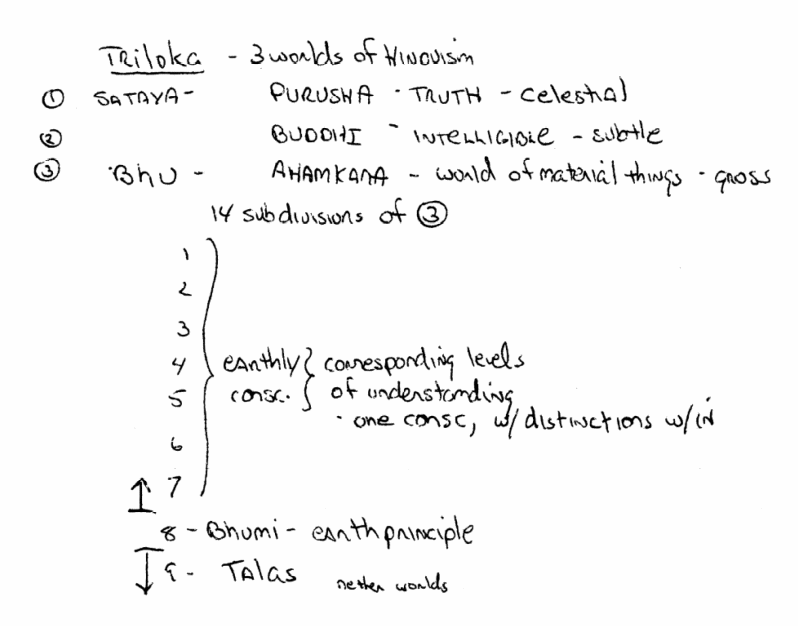
DIAGRAM appended to this transcript:
- FIGURE 1974 0315-1-AB. Triloka and Seven Levels of Earthly Consciousness.
[Transcriber note: [diagram] means the speaker is referencing a diagram as he or she is speaking. If someone is drawing or writing, with audible sounds of chalk on a blackboard, I indicate this by [drawing] or [writing].]
AD PAPER read in class:
- "Seven Levels of Earthly Consciousness". This paper uses Sir John Woodroffe's The Garland of Letters, Chapter XXX, "The Gayatri Mantra as an Exercise of Reasoning" as a base.
NOTE: For readability's sake, the following substitutions/edits made in Verbatim Transcript: cuz = because; gonna = going to; gotta = got to; yeah = yes; yous = you.
TRANSCRIBED Verbatim by IT prior to 2017, reformatted by jf 2017. In 2023, IT updates prefatory matter, footer, and audio file name, alters Subject and Subsubjects to make more accurate, adds TOC, completes Book List, fixes errors/typos, adds new notes within transcript, adds one diagram and reference within transcript to this diagram, reformats to accord with new conventions. Archival verbatim transcript with AD Paper – V12ap.
AUDIO FILES: 1974 0315a, 1974 0315b. [Note: "Tape" and "Side" refer to original audio cassette tapes that were later digitized into .MP3 Audio Files.]
1974 03/15 at Wisdom's Goldenrod
Epistemology; Vedanta
[Transcriber note: In what follows, AD is using Sir John Woodroffe's The Garland of Letters, Chapter XXX, "The Gayatri Mantra as an Exercise of Reasoning" as the basis for his summary (both spoken and written) of the seven levels of earthly consciousness.]
[Audio File 1974 0315a Begins]
S: Uh-hm.
S: Phil's (Sun/son) is.
[student assents, very faint]
[Note: See FIGURE 1974 0315-1-AB for the following.]
AD: Alright, the very first step. Shouldn't be too hard to memorize what we're going to say or at least know it, you know, understand it. This is like reviewing from the very beginning, ok? Very first step is, we'll take for granted that there's an outer or an external world. Oh, let me see, for Alan. I got chalk, so-- I make a little diagram. [drawing/writing] Now you heard this word. [S: Yes.] Haven't you all? What does it mean?
S (very faint): No idea Tony.
OG (simultaneously): There were three worlds there.
AD: Three worlds, huh? [S simultaneously, very faint: There were-- there were six, six of them.] We have enough trouble with one. Do you know what they are?
OG (very faint): No idea. [couple words inaudible] (laughter) (Now we're/There were) kind of--
[13 seconds of background student talking/laughter while AD draws/writes]
AD: Yes. I guess they never told you fairytales when you were in India, huh? Three worlds of Hinduism? Those of you that study Samkhya don't know, huh?
S (faint): Uh-hm.
AD: How do you study Samkhya if you don't know that? [short pause] Alright. These are the three worlds [diagram] and of course-- [S: Yes.] these are the me-- one of the divisions down here, they have corresponding to it, alright, the Satya, Satya, where am I talking [AD indicates on diagram]. Let's say this would correspond to the intelligible [diagram] and this to the world [diagram]. [aside: You got in, no?] What do you call it? What do they call it, you remember Om? No, huh? Three worlds. What were the equivalent? This was the truth, remember, truth [OG assents] was here [diagram]. Buddhi was the intelligible [diagram]. And this one [diagram], do you remember?
OG: (Didn't/I think) you ask(ed) me about that, did-- what-- what-- what about imagination?
AD: Huh?
OG: What about imagination [AD simultaneously: Yes.] [couple/three words inaudible] You want the Hindi [one word inaudible]
AD: The Hindi word. I know the English. (bit of laughter)
OG: Bhu? Bhu [one word inaudible]
[AD writing]
S (faint): [few words inaudible]
AD (simultaneously): Ah, you're a good boy. Alright, this here is divided up into fourteen [diagram], you know, I mean--
LS: I know, it's (all/old) Sanskrit, I don't know what it means.
AD: Well, first, second, and third level, right? (bit of laughter) Even--
S (simultaneously): [few words inaudible]
AD: First level reality, second level reality, third level reality [AD indicates on diagram].
LS (simultaneously): I got a comic strip mind though, (what the hell) does that mean?
AD: Alright, suppose we say the gross, the subtle, [writing] and the celestial.
LS (very faint): Yes. Alright then.
AD: Right? Alright, we'll take the gross world. And they got it divided up into fourteen layers. [drawing/writing] I don't know why fourteen but-- And then I-- the eighth is Bhumi. Is that right Om, [OG simultaneously: Right.] Bhumi? Alright? [OG: Right.] Then they got nine, all the way down to fourteen, ok, all the way down. [students assent, very faint] I don't know how you guys study Samkhya (to--/too.)
S: If it's in gross world, I mean that's a pretty broken vegetable. (bit of laughter)
AD: Alright, this is the talas [diagram], what they call the talas, but here-- this is what I'm interested in [diagram], see? Now above earth-- don't think of the physical planet Earth, just think of the--
LS (simultaneously): Does the word 'bhumis' and 'talas'-- (laughter)
AD (amidst laughter): What?
LS: What do those words mean, 'bhumis' and 'talas'?
AD: This is the earth principle. Earth.
S (faint): Ok.
AD: The term they use is Prithivi consciousness.
[Note: Parthiva consciousness is the term used in the text. Prithivi Tattva is used in reference to the earth-principle.]
S: Oh yes.
AD: Ignore this part [diagram], this is like going down to hell.
S (very faint): Yes.
S: Ok.
AD: They got fourteen classifications going-- I mean seven going down this way [diagram], ok, and they got seven going up this way [diagram], alright. In other words, the-- What I'm-- what I want to do here is very simple, is-- if this represents the earthly consciousness, alright, these seven levels, alright, there are corresponding states of consciousness with each one that would correspond to a level of understanding that we work with. And when a person fully understands and has firmly established in his consciousness the meaning that's involved in living here, then he's traversed all seven. Alright? [student assents] And I broke it down. I broke down what we've been doing in-- into seven steps.
S: Yes.
AD: Ok? And the first step is this here, the first step is, think of a person for whom the external world-- for whom the external world is real, ok? It's out there somewhere. It's stable. Now you're all familiar with that attitude, right?
S (very faint): Uh-hm.
S (very faint in background): (Has he ever been?)
[12½ second pause]
AD: Alright. The first level of consciousness as we start rising is that the outer--
LS (simultaneously): Number seven there?
AD: Yes, number seven. It-- it really doesn't matter, I mean you could flip them around.
LS: Sure, I just want to know what you're saying.
AD: Alright. The-- think of a person whose normal consciousness is such that for him the external objective world is real, ok? Now, you've met people like that. There's nothing, so to speak, but that external world which has reality for them. Alright, that's the first step. This external world, so to speak, is independent of your consciousness. You remember that attitude? You must have-- you must remember. [student assents, very faint] At some time when you were a child you said to yourself, "Well, that world is external, it's stable, it's objective, it's real, it's independent of my consciousness." You're familiar with that attitude, aren't you? (laughter) Alright. The second--
LS (simultaneously): The kind-- that's the kind of attitude that comes out when I go look for a job, say.
AD: Yes it might, yes, yes.
[students assent, very faint]
AH (faint): No, that's the kind of attitude that comes out when you don't find a job.
S: Yes, yes, because-- (laughter, student assents)
AD: Now, the second, the second step, the second step is that this objective world is not really so independent as we first thought, you know? The form it presents to us is due to the action of some sort of objective force acting upon the subjective sensations. Some kind of force within is operating on our subjectivity and the person begins to feel that the world is a little mobile, it's really not as fixed and as permanent as you thought, you know. Like if-- if you get Novocain or something, you know, and you come out of dentist's office. World isn't just the way it was before, you know, something altered it. You begin to feel that there's some force operating within which can change the character of your subjective sensations, and from then-- then on you start having ideas that perhaps this world isn't as mobile, I mean isn't as fixed, as stable, as in the first step, when you thought that the world was objective, clean, stable, reliable, you get up every morning, it's still there, (AD laughs a bit) ok? [short pause]
And, of course, you can see that the condition of mind that accepts this sort of an attitude is almost equivalent to tho-- to that of many thinkers that are materially minded, right? You've met people for whom what is real what they can grasp with their fingers, their hand. [short pause] These are the people, I think, if you try to have a philosophical discussion you would-- you'd find enormous difficulties set in the way. [students assent, faint] For these people, the objective world is independent of any consciousness. But insofar that a person has had some sort of experience or some sort of indication that these sensations that seem to arise within us are subject by-- subject to alteration, change, manipulation, you know, then that fixity of consciousness is-- that fixity of the world is doubted and a person has entered a sort of second level of consciousness. In other words, through the elaboration of reflection he's beginning to get a little suspicious about that world out there. [short pause]
Now, the point to keep in mind here of course too, and this may be difficult but, is that even though a person recognizes that some force is operating within him which alters the sensation, but nonetheless the subjective element is still regarded as being objective. It's still regarded as something in the world, something objective. You follow my point here?
S: No.
S: He's just saying at that level the subjectivity is just as objective.
AD: Yes, it's still a thing out in the world. That's--
S (simultaneously, very faint): At [one word inaudible] level(?/.)
AD: At the second level, when the person has realized-- In other words, if you realize that because your sensations have been altered and that there's some force within you which alters this-- these sensation, it is not construed to mean that something ideal has been altered but some sort of thing has changed. And whatever the thing is that has changed is the thing that's in that world of time and space out there. So you look at yourself and you say, "What happened?" you know. You look around. You're looking at something external, something physical, alright. It is not an ideal element in your make-up that you're beginning to suspect. You don't suspect that yet at this level.
S (faint): You could say that would be like taking Kant's thing-in-itself and--
AD: Taking what?
S: Taking Kant's notion of the thing-in-itself and trying to see the thing-in-itself as determinate.
S: Yes.
AD: Ok, yes. Ok Andrew?
S: Yes.
AD: Persist, if you don't understand persist 'cause this is just a simple [AH simultaneously: See--] summary of seven steps reviewing what we've done.
AH (very faint): In the second-- the second level, we kind of-- kind of relate to the-- to other than the world that we're in, you know, the real world. Ok, but, you're saying that--
AD: Look, the naive position, number one, is that the objective world is fixed and stable. The second naive position is let's say somebody injects you with some sort of chemical, alright, and instead of seeing pink you see blue and you start beginning to say, "Wait a minute, you know, the world as it appears isn't as fixed as I think it is," you know, because if something in here gets altered, something out there gets altered.
AH: Ok.
AD: Ok? But you're still, so to speak, identified with the physical body and the external manifestation. You're not thinking, "Wait a minute, there's a self behind all this."
AH (very faint): That'd be ideal.
AD: Yes, that would be the ideal, uh-huh.
LS: You might write a book called "The Chemistry of Consciousness".
AD: Yes, yes, there must be a consciousness or glands regulating the personality, yes. Berman wrote one. I remember when it first came out I was really enthused. (some laughter, AD laughs a bit) Figured I could change my personality with just-- change my glands around. (laughter)
AD: Now--
AH (simultaneously, faint): They're-- they're still very much materialistic, right?
AD (simultaneously): Very-- yes, very much so, very much so. In other words, the identification is with the physical body and any forces that operate on the physical body will naturally alter the perceived world. Alright, so you-- it's like you're saying, "This is me," you know, and if something happens to this here then something's going to happen to what this perceives out there. Alright? So it's out there. Think of the words "out there," ok?
AH (very faint): Is that the attitude which-- from which science or-- science inquires?
AD: Well, very often it does, although I-- I don't know, today it would be very hard to make a general statement like that. I'm just trying to trace, so to speak, the-- the various levels of a consciousness that's ascending in its understanding. And I started off-- and this is theoretical, I started off with a primitive. Richard isn't here, right? [S: Yes.] [S, very faint: Uh-hm.] Ok, and (bit of laughter) now this primitive is beginning to wonder about the world, alright. The third step is a little more interesting. The senses do not apprehend objects unless attention is directed towards them, you know. You know yourself, somebody's ringing a bell, and you're reading a book and you're concentrating and you don't hear the bell. And you come to the conclusion, "Gee, if I am not paying attention, even though the senses are functioning, I'm not aware of it," alright.
[Transcriber note: I do not have access to AD's paper which uses Woodroffe's article as a base. I transcribe it as AD reads it, including any alterations made during re-reading and with some notes indicating deviations from the article. Sometimes it is a little unclear whether AD is reading or speaking and this is noted as well.]
AD Paper ["Seven Levels of Earthly Consciousness," AD reading]: "So the third level will be where the senses do not apprehend objects unless attention is bestowed on them. Behind the Senses there is some Self which directs this attention and perceives it through the senses. Therefore the world (considered apart from what it may be in itself) is dependent [AD reads: independent] both upon [AD reads: of] the senses and [AD adds: the] attentive mind of the self which is behind them."
AD: Alright, the third step now starts getting a little complicated. You have the experience where you're reading, like the example we used, and you're doing something and your mind is paying attention to what you're doing. Other objects, so to speak, are made available to your inspection, you know, experience comes your way but you don't notice it. And then you reflect and you say, "You know, I was concentrating. That man told me he rang the bell for five minutes and I never heard (him/it). Now, that's very peculiar. After all, my ears are good, I should have heard the bell." And then you begin to realize, "Well, if my attention is not on the senses and the senses are not on the objects, then experience isn't available." So you start thinking, "Wow, look at that. Unless attention is brought to play, there's no perceived world." And then you say, "But what directs this attention?" I mean, why-- why throw your attention here and not there, what's directing it? Alright?
AH (very faint): Well even the case of so-called primitives, the attention [couple words inaudible] to all-- to all externals a little bit more, but, that even if there's been a lot of noises here that you haven't heard.
[student assents, very faint]
AD: Andrew, you drove a car, haven't you?
AH (faint): Yes.
AD: And did you ever see that it took a split second for your attention to be taken away from something that required it, and that split second was enough to have a very interesting experience, like going into a ditch, crashing, colliding? Huh? What took your attention away from what you were doing, which you-- you know that it's imperative your attention is on what you're doing.
AH (very faint): I just never even bought the distinction-- It was about what you're talking about. And-- and I don't-- I don't see the distinction. I understand it clearly in terms of-- of not really relevant but the attention is elsewhere. But it seems as though like the word 'natural' here--
AD: All these things are very natural, I know. But, I'm very suspicious of natural things. I figure they got a program behind them.
AH (very faint): Well, ok, here's where it ties in.
AD (faint): Right.
AH (very faint): Why must it-- why are we looking at phenomena as-- as level three and not level one, as-- I guess I know what you meant, it's important to do that [couple/three words inaudible]
AD (simultaneously): In the first level, in the first level, we took the example where a person, with a minimum amount of intelligence, an un-unified ego, is not only operating through the senses but is identified with the operation of the senses and thinks that that is the world. [AH, very faint: Ok.] In the second case we make a distinction, so to speak-- I mean in the second case we make the distinction where we see that unless the attention is bestowed upon the senses, those senses do not function.
AH (very faint): At the third level.
AD: I-- I mean the third one. And between these two levels, there's enough space in there to choke a horse, if I can use the expression.
S (very faint): Of course.
AH (very faint): The point is at the third level there is some kind of control.
AD: Not control, there's just an awareness that your attention, so to speak, has to be bestowed. Without attention it-- it doesn't matter that the senses function, alright. Your ears are perfectly operating, the bell rings, alright, but you don't hear it. Why? Attention, it wasn't there. What do you mean "wasn't there," where was it!? Somewhere else. "Ah, wait a minute, who's this guy running around, doing here, doing there, paying attention here, paying attention there?" So we make the distinction, alright, here between the senses operating and unless the attention is working through them, these senses cannot deliver you any information. Simple.
LS: His attention is still like material thing there.
[student assents, very faint]
AD: But we don't know what it is! We really do-- don't know what it is because you can see from another point of view you can consider this the Active Intellect.
[student assents, very faint]
LS: No, at this level I mean.
AD: At this level you don't know what it is, you still tend to identify it with something material, you know, the self is identified with the body. But you start reflecting on this, and when you try to grasp the notion of attention it's not available in any material form. [short pause] Come on. [short pause] The important thing here, of course, is to see that even though the world exists and the senses are operating, that if the attention isn't bestowed on these things, there's no perception for you, there's no experience for you. This is the third level, you start getting suspicious now. This is where perhaps-- you ever watch like a person is staring blankly and you tell him, [AD snaps fingers] "Hey, come on out of it," [one/two words inaudible] "Yes, yes, yes". You ever notice that phenomena? Alright. There's that attention, so to speak, which is absorbed in itself, alright. The senses, the body, the world is all there. But there seems now to be a wedge between these two. You begin to feel as though the attention, or who-- whoever is directing the operation of the senses, is certainly independent of the senses and what the senses are looking at. Isn't this the first real dislocation of that smug attitude, "I am the body"? [student assents] "I am this"? And the reason I gave the example about driving a car is there where, for instance, you can see a split second, your attention is diverted and you have a catastrophe on your hand. Is that a minor thing, that somebody in you decides, "Well, I don't like to live the way-- I don't like for you to go on living this way." [short pause] That's the third level, you see, we're going up that scale, you see? You're going up these various levels. Go ahead Richard, uh--
RG (faint): At that level, seems the attention could be still-- could still be conceived as in the brain although not in the sense-organs.
AD: Ok, sure. But still, the fourth level comes up about that, ok, ri-- right at that point. [AD possibly reading the next two sentences] There's some sort of knowledge of the self is indicated. The notion of a self arises. [short pause] What would you say to that? Now think-- think ontogenetically and on-- phylogenetically, think of the evolution of consciousness, so to speak, the way a person in a very primitive society operates. Number one, completely thinking the world out there is external and real; number two, that he has to use the senses, [student assents] alright; number three, that the attention could be either given to the sense or not; and then number four, "Wow, wait a minute, you know, maybe I'm a self, maybe I am somebody." [student assents] Think of it as there's a sort of ascending consciousness, alright, and don't think of it, you remember, like a Virgo, pigeonhole it, don't think-- (bit of laughter) What are you laughing at, I'm the Virgo.
S: [few words inaudible]
AD: You don't even know what that means yet.
S (faint): Well, I'll be patient.
AD: Be patient, couple of kalpas. Go ahead, Paul.
S: I don't know what you really mean by levels. [S, very faint: I don't either.] I know some people who--
AD: That's just a word.
S: Yes, but I still don't see-- like I don't see it really operating as levels. I know some people who firmly believe in the fixity of the world or say they are the body. And say that they'll be working on a project, and I'll say to them, "Hand me the hammer," they won't-- they won't hear me say that. They'll be very involved in what they're doing. And then I'll say like [one/two words inaudible] "Oh, oh, yes" and then they'll hear it. I don't understand what you really mean by the levels. Now here's a person--
RG (simultaneously, faint): These are levels of knowledge Adam, not-- not levels of being.
S: Yes, but both levels of-- are operating, one and three in that case.
AD: Well, do you remember [S simultaneously, faint: I don't see that.] the story about-- the story that Gurdjieff gave about these people that are-- two people used to come to see him quite often and one of them used to ask what he thought were very profound questions. And the other fellow, he was kind of quiet, he really didn't talk too much. And, you know, Gurdjieff was a great practical joker and one day he hypnotized both of them. And the fellow who was asking for always profound questions, Gurdjieff looked at him and says, "What do you want?" He says, "Give me a piece of bread and jelly." (laughter, AD laughing) And the other fellow, you know, who was very quiet, he really had some very serious questions but he wouldn't speak of them. So, don't go by surface appearances. (LS laughing) A fellow may say that, you know-- You don't believe me, huh?
LS: I believe, I believe. (laughter)
AD: He used to take them out and get them drunk to figure what they were like, you know. [S, faint: Ok, yes.] (Break) down their inhibitions and then you'll see them operate. (bit of laughter) The point is very often a person, you know, would say he doesn't believe, but don't go by wh-- the words, go by what he's doing, what he's saying. Fellow could say, "I'm-- you know, I'm such and such," and then he acts directly contrary. You've got to go by, you know, their condition of being. That's what Richard meant I think, huh? Ok? And maybe he's ha-- he-- maybe this fellow hasn't had enough time to understand through reflection, you know, thinking. Maybe he hasn't been given that opportunity, you know. If you point it out to him, maybe say, "Yes, you know, that's strange. Yes, maybe-- maybe I'm not the body, maybe there's something else around. Maybe there's a little mannequin inside pulling the strings," you know. But you-- you have to see that these divisions are for our understanding. They don't exist isolated like that, [student assents, very faint] [AB, faint: (I mean--/Uh-hm.)] and-- Yes, go ahead.
AB: In the first three levels could you say that a notion of responsibility for one's actions hasn't come in yet. Like (it occurs), then we say "I don't know what got into me."
AD: They don't (come self-conscious until) seventh level. Look at me, I've been a bum all the way. (AD laughing) Alright?
AD Paper ["Seven Levels of Earthly Consciousness," AD reading]: "At this level, the fourth level, a knowledge of the self is indicated."
S: Is this the third or fourth?
AD: This is the fourth now we're going into. Once a person begins to realize that the attention is directed, he starts assuming [S simultaneously, very faint: Ok, right.] that there's some self that directs this attention. And Richard says, well he identifies with the brain. Ok, he starts saying, "Gee look, you know, I'm a person, I'm a self, I'm an ego, I'm somebody." Alright? [students assent] The next one is a little difficult though. Now if this fellow that you ask for a hammer, you know, if this fellow starts asking, "Now, wait a minute. What's the relationship between the objects that the senses perceive, the senses that are directed by the attention, and the attention which more or less is directed by some sort of self, what kind of relation exists between these things?"
S: Yes.
AD: Well, [few inaudible student words simultaneous with AD] probably goes to the bar and starts drinking, you know. (some laughter) He goes and plays horses. [11½ second pause with background student talking, laughter] Alright Andrew? You f--
AH (simultaneously, very faint): I-- I started with the problem.
AD: No.
S: Uh-hm.
AD: Anybody else didn't get the point?
S (very faint in background): I still don't get [one/two words inaudible]
S (very faint): I didn't get (it).
AD: But we're just making a distinction now, this fellow-- the distinction here which is really big and [S, faint: Yes.] very important is, you start thinking about this and you start saying, "Well, there's the first point of view, there's an objective, external, real world," ok. The second point of view, the senses that perceive this objectively real world can be altered, you know, and then you perceive something that's a little different and you start thinking, "Well wait a minute, maybe that world isn't so mobile-- maybe it's not so fixed, it's mobile." Then the third point of view where you began to see, so to speak, that the attention was required. And fourth point of view, you began to consider the possibility that maybe you are a self. Now the fifth point of view-- Yes--
AH (very faint): So, in the third and fourth, you could almost say that the attention is directed in a specific way in order to-- in order-- in order to talk about an awareness of the self, like it's sort of--
AD: Well, again, if I could take the extreme example that we spoke about before where there was an accident, alright, you were driving and your attention was taken away from you, you know. This kind of emphasizes and highlights the fact that-- you start saying, "Well wait a minute, where was I then," you know? You make a remark like that. "Where was I? What was I doing?" You see the point I'm trying to get to? Like some emphasis is-- is brought out and you start saying to yourself, "Gee, you know, I was responsible." But this "I" that is responsible is not the senses, alright, and certainly not the external world. You be-- you begin to assume that there's some sort of "I" functioning here. Haven't you people studied any anthropology? Don't you read any diaries, (you know), Captain Cook's adventures, description of the way people behaved in primitive soc-- [Note: See James Cook, J.C. Beaglehole (ed.), Philip Edwards (ed.), The Journals of Captain Cook.] Do you all take academically credited courses, don't you read outside them?
[short pause]
S: Go ahead.
AD (simultaneously): None-- none of you lived in a barri I guess long enough.
AH (faint): I-- could I persist a little more with my--
AD: Sure, persist.
AH (very faint): Level three also had to do with it, (it started when I drove his, you know--) The attention is elsewhere. You know like, I can-- I used to drive-- I used to drive a great deal, um-- (laughter, student words) (Yes), and I had a job where I had to drive all day and, at the end of the day I didn't-- I couldn't remember how I did it.
AD: Andrew, I didn't say that you had to persist in consecutive continuous attention. I just said that it appears now and then.
S (very faint): I see, I see. (some laughter, student words)
AD: And you start saying, "Wow, look, if my attention isn't on the thing I can't figure out what's going on." And so then you go to school and they give you, you know, an example and you go home and you try to do your homework and you say, "But why can't I pay attention to what I'm supposed to do!?" What's difficult about that? You're beginning to realize that there's a you that's operative.
AH (very faint): Well you think of the example you gave where you-- the-- the attention is diverted for an instant and you wind up in a ditch.
AD: When it shouldn't be.
AH (very faint): When it shouldn't. Like if I have-- like-- [possibly another student: (ok)?]
AD (simultaneously): Now, that brings up the fifth.
AD Paper ["Seven Levels of Earthly Consciousness," AD reading]: "What is the relationship between the externally perceived world, the senses, the attention, and you who claims to be able to manipulate this attention?"
AD: What is their relationship? [AH assents, very faint] And like I said, you go to the bar and you drink it (up/off). You're not going to try to answer that.
AH (very faint): Well attention in this case is not necessarily thinking.
AD: No, not the thinking. Paying attention could-- you know, you pay attention. What are you paying attention to? The thinking that's going on.
AH (very faint): That's not attention (though).
AD: That is attention, isn't it? I mean, if you're not paying attention you're thinking, but you don't know that you're thinking. When you bring attention to it then you start becoming aware that you can think. Not correctly or incorrectly but that it can be done.
AH (very faint): So, at these levels anyway we're equating thinking with attention.
S (very faint): No, it's not.
S: Uh-uh.
AD: I'm trying to show you the difference now. Go ahead, go ahead.
RG (simultaneously, faint): I think that-- well, confusion again is all you're speaking of-- of (reflective/reflecting)--
AD (simultaneously): What confusion? I wrote this for-- for kids in kindergarten!
RG: (I'm quitting), I'm interested (with/what) levels of reflection on your experience.
AD (simultaneously): I'm not speaking of levels of reflection, I'm asking you to go back and go over in your mind and see if this is a sort of graduated ascending steps of understanding.
RG: Yes, right, levels of understanding but not levels of experience because all these levels are experienced, although unconsciously. I mean a man can direct his attention and yet not be aware that he has a mind because he hasn't reflected on the fact.
AD: I deny that. I deny that. It's impossible to direct attention and not to feel-- not to feel the notion of egohood.
RG: And to be reflectively aware of it?
AD: Not necessarily reflective.
RG: Yes, that's what I meant.
AD (simultaneously): Reflect-- like I say, reflection takes you to number five. Reflection you start saying, "Well wait a minute. You know, here's this-- here's this me directing the attention, alright, onto a certain problem I have." And now the whole problem comes up, implicit in this-- alright, in this operation, implicit in it is-- is the unconscious notion, the world, the senses, the attention that's bestowed on it, alright, and their manipulation. Or, what is the relationship between me, the mind functioning through the senses, and the world that's perceived, what is their relationship? You're no longer-- you're no longer, so to speak, a primitive. [RG simultaneously, very faint: Could I just--] Go ahead, go ahead Richard.
RG (faint): If we-- I'm going to take the-- if you take the example of scientist who let's say concentrates on a-- on a problem of chemistry or physics, his attention is being directed towards that problem and yet he could still consider that-- that what he is is a collocation of material properties.
S (very faint): Uh-hm, yes, that's (true).
AD: If you permit, if you permit, ok, me to remind you of the distinction you made between being and knowledge, between the man who was hypnotized and asked for a piece of bread and jelly, alright, (bit of laughter) and the one who was asking questions, alright. Now I want to refresh your memory. You know what that means? That the man could claim to be anything he wants but his being will point out what he really is. Now this scientist who says he's a collocation of atoms will tell you very clearly, "I love this piece of music. I love this piece of music. I don't like her." I am not speaking theory here. Like I told you, I wrote this for kindergarten kids. [S simultaneously, faint: (So doesn't--)] Anyone with a minimum of intelligence that is coincident with his being will understand what is being said here because I am not speaking anything theoretical. The chemist may speak theoretical, says "I don't believe in an"I"." And yet goes out and acts with the "I", performs with the "I", and lives for that "I". Now don't tell me what he believes and what he is.
RG (very faint): Right, I'm just saying.
AD: Just think of a plant growing up and it says-- it doesn't say nothing, it just goes on growing. It is what it is. Alright?
S: Well, Tony is this the level also where you--
AD: Again, let me remind you, don't use that word 'level' too tightly, you know, too precisely.
S (simultaneously): Alright, sorry. Well, if you say-- like, in the-- in the first steps, a primitive is aware-- aware of the world and then-- and then the senses and then the attention. Well many-- many philosophical views seem to like s-- they start with the external world and the senses and then through insight they call it an inner life, but it's not clear whether they mean a mind and the thinking that goes on in it or attention itself. Like is-- you know, like, are you bringing in thinking here?
AD: I want you to ask the question. Just ask me a question.
S: Well I'm wondering where thinking comes in. Whether--
AD: We're not talking about thinking.
S: Whether you've introduced thinking as part of-- part of attending to the-- the outer world, whether it's, I think, like, I guess Jung would say the ideational components of the sen-- sensation.
AD: Tell me what you say.
S: Well I-- I call that the perceived part.
AD: No, tell me what your question is Andrea.
S (simultaneously): I'm-- I'm wondering whether on this-- this level that you're talking about where-- where there's--
AD (simultaneously): On what level am I talking at?
S: The-- the fifth level where you have an "I"--
AD (simultaneously): I haven't started talking about it, all I said is the fifth level comes in--
S (simultaneously): Well, we're just trying to get acquainted.
AD: Huh?
S: I mean we're trying to get acquainted. But go ahead.
AD: I just-- I just pro-- I just read one sentence, "What is the relation of the self, senses, and the external world?" This is the question [student assents, faint] that comes up now at the fifth level. [S simultaneously, faint: Right.] I haven't spoken about it.
S: Oh.
AH (very faint): Could I ask-- [S simultaneously: (Two/Too/To)(--/.)] could I [S simultaneously: Well--] ask a [couple words inaudible] I think it would be part of Andrea's question. (bit of laughter)
AD: Sure, (go ahead).
AH (very faint): Well, like what-- I don't understand the distinction between thinking and the senses.
AD: Well I'm not talking about thinking, we-- we haven't spoken about [student assents] that.
S: Oh. Ok.
AD: Why do you people bring in problems for yourself that don't exist? Don't you have enough to handle this here?
S: Thinking's a problem.
AH (simultaneously): Well, I wonder-- I wonder what it was that (went/meant)--
AD (simultaneously): The first-- what was the first level, the first-- Step A, ok? (some laughter) Step A. Step A, think of a child, he's born, and there's the world, and he goes and touches it and for him this world is fixed, stable, reliable, in the morning he gets up he knows just where his chair is, he goes there again. Step B, alright, he gets his tooth pulled out and he's got a swollen jaw and that chair, he sees it there but when he goes for it he finds out it's over there. Now he says, "Wait a minute," (some laughter) alright. "Something wrong here," alright. "That world isn't so fixed. I have to be fixed too." Ok? It's simple, let-- don't complicate it, I'm not talking about thinking. I'm just trying to show you grades of ascending consciousness of understanding.
AH: I was following pretty well until you used the example. I don't know what it was that lapsed when I drove in a ditch. (laughter)
AD (amidst laughter): Forget the example then! Forget the example! (AD laughing, laughter, student talking)
S (faint): I think like all these examples should be permeated with different levels of being, you know, and just the examples are giving the wrong information with the-- with (the/this) (situation).
AD (simultaneously): Well then why, tell me, why do they make such an effort to misunderstand it? (laughter, student words)
S (faint): (Well then if you) use an example you can understand the example, if something happens that happens in the world then many different levels of being, that the-- that the level of being that you're trying to express is very simple.
[student assents, very faint]
AD: Jeff, would you please get me some coffee and put some vodka in it. (laughter, student words)
LS (amidst laughter): Hey Tony, (can/could) (I just give you) [couple words inaudible]
S: (Impress us/Impressive).
AD: Yes, go ahead.
S: [one/two words inaudible]
LS (simultaneously): Listen, I [one/two words inaudible] in that example you used about going in the ditch, it's kind of like that the scales fall from the eyes and one-- one notices that the attention must be real because it wasn't there for a moment. That's the way I was understanding that-- that example.
AD (simultaneously): Very good, very good. Very good. He may have been operating with attention for a long time but now it's forced home, that there is such a thing, yes.
LS (simultaneously): Yes, the existence of-- the existence of it as a thing, as a separate thing from the senses.
AD: From the senses.
LS (simultaneously): Yes, right.
AD: Quite different. So we have-- we have this kind of a situation--
AS: Tony, but-- that example of scales, could you look at it like one at a time these-- these--
AD: What scales?
AS (faint): The--
AD (simultaneously): Music scales?
AS: No, like, you know, fish scales.
AD: The what?
LS: Scales fall from the eyes?
AS (simultaneously): Fish scales. Or like that onion--
LS (simultaneously): Oh, Bhattacharyya uses, right, uh-hm.
AS (simultaneously): Like the onion example we once had, something like that, [S simultaneously: What?] you know like-- (laughter)
AD (amidst laughter): I hate onions! (laughter, students assent)
AS: You're looking at this whole--
AD (simultaneously): Give another example.
AS: I-- (laughter)
LS: Fish with onions, he's really cooking up a dish here. (laughter)
AD/S(?) (amidst laughter): Fish with onions.
AS (amidst laughter): Nah, I better decline.
LS: It's not sattvic either. (more laughter)
AS (faint): I must be hungry, I better [couple words inaudible] (laughter)
AD: Have-- haven't you noticed for instance that you can speak to people-- and you-- you were a high-- you as a teacher, alright, you speak to kids, some kids, some children for instance, you know that they-- they really have to be handled according to the objective world, they have no other way of understanding. And there's other children, you can talk to them and use any concepts you want and they-- they grasp quick. Now it's very obvious there's a difference of understanding, of conscious understanding by various people, alright. And as much as we dislike the IQ notion there is some truth, it does-- it does have some truth to it in the sense that there is an intelligence that's available to an ego which is manipulated or not manipulated. A child that's emotionally disturbed can't manipulate his intelligence. To deny these obvious facts is really childish. And all we're doing is trying to point out that there are levels of understanding or of consciousness that people operate with.
And a very primitive person, if you take a person like a Neanderthal man, I don't know if there is such a thing, (laughter, AD laughs a bit) but I'm quite sure, you know, if we use him as an example, and we won't hurt no one's feelings, this man is dominated completely by the objectivity and the fixity of that world he lives in. He has to be. Biology comes first. And when that tiger is approaching him he has no doubt as to what he's going to do. [students assent, very faint] The second level is where we said again, that tiger was grey-- that tiger was red, but he saw it grey and then he begins to realize, "Gee, there could be influences that are working on my body that alters my perception of the world," alright. And three, "The tiger growled, I didn't even hear it. Wait a minute, where was my attention," alright? These are various facets of one-- you could say that all this, all this is really one consciousness [diagram] and we're making this-- these distinctions within it to help us understand how people could operate at various levels.
The fourth-- fourth level when the person starts saying "Oh, wait a minute, there's an"I" here," you know. And this is an important level because the humanity as a whole has not yet developed sufficiently its notion of an "I" and the meaning of "I". This is a very important step and Jung goes to the point where he derides the entire Eastern doctrine because of its inability, so-called inability to understand the meaning of the "I". Well, I doubt that part but nonetheless you can see how important this "I" is to him. Suddenly you start becoming aware that you are an entity in your own right. Now, as soon as that comes up, then you start saying "Well what is the relationship between me--" in other words, you're sort of pushing the "me" away from the physical identification, "between me, my brain--" they don't say senses today, they say "me, my brain, and that world that I perceive?"
LS: Yes, but, Tony you wouldn't do that unless there was a felt lacuna in the relation between the me and the-- and the world. A felt gap arises.
AD: And what would that gap be? [LS simultaneously, faint: (I don't know.)] We pointed out that it might be some sort of experience, you know, like driving in the ditch.
LS: Now in this case it'd be kind of a, say a felt inability to control circumstances or a noticing of the difference between our concepts and the circumstances that we're dealing with [one word inaudible]
AD (simultaneously): Alright. Or also [LS simultaneously: (Want another one?)] let's say, for instance, an inability to control your attention when there's need to control it. And so a conflict that's set up within you and let's say what you want to do. And this conflict always certifies to your I-ness. There's nothing like conflict to make you start thinking you're somebody. You go around start saying, "I'm suffering!" (some laughter) Alright, [S: Yes.] so--
S (very faint in background): The fifth one is the hard one.
AD: The fifth one is the hard one though, because now that you-- you so to speak distinguish these various things, you're trying to relate them. This "I", alright, operates through a brain and senses, perceives an external world, alright. What is the relationship between one and the other? What is the relationship between the world that I perceive, alright, my senses, the attention bestowed on the-- the senses so that it interprets the world for me, and the "I" who is operating this machinery? What is the relationship? [short pause]
The first thing of course be-- that becomes obvious is that these perceived objects are not independent. There's no perceived objects unless there's senses to perceive them with. And there's no-- there's no perceived object even if the senses do see unless the attention is bestowed on the senses. [10 second pause] Yet, yet, we notice a peculiar thing, that even though, even though, let's say, your senses are operating, your ears aren't plugged, somebody rings the bell, and you're-- you're not-- you don't hear the bell. I bet you've had this experience, haven't you? Some sort of experience where even though the senses are perfectly functioning, alright, you're not there. You're not there. And so you start wondering. You start saying to yourself, "I wasn't there. I was sort of absorbed in myself. Well that means that this self here or whoever I am exists and can exist independently of that." [students assent]
Let's go over this. You're reading a book, you're very concentrated, and then you go into brown reverie. Somebody rings the bell, you don't hear it. Your ears aren't plugged, they're-- they're functioning, your inner ear drums are vibrating away, the message goes up to the brain--you went through all this epistemology--but you don't hear it. And then you come out of it. Guy confronts you, says "What's the matter, didn't you hear me hear-- ringing the bell!?" You say "No. No, where was I? I was wrapped up in myself. But that means that I could exist independently of the functioning of the senses." And dream is a perfect proof of that, alright. In dream, the self is cut off from the external world, right? Cut off from the sen--
(Side 1 of original cassette tape digitized as 1974 0315a Ends; Side 2 Begins)
AD: --thing here is you begin to see that this self is the ground, the ground from which the self evolves the necessary senses and objects to have a world of experience. The self is the ground. You got a feeling for what I'm saying now? Almost like it exists independently, alright. I didn't say quite but, you know, you get a little suspicious. [student(s) assenting, very faint] [11¼ second pause] You follow this point? Like this will be like coming to the fifth level of consciousness, alright, you--
AD Paper ["Seven Levels of Earthly Consciousness," AD reading]: "The sixth level would deal with the nature of the relationship between the cause, that is, the self, alright, producing the objective world and the effect that is so produced."
AD: In other words, take the example of the dream. And in a dream this self evolves a world of experience for you. And you start wondering, "What is the relationship between this world of experience in the dream and the self that's producing this dream? What kind of relationship is it?" And you say, as we said before, we said that the self is the causal or the ground for this experience. You know what we mean by that? Oh, what would the word suggest to you?
S: Source?
AD: The source, yes. It's the matrix, [students assent, faint] creator.
[student assents, very faint]
OG: Well it's just now it's not clear how you connect the-- those people that (is central to) [few words inaudible] pointed to the example of a dream. But from that dream example of the dream I don't know that (really).
AD: From the example of the dream we pointed out that the self here is cut off, is cut off from the external world, which includes the senses too. Then you have a dream. Now in this dream, alright, the self evolves from itself, because there's no external world, [student assents, very faint] but from itself it evolves this dream. Now if it evolves this dream from itself that means it is the cause of this, isn't it? And if it's a cause, what kind of a cause? It's an ideal cause, isn't it? [students assent, faint] I mean it's-- the ideas are getting projected out so it's an ideal cause and the ground for this dream experience.
OG (faint): Ok Tony, if you want, you're able to think that everything is a-- the idea is they're full of the [three/few words inaudible]
AD: Uh-huh. Now, from the example of the dream we come to the conclusion that no material was needed on the part of the self to evolve this world, ok? The dream world, that is. No material was needed. Everything came from within itself. [student assents, faint] And therefore there is no need to postulate an objective factor outside of that situation, outside of that relationship where the self evolves from within itself a world of experience, a dream world of experience, right?
[short pause]
S (faint): Postulate an objective factor outside of what?
AD: Outside of the dream world. You don't-- in other words, when you're having a dream, you don't say "Ah, wait a minute, what caused that dream? Oh yes, somebody left the faucet running."
S (very faint): Yes, say that (if you) go back to the dream.
[student assents, very faint]
AD: That faucet running could cause all kinds of dreams, and none. So by definition you couldn't prove that. You can't tell me just because your hand was lying like this that you had a dream that a pirate cut it off. I could just as well say why not a tig-- tiger bite it off, or why didn't it grow eighteen feet? [student assents, very faint] The point that we're trying to get here is that you cannot bring out, you cannot bring in to explain the contents of the dream anything outside of you. [S simultaneously: Is it that--] Go ahead.
S (faint): Do we have to import, I mean, in order to have the experience arise in you of the dream?
AD: Yes, your eyes are closed and here everything is lit up. Some even have television, you know, regular cinema colors and-- bright colors, rainbow, color television. Alright.
S: I didn't (get--/get it.)
S: Yes but Tony, if-- if-- if I have a dream and like I perceive objects in the dream and I know that this dream is evolved from within me, like I only know that from outside of the dream, I don't know that inside the dream. And inside the dream-- I mean there's a difference between the me inside the dream and the me that-- that knows that the dream is a-- is being evolved. I mean because like-- because when I wake up I can see how the dream came from within me. But from within the dream it doesn't seem like it came from within me.
AD: Uh-hm. Yes. How about sometimes when you have the experience that you know it's a dream?
S: (What do you mean?)
S: So that's forty.
AD: What?
[short pause]
S (faint): Uh-hm.
AD: So I can go on using it as an analogy, right? [short pause] Anybody here have the experience that they know they're in a dream (when/and) they're having a dream?
S: Not really.
AD: But we can go on using the analogy.
S (very faint): This is six.
S (very faint): Yes.
AD: It's too bad [one/two words inaudible]
S (simultaneously): You wake up though.
S: Yes.
S: But you don't have to.
S (faint): Yes.
S (faint): It's more fun if you're still in a dream, play it up. (laughter)
[14 seconds of background student talking, laughter]
AD: Alright, again, we go over this notion.
AD Paper ["Seven Levels of Earthly Consciousness," AD reading]: "The sixth, the nature of the relation between the cause, that is, the s-- whatever is producing this dream, or producing the objective world, and the effect. As we said, we rejected that there could be any material cause outside which we would have to bring in to explain. So therefore, the explanation has to be in terms of what's going on from within. We rejected the material cause which precludes an effect that's external to itself and instead considered the objective world can only be ideally connected with its cause."
AD: In other words, in terms of the dream analogy, we would say that the manifested dream world can only be produced from ideas within, ok, ideally connected with whatever that ground is. And whatever that ground is, so to speak, we're speaking about it as projecting and externalizing in the course-- you know, were trying to bring it in relationship with the Higher Self, like the Higher Self does the same thing like the dream, in dream, you know. In dream we evolve all this world out of ourselves. And, what I'm asking you to do just for temporary point of view is to realize that the Higher Self, from within Itself, alright, evolves everything from within Itself. You don't have to go out there and say, "What causes me to see this objective world? After all, this objective world arises from within me. And the connection to that world is from within me." In other words, in understanding the dream I don't have to go outside the dream but right within the dream itself, alright, is everything that I want. In the same way, when you're awake and you try to explain to yourself the existence of the objective world, you don't have to go outside the world, get behind it, and say, "Ah, that's where it is, that's the cause." But all explanations would have to be found within your experience. Go ahead (Richard).
RG (faint): Then, I mean, the analogy with the dream with sensible perception would be that all the explanation of the material cause already posits perception as the cause and you have to account for the creation of that in space and time.
AD: Are you trying to say something like this? You begin to realize that thought, so to speak, is creating this so-called perception, and that perception is simply another mode of thinking. Right, that's what I've been saying.
RG (faint): That it's impossible to account for perception in lieu of the dream.
AD (faint): Uh-hm.
S (faint): Yes.
AD: You don't go outside, you have to stay right inside. [students assent, very faint] Now, when this-- when this understanding, understanding, you know, part of your being-- I'm not talking about understanding here that you're going to give me back on a test because I don't give you no test. The Boss outside gives you the test. And if you don't believe me, you wait for an occasion, you'll find out fast enough what you really believe. When I say "you", I mean right down from the visceral region up, not from here down. You understand what I'm saying Paul? [S simultaneously, faint: (I understand.)] A lot of people think they understand. But that's BS. I told you the experience when I was sitting in a booth once? And I was concentrating. And this fellow comes over and puts a gun right into that opening in the cage. You ever see the front of a .38? Looks like a cannon. And, it was a hold-up. But I was concentrating. And I stuck out the tokens, "Come in," alright. (laughter, student assents) I don't know, a few minutes later, few minutes later, the good old ego came back and I was normal again. "Wow, that was a gun!" Right then and there, diarrhea! (some laughter, background student talking) You see the difference between the being and the guy who thinks he is that being?
S (very faint): Did he run away?
AD: Huh?
S (very faint): Did he run away?
AD: He ran away, yes.
S (very faint in background): What's his name?
AD: But he was there for, I don't know, a few seconds. I guess he was getting impatient with me. (laughter) But I was, I was really oblivious, alright. The point is, when the ego returned, and the ego has got this pattern, you know, this ego is patterned in a certain way, has certain activities, it's got a certain style of life, alright, and as soon as it recognized that that was a .38, even though that .38 was gone, probably was three blocks away somewhere, that little ego, identified with that body, right and then there got diarrhea, couldn't make it to the toilet. (laughter) You see the story about the fellow who wants a piece of bread and jelly? [student assents, very faint] Well, alright.
S (simultaneously): [couple/three words inaudible]
OG (very faint): I don't see the-- this point.
AD: You don't see the point Om?
OG (very faint): Not just [few words inaudible] (bit of student chuckling)
[student assents, very faint]
AD: Well, let's try-- let's try this way. When I said that [S simultaneously, very faint: Yes.] this level of understanding, when it is firmly established in your consciousness, alright, then you call this the sixth level of understanding.
OG: You have all these five levels [few words inaudible]
AD: Yes, now you reach this level of understanding, this is what you are in your being [AD tapping on something to emphasize point]. This is not something you think. You may not even [AD tapping on something to emphasize point] think this and yet be this. In other words, a person has no-- no philosophic background but he knows the world comes from within his-- Himself, that's capitalized, ok? He may have no philosophy. But this is a belief in the sense that it is his being, this is the way he is. If you tell him, "Well, you know, if I take that away…" He says, "What can you take away from the Self, what are you talking about?" You could be born in the Fiji Islands and ha-- be, so to speak, [AD tapping on board/diagram] established in this state of consciousness.
S: He's a self-made man.
S: Well then everything I [one word inaudible]
AD: You bet your life he's a self-made man. And [couple inaudible student words simultaneous with AD] if you could give this as a, you know, an answer on a test but it doesn't mean anything.
OG: [few words inaudible]
AD: Huh?
OG: [few words inaudible]
LS (simultaneously): Well it's just a man who automatically takes [S simultaneously, faint: (one word inaudible) right.] responsibility for everything that happens to him.
AD (intensely): What do you mean automatically? A man who through much toil and sweat and tears finally began to take things and be responsible for them, that's what you mean, isn't it?
LS: Yes.
AD: Yes, the-- sure, he's right, sure. And it takes a long time to start admitting that you're responsible for yourself. And when that kind of attitude is established, that's what we're talking about. The establishment of this-- of this attitude, so to speak, or this understanding is not something that's subject, let's say, to the activity of the brain. It is grounded, it is your style of life, it is your being. I cannot, so to speak, speak of you without speaking of that understanding. You are that understanding. Just like, for instance, if you were to walk and somebody raised his hand you would automatically, alright, protect it. That is your being, you can't help that. Imagine a man who you go to strike and he doesn't do anything. That's his being, isn't it? You can't come over and say, "Self-preservation is the most important thing in life" because he may disagree. And not by arguing with you. (bit of laughter) But by showing you that when you raised your hand to strike him, no reflex took place. See the difference now? The establishment of that sixth level of consciousness, ok? It's really hard, I know, because most of us--
You remember that quote I'm so fond of when Jung says, "Between an intellectual concept, a verbal concept, and the actual psychological experience, there's-- there's a-- a world of difference." [Note: See C.G. Jung, CW 9, Part II, Aion, p. 32, paragraph 60.] You could have an intellectual concept, and you might even think that you understand that concept. Ok. And then experience shows you, you never believed it. Because your whole being doesn't-- the other nine-tenths of you say, "Nothing doing. You can't get me to do that." [students assent, faint] So, that's the sixth level. A-b-c-d-e-f, the f-level. (some laughter) [S laughing: F-level.] The f-stage. I'll get rid of all these precise terms sooner or later. (bit of laughter)
How about that? You follow so far? Put together your Steiner work, alright, what you've been doing in Steiner for instance. In Steiner you've been recognizing the fact or gradually being made aware of the fact that the reality that's manifested to you is a reality that's manifested because of your thinking. Now, if I gave you a question like that, suppose I was going to test you, alright. Now, how far up and down that ladder of six steps that I gave you would you go with that? In other words, what I'm saying is, do you really believe what you understood when Steiner said that the thinking produces and manifests this empirical reality, or is-- is it at the level of a concept yet? And if you're honest, alright, you say to yourself, "No, it's still at the level of a concept, I haven't brought it into me yet," alright.
S (simultaneously): No that-- that's what I was going to say about the dream because if I like-- very often if you wake up you have a thought and then there's the dream right then, and you could almost see how it was-- it was that particular thought that created the whole dream, and it's-- it becomes very clear to-- I mean the dream example is really good for that, but to show-- to show the relationship of thinking manifesting reality. So, I mean I guess it can be used psychologically as well but-- you know, it's really--
AD: You think you have disagreed with what I've said.
S: No, no, I'm--
AD: Yes. Yes. You think that you have disagreed, that you've pointed out something. You haven't. You've only ascertained precisely what I'm telling you, that a concept that's in your head is not the experience.
S: I don't know what you said.
AD: You don't know what I'm saying?
S: To say that I have a thought and then see how the dream unfolds from it, why is that just having a concept?
AD (simultaneously): That is a concept in your head.
S: You mean that-- that I'm--
AD: How do you see a thought transform itself into an appearance of a dream?
S: Well like if I-- if I think about(,) (I mean/any)-- Well I mean, we have to look at a particular example and then-- and then it would depend on, you know, the interpretation.
AD: But then you're not seeing anything, are you? You're just imagining all this.
S: Granted.
S: You mean, you mean I'm using my mind and looking at a situation [one/two words inaudible]
AD (simultaneously): You're using your imagination, you know, to fulfill this thinking requirement that you've set up for yourself. [short pause] In other words, the game of symbolical sport goes on.
[student assents, very faint]
S: Right. [student assents, faint] Could be.
AD: Alright.
S (faint): Yes. That's what [few words inaudible] and that's really what you mean though.
AD: Alright, the seventh stage. Well, whether you take it from the point of view of the dream, alright, or you take it from the point of view of philosophic understanding-- in other words, let's say you've elaborated your understanding through philosophical reflection and deepened it through meditation, alright. Either-- you can follow either path or follow both of them, try to understand the seventh step.
AD Paper ["Seven Levels of Earthly Consciousness," AD reading]: "There is no matter outside the self."
AD: In a dream you begin to say, "Well, there's nothing outside my self, you know, what am I looking for? It's all within the self," alright.
AD Paper ["Seven Levels of Earthly Consciousness," AD reading]: "It may be thought that there was an ideal connection with the objective world, so to speak, on the causal side…"
AD: Just like for instance, when you're firmly convinced through thinking that this world is the result and the manifestation of your thinking, you'll see there's another part of you that sneaks out and says, [spoken in a gruff voice] "Wait a minute, there's got to be something there!" (laughter, background student talking) Then comes back in [S simultaneously: We call it Neptune] and is agreeable, "Oh yes, sure, sure, that's what--" And the other little part of you, you know, he runs around a-- alright.
S: [couple/three words inaudible]
AD (simultaneously): There-- Huh?
S (very faint): [few words inaudible]
AD: You remember what Vedanta says, every doubt has to be firmly ensconced, it has to be brought out, fully explained. You can't suppress it. You ought to be thankful that you have a doubt. Never mind Descartes' doubts either. These are real doubts, alright. And if a person says, "But I'm still not firmly convinced that it is thinking which produces the manifested reality for me," then he ought to sit down, "Damn it," [AD hits something to emphasize his point] say "I don't get up till I find out!!" Ok? Many of us have to be brought to a point of desperation before we begin to wake up. Serious business. Life is a serious affair. Sooner or later most of us find out that no one's exempt from suffering and it's going to come your way. Even that's not enough. Anyway, we go back, step number seven.
AD Paper ["Seven Levels of Earthly Consciousness," AD reading]: "There is no matter outside the self. It may be thought that there was some sort of ideal connection with the objective world on the causal side, [AD: Something was causing that world, you know.] [S, very faint: (Energy.)] but that the root of the objective world upon which it operates was something lying elsewhere than in the inner being."
AD: In other words you could say, "Well, something outside was causing this dream," or, philosophically, "Something outside, alright, is causing the appearance of this here, of this pole."
LS: So at the sixth level the-- the idea of matter is splitting the idea of the self into cause and effect instead of losing-- letting it go through (and assuming). Here you're saying the idea of matter also lapses with that.
AD (very faint): Yes.
[student assents, faint]
RC (very faint): Ideal connection with (the--/it?)
AD: Well, in other words, an ideal connection would be, if you have a certain dream going on, this dream is manifesting ideas that are coming from within you, so that this manifested dream is connected in terms of thinking or in terms of ideas to the inner being. [student assents, very faint] These dreams are nothing but a manifestation of my ideas, even though I can't see that process. I know that, let's say I go to sleep tonight and I dream about a red rose, alright. Well, that idea has to be within me. And that red rose is a manifestation of an ideal content within me. So it's connected to that ideal content. There's no sense looking outside to see where the connection is. There is no outside. Alright, but this is really cornering me now in the sense that you are being forced to submit to the dictates of thinking that says, "Look, there is no other world than what your thinking produces for you." And if your thinking produces this world for you, then this world is connected to you ideally from within. Don't go looking outside and say, "I'm going to get behind what that thing is and find out (AD snaps fingers) what its substance is and its matter."
RC (very faint): The idea is like a bridge between the empirical subject and empirical object per se? That it [AD simultaneously: Well--] now becomes the whole [one word inaudible]
AD: You see it's harder to think-- In other words, this here looks much more real than the idea that you may have, ok. The idea is much closer to you and much more difficult to distinguish from the self than the so-called object out there.
S: Tony--
RC (very faint): Ok, but it may be thought that there is this connection if I'm thinking that there's an idea once you get to a certain-- to a certain level. I'm still thinking that-- thinking that there is an idea.
AD: But even more so. But even more so.
RC (very faint): (Have 'em disappear again.)
AD: That that thing is your idea! The idea objectified. [student assents] What else is that red rose, isn't it an idea objectified, it's not a thing? [short pause] Go ahead, uh--
S (very faint): Can you-- I mean I'm trying to get a perception of the difference between six and seven. Could we say that that's it?
AD (simultaneously): Well, I'm not finished with seven yet.
S: Oh.
AD: Let me finish then, [S simultaneously, very faint: Ok, uh-hm.] let me do the whole thing, seven.
AD Paper ["Seven Levels of Earthly Consciousness," AD reading]: "The objective world, as effect, must necessarily be within the cause or the self, [AD: Whichever analogy you're working with.] otherwise it could not be ideally connected with the self [AD: or with whatever that cause]. If the connection with the cause were something other than the constitution of the cause itself, there must be an indication of what that something is and the nature of its connection with the cause."
AD: In other words, if we think of the dream, and we try to say that something outside the dream caused it, we would have to find some sort of connection, hence, to connect it with a so-called or supposedly something outside.
[short pause while AD flips pages]
AD Paper ["Seven Levels of Earthly Consciousness," AD reading]: "It is reasonable, consequently, to hold something like this, [AD: And I say reasonable, alright.] to hold that the objective world is necessarily in its root brought about by the cause or the self. The effect ideally is connected with the cause and that this connection is due to the constitution of the cause itself. The entire objective world is viewed as lying within the cause. The whole universe is viewed as lying in a seed form, [AD: for instance, if you're thinking philosophically] ideally and potentially within its cause [AD: That is, the Self.]. [9¾ second pause] This indwelling Spirit…"
AD: And at this seventh stage now, that we're speaking of now, we're speaking about the Gayatri Mantra by the way.
AD Paper ["Seven Levels of Earthly Consciousness," AD reading]: "…is often referred to as Savitri [Transcriber note: Savita is the term used in the text]…"
AD: Om, is that the way to say it?
OG (very faint): Yes.
AD: And in the Gayatri deity, deity-- Do we have that book here, The World Mystery? [Note: See G.R.S. Mead, The World Mystery.]
S (very faint in background): We have one.
AD: Yes, could I have it for now?
AD Paper ["Seven Levels of Earthly Consciousness," AD reading]: "…Savitri, the indwelling Spirit, the Projector of the Universe out of Its own thought, without external aid. This externality notion [AD: this notion of externality] which commences at the stage, for instance in Samkhya, of the Ether, reaches its greatest power in the principle of earth or Prithivi or earth consciousness."
AD: Follow what I'm saying, those of you that are interested in Samkhya.
S (very faint): I'm trying to.
AD Paper ["Seven Levels of Earthly Consciousness," AD reading]: "Savitri, the Producer, though really the Inner Self, is itself externalized as something placed out in space and is often designated as That."
AD: Now, it's very strange because what is the most externalized, oh-- In other words, what is the most externalized by Savitri is the Thatness, is to us the most inwardness of our own being. Let me-- let me--
S (simultaneously): Can you do that again [one/two words inaudible]
S (faint): Yes, read that again.
S (simultaneously, very faint): [few words inaudible] for that.
AD: Alright, let me-- this is a very short mantram, the Gayatri, which is probably the most famous mantram in the-- I don't think we-- I don't think the Brahmins have given us-- they-- they just-- the whole thing is unavailable, is-- I'm quite sure.
OG(?) (very faint in background): I think so [one/two words inaudible]
AD: Huh? Do you know it, Om?
OG (very faint): (Uh-hm/Yes).
AD: Why don't you say it for us?
S: [one word inaudible]
OG: "Om Bhur Bhuvah Svah
Tat Savitur Vareniyam
Bhargo Devasya Dhimahi
Dhiyo Yo Nah Pracodayat"
AD: This is the English translation.
Sir William Jones [Gayatri Mantra (1807 free translation), AD reading/reciting]: "Let us adore the supremacy of that divine sun, the god-head who illuminates all, who recreates all, from whom all proceed, to whom all must return, whom we invoke to direct our understandings aright in our progress toward [AD reads: towards] his holy seat."
AD: In other words, our reasoning has to participate in Its reasoning in order to be guided to that sanctuary. And these seven steps that we just have spoken about, these seven steps, from here up [diagram] represents the earth consciousness, ok. These seven steps, so to speak, were steps distinguishing the evolution, the growth, and the understanding of a person. And he will go through these stages, sometimes maybe one, sometimes two in a life, sometimes many in-- before he grasps one. But there will be this ascending-- this ascent of consciousness. And when he reaches this seventh stage where he realizes, and it is firmly established in his consciousness, that whatever is, is ideally and causally connected to the self and is pr-- pro-- let's say, produced by this inner self, alright, then he has achieved somewhat what they call this earth consciousness.
S: Yes.
[students assent]
OG: What you have just read about the meaning of the [one/two words inaudible]
AD: Uh-hm.
OG(?): I don't (feel) the Hindu version.
AD: Well, there's quite a few. What-- what's the meaning you have?
OG: "I meditate on the divine [one/two words inaudible] brought the light of Dharma to teach the (humility/humanity) to-- to teach the (humanity/humility) to make three states of consciousness like [few words inaudible]"
AD (simultaneously): No, no that's wrong. Start off the-- start off the-- Start it.
OG: Yes, "I meditate on the--"
AD: No, start it in Sanskrit.
OG: Om.
S: Uh-hm.
OG (faint): Bhu--
AD (simultaneously): Next word.
OG: Bhur.
AD: Spell it. [AD writing]
OG (faint): B-h-u-r.
AD: Next word.
OG (simultaneously): Bhu-- Bhuvah, B-h-u-v.
AD: "B" what?
S: B-h.
OG (simultaneously): B-h-u-v, Bhuvah.
AD (simultaneously): U-v.
OG: Svah.
AD: Spell it.
OG: [few letters inaudible] [AD writing] That-- that makes [one word inaudible]
AD (simultaneously): Alright, what does that refer to?
[short pause]
OG: Bhur Bhuvah Svah?
AD: Yes, what does this refer to?
OG: Three worlds?
AD: Yes.
OG: Yes, that was what the meaning of that.
AD: Huh?
OG: That was the meaning, which is illuminating like three states of consciousness, like the Sun illuminating these three lokas. [one/two words inaudible]
AD: The three lokas are what? We put down-- you remember the three lokas?
OG: Yes, Bhur [couple words inaudible]
AD (simultaneously): [writing] Purusha, [OG assents] buddhi-- [OG assents] Go on. Ahamkara. The tr-- triloka, this is the Hindu triloka, [OG assents] alright? Now, this here over here [diagram], over here, in other words, we've got to rise through these here [diagram] before we get here [diagram]. [student assents, very faint] We've got to rise through these seven levels of consciousness, alright, before we're firmly established and free. [student assents, faint] Personal realization, realization of the soul. [student assents, faint] Alright? Now why do you say it disagrees with what you-- what you say? Because I insist on the detail? You know the way the Hindus, they summarize everything, right? "Light up the three states of consciousness."
OG (very faint): Yes, because [couple words inaudible]
AD (simultaneously): But it's not that simple.
OG (very faint): Yes, if you understood that I beg Supreme to clean my mind of all the impressions that [few words inaudible]
AD: Yes. And that means you have to go through those fourteen-- in other words, these fourteen levels that they speak of, the Hindus, over here, alright, these fourteen levels, I'm only taking from the earth up [diagram]. This is below [diagram]. In other words, this is the nether regions. But this is earthly consciousness, and they refer to it as earthly consciousness, Prithivi. And no one gets here [diagram] until he's gone through this [diagram]. You see what I'm saying now?
S (very faint in background): I think so.
AD: Now, once-- once you understand that these seven steps or seven levels of understanding, which finally produce a firmly-- a firm understanding in the consciousness, and you are this consciousness, then you talk about being released from here [diagram]. And then from here we could talk about going the next place [diagram] and then the next place [diagram]. No giant steps here. Nobody's going to skip. Yes, go ahead. (tiny bit of student chuckling)
AS: Tony before-- before (you hear about) our complete realization of the nature of phenomenal consciousness, of-- of the-- of this process and the-- the actual nature of these-- (of these, we're going) a different way.
AD (simultaneously): We're talking about, we're talking about-- we're talking about what you've been interested in, the question that you've been asking over and over again in many diverse ways. Now, what I'm saying in one way is something like this Avery, the question-- in answer to your question. Sometimes the soul knows through sensation, sometimes it knows through thinking, sometimes it knows through opinion, sometimes through reasoning, ok? But whatever it is that is known, it is the [couple very faint inaudible AS words simultaneous with AD] soul that knows it. [AS, faint: Right.] And that these self-distinguishing aspects of its knowing are within itself. [students assent in background, very faint] So you see how your question, so to speak-- you're expecting an answer, there is none. It's not something outside. When the soul understands that it can understand through these various ways, then the soul is ready to understand, so-- so to speak, Plato-- the Platonic intelligible.
AS: Right, that's why I said image relative to the phe-- phenomenal universe.
AD: Uh-hm.
AS: It's a manifestation of--
AD: Yes, which is-- which is to lead [AS simultaneously: Right.] us into, which is to lead us into the way Sinha attacks or tries to understand subjectivity from the point of view of Vedanta.
S: Yes.
AS (faint): For example, at one time-- this may be irrelevant, [AD: Go ahead, let's try.] but I'm trying to-- at one time we read the Mandukya Upanishad for example, talking about these three levels of consciousness where the first was the--
AD: Virat.
AS (faint): The Virat consciousness.
AD: Uh-hum.
AS (faint): And it seems that this Virat just corresponds to these seven levels of earth consciousness.
AD: Yes.
AS (faint): And that second level would be the [one word inaudible]
AD (simultaneously): Well, let's not worry about the second level.
AS (simultaneously, faint): (Ok.)
LS (faint): Tony, can I go back to the seventh level that you were (just) [AD simultaneously: Yes, sure.] reading from? I [AD simultaneously, faint: Go ahead.] didn't-- I didn't really understand that. And all I could understand, I got this far, ok, coming from the sixth level up that the idea of matter as something external lapses, alright? But then you went much farther than I thought you were going to go.
AD: Alright, you want to go-- you want to go over this, ok? You see, what these steps take in, by the way, you probably notice that everything we've done is covered by these seven steps. In other words, your studying Steiner, your study of PB, all these studies-- I'm talking about just the Hidden Teaching, when we were studying Haas, any of these people are all fall under this category, alright, nothing that we studied goes beyond this category. When Steiner's talking about thinking and thinking only revea-- he's in this category, he's not beyond it. [student assents] Go over this in your mind, the first step, the world is fixed, stable, strong, objective. Second step, senses get affected, they alter that. And you can see an alteration in consciousness takes place. Third step, attention is required, now-- Think of this for instance also in psychological terms, the way Jung speaks, the growth of the ego, the way the ego gradually grows and assimilates experiences and it becomes more and more filled in with pie filling, you know. You got a pie crust, now you got to fill it up with content, alright, here's this ego structure and it has to be filled up with content and so as the experiences of the world accumulate, you-- let's say a certain residue, these-- these steps start becoming more and more obvious. And if you even go back into-- into your own consideration or if you look at a child, you see for a child that world has to be [AD banging on something for emphasis] very real, otherwise he can't grow. Imagine being a child and saying, "If I put my foot down maybe I'll go to the other side of the world!" So that first consciousness has to be fixed on this rock, "The world is stable." Ok? Second, third, fourth, all these show that there's a heightening, a deepening, a penetration of thinking consciousness, basically consciousness. Let's go over seven.
AD Paper ["Seven Levels of Earthly Consciousness," AD reading]: "There is no matter outside self. [AD: Excuse the grammar but I--] It may be thought that there was an ideal connection with the objective world on the causal side, that the root of the objective world upon which it operates was something lying elsewhere than in the inner being."
AD: In other words, you remember when Steiner was saying, "Thinking produces and manifests this reality for you. Don't go looking outside of this thinking to f-- to find the reasons for its being. These reasons are within you!" And of course, when he says "within you," you don't open up your shirt and take a look. (bit of laughter) "Within you? What do you mean within?" Within the mind. And if you try to put the mind any place, you're in trouble. You know that. All these ideas are within you. "Wow! I'm the richest man in the world!" Ok.
OG: But then Tony, what is the difference between the sixth--
AD (simultaneously): We were speaking about that in terms of the Anima Mundi being within you, Dharmakaya. Yes?
OG: What was the difference between sixth and seventh stage?
AD Paper ["Seven Levels of Earthly Consciousness," AD reading]: "The sixth was the nature of the relation between the cause producing the objective world and the effect so produced. And here we rejected, so to speak, the material cause which produces an effect external to itself…"
OG (faint): I thought that was taken care of at the sixth level itself when in the fifth you realize that a dream can be produced by a self. That dream can be just [one word inaudible]
AD (simultaneously): Well, let me finish six, let me finish six, alright?
AD Paper ["Seven Levels of Earthly Consciousness," AD reading]: "We rejected the material cause which produces an effect external to itself…"
AD: That is, the dream world is not outside [OG, faint: Right.] the dreamer.
AD Paper ["Seven Levels of Earthly Consciousness," AD reading]: "…and instead considered the objective world can only be ideally connected with its cause, [AD: With the dreamer.] which is projected and externalized in the course of the evolution of the dream or of a cosmos."
AD: That was the sixth. The seventh?
S: At the sixth they-- the way you just read it, it seems that you're leaving open room for that nagging doubt that you spoke of before, that little voice which comes back and says, "But is that really all there is to it?" And then that-- is that what's resolved at the seventh, ok? I mean it may be understood that what goes on within is that which gives form to everything that you understand. And that becomes very clear. And the more that you change within the more that what you understand in terms of this appearance but there's still room for that doubt, "Where does it all arise?" And that's what happens at the seventh, does that dissolve?
AD: That tries to get resolved, yes.
S (faint): Oh, ok.
AD: In the seventh now, of course, we say there is no matter outside the self. You don't look for some sort of matter outside the dream to say "What is the dream made out of?" so you got to go outside the dream and get the matter to make the dream up. It's within. You can say the same way, the self that creates this cosmos for you doesn't have to go to another plane of existence and get the matter and bring it here and say, "Now I'll create a cosmos for you." The self creates from within itself, just like a-- in a dreamer, he creates from within himself. You say, "Where does he get the material?" Well, we'll find out. Maybe there isn't any.
S (faint): Yes.
AD Paper ["Seven Levels of Earthly Consciousness," AD reading]: "There is no matter outside the self. It may be thought that there was ideal connection with the objective world on the causal side, but that the root of the objective world upon which it operates was something lying elsewhere than in its inner being. This can't be so. The objective world as effect [AD: Or the dream as an effect.] must necessarily be within the cause…"
AD: The dream must be within what causes it, can't be outside of the cause.
S: [one/two words inaudible]
AD: Isn't that so? [student assents] In other words, if I have a dream, the dreamer is creating this dream. The cause of this dream is the ground and the possibility of this dream. You don't have to go anywhere to find out what caused that dream--it's right there. You don't have to go anywhere in this universe to find out what's causing it. It's right where you are.
AD Paper ["Seven Levels of Earthly Consciousness," AD reading]: "The objective world as an effect must necessarily be within the cause, otherwise it could not be ideally connected with the cause."
[few very faint inaudible student words in background]
AD: No?
AD Paper ["Seven Levels of Earthly Consciousness," AD reading]: "The objective world…"
AD: You notice, I didn't say "material world", I said "The objective world…"
AD Paper ["Seven Levels of Earthly Consciousness," AD reading]: "…as effect must necessarily be within the cause, otherwise it could not be ideally connected with it."
AD: In other words, if my thinking manifests this world, this empirical reality for me, ok, then it must be, so to speak, connected with that idea. Don't go outside for it. Its connection is right here. It's my thinking that connects with that objective reality, that manifested reality. So that thinking is the ideal, alright, let's say materializing, concretizing, any of those words.
S: But it happens for other people too, ok, that's where the gap comes from.
AD: It happens to what?
S: It happens for different people (when you) say--
AD (simultaneously): How many Anima Mundis are there, how many World-Souls are there? And we eliminated it right away, right?
S: Then you don't have-- you don't have an ego (AD laughing) any more at all where--
AD: It may be that you've never had one to begin with honey.
S (simultaneously): Well-- (laughter)
[students assent, very faint]
AD: You see, that may be also a content of the Anima Mundi, in order to provide, so to speak, the necessary direction and the growth, you know, for this Anima Mundi to realize itself through you. But it may not be an actual thing as you take it to be.
AD: Let's finish this.
AD Paper ["Seven Levels of Earthly Consciousness," AD reading]: "If the connection with the cause [AD: That is, if the objective-- the objective world--"If the connection with the cause] were something other than the constitution of the cause itself, [AD: Ok?] there must be an indication of what that something is…"
S (very faint): Yes.
AD: In other words, if something else caused the existence of this manifested world or the dream world other than the ideas that are within you, there would have to be some sort of evidence to show for it. But you can't show me a shred of evidence, of reasoning, that I have to go outside of myself to find what causes and produces this world.
OG (faint): I think there's a psychological distinction. You might get swallowed in the end. I don't want to get swallowed, (right here I'm--) But that's outside(--/.)
AD: Look, Om, I'm not going to go back and review Steiner, Haas, PB and all the others. That has been answered and answered adequately a half a dozen times.
[short pause]
S: Is it-- [S simultaneously, faint: That's once you're home Om, yes.] Tony, was there any point--
AD (simultaneously): Let me finish, let me-- let me do the whole s-- thing, huh?
S (very faint): I see.
AD Paper ["Seven Levels of Earthly Consciousness," AD reading]: "If the connection with the cause were something other than the constitution of the cause itself, there must be an indication of what that something is, the nature of it, or the connection that it might have with the cause."
AD: But you can't show me any of that.
AD Paper ["Seven Levels of Earthly Consciousness," AD reading]: "It is reasonable to hold that the objective world has necessarily in its root the cause, [AD rereads: It is reasonable to hold that the objective world has necessarily in its root the cause] the effect ideally connected with the cause, and that this connection is due to the constitution of the cause itself. The entire objective world is viewed as lying within the cause. The whole universe is viewed as lying in a seed form(,) ideally and potentially within its cause, that is, within the self."
[short pause]
S: Tony, could you read that sentence, "The objective world has-- has in its root the cause" that--
AD (simultaneously): Yes.
AD Paper ["Seven Levels of Earthly Consciousness," AD reading]: "It is reasonable to hold that the objective world has necessarily in its root [AD: or, let's say, its root] the cause, the effect ideally is connected with the cause, and that this connection is due to the constitution of the cause itself."
AD: We have said nothing here that you haven't gone over and I just [S simultaneously: True.] make it annoying for you because I'm saying it differently.
S: Is that at so--
[Audio File 1974 0315a Ends]
[Audio File 1974 0315b Begins]
LS(?) (faint): Jung didn't get to the part where--
S: Yes.
AD (faint): Yes, I didn't get to the point(,) (well--/yet.)
[AD flipping pages]
S (very faint): Is that word at the very end, Savitri.
AD: About Savitri? [student assents, very faint] Oh, "The indwelling Spirit, the Pro-- Projector of the Universe out of Its own thought, without external aid"-- This really doesn't belong here because this is from the Rig Veda.
AD Paper ["Seven Levels of Earthly Consciousness," AD reading]: "…Savitri, this indwelling Spirit, the Projector of the Universe out of Its own thought, without external aid. This externality notion which commences at the stage of Ether [AD: Or Akasha, you know.] reaches its greatest power in the principle of earth. Savitri the Producer, though really the Inner Self, is itself externalized as something placed out in space and hence designated as That, Thatness."
[student assents, very faint]
[10½ second pause]
AD: I don't have much time I think to get to Sinha but--
LS: What's the meaning of "Thou art That"?
AD: The meaning of what?
LS: "Thou art That."
AD: Well, it's based on that. When they say "Thou art That" they're speaking about the That that Savitri projects.
LS: What-- so what appears psychologically is the most external.
AD: From our way of understanding, in other words, Savitri projects from within Herself, she prodec-- projects this entire manifested universe. The entirety of that manifestation, alright, we refer to as That. Thatness--that thing, that boy, that girl, that, alright? That Thatness, which is the most-- the most externalized, alright-- Psychologically, use psychological analogy to help you. This is the most that Savitri can project and externalize. That Thatness is our most inner being, because in order for us to get to the Thatness of Him, we have to get to the very soul substance of Thatness. In other words, when I say "that" or "that", alright, I'm speaking about the underlying substance which is, so to speak, beneath all whatness. I can say, "I know what that is and what that is." But I can't say I know what that Thatness is.
LS: So externality would be that notion of matter under the unintelligibility that is from the standpoint of "what".
AD: Yes.
LS: But when we reverse the standpoint and take the standpoint of That, that becomes [few words inaudible]
AD: That is our most internal point. That's in a sense what PB meant when he says that the most exteriorized and external nature of this Divine Being is the most inward ground of our Overself. This is Gayatri, I-- I'm surprised you haven't read this, this is one of the most beautiful mantrams. I think, who was it, Ramana (says/said) "What else do you need to know besides the Gayatri [student assents] mantram?" And Om. That's why everybod-- every girl in India is named Gayatri I guess. (AD laughs) Yes, go ahead. [9½ second pause] Oh I-- I had meant to ask the group here, is-- I-- there was a book in the store by the name of The Reign of Relativity. Anyone here buy it?
S (very faint in background): The bookstore.
AD: I just wanted to look at it. Lord Haldane, The Reign of Relativity. Anyone buy that, no?
S (very faint): I saw it there.
S (very faint): [couple words inaudible]
AD (simultaneously): I know, I saw it too.
OG: Tony, when we were talking about that Thatness--
AD: Yes.
OG: And that is your objectivity that you--
AD: Yes, that's the notion of-- [few inaudible student words simultaneous with AD] that is the notion of objectivity.
OG: The (ascent) of the objectivity.
AD: Uh-hm.
OG: But that is produced by (the maya/denial).
AD: Don't use that word yet until we studied Vedanta for a couple of years. You know, I've been studying Dasgupta the past four nights because I said that we're going to start the Vedanta. I never seen someone misunderstand the Vedanta so completely. I hate to say something like this because he's one of the real great scholars of India. But when you mention the word Vedanta his shadow comes out and it is unbelievable that a scholar of his repute is so unaware psychologically of how he's (operating/operative). So unbelievable. Yes Richard, go ahead.
RG: This Thatness in Samkhya, would that be the substantiality of ahamkara?
AD: Oh no, that's much, you know--
RG (simultaneously, faint): That would be prakriti you think?
S: Huh.
AD: Yes. That's much further down. The Thatness in Samkhya would o-- would be the-- I would say the Akasha. But I'm not sure about Samkhya on this point.
S: But Tony, the most external because it goes through matter and then yet again further so that it's also the inner essence like of a-- of a person? But, in the sense that it's like the inner essence of one person that it gets projected out and then-- like through-- through the-- the-- the thought-- thought-medium and then to the real essence beyond?
AD: No. [19 second pause] This fellow is not a-- not a Hindu, you know, Lord Haldane, he's, as a matter of fact, a Hegelian. And, I was reading some of these things here and was really surprised at his insights.
[Transcriber note: I am using Neo-Hegelianism by Hiralal Haldar, Heath Cranton Ltd., London, 1927. These quotes are found in other places as well and I don't know which source AD is using.]
Hiralal Haldar [Neo-Hegelianism, p. 396, AD reading]: "The various levels of thought are relative to the corresponding levels of reality [AD: he writes]."
AD: That make sense to what we've just been saying?
S: Yes.
S (very faint): [one/two words inaudible]
S (simultaneously, faint): I think it's the other way around, isn't it?
S (simultaneously, very faint): [one word inaudible] that too.
AD: Hm?
S (simultaneously, faint): Yes.
S (faint): I just think it's the other way around.
AD: Well, instead of the word 'reality', because then you might think of that as ultimate reality, think of empirical reality.
[student assents, very faint]
S: Yes, that's what I meant. So, the level of thought--
AD: The various levels of thought are relative to the corresponding levels of that empirical reality.
S (faint): Well I took it as the ego.
[student assents, very faint]
[short pause]
AD: Alright.
[students assent, faint]
Hiralal Haldar [Neo-Hegelianism, p. 393, AD reading]: "The Hegelian theory which [Lord] Haldane whole-heartedly accepts is that reality is no other than mind at the highest level of its self-comprehension."
AD: You see he-- he's fighting and he's struggling to say something that the language doesn't permit him to express. Because beyond manas or mind there would be, so to speak, the notion of let's say buddhi or supermind or any of those terms, you see. Manas is a principle of division, that is it-- it cuts reality up into sections and presents you with these sections, but the principle above it or supermind has the whole of that truth before the mind cuts it up and knows it integrally, alright. But he can't-- he doesn't have that language, so he has to put it this way.
Hiralal Haldar [Neo-Hegelianism, p. 393, AD reading]: "The Hegelian theory which Lord Haldane [AD reads: It is-- The--] whole-heartedly accepts is that [AD adds: the] reality is no other than mind at the highest level of its self-comprehension. It is not something different from the world in which we live, but the self-same world adequately comprehended."
AD: This is a Westerner, you know, who has no Eastern doctrine or Eastern teacher.
Hiralal Haldar [Neo-Hegelianism, p. 395, AD reading]: ""The mind found as there in nature what was once its own character-- The mind finds-- [AD: Let me--] The mind finds in nature-- there it finds in nature what is its own character. The mind found as [AD reads: finds] there in nature what was of [AD reads: what is] its own character and content, in objective form." While being-- Without being intelligible nothing can be real. The error of Kant was to "lay [knowledge] out on the dissecting table for dismemberment," to break it up into factors wrongly supposed to be independent. When this error is corrected, it is seen that "Reality lies in the foundational character of knowledge, and in the distinction between perceiver and perceived, knower and known, as being distinctions falling inside the entirety of that foundational character [AD adds: of knowledge], in as much as they are made by and within knowledge itself" [(Reign of Relativity, p. 27)]. Do what we may, we cannot go behind knowledge itself."
AD: And, here again, he comes up with an extraordinary insight into the problem that I just mentioned to you. He says--
Hiralal Haldar [Neo-Hegelianism, p. 399, AD reading]: "This shows that the conception of [AD adds: the] mind as a finite thing is not ultimate. [AD: You cannot accept that, you know, after all the reasoning he goes through.] We are forced to pass beyond it to the view that"it [AD: that is, the mind] is a whole [AD: Now this begins to sound like Anima Mundi. (student assents, faint) "…that"it (AD reads: the mind) is a whole] containing within itself the I who know [AD reads: knows] and the entire field of knowledge, with the conceptual and [AD adds: the] sentient [AD: sensory] aspects distinguished within it through its own abstractions" [(Reign of Relativity, p. 155)]."
S (very faint in background): This is good.
AD: And that ought to help you Avery out of that hole you're in-- you're falling into. Now, without this background understood it was-- it'll be purely a waste of time to go into the Vedanta, I can assure you. And I don't want to go back to the Vedanta and then spend another six months, you know, trying to figure out where our shortcoming is. So if it's at all possible, if you review these seven steps, alright. And if you-- if you only think-- think (it/of) the first time before you went on, so to speak, to the quest or the bookstore, you got interested in these things. Think of the kind of attitude your being was operating with then. And think of the change that has gone on since then, how you've been forced through, you know, thinking, trying to understand your thinking, how you've been forced to let go of a former position. And when you were secure there, again, you were forced to let go of that again. Yes, some people here even call me a liar. They say I lie every step of the way. I don't care. [student assents] I don't care. If I have to lie to convince you to get to a certain point and then you get there and you're established there, and then if I have to lie to get you to jump out of that, fine, I'll lie. After all, you too will be in hell with me. (laughter)
S (amidst laughter): Ok. (more laughter)
S (amidst laughter): (What a disaster.)
LS: You know the saying, "Better to be in hell with the Buddha than without"?
[students assent]
AD: Well, you're not being in hell with the Buddha! (AD laughing, laughter)
LS: As long as you bring the Buddha down there with you I'll join you. (bit more laughter)
AD: Alright, uh-- Do we have the Sinha book most of us, we could read-- I--
S (simultaneously, faint): No.
AD: No? How many people have the Sinha book? I don't want you to buy it, we could just read from it. I picked out all the important passages, even the misprints and error. Give me a bookstore [one word inaudible] fantastic. (bit of laughter) You know, sometimes you sit down and you say, "But this don't make sense," and you say, "Well, I'm stupid," you know. I used to do this. And now I begin to say, "No, they're stupid!"
S (very faint in background): Yes.
LS: I mean [one/two words inaudible] "unreal" to "real".
AD: Yes, I forgot.
S: [couple words inaudible]
S (very faint in background): But it's still real. (bit of laughter)
LR (very faint): Minor quirk.
AD: Well, you have to [LS simultaneously: Minor quirks like that, yes. (LS laughs a bit)] remember-- you have to remember their-- to them it's their second language, it's not their home language so--
S (possibly part of background): Thank you.
AD: Oh, it's 9 o'clock! Hey, I'm a union worker, ha ha! (AD laughs a bit)
S (very faint): [couple/three words inaudible]
AD: Class over? Or another ten [S simultaneously, faint: No, that's on Sunday.] minutes, what do you want? After that it's overtime. (laughter)
S (amidst laughter): Double the coffee, double good.
[11¼ second pause]
AD: Any questions before we go on now? What I might suggest is, I'd like to hit (through/true) subjectivity, I'd like to hit this here, the other book by-- what was the guy [S simultaneously, very faint: Does Mookerji speak English?] I was thinking?
LDS: Mookerji?
AD: Mookerji book. In other words, get acquainted with subjectivity, the Vedantic style, and then we'll try to get acquainted objectivity the Nyaya style. Yes, go ahead Lou.
TS: Would it be from the sixth level or the next to the last that one would properly begin to study Samkhya or that it would-- the errors would only be seen from the seventh level?
[short pause]
AD: Well actually(--) Tim, in terms of the diagram over here you can see that this represents Prithivi [AD says: Prithi] or the earth consciousness [diagram], alright, and when someone has understood each one of these positions, and distinguished each one of these positions in his understanding and fully understands and grasps them, he can go on-- go ahead theoretically and study the Samkhya position with no problem. The point of studying Samkhya is to get you to run through these levels. All the-- the schools, the six schools of darshana in India are oriented towards that purpose, to get you to run the gamut, these six position(s), seven position(s).
TS: I thought though this was even below Samkhya.
AD: Huh?
S (very faint): Yes.
AD: [AD tapping on board] You remember, you remember the story about the Zen master who pointed out that you have to come down to Earth, fully into Earth, see, and before you start speaking about freedom, liberation, and all that? You see what he means now? [student assents] Unless a person comes totally and, so to speak, has been completely exteriorized, the soul completely descends into matter, if you can use that phraseology, alright, this [diagram] can't be worked out. So he has to really come down into the Earth, descend completely(--/.) As we said before, this represented from the point of view of Sa-- Savitri the utmost [AD drawing or indicating on diagram] exteriorization of her projection or externality. And then the ascent upward from there.
S: Yes.
TS: Through the--
AD: So that-- so that in studying any one of the six schools of, you know, Indian philosophy, you'll get acquainted with the various levels of understanding here [diagram].
TS: Yes, so that is a (thin) system [couple/three words inaudible]
AD (simultaneously): Theoretically you could study any of them, and they help, like if you study the Samkhya and let's say you're only at the seventh or sixth level, it'll help you pull yourself up to the second level [diagram]. Because, you can't say offhand how much experience you've had in the past, you know. And sometimes by undertaking certain disciplines or studies you evoke those old samskaras, they come to life in you. Sometime in the past you must have been religious or what not, you know, and these samskaras can be revoked. That's why the Hindus say, "Try to attack the problem directly, try to find immediately [AD hits board with chalk] where your level is and then [AD hits board] work from there."
TS: Ok, I-- I guess I was trying to ask if one could grasp the second level with understanding, but to grasp it in terms of where you're speaking of being a-- the-- the gut reaction, the-- the-- and that reaction is from the standpoint of one's being, that that would be the instinctive reaction as it were of someone who is developing the actual Samkhyan path, actually practicing the discrimination.
[students assent, very faint]
AD (faint): Yes.
TS (faint): And that it would only be from the seventh that one could do this, unless he falls into the duality back. But by actually standing at the seventh level one could see what really [couple/three words inaudible]
AD: He-- you could really undertake to study philosophy now.
TS (faint): Yes, the seventh level.
RG (faint): Tony--
AD: Yes Richard.
RG (faint): [few words inaudible] 'cause it seems-- you just said those seven steps need to be reconciled with your notion of ahamka-- ahamkara. So you come to the top level, so to speak, if you-- if you were to view this thing as being, you admitted, you know, through ahamkara. Or is that a different notion of ahamkara than the--
AD: No, it's not a different notion. When those seven-- when that understanding is completed, alright, then you are automatically released and you go up to the level of ahamkara which means you're freed from that bondage to the ego.
RG: So the two-- right, the duality that they're speaking of, where-- where the ma-- where matter is seen as the (next) sort of principle, isn't at the level of purusha and prakriti but is at the level of the sense-organs and the tanmatras--
AD (simultaneously): Yes, yes.
RG: --which at the seventh level [S simultaneously, faint: Ooh.] gets reconciled in ahamkara.
AD: Uh-huh. Very good.
RG: Do you know what's going on?
[student(s) assenting in background, very faint]
AD: I think, I still think that of all the schools, you know, India still has the finest system of pedagogy available for those who want to get into these doctrines, because those six schools, you know, the Nyaya-Vaisesika and the Yoga-Samkhya and Mimamsa-Vedanta, are orientated to do that to you. [couple inaudible student words] And by the time you get finished with a study of the Vedanta, let's say, and you can go through the Vedanta and understand it, that-- that's been completed. Those seven steps are firmly in you. They-- they, so to speak, are assimilated, they become your, you know, your flesh and blood as you be-- if you really understand them and [student assents] more and more the instinctual reactions are going to be in these terms, alright, than let's say in terms of the way you might have been operating in the past. So, before you might have struck someone, now you would raise your hand and you'd leave it hanging there, and later on you might not even raise your hand, just accept it, and be like Plato and say "I'd rather suffer an injustice than perpetuate one." Takes a long time.
But there's-- I think now there might be a little more precision in seeing the gradual ascent in your thinking that's been going on for the past couple of years. And if you think to re-orientate your thinking is something that can be done overnight you're mistaken, it takes a long time. It's almost like one-tenth of you takes a lead and the other nine-tenths drags its feet and doesn't want to come along. And you can't help that, you just have to put up with it and fight with it the best you can. But I'll tell you one thing--you're not going to get it without a struggle. That's a guarantee. Anybody who has illusions here is mistaken. And even PB says this very beautifully in the Spiritual Crisis, there is no way out of the lower self except through a struggle, a fight. It's not going to be handed to you. And Vic says, "Well, PB said that--" he says, you know, "unless the ego is laid with Grace." Yes, and that's when the struggle begin. Then it's for real, then [AS assents] it's in dead earnest.
LS: Operate the same struggle.
AD: Huh? No.
LS (simultaneously): Operate the same ego.
[short pause]
AD: Alright, so the other thing I wanted to mention was we'll poke at the Mookerji book, there's some very fine-- Mookerji is a West-- he writes with absolute certainty and control over English. He expresses himself more than adequately. This fellow I have some doubts about but still he's quite good.
S: Tony, also you mentioned about the Plotinus outline.
AD (simultaneously): Oh yes, one other thing uh-- I once made, or typed out, the outline of Plotinus. And, I don't know, what was it, ten, fifteen type-written pages? [student(s) assenting, faint] Well, it was an outline of Plotinus that we got from the Shrine of Wisdom series. Do any of you have it here?
S (very faint in background): I don't think so.
S (simultaneously): How many people have one and how many would-- how many people would like one?
AD (simultaneously): How many have one, do you know?
S (very faint): We don't have it.
AD (simultaneously): Because Richard wants to get into the notion of the soul as far as the Greek version is and I think Plotinus is much easier than Proclus, Proclus is overwhelming. But Plotinus will give us a good introduction. And, you'll see a disagreement between Richard and myself which is worth-- worthwhile. Disagreements are always good. So--
S: Well how many people would like a copy?
AD (simultaneously): Let me see, I-- It's only about ten or twelve pages, right Jeff?
S: There are twenty-three including [AD simultaneously: That much, yes?] the part on the Platonic Ideas.
AD: Twenty-three pages, xerox that and I'll-- whatever that cost.
S: [couple words inaudible]
AD: There's no rush but [student assents] it-- it is a very handy outline of Plotinus, it's the finest outline I've ever come across. And, if you-- if you like Plotinus, good, then take-- get this outline and you could start reading Plotinus, we'll start quoting from him extensively with Richard.
[25 second pause with very faint background student talking]
AD: He starts off by saying--
[Transcriber note: I am using The Idealist Standpoint: A Study in the Vedantic Metaphysic of Experience by Debabrata Sinha, Centre of Advanced Study in Philosophy, Visva-Bharati, 1965.]
Debabrata Sinha [The Idealist Standpoint: A Study in the Vedantic Metaphysic of Experience, p. 15, AD reading]: "…our enquiry would centre [AD reads: will be centered] not around the subject that is metaphysically real, but rather towards the supposed foundational essence involved within the range of experience taken as meant."
AD: I'm only going to read one paragraph so don't get excited.
S (faint): Well then can you [one/two words inaudible]
S (simultaneously, very faint): On what?
AD: The very first chapter.
[student assents, very faint]
Debabrata Sinha [The Idealist Standpoint: A Study in the Vedantic Metaphysic of Experience, p. 15, AD reading]: "Accordingly, the procedure may be viewed not in terms of existence, natural or ontological, but in terms of what may be called pure ideational implicates of experience. With a view to bringing out the foundational status of consciousness…"
AD: Now you can see why I says I hope you understand what we've been doing before up to there because this is exactly how he (formulate).
[student assents]
Debabrata Sinha [The Idealist Standpoint: A Study in the Vedantic Metaphysic of Experience, p. 15, AD reading]: "…our enquiry would centre not around the subject that is metaphysically real, but rather towards the supposed foundational essence involved within the range of experience taken as meant."
AD: Now right away you can see that this is going to be an analysis of experience, alright, not an analysis of metaphysics. We're not going to get into metaphysics, we're going to get into an analysis of experience and this would include even what Jung speaks about. All experience is going to be subject to an analysis from a point of view of phenomenology and later on he brings in the Vedantic point of view. So for instance, what do we mean "phenomenology"? Well you say, "I see a pink elephant." Somebody comes along, "There is no such thing." You say, "What are you talking about? I saw it." And he'll argue with you there isn't any. Now, of course, you're both right and you're both wrong unless you define what you're talking about. If you say "I saw a pink elephant", as psychic experience that's valid. Nobody's got the right to say you didn't see a pink elephant, you saw it! Now he may say, "Well there is in actuality no pink el--" Ah, but now you're saying something else. See the difference between phenomeno-- phenomenological and metaphysical, ontological. Other words, there is such a thing as a real elephant, or there isn't. But, when I see a pink elephant that's a psychic fact that no amount of talk is going to take away. It's there and that's a fact of your experience. [student assents]
Just like for instance Jung says people say, "I saw God." Well, obviously you didn't see God but you had an image, alright, a psychic image. And that's real, for you it's real. And it's so real that it's the greatest, let's say, energizer, you know, in-- in your consciousness. So you can't say it's not real in the sense that it doesn't exist, you can say it's-- ontologically there's no God out there that would correspond to your image, alright? So, this is what he's going to center himself on, he's going to analyze experience from the point of view of phenomenology [AD taps on something]. What does it mean when you say "I have a pink elephant in my mind"? It might have a certain foundation in terms of idea or meaning and this is what he's going to go after, what does something mean when it's in consciousness. See the difference now between metaphysics and phenomenology? [OG simultaneously, faint: But who is there?] For instance, Jung is a great phenomenologist, all his work is based on phenomenology. He never touches metaphysics, so he says.
OG (faint): Yes, that's in relationship between phenomenology and metaphysics and-- If you start with [one/two words inaudible]
AD (simultaneously): Is it possible, is it possible to study the subject, you know, for a while, without relating it to metaphysics? [short pause] It may be that you don't have to go out of experience to find the metaphysics that you're looking for.
RG (faint): That's what I'm saying.
S (very faint): Right.
AD: Yes.
S (faint): Could you please read it once more? And also--
AD: So, he says this here.
Debabrata Sinha [The Idealist Standpoint: A Study in the Vedantic Metaphysic of Experience, p. 15, AD reading]: "It is to be noted in this connexion that our enquiry would centre [AD reads: centers] not around the subject that is metaphysically real, [AD: A real, you know-- a real metaphysical principle like Mind, ok.] but rather towards the supposed foundational essence involved within the range of experience taken as meant [AD reads: and this experience is taken as meaning something, something meant]."
AD: Ok?
S (faint): I can read the [one/two words inaudible]
S (simultaneously, very faint): [one/two words inaudible]
[AD coughing]
S (very faint): Yes.
AD: By the way, those of you [AD coughing] who are familiar with Bhattacharyya-- See, all this coughing means I have to stop talking.
[student assents, very faint]
S (very faint): [few words inaudible]
[Transcriber note: I am using Studies in Philosophy, Vol. 2, by Krishnachandra Bhattacharyya, "The Subject as Freedom," Progressive Publishers, Calcutta, 1956.]
K.C. Bhattacharyya [Studies in Philosophy, Vol. 2, "The Subject as Freedom," stanza 1, AD reading]: "1. Object-- [S simultaneously, faint: Yes, right.] Object is what is meant, including the object of sense-perception and all contents that have necessary reference to it."
AD: You can see where this man gets his thought.
S (simultaneously, very faint): This is really--
AD: Huh?
S (faint): I mean this is really like you're reading that just before [one/two inaudible student words simultaneous with S] [couple words inaudible]
AD: Well someday when we've grown up enough, you know, we can start, you know, with the notion of subjectivity, "The Subject as Freedom".
S: Yes.
AD: I won't tackle it now.
Debabrata Sinha [The Idealist Standpoint: A Study in the Vedantic Metaphysic of Experience, p. 15, AD reading]: "[Accordingly], the procedure may be viewed not in terms of existence, natural or ontological, but in terms of what may be called the pure ideational implicates of experience."
AD: How about that? [student assents, very faint] Well come on, someone, you started reading this.
S: Well what become evident in-- in the sixth-- in the sixth and (in/then) the seventh stages that you did before is that not only-- not only could you have, you know, those different levels of consciousness or attention and knowing yourself as a self, but that-- that there has to be an ideal part too, like that-- like that projector had to be the mind.
S (very faint): I don't think [AD simultaneously: Go ahead, go ahead.] that we need-- it's a little-- he's not going to-- he's not going to teach that a principle that's presupposed in your experience (that can start with--) it's not yet that your experience which is the central idea.
[student assents, very faint]
TS (very faint): [couple words inaudible] [S simultaneously: Well--] [couple words inaudible] reason-principle is outside of consciousness, the way maybe it (is being) required of consciousness.
S: Based on an analysis of existence.
TS (very faint): Ok.
[student assents, very faint]
TS (very faint): [couple words inaudible] finding the object would be-- is outside one eternal mind [one/two words inaudible]
S (very faint): If you're taking his idea, the-- the content of ego is still prior to consciousness?
S (very faint): Uh-hm.
TS (very faint): An idea (implied/applied) an ideal content(./?) If it's an idea [student assents] in a mind, (maybe/may be) prior to the experience or it may be posited coming (through your inner/to you in a) mind. And the other's a-- it may come-- analysis of experience may-- may find what the mental or-- mental apprehension is, what you understand to be the object, but it always remains within a mind.
[student assents, very faint]
AD: Well, I guess most of you are weary. We'll continue this in two weeks. Now, I'd like to ask you Tim, Richard, anyone else wants to volunteer? How about you? Too busy?
S (very faint): For what? (bit of laughter)
AD: Volunteer the next time we talk to talk, and not to sit. Anybody? Come on. [S, very faint: Well--] How about you, huh?
S (simultaneously, very faint): [few words inaudible]
AD: Yes Bob, ok, three or four. You have a copy of this, yes?
S (very faint): Yes.
AD: Why don't you read the first chapters, ok? Then I don't need to copy [couple words inaudible] [student assents, faint] Alright, then we'll do this. Tim, Bob, Richard, ok, will talk. I expect-- you know, I'll do the questions. You want to join? Sure.
S: Uh-oh.
AD: Yes. The more the better. That first chapter, I'll ask questions and answers, ok, and you give answers. Ok?
S (very faint): Yes.
AD: As best as we can, as best as we can.
S (faint): Can I get ten dollars from you?
RG (very faint): Then he has to pay.
AD (simultaneously): Hm?
S (very faint): Uh-hm.
S (very faint): It's your choice.
TS (faint): You give the answers, we have [S simultaneously: Yes.] to get up here and just-- (bit of laughter)
S: Yes.
[few seconds of background student talking as class ends]
[Audio File 1974 0315b Ends]
1974 03/15 V12ap: CLASS: Epistemology; Vedanta. Copyright 2023 Wisdom's Goldenrod p. iv