DIAGRAM FOR 1974 1006a
Class
Sunday, October 6th, 1974
Student notes of a class/seminarWISDOM'S GOLDENROD, ALAN BERKOWITZ AND JEFF COX CLASS NOTES
(TYPED)
OCTOBER 6a, 1974
EPISTEMOLOGY; THE GIVEN
TOPIC: Epistemology
SUBJECT: The Given
SUBSUBJECTS: Mentalism, Vedanta, Maya, Bertrand Russell, Kant, Sensibility and Understanding
CONTENTS:
AB class notes
Experience bifurcated into consciousness of world-image, reference to unknown reality
Differentiating between world-image, its appearance in consciousness, and revealing consciousness
Relativity of known world-image; perception highly determined
Inseparability of contents from total givenness of world; no metaphysical duality
Dream analogy; transcendental subject's thinking experienced objectively
Intellect as product of world-image
World-image is first, experience follows
Different approaches to the problem (three circles)
AD Paper 2
1) Definition of object
2) Givenness as generic character of object
3) New realists' perspective (Russell)
4) Inconceivability of objects before knowing
5) Assumption of independent existence based on givenness
6) Postulation of transcendental background
Only one event, not two
JC class notes
World of experience bifurcated into consciousness of world-image and reference to unknown reality
"I" can't be objectified; difference between "I" and world-image
Dream analogy; transcendental subject's thinking experienced objectively
Confusion between "I" and not-I
Indeterminate to determinate perception
Intellect as product of world-image
Feeling of objects as given; approach through objectively given
Different approaches to the problem (three circles)
AD Paper 2
1) Definition of object; relatedness to knowing act
2) Givenness as generic characteristic of object
3) New Realists and neutral objects
4) Possible objects and actual objects
5) Sensuous representation in cognition
6) Object existence and perception
7) Thought constructions of past and future objects
8) Object apprehended as other than knowing act; given to knowing act
9) Three Advaita theories
10) Givenness gives rise to notion of transcendental background: thing in itself, Avyakta, Avidya, Maya, reality
Structuralizing of knowledge in dreams
Plato's Ideas and Jung's Self
Avidya
Freedom from mother complex
AD Paper 2 (cont. – not read in class)
1) Sense and understanding
2) The real, the given, and the objective
BOOKS / ARTICLES READ FROM OR REFERENCED:
S.K. Chattopadhyaya, "The Object and Sensibility" (in Philosophical Quarterly 24, 1952)
S.K. Chattopadhyaya, "The Real, the Given, and the Objective" (in Philosophical Quarterly 28, 1955)
Bertrand Russell, The Analysis of Mind
Immanuel Kant, Critique of Pure Reason
DIAGRAM appended to these notes:
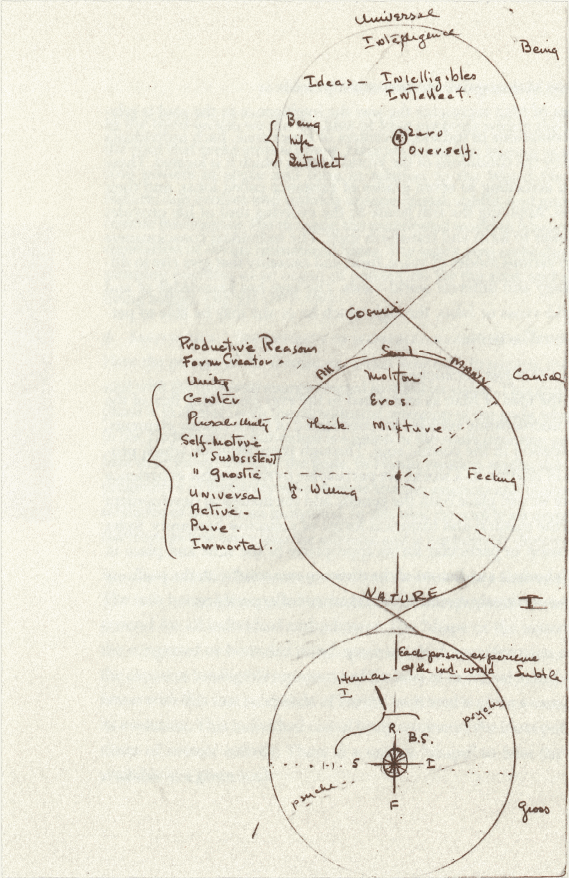
- FIGURE AD_G_012. Three Circles Diagram: Divine Intellect, Soul, Psyche.
Other diagrams also referred to not with this version.
AD PAPER read in class:
- Abridgment of S.K. Chattopadhyaya's "The Object and Sensibility" and "The Real, the Given, and the Objective." Retyped as 1974 1006b V09BN. Epistemology - The Given. A version of this paper also appears in AD Supplementary Material, pp. 46-60, and a second version of the final six paragraphs on pp. 135-136; both handwritten by AD.
TYPED AND REFORMATTED by IT 2024
NOTES:
RETYPED STUDENT NOTES (hence V08). From Alan Notes 3 1973 TO 1975 psyche and soul.PDF and Jeff Cox Notes.
This is 1974 10/06a, Epistemology; The Given Class, and the first entry associated with this date. 1974 10/06b = Epistemology; The Given Book Notes.
This is the second of five classes in the 1974 "Epistemology Review" series. See also WG Classes (and related papers) 1974 0929(a, b), 1013(a, b), 1020(a, b), and 1027(a, b).
Tony = Anthony Damiani (AD).
All spelling, capitalization, and punctuation corrected, abbreviations spelled out. Couple words in [square brackets] inserted in JC Notes for clarity.
1974 10/06a at Wisdom's Goldenrod
Epistemology; The Given
[Alan Notes 1974 1006 Begin]
10/6/74 Epistemology Review – 2
Bifurcation produces 1 and 2:
1) our consciousness of world-image
2) reference to the objects or to an unknown reality
Simple and direct realization of the difference between (your) consciousness and the world-image is necessary.
Also between the world-image itself, its appearance in your consciousness (as images) and the consciousness which reveals them.
3) World-image I know is relative (to my cognitional and sense apparatus).
I and not-I for Jung = ego and shadow.
4) The perceptions within our world-image are highly determined (by the functioning of our senses).
5) The contents cannot be abstracted from the total givenness of the whole world. There is no metaphysical duality -- the real "thing in itself" or archetype is not separate from what I experience. One thing happens even if there are many different observations of it.
Dream -- the objective experience of the dream subject is the result of the subjective wish of the dreamer. In the same way -- what the transcendental subject thinks subjectively we experience objectively.
All we really know are images. The unknown reality is interpreted as images by our consciousness.
The intellect that we function with is produced in the world-image that we have -- it is its product and is therefore based on the bifurcation which precedes it. The intellect's questions are therefore based on a false dualism and cannot really be answered.
Paper 2 (What is the given? Objectively real?) [Note: See below for actual start of paper.]
Something is objectively given which we produce an image of. The me that I know is also an image. The whole world-image is presented first and then the object is perceived through the senses. From that world-image your experience arises. Something given (other) produces my image.
We can tackle the problem from different points of view (three circles). [Note: See FIGURE AD_G_012, Three Circles Diagram: Divine Intellect, Soul, Psyche, appended to these notes.]
Top circle -- Plato, Ideas.
Middle circle -- PB shows the images in bottom circle are superseded by a higher one -- whole word image is presented first through heart.
Bottom circle -- Jung -- all we have knowledge of is the psyche.
Different approaches
1) world-image in our consciousness (Jung - probe into nature of my consciousness)
2) external world which appears in our consciousness (apparent world) (science - what is the nature of the object out there)
3) combination of 1 and 2
Paper 2 [Note: Paper starts here.]
World is given. What is this givenness? What is an object? It is that which is known in reference to a subject that knows it. Its being something, or felt as such (and not as nothing) is its generic character. Its specific character -- that which differentiates it -- is its relatedness to some act of knowing.
Givenness is the generic character of an object. Without it, it cannot be called an object. The felt givenness is primary to other qualities.
New realists (Russell) -- object remains what it is whether it is known or not.
But an object before it is known is not an object. It is inconceivable. Yet before our knowing it, it must be something, for if it was nothing it could never be known. The possible object is its being.
Even when PB reduces the object to a mental image, we still infer an actual object outside our knowing. The object that exists outside our knowing is also a thought construction based on our experience. The image or object cannot be separated from the function (knowing) that creates it. What an object is in itself is unknowable and indeterminable.
We think of an object as independent because it is given to our knowing. But it is unnecessary to go beyond this givenness to assume a "real world" behind it.
Paragraph 7 [Note: Paragraph 8 in Scan File EPI lectures by Anthony P 15p.PDF (pp. 5-8).] -- with the perception of an object is the feltness of its givenness, which leads us to assume its independent existence.
From Lecture 1 -- do not assume that the world of the real, which is determining our experience, is outside our consciousness.
You are not the cause of your knowledge -- but it does not exist apart from your knowing.
Paragraph 11 [Note: Paragraph 17-19 in Scan File EPI lectures by Anthony P 15p.PDF (pp. 5-8).] -- the transcendental background which we infer can't be given, because then it would not be transcendental. If it can't be given, it can only be postulated, and we can't know the things as they are in themselves. You may be forced to think that there is a transcendental background, but that doesn't mean there is.
There is only one event taking place in the world--not two.
Bottom two circles can be bent so they coincide. [Note: See FIGURE AD_G_012, Three Circles Diagram: Divine Intellect, Soul, Psyche, appended to these notes.]
[Alan Notes 1974 1006 End]
[JC Notes 1974 1006 Begin]
Our world of experience is divided into two sections: one is our consciousness of the world-image and the other is the reference this made to the unknown reality.
[two diagrams currently unavailable]
You can't say "I am this," the "I" is never a "this". The "I" can't be objectified into a "this". Your desires are objective. Anything meant is an object. The "I" can't be meant. This is what is meant by the realization of the difference of the world-image and "your" inner consciousness. I-ness doesn't change, there would have to be another "I" to know it. The world-image constantly changes.
My subjective desire, wish becomes in dream objectively experienced by a lower type of mind. What the transcendental subject thinks subjectively we experience objectively.
Maya veils and projects. Psychologically the "I" and the Not-I are confused, the attributes of the "I" are superimposed on the object and the qualities of the object are superimposed on the "I". The conflict as to what a person really is; how he pours his being ("I") into the world and confuses it with the world. The projection must be withdrawn from the world to find one's self.
The indeterminate perception which becomes a determinate perception all takes places in your consciousness and is not "out there."
The intellect you function with is the product of this world-image and is based on the bifurcation of the inner and the outer.
Everyone has the feeling that whatever objects come into his consciousness are in a sense given (objective). Instead of speaking of Avidya (projection) we will approach from the angle of the objectively given. There has to be a reality which is producing the image of himself in his consciousness. That which produces the image in your consciousness is felt as given.
For Plato the Ideas are in God's Mind and will manifest the universe. [Note: See FIGURE AD_G_012, Three Circles Diagram: Divine Intellect, Soul, Psyche, appended to these notes.]
For PB you have to take the tree and show it preceded by a greater one.
For Jung you have to work within the psychology of the person to explain his experience. For Jung the only knowledge you can have is of your own psyche, there is no other knowledge you can have, the rest is all inferred.
Tony's Paper #2
We will investigate the givenness of the object. What is an object? (Can substitute the word 'thought' (when you use the word 'thinking' you personalize it, not so with term 'knowledge') in the following.) An object (thought) as far as known refers to an act of knowing (thinking) -- apart from that context it's not an object. As a relative term it is meaningful only through reference to a subject that knows it. When not thus related it may be anything but should not be called an object. The object is that which we know or that which is known. (Not concerned with nature, status, locus.)
(A possible object is a mere term of talk -- unless substantially like the known object.) So an object forms the content of a cognition (of a knowing) -- it is something and not mere nothing; thus its being something or felt as something may be regarded as its generic character. The object as object is as much something as the tree is something which we call object. The specific character of this something which we call object--its differentia (that which differentiates it)--is its relatedness to some act of knowing. When we speak of a tree we know we are speaking of something specific and we describe. The specific nature of the definition of object, the only class or universal characteristic of the object is its feltness as being given to us. Every object must have givenness which is its generic character. It has to be given in knowledge.
Can we conceive an object which is not related to the knowing act (or a knowing act with no content)? The new realists know how to do this (Bertrand Russell's Analysis of Mind)!
Knowing knows an object and the object always refers to the knowing act. The new realists want a neutral object which doesn't require a subject; the object remains what it is whether known or unknown. Russell speaks of a "may-be" object (it may be an object and it may not) -- what is this "may-be" object before it is ever known? What does he mean by a possible object which is not actual but is the possible content of a cognition? It cannot be anything given. What is it before it is known; can there be an a priori idea of a possibility possible? Can there be an idea of a possibility which is prior to its knowing?
The possible object is the neutral being of the object or the thing before it is known and made into an object of cognition. Our knowing presupposes it (granted -- our knowing presupposes an object that will be known but it is only a mode of speaking because the object as long as unknown is not an object. If there is some difference when that object gets known then substantially we weren't speaking about that object but about something that may or may not be.) (Severin: We can't posit objectness to the unknown reality.) Before our knowing of the object it was something -- had it not been anything it could be nothing when actually known. So we can't allow that. Thus the possible object is the prior being of the object before appropriated by the knowing as its actual content. This may be allowed (by everyone except the agnostic or the subjective idealists).
Yet though logically admissible, the neutral object is not conceived as an object. It's not immediately known as such since that would render it into an actual object. And could we know a possible object before experienced we could claim omniscience. No - Bertrand Russell says - there may be other modes of knowing than the sensuous way of knowing. The way we know has to be sensuously -- if it's not given to sense then we don't know about it. Bertrand Russell suggests that there might be another mode of knowing but Tony hasn't found it.
Now insofar as an object is known, some sort of sensuous (sensation) representation has to be granted. Is a non-sensuous way of cognition of an object possible? The possible or neutral object is a past experience constructed subsequent to our knowing of an object. Once you know it you can say it still exists even though you no longer have the object. It is a thought construction based on my previous experience of the object.
The existence of a thing or object is its perception and that forces us to think of the object as capable of remaining outside our knowing, when it was no longer known and also as being somewhere before our knowing it. Jung says consciousness is a beam of light and is on an object and then another. He says no doubt the former objects are no longer in my consciousness but presumably it is the way I left it. But these people don't buy that.
In knowing we have it and do not construct it out of nothing. The prior existence and posterior being in relation to our actual knowing of it are thought constructions, made up hypotheses which hinge upon an axis of reference (the present), the actual knowing of it. The past and future are inconceivable without references to a living present. Thus a neutral object is not known as such but referred to, thought of on the basis of our actual knowing. (When you are forced to perceive an object isn't there the feltness that the givenness is independent of your psychological volition, of your volition as an individual? You feel this (teaching) is a violation of that volition. This forces you to the assumption that the thing is whether you are or not.)
We distinguish the object known from our knowing of it and since knowing is not making the object out of nothing we are led to believe it was something before we knew it and will remain something after the knowing. It is not a self-evident truth that cognition makes no difference to the content cognized. For outside of that cognition it is not known to be this or that.
Since the object is a content of knowledge and is intra-cognitive, its extra cognitive being rejects against (militates against) its objecthood. It can no longer be an object; what it will be then is unknowable and indeterminable.
The object is apprehended as something other than the knowing act because it is given to the knowing act. Its otherness and independence can be explained as its being given to the knowing act. The cognition doesn't conjure it up. It presupposes it as something given. The faculty to which it is given is the sensibility of the subject. Cognition reveals it as sensed, given, intuited. It is not itself the faculty of sensibility -- it presupposes that. The reason is that our faculty of cognition awaits the given and does not enjoy the freedom to conceive it in any way it likes. You have to perceive the object the way it is given and don't have the freedom to see a circle where there is a square. The fact that it is given in the knowing act leads you to postulate its existence outside the knowing act.
There are three theories in Advaita, we will speak of two: one says that all that exists is knowing, there isn't anything else. The second says there is a world that exists independent of our knowledge and is always what it is and our knowledge of it changes. The third theory says there isn't anything, what are you talking about (there's only the self). These three are graded (2, 1, 3). PB points out that only by thinking do we perceive a world. To be an object to a knowing act is the equivalent as being given to the knowing act.
What is known is what is given and knowing makes it its content. It is as it is given and it is given as it is known. We know it as it is given to us…and as given to us it is something different both from ourselves and our knowing acts. It becomes a given content in being by our sensibility and when not given or sensed it is no more an object.
What is it when not given? It is no longer itself -- and so it is meaningless to ask the question.
This givenness gives rise to our notion of a transcendental background.
Is it a thing in itself (Kant) or Avyakta (Samkhya) or Avidya (Vedanta) or Maya or reality? The givenness of the known content presupposes it but tells us nothing concerning this ungiven and transcendental background of all givenness. The transcendental can't be given like other things are given because then it won't be transcendental.
It is thinkable as the many in reference to the plurality of objects we know as things in themselves; this can only be thought; or as the Avyakta is a transcendental background -- Prakriti, you can think it but you can't know it. This unintelligible background of all givenness, the transcendental thing in itself, is a presupposition of the object as given. It's a reflection in our thinking of the existence of this transcendental background. It can't be given, only postulated, and we can't know the nature of what the things are in themselves.
[Note: Paper 2 as read in class ends here. See below for unread portion.]
In the dream the very structuring of knowledge which at first is not seen but experienced -- it is only when we reflect that we see that all the relationships that make experience possible are all there in the dream. (The a priori categories.) In the original situation we have an identity of the self, the wish ("I want an apple"). This identity is broken down in the dream and manifested through all the relationships; so what is manifested in the dream is the structuralizing of this knowledge or self-identity which is being manifested. The relations are brought out in the manifestation of the knowledge situation. But the knowledge which structuralizes the dream is not outside it, but in it.
Avery: The whole dream is the desire in the dreamer's mind, it's only that the desire in the dreamer's mind is seen from within that desire somehow. The desire is not outside the dream.
Tony: So then there is only one event taking place in the world.
Avery: The only thing that is other is when our point of view changes. There's nothing outside.
From the images you derive certain concepts (belief). Then you start reasoning about those concepts which your subjective experience has made possible to you (reason, dianoia). This dianoia is in the soul. Then you go further up to the universal ideas and you realize that the universal ideas and knowledge are one and the same thing.
Plato's Ideas aren't in a super-celestial palace beyond Uranus. Jung says his Self is only a reflection of what the Self really is. The totality of psychic processes which constitute you as an individual (Self). You have to find this reflected self before you speak of any other.
Without the concept of avidya you can't understand how what is true today can be false tomorrow -- the way the knowledge transforms and unfolds the subject that is coming through.
There is no freedom or discovery of the real world until you get out of that damn mother complex of yours. And if you expect someone else to do it then you're living with your mother.
Not read in class:
Sense and understanding. When mind works through the senses -- when mind works through the imagination. The latter is individual, the former collective. Sense gives us the matter of knowledge which comes from outside while understanding gives us the generic forms that are in it.
Sense gives the sense data -- the indefinite sense matter undistinguished from other subjects. Understanding gives the specific relations of identity and difference and spatio-temporal order. Sense can't distinguish the object from the subject but understanding can and it does this through the relations which it first gathers from experience. These relations are the determinants of objectivity. They are so just because they are found to be in nature and not in the understanding itself.
The real, given and objective are often confused. To be real means not constructed -- givenness the ultimate foundation of any construction has always self acclaimed as real. The given is the real and the real is the given.
Or the real is the objective -- that which doesn't owe a cent to the subject but independent of it and indifferent to the subject.
The subject may be a substantive entity or epiphenomena as cross section of objective facts defined by specific response of the nervous system -- desubjectify the subject and reduce it.
All agree that to be real means to be objective, to be independent of the subject. Is the real the same as given [and the] same as objective? And to be independent of subject objectivity becomes a criterion of reality.
That the given or objective is in some sense real -- I'll let pass, but the point here is whether the real is the same as the given or same as the objective. We are concerned with the criterion of reality. Can givenness or objectivity be that criterion? Evidently not.
The given is presented, forced upon us, and free from any subjective construction. But is it always real, is not the false also presented? Are all experiences of reality?
[JC Notes 1974 1006 End]
1974 10/06a V08: NOTES: Epistemology; The Given. Copyright 2024 Wisdom's Goldenrod p. iv