DIAGRAMS FOR 1977 0228
Class
Monday, February 28th, 1977
Verbatim, unedited transcriptCLASS at Wisdom's Goldenrod, Hector, NY
with Anthony Damiani (AD)
February 28, 1977
BUDDHISM; NIDANA CHAIN
TOPIC: Buddhism
SUBJECT: Nidana Chain
SUBSUBJECTS: Links 4-9, Astrology
CONTENTS:
Six sense-fields, six sense objects, six sense-vijnanas
Reading from Jung, "Spirit and Life," on reflected images, eye-personality
Each sense a world in itself; tattvas; manas coordinates the whole
Nidanas 4, 5 correlated with fourth and fifth houses
Pentad of pranas and their role; as motion/energy in the body; correlated with sixth house
Pranic functioning results in appearance of mahabhutas
Astral body penetrates into physical body by seizing pranic activity in the senses
Reading from Woodroffe, The World as Power: Power as Life, on prana
Pranamaya kosha as contact (phassa) between namarupa and sense-fields
Sense-fields distinguished from body
Dhyani Buddhas and their role: coordinate sense-experience and life experience into a meaningful whole; transform self-centered functioning into five wisdoms
Different orders of Gods fabricate different aspects of your being; each in all, all in each
Reading from Manly Hall, Lectures on Ancient Philosophy, on natal daemon, diamond soul
Sheaths (koshas)
Feeling (vedana) as seventh nidana; correlated with seventh house; correlated with reason-principles
Dream example; feeling as most important characteristic of dream; dream meaning locked up in feeling
Reason-principles as knowing, productive, vital, full of feeling; example of luminous dream
Meaning inherent in life; each planet on a degree contains its own principle of meaning
Example of student's Mars at 1-degree Virgo in seventh house
Personality invested with feeling-principles; each reason-principle a God; feelings as supreme rationality
Freedom from feeling leads to liberation
Mars in Libra: as vedana; as kama rupa; as power; desires organized by higher principle (Saturn in Libra); drugs interfere with instinctual functioning
Venus in Scorpio: as thirst; as eternal feminine
Mars Venus always together in Metaphysical Chart; when integrated, masculine/feminine work in harmony
Reading from Evola, The Doctrine of Awakening, on nidanas 6-9
BOOKS READ FROM OR REFERENCED:
C.G. Jung, CW 8, The Structure and Dynamics of the Psyche, "Spirit and Life"
F. Th. Stcherbatsky, The Central Conception of Buddhism and the Meaning of the Word "Dharma"
F.L. Woodward (tr.), Some Sayings of the Buddha, According to the Pali Canon
Sir John Woodroffe, The World as Power: Power as Life
Bible, Genesis (3:7)
Manly P. Hall, Lectures on Ancient Philosophy
Marc Edmund Jones, The Sabian Symbols in Astrology
Julius Evola, The Doctrine of Awakening
SABIAN SYMBOLS: Virgo 1, Pisces 1
DIAGRAMS appended to this transcript:
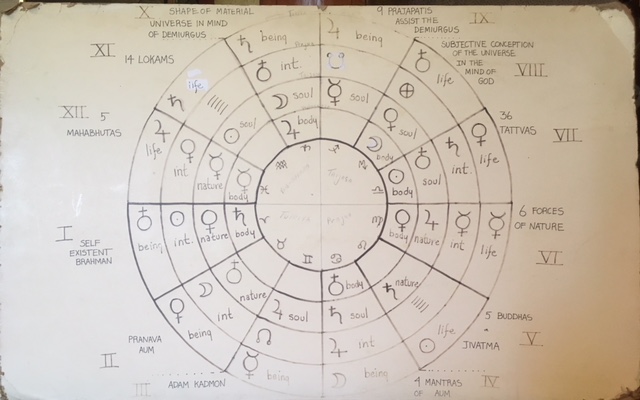
FIGURE IMG_2202-Posterboard Metaphysical Chart.
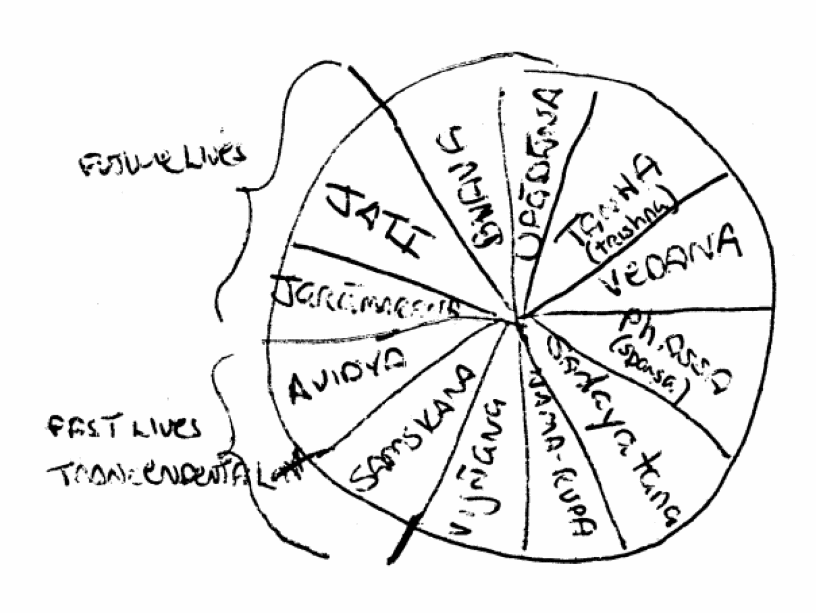
FIGURE 1977 0228-2-AB. Nidana Chain, in the Mandala of the Houses.
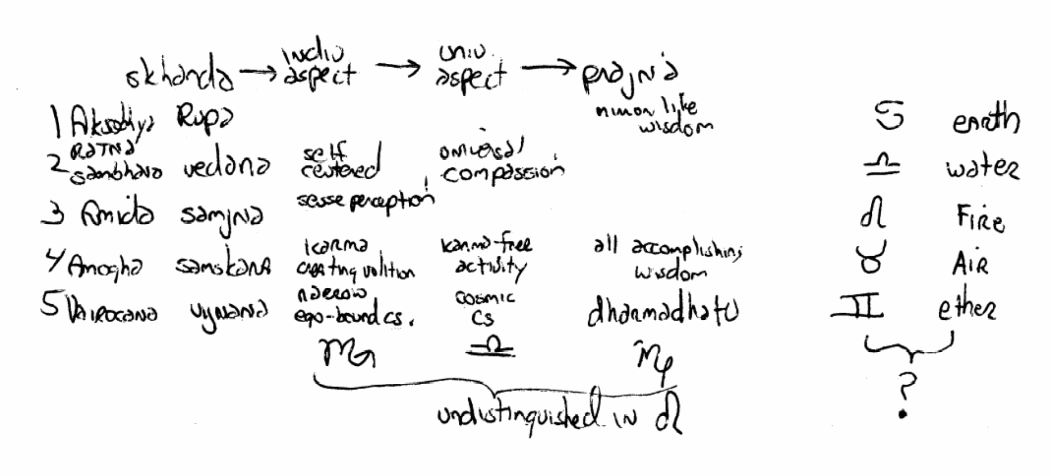
FIGURE 1977 0228-3-AB. Table correlating Dhyani Buddhas, Skandhas, Individual and Universal Aspects, and Five Wisdoms.
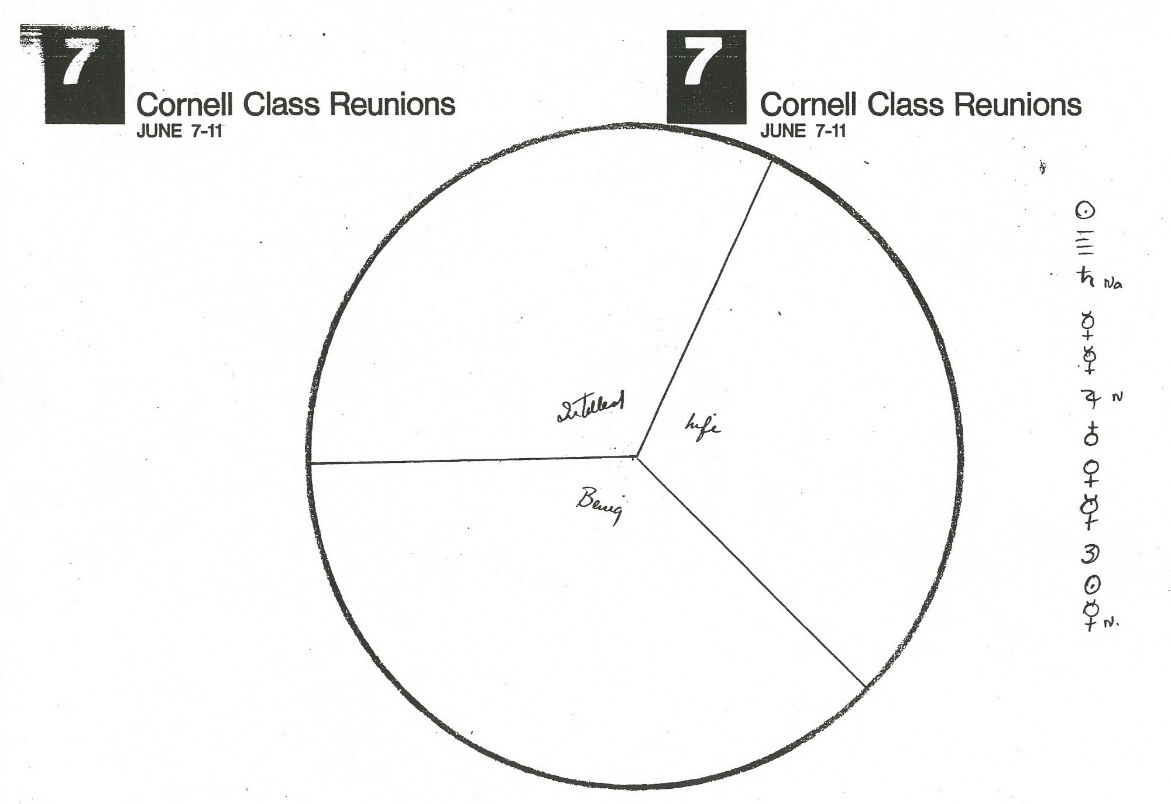
FIGURE AD_E_020. Being, Life, Intellect.
Other diagrams referred to are not with this transcript version. [Transcriber note: [diagram] means the speaker is referencing a diagram as he or she is speaking. If someone is drawing or writing, with audible sounds of chalk on a blackboard, I indicate this by [drawing] or [writing].]
NOTES:
See second half of WG Class 1977 0227 Hinduism; Vedanta; Epistemology for related material.
For readability's sake, the following substitutions/edits made in Verbatim Transcript: cuz = because; gonna = going to; gotta = got to; yeah = yes.
TRANSCRIBED Verbatim by IT prior to 2017, reformatted by jf 2017. In 2023, IT updates prefatory matter, footer, and audio file name, expands Subsubjects, adds TOC, expands Book List, fixes errors/typos, adds new notes within transcript, adds four diagrams and references within transcript to these diagrams, reformats to accord with new conventions. Archival verbatim transcript – V12a.
AUDIO FILES: 1977 0228a. [Note 1: "Tape" and "Side" refer to original audio cassette tapes that were later digitized into .MP3 Audio Files. Note 2: We only have one audio file for this class, we are missing the rest.]
1977 02/28 at Wisdom's Goldenrod
Buddhism; Nidana Chain
[Audio File 1977 0228a Begins]
[Transcriber note: I am unable to locate the source of the following quote, quote needs to be checked.]
[JC reading]: "…the whole apparatus of sentience, which includes the recipient and coordinating mind."
JC: So I guess he's just saying there that recipient and coordinating mind is the sixth sense.
AD: Wait a minute. Recipient and coordinating mind, that would be two different (entities) wouldn't it?
JC: Well, the recipient may be just his five senses then, is that what you're saying, and then the coordinating mind is the manas, lower manas?
S: [few words inaudible] Stcherbatsky's got the symbols.
AD: Louder.
S: Stcherbatsky interprets each of the sense-vijnanas as being integrative as well as receptive.
AD: Being integrative?
S: Yes.
AD: [drawing] Well, they have the senses divided, right? Eye, ear, nose, tongue. (Yes, and) I forgot one.
S: Body.
AD: Huh?
S: Body.
AD: [drawing] Body? Corresponding--
S: Um, that's right [few words inaudible]
AD (simultaneously): These are the five senses, alright? The senses--
JC (simultaneously): [couple words inaudible] Visual [AD/S(?) simultaneously: (one word inaudible)] object. [few words inaudible]
AD (simultaneously): [drawing] Visual object. [S: (couple words inaudible)] Alright, and we could go down like that, ok?
JC (simultaneously): Right, all the way down. And then they have the consciousness that [few words inaudible] They call it the vijnana, eye vijnana for instance. In other words--
AD (simultaneously): "Consciousness of," huh?
JC: Right. Because they work discrete, in a discrete way, they don't have like a general consciousness that sort of shines, say, in all the senses at once, but there's a consciousness associated with each sense act.
AD: Yes, if you remember, for instance, in almost any physiology-- physiological text, and it was a, you know, dramatically phrased in Jung when he points out that each sense makes a reflective image of its own functioning or its own activity. Remember that? You get me Volume 8 please? We'll read that now. [S: (couple words inaudible)] Because this has to be very clear. I think it was Volume 8, "Mind and Life".
S: Yes.
AD: Yes.
PD: It's the-- it's the "Spirit and Life" article, isn't it?
AD: Yes. [drawing] So that we would have here, this would be the five sense-fields.
JC: See, the thing that gave me-- I don't remember if I'd read it in any specific book but the word is 'sat ayatana'. And the word 'ayatana' for them refers to not just the sense organ side of knowledge but also the object. When they have the 12 ayatanas, it means the sense organs and sense objects, so 'sat ayatana' refers to the six sense relationships, in other words, and that's why although--
AD (simultaneously): Alright, then this here, over here we would put-- we could put manas as the coordinating [diagram]--
JC: Yes, as a sixth. And it also has its object which is thought and a consciousness that operates in that sense.
AD: We-- [S simultaneously: (couple words inaudible)] we got the picture?
S (simultaneously): [couple words inaudible] got the six ayatanas [few words inaudible] site [couple words inaudible] not s-i-g-h-t but s-i-t-e.
JC: Site.
S: [couple words inaudible]
AD (simultaneously): Goes here [diagram], ok, and--
S: [few words inaudible]
AD: Alright, let me-- let me read this here. For instance, in "Spirit and Life," we'll read this paragraph. He says--
C.G. Jung [CW 8, The Structure and Dynamics of the Psyche, "Spirit and Life," paragraph 610, p. 323, AD reading]: "In this way we can form an idea of the nature of the psyche. It consists of reflected images of simple processes in the brain, [AD rereads, paraphrasing: We can form an idea of the nature of the mind or the psyche. It consists of reflected images of simple processes in the brain] and of reproductions [AD: of these processes] of these images in an almost infinite series. These images have the quality of consciousness. The nature of consciousness is a riddle whose solution I do not know. It is possible to say, however, that anything psychic will take on the quality of consciousness if it comes into association with the ego. If there is no such association, it remains unconscious."
AD: Ok? Alright, you take a look for the other one, the one where he speaks about-- he gives an example. Let's imagine that the eye, alright, functions by itself, alright, that-- that example there. Alright, so, in this badly drawn diagram, [drawing] you have the five senses, the object of the senses, and the consciousness that coor-- is-- constitutes the-- the sense object. So you would have the eye, the visual object, the consciousness of the vis-- So maybe we should put this over here [diagram].
JC: Yes [one word inaudible] put it over there.
AD: Alright. [drawing/writing] So we will put eye, consciousness of the eye gives you an object, that's the visual object. The same thing here, ok, same thing here [diagram]. Well then these five senses would need a common denominator, manas, coordinating all the various sense images. This is the same thing like in Latin and Medieval patristic psychology. That's the common sensorium. Yes--
S: I think in the early Buddhism first they said that like this-- they didn't have the vijnanas at first so they just said that the-- Like the [couple words inaudible] is-- produced the consciousness as well as the perception of the eye object.
AD: Say it again.
S: That the eye-- They just divide it into 12 ayatanas, correct? And the eye as sense organ serves a double function of receiving the sense image and producing the consciousness of it. In other words, it le-- it more or less even served a function of naming the object, (and) you saw a book, the eye consciousness recognized it as a book.
AD: Where you see this?
S: I think it was in Stcherbatsky.
AD: Where?
S: I think it's in Central Conception [few words inaudible] [Note: F. Th. Stcherbatsky, The Central Conception of Buddhism and the Meaning of the Word "Dharma".]
AD (simultaneously): Well you better get that for me because I don't-- I don't think he (does). Alright, so-- Do we have a copy any place?
S: [couple words inaudible]
AD: Also, in that compilation of early Buddhist teachings, the Woodward-- [Note: F.L. Woodward (tr.), Some Sayings of the Buddha, According to the Pali Canon.]
[short pause]
MW: Tony, I have two quotes here. There's the one part where he talks about the-- the eye, the eye personality.
AD: Yes, the eye personality. Go ahead, let's read that. You have to get a feeling that each one of these senses, so to speak, could operate independently, alright. The eye personality-- the eye has a personality. Just imagine the eye has an ego, alright. Now it only has one sense, the eye can only see things, objects, ok. Go ahead.
C.G. Jung [CW 8, The Structure and Dynamics of the Psyche, "Spirit and Life," paragraph 638, p. 333, MW reading]: "I would not know how we could ever prove that a consciousness higher or wider than the ego-consciousness exists in us; but, if it does exist, the ego- consciousness must find it acutely disturbing."
AD: Louder.
C.G. Jung [CW 8, The Structure and Dynamics of the Psyche, "Spirit and Life," paragraph 638, p. 333, MW reading]: "A simple example will make clear what I mean. Let us imagine that our optical system had a consciousness of its own and was therefore a kind of personality which we shall call the"eye-personality." This "eye-personality" has, let us say, discovered a beautiful view and is lost in contemplation of it. All of a sudden the auditory system hears the horn of an automobile. This perception remains unconscious to the optical system. From the…"
AD (simultaneously): Because the optical system doesn't hear.
C.G. Jung [CW 8, The Structure and Dynamics of the Psyche, "Spirit and Life," paragraph 638, p. 333, MW reading]: "From the ego there now follows, again in a way unconscious to the optical system, an order to the muscles to move the body to another position in space. Through this movement the object is suddenly taken away from the eye-consciousness. If the eyes could think, they would naturally come to the conclusion that the light-world was subject to all sorts of obscure disturbances."
AD: Ok, you get the feeling of what-- how-- what he's trying to do? He's trying to present like each sense as a world in itself. The Hindus call that a ta-- a tattva, principle, a thatness, alright. So these sense, you remember in the Samkhya system (chat chakri) system, they're tattvas. Now, these five tattvas combined over here, these five tattvas, then that one is a sixth tattva [diagram]. [drawing] So this is a principle and these are all principles, alright? This is sup-- superordinate to this here [diagram]. Ok? It's really not that difficult to understand, I mean, all they're doing is analyzing the-- the consciousness of objects and they break it down. The same way Samkhya does. Everybody's got eyes. Ok, good, then we have such a thing as the seeing tattva. Everybody smells, good. Ok. In other words, they take sentient life and they break it down to its constituent elements. Not that you'll find an eye walking around or something. (some laughter) Alright, so this is what they did. This here, the visual object, the consciousness, and this is supposed to be an ar-- you know, like related. I mean, it isn't that you have the ear and you have consciousness of the ear separate from it but it's-- it's like related, all are related to one another. Alright.
Now, if the eye, like in the example he just gives, the eye is contemplating a beautiful scene but a car is coming your way so that the body has to be moved away, the mind gives an order to the whole body, "Take the body out of there." Ok? So this here will have certain contents. These tattvas all have certain images. They make an image. They all make reflex images of themselves, ok. When you go to sleep at night, you can see a blue color. There's no blue in your dream but you can see a blue color. It shows that from prior perception, you're capable of (reticulating) that experience, in other words, bringing in the blue. Alright, and the same with any one of these senses, you can re-experiencing them-- you can re-experience them in (the) dream.
Alright, then manas, manas would be what coordinates the various sense-data into some sort of coherent whole. In other words, when I look at an orange, there's a color of the orange, there's a roundness, the pulpiness, it's smooth, all these things, alright. But something has got to coordinate them because the eye can only deliver the color, alright, the touch can only de-- deliver the pulpiness. What puts all this together and gives us an image of the on-- of the orange, the Buddhists say would be manas. [Note: See FIGURE 1977 0228-2-AB, Nidana Chain, in the Mandala of the Houses, appended to this transcript for the following references to links in the nidana chain.] So this would be the six sense-fields and we put them in here [fifth house]. Ok? Over here, we spoke about this as nam and rupa or name and form [fourth house]. And in Sanskrit, this is the only term they have for the entirety of the meaning of intelligibility, alright, 'namarupa,' the intelligible and this-- and the material.
But, to get back to where we left off last week, alright. This in itself, these two in themselves, are meaningless. Something, something has got to trigger off the action, something's got to start the thing into movement of the sense-fields or, let me say, let me put it this way. You have the-- you have the movie camera, you have the film in the camera, alright, and you got the light. But, nothing's moving yet. Something's got to move that film. Once the film moves, alright, then you could have experience. But if the film is not moving there's no-- nothing's projected on the blackboard or on the screen, alright? [drawing] That's where this comes in. What I said last week and what I said last night and I can see that this is really going to become a problem, is that, over here you speak about the pentad of the pranas [sixth house]. You have the pranas here. Now unless, unless there are the pranas, these two don't work. In other words, unless you plug in into the electric, there's no picture out there. That's what I more or less said.
And, of course, what I did was to take our original metaphysical meaning of the 6th house, which is the Six Holy Forces, ok, and if you remember, they were prana shakti and kundalini shakti and mantra shakta and para shakta, iccha shakta, and jnana shakta. [Note: See FIGURE IMG_2202-Posterboard Metaphysical Chart appended to this transcript.] Each one of these here, alright, have definite precise meanings. Jnana shakta, sensation, perception; para shakta is heat, light, electricity, ok; kundalini shakta-- well, you're familiar, ok? [drawing] Now, over here is where we put them [diagram]. So now, in this 6th box we know-- in this 6th circle, we know-- we know that in the metaphysical chart the meaning of the 6th circle is to be found right here. These are forces, alright. Now, if we consider this here as some sort of force, the pranas, as the undulating pentad-- In-- in other words, if we think of prana--
The-- the Hindus, for instance, have many many different kinds of prana but they speak about five chief pranas. A prana is not just breathing, although that's what people think. You're closer to think of-- thinking of it as motion, alright? And one prana, for instance, they refer to is the one that you know, you breathe in. There's another prana that you have to use, for instance, if you expect or if you spit. Another kind of prana, if you breathe. So you see they're taking all-- all these different kinds of pranas and they itemize them. One prana has to do with evacuation, another prana has to do with the movement of the eyelids, another prana with hiccupping, hiccup, you know? So this is a-- a very un-- I mean, we don't have this in our culture.
JC: Don't they-- they govern all motions in the body [couple words inaudible]
AD (simultaneously): All motions in the body. Yes--
JL: Is there a corre-- correspondence between the mahabhutas on the-- on the 12th house side and the pranas in the 6th? (Yes), maybe I'm shifting gears here.
AD: No, you're not shifting gears, but I gave up after last night. That's the whole point. Mahabhutas are the end result or the end effect, effect of the (physical) pranas, the [few words inaudible]
JL: You mean [few words inaudible]
AD (simultaneously): If-- if the pranas-- if the pranas don't move, no mahabhutas appear. I have to find a way of saying it and last night showed me I didn't do it so I--
JL: You mean like the [AD simultaneously: I--] mahabhutas are the states of that prana?
AD: No, they're not states of the prana. But without the prana, no mahabhutas can appear. In other words, sensible qualities or, if you think of the world, the elemental world which is within us, ok, and which gets projected by the mo-- motion of the pranas, if the-- if those pranas don't move, there's no sensible qualities. Here, look at it this way. In a dream, ok, if thoughts in your mind are still, alright, you're sleeping soundly. If there's any motion in the mind, you have a dream appear. And with the appearance of that dream are the bhutas. Because you won't know that there's a dream if there's no bhutas. Let's not use the word 'bhutas', let's use the word [AD yells these last two words] 'sensible qualities'. Because, you know, "bhutas," that sounds exotic, "Wow, what the dickens is that?" Say "sensible qualities," ok. In a dream, if there's the slightest motion in thought, you have a dream. If you have a dream, you got sensible qualities. But you got to have the motion prior to it. If not, if not, let's say, existentially, at least logically you would say, no motion, no dream. Because what is a dream? In a-- in a kind of a quick way, you could say a dream is nothing but ideas in movement. Ok. So therefore, if I see a yellow in the dream, that means that thoughts are moving around. [JL(?): (possibly couple words inaudible)] Alright, but I [half word inaudible] I-- I want to avoid that John, so you have to-- you have to excuse me. This is the pentad of the pranas, five pranas [sixth house]. They are the ones, so to speak, that (start) the motions in the body, all the different kinds of motions. Whether you go to the bathroom, whether you expectorate, whether you hiccup, whether you breathe, these are the pranas. And we don't have a concept like that. [couple words inaudible] could you think of a concept, prana?
S (very faint): [few words inaudible]
AD/S(?): (Yes.)
AD: In-- in the early tradition I think they would speak about, what, the pneuma?
S: Oh [one word inaudible]
MW(?) (simultaneously): Animal spirits?
AD: Huh? Animal spirit, yes.
MW(?) (simultaneously): They talk about animal spirit.
AD/S(?) (very faint): [few words inaudible]
AD: Alright, so then what I'm saying is something like this. [writing/drawing] These two, by themselves, do not give us any possibility of any object, feeling. Because the first thing that's going to come, it's over here [seventh house], is vedana, right? So unless these two are coordinated and put into motion, this will not arise. But let there be the slightest movement of thoughts [AD snaps fingers] and you got feeling. Because, a sensible object cannot appear without it participating in pleasure, pain, or indifference, [one word inaudible] you know, the three qualities of the gunas. There's no such thing as a neutral sensation, although they speak of it sometimes like that. I don't follow it. Ok. So we got as far as here and I think that the meaning of contact would be established with bringing in the notion of the pentad, the prana pentad. [short pause] What do you think? You think it's a wild guess?
[41½ second pause]
JL: Actually Tony, when-- when you speak of-- Well maybe the question I asked before was kind of related to this because it would seem that the pranas would have some correlation with the-- the elements, but at the same time, in the sense that they would also have a correlation with the sense-- the sense-fields in the-- in the 5th house, and these sort of respective matrixes would-- the forces that would-- that would, (know), project them into a-- into a state of ideation. I mean, there would-- there would seem to be a definite correlation between the 6th and the 5th in that respect, wouldn't (it)? Like (it fixes the attitude) every day.
AD (simultaneously): Well, if you-- if you remember, I pointed out yesterday [Note: See WG Class 1977 0227.] that the only place in the whole physiological apparatus where the-- the astral body could penetrate into the physical body, and by astral body that may sound kind of fancy but, think of the desire nature in the sense of, you know, passion, things like that, that the only place that the desire nature (or our) physical body, could penetrate into the physical body, is in the realm of where the senses are. Wherever the senses are, the astral body could seize, so to speak, the whole breathing motion that's going on there. The example I gave is, if you are asleep, your astral body is not, so to speak, coinciding with the physical body. But on the moment of awakening, the astral body's drawn into the physical body, and at that instant, it seizes all the six-- the five sense-fields, alright, and inhabits them or moves into that area. Because the sense-fields, like I said, are like inlets into the body. That's how the world gets into the body. And insofar, insofar that the sense-fields-- and it's only in the sense-fields, by the way, where this activity can go on. The-- the breathing is seized and the motion that is set up results in the production of these images which we later on are going to consider as our experience.
JL: It's interesting, too, to compare that with mundane astrology where the 6th house is-- is sickness. It would be like-- I mean interpreted in that way, it would be like a blockage of those [one word inaudible]
AD: Yes, it's also adjustment too.
JL: Yes.
AD: So when you come over to me, I-- or you speak to someone and they give you a certain kind of breathing exercise or a certain kind of mantra which will help bring down, let's say, one element. You know, let's say you have an excess of the fiery element and the mantra used is to diminish the amount of the fiery element in the person so that he gets a more balanced approach to what he's doing. Yes. Look, you see, this is the whole problem, we don't have in the West a term equivalent for it. And if you have Power as Life by Woodroffe, read it, read the whole thing, where he points out the meaning of prana, I mean the meanings are tremendous.
[Transcriber note: I am using The World as Power: Power as Life by Sir John Woodroffe, Ganesh & Co., Madras, 1922.]
John Woodroffe [The World as Power: Power as Life, pp. 27-28, AD reading]: "Therefore there is present both Will and Knowledge… … [AD: But here.]
"Prana is either individual or cosmic. The latter [AD reads: cosmic prana] is the Brahman [as Prana]."
AD: But that's not r-- that's not correct because actually in the-- in the real meaning of Hindu metaphysics, cosmic prana or-- is really the Atma. Atma is the breath of Brahman, Brahman. It's the breath of the Absolute. In other words, the entire motion. But at any rate is-- you can, if you read this here, you'll see these very specialized meanings that they give to the term 'prana'. Now, that's been somewhat dropped out in Buddhism, alright, except in Tantra. And, naturally, the-- the term 'phassa' here or 'contact' has lost all relevancy, they don't know what's going on in-- in the nidana chain. But let me repeat what I just said. Here. Here's an example.
John Woodroffe [The World as Power: Power as Life, pp. 29-30, AD reading]: "The body is divided by the Vedanta [AD reads: The body, according to the Vedanta, is divided] into five sheaths, which are less and less gross [as we proceed inward], [AD: You-- you know all this.] namely the sheaths of food or matter, life, lower and higher mind and of bliss [AD reads: namely the body of food, the body of life, the body of the lower mind, the body of the higher mind, and the body of bliss]."
AD: They divide-- they divide us into these five different sheaths, like you have five suits of clothes, alright. Just like in the Bible when they speak about man was naked so they put a fig tree around him. [Note: Bible, Genesis, 3:7.] Moron(s). (some laughter) Yes, you know, they put a fig tree, fig leaf covered up his-- His nakedness was that pure Consciousness has to be clothed, otherwise it can't manifest. But, you know, the Western man. The body's divided into these five sheaths. Now look--
John Woodroffe [The World as Power: Power as Life, p. 30, AD reading]: "The Pranamaya or life-body differs from the gross [AD adds: or the] outer body or [AD adds: the] body of food…"
AD: In other words, [drawing] the conception here is you got a physical body. Alright? Ok. Now inside that physical body, if I could use the expression, you got a body of (life/light), an actual-- a living body which is shaped to your means. It's-- it's individual, it's not cosmic. And this body, this prana body, alright, so to speak, is inserted in the physical body. Now, a prana body is a body of motion, (insert body) and this is-- this is, so to speak, the contact between, so to speak, the senses and the namarupa. Now if, let's say, well, let's take the example of the dream, that helps us a little bit. In the example of the dream you have the body, ok, and you-- you have images that you're seeing. In the dream you're seeing yellow, blue, you're tasting this and smelling that, ok? Now, we said prior, just a little before, we said that all that a dream fundamentally and ultimately is, ideas in movement. But if that's all that a dream ultimately is, ultimately, I'm not saying, you know, that it doesn't have psychological meaning, all that, but if ultimately all that the dream is, is thought or ideas in motion, then that motion is absolutely imperative in order for there to be an experience of a dream. No motion, no dream. Alright. This is contact. [drawing(?)] This is-- this is what gets inserted between these two and now you could have-- you have images which you must feel.
JC: I don't understand it being the-- the contact between the 4 and the 5. I haven't quite--
AD: What can I do? I mean I've been speaking about this four, five times. Take-- take a good look. Take a good look. Just imagine that you're sleeping in bed, ok? You're dead. You're ac-- actually you're dead, right? But you still have a nose, eyes, right?, ears, everything, ok, but your body's laying down there. What has to happen in order for you to smell something?
JC: [few words inaudible]
AD (simultaneously): You have to awake!
JC: Yes [few words inaudible]
AD (simultaneously): What do you mean awake?
S: My organism has become active.
AD: Yes, ok. What do you mean?
JC(?): [few words inaudible] (some laughter)
S: [few words inaudible]
AD: Yes, you could do anything you want in a dream. The whole point is that first there's got to be a motion. You got to awake!!!
JC: But, I mean, couldn't you say--
AD (simultaneously): (Now), what I mean by "awake" here, and you can see, if you-- if you look at very carefully, it's like something comes into you, right? When you awake, you [AD snaps fingers] almost feel something coming into you. That's the astral body.
S: So in a dream is it coming in [few words inaudible]
AD (simultaneously): It didn't get in all the way, it didn't get in all the way.
S: And that's why you can also smell in a dream? Because--
AD (simultaneously): I'm sorry?
S: Because part of the-- part of the astral body has come in, and that's why you can smell in a dream?
AD: Yes. In other words, your thoughts are-- Instead of calling it the astral body, let's imagine the prana, [S: (Uh-hm.)] alright. Because if you notice, automatically, this is an automatic fact, you go to sleep, your metabolism slows down. You ever notice? Really slows down. And if you sleep very deeply, ok, like when I was a little baby, my father used to kick me, shake me, bang me, I wouldn't wake up. And my wife told me when I was a young man, I didn't know this, says, "I never seen (anyone) sleep like you." Alright. What was interesting was that there was hardly any breathing so they would come over and see if I was still alive. (some laughter) But you see what breathing does? As soon as you start breathing heavier, ok, you notice when you're angry? [AD starts huffing and puffing] (laughter) You see what familiarity does? We don't even observe what's-- what's right in front of us. When you're-- when you're calm, when you're very, let's say, contemplative, your breathe hardly moves. Somebody could put a feather in front of your nose and it won't move. And in very deep meditation, that happens; hardly breathe, or if you do, it's hardly noticeable.
S: So does that mean you have no prana in the body?
AD: Very little. Just enough is kept there, like a watchman, you know, the body [one word inaudible] But then when you awake, something comes in and stirs up everything, alright. Now, we start seeing things. But until that motion takes place, there's no-- there's no sensible world for you. Alright, so then we getting the feeling? This prana is what activates the whole apparatus. Now, this is-- this is the senses [fifth house], Jeff. This here [fourth house] is what? The intelligible aspect of the being, the corporeal aspect, in the sense of all this is potential. We can [JC simultaneously: Right.] say it's all potential, ok?
JC: Just strictly in terms of their classification, one thing that's (going to)--
AD (simultaneously): You must separate the senses from the body.
JC: Well that's what I was wondering.
AD (simultaneously): Those senses could be ser-- inserted in any kind of body.
JC: Still I don't understand.
S (simultaneously): [few words inaudible]
AD: Yes, that's-- that's your problem. You're keeping them together. The senses, the sense-fields, is not the body. Now he just gave the quote. Now just imagine an eye-personality. This eye-personality is walking around (laughter) "Oh," they're contem-- contemplating, ok? It doesn't smell, doesn't taste, (anything), it just sees, alright. In other words, these five senses, each one, alright, and as an aggregate, all together, make up what Manly Hall called the monad. They are utterly distinct from the body. Now, for instance, suppose in the next root race you come around you got seven senses now. So you must separate the senses from the body and the intelligibility that is attached to that body. In other words, by intelligibility we mean here, let's say, the genital, I mean the congenital history that's inherent in the body, we separate it from that.
JC (simultaneously): Well, you mean like-- like the difference between senses, which are the subtle forces, and the body which is--
AD: Senses? No--
JC: --gross?
AD (simultaneously): --senses are more like subtle structures.
JC: Ok, complexes, energy complexes--
AD (simultaneously): Yes.
JC: --can you call them.
AD: No, not energy complexes. They're not energy complexes till that phassa comes in. [S: (Right.)] That's the whole point.
JC: Ok.
AD: It's like you have a steam engine but it's not going until you get the fuel in and you raise the temperature of the water. Otherwise that engine don't move. And the-- let's say the gasoline which, you know, explodes in the combustion chamber of an engine provides the energy for the engine to go. No energy, that engine don't move.
JC: Ok.
AD: Alright. So you have the four wheels, but what good are they? Alright, you have the five senses but what good are they unless the energy comes in and activates them? Alright, and they have to be kept separate from the body and the sens-- and the meaning or the intelligibility attached to it.
S: Causality--
AD (simultaneously): You got two aspects, the senses, name and form, something has to come between them so that they get activated. Yes, go ahead John.
JL: Well, if it would seem like the-- the contact would be like the plug but it would also be like a [couple words inaudible] of a-- a regulate-- a regulator in the--
AD (simultaneously): Yes.
JL: --(just) in terms of your--
AD: Yes, it's the energy, sure, it's the energy. Naturally that energy is going to be controlled although in some people it's not. You've met, what do they call them? Some of these people that are--
MW (simultaneously): Hyperactive.
AD: --like very committed to their always moving.
MW (simultaneously): Hyperkinetic.
AD: Huh?
S: Hyperactive.
AD: Hyperactive, yes. I think they have a very special name for them, it's almost a disease. They can't stop moving.
EMK: Tony, is this tied in with what they're talking about with the Dhyan Buddhas sitting at the top of each heap and then their contemplation is what spins out the-- (say) that that is the activity that spins out the (sensing/senses)?
AD (simultaneously): Well, the Dhyan Buddhis [sic; Dhyani Buddhas] over here, [writing/drawing] in the 5th house, [Note: See FIGURE IMG_2202-Posterboard Metaphysical Chart appended to this transcript.] alright, each one of these tattvas, alright, that we [EMK simultaneously: (one word inaudible)] spoke about, the eyes, the ears, the nose--
EMK: Yes.
AD: --each one of those tattvas has at the head a Dhyan Buddhi.
EMK: Yes but that-- that's if--
AD: Wait a minute.
EMK: Oh, I'm sorry.
AD: Alright. So you have five senses, ok, so you got five Dhyan Buddhis. Now they also work together because they want to present you an integral image of your experience. I mean, they don't want to present you the orange here and the color of the orange over there. (some laughter) They got to put everything together for you. And the sa-- in a-- in a grander way they have to do that with your life, you know, like the experiences in your life have to be meaningfully related to one another. This is their work. And you know, in the Shingon Buddhist sect, Sid and I were talking about maybe you could steal the one they have at the Washington Museum, beautiful one with the five Dhyan Buddhas, like this [one/two words inaudible] (some laughter) [half/one word inaudible] it's a small painting, it's only like that. (laughter) I mean, we could do it. (laughter) Alright, now, if I can go back to your question Ed, your question.
EMK: Well no, I was just trying to make the association that-- that what we'd call these Dhyan Buddhis here are like what I thought you were speaking of a while ago was the monad, like the monad of seeing [one/two words inaudible] the monad of the eye, it would be one of the Buddhas [few words inaudible]
AD (simultaneously): Yes, that would be one of the Buddhas--
EMK: Yes.
AD (simultaneously): --yes, and there would be five of them, right?
EMK: Yes.
AD: And the one in charge, so to speak, there's one in charge, and I don't remember his name, maybe you could find out, but they [S simultaneously: Vairo--] very often refer to him--
S (simultaneously): Vairocana.
AD (simultaneously): --as Avolokiteshvara.
S: Oh.
AD: I think. I might be wrong.
S: [one/two words inaudible]
JC (simultaneously): The one that rules consciousness is usually in the middle, Vairocana.
AD: Vairocana, I think you're right, the (illuminator), yes. [couple words inaudible] You're right, yes. Vairocana, yes. But, wait, just one minute now. Will you get the Ancient Lectures, The Lectures on Ancient Philosophy please, of Manly Hall, the big red book, in the bottom of the case. Because you will understand Manly Hall better when he speaks about the monad of the five senses. Ok? You remember that quote in the Manly Hall book? Alright, one minute. The point here is that these have to operate as an integrated whole. Suppose I wa-- I was going to project a film, put it on a screen. And I want you, when you see the pictures, I also want you to smell the food that they're eating in the picture, ok, and taste it, ok, if these things are possible. Now when I'm putting the-- the film on-- [AD to student looking for book] It's a big red book. (some laughter) It's an oversized red book, Lectures on Ancient Philosophy.
MW: I think maybe it's on the third shelf or fourth shelf on the [one word inaudible] to the left.
AD (simultaneously): Now if I project this film, right, and let's say you see the man is sitting down and he's eating chicken, ok? Now, I got to also make you smell the chicken at the same time. I don't want you to smell the chicken (AD laughing a bit) when you're in the (bathroom/bedroom). (laughter) You see what I'm-- [S simultaneously: (Yes.)] They all have to be coordinated. So the five sense mon-- the five senses have to operate as a monad.
S: Ok.
AD: Ok? Five Dhyan Buddhis. Now, again, over here, in this chart [diagram], each one, each one has a special job to do. [Note: See FIGURE 1977 0228-3-AB, Table correlating Dhyani Buddhas, Skandhas, Individual and Universal Aspects, and Five Wisdoms, appended to this transcript.] And if you-- If-- You have to really look at this chart carefully. For instance, in vedana-- Who's in charge of vedana? Ratnasambhava, alright. And the corresponding sen-- skandha or psychological-- self-centered feeling. Now we all know that, right? Everybody's feelings are self-centered. I mean, why should I love you? What do I get out of the deal? (some laughter) If I can get something out of the deal, I'll love you! But what he aims at doing is to change all that so that you have compassion for anything that lives. That's what he aims at doing. So that your experiences he's going to orientate towards that point, ok? And then he says, this results, you know, finally, this results in the Wisdom of Equality. He sees that all beings are essentially identical with him. This is the function of one Dhyan Buddhi. And each one of them has got to do that with each one of the tattvas.
EMK: So on the one hand you have the purity of that, almost the--
[Note: See FIGURE IMG_2202-Posterboard Metaphysical Chart appended to this transcript for the following.]
AD: Yes, the purity of this here [diagram] would correspond to what we call the planet in the 1st quadrant [drawing], alright, or, if you want, in the 2nd quadrant. Let's say, this-- Let's put him in the 2nd quadrant, we'll be safe. In the 2nd quadrant in the metaphysical chart, this is causal being, ex-- This is where the archetypes of the existence of you as an entity is, you know, taken up. Over here [third quadrant], the subtle essence, in other words, what-- you know, how your mind is (constituted). And over here [fourth quadrant], the physical, ok. Now this God has got to actually make the exi-- existential archetype. He's got to in his mind say, "I got to give him so much being, so much essence, and I got to put in that so much meeting-- meaning, and so much sense experience, so that out of life he gets a certain understanding. Then the next life we'll give him a little more understanding." It's a very well planned, organized scheme. It's a design that's-- I mean all wisdom, you know, you just-- you get scattered, you-- you bow down in awe. It's-- it's absolutely inconceivable even though we're talking about it.
Alright, so if you take these-- if you take one Dhyan Buddhi and he's in charge of developing a certain aspect of your personality, ok. Well, the Dhyan Buddhi himself, the Unity, alright, this Dhyan Buddhi, like we pointed out, would have four aspects, alright. The highest Dhyan Buddhi is not involved at all. He remains here [first quadrant]. He's one of the Gods, he remains in the state of pure homogeneous purity. Then the second level of the Gods, what we call the Intellect in Greek philosophy. In other words, this would be the Unity, this would be the Intellect, this would be the Soul, and this would be the Body, alright, or the mundane, the formal. So that we put the Unity here [first quadrant], and we put the Intellectual God here [second quadrant]. This Intellectual God is concerned or, let's say, operating, fabricating your being. The Gods here [third quadrant] are fabricating your psycho-essence. The Gods here [fourth quadrant] are fabricating your material corporeality. All together, they must always work all together. That's why the Gods all have to be in each other. You got to know what I'm doing and I got to know what you're doing. Otherwise, you know, we start-- start building a chair, and we end up with a table and a chair, you know, half table and half chair. Alright, so, if I could just for a moment remind you-- That's why I told you boys, don't-- don't play Manly Hall down. He speaks over here and he says the natal de-- daemon, where was (that)-- Yes. Speaking about the natal daemon, now this is very beautiful.
[Transcriber note: I am using Lectures on Ancient Philosophy by Manly P. Hall, Tarcher/Penguin, New York, 2005.]
Manly Hall [Lectures on Ancient Philosophy, p. 290, AD reading]: "The natal daemon [AD reads: This] is declared by Olympiodorus…"
AD: Who was, you know, a Platonist and had written some commentaries on Plato, just in case you think we don't have it in our tradition.
Manly Hall [Lectures on Ancient Philosophy, pp. 290-291, AD reading]: "The natal daemon is declared by Olympiodorus to be the supreme flower of the soul [AD reads: Olympiodorus declares that the natal daemon is the flower of the soul], for it is the blossoming of soul qualities. To a certain extent the soul is generated from the interplay of action and reaction in the sphere of sense. The soul is a garment woven from the threads of incident; the natal daemon is consciousness born of experience…"
AD: Listen to that! "The natal daemon is consciousness born of experience." Alright, that's why even the Vedantists say there is no such thing as useless experience. All experience is going to be put to use. Even if a man, let's say, goes, becomes a quester and then quits. It's put to use. Not wasted, nothing is wasted. You know the way Nature is. And he goes on and he says--
Manly Hall [Lectures on Ancient Philosophy, p. 291, AD reading]: "…the natal daemon is consciousness born of experience--the realization begotten of necessity. The natal daemon [AD: Now listen to this carefully.] is the diamond soul…"
AD: You've heard of the diamond soul? You can't destroy it. And you have to make that. You have to do that. Your soul has to become like a diamond soul. You know what diamond, you know, the qualities of a diamond--adamantine, unbreakable, it'll break anything, you know, you can scratch glass with it, ok. It's-- it's beautiful, it shines, ok.
Manly Hall [Lectures on Ancient Philosophy, p. 291, AD reading]: "The natal daemon is the diamond soul, the transmutation of corporeality into incorporeality, the regeneration of bodily qualities into bodiless qualities…"
AD: Alright, so let's say you and I are having an argument, ok, and I get mad at you and I have a lot of hate, ok? Now this hate is going to do something to me. Let's say I die, I got to live with this hate, this hate is going to take over. A certain quality comes built into the soul. Or the reverse. Let's say I learn to forgive and be kind and loving, ok. Then this love, so to speak, becomes a quality, an un-- unembodied quality, a quality of the soul. But you learned it with the physical body. So he's saying here--
Manly Hall [Lectures on Ancient Philosophy, p. 291, AD reading]: "…the transmutation of corporeality into incorporeality, the regeneration of bodily quantities into bodiless qualities; for the natal daemon is the wholeness of consciousness which must ever result from the co-ordination of heterogeneous parts. In terms of mathematics the natal daemon is the spirit of the number 6, which is invoked by coming together of six monads and is inseparable from them… The natal daemon must therefore be regarded as the consciousness of the senses conceived as a monad [AD: As one.] and established at the summit of the pyramid of sense, from whence it flows downward to tincture with that understanding based upon experience the entire structure of the corporeal perceptions."
AD: Read that chapter. Ponder it. Study it. Don't think because you un-- you know, that the word is familiar, that you got the feeling for it. The man knows what he's talking about. Ok, so then we go back. These are the sense-fields, sense-objects. We got everything here, we got the body here, we got the sense-fields here, alright [diagram]. Do not identify the sense-fields with the body.
(Side 1 of original cassette tape digitized as 1977 0228a Ends; Side 2 Begins)
AD: First sheath is like the four gnostic faculties, ok. The next sheath is, let's say, would be vijnanamaya, ok. The next sheath would be manomaya. In other words, as it descends into materiality, alright, it acquires all these sheaths. And each one of these sheaths represents a different aspect of the, let's say, the total picture of this person. [drawing] This is by itself [diagram]. This is by itself [diagram]. Here, for instance, six senses. Right now, you don't-- you can't function clairvoyantly, but what's to stop it from being so? But that's not to be confused with the body. Because you could, let's say, be an angelic being. You could be a being, you know, angeloi, domino-- dominion, principality, power--you don't need this kind of body, you get a different kind of body. Also, different kind of senses. Imagine the Seraph, you know, who gets everything in one image. Alright, so you can't restrict it in the sense that you'd like to, saying the senses is part of the body. (You know) that it's not. They're different, they're two different things that they're speaking about. This is nama rupa. Nama is the intelligibility, rupa is the corporeality, but here like we said, in terms of intelligible, not in terms of actuality. [JC: Uh-hm.] Actuality doesn't come till here [diagram]. Alright. Now, you got these two parts, right? In other words, let's say you got the body of the car, ok, and then the senses, you know, like the four wheels, ok. Now, you got to put fuel in the engine so it moves. Contact. Prana. Alright. By the way, you remember the six pranas I listed, I mean the six forces, alright? If you say prana, that's Brahman. [drawing] This is the motion of Brahman, alright. When you say Brahman breathes out, ok, all-- all of that is included in the term 'prana'. In other words when you say, Brahma is prana, then you're saying all these forces. But if you speak about an individual, they're not identical. I don't know if you got a feeling now of what we're talking about.
JC: It's interesting in the seven soul diagram that we worked with where you put up the Sun, Mercury, Venus; and the Sun is prana, but it's also the Atma in that-- in that schema.
AD: Well, let's say, let's say now that you have ma-- established contact between the sense-field, ok, in a theoretical way. You have the six sense-fields here [fifth house] and you have the namarupa here [fourth house] and the contact is made, it's established. Now the machine moves, ok. And this, the 7th nidana chain, is vedana, right? Vedana means feeling, [writing] or something like that. (Alright/Ok)? Now, that-- that's very misleading. [AD to student: You could borrow my copy (one word inaudible) book.] Why do you-- Well, let me ask you, what do you think that means, feeling?
JC: Well we went over some last week.
AD: Yes, go ahead.
JC: (I think) what was basically said was that it's in the 7th house where whatever it is that this transcendental principle was identified with as avidya, now it has to confront that identification in terms of some sort of projection, some sort of inner distinction or division within the person, within the being. (Now) like with the proj-- with the contact or the activity, now you could say that there is some sort of-- Knowledge becomes externalized when you cross the descendent. And so whatever it is you identified with in the 1st, now you're experiencing that in the 7th.
AD: Let's try this here, ok? Let's imagine I'm going to go to sleep tonight-- and which I don't do. (You--) you don't know how fortunate (you are). Go to sleep tonight and I have a desire, right? And this desire's going to be a dream. Now, I'm going to provide myself a deluded mind, deluded senses, ok?
JC: It's the whole subjective portion there.
AD: Yes, I'm also going to provide myself with a body, alright, which has some sort of intelligibility attached to it. In other words, I'm going to be 5 feet, I'm not going to be 18 feet, ok. I'm going to be constituted of certain, let's say, (this) characteristics and attributes, ok?
S: [couple words inaudible]
AD: Now, I provide myself with a deluded mind, deluded senses, and with a deluded, so to speak, object, because the effect-- the effect over here is going to be an object, you know, a scene is going to-- there's going to be a sensible appearance of something. Did you ever notice, for instance, in the dream, the-- the most important characteristic about the dream? Even when you get up and you don't know what the hell the dream was about. What?
DB: Feeling?
AD: Feeling. Why?
DB: Because-- Well, I said that because that's generally what I remember, I just-- It's hard for me to remember the images. But it seems that [few words inaudible]
AD (simultaneously): Well let's say you remember the images! Let's say you remember everything, but you get up, you don't know what the dream means, but you have a definite feeling.
DB: Well, it seems that if I could understand what the feeling was, then I'll have a better idea of why I had the dream.
AD: Or at least what the dream means.
DB: Yes [couple words inaudible]
AD (simultaneously): Ok.
DB (simultaneously): Right, yes.
AD: So then, some-- somehow, in the feeling, in the feeling there's locked up the meaning.
DB: Yes.
AD: That's what you're saying, something like that. "If only I knew what this feeling is, you-- I would know what the dream means." How about you, you had that experience? Would you agree with that?
AH: Well, it's the feeling that (provokes) the image [one/two words inaudible]
AD (simultaneously): Oh, no, not at all. I mean I'm going to sleep and I got this idea of a beautiful woman, I'm going to have a bedroom scene with her, and I wa-- I have a dream and it turns into a nightmare!
AH: Still the same.
AD: No, it is not!!! Don't tell me that cold is the absence of heat! That if you get heat down enough it'll be cold.
AH: I don't understand [possibly couple/few words inaudible]
AD: Well of course, I don't understand what you're saying! I go to bed, I have this beautiful woman to go to, and it turns out I go visit a snake, a boa (some laughter) constrictor, a horse, and you say it's the same thing. (laughter)
AH: Well [couple words inaudible]
S: [couple words inaudible]
AD (simultaneously): And besides, you know, there's no causal relationship. You know, like, I can go to sleep and the last thought in my mind might produce a dream, might not. In the dream itself-- I mean, when you try to find out what the cause of a dream is, it's out of the question. It could be anything. But there's no thumb of rule that says this is a cause or that's a cause. Forget it.
AH: But that-- but [S simultaneously: (couple words inaudible)] that question is why-- why is a feeling [few words inaudible]
AD: Yes, you get up, alright-- And besides, another reason why you would be wrong, if you went to sleep and you had a certain thought in your mind or feeling and then it turned into a dream and you woke up in the morning, you say, "But I don't understand what the dream means," alright, that would be-- that would be a contradiction because you just said that you already know what-- you know what the dream means because you went to sleep, you had an idea what the dream was going to be about. In other words, I have a certain feeling. When I go to sleep, that's what I'm going to dream about. Well then when I wake up I should understand why-- what I dreamt. That's no explanation, I'm afraid.
AH: [inaudible]
AD: I'm not (relaying) what I'm-- What I'm trying to get at is, why is it-- I wake up, I had a dream, I don't understand the dream. I (go/don't)-- I have no idea what the dream means. But there's always a definite feeling that I have. I got to taste in my mouth when I wake up, of that dream, ok? So what I'm trying to say is that there's a feeling residue. You wake up, you start investigating the dream. Now, if you ever notice, sometimes, not all the time, but sometimes you get-- you understand what the dream is telling you, [AD claps hands] that feeling is dissolved. So in the feeling there's locked up, so to speak, you know, there's locked up this meaning and until you get to that meaning, that feeling will persist. It's like you eat something and you can't digest it. If you have a certain experience and you don't assimilate it, you get neurotic. The same thing, the same principle. You eat something, you don't digest it, you get a stomach ache. You have an experience in life that you don't understand, you can't digest it, you can't assimilate it, you get neurotic. The same thing. One is cognitive and the other is nutritional. (laughter) Go ahead John.
JL: Yes, but in that in-- in that particular instance, (I mean) like the relationship between the 7th and the 6th, the feeling would be like posterior to, you know-- Well, let's say you woke up and you had a-- you had a nightmare, ok, that that feeling that you have there, in order to really get to it, you have to get to the-- to the-- the complex up in the 6th, though, wouldn't you, like the-- the prana factors that are behind that.
AD: Well, I mean, if we go to the prana factors that are behind the sen-- the appearance of the sensible object, you know, we'll be there forever. Usually what we do to interpret a dream is we try to understand from the appearance, you know, this-- the play that's being acted out and try to see, "Ah, that's what the plot is. Ok, I understand now what's going on." So in a similar way, you have a dream, and until you understand what the plot or the meaning of that dream is, you know, the sensible or appearances that are taking place in the soul, alright, this is what is going to happen. It's only when you get to the feeling, you burst through, break through into the feeling and you understand what the dream is telling you, you get to the meaning, ok, now this gets dissolved. But if that's so, if that's so, and I think I see what you're trying to get at, this here [diagram], alright, has to be-- and also he's saying that in his way [one word inaudible] In other words, when the dream is formulated, let's say that the higher soul is going to produce this dream in your consciousness [one word inaudible] Well already the higher soul knows the kind of message it wants to give you, alright. So it means that your higher soul has to take all your memory content, pick out the things in your memory content that it could make this play with, and in that, so to speak, incorporate them, incorporate its message. But if that message which is incorporated in the dream is not understood, you have just a feeling. If that message is understood, then you have a meaning. But real meaning, real meaning, if it's, you know, an organic idea of any kind, will always be associated with feeling. In other words, like the Platonists say, the reason productive principles are knowing and also productive. And also vital, they're full of life. If you've ever experienced a real idea you know that it's got a lot of life in it, alright. It moves you, does things with you, ok? Vedana.
JL: Oh I'm trying to-- I'm trying to relate that and the previous step(s).
AD: No. (No/Now), look.
JL (simultaneously): [one word inaudible] I mean you have a feeling--
AD (simultaneously): Now, look, look.
JL: Alright.
AD: Over here you got the contact established [sixth house]. The dream appears here [seventh house]. Sensible experiences, ok? [JL: Uh-hm.] You're in a bedroom, there's a beautiful boudoir with four poster beds, silk lace, yellow curtains, [S simultaneously: (one/two words inaudible)] ok, the smell of whatever you want, ok, [S: (one/two words inaudible)] and you say, "What am I doing in here with this donkey on the bed?" (laughter) I fooled you that time, huh?! (laughter, student words) Alright(./?) You ever see that painting with the horse peering in through the window, what was it called, "Nightmare"?
S: [one word inaudible] yes.
JL (simultaneously): Oh yes [one/two words inaudible] (some laughter)
AD: Alright, so what I'm trying to get at, John, the sensible appearance is here, in the 7th house [diagram]. And in a mundane chart, you know, that this rela-- this is association, relationship, ok. And the point is that, here's all the scenery in the dream, ok. It's there, the sensible qualities are there because this has been activated and there's an appearance of an object. (This is) the dream. Ok? Now they say that the 7th nidana chain is feeling. And I'm not going to disagree. But I'm going to tell you-- I'm going to put it to you this way. I'm going to say that what they really mean is that the reason productive principles, insofar that they produce any object, are accompanied by feeling. You cannot have an experience of anything real in life without the accompaniment of feeling [one/two words inaudible] That's what I'm saying. The reason productive principles, when they produce, are organic, they're living, they're vital. You ever had the experience, when you had a dream and it was very luminous? You ever had that kind of a dream, a luminous appearance in a dream? Alright, that luminosity is the essence or the efflorescence of the reason-principles that are creating the dream. That's the feeling. But, because we are so highly conceptualized, because our mind is so cons-- you know, constructed in our day and age, you know, our whole culture has watered down these experiences to the point that they have lost this luminosity, this vividness. You see what I'm talking about?
JC: Can you-- can you really explain feeling? I mean, it's just, like you say [couple words inaudible]
AD (disappointed): Ooh.
JC: It accompanies knowledge.
AD (simultaneously): (And) you missed the whole point! I'm trying to tell it to you very straightforward. Real reason is so full of feeling you can't even imagine it.
JC: Right, but-- I agree, I'm just saying to try to--
AD: Agree? No you don't.
JC (simultaneously): --trying to explain--
AD (simultaneously): You-- no you don't, you don't agree. Go ahead, try (me). I'm giving you an exam, go ahead. (laughter)
PD/S(?) (amidst laughter): Jeff, can you speak up a little?
JC/S(?): I don't (see it). (laughter)
AD/S(?) (laughing): (Come on) Jeff.
S: [couple/few words inaudible]
JC/S(?): I almost (caught) my feelings.
[9½ second pause, background student words]
AD: (Now--) Look, could I give you an example? What do you got over here, in the 7th house?
JC: Sign or planet?
AD: Planet.
JC: Saturn.
AD: That's a good one.
RC/S(?): [one word inaudible]
AD: (Any--)
JC (simultaneously): And Mars.
AD: No, (step)-- one's enough.
JC (simultaneously): Alright.
AD: Mars is better, good. You know, I love Mars. (laughter) In what sign?
JC: Virgo.
AD: Virgo? What degree?
JC: One.
AD: Do I have to tell you more?!?
S: Yes [one word inaudible] (laughter)
AD: You sit in the back. (laughter) What's the 1 degree symbol? That's my Sun, ok, so we know what we're talking about.
JC: It's the portrait of a man in which the--
AD: Could you get me a book, (the) symbol book?
S: [couple words inaudible]
JL (simultaneously): [couple/few words inaudible]
AD: Yes. I want to show you what a reason-principle is. I don't want to-- I don't want to explain it, I want to show it to you, a reason-principle.
JC: I guess that's what I was trying to say. I-- It's very hard explaining feeling but in-- in every act of knowledge, when those reasons are manifesting the world, they're accompanied with feeling, or they're--
AD: Remember all this here part [diagram], Jeff, is-- is [JC simultaneously: (one word inaudible)] Life, right? (Remember?) 5,6,7,8--that's the monad-- that's the sector of Life. This is Being, this is Life, and this is Being (of) Life [diagram], ok. So that 7th house is in the realm of Life. [Note: See FIGURES AD_E_020, Being, Life, Intellect, and IMG_2202-Posterboard Metaphysical Chart appended to this transcript.] I-- I want-- I want to read you his symbol, ok, and it's my Sun symbol so-- And I want to tell you this here. This is a reason-principle. Now, if this reason-principle wasn't-- In other words, if life didn't have its own meaning, you wouldn't go on living. You'd find the first pole and hang yourself. What do you think? Huh?
JC: If there was [couple words inaudible]
AD (simultaneously): If life doesn't have its own meaning, you would destroy yourself. So what we're saying is that inherent in the reason-principle is life and the meaning of life all in one time. Would you say that?
JC: In the reason-principle there's the meaning worth living, that's what your life is (and--)
AD: Yes, that's-- In other words, you don't have to go outside of life to find its value or its meaning.
JC: No, you're in that because--
AD: It's that!!
JC: Yes.
AD: Ah, that's why you keep on living! Now, imagine all the planets doing that. Each planet which embodies a psycho-essence contains in itself its own principle of meaning. It doesn't have to go outside of itself for any meaning. It stays right where it is. They call it feeling, and just as legitimately. [short pause] "A man's head," Virgo, 1 degree, "Man's head." I'll just read the bottom.
Marc Edmund Jones [The Sabian Symbols in Astrology, Virgo 1, AD reading]: "…the degree is effective self-assurance [and an] [ever-]clear vision of each emerging opportunity in life…"
AD: Ok, that would be here [diagram]. And over here, your 1st house, opposite [diagram].
Marc Edmund Jones [The Sabian Symbols in Astrology, Pisces 1, AD reading]: "[The] keyword is COMMERCE. [When] positive, the degree is an exceptional capacity for organizing the converging and conflicting interests of many people in practical arrangements…"
AD: That's your Mars, ok? So you got it working here, you got it working here [diagram]. This is actually you, the body, the mind, the feelings, everything, right here. But, in a very specific way, right, in terms of your-- in terms of your desire nature, your self-motivation. Right? Now, could you operate without feeling? Assuming that you know that this is what the goal is, that you got to organize conflicting interests out there and also within yourself.
JC (simultaneously): Uh-hm.
AD: Can you imagine a mechanical robot-like performance of this?
JC: No. I mean if--
AD: Yes, that part is your Venus in Capricorn. (laughter)
JC (amidst laughter): [couple words inaudible] I can't imagine it but let's say I-- I [one word inaudible] that way. (laughter)
AD (simultaneously, amidst laughter): Ok, it's just like-- it's just like when you-- it's like-- it's like if-- if you didn't-- if your life wasn't accompanied with that feeling, you might as well let your servants live out your life. You don't have to live it. Right? Alright, that's the feeling that they're talking about.
JC: When you say something meaningful, it's like saying that (it's) accompanied with feeling for you. It has, you know, positive [couple words inaudible]
AD (simultaneously): Yes, now go back one step. What is meaningful for you is the life itself. Then you come along with all these extrapolations. You say, "Ah, now I know why life is valuable," and you have a long list of reasons. You could get rid of all the reasons, you'll still think it's valuable! That's a reason-principle. Those reason-principles, alright, we got 360 of them. Let's say that a certain number are-- are aggregated together to form a certain personality, alright. So this personality's invested with feeling-principles. Alright, that's what happens. Insofar that there is a sensible manifestation or appearance of the entity, what accompanies that entity is also the meaning and the significance of the life in itself, by itself, and for itself. That would be the feeling. We shouldn't think of feeling in the parochial way that they're (dealing) with you. It's really a come down, you know, like say "Well, I feel for that guy but…", you know. That's not it. That's already in the realm of reflection. When you say, "Well, I feel for him" or "I-- I feel that you should do this," that's already in the realm of reflection. That's not this direct, you know, immediacy of living out what these things are. And you-- you might go further and say each one of these reason-principles, 360 of them, each one of them is a God. You gettin' an idea what the-- the feeling in the 7th house is about?
EMK: This is like the aspect of life that holds our attention (riveted there).
AD (simultaneously): All the time. You're riveted there. It's immediate to you. There's no interval between you and that. You can't find a place you can put a knife (through it). And if that wasn't so, like I said, you'd find the nearest pole and hang yourself. Because if you can show me reason to go on.
S: Tony?
AD: Why? Because basically the reason-principles are, so to speak, you know, part of the Divine Being. (It--) and that very-- that very fact that it's part of the Divine Being, you know, is like that-- (it--) it's like that self-certainty that life is Divine. Go ahead.
AH: [inaudible] feelings are thought of irrational [couple words inaudible]
AD: But you see what I said. I consider them the supreme rationality.
AH: [few words inaudible]
AD: (You got to think. You see that-- that's your problem, don't you?) As a matter of fact, if you can get rid of feeling, if you can completely free yourself from feeling, you'd be a liberated man. [short pause] Not that a Jivanmukta is like a stone, I mean, He's full of love and all that, but He also stands behind all of it.
JL: That creates a duality, doesn't it?
AD: (What?)
JL: Well, a duality, (you know), between the Jiva, Jivatma, and the-- and the world, and the world-image.
AD: No, he's so completely absorbed but, let's leave that out John. Let's continue now.
JL: Well, that's--
AD: Alright.
JL: That's what I'm trying to do, I mean--
AD: [drawing] Vedana.
JL (simultaneously): --(feeling)-- doesn't that feeling create that-- that image that is opposed to the-- let's say, the 1st house?
AD: Well, let's say, let's say, not opposed. Let's say it's complementary, (extrapolates) it, unfolds it, brings out its full meaning. Because if this is the Shiva principle, Pure Consciousness principle [first house], ok, then over here [seventh house] it would show you how this Pure Consciousness is, excuse me, embodied. [Note: See FIGURE IMG_2202-Posterboard Metaphysical Chart appended to this transcript.] And that very embodiment is by those reason-principles. So, of course, this becomes inconceivable.
JL: Well, what's so-- what's so interesting in it is that-- Well, if you take normal-- normal Jungian projection, it's almost like the subjectivity is itself the world that you experience.
AD: The what?
JL: The subjectivity that one is, is the world that you experience.
AD: Ultimately, yes. Yes, the Vedantist would call that superimposition. Sure. The only trouble is that the Jungians restrict themselves to psychology.
JL: Well, that's like a bond to that-- to that image, isn't it?
AD: That's like a--
JL: A bond.
AD: Well, what do you mean?
JL: [one/two words inaudible] (Well), it's kind of hard for me to differentiate between subjective factors that constitute, you know, that world-image, and the objective ones. It would seem that--
AD: I'm sorry--
JL: I say, it's difficult to dis-- distinguish between the subjective factors that constitute that--
AD (simultaneously): No, it's the other way around John.
JL: Well, alright.
AD: It's the other way around. [JL: (one/two words inaudible)] Because we're always distinguishing them, we can't see their unity.
JL: Because we're distinguishing [possibly one/two words inaudible]
AD: We're always distinguishing the subjective and the objective, we can't see their unity, or better still, experience that unity.
JL: And what does this-- what does this say about feeling now then? That-- that it's--
S: Seems like the next one, thirst, is what's really creating a cleavage in the experience.
JL: Rather than feeling?
S: Yes.
[Note: See FIGURE IMG_2202-Posterboard Metaphysical Chart appended to this transcript for the following.]
AD: Before we go on, can I hold on just for [JL simultaneously: (Sure.)] one minute? This is just for my-- my benefit, ok? [drawing] You remember the arrangement here, Venus, Mars, Jupiter, Saturn, take this whole realm [third quadrant dignities]. And then over here we call this here the Soul, I think, isn't that right, we-- these three would represent the Soul and this one here would represent the Body [diagram], ok. This would represent the Intellect, ok, and this would be Being and this would be Life and Life [diagram], ok? So this-- this third tattva is Soul. So when the-- in the nidana chain-- Now this is not part of the-- what we're doing, ok. This is for me and my education. This Mars here [in Libra] would be what we're talking about when we speak about vedana. What do you think?
JL: It doesn't include all of them? Or is it just because of the psychological point of view that they're taking--
AD: Well--
JL: [one word inaudible] (interpreting these feelings)?
AD: Yes, we're taking the psychological point of view, or the point of view of the [JL simultaneously: (one word inaudible) soul.] Soul, so naturally we're going to be more specific. In other words, when we make the monad of the Soul, this is what we do, right? [drawing] No, it's the other way around, I'm sorry. Jupiter [in Gemini], Saturn [in Cancer], then we have Mercury [in Sagittarius], Mars [in Libra], and Venus [in Scorpio], ok, and then the Sun [in Aquarius] and the Moon [in Capricorn]. This is the monad of the Soul, ok? Now, this part here represents the Essence, the summit of the Soul [Jupiter in Gemini], this is like the Intellect of the Soul [Saturn in Cancer], alright, and this is the Soul's Soul or Soul proper [Mars Venus Mercury], and this is a body and the mind [Moon Sun], you know, the ego-complex [diagram], ok. So that what we're talking about is this realm here [diagram]. Because we may not like this, but the Buddhists are speaking more about Soul than they dare to say. [JL(?) simultaneously: (one/two words inaudible)] They're the ones who cry [AD cries out], "There's no Soul!" That's all they're speaking about is Soul. Isn't that so according to astrology, what we worked out?
JL: What's interesting though, is that, you know, in the higher realms, like in the 1st and 2nd quadrant where you don't have that principle of Soul, they can't-- their application(s) (from) avidya, samskara, and so on--
AD: No, it's--
JL: [few words inaudible]
AD (simultaneously): The point is that this is where their analysis is coming from.
JL: Oh [couple words inaudible]
AD: Their analysis of the nidana chain is coming from here and that's why I intuitively knew they were talking nonsense. I-- I don't mean Buddha, I mean the commentators. You know, the unmarried celibates that walk around in the orange robe with a begging bowl saying that if you get married you can't get liberated. That's who I'm talking about. They don't know what they're talking about. (Alright.) Why Mars? Look at the monad of Soul. What do you think? Come on, you've been (to the) astrology long enough. Why Mars? Feeling. This was Life [Venus in Libra], right? This [S simultaneously: Ok.] is Intellect [Saturn in Libra]. This is Soul [Mars in Libra]. What would that mean here? What is Soul-- what does Mars represent? Kama rupa. What does that mean?
S (simultaneously): (Ok, the) desire nature.
AD: Desire nature, you bet your life.
S: Ok, so--
AD: Kama rupa's desires, right?
S: Right.
AD: In your cells, in the brain, in the blood, in the muscle, everywhere you look it's there [bangs on board].
S: Ok, so [one/two words inaudible]
AD (simultaneously): You want to see if you got somebody-- if you've got a shadow projection on someone? Look at the aspects with your Mars and you'll know. You'll have no doubt whether that's a shadow talking. Mars. Yes, go ahead.
S: I was just going to say that, if the way that we were talking of Life before it seems that in a way we're talking of the Mars in light of the [couple words inaudible]
AD (simultaneously): No, no, no, no, no. This is Life [Venus in Libra]. This is the Intellect [Saturn in Libra]. This Intellect organizes these desires. You don't have any desires. You have certain desires and they're organized in a certain way. First you like ice cream, vanilla, then chocolate, then strawberry, then you become a gourmet, ok? They're organized. (some laughter) Don't ever think that desires are random. They look random. But if you ask yourself, "Why do I want what I want?" you're in trouble.
S: Why? Why [few words inaudible]
AD (simultaneously): Because something has organized that for you.
S: Can I find out?
AD: Oh, you could find out. But what I'm trying to say is that there's a very highly efficient, intelligent organization of your desires and these desires will lead you step by step to higher and higher levels of being. That's what those Gods are doing, alright. So in the beginning, in the beginning you have the plain ordinary little shabangy car, you don't care. You have it for two months, you want a little better car. By the end of the year, you want a Cadillac!! (some laughter)
S: Tony, I was wondering, who's Lincoln Continental was that out there?
AD: I don't know, don't look at me. (AD laughs, laughter)
S: [couple words inaudible]
AD: Who's got a Lincoln Continental here? We want to know (of) his desire nature. (laughter, student words) [couple words inaudible]
JL(?): [couple words inaudible]
AD (simultaneously): Alright, you get the feeling of this kama rupa, very highly efficient organized desire. This has to be, because even your body, I mean-- Stop and think for one minute. If the instinctual nature is deprived of desire, you'll be a flop. Just think. What gets you up in the morning [one/two words inaudible] You know, it's nice and warm under the covers (laughter), a [one word inaudible] (is blowing). "(Come on) [few words inaudible] (lazy)?!?" You get up, you get dressed, and you go to work. What desire? "I got to feed my baby," alright. That's a strong desire. If they're not organized-- Let me put it to you this way. If you-- when you get too far away from your instinctual or archetypal nature, you're in trouble, because then your desire can't function, and that's one of the catastrophes about drugs. They lead-- it takes you too far away from your archetypal nature. The archetypes organize not only your nature but society. Alright, it's not very highly organized, but it's organized. The man gets up and goes to work because he's got to feed his kid and nature has instilled in him that desire to protect his young. And when (you're) young, is 18, you say, "The hell with it, now I go to sleep." (laughter)
S: What about yourself?
AD: That's what you get up for now. (AD laughs) Alright, [S simultaneously: Ok, but--] so this Mars here, what I think they're referring to is the desire nature, kama rupa. And even from a philosophic point of view, you remember that the Greeks refer to it, the Mars--
JC: Separates the contrarieties and--
AD: Separates the contraries.
JC: What distinguishes one soul from another is the desire.
AD: [one/two words inaudible] desire.
JC: So, I was thinking that that Mars there would be like the principle which would, let's say, distribute or sort out the individual entities which are going to participate in this organization of knowledge (and life--)
AD (simultaneously): Yes, in a cosmic sense [JC simultaneously: --in a cosmic (sense).] and in an individual sense, let's say like you have a whole list of incarnations and it singles out this set of desires for this incarnation, this set of desires for that incarnation, ok. So that would be a principle there, ok.
EMK: And in that way it would determine the sort of feelings you were going to have and so forth.
AD (simultaneously): Yes. Otherwise you won't be motivated. You won't be motivated. And sometimes, you know, you wonder, you look at a man who you think are absolutely incredible. This is very powerful in the chart. You ever-- if you notice, for instance, the charts of the Kaiser, Franklin Roosevelt or, you know, men who-- Napoleon. This is always very strong position, 10th house, near the midheaven, something like that. Go ahead.
AH: The way we were speaking about desire, the feeling--
AD: Think of desire also as power.
AH: Can (you) think of it as feeling? Like, I don't understand the relationship between desire and the feeling in the way that we're speaking.
AD: Well, the exercise of any activity is always attended with feeling but primarily, primarily, alright, it's power. We can't help-- No matter what you do, it's always accompanied with feeling.
AH: Kama rupa is power?
AD: It's really power, really power. You ever see a bull? That's power, isn't-- Even though it's like tremendously (fecund), you know, what tremendous power. But what about this one here [Venus in Scorpio], look at this pretty girl here, pretty woman, alright. How about Venus? Thirst. [Note: Eighth house in FIGURE 1977 0228-2-AB, Nidana Chain, in the Mandala of the Houses.] [drawing] Yes, we got it down, thirst. Or would you put it over here in Mars, you know? It's very obvious. No. It's over here, it's Venus. Why Venus? Venus is like the eternal feminine, isn't (it)? I mean, if you've ever really met a-- a beautifully feminine woman, there's (enormous) absolute certainty, you're tempted. She's always drawing you in. No?
S: Want to repeat that? (laughter)
AD: She's tricking me! You better write that out.
S: [couple words inaudible]
AD: (But) the Yin and the Yang, for instance. You've come across the Yin and the Yang, alright. When the Yang is fullest, alright, then the Yin appears. When the Yin gets fullest, then the Yang appears. Well, if you think of these in terms (in the) principles, if you think of the feminine principle, and even in-- in (patrial) psychology, if you think of the anima, it's like something you could project anything you want on. Think of a woman, alright. I'm going to have to exaggerate this. Think of a very beautiful woman but not highly individualized. If she's highly individualized, it won't work. In other words, if she has very specific taste, very specific ways of operating, you can't project anything on because her individuality will repel it. But if she's completely beautiful but, you know, nothing there that's too specifically individual, you can take everything inside and just throw it on her. Ok? (laughter) "Ah, that's my beloved!" Ah, that's Venus, the eternal feminine, the eternally feminine drawing it in. Thirst.
JL: Yes, what's interesting too, in art, you find that passive imagery that the-- (In fact) [couple words inaudible] is entirely generalized. [one word inaudible] you know, [AD: (half/one word inaudible)] (Bacchus), you know--
AD: Yes it is generalized, sure, I'm not defining it. Who made that statement, "the eternal feminine"?
S: Goethe.
AD: Goethe, yes.
S: (Sure), the eternal feminine is [couple/few words inaudible]
AD (simultaneously): You remember what it's in reference to?
S: Yes. [few words inaudible] (8th house), right? The eternal feminine (has) [few words inaudible]
AD: Yes.
S: [few words inaudible]
AD: And wasn't Morrow also the other one about "The place that launched a thousand ships, how at the topmost powers of the [one word inaudible] on fire"?
S: (Yes.)
S: (Yes.)
AD: Yes, you get the feeling, that-- that's Venus. I think that's that absolute feminine. We all have a Venus right? So the feminine is in me as well as in her. But she embodies it, I don't, except in an unconscious way. And so, because it's unconscious, I'm always thirsty, for her, alright. Because the masculine is unconscious in her, she's always thirsty for me. But these two are notorious. If you look at our chart, ok, [drawing] if you look at our chart, ok, over here [diagram], they're always together, alright. Look over here, Mars Venus [diagram], ok. If you look this way, Mars Venus [diagram]. Same thing here [diagram]. Over here Mars, over here Venus [diagram]. Always together. Over here Mars, over here Venus [diagram]. Same over here [diagram]. The Intellect, Mars Venus [diagram]. [Note: See FIGURE IMG_2202-Posterboard Metaphysical Chart appended to this transcript.] Always together. It's really one of the most beautiful of all symbolisms, the Mars Venus. As a matter of fact, if you got nice Mars Venus in your chart, you're a happy person.
S: What (if I have no problem)?
AD: Huh?
S: How about a square? (laughter)
AD: I don't even have to answer it, just look at your wife. (laughter)
S (amidst laughter): [few words inaudible] his wife. (more laughter, student words)
JL: Venus-- Venus in the 7th would be more like Sophia though, wouldn't it, Wisdom?
AD: No, no, the Venus-- No.
JL: [couple words inaudible]
AD (simultaneously): Yes, in a way you could say that if you think of Life in its totality.
JL: Oh I'm talking about a comprehension of those tattvas that-- that [one/two words inaudible]
AD (simultaneously): No, it would take Sophia to tell Life. In other words, the first principle is Being. It's in Being that you have the paradigm, the intelligible paradigm, alright, you have Being, Life, Intellect [fourth, fifth, sixth houses per AB notes], ok. [JL: Uh-hm.] It's in Being where you have the intelligible paradigm which is going to tell you how all this has got to be distributed. So the paradigm, Sophia's over here, Phanes is here [Moon Jupiter in fourth house per AB notes], ok.
JL: It's always there.
S (very faint): Uh-hm.
AD: That's from the Greek point of view. I think it would be also from the Buddhist point of view. Go ahead.
AH: Well I'm having trouble--
AD: [few words inaudible] lunch I thought it was, huh?
AH: --making a distinction [one word inaudible] If thirst is kama rupa, how did you distinguish?
AD: Go on.
AH: Uh--
AD: You can't tell the difference between when you're thirsty and when you drink the glass of water, now you're satisfied?
AH: Thirst is kama rupa?
AD: Yes, the thirst would be the ka-- No. The-- the desire for the drink would be the kama rupa. This here is when you have the drink. But it's not going to last long because you're going to be thirsty again in a very short while. You want to repeat that experience. I mean, you embrace a beautiful woman, a moment later you say, "(Well) wait," five minutes later you're back at her doorstep, you want to embrace her again. When these two are integrated, it's really nice. When these two are integrated, there's-- In other words, like the masculine and the feminine in a person is working harmonious. If a man is all masculine, he's a-- he's a savage. If he's all feminine, well I don't have to tell you. The same with a woman. If she's all feminine, alright, then you got a complete projection going on. You got no one there. But if there's a little bit of individuality, then you got someone there. Alright, so this one, [drawing] feeling [seventh house]. This is their terminology. This one is thirst [eighth house]. This one they call upadana, attachment [ninth house]. Let's read-- let's read from Evola, ok, right through [S simultaneously: (few words inaudible)] it, seven, eight, and nine, because they're not too lengthy. Seven, eight, and nine [one/two words inaudible]
S: [couple words inaudible] 7th following the 6th.
S: Yes.
AD: (One more.) Six, seven, eight, nine--(that's) enough.
S: Hm.
S: [possibly one word inaudible]
S: You want me to read?
AD: Yes, sure, read, read.
[Transcriber note: I am using The Doctrine of Awakening by Julius Evola, Luzac & Company, Ltd., London, 1951.]
Julius Evola [The Doctrine of Awakening, p. 84, S reading]: "6-7.─With the 6th nidāna, phassa, we pass from potentiality to actuality. Phassa literally means"contact" or "touch". [S: (couple words inaudible)] It refers to all experience that, under particular stimuli, begins to burn or blaze up in each of the six sensory fields we have mentioned. For this reason the next nidāna is vedanā, feeling, the affective colouring of the perceptions, sensation as a whole."
AD: No.
Julius Evola [The Doctrine of Awakening, p. 84, S reading]: "Here a…"
AD (simultaneously): You see, my interpretation was the opposite, exact opposite.
S: [couple/few words inaudible]
AD: No, no. He says that feeling is the effects of the contact. I'm saying it's prior to it.
S: Right.
S: No, it's affective, 'a'.
S (simultaneously): Affective not effective, it's affective, [S simultaneously: Affect.] affect, like--
AD: Alright, reread it please.
Julius Evola [The Doctrine of Awakening, p. 84, S reading]: "For this reason the next nidāna is vedanā, feeling, the affective colouring of the perceptions…"
AD: Ok, yes, you're right. Go ahead.
Julius Evola [The Doctrine of Awakening, p. 84, S reading]: "…sensation as a whole. Here a new development begins, which we may regard as the manifestation, the igniting, of the, so to speak, transcendental mania which appears in the guise of that particular desire or attachment forming the substratum of a given being's experience in given surroundings."
S: Ok, the next-- You want to continue?
S: Continue.
S: Ok.
Julius Evola [The Doctrine of Awakening, p. 84, S reading]: "8.─The nidāna which immediately follows feeling is therefore thirst, tanhā. This awakens in the various sensory fields, and is nourished by contact, exactly like the flame which--according to a text we have quoted--burns in every sense and includes the object, the sense-organ, the contact and the impression which follows from it, even when it is neither pleasurable nor painful but neutral."
S: Ok, um--
AD (to another S): (Uh-hm, loud. Can you hear it?) Speak louder, speak louder for us.
S: Speak louder?
AD: Yes.
S: Ok. Ok--
Julius Evola [The Doctrine of Awakening, p. 84, S reading]: "9.─[And] as"to burn" on this level is the same as "to be", but since the flame, in order to burn needs material and depends on material and must have material, there follows the ninth nidāna, upādāna. The term, literally, means "to embrace": it is an acceptance, a coming into possession in the sense of attachment or dependence. Thus many have translated the word by "will" or by "affirmation" (anunayo), which is the opposite of detachment or rejection (vinayo). Therefore, just at this point the ahamkāra, the general category of the "belonging to self", adhyâtmika (Pāli: ajjhattika), arises and comes into being: there arises the feeling…"
[Audio File 1977 0228a Ends. We are missing all other audio files for this class.]
1977 02/28 V12a: CLASS: Buddhism; Nidana Chain. Copyright 2023 Wisdom's Goldenrod p. iv