DIAGRAMS FOR 1977 0607
Class
Tuesday, June 7th, 1977
Edited transcriptCLASS at Wisdom's Goldenrod, Hector, NY
with Anthony Damiani (AD)
June 7, 1977
PLOTINUS; MATTER
TOPIC: Plotinus
SUBJECT: Matter
SUBSUBJECTS: Cosmology, Dyad, Samkhya, Prakriti, One, Intellectual-Principle
CONTENTS:
Reading from Brehier, The Philosophy of Plotinus, on Plotinian metaphysics and cosmology
Medieval conception doesn't separate planet/star from its orbit; example of moving ring; qualitative view
Reading from M.P. Hall, The Philosophy of Astrology, on geocentric world-view
Three levels of sensible cosmos as representative of Intelligible World
More from Brehier on Plotinian metaphysics and cosmology
Reading Plotinus, III.6.7, on Matter
Comparison of prakriti to Plotinus' notion of matter
Body as organ of perception, world concomitant
Reading/discussing Bhattacharyya, "Studies in Sankhya Philosophy," on body/world
World manifests through body as distinct from it; world not appropriated as "me"
Perceiving body feels the object; object presupposes the body and can be seen as its feeling projection
World as non-causal manifestation of prakriti through the gunas
Feeling as substratum of experience, not matter
World's material not bhutas but gunas
Body doesn't cause the world; prakriti constitutes all causal manifestations
Meaning, order not derived from gunas; difficulty of deriving meaning from non-causal rational principles
Can prakriti be both being and non-being?
How does prakriti organize itself?
Does the notion of matter reach up to the One?
Reading Plotinus, II.4.5, V.1.5, on Divine Matter, Dyad
Intellect and Soul not composed of gunas; prakriti correlated with Body ring
Dyad as Divine Matter molded by the One; Samkhya position limited to fourth quadrant
Real intelligibility comes from purusha
Reading Plotinus, III.6.7, on Matter; non-being doesn't mean non-existent
Reading from P.V. Pistorius, Plotinus and Neoplatonism; visible universe a reflection of Invisible Reality for Plotinus
AD critiques modern conception of an infinite universe; Indeterminate Dyad represents deeper concept of infinity
Dream analogy: matter as substratum on which images are projected
Sage only deals with individual, can't relate to a group
One does not emanate, is reflected in the One Being (Cancer); example of Sun and heart
Indeterminate Dyad seems to sunder non-dual One, present us with duality
Reading from Brehier, The Philosophy of Plotinus, on procession of beings from the One; relationship of One and Intellectual-Principle
Using physical universe to understand metaphysical principles; human being not sufficient guide
BOOKS READ FROM OR REFERENCED:
Emile Brehier, The Philosophy of Plotinus
Manly Palmer Hall, The Philosophy of Astrology
T. Subba Row, Esoteric Writings, "The Twelve Signs of the Zodiac"
T. Subba Row, The Philosophy of the Bhagavad-Gita
Plotinus, The Enneads (MacKenna translation, 4th ed.)
Krishnachandra Bhattacharyya, Studies in Philosophy, Volume 1, "Studies in Sankhya Philosophy"
Philippus Villiers Pistorius, Plotinus and Neoplatonism: An Introductory Study
Plato, Sophist
PLOTINUS QUOTES READ OR REFERENCED: II.4.5, III.6.7, V.1.5, VI.7.12, VI.7.15, VI.7.16, VI.9.6
DIAGRAMS appended to this transcript:
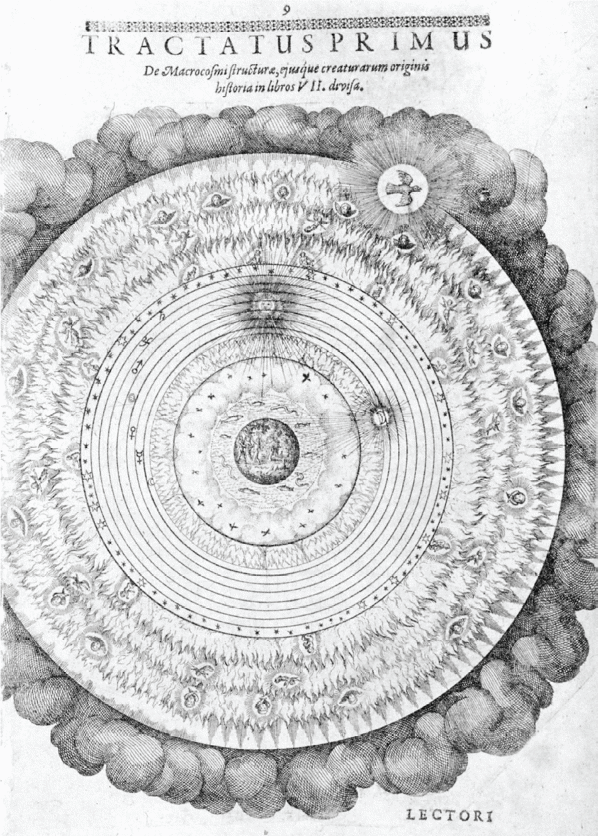
FIGURE 1977 0607-1. Robert Fludd's Geocentric World-View.
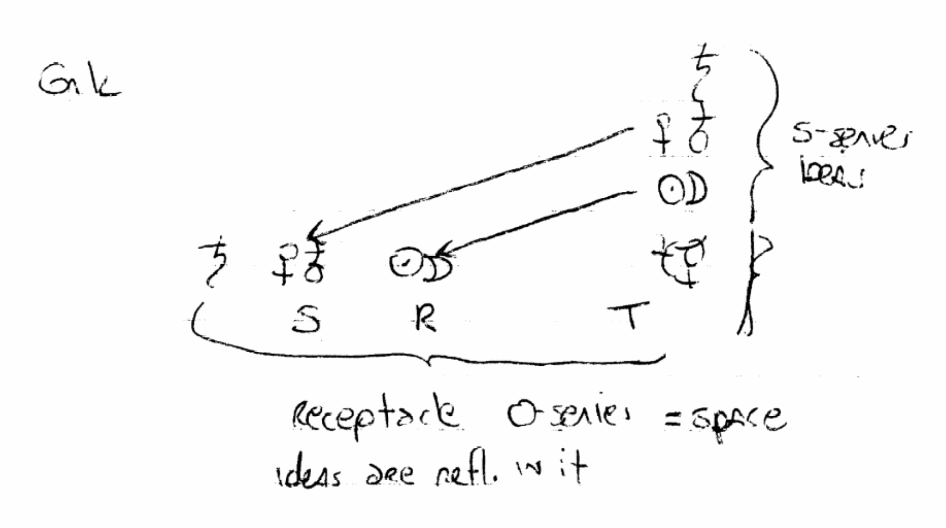
FIGURE 1977 0607-2-AB. Greek Scheme: Subject and Object Series.
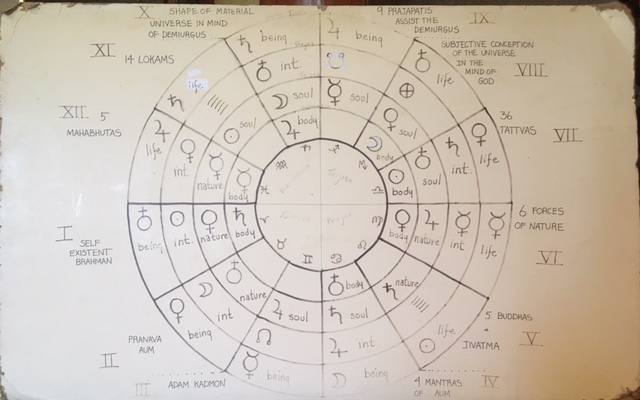
FIGURE IMG_2202-Posterboard Metaphysical Chart, used in classes at Wisdom's Goldenrod.
Other diagrams referred to are not with this transcript version.
RETYPED AND REFORMATTED by IT 2021. In 2024, IT adds TOC, notes within transcript, three diagrams and references to these diagrams, corrects errors/typos.
NOTES:
RETYPED PARTIAL TRANSCRIPT (hence V10). From 1977 0607 PLO Matter 14p.PDF. THERE ARE NO AUDIO CASSETTE TAPES EXTANT.
Tony is Anthony Damiani (AD).
Three diagrams (and references to them) not found in the original scan have been added. Some explanatory notes have also been added in [square brackets].
All spelling, punctuation, and capitalization errors have been corrected, some numbers spelled out, all quotes looked up and corrected to match the published version. The formatting has been changed for ease and clarity of reading. When a quote is read and it is not clear who is reading, the reader is left blank. —– has been replaced with [inaudible].
1977 06/07 at Wisdom's Goldenrod
Plotinus; Matter
[File 1977 0607 PLO Matter 14p.PDF Begins]
June 7, 1977
Greek Class concerning the Difference between Divine Matter and Matter
Rita: Maha-ishvara is an indeterminate being which contains an infinite number of possibilities. It is the potential ground of every and any universe. It is out of that substratum that a particular set of possibilities is determined and actualized which becomes One Being [FIGURE IMG_2202, Cancer]. That mixture of Bound [Gemini], the unity [Aries], and Infinity [Taurus], the Ideas, is the One Being. Last week you seemed to be saying that the One Being is a reflection of the Bound in the Infinity. I don't understand where the Ideas come from.
Tony: We'll have to pick up the problem of matter or the receptacle again. Let me read from Brehier on the notion of Plotinian metaphysics:
[Typist's note: I am using The Philosophy of Plotinus by Emile Brehier, The University of Chicago Press, Chicago, 1958.]
Emile Brehier [The Philosophy of Plotinus, pp. 44-45, Tony reading]: "Plotinian [partial reads: His] metaphysics is centered entirely in a certain astronomical theory of the sensible world, a theory which had its origin in the speculation of Eudoxus in the fifth century and which had established itself through the course of the centuries. It is the geocentric conception in which the heavens are formed by concentric spheres. The sphere which possesses the greatest radius supports the fixed stars; those of smaller radii each support a planet. We are able to form not only an abstract representation of this limited world but to have a definite mental picture as well. The regularity and periodicity of the movement of the spheres render the temporal process of the world equally comprehensible by reason. Such a world is eternal, and its periods succeed each other endlessly, one repeating the other.
"Plotinus and all the pagan Neoplatonists were very greatly attached to this conception of the world and Plotinus wrote a treatise defending it… …
"[Now] two results followed from this representation of the world: first, a certain way of conceiving the principles of the world; in the next place [partial reads: and next], a certain manner of representing the relations [partial reads: relationships] of these principles to each other and to the sensible world.
"Let us turn to the principles first. The sensible world is a certain order realized in space and in matter. The principle of this world can only be an absolutely fixed intellectual order, containing, in an eternal form and accessible to pure intelligence, the relationships and harmonies which are perceived in the sensible world. Such is indeed, in reality, the central hypostasis of the metaphysics of Plotinus, namely, Intelligence. Intelligence is above all an order or an intelligible world."Yonder there is a sky which is a living being. It is then not deprived of what we call stars. . . . Yonder there is also an earth which is not uninhabited but much [partial reads: which is] more alive than ours. [Partial reads: And] It contains all the living creatures which are in this world, as well as plants which possess life. There is yonder [partial reads: Yonder there is] a sea, a universal water whose flux and life remain constant. . . air is also a part of this intelligible world, as are the living creatures of the air which belong to it" (vi.7.12).
"Intelligence or the intelligible world is then none other than the very knowledge of the sensible world, realized in a hypostasis. This knowledge must be posited as a thing prior to the sensible world which is its imitation. If, indeed, the rational contrivances of the sensible world are not to be the result of a chance meeting…reason in its unity must be logically prior to this world."
[Note: See FIGURE 1977 0607-1 for the following.]
Tony: (See diagram) These are like a ring, this is like an orbit. When you have a ring on your finger and turn it around, the whole ring has to move. As this moves, the planets or fixed stars move with it. Don't think of the planet as separate from its orbit--it's not the way they conceived it. This is the so-called finite world of the medievals. The stellar sphere is the largest, within that is the planetary sphere and in the center is the Earth. He's speaking about the Intelligible World superimposing on this scheme. It's a conception of the universe which is qualitative and not quantitative. The modern conception of the universe is quite different. They think of it as an infinite world. Quote from Manly Hall, Philosophy of Astrology:
[Typist's note: I am using The Philosophy of Astrology by Manly Palmer Hall, Philosophical Research Society, Inc., Los Angeles, California, 1943.]
Manly Palmer Hall [The Philosophy of Astrology, pp. 14-15, Tony reading]: "When the ancients referred to the world they meant the complete nature of a creation, not merely its physical structure. The earth that is in the middle of the geocentric diagram of the world is not the planet earth, but the element earth, or matter. The seven planetary orbits that surround the earth in the geocentric system are zones or planes of magnetic energy and are referred to as the bodies of"Blessed Gods." Together these form what the medieval mystics called the Anima Mundi, or the soul of the world. Beyond the orbits of the planets, according to Ptolemy, lie the great circles of the fixed stars often represented by three rings of flames. These great constellational groupings were the source of the pure spiritual energy of nature, and were the abodes of the three manifestations of the Supreme Deity. …
"Thus, man living on the planet earth receives three kinds of energy into his own nature; spiritual energy, from the countless stars of heaven; physical energy reflected from the other planets of his own solar system; and elementary energy or force from the physical earth beneath his feet."
Tony: So we have the stars, the planetary spheres and the elements. This is equivalent to the Demiurgic Logos, or Mind -- the combination of these three. In this diagram which is in reference to the sensible world and all we know about it, the stars correlate to the Intellect, the planets to the Soul, and the Earth to the body. So we have a sensible representation of the Intelligible. When we speak of the zodiac presented by T. Subba Row, he is hinting that the physical zodiac of Aries through Pisces is a representation of the Intelligible. We have to try to understand what these qualities are based on or superimposed on. This is where the notion of the receptacle or matter comes in. If we turn to the section in Plotinus where he speaks about matter and pick out some selections -- III.6. "The Impassivity of the Unembodied". While you're looking, Avery, I want to read a little more from this introduction by Brehier.
Emile Brehier [The Philosophy of Plotinus, p. 62, Tony reading]: "It is easy to understand the intentions of Plotinus in his transformation of animism. For him the sole authentic reality is a spiritual order. If from a material reality we abstract both the spiritual order which is reflected in it and the law or reason which is expressed in it, there remains only non-being, matter, the place devoid of reality, in which this order is realized. Now an order or a reason can exist as such, only as an object of contemplation or as an object of knowledge; so the only real force even in the sensible world is contemplation and its object. The only actual forces are those of a spiritual nature. Nature is a sort of dream of this order which is reflected in matter.
"This spiritualistic physics is as radically opposed as it can be to any mechanistic physics. The parts are not to be regarded as the real elements of the whole but rather as productions of the whole. The conception or the production of the whole must be [partial reads: is] deemed, therefore, more real than the parts themselves. These are his principles. And they tend to establish connections of a purely spiritual nature between the parts of the universe. Thus the sensible world becomes transparent to the mind, and the forces which animate it can re-enter the great current of the spiritual life."
Tony: He refers to these as the intelligible aspect of the universe. If we abstract from the material universe all these qualities, the Intellect, the Soul, and the Elements, what would we have left? Read from Plotinus, III.6.7, p. 208.
Plotinus [III.6.7]: "7. We are thus brought back to the nature of that underlying matter and the things believed to be based upon it; investigation will show us that Matter has no reality and is not capable of being affected.
"Matter must be bodiless--for body is a later production, a compound made by Matter in conjunction with some other entity. Thus it is included among incorporeal things in the sense that body is something that is neither Real-Being nor Matter.
"Matter is not Soul; it is not Intellect, is not Life, is no Ideal-Principle, no Reason Principle; it is no limit or bound, for it is mere indetermination; it is not a power, for what does it produce?
"It lives on the farther side of all these categories and so has no title to the name of Being. It will be more plausibly called a non-being, and this is not in the sense that movement and station are Not Being (i.e., as merely different from Being) but in the sense of veritable Not-Being, so that it is no more than the image and phantasm of Mass, a bare aspiration towards substantial existence; it is stationary but not in the sense of having position, it is in itself invisible, eluding all effort to observe it, present where no one can look, unseen for all our gazing, ceaselessly presenting contraries in the things based upon it, it is large and small, more and less, deficient and excessive; a phantasm unabiding and yet unable to withdraw--not even strong enough to withdraw, so utterly has it failed to accept strength from the Intellectual-Principle, so absolute its lack of all Being.
"Its every utterance, therefore, is a lie; it pretends to be great and it is little, to be more and it is less; and the Existence with which it masks itself is no Existence, but a passing trick making trickery of all that seems to be present in it, phantasms within a phantasm; it is like a mirror showing things as in itself when they are really elsewhere, filled in appearance but actually empty, containing nothing, pretending everything. Into it and out of it move mimicries of the Authentic Existents, images playing upon an image devoid of Form, visible against it by its very formlessness; they seem to modify it but in reality effect nothing, for they are ghostly and feeble, have no thrust and meet none in Matter either; they pass through it leaving no cleavage, as through water; or they might be compared to shapes projected so as to make some appearance upon what we can know only as the Void.
"Further: if visible objects were of the rank of the originals from which they have entered into Matter we might believe Matter to be really affected by them, for we might credit them with some share of the power inherent in their senders: but the objects of our experiences are of very different virtue than the realities they represent, and we deduce that the seeming modification of matter by visible things is unreal since the visible thing itself is unreal, having at no point any similarity with its source and cause. Feeble in itself, a false thing and projected upon a falsity, like an image in dream or against water or on a mirror, it can but leave Matter unaffected; and even this is saying too little, for water and mirror do give back a faithful image of what presents itself before them."
Tony: That's a good selection. Let's try to work a little bit on this problem to see if we can understand. The suggestion was made that we might think of this as Prakriti.
Dickie: It did seem that when we were studying the idea of causal and non-causal manifestation, that Prakriti was manifested in two ways--causally as the tattvas and non-causally as the world. That second way, the non-causal appearance, is only illusion. On the one hand the world is an appearance of reality [inaudible] and yet somehow underneath that Prakriti is there and you can't see it. How do you know it's there? You only know it because the Purushas couldn't noncausally have something appear through them.
Tony: If we try to remember something Bhattacharyya said when he spoke about objective knowing which appears as subjective functioning…
Dickie: The objective knowing appearing as subjective functioning is what he calls the bhava.
Tony: The catch is what does he mean by "appears as". Could you give us an example?
Dickie: The example he uses would be how the unity of the felt body projects the image of the world. It is a projection through the felt body, not a projection of the body, or else it would be caused by the body. It is not caused by the body. The body is somehow a non-cause of the world. What manifests would appear to have a substratum Prakriti. Yet it is through the form of the elements that you know it.
- - - - - -
Tony: If we want we can imagine the senses shooting out; this is not accurate because only two senses go out. Let's imagine five of them go out and as they come out they seem to grasp a certain part of the world. So these are five selections from the world. We add them up and we get a picture of the world. Coming from the center of the body, let's say the heart center, going out through the body, projecting itself through the senses, each functioning and motion, warmth, movement, life. All these together constitute the imaged world. But, it is not the cause of that world. Yet that world won't appear without this body as an organ of perception. The entire body would be an organ of perception and concomitant with it would be the world we see. If you cut out certain senses, the rest of the body goes on perceiving the world quite differently. The image of the world would be changed by either the addition or subtraction of a function. Bhattacharyya said that the body is the entire system of Nature. The Buddha also said, "Within this body, six cubits in length is the origin of the world…"
[Typist's Note: I am using Studies in Philosophy, Vol. 1, by Krishnachandra Bhattacharyya, "Studies in Sankhya Philosophy," Progressive Publishers, Calcutta, 1956.]
K.C. Bhattacharyya ["Studies in Sankhya Philosophy," p. 160, stanza 52, Dickie reading]: "The external world is nothing manifest apart from the perceiving body or bodily consciousness…"
Dickie: The manifestation of the world depends on a percipient. There is no real manifestation without this subjective construction of it to grant it its manifestation.
Linda: It sounds like he's making a distinction between existence and manifestation. There are two existents -- the subject and the object. But manifestation is entirely dependent upon the body. One is not existentially prior, but in terms of production you have to have a body first.
K.C. Bhattacharyya ["Studies in Sankhya Philosophy," p. 160, stanza 52, Dickie reading]: "The external world is nothing manifest apart from the perceiving body or bodily consciousness, being manifest [partial reads: it manifests] through it as distinct from it."
Andrew: He's not talking about the physical body which we know as object, but of the body which we more commonly think of as subjectivity. When we perceive an object, the body is right where the perception is. If this body is the body which creates the world and our perceptions, then I can't see how he says the world is distinct from it.
Dickie: That's exactly because it's a non-causal manifestation. If it were distinct in the body, it would be a causal evolute.
Chip: An easier way to say that is that I feel like I'm my body, but I never feel like I'm the world. You never appropriate the world as yours.
Andrea: We appropriate this body that we're speaking of?
Dickie: Yes, you call it me. That's what you know of yourself. It's the feeling you have of yourself.
Andrea: But that body is right where the perception is.
Dickie: It is where the perception is, but it is also not where it is. That isn't the extent of the body; it's not the whole realm of it. You never really appropriate your perceptions to be you. All you can say is that it's mine.
Tony: Go over that. You can't understand the higher conceptions unless this is grasped. You can't understand Plotinus and the others without understanding this.
Dickie: The world is distinct from the body and not in the body. It's distinct from the body because we do not appropriate it. The world is not felt as me but the body is. If it were part of the body we would say it is me, but we don't. You say the body is mine -- you never appropriate the perceived body.
Tony: Did you hear what Richard just said -- you're hurting me when you pinch my foot.
Avery: Plotinus says, if the real forms were actually on matter, they would have some power to affect the matter. But they are not; they are images. They don't really combine with matter. The body conditions the experience. The conditioning of the experience is almost like an image of that felt body. It is distinct from that felt body…
K.C. Bhattacharyya ["Studies in Sankhya Philosophy," p. 160, stanza 52, Dickie reading]: "The external world is nothing manifest apart from the perceiving body or bodily consciousness, being manifest through it as distinct from it. The perceiving body is the body as feeling the object and the object as presupposing it [Dickie: the body] may be regarded as its feeling projection or necessary construction, the necessity being the necessity of the manifestation of aviveka as bhoga [Dickie reads: of the world]."
Tony: The perceiving body is the body as feeling the object. What would that refer to? Would that bring in the play of the gunas?
Dickie: Yes, the object is felt in three ways, the manifestation of the gunas. There is no experience of the object itself. Unless there is a felt relationship to the object, there is no experience.
Tony: Are you saying that our experience is constituted of these feeling complexes?
Dickie: Yes, that's their point of view. That's why the world is a non-causal manifestation of Prakriti, because the three gunas are involved in these feeling complexes.
Tony: Isn't that a strange thing to say, that feeling is the substratum of my experience, not matter? In other words, the gunas, the qualities of the gunas, are what I am experiencing, never any kind of matter.
Dickie: And yet what those feelings are are somehow images of this matter or Prakriti in its unmanifest state. There is some relation there.
Alan: Which side is the feeling coming from? We were just reading about how the world is a projection by the felt body but not in it. So in that sense there is a certain feltness of me that the world is projected through and the feeling is projected. On the other hand, if the Prakriti is constituted of these felt reals then the feelings are the stuff of that which is underlying what is being projected by the felt body.
Dickie: The problem is that what the felt body projects is not the felt body. The felt body projects the gunas, not itself.
Alan: It projects the gunas, or it projects on to the gunas?
K.C. Bhattacharyya ["Studies in Sankhya Philosophy," p. 159, stanza 49, Dickie reading]: "The world, as will appear presently, has for its material not indeed the manifest matters (bhutas) that compose the body but their primordial potentialities, the gunas that make up prakriti."
Linda: If it projected the bhutas, then the world would appear as you, or as your body. Therefore it couldn't be projecting the bhutas, because that is constitutive of the body. It would have to project something which isn't totally dissimilar from the body but at the same time could not be the body. If it were totally dissimilar to the body then you would never recognize it and if it were the same as the body you'd never be able to distinguish it.
Kristal: If the gunas are unmanifest, how are they projected by the body?
Dickie: They are never projected. There is an appearance of the gunas, but the gunas never get projected. They are unmanifest, so how could they get projected?
Alan: Aren't they the locus of the appearance?
Tony: They are all-pervasive.
Dickie: They do become the tattvas, but they appear as the world. So it's the part they are considering in the appearance as this type of matter. The other type of matter is something different. [inaudible] The non-causal manifestation is the one which resembles this type of matter, not the real becoming.
Tony: You say they become the tattvas; that's causal. And the world is non-causal. Suppose we use a different terminology. In the Greek scheme, let's say the gunas become Intellect, Soul. [inaudible] If we say the Antahkarana is composed of Buddhi, Citta, etc, and we consider an individual Antahkarana, it has a certain grasp of objects; it's not causing these manifest objects, but it's presenting them. That would be an irrational presentation, and this would be a rational presentation. Causal and Non-causal. He also said, they become the tattvas. That would mean they constitute these principles. [inaudible] Buddhi corresponds to a predominance of Sattva. Soul would correspond to rajas…
Avery: Tanmatra would correspond to tamas. Manas seems to be more sattva.
Tony and Richard try to work out Greek correspondence with three gunas. Indistinct.
Tim: It's hard for me to understand a complete distinction of sattva, rajas, and tamas in causal, subtle, and gross. There would be a predominance of one.
Tony: That's all we're saying. In the object series [FIGURE 1977 0607-2-AB], the sattvic would represent what we call the six holy forces [FIGURE IMG_2202, Venus in Virgo] and Mars [in Cancer] would be the four levels of being. In here would be contained the sattva, rajas, and tamas, and the distribution and production of beings according to how much sattva, rajas, and tamas they participate in.
I want to get back to the problem of this diagram. Reread the last sentence from Bhattacharyya.
K.C. Bhattacharyya ["Studies in Sankhya Philosophy," p. 159, stanza 49, Dickie reading]: "The world…has for its material not indeed the manifest matters (bhutas) that [partial reads: not the elements or bhutas which] compose the body but their primordial potentialities, the gunas that make up prakriti."
Tony: If we said this is Prakriti [possible reference to Saturn in Aries] and this the bhutas [possible reference to Jupiter in Capricorn], what is he saying, Dickie?
Dickie: The body doesn't cause the world, in the sense that it becomes the world; and it doesn't make anything else become the world. It's neither the eminent cause or the external cause.
Tony: Now the body itself would have to be an effect, wouldn't it? It would be a causal effect. It is the last evolute; it doesn't produce anything. What would be the underlying substratum of the body?
Dickie: Fundamentally Prakriti constitutes all of the causal manifestations. It becomes the causal evolutes and is the substance of the tattvas. [inaudible] Specifically, the five elements constitute the body.
Tony: Could we say that the Prakriti is what underlies the phenomenology that is perceptible? Therefore, if we put aside the Prakriti which underlies the phenomena, how is this phenomena constituted?
Dickie: Through the subjective function manifested through the tattvas.
- - - - - -
Tony: There is a certain order, a certain significance, a certain meaning, even if you want to call it mythical, that exists for this individual antahkarana. Otherwise you have chaos. Let's say that that meaning is based on phenomenology. Where did the meaning of that phenomena come from? I see a beautiful sunset. It has a value and a meaning. This individual's life has an order and meaning. Where does it come from? It doesn't come from the gunas.
Dickie: It comes from the subjective functioning. It comes from all the knowing functions of the Intellect.
Tony: Where does the order in my life come from? We look in the chart and we see a certain significance. We see the soul ordering my experience and a certain result takes place. But according to the theory here, I can't derive it because the rational principles are non-causal. So how can I account for the significance of the experience here? If you say that the appearance is Maya, that won't help because even Maya is significant. It conceals knowledge. I don't use the Vedantic term concealed Ignorance. If I could see into Avidya, I would see my future. [inaudible] It's like trying to get an explanation from the gunas themselves. Can I go back now to this body. The object is constituted by Prakriti, the felt body is constituted of the elements, fire, air, earth, water.
Dickie: [inaudible] Earth is the force which holds the body together; air is the thought process; fire is the subjective identity; water allows the felt body to project the world.
Tony: And all the time the gunas could take the form of any one of these. Again, what would the gunas be? Where would you put Prakriti on the chart? You have to be disagreeable, because I'm taking the stand that Prakriti or the gunas is the matter that takes on form, disperses the form, is incapable of holding on to any form.
Alan: When we read from Plotinus he said that matter is not body; it's after body. What's the difference between matter and body? Sometimes you seem to say that formless matter is not body, that body has some sort of determination.
Tony: I want to see if there is a correlation or not between what Plotinus calls nonbeing, the receptacle or matter, and Prakriti.
Linda: How could Prakriti be both being, everything that is to become, and nothing?
Tony: It sounds like Plotinus is saying it's nothing, but, Avery, just read a few quotes. You're speaking of it becoming all the time. It's nonbeing.
Linda: It can't be both being and nonbeing, can it?
Dickie: This is the point I was making. It can be as causal and it can be not as non-causal.
Linda: It's hard to conceive of something being empty and full at the same time. It seems that the conception of matter is emptiness.
Tony: Emptiness is not the word to use here.
Linda: What allows matter to be a pure receptacle?
Tony: How does the Prakriti organize itself, or is it these elements that organize the Prakriti?
Plotinus [II.4.5, Dickie reading]: "Those that ascribe Real Being to Matter must be admitted to be right as long as they keep to the Matter of the Intelligible Realm…"
Dickie: [inaudible] So in some sense the matter there is the [inaudible] of being. It underlies the Intelligible World; you could say it's Prakriti.
Tony: What you're doing is taking the rational first, second, and third, and saying the gunas constitute that. Whereas I suggested that it might work from Saturn [in Aries] down to Jupiter-Mercury [in Capricorn-Pisces] and doesn't work that vertical way. If you do that you're going to bring the gunas up to the level of the One.
Dickie: I don't think the Samkhya conception of Prakriti is like that, but you could come to a deeper conception of Prakriti. It seems that he has two ideas of matter.
Tony: Yes, but what is the Intellectual Matter?
Dickie: It's Venus [in Virgo]. [inaudible]
Tony: He just said that the causal manifestation, which really constitutes it, is not the gunas. Anyone remember quotations where he speaks about the Dyad, the Intelligence which is molded by the Intelligent? You've got a different kind of matter here. I suspect Intelligence is not constituted by the gunas. Wouldn't that come to say that matter is intelligent whereas I think Plotinus was suggesting when he speaks about the Indeterminate Dyad… [inaudible] We could put the abstract Dyad up here, the part that is Infinity and the part that is Bound [FIGURE IMG_2202, second and third houses]. This is the Indeterminate Dyad or the abstract principle of the World-Mind which is going to constitute the One Being [Cancer]. It amounts to saying that this is substantially constituted. This is something I've gone through with the Theosophists. They insist on bringing the notion of matter right up to the One, and I'm questioning that.
Plotinus [II.4.5, Dickie reading]: "The Divine Matter, though [(like the Matter here)] it is the object of determination, has, of its own nature, a life defined and [intellectual]…"
Dickie: [inaudible]
Tony: Isn't he speaking about life in itself, not life as participated in by creatures? Like the fountain of life.
Richard: [inaudible] I'll be the Samkhya. [inaudible] The Divine Matter is Buddhi, not even Prakriti, and it molds the Intelligence. It molds the Intelligence that comes from the Purusha and gives it form.
Plotinus [II.4.5, Dickie reading]: "Those that ascribe Real Being to Matter must be admitted to be right as long as they keep to the Matter of the Intelligible Realm…"
Tony: Then what is the matter of the Intelligible Realm? Could we have some quotes on that V.1.5.
Plotinus [V.1.5]: "5. As a manifold, then, this God, the Intellectual-Principle, exists above the Soul here, the Soul which once for all stands linked a member of the divine, unless by a deliberate apostasy.
"Bringing itself close to the divine Intellect, becoming, as it were, one with this, it seeks still further: what Being, now, has engendered this God, what is the Simplex preceding this multiple; what the cause at once of its existence and of its existing as a manifold; what the source of this Number, this Quantity?
"Number, Quantity, is not primal: obviously before even duality, there must stand the unity.
"The Dyad is a secondary; deriving from unity, it finds in unity the determinant needed by its native indetermination: once there is any determination, there is Number, in the sense, of course, of the real (the archetypal) Number. And the Soul is such a number. For the Primals are not masses or magnitudes; all of that gross order is later, real only to the sense-thought; even in seed the effective reality is not the moist substance but the unseen--that is to say Number (as the determinant of individual being) and the Reason-Principle (of the product to be)."
Tony: Let's go to this diagram for a minute. We pointed out that this was the universe that the medievals or the ancients spoke about [FIGURE 1977 0607-1]. It was composed of the realm of the fixed stars which would correspond to the Intellect, the realm of the planetary spheres which would correspond to the Soul, and the realm of the earth which corresponds with the elements. If you remember the quote we read from Brehier, he said something like this; the spiritual, rational, or soul gets reflected in all this.
Emile Brehier [The Philosophy of Plotinus, p. 62]: "If from a material reality [Tony: And I'm calling this a material reality.] we abstract both the spiritual order..."
Tony: Which one shall we abstract, the Intellect or the fixed stars? The fixed stars are part of the material order, so we abstract the Soul.
Emile Brehier [The Philosophy of Plotinus, p. 62]: "If from a material reality we abstract both the spiritual order which is reflected in it and the law or reason which is expressed in it, there remains only non-being, [partial adds: or] matter, the place devoid of reality, in which this order is realized."
Tony: It seems that these are devoid of matter, but they do order this, the material world. I'm inclined to think Intellect as such is not composed of matter. Intellect and Soul are not composed of the gunas. I'm saying that we are speaking about the bottom line [FIGURE IMG_2202, Body ring, FIGURE 1977 0607-2-AB, object series]. I'm going to start with Prakriti here [Saturn in Aries] and go to the Mars and Venus, then go to the Sun and Moon, then Jupiter and Mercury. I'm claiming that above this, speaking about matter doesn't make sense.
What would be the matter in the higher realm then? You're working out one of my complexes now--just figure you're doing something for me. (working on the board) This we call the Intellectual-Principle, this the One [FIGURE IMG_2202, first and third houses per AB notes for this time period]. The Intelligence or the Intellectual-Principle is the matter for the One to mold. This is the way I understand Divine Matter. I do not understand it as the gunas. We must keep these two things apart.
Dickie: So what is the difference between the Dyad and the Intellectual-Principle?
Plotinus [V.1.5]: "Thus by what we call the Number and the Dyad of that higher realm, we mean Reason Principles and the Intellectual-Principle: but while the Dyad is undetermined--representing, as it were, the underlie (or Matter) of the Intellectual World--the number which rises from the Dyad and The One is always a Form-Idea: thus the Intellectual-Principle is, so to speak, shaped by the Ideas rising within it--or rather, it is shaped in a certain sense by The One and in another sense by itself, since its potential vision becomes actual and intellection is, precisely, an act of vision in which subject and object are identical."
Tony: Yes, yes, that's the abstract principle of the Infinite and the Bound. That higher realm--we said that this is Infinity [second house] and we put Venus [in Taurus], Moon [Taurus], etc. and this was Bound [third house]. And we said that these constitute the One Being [Cancer] and I call this the Dyad. Now what do I mean by the Dyad here? I understand the Dyad like this. Let's call this a Logos Principle [Gemini] and this would be a system of ideas which is going to constitute the universe [Taurus]. Let's call this the plurality of ideas and this the Logos Principle or the Idea of the Universe. This will be Bound and this will remain Infinite. This would be the Divine Matter, molded by the One. What the One molds is certainly not the gunas -- that's at a much lower level. What the Divine Being molds is the Intelligence or the Incorporeal Being. Incorporeal Being is certainly not to be equated with gunas.
Dickie: Why couldn't you say that Taurus is Mulaprakriti?
Tony: That's what the Theosophists say. Then what's the meaning of Mulaprakriti? Is it this system here -- Venus [in Taurus], Being or Pranava Om, which means the triple Godhead. I'm quite sure the Divine Being is not going to start working like a potter, putting the gunas underneath the substratum of sensible qualities. That doesn't take place until we get to the fourth quadrant. You're talking about the Divine Being descending down to the fourth level and molding pots, to use a Vedantic expression. I'm saying that the Divine Being takes Incorporeal Being, because here is where plurality begins. Many? Many what. Many gunas? These are Divine Beings which get molded by the Unity into a certain pattern or idea which is going to be the idea of a cosmos. We're nowhere near creatures or phenomena. I'm saying that the Samkhya position is coming from the fourth level and that's as far as they get.
(unintelligible question) Mahat there [Mars in Cancer, Venus in Virgo] would be what we call Buddhi. Buddhi would be composed of matter and form. What is the mater and form here? The correlation between matter and form are the forces and the plan of what these forces are going to fabricate or make.
(unintelligible question) If we study astronomy and out of the void a nebula starts forming. There is this whirling which takes millions and millions of years. They come out with these huge arms and then they start forming a nebula. You're speaking about these fixed stars--a physical material world. We're speaking about a substantial point of view of being. We're not speaking about spiritual laws. The knowledge behind which the forces and the matter are correlated to formulate and become this nebula--this is what they are talking about. The spiritual laws will be reflected here, but to say this is constituted of gunas, I can't understand. [inaudible] We've got to build up on Samkhya. What we're talking about now are the tattvas above the 24 tattvas.
Avery: The unity of the body is in Purusha. That's what unifies their notion of matter. It may seem like ordering and intelligibility comes from Prakriti, but really all the real intelligibility comes from the Purusha. If you want to place intelligibility somewhere you have to attribute it to the unity which comes from Purusha. The light of Intelligence must provide all the true intelligibility, because in itself the Prakriti is a mechanistic unfoldment of matter.
Tony: We'll have to agree with this fellow [inaudible] when he says that matter is the base of the pyramid and has the ideal world as its aspect. Matter is unembodied and immutable. It is very important to have an understanding of the Plotinian concept of matter.
Plotinus [III.6.7]: "Matter must be bodiless--for body is [partial reads: because bodies are] a later production, a compound made by Matter in conjunction with some other entity. Thus it is included among incorporeal things in the sense that body is something that is neither Real-Being nor Matter.
"Matter is not Soul; it is not Intellect, is not Life, is no Ideal-Principle, no Reason Principle [partial reads: Logos]; it is no limit [partial reads: not limited] or bound, for it is mere [partial reads: merely] indetermination; it is not a power, for what does it produce?
"It lives on the farther side of all these categories and so has no title to the name of Being. It will be more plausibly called a non-being…"
Tony: Non-being here does not mean non-existent.
Linda: You said once that non-being is within Being.
Tony: To him all of it is within Being. It's not something on the other side.
- - - - - -
[Typist's note: I am using Plotinus and Neoplatonism: An Introductory Study by Philippus Villiers Pistorius, Cambridge: Bowes and Bowes, 1952.]
Philippus Villiers Pistorius [Plotinus and Neoplatonism: An Introductory Study, p. 119]: "[The Logos, or] the immanent phase of the Ideal World, acts on matter, and then, in the fashion of a mirror, by a pseudo-conception of a pseudo-entity, it conceives. Should the Logos disappear, the visible reflection or created entity would automatically disappear also. For Plotinus the visible universe [partial reads: world] is merely the visible reflection of an Invisible Reality…"
Tony: So we get the notion here of something above this qualitative world which was described by the medievals. There is a book by Alexander Koré [Note: Reference not found.] who said they had a finite conception of the world. Mr. Koré should take the trouble to study a little Platonism because this finite conception of the world would boggle his brain. He thinks the world is infinite according to the moderns because they've got a hundred billion stars. This Indeterminate Dyad is what makes the world infinite. He also says "accordingly therefore we have to consider that matter is a logical abstraction in Plotinus." That is nonsense. It is not a logical abstraction.
Linda: How does this concept of matter work into the chart we've been doing where you have the One Being in Cancer? You say that beyond that One Being in Cancer you have non-being. But that's not the non-being that's in Being. That's the non-being above Being. We've said that the non-being of matter is within Being. On your chart there is a non-being by virtue of the fact that it is beyond Being. I don't understand where matter comes in on your chart.
Tony: We put it down at the base. This base of the pyramid would be what he calls matter, the receptacle. This would be Being. Let's try an analogy. If you analyze your dream, everything in the dream is constituted by some kind of understanding or knowing. Every aspect of the dream, anything perceived in the dream, the entirety of the dream has a knownness to it. The part that is unknown is where the dream images are projected. Matter would be like the substratum on which the images of the mind are projected. Suppose I have a movie camera and I project and I have no screen. Will I see any pictures?
[Note: See FIGURES 1977 0607-2-AB, IMG_2202 for the following couple paragraphs.]
(unintelligible comment) Prakriti means the equilibrium of the gunas. There is no distinction between the gunas here. In the next line we have the distinction; there is a rupture of that equilibrium and a predominance of sattva because we're dealing with the causal aspect of the material universe. We could refer to it as Buddhi, but Buddhi always refers to the subjective series. Ahamkara would correspond to the subtle laws or what we call the psychic realm.
Richard: So all we have on the bottom line is the bhutas and the noncausal manifestation? Now they say that the Prakriti is the manifest form of Purusha. They say that the manifest is taken to be the unmanifest. They lump all the unmanifest in the Purusha, and you're taking their Purusha in the subject series and drawing it out. You're saying that on each one of those lines which calls itself the subject… [inaudible] The bottom line, the body monad, would be called the manifest series, except the Saturn [in Aries] because Prakriti itself is unmanifested. It's that which manifests everything above it and pretends that it is everything above it.
Tony: In a few commentators and in some of the quotations we read where they speak about the sensible universe, starting with the realm of the causal, the fixed stars, which reflect the Intellect… It reflects the Universe. It certainly it not the Intellect.
Richard: But it acts just like it.
Tony: Yes, that's why astrology can be so mundane. You also see, for instance, why a Sage will only deal with an individual. He embodies these things in a very individual way. The whole of the Intelligible World is reflected in him, in a way that is peculiar to him. He's playing out the celestial idea of what his higher Self is and what his evolution is, so then he has to see you as an individual. He can't consider you in a group. He can't even relate to a group.
We can go over this notion of the two different kinds of matter. I'm trying to show that this higher realm is so inconceivable because we are speaking about the One or the Unity or the Self-Existent Brahman which is going to mold the Intellectual-Principle which would be constituted of the Indeterminate Dyad. This is intelligence, not gunas.
Linda: Divine Matter is not the one that's so problematic. I can understand this Divine Matter as Bound and Infinity. It's this other matter which reflects the Intelligible Principle which has no being, which doesn't mix with any form. Is it the actual shape? It doesn't seem that it's the same as body.
Tony: He says it's not body and he makes a distinction between that matter and body. Guenon says that matter in itself is so unintelligible that there is nothing that we could know about it. [inaudible]
Remember the quotation where he speaks about the power of the One. I think we're trying to answer the question of what is the relationship of Unity and Being. Or we could put it in Hindu terms as the difference between Cit as [inaudible] and Cit as static. (working on board) Let's put the One here and Being here. This constituted the entirety of the system of universes and this would constitute the substratum or subject aspect or the idea of the universe which is not the universe. [Note: See FIGURE IMG_2202, houses 1-3, per AB notes for this time period.] This would be the universes and this would be the idea of the universe. Idea is a bound thing. Here is the difficult part for us to grasp. We refer to this symbolically as the One and this as the Intellectual-Principle or Karana. This is the Linga or Soul Principle. And this is the body or Sthula Principle. [Note: See FIGURE IMG_2202, first house dignities.] I'm using T. Subba Row's classification. This constitutes what T. Subba Row would call the entity, the Self-Existent Brahman. But the Self-Existent Brahman in no way can send forth an emanation of itself. It itself does not emanate. So what happens? These three get reflected into the One Being [Cancer]. They are not in the One Being. Because these three by definition constitute the Indeterminate Dyad, which constitutes not one universe but all universes, they could only be a reflection in the One Being. We gave the example at a much lower level–we think of the planets as the psychical principles which constitute or fabricate our being. When we investigate how they fabricate our being, for instance, the heart represents the Sun or is a functional image of the Sun. It certainly is not the Sun. As I said last week, when we die the psychic essence or function which constitutes the heart goes back to the Sun. We pointed out that these generative natures in some mysterious way participate in these ideas. Now these ideas or reason principles are at a much lower level. The other Reason Principles are at the highest conceivable level and they get reflected in the One Being. This One Being goes into the second quadrant and then we will have to break this down and see how it fabricates 5, 6, 7, and 8 and then 9, 10, 11, and 12 so that we have a triad.
But to get back to Richard's question. The question is that there is this mysterious dualism somehow present. This Indeterminate Dyad or the World-Mind seems to take that nondualism and sunder it, present us with a dualism. "We must therefore take the Unity as infinite not in measureless extension or numerable quantity but in fathomless depths of power." (Plotinus, VI.9.6) So to T. Subba Row, this could never be divided up or broken up -- you can't say this is 1, 2, 3, or 4. T. Subba Row would say this constitutes the entity, the Parabrahmic portion, the Intellectual, Soul, and Body. Can you use the level we're working with? The unity of this is never interfered with, never broken up, never touched upon. That's the first house, the Self-Existent. If we take the whole first quadrant and go according to the circles, the only fall is Saturn [in Aries]. That would be the body of this whole quadrant, whether in a metaphysical way of all universes or in the ontological way.
Let me read this and see if it helps. You can't really answer these questions. At the most suggestions are offered.
Emile Brehier [The Philosophy of Plotinus, p. 138, Tony reading]: "In the second treatise of the same Ennead, [partial reads: Plotinus: II] Plotinus asks himself how"all beings proceed from the One…""
Tony: Now beings here is incorporeal Being.
Emile Brehier [The Philosophy of Plotinus, p. 138, Tony reading]: ""…all beings proceed from the One which is simple and which manifests, within its identity, no diversity and no repetition." [partial adds: Now] Plotinus distinguishes three moments within this productive act. "The One, being perfect, overflows; and this superabundance produces a thing different from it. The thing engendered turns back to the One. It becomes fruitful; and, in turning its attention upon itself, it becomes Intelligence. Its arrest in turning to the One makes it a being, and its attention turned toward itself makes it Intelligence. And since it stopped in order to look at itself, it becomes both Intelligence and being." It is easy to see what must be understood by this sort of theogony."
Tony: It's not easy to see. Sometimes these issues are really agonizing.
Emile Brehier [The Philosophy of Plotinus, p. 138, Tony reading]: "The indeterminate thing (Indeterminate Dyad) which arises from the One is the other, also called the infinite dyad or ideal matter."
Tony: Ideal matter is not Prakriti. If you want to think of the Overself composed of gunas, go right ahead. Or, the Solar Logos made up of gunas.
Emile Brehier [The Philosophy of Plotinus, p. 138, Tony reading]: "It constituted the first moment. In turning back upon the One, that is to say, in letting itself be determined by the One (and this is the second moment), it recognizes within itself fixed limits and, in that way, it knows itself."
Tony: Now you have a particular World-Mind.
Emile Brehier [The Philosophy of Plotinus, p. 138, Tony reading]: "[Section 10 of] the third treatise describes this genesis for us in almost the same way. … In Platonic terms borrowed from the Sophist [partial reads: Sophista]…"
Tony: By the way, I suggest you read it if you want to follow these problems.
Emile Brehier [The Philosophy of Plotinus, p. 138, Tony reading]: "…there must be in each object of thought something of the same and of the other."
Tony: And this becomes the principles of all knowledge. Not until then could you have knowledge.
Emile Brehier [The Philosophy of Plotinus, pp. 138-139, Tony reading]: ""If thought wills to apply itself to an object one indivisible, no verbal account is possible [any longer]. . . . A being which thinks must comprehend differences, and the objects which it conceives must present variety. Otherwise, there is no thought but only that sort of contact or touch either ineffable or non-rational which exists before the rise of Intelligence.""
Tony: [inaudible]
Emile Brehier [The Philosophy of Plotinus, p. 139, Tony reading]: ""To touch is not to think.""
Tony: Here touch would be Samadhi, supreme identity.
Emile Brehier [The Philosophy of Plotinus, p. 139, Tony reading]: "In the return movement of Intelligence to the One, he distinguishes two further movements. The first consists in that"there is a tendency toward the One which Intelligence desires to lay hold upon in its simplicity." Then, it is not yet Intelligence, "but a vision which does not yet have an object." It has at the most only a "vague representation," possesses only a "vague outline." It is "desire to see and vision without distinctness." It has, in short, the vague feeling of measure."
Tony: This reminds me of the Shaivite doctrine where the two sides, This and the I, are combined into a unity. Yet there is no distinction here.
Emile Brehier [The Philosophy of Plotinus, pp. 139-140, Tony reading]: "Accordingly, the One is considered not so much a static principle of the union of beings as the dynamic principle of Intelligence. The One is not so much the actual object of Intelligence as the reason which causes Intelligence to have objects."The Good is the source. … The Good gives to Intelligence characteristics it does not itself possess. From the One comes a multiplicity to Intelligence. Incapable of containing the power which it receives from the One, Intelligence reduces it to fragments and multiplies it, in order to be able to entertain it thus part by part" (vi.7.15). … "We must not say then that Intelligence beholds the One. Intelligence lives orientated toward the One. It is suspended from the One and it turns toward the One" (ibid. 16). Intelligence derives the power from the One to establish within the infinite the fixed relations which at once constitute beings [partials adds: and Being] and make them visible to Intelligence."
Tony: If I don't leave I'll turn into a pumpkin, so that's enough. If you follow this diagram or the metaphysical chart which T. Subba Row has presented, you can trace your way back to metaphysical principles. So the stars would represent Intellect, the planetary spheres the Soul. So we're using the actual physical universe to try to understand these metaphysical principles. This is the only thing that we have -- our universe. A human being will not constitute a sufficient guide.
[File 1977 0607 PLO Matter 14p.PDF Ends]
1977 06/07 V10: CLASS: Plotinus; Matter. Copyright 2021 Wisdom's Goldenrod p. iv