DIAGRAMS FOR 1978 0524a

Seminar
Wednesday, May 24th, 1978
Verbatim, unedited transcriptSEMINAR at Wisdom's Goldenrod, Hector, NY
with Anthony Damiani (AD)
May 24a, 1978
PLATO; REPUBLIC; DIVIDED LINE
TOPIC: Plato
SUBJECT: Republic
SUBSUBJECT: Divided Line
CONTENTS:
Initial discussion of Book VI of Plato's Republic
Introduction of the analogy between sensible Sun and the Good
Key passages and their locations discussed
Idea of Good is totality of Being, not yet divided into Intelligible and Intellectual; at level of Triad
One is to Being as Sun is to sensible world
Unwritten doctrines: Idea of Good corresponds to Dyad/Intelligible Matter for the One
Levels of knowledge correspond to geometric forms (point, line, surface, cube); divided line conceived from level of Nous; Plato teaching, not just speaking to us; initial premises indicate analogy and meaning
Soul as subject of divided line
Soul knows first, empirical personality an effect; no need for Scholastic abstraction
Libra very moody; good for aesthetic appreciation
Traditional doctrine of epistemology implicit in divided line, required for understanding
Sensation and perception not identical, disagreement with Jung
Detailed analysis of divided line sections
Lowest section terminology across different translations: picture-thinking, shadows, phantasy, conjecture, apprehension of images (eikasia); numinosity and elusiveness of meaning
Second section terminology: belief (pistis), resemblance, natural objects; archetypes of images in lowest section
Third section discussion: process of working back to psycho-essences; role of concepts and reflection; different interpretations: Scholastic view (abstraction), Platonic view (soul's a priori knowledge)
Plotinus: soul assumes identity with dominant phase
Analysis of Demos's interpretation of third section: critique of his definition; discussion of "hovering between sense and essence"; importance of precise terminology: locus of psycho-essence is between sense and essence
Mathematical intermediates: numbers in soul; involved in constitution of psycho-essence
BOOKS READ FROM OR REFERENCED:
Thomas Taylor (tr.), The Republic: A Dialogue Concerning Justice (Vol. 1), in The Works of Plato, viz. His Fifty-Five Dialogues, and Twelve Epistles
Thomas Taylor (tr.), Theodore Wratislaw (ed.), The Republic of Plato
Paul Shorey (tr.), Plato, The Republic (Loeb Classical Library) [Note: Shorey's translation is also to be found in Plato: The Collected Dialogues, Hamilton and Cairns (eds.) (Bollingen), which is the book Anthony most likely was using.]
Francis Macdonald Cornford (tr.), The Republic of Plato
Plato, Benjamin Jowett (tr.), The Republic
Raphael Demos, The Philosophy of Plato
Sir William David Ross, Plato's Theory of Ideas
Plato, Parmenides
C.G. Jung, CW 10, Civilization in Transition, "Flying Saucers: A Modern Myth of Things Seen in the Skies"
Whitney Jennings Oates, Charles T. Murphy (eds.), Greek Literature in Translation
Paul Brunton, The Hidden Teaching Beyond Yoga
Plotinus, The Enneads (MacKenna translation, 4th ed.)
PLOTINUS QUOTES READ OR REFERENCED: III.4, VI.7.25
DIAGRAMS appended to this transcript:
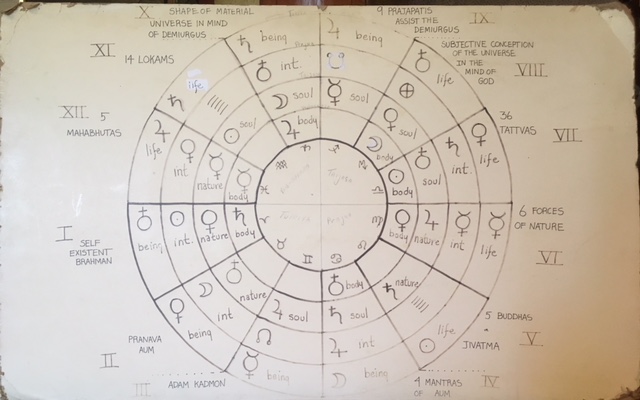
FIGURE IMG_2202-Posterboard Metaphysical Chart.
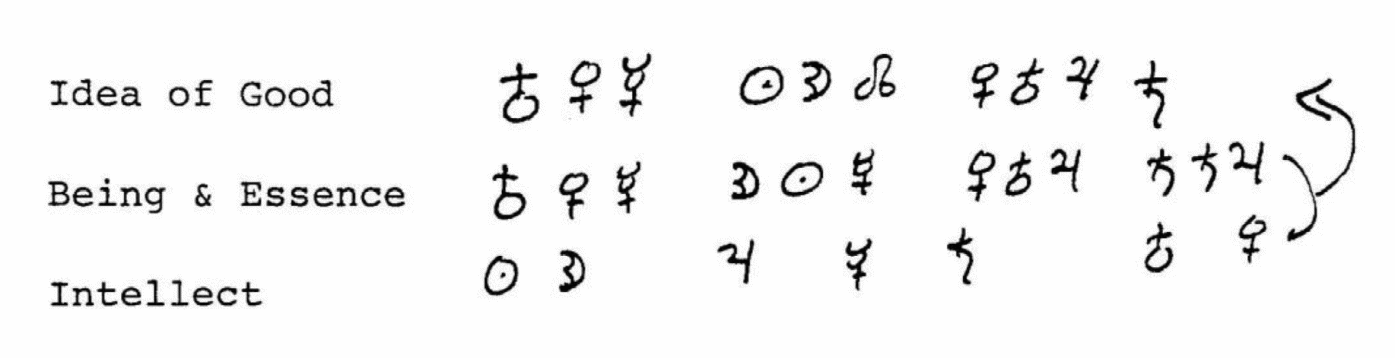
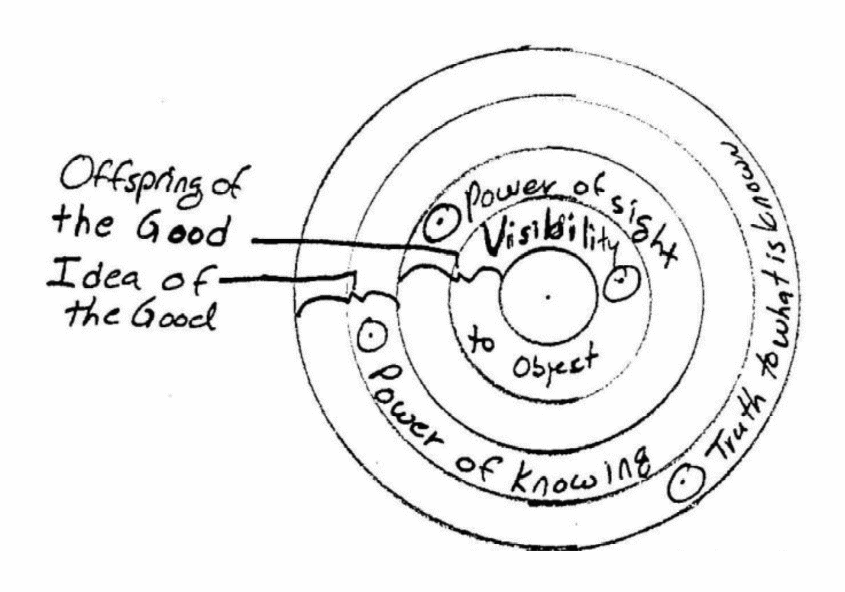
FIGURE 1978 0524a-2. Idea of the Good.
FIGURE 1978 0524a-3. Idea of the Good, Being and Essence, Intellect.
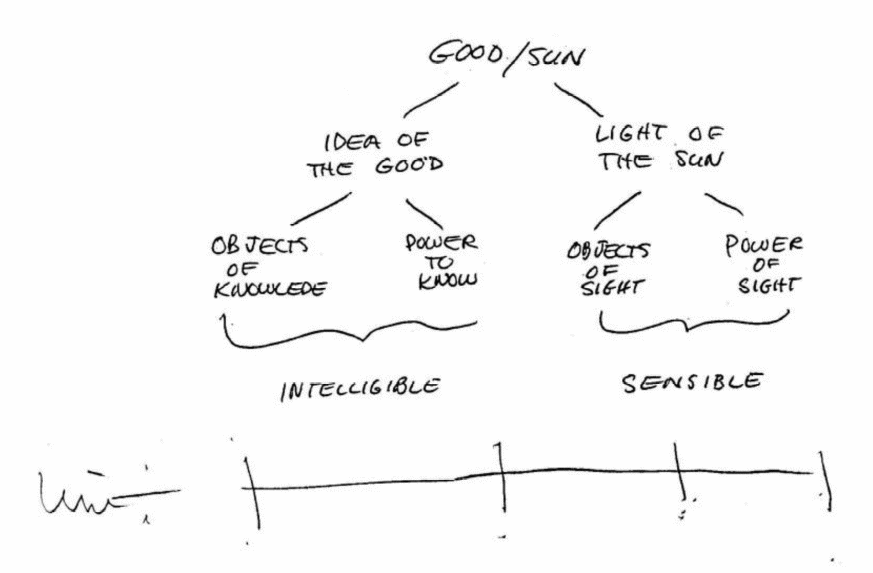
FIGURE 1978 0524a-4. Good/Sun analogy correlated with Divided Line.
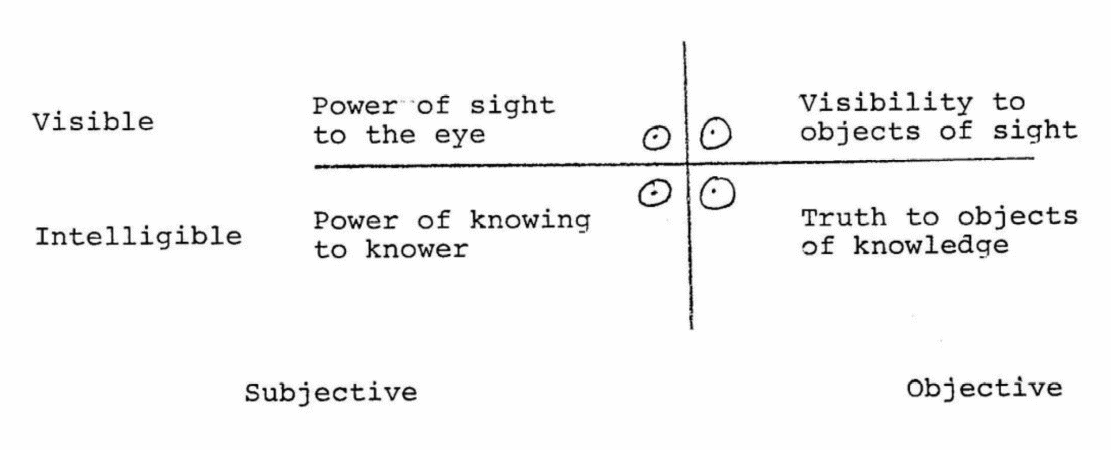
FIGURE 1978 0524a-5. Four Aspects of Sun Monad.
FIGURE 1978 0524a-6. Four Aspects of Sun Monad in Four Rings.
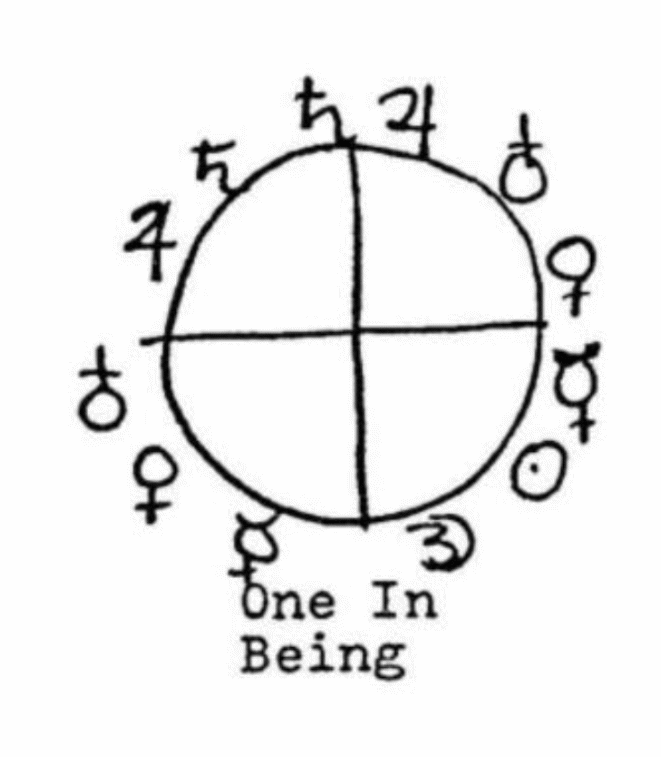
FIGURE 1978 0524a-7. One in Being.
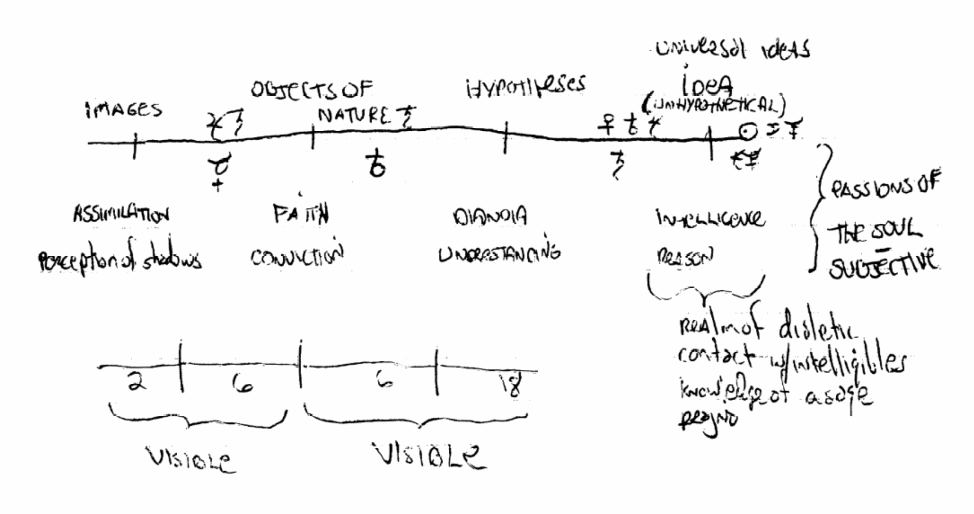
FIGURE 1978 0524a-8-AB. Divided Line.
Other diagrams also referred to are not with this transcript version. [Transcriber note: [diagram] means the speaker is referencing a diagram as he or she is speaking. If someone is drawing or writing, with audible sounds of chalk on a blackboard, I indicate this by [drawing] or [writing].]
NOTES:
This is 1978 05/24a, Plato; Republic; Divided Line Seminar, and the first entry associated with this date. 1978 05/24b = Hinduism; Knowing Willing Feeling Class.
In this seminar it sounds like AD is trying to make an outline or write a paper. He flows in and out of dictating and conversing. The dictation is so woven into his speaking that I make no effort to indicate it separately.
TRANSCRIBED Verbatim by IT prior to 2017, reformatted by jf 2018. In 2023, IT updates prefatory matter, footer, and audio file name, completes TOC and Book List, adds Plotinus quotes section, fixes errors/typos, adds new notes within transcript, adds eight diagrams and references within transcript to these diagrams, reformats to accord with new conventions. Archival verbatim transcript – V12a.
AUDIO FILES: 1978 0524a. [Note 1: "Tape" and "Side" refer to original audio cassette tapes that were later digitized into .MP3 Audio Files. Note 2: We are missing the second audio file for this seminar.]
1978 05/24a SEMINAR at Wisdom's Goldenrod
Plato; Republic; Divided Line
[Audio File 1978 0524a Begins]
MW: Do we not have the extension cord for this?
AD: We can (swap this) out right now and use those quietly.
[tape break]
AD: "…give some consideration to mystical and astrological conception of the cosmos implicit among the Greeks' metaphysical and occult philosophy." Now, ignoring that quotation, ok, let's go right in-- right into the-- um--
EMK: See, this is the one with your notes in it. This-- this is just the copy I think where you have I think [one/two words inaudible] corrections on it.
AD (simultaneously): Alright. Let's do this here because I think you could use this material if you want, what I have corrected, and when I haven't I'll go along. It'll be harder and harder for me 'cause I'm getting busier and busier. And traffic at night has also jumped up 20%. So, we'll try outlining and then, you know, writing it up, ok. So, we'll go right into-- "In order to-- we have to give ce--" no not-- [24 second pause, flipping pages, faint background student words] You see what I-- well, I think I'm-- think of doing is something like this. And we even plunge into the Book VI, take the passages which we consider key passages. And they will consist of-- Which book has the-- [short pause] This one, no? [student assents, very faint] Well, you know, the paragraph Tom [one word inaudible]
MW: I have (one) that had the (letters in it).
AD: Which is that?
MW: The traditional one like 510a, b--
AD (simultaneously): Yeah, yeah. This way all we have to do is put down that traditional numbering and we don't have to quote, you know?
MW: Uh-hm.
AD: I mean you don't have to write out the quote and get lost in it. Ok? So now--
MW (simultaneously): You want to look at it or--
AD: No, you hold onto it, ok? Now, um-- [short pause] We could briefly summarize by saying that in the Book VI we're given the parable of an analogy-- or we're given an analogy between the sensible Sun and the Good. [short pause] And this was going to require the closest scrutiny of the meanings, you know, that he's-- let's say that are the background to this here but they're more hidden than obvious. [short pause] We're underlining the fact that [short pause] symbolism is cosmic, I-- you don't have to write that, what we ju-- just (underlining it), you know, cosmic symbolism that we're dealing with. [S, faint: Alright.] So, the most-- I think the most appropriate place to break-- begin was in quoting here, where he starts in, Michael, by saying--
[short pause]
[Transcriber note: I am using Thomas Taylor (tr.), The Republic: A Dialogue Concerning Justice (Vol. 1), in The Works of Plato, viz. His Fifty-Five Dialogues, and Twelve Epistles, First Edition, London, 1804.]
Plato, Thomas Taylor (tr.) [The Republic, Book VI, p. 345, AD reading]: "Is not then the sun, which indeed is not sight itself, yet [as it] is the cause of it… [AD: Going on.] … Conceive then, said I, that this is what I called [AD reads: call] the offspring of the good, which the good generates, analogous to itself…"
AD: Alright, what paragraph is that?
MW: That's 508b, uh-- yeah, 508b.
AD: Alright. We quote paragraph 508b. [short pause] Alright, there's a very specific reference i-- item. Now, continuing. You have to forgive me for-- Continuing, what I'm going to do is then the next item he speaks about the soul, ok, looking up or looking down, number-- now that's [MW assents] the second quote, now what paragraph would that be? It follows right upon that. "You know [MW simultaneously: Right.] that the eyes, said…"
MW: Ok. Well if you want the part that starts right after it then it would be 508c, d-- Yeah, 508c and d.
AD: C and d would be like line 1, line 2, [MW assents] line 3, ok? Alright? So then that would give us the next point which we want to make, which is about-- you know, he's referring to the soul: if it looks up, it's guided, it looks down, it gets lost. Ok? [student assents, faint] Because I-- I-- like this I don't see, you know, I don't think Plato wrote like this. See, there are no paragraphs. He's not broken down into paragraphs.
EMK: No, this is-- this is a style of printing books, they have a ratio for the margins.
AD: Yeah.
EMK (faint): (The whole thing.)
AD: The (healthy) paragraph. (AD laughs) [short pause] Alright? That's an item by itself. In other words, the [MW assents] series of quotes, we're taking them apart, you know, like you take a body and say this is 1a-- bone a, [MW assents] this is bone b, this is bone c. So then we can say bone a, bone b, and bone c is what we're talking about.
MW: Uh-hm.
AD: And then the very next point-- [short pause] um--
Plato, Thomas Taylor (tr.) [The Republic, Book VI, p. 345, AD reading]: "That therefore which imparts truth to what is known…"
AD: Now what paragraph is that, or line?
MW: That's 508e.
AD: Ok.
Plato, Thomas Taylor (tr.) [The Republic, Book VI, p. 345, AD reading]: "That therefore which imparts truth to what is known, and dispenses the power to him who knows, you may call the idea of the good, being the cause of science and [of] truth…"
AD: Alright?
EMK: What was the number on that quote?
MW: 508e. [18 second pause] If-- if you want that whole part to conceive-- where he speaks about how the Good is beyond knowledge and truth then it-- then it's 509a.
S: Oh (so--)
AD (simultaneously): Good, alright, then it's following in (concercation), you know, conse-- serially. You see what I mean, that it's the meanings, the way they're following underneath? Like the words are up here and the meanings are down below it. There's a serial order that Plato is imparting. [9¾ second pause, flipping pages] Yeah, I'm skipping over.
RC: Excuse me, was that 509a?
AD: 509a is what?
MW: That's the-- it-- well, it's when he says that knowledge and truth are fair but the Good is beyond even knowledge and truth.
AD: Yes, that's another s-- very specific item. [11 second pause, flipping pages] Alright, and then on my book in 350 he starts off by saying--
Plato, Thomas Taylor (tr.) [The Republic, Book VI, p. 349, AD reading]: "Do not omit, replied he, the smallest particular. [AD paraphrases: Do not, said he, leave anything out.]"
AD: You know? Ok.
Plato, Thomas Taylor (tr.) [The Republic, Book VI, pp. 350-351, AD reading]: "Understand then, said I, that we say these are two; [MW assents] and that the one reigns over the intelligible genus and place, and the other over the visible [AD adds: place]…"
MW: Ok, that's [AD simultaneously: What--] 509d.
[11¼ second pause, flipping pages]
AD: Then you understand then these two species, the visible and the invisible, alright. We're going to try to give a minimum background or framework, you know, in terms of quotations, absolutely minimum because anyone who doesn't read this Republic is wasting his time reading what-- [10¼ second pause, flipping pages] Alright. [24¾ second pause, flipping pages] Alright could-- could you read back the-- itemize the idea, the-- the quote?
EMK: Ok, can you-- In Book VI, we're going to anal-- we're given the analogy between the sensible Sun and the Good, which we-- which will regard the closest scrutiny of the hidden meanings which are in the background. We're (underlizing) the fact that the symbolism is cosmic. The most appropriate place to begin is where he says "Is not the sun which is sight, etc." That's 508b. That's the "Conceive then, said I" passage. Continuing he next speaks about the soul looking up and looking down, 508c and d. And the quote will refer here to the soul getting lost in darkness or adhering to that which is above.
[short pause]
AD: Go on, uh--
EMK: And having spoken about the soul, "That therefore which imparts truth to what is known" is the quote in 508e. And then the next one is the one Michael mentioned, 509a, the Good is beyond even knowledge and truth. Then you mentioned on page 50 [EMK means: 350] in your book, "Understand then, said I…" That's all I wrote to refer to the quote, it's the 509d. We understand--
AD (simultaneously): "…that we say these are two; and that one reigns over the intelligible," ok. So that gives us a number of very distinct and specific ideas, right? How many would you say?
RC (faint): About five written passages.
AD: Hm. [10 second pause with very faint background student talking] Ok? [short pause] So let's rephrase it to accommodate ourselves. [short pause] The parable that he sets forth here is something like this. The Sun is to the sensible world as the Good is to the Intelligible place. [37¾ second pause] Let's pick up one item at a time, ok?
[14½ second pause with very faint background student talking]
RC: So you've got-- we just did that with this.
[57¾ second pause]
AD: That is, I think, something that we could see [one/two words inaudible] providing us with the material necessary to construct and, you know, project some meaning into his divided line symbolism. [short pause] It seems that there's an almost one-to-one correlation, you know, between that part of the divided line which is going to deal with knowledge [short pause] at the human level, you know, and then true knowledge or true cognition. And he's-- you know, I think we could say that. And then the next-- following the next point-- [11 second pause] We're anglicizing this, right? The next point he makes is that [short pause] the soul is the subject of discourse here and consequently he inserts this-- this very specific reference in regard to the soul's functioning, if it looks up or it looks down it will have knowledge according to that. And then the Idea of the Good, that, (you know/yeah)-- (uh-hm).
S (simultaneously, faint): "That therefore…"
EMK/S(?): It refers--
S (whisper): Ok, what's--
[short pause]
AD: "That therefore…" (Here we go.) [15 second pause, flipping pages] I'm looking for the "That therefore".
DB: Bottom of the page, 244 [DB means: 344].
AD: 3 what?
DB: 44.
S (faint): Look it up.
[10 second pause, flipping pages]
AD: Well this was 5-- 509--
RC (faint): Yeah, 508.
AD: 508c, uh--
EMK/S(?) (faint): [couple/three words inaudible]
RC (faint, almost to himself): "But that therefore which imparts truth to the thing known (and all our) [couple/three words inaudible]"
S (very faint): Sounds like [one/two words inaudible]
[short pause]
AD: Is that right, Michael?
MW: The quote that [AD simultaneously: Yeah.] says "That which imparts truth" is--
AD (simultaneously): Yeah, read that to me.
MW: It's 508e.
AD: Yeah, you have that?
[Transcriber note: I am using Plato, The Republic, Volume II, Books 6-10, translated by Paul Shorey, Loeb Classical Library, No. 276, London: William Heinemann Ltd, Cambridge, Massachusetts: Harvard University Press, 1935.]
Paul Shorey (tr.) [Plato, The Republic, Book VI, 508e, pp. 103-105, MW reading]: ""This reality, then, that gives their truth to the objects of knowledge and the power of knowing to the knower, you must say is the idea of [MW adds: the] good, and you must conceive it as being the cause of knowledge and of truth in so far as known.""
AD (simultaneously): Read it again, s-- very beginning.
Paul Shorey (tr.) [Plato, The Republic, Book VI, 508e, pp. 103-105, MW reading]: ""This reality, then, that gives their truth to the objects of knowledge and the power of knowing to the knower, you must say is the idea of [MW adds: the] good, and you must…""
AD (simultaneously): Ok, ok. So 508e we're presented with the extremely important signification as to the Idea of the Good, which would be the totality of Being. [Note: See FIGURES 1978 0524a-2, 3.] We say the totality of Being because we're not going to divide it now into Intelligible and Intellectual [rulerships and exaltations]. Well-- [23¼ second pause] And, again the pivotal point in the whole doctrine, the addenda that the Good is something different and beyond even the truth and the power of knowing that truth which is imparted. No, that's wrongly stated. [short pause] That the most important point in this discussion of course is that the Good is beyond essence and Being. Beyond, what can we say, existence and truth. [9 second pause] So that again our metaphor or the proportion work out something like this. That which is beyond Being is to Being as the sensible Sun is to the world.
[12¼ second pause]
MW: Uh-hm.
[10 second pause]
AD: How does this-- does it seem to be going alright? You know, the outline does seem to be following, ok?
EMK: At this point are you speaking of the Good as beyond Being or also [AD simultaneously: Yeah.] the Idea of the Good as beyond Being?
AD: No.
EMK (faint): Ok.
AD: The Idea of the Good is Being.
EMK (faint): Ok, good.
AD: See the terminology in the East would be like in Chinese philosophy they would call what's beyond Being they'd call it non-Being.
EMK: Uh-hm.
AD: Alright, [MW assents] but if you use that word here, non-Being has the implications of unreality. Like sensation is non-Being. So you can't [EMK simultaneously: Ok.] use that damn terminology.
EMK: So in the sense that you're speaking of it as Being, but as Being yet-- not yet distinguished in terms of the Intellect or the rulerships and the exaltations, you're speaking of the Idea of the Good at the level of the-- the ten.
AD (simultaneously): The Triad [diagram], yeah. [Note: See FIGURE IMG_2202-Posterboard Metaphysical Chart, first quadrant.]
MW (simultaneously): Triad.
AD: So like-- well-- maybe we'll revise it but right now to keep it as simple as possible so that we could itemize [EMK assents, faint] the chief points. Um--
EMK: Good.
[Note: See FIGURE 1978 0524a-4 for the following.]
AD: Right now we're doing this here, we're saying like this is the Idea of the Good [diagram,], ok. But this is also these two [diagram].
EMK: Yes.
AD: Ok, and we're not splitting apart. So this is the Idea of the Good, the Good has this for its Idea [diagram]. Like the Sun over here [diagram] is going to have this, is going to generate this down here [diagram].
[student assents, faint]
EMK: Yeah one of the difficulties in the class though would be that-- following the context in which you're speaking when you call something the Idea of the Good, there's-- there's this kind of present context in which they're-- the level of the Triad there is spoken of as the Idea of the Good, there's also another context in which the other signs are spoken of as the Idea of the Good.
AD: These other what?
EMK: The Sun in Leo in the 2nd series [diagram].
AD (simultaneously): Oh, but that comes after.
EMK: I know, but I'm saying--
AD: You first have to make this very clear.
EMK: Yeah, yeah, I'm-- that's what I'm saying, it's the-- it's the--
AD: You see, because over here like we have the Sun [diagram], ok?
EMK: Yes.
AD: Now the Sun over here is like these two Suns [diagram]. [Note: Sensible Sun splits into Sun in Libra and Sun in Aquarius, Intelligible Sun/Idea of the Good splits into Sun in Aries and Sun in Leo. See FIGURES 1978 0524a-5, 6.]
EMK: Yes, [possibly another student: yeah].
AD (simultaneously): Ok?
EMK: But that-- like Vic brought up the point last night, once you said this [diagram] is the Idea of the Good and then you said this [diagram] is the Idea of the Good. And that confusion comes because there's not a following of the context of where-- at what level or in what logical priority you're speaking of the Idea of the Good. At one time you speak of it as the Sun in Aries at level of the Triad [diagram]. And later on when you're speaking of Intellection, the-- the Intelligible-Intellectual and the Intellectual, you're speaking of it in a different context or--
RC: Maybe that quote from Plotinus which is the good is always that which is the next step beyond would be-- it's useful to bring in to deal with that? [Note: See Plotinus, VI.7.25, fifth paragraph.]
AD: No I want to-- I want to stick to Plato. Like after we get this down, then we could throw in the other Platonists. [RC simultaneously: Yes but (few words inaudible)] But, what I basically want to do is stick to the Platonic dialogue so they can't say well sure, you're bringing in somebody five hundred years later.
RC: Does Plato ever say that anywhere, that--
AD: What?
RC: He's-- that-- of the discussion at hand, the Good is the next step beyond and when we take the next step what we define-- what we mean by the Good?
AD: Well if you notice in this passage he very carefully avoids trying to define it.
RC: Yeah.
[student assents, very faint]
AD: He really undertakes to do that in the Parmenides and only in the Parmenides. You have to, you know, keep in mind like what-- what he's working with is not truth for us or-- He's working with the notion of the genesis of the Gods. This is a kind of startling way to operate. Like he's starting at the very top. Actually, he's only accommodating, you know, us. It's-- Let-- let's keep this going, ok? I'm sorry now, I forgot.
RC: That which is beyond Being is to Being as the sensible Sun is to the world.
AD: Yeah.
RC: I have four points so far.
AD: Well, you can see why people like Cornford are going to say, well, the One or the Good is just a, you know, symbolical figuration, there's really no such thing in Platonic philosophy, blah blah blah, you know. [short pause] So let's see, we're trying to say-- we're trying to say this in our own English, huh? I-- I lost count.
RC (simultaneously): So far you did soul is the subject of discourse was 508c and d. 508e, the Idea of the Good is the totality of Being which was not yet divided into Intelligible and Intellectual. 509a, the most important point so far, the Good is beyond essence, existence, and truth. So that the analogy becomes that which is beyond Being is to Being as the sensible Sun is to the world.
AD: In this point here, the Idea of the Good, totality of Being-- Yeah. And this is bracketed, not yet to be, um--
EMK: The Good is something different, enti-- entirely beyond existence and truth.
AD: Perhaps we go there just another sentence on this notion of the totality of Being. We don't want to bring in the symbolism, you know, too much right now except for our own purposes, uh-- [24 second pause] Totality of Being, which is the Idea of the Good, [10½ second pause] would be equivalent, as we go along, to the discussion that takes place between the One and the indefinite Dyad, or Intelligible Matter for the One. We-- and just keep this aside because I want to prove that point, kept it [one word inaudible]
EMK: Would you just repeat it, just that sentence?
AD: Yeah. The totality of the notion of the Idea of the Good, [EMK assents] the Idea of the Good is equivalent to, we said, Being, alright? [EMK assents] And Being here is going to be equivalent to or correspond to what in the unwritten doctrines is referred to as the Dyad or Intelligible Matter. So that the relationship between the indefinite Dyad and the One [Note: First House in Metaphysical Chart.] is going to be of course the pivotal teaching. But we just want to keep this like in the background, we just want to have it there. Can you see that?
EMK (faint whisper): Yes.
AD: Ok. See if the Idea of the Good is the totality of Being, and we're going to take this here [diagram] as Being for now, then we'll see that the relationship between these two [diagram] will-- our terminology is bad-- but the relationship between these two, alright, this [diagram] is like the Matter, the Intelligible Matter for this [diagram]. [student assents, faint] It's going to mold this [diagram], alright, and then, like we said, as long as that's there, the Dyad is indeterminate. Once that becomes this here [FIGURE 1978 0524a-7], alright, now it's like a determinate thing. [few faint inaudible student words simultaneous with AD] There's no going back, so to speak, no going back. The plan of the universe is conceived, all the determinations within (here/there) are there, alright. But over here [diagram] that's not so. Alright, so that's what we want to keep in the back of our mind. So the Idea or the totality of Being and its relationship to the One later on blows up into the unwritten doctrine as in all its consequences. The argument between many of the schools [AD or a student hitting something] goes on from this point. I think there was a great deal of misunderstanding. You see that in Aristotle. And then the following, [flipping pages] in terms of the philo--
Plato, Thomas Taylor (tr.) [The Republic, Book VI, pp. 350-351, AD reading]: "…these are two…"
RC (faint): One reigns over the [couple words inaudible]
AD (simultaneously): Yeah. Pursuing the analogy in order, you know, to impart meaning, symbolical signification to his divided line, we have, like we said, the One is to Being as the Sun is to the sensible world. [15¾ second pause, flipping pages] Alright.
S (possibly part of background): What's up?
[short pause, flipping pages]
RC: Now this-- these are two. This is not the division into Intelligible and Intellectual, this is a [AD simultaneously: No.] different division.
MW (simultaneously): No.
AD: The division here is Intelligible-- the One is to the Intelligible, ok, as the Sun, the sensible Sun, is to the sensible world. Now you can of course per-- parenthetically make the remark that the Sun is to the sensible world is included in the-- the Idea-- you know, the Idea of-- of the Good. [12 second pause] Now with this background he leads us into the divided line, with this as a background. [26¾ second pause, flipping pages] Where does he begin, uh--
MW: Right after that.
AD: Yeah--
Plato, Thomas Taylor (tr.) [The Republic, Book VI, p. 352, AD reading]: "In the visible species [AD reads: place] you will have in one section images…"
AD: Don't write yet.
Plato, Thomas Taylor (tr.) [The Republic, Book VI, p. 352, AD reading]: "…but I call images, in the first place, shadows, in the next, the appearances in water, and such as subsist in bodies which are dense, polished and bright, and every thing of this kind…"
[10¾ second pause]
[Note: See FIGURE 1978 0524a-8-AB for the following.]
AD: Let's see. Point, line, surface, cube. [short pause] Initially the divided line [short pause] is conceived at-- at the level of dialectic, dialectic according to Plato's terminology. In other words, the device of the divided line is coming from this level [Note: top level], this is where he's working from.
MW: When you-- when you're pointing--
AD: Why? Well, Mercury Jupiter [three words inaudible] [AD indicates on diagram]. Why? If we took s-- if we take seriously their classification of knowledge into four distinct aspects, the first one, the dot, would correspond to the Absolute kind of knowledge, the knowledge of the One which is no knowledge. But the second would correspond to the Intelligible [MW assents] Intellectual. In other words, the first line-- the dot corresponds to knowledge of the One, the line corresponds to-- [one inaudible student word] what would he call [one word inaudible]
MW: You mean prajna?
AD: Yeah, what is it in Greek?
S: Intelligible-Intellectual?
AD: Nous.
MW (simultaneously): You mean Nous.
AD: The knowledge of the Nous. The third, which will be a surface, is rational, and the fourth which could be the cube-- I'm just saying this for you, I mean those who read Plato. And the fourth, the cube, is knowledge from the point of view of sensation. In other words, he equates various levels of knowledge with these geometrical notions.
MW: I see, [student assents, faint] so the fact that [AD simultaneously: The dot would--] he's speaking about a divided line is pointing [AD simultaneously: Yeah.] to the fact that it's at the level of Nous.
AD: Yeah, that he's coming from the level of Nous, he's devised this analogy from this level. So the initial premises of the analogy shows that this is where he's coming from. [short pause] We have assurances here that Plato is speaking to us. No. Not speaking to us. [student assents] Teaching us.
[15¾ second pause]
RC: Now when you-- when you pointed to the Jupiter Mercury [one/two words inaudible] you would say he was coming from the Jupiter [in Cancer] Mercury [in Virgo] in 2nd quadrant [diagram]? [Note: See FIGURE IMG_2202-Posterboard Metaphysical Chart.]
AD: Yeah.
RC (faint): Ok.
AD: This is where Plato was coming from, alright. In other words, they had four stages of knowledge. Alright? The point, [RC assents, faint] ok, then the line. [drawing] Then if you extend the line, ok, if you extend the line you get a surface. And if you extend the surface you get a cube or a square, alright. This would be the first kind of knowledge, the line would be the second kind of knowledge, the surface would be the third kind of knowledge, and the square would be the fourth kind of knowledge.
RC: So there I could also bring in like the polished surfaces quote in--
AD: Yeah, but the point that we have to keep in mind here is that the Pythagoreans and the whole Pythagorean tradition saw that knowledge has to be looked upon in these four aspects. So this [diagram] is going to correspond to sensation, alright, this [diagram] is going to correspond to the archetypal image-- I'm sorry, the archetype of the sensible image or the image. This [diagram] is going to correspond to the dia-- diale-- the psychical essence that constitutes this [diagram], and this [diagram] of course is going to refer to the Nous. Now that-- I'm bringing this in on a side because of-- I want to establish right off the bat the level that this diagram is functioning from. [student assents] [short pause] Ok, I'm sorry, so-- Ask all of your questions you want, ok, because it's going to be among you people to write this down. And for me to revise and correct and then for you to rewrite and write until we get it the way we want it. So-- I'm sorry. Where did I leave off?
RC: Initially the divided line is conceived at the level of [one/two words inaudible]
AD (simultaneously): No before that there.
RC: With the above as background he leads into the divided line.
AD: Ok.
RC: Init--
AD: And the initial premises right away, so we see where the diagram's coming from.
RC: Ok. The fact that he works with a line shows that he's coming from the level of Nous and then, parenthetically, from the Jupiter and Mercury in the 2nd quadrant.
AD: Now here it might be worthwhile to use a quote from Jung. [MW assents] We had just put down the page number. [short pause, flipping pages] The chapter on the four-- (in between them) four [couple/three words inaudible] are, um-- It's from "Flying Saucers: A Modern Myth," Civilization in Transition. Alright, volume 10, paragraph 774.
RC: Paragraph 774?
AD: Yeah, [student assents, faint] paragraph 774. She gives the [one word inaudible]
[short pause]
RC: Now this is on the four?
AD: Yeah. It was the quotation we read last night. [short pause] The bottom half of that quotation. [10¾ second pause] Again, I would like to hear here and now, but I haven't worked this out, would you include, just in heavy red or something, "Tony work out the four causes of Aristotle [couple words inaudible]" Remind me to take this, I want to read it. [short pause] Because the four causes and the four gnostic faculties can hardly be conceived of separating-- separate from each other. I want to tie all these loose ends together that people are talking about, you know. It's like-- it's like last night, you s-- you see what happens in a group? I'm not picking on-- I thought it was good, it went a lot [few words inaudible] You know like you're looking at the cowboy pictures and everybody's shooting at everybody and there's so much smoke you don't see what's going on, nobody-- nobody knows who's getting shot, who's alive? It's that kind of thing that comes out. And what we want to do [couple words inaudible]
MW (simultaneously): It inflated me too. (MW laughs a bit)
AD: No what we want to do is like bring in-- you could call these accident-- accidental-- accidentalia, you know? But it really isn't because it tie-- it's tying together these positions that are floun-- and like they're not associated with their proper premises. Like when Aristotle says the four causes, he doesn't see that it ties in with the gnostic faculties, alright, he-- they don't see that it ties in with the quadrature of the circle, the four quadratures, ok, alright. It's like a person gets one partial point of view and he thinks he's got it! And that's-- that's absolutely absurd because you can't grasp a-- an idea from all sides. But, if you're aware of that then you could point out, look, these are the four aspects and I'm considering this one or this one or this one or this one, I can't speak of all four at one time. You remember that poem, you jump on a horse and go away in all directions at once? I mean, it-- it's not true, it doesn't work. The horse can only go in one direction. And even if you had a forked tongue you can only speak in two directions. But, you know, a tongue with four levels-- (MW laughs a bit) They claim that only a Buddha could speak like that, that his words would automatically supply each person at the level that he's functioning with the meaning proper-- proper meaning for him. [MW assents, faint] But since I'm not a Buddha, and I don't expect to be one, I better supply myself with some damn human understanding. [short pause] Alright, so, continuing. We're saying that we have--
RC: Shows that he's coming from the level of Nous.
AD (faint): Uh-hm.
RC: Quote from Jung. And work out the four causes of Aristotle [couple/three words inaudible]
AD (simultaneously): I'm sorry [one/two words inaudible] Yeah put down "Tony". [flipping pages] I never looked at it that way. (AD laughs, bit of laughter)
MW: What did you do?
RC: I just put T for Tony.
MW: Oh yeah. Your T. (MW laughs) T in the notes. A--
EMK: I've been using AD for--
MW: That makes it (stand out).
AD (simultaneously): Ok so, [EMK/MW(?) simultaneously: I could use A (one word inaudible)] now we draw the line. He ask-- he ask us to draw the line. [short pause] And what's important here is to keep in mind that this line, which he divides into two unequal parts and then again proportionally, will include or, how can we say, it would contain the premises-- No, I can't-- You know, the way he divides the line-- see if you could say it for me. The way he takes that line and divides it is really so clever but it's-- he says it with such simplicity that you go right over it, (you know)? And then, you know, like when you study it very intently, he says take a line. Divide it in two unequal parts. Ok. He says now divide that proportionally the same way. So, you take ha-- this here [diagram], divide it. Take this here [diagram] and divide it up, ok. So that you're going to have like this here [diagram], alright, is going to be equal, I think it was by this here [diagram]. [MW assents, faint] This here [diagram] is going to be equal-- is going to equal this here [diagram]. [MW assents, very faint] And that would fit in perfectly.
In other words, if we speak about this realm [diagram] as the realm of the prakritic entity, that which is (sense/sensed). Ok? Then, he's going to point out-- Over here [diagram] there's no analogy, in other words, the images or the intentional being which is projected out, the intentional image which the prakritic entity projects out from itself, alright, there isn't any really one-to-one correlation. But there is between this here [diagram] and this here [diagram]. The prakritic entity is identical with the psycho-essences that constitute it. So these two [diagram] have to be equal, ok?
Now, what I'm trying to say is, [MW assents] the initial-- the premises given in the divided line, the initial premises postulated in the divided line already give us an indication of the analogy of the divided line. That's why I was trying to tell them last night, if you work out the analogy, or if you permit the analogy to get-- to get worked out, then you could see very easily that you can't conceive of the last section or the lowest section of that divided line in any other way. Alright so, that is something I think I can get Avery to work out for us, that's the golden mean, you know? And the Greeks made tremendous use of it.
EMK: That's-- that shows up in the pentagon. [student assents, faint] The way you get the golden mean is inside a pentagon with these-- or the--
AD: Can you work it out?
EMK: I can't work it out but I can find it-- I can find the-- the demonstration of it's in that book that I was showing you on geometry [AD simultaneously: Uh-huh.] where they-- where they use the stars so that you would have-- there's some way they connect the-- you know, if you got five points equidistant around the circle and you connect them around, you know, the edges--
MW (simultaneously): [few words inaudible] you have a golden ratio.
EMK: Yeah. And [AD simultaneously: I'm sorry.] Michael worked with it quite a bit.
MW: If you-- [drawing] if you do this, then each place you have these lines crossing it cuts each other in that ratio he's speaking about, [EMK simultaneously: And these-- these are not all--] like this is divided-- [student assents, very faint] Some-- this line is divided in golden ratio [diagram]. And then you take just this section of the line, this cuts this in that same ratio [diagram]. So that in fact you could find the whole golden-- [EMK simultaneously: So this is the one.] you could find that divided line folded around inside of here [diagram], like--
AD: Folded around the inside?
MW: Yeah, like here, this is the divided line right here [diagram].
AD (simultaneously): That's marvelous. That's marvelous.
MW: This is the Intelligible section [diagram]. Uh-- Wait, where did this go?
EMK (simultaneously): [one/two words inaudible] this would be--
MW (simultaneously, faint): 1, 2, 3--
(Side 1 of original cassette tape digitized as 1978 0524a Ends; Side 2 Begins)
AD: What I'm trying to say is, instead of in this curt fashion which, you know, like we just put down that the initial premises are there, we could have like explanatory paragraph, you know, by itself or off on the side showing what we mean by saying the initial premises or-- of what the divided line are can be illustrated that-- by that.
MW (simultaneously): Right, you wanted to say some-- the actual geometric proportions of the divided line give a clue to the different kinds of knowledge and their relationships to each other.
AD: Well then he's speaking about soul.
EMK: Another interesting thing is if you construct a pentagon in the first place you get these diagonals. [drawing] The way they construct it is using a vesica with these two lines and then by measuring off this line on this one they-- they-- they get out a link which measured off down here gives that pentagon [diagram].
AD: Ok, then you see what I'm saying. We're discussing soul.
EMK: Yeah. Ok.
AD: And the divided line, like he says now think of the four passions of the soul in the divided line and he says last one would be reception of images, the next one, ok. He's saying soul! [EMK assents, very faint] That's exactly what that is, soul. Isn't that so when [drawing] we go to the 11th house [diagram] and we're talking about the soul of an individual and we have to break it up in this way. So-- Alright then, I think that will be very useful if we could write up a page or whatever amount of, you know, space is necessary to put this idea off on a side but show it as a further elaboration of the divided line. It kind of shows how-- how-- how amazing Plato was, that with all this profound occult knowledge, you know, he would be able to apply it in a kind of universal symbolism and you would never be aware. That's what I mean about his irony. He's very ironic. You read him and you get the feeling, this guy is not saying everything he knows, you know, he's just feeding us-- you know, like, you know, a fish sees bait come down and says "Ooh. Wow." Alright so then-- now we have the divided line. We-- remember we have to try to avoid this symbolism until we get to [student assents, faint] the Sun and expand that and then bring in the symbolism.
RC: What's the number on that passage?
MW: It's 509d, e and then 510a.
RC: That's "to draw a line" passage?
AD (simultaneously): You following Dave?
DB: I believe so.
[26 second pause, flipping pages]
DB: I mean he s-- he speaks of this-- of the fact that this is all in terms of the soul earlier than that too. Because when he's elucidating the original analogy he says to see it in terms of the soul.
AD: Yeah, when the soul looks out, when the soul looks down. I mean that's why the whole thing was absurd when they started getting off into reflections in metal. What are we talking about, you know? And there of course you'll see that these passages are (numinous/luminous), they're getting excited. They're getting afraid too.
DB: Uh-hm.
AD: Because it's quite a shock when it starts coming into you (what/where) the hell you're really living at. What you took for substantial and solid reality is really shadows. You see, one of the-- one of the reasons why for instance I backed away from Richard was his-- that's not the way I look at it. What is real, what is really real, alright, is the perception of the reality, not the abstraction from the reality. [DB assents] Alright. In other words, it's the soul that knows first, not the empirical personality. [MW/S(?): No.] It's that knowing that counts. The other one is secondary. But this is my way of looking at it. When someone explains it coming from the other end then he's gotta go all the way through, then reverse, turn around and say "No, that was wrong. That was not the way to state it."
DB: Uh-hm.
AD: Ok? Now you see what I'm saying?
EMK: Yeah.
AD: It's the soul that knows, therefore what the empirical personality is-- knows is a-- an effect much later on. And it really isn't a knowing.
EMK: If you start with that position, that it's the soul that knows, you don't have to account for the sublation of the empirical (personality).
AD (simultaneously): Yes, and you don't have to account for what they call abstraction. There's no such thing. The Scholastics got into that problem because they say well here's the object and the intellectual agent abstracts from the object the form. [DB assents] And then they say "But how could we bring the sensible and the intelligible together?" You can't because you s-- (AD laughing) once Humpty Dumpty falls, it's over! (AD laughing a bit)
DB: Right.
AD: But if-- if you say, there's the soul that knows, boom, the problem isn't there. You don't have to say abstraction takes place. The soul already knows, what are you talking about abstraction?
DB: Right. It's like saying-- it's like trying to abstract the idea of the line from a cube when the line was there first.
S (simultaneously): Before you could speak of a cube.
DB: Yeah.
AD: Alright, so now we got the divided line, let's begin. You look good in my sweater. (some laughter)
RC (faint): I'm particularly cold today, I don't know why.
AD: If you're cold well why don't you put on an undershirt, heavy undershirt?
RC(?): Two?
AD: Well you might be reacting to overworking, Randy. [10½ second pause] I think-- I think we're going along good. I'm not saying it's written up but we're going along good, one-- you know, like the-- remember when I spoke about like the caterpillar, [student assents] the way it moves? No flying leaps for me, I don't work like that. That's why PB even said you drive everybody insane (with your) details. (Oh/Ah).
RC: Well my Moon's gonna progress out of Virgo in the next couple of weeks. And then I'll probably start [couple words inaudible]
AD (simultaneously): Well Libra's nice, Libra's nice.
S: [couple words inaudible] got hope.
AD: Well Libra is-- it tends to be moody but it's nice, it's-- I enjoy planets in Libra, there's a lot of asceticism-- aes-- aestheticism, not asceticism, I'm sorry. One really gets to appreciate the beautiful. It's a nice sign. It's very moody. Tremendously moody. I got a Libra ascendant and I can-- one hour I would go through 87 moods. (AD laughs)
RC: Yeah. (MW laughs) Doesn't seem-- I don't see-- doesn't seem to be the attachment to them that comes with some other kind of moods. They're my moods or [one/two words inaudible]
AD: Oh, that's what I mean when I say it's aesthetic.
RC: Yeah. In one [couple/three words inaudible]
AD (simultaneously): Here, I'll give you an example, [three/few faint inaudible student words simultaneous with AD] like let's say they put on a piece of music that I don't particularly enjoy listening to, you know, like they-- well-- well, you know, he'll put on Francesca da Rimini. I can't stand to listen to it, you know, it's very disturbing. But I can't take it off! You know, what do you do? (AD laughing) It's beautiful, you know, but it's sad, you know. So what do you do, take it off? No. Then I'll miss the beauty. [student assents, faint] So I told Paul get his own set, go upstairs. Which he did. So he plays the second movement of [one word inaudible] (and) I get frozen. Well-- yeah, Libra's very moody. But of course when you get detached from the moodiness then it starts becoming really aesthetic. Alright, so we got the divided line.
RC/S(?) (faint): Ok.
AD: We're going to have the greatest difficulty in understanding. And that's one advantage we could take of last night. We can see very clearly that the transparent ease with which he writes about the lower section of the line is the subject of vehement misunderstanding. So we will have to say, in esta-- in the established line, the divided line, [short pause] is implicit a whole traditional doctrine of epistemology. [S, possibly part of background: I think.] [12¼ second pause] And in this-- [short pause] Here we find I think that the initial starting point-- [RC or another student assents, faint] Oh by the way, did you see last night how beautiful the argument came up between perception and sensation, and why I rejected completely the equation that Jung makes between sensation and perception. [EMK assents, faint] That was a perfect example. It's absurd and to think of them identical when the very language forces you to think of them as two different things. There's an image. And within the image of course you can sense there's an object. But if you think of the image and then the object somewhere else and then the dianoetic reason somewhere else and the Nous somewhere else, it's all over. It's like I said, Humpty Dumpty fell on the floor. So, we have to grant immediately that we're faced with a difficulty in understanding the lowest stage of the divided line. Here we'll bring in, so to speak, as witnesses-- corroboration, witnesses, I don't care what you call (them/it). Who was that fellow who wrote The Philosophy of Plato? Demos.
MW: Uh-hm.
AD: Uh--
MW: Well--
AD: Let's quote Demos in his definition of phantasy. [short pause] But I think-- can you remember offhand the various appellations for the lowest section of the line?
MW: You mean [EMK simultaneously: Shadow(s)?] when he's speaking about phantasy?
AD: Yeah. [RC(?) simultaneously, faint: (three/few words inaudible) everything.] Images, phantasy.
EMK/S(?) (simultaneously, faint): [few words inaudible]
MW (simultaneously): It's down at the guest place-- oh. I think it had like 'feeling, emotion'.
EMK (simultaneously): Oh, I've got it upstairs.
AD (simultaneously): No.
S (very faint): Go get it.
AD: You got it upstairs?
EMK: Got a copy of it.
MW: Didn't it have all that in it, all the--
AD: No, uh, like [couple/three inaudible MW words simultaneous with AD] one translator would refer to it as image, another translator would refer [MW simultaneously: Oh.] to it-- Do you remember the variety, or two or three, to show--
MW: Well, like my book has picture-thinking. (Paul Shorey translation)
AD: Alright.
MW: Conjecture.
AD (simultaneously): The bottom line, the bottom line has this enormous difficulty for all of us. Picture-thinking, alright, write down picture-thinking. What does this gentleman have? [short pause] Republic [couple words inaudible] huh?
EMK: Do you have everything sorted?
MW: I don't think that's what he wanted Ed. [EMK/S(?) simultaneously, faint: Ok, ok.] Or at least not right now.
AD: Alright, but we--
MW: He's looking for different translations of that term.
RC: That's the [one word inaudible]
EMK: Oh.
MW: This book's got picture-thinking [EMK simultaneously: Ok.] and images.
AD: Picture-thinking he calls it. What does Jowett call it?
DB: Phantasy, is it phantasy he calls it, Jowett?
AD: I don't know, where's the Jowett book, is it in here?
MW: Is this the one that he's got 'assimilation' in?
DB: (Is that it?)
MW: What's Taylor's translation?
DB: Yes, he has 'assimilation,' Taylor does.
AD: Um--
Plato, Thomas Taylor (tr.) [The Republic, Book VI, p. 352, AD reading]: "In the visible species you will have [in] one section images: but I call images, in the first place, shadows…"
AD: 'Shadows' is the word here, alright. Assimilation is the subjective faculty. [MW assents] So 'shadows' is a word here. Is it in there, is there everything?
DB (simultaneously): No, it's the other volume.
AD: The other volume?
DB: Then I [couple words inaudible]
AD: See what Jowett uses. This is Cornford, see what Cornford-- is that the same?
MW: I don't think that's Cornford, I think [AD/S(?) simultaneously: (Put that back.)] that's Shorey.
AD: See what Cornford uses.
MW: Well, in the section where he first introduces he says 'images'.
[Transcriber note: I am using The Republic of Plato, translated by Francis Macdonald Cornford, Oxford University Press, London, 1941.]
Francis Macdonald Cornford (tr.) [The Republic of Plato, Book VI, 509a, p. 224, MW reading]: "By images I mean first [MW reads: first mean] shadows, [and then] reflections in water or in close-grained polished surfaces…"
RC: He's got one here, the Demos has got--
[Transcriber note: I am using The Philosophy of Plato by Raphael Demos, Charles Scribner's Sons, New York, 1939.]
Raphael Demos [The Philosophy of Plato, p. 273, RC reading]: "Conjecture is the state of pure presentation…"
AD: He uses the word 'conjecture'.
RC: Yeah.
Raphael Demos [The Philosophy of Plato, p. 273, RC reading]: "…state of pure presentation; in the absence of [RC adds: the] criteria of selection, all sensations are on an equal footing…"
AD: And that could apply to both ends of the divided line.
RC: Yeah.
AD: Uh-- Yeah, he's got a divided line in here, take a look in here. And you take a look in here.
DB (simultaneously): He's got 'shadows' here (Benjamin Jowett translation) and-- and he says-- and he's got the "perception of shadows" to the left.
AD (simultaneously): No, no, don't look there, don't look at the subjective faculties.
DB: Ok, well here(,) he's just-- it's the same as in Taylor. Shadows, reflections, water, and so forth.
AD: Ok. So you see-- And he has--
RC (faint): Well, he's got two things on it, one here.
Raphael Demos [The Philosophy of Plato, p. 272, AD reading]: "Plato divides opinion into two--conjecture, which is lower…"
AD: Alright, then we have to use the term 'conjecture'. In other words, Ed, what I'm doing is the last section of the divided line, I want to accumulate a few of the words that I'll use variously, alright. [EMK assents, faint] He has 'conjecture,' he has 'shadow,' the other fellow had, what was it--
S (very faint): Picture [one word inaudible]
MW (simultaneously): Picture-thinking.
AD: Picture-thinking. Alright? Because the very variety of words, you know, shows that something numinous here. You know what I mean? Numinous? [MW assents] It's like nobody really is sure. Whenever you see that, you can rest assured there's numinosity. It's like the mind is, "Wait a minute, what is this?" You know, "Picture-thinking, you know, conjecture, shadow, what are we talking about?" That's why a lot of-- a couple of the people were getting scared last night, that's why I backed away.
RC: He also has 'fancy'.
AD: Leslie was getting close to hysteria. Because something's coming up. Like the soul inside wants her to see and the ego outside says "No, please, I don't want to see!" (AD laughing) And that hysteria starts bubbling. Then of course it's best to back off. After all, we're not here to hurt somebody. Like Plato says, rational persuasion, little by little, then they see. I know, because I tried to force people to see something when they were unready and they got a-- [AD speaks the next five words very quietly] they got very sick. Yeah. And I learned that lesson the hard way. Alright, so then we have-- What I'd like you to do Randy and Ed, if possible, make your divided line and the-- above the divided line we're looking at the objective phase [diagram], we want to make a list of the variety of terms, over here we would have 'picture-thinking', 'shadows'--
EMK: Phantasy.
AD: Phantasy, ok.
EMK (simultaneously): Conjecture.
AD: Conjecture. Alright, four, that's good. Four, huh?
MW: I-- this book has for where he's speaking about the faculties, he says--
[Transcriber note: I am using Plato's Theory of Ideas by Sir William David Ross, Oxford: Clarendon Press, 1951.]
W.D. Ross [Plato's Theory of Ideas, p. 67, MW reading]: "…'apprehension of images' [(eikasía)], i.e., of shadows and reflections."
AD: That's a duck. That's a duck. [student assents] Because 'apprehension' is so broad that you can use it from the level of [MW assents] Nous all the way down to the level of images.
MW: It says--
W.D. Ross [Plato's Theory of Ideas, p. 67, MW reading]: "Eikasía in its ordinary…"
MW: The word-- the Greek word is 'eikasía'.
AD: Yeah.
W.D. Ross [Plato's Theory of Ideas, p. 67, MW reading]: "…in its ordinary sense [MW: he says] (= 'conjecture') is a consciously insecure attitude towards its objects…"
AD: You see like the emphazi-- the emphasis there is on psychology.
MW: Hm.
AD: At any rate, we could say this here, alright. We could say immediately what's apparent in this lowest division of the divided line is the numinosity, the illusiveness, and the uncertainty in grasping Plato's precise meaning. Because this requires and demands a full understanding of his epistemology, assuming that he has, you know, a complete epistemology. [short pause] And we cannot, you know, overemphasize this. Why-- why this variety of terms? You don't have to write all these things down, I mean just, you know, make the necessary point. [short pause] This is the Demos book?
EMK: Yes.
AD: Oh you got it xeroxed, huh? It's a good book, it's enjoyable. [14¾ second pause] We will return to this point later on. For now what we're doing really amount to understanding-- just understanding that divided line, making sure that we have every aspect. Then the second one he-- he refers to as-- in the divided line [couple words inaudible] Is there a variety of terms there?
RC: For doxa? There's opinion, belief.
AD: Well 'opinion' is more comprehensive I think, see, because opinion would include three quarters of the divided line [diagram].
RC (very faint): Ok.
AD: But he'll bring that in later but for now like-- He's got a diagram there Michael?
MW: This one?
AD: Yeah. [short pause] You see how he's-- he's got the right idea but he doesn't work it out. If he puts this here, alright, and goes around this way he would have the quadrature. (Cornford translation, diagram, p. 222)
MW (simultaneously): Oh he'd have the circle, uh-hm. Uh-hm.
[short pause]
AD: So, he (Cornford translation, diagram, p. 222) has here 'Imagining,' huh? Alright, so the second one is 'Belief'. What other term does he-- Not in the subjective but in the objective.
DB: Ok, that's-- what term is that?
MW: Well in the objective he's got 'Visible Things'.
AD: Yeah well they're all visible in the--
EMK: You mentioned archetypes.
AD: Well I ref-- that was my term to try to get you to feel that the-- the-- the intentional being which is projected is based on a real entity, a real prakritic being. That's like the archetype of the picture. Like let's I take a photograph of you, ok. The photograph would be the image, you would be the archetype of that image you see, ok. In that sense I use the term 'archetype'. I don't use it in the sense of the primordial Ideas.
RC: Are we looking for translations of pistis or doxa? Is it pistis that we're looking for?
MW: Pistis is the [DB simultaneously: Yeah he's got this (too).] term that he has, is the Greek [student assents] that we're looking for.
RC (faint): Ok.
DB: Resemblance.
[Transcriber note: I am using The Republic, by Plato, translated by Benjamin Jowett, The World Publishing Company, Cleveland and New York, 1946.]
Plato, Benjamin Jowett (tr.) [The Republic, Book Six, p. 243, AD reading]: "Imagine, now, the other section, of which this is only the resemblance…"
AD: Alright, 'resemblance' is one term.
EMK: Now wait, which is the resemblance, the--
AD: The second [EMK: Ok.] part of that. You could use the same line, you know.
EMK: Right, ok.
AD: But this here would be resemblance up here [diagram], the objective side. [EMK assents] Let's establish it on ourselves, the objective side is above the line and the subjective side below the line [diagram] so we s-- we remain consistent. [EMK, faint: Yeah.] Over here, see what he uses over here. [short pause, flipping pages, faint background student words] Well-- No, alright, perception of shadow. Uh-hm.
EMK (faint): [one/two words inaudible] images, just put shadows [one/two words inaudible]
Plato, Thomas Taylor (tr.) [The Republic, Book VI, p. 352, EMK reading quietly to himself]: "Suppose now the other section of the visible which this resembles, such as the animals around us…"
EMK (faint): Ok, yeah.
AD: Again, the word 'resembles' here.
DB: Now he does give--
EMK (simultaneously): But this--
AD: Excuse me.
S (very faint): [one/two words inaudible]
EMK: This-- this is the section which-- I mean your second one is that which the first resembles, isn't it?
MW (simultaneously): Uh-hm.
AD: Yeah.
EMK: So--
MW: It's not resemblance [one/two words inaudible]
EMK (simultaneously): This wouldn't-- the resemblance would be over here with the shadows [diagram]. [student assents, very faint] And this is that which it resembles I think.
Plato, Thomas Taylor (tr.) [The Republic, Book VI, p. 352, AD reading]: "Suppose now the other section of the visible which this resembles…"
AD: You're right. [short pause] Alright, what term does he have there?
MW: He has belief.
AD: Belief, alright. We have to put 'belief' there. Now, does he-- in this one--
RC: Well he talks a lot about doxa. But it seems that (doxa--)
AD (simultaneously): Yeah but here we can't [MW simultaneously: But doxa includes--] use a Greek word, [RC: Oh yeah right.] can't use a Greek word.
RC: But it seems like what we're looking for now is the correspondence to pistis from what you said, like doxa [MW simultaneously: Right.] would include three quarters of the line.
AD: Opinion, yeah.
RC: Yeah. And pistis seems to have 'apprehension'-- Let's see. He's got different things, one of them he has the "apprehension of forms through images". So--
AD: Alright, where's that one? Like pistis-- Alright, he has here--
Raphael Demos [The Philosophy of Plato, p. 297, AD reading]: "…pistis, is apprehension of the forms through images…"
AD: We could use that, alright?
MW (simultaneously): [few words inaudible]
S (faint): Yes.
EMK: But that's [MW simultaneously: Brilliant.] subjective too, isn't it?
AD: The apprehension of forms through images, the-- it leans more on the objective side. It's like the very image, you remember like I said here's the photograph of Ed, alright. So looking at that photograph, the form of Ed is in that image, ok.
EMK: So this [diagram] would be like the-- the image of forms and this [diagram] would-- the fourth one would be the image of those images of forms.
AD: Form. Yeah, you see, it's very tricky, very tricky, because like I was pointing out to Richard, that dianoia, alright, when the experience of dianoia takes place, you know, that moment of identification, you're inclined to think of this as tur-- prajna. It is. It is prajna in a way. But it isn't because it's so incomplete. You only grasp, let's say, part of your psycho-essence [AD snaps fingers] and it's momentary. Prajna is boom!, it's all out there. There's no, you know-- the whole thing. In other words it isn't that you experience, let's say, your own psycho-essence in a very momentary fashion but in a very complete fashion. That's the next level up, alright. In other words, the maintenance of the dianoetic energy turns into prajna.
MW: Hm.
RC: Ok--
Raphael Demos [The Philosophy of Plato, p. 273, RC reading]: "The second subdivision of opinion is belief (pistis). The data of belief are the archetypes of the images given in conjecture…"
AD (simultaneously): Good, alright, this-- quote this here. Hey wait a minute, they-- these are all my notes!
RC: Well--
MW: Ha! You're reading-- (MW laughing)
RC (simultaneously): I copied your book.
AD: I thought you read it! (AD laughs)
RC: No, I was copying your book. (MW laughs) I just looked in the index. There it is.
MW: Well, Plato's fairly explicit about that, he says "that of which the things in the last division are images," so--
AD: Yeah. But, it's like we want to pile up a sufficient-- Here's another-- Oates was another one. [short pause] He has Belief--
EMK: Natural Objects.
AD (simultaneously): Opinion-- Yeah. Subjective and the objective. Natural Objects, Artefacta. (Greek Literature in Translation, edited by Whitney Jennings Oates and Charles T. Murphy, Longmans, Green and Co., New York, 1944, diagram, p. 554) But you see, natural objects, that's like begging the question.
RC: What is an object of Nature?
AD: Huh?
RC: What is an object to Nature?
[short pause]
AD: See if you find anything in here, this is-- these are quotes from--
EMK: Do you know the-- what is an artifact exactly, is that something made?
AD: Yeah, something made. But in the-- in the Republic the reference is to artificial constructed objects like table, chair, things like that, done by art.
EMK: I see.
[9¾ second pause]
AD: Ok? Well, in other words, we're working with Plato and we're just making explicit what he's saying, we [EMK assents] want-- we want to make it in English, we want to say it in English. Because this is for-- also for astrologers. And they're not very intelligent. [9½ second pause] They are very conceited. You see because that inflation has taken place when you get in astrology. Boy you're in for trouble. Ok? So we got two. Now the third one-- third one, we have to run all the way down? See if you see what it is.
EMK: Oh I've done-- (we) do-- [flipping pages] And then the section where he's coming out of the cave.
AD: You look up the third one there. Dave, the third one there?
DB: Uh-hm.
AD: The third section of the divided line? The objective part.
Plato, Thomas Taylor (tr.) [The Republic, Book VI, p. 354, EMK reading]: "Understand now, that by the other section of the intelligible, I mean that which reason itself attains, making hypotheses by its own reasoning power, not as principles, but really hypotheses, as steps and handles, that, proceeding as far as to that which is unhypothetical, viz. the principle of the universe, and coming into contact with it, again adhering to those things which adhere to the principle, it may thus descend…"
AD: Wait, read that again, the last two line(s)?
Plato, Thomas Taylor (tr.) [The Republic, Book VI, p. 354, AD reading]: "…I mean that which reason itself attains…"
AD: Read it very slowly.
Plato, Thomas Taylor (tr.) [The Republic, Book VI, p. 354, EMK reading]: "…I mean that which reason itself attains, making hypotheses by its own reasoning power, not as principles, but really hypotheses, as steps and handles, that, proceeding as far as to that which is unhypothetical, viz. the principle of the universe…"
AD: Stop, ok. It seems that he's saying something like this. Like you're working back in your reflective consciousness through the use of reason, alright, to the origin or genesis of reason itself. And consequently we're forced into that situation where-- Well, don't write every word I'm saying. (AD laughs a bit, bit of laughter)
MW: Just (take note(s)).
AD (simultaneously): I'm not the Pope. Let's see if we could formulate the idea and then we write it down.
RC/S(?): Ok.
AD: What he's saying is something like this. I'll take an example. Suppose like I'm reasoning about and trying to understand myself, alright. Now the very concepts that are reflected in my consciousness, they're a reflection of the psycho-essences themselves. They're reflections. Now through those reflections or these concepts in my empirical consciousness, I try to get back to the source which is reflecting them. Ok? Now what do I do? I construct a variety of concepts to help me lock in [AD claps hands] and get back there.
MW: And so the true reasoning is when you get back there.
AD: When you get back there.
MW: [couple/three words inaudible]
EMK (simultaneously): That (peculiar) correction of those--
AD: Hypotheses, yeah.
DB: This is-- I think this is what PB talks about in the Hidden Teaching (where he) discusses difference between what he calls reason and logic in terms of the fact that logic starts out with certain premises and doesn't examine them whereas reason is concerned with the examination of the premises, of taking--
AD (simultaneously): Yeah. So, what's interesting here is like reason is its own judge and its own critic. It's like the concepts that are reflected in our consciousness are let's say effluxions from it, ok. And at the same time it says "You're wrong, you're right. That reflection is no good, this one is." But like we-- the point I think Plato is making very specifically is that if we try to grasp our psycho-essences directly we can't. So what we do is grope around, make a variety, have a variety of different concepts to try to explain those psycho-reas-- essences. [EMK assents, faint] It's like a handle on them, alright. Once you get the psycho-essences in your reflective consciousness, let's say conceptually, now you could lock in and say, "Ah, that's what this is a reflection of." So it has to be almost like a correspondence with no distortion. The psycho-essences project themselves in your consciousness as concepts. Are those concepts a correct reflection or did some distortion takes place? So he says the way we have to do is work back to them.
EMK: That's the activity that goes on in the vesi-- vesica, that--
AD: Yeah, yeah. So now, let's see how could we put it.
Plato, Thomas Taylor (tr.) [The Republic, Book VI, p. 354, AD reading]: "…the other section of the intelligible, I mean that which reason itself attains, making hypotheses by its own reasoning power, not as principles, but really [AD adds: as] hypotheses, as steps and handles, that, proceeding as far as to that which is unhypothetical…and coming into contact with it, again adhering to those things which adhere to the principle, it may thus descend to the end; using no where any thing which is sensible, but forms themselves, proceeding through some to others, and at length in forms terminating its progression. I understand, said he, but not sufficiently."
AD: I have to agree with you. (MW laughs a bit) And of course there's this very beautiful--
Plato, Thomas Taylor (tr.) [The Republic, Book VI, pp. 354-355, AD reading]: "[For] you seem to me to speak of an arduous undertaking…"
AD: [next couple sentences quietly] And they always leave that out. Always. And right away there's this whole revelation of the attack that they make on Plato [AD tapping on board] is through this conceptual apparatus.
MW: Where does that sentence go?
EMK: Bottom of-- well bottom of--
MW: But what-- where was it from?
EMK (simultaneously): It's right after the discussion of the upper section of the line.
AD: He's saying--
Plato, Thomas Taylor (tr.) [The Republic, Book VI, p. 354, AD reading]: "…I mean that which reason itself attains, making hypotheses by its own reasoning power…"
AD: About five lines into that.
Plato, Thomas Taylor (tr.) [The Republic, Book VI, pp. 354-355, AD reading]: "…proceeding through some to others, and at [MW assents] length in forms terminating its progression. I understand, said he, but not sufficiently. For you seem to me to speak of an arduous undertaking…"
AD (faint): It is.
MW: That's right, he left it out completely.
S (faint): Which book?
AD (faint): [couple words inaudible]
MW: It says--
Paul Shorey (tr.) [Plato, The Republic, Book VI, 510c, p. 111, MW reading]: ""I don't fully understand what you mean by this," [he said]. "Well, I will try again," said I…"
MW: Doesn't have that at all in that. (MW laughs a bit)
S (faint): Yeah.
AD: And how-- what does Jo-- what does-- what--
DB: Well, he says--
Plato, Benjamin Jowett (tr.) [The Republic, Book Six, p. 244, DB reading]: "…not perfectly, for you seem to me to be describing a task which is really tremendous; but, at any rate, I understand you…"
MW: Not at all.
AD: You want to-- you want to read them and you('ll) see how absurd some of these translations are?
MW: I got gypped.
DB (simultaneously): He's got-- he's got here in the margin-- (bit of laughter) when he's talking about these four faculties of the soul he's got in the margin "Return to psychology." (Jowett, p. 245) (AD laughs)
AD: Bumptious ass. (bit of laughter)
[short pause, EMK laughs]
MW: (Arduous/Argue).
EMK: Michael, you know it's hard work, you don't have to write it down. (EMK laughing, some laughter)
S: (Just read) jerk.
AD: Don't write down bumptious ass. (AD laughs, laughter)
MW: No, I won't write that one down. (bit more laughter) Right.
AD: Excuse me for the joke. Alright so then what-- what we could put as the third-- I-- I would-- this is what I would say, alright. And I'm not one of the translators. Reason-principles, (psychal/psycho) reason-principles, psychical reason-principles. But we have to find the translator's word.
EMK: What he--
DB: I think that--
AD: What does he got there?
DB: They've both got basically the same idea where they-- where they talk about the fact that in the lower of the intelligible section they use the "figures given by the former division as images," (Oates, p. 552) that is, the prakritic entities [AD: Yeah.] that-- the real sense objects are used as images. And, let's see, here he's got--
[Transcriber note: I am using The Republic of Plato, translated by Thomas Taylor, edited by Theodore Wratislaw, London: Walter Scott, 1894 (publication date uncertain).]
Thomas Taylor (tr.), Theodore Wratislaw (ed.) [The Republic of Plato, Book VI, p. 193, DB reading]: "That with respect to one part of it, the soul uses the former sections as images; and is obliged to investigate from hypotheses…"
DB: And this is-- I don't know, for me it's-- it's-- there's a kind of a stumbling block here because it almost seems that the object of the dianoetic [AD: Energies.] energies is an image of-- well I just, I can't-- I can't make the connection.
AD: It seems, Dave, what-- it seems that-- I think you got your finger on it. It almost seems as though he is saying here is where abstraction takes place.
DB: Yes. Um-- it's like--
AD: It's like you pull out the reason-principles that are inherent in the images of the objects.
DB: Right. But-- and then you make that into an image.
AD: Not necessarily.
DB: Well, I mean not as in a pictorial image but it's recognized as an object.
AD (simultaneously): What does he got there, do you see what I'm--
RC: Well, the nicest thing so far is where he just says that--
Raphael Demos [The Philosophy of Plato, p. 285, RC reading]: "In dianoia, the mind hovers between the realms of sense and [of] essence, conceiving universals through concrete instances…"
AD: Yeah, that's more or less (saying--/same.)
RC: Sounds like the most--
AD (simultaneously): But the hovering of the mind between sensing-- not sense, sensing [RC, faint: Sensing.] and essence--
RC: Right, it sounds like--
AD (simultaneously): But over here essence is not Being, it's psychical essence.
RC (simultaneously): Yeah. It sounds very much like the way you've spoken of Mars Venus Mercury [diagram] in a-- [Note: See FIGURE IMG_2202-Posterboard Metaphysical Chart, third quadrant Soul ring dignities.]
AD: Ok, so then for the objective side of that line I'm afraid we're going to have to be a little arbitrary and point out the confusion which, you know, seems to prevail. Ok.
DB: What--
AD: Here's where the whole problem in Scholastic epistemology arises. The very numinosity and inability to understand points out to a very distinct factor. Is the process one of abstraction? In other words, is the reasoning process one of abstraction? If so, then this will give credence to the Scholastic epistemology, i.e. Thomas, Duns Scotus, etc. [short pause] 2) The Platonist version, not that of abstraction but that the soul knows a priori and it is a question of its returning to that a priori knowledge. Ah, that's why it's so-- I could see now. I don't know if you follow what I'm doing.
RC: Would you do the second half again?
AD: We have two choices in the way we interpret and the way this is going to be interpreted. Given that you're biased in one way or the other it will show up. If you think that the soul's acquisition of knowledge takes place through a process of abstraction, this will be the Scholastic point of view. There's the object. Mind perceives, makes an image, the form is subtracted from the image and then this form is considered in itself, alright? The second point of view is the Platonic point of view, especially Proclus' point of view. And in Proclus', it is the soul which knows its contents prior and independently of abstraction. So that the whole reasoning process is simply a return to the source of reasoning in itself.
EMK: Yeah, the Scholastics couldn't bring in that idea of remembering because they wanted to say the soul was created.
AD: At that moment, yeah, so there's no remembrance, they're-- That's where Locke got the idea, he got it from them, that the soul when it is born is like a nice clean slate, there's nothing in it. And sense experiences-- Now that has a certain validity. But it's not completely valid, that's only half the story. When a person is born, sure, there's no-- the brain hasn't been touched, it's like a brand new brain, ok, and the forces of the world as they impinge on it they start-- start the evolution of the brain, development of the brain. So consequently, your understanding will take place only in terms of the images you have in this life. But those images are determined, how they're going to be manipulated, by the very structure of the brain itself. So their-- their story's only half. The other half is the fact that the brain conditions that thinking, if a-- I don't want to use the word 'archetype'.
RC: Now this return-- so that the reasoning is a return of--
AD: To its source, which is the psycho-essences themselves.
RC: Now the "it" there is-- is the soul or the empirical personality? Like (would/will) you say soul returns to its source or that the empirical personality--
AD: What is the subject of the divided line?
RC: We've been saying the soul.
AD: Always. And it always is soul. The soul could descend, like Plotinus pointed down, and assume identity with the dominant phase. [Note: See Plotinus, III.4.] If the dominant phase is identified with the physical body, then the soul is the empirical personality. If the soul, so to speak, refuses that identification with the animate, even though the animate is part of its-- it's its vehicle-- refuses that identification, then you can't say that the soul is the empirical personality because the soul knows it's other than the empirical personality. You see the consistency of Plotinus and Plato will amaze you as you go along. And Plotinus is not depending on Plato. As a matter of fact Plotinus says "I know what I'm talking about, don't worry. I'll bring in Plato to elucidate Plato or for--" you know, for each other, to sh-- you know, elucidate each other. But a man like Plotinus doesn't need Plato. One Sage doesn't need the other Sage. They know what they're talking about.
RC: Now would you say that it's the return of the soul to its place in the Nous?
AD: No, no. That's why you put down that quotation from him.
RC: Uh-huh.
AD: His hesitation is (pawning) around when he says that it's the essence. He-- why does he leave out the word 'psychical essence'? Get that quote that you just gave me.
RC (simultaneously): Yeah.
AD: Because he's afraid.
Raphael Demos [The Philosophy of Plato, p. 285, RC reading]: "In dianoia, the mind hovers between the realms of sense and [of] essence, conceiving…"
AD: No, not between sense and essence.
RC (faint): That's right, yeah.
AD (simultaneously): Between sensing and psychical essence. And you could make the remark "this man is afraid to say so".
RC: Well, now this one I'm wondering--
AD: Quote me there.
RC: --whether it's between sensing and psychical essence or if it is between the body monad and essence so that this is actually-- this-- this is the activ--
AD (simultaneously): Wait a minute, wait a minute. Between the body monad--
RC: Well the question is if this activity which we're speaking of as dianoia here is actually the formulation of the psychical essences. Like not that the dianoia goes to the psychical--
AD (simultaneously): Don't you see the term 'essence' there, "between sense and essence," [RC: Uh-huh.] is too vast. You're covering this part of the divided line [diagram], you're going-- Here's-- here's the-- here's the image or [RC assents] pictorial thinking [diagram]. This [diagram] is what that pictorial thinking is a resemblance of. Now this [drawing] is the phase here [diagram]. Now this is not essence.
RC: No.
AD: This is psychical essence.
RC: Yeah.
AD: Why doesn't he say so? If he says from here [diagram] to essence, then we have to go all the way over here [diagram].
RC: Ok. If-- if he was talking about this dianoia as an activity of the-- that goes on in the Mars Venus and Mercury, could you say that that activity goes back and forth between the Saturn in Cancer and the-- the Sun [in Aquarius] Moon [in Capricorn], that it hovers between [AD simultaneously: No.] those two and goes back and forth? [Note: See FIGURE IMG_2202-Posterboard Metaphysical Chart.]
AD (simultaneously): Here or here [diagram](./?)
RC (very faint): Ok.
AD: Here or here [diagram](./?) Don't move over.
RC: Ok.
AD: Because then you would be in essence.
RC: I guess I don't (understand).
AD: Remember this. When people write, they not only reveal what they know, [RC assents] what they don't know. Maybe that's why I don't want to write. (bit of laughter) Alright, so we have to put that down. You could put a quick note in remark to Demos. The definition is too wide in Demos.
EMK: What page is that on anyway?
RC (simultaneously): 285.
AD: It is required to be more precise.
Raphael Demos [The Philosophy of Plato, p. 285, RC reading]: "In dianoia, the mind hovers between the realms of sense and of [AD adds: psychical] essence, [RC simultaneously: Psychical essence.] conceiving universals through concrete instances…"
[short pause]
AD: So it's not a hovering but the locus of (psycho/psychal)-essences is between sense and essence. No hovering, it's exact.
RC (simultaneously): Yeah. Ok, that-- the locus of psycho-essence is between sense and essence.
AD: Yeah.
RC: Ok. Then this realm that we're speaking of as the dian-- dianoetic realm is actually the realm at which the psycho-essences [AD simultaneously: Yeah.] are-- are formulated.
AD: Yeah. And the other term objective is intermediates, object-- [MW assents] mathematical intermediates.
MW: Right, that's what-- that's what this book has, mathematical objects.
AD: Intermediates. But you see, mathematical here is a misnomer.
MW: Because we'll think of it--
AD: He's speaking about the numbers in the soul.
EMK: Is the rational powers.
AD: Yeah. So to say mathematical objects is really a very misleading term. So what we have to say is the mathematical intermediates which are involved in the constitution of the psycho-essence. You remember in Proclus when he says what are the five terms that we have to use to understand soul, and he brings-- he brings in psycho-essence, he brings in, what was it, [MW simultaneously: Breeds harmony, form.] form, harmony, energy, and power, alright?
DB: Ah.
AD: Ok. Then the next one--
[Audio File 1978 0524a Ends. We are missing the second audio file for this seminar.]
1978 05/24a V12a: SEMINAR: Plato; Republic; Divided Line. Copyright 2023 Wisdom's Goldenrod p. iv