DIAGRAMS FOR 1978 0805
Interview
Saturday, August 5th, 1978
Verbatim, unedited transcriptPHONE CONVERSATION
Anthony Damiani (AD) and Red Witter (RW)/COLUMBUS
August 5, 1978
PLOTINUS: SOUL
TOPIC: Plotinus
SUBJECT: Soul
SUBSUBJECTS: IV.3.30, Epistemology, Memory (higher and lower), Shade (Eidolon), Samskaras
CONTENTS:
Reading/discussing Plotinus (Guthrie translation), IV.3.30
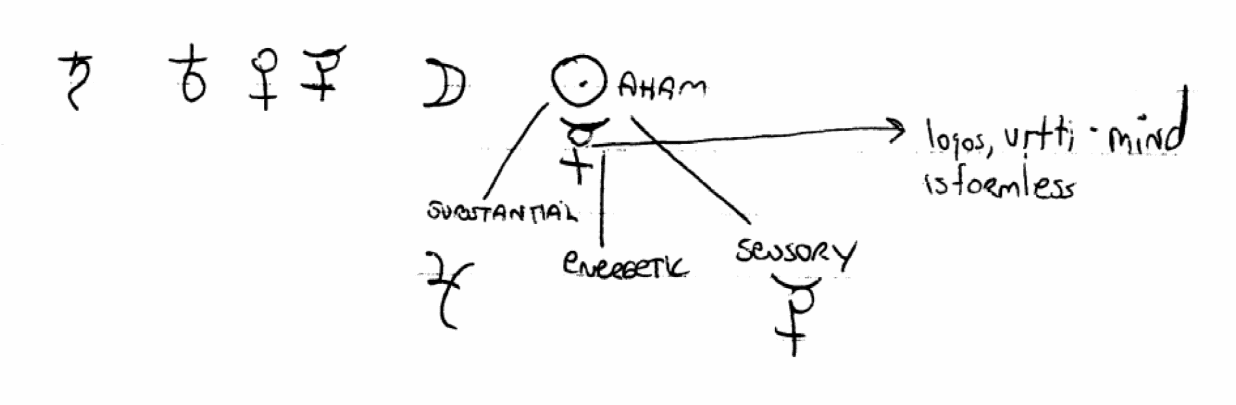
Thought (Saturn in Cancer) → Reason (Mars Venus Mercury) → Imagination (Sun Moon)
Cosmic imagination produces cosmos; individual engaged in reasoning transcends imagination
Thought vs. perception of thought: rational soul is always intelligizing but we're not always aware; Proclus vs. Plotinus
Same principle (rational soul) perceives both thoughts and sensations
Nature Mercury in Pisces (lower mind) translates functioning of Sun in Aquarius into primal image (Jupiter in Capricorn, Body Mercury in Pisces)
Two levels of memory: higher and lower
Higher memory: belongs to higher Self; contains distilled wisdom of past experience
Lower memory: imprints made on living animate; body's samskaras, racial inheritance
Shade (Eidolon): form taken by desires after death; resembles person's appearance; tends to sink into Earth; eventually disintegrates
Plotinus, 1.1.12: twofold Hercules
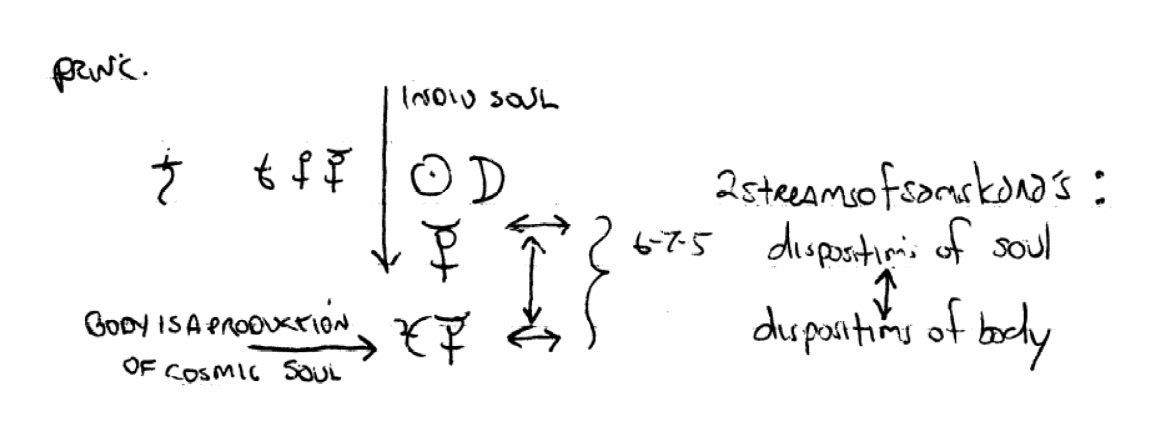
Two sources of samskaras: vegetal/body and soul; soul and bodily samskaras can conflict
Reading/discussing Plotinus (Guthrie translation), IV.3.29
Rational vs. irrational soul: rational soul represented by Mars Venus Mercury; irrational soul as manas and five senses or instinctual nature, represented by Sun Moon
BOOKS READ FROM OR REFERENCED:
Plotinos, Kenneth Sylvan Guthrie (tr.), Complete Works, Vol. II
Plotinus, The Enneads (MacKenna translation, 4th ed.)
Paul Brunton, The Wisdom of the Overself
Krishnachandra Bhattacharyya, Studies in Philosophy, Vol. 2, "The Subject as Freedom"
PLOTINUS QUOTES READ OR REFERENCED: I.1.12, IV.3.29, IV.3.30
DIAGRAMS appended to this transcript:
FIGURE 1978 0805-1-AB. Soul Monad, Logos, and Three Aspects of Ahamkara.
FIGURE 1978 0805-2-AB. Individual Soul and Cosmos; Two Streams of Samskaras.
[Transcriber note: [diagram] means the speaker is referencing a diagram as he or she is speaking.]
PAPER read in this transcript:
- AD Outline
NOTES:
- This is a recorded phone call between Anthony Damiani and Red Witter. Presumably AD in Hector, NY and RW in Columbus, OH.
TRANSCRIBED Verbatim by IT 2021. In 2024, IT updates footer, corrects errors, adds TOC, expands Books List, adds note within transcript, adds two diagrams and references within transcript to these diagrams. Archival verbatim transcript – V12a.
AUDIO FILES: 1978 0805a.
1978 08/05 Phone Conversation
Plotinus: Soul
[Audio File 1978 0805a Begins]
[Note: See FIGURE 1978 0805-1-AB for the following.]
AD: Excuse me. You know the Saturn which is the Intellectual aspect of the soul?
RW: Yeah.
AD: I would put it there.
RW (simultaneously): Saturn in Cancer [diagram].
AD: Yeah.
RW: Ok good. Uh--
AD: In other words, it's like a prolongation of essence. It's not an idea, it's not a concept in your mind. [RW simultaneously: Good.] But a prolongation of actual essence or being.
RW: Ok, then the next sentence--
[Transcriber note: I am using Plotinos, Complete Works, Vol. II, translated by Kenneth Sylvan Guthrie, London: George Bell and Sons; Grantwood, N.J.: Comparative Literature Press, 1918.]
Plotinos, Guthrie (tr.) [Complete Works, Vol. II, IV.3.30, RW reading]: "Are they also preserved by imagination? If imagination accompany every thought, and if later it, as it were, preserves its image, we should thus have the memory of the known object…"
RW: Now it appeared to me that this was the rational part of the soul looking to that Thought in that Saturn.
AD: Yeah, in the Intelligible.
RW: In the Intelligible.
AD: Uh-huh.
RW: And so if imagination which is the rational part of the soul, the three planets [Mars in Libra, Venus in Scorpio, Mercury in Sagittarius]--
AD: No, it would be the-- the next two.
RW: The Moon [in Capricorn], Sun [in Aquarius].
AD: Yeah, the Moon and the Sun.
RW: Ok.
AD (simultaneously): The rational part of the soul would be like the abstract of it.
RW (simultaneously): Ok.
AD: Ok?
RW: And now--
Plotinos, Guthrie (tr.) [Complete Works, Vol. II, IV.3.30, RW reading]: "If imagination accompany every thought, and if [RW reads: it] later [it], as it were, preserves its image…"
RW: Oh yeah that's right, ok. I jumped over one.
Plotinos, Guthrie (tr.) [Complete Works, Vol. II, IV.3.30, RW reading]: "If imagination…"
RW: That's the Moon Sun.
AD: Yeah.
Plotinos, Guthrie (tr.) [Complete Works, Vol. II, IV.3.30, RW reading (simultaneously with AD above)]: "…accompany every thought…"
AD: Every thought.
RW (simultaneously): Which is from the Saturn.
AD: Uh-huh. In other words, we--
Plotinos, Guthrie (tr.) [Complete Works, Vol. II, IV.3.30, RW reading (simultaneously with AD above)]: "…and if later [it], as it were, preserves its image, we should thus have the memory of the known object…"
RW: Now that memory part there of the known object, that would be in the three planets, wouldn't it?
AD: Uh--
RW: Wouldn't that be the higher memory? Because the known object is really the object coming from the Saturn, not down in the couplement, isn't it?
AD: Repeat that.
RW: Ok. "If im…"
AD (simultaneously): No, just repeat what you just said.
RW: That the known object, [AD: Uh-huh.] which we have memory of, [AD: Yeah.] wouldn't that be the object as itself as we know it coming from the Saturn rather than from the couplement?
AD: Yes. Yes. In other words, the rational soul would be-- which has a memory of the knowledge of having grasped the concept in the Intelligible.
RW: Right, ok. That's what I meant. Now-- Or then he says then--
Plotinos, Guthrie (tr.) [Complete Works, Vol. II, IV.3.30, RW reading]: "…otherwise some other solution will have to be sought. Perhaps reason, whose actualization always accompanies thought, has the function of receiving it [AD, faint: Ok.] and transmitting it to imagination."
AD: Yeah.
RW: Now, when he uses the word 'reason', is--
AD: That's the discursive soul, the three planets.
RW: Ok, that's the rational part of the soul.
AD: Soul, yeah.
RW: Ok, so we would say--
Plotinos, Guthrie (tr.) [Complete Works, Vol. II, IV.3.30, RW reading]: "Perhaps reason…"
RW: Or the three planets, has--
Plotinos, Guthrie (tr.) [Complete Works, Vol. II, IV.3.30, RW reading]: "…whose actualization always accompanies thought…"
RW: Which came from Saturn.
AD: Uh-huh.
Plotinos, Guthrie (tr.) [Complete Works, Vol. II, IV.3.30, RW reading]: "…has the function of receiving it…"
RW: From Saturn.
Plotinos, Guthrie (tr.) [Complete Works, Vol. II, IV.3.30, RW reading]: "…and [AD simultaneously: Uh-huh.] transmitting it to [RW adds: this Moon Sun (AD simultaneously: Yeah.) which is] imagination."
AD: Yeah. Which actually produces, you know--
RW: Then produces the Body Monad.
AD: Yeah. So that it-- Now you remember, imagination here (at a/they're) much higher level is cosmic imagination, ok.
RW: Uh-hm.
AD: And that's what produces these objects, alright.
RW: Yeah, when I say Body Monad I meant cosmos.
AD: Uh-huh, ok.
RW: Ok then it go on.
Plotinos, Guthrie (tr.) [Complete Works, Vol. II, IV.3.30, RW reading]: "Indeed, thought [RW: Which is Saturn.] is indivisible…"
AD: Ok, you got that?
RW: Yes.
Plotinos, Guthrie (tr.) [Complete Works, Vol. II, IV.3.30, RW reading]: "…and so long as it is not evoked from the depths of intelligence, [RW: Saturn.] it remains, as it were, hidden within…"
RW: The Saturn.
AD: Yeah.
Plotinos, Guthrie (tr.) [Complete Works, Vol. II, IV.3.30, RW reading]: "…within it."
AD: Uh-huh.
RW: Then it says--
Plotinos, Guthrie (tr.) [Complete Works, Vol. II, IV.3.30, RW reading]: "Reason…"
RW: Which are the three planets.
Plotinos, Guthrie (tr.) [Complete Works, Vol. II, IV.3.30, RW reading]: "…develops it…"
RW: Which is thought from Saturn.
Plotinos, Guthrie (tr.) [Complete Works, Vol. II, IV.3.30, RW reading]: "…and making it pass from the state of thought to that of image…"
RW: Which now is down into the Moon Sun.
Plotinos, Guthrie (tr.) [Complete Works, Vol. II, IV.3.30, RW reading]: "…spreads it out as it…"
RW: No I'm sorry, and it's still in the three planets.
Plotinos, Guthrie (tr.) [Complete Works, Vol. II, IV.3.30, RW reading]: "…spreads it out as it were in a mirror, for our imagination."
RW: Which is the Moon Sun.
AD (simultaneously, faint): Yeah.
RW: That right?
AD: Yeah.
RW: Then to go on.
Plotinos, Guthrie (tr.) [Complete Works, Vol. II, IV.3.30, RW reading]: "That is why we…"
RW: Now "we" now is the "We" that we talked about before [AD: Uh-huh.] which is the-- the primal Man plus the-- what happens in the couplement.
AD: Yeah.
RW: So that--
AD (simultaneously): Primal Man, yeah.
Plotinos, Guthrie (tr.) [Complete Works, Vol. II, IV.3.30, RW reading]: "That is why we grasp (the thought)…"
RW: Which came originally from Saturn.
Plotinos, Guthrie (tr.) [Complete Works, Vol. II, IV.3.30, RW reading]: "…only when the soul, which always desires rational thought, has achieved a thought."
RW: So achieving a thought means to actually grasp it from Saturn and hold it in that rational part of the soul.
AD: Uh-huh.
RW: So the "We" is the rational part of the soul combined with the couplement.
AD: Alright, now, you can see now consequently that a person who develops the rational mind and reasons rationally has to go back to that stage.
RW: Yes.
AD: Ok? It's like he transcends the imagination.
RW: Yes, I understand that.
AD: Good.
RW: Now the next sentence.
Plotinos, Guthrie (tr.) [Complete Works, Vol. II, IV.3.30, RW reading]: "There is a difference between thought [RW: Which is the Saturn.] and the perception of thought."
AD: Uh-huh.
RW: Now the perception of thought here would be the--
AD: It could be either. It depends on the context. Say more.
RW: Ok. Yeah, al-- good. Because I was thinking perception of thought here could either be up in the rational part of the soul or it could be the "We".
AD: [one/two words inaudible]
Plotinos, Guthrie (tr.) [Complete Works, Vol. II, IV.3.30, RW reading (simultaneously with AD above)]: "[RW adds: So] There is a difference between thought and the perception of thought. We are always thinking…"
AD: I'm sorry.
RW: It says--
Plotinos, Guthrie (tr.) [Complete Works, Vol. II, IV.3.30, RW reading]: "We are always thinking, but we do not always perceive our thought."
AD: Exactly, ok?
RW: Now the "We" here that are always thinking again is the combination of the couplement and the rational part of the soul.
AD: Well no. I would say that here when he says "we" that are always thinking, [RW: Uh-hm.] that would be equivalent to saying the rational soul is always intelligizing [RW: Ok.] or grasping the I-- the-- the content of the Saturn. It is always doing that.
RW: Uh-hm.
AD: Alright?
RW: How--
AD: But we're not always aware of that, that it-- now, the lower part comes and says "But I don't know that I'm always thinking." Let me put it this way. If the rational soul stops thinking, you'll disappear.
RW: Ok, so the "We are always thinking" is the rational part of the soul.
AD: Yeah.
RW: But "we do not always perceive the thought" then becomes the other "We" that we talked about.
AD (simultaneously): Exactly. Yes, exactly.
RW (simultaneously): Ok, that's-- I see.
AD: And that's why, for instance, Proclus did not believe with Plotinus, alright, that the soul always intelligize, he says, because sometimes we're not aware of any thought. Plotinus would answer that doesn't mean that the soul stopped thinking just because you're not aware of it.
RW: I see.
AD: When you go to sleep you're not aware of the soul thinking but that doesn't mean it stopped thinking.
RW: Yes, that--
AD (simultaneously): If it did, you would-- you would be dissolved.
RW: I see. I see. Ok the next sentence it says--
Plotinos, Guthrie (tr.) [Complete Works, Vol. II, IV.3.30, RW reading]: "That comes…"
RW: Let me read that resent-- let me reread that sentence.
Plotinos, Guthrie (tr.) [Complete Works, Vol. II, IV.3.30, RW reading]: "There is a difference between thought and the perception of thought. [AD: Uh-hm.] We are always thinking, but we do not always perceive our thought. That comes from the fact that the principle that perceives the thoughts also perceives the sensations…"
AD: Yeah.
RW: Ok, now that principle that perceives both thoughts and sensations, is that the principle--
AD: That's the rational soul.
RW: The rational soul, [AD, faint: Yeah.] without any contamination with any--
AD (simultaneously): Yeah. In other words if it looks upward, it perceives the Intelligible.
RW: Yes.
AD: When it looks downward, it sees sensation.
RW: Ok. And then it says--
Plotinos, Guthrie (tr.) [Complete Works, Vol. II, IV.3.30, RW reading]: "…and occupies itself [with] both in turn."
RW: So [AD simultaneously: Yeah.] that's the end of the paragraph.
AD: Uh-huh.
RW: Ok, well that's great because I-- that-- that "We are always thinking, but we do not always perceive", I did not separate those into two different "we's".
AD: Ah, but you see how-- how clever he is.
RW: Uh-hm.
AD: He's not going to give it to you without you struggling for it.
RW: Ok, let [AD simultaneously: I--] me go back up a sentence, there was another word there that I wanted to question. Back to the sentence where it says--
Plotinos, Guthrie (tr.) [Complete Works, Vol. II, IV.3.30, RW reading]: "Reason develops it, and making it pass from the state of thought to that of image, spreads it out as it were in a mirror, for our imagination."
RW: Now the "our" there in imagination, is that the same "our" that is-- like "the first of our thoughts is 'I'"? [Note: See Paul Brunton, The Wisdom of the Overself, "The Secret of the I," p. 79, Rider, 1943 hardcover edition.]
AD: Hold on. [17¾ second pause, AD talking to someone in background] I'm sorry.
RW: That's ok. The sentence where it says--
Plotinos, Guthrie (tr.) [Complete Works, Vol. II, IV.3.30, RW reading]: "Reason develops it, and making it pass from the state of thought to that of image, spreads it out as it were in a mirror, for our imagination."
AD: Alright, look at it this way.
RW: What's the "our"?
AD: Reason develops it, alright. Think of that as the planetary spheres.
RW: I've got that.
AD: And spreads it out, spreads it out for our imagination. Now think of the lower mind grasping it, alright, [RW: Uh-hm.] and converting it into your experienced world.
RW: Ok, so the "our" there is not like PB's "the first of our thoughts is 'I'"?
AD: Uh--
RW: As-- or it's more like what's happening down here in the sense world.
AD: Uh-- Let me see. It's-- Let's look at it this way. If you think of PB's the individual mind, alright, [RW: Yes.] that individual mind which grasps the Intelligible, alright, and spreads out, spreads it out like in a mirror, that would be like the Sun and the Moon now take that which the rational mind has grasped and they materialize it or concretize it as the world. Now our imagination, so to speak, grasps that.
RW: Ok, so [AD simultaneously: Did you follow?] our (or my--) our imagination then really is the Mercury [AD simultaneously: Yeah, that Mercury.] in Pisces [diagram].
AD: Yeah. Uh-- well--
RW (simultaneously): Not-- now would that--
AD: That's right, that's right, you could-- Like take-- take the Sun, alright, and imagine the Mercury, alright, and the Jupiter and the Mercury make a-- make like a triangle of those three, ok.
RW: Right.
AD: Now, take that Jupiter and put like a 'V' on top of it, you know, or let the horns stretch out so that it-- the Sun is enclosed within them [diagram]. And then you'll get the feeling as though everything the Sun is doing, you know, the concretizing of the world, that Mercury translates as our imagined world.
RW: Ok, so you take the Mercury in-- now you-- you said Jupiter but I think you meant Mercury when you said take-- put the Sun in the horns.
AD: Yeah, put the Sun in the horns.
RW: Of the Mercury.
AD: Yeah, of the Mercury [couple/three words inaudible]
RW (simultaneously): Now that's the-- which Mercury is that?
AD: Top Mercury.
RW: Nature Mercury [diagram].
AD (simultaneously): The-- the Logos Mercury, yeah.
RW (simultaneously): Ok, I understand.
AD: Ok? And now what happens is the Jupiter and Mercury below it appear.
RW: Ok. Now that then is our imagination.
AD: That's right, yeah.
RW: Ok. That helps a lot.
AD: And that's of course your experience. That will be equivalent to like the primal image, you know.
RW: Yes. Ok, that's-- that's a big help. Now I got a couple other ones here. Let's see. And where-- in your outline where you speak of-- there's a lot of reference here to Hercules and the shade.
AD: Uh-huh.
RW: And, I'm trying to s-- I had it down. Ok. Says--
[Transcriber note: I do not have access to this outline, quotes need to be checked.]
AD [Outline, RW reading]: "The notion of the lower soul brings up the question of memory. The continuation of memories are samskaras and the relation of the two levels of memory. Plotinus dwells on the reality of the shade, its contribution to selfhood and its effectiveness as a repository of personality. Certain of its memories are retained."
RW: What part of the four line chart [diagram] is the shade? Is that just-- Well, I have read it in two different ways. Couple of ways I have read it as the memory that is in the cosmic Body Monad and some places I've read it where it was-- included the rational soul. And I don't--
AD (simultaneously): Well, you know, PB also mentions this too. You remember he says (there/the)-- in the chapter I think on dying he says that some life experiences there is distilled a certain-- a drop or two of wisdom. You remember that?
RW: Uh-hm.
AD: Now, imagine that after many lives' experiences, all these little drops have been accumulating. Ok?
RW: Yes.
AD: Now this would be the memory of the higher self. It wouldn't be the memory of you because you don't remember, let's say, ten lives ago. So this memory that is contained by the higher self would be like the memory of the prior experiences. It extracts what's worthwhile in them and rest-- throws the rest away. So this becomes the higher memory. But there's a lower memory, and that is that the memory that this body has right here and now, you know, the imprints that are made on the living animate.
RW: Yes.
AD: Alright? Now that memory there, so to speak, is a lower memory. Now ask your questions, see if I follow.
RW: Ok, the question is the higher memory on that four line chart--what planets are the higher memory?
AD: Well you would have to-- you would have to put that in the, you know-- either the three or the Saturn, the three planets or the Saturn.
RW: I kind of saw it as the three planets looking to the Saturn. (Yeah.)
AD (simultaneously): Yes. Yes, you can, but--
RW (simultaneously): As memory looking to what really was authentic thought and the rational part of the soul grasping that was a higher sort of memory. And then the three planets looking to the experience of the-- these lives, the higher experience of these lives that is retained, it was like three planets looking down to that was the lower part of memory, is that incorrect?
AD: Well, if those planets are looking down you say like to the animate, right?
RW: Yes.
AD: Then you would be aware of the memory that you having in this body and in this incarnation, right?
RW: That's right.
AD: And if it looks up to the Saturn, then it becomes aware of what they call the causal body, the memories of the causal body.
RW: Yes.
AD: Yes. That's right.
RW (simultaneously): Now that('s) the-- Is that the difference between the higher and the lower?
AD: Yes.
RW: Ok. Then looking--
AD (simultaneously): The same problem when a person incarnates, he brings memories, you know, from the higher, [RW: Uh-hm.] and the body has its own samskaras or its own memories, the racial characteristics that it inherits.
RW: Yes.
AD: And so immediately there's a conflict between those two. Assuming that the person isn't eupho-- euphorious, you know.
RW: Yes. So the shade of Hercules or the shade, period, would be the three planets looking down to the--
AD: No, no, the shade is something else. The shade is something else.
RW: Oh.
AD: I don't remember the context of what you're referring to but, in Greek philosophy in general, the shade is like when a person dies, the-- the nature of the desire body is such that it could-- it gets a certain form. It actually looks like the person, alright.
RW: Yes.
AD: And then this here, this form or this appearance of the body of that person is what they call the eidolon or the shade and it actually seeks to sink into the Earth.
RW: Oh, I didn't understand that.
AD: Yes, that would be the shade or the eidolon. And they would call that-- like they would say now if the soul is attached to that, then the soul goes to hell with that shade or what they call Hades.
RW: Yes.
AD: Ok? And of course you have to remember that that eidolon or that shade disintegrates after a while.
RW: Ok. Ok it's 'cause it talked here in Plotinus, it said that--
[Transcriber note: I am using Plotinus, The Enneads, translated by Stephen MacKenna, 4th edition, Larson Publications, Burdett, New York, 1992.]
Plotinus, MacKenna (tr.) [1.1.12, RW reading]: "The poet, too, in the story of Hercules, seems to give this image separate existence. [AD: Uh-hm.] He puts the shade of Hercules in the lower world and Hercules himself among the gods: treating the hero as existing in [the] two realms at once…"
AD: And-- yeah.
Plotinus, MacKenna (tr.) [1.1.12, RW reading]: "…he gives us a twofold Hercules."
AD: Uh-huh.
RW: So uh--
AD: So you can see that the soul was not identified with that shade.
RW: Uh-hm.
AD: So, it was-- it-- it went to heaven. I mean this is what I would assume they would say.
RW: Yes.
AD: The same thing like, when a person dies he's-- he gets his-- this is-- the-- they're-- in Theosophy they call it the kamarupa. The nature of our desires is such that they're throughout our body. But they have no form. It's only after that the life has been lived out somehow and then when a person dies all these desires have assumed the form of that body.
RW: Uh-hm.
AD: And they-- the Greeks usually refer to that as the shade. And if a person has an inclination towards sensuality, then the shade gets more and more corporealized. Ok?
RW: Yes.
AD: Well, it's something like that, that's about-- about the size of the way they work.
RW: Ok. Uh, let's see. Ok. There was another question here I had and I can't find it. Ok, you had made a statement on one of the tapes that samskaras are from the vegetal soul-- or they're-- samskaras come from two different places in the historicity of the being. And, you talked about from the Body Monad or schemata and from the soul. [Note: See FIGURE 1978 0805-2-AB.]
AD: Yeah.
RW: And then you said I think samskaras from the vegetal soul and samskaras from the higher soul.
AD: Uh-hm.
RW: Ok, the samskaras from the vegetal soul, again trying to put that on the chart, where do you place the vegetal--
AD (simultaneously): Samska-- Well that will be the vegetative life. But, instead of thinking-- think of-- maybe this might help. Imagine-- well you know they have like breeders, they breed horses or dogs [RW simultaneously: Yes.] now. And these animals are-- are bred in such a way that they specialize in one certain faculty, let's say they develop a sense of smell that's remarkable, ok?
RW: Yes.
AD: Alright, now one could see here the development of the bodily samskaras. There's a sort of racial inheritance that's going on in the body, alright. Now imagine a dog, now the entity or the soul of a dog, not that-- that a dog has a soul but let's imagine the dog has a soul. Now he enters into that body. But he comes-- he comes with a past where he never developed that faculty. Well, let's say he was like Ferdinand, he preferred to smell flowers, you know?
RW: Uh-hm.
AD: There would be a conflict between the samskaras that he brings, this soul, and the samskaras that he has to contend with that are in the body.
RW: Ok.
AD: Ok?
RW: I see.
AD: So there's the higher and the lower. Or there's an inherited mode by which it-- or with which the body operates and one that the soul brings with it in its own animate body, in its own linga, subtle body.
RW: Ok. I see.
AD: It's a little tricky but after a while the-- you'll see that, you know, very often an entity or a soul incarnates and he incarnates into a body that's not suitable for him.
RW: Yes, I see.
AD (simultaneously): (Yeah right.) You know, he's got to struggle. Got a real problem.
RW: Ok. Now I have another reference here. On-- back into Guthrie again. This is in IV.3.29 just prior to IV.3.30, where he was talking about memory does not belong to the faculty of sensation. And (now), two sentence and then I'll ask you the question.
Plotinos, Guthrie (tr.) [Complete Works, Vol. II, IV.3.29, RW reading]: "Can memory be referred to sensibility? [RW: Is a question.] Is the faculty that feels also the one that remembers?"
RW: And he goes on to say--
Plotinos, Guthrie (tr.) [Complete Works, Vol. II, IV.3.29, RW reading]: "But if the image of the soul (the irrational soul) possess [RW reads: possesses] the memory, as we said above, there would be in us two faculties that will feel."
RW: Now, when he talks about-- I know the rational soul are those three planets. When you talk about the irrational soul, where do you place that on the four-line chart?
AD: Again, the irrational soul--
RW: I have down here the rational part of the soul are the three planets, [AD simultaneously: Uh-huh.] Mars, Venus, Mercury [FIGURES 1978 0805-1, 2].
AD: And the irrational part of the soul will be like the manas and the five senses, alright. Or the instinctual nature. So it would have to be the Moon and the Sun again.
RW: Ok, that's--
AD (simultaneously): But as embodied, you know, in other words-- When you look at a person and you say he has an instinctual nature, you're referring to the Moon. [RW assents] It's like-- if you use symbolic language.
RW: I see. Ok well that's-- that's-- that helps. That's what I needed to know. Ok, the rest of this can wait till you come, I just needed to get those straight in my mind 'cause we're about to get into this in our class.
AD: Do you have one minute, I want to run out and get a book.
RW: Sure, go ahead.
AD: Hold on. [25½ second pause with tape break] [half word inaudible] But, there was a quotation which maybe you might remember from Bhattacharyya where I said this was like an exact duplication of IV.3.30. It was in "The Subject as Freedom".
RW: Yes, I have that.
AD: You have that quote?
RW: Yes.
AD: Oh, go over that again.
RW: Ok.
AD: Go over them, you know, together now and see if what I told you makes sense.
RW: Ok, that'll help. Yeah I have that marked off so we'll--
AD: Oh good, ok [couple words inaudible]
RW (simultaneously): I'll get it out and when we come to this in class we'll use both of them then.
AD: Good idea.
RW: Ok, well [one inaudible AD word simultaneous with RW] we'll-- that's it.
[Audio File 1978 0805a Ends]
1978 08/05 V12a: Phone Conversation: Plotinus: Soul. Copyright 2024 Wisdom's Goldenrod p. iii