DIAGRAMS FOR 1979 0214
Class
Wednesday, February 14th, 1979
Verbatim, unedited transcriptClick the series name to view more
CLASS at Wisdom's Goldenrod, Hector, NY
with Anthony Damiani (AD)
February 14, 1979
PB BOOKS; HIDDEN TEACHING (Chapter 5)
TOPIC: PB Books
SUBJECT: Hidden Teaching Beyond Yoga (Chapter 5)
SUBSUBJECTS: Philosophic Disciplines, Reflective Consciousness, Thinking, Meditation/Yoga, Ego
CONTENTS:
THE IMPORTANCE OF MASTERING ATTENTION
WILL MUST DIRECT THINKING
SELF-REFLECTION AS AN INSTINCT
REFLECTIVE CONSCIOUSNESS DISTINGUISHES MAN FROM ANIMALS
DHYANA (CONCENTRATION) AND SAMADHI (CONTEMPLATION)
REMOVING THE HINDRANCES TO CONCENTRATION
WHAT IS THE EGO?
THE PRACTICE OF SAMADHI
BOOKS READ FROM OR REFERENCED:
Paul Brunton, The Hidden Teaching Beyond Yoga
Julius Evola, The Doctrine of Awakening
I.K. Taimni, The Science of Yoga
Karl Jaspers, General Psychopathology
Aniela Jaffe, The Myth of Meaning in the Work of C.G. Jung
Paul Dahlke, Buddhist Essays
Plotinus, The Enneads (MacKenna translation, 4th ed.)
C.G. Jung, CW 11, Psychology and Religion: West and East, "Psychological Commentary on The Tibetan Book of the Great Liberation"
PLOTINUS QUOTES READ OR REFERENCED: V.3.6
DIAGRAMS appended to this transcript:
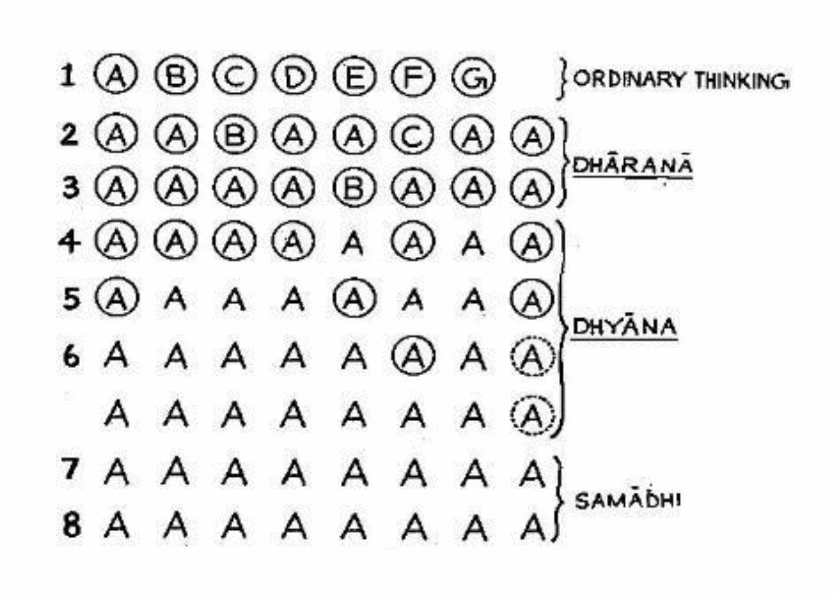
FIGURE 1979 0214-1. Stages of Meditation.
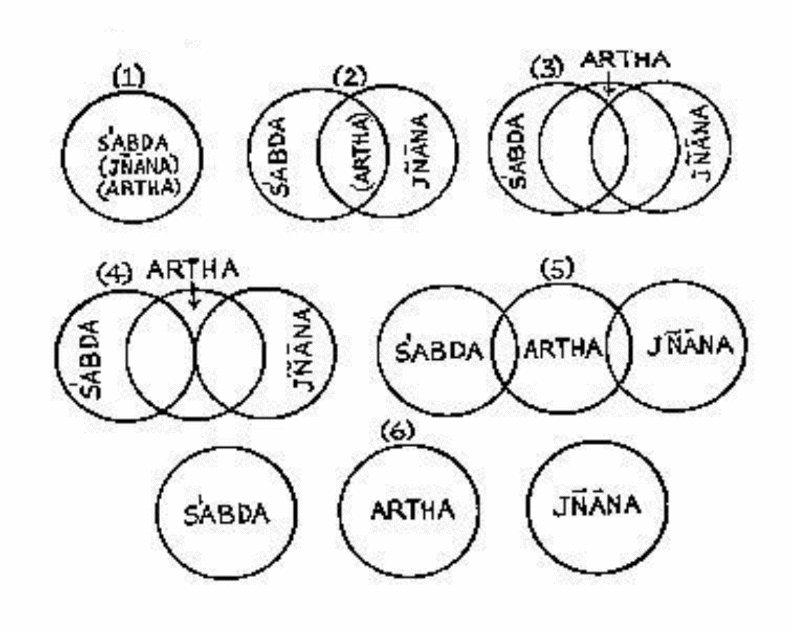
FIGURE 1979 0214-2. Sabda, Artha, Jnana.
These diagrams are from I.K. Taimni, The Science of Yoga, pp. 284 and 108 respectively. [Transcriber note: [diagram] means the speaker is referencing a diagram as he or she is speaking. If someone is drawing or writing, with audible sounds of chalk on a blackboard, I indicate this by [drawing] or [writing].]
TRANSCRIBED Verbatim by IT 2019; reformatted by JRM & JF 2019-2020, with TOC/Subheads by JRM. In 2023, IT updates prefatory matter, footer, and audio file name, adds Plotinus quotes section, fixes errors/typos, adds two diagrams and references within transcript to these diagrams. In 2024, MW alters Subheads to make more accurate. Archival verbatim transcript – V14.1a.
AUDIO FILES: 1979 0214a, 1979 0214b. [Note: "Tape" and "Side" refer to original audio cassette tapes that were later digitized into .MP3 Audio Files.]
1979 02/14 at Wisdom's Goldenrod
PB Books; Hidden Teaching Beyond Yoga (Chapter 5)
Archival verbatim transcript
[Audio File 1979 0214a Begins]
[faint background student talking, noises until 0:00:58.5]
THE IMPORTANCE OF MASTERING ATTENTION
AD: Alright, let's start. [32½ second pause, shuffling about] Alright, the fifth characteristic Brunton refers to is "Concentration, Calmness and Reverie". [13¾ second pause with faint background student talking, shuffling about] And he starts by saying--
[Transcriber note: I am using The Hidden Teaching Beyond Yoga by Paul Brunton, E. P. Dutton & Co., Inc., New York, 1969.]
PB [The Hidden Teaching Beyond Yoga, "The Philosophical Discipline," p. 127, AD reading]: "He has here no concern with [the] other consequences of yoga. Indeed, occult experiences, extra-ordinary visions and similar abnormal happenings will only hinder his progress in philosophy if he pays them undue attention. They have no importance here, however encouraging they often are on the mystic path."
AD: The first point that he brings out--
PB [The Hidden Teaching Beyond Yoga, "The Philosophical Discipline," p. 127, AD reading]: "The first of these points is the power to regulate [the] thoughts and master attention, and then to concentrate fully in any required direction."
PB [The Hidden Teaching Beyond Yoga, "The Philosophical Discipline," p. 127, AD rereads more slowly]: "The first of these points is the power to regulate [the] thoughts and master attention, and then to concentrate fully in any required direction."
AD: Well, we'll spend a few moments on this.
EMD: Louder please.
[short pause]
AD: Alright, am I loud enough?
PB [The Hidden Teaching Beyond Yoga, "The Philosophical Discipline," p. 127, AD reading loudly]: "The first of these points is [the power] to regulate the thoughts…"
S: Ok.
AD: I've been heard, haven't I?
S (faint): Uh-hm.
EMD (simultaneously): Yeah.
AD (intensely): Alright, now let's hear-- (some laughter) let's have a comment.
[short pause]
PB [The Hidden Teaching Beyond Yoga, "The Philosophical Discipline," p. 127, AD reading]: "…master attention, and then to concentrate fully in any required direction."
[short pause]
AD: He says--
PB [The Hidden Teaching Beyond Yoga, "The Philosophical Discipline," pp. 127-128, AD reading]: "The mind possesses a [natural] tendency to run in various directions [and] to flit from one subject to another, on account of [the pressure of] emotional attachments [AD reads: emotional attachment], physical environment, [or] imperfect education. This tendency can be stopped and corrected by the psychological discipline of meditation. The power to become completely absorbed in the subject in hand can then be unfolded. The meaning of such concentration is extreme attentiveness to the topic under consideration, never permitting it to lapse through laziness or fatigue. The mind must move only where the will directs it. … [AD adds: And] Similarly, the faculty of fixing attention at will and retaining it, ultimately helps to burn a way through the hardest intellectual problems."
S: Is that power that regulates the thoughts, is that will?
AD: Is the power--
S: The power he speaks of that we-- that we have to use to regulate our thoughts, to develop this concentration, is that the will?
AD: Yes. [short pause] Well, I'm prepared for you people tonight, since you have no comments I'll read to you. [short pause] This is from The Buddhist Doctrine of Awakening by Evola, I'd like to read you a section, page-- you know that [one/two words inaudible]
S (faint): What page is that?
S (faint): You know.
S (faint): Page (6).
S: It's haphazard.
S (simultaneously, very faint): (I've) already read it.
[15 second pause]
AD: It's one of the books I hope you'll pick up in the Buddhist class.
[12½ second pause]
[Transcriber note: I am using The Doctrine of Awakening by Julius Evola, Luzac & Company, Ltd., London, 1951.]
Julius Evola [The Doctrine of Awakening, pp. 6-8, AD reading]: "Now, few other great historical traditions [AD: writes Evola] allow us to isolate so easily the elements of a pure ascesis as does the"Doctrine of Awakening"… It has been justly said of Buddhism that in it the ascetic problems "have been stated and resolved so clearly [and], one could almost say, so logically that, in comparison, other forms of mysticism seem incomplete, fragmentary and [AD adds: even] inconclusive"; and that, far from being weighed down by every kind of emotional and sentimental element, an austere and objective style of intellectual clarity so much predominates that one is almost forced to compare it with the modern scientific mentality. …
"Firstly [AD reads: First]. The Buddhist ascesis [AD reads: austerity] is conscious, in the sense [that] in many forms of asceticism--and [AD reads: as] in the case of Christian asceticism [almost without exception]--the accessory is inextricably tied up with the essential, and ascetic realizations are, one might say, indirect because they result from impulses [AD reads: impulse] and workings of the mind determined by religious suggestions or raptures; whilst [AD reads: while] in Buddhism there is [AD adds: a] direct action, based on knowledge, conscious of its aim and developing throughout in controlled stages."Just as a practised turner or turner's apprentice, when turning quickly, knows: 'I am turning quickly', and when turning slowly, knows: 'I am turning slowly'"--[AD adds: or]"As a practised butcher or butcher's apprentice who butchers a cow, takes it to the market place and dissects it piece by piece; he knows these parts, he looks at them and examines them well and then sits down"--here are two trenchant similes, chosen from many, and typical of the style of consciousness of every ascetic or contemplative procedure in the Doctrine of Awakening. [AD: Which is also applicable to Yoga.] Another image is furnished by clear and transparent water through which can be seen everything lying on the bottom: symbolical of a mind that has left behind all unrest and disturbance. [And] it will be seen that this style persists throughout, on every level of Buddhist discipline [AD adds: and Yoga]. It has been well said that "this path through consciousness and awakening is as clearly described as a road on an accurate map, along which every tree, every bridge [and] every house is marked."
"Secondly. [AD reads: Next, in Yoga and] Buddhism is [almost] the only system which avoids confusion between asceticism and morality, and in which the purely instrumental value of the latter in the interests of the former is consciously realised. Every ethical precept is measured against an independent scale, that is, according to the positive"ascetic" effects which result [AD reads: results] from following these precepts or failing to follow them. From this is can be seen that not only have all religious mythologies been surpassed, but also all ethical mythologies. …
"Thus [AD reads: So] we can fairly claim [that] in Buddhism--as [also] in Yoga--asceticism is raised to the dignity and impersonality of a science: [AD adds: and] what is elsewhere fragmentary here becomes systematic; what is instinct becomes conscious technique; the spiritual labyrinth of those minds which achieve a real elevation through the workings of some"grace" (since it is only accidentally and by means of suggestions, [fears, hopes and raptures] that they discover the right way) is [AD adds: here] replaced by a calm and uniform light, present even in [AD adds: the] abysmal depths, and by a method which has no need of external means."
[short pause]
AD: Um-- There's a kind of presentation of the Buddhist and Yoga asceticism that is going to be implicated in this very non-implicatory passage on concentration, calmness and reverie. So, if we can take an example of this passage and show very clearly what he's referring to.
PB [The Hidden Teaching Beyond Yoga, "The Philosophical Discipline," p. 127, AD reading]: "[The] first of these points is the power to regulate [the] thoughts and master attention, and then to concentrate fully in any required direction."
AD: So let-- we have three points here that I'd like to take apart. The regulation of thoughts--
[13 second pause]
SS: Does he mean there stopping the thoughts or regulating the ones that do come out in a certain fashion?
[short pause]
AD: Um-- [short pause] Suppose you read down a few lines. [31¾ second pause] If you want to turn over to the next page-- I'm sorry, two pages later, it's italicized in my copy. It says--
PB [The Hidden Teaching Beyond Yoga, "The Philosophical Discipline," p. 131, AD reading]: "The mystic stills the mind in order to get thought-control, but once the control is attained, he should begin to think vigorously."
AD: But that may be too far away. The next-- the page where we just left off--
PB [The Hidden Teaching Beyond Yoga, "The Philosophical Discipline," p. 129, AD reading]: "Every philosopher must possess these three qualities of concentrativeness, calmness and reverie. In these respects he will be a mystic but most mystics are not philosophers. Mysticism may now be viewed as a disciplinary stage through which the would-be philosopher must pass if he finds, as most do, that he lacks such qualifications."
AD: How would you answer it Steve? Stop-- stop the thoughts?
SS: Well it seems like you want to do both.
AD: You want to do what?
SS: You want to be able to do-- to do both, stop-- stop them, the unwanted ones, and thereby gain control and direct the ones that are true to serve this.
[short pause]
AD: You want to direct the ones, you said--
SS: To a certain concentration on-- on one idea, you would direct those early thoughts in that-- in that one area, not jumping from one subject to the next.
AD: Well then it's not the stop-- stoppage of thoughts you're interested in.
[short pause]
WILL MUST DIRECT THINKING
SS: Yeah. It's just in meditation we-- there are two, we have to observe a certain power, a certain will-- maybe not to regulate them, I guess it is to stop them. We-- and he's pointing out something else here.
AD: Well, wouldn't you say-- I think what he's saying here or suggesting here was that we learn to think first. That means you have to be able to regulate your thoughts. And there's no question here of nirodha or stopping thinking but gaining control over it. [SS assents] Suppose we took a look at the Patanjali Sutras to get an idea of what concentration is. We touched on it. I don't want to end up writing a commentary on this chapter but I think some of these have to be pointed out.
S: Uh-huh. To what extent do we use thoughts, control thoughts, and that is, what is the will? Is the will thought-free?
AD: Is the will thought-free? [11¾ second pause] Well, I don't think I understand yet.
S: Alright. The mind must move only where the will directs it.
AD (faint): Uh-hm.
S: I think I have a little feeling of what the will is. I'm not sure to what extent my will is embedded in thoughts or vice versa. What-- what is it that stops thoughts?
AD (simultaneously): Well, yeah, it is confusing because you just told me you had a feeling of what the will is. (laughter)
BS (amidst laughter): Not really.
S: Yeah.
AD: And before it was just thought was just mixed up with will but now it's feeling and will and thought. (laughter)
S: That's true, putting it uh--
S (faint): [couple words inaudible]
AD: Well, there may be of course some knowledge involved in the direction of the will, I mean there may be certain presuppositions or a certain goal that a person came through knowledge to accept as what he wants to effectuate or realize. And, if you ask me what will is, it's too fundamental, I don't think I could even answer that right now. But, that we (have/had) will, I would say yes.
S: But when you use the will, don't you have to-- it's still another thought with form. I mean I could say ok-- ok, now what I'm going to concentrate on now is this and they-- It's still a-- it's still a formed direction of the energy. Still has a form-- it's still a thought.
AD: Will is a thought?
S: It's not an image, I mean it's not like an image, you know, but-- Isn't it?
S: Yeah.
S (very faint): Yeah but there's no (image).
AD: Well, if you ask that way I would say no, it isn't.
S: No?
AD: No.
S (faint): Ok, yeah.
AD (simultaneously): My will is not my thinking. And they're not my thoughts.
LR/S(?): That's what he was asking, is it?
AD: There may be elements included when I direct my will where I want to direct it to, but I certainly don't think they're the same thing, willing and thinking.
S: But what-- so what is the difference?
AD: Would that help you? (bit of laughter)
S: I would--
S: [couple/three words inaudible]
S: You say you can distinguish them, right, and I-- I think I can too but--
S: Ok.
S: Um-- When we use the will you know that the mind moves, there's a movement there. [short pause] [RG simultaneously: Yes, when you think(--) is it--] If you don't want to call that movement a thought, then tell me what you mean.
RG (simultaneously): Isn't the organ-- isn't the organ that knows willing, willing?
S: An organ that knows willing?
RG: That's aware of willing, isn't it the willing that's aware of itself? If you knew the will the will would stop being the will, it would be an object of knowledge. It couldn't will. By definition of what knowing is, it has to make an object of it. To make an object of the will it stops willing.
[9¾ second pause]
S: Now that's like bringing in a third position. At first, I mean-- to know the will even, I mean, that seems even something else. If you-- if you say it can be known, then it's-- then it's a thought?
RG: No I'm saying it can't be known through knowing, through a thought. That isn't thought. It has its own vision, its own [one/two words inaudible]
S: So what knows it is something other than the will.
RG: No, it knows itself. If you want to-- knowing there isn't knowing. Knowing is awareness of the function, it's not knowledge [student assents] as we normally use it.
S (very faint): Ok.
S: Yeah.
[short pause]
AD: Richard, would you repeat that distinction?
[short pause]
RG: Yeah, um-- To speak of willing we're speaking of a-- an activity, a-- I mean it-- it's an organ which is a creative act you might say. When you're knowing isn't creating something new, it's revealing an object. They're very different modes of behavior, modes of being. And they're distinct modes of being, I mean you can't-- you can't meld one into the other. They're both there.
[9¾ second pause]
AD: Are you suggesting then that the will is like (the) actualization or an essentialization of the "I" which is distinct from another way of essentializing the "I" through knowing or-- yeah.
S (faint): Through feeling.
AD: Or through feeling. Yeah, they're quite distinct. I-- I have trouble understanding myself the confusion here but go ahead, go ahead.
S: The last sentence on the bottom of 127, (I'll read), well--
PB [The Hidden Teaching Beyond Yoga, "The Philosophical Discipline," p. 127, S reading]: "The mind must move only where the will directs it."
S: Is one-- the word 'directs' bothers me because it implies a goal and it is the goal and object of the knowledge that the will is then applied to or is this goal somehow sensed by the will?
AD: Is this goal sensed by the will?
S: Is it the mind that knows the goal as an object and then the will enters and applies to it or at it or towards it? Where does the sense of the goal lie?
PB [The Hidden Teaching Beyond Yoga, "The Philosophical Discipline," p. 127, S reading]: "The mind must move only where the will directs it."
S: So I'm-- I'm focusing on the word 'direct' or direction.
AD: Well, assuming that you have some familiarity with what it is that you have understood and that you wanted to work towards, an actualization of your understanding, then your will directs it towards that goal. Yeah, go ahead.
RG (simultaneously): See here-- here the goal is formed through knowledge 'cause the goal is truth. If the goal was formed through the will we'd speak of it as wanting freedom, not knowledge, not truth.
[short pause]
AD: Go right ahead, yeah.
S (simultaneously): Could we say that-- that the mind has these-- has three modes which-- that are like instruments for the willing, the thinking, and feeling and that like the thinking would be what would set up the goal and the willing would be the power of the mind to accomplish that? Would it be correct to speak that way?
AD: I don't know, I think that might be premature.
S: So we couldn't say yet that those are instruments of the mind?
AD: Well, let's say they're modes or [S simultaneously: Modes.] ways of being rather than saying they're instruments of the mind.
[student assents, very faint]
S (faint): I see.
[short pause]
AH: Isn't the will-- will distinct from thinking insofar as the will can operate in other spheres, namely the biological sphere of the body and-- Are we just thinking of them as (simply) just psychic function?
AD: No, I would agree with that, the will essentially is the actualization of the "I", the variety of forms the "I" might take, biological, vital, any way you want to look at it. They are three very distinct modes. The will has nothing outside of itself for its object. When you say we're directing it to a goal, you're speaking in terms of knowledge then. But the will, so to speak, is in its own right and doesn't need-- doesn't need a goal to be directed at, although we do so. Go ahead.
LDS: It seems though that the will-- this power of will would be sort of aimless if it-- if it didn't presuppose some kind of knowledge for its direction or for its goal, for his use.
AD: Well it's always directed by ignorance, yes.
S (very faint): Uh-hm.
S: Uh-huh.
S (faint): By what?
AD: So you're always actualizing your ignorance, fine, ok.
S (faint): Yes sir.
LDS: Some people might call that knowledge, right?
AD: Uh-huh. Well we'll try to be more precise. (laughter) [short pause] Now we could probably get involved. But I think we ought to try to-- try to understand something about what he means here of concentration. And, I referred you to a text by Taimni called The Science of Yoga which is relatively simple to understand. Why don't we do this first? Let me try something.
S (faint): Ok.
S (faint): Go ahead.
[22¾ second pause]
SELF-REFLECTION AS AN INSTINCT
AD: Let's take for instance the phenomena of self-reflection and try to understand it a little bit and see how reflection is inserted between the psychic impulses and the images and how we direct that-- those impulses towards ends that consciously or unconsciously we ourselves have instituted.
[Transcriber note: I am using General Psychopathology by Karl Jaspers, University of Chicago Press, Chicago, 1963.]
Karl Jaspers [General Psychopathology, p. 131, AD reading]: "I am [AD reads: I'm] not only conscious [AD: writes Jaspers] in the sense of having certain inner experiences, but I am [AD reads: I'm] turned back on myself--reflected back--in consciousness of [AD adds: the] self. [AD adds: And] In the course of this reflection I not only come to know myself, but I also influence myself. There is not only something happening within me, but I instigate, arouse and shape a happening within me. I can, as it were, draw reality into me as well as evoke and guide it. …
"For this reason, there is no longer any such thing as unmediated psychic life. Thinking and volition beget reflection and with the reflective process begins the indirect alteration of all direct experience. Once, [however], direct experience ceases to be the sole determining factor, we not only find expansion, a general unfolding, and new dimensions of experience, but also interferences of an entirely new character. [For instance], to take the simplest, basic immediacies, the instincts, not only can they be assisted by reflective purpose, but they can be thoroughly confused and obliterated by it."
AD: So up to this point Mr. Jaspers was saying something to the effect that we're subjected to psychic impulses, direct psychic impulses like physiological functioning. [S, faint: What?] And, this is an unmediated psychic life. There's no intermediation here except of course I suppose a very advan-- not necessarily advanced but a yogi could influence the, let's say, the functioning of his heart, slowing it down, or his breathing. But for-- for the generality of most of us, this psychic functioning, I mean this physiological functioning is not interfered with by our thoughts or psychic understanding. And, he says that--
Karl Jaspers [General Psychopathology, p. 131, AD reading]: "Once, [however], direct experience ceases to be the sole determining factor, we not only find [expansion], a general unfolding, and new dimensions of experience, but also interferences of an entirely new character. [For instance, to take the simplest,] [AD: And he gives us the] basic immediacies, the instincts, not only can they be assisted by reflective purpose [AD reads: purposes], but they can be [thoroughly] confused and obliterated [by it]. [AD: Going on.]
"Interference of this sort arises when the mechanisms [AD reads: mechanism] that realise and co-ordinate reflection with immediacy do not take their natural course, which remains obscure but maintains all that is self-evident, beneficial and unproblematical in our lives, reflect how we may. [AD: Now--]
"Human psychic life can no longer be an immediate experience such as that of animals or idiots. Should it become a purely elementary process, we [should] have to consider it disturbed; equally so if it were nothing but pure reflection. [AD: Again--]
"The fact that the immediate phenomena we experience do not remain immediate but are constantly being transformed by reflection does not obliterate for most of us their immediate character, as indeed we have tried to describe [it in all its great variety]. But the fact of alteration remains a basic one and while we investigate phenomena we should keep our eye carefully on the possible changes wrought by reflection."
AD: Now, the reason I'm going to attack it this way because we already got caught in a-- in a cesspool, the will, you know? I never like to talk about the will…unless you've learned to use it. So, this way, this way, you see, if we take the biological urges as standing in their own right, alright, and it's very hard to refuse to breath, it's very hard to stop the digestive flow of juices. So I got out of that discussion of the will. Ok? Now, he said that these psychic impulses-- I mean these physiological instincts which are functioning and are not interfered with is the prerogative of animals and idiots. But since we're neither, we do interfere in some way or another so, between the physiological instinct and the image, somehow we get in the way, alright. You ever notice for instance when you get very anxious how your breathing starts coming out in spurts? Alright. You're familiar with it. So what we're going to do is try to see if we can insert or understand how our reflective processes are inserted between physiological impulses, you know, and the images, and this way I won't have to discuss will. Ok? You do it, alright. [student assents, faint] Just a little more. Now--
Karl Jaspers [General Psychopathology, p. 132, AD reading]: "[AD adds: Now] Normal, everyday psychic life is always in some way rooted in reflection. In this it contrasts with psychotic, elementary experience. For instance, if we contrast delusion proper with an ordinary mistake, a vivid awareness with an 'as if' experience, [AD adds: or] melancholia with a neurotic depression after an unpleasant occurrence [AD: etc]… What is elementary and immediate cannot be influenced by psychological means, though the latter [AD reads: the psychological means] may influence anything that is mediated by thought. What is elementary is primarily without content and gains this [AD adds: content] only secondarily, but whatever has been evolved conceptually starts from content and operates in reverse. All that is understandable and has developed understandably stands contrasted with phenomena that are obscure in their causes, exist incomprehensibly and break into the psyche with an elementary force."
AD: Do-- we've got the point he's making here, right, that there's this process going on, that this instinctual energy or this attachment that the sentient beings have to the body-image is somehow operative and manages to do very well without our influences. But, insofar that reflection itself is an instinct, it tends to interfere with these processes. Ok? And this process of reflection, this process of reflection, is very important for what we're going to do now because the last three disciplines that he speaks about are "calmness, concentration, reverie" and "reason must master emotion" and to "give up the ego" are really very pivotal so I want to try to work from a ground basis. [35½ second pause] Alright, I'm going to ask you to be a little patient, this is not too long yet.
[short pause]
Karl Jaspers [General Psychopathology, pp. 347-349, AD reading]: "Self-reflection has its place in the comprehensive relationship of the conscious and the unconscious. We will first consider all that is included in the term 'Reflection'. Reflection means growing illumination, which comes about from the separation of what is related.
"The clarification of psychic life begins with a [AD reads: the] separation of subject and object [(Self and Object)]. The things we feel, experience, and strive for, grow clear to us as ideas or images. We can only expect illumination when there is an object, a form, something thinkable, in short when there is some objectivisation. Separation gives rise to further reflection: I turn back again on myself by directing reflection upon myself [(self-reflection)]; I reflect on each content, each image and symbol to which as mere objects I have been bound in the first place without any full awareness and I ask what are they? From this point awareness grows unchecked up to the final awareness of awareness itself. [AD adds: And] Lastly, I reflect on the division into subject and object as it takes place within the whole, that is, by a philosophical transcendence, I make myself aware of what this division means to me in terms of a manifestation of Being.
"Each act of reflection throws light on something which up to then had been unconscious and obscure and with this comes release; release from the obscure bondage of the undifferentiated, from the given thus-ness of the self [(Sosein)], from the power of uncritically accepted symbols and from the absolute reality of the objective world. Each release 'from something' begs the question 'release for what?'. When I grasp an object, I win freedom from an obscure bondage to the undifferentiated. It is a relief that at last I know what up to then I have only felt. If I know what happens to me, I have taken the first step to freedom in contrast to being blindly overpowered. Out of the given thus-ness of the self, as I might conceive [it] if I turn myself into an object, I emerge freed by self-reflection for the task of becoming myself. Instead of a determined finality, I gain potentiality. Instead of bondage to symbols I gain through knowledge of them the freedom to transform them. Imprisoned as I am in the supposed absoluteness of existing objects, my awareness of existence as mere appearance enables me to transcend them into objectless Being [itself], but there is no illumination except by way of the totality of objective possibilities. … [short pause]
"If we give the term 'mere happening' to whatever occurs to us without our being aware of its significance, and keep the term 'experience' for what is felt to be a significant happening, self-reflection then becomes an indispensable element in experience, since there is no awareness of significance without self-reflection.
"Yet self-reflection is something essentially different from knowledge. 'To know that one knows' is not the same thing as knowledge itself. Knowledge requires an object which will continue to exist and be available. But self-reflection is that kind of knowing which makes itself the object and changes itself at the same time. It never reaches, therefore, the quiet stability of a knowledge of something which continues to be as it is, that something 'which I am' but remains with us as [a] continually prodding spur."To change our metaphor, self-reflection acts like a ferment, whereby something merely given is turned into something accepted, mere happening into history, and the sequence [AD reads: sequel] of a life into a biography. If we are to understand self-reflection, it means we must try to grasp its nature [AD emphasis] in its structure."
AD: Alright, I'm going to stop now. We're getting a little bit of a feeling of how it's almost an urge to reflect, that we can hardly avoid it whether we like it or not? No? Now I'll ask you to use your will and tell me, what do you think? You ever notice moments when you're not reflecting? (laughter)
S (very faint): Just reflect.
S (very faint): Yeah.
AD: Huh? (student laughs) No? (bit of laughter) Then it's going on all the time practically, huh?
S (faint): Yeah.
AD: Well, we didn't define fantasy life and all that but actually you are aware that there's this constant process of self-reflection going on, alright. Now, if we wanted to acquire-- if we wanted to acquire the ability to concentrate you're going to have to deal with this fact. The fact is this here, that there is this instinctual self-reflection that's going on. Jung even speaks about five or six instincts and refers to so-- reflection as one of them. So it's like eating, you know. You must eat, you must reflect. Now, since you must reflect, would-- don't you think it'd be wise to first understand the nature of what it is you're doing so that you could do it properly? I-- you don't agree, Alan?
AB (faint): I agree, sure.
AD: But in order for us to be able to refre-- reflect properly, we would have to grasp something of what-- what's going on, yeah. And so if we can grasp something of the structure or the nature of what reflection is, then perhaps we could use it to advantage in order to learn how to concentrate, because concentration is-- yeah.
AH: By-- by self-reflection do you mean the fact that we know or the fact that we know that we know?
AD: The fact that we know that we know. Reflection. I know that I know. You ever get that feeling?
S: Oh.
S (very faint): Uh-hm.
[short pause]
AD: Let me repeat again. Since it is an instinct and we must do it, I'm suggesting that we try to get an insight into the nature and structure of this whole apparatus that's involved in reflection. And perhaps when we do that then we could learn to concentrate because we could use these forces in a favorable way rather than unfavorable. [9 second pause] Well if you're not going to talk back to me, I'm going to walk out. (bit of laughter)
S: Is there any-- there's-- it seems like there's no content here to look into.
AD: Well, when-- when a person [couple very faint inaudible student words simultaneous with AD] says "I know that I know" there's no content, yes.
S: So really when you really look into this process, you can't examine ever the objects of the process. It's almost like you're trying to catch the thing.
AD (simultaneously): Well you can examine the objects of the process if you're reflecting on something, you can ex--
S (simultaneously): And I mean but they're no longer the process, they're not-- they're not--
AD (simultaneously): But-- Well that's not the process, no, now [S, faint: Yeah.] which one are you talking about?
S: Well, I thought what you were-- seemed what you were asking was that if you try to understand what this is but if we-- if we try to understand the objects of it that won't really help.
AD: No, that won't help, so we want to understand what reflection is like, I mean, you know, what's--
S: We're trying to like grasp the subject in a certain stance.
AD: Yeah, can we grasp this reflective process going on. Sounds contradictory, doesn't it. Yeah--
S: What's the difference between reflection and thinking? Is there any?
AD: Uh-hm. Well why don't you wait till we get to thinking, we're going to get to it very soon and we'll see a big difference. [short pause] We try to point out one difference, insofar that, you know, we said that in reflecting it's an instinctual process that's going on and we're always interpreting these psychic-- psychic impulses that arise.
LC: But I really don't understand that, right from the beginning. I mean--
AD (simultaneously): Well why didn't you say so right in the beginning?
LC: Because I was just waiting to make sure I didn't understand. (laughter)
AB: She was reflecting on it.
AD (simultaneously): Well, that's why I want you near me, go ahead. (some laughter)
S (amidst laughter): Go ahead.
LC: What do you mean it's reflection if I see an object, for example the o-- that pole, I don't have to reflect on whether that's a pole or not. I see it and I say it's a pole. To say I know it's a pole isn't reflection. Is it?
AD: Well would-- would you say that when you say that you know it's a pole, wouldn't you also say that you know that you know it's a pole?
S (faint): Yeah.
AD: I mean isn't it simultaneously accompanying that?
LC: I know that I know it's a pole? I could [couple words inaudible] I know that I know it's a pole.
AD: Yeah, you don't say that but it--
LC (simultaneously): But I don't think that much, I mean I don't-- (laughter)
AD: It-- it would be uh--
LC (faint): Oh sorry.
S (faint): [couple words inaudible]
S (faint): Change my benefits at the same time, huh?
AD: No, no. (laughter) No I'm saying that you just assume it, you take it for granted.
LC: Yeah.
AD: I mean you don't have to repeat it, I'm repeating it. Well, I'm elaborating the obvious.
S (faint): Ok.
S (faint): Ok.
AD: So when I see a pole I-- I say "I see a pole." I also know simultaneously that I know the pole, that I'm seeing the pole. So that we have this kind of division where there's a kind of content in our awareness and also a kind of awareness that we're aware, if I could use that double jargon. I know that I know.
BS: What do you mean by the first knowing? Would that be a--
AD: The presentation of the immediate datum.
BS: Would that be like a holistic-- knowledge-- knowledge and being coinciding so to speak?
AD: No, no, no, no, no.
BS: Nothing like that.
AD: No.
LC: Wait. So if I'm that first knowing, why do you need the second knowing and then wouldn't you then need a third knowing, [S simultaneously: Yeah.] I mean, and then how do you know that you know? If you say I know-- (RG laughs, student words)
S (faint): Yeah.
S: Yeah.
AD (simultaneously): Remember the story about the centipede? (some laughter)
LC: Right! But that's on my side! You're reading this book right!
LC/S(?): Go on! (bit of laughter)
AD: No, the centipede was asked and he couldn't figure out how to walk.
LC (simultaneously): That's right, Avery. (bit of laughter)
S (faint): Well--
AD: Well--
(Side 1 of original cassette tape digitized as 1979 0214a Ends; Side 2 Begins)
LC/S(?): --and on the world of thoughts. [S, faint: Yeah.] I mean [AD simultaneously: (They're/It is) the thoughts, yes (one word inaudible)] 'cause the [one word inaudible] [S: Yes.] (defined) his reflection [S simultaneously: Yeah.] he can--
AD: Yes. And isn't it precisely that (gulf/goal) that someone releases you from bondage to what it is that you know. Like if we took the case of animals with the immediacy of the sensory apparatus that they have to work with, alright, they-- they are-- they react to the moment, to the present, and that's it, alright. There's no awareness that they're reacting to it. Well-- well we-- we assume that that would be so. So consequently they're really in bondage to the-- whatever presentation the sensory apparatus operates with. It isn't like with the human being, you remember, we're-- we're bringing this in to kind of dramatize the fact, that he might smell a rose and he knows he's smelling a rose. The dog wouldn't know he's smelling a rose. He just smells the rose.
LC: Yeah there's a different smell from another smell.
AD: Yes.
LC: He knows that [couple words inaudible]
AD: But he doesn't know that it's a different smell from the other smell.
S: What do you mean he doesn't know?
LC: He doesn't [S simultaneously: Yes, yeah.] categorize. He doesn't [couple inaudible student words simultaneous with S] catalog, he doesn't have a category for it. But I don't know, maybe he does.
AD: Well--
LC: I mean I think that would get in one way, from what--
AD (simultaneously): To bring in, to bring in the category of difference is already to attribute to the dog an extraordinary intelligence.
S (faint): Yeah.
LR: There's no-- in other words, there's no reflection on--
S (simultaneously, faint): There's no [one word inaudible]
LC: I know that there's--
LR (simultaneously): --this rose smells different from this jasmine.
AD: Do you realize that?
LC: That this rose smells different from this jasmine? Yeah he does know that (something) [one/two words inaudible] smell.
LR (simultaneously): He knows that it's different but he doesn't reflect that this is-- he doesn't put two things up until--
LC (simultaneously): And then to compare them. Ok.
LR: Which means the category of difference isn't--
LC: Yeah. Exactly.
AD (simultaneously): Well, in that case then he's really in bondage to the present moment.
[short pause]
S: Well, maybe [couple/three words inaudible]
AD (simultaneously): He is [S: Yeah.] immediate-- he's imm-- he's in bondage to the immediacy of the experience that is presented.
LC: And if you were going to begin to categorize the world and your experience you could get into more bondage.
AD: That's alright.
LC: Because--
AD: It's alright.
LC: It's endless!
AD: No.
S: Uh-huh.
RG: Yeah.
S (faint): It's not so endless.
AD: It's not endless. You're saying that to remain in this undifferentiated state of awareness--
LC: No. I'm not saying just remain in the state of undifferentiated-- I'm not saying that, no. I mean I wouldn't want to do that at all. I'm just saying to go the route of-- of constantly naming--
AD: Well I'm not saying go to the route, all I'm saying is that is this a fact of life, that you must reflect on what's happening. That's all. I'm not telling you to take it up as a hobby. (bit of laughter)
S: Beautiful.
AD: You must reflect whether you like it or not. That is, assuming that we're normal people. And constant-- consequently the conceptual discrimination that is arising is constant, it's without interruption. [student assents] And because this discrimination and this conceptual formation is constantly going on, we're aware of it and we s-- we start trying to deal with it. And insofar that most of us are, like is being pointed out here, that our mind is flitting from one object to another, shows us that we lack the attention, that we lack control over the thoughts, and that we really don't know what's going on. And that's all we want to make very very obvious, alright, that this reflective process which is going on in us is something that is taken for granted, hardly examined, and only in the case of, you know, when there's a real utilitarian need a person begins to see how important this whole reflective apparatus is and how it's constantly involving him in a series of uninterrupted dispersions, exteriorization, alright, external formations where he's completely opposed, you know, projected into these concepts. Now, the point that I wanted to make was very simple. Now if-- can we investigate into the nature of this reflective apparatus, perhaps get some hints as to what it is, and then perhaps we can understand how we can control or regulate our thoughts so that we could learn to concentrate. Yeah, go ahead.
LR: Perhaps the point that-- of what you just read was that reflection is a faculty which turns man upon himself rather than directing his attention externally to himself and that in doing that it prevents the identification of the subject with the objects of his world. If--
AD (simultaneously): Well I-- I would go so far-- Well, let me ask you this, it prevents or, let's say, fortunately--
LR: Well I wasn't saying fortunately or unfortunately.
AD: Ok, ok.
LR: It's that which inserts itself between say [AD simultaneously: The immediacy--] dog and his i-- yeah.
AD (simultaneously): Yeah, the immediacy of the environment, alright, and our response. I mean like it inserts itself between our reflexes and instead of reacting just unconsciously as being subjected to the sensory process, there's a momentary pausing. [LR simultaneously: In that there's an--] You think and then you act.
LR: In that there's an-- a reflective turning backward action involved.
AD (simultaneously): On-- on oneself.
LR: Rather than something directed externally.
REFLECTIVE CONSCIOUSNESS DISTINGUISHES MAN FROM ANIMALS
AD: Yeah, alright. That's the point I want to get to. Now, this reflecting medium for instance, this reflecting medium-- medium is spoken of in different ways. Let me give you one way that it's spoken of by-- in Jaffe's handling of Jung's myth of meaning, the myth of consciousness. [14½ second pause] Patanjali would never go through this labyrinth. I must be crazy.
[Transcriber note: I am using The Myth of Meaning in the Work of C.G. Jung by Aniela Jaffe, Daimon Verlag, Second Daimon Edition, Zürich, 1986.]
Aniela Jaffe [The Myth of Meaning in the Work of C.G. Jung, "Meaning as the Myth of Consciousness," p. 138, AD reading]: "Man possesses a consciousness that not only perceives…"
AD: And remember, when he uses consciousness, it's reflective consciousness, always. If I don't say it, put it in.
Aniela Jaffe [The Myth of Meaning in the Work of C.G. Jung, "Meaning as the Myth of Consciousness," p. 138, AD reading]: "Man possesses a consciousness that not only perceives and reacts to what it experiences, but is aware of perceiving and understands what it is experiencing. [AD, faint: Pace (one word inaudible)] It has the faculty of reflexion [and insight], and, through its recognition of the outer and [AD adds: the] inner world, of self-extension and self-transformation. Man's consciousness is also [AD reads: Man's consciousness therefore is] a spiritual function. It lifts him out of the animal kingdom, even though from another point of view he can be regarded as a differentiated animal driven by instinct [AD reads: his instincts]. Generally Jung used [AD reads: uses]"consciousness" and "reflecting consciousness" as equivalent concepts… The cognising and reflecting consciousness exercises a creative activity, superimposing on the existence of the outer and [AD adds: the] inner world the fact that they are known."
AD: Now, you want me to repeat this, so that, you know, you'll feel comfortable.
Aniela Jaffe [The Myth of Meaning in the Work of C.G. Jung, "Meaning as the Myth of Consciousness," p. 138, AD reading]: "The cognising and reflecting consciousness exercises a creative activity, superimposing on the existence of the outer and [AD adds: the] inner world the fact that they are known."
AD: Correct? See I didn't have to say "I know that I know". Now from now on I could say anytime I know something I know that I know something.
Aniela Jaffe [The Myth of Meaning in the Work of C.G. Jung, "Meaning as the Myth of Consciousness," p. 138, AD reading]: "In this way it endows them with reality [AD adds: that they are known]:"the world becomes the phenomenal world", and as though in a "second cosmogony" man confirms its existence for the Creator."
AD: We had this once before but I'm going to use it now for the very specific-- So I have to, you know, kind of refresh your memory. You remember we had this once before. No you don't. (bit of laughter) Now--
Aniela Jaffe [The Myth of Meaning in the Work of C.G. Jung, "Meaning as the Myth of Consciousness," p. 139, AD reading]: "Man has an indispensable place in the spiritual world too, with its age-long processes [AD reads: process] of transformation. His consciousness, as we have seen, plays a creative part…"
AD: His consciousness--yours, mine, hers.
Aniela Jaffe [The Myth of Meaning in the Work of C.G. Jung, "Meaning as the Myth of Consciousness," p. 139, AD reading]: "…plays a creative part in the evolution and [AD adds: the] differentiation of archetypal God-images."
AD: Yeah.
S (very faint): Ok.
AD: I got to live with a lot of things.
Aniela Jaffe [The Myth of Meaning in the Work of C.G. Jung, "Meaning as the Myth of Consciousness," p. 139, AD reading]: "We might say that he accomplishes the miracle of a second theogony. As co-creator of [AD adds: the] outer and inner reality he and his consciousness have a"cosmic responsibility". [AD adds: And] Jung even speaks of the "miracle of reflecting consciousness" in which the whole evolutionary trend of nature culminates."
AD: Now what he's saying here is that all this work for eons and eons, you know, that Nature's been really at it for a long time, is to culminate in the fact of reflecting consciousness, that I know that I know. I know, it doesn't sound great and-- (laughter) I-- I mean she's gone through a lot of trouble just to build up this reflecting mechanism, and so when you have experience you can say "I know I'm having experience and this is what it means." Well, am I-- is this making any sense?
S (faint): No.
S (simultaneously): Yeah.
S (faint): Yeah.
LR: Can I just-- [S simultaneously, faint: I'm just wondering.] can I just--
AD (simultaneously): Yeah, sure. Any time you want just [LR simultaneously: For my friend over there.] break in and I'll punch you in the nose. (laughter) Go ahead.
LR: I'm not talking to you, I'm talking to her.
AD: Go ahead Linda.
LR: I just-- I mean just it might-- what might be confusing you or that you don't like is the phrase "I know that I know". But if you think of it as this reflection making possible meaning, that without that you derive no meaning, [LC: Yeah.] it's the same thing. Because if you just experienced immediacy, in the immediacy you're just experiencing and the fact that you can draw from any experience meaning at all for yourself or for anything is I think what's being described as the reflection.
S (very faint): Yeah.
S: Yeah, that-- that was clear, I--
S: Symbiotic.
LC: I (would be) shaking my head--
LR (simultaneously): I mean I thought (we) could accept that a lot better.
LC: I was just shaking my head to Nature building up--
LR: [couple words inaudible]
AD (simultaneously): You shake your head any time you want, don't hesitate.
LC (simultaneously): --through all-- through all the eons so that man can say "I know that I know" so--
AD: Yeah but you see, that's the remarkable and almost miraculous thing that's going to happen. Because once this reflecting apparatus is built up, alright, and now man can say that I know that I know, alright, now something very extraordinary could happen. But not until this-- this is built up, alright. And all I want to do is try to get out some of the preliminary work so that I could get back and try to handle the question like "give up the ego". Yeah.
S (faint): Go ahead.
AD: Go ahead.
AH: In terms of this being an evolutionary thing, can you-- can you speak of this reflection as also being [S simultaneously: In your awareness.] in the sense of ego or the sense of this personality?
AD: I don't follow you Andrew.
AH: Like insofar as this is (the/a) product of Nature's evolution, it's also the evolution of the sense of "I", sense of individuality. I mean--
AD: Yes, that might come in. That might come in, in a very peculiar way though.
S: Is it fair to say that there can't be knowing at all without a knowledge of the knower, without a knowledge of the process?
S: Seems you need the-- the one behind to have the other at all. [S: Well s--] Like the animals can't really know at all.
AD: Yeah. You know that's what used to-- that-- that's what used to throw me in this talk cure that the Freudians used to speak about, when they used to say you have an unconscious desire.
S (faint): How can it be desire if you're unconscious?
AD (simultaneously): Yeah, (how/huh)? But then again, I'm-- I'm a simpleton. [short pause] In other words what you're saying, what you're saying is, the whole problem of knowledge comes in with this. Yeah. Now of course it's possible that with the-- you know, with the problem of knowledge coming in, false and true knowledge, we won't discuss. But it is this-- the whole problem of knowledge, the whole-- the way Jung describes it, the second cosmogony. There's the world. It's existed and has existed for millions of years, alright. Human beings come into it and now something very strange happens. They know. They know. Now I'm not saying that mankind is the height. In all probability he's the absurdity but, as far as we know of this world, it comes in with him. And so many of the ancient mystics (in fact) used to refer to man as the epitome, you know, the microcosm that the whole of the macrocosm was evolving and they put man at the head of the kingdom for that reason. Yeah, go ahead, yeah.
S: Would-- would you also say that memory, [S, faint: Yeah.] is memory (as) functioning, is based on that-- that reflection? I mean because what we remember is already implying some gap there between the-- the content here-- [student assents, very faint] Maybe that's too complicated to answer but--
AD/S(?) (faint): Go ahead.
S: The fact of-- the fact of the process of from moment to moment that you remember implies that reflection is always going on.
AD: Let's see, I think you're trying to say that memory resides in the reflective apparatus.
S: It's a corollary of it.
S: Well--
AD (simultaneously): It's a corollary.
S: I'm trying-- it's-- but-- and the problem I'm going to bring up is that-- I know you won't like it but, you know, [S: What?] animals do have this memory and they do, you know, distinguish and they can be trained and they have certain-- seems to me certain rudimentary reflective capacity, you know. And I know, you know, that's probably just going to confuse the issue. Let me try it. I mean even an animal will remember from day to day or from years to years. [student assents, very faint] So it did also transform experience into some kind of content that's not immediate.
[short pause]
AD: I see. We're back to the problem, do the animals have reflective consciousness.
S (simultaneously): No. I know. No, no.
AD: Well, if you think so go ahead. (some laughter)
S (faint): I think so.
AD: I mean I look forward to my dog recognizing me every day. (laughter, student words) [S simultaneously: But why should--] I don't think he does. (laughter, student words)
S: The dog's really (intelligent to be that way).
AD: That there may be traces of this, yes, why not.
S: Ok, but just to go back to the earlier question, I mean, the fact of memory is that-- yeah, more like what the correlate, let's say, that reflection is operative.
AD: Alright, so we could make a correlate, ok. But since the animals don't reflect very much they don't have very much memory. Ok. [short pause] You ever see an animal stay up at night trying to figure out what reflection is? (laughter)
S (amidst laughter, faint): Don't [couple words inaudible]
AD: Now, let-- let me try to push this point a little bit more, alright. I think we're starting to get a little bit of a drift. We're speaking about-- Jung is speaking about this consciousness in this book, The Myth of Meaning or "Meaning is the Myth of Consciousness", and the subtitle is really just apropos, it's just what I've been looking for. He says--
Aniela Jaffe [The Myth of Meaning in the Work of C.G. Jung, "Meaning as the Myth of Consciousness," p. 143, AD reading]: ""Since a creation without the reflecting consciousness of man has no discernible meaning, the hypothesis of a latent meaning endows man with [AD adds: a] cosmogonic significance, a true raison d'être [AD reads: reason for being]. If on the other hand the latent meaning is ascribed to the Creator as a conscious plan of creation, the question arises: Why should the creator stage-manage this whole world phenomenon [AD reads: this whole phenomenal world] since he already knows what he can reflect himself in, and why should he reflect himself at all since he is already conscious of himself? Why should he create alongside his own omniscience a second, inferior consciousness -- millions of dreary little mirrors when he knows in advance just what the image they reflect will look like?"" (laughter)
AD: Ok?
S (simultaneously, very faint): Yeah, right.
AD: Why did he go through all this trouble, you know, building up this reflective apparatus? [short pause] Alright? We got the drift of the problem? That we do have a reflective consciousness, and that this reflective consciousness somehow keeps interfering with the immediacy of perception, you know. Like even if you want to sit under a tree and eat lotus leaves and just, you know, vegetate, (some laughter) after a while your reflective consciousness just drives you up a wall and you got to do something. [couple inaudible student words] So you go look for another place with a different kind of a [one/two words inaudible] (laughter, student words) Alright. So, now the problem comes up, what is this reflective apparatus like, ok?
S (faint): Very interesting.
AD: Yeah, that's a different problem.
S (very faint): Right.
[10 second pause]
AD: Well, since the problem is so difficult suppose I duck it for now and [one/two inaudible student words simultaneous with AD] go around (to--) (laughter)
S (amidst laughter): Heck no.
AD: Go around to the next point.
S (very faint): [three/few words inaudible]
S (faint): That was the next point.
DHYANA (CONCENTRATION) AND SAMADHI (CONTEMPLATION)
AD: We know-- we know that we have reflecting capabilities or powers and that these are a constant source of annoyance when the person's trying to let's say concentrate. Now, suppose now in juxtaposition, alright, we take up the meaning of concentration and just holding reflection in the background, just for a while, ok. I won't go into detail of this here but those of you who have Taimni or have Woods' translation of Patanjali, uh-- This is a little bit of what we did yesterday with a little more-- I mean last week.
[Transcriber Note: I am using The Science of Yoga by I.K. Taimni, The Theosophical Publishing House, Madras, 1961.]
I.K. Taimni [The Science of Yoga, p. 275, AD reading]: "1. Concentration [AD: he says] is the confining of the mind within a limited mental area [(object of concentration)]."
AD: Then he has a long explanation of that. Now--
I.K. Taimni [The Science of Yoga, p. 278, AD reading]: "2. [AD adds: The] Uninterrupted flow (of the mind) towards the object (chosen for meditation) is contemplation."
AD: And the third-- third sutra runs--
I.K. Taimni [The Science of Yoga, p. 281, AD reading]: "3. The same (contemplation) when there is consciousness only of the object of meditation and not of itself (the mind) [AD adds: that is, then this] is Samadhi."
[short pause]
I.K. Taimni [The Science of Yoga, p. 286, AD reading]: "4. The three taken together [AD reads: And these three together, taken together] constitute Samyama."
AD: And we had this diagram up on the board last week. [Note: See FIGURE 1979 0214-1, Stages of Meditation, appended to this transcript. This diagram is from I.K. Taimni, The Science of Yoga, p. 284.] In the meantime while I write it you could listen to some more. [10½ second pause] Alan, would you do me a favor while I get this diagram on the board? There's a couple of sections marked here. Starting from here, ok?
AB (faint): Uh-hm.
AD: Just read some of the selections there and I want to get that same diagram on the board. [short pause while AD draws] Oh. (student laughs)
S: (Hm?)
S (faint): (Never mind.)
S: He jumped to the end of the diagram. (laughter, student words)
I.K. Taimni [The Science of Yoga, pp. 275-278, AB reading]: "The main reason why the vast majority of aspirants for the Yogic life keep struggling with the mind year after year (laughter) and then generally give up the effort as a hopeless task, lies in the lack of systematic preparation without which even the elementary practice (some laughter) of Dharana [AB reads: concentration] is very difficult, to say nothing of the further stages of [Dhyana and] Samadhi. … Concentration according to this view [AB reads: According to this view, concentration] is the controlled movement of the mind within a limited sphere and by keeping the mind confined in this manner all the remarkable results of concentrated mental effort can be obtained. …though concentration begins with the controlled movement of the mind it can reach a state in which all movement or change stops. In this ultimate stage the mind becomes one with the essential nature of the object concentrated upon and can thus move no further. … [AB adds: In concentration] The mind is interned, [as it were], within the [AB reads: a] limited mental territory and has to be brought back immediately if it strays out. The reason why a limited freedom of movement is possible when the mind is being concentrated upon a particular object will be seen if we remember that every object has innumerable aspects and the mind can consider these aspects only one by one. So that, while it takes up one aspect after another it is moving and yet really fixed on the object of concentration. Or it may be that the object may involve a process of reasoning consisting of many steps connected logically with each other and forming an integrated whole. Here also there can be movement without really leaving the object of concentration. It is only when the mind gets out of touch with the object and an unconnected and irrelevant object enter [AB reads: enters] [it] that Dharana [AB reads: the concentration] may be considered to be broken. The main work in Dharana [AB reads: concentration] therefore consists in keeping the mind continuously engaged in the consideration of the object and to bring it back immediately as soon as the connection is broken. The objective which the Sadhaka [AB reads: practitioner] should place before himself [AB reads: him] is to reduce progressively the frequency of such interruptions and to eliminate them completely ultimately. But it is not only the elimination of interruptions which has to be aimed at but [AB adds: the] complete focusing of the mind on the object. Vague and blurred impressions should be replaced by sharply defined mental images by increasing the degree of alertness and [AB adds: the] power of attention. [So], the condition of the mind during the period when it is engaged with the object is as important as the frequency of the interruptions which break the connection."
AB: That's all on top of this page.
AD (simultaneously): Alright, ok.
[short pause]
AB: That was pages 275-8 in that book.
[short pause]
AD: Yeah.
S (very faint): Alright.
AD: Alright, just quickly I want to run through this-- what PB was saying here when--
PB [The Hidden Teaching Beyond Yoga, "The Philosophical Discipline," pp. 127-129, AD reading]: "The power to become completely absorbed in the subject in hand can then be unfolded. … [short pause] The mind must move only where the will directs it. Much may be accomplished through the single power of concentration. … [AD adds: And] Similarly, the faculty of fixing attention at will and retaining it, ultimately helps to burn a way through the hardest intellectual problems.
"The second factor of philosophic importance to be sought after in the mystic discipline is equipoise, a calm, steady and even disposition of mind which will withstand shocks. … [AD adds: And] Through its aid a better equilibrium between feelings and thoughts, between thoughts and thoughts, between passion and reason, may be tentatively evolved and fitfully maintained. Permanent equilibrium [however] can be established only by completing a course in philosophic [AD reads: in this] discipline. …
"The third point to be noted is the unfoldment of reverie [AD reads: And the third point he makes is in the unfoldment of reverie]. This is of [AD adds: very] profound importance and the highest value when, in the more advanced stages, the student attempts to gain the final fruits of his philosophical [AD reads: philosophic] effort, the realization of ultimate truth. It is that which appears in the constant endeavour of the mystic to cease external activity, to shut out the distractions of his material environment, to stop the operation of his five senses, and to develop a condition of complete introversion. The [AD reads: This] latter is akin to the profound abstractiveness and creative moods noted in the lives of famous geniuses. This sustained inwardness may consummate itself even in trance but the essential factor is the capacity to re-orientate the attention at will from the world of concrete things to the world of abstract thoughts. … This capacity for subtle introspection is an unusual one."
AD: And continuing the next paragraph, in the middle--
PB [The Hidden Teaching Beyond Yoga, "The Philosophical Discipline," pp. 129-130, AD reading]: "Every philosopher must possess these three qualities of concentrativeness, calmness and reverie. [AD adds: And] In these respects he will be a mystic but most mystics are not philosophers. Mysticism may now be viewed as a disciplinary stage through which the would-be philosopher must pass if he finds, as most do, that he lacks such qualifications. The difficulty of completely concentrating the thoughts in ordinary life, which is so familiar and so personal, is well-known; how much greater must it be in [AD adds: the] philosophic research which is so remote and impersonal? The difficulty of such research soon tires the unwilling mind unless it has previously developed the strength which comes through such discipline. And without the complete concentration which mobilizes the mind to a single-pointed end and which keeps out extraneous thoughts, resistance will beset the effort to grasp either the meanings of philosophic problems or to move onward to their proper solutions [AD reads: solution]. The lengthy trains of thought in which the philosophical [AD reads: philosophic] student is forced to indulge, absolutely demand the presence of this quality. His mind must be competent to take them up without being shaken from its purpose…
"Furthermore the composure of mental peace is an essential prelude to the undisturbed investigation of truth. … [AD adds: And] Even if a man [AD: Towards the middle."Even if a man] possess [AD reads: possesses] sharp understanding, he may injure its philosophic value if he uses it when he is [AD reads: he's] angry. The mind must be emotionally free for study."
AD: Again, the middle of the next paragraph.
PB [The Hidden Teaching Beyond Yoga, "The Philosophical Discipline," pp. 130-131, AD reading]: "The habits of introspection and abstraction engendered by meditation prove indispensable pre-essentials here. And in the investigation of the significance of sleep the value of such extreme fineness or subtlety of mind will also be realized. Moreover all metaphysical thinking is made much easier by an earlier experience of meditation. …the intensely sharp attentiveness of the yogi can enable him to grasp them more effortlessly.
"[AD adds: So] From these observations it will be seen that philosophy regards the yoga of concentration as an invaluable psychological training which it prescribes to qualify a man for its pursuit. Such yoga assists the understanding of the world to the extent that it helps to shape the instrument of mind with which we must get such understanding. The mystic who unfolds reverie and calmness through meditation and stops there, intent upon enjoying the peace or ecstasy he may feel, will remain in ignorance of the supreme truth about life although he will have gone farther than others in self-knowledge. He may feel happy but he will not be wise. To put the matter in a nutshell, the yoga of philosophical [AD reads: philosophic] discernment is the necessary sequel to the yoga of mental concentration.
"[AD adds: Now] It must [also] be repeated that only when meditation is correctly practised is it likely to be useful for this quest or indeed any other. [AD adds: And] When wrongly done…"
AD: Well, you know from here. But, he does say--
PB [The Hidden Teaching Beyond Yoga, "The Philosophical Discipline," p. 131, AD reading]: "When people lose sight of these disciplinary and purificatory purposes of mysticism and magnify it to the exclusion of all else they not only fail to remove their complexes [but] [AD adds: they] may [even] increase them!"
S (faint): Yeah.
AD: And then next paragraph, the middle--
PB [The Hidden Teaching Beyond Yoga, "The Philosophical Discipline," p. 131, AD reading]: "The mystic stills the mind in order to get thought-control, [but] once the control is attained, he should begin to think vigorously. Thus he should kill thoughts only to use them better later! Meditation practice must in this more advanced stage be set behind the study of philosophy; the correct order now is to begin with the one and finish with the other."
[short pause]
AD: It wouldn't be right to exclude what he says in the next--
PB [The Hidden Teaching Beyond Yoga, "The Philosophical Discipline," pp. 131-132, AD reading]: "[For] when the philosophic course is run he will once again drop the labours of thinking and resume his mystical practice. [AD adds: And] This time, however, thinking will now come to its deserved rest spontaneously, of its own accord, its purpose fulfilled, whilst [AD reads: while] his absorption in yoga will now be a natural day-long process, secret, unmanifest, and not interfering with his [AD reads: the] practical everyday activities. It is not possible to achieve this final stage of ultimate realization unless he has perfected himself not only in both formal yoga and formal philosophy but also in the art of immediately expressing their logical consequences in vigorous action."
AD: Alright. With those-- you know, with that as an outline and a background, let's get to this notion of concentration. [short pause] Because the-- the point has often and very vigorously been brought up. How can thinking transform the personality, how can thinking release you from bondage? And we'd have to contend with very strange notions as to what real thinking is, so if we could try to get some insight into this here. [13 second pause]
Remember last week we spoke about person who does ordinary thinking [Note: See FIGURE 1979 0214-1, Stages of Meditation, appended to this transcript to follow this discussion.] and that if we were capable of inspecting the contents of his mind there would be a sort of arrangement where one idea is followed by another, and that followed by another, sometimes they're associated, sometimes they're not associated. Sometimes you wonder where one thought comes from, it was never around before, right? [student assents] And you have this kind of situation where, you know, if you have a hundred monkeys on a tree and one jumps off, you got none left. (laughter) So, we're all familiar with that. And, they point out how the mind is like a monkey, always jumping from branch to branch, never stays.
So suddenly you decide to do something about it because you've been brought to your knees, can't stand it anymore. So you heard here about yoga where they devote themselves to try to bring the mind under some control. And you're giving-- you're given a mantram let's say. And-- and you repeat this mantram. Now it doesn't matter, it doesn't have to be a mantram, it could be anything. But it's-- there's no sense in meditating on a doorknob. So, you're given a mantram of some kind and preferably, preferably something mental. Now, I'll break this down a little bit but, let's say you're (given/giving) a mantram and you try to say it to yourself, you try to repeat it, and as you repeat it you try to be attentative to what you're saying. Naturally try to bring some feeling into it. But ignoring the aspiring part and more the technical part. You hold this thought in your mind, and you repeat it, and you repeat it over and over again. And you seem to be able to connect the first one with the second one and you say it over and over again but every now and then your rent wasn't paid, alright, (laughter) or the telephone bill is overdue comes in, or what should I give junior for breakfast, you know, but-- (laughter) But you're getting the hang, you know that-- you know that this is what you have to do.
So you keep trying and you do-- you do-- you do succeed, little by little there seems to be a kind of-- a kind of-- it's almost attended with some kind of felicity, you know, happiness. It's very-- it's frictionless. You begin to repeat the same thought over and over without interruption, the mind doesn't go away. But, this is after many battles when the mind goes away and you pull it back and you say here's where we belong and you keep doing that. But after a while the mind does stay with this one thought and you keep repeating it over and over again. And every now and then there's even moments of abstraction where the subjectivity that surrounds you, you know, in other words "I'm doing this", drops off, ok, and you're just doing it without no-- without even saying that "I'm doing it", alright. That's when we get, so to speak, these clear A's with no circle around them [diagram].
Then the next point comes when the-- [someone coughs] [AD, very faint: (Bless you.)] (students assent, bit of laughter, student words) [drawing] when there is this kind of arrangement where the thought flows in an uninterrupted manner and one follows the other, it's like the mind is-- if you think of a block of ice and when it melts it must become water, when your mind is-- every time it goes through a pulsation, a transformation, [AD hitting board] it becomes this thought without-- without any interruption. And they refer to these three as Samyama [AD pronounces: Samayana]. And they say that this process here can be used to help you understand and unlock intellectual solutions or problems, to penetrate into the meaning or the core of almost any problem that you're presented with.
Now, in this state here [diagram] of course, assuming that the person-- assuming that the person can hold onto this for a few minutes, he does achieve a s-- kind of trance state ensues. And, this very happy or felicitous experience occurs because the mind is like frictionless, there's no-- e-- there's no friction within it, you know, there's no movement within it, it seems to come to a standstill.
Now, let's see, before we said that in-- in the reflective instinct, alright, we noted that the immediacy of an experience was interfered with and that we reflected upon this experience, whatever it was, or interpreted. And, in interpreting the experience, one starts becoming aware of a domain within him which is subtle, which is not the physical world. In other words when you say to yourself "I know this item," whatever it is, and "I know that I know it," it doesn't exist in the causal realm. You start becoming aware of a level of consciousness, I don't know if that's the right word, let's say a level of mind, alright, which is not physical. You become aware of the existence of this within you.
But you also know that this realm that you become aware of, alright, that when you go into that realm or let's say if you daydream, you probably notice, if you sit back and you daydream and you let your-- your thoughts, you know, arise as they will without control or anything, they seem to have some sort of subterranean logic which you can't figure out, you know, one follows upon the other and-- Perhaps they're telling you something, perhaps not. But, if they were telling you something, alright, sometimes you would see the way your thought is following a certain line of thought or a certain feeling and you begin to recognize that this line of thinking that is going on or reflective thinking that is going on seems to have certain, how could we say-- like it has breaks and stops and-- it doesn't flow smoothly. It seems to attach itself to one kind and rather than another. In other words what I'm indi-- what I'm trying to say is that there seems to be indications in the very reflective process that is operative, alright, certain attachments that a person may have, certain tendencies, certain proclivities, whatever-- whatever his-- his peculiarities are, his idiosyncrasies seems to-- seems to come out in the flow of these fantasies. And one can start pinning down almost after a while the peculiarities of his own psychology, alright. You'll see that a certain repetitious fantasy always keeps reoccurring. So it may be indicating something about his personality.
REMOVING THE HINDRANCES TO CONCENTRATION
Alright now, the point I'm trying to get at is this here. In the reflective process where we see that this is occurring, we see that there are these internal proclivities manifesting themselves as certain tendencies, if we hold that in the back of our mind and then think of this here process that we want to get engaged in, in other words, we want to be able to concentrate, we'll see that those very tendencies or proclivities or dispositions come in and interfere with this process, alright. Like for instance we said [AD hits board with chalk] what should I give my child for breakfast. An attachment showed up or let's say a disposition, you know, to lord it over the kid, whatever it may be, I don't know, alright. But it does show up and it does begin to indicate why you cannot concentrate, because these-- what do they call them, you remember? I think the Buddhists refer to them as the kleshas, right, the passions. Right? Attachments. They begin to show up in this very process. Well, if we wanted to learn to concentrate evidently we have to do something about them. [short pause] Well, there's two things we could do. (laughter) There's two things we could do, alright.
S (very faint): (Just two of them?)
AD: Maybe more, but two I know of. Either I systematically-- I go around or about systematically destroying them by an effort of the will or I could take the long way, use the-- the talk cure, go to an analyst and talk to him about it for the next 28 incarnations. (laughter) I could do either one, you know, I could go to the analyst [S: Repeat?] and sit in a comfortable couch and talk to him all the time. And I'm sure they'll all come out. (laughter) But I don't know if I'll get rid of them. (bit more laughter) Well, you see the point we're trying to get at here? So it is this here which is coming in and disturbing this process of concentrating on-- on one-- one line of thought. So, it would-- it would make concentration a really difficult problem.
S: You said you use the will?
AD: I'm sorry?
S: You said you use the will to systematically go after each one [couple words inaudible]
AD: No, don't use the will, just use your heart. You [S simultaneously, faint: Ok.] decided that you will free-- you want to get free. Ok, forget the will. No will. "I want to be free, please help me Lord!" Never mind the will, I don't want to use the will. (laughter) What do you think drives you to something like this? Huh? [S, faint: Will, right.] That something in life has brought you to this stage where you had it, right? That's it, no more, I don't want no more, I don't want to go through this. So the soul turns about and starts looking for some kind of knowledge to-- to guide it. [short pause] The point, the point I'm trying to make here, Crystal, there's two fundamental attacks in Yoga that could be used. One does employ the will and the other does not. One says "I surrender completely." No will. Usually it's a maturity of soul, you know, ripe soul, he's had it. And he can say "I surrender" and mean it. And of course there's the other one who says "I surrender. Now what do I do?" (laughter) Then there's the second way, the second way is the way we're speaking about now which is that you're going to undertake this discipline, alright, (we're/you're) going to undertake this disci--
[Audio File 1979 0214a Ends]
[Audio File 1979 0214b Begins]
AD: --paper in the Buddhist class on the will. I'll repeat the paper I already did on the will as the actualization, the self-actualization of the "I", and I'll leave the discussion for then. Because the will, as I tried to ex-- I tried to ex-- in a previous paper based on Dahlke's Essays on Buddhism [Note: Buddhist Essays by Paul Dahlke, Macmillan and Co., Limited, London, 1908.] where he tries to show the-- what we call the will is the actualization of one's own ignorance through this attachment and causes that are involved. I don't want to repeat that now. But I do want to repeat here is-- I do want to go over this notion of concentration. [short pause] So, we were saying that the uninterrupted flow of the mind, or Patanjali says that--
I.K. Taimni [The Science of Yoga, p. 278, AD reading]: "2. [AD adds: The] Uninterrupted flow (of the mind) towards the object (chosen for meditation) is contemplation."
AD: And, we pointed out that there will be interferences coming from this domain which we refer to as the subtle domain, and that if we trace back the origins of these interferences we begin to find certain peculiarities which are due to our own individual nature. So the next point will be how do we get rid of these kleshas or passions and-- you know, that deter us. Now, they do have, they do have something similar to what PB has here where he-- that certain requisites are required in order for a person to pursue philosophy. That doesn't mean that they have to be had in their totality or in their final form, I mean, we start where we are. That means most of us have a difficult task ahead but not an impossible one. Now, I wanted to bring in one other point now, uh-- [12¾ second pause] Oh yes. We said that there was two ways to attack this, to try to understand the nature of reflec-- the reflective apparatus and the peculiarities which are inherent in it. And what was the other way, do you remember? That was the talk way, right? The other way was a philosophic approach?
S (simultaneously): No the will.
S (faint): The will.
AD (simultaneously): Huh?
S (simultaneously, faint): The will.
S (very faint): Yeah [one/two words inaudible]
AD: The (way) it was the other one?
S (simultaneously): [few words inaudible]
S (simultaneously): The other one you gave (away) [one/two words inaudible]
RG: The destruction of the kleshas.
AD: Yeah. There was two ways, right?
RG: Yeah, the destruction of the kleshas by the will or the talk method. (bit of laughter, student words)
CDA: You said before you can destroy the object (for) yourselves. But we haven't--
AD (simultaneously): That would be one way, yes, that would be one--
CDA (simultaneously): Well what do you mean by that? I mean, where do-- what you have--
AD (simultaneously): Well, to trace their origin, you know, the genesis.
CDA: Ok where, how-- according to what? Is that what [one word inaudible] (we'll go) and do that?
AD: Well, there's a variety of ways, we spoke about the analyst one way. The other way for instance we pointed out that, remember last week we spoke about that if a person gets an insight into his nativity chart, you know, and-- a real insight into the way his psycho-essences in their totality constitute his personality and that he must operate this way, and that it's only a question of really recognizing it and watching it in operation so that he sees these very clearly defined channels of psychical functioning so that he stops identifying with them, that would be another way. Now our preference of course is a philosophic way. But, a philosophic way would mean that we would have to start thinking and reasoning and understand. Now there was a very-- there was a very beautiful passage that we used to quote from Plotinus and I forgot it. I forgot the wording. Do you remember it? Do you have it with you?
LR: The one about teaching the soul?
AD: Yeah.
LR: No, I don't have it right with-- right here.
AD: Does anyone have the Plotinus text with him?
LR: IV.3.6. [Note: Plotinus, V.3.6, "Our way is to teach our Soul how the Intellectual-Principle exercises self-vision…"]
S (faint): Ok.
[46 second pause]
AD: No? Alright.
GA: Anthony? Are you s-- are you saying that philosophy is combining the two possibilities, the one of following through the reflective consciousness, just trying to get at-- get at the meaning of what your psycho-essences are, the other alternative being just cutting them off, and in between or what Paul Brunton was bringing up is that using the will that you've gotten in cutting them off, but in also using the reflective consciousness, not dropping it, using both of them to go-- to find the source of the reflective consciousness.
AD: Well, as you probably know, I like to operate with both, I've always enjoyed working the short and the long together. I found that, you know, if I fail in one maybe I'll succeed in the other or vice versa. But, it's something like that. Like, one of the-- one of the last disciplines he says is give up the ego, alright, now, that's extremely difficult and perhaps a way of getting-- if we can get an insight into what the ego is maybe it would be easier for us to-- to give it up, if there's something to give up, that is. And, if I were to ask, you know, what do you mean by ego, you know, what could you come up with? What does anyone mean by ego?
GA: I think usually people mean their individual self. When we investigate it or from a psychological point of view we always say it's a conglomeration of complexes, expe-- complexes of thought and experience, (memories/memory), attitudes. There's any number of (things).
[short pause]
WHAT IS THE EGO?
AD: I don't know, somehow that seems to be on the surface, it skims-- or it seems to be superficial, you know? [couple inaudible student words simultaneous with AD] It seems like the core of what I mean by ego-- yeah?
S: Is self-reflection--
AD: I know, this is what we all, you know, we all say, yeah.
AH: It's a residue of the reflective process.
LC: It is the self that you--
AD: Yeah that-- that's complicated, [GA simultaneously, faint: You say there's--] the residue?
AH: The reflective process leaves behind it a kind of traces. And after a number of years we speak of that as an ego. And that's certainly not all of it. It has other-- it has other fundamental aspects.
[short pause]
AD: Any other suggestions?
LC: Is the ego that which self-reflects?
AD: Well, you already assume.
LC: Well the-- the part that says I know that I know, without the ego you would just know and not make distinction, or the distinctions would be more real. And when we make distinctions and choices, that's the ego.
AD: Alan what do they say in your field, what do they say the ego is now? Any--
S (faint): (Well the--)
AB: They would say that the part of you which relates to your environment or attempts to master it.
[10¼ second pause]
AD: Any more suggestions what ego-- go ahead, please.
S: Wouldn't you-- wouldn't (insight) be a central organ in our conscious functioning?
S: Uh-hm.
RG: Cen-- [AD simultaneously: Is the ego--] the cen-- the center of our conscious functioning.
MB: That which is aware of conscious experience and to which all conscious experience is referred.
[short pause]
S: A personal viewpoint.
S: How about that which always grasps anything-- every-- any-- any viewpoint or instinct [student assents] we have, it-- it always grasps, it won't let go.
AD: Yeah but that's the point, we're trying to find out what is it that's grasping.
S: That's it, good, I mean it's that grasping, isn't it?
S (faint): Not all.
LR: That's if you have the ego in Cancer.
PD: Philosophically-- (laughter, student words) Philosophically there's no ground-(point) or explanation of the ego. I think you'd have to say it's a-- a personal or imaginal reference. For philosophically the ego always gets resolved back into some objective functioning that it's usurped, personalized, or created a fiction about it.
[short pause]
AD: Well I guess you're trying to say there isn't any.
S: Well that's true.
BS: Oh we knew that.
S: Yeah. (laughter, student words)
AB: Makes it easier to give up. (laughter)
S (amidst laughter): What'd he say?
S: Right.
S: Without trying to define it may I ask a question? In a moment of great stress, sometimes unexpected, if you have the good fortune to have presence of mind, are you then closer to feeling the ego, if there is such a thing?
AD: Of healing?
S: Of the-- feeling the ego, of being more conscious of it just at that moment of-- of intensity.
AD: Well I think I've had presence of mind but it usually was when the ego wasn't there. [short pause] I mean occasionally, you know, I-- and it was because it wasn't there that I've had presence of mind. But it seems that when-- when it was around or I smelled it somewhere, there was-- there wasn't presence of mind.
S: What is the present then?
AD: Hm?
S: What is that present?
AD: Presence of mind? What is it?
S (simultaneously): Yeah, if that's not the ego what is it then?
AD: I'm sorry, now which question are you asking?
S: What is-- if that presence is not the ego, the ego is absent when the presence is present, what is that presence? (laughter)
AD: What is the presence of mind? [S, faint: Yeah.] A kind of equanimity, you know. There's no highs and lows in it. [S simultaneously: I mean (one/two words inaudible)] It's like being level, you know, like it's level.
BS: Well what if you think of the functions such as, you know, we've been talking about willing as a-- as a functions and a-- if you want to define the ego as something not-- not absent, it would be the-- that which presents-- which prevents the will from being self-directed.
AD: Say it again Bert.
BS: That which prevents the will, taking the will as one of the functions, we'll probably say it about all of them, ego could-- might be defined as that which prevents the will from being self-directed.
S (faint): (No, no.)
RG/S(?): How could that be? I mean I--
BS: The higher will, ok? I was trying to avoid that term.
RG: Yeah but then-- I mean then you're looking at ego in a very, you know-- I don't know. I mean [one/two words inaudible]
S (simultaneously): I don't know (though/that) Richard, tell me.
RG: I mean in a-- in a way that doesn't give it any value. It may not have a value.
BS: I just defined it. I mean I didn't defi-- I don't know if the definition is correct but I gave it a objective--
RG: Say it again? That judging by the will--
BS (simultaneously): That it's-- it could be defined as that which prevents. So that's a definition right there.
RG: That [S simultaneously: Yeah.] it prevents what?
BS: The will from being self-directed. Or the thinking from knowing the actual situation.
LR: Could I ask what kind-- what kind of definition are you asking for here?
AD: I was-- I was just, you know, trying to feel if the concept ego had any meaning for us.
LR/S(?) (faint): Oh.
AB: Before you were [S simultaneously: Oh.] referring to these kleshas [LR simultaneously: No.] or passions. Could you say that the ego is the experience of these passions as oneself? Or that which experiences them as, you know-- or owns them. And like if I say "I feel angry".
[short pause]
AD: Well when you feel angry, you know, you are that anger. So you wouldn't be the ego.
S (faint): Uh-hm.
AB: But then when I say to you "Oh I was angry yesterday," something is appropriating that anger and defining itself in terms of that anger.
[short pause]
AD: You're saying that after the experience something appropriates that experience, and that which appropriates it is the ego, alright. And again the same problem. What is it which appropriates that experience to itself?
GA: Isn't it-- there's no answer, isn't it the self-reference itself which creates the idea of an ego?
AD: The self-reference?
GA (simultaneously): It's the self-reference of experience due to a self that's imagined to be in this body or imagined to be made up of whatever it's experiencing, that that-- this is the rea-- that the reference of this as being real, as these limitations or these images as being real and true, that self-reference toward truth or reality in his experiences, it appropriates, Alan said, appropriation of those experiences, or it's real or true, this anger, the justification of that anger.
AB: Seems to be related to the self-reflection you were talking about before.
AD: (What/What's) self-reflection, (you know)? What is it that reflects, right? If I say that this, you know-- I'm appropriating this self-reflection process, what is it that is doing that?
AB: Well, I-- I would--
AD: I mean perhaps the word 'what' is wrong.
S (faint): What is--
AB: I would say that the fact that the self-reflection is taking place organizes experience in a certain way which we call ego. But if you say 'what', it's like you hypostasize it, I don't know if you can do that like it's a thing.
AD: Well I didn't want to make it into a static entity, you know, I wasn't thinking of making it a static, it could be a dynamic entity, [AB assents] alright, and still, it still eludes me, you know, I still can't-- Go ahead.
S (faint): (Can I--)
FW: Can we say that it might be the direction of the attention to that which is not or that which does not has-- does not have being?
AD: That which directs the attention?
FW: No, the dir-- it is the direction of attention towards that which is not being.
AD: Which is not being. I got interested in the direction of attention.
CDA (faint): He says that it was (a/an) instinct.
S (very faint): No, that--
AD (simultaneously): Ego, yeah?
CDA (simultaneously, faint): No, that [AD simultaneously: Self-reflection says--] the self-reflection was an instinct.
AD: No?
CDA (faint): And a couple of months ago when you were talking about instinct, you put that at the level of soul, you know, you put (the instinct) very high level, even higher than archetype(s).
S (very faint): (What controls--)
S (very faint): Yeah.
AD: Well I don't [S simultaneously, faint: Could we say--] remember doing that, I remember taking-- taking these instincts and showing that they were bits and pieces of dynamic psychical energy which when it got incorporated seemed to operate as though it was a unity but there wasn't any. I didn't elevate it, [one/two faint inaudible student words simultaneous with AD] believe me, I wouldn't do that.
S (faint): No?
AD: No. Well, that's what I thought, I didn't think any of us had any concept or any real understanding of ego, what it was. Neither do I. Go ahead. (some laughter)
S (amidst laughter): It may--
S (faint): That's why you could have fun? (some laughter)
S (faint): They're moving on, Sidney. (GA laughs)
S: It seems to put imaginary, almost imaginary center that all experience or thoughts seem to relate back towards.
AD: I know but that's what I want to know, what is it that they relate back to? Because you know the Buddhists, especially like in Tibetan Buddhism they spend 26 years in proving to you that the ego doesn't exist and you get your Ph.D. after that. (bit of laughter)
S (very faint): (Right.)
FW: Could I [S simultaneously: You see--] try again [S simultaneously: We'll get--] along the same track? (bit of laughter) A certain orientation of the attention in ignorance.
AD: A certain orientation of the attention? (some laughter)
S (very faint): Oh no.
S: Well for cause--
S (simultaneously): It seems to be an urgency to maintain, to take the sum total of what one feels and constantly use it to sort of bolster and maintain something, just a constant tension that's-- it keeps maintaining sort of who one is, what-- how one feels.
AD (simultaneously): (Wait), you're saying that this very craving itself is ego and we're just giving it another name, but if we just said craving, everybody knows what that is. Myself, you know.
RG: Yeah but all-- I mean, all his cravings are-- and all those desires, I mean there's-- is not what we normally call ego, I mean ego is-- is that which experienced [students assent, faint] those cravings in consciousness. [students assent, very faint] I mean it's that which gives form to those desires and unconscious tendencies.
AH: Sometimes the subject for experience.
RG: Yeah.
S (faint): Yeah.
AD: It's the what?
S (faint): Yeah.
S (faint): Right.
S (faint): Yeah.
S (faint): Subject for experience.
RG: Subject of conscious experience.
AH/S(?): Aware of cognition.
LR: Not necessarily.
RG: Unconscious experience. (laughter, student words)
S: Tony?
S (faint): Can we slow this (down)?
AD: It's the subject of experience? But wouldn't you say that the ego too is objective?
S: Yeah.
AD: And that insofar that we can analyze it to its constituent parts and show how it relates to everything else, it's as much an object as anything else?
RG: At a later stage.
AD: At a later stage, what do you mean?
RG: Well, initially no, I mean as-- [AD simultaneously: (Says Alan.)] as the subject of what we call our conscious experience. As our experience widens, that-- that what we call the center of it becomes an object in it and there's another standpoint to view it from.
PD: So then it's just made up of thoughts and feelings and desires.
RG: Sure, it's a-- it's a nucleated structure of thought you could say, I mean--
GA/S(?): It's very (adaptable).
RG (simultaneously): It's very powerful structure. (bit of laughter) I mean, I wouldn't [one word inaudible] with that-- that structure.
AD: Yeah go ahead Eleanor, you might as well join, I-- Because I mean he tells me to give up the ego and I got to know what it is he wants me to give up! (AD laughing)
EC (simultaneously): Yeah, well, well, I don't know, I don't know what that is--
AD (simultaneously): I mean I can't give up what I don't know!
EC: I don't know what that is but what everyone is talking about seems like behind all those things that immediate sense of continuity that's always with us no matter what happens or how many changes we go through, there is that sense of continuity all the time.
AD: But is that [S simultaneously: Wait a minute.] continuity the same as identity?
EC: Yeah but--
AH (simultaneously): Eleanor, you call that continuity the ego [one/two words inaudible]
AD (simultaneously): Well then why not call it identity and show me where it is?
EC: Well, identity-- well I can't show you but it's there all the time no matter--
AD (simultaneously): Where!? (laughter)
EC: Well I can't get rid of it even if I tried, that's my point.
AD (simultaneously): I mean, I mean, here's the-- here's the point Eleanor, here's the point. You're going to point out to me this ref-- this concept which the reflective apparatus or the reflecting, you know, has produced, that there is an ego, alright, and that I-- I have to-- well the way he says, I have to give that up but, as far as I can gather the only thing I know about the ego is you say that there's this kind of self-identity and when I search for it, alright, I can't find anything that is self-identical for any-- even two minutes. [student assents, faint] I have trouble with that.
S (very faint): Yeah, so do I.
S: Yeah.
S (very faint): Uh-hm.
AD: I mean because there's-- the point I'm trying to get at-- I s-- I'll see if I could make it this way, is that this notion that there is a self-identical "I" is like a content of the reflective awareness. And as a content of the reflective awareness I know reflective awareness is not, then that solved the problem, I can't-- you know, I don't have one. If reflective consciousness, you know, like when I think I'm what I know, that really has no kind of existence. You got to think about it, what do you think?
RG: Go over-- say that again?
S (faint): Yeah.
AD: That self-consciousness, you know, that reflective self-consciousness really has no kind of existence. When I say that I know that I know a tree.
S: Yeah.
AD: So if I say that the ego is part of that process, then I've made that as a-- that-- I made that very-- illusory too.
S (very faint): Yeah.
S: Yeah.
S: Right.
RG: Why doesn't that--
AD: In other words what I'm trying to say, that the concept of an "I", alright, is an illusory concept. I can't-- I can't find anything in my experience to equate with it.
EC: But we're asked to give it up though. (EC laughs bit)
AD: Well that's why I'm asking, what is it?
S: All of our attachments?
AH: Isn't it--
AD (simultaneously): Well how-- how about things that we're not attached to?
S (faint): Right.
S: [couple/three words inaudible]
BS: But the others have to give (in/up).
S (very faint): Whatever.
S (very faint): What'd he say?
S (very faint): What'd he say? (bit of laughter)
AD: I mean you're-- you're saying that the ego is the sum of our attachments. But that's like asking me to add a column of figures and then when I come down to the addition I can't-- I can't see what it's equal to. I mean you say it's the sum of all (our/of) attachments but I don't know what the sum is. (student laughs) Go ahead, just--
LR (simultaneously): Alright.
AD: Another [LR simultaneously: Just from this--] two minutes and--
LR: I just wanted to insert that I wasn't being facetious when I said ego in Cancer because everyone's going to come up with a different definition of ego which is very relative to the way they feel themselves to be and no two people are going to quite think it or feel it in the same way and there's a certain substantial quality to each description which-- It's a very relative term, in other words, it can't be ta-- it seems to be more of a process than a substance and it can't be taken as a hypo-- as [S simultaneously: But regardless of where--] hypostasis.
S: Regardless of where it's at it's still a personality I would imagine that we're attached to, regardless if it's in Cancer or Leo or what, it's still that-- with that attachment he said.
LR (simultaneously): But I don't think it's a thing like that, that's my only point.
AH: I don't think we were describing our personalities as much as we were at trying to arrive at a definition.
S: Yeah.
AH: And in that case it wouldn't have anything to do with Cancer or Leo or [one word inaudible] (laughter, student words)
S: That's right.
S (very faint): See what you (got)?
S: Oh boy.
AD: Jung for instance says in this chapter (laughter) on Tibetan Book, he says in this chapter--
C.G. Jung [CW 11, Psychology and Religion, "Psychological Commentary on The Tibetan Book of the Great Liberation", p. 484, paragraph 774, AD reading]: "It is safe to assume that what the East calls"mind" has more to do with our "unconscious" than with mind as we understand it, which is more or less identical with consciousness. To us, consciousness is inconceivable without an ego; it is equated with the relation of contents to an ego. If there is no ego there is nobody to be conscious of anything. The ego is therefore indispensable to the conscious process. The Eastern mind, however, has no difficulty in conceiving [of] a consciousness without [an] ego. Consciousness is deemed capable of transcending its ego condition; indeed, in its "higher" forms [AD reads: form], the ego disappears altogether. Such an ego-less mental condition can only be unconscious to us, for the simple reason that there would be nobody to witness it. … I cannot imagine a conscious mental state that does not relate to a subject, that is, to an ego. The ego may be depotentiated--divested, [for instance], of its awareness of the body--but so long as there is awareness of something, there must by somebody who is aware. The unconscious, however, is a mental condition of which no ego is aware."
AD: I mean he'll go on and on like this.
S (very faint): That's true.
AD: So he really-- he's-- he's got it firmly in his hands.
S: So what?
S: Yeah.
BS (faint): I-- I didn't-- (laughter)
S (amidst laughter, faint): Oh no.
AD: I'm-- I'm trying to find out what he means by ego and I can't. [S: Yeah.] He says, you know, contents related to a center.
JC: Yeah.
AD: Now it's-- you know, if I'm going to relate A to B I gotta know what A is and what B is so I can take it, you know, the middle term and relate them both. But I don't know what one end end-- one-- one end is.
S: Right.
S: Seems to be a construct whose blueprint is-- is the-- is an essential notion of uniqueness or separateness such that things can be known as what they are by first establishing what they're not, as being not-self. Only by first identifying them as being not of the self can they be known. And that seems to be its functioning. Does that make any sense?
AD: You'd have to try again, uh, I--
S (faint): Who brought him? (laughter)
S: It's like a base of operation from which I first view the world and begin to establish parameters of-- that later serve to offer knowledge up to me. At first they only establish a sense of what I am as-- as different from anything else. And eventually if I get beyond it I begin to accrue substantial knowledge.
[14½ second pause]
AD: I didn't get it, did anyone get it here?
S (faint): He's changing it.
GA: Well I thought he was referring to, well, it seems to be (the priority) that goes to the functions, the e-- saying that something is not self or otherness-- otherness seems to be the fact that it's related to a self, there has to be other or otherness, not self. Certainly it's interrelated to the idea of a subject and to set up the subject we have to set up an object, an other.
S: Uh-hm.
S: (Uh-hm.)
LR: How about something like the ego is a process of or an obsession to limit oneself within certain boundaries [S, very faint: Ok.] and not try to qualify it 'cause that's going to be-- or just some kind of obsession which keeps one limiting himself, his own capacities.
RG: Pluto on Moon. (bit of laughter)
KD: I have an ego. (RG laughs) I do, and I haven't seen (what you eat with). (laughter) No, I guess this whole thing is-- is ridiculous, you know. I-- when I-- I think what (Tim's) saying is, I'm the base of operations and when I feel that heavy weight of responsibility that I have to make a decision, I have to do an action, that heavy weight of responsibility, that I'm the doer and I'm going to do it, that's my ego. And at times I can step back and I'm aware of this and at other times I'm aware of myself as not the doer, when something flows through or an intuition or something on those few occasions when it'll happen. But most of the time, 90 percent of the time, I feel the weight of responsibility and that's an ego which wouldn't--
S (simultaneously): Initially though there wouldn't have been any other way to know what must be done, initially. Later on [student assents] you get beyond that but initially you need that sense of the one to have an idea of the other.
KD: Yeah, right. And whether it's imaginary or not, you know, I-- I get a taste every once in a while that-- that that's not the only thing around, that that's not the only thing I am but that's what I function with.
[9¼ second pause]
AD: I'm convinced you don't know what the ego is. I'm convinced of that. Because we're always pointing to something, (to/through) some sort of unknown, you know, we take a collocation of conditions or situations or circumstances or events and we're referring it to the ego. Or we use a nice sly word like 'the subject', you know, as though x explains y or y explains x, I'm confronted with another unknown, before I had just the ego, now I have the ego or the subject. Either way I-- I'm not at all happy at this situation, go ahead. (laughter)
S: What-- I don't know if this might be a helpful way to look at it but what do we talk about when we say you see the arisal of the ego in a child or a baby when you can start to see that sense of self or whatever. I mean if we could think about it in the very beginnings of it, if we could understand what we meant when we said that, would that be a helpful way to look at it where (that/it) [couple inaudible student words] [couple words inaudible]
AD (simultaneously): Well that's-- that's what Jung says, you know, you got a series of memory contents, then the child begins to connect them more and more and from island hopping [GA simultaneously: Right or--] you finally end up on a continent and now you got a nice well-established ego. And I still don't know what it is. (some laughter) Like bits of memory are brought into juxtaposition and relation to each-- in relationship to each other.
S (simultaneously): Well that's what he says, but I mean--
AD: But, you know, what I'm trying to say is all of this I could-- I could describe under entirely different categories, you know, like cognition, memory, I don't have to bring in the notion of ego. Go ahead.
FW/S(?): Do you want us to keep trying on this or no?
AD: No, I think we'd better get onto something that's--
RG: You-- (RG laughing a bit, student words) do you want that quote from Plotinus?
AD: You found it?
S: Yeah.
S (faint): Go ahead.
AD: Yeah, please.
Plotinus [V.3.6, RG reading]: "Our way is to teach our Soul how the Intellectual-Principle exercises self-vision; the phase thus to be taught is that which already touches the intellective order, that which we call the understanding or intelligent Soul, indicating by the very name [(dia-noia)] that it is already of itself in some degree an Intellectual-Principle or that it holds its peculiar power through and from that Principle."
AD: Go ahead.
Plotinus [V.3.6 cont., RG reading]: "This phase must be brought to understand by what means it has knowledge of the thing it sees and warrant for what it affirms: if it became [RG reads: becomes] what it affirms, it would by that fact possess self-knowing. All its vision and affirmation being in the Supreme or deriving from it--There where itself also is--it will possess self-knowledge by its right as a Reason-Principle, claiming its kin and bringing all into accord with the divine imprint upon it."
[short pause]
AD: Well, that would be the way of philosophy, alright. That would be the way philosophy would have to try to deal with this problem and not go to the walking cure or talking cure. It would have to deal with this problem by trying to understand the-- what reality is and direct the soul or guide the soul towards that reality. Now if that was the philosophic way of doing things, alright, then it would kind of push aside the talking cure and an attack upon the problem would have to be a really direct appro-- a real direct attack. What I mean by that is that the problems in philosophy would have to be attacked direc-- directly, and the psychology or any kind of subterfuges of that nature are completely pushed aside as irrelevant. Because it's the same thing I was trying to point out now, we use the term 'subject' or we use the term 'ego' and there's this absolute-- almost absolute unawareness of what we're talking about. So perhaps if we attack this problem philosophically we may be able to get some insight.
THE PRACTICE OF SAMADHI
I have about ten, fifteen minutes and I'd like to go through this thing, I know you people won't go through this here, but The Science of Yoga, Patanjali. But it is the-- the only cure that I know of. And it's extended, it's an extended quotation but I cut it out in certain places. I cut out as much as I could. But, over here we're going to try to do is understand in another way and-- Our attempt here would be to understand for instance when the subject knows or the ego knows something, how it could penetrate to different levels of knowing and these various levels of knowledge will have to have with-- with it a coordinate object, that is, if I could sink-- if I could sink into a deeply reflective state of consciousness then the object of that consciousness would be of a similar nature to it, alright. And if I sink into a deeper level of consciousness, then the object that corresponds to that would have to be of a deeper level. And, that's why in most of the Oriental schools the study of Yoga was absolutely insisted upon because without concentration, these problems wouldn't-- or couldn't be solved. [9½ second pause]
Very s-- in a ver-- a very simple way of doing this would be to do something like this or-- First let me-- let me put the very simple thing here. [Note: See FIGURE 1979 0214-2, Sabda, Artha, Jnana, appended to this transcript for the following. This diagram is from I.K. Taimni, The Science of Yoga, p. 108.] We have an object, alright. And this object-- this object is constituted of [short pause while drawing] words, alright, when we look at this object, it's constituted of words, it's constituted of-- well, that is, the knowledge of words. And then it's the object itself, alright, con-- what the object is in itself, and also our knowledge about it, you know, the relationships that it has with other things. And they usually refer to this here as sabda, artha, and jnana, alright, so let's see if we could follow what they're saying. [23 second pause while drawing/writing] Now what we're talking about here basically is what they speak about as trying to break the seed. When one goes into samadhi and he's contemplating a certain object, he tries to uncover it or break down the three different-- In other words, something like this will happen. As concentration gets more and more intense, the three levels of our unknowing are separated so that eventually through a difficult process of concentration one comes out with sabda here [diagram], let's say, artha here [diagram], the object here [diagram]. In other words, he's separating in his mind what constitutes the object as a whole, alright. In a very simple way--
[short pause, flipping of pages]
I.K. Taimni [The Science of Yoga, pp. 95-96, AD reading]: "41. In the case of one whose Citta-Vrittis [AD reads: thoughts] have been almost annihilated, fusion or entire absorption in one another of the cognizer, cognition and cognized is brought about as in the case of a transparent jewel [(resting on a coloured surface)].
"This is one of the most important and interesting Sutras in the book for many reasons [AD reads: Now this is one of the really interesting Sutras in Patanjali]. [Firstly], it throws light on the nature of Samadhi…[AD adds: and] it enables us to get some insight [AD reads: light] into the nature of consciousness and mental perception, and lastly, it provides a clue to the modus operandi [AD reads: modus operandum] of the many powers which can be wielded by the Yogi."
AD: Now he goes into a discussion of how all reality, so to speak, is a condensation of consciousness. And I'll-- I'll leave that out. And he-- he says something like this.
I.K. Taimni [The Science of Yoga, pp. 96-97, AD reading]: "This [AD reads: The] fundamental fact underlying manifestation, that the One has become [the] Three, [is the basis of the mysterious identity] which exists between these three apparently different components of the triplicity. It is because the One Reality has become the Three that it is possible to bring about a fusion of the Three into [AD adds: the] One, and it is this kind of fusion which is the essential technique and secret of Samadhi. This fusion can take place at four different levels of consciousness corresponding to [AD: four different levels, alright, Sanskrit names]… …
"[AD adds: Now] If we place a small piece of ordinary stone on a sheet of coloured paper the stone is not at all affected by the coloured light coming from the paper. It stands out against the paper as it was owing to its imperviousness to this light. If we place a colourless crystal on the same piece of paper we immediately see a difference in its behaviour towards the light coming from the paper. It absorbs some of the light and thus appears at least partially assimilated with the paper. The degree of absorption will depend upon the transparency of the crystal and the freedom from defects in its [AD reads: this] substance. The more perfect the crystal the more completely will it transmit the light and become assimilated with the coloured paper. A crystal of perfectly transparent glass with no internal defects or colour will become so completely assimilated with the paper as almost to disappear in the light coming from it. It will be there but in an invisible form and emitting only the light of the paper [upon which it is placed]."
AD: So this is the very famous analogy they give where they put a rock or a crystal on a paper and the color of the paper is reflected by the crystal and the analogy that is going to be used here is that the mind similarly, alright, is going to be affected by the objects and it's going to reflect the objects. And consequently because the mind operates like that, the process of trying to deprive the mind of any impediments, any drag, any sediments, you know, to take them all out so that the mind will reflect the object precisely as the object is. Now, this is the goal that they-- he's going to work at, Patanjali.
I.K. Taimni [The Science of Yoga, pp. 97-98, AD reading]: "The behaviour of a mind in relation to an object of contemplation is [remarkably] similar to the behaviour [AD reads: to that] of the crystal [in relation to the coloured paper]. Any activity, impression, or bias which the mind has apart from the object of contemplation will stand in the way of its becoming fused with it completely. It is only when the mind has, as it were, annihilated itself completely and destroyed its independent identity that it can become assimilated with the object of contemplation and shine with the pure truth enshrined in that object [AD reads: with the truth in the object]."
AD: So, now he's saying to the-- something to the effect, that in a sense the mind has to annihilate itself in order for the object to reveal itself entirely as object and purely as object.
I.K. Taimni [The Science of Yoga, p. 98, AD reading]: "Let us consider for a while [AD reads: Now let's see] the various factors which prevent this process of assimilation."
AD: That is, why is it that when I look at an object, I don't know all that I want to know about the object but am restricted in my knowing of what the object is. There's certain inherent factors in the very functioning of the mind that prevents it.
S: Isn't that going back to the-- the animal's way of experiencing?
[short pause]
AD: No.
S (very faint): You just said so.
AD: Don't see why. You're not going to get rid of the reflective apparatus [S simultaneously: The reflective apparatus will still be here.] that quickly. And it's not going to be a descent, it will have to be an ascent. [student assents, faint] Now, the-- the assumption here is that the imme--
(Side 1 of original cassette tape digitized as 1979 0214b Ends; Side 2 Begins)
AD: What is in between? The senses. [S, faint: Right.] So it's not really immediate. We're just speaking, you know, for analogy. It would seem to me that immediate experience would be, if I was capable of subtracting the senses so that the object stood without the interference of the senses, that would be immediate experience. Alright, but we're not talking that way yet, alright? What-- what you're saying is if I descend to that level where the immediacy of the sensory apprehension was there and nothing else, I would be at the level of the animal. That would be true, yes, if it-- if that were possible. What we have to-- he says here what we have to discover or try to understand is what factors prevent that pro-- alright, that so-- so-called what we just referred to as immediacy. Now why can't I perceive an object without having any interferences? Why is it that in the very nature of the mind there's something which prevents me from assimilating the object as it is in itself? He goes on.
I.K. Taimni [The Science of Yoga, p. 98, AD reading]: "First of all come the various tendencies, some almost [AD reads: they're almost] instinctive in character, which impart strong biases [AD read: bias] to the mind and make it flow naturally and powerfully along certain predetermined lines."
AD: And these tendencies I think we're all familiar with.
I.K. Taimni [The Science of Yoga, p. 98, AD reading]: "All such tendencies are sought to be [AD reads: have to be] eliminated from the mind of the aspirant by the practice of Yama, Niyama and Vairagya."
AD: Now again, here the Yogi is told that if he really wanted to practice Yoga, he would have to take very seriously some of these practices. Like the last one mentioned was detachment, and we spoke about detachment last week a little bit. And non-violence. All these actually have to be practiced in order for-- to get rid of some of the impediments that the mind offers. He goes on and he says--
I.K. Taimni [The Science of Yoga, p. 98, AD reading]: "Then come [the] sensuous impressions derived from the contact of the sense-organs with the [AD reads: this] external world."
AD: So now another impediment to the mind's undisturbed functioning and continuous identity with the object is that the mind has acquired within it a storehouse of images, sensuous impressions of all kinds, which prevent it from making that contact, it'll just bring up these images all the time, alright.
I.K. Taimni [The Science of Yoga, p. 98, AD reading]: "Along the avenues of the sense-organs flows a continuous current of impressions [AD read: impression] into the mind, modifying it continually into a never ending series of images. [AD adds: Now] These impressions are cut off when Samadhi is to be practised by means of Asana, Pranayama and Pratyahara. The Yogi has now to deal only with the inherent activity of the mind itself, the activity which it can carry on with the help of the images stored in its memory and its power to arrange and re-arrange those images in [AD adds: different and] innumerable patterns. This kind of activity is sought to be controlled and canalized in Dharana and Dhyana and the mind made to direct its activity solely in one channel."
AD: Now let me see, if we go back and we were speaking about reflective consciousness and we were speaking about this awareness of this subtle realm, and that there was an interposition or an intermediation between the psychic-- the physiological impulse and the psychic impulse, and we became aware of this reflective subtle kind of consciousness, it's there that these people are suggesting we attack the whole problem. Alright, I don't know if I'm succeeding with the problem. But that was the whole point in getting-- in trying to make us realize by whether Jaspers or any of the others, that so-- this reflective process was absolutely instinctual, that this subtle consciousness was very part of our being, and that if we could s-- if we could cut off the impressions, the sensuous impressions, and if we practice some of these requisite that they require, that we could involve ourselves in a world where there's only this-- these mental images. We could arrange them, rearrange them. We could live in the thoughts of the mind. Alright, we've cut off any connection to the physiology.
I.K. Taimni [The Science of Yoga, p. 98, AD reading]: "There is nothing left now in the mind, there is nothing which can arise in the mind except the 'seed' [of Samyama] or the object of contemplation."
AD: So here we are, we're going to contemplate a doorknob, alright, and that's the only thing that's in our mind. The image of the doorknob. Now this--
I.K. Taimni [The Science of Yoga, p. 98, AD reading]: "[But] the mind is still separate from the object and as long as it [AD reads: the mind] retains its subjective role it cannot become one with the object."
AD: So as long as I go around and I still, you know, say well, "this is me and that's the object", there's no fusion. There's only confusion, alright.
I.K. Taimni [The Science of Yoga, p. 98, AD reading]: "This awareness of the mind of itself which stands in its way of becoming fused with the object of contemplation and 'shining' solely with the truth hidden within the object is eliminated in Samadhi."
AD: But we're not there.
I.K. Taimni [The Science of Yoga, p. 98, AD reading]: "[How] this self-awareness is dissolved to bring about the complete fusion of the knower, known and knowing [AD reads: knowing and known]…"
AD: And of course is going to be the preoccupation of the next Sutra. Now, I'm trying to give this Patanjali a basis in actual empirical and psychological fact, I mean, this is where they take off. They take off from this reflective consciousness which is mental, and-- and pratyahara where you cut off the external stimuli so that you only deal with the mental. [S, faint: Alright.] Now of course you can concentrate, you can open your eyes and look at a doorknob and concentrate on-- on a doorknob. But concentration properly doesn't begin until we cut off the external world and deal only with the thoughts, we said reflective consciousness which is within us or we're within it, I don't know. See I'm very confused. [student assents] I started asking that question, you know, like the centipede. [short pause]
Now, when we concentrate with some thought in our mind, whether it's a doorknob or a mantram, they refer to this as contemplation with seed. [student assents, faint] Now seed, you know what a seed is, right? And you also know that a seed like has different envelopes, you know, like you tear off one envelope there's another one and you have to-- you have to keep ripping off the envelopes till you finally get to the core of the seed. You can hardly see it but it's there. So, we're going to have to go through a similar process of ripping off the envelopes of this object that we're contemplating on. And, accordingly as-- as we try to penetrate to deeper and deeper levels of what this seed is, you're going to have to accompany it with a consciousness that correlates with the object that we're trying to know.
Now, we started-- we're starting off by saying that all this is taking place in reflective consciousness, subtle consciousness, and if I can use the word 'taijasa', alright, a kind of condition-- you know like when you're in dream? I'm going to cut it now. When you're in a state of dream, the only thing that exists is ideas, right? But with one qualification. These ideas are in motion. [student assents, faint] Ok? So in a dream state all you are experiencing are ideas in motion. Correct? Now, naturally if you-- if you became aware of the dream state and you see how difficult it is to retain any control over what's going on. You'd like to but the dreams always turn out, you know, particularly distasteful. So evidently you have no control over (there/them). Now it's possible that we can insert some control by inserting ourselves in our subtle consciousness and regulate the flow of those ideas, the movement of those ideas. So this is what he's going to be preoccupied with for the next three sutras. And this is what I'm going to do next week because after that I want to go into the epistemological problem.
But I want to answer these questions. And they can only be answered by going through this. First of all, think. You remember, one of the disciplines, "Think!" You got to think real hard. The other-- the inner detachment we'll forget but the reason-- the reason must master emotion, the calmness, the reverie is an absolute necessity because you cannot think intensely, alright, unless there is that calmness. And like we try to point out, it's this continuous process of holding on to one thought and whence-- once you have that one thought and you really have it fixated, then you could start stripping off the envelopes that surround it, alright. So, that's what we'll do next week, I'm going to stop now. I don't know how the weather is. Take a look outside, see if it's sunny?
S (very faint): Gonna change [one/two words inaudible]
MW (simultaneously): Well it's not.
AD: Those of you who have this, it's on page 90-- starts at [short pause, students getting up to leave] 95, it sta--
[Audio File 1979 0214b Ends]
1979 02/14 V14.1a: CLASS: PB Books; Hidden Teaching (Chapter 5). Copyright 2023 Wisdom's Goldenrod p. iii