DIAGRAMS FOR 1979 0221
Class
Wednesday, February 21st, 1979
Verbatim, unedited transcriptClick the series name to view more
CLASS at Wisdom's Goldenrod, Hector, NY
with Anthony Damiani (AD)
February 21, 1979
PB BOOKS; HIDDEN TEACHING;
The Four Samadhis
TOPIC: PB Books
SUBJECT: Hidden Teaching Beyond Yoga
SUBSUBJECTS: Hinduism, The Four Samadhis (The Science of Yoga), The "I", Philosophic Disciplines, Thinking, Meditation/Yoga, Ego, Language
CONTENTS:
THINKING, CONCENTRATION, CALMNESS, REVERIE
FOUR SAMADHIS IN YOGA PHILOSOPHY
DISTINGUISHING NAME, CONCEPT, AND OBJECT
STAGES OF CONCENTRATION
PLATO'S DIVIDED LINE AND FOUR LEVELS OF CONSCIOUSNESS
FOUR STATES OF CONSCIOUSNESS CORRELATED WITH FOUR STAGES OF THE GUNAS
DEEPENING ONE'S OWN CONSCIOUSNESS IS NOT THE SAME AS PENETRATING INTO THE OBJECT
CONCEPTUAL THINKING VS. LIVING THINKING THAT IS THE OBJECT ITSELF
THE NEED TO DEVELOP IMPERSONALITY
THE WORSHIP OF WORDS
BOOKS READ FROM OR REFERENCED:
Paul Brunton, The Hidden Teaching Beyond Yoga
Paul Brunton, The Wisdom of the Overself
Julius Evola, The Doctrine of Awakening
I.K. Taimni, The Science of Yoga
Mandukya Upanishad
David Hume, A Treatise of Human Nature
Plotinus, The Enneads (MacKenna translation, 4th ed.)
Ernest E. Wood, Practical Yoga, Ancient and Modern
PLOTINUS QUOTES READ OR REFERENCED: III.4.6
DIAGRAMS appended to this transcript:
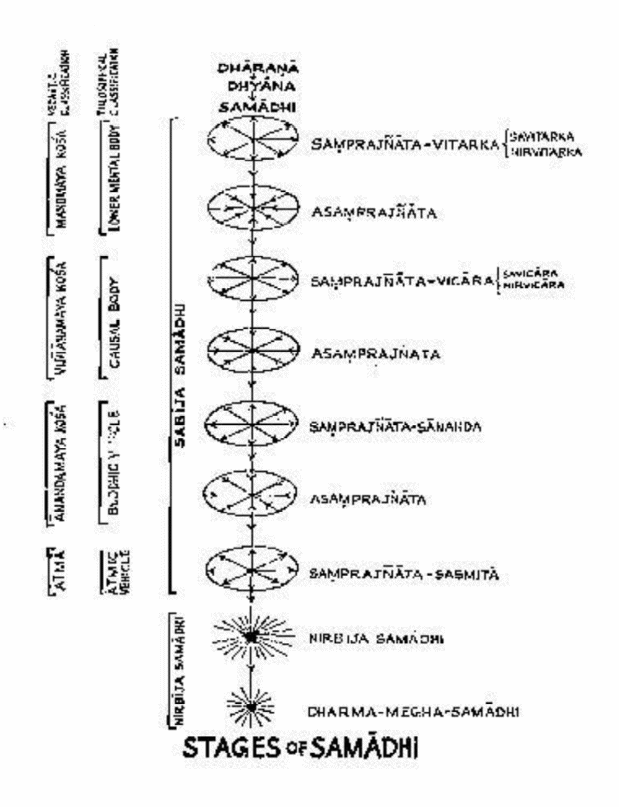
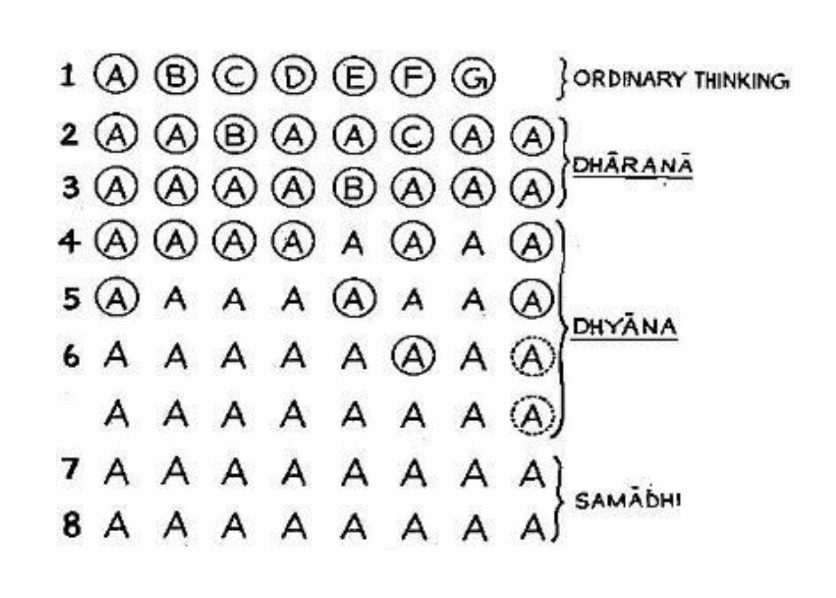
FIGURE 1979 0221-1. Stages of Samadhi.
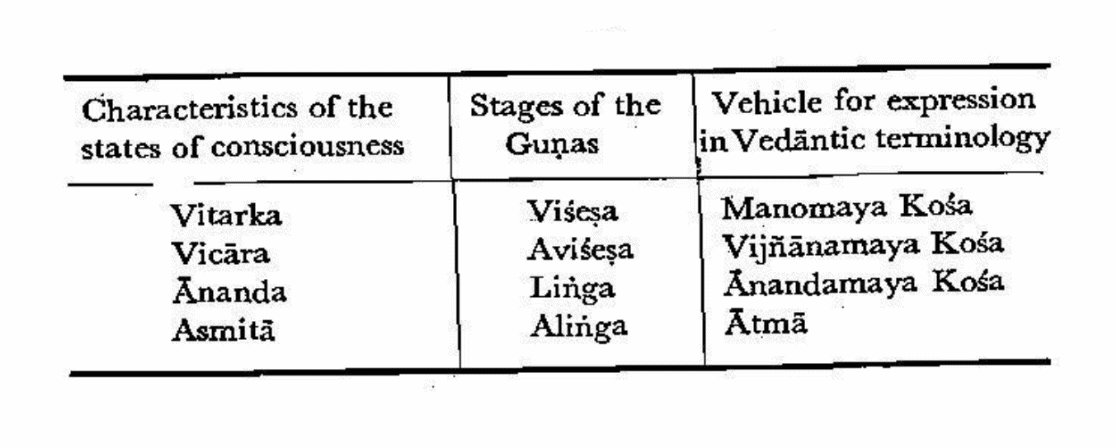
FIGURE 1979 0221-2. Four Samadhis, Four Stages of Gunas, and Four Sheaths.
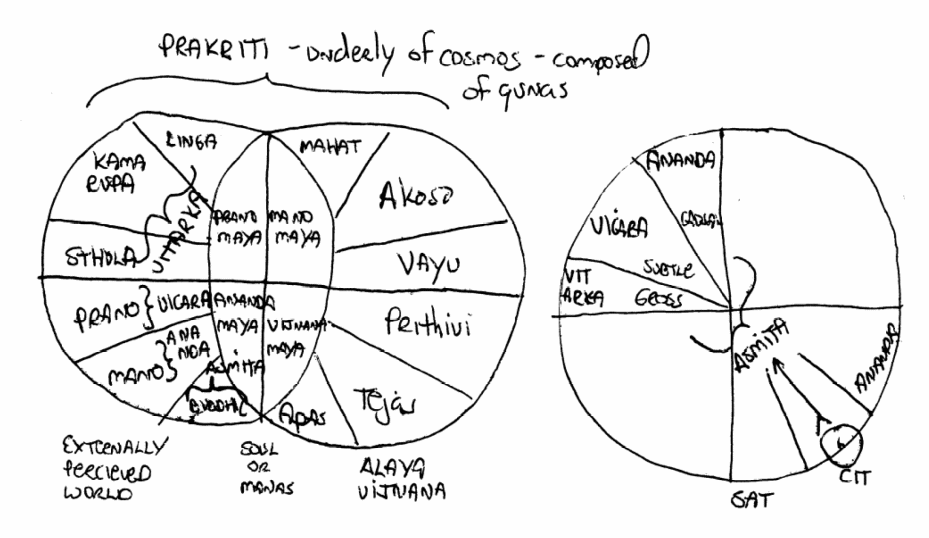
FIGURE 1979 0221-3-AB. Vesica of Houses 10-12, with Cosmic Tattvas in House 10, Four Koshas in House 11, and Six Theosophical Principles of Man and Four Samadhis in House 12; Sat-Chit-Ananda correlated with Houses 4-6, Four Samadhis correlated with Houses 10-12.
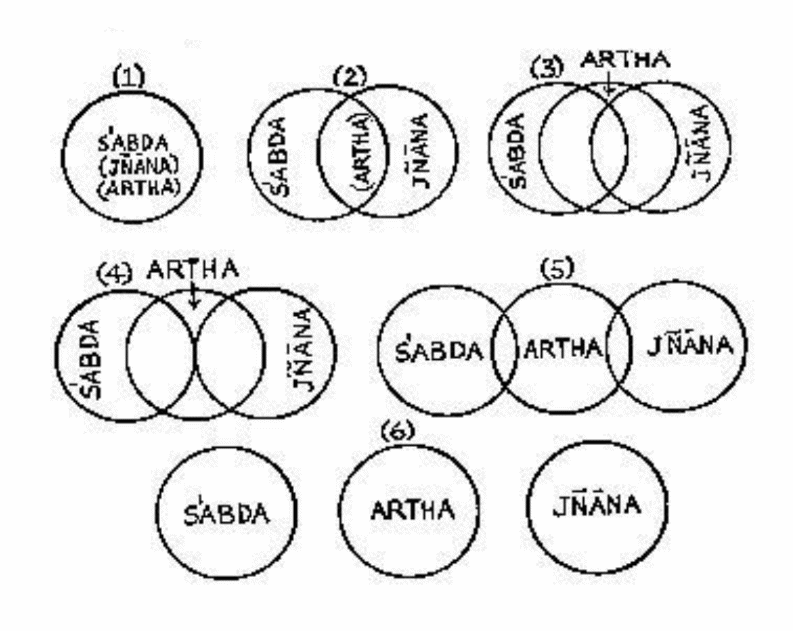
FIGURE 1979 0221-4. Sabda, Artha, Jnana.
FIGURE 1979 0221-5. Stages of Meditation.
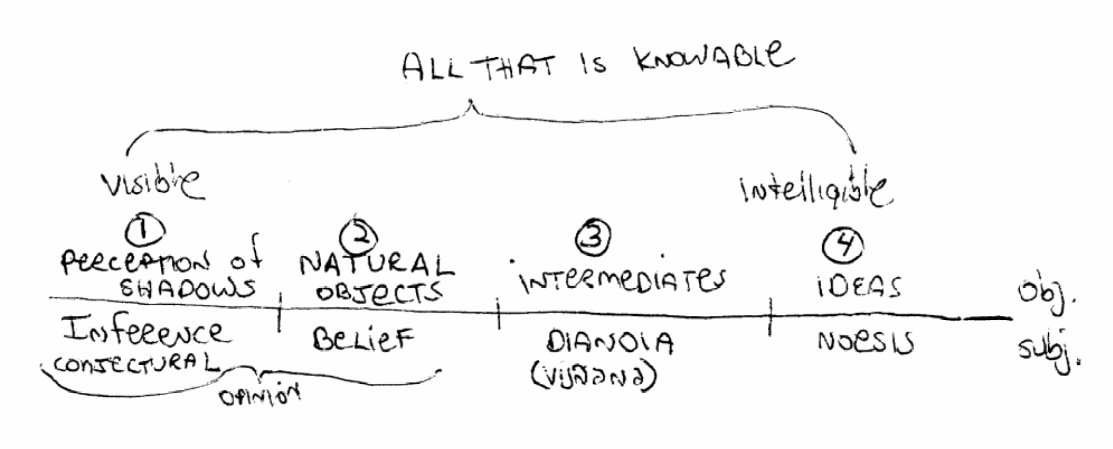
FIGURE 1979 0221-6-AB. Divided Line.
Diagrams 1, 2, 4, and 5 are from I.K. Taimni, The Science of Yoga, pp. 38, 180, 108, and 284 respectively. [Transcriber note: [diagram] means the speaker is referencing a diagram as he or she is speaking. If someone is drawing or writing, with audible sounds of chalk on a blackboard, I indicate this by [drawing] or [writing].]
AD PAPER read in class:
- "The distinction between the seed-thought and the mind" – seems incomplete.
TRANSCRIBED Verbatim by IT 2019; reformatted by JRM & JF 2019-2020, with TOC/Subheads by JRM. In 2023, IT updates prefatory matter, footer, and audio file name, completes Book List, adds Plotinus quotes section, adds new notes within transcript, fixes errors/typos, adds six diagrams and references within transcript to these diagrams. In 2024, MW alters Subheads to make more accurate. In 2025, IT updates audio file markers to match new REP audio. Archival verbatim transcript – V14.1a.
AUDIO FILES: 1979 0221a, 1979 0221b. [Note 1: "Tape" and "Side" refer to original audio cassette tapes that were later digitized into .MP3 Audio Files. Note 2: Audio File 1979 0221b was originally recorded back to front, i.e., Side 2 followed by Side 1; REP Studio fixes in 2024.]
1979 02/21 at Wisdom's Goldenrod
PB Books; Hidden Teaching Beyond Yoga; Four Samadhis
Archival verbatim transcript
THINKING, CONCENTRATION, CALMNESS, REVERIE
[Audio File 1979 0221a Begins]
AD: (Uh-hm.) I gotta find relativity. So, next week [Note: WG Class 1979 0228, Vic Mansfield on Relativity, Quantum Mechanics.] we'll get into the gist of this matter, you know? The problem of epistemology. So all this was a sort of prelude, you know, a nice-- just a prelude, prelude to the conversation, nothing too serious. But I do want to stay with the problem of thinking, concentration, calmness, reverie. [short pause] And go over this part and in a very formulated way. Now, those disciplines that he speaks about, "Think!", and the other one, "Concentration, Calmness, Reverie," they're a problem for most of us and I think last week we pointed out, we quoted from Evola [Note: See Julius Evola, The Doctrine of Awakening, Luzac & Company, Ltd., London, 1951, pp. 6-8. See also WG Class 1979 0214.] where there are groups, there are teachings, even public teachings, which may sound esoteric but really are not but, these teachings are very very scientific in the sense that they worked out a scheme, a scheme of how to think a thing through, and what's required, what-- what are the steps along the way, and, what are some of the landmarks. Now, we have some familiarity with it when we were speaking about the Platonic scheme, the Scholastics, the terminology, the (rating), we started getting acquainted with it. [short pause] So, I thought I would try to summarize what-- what is badly said last week or not, you know, articulated. [11½ second pause] You know, we're picking out sentences over here where in a very shy, almost coy way PB says--
[Transcriber note: I am using The Hidden Teaching Beyond Yoga by Paul Brunton, E. P. Dutton & Co., Inc., New York, 1969.]
PB [The Hidden Teaching Beyond Yoga, "The Philosophical Discipline," p. 127, AD reading]: "The first of these points is the power to regulate the thoughts and master attention, and then to concentrate fully in any required direction."
AD: Or where it goes on, it says--
PB [The Hidden Teaching Beyond Yoga, "The Philosophical Discipline," p. 127, AD reading]: "The power to become completely absorbed in the subject in hand can then be unfolded. The meaning of such concentration is extreme attentiveness to the topic under consideration, never permitting it to lapse through laziness or fatigue. [AD adds: And] The mind must move only where the will directs it."
AD: I will not go into discussion of the will, please.
[short pause]
PB [The Hidden Teaching Beyond Yoga, "The Philosophical Discipline," p. 128, AD reading]: "[AD adds: And] Similarly, [AD: he goes on] the faculty of fixing attention at will and retaining it, ultimately helps to burn a way through the hardest intellectual problems."
[short pause]
AD: He speaks about the unfoldment of reverie, the need for quietness or stillness in the mind. All these, of course-- Here, let me add a few more.
PB [The Hidden Teaching Beyond Yoga, "The Philosophical Discipline," pp. 128-129, AD reading]: "It is that which appears in the constant endeavour of the mystic to cease external activity, to shut out the distractions of his material environment, to stop the operation of his five senses, and to develop a condition of complete introversion. The [AD reads: And this] latter is akin to the profound abstractiveness and creative moods noted in the lives of famous geniuses. This sustained inwardness may consummate itself even in trance but the essential factor is the capacity to re-orientate the attention at will from the world of concrete things to the world of abstract thoughts."
AD: And he refers to this of course as an unusual capacity. But it's not too bad when you-- when you love what you're doing. It's really not difficult. I'm quite sure those of you who are artists, when you work, you get involved in your work, you enjoy it. It's only the effort to get involved in your work that's hard, but once you're doing it it's enjoyable. And he goes on and says--
PB [The Hidden Teaching Beyond Yoga, "The Philosophical Discipline," p. 129, AD reading]: "Every philosopher must possess these three qualities of concentrativeness, calmness and reverie. … [9¾ second pause] [AD adds: And] The difficulty of such research soon tires the unwilling mind unless it has previously developed the strength which comes through such discipline. [And] without the complete concentration which mobilizes the mind to a single-pointed end and which keeps out extraneous thoughts, resistance will beset the effort to grasp either the meanings of philosophic problems or to move onward…"
AD: So, we'll, again, go over some of these ideas that are to be found in most of the Yogas which the Hindus and the Buddhists have advised. They're very scientific in their formulation of how to attack the problem of concentration. Remember when we read from the Mandukya Upanishad there was a statement that says man would rather die than think?
S (faint): That's very good. (bit of laughter)
FOUR SAMADHIS IN YOGA PHILOSOPHY
AD: And you can see why, there's a certain amount of difficulty involved in really thinking a thing through, go-- going through to the end, 'cause it may take longer than you suspect. But-- [11½ second pause] They-- they have a very fancy terminology and sometimes a little sparing to read about--nirvitarka samadhi and vicara samadhi, you wonder what in the world is going on. But a lot of it, a lot of it is really exotic terminology, it's not the ideas that are difficult to understand. So, I-- I made a couple diagrams here. Again if you want to you could refer to some of the early Buddhist studies, those of you who are Buddhist orientated. We would put manas and five vijnanas here and manas over here and alayavijnana here [diagram], you remember we had that kind of arrangement. But, since I'm not committed to any school of thought except a peculiar one, I don't care how you take the diagrams. You can use them any way you want. But I'll tell you what they mean as far as I can understand. Now-- [15 second pause]
The underlie of all this here [diagram], which let's say would be the cosmos, the underlie of this they call prakriti, it's a kind of formless indeterminate matter. We have opportunity to discuss that more and more as-- in other classes. Now you remember we spoke about the possibility of a-- a diagram that would be-- what-- what we could say, various in its use, that many traditions could be explained or the same diagram could be used for many traditions and this way you would have a kind of a schema where different traditions are all related to each other and you can, by glancing at the diagram, see what they're talking about, where the similarities are, where the dissimilarities are. And if you remember we spoke about this as the soul, manas [diagram]. We speak about this as the externally perceived world [diagram]. Now, in the externally perceived world, I pointed out that there are s-- so to speak these principles are involved in the construction of any individual. Alright, now we're talking about human beings, I don't want to get into dogs, cats or any of that, ok? And we said that the principles that in their totality is going to constitute his personality was referred to as a light vehicle or linga, desire body, a physical body, an air body or you might-- they-- the term they use is pneumatic or pranomaya, alright. And then manas or an excerpt from mind, and buddhi, which is the highest intelligence. Now these six and their synthesis, the seventh, alright, these six constitute any individual that, you know, you'd want to refer to. Now these three [diagram] are very easy to perceive and obvious, ok. In other words, the physical body, alright. This physical body, so to speak, has a life in it. And this life is motivated or moved by a desire nature. [9 second pause]
Now in the-- in the schools of Yoga they speak about-- they speak about-- well the most famous aphorism I think was the second, when they're defining Yoga and they say that Yoga is the suppression of the modifications of the mind, mind-stuff and-- And that's a very famous sutra because there in four words they're telling-- telling us that what Yoga is concerned about is to bring or-- to a halt the mind's functioning. And that that's quite an operation because those of you who have some familiarity with sitting know that it's really a tremendous undertaking. You have your highs, you have your good days, you have your bad days. And, you've begun to see that it's a problem that some day you're going to have to attack in all seriousness. But you have to wait until that day but you'll probably know when that comes.
Now, they speak about-- they speak about four samadhis. Now I may have the Sanskrit terminology mixed up. But I don't care since I'm not a Hindu. But I won't have the meanings mixed up so, let me follow through with the meanings. They speak about four levels. Now, you know-- you know the point I'm making, right Kathleen? You started this so you-- [KD: Yeah.] you're going to have to bear responsibility. (KD laughs a bit)
S (faint): Alright.
S (faint): Yeah.
AD: Can through thinking, can thinking alone help us in the transformation process, the transformation of our consciousness. And I hemmed and hawed about it because I wanted to say yes but then I would have to define what thinking is. And to define what thinking is or to show some of what-- what it means is, you know, a really laborious undertaking. So I'm going to make it very short today, thumbnail. But nonetheless, I can say yes, it can, if you're willing to do what this is, what thinking really means, and not what you think it is, [student assents, faint] right? So, we're pursuing an answer to your question.
Alright so, here we are. We're saying that in this (scheme/theme) there are these levels. And then this top one here is very easily recognizable, ok. We're all familiar with it, the physical body with the life in it, motivated or moved by desires, 'cause it's these desires that giving or directing, you know, orientating life towards a certain goal. So, we could almost say that that whole thing is like physical, alright? Now, as I said they-- they break down four different kinds of samadhi. [Note: See FIGURES 1979 0221-1, Stages of Samadhi, and 1979 0221-2, Four Samadhis, Four Stages of Gunas, and Four Sheaths, appended to this transcript for the following. These diagrams are from I.K. Taimni, The Science of Yoga, pp. 38 and 180 respectively.] And the first one they call vitarka, and I put it over here in this realm [diagram]. [short pause while drawing/writing] The second one they call vicara. And I put it with this body here [diagram]. In other words, correlated-- correlated with a certain samadhi, there's a certain body that works with it, I mean if you want to practice pranayama you have to use the prana body, you don't practice it with the manomaya, alright so, there's a body that's correlated with it. And a-- also a certain matter because this prakriti here is composed of gunas, ok. [drawing]
Alright, so vic-- vitarka would be the first samadhi, vicara will be the second samadhi, the third samadhi is what they call ananda, and the fourth samadhi is what they call asmita. [one word inaudible] like that, ananda. [writing] This means that you're very happy when you're there. And this one here, the asmita, [short pause while writing] that's like the last meditation that a person does before he's catapulted into the vision of the universal. But, these are very advanced anyway. So all these four, one, two-- ananda goes with the manomaya kosha and asmita goes with the buddhi. So that you would have these four, vitarka [drawing/writing] and vicara and ananda then asmita. Alright, these are the four samadhis that they usually speak about. [short pause while drawing/writing] Now they divide them-- they divide these [diagram] up into two, they divide this [diagram] up into two, they divide this one [diagram] up into two, this one [diagram] up into two, but we're not going to do that, you know? I'll-- I (will/would) be quite satisfied if we just get a glimpse of--
Now let me remind you, we pointed out that this part here was, if you use the Buddhist terminology, alayavijnana [diagram], alright. [Note: See FIGURE 1979 0221-3-AB, Vesica of Houses 10-12, etc., appended to this transcript to follow this discussion.] If you use the Greek terminology it was comparable to the Demiurgic-- the material aspect of the Demiurgic Intellect. If you use the Hindu terminology it will be a causal realm of the fabricated or constructed universe. So that in the tenth, in this-- in this house here, we have these principles which are cosmic in their nature. Mahat would be like the universal intelligence that governs fabrication of the universe. These are the ideas used. This is the material that is used. But over here, fire, earth, air, and water is not intel-- is not gross, it's causal. And then, we pointed out that over here we-- was the externally perceived world [diagram], the world of the mahabhutas, and in between was the soul [diagram], alright, which fabricated, brought about the manifestation which we experienced here. So we locate ourselves here and we say "Well, I'm-- I'm so and so and I have a physical body. Let-- I want to practice-- I want to practice concentration." [10½ second pause] Now, let's see. [12½ second pause]
This is-- I'll make this remark so you don't get confused, alright. But it might end up that you will get confused but, let me try because it might be worthwhile. Let's say that you come from some point here [diagram], ok, you come from some point here, and that somehow you're going to get involved in this here world [diagram], alright. But it's very possible that even though you get involved in this-- in this world, that you can withdraw from this world and go back home where you came from. So I just want to bring this in now. Now this part here [diagram] that, so to speak, might get involved in the world and withdraw, alright, I'm going to call the soul, alright? It doesn't matter what we call it, the Buddhists would object but, any name will do. And this soul is somehow, when it secedes or separates from its source, alright, gets inserted into this world and somehow or another goes through experiences in that world which can be endless, because all of this [diagram] would be what they call samsara. This can go on forever, there's no stopping this. So, you know, Sam and Sara's coffee shop. (bit of laughter) Samsara, it's forever. You go in and stop, you have a cup of coffee, you go out, you come back, and it's always there. So, that's the world of transmigration. And, it's a universe, it's a fabricated world.
So now, we say-- we said that I'm located here [diagram] or any entity is located here and you under-- he wants to undertake the study of-- he wants to think and he wants to be able to think a thing through. Now, you can see that on the one hand, if we call this-- if we call this [writing] purusha [diagram], ok, that-- that again is the, you know, Hindu terminology, the jivatma, that's the Hindu terminology, soul is more like the Western terminology but not-- not Christian. This is more in the Neo-Platonic tradition, alright. So, between the purusha and what we call over here the prakriti, alright, the-- the interaction of these two, the interaction of prakriti, the underlying substratum of the universe, and the purusha, ok, the interaction between these two, there's going to be-- what's going to be required is a substance, a thing that they call citta, alright, and it comes [writing] from this word Sat-Chit-Ananda. It comes from here [diagram]. So, it's like a consciousness which is projected forth and it can-- its potential is universal, it can cover the whole universe, alright. But of course it's restricted insofar that that citta gets restricted let's say and tied to one particular body. Alright, so what we're saying is something like this, here's the purusha [diagram] and here's the prakriti [diagram] and the interaction between them is made available or we become aware of it that there's some kind of substance which they refer to as mind, a soul or a projected light which goes out into this world, alright, and gets intermingled with various objects in the world. Now in our case of course it got mixed up with a body and the peculiarities of that body.
Now the-- the point here would be in all the-- all Yoga is, how can I withdraw that citta, how can I withdraw it from its entanglement, its involvement or engrossment in the sensible world, how can I pull it out, alright. And so the Yoga textbooks are concerned about how to discipline and how to-- how to discipline the citta so that eventually the task of withdrawal, the consci-- the withdrawal of consciousness from the world, alright, can be accomplished. Now, many many strange experiences happen with something like that but we won't go into them, like I said, we don't want to get involved in the mystical side right now. Um-- [short pause]
Now this process, this process of withdrawing the citta from its involvement in the world, extricating it so to speak, is really a lengthy discipline. Now I know that today we believe in, you know, instant Ph.D.'s, things of that sort. But, in actuality this is a long drawn-out process and covers a span of perhaps many lives. But we can't tell because a person may have already accomplished a great deal of this in some form or other. Well if the person spent years, lifetimes as an artist, he's already accomplished a great deal of the work, so it would be very simple for him to understand the logic behind this. On the other hand a person through (dispassion), let's say a kind of saturation with the world, with Sam and Sara's stinkin' coffee and donuts. (laughter) [couple words inaudible] (laughter) It's tea. (laughter, student words) Now--
LR: It's even worse.
AD: Yeah it's worse.
LR: When they turn [one word inaudible]
AD: Yeah. (laughter) So-- so we're-- we were saying that-- There's too much variety to be able to pinpoint any one down, this only very advanced soul could do, to pin down someone and says, "Look, you have to start at the beginning. Or you have to start in the second or the third." Usually what happens is when people come to meditation, they immediately recapitulate a great deal of their past and then from there take-- go on, ok? But it's a very mixed up affair so, you may start with this first exercise and find that [AD snaps fingers] you can-- there's no problem to it so you go right on to the second and you find no problem, "Oh, I'm going to go right through" and then you hit the next one and you got problems. Well, you're not familiar with it so it might indicate that you've never done that yet. So what I'm trying to say is it's a lengthy discipline, there's no way of telling a-- ahead when you're speaking to someone or even when you're dealing with him. Actually when all is said and done, outside of a Sage, it's really that a kind of intuition arises, it's-- and tells you what's going on. But the trouble with most of us, we interfere with that intuition. [short pause]
Now, I'm not going to speak about the fact that they have prerequisites to the study. If I could put it this way, before you really can think something through and understand something, they say that you have to have certain prerequisites and they speak about what they call in Yoga the angas, you know, like yama, non-- no violence, you know, the-- no violence to any creature. Dispassion, we spoke about dispassion maybe a couple weeks ago. These are all prerequisites. They're not-- they're not the causes of Yoga but they're-- they're pretty good aids, you know, they're really helpful. Nonetheless, they are distinct from Yoga proper so that when you come across what they call the yogandas, they're prerequisites to-- to do Yoga but they are not Yoga. [short pause] All these various obstacles on the way, alright, they have enumerated various disciplines of how to handle them. This way it reduces to a minimum the effort required when a person actually undertakes the practice of Yoga, or how to think.
Assuming-- let's assume that a person is aware that-- is aware of this and has employed yamas, you know, has taken on certain practices like to be dispassionate or to be truth-telling or not stealing, in other words, has gone through the regular prerequisites, and then he decides that he thinks he ought to try meditation (or) contemplation. So-- [short pause] so assuming that that's so, he would be faced with certain-- like the obstacles that we generally have when we sit down (we/and) want to meditate, there may be certain inner tendencies, dispositions, proclivities (or formed) samskaras, all these may come up. But if you practice some of these disciplines or prerequisites, then you're in a position of greater strength to handle that. An impulse arises within you to get up, alright, and you've learned to be a little dispassionate towards your own impulses, just to look at them and say, "Alright, you're there, I know it," and just go on, alright. That kind of dispassion, that kind of discipline helps when you're sitting down and these impulses are just coming through you, to sit down and observe them, you know, and say alright, there they are. So that it helps you deal with those innate tendencies, alright. Now assuming now that you've gone through and understand-- understood a great deal about that, you know, like you say well I'm going to sit and you keep putting it off so that by 10 o'clock you're too tired to sit, alright. I mean when you begin to see through all that now you're ready to be a little more serious.
So you do finally sit down, alright. This-- this takes a little time but you finally sit down and now you recognize that you have to cut off the externally perceived world, you really have to cut it off, alright. Because there's a constant stream of impressions coming into your mind through your sense organs. So you cut that off, you close your eyes. Japanese Zen people don't want you to close your eyes. They want you to leave them a little open just a tiny bit, so you can't fall asleep. And besides it requires an effort to keep them just a little bit open. Some of them even tell you open with your eyes wide-- wide open, o-- meditate with your eyes wide open. But these are all varieties, each one has to find out which way is best. I personally like the eyes closed because there's-- there's less interference, I don't have to deal with the impressions coming from outside.
Alright so then your next step would be to cut off the external world, close your eyes, and you have to live in the internal world, alright. Now the mind starts throwing everything at you, ok, and you have to somehow regulate, channelize and govern this energy that's just pouring out and wants to think about one thing after another. So you have to really come down and as-- like your-- your-- your attention has to be like a vice. You have to hold on to this idea, whatever seed-thought, whatever mantram or whatever the-- the object of your concentration is, you're going to really have to bear down, the attention has to grip it like a vice. [10 second pause]
Now, when you're doing this, you're all aware now of that statement that they would make in the sutra when they speak about the citta in a s-- is in a state of constant transformation. You look at it and you're amazed. When you first start meditating, you don't believe you could have so many thoughts, right? You only had ten a minute before, now you got like a hundred and ten a minute, they just pouring out. That is good, that is good. It's a good sign, because you stop having a lot of illusion(s). I know it happens other ways, sometimes people sit down and they have no thoughts and they have very good meditations. And a year later it looks like bedlam broke out. Sooner or later we all have to contend with it. So that we know that the goal is eventually to halt the transformation of the citta or the changing phases. We know that that's the ultimate goal. But, it's not our immediate goal, we can't-- you can't undertake to do that. Generally, the only time you stop thinking is when you're sleeping. So-- but even then that's a samskara.
DISTINGUISHING NAME, CONCEPT, AND OBJECT
Alright so, we gave the example the last week where we said in the thinking of the ordinary person, and that's all of us, alright, if there is an object, [short pause while drawing] there's always a confusion in the thinking of a person between the name, the object, and the concepts one has about the object. [Note: See FIGURE 1979 0221-4, Sabda, Artha, Jnana, appended to this transcript for the following. This diagram is from I.K. Taimni, The Science of Yoga, p. 108.] It's like it's a nice stew, you know. Nothing is really distinct, where the object is, where the concepts are, alright, what the name is, is the name distinct from the concepts, are the concepts distinct from the object. And, part of-- part of the-- part of the training here is if we say that this here is the thing [diagram], and this its name [diagram], [drawing/writing] and this the concepts about the thing [diagram], what we want to do is gradually to separate-- separate them, and it's a slow process like we said. Here's the name, here's the concept, here's the thing, and you keep working on it until you finally separate and have each one distinct. This would be the name [diagram], this will be the concepts [diagram], this will be the thing [diagram]. I know everyone feels superior to that, but they-- I know that everyone has no cause to be. Because, it is inevitable, it is inevitable that the associations that the name, the concept, and the thing have lie in a state of undifferentiatedness and confusion. And that it's really difficult if you try to understand exactly where the thing breaks off and the concept begins, you're going to have a problem.
S: What's the different-- what's the distinction between the name and the concept?
AD: Well, suppose I have a horse, alright, and it's called Black Beauty, ok. That would be the name of the horse, ok.
S: Black Beauty?
AD: Yeah. Black Beauty. (some laughter) If it's a white one I call her White Beauty, (some laughter) you know. And, this horse is a certain type of animal, it can fall under various classifications, genera, ok. And also these concepts and the horse, the actual horse, alright, are different. So the horse, all that I know about the horse in terms of conceptual analysis, alright, and the name, they are really all distinct from one another. When I say the name there's going to be peculiarities about that horse that are almost like hidden with the name and associated with the name so closely that we can hardly distinguish them.
S: Ok, well if you take an inanimate object like a cup, what would the name be there?
S (faint): Cup.
S: Cup?
AD: Yeah, cup.
S (simultaneously): And that--
AD: Or any kind of a vessel or-- Think, [S, faint: Cup. (some laughter)] think of the name here as a more universal-- more of a universal, you know? [short pause] Take the more difficult examples, when you call someone Mary or Joe or you got a-- well you got a problem there because how do you distinguish the person, Joseph, alright, and you call-- his accidental modifications of his universal essence, how do you distinguish one from the other? And that becomes really-- With a cup I mean there's no-- there's no emotional ties to it. Unless it's worth 300,000 yen or something. (some laughter)
LR (faint): Or you drink your coffee out of (it).
S (faint): Uh-hm.
AD: Yeah, go ahead.
S: I don't know if this is right so I thought I'd ask. Sometimes the word 'cup'-- I'd said the word in meditation or even when I wasn't meditating I-- somehow the sound of the word got split off from its association(s) and all I heard was a sound. I would-- it's as if I was hearing 'cup' as a bunch of sounds completely unrelated to any ideas, is that what you're talking about [AD simultaneously: Yeah, yeah.] in terms of a name?
AD: Uh-huh.
S: It almost sounded idiotic. It was-- because it was just a sound.
AD: No, what's idiotic is when we realize that that sound is so emotionally laden and associa-- [student assents, faint] associated with so many thoughts and ideas that usually the word 'cup' will immediately arouse all kinds of reactions. In some person he wants to smash it, another one he wants coffee in it, you know, (laughter) everyone [one/two words inaudible] yeah. And yet the word 'cup' is meaningless. Just a sound.
S: Right.
AD: Yeah. Now that's usually required in almo-- it's a preliminary study, it's almost always required in anyone who meditates that they break-- break away from that. So that-- you remember the word association test, you-- you say one word, another word is-- automatically comes into your mind. And that shows the power of association. Yeah. As a matter of fact it becomes-- it becomes really a monumental problem if you ever read David Hume, alright, where he reduces the laws of physics, you know, laws of causality, to psychological association. [Note: See David Hume, A Treatise of Human Nature.] I don't know if you ever read it but he actually does that. You know, it's the story like every day at 12 o'clock the bell rings and this bus pulls up in front of it. So a kid comes along and says "That bell causes the bus to come." So he says a psychological association is what we mean by causality. And I think we've gone the limit now. (bit of laughter) You don't believe me, huh? You read it. [short pause]
STAGES OF CONCENTRATION
Alright so, we said now that the person picked up the notion of concentration, he wants to concentrate. And immediately the-- this continuous stream of sense impressions which are flowing through the senses and into the mind has to be halted. And he has to cut them off. Alright. Assuming that, now he can close his eyes. And he has to live within the mind itself. And we know that this pattern of thoughts just keeps bubbling over like a fountain. And he decides that he's going to tackle this. Uh-- Usually when the-- the terminology, the word they use here is pratyahara. But you see, I don't like these words 'cause they scare the dickens out of me. I know what they're-- I know what the process is but when they use a word like pratyahara, I say I never-- I never heard of it, I don't know what that is, you know. But generally, you close your mind, you shut down your mind, you cut out all the sense impressions and you take a section of the-- of the processes that are going on and you rivet your attention there. So like for instance if you are concentrating a creative visualization exercise, you imagine the face of a Sage or something or you're saying a mantram, you restrict the entire locus of the mental terrain to just that thought and none other. Now, you know right away that's like getting on a-- on a wild horse, a bronco, right? It's not going to happen, you're going to say "Well, I'm going to hold onto just this one thought, Om bitus, Om bitsu." And the next-- the next word that comes out is, "Oh the rent, I forgot to pay it," you know, (bit of laughter) "Om bitsu", alright. Alright so, you know immediately that that's what you're going to-- They call that pratyahara, you restricted the mental field to a certain well-defined thought or seed-syllable or object and you going to grasp that object and only that object and everything else is going to be, you know, irreligiously just disregarded. [short pause]
Now, the point we have to make here that any object of concentration, if it is an object of concentration, most of the schools refer to it as with seed, so they call it samprajnata, alright. Samprajnata-- this means you're concentrating with an object in mind. [drawing/writing] Now as soon as they put the A here [diagram], alright, without seed, that's very very difficult and very advanced, alright. But, that's not our problem. Samprajnata samadhi is where you have a thought and this thought is going to be the object and your attention is going to be riveted on that thought and that's all. [11 second pause]
Now in the first stage, they called the first stage dharana, you can feel a kind of dis-- distinction, a very clear distinction, a separation, a division between the object that you're trying to grasp and your mind trying to grasp that, you feel that, you know very well that you haven't succeeded in bringing it completely in the fold of your attention.
[Transcriber note: AD is reading a paper "The distinction between the seed-thought and the mind" (which he mentions later in the class) which I have no access to. I transcribe it just as AD reads it. Note from jf: As of 2020, paper not in AD Archives - seems to be incomplete.]
AD [Paper, AD reading]: "The distinction between the seed-thought and the mind is maintained. What stands in the way of-- [AD: I'm going to use the term loosely.] of identification of the mind with the thought is the mind itself."
AD: Alright, so, you're meditating, you're concentrating, you say I'm going to concentrate on bitsu, bitsu, alright, and you begin to notice that there's an inability for you to identify with that-- with that thought, and what that is is your mind, alright. It's not a plastic malleable medium that you can bend completely to your will but there seems to be-- the very effort involved, alright, is the very thing that's keeping you at a distance from that identification. Again, the word 'identification' is wrong I'm going to later on show.
AD [Paper, AD reading]: "Here the mind is-- it's the mind itself that's preventing this dharana from proceeding and becoming dhyana. The mind is always running away, making forms for itself other than the form of the object of concentration. The mental energy must be canalized upon this seed-thought. And if this canalization proceeds for an uninterrupted length of time, the mind gets attenuated or preoccupied with thought."
AD: Now I think that's kind of self-explanatory. You keep saying this here and after a while there's this-- this effort seems to-- the effort isn't required. A person feels that something broke, you know, and now he's saying it with no-- hardly any effort, alright. The mind is getting attenuated. The proclivities, the tendencies, the samskaras seem to you-- it seems as though you've broken-- broken-- broken them down, their resistance is less. Now if this continues considerable-- and these are all things that you could see in your own development, you know. I mean, you could watch these things and you could nail them down. You see this going on and there'll be moments where you feel that you're almost identified with bitsu, bitsu, bitsu. And it seems to be saying itself, goes on by itself, alright. Now you're approaching this stage of what they call dhyana, meditation proper.
Now, let's continue this inwardization process that the mind is going through. And, let's say you're holding on very firmly to the seed. After a certain length of time-- now PB reduced it to two and a half minutes. It varies. For some people it's more, much more, a great deal more. But, there is a minimum and he's-- he says it's two and a half minutes I think in, what was it, the Wisdom, [S: Uh-hm.] where if you could hold onto the seed-thought, then you experience or you go into what they call a samadhi on the object or there's an almost total identification. I'm going to use this word 'identification'. But later on I'm going to retract so don't accuse me of being inconsistent, I don't want to go into the explanation of what I mean right-- So that, the experience of identifying, that the mind is identifying with the seed-thought now occurs. The object, whatever it may be, stands in its own light. It shines, actually, literally shines, alright. And this object that is shining in your consciousness can do so because the obscurations that the citta or the mind had offered have been attenuated, reduced to an-- almost to an absolute minimum. It's almost like-- the example I like to give is when you look at the water, you know, you look at a lake and, there's a wind blowing and there's waves and you can't see to the bottom. But when the wind stops and the lake gets very still and the surface is placid, alright, then you (could) look straight down to the bottom, there's the stone lying at the bed of the-- you know, the water, you can see very clearly. Now, I might say that the instant that--
(Side 1 of original cassette tape digitized as 1979 0221a Ends; Side 2 Begins)
AD: --the exam-- the other example we use which I thought was very good, you know, because it's picturesque, you know, was the one where we thought of ordinary thinking, alright, [drawing/writing] a person thinks about different things, Z, R, T, A, O, alright. [Note: See FIGURE 1979 0221-5, Stages of Meditation, appended to this transcript for the following. This diagram is from I.K. Taimni, The Science of Yoga, p. 284.] Now, in the case of dharana he starts saying "I'm going to say just A." And he keeps saying A, alright. Now and then something else comes up, alright, C, and then A again. But as it gets more intense he starts saying just A all the time, alright, with a break every now and then where let's say something else comes in. But what starts happening in the A is this which represents the mind's interference [diagram] drops away, alright. So he experiences the object as it is in itself. And in samadhi the next step he has just the A standing alone by itself, shining in its own-- in its own being, alright.
Now, I would explain it something like this, that here we are thinking of the person here who's practicing vitarka meditation, alright, he's holding on to an object and succeeds-- succeeds over here in this instant in getting to the material constituents of the objects which are here. And that means that he traces the object through the subtle realm into the causal realm. Now that doesn't mean that when you sit down and look at an object and after two and a half minutes you finally succeed in-- in establishing this entity as existing in its own right that you will get-- that you will know all that there is to know about it. You may have to practice this-- they call it samyama [AD pronounces: samayana], this whole practice. You may have to practice samyama on that same problem for a number of times before you start getting all the information about that object, alright. Again, there's no-- there's no Virgo file on these things, you know. It isn't that you hit it once and you're going to get all the information, you may have to go back and do it over and over. True, for the advanced adept, the Sage, it's almost an automatic process. For the rest of us it's quite an effort and might take many years but for them it's quite normal.
PLATO'S DIVIDED LINE AND FOUR LEVELS OF CONSCIOUSNESS
Now, the next point we wanted to make, and this-- this will show in some-- to some extent how involved and how intricate it is to think a thing through, alright, and that-- and we said something like this. When we're in this level here, the physical body with its desires and its life, and we concentrate on a certain gross object and we get an insight into what the nature of that object is. Now, let's say we want to concentrate on something more internal, a thought, an idea. Now here it's going to be even a little bit more involved. But the point that we want to make, the point we want to make here is that, corresponding to this-- to this meditation we're going to use this body [diagram] and the ultimate outcome is-- the consciousness that's going to be used is going to have to correspond to it.
Let me see if I could do it this way. You remember over here we put the active intellect [diagram] and we said that the consciousness here was equivalent to that of the highest level of taijasa. And this consciousness was rec-- was necessary in order to be able to grasp the object-- intuit what the meaning of the object is here, ok. Now, let's say that-- let's say that you wanted to know the nature of an object not in the vicara stage but in the manas stage, which means that you have-- you have to use rational cogitation. Now, the-- Can I erase this, are you finished with it? [short pause] Let me try to simplify this and the Platonic simplification is really the best. [drawing/writing] You remember we spoke about, in Plato when he uses the divided line he says over here we have shadows, perception of shadows, over here sensing, over here rational cogitation, and over here intellectual intuition [diagram]. [Note: See FIGURE 1979 0221-6-AB, Divided Line, appended to this transcript.] And the subjective faculty that corresponded to that would have to be across of it. So this would be the-- let's say the objective and subjective faculty here [diagram]. So you have to have a body in order to perceive shadows, right? To see objects.
S (faint, possibly part of background): Give him (some).
S: Well, I was looking at your writing more, can you read one more?
AD: Well nobody else can read it. (some laughter) Yeah. That's only a pseudo-writing, that's so that you follow my talking. (laughter) And sensing again you have to have a body but here the body has to be a psychical body, it doesn't have to necessarily be a physical body. Anyway we said that we needed a kind of subjective apparatus. Rational co-- cogitation required a rational mind, a reasoning mind, and intellectual intuition required intuition, that is, a faculty of intuition. Now, the other point I made which I said this is always left out, and if it's left out it really obscures the whole point, that in the perception of shadows, it's enough if you're in a wakeful state of consciousness, ok? And the same with this here, sensing, it's enough that you're in a wakeful state of consciousness. You sense something is there, you may not perceive it, you know, as an object but you sense something is there. I don't want to repeat what we did, I just want to recall a certain point.
Now, in the case of rational cogitation, alright, in rational cogitation, wakeful consciousness alone is not enough, because rational-- wakeful consciousness really keeps you in contact or in touch with the externally perceived world, the material world. So, when you're cogitating or when you're reasoning, you really have to kind of pull back and like go into this reflective consciousness, [student assents, faint] alright. You know what I'm speaking about? It's like you're like in a dream state, alright, if someone calls you say "Yeah, yeah, what, huh?" So it's like you come out of a dream state. So what I'm saying is that what's required over here is the kind of consciousness which the Hindus refer to as taijasa consciousness or dream consciousness. So what I'm saying is that the consciousness that you need to operate with when you're cogitating rationally is the consciousness which we're acquainted with when we're dreaming. Now it's not dream consciousness. The term 'dreaming' could obscure the meaning here but think of when you're in a state of dream it's like you're living in the mind, and imagine that you were capable while you were dreaming to create the kind of dreams you want instead of anything that happens. That would be rational cogitation, alright. You would be manipulating the contents of a dream mind to suit your purposes. Ordinarily when we dream that doesn't happen. But in rational consciousness, when you're-- when you're thinking of a problem and you're living in this borderline where you're not here, your body is here but your attention is in this realm of consciousness, ok. So thi-- that would correspond to the taijasa consciousness.
And the next point in the divided line is, if you are to reach an intuition of the ideas, the universal ideas which underlie any object, you would have to reach what they call a state of prajna consciousness now. Prajna consciousness is at the level of deep sleep, you know, so it's even-- it's a causal-- it's an absolute cognitive consciousness. That's all it is, it's knowing. And, the only way we experience it is in sleep. We can't stand up to this. But, the point I was trying to make is that there has to be a [AD indicates on diagram as he speaks] certain body, a certain state of consciousness, and a certain object [drawing] that correspond with one another, alright, so we could do something like this. Now similarly, in-- in terms of this very exotic science that these people have evolved, alright, that in comparison, if you're concentrating on a-- on a physical object and we're speaking about vitarka meditation, there you have to really be awake. You can't be seeing an object if you're in a dream consciousness, right? So you really have to be awake here. Now over here when we move here into the realm of thought [diagram], there again a wakeful consciousness would interfere, alright. In other words if-- if you're inwardly trying to guide thought you can't be concerned about the color of the doorknob anymore. So over here the consciousness, the body, and the object of the concentration is different from what it is over here [diagram].
SP: The one that was up above, is that an actual object or do you mean like a-- a mantram or something like that?
AD: Actual object.
SP: Actual object.
AD: Yeah, think of a [SP simultaneously: (So) object.] gross object so that it makes it much easier, ok, and think of the next one as an internal object, a thought.
SP: So that would be maybe like a mantram.
AD: A mantram, sure, an idea, you know, let's say you're thinking an idea through, ok. Do you notice it has to associate with the pranomaya body because that's the aerial body, that's thought.
SP: Uh-hm.
AD: Yeah--
S: It's just Tony that I was getting a feeling that the vitarka consciousness was like almost a physical act like threading a needle, the kind of concentration where you lose the [one/two words inaudible]
AD: Yeah, yeah, it's at the level of wakeful consciousness or the terminology they use, vaishvanara consciousness, where you're really quite alert, I mean-- You ever watch a snake trying to hypnotize a bird? There's a good example. Or a boy trying to hypnotize a girl. (bit of laughter) Really alert and awake, very wakeful, ok. (bit of laughter) (It's) the only time they know it. Now, the terminology that Randy had written over here is-- is correct except for that one adjustment I made, because I don't agree with Taimni's interpretation of the Patanjali at all. But that's my disagreeable Virgo nature. [Note: See FIGURE 1979 0221-2, Four Samadhis, Four Stages of Gunas, and Four Sheaths, appended to this transcript for the following.] They put alongside, they put alongside the vitarka, we have to discuss this, [short pause while writing] alongside vitarka they put visesa [AD pronounces: vivesa], e-s-a, yeah. [S, faint: Yeah.] [short pause] And what you use-- what you use here is mano [diagram]. Not manas, mano-- He has, he has manomaya but I can't see that, it's manas vijnana, [writing] manas and the five senses. [student assents, very faint] In this-- in the second one, the vicara, [short pause while writing] avisesa [AD pronounces: avisa], then [S, faint: Yeah.] [short pause while writing] vijnanamaya. Let me see if I could find that correlation.
FOUR STATES OF CONSCIOUSNESS CORRELATED WITH FOUR STAGES OF THE GUNAS
AB: It's on page 180, the diagram.
AD: 180, oh. [short pause] Oh good. Now, let's see, in that ca-- in that case you haven't written this down, just let me write down these here, linga, [writing] and alinga. [short pause while writing] Would you read a little bit on that? [S, faint: Uh-hm.] Give me a chance to (complete it). [S, very faint: Uh-hm.] Probably make it.
AB: Right.
LR (simultaneously): What chapter?
AD: Just what he means by this here, particular.
AB: Uh-hm. Ok.
AD: Now look, first before you start. Remember we said that what underlies this whole cosmos is what they call this formless indeterminate matter, prakriti, alright. And that everything in the cosmos is going to be constituted of prakriti or what they refer to as the three gunas, various collocations of the three gunas. Now, there will be objects so to speak which are composed of this here, very specific individual objects, and they're going to call-- call them visesa, alright. Now these very particular specific determinate objects they refer-- this is the term they use, alright. Again, don't let these words throw you off, try to get the idea, I don't care if you never remember a Sanskrit word in your life. Alright, Alan?
[Transcriber Note: I am using The Science of Yoga by I.K. Taimni, The Theosophical Publishing House, Madras, 1961.]
I.K. Taimni [The Science of Yoga, pp. 180-181, AB reading]: "As the states of consciousness which the Yogi has to pass through in Samadhi…are four there should naturally be four stages of the Gunas. …
"The word [AB reads: The first stage or] Visesa means particular and the Visesa stage of the Gunas obviously refers to the stage of the lower mind which sees all objects only as particular things with names and forms. To the lower mind every object seems to have a separate and independent existence and a separate identity. … This stage [of the Gunas] corresponds to the Vitarka stage of Samadhi because while consciousness is functioning through the lower mind Vitarka is its most important and essential function. Vitarka [AB reads: It] is that activity of the lower mind through which it differentiates a particular object from all others."
AD: Alright, let's jump now to the next one, the avisesa, avisesa, which is on 182.
AB (faint): Uh-hm.
AD: Next stage.
I.K. Taimni [The Science of Yoga, p. 182, AB reading]: "…Avisesa [which] means universal or non-specific."
AD: Change that to general.
I.K. Taimni [The Science of Yoga, p. 182, AB reading]: "This corresponds to the activity of the higher mind whose function is to deal with universals [AB reads: generals], archetypes and principles which underlie the world of names and forms. [AB adds: While] The lower mind deals with particular objects [with names and forms], the higher mind [AB adds: deals] with abstract ideas and archetypes."
AD: Ok, good. Then the next one, linga. This is just a very rough summary of what these-- this prakriti has this-- these four different states of matter, that's all we're doing.
I.K. Taimni [The Science of Yoga, p. 183, AB reading]: "This word [AB reads: Linga] means a mark which serves to identify and in the present context Linga matra [AB reads: it] means a state of consciousness in which particular objects and even principles are mere marks or signs which serve to distinguish them from other objects."
AD: In other words at this level now, at this samadhi level of consciousness, what the person knows, will know about an object will be the relatively universal idea which constitute that object. Ok, next one, alinga, no mark.
I.K. Taimni [The Science of Yoga, p. 183, AB reading]: "…Alinga or [AB reads: The alinga stage is] without mark or differentiating characteristic [AB reads: characteristics]. In this stage the objects and principles lose their separate identity. Consciousness becomes so predominant that they go out of focus, [as it were]. … In the Linga stage awareness of objects exists side by side with the awareness of consciousness. In the Alinga stage the former go out of focus…"
AD: No, no, stop there. Let's start again, ok. Read the first definition and think of the vitarka stage of samadhi would be with an object that exists here, ok. In other words, you're concentrating on a doorknob, alright, physical object, ok, and that would correspond to this level here [diagram], ok. So that you could have knowledge of what constitutes this doorknob, where the marble came from or whatever it's constituted. You could have all the knowledge that concerns the physical properties of this object according to this stage of concentration or samadhi, alright. So just read a line here of what this object is.
I.K. Taimni [The Science of Yoga, p. 181, AB reading]: "The word Visesa means particular and the Visesa stage of the Gunas obviously refers to the [AB reads: Visesa means particular, and this stage refers to that] stage of the lower mind which sees all objects only as particular things with names and forms."
AD: Ok. And we're talking about this stage of samadhi, alright, where a person with the wakeful consciousness is concentrating, throwing all his attention on this particular object. I mean it would be very difficult, you know, like to paint the Raphael Blue if you're in a dream state of consciousness. No, it has to be this kind of consciousness and it has to be wakeful consciousness. Ok, the next one--
I.K. Taimni [The Science of Yoga, p. 182, AB reading]: "…Avisesa [which] means universal [AB reads: general] or non-specific. This [AB reads: And] corresponds to the activity of the higher mind whose…"
AD: You see, that's where we disagree, it doesn't correspond to the activity of the higher mind. It corresponds to the activity of pranomaya, because all thought arises, you know, because of the motion of vayu or, in other words, no breathing, no thinking. They're so intimately connected these two that if you actually get to the very source-- in other words, breathing-- thinking and breathing have a source in common. If you get to that source you get to know what that idea is. So, if you repeat that sentence.
AB: Uh-hm.
I.K. Taimni [The Science of Yoga, p. 182, AB reading]: "This corresponds [AB reads: Would correspond] to the activity of [the higher] mind whose function is to deal with universals [AB reads: generals], archetypes and principles which underlie [AB reads: or principles underlying] the world of names and forms."
AD: Uh-hm. You see, that applies to this one here [diagram]. That applies to mano.
S (faint): Uh-hm.
AB: He does call it higher mind. [short pause] But when he--
AD: So-- so let's have it again now.
I.K. Taimni [The Science of Yoga, p. 182, AB reading]: "This [AB reads: It] corresponds to the activity of the higher mind whose function is to deal with universals, archetypes and principles which underlie the world of names and forms."
AD: Alright so then let's allow him-- let's say that he's calling this [diagram] lower mind, ok? Let's allow him that, ok? So then the-- the higher mind is what deals with relatively universal principles. Or this stage here, linga, alright. But if you look at this here, alright, now you remember we said these are the six principles [diagram] that go into the constitution of a-- of a being. [Note: See FIGURE 1979 0221-3-AB, Vesica of Houses 10-12, etc., appended to this transcript.] And we spoke about this as the obvious, you know, you see a person, his physical body, and you see the motion or the movement of life and his-- the direction that that motion is taking and you say "Alright." Alright. The next one you can't observe. You can't see what the man internally is concentrating on, although you-- he may be still. And by the way samadhi does not mean that a person is in a rigid state. I know a lot of people have that idea that you go into a cat-- catalepsy, you know, catatonic state, that's not necessarily samadhi. More often than not it means you're sleeping. But, over here where he speaks about manas, alright, that refers to this stage here [diagram], linga, doesn't it?
S (very faint): Yeah.
AB: Well, the way he speaks of the higher mind here is that it-- it's what abstracts the common name or the species.
AD: Well-- well read what he says about the higher mind.
AB: He says--
I.K. Taimni [The Science of Yoga, p. 182, AB reading]: "Every common noun is such an abstraction… The mental process whereby these qualities are isolated from particular objects and combined in a single abstract concept is called Vicara."
AD (simultaneously): Oh this-- this (is in/isn't) (writing).
I.K. Taimni [The Science of Yoga, p. 182, AB reading]: "The function of the higher mind is to form such universal [AB reads: general] concepts and [to] grasp their inner significance."
AD: This man has been contaminated by the Western epistemological treaties, you know, that we come to know what an object is through abstraction. See what I mean? Well he was-- he's a chemist. No. What we would say here would be at this level here, the concept-- Let's go here in vicara where the person is concentrating on an internal object, a thought, alright. The-- the activity-- the body involved here is the pranomaya kosha. It is what you would call the cosmic prana which-- which we inhale, you know, which we take into ourselves and individualize. That very process of individualizing this cosmic prana results in the formulation of certain thoughts, you know. It's like we're like a big-- think of ourselves like a big vase, ok, alright. Think of this here as, alright, inside [drawing] a bathtub of water, alright. Now here's the water, ok, alright, and there's stuff going in and out of us, alright. These here would be like thoughts coming into us and going out of us, alright, going in and coming out [diagram]. This is inserted in-- this is the individual and this is the cosmic prana, every time he breathes in and out, alright, he brings into himself this cosmic prana and he thinks he is originating some great thoughts. Yeah, that's the body you use for this kind of functioning where you are going to try to bring control over the prana body. And the particular exercise that they refer to here is the vicara kind of samadhi where you practice this internal concentration on a thought. In other words, you have a thought. That's with bitsu. And, you go through the whole process of what we call dharana where you start saying it, you-- you're in the mental realm and you're manipulating it, you're saying it, and then it starts getting very steady, becomes-- Well, it's almost like-- you know, did you ever pour oil? Has a nice frictionless movement, ok? It's not like water which gurgles and burgles and makes all kinds of noises (bit of laughter) but it's nice and smooth, very peaceful. That's the second stage, dhyana. And the third stage, of course, is what they call samadhi. Yeah, go ahead.
AB: When you speak of vicara as associated with the pranomaya, in the Platonic system would that be analogous to saying that, you know, what we say in the Nature monad there's these spermatic reason-principles which are above the B-- the Body monad, so that if you--
AD: I don't follow, I don't follow at all, you have to start again.
AB: Ok. I'm trying to make a correlation with the Greek scheme when we speak of the Nature monad as having these spermatic reason-principles or Logos principles which inform matter. And I'm asking if you could make that analogous to the pranomaya, which is realized in vicara.
AD (simultaneously): Oh I see, yeah, yeah it's very close to that, very close. Not identical but very close.
AB: Like it-- it wouldn't be like realizing the ideas in the soul.
AD: No.
AB: It would be below that.
AD: Not at all.
AB: But it would be above the sensible.
AD: You're talking about here [diagram], to realize [AB simultaneously: That--] the ideas in the soul.
AB: Right, that would be the manomaya.
AD: Manomaya. So that in this-- in this type of concentration, what they refer to as ananda samadhi, alright, where you go through the same process, in other words, you [AD knocking on board as he speaks] start off with dharana, you get into dhyana and then you get into samadhi. And in that state, in that state where you are actually localized, your attention is in the manas principle, alright, now you can experience the reason-principles that are (on/in) the manas, alright, and so you can have a direct contact with what actually constitutes this entity. Actual contact. It isn't-- it isn't through concepts or words like he was pointing out. That is utterly bizarre, you know. You can see that that's a throwback to the Western way of saying that we acquire knowledge through a process of abstraction. No. (AD laughs a bit) Why would a yogi go in a cave for that? Why would he practice this very austere kind of-- You don't need-- you don't need the austor-- austerities that, you know, let's say are prerequisites, you don't need that. Anyone could go to college and learn how to abstract properly, induct and induct and all that, that's all nonsense. He's got that all confused. Yeah, go ahead uh--
LR: Um, last--
AD (simultaneously): By the way I-- You have to read the passage. I can't read my book, I got it (all--) so read it.
LR: No by the way what?
AD: The question.
S (very faint): Yeah.
AD: Go ahead, go ahead, the question.
LR: Last week when you had-- when you were working on this diagram, A B C, [AD: Uh-hm.] and you were explicating it, you said it was impro-- I believe this is what you said. I may not have understood you but I thought you said that it was improper to think of the circles at-- surrounding the letter as a kind of self-consciousness accompanying. And I-- I wondered why it is improper to think of it as that. But I may [AD simultaneously: No.] have misunderstood you.
AD: No I-- if I said it that way I was wrong, the way I said it was that this was like the self-consciousness surrounding the object.
S (very faint): Uh-hm.
LR: Oh ok. I don't-- I thought you said you didn't like that word for the circle surrounding but I-- I might be wrong.
AD: No. That would represent a kind of self-consciousness which is still presented when the object is in the dharana state or dhyana state. The object is not yet-- it's not shining through itself, the mind isn't sufficiently attenuated. But nonetheless, it is beginning to come through, you're beginning to see aspects of the object that you never saw before. However, there is enough self-consciousness to prevent that feeling that now you are this object. What we mean when the circle is gone is that there's-- there's no you there, alright, there's-- If we want we could say something like this. There's the seer, the seen, and the seeing, alright. And in this process what they would say is you take out the two ends, you take out the seer, you take out the seen and all there is is the seeing. So that there's no awareness of any self or subjectivity or the mind's presence. The mind is there, don't make the mistake of thinking the mind isn't there. The mind is there but it's so attenuated that you're hardly aware of it. The only time the mind is not there is when you go into asamprajnata. Then there's no mind.
LR: But I got to ask this 'cause I didn't understand the way you said it. Is all that is there the seeing or the seen?
S (faint): [one/two words inaudible]
AD: Well--
LR: You say those two words very much alike.
AD (simultaneously): Yes, I should say the seen, but it actually comes to like seeing. (bit of laughter)
S: Spell it.
S (simultaneously): You can't interpret. (some laughter)
AD (amidst laughter): Huh?
S (amidst laughter, faint): (She/He) doesn't.
S: Spell it.
LR: You have to spell it because [AD simultaneously, faint: Spell it.] you pronounce those words very similarly. The function.
AD: Yeah, function.
LR (simultaneously): Functioning. Ok.
AD: There's a girl here who promised to put out a dictionary on my euphemisms and mispronunciations but (bit of laughter) she never came up with it yet, ok. Alright then we-- we moved into this one here [diagram] where we saw again the same problem. Let's say that you want to get acquainted with the seed-thought. Now, ananda meditation is a meditation where you actually come into contact with the reason-principles, you experience directly the reason-principles, not through any intermediaries. Now this comes very close to the Platonist way of saying when you know, you know because you are soul and it is the soul that knows, not you. So, they would never start out by saying you know an object because from-- here's an object, alright, square, you remember? They would say, "Ah, so you got the concept square." What did you do according to modern theories? "You subtracted from this physical object the concept square, isn't that amazing. Tell me how you did it?" That's the modern theory of abstraction, alright, that here's all these people here, everyone has two arms, two legs, one head, I think, alright. "Ah, we got the concept"man"," alright, because we derived, we abstracted all these commons that every individual has and we got a concept man, this is how we got the concept. That's very beautiful. But it doesn't work. To the Platonists that's all baloney. You first have the concept of man in the soul and then you know about it as an image in the reflective consciousness. They put that first so-- They would say that these real reason-principles that constitute any object, in this ananda meditation you can actually get to these reason-principles, see what constitutes an object, and then, so to speak, understand what that object is. Now-- Maybe we could exaggerate it, think of something like this, think of, oh let's say you got a planet on 1 degree Aries, alright. And that through this contemplation you can actually experience what that 1 degree Aries planet is. I mean you could actually experience it, it would be the-- what was the terminology he used, the unvitiated nature which is the presupposition of your psycho-physical organism. Yeah, yeah, [drawing] this is what we're talking about, you want real knowledge, this is the next step. And this is not real knowledge then because the next one, buddhi, is even more real, alright. And buddhi or what they call asmita consciousness-- [Note: See FIGURE 1979 0221-3-AB, Vesica of Houses 10-12, etc., appended to this transcript for the following.]
And always look at the opposite and you'll see where it's coming from [diagram]. Manas is like an excerpt from cosmic akasha. All the ideas that constitute the fabrication of the universe, your mind is, let's say, a selective-- selective amount of that. So that if you investigate the nature of your mind you're going to eventually get to akasha, alright. The same way with pranomaya, you're going to eventually get to vayu. Now over here in buddhi, if you-- if you reach the level of asmita in meditation, again, you'd have to go through the three steps, alright, the three steps which they call samyama meditation and you'd concentrate-- And this buddhi meditation or ananda-- asmita meditation is supposed to give you a vision of the universal Idea(s). So asmita-- now how in the world by concentrating on the "I" which is reflected in buddhi consciousness the idea of universal manifestation appears I'll leave to you to answer. (bit of laughter) But it's an interesting question because some of the great Indian scholars are trill-- still working with that, trying to figure out how the yogi triggers off, you know, that vision of the universe. Yeah, Alan.
AB: What-- in the vesica you also have some of the koshas [diagram]. And then you have them on the left in the, you know, twelfth house [diagram].
AD: Alright now, what I was trying to do there was trying to show you how-- You remember we started off by saying something like this, now this-- this pure soul, alright, which is in the realm of the Intellectual, it's a pure principle, is let's say projected into generation, alright. It's thrown into the world. You know, like Plotinus says, this is the skiff. The universe is the-- the skiff of the universe is where the soul is thrown in and it becomes a metaphysical wanderer. [Note: See Plotinus, III.4.6, last couple of paragraphs.] Now, this soul here [diagram], as it identifies with various sections of this cosmic panorama, alright, this-- could get engrossed or lost at various levels of its-- of the cosmos. So, let's say the soul could identify with the gross body here, the physical body let's say, and think itself the physical body. It can get identified so to speak with what we call-- in other words, these various bodies [AD indicates on diagram], ok. The pure soul here can get identified with what we would call the hylic intellect or the rational intellect or any of these or the body, alright. In each case, alright, in each case-- I want you to keep something in mind, and that is that the soul, even though identified with any of these sheaths, alright--which we call anandamaya in Hinduism, alright, and this we call vijnanamaya in Hinduism, in Greek for instance it would be the gnostic body, this would be the augoeides [diagram] in Greek, alright--that the soul is still not these things. That's the difficulty. [short pause] As high in value these may be, the augoeides, which is an eternal sheath given to this pure soul, and which will last let's say the entirety of a Manvantara, alright, it's eternal, as high in value as that is, that is still not to be confused with the soul here [diagram].
S (very faint): Uh-hm.
AB: Could you identify like where you have vicara or subtle, could you say that's the whole vesica and--
AD: Oh no, no, no, don't use it that way.
AB: Ok.
AD: This is the diagram without any of the connotations here. So-- [drawing/writing] So we could see the soul could identify with any of these here [diagram], alright. Meditation here [diagram], meditation here [diagram], meditation here [diagram], and medita-- So you can see it's like a graded series. A graded series and levels of samadhis, alright. Now it's only after a person reaches this here [diagram] that they could speak about what they call samprajnata, in other words, now concentration or contemplation is without any object.
AB: Asamprajnata.
AD: Asamprajnata. No object. Alright. Over here [diagram] there's still an object. What? The pure "I". It's over here [diagram] too, buddhi, buddhic consciousness, alright. It's like the light [drawing] which is coming from the Atma is reflected here and so there's an i-- there tends to be an identity of the "I" with the buddhi consciousness, alright. Now, very simply this-- this is a kind of a brief thumbnail sketch of what-- what it means when you say can you think. Now I don't know, I don't know if this, you know, would be proper. People would say well perhaps I'm stretching a point. But I know that every time I try to think something through I could never get to the bottom. You know, like if you dive in a pool and it's ten feet at least you hit the concrete, you get a bump, you say "Alright, I hit bottom." But you think and you think and you don't come to a bottom. So evidently there must be something very shallow about our nature. Because we seem to think that, you know, you get acquainted with a few lines, a few sentences or you think for five, ten minutes a certain problem and you think you know how to think. And yet most of the great philosophers would point out very-- very readily that all we're doing is trying to think, but we're a long way from doing that. I don't know if I follow the paper, it really doesn't matter, uh-- [13¼ second pause, paper noises]
DEEPENING ONE'S OWN CONSCIOUSNESS IS NOT THE SAME AS PENETRATING INTO THE OBJECT
AD [Paper, AD reading]: "Taimni says on page 105 that the Yogi in samyama sinks into his own consciousness, into progressively deeper layers of the object."
AD: I have to remind you Charlene, this was the same point I was making Sunday. Now, sometimes I make a point and I try to sound excited, enthused, just to [couple/three inaudible student words simultaneous with AD] tell you, look, this is so big, if only you could see it, you know. Rather than speaking in a monotone. But it's the same mistake. Now how could two people with supposed affiliations with two different traditions make the same mistake? I know--I'm mistaken. (bit of laughter) What he says is if you sink deeper and deeper into your own consciousness, alright, you come into the substratum of the object. Nonsense, you sink deeper and deeper into your own consciousness, you come over here [diagram]! You come to the divine soul in yourself. You don't come into the object. If you sink deeper and deeper into an object here [diagram], I can understand that. But that would be that you're identifying-- well we would have to go this way [diagram], alright. As the mind is associated, let's say, with the anandamaya kosha, then it gets associated with vijnanamaya, the manomaya and prana, it's sinking deeper and deeper into matter. Now that's quite different, alright, than to say that if the soul looks into itself, it gets deeper and deeper into matter, that is not so, the soul can't get deeper and deeper into matter by sinking into itself. It only can, so to speak, identify more and more closely with these various bodies. These bodies associated with certain matter is what you're getting, so to speak, caught up in. But the soul doesn't become these things. So when he says that the Yogi in samyama sinks into his own consciousness and to progressively deeper layers of the object, this is a misunderstanding. And I'm-- I (brought/thought) this out for your-- for your pur-- for you Charlene. Because if you-- after a while you'll see that some of these mistakes are pretty pervasive and they go around with the banner flying and the dharma stamped on them. But that doesn't make them true.
AD [Paper, AD reading]: "So until he reaches the level of the Divine Mind in which the reality is to be found. But this is not correct."
AD: Well, ok.
AD [Paper, AD reading]: "The Yogi does not sink into his own consciousness to get this vision of the reality underlying the object. Meditation on his own consciousness would precipitate the experience of the unconditional (light/life) which is coming from the fifth house."
AD: In other words, what I'm saying is if you follow your own inner Logos, you find a light within you, and that takes you deeper and deeper into the soul. But if you want to find out the nature of what an object is constituted of, then you have to identify this light with a particular gnostic faculty so that you can penetrate what that object is. Follow that?
KD (simultaneously): Ok. Would you-- would you go back, just back up a minute, what you just said.
AD: Whoa.
KD: Ok. What--
AD: I'm sorry.
KD: (Is there--) is there a difference between what you're talking about in the chart on the right [diagram] and the activity of thought that you were describing [AD simultaneously: Uh-hm.] on the circle on the left [diagram]?
AD: Yeah.
KD: Ok, explain it.
[Note: See FIGURE 1979 0221-3-AB, Vesica of Houses 10-12, etc., appended to this transcript for the following.]
AD (simultaneously): It's very simple. If I introvert my-- my attention and pursue the Logos principle within myself, within me, alright, I will eventually reach the undivided pure life, the soul itself. Now, if this pure life or this soul is extroverted, projected like I am doing here [diagram], alright, as I'm doing here-- In vitarka I'm concentrating on an object. [KD: Yeah.] The mind gets attenuated. So then that the object reveals more and more of itself, alright, I kn-- I get to know something about this object, this doorknob. Again, when I move into the next meditation, this samadhi here [diagram], alright, I'm concentrating on an internal object, alright. And this concentration on an internal thought, I get to know what the substratum of that internal thought is. Now all this is taking place within these three houses [diagram], if I could use this example. And if I meditate and introspect into the ideas or the form-principles that are within the soul, I get deeper into the chart of these three circles [diagram]. I do not [KD: Oh.] go into this here [diagram] by concentrating on an object, regardless of how sublime the object is.
KD: Oh, that's not bad. So, what you're saying is the more you focus on an object, whether it be a doorknob physical or an idea, whatever, all's you end up seeing are like your vehicles that you operate with, no matter how sublime they are.
AD (simultaneously): Yes, and also the-- the world that's correlated with those vehicles. The world is correlated with the vehicles they operate with, this body is part of the universal body. [KD simultaneously: Yeah, (erase) that.] This reason is part of the universal reason. So all I get to know is what's in here [diagram]. But I don't get to the true self that I am that way, I get to the true self that I am by following the light which is in the soul into itself, tracing it-- tracing its own origin, its own genesis.
S: (Uh-hm.)
KD: [one/two words inaudible] Yeah. No.
AD: Think about it, just think about it for a moment. Make sure that this gets clarified in your mind because they'll-- they'll throw this at you all the time. We had an example Sunday, we have an example right now. And these are so-called reputable people. They supposedly know their business. Alright? I'm not going to wear a dhoti (yeah/yet). Don't ever make that mistake. [S simultaneously: It brings (couple words inaudible)] Don't think that to understand the doctrine I got to go to Tibet or I got to wear a dhoti. I make my-- my pilgrimages underground. (laughter)
KD: That's the activity [couple words inaudible] thinking that you began the discussion with, that you were going [LDS simultaneously: This?] to try to understand takes place in that chart on the left [diagram], not the introversion, that's--
AD: Yes, you see this is the universe [diagram].
KD: Yeah.
AD: This is the entirety of the fabricated universe in its three levels, gross, subtle, and causal [diagram]. And I could get to know different parts of the universe. But in order to know the gross part of the universe, I gotta have a physical body. In order to know the subtle part of the universe, I got to operate with a mental body. And to know the causal part of the universe I gotta operate with the causal part of what they call the anandamaya or vijnanamaya, ok. But to know myself!? None of them will suffice. None of them will be any good. But, look at the training, look at the training you put yourself through. Now that you've learned to take this citta, which is coming from here [diagram], manipulate it so that goes through this exercise, then you put it through this one, then you put it through this one [diagram]. Now, now you're in a position where you could stop the modifications or the movement of the mind complete--
[Audio File 1979 0221a Ends]
[Audio File 1979 0221b Begins]
AD: --for the Logos which is within, the subjectivity which is in there, true subjectivity. But to confuse it by identifying it with any of these, alright, even in the-- in the Vedantic they point out, you know, I'm not the nama, I'm not the vijnanamaya or the manomaya or the anandamaya, "I" is above all of that. So there's this very subtle point that is being made, that although in this entire scheme of learning how to think and following a thing through, in other words, whether an artist and an inventor or whatever, where you actually learn to pinpoint your attention and follow a thing through, you go through these various grades till finally you get to subtler and subtler and more causal levels of being, alright, you are all the time, the way the Buddha said, no amount of walking will take you out of this world. You can't get out of this world by walking. And this what we've been doing, we've been walking from different levels of meditation to higher and higher levels of meditation. Now it's only when we reach this level of asmita meditation, alright, where, so to speak, the object is now the "I" which is reflected in consciousness and which they refer to as buddhi, alright, now by concentrating on the "I" which is reflected in that so-called buddhic level, now you trace the "I" back and you come-- you get out of this realm altogether. So, it isn't-- it isn't that these-- this is a useless procedure, far from it, it's absolutely necessary. But the point is that there's a-- there-- there is this difficulty where they start confusing the "I" with any-- ev-- any one of these bodies and think that if they know those bodies that they would know the "I". Go ahead, Paula.
Paula D: Yeah I'm still confused because--
AD: Well, go ahead.
Paula D: When I'm doing meditation--
AD: When I read these people I get confused.
S (very faint): Me too.
Paula D: I mean it never-- in like saying a mantra or whatever, it doesn't seem, I mean for me it was ever my preference to have the mantra itself bring it up. It was always just to concentrate my mind until it reached a point where the light would shine through. But it seems what you're saying is that it-- it's an object that gets lit up, it's not that deepest thing.
AD: Yes but also what I'm saying at the same time is that the attention which is bestowed on an object, alright, falls into a certain level of consciousness. And one has to get into a deeper and deeper level of consciousness and this takes place by the training which is accruing by carrying this out. [student assents, very faint] You won't get to that deeper level of yourself without this prelimina-- preliminary training.
Paula D: I understand that but-- I guess what confused me is it seemed that not only would it be the training but it surprised me that you said it could-- I still thought that that training could lead, I mean, that once you reach that point of concentration no matter what prerequi-- prerequisite you use, no matter what type of training it got to the-- you know, if it-- your mind reached a point of concentration a light would shine through. And it seems what you're saying is that no, to reach to--
AD (simultaneously): The light of what will shine through?
Paula D: Your soul. I don't know--
AD: Well, if you're concentrating on an object, alright, [Paula D simultaneously: But isn't there a point where the object disappears?] the object would come shining through.
Paula D: But isn't there a point if the concentration becomes that the object itself disappears and it's just pure concentration?
AD: Yes. Yes.
Paula D: So then it wouldn't matter whether you concentrated on an object or a thought or-- would it?
AD: I-- you're losing me, I--
Paula D: Well then it wouldn't matter whether you were coming from vitarka or vicara.
AD (simultaneously): Well did you ever try concentrating on nothing? I mean you have to have an object to concentrate on, right?
Paula D: Ok, ok.
AD: To pin your attention on, alright. And then we're saying that this-- this-- this concentration gets you involved deeper and deeper. You go into deeper layers of the mind. What we're trying to say is that if you take the-- the-- these various bodies or gnostic functions, whatever we want to call them, it would take the deepest one, alright-- in other words, this is the most attenuated of all the bodies [diagram]. You would have to reach that attenuated body before the light of the soul from within yourself could shine out. Wait, wait, I-- Look, the way the mind here is concentrating on a doorknob, the mind is coarse, it's crude, it's inflicted with all kinds of nasty dispositions, habits, alright. With that kind of consciousness, with that kind of let's say citta, it's not possible for the light to shine through. So you concentrate and you finally learn to do this exercise and now you can concentrate on a physical object, now you move to a mental object, alright. Now by the-- by concentrating on a mental object you've removed a great deal of the crude impurities which are found here [diagram]. You've already advanced somewhat. The mind is much more attenuated, you're capable of sitting for an hour without moving around and jumping up like a frog up and down, alright. Fine. Now the mind is even more attenuated. You move down to the next step, now the mind is really getting attenuated. Still you're concentration is on an object that correlates, alright, to that-- to that particular gnostic body or soul faculty, alright. It's down here [diagram], alright, where the mind is attenuated to the extreme, where the intellect you might say is almost potentially universalized, where it offers no resistance to a light that comes in that one becomes aware that his soul, over here now [diagram]. Now he starts becoming aware that-- of his soul. Until that time he's been concentrating on objects.
Paula D: Ok, I guess what confuses me--
AD: Sublime or ridiculous.
Paula D: I guess what confuses me is that I'm not sure to see that diagram is-- Is it you're saying that you have to-- it-- concentration on a certain type of object that-- or certain level in order to gain the higher-- that higher position where the light can shine through, it--
AD: Yes, did you ever try playing the piano with gloves? Or better still, with a mitten? (some laughter, student words)
Paula D: It-- it still confuses me 'cause I still always thought that, I mean-- the concentration, no matter what you concentrated on, if you reach that perfect concentration, that the light could shine through. And [one/two words inaudible]
AD (simultaneously): But you don't like to stand corrected.
Paula D(?) (very faint): Ok.
AD: I mean that's what it amounts to. These people would say you're wrong. Now that doesn't mean that, you know, that Grace can happen, you know, like sometimes a person could be sitting down and get a vision, a glimpse of the Atma. Fine. But you're talking to people who are saying, "I want it. And when I get it, I'm going to keep it." I mean you're talking to people who are going to discipline their soul. [drawing or hitting board] You're not talking about people who want just a pop shot at it, see it once and then go on. Oh no. These are people who have stripped themselves of everything to get to this goal. So they devise(d) this. This is a very highly obscure but very articulate science on how to train the mind, discipline the mind.
Paula D: Could you explain to me again the difference between after the concentration on vicara or the thought, what is that in-- in the third house, in the buddhi [diagram]? Would you explain that to me again?
AD: This one here, buddhi?
Paula D: Yes, what concentration is that?
[14¼ second pause]
AD: Well-- If we look at this tenth house [diagram], alright, we usually refer to this as the causal realm of the universe, alright. And that means that over here, what's involved over here is the intelligence, the absolute intelligence, alright, that is going to fabricate this whole universe. This is what Mahat means. Now, what role does your soul play in this cosmic manifestation? The role that your soul plays in this cosmic manifestation is, so to speak, inherent in the buddhic consciousness. So that when a person reaches that level of the vision that the soul has of its own destiny, alright, that means it knows its place in the scheme of things, you're up to buddhic consciousness. Now, now you could start separating yourself from the scheme of things and isolate it down here [diagram]. You follow?
Paula D: Is that then what concentration is, that concentration on that thought, the thought of what is-- what is your soul in the scheme of things? Or is it--
AD: Say it again, I-- I didn't follow.
Paula D: Is that then what that meditation or that concentration is on the thought of or the question of what is your--
AD (simultaneously): Oh yes, that's what asmita is, that's what the asmita concentration is. In other words, you're trying to get a vision of what the soul's destiny is, what the archetype-- what its realm-- I mean what its relationship is in terms of the whole--
S (faint): Uh-hm.
Paula D: But that can't be attempted really until the others are accomplished.
AD: Well you can try it, sure. [Paula D: Uh-huh.] You can try it.
Paula D: [couple/three words inaudible]
AD: That-- Look, any of these things can be tried, like I said a person could sit down and meditate for the first time and pick on the mano, uh-- He may be at it for twenty years, alright, whereas if he started with this here [diagram] and after a couple years he would've been at mano. On the other hand sometimes people are-- you have these rare examples, you know, like Hui-Neng and Ramana where, you know, they sit down and meditate and they get enlightened. I don't like to make the mistake of confusing myself with them. So I start as, you know-- where I think I belong and work from there on. And you have to experiment a little to find out where your level is. [12¼ second pause] Uh-- I don't know, perhaps I've confused you more rather than explained. But I'll stop for a few minutes and you could start talking about it.
CONCEPTUAL THINKING VS. LIVING THINKING THAT IS THE OBJECT ITSELF
KD: One question. So is the activity of thought generated at the level of soul or is it generated at the level of the-- the object for the-- the-- the level of the vehicle that you're operating with? In other words, from your description it sounds like this activity of thought is no real-- there's no very higher elevated process at all, it doesn't sound like the soul gets involved at all. It sounds as though it's an activity that occurs between the-- for instance, between your wakeful consciousness and an object in the world or between that lower mind and the idea or the concept, not--
AD (simultaneously): Well, I don't know that that's really thought as we've been speaking about it, you know. [short pause] I-- I prefer to refer to them as phantasms, you know, in the cave. It's not really thinking. That's-- I-- See to me it's closer to dying, you know. It's as this entity is dying these concepts which are being formulated in his consciousness is what's the end result. I-- I don't make sense, uh, [S, faint: Yeah.] well-- You-- you've watched for instance when a flower is fading, how it's changing colors and rotting or decomposing. Similarly what we call our thinking is of that nature, it's like the decomposition that's taking place. Moment by moment as we're dying these-- we give birth to these thoughts. And they're not-- that's not really thinking, it has practically nothing to do with thinking.
KD: Thinking up here [diagram], on-- on the chart on the left--
AD: Thinking in terms of this here [diagram] is [KD simultaneously: Yes.] something else. [KD simultaneously: That's--] This-- this is a-- this is a claim that we can get back to the objects, whatever they are, in their naked purity and know them as such. And not our interpretations of them.
KD: See I keep looking for a place where it originates though, I keep looking for--
AD: Where what originates?
KD: Where this thinking or this concentration originates, is there-- I keep imagining that there's somebody behind all this, like a-- the soul is pulling or forcing the thinking to concentrate, that-- that gradually (it could disidentify).
AD (simultaneously): Well I try-- I tried to explain it my way, that what we call empirical thought is really the end process, the end result of a living organism. And that these phantasms which rise in our mind and which we like to call thoughts are really nothing more than that. They're corpses. They have no life, they have no vitality, it's the dying of this entity. So you see we have real-- really different ideas of what thinking is. [students assents, faint] In other words, if I could refer you to something I did some time ago where manas here or the whole planetary system [diagram] looks to the ideas which are found here [diagram], fabricates because of the essences or the forms that are within it, individual life systems and then combines them and inserts them into a body, and this whole process, alright, when this is accomplished, alright, the ultimate result of that process is what you call thinking. Which is no kind of thinking. It's not thinking. It's a natural decomposition that's taking place, a thing is starting to fall apart and what arises, alright, you would like to call thinking. Well I'll leave you with that for a couple minutes. You start thinking about it. (bit of laughter)
BS: No concept.
AD: Huh?
BS: Why-- I mean why--
AD (simultaneously): Well, the concepts are corpses, they're dead, they've got no life in them. Alright, go ahead, now you start with your questions. I want to conclude it this week because next week I want to get on to the epistemological theories. But, if you-- if you want to, please, think now about what we said because I don't want to go back to this anymore.
AH: Earlier when you had the distinction according to the divided line--
AD: Yeah.
AH: Are you including what you refer to as rational thought in this corpse?
AD: No, that's not-- that's not. You see, when let's say you're practicing what is known as ananda meditation, alright, and you actually get back to those essences which are within the soul, alright, now from this side of the fence we'll call them thoughts. But the actual experience of these here amounts to what you might call satori. That's thought there, yes, but it's thought that's vigorous, it's life-- that's full of life, that's got force, that's got will, that effectuates and realizes what it thinks. What does-- if you think of a dollar, what does a dollar come into your pocket?
KD: So are these-- are these-- it's almost as though these mental processes which you operate with are getting more and more revealed. I think that's what you're talking about. The chart on the left, that's what's happening, it's not as though you're moving from level to level, it's not as though there's an outside activity that's uncovering more and more. It's-- from what you just said it sounds like--
AD (simultaneously): No, I'll have to disagree with you, I would [KD simultaneously: Oh.] say it's revealing more and more, it gets deeper and deeper, [KD: But--] because it's going from the gross realm to the subtle to the causal.
KD: Ok, what's [S simultaneously: So--] getting revealed, is it the thinking-- is it the thinking, the (minding--)
AD (simultaneously): The objective world!!
KD: Yeah but that cannot get to-- to the-- to the (thirty thousands) that--
AD (simultaneously): (Through the) sheaths!
KD: Right so, is that thought, is that the mind that's revealing itself more and more, the vehicle?
AD (simultaneously): Is that what?
KD: Is that-- is that m-- is that the mind then that's getting more and more revealed, in other words that-- that the seer, that seeing and the-- and the seen that is this world, ok, [AD simultaneously: But--] that whole vehicle, [KD clears throat strongly, bit of laughter] that-- Where is-- where is the difference between the thought and-- and the mind in a way, really? Seriously. Well, really, yeah. Do you-- do you see [couple words inaudible] asking?
AD (simultaneously): Where is the difference between the thought [KD: Yeah and--] and the mind?
KD: Yeah. Where is the thinking and where is this-- where are the vehicles? Where's the activity, is this--
S (faint): (Right here.)
S: No.
KD: Ok. I'll hang on, I'll get-- I'll run into (it/him).
S (faint): Either way. (laughter)
S (amidst laughter, faint): Either way.
KD: Ok. (We could go on.) (laughter) Ok! (some more laughter) Oh.
S (faint): (Alright), you should leave your speech. (bit of laughter, student words)
KD: Ok. Where-- oh, there you are. Where-- (laughter) Richard, where is this? Where is this thinking activity? Well-- Ok, it seems like for instance when the psycho-essences are revealed at [one word inaudible]
AD (simultaneously): At the anandamaya level.
KD: Right, right, right. It sounds as though you're-- you're talking about the subjective vehicle(s) is getting revealed along with-- along with the world. Ok? Ok because there are two ends of the same stick, you know.
AD (simultaneously): Yeah, I follow, yeah, yeah.
KD: That's a vehicle. Is that-- is that thinking, is that thought, is that the activity of thought, that [AD simultaneously: But there's no--] revelation of the psycho-essence which is the--
AD (simultaneously): But there's no activity of thought there.
KD: Oh, see that-- but what-- then what--
AD: Unless you want to say that the motion [KD simultaneously: But you say that--] of the planetary spheres is the activity of thought(s).
KD: Well-- But you were-- you were-- you were showing the-- what thought is on that chart on the left [diagram], so what happened to the thinking? Where is-- [AD simultaneously: Here look.] where is the activity that you're concentrate-- you're concentrating, ok? So it's-- I--
[short pause]
AD: I think you fail to catch the-- the point, huh, that [KD simultaneously: Yes!] the whole purpose of concentration and attention is to eliminate thought.
KD: Oh but that's the-- that's the bad thoughts that you were talk, that's the conceptual junk that-- [AD simultaneously: Uh-huh.] that we don't want to do.
AD: Yeah.
KD: The real thought that you-- that you said we do when you're thinking--
AD (simultaneously, intensely): What-- what do you mean real thought?
KD: Ok, I'm talking about the thought that you-- that you defined last week as being not like the thought that we think.
S (faint): Yeah.
S (faint): Yeah. (bit of laughter)
KD: You're saying that the real thought, which is-- which is like a lack of thought, is the concentration, it's the elimination of all this [AD: Yes but then--] conceptual garbage.
AD: Yes but then the whole point is that the-- the object is revealed. When you get rid-- when you get rid of your conceptual thought, then the object stands as it is. That object-- that object--now you have to listen--that object is the thought.
KD: That's what I was asking.
AD: Yeah.
KD: Oh.
AD: Oh ok, you were asking.
KD/S(?): Oh, great.
S (faint): Ok.
S (faint): Uh-hm.
AD: So all your attempts at thinking is to get back that he-- to get back to that eternal object. In other words, when you really understand what an object is, thought about the object ceases because now the object is there. There's no need for thinking about it.
KD: Yeah.
AH: Is there anything to be said for the subject at that level?
AD: Yeah I-- you have to say more. I'm not Sherlock Holmes. [KD simultaneously: (No) that's (privacy) (couple words inaudible)] I can't work on clues. Come on, say more. (laughter, student words)
AH: Ok, the object is revealed as it is. And there's no longer any necessity for conceptual--
AD: Thought, ok.
AH: (Talk/Thought).
AD: And you still haven't got emptiness. Go ahead, go ahead now.
AH: Is that the state that you were referring to earlier where there isn't-- where there's no consciousness of a seeing, a seen, or seer?
AD: When there's only the process or the [AH simultaneously: The activity of seeing--] actualization going on, yes.
AH: That's the same--
AD: Yeah but you see, there the "I" is like it's there, the "I" is still there. When you're functioning let's say at the level of vijnanamaya, in other words, let's say that if it's conceivable you're identified with the potential intellect. You're rationally cognizing, which means that in terms of-- in terms of this diagram you're identified with the functioning of the planetary spheres as they're producing objects, alright. You are that process. So there's no need to think. Ok. Ok? Still in-- in-- inherent in that, alright, is this light which is illuminating all of it and which is not identical with that process. Now you don't become aware of that. You move into this area [diagram] where you go into the causal substratum of what the object is. The "I" is still immanent, but you're still not aware of it, alright. But you begin to experience a great bliss, a great happiness, alright, you're still not aware of it. It's only here [diagram] that now you are directly confronting the immensity of what this "I" is, which is reflected in this notion I AM, or what they call buddhic consciousness. So it's a gradual-- all the time-- all the time there's this identification with a false "I", on this "I", on this "I", on this "I" [AD indicates on diagram as he talks]. These are all false I's, as glorious as they may be. As a matter of fact the Buddhists point out that this here is the extent and the realm of ignorance [diagram].
S (faint): Yes, uh-hm.
AD: So if you have a cosmic vision of the universe, they say well that's as far as your ignorance-- ignorance extends.
AH/S(?) (faint): [couple/three words inaudible]
[short pause]
KD: And you just equated objects with thought five minutes ago, you said that that is concentration on an object and that's-- that's-- that is-- that is thought and eventually--
AD: Let's imagine this possibility, Kathleen, just imagine this possibility. I have a desire-thought. You know my favorite example, the erotic bedroom scene? I have this desire-thought in my mind. And I awaken, I'm in a dream and this bedroom scene is going on. But let's say I'm philosophic tonight. I don't want to go to bed, "Let's see, what brought all this about?" And so I sit on the bed and I start thinking. Alright, now imagine that I have the intensity of concentration that this dream Tony starts getting back all the way to the point where [AD snaps fingers] he gets a glimpse of the desire-thought which Tony had. That would be the object. [short pause] Don't be so skeptical, it could happen. (bit of laughter) And all our knowledge will be turned into a curiosity. Ok? So when I say eternal object don't think of some sort of fixed, you know, plastic cubicle or border or object or something, don't think of that when I say the eternal object. The eternal object in the case of the example that I just used, the dream, ok, will be this desire-thought that Tony has, and when he goes to sleep it becomes this bedroom scene, alright. The desire-thought I have would be the eternal object which the dream Tony in his concentration effort is trying to get back to that and all his thinking is a trying to think to get back to that. Now if this dream Tony is given a real bundle, you know, and given some good books on Yoga and how to concentrate, maybe he could find his way back there. But if it's haphazard, he'll be playing around in these phantoms in the cave and think that he's thinking. So this whole process was devised to help a man get out of this. Or at least temporarily to separate himself from it, see himself as distinct from it, and then when he returns to it, it won't bother him anymore. It will be like-- be like an explosion. Everything will be seen as it is in the Void. Go ahead Andrew.
AH: This real object, is that-- is that like the vasana?
AD: Yeah, except that it's God's vasana. [AH simultaneously: Insofar as--] So, you know, if God has vasanas we got to go through with them. Yeah.
AH: Because it has that--
AD: Because it has power, it has efficacy. It's an intelligible, it's real being if it's God's thought. The trouble with saying vasana is almost to anthropomorphize the-- you know, God's thinking, God's Wisdom. Alright. Yeah, you're all tired already. Yeah, how many times when we try to engage in a little rational thinking you notice how quickly everybody starts yawning? (bit of laughter)
S (faint): I'm ready for bed.
AD: Laying down, getting sleepy. Alright, go ahead with the questions. Randy will answer them. (laughter, student words) [short pause] You have no questions? We should go on then, huh? Well then open to the Hidden Teaching. We'll go on to the Hidden Teaching. [9 second pause] Well these things were very very important, calmness, reverie, concentration, the ability to think, a certain inner detachment, all these things are extremely important to carry (on) for philosophy, that's why many of us unconsciously wish that we could go hide somewhere and study philosophy, you know. But it doesn't work, you find out as soon as you have a week's vacation you do nothing. (laughter) Boy, we all have that problem so I mean no one should think themselves peculiar or (unique to this). It takes a very evolved man to be able to use his free time wisely, most of us will just waste it. So why don't we read some more from the Hidden Teaching. Let me-- let me put it this way, we have-- we have twenty minutes or so. Why don't you ask questions all the way up to this chapter, ok, up to the next chapter, "The Worship of Words". Because next week I really like to get started on the, you know, the epistemology. [10¼ second pause] Go ahead Alan.
THE NEED TO DEVELOP IMPERSONALITY
AB: Are you willing to tell us what the ego is this week? (bit of laughter) Because the-- the--
S: No. (S laughs a bit)
AD: I told you. There's no such thing.
S (faint): (What do you mean?)
[short pause]
AD: I didn't say there's no individuality, I said there's no such thing as an ego.
AB: Because in the section on "Give Up the Ego!" a lot of the ways PB speaks about it, if I could-- (some laughter) a lot of the ways PB speaks about what you have to give up seem to be related to what we were trying to, you know, give as definitions last week.
[10¼ second pause]
AD: Well if-- if you insisted on a definition for an ego I would say it's the neurotic behavior pattern that you operate with, which is pervaded by your misunderstandings and ignorance, ok? (bit of laughter) You got a definition now. [students assent, very faint] And it's easy to give that up, you're almost willing to give it up if you could. [9 second pause] Well, come on, no questions? Then everything is understood up to the chapter on--
LR: How about "Reason Must Master Emotion"?
AD: "Reason Must Master Emotion"?
S (faint): Uh-hm. Well read.
AD: Yes, what about it?
LR (simultaneously): Does that ring any bells? The summary that you wrote gonna comment on that section at all? The last section of the chapter?
AD: Alright, why don't you read some excerpts from it.
S: Uh-hm.
LR: All of it? (bit of laughter)
AB: You could do it. (bit of laughter)
S (faint): Oh no.
AD: Well just pick out a few excerpts from it.
PB [The Hidden Teaching Beyond Yoga, "The Philosophical Discipline," p. 133, LR reading]: "At every stage of philosophical research the student must suppress his emotions and sentiments whenever they come into sharp conflict with reason."
S: Page?
S: 133.
GA: 133.
S (simultaneously): 133.
S: Thank you.
LR: [three/few words inaudible]
S (faint): Uh-hm.
S (simultaneously): [couple/three words inaudible]
PB [The Hidden Teaching Beyond Yoga, "The Philosophical Discipline," pp. 133-134, LR reading]: "All these forces are so powerful that it is true to say that most men live more by feeling than by thinking. [The] consequence is that they colour most of their thinking with conscious or subconscious wishes and desires, with irrational neurotic fears and other emotional complexes. … [12½ second pause] Strong gusts of emotionalism therefore provide a barricade against which the attacks of reason are futile. Emotion unchecked by reason is one of the great betrayers of mankind. … [short pause]
"Now the philosophical student…"
LR: See I don't have the commentary.
AD: No go ahead, just go on reading a few excerpts.
LR: This isn't exactly what I had in mind. (LR laughing, some laughter)
AD: It's alright, it's (still meaningful).
PB [The Hidden Teaching Beyond Yoga, "The Philosophical Discipline," p. 134, LR reading]: "Now the philosophical student especially cannot afford such emotional luxuries. He knows that when feeling inundates the whole life of a man, it does so to the detriment of his intellectual nature. And because his chief instrument of penetration into the domain of truth is nothing but the mind itself, sharpened to a delicate edge, he must sooner or later come to a definite choice between the constant exercise of reason and restraint or the constant indulgence of emotion and passion. He more than others must beware of delusions bred by personal sentiment, of letting sober judgment give way to infectious enthusiasm, of sacrificing cold fact to heated imagination, and of swinging through the alluring arc of delusions bred by personal sentiment or sexual desire. He cannot possibly discover truth if he is not willing to depart from an unreliable standpoint at its behest. It is not the pleasure or the pain which any idea or event yields him which is entitled to determine either its truth or its value, for these emotions merely reveal something about his own character but nothing about the true nature of the idea or event itself."
AB: Anthony?
AD: Yeah.
AB: He mentions infectious enthusiasm. And later on he warns about the dangers of undue enthusiasm. And I was wondering about that because at the same time we talk about how you have to put your feelings into, say, you know, your studies or your aspirations. And there's a certain enthusiasm that comes up that seems to be justified enthusiasm.
AD: Well I don't think your problem is enthusiasm. (laughter) The problem I think is the reverse, how to get enthusiasm aroused, I was watching this Sunday. And I think the louder I spoke the more quiet they got.
LR (faint): Doesn't show lack of enthusiasm.
AD (simultaneously): Huh? What?
LR (faint): That doesn't necessarily show lack of enthusiasm.
[short pause]
AD: What does it show? (AD laughing)
S (faint): [one/two words inaudible]
S (simultaneously): Fear. (laughter, student words)
AD: Now, I'm not, I'm not too frightened of enthusiasm at a certain point, up to a certain point. Over here [AD indicates on diagram] enthusiasm will be a catastrophe. Yeah. You can't-- you can't-- when you're meditating, contemplating an object, you can't arouse your enthusiasm, it's the will that's really got to be operative. Now, it's true, it's true that if a person has a tremendous aspiration, it'll push him through this kind of situation where he's got to be able to seize the attention and grasp it and not let go of it. But, not while he's doing it. If we could take an example, a person could be very enthused about let's say either painting a picture or playing a piece, you know. But when he's playing the piece he better be absolutely controlled. Because if he plays with enthusiasm he's not going to play it the way he thinks it should be played, the way he reasoned it out. [AB simultaneously: So--] So the enthusiasm has to be under your control. But I don't think he means elimination of enthusiasm or aspiration.
AB: No. But he-- when he says undue enthusiasm you mean when you're kind of completely carried off by it.
AD: Yeah, yeah. Undue enthusiasm I think most of us are familiar with, you know, when we get carried away with ourselves which is-- But I think we-- we did once-- I did write a paper and present it once where I spoke about emotions. And, it was a kind of long-winded paper. [Note: See 1978 0412b V09N. Buddhism - Emotion.] And it required an understanding of the four causes that were involved in the understanding of emotion, what we spoke of as the final cause, remember? the material cause, the efficient cause and the instrumental cause, and that to get a perspective into enthu-- into the nature of emotion you'd really have to grasp these four principles that are working all together simultaneously. So I would say let me beg off of that and I'll give it in one of the Buddhist classes, alright, without the Buddhist imprimatur. My version. [11 second pause] How about the part where he says--
PB [The Hidden Teaching Beyond Yoga, "The Philosophical Discipline," p. 141, AD reading]: "Teachers of the right kind are admittedly rare, but so are students!" (laughter)
AD: [few words inaudible amidst laughter] (more laughter) No, one of the points about giving up the ego, it's usually noticeable that people who have either given it up or to some extent it's been attenuated, it's like their desire nature has no root. Like it can't put roots into anything. You know if you have a seed and you want it to grow and you plant it in the ground and the seed will grow, alright. But if a person has an attenuated ego or no ego, there's no soil in which you could take this emotion or this desire and put it in and have it grow, alright. So generally the person with an attenuated ego or has given up the ego, the desires have no place to latch onto so that they could grow into beautiful weeds. Alright? (some laughter, students assent) So, to that-- to that-- that's worthwhile from a point of view of, you know, when he says give up the ego, that is one of the very important consequences of that, it's that these desires can't get rooted in your being and then start determining how you should think or what you should think, alright. [student assents] It becomes worthwhile.
PB [The Hidden Teaching Beyond Yoga, "The Philosophical Discipline," p. 139, AD reading]: "Every time a man thrusts his ego into a train of thought, its [AD emphasis] balance [AD: Not your balance."…its balance] is disturbed and its truth-value distorted."
AD: Now how would you interpret something like that? Can you see how for instance if you're thinking a certain problem, alright, and the ego has a propensity, you know, like I want to say that four plus five is twelve, you know, because I want four dollars plus five dollars, if he gives me twelve dollars I'll be better off. (bit of laughter) So the ego is intruding with its desire nature trying to pervert something, trying to, you know, get it its way. Now anytime the ego infiltrates a sequential reasoning process that's going on, it brings with it this whole baggage, all this baggage, you know, all-- all of your past, your desires, alright, the nature-- the very nature of the body you operate, all this is injected into that stream of reasoning and then you cannot possibly come out with any, you know, truth at all because the whole thing has been distorted. It's almost like-- if there's anything that's impersonal, I would say it's consciousness, alright. He says here that-- somewhere he says that we have to develop this impersonality which is very-- it's the very nature of consciousness to be-- oh yeah, it's at the-- page 139 here, (the/you) "Give Up the Ego!" first paragraph, where he says--
PB [The Hidden Teaching Beyond Yoga, "The Philosophical Discipline," p. 139, AD reading]: "It is perhaps the most difficult of all his preparatory tasks consciously to unfold this impersonality."
AD: Now to unfold this impersonality, you know like the example we gave here, if we think of this light just purely as light, alright, shining on the whole of the cosmic fabric-- fabrication, the whole of the cosmos, alright. Now this light is impersonal, it'll-- it'll light up anything that stands in its way or is in the way, alright. But the light is none of these things that it, let's say, lights up. Alright, assuming that that's so, then what he wants us to do is to unfold this impersonality which is inherent in the very nature of this light principle which is within us and illuminates whatever contents arise regardless of what they are. So there again the un-- the unfoldment and the development of this impersonality is something that is necessary to carry through with philosophy.
You have to remember that everyone has a philosophy. There isn't anyone who doesn't have, whether consciously or unconsciously, a set of presuppositions, certain value judgments, a certain view of the world, alright, this is what I mean when I spoke about this ignorance that is absolutely pervasive. You know, even the man who says "Oh, philosophy, who needs it," alright, he's uttering a value judgment, he's saying I know more than any philosophers, it's all junk, or-- it makes you sound-- makes him sound as though he studied them all, he understands them all, and he's risen above all of them, alright. So, there again a man is expressing, so to speak, a certain naïve judgment, you know, I stand above all of this. Now, you allow those people to go on being and you don't have to pay attention to them, but it's unavoidable, if you examine you'll see that--
You remember the remarks we made about, regardless of what the situation is, what the event, what the occurrence, the ego has a comment. I don't care what it is. I don't care what it is, alright. You come into meditation, you come out of it, the ego already says "It was good, it was bad." How would it know? (laughter) How would it know? With all its ignorance, you know, of what-- what it's all about it comes out and really it's got a scoreboard and says [few words inaudible] (laughter) So, this is what I mean when I-- when I speak about this absolutely pervasive ignorance which we always operate with and it's really bewildering. I mean if you ever get a chance to look into it, it'll just, you know, shock you. And it passes judgment on everything. And it's so pervasive.
Maybe-- maybe this-- this might give you an idea. You remember when we spoke about-- well there's this sloppy board here. [Note: See FIGURE 1979 0221-3-AB, Vesica of Houses 10-12, etc., appended to this transcript for the following.] Well, here. We spoke about, [drawing] over here was rational cogitation [diagram], and that the mind would-- Let's say that there's an object that exists here. You remember in the article we were studying of Al-Farabi? He says the potential intellect, alright, grasps the object, separates the forms from the matter, alright, and delivers up the forms, so to speak, to get actualized as a sensible world. Alright, this is a kind of very-- Now, Al-Farabi of course pointed out, he says there's nothing in the hylic intellect, in the material or potential intellect. It has to be absolutely formless, otherwise it can't grasp the object. Now suppose I modify this, even though Al-Farabi, rest in peace, will disagree. Suppose I say that this potential intellect is already pervaded by a certain system or organization of concepts which when it grasps an object has already decided what the object is even if it isn't that object. And then portrayed it up here [diagram] as the sensible world. So what I would be saying is something like this, if this is the potential intellect [diagram], the mind goes out, grasps the object. Now pervading that mind is a whole system of concepts, misunderstandings, misperceptions, misconstructions, alright. This whole imagine-- let's say it grasps the object and converts it into the sensible world. You can see that intrinsic to the sensible world which is being projected is going to be all that ignorance which is inherent in that potential intellect. So that when you appear here, alright, here's you, you appear here [diagram], ok, and there's this object here [diagram]--
(Side 1 of original cassette tape digitized as 1979 0221b Ends; Side 2 Begins)
AD: --an example. You remember the example we use? Here's the subconscious mind [diagram]. Here's the unconscious complex [diagram] and on this side is the dream [diagram]. So we have the dream here, the unconscious mind or subconscious mind here and an unconscious complex here. Now the un-- the subconscious mind takes a hold of the complex, alright, and pictures it as a dream. Now imagine that this subconscious mind had a very limited intelligence, alright. If it wants to say "squeeze" it can't do so but it can take a picture, imagine a snake around your neck pulling and that would be the way it interprets "squeeze", ok. So you get in the dream image you get-- the subconscious mind is trying to tell you, "Look, you're being squeezed by the blankets," but the only images it has is the snake around your neck, alright, and you say "Now what in the dickens does this mean?" (laughter) alright. So if that pervasive ignorance pervades the potential intellect, when it takes a hold of the so-called intelligible vasana and makes it into an intelligible-- I mean a sensible world, pervading the entirety of that sensible world, which means your body, you were speaking about emotions, and the object you see are-- pervading it is already all the emotions you're going to experience. So the emotion isn't only in me, the emotion is out there too, at the object I'm looking at. You-- you follow what I'm saying?
Now of course Al-Farabi would say, "Well, look Mr. Damiani, you're all mistaken. The potential intellect is formless, there's no forms in it, it has nothing in it." Yeah. When you're a saint I'll agree with you. But until then this is already pervaded by an inherent ignorance as to who you are-- or the first three questions that he starts out with: what I am, what is the object of experience, and what is the meaning of the world. [S: Wow.] It's pervasive.
So take the subconscious mind with its very limited knowledge, with its bewildering, you know-- because of all past experiences, bewildering neurotic understanding, trying to take this intelligible vasana in the World-Mind and construct a sensible world. And in that whole process (is/it's) going to transport the ignorance which is let's say in an undifferentiated state here [diagram], unconceptualizable, and conceptualize it and differentiate it and you say "Well now, why is that tree attacking me?" Alright? You have that kind of process going on.
That's why the whole notion of emotion is so difficult because you really have to understand this part [diagram] too. Inherent in the primordial image which the soul projects outward, in the entirety of that primoral-- primordial image emotion is pervasive, just like your ignorance, your intellectual knowledge is pervasive, alright, so you can't get away from it. If we're caught in that, what do we do to get out of that? And so they start recommending this process of concentration, separating the object, the name, and the concepts from one another, and then dwell-- delving into either one, either the concept, that is, the internal structure of an object in terms of what it is mentally, or of the object physically, like for instance the physicist, they really-- you know, some of these physicists have gone so deep into these studies that they actually experience samadhi. I think PB referred to, who was it--
AB: Heisenberg?
AD: Heisenberg [three/few words inaudible] Alright, and many many scientists have these experiences. But you see, their concentration is in this realm here [diagram], alright? In the gross-- in the world of gross objects. That doesn't mean that they're going to understand spiritual truths. Ok? So you have to be careful not to get tripped up on that. Alright, I think we did enough tonight. I'd like to ask-- Andy, be ready next week?
S (faint): Yeah.
AD: Ok. I'll have Vic. Now, who's going to do the next chapter after that?
S (very faint): [one/two words inaudible]
S (simultaneously, faint): I don't know [one/two words inaudible]
AD: I just wanted to know.
S: So Louie-- Lou--
S (simultaneously, faint): So we-- we won't cover the "The Worship of Words" at all?
THE WORSHIP OF WORDS
AD: No, I-- Look. I-- I mean, you see me go through this practically every time we sit and talk. I keep pointing this out, I mean you see examples. You people actually worship words, I'll keep reminding you. (bit of laughter) There are some worthwhile things here but I think we ought to get on to the body of the work. In this "Worship of Words"--
S: I had a question, that's all.
AD: Sure, please.
S: In two places, on page 144 he-- and he speaks of how on-- in the middle of the page it says--
PB [The Hidden Teaching Beyond Yoga, "The Worship of Words," p. 144, S reading]: "Most of man's thinking, as distinct from perceiving, is done in words rather than in pictures. They give form to thought and provide the tools which must be used by reason."
S: And then on page 156 at the bottom, he says--
PB [The Hidden Teaching Beyond Yoga, "The Worship of Words," p. 156, S reading]: "In short, he has to find out how much of his word-formulated thought and speech is sheer nonsense…"
S: Etc. I just got hung up on this-- on the different distinctions when we talk about thinking, if we say that most-- most of our thinking in fact, probably all of our thinking takes place in words, you know, with words as-- as their tool, as its tool. And when I think about my own processes of thinking, I see that it is done in words. I just wondered what-- what the thought is before the word gives it a form.
AD: What the thought is before the word gives it form. Well, that we had tended to show when we were speaking before about the fact that our thinking tries to get us back to the eternal object which is a pure thought or eternal thought. And that's what our words are trying to recon-- reconstruct. But, let me-- I think it's-- it's this passage here that-- First of all try to remember this here, language is like a pure monogram of the imagination. You can do a lot of things with language that people say can't be done because language is really plastic, malleable, it could be converted. I mean I-- I myself have seen that (you/it) can use a negative theology with it, a positive theology. It is plastic enough that we could make statues with it, alright. But, here I think was the really worthwhile part in "The Worship of Words". He says--
PB [The Hidden Teaching Beyond Yoga, "The Worship of Words," p. 153, AD reading]: "In the end the definition which a man gives depends on his individual theory of the universe. Meaning becomes a creation of the mind! Thus the element of personal preconception, against which the philosophical [AD reads: philosophic] student has [already] been so strongly warned…"
AD: Alright? Now if you keep this in mind, if you keep in mind that a word, alright, doesn't really have a meaning except what you give to it, and even then, even then this meaning is always like more conformable to your presuppositions of what the universe is than to what the word actually means. And that's why I never look to the word. I always try to go directly and grasp the man's basic presuppositions, metaphysical, ontological. I don't care what they are but I grab that because once I grab that, I can understand what his words mean. I can't get to that meaning through the words, although that's what, you know, language is for. So the example we give when we say "The (knight/night) is coming." Unless I say more, you don't know if it's in shining armor or the darkness. (bit of laughter) So I have to say more and then the very meaning I'm operating with defines the words as I go along. Go ahead Paula.
Paula D: Well he also has the statement though that you could-- by changing the structure of the language you can also change a man's thoughts, the presupposition.
AD: No, [Paula D simultaneously: No?] I don't think that that's possible.
Paula D: But didn't-- well, (it'll) find that because I thought he was--
AD (simultaneously): I don't think that's possible that, just because you give a person a new vocabulary you change his basic presuppositions. [Paula D: Well it--] His basic presuppositions are inherent in his very constitution. You don't have an attitude, you are the attitude. You see, when you say you have an attitude it's like I got ten dollars in my pocket and I could take it out and put it in. Ok? When I say I have an attitude I can put it in my pocket or take it out. That's not the way I'm referring to presuppositions. You are the attitude. You are that. Now, go ahead and talk. And [Paula D: Well--] it's inevitable you must give expression to the attitude that you are.
Paula D: Maybe I'm just thinking of a person--
AD (simultaneously): Unless you think. Unless you think. [short pause] If you think, then you don't have to submit to that indignity of always, so to speak, trying to make the words conform to your preconception of what the world is. "Two plus two is four. Dammit, I don't care whether you like it or not." [short pause] Go ahead, Paula.
Paula D: Well I guess I was thinking that statement that PB makes, that the structure of our language actually reveals the state of our ignorance, that our structures show something [one word inaudible]
AD (simultaneously): Where-- where did you see that?
Paula D: Here, I'll find the passage.
AD: That there's inherent in the very nature of language a certain structure, alright, is obvious, everyone is aware of that.
Paula D (simultaneously): That reveals the ignorance.
AD: It doesn't necessarily reveal ignorance. It's my use of it that shows ignorance. I mean language has verbs, nouns, propositions, adjectives, why-- why should that show--
Paula D: Well he made the statement that if you could-- well, let me find it.
AD: Alright, get it!
Paula D: Alright.
AB: Well, but maybe-- like we've made the reference before how in the Chinese or the Japanese language they don't have abstract, you know, words. So that in Zen the-- the terminology had to use concrete imagery.
AD: Uh-hm.
AB: It seems that the point is that the structure of the language, of the culture you're born into, expresses certain meanings and not others so that in a certain sense the language makes available certain ideas to you and-- and not others. And, you know, a more comprehensive language would--
AD: It didn't stop them, did it. It didn't stop them and they develop a very abstruse philosophy, the Kegon philosophy in Zen. So it didn't stop them. No, I'm inclined to say yes, there's certain natural restrictions that we can't help when we deal with language because inherent in language is a certain importation of the ontic structure of the universe and our life, our biological life in the universe, that can't be helped. But that doesn't mean that you can't use language to transcend its very limitations. [student assents] And we've seen it done again and again when people insist that only the negative theology would, for instance, or a negative philosophy would reveal to us truth. And I think enough times it has been shown that a positive philosophy can do the same thing. [AB assents] That there's no law that says it's got to be this way or that way. So that, I think I'm much closer to the truth when I say that language is a pure monogram of the imagination. Now, if in the imagination, alright, if the imagination is not ordered and structured and understood and the thought-processes completed there, then naturally what's reflected in the language is going to be a replica of the misunderstanding that's going on in the imagination. But if you could imagine something, order it in your imagination, see the principles involved, what's more-- first, you know, what's the principle, what's secondary, then there's no reason why you can't imple-- implement that in words. Because it is plastic enough to do that. So, to me, language is a monogram of the imagination and very effective. And, when we get to this stage here, you know, beyond the asmita [diagram], then we won't need language and I-- I'm not worried about those stages (right now). Alright so, you got a little glimpse into what it means to be able to concentrate, think, alright. I think, I think you'll be more aware in meditation. Perhaps later on, maybe in the summer, we'll actually study one of the texts, Yoga text(s). Perhaps Patanjali. But, I've been dissatisfied with all the texts I've ever studied so-- up to date. The only one is Woods and I don't know if that's in print. [Note: See Ernest E. Wood, Practical Yoga, Ancient and Modern.] But, summer we may go through the Patanjali text.
AB: I think the Woods is in print still, yeah.
AD (simultaneously): Yeah, alright, that would-- Because he interferes, many of these people interfere too much when they translate Patanjali. And when they have these running commentaries they really scare the dickens out of me. Because then I have to figure out, what are his presuppositions? It's bad enough that I got to figure out Patanjali's suppositions. But then I got to figure out the commentators. And then the sub-commentator. And then I end up with four world-systems, one alongside the other! (AD laughs) No. The Woods text maybe will be about the only one because he's only got three commentators and we could ignore two of them and just read the text. (laughter) [short pause with faint background student talking] By the way I don't mean that you shouldn't read these books.
[Audio File 1979 0221b Ends]
1979 02/21 V14.1a: CLASS: PB Books; Hidden Teaching; Four Samadhis. Copyright 2023 Wisdom's Goldenrod p. iii