DIAGRAMS FOR 1979 0929
Class
Saturday, September 29th, 1979
Verbatim, unedited transcriptClick the series name to view more
CLASS at Wisdom's Goldenrod, Hector, NY
with Anthony Damiani (AD)
September 29, 1979
PB BOOKS; WISDOM OF THE OVERSELF;
"BIRTH OF THE UNIVERSE"
TOPIC: PB Books
SUBJECT: Wisdom of the Overself
SUBSUBJECTS: "Birth of the Universe," Mentalism, Epistemology, Cosmology, Karmic Impressions, Subtle Physiology
CONTENTS:
EXPERIENCE IS A THREE-TERM EPISTEMOLOGICAL RELATIONSHIP: SUBJECT, OBJECT, AND THE RELATIONSHIP
ASSIMILATION OF THE WORLD-PICTURE TAKES PLACE IN THE EMPIRICAL WORLD
EXCITATION OF KARMIC IMPRESSIONS IS THE WORLD-MIND RECALLING WHAT IT HAD PREVIOUSLY MEMORIZED
THE BODY THAT RECEIVES THE KARMIC SEED-THOUGHTS EXISTS IN A SUBTLE, FLUID FORM AND IS INCLUDED IN THE UNIVERSE PROJECTED BY THE WORLD-SOUL
THE SUBTLE BRAIN MAKES POSSIBLE WAKEFUL CONSCIOUSNESS OF THE WORLD
DOES THE SUBTLE WORLD PROJECTED BY THE COSMIC SOUL HAVE SENSE QUALITIES?
EACH INDIVIDUAL'S SENSATIONS ARISE FROM WITHIN THEMSELVES
IS THERE A COMMON ORIGIN OF THE FORM OF THE OBJECT AND THE FORM THE INDIVIDUAL MIND GIVES THE OBJECT?
THE SHAPE/STRUCTURE OF THE OBJECT IS NOT THE SAME AS THE SENSIBLE QUALITIES OF THE OBJECT
SENSE EXPERIENCE COMES FROM THE CREATIVE ACTIVITY OF THE MIND, NOT THE OVERSELF
WORLD-SOUL, NOT THE OVERSELF, IS THE OCCULT LINK THAT MAKES TWO THOUGHT-MOMENTS ORDERLY
WORLD-SOUL'S THOUGHTS REFLECT CONSCIOUSNESS AND THEREBY MAKE IT POSSIBLE FOR US TO BECOME CONSCIOUS BEINGS
CRITIQUE OF THE VIEW THAT THERE IS NO IDENTICAL MIND OR SUBSTANCE FROM WHICH THOUGHTS EMERGE
BOOKS READ FROM OR REFERENCED:
Paul Brunton, The Wisdom of the Overself
Julius Evola, The Doctrine of Awakening
Plotinus, The Enneads (MacKenna translation, 4th ed.)
Sri Venkataramiah (Swami Ramanananda Saraswati), Recorder, Talks with Sri Ramana Maharshi
PLOTINUS QUOTES READ OR REFERENCED: IV.3.6
DIAGRAMS appended to this transcript:
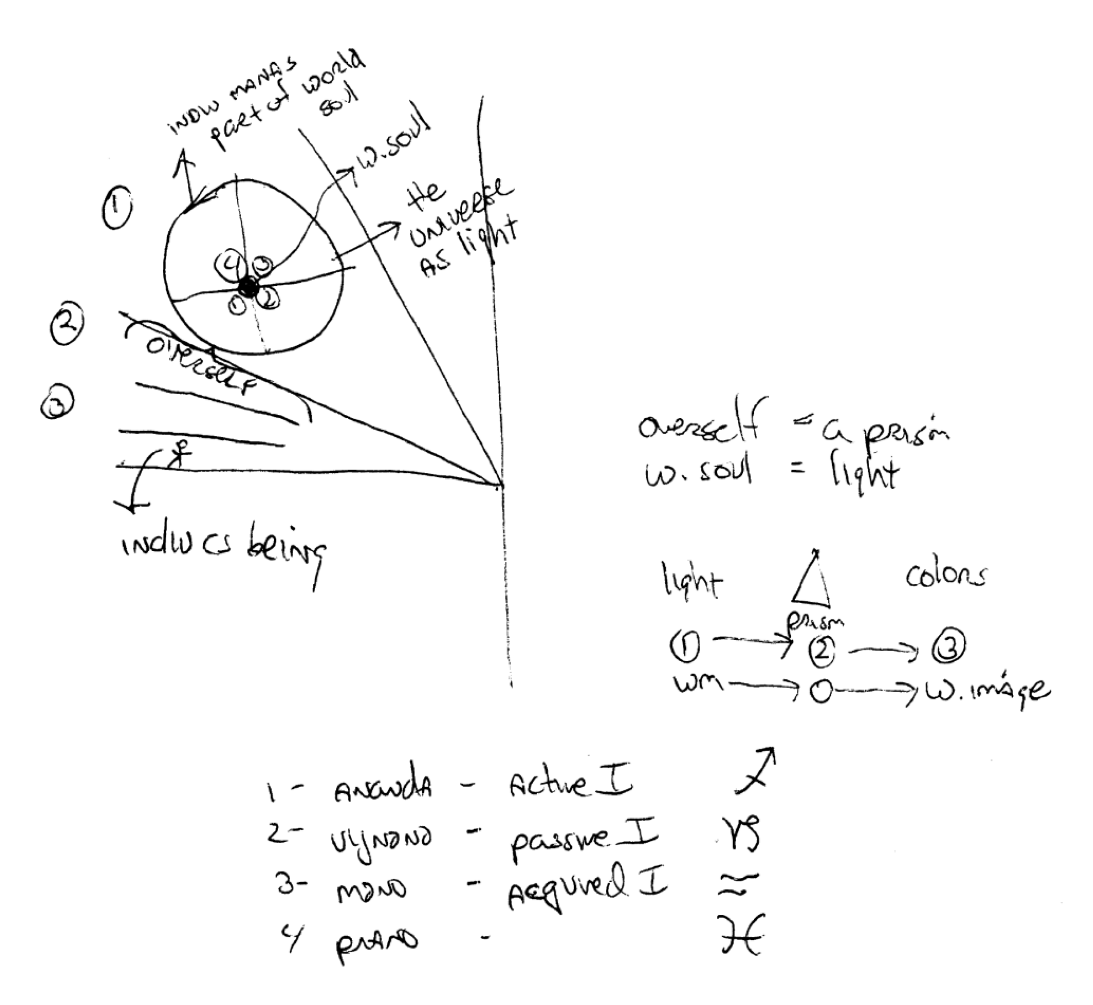
FIGURE 1979 0929-1-AB. World-Soul, Overself, Individual Conscious Being; Overself as Prism; Four Intellects.
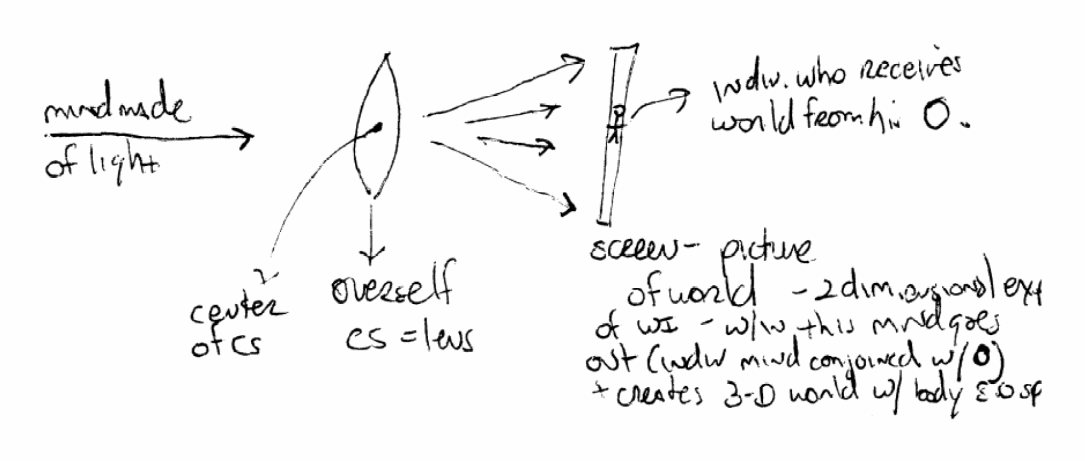
FIGURE 1979 0929-2-AB. Mind of Light, Overself, and World-Image.
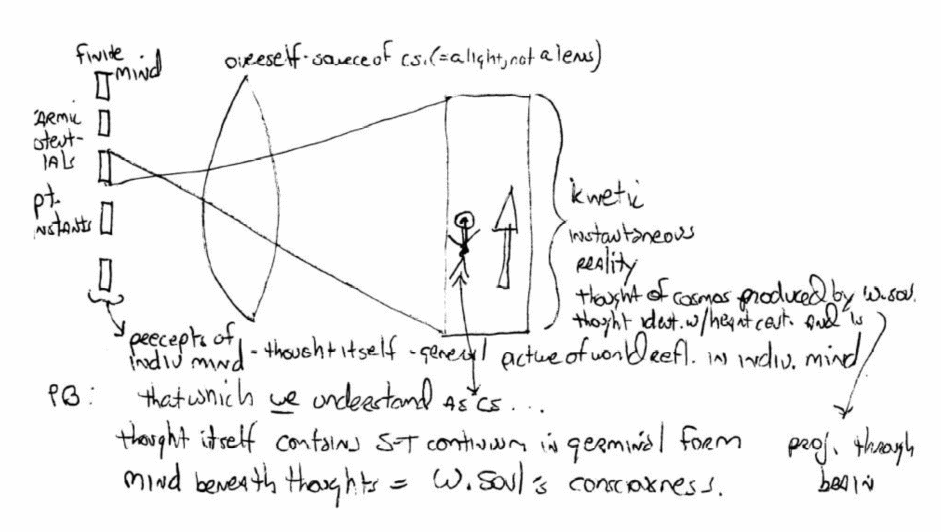
FIGURE 1979 0929-3-AB. Finite Mind, Overself, and World-Image.
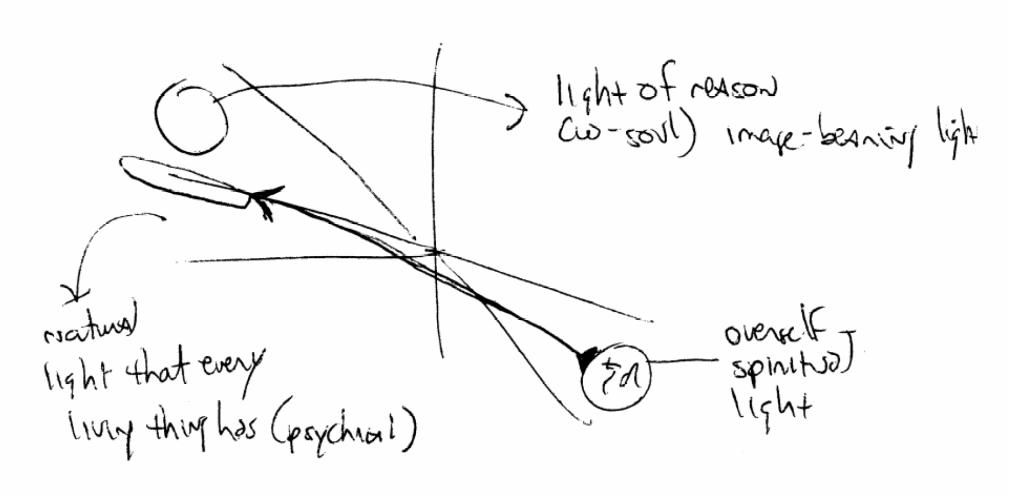
FIGURE 1979 0929-4-AB. Three Lights.
Other diagrams referred to are not with this transcript version. [Transcriber note: [diagram] means the speaker is referencing a diagram as he or she is speaking. If someone is drawing or writing, with audible sounds of chalk on a blackboard, I indicate this by [drawing] or [writing].]
NOTE: This class was held on a Saturday; part of Wisdom series 1979-1980.
TRANSCRIBED Verbatim by IT 2019; reformatted by JRM & JF 2019-2020, with TOC/Subheads by JRM. In 2023, IT updates prefatory matter, footer, and audio file name, completes Book List, adds Plotinus quotes section, adds new notes within transcript, fixes errors/typos, adds four diagrams and references within transcript to these diagrams. In 2024, MW alters Subheads to make more accurate. Archival verbatim transcript – V14.1a.
AUDIO FILES: 1979 0929a, 1979 0929b. [Note: "Tape" and "Side" refer to original audio cassette tapes that were later digitized into .MP3 Audio Files.]
1979 09/29 at Wisdom's Goldenrod
PB Books; Wisdom of the Overself; "Birth of the Universe"
Archival verbatim transcript
[Audio File 1979 0929a Begins]
[background student talking, noises, 1 minute]
[tape break]
AD: --is the place where we left off which [one/two words inaudible] of most of us.
[Transcriber note: I am using The Wisdom of the Overself by Paul Brunton, Rider and Company, London, 1943.]
PB [The Wisdom of the Overself, "The Birth of the Universe," pp. 34-35, AD reading]: "The excitation of karmic impressions within the World-Mind [short pause with shuffling about, background student talking] is reflected in the individual mind as a general picture of the world. [AD adds: And then] The individual has to take it into the very center of his own consciousness, which he can do only by his own act. [AD: You know.] That is to say, the world-picture must be so assimilated as to be made his own through experience."
[Note: See FIGURES 1979 0929-1-AB, World-Soul, Overself, Individual Conscious Being; Overself as Prism; Four Intellects, and 1979 0929-2-AB, Mind of Light, Overself, and World-Image, appended to this transcript for the following.]
EXPERIENCE IS A THREE-TERM EPISTEMOLOGICAL RELATIONSHIP: SUBJECT, OBJECT, AND THE RELATIONSHIP
AD: I've repeated this enough time(s) so we should get some straight questions that we can quote. [short pause] We have conceived of the World-Mind as the World-Soul ring [diagram]. And, within the World-Soul there are the forms of the universe that is to be. These forms get projected outward; and when they do get projected outward they become the universe. The projection outwardly of these karmic impressions has to, he says, be reflected in the individual mind as a general picture of the universe. And what we did there was to conceive of the functioning and the organization of the mental processes which are-- in a sense they belong to an individual, that these two together produce what we would call the world. And that what it-- when he says that a general picture of the world is reflected in the individual mind, we could think of this picture of the world in-- in a variety of ways, and one of the ways I like to think of it is that the-- the entirety of the mental processes are structuralized and the force of the cosmic soul is within those mental processes, and those mental processes will be obliged to undertake to think the way they've been, let's say, superimposed upon or the way these forces insist that they think. And then after that, and only after that, he speaks about-- he speaks about the individual again, the individual has to take it into the very center of his own consciousness. Now-- um-- [short pause] There's a possible way of saying that prior to the projection of the universe as we know it, that the individual consciousness is intercepted between the two of them, that is, twelfth house world [diagram], the externally perceived world, the world of thought [diagram]. But the next part of the sentence doesn't allow us to say that, where he says--
PB [The Wisdom of the Overself, "The Birth of the Universe," p. 35, AD reading]: "That is to say, [AD: alright, and--] the world-picture must be so assimilated as to be made his own through experience."
AD: So, we're constrained by the meaning there that he's speaking about the way the world which is thought and projected outwardly, and that means that the individual bodily percipient is part of that world, has to take that world back into himself. That is, the consciousness by reading off the bodily percipient the activities that are going on, the impressions that are being made on that bodily percipient, then that experience will be his. Now, the term 'experience' is the term that involves three terms, subject, object, and the relationship. So 'experience' prevents us from saying that the assimilation of the world-picture will take place through the Overself-consciousness. Follow me? Do you follow?
S (very faint): I'm not sure.
MW: I don't think so. Not yet.
PB [The Wisdom of the Overself, "The Birth of the Universe," p. 35, AD reading]: "The individual has to take it into the very center of his own consciousness…"
AD: Now, if we-- if we think of the world-picture, [drawing] if we think of that as the thinking that's going on, and we intercept it with consciousness, alright, and then let's say over here the empirical world [diagram], if we-- if we think that this [diagram] is what is assimilating the world-picture, alright, the word 'experience' wouldn't be applicable, [MW assents] 'cause there's no experience there, alright. So that's why the other interpretation is more to the point, where the empirical individual here [drawing] assimilates the world-picture, because 'experience' has to be a three-- a three-term epistemological relationship.
BB: Oh.
[12¾ second pause]
ASSIMILATION OF THE WORLD-PICTURE TAKES PLACE IN THE EMPIRICAL WORLD
AD: Alright, the--
MW: Anthony?
AD: Yeah?
MW: Are-- Does he mean, when he speaks about the individual taking this general picture into the center of his own consciousness, is that the same process as the assimilation of the world-picture through experience?
AD: Yeah, right there [diagram]. That's the point, isn't it. The general world-picture cannot be assimilated in this realm here [diagram], [student assents, very faint] because there you can't speak about assimilating anything unless you assimilate what we refer to as nothingness. What would the mental processes be like devoid, you know, of any sensible representation, I mean what would you be assimilating? So the assimilation has to take place in the empirical world. It is through the experiences-- In other words if we think of the experiences you have in the world, then you could relate them back, you could say, well, they're derived from my thinking them. Insofar that I think, certain experiences accrue, then you would benefit by that kind of process, ok. But if you were to stop here [diagram] and let's say have the illuminating light of consciousness reveal the facticity of thought-processes, there's nothing that you would be assimilating.
MW/S(?): Uh-hm.
AD: So I can't interpret that passage in any other way than the way I just did. [short pause] And then the next point he makes is that the heart center of each individual-- he-- he-- [short pause] He says--
S (faint): "The meeting…"
PB [The Wisdom of the Overself, "The Birth of the Universe," p. 35, AD reading]: "…the hidden meeting-point of the World-Mind with each conscious being [AD rereads:"…the meeting-point of the World-Mind (AD: or the cosmic soul) with each conscious being] has a special existence of its own and must therefore be given a special name of its own."
AD: So, if we refer to this here-- [short pause while drawing] If we refer to this here as the cosmic soul [diagram], and he says the meeting of the cosmic soul which-- with each individual, where they meet, he says we'll give it a special name, we'll call it the Overself and he locates it in the heart.
PB [The Wisdom of the Overself, "The Birth of the Universe," p. 35, AD reading]: "The name which will [henceforth] be here used [AD reads: be used here] is the"Overself". It is consequently from its own Overself that every individual receives the world-picture."
AD: So it is from this point here [diagram] that every individual is going to receive a picture of the world.
[short pause]
PB [The Wisdom of the Overself, "The Birth of the Universe," p. 35, AD reading]: "[Hence] the heart is the focal point where the World-Mind through its intermediary the Overself affects the personality."
AD: So, below this point [diagram], yeah.
S (faint): Yes.
S: The general picture that's received, is that the same for every individual? The general picture, before it hits the heart.
AD: I'm sorry, I didn't hear you.
S: The general-- the general world-picture before it hits the heart center is the same for every individual?
AD: Well general world-picture's the same, period. When it gets into the individual it gets refracted according to the individual's make-up.
VM: The subtle.
S: But no modifications or qualifications of that picture are going to be made until you speak of the heart center.
AD: Yes, because-- [S, faint: Right.] Again, if we go back to this here, this cosmic soul is fabricating a universe, [drawing] it's creating a universe, alright. And this universe is its idea. The universe is its idea, so it'll be one universe. The idea of the universe will belong to the cosmic soul, will be a projection of the cosmic soul. [aside] How'd you sneak in? Ok? So it's one universe. But, considering that this gentleman here [drawing] lives in the South Pole and this fellow lives in the North Pole and this fellow lives in the equator, ok, the influences that they're going to be subject to are going to be different. And he certainly will not see, you know, a jungle.
S: And the cosmic-- the World-Soul there isn't going to really hold-- it's not going to really hold any of that individuation.
AD: It's not going to what?
S: It's not going to have any sense of the individuals, the different individuals. It's just going to put out a general world-picture and-- but within-- I'm just trying to find out if there's any sense though within that World-Soul of-- of it holding the-- the Overs-- not the Overself but the individual.
AD: I still don't follow you.
S: Well, I'm sorry. The general world-picture, is it in any way created because there is some knowledge of the individual soul within the World-Soul also? Or is this general world-picture-- No, I better stay with that. Did you follow-- Is the general world-picture created because the World-Soul also knows about the individual souls?
AS: Individual minds you mean.
S: Oh-- well, ok. [short pause] I mean is the general world-picture in some way going to have to depend on all the past karma of those individual souls as well?
[short pause]
AD: Is the general world-picture dependent upon individual-- the karmas of individual minds?
S: See, I know you're trying to separate. You know, on the one hand you have the World-Soul's production which is this attentative kind of picture of the world, and then on the other hand you want to keep the individual with the heart center. But my confusion is that to make that world-picture, doesn't the World-Soul have to have some kind of unity with the individual souls? It has to know about the individual souls, doesn't it?
AD (simultaneously): Why? Why are you bringing this in, I mean what relevance is it?
S: Oh I'm sorry, that was [few words inaudible] to me.
AD (simultaneously): Well, what relevance is it?
RG: Well, I-- I mean the line in the book says, I mean--
PB [The Wisdom of the Overself, "The Birth of the Universe," pp. 34-35, RG reading]: "The excitation of karmic impressions…is reflected in the individual mind [AD: Uh-hm.] as a general picture…"
RG: Which would seem to imply that in order to speak about a general picture, you have to speak of it as given to an individual mind, [AD drawing] that prior to that you would speak of--
AD (simultaneously): No, no, no.
RG: Then why does it say that?
AD (simultaneously): (Experience.)
S (faint): Uh-hm.
AD: There's going to be an image of the universe projected out of the cosmic soul and that universe has an existence that depends upon the cosmic soul and not the individual minds. The individual mind will think that picture into actuality for you later on so that you can have the experience of the world. But what your mind produces for you is not the universal picture. I mean just take a look [RG simultaneously: For sure. I didn't expect--] at the vastness of what you're talking about. [RG: For sure, but that's--] This--
RG: Yeah but that's not the question.
AD (simultaneously, intensely): Let me finish. This cosmic soul produces the entire galaxy. You know a little corner of Valois!
RG: Right. (VM laughs)
AD (intensely): And even that you have trouble finding. (laughter) Now what's this got to do with the individual, where does the individual-- individual come in and reproduce the universe? That universe is there. And the way he points out in a later chapter, if you go to an unvisited polar region, alright, you will see it when you get there. (some laughter)
RG (laughing): But not before.
AD: Not before. (laughter) [intensely] But that doesn't mean that it's dependent-- that it's dependent upon your apparatus of knowing for its existence. It does not depend on it. All that you can say is that knowledge for you doesn't exist unless you know it. But that doesn't mean that the thing known depends upon your knowing it for its existence.
S: Yeah.
AD: A hundred and twelve times.
RG: Right.
AD: So all we're talking about now is a general universal picture which the soul projects outward, the universe, the So-- the Sun produces the universe, alright. [intensely] You're going to appear maybe much later on somewhere. And hopefully on one of the planets that exist.
S: Uh-hm. (some laughter)
RG: Wait, wait, wait a minute.
AD: Yes, you're going to appear after the fact of universal manifestation, [RG simultaneously: Yes, I--] not simultaneously with it.
RG: I fully agree with that point of view.
AD: Alright.
EXCITATION OF KARMIC IMPRESSIONS IS THE WORLD-MIND RECALLING WHAT IT HAD PREVIOUSLY MEMORIZED
RG: But what is that-- what does it mean to bring in and say that-- But before, before the individual's brought in, would-- it seems PB here would speak of it as karmic impressions, not [AD simultaneously: Yes.] yet as a general picture of the world. 'Cause he says the karmic impressions are reflected in the individual mind as a general picture of the world. Without that reflection in an individual mind, it seems you would speak of karmic impression.
AD: Without that reflection of [RG simultaneously: The exci--] the karmic impressions in the individual mind, [RG: Right.] then--
VM: There's no notion of picture.
RG: There's no notion of a general picture of the world until there's some reflection in an individual mind.
AD: Now let me see, if I follow what you're saying, there's this excitation of karmic impressions results in a general picture of the universe in the individual mind.
RG/VM(?): Yeah.
AD: That's what you're saying.
RG: Yeah, that's what I think PB says.
AD: What about the first part, the excitation of karmic impressions within the World-Mind?
RG: Right.
AD: What would that mean?
RG: Oh, I certainly have no idea what that means. I mean-- I don't know what it would mean.
AD (simultaneously): No, you should have an idea of what that is.
RG: I mean--
AD: If there's an excitation in the cosmic soul, what are we saying? Could we say it in another words? You remember we refer to the fact that memory, alright, when an object, so to speak, lapses back into cosmic soul and exists within the seeming void of this cosmic soul and then some excitation of this takes place, it's another way of saying is that the memory of the World-Mind is triggered off and it recalls what it had previously memorized.
RG: Uh-hm.
AD: Now, what-- what it previouly-- what it previously memorized would be like these thoughts or these things which are thoughts but which are memorized by the World-Mind. So it's these thoughts which are being excited, alright. [RG assents] So then that means that these thoughts are being reflected in the individual mind.
RG: Ok.
AD: Ok? Go ahead. So the excitation of the karmic impressions results in the individual mind's mentation processes concurring with that of those karmic impressions. [aside] Come in. [9 second pause] And then the next point was that the Overself center in the heart of the bodily percipient is the point where the entirety of the cosmic soul's influences get condensed in that heart center. Now he also makes the point that the Overself is everywhere in the body besides the heart but it's localized in the heart. So that means that the entirety of your body, plus the heart center, is subjected to these forces and influences emanating from the cosmic soul. And that these here could be dropped or deposited or condensed in the heart center as karmic seed-thoughts for the individual. Now, the point-- the point is that when they are deposited in the heart, alright, it is these karmic seed-thoughts which later on are going to account for the sensations that we're going-- that we experience. But for now, we have to go through the role that he laid out for the karmic seed-thoughts, that they have to travel up the spinal column, go to the brain, and get amplified and projected out as the projected world. And at that instant, at that instant, he says, "When all this has been accomplished the individual becomes fully aware of the transformed and magnified world-picture…" And it is at this point, when this happens, that from the condensed seed-like thought-forms in the-- in the heart center, when they reach the brain and get projected out, at that instant the transformation of consciousness from a dream taijasa quality to a wakeful consciousness, and at that instant also those things-- those things which were thoughts and known as thoughts, alright, in that very moment, in that very instant, get projected out no longer as thoughts but as things. It is at that instant when all this occurs. Yeah--
THE BODY THAT RECEIVES THE KARMIC SEED-THOUGHTS EXISTS IN A SUBTLE, FLUID FORM AND IS INCLUDED IN THE UNIVERSE PROJECTED BY THE WORLD-SOUL
S: Is the body one of those things that are projected?
AD: The body is one of those things that is projected.
S: How then-- how then does the--
AD: The questions are archetypal, aren't they?
VM: Yes, they certainly are.
S (simultaneously): But he didn't-- (bit of laughter)
S (faint): Uh-hm.
S: No you [S simultaneously: Right.] didn't have to ask that.
GA (simultaneously): Four pages later, you know.
Couple students (simultaneously): [few words inaudible]
AD (simultaneously): No, no, you weren't here, it's alright, [S, faint: Yeah.] it's alright. Avery, go ahead.
AS: Well, let me try.
S: Ask the rest of the question.
S: Now that--
AS: (22), yeah.
VM (simultaneously): You know, ask it for the rest of the class.
S (faint): Question--
S: Yeah go ahead.
VM (simultaneously): We'll speak about knowing the archetype.
AB (simultaneously): That's so archetypal.
AD: We all [one/two words inaudible]
LR: We could have buttons [couple words inaudible] (Crystal).
AS (simultaneously): We can't read minds yet.
RG: Right.
VM (simultaneously): Just say "number six".
S (simultaneously): At that point we take-- (laughter)
S: Question-- [one/two inaudible student words simultaneous with S] question number six. [S: Quiet. (S laughs a bit, bit of laughter)] My question was that if the body is projected as one of the things after the karmic seed has reached the brain and that whole process goes on, how is it that the karmic seed can travel up the spinal column through the brain which has to be projected?
AS: And basically the answer is that the spinal column and the brain through which this karmic seed is amplified is the subt-- is subtle, is not the sensible body that you know. It's, let's say-- we said that the World-Soul projects the whole universe prior to your individual reception of it and blowing it up. Well it-- part of the universe is your body. But this is in a completely subtle form.
S: So--
AS: It's not the sensible body that you know, although--
S: Can you say then--
AD: It's not as you know it.
S: I mean--
AS: But it's there already 'cause the World-Soul has projected it.
S: Uh-hm. Is it appropriate then to say that manifestation-- I'm trying to see an order in things [AS simultaneously: Yeah. And pri--] that takes place from one level down and like a-- Can you--
AS (simultaneously): Logically prior to your body being a reception mechanism, the World-Soul has to think it into existence, it gives it its existence, in a subtle form though, not as you know it of course. So then when that seed-thought goes up, hits the heart, it must be the subtle center that-- [S simultaneously: It would-- I mean it--] that's given existence in the World-Mind, has an existence in the World-Mind.
S (simultaneously): Yeah it certainly has to follow because the karmic seed isn't like a--
AS (simultaneously): Sure, sure, it's a subtle thing, the karmic [student assents] seed, it's not the gro-- it's-- and the body that it interce-- that that heart center is also subtle. Now [S simultaneously: I knew it was it was, but it was silly question.] by the two of these interacting-- yeah but the two of these interacting, [S simultaneously: It's not silly.] the one passing through that subtle, at that ti-- it's like simultaneously your body becomes manifested and the world, and the consciousness which knows the world, the-- the vaishvanara consciousness which knows the world. [couple/three faint words inaudible]
AD (simultaneously): This is the point I think where PB told Richard that this is a subtle brain we're talking about. [student assents, faint] In other words, the example we used is you're in bed and you're sleeping or you're dreaming. Now you exist there in a taijasa form, alright, there's no gross body. And you're having a nightmare. So one of these little vasana thoughts runs up all the way up to the head and you wake up screaming, alright. At that instant vaishvanara consciousness came into being with the objects of the world. But just prior to it, alright, your body was in a subtle state. It's always in that state.
S: You can see that condition sometimes when you wake up from a nightmare and you're not really--
AD: Awake?
S: --not-- you don't really see the room or-- or are not in your body yet and stuff so you can see it.
AD (simultaneously): Alright, these are two conceptions you have to hold simultaneously, that the body on the one hand-- When we say that the influences which condense in the heart center, we're really speaking about the psychic system of the chakras, alright. The heart center is not one of the chakras but is the center of all the chakras.
S: Could I ask another question?
AD (faint): Uh-hm.
S: I don't know if it's appropriate to ask it right now but, what is the connection-- I mean where does the individual mind stand in this priority of manifestation?
AD (simultaneously): Could you wait? I'll answer that because that's very very difficult. And I don't think it's accepted yet. (laughter)
S (faint): [one/two words inaudible]
VM: The nichrome wire hasn't it accepted it yet, huh?
AD: No. (bit of laughter)
S: And then he [one word inaudible]
AB: So (in other--)
MW (simultaneously): It's building up a lot of heat.
AB: When we say that the uninhabited polar region exists because the World-Mind thinks it, [AD, very faint: Ok.] the kind of existence it has is the same kind of existence my body has, like as a subtle [AD: Yeah.] brain and heart center into which my thinking produces an empirical world.
RG: But-- but what do we really mean by subtle there?
AB: Yeah, well this is the question you're always asking, is it the--
AD: In the same way that we-- when we think of thought, alright, in the-- when you in a dream state, alright, you say that the consciousness and that the contents are in a subtle realm or they exist subtly and you can see there that the-- that there's a certain fluidity and tenuousness. The-- it could be summarized much more adequately this way, by saying that knowledge is in a condition of movement, alright. Whereas when you're awake, the mountain doesn't move around. But in a dream state, most things are in a fluid condition.
RG: But this brain that we're talking about is in a fluid condition here?
AD (simultaneously): Yeah. Extremely fluid.
RG: What does that mean?
AD: Extremely fluid. It's everywhere at all times, it tries to be at-- it tries to grasp or encompass as much of the world as it can. You were asking me about the subtle mind. Right?
RG: I don't know, I'm asking you what he means by the brain there. If that's what he means, yeah.
AD: Well I told you, the easiest way I think to look at that is to look at the mind and the way it is canalized, you know, into the five sense way-- the five sense organs. So you're really talking about manas and its canalization through the five sense-- sense organs in a psychical state.
VM: Well I thought we spent so [S simultaneously: I'm-- yeah.] much time trying to convince you that this was the real physical brain in the-- in the sort of traditional sense of the term and you agreed, and now you seem to be reverting to our older position.
AD (simultaneously): It's only physical, it's only physical when-- again, it's only physical when the vasanas go to the brain. It's only physical at that instant. Prior to that, it is a construction and a fabrication of the cosmic soul. And it exists in that state of taijasa consciousness un-- until those vasanas reach the brain. Then you speak about the physical brain. [S, faint: Right.] Not an instant before. If you put it in time, if you put it in time.
S (simultaneously, faint): [couple words inaudible]
RG: But, doesn't it occupy a space?
AD: What?
RG: The subtle brain?
AD: Does it occupy--
S (simultaneously, faint): A space?
RG: Some-- doesn't it have its own locus?
AD: Well I don't know what you mean by space.
RG: I mean pos-- position [one/two words inaudible]
AD: The real space?
RG: No, I m-- position in a world, not our-- position in some-- some world, some given locus.
[short pause]
AD (quietly to himself): Position in space?
RG: No?
VM: You mean your brain is in the back of the room and mine in the front? I don't know but-- or are you being more sophisticated?
RG (simultaneously): No, not-- not [AD simultaneously: If--] quite-- not quite that gross yet. (bit of laughter)
AD: Alright, let's [one/two inaudible student words simultaneous with AD] say it has a position in space providing, providing that you keep in mind that it's-- the space that we're speaking about is the taijasa consciousness or the projected universe of the cosmic soul. And if you say it has a position within that and operates within that, ok, fine. Because it has to reach out, go to the objects, and does, you know, in the empirical world. Your taijasa consciousness is operating.
VM (faint): Oh yeah.
RG: But this subtle brain, this-- is not other than, I mean--
S: That's alright.
AD (emphatically): It is other than the physical brain.
RG: It's other than, it is other than but [AD simultaneously: Yeah.] the physical brain isn't a part-- doesn't it encompass that?
AD: Does [couple words inaudible]
RG (simultaneously): I mean it's not limited to the physical brain.
AD: No, definitely not.
RG: But it some-- it envelops the physical brain.
AD: Absolutely, absolutely. And if you have a lobotomy formed and you forget all the recent experiences you had and that, let's say, the brain grows back, alright, all those images which were contained in the physical brain and are now destroyed, alright, they reoccur.
RG: For sure, ok, now how would you distinguish the concept of even--
AD (simultaneously): Why?
RG: Why? Because they're stored in a subtle state.
AD: Yeah, they're stored in a subtle mind, subtle brain.
RG: Well, now you seem to be u-- Then you wouldn't distinguish now between individual mind and-- and brai-- and subtle brain here?
AD: But I'm distinguishing insofar as the physical brain is used by the-- the mind.
RG (simultaneously): No, no, not physical. When we say subtle brain, the brain here that the seed-thought goes up to, and the individual mind, you wouldn't distinguish now?
AD: You cannot speak of that brain, alright, until the seed-thought goes up to it.
RG: He does the-- Wait a minute. The subtle brain.
AD: The subtle brain.
RG: The seed-thought goes from the heart to the-- to the brain, the subtle brain.
AD: Yes.
RG: Is that subtle brain before the seed-thought reaches it any different than the concept of the individual mind?
AD: Oh definitely. Why don't you wait till we get to the mind part.
RG: I don't know.
AD: You're taking a little portion of the personal-- [S, possibly part of background: Not yet.] a little portion of what constitutes the entity, and you're blowing it out of all proportions.
RG: Well then what are these paragraphs-- I thought we went through this two weeks ago.
S (very faint): Yeah, I did too.
RG: What do all these paragraphs mean when he talks about the functions of the brain before the m-- before the seed-thought gets magnified through it and he seems to speak about it in a very particularized way. What does he mean to do by that?
AD: I don't know what part of the text you're talking about.
RG: Well the next-- "In order to provide the conditions…" Well, the next sentence, the [AD simultaneously: Well--] next paragraph.
AD: Uh-hm, yes. What about that?
RG: I don't know. I mean I can't fit--
AD: Now the-- now he's speaking about the physical.
S (simultaneously): Yeah.
RG: But this is speaking of it before the image goes to it, and it's speaking of it in the process there.
AD: Well, tell me the whole thought you have and [one/two words inaudible]
RG (simultaneously): I don't know because I just got so-- I don't understand what you're saying so--
S: (That/Jeff) would normally flake.
[14½ second pause]
AD: Could we resume then where it says--
PB [The Wisdom of the Overself, "The Birth of the Universe," p. 35, AD reading]: "Hence the heart is the focal point where the World-Mind through its intermediary the Overself affects the personality. The karmic forces become active within the heart therefore and there break into space-time existence. [AD: And the analogy that follows--] Like light-photographs on a sensitive film, they develop into a tiny seed-like thought-form. [short pause] [AD adds: And] This is the matrix of the world-to-be."
AD: Could we-- could we say here now that we're speaking about the influence of the cosmos on the individual? Could we also say that the individual could be taken in both senses, physical and subtle or gross and subtle?
[17¾ second pause]
RG: No, I don't think so.
AD: What would you say it applies to?
RG: Just the subtle.
AD: The subtle. [student assents] [short pause] Now, insofar that this just applies to the subtle, the next paragraph goes on and says, well, if it stays there, we won't have no world experience, no experience of the world. So something has to happen.
RG: Right.
S: Right.
RG: There's no talk of the brain yet.
AD: No talk of the brain.
RG: Right.
AD: Go ahead.
S: Yes, if it stays there, it still is an individual's experience, even if it's subtle.
AD: Yes.
S: Yeah.
S: Ok, just because-- I mean-- We've been speaking as though that to have the individual you have to have the full blown--
AD: If you have knowledge of what is going on in the heart center, the subtle heart center, you have knowledge of everything's that going to happen to you.
S: Yeah but that's still some kind of an individual.
AD (simultaneously): The whole world for you exists there in this most pre-gross form.
S: I wasn't even thinking much, that it's all the experience, I mean just if you stay in the subtle realm, it's still a very individual realm. You can have your own dreams and [one/two words inaudible]
AD (simultaneously): Well it's in-- it's in your heart center.
S: Ok.
THE SUBTLE BRAIN MAKES POSSIBLE WAKEFUL CONSCIOUSNESS OF THE WORLD
AD: Alright, so the-- Then he goes on to the next paragraph. Now in order for vaishvanara consciousness or wakeful consciousness to come about, he says--
PB [The Wisdom of the Overself, "The Birth of the Universe," p. 35, AD reading]: "…the co-operation of the brain and the senses is required. [student assents, faint] [AD adds: And] These act partly in the same way as a [AD reads: the]…"
AD: You know the analogy.
PB [The Wisdom of the Overself, "The Birth of the Universe," p. 35, AD reading]: "Unless the world-image is caught by the brain, consciousness will remain at the dream level and physical experience becomes impossible. Hence the thought-form is transmitted to an image-magnifying centre in the outer layer…"
AD: Now over here, again, the problem is, what brain is he speaking about?
VM: Well, [S simultaneously: Maybe this--] whatever brain it is, it has outer layers versus inner layers.
AD: Louder please.
VM: I say whatever brain it is, it has out-- it has outer versus inner layers so there's some sort of spatiality that is associated.
AB (simultaneously): Yeah but it can't be the physical brain because it's this brain that produces physical experience.
GA: Yeah but see, you're [VM simultaneously: Perhaps.] getting physical mixed up with reflective consciousness. There is a physical realm that's existent prior to your reflective consciousness of it [student assents] that's within the World-Mind's consciousness. The fact that that physical brain has something to do with setting up the resistance needed for vaishvanara consciousness even though you don't yet experience it as physical doesn't mean that it isn't a physical brain.
AB: But he says--
PB [The Wisdom of the Overself, "The Birth of the Universe," p. 35, AB reading]: "Unless the world-image is caught by the brain, consciousness will remain [AB reads: remains] at the dream level and physical experience becomes impossible."
GA: Right.
S: Physical experience.
S: Physical experience.
AB (simultaneously): Yeah.
GA: Physical--
AB: Ok.
GA (simultaneously): Your reflective consciousness becomes available.
AB: 'Cause he says space-time existence is-- comes into being in the heart. So you could have the inner and outer layer of the subtle brain which is in the heart's experience before you have the phys-- you know--
GA: Right. But still the physic-- still, even if you call it subtle, it's a subtle image of the physical brain. I mean it's-- it's not the subtle brain that's in the subtle realm. I mean it's-- it's the--
RG (simultaneously): Well that's the question though. I mean, I thought Anthony [GA simultaneously: Yeah.] was trying to make that point, that the brain--
S (faint): It's taijasa or vaishvanara.
RG: This is the first time he uses the term 'brain' so far.
S (faint): Yeah.
AD: Yeah.
RG: Now you're saying that is a-- the brain as this-- in the subtle realm, mental functioning in the subtle realm? Or is it more ma-- more physical, as Chip would say, prior to one's perception of it?
[short pause]
AD: Could you restate your question?
RG: Yeah, is it-- is it the subtle brain right here he's talking about, "Unless the world-image is caught by the brain," the-- this-- the brain in taijasa consciousness fully where's it's pervasive and where it-- it has tremendous motion as you say? Or is it more towards the physical, more centered in it prior to our perception of it? We're not talking the brain as perceived, obviously, we haven't had perception yet. But, why can't our perception be an image of something that really is there, that exists?
AD: Well, I won't deny that.
MW: But why can't what is really there and what exists be this-- this structure of thought that we're calling subtle brain at this point, and it's got a certain structure so he can refer to it as having an outer layer, that's the way we're going to understand the structure. I mean, if we're speaking about the body at this point, we're speaking about the body as a thought-structure.
RG: Well your-- [GA simultaneously: Uh-hm.] the body-- our perception of our body is a thought-structure too, that doesn't really answer the question. I mean everything is a thought-structure.
GA (simultaneously): Yeah. If you mean a thought-structure as opposed to what we think as a piece of meat, we already explained that that is-- we're no longer thinking of the physical body as a piece of meat but as a thought-structure.
S (faint): Yeah.
MW: Yeah but the questions don't seem to indicate that that's what they think.
GA: Hm?
MW: Like the questions don't indi-- I mean it seems like everyone's trying to put-- put back the physical body as--
GA (simultaneously): That's exactly the problem. If we keep-- we're denying it as if it's a problem again. We-- we're saying, "Oh no, only the subtle brain could do this." That-- that's because we don't think that the physical brain could have any subtle qualities, I mean any-- We're not thinking of the physical as a thought. If we realize that the physical brain isn't what we-- it's not these like little molecules running around and atoms and pro-- that there's a deeper significance to the motions than, you know, what we know of what goes on in the brain. And PB says that the scientists aren't wrong, they're just not completely right and he refers very specifically to different areas of the physical-- what we call the physical brain, in this chapter. But, we have to realize that there's more to it than what we've learned in physiology, that these brain centers have-- aren't just-- you know, aren't limited to the space-time perceived brain but have a much more depth of operation that are connected to the heart center, they receive the image of the world. That's much, you know-- Obviously that's not being received in these-- in these molecules, in the way that we think of the molecules. It's being received in some kind of thought-apparatus that is there to receive these.
BS: Well why do you call that the physical brain?
VM: Well that makes sense, I mean--
BS: [couple words inaudible] a brain [one word inaudible] its corporeality.
GA (simultaneously): It has a structure, has a very particular structure to it. It receives the world and projects it out as what we see here.
BS (simultaneously): But I understand what you're saying but what-- how do you then make a distinction between subtle and physical? Or you're not?
AB: It's not the one the surgeon operates on.
GA (simultaneously): One runs into-- you can't draw a great big line and say this is the physical brain and this is the subtle, one runs into the other. You know--
BS: Well that must mean that they exist.
GA (simultaneously): In other words, as-- as let's say the phy-- the subtle brain manifests itself within the-- in physical experience, we could show this by the-- we brought up the problem of the lobotomy. That subtle brain becomes-- it memorizes the physical impressions that you have during your life. And later on there's-- PB points out in other books where a person-- part of a person's brain is missing or something yet he continues to perceive as if that brain were functioning. That's because the subtle brain has been canalized through physical experience to experience in a certain way. That subtle brain will go on experiencing that way but it needed first the physical brain in order to canalize it in this particular mode of consciousness.
BS (simultaneously): I still don't see why you're calling it physical because--
GA: 'Cause of the limitations that we experience. If I was just in the subtle brain I wouldn't experience these limitations. I need the physical brain to produce this type of ex-- experience.
BS: Perception.
AS: But, I'm not sure if Chip is saying that. He's saying something like my physical brain, just as we said the World-Soul projects out the whole of the cosmos in a subtle formula, [GA assents] included in that are these entities, including-- we spoke about first the heart center. First we have the seed-thoughts deposited in this heart center. Now it's a subtle heart center, it's not your physical heart that's been-- [GA assents] that you sensibly know. If a guy goes in there and cuts up you heart, he's not going to find it. Then next he says that transmission goes to the brain. And that brain must be that part of your-- that part of the twelfth house which the World-- the existence of which the World-Soul has projected. [student assents] That's your brain, that's your actual brain in the World-Soul's consciousness.
S: So why call [GA simultaneously: Yeah.] the brain physical?
AS: It's physical in the sense it's a twelfth house type [VM simultaneously: It's just as physical as anything else.] brain but it's subtle in the sense that it's still in taijasa consciousness.
S (faint): Oh that makes (sense).
AS: It's in the World-Soul's taijasa consciousness. At the instant, as it were, simultaneously with that seed-thought going up to that subtle brain, namely the brain in taijasa consciousness of the Soul, that the Soul of the World has as a content, simultaneously with that and the projection through that, what you call the physical, the vaishvanara brain, what's called the vaishvanara brain, becomes manifested, the one-- you know, the one that the [GA assents] guy can cut up.
GA: Yeah.
AS: Just as when the World-S-- when the seed-thought goes through that subtle brain, the whole world also bursts out into tai-- into vaishvanara consciousness. But I think that when he speaks about the reception by the seed-thought, it seems like what you're saying is that that's-- the reception is by this thought-structure which is [GA assents] in the taijasa consciousness of the Sun, the actual [GA simultaneously: Right, right. It's a--] brain center, just as we spoke about the actual heart center.
GA (simultaneously): What we-- what we call the physical body is a very particular thought-structure which--
S (simultaneously, faint): Ok.
S (faint): Yeah.
GA: Or a receiving apparatus or whatever you call it.
AS (simultaneously): Except that what we call the physical body I think is actually an image.
LR: Yeah, it's a reflective--
AS (simultaneously): It's a reflected [GA simultaneously: Yeah.] threefold epistemic [one/two words inaudible] image.
GA (simultaneously): But that's what's so tricky about the way he uses the words 'body', 'brain', 'heart center' and so on, that we--
AS (simultaneously): But when he says-- talks about it as receiving that seed-thought, then he must be talking about it as the way it is in the two di-- the twofold epistemic-- the way that the Sun-- the existence of which is granted by the Sun's taijasa consciousness. So it's subtle because it's taijasa con-- it's a content of that taijasa object.
GA: But it's in the twelfth house.
AS: But it's in the twelfth house. In that sense it's-- we call it physical. So--
[short pause]
AD: So then by-- [S: Yeah.] by saying "physical", we really do not mean that there is [AS simultaneously: Sensible.] any such thing there as physical.
AS: We don't mean it's sensible the way we perceive it.
AD: Well, [AS, very faint: Or (one/two words inaudible)] what I mean is that--
GA (simultaneously): We don't mean as matter or as external.
AD (simultaneously): You don't mean it as matter.
S (faint): Yeah.
AS: It's a thought in taijasa consciousness.
AD (simultaneously): You mean simply a fixed image.
AS: A fi-- yeah. It's-- yeah.
AD (simultaneously): And this image arises because--
VM: The original?
GA (simultaneously): Because it's been memorized by the World-Mind. That brain structure is a product of the whole racial past so it's this fixed image which the World-Mind has memorized is going to receive that thought-- thought-transmission and project it in a parti--
AD (simultaneously): No, what I was trying to say was that if the objects that exist on the subtle, in the sense that they are nothing but a manifestation of the World-Mind's consciousness or the Soul, alright, then this is taijasa consciousness, right? There never is anything else but taijasa consciousness or this-- for it's-- for the substance of that entity. So that when we say that this thing, and we're referring to a physical thing, what we really mean is that we have a fixed image of this thought-structure.
AS: The brain that we see is a fixed image. What the-- what the [couple inaudible student words simultaneous with AS] thing is in itself we in fact-- I mean we say that about-- we say that about external things. [S: Sure.] What the thing is in itself we never know, only the form of it that our mind has taken. Wouldn't that be the same for our brain and the rest of our body? The image of it that we know is only the form that our individual mind has taken when it gets projected out. But the brain the way that the World-Soul has it, as you said, it's in taijasa consciousness, it's this fluid concept. And every time we have an experience of it we make an image, the mind makes an image of it. Then it takes it. [AD/S(?), faint: Uh-hm.] But--
AD: Well let's fly by that and then we'll come back to it, alright. If we go to the next paragraph, where he says that--
PB [The Wisdom of the Overself, "The Birth of the Universe," p. 35, AD reading]: "…the functions of [the] brain, nerves and five senses, [although] correctly described by physiologists, still…"
(Side 1 of original cassette tape digitized as 1979 0929a Ends; Side 2 Begins)
[18¼ second pause while someone drawing]
S: He doesn't understand.
AS: The only thing-- When he says that these functions of brain, nerves and senses, although correctly described--
AD: Within the mental sphere, right, so if we think of the Soul of the All as the mental sphere, alright, then all these artifacts or objects, alright, exist within the mental sphere.
AS: Right, the-- the only thing it seems (from/and) everything I can say, that the description is-- is not quite correct, there seems to be-- to be-- there's an order there, yeah, but the-- the order is all backwards.
S: He just said functions.
AS: Yeah, the functions of them. But what I mean is the--
AD: Well, here. Try it this way. All these things exist within the mental sphere. So if we took-- if we took the analogy and we said, well, [drawing] here's the Sun and everything that it projects, alright, (what/whether) it goes into or comes out of, alright. Then anything that exists here exists within the mental sphere.
AS: It's part of taijasa consciousness.
AD: Alright?
AS: (Sure/Fine).
AD: And the image too exists here.
AS: Mainly the image of when the mind goes out and makes an image, the reflective consciousness--
AD (simultaneously): Any image, any image. Any image would have to exist within this realm. [students assent, very faint] Easy?
VM: Yes, I mean what you're saying is essentially that the way PB is using the term here, that nothing in empirical-- empirical experience is outside of the mental world.
[short pause]
PB [The Wisdom of the Overself, "The Birth of the Universe," p. 35, AD reading]: "[But] the latter's"outsideness" gives rise to the wrong notion of its [AD reads: it] being formed out of material substance."
AD: Outsidedness gives the-- gives birth to the notion of a material substance. (Now do you--)
AS (simultaneously): Does that mean outsideness in direct reference to the body? Like if the mind goes through this vehicle and shoots out through there, then for that individual mind that has, as it were, gone out to the object, taking its locus as the heart center and then the brain center, the outsideness of that image it projects is with reference to the body.
S (very faint): Yeah.
BS: Or maybe outside the subtle brain.
AS: Well, I mean, [S, faint: It's part of the (one word inaudible) (house).] with reference to the-- yeah, well, that's what I'm saying, and with reference to the body it's the outsideness of this world-image.
S (very faint): Yeah.
AD: So you're saying that the feeling of externality arises within us because of the unconscious assumption that [AS simultaneously: That we are--] we are the body.
LR: Yeah.
AS: The fact that individual mind has taken that as its locus originally will give rise-- if it takes that as its locus, then what's not the body or what it has to image forth as other than the body it takes to be outside itself. Whereas he says earlier it's outside the body but not outside the mind. So the outsideness could on-- that's why I think he puts it in quotes.
AD: Alright.
PB [The Wisdom of the Overself, "The Birth of the Universe," p. 36, AD reading]: "So long as there is a [AD reads: So as long as the] transmission of the seed-picture from [AD adds: the] heart to head so long does waking consciousness of the world remain. [Ordinarily] this means [therefore that] both its [AD reads: both that the] transmission and magnification by the…"
AD: Alright, that part. The next one.
PB [The Wisdom of the Overself, "The Birth of the Universe," p. 36, AD reading]: "This inner transmission is constantly going on [AD reads: is going on all the time] and the brain is constantly [AD: naturally, all the time] magnifying the [AD reads: these] original karmic impressions into physical sense-impressions."
AS: He means there vaishvanara impressions.
AD (simultaneously): Vaishvanara.
AS: Vaishvanara consciousness arises with the mind's projection through this organ of-- of the brain and the sense.
PB [The Wisdom of the Overself, "The Birth of the Universe," p. 36, AD reading]: "Hence the individual's sensations actually arise from within himself."
AS: That's talking about his-- [S, very faint: Ok.] Yeah, I mean they arise from the mental functioning and not from the physical. It's the mind that produces these sensations as it goes out through this-- through this brain that acts like a nichrome wire, but it's really the mind which is producing the sensations. The body is only like the condition of the thing for the production of sensation. Like brain is a transformer, it transforms that taijasa consciousness into vaishvanara consciousness. But, these sensations actually arise from-- are actually-- [student assents] arise from-- but then I guess it means that they're actually (of) the mind, the individual mind. They are of the substance of the individual mind, the sensations. But they arise from within. [9 second pause] They're not imposed on the-- on the senses from without, you just got this mind that-- that's coming from a locus within the body. And that those sensations then--
DOES THE SUBTLE WORLD PROJECTED BY THE COSMIC SOUL HAVE SENSE QUALITIES?
AD: Well then we have a problem here. If we say, if we say that the green that we see on the leaves of the tree belong to the green-- belong to the tree, and now we're saying that the sensations of green arise within us.
VM: Yes, but you [couple faint inaudible AS words simultaneous with VM] have to be careful, the within is not within the physical, [AS: Well--] or within the body that I can point to with this finger, but within the individual mind, which includes the tree with its green and its brown bark and so forth.
AD: Well why don't you give me more explanation, I don't follow.
VM: If you localize the mind and its functioning within the physical body--
AD: If you localize the mind and its functioning within the physical body--
VM (simultaneously): Within the physical body, then all objects appear external to the mind. The notion of "outsideness" arises, the notion of materiality arises. But if you take mind as an all-encompassing principle, including both the objects in the outer world with all their sense qualities, and the physical body with all its own sensations, if you take the mind to include both those poles of experience, then I don't think any problem arises.
AD: Well, I don't know, maybe-- [drawing] well--
VM: But the identification of the individual mind with the body is so habitual, then the-- these polarities arise.
AD: If you take for example that this man has an Overself center here [diagram], right? And that he's only a thought-form now, alright, he's not actualized. And that they reach the brain, alright, the head, and then they go out through the eyes, ok, right, and then he sees the green tree.
VM: Well, see that picture is [AD: Well--] liable to misrepresentations. Please go ahead, I'm sorry.
AD: Well, I just-- I want a criticism of the picture.
VM: Criticism is in a sense that all of this whole picture occurs within [student assents] the heart, if you like.
AS: But then it's not-- but then it would be subtle if [RG simultaneously: Yeah, there--] it remained in the [student assents] heart center.
VM: Well, I'm not saying if it-- Yes, let's say it originates there and everything that unfolds in some sense is still within the--
AS (simultaneously): But isn't there a question about that because we said, ok, it goes up to the brain. And we said that brain is not the image of the brain, the transmis-- it's the real existent brain that's held within the World-Soul, it's taijasa, the subtle brain. Now if the-- if the mind goes out through that and contacts this object, isn't there also-- hasn't the World-Soul also projected a-- [S: A real tree?] a re-- an existent tree? [S simultaneously: He said (one/two words inaudible)] Does that contact-- I mean, here's the-- the problem is, I mean, is the green from the World-Soul's projection of that tree as (existent/existence), or is it provided by this individual mind?
S: Well either way, either way--
GA (simultaneously): Well, he says the mind--
AB: It's not two separate questions.
VM (simultaneously): The entire world is pre-existent in that image.
RG: What?
VM: In that subtle seed-like thought-form, the entire world is pre-existent.
MW (simultaneously): The individual('s) world.
VM: The individual's [AD simultaneously: Your world, yeah.] world, and that's the only world I can ever talk about, I mean, [S, faint: Well--] [S: Well--] except in a hypothetical way.
MW: How about your body, is that part--
VM: That's part of that seed-thought.
GA: Yeah but you know, the mind--
VM: The body--
AD (simultaneously): Go ahead, go ahead.
AS: Yeah.
VM: The body has got to be part of that subtle seed-thought, it's an aspect of it.
AD (simultaneously): In other words, the-- [drawing] In here [diagram] is also the body too, right?
VM (simultaneously): Yeah. Yeah, that's why I say that if you put the-- [AS: Yeah.] the heart center there, it's liable to misrepresentation in a sense.
S: Why don't you put it outside of all that?
VM (simultaneously): Well you'd have to put it there too, I mean it's a tough [S simultaneously, faint: Well--] diagram to draw.
S (simultaneously): You can but--
GA: But you know, there is a-- there is a process at the same time, the mind is goin-- can correct itself. For instance, like PB makes a big point that the mind anticipates his experience, it anticipates what that seed-thought is going to be. So for instance you may see a tree over here [diagram] and after the mind goes out and connects with a tree it may-- it may correct its representation. At first you may see the-- the tree one way and after looking at it again or just, you know how a split second later you (see/say), oh, that the tree isn't the way I thought.
AD (simultaneously): No, but we're not talking about that kind of experience. We're talking about the fact that there's all of this here, alright, [drawing] all of this here. Imagine these are clouds, these are mountains, ok. Imagine anything [AS simultaneously, faint: It's in the mental sphere.] you want, alright. All of this here, so to speak, is a projection of the universal or the cosmic soul, right?
AS: That's what he means by mental sphere.
AD: Yeah. [AS simultaneously: So--] That's the mental sphere.
AS: So I would imagine that the-- it has a-- we said it has an existence. The World-Soul gives this universal-- the universal existence, (if there is).
S: Would you say it's a sense?
AS: No, no, befo-- no, no, but we-- prior to any sensation.
VM (simultaneously): But when Anthony draws a picture of a mountain there, see, [AD simultaneously: Well let--] I understand it as--
AS: Well we said it was subtle-- it's a thought-form, the whole thing is a vast thought, but in the World-Soul.
AD (simultaneously): This whole thing is a thought-form, alright. [VM assents, faint] It's the universe projected by the Universal Soul, ok.
AS: It's there, including your body.
AD (simultaneously): This whole thing is a thought-form, alright. [S, very faint: Ok.] Now, [S: But then--] that way, that way we can't have any experience, gross experience.
S: Right.
AD: Alright?
VM (faint): Fine. Fine.
AD: Alright, something has to happen. We're back to the same question.
VM: Yes, it's [RG simultaneously: Right.] a hard question.
AS/S(?) (faint): [few words inaudible]
S (simultaneously): Yeah, because in that, I mean, you don't have a green tree, you don't have a-- I mean if it's still the general picture of the world, you can't put those--
AD (simultaneously): It's a general picture of the world but like it has no colors, no smells, no--
S (simultaneously): Right.
S: Yeah, right
S (simultaneously): No body, no--
VM (simultaneously): And that's why when you draw a picture on the board [BS simultaneously: It has to be this--] that to me must mean the picture that's been, let's say, unfolded by the processes going through the brain.
BS: By that 'general' it means it has to be the same for everyone.
VM/S(?) (very faint): Well no, I don't know about that.
BS: Well, I think so. But not individual. But it would have to be the same in essence for everyone. Otherwise what would 'general' mean?
AD (simultaneously): Basically, basically the i-- this is the world which is projected by the World-Mind. So consequently it would be the same, similar, for everyone.
BS: I'm not talking about the pictures, you know, but what's behind it [AD simultaneously: In other words we're saying--] here is the general picture.
AD: We're talking about what this Soul projects outward, [drawing] the universe that it projects outward.
S: Right.
S: Uh-hm.
AD (simultaneously): That's one universe, isn't it?
VM: Yeah, yes, but that's a universe of light, form-bearing light if you like, and you can't draw a picture of it like that, if you're talking about it at that level, you can't make mountains and trees in it.
AD (simultaneously): Well alright, alright.
S: Can you make it [one word inaudible] (come out--)
AD (simultaneously): Subtract-- subtract the colors.
VM: Alright.
AD (simultaneously): Subtract the odors.
VM: Good, good, then I can believe it, alright.
RG: Then you can't draw a picture.
S (simultaneously): Then you can't even take it up (far enough).
S (simultaneously): No, no, you got to leave it.
VM: Yeah, I don't even want a [S simultaneously: It'd be--] picture, I want vibrations.
S (simultaneously): Is it possible to take it up [S simultaneously, faint: Yeah.] from the heart center even [BS simultaneously: Cycles per second.] there then if you say you have the general picture of the world?
S (faint): Something like that.
S (simultaneously): Uh-hm.
S: I mean--
AD (simultaneously): I'm sorry?
S: Would-- in saying that-- that that's a subtle picture of the world, in the whole--
AD (simultaneously): That's the universe the Soul projects.
S (simultaneously): Projected by the World-Soul. It seems inappropriate then to take that karmic seed and take it up to the brain and take it out. You can't--
AD: What karmic seeds? [S, faint: Right.] Just a projected universe.
S (simultaneously): But you (now) put no line. A projected universe?
AD: Just the universe that's projected by the cosmic soul.
S (simultaneously): [one/two words inaudible] the opposite.
S (simultaneously): Well take out that line from the person to the tree.
S (simultaneously): Yeah that's far (out/enough).
AS: Not yet, but now (student laughing) [one/two inaudible student words simultaneous with AS] [few words inaudible] going on.
S (simultaneously): Alright. Am I wrong?
GA (simultaneously with AS and S): But wait a minute, all those functions are going to happen though. [AS assents] All those things are going to happen [S simultaneously: Leave it.] so you should leave them in.
AS: No, but (the/they) question--
GA (simultaneously): How-- how is that (bit of laughter) image going to find its way into the heart center if that's not in the picture?
S (faint): Ok.
GA: And how-- [S simultaneously: Wait.] how are the senses going to go out through the sense-organs if that's not included?
S: Well, it's got to be--
GA (simultaneously): That whole functioning is pre-existent in--
AD: Well--
VM (simultaneously): We're doing analysis though.
AS (faint): Yeah.
S (simultaneously, faint): Yeah.
VM: And for purpose of analysis we're trying to break it up. I agree with you it's all at once, but if it's all at once then where do I get a handle on it?
GA: Well that's why I said, you have to include the functioning in the general picture. Otherwise why-- There'd be no tendency for--
EACH INDIVIDUAL'S SENSATIONS ARISE FROM WITHIN THEMSELVES
AD (simultaneously): No, no, I want-- I just want to start back again, alright, because he says the individual's sensation actually arise from himself. Now what does he mean by this? That means that the green I see, the smell of the rose that I smell, alright, that's got to come from within me.
RG: Right.
AS: From your individual mind, the individual [one/two words inaudible]
RG (simultaneously): From within your own mind.
S (simultaneously with AS and RG): Well that would be in your subtle brain, where else could it-- I mean isn't the green there in the brain?
AS: Well because one--
S (simultaneously): Where else could it be?
VM: No sir, it's in the tree.
AS: But--
S (simultaneously): In the subtle brain.
AS: But--
S: Uh-hm.
S: Well if it's--
S: What's wrong with that? It doesn't-- that seem easy? I mean, isn't that what you said before Avery?
AS: What?
S: Well that it's in the subtle brain, the green, whatever you want.
AS: In the subtle--
S: Well--
RG: Or it's in the heart, I mean, or both.
S (simultaneously, faint): Yeah it's--
S: Well if we're going to call it green let's put it in the subtle brain rather than--
VM: No, if we're going to call it green let's put it in vaishvanara.
AD (simultaneously): But all-- all I wanted to suggest was, can we start again [S: Louder.] from here? [S, faint: Uh-hm.] This is the [S simultaneously: Yeah.] projected universe, ok?
VM (faint): Ok.
AD: It has no heart center. No heart center.
VM: Uh, I have difficulty when you put it there, when you draw it like this. See I don't think you can draw a picture like this if it's prior to vaishvanara experience. Is that what you've got here, prior to [S simultaneously: That's a big word, vaishva--] vaishvanara experience, is that right?
AD: Why, wouldn't the shape of the material universe remain what it is the-- dis-- disregarding [S simultaneously: But--] how you perceive it?
S (faint): (True.)
S (faint): Yes.
S (simultaneously, faint): I'm sure you'd like that.
S (very faint): Yeah.
AS: You have (it on/enough) [one word inaudible]
S (simultaneously): Is (there) trees in the back [couple words inaudible]
AS (simultaneously): Do we-- that those will always do that.
AD (simultaneously): I said the shape. [S, faint: Shape.] [S simultaneously: Shape.] I didn't say the sensible qualities of the universe.
VM: I don't know how to draw a shape without sensible qualities.
AD: Well suppose you subtract all the sensible qualities let's say from a mountain.
VM: Including its shape.
AD: That's not a sensible quality. The sensible quality-- you're confusing the color and shape, you're saying they're the same. In other words you look at an object and the color defines its shape, you say that's the shape of the object. I'm saying take away the color. That object will still exist, but you [S simultaneously: Isn't that the shape?] won't see it. It'll still have a-- it will still be a localization of forces with no sensible qualities you can attribute to it. What's wrong with that?
RG: Nothing.
S: Experienced by an individual?
S: Wait, (we/you) don't.
AS (simultaneously, faint): No (need).
VM: Well, well, are you saying something like this maybe, just I want to make-- I want to make sure. If I speak about a psychological complex, I can't ascribe any sense qualities to it but I can say indeed it has a structure. How does that structure manifest? Well, through various kinds of experiences and contact with it and you're speaking a contact-- kind of metaphorical use of the word. Is that the way--
AD (simultaneously): Yeah. Or you make a picture out of it, you make a sensible representation out of it.
VM: You can use symbolism to grasp [couple words inaudible]
AD (simultaneously): Yeah. And you say "There-- that's it."
VM: Alright, fine. If that's the [AD simultaneously: Now, there's taijasa, there's the taijasa world, alright.] way you're talking about it, then when I see a picture of the world (then) you should use different colored chalk for that but I'll--
S: Dotted lines.
VM: Dotted lines, that's good.
AD (simultaneously): Dotted lines, alright, dotted lines. [VM simultaneously: Alright.] Make out they're dotted.
VM: Right. (bit of laughter) Fine, [AD: (Right?)] fine.
MW: Now what?
RG: You know, but if it were only subtle in the sense that's being spoken of, then the-- then the individual should be able to manipulate the appearance in ways that he can't.
AD: I'm sorry, I don't follow.
S: What ways?
AB: Yeah, what individual?
RG (simultaneously): I mean the individual is meeting resistance in the object.
AD: I'm sorry?
RG: When we contact an object, we're meeting resistance to it [AD: Yeah.] in the sense that we cannot create or destroy even the sensible appearance.
S: Yeah but that's 'cause-- then you're talking about the individual in vaishvanara consciousness, [RG: Right.] which is [AS simultaneously, faint: Maybe.] that [one/two words inaudible]
RG (simultaneously): Or the individual in subtle consciousness.
S: No! Well, how do you know?
RG (simultaneously): He can't-- he can't create or destroy those objects that are projected by the cosmic soul.
VM (simultaneously): Why not, why not? [RG simultaneously: Because they're--] Sometimes people can kill at a distance, you know?
RG (simultaneously): Because they're manifestations of the cosmic soul.
AD: Well what-- [S simultaneously, faint: Wait a minute. Dickie's (few words inaudible)] what Dickie is saying is-- I think is what I'm saying, is that these objects are all productions of [student assents, faint] the cosmic soul. Fine, ok.
VM (simultaneously): I don't think Dickie-- were you trying to say?
RG (simultaneously): Yeah.
AD (simultaneously with VM and RG): Now, [VM simultaneously: Oh good.] the cosmic soul produces something but we're not saying that what it produces will all alway-- also have these sensible [student assents] qualities, we're trying to, you know, break off right there. [S, faint: There we go.] So we say there's these-- there's the production of the cosmic soul, alright, no Overself center here, ok. Now we put in an Overself center, we say over here is the center [diagram], alright, and he says that in the Overself center there is deposited [drawing] these tiny seed-like thought-forms. So that means that the whole cosmos is acting on this center.
AS: Yeah, that seed-like thought-form is ostensibly an image-- and he said the world-image is received from his Overself. That seed-like thought-form is ostensibly an image of what that whole World-Mind has already projected but localized for that individual. So it's that individual's picture of the existence of the world in the mind of the Soul.
AD: So then like over here [drawing] there would be the green tree.
AS: Yeah, the green. There--
AD (simultaneously): But an image-- And like if you look at the seed of a lotus, there's imprinted on that seed the entire lotus-to-be.
AS: But right there it seems it--
S: What?
VM: It's like in microfilm there.
GA: Yeah, yeah.
AD (simultaneously): A microfilm?
AS: But right there it seems it would be potentially green. [student assents] It's potentially green in here too. It should-- it wouldn't have the vaishvanara sensible qualities because it hasn't gone up through the brain and through the five senses yet.
S: Maybe it's a green (dragons).
AD (simultaneously): Now the point, the point, the point would be this here. Now if this goes up to the brain, alright, and becomes the world-image, ok--
AS: Well then-- then you would have the-- Its passage-- in order to become a sensible-- to become these sensible qualities, this image here has to pass through the individual sense apparatus, and the friction created or the resistance or whatever is what actually transforms this subtle image into a physical sense-impression.
AD: Physical sense-impression, and by that you mean [drawing] all these here.
AS: The actu-- yeah.
VM (simultaneously): With-- with colors this time.
AS: Yeah it-- as it's projected out the physical sense-impression is what we call vaishvanara consciousness arises, through that interaction.
AD (simultaneously): So then all these things at that instant, alright, which are [AS assents] in here [diagram], they come [student assents, faint] out here [diagram], [VM simultaneously: At least all the--] they magnify-- [AS simultaneously, faint: Well--] including him.
AS: Ok but, maybe we would even there make a distinction, this I don't know but, say that the qualities that all these things have come from him. But--
AD: Yeah.
AS: But do their existence? I mean I wouldn't say that their existence-- not-- The way Vedantic explains it, which (I) may be different, there is an e-- there is an existent object. It's a subtle object and it never is manifested. The only thing that ever really gets magni-- manifested, as it were, is these images projected onto it. Then you-- then you're back to then this--
VM (simultaneously): So the sense qualities had to be his.
RG: No but his in-- the-- [VM simultaneously, faint: The sense quality that--] he didn't say the existence, he said our sensation comes from us.
AS: Yeah, yeah.
S: Yeah but--
AS: And the ques-- and the thing is that its existence is not projected through the individual.
RG (simultaneously): No.
VM: No.
AS: Otherwise there would be what we called an essential identity. But there's only a formal-- he only has the form of the object here. Is that what he means by saying that we have an image-- the-- that image, the world-image is in the heart center. It's a form of-- it's--
S: That's the karmic seed?
AS: It's the form-- yeah, that karmic seed is the form of the object which gets projected through the individual [S simultaneously: Seed-thought.] [S simultaneously: But--] but not its-- not its matter.
S: Ok, so if you--
AS: Not its existence.
S: If you--
AD: One minute, repeat that.
AS: Its form gets projected through the individual. And that seed-like form which is projected through the individual's apparatus immediately becomes these sensible qualities. But the existence or matter of the object is not projected through the individual.
LR: No, I'd have to say some of the form is there anyway, you'd think, and that's how you [S simultaneously, faint: Well (couple words inaudible)] could have a formal identity.
AD (simultaneously): Well what do you mean by form now?
VM (simultaneously): (Yeah), you got to be careful about that.
AD: What do you mean by form?
AS (simultaneously): If you-- I mean--
S (very faint): Uh-hm.
LR: Well, I'm just going from the definition of formal identity, and if the-- if the form isn't inherent in the existence of a thing, (you would think), and also as well carried by the individual, then you couldn't have formal identity. I thought formal identity meant that the forms within and, so to speak, the forms without [MW: Can coincide.] coincided, and that meant knowledge of the thing.
AD (faint): Yes, but what--
S (faint): [couple words inaudible] yeah. Yeah.
LR (simultaneously): In other words, I'm-- I'm kind of hesitant to say that the bare existence of a thing is out there and the form is completely provided by the individual and that the individual superimposes the form on that existence.
S (very faint): Uh-hm.
AB: You're using 'form' the way we were speaking about shape before, like the shape of an object.
AD (simultaneously): No, she's using [S simultaneously, faint: No.] 'form', [RG: No.] she's using 'form'--
AS: She means--
S: I don't understand her.
AS (simultaneously): She means that when the-- she means that when the World-Soul projects that existence it already has-- In other words it's a green tree, you can't make it--
LR/S(?): Right.
AS: Even that--
S (simultaneously): As the person sees it.
AS (simultaneously): Even those sensible qualities are determined by the World-Soul. [student assents] You can't see a green-- well, I mean I think that's what she said.
S: I thought that formal [AS simultaneously: Right, Linda?] identity came later though because--
AS (to LR): That isn't?
AD: Well wait, wait, wait. Mary, [couple/three inaudible AS words simultaneous with AD] will you repeat that? Linda, would you repeat that?
S: What is meant--
LR: The two of us will now-- (some laughter) I-- I thought when you were explaining formal identity, what was meant was that-- as opposed to existential identity, what was meant that-- was that the form had to be inherent both in the individual [AD, faint: Yeah.] and the existent object projected by the World-Soul.
IS THERE A COMMON ORIGIN OF THE FORM OF THE OBJECT AND THE FORM THE INDIVIDUAL MIND GIVES THE OBJECT?
AD: Alright, now suppose, suppose we take that for a premises, could we trace-- trace these two, the form that the object has, you know, the actuality, the form that the individual mind gives it, can we trace those two back to a common origin?
LR: Yes it's called--
AD: How?
S (faint): With World-Soul.
LR: Because the individual mind resides in the World-Soul. And therefore both receive the form and both-- both contain the forms there with the World-- in the World-Soul.
AS: That makes a lot of sense. So you would say that when the World-- when the World-Soul functions with the individual mind--
LR: Well that-- yeah, world is straight--
AS (simultaneously): The World-S-- Ok.
LR: So then that makes it so that the-- there is an actual formal existent before-- or with or without let's say, an individual projection of the world.
AS: Well, what I was just trying to say--
AD: No, stay on this point.
LR: Yeah, go ahead.
AD: There's formal identity. That means that there's forms that come from within me which will coincide with the object, in some way or another give me knowledge about that object. But certainly the forms that are within me, alright, don't have any existential existence in the sense that that object has.
LR: Right.
AD: Alright. That object, insofar that it has-- let's say it's an-- an interrelationship of different functional parts, alright, and they're all related to and work in a certain way, and I have knowledge of that, the knowledge I have of it is a kind of form about what that object is. But that object is distinct from the form that I have of it. Now, we want to see how could we trace back those two to a common origin, common heritage, and you said?
LR: And I said that the individual mind-- I--
AD (simultaneously): Yeah, go on, the individual mind--
LR: Which is what actually contains those forms--
AD: Which contains the forms--
LR: Resides-- reside--
AD: Well the forms would be--
LR (simultaneously): Yeah, objectively with the World-Soul, or in the World-Soul, or is part of the World-Soul. And-- The form doesn't come from a different place for one and a different place for the other but that insofar as-- I mean, we're calling it World-Soul but it's some kind of Universal Mind that we're speaking of here and the individual mind--
AD (simultaneously) Well, cosmic soul is good, it's a good term. So then you're saying like the Greeks would be saying, right? They say that the Soul, cosmic soul in this case, is both fabricative and gnostic, but the individual soul is only gnostic.
LR (faint): Right.
S (faint): Uh-hm.
AD: And so consequently all the forms are in the individual, alright, in the individual mind are all the forms, alright, but the individual mind can't produce, can't fabricate an entity. It takes a cosmic soul to do that.
LR: Yeah, it's-- That would be like Plotinus says well why the-- Remember, Avery, that passage? Well why then can't the individual just fabricate his world?
AD: Well, the World-Mind did it first. [Note: See Plotinus, IV.3.6, sixth para.]
S: I-- (Tony?)
AS (simultaneously): But see I thought you were getting to the point that the-- that the orig-- the common origin was the eleventh house [diagram], the-- in other words, that's-- there is-- [drawing] it isn't here that the-- the-- the commonality starts, it's already back here [student assents] insofar as it's the worl-- insofar as it's the individual mind is an excerpt of that World-Soul or [RG assents] functions together with it. Because originally he says that the World-Soul reflects-- [AS hits board with chalk] the excitation of karmic impressions reflected in [AD simultaneously: Ok.] the individual mind back here [diagram]. So whatever--
AD: I don't know what "back here" is.
AS: Oh, the eleventh house.
AD: Eleventh house.
AS: Whatever form that individual mind--
AD (simultaneously): I thought that was a cellar.
AS: Whatever form the individual mind deposits [drawing] in the heart center, and consequently goes and projects, is only an excerpt of the original object anyway.
S: Right.
S: Right.
AS: Not anyway but I mean it's more like one ray hits-- hits that individual mind, hits the heart center, but whatever was provided there by that individual mind wasn't-- couldn't be anything outside of what the World-Soul was producing anyway. 'Cause the individual mind didn't receive it when it went out. I think that's what-- it doesn't receive the thing, it doesn't contact the thing first when it went out. [drawing] Contacted the thing first all the way back when it functioned with the World-Soul, subtly.
AD (simultaneously): In a word-- In fact what you're saying is then that when the World-Soul and the individual mind are in conjunction and are thinking the universe, alright, insofar that this thinking which is going on in the individual mind, alright, insofar that we recall what memory is-- You remember? We said the structuralization and modalization of the mind. Once the mind does something then it has a memory. Now we say that insofar that the individual mind and this [AS simultaneously, faint: It already (one/two words inaudible)] cosmic soul here are functioning together, producing, alright, now the individual mind has and can recollect the functioning that it engaged in and so it can say, "This is a box, a square." Because it's structu-- it's very-- the way it was forced to perform over here [diagram], that very structuralization or a modalization of the citta itself can now recollect that functioning and say, "That's a square."
S (simultaneously): Yeah.
AS: When it hits the same entity again only going out through the senses it knows what it is. It's not going to-- it's not arbitrary, it has to think in a certain way.
AD: Alright. If you got the point then make sure you got it.
AS: Better write it down.
AB (simultaneously): I think there's another quote of his that kind of says the same thing we're talking about where he says as the ripples of karma flow across the lake of the World-Mind they are reflected in the universe and the individual simultaneously.
AD: No don't use that because the ripples of karma brings in the whole-- the real World-Mind.
AB: Oh not the World-Soul?
S (simultaneously): Isn't that the fake one?
AD: No that's real.
AB: Ok, sorry. But the point is that because the individual mind is part of the World-Soul, the object that you know is the object in the World-Mind even though it's given within the individual, even though the sensations come from within himself.
AS: (All he's coming from.) See, but if you posit that there's-- the World-Soul [drawing] projects an existent entity, and then this individual mind functioning in the dark as it were goes out through the senses and locates and knows-- then it knows exactly how to put the green on the tree. It's v-- it's-- that's a gap. I mean that's one of those real gaps.
S: Where--
AS: But if you posit that the individual mind already was being activated by the World-Soul back here [diagram] and was functioning together with it-- In fact he says--
MB: But see, that's not what I would call formal identity at that level.
AS: Oh yeah, but it is.
MB: I thought when we talked about [AD(?) simultaneously: (No./Don't--)] formal identity--
AS (simultaneously): But form is back-- sure, there's a formal identity because--
MB: I thought that was more than a formal identity.
AS: No, that's what it is, it's a [MB simultaneously: Isn't that a--] formal identity because the World-- the individual mind doesn't carry with it the actual existence, never contai-- never becomes joined here [diagram] with the actual existence.
LR (simultaneously): Yeah. Yeah, no all-- I think all Myra's saying is, which-- which realm do we want to speak of formal identity. [student assents] Do we want to speak of it applied to the empirical world where the forms within the individual actually contact and come into union with the exi-- the existent [AS simultaneously, faint: Both.] forms? Or, are you trying to just speak of formal identity in that realm where the individual mind is conjoined with the World-Soul before--
MB (simultaneously) That's a closer identity there, there's [one/two inaudible AS words] more of a conjunction [three words inaudible] yeah.
LR (simultaneously): Or one up, I mean--
AS (simultaneously): Both, both. Here's there's a fu-- if there's not a su-- if there's not an identity here with the subtle form [drawing] of the object as the World-Soul is producing it, then there can't be a formal identity with this vaish-- between the vaishvanara form and the subtle form. I guess what we're saying is that the vaishvanara form that the mind projects here is originally the same as the subtle form of the object. Maybe that's the formal identity, the formal identity between the vaishvanara qualities that the individual mind projects and the subtle form of the object.
LR: So you're saying then that the--
AS (simultaneously): The formal identity.
LR: --the form, the taija-- the subtle formal identity doesn't imply self-consciousness because the Overself has a--
AS (faint): Exactly.
LR: That-- that's what--
AS: Yeah.
LR: Yeah.
AS: Of course. And you don't [LR simultaneously: That I think--] know that.
LR: You need the Overself's consciousness inserted in that and the physical world to make that formal identity self-conscious or to make that individual conscious of his identity. [S, very faint: Ok.] Or [AS simultaneously: Yeah but--] his heart, say.
AD: Try again, I didn't follow it Linda.
LR: If you want to speak of the communion of form just within that taijasic realm of World-Soul and individual mind, it's not-- Ok so far? Well, that's what Avery was trying to talk about, the-- where both of them reside together, that-- this individual mind and the World-Soul. Obviously there's a communion of some kind of form there because they're in the same taijasic realm. The individual mind there contains inherently the forms. But now it's not a self-conscious-- In other words, there's no knowledge there.
AD (simultaneously): It's not self-conscious, yes.
LR: Yeah, so I was just saying it's only when the Overself actually magnifies that world [S simultaneously: Yeah but that--] that that kind of identity, whatever--
AD: But the Overself doesn't [AS simultaneously: No.] magnify the world.
AS: No, see that's what I didn't understand (that/there), there's the bo-- What's happening [LR simultaneously: Oh, what did I say?] here, if you leave out the Overself, is that [S, faint: No.] it's the [LR simultaneously, faint: Is that--] body which is transforming this subtle picture that the individual mind has into a vaishvanara physical picture, [student assents] and that that physical picture can then actually coincide with the subtle object that the World-Mind projected.
LR: But the consciousness, doesn't that come from the Overself?
AD: Oh yes, the consciousness--
AS (simultaneously): Yeah but that's not--
AD: Yes.
AS: --what came in, that's not--
AD: Well what-- what is it that gets magnified? In other words if I have a little picture here and a projector and I blow-- and I throw it on the screen, what gets magnified, does the light get magnified?
LR: No.
AD: Or does the image in the film get magnified?
LR: The image.
AD: Well then it would be the vasanas or the seed-thoughts that get magnified. [S: Wouldn't be--] That would be mental.
S (very faint): (It seems/Receives) the general.
AS (faint): Depositing [one/two words inaudible]
AD (simultaneously): The consciousness doesn't get magnified.
LR: No, I didn't say the consciousness.
AD (simultaneously): It doesn't get big, it doesn't get small, doesn't get fat, skinny.
LR: No, no. I wasn't saying the consciousness gets magnified.
AD: Ok.
LR: What I was trying to say was that [S: Seed.] through the intermediary, I mean-- the intermediary of the Overself makes that world present for an individual.
AD: Yes.
LR: And it's only then that that identity becomes a conscious identity. It's not conscious (here/yet).
AD: A conscious identity-
LR: Of form.
AD: Of form. Ok, ok. Are we alone in this discussion or are you following?
MW: I have a question, I don't know-- When he says that it's from each-- from his own Overself that each individual receives the world-picture--
AD (simultaneously): Leave that out now.
S: But we don't believe--
AD: Leave that out now. We're getting to that.
S (very faint): Ok.
AD: I left it out purposely.
THE SHAPE/STRUCTURE OF THE OBJECT IS NOT THE SAME AS THE SENSIBLE QUALITIES OF THE OBJECT
MW: But then, if I'm-- if I understand what you're saying now, what it sounds like is that the-- the individual located within that world that the World-Soul projects can know what an object is, you know, can have the dream-- It's--
AD: Can have a recollection of that object because it was in conjunction with [MW simultaneously: Right, it--] the World-Soul in producing that object and insofar that it was in conjunction with the World-Soul producing that object, that means that the very modes of structuralizing [MW assents] something is inherent in the very mindstuff that made that object. Now it has con-- within a memory-- it has a memory of what it constructed. This memory will later on, in vaishvanara or in the wakeful consciousness, reoccur. You could see a wheel for a thousand times and then all of a sudden you say, "That's a circle."
VM: Yes, it's a-- it's an interesting use of the word 'memory' because usually when I use 'memory'--
AD (simultaneously): This is the way Plato uses it.
VM: Yes, I know, but usually when you think of memory you say, oh you're working to remember something that occurred a long time ago in normal sense of time. What you're talking about as recollection here is simultaneously with the individual mind's concurrent functioning with the World-Soul, that's when the memory traces are generated.
AD: Uh-huh.
VM: It's the recollection of that when this karmic seed-like thought-- seed-like thought-form is blown up into vaishvanara consciousness, the possibility of genuine knowledge means that there must be a recollection of that prior functioning.
AD: Of [one/two words inaudible]
VM (simultaneously): It's not a-- it's not a prior functioning in a temporal sense but it's in a logical sense.
AD (simultaneously): Uh-huh, logical.
MW: Could you speak [VM simultaneously: That's great.] about that-- that seed form as being the actual structuring of the mind substance? When the in-- when the individual functions with the World-Soul and he says it's depos-- it's deposited as a seed form, is that seed form in fact the memorization of that functioning?
AD: Is that seed-thought--
MW: Is the seed-thought the memorization that the individual mind has of its functioning with the World-Soul in producing a cosmos?
AD: Yeah, the question, I'm sorry I-- I wasn't-- The seed-thought?
MW: Is the seed-thought that we say is deposited in the heart center, is that seed-thought the very memorization of the individual mind's functioning--
AD: In conjunction with the World-Soul.
MW (simultaneously): --in conjunction with the World-Soul?
AD: Well what else could it be?
MW: Well it sounds nice that way, it's like-- Because if you didn't have it there then-- then you'd still have the gap. So you have-- that memory-- that memorization has to be in the empirical individual.
AD (simultaneously): After all, after all, when he says, when he says, "Hence the individual's sensations actually arise from within himself," alright, we trace the individual's sensations back to the heart center of this entity, alright. [drawing] We trace them back here [diagram], and then we have to [MW assents, faint] trace them back to the functioning of the individual mind, the cosmic soul.
S: So--
SD: So when we say then of the in-- that the sensations arise within himself, that's not making them individual. "Within himself" points to a cosmic--
AD (simultaneously): Individual mind. Your individual mind is there too.
SD: Is there also-- but it's not purely individual. In other words, when I say that the sensations arise from within myself, that doesn't mean that, you know, I personally provide the green, that there's not a cosmic [one word inaudible]
AD (simultaneously): No I-- first I'd like to be-- I'd like to beg off of this question for a couple of pages, alright, and point out that the sensible qualities that are going to be superimposed are going to be coming from somewhere else, from-- But something is being given. Let's say the structure of something is being given, the shape, alright, is being given, and that's because these two [diagram] are functioning in common. Now, when you know a circle, you don't have to know this circle which is yellow. The circle that the soul knows has no color distinctions, has no qualities of any kind. So he can speak about the idea per se, you know, in the sense that it has no sensible superimposition placed on it. Now what we're saying is, what's produced here [diagram] is the configuration of the object, the structure of the object, none of the sensible qualities, not yet. You have to wait for the next page for that. So, "the individual's sensations actually arise from within himself," alright, we'll have to trace them here [diagram]. And then we'd have to go even further if we wanted to say that the world, you know, arises from within here [diagram], we'd have to go here [diagram]. But sensations we can stop over here [diagram], where the Overself center is. [RG assents] Go ahead.
S: I'm confused because I-- I thought of-- I thought you answered this just the opposite the beginning of class. So, are we now saying that the general world picture really has to have the individual mind in some kind of union with the World-Soul? We wouldn't have to.
AD: But I thought I did say that.
S: No, I thought you said [one word inaudible]
AD (simultaneously): I thought that I pointed out that insofar that you speak of karmic excitations, it-- it's a recollection of the memories that are going on in the cosmic soul and this is the general picture of the world that the individual mind receives. It didn't receive a picture with, let's say, a golden face, black-bodied-- you know, all the smells and odors that go with this creature, I didn't say that. When the mind recollects its functioning, when the mind recollects that it fabricated an object, alright, the recollection like I said is independent of those sensible qualities. When you say, "Ah, that's the idea of a square," you don't say it was a red square that the Soul fabricated. Just square. And even that, you know, is about as abstract as you can get without bringing in-- there'll be no need to bring in any sensible qualities. Go ahead.
S: When we were-- when we were speaking of-- when we first had the picture up there with the Overself and the karmic seeds coming up from the heart center and stuff, we had a-- a certain picture of the world that was given. In that picture we didn't-- we didn't discuss the individual mind yet. And now we're talking about-- and did you--
AD (simultaneously): Over here [diagram] you said that there's an image of the world that's given or picture of the world, yeah.
S: The ka-- is that karmic impressions?
AD: Those are karmic seeds, yeah.
S (simultaneously): Ok. And now we start-- when you talk-- we're talking about the individual mind as, you know, it's creating the world along with the World-Soul. And I'm just really confused because I can't bring together-- if you have-- if you have a picture of the world coming from the World-Soul through the individual mind which, you know, is-- which is helping in creating the world, manifesting, and then you also have karmic impressions coming from the heart which are being projected-- you know, go through the brain, and being projected--
AD (simultaneously): Karmic impressions going into the heart, yeah.
S: I can't-- it seems-- I-- it-- they're still disparate, I can't bring them together. They seem like two different explanations of manifestation.
AD: They seem like two different versions of--
S: Explanations.
AD: Ahhh. I didn't get it yet.
S: Well, when we were talking about the karmic impressions [AD simultaneously: Coming into the heart--] coming from the Overself and-- [S: Sure.] from the heart center [AD: Yeah.] and going through the brain and I asked about the individual mind, you said we couldn't talk about that yet. And now--
AD (simultaneously): Well, [drawing] here's the individual mind [S simultaneously: Ok.] alright, here's the cosmic soul [diagram]. They fabricate this whole universe, alright. And that included in that universe is this nucleated structure of thought, ok, [student assents] and that this nucleated structure of thought is a fabrication of these two, primarily of the cosmic soul, secondarily of the individual mind, and as they go on constru-- fabricating this universe, alright, there will be many forces which are beyond the scope of the body, you know. They-- they're building up the body actually, as a vehicle or as a receiving set, and many of these forces simply get reflected in the heart center.
S: Get reflected in the heart center?
AD (simultaneously): Yeah, [S, faint: Uh-hm.] yeah. They get condensed in the heart center.
S: But those images that are in the heart center are given by the Overself.
AD: Are given-- the images here--
S (simultaneously): The karmic impressions are given by the Overself.
S: Every individual receives--
RG (simultaneously): No, the term-- the term there 'karmic impression' refers--
S (simultaneously, paraphrasing) It is consequently from the Overself--
MW: That's the sentence he said he was going to do later.
AS: --that receives his world--
S (paraphrasing): --that every individual [VM: Receives the world.] receives the world.
RG (simultaneously): Receives the world-picture.
AS (simultaneously): The world-picture. [student assents, faint] That's a different-- that's already-- that's what's been deposited in that Overself center by that functioning of the World-Soul and the individual mind, namely by the-- the karmic forces. When they hit the Overself center they develop into the-- what he calls a seed-picture, seed-- seed--
VM (simultaneously, faint): Seed-like thought-form.
AS: Seed-like thought-form. That's what goes--
S (simultaneously): So that picture that-- that-- so that picture that's given isn't-- we can't really call it the forces from the World-Soul because they're like images. [AS simultaneously: Oh.] Is that true?
AS: Pic-- the seed-picture is like an image.
S: Yeah.
AS: Or the forces are like an image. [S simultaneously: The seed--] It seem(ed) like they're two sides of the same thing though.
S: If the Overself--
AS (simultaneously): Well, namely the forces hitting the-- as it-- I mean this is a kind of spatial imagery but I think-- the karmic forces that are projected by the World-Soul together with the individual mind which strike that Overself center or hit the Overself center, the obverse side of that, what develops there, what they develop into by becoming associated with the light of consciousness he calls [S simultaneously: Seed-like thought.] seed-like thought-form or a world-- (or) a subtle world-image.
S (simultaneously): Ok, now each-- I mean I don't know if these questions are [one word inaudible]
AS (simultaneously): And each individual Overself would have one of those seed-pictures.
S: Each individual has an Overself center. Ok?
AS (simultaneously): Each individual heart center would have--would-- would have deposited in it a seed-picture of the [S simultaneously: And those--] world for him.
S: Ok. And that-- those seed-pictures are like his individual picture of the world.
AS: They're going-- and they're going to become blown up apparently.
AD (simultaneously): Well they're going to become the individual-- the individual's picture of the world. Yeah.
AS (faint): You might call it subtle.
AD: Yeah. Go on.
S (simultaneously): So the Overself-- the Overself center it seems like--
AD (simultaneously): But we're not bringing in the Overself yet. [S simultaneously: Ok, well, I'm sorry.] You have to leave that out, I got to leave out half the an-- half the explanation right now.
S: Ok, I'm sorry I brought it up except that that's how we started and I-- and I was just trying to follow from--
AS: Just call it the center, the individual center within that world, that it-- that entity ha-- there's a center for that entity and it gets deposited in that center.
AD: Yeah, I'm sure they have many instruments in astronomy where they poke them up at the skies and they receive certain waves from that and they read off the waves what that object might be like. There's nothing unusual about this here. Alright, (in/and) the same way that you're subject to (deposit) of the influence of the cosmos whether you like it or not.
VM: Heartscope.
AD: Heartscope, (bit of laughter) yeah, heartscope. Let's get to the Overself because if we don't I think [one/two words inaudible]
MW (simultaneously): I'll have a heart attack after this. (bit of laughter)
S: Yeah.
AD: Alright, he goes on and he says--
PB [The Wisdom of the Overself, "The Birth of the Universe," p. 36, AD reading]: "The sense-pictures are indeed manufactured in and by the brain of each individual himself. But it manufactures them out of material supplied from within…"
AD: And don't think that you know what 'within' means yet, alright. Don't-- don't locate it spatially, like you make a little incision and look for it in there.
PB [The Wisdom of the Overself, "The Birth of the Universe," p. 36, AD reading]: "But [it] manufactures them out of material supplied from within, from a source unknown to and unsuspected…"
AD: And then the next sentence I'm going to ask you to leave out.
PB [The Wisdom of the Overself, "The Birth of the Universe," p. 36, AD reading]: "The creative activity which brings the world…"
[Audio File 1979 0929a Ends]
[Audio File 1979 0929b Begins]
SENSE EXPERIENCE COMES FROM THE CREATIVE ACTIVITY OF THE MIND, NOT THE OVERSELF
PB [The Wisdom of the Overself, "The Birth of the Universe," p. 37, AD reading]: "…recognition of that [AD reads: a] thing. For this certain powers of the individual mind must come into play. [First], memory must tell us what it knows about the thing [and thus] classify it; [second], reason must consider and judge it. But primarily it is the image-making faculty which handles the sensations [AD reads: sensation], completes the work and presents us with a finished external thing and which supplies [AD repeats: and which supplies] continuous and independent existence to that thing. It is this imaginative activity of the mind [AD emphasis] [AD: Not of the Overself, of the mind.] which is the basis of all our sense experience, [AD adds: and] not a separate material substance [as is commonly supposed]. … [AD: Going on.]
"[But] before [this] experience is possible, [before the] sensations can be turned into [a] recognizable object, certain relations have to be set up [both] among the sensations themselves and between them and ourself."
AD: And he goes on, alright, to the next page, the last paragraph.
PB [The Wisdom of the Overself, "The Birth of the Universe," p. 37, AD reading]: "Our mind is so constituted that we are unavoidably obliged to experience the world in the way we do. Without our conscious knowledge and in an instantaneous process, the mind [AD: Not the Overself, the mind.] thinks over its sensations [AD reads: sensation], interprets them in terms of this particular space-time order, [and then] pushes into our conscious field the resulting thought-form which it constructs and it is this that passes for our own personal experience."
AD: Again, and just to keep adding, you know, on to this.
PB [The Wisdom of the Overself, "The Birth of the Universe," p. 37, AD reading]: "To bring the karmic impression [AD reads: impressions] of a thing into actualized being, the mind [AD emphasis] has to provide it with…"
AD: Etc, etc, ok? And again--
PB [The Wisdom of the Overself, "The Birth of the Universe," pp. 37-38, AD reading]: "It is only after we enquire deeply that we can at all discover [that] the world which is presented to our senses is really presented to our mind, [AD emphasis] because the senses themselves are forms of consciousness."
AD: But notice, over and over again, he keeps emphasizing the creative activity of the mind, not the creative activity of the Overself. And I want-- I want that to-- to really weigh on you! [short pause] And, on the next page-- I'm sorry, let's stick with that one.
PB [The Wisdom of the Overself, "The Birth of the Universe," pp. 38-39, AD reading]: "Mentalism however makes the connection by making the idea prior, in one sense, to the object. It is now possible to understand why such priority arises. For the process of personal experience consists in constructing an idea of the World-Mind's idea and at the same time perceiving it as an objective thing. The fact that [AD adds: the] World-Mind knows the idea of itself confers prior existence upon it. Thus World-Mind's master thought is certainly prior to our humanly constructed and humanly perceived thing. But both being in the end but ideas it is likewise correct to say that a material object, apart from the idea of it, never exists [AD reads: existed] at any time.
"Thus we build up our own space-time image of environment from this subconsciously supplied seed-like thought-form. The space-time form which moulds the perception is contributed by the individual mind [whereas] the material which assumes that [AD reads: the] form is contributed by the World-Mind. The individual's own mind subconsciously anticipates how his experience shall come, that is extended in a particular space-order and changing in a particular time-series [AD reads: that is extended in a s-- the particular space-time], whilst [AD reads: while] the World-Mind provides [AD adds: for] what [AD corrects himself: I mean provides what] he shall experience."
AD: Alright, now, this sentence.
PB [The Wisdom of the Overself, "The Birth of the Universe," p. 39, AD reading]: "This is the mystery; that which we understand as consciousness itself becomes possible only through the finite mind's magnified projection into time and space of its own percepts."
AD: Now, you discuss that and I sit back. Please, go ahead. [student assents, faint] [short pause] Why don't you start us off, Crystal?
S (simultaneously, faint): Ok.
[9 second pause with background student whispering]
AD: I know, she's going to ask a question when she comes back. Go ahead.
S: It seems like there's-- we could have no relationship to us being conscious if it weren't conscious of-- of objects, you know, of our-- of ourselves in a body as perceiving objects and stuff that-- I mean that's-- that's a mode of being conscious.
VM: Are you saying something like this, the functioning of the individual mind provides the occasion for the revelation of consciousness?
S: Yeah. (S laughs) [one/two words inaudible] uh-hm.
VM (simultaneously): But it is-- it is not itself the consciousness. It's like the example we were using before, you have a beam of light and you throw up dust particles. They reflect the light. They're not actually the light themselves but they allow the possibility of that light manifesting in a-- [AD simultaneously: So--] let's say a diminished form but nonetheless manifesting.
[Note: See FIGURE 1979 0929-3-AB, Finite Mind, Overself, and World-Image, appended to this transcript for the following.]
AD: So if we have a beam of light shooting out like this, alright, [drawing] and this is a dust particle, alright, the light is reflected, is right on that particle.
VM: Yes, but you always, you confuse the particle with the light.
AD: Yes. And the point is that you think that this [diagram] is the light.
[student assents, very faint]
S: And also another point I think is that if you have a beam of light going past the dust particle, that there will no-- be no consciousness of it.
VM: It'd be nothing we'd call experience.
AD (simultaneously): Well over here [diagram] [S simultaneously: Right.] [drawing] it would be like in darkness, alright, we don't [student assents] know the existence of anything. The thing moves into position here [diagram], the light shines on it, alright, the light gets reflected. Not off of it, the light gets reflected. If you say "off" you think that there's nothing there, but gets reflected on it. Just like, you're looking at a mirror, the image appears in the mirror. Here's the image in here. [drawing] And you say "That's me. I'm conscious." And you point to this here [diagram] and you say "I'm conscious." And this is the last thing that's conscious. Read that sentence again. "This is the mystery…"
PB [The Wisdom of the Overself, "The Birth of the Universe," p. 39, S reading]: "This is the mystery; that which we understand as consciousness itself becomes possible only through the finite mind's magnified projection into time and space of its own percepts."
AD: So then this [drawing] would be the mind, alright, going through that [diagram], alright, and what we know-- and of course this would be, so to speak, a-- you know, a world-thought. Imagine a world-thought here [diagram], ok? A world-thought.
VM (faint): Seed-like thought-form.
AD: Yeah, the seed-like thought-form, alright. This here [diagram] which-- [drawing] Let's make it very tiny over here, ok. Then it gets a little bigger. Then it gets this big here, right, and let's say that that's the size of your-- that's the size of your world. Ok?
LR: No, I-- first of all I can't see the diagram and second of all I can't follow it.
AD: Good. (AD laughs, bit of laughter) A natural!
VM: One is prerequisite for the other though. (bit of laughter)
S: Yeah.
AD: Alright.
LR: Are you diagramming that sentence there?
AD: Yeah, [S simultaneously: Sure.] I'm trying, I'm trying to make a picture of that sentence. [drawing] "This is the mystery, [LR simultaneously: Oh.] which…"
S (faint): Ok, just--
LR (simultaneously): "…that which we…" and he italicizes the "we".
S: Yeah, "we".
AD: Yeah.
LR: "…that which we understand as consciousness…"
AD: Yeah.
MW: Because we have wrong ideas of what consciousness is.
LR (simultaneously): Right.
S: [one word inaudible] selectively.
AD (simultaneously): Alright so, [MW(?) simultaneously: This idea that--] we're imagining this to be the light [diagram], alright. [VM (laughing): Right.] We're imagine-- we're imagining that these [diagram] will be-- then over here [diagram] it disappears, ok. [S: Wait, shhh.] These are thoughts [diagram]. They belong to the mind. They belong to the mind. [student assents, faint] There's a reflection of consciousness from the thought, alright, [LR simultaneously: That's the Overself conscious--] it reflects on-- onto the thought. Huh?
LR: This is the Overself consciousness [diagram]?
AD: This is consciousness [diagram], yeah.
LR: And those are the thoughts being presented by the image [diagram]?
AD: And these are the thoughts [writing] or the creative activity of the mind [diagram].
LR: Uh-huh.
AD: Alright. And they're one [drawing] after the other, ok. And then over here [diagram] they-- they go out, alright. So over here [diagram] it's like a seed-thought, over here [diagram] it becomes your state of-- [S, faint: Consciousness?] the state of contents in your mind, alright, illuminate-- illuminated contents of your mind, ok. And you say [AD hits blackboard with chalk] "This is-- this is I." And what you mean by that is that this consciousness [drawing] associated with this thought-- And associated here might-- might be too weak--identified with that thought--now the person thinks that he is this conscious-- He thinks that that physical thing or mental thing is-- is he.
S (very faint): (Uh-hm/Ok).
VM (quietly): Moths shooting out of the rock.
AD: The moths shoot out of the rock except that these are the-- [AD hitting board] this is the-- the moths shooting out of the mind.
VM (faint): Well, it's in reference to [couple words inaudible]
AD (simultaneously): The mind-- you remember the quotation from Ramana, when they were looking at this little pinhole in a rock, and all of a sudden there emerged a whole cloud of moth-like structures and a whole cloud, you know, you-- [AD snaps fingers] in the twinkling of an eye. [Note: See Sri Venkataramiah (Swami Ramanananda Saraswati), Recorder, Talks with Sri Ramana Maharshi, Talk 616.] In the same way in the twinkling of an eye, alright, the mind produces thoughts one after another. And with each thought, and consciousness illuminating each thought, there is an identification with this illumination. He says--
PB [The Wisdom of the Overself, "The Birth of the Universe," p. 39, AD reading]: "It appears to be continuous…"
AD: What appears to be continuous?
S (very faint): I don't know.
VM: This reflected consciousness or the--
RG (faint): I don't see it.
S (very faint): [few words inaudible]
AD: Yeah, the mind's own percepts. They appear to be continuous but he says obviously they're not because we have enough proof of that. You go to sleep, for instance.
PB [The Wisdom of the Overself, "The Birth of the Universe," p. 39, AD reading]: "…but this is not really so; the sense impressions follow each other so rapidly as to give the illusion of manifold experience, in the same way that a whirled torch gives the illusion of a fixed circle [of glowing light]. … Actually as soon as a thought-moment arises, [AD: This is a thought-moment (diagram)."…arises] passes and vanishes, another takes its place at once…"
AD: Alright, the next sentence? I'm sorry. [short pause] "The conventional conception…"
S (faint): Read it.
AD: We'll read it.
PB [The Wisdom of the Overself, "The Birth of the Universe," p. 39, AD reading]: "The conventional conception makes thoughts move across a background of world-consciousness but this is not correct. It is the thought itself that provides us with the particular kind of spaced and timed [AD reads: space and time] consciousness with which we are all familiar."
VM: Oh I wanted more. It's just like, you know the-- I'm just trying to tie something here which you've said before. If this-- the dust particle were completely transparent, then it wouldn't provide any resistance to this light and consequently would never appear to be illuminated. In the same way, if the brain didn't provide some sort of resistance to the flow of these seed-like thought-forms, then they could never be manifested in terms of what we call vaishvanara consciousness or-- or waking consciousness. [AD, faint whisper: Yes.] But--
AS: Doesn't it seem like-- In other words, you would have said it's like backwards, this-- Instead of saying that consciousness is illuminating these thoughts, it's almost saying like these thoughts are manifesting some kind of con-- are manifesting the consciousness or allowing an image of consciousness to manifest.
VM (faint): Yeah.
AS: Because he says that, you know, it's the thought itself, the parti-- that provides us with this particular kind of space and time consciousness, in other words, with the refle-- the thought itself provides us with the reflection of the consciousness without which we wouldn't have-- 'Cause he says later on [AD simultaneously: Yeah.] that diffuse consciousness would be like having no consciousness at all. It's a beautiful thing.
LR (simultaneously): Yeah but that would be-- that has to be-- I mean we can't talk about epistemology unless we presuppose cosmology. I mean that's really what--
AS (simultaneously): Yeah, so?
LR: So? Well, that's really what's I think being said, and we're not going to talk about how we know anything unless we presuppose a real ontic reality [MW simultaneously: Which is what?] that's going to bring into the foreground our consciousness. We-- we don't [AD simultaneously: Our thoughts.] speak about epistemol-- we don't-- we don't speak about our consciousness in an empi-- in a-- in an empirical world without presupposing the reality of that world. That--
AD (simultaneously): Without presupposing mind.
LR: Well, in this-- yeah.
AD (simultaneously): Yeah, in this instant, mind. So then what--
LR (simultaneously): I mean maybe when we're doing metaphysics or something we can--
AD: Alright, then let's see if we could do this here then.
WORLD-SOUL, NOT THE OVERSELF, IS THE OCCULT LINK THAT MAKES TWO THOUGHT-MOMENTS ORDERLY
PB [The Wisdom of the Overself, "The Birth of the Universe," p. 39, AD reading]: "Beneath two successive thought-moments there is Mind, the [occult] link which makes them [AD repeats: which makes them] orderly and makes their consciousness possible."
S (very faint): Right.
S (very faint whisper): Right.
BS: That would have to give some continuity.
AD: What would have to give? I want [S: Isn't it--] specific terms.
BS (simultaneously): Well, beneath each thought-- I don't have the book to read right here.
S: Go get it.
S: Bert--
S: You won't get out [BS simultaneously: Where?] that way.
S (very faint): Oh yes.
AD: Yes.
S (faint): Here we go.
MW: Here.
PB [The Wisdom of the Overself, "The Birth of the Universe," p. 39, BS reading]: "Beneath two successive thought-moments…"
AD: [drawing] Two successive thought-moments.
PB [The Wisdom of the Overself, "The Birth of the Universe," p. 39, BS reading]: "…there is Mind…"
BS: That Mind would have to, I believe, create the continuity.
AS: What is that Mind?
MW: Yeah.
BS: What is that Mind?
AS: Yeah. Is he [MW simultaneously: Like in this diagram--] referring to the World-Soul the way he referred to Mind as being the continuity of those thought-moments that it fabricates, or is he re-- or is he referring to what we call [BS simultaneously: The Overself?] consciousness [AD drawing] as the Mind?
BS: Well--
AD: Yes. That's what I want you to answer.
S (faint): Well--
AS: Which one? I mean, [couple students at once, few words inaudible simultaneous with AS] which-- which Mind here is the occult link?
S (simultaneously): What do you mean by consciousness, the Overself?
AS (simultaneously): Which-- No, no, no. Yeah, like the Overself con-- Does [S simultaneously: Well--] Mind-- (you're) not even say World-Mind here, he's saying Mind with a capital M.
AB: Yeah but he also [RG simultaneously: Or he could mean both there Avery.] says [few words inaudible] just different experiences (of) [one word inaudible]
AS (simultaneously): Or does he mean the unity of both, namely-- Well, I don't know.
RG: I mean they--
AD (simultaneously): But what would be that capitalized Mind?
AS: Well, I wouldn't think it would be World-Mind, I would think it would be more like the-- the Overself, if anything, cog-- pure-- [S simultaneously: But how--] pure cognitive-isness.
S: But isn't it that consciousness [AS: Or--] identified with the mind is now called Mind with a big M? I mean it's no longer looking at the mind as just a mechanical functioning but it's now-- now you got the mind with the consciousness.
AS: Actually by Mind he usually means something which trans-- which is [student assents] [S, faint: Transcends.] other than both of those.
MW: What if you went to the [three words inaudible]
AS (simultaneously): [couple words inaudible] the World-Mind.
S (simultaneously with MW and AS): Yeah, but to follow what we've been saying along, as we've been treating mind, you know, we've been letting it be those little boxes that go by and keeping the consciousness separate.
AD (simultaneously): Well, what we-- what have we been calling Mind all along?
S: The World-Soul.
AS: The World-Soul.
AD: World-Soul, alright.
VM: It still seems to fit.
AD: Just transpose, just substitute, instead [VM simultaneously: I think it's--] of saying Mind, World-Soul. [S simultaneously: World-Soul.] And read it.
VM (simultaneously): Because we spoke of-- Yeah, we've spoken here before about "the occult link which makes them orderly and makes their consciousness possible." This whole notion of orderedness and karma and memory [S simultaneously: Yeah.] and continuity and so on, that was the functioning of the Sun in-- I mean the Sun in--
AD (simultaneously): Cosmic soul which projects the universe.
VM: --in Aquarius [diagram]. And it's indeed true that the Overself consciousness is what eventually allows them to be illuminated and give the illusion that we're conscious beings and so on when in fact it's just a rather weak reflection of this pure consciousness on the functioning of individual mind. But there's not a random sequence of thoughts that come through here.
S (very faint): Right.
AD: No, because the universe that's being projected is an orderly universe.
VM: Yeah.
AS: And also, and also--
S (simultaneously): He says that Mind which is--
AD (simultaneously with AS and S): [three/few words inaudible] Huh?
VM: World-Soul.
S: Isn't this--
AD: Go ahead.
S: Well I thought this-- I guess I'm taking it too high but I-- I thought that this Mind was--
AD: The World-Mind, the Intellectual-Principle.
S (simultaneously): No, not the World-Mind but [AD simultaneously: No?] the Mind that-- that really the Overself is part of, the Mind which includes--
AS (simultaneously): The Intellectual-Principle.
S: Yeah, the Intellectual-Principle which is--
AD: Yeah, World-Mind.
S: Alright.
AD: They're very close.
S: Yeah.
VM: I think that's too busy to deal with us directly.
AD (simultaneously): That's what everybody's been (propounding).
WORLD-SOUL'S THOUGHTS REFLECT CONSCIOUSNESS AND THEREBY MAKE IT POSSIBLE FOR US TO BECOME CONSCIOUS BEINGS
RG: But I could see the World-Soul from the first part of it but the second part, "and makes their consciousness possible"--
S (simultaneously): Yeah, that's--
AD (simultaneously): Yeah. Now the second part, go ahead and try to explain it!
RG: Well [LR simultaneously: It's tough.] I think that would have to be more the Overself consciousness.
S (simultaneously, faint): No.
S (faint): Which one?
AS: No.
LR: "…makes their consciousness…"
AD (simultaneously): "…and makes their consciousness possible."
VM: No, no, [RG simultaneously: Right.] no, [S simultaneously: Whose consciousness?] he is providing the-- it's providing the mirrors for the consciousness.
RG: Right, it's not-- it is not.
S (simultaneously): Consciousness in the space and time form.
VM (simultaneously): It is not the consciousness that provides the occasion for the [AS simultaneously: But--] consciousness to reveal itself.
AS (simultaneously): Yeah. In other words [S simultaneously: Who?] they're unmanifest, they're seed-- they're karmic impressions.
AD (simultaneously): Remember the definition of consciousness in the Vedanta? Somebody here memorized it.
VM: It's not capable of any objectification but it's capable of immediate usage so that's a-- I'm paraphrasing (or quoting).
AD (simultaneously): Immediate perceptual usage.
VM: Immediate perceptual usage.
AD: So consciousness in itself is always unmanifest. [S, faint: Exactly.] It can't be manifest by definition.
RG: Yeah, right. Well (yeah).
AD (simultaneously): You can't see consciousness, you can't touch it, you could look at it.
RG: Right.
VM: No I can't though.
RG (simultaneously): But doesn't it make all thoughts possible?
AD (simultaneously): Well-- well wait. Well, let me [S simultaneously: Again--] finish, alright? [S: (To/For) you.] So then that means that the mind provides these thoughts which become like mirrors upon which consciousness can be reflected, and now you say, "I'm a conscious being."
VM: The wonderful thing is--
S: [couple words inaudible]
BS (simultaneously): You can't see the circle either.
VM: This reminds me of that notion where they speak about maya or avidya as both revealing and obscuring. It obscures that pure light in the sense that it leads you to the idea that the reflection is the-- is real consciousness. And on the other hand it does provide the occasion for the revelation of that [AD simultaneously: Well--] consciousness, nonetheless in a diminished and a perverted form.
AD (simultaneously): Alright, now Dickie go ahead, complain. Read it Dickie.
PB [The Wisdom of the Overself, "The Birth of the Universe," p. 39, RG reading]: "Beneath two successive thought-moments there is Mind, the occult link which makes them orderly and makes their consciousness possible."
AD: Go on.
RG: I mean, it "makes their consciousness possible." What does that mean? The 'their'--
S (simultaneously): Same thing.
RG: I mean even--
AS: Thought-moments
RG (simultaneously): The 'their' refers to the thought-moments
AS: Right. And how do they become-- how can they possibly become conscious? If they're hidden within the depths of the World-Soul, they can't become conscious 'cause they--
RG (simultaneously): True, I'm not arguing that aspect, but they also can't become conscious unless the principle of consciousness lights them up. They remain--
AD (simultaneously): So then--
AS: That--
RG: They [AD simultaneously: So then what?] remain inert otherwise.
AD: Oh no, they don't remain inert.
RG (simultaneously): Not inert, but they remain unconscious.
AD (simultaneously): They don't remain inert.
VM: [one/two words inaudible] have time.
AD (simultaneously): This the-- the [S simultaneously: Yeah right.] World-Soul is producing it! [RG: Yeah but, they'd be--] They're not inert, they're constant-- It's the kinetic memory of Nature, remember?
RG (simultaneously): There'd be no consciousness of them unless [AD: Yeah.] consciousness lit them up.
S: But--
AD: Correct.
S (faint): Yeah.
AS: But also Dickie, [S simultaneously: Right.] but-- but from the-- but from the lines here, [S: Right.] he first says [S: Right.] that [MW: That (which) within them.] there's thoughts-- [S simultaneously, faint: Right (couple words inaudible)] the conventional conception makes them move across a background of world-consciousness is not correct.
RG: Right.
AS: So he's not taking the point of view that there's some--
AD (simultaneously): You know why that's not correct? Excuse me.
AS: Yeah.
AD: You know why that's not correct?
RG: That's not [one word inaudible] creating a solar system.
AD: [drawing] Alright, that's world-consciousness [diagram].
RG (faint): Right.
AD: And there's a thought going through, alright, and this is the world-thought [diagram], alright. What's wrong with that analogy?
S (faint): No.
S (faint): There's no individual.
AD: There's no consciousness that you can do this with!
MW: Yeah.
LR: There's no world-consciousness?
AS (simultaneously): So therefore when he put--
AD: You don't have a consciousness and inside of it a world!! [S: Yeah.] You see, you're spatializing. You're metamorphosizing consciousness into a thing, you're reifying it. So you say, "Ah, the picture of the world is moving across the background of a world-consciousness."
LR: Yeah but don't you-- I mean, is it [S simultaneously, faint: Yeah.] incorrect to think of the World-Soul as having consciousness? I don't think that's what he's speaking of here but the World-Soul must be a conscious being.
S: Yeah, it is.
AD (simultaneously): Yeah but-- but, you know, like you just connected peas and potatoes and I'm trying to see what you're saying. [LR simultaneously, faint: I connected peas and potatoes?] So the World-Soul has consciousness, yeah, so?
LR: Well, I mean, [S simultaneously, faint: There's no reason why you're going (to bother).] I don't-- I don't think that's what he's speaking about here as consciousness but if we were speaking of the World-Soul we'd have to speak of it in a subjective and objective way.
AD (simultaneously): The World-- the World-Soul has a consciousness of the world it's projecting, granted. [LR simultaneously: And--] So what?
LR: So-- so what is that--
AD (simultaneously): So do-- does the world move across that consciousness?
LR: Move across?
AD: Or through it?
LR: The world [AD simultaneously: And--] is that.
AS (faint): Right.
AD: Ah! But then you just-- you just cancelled out the consciousness that it's supposed to be moving across.
LR (simultaneously): Yeah, right. Well, that's what it is though, I mean it is con-- You're not going to take the consciousness away from the World-Soul.
AD: No, I have no intentions of doing that.
LR: Good. (some laughter)
S: (Sleep.)
S: Perish the thought.
JC: He do-- I don't think he says here that the world moves across a background of consciousness, he says thoughts move across a background of consciousness, world-consciousness.
MW (simultaneously): Yeah, well [few words inaudible]
AS (simultaneously): No he said that they don't.
JC (simultaneously with MW and AS): That's the conventional conception. That means the man on the street I would assume.
S (very faint): Uh-hm.
S (faint): Us.
JC: And I would assume-- (laughter) you know, us, ok.
S (simultaneously): If you're a man, [S simultaneously: Ok, got you.] what street?
JC: But, [S simultaneously: The fact that--] I think that it's talking about you're conscious of the world and you also are aware of thoughts, but these are reflective imitations of what thought really is. And then he goes on to say it's the thought itself which is the creative thing and provides you with the space-time consciousness. You-- you see? I mean I didn't-- That's the way I would see this.
AD: Well say it again Jeffrey.
S (faint): Uh-hm.
JC: Says--
PB [The Wisdom of the Overself, "The Birth of the Universe," p. 39, JC reading]: "The conventional conception [JC: Ok, man on the street.] makes thoughts move across a background of world-consciousness but this is not correct. [AD assents, faint] It is the thought itself that provides us with the particular kind of spaced [JC reads: space] and timed consciousness with which we are all familiar."
JC: I think he's saying here that it's not that we are conscious of a world and we have-- we have thoughts about it, but it's the thoughts itself which provides us with this space-timed awareness of a world let's say that we have in the twelfth house. And that it's thought that is creative, it's not-- not that we think about a world or after the fact.
AD: In other words, it would come to something like this then. The activity of the Aquarian Sun or what we refer to as the cosmic soul, alright, makes it possible-- makes it possible for us to become conscious beings because that is the creative activity of mind which fabricates and creates what we call things, and because of the existence of these thoughts or things, there can be reflected back to us the consciousness which in itself is unmanifest.
S (very faint): Yeah.
JC: You mean it gets reflected back [AD: Yeah.] as we apprehend the objects in the world.
AD (simultaneously): Yeah. The only way you can understand consciousness is when it's associated with some grade of matter, from the lowest to the highest. The highest you would say is intuitive and the lowest you would say is gross consciousness or ignorance but regardless, in all these you must have some kind of material, some kind of matter which consciousness can be reflected off of. And I cancelled the word 'off'.
JC: Well, could you go over it again, I don't-- What's the consciousness?
[Note: See FIGURE 1979 0929-3-AB, Finite Mind, Overself, and World-Image, appended to this transcript for the following.]
AD (simultaneously): It's the same diagram we used before.
JC: Yeah.
AD: We took the diagram where we said here's the-- [drawing] here's the light, alright. We imagine a thought. This thought here [diagram] provides the possibility of consciousness to be reflected off of it, just like if it's a mirror, it's possible for me to see my face in it. Now, insofar that these thoughts are, and this is the creative activity of the World-Soul, alright, these have a certain order, certain regularity, a certain ruling principle. Light gets reflected off of this here. And again I'll-- I-- I'm doing it deliberately. Cancel the 'off'. This is a thought. And the consciousness, so to speak, is on that thought, superimposed on that thought, whatever way we want to use it. So this is the very means of him becoming aware of consciousness. But this is not consciousness.
S (very faint): Ok.
S: But is that space-time consciousness?
AD: Well, that's space-time consciousness, every thought will have, so to speak, within it a content.
S (simultaneously): But, so you think-- When you con-- On a much lower level like, once you conceive of space-time consciousness, and you said before that you can never consider consciousness in the sense of a container, when you think of space-time consciousness, can you conc--
AD: No, not space-time consciousness, the thought is space-time.
S: Yeah.
S: The thought--
AD: The thought is space-time, it's got a content. Any content and immediately you'll have space-time or you have some kind of continuum.
S: So even when you have, let's say, you know, an illu-- an illusive thought like a phantasm of some kind--
AD: That places you in space.
S: That phantasm is part of the structure of space-time. That--
AD: No, included in it is space and time. Let's do it that way so that we can tran--
S (simultaneously, faint): Within my [one word inaudible]
AD: Yeah, yeah. [S, faint: So--] Like let's say you have a recollection of when you were a four year old girl, alright, [student assents, faint] and you were-- you were hungry for a little doll, alright. [student assents] That fantasy comes up into your mind. The light of consciousness gets reflected on it. [student assents] In-- in that content, in that thought, you're put in this-- in the-- in the world of a four year old girl. Consciousness itself doesn't-- doesn't have any of those attributes of the space and time, just like it doesn't have any of the attributes [student assents, faint] that we ascribed to it before of anything else.
S: So the thought, the thought is what characterizes the consciousness in such a way that the space-time phenomena--
AD: That makes you think that consciousness existed [S simultaneously: I see.] for you in 1788.
S: Uh-hm.
S (simultaneously, faint): Uh-hm.
S: But if-- isn't the thought always--
VM (simultaneously, very faint): (This is) Thomas Jefferson [couple words inaudible]
AD: Thomas Jefferson. Yeah, I [S simultaneously, faint: (It's up to him.)] got it in for him. (laughter) Go ahead Crystal.
S: Last night you did this too but, I mean if you-- [S simultaneously: Don't be--] you're always keeping the--
AD (simultaneously): That don't matter.
S: You're always keeping the thought as-- the content as other than consciousness.
AD: Yes, mind, thought.
S (simultaneously): But then-- but then you're saying, but then you're saying that because of that thought, that matter, which is dead, consciousness becomes--
AD (simultaneously): I didn't say it was dead. Just-- just that thought.
S: Uh-hm.
S (simultaneously): Ok. Well because of that, then we-- then we become aware of this consciousness, like--
AD (simultaneously): You become aware of the possibility of consciousness.
S (very faint): (Ok/Uh-hm).
S: But, it seems to me that does-- I mean why not just-- I mean you're a-- you're taking matter to-- you're giving it a power, you're letting that mat-- I mean you're letting the content have a function in that it can deliver consciousness. Why not-- why not consider the content as no-- all along it had to be a form of consciousness anyway?
AD: I know, I know.
S (simultaneously, faint): Right.
S: Well--
AD: So--
S (very faint): I know [one/two words inaudible]
AD (simultaneously): And what would that solve?
S: I know, this is too hard to do but they would have to bring out that point of view at some (point).
AD (simultaneously): I know. I mean it's very common, people say that after all, all these thi-- all-- what these things really are are condensation of consciousness. Fine. Then what?
S: And in that way you could become aware of them. I know, it's [one word inaudible]
AD (simultaneously): But if consciousness what got condensed into a thing, how are you going to be aware of anything?
MW: Yeah, there would be no (experience).
S (simultaneously): They never--
S (very faint): Yeah.
S (very faint): Yeah.
S (very faint): Yeah.
S: It never really does. Ok.
AD: So if I'm allowed, Dickie, to continue.
AS (faint): Oh he's (selling pens). (bit of laughter)
JC: Could I ask you a question now?
S (faint): Yeah.
AD: Sure.
JC: Isn't the World-Soul momentary, as the individual mind is?
AD: The Soul, the World-Soul momentary?
JC (simultaneously): The World-Soul, its functioning--
AD (simultaneously): I don't follow you at all.
JC: The ri--
AD (simultaneously): At all!
JC: Alright. It's-- we've read it many times.
AD: You mean he comes into existence and goes out of existence like the Buddhists imagine, in and out, right?
JC (simultaneously): Forever and ever, yes.
AD: Uh-hm. I-- I don't follow you at all.
JC: Well PB says the individual mind is momentary, the Overself is not. I mean we haven't gotten to that place yet, it's in this chapter. And it's like saying the functioning of the individual mind is one thought after another, just the way you put it on the board. But wouldn't the Overself be a grander version of that same thing?
AD: No, no, no, they're two utterly distinct things. They're two utterly distinct things.
JC: You mean you can't-- I can't imagine it like a--
AD: Qualitatively they're distinct.
JC (simultaneously): --like a-- like an individual rational soul?
AD (simultaneously): Like if you say one is a pea and the other one's a potato, they're two very distinct things. (bit of laughter) The mind, the individual mind, is not the Overself. Nor is there any hope of it ever becoming the Overself.
JC: Ok. And by analogy? What about the World-Soul--
AD (simultaneously) By analogy, the Overself can't become the individual mind. (laughter)
JC (amidst laughter): Plotinus says that--
AD: I--
JC: There are many-- there are many--
AD: Can you wait, can you wait till we get to the Overself, can you wait?
JC (simultaneously): Well it involved this question of the mind underlying the successive thoughts that provides the continuity.
AD (simultaneously): Well, I want to read, I want to read the next passage, alright?
CRITIQUE OF THE VIEW THAT THERE IS NO IDENTICAL MIND OR SUBSTANCE FROM WHICH THOUGHTS EMERGE
PB [The Wisdom of the Overself, "The Birth of the Universe," p. 39, AD reading]: "Thus a regular ever-running succession of thoughts marks each conscious being, a perpetual combustion-process of mental stuff goes on. Therefore every thought is really a new one: no two thoughts could ever possibly be identical, although they are usually similar."
AD: Now, what is he saying is discontinuous, alright, and, so to speak, you know, broken into fragments but one following the other? Is he saying that about the Overself?
JC: No and I wouldn't either. I'd say it's the individual mind's functioning, [student assents, faint] one thought after another.
AD: One thought after another, and you know I-- even there I would hesitate and say, one thought following another, what do they come out of, a vacuum?
JC: Well, it's-- right.
AD (simultaneously): One thought comes out of this vacuum which [JC simultaneously: Ok.] we're calling mind, the next thought comes out, that's a-- it's--
JC (simultaneously): We don't want to put it in time because (if--)
AD (simultaneously): Can I finish Jeffrey?
JC: Yeah.
S (faint): Uh-hm.
AD: I'm criticizing PB and the whole Buddhist tradition now, alright. If thoughts are discontinuous, alright, one comes from A, the other comes from B, the other comes from C.
VM (faint): No, no.
AD: Where they come from?
VM: Come from the World-Soul.
AD: Thoughts, individual thoughts!?
VM: No, wait a minute. The World-Soul in conjunction-- The-- the individual mind functions in concert and conjunction with the World-Soul--
AD: Either way, either way, doesn't matter. The point I'm asking you is, mind has a thought.
VM: Yeah.
AD: Let say mind is the totality and the expression, alright-- that thought expresses completely and is totally mind.
VM: Uh-hm.
AD: Then you have a break and another thought continues and that's still the same mind?
VM: No, new mind.
AD (simultaneously): Or is it a different mind?
VM: New mind every time.
AD: I'm sorry?
VM: New mind every time.
AD: Yeah that's what-- that's the conclusion. You believe it?
VM: Sure, why not?
AD: Alright. Why not?
VM: It's not to say-- it's not to say that the-- each little mind-- let's say each vibration that gives rise to a thought and the mind that-- that's concomitant with it, they're not totally dissimilar from what went before and what will come after. The continuity is provided let's say by the World-Soul.
AD: But, [AS/MW(?) simultaneously: But that's not what he was saying.] similarity or dissimilarity is not the point here. The point is, is there a continuity of substance without identity of that substance?
VM: Just say it again. I mean I've heard the words 'continuity' and 'identity' and so on.
AD (simultaneously): Is there a continuity of thoughts, one after the other, without identity of substance?
VM: Yeah, I think so, I think so.
AD (simultaneously): Ok, that's the Buddhist position.
S (very faint): Ok.
VM: The identity would be provided by the Overself, won't it?
AS: That's-- that's--
MW (simultaneously): No, that's-- that's the conclusion he doesn't [S simultaneously: Uh-hm.] want to come to, see.
VM (simultaneously): No, no, no, no, alright. It's [one/two words inaudible]
AS (simultaneously): Well, it's not clear but that's not--
JC: Why not?
AS: That's what we're saying, no, that the identity is not the Over-- provided by the Overself.
MW: Because if you say the i-- the identity is provided by the Overself then you have to make mind some kind of condensation of the Overself.
VM (simultaneously): Identity between what and what? Hang on a second, the identity between what and what, one thought and the next?
AS (simultaneously): No, the identity of the thoughts is provided by the Overself. In other words, the Buddhists say there's no cont--
VM (simultaneously): The words all of a sudden lost me.
AS: The Buddhists say there's no identity of substance in the individual mind, in these thoughts, it's just a c-- there's a continuity--
AD (simultaneously): A flowing succession.
AS (simultaneously): What I call flow. And the only thing they would say that gives an identity to it, that can give an identity to that we would [one word inaudible] you interpret this as saying-- or you would-- The only thing that would give an identity to it in that position is this pure cognitive-isness, is giving an identity to that stream.
VM: You know, Avery, I-- [AS simultaneously: That's giving it its identity.] I'm sorry, if you'll forgive me, just maybe take out two seconds [AS simultaneously: You like Jeff's (question).] or a little more I guess. You know, I've heard the words 'identity' and 'continuity' [AS simultaneously: I'm sorry.] a million times and so on but right now I can't make any sense out of them.
AS: Are all the thought-moments connected?
VM (simultaneously): In other words, what do we mean-- what do we mean by-- But look, continuity, that's what that means, identity--
AS (simultaneously): Oh yeah but that's not a real con-- Continuity just means that there's [MW simultaneously: Just means they follow after each other.] some sequence, like a flash. There's a continuity of pictures on the screen too, but they're not connected. And you can't even-- I mean don't even speak about the film as connecting them, I mean that's-- that's not qui-- that's not the same thing you mean by-- by an identity of them.
VM (simultaneously): You know what continuity means in mathematics. We're [AS/S(?) simultaneously: Yeah.] not using it that way? The function as a first derivative, it's con-- continuous?
S (simultaneously): A certain--
AS: No, no, no, no.
VM (simultaneously): You're not talking about it that way, are you?
AS: No, we're saying-- continuity here means--
VM: So what do you mean by continuity?
AS: Causal relationship between them, a flow, you know, [S simultaneously: Yes.] an ordered sequence, a--
VM: Ok then, and then what does identity mean?
AS: Identity means that there is some identical substance that--
VM: You can't use the same word to define the word.
AS: That-- no. That there's a sa--
VM (simultaneously): Oh I'm sorry Avery, I didn't [one/two words inaudible]
AS (simultaneously): Identity. (some laughter) Like you would say that if you had water, ok, and you had waves and all these guys, you know, you would say that the water is the identity of all these appearances of this form--waves, foam, spray. All these different appearances had an identical-- had an identity. What's their identity? Water.
VM: So you're saying--
AS (simultaneously): Now if you're a Buddhist and you say that these thought-moments are sheerly staccato movements and all there is is the continuity, then there is--
VM: Oh, no underlying substance, is that another way of saying identity?
AS (simultaneously): Yes, no underlying substance. And what is the identity then of that stream? It must be the cognitive-isness, it's the only thing. So they would say that there's this pure cognitive-isness which is providing the identity of this discontinu-- really staccato movement of thoughts.
MW (faint): And that [one/two words inaudible]
VM (simultaneously): Oh I see, and that-- [AS simultaneously: But, we're disagreeing.] the difficulty with that is is you never can (then) disentangle consciousness from the thoughts that--
MW: Right.
AS: It wouldn't be a u-- there is no substantial unity.
S: No.
MW: That [AS simultaneously: So I--] would almost be like the position of saying there's a background of world-consciousness [student assents, faint] and--
AS (simultaneously): Yes, yeah that's-- that's what it-- [MW simultaneously: That's why you would criticize (it).] that's why the interpretation seems to be he's not saying that this is happening. Because that would make it a background of this world-consciousness [drawing] with these thought-moments within it. But I think on our interpretation, there is an actual identity of all these thoughts, namely the individual mind is the common substance, secondary matter. There's a real material existent mind. There is an individual mind, it has a-- an existence continuously, whether latent or active, within the World-Soul. And it's that taijasa consciousness of the Sun if you want that it's-- [student assents] that is its material identity ultimately.
JC: You could say the World-Mind provides the continuous existence of the individual mind ev-- when the Overself consciousness is distinct, it, you know, can become separate from it.
AS: Well, by World-Mind you mean the World-Soul.
JC: By-- no-- yes, by World-Mind I mean World-Soul.
AS (simultaneously): Yeah.
JC: The World-Soul maintains the [one/two inaudible AS(?) words simultaneous with JC] continuity of the individual minds when the Overself is not associated with those vehicles.
AS: Yeah, it has an existence, never mind continuity, and it-- and--
JC: Well I'm just trying to uphold the [S simultaneously, faint: A real--] non-substance point of view as far as the individual mind goes.
AS: Well I think you're agreeing with--
JC: No, I would maintain it in the World-Soul but I don't think it's an identical substance.
AS: But, [S simultaneously, faint: The World-Soul?] as soon as you say you're maintain-- Oh wait. Oh, I see, you're s-- you're--
MW (simultaneously): There's no individual [JC assents] minds, there's only this-- you got this functioning of the World-Soul.
AS (simultaneously): He's saying there's-- no, he's saying there's no World-S-- he's saying [JC(?) simultaneously: (No.)] there's no identical World-Soul.
JC: Yeah right.
S: Oh.
S (faint): (Yeah.)
JC (simultaneously): Yeah.
S: Go ahead.
JC (simultaneously): The World-Mind and the Overself is what is identical. The World-Soul and the individual minds are momentary.
AD (simultaneously): I'm sorry, [AS simultaneously: See--] slower, slower. You know, I got a--
AS (simultaneously): [couple words inaudible] Yeah but--
JC (simultaneously): The World--
AD: They call me dimwit.
JC: The World-Mind and the Overself is what is identical in the stem--
AD (simultaneously): What do you mean by World-Mind?
AS (faint): He means second quadrant [diagram].
JC: Second quadrant, Intellectual-Principle.
AD: Well, what's identical?
JC: It's eternally the same, unchanging.
AD: What, what's the same, the Overself and the World-Mind? You mean my Overmind-- my Overself is the World-Mind, the Intellectual-Principle?
JC (simultaneously): No, no, no, it's an essence.
AD (simultaneously): Well, what's the same?
JC: Their essence.
AD: Their essence. You mean the Being, the Substance.
JC (faint): Yes.
AD: Yeah. And the same in what way? That it has its origin in the Intellectual-Principle, that the Intellectual-Principle is the cause or the generator of this Soul [AD indicates on diagram]. But not that they're the same. They're only the same or identical in substance.
JC (simultaneously): Same in-- in substance, that's right.
AD (simultaneously): Yeah. Sure, no one would disagree with that.
JC (simultaneously): Ok. But the individual mind--
AD (simultaneously): But that's not the World-Mind we're speaking about.
JC: Wait. The World-Soul and the individual mind that functions in conjunction with it--
AD: I'm sorry?
JC (simultaneously): I don't-- I don't see how the World-Soul and the individual mind that functions in conjunction with it can be of identical-- in a-- have identical substance.
AD (simultaneously): Of an identical nature.
JC: They have continuity but no identity.
[Note: See FIGURES 1979 0929-1-AB, World-Soul, Overself, Individual Conscious Being; Overself as Prism; Four Intellects, and 1979 0929-2-AB, Mind of Light, Overself, and World-Image, appended to this transcript for the following.]
AD: Alright. So if we take this here to be-- [drawing] if we take this to be the-- what we call the World-Soul [diagram], and we call it the world of light, the upper solar world, we call it the-- the world in a protypical form in this-- in the same-- in the sense that here the world exists but in a form of light, alright. And that-- we've done this many times, we've put Jupiter here or the Greek order of the Gods, alright. And we put the Hindu system of the nidana chain there. All these things here, whatever we put here, it all comes down to this here: that this here is an objective universe, alright, objective in the sense that all that is mental. This is all mind. Now, we can think of this as [drawing] the cosmic soul and the individual mind or we could think of it as individual mind without cosmic soul or cosmic soul without individual mind. But if we want, we could do something like this, we could say insofar that we're speaking about an individual mind, alright, that individual mind is part of the total cosmos of this light. In other words we're saying that individual mind is composed of this light which we said constituted the solar world, alright. So individual mind, individual mind is something objective. Now he says that the Overself is the intermediary between [drawing] World-Soul, I'm not going to call it World-Mind, Overself, alright, and the conscious being or the individual empirical being. Ok? So that means-- now this is-- this is what's peculiar. The Overself is intercepted between these two realms [diagram], alright, so that what the Overself experiences is the functioning of a mind, let's say his mind.
[students assent, faint]
JC: That Overself consciousness provides the field, you know, field in an immaterial sense, for the [AD simultaneously: No.] World-Soul and the individual mind to project their contents.
AD: I'm sorry, say it again Jeffrey.
JC: The Overself consciousness is-- like provides the [AD, faint: Ok.] [S: I don't know.] background or-- like the light in the diagram there, in which the Over-- the World-Soul and the individual mind can--
AD (simultaneously): Alright, let's take that tentatively. Then this here [diagram], this here which we call active intellect, potential, you know, or if you want to use the Vedantic terms, anandamaya, vijnanamaya, manomaya, pranomaya, alright, this is what the Overself is going to experience, that objective world, whether of an individual or the individual combined with cosmic soul. So somewhere in here-- [drawing] let's say that this is the Overself [diagram], alright. And this Overself as the intermediary, alright, experiences mind, alright; it gets filtered through or refracted through the Overself center and becomes the world that he's going to experience.
[short pause]
S (faint): Uh-hm.
SS: Anthony, what do you mean when you say the Overself experiences mind?
AD: No, that's what this individual is going to experience. Through the intermediary of the Overself he's going to experience the objective mind, whether [SS simultaneously: The individual is the one--] yours-- yours or a combination, it doesn't matter, mind now, alright. Yeah, you think about it. Overself experiences its mind, or mind which is suspended from it or conjoined to it or associated with it, any way you want to put it.
SS: But what is there in the Overself that can experience? What-- I thought it's this more or less pure consciousness, how does it--
AD: It's pure consciousness, yes.
SS: And so how does it experience, what-- I thought that was sort of a lower form, that's something applied to the mind, experience.
MW: Are you referring to what we did at the beginning of class when we spoke about experience has to be a three-term relationship?
SS: Uh-hm.
AD: Here. Steve, if we take the-- if we say that this person here has no Overself, alright, then that would mean that it would not be experiencing what mind has produced, right? And that there would be just this vegetable here.
S (faint): Uh-hm.
AD: Whose experience would it be?
VM: There isn't any.
AD: Huh?
VM: There isn't any.
AD (simultaneously): Oh yes, it's some-- it's experience in the [S, faint: Oh well--] bigger sense of the word.
VM (simultaneously): World-Soul.
AD: World-Soul is experiencing.
VM (simultaneously, faint): Right, right.
AD: But let's say the World-Soul does build this body for you, alright. [students assent, faint] You inhabit this body, let's say we locate the Overself center here [diagram]. Now this whole-- this whole universe, alright, deposits upon the heart center the seed-like thought-forms which through the head get blown out, alright. So this Overself is-- without this Overself we can't speak of a "who" that's experiencing a "what". With this Overself we can say, "Ah, now we have a"who" that experiences a "what"." And in that sense, "the World-Soul, through its intermediary the Overself", alright-- I forgot the sentence.
AS (faint): Constantly contacting consciousness.
S (very faint): Yeah that's true.
AS: That's consciousness.
PB [The Wisdom of the Overself, "The Birth of the Universe," p. 39, AD reading]: "All ideas are thus momentary members in an uninterrupted series. Each appears only to be displaced by another one. Our present physical form of consciousness…"
AD: It's like when we spoke about the light gets reflected, you know, onto the body and now we think that this is what we mean by consciousness.
PB [The Wisdom of the Overself, "The Birth of the Universe," p. 39, AD reading]: "…is but a rapid succession of changing thought-moments…"
AD: So what we call consciousness is really nothing but a change of thoughts, one after the other.
PB [The Wisdom of the Overself, "The Birth of the Universe," p. 39, AD reading]: "…each member of the series being individually conscious…"
AD: Each thought is individually conscious because as it [drawing] arises into this and the light illuminates it, each member of these series of thoughts is going to be individually conscious.
PB [The Wisdom of the Overself, "The Birth of the Universe," p. 39, AD reading]: "…and the whole producing the illusion of a single stream of integral awareness."
SS: I guess what I'm getting at is, I'm trying to understand what's happening in the Overself.
AD: No, I told you, put that off for now. [SS simultaneously: But-- but that's why the word 'experience' is confusing.] Give me-- allow me the privilege to work it out my way, huh? You're not going to understand what the Overself does yet.
SS: But that's why the word 'experience' confuses me. I don't understand what--
AD: This experience here for the individual [diagram] is not possible unless that illumination is coming from the Overself. This here [diagram] makes it possible for consciousness to be reflected onto the thing [AD tapping on board with chalk as he talks] and then think that this thing-- In other words, when you say "Steve", this [diagram] is what you mean. You don't mean this here [diagram]. And yet without this here [diagram] there's no Steve to talk about. So-- so without the Overself consciousness there is no experience.
PB [The Wisdom of the Overself, "The Birth of the Universe," p. 40, AD reading]: "The essential point is that our particular form of spaced and timed conscious [AD reads: space and time consciousness] sense-experience lives as long as a thought lives and ceases as soon as a thought ceases. But [as] the next thought follows practically instantaneously its intermittency is never noticed."
AD: Down to the-- Skip a paragraph.
PB [The Wisdom of the Overself, "The Birth of the Universe," p. 40, AD reading]: "The foregoing has been a scientific view of the situation. It explains why all things are really momentary and why the…"
(Side 1 of original cassette tape digitized as 1979 0929b Ends; Side 2 Begins)
AD: --can apply to this [diagram], it can't apply to this [diagram] which is an integral unbroken awareness, alright. It can only apply to this.
MW: Uh-hm.
PB [The Wisdom of the Overself, "The Birth of the Universe," p. 40, AD reading]: "This incessant movement from one conscious moment to the next supplies us with the materials of world-experience but it also breaks our integral awareness and gives rise to a sense of passage from past to present…"
AD: Alright. We still have to get to the Overself, the so-called creativity of the Overself, but I wanted you really to understand and try to get-- get this clear. That mind is objective, it's material, and even in the example when we use(d) the Evola book [Note: Julius Evola, The Doctrine of Awakening.] I pointed out that in the meditations beyond form, you remember the passage in-- in particular where he speaks about after you break out of the--
MW: Hereditary, you stop (here).
AD: After your [S simultaneously: Uh-hm.] formless meditation, you remember, when you reach the end of formless meditation, then you reach the unconditioned, the undetermined, and I stopped class right there. You remember that? But it didn't help, right? As dramatic as that was. Because no, that's not true. That's not true. I pointed out in the next class that over here was the vijnana consciousness [diagram], the unity of the being was posited here [diagram]. That which made possible the unity of the being was posited here [diagram]. When that gets cancelled out or annihilated then you're-- you're left with the purity of light without the samskaras inherent in it. Now you can speak about reaching Saturn or the pure soul consciousness without any stains attached to it, now you can speak about being the Overself. [Note: See FIGURES 1979 0929-1-AB, World-Soul, Overself, Individual Conscious Being; Overself as Prism; Four Intellects, and 1979 0929-4-AB, Three Lights, appended to this transcript.] Not a Buddha, not a Buddha. Just being the Overself, just being that pure consciousness. [student assents, faint] You remember those passages?
S (faint): Yeah.
S (faint): Uh-hm.
AD: Alright, let's have a break, I think someone suggested a break now? (bit of laughter) [S, faint: (Right.)] [S, faint: You're not a Buddha?] And if you're ready I'll go through the whole section and I'll get it through you one way or another because I'm not going to do it after this year. You think you understand the Wisdom but what you understand is your interpretation.
[students assent, very faint]
AS (faint): Gave my interpretation.
S (faint, part of background): (Oh you and your coffee.)
AD: Let's call it a break.
[students getting up to leave, background student talking till the end]
[Audio File 1979 0929b Ends]
1979 09/29 V14.1a: CLASS: PB Books; Wisdom; Birth of the Universe. Copyright 2023 Wisdom's Goldenrod p. iii