DIAGRAMS FOR 1979 1127
Class
Tuesday, November 27th, 1979
Verbatim, unedited transcriptClick the series name to view more
CLASS at Wisdom's Goldenrod, Hector, NY
with Anthony Damiani (AD)
November 27, 1979
PB BOOKS; WISDOM OF THE OVERSELF;
"THE IMMORTAL OVERSELF"
TOPIC: PB Books
SUBJECT: Wisdom of the Overself
SUBSUBJECTS: "The Immortal Overself," Death, Karma, Soul (Overself vs. Vegetative), Witness-I, Subtle Physiology/Body
CONTENTS:
FACING THE INEVITABILITY OF DEATH
MOTILITY, OR MOTION, IN THE BODY PRODUCES THE INDIVIDUAL'S AWARENESS OF THE WORLD
THE INDIVIDUAL MIND MANIPULATES AND INTERPRETS THE CONTENTS OF THE EMPIRICAL MIND
BOTH THE COMMON CONCEPTION AND THE MYSTIC CONCEPTION OF IMMORTALITY MAKE IT AN INDEFINITE PROLONGATION OF EXPERIENCE IN TIME
BUDDHISTS CONSIDER REBIRTH AS A GOD UNFORTUNATE SINCE THE GODS, BEING ALWAYS IN A STATE OF HAPPINESS, CANNOT DESIRE ENLIGHTENMENT, TRUE IMMORTALITY
"IT IS" CAN APPLY ONLY TO SOMETHING THAT HAS AN UNINTERRUPTED EXISTENCE, WHICH WOULD PLACE IT COMPLETELY OUTSIDE OF ANY TIME-SERIES
THE OVERSELF HAS LIFE OF ITSELF, WHEREAS THE BODY DERIVES ITS LIFE FROM ANOTHER PRINCIPLE
DOES THE BODY DERIVE ITS LIFE FROM THE COSMIC SOUL OR THE OVERSELF?
THE RATIONAL SOUL CAN LEAVE THE BODY WHILE THE VEGETAL FUNCTIONS OF THE BODY CONTINUE
THE LIFE OF THE BODY IS GIVEN BY THE SUN
THE LIFE OF THE SOUL IS THE MOST PRECIOUS THING WE KNOW
THE OVERSELF COMES INTO CONTACT WITH THE COSMIC SOUL'S PRODUCTION THROUGH THE INTERMEDIARY OF THE BODY
THE FINITE SELF CAN NEVER BRING THE WORLD-MIND OR THE PRODUCTION OF THE COSMIC SOUL WITHIN ITS RANGE OF OPERATION
A PERSON TOTALLY IDENTIFIED WITH THE OVERSELF CAN KNOW THE INTELLECTUAL PLAN OF THE UNIVERSE
THE SOUL (OVERSELF) AND THE NOUS (WORLD-MIND) ARE IDENTICAL IN SUBSTANCE, BUT THE SOUL DOESN'T HAVE THE UNIVERSALITY OF THE NOUS
DIFFERENT LEVELS OF THE IDEA OF MAN AND SOUL ARE SYMBOLIZED BY THE DIFFERENT PLACEMENTS OF THE SUN AND SATURN IN THE METAPHYSICAL CHART
INSOFAR AS THE OVERSELF IS A LOGOS PRINCIPLE OR AN OPERATIONAL PRINCIPLE FOR THE WORLD-MIND, IT'S A PHASE OF THE WORLD-MIND'S EXISTENCE
YOU CAN UNDERSTAND THE WORLD AND THE PURPOSE OF LIFE BECAUSE YOU ARE CONNECTED THROUGH A CHAIN OF RELATIONS TO THE OVERSELF, WHICH IS PART OF THE INTELLECTUAL-PRINCIPLE
IN THE EXPERIENCE OF THE ONE YOU TRANSCEND THE WORLD-MIND, BUT WHEN YOU COME OUT OF IT, YOU ARE SOUL AGAIN
BOOKS READ FROM OR REFERENCED:
Paul Brunton, The Wisdom of the Overself
Paul Brunton, The Hidden Teaching Beyond Yoga
C.G. Jung, Gerhard Adler (ed.), Selected Letters of C.G. Jung, 1909-1961
Plotinus, The Enneads (MacKenna translation, 4th ed.)
PLOTINUS QUOTES READ OR REFERENCED: V.1.3, VI.4.4, VI.8.16, VI.8.18
DIAGRAMS appended to this transcript:
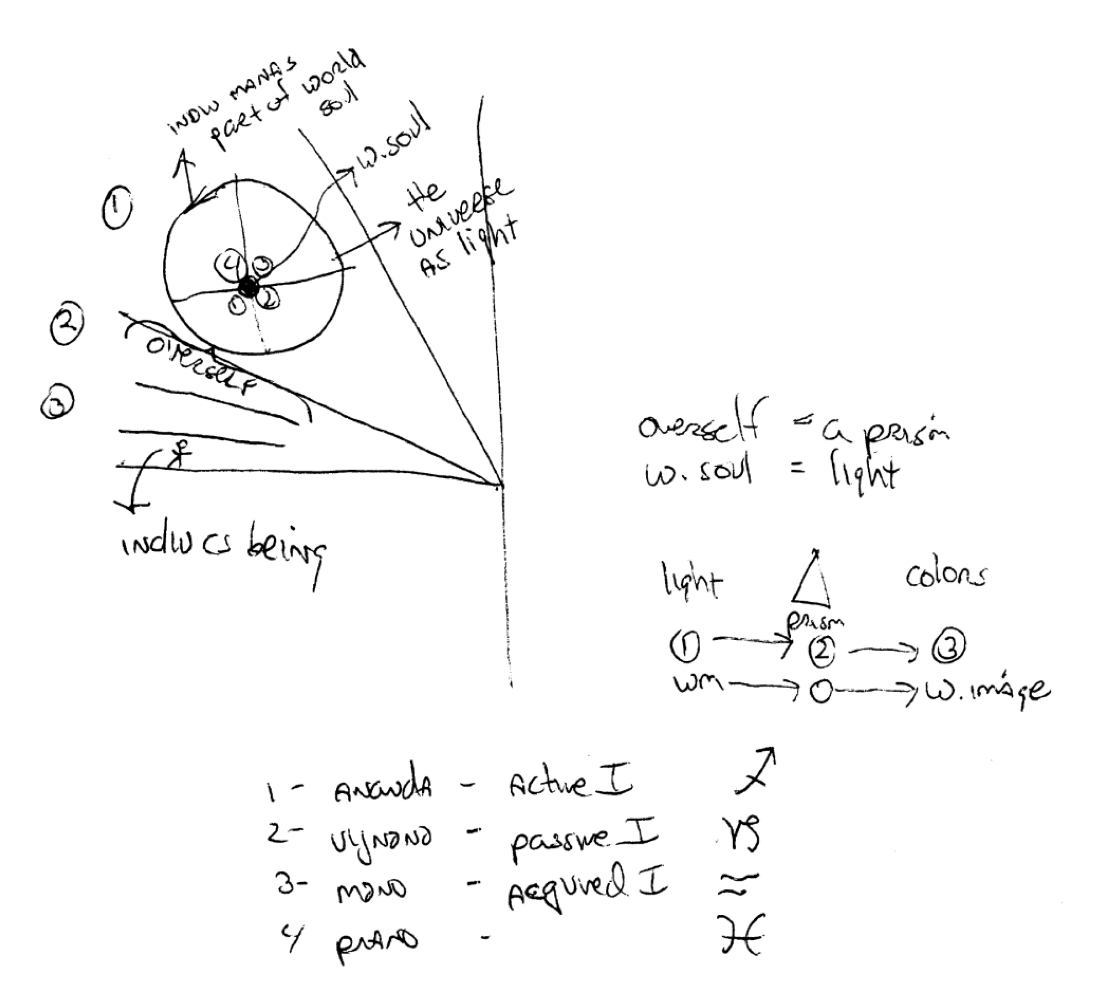
FIGURE 1979 1127-1-AB. World-Soul, Overself, Individual Conscious Being; Overself as Prism; Four Intellects.
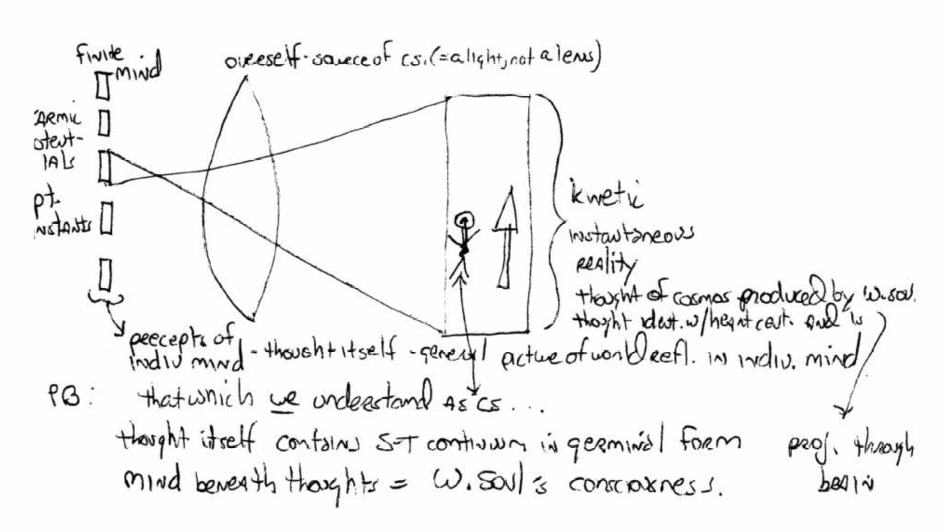
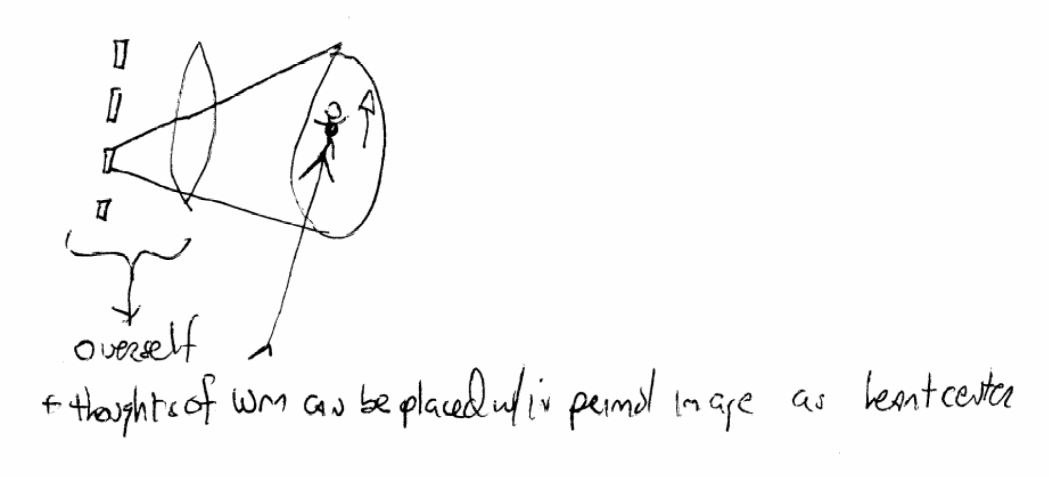
FIGURE 1979 1127-2-AB. Finite Mind, Overself, and World-Image.
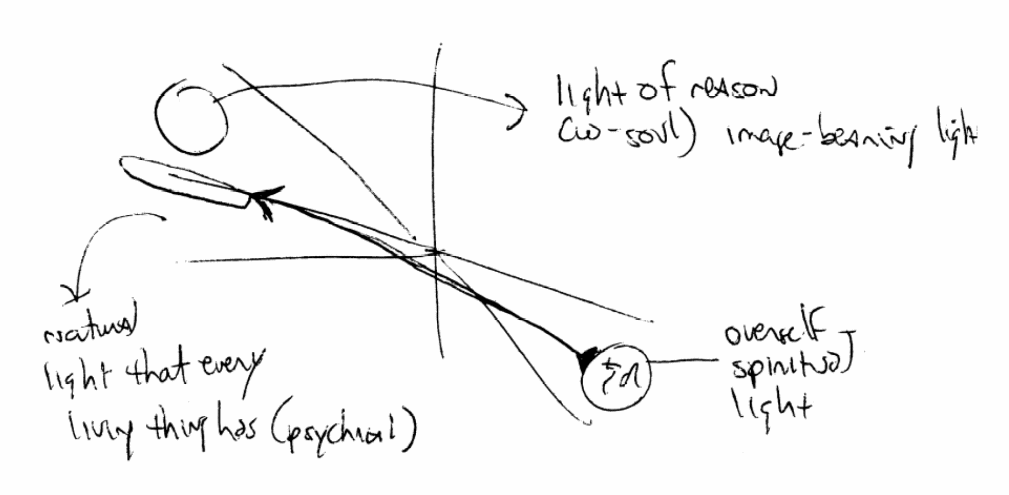
FIGURE 1979 1127-3-AB. Three Lights.
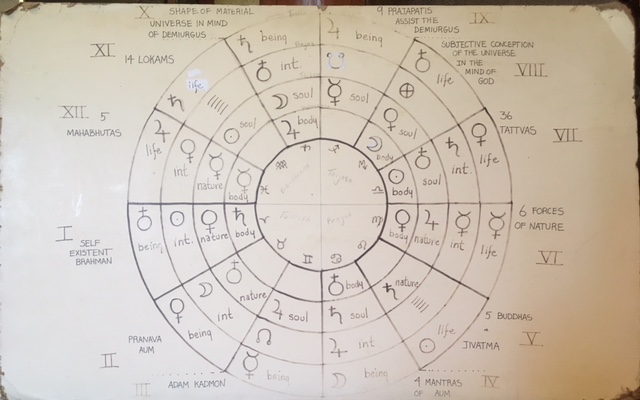
FIGURE IMG_2202-Posterboard Metaphysical Chart.
FIGURE 1979 1127-5-AB. World-Mind's Thinking, Overself, and World-Image.
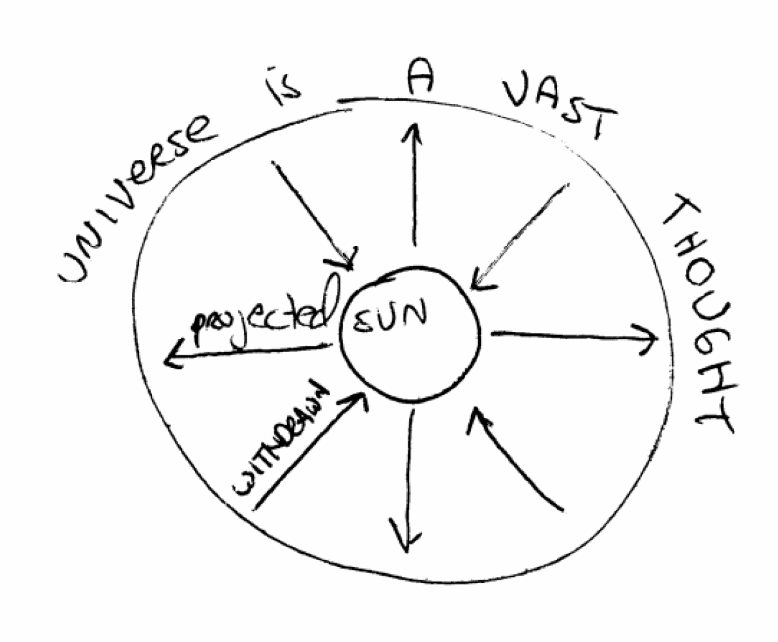
FIGURE 1979 1127-6-AB. Universe as Sun's Vast Thought.
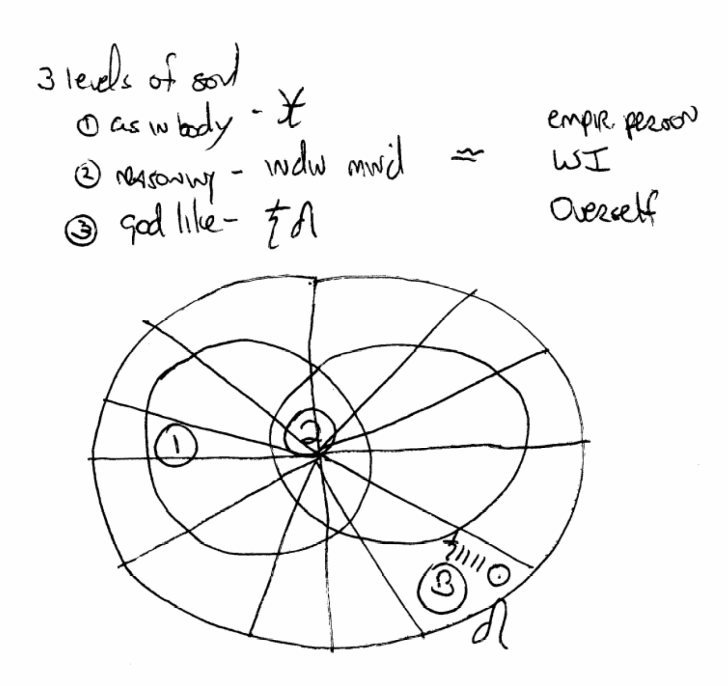
FIGURE 1979 1127-7-AB. Three Levels of Soul.
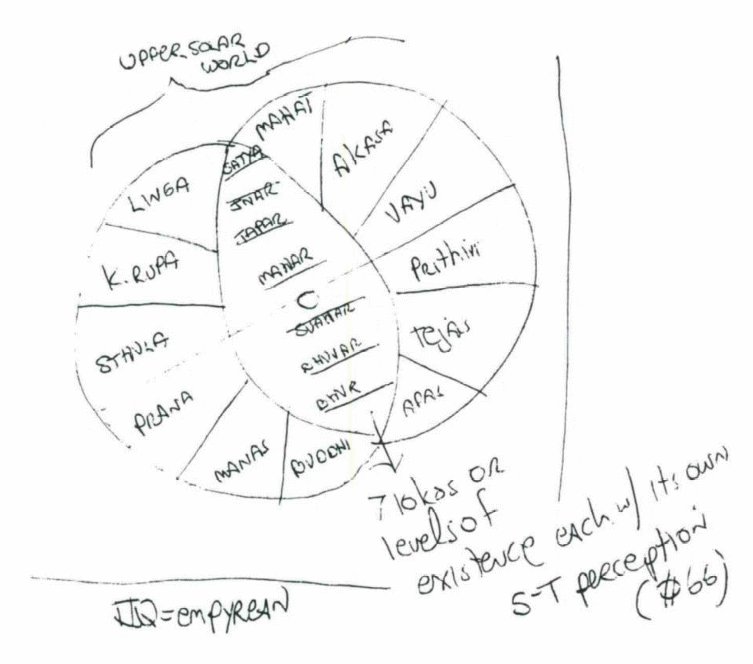
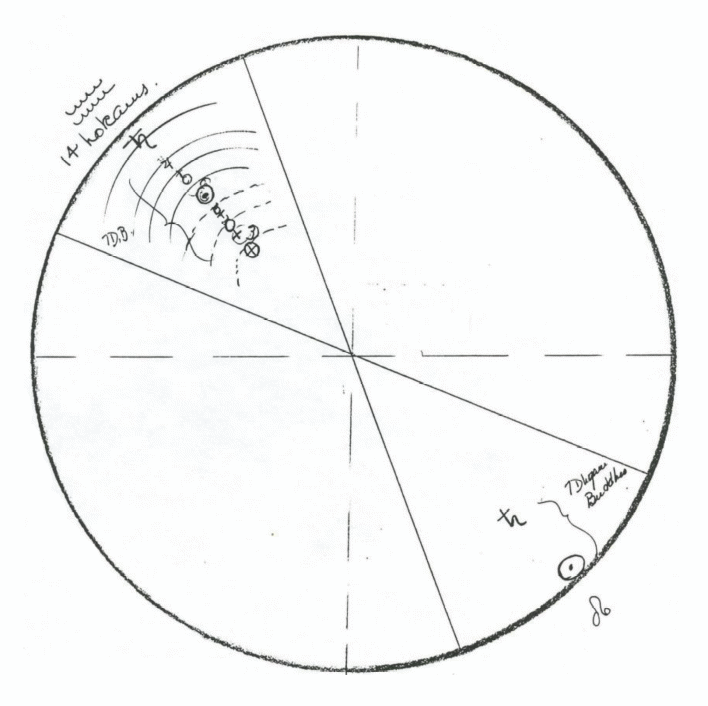
FIGURE 1979 1127-8-AB. Vesica of Houses 10-12 and Seven Lokas.
FIGURE AD_A_004b. Fifth and Eleventh House.
[Transcriber note: [diagram] means the speaker is referencing a diagram as he or she is speaking. If someone is drawing or writing, with audible sounds of chalk on a blackboard, I indicate this by [drawing] or [writing].]
NOTE: This class was held on a Tuesday; part of Wisdom series 1979-1980.
TRANSCRIBED Verbatim by IT 2019; reformatted by JRM & JF 2019-2020, with TOC/Subheads by JRM. In 2023, IT updates prefatory matter, footer, and audio file name, completes Book List, adds Plotinus quotes section, adds new notes within transcript, fixes errors/typos, adds nine diagrams and references within transcript to these diagrams. In 2024, MW alters Subheads to make more accurate. Archival verbatim transcript – V14.1a.
AUDIO FILES: 1979 1127a, 1979 1127b. [Note: "Tape" and "Side" refer to original audio cassette tapes that were later digitized into .MP3 Audio Files.]
1979 11/27 at Wisdom's Goldenrod
PB Books; Wisdom of the Overself; "The Immortal Overself"
Archival verbatim transcript
[Audio File 1979 1127a Begins]
S: Yeah.
AD: That would be (my feeling). You got a copy?
RG (faint, possibly part of background): It's only contextually.
AD: Uh-- Well before we start (we'll lead) with a question or two that were left unanswered. We reviewed last week a little bit. So, before we start this chapter instead (we'll do the) questions that are--
AS (faint): There's some people who weren't here.
FACING THE INEVITABILITY OF DEATH
AD: Some people weren't here? Well, they'll have to have their own private [one/two words inaudible] You-- you know the nice thing I liked about the film was the cremation scene.
S: Uh-hm.
S: Ok.
S: Yeah.
AD: That really put-- put it right on the line. [student assents, faint] You make your decision now. If you put it off, it's forever. And, it was really very existential you could say. Decisions, values, judgments, things like that, you do now. You put it off to tomorrow, there is no tomorrow, you're putting it off forever. So-- I think it straightened out a lot of us, I know I went home and meditated. (AD laughs, laughter)
JG: Some people threw up. (laughter)
AD (amidst laughter): Same-- same thing.
S (simultaneously, faint): Yes.
AS (amidst laughter): Same--
S (amidst laughter): Perfect. (laughter, student words)
AD: Yeah, Crystal.
S: What do you mean you put it off forever? I mean-- [S, faint: Uh-hm.] I thought-- I don't understand what you mean.
AD: Well if you don't look at the situation for what it is, you know, if you don't look straight ahead and you say, "Yes, I'm going to die too. Now what do I do with my life?" Right there and then you make your decision. You can turn around and say, "Well, it won't happen, don't worry." But you're 20, as I said when you're 20 or between 20 and 30, you think you're immortal. It's only--
S (simultaneously): You told me once when you turn between 20 and 25, you pushed it up.
AD: No, I didn't push it up. (bit of laughter) I didn't push it up. Saturn birthday is usually about 29, 28. Well, you know, until that time you feel immortal, you know? After 30, you know that it's all downhill now.
S (faint): Yeah. (laughter, student words)
BS: Well--
S (faint): Fine.
AD: I mean physic-- physically.
S: It's up hill in the other way.
AD: It's up hill. (laughter, student words) Alright, these questions are easier, come on, let's go to it.
S (possibly part of background): [couple words inaudible]
[11¾ second pause]
AD: Any questions before we start?
S: Yeah.
AD: There he is.
[Note: See upper left diagram in FIGURE 1979 1127-1-AB, World-Soul, Overself, Individual Conscious Being; Overself as Prism; Four Intellects, and FIGURE 1979 1127-2-AB, Finite Mind, Overself, and World-Image, appended to this transcript for the following.]
MOTILITY, OR MOTION, IN THE BODY PRODUCES THE INDIVIDUAL'S AWARENESS OF THE WORLD
DB: Um-- [short pause] I guess what I'm not sure of is the rela-- is given the twelfth house body [diagram] which the individual mind and the cosmic soul have produced along with the rest of the primordial image there, and then the karmic seeds, the karmic forces which become active in the heart and go to the brain and so forth would picture forth the world that that individual is going to experience, my problem is that I don't really understand the correspondence between the karmic seeds, the functioning of the karmic seeds of the individual, in the individual's mind, and its relationship to the primordial image or to that network of forces which it interacts with in order to produce the experience that the individual-- of the individual conscious being. And, one way I was trying to think of it was that-- Well I guess I said last week there's this description that PB gives later on in the book of the experience that can be had on awakening where you might have a couple of seconds of very peaceful experience and that's broken by the functioning of the conceptual mind and all of a sudden the whole train of memories and desires and so forth becomes operative and that quiet is destroyed. And my question-- Well, I thought perhaps that mental functioning there was represented by the karmic seeds and that what was there prior to that functioning in a peaceful setting would be the-- the-- what (we/would)-- the primordial image. And, I'm just not sure which is which. If the conceptu-- is the conceptual mind-- is that functioning which destroys the quiet there, is that something that takes place within the-- the karmic forces or is that the effect of those forces?
S (faint, possibly part of background): Thank you.
[44¾ second pause]
AD: Better try a clear question first.
[10¾ second pause]
AS: David?
S (faint): Go ahead.
DB: Do you want me to repeat it?
S (faint): Uh-hm.
S (simultaneously): Of course.
S (very faint): Go ahead.
AS: Whether-- whether Dave-- It seemed like there's more than one question (there/though), [DB: Well--] maybe the main ones-- [DB simultaneously: The main one--] But the main, the main thing you're asking, which is the one you've asked before, to distinguish between the karmic seed-thoughts he speaks of in the heart and the entire world-image which is projected by the World-Soul in conjunction with the individual mind.
DB: Yes.
[short pause]
AS: You want to distinguish between those.
S (very faint): That's true.
S: Uh-hm.
[1 minute 4¾ second pause]
AS (faint): Good. You like the question?
AD: Well we take for granted-- take for granted the prior, right, the establishment of the body. That's taken for granted, ok? So that the existence of the body as a product of cosmic soul is pre-assumed. And then we speak about the motility or the motion that takes place in that body and which produces the individual's awareness of the world. Is that correct?
AS: Right. And the motility within the body you're speaking of as the seed-thought that he speaks about prior to the--
AD (simultaneously): Right, the seed-thought, the motion [AS simultaneously: It's going up.] of the-- the motion of the airs in the various chakras running through the body, ok. Therefore, consequently, the world which exists prior, and by that we mean the body too, alright, remains unknown until that motility traverses the various centers in the spinal column. And then the person is aware, so to speak, of the external world. I don't know if that was a question that he asked or he wanted just-- he wanted it restated.
DB: Well--
RG: But, in the body that's pre-assumed, [S: Uh-hm.] that-- that's not known yet by the individual mind, it seems there must be some participation of the individual mind in the construction, so to speak, of that body also. [short pause] I mean otherwise what would-- what principle would individuate those bodies from-- from within the cosmic soul, being that that body is the--
AD (simultaneously): Isn't it-- isn't it the body?
RG: Isn't it the body? [short pause] I don't understand the answer. If you ask what distinguishes the body and you say the body, I don't-- I don't know how to understand it. How--
AD (simultaneously): What distinguishes the body--
RG: Within the cosmic soul there are individual-- there are-- there are particular bodies. They may be unknown but they're [AD simultaneously: Yeah.] still particular.
AD (faint): Yeah.
AS(?) (faint): Yep.
RG: Now doesn't the arisal of that particularity arise from what-- within the-- the individual entity part?
AD (faint): Arise from the individual entity?
RG: Within-- in union with the cosmic soul but, in that there's particularity there and in-- in that that's the field for the arisal of individual consciousness, [AD: Yeah.] that field too must be a production in part by the individual mind, in that-- in that if it's going to care--
AD (simultaneously): Wait, that field too must be a production-- well, what do you mean by "that field"?
RG: The field of the bo-- the particular body within the cosmic soul.
AD: And we said, we said that's a production of cosmic soul, right?
RG: Yeah, only?
S (faint): Uh-hm.
AD: Basically, [RG simultaneously: But--] basically.
RG: Ok well that's the-- that's part of the question, the 'basically'. I mean it seems there must be also some individual elements within that.
AD: Must be--
RG: Some individual elements tied to that production.
AD: I don't follow that point.
RG: Cosmic soul produces a world, [AD, faint: Uh-hm.] ok. In one sense you speak of it as the body of the cosmic soul. And in that sense one could understand it as totally the production of cosmic soul.
AD (simultaneously): Uh-hm. And we said it was accompanied by the individual mind.
RG: Right, right. In ano-- right, in another sense though, it's the field for the arisal of every individual consciousness.
AD: Yes.
RG: Ok. In that sense it seems there must be some individualization also that goes on at that point.
AD: There must be some individualization that goes on at that point. Well, prior to the arising of the consciousness of that individual body, [RG: Yeah.] alright, we would have to postulate what? Wouldn't we have to postulate this motility that runs through the body and which you're calling the individual mind?
RG: Right.
AD: What's your problem?
RG (faint): I don't know.
LR: The problem is--
S (very faint): I don't know.
LR: (Otherwise--)
RG (simultaneously): Well because you [AD simultaneously: No.] pre-assume-- [S: Right.] because you pre-assume the body. You said we assume the body in the cosmic mind.
AD: Yeah.
RG: Within that we speak of the-- the vasanas arising.
AD: Ah no. First you assume there's motility going through the body before the vasanas can arise.
RG: Ok.
AD: Individual vasanas you're speaking about.
RG (simultaneously): Right, right, ok. But let's talk about the pre-assumption of that body within the cosmic mind. Does that pre-assumption assume only the cosmic soul's production or is there also an individualized activity?
AD (simultaneously): I said accompanied by individual mind. But the individual mind does not fabricate the body.
RG: Does not fabri-- does not fabricate it, true, but the-- the structure of that body in the cosmic mind, somehow that must have a-- somehow relate let's say to the individual's samskaras or vasanas or past tendencies.
AD: I-- you're missing the point, aren't you? The body is your samskaras.
RG: Ok.
AD: That is exactly the problem. So if there's any motility in that body you're going to refer to it as your thinking. Any motion, any movement of air, and there's five different airs that move through the body, alright, there's going to be produced what you call your physical consciousness. And you're going to refer to that as your mind.
LR: So now it's the body which is producing the individual mind?
AD: I'm sorry? Now it is the body that is produced--
LR: You just said the body is your samskaras and any motion of air through that will be what we call our mind.
AD: Your physical consciousness, yeah.
[short pause]
LR: What do you mean the body is the samskaras?
AD: Well it's a reproduction of the previous thinking that you engaged in. It's a congealing, a corporealization of your previous karma.
LR: Then why would it not be the effect of the individual mind's operation?
AD: Only in conjunction with World-Soul and [LR simultaneously: Well fine.] the World-Soul is primary.
LR: Fine. You mean the power of fabrication [AD simultaneously: The fabrication comes from cosmic soul.] comes from the World-Soul. But, the effe-- the particularity comes from the individual mind, in other words--
AD: I'm sorry, the particularity (now--)
LR (simultaneously): The particularity of that body and not the other body is seen as an effect of the individual mind's operation in that it will carry the samskaras. That seems to be what you're saying now.
AS: But I don't--
AD: That it would carry-- yeah.
LR: I thought what you were saying was that the fabrication of the body was due to the World-Soul but that the particularity of that body, in that it's a-- it's the recipient or the vehicle for the samskaras, would be an image of the individual mind in some way, that body.
AD: On the one hand it's an image or corporealization of prior-- prior karma, right? And insofar that it is, on the other hand, you also have it as the receptacle through which when there is the motility taking place in the body, there's a release of these prior vasanas that you operated with. In other words, it would be the physical embodiment of all your samskaras that you're going to operate with.
S (faint): Yeah.
LR: Due to the individual mind associated with it.
AD: Well, yeah.
LR: Ok, um--
AD: But, again, what would this-- this individual mind that you're referring to, you mean by that the Witness-I or do you mean the empirical "I"? If you mean the empirical "I", I would say it resides in the body, [LR simultaneously: Well, (couldn't be--)] or what you call the body.
LR: I would not mean empirical.
AD: The-- so then you're speaking about a continuum.
LR: The individual mind which I would like to think has some association with that body, some very close connection.
AD: Uh-hm. You can have it. Have it your way. In other words you're trying to-- he's trying to say something, if I follow. This individual body, which is the corporealization of my previous karma, involves the functioning or the-- or the cooperation of the individual mind and the cosmic soul to produce that body. Alright, now having produced that body, this body itself is a vehicle. Insofar that you have a certain brain structure, alright, that very brain structure is an indication of the kind of vasanas you're going to experience when motility takes place, when there's motion in the body. [student assents, very faint] What's the problem?
LR: Nothing, except you never said that before.
AD: Oh, we said it over and over again in different words. And the next time I'll be saying it in (bit of laughter) different words again. [students assent, faint] You got a tape?
LR: I have notes.
AD: Go ahead David.
DB: Well, there's this predetermined structure represented in the brain, say, particular tendencies and habit patterns and so forth that the empirical mind is going to function in accordance with.
AD: That is the empirical mind.
DB (simultaneously): That-- right, that is the empirical mind. But-- So this is something very-- well, very personal, you know-- you know-- I think the question I'm asking is more along the lines of, if the-- if the particularity of experience, if the personal qualities of experience is something provided by the body, what is it coming from the individual mind that differentiates one from another?
AD: Differentiates one what from another what?
DB (simultaneously): One empirical mind from another. I mean, they're different--
AD (simultaneously): Well, isn't the brain good enough?
DB: Well--
RG: Well we just said its own prior functioning.
[10¾ second pause]
DB: Um-- So that there wouldn't be any difference in the functioning of your individual mind in your body and my individual mind in my body. The only difference is coming from the brain?
AD (simultaneously): The only difference?
RG: The only difference-- that is the totality of the-- of the individual consciousness there is the functioning of your thinking. What do you mean 'only'? What else is there?
DB: Well the fact is that your individual mind has a particular history and so does mine.
RG: And yours has its own.
DB: Yes.
RG: And mine has its own.
DB: Right.
RG: That stream of thinking is what we call the individual-- each of our individual minds.
[short pause]
DB: Yes. So but now you just-- unless I misunderstood you, you equated that with the structure of the brain.
RG: Well, the brain is a manifestation of that, sure.
DB: The brain is a vehicle through which that's going to function.
RG: It's also a manifestation of it. Both.
DB: Yes.
RG: Yeah.
DB: Alright, so then on the empirical level the same quality of difference is manifested?
RG: The same what?
DB: Well look, if I'm up-- if on the physical level you get the particular characteristics that distinguish you as an empirical ego, alright, [RG assents] and I get mine, it's all because of the structure of our brain. Right? Well what's coming from the individual mind? What's-- what's working through that?
AD: Well look--
RG: That is it.
DB: No it's not.
RG: Why not? What is the structure of your brain other than the functioning of your individual mentality?
AD: Listen, could we go through this again David, once more? Linda here will help us, alright. For the first time, Linda, what was it we said?
S (very faint): (Prove it), different thoughts. (RG laughs)
LR (faint): That's (rationalist). They're just-- (some laughter)
AD: We said something like this, right, the body is a product of the cosmic soul in conjunction with the individual mind. The body does represent the karmic corporealization of that individual mind's prior experience. Ok. So we have this body now which is structuralized in a certain way. And then we say a certain motility takes place, certain motion or the movement in the focal points along the spinal column, chakras, whatever you want to call them.
JG: Could you please go a little slower Anthony?
AD: And backwards?
S (faint): Do that.
JG: Yeah.
AD: We said that the cosmic soul and the individual mind together fabricate the individual body. This body for an individual mind represents his prior karma. The body that you receive and you operate through represents your prior karma, it is an ossification of the previous stream of consciousness that you operated with. So now this body congeals that karma, alright, now it's presented. Now, that means that this body is slightly structured, a little differently structured from someone else's. I think once, many many years ago he made a presentation of embryology where he showed that no two, no two bodies grow the same way, that there are always slight differences between any two bodies from the time of conception to the time of birth. Alright. Now that individual body, with an individual brain, represents, as we said, the congealing of your prior karma. And that means that the kind of brain you inherit, even if it's-- even if you want to include the subtle brain, it doesn't matter, the kind of brain you inherit, when there is motility going through that body, it's going to be your experience of the world and your experience of your mind, your empirical mind. This is what you call empirical mind.
THE INDIVIDUAL MIND MANIPULATES AND INTERPRETS THE CONTENTS OF THE EMPIRICAL MIND
S: Does the movement or the motility that you speak of that goes through the brain, is that also individual?
AD: (It needs) to be individual, it belongs only to your body. Her motility will be different and mine will be different. [S simultaneously, very faint: That's-- yeah.] So the motion or the vayu principle that operates through the body and produces what we speak about the ex-- primal image for us, each individual one, then that will be something-- that will be the experience that we speak about, but now, now we can bring in the individual mind and say that the individual mind, not the empirical mind, can manipulate the contents of that empirical mind, interpret it, alright.
BS: Excuse me, what would manipulate?
AD: The individual mind, the higher reasoning, will take the contents and manipulate them.
BS: (Of course/Because) there seems to be a-- the distinction not mentioned, but I'm looking for the consciousness principle.
AD: Well, we didn't even bring that in right now because that's [S simultaneously, faint: I know.] just assumed right there. It's just being assumed.
DB: I guess that's the question [S simultaneously: But that's another question.] then, what is-- I mean we-- we speak of the individual mind now coordinating or functioning in regard to this empirical mind or this determined structure of karmic ossification. Now there is going to be a difference, one-- one to another, isn't there?
AD: There's going to be a difference? [DB/S(?), faint: Yeah.] Well, I didn't follow you.
DB: Well, very simply I mean the karmic seeds-- the karmic seeds that are coming from one individ-- one individual's heart to his brain are different from those that are functioning in another. Are they not?
AD: Yeah, only I'm getting away from your terminology because you're hung up on it. The motility that moves one body and the motility that moves another body may be the same motility but the bodies are different. Look, you're 6 feet, I'm 5'4", ok?
DB: Yes.
AD: The air as it traverses my body doesn't have as much room to traverse.
S: So it's the same motility?
AD: It's the one same principle, vayu. [students assent, faint] And what it produces, the activity it produces in your body, the functioning of the sensory capacities, alright, all the sense functions, you speak about as your empirical world, alright, the functioning of the various senses, the functioning of the various organs. This is your empirical world. This is the experience you have. [RG: Yeah.] Ok? Now, we have to bring in the individual mind in order to make sense out of this chaos, in other words, you see a red-- you see a wagon wheel and I see a wagon wheel and to you it's a wagon wheel and to me it's a circle. Now you're bring-- now you have to bring in the reasoning mind or the thinking mind to explain the distinctions or the differences that could take place in terms of explaining the experiences of individual minds. [short pause] This you all said in the second chapter. You did this in the second chapter. Continue Dave. Let Dave finish through.
DB: Well, I mean I'm just operating with the notions that he gives in here. And, I mean I could see how the principle of vayu would be universal, and I can see how the-- the body, by the very nature, has to be individual. But, what I don't understand is that the individual mind which is going to operate through this functioning of the motility of vayu and the particularity of the body has got to be-- seemed to be-- to be different.
AD: Seems to be different?
DB: Yes.
AD: Well of course it's different
DB: Yeah, now--
AD: Of course it's different.
DB: Now--
AD: The individual mind, like we says, is equivalent like the Witness-I.
DB: Yes.
AD: Or the empirical mind is like equivalent to no mind. You want to try?
DB: But now--
S (faint): That's a real--
DB: I mean is the contact that the individ-- that the reasoning individual mind makes with this empirical ego, the-- with the-- with the empirical mind, is that the process of the transmission from the heart to the brain?
AD: I don't know what you mean.
DB: Well--
AD: We just spoke about the-- we just spoke about that, the impression from the heart to the brain, we spoke about as motility.
DB: Yes.
AD: Yeah, the motion that's taking place in the body.
[9½ second pause]
DB: Well see on the-- on the--
AD (simultaneously): Yeah I'm-- I'm trying to get you away from that word 'karmic seed'. Because you keep thinking about it as some kind of little insignificant microscopic germ. (bit of laughter) I'm trying to get you away from that. I'm trying to get you to realize that the body is something presented by the cosmic soul, alright, and if there's any activity, any motion in that body, there's going to be expe-- there's going to be presented an image.
DB: Yes.
AD: And that image we refer to as primal, ok. [DB assents, faint] And if it stays there, there won't be any experience.
DB: If it stays where?
AD: If it stays like that it won't-- if the explanation doesn't go further there won't be an experience.
DB: Yes. Well, I mean if-- [9 second pause] I guess I just don't understand at this point what the individual mind is bringing to this whole set-up, you know, I mean the-- the body itself is structured because of the past, because of past experience, and--
AD: You don't understand what the individual mind is bringing to the experience.
DB: Well, yes. I don't. I mean because if the past is represented, if the particular way the world is going to be interpreted is repre--
AD (simultaneously): Well what would-- what would be interpreting this motility that's taking place in the body?
DB: Well--
AD: Would it be the empirical mind?
DB: Well the empirical mind is--
AD (simultaneously): Would it?
DB: It would-- that would seem to be the effect of that motility, right?
AD: Ok.
DB: Ok.
AD: So then the scene of carnage is laid out, ok, and now an interpretation has to take place.
DB: Right, ok.
AD: And that's where the individual mind comes in, which is the repository of all prior experiences too.
S (very faint): Uh-hm, yeah.
DB: But not in terms of their effect but in terms of the understanding that has been made possible.
AD (simultaneously): That you come-- that you come with.
DB: Yeah. Alright, now, is it with that that the Overself center in the heart is conjoined?
AD: With that?
DB: Yes.
AD: Use nouns. With what?
DB: With the-- with the individual mind.
AD: Yeah.
DB: Ok, representing this understanding and so forth from the past, is that what is conjoined in the-- in the heart center?
AD: Yeah.
DB: Ok.
AD: And what's the heart center?
DB: Well, it's this little--
AD: It's nothing, it's nothing. It's nothing, it's nothing. (bit of laughter) You're getting hung up on words.
DB: Well, yes, see--
AD: Heart center. Where? Right here? [DB simultaneously: Well--] You want to get a mic-- micrometer and measure it and see where it is?
DB: No.
AD: It's nothing.
DB: Well--
S: Uh-hm.
JG: If you do-- (JG laughs a bit)
DB: Well, I-- I'm not completely--
S: Uh-hm.
AD (simultaneously): No, the heart center in Sanskrit is not anything physical. [DB: Yes.] It does not exist in space or time. [DB: Right.] It is almost where they come together, where the other side of space and this side of space seem to meet. The Hindu term would be like 'hridaya', which [DB assents] means the Self. And that's no explanation.
S (simultaneously, faint): Ok.
S (faint): Ok.
S (faint): Uh-hm.
AD (very faint): Yeah.
DB: Then can we look at it in terms of the eleventh house [diagram]? Is that individual?
AD: You don't have to look at it in terms of any houses, you just simply have to follow what I've been telling you. No houses, no diagrams, just the way I've been telling it to you.
DB: How--
AD: You remember when they were speaking yesterday in the movie picture? A reversal of the s-- of the energies flowing through the body, alright, and then what is experienced is qua-- quite a chaos. See, as long as the energies are pouring into the body, the primal image appears as part of that body or conjunct with it. Alright, but let those-- let those energies reverse, instead of flowing in flow out, then you experience chaos or the bardo. [10 second pause] Well, that's enough. Think about it. [student assents, very faint] 'Motility' is the word here. The activity or the action of vayu on the body. The experiencing of one's empirical mind which is really no mind, not yet. [short pause] Maybe we'll get some more clarification on this chapter, I doubt it but-- (bit of laughter) We can start right at the-- 193? Start right there instead of, you know--
S (simultaneously, faint): 193.
[27 second pause]
BOTH THE COMMON CONCEPTION AND THE MYSTIC CONCEPTION OF IMMORTALITY MAKE IT AN INDEFINITE PROLONGATION OF EXPERIENCE IN TIME
AD: Alright, paragraph 8, let's start there, go ahead.
AS (faint): From the beginning?
AD (faint): Any place you want, don't worry. Go ahead, start reading.
[Transcriber note: I am using The Wisdom of the Overself by Paul Brunton, Rider and Company, London, 1943.]
PB [The Wisdom of the Overself, "The Immortal Overself," pp. 114-115, AS reading]: "The common conception of immortality would make it an indefinite prolongation of personal existence. The mystic conception would make it an [AS reads: makes it] indefinite prolongation of personal bliss. The philosophic conception, however, transcends both these notions because it discards [AS reads: disregards] the personal life and replaces it by its ultimate non-egoistic root, the individual Overself. The first two are still within the time-series, albeit it is not the kind of time we ordinarily know on earth, whereas the third is beyond any possible consideration of time or succession. It IS. Such true deathlessness can be attained only in the Overself, for this does not derive its life, as the body does, from another principle. It has life of itself. Consequently, the body has to give up in death what it has previously received, but the Overself, never having had anything added to it, has nothing to give up. It cannot but be immortal for it is part of the World-Mind and what is true of that must also be true of itself. That which is forever in union with the World-Mind must itself be forever free from a change like death."
[18¾ second pause]
AD: Well, no [couple inaudible AS words simultaneous with AD] problems, right? Well, we can go right on?
AS (very faint): [couple words inaudible] question.
LR: Say it's appended.
AD (simultaneously): Go ahead, you had one.
MS: I always had a question about this sentence--
PB [The Wisdom of the Overself, "The Immortal Overself," p. 115, MS reading]: "The first two are still within the time-series, albeit [it is] not the kind of time we ordinarily know on earth, whereas the third is beyond any possible consideration of time or succession."
S: Hints.
S: Good.
MS: To speak-- it sounds like from the phrasing that the first two are actually like possible in some weird sense. You know what I mean, like-- If he was just dismissing the consciousness of the personality, he would say it was the same type of time that we know on earth. You know what I mean?
[students assent, very faint]
AD: Well, let's see, he's saying that the first conception of immortality would make it like an indefinite prolongation of what we experience here on earth, right? And the second kind of immortality would be the mystic's conception of immortality and that's basically in terms of feeling, alright. And he says both these are-- can be referred to a time-series, alright. So there's some people who believe that-- I imagine some religions they believe that when they die they will go on in the same egotistical way, and that probably is one kind of immortality. And the second one is where the mystic is enjoying this blissful repose or this blissful state, this feeling, you know, exaltation. And, that too is in time because it follows. Alright, and that these two are-- PB is saying that they both fit into the time scheme.
LR: But not the ordinary time we know on earth.
AD: Yeah.
LR: What is that-- I think that's the place Mark--
AD (simultaneously): Well-- well if-- if the-- if you had an existence, so to speak, that was indefinite in duration like what you had here, then that would-- would be one of the conceptions that we're speaking about. And I think Mark is curious to know if there are such scales, such heavens. Yes, there are. I think in one of the Midis-- Mid-- Mideast religions when you die you go up to heaven and you have a harem there and you have this indefinite duration of personal happiness and the ego's every whim and wish is fulfilled. Isn't that so? [S: (Yeah well--)] I think they have something like that, right?
S: You mean they have a conception of it but it's not really true.
AD: It's true too.
RG (simultaneously): Yes, it is true.
S: What?
S: That's why they're all so anxious to get killed in wars. (laughter)
AS: [couple words inaudible]
AD (simultaneously): I think for instance, is it in-- in the Nibelung they have that where the warriors, when they die in battle they're [S simultaneously: Oh yeah.] picked up [S simultaneously: Ahh, aha.] by the maiden, [RG: Yeah.] brought up to Valhalla [RG simultaneously: Sure.] and there they [couple/three inaudible student words simultaneous with AD] eat and drink and battle. (bit of laughter) They fight all day, they get killed a few times, they come back [AS simultaneously: Doesn't matter.] at night, they drink and eat, and then the next day they do it again. (bit of laughter) They go on [S simultaneously: Sure.] perpetually enjoying. This is their heaven.
S: I don't get it. (laughter)
S (very faint): They get killed.
S: Me too.
AD (simultaneously): I didn't ask you to believe it, I'm just-- (laughter, student words)
AS: It's not for everybody. (some laughter)
LR: They have only the heroes.
S: What?
LR: That's only the heroes.
AD: That's only for heroes, yeah but, I imagine that it's quite a common conception among people that haven't evolved mentally, that they think the possibility that there will be a continuation of a happy life, you know, like the one we know here, and that this has an indefinite duration. [S: Yeah.] Well, that's conceivable, isn't it? I mean if-- if there is such a place then when dogs die they go to a heaven where they find all the bones that they want. (bit of laughter, student words)
SS: Doesn't PB speak of that in the-- in the prior chapter?
AD (faint): I don't-- I don't remember.
S: About?
S (faint): That's you.
SS (simultaneously): No, not about the dog's bones. (laughter, student words)
AD (amidst laughter): Oh, oh.
SS: About the heavens and the animals and--
BUDDHISTS CONSIDER REBIRTH AS A GOD UNFORTUNATE SINCE THE GODS, BEING ALWAYS IN A STATE OF HAPPINESS, CANNOT DESIRE ENLIGHTENMENT, TRUE IMMORTALITY
AD: Yeah, there are such places. Like for instance you could be reborn as a god. In Buddhism, for instance, alright, it (would/wouldn't) be a very happy occasion. But if you're born like a deva, a god, you're always happy. All your-- all your desires are fulfilled. It's an unfortunate situation because you cannot desire enlightenment.
S (faint): Yeah.
AD: Alright? You have no desire to be enlightened.
S: Do you mean in that state, when you're--
AD (simultaneously): (The) (state/Saint), sure.
LR (faint): Because you're happy with what you've got?
AD: Yeah, of course.
S: Oh, but as soon as you want enlightenment though that-- those kind of things--
AD: Well there you won't want enlightenment. What would you want enlightenment? You're completely happy.
SS: Oh.
AD: So they consider that an unfortunate state to be reborn in although you're happy all the time. [AS, faint: So it's al--] And their life is immeasurably long. So, that's all he's saying here, alright, there are such counterparts, you know. And a mystic of course will be reborn where he's always in ecstasy and drunk with ambrosia and drinking it up, so to speak, ok, and he-- there's a place for him too. But, from a philosophic point of view this is not immortality. This is not really immortality. This is not what you're really looking for.
S: This is an aside, don't those states end?
AD: Well yes, they-- [S simultaneously: 'Cause, I mean in a truly (one word inaudible)] they end but from a-- You see, there again you'd have to bring in a philosophic perspective, alright, because it's only from a philosophic point of view that one recognizes that they're not eternal. But, in that state, even those thoughts are banished, that (it'll ever/will never) come to an end. So if you're a deva you have no conception of an end, of a dying. You might get old and the smells start, you know, and the flowers start decaying, but you have no conception of death. Yeah?
AH: Just one further question about the Buddhist conception. That-- isn't that the reason they consider the human birth so significant?
AD: Yes, yes exactly because the possibility of the thought of enlightenment could take place. Whereas in the others, like if you go to the lower heavens, you know, denizen of hell or preta, hungry ghost or something like that, the question of the thought of enlightenment is eliminated or excluded, it's not possible. And if you go to a deva, the heaven of the devas, there the thought of-- is excluded because of-- what was it we said? Too much happiness. (some laughter) Well, you ever notice in history whenever a society gets too affluent they usually go down? Well anyway we-- we'll con-- we'll continue with the Buddhist point of view later on, on a Sunday. But of-- from the human-- from the Buddhist point of view they consider being born a human being as a rare privilege, and (then/that) not to take advantage of it is really to be stupid. I think there was a remark where-- No, there's a very beautiful analogy where the Buddha is speaking to some disciples and he says now-- he says imagine-- (bit of laughter) he says imagine going out with a rope, you know, with a noose on it and that there's one turtle in the ocean. And imagine the chances of this turtle coming up so that you can grab him with your noose. He says well that's the chances for a fool in his misery to find his way to happiness. So, he's very severe about that, he says, you know, to waste your human embodiment on the trivialities and pleasures of being a human being is to be a fool, to waste an opportunity that may not come again for many many years. Alright, let's stick with PB, he's more polite. (laughter) So--
"IT IS" CAN APPLY ONLY TO SOMETHING THAT HAS AN UNINTERRUPTED EXISTENCE, WHICH WOULD PLACE IT COMPLETELY OUTSIDE OF ANY TIME-SERIES
PB [The Wisdom of the Overself, "The Immortal Overself," p. 115, AD reading]: "The first two are [still] within the time-series…whereas [AD reads: but] the third is beyond any possible consideration of time or succession. It IS."
AD: Alright. Ok? Next-- next line.
MW (simultaneously): Yeah, what does-- what does he mean-- silly question, what does he mean when he says 'life' here? It says "It has life of itself."
AD: But wait, one sentence at a time.
MW: Oh we're doing one at a time.
AD (simultaneously): "It IS."
MW: "It IS."
AD: Yeah, that's one sentence. (laughter)
S (amidst laughter, faint): Yeah.
S: Sort of.
[short pause with faint background student talking]
MW: Well why don't we discuss that one?
AD: Well we saw that the kind of life or the kind of existence that would take place in the universe would be an intermittent one, like the Buddhists speak about. It's an incessant--
(Side 1 of original cassette tape digitized as 1979 1127a Ends; Side 2 Begins)
RG (very faint): Uh-hm.
MW: Ok, what if you spoke about the conception that we were trying to evolve, the Witness-I, though? And you wanted to ask-- well would you-- would you say that IS?
AD (simultaneously): Well, that's simply a larger time-series, that's all, [MW simultaneously: So you would s-- you would say even--] from one Manvantara to another.
MW: You would say you couldn't truly say it IS of such a principle.
AD: Well, it would sink into pralaya, wouldn't it?
S: Uh-hm.
S (faint): Right.
AD: Look, we said that the Witness-I presides over the entirety of a series of incarnations that take place for one soul, alright, and that there is periods of pralaya, periods of absorption. That's it. That means that it's not unbroken.
MW: But if you say the pralayas only affect the manifestation and not the producing principle--
AD: But we said that the Witness-I is to be identified with the presiding over the-- an entire series of manifestations that are taking place in one Manvantara. Now you want to change the definition you're going to have to stand up to the consequences of that.
RG: But why can't the same Witness-I preside over more than one Manvantara?
AD: It does. It depends on how stupid you are. [S, very faint: Yeah.] So instead of being liberated within one Manvantara you could make it ten. And the same Witness-I would preside over it, sure.
RG: So until you're liberated it's the same [AD simultaneously: Yeah.] Witness-I presiding.
AD (simultaneously): It's the same Witness-I. Don't the Hindus speak of the same thing, you have the same linga sarira [student assents, faint] until liberation.
S (very faint): Yeah, right.
AD: Yeah. Now some people figure, "Let me get out of this as quick as I can," some say, "Let me take my time." Some don't say anything. So "It IS" here would have to-- that can only apply to something that has an uninterrupted unbroken existence, which would place it completely outside of any time-series. Well, we don't have to spend too much time on that if it's too difficult. Go ahead. The next sentence here.
AS: Yeah.
THE OVERSELF HAS LIFE OF ITSELF, WHEREAS THE BODY DERIVES ITS LIFE FROM ANOTHER PRINCIPLE
PB [The Wisdom of the Overself, "The Immortal Overself," p. 115, AS reading]: "Such true deathlessness can be attained only in the Overself, [AD, faint: Yeah.] [for] this does not derive its life, as the body does, [from another principle]. It has life of itself."
AS: It sounds the way we spoke of the soul in-- in Platonism.
AD: Go on, yeah.
AS (simultaneously): It's self-motive. Can we go on with--
AD: No, no, no, [LR simultaneously: Go (out with your) just--] go on with your explanation.
AS (very faint): (Ok.) (RG laughs)
AD: You-- are [AS simultaneously: Well, I--] you saying something like this? I don't know if I follow you, that it seems that the Overself is life itself, alright, but it seems that the body derives life from something else.
AS: From [S simultaneously: Yeah.] s-- yeah, from another-- it's-- it's not self-motive, the body. Well that part is pretty clear, even the way-- even the way you were speaking about the vital principle, prana, so on would animate the body. So it depends on something else for its-- its life.
DOES THE BODY DERIVE ITS LIFE FROM THE COSMIC SOUL OR THE OVERSELF?
AD (simultaneously): So then-- so then the life of the body, so to speak, is dependent upon the cosmic soul or let's say our Sun, alright. Whereas the life of the Overself is not dependent on the Sun as principle or cosmic soul as principle.
AS: They-- they even-- in-- you know, in Platonism they seem to use that as a-- well-- well not (a/if)-- if not a proof at least a reasoning of why it is immortal. If it has life of itself and doesn't get it from something else, it must mean that it's eternal. If it didn't get it from something else, then it must have had it from the beginning because it couldn't impart it to itself before it existed. So if it-- if it is the principle of its own life it can't have it spontaneously coming into existence, it must be in it(--/,) it must be an eternal life.
AD: Well, let's see if we can get Richard to disagree with us a little bit. Do you think that that means something like this therefore. We can speak of the life of the soul as one kind, alright, and then we can speak of the life of the body as something else. So that when we say the body is fabricated by the cosmic soul and endowed with certain motion, you know, sensory apparatus and all this, this is given to it by the Sun, ok. So this whole body is fully equipped, organized, the functioning, alright.
AS: Yeah see that's the thing, it's not even clear that the life-- in fact I would say it isn't-- that the life that the body has is possibly not derived from the life that the Overself has. One point is that they're distinct. But it may also be that the one isn't even derived from the other. As (he says/you said) the life of the body [LR simultaneously: The cosmic--] may have its own continuity from the cosmic soul whereas the Overself's life [one/two words inaudible]
AD (simultaneously): And for instance we spoke about sometimes, and-- and we mentions-- we had some quotations where we speak about like when people get very old or very si-- very old and the higher principle leaves, the vegetative functioning of the body goes on but the rational soul has left the body, it's no longer-- alright? And then that body would have like a continuity, an organic continuity of its own.
S: Yeah.
RG (simultaneously): But are there two principles of life there?
AD: Yeah, [student assents, faint] that's what we're saying.
S: Anthony?
RG: I don't-- I disagree.
LR (simultaneously): You got him! (AS laughs)
AD (amidst laughter): You finally got the point!
S (simultaneously): You got the point.
LR: You got him. You succeeded.
S: [couple words inaudible]
AD (simultaneously): It took a little time to get the point, huh? (RG laughs, bit of laughter)
RG: What do you mean there are two principles of life?
AD: Well we just gave this very outlandish example, alright, when people are very sick or they reach a certain age or senility where the rational soul actually leaves the body, [RG/S(?): Yeah.] no longer has any need for the body. And now what goes on functioning is simply the vegetal principle.
RG: But that doesn't prove that that vegetal life is not a-- an aspect of the li-- of the life principle, which if he--
AD: I didn't say it wasn't.
RG (simultaneously): No, but if you call the Overself the principle of life, and then you say reason leaves--
AD: I didn't call it the principle of life.
AS (simultaneously): He didn't say it was the principle of life, it-- if it had life of its own.
AD (simultaneously): Life of its own. It has its own life, [RG: Yeah.] ok.
RG: Well if it has a life of its own, it does-- how could you talk about it as not being the principle of life if it's eternally a different [one word inaudible]
AD (simultaneously): It has life of its own, it's its own life. When my consciousness departs from my body, it'll still be a living conscious being.
RG: Right.
AD: Go ahead, argue [S simultaneously: Yeah.] with him, not me.
RG (simultaneously): Ok.
S: I--
AS (simultaneously): Well take it up to a different level, Richard, wouldn't you say that [AD simultaneously: Let's see if I can get you this quote.] the World-Soul-- let's say we take the principle that governs the motions of the planetary spheres, the World-Soul, the aspects [RG simultaneously: Yes.] or the cosmos and so on. [AD simultaneously: Well, I'm going to (few words inaudible)] Now, you could-- you could distinguish that. (laughter)
S: What did he say?
[couple seconds of background student talking]
AS: Exactly. (bit more laughter)
JC: What'd he say?
AS: The library's up there.
RG: Right, but you [few inaudible student words simultaneous with RG] see, in the-- if-- and if you have soul there though, the cosmic soul is an aspect of soul, but in the Greeks that [AS simultaneously: Oh well--] would be an aspect of-- [AS simultaneously: Oh I see what you're going to do.] of the soul principle.
AS: Sure, sure, you're going to do the [S simultaneously: Announce it.] same thing you did with consciousness, you're going to say, "Well look, cosmic soul is really the…" You're going to say the co-- I'll do it for you. You're going to say the cosmic soul derives its [RG simultaneously: (couple words inaudible) same thing. Go ahead.] life from the second quadrant [diagram]. Is that what you're going to trace back the principle of life, like Proclus, Being Life Intellect, well, Life.
RG (simultaneously): The Overself principle, right. Big time.
AS (simultaneously): Are you going to say-- But then we're going to get back to the thing we get in-- but that's a s-- it-- you're going to go back and say well that-- that's li-- that life is from the Sun in Leo and the Overself life is the Saturn in Leo [diagram]. [Note: See FIGURE IMG_2202-Posterboard Metaphysical Chart and FIGURE 1979 1127-3-AB, Three Lights, appended to this transcript.] And you're going to do something like that.
RG: I don't see two [S simultaneously: Right.] lives as an essential here.
S: How about the--
AS: No?
S: From what it says, it sounds as if the body could derive its life from, let's say for example, from the Overself. [AD simultaneously, faint: Ah (one word inaudible)] Let's say if the Overself is the principle, then the body could derive its life from there, and the Overself, since it is the [AD simultaneously, very faint, possibly part of background: Yeah.] principle, does not [AS simultaneously: But that's--] have to derive it from any other place.
AS: That's basically the point that I think is being objected to, that the body does derive its life from that Overself.
RG (faint): Yeah, that's Nature.
AS: And that the body deri-- actually derives its life from the cos-- the cosmos in which it-- in which-- in which it exists. The body being a part of that vast thought of the cosmos derives its life from the cosmos, from the cosmic soul, [S simultaneously: You could s--] but not from the Overself.
RG (simultaneously): From cosmic soul. Well but, what are you using as Overself here? I thought we're not--
AS (simultaneously): [one/two words inaudible] Saturn in Leo.
RG: Saturn in Leo.
AS: Yeah. Well, ok, we didn't want to [couple words inaudible]
RG (simultaneously): And what are you using as World-Mind in the next paragraph?
AS: In the next paragraph, the [S simultaneously: Something else.] World-Mind? The second quadrant. [student assents] I agree, but we're not-- we're talking about the body now, where the body derives its life is [RG simultaneously: Yeah.] from the forces which are gov-- are inherent in the cosmos, the force of-- forces of the World-Soul.
RG: Yes, um--
AS: The pranas and so on.
RG: Yes, at that level, yes.
AS (simultaneously): And we're just distinguishing that from the Overself's life.
RG: But is that a different life?
AS: Ultimately no but [RG simultaneously: Ok.] you want to keep-- I mean where do you want to go-- you-- The other-- see the other point is that at that level you wouldn't say, I don't think, that the body's life is derived from the Overself's life. If you want to trace them both you have to say both are derived ultimately from the very [student assents] principle of life itself.
RG (simultaneously): Yes, see that's--
AS: Yeah but then that's-- [S: But--] that's going-- that's going out of the question. The question right here is how does the life in the body relate to the life of the Overself.
S (simultaneously, faint): His own Overself.
AS (faint): Yeah. That's the only (portion) that you need right now.
LR: Yeah but, you don't have to come up with two lives from that sentence. Here.
PB [The Wisdom of the Overself, "The Immortal Overself," p. 115, AS reading]: "…this does not derive its life, as the body does, from another principle. It has life of itself."
RG: Right.
AS: But its life is not the life which it imparts-- I would say that the life imparted to the body is not imparted by the Overself. The forces that run the body on this level--
S (simultaneously): What is life?
S: What is life? (laughter)
MW: That's what I (was ask--)
S (simultaneously): No really. (some more laughter)
S (amidst laughter): (I haven't done anything.) (S laughing)
AS: Well, the Overself's life is quite-- besides anything, the Overself's life is quite different from the life of the body, isn't it?
S: Yes, that's true.
RG (simultaneously): Well, it depends.
AS (simultaneously): Because the Overself is immortal and so on.
RG: But so is the life of the--
AS: The body!? The life of the body [RG simultaneously: Well the life's--] is immortal?
RG: No, no. That's not the point.
AH: Yeah, skip it.
PB [The Wisdom of the Overself, "The Immortal Overself," p. 115, RG reading]: "…for this does not derive its life, as the body does, from another principle."
AS: Right.
RG: And you're saying-- I mean that other principle which the life derives its body from could be taken at many levels.
AS: Well I would say that the life that the body derives its life from is not the Overself. Why-- I mean why do you have to bring in that? We went through the whole (thing).
RG (simultaneously): I don't think you do but I don't think you have to bring in the other interpretation-- the idea [AS simultaneously: (Saw that.)] of two prin-- [S simultaneously, faint: Oh yeah.] two life principles.
AS: But doesn't the body have a life which is separate from the Overself?
S: Yeah but wouldn't--
RG (simultaneously): Well, it isn't clear to me at this point that the principle of life which is of the Overself ultimately is not the same life of the body.
AS: Oh, it's not the ultimate.
RG (simultaneously): So why--
S: No but the [one word inaudible]
RG (simultaneously): So why say different?
AS (simultaneously with S and RG): Yeah but the ultimately is not-- the ultimately is not--
RG: But what's the point?
AS: What's your point in the ultimately?
RG (simultaneously): What is your point to bring in the distinction?
MW: To show [AS simultaneously: The point? That's the point--] the difference in the kinds of life there are.
AS: That's-- the whole [S simultaneously: Uh-hm.] thing is to distinguish the--
RG: I thought the point was is that the life of the body is-- is ephemeral, and that it's truly not deathless because it-- it is not self-motive.
AD: Well we--
AS: Well--
[Note: See FIGURES 1979 1127-2-AB, Finite Mind, Overself, and World-Image, and 1979 1127-5-AB, World-Mind's Thinking, Overself, and World-Image, appended to this transcript for the following.]
AD: If we [AS simultaneously: Certainly.] took a diagram (we/you) could say something like this, [drawing] if we think of this as the immortality of the Overself, alright, and that (as/it has) its life is its own, it's an eternal life, it's not a life as we find it, and we think of the individual body which is, you know-- like there'll be breaks into that, alright, but there's no continuity in these here [diagram], we'd have to break them off [RG assents, faint] and show that in, you know-- So there-- there could be a conjunction, what we would probably later on-- later on in other traditions we can show that this would be the possibilities, alright-- Let's say the possibility of meanings would be over here [diagram], ok, and the appearance would be over here in these things [diagram] so that [RG assents] we would have an indivisible coincidence of these things here [diagram] but still-- I'm going to hold on to that point of view that the distinction here is very valid distinction.
RG: I'm not disagreeing that there is a distinction between the life of the body and the life of the Overself.
S (faint): Yeah. What is distinction?
AS: Ok, well then--
RG (simultaneously): That-- that's ob-- that's for sure.
AS (simultaneously): Then why-- then, you know, why don't we (date) that. I mean you just-- you're just reluctant for some reason to trace the life of the body to the life of the cosmos. Does the cosmos have a life of its own?
RG: No.
AS: Does the cosmos have-- well I mean Guenon--
AD: It's-- it's [AS simultaneously: Does--] quite living, don't worry.
RG: Yes, it's living.
AS: Well--
RG: But that doesn't mean it's motive of its own-- [AS: Right.] that it has its own life.
AS: Exactly, it doesn't have its own life.
RG: Right.
AS: Right, and the body's life is of the same nature as that cosmos.
RG: Right. So now if the [AS simultaneously: So even the--] cosmos doesn't have its own life you have to trace what the life is of the cosmos.
AS: Which is what?
RG: Well, that's the question we're debating.
AD: Why don't you read this paragraph to the class.
[short pause]
THE RATIONAL SOUL CAN LEAVE THE BODY WHILE THE VEGETAL FUNCTIONS OF THE BODY CONTINUE
[Transcriber note: I am using Selected Letters of C.G. Jung, 1909-1961, selected and edited by Gerhard Adler, Princeton University Press, Princeton, New Jersey, 1984.]
C.G. Jung, Gerhard Adler (ed.) [Selected Letters of C.G. Jung, p. 68, LR reading]: "Kristine's experience you mention is truly of a transcendent nature. If it were the effect of morphine it would occur regularly, but it doesn't. On the other hand it bears all the characteristics of an ekstasis."
AD: That means out of the body experience.
C. G. Jung, Gerhard Adler (ed.) [Selected Letters of C.G. Jung, p. 68, LR reading]: "Such a thing is possible only when there is a detachment of the soul from the body. When that takes place and the patient lives on, one can almost with certainty expect a certain deterioration of the character inasmuch as the superior and most essential part of the soul has already left."
AD: Ok stop, that's good. Got the point? And if you don't, go to the hospitals. Go look at the wards where there's senile people. And you'll see that the vegetative functions will continue, but they will be purely vegetative functions. There will be the ability to eat, there'll be the ability to say I want this rather than that. But it's all vegetative, it's no longer the rational soul. It's not there.
RG: Ok and then your--
AD: It's not there.
RG: Your point then [AD: Yeah.] is--
AD: That that soul has an existence, a life of its own. That soul is not dead. That soul is very much alive, [RG assents] perhaps more so now than before. So that the kind of life that the soul has is not broken up, where the kind of life that a body has which has a beginning and an end. It is a product of the universe or the cosmos. So, in truth one could say well, the person doesn't die, the person doesn't die, his body dies, his body deteriorates, that does die. But that has a beginning and an end.
S: I would like to ask if-- he says like the higher part of the soul leaves. It seems like there still would have to be some connection between the entity and that body though, that it wouldn't be just merely vegetative functioning.
AD: No there is none. [S simultaneously: There is none?] It's broken off. It's broken off.
S: Well it seems like then there would be no reason for the whole idea of cremation for-- to get rid of the body so the soul can leave harmoniously.
AD (simultaneously): Well, let's say it's more hygienic. Let's not get into that now.
S: Uh-hm.
AD: The point here is that it's broken off, definitely cut off, alright. And PB even made a remark somewhere that there is-- even under certain circumstances a person is allowed to commit suicide. And there's a certain technique on how to do it.
S (faint): Hm.
S: You mean when the rational soul has left?
S (simultaneously): The individual soul is (gone).
AD: Well, [S simultaneously, faint: No.] certain circumstances. Like in the case of Iamblichus for instance who was placed under a situation where he was going to suffer extreme torture. Ok? He eliminated [one/two words inaudible] committing what we call suicide. But it has to be done in a certain way so there's no bad consequences. You have to remember suicide wasn't always considered in the way that we consider it today as just, you know, ipso facto wrong, it's not so. Under certain conditions and certain circumstances it's permission-- it's permissible. So the point, the point we're simply trying to get to, which follows in large measure with some of the things we've been doing prior was that there's-- there's a life here, you know, which one seems to think is one and the same thing for both. But we're making a distinction here that this is not so, that there's a life which the body has and this is the vegetal-- vegetal principle living in that life and there's a life which is of the soul and that life is never interrupted, it is eternally life. Yeah, (Karen/Carrie).
S: Can I just ask, what's the purpose of the body living on when the rational soul has left? I don't know if that [one/two words inaudible] or not.
RG (faint): Good point.
S (faint): It is a good question.
AD: Well, I can't answer those questions, I mean, you have doctors here that could answer that. Let's see if they can.
S (faint): What?
S (faint): Great job [one word inaudible] (laughter, student words)
AD: In a lot of societies they just wouldn't permit the body to go on. In a lot of societies they don't permit that. Different, let's say more "primitive" societies, they would never permit that. But over here we-- we're of the notion that we're altruistic and humane. And so they'll keep a body going even if they got to have life support systems for years. And [S simultaneously: But--] all you have there is a vegetable. But I don't want to get into those questions of that.
S: If I may, just one more thing, does-- does the rational soul only li-- leave when you're very old and if it leaves does it ever return to that same person?
AD: No.
S: Like if a person's in--
AD (simultaneously): No, if it breaks off it's not going to return anymore. The body is useless now. For its purposes the body is no more of any use.
S: Do you know when a person suffers a very severe accident and it seems-- you go-- you could go to visit them and it seems like they're just a vegetal-- how do we say it, the rational doesn't seem to be there. They just look like they're barely surviving and then maybe they come back a few weeks later. And they don't even remember that-- talking to you during that time. What would you just-- is that-- that's not the same thing.
AD: No, no, something else. Soul never left. Never left that body.
RG: You know, I don't understand in terms of that you're saying the rational soul leaves the body. Are you then saying that the rational soul in that sense is the Overself?
AD: Yeah.
RG: Then what do we mean the Overself is leaving the body (there/then)?
AD: Well, leaving is only a metaphor.
RG: Well, but what do you mean?
AD: Disassociated from that body and no longer having experience through that body.
RG: But I-- I thought previously, in the last chapter we had discussed that if-- if-- if the Overself is eternal in a sense and can't really-- if it isn't(--) its intermediary, wouldn't that be the Witness that moves back-- comes in and out like that and not the Overself? I mean the mental vehicle is-- as-- in terms of the rational soul? Or would it be this conception of the Overself?
AD: Well, I see, you're making a distinction now between the partial Intellect conjoined with the rational soul.
RG: Yeah.
AD: Doesn't matter, doesn't matter. Rational soul if you want to say just the eleventh house configuration, that's enough.
S (very faint): Yeah.
RG: But is that-- but then how would we distinguish that from the concept of the Witness-self that we had?
AD: Well, we could distinguish that from the concept of the-- the body from the concept of the Witness-I.
RG: Well the body would do it.
AD (simultaneously): Yeah, we could distinguish within the Witness-I a consciousness which is not even-- doesn't even belong to the Witness-I.
RG: Right, and that would be the Overself consciousness.
AD: Yeah, and one could discard even-- even the whole reasoning principle.
RG: Ok, so in considering the soul as reason we're considering it as the Witness principle.
AD: Well--
RG: Or not?
AD: I'm inclined to say that that's a decision of the higher soul, not the rational, well, what we'd call the rational essences.
RG (simultaneously): It's still-- it's Overself working through the rational soul.
AD: This would be the higher. [11¾ second pause] And then he goes on, "It cannot…"
PB [The Wisdom of the Overself, "The Immortal Overself," p. 115, AS reading]: "…cannot but be immortal for it is part of the World-Mind and what is true of that must also be true of itself. That which is forever in union with the World-Mind must itself be forever free from [a] change like death."
AS: Well, I think Richard made this point also, that in this chapter, when he speaks of World-Mind, he seems to be speaking now of the second quadrant more particularly [one word inaudible] but--
AD (simultaneously): Yes, but you still have to be careful and go by the context, you can't take that for granted.
AS: But-- but at least over here, "It cannot be-- but be immortal for…" 'cause he's speaking about the Overself as part of the World-Mind. That it seems that here he's talking about the way we speak about the soul conjoined with the Intellectual-Principle in the second quadrant.
[13¼ second pause]
AD: Alright, so there's a little bit of a mouthful right there, you see, you're called upon to make distinctions that ordinarily you would not. The very nature of the words is such that produ-- that it will produce ideas in you, alright. You know what I'm saying? [S, faint: Uh-hm.] What I said before about the-- what I said to Dave, that the associations that the empirical mind have to certain words, the conjunction of these words produces certain ideas in you and that's why I call it the same as no mind.
S: Yeah.
THE LIFE OF THE BODY IS GIVEN BY THE SUN
AD: Yeah, go ahead Andrew.
AH: I have a question, not a-- I-- we have to go back about a minute to the last-- last point we were discussing about-- Seems that we're talking about the body as a separate principle with its own karmic history as it were.
AD: Uh-hm.
AH: And has a life of its own, so to speak. And we said that life is the life of the Sun in some sense.
AD: Yeah.
AH: And we're also speaking of a part of that body, the brain--
AD: You ever get anything square your Sun in your chart?
AH: Yeah.
AD: I can assure you, it's quite deadly.
AH: Well it knows--
AD: 'Cause that's the life principle in you. That's the life principle in you, the Sun.
AH: Ok.
AD: And let's say you get a Saturn or a Mars squaring it, or let's say it's by progression, which takes a long time. [student assents, faint] Then you'll see how the life little by little is getting choked out of you. It's like being blocked right off.
AH: Alright, that's clear that the body [AD simultaneously: Yeah.] is associated with the principle which is--
AD (simultaneously): With the Sun. The life of the body is associated with the Sun.
AH: Now part of the body is the brain. The brain we attribute--
AD: Part of the bo-- Think of the whole body as a brain.
AH/S(?): Alright.
AH: Well how could--
AD (simultaneously): Think of the whole bo-- Just think of the enormous, you know, organization of the body. You know, the films you saw yesterday we-- they speak about it as a palatial mansion.
AH: Well the question I wanted to ask is somehow the body becomes the expression of our individual life as well as the life of the Sun.
AD: Yeah.
AH: And what is it-- and then we speak of the body as being the vehicle in which the soul partakes--
AD: But you have to remember too, Andrew, you have to remember, that every activity you engage in, right, every thought you have, every habit, every reflex, all these things become memorized impressions of the World-Mind or what we refer to as the cosmic soul. So all the activities that you engage in, alright, insofar that they exist within the solar system which belongs to the Sun, alright, then all that activity is memorized by the Sun. Upon the reproduction of the next vehicle for your experience, those memorized images are called forth and corporealized.
AH: Is that the life of the body?
AD: I'm sorry. Well the life of the body will be given to it by the Sun which is fabricating this body. And the point to remember here is that insofar that-- no matter what deed you do, like the Buddha pointed out, you are heir to the deeds you have performed. That's what you're going to inherit. What you have done previously is what you will inherit now, in a corporealized way, ok. And that body is, so to speak, fabricated and built up by the Sun because it's the Sun that has memorized the impressions, alright, of your former activity. Alright, so that body which is built by the Sun and the life given to that body is given to it by the Sun. Now, don't make such a sharp distinction that later on I'll have trouble bringing the two of them together. Because there will be the body that you do-- that you are given, alright, is the best available one considering your karma. Now it's not a screw and bolt association, you know, bolt and nut association. There's sometimes little discrepancies. (bit of laughter)
Yes, this is a very important passage here. And it's-- it's really worthwhile because it helps to draw in your mind the distinction between the s-- the life in the soul, which is inherent in the soul itself, alright, and the life in the body, alright, which is-- that life in the body is in-- so to speak put into it by the Sun. And that's why one of the-- one of the most curious symbolism that we come across is any time we work out-- I don't want to put the chart up but every time we work-- [drawing] work out, these two [Note: Sun Saturn] are always together, they're really the most significant. So if you make the four lines, you know, you draw the four lines, rulerships, exaltations, you'll see these two are always together, either in this-- in this way or this way [diagram]. They're always together. And this let's say would represent-- [drawing] down in the fifth house [diagram], alright, this would represent the Word-Mind principle [Note: Sun in Leo] and the soul [Note: Saturn in Leo] is part of the World-Mind. Over here [Note: eleventh house] it seems to be the reverse, alright. Over here we have the soul within let's say the life of the Sun, alright. [Note: See FIGURE IMG_2202-Posterboard Metaphysical Chart appended to this transcript.] So, it's not too far-fetched.
[student assents, very faint]
S: Tony?
AD: Go right ahead.
S: In beginning of this paragraph, what-- why does he call the Overself individual Overself?
AD: Well--
S: As it [one word inaudible]
AD: I think he did that to satisfy my yearning.
S (very faint): Uh-hm. (bit of laughter, student words)
JG: She's reading the book.
AD: Huh?
S: I'm sorry.
S: [couple/three words inaudible]
JG (simultaneously): She's reading the book.
S (faint): So?
S: So?
AD: Well isn't it-- [JG simultaneously: She's reading (it).] it individual? I mean isn't it you that are trying to realize your soul?
S: Yes.
AD: Alright. So at this point it's-- right now it's important. [S simultaneously: But--] In other words right now it's like salvation, the individual. Later on we can speak about moksha which is even beyond that but right now everyone looks forward to his own individual salvation, save himself.
S: To realize his own--
AD: Yeah for him-- yeah. You'll see he points out somewhere, he says there's a lot of-- if we use the word 'Overselves' or we use the word 'Overself' in either case there'll be difficulties.
S (faint): Yes.
AD: In either case, ok. Plotinus got around that by pointing out that each soul includes all soul. All souls are included in each individual soul and they are mutually inclusive of each other. [Note: Plotinus, VI.4.4, last para.] That would be another way of putting it.
S (faint): Hm.
S: Uh-hm.
S (faint): Yes.
S: I have another question about-- I'm not sure how to phrase this but, would you say that the life of the soul and the life of the body are mutually exclusive, if your attention gets in one, it can't be in the other? I mean, I'm responding to a comment you made before about suppose you had something square the Sun and it's deadly, like the energy is-- it will drain the [one word inaudible] from you. And I was just wondering is that also the way it works philosophically.
AD: I don't get your question.
S: If we're talking about the life of the soul versus the life of the body, if they-- if your attention is on one or you're living in a life of one--I don't know quite how to put it--does that exclude the turning towards the other? I mean--
RG: Then you couldn't explain the Sage living in the body.
AS: I mean first, aren't both of those lives going on-- going on maybe isn't the word, but aren't they both simultaneously present? Does the li-- right here and now there's-- must be the body has a life of its own. And there's the-- and the Overself always has its life.
S: But when you're paying attention towards the life of the body, can you also pay attention to the-- yeah, question of the Sage comes (up/out).
AD: What do you mean pay attention to the life of the body?
RG/S(?) (faint): [couple/three words inaudible]
S: Well when you were giving the example of suppose you had a square to the Sun--
AD (simultaneously): All that was within the life of the body.
S: What, the square to the Sun?
AD: The example you want to use. [short pause] And the experience would be for some Overself, yes. But all that-- the blocking that was taking place of the life was within the life of the body per se. [S simultaneously: But when you describe--] I mean the Mars principle wouldn't be outside of that solar system, it's included in that solar system.
JG: In other words, the body wouldn't be squaring the soul.
AD: No, there's no such thing.
S (faint): Right.
AD: What was coming to an end was the life of the body, not the life of the soul. And that coming to an end was taking place in the soul. So that you could even in the soul have the experience of the reversal of the life processes and experience the bardo plane.
S: Yeah but it seems in some way the life of the body's (meant to) come to an end, you're going to-- It would seem that the life of the body has this-- in some way--
AD: It has to come to an end, yes.
S: Well, ok.
AD: Yeah.
S: In order to realize the life of the soul.
AD: In order to what?
S: Realize the life of the soul.
AD: Not necessarily, I mean you could live in such a way that you won't realize the life of the soul.
[short pause]
AS: But, in some-- I mean, this is maybe a far-fetched tale but, some Sage or somebody has an experience of the Overself, it doesn't mean his body has died. I mean the life of the body goes on. Otherwise he couldn't come back to it.
S (faint): Yeah.
AS: I mean, I don't see why the one has to exclude the other. I don't know if that's your question.
S: Well I guess just when you talked about it being deadly let's say if you have an aspect that drains your energy, it seemed to me in some ways I would call it the reverse, not deadly but-- but a help, I mean it seems that--
AD: Oh yes, of course, this is a very famous dictum by Heraclitus that the life of the body is the death of the soul. Ok, let's go on. (laughter) They called him "the obscure one". (some laughter) Go ahead Steve.
THE LIFE OF THE SOUL IS THE MOST PRECIOUS THING WE KNOW
SS: Anthony, I think I take for granted the meaning of the word 'life', especially when we do--
AD (simultaneously): Oh (we/you) do.
SS: Especially when we think of--
AD (simultaneously): I thought that was a mystery for all of us, including you.
SS: So while we're speaking about the life of the soul could we-- would it be degrading to try to conceptualize what life means or--
AD: Well--
SS: Even when I think of it in terms of self-motivity it-- it's-- I think of it in, (you know), much lower--
AD (quietly): Well it's the most precious thing we know, isn't it.
SS: Life.
AD (quietly): Yeah, the life of the soul. Most precious thing we can know, that we value. Even a little ant knows that. You go to step on it and he runs like blazes.
SS: But I think life--
AD: Life, life!! (bit of laughter)
SS: But I think life [S simultaneously: Life (one/two words inaudible)] that I think know is in the body.
AD: Huh?
SS: The bodily life that I--
AD: Well, you've met many people who destroyed the body because there it was in conflict with the ideals or the virtue of the soul.
S: Uh-hm.
SS (faint): Uh-hm.
AD: In other words they held something more precious than the bodily life. It was the integrity of the soul itself, the life of the soul itself is more important than the life of the body. And the example I gave was Iamblichus before. But it would-- it's so intimate that I don't see that it's possible to conceptualize it although we all try to, you know. But all you have to do is think of what you value the most. And you'll see it'll always come down to that, always come over and over always to that same point. Point is that the confusion here is we, you know, through habit, through eons of experience, we think that the life is in the body and we think that that's the life that's-- Sure, it's valuable, I'm not trying to downgrade it but this very intricate, you know, relationship or coincidence or indivisible separateness between the life in the body and the life of the soul very often confuses these two (thoughts) and we can't distinguish which is which, alright.
SS: Perhaps what also makes it difficult for me is that I think of it in terms of substantiality which is more common to [one/two words inaudible]
AD (simultaneously): Well we can't help that, our ver-- very nature of our thinking hypostatizes and substantializes all our concepts. We can't help that. [SS: Right.] But later on we could abstract even from that. Some things can't be approached through the, well, you know, claws. Claws can't grab. [SS, faint: Obviously.] I think we all more or less feel-- feel what we're speaking about now, its intimacy is something which can't be gainsaid and I mean there's no interval between that life and yourself, there's no interval. You can't say it's something out there, it's you. It's so intimate that there's no, you know, space between, no-- no interval. And it's a very [one word inaudible] (life), but we could say that that's, you know, absolute cognition, true subjectivity, real value. We can say that [one/two words inaudible]
S (faint): What about I AM [SS simultaneously: The life?] consciousness?
AD: I AM consciousness, yeah. Sure. This, you know, we want to preserve forever, even the Sage, [student assents, very faint] you know, wants to keep his existence forever. But that's the existence he's talking about. Whereas you want to keep the existence of the body forever and that's a mistaken, you know, identity between-- [student assents, faint] We'll get into this-- more of that I think when we get to the existentialism of Buddhism where they really pounce on this over and over again and try to point out how you throw away-- throw away this most privileged state of being, you know, for the sake of a few trivialities and [one word inaudible] (information).
SS: There would be a difference Platonically (in/from) the being of the soul to the life of the soul, right? So I think there is a distinction there.
AD: Well that's too involved right [SS simultaneously: Yeah.] now, that's too involved. Alright, let's go on a little more.
AS: The next paragraph?
AD (faint): Yeah.
THE OVERSELF COMES INTO CONTACT WITH THE COSMIC SOUL'S PRODUCTION THROUGH THE INTERMEDIARY OF THE BODY
PB [The Wisdom of the Overself, "The Immortal Overself," p. 115, AS reading]: "What is meant when it is said that the Overself is man's higher individuality must now be explained. We know that the World-Mind must be everywhere, yet it is certainly not everywhere, [AS adds: to] the personal consciousness. There must be a point-instant in space-time perception where the latter can meet it."
JG: Excuse me, did you read "to the personal consciousness"?
AS (simultaneously): Yeah, there should be a 'to' here.
JG/S(?): Ok.
AS: Was I reading 'to'? Yes, "to the personal [S simultaneously: 'To'?] consciousness" [student assents, faint] is what it says, yeah.
PB [The Wisdom of the Overself, "The Immortal Overself," p. 115, AS reading]: "In most mystical experience such a point is first felt to exist within the heart. But the World-Mind cannot be confined within such a limited perception. And later mystical experience always transcends this centre within the heart and largely detaches the consciousness from the body altogether. Yet the finite self can never bring the World-Mind in its fullness within this experience simply because finitude would itself merge and vanish while trying to do so. This mystical meeting-point, the Overself, represents the utmost extent to which the finite self can consciously share in the ultimate existence. It is that fragment of God which dwells in and yet environs man, a fragment which has all the quality and grandeur of God but not all the amplitude and power of God. The difference between the World-Mind and [AS adds: the] Overself is only one of scope and degree, [AS adds: and] not one of kind, for they are both essentially the same"stuff"."
[short pause]
AS (faint): You want to go on?
AD: Well finish the paragraph.
PB [The Wisdom of the Overself, "The Immortal Overself," p. 115, AS reading]: "We may climb as high as his [AS reads: this] highest self but not beyond it. Thus our personal life is a phase of the Overself's life. The latter's existence in its turn is a phase of the World-Mind's existence. Through his [AS reads: this] chain of relations the little self has an everlasting kinship with the cosmic one. It can become aware through philosophy of this kinship but it cannot transcend the relation itself."
[10¼ second pause]
AD: Let's try to make sense out of this for ourselves.
[36 second pause]
AS: Well, sure even here I'm not-- it's not clear how he's using 'World-Mind'.
RG: Well it-- it certainly seems [AS simultaneously: Later on--] from the beg-- in the first couple of sentences though it's similar to the way we've been using cosmic soul.
AS: Yeah. Definitely.
RG: Now it's very hard to understand it.
AS (simultaneously): But later on-- but later on in the paragraph, [RG simultaneously: Yeah.] when he says they're of the same stuff and the difference between them is only one of scope and degree, then it seems he is using the second quadrant.
RG: Well, I wonder what-- Yeah.
AS: But you're right, the first [RG simultaneously: Well--] two paragraphs seem to be-- when he says that he-- all the way back in the-- in "The Birth of the Universe," when he speaks about the hidden-- the meeting-point [S: Right.] between the conscious self--
RG (simultaneously): And he seems to be discussing the Overself in the first part.
AD: Well, then if we--
AS: No but--
RG (simultaneously): He has that.
AD: If we were--
AS: And we did talk about it that way.
RG: Right.
AD: If we were to make some kind of picture for ourselves. [drawing] And we speak of this as the realm of the cosmic soul [diagram], ok. And, we said that this was a vast thought. [Note: See FIGURE 1979 1127-6-AB, Universe as Sun's Vast Thought, appended to this transcript.] [10 second pause while drawing] Alright, the next sentence?
PB [The Wisdom of the Overself, "The Immortal Overself," p. 115, AS reading]: "We know that the World…"
PB [The Wisdom of the Overself, "The Immortal Overself," p. 115, AD reading (simultaneously with AS above)]: "There must be a point-instant in space-time perception where the latter can meet [it]."
AS (faint): Yeah.
RG (faint): Where empirical consciousness can meet the World-Soul.
[students assent, faint]
AS: Yeah the-- the way we spoke about this in the earlier chapter was where the personal empirical self, empirical conscious being, think "conscious being" was what he used, can meet-- met the production of the World-Soul.
AD: Soul.
AS: And we spoke about that point as the Overself center.
AD: So we have to-- [AS simultaneously: That's the point.] let's say, we have to first conceive [drawing] this vast thought or this universe of things, alright. And within that universe of things we place-- we think of our own body as one of the things in that vast plurality, alright. Now he says, there has to be a contact between ourselves and that vast thought. Some contact has to be made.
[short pause]
AS: Yeah. Between the functioning of the World-Soul and the conscious being.
AD: And he says the Overself is that point of contact.
AS: Yeah, he says that in the other chapter also.
RG: Uh-hm. But in the other chapter we interpreted that as being the Witness.
[short pause]
AS: Well not-- not in the-- not in "The Birth of the Universe" chapter.
RG: No, in "The Secret of the I". Well in the-- you know, in the heart, I mean as he [AS simultaneously: But--] describes it here.
AD/S(?) (very faint): Well--
AS: But I don't see why you keep excluding the notion of Overself from the heart center.
RG (simultaneously): Well I-- I don't exclude it, I'm just trying to [AS: Yeah.] distinguish.
AD: Well how about we say it to ourselves so that the-- you know, it has some meaning.
JG: I have one question to that paragraph. There must be one point-instant in space-time perception. That means that-- Perception technically is the end-product of sensations, right? I have a percept-- like discussed in the Hidden Teaching?
AD: What are you trying to get to, Johanna?
JG: I'm trying to get to--
AD: There must be a point-instant in space-time perception where the Overself can meet the World-Mind?
JG: Yes. Uh--
AD: He's trying to say in this world that we know there has [JG simultaneously: Yes] to be some point that we could point to.
JG (simultaneously): Awake. You know, when I'm awake then I speak of [AD simultaneously: Yeah. There's some--] perception, when I have wakeful consciousness, [AD, faint: Yeah.] there must be a point of contact. This is what I wanted to make sure that that's--
AD (simultaneously): Between the Overself [JG simultaneously: And--] and the World-Mind.
JG: Yeah.
AD: What would that point of contact be?
JG: Body, it must be--
AD: Yeah, of course! (AD laughs a bit)
[Audio File 1979 1127a Ends]
[Audio File 1979 1127b Begins]
RC: I don't understand why you say that the meeting that's being spoken of is between the Overself and the World-Mind.
AD: I didn't hear you, this girl here coughed right in my ears. (laughter)
RC: The two-- the two terms and their (meeting/meaning) here, what-- why do you say that it's the Overself--
AD (simultaneously): The Overself and the World-Mind?
RC: Yeah, why do you say that?
AD: Why do I say it? I think he said it, didn't he?
RG: Yeah. (bit of laughter)
S: Force him.
S: Yeah.
S: Of course (he did).
RG (simultaneously): No, the way-- the way--
AD: Drop.
S (very faint, possibly part of background): Yeah. That's in conflict.
RG: But--
S (very faint, possibly part of background): But Christie, no.
AD: Well--
PB [The Wisdom of the Overself, "The Immortal Overself," p. 115, AD reading]: "What is meant when it is said that the Overself is man's higher individuality must now be explained. We know that the World-Mind must be everywhere, yet it is certainly not everywhere, [AD adds: to] the personal consciousness. There must be a point-instant in space-time perception where the latter can meet it."
AD: Can meet what?
RG: Where the personal consciousness can meet the World-Mind.
S (very faint): Uh-hm, yeah.
AD: Where the personal consciousness can meet the World-Mind?
RG: That's what it says.
S (faint): Yeah, [student assents, faint] that's the World-Mind though.
RG: That's "the latter". "The latter" is personal consciousness.
AD: Yeah, ok. But that personal consciousness arises from the contact between the Overself and the World-Mind. Isn't that so?
RG: Uh-hm. Right. Well that-- yes, and--
S: No.
RG: Right. Yeah he said there must be a point-instant where--
AD: A place!
S: Yeah right.
RG: Ok. The place where the personal consciousness can meet the World-Mind.
AD: Well where-- where is that?
S: Say--
RG (simultaneously): Well he says this mystical meeting-point is the Overself.
AD: Well, yeah.
S (very faint): Uh-hm. Well--
RG: Well, first it appears in the heart.
AD (simultaneously): Well, how did I say it differently? Because I reversed it?
RG: No. I don't know, Randy had a question it (seems/seemed). (bit of laughter)
S (faint): [couple words inaudible]
S (faint): I don't understand.
RG (simultaneously): I think the way you phrased it was, "where the Overself meets the World-Mind", not where the-- not that the Overself is the point at which the personal consciousness met the World-Mind.
DB: No but the point at which the Overself--
MW (laughing): No but they're all at the same place, it doesn't matter who's the ego.
AD: Where does the Overself [couple/three inaudible student words simultaneous with AD] meet the cosmic soul?
DB: That's the body. Wouldn't it?
RG: Well, from his point of view it seems that the Overself never left it, I mean--
AD: You continue.
RG: It's always there.
AS: It's always where?
RG: It's always in contact with the World-Mind.
AS: Yeah but-- but-- ok but-- [S: It's up.] Right here, we got to get s-- See, if you interpret though here that by World-Mind-- when he says it must be everywhere, ok, we're not using 'World-Mind' there as second quadrant World-Mind.
RG: Yeah I know Avery.
AS (simultaneously): Otherwise-- you yourself-- I mean I'm just going by your own [one word inaudible]
RG (simultaneously): I-- I know, in your interpretation I agree.
AS: No but, [S simultaneously: Oh I see.] even there, when he says World-Mind must be everywhere, you would normally interpret that as the World-Soul pervades its entire (production), or the production of the--
RG (simultaneously): Given this whole-- given the whole schema you developed, yes.
AS: But also-- but also based on what he said in the second-- the third chapter in "The Birth of the Universe".
RG: Well yeah, I mean it all goes up to build that same point. I know but I--
AS: Ok well [RG simultaneously: Yeah, go ahead.] what-- then what-- ok well make your point then. [RG simultaneously: No there's no point, I--] You're saying World-Mind here as--
RG: Randy asked why [AS: Oh I--] was Anthony interpreting the meeting of the Overself with the World-Mind. It seems this sentence is talking about where the personal consciousness meets the World-Mind. That meeting-point is considered as the Overself.
[short pause]
AS: That's all he said.
S (very faint): Uh-hm.
S: No problem.
S (very faint): Yeah, uh-hm.
AS: 'Cause meeting-point, I mean it sounds like you're putting the Overself-- it sounds like you have some point there, the Overself is between the--
RG (simultaneously): Well, yeah--
PB [The Wisdom of the Overself, "The Immortal Overself," p. 115, RG reading]: "This mystical meeting-point, the Overself, represents the utmost extent to…"
LR (simultaneously): Yeah but you don't have the [AS simultaneously: Where are you there?] problem if you don't--
PB [The Wisdom of the Overself, "The Immortal Overself," p. 115, AS reading]: " "This mystical meeting point…represents the utmost…"
PB [The Wisdom of the Overself, "The Immortal Overself," p. 115, RG reading (simultaneously with AS above)]: "…represents the utmost extent to which the finite self can consciously share in the ultimate existence."
AS: Well, maybe you want to interpret it as that that Over-- well, (and/it) maybe does.
S: Yeah.
LR: No (you) [one/two words inaudible]
AS (simultaneously): In that place you might take the World-Mind to be [LR simultaneously, faint: Yeah, second quadrant.] the second quadrant then later on.
LR: Yeah if you just--
AS: See later on you could see the same-- say the same thing, you as a finite conscious being, the intermediary between you and the Intelligible realm, the Overself. Or you could say right here, the intermediary between you as a conscious being and the World-Soul('s) production.
[short pause]
LR: But if you-- if you just leave World-Mind as World-Mind second quadrant, problem doesn't arise.
RG: Well, yeah.
AS(?): Well that would--
RG: Yeah, but then how do--
LR (simultaneously): Because if the personal consciousness wants to get the World-Mind-- to World-Mind, it does so through the Overself. There's no problem.
RG: Right, that's true Linda, but in the-- in the phrase "We know that the World-Mind must be everywhere," [AS: Yeah.] that doesn't jive with our conception of the World-Mind second quadrant.
AD: How could the World-Mind be everywhere?
AS: Yeah.
RG: Yes. That's right and that--
AS: No that's-- Sorry.
RG: So you have a problem.
AS: If you start from that sentence, you have to keep the explanation more or less the way we did in "The Birth of the Universe". [student assents, faint] And then it's the World-Soul.
JC: How could the World-Mind not be everywhere?
RG: Alright!
S: Yeah.
RG: Yeah! (RG laughs, laughter)
AS (amidst laughter): It's nowhere!
JC: Come on, it's-- [AS: Al?] it's both.
AS: It's both.
JC (simultaneously): Even if we-- even if we've read [S simultaneously: The (one/two words inaudible)] it maybe in Plotinus, it's everywhere and nowhere. (someone claps)
AS: It's everywhere.
JC: And nowhere.
AS: Yeah but as every-- but-- it's true. If you want to say [S simultaneously: It's true, ok.] that this is the World-Mind, but--
LR: He says, [S simultaneously: There you go.] the sentence reads--
AS (simultaneously): If you--
PB [The Wisdom of the Overself, "The Immortal Overself," p. 115, LR reading]: "We know that the World-Mind must [AS simultaneously: Yeah.] be everywhere, [S: Yeah.] [AS: Right.] yet it is certainly not [AS simultaneously: Yeah.] everywhere, [LR adds: to] the personal consciousness."
AS: Yeah, but all-- the only point--
LR (simultaneously): What's wrong with that?
AS: The only point is that the way we've been using the terminology, we've been trying to distinguish his two uses of World-Mind, which is that World-Mind as the World-Soul is what's everywhere in the cosmos, not World-Mind as in second quadrant, that doesn't go anywhere. How could it be anywhere? Alright? I mean that-- I agree he uses the same term 'World-Mind', this is certainly true, but just the way we've been using the concept is that he means here the World-Soul. What would you mean that pervades the universe?
JC: Well, why-- why do you limit his use of the word 'everywhere' to be something that falls in space and time in some way, you know, in a formal world? [AS simultaneously: But-- well I think--] I mean why can't you just say it's all-pervasive?
AS: Fine. I think Anthony was only making-- there certainly is an interpretation which says that the meeting-point of you as an individual with the second quadrant, whatever, is the Wor-- is the Overself. But I think Anthony was making a different-- well maybe not different but it seems like (there's a) [one/two words inaudible]
AD (simultaneously): [couple words inaudible] don't change the word that could tip it off. (student laughs a bit) What's wrong with saying that the body is the meeting place for the cosmic soul and the Overself? Isn't that better said than the way it's said there? [Note: See FIGURE 1979 1127-5-AB, World-Mind's Thinking, Overself, and World-Image, appended to this transcript.]
S: (Sure/Yeah).
AS: That is.
AD (simultaneously): And it's not because I'm saying it.
RG: That may be true but I think it's saying something different than what's being said here. Is it or not?
AD: Well that's what I'm asking you.
LR/S(?) (faint): Body is [couple words inaudible]
RG (simultaneously): I don't disagree with what you say but is that--
S (faint): Is that what PB said?
RG: Is that what he's saying?
AD: Is there any possible contact with that cosmic soul's production unless a body is provided for the Overself?
RG: No.
AD: Alright.
RG: But is that the same as-- [AS: Well there you have it.] same thing as saying that the-- the meeting-point of the personal consciousness (with/or) the World-Mind is the Overself? Or the World-Soul?
S (very faint): I like this.
AD (intensity): Isn't it the other way around? Isn't it that the Overself comes into contact with the cosmic soul's production through the intermediary of the body?
RG: Could you repeat that?
AS: Yeah.
AD (intensely): No body, no contact between the World-Mind-- I mean the cosmic soul and the Overself.
RG: If no body.
AD: No body.
AS: If there's no body. In fact the person-- I think what we're saying is that the person is the meeting point of the Overself with the World-Soul. It is-- it is saying something different.
RG (simultaneously): In that view, yes, I agree.
AS (simultaneously): So it is saying something different.
RG (simultaneously): I agree in that view that-- Considering the World-Mind as World-Soul, yes, I would agree that you would have to interpret it that way. But I-- I still can't see that that's what PB's saying there.
AS: Yeah and then he says in mystical experience the first point-- the point of contact of the Overself with the World-Soul is first felt to be within the heart. And then you see that it really pervades-- or actually he says detaches consciousness from the body altogether.
RG: Uh-hm.
AD: That simplifies the whole thing, the whole paragraph for you.
RG: Ok.
AD: Now-- now work out the paragraph.
RG: Now interpret the rest of the paragraph. (bit of laughter)
THE FINITE SELF CAN NEVER BRING THE WORLD-MIND OR THE PRODUCTION OF THE COSMIC SOUL WITHIN ITS RANGE OF OPERATION
AD: Yeah. Continue, next line. [short pause] Once the Overself, through the intermediation of the body, alright, contacts the cosmic soul's production, alright, now you can refer to this association or identification as the finite self.
RG: Ok.
AD: And this finite self, he says, can never bring the World-Mind or the production of the cosmic soul or the cosmic soul per se within its range of operation. [short pause] Any problem there?
RG: Um-- Not yet.
AD: You know, if we make the big chart like-- something like this here. [drawing] [S, faint: That's very (one word inaudible)] And we think of the Sun here, ok-- Let's have the two circles, ok. [Note: See FIGURE 1979 1127-7-AB, Three Levels of Soul, appended to this transcript.] We think of the Sun here [diagram], ok. [short pause while drawing] Well if there's one missing don't let it bother you. [students assent, faint] [short pause] Now you-- If, let's say, you're an entity here [diagram], alright, [RG assents] you can't bring the scope of the cosmic soul's production within your-- your realm or your range of perception.
RG: When he says--
PB [The Wisdom of the Overself, "The Immortal Overself," p. 115, RG reading]: " [Yet] the finite self can never bring the World-Mind in its fullness within this experience…"
AD: The World-Mind's production in its fullness [AD indicates on diagram]. I'm not even talking about the World-Mind, I'm talking about the production [AS simultaneously, faint: Yeah (couple words inaudible)] of the cosmic soul.
RG: Well, I know you're not but [few words inaudible]
AS (simultaneously): Yeah but Richard, if it can't even bring this one [diagram] in, [S: Yeah, what's happening?] it certainly can't bring in the other one [diagram].
RG: Well no, I know but-- ok.
AS: Alright.
RG: Alright, go on.
AS (simultaneously): So then just try and continue now.
RG: Go on to the next one.
S (very faint): Uh-hm.
A PERSON TOTALLY IDENTIFIED WITH THE OVERSELF CAN KNOW THE INTELLECTUAL PLAN OF THE UNIVERSE
PB [The Wisdom of the Overself, "The Immortal Overself," p. 115, AD reading]: "…simply because finitude would itself merge and vanish while trying to do so. This mystical meeting-point, the Overself, represents the utmost extent to which the finite self can consciously share in the ultimate existence."
S (faint): [one/two words inaudible]
AD/S(?) (very faint): Must be alone.
S: [couple words inaudible]
DB: Does that sentence there refer to second quadrant?
AD: Well why don't we try both hypotheses?
S (possibly part of background): Thank you.
RG: It doesn't seem in your-- that there's no need yet to go to the second quadrant.
AD (simultaneously): Well no, we'll try both hypotheses, you know. See, (other/well the) thing I like you to try to do is to think with me, I don't want you to think like me or be a little Tony running around. [S: Uh-uh.] I don't even expect that of my children. (bit of laughter) But, if you could think with me for a little while and you see the way I make my distinctions, then you start employing a technique of making distinctions, you could do it for yourself. But you have to sooner or later make these very subtle distinctions as you're going along but-- if you want to get, you-- you know, to see what they're saying, agree, disagree, whether you like it or dislike it.
JG: What you said before about the body being the-- a meeting ground for the World-Soul and Overself. And now the mystical meeting-point is-- so the body is a mystical meeting-point. Is that (part of the) [one word inaudible]
AD: Isn't that part of the mantram, Om mani [JG simultaneously: Yeah, that's--] padme hum? That the whole universe exists within you?
JG: So in that sense the-- this mystical meeting-point or the finite "I" cannot grasp the whole of the universe.
AD: No.
JG: That's not what-- yeah.
AD (simultaneously): Not if it's-- not as long as it's the finite self, [JG simultaneously: Yeah but-- but--] in other words, not as long as it's identified with the body.
JG: Uh-huh. [RG: Yeah but--] But that's what-- what is the finite self. The finite self is the Overself meeting--
AD: The body and identified with it. That would be the finite self.
JG (simultaneously): The body, yes, and identify with it, yes. Ok, this is what I want to--
AD (simultaneously): Now that's not to say, that's not to say now-- don't jump ahead and conclude therefore that the Overself cannot have the experience of the Intelligible World which would be a prefiguration of the whole cosmic production. That's not to say that. I'm not saying that.
JG (simultaneously): No, no but that would entail disconnecting or disidentifying with the body.
AD: With the body.
JG (faint): Uh-hm.
AS: The finite self couldn't have that though.
AD: No.
JG (simultaneously): Yes. I mean it couldn't.
AD (simultaneously): See, if a person let's say was totally identical with his Overself, alright, [JG: Yeah.] then he could have like a cosmic vision, a vision of the whole universe, alright. And by a whole universe I tend to restrict it to our universe. I'm very restricted in that way, I can't conceive of these enormous kalpas and eons and myriads and billions and billions of worlds that the Buddhists speak about, I have trouble with one of them. [JG assents] I'm not saying that it's inconceivable that that can take place, that an omniscient Buddha can reach such types of knowledge. But that would be because he would be like living here in the Intellectual World [diagram] and would know the Intellectual plan of the whole universe. But that would be the archetype of that universe. That would not be the universe. So he would get his information right from the horse's mouth. [short pause] So, let's try again.
PB [The Wisdom of the Overself, "The Immortal Overself," p. 115, AD reading]: "[Yet] the finite self can never bring the World-Mind [AD: Or cosmic soul.] in its fullness within this experience simply because finitude would merge and vanish while trying to do so. This mystical meeting-point, the Overself, represents the utmost extent to which the finite self can consciously share in the ultimate existence."
AD: So, let's see if we can figure out what possible meanings are embedded here.
[15 second pause]
AS: Well, he does have that line in the previous chapter like that it's from his own Overself that every individual receives the world-image. He saying it's through this Overself center that as a finite self you can share in the World-Soul's production. I mean that's what he started with. That the-- whatever that-- whatever is delivered to you through that is all you can ever experience as a finite self, as an empirical self, of the-- of the World-Soul.
JG: Could you-- could you go over that again what you just did?
AS: Yeah, in the-- in the chapter on "The Birth of the Universe" [JG simultaneously: Yeah.] he says that it's from his-- from every individual's own Overself that he receives the world-image, has to come through that Overself center. And also he says here it's that meeting-- the hidden meeting-point. So when he says that's the utmost extent to which you as an empirical finite personality can participate in the existence of the World-Soul, the World-Soul's projection, the-- that's-- that's governed by what comes through the Overself, what-- the image that comes to you through that Overself center. That's the utmost of your possible participation. It's like you couldn't-- you couldn't-- as a(n) individual being you couldn't experience anything of the World-Soul-- like you couldn't jump out of your Overself and experience the World-Soul-- well maybe--
RG (simultaneously): Well you think [JG simultaneously: No but what--] that the ultimate existence he refers to is the projected world?
AS: The ultimate existence?
PB [The Wisdom of the Overself, "The Immortal Overself," p. 115, RG reading]: "…the utmost extent to which the finite self can consciously share in the ultimate existence."
AS: Well, as a matter of fact he-- But look, again, suppose you say the ultimate existence.
AS/S(?): Yeah, still--
RG (simultaneously): Is-- is what? How are you (defining it)?
AS: Well even if you say the ultimate existence is this [diagram] too, still what's the u-- still it's-- you're still saying that the co-- that's just what I happen to think, if you say-- suppose you say that the cosmic soul is bringing into existence whatever plan that's back here in the second quadrant, ok. And now you're saying that the most of that ultimate existence that this guy here in the twelfth house, this finite self, can experience is that part of what the World-Soul has projected, [drawing] that part of it which the Overself is delivering. [Note: See upper left diagram in FIGURE 1979 1127-1-AB, World-Soul, Overself, Individual Conscious Being; Overself as Prism; Four Intellects, appended to this transcript.] So yeah, I mean by experiencing something of the cosmos, ultimately you are experiencing something which comes from this ultimate existence. But here he's saying it's even filtered down-- it's not even-- I don't know.
RG: Ok, the other view is to say that--
AD: Well, how about both views then? As an empirical person, alright, if I'm identified with the Overself, that's the utmost extent to which I can experience the ultimate existence. Ok? Now let's reverse it. The Overself identified, alright, so to speak, with the-- the Overself here identified let's say with this-- the common life of the universe, alright, through the medium of a body, alright, now as a finite self, alright, that's the utmost that it can experience of this cosmos.
[students assent, very faint]
S (faint): Yeah.
AD: So you'd have both, alright.
RG: And the other view, I mean, would be that the finite self represents the rational soul and--
AD (simultaneously): Well, I include this [diagram] too here.
RG: But that if-- that--
AD (simultaneously): This would be the rational soul [diagram], let's say, this would be the empirical person [diagram], ok. [Note: See FIGURE 1979 1127-7-AB, Three Levels of Soul, appended to this transcript.]
RG: Yeah.
AD: Alright, now, what I'm saying is, if let's say you're identified, the Overself identified with the body, alright, as associated and identified with the body, is the utmost extent to which it can experience the sensible universe.
RG: Yes, granted, to the sensible universe, yeah.
AD: Yeah, ok. Now let's reverse it, let's reverse it. Insofar that I am identified with the Overself here [diagram], alright, it's the utmost extent to which I can experience the ultimate existence.
RG: Right. Right. Yeah.
AD: Ok? So you have the best of both.
S (simultaneously, faint): Both views, ok.
AD: Now, of course we don't have to limit that up in the fourth quadrant [diagram] because there the Overself could successively identify with subtler and subtler sheaths and experience more and more of the universe. [Note: See numbers 1-4 in upper left diagram in FIGURE 1979 1127-1-AB, World-Soul, Overself, Individual Conscious Being; Overself as Prism; Four Intellects, appended to this transcript.]
RG: Uh-hm.
AD: Ok.
S (faint): Yeah.
JC: But when you say the Overself meets the World-Mind in a body, in a cosmos, then you're saying in-- on any one of these levels in terms of the sheaths it's some body like could be (embodying) [couple words inaudible]
AD (simultaneously): Yeah, I have to speak about-- I have to speak about my Overself, alright, my soul, alright. Insofar that my soul is identified with my physical body [JC assents, faint] here [diagram], ok, then this is the utmost I can experience the physical world, ok. [JC: Ok.] Let me expand that now, let me say the Overself not identified with the physical senses but with the psychical senses. I experience more of that cosmos. But there's a limit, there's a limit, ok. Now reverse that. Insofar that I have achieved union with the Overself, now I can experience the Intelligible World. The utmost that I can experience of that Intelligible World is the extent of that Overself as part of that universe.
BS: So the--
AD: So we don't have to stick to the words, you know, as though they're sewed on our tongues.
BS: Sort of using the Overself as (a/the) principle of knowing various modes of the mind?
S: Yeah.
AD: Uh-hm.
S (very faint): [one/two words inaudible]
MB (simultaneously): Anthony? The Overself needs the body to experience the World-Soul we just said.
AD: The production of the World-Soul [MB: The production of--] on a physical plane.
MB: But we wouldn't speak of the Overself, so to speak, mediating between the individual body and the World-Soul, would we?
AD: The Overself is mediating [one word inaudible]
MB (simultaneously): We would-- we wouldn't speak of it as the Overself as in between the body, the individual body, and the World-Soul.
AD: I don't know what the word "in between" means.
MB: In other words--
AD: What do you think, it's a sandwich? (laughter, student words)
S (amidst laughter, faint): It's obviously a sandwich.
MB: In other words, the-- the individual soul must have the Overself in order to have any experience at all.
AD: The individual soul must have-- uh--
MB (simultaneously): Soul must have the Overself but the in-- the individual mind must [AD simultaneously: Yeah.] have the Overself in order to have experience. But the individual mind is, so to speak, an excerpt from the World-Soul in a certain sense. It's composed of the same elements. So we don't speak of the Overself, so to speak, taking the elements of the World-Soul and making them available to the individual mind. That would be incorrect.
S (very faint): Yeah, right.
AD: I think so.
S (simultaneously, faint): Yeah, right.
S (very faint): Uh-hm, right.
MB: That's what I meant by the sandwich. Taking-- [AD: I see.] making them available.
S (faint): Who else (taking care of) [few words inaudible]
AD: And then when he says here--
THE SOUL (OVERSELF) AND THE NOUS (WORLD-MIND) ARE IDENTICAL IN SUBSTANCE, BUT THE SOUL DOESN'T HAVE THE UNIVERSALITY OF THE NOUS
PB [The Wisdom of the Overself, "The Immortal Overself," p. 115, AD reading]: "It is that fragment of God…"
AD: Now over here, "fragment of God" must be referring to the Overself.
PB [The Wisdom of the Overself, "The Immortal Overself," p. 115, AD reading]: "…which dwells in…[AD: Which is within and without man, alright.] a fragment which has all the quality and [AD reads: of the] grandeur of God but not all the amplitude and power of God."
AD: So he's saying this here [diagram], the Overself, is all the power and quality?
RG: No, no, no, no. The fragment is the Overself.
S (very faint): Yeah.
AD: Yeah.
AS: Yeah.
AD: And that fragment he says has the quality and grandeur of God but not all the amplitude and power of God.
LR: So that's a distinction between the World-Mind and the Overself.
AD: Yeah.
RG: Yeah.
DB: But--
AD: But could that [S simultaneously: The World-Mind isn't--] distinction-- could [RG simultaneously: Hm?] we carry it down the other realm?
S (faint): Sure.
AD: Go ahead.
DB: Well, couldn't you [AS simultaneously: Yeah.] speak of the-- the part of the amplitude and power of God as being what the World-Soul is? I mean, the cosmic soul would represent that amplitude and power in a more-- on a larger scale than-- than the Overself?
S (faint): Yeah.
AS: Hey look--
[short pause]
AD: You were going to say what?
AS: Well I-- I'm not sure if this was-- this is what David was saying but-- If you say that the World-Soul manifests the entire cosmos and the Overself only does so for the individual, [RG: Right.] this particular individual self, in that sense, it certainly would ha-- seem to have the same quality of God, God-- if you use 'God' as the World-Soul here, but not the amplitude and power of God. It doesn't manifest the whole universe. It manifests a particular part of it, the life of-- or part of it there. [short pause] The only thing is when you say "fragment of God". You wouldn't say that the Overself was a fragment of the World-Soul (now/though).
LR: No.
RG: Just as in the next sentence, you know, the [AS simultaneously: So in this--] difference is only one of scope not of kind, for they both essentially are the same--
S (very faint): Yeah, right.
AS: Well I could see tracing that back though if you trace back the same kind as saying that the World-Soul is ultimately of this stuff, so is the individual Over-- so is the Overself.
AD: See that's [AS simultaneously: So I guess (like Plotinus).] almost like a paraphrase of Plotinus when he made the remark about the-- the soul sharing the substance of the Nous [RG assents, faint] and being identical as far as substance is concerned with the Nous, but not having the universality of the Intellect of the Nous. [Note: Possibly a reference to Plotinus, V.1.3, third and fourth paras.]
AS: Yeah. Yeah that's what I'm saying, it's just hard to see if--
RG: So it's hard to see that.
S: Uh-hm.
AS (simultaneously): See World-Mind interpreted as the World-Soul in (there).
DIFFERENT LEVELS OF THE IDEA OF MAN AND SOUL ARE SYMBOLIZED BY THE DIFFERENT PLACEMENTS OF THE SUN AND SATURN IN THE METAPHYSICAL CHART
[Note: See FIGURE IMG_2202-Posterboard Metaphysical Chart appended to this transcript for the following.]
AD: Well probab-- maybe part of the [AS simultaneously, faint: That's--] confusion is like we pointed out over here. If you looked o-- if you look over here [Note: fifth house] and then you look over here [Note: eleventh house] where there's a reversal, alright, that might be part of the confusion in all these studies that we attempt. Because on the on hand over here it is the Idea [Note: Sun in Leo, fifth house], let's say the Idea of Man, alright. Just the Idea. Over here [Note: Sun in Libra, seventh house], that Sun would represent what we would call the-- that Idea of Man magnified, amplified, made into some kind of image. The 36 Tattvas, in other words, would picture that Idea of Man which is in the fifth house, ok. Now we take that Sun and we move to the eleventh house, alright, now those very forms are pictured forth as our universe in the-- in the eleventh. Ok? So that we have the Idea of God put into forms and then those forms projected out [drawing] as a cosmos over here [diagram]. [RG assents]
Now if we take the-- if we take the soul we'll have a similar thing. [RG assents] You'll see that the soul over here [Note: Saturn in Leo, fifth house] would be, so to speak, soul. In what sense? In the sense that it is a pure indeterminate Life. Then that pure indeterminate Life over here [Note: Saturn in Libra, seventh house], alright, gets trans-- transformed into-- into the actual structure of the Idea of Man. Not Man yet, alright, because we have to go through the whole circuit. And then the Saturn there [diagram] is the bare existence of that Idea and in the eleventh house, that Idea, so to speak, that Life [Note: Saturn in Aquarius] as living in the realm or the mansion of the Sun, the house of the Sun, Soul of the Sun [Note: Sun in Aquarius]. So that we could trace these two going around the circle the same way and you'll see that they'll always be-- like Saturn [Note: in fifth house] would be here [diagram], Sun [Note: in fifth house] would be here [diagram], alright. [RG assents, faint] Then over here [Note: eleventh house] it gets reversed, Saturn is here [diagram] and Sun is here [diagram] so that it's-- it's much more-- much more intricate than the text would lead you to believe.
RG: Ok, now in the past it seems though when we've been talking about the eleventh house soul, we've developed a different concept for it than the one of the Overself in the-- in the fifth house. (And when--)
AD (simultaneously): Say it again, I didn't--
RG: When we talk about the soul as in the eleventh house, [AD, faint: Yeah.] it seems we s-- we can speak of it a little differently, we could speak of it as the individual mind or the light of the-- the Witness-self as being the individual mind conjoining the light of the Overself.
AD: Go on, I (don't--)
RG (simultaneously): So, I mean I'm just saying is that an appropriate way to distinguish--
AD: Oh no it's-- I just pointed out, it's more dis-- it's more involved than that. Here look. Maybe with the Sun we could see it easier. If this is the Idea of Man [Note: fifth house], ok, and so that would be the Life of this Idea [Note: Sun in Leo]. Then over here the Idea becomes embodied in the form of the 36 Tattvas [Note: Sun in Libra, seventh house], in other words this Idea is now given some kind of structure. [S, faint: Ok.] And this we refer to as the stuff of the soul, alright, alright. Now over here that very-- we're still talking about the Sun, alright, but the Sun having these three aspects, over here unity [Note: Sun in Aries], over here Life [Note: Sun in Leo], over here Soul [Note: Sun in Aquarius] and over here Body [Note: Sun in Libra], ok. Now, this Soul here [Note: Sun in Aquarius, eleventh house] which projects all that content and makes a universe, alright, now who lives in that universe?
S: Soul.
AD: Yeah, individual soul.
RG (very faint): Right.
AD: Now, individual souls, these here [diagram], live in this cosmos. What cosmos? The soul-- the solar Sun, [student assents, very faint] or the solar man. So it's a little more involved I would think than most of the textbooks would have us believe. Because they don't have these distinguishing marks. And, you know, if you think of the fourteenth-- the twelfth-- I'm sorry, the eleventh house as representing the seven lokas, seven planes of existence, now if you think of, let's say, the Sun as providing seven different degrees of existence in that universe, ok, then an individual soul can live in any one of these degrees. [Note: See FIGURES AD_A_004b, Fifth and Eleventh House, and 1979 1127-8-AB, Vesica of Houses 10-12 and Seven Lokas, appended to this transcript.] So you could live in the de-- the denizens of hell or preta or hungry ghost, any of these things. Ok.
RG: Ok, so the Saturn can traverse those seven lokas.
AD: Yeah, yeah. Now, to make it more complicated and to help matters, think of the Sun. Each Sun could live in one of those degrees of existence. So you can see the Sun as evolving too.
RG: Uh-hm.
S (very faint): (Uh-hm/Ok).
RG/S(?): Is the difference--
AD (simultaneously): Now that I complicate it for you--
RG: Is the Sun of our world living in one of those lokas?
AD: Well, [S: Which one?] the Sun of our world, alright, that's the kama rupa of our world. That's what gives birth to the universe, alright, and we live in its-- in its house. Now, the difficult thing is to remember, think of the Sun, [chalk on board sounds] so to speak, as being one thing, alright, but it have these four different aspects, what we-- we would refer to as Being, Life, Intellect, ok. And we live, our individual souls live in the house, the home, the mansion, the Soul's-- the Sun's functioning. [student assents, very faint] We live within its house.
RG: Ok, so when we say--
AD: So you see how-- Just one more point. So it becomes very difficult over here because on the one hand we're speaking about the life of this soul [Note: Saturn in Aquarius], alright, and then we're speaking about the Soul of the Sun [Note: Sun in Aquarius] producing a cosmos and that Soul of the Sun which is producing the cosmos, that's a living universe, that's its life, alright. [RG assents, faint] And then the individual soul living in that, that's its life. So that, as we said in (the/a) prior passage, we said that the consciousness of each individual Overself, alright, has a life of its own. We trace it back here [Note: Saturn in Aquarius or Saturn in Leo, not clear what AD pointing to]. Then we say that the life of the cosmos has its life of its own and we trace that back here [Note: Sun in Aquarius or Sun in Leo, not clear what AD pointing to]. [RG assents] So that's why very often you can come up with a double interpretation. And it's only the context that's going to establish well, you know, what realm is he speaking about. Now the question of-- And sometimes there's even what I would call some obscurities and they can't be helped.
RG: 'Cause when we say that the Saturn in the eleventh, let's say, traverses the seven lokas, at the highest level of its traversement we would call it the height of the rational soul at that point?
AD: Yeah.
RG: Where then it would be conjoined to the Saturn in Leo as the partial Intellect, the awareness.
AD (simultaneously): Yeah, yeah, that's the way Proclus would put it, sure. Alright, I'm sorry to draw all this out of this. Yeah. Go ahead Dave.
DB: Well this is just about the eleventh house. Doesn't the-- insofar as the Saturn's in rulership there, doesn't the life of the cosmic soul depend on that principle of the individual soul?
AD: No it doesn't.
DB: The-- to pro--
AD: Now look, when-- I could use this chart, and I generally do use it in this way. I could be speaking about, so to speak, individual, or I could be speaking about cosmic principle.
DB: Yes.
AD: So I could be saying the Idea of Man [AD indicates on diagram], alright. And I could also be referring to an individual man.
DB: Yes.
AD: And I generally use the chart with both of them in operation. I-- if I-- if-- what I say about an individual will apply to the whole. [student assents, faint] What I say about the whole will apply to the individual. It's the same principle the Hindus use.
S (very faint): Ok.
DB: I think I probably didn't state it very well. What I meant was that in the eleventh house the Saturn is the principle which is going to essentialize the Idea of the seven lokas and talas.
AD: Yeah.
S (simultaneously): Uh-hm.
DB: Now, I don't mean by that that an individual soul would necessarily--
AD: Well all that would simply mean by saying that Saturn as rulership essentializes the seven lokas and talas or the seven planes of existence is simply-- is simply that we can conceive of life, alright, as being in each and every one of those. We can think of this cosmic life as in-- as being spread out through the seven lokas. You see, you're thinking of it in a cosmic way.
DB: Yes.
AD: Alright. I could think of it of an individual. I could think of an individual soul, alright, and he has the ultimate say as to which loka and tala he's going to live in. [short pause] Well, that's enough for the chart. Let's go back to PB. Oh I'm sorry, it's late, 10 o'clock.
S (faint): Well it's late.
RG (simultaneously): Well let's finish the paragraph.
[16 second pause with faint background student talking]
AD: Alright, why don't you just read the top of that paragraph and try and finish that, ok. Top of [one/two words inaudible]
AS (simultaneously): "…they are both-- they are both essentially the same"stuff""?
AD: Yeah. "We may say…"
AS: Or--
INSOFAR AS THE OVERSELF IS A LOGOS PRINCIPLE OR AN OPERATIONAL PRINCIPLE FOR THE WORLD-MIND, IT'S A PHASE OF THE WORLD-MIND'S EXISTENCE
PB [The Wisdom of the Overself, "The Immortal Overself," p. 115, AS reading]: "We may climb as high as his highest self but not beyond it. Thus our personal life is a phase of the Overself's life. The latter's existence in its turn is a phase of the World-Mind's existence. Through his [AS reads: this] chain of relations the little self has an everlasting kinship with the cosmic one. It can become aware through philosophy of this kinship but it cannot transcend the relation itself."
S (very faint): (I've got this--)
AD: Yeah?
DB: Couldn't that whole-- that whole section be looked at as from within the fourth quadrant?
S (very faint): What do you mean?
DB: Uh-- [short pause] If it-- if it in some sense--
AD (simultaneously): I don't think so, I think you have to go from the fourth to the second all the way. [DB simultaneously: Well, yeah.] And not only that, I don't even agree with the last line.
DB: Well if-- if it's all kept within the fourth-- [RG: Hm.] if it's all kept within the fourth quadrant-- I don't know, it depends on how the-- the notion of existence is interpreted, but he says "our personal life is a phase of the Overself's life."
S: Yeah right there.
AS: How about right there?
DB: What?
S: Yeah.
AS: See the previous-- the way we've-- well, the way we talked about the Overself's life, says it has a life of itself which is immortal.
DB: Yes.
AD: So now what he's [AS simultaneously: It's hard to squeeze that(--/.)] asking you to think of here is that in a way our personal life really is part of the Overself or the soul's life, [DB: Yeah.] ok. [DB assents, faint] So then right away it takes you into the second [diagram].
DB: Alright, but then he says--
PB [The Wisdom of the Overself, "The Immortal Overself," p. 115, DB reading]: "The latter's existence in its turn is a phase of the World-Mind's existence."
AD (simultaneously): Yeah, insofar that this [diagram] is a Logos principle or an operational principle for the World-Mind, then that's a phase of the World-Mind's existence.
RG: Uh-hm.
DB: Well--
S (faint): Ok. Good point.
YOU CAN UNDERSTAND THE WORLD AND THE PURPOSE OF LIFE BECAUSE YOU ARE CONNECTED THROUGH A CHAIN OF RELATIONS TO THE OVERSELF, WHICH IS PART OF THE INTELLECTUAL-PRINCIPLE
AD: And, through this chain of relations, alright, the chain of relations [AD points out on diagram as he speaks] from the empirical self, alright, to the rational soul, to the soul as part of the Intellect, he says through this relationship, you, the empirical "I", could understand that what you're witnessing, alright-- the world that you're witnessing and the teleological point of the world, alright, is provided for you, the answers are given to you from the Overself as part of the Intellectual-Principle. [RG assents, faint] It can-- you can become aware of this through the study of philosophy. And he means it here in a very real sense, I mean, you can actually have an understanding of the-- let's say the evolution of races throughout eons of time and-- I mean you could have really esoteric knowledge. He says but you can understand all this because of this relationship. In other words, if you weren't ultimately connected to this here [diagram], alright, you would not be able to see that the-- the purposes of the evolution of life is to evolve, you know, and bring man to a state of perfection where he gets to know himself. So the whole point-- the whole point of this relationship is to make you realize that in a sense you are the Overself, alright, but experiencing the sensible world through the intermediary of the body and you knowing something about the production, the World-Mind's production of the whole-- of the sensible world. The last part I don't-- I don't follow, when he says, "but it cannot transcend the relation at all." Because there obviously you can and do transcend the relationship in the unit-- in the experience of unity. You do translate-- you remember, the way it was clearly put in many texts, that the soul denies itself and transcends itself and reaches the One.
DB: Doesn't the 'it' in the sentence refer to the personal self?
AD: I don't know what it refers to.
DB: Well it says--
S (faint): Uh-hm, yeah, uh-hm.
PB [The Wisdom of the Overself, "The Immortal Overself," p. 115, DB reading]: "Through his [DB reads: this] chain of relations the little self has an everlasting kinship with the cosmic one. It can become aware through philosophy of this kinship…"
AD: Yeah.
DB (faint): Well, wouldn't the be the (personal)?
IN THE EXPERIENCE OF THE ONE YOU TRANSCEND THE WORLD-MIND, BUT WHEN YOU COME OUT OF IT, YOU ARE SOUL AGAIN
PB [The Wisdom of the Overself, "The Immortal Overself," p. 115, AD reading]: "…but it cannot transcend the relation itself."
DB (faint): Yeah.
LR (faint): Yeah, that could just be referring to the little self, that's what David's saying I think.
AD: Well who is that-- who is that has the experience then?
LR (faint): The (Overself).
DB (faint): [couple words inaudible]
LR: Which wouldn't be [one word inaudible]
AD (simultaneously): Well wouldn't that include the empirical self?
S (very faint): Oh no, no, no.
AD: No? Then I don't have to practice no virtue, I don't have to worry about meditating tonight and I'll go right to bed and I'll close class right here. (bit of laughter)
LR: Include [S simultaneously: Well--] but not include-- includes in the-- in the-- in the sense that the finite self isn't outside of that.
AD: Alright, I'll tell PB that you people are very apologetic and you-- and tell him that I'm disagreeing with him on this point.
RG: But-- but what if-- if-- the way he says the Overself is essentially the same stuff as the World-Mind and there's only a difference in scope, to speak of transcending that relation, I mean I don't-- I don't understand what you're objecting to.
AD: Well, the experience of the One, the unity of the One, the experience of the One is a transcending of that relationship. The One-- the soul has to go even beyond the World-Mind. True, that the World-Mind is what gives you the blessing and gives you the-- the push, you know, actually escorts you up to that. But then-- then, alright, it has to plunge into the One itself, and there it leaves behind all kind of Being, no matter how exalted, it leaves it behind. Now you come out of it and you're soul again.
RG: Right.
AD: If that's what you mean, that you cannot transcend that relation, you cannot go beyond soul being soul, well of course. I would assume that but I don't know that he-- he meant that. Anyway, let me disagree so that you people could try to see his point of view, ok?
S: Uh-hm.
S: Tony, when you s-- when you just talked about the One, going into the One and coming back, did you mean going to the first quadrant? I mean what do you-- I don't understand what you mean by the One.
AD (simultaneously): Yeah, all the way up to the first quadrant, first house [diagram]. [Note: See FIGURE IMG_2202-Posterboard Metaphysical Chart appended to this transcript.]
S (simultaneously): It's not the Intellectual realm anymore.
AD: No. And the profundity and subtlety of this doctrine is that ultimately even I can have the experience of the Transcendent One Itself.
S: That's possible?
AD: Of course it's possible. It's spoken of over and over again and in various traditions. And in Plotinus he speaks about as having it four to six times or eight times, who knows how many times, you know, I don't know how they-- they must have had a diary that I never heard of. (bit of laughter) But, you know, when we read, what was it, VI.6-- 8.16 and VI.8.18, you know that he had the experience, I mean there's no doubting it. Absolutely sure. But he himself at times speaks about the experience of the One in this way. And so do the others like PB, Ramana, they speak about it. But, see the interesting thing is that you are not the One. You have the experience of the One which is no kind of experience that we can even conceive. But then when you come out of it, whether it's a minute later or a Manvantara later, [students assents] you are soul again. You are still soul because that's what you are eternally. Well I think-- I think you're doing pretty good with a very difficult-- very difficult passages. And I hope you don't take your reading for granted anymore. We'll continue next week, ok?
[Audio File 1979 1127b Ends]
1979 11/27 V14.1a: CLASS: PB Books; Wisdom; Immortal Overself. Copyright 2023 Wisdom's Goldenrod p. iii