DIAGRAMS FOR 1980 0109
Class
Wednesday, January 9th, 1980
Verbatim, unedited transcriptClick the series name to view more
CLASS at Wisdom's Goldenrod, Hector, NY
with Anthony Damiani (AD)
January 9, 1980
PB BOOKS; WISDOM OF THE OVERSELF;
"THE UNVEILING OF REALITY"
TOPIC: PB Books
SUBJECT: Wisdom of the Overself
SUBSUBJECTS: "The Unveiling of Reality," World-Mind, Plotinus, One & Intellectual-Principle
CONTENTS:
HOW FROM THE ONE DOES THE MANY ARISE?
IS THE WORLD-MIND THE MANY OR THE SOURCE OF THE MANY?
PLOTINUS: HOW DOES THE MANY ARISE FROM THE ONE WHILE THE ONE REMAINS INTACT?
AMPLIFYING OUR IDEA OF THE ONE MAY HELP US UNDERSTAND WHAT IT MEANS FOR THE MANY TO ARISE FROM THE ONE
THE ONE AS SUPREME UNDIFFERENCED KNOWLEDGE
TRUE KNOWLEDGE IN PLOTINUS' SENSE OF THE TERM PRECLUDES ANY KIND OF KNOWING OR SOMETHING THAT KNOWS SOMETHING ELSE IN IT
THE IDEA OF THE INFINITE IS THE ONLY TRUE POSITIVE IDEA YOU CAN HAVE
THE TWO PHASES OF THE ONE—ACT AND REPOSE, ACTIVE PERFECTION AND PASSIVE PERFECTION—ARE ONE AND THE SAME
EXAMPLE OF THE PASSIVE/ACTIVE ASPECTS OF AN ENTITY: AN ENTITY WITH SAMSKARAS (ACTIVE SIDE) THAT HAVE A BOUNDARY OR LIMIT (PASSIVE SIDE)
NO MATTER THE VARIETY OF WAYS THE TOTALITY OF POSSIBILITIES ARE COMBINED AND RECOMBINED, THEY ALWAYS REMAIN THE INFINITE, THE ONE
THE ONE INCLUDES THE WORLD-MIND WITHIN ITSELF IN A MODE THAT IS TRANSCENDENT TO THE WAY THE WORLD-MIND ACTUALLY EXISTS
THE ONE IS BEYOND BEING AND IS THE ORIGIN OF BEING
THE LIMIT AND UNLIMITED ARE ASPECTS OF THE ONE, NOT THE WORLD-MIND
HOW CAN WE RECONCILE THE SO-CALLED APPEARANCE AND THE REALITY WITHOUT BIFURCATING THEM AND INTRODUCING DUALISM?
ANOTHER VERSION OF THE SAME QUESTION, USING PB'S TERMINOLOGY: HOW DID REALITY BECOME IDEA?
REAL UNITY CAN'T HAVE PARTS
THE QUESTION IS MUCH MORE IMPORTANT THAN THE ANSWER
IF YOU SAY THE MANY NEVER LEFT THE ONE, THEN YOU MUST EXPLAIN EITHER WHY YOU SEE MANY OR HOW YOUR IGNORANCE OF THE ONENESS AROSE
THE IMPORTANCE OF DEVELOPING A RATIONAL UNDERSTANDING OF THESE THINGS
BOOKS READ FROM OR REFERENCED:
Paul Brunton, The Wisdom of the Overself
Plotinus, The Enneads (MacKenna translation, 4th ed.)
Bible, Deuteronomy (6:4)
John N. Deck, Nature, Contemplation, and the One: A Study in the Philosophy of Plotinus
Robert M. Pirsig, Zen and the Art of Motorcycle Maintenance: An Inquiry into Values
Rene Guenon, The Multiple States of Being
PLOTINUS QUOTES READ OR REFERENCED: V.1.3, V.1.4, V.1.6, V.1.8, V.1.10, V.9.8, VI.1.5-6, VI.2.15, VI.4.2, VI.7.40, VI.8.16-18
DIAGRAMS appended to this transcript:
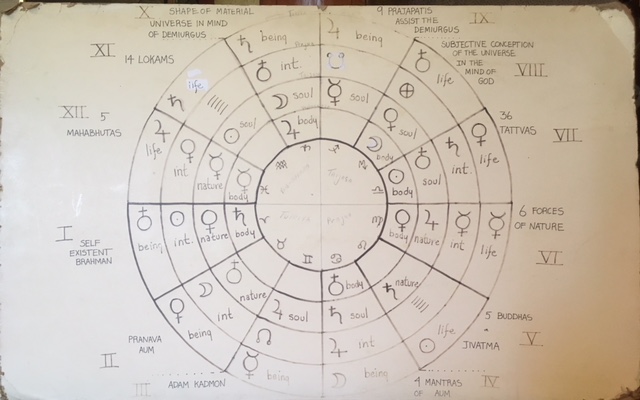
FIGURE IMG_2202-Posterboard Metaphysical Chart.
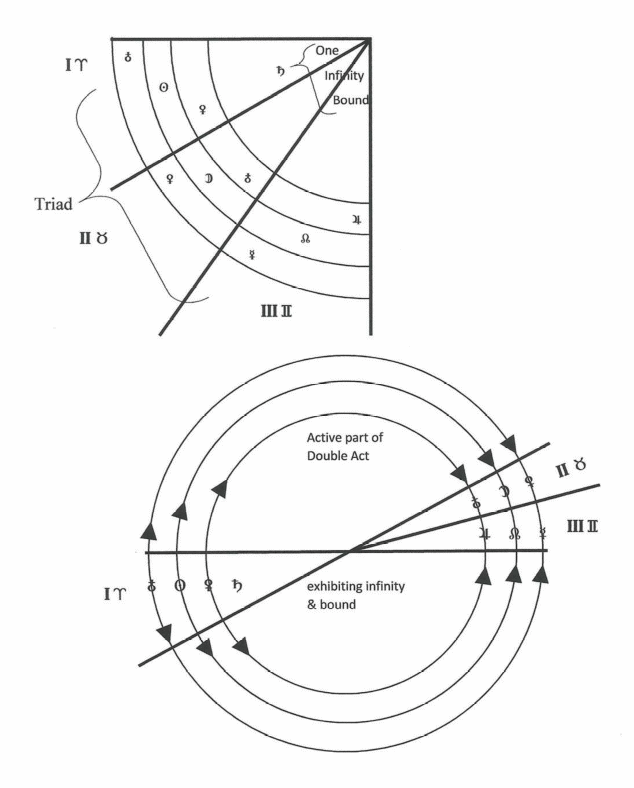
FIGURE AD Supp 28-digital. First Quadrant with One-Infinity-Bound and Triad; Double Act.
[Transcriber note: [diagram] means the speaker is referencing a diagram as he or she is speaking. If someone is drawing or writing, with audible sounds of chalk on a blackboard, I indicate this by [drawing] or [writing].]
NOTE: Wednesday night class, part of Wisdom series 1979-1980.
TRANSCRIBED Verbatim by IT 2018 (earlier partial begun by PFK); reformatted by JRM & JF 2019-2020, with TOC/Subheads by JRM. In 2023, IT updates prefatory matter, footer, and audio file name, completes Book List, adds Plotinus quotes section, adds new note within transcript, fixes errors/typos, adds two diagrams and references within transcript to these diagrams. In 2024, MW alters Subheads to make more accurate. Archival verbatim transcript – V14.1a.
AUDIO FILES: 1980 0109a, 1980 0109b. [Note: "Tape" and "Side" refers to original audio cassette tapes that were later digitized into .MP3 Audio Files.]
1980 01/09 at Wisdom's Goldenrod
PB Books; Wisdom of the Overself; "The Unveiling of Reality"
Archival verbatim transcript
[Audio File 1980 0109a Begins]
AD: --read the chapter on the World-Mind? Um-- [22¼ second pause] I was wondering if I could take the liberty of presenting these two chapters in my own way [one word inaudible] differently than he has them arranged. And I was suggesting that-- [short pause] I was suggesting that we'll weave in some of Plotinus to perhaps help matters, perhaps darken matters. [short pause] Now-- I would-- I-- I want to start with the chapter after the World-Mind and most-- If there's not too may groans, I'd like to start with the chapter on "The Unveiling of Reality" and work back to the chapter on the World-Mind. [32¼ second pause] In the chapter on "The Unveiling of Reality", we'd have to start with the third paragraph. [35½ second pause] So, Avery would you-- third paragraph, (read--)
[Transcriber note: I am using The Wisdom of the Overself by Paul Brunton, Rider and Company, London, 1943.]
PB [The Wisdom of the Overself, "The Unveiling of Reality," p. 191, AS reading]: "The One becomes a multitude [AS reads: multiple]."
S (very faint): What?
PB [The Wisdom of the Overself, "The Unveiling of Reality," pp. 191-192, AS reading]: "The One becomes a multitude. The World-Mind continually and spontaneously throws its being into living universes and living creatures. But that can never exhaust it for it never really loses anything by this process. The One has produced the Many out of itself, not out of some extraneous material, and cannot be measured by its expression in the universe, for this is always an incomplete one. We cannot arrive at Reality by stitching together millions of little pieces. It is not the whole in this sense. It is not only the totality of things but much more the essence of things. [short pause]
"We can easily comprehend how one human mind becomes many thoughts in succession yet still remains beyond them as its unlessened self. We can also comprehend how the same mind exists in all these different thoughts. Thus we can more easily comprehend how the World-Mind can manifest in a million forms and yet remain its infinite transcendent self. It is not contained by the universe, unbounded though the latter seems to be, in the sense that all space is not contained by an empty jar. The jar can only give us through what it holds a bare hint of what space is and the universe too can only give us through what it holds a bare hint of what the World-Mind is. The World-Mind is not only in the universe but also metaphysically beyond it. The finitude of the world points to the infinite which transcends the world. The fact that it is but a changeful Appearance suggests the unchanging Reality which underlies it. If the cosmos is truly a self-revelation of the World-Mind, it is nevertheless neither a full nor exhaustive revelation but only a fragmentary one. Thus the world is exhibited before us as self-revelation of Mind's immediate presence but, until we enquire more deeply, not of its nature."
[58½ second pause]
HOW FROM THE ONE DOES THE MANY ARISE?
AD: Well let's take the first sentence, "the One becomes a multitude". [20¾ second pause] Do you understand that sentence, the One becomes multitude?
S: No.
[laughter, faint background student talking, pause, 13 seconds]
AD: But, the next sentence he s-- he says the World-Mind.
S (faint): Yeah.
S (very faint): Right.
PB [The Wisdom of the Overself, "The Unveiling of Reality," p. 191, AD reading]: "The World-Mind continually and spontaneously throws its being into living universes…"
AD: And then he says--
PB [The Wisdom of the Overself, "The Unveiling of Reality," p. 191, AD reading]: "But that [AD reads: It] can never exhaust it for it never really loses anything by this process. The One has produced the Many out of itself, [AD adds: and] not out of some extraneous material…"
S: Is he-- is he equating the One with the World-Mind? [AD/S(?), faint: Uh-hm.] Does he mean to do that? I don't know what he means by the One.
AD: Well--
S (very faint): Um, yeah.
AD: You have no idea what he means by the One?
S: Well I'm asking if it's-- if it's in--
AD: Well that's-- this is (just/his) dialogue, I can't walk around so--
S: (Yeah.) [few words inaudible]
S: Is he equating the One with the World-Mind or is it something different?
[13¼ second pause]
AD: It becomes the multi-- a multitude. But yet it really doesn't change in any way.
[short pause]
S (faint): What-- what is it [one word inaudible]
AD: This is a classical problem all traditions have, you know. And in the mythological framework, in the setting that is used by most philosophers, it's spoken of in this way. Not that it actually exists in this way, but it's the way that we can understand. [short pause] It's traditional for instance in the-- in the Vedanta scriptures they say, "Only pure consciousness is", it's-- you know. And then you have the problem of explaining well how come there's everything else but pure consciousness. And I don't see it, I don't know it, but I do know these many things. So they have the same problem too, how from the One arise the Many. So it's very difficult [one word inaudible]
S: Well does he mean the Absolute One or the One Being? Is the One speak of--
AD (simultaneously): Well, this is chapter on "The Unveiling of Reality". The One I assume means here the Real, Reality.
S (faint): Which (reality)?
S (simultaneously): Which reality?
S: Uh-huh. (bit of laughter, student words)
S: Well, I had--
S: It's like Prajna reality?
S (simultaneously): Yeah, I had some--
AD: The Reality.
S: Like the first quadrant Reality [diagram]? [Note: See FIGURE IMG_2202-Posterboard Metaphysical Chart appended to this transcript.]
AD: The Reality.
S: Which are not-- that's right.
AD (simultaneously): There's only [RG(?), faint: Say it.] the Reality, there's only the Real.
S: But what-- then-- then what-- but what about the second quadrant [diagram], isn't that real too? I just don't understand the distinction that's being made.
AD: The distinction between?
S: The One and the World-Mind. In this paragraph.
EMD: We can't hear anything back here.
S: I don't understand the distinction that's being made between the One and the World-Mind in this paragraph. Are you saying that there's a distinction Tony?
AD: Between--
S: The One and the Wor-- the One and-- and the World-Mind?
IS THE WORLD-MIND THE MANY OR THE SOURCE OF THE MANY?
AD: Well, I-- I would say so, he's making a distinction, the One becomes a multitude, becomes World-Mind.
S: Uh-hm.
[short pause]
RG: But it's slow. [S: This is--] But is that multitude the World-Mind or-- or its product?
S (very faint): Yeah.
RG (very faint): And there is no [one word inaudible]
AD (simultaneously): Is that--
RG: It seems the second sentence there is so to speak in some way describing, so to say, in that [one/two inaudible student words] the World-Mind is really that becomes the multitude, not the One of the World Mind, if you want to speak that way.
AD: I'm sorry Richard, again.
RG: It seems in-- the way I interpret this, that the World-Mind becomes the multitude, not the One, if you want to call it the One of the World-Mind, or this aspect of the World-Mind which is internalized, not-- not having any relation to any world which is this aspect we call the One. But the World-Mind is the aspect that produces the relative.
AD: That produces or manifests--
RG: Manifests anything, universes.
[student assents, very faint]
AD: The World-Mind or the One?
RG: Well yeah, I would think the World-Mind.
AD: Then why does he say the One? Again, just another sentence down.
PB [The Wisdom of the Overself, "The Unveiling of Reality," p. 191, AD reading]: "The One has produced the Many out of itself…"
S (faint): Yeah.
RG: I think he's trying to integrate the concept of the One and the World-Mind, (think) he's trying to show you there's two different aspects.
[19¼ second pause]
AD: Any other, Alan?
AB: If you-- the fir-- the first sentence in this section he says the World-Mind is bound up with the universe because it is the universal producing it. So I think the One or Mind would be a higher reality which is not necessarily conceived of in terms of the universe or bound up within it. As he said, the universe is in space and time whereas the Mind of the World-Mind is beyond it. So I think the One is a higher reality and World-Mind is always spoken of--
AD: Is always--
AB: Spoken of in terms of the universe which it gives forth. But Mind is the principle, underlying principle which is independently [student assents] conceived.
S (faint): Isn't-- would you say that--
RG (simultaneously): Well I don't think it is independently conceived of. [student assents] He goes on to talk about the first aspect of the World-Mind in alternating activity whereas in the second it finally pulls in that the World-Mind is a single entity from a philosophic standpoint.
PB [The Wisdom of the Overself, "The Unveiling of Reality," pg. 193, RG reading]: "This does not make one less important or less real than the other."
[18 second pause]
LC: I don't see how you can make-- from what we've read how you can make any distinction between the One and the World-Mind. It kind of sounded to me like he was talking about them interchangeably. So I don't understand any of the distinctions right now.
S: And also how did-- when we've-- when we've spoken of the One in the past and we-- the way I've understood it, how can you-- isn't it not possible to really relate it in that way to the-- I just-- I guess I just wasn't sure of the relation of the One to the World-Mind.
AS: Well we spoke of the One as the source of everything too. In fact, we do that, we trace everything back to the One, [S simultaneously: But can--] and he certainly makes the distinction between Mind-in-Itself and World-Mind. He doesn't always call it the One. In fact most of the-- you know, later on in the chapter he calls it Mind or Mind-in-Itself. And he very clearly distinguishes it from World-Mind. Very clear [couple/three words inaudible]
S: But can-- is it-- is it cor-- is it correct to speak of the One as becoming a multitude, is that a-- is that the correct way that you would speak of the One?
AS: Well, is there anything other than the One? He gives the example of Mind.
AD/S(?) (very faint): And how could it become [one/two words inaudible]
AS: How could it become, how else would you speak about it?
AD: Alright, read one more paragraph please. "We cannot stop the dynamic…"
S (faint): Oh.
AD: One more-- one more paragraph.
PB [The Wisdom of the Overself, "The Unveiling of Reality," p. 192, MW reading]: "We cannot stop with the dynamic conception of the World-Mind alone. For so long as it is conscious of its relation to the individual centres, so long as it is active in the out-breathing and in-breathing of universes, so long as it has [MW reads: so long has it] to work with time--however far beyond and beneath our human range its own amazing time-sense may extend--so long is it in the realm of appearance and not reality, so long is it in the sphere of thought-forms and not of undifferentiated Thought itself. We cannot stop with this conception therefore if we would know intellectually at least what is absolutely ultimate, what is definitely final in existence. We must proceed on our way. And indeed it is the World-Mind, the living God Itself, which bids whoever comes to the comprehension that it does exist, whoever understands it to be the ultimate ground of all life and being, to look beyond it to THAT which alone possesses the uttermost reality. He must understand that although mentalism reduces the world to idea, it does not reduce reality to idea. Thus we arrive at the problem of the World-Mind's own nature. After the problem of matter it is the deepest and darkest one which confronts us. And because it is the ultimate source of everything it is likewise the ultimate key to everything. For we have reduced all human beings to cells in this cosmic mind and all material things to the co-produced thoughts of both. Everything exists within an ocean of mind just as all waves exist within the watery ocean itself. Cosmic Mind therefore is unique and like nothing else in existence. It is the ultimate. It is irreducible to anything simpler than itself. The importance of getting even an intellectual insight into its nature and meaning is such that it must simultaneously yield an intellectual insight into the nature and meaning of God and of reality, that is into the most fundamental problem open to human reflection."
AD (very faint): [one/two words inaudible] problem, discuss it, (I'll) discuss. (They want me to do) [one/two words inaudible]
[short pause]
PLOTINUS: HOW DOES THE MANY ARISE FROM THE ONE WHILE THE ONE REMAINS INTACT?
AS (faint): Want me to read?
S (very faint): Uh-hm.
AD: Yeah, the Plotinus. Yeah, I think it's in here. Now, let's read this from Plotinus. Stated a little differently in Plotinus.
AS: Should I read that first paragraph? This is V.1.6.
AD: In Plotinus.
Plotinus [V.1.6, AS reading]: "6. But how and what does the Intellectual-Principle see and, especially, how has it sprung from that which is to become the object of its vision?"
AD: Do you understand the question here?
S: How does the World-Mind spring from the One?
AD: How did the Intellectual-Principle, the World-Mind, arise from the One, ok. And the second part?
S (very faint): I didn't-- I didn't hear it.
AD: Read her the second part.
Plotinus [V.1.6, AS reading]: "[But] how and what does the Intellectual-Principle see…"
AD: What is it that the World-Mind sees? Two questions he starts out with.
S (faint): Ok.
AD: Do you get an idea of the level that this man's talking from? Alright. Let's repeat the questions again. Read.
Plotinus [V.1.6, AS reading]: "[But] how and what does the Intellectual-Principle see and, especially, how has it sprung from that which is to become the object of its vision?"
AD: Alright, you have some feeling of the depth of the question this man is asking. Go on. Next paragraph.
Plotinus [V.1.6, AS reading]: "The mind demands the existence of these Beings, but it is still in trouble over the problem endlessly debated by the most ancient philosophers: from such a unity as we have declared The One to be, how does anything at all come into substantial existence, any multiplicity, dyad, or number? Why has the Primal not remained self-gathered so that there be none of this profusion of the manifold which we observe in existence and yet are compelled to trace to that absolute unity?"
[short pause]
S: Uh-hm.
AD: Do you follow what he's saying?
S: [one/two words inaudible]
S (very faint): Where is the multiple?
RG: Say it again.
AMPLIFYING OUR IDEA OF THE ONE MAY HELP US UNDERSTAND WHAT IT MEANS FOR THE MANY TO ARISE FROM THE ONE
AD: So you see, this is not a new question that-- I mean, it's not in your journal, contemporary journal, it's been around a long time these questions. And it's almost an archetypal question that sooner or later you start asking. If there's only God, like in the Bible it says "Thy Lord-- The Lord thy God is One," [Note: Deuteronomy 6:4.] then you're going to have a problem explaining your presence, or a dog, or a pole, or a cat, because if "The Lord thy God is One," well, where's all this coming from? Alright. That would be for instance a Christian Biblical way of the question. And I just expressed the Vedantic way, they say there's only Brahman. And then somebody, some smart aleck will come up and say "Well, what about me?" (bit of laughter) Yeah. You're going to have a problem. Because you're going to have to explain the manifold, the many. If there's only the One, you're going to have to have a problem of explaining, and you-- you can't say it's not two because the problem is still the same. (By) saying it's non-dual doesn't change-- Let's read this paragraph again by Plotinus.
Plotinus [V.1.6, AS reading]: "The mind demands the existence of these Beings, but it is still in trouble over the problem endlessly debated by the most ancient philosophers: from such a unity as we have declared The One to be, how does anything at all come into substantial existence, any multiplicity, dyad, or number? Why has the Primal not remained self-gathered so that there be none of this profusion of the manifold which we observe in existence and yet are compelled to trace to that absolute unity?"
AD: Now, in many passages he'll reiterate over and over again that regardless the Many coming from the One, regardless, the One remains always intact. That's the complication, alright. The One always remains itself, it never changes, it never alters, it's the only Reality, or they would say it's the Ultimate Reality. So, we have a bit of a problem.
Now-- Perhaps we could tackle the problem by bringing in something else, ok. And that would be to give some kind of clue as to what Plotinus means by the One, the Supreme, the Infinite, whatever you want to call it. And if we can get a glimpse as to what he means by the One, then maybe we can understand the possibility of what we mean when we say the Many or the World-Mind arises from the One. So, maybe if we expand, amplify our idea of what the One is, ok, that might give us a clue. So, one of these books that-- By the way, we've done a bit of work on this so for some of you it may-- it may seem redundant. Don't make that mistake. [11¼ second pause]
We're going to read from Deck's book which is called Nature, Contemplation, and the One, his translation of a very difficult passage in Plotinus. But before we do that, why don't we turn to the passage and just read a few of the lines from Plotinus himself.
From now on, by the way, I'm not going to follow PB in the usual way. I'm going to have to bring in anything I can to help you understand some of the ideas. And if I think PB is interfering in helping me to understand or you to understand, I'll throw PB out the window just like I'll throw Plotinus out the window. What I want is for us to understand. If we don't understand, then-- well, you just have to do it again. So who has time to do these things over and over? Now here's some passages from Plotinus. These are passages that reveal that he had the experience. If you listen very carefully, you can see he's speaking about something he had gone through. You can call this the experience of the One, you can call it Nirvikalpa samadhi, you can call it anything you want. Listen to the passages. Just pick out a few from, what was it, 16, 17, 18?
THE ONE AS SUPREME UNDIFFERENCED KNOWLEDGE
Plotinus [VI.8.16, AS reading]: "If God is nowhere, then not anywhere has He 'happened to be'; as also everywhere, He is everywhere in entirety: at once, He is that everywhere and everywise: He is not in the everywhere but is the everywhere as well as the giver to the rest of things of their being in that everywhere. …
"That his being is constituted by this self-originating self-tendance-- at once Act and repose--becomes clear if we imagine the contrary; inclining towards something outside of Himself, He would destroy the identity of his being. This self-directed Act is therefore his peculiar being, one with Himself. Thus, He created Himself because his Act was inseparable from Himself. If then this Act never came to be but is eternal--a waking without an awakener, an eternal wakening and a supra-Intellection--He is as He waked Himself to be. This awakening is before being, before Intellectual-Principle…"
AS (faint): And so on. [short pause] Do you want to read (the passage)?
AD: No, just right here. I know these are difficult but we'll explain it a little bit, we'll try to explain it.
S: Tony, what were you reading from?
AD: Sorry?
S (faint): [one/two words inaudible]
AS (simultaneously): VI.8.16 and VI.8.18.
Plotinus [VI.8.18, AS reading]: "Seeking Him, seek nothing outside of Him…"
AS: I'm sorry.
Plotinus [VI.8.18, AS reading]: "…seek nothing of Him outside; within is to be sought what follows upon Him; Himself do not attempt. He is, Himself, that outer, He the encompassment and measure of all things; or rather He is within, at the innermost depth; the outer, circling round Him, so to speak, and wholly dependent upon Him, is Reason-Principle and Intellectual-Principle--or becomes Intellectual-Principle by contact with Him and in the degree of that contact and dependence; for from Him it takes the being which makes it Intellectual-Principle."
[short pause]
AD: Alright, now here's a slightly easier version to read from Deck. [short pause] Now he's speaking-- he's going to-- we're reading from this tractate that we just read but Deck's translation is a little easier. And we'll try to throw some commentaries into it so that maybe it--
[Transcriber note: I am using Nature, Contemplation, and the One: A Study in the Philosophy of Plotinus by John N. Deck, University of Toronto Press, Toronto, 1967.]
John Deck [Nature, Contemplation, and the One, "The One," AD reading]: "In these lines the One is said to look at itself…"
AD: You can think of the One as God, the Infinite, it doesn't matter, they're just names.
John Deck [Nature, Contemplation, and the One, "The One," AD reading]: "…the One is said to look at itself, and a little further on in the same passage the One is called an eternal super-knowledge: [AD: Quote from Plotinus.]"If, now, its [the One's] act [AD reads: If, now, its act, the One's act-- If, now, its act] does not become but is always, and is a kind of wakefulness which is not other than the one who is awake, being a wakefulness and an eternal super-knowledge, it will be in the way it is awake. The wakefulness is beyond being and Nous and intelligent life; the wakefulness is itself.""
AD: You get any feeling for that? This is exactly what the Hindus would call Turiya, pure consciousness, alright, where the awakener is not different than the wakening, that is the consciousness and he who is conscious are not different from one another, you don't have two items in this knowledge, you have one supreme undifferenced knowledge. You could use perhaps the-- you know, the worn-out analogy about water, alright. In other words you have foam, you have spray, you have waves, alright, and you have the ocean. But all is immediately subsumed and homogenized by the word 'water', ok. All distinctions get abolished as soon as you said 'water'. They're all gone. If you want to, try to think of it that way. Think of the supreme consciousness, this wakefulness, as the totality of all knowledge. Alright. And there is no distinction within all of this knowledge. It will be like the waves, alright, the foam, the spray, the ocean is all water. Now, we have to think of the One in this sense, that it is the supreme knowledge. Everything within it is homogenized, alright. This he would call the wakefulness. A little bit more.
[short pause]
John Deck [Nature, Contemplation, and the One, "The One," AD reading]: "He has said a little above that"the most lovable in the One is, as it were, the Nous" [AD: World-Mind]. The force of this becomes manifest when we realize that he can not be referring to the hypostasis, [the Nous]."
AD: Or what we would call the World-Mind. He can't be referring, Plotinus can't be referring, to the World-Mind in the One when he uses the word Nous. So then what is he referring to?
John Deck [Nature, Contemplation, and the One, "The One," AD reading]: "The One is the Good, the good for the Nous-hypostasis [AD reads: World-Mind hypostasis] as well as for everything else, the supremely lovable. Here he says that the most lovable in this [AD reads: the] supremely lovable is, as it were, intelligence."
TRUE KNOWLEDGE IN PLOTINUS' SENSE OF THE TERM PRECLUDES ANY KIND OF KNOWING OR SOMETHING THAT KNOWS SOMETHING ELSE IN IT
AD: Let me (read) this other passage and we'll talk about it. He's still speaking about the One. [short pause] Now he points out that the World-Mind-- World-Mind and Nous are used interchangeably so if I don't say it you'll know.
John Deck [Nature, Contemplation, and the One, "The One," AD reading]: "After remarking that the Nous is multiple [AD: that is] (as containing the multiplicity of the ideas and as being composed of the known and the knower), Plotinus goes on to say that the One is [AD: Listen.]"not, so to speak, imperceptive, but everything of it is in it and with it [i.e., it is entirely self-contained]; it is entirely self-discerning; life is in it [and] all things are in it; and its self-knowledge is itself, a self-knowledge by a kind of synesthesis [AD reads: synthesis] being in eternal stasis and in a knowledge otherwise than knowledge according to the Nous [AD reads: World-Mind].""
AD: Alright, I admit these things are very difficult but I think, I think you can try to contemplate some of these ideas. What is he saying here? Remember we pointed out that the One has to be completely, totally the One, nothing else but the One. And so we use the analogy of water to include and subsume the variety of forms that water may take. Now he's using a similar point of view, he's thinking of the One as the super-knowledge, alright. We can call it metaphysical infinity but that's not going to help, alright. And we could call it Active and Passive Perfection but that's not going to help. So we have to find some kind of words that convey some of these ideas, otherwise you'll just be reading 'the One', or 'World-Mind', or 'Mind'. And I know those words could, you know, actually-- you actually think you understand.
[short pause]
John Deck [Nature, Contemplation, and the One, "The One," AD reading]: "Thus knowledge, which appears in a way in nature, more fully in soul, perfectly in the Nous [AD reads: World-Mind], is not absent from the highest"nature," the One: the continuity of knowledge is not abruptly broken in the ascent from the Nous [AD reads: World-Mind] to the One.
"A knowledge, which is a self-identity--this is not so alien to Plotinus' usual notion of knowledge [as may first appear. On] all levels the nisus of knowledge is towards identity: knowledge becomes truer [AD reads: true] as knower and known become more identical."
AD: So then in that case, when you actually do reach the One, there should be a total identity of knower and known, and no longer even existential diversity, even that would be gone.
S: You wouldn't be able to speak of the One like as knowing anything, I mean in-- in-- in the sense [AD simultaneously: Yeah. Be--] of-- in the sense of a subject knowing an object.
AD (simultaneously): Yeah, because by definition if [S simultaneously: Right.] this is true knowledge in Plotinus' sense of the term, it would preclude any kind of knowing. Now that's paradoxical, isn't it? If this is the One, and if the One we said is true knowledge, absolutely true, homogeneous, everything is in it and with it and has it, alright, then there can't be something that knows something else in it. [student assents, faint] You follow that?
S (simultaneously): It is-- it's like it is what it knows but not-- not in a--
AD: Not in a dualistic way
S (simultaneously): --dualistic sense, it just-- it's this unity that-- I don't know how to really put it.
AD: It is this unity which precludes any knowledge of itself. Well think-- you have to slowly assimilate these things. Unity, if it's true unity, cannot know itself because to know itself there would have to be [S simultaneously: Be two things.] two things. [student assents, very faint] So it can't even know itself.
S: But then what-- if it doesn't know itself, then how-- how do you-- how do you speak of--
AD (simultaneously): That's-- it's not the question now.
S: Oh, alright.
AD: The question right now, we're trying to grasp something of the nature of the [S simultaneously, faint: Ok.] One. So while we're discussing this, we're also discussing for instance what in Hinduism they would call Turiya or pure consciousness, we're discussing the same thing. So, if we can get a little bit of a glimpse as to what the nature of this kind of absolute knowledge is, or pure consciousness is, we'll have something to work by. But there would be no sense discussing the One if we don't have some clue, some indication, what it is that for instance most of the major traditions speak about and what we ultimately and finally are really interested in. I mean, it (seem--) it's a worthwhile piece of information to have. It's only conceptual but nonetheless necessary. So that, you know when you come out of meditation and you saw dazzling lights, alright, you won't go around thinking that you saw the One. Because you know that by definition that couldn't be. It can't be the One. It could be other things, yes, but not the One. So the-- the knowledge of the One or the experience of the One is no experience.
S (faint): But it's not like-- and so if you experience the One in meditation, you wouldn't know that you experienced the One until you-- or until you can be--
AD (simultaneously): Until you get it confirmed by a Sage.
S: But I mean, that--
AD (simultaneously): We won't know.
S: You won't-- you won't [AD simultaneously: You won't know.] know it unless, I mean-- until you're not there anymore, right?
AD: Wait, you're not there. There's no "you" to talk of knowing something.
S: (It's in) always-- like when you're in that kind of a state you don't-- there's just no knowing of [couple words inaudible]
AD (simultaneously): Well, by definition it wouldn't be a state, right. Because a state would be a qualification.
[short pause]
S: So you could describe it as what, almost like a total identity and-- I mean is that (clear)?
AH: (Would) you speak up please? Can't hear back here.
S: Can you describe it as like a-- a total identity without any knowledge at-- at all?
AD: But if you say it has no knowledge at all--
S: Well not-- no knowledge in the-- in the sense of how we think of knowledge, and, you know, like--
AD: But, even, even the way the World-Mind thinks. (bit of laughter)
S (very faint): [couple words inaudible]
S (very faint): Right.
S (faint): World-Mind.
S (faint): Right.
S (very faint): Yeah.
S (faint): So the World-Mind is-- I mean you'd say that there (is) this identity to (World-Mind), that the knower through its object is identical with what it knows, you know. There's an identity there too but-- but we allow the distinction of knower and known. You'd say that through the knowledge that it knows itself as none other than the (object).
S: Uh-hm.
S (faint): But it says here--
AD: But it's not an ultimate simplex, is it?
S: No. But here you can't even-- I mean to call it knowledge-- seems that you're talking about-- it's really not like knowledge, I mean you can't even-- I mean even to say identity is like two terms.
[student assents, very faint]
AD: Well from-- most often, yes. But, you have to remember that most traditions would call this truly knowledge and everything else, relatively speaking, ignorance. This is what they would call knowledge. And so when you come across the term 'knowledge' in the Vedanta scriptures you have to be very careful that you keep in mind what we're just talking about. Everything else-- anything down below that they would consider some form of ignorance--exalted, less exalted.
S: So what does knowledge mean, what is super-knowledge? When-- what way can we think of it?
AD: I thought the whole purpose here was to show that we can't think of it.
S: So what do we speak of when we say super-knowledge? What do we mean by that?
AD: Well it's a round-about description.
S: Of-- of the One?
AD: It's a sort of negative description.
[9 second pause]
S: Of what, what is it-- what were you (saying)? (laughter) There is no "what", but-- So it's just a-- it's a-- [9¾ second pause] So it's a description of this type of identity, this self-identity.
THE IDEA OF THE INFINITE IS THE ONLY TRUE POSITIVE IDEA YOU CAN HAVE
AD: Yeah. [short pause] Well at least we could say something like this, we-- at least I've noticed this much, that nothing is excluded from it. Look at it this way. It's the most positive idea that you can have. The idea of the Infinite is the only true positive idea you have. The idea of anything else has to be negative. Look at it that way, alright. For instance, if I tell you-- if I-- if I ask you what is so and so, this-- what is a table or what is a city or what is anything, alright, your definition would have to exclude, alright, so much, alright, show what the boundaries of this thing are, and in a sense, the definition arises because you'd negate everything else which is not that thing. So definition arises in the sense that Spinoza pointed out--it's a negation or a determination-- negation is determination. Now, the notion of the Infinite is the absolute opposite. You cannot exclude anything from it, because if you excluded anything from it, it wouldn't be the Infinite. So the idea of the Infinite is the most definite positive idea that you could have.
AH: Seemed to be excluding the possibility of-- of knowledge of it.
AD: Knowledge of it, yeah. That's included.
AH: But (as/so) far as knowledge of it, it's not possible in any conventional sense.
AD: Well when we say included we mean that you cannot exclude even that. So that if you speak of someone having, or the World-Mind's innermost self is the One, if you say something like that, alright, that's included in the-- in the idea of the Infinite. In other words what we're saying is, anything that we're going to derive, we're going to derive from this definition of the Infinite. Anything that we can speak about will have to come from that. Now, Plotinus makes the point that the next highest principle, the World-Mind, comes from that, comes from the One. But if it comes--
(Side 1 of original cassette tape digitized as 1980 0109a Ends; Side 2 Begins)
AD: --he is, that Plotinus says no, this doesn't happen, that when you, so to speak-- when the genesis of the World-Mind is explained, the One remains what it always was, this pure undifferentiated consciousness, this undifferenced knowledge, this absolute knowledge.
S: But you seem to have something other than itself once you've taken-- no, that we don't but, we take principle like the World-Mind, it then becomes a multitude, [AD: Uh-hm.] certainly seems other.
AD (simultaneously): That the One would be that much the less?
S: Right.
S (simultaneously): No, not so much that the-- that the One would be less but that there is something definitely other when you're talking the One and the-- and [one/two words inaudible] I mean, there's consciousness of things, there's (therefore) consciousness and-- Knowledge has become twofold in a way.
S: Yeah.
AD: Try again, keep-- keep at it.
S: Well, since I don't understand the principle so well it's very difficult to explain what I don't understand but, to posit the One as-- as being pure consciousness, all this knowledge which is not knowledge of anything, just knowledge, and then you have a-- you have the principle of World-Mind which is derived from the One, which now-- which now makes possible, many steps down, but which now makes possible things like consciousness, now you have consciousness of something. When we talk of consciousness from our point of view it's always (about) consciousness of something, or knowledge of something. It's-- it's the states that are-- would be totally alien to the (One).
AD (simultaneously): In other words-- yeah. In other words, now you have Number from the One. Before [student assents] you only had the One, now you got the two, the three, the four, [S simultaneously: And on so on, (uh-hm).] the ten, all the others.
S: Certainly it seems so different in nature. But from what we've read, (you know), the One is just all-inclusive.
AD: Well, the One is all-inclusive, and that we have to try to understand first, e-- alright, even if it-- even if a paradox arises, we have to establish very clearly in our mind that the nature of the One is this all-comprehensive, undifferenced, absolute knowledge. You can't even include no-- notions like motion and rest, things like that. And all of that is wiped away, alright. You have just this homogeneous, synthesized purity of undifferenced knowledge. And it's mind-boggling, you know?
S: It's just totally inconceivable.
AD: Yeah, that's-- that's exactly the point. The most positive of all ideas, the Infinite, is totally inconceivable.
S: Because we try to conceive it from where we stand.
AD: Alright.
S (faint): Yeah.
AD: Then the next point is, we're going to have to describe, or he's going to describe here that the World-Mind arises from that and the One remains one. It's like if I take away from five, four, I still have five. Something's going on that I don't understand. And that's what most of the texts will say over and over again.
S (very faint): [one/two words inaudible]
THE TWO PHASES OF THE ONE—ACT AND REPOSE, ACTIVE PERFECTION AND PASSIVE PERFECTION—ARE ONE AND THE SAME
AH: Anthony, the passages that were read referred to the-- the One and the self-Act.
AD: Yeah.
AH/S(?) (faint): (Would) you say something about that also?
AD: Alright, we'll talk a little about that too. He speaks about the One as being in eternal repose, and he speaks about the One as having this self-tendance or self-originating knowledge. So he's speaking of the One as having two aspects, alright, but these two aspects together are not aspects, they're one and the same thing. Like I say the pole is six feet high, alright, and weighs twenty pounds, I'm not speaking about two things, I'm speaking about one thing. Now he's speaking about the One as having these two phases. On the one hand refers to it as Act and on the other hand he refers to it as Repose. In Chinese philosophy you have the same thing. They call it Active Perfection, alright, and Passive Perfection. And the two of them are the same, they're both one.
S (faint): I can tell that he didn't hear the--
AD: Passive. Passive Perfection and Active Perfection. In the Vaishnavite philosophy you have what they call Parasamvit with two principles, Siva and Sakti, alright. And that sounds very foreign, you say, you know, you could just as well speak in Greek for all I care. But, if we-- if we use the English equivalents, like we could say this entity has two aspects: on a one-- on the one hand, the totality of all the samskaras, and on the other hand, the boundary of that totality. And these two constitute the entity, the one entity. So we're taking a one entity, we're dividing it in two, alright. But the continuum remains there, alright, you would have to keep this in mind. While I divide the entity in two, the entity as a continuum remains there. It doesn't dissolve, it doesn't disappear. You follow that?
AH (faint): Is that a-- is that hard to understand because, if we juxtapose terms like repose and action, it's hard to conceive of those simultaneously.
AD: Yeah because they're usually, in our thinking they're opposites.
AH/S(?) (faint): Right.
EXAMPLE OF THE PASSIVE/ACTIVE ASPECTS OF AN ENTITY: AN ENTITY WITH SAMSKARAS (ACTIVE SIDE) THAT HAVE A BOUNDARY OR LIMIT (PASSIVE SIDE)
AD: Alright. So that they would be very hard to reconcile in one entity. But if we take the example of an entity, a person for instance, he has certain samskaras or vasanas or memory traces, the boundary of the entirety of all these memory tr-- memory traces could be conceived of as, let's say, the passive side, and the activity of these samskaras can be conceived of as the active side, and these two together constitute this unity. I don't know if that helps.
AH: Well I missed-- I missed the point of the boundary.
S: Yeah, [S simultaneously: Yeah what-- what does it mean?] what does that-- what does that mean, the boundary of the entity?
AD: Well-- the boundary of all the vasanas?
S: Yeah.
AD: Like for instance if there was no boundary of the samskaras you operate with, then you'd be eating grass, (bit of laughter) alright, because all the samskaras would include every-- every samskara that you ever experienced, all the traces left behind in you. Let me try this way.
S (very faint): Go ahead.
AD: Uh-- [short pause] How would you combine one, two and three, that will always give me six no matter which way you combine and recombine, isn't that so?
[students assent, very faint]
S (very faint): Well is that--
AD: Huh?
S (very faint): Is that on the border?
AD: I'm sorry.
S (very faint): Is that on the border of--
AD: Yeah, and what would you come up with? [one/two inaudible student words] No matter how many different ways you did it. But you-- you have how many digits or integers?
S (very faint): (Only) three.
AD: Three, right?
S: Yeah.
AD: So no matter which way you combine them, shuffle them, recombine them, you'll always come out with six.
S (faint): Yeah.
AD: Now six would represent the boundary. It would represent the limit-- the limit. The digits would represent the unlimited.
S (very faint): (Yeah) [one/two words inaudible]
S (very faint): (That's easy.)
S (faint): (No.)
AD: Think of an easier way, you think of an easier now.
S (very faint): (What Jeanne) [three/few words inaudible]
S: Are you going to use the One?
AD: In other words what I'm trying to say is there's parts to a thing and these parts could be combined in a variety of ways. The limit of the variety of ways in which it can be combined would be equivalent to the boundary of the thing. So if you take these three numbers, one, two and three, no matter how many ways you combine them, you come up with six all the time, over and over again. Six would represent a fixed boundary, it would represent what, for instance, Plato calls the limit. Whereas one, two and three would represent the unlimit. There's no-- no limit to the number of ways you could combine them, alright, they're just--
NO MATTER THE VARIETY OF WAYS THE TOTALITY OF POSSIBILITIES ARE COMBINED AND RECOMBINED, THEY ALWAYS REMAIN THE INFINITE, THE ONE
[Note: See FIGURES IMG_2202-Posterboard Metaphysical Chart, AD Supp 28-digital, First Quadrant with One-Infinity-Bound and Triad; Double Act, appended to this transcript for the following.]
So if we do something like this and we turn to the chart(,) (we/and) do this. [drawing] One, two and three. And Plato would refer to this as the One [diagram], alright, this the unlimited [diagram] and this the limited [diagram]. And no matter how you combine these here, it always remains [AD hits board to indicate] within that boundary, so to speak, this boundary within here [diagram] or what we're calling six. So limit would represent one aspect, unlimited would represent another, and this would be the One. So you take (a/the) one entity, you take the totality of the samskaras that he operates with, ok, and you'll always come up, so to speak, with the same entity over and over.
Let me try it metaphysically now. The totality of possibilities which we call the Infinite, no matter how-- in what variety of ways they're combined and recombined, they are always the Infinite. It always remains the Infinite. No. Well I said it was going to be hard class.
S: How does that have to do with eating grass (and) [one word inaudible] (laughter, student words) I'm really-- I don't understand how-- I mean--
AD: No. Forget about that, forget about eating grass. I'll go out and eat some. (laughter)
S: You know, you said well you'll be eating grass. (laughter)
AD: Forget about it now, [S simultaneously: That's right.] forget about (him).
S (very faint): [one/two words inaudible]
AD: I have to think of another analogy.
S: The whole idea of limit [three/few words inaudible] (any/would be) different than we conceive it when we [three words inaudible]
S (simultaneously): What? (laughter)
S (faint): Thank you.
S (simultaneously, faint): We can't hear.
AD: Speak up, speak up.
S: I said the whole idea of limit would be-- would be different than how we conceive it if you're speaking of it in terms of the One because limit is that it's infinite. You know, it's not-- It's a funny way to think of a limit, a limitation, or boundary.
[9¼ second pause]
RG (very faint): [one/two words inaudible] how do we say that is a limit?
S: I didn't.
S (faint): So that's what you mean. (S laughs a bit)
RG (faint): How could we say that's the limit?
AD: Is that outside?
RG (faint): Well, in what sense does it mean that, to call it limit?
AD: Well you--
RG (simultaneously): Then it must be that.
AD: You can use the term 'boundary'. You don't have to get stuck on one--
S (faint): That-- that's the other side of action.
AD: The-- if you think of permutations and combinations, what we're saying is that they're not infinite, there's a limit to the number of combinations possible.
RG: Yeah.
AD: So that for instance, if we say that you are constituted of such and such samskaras, that there's a limit to the variety of combinations that these samskaras can coo-- be coordinated so that a certain entity results.
S (very faint): That's right.
AD: The very-- the very nature of that limitation or the very nature of the limited number of combinations is what we're referring to as limit.
S (faint): That's right.
AD: And that is what they would call the passive aspect. And these here [diagram] they would call the active aspect. So this would be power [diagram] and this would be the limits of power [diagram].
RG: Ok, but are we speaking of it there in terms of the One or in terms of the World-Mind?
AD: I'm not ready for that yet, we'll do it. Who is that, huh?
S (simultaneously, faint): Which is action and which is (his/this) (own) entity?
AD: It doesn't matter right now! It doesn't-- what does matter is can you see that the two of them combined in a variety of ways is all subsumed under the continuum of One.
S: Well what's difficult is to-- is to limit something that's infinite and [one word inaudible] it to some very special sense of-- of the One. But still when we-- when we do the terminol--
AD (simultaneously): Well--
S: Limitation, how come from so great a One (there's limit)?
AD (simultaneously): Well, if you say metaphysical infinity there, haven't you brought that in? When you say metaphysical infinity, [S: Yeah.] is that many ideas or one idea?
S: So in calling it one idea we've limited for it(,) showing us its limited aspect(s).
[student assents, very faint]
RG (faint): But (isn't it an idea also)?
AD: No, one minute, you're running ahead of me. This is hard enough. Don't run too far ahead.
CDA: Can we think of it that the reason we would-- would be conceived as the limited and unlimited in that-- in that the-- all the knowledge that's contained in the One, that the One has the knowledge of-- already of the World-Mind within itself.
AD: And of [CDA simultaneously: And that--] all the Beings.
CDA: And so that in terms of that knowledge already being the One, there would be the-- the limited and the unlimited.
AD: Yes. So, you're saying something like this. Within the One is already included the knowledge and the Beings, all of them. [student assents, faint] Alright.
CDA: And so it has to unfold this, the know-- and the knowledge of the way that these would be unfolded is already there and so the very first step of this unfoldment would (me--) although you can't think of it in time and space but-- I'm just asking, is that a correct way of thinking of the limited and unlimited?
AD: [one/two words inaudible] That's what we're trying to [CDA simultaneously: Um, uh-hm.] get at. It doesn't matter that later on we're going-- we'll be able to say that these will be infinite essences, you know, doesn't matter now. The point right now is that we have to see it subsumed all under the One because this whole first quadrant [diagram] is nothing but the ultimate Reality. Alright, we tried. We back up, we try a different approach.
MB: Is (it/that) fair to state [S: I could--] the problem or whatever again, like before when Pat asked about the One, you said that-- you said to her it doesn't include knowledge, it doesn't include the ideas of motion and rest. And yet we also think of the One as having to include everything, so that--
AD: I'm sorry, the One--
MB: We think of the One as having to include everything, everything is included in [AD simultaneously: Uh-hm.] the One, nothing can be excluded, the One is the One. So when you bring in the principle of knowledge, you can't say oh, now you have something other than the One because it's included within the One. And yet when you consider the One, you can't consider the ideas of motion per se or rest per se. The One is so much more than that, that those principles do not exist as such.
AD: As separately.
MB: As separately.
AD: Ok. Go ahead.
MB (simultaneously): Still doesn't answer the question 'cause then how else--
AD: No but we're not-- we're not going to answer any questions. We're going to have to try to bring out problem.
MB (faint): That's what I [one/two words inaudible]
THE ONE INCLUDES THE WORLD-MIND WITHIN ITSELF IN A MODE THAT IS TRANSCENDENT TO THE WAY THE WORLD-MIND ACTUALLY EXISTS
AD: I don't care about answers. [students assent, faint] So then we begin to get some indication that the nature of the One includes integrally and principally everything within itself but in this homogenized way that we spoke about. Now if we can think of the One or the nature of the One in that way, then the s-- the next step will be a little easier, how does the World-Mind arise from that. Because if the World-Mind is not within it to begin with, we'll never be able to get it out. So then in some mysterious way, the One includes the World-Mind within itself and the World-Mind that it includes within itself is something of a higher, a superior, of a more transcendent mode in the One than the way it actually exists as the World-Mind, to use Plotinus' expression. In other words, the copy of the World-Mind which exists in the One is truer than the World-Mind as it actually exists. [S, faint: Yeah but--] So--
S (very faint): So--
S: The copy of the World-Mind?
S (faint): [couple words inaudible]
S (simultaneously): You mean a copy of the--
AD (simultaneously): Well, look, they're only words, I mean don't hang me now.
S: I'm not hanging you, I just want to understand what you're saying.
AD (simultaneously): Alright, we're saying-- look, here's the World-Mind, there's the World-Mind, alright. But the prototype of the World-Mind must exist in the One. [S: Yes.] Just like we say anything that exists, its prototype would have to be in that absolutely undifferentiated knowledge, [S: Right.] alright, because where can it come from? Follow that?
S: I think so.
S (very faint): Not following.
S: So?
S (very faint): Yeah, so?
AH (simultaneously): What's the prototype Anthony, what-- why did you just say to (speak/think) of the World-Mind as prototype and the World-Mind as-- as World-Mind? I don't-- I really don't understand that division at all. Is it like one aspect of the World-Mind is truer than the other? Is one more separate from the One than the other?
AD: Well--
S (very faint): Yeah but--
AD: Go ahead.
AS: Alright, wouldn't you say that insofar as the World-Mind has a being of its own or a hypostasis of its own, it's a separate principle, it's distinct from the One. So it must be of a lesser-- I know it sounds funny but, can you say it's of a lesser order of reality when it-- when it exists in its own right as the manifestor of the world than when it is conjoined back to the One, than-- than when it is within the depths of the One. So as within the depths of the One it's more real or has a higher-- or is ult-- within that ultimate Reality is a higher standpoint than saying that it even has its own existence in its own right as a separate principle.
S (faint): Or it retains its identity while its attached to the One? [students assent, faint] As prototype of World-Mind?
AS: Not if you mean by Being, not if you mean-- not if you mean existence. It doesn't have its own existence when it's back in the One. It's only the prototype of the World-Mind, just as a prototype of everything. It's like I think the way we spoke of the Intellectual-Principle in Plotinus, the-- a unity-in-duality of Intellect and Being. Right, now that Intellect and that Being have a prototype back in the One. In fact that was this bound and infinity that we spoke of. [S: Avery--] Now you would say that the bound and infinity there is higher than the World-Mind. But yet that bound and infinity are the very prototypes of those-- for that duality of the World-Mind. Its Being and its Intellect, the World-Mind's Being and the World-Mind's Intellect are derived from that bound and infinity that are in the One. In fact they're already contained in it.
EC (faint): Avery?
AS (very faint): (Yeah.)
S (faint): Yes.
EC (faint): Would (you hesitate to say) that (one/when)-- of the One is timelessness that they speak about and when it's the World-Mind it's eternal, it's just of great eons of time but it's not still the timelessness, which would make [AS simultaneously: Maybe.] (two) [one word inaudible] Would that-- would that be helpful?
AS: Maybe, I--
EC (faint): Would you-- would you discuss the difference of timelessness and [one word inaudible] I always thought it was a timelessness one and then the World-Mind (is) eternal. Is that correct?
S (very faint): (I don't think so.)
[student assents, very faint]
AS: I don't think(--/.)
S (very faint): (Uh-hm.)
S (very faint): [one/two words inaudible]
S (very faint): [couple/few words inaudible]
S (faint): No, go ahead.
AD: Go ahead.
S (very faint): [couple/three words inaudible] (laughter)
S (amidst laughter): Back on the newspaper(s).
[18 seconds of laughter, background student talking]
S: Put up that.
RG: What? No, I don't-- I-- I don't understand the bound and infinite, to speak of it as within the One, why-- why [couple/three words inaudible] and [AD simultaneously: Hm?] where establish that (whole)(--/.) And why those are not the two principles of the World-Mind.
AD: Why those are not--
RG: The two principles, not "of" in terms of transcendence but con-- constituents of those.
AD: I'm sorry, we have to try again. We have to try again. I wasn't-- I wasn't here, go ahead, again.
RG (simultaneously): I don't understand why the bound and infinite are spoken of as aspects of the One and not as constitutive aspects of World-Mind.
[25 second pause]
AD: I think you have this problem in the Plotinus class too.
S (very faint): Yeah I do.
S (very faint): [one/two words inaudible]
S (faint): Uh-hm.
AD: Well--
[11½ second pause]
RG (faint): Well put it another way, I can't understand why [one word inaudible] we can't put (like/that) everything (exposed) and (integrated) within the World-Mind, why we-- we think of everything united within the One. But in terms of content--
AD: In terms of?
RG (faint): Of content or Ideas or whatever term we're going to give to all po-- all possibilities that are going to arise, why we can't speak of that as inhering in the World-Mind, I mean that's the Mind of the world, that's the Mind of all-- of all universes, of all to come. I don't understand why we have to transcend that (for) all possibilities. [11¾ second pause] I thought that the World-Mind contained the whole thing in itself as (this) [few words inaudible]
S: Well that's the question.
S: Yeah.
RG (simultaneously): Well, it's not a-- isn't that an answer to your question?
S (very faint): No.
RG: 'Cause it hasn't been. And I don't care (if it's just scrapped). Just seems that the World-Mind itself would be an aspect of the One which contains-- it is that aspect of the One which contains all things, not essentially different. It's its outward-facing view.
AH: The World-Mind is it's--
RG (faint): Yeah.
AH: But also has an inward-facing view of everything.
RG: Right. And that you call Mind-in-Itself.
AS: What happens to those "all things" when you (think/speak) about the inward-facing view, do they go on subsisting somewhere outside of the inward view? Or do they get absorbed back into the inward view (itself)? If they exist somewhere outside of the world, if they exist outside even when the World-Mind faces inward, then there's some other reality. If they get absorbed back into the One when the O-- when the World-Mind faces back in, then they are originally part of that inward-facing view.
AD: And a higher part at that.
AS: So either way, I mean, you ha-- either way you have to admit that if there's not a duality then those must be traced back to that inward-facing view and not just to the outward.
AD: Do you follow the problem here? Otherwise you-- you think we were getting upset about-- But go ahead. Tell us what you don't understand. It's much more important to understand the problem than to worry about the answer. The answer may take a whole Manvantara. The problem you can see, you can see it here and now. Go ahead Alan. Go ahead.
AB (simultaneously): Perhaps it won't work to use this analogy but say the analogy we used of the water. Like you have all these distinctions of foam and waves and spray and everything, and they exist, and then you say water and they're all abolished. But yet, we don't say the prototype of those distinctions exists in the water because the spray is still spray. You know, there isn't a prototype spray in the water which is different from the spray or the waves.
S: (What/Where)--
S (simultaneously): Where could those things possibly come?
AB: Well-- [S simultaneously: Darkness. Keep going.] well I'm just saying, why say-- why do you need to say that there's a prototype of the World-Mind in the One. The World-Mind is in the One either as World-Mind or as--
AS: If it's in the World-- if it's in the One as World-Mind, then you have a duality in the One. So it can't be that.
AB (simultaneously): No, because it's not outside of the One.
AS: Exactly, then it's-- then it's the One as conjoined with the One and that's what we're calling the prototype. The World-Mind in the One is the prototype of the World-Mind.
RG (faint): But how [couple/three words inaudible] the World-Mind(--/?)
AB (simultaneously): And it is the World-Mind!
AS (simultaneous): No, because [couple inaudible student words simultaneous with AS] if it's in the One it can't-- it can't be a distinct hypostasis of World-Mind. If it remain-- as long as whatever you're calling that remains within the One, it's not the World-Mind per se, it's not [RG simultaneously: (Why?)] the World-Mind as a separate hypostasis.
AB: But there isn't anything that's--
AS (simultaneously): Because that's the One, it's conjoined with the One.
AB: But you can't speak of anything that isn't in the One.
AS: Can't speak of anything, (well--)
AB (simultaneously): That exists outside of the One. So then the way you'd be defining hypostasis couldn't exist.
S: (What/Why) though, I don't get that.
AS: Doesn't 'exist' means to stand outside him?
S (very faint): [one/two words inaudible]
AB: Yes, it does. But it really doesn't.
AS (simultaneously): Well how could you stand-- how could you speak of anything that exists within the One? [AB simultaneously: Well isn't that--] Let me ask you that, I mean-- (AS laughs a bit)
S (very faint): No.
AB: But isn't that why it's an appearance and not real?
AS: What, the World-Mind?
AB: The existence.
AS: The World-Mind is real but not its existence, then you-- then you're going back to the point that the World-Mind really originates within the One.
RG: That's right, but is the World-Mind's reality in the One or in itself? I mean--
AS: All reality is in the One.
RG: Ok.
AS: Even the World-Mind's.
RG: Right, ok.
AS: But not its existence.
RG: Existence is where?
AS: In itself. When it exists, I mean--
RG: But I think in it-- as its own hypostasis it too is beyond Being. If it's the principle of Being [couple words inaudible]
AD (simultaneously, faint): No, it's not beyond Being, World-Mind is not beyond Being.
AS: It is Being, its existence is its essence. Its essence, what it is-- yeah the "what" the World-Mind is in itself is existence per se.
S (very faint): (The Vedanta.)
AS: (Doesn't it--) there's no other-- one school (this) exi-- its exi-- that it's characterized by saying that its essence is its existence? Or its essence is existence. So it doesn't transcend existence. It is existence per se, it's the principle.
THE ONE IS BEYOND BEING AND IS THE ORIGIN OF BEING
AD (faint): You better use the word Being because existence [AS assents] is going to [one word inaudible] to each level. The World-Mind is Being itself.
RG (faint): Is Being itself.
AD: Being itself. [S simultaneously: (Alone--) but is--] But the One is not Being.
RG: Excuse me?
AD: The One is not Being. [RG: Right.] The One is more than Being. It's above and beyond Being, it's non-Being, all these terms but it is not Being. [student assents, very faint] Alright, then if it's not Being, alright, where does Being arise? The question that he asked in Plotinus class went something like this: what's the origin of Being? And so you force-- you're forced to conclude that the origin of Being is to be found in the One itself. But if it is found in the One itself, then you remember how he spoke about the One? He spoke about it as this-- where everything is in it, as it, and with it. So that means there will be no separation, no distinction within the One. But if this is so, then--only analogy, alright--its existence in the One is not like it is per se, in itself.
RG: Ok. Then how could it--
AD: That's what he means when he says the prototype of the Nous is in the One.
[short pause]
RG (faint): How could it be at all in the One then? So it's not Being.
AD: In the way we just said, Richard. In the way that we just said. Undistinguishable, unseparated, as it, with it, and part of it, as part of this undifferenced knowledge. Now as the-- if we think of the World-Mind as existing in the One as undistinguished from the other contents, the Being, the Ideas and all that, then we can see that as it exists there, and the word 'exist' is only analogy, correct? As it exists there is superior in a sense to as it would exist as World-Mind per se. So if you take-- again here analogy is absolutely awkward, if you take a character out of a play, alright, and let's say it was possible to take an imaginary Hamlet and have him walk up and strut out on (a) stage or in public somewhere, and then we say yes but the way he exists in the play, alright, there's the prototype of Hamlet in the play. Outside of the play it's like an extract from that totality. [student assents, faint] So everything, so to speak, as it exists in the One, has a higher version of itself in the One.
RG: Ok but undistinguishable from anything else within it, within the One.
AD (simultaneously): Yeah, undistinguishable.
RG: Ok.
AD: That has to be maintained because, again and again he'll point out, and especially in some of the passages he'll make very diff-- very beautiful remarks showing how the entirety of anything within the One could be a re-- rearranged, reshuffled in any way you want, it'll always be a part of that One undifferenced knowledge.
RG: Ok.
AD: And that's why we use the diagram, the first quadrant would be the One [diagram] per se.
THE LIMIT AND UNLIMITED ARE ASPECTS OF THE ONE, NOT THE WORLD-MIND
RG (simultaneously): Ok but-- but then to consider bound and infinite now, we're distinguishing already. We're distinguishing out two concepts.
AD: Well, again, I gave you the exam-- the psychological example to try to help you see that. If we speak of a person, alright, a person means a one, we speak about the samskaras or the vasanas that he operates with, alright, and the limitations of those vasanas. They don't include everything. You follow this?
S (very faint): Yeah, they--
AD: This is the only kind of example that's speakable. Now, do we have three things here or one thing? The person, the entity, the vasanas or the samskaras which (manifest as/manifest) that activity within him, and the boundary or the limits of that activity. Are we speaking about three things or one thing? And yet I could speak about it in this way. I could speak about an entity which has certain contents which arrange themselves as certain limitation. The same thing like they do in Kashmir Shaivism. You have Parasamvit, Siva and Sakti. Siva, Sakti is not different from Parasamvit. You're speaking about one thing. But you're taking an aspect of it. Plato also says, and in two different translations, the One exhibits, the One reveals. So that it's not something outside of itself.
RG: Ok, but then back to my original question. If we are talking about two aspects here of the One or somehow we are distinguishing them, what distinguishes bound and-- the limit and unlimited from the contents within the World-Mind?
S: Uh-hm.
AD: What-- I'm sorry. What distinguishes--
RG (simultaneously): What distinguishes the contents within the World-Mind, calling the samskaras of the universe and their limit, what distinguishes that from the concept of the World-Mind? You're saying because it exists totally undifferentiated within the One, that's what differentiates it from the World-Mind as existence?
AD: No. Let me follow your question out loud. What distinguishes the World-Mind from the One.
RG: No, (what--) well, what di-- no, what distinguishes the World-Mind is from the unlimited-limited aspect of the One. [short pause] We speak here about samskaras and their limits.
S (very faint): I don't know if you follow that.
AD: Yeah.
RG: It seems that's very close to speaking about the Wo-- the World-Mind.
AD: No.
RG: Why not?
AD: I'm speaking about the One. When I speak about the arrangement and rearrangement, the shuffling, the co-emergence appearance of the totality of all the samskaras that constitute you, I'm not speaking about your World-Mind or your mind in this individual sense, I'm speaking about you as a total. [RG or another student assents, very faint] Not-- I'm not speaking about World-Mind. I'm not speaking about, in other words, the ordering principle within you which I could refer to let's say as analogous to the World-Mind. What I'm speaking about is what constitutes you totally as a one. [9½ second pause] The samskaras that I'm referring to and the limitations that they operate within is not the World-Mind.
RG (faint): Those constitute the world-- those manifest as the world?
AD: They're going to be intrinsic in the production of the World-Mind but they are not the World-Mind. I'm speaking in (analogy/analogies). [short pause] If you think of the mind, alright, (and) anyone could use this example because it fits right at home. [S, faint: Yeah.] And it's (going to) [one/two words inaudible] Well, let's say you have a hundred ideas, ok. And these hundred ideas all simultaneously existing, all interrelated to each other, all so to speak are different versions of one and the same hundred ideas, ok. This would be like the World-Mind. You can imagine this wiped away and another hundred take its place. Ok?
RG: Well you're thinking of a different World-Mind, of [couple/three words inaudible] One World-Mind appears--
HOW CAN WE RECONCILE THE SO-CALLED APPEARANCE AND THE REALITY WITHOUT BIFURCATING THEM AND INTRODUCING DUALISM?
AD (simultaneously): Yeah that's-- that's the way right now I'm trying to [RG simultaneously: And then another one.] work with it, that's the way I'm trying to work. Somewhere in the text PB speaks about the World-Mind like a cloud floating in the sky, the sky being Mind or the One, and the cloud, the World-Mind. [students assent, faint] I don't remember the passage, any of you do? I didn't-- I didn't want to run that far ahead but, [RG, faint: Right.] you probably remember. [student assents, very faint] [21 second pause] I don't remember, you could-- [12 second pause]
But, I did notice, there's a passage at the very last page where he says "There is only the One." (p. 207) Somewhere he points out, he thinks of the World-Mind as a cloud, alright, the sky as Mind Itself, cloud appears and disappears, another cloud comes, comes and goes. So that to him there is only the reality of the One or Mind. [student assents, faint] And what we're trying to-- what we're trying to, I think, make clear to ourselves is, first to try to understand the nature of this One, as-- as little as we can understand it or as great as we can understand it, doesn't matter, we get some insight into it, then we can see how, so to speak, anything that we can speak of, whether these very exalted notions like the World-Mind or Eternal Being, and then we would be able to refer it back to the One.
Now the difficulty would be something like this, because that's not really the difficulty that you're bringing up. The real difficulty is: if you distinguish or separate out the World-Mind from the One, alright, then you would say, so to speak, the One becomes Many, then the One does not remain intact. Something is drawn out of it, alright, and yet it still remains the One. So the problem would be more specifically, how can we derive the World-Mind from the One and leave the One intact. That's the problem.
LC (faint): I've got the passage that you're (talking about).
AD: Yeah, please.
PB [The Wisdom of the Overself, "The Unveiling of Reality," p. 201, LC reading]: "The universe exists during its period of manifestation in this Void like a cloud in the sky, but before this period it is wholly merged in Mind."
AD: No, that wasn't the passage.
S (very faint): Oh really?
S (very faint): Yeah.
AD: Yeah?
OG: I thought that the problem earlier was that there's only One to begin with. World-Mind-- World-Mind (isn't/is in) Being. But when it's not just the Being, then (it--) purpose of Being is your own being. Being is in duality. That is when it's beyond it. So then there is-- Dickie was saying that World-Mind is One. I think that was the problem.
[short pause]
AD: Try again Om, once more. You think that the problem is that--
OG: [couple words inaudible] just thinking Being and One as identical. What is Being and beyond Being? It consists of two aspects, both of them. There's World-Mind that's in Being.
[short pause]
AD: The World-Mind is Being, yeah, [OG simultaneously: Whereas One is beyond.] and the One is beyond Being, uh-huh.
OG: And it includes Being as it is beyond Being
AD: It includes Being--
OG: And beyond Being. Whereas World-Mind is identical with Being but it's the lesser aspect of the One.
AD: Whereas it is the lesser aspect of the One.
[11¼ second pause]
AH: 'Cause it does not include non-Being, is that it?
OG: Right.
[short pause]
AD: Well, I don't have any objection to that statement, Om, uh-- [short pause] I think it's relat-- relatively easier to understand that there could be a principle, even if we don't agree with it, there could be a principle which is beyond Being. I think we can grasp that, alright, that the-- the principle of Being per se is not the supreme metaphysical Infinite because there's something beyond it. I think the real difficulty would be, how can we take Being and extract it from the One and yet leave the One intact as the One. In other words, how can we reconcile the so-called appearance and the Reality without introducing dualism, bifurcating them. That's really, in my opinion, the problem.
OG: Is it-- isn't bi-- bifurcation not superficial or creating and then trying to put together. By itself One includes both. It includes the bifurcation also.
AD (simultaneously): Yes. By Self or by the One, it includes both.
OG (simultaneously): But it includes bifurcation also.
AD (simultaneously): Alright, now, now if in discourse we separate Being from the One, alright, then logically it must follow, in discourse, logically it must follow that the One cannot be intact. Unless we can show also logically in discourse that we're doing that and the One remains intact and that the Being which is extracted from that One is extracted in such a way that it is not separated.
[student assents, faint]
OG: I don't see that problem though.
AD: I know you don't see the problem, I know, that's why I'm harping on it. Because if you told me, if you told me that there-- the One is the only reality, and then you bring in a second principle of reality and call it the World-Mind, I'm going to say to you well then the One is not the reality, you got two realities.
S (very faint): Yeah, but they have it.
S: Can you just--
AH: I would like to try (that) [RG simultaneously: Yes.] [couple words inaudible]
AD: You'd like to what?
AH (faint): If you set up the equation logically there's a, you know, a kind of equality between the One and Being. I think that-- I think (the--/he) follow it kind of hopelessly, (you/you'll) wind up in a situation where Being does take an aspect of the One (with) [one/two words inaudible] But, if all things are in the One, that doesn't really necessitate the conclusion that the One is in all things. [short pause] But it's like not an equation between Being and the One. You have a one-sided construction. All things are in It, but It is not in things. So therefore World-Mind cannot take-- it cannot include within it the One. It can't take a part of the One with it. Because by definition the One cannot be in the World-Mind.
AD: I'm sorry, I didn't follow you. Did you follow?
S: (Uh-hm.)
S (faint): Why not?
AD: Repeat then.
S (faint): Repeat.
AH: All things are in the One. That's agreed, right? Haven't we said that tonight?
AD: Yeah, they're in, with, part of, synthesized, homogenized, not distinguishable, yeah.
AH: One of the things that's in the World-Mind is various kinds of aspects and descriptions of the World-Mind.
AD: One of the what?
AS (simultaneously): The One. [S simultaneously: (We're using) the One.] One of the things that's in the One is the World-Mind.
S (simultaneously, faint): Right.
AH: Yes, I'm sorry. One of the things that's in the One is the World-Mind.
[Audio File 810109a Ends]
[Audio File 810109b Begins]
S (very faint): That's actually not (right).
RG: [one word inaudible] that. The fact that you call yourself one at all though shows that-- I mean you have access to it. Even the name [few words inaudible] itself.
S (very faint): [one/two words inaudible]
RG: Must be in you. Must be your essence.
S (possibly part of background): Excuse me.
RG (faint): Contextual.
S (faint): (Yeah), correct.
OG: Just the example of that film or a mountain which has lot of cliffs. And having one cliff does not (reduce/produce) the mountain, mountain is still there like one, whereas it has many [one word inaudible] many cliffs, peaks, valleys. And, just having them does not reduce the mountain, does not reduce the unity. But--
MW: Could I respond?
OG: Yeah.
AD: Go ahead.
MW: See when you try to speak of the-- like in your example you have the mountain that includes the cliffs, ok? That-- that might mean-- that's when we speak about the One as including everything or the One includes the World-Mind. But it doesn't address itself to the question or the problem, what do you mean by saying the World-Mind has its own existence when you say the World-Mind does actually arise from the One. And in speaking of it, of the One-- of the World-Mind as-- as a distinct hypostasis now, it's no longer appropriate to speak about it as included in the One. [OG simultaneously: That you--] Because the very statement is-- that we're trying to make is now the World-Mind is not included in-- because as included we can't even speak of it as the World-Mind, we're [OG simultaneously: Yes.] trying to speak about it as the World-Mind now.
OG: Yes. Now you see question of the emphasis, now you see only the peak and you don't see the unity. I mean that's why-- you know, just [S, faint: (No/Oh).] talking about the World-Mind and not the unity-- It's just like example of the gold and the lion. Lion made out of the gold and then when we get to see the lion and not the gold in there. And it's just (a/to) shift the emphasis that unity of the gold is still there in the lion.
AD: But don't you see you're using a sleight of hand, you're saying just a shift of emphasis. [short pause] You know what I mean by sleight of hand?
S (very faint): No.
S (very faint): Yeah.
AS/S(?): No.
OG: No it's just a different [AS simultaneously: A trick.] way of looking at-- (bit of laughter) not emphasis. But just like looking at a thing differently, whether we want to take and look at it as a lio-- lion or we want to look at it as a gold, as both the aspects are correct of it.
[short pause]
AD: Yeah I-- go on, talk more.
OG: Both of them are correct, whether you call it a lion or whether you call it a gold. [short pause] So there was never a separation in one after we make it like we call it a li-- a lion and gold or any other object that we made out of it. That does not reduce the gold.
AB: Well but, [S simultaneously: Yeah but it--] they're not the same because the gold is more real than the lion, so if you speak of it as a lion, you lose something. You-- it's less.
OG: Yeah, because it cannot be anything else, it is lion, that's why it is less.
AD: Yeah, the gold could become a lot of other things.
OG: Right. That's why lion is less.
AD: Well then how did the lion come from the gold is the question. I don't know why you go around in circles. Keep looking at the question. How was the lion derived from the gold? How is the peacock, the snake, the bull, whatever you get from the gold, how is it derived from the gold? How is the World-Mind derived from the One?
RG: But if you've already [CDA simultaneously: That's the--] said that it's contained inherently within it, doesn't that inherence also contain this necessity of its own manifestation?
[students assent, faint]
[short pause]
RG: I mean, if the World-Mind is-- is in the One integral-- integrally, to speak of it in the One--
S (faint): Uh-hm.
AD: Isn't the question its own refutation?
S (very faint): Why?
S (very faint): What do you mean (why/by it)?
AD: Why should it part?
S (very faint): Uh-huh.
S: [one/two words inaudible]
S (simultaneously): Oh yeah.
RG: But--
S: Because--
AD: I mean [RG simultaneously: This is using this--] that's the question, that's exactly the question [RG simultaneously: No, he didn't.] Plotinus ask, he says why didn't it stay as One?
RG: Because [S simultaneously, very faint: It wanted (one/two words inaudible)] it wouldn't need to be the World-Mind if it wanted to stay as One.
S: What?
RG: What [S simultaneously: What?] need, what need would it have (RG laughing) to be there at all, [S: Yeah.] integrally or any other way, if it wasn't going to manifest?
AD: Well evidently when it's in the One, it's not the World-Mind.
RG: [couple words inaudible]
AD (simultaneously): But we just pointed out that as it exists in this undifferenced-- undifferentiated knowledge or pure consciousness, it is not the World-Mind.
S (faint): Yeah.
RG: What is it? You can't say what, ok.
AD: But we just referred to it as the One!
LC: But then you said within the One is the prototype of the World-Mind.
AD: Yes, but I also said that there's a prototype of everything else but it exists in this undifferentiated, undistinguished way which we refer to as the One!
LC: Right, [S simultaneously: Well then--] now if-- if it exists in the w-- my idea, if in the One are all these prototypes--
AD: It cannot exist in the One.
LC (simultaneously): Right, it has [one/two words inaudible] right. If the One contains all these-- everything, if the One contains everything--
AD: Then the question that Plotinus says, why the Many then.
S (very faint): Right.
LC: Just because of the One there has to be the Many. Because if in the [OG simultaneously: No, no, no.] One-- if the One contains-- (laughter, student words) if-- if the One contains everything, then it also has to contain the mo-- the motion outward of the everything that (it/is) contained.
AD: Well if the motion, alright, if the motion is the thing that is going to distinguish the World-Mind from the One, then motion will be the second principle and not the World-Mind.
RG (faint): But there are principles in between.
AD: In other words power (would/will) be the second principle, not World-Mind.
S: But he has the same thing.
RG (faint): [one/two words inaudible]
AS (simultaneously): What principles are in between? Between the One and the World-Mind?
S (faint): You would say(--/.)
S (very faint): There's always principles.
AS: Which principles are in between it?
S: Yeah.
S: Maybe--
AS: That's good, there's a principle in between the One and the World-Mind.
RG: Yeah.
AS: And how did that principle in between the One and the World-Mind arise from the One?
S: Maybe it's the same [AS simultaneously: If it's--] thing as the World-Mind.
AS: If it's the same thing as the World-Mind then you got the problem again how did that principle arise. If it's the same thing as the One you're saying it's contained in the One and we're back to that.
BS: Can I ask a question [one word inaudible]
OG (simultaneously): The answer to that is [S simultaneously: (I don't know.)] it never arose. (student laughs)
AS: Oh.
S: That's not denied. (laughter, student words)
AD: I would-- I would buy that if you could explain to me-- [S: What did he say?] [one/two inaudible AS words simultaneous with AD] if you could explain to me what you mean. [BS: Yeah.] I-- as I said that's a sleight of hand, Om. This is not-- this is not a propaganda class. (laughter) I want reasons, I want explanations, I want understanding. I don't want clichés.
S: Well--
BS: Well we--
OG: I don't know if it could be explained, I don't know if anybody could explain it.
AD (simultaneously): Well we're going to give it a-- we're going to give it a try.
[students assent, faint]
OG: Then why did you want to-- why did Many arise from One?
AD: The explain might cancel itself out in the process but we're going to give it a try.
BS: (But) we conceive of the World-Mind as closed, outside of the One, ok, it's (coming clear), [S, very faint: Good.] not actually but just conceive it [one/two words inaudible]
AD (simultaneously): A different principle than the One.
BS: Are we now conceiving of the World-Mind this way as the manifested universe, as none other than this [one word inaudible]
AD (simultaneously): No, the manifested universe will depend on the World-Mind. The manifested universe will be a-- let's say a clonc-- concretization of the Idea in the World-Mind.
BS: But this Idea in the World-Mind we're now conceiving as being something other than in the One.
AD: Yes, we're conceiving it as other than the One.
BS: And that understands why it's not the manifested universe.
AD: But that comes much later Bert, the manifested universe is something which is going to require a lot of [BS simultaneously: Ok.] other principles.
BS: Yeah. Ok [couple words inaudible]
AD (simultaneously): I'm only working with the top two levels right now, not with the last-- I'm-- you know, the Body monad, the sensible universe, I'm not even concerned about that. Because if I can't explain 1) how the World-Mind arises from the One, I'm going to have the same difficulty explaining how the universe arises from the World-Mind. All the way down the line I'll have this problem.
BS: But all-- but it seems that all we actually know in knowledge are these-- well I'll stick my neck out, are these prototypes, which is a unity to any-- any [one words inaudible]
AD (simultaneously): Yes, I won't disagree with that, yeah. [S simultaneously, very faint: Yeah but--] I won't disagree. That's all you ever know really and truly, the universal. Maybe I let the cat jump out of the bag too prematurely but that's my opinion. You know nothing but universals all the time.
BS: Well that-- that's what I was getting to, then-- then like my problem would be is, how does it seem that we don't know universals(,) again, which maybe is not a problem (now/yet).
S (very faint): Well it should be. Explain [one/two words inaudible]
AD (simultaneously): Alright. That is a problem, [S simultaneously: I know, what--] and that's very-- a very distinct problem which we're-- we're going to have to deal with but, again, [BS, faint: It's not (Overself).] let-- let me stay with this problem.
LC: Why do you [S simultaneously: Wouldn't it--] have to have a principle between the World-Mind and the One if-- if the World--
AD: I would say you shouldn't [AS simultaneously: (Don't/No).] have a principle.
LC: So why--
AD: Because if you have anything between the [LC assents] two then you're going to have three.
LC: Right.
S: Yes.
LC: So, why do you-- why did you say you have to have a principle if the World-Mind-- if the prototype of the World-Mind contained within the One propels itself outward of--
AD (simultaneously): Look, let's try this way because maybe the analogy didn't work. I have over here in front of me a hundred pieces, all odd pieces, ok, different kinds of pieces. And then some genius comes along and puts them all together and it's one thing, alright. Now, the way it exists in this one thing I'm calling the prototype, alright, and when they're out there separated out, you know, I'm calling that the thing that the p-- its prototype [LC assents] exists in the One, alright.
LC: And now-- ok, that's-- I just want to-- I think I understand.
AD (simultaneously): Ok. Alright.
LC: Now because this One contains all these-- this pro-- prototype contains all these pieces, just the fact of all those pieces being there in itself necessitates its moving outward of [one word inaudible]
AD: Of them coming apart and falling down and becoming ten [LC: Because--] unrelated pieces?
LC: Yeah.
[student assents, very faint]
S (very faint): I see.
S: But aren't you then saying there's a complete duality which exists in the One?
S: Talking.
S: Is that true?
S: I can't hear what you said.
S: If Leslie says that then the-- this-- doesn't that mean-- is-- isn't she saying that the principle of duality exists in the One if you're saying that all those pieces exist-- Are you saying that?
LC: That--
S: All those pieces which are the pro-- which make [LC simultaneously: Make up the-- which are the One.] up the prototype exist in the One. Is that what you said?
AD: Here's another version of the same thing, alright, try to listen. I'm repeating.
ANOTHER VERSION OF THE SAME QUESTION, USING PB'S TERMINOLOGY: HOW DID REALITY BECOME IDEA?
PB [The Wisdom of the Overself, "The Unveiling of Reality," p. 192, AD reading]: "And indeed it is the World-Mind, the living God Itself, which bids whoever comes to the comprehension that it does exist, whoever understands it to be the ultimate ground of all life and being, to look beyond it to THAT which alone possesses the uttermost reality. He must understand that although…"
AD: Now, follow this carefully.
PB [The Wisdom of the Overself, "The Unveiling of Reality," p. 192, AD reading]: "…that although mentalism reduces the world to idea, it does not reduce reality to idea."
AD: Now let me ask the question: how come, and what is the modus operandum by which reality becomes idea?
S: The One becomes the World-Mind.
S (very faint, possibly part of background): Yeah.
AD: Yeah! But we said that before, that didn't work so I'm trying this way. Reality, alright, becomes some kind of idea or mental. I'm sorry I'm taking all this time to elaborate just the question. But like Plotinus pointed out, this is a question that's been debated and argued pro and con relentlessly for thousands of years. And I told you the story, in Zen Buddhism you ask a Master how the Many come from the One, he usually (will/would) pick up a two-by-four and crack it over your head. Yeah because-- But that's no answer here, I can't go about hitting people over the head with two-by-fours.
S: Anthony, if-- if you had a real vast ocean, a tremendous, tremendous ocean, all the water that could ever be, and someone took a dipper and-- and took a-- a dipper of water out of the ocean, and you tried to watch where the empty hole of the water was 'cause, you know, it closed up real quickly, couldn't the little dipperful that's been held apart say that "Oh, this is the World-Mind." And then when you look for the empty hole that was in the One there is-- there isn't anything gone.
S: Yeah but you got somebody holding [S simultaneously, faint: You got that--] that.
S: Yes, I could taste water. (laughter)
AD: I mean, your analogy is more difficult than the problem! (AD laughing, laughter)
S (amidst laughter): No but you're using it (with--)
AD (simultaneously): I'll take the problem! (AD laughs, laughter)
S: Water is being used differently, it's gonna [one/two words inaudible]
S (simultaneously): But there's still less water there.
S (faint, possibly part of background): Thank you, yeah, for this.
S: There is still less water.
S (simultaneously): But you can't see any less water.
S: Because it--
S (faint): Yeah.
S (simultaneously): It doesn't matter [one/two words inaudible]
S: But [S simultaneously, faint: Still what?] you use the water.
S: Hm?
S (simultaneously): You keep (dipping).
AD (simultaneously): You see, [three/few inaudible student words simultaneous with AD] now she's working with a spatial metaphor. [S simultaneously, faint: Exactly. That's right.] She's thinking of an infinite ocean, alright, that you won't miss a cup here and there. (AD laughs, laughter)
S (amidst laughter): He knows!
S (amidst laughter): But you're-- but you're-- but you're dealing with a spatial metaphor to say something is being taken out of the One.
S (faint): Right, yeah.
CDA: Uh-uh.
S: But that's-- no.
CDA/S(?): No.
S (very faint): That's if you can [one word inaudible]
S: No.
S (simultaneously): No.
AD: The World-Mind is an eternal principle in the sense that, let's say, it's a selected architectonic structure of God's Wisdom or the Wisdom of the One, so it has an eternal forbear-- duration. It's quite real. As a matter of fact I suggest when you have Grace you pray to the One-- or to the World-Mind, not to the One. 'Cause the One by definition excludes knowledge, alright. But if you pray for guidance, you need the World-Mind.
S: Now one--
CDA: Can we-- can you draw a parallel to the question of how does reality become idea as to how non-Being will become Being?
AD (simultaneously): Go ahead, you got another analogy, just stay with (your) because--
CDA: No I'm just asking, is it a parallel question to ask how does idea come from reality than how does Being come from non-Being.
AD: Yeah, the same, they're parallel. Idea is still [one/two words inaudible]
CDA (simultaneously): So you can think of Being as idea?
AD (simultaneously): It's parallel. It's a parallel question.
CDA: You co-- but is-- can idea be a definition of Being?
AD (simultaneously): The One breaks out into supreme Ideation PB's going to say. And I'm going to say, what are you talking about!? (student laughs a bit)
S (very faint): Ok.
S (very faint): That's the way he's--
S (faint): [one word inaudible]
CDA (simultaneously): He's trying to get the question (out). (bit of laughter)
S (very faint): [couple words inaudible]
S (faint): Right?
AS: Yes.
S (faint): (Steve--) (laughter)
AD: You follow the problem now?
OG (faint): Yeah but, if I don't see that as sleight of [one/two words inaudible]
AD (simultaneously): It's not a problem for you, you're a Hindu. (some laughter, student words)
OG (faint): No, no, I [one word inaudible] together with the question of emphasis.
S (faint): Because what?
[Transcriber note: The following bracketed conversation between AS and students occurs in the background as class continues.]
[S (simultaneously): And if the World-Mind is an idea now?
AS: Yeah.
S: Which is not-- isn't that--
AS: The Ideas, big Ideas.
S: Correct, not ideas in the sense of--
AS: Right, the big Ideas.
S: Ok.
S: (Biggie.)
S: I don't know what to think of mind right now.
AS: No, no, big Ideas.]
S (very faint): No.
AD/S(?): What?
REAL UNITY CAN'T HAVE PARTS
OG: Now if I knew-- I don't know [couple words inaudible] like-- If you (think) that Many arose from One, which means like that they were not there [couple words inaudible] They were always there. So there's no question of arising (from/for) (them), Many arising from (them), that's-- they're part of-- they're part of One, this Many.
AD: How could the One have parts!?
[Transcriber note: The following bracketed conversation between AS and students occurs in the background as class continues.]
[CDA (simultaneously): (I don't) think you could view this without dealing with [one/two words inaudible] and the primals and all that.
S (faint): Uh-huh.
AS: That's-- well that's the answer. That's the way he's tried to do-- that's the way Anthony wants to answer him. Of course he's going to bring in all that stuff.
CDA: He just wants to get it out.
AS: Yeah, he wants just to ask the question. (He/You) would have to speak about those.]
OG (to AD above): Not parts, I'm saying that they're-- they are [one/two words inaudible] of basically the same thing like [one/two words inaudible]
AD (simultaneously): Facets!! You see what I mean sleight of hand? (some laughter)
S (faint): Right. Sleight of hand, that's right.
RG (simultaneously): Yeah but you use the same sleight of hand when you say that there are all these possibilities there. And how do you speak of possibilities if you-- if you have no distinguishing mark? You can't speak of possibilities, there's only unity if there's no distinguishing mark of anything. You can't speak of possibilities. What does it mean to say?
S (possibly part of background): [couple words inaudible]
AS: That's just your-- that's just your conception of unity though. You have a conception-- I think that the problem is that you're conceiving of unity as a numerical kind of unity or monadic kind of unity.
S (faint): Just says that [RG simultaneously: Rather than?] they're distinguishable.
AS: Rather [AD simultaneously: The way we s--] than an infinite unity. He says it's [student assents] infinite in fathomless depths of power and things like that.
RG: Yeah.
AS: It's more a fullness kind of unity than a-- than a unity which excludes everything. You're thinking of unity, I think, as an abstract-- ab-- extract-- abstracting the unity of something from everything else whereas I think he's speaking of the unity as inclusive of everything.
RG: Fine but speak of possibilities that way and-- I mean--
AD: Think of the totality of possibilities as synthesized, homogenized, integral with, as, and is the One.
RG: Ok.
AS: Where else are they going to come from?
RG (simultaneously): And as soon as you say-- as soon as you say one of--
AD: You see, what you keep trying to do, I think-- I think I'll-- I'm being objective but-- (laughter) If I'm-- you can tell me if you're not. (bit of laughter, student words) What you're trying to do is so to speak, not so much that-- you're trying to answer the question by preventing your understanding from recognizing what we're speaking about, full unity, real unity, alright, and then thinking of unity as parts, constituted of so many parts, this is what a unity is, all these parts together. And you can get many writers, quite a few writers and Guenther was one that I showed you, where they think of unity as constituted by parts. This is not unity.
OG (faint): Well I'm not thinking of (this/that).
AD: Unity is absolutely a prerequisite. Before I say "a person", that unity has got to be there before I can even speak a word! [students assent, very faint] Now the Buddhists would say oh, what you talking about like a wagon, you're saying that's a unity. No, that's your version of what a unity is because it's not the wheels, it's not the shaft, it's not the boards, it's not this, it's a conglomeration of all these things put together. This is what you mean by unity. No sir Buddhist, you mean by unity that, I do not mean by unity that. Because you're speaking about a functional unity and I'm not speaking about a functional unity. I'm speaking about a substance-functional unity.
OG: Yeah. I don't think that I was trying to put it that way. And, I would like to listen to the answer [one/two words inaudible] write down that question that-- what your question is. And I'd be very much interested in learning the answer.
S (very faint): [one word inaudible] (laughter)
AD/S(?) (amidst laughter): That's good.
OG: But (are you--) In order to write down the questions, create like how does Many-- why and how do Many ari-- arise from One. Just write down that question and I [couple words inaudible]
AD (simultaneously): Wait, you don't have to write it down when you read it from the text in Plotinus who very elegantly [AS simultaneously: Here Om, V.1.6.] and precisely states it.
AS: You don't have this book but it's all right here.
AD: Long before I could even conceive of the problem.
OG: But then the answer will be one that they arise in ignorance (of it), or they arise by the [couple/three words inaudible]
AD (simultaneously): That's another cliché from the Vedantists. (laughter) There arises-- instead of there arising the World-Mind, there arises ignorance. But that's the same thing. (bit more laughter) You haven't answered the question. We went through this but-- in the Vedanta by the way, very poignantly. And very carefully disregarded it. (laughter) Because it wasn't answered. Vedantists don't answer it. "Somehow" is the explanation. Listen to the question the way Plotinus states it and I think you'll find--
AS: Here, it's written down Om so I'd like to read it. (laughter)
S: Where-- where is this again?
AS: V.1.6, we read it (today).
S (simultaneously): Oh, ok.
THE QUESTION IS MUCH MORE IMPORTANT THAN THE ANSWER
AD: Now try to remember, as I mentioned to you, there's-- he speaks of his own experience in 16, 17, and 18. But he's been referred to as the mystic philosopher par excellence. He is known to have the experience of the One half a dozen times or so. So that in a way this is scripture to me just the same way Shankara is to you. And I'm going to listen very carefully to what he says. And not think I have the answer. Because if I already have the answer I'll never understand the question. As a matter of fact I won't even hear the question if I have the answer. Now the hardest qu-- the hardest problem I have here is like I try to tell you, make you aware of the problem. Did you ever walk in the woods at dark, at night, and there's a ditch? (laughter) And you fall into it. You know why did you fall into it? Because it was dark, you didn't see it. And in the same way in our ignorance we can't see these problems because it's dark, our mind is darkened. So if we can see the problem that means some light is coming into the mind. [short pause] I always regarded the problem, the question is much more important than the answer. Always. Because that is the formulation of the answer is in the question, but first the question. Let's read, let's listen to him very carefully. Slowly please. Now notice the formulation of the questions right at the very beginning of the tractate.
Plotinus [V.1.6, AS reading]: "6. But how and what does the Intellectual-Principle see and, especially, how has it sprung from that which is to become the object of its vision?
"The mind demands the existence of these Beings, but it is still in trouble over the problem endlessly debated by the most ancient philosophers…"
AD: Now he wrote about 200 A.D. or 250 A.D. And Aristotle was arguing this question 300 B.C. and Plato was arguing it 400 B.C. and Orpheus was arguing it in 700 B.C. Just like in the Vedas they were arg-- Does Being come from non-Being? But how could that be? Alright, it's the same thing like in the Vedas. These problems have no dates. You know what I mean, they have no dates? At a certain level of operational intelligence the question arises for the first time in your career. And you think "Wow, look at what I discovered!" But men have been arguing these questions for thousands of years. But when it arises for you is all that counts. If it doesn't arise for you that counts too. (student assents, laughter)
RG (amidst laughter): Wait [couple words inaudible]
S (simultaneously): It counts against you. (more laughter, student words)
AD: Alright. I'm sorry. Would you continue again please?
Plotinus [V.1.6, AS reading]: "…from such a unity as we have declared The One to be…"
AD: Now, over here he's just stating a problem. From such a unity as we declared the One to be. And like I refer to you to the fact that in many passages over and over again he speaks about the One as intact, incapable of division, indivisible, alright. Now you'll keep those definitions in mind and then ask yourself well how does the One come from the World-- how does the World-Mind come from the One, you got a problem. [student assents, very faint] You've got to keep these things in the background, alright, to follow it. Continue, please.
Plotinus [V.1.6, AS reading]: "…from such a unity as we have declared The One to be, how does anything at all come into substantial existence…"
AD: Stop. Repeat.
Plotinus [V.1.6, AS reading]: "…from such a unity as we have declared The One to be, how does anything at all come into substantial existence…"
AD: Into substantial existence.
[short pause]
IF YOU SAY THE MANY NEVER LEFT THE ONE, THEN YOU MUST EXPLAIN EITHER WHY YOU SEE MANY OR HOW YOUR IGNORANCE OF THE ONENESS AROSE
S (faint): It never left the One.
RG: See that seems to be a [one word inaudible] from--
AD (simultaneously): Then the problem arises, how do you account for the Many? If you want to deny what you perceive, go right ahead.
S: Uh-hm.
S (faint): Then maybe it's--
S (faint): [one/two words inaudible]
AD: If you say it never left the One, [S simultaneously: (Even when) it's still there (few words inaudible)] do you have-- do you have the experience of the One or do you have experience of a world?
S (very faint): I'm experiencing a world.
AD: Yeah. And that means Many.
S: Oh, so I-- there would be duality.
AD: Yeah. Not duality, let's be honest, you'd be lying. (laughter)
S (faint): Why would I be lying?
AD: Because you say that it never left the One! But [S simultaneously: Yeah but I mean--] you're s-- you're looking at the world!
S: I don't know.
AD (simultaneously): And you tell-- Ah! (AD laughs)
S: I'm just saying what if it never left the One.
AD: Yeah.
S: And I don't recognize the fact that it never left the One, then [one/two words inaudible]
AD (simultaneously): If it never left the One, then [S simultaneously: That was (one word inaudible)] we wouldn't have no problem, would we?
S: What if we-- what if all of us and the world is in the One right now?
AD: Alright, granted.
S: That's what I'm saying.
AD: Alright, granted.
S: I don't recognize that I'm in the One-- in the (World-Mind) [one word inaudible]
AD (simultaneously): Well then you would have the problem that the Hindus have.
OG (faint): Then you-- you would come (after) the One.
RG (simultaneously): How does that (not) [couple words inaudible]
S: That's what?
S (faint): What-- what are you saying?
AD (simultaneously): You would have the question he has, wouldn't you? Then you would have to explain the origin of your ignorance. [student assents, very faint] Say it again, let's go over it slow.
S (faint): (In fact), do it again(./?)
AD: Yeah, repeat.
S: Ok, what if I, because I know exist, (and) the world, my experience, never left the One, I just simply don't recognize that I--
AD (simultaneously): You simply don't know. Ok.
S (simultaneously): I don't know.
AD: Then how did the ignorance originate?
S (faint): That's in the One also.
S (very faint): [one/two words inaudible]
S: Don't (do it).
S: But why do you want to cheat?
OG: The-- that question is-- once you ask that question, it's too late. You cannot ask that question. (laughter, student words)
AB: Om, you asked before to write it down! (laughter, student words)
AD: But that's-- that's-- that's the same thing like when the Zen students asks his teacher where-- how does the Many arise so the Zen teacher instead of answering hits him with a two-by-four!
OG: Because you always [one/two words inaudible] And then [few words inaudible]
AD (simultaneously): But, don't-- don't you see that that's a sleight of hand? Don't you see what-- Listen, listen. Don't you see that what you're doing is ducking, evading a way of answering the question. You say that it's too late.
OG: No I'm not--
AD: You too. No, this is what you're saying. You're saying once instantaneous cognition is not recognized, then it's too late to ask how it all started.
OG: No, it's a question I-- start from I, like, when I pause [few words inaudible]
AD (simultaneously): Oh Om, come on. Don't let me repeat, I don't have that much breath! (bit of laughter) You're-- you're using the same technique in a different way, you're all doing the same thing! You want to push it back into the One and say "There, I solved it."
OG: No, I didn't solve (this).
S (simultaneously): [few words inaudible]
OG: I didn't solve [one word inaudible]
S (simultaneously, faint): Yeah, all you-- (laughter)
OG (faint): I didn't solve [three words inaudible]
AD (simultaneously): I'm going back and have a drink of (coffee).
OG (faint): I didn't solve it. (Are we--)
[couple seconds of background student talking]
AS: But-- you know, it's interesting 'cause he says--
S (simultaneously): I have [one/two words inaudible] of it, you still haven't answered your question but I just wondered is that a possibility.
AD (simultaneously): No, the point I brought out was then you could have the question in another way, how the ignorance arose. And if the ignorance arose, alright, there again you have the bifurcation of reality and appearance.
S (simultaneously): Well, it doesn't really make any difference, just stick to (where we say you're) outside it.
AD (simultaneously): It doesn't matter. This has been handled from every side. And all I'm trying to do is get you to recognize it. If we recognize it then we could try to see how Plotinus, perhaps PB, worked out the answer. In other words I'm saying, look, don't give me any more of that malarkey that you find in Zen and How to Fix a Motorcycle [Note: Zen and the Art of Motorcycle Maintenance: An Inquiry into Values by Robert M. Pirsig]. (laughter, student words) Come on. I want real solid answers. The way Plato pointed out, if you cannot rationally explain to me the meaning of the One [one word inaudible] it (and explain it--)
S (amidst laughter): This isn't helpful. (bit more laughter)
AS: But-- (laughter, student words)
AD: So this means that you're going to have to think very very careful (the slightest) orientated way you do if he gives you an answer. If he doesn't give the answer you could point that out, you can go to the Vedanta, see if they give you an answer, you go to the Buddhists. Everyone says that they have an answer. (bit of laughter)
S (very faint): Yeah.
AS: But you know, a--
OG: I think the answer will come out experientially.
S: But you have to--
OG: We can talk about it. But it'll come out with the experience that that question is unaskable, like I (could--)
THE IMPORTANCE OF DEVELOPING A RATIONAL UNDERSTANDING OF THESE THINGS
AD (simultaneously): Don't you understand that even the experience is no experience, that the Sage would have the same problem? If he is a Sage, he can explain it to you, if he's not a Sage, he'll hit you with a two-by-four. (bit of laughter, student assents) Don't you understand what I'm talking about? I'm trying to get you to realize that you can be a rational understanding being and come to some understanding of these things, without clichés, without propaganda, without referring to some hidden text in Sanskrit that I can't read. (laughter, student words) I mean I'm simply asking you like for instance how do I get to such and such a place and you can give me expert direction. I have to go there, I have to do it myself and-- but you can certainly give me explicit rational discussion and answer to this-- to the question. Instead of telling me it's ignorance. Because that's not going to satisfy my soul. To say it's ignorance, I'm going to ask you where did that start, where did that come from. And then the other one would pipe up and say well that's man's original sin, another myth. Don't you see, you're answering things in terms of mythological frameworks.
S (faint): Yeah.
OG: Without that probably we (can't/can) talk with him, you can answer it, (but you lose) my point.
AD: Without--
OG: Without those myths and without those so-called symbols, that question cannot be answered.
AD: But I think you would be going against the tide of evolution which has shown more-- you know, it's been going on for maybe a thousand years. That the evolution, the evolvement of man's rational consciousness has been taking or displacing the mythological framework, so that a man can now approach these things through rational understanding. Now a thousand years or two thousand years ago you would have given me a story, you know, a myth, a tale, that would have served an answer. But I'm not living in those times and I don't have that kind of a consciousness. You have to explain things to me now. I mean if you tell me a story, you know, about the origin, how the great Purusha divided himself into male and female and went around copulating with every other animal so that there was (a/the) production of the universe taking place, that would've been fine a thousand years ago but-- (laughter, student words) And I'm assuming that I had to develop this rational consciousness to this level, that I want to continue, that I want to be able to understand with my mind what I'm talking about, not that this is the experience of the One.
AH: But I thought according to the passage we read that the-- everything can be reduced to idea but reality cannot be reduced to an idea. Now in terms of this passage, substantial existence is evidently the realm of idea.
AD: Yeah.
AH: Now--
AD: Not ideas as you understand them either. Because what you have in your head is not an idea. (laughter) I'm (simplifying). (laughter, student words) This is not [one word inaudible] [AH, faint: I don't--] This is not personal. (Or) he would call them karmic impressions, alright, which is another way-- or karmic forces, which is another way of speaking about the same thing that Plato would speak about as the Ideas. You don't have these Ideas. They have you, if you want to put it in the correct way. But you don't have them.
AH: Are these Ideas real?
AD: Well what do you mean by real now? Ultimate?
AH (simultaneously): Do they-- do they transcend the realm of the unreal and are they part of the One? Do they abide in the One?
AD (simultaneously): Well, you just gave me eighteen questions. (laughter)
AH: Well--
AD: You see the little tiny mind I got, I could only take one question at a time.
AH: Apparently the Ideas that you are speaking of are not the ideas that we experience mentally.
AD: Well, if the universe is an Idea, alright, you can see the-- in what sense he's using the term 'ideas'. If the universe is a manifestation of Ideas, alright--
AH: It can be reduced to an Idea [one word inaudible]
AD: Yeah.
AH: But-- but now you have--
AD (simultaneously): (Ok), if you happen to notice, you're within the universe.
AH: Yes.
AD: Well then the Ideas have you.
AH (faint): Yes.
AD: Alright. Then you don't have the Ideas.
AH: No.
AD: Ok. Then what ideas are you talking about when he says he's reducing universe to an idea?
AH: I'm talking about my concepts.
AD: Yeah. Which is not what he's talking about as the Idea. Out of-- out of the One does not arise your concepts. (laughter) Out of One-- out of the One arises the substantial existence of the Ideas. Or God's Wisdom.
RG: Ok is there-- there-- they or the World-Mind are again inherent in the One in the sense of all possibilities are inherent in the One. And yet there's no way-- when we speak of them as One there's no way to distinguish them at all from each other?
AD: Not if you want to call it the One.
[short pause]
RG: Why not? I don't--
AD (simultaneously): Well that would be like I have ten ingredients to make a cake, alright, I make the cake and then you tell me distinguish the ingredients in the cake. Which is the flour, which is the salt, which is the sugar, I-- What are you talking about? There's only a cake here!
S: Boy, that's pretty good analogy. (S laughing)
RG/S(?) (simultaneously): Well that don't help.
S (faint): Yeah, uh-hm.
RG: From--
AD: It's going the other way but it serves the purpose, doesn't it? (laughter) The totality of possibilities as they are synthesized or constitutive of the One cannot be understood in that way in the One.
RG: Ok. They can't be understood but-- Then it seems--
AD: Good, we're getting going, ok, next week we'll continue. Read the whole chapter on "The Unveiling of Reality" too, read the whole thing. I don't want to discuss right now. The fun is just beginning.
S: That's true. (laughter, students assent)
AD: The fun is just beginning. Everything that you think you understood about the Wisdom we're going to have to undo.
RG: Do you--
AD: I expect to be around in 1980. (bit of laughter)
S (faint): (Yes/If) you are.
AD: If you have these books, if you have these books here, the Deck book, read the chapter on the One, it's not that long, study it, don't read it, contemplate, make out-- sit down and meditate on it, this is the only way you could read these things. They're scriptural. You know, it's not the New York Times. (bit of laughter) It's scriptural. Any of you have the Guenon book on The Multipli-- The Multiple States of Being? There's a chapter in there that might help.
S: Which one?
BS: [one/two words inaudible] do you-- Anthony?
[couple seconds of background student talking]
AD: The first chapter, "Meta-- Metaphysical Infinity," first chapter. [few seconds of background student talking] Wait, uh-- Let me give this out. Those of you who have the Plotinus--
[couple seconds of background student talking]
S: Shhh.
S: Shhh.
AD: Those-- these are some of the quotes from Plotinus if you want to follow. Now, I'm not saying get it read next week, but if you can read them within, oh let's say a month because the discussion won't get off the ground for a month.
S (faint): Ok.
AD: Ok? Well, just give them a few of the--
AS: V.1.10, V.1.8, VI.8.16, VI.8.18, V.1.4, VI.4.2, VI.1.5 and 6, VI.7.40, VI.2.15, V.1.3. Is that enough?
S (faint): More.
AS: V.9.8.
AD: And give them the last one, VI.[8].16, 17, 18.
S (faint): Uh-hm, that--
S (simultaneously, faint): We already did that one.
AS: VI.8.16, 17, and 18, yeah.
S: What?
AD (simultaneously): Alright, that [S simultaneously: What?] would be enough.
S: VI--
AS: VI.8.16, 17, and 18, I read those.
AD: VI. Ennead VI. [short pause] The passages are very difficult, I admit, but they're really worth it, they're beautiful. I mean, you can actually get exalted by reading Plotinus, you can get carried away. And even PB referred to Plotinus as scriptural. And you know what that means. It's like he's a mouthpiece for the One. Don't-- don't get discouraged, it take a little time, the whole terminology has to be worked up, we have to get-- And if you want, I'll even introduce some of the symbolism I use to work out-- that we use to work-- work this out. In other words, I'll use this here, the symbolism that I evolved to work (up/out) some of these ideas so that you could sometimes see a picture of what we're talking about. So if you have patience, we'll meet again next week.
AS: Can I-- can I actually start-- try to start memorizing some of those passages [three/few words inaudible]
AD (simultaneously): They're worth it Avery, they're worth it.
[students milling around and talking in background, AD and students talking about making xerox copies and buying Plotinus books, 1 minute 14¼ seconds]
[Audio File 1980 0109b Ends]
1980 01/09 V14.1a: CLASS: PB Books; Wisdom; Unveiling of Reality. Copyright 2023 Wisdom's Goldenrod p. iii