DIAGRAMS FOR 1980 1126
Class
Wednesday, November 26th, 1980
Verbatim, unedited transcriptClick the series name to view more
CLASS at Wisdom's Goldenrod, Hector, NY
with Anthony Damiani (AD)
November 26, 1980
NEO-PLATONISM; ASCENT TO INTELLECTUAL BEAUTY
TOPIC: Neo-Platonism
SUBJECT: Ascent to Intellectual Beauty
SUBSUBJECTS: Santayana, Relation between Essences in Matter and Essences in Soul, Third and Fourth Quadrants, Soul as Gnostic and Fabricative, Cognitive-Isness, Psyche, Plotinus (V.3.6), "Plato and the Four Inspirations" (Shrine of Wisdom article), Deck ("Is Nature Real for Plotinus?"), Proclus, Gods, Aspects
CONTENTS:
Cezanne's struggle to see a tree objectively; in order to truly see, you have to subtract the mind; to see objectively is to bring being out of non-being
VM reading and expounding Santayana, The Realm of Essence, on essences/beauty
Santayana poem read, discussed
Santayana distinguishes between intelligence in animal life and thinking/feeling/intuition
Psychic base is necessary for intuition to actualize itself; biological adaptation is necessary before essences can arise
Essences arise from soul; what about essences embodied in Matter?
Absolute Soul (3rd quadrant) tentatively illumines Matter; cosmic/individual soul comes from Saturn in Leo and enters into that organized Matter/body
Rulers/exaltations of 3rd quadrant inform 10th house formless Matter; 11th house–vasanas (essences), traces of Life in Matter; cosmic soul combines Matter and essences (vasanas) to produce entity
3rd quadrant Gods build material sheaths; Soul ring (from Leo to Aquarius) is the individual soul that inhabit those sheaths; soul gets buried in the psyche, illuminates the psyche
Psyche is material; in order for us to be able to apprehend essence it must be built into material body
11th house–7 levels of vasanas; certain memory traces in body can help you recollect high levels of meaning, others not so helpful
Forms supplied to psyche are coming from realm of soul and are necessary to understand what's happening; essences are coming from two different places, so what does Santayana mean?
Inherent in the body are certain vasanas which allow animal to adapt but it's not conscious of what it's doing; becomes conscious when cognitive-isness enters and provides the forms
Soul as gnostic and fabricative
7th, 8th, 9th house Ideas as gnostic and fabricative
Realm of essences we function with is initially restricted by the psyche/natal chart; it is important for cognitive-isness to be fed those essences so that it can grow
What is growing through this experience, Saturn in Leo or Sun in Aquarius?
All essences are ultimately coming from 2nd quadrant and have as their substance pure Being
If you have sufficient experience of essences in life, eventually you will recognize Being beyond existence
Plotinus V.3.6–"Our way is to teach our soul…"; what part is being taught?
Overself's consciousness is universal, not concerned with ego; to provoke it into recognition (Grace), you must feed yourself a steady diet of higher and higher essences
What's being educated is the Saturn in Leo, the ultimate "who" of experience
Soul per se is a pure indeterminate life principle wedded to the Idea of Man; must inhabit and experience through sheaths to come to self-recognition; then you have metaphysics
Two points of view required in metaphysics–simultaneity (all is totally accomplished in the One) and perpetuity (time)
Saturn in Leo is first taught in irrational sphere, then rational, then spiritual
Platonists have a method they use for the acquisition of higher and higher essences; to study this method, AD proposes to focus on the notion of Intellectual Beauty and Plato's four inspirations
Brief restatement of Deck quote on seeing the Beingly tree
There are many steps or stages between human cognition (of the sensible tree) and Divine cognition (of the Beingly tree)
Plato speaks about four inspirations and through these you reach the summit of the soul; each inspiration equips you to grasp certain essences which normally you would be unable to
Reading Proclus on enthusiasm and four gnostic faculties; there is a different enthusiasm at each level of the soul and this is linked to the four gnostic faculties
Definition of a word depends on the context
Discussion of Proclus quote on summit of the soul or "the image of the Superessential One" in soul
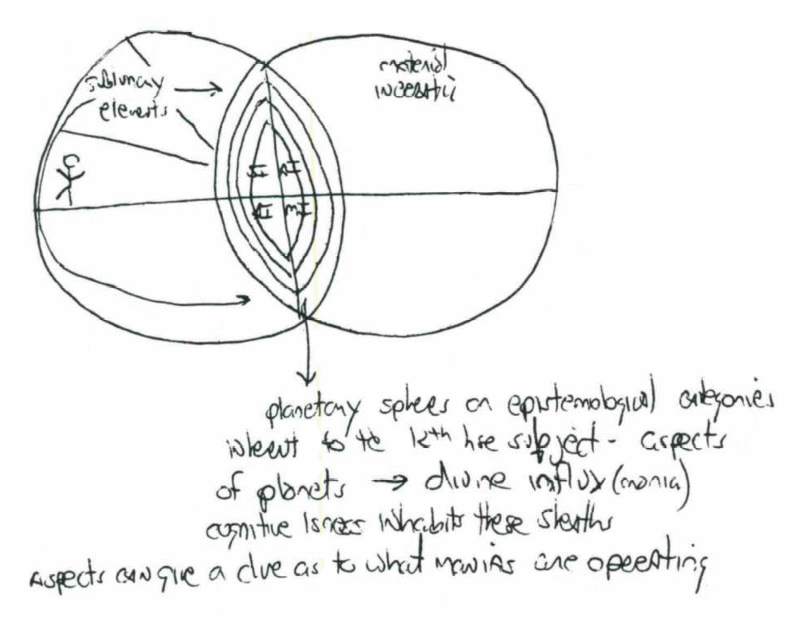
Speculation: when certain aspects occur, a certain enthusiasm arises in the soul
Review: 3rd quadrant rulers/exaltations structure 10th house Matter and 11th house vasanas and these two are brought together to form an entity
When there is an aspect between certain planets, some essence embodied in Matter will be manifested
Material conditions are provided by one set of Gods, energy provided by another set of Gods
The body already has the organs or the means to know something, to manifest inspiration, but there has to be an influx of energy to force it above the threshold of consciousness
Appearances in our consciousness are appearances of the Gods but in a human psychological way
The four inspirations show steps to take to approach the Divine Unity, can't take one giant step; Santayana had a superficial naïve idea of these things, like most philosophers have
BOOKS / MAGAZINES READ FROM OR REFERENCED:
John Deck, Nature, Contemplation, and the One
George Santayana, The Realm of Essence: Book First of Realms of Being
George Santayana, Sonnets and other Verses
Plotinus, The Enneads (MacKenna translation, 4th ed.)
Shrine of Wisdom, Part II of "Extracts from Thomas Taylor's Dissertation on the Platonic Theory of Ideas," with T. Taylor tr., 7th Letter of Plato, in T. Taylor's footnote, and commentary by Avicenna
Shrine of Wisdom, "Plato and the Four Inspirations," with T. Taylor translation of the Scholia of Hermeas
Selections from Plato, from the Translation of Sydenham and Taylor, The Banquet
Plato, Phaedrus
Proclus, Glenn R. Morrow (tr.), A Commentary on the First Book of Euclid's Elements
PLOTINUS QUOTES READ OR REFERENCED: V.3.4, V.3.6
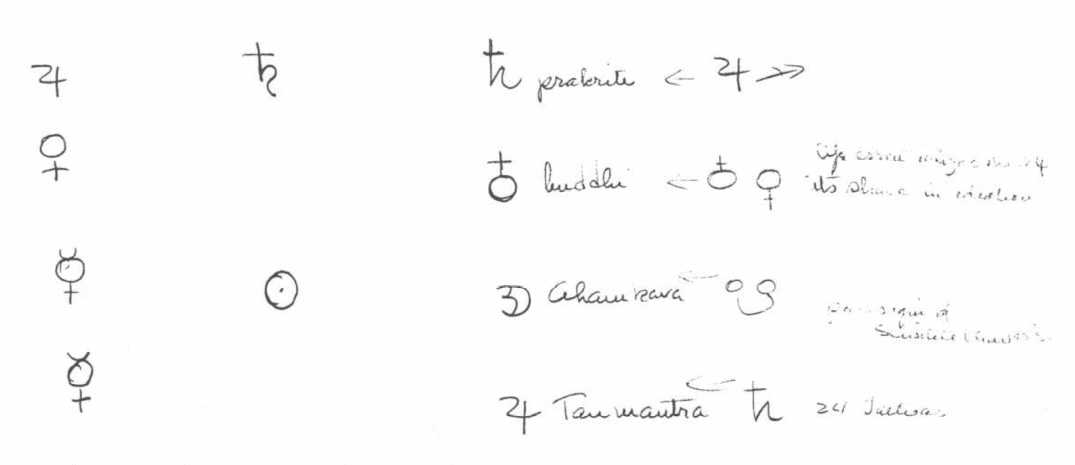
DIAGRAMS appended to this transcript:
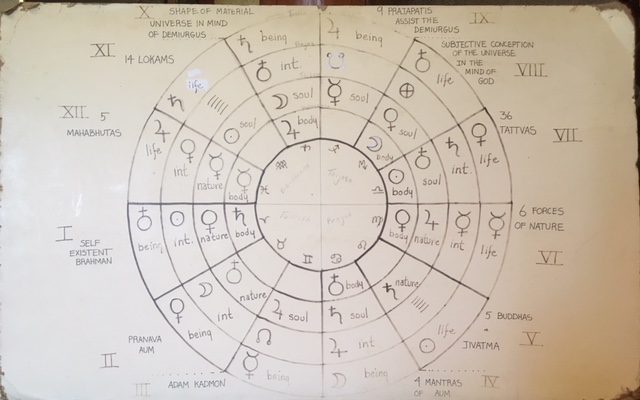
FIGURE IMG_2202-Posterboard Metaphysical Chart.
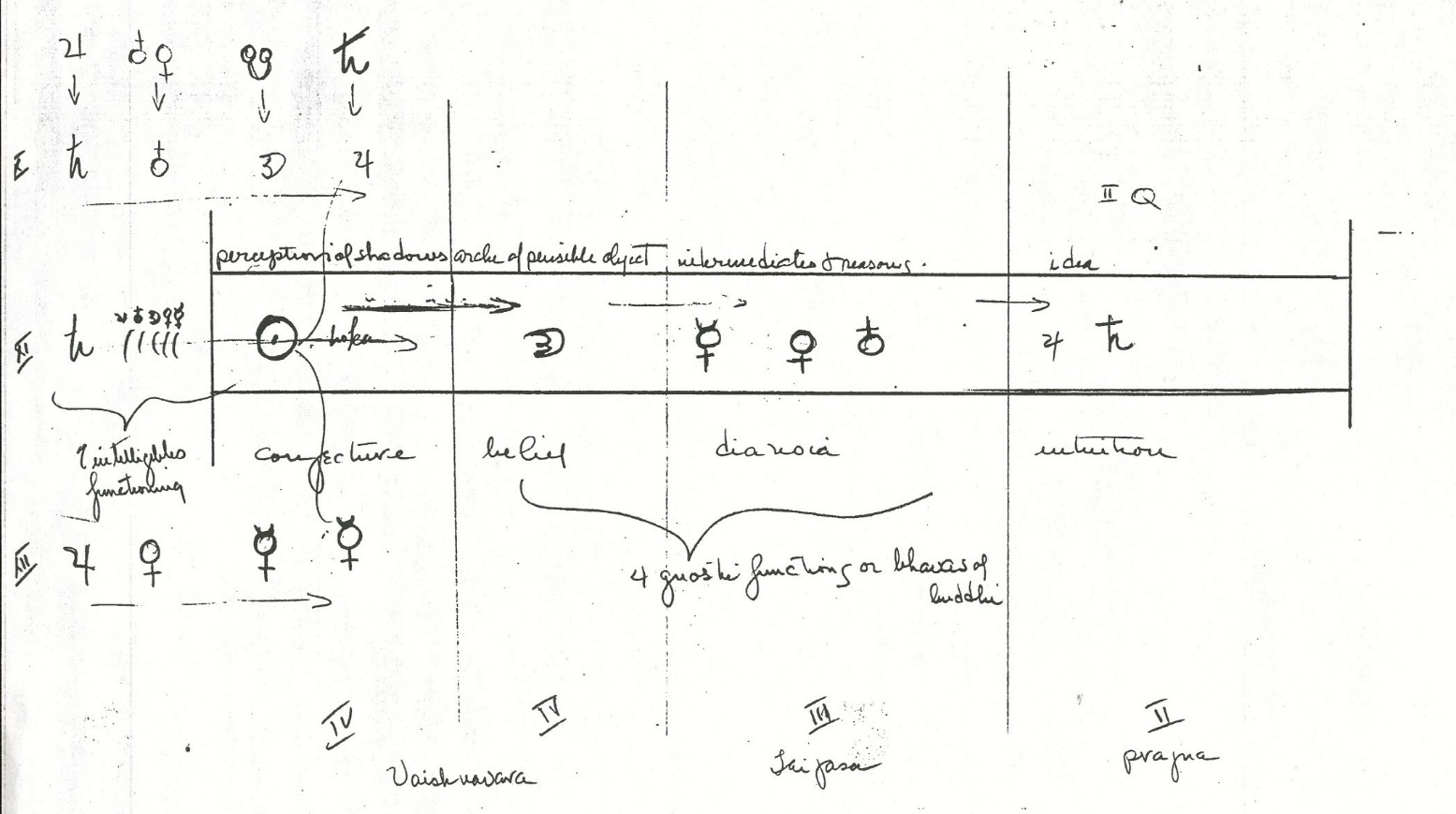
FIGURE AM008. Subject and Object Series with Divided Line.
FIGURE 1980 1126-3-AB. Vesica of Houses 10-12 and Four Intellects.
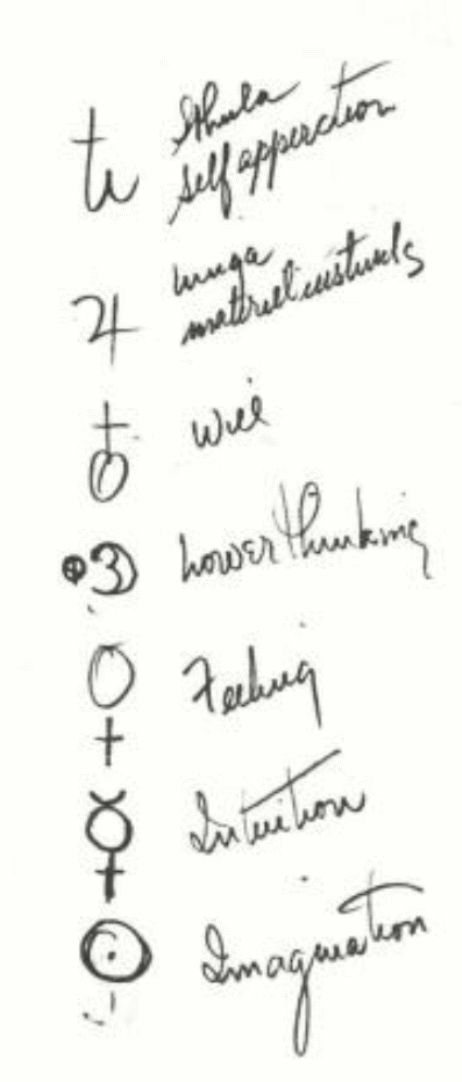
FIGURE AD_D_038. Categories of the Imagination.
FIGURE AD_K_026. Universal Soul and Fourth Quadrant Dignities.
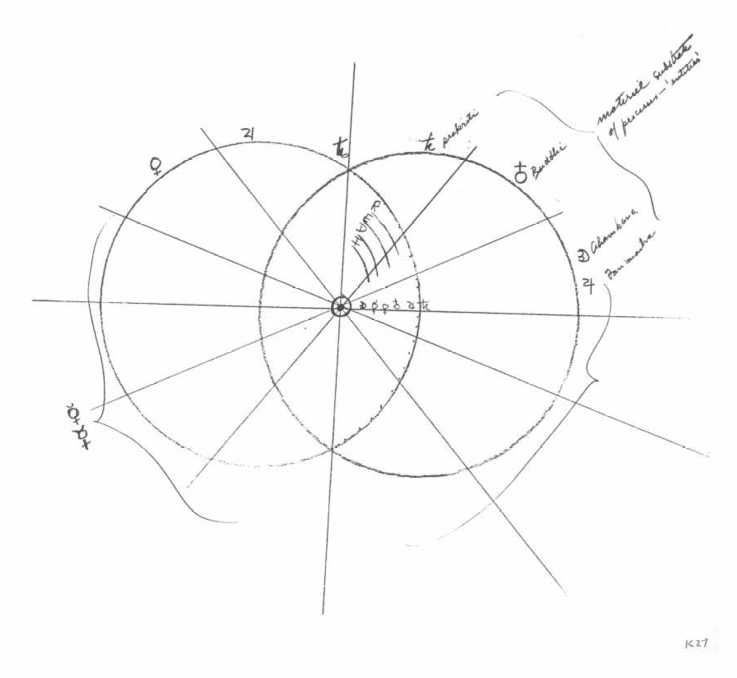
FIGURE AD_K_027. Vesica of Houses 10-12 with Fourth Quadrant Dignities, Dignity Rings in 11th House, and Soul Ring Planets.
See also Plato on the Divided Line at the end of Republic, Book VI. Other diagrams also referred to are not with this transcript version. [Transcriber note: [diagram] means the speaker is referencing a diagram as he or she is speaking. If someone is drawing or writing, with audible sounds of chalk on a blackboard, I indicate this by [drawing] or [writing].]
NOTES:
This class is part of a series on Beauty, Essence, and Inspiration. See also WG Classes 1980 1112, 1113, 1119, 1128, and 1203.
Wednesday evening class.
TRANSCRIBED Verbatim by IT, reformatted by jf 2018. Originally transcribed by June F. in 2006, part of Plato set. IT does two more passes in 2012 and another in 2017-8 after he discovers that Audio File 1980 1126a is part of this class. In 2023, IT updates prefatory matter, footer, and audio file name, alters Topic, Subject, and Subsubjects to make more accurate, completes Book List, adds Plotinus quotes section, fixes errors/typos, adds new notes within transcript, replaces appended diagram with six others and references within transcript to these diagrams, reformats to accord with new conventions. Archival verbatim transcript – V12a.
AUDIO FILES: 1980 1126a, 1980 1126b. [Note: "Tape" and "Side" refer to original audio cassette tapes that were later digitized into .MP3 Audio Files.]
1980 11/26 at Wisdom's Goldenrod
Neo-Platonism; Ascent to Intellectual Beauty
John Deck, Nature, Contemplation, and the One, pp. 109-111, quotation not on this tape, but needed for 11/26/80 and 12/3/80: "The matter which reflects being is other than being: it is non-being. This does not … mean non-existent or unreal. Matter is non-being in the sense that it is not form, not order, not knowledge. As a mirror it reflects the world of true being, the world of Nous. In the simple language which Plotinus himself sometimes employs, the world of true being contains the veritable tree. The sensible tree is a reflection of the veritable tree upon matter, or, more accurately, the form, the nature of tree which is upon matter is a reflection. …
"Now Plotinus would agree that the sensible tree is a tree. He would interpret this as meaning that the physical tree which we observe is, as known by intellect, tree. That is to say that the sensible tree, insofar as it is a tree, is the true-being tree, the veritable tree in the world of true being.
"Thus, for Plotinus,"the sensible tree is the sensible tree" could be admitted as a fruitless tautology. As providing any insight into what the sensible tree is, it would be useless. The amended statement, "The sensible tree is tree," tells what the sensible tree veritably is, yet it is untrue of the sensible tree precisely as sensible. In other words, Plotinus' meaning is that the sensible tree as sensible is non-identical with its own being.
"But if the sensible tree, as known by intellect, by the power which can know what things are, is the tree which has true being, this indicates that Plotinus does not have two worlds, but only one. His world of true being is not, except metaphorically, a world above the everyday world. It is the everyday world, not as experienced by sense, by opinion, or by discursive reasoning, but as known by intellect, the Nous, the Knower.
"Plotinus' world of true being is, therefore, the real world of everyday experience when the latter is known by the best knowing power. The more real turns out to be in the real, in fact, to be the reality of the real. Being, which seemed at one time to be for Plotinus a technical term less extensive than reality, seems able now to coincide with reality, as common sense would appear to demand."
[Audio File 1980 1126a Begins]
S (faint): I don't know.
S: There's the solution.
RG: Santayana on essences, [AD: Yeah.] beauty.
AD (very faint): I forgot.
RG: Great.
AD: [few very faint words inaudible] Remember what it was we quoted from the old man?
RG: Cezanne's vision of the-- of the tree.
S (very faint): He had (a) vision.
AD/S(?) (very faint, possibly part of background): That's right.
S (very faint): Had the vision.
RG: How he saw the tree at night for the first time.
S (whisper): Yeah.
S (faint): Saying [one/two words inaudible] about the tree?
[51½ second pause, faint background talking/whispering]
RG: Spending a lot of time on those essences of the soul.
[short pause]
AD: What about that?
[13 second pause, flipping of pages, faint background talking/whispering]
S (very faint): What about that?
AD (faint): What do they call it?
[29¼ second pause, faint background talking/whispering]
S (very faint): (Would that be) this?
RG (very faint): Just if you (take--)
[short pause]
S: Then we also talked about the apprehension of essences.
AD (very faint): I wanted to see them-- waiting to see them get them right. [short pause, bit of laughter] Read us a little bit about essences Vic. First chapter?
VM: No.
AD: What we were discussing last week?
VM: Our friend.
AD: Remember, we were discussing about Cezanne and the way he tried to see a tree. I used the example because I thought that he would use the example from Deck, [VM assents] Plotinus might see a tree, alright. And, if I remember, it was a very difficult struggle for Cezanne to see a tree, and that the encounter with the objective side of the-- the world he lived in brought about a tremendous amount of anxiety and neurosis. And since you're-- And it's just like when you open a book, there's a certain amount of anxiety comes out. But he's only a painter. He had to try to see something, he had to try to see the tree the way the tree really was, at least for him. Of course that's something we never do. We all take for granted we see trees and roses and flowers and the sky and clouds, which is a lot of baloney, we never see anything. We never look at anything. Because in order to see anything you have to subtract the mind, and then you would be able to see. But at any rate, it did bring about a psychosis for Cezanne. [short pause] So, we had discussed that encounter that he [one word inaudible] in trying to see, the way it brought about a great amount of anxiety. And this anxiety is a necessary fact whenever we try to encounter the objective and try to bring being out of non-being. Because when you look at a tree it's non-being, there's nothing there. You have to try to bring some kind of being into it. So we spoke about it in that way. Now, if you could remember, come up with some quotes from there about essence and [VM simultaneously: Do you have a particular chapter?] how the essences are intuited.
VM: Do you have a particular chapter you would like to work with?
AD: We can go through some selections in the first chapter, when he speaks about intuiting essences.
VM: Ok. I think there's some underlined parts, maybe you could just say just to-- to go through those. [VM almost whispering] Seems a little backward but I'm going to sit over here today. This is Chapter 1, "Various Approaches to Essences," and um-- I-- it's maybe a little choppy because I'm not going to read it [couple inaudible student words] except underlining. He says here--
[Transcriber note: I am using The Realm of Essence: Book First of Realms of Being by George Santayana, New York: Charles Scribner's Sons; London: Constable and Co. Ltd., 1927. Volume 16 of The Works of George Santayana.]
George Santayana [The Realm of Essence: Book First of Realms of Being, p. 1, VM reading]: "Knowledge such as animal life requires is something transitive, a form of belief in things absent or eventual or somehow more than the state of the animal knowing them."
[short pause]
VM: So he's hearkening here to his notion of-- of belief and animal faith and so on, the idea that we-- oh when normally we see something, we believe that it's a self-subsistent object, it's standing on it's own ground and we don't really bring anything to it. [17½ second pause, flipping of pages] Um--
[short pause, flipping of pages]
AD: Just on the meaning of essences.
VM: The meaning of essences, ok.
AD (simultaneously): Yeah, the meaning. Yeah, read.
VM (simultaneously): Well he talks about the approach of essence through dialectic, in other words, through careful critical argument. And he makes the point, the subtitle or the description of this paragraph is "Approach Through Dialectic: every term intuited or defined is an essence." Ok.
George Santayana [The Realm of Essence: Book First of Realms of Being, p. 3, VM reading]: "What is dialectic? Precisely an analysis or construction of ideal forms which abstracts from such animal faith as might be stimulated by their presence, and traces instead inherent patterns or logical relations of these forms as intuition reveals them. To the dialectician animal faith seems wanton and superfluous, and in his overt reasoning, if not in his secret assumptions, he neither posits any objects of natural knowledge nor seeks to describe them."
VM: Well, it-- it seems like the best example for me anyway here is the discussion of pure mathematics where one has carefully defined terms and you don't care if a circle-- if you're a pure mathematician, if a circle ever appears in its pure form in Nature. You're not interested in those things, you're interested in the definition of circle and how it relates to that of straight line and what an arc means and so on and so forth and you're tracing the-- the detailed relationships among all the various precisely defined terms. And each of those terms, according [AD assents, faint] to San-- Santayana, is the essence. [short pause, flips page] I'm not exactly sure how you want to treat this, I mean just-- should I read and then have people ask questions?
AD (simultaneously): As meaning, yeah. No, just a short review and they're-- [VM, faint: Alright.] they know about essences by now [one/two words inaudible]
[short pause]
George Santayana [The Realm of Essence: Book First of Realms of Being, p. 5, VM reading]: "Essences, by being eternally what they are, enable existence to pass from one phase to another, and enable the mind to note and describe the change."
VM: So here he's getting to an idea which he makes a lot of throughout these volumes and that is that essences are somehow, because of their eternal identity and precise fixed nature, permit one to speak about a flux. If you didn't have these sort of markers, these milestones, you-- the flux would be-- the flux of the experience would be pure chaos, there would be no meaning, no structure, no understanding possible unless there were these eternal essences which guided the mind in some sense from one event to another. Says here the--
George Santayana [The Realm of Essence: Book First of Realms of Being, pp. 5-6, VM reading]: "They are the only staunch possessions of the mind. … [short pause] …but the mind, even if describing only the series of its own illusions, attempts to describe it with truth: and it could not so much as fail in this attempt unless that [VM reads: this] series of illusions and each of its terms had a precise inexpungible character."
VM: In other words, they're essences. [9½ second pause] Oh, this is wonderful. We'll do the thing with the cart, do you remember that one, the [AD or student assents] reference yesterday? Perhaps this is worth reading, it's a short paragraph, I'll try and read the whole thing because he ends up with an example I think that helps.
George Santayana [The Realm of Essence: Book First of Realms of Being, pp. 6-7, VM reading]: "Sometimes sense itself, without any dialectical analysis, distinguishes essences from facts, and recognises them in their ideal sphere. This happens for a very simple reason. The stimulus that calls animal attention to some external fact, in provoking an act of the body, also presents some image to the mind. Moreover this labour of perception may be more or less welcome, pleasant, or life-enhancing, apart from its ulterior uses; [and] sometimes this incidental emotion is so strong that it overpowers the interest which I may have had originally in the external facts; and, I may suspend my action or continue it automatically, while my thought is absorbed in the image and arrested there. As I was jogging to market in my village cart, beauty has burst upon me and the reins have dropped from my hands. I am transported, in a certain measure, into a state of trance. I see with extraordinary clearness, yet what I see seems strange and wonderful, because I no longer look in order to understand, but only in order to see. I have lost my preoccupation with fact, and [VM adds: I] am contemplating an essence."
[short pause]
S: Right.
S (very faint): Right.
VM: I don't feel like I just want to talk about it, I would rather respond to the questions, [AD simultaneously: Well this is-- he's--] get some kind of discussion or something.
AD (simultaneously): Next page I think he speaks about appreciation of beauty, beauty [VM simultaneously: Ok.] de-materializing.
George Santayana [The Realm of Essence: Book First of Realms of Being, pp. 7-8, VM reading]: "This experience, in modern times, is called aesthetic; but it has no exclusive connection with the arts or with the beautiful. It is really Intellectual, and the high Platonic road. … If the thing is beautiful, this is not because it manifests an essence, but because the essence which it manifests is one to which my nature is attuned, so that the intuition of it is a delightful exercise to my senses and to my soul. …
"The beautiful is itself an essence, an indefinable quality felt in many things which, however disparate they may be otherwise, receive this name by virtue of a special emotion, half wonder, half love, which is felt in their presence. The essence of the beautiful when made an object of contemplation by itself, is rather misleading: like the good and like pure Being, it requires much dialectical and spiritual training to discern it in its purity and in its fullness. … …the beautiful is a great liberator of other essences. The most material thing, insofar as it is felt to be beautiful, is instantly immaterialised, raised above external personal relations, concentrated and deepened in its proper being, in a word, sublimated into an essence…"
[12½ second pause]
AD: It dawned on you?
VM: A little bit.
RG/S(?) (faint): Definitely.
VM: I'll just continue to read it, I mean-- It just seems like he says it so much nicer than I can say it but I'm happy to say something about that. I don't know, it seems like he's making a very important point here, the idea that normally we're immersed in-- when you see a tree let's say, any object, one that you might consider beautiful, you're tangled up in all your external relationships to the tree. All your psychology comes to the fore, you like it, you dislike it, you compare it with other trees and so on. And in Santayana's word-- words--
AD (simultaneously): Most of the time you're bored.
VM: Right, but it's totally immersed in this material net of relationships. And it's only when one can dematerialize that you get sufficiently free of these entangling relations but then you can see the object, whatever it may be, in its essential purity. [short pause] It says here--
George Santayana [The Realm of Essence: Book First of Realms of Being, p. 8, VM reading]: "The most material thing, insofar as it is felt to be beautiful, is instantly immaterialised, [VM: that is] raised above external personal relations, [VM adds: and] concentrated and deepened in its proper being, in a word, sublimated into an essence…"
[short pause]
AD: He says it in this poem very beautifully too. Why don't you read us the (other one)?
VM: One or the other(./?)
AD: Fred also.
VM (simultaneously): Paul. That's David's idea.
[student assents]
[Transcriber note: I am using Sonnets and other Verses by George Santayana, New York, Duffield & Company, 1906. This poem is from Sonnets, First Series, Sonnet VII.]
George Santayana [Sonnets and Other Verses, VII, p. 9, VM reading]:
"I would I might forget that I am I,
And break the heavy chain that binds me fast,
Whose links about myself my deeds have cast.
What in the body's tomb doth buried lie
Is boundless; 't is the spirit of the sky,
Lord of the future, guardian of the past,
And soon must forth, to know his own at last.
In his large life to live, I fain would die.
Happy the dumb beast, hungering for food,
But calling not his suffering his own;
Blessed the angel, gazing on all good,
But knowing not he sits upon a throne;
Wretched the mortal, pondering his mood,
And doomed to know his aching heart alone."
AD: Suppose we read that again, a line or two at a time? (Even) by the Platonist. Now one or two lines at a time.
VM: Ok. Well, the first line seems quite a mouthful already.
George Santayana [Sonnets and Other Verses, VII, p. 9, VM reading]:
"I would I might forget that I am I…"
VM: Oh boy.
AD: That doesn't need an explanation.
VM: I don't think so. (VM laughing, some laughter) If you don't-- if you can't relate to that one, but then-- then we should all go down with these sheets or whatever these called [one word inaudible] (laughter) Those people are trying to get rid of the "I" too, right, in their own way. (some laughter, student words) Ok.
George Santayana [Sonnets and Other Verses, VII, p. 9, VM reading]:
"I would I might forget that I am I,
And break the heavy chains that bind me fast,
Whose links about myself my deeds have cast."
VM: So--
AD: Well, of course obviously like the Buddha said, you are the heir to the deeds.
[student assents, very faint]
VM: Yes. It's like being chained in your own personal karma in a sense.
S (very faint): I don't understand it.
George Santayana [Sonnets and Other Verses, VII, p. 9, VM reading]:
"What in the body's tomb doth buried lie
Is boundless, 't is the spirit of the sky…"
AD: What would that be? What is he saying?
VM: I would say he'd say the soul is buried in the body's tomb, these limitless principles, cosmic principles.
AD: This pure cognitive-isness buried in the body like-- chained like Plato said, an oyster in its shell.
George Santayana [Sonnets and Other Verses, VII, p. 9, VM reading]:
"What in the body's tomb doth buried lie
Is boundless; 't is the spirit of the sky,
Lord of the future, guardian of the past,
And soon must forth to know his own at last."
VM: I hope so. Apparently there's some hope here that the soul will know its own identity and will be made somehow to be obvious.
[students assent, faint]
George Santayana [Sonnets and Other Verses, VII, p. 9, VM reading]:
"Happy the dumb beast, hungering for food,
But calling not his suffering his own; [short pause]
Blessed the angel, gazing on all good,
But knowing not he sits upon a throne…"
VM: That's interesting, even the Buddhists, they say the Gods, they're not liberated, (but/well) the angels are certainly-- well I don't-- don't think we speak about angels but they say the Gods are not liberated, they're in temporary state (of/in) becoming. But these angels here don't know they're sitting on a throne.
George Santayana [Sonnets and Other Verses, VII, p. 9, VM reading]:
"Wretched the mortal, pondering his mood,
[And] doomed to know his aching heart alone."
[13¼ second pause]
AD: Alright, let's go back a little more about essences.
[short pause]
S: Who wrote that?
VM: That's Santayana's [one word inaudible] poems. It's just number 8, I don't know what part-- or number 7. Well, this is a paragraph that has a lot of underlining so maybe I'll just try and read it, it's about half page.
George Santayana [The Realm of Essence: Book First of Realms of Being, p. 9, VM reading]: "This [VM reads: The] native affinity of the mind to essence rather than to fact is mind itself, the very nature of spirit or intellectual light. The sort of intelligence which adapts one natural being to another, and may be found in the conduct of animals, or even in the structure [VM reads: structuring] of their bodies, does not consist in thinking; it is an adaptation of life to its conditions, a form of behaviour in matter, which must exist and flourish before thinking or even feeling can arise at all."
[short pause]
VM: See I think for him--
AD (simultaneously): Do you understand that?
VM: Yes, I think for him, this an important point that-- the idea that thinking, as we usually call it, is a very mechanical act, it's just a sophisticated motion in matter. But genuine thinking or feeling is a-- is a discrimination of essences and consequently requires a-- a more, let's say, elevated kind of mental functioning. [short pause] Ok, but this kind of thinking, this p-- this-- this sort of animal training, if you like, is not to be sneered at and is an absolute prerequisite before genuine essences can be intuited. This kind of thinking he call this--
George Santayana [The Realm of Essence: Book First of Realms of Being, p. 9, VM reading]: "…adaptation of life to its conditions, a form of behaviour in matter, which must exist and flourish before thinking or even feeling can arise at all. Intuition would be impossible without an underlying animal life, a [VM reads: the] psyche; for how should the sheer light of intuition actualise itself, or choose the essence on which it should fall? A psyche, the hereditary organisation and movement of life in an animal, must first exist and sustain itself by its"intelligent" adaptations to the ambient world: but these adaptations are not conscious until, by virtue of their existence, intuition arises; and intuition arises when the inner life of the animal, or its contact with external things, is expressed in some actual appearance, in some essence given in feeling or thought."
[14¼ second pause]
AD: You want to comment?
VM: Well-- He's-- he's-- the psyche of course is a-- is a very complicated material organization for him and-- and what we would call let's say education in a kind of collective sense or the kind of sense that they sell at Colgate or Cornell would be for Santayana merely a training to bring the psyche into some reasonable level of sophistication and so on so that it can be a proper, let's say, proper vehicle for the intuition of essences, or-- Let me just use his language, it's way better.
George Santayana [The Realm of Essence: Book First of Realms of Being, p. 9, VM reading]: "[A] psyche, the hereditary organisation and movement of life in an animal, must first exist and sustain itself by its"intelligent" adaptations to the ambient world…"
VM: Ok, so you have to have a organized psyche, you can't be a complete barbarian in order to have these intuitions. He says--
George Santayana [The Realm of Essence: Book First of Realms of Being, p. 9, VM reading]: "…but these adaptations are not conscious until, by virtue of their existence, intuition arises; and intuition arises when the inner life of the animal, or its contact with external things, is expressed in some actual appearance, in some essence given in feeling or thought [VM reads: thought or feeling]."
VM: So these essences are actually evoked, let's say, by experiences in the outer world [AD simultaneously: Well let's--] or the inner world.
AD: Well let's see now, he's saying-- he's saying there first has to take place a biological adaptation [VM assents] to the world be-- before essences could arise. Now, these essences or-- or he says these essences arise from an inner intuition. [one/two words inaudible]
VM (simultaneously): From an intuition. It can be in the inner world or in the outer world, I don't think [AD: Well--] he excludes one or the other.
AD: If we s-- if we say that they arise from an inner intuition, they would be coming from within the soul, wouldn't they?
VM: Yes, but what I meant to say was one can-- can get a-- one can intuit an essence when looking at a sunset or one can intuit an essence when reflecting on one's own thought processes and relatively shut off from the sense world too.
AD: But in both cases, in both cases, [S: Are you--] are the essences coming from within?
VM: For sure, for sure. The material occasion in one case is the external world and in the other case the psychic, let's say, rumblings if you like. But in each case the meaning, the definiteness to the experience, is a projection, let's say, from the soul of a given essence.
AD: What about the essences embodied in Matter then?
VM: Well, I'm not sure exactly what are you asking. Are you asking what is the relationship between the essences in the soul and the essences in Matter?
AD: Yeah.
VM: Oh. This is a hard problem and Santayana never satisfied, to me at least, in my level of understanding of him, that he had solved this problem because-- He did clearly speak about essences embodied in Matter, there's-- he claimed that there was blue in the pillow that's really in the pillow, the material pillow. There's also a blue that I intuit that is given to me, let's say, as a unfolding of my-- my own mental processes. Now the relationship between the blue in the pillow, the material-- what does he call it, the essence in Matter, [AD assents, very faint] and the essence in the psyche, he leaves that, to me anyway, I-- maybe I just never went deep enough but, he left that as a complete mystery as to what the relationship would be. I mean personally I find it very offensive that there should be two, perhaps different, essences.
AD: But wouldn't that take us back to the notion that on the one hand, [VM: Objective and subjective.] on the one hand you have that which is outside the sensory apparatus and which will be an input, [student assents] and on the other hand you have the build-up-- the building up of the generic mentality or imagery inside the psyche.
VM: Yeah, if you'll permit a reference to the diagram which you're working with.
[Note: See FIGURES AM008 and IMG_2202-Posterboard Metaphysical Chart for the following.]
AD: Avery, would you put up our diagram [VM: Good idea.] showing the objective and subjective?
VM: I think he never could appreciate how these two streams can converge and in fact how in some ways they are rooted but at a high level, they are rooted in the same principle, let's say in the 3rd quadrant they would find some sort of synthesis. But in the material world that we operate in, it is indeed a mystery what the relationship is between those essences evoked from the subjective side and those essences, let's say, generated in Matter from the object side.
SD: But by subjective-- I mean, the psyche for-- for him isn't subjective, right, I mean not the way we would understand it. By subjective we meant the real appreciation of essence.
AD: I'm sorry, (Severin).
VM (simultaneously): I'm not sure what you're saying, Severin.
SD (simultaneously): I mean it seems to me that-- that there are three things involved, [AS drawing] there's-- there's the essence apprehended in intuition, but-- and there's the essence that's embodied let's say in the object.
VM: In the world, let's say.
SD: But there's also the essence as embodied as it were in the psychic functioning, the adaptation.
S (very faint): I see.
VM: I think the first and the third are the same.
AD: That's-- [VM simultaneously: That's-- yeah.] so perhaps what Avery could explain to us.
VM: I think so. I [couple inaudible student words simultaneous with VM] think for him the first and the third are the same, if I understand what you said.
SD (simultaneously): Well-- then what is this psychic-- this, rather, adaptation to the environment, this animal adaptation which occurs as a preliminary before you even have the-- any intuition of an essence?
VM: I'll just give you the party line, what he would say. His contention is that in order to have a intuition of essences the psyche must evolve. It must go through a long process of evolution and training and-- when matter, the psyche is matter for him, [SD assents] becomes sufficiently sophisticated and organized and harmonious, then it's possible for intuition to-- no, then it's possible for spirit to then function through that organized psychic matter and intuit essences. Ok? It's almost like-- we would just use maybe different language. When the vehicles become sufficiently prepared then it's possible for the soul to intuit certain kinds of essences using those vehicles. I don't think it's that foreign to use that-- that language instead.
SD: Yeah I-- I still-- that still leaves the question for me that, you know, while this adaptation is going on-- you know you're just taking a-- either an animal level or taking the human level before there's any, you know, really intense experience of anything, I mean-- there's on the one hand-- because he speaks on the one hand of essences as something that we experience all the time. And then on the other hand he speaks of it as a-- as a truly singular occasion when our life is really lit up with some meaning [one word inaudible]
AD (simultaneously): Well, let's ignore Santayana now, let's-- let's think for ourselves, alright?
VM: Ok.
AD: Avery? [short pause] You want to explain the chart a little bit?
[14¼ second pause]
VM: Louis could start.
AS: Hm?
[short pause]
AD: You want to explain what you did here?
[student assents, very faint]
[some clanking noises, sounds like coffee pot]
CDA (to AD): Oh, I already took (that).
AD (to CDA): Oh, it's alright.
S: I--
S (faint): No.
[short pause]
AS: Ok, well-- [short pause with noises] Forty-two. Uh-hm. So (you) got three factors. That's the psyche [diagram].
[AS drawing]
S (faint): Which side?
AS: I suppose that's what-- or roughly what he means by the psyche. [short pause] I suppose this is roughly what he means by the psyche, although there's some question about that, I guess. And then--
AD (simultaneously): Well start with the third [half/one word inaudible] start with information of Matter by the Ideas.
AS: Ok, well I'm going to do that. See, he says that this-- [drawing] this Matter has to be worked up somehow. You can't have-- the pure cognitive-isness or the pure soul over here [Saturn in Leo] can't directly experience the absolute indeterminate Matter, ok. [student assents] In fact, it can't even do that without a--
S (simultaneously): Those (circ--) the rings around it is Matter [diagram]?
AS: No. Well, [AD simultaneously: Wait, let him explain it, go ahead.] let me make the diagram clearer. So, I should move this over a little bit. [student assents] [short pause while AS draws] This is what we called-- This is the whole realm of Matter, this is the whole 4th quadrant here [FIGURE AM008, X, XI, XII], [AD, very faint: Yeah.] ok? [drawing] Matter. This is the 3rd quadrant [top left line], ok, the Demiurgus, ok, Demiurgic Intellect, Abs-- or Soul, Absolute Soul or Soul quadrant, which is working objectively to illuminate this Matter. This is an individual soul, let's say, coming from this way [right to left along divided line], that's Saturn in Leo, or this cosmic soul, all the way down to the Sun in Aquarius, this whole stream here [diagram], ok, which is going to inhabit this world of Matter and become immersed in it, if it's an individual soul, or govern over the activity of it, if it's the cosmic soul let's say. So, where it finds itself, suppose it is this cosmic soul, the Sun in Aquarius [diagram], and where it find itself is not in absolutely indeterminate Matter but in this already illumined Matter [diagram], alr-- Matter which is already in some way organized by this tentative illumination, ok. In other words, somehow we have already this [drawing] organized Matter or organized body which is already prepared for it, there's a ground already prepared for the entrance of this pure spirit, which I guess--
S: How does it get prepared-- where does it get the preparation for it, I mean where does it--
AD/S(?) (very faint in background): Well you have to repeat it.
AS: From--
S (simultaneously): How does it prepare (it/us), I mean where-- Do you know what I mean?
AS: Yeah.
AD: When you take the rulerships from the 3rd quadrant and the exaltations, alright, Jupiter, Mars, Venus [diagram], [student assents] alright, that would be the Being, Life, and the exaltations would be the Intellect [FIGURE IMG_2202-Posterboard Metaphysical Chart]. [student assents] So that would be the line above--Jupiter, Mars, Venus, Tail and Saturn. If you wanted to put the Ideas up there, over here you could put the Being of the Soul of the Demiurge [diagram], over here the Ideation, Subjective Ideation, Conception of Universe in Mind-- in the Mind of God [diagram], this here the 36 Tattvas [diagram], ok. This is a paradigm of the sensible universe [diagram], again, the 36 Tattvas. This here top informs the Matter, the 10th house is the Matter [diagram], formless Matter, prakriti, if you want to use that term, formless Matter. But Matter per se, ok. The 11th house is where the interesting point comes for us because this is where the vasanas are, the traces of Life which are left behind in Matter, and they're referred to as vasanas, alright. I'm going to also call them essences. Now you have to combine those two together, alright, and that's what the cosmic soul does, combines those two together, Matter and the essences or the traces of life left behind in Matter. These two are combined together, alright, to produce the entity. So this would be the material side of the world coming from here, coming down [diagram]. Up to here [diagram], this would be the material side, ok. Coming from here [right to left along divided line], we would have the pure cognitive-isness [drawing] or the soul [Saturn in Leo], ok. Then over here reason [Jupiter in Virgo], willing [Mars in Libra], and knowing [Mercury in Sagittarius]. Reason [Jupiter in Virgo most likely], willing [Mars in Libra], feeling [Venus in Scorpio], and over here is sensing somehow [Moon in Capricorn], ok. And this is coming from the ring. So what we're doing basically, coming from the 3rd quadrant, we're going to build the material sheaths, the Gods are going to build the material sheaths. Coming from the ring are going to be the individual souls that inhabit those sheaths. Alright? Follow that?
S: Coming from the ring?
AD: Yeah, starting with Saturn in Leo [diagram] and going all around, [students assent] alright, Jupiter in Virgo, Mars, Venus, Mercury, Moon, and Sun [diagram]. That would give me the soul of man. Ok. Now, this soul here is the one that we're [drawing] referring to as when it goes into the psyche, alright, will illuminate that psyche, it gets buried in that psyche, to use Santayana's term. And the psyche is material, from what he said. But in order for us to be able to apprehend an essence, he points out it has to be built into the material body. Now to complicate matters even more, the 11th house Idea, if you remember, was the 7 Lokas and 7 Talas. That means there's 7 different levels of existence. That would mean that there are 7 different levels of vasanas, from the lowest to the highest. Ok? So like for instance, you might have certain memory traces built into your body which will be capable of helping you recollect high levels of meaning. You might have others that don't do as well, alright. [VM: Yes. (VM laughs a bit)] So if you try to keep in mind that you have the 7 divisions here, 7 Lokas and Talas, alright, you-- you can see that they're going to be combined, and the cosmic soul is what combines them [diagram], alright.
Now the forms or the units of meanings which are going to be supplied to the psyche are going to come from the realm of the soul, [student assents] alright. So, this will be the pure cognitive-isness [Saturn in Leo], this would be the Being, Life, Intellect, or reasoning, you know, reasoning-- all together this would be called dianoia or rea-- reason, [AD hits board with chalk] and we say it's feeling, willing, and knowing, the rulers, exaltations, and detriments [diagram]. [18 second pause while AD draws] So the-- this cosmic soul [diagram] produces the entity over here, let's say this entity [FIGURE 1980 1126-3-AB, stick figure in left circle], creature, and he's going to be composed now of essences supplied from here [diagram], meanings, units of meaning, like the form of a circle, the form of a square. Any unit of meaning or signification is coming from here [diagram]. [student assents] And the material body, this Matter which is informed by the Ideas [diagram]-- not that the Ideas are in the Matter but they inform the Matter. So like for instance the idea of a square, you take four bricks and you make a square. Now the idea of the square isn't in the bricks. But the bricks are, so to speak, informed by that idea.
S (simultaneously): Or the bricks are like an embodiment.
AD: Hm?
S: Can be embodiment of it.
AD: If you use the word 'embodiment' then you're going to think that the Idea's in the Matter. In-form or any word that will help you understand that the Matter is being formed by these Ideas but the I-- Ideas never leave themselves and go into the Matter. So, the combination of these two [diagram], like we said, alright, produ-- is-- on the one hand-- you have this [diagram] on the one hand, so we can call [drawing] all of this Matter, ok, and on the other hand we call this Form [diagram], ok. These two combined, Matter and Form, give us the hylomorphic creature or soul [diagram]. [students assent] So that means built into the body is already these vasanas, [drawing] predispositions, whatever you want to call them, essences, it doesn't matter.
VM: Tropes.
AD: Ok?
S: So then you would say that that cognitive-isness over there is gaining experience of the essences?
AD: Well it's gaining experience and that's what we have to understand now, what do we mean when we say it's [student assents] gaining experiences?
S (simultaneously): Ok, right.
AD: So it would seem as though what we're saying is that the essences or the forms which are supplied by the soul are necessary in order to understand what's happening here [diagram]. But, there's essence coming from here [third quadrant], alright, and there's essence coming from here [soul ring]. [S, very faint: I see.] Now, you try to explain what Santayana means.
VM: Well, Santayana--
AD (simultaneously): Wait, you follow the diagram?
S: Uh-uh.
AD: Even if you don't understand the symbolism, you fo-- you-- the-- the idea is quite simple. Just like we could say that your heart is an embodiment of, you know, a certain kind of functioning, any part of your body is an embodiment of a certain kind of functioning, a vasana, traces of life left in the Matter. You take all these units of life, build toge-- build one body with it, inherent in that body there's already certain meanings. The body now could function, the animal could adapt itself to the world, but it is not conscious of what it is doing. It becomes conscious of what it is doing only when the cognitive-isness enters and provides it with the meanings or forms. Now you can, through the intensity of attention, become aware, or the psyche becomes aware, but the psyche can't become aware, the psyche has no [VM assents] consciousness. [VM assents] It's a material thing.
S: Well, I mean, would you say then, part of the meaning of what this cognitive-isness in the experience is it has to try to [student assents, faint] see what these essences are maybe apart from the Matter that-- that it's trying to embody.
AD (simultaneously): Well, let's not jump there yet, let's not jump there, ok? Now we try to understand what Santayana means because this'll take us right into what Plato's going to speak about when he speaks about the four muses, for instance, the four different levels of reaching the One. And he'll speak about these four. Well, we'll get to that in a minute. But, if you were to take Santayana's position, and you have studied Santayana, would-- w-- would that explain his position?
VM: I think so, can we start-- attack it by talking about the essences in Matter or the essences in the soul and (maybe) those-- that disparity that I don't think he ever really dealt with properly? If you come from the top, let's say you tart-- start with the Jupiter in Sagittarius in-- in other words, the rulers and exaltations in the 3rd quadrant, Universal Soul structures Matter in a particular way [diagram]. The Matter that Santayana ever-- whenever he wants to discuss Matter it's always Matter with form, it's always a certain definiteness. He's excluding any knowing of it by a subject, let's say a soul. So the 10th house Matter is the form of the Demiurge, even--
(Side 1 of original cassette tape digitized as 1980 1126a Ends; Side 2 Begins)
VM: The part that I always, as I-- as I say, found it difficult is the San-- Santayana never really dealt with properly, is what is the relationship between that-- those forms that are, let's say, implanted in Matter through the functioning of the Demiurge or-- he would put it in a different way, he would say the external world is in ceaseless motion and essences are being embodied in the external material world. So like that tentative illumination. So there's a certain kind of essence in Matter there.
AD: Uh-hm.
VM: But then he also says, when this Matter becomes sufficiently organized and sophisticated, well, whatever, when it's worked up sufficiently, the vehicles are sufficiently adapted, then the soul can intuit essences in that psyche. So now they're essences in the psyche. And that's all the soul (at risk) really, these are essences in the psyche. But the part that he leaves, I think, completely sort of up at the air, what are the relationships between the essences, if you like in the diagram coming from the Soul ring [diagram], and the essences coming down from the Demiurge [diagram]? What is the relationship between those?
AD (simultaneously): You mean from the Ma-- realm [VM assents] of Matter.
VM: Right. And, I think that if I could hazard a guess from-- from this diagram, you would say that the essences really are unified but not in the 4th quadrant. There they're-- if you stay there, which pretty much is where Sa-- Santayana stays, you'll never understand this problem of the relationship between the two essences. Because if there's any relationship, it has to be understood from the point of view of the 3rd quadrant, and that is, the rulerships and exaltations which are the principles which structure the 4th house [Note: 4th quadrant] Matter are coming from the Soul quadrant, 3rd quadrant. And those Ideas can be understood as, if you like, moving around into the 4th quadrant [diagram], they can also be understood as moving inward to the detriments and falls in the 3rd quadrant [FIGURE IMG_2202-Posterboard Metaphysical Chart], in other words, they're moving into the Soul ring. And so, in some ways the Ideas, those three Ideas which we-- 36 Tattva and the Subjective Conception, the Nine Prajapatis, those Ideas are actually informing the rulerships and exaltations which illuminate the Matter and they also-- those Ideas also inform the Soul ring in there, which in turn is going to be the principle which intuits essences in that Matter.
AD (simultaneously): So very simply then what you're saying would be something like this. If we take the metaphysical chart, we work with the 3rd quadrant, alright. [VM assents] [11¼ second pause while AD draws] And we say this here [diagram] is being built, alright, as a fit vehicle for this [diagram] to inhabit.
VM: Right.
[10¾ second pause while AD draws]
AD: Alright, well--
VM: That's ok.
AD: It's alright.
VM: Take that out, right.
AD: This here [diagram] is two things at one and the same time. It is the-- it contains the operative reason-principles of what makes a thing to be what it is, [VM: Right.] here [AD knocks on diagram]. But at the same time, it is the forms which are in the soul which is and understands what that thing is. [VM assents, faint] So we're saying on the one hand, these are gnostic reason-principles because the soul could [AD knocks on diagram] know through them, and on the other hand, they're fabricative reason-principles because [drawing] they go to build in an object.
VM: Right.
AD: Yeah so, Santayana did need [VM simultaneously: Is that--] a little help.
VM: Yeah, he really never got clear on that issue at all.
AD (simultaneously): He never got to that point, no.
VM: Not there at all.
AD: He couldn't see it.
VM: No. He could make the jump in some ways, he would jump up to some sort of essence in itself in this eternal realm of pure Being and so on. That's relatively, I don't want to say easy, but it's relatively clear to speak about that. But to go from there to the material world and somehow connect them is much tougher. And of course he always criticized the Greeks for not having a sufficient detail of the unfoldment.
AD (simultaneously): He-- yeah, he didn't read the Greeks very--
VM: Well obviously he never read them, especially--
AD (simultaneously): He's a professor. When you're a professor you don't have time to read like [VM simultaneously: No.] that. So, very simple then, it's not that complicated.
VM: Yeah.
AD: It's quite a simple idea. On the one hand there's a part of the soul that goes to inform the Matter and this Matter is going to become the definition of the object. On the other hand, the part-- there's a part of that soul which knows, it knows because soul is doing it, [VM assents] and so the soul could be referred to as fabricative and gnostic. So when we speak about the soul as intuiting an essence, we're speaking about the gnostic function of the soul and when we speak about the soul fabricating, then we're speaking about the power of the soul to make things and the soul is the great maker. And they come into contact right in that realm that we're-- we're speaking about, that's where they come into contact. Now the reason why we're going through this here, although not with the detail I'd like to, is because the-- the realm of essences that we operate with, and the intuition of these essences, is in the beginning restricted by the functioning of the psyche. The very nature of the way the psyche is constructed restricts the number-- the extent of intuition of essences that we could have. Ok? In a simpler way we could say you'll only understand what your chart permits you to understand, what the psychical essences which go to constitute you as you are. They-- they already lay down and they predetermine the extent of your ab-- ability to intuit essences. But, if we ignore that and look at it from another point of view, that there will be, so to speak-- what would be important would be for the soul, the cognitive-isness, to be fed these essences so that it can grow. The selection and the nourishment by these various essences is what gradually brings about a recognition, a (soul/sole) recognition of its own worth. And this is what Plato is preoccupied with. Now if we could go back to what we did last week, we spoke about the tree, Plotinus spoke about a tree, his-- the sensible tree. I don't know, I don't have the quotation with me but maybe we could summarize it from memory. After ten times you should be able to summarize it from memory.
SD: (Well) maybe--
AD: Yes Severin--
SD: Maybe this is off the point but, what is it in the diagram or can we point to it in the diagram, that is being nourished, that is being-- that is growing through this experience? Is it the-- is it the Saturn [in Leo] or is it the-- is it that Sun [in Aquarius] that-- I hesitate to say either one.
AD: (Well--/Why?)
SD: Well, the Saturn seems-- being-- being cognitive-isness, it doesn't seem like it's in any need of growth, but on the other hand the Sun being a material sheath doesn't seem like--
AD (simultaneously): But the Sun is also part of the soul. It's the lowest part of the soul, the functioning part of the soul, the producing part of the soul. Because if you took the ring of the soul, alright, you would have Saturn in Cancer-- I mean Saturn in Leo and Jupiter, Mars, Venus, Mercury, Moon, and Sun [FIGURE IMG_2202-Posterboard Metaphysical Chart]. Those seven planets would constitute-- would constitute the Soul ring. [drawing/writing] So over here you would have cognitive-isness [Saturn in Leo], 6 Forces of Nature [Jupiter in Virgo], alright, (beneath), all the way to the Sun [in Aquarius]. This would be the Soul ring. If you wanted to say very simple, self-apperception, material instincts, willing, feeling, intuition, lower manas thinking, and the imagination [FIGURE AD_D_038]. So they're all like parts of the soul. The unity of the soul will be the Saturn in Leo, that would be the unity, and the other six, let's say, will be the various parts of the being of the soul. Together they would constitute the whole of unity and its parts, something you must have picked up when you read "Plato's Two-Fold Being," I'm sure. [Note: See PLA Plato's Two-Fold Being V09N, by Anthony Damiani, based on Leonard J. Eslick's "The Dyadic Character of Being in Plato".] Alright, let's go back to the point we were trying to make now, we're trying to make this point. [short pause] The realm of essences is from where?
SD: As [couple words inaudible] or--
AD: But where-- where are essences?
S (very faint): Yeah.
SD: As-- as we would speak of them or as he would? I--
AD: I don't care, speak about them.
S: What do you mean?
AD (possible aside): Chapter on Being.
S (very faint): Ok, yeah.
[student assents, very faint]
S (very faint): (I don't know.)
SD: They seem to all meet in that Sun [in Aquarius].
AD (simultaneously): Where do they come from?
SD: Originally? They come from the Ideas.
AD: Originally.
SD: They would come from the 2nd quadrant, ultimately.
AD: They would be from the Intellectual-Principle?
SD: Yeah.
AD: All essences will be coming from there(./?)
SD: In one form or another.
AD: In one form or another. He speaks there about pure Being and he speaks about the essences as having pure Being.
VM: Uh-hm.
AD: Would you read that section, just--
VM: There's a bunch of other business in here, I want to get right to the point. You don't want that stuff about "Confusions [AD simultaneously: I--] about pure Being," that's [couple/three words inaudible]
AD (simultaneously): Yeah, just pure Being. [short pause] Just one time.
[10¼ second pause while VM flips pages]
S (very faint): But I've already read it.
S (very faint): Go ahead and read.
AD: Whatever you said.
S (very faint): Ok, yeah.
AD: Now listen to this briefly. We say that essences all come from the Intellectual-Principle, like the essences in-- in the Idea of Man. There are many essences that constitute the Idea of Man, [VM, faint: Ok.] alright.
George Santayana [The Realm of Essence: Book First of Realms of Being, p. 45, VM reading]: "No essence, as we have seen, is abstract essentially, since it defines itself and might appear alone to an intellect strung to that key: and in the case of pure Being we have high testimony (which there is no reason to distrust) assuring us that, in fact, it appears alone to the human intellect in its ultimate reaches; and even when not realised separately in intuition, it can be discerned both analytically and intuitively in every essence whatsoever. Pure Being supplies, as it were, the logical or aesthetic matter which all essences have in common, and which reduces them to comparable modes on one plane of reality. Pure Being is thus found in all essences somewhat as light is in all colours or life in all feeling and thought…"
AD: Alright, would you read that again?
VM: Ok.
[short pause]
George Santayana [The Realm of Essence: Book First of Realms of Being, p. 45, VM reading]: "Pure Being supplies, as it were, the logical or aesthetic matter which all essences have in common, and which reduces them to comparable modes on one plane of reality. Pure Being is thus found in all essences somewhat as light is in all colours or life in all feeling and thought…"
AD: What would you say now the substance of essences are? We know they don't exist because only things [VM assents] in the world of Matter exist.
VM: I think that if you try and make this harmonious with his idea as possible you would say the substance of essences is that pure undifferentiated prajna consciousness which underlies the 2nd quadrant.
AD: Alright, we could use that. So all these essences are built-- are constituted or have-- have their substratum, their aesthetic matter he called (them/him), [VM assents] their substratum, pure Being. Now to get back to your question, Severin. If-- if you have sufficient experience of essences in the empirical life, eventually you would recognize what?
SD: Soul.
AD: Obviously. You would have to be living on that level, level which is beyond existence, the level of Being. [students assents, very faint] Otherwise, why call it celestial nourishment?
[short pause]
SD: And it's that lower aspect of the soul which is growing through this and integrating itself back into the higher?
AD: Lower aspect of the soul?
SD (simultaneously): Well, I mean, in terms of trying to-- to express it through the diagram, just to see it there.
AD: Avery, do you remember the quotation where he says "In our doctrine," [VM: We teach our--] "In our teaching," in Plotinus?
VM: "Our way is to teach our soul," that one?
AD: Uh-hm, uh-hm. Would you get it out? (bit of laughter) Ok. Don't worry.
S (very faint): (Uh-hm./I think--)
[flipping of pages]
S (very faint): Maybe it's a good one.
RG: Read it again Avery.
AS: V.3.6.
S (very faint): (V.3.6.)
[student assents, very faint]
AB (faint): No V.3 [one/two words inaudible]
[student assents, very faint]
S (very faint, possibly part of background): [few words inaudible]
S (very faint): I don't think so, you're not following the quote.
AD: Alright, read it Carol.
S (very faint): Yeah, ok.
AD/S(?) (very faint): Go ahead.
Plotinus [V.3.6, CDA reading]: "Our way is to teach our Soul how the Intellectual- Principle exercises self-vision; the phase…"
AD (simultaneously): Would you read that again?
Plotinus [V.3.6, CDA reading]: "Our way is to teach our Soul how the Intellectual-Principle exercises self-vision; the phase…"
AD (simultaneously): Do we have to teach our soul Severin? How would you like that for an assignment? (some laughter)
S (very faint): I see.
SD: First I'd like to find the "we" that's going to do the teaching.
AS: But--
AD: Read it through Carol.
Plotinus [V.3.6, CDA reading]: "…the phase thus to be taught is that which already touches the intellective order…"
AD: What part would that be Severin, if it touches the Intellectual order?
SD: Well, from the diagram that we would say that would be the Saturn [in Leo] which is in the 2nd quadrant [FIGURE AM008], which(--) I just can't conceive of that being what grows.
AD: I didn't ask you to conceive of it, I'm asking you to follow what he is saying. I don't think we are capable of conceiving this truth. Read it out aloud, Carol, make out you're on stage. Good Leo performance. (laughter) As though you believe it.
Plotinus [V.3.6, CDA reading]: "Our way is to teach our Soul how the Intellectual-Principle exercises self-vision; [AD, very faint: Go ahead.] the phase thus to be taught is that which already touches the intellective order, that which we call the understanding or intelligent Soul, indicating by the very name [S: Dianoia.] [S: Dianoia.] (dia-noia) that it is already of itself in some degree an Intellectual-Principle or that it holds its peculiar power through and from that Principle. This phase must be brought to understand by what means it has knowledge of the thing it sees and warrant for what it affirms: if it became what it affirms, it would by that fact possess self-knowing."
AD: Alright. What do you think he's saying Richard?
RG: I-- I have trouble, I mean I don't-- I [AD simultaneously: Me too.] don't understand how you-- how you can apply dianoia to the Saturn in Leo.
AD: You remember where he speaks about the other quotation, where he speaks about there's a primary essence and it issues a secondary essence. Now this secondary essencing has a tendency towards manifestation but it is also-- derives its unity from that which is its prior. Ok? Remember that?
[student assents, very faint]
S: 256.
S: Well, uh-hm.
AD: So what would you be doing? If you selected carefully from the realm of experience the essences which would restore your understanding, alright, so that it could act in consonance with the Intellectual-Principle, what would you be doing? Wouldn't you be aiming, so to speak, at a recognition of what you ultimately are?
RG (faint): Uh-hm.
AD: Alright.
RG: But-- yeah, for sure. The only question I-- I mean, the only question is at what level of soul does that-- is he talking about that recognition taking place.
AD: At what level of soul--
RG: Of soul is this-- is this recognition taking place. [student assents, faint] (I mean) what-- "the phase thus to be taught is that which already touches the intellective order, is the intelligent Soul, dianoia." I still can't understand that Saturn in Leo as that which-- as that-- that's what's being taught, and that-- that's what we mean by dianoia.
AD: Well, you'd have difficulty teaching pure [RG assents] cognitive-isness anything, would you?
RG (simultaneously): Right, yeah.
AD: But, what would you be pointing out to cognitive-isness-- isness?
CDA (simultaneously): Here it is.
RG: I don't see how you could point anything out through the understanding to cognitive-isness. If it said Nous there I could be-- accept it but through dianoia to point-- point out to cognitive-isness?
AD: Tell me, why does he have the word in Greek here? Now(--/.)
RG(?): Because it's not obvious how to translate it.
AD: I'm sorry?
S: Probably not.
VM: Probably not obvious how to translate it, that's one reason.
RG: Yeah but it's better that the word is in Greek there [VM simultaneously: In some ways it is better.] because we know the word-- we know what the word is.
AD: Look, let's leave out-- let's-- let's just concentrate on the-- just on the meaning, ok.
VM: Fine
RG: Yeah.
Plotinus [V.3.6, AD reading]: "…the phase thus to be taught is that which already touches the intellective order, that which we call the understanding or intelligent Soul, indicating by the very name [(dia-noia)] that it is already of itself in some degree an Intellectual-Principle or that it holds its peculiar power through and from that Principle."
AD: Now what would you-- what would you say? What would you ascribe it to, the Saturn in Leo?
S: No.
RG: I wouldn't.
AD: What would you ascribe it to?
RG: To reason.
AD: To reason?
[short pause]
RG: I mean reason by its nature of having some form of Intellection has it through--
S: Through the Saturn.
RG: --through the Saturn in Leo and the highest part of the reasoning soul does contact the Intellective order (through) Saturn in Leo [couple words inaudible]
[short pause]
AD: So-- and you would say by the reason-- when we teach our soul, that we will be referring to the dianoe-- noetic section, the Mars [in Libra], Venus [in Scorpio], Mercury [in Sagittarius] there [FIGURE AM008].
[students assent, very faint]
DB: But--
S (faint): Go ahead.
DB: Doesn't it seem that the very content of what is to be taught is going to be something which is going to transcend any kind of reasoning?
S (faint): Yeah. But that's the question he asked.
DB: Well, doesn't it seem that the-- the content of what is to be taught--
RG: I don't understand what that means, the content of what is to be taught.
DB: Well, how the Intellectual-Principle exercises self-vision.
RG: Yes.
DB: Doesn't the very nature of that seem to imply that it's going to transcend any kind of reasoning?
RG: Oh but-- but the question is, in what way is it-- ultimately yeah, of course, but then isn't-- to know that directly you'd have to know it through the Nous. But here he's speaking about the understanding of that fact even, first the understanding of it and then the-- then maybe the experience of it. First we have to understand that it even exists.
[short pause]
DB: It doesn't exist even though you don't understand it?
CDA: I think he-- it's very possible that Richard [few words inaudible]
AD (simultaneously): Let me ask you in a very simple way. Would the Higher Self, Overself, Soul, would it have any knowledge of you here?
S: Does it have any knowledge of me here?
RG: It must [half/one word inaudible] I mean, what-- I don't know what you mean by knowledge.
AD: Is it aware of you?
RG: Seems to oversee my incarnations.
AD: Huh?
RG: Seems to oversee my incarnations.
AD (simultaneously): No, no, here and now. Does the Overself know about you, concerned with you? [RG simultaneously: I mean if that--] Or is it's knowledge of a universal kind which excludes you?
RG: Uh-hm. But isn't that-- isn't that the knowledge of the Nous?
[student assents, very faint]
AD: Isn't that knowledge of--
RG (simultaneously): That's an eternal knowledge.
AD: I'm sorry?
RG: Isn't that an eternal knowledge?
AD: Do you want to go on with it?
RG: With what?
AD: With that eternal knowledge? Or would you like to kind of remind it of your existence? (laughter) If it has [S simultaneously: I'm right there.] basically a universal consciousness, where do you fit into the role? What-- what are you going to do about it? (student laughs)
[student assents]
RG: I don't know, I--
AD: Alright, that's enough.
VM: Ok. I'll wait.
MB: There's only one thing to do.
RG: No, we gotta, I think-- we gotta understand this.
AD: No, because that's not what the lecture is about, I don't want to get lost into a side issue, that's a side issue for me. You-- [RG simultaneously: But we said that--] The simplest way to look at it, and of course that's my opinion, is that the consciousness of the Higher Self is a universal consciousness, it has no awareness of you. And unless you start doing something about it, it's going to remain like that. [short pause] Ok? Now one of the ways to get close to it, of course, is to feed yourself a steady diet of essences. The higher the order of essences, the closer you can approach it, provoke it into some kind of-- we call it generally Grace, you know, that it recognizes your existence. [short pause] You can also refer to it-- if you want, you can leave it your way Richard, you can say well, the higher phase of the soul, the buddhi phase of the soul, is what I'm teaching, alright. You can--
RG (simultaneously): I don't want to keep it any way, I want to understand what he means.
[student assents, faint]
AD: Well I don't-- I-- I think that that was an explanation.
[short pause]
S: Anthony, I-- I can-- f-- for it to notice or for there to be any kind of relationship between these two things you say I gotta feed it-- feed it essences and some way become like-- (and/in) some way able to make the relation [one/two words inaudible] a way (to have to be) something on both sides but within (calmness).
S: But I'd rather just (be/teach)(--) you mentioned in the quote and then-- [AD simultaneously: Well--] That isn't the same as to say that I would teach. This side--
AD: Don't teach it.
S: This side is the one that's got to be taught. I mean I got to learn how to get like it. It says that [AD: (Well after you.)] I have to learn--
AD: That's why you go through all the discipline.
S: So--
[student assents, very faint]
AD: Who's the ultimate experiencer?
S: You.
AD: Alright, we'll leave this to-- as a debatable question, alright? (some laughter, student words) We want to get-- we want to get to essences, I don't want to-- I don't want to go on to these questions. [student assents, faint] So at any rate, we say that the essences are being supplied from the Idea of Man, [student assents, very faint] and also that they-- Yes?
MB: Well, last week you said that the Ideas have some kind of knowledge of all the essences that's there in the soul. And I didn't understand when you said it and I didn't ask the question. You mean the Ideas--
AD: Well the Idea of Man, for instance, would include many essences.
MB: And it knows all those essences and it-- [AD simultaneously: It would be--] you said it knows all the manifestations of those.
AD: I'm sorry?
MB: I think what you said was that it knew, it had knowledge of all of the manifestations of itself, like each Idea has complete knowledge--
AD (simultaneously): Yeah but, what's your point?
MB: My point to ask what you meant, that it has complete knowledge of all the essences.
AD: Yes but it's-- you're still doing the same thing Richard is doing. What good is it that the Idea has a knowledge of itself and you don't?
MB: But of its manifestations, I mean, even on simple the-- I thought what you meant was that it-- even its manifestations in matter, that it has some kind of knowledge of-- of all the unfoldments of itself. Is that what you said, something like that?
AD: Yeah, that the Gods have providential knowledge of everything that's in or subsumed under the Idea, yeah. What's your point?
MB: No, I just don't under-- I just didn't understand because it seems sort of to conflict with the notion that we were discussing about the Overself not having any knowledge of manifestation or of the individual existence.
S (very faint): What do you mean?
AD: Do you remember reading PB where he says the consciousness of the Overself is a universal consciousness and it doesn't include anything of a relative order? Well then why do I have to go over this again?
MB: Well, no I just didn't understand the notion that the Idea can (have--) I just can't get them both together, that the Idea can-- can-- can have knowledge of all its manifestations. If its manifestations arise [couple words inaudible] (development) is different.
AD (faint): Repeat. I'm sorry I lost your point. [student assents, very faint] But I don't see your point that she was trying to say.
MB (simultaneously): No, I'm not getting to-- I just want to understand actually how the Idea--
AD: Alright then. Let's-- let's leave that aside for now.
RC: I think she's just asking, how could the Intellectual-Principle have self-vision and the soul not know about it, if you take the-- the two together. It's one thing to say the Ideas have knowledge of their content, and another thing to say that the soul does too.
MB: That's fine but that wasn't (the explanation) and that's [couple words inaudible]
RC (simultaneously): Oh you're saying how could the Overself not know, doesn't that conflict with the idea [couple words inaudible]
MB (simultaneously): No, I wasn't saying how could it not know, I just wanted to know what it meant-- last week when-- when Anthony spoke about the Ideas having knowledge of the whole of their manifestations--
RC: And that's the Intellectual-Principle.
MB: What's the Intellectual-Principle?
RC: The Ideas exercising self-vision.
MB: The manifestation part is the part that I didn't really see.
RG: Yeah, there seems to be a problem with the phrasing of what is the question in the first sentence.
RC: Huh.
RG: And Anthony seems to be phrasing it at the sense that the soul doesn't know what's going on down here, which is what Myra the question-- question is addressing. Now, the way-- the way you're interpreting that-- the question in the first sentence is how does the soul not know how the Intellectual-Principle exercises self-vision. That seems to be a very different interpretation [RC: Yeah well I already--] of the question.
RC: Myra-- I think if I heard Myra's question she could-- Doesn't the idea that the Overself doesn't know conflict with the idea that the Idea knows it manifestations?
MB: Yeah.
RC: And in terms of the quote I thought that was made-- that for the Intellectual-Principle to have self-vision is one thing, for the soul to know it is another, that we have to-- [S, very faint: That's true.] the soul has to be taught how the Intellectual-Principle possesses that knowledge.
S (faint): Exactly.
RC: They didn't seem to be in conflict.
AD: Yeah, that's more restatement of what she said, yeah. And I'd rather leave that discussion for another realm, you know, where we get into the notion of the Ideas and how they subsume within themselves all the contrary Idea-- manifestation. Right now we're speaking about the universality of your consciousness or cognitive-isness, which, by definition, can exclude knowledge of any particular. [S, faint: Continue.] And so that-- that leaves us as orphans as far as I'm concerned. [student assents] So, how do we get to that principle, what do we do to get to it and how do we get to it, is the question that we're asking. Now Santayana's notion, and that of almost all the traditional teachings, is that by assimilating as much as these essences as you can, alright, we would be restoring rationality and, you know, a-- an internal dignity and a rationality to the soul, and, by chopping off the irrational parts then we'll get closer and closer to the higher soul.
RC: It was in Plotinus also that the notion that from the embodiment soul acquired the power to appropriate what it had seen, that it-- it does come out of-- [Note: See Plotinus, V.3.4.]
AD: Appropriate what it has seen, what it has-- what it has taken in. [students assent, faint] What need would there be for that if the Overself knows everything?
RG: None.
AD: That's what I would think. Then there would be no need for this experience. Then why an-- why am I being put through it? [short pause] Why should I be concerned about this beautiful essence when I'm looking at a landscape and I get carried away? Why should I be concerned with that if my soul already has all these essences within it?
PD: But why do you [S simultaneously: You have to have (both).] identify yourself with the soul?
AD: I'm sorry?
PD: It's you having the experiences, not the soul.
AD: Well who's the "you" that you're referring to here?
RG: That's the whole question.
PD: Relative existential experience.
[student assents]
AD: No, but who is the you, what is the subject that you referring to here?
PD: Relative--
AD (simultaneously): Is the subject-- is the subject the Matter which underlies the essences, the formed essences, is it a combination? Is it all those parts of the soul? Here. I think this is the simplest way to look at it. If we take Saturn to be self-apperception, the psychological example we use. Take Saturn to be-- [drawing] Sun to be imagination, Moon to be thinking, lower thinking, Saturn to be self-apperception. Kama rupa or willing, feeling, material instincts, intuition, alright. This is self-apperception [FIGURE AD_D_038]. Take this away and tell me if you can get any meaning out of that.
S (very faint): Uh-hm, (I can).
S (very faint): No.
AD: I was asking Paul.
S: Huh?
PD (simultaneously): Apperceptive experiencing is a relative existential experience I wouldn't equate with the Overself.
AD: [drawing] Who's experience is it?
PD: A relative consciousness [couple words inaudible] consciousness.
AD (simultaneously): A relative consciousness? Consciousness is relative.
PD: A reflected consciousness, a reflected--
AD: Consciousness reflected in the psyche?
PD: In a-- in a system of vehicles, organized system of vehicles.
AD (simultaneously): Yeah.
PD: Yeah.
AD: Well why should it bother to reflect itself into an organized system of vehicles?
PD: Well maybe it's got certain job to do in the cosmic scheme as a--
AD: Yes, that's what we're saying.
PD: But then it's still not the Overself.
AD: What's not the Overself?
PD: That reflected or that--
AD (simultaneously): I didn't say this was the Overself [diagram], you said that its consciousness [drawing] is reflected in here [diagram]. Which is the Samkhya scheme. Consciousness is reflected in prakriti. For what purpose?
RG: The liberation of the vehicle.
AD: The what?
RG: Liberation [student assents] of the identification from--
AD (simultaneously): From the vehicles.
RG: From the vehicles.
AD: From the vehicles. Well, doesn't it know it to begin with?
RG: That's a-- yes, it does.
AD: It does know it, huh?
PD: No.
AD: Well then how did it get tied up with it? (some laughter) [couple inaudible student words] Again, the same old classical problem.
S: Yeah.
SD: Yeah. Anthony, [RG simultaneously: Well that--] which Saturn is that?
DB: It's a big problem.
AD: Any Saturn. (laughter) In your chart, you take the Saturn in your chart, right? Or-- and you don't even have to use a symbol, just take the term, 'self-apperception'. Subtract self-apperception and see if-- see what kind of learning takes place and who's learning, if there is any.
PD: Well I think that's just what Richard was trying to interpret that passage as, is that that understanding that's being educated is the self-apperceptive reason or mind that's going through that process of development, not the pure undifferentiated awareness.
AD: Yes, I know that's what Richard was saying.
PD: And I thought that's what you were just saying.
AD: And I was saying that's what's being educated, that's what's being taught, is the Saturn in Leo, pure cognitive-isness.
S (very faint): But I don't--
PD: But I don't see how you demonstrated that, it seems like you demonstrated just the opposite.
AD: Well why the opposite, why do you say the opposite?
PD: You demonstrated that it's a-- it's an apperceptive reflective consciousness that's going through the experience and not an undifferentiated consciousness.
AD: I'm sorry Paul, repeat.
PD: You demonstrated that it's an apperceptive and reflective consciousness that's going through the experience. You say without that there's no experience.
AD: Yes and the-- the question I asked was why should it reflect itself in the self-apperceptive consciousness? [PD: Because--] Why should it reflect itself in the psyche? What possible reason could it have, if it's perfect the way we say it is?
PD: As the self-reflective consciousness, it is separate from the identity in Being. And in that sense it's establishing itself in the world of becoming.
AD: But, if it's establishing itself in the world of becoming evidently that's because it broke its wings.
PD: Or the two of them are-- the two sides of the soul can be maintained simultaneously without reducing one to the other.
AD: I'm not reducing one to the other.
RG: Ok, it broke its wings but a part of the soul always remains in the Intellectual-Principle.
AD (quietly): Yes. Yes, I know that.
RG: I know, so where-- I missed-- so, (you have to--) And that part always knows.
AD: Yeah, I'm concerned about the part that broke its wing.
RG: And you're saying it's the Saturn in Leo that broke its wing?
AD: Yeah.
RG: And it's the Jupiter in Gemini that never leaves or the Saturn in Cancer that never leaves?
AD: No, no, I'm saying Saturn in Leo broke its wing.
RG: Ok, what's the part that never leaves?
AD: There's a part that stays there all the time.
RG: And on the chart how would you symbolize it?
AD (simultaneously): But insofar, insofar that it has to come down, alright, then that part has evidently got to learn something. But I told you, I don't want to go into this argument because it becomes very very, well, well-- Let me put it this way: you already have an opinion that you are a Buddha, and I say fee fi fo fum, (no/nah). (laughter) You're no Buddha no more than I am. (bit more laughter)
S (faint): Yeah, well--
RC: One place that might [few inaudible student words simultaneous with RC] be worth looking is the Mahayana.
AD (simultaneously): You always keep coming up with this here story (laughter while AD talks) that we are this pure consciousness, [RG simultaneously: You--] immaculate, Divine, omniscient, full of--
RG (simultaneously): Well if-- you gave me the story.
S: Uh-huh. (RG laughs)
AD: That's why it'd be very hard to understand the Dalai Lama, when he start te-- when he starts telling you about the necessity of going through certain disciplines and certain rites and rituals and training and understanding. Why bother, I'm already perfect.
S: Not necessarily.
RG: No, that's not the position.
S (very faint): You got it. (student laughs)
S: It's [couple words inaudible]
AD (simultaneously): What's the position then? What's the position? (laughter)
PD: The position is that that apperceptive consciousness has to develop, that rational soul.
AD: That apperceptive consciousness is--
PD: The reflective consciousness, the rational soul has to develop and conform to the vision of the Intellectual-Principle.
AD: Yes, that is-- that's the standard definition.
PD: So why'd you ask for?
AD: Well, I just-- I [S simultaneously: (Guys.)] just brought in an opposite-- [student assents] well, not an opposite but a different point of view.
DB: But it--
S (very faint): The (Overself/Oversoul).
DB: Well is it-- I mean it--
S (faint): Huh?
S: Right. (laughter)
AD: Who's coming? (AD laughing)
DB: It just seems that part of-- I mean, if we take the position that within the 11th house and the 12th house they have an organization of Matter, but no matter how refined and developed and precise and articulate and so on and so forth that Matter gets, I don't think it's going to become anything other than what-- I mean it's not going to become something other than Matter.
S: Ok.
DB: I mean, that-- the part of that refinement taking place there of-- within the rational soul seems to be quite true but maybe that's just a reflection of something that's going on at a different level. I think. But that's not [couple words inaudible]
AD (simultaneously): You see now, again, the same problem comes up. The soul is pure, alright, but the vehicles are not. Therefore, the soul has to go through the process of making the vehicles pure so that it could be properly reflected in them. [DB: Yes.] You got the same problem.
DB: But--
AD: Why is it going through this?
DB: See but, the soul is pure [AD: Let--] but maybe it doesn't know it.
AD: Maybe it doesn't know it.
DB: Yeah.
AD: Yeah, that's-- that was my original position. [student assents, very faint] [short pause] Because the soul per se is a pure indeterminate life principle wedded to the Idea of Man, which it only will get to know through the experiences that are going to be set up for it by the-- by the Universal Soul making sheaths [AD hits board for emphasis as he talks] for this soul here [diagram] to inhabit so that it could learn from what this Universal Soul has built for it, could learn from that vehicle, and it can come to a self-recognition. Then-- then you can say well all-- all possibilities have been accomplished, we have metaphysics now. But, until then, you know, I'm not in a rush.
S: You--
RG: Ok, wait a minute, let me-- let me just go ahead and try to understand [student assents] what you're saying.
AD: You have to remember, I told you this before Richard, there's two points of view in metaphysics that are required of us all the time, that is the point of view of simultaneity and the point of view of perpetuity. And we're, whether we like it or not, working from the point of view of perpetuity, from the point of view of time. From the point of view of actual, alright, the One, everything is totally accomplished. From our point of view, there's no such thing. We're still going through it.
RG: Let me just see then if I understand. It-- I could-- um, alright, if we say the Saturn in Leo is what's going through the experience and that it has to be taught, the realm it's taught, wouldn't the realm that it's be-- that it's taught in be when it identifies with the vehicles, in other words, through the-- through the reasoning soul it gets taught? In other words, in the diagram the Saturn in Leo--
AD (simultaneously): Wouldn't you say that it first would have to get taught in the irrational sphere?
[RC assents, faint]
RG: Well in the ra-- well, through-- in the rational sphere.
AD: In the irrational sphere.
RG (simultaneously): In the irra-- alright, in the irrational sphere.
AD: Yeah.
RG: But through--
AD: And then the rational sphere?
RG: Yeah.
AD: And then the spiritual sphere.
RG (faint): Ok.
AD: That's a dogma you people have.
RG: Well Vic--
AD: That's not-- not even a belief, it's a dogma. A belief it is possible to--
RG: I don't understand, what are you-- what's the dogma?
AD: Well, I haven't finish. [couple words inaudible] understand(--/.)
VM (simultaneously): Look Richard, he keeps saying over and over again the Saturn in Leo does-- does have to be taught.
RG: I [couple words inaudible]
VM (simultaneously): And-- and you don't want to accept that, that's what he's getting from dogma.
RG (simultaneously): I'm only asking from what point of view does it get taught from, that's all.
VM: I don't understand it either but I mean I think he really is [RG simultaneously: I know--] holding to that position.
RG: I know he is holding to that position, (most) definite.
S: Uh-hm.
AD (simultaneously): Well, [S: What position?] in either case, whether-- whether we're teaching the summit of the soul or whether we teach the reasoning phase of the soul, the highest Intellectual phase of the soul, alright, there is a system-- there is a method that the Platonists use, alright, of the acquisition of certain essences to bring about that desired result, alright, and that's what I thought we should go through with now is that we could pursue the notion of Intellectual Beauty. Now remember last week we were speaking about the fact that-- about Plotinus, we used the Deck quotation where-- where he speaks about the seeing of a s-- of a tree, a sensible tree. And he points out, he points out that what's the difference between seeing a sensible tree and to see the real tree. Do you-- do you remember [RG assent] this here or do I have to go through it again?
S (simultaneously): Do it again.
S: Yeah.
S: Do it again.
AD: And, to see the real tree, the Beingly tree, was actually to see the Idea in itself, to have a knowledge of the Idea, and the knowledge of the Idea meant that the Idea grasped itself, was self-identical with itself, knew itself, alright, in other words Being and Knowledge was of the same order. Whereas the way I know the tree here, the way I know the tree here is as a sensible repre-- representation. In other words, some other people would say that the only thing that I do know of a tree is not the tree as it is in itself but the psychic generality or the psychic imagery which is aroused in my mentality and this is what--
[Audio File 1980 1126a Ends]
[Audio File 1980 1126b Begins]
AD: From the point of view of human cognition to the point of view of divine cognition, to see the tree as it is in itself, and the way we see it now, he-- when you read that tractate it sounded like a very short order thing, alright, all you had to do is really stay there [student assents] long enough, (bit of laughter) like Cezanne, alright, and you'll eventually see the real Being of the tree. And I thought it might be a good-- a good point now to show that-- the levels that the soul must go through to reach that level of intellectual understanding, and the beauty that's inherent in that. So rather than say that the Divine Ideas which permeate and infuse themselves into every sensible object, alright, and that's where the beauty is coming from, that's a nice shorthand, you know, version of what's going on. And like in our day where instant PhDs are being granted, it's a good solution. So, why don't I try reading a little bit from-- of-- [short pause, flipping of pages] f-- The other thing I wanted to remind you was, you remember the quotations from Ibn 'Arabi? Alright. They're-- they should be here somewhere. [17¾ second pause, flipping of pages] He quoted Avicenna [S simultaneously: On the light.] of the-- of-- of the-- [14½ second pause, flipping of pages] Do you have it? [student assents] Would you read it Richard? I want this re-read, because it's important. [student assents, very faint] [short pause] I can't hear you.
S (faint): Yeah. (bit of laughter)
S (faint): Read it. (bit more laughter)
S (faint): (I did.)
[Note from JF: the quote below is not Ibn 'Arabi but quotes Avicenna; see source info below.]
[Transcriber note: JF is using Part II of "Extracts from Thomas Taylor's Dissertation on the Platonic Theory of Ideas," Shrine of Wisdom, No. 42, Winter 1929.]
[7th Letter of Plato, 344b, in T. Taylor's footnote, in Shrine of Wisdom, Part II of "Extracts from Thomas Taylor's Dissertation on the Platonic Theory of Ideas," p. 176; this sentence was not read in class but is needed for the context of the commentary below: "For a thing of this kind…cannot be expressed in words, like other disciplines, but by a lasting familiarity and conjunction of life, with this divine object, a bright light on a sudden, as it were leaping from a fire, will illuminate the soul, and there preserve and nourish its splendour."]
Shrine of Wisdom [T. Taylor Dissertation on the Theory of Ideas, Part II, pp. 176-7, footnote to above, RG reading]: "This bright light is no other than that of Ideas themselves; which, when it is once enkindled, or rather re-kindled in the soul, becomes the general standard and criterion of truth. He who possesses this, is no longer the slave of opinion; puzzled with doubts, and lost in the uncertainties of conjecture. Here the fountain of evidence is alone to be known. This is the true Light whose splendours can alone dispel the darkness of ignorance, and procure for the soul undecaying good, and substantial felicity. Of this, I am certain from my own experience; and happy is he who acquires this invaluable treasure. But let the reader beware of mixing the extravagances of modern enthusiasm with this exalted illumination. For this Light is alone brought into the mind by science, patient reflection, and unwearied meditation: it is not produced by any violent agitation of spirits, or ecstasy of imagination; for it is far superior to the energies of these; but it is tranquil and steady, intellectual and divine. Avicenna, the Arabian, was well acquainted with this Light, as is evident from the beautiful description he gives of it…"When a man's desires…are considerably elevated, and he is competently well exercised in these speculations, there will appear to him some small glimmerings of the truth, as it were flashes of lightning very delightful, which just shine upon him and then become extinct. Then the more he exercises himself, the oftener will he perceive them, till at last he will become so well acquainted with them, that they will occur to him spontaneously, without any exercise at all; and then, as soon as he perceives anything, he applies himself to the divine essence, so as to retain some impression of it; then something occurs to him on a sudden, whereby he begins to discern the truth in everything; till through frequent exercise he at last attains to a perfect tranquility; and that which used to appear to him only by fits and starts, becomes habitual, and that which was only a glimmering before, a constant light; and he obtains a constant and steady knowledge.""
[11 second pause]
AD: Well, if you remember, last week ago or so, Avery was reading the quotations from the Symposium, [student assents, very faint] and the way Socrates was initiated into the mysteries of love. Do you know where that passage is? [student assents, very faint] Was it-- was it the Symposium?
VM (simultaneously): [couple words inaudible] Symposium.
AS: Yeah.
[short pause]
AD: Do you remember anything about the passages from the Symposium, Randy, do you remember [student assents] the Symposium? Do you remember the passages, the way he led-- the way she led him step by step to higher level?
RC: Well he said first that we-- we have to appreciate the beauty in physical form, and after-- in order to begin you'd have to begin with one person, with one body, and then you should realize that there were other beautiful bodies. Then going from the appreciation of one he should be able to lose his attachment to that particular and see that the beauty was spread out over that whole plane, that whole level of body. And then he should be able to go from there to appreciating beauty in institutions and laws and disciplines that go into the ordering of that realm of body. Then he should be able to go from there to appreciating the beauty in the souls, that--
AD: Good knowledge, learning.
RC (simultaneously): --bring about those laws; from that to the character, to the ethical character, moral character; and then perhaps from that you would be able to begin to appreciate the-- the beauty of (the Nous).
AD: So there was this gradual step by step process, alright, it was-- it l-- it leads us on. So-- [10¼ second pause] Now Plato, in a few of the works, speaks about four different kinds of inspiration, alright, and he refers to them as the-- the lowest one he calls the Musical, next one the Telestic, the third one the Prophetic, and the last one Amatory. Or the English would be the Muses, Dionysus, Polla-- Apollo, and Eros. And it is through these four levels of inspiration that he (goes) to reach the very summit of the soul. [11¼ second pause] Did you find the passage?
RG: Yes, right.
AD: The last thing.
RG: Where he goes through the ascent.
AD: Just the last-- the very last paragraph Diotima tells Socrates. [22 second pause, flipping of pages] The last paragraph.
[20 second pause, flipping of pages]
S (faint): Go.
[Transcriber note: I am using Selections from Plato, from the Translation of Sydenham and Taylor, Revised and Edited by T. W. Rolleston, The Banquet, London: Walter Scott, 1892.]
T. Taylor, F. Sydenham (trs.) [Selections from Plato, The Banquet, p. 89, RG reading]: "Do but your best to follow me. Whoever then enters upon this great [RG reads: greatest of] affair…"
RG (faint): Is that it?
AD: Alright, let me read this then, and--
[Transcriber note: JF is using "Plato and the Four Inspirations," Part I, Shrine of Wisdom, Vol. VIII, No. 29, Autumn 1926.]
Shrine of Wisdom ["Plato and the Four Inspirations," Part I, p. 155, AD reading]: "[Thus] Plato distinguishes [the] four inspirations: the Musical, which inspires the soul to express itself in song and poetry; the Telestic, under the influence of which the soul is inspired to perfect itself and take the necessary steps which will free it from the evils and diseases…; the Prophetic, which inspires the Soul to interpret the future so that men may direct their lives rightly; and, last [and] [AD reads: the] highest, the Inspiration of Love which arises in the soul as the [AD reads: a] result of the contemplation of Beauty. … [short pause]
"…Plato sets forth, in veiled language, something of the nature of the soul and the part which Inspiration plays in making her perfect. The soul is self-motive, and therefore uncreate, beginningless, indestructible, and immortal. Her nature, he says, will be the theme of a lengthy and divine discourse, but her"form" may be likened to a pair of winged steeds and a charioteer. Of the two steeds one is beautiful and good, but the other has an [AD reads: the] opposite character, and therefore the charioteer has difficulty in directing his course. But [AD reads: And] although [the] soul is immortal, it may put on a mortal nature. "Every soul takes care of that which is without soul and traverses all heaven, appearing at [AD reads: to] different times in different forms. When therefore she is perfect and winged, she soars to the heights and governs the whole cosmos, but when she loses her wings she is borne downward until she is brought up against something solid, in which she dwells taking an earthly body, and, as this seems to move itself through the power of the soul, the whole--soul and body knit together--is called a living being and has the name of mortal.""
AD: Well-- Now, he's going to take each one of these inspirations and show us how it works, alright, what different-- how it equips a person to grasp certain essences which ordinarily he would be unable to do so. And so if we could take an example, just to follow a little of what he wants to do.
VM(?): Tony, where are you reading from please?
RG (faint): Shrine of Wisdom.
AD (simultaneously): Shrine of Wisdom, there's-- there's a few passages put together called "The Four Inspirations," just like the four gnostic faculties, I think (of receiving) them.
S (faint): Uh-hm.
[short pause]
AD: Well, you have the book there? Turn to page 138, would you?
[short pause, flipping of pages]
RG: 183 also.
AD: 138. 1-- 158, I'm sorry.
RG: Ok. And the quote from--
AD: Yeah, please, from the Scholia.
RG: Yeah. This is from the commentary on the Phaedrus.
Shrine of Wisdom ["Plato and the Four Inspirations," Part I, pp. 158-159, T. Taylor translation of the Scholia of Hermeas (note italics), RG reading]: "Since Plato here delivers four kinds of mania, by which I mean enthusiasm, and possession or inspiration from the Gods, viz., the musical, the telestic, the prophetic, and the amatory, previous to the discussion of each we must first speak about enthusiasm, and show to what part of the Soul the enthusiastic energy pertains; whether each part of it possesses this energy; if all enthusiasm is from the Gods; and in what part of the soul it is ingenerated; or whether it subsists in something else more excellent than soul. Where, then, does that which is properly and primarily called enthusiasm subsist, and what is it? Of the rational soul there are two parts, one of which is dianoia, but the other opinion. Again, however, of dianoia one part is said to be the lowest, and is properly dianoia, but another part of it is the highest, which is said to be the intellect of it, according to which the soul especially becomes intellectual, which some call intellect in capacity. There is also another thing above this, which is the summit of the whole soul and most allied to The One, which likewise wishes well to all things, and always gives itself up to the Gods, and is readily disposed to do whatever They please. This, too, is said to be the one of the soul, bears the image of the Superessential One, and unites the whole soul. But that these things necessarily thus subsist we may learn as follows. The rational soul derives its existence from all the causes prior to itself, [i.e.], from intellect and the Gods. So far, therefore, as it subsists from the Gods, it possesses the one, which unites all its powers, and all the multitude of itself, and is the first recipient of the goods imparted by the Gods. It likewise makes all the essence of the soul to be boniform, according to which it is connected with the Gods, and united to them. But so far as it subsists from intellect it possesses an intellectual nature, according to which it apprehends forms (or ideas), by simple projections, or intuitions and not discursively; and is conjoined to the intellect which is above itself. And so far as it constitutes itself, it possesses the dianoetic power, according to which it generates sciences and certain theorems, energizes discursively, and collects conclusions from propositions. … [… =sic, SOW] Hence that which is primarily, properly, and truly enthusiasm from the Gods, is effected according to this one of the soul, which is above dianoia and above the intellect of the soul; which is at another time in a relaxed and dormant state. This one, likewise, becoming illuminated (by the Gods), all the life of the soul is illuminated, and also intellect, dianoia, and the irrational part, and the resemblance of enthusiasm is transmitted as far as to the body itself."
AD: Let's stop there. Let's try taking this apart. [9¾ second pause] He's saying here, if I follow, he's saying here that each one of those four quadrants, what we-- when we divide the soul up, alright, each one of those four quadrants has an energy which is peculiar to itself.
[student assents, very faint]
[short pause]
Shrine of Wisdom ["Plato and the Four Inspirations," Part I, pp. 158-159, T. Taylor translation of the Scholia of Hermeas, AD reading]: "…each part of it possesses this energy; if all enthusiasm is from the Gods; and in what part of the soul it is ingenerated; or whether it subsists in something else more excellent than [AD adds: the] soul. Where, then, does that which is properly and primarily called enthusiasm subsist, and what is it? [S, faint: That's right.] Of the rational soul there are two parts, one of which is dianoia, but the other opinion."
AD: So if we put up the Divided Line or we put the circular thing that you-- [11½ second pause] This might give us some sort of insight, perhaps, you know, as to what level of the Gods are operating at what level of the inspiration.
RG: Right. [short pause, very faint background talking, AD and students] You want the circle or the line?
AD: We could have them both.
RG: Both?
[1 minute 2 second pause while RG draws]
AD: Well, we'll have to try to work with him and see what he's saying. Yeah.
SD: Would that-- how would that go and fit in a circle, I'm not familiar with this--
AD (simultaneously): Louder.
SD: I'm not familiar with the circle version of it I don't think.
AD: Well sometimes when we use the circle, you know, with four quadrants [FIGURE 1980 1126-3-AB, vesica].
RG: Yeah, just the four.
SD: Is that the vesica?
[somebody drawing]
AD: Yeah.
RG: Yeah.
SD: Ok, so-- so then the soul that you're talking about then is not the Soul ring in the metaphysical chart.
AD: I'm sorry?
SD: You're talking-- the soul that you're talking about is not the Soul ring of the metaphysical chart but the rational soul of the vesica.
[Note: See FIGURES AM008, AD_K_027 for the following.]
AD: Well, let's go over that again then. [19½ second pause while AD draws; AD continues to draw while talking] See-- And above you had the 9th house, 10th, 11th [diagram]. Remember [possibly: when] we put them over here, the 9th house [diagram], the Ideas inform the Matter of the 10th house [diagram], and these two are combined. Over here in the 10th house where we have Jupiter in-- in Capricorn, those are the Four Tanmatras [FIGURE AD_K_026]. So divide that into Fire Earth Air and Water, [Note: Not explicitly shown in diagrams.] [student assents, very faint] ok? And-- Then bring in from here the reasoning soul [FIGURE AM008, dianoia], so that you would have the rulerships, exaltation-- [FIGURE AD_K_027, vesica] in other ray-- in other words, Willing, Knowing, Feeling [diagram] would be inserted in-- in this material sheath [diagram]. So that you'd have a combination on the one side of the Forms which are in the soul, and on the other side, the Matter, and this combination would be soul [diagram].
SD: So when we speak of the soul there, it's not like we aren't speaking of the Soul ring, but we're speaking of it primarily as it is embodied and primarily with the Mars [in Libra], Venus [in Scorpio], Mercury [in Sagittarius].
AD (simultaneously): We s-- when-- whenever we speak of the soul, we have to see in what context we're speaking and then we know which one we're-- to refer to. There are no definitions that are nailed down for you in philosophy. I think Dalai Lama pointed that out, over and over again. Tack a definition onto a word and you're lost. The definition of a word depends upon the context and the meaning you find the word, it does not carry its own meaning with it. It's ridiculous to go over these arguments. By now they should be-- they should be engraved in your brains. [drawing] So we said that on the one hand we have the Jupiter [in Capricorn] here, to go back to the diagram, four Tanmatras, Fire Earth Air and Water [diagram]. That would be the material part of the soul. And then we're inserting the functioning that goes around here like this, alright the rulerships exaltation detriments and fall [FIGURE AD_K_027, vesica]. So you have a combination in this soul, cosmic soul, or individual soul, no distinction, as far as powers are concerned they're all the same, your soul, cosmic soul, ok. So, we have a combination here of the reasons, reason-principles, as the functioning that's going around and the Matter coming from above [FIGURE AM008], ok. The two of them combined together gives us this notion of soul. And we referred to this one here as the Active Intellect, this is the Hylic Intellect, alright, [drawing/writing] I think this Acquired Intellect, and this Sensible Intellect [FIGURE 1980 1126-3-AB, vesica]. Ok? I think more or less we went through this a couple times. [students assent] Now let's see how he takes it apart.
Shrine of Wisdom ["Plato and the Four Inspirations," Part I, pp. 158-159, T. Taylor translation of the Scholia of Hermeas, RG reading]: "Where, then, does that which is properly and primarily called enthusiasm subsist, and what is it? Of the rational soul there are two parts, one of which is dianoia, but the other opinion. Again, however, of dianoia one part is said to be the lowest, and is properly dianoia, but another part of it is the highest, which is said to be the intellect of it, according to which the soul especially becomes intellectual, which some call intellect in capacity."
AD: You want to try breaking that down now?
S: What is this?
AD: This is Proclus.
RG: Yeah.
RC: That fits pretty good with the thing that you read like a couple of weeks ago from Morrow book where he was talking about the mathematicals coming out of these Forms, or the permanent Forms in the soul. [Note: See Proclus, Glenn R. Morrow (tr.), A Commentary on the First Book of Euclid's Elements.]
AD: Randy, how would you spread that out here?
RC: Well the-- the--
AD: Go over it again. Re-read it for Randy.
Shrine of Wisdom ["Plato and the Four Inspirations," Part I, pp. 158-159, T. Taylor translation of the Scholia of Hermeas, RG reading]: "[Of] the rational soul there are two parts, one of which is dianoia, but the other opinion. Again, [however], of dianoia one part is said to be the lowest, and is properly dianoia, but another part of it is the highest, which is said to be the intellect of it, according to which the soul especially becomes intellectual, which some call intellect in capacity."
RC: Well, if I'm thinking of it right then the actual operation of the mathematicals would be the lower part of the reasoning soul and their reference in the soul would be this intellect in capacity. That the soul has the power to actualize any one of those Ideas within itself, but it's only when it's actually energizing with the mathematicals that one of those Ideas it has in capacity comes into act.
[short pause]
AD: Well, would you distribute them around that circle? Anyone?
DB: Would you say that the-- the inte-- "intellect in capacity" would be the Active Intellect, the-- the-- what is "properly called dianoia" would be the-- the Hylic Intellect, [AD drawing] and I think you could put opinion down for the other two, because if you divide it in two origin-- initially, it would be the higher and the lower.
RG: Hm.
AD: [drawing] So, it's his way of s-- the-- speaking about the same thing we've been doing, these four Intellects. Would you read the next few lines?
Shrine of Wisdom ["Plato and the Four Inspirations," Part I, pp. 158-159, T. Taylor translation of the Scholia of Hermeas, RG reading (AD draws while RG reads)]: "There is also another thing above this, which is the summit of the whole soul and most allied to The One… This, [too], is said to be the one of the soul, bears the image of the Superessential One, and unites the whole soul."
[student assents, very faint]
AD: Any ideas?
S: On that.
RG: Yeah it's-- I mean, in the Divided Line he's-- up till now he's still left-- he's left out Nous. I think "the one of the soul" would have to refer to the Nous.
AD: To Nous? "The one in the soul," in other words the cognitive-isness, [RG assents] the unity of it, [RG assents] the twofold Being or the whole of Being.
VM: That fits in nicely with the way we've tried to interpret his use of the notion of superessential, which really means 2nd quadrant [AD simultaneously: Uh-hm.] principles, not really superessential the way [couple words inaudible]
RG (simultaneously): I mean it on-- it only makes clear that his idea of soul is re-- is reason. When he says "the whole of [VM simultaneously: Right, the unity of the soul, right.] the soul is reason," he's [SD simultaneously: Also (his--)] excluded Nous in a sense from the Divided L-- yeah, from a capacity of soul.
[student assents]
SD: Also, if we think of this, the way you've indicated there, that in this-- in this chart we have the-- the Mars Venus Mercury [diagram], then what would be above that would be the Saturn [in Leo] [FIGURE AM008].
[student assents, very faint]
[short pause]
DB: Um--
AD: Yeah, David--
DB: There was that one line where he said that it "bore the image of"--
RG: Bore "the image of the Superessential One".
S (simultaneously): Right.
DB: Would-- could that have anything to do with the-- the Mars, Venus, Mercury in the Soul ring [diagram], in the sense that that would be an image of the Mars Venus Mercury of the 1st quadrant?
AD: I didn't follow you.
DB: It's-- it's just a guess, you know, but I was thinking if you thought of the-- the summit of the soul there as the Saturn in Leo [diagram], ok, that the image that it bore that you spoke of, of the One, it's just that that might not refer to the Mars Venus Mercury in the Soul ring there [diagram].
[short pause]
RG: But isn't this the same thing we did Friday night, that the image-- that the soul has an image of the Intellect above it in it and that's how it knows the Intell-- the Intelligibles, by its particila-- by-- by it participation in the Intellectual Forms? And that's the closest it could bear an image of the Superessential One is as participating in Intellect?
DB (very faint): Probably.
RG: Re-- remember the quote Fri-- either last Friday or the Friday before we were struggling with, that the image of the Intellect in soul, that's how the soul knows Intelligibles, because the Intelligible engenders an image of itself in soul? And that seems--
AD: Yeah.
RG: That seems to be what-- it bears the image of the Superessential One in that the image comes from the Intellect, [AD/S(?), whisper: Yeah.] which contemplates the Intelligibles.
AD: Did he s-- was that essential image, do you remember?
RG: Was it essential image? Yeah, yeah, we interpret it as (the Form).
AD (simultaneously): Essential image?
[short pause]
VM: I mean can't you say also from ano-- slightly different point of view, the Superessential image in the soul is the Idea of Man that's been, let's say, essentialized first by the Sun in Leo [diagram] and then, let's say, given to the soul, the Saturn in Leo [FIGURE IMG_2202-Posterboard Metaphysical Chart].
RG: Yeah, he go-- he said-- he go "The rational soul derives its existence from all the causes prior to itself…from intellect and the Gods." So for him that would be the Intellect and the-- his Intelligibles.
AD: [drawing] So then you would be suggesting this here [diagram].
S: Huh.
[student assents]
RG: "So [far], therefore, as it subsists from the Gods, it possess the one…" So already he's not talking about what we would call Superessential One but prosse-- possesses its unity from the Intelligible Intell-- order and not from--
AD: Possesses its unity from One-Being.
RG (simultaneously): From the order-- from One-Being, right.
AD: Alright, we can leave that part alone right now, ok. We've established what-- its genesis. If we go back to the quotation here now. Remember, we said that this is the Fire Earth Air and Water [diagram], these are the four elements, and then we put-- we put the functioning planets [drawing] around there [FIGURES 1980 1126-3-AB, AD_K_027]. [students assent, very faint] [short pause while AD draws] So this is like a prefiguration of the chart. There's going to be-- [drawing] there's going to be an activity going on here [diagram], which when, let's say, certain aspects occur, a certain kind of enthusiasm should arise in the soul.
VM (faint): Well--
[students assent, faint]
AD: Yeah. Alright, I'm just suggesting, I don't know. [student assents] You think it's possible?
SD: And insofar as he indicates that that enthusiasm is first enkindled in that very highest part of the soul, which we're calling the Saturn, then we're-- what you're saying is--
AD (simultaneously): No, let's not talk about that yet. Let's not talk about that. Let's talk about the lowest enthusiasm.
SD: Well I just want to draw the connection.
AD: Go ahead, Richard, read.
Shrine of Wisdom ["Plato and the Four Inspirations," Part I, pp. 158-159, T. Taylor translation of the Scholia of Hermeas, RG reading]: "So far, therefore, as it subsists from the Gods, it possess the one, which unites all its powers, and all the multitude of itself, and is the first recipient of the goods imparted by the Gods. … But so far as it subsists from intellect it possesses an intellectual nature, according to which it apprehends forms (or ideas), by simple projections, or intuitions and not discursively; and is conjoined to the intellect which is above itself. And so far as it constitutes [RG adds: intellect] itself, it possesses the dianoetic power, according to which it generates sciences…energizes discursively, and collects conclusions from propositions."
VM: [one word inaudible]
AD (simultaneously): Let's stop there, let's not read, let's [VM simultaneously: Is he--] see if we can understand (what he's saying).
VM (simultaneously): Isn't he saying something about the-- this sort of objective instantiation or material instantiation of Ideas in the vehicles and then the subjective intuition of these essences in those vehicles? I mean-- I mean I'm taking a slightly different approach [AD, very faint: Yeah.] than what we were doing before. But he talks about the Gods as essentially organizing this soul, and couldn't we see that as the-- well in this diagram here, coming down from 9, 10, and 11 into the Sun in Aquarius [FIGURE AM008]. And then he speaks, almost using the same language as before, about intuiting these Forms or these essences in a sort of subjective mode as coming from the Soul ring. I-- I can't quite repeat the words, maybe if you could read the last sort of two sentences (for me).
AD (simultaneously): Would you read that?
Shrine of Wisdom ["Plato and the Four Inspirations," Part I, p. 159, T. Taylor translation of the Scholia of Hermeas, RG reading]: "[But] so far as it subsists from intellect it possesses an intellectual nature, according to which it apprehends forms…by simple projections, or intuitions…and is conjoined to the intellect which is above itself. [And] so far as it constitutes itself, it possesses the dianoetic power, according to which it generates sciences and certain theorems…"
VM (simultaneously): Ok. So, it seems plausible that one could interpret that whole last piece that Richard read as the functioning of the Saturn in Leo through the dianoia and actually intuiting the essences in the material-- in the four material Intellects, you know-- you know, the Active [AD: Yeah.] and so on around [FIGURE 1980 1126-3-AB]. And-- But then the-- the piece that you read before that quote seems like where the God generate this--
SD: In the highest part of the soul.
VM: Yeah, in the highest-- Can you just back up one more sentence from the one you just read Richard? I'm trying to see that one as [RG assents] coming down from the-- the Demiurge.
Shrine of Wisdom ["Plato and the Four Inspirations," Part I, pp. 158-159, T. Taylor translation of the Scholia of Hermeas, RG reading]: "So far, therefore, as it subsists from the Gods, [RG: The rational soul.] [VM: Right.] it possess the one, which unites [RG: The"one" above the soul.] [VM assents, faint] [RG rereads: "which unites] all its powers, and all the multitude of itself, and is the first recipient of the goods imparted by the Gods."
VM: Well, that's a little different than the way we were interpreting it before but perhaps we could say that the-- that the Gods are these Universal Soul, the principles in Universal Soul structuring that rational intellect and preparing it for the intuition of the essences in it from the Soul ring. [AD simultaneously: But how (one word inaudible)] No, that may be a perversion of the--
S (faint): Oh yeah.
AD (simultaneously): How would the Gods prepare the soul?
VM: Well let's say one of the things they would have to do would be to take the 10th house Matter [diagram] and combine it with the 11th house tropes, vasanas, you know, samskaras [diagram] and build a particular rational intellect that will only allow for intuitions of certain kinds of essences, for example.
[Note: See FIGURE AD_K_026 for the following.]
AD: [drawing/writing] So, when we have Jupiter here, Mars, Venus, alright, Tail and Saturn [diagram], alright, we're saying this is the 24 Tattvas [Saturn in Libra], [VM assents] alright. Those are essences. [VM assents] And we say these essences, alright, are going to be in the tanmatric substance [Jupiter in Capricorn], [VM assents] alright. We say this [Moon in Capricorn] will be the individual matter of any entity, that's coming from the paradigm [VM simultaneously, faint: (Still--) right.] of the sensible universe [Tail in Sagittarius]. Mars [in Scorpio] and Venus [in Libra] [diagram]-- [drawing] Right?
VM: Right.
AD: Mars and Venus or the Subjective Ideation-- the Conception of the Universe in the Mind of God, alright, would be the 8th house, the Mars and the Venus would be again the [VM simultaneously: Life] essentialization [VM assents] in Life of these essences. And we say that these two combined would give standing-- would give this Matter-- would organize this Matter as the material substratum of a mind [Mars in Capricorn]. [drawing] And, this of course would be the-- the essence of the Demiurge [Jupiter in Sagittarius]. So we saying that-- What did I leave out?
VM: Saturn.
SD (faint): Saturn.
AD: Saturn. So this would be the Shape of the Material Universe, alright, Prakriti [Saturn in Capricorn], Buddhi [Mars in Capricorn], Ahamkara [Moon in Capricorn], Tanmatra [Jupiter in Capricorn]. This is just [drawing] the Matter, alright. Then over here [in Aquarius/11th house] the vasanas [diagram]. These two together are brought together [diagram], ok. So already in the Matter, in the Matter already there is the essences.
VM: Uh-hm.
SD: But if you're saying that that corresponds to that sentence--
[Note: See FIGURES 1980 1126-3-AB, AD_K_027 for the following and correlate Fire with first quadrant of vesica, Earth with second quadrant of vesica, Air with third quadrant of vesica, and Water with fourth quadrant of vesica.]
AD: Well, can I finish please? The essences are in the Matter. Now if we imagine-- if we ima-- if we imagine that the Fire Earth Air and Water [diagram], that in each of these elements the-- [S, very faint: What?] like in the Fire element, which would be the [drawing] Sagittarius, alright, you have the Ideas in the 1st quadrant [diagram]. [student assents] In the 2nd quadrant, alright, Earth [diagram]. You would have to think of these here [diagram], [drawing] the 2nd quadrant-- Hylic Intellect mean-- 'Hylic' means Matter, [VM assents] the Material Intellect. And that would be the 10th house [diagram]. The 11-- the 11th house we say is vasanas or the traces left in Matter, alright, and that would be coming from here [diagram] and they-- they would have 7 levels of subsistence. [RG assents] So you could have vasanas left behind by Sages and vasanas left [VM simultaneously: Right (one word inaudible)] behind by morons. [VM assents] You go up and down the gamut. [student assents, laughs a bit] Ok, that would be found over here [diagram]. (bit of laughter, student words) So you were saying?
SD: Well, I was just--
AD (simultaneously): Well-- I'm sorry.
SD: Go ahead.
AD: So what we were saying was, now, we could [drawing] imagine the functioning of the planets going on around in here [in vesica], [VM assents] alright. It should-- you-- you know, in a tentative way, it should be possible to conceive that when you have let's say an aspect between certain planets, [drawing] that some idea, some s-- some form or shape or essence embodied in the Matter, or some vas-- essence, should be manifested when that functioning goes on. So like we say, if you have a trine aspect or a t-square or something, something is revealed in your consciousness, let's just stay in the mental realm. [RG assents, very faint] Your-- the psychic realm gets affected in such a way that a certain insight arises. So that we'd be saying that, if there is a manifestation of some idea taking place, that these as functions and the underlying substratum of Matter can-- combines and delivers to our understanding or as a content of our understanding the contents that are buried in the Matter by the functioning of the planets.
VM: I'm a little confused though. Would you say the actual enthusiasm is the intuiting of essences in-- Let me back up, trying to say it all too fast. You have this mo-- material motions, let's say all the planetary spheres, just lump it all together as material motions. This material motions brings about the proper condition for the intuiting of essences via the Soul ring and the principle of dianoia, and it's the actual intuition of the-- of the essence which is a concomitant of these subjective meaning-principles and the motion of Matter. Is that actual intuition the enthusiasm in the soul or-- I'm-- I guess--
RG (simultaneously): Well, enthusiasm occurs on all those levels, it depends at what level you-- you're intuiting. Enthusiasm occurs on a level of reason when you energize theoretically. [VM assents] It occurs, he says, at the level of the "one above the soul" when you intuit that you're linked to a higher Intellect. It occurs on all the levels of the Intellect there.
VM: Ok, but the process you would say then, Richard, is-- is the intuiting of meanings in this-- in these material motions of the rational s-- the rational soul?
RG (simultaneously): That's only one level of what he's calling enthusiasm, that would be the level according to dianoia, according to the rational soul.
VM: Ok, but he'd actually understand intu-- enthusiasm as intuiting the essence of the Saturn in Leo?
RG: At the upper limit I think, I don't know.
AD: Well why go all the way up there? [VM simultaneously: Yeah (few words inaudible)] Why don't we stay down here for awhile.
RG: Right.
VM: So--
RG: But when he says--
Shrine of Wisdom ["Plato and the Four Inspirations," Part I, p. 159, T. Taylor translation of the Scholia of Hermeas, RG reading]: "Other enthusiasms, [therefore], are produced about other parts of the soul. [For] dianoia is said to energize enthusiastically, when it discovers sciences… [VM assents] Opinion [likewise] and [the] phantasy…are said [thus] to energize when they discover arts, and accomplish admirable works…"
RG: So on all levels of-- of the soul you have different enthusiasms, which are linked to the four manias and the four gnostic faculties.
AD: There is a link between the gnostic faculties, the four gnostic faculties, [RG simultaneously: And the four man--] and the four manias.
RG: Yeah.
AD: Uh-hm.
RG: Yeah they-- the--
AD: I thought you would participate a little in the work session. Go ahead. Well, let's call it quits, it's 10 o'clock, I didn't even realize.
S: But the--
S: Could you-- could you read that example one more, just read the first.
Shrine of Wisdom ["Plato and the Four Inspirations," Part I, p. 159, T. Taylor translation of the Scholia of Hermeas, RG reading]: "[For] dianoia is said to energize enthusiastically, when it discovers sciences and theorems in a very short space of time, and in a greater degree than other men. Opinion likewise and [the] phantasy…are said thus to energize when they discover arts, and accomplish admirable works…"
DB: But is--
AD: Go ahead, David.
DB (simultaneously): Does what constitute enthusiasm, regardless of what level it's on, does that mean that given the material occasion, whether it's on a-- a sensible level or a-- or a dianoetic level, does that mean that the-- the arrangement of the material circumstance is such that the particular essence from within the soul has the proper conditions to become articulated or defined so that it could be known, and that when the-- [RG simultaneously: Yes, yeah (one/two words inaudible)] when that thing happens that is enthusiasm, [students assent, very faint] and that the particular faculty is kind of lit up by that intuition.
RG (simultaneously): That would be according only-- that would be according to material cause, that the situation was right.
DB: Yeah.
RG: Yeah. You would say that's the material cause of the energy-- of the enthusiasm. The producing cause, he-- he would say, would be the Gods.
DB: Ok [student assents] no-- now by the Gods here, they-- they would-- they would be the producing Gods insofar as they arrange the particular Matter to make possible this appearance of a essence from within the soul?
AD: They would what?
DB: That they would be responsible for arranging the Matter, you know, say you got a Saturn Jupiter trine.
AD (simultaneously): Well wouldn't-- wouldn't you think that they'd be more responsible for providing the energy?
RG: Uh-hm.
DB: Providing the energy [AD simultaneously: Energy.] for?
AD: Because the conditions are being-- the conditions, on the one hand, the material conditions are being provided by one set of Gods who fabricate the material world.
DB: Right, ok.
AD: And the Gods within, so to speak, that fabricate or work on the soul, you know, when-- when we look at the Soul ring, [DB: Yes.] the-- they bring all this together, [DB assents] and there's a functioning going on. And let's say you have some extraordinary aspects going on, [DB assents] I think you'll notice most of the time there's an influx of energy. [DB assents] It's not something new, you already have the equipment, so to speak, you already have the instruments to manifest whatever the idea or the inspira-- the inspiration may be. In other words, you already have the organs or the means to know something but there has to be an influx of energy to force it up and out into, let's say, above the threshold of consciousness.
DB: So, so that there would be this--
AD: Just like when you have, you know, like three times the same aspect, as though the first time it either comes in with a tremendous inrush or it comes in very gently and then the third time there's a tremendous inrush or the reverse, it depends on which is aspecting which. But, the material is right there, all the stuff that you needed is right there. In other words, the body has the organs, the body has the means--
(Side 1 of original cassette tape digitized as 1980 1126b Ends; Side 2 Begins)
AD: --and he saw that what we call music here is the Gods up there. [student assents] I mean, we're talking about things that are really manifesting in our experience. We call them, you know-- we think of them as appearances in our consciousness but actually they're the appearances of the Gods themselves but in a human psychological way. So these four inspirations that Plato speaks about I think will be well worth the study so that we can see the steps that we have to take to approach what he called Divine Unity, and stop thinking that we're going to take one giant step and get there. Because it's not going to be like that. In rare conditions I suppose it might be but generally we have to go through Jacob's ladder, climb up Jacob's ladder, up and down. Alright, next week we'll continue. Yeah, Santayana had a very superficial naïve idea of these things, like most philosophers have. They just put together anything they've read. They have a lot of footnotes, a big bibliography, which I know is a lie, nobody could read all those books, I've tried. (some laughter) And after forty years I gave up, you can't read them, the bibliographies they have in there. Well [couple words inaudible]
S: Jupiter--
[Audio File 1980 1126b Ends]
1980 11/26 V12a: CLASS: Neo-Platonism; Ascent to Intellectual Beauty. Copyright 2023 Wisdom's Goldenrod p. v