DIAGRAMS FOR 1981 0102
APPENDIX: EIGHT HYPOTHESES (Cornford trans.)
HYPOTHESIS I
2. The One (having no parts) is without limits.
3. The One (being without parts) has no extension or shape.
4. The One (being without parts or extension) is nowhere, neither in itself nor in another.
5. The One (not being a physical body in space) is neither in motion nor at rest.
6. The One (lacking the above qualifications) is not the same as, or different from, itself or another.
7. The One is not like, or unlike, itself or another.
8. The One is not equal, or unequal, to itself or to another.
9. The One cannot be, or become, older or younger than, or of the same age as, itself or another, or be in time at all.
10. Since it is not in time, the One in no sense 'is', and it cannot even be named or in any way known.
HYPOTHESIS II
2. A 'One Entity' is a whole of parts (both one and many).
3. A One Entity (having parts) is indefinitely numerous and also limited.
4. A One Entity (being limited) can have extension and shape [AD handwrites 'schema' above 'extension and shape'].
5. A One Entity (being an extended magnitude) can be both in itself and in another.
6. A One Entity (being a physical body in space) can have motion and rest [AD handwrites 'Power + being' above 'motion and rest'].
7. A One Entity (as above qualified) is the same as, and different from, itself and the Others.
8. A One Entity (as above qualified) is like and unlike itself and Others.
9. A One Entity (as above qualified) has, and has not, contact with itself and with the Others.
10. A One Entity (as continuous quantity or magnitude) is equal and unequal both to itself and to the Others.
11. A One Entity (as discrete quantity or number) is equal and unequal both to itself and to the Others.
12. A One Entity (as above qualified) exists in Time, and is and is becoming, and is not and is not becoming, older and younger than itself and the Others.
13. A One Entity (being in Time) has existence and becomes. It can be the object of cognition and the subject of discourse.
HYPOTHESIS IIA
COROLLARY ON BECOMING IN TIME
2. The transition in becoming and change is instantaneous.
HYPOTHESIS III
2. When the element of unity is abstracted from any one whole or one part, what remains is an element of unlimited multitude.
3. The combination of the unlimited element with limit or unity yields the plurality of other ones.
4. The Others, so defined, have all the contrary characters proved to belong to the One Entity of Hyp. II.
HYPOTHESIS IV
2. The Others, having no unity, cannot possess any of the contrary characters.
HYPOTHESIS V
2. A Non-existent Entity, being knowable and distinguishable from other things, can have many characters.
3. A Non-existent Entity has unlikeness to the Others and likeness to itself.
4. A Non-existent Entity (being a quantity) has inequality to the Others, and has greatness and smallness and equality.
5. A Non-existent Entity has being in a certain sense.
6. A Non-existent Entity can pass from the state of non-existence to the state of existence, but cannot change or move in any other way.
HYPOTHESIS VI
2. A Nonentity cannot begin or cease to exist or change in any way.
3. A Nonentity cannot have any character.
4. A Nonentity cannot be specified as distinct from other things, or stand in any relation to them, or exist at any time, or be the object of any cognition or the subject of discourse.
HYPOTHESIS VII
2. The Others will differ from each other as masses unlimited in multitude.
3. Such masses will present an appearance of unity and number.
4. There will be an appearance of greatness, smallness, and equality.
5. There will be an appearance of limitedness and unlimitedness.
6. There will be an appearance of likeness and of unlikeness and of all the other contraries.
HYPOTHESIS VIII
2. The Others cannot even appear one or many, or as having any character. There is nothing that has any being whatsoever.
Class
Friday, January 2nd, 1981
Verbatim, unedited transcriptCLASS at Wisdom's Goldenrod, Hector, NY
with Anthony Damiani (AD)
January 2, 1981
PLATO; PARMENIDES;
Eight Hypotheses, Hyp. 2
with Appendix: Eight Hypotheses (Cornford translation).
TOPIC: Plato
SUBJECT: Parmenides
SUBSUBJECTS: Eight Hypotheses Hyp. 2, One, One Being, Double Act, Unities, Essence
CONTENTS:
Reading/discussing Thomas Taylor (tr.), Parmenides, on the One's participation in essence (Hypothesis 2)
Soul essence vs. One essence (different approaches needed)
First house with four dignities; Double Act, substance and function views; each dignity as a unity or leader of its respective series
Unities as zeros; the One participates in the unities which constitutes its essence
Discussion about whether the One's essence necessarily implies multiplicity
Discussion of how essence and the One are distinct but not separate
Double Act constitutes the essence of the One; 'Being' and 'essence' not equivalent terms, don't confuse them
Mars in Aries manifests the Being of the One; Sun in Aries manifests the Intellect of the One, etc.
Crucial distinction in Platonism: to be is not to be one; the unity of Mars is distinct from the Being of Mars; T. Taylor tree analogy
The One Being has parts, the "One" aspect and the "Being" aspect; example of Mars in Aries; Proclus confused matters by placing One-Being in the second quadrant instead of the first
Student's confusion about what appears to be two uses of "the One" is addressed
"The One Being has parts" repeated; correlated with completing Act in Plotinus
Neither part can desert the other – they are inseparable; each part contains both one and being; example of Saturn in Aries as unity and Body Monad as being
Being as the most complicated concept, unity relatively simple
The One has undifferenced knowledge of everything; the leader of each series has providential knowledge of everything in that series
Each part (containing one and being) leads to further parts; this creates an infinite multitude within the One; Plotinus: "The One remains intact but all things spring from it"
The need to go beyond dianoia (discursive reasoning) to comprehend how the One can be many
The infinite multitude discussed belongs in the first quadrant (Plato), not the second (Proclus)
Brief discussion of plans for the next class
Appendix: Eight Hypotheses (Cornford translation)
BOOKS READ FROM OR REFERENCED:
Thomas Taylor (tr.), The Parmenides: A Dialogue on the Gods (Volume 3), in The Works of Plato, viz. His Fifty-Five Dialogues, and Twelve Epistles
Plotinus, The Enneads (MacKenna translation, 4th ed.)
T. Subba Row, Notes on the Bhagavad Gita
T. Subba Row, Esoteric Writings, "The Twelve Signs of the Zodiac"
Maitreya-natha, Asanga, Madhyantavibhagakarika, or Verses Distinguishing the Middle and the Extremes
PLOTINUS QUOTES READ OR REFERENCED: V.2.1, VI.8.16
DIAGRAMS appended to this transcript:
FIGURE 1981 0102-1. The One-Only.
FIGURE 1981 0102-2. Active and Passive Perfection.
FIGURE 1981 0102-3. One, Infinity, Bound.
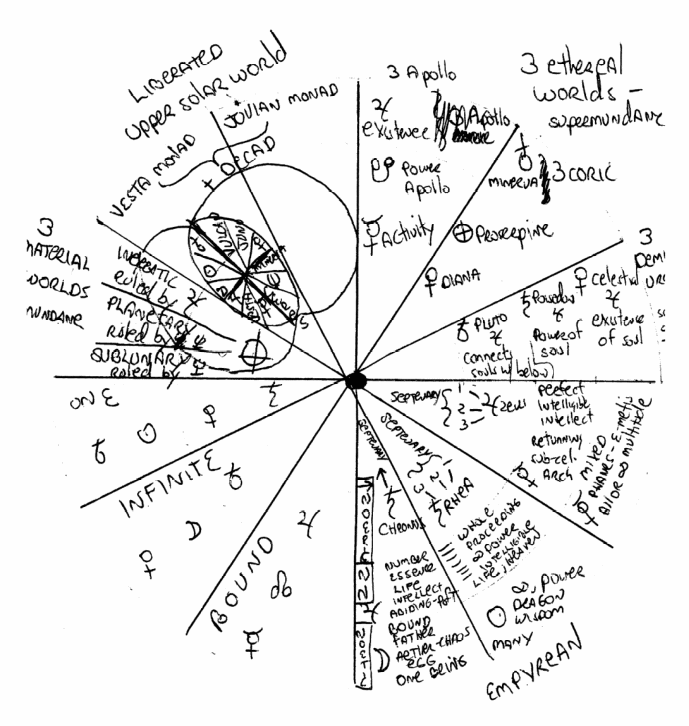
FIGURE IMG_2202-Posterboard Metaphysical Chart.
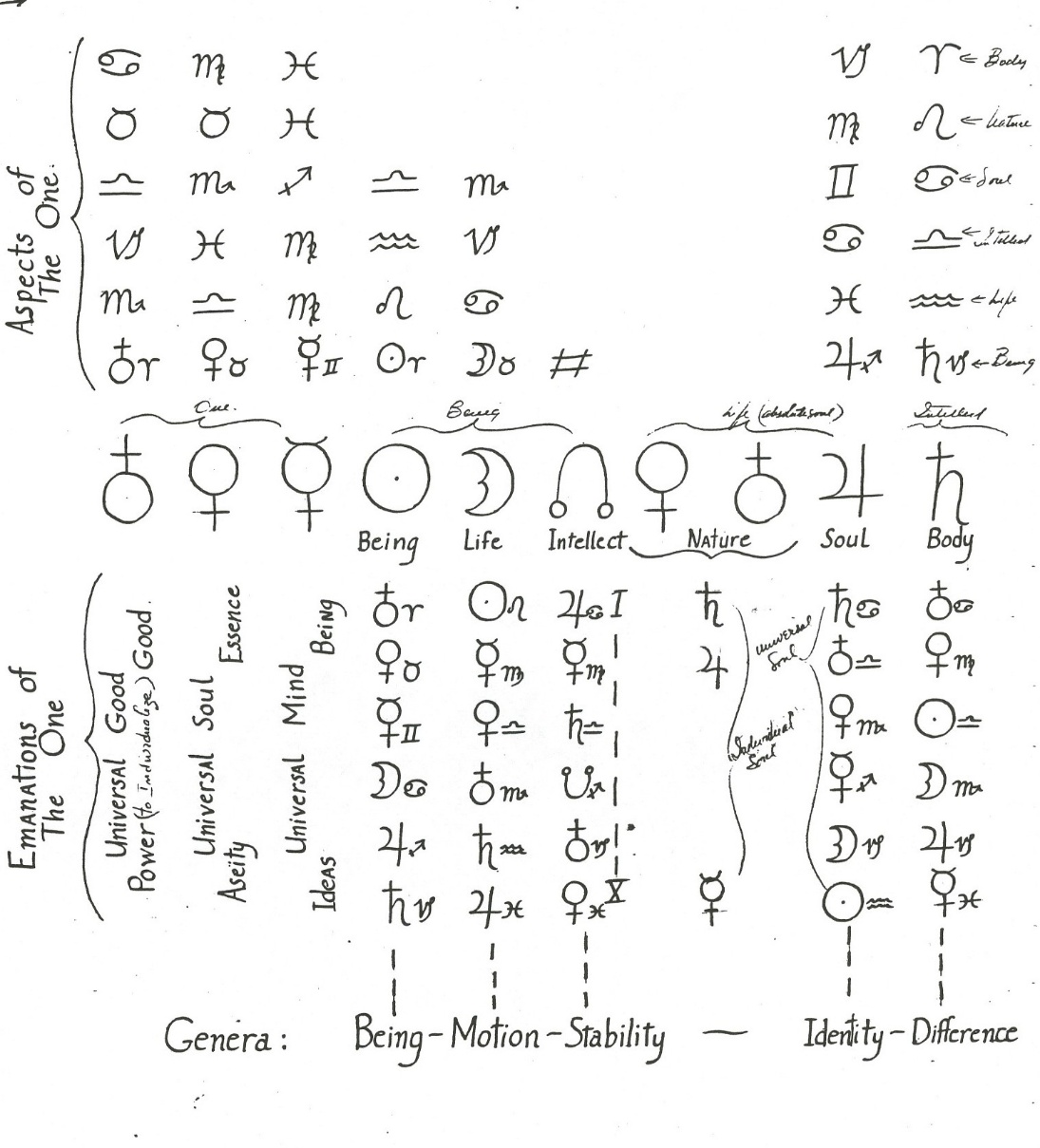
FIGURE AD_G_007. Aspects of the One; Emanations of the One; Genera.
FIGURE 1981 0102-6-AB. Proclus Chart.
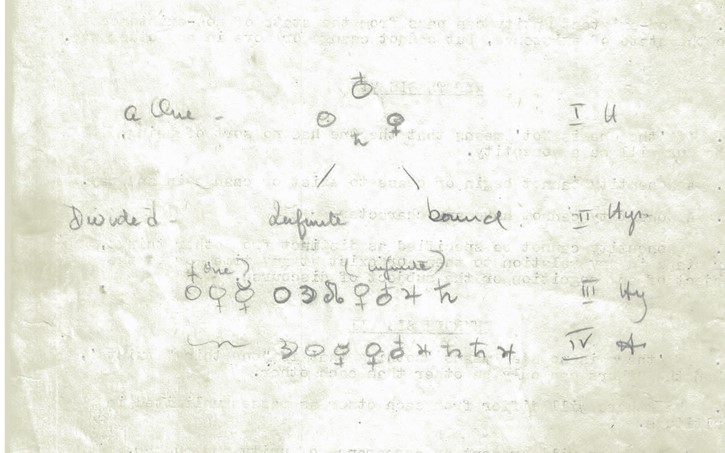
FIGURE PLA Eight Hypotheses of Plato B-p.4.PDF. Facsimile scan of Anthony Damiani hand-drawn diagram (originally on back of copy of Cornford Eight Hypotheses): Hypotheses I-IV, with 1st Quadrant Dignities (Hyp. I-III) and Rulerships (Hyp. IV).
Other diagrams also referred to are not with this transcript version. [Transcriber note: [diagram] means the speaker is referencing a diagram as he or she is speaking. If someone is drawing or writing, with audible sounds of chalk on a blackboard, I indicate this by [drawing] or [writing].]
APPENDIX: The Eight Hypotheses, as translated by F.M. Cornford in Plato and Parmenides, are appended for reference only. They were typed out and used in other WG classes on the Eight Hypotheses. AD made some handwritten edits and these are noted accordingly.
NOTES:
- Plato's Parmenides Hyp. 2 is further discussed in WG Class 1981 0109.
TRANSCRIBED Verbatim by IT 2021. In 2025, IT expands Subsubjects, completes TOC, adds new notes within transcript, corrects typos/errors, adds six diagrams and references within transcript to these diagrams. Archival verbatim transcript – V12a.
AUDIO FILES: 1981 0102a, 1981 0102b. [Note: "Tape" and "Side" refer to original audio cassette tapes that were later digitized into .MP3 Audio Files.]
1981 01/02 at Wisdom's Goldenrod
Plato; Parmenides; 8 Hypotheses Hyp. 2
[Audio File 1981 0102a Begins]
S (very faint): The two of us.
S (very faint whisper): (Right.)
S (faint): Yes.
[tape break]
[Transcriber note: I am using Thomas Taylor (tr.), The Parmenides: A Dialogue on the Gods (Vol. 3), in The Works of Plato, viz. His Fifty-Five Dialogues, and Twelve Epistles, First Edition, London, 1804.]
Plato, Thomas Taylor (tr.) [The Parmenides, pp. 161-164, LR reading]: "Have we not therefore declared if the one is, what circumstances ought to happen to it? Is it not so? Certainly. But consider from the beginning, if the one is, can it be possible that it should be, and yet not participate of essence? It cannot. Will not essence therefore be the essence of the one, but not the same with the one? [for], if it were the same, it would not be the essence of the one, nor would the one participate of essence; but it would be all one to say the one is, and one one. But now our hypothesis is not if one, what ought to happen, but if the one is--Is it not so?"
AD: Ok, could we stop here and see if we understood this much. [short pause] Now, what do you think that the essence of the One is? The One is participating in essence and the essence it participates in is the essence of the One. So then it becomes crucial to find out what the essence of the One is. [student assents] What makes the One to be One? If we say that essence is the definition of a thing. [short pause] Well we could use our diagram to help us.
LR (faint): I'm just the reader now.
S (very faint): Yeah, yeah, do it.
LR (faint): Not-- we're not allowed to--
SC/S(?) (very faint): Go ahead.
S (faint): Uh-hm.
MW: Got to contradict him.
[short pause]
AS: Do you want to pick up?
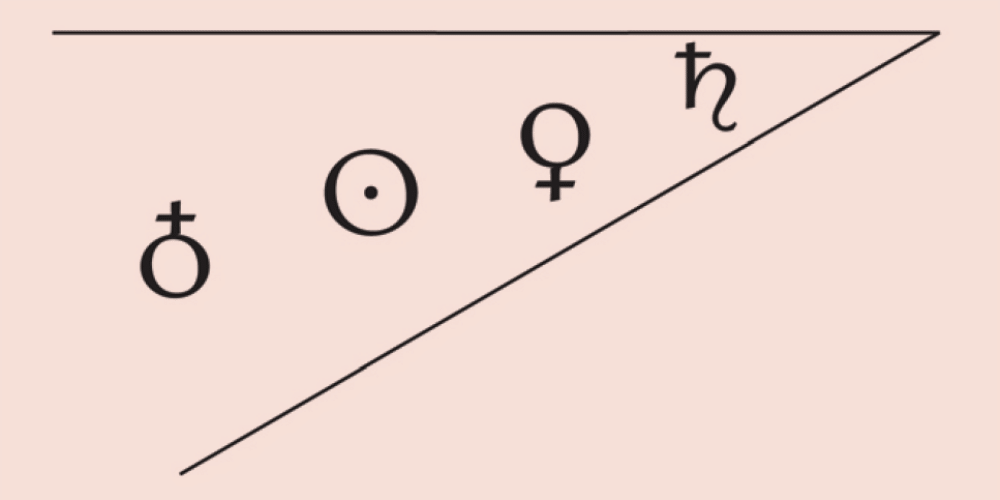
AD: Yeah please. That's all you're going to-- that's all you're going to need, the first house [FIGURE 1981 0102-1], you don't need anything more.
AS: Then--
[AS drawing]
LR: When we read this, do you-- the way you're wanting to go through it now [one word inaudible] is it with or without the footnotes?
AD: No, no footnotes. [LR: So--] We're doing-- we're doing this according to Plato, not according to Proclus.
LR (simultaneously): Alright, so leave out the-- Because the footnotes really take you into a different track than I think the way you want to go (now) [couple words inaudible]
AD (simultaneously): But, I understand that, Linda, I understand that.
LR: So, you want to do--
AD (simultaneously): And that's-- that's what I want to avoid, [LR simultaneously: That's what I want to say.] I want to avoid having a Plotinian-- a Neo-Plo-- Neo-Platonic interpretation of that. I want to try--
LR (simultaneously): So-- so you just want to avoid the footnotes this time too.
AD (simultaneously): Yeah, I want to try if we can understand Plato and just Plato himself. [short pause] Now, do you remember in another context we spoke about (what--) we spoke about the word 'essence', I mean, and esser is the same like the verb "to be". And, essence-- I think the context we spoke about it, we spoke about Soul essence. And we said now Soul essence, alright, is constituted of such and such. What constitutes Soul essence does not constitute Intellectual essence. So we made a few chalk marks on the board and we showed that the Ideas that go to constitute Soul essence, alright, do not constitute Intellectual essence. So that the definition of Soul essence is different from the definition of Intellectual essence. But now he's speaking here about the essence of the One. Alright now what would the essence of the One be? [short pause] I don't care who throws a sponge at this.
LR (faint): The first house (I mean). [one/two words inaudible] (say to use) the first house. Self-Existent.
AD: When you say the Self-Existence is the essence of the One, alright--
LR: Yeah.
AD: Now, if we wanted to go into some sort of understanding or elucidation of that, alright, we would have to find what that would mean, what the ingredients of Soul ess-- I mean of the One's essence is.
LR (faint): Yeah, uh-hm. How--
AD (simultaneously): Now, I think Avery's been working on that for a couple, I don't know, weeks, months, centuries, it doesn't matter, alright. What would you say the essence of the One is?
S (very faint): I just don't know.
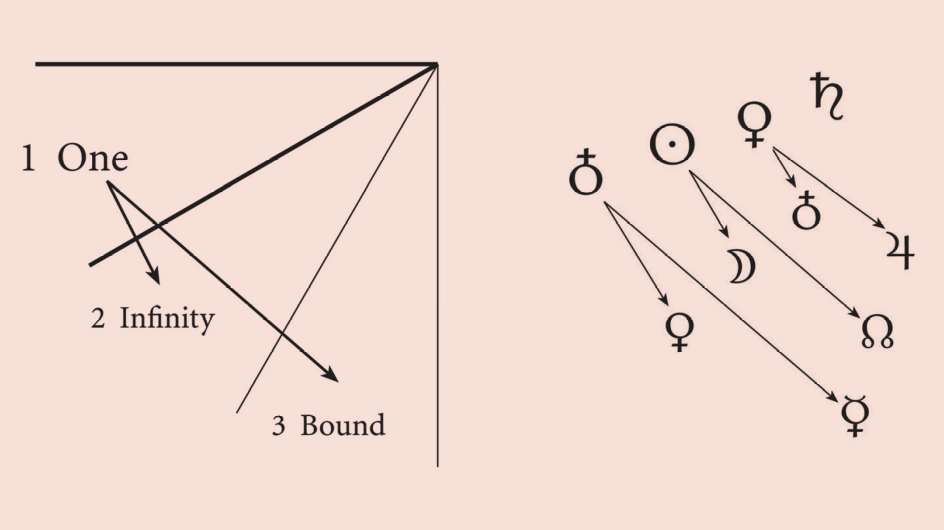
AD: In other words, if you wanted to-- if you wanted to try to present us with a definition of what the One is, wouldn't you have to try to show that it-- it was constituted of unities which can be subtended? Wouldn't you have to show for instance that the One exhibits Infinity and Bound [FIGURE 1981 0102-3]? Unlimited function, infinite substance? Wouldn't you have to show that this is what the essence of the One is?
[20¼ second pause]
BB: Wouldn't it be contained within the essence and not--
AD: Wouldn't it be contained, I'm sorry?
BB (simultaneously): Yeah, the Infinite and Bound, wouldn't that be contained within the essence, in other words, you would have to explain essence first before you--
AD: No, when you get your definition then you get an idea of what essence is.
LR: Are you in the diagram looking at the essence of the One as-- how are you symbolizing essence of the One, just as the Mars [diagram], as the first-- as the whole first house?
AD (simultaneously): Well, wouldn't you say that the Mars for instance could be looked at-- and Avery went through this, the Mars could be looked at as a substantial unity and as a functional unity [diagram]. It could be looked at as the leader or the unity of the whole series of Being [diagram]. You could do that with the Sun [diagram], could do that with Venus [diagram].
LR: I know that.
AD: And you could do that with--
LR: But what I'm asking is, when you speak of the essence of the One specifically here, [AD, faint: Uh-hm.] how are you-- how-- what are you looking at, the whole first house? All the planets or just the Mars? All the planets as they imply the whole first quadrant, [AD, faint: Uh-hm.] and all the rings [diagram], I mean, what are you-- just--
AD: I'm looking at just what's there. Just what's there.
LR: Four planets in the first house [FIGURE 1981 0102-1]?
AD (simultaneously): The four planets there.
[short pause]
LR: So it includes that Being, [AD: (Here/Yeah).] Intellect, Nature--
AD (simultaneously): Yeah let-- let's go back to Soul essence because I see everyone's a-- you know--
S: Yeah.
AD: Soul essence, the definition, come on.
AS (faint): Well, we already explained the wrong one.
AD: You explained Soul essence, you remember?
AS/S(?): Of course, that's what I get.
S: What?
S (faint): Maybe you remembered it (somewhat) wrongly.
S: Yeah.
S: Yeah. (bit of laughter)
LR (faint): What was it (A.)?
AD: You'll drive me to drink, to smoke, to-- All the vices.
S (very faint): I don't really think about it.
RG: No. What do you mean?
AD: Come on Avery. Soul essence. You think they remembered from two weeks ago, you're crazy. They forgot what they had for breakfast.
AS: It's ok. (bit of laughter)
S: Yeah.
[short pause]
AS: Ok, so--
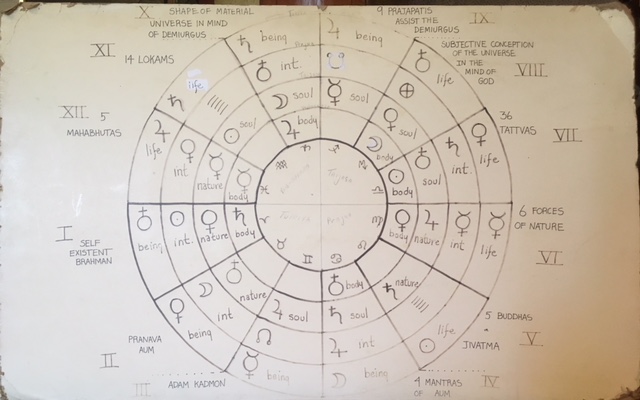
AD: On the other board, you remember? We took-- we took the third quadrant [FIGURE IMG_2202-Posterboard Metaphysical Chart], we said now what constitutes Soul essence? [drawing] Soul kind. So Avery went through this procedure.
AS: You won't remember.
[30 second pause while AS draws]
AS: So when we looked at what made s-- what was-- what the essence of Soul is, [S, faint: Uh-hm.] what makes Soul to be Soul, and he said there's a certain being and motion, permanency. [short pause while drawing] Just go on.
AD: We said [AS simultaneously: Well there are two aspects.] that certain Ideas [AS simultaneously: Yeah.] have to constitute Soul essence. [student assents, very faint] [AS: Sorry.] And only these Ideas would constitute Soul essence.
[16¾ second pause]
AS (faint): Try again.
[short pause]
AS/S(?): Yeah, simple.
AD: What did you eat, potatoes?
CDA (simultaneously): (We/You) started from the categories-- (laughter, student words) Like, if you use the same-- one thing I remember is that if you use the same categories to-- to talk about Being--
AD (simultaneously): Nice and loud Carol, I can't hear a word you're saying. Make out [CDA simultaneously: Well I--] you believe in this stuff, that your life depends on it.
CDA (simultaneously): I didn't want to say it out loud. (CDA laughs a bit)
AS: Why not? (laughter) Come on.
CDA: Well one thing I remember is that, one question we had was if you use the five cate-- five genera for the second quadrant [diagram], and you use the five genera to determine--
AD: But the five genera also apply to the third quadrant.
CDA: Right. So--
AD (simultaneously): So the genera did not give us [CDA: Right.] essence.
S (simultaneously, faint): Yes.
CDA: Right. (laughter) That's all I wanted to say was that it [three/few inaudible AD words simultaneous with CDA] came to be that the Ideas were what made--
AD: That did distinguish one quadrant [CDA simultaneously: Yes.] from the other.
CDA: Yes.
LR: Ok but if-- now if you do that you've got Libra, Scorpio and Sagittarius as Soul as the three [diagram].
AD: Uh-hm.
LR: But now you want to look at the essence of the One as Aries.
AD: Yeah we want to look at the essence of the One.
LR: As? I mean you're not doing the same thing? You're not looking at Aries, Taurus, Gemini?
AD: Well we will but let's start with the first house.
LR: Aries.
AD: Yeah, first house [one/two words inaudible]
DB: (Come on.)
AD/S(?): Go ahead.
DB: Randy? In distinction from the third quadrant where essence is a principle that would be, so to speak, prior to manifesting sort of as Soul, here it's the other way around. I mean we spoke of the essences referring to the planets whereas the One itself would be the sign. So that there's a distinction in the way essence is to be understood in relation to the One as opposed to the relation to everything else. [students assent, very faint] I mean we spoke of-- we-- I think we were speaking before of the-- the essences containing within itself this undifferenced knowledge that-- that-- if I remember from the way you've done it before--
AD: We spoke about the Double Act in the One?
DB: Yeah. But--
AD: Which is not a Double Act, right? Except, you know--
DB: In the (ether/kether).
AD: Uh-hm. And the Double Act was what?
DB: Well-- There was the-- on the one hand you could look at the-- the One as absolute substance, which I think would be the sign, and then as infinite function. Ok, and that there were two ways of looking at that, that on the one hand, I think it was said that the first Act was understanding them as being in a completely undistinguishable relationship so that there was--
AD: (Should've) just cancelled out the word 'relationship'.
DB: Right. So that, I mean--
AD: So you say an unlimited substance is synonymous with in-- infinite substance.
DB: Right.
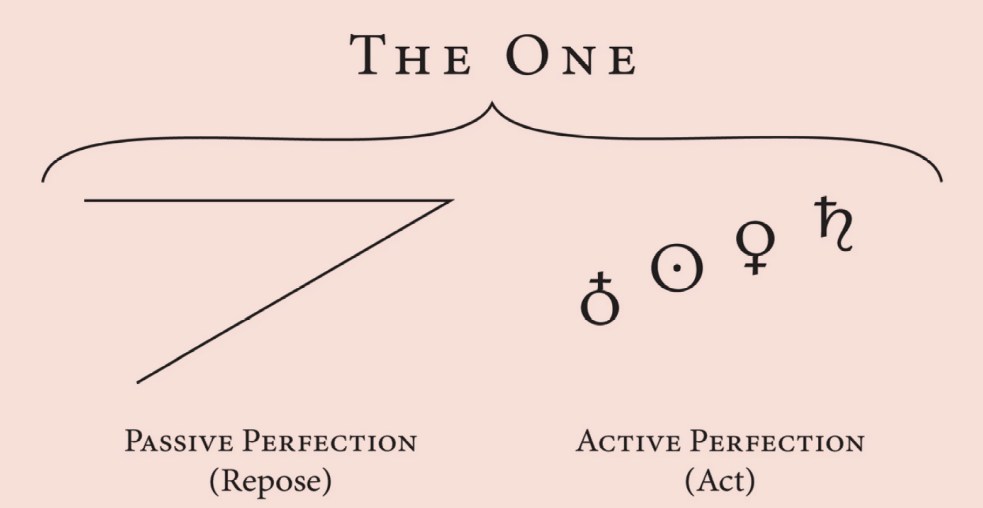
AD: This is the Double Act.
DB: Well--
AD: Passive Perfection, Active Perfection, this is the Double Act [FIGURE 1981 0102-2]. They're synonymous with each other.
DB (faint): Right.
AD/S(?) (faint): Ok, yeah.
DB: And at that level I think that the dignities there were spoken of as--
AD: Well we could-- yeah, we could-- we could do a couple of things, right, we can put the second and third house [FIGURE 1981 0102-3, left side].
DB: Right.
AD: Alright, that would be the Double Act. Each one, insofar that each is synonymous with the One and synonymous with each other, alright, all the first three houses are nothing but the One [diagram], (ok)?
DB: But, would it-- would-- would we be saying now that this-- you know, this determination, so to speak, within the One of the second and third house as coming from the first house, so to speak, that would constitute the essence of the One.
AD: Well wouldn't, wouldn't we be talking, when you do that, aren't you taking the idea of the One, [DB: Uh-hm.] and you're splitting up the idea of the One into what constitutes the One, Active and Passive Perfection.
DB: And-- [short pause] So the splitting up of the idea of the One and into Active and Passive Perfection, would-- would that mean what he means here by essence?
AD: Gee, I'm not ready to worry about essence, I'm just worried [DB simultaneously: Oh. Oh alright.] taking it apart.
DB: Oh I thought we were-- ok.
AD: Alright, that will be one approach, you take the house, the first house, you say One has these two ways of (being applied). Take the dignities in the first house [diagram].
DB: Right.
AD: Ok? Now if you took each dignity, each dignity would have what you would call an act and substance [diagram].
DB: Yes, ok.
AD: Ok? So that you could look at everything in the first house, alright, as composed of substance and function, alright, and the totality of that, [student assents, very faint] if we look at all together we would be able to say, well one way of approaching this here would be to see that those dignities is a combination of the unities, alright, the Saturn unity, Venus, Sun, Mars, ok. And there you have the Double Act so we-- we had written this up before. (We/He) did something like this. [drawing/writing] We said the Double Act that stems from here, Double Act from here, Double Act from here, and Double Act from here [FIGURE 1981 0102-3, right side]. Ok?
DB: Right. [short pause] Now this-- now this would all be from the standpoint of the-- of, so to speak, the functional aspect of the-- I mean it would be from the point of view of the active pole, so to speak.
AD: Why is it from the-- just the active pole? If we take the Saturn, alright, [DB: Uh-hm.] it's the leader of the Body series [diagram], [DB: Right.] alright, so [drawing] you'd have the Mars going all the way down [FIGURE AD_G_007, column under Saturn].
DB: Yes.
AD: And it's also a leader in its own right, it's the leader of all the dignities and Saturn [FIGURE AD_G_007, column above Saturn].
DB: Right.
AD: If you take the Sun you could do the same thing [diagram].
DB: Yes, right.
AD: Ok?
DB: Ok.
AD: So then over here [chalk on board sounds] this would represent the different constituents that go into helping us understand what constitutes the essence of the One.
DB: Yes, ok.
AD (simultaneously): So we-- [drawing/writing] we would call this Being, this is what we do, Life, Intellect [diagram]-- Being, Life--
CDA/S(?): And In--
[AD drawing]
LR: You know, it's just not based on the same thing as when you speak of Soul essence. When you speak of Soul essence--
AD (simultaneously): No, no, I didn't say it was based on the same thing.
LR: No I mean it's-- it seems almost misleading to say well, here's what we meant by Soul essence, now what do we mean by essence of the One. Because when you define Soul essence it-- you can do it through limitation. You can [student assents] say it's not this and it's not that. It's very hard when you're looking for the essence of the One because what you're doing is trying to get at the principle for everything that's going to come out of the chart.
AD: Very good.
LR: So it's a very different kind of technique that's required to find what you mean or what might be meant by "if the One is" than what you mean by what Soul essence. Soul essence we could say ok, now we're limiting it to this quadrant, we mean these three Ideas, there are these dignities which are going to appear in it and there's like a Cognitive-Isness that runs through it. Ok? We can't do that here, we can't do that at all. We're talking about the basis for anything else we're going to speak of in the chart--substance, function, unities, monads--
CDA: All the Ideas.
S (very faint): All the Ideas as (promised).
LR: Being. Intellectual-- super-essential Being, you know, those [one word inaudible] Um-- you know, you-- it--
AD: But isn't-- isn't that intriguing?
CDA: It's overwhelming.
AD (simultaneously): I mean isn't that the whole point? The whole point here being that the One is going to participate in the unities. Because the unities are its essence, therefore the One is participating in the essence, and the essence that we're talking about is the essence of the One.
LR (faint): Yeah, I don't think-- Which?
AD: If you put the whole series below each one [FIGURE AD_G_007], ok, you cover-- [drawing] you-- you'll be running, so to speak, all the-- In other wor-- [short pause while drawing] You would end up speaking about the unities, in the analogy we used about zeros, you know, the unities are equivalent to zeros. And that no matter how many of them you add up together you'll still have zeros. So if we think of the One as participating in its own unities, alright, would we be saying something like he wants us-- wants us to understand, that the One is participating in its own essence.
S (faint): Go ahead.
S: Could I ask if the-- is it-- is this an essence-- usually it seems like it's one thing that it-- you know, we usually talk about the essence, it's-- it's a-- it's a unity, it's-- it's not a-- I mean the way you're speaking of it here is that from the One talk about its essence but we immediately jump to unities as we immediately have a-- we've got a multiplicity. Is that what you mean?
LR (simultaneously): Why do you think the essence is one, Crystal? I'm just trying to help you before you get in big trouble. (bit of laughter)
S: I think essence usually refers-- you-- ess-- an essence usually has a unity. You can talk about the essence of-- I don't know, I mean, maybe those are lower principles, maybe that's not [one/two words inaudible] I mean if you talk about the essence of anything don't you usually go to a-- a unity [one/two words inaudible]
LR: Well, did you [AS/S(?) simultaneously, faint: No.] in the third quadrant and that's a lesser complicated. Is that one-- did you? When you looked at all the Ideas and dignities in the third quadrant, did you point to one thing as its essence?
S: Yeah.
LR: What?
AS/S(?): No.
S: Well--
LR: What was the one thing?
S: The essence of Soul. [S, faint: Yeah.] (Only that.)
LR: But it was all those dignities and all those Ideas.
S (faint): Well I know it's the way, you know, that you're looking at it. My question is, is that the way you're looking at essence, is it always multiplicity. Or is it one thing. [9¼ second pause] I mean I don't--
AD: You want to answer? Go ahead.
BB: I don't know-- I'm not sure exactly, is-- are-- is she saying that-- that essence is comprised of both multiplicity and unity. Is that what you're saying?
S: Well, what we're saying here-- well I'm just listening to what's being said, it seems like to talk about the essence of the One we're immediately talking about unities, like we're immediately talking about a multiplicity. And, somehow, I-- when I think of essence, it somehow usually points to some kind of a-- an-- an underlying thing with the unity. Maybe that's a wrong way to look at it, I'm trying to-- I mean you usually talk about the essence of something it's-- it's the single unifying principle, so for me I'm trying to figure out what are we saying if we're immediately having a multiplicity, I mean-- Or maybe [BB simultaneously: (It's--)] the only way we can talk about the One's essence is to immediately have multiplicity.
BB: But can't you have both? Can't you have a unity and multiplicity, that that's kind of (much all--)
S (very faint): Uh-hm.
BB: Uh, the--
S: What's the unity? Then what's the (unity)?
BB (simultaneously): The unity is all of them together. The unity-- the mul-- the-- the multiplicity or the unity is as a unity.
S: But what's the unity?
BB: The unity is the One itself.
S: But then you're back to the One.
S (very faint): Yeah that's right.
BB: That's the thing I'm trying-- hard to understand is how-- how you-- you can be talking about essence and either in terms of a multiplicity or in terms of a unity it has to be a combination of both, it seems to me. But if there's a combination of both then-- then you're giving rise to something else that's in a way predicated like on difference or something like that. In other words, it seems to me what he was saying in this was-- is that you have the One and the Being of the One, and that Being is that which is going to give rise to that multiplicity or these unities in the first house. Or maybe even just the-- if you have just one unity, i.e., the Being, which is the Mars, in a way it gives rise to, at that point, a-- a multiple aspect of looking at the One. So you have two things which is the One and-- and-- which is at the first house and then number two is the Mars in the first house which is the Being and the multiple aspect, [someone drawing] you can look at it as either substance or function or both, and that would be what he'd call essence. But, if you have that then you've got to have had difference.
S (faint): Yes.
BB: And you also have got to have probably another thing too and that'd be same, sameness.
AD: This keep coming up all the time, so I guess we'll try.
S (simultaneously): Yeah I have the same old question, you know, whether-- whether Being itself has a unity. And I know we've gone over that and I don't-- It's-- it just-- I was only pointing out that usually when we talk about the essence of something from down below, you rise to the essence and it becomes a kind of u-- it becomes the unity. But in this case, it's like to find the essence(s) so the One then separates, the One be-- it comes down or the One-- It's sort of a reverse-- I mean usually when you speak of essence you talk about the principle that was [one word inaudible]
[students assent, very faint]
LR: Crystal, I think you're using essence in the way (we/he) spoke about like form.
S: No. Not really. But your essence, what is your essence? Probably different thing(s). [student assents, very faint] But-- Overself, what is it? [S, very faint: Yeah.] Soul? It's one thing, it has a unity. Or how could it be your essence? How can your--
LR: How could the-- how could the essence of the One be one thing?
S (faint): Uh-hm.
S: That's exactly what I'm saying, I-- like I-- it seems a real different way of looking at it.
LR: If it were one thing it wouldn't participate of-- I mean, you've [BS simultaneously, faint: Or it would be the (one/two words inaudible)] just knocked out any possibility for a universe or anything if you speak [student assents] of the essence of the One to be one thing.
S: No it has a unity. Doesn't mean it can't also have a multiplicity in it.
S (faint): Not (really).
RC (simultaneously, faint): Is the multiplicity part of its essence or something other than it?
S: Well that's-- that's what I'm trying to find out, is that later, is that like the later--
RC (faint): What would you think?
S: I-- that's what-- well-- that's what I would like to think, that first it's-- on its highest level its essence is its Being. I mean that's what he's saying as Being. We don't say it has Be-ings. We don't say the One has-- well-- or maybe we do, that's what I'm trying to find out. That isn't-- there isn't an in-between like with the One.
RC: Like it sounds like you say that you're thinking of an essence as the simplest term in which a multitude of qualities could be united (participating--)
S (simultaneously): Yeah like a substance.
S (faint): Yeah. Uh-hm.
RC (simultaneously, faint): Participating in some common ground. But if-- if it resolves a multiplicity, then doesn't the essence itself have to have the multiplicity within it?
S: If what, if it has-- if it what? It manifests a multiplicity?
S (faint): Resolve.
RC (faint): If it resolves the multiplicity [S simultaneously: Yes.] into a One, [S: Right.] then it would seem that the multiplicity that gets resolved is anticipated in the essence or presence of the essence.
S: Right, but-- and don't go back to-- but don't go back to the first One. Let the essence have a unity also. I mean don't-- right? Is that what you mean, the essence itself is a unity [three/few words inaudible] Don't-- I mean-- don't think of it as-- it would have to go back to the first, (go back).
RC (faint): Well if you think of-- if you allow essence as having both unity and multiplicity, and then you say the essence of what-- Like, you speak of the essence of Soul, you'd be talking about one type of multiplicity getting resolved into one type-- the essence of Intellectual-Principle, some type of multiplicity getting resolved into some type of ground. But see now he's talking specifically about the essence of the One.
S: Uh-hm. And immediately we're going to talk about a multiplicity.
RC (simultaneously, faint): What kind of multiplicity can we deal with other than [short pause] ones?
[short pause]
AD: Go ahead.
BB (simultaneously): You s-- you-- you've got-- it seems to me you got two things. You've got the One which is that first house. You've got like the first thing is that Mars which is that Being. Then you're saying also you've got the Being, Intellect, Soul, and Body there. And each of those has a unity and-- or a substance and function or a unity and multiplicity or something like that. So you got two aspects there of the One. But-- and both of them it seems to me would kind of be related to that essence. But the thing is is that the first part would be the-- the One, and then that Mars which would be the Being. And the two of-- one would be kind of, as you said, the interior Act or the-- I don't know what you'd call it, the Act-- one would be the passive part, the Passive Perfection which would be the One, and the other-- the Mars would be like the Active Perfection. And the two of those together would comprise the essence of the One. Then you'd also have the One being the full first house, which in a way would also be a passive aspect and then also those dignities in there which would also be an active aspect, and those two would also be-- the two of them together would be what it seems to me would be also a thing which we might call the essence of the One. And I guess in a way you've got two thing-- you got really four things there in a way that are all comprising the essence of the One. But it seems to me that what he's talking about in the Second Hypothesis there is that very first thing, the very first Act or if that's-- I-- if that's the first Act I'm not sure but the-- where he's talking about the One and that Mars, and that the two of them together comprise the essence of what we would call the essence of the One. It'd be like a two-sided-- if two sides of a coin and in a way the essence would be the coin. And yet the essence is the One and it's also that of-- of the Being too. And [AD simultaneously: But--] they're both the same.
AD: But look--
BB: In-- in my head.
AD (simultaneously): He starts off the proposition, he says the One participates in essence. The essence that it participates in is in the essence of the One. Alright. Now we could put aside the notion of the One and we could try to understand what he means by the essence of the One.
BB (faint): Fine.
AD: Ok, we could-- So, we-- we're trying to tackle what he means by the essence of the One.
BB: Right.
[Note: See FIGURE IMG_2202-Posterboard Metaphysical Chart for the following.]
AD: Now, if we work up for instance the Intellectual-Principle, alright, we come up with the Sun in Aries [diagram], alright. If we work up the Being, we come up with the Mars, alright, in Aries [diagram], and if we work up the Nature monad we come up with the Venus in Aries [diagram], alright. Now every time you come up with one of them, alright, in other words, if we took an example. [short pause] If we take the Saturn and we say it's-- it's-- it's a mon-- it's a unity in its own right, alright. And insofar that [drawing] it's a unity of the Body series [Body ring], ok-- Well-- let me see.
LR: You had Mars in Cancer, Venus in Virgo.
AD: Mars in Cancer, Venus in Virgo.
AS/S(?): (Sun.)
LR: Is that what you want or--
AD (simultaneously): Saturn in-- [drawing/writing]
AS: Sun.
AD: Sun?
AS (faint): Yeah Sun Moon.
LR: Sun Moon.
AD: [drawing/writing] Sun, [AS, faint: Jupiter.] Moon, [LR, faint: Jupiter.] Jupiter.
LR: Mercury.
AS (faint): Mercury.
AD: (Ok.) Alright. And, another one?
AS: Then Saturn, Saturn, then all the other ones are all Saturns [Saturn dignities].
LR: Saturn in Cancer, Saturn in Leo.
AD (simultaneously): The other ones are Saturn [one/two words inaudible] and--
AS (simultaneously): Saturn in Cancer and Saturn in Leo. They're in [AD simultaneously: Cancer, Leo.] Cancer, Leo, Libra.
AD: [drawing/writing] And Capricorn and Aquarius. Now, let's take one, ok, let's start with this here [diagram]. [Note: AD is starting with Body Mercury in Pisces and going backwards through the Body ring per his comment below.] This is bhutas, this is tanmatra, right? This is ahamkara, this is ahamkara, this is buddhi, this is buddhi, alright, buddhi-linga, buddhi-bhava [diagram]. What's this here [Saturn in Aries]? Huh?
BB: What is that?
AD: Yeah, what's this one then?
BB: That would be the-- that would be the-- I don't know, the-- the total absolute [couple words inaudible]
AD (simultaneously): No, ju-- in terms-- in terms of the terminology, alright. We're using the Vedantic terminology now.
BB (very faint): Yeah I know.
AD: Alright, this is the Body monad. So this is bhutas, tanmatras, ahamkara, buddhi, what's this here [diagram]?
BB: Prakriti.
AD: Prakriti. What is prakriti?
BB: Prakriti is--
AD: Principle of non-Being?
BB: Yeah.
AD: Formless matter?
BB: Right.
AD: (Has/Is) that got a unity? Is that a u-- is that the unity of [BB simultaneously, faint: No.] the Body monad?
BB: No.
AD: What is it then?
BB: I don't know what it is but it [one/two words inaudible]
AD (simultaneously): But when you say prakriti you're speaking about formless matter in principle, the principle of Difference.
BB: Yeah, ok, yes.
AD (simultaneously): You're speaking about that. So then this [Saturn in Aries] would be the unity of matter from which the differentiations come out of it. Is that so?
BB: Ok.
AD: If you took the meaning of Capricorn, I mean of Saturn (has/as)-- not s-- let's say substance, right now tentatively or-- or function, it doesn't matter, alright, and you would say, this will be its Life [in Aquarius], its Being [in Capricorn], etc., alright, till you come here, and then this Saturn in Aries will be what? Wouldn't that be the unity of all these?
BB (faint): Yeah, ok.
AD: Now what do you mean by unity then? If we said [writing] 6, 5, 4, 3, 2, 1, 0, right? If we say 6, 5, 4, 3, 2, 1, 0, that will be zero, right?
BB (faint): Yeah.
AD: (Yeah.) If we do that with all the others, alright, then we [drawing] would have zeros all along here [diagram].
BB (faint): Yeah.
AD: Now if you add up all these unities, what are you going to come up with? Eighteen!?
BB (faint): No.
AD: What do you come up with!?
BB: Come up with the same zero.
AD: You come up with unities. That's all you have!
BB (faint): Right.
AD (intensely): That's all you'll have at this level is unities.
S (faint whisper): Right.
AD (intensely): Now, when he says the One participates in its own essence, the essence of the One, what is he talking about?
S (very faint): What?
S (very faint): Yeah.
AS: Talking about these unities.
S (very faint): Uh-hm.
S (very faint): [one/two words inaudible]
BB (faint): Participates of its own unity?
AD (simultaneously): Alright, go ahead, continue, let me get some coffee.
AS: What?
AD: Let me get some coffee, continue.
AS (simultaneously): No, no, not that it participates in its own unity, it participates in essence. We're not talking about unity now. We're not talking about the unity part of the One. He did that in the First Hypothesis. He's talking about the participation in essence, just like the Double Act. It's the second Act. He's talking about the way-- I mean [couple/three words inaudible] he's just talking about the way in which the One has-- has these essence [AS indicates on diagram], these-- In other words, essence here is-- you can't cha-- in other words, it's not the first one because you can't characterize-- in the First Hypothesis you can't characterize the One at all. [BB, faint: Right.] If essence is what characterizes the One, then you have to speak about this second aspect of the One. So if you want to characterize it by its essence, these-- these dignities as it were are what-- are what makes the One to be One, if you want to put it that way. But the first-- but talk-- talking about it as absolute One you won't even be able to say anything about it.
BB: I understand that first part being that you can't talk about it, and so you really got-- it just says that-- discusses the One, but we can't really talk about it. And in the second one it says we've got to discuss the One is. And when we're discussing the One is, then we've got to look at it seems to me in terms of something he calls One Being. And when [one/two words inaudible]
AD (simultaneously): No, [AS simultaneously: But-- no.] you can't make this up, you can't make this up, you got to [AS simultaneously: No, (he is).] follow the text. You can't-- [BB simultaneously: He does it in the very first (one word inaudible)] you (can) say he participates in One Being.
AS: See I think he's talking about this as the internal structure now of the One as containing all of this within it. [drawing] So if you push all the whole Body series back into the One, you get the Saturn [in Aries], if you push any one of these back in here [diagram] this-- the internal structure of the One is its essence. [Note: See FIGURE AD_G_007, middle line; also first quadrant in metaphysical chart.] Ok? And we say its internal structure as it were that allows a participation of all of these principles. That's-- in a way that's its essence.
BB: He says on page 167--
Plato, Thomas Taylor (tr.) [The Parmenides, p. 167, BB reading]: "If the term it is is spoken of one being, and the one, of being which is…"
AS (simultaneously): No, wait, wait.
AD: Read the text where we're reading now.
AS: Back Bob.
LR: We're on 165, 164.
BB (simultaneously): Where are we?
AS: Here he says--
Plato, Thomas Taylor (tr.) [The Parmenides, p. 162, AS reading]: "Will not essence therefore be the essence of the one…"
BB (faint): Right.
AS (simultaneously): Can-- Oh, go back.
BB: Not the same-- but not the same with the One.
Plato, Thomas Taylor (tr.) [The Parmenides, pp. 161-162, AS reading]: "Have we not [therefore] declared if the one is… … [But] consider from the beginning, if the one is, can it be possible that it should be, and yet not participate of essence?"
AS: So now we're considering the One as participating of essence.
BB: Should be [couple words inaudible]
AD: And all I want to know before you take another letter forward is what is the essence of the One. If you don't understand that there's no sense going anywhere. If it's participating in essence and it's the essence of the One, and you don't know what the essence of the One is, why go any further? I already had four hours this morning so I'm not going to be short-tempered. Now answer me will you? Is that so, do you have to know what the essence of the One is in order to understand what the One is participating in?
BB: I would think so.
AD: Oh, ok, then we have to find out what he means by the essence of the One.
BB: Right.
AD: Good, let's do so. What is the essence of the One?
AS: Say-- and you can't-- you can't just say the One again because that's not going to-- then you're going to go back-- then he's going to say it's all the same to say-- that's the point. [one/two inaudible student words simultaneous with AS] It's going to be all the same to say the One Being and the One One.
BB: I know, I said [couple words inaudible]
AS (simultaneously): If you go back-- if you go back and say, well the essence of the One is one, [BB simultaneously: He says "Will…"--] you might as well forget it, you're back in the First Hypothesis.
BB (simultaneously): He says--
Plato, Thomas Taylor (tr.) [The Parmenides, p. 162, BB reading (simultaneously with AS above)]: "Will not essence therefore be the essence of the one, but [BB reads: and] not the [BB emphasizes following word] same with the one?"
AD: Yeah.
AS: But not the same with--
BB (simultaneously): If-- if otherwise it would be One One.
AS: Right, we're not in the first Act anymore.
BB: Right.
AS: So the first Act you have substance and function are absolutely indistinguishable and united. So you can't even speak about essence. And you don't.
BB: Right.
AS: But in the second one, you're distinguishing them so you can speak about [AS knocks on board] essence now as distinguished out from the oneness or absolute One. It's just-- but not separate from it, I mean not other than it but within. The-- the thing is here the essence is actually [AS knocks on board] that aspect of the One.
LR: Yeah there's a real-- there's a real [AS simultaneously: And not other than the One.] necessary [couple/three words inaudible] [AS simultaneously: Yeah.] which I think has come up a lot, which is when he says the essence of the One will not be the same as the One.
AD: Linda, you [AS simultaneously: Neither--] have to speak louder, can't hear you.
AS (simultaneously): Neither will it be different than the One. (AS laughs)
LR (simultaneously): That's the thing. When you say-- when you read this, and this has come up as a problem many times and I think [AS simultaneously, faint: Or (one word inaudible)] you're trying to avoid this, when he says the essence of the One will not be the same as the One, it's very-- it's very common to say well then the essence of the One will be different from the One if it's not the same as the One and I think he wants to avoid that too. It's not that the essence of the One will be the same as the One or different from the One. But exemplified as the internal structure of the One. In other words, you don't [AS assents] want to bring in sameness and difference right now. You want to look at the One in a different way. Or-- or the word 'distinguishing' maybe instead of 'difference'. I think. 'Cause I think we've run into that before haven't we, we say well, in order to look at the-- in order to look at the essence of the One, you have to bring in the category of Difference.
AD: Yeah but you remember when he--
LR (simultaneously): And that's what Bob wants to do and I don't think you want to do that.
AD (simultaneously): Yeah. I don't want to do that, [LR: I know.] see, I don't want to do that.
S (faint): Right.
LR: So we can't look at the essence-- so in saying that the essence of the One is not the same as the One, we don't mean it's different from the One or other than the One. We mean we're going to look at the internal structure of the One.
AD (simultaneously): Of the One, of the One.
LR: And that-- somehow just changing the words [couple words inaudible]
AD: Now, let's try the language of Plotinus, alright. If we would-- if we attempted this analysis on Plotinus, you remember the way he spoke about the Double Act of the One, ok. He speaks about it as having a Double Act and you remember the quotations on that. And you get the feeling that on the one hand you have the first Act and the second Act are really not different from the One. (Do you) remember that?
LR: Yeah.
AD: Alright so, he speaks about these two Acts. Now these two Acts are the essence of the One. Alright? You follow that much? The two Acts are the essence of the One. So if we take these two Acts and break them down and try to understand what they are, we can understand how the One is participating in this Double Act. Which is itself. [student assents, very faint] [short pause] Now the mistake we'll always make over and over again is that we will use the word 'Being' for essence and we'll get into all kinds of difficulties because Being has connotations that are embedded in the understanding. Essence, essence is a little more difficult. Because essence means more than Being. [students assent, faint] Essence has a peculiar flavor to it. It can alway-- it can be driven all the way up to the One. So you can say the essence of the One. You can't say the Being of the One without bringing in all these associations that determine the meaning for you right away. [short pause] [BB: Well--] The pivotal point here, Bob, I think that you have to see, is that if you establish all these unities up in the first house, alright, and you say that now the One participates in the essence [AD taps on board], and what is the essence, alright, and we say it's the essence of the One, then we could say well what is Mars manifesting, what is the Sun manifesting. And it would make sense to say that the [AD hits board] One is man-- is-- Mars [drawing] is manifesting the One, alright, but this One that is being manifested-- this is tricky, alright-- the One, [drawing] this One out here [BB: Yeah.] is participating in that One that's being manifested [FIGURE IMG_2202-Posterboard Metaphysical Chart, first house].
BB: Are you saying maybe-- can I try-- are you saying that the-- you've got the concept there of the One. Then you've got a concept that we might call the essence of the One, and from that such things as the Mars, which is the Being of the One, arises? That Being arises pri-- posterior to essence in a way? Or to put it [couple words inaudible]
AD (simultaneously, intensely): The Being of the One is manifested. The Being of the One is manifested.
BB: Right.
AD: The Intellect of the One is manifested.
BB: Ok. In other words you have One, then you have the essence of the One, and the One participates in its essence. And from that Being of the One arises, is that what you're saying?
AD: I lost you.
BB: You had the concept of the One. And you have this concept of the essence of the One. And the One participates in its own essence. From this, the Being of the One, i.e., the Mars in Aries, manifests and the Intellect of the One manifests and so forth? In other words, the essence--
AD: What does it manifest?
BB: It's going to manifest its unity and its-- and-- and its-- its substance and function or whatever you want to call it.
AS: No, it's going to manifest its essence.
BB: It's going to manifest its own essence.
AS: Which is the essence of the One, (and so) the Mars manifests the Being of the One.
BB: Going to manifest its own essence, which is the Being.
AS: The Sun manifests the Intellect of the One.
S (very faint): Yeah.
(Side 1 of original cassette tape digitized as 1981 0102a Ends; Side 2 Begins)
CDA: Could you explain-- I'm so-- I didn't get--
S (faint): Yeah.
AD: Michael, [CDA simultaneously: Say it again.] go over it.
MW: Ok. What we said so far was that the-- he could-- the peculiar essence of the One, we're saying well what makes the One to be One, we're saying ok, it's this essence of the One. Well one thing that's striking about it is that in distinguishing the-- the ingredients of this essence or the One, the only way we could talk about them is as zeros, that to-- to speak about them as having anything-- as having some characteristic other than the zero would make them a principle in their own right and seems then you end up with Being as a principle in its own right, no longer as the essence of the One.
CDA (simultaneously): I just don't get that step.
AD: If you make Mars Being, alright--
CDA: If you make Mars in--
AD (simultaneously): If you make Mars Being, alright, [CDA simultaneously: Being.] then the only thing can be-- that could be manifested, alright, will be Being of some kind, in the first-- in the first house. But, if you think of it as a unity, or a zero metaphorically, alright, then the only thing that could manifest through it will be the One itself.
CDA (simultaneously): Will be One. I see. I see.
AD: The distinction between a unity of the thing, alright, and the being of the thing is utterly crucial in Platonism. Plato goes so far as to say to be is not to be one. Now if we think of Mars for instance, it is. Mars is, it has Being. But if you're thinking of the Mars not as its unity but as it having Being, [CDA: Uh-hm.] alright, and you apply that to the first house, you're in trouble. [student assents, very faint] But if you think of the unity of Mars, alright, then you're thinking of the One of the Mars. [CDA assents, faint] Ok. Then you could work with that.
CDA (faint): Uh-hm.
AD: So, Linda was right when she was saying I'm going to be working off a different analogy but the only reason why I wanted to bring this in was that when he was putting these on the board and you began to see well, essence, alright, or x or y or z, you want to know what something is, you got to break it down as best as you can into its components, alright, and then put them together and say that's the essence of the thing. That's the definition of the thing. If it doesn't have those things, then that's not the thing! Now if you say, if you say that the Being or Nature for instance, if you think of it, Venus is the Nature or let's say Soul, alright, to make it easier, and you think of that as the essence of the One, alright, you-- you wouldn't be able to work it out. [student assents, faint] But if you think of the unity of Soul equivalent to a zero, alright, it has, let's say-- let's put it this way. It has no characteristic uniqueness of its own except that it is a one. Can we put it that way? It has no characteristic aseity or uniqueness except that it is a one. You put it in the first house, then the One, so to speak, could mani-- be manifested through that unity. But if you-- if you don't have a unity where Venus is, alright, then you're not going to be able to manifest the unity of the One.
And that's why it's very important-- I think somewhere, I don't remember where but, when he speaks about the super-essential unities are rooted in the Unity of the Principle of all Principles. [Note: See Thomas Taylor (tr.), The Parmenides: A Dialogue on the Gods (Vol. 3), in The Works of Plato, viz. His Fifty-Five Dialogues, and Twelve Epistles, p. 162, footnote 1.] And he goes on to say now think of the example of a tree, alright, you got a birch, an elm, a walnut, alright. Now insofar that each tree is a tree, they're different from one another, alright. But insofar that they are all rooted in the Earth, they all share in the common characteristic of earthiness. So everything rooted in the first house, let's say, shares in the One. In what way? It has to be a unity. Ok? But insofar that you'll see derived from them all this other functioning, well this will be a birch, an elm, a walnut and whatever. But the unity of each one of them when it's up there, alright, they all have to share in that common characteristic of being, each, so to speak, is characterized by unity. Now by definition, unity cannot-- or, let me say, unity precludes knowledge. You can't know unity. Alright. Those are all, so to speak, up in the first quadrant. Now if you say that the One participates in its own essence, yes, it'll make sense. Not before.
CDA: Now when the One participates in its own essence, you s-- these-- how that-- how these unit-- do you see these unities in-- in any different way than how you just described?
AD: I'm sorry?
CDA: When-- you say that the One participates in its own essence, are you still looking at these unities as zeros?
AD: Yeah.
CDA: And when-- at what point do you not see them as zeros, when-- I'm not-- I don't--
AD: When you talk about the second quadrant or third.
CDA (simultaneously): That's-- that's--
AD: But if you're talking [CDA simultaneously: They're always zeros in-- in the whole first quadrant.] about them in the first they're all unities. They're all unities in the whole first quadrant. I'm restricting the argument to the first house to simplify it.
CDA: Well that's the only way you've done it so far, when you've-- you-- I mean, has been to put the zeros-- I've never seen you put zeros in-- in the whole first quadrant.
AD: Well you can [AS simultaneously: Yeah.] very easily, you can.
CDA (simultaneously): But you do, yeah.
LR (faint): All the [one word inaudible]
CDA (simultaneously, faint): Ok.
AS: Yeah. Just [CDA simultaneously: Yeah I did--] do the whole Triad.
CDA (simultaneously): Ok, sorry.
[Note: See FIGURE AD_G_007 for the following.]
AD: When you take [AS simultaneously: That'll be the same thing.] Mars, Venus, Mercury, [CDA simultaneously: (one/two words inaudible) all--] and he's done this, [couple inaudible CDA words simultaneous with AD] the Sun, Moon, [AS simultaneously, faint: They'll all--] Head, alright, those three and those three and you have One, Being, Life, Intellect [AD indicates on diagram; middle line], alright. Or the other way was to think of it, One, Being, Life, Intellect, Soul, Nature, Body [AD indicates on diagram; middle line], [CDA, faint: Yeah.] alright.
AS: Say those are the essence of the One.
CDA (simultaneously): And they're all-- Ok, and we--
AD (simultaneously): When you do that, when you do that, it's complicated because you have to work with two positions at once. [short pause while writing] Alright. You could think of it this way. [short pause while writing] Now you got four here [diagram], ok. If I do it this way you'll have seven [diagram]. [writing] This is one, [CDA assents, faint] two, three, four, five, six, seven, ok, if you do it this way. If you do it this way you're working from a functional point of view [seven], if you do it this way you're working from a substance point of view [four]. Now, if let's say we wanted to say that this was a functional point of view, the Sun will be the l-- the leader, alright, [drawing/writing] the Moon will be a leader, each one of these will be a leader of a series. But these in themselves will all be equivalent to-- to zero. So if you-- if you say this is One, Being, Life, Intellect, Soul, Nature, Body, or if you say One, Being, Life, Intellect [AD indicates on diagram], alright. You're coming from either substance point of view or function point of view. But the important thing is that up here they're all equivalent to zero, they're all unities here [middle line; also first quadrant in metaphysical chart]. Now we can speak about the One participating in its own essence, never before. And it sounds strange, it's almost like saying zero participates in zero. But of course it's not quite like that because those are primals.
S: Go ahead Sam.
AD: Go ahead, Sam.
SC: Even though these-- these aspects of the essence of the One are unities, would you still say that you're introducing the possibility of relationship when you bring up the essence of the One or these unities? They're unities but they're leaders of these series. So in a sense would you say that everything comes out of them and therefore you've now talked about the One as relating to everything that will follow.
AD: You want to bring the One in so that everything that follows below, like for instance down here [diagram], you can relate the One to.
SC: Yeah, every series [AD simultaneously: Well--] is now re-- is-- in the First Hypothesis there's no-- you can't speak of any kind of relationship.
AD (simultaneously): You can't, uh-hm.
SC: But now in the Second Hypothesis, you talk about the essence, and in itself each one of those principles is a unity. And, in some sense I guess as a unity non-relatable but in another sense each one is a leader of a series and therefore you've brought in this-- this idea of-- of relationship or cause.
AD: Yes, you could do that. But why don't we-- why don't we wait till we get to the Third, Fourth, and Fifth Hypothesis. He'll do that for us. [short pause] Go ahead Lou.
S: Well, I don't know if (this/it's) similar to what Sam says. Well, you might have to follow through but, each one of those is a unity, could say that each one of those also has its own essence when you say that it's leader of a series, if you're going to distinguish it as, you know, one being different from the other it would be from the point of view of its essence.
AD: Yeah.
CDA: Well that's what he does, isn't it?
AD: Yeah.
S: Yeah, that's what he does, (yeah).
AD (simultaneously): But you see, when we-- we're working on the paper of the Eight Hypotheses, alright, the whole of the notion of a unity, whether you speak of the unity of Being or Life or the unity of anything above the mundane Gods, there's no unity below for Platonism, alright, it's based on this model, alright. This is the model for all the unities that we're going to speak about, whether we speak about the unity of an Idea, we speak about the unity of Being, the unity of Intellect, you're basing it on this model. So this model has to be correctly understood so I could work out the others.
S: Well, to do it that way though it doesn't disturb the unity of the One at all.
AD: No. And the same thing will happen for instance when you speak about the unity of the Intellect. It doesn't disturb the unity of the Intellect because some creature downstairs is-- is making wrong additions.
S (very faint): Right.
AD: That's what they would call the providential knowledge of the Gods, which includes within itself all your functioning. Alright, but it wouldn't go be-- it wouldn't go beyond the first quadrant, I mean it'll stop at the first quadrant and stop at the level of Being, it won't go to the first quadrant. Because this is the essence of the One. Alright, now, let's try reading a little bit more, ok?
Plato, Thomas Taylor (tr.) [The Parmenides, p. 165, LR reading]: "If, therefore, any one should summarily assert that the one is…"
AD (simultaneously): Louder.
S (very faint): [few words inaudible]
Plato, Thomas Taylor (tr.) [The Parmenides, p. 165, LR reading (simultaneously with S above)]: "If, therefore…"
LR: I just--
S (very faint): Linda, what page?
LR: Page 6-- 164.
AD: Come on, make out you're angry and you're yelling at me.
Plato, Thomas Taylor (tr.) [The Parmenides, pp. 165-167, LR reading]: "If, therefore, any one should summarily assert that the one is, this would be no other one than that which participates of essence. Certainly.
"Again, therefore, let us say, if the one is, what will happen. Consider then whether it is not necessary that this hypothesis should signify such a one as possesses parts?"
AD: Avery, would you try to show when she says something if a pertinent illustration [AS simultaneously: Oh, sure.] shows up just show it on the board.
AS: How about this last one. Well, right here.
LR (faint): Yes.
Plato, Thomas Taylor (tr.) [The Parmenides, pp. 166-167, AS reading]: "Consider [then] whether [it] is [not] necessary…should signify [such] a one as possesses parts?"
AS: Well, I think the-- the simplest one would be the parts saying Mars in Aries [FIGURE IMG_2202-Posterboard Metaphysical Chart, first house]. You have Mars and you have the Aries. Could say the Mars is the essence of the One. Or, you could say that the parts are the Mars, Sun, Venus and Saturn, you could go that way. 'Cause as soon as you say essence and not just One, you're going to have to talk about-- to talk about that essence. Oh, I was going to say, as having parts.
Plato, Thomas Taylor (tr.) [The Parmenides, p. 167, LR reading]: "How?"
S (very faint, possibly part of background): [few words inaudible]
LR: I mean, I don't--
AS: Yeah.
Plato, Thomas Taylor (tr.) [The Parmenides, pp. 167-168, LR reading]: "If the term it is is spoken of one being, and the one, of being which is one, and essence is not the same with the one, but each belongs to that same one being which we have supposed, is it not necessary that the whole of it should be one being, but that its parts should be the one and to be?"
AD: Ok, let's [AS simultaneously: Well--] stop here now because this where Proclus introduced the greatest amount of confusion in Neoplatonism [LR simultaneously: It seems you still have a One.] a thousand years (before).
AS: Well-- I don't know, I--
S (very faint): Read some more.
AS: If I were to use that same diagram I'd say--
Plato, Thomas Taylor (tr.) [The Parmenides, p. 167, AS reading]: "[If] the term it is is spoken of one being, and the one, of being which is one…"
AS: I just-- this seems to be easiest well if you just take one of those like the Mars. Ok, you have the Mars (is/as) in Aries. As soon as you now [AS hitting board with chalk] speak about this Mars or any of these as manifesting the essence of the One, you'd say well, when this Be-- if this is the Being aspect [Mars], and this is the oneness [Aries], then when you have One Being, if you speak about this as Being which is One, then this One is going to apply to Being, or this Being is going to be characterized by One. And at the same time, the One, the Aries, is going to be characterized by Being, since the Mars is manifesting it. So soon as you have Mars in Aries, you have the Mars or Being characterized by oneness, Aries, and you have Aries characterized by Being or manifested by Being.
S (faint): Right.
AD: Now what Proclus did was to take this here and say it's the Intellectual-Principle, alright, throw everything in the second quadrant [FIGURE 1981 0102-6-AB, One Being in fourth house] and then he went along his merry way and stopped at the Third Hypothesis and never gave us explanations of the other eight, the other five.
AS: In other words, then, in this case the Being-- See he really separated that Being from the One. And he had the-- the Being-- he said ok, we've got something different now so he put it some place else. But-- but I think keeping with the way we interpret it the Being or the essence is the-- [AS hitting board with chalk] Being is bad here, again I don't--
CDA (simultaneously): No-- yeah, that's-- that's- (CDA laughs) Why don't you use [AS simultaneously: See, I know--] the Sun for an example.
AS: Well, yeah, ok, on the other--
AD (simultaneously): Look, the One Being does not apply to the Intellectual-Principle!
AS (simultaneously): Right. No, no, but she put--
CDA (simultaneously): No, I know, but he's--
AS (simultaneously): But we made the point before, [CDA simultaneously: (Yeah/Right).] that it's-- it's hard to use the word 'Being'. See I s--
AD (simultaneously): Well it's hard to use the word "One Being" because of what Proclus did to it.
AS: Right. That's what I'm-- you made that point at the beginning though. See I-- at this point now I'm-- you know, I may be throwing things out, but I think we could just as well say the essence [AS hitting board with chalk] the way we did before. We say the One has essence, or the One participates in essence. You already said that. That means that essence is the essence of the One and the One has essence. So that means that the essence he's speaking about is characterized by oneness.
CDA: Right.
AS: The essence he wou-- But, that's a-- Ok, let's take the One there, the first thing, he says essence is characterized by One. If it were in the second quadrant it wouldn't be characterized by One, essence would be characterized by Being. In the third quadrant it would be characterized by Soul. [CDA assents, faint] But he's saying here-- well-- "the term one is spoken of being which is one". I'm doing the second part first. So that means that the kind of essence you have here [first house or first quadrant], any of these [AS hitting board with chalk] is a characterized by unity. So we've said that each of these is a zero, [writing] a unity. Now the first half of it says "the term it is is spoken of one, of one being". So, we're not-- that's saying that we're not speaking about the One as we did in the First Hypothesis but we're speaking about the One as having Being [AS hitting board with chalk] or participating in Being or essence. So now the One itself is going to be characterized at the same time that each of these is going to be [AS hitting board with chalk] a unity.
S: As soon as you say "is" are you bringing in function and substance (and) that that will happen?
AS: Yeah I think really we could do it that way too and say that substance is participating in function and that function is manifesting substance. And you'd have those two aspects.
AD: Could we stop for a minute, do you follow now a little bit? Do you follow a little bit what's going on? Instead of taking that sophistical attitude of mind, that because you heard the word 'Being' you know what Plato's speaking about.
AS: Yes by Being he's really-- he's-- what he's really doing, I mean, he's really throwing overboard the whole notion of Being that, you know, the normal-- well, I mean, for us, the normal Judeo-Christian notion of Being.
AD (simultaneously): Yes, but you have to remember, when he started, alright, the field was clear.
AS: Yeah, right.
AD: Words like 'Being' wasn't [AS: No I know.] used by Proclus. Proclus came 500 A.D., a thousand years later, [AS simultaneously: Huh, I know.] and confused everything. He was the great organizer, but sometimes things could be organized according to Murphy's Law! (some laughter)
AS: No I meant for-- [S simultaneously: Ooh.] what he does is-- that's for us. I mean that's for us [couple/few words inaudible]
AD (simultaneously): Now you [couple/few inaudible CDA words simultaneous with AD] know I respect Proclus. I mean it's just that this I want done Platonically.
AS: Yeah well I mean the diagram should make that clear really. But, unfortunately--
AS/S(?): Didn't hurt.
AD (simultaneously): You get a feeling for this? I mean, it may be just a feeling but little by little you'll begin to see that it's quite different when he says One Being, when Plato says One Being, in no way is that to be equated with the principle of ontology which is referred to as Being. [student assents, faint] No way. It's better to-- to put it the way he just did, to say the One participates in its own essence so you get away from that word 'Being' which will immediately channelize your mind to thinking in a certain way. [student assents, faint] We see that we have to always tear ourselves free from the association words have for us, otherwise they'll think for us.
BS: Yes but--
DB: Um-- I'm right-- I have a problem, an ongoing problem with this sentence, and I-- He uses the-- the phrase "the one" twice in the sentence. And I don't understand what the distinction is between them, between the way he uses them.
AD: Well you have to tell me the quotation.
DB: Ok, he says--
AD: Unlike Proclus, I did not memorize Plato and I have no intentions to do so.
DB: Ok. No he says-- it just-- just reading the first part of the sentence he says--
Plato, Thomas Taylor (tr.) [The Parmenides, p. 167, DB reading]: "If the term it is is spoken of one being…"
DB: Ok, so we can speak of the-- the first house as One Being now, ok. He says--
Plato, Thomas Taylor (tr.) [The Parmenides, p. 167, DB reading]: "…and the one…"
DB: And now this is the first time he uses the phrase "the one".
Plato, Thomas Taylor (tr.) [The Parmenides, p. 167, DB reading]: "…and the one, of being which is one, and essence is not the same with the one…"
DB: Ok? I-- I don't understand that. I-- I mean I don't understand--
AS: We distinguish(ed) them.
DB: Just now you did?
AS: But just-- yeah, I-- I think that's what we were doing, saying well look, we're distinguishing. We have this distinction, [AS hitting board with chalk] we say-- well this is-- each-- this is essence here, these dignities.
DB: Right.
AS: But you know what, they're characterized by unity, they're zeros.
DB (simultaneously): Right. Yes.
AS: And this is the One, we're in the first house, it's the One, [DB: Right.] but it's being manifested or characterized by Being, Intellect, Soul, [AS hitting board with chalk] and so on.
DB: Right.
AS: Now, we got these-- we're distinguishing these two aspects, substance [DB simultaneously: Between?] and function or oneness and essence.
DB: Yes, between Being and the One.
AS: So there is a distinction between One and essence that he's making.
DB (simultaneously): Right, ok, fine, I mean-- I-- that's not-- I mean, my problem is I don't see that-- I mean what-- what's-- what are the two Ones that he's distinguishing? I mean I can see the distinction that you're making between the Being.
AS (simultaneously): He's not distinguishing two Ones.
LR (faint): There's not two Ones, David.
AS: There's two-- there's two terms, One and essence. But why do you say there are two Ones?
DB: Because he says--
Plato, Thomas Taylor (tr.) [The Parmenides, p. 167, DB reading]: "…and the one, of being which is one, [DB rereads:"…and the one, of being which is one] [AS simultaneously: Being which is one.] and essence…"
LR (simultaneously): Being which is--
AS: Each of these is a Being which is One [AS indicates on diagram].
DB: Right. Ok.
AS (simultaneously): It's a One. [DB simultaneously: Yes.] It's not Being which is Being, second quadrant, but a Being which is One.
DB: Granted, yes, right.
AS (simultaneously): Right.
Plato, Thomas Taylor (tr.) [The Parmenides, p. 167, DB reading]: "…and the one, of being which is one…"
LR: Is the One--
AS (simultaneously): And the [DB simultaneously: Essence.] One-- and the essence of the One Being.
DB (simultaneously): Right, is not the same with the One.
AS: Well, yeah.
DB (simultaneously): That's what I--
AS: Isn't this-- And the diagram shows that there's a distinction between [AS hitting board with chalk] the essence aspect and the One aspect. You have Mars in Aries or the Sun in Aries. But I don't know why you say there are two Ones.
DB: Well maybe--
AS: If you do that--
DB (simultaneously): I really have to-- no Avery, wait a minute.
AS: Yeah, yeah, but wait, I wanted to say--
DB (simultaneously): I understand what you say.
AS: Yeah but see if you do the thing-- that was the point somebody made before. If you make each of these a disti-- something disti-- when you turn these back into zeros, do you have really-- do you really have something other than the One? If you-- if you follow any of these series back into a zero can you really distinguish these, can you really separate them? If you did you'd have an abs-- an ultimate duality.
DB: Ok.
AS: He's [few inaudible MW words simultaneous with AS] saying that there is no two Ones, the oneness of these is the One, and the essence of the One is these. In other words, just as these are the essence of the One, the oneness of them is the One.
DB: Yes.
AS: There's no separate One-- I mean I would have to say, maybe it's wrong, but I would say at this point, you wouldn't think of the "one" of each of these as separate. It is the One [DB: Yes, ok.] that he spoke-- there's not two-- I don't think there's two Ones that he's-- he's speaking about.
DB (simultaneously): I mean that's why I don't understand it because-- [AS simultaneously: (Well) (couple words inaudible)] I mean Avery, I follow what you were saying and in terms of [AS simultaneously: Well--] making the distinction between [AS simultaneously: Yeah.] Being and the One. It just-- I just don't understand what is it that we're speaking of as not being the same as something else.
AS: Essence and the One. Essence is not the same with the One. You're distinguishing.
DB (simultaneously): That's all we're saying?
AS: Yeah. I think that's all-- that's the only two things he's distinguishing. Essence and the One, not One from One or essence from essence. And in fact he's even going to say later that it's not as essence that it's different from the One because it is the essence of the One. And it's not as One that it's different from essence. But he is distinguishing them. Otherwise he'd be in the First Hypothesis. Or he's distinguishing substance and function, otherwise we'd be in the absolute First Hypothesis. But that-- I think that's the only things he's really distinguishing is essence and the One. [short pause] Not One-- not two Ones, that was-- If there were two Ones you'd pro-- then you would-- then you would say that there was a O-- that there could be a One [BB: One One.] in the second-- or there could be a One in the second quadrant. You would have-- you would have a unity there. You would have a One there. What-- I don't know David.
DB: I mean, I don't-- I don't want to disagree because, [AS: No.] you know, I-- I just-- What you say makes a lot of sense, I just can't-- I mean I've been trying to squeeze it out of this sentence.
AD (simultaneously): Well you may not get it out of the words, don't let that disturb you.
DB: Well-- [10 second pause] I mean I could see if he said an essence is not the same as the One, alright, I mean that seems-- seems what--
AS (simultaneously): That's what he said.
DB: Right. But I thought he was saying that the-- two things that were not the same as the One and that's-- that's my problem.
AS: I-- In the first two he's speaking of things which are the same. When he says--
Plato, Thomas Taylor (tr.) [The Parmenides, p. 167, AS reading]: "…it is is spoken of one being, [DB, faint: Right.] and the one, of being which is one…"
AS: There he's saying that these terms are applied to each other. But then he says--
Plato, Thomas Taylor (tr.) [The Parmenides, p. 167, AS reading]: "…and essence is not the same with the one…"
AS: So they really are distinct.
DB: Oh!
AS: What?
DB: Oh!
S (faint): What do you say?
DB: No, I just-- no I s-- I didn't say no, I was--
S (faint): That was (an "oh")?
DB: Yeah. (bit of laughter)
S: You didn't say no? That was an "oh"?
S (simultaneously, faint): Yeah that was an "oh".
DB: Yeah, I was--
AS: Oh. Oh that was a "oh"?
DB: Yeah, I finally caught it. That's alright. Thank you.
BB: Avery, say it again what you just said.
S (faint): So he can say "oh".
AD: He wants to say "oh" too.
AS: He wants [S simultaneously: Yeah.] to say "oh". (laughter)
DB: No you see the [AS simultaneously: David--] whole thing is [BB simultaneously: Write it down but I can't remember it.] that--
Plato, Thomas Taylor (tr.) [The Parmenides, p. 167, DB reading]: "If the term it is is spoken of one being, and the one…
Plato, Thomas Taylor (tr.) [The Parmenides, p. 167, AS reading]: "…of being which is one…"
DB (simultaneously): Ok. See I was thinking that he was saying--
Plato, Thomas Taylor (tr.) [The Parmenides, p. 167, DB reading]: "…the term it is is spoken of one being…"
DB: Semicolon, so to speak.
AS: Right.
DB: And then going on [AS simultaneously: He is.] saying--
Plato, Thomas Taylor (tr.) [The Parmenides, p. 167, DB reading]: "…and the one, of being which is one, and essence is not…"
AS (simultaneously): He is. (bit of laughter, student words) And then semicolon.
Plato, Thomas Taylor (tr.) [The Parmenides, p. 167, AS reading]: "…and essence is not the same with the one…"
DB: What is the term "it is" spoken of? Is it spoken of the One Being?
AS (simultaneously): Of the One Being.
DB: Ok.
AS: I-- yes.
DB: I'm--
AS (simultaneously): It is.
DB: I'm going to drop it.
AS: See, soon as you put a Mars there in the first house you have "it is", I have spoken of the One Being.
DB (faint): Ok.
AS: And oneness is-- then this Being is characterized by oneness or we did all that. So as [AS hitting board with chalk] far as that you-- you're saying well they're characterizing each other as it were, if you could even speak that way. But-- and then he says--
Plato, Thomas Taylor (tr.) [The Parmenides, p. 167, AS reading]: "…and essence is [AS emphasizes following word] not the same with the one…"
AS: So we have a very peculiar situation. On the one hand it's the essence of the One-- of the One, yeah. And the e--
DB (simultaneously): It's only essence which is not the same with the One, [AS simultaneously: Yeah I think that-- I think--] not the One of Being which is One which is [LR: That's right.] not [one/two words inaudible]
AS (simultaneously): I think the phrase (get it).
LR (simultaneously): That's (enough to deal with.) That's right.
DB (simultaneously): Alright. Well the--
AS: The phrase--
LR: Tell that to Bob so he can say "oh".
S (faint): Yeah.
AS: Tell it to Bob.
BB: I [couple words inaudible]
Plato, Thomas Taylor (tr.) [The Parmenides, p. 167, AS reading (simultaneously with BB above)]: "…and essence is not the same with the one…"
AS: Is one-- that's the only phrase where it says two things are not the same. I mean I don't--
LR: They're not in order.
DB (simultaneously): That's what he said.
S (faint): Oh.
S (faint): Translate for David to say it in [one word inaudible]
AS: Well David got it.
AD: Alright, we'll ch-- we'll go over it again now. We'll go over it again now. Start the reading please.
Plato, Thomas Taylor (tr.) [The Parmenides, pp. 167-168, LR reading]: "If the term it is is spoken of one being…"
S: Louder please?
Plato, Thomas Taylor (tr.) [The Parmenides, pp. 167-168, LR reading]: "If the term it is is spoken of one being, and the one, of being which is one, [LR, faint: Where's your pointer at?] and essence is not the same with the one, but each belongs to that same one being which we have supposed, is it not necessary that the whole of it should be one being, but that its parts should be the one and to be?"
S (very faint): Uh-hm.
S (faint): What did it say?
S: Well I'm not sure.
AS: You want to try doing it again?
AD: Yeah, do it again, sure.
AS: Well I'll try it but [few words inaudible]
LR (faint): Ok.
Plato, Thomas Taylor (tr.) [The Parmenides, pp. 167-168, LR reading]: "If the term it is is spoken of one being, and the one, of being which is one…"
AS: Ok that's-- that's just one thing he's saying. He's saying that these two mut-- the One and essence-- I'd rather use the ones we used before which were the One and essence. Saying the One participates in essence. I know he's using a different word but I think he's saying the same thing he said before.
S (very faint): Uh-hm.
RC: We can't hear everything you're saying back here, Avery.
AS: Oh, [LR, faint: He--] sorry. I think he's trying to just elaborate on what he said before about the One participating in essence. Since it does, two things happen, if we speak about the One as having essence, the One participating in essence or the essence of the One. Depending on which order you say it in, you say that this essence is characterized by One, and that's what he means by saying we say "the one, of being which is one". We did, we said, the One of Being which is One, this Being is a one, is a unity. It's a zero. And we say [LR: It is.] "it is is spoken of one being". So now we're-- [AS hitting board with chalk] we're saying that the One has essence. If the One has essence, it's the essence of the One. He's just separating those two compartments. The One has essence, and it's the essence of the One [AS indicating on diagram]. So the essence is characterized by One and the One is characterized now by having essence. It's not characterized as absolute. 'Cause in the First Hypothesis he wouldn't even characterize it as having essence or Being. Ok, so he's saying the way in which they participate. But they-- but then he says--
Plato, Thomas Taylor (tr.) [The Parmenides, p. 167, AS reading]: "…and essence is not the same with the one…"
AS: It isn't 'cause then we'd be saying One One and not the One as essence, so it--
LR (simultaneously): So, if you take the Mars, [AS: Yeah.] there's two things you can say about it. It is and the One.
AS: It's manifesting the One.
LR: Yeah. Well I mean just in this sentence. It's spoken of as-- as--
AS: I would say if you take Mars in Aries--
LR: Yeah.
AS: Yeah, ok, Mars in Aries.
LR: It is and it's also the One.
AS: And the "it is" part--
LR (simultaneously): And that it is in some way in being the essence of the One it's not the same as the One.
AD: I don't follow you. You say "it is" and it is One?
LR: Well he says--
Plato, Thomas Taylor (tr.) [The Parmenides, p. 167, LR reading]: "If the term it is is spoken of one being…"
LR: And we're speaking of this One Being as the Mars in Aries, in this example.
AD (faint): Yes.
LR: Right?
AD: Go on.
LR: Is that what you were-- see I can't exactly see what you're pointing [AS simultaneously: Oh.] to, is that the example that you're using?
AS: Yeah, but I-- but I wasn't applying both of these to exactly the same thing the way you were doing it. I was distinguish-- we distinguished [LR simultaneously: The Aries from--] between the Aries and the Mars.
LR: And--
Plato, Thomas Taylor (tr.) [The Parmenides, p. 167, AS reading]: "…[AS adds: and] it is is spoken of [AS adds: the] one being…"
AS: Namely we're now speaking of the One as having Being.
LR: So Mar-- you're pointing to Mars?
AS (simultaneously): So we speak about it as One Being. And we're saying that this Aries, [AS hitting board with chalk] the One, is now characterized as [LR simultaneously: As--] having Being.
LR (faint): Yeah.
AS: So "it is" is spoken of of the One.
LR: Of the-- of the Aries part?
AS (simultaneously): Look I'm just saying-- I'm just restating it, I'm saying the One is characterized by Being. Or Being is characterizing or manifesting some aspect of the One's essence. That's what he means by "it is is spoken of one being". That language just seems confusing, we're saying that the Being is characterizing the One or manifesting something of the One. And then he says "the one is spoken of being which is one". This essence or Being which is characterizing the One is itself getting characterized as One.
LR (simultaneously): Characterized by the One.
S (very faint): (Uh-hm.)
AS (simultaneously): They're not getting characterized but is characterized as One. [student assents, very faint] It's not second quadrant or any other kind of Being. It's a unity. So even when he's saying Being characterizing the One, this Being is a-- is a unific kind of Being. So it's characterized by the One.
LR (faint): Go ahead.
AS: And then these two things he just mentioned aren't-- aren't the same here. They're being distinguished, essence [AS hitting board with chalk] or any-- the essence from the One.
LR (simultaneously): But they both belong to this one essence.
AS: But they're both spoken of to the same One Being, which is now the first quadrant consi-- the whole first quadrant spoken of as a One Being, namely as the substance and the function. [drawing] Or oneness and essence.
SC: Avery? I'm s--
AS: Yeah.
SC (simultaneously): I'm still a little confused about one part of that, I see where-- where as soon as you talk about the essence, you might emphasize that it is a unity still. So, it's the essence of the One so it has the unity. But the other part of it, of saying that the One you're talking about has an essence, that essence is the Mars.
AS: Right. The One has Being. The One participates in essence. So Being is characterizing [SC simultaneously: Well--] the One. We have the Mars there, we have the Sun there. So the One is characterized in some way. So we're applying the term "it is". We're not in the First Hypothesis. We are talking about this essence, the essence of the One. And that essence is characterized by One.
SC: Ok. I thought that in-- in this section something was being added to what was said before.
LR (simultaneously): We didn't finish this sentence.
AS: Yeah.
SC: And I [LR simultaneously: The thing about parts.] can't quite pick it up.
AS: Well you mean right here?
SC: Yeah. The things about parts, it's like making them parts.
LR: Of a whole.
SC: Of a whole, yes, and that's [LR simultaneously: And that's this sentence.] what I'm having some difficulty.
AS (simultaneously): Well he hasn't gotten to that because--
SC: Ok. Well [AS simultaneously: Here.] maybe you should [few words inaudible]
Plato, Thomas Taylor (tr.) [The Parmenides, pp. 166-167, AS reading (simultaneously with SC above)]: "Consider then whether it is not necessary that this hypothesis should signify such a one as possesses parts?"
AS: Why? Well he's going to-- he's going to tell you why, in what way it could be possible to consider. That's going to be the conclusion of this.
SC: Ok, "such a one as possesses parts" and then he speaks about the One--
AS: He already said the One has Being, [SC simultaneously: Right.] or the One participates in essence. Now what does that mean? It means-- it's a two-way street, as it were, it seemed just-- it's all he's saying here. The essence-- the One participates of essence, and essence participates of the One.
SC (simultaneously): And therefore that essence will participate of unity. [AS: Right.] That essence that the One has will participate of oneness or unity.
AS: It's unific essence. It's not any other kind of those three other Hypostases type of essence. It's a peculiar kind of essence.
SC (simultaneously): And the unity will participate of that essence.
AS: That-- and that we already said because we're saying the One participates of essence now. The One-- we're speaking of the essence of the One or the One having Being [AS indicates on diagram]. And so he says well if we do this, this is what comes out.
Plato, Thomas Taylor (tr.) [The Parmenides, p. 167, AS reading]: "…it is is spoken of one being, [and] the one, [AS adds: spoken] of being [AS adds: this being] which is one, and essence is not the same with the one…"
AS: Otherwise you're just going to say the One One. You'll be back in the First Hypothesis. Instead of talking about what makes the One to be One, you won't be saying anything [SC simultaneously: Yeah. That--] except One One.
SC: Yeah.
AS: So in this peculiar way, it seems you could say now, in this view of the One, when you say the One participates of essence, you can speak about two parts of it. And I think he's calling this whole view the view of One Being. He's saying each [one word inaudible]
SC (simultaneously): The two parts are that-- are the oneness--
AS: Are that One Being.
SC: --which participates of essence or-- and the essence which participates of the oneness.
AS: Yeah. And together he's saying that this is the One Being.
AD: So you see what he's calling the One Being? The entire unities of each and every series. Those unities, alright, and the One, alright, now that-- the One itself participates in its own essence means that he's participating in the unity of each of the series--Being, Life, Intellect, Soul, whatever you-- Every series has a unity, alright. That unity we said is like equivalent to uncharacterizableness, alright. The only thing that we could say of it, it is unity, alright. Now that you have the unities of all the series, he's saying that the One is participating in its own essence. Now, four weeks.
S: Uh-hm.
[short pause]
Plato, Thomas Taylor (tr.) [The Parmenides, pp. 167-168, AS reading]: "…each belongs to that same one being…is it [AS reads: it is] not necessary that the whole of it should be one being…"
AS: Now actually the thing about the parts being One and Being, there's probably about three different ways to see that. One of them was here. If we do the whole first quadrant, you could even do it this way and say-- [drawing/writing] either according to substance or function. One, Being, Life, Intellect, if we do it that way you see you have these parts of One and Being [diagram]. Or you could do it this way, One and all of these are [AS taps on board]-- I mean I think it would work that way. Or you could say that these-- the whole substance of the sign is like the One aspect, if you just stay in the first house, and these [AS taps on board] represent the Being aspect [FIGURE IMG_2202-Posterboard Metaphysical Chart, first house]. Or you could even do it with each-- well-- I don't know but, it seems you could do it with the dignities.
AD (simultaneously): Well let's stick to the first house version because that-- that-- [AS simultaneously: That's the most fundamental.] that's more precise, you know. This is ins-- it's like a surgeon's knife. [AS drawing/writing] Either you understand or you don't.
AS: Yeah. [drawing/writing] I mean-- I was thi-- I was trying to do it like in Plotinus, that this is the second Act of the One, when you call it One Being in this Hypothesis. When he says the One participates of essence and the essence of the One, that's the second Act, [AD simultaneously: Right, yeah.] the completing Act. And the first Act, the absolute unity of substance and function, you can't even distinguish essence from Being. But that's the point here. I think what he's--
AD (simultaneously): Well he even speaks about it, you remember, as Being--
AS: It is constituted by its self-originating self-tendance. [Note: Plotinus, VI.8.16, "That his being is constituted by this self-originating self-tendance--at once Act and repose…"]
AD: Yeah. And, [couple/three inaudible AS words simultaneous with AD] the two Acts of Being, remember?
AS (simultaneously): Yeah, the One remains in itself.
AD (simultaneously): Remember that one now?
AS: Yeah, plus again [few words inaudible]
AD (simultaneously): Alright, now let's read on. We should be able to move a little faster now.
Plato, Thomas Taylor (tr.) [The Parmenides, p. 168, LR reading]: "Whether, therefore, should we call each of these parts a part alone, or a part of the whole? Each should be called a part of the whole. That which is one, therefore, is a whole, and possesses a part. [Entirely so.] What then? Can each of these parts of one being, viz. the one and being, desert each other, so that the one shall not be a part of being, or being shall not be a part of the one? It cannot be."
AD: And the unities desert the One or can the One desert the unities. [student assents, very faint] It can't be he says.
LR: You'd be trying to strip away the internal structure from the thing that it's the internal structure of.
AD: Yeah, he's actually working with the instru-- internal structure of the One the same way Plotinus is. This approach is a little different but it's basically to understand the internal structure of the One, the undifferenced knowledge. [short pause] Continue.
[short pause]
Plato, Thomas Taylor (tr.) [The Parmenides, p. 168, LR reading]: "Again, therefore, each of the parts will contain both one and being, and each part will at least be composed from two parts…"
AD: Come on Linda. A nice speaking voice. (AS laughs a bit)
LR (faint): What are you talking about (over there)?
AS: What? Nothing.
LR: Oh.
SC/S(?) (faint): Say it slow again.
Plato, Thomas Taylor (tr.) [The Parmenides, p. 168, LR reading]: "…each of the parts will contain both one and being, and each part will at least be composed from two parts; and, on the same account, whatever part takes place will always possess these two parts: for the one will always contain being, and being the one…"
AD: Ok, let's try. Avery? Go ahead. You have two parts all the time.
AS: Yeah, well, so-- Now this gets a little more complicated and I don't-- Now you're saying that [drawing] when these-- we originally just had these two things, like-- I mean it's like the substance-function thing, we originally had those, but each of these-- each of substance has substance and function and function has both. Let's try with the Being one. So like the M-- now just consider the Mars as distinct from the Aries. The Mars itself will have a Being and a oneness to it, and the A--
AD (simultaneously): Avery? Can I interrupt for a minute?
AS: Yeah.
AD: Instead of saying the Being of Mars, alright, to make the language more precise, let's say the unity of the Being of Mars.
AS: Right, that's [AD simultaneously: Ok?] what I was going to say. Yeah.
AD (simultaneously): Because then it'll be easier to show that that unity of the Being of Mars can also be divided into [AS simultaneously: Unity and Being.] Being and One.
AS: Yeah.
AD: Ok?
AS: Again-- Well ok, let me-- I just-- We started with these two aspects, the essence or the Being [AS hitting board with chalk] and the oneness, the Aries. Ok, Mars in Aries, now-- Now he's-- now he's going to analyze (to/he) (say) that each one of those has unity and essence applied to it. So the Mars-- if we consider the Mars, this unity Mars itself, it has a unity and an essence. Now what's its unity and what's its essence? [short pause] And I don't think I've even speculated.
S: That's right.
S (faint): Do it.
SD: That's alright.
LR (simultaneously, faint): (Well we--) should we read it again?
AS: Yeah, read it a-- you gotta read it again.
Plato, Thomas Taylor (tr.) [The Parmenides, p. 168, LR reading]: "That which is one, therefore, is a whole, and possesses a part."
LR: Ok now--
Plato, Thomas Taylor (tr.) [The Parmenides, p. 168, LR reading]: "Again, therefore, each of the parts will contain both one and being, and each part will at least be composed from two parts; and, on the same account, whatever part takes place will always possess these two parts: for the one will always…"
AD (simultaneously): Alright, so if you took-- if you took the Saturn in Aries, alright, it will contain a unity, right? and Being.
AS (simultaneously): And Being.
AD: Alright? The unity will be the Saturn in Aries. The Being will be the whole Body Monad that follows. And you could do the same with each one of them.
AS (very faint): Right.
MW (very faint): Right.
S (very faint): Well, I was thinking that (too).
AD: Being is a little more complicated than someone here was trying to lead us into believing.
S (very faint): That someone is who?
LR: That's-- but I think this is where I'm having a problem.
AD: Go ahead.
LR: Some (we--)
AD (simultaneously): As long as we got problems we're alive. When you have no problems, you're dead.
RC (faint): It's interesting 'cause he's not saying that both parts have unity and essence. He's changed the term to say that both parts have unity and being.
AD: Now, both parts have unity and being. If you take the One in itself, alright, we said that it has unity and being, the being being the Mars or the Sa-- the-- the unity of Mars or the unity of Saturn, alright. But if you take one of the parts, the Saturn, alright, that too will be-- have two parts, [RG: Right.] unity, the Saturn in Aries, and [RG simultaneously: (Have/As) being.] Mars, Venus, etc, as its being.
AS: Yeah. That's all he was-- that's what he said. Or-- or we could say that-- suppose you did the Aries itself. The Aries has a unity in itself and its being is the way it is manifested by the Mars. So the One has a one and a being. We started with these two aspects, just the be-- the Mars and the be-- and the oneness, the Aries. Now he's taking each one of these, take the Aries part of it. It's a one in itself. It is the One. And it has a being aspect. Its being aspect is the way that it's manifested by Mars or by the Sun.
AD (simultaneously): Unity of Mars.
AS: The uni-- yeah, the unity of Mars or the unity of Sun or the unity of Venus and so on.
RC (faint): I think if you go that way-- (appears) to me if you go that way the terms are going to get confused.
AD: That's alright, confusion [few inaudible AS words simultaneous with AD] is better than (their) misapprehension.
AS: Ok. But-- see that-- that's-- that aspect is the-- the One Being, the One which has Being has essence.
S: Yeah.
AS: Now the other one is this ess-- this Being itself, the unity of this Being. Consider the Mars in itself. It has a unity aspect and a being aspect just as the Aries had a unity aspect and a being aspect. It itself is the being aspect of that unity Aries. But now we're not consider-- now we're considering in itself [RC: In--] as a principle, the Mars, and it will have a-- a unity and a being applied to it. The unity of it-- its unity may be the being aspect of the unity. I mean that's-- there may be a confusion there in saying the unity aspect of Mars may be the same as the being aspect of the unity. And I don't-- you know, I don't--
AD (simultaneously): You follow that?
AS: They'd be hard to distinguish.
LR: Not--
AD: Come on, if you don't follow it, speak up!
RC (simultaneously): I-- I got a block. I got a block because all unities [AS simultaneously: You see what I mean Randy?] would have an essence but not the essence of all unities will be "to be".
AS: Yeah this one will have Intellect [FIGURE IMG_2202-Posterboard Metaphysical Chart, Sun in Aries].
AD: I-- I think Avery just said it very-- very good, alright.
AS: He's caught up, Anthony, because-- [SC simultaneously: Just--] I think he's caught up on the being and essence thing. That's not the problem here though Randy.
LR/S(?) (faint): It's not the being, (right)?
AS: Call it essence or--
SC (simultaneously, faint): I have a different problem.
AS: I mean it-- you might--
S (faint): (Yeah.)
AS: Do it with another dignity it's going to be the same thing. I'm not sure if that's his problem but I think he's-- [LR: Yeah.] I think he doesn't like the Being thing. 'Cause [AD simultaneously: Alright.] the essence of this one [Sun in Aries] won't be Being, it'll be Intellect, that's what you're saying?
AD: Alright?
AS: And I don't think that--
AD (simultaneously): Alright, use-- use the unity of Intellect, alright?
AS (simultaneously): See use the unity of Intellect, you'll have the same thing.
AD (simultaneously): The unity of Intellect, alright, will be the Being of the One.
AS: Yeah. Or the essence of the One as given.
AD (simultaneously): Essence of the One, I'm sorry. Essence.
AS (simultaneously): 'Cause otherwise-- (AS laughs a bit)
RC: Yes, yes.
AD (simultaneously): The unity of the Intellect or--
AS (simultaneously): Yeah.
RC: Precisely, [AS simultaneously: Yeah.] that's what I-- that's the point I was trying to make.
AS (simultaneously): Yeah, I know. I know that was bothering you, right. [RC simultaneously: The unity of the Intellect (is) the essence (few words inaudible)] If that-- that char-- that peculiar character is different for each of these.
RC (faint): Yeah.
AS: Ok. Since we made that distinction we might as well use it.
LR: But--
AS: But--
LR: There was another--
AS: Well but that-- but that was his-- I think that was his problem with what we were saying. That's why he didn't follow. He didn't like that switch with the Being (and Intellect). Ok Randy? I mean that--
RC (very faint): Yeah.
S: Avery?
AD: You see, over here, if you don't know the Ideas, (Plotinus) will never supply them.
S (faint): It is over here [few words inaudible]
S (very faint): Yeah.
AS (faint): Don't say that. (AS laughs a bit)
S (faint): [couple words inaudible] that's right.
AD (simultaneously): As I told you, this was a-- just a-- you know, an elementary introduction in--
[Audio File 1981 0102a Ends]
[Audio File 1981 0102b Begins]
AD: --but with the principle Saturn itself you would have the unity and the being.
BB (faint): Right. I see, ok, right.
AD: Let me assure you, Being is the most complicated concept you can operate with. There isn't anything more difficult. Unity is relatively simple because there's nothing you could know about it. (some laughter)
MW: Anthony? Can I try something now?
AD: Go right ahead, Michael.
MW: I thought I saw something interesting, and that was that-- this idea that unity and being can't desert each other. [BB, very faint: Uh-hm.] Now, we say-- ok we say-- let's say we're taking now the Saturn. If we say its unity is the essence of the One, we said earlier that means it's like a zero, ok.
AD (simultaneously, faint): Yeah.
MW: Now we take-- now we want to take its-- the Saturn's essence, not its unity, ok? But since unity and being can't desert each other, this essence is also characterized by unity. If it's characterized by unity, in some sense it's also a zero. That means when you trace out these derivatives, you haven't left the Saturn. You real-- you haven't extended the One out of-- you haven't extended that Saturn out of the first house. You're trying to consider-- you're considering all those derivates as the [CDA simultaneously: (That's) right, yeah.] essence of-- of a unity, and so it's still a zero. So it's a way of--
AD (simultaneously): And I suggest now you're getting to undifferenced knowledge. And that's why T. Subba Row-- you remember T. Subba Row article? He said this is the One, we have to think of it in four ways. It has a Body, it has an Infinite Nature or an Infinite Life, an Intellect and Being [AD indicates on diagram; dignities in first house]. He says, this is what we mean when we speak about the Self-Existent One. [Note: See T.S. Row, Notes on the Bhagavad Gita and Esoteric Writings, "The Twelve Signs of the Zodiac," the fourth sign.] Now people have some kind of idea, I don't know where they get it from, that unity is a simple thing. It is the most difficult of all things to understand if it could be understood, which I doubt. Exactly, you're getting right back into the notion of undifferenced knowledge. Ok.
SC: Could I-- could I pursue that a little bit? That was-- Michael [LR/S(?) simultaneously: You say you want to--] just tried-- he answered the question that I had but I still don't understand it Michael. My question was that if you take one of those, say the Saturn, and you're going to speak of the Saturn in Aries as the unity of that Saturn, and then you're going to speak of that whole line as its essence [FIGURE AD_G_007, column below Saturn], I was thinking exactly the opposite and that is that you no longer have a unity.
MW: No [couple words inaudible]
AS (simultaneously): Not but [few words inaudible]
SC (simultaneously): Because you've drawn it out into its-- [AS: But--] [CDA: But--] into an entire chart.
AS (simultaneously): But the point we made before is that the whole thing [AS hitting board with chalk] is contained in the internal structure of the One.
S (faint): (Uh-hm/Yeah).
SC: The whole--
AS (simultaneously): So Michael is-- The whole series which seems as it were or looks like it's suspended from the Saturn has to be seen as being included in the unity of Saturn, since as Michael pointed out the essence doesn't desert the One, and is therefore--
MW (simultaneously): And it says the essence is charac--
SC: Is character-- [one/two inaudible MW words simultaneous with SC] But you'd say that about any essence is characterized by a (oneness).
AD (simultaneously): But Sam, wouldn't it stand to reason that ultimately it would have absolute knowledge of everything? [student assents, faint] In other words, what your Mars is doing in Aries-- [SC simultaneously: That it would all be contained--] Mars in Cancer. I'm sorry.
SC: You mean that it would all be contained right there.
AD: Well if-- if the undifferenced knowledge, if the One is undifferenced knowledge, wouldn't it all be there too? If you s-- if you [SC simultaneously: Yeah it would have to.] separate it from it, alright, then the Absolute doesn't have this undifferenced knowledge which includes providentially, alright, everything that's going to go on even in the cosmic circuit. That's what they mean when they say providential knowledge. We don't have to go that far, you go up to the leader of the Soul series for instance and you could say that the leader of the Soul series have providential knowledge of everything your soul is going to participate or work out.
SC: So that that Soul, that unity of Soul, will have within itself but in an undifferenced way [AD: Yeah.] every possibility.
AD: Every possibility, yeah. That's what you mean when you say that the One remains intact. [short pause] And that could be also thought of as absolute Stillness. Any way you want to do it. Alright, let's read some more now.
[10¾ second pause]
LR: Um-- Ok, I'll just go ahead.
Plato, Thomas Taylor (tr.) [The Parmenides, p. 168, LR reading]: "…each of the parts will contain both one and being, and each part will at least be composed from two parts; and, on the same account, whatever part takes place will always possess these two parts: for the one will always contain being, and being the one; so that two things will always be produced, and no part will ever be one. [Entirely so.] Will not, therefore, one being thus become an infinite multitude? So it seems."
AD: Well, what do you think?
MW: What? That was actually what I was--
LR (faint): Go ahead.
MW: That was what I was thinking of is this infinite multitude--
AS: Yeah.
MW: Yeah, the infinite multitude is rea-- it doesn't-- it doesn't unfold outside of this unity. The infinite multitude because any part you take is characterized by unity which metaphorically we're calling zero, that means it never-- it never gets actually unfolded outside of that unity. So the infinite multiplicity is like a multiplicity of zeros. Maybe I'm using it too far as a metaphor but it-- it seems that it actually hasn't broken up the unity [AD simultaneously: No it's-- yeah.] even when you're speaking of it (as a) multiplicity.
AD: It's never broken up, unity is never broken up. [short pause] And that's the paradoxical nature of Plotinus' statement, do you remember, the One remains intact but all things spring from it. [Note: Plotinus, V.2.1, "'The One is all things and no one of them'…"] Alright Linda, continue then.
Plato, Thomas Taylor (tr.) [The Parmenides, p. 168, LR reading]: "But proceed, and still further consider this. What? We have said that the one participates of essence, so far as it is being. We have said so. And [LR adds: then] on this account one being appears to be many. [LR, faint: I just did it.] It does so. But what then? If we receive dianoetically that one which we said participates of essence, and apprehend it alone by itself without that which we have said it participates, will it appear to be one alone? Or will this also be many? I think it will be one. But let us consider another certain circumstance. It is necessary that its essence should be one thing, and itself another thing, if the one does not participate of essence; but as essence it participates of the one. It is necessary."
AD: Go on a little more.
Plato, Thomas Taylor (tr.) [The Parmenides, pp. 168-169, LR reading]: "If, therefore, essence is one thing, and the one another thing, neither is the one, so far as the one, different from essence, nor essence, so far as essence, different from the one; but they are different from each other through that which is different and another. Entirely so. So that different is neither the same with the one nor with essence. How can it? What, then, if we should select from them, whether if you will essence and different, or essence and the one, or the one and different, should we not, in each assumption, select certain things which might very properly be denominated both [LR adds: of] these? How do you mean? After this manner: Is there not that which we call essence? There is. And again, that which we denominate the one? And this also. Is not, therefore, each of them denominated? Each. But what, when I say essence and the one, do I not pronounce both these? Entirely so. And if I should say essence and different, or different and the one, should I not perfectly, in each of these, pronounce both? Certainly. But can those things which are properly denominated both, be both, and yet not two? They cannot. And can any reason be assigned, why of two things each of them should not be one? There cannot. As, therefore, these two subsist together, each of them will be one. It appears so. But if each of them is one, and the one is placed together with them, by any kind of conjunction, will not all of them become three? Certainly. But are not three odd, and two even?"
AD: Alright, now, up to here?
[21½ second pause]
AD: He started off, Linda, by saying what? [short pause] That we have to receive this dianoetically, right?
LR: Uh-hm.
AD: What would that mean?
S (faint): (What are you thinking about?)
LR: It would mean that you have a-- that you're losing the idea of oneness.
AD: That what?
LR: That to receive dianoetically, you're not receiving oneness per se but indivisibility-- or distinction I should say.
AD: Well read the passage, I-- what page is it on?
LR (simultaneously): I would think. We're on 168.
Plato, Thomas Taylor (tr.) [The Parmenides, p. 168, LR reading]: "If we receive dianoetically that one which we said participates of essence, and apprehend it alone by itself without that which we have said it participates, will it appear to be one alone? Or will this also be many?"
AD: Alright, now up to there.
LR: Yeah.
[short pause]
AD: Do you think he-- it's-- I mean it's just a literary flourish when he says we receive this dianoetically?
LR (simultaneously): No.
AD: You think that he has some reason for saying that then, huh?
LR: Yeah.
S: Uh-hm.
Plato, Thomas Taylor (tr.) [The Parmenides, p. 168, AD reading]: "If we receive dianoetically…"
AD: Or rea-- in the-- in the sense of reasoning, alright.
Plato, Thomas Taylor (tr.) [The Parmenides, p. 168, AD reading]: "…that one which we said participates of essence, and apprehend it alone by itself without that which we have said it participates, will it appear to be one alone? Or will this also be many? I think it will be one."
AD: And he stops there, he says now let us consider another circumstance. Now, in that-- in that first sentence, what is-- what is he saying there?
[short pause]
LR: Sounds pretty (specific).
AS (simultaneously): Well, I think-- no I-- I think he's saying that-- this is what I think but-- I think di-- by dianoetically he's saying well if you just logically consider the circumstances, you would come up with the fact that One must remain One. But, you have to go beyond the reasoning or beyond the normal logic or dianoia or you won't comprehend the fact that in fact the One [LR simultaneously: What is it.] can be a many. The logic of the One must go beyond dianoia. If you stick at the level of reasoning, you're going to say One and the guy's gonna say One? Oh yeah, One means One.
AD: Ok.
AS: But there's-- you won't say anything, there won't-- (it/they) won't get you to the point. So then he says we have to consider another circumstance.
AD (simultaneously): So-- so now we go on and s-- now let's consider another circumstance, alright.
AS: Which is-- which-- I think he really means another-- another circumstance of knowledge of-- which is going to be [LR simultaneously: Other than--] above dianoia. You're-- you-- you yourself are in difference-- a different circumstance.
AD: Well, the whole reasoning process he goes through there, alright, is to show what?
LR: That it can't be done through that reasoning process.
AS: No, you missed it.
MW: That One-- he's going to show the One can be many, right?
LR: Yeah, and you can't get to that by just saying well-- taking essence away from the One, you'll just have One. Doesn't get you to the One really.
S: Right.
S (very faint): Uh-hm.
AS (faint): Well that's 'cause you don't-- I think it's--
LR: No?
S: Go ahead.
AS: But also isn't he-- he's also examining the structure of the One Being or essence here.
AD: Go on.
AS: I mean like the cate-- like when we spoke about the categories too. And in a s-- in a sense this whole business of Being is the presupposition of reasoning.
AD: Is the presupposition--
AS: It's the presupposition of all reasoning, and in fact of Being.
AD (simultaneously): Yeah but-- Yeah, I'll grant you that but, wouldn't you say that now what he's out to show is that each one of those unities is going to be composed of One and Being, [AS: One and Being.] and consequently you can derive an infinite multitude from that? [AS assents] Rather than remaining in the unity of Being or the unity of Intellect [AS assents] and not being able to [AS simultaneously: As--] move out of it.
AS: Yeah, as logic would imply. Logic would only get you that you could only have a One, you have a One. But here he's going to show that you have a many inside a One.
AD: Alright.
AS: Yeah.
S (faint): Right.
AS: That Being-- and that Being itself will not be a One also.
LR: In that when you counterpose a unity to its essence, you have to come up with a many. And it doesn't matter which unity you take or at which level at. You could take the One and its essence, or you can take each of those parts as a unity and derive their-- In either case a counterpo-- I don't know what the word is, in distinguishing the unity from its being, you will come up with multiplicity because when you distinguish you bring in a third term, namely difference. And if you bring in a third term, then the possibility arises for distinguishing out all the parts of the essence or Being, and there's no-- then you've got the possibility for distinguishing for any--
AD (simultaneously): But, I-- I-- I agree with that, I mean the-- the principle of difference has to be brought in. And once he brings that in, then of course he goes ahead and hammer home the idea, alright, that each of these unities will have a being and unity in being, alright, can be distinguished from one another and then each of the being-- each part of that unity which we're referring to as the being of that unity, alright, that each one of them will now be a unity in being, alright. And this way if you say, for instance, Saturn in Leo, alright, on the one hand it's subsumed let's say under the Venus ring [FIGURES IMG_2202-Posterboard Metaphysical Chart, AD_G_007], alright. That would be its unity, now you get the Saturn in Leo, alright. That-- that too is a unity, alright, but at the same time that can be broken down into unity having being. So you could think of the unity of Soul there, alright, Rhea, and you could think of the being of Soul, the beings, alright, the various individual souls. Now, each one of them, each one of them will manifest the Fifth House Idea and so will Rhea in herself manifest the Fifth House Idea [FIGURE IMG_2202-Posterboard Metaphysical Chart]. So, you can see this going down through each house, alright, you could see it being amplified infinitely. Now the-- the discussion about the twice two and thrice three is not necessary, why don't we continue? Go ahead, David.
DB: Could I just ask one question about the [AD: The question.] beginning where he says--
Plato, Thomas Taylor (tr.) [The Parmenides, p. 168, DB reading]: "But let us consider another certain circumstance."
DB: And it's like-- I think it's probably words again but, I don't understand it. He says--
Plato, Thomas Taylor (tr.) [The Parmenides, p. 168, DB reading]: "It is necessary that its essence should be one thing, and itself another thing, if the one does not participate of essence; but as essence it participates of the one."
DB: Uh-- [10 second pause] I don't have any resonating--
AD: Go on.
DB: That--
AD: I don't hear your question.
DB: What does it mean? Like I don't understand the sentence. I mean why-- we've spoken of this previously, that essence and unity are not going to be the same thing. We're considering the-- the essence participates-- that the One participates of essence, ok. I mean, you went through that before. Why does he bring in here the notion if the One does not participate of essence, I just didn't (quite--/what) purpose does that serve.
[10½ second pause]
LR: I think-- I think it's-- I think it's-- In order to come up with the notion that you can find an infinite multiplicity within the One, [DB, faint: Yeah.] you have the--
AD: Can't hear you.
LR: Well I'm not sure this is right. If you wanted-- if you have to come up with a notion that there's an infinite multiplicity within the One, the only way you can do it is through distinguishing unity from its essence.
DB: Right.
LR: As long as they remain united, you can't come up with number. But if you can distinguish the essence from the unity, [DB: Right.] it's like you've got a wedge now.
DB: Yeah, ok.
LR (simultaneously): Ok? You bring in difference to distinguish. And I-- you bring in some kind of separating principle. The One is not its essence and the essence is not the One. And once you've done that-- Is that ok David?
DB: I-- I know that.
AS: Yeah and David's is-- David's questioning why [DB/S simultaneously: I think I--] he says here [AD simultaneously: Louder.] that the One doesn't-- David you're-- David is just questioning why he says--
AD (simultaneously): Yeah, David's back on his primal question.
DB: That--
AS: Yeah. Why is-- why is it the principle of-- why doesn't difference unite essence to the One, no.
DB: Oh, am I asking that?
LR: No.
AS (simultaneously): No, no.
S (simultaneously): No.
LR: No.
AS: No, you were asking about the line right--
Plato, Thomas Taylor (tr.) [The Parmenides, p. 168, AS reading]: "…if the one does [AS emphasizes following word] not participate of essence; [LR, faint: Yeah.] but as [DB simultaneously: I mean, I--] essence it participates of the one."
AS: Why did he put that in there?
DB: I mean I thought it was determined previously that essence was one thing and the One was another thing, [AS: Yeah.] even if you speak of the One as participating in essence. I mean that's all. So what-- why all of a sudden talk about the One not participating in essence?
LR (very faint): He's thinking.
BB (very faint): Very slowly.
S (faint): Uh-hm.
AD: Could you repeat your question louder?
DB: Well--
AD: You started off by saying that--
Plato, Thomas Taylor (tr.) [The Parmenides, p. 168, AD reading]: "If, therefore, essence is one thing, and the one another thing, [DB simultaneously: Yeah.] neither is the one, so far [as the] one…"
AD: Etc., ok. You say why is he introducing that distinction?
DB: Well, no, I mean, the-- the question is that, we've made the distinction between essence--
AD: What's the question?
LR (faint): What is this?
DB: What-- what does it add to speak of the One not participating of essence at this point? I mean what-- what--
AD: He's not saying it doesn't participate of essence, he says the One is one thing, essence is another thing.
DB: Yes, right, he says that the One is one thing, the essence is another thing, "if the one does not participate of essence". I mean but, we've spent, you know, the last four weeks talking about the participation of-- of One in its essence, and that the One does participate in its essence. I mean so what-- what's the purpose here--
LR: Just to de-- just to-- I think-- again David I think it's just logistically to establish distinguishment.
DB: Ok.
LR: I mean I think it's that principle of distinguishment that's going to allow you to distinguish all the way down, all the parts within a unity. To separate one part from another [one/two inaudible student words simultaneous with LR] to come up with this--
AD: I-- basically, Dave still didn't grasp that the distinction between the unity of Being, of which the One participates, alright, and which is different from that which it participates in. We're back to the same question.
DB: (Well) I-- I'm sorry.
AD: How the One participates in its own essence, and yet how it is different from that essence it participates in.
DB: I thought that it was already established that it couldn't participate in its own essence if it wasn't different from its essence, I mean from before. He says that being and the essence are not the same. I mean that's not my argument or a discussion of the question. I mean the being is one thing, the essence is an-- the-- I'm sorry, the unity is one thing, the essence is another. They have to be, otherwise you couldn't speak of any kind of participation whatsoever. Now I mean, I'm not-- I don't want to quibble about that, I mean that's-- I'm taking that for granted. I just don't understand why he brings in this notion of-- he makes them-- he distinguishes them, he says if essence is one thing and unity is another, then-- or comma, "if the one does not participate of essence". I mean, what-- I just don't follow what logical-- what kind of aid that is to any kind of understanding. I don't-- I mean it's perhaps to develop a point because certainly he seems to be bringing it up.
AD: Could you try again the question?
DB: Ok. We s-- we started out, we've spoken of--
AD: No, just the question.
DB: Why does he bring in this notion of the One not participating of essence in terms of trying to understand why the essence and unity are distinct?
AD (simultaneously): Well, could you-- could you give me the--
DB: Yeah. It's halfway down the second paragraph on 168, or maybe a third of the way down.
AD: Read it.
DB: "It is…"
Plato, Thomas Taylor (tr.) [The Parmenides, p. 168, DB reading]: "[But] let us consider another certain circumstance. It is necessary that its essence should be one thing, [DB: Alright.] and itself another thing, if the one does not participate of essence…"
AD: Yes?
DB: I mean, we've-- we've-- we've distinguished between the essence, the--
AD (simultaneously): No, now the question.
DB: Ok. Why this que-- why does he bring in "if the one does not participate of essence". I mean I thought he had said that they have to be distinguished to speak of the One participating of essence.
AD (simultaneously): Now let's read the-- let's read it.
Plato, Thomas Taylor (tr.) [The Parmenides, p. 168, AD reading]: "It is necessary that its essence [AD adds: the essence] should be one thing…"
AD: The essence of the One?
DB: Right, the Mars or [AD simultaneously: Alright.] Sun, whatever.
Plato, Thomas Taylor (tr.) [The Parmenides, p. 168, AD reading]: "…and itself [AD adds: the one] another thing, [DB: Yes.] if the one does not participate of essence…"
DB: Right.
AD: Now your question is, what does he mean here by "if the one does not participate of essence".
DB: Right.
AD: Well, isn't he simply saying there, if the One does not participate of essence, alright, we could distinguish between essence and the One.
DB: Yes.
AD: So now if we distinguish between these two it's because they are different.
DB: I-- I see that, ok. I just thought that we had, you know, seven or eight pages ago distinguished between the essence and the One precisely because of that--
Plato, Thomas Taylor (tr.) [The Parmenides, p. 168, AD reading]: "…but as essence it participates of the one. It is necessary."
AD: You have to finish the line.
DB: Right.
AD: I don't see your question.
S: Might--
LR: David, I think he's-- David?
DB (simultaneously): [few words inaudible] I mean we could discuss what you're doing [couple words inaudible] doing it.
LR (simultaneously): I think he's repeating it because he's going to bring out [couple/three words inaudible] now.
AD (simultaneously): All he's simply saying is, if we're going to talk about the One and we're going to talk about the essence of the One, there's-- when we speak about the One, we're talking about it as not participating in essence. We're just speaking about the One.
BB: He's asking why is there a repetition here.
DB/S(?): No.
SC: No.
DB: Actually I'm not asking that because I thought we'd already very precisely distinguished between the essence and the unity previously when we said that he could do so in virtue of the fact that the One in its participation of essence had to be necessarily different from that essence. I mean it was because of the fact that it was going to participate in essence that there could be that distinction made, and I just don't--
AD: Well, could--
AS: Oh. I've-- David?
DB: Yeah.
AS: I think got to go all the way back to the question. [student assents, faint] The question is going to be considering the One by itself. See he said--
Plato, Thomas Taylor (tr.) [The Parmenides, p. 168, AS reading]: "If we receive dianoetically that [AS reads: the] one [which] we said participates of essence, [and] apprehend it alone by itself without that which we have said [it] participates, will it appear to be one alone?"
AS: Now if we apprehend that circum-- that dianoetically, then you will think it would be One. But now he says let's consider another circumstance. But still under the-- still considering, though, that the One is distinct from essence, [MW simultaneously: And not participating of it.] the One not participating of essence.
MW: Right.
DB: Right.
AS: He's still considering that but from another circumstance.
DB: So now we're considering that One which does not participate of essence.
AS: In other words, consider the One by itself not participating of essence.
DB: Right, ok.
AS (simultaneously): And see if it doe-- see if that One by itself is really different from essence or if the essence is different from the One, he's going to say either one. But I think that's where-- why he's coming in with that line here.
MW: Avery to--
AS: It follows what he's trying to do. [DB simultaneously, faint: Oh yeah.] I think he is anticipating that.
MW: Seems like he's-- the Hypothesis is suppose-- suppose you wanted to say that essence participate of the One but the One didn't participate of essence. What would you conclude about that One? And then he's going to try and show you that actually it's going to be as multiple as the essence which participated of the One. Like, it's a-- it's a Hypothesis and he can-- supposition, he's going to show you something, what follows if you suppose that. He's not saying-- it's not like going back to the First Hypothesis and saying the One-- there is no essence, he's saying there is essence and essence participates of One. But you're trying to imagine, but what if the One didn't participate of essence or like a one-way street. Essence only participated of One but One didn't participate of essence, what would follow. Do you-- is that-- [students assent, faint] thinking of it that way?
AS: Somewhat. [short pause] But I think, yeah. He's just going from what-- from what's up above there David I think. That really--
SC: And you would have to go a little to see what he's trying to get out.
MW/AS(?): Yeah well we've read--
AD: Alright, so the-- the net result of the paragraph then, of this reasoning?
LR: Is that you can see a mul-- an infinite multiplicity within the One.
BB (very faint): Yeah.
LR: And all number derived from there.
AD: That you can see an infinite multitude developing--
LR: Within One. [short pause] Or that you can establish number from there.
AD: Alright, now, if-- if we go back, if we go back to Proclus' reasoning, wouldn't this be exactly what he says about the Intellectual? Wouldn't he apply this to the Intellectual? [MW assents, faint] You remember in the way we worked out the Proclus chart [FIGURE 1981 0102-6-AB], the second quadrant, the infinite multitude was the Jupiter [diagram], alright. [Note: FIGURE 1981 0102-6-AB shows Rulership Mercury in Virgo as infinite multitude and Jupiter in Cancer as Number.] Now what is the o-- infinite multitude that he's talking about here?
[short pause]
LR: Wouldn't it come from the unities in the first quadrant?
AD: Can't hear you.
CDA: Yeah.
LR: The unities in the first quadrant.
AD: Yeah.
CDA (simultaneously): Yeah (this is right).
AD: That's [S simultaneously, faint: Yeah.] the infinite multitudes he's talking about.
AS: Think that he's saying like one of the two aspects of the One itself is that it already contains infinite po-- the infinite possibility.
AD: Possibilities is the correct word, yes.
AS: I mean--
AD: Each one of those possibilities, alright, is a unity which will have Being. Now you have that infinite multiplicity of possibilities which you need in order to speak about a first quadrant. But Proclus turned it into-- Proclus turned it into an Intellectual-Principle. And he calls it the One and the Many. [short pause] Well if you assimilated anything we've done tonight, you're alright. [12 second pause with faint background student talking] Avery, what are we going to do tomorrow morning?
AS: You're gonna-- wanna go through--
AD (simultaneously): Do you want to do the Yogacara, finish them, help them, or go into Proclus, continue the-- with Plotinus?
AS: You want to do the Yogacara, that's fine Anthony.
AD: I don't know (uh/if)--
[slight pause followed by laughter]
S: [few words inaudible]
AS (simultaneously): They have-- they have more of a timetable than I do.
AD: Huh?
AS: They have more of a timetable than I do. [MW: Oh yeah.] They have to do it for Sunday.
MW (simultaneously): Sure, well let's just have classes from now until Sunday. (laughter)
S: Right.
MW: [few words inaudible] (bit of laughter)
S: That's true.
AD: Well the trouble with that is of course you'll find you'll come to a blank in a very short while. So it's no sense having classes till Sunday. (bit of laughter) What do you want do to? You want to work at it some more or--
SC: Yeah, sure. (laughter)
AD: Have you written anything Sam?
SC: No. (SC laughs) Yes. (some laughter)
S (laughing): Yes. Ok.
SC: Voluminous notes.
MW/S(?): Hey, weren't you guys going to come to class this Sunday?
AD (simultaneously): Voluminous notes.
SC: You mean a paper?
AD: Well I-- (laughter) He's catching on. Did you send him to college?
EC: I-- well, I tried.
SC (simultaneously): Well they-- they told me I had to write notes but I never got to the favorite quote. (laughter)
AD: Alright, then we'll meet tomorrow about 9:30 and we'll continue. Yeah get all the notes you can together and then try to put something together. Alright well, we'll work on the Vibhaga [AD pronounces: Vibhanga] some more. [Note: Madhyantavibhagakarika, or Verses Distinguishing the Middle and the Extremes by Maitreya-natha, Asanga, a key Yogacara text.]
S (faint): Ok.
S (very faint): That's perfect.
AD: You know of any other text that's more important than that?
MW: That's more? The only other text [AS simultaneously: I hope not.] I have at all is the why-- the [one word inaudible]
[Audio File 1981 0102b Ends]
1981 01/02 V12a: CLASS: Plato: Parmenides, Hyp. 2. Copyright 2025 Wisdom's Goldenrod p. iii