DIAGRAMS FOR 1981 0103
Class
Saturday, January 3rd, 1981
Verbatim, unedited transcriptCLASS at Wisdom's Goldenrod, Hector, NY
with Anthony Damiani (AD)
January 3, 1981
HINDUISM; VEDANTA; GRID
TOPIC: Hinduism
SUBJECT: Vedanta
SUBSUBJECTS: Grid, Epistemology, Mercury Nature (Pisces), Antahkarana, Gnostic and Fabricative, Animate, Astral Soul, Astrology, Aspects, Parts (Arabic Parts)
CONTENTS:
Discussion of grid diagram/s
Soul's gnostic functions and grid
Antahkarana goes out and takes the form of the object
Reading Swami Satprakashananda, Methods of Knowledge, on visual perception
Reading Veermani Prasad Upadhyaya, Lights on Vedanta, on two views of Jiva
Samkhya and Vedanta definitions of antahkarana
AD wants a consistent Vedantic view that can be integrated into the grid
Discussing two views of Jiva from Lights on Vedanta
What is the medium by which subject knows object/sublunary body?
What, in the diagram, is the mind going out to assume the form of the object?
Nature Mercury as antahkarana and object-consciousness as gnostic functions in grid
The object as manifest vs. the object as known
Diagramming two versions of Vedantic epistemology on the grid
Superimposition
Is object informing soul or is soul superimposing subjective content onto object?
Reason-principles in object and reason-principles in soul coincide in cognition
Three schools of Vedanta are really one school
Diagramming the three Vedantic schools on the grid
Body is first object mind goes out to
Object-consciousness, antahkarana, and subject-consciousness are fourfold
Cosmos is strictly in twelfth house and is not to be confused with prior principles which it represents
Four gnostic functions of the antahkarana reflect prior principles
Nature Mercury as individual mind
Nature Mercury as light of soul sent into cosmic circuit/twelfth house
Is Vedantic vritti knowledge only explaining perception of shadows?
Antahkarana cut off from soul is incapable of perceiving/knowing anything
Seven planetary functions in grid as seven modes of subject-object relation assumed by antahkarana when it goes out
Grid as astral soul
Nature Mercury as middle ground between bodily modification and soul's pure perception
Nature Mercury/Animate/Vritti takes the form of the cosmic functioning (seven planetary functions)
Absolute distinction between light of soul and modifications in astral/grid
Definition of organized body includes modifications of astral soul
Aspects, Parts
Aspects connect subject-consciousness and object-consciousness
Incorrect knowledge, triggered by certain aspects, can be correct, appropriate to your karma
BOOKS READ FROM OR REFERENCED:
Swami Satprakashananda, Methods of Knowledge, Perceptual, Non-perceptual, and Transcendental according to Advaita Vedanta
Veermani Prasad Upadhyaya, Lights on Vedanta: A Comparative Study of the Various Views of Post-Sankarites
DIAGRAMS appended to this transcript:
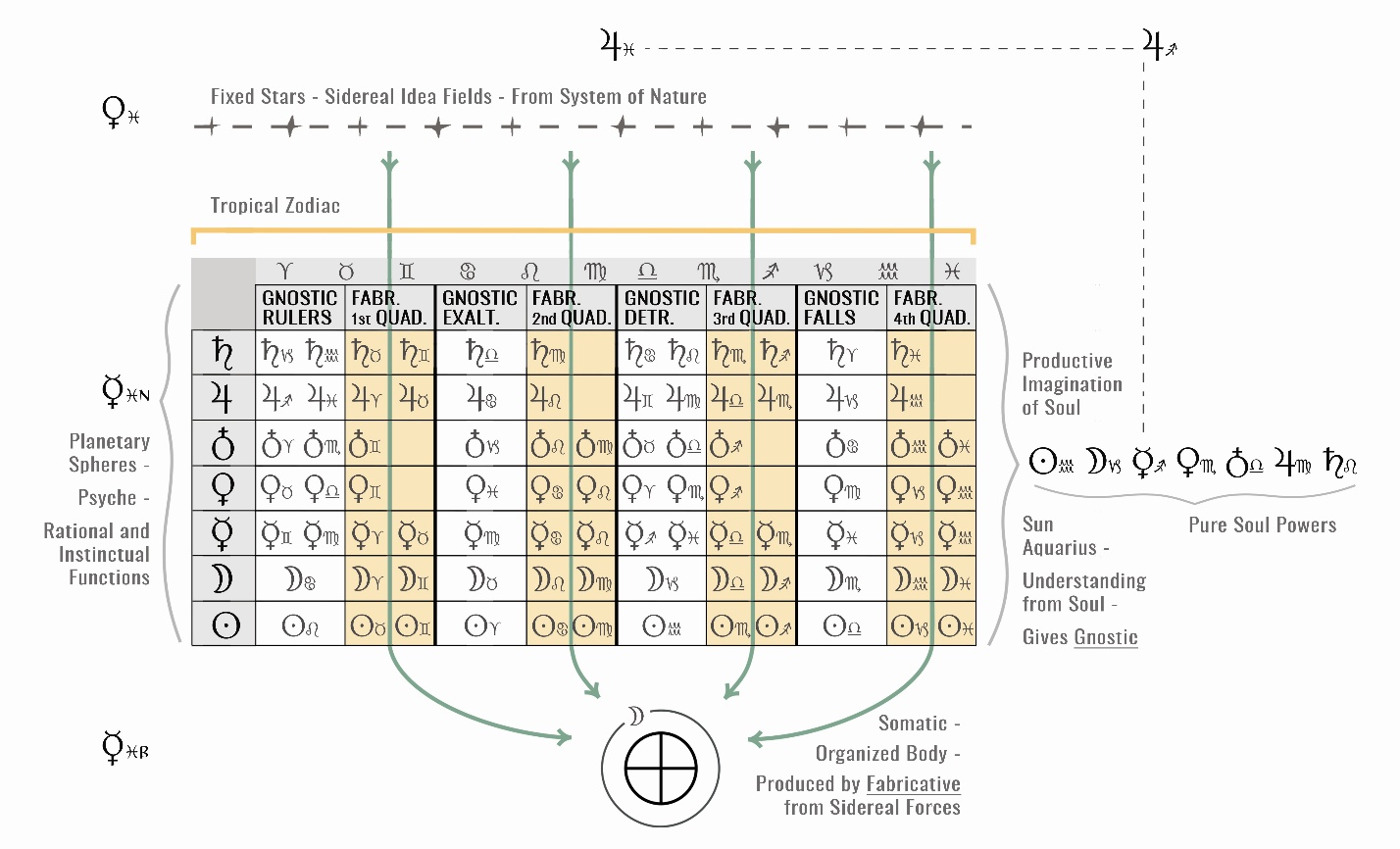
FIGURE Gnostic-Fabricative-1. "The Grid" – Gnostic and Fabricative.
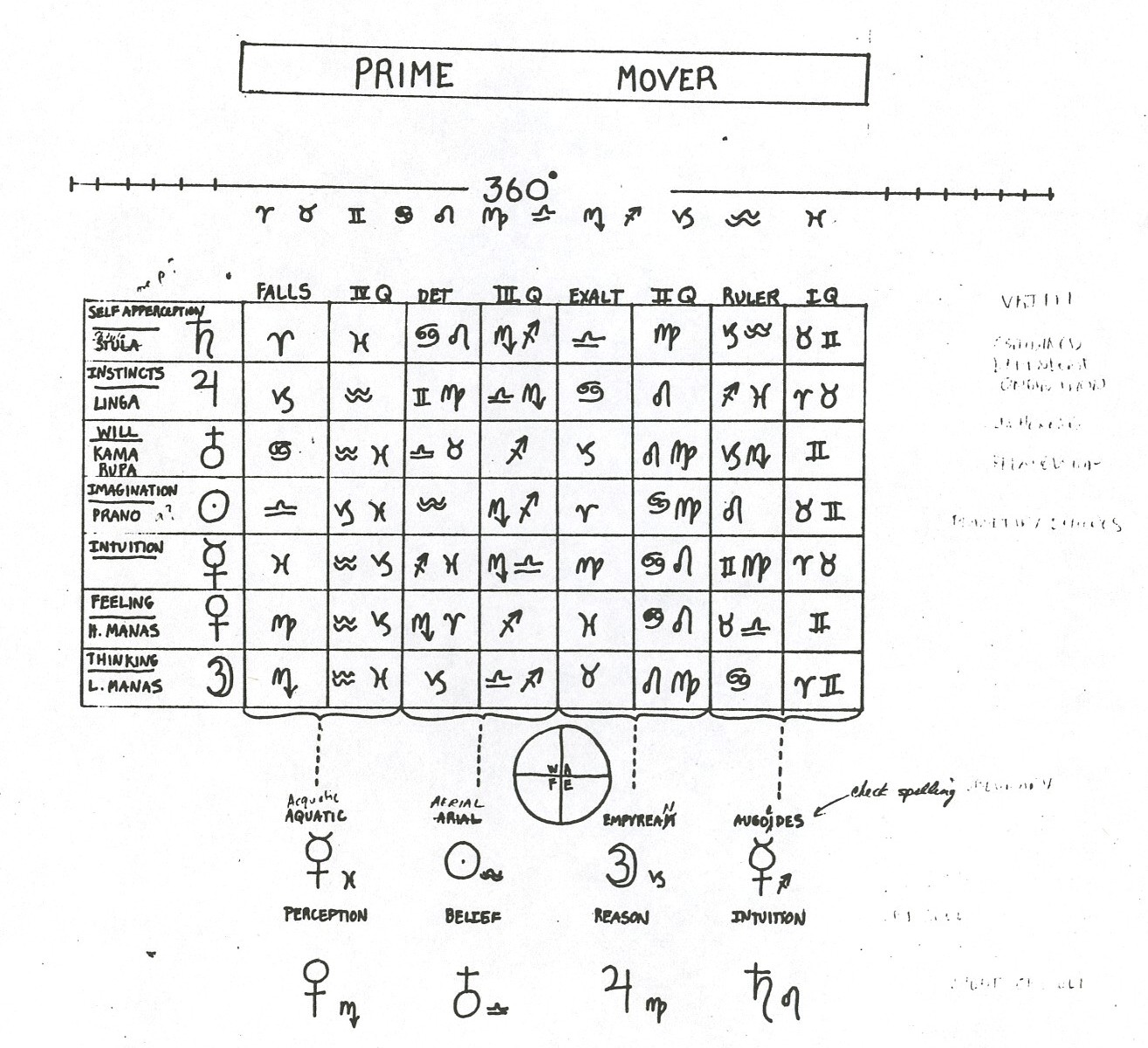
FIGURE AD_G_003. The Grid, 12th House Levels, and Divided Line.
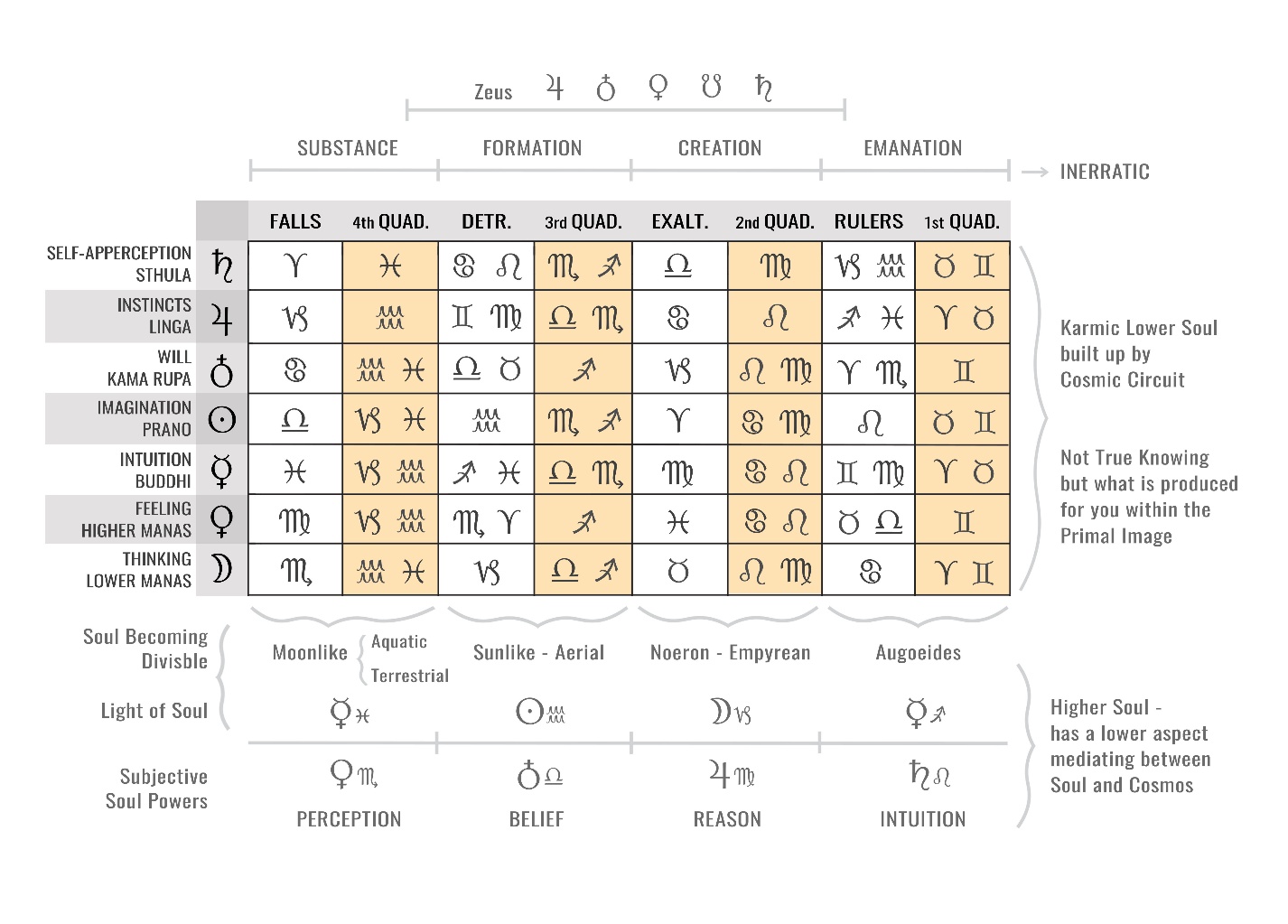
FIGURE 1981 0103-3-AB. The Grid and Divided Line.
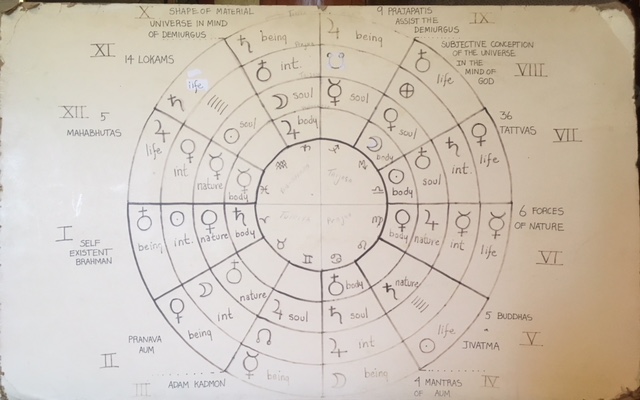
FIGURE IMG_2202-Posterboard Metaphysical Chart, used in classes at Wisdom's Goldenrod.
The first three diagrams are not specifically from this class but are close enough to help follow along. Other diagrams also referred to are not with this transcript version. [Transcriber note: [diagram] means the speaker is referencing a diagram as he or she is speaking. If someone is drawing or writing, with audible sounds of chalk on a blackboard, I indicate this by [drawing] or [writing].]
NOTES:
- For more on The Grid: Gnostic and Fabricative, please see the Appendix to WG Seminar 1981 1016a.
TRANSCRIBED Verbatim by IT 2023. Archival verbatim transcript – V11a.
AUDIO FILES: 1981 0103a, 1981 0103b. [Note: "Tape" and "Side" refer to original audio cassette tapes that were later digitized into .MP3 Audio Files.]
1981 01/03 at Wisdom's Goldenrod
Hinduism; Vedanta; Grid
[Audio File 1981 0103a Begins]
[background student talking followed by tape break; AD begins to speak at 0:01:36.9]
AD: Well we'll put it together [one/two words inaudible]
S (very faint): Yeah.
LR (faint): Well (did) we read [one/two words inaudible]
AD (simultaneously): Yeah. You were best packed, you missed it, this is incredible. (bit of laughter)
S (faint): He didn't do it right.
[17¼ second pause]
[Note: See FIGURES Gnostic-Fabricative-1, AD_G_003, and 1981 0103-3-AB for the following.]
AD (faint): There is subjective soul coming (through) the side, you see on the one hand, left-hand side of the board [diagram].
LR: It's nice of you, Anthony.
AD: Huh?
MW (faint): 3D diagram.
LR: Huh?
MW: 3D.
LR: You really want to get into this?
AD: Yeah.
LR: Were you really asking me or are you joking around?
AD: You know me to joke around?
LR: No. (bit of laughter) No, perfectly serious all the time.
AD: Well look at them and talk to your-- talk to Red, maybe he can help you.
LR: Well I-- (laughter) I--
JC: Come on, Linda. (laughter)
LR (amidst laughter): I would not put--
AD: Avery don't want to talk to me.
MW: I have a question.
LR: I would-- wait, my-- (laughter)
S (very faint): See and this is [one word inaudible]
LR: The first chance I've had.
S: (John), what's wrong with that chart?
AD (faint): Well, just use (chalk). I just (use wood) on the fire, wait a while.
LR/S(?) (faint): [few words inaudible] wait a while.
MW: Well, (and that will--)
VM (simultaneously): What's wrong with the chart.
LR: I would like to talk about the gnostic faculty.
AD: I'd like to talk about the whole thing there, I want to bring them together.
LR: Yeah. Well--
AD: Want to think of it, soul, subjective soul, working through that elementary body and operating through the gnostic functions. And what is it going to operate on?
S (very faint): Yeah.
VM: You mean what are the contents?
AD: Yeah.
VM: I don't know, I don't understand. Do you think in that body, the elementary--
AD (simultaneously): I don't understand either, I'm-- I'm all putting it the other way, you have to explain to me.
VM: Then I decide to be quiet.
S: Hm.
AD: Go ahead, Linda.
LR: I'll wait. (Go on/Gone). You've got a Mercury Sun Moon and another Mercury [Mercury in Sagittarius, Moon in Capricorn, Sun in Aquarius, Mercury in Pisces].
AD: Yeah all of this here, alright, all of this here is your chart [diagram]. Ok?
LR: Yeah.
AD: And symbolize it over here [diagram]. So that means all of this is in the sublunary body, material body. Ok? And we know that the rulerships, you know, build one body, this another, this another, this another [diagram]. And everything is put into this little capsule.
LR: Yes.
AD: Alright? Now-- When we start speaking about the gnostic functions of the soul, the soul knows something. What is it it knows?
LR: Well they say reason-principles within itself.
AD: Huh?
LR: They say reason-principles within itself.
AD: Well, don't you want to know what's going on outside too? And I'm asking you, what does the outside mean?
LR: What does it mean?
[short pause]
AD: Yeah I told you, the best defense is an attack.
S (very faint): Uh-hm.
S (very faint): Yeah, that might be. Anthony, what-- I thought you said that (it) [one/two words inaudible]
[12 second pause]
AD: Put it together now. Try to put it-- put the diagram together, see, you know--
LR: Ok, was there some reason you put those four gnostic faculties within the grid [diagram]?
AD: No. Just my way of saying, you know, rulerships (fabricating/fabricate in) the highest body, you know, have-- are concerned with the highest gnostic function.
LR (simultaneously): They-- well you see, that's precisely the ques-- the way you just drew it, they're fabricating the body of the rea-- reason, intuition. But where are the faculties of conjecture, belief, reason, intuition?
AD: Where are the faculties? Very good. Go on.
LR: This is what I've been asking--
AD: Nobody's gonna help you?
LR: Alright.
VM: Wouldn't you say the grid fabricates the objective component of the-- or the objective content for belief, for reason, for intuition? But those faculties themselves are soul faculties.
AD: But the faculties themselves what?
VM: The faculties themselves are powers of the soul, but the grid fabricates the content for belief, for reason, for intuition, and that's the meaning of putting them on the grid like that. That's for the objective content of the knowledge event, whatever it may be. In other words, you have an intuition. That's the soul intuiting, let's say, a form. But, what is it that it intuits is given by the cosmos. I don't know, I'm just saying that-- [LR simultaneously: Vic?] maybe as a way of justifying this labeling.
LR: How would you take-- what would be the content for the faculty of belief?
VM: What would you call a prakritic entity? So--
LR (simultaneously): As opposed to the content of conjecture or-- I mean, you make it sound like there's these-- coming down the grid you've got these four different content-- contents broken up so that the subjective faculty came in, just clipped into its appropriate box.
VM: No, I would say they would all be invested in one object.
LR: Yes.
VM: Just like you would say-- well, all in one object. You focus on different aspects of it, let's say you see an object, you see it as an object, you believe it's self-subsistent-- self-subsistent and so on, but you don't necessarily have to include the reason-principles in it but you could in the same object.
S (faint): Right?
LR: Right. So then what's the meaning of--
[tape break at 0:08:20.1; class resumes at 0:09:51.7]
AD: Now, where is this celestial ray coming out from? The body?
VM: Going out from. See, I didn't--
AD (simultaneously): Yes, from the eyes it goes out to the object.
VM: I would say that's in a--
S: Ok. [couple/three words inaudible]
VM: I would say it goes out into the cosmos.
AD: Goes out into the cosmos, ok. And strikes a tree.
VM: Well-- uh, ok Anthony, I-- All-- the more I talk the more I reveal my ignorance which is I guess alright but--
AD: Well don't feel that you're so privileged, I mean we all reveal our ignorance.
VM: Alright. (VM laughing a bit) It's so [one/two words inaudible] fugazi.
AD (simultaneously): You don't get no Nobel Prize (bit of laughter) [S: Yes.] for that.
VM: It strikes a tree like a-- Yeah, ok.
AD: Ok? That will be the antahkarana or Platonists speak about this ray of light going forth, striking the object, immerses itself in the object, ok. So now if we looked at the grid, ok, it-- would that circle there [diagram] be the--
VM: I would say that'd be the space-time world, yeah.
AD: Or, that'd be the space-time creature, alright, the empirical creature, (ok).
VM (simultaneously): Yeah, yeah, I mean I--
AD: And the ray of light is going out from that creature.
VM: From that creature to where though?
AD: Yeah, to where? Well--
VM (simultaneously): Seen now I--
AD: Well this-- to these here [diagram].
VM (simultaneously): Is there more than the body in that-- in that quartered circle [diagram]?
[AD drawing/writing]
AD: N+1 objects.
VM: Well you say the objects are from in the grid, huh?
AD: Well no, I'm just saying that this here [diagram] would represent the composition let's say of any person. Ok? I don't want to say dog, cat, say any person, maybe-- So this [writing] could be n+1 objects, any number of persons. They'll all have something like this [diagram]. Alright so, the ray goes forth, alright, and strikes the object, assumes the form of that object.
VM (faint): Ok.
[short pause]
AD: Well--
VM: I-- let me just ask a silly question.
AD (simultaneously): Alright, read the text from the Vedanta.
VM: I-- I didn't have a chance to really study this but, you know, looked here and there.
AD (simultaneously): Well just read the text.
VM: You want me to read parts of it, you got a quote you want me to read?
AD (simultaneously): Yeah you remember the quotation?
S (faint): 102, [LDS simultaneously: 102.] Vic.
MW (faint): It's your quote, Vic.
VM: [couple words inaudible]
S (faint): Uh-hm.
S (very faint): 102 [one/two words inaudible]
S (faint): 102?
MW: Yeah.
S (faint): (Seems) to me--
VM (simultaneously): Knower, yes.
[Transcriber note: I am using Methods of Knowledge, Perceptual, Non-perceptual, and Transcendental according to Advaita Vedanta, by Swami Satprakashananda, Advaita Ashrama, Calcutta, 1974.]
Swami Satprakashananda [Methods of Knowledge, "Perceptual Knowledge," p. 102, VM reading]: "Thus the whole process of visual perception consists of the following steps…"
AD: (Keep on.)
VM: Should we go through that?
AD: Yeah.
VM: I gotta turn around and-- 'cause it's no good.
AD: Turn around, face your audience.
S: (Yeah/No), Vic.
VM: You don't have this book?
S (faint): I didn't know you could do it there.
VM: I didn't either. It was the only-- Ok. This is page 102 if you have the book, if not I'll try and read it loud.
S: Read it loud.
Swami Satprakashananda [Methods of Knowledge, "Perceptual Knowledge," p. 102, VM reading]: "Thus the whole process [S simultaneously: We've read it.] of visual perception consists of the following steps:
"(1) The mind conjoined with the organ of vision reaches out to the object and coincides with it."
VM: Now--
AD: The mind reaches out to the object and coincides with it, go ahead.
Swami Satprakashananda [Methods of Knowledge, "Perceptual Knowledge," p. 102, VM reading]: "(2) The mental mode removes the veil (the darkness of ajnana) that hides the object from the percipient."
VM: Should I just read them all through first, Anthony, give the general familiarity?
AD (simultaneously): Yeah read-- well read the full-- that thing, know what you're talking about.
Swami Satprakashananda [Methods of Knowledge, "Perceptual Knowledge," p. 102, VM reading]: "(3) Consciousness underlying the object, being manifest through the mental mode, illumines the object.
"(4) The mental mode associates the object-consciousness with the subject-consciousness.
"(5) The subject perceives the object."
S (faint): That's good. But what--
VM: We might as well read them all over again.
S (very faint): What page are you guys using?
VM: 102.
RG/S(?) (faint): 102.
VM: I'll go through it again.
AD: You can get up there too, Alan, to give them--
VM: To give them Vedantist--
AD: More than Vedantist.
Swami Satprakashananda [Methods of Knowledge, "Perceptual Knowledge," p. 102, VM reading]: "(1) The mind conjoined with the organ of vision reaches out to the object and coincides with it."
VM: Ok. Now I'm sure here-- I'm just three minutes worth of reading (before supper) that. When (he) speaks of the organ of vision, he means the subtle sense.
AD (faint): Of vision.
VM: Not (the) necessarily physical organ, although that would have to be included but I think primarily he says in here when I talk about organs of vision, I'm speaking about the subtle organs like-- The organ of vision would be used in seeing tree in a dream. And the mind is what he refers to elsewhere as the antahkarana, which is not conscious per se. It's unconscious, the only thing that's conscious in this whole scheme is the Self. Alright--
Swami Satprakashananda [Methods of Knowledge, "Perceptual Knowledge," p. 102, VM reading]: "(1) The mind conjoined with the organ of vision reaches out to the object and coincides with it.
"(2) The mental mode removes the veil (the darkness of ajnana) that hides the object from the percipient."
VM: I don't exactly-- well-- I guess the mental mode is--
AD (simultaneously): Can we integrate that into the grid, that's [S simultaneously, faint: Well Alan--] what I want to do.
VM: Just louder.
AD: I want to integrate that into the grid.
VM (simultaneously): Ok.
Swami Satprakashananda [Methods of Knowledge, "Perceptual Knowledge," p. 102, VM reading]: "(3) Consciousness underlying the object, being manifest through the mental mode, illumines the object.
"(4) The mental mode associates the object-consciousness with the subject-consciousness.
"(5) The subject perceives the object."
AD: Alright. That's one version. Alan has another-- another version. Alan [one/two words inaudible]
S (faint): You read first.
AB: This is from this book called Lights on Vedanta.
[short pause]
S (faint): Ok, I've done this, Alan.
S (very faint): That's (true).
AD: Now you have to remember, these titles are metaphorical. (bit of laughter)
VM: There really isn't much light, is that what you say?
S (faint): [couple/three words inaudible]
AD/S(?) (very faint): Yeah.
S: Yeah.
AB: Ok. Well, some of this is a little obscure but-- (bit of laughter)
S: We expect you to illuminate it.
S (very faint): Of course.
AB: Um-- I think in the Vedanta everyone agrees that there's an ignorance obscuring the jiva or the subject, and that this vritti breaks through that ignorance and makes some knowledge available through the jiva. But they disagree depending on their definition of the jiva. For instance, some define the jiva as the Atma consciousness associated with the antahkarana, [student assents, faint] [someone drawing/writing] which-- And others define it as the Atma consciousness associated with maya, and therefore the jiva would be either limited or unlimited and then that would be to a different theory of perception. And then in-- in the one theory Vic just read, they're assuming that the object is being illuminated underneath by this Brahman-consciousness, that that's bringing about the knowledge, but some of these other theories would disagree. So I'll just review some of them.
AD: So we got the object here [diagram]. [AB assents] We got the jiva here [diagram]. And the ignorance separates them.
AB: Right.
AD: Darkness.
AB: Right.
AD: And they're going to shed light on this.
AB: Well, some.
[Transcriber note: I am using Lights on Vedanta: A Comparative Study of the Various Views of Post-Sankarites by Veermani Prasad Upadhyaya, The Chowkhamba Sanskrit Series Office, Varanasi, India, 1959.]
Veermani Prasad Upadhyaya [Lights on Vedanta, p. 144, AB reading]: "There are two important views about the conception of a Jiva: one affirming it to be the Consciousness, having for its adjunct the internal organ and the other defining it as the Consciousness having for its adjunct Avidya."
AD: Now, you have to explain it to us.
AB: Ok well, we speak of--
AD (simultaneously): Consciousness has two adjuncts, one or the other.
AB: The two definitions of jiva, we speak of the mind as this organ. A consciousness associated with this organ has knowledge. And because the organ is limited, there's a limited knowledge that arises. But another Vedantist would say that his consciousness is associated with form of ignorance, and that's what the soul's--
VM: What's the difference really?
AB: I don't know.
HS: We're assuming the soul isn't conscious? Isn't there (all--)
AB: They say that the jiva or soul is conscious because it-- the Atma principle inheres in it. But, they define the fact that the jiva's limited either because of ignorance or because of association with the mental organs. Now you could just say that the mental organs are limited and that's, you know, ignorance. But, the doctrinal schools make those two distinctions. [9¼ second pause] So then they say--
Veermani Prasad Upadhyaya [Lights on Vedanta, p. 144, AB reading]: "According to the first view [AB reads: According to one view] the Jiva is all pervading and is held to be the agent of the manifestation of objects directly…"
AB: In other words, if the jiva has this mental organs or antahkarana associated with it, then the actual consciousness of the jiva will illuminate the object directly. Whereas if the consciousness is veiled by ignorance, then you need to bring the-- in the object-consciousness from underneath illuminating the object. So one requires a subjective consciousness and one doesn't. That-- that's how I'm understanding this.
VM: Is that--
AD (simultaneously): Do one at a time, do one school at a time.
Veermani Prasad Upadhyaya [Lights on Vedanta, p. 144, AB reading]: "According to the first view [AB reads: According to the view that the Jiva is consciousness associated with the internal organ] the Jiva is all pervading and is held to be the agent of the manifestation of objects directly, while, according to the second view, [AB adds: where the Jiva or soul is defined as consciousness having its adjunct Avidya] the Jiva is finite and is regarded to be the agent of the manifestation of objects only indirectly, that is, through its identity with the object-defined Consciousness, which is really responsible for the illumination of objects."
AB: I think that some-- some of the steps that Vic went over show how the consciousness underlying the object is what illuminates the object and allows for it to be known to the subject. So, they're saying, you can define soul in such a way that you don't need that object-consciousness. You just need the searchlight of the soul shining on it. You could say they're leaving out the Demiurgic, you know--
VM: Well, when they say object-consciousness, maybe that's their code word for Demiurgic Soul or cosmic processes that give rise to objects that have a certain intentionality towards the subject.
AB: Uh-hm. It'll give you a little more detail.
AD: We got some more Vedantists here. More [one word inaudible]
AB (simultaneously): We have to find out what you are and--
AD: Huh?
AB: We have to find out what you are.
AD: Well, these people have studied the Vedanta.
AB: The internal organ is the antahkarana obviously, I mean buddhi-- like in Samkhya--manas, buddhi, ahamkara, yeah.
AD (simultaneously): The antahkarana are the four functions. Aren't they?
VM: What'd you say?
AD: The antahkarana are the four functions.
VM: Four gnostic functions?
AD: Yeah.
VM (simultaneously): What'd you say [one/two words inaudible] alright.
AB: It's the objective vehicle that the soul has knowledge through.
AD: In other words, it consists of alocana, vikalpa, abhimana, and certitude?
S: Yeah.
AD: Isn't that-- That's it, speak up Vedantists. (bit of laughter)
PD (faint): It's a little different. They have citta as one of the functions.
AB: Yeah, Vedanta they have citta as part of (a) memory.
AD (simultaneously): What function does the citta play?
AB: Don't they say it's memory, Paul?
LDS: Yeah, Vedan-- that's what they said.
AD: Huh?
LDS: Yeah, they say citta's memory.
PD (simultaneously, faint): Four functions (and internal) function is memory. Four internal functions and one external.
AD: Four eternal--
VM: Internal.
AB: Internal.
AD: Four internal and one external?
AB (simultaneously): And one external.
PD (faint): Senses are the external. Four internal functions of the antahkarana. Same three with the addition of memory.
AD: I can't hear you, Paul, you gotta speak louder.
PD (faint): The same three functions-- same three internal functions as Samkhya with the addition of citta or memory as the fourth.
AD: Well which one do they leave out?
AB: They add one.
PD (simultaneously): No they have four.
S: They-- they got--
AD (simultaneously): But you just-- you just said three, didn't you?
PD (faint): There's three internal functions only in Samkhya.
VM: Buddhi, ahamkara, manas, right?
PD: Right.
VM: Alright.
AD: And--
VM: Then they add citta to that, plus they also add the subtle senses, right?
PD (faint): They add the senses as the external organs of knowledge. That's not part of the antahkarana.
S (faint): Yeah.
AD: So the four internal functions are memory?
PD (faint): Memory, buddhi, ahamkara, and manas. Citta.
S (very faint): That's right.
AD: No, Avery's got some Vedantic books too. You know, we're getting the Vedantists out of the woodwork. [short pause] Well, I personally don't believe that you Vedantists know what you're talking about. (laughter) I mean, and that's a-- that's just my honest opinion because there's so many varieties of it, alright, that they all cancel each other out. And unless you can show me a consistent Vedantic view, I won't be able to integrate it into the chart. So you'll [AB simultaneously: Well--] have to show me the view.
VM (simultaneously, faint): It's just a (blowback), yeah.
AB: We could show you how the different Vedantic views can be integrated into the chart.
AD: Well can you give me one view at a time?
AB: Well, I think Vic gave you one view.
MW: (Wouldn't we all have wanted) to blame Vic.
AD: Huh? They want to throw all sixty at one time.
LR: (Ok.)
AB (simultaneously): But they would all agree on certain basic things.
AD: Alright, what would they agree on?
VM: What are the points of agreement?
AB: They would-- if we're talking about this knowledge thing, they would all agree for instance that a psychosis is essential for the connection of the jiva (laughter) with a particular external object.
VM: You better translate it better.
S (simultaneously): I don't buy the story. (some laughter)
AB: They would all agree that in order to have knowledge you need a thought which will mediate between the subject and the object.
AD: In order for a subject to have knowledge--
AB: Of an object--
AD: Of an object.
AB: You need this thought or vritti or they call it psychosis, transformation of the mind, to make the object-- to allow the object to be known to the subject.
S (faint): What--
AD: You-- you would buy that?
AB: See here's the-- (bit of laughter)
S: See?
AD: He's holding back.
AB: Now then they would interpret that in three ways. They would say, it brings about the association of the object with the intelligence underlying the object.
AD: Ok.
AB: Or, it manifests--
AD: No, no, no, once more, don't-- don't go into too many. One at a time.
AB: Ok. So what do you want to do, show that--
AD: Yeah so how--
VM (simultaneously with AB): Just read it again, Alan.
AD: Yeah.
AB: Ok. [VM simultaneously: Just sum up (couple words inaudible)] Well I think that's what-- I think that's what you did.
VM: Go ahead.
AB: Bringing about the association of the object with intelligence or, the way this guy said it here--
Veermani Prasad Upadhyaya [Lights on Vedanta, p. 144, AB reading]: "…the Jiva is finite and is regarded to be the agent of the manifestation of objects [only] indirectly, [that is], through its identity with the object-defined Consciousness, which is really responsible for the illumination of [AB adds: the] objects."
AD: So now they're saying that somewhere or another the ego has to be identified with the object in order for the subject to have knowledge of the object.
AB: Uh-hm.
LR: Doesn't that just mean that the planets have a gnostic and fabricative side?
AD: Well wait. First let's see if I understand what they're saying because I really don't know what they're saying.
AB: Aren't they saying that this couplement or medium that we spoke about which touches both the subject and object series can be transformed in such a way that it connects the subjective reason-principles and the object reason-principles found in the object. And the subject can interpret that object or have knowledge of it.
AD: Then what would be the medium by which the subject gets to know the object, in this case the object being his body?
S: Nature.
S (very faint): Ok.
VM: That's it. The animate?
S (faint): Yeah.
VM: Or the psyche? Let's say-- they would say antahkarana.
AD: A thought? Isn't that so?
VM: I mean, you're asking what's the medium for the thought to actually effect this conjunction between the object and the subject. Is that right?
AD: Yeah, and let's say that the object is your body, [drawing] the sublunary body. [VM simultaneously, faint: Ok.] Body made of elements.
VM: And that would have to occur in what they call this principle of mind or antahkarana.
AB: See--
AD: No, I don't see anything.
AB: I was-- I was going to say, some of them would say that you actually contact the object directly.
AD: Alright, this body I want to contact directly.
AB: Ok.
AD/S(?) (faint): Yeah.
AB: Then inherent in that body is a mental organ or mind which then--
AD: Inherent in the body is a mental organ or mind? Go ahead, go on.
AB: Which can apperceive the transformations of the body, or the sensory function(s). I think-- I think it's just the same thing that we've been saying with the Buddhists, that direct per-- direct perception is perception of the bodily transformation.
[short pause]
AD: Clear to you? You follow?
CDA (faint): No.
AD: No?
JC: I think it's similar to what we were saying about the imagination gets transformed into the image of what that object is. Soul reads off the imagination. Cognitive light of the subject-- the jiva-consciousness or whatever you want to call it, is receiving what's going on in the imagination, in the antahkarana which has transformed itself into the mental mode and (it) corresponds to object-consciousness underlying.
HS: So you're saying you don't see the object?
JC: You see a mode of the antahkarana.
AD: You see a mode of the antahkarana?
JC: Karana.
S (very faint): Yeah.
[12½ second pause]
TS (faint): He says what some of the meaning they say that the mind goes out--
AD: You better speak louder. Can't hear you.
S: Yell it.
AD: Go ahead, speak louder. (laughter)
S (amidst laughter): You tell me.
VM: Scared him.
S: Yeah. (some more laughter)
S (faint): Yeah.
TS: I think I'll back off (and restart this over). (laughter)
MW: Maybe, (yeah).
TS (simultaneously): I thought they-- they talk about the mind going out to take the form of the object, and I-- I think that that would be the same as the way Jeff was speaking of it.
AD: Well, let me ask you then, if we use the diagram here, what will be the mind going out to assume the form of the object?
TS (faint): (See) the Mars is important but--
AD: Playing it safe?
S (very faint): Uh-hm, uh-hm. (bit of laughter)
S (very faint): [few words inaudible]
S: Go ahead.
TS: [few words inaudible]
VM (simultaneously): I will say it's--
AD (simultaneously): [couple/three words inaudible] the mind that goes out and assumes the form of the object.
VM: I would say it's the couplement.
AD (simultaneously): In this case we're speaking about the object is something fabricated by the cosmos.
VM: Couplement.
TS: You know what?
S (very faint): Oh.
LR (simultaneously): So is the mind.
TS: Yeah.
AD: Huh?
LR: So is the mind.
TS: I think that their idea of the mind--
LR (simultaneously): Three times around. (laughter)
AD: So is the mind?
S (very faint): Yeah.
AB: In-- in our chart--
AD: In other words, there's a mind in the grid fabricated by the cosmos and there's a mind coming from the soul [S: No.] grasping that mind that is fabricated [TS simultaneously: No.] by the cosmos?
AB (simultaneously): No.
VM: Schizophrenic.
LR (simultaneously): You don't have to call them both mind.
AD (simultaneously): Oh boy.
VM: That's getting complicated.
TS (simultaneously): No [one/two words inaudible]
AB: The mind that the soul uses to have knowledge is given to it by the cosmos or fabricated for it by the cosmos. And then--
VM (simultaneously): Who says that?
MW: When?
VM: They say that?
AB: Well--
LR (simultaneously): Why else-- what-- [AB simultaneously: They don't use our terminology.] what else would be the value of gnostic and fabricative in the grid?
LDS (simultaneously): They say the mind (includes) the subtle elements.
VM: I'm sorry, I didn't hear you Linda, what did you say?
LR: What's the value of dividing those four cha--
AD (simultaneously): You get up in there, I'll sleep there and go to sleep. So don't get up.
LR: Well he goes to sleep.
VM: Then we'll get nothing done but go ahead.
LR: We have those four categories, fall, detriment, exaltation, rulership, and then he likes to divide each one into two saying one part is fabricative and one part is gnostic [diagram]. What's the value of the gnostic side? The fabricates-- fabricative side is making all these--
VM: Here, let me try (this/to)--
LR (simultaneously): What's the value of the gnostic side?
VM: Let me say may-- perhaps, you know like, one of the things that we did which actually has some appeal and I hadn't seen us do a lot of it, is to associate various aspects of that intermediate mind with-- with the grid, with the inerratic sphere, with the Prime Mover and so forth [diagram]. Maybe the gnostic aspect of these planetary functions is where the soul actually makes its first contact, I don't know.
LR: Yeah, that's-- and what I'm saying, what is the gnostic side of those planets?
VM: And he's (not--) you're saying that too, aren't you, or suggesting that.
HS (simultaneously): And you-- and you're relating that [S simultaneously, faint: (one/two words inaudible) the body.] to the thing with the mind going out and taking the form of the object [couple words inaudible]
AD (simultaneously): Well, I think what Linda is saying is, you know, we take the dignities, all the dignities, and we say the gnostic functions of each of the dignities is constitutive of what we call the intuitive body, reason body, belief, ok? So then the gnostic functions are here [diagram], alright.
VM: The objective component of the gnostic functions, or are you not making that distinction?
AD (simultaneously): No, no. No, I want you to make that distinction.
VM: I want to make that distinction, I started out with that.
AD (simultaneously): Yeah, I want you-- Yeah.
VM: I want to keep the gnostic functions in this principle of soul.
AD: You want to keep them in here [diagram].
MW: Right.
VM: Right, over there.
AD: You want to keep them in the soul. So--
VM: That's just what I was told.
AD: [drawing] Let's put them over here [diagram], ok?
VM: Alright.
AD: So we would say over here we have conjecture, [writing] alright, over here belief, [S, faint: Yeah.] [VM, faint: Yeah.] reason, intuition [diagram]. [VM: Ok.] We want to keep these in the soul.
VM: Yeah. But I would grant you or [AD writing] I would find it reasonable to say that the objects which are known through these gnostic functions are productions of the cosmic circuit or forces in Nature, whatever language you want to use.
AD: The objects that are known by the gnostic functions.
VM: Would be given by the objective--
AD: Are fabricated by the cosmos.
VM (faint): Yeah. Seems (reasonable).
LR (simultaneously): That still doesn't answer my question though.
SD: Well, then--
LR (simultaneously): What-- I'm sorry, Severin. What is the meaning or the value of the gnostic side of--
AD: That's not your question, that's my question.
S (very faint): Uh-hm.
LR: I'd still like to know the answer to your question.
AD (simultaneously): Yes.
AS: And the Vedanta tells you what it is.
LR (simultaneously): What is gnostic--
AS: The Vedanta tells you what it is.
AD: Alright. Tell us.
AB/S(?) (simultaneously): What he asked-- what he asked [few words inaudible]
AS (simultaneously): The Vedanta tells you what it is, [VM simultaneously: Well then tell us.] I think. Which is what he read, that when the-- when this--
S (very faint): Oh no.
LR: The object-con--
VM (simultaneously): Is the consciousness [AS simultaneously: (Well--)] underlying the object. Go ahead. You know you gotta-- you know you gotta shout.
AD (simultaneously): You-- you opened your mouth now go through with it!
AS (simultaneously): Well they-- I gotta finish it. I mean, that's why I don't want to [one word inaudible]
S (faint): [couple words inaudible]
AD: Go through, go ahead.
AS (simultaneously): [couple words inaudible] The way-- the way I was trying to understand that one with the finite one there, he says that this antahkarana-- you have this soul. And here's what they always say, you have the soul or the jiva. And it wants to get to know about the object. The same as-- the same as-- same as that problem Plotinus says. And they say for vari-- they have three reasons or various reasons, whatever, why it can't do that. And, I think you could show what [LR simultaneously: Avery, I can't hear you.] the difference is in the level of soul.
LR: I'm sorry, I can't hear you.
AS (simultaneously): Right? I'm sorry (I struggle). They start with the same problem that Plotinus does I think, with the soul-- you have the soul which they call the Atma. And they say that this Atma is now a jiva, it's associated with some of these-- some level, it's like-- just like Plotinus says that the soul has these levels in it. And I think that's where-- basically where their different views of jiva are coming from, the three different levels of soul that Plotinus speaks of. But anyway, they say that this soul can't directly know the object-consciousness for three different reasons, either it's veiled or 'cause it's not the material cause or for some other reason. Ok. Now, it seems that from there the next step would be to say, and they'd say well, the antahkarana ha-- the mind has to go out, has to take the form of the object. Now, I would say that the object-- suppose you say the object is this [diagram], the body here primarily which is fabricated [drawing] by all this business. And the mind that's going out I think is like the light that's given off by the soul, it's not the soul per se, it's-- The same way we were doing it this morning, the imagination, or the--
AD: This morning was a long time ago, Avery.
AS: Ok well the imagination or the antahkarana-- I think you can call that Mercury Nature for example the antahkarana. It has these four functions. But now, they say-- one of the schools at least says that it's the object-consciousness which illumines the object.
LR (faint): And you're saying it's these.
AS: Ok so, it seems that the object-consciousness which illumines the object, the object-consciousness or-- could be those gnostic functions which are part of the grid--conjecture, belief, reason, and intuition. And that's what's revealing the object to the subject. So for example, by object-consciousness they mean a little-- I mean they just say Brahman or something but they don't all say that actually. They say the consciousness associated with the object. Suppose that these-- [drawing] this is the consciousness associated with the object [diagram]. Here's the object [diagram]. Here's the consciousness which underlies the object [diagram]. When there is a vritti, they say that then this manifests-- either it manifests a non-distinction or it sets up a relation between the pure soul-- the soul-- subjective soul powers and the objective object, the object. And now, they say that what lights up the object is the object-consciousness that underlies it.
So for example if there's a conjectural kind of consciousness underlying the object, that object can be known by the faculty of perception. If there's a reasoning consciousness underlying the object, that's been fabricated say-- if-- if it's associated with the exaltations, or if the power of reasoning, if-- If the-- if the so-- if the so-called consciousness underlying that object is the gnostic-- cosmic gnostic function of reason, then the soul's function of reason can apprehend that object. And so-- for example, the guys that say that the object-consciousness has to get associated with the subject-consciousness or the substratum of the object is the object-consciousness, say it's reason, that particular one, and the substratum of the subject-consciousness being also reason, or the soul power being reason, can then get conjoined with it.
LR: Yeah. I would--
S (very faint): Yeah.
AB: And the-- the other guy just leaves out the object-consciousness that you're talking about that underlies the object.
VM: Cut the grid right off.
AB: And he's just saying that it's sufficient-- the consciousness or the gnostic power that the soul has itself is sufficient to reveal that object to the soul.
LR: See, I-- I would-- I would say that's the only thing the gnostic part of those planets could be is-- I mean, I would say if you had to put the object-consciousness anywhere it would have to be in terms of those gnostic--
AD: Would you-- would repeat what you just said?
AB: I said-- I'm not quite sure about the third theory but, the second theory, his definition of soul is different. So he will say that it is not necessary to bring in this consciousness underlying the object which is by the grid. All you need is the power of consciousness associated with the soul and that will illuminate that object for the soul.
AD: The power of consciousness [AB simultaneously: Or--] associated with an internal organ.
AB: Right.
AD: To manifest the object.
AB: To that--
AD: Is that the same as to know the object?
AB: I think they would say it is. I mean maybe [AS simultaneously: No.] it isn't but wouldn't they?
AS (simultaneously): No, they don't. They [AB simultaneously: Ok.] say that the object-consciousness manifests the object so that the subject-consciousness can know it. And I think that's what we're trying to say here but I'm not sure. That the--
AD (simultaneously): When the-- when the subs-- [AB simultaneously: Yeah.] when the substratum of the subject-consciousness knows the substratum of the object-conscious, then you know the object.
AS: Right.
AD: If you don't have the substratum of the [AS simultaneously: There's two--] object-consciousness, then the object is only manifested.
AS (simultaneously): It doesn't get manifest. It's not manifested.
AD: It's not manifested.
AS: Ok maybe I'm using the words the other way around but it seems that--
AD: Well, all I mean by manifested is the objected is manifested, that means it could be under the realm of conjecture or opinion.
AS: Right and they--
AD (simultaneously): And (that's/it's) not knowing.
AS: Right. And I think that the object-cons-- I thought we said the same thing. Ok, I'm sorry.
AD: Go ahead.
AB: Yeah Avery--
VM: Yeah.
AS: Let me-- let me try again though. That the-- They speak about two-- there's-- the relation that goes on two ways of the object-consciousness to that vritti and of the subject-consciousness to that vritti. And they put more or less emphasis on one or the other. Now, the relationship of the object-consciousness to the vritti is the object-consciousness, this grid here [diagram], and the functioning going on in there, manifests the object, whereas the subject-consciousness knows that manifestation. So in other words the image or the-- let's say the object needs to be mani-- is being manifested by these but manifest it's just-- manifest it doesn't necessarily be-- mean known, manifest it seems to mean just makes itself-- modifies that vritti or lights up the vritti or [few words inaudible] subject.
AD (simultaneously): Well, let's see if we can break down their-- your analysis, alright? I think very simply we could do something like this. [student assents, very faint] Let's say this is the vritti. [drawing] This is a subject [diagram], this is the object [diagram], alright. Underlying-- underlying the object you could say that there are-- there is some sort of consciousness and it could be a variety, right? [AS assents, faint] The variety being--
AS: I think basically it's the--
S (faint): Yeah.
AD: The variety could be let's say--
AS (simultaneously): Conjecture, belief, and-- those-- wouldn't-- ok.
AD: Well what-- what would the variety be? What would it be?
AS (simultaneously): Well I-- the-- those four right over there--rulership, [AD writing] exaltation, detriment, and fall [diagram].
AD: [writing] That would underlie an object, ok?
AS: Right, that would be the consciousness coming from the cosmic circuit.
AD: Ok, now, coming from here, the subject series [diagram], alright, [AS simultaneously: Those are the gnostic faculties.] we would have to-- [drawing] we would have to bring in the soul series.
AS: Uh-hm. Right. Now, in themselves, neither one of them is representable or known as it were.
AD: In themselves, alright.
AS: And they're not-- neither of them in a sense is known to the o-- in-- I mean, in different ways and different schools.
AD: Uh-hm. But we will-- [drawing]
AS: But they all would agree, I think, that you have this Atma consciousness, you have the consciousness in the object. And that a vritti is needed to form a connection, one or-- one way or--
AD: So we can imagine [drawing] the consciousness illuminating the object is one school, alright? And this object, when a vritti goes out to the object, the vritti gets illuminated and the subject knows the object.
AS (simultaneously): Right, there's two-- there's two distinct things going on and they do make the point I think in most of them that there are two things going on. One is that the object-consciousness is illuminating whatever form is in the vritti, and that's the manifestness of the object. But then--
AD (simultaneously): So like [drawing] this light is illuminating that thought [diagram].
AS (simultaneously): Coming right through. Like the thought, the imagination takes a form and it's the light of the object that's [student assents, faint] really illuminating the thing.
AD (simultaneously): Illuminating that vritti.
AS (simultaneously): The object. The vritti. Now, the subject knows it.
AD (simultaneously): Now, the subject knows.
AS: Yeah.
AD (simultaneously): Alright, that's one version.
AS: Yeah. That's-- that's--
AD (simultaneously): Now, the other version. [drawing] Coming this way [diagram].
S (very faint): Right, uh-hm.
AS: That's the limitation theory. They say--
AD (simultaneously): That's the limitation theory.
AS: The limitation theory says that in fact the jiva is-- well this is very strange, but one of the theories is that it's the material cause of the object as well. The theory that says that you don't need the object-consciousness, that the subject-consciousness can manifest the object as well.
AD: Do they mean material cause or do they mean the ideal-form of the object?
AS (simultaneously): Well, I think that when they say a material cause it's-- I think they mean it supplies-- as you would say it supplies the reason. I don't know [few words inaudible]
AD (simultaneously): Well think for a minute, what would it be?
AS: Well, they-- their material cause is always consciousness.
AD (simultaneously): Would it be-- is-- is the subject-consciousness supplying the material of the perception in the sense that it's the material thing, or is it [AS/S(?) simultaneously: No.] supplying the ideal-forms?
S (faint): Yeah.
AS: Supplying the forms certainly we would say. And that's why I never understand what they mean by saying that it is the material cause.
AD: Wouldn't that be like saying-- wouldn't that be like elevating their position to the Demiurge when they do that?
AS (simultaneously): Well, I-- I think it's intermediate.
MW (simultaneously): Maybe they're trying to think of the soul as being [AS: Yeah, but I--] integrated into that Demiurgic soul.
AD (simultaneously): Uh-uh, uh-uh. No I'm-- I just made this remark to show you that they may be saying things which you think are true but they are but in the wrong context.
AS: Yeah. See there's an intermediary one which says I think that the jiva is all-pervasive, not like this. The view we went-- just went through seems to say the jiva is finitized. There's a second view intermediate that says that the jiva's-- jiva's all-pervasive but is not the material cause. Ishvara is the material cause, in other words, the Demiurge is the material cause.
AD (simultaneously): So the Demiurge would be creating the object.
VM (very faint): Uh-hm.
AS: He would be creating the object and in that second view they say the vritti needs to get tinged with the object. And I--
AB (simultaneously): But in the thi-- don't-- in the third-- third-- what you were saying is the third view, [AS/S(?) simultaneously, faint: That's the second view.] where they don't require the second-- this object-consciousness, for them the jiva is also all-pervading. [AS assents] In other words, the soul is infinite.
AD: Alright, the soul is infinite, there he is [diagram].
AS/S(?): But why are you--
AB (simultaneously): It's associated with this mind which is limited.
AD: Associated with the mind.
AB: Which is limited.
AD: [drawing/writing] So then we could put here--
AB: Ok now, when the mind through a thought contacts the object--
AD: Now when the mind through a thought-- Now you mean-- I think he already pointed out you're speaking about the light coming from the soul going through the body, because [AB simultaneously: Right.] that's the first object it's going to contact.
AB: Right [one word inaudible]
AD (simultaneously): This is the first object [diagram] it's going--
(Side 1 of original cassette tape digitized as 1981 0103a Ends; Side 2 Begins)
AB: It can reveal the object under its own power.
AD (simultaneously): But-- yes but then what you're saying is it's that the light of the soul is illuminating this object.
AB: Right. And the light of the soul is sufficient enough that you don't need the light.
AD: But this only manifests the object.
S: Yeah.
AD: When you put a searchlight on an object and you see the object, doesn't mean you know the object.
AB: Ok well I-- correctly or incorrectly I thought that (these) theory was saying that you know the object solely or simply by the light of the soul being--
AD: Well is this-- is this knowledge or is this belief, is this conjecture? Is this a reasoned understanding of what the object is? You can't expect the man to do that for you. He wouldn't even know what you're talking about. But why you ask a Vedantist what do you mean by knowledge, alright, he's going to have to come up with some definition. What do you think he would come up with there? Again, you see [few words inaudible] words.
AS (simultaneously): See I-- I would-- I-- I'll tell you what I think he would say. I mean I don't know if we want to take it to this level. But I think that that's the guy who's saying that what the-- what the knowledge is, is when-- whenever this happens the only relevant part of the knowledge is that the soul knows some subjective-- some idea that was originally contained within itself. It was veiled-- they would say the only thing that's-- it's just this veil around-- Like the Saturn in Leo. Suppose you say-- or this-- I don't know. Sorry. [short pause] I think that this-- this third view, but I'm not sure-- Well, I think that the third view would say that what the real-- what the knowledge is is the soul knowing this idea that it has within it, and which has somehow been veiled from its knowledge. Similarly to the way we would say that the soul has--
AD (simultaneously): Well Avery, then why speak about-- why speak about manifesting an object? Why not speak about manifesting the contents of the soul?
AS: Well I think what they would say is that the way that the content of the soul is being manifest is by being superimposed on the object. They're mainly taking that view of superimposition.
AD (faint): Imposition, sure.
AS: And that therefore it's almost-- the object can be there or not but the whole-- the knowledge is because through this hook as it were the sub-- that-- whatever reason-principle or form was in the soul can now become objective to that soul and become known and that's what knowledge is for them.
AD: Alright.
AS: And that's what their--
AD (simultaneously): And my-- my question-- my-- to return to my question, then, over here we would have to ask them what do you mean by knowledge.
AS: Well, yeah. Well I think here they--
AD (simultaneously): Because there it's obvious that [AS simultaneously: There's no object.] all they're speaking about is this realm here [diagram], perception of shadows. The revelation of the sensible object. [student assents, faint] With what's being [chalk on board sounds] superimposed on it of course are the ideal forms in the soul.
S (faint): Ok.
S (very faint): I didn't (follow).
AS: I think.
VM: I don't understand [one/two words inaudible]
AD (intensely): Come on, think for yourself, never mind just because he put it in a book it's correct!
AS: No but I-- I think I was trying to come from the way we were talking about these. They really are-- well, it seems it's-- there is a distinction between saying that the object is informing the soul [AD simultaneously: Yeah.] in some way and saying that the soul is im-- is superimposing some subjective content onto.
AD (faint): On-- on to it.
AS: And I-- it seems that perhaps these different schools are taking one or the other view depending on what you think that the soul is--
AD (simultaneously): How about a combination of the two before we go on?
AS: Yeah.
AD: Ok? Combination.
AS (simultaneously): Well [couple words inaudible] take a combina-- I thought the one you were doing was a combination.
AD: Well the combination of the two--
AS: Like the original one.
AD: You mean this here, [writing] one, two--
AS (simultaneously): The one we had there seems to [student assents, faint] be the most comprehensive because it requires--
AD: What would the name of that school be?
AS: That's the middle one, [VM: The (one word inaudible) school.] the process, bimba-pratibimba school. They say that the ref-- (bit of laughter) they say there's a bimba and there's a pratibimba. (bit of laughter) In other words, there's an object and then there is also-- the object informs the consciousness and at the same time there's a reflection in that of the objects. [AD writing] I mean I don't know.
AD: Alright, Avery, if I [AS simultaneously: I'm--] follow you, [AS simultaneously: Well I'm (couple words inaudible)] this would be the object [diagram]. Here's a vritti [diagram], alright? [drawing]
AS (faint): This right-- yeah but right or left.
VM (simultaneously): Yeah but isn't this starting the--
AD (simultaneously): Here's the [one word inaudible] and, [couple inaudible AS words] [drawing] when we think of the subject just put down the whole series of soul [diagram], ok?
VM (simultaneously): Ok.
AD: So we know that there's a light coming from the soul, ok? We know that there are reason-principles of various grades underlying the object.
VM: Uh-hm.
AD: Alright? And that these two have to be brought together in order for there to be knowledge in the technical sense [student assents] of the term.
AS: Yeah they-- and they would say there's two things going on. The object is manifest and then you know the object. [student assents, faint] Yeah, it's even the difference between object and knowledge of the object. Manifestness of the object and the knowledge of that manifestness.
AD: Well then, if we take-- if we take this position, but if we say that the substratum of the subject-consciousness must coincide with the substratum of the object-consciousness, then the object is known, this seems to be a more comprehensive formula because it seems to take in the reason-principles that are in the object.
AS: Actually you know what I think now?
AD (simultaneously): The reason-principles that are in the soul, and they're [AS simultaneously: Bring them together.] brought together in that relationship.
AS: You know what you're doing, Anthony? I think you put-- you've just stated all three of the things that they say the vritti does. [student assents, faint] It's not like-- I think you're saying-- They say three things. First is the-- the i-- there has to be an identity of the subject underlying and the object. So that's saying the subjective reason-principles and objective reason-principles have to be identified. Then they say there has to be a reflection in the vritti of that actual object. You're saying that also.
AD: Uh-hm.
AS: And then you're saying also thirdly the veil of ignorance has to be removed from the subject. You're saying all-- you're just putting-- you're saying all three of these things. It's not like there are three schools of Vedanta. It's just that you have to bring in all three of the things they say that are happening. And in fact all three of them are happening.
AD (simultaneously): That's why you got three schools. Because they didn't bring them together.
AS (simultaneously): Well I don't understand why. They should all be there. I mean by what you're saying, you should have all three of these things happening. 'Cause if you don't-- if you leave out one of them, you're either going to have a subjective idealism or you're going to have just the objec--
AD (simultaneously): Or you're going to have objective idealism.
AS: Or objective [AD simultaneously: Yeah.] realism or--
LR: What's the third thing?
AD: The third thing is neither.
LR: The third's the removal of the veil.
AS: The removal of the veil of ignorance?
S: Yeah.
LR: What is that?
AS (simultaneously): The vei-- I'm not really sure what that is. (AS laughs a bit) [S, faint: Oh.] [couple words inaudible] But, from what I can understand, those guys are the ones who say-- those-- the guys who say that the vritti removes the veil of ignorance are the same ones who say that the jiva is all-pervasive and a mat-- and the material cause of the object. They're the ones who say that. Now, if we say material cause here means not material in the sense of the way we're thinking of it, they would be like the a-- the subjective idealist school. They would be the ones who say-- I-- they would be the ones who are saying that what knowledge means is that some form that's already within the soul is being imposed on the vritti. And the other guy would be saying no, some reason that's in the object is being reflected into the vritti. And then the other guy is saying no, the re-- the objective reason-principle and the subjective-- the object-consciousness and the subject-consciousness are getting united. [drawing] So they're saying this. So one guy is saying this is happening [diagram]. Another guy is saying this is happening [diagram]. The other guy is saying this is happening [diagram]. And we're seem to be saying that all three of those are happening.
AD: Ok, now if-- let's assume all three are happening, ok? Let's put it in the-- in the grid.
AS (faint): Put it in the grid.
AD: Yeah, Linda should put it in the grid because she's got two minds.
LR (faint): You want me to show it to you?
AD: Yeah.
LR: There's the mind. I don't call-- I don't want to call it mind but if you say two minds, there's the one which is the Saturn Jupiter Mars and Venus [Saturn in Leo, Jupiter in Virgo, Mars in Libra, Venus in Scorpio].
AD (faint): Saturn, Jupiter, Mars, and Venus?
LR: Yeah, Saturn Leo, the Jupiter Virgo--
AD: You mean the Soul ring?
LR: In the Soul ring?
AD: The light coming from the soul?
LR: Well that's the soul. Then there's the second mind which is the Mercury Sun Moon and Mercury [Mercury in Sagittarius, Moon in Capricorn, Sun in Aquarius, Mercury in Pisces].
MW (simultaneously): The intermediary. What we call the intermediary.
AD: Huh?
MW: What we've called the intermediary is what she's calling the other mind.
AD: Oh, heavens, no, I thought-- I thought you really had a-- had a trip for me. [one inaudible student word] I thought you were going to say there's a mind here [diagram] and there's a mind here [diagram].
LR: Yeah.
S: That's what she is saying.
LR: I am.
AD: Is that what you're saying?
LR: Do you want to know why?
AD: Yeah, go ahead.
LR: Because (if/it's) the Moon-- the Mercury Sun Moon Mercury which is [one word inaudible] carries the light from the soul is also in Sagittarius, Capricorn, Aquarius, and Pisces, which is part of the cosmic circuit. The other part of the soul, the Saturn Jupiter Mars and Venus, is not part of the cosmic circuit, comes from the second third of the chart [diagram]. However the Mercury Sun Moon and Mercury come from the third third of the chart [diagram]. [Note: See FIGURE IMG_2202-Posterboard Metaphysical Chart.]
AD: Make them-- slow down, say it again. And use-- use words, some people don't know. The lower phase of the soul--
LR: Lower phase of the soul [AD simultaneously: Yeah.] symbolized by those four planets.
AD: Yeah.
LR: Is part of the Soul ring.
AD: Yeah.
LR: But it's also in the part of the chart which is part of the cosmic circuit.
AD: It's in part of the chart? You mean it's in this body?
LR: It's in the grid.
AD: What do you mean in the grid? In here [diagram]?
LR: It's in the cos-- Alright, let me say it this way: in the cosmic circuit, it's part of the fabrication of the cosmic circuit.
AD: In here [diagram]!?
S (very faint): No.
S (very faint): (I don't know.)
AS (faint): That's what she-- that's what she's saying.
AD/BS(?) (very faint): Is it in there?
S (faint): Yeah, uh-hm.
LR: It's not just part of the pure soul, that's why-- that's what I'm [one word inaudible]
AD (simultaneously): Well, that's why I wanted to know your two minds.
LR: I just-- I'm of two minds. (bit of laughter)
AB: Well if-- it is interesting because--
LR: There-- we break the chart-- I'm sorry Alan, let me just--
AB: Go ahead.
LR: There-- we break the chart [couple inaudible VM words simultaneous with LR] into three thirds.
AD: Into two thirds?
S (faint): Oh my (God).
AS (simultaneously): Three thirds.
LR (faint): We ought to throw [one word inaudible]
AD: No, you have to speak up. You break the chart up into-- into what?
LR: You break the chart up into three thirds.
AD: Yes, one, two, three [AD indicates on diagram].
S: I don't know.
S: Say Aries--
LR (simultaneously): No.
VM: But to take-- [few inaudible student words simultaneous with VM] take the ontological chart and you break it up into the first four houses, the second four houses, and the last four houses [diagram].
AD: Well, what are you going to that diagram for?
VM: I don't know, that's what she wants to do. And she's saying the last four planets in the couplement come from the last four houses where the principles lie that generate eventually the cosmic circuit. And that's the basis of her discussion of two minds which has some validity.
AD: Go ahead, say it again. [S: Whoo.] Take this-- take her place, go ahead.
LR: Hear, hear, Vic.
VM: Well I mean--
AD: Go ahead, Vic.
VM: I could see what you're saying.
S (simultaneously, faint): Present it.
AB (faint): [few words inaudible]
AD (simultaneously): Go ahead, say it again Vic.
VM: Well-- no, she should say it, I mean, silly thing to say, it's really not--
AB (simultaneously): Say it, Vic.
LR (simultaneously with VM): He doesn't understand anything.
VM: (Right.)
AD (simultaneously): She needs-- she needs a knight.
VM (simultaneously): Support. Yeah.
AD: Go ahead. (bit of laughter)
S (faint): Oh, oh, oh.
S (very faint): I was getting ready to (do that). (some laughter)
VM: No it's just--
S: (You're/Your) take--
VM: I think you understand what she's saying, you just like giving her a hard time.
AD: That's the only pleasure I've got left in life. (laughter)
VM: It's the Idea of Man in the-- in-- in the Nous, the Idea of Man in soul, and the Idea of Man in the cosmos. [AB: Yeah, Vic--] This is the four planets here [diagram]. That's the lower mind that Linda's speaking about.
S (simultaneously): What [one/two words inaudible]
AD: Whoa, whoa, whoa, wait, wait.
AS (simultaneously): What is what?
S: What is--
AD: This is the lower--
S: Huh?
VM: I'll do it again, right?
AB: That's in the third third.
VM (simultaneously): Make sure that I'm representing my fair damsel properly. (laughter) This is the Idea of Man in the Nous, right, the first third Linda [Venus in Aries to Saturn in Cancer]? Correct?
AD: Yeah.
VM: The Idea of Man in Soul.
AD (simultaneously): The Idea of Man in (the) Soul, yes. Which [VM simultaneously: The I--] would be the Saturn--
VM: That's right, [writing] Saturn--
AD: Saturn to Ma-- Venus [Saturn in Leo to Venus in Scorpio].
VM (simultaneously): --Jupiter, Mars, and Venus.
AD: Yeah.
VM: Ok? And then in here we have Mercury-- [writing] Mercury [in Sagittarius] Moon [in Capricorn] Sun [in Aquarius] and this Mercury [in Pisces] here which really isn't part of the story [AD simultaneously: Ok.] officially but we put it on there anyway. This is the lower mind that-- or the couplement or the intermediate that Linda's referring to when she's saying insofar as it's associated with these four principles which build up the grid, the inerratic sphere, and the Prime Mover--
LR (simultaneously): The one elemental stuff.
VM: There you go.
S (faint): Hey.
VM: Ok?
AB (simultaneously): Now-- now it makes-- (laughter)
S (amidst laughter, faint): No.
S: Nobody can hear (you).
LR (amidst laughter): [few words inaudible]
VM/S(?) (simultaneously): [few words inaudible]
AD: Well, [MW: No wait.] throw it out, missing [MW simultaneously: Think that--] principles. (laughter)
AS: Yeah I--
AB: Any Vedantic theories, that like Avery said there's three premises that the vritti serves and we're going to say they're all necessary. The three Vedantic theories are each based on a different view of the soul. And I think each view is according to one of those different levels of soul. Like one view says that the soul is limited and determined. Well that would be as associated with the couplement or animate. And therefore it would need the object-consciousness underlying the object to illumine it.
AD (simultaneously): Why? I can say the soul is limited without saying that it's limited to the couplement. The soul is limited in comparison to the [AS: Nous.] World-Mind, in comparison to the One.
AB (simultaneously): Ok but they're saying, if you define the soul as limited to the couplement, then vritti serves a certain function and the object-consciousness is necessary to illumine the object. If you define the soul as identical with Brahman, or as in the Nous, the Idea of Man in the Nous, then they have a different theory of knowledge. They say that the soul has these principles within itself.
AD (simultaneously): But, you see, Alan, I discharged that burden from you. I put them all three together, showed you it's one consistent doctrine when they really understand what they're talking about.
AB: Right, but I'm trying to agree with you.
AD: And--
AS: I don't-- yeah.
AB: I'm-- I don't think I was disagreeing with you.
AD: No, not a question of agreement, disagreement. [AS simultaneously: (couple words inaudible) put it on the side.] And all I (wanted you/want to do), just take that and put it-- put it here [diagram].
AS (simultaneously): But didn't you put it on the chart, I mean isn't that what it says up there? [few words inaudible]
AD (simultaneously): Yeah but I want him-- I want him to do it on the chart.
AS: But he did it on-- I-- well, [AD simultaneously: Oh you did it up there?] why is it different here [diagram] than it is over here [diagram]? In other words, [drawing] this business here is this [diagram].
AD: Ok.
VM: Yeah right.
AS: And this business here is this [diagram].
VM (simultaneously): Grid.
AD: Ok.
AS: And this business here, this vritti, if I leave that out, is what's happening [drawing] right in the body, [S: Right.] [LR simultaneously: Well I--] is the nature-- [VM simultaneously: In conjunction with that.] is the-- is nature body takes the form-- I think we said this a long time, you said it, I didn't. It made a lot of sense. The object that the mind goes out to is the body.
AD: That's the first object.
AS: That's the first object, and in that object are contained all this business here [diagram]. Put it this way. In that object, let's say that that is the object, and if you talk about a substratum of that object, here's the substratum consciousness [drawing] right here [diagram].
AD: Ok.
AS (simultaneously): (Put/But) the consciousness of the planetary spheres [drawing] and the consciousness of the inerratic sphere [diagram]. Plotinus even said that has--
AD (simultaneously): Alright, so the substratum of this object here [diagram]--
AS: Is this business here [diagram], objective-- This is the consciousness underlying the object. So leave out this.
AD (simultaneously): So that-- so that if this thought here, the thought coming from--
AS (simultaneously): Takes the form of the body.
AD: Takes the form here and really, let's say, [AS simultaneously: Pervades.] penetrates into it, [AS simultaneously: Then it's this business--] then we'll become aware [AS simultaneously: That's what's going to come through.] of the sensible body. It would recognize a [AS simultaneously: Yeah.] body of belief, it would recognize the realm of reason, it would recognize [AS: Right.] intuition, all these built into that body.
AS (simultaneously): Right. Now we're talking about the manifestation of the object. Now if we talk about the knowledge of that object, we have to talk about the soul's powers [drawing] are going to know that manifestation. So like if the-- if-- if the substratum of the object happens to reveal it as a reasoned object, then it would take the soul's power of reason to know that reason manifestation, that reason-principle, which has been-- which has been manifested through the vritti or through the-- [LR: As--] the antahkarana.
AD: Go ahead, Linda.
AS: And the antahkarana has four-- You know, the thing-- I think Paul mentioned that, supposed to-- But, they do say the antahkarana has these four aspects to it besides. They do have four-- similarly to the--
AD (simultaneously): Yeah, he added memory, the fifth.
AS: Well it's similar to-- well they speak of-- they-- they fiddle around with Samkhya ones a little bit. Samkhya has four but they also have four except I think they collapse one and they put in citta which the-- which the other guys don't have but-- Those, again, it's almost like you're saying well, the object-consciousness is this fourfold, the subject has these four gnostic functions, and even the antahkarana itself has a fourfold aspect to it. I mean it-- it too as an intermediary would have to have something akin to all four of these levels. I mean I don't know if that's (valuable) but--
AD: Yeah, that's it, that's it.
LR: And all I wanted to say was that the-- the four levels-- when you divide that object which-- the circle that's producing or the cosmic circle, that's where the Sun Moon Mercury and Mercury belong in that [diagram], the four intellects. It's just as much a production of the cosmos as it is of the soul. And that the faculty of the soul which knows it all is the Saturn Jupiter Mars and Venus [diagram]. [AS: I--] But that the intermediate is as much a part of the [student assents] cosmic circuit in that we distinguish [AS simultaneously: Well--] between the individual mind as objective and the soul as subjective.
AS: Ok, I-- I don't-- Could you go over that again? I don't-- I don't quite follow how the Sun [in Aquarius] Moon [in Capricorn] Mercury [in Sagittarius] are as much a part of the cosmic circuit as the Mercury Nature [in Pisces]. I-- I seem to see a distinction.
AD (simultaneously): It's the same confusion from before, you know, like the [AS simultaneously: Yeah.] faculty of perception is confused with the content or that which, you know, [AS: Yeah.] gives it a content. [AS simultaneously: Yeah but--] The-- the beliefs that the soul operates with which are ultimately derived, you know, from a higher principle in the soul, [AS: Yeah.] are confused with the lower functioning.
AS: Yeah, I see--
LR (simultaneously): And that's exactly what happens.
AS (simultaneously): I see you want to make a distinction.
LR (simultaneously): The higher soul does identify with the lower mind. And that's why you can have belief [AS simultaneously: Ok, let--] or conjecture or error in knowledge. The higher--
AS (simultaneously): Let me ask you a question.
S (faint): Wait, Avery.
AS: Are you calling the whole thing the antahkarana, the whole Sun Moon Mercury? Is that what you were saying, the Mercury Sun Moon Mercury? Are you saying that whole thing--
LR (simultaneously): Well, put it this way, I'd say that they're contained or reflected in the Mercury Nature. And you could call (the whole thing).
AS: Louder please. Which are you are calling the antahkarana? [LR simultaneously: I'm--] The Mercury Sun Moon Mercury? Or just the Mercury Nature?
AD: Well--
LR: I would say--
AD: Linda, wouldn't we have to do something like this to oblige you. In terms of our diagram, alright, if we put-- if we put the natal chart here [diagram], ok-- put the natal chart there, and then if we think of-- or let's say the house cusps, alright, as these four [diagram], ok? [drawing] The soul, so to speak, surrounding.
S (very faint): Ok.
LR: Can you put the second circle around it?
AD: Alright.
AS: Yeah.
AD: Second circle, the soul surrounding it [diagram].
LR: Ok, now put the Soul ring planets in there.
AD: Put the Soul ring planets in here [diagram]. [drawing]
LR: No, no.
AS: Ah, see that's-- yeah, see that's what she was saying and I-- that's--
LR: No.
AS: Yeah.
LR: Alright, well then you gotta put four more around it.
VM: Four more?
AD: How many planets do you think we have?
AS: She wants a third ring.
LR: No, no, two rings! What do you mean third?
VM: Oh you want the o-- I see, she wants the higher soul [AB simultaneously: She wants the higher soul, right.] and another ring concentric about the first one, is that right?
LR: Yeah.
VM: Oh I see, ok.
LR (simultaneously): That's the way we do it, [AS simultaneously: See, her whole point is--] the first circle is Sagittarius [AS simultaneously: Yeah.] through Pisces and the second circle is Leo through [VM simultaneously: Uh-hm. I see what she's talking about.] Scorpio.
AS (faint): Yeah but--
AD: In other words, she wants three circles.
S (faint): Three of them.
VM: Yeah.
S: Well--
LR: I'm only talking about two.
S (faint): Yeah.
AS: Oh I s-- I see the problem though. You see there's-- there's a problem. Because, [S simultaneously: Yeah.] in-- (bit of laughter) in the diagrams where we had two zodiacs, where we had-- it seemed like Mercury Sun Moon Mercury was inside. And then the Saturn Mars Venus Jupiter is on the outside of that. But there-- in this diagram, that's-- we haven't even brought in the cosmic-- I-- I can't see-- the Mercury Moon Sun Mercury here, which is part-- at least the top three are part of the soul, I don't see how you can include that in the cosmic functioning. The cosmic functioning that's going on is different from all that.
S (very faint): Different from that.
LR: I know you're saying that, Avery. That's-- I mean, I know. [AB simultaneously: Yeah but--] That's what you're saying.
VM: Well it--
LR: And I'm saying it's included in some way in the cosmic functioning just as much as it's included in the soul.
VM: Yes, let me try and support Linda since she needs--
AS (simultaneously): But, the way that it's included--
VM: Not-- not protect you.
LR (simultaneously): I mean--
VM: Like for example, Linda, you know when they talk about-- these past several Sundays Gabriel did this business of the death state, the after-death state. Clearly the physical body which does the dying is a production of the cosmic circuit. Right? And you're saying that in that sense, what we normally call these lower, or this intermediate soul is really a combination of this physical body produced by the cosmic circuit invested with the soul powers. Is that right?
LR (simultaneously): And I think we spent about one year constantly trying to point out the distinction between that individual mind and the Overself.
VM: Yeah.
LR: Did we not?
VM: Yeah (I do).
LR: There were problems there too and it was-- the hiatus or the distinction was finally made that the individual mind which the soul operated with is as much an objective part of the cosmos--
VM: Yeah, it was a content of the cosmic soul.
AS: As--
LR: Anything else in the cosmos.
AS: No but these are not as--
LR (simultaneously): It had a particular relation to the [AS simultaneously: Ok.] soul, but then it was the four intellects that were objective and that a soul got itself attached to to operate in (the life).
AS: I-- I think [few inaudible AB words simultaneous with AS] I see what you're saying but I-- but-- maybe it's just the way you're saying it. You seem to be saying that these are solely. I'm sure you don't mean to be saying that these Mercury Moon and Sun are solely part of the cosmos.
LR (faint): No I (don't/know), they're all--
AS (simultaneously): But then when you say that they're as much a part of the cosmos as the cosmic functioning up there [diagram], [LR simultaneously: No, this is--] I have to affect-- except-- They are not as much a part of the cosmos as that cosmic functioning.
AD: Yeah, look at this way.
AS (simultaneously): Otherwise I--
AD: Try this way.
LR: No, no.
AD: The twelfth house Idea, alright, what you're trying to include in the twelfth house Idea, alright, is from nine, ten, and eleven [diagram], and you're trying to say that they're part of the cosmic circuit.
AS (very faint): That's (what--)
LR: And you're ex-- right, that's definitely what I did--
AD (simultaneously): Yeah, that's what you're saying.
LR (simultaneously): --and you're saying the cosmic circuit is all in the twelfth house.
AD (simultaneously): (Yeah.) Whereas what you should be saying is that you have a representation [LR simultaneously: (A/Of) reflection.] of that in the cosmic circuit, but you don't have those principles in the cosmic circuit.
LR: Insofar as we're replacing the Mercury in Pisces you do.
AD: Insofar that it's reflected yes, but you don't have the principle there.
LR: But you don't have the principle of the cosmos in the twelfth house either, Avery.
AS: I don't understand. You have the cosmos. If you i-- exactly what Gabriel was saying I think supports the other view. If you isolate yourself from the Mercury Pisces, you are part-- the Sun in Aquarius is not just the cosmic circuit. The soul re-- that is [LR simultaneously: That's right, it's part of the Soul ring.] really-- the soul really is there as it were.
LR (simultaneously): And how does the soul come into [AS simultaneously: Yes.] an incarnation or cosmos? Because it has an individual vehicle to do that. The soul (in that house).
AS (simultaneously): Now you're talking about the twelfth house?
LR (faint): Pardon me?
AS: Are you talking about the twelfth house? You're talking about the cosmos as the twelfth house, then you need the Mercury in Pisces.
LR: Exactly. The way it can come in is through an intermediary. I don't care whether you say it's the whole thing, Mercury Sun Moon and Mercury, or whether you take the Sun Moon and Mercury and say they're reflected in the Mercury in Pisces.
AS: Well, I think--
LR: It doesn't-- and I, you know-- I've-- I've said the point. [few words inaudible]
AD (simultaneously): You'd be collapsing everything in-- everything from nine into twelve, you'd be collapsing everything back into the twelve.
AB: But I think the confusion is that you--
LR (simultaneously): Ok, I'll drop it.
AD: No, no.
LR (simultaneously): I'll be very glad to drop it but it's partly come out and--
AD (simultaneously): No, because-- because this keeps coming up over and over again. A sensible representation of the-- in-- in the twelfth house of what's ev-- what might be prior to it is not to be confused with that which it is representing.
S: Oh.
AS: And I think her view is that, what she's talking about is in fact the four functions in the antahkarana, which is a reflection of those higher-- of those principles.
AD (simultaneously): Of those principles, yes.
AS: I think that-- that is-- I think what she's saying is that.
VM (simultaneously): But could I--
MW: Uh-hm.
LR: When you say [AS: Now--] that the soul enters the cosmos and associates with an individual mind--
AD: The soul does not enter the cosmos.
LR: When the soul identifies with the individual mind, you have the active intellect--
AD (simultaneously): With an in-- and individual mind?
LR (faint): Yes.
AD: What do you mean now?
LR: I mean an active intellect--
AD: You mean this here [diagram]?
LR: That's what I mean.
AD: So--
VM: Which did you point to, [couple inaudible student words] the whole--
LDS (simultaneously): You mean like the Augoeides and-- the Mercury in Sagittarius and the--
AD (simultaneously): That's not an individual mind.
LR: Well I'm using someone else's (turn/chart).
AS: Oh but if-- if we did that individual mind thing now, where would you put that individual mind?
LR (simultaneously): See I would say the soul-- the soul associates [AS simultaneously: Yeah.] with four functions.
AS: Wouldn't you?
S: Yeah.
VM/S(?) (simultaneously, faint): Sure.
AS: I mean what Vic-- Vic even said just now, if you [VM/S(?) simultaneously: (Keep right there.)] would've put that individual mind right now in the thing, I think you'd put it the Mercury in Pisces.
LR (simultaneously): Mercury in Pisces.
VM: Yeah, it's the animate [one/two words inaudible]
AS (simultaneously): And say that's the individual mind.
LR (simultaneously): Right. I know.
VM: Sure.
AS: When--
AB (simultaneously): Can I ask a question which relates to Linda's--
LR: No I see. (LDS laughs a bit)
AB: Yeah but I don't. When we-- we were talking about, you know, these different bodies like the Empyrean, the Aerial, the Augoeides, and we say that those are reflections of, you know, these-- the Mercury Moon Sun in the cosmic circuit? Are we saying that those are bodies of the soul that [couple words inaudible] (on) the--
AD (simultaneously): Let's reverse the way-- let's reverse the way you're saying. In meditation or introspection, if you reach the Augoeides, ok, is that a reflection or is that the real Augoeides? No, that would be the real Augoeides but you're no longer in the twelfth house.
AB: Ok but it's still a body or sheath of the soul.
AD: Uh-hm.
AB: That's where the confusion was stemming from is that some of us were thinking of all the sheaths or vehicles of the soul as in the cosmic circuit. And we're saying that the soul has these vestments that--
VM: Other way [couple words inaudible]
AD (simultaneously): We made very clear, it was made very clear that the soul is not in the cosmic circuit but sends or emits a light from itself into the cosmic circuit. Over and over again that's been emphasized.
S (faint): Uh-hm.
VM: I mean isn't [AB simultaneously: Ok. My question was (few words inaudible)] that the-- isn't that [one/two words inaudible] why they always want to keep the Mercury Nature separate from the soul.
AD: Yes, otherwise you'll be-- you'll be changing the nature of Mercury in the twelfth house.
LR (faint): Then the light has to be restricted for the Mercury in Pisces?
S (faint): (To twelfth house.)
S (very faint): Yeah.
S (very faint): Yeah.
AD: I'm sorry?
LR: I'm sorry. Then the light is restrict-- what you mean by the light that the soul sends out is restricted to the Mercury in Pisces.
AD: Yeah. [short pause] Now if we get back to the original problem, alright? Which was the Vedantic notion of how we-- how knowledge arises.
S (faint): And it seems, um--
TS: I'm not sure that the Vedantic-- Vedantic notion of the subject series or the subject can really be separated from the antahkarana. In which case it seems like you would be speaking of it, the Mercury in Pisces, as the subject, the vritti is the-- the material substrate, and the object is the planetary grid.
AD (simultaneously): Wait, wait. Vritti as material--
TS: The Mercury in--
AD (simultaneously): Stop him.
TS: That the antahkarana or the subject, or the antahkarana as Mercury in Pisces Nature, the vritti is the Mercury in Pisces Body. And the object-consciousness is the planetary grid above it in Pisces still.
S (very faint): Yeah.
S (faint): Yeah.
S (faint): Yeah.
AB: It's funny. All their epistemology right down here at the bottom, you know, of this grid.
S: [couple words inaudible]
AD (simultaneously): Well elaborate. Elaborate that now.
TS: That, when they talk about knowledge of perception, that they don't really seem to bring in the Atma, that they always seem to be speaking about a consciousness as in the antahkarana or as in the koshas, in the sheaths. And as such, it would seem that it's only that Mercury in Nature that is only embodied consciousness.
S (faint): Uh-hm.
AS: Except-- but what about the other sheaths? I mean we put the sheaths, the Vedantic sheaths right along that line there [diagram].
TS: I know, but do they talk about knowledge through those other sheaths?
AS: Yeah.
AB (simultaneously): I think-- I don't-- I think--
AS (simultaneously): (I can't--) I mean I don't know. I-- I mean I think so.
AB: Question was raised before, all-- is all they're talking about the perception of shadows, the lowest level of the divided line [diagram]. And it seems that the way they present their epistemology in terms of sense knowledge of corporeal objects, they're only referring to that level of knowledge in their--
VM: Wait a minute, what about [AD simultaneously: Yeah.] when they talk about inference? Are you going to say that that's still in the level of sense-perception?
AB: But they don't talk about inference as involving a vritti where the mind goes out and takes the form of the object.
AS: Not goes out.
VM: No it doesn't (want to) go out, it stays in place.
AD (simultaneously): [couple words inaudible] out, it stays in-- in-- in its place.
AB (simultaneously with VM and AD): Ok.
VM: It assumes a certain form and so on, it seems that's-- that's reason.
AB (simultaneously): No I'm just saying that the-- but the part of the epistemology that we were just trying to work out now, I think you could argue that it only pertains to the lower parts of the divided line.
VM (simultaneously): Ok. [one/two words inaudible] Maybe.
AS (simultaneously): No but I-- excepting-- no because, I would say that when they talk about the subject, again the subject-consciousness, they-- we said that would be B, the soul, [AB: Right.] going down [diagram]. The object-consciousness is here [diagram]. [drawing]
AB: Right.
AS: Ok? Here is the object and [AB assents] here is what the subject is identified with, his antahkarana, which then takes the form of the object and that is what's going to relate the subject-consciousness which-- and right there I think you would say you have to bring in what we would call the soul [AB simultaneously: You can't--] as over and above just the material vehicle.
AB (simultaneously): Right, you can't exclude the soul [AS simultaneously: You have to bring it in.] as more than that to explain knowledge. You have to bring in the soul, I agree with you.
AS (simultaneously): I-- and I think they do even in their vritti knowledge.
AB: What kind of knowledge are they talking about?
AS: Even to have vritti knowledge I think they're saying-- I-- just like Plotinus would say it has to take-- for that manifestation to be known involves the subject-consciousness, either as the subject-consciousness is getting identified with the object-consciousness, or the veil being removed from the subject-consciousness so it can know, and so on.
AD (simultaneously): And besides you're at a disadvantage because they usually-- they use the word 'knowledge' in both senses, [AS simultaneously, faint: Yeah, that's true.] as empirical and as transcendental. [AS simultaneously, faint: That's right.] So how the dickens can you beat them at their game?
AB: But that wasn't the point I was trying to make, I was just trying to say, when they speak of vritti knowledge, [AS, faint: Yeah.] granted it involves all of the soul, and they have these different definitions of soul. When they speak of vritti knowledge that only refers to the lower part of the divided line, even though--
AS (simultaneously): When they speak about perception.
AB: Right, when they speak about perception.
AS (simultaneously): I agree.
AB: That's all I was trying to say. So that when-- you want to explain higher forms, higher levels of the divided line, you don't say the mind goes out and takes a form of the object through a vritti.
AS: I follow that but I don't-- wait-- But that-- to speak of those higher knowledges it seems to me is to leave off some of the lower stuff. The lowest one seems to have to include all of the higher stuff. And in order to explain perception they seem to have to bring in their highest principle.
S: Uh-hm.
AS: Or, I mean-- You mean it should-- I-- seems like when we were doing it this morning-- See to my-- I un-- I think I understand what you're saying. In other words, their view of jiva is that the soul or Atman is associated with the antahkarana. And the an-- they sometimes say the antahkarana also stays in-- [S, faint: Oh I see.] stays in its place. But a part of it.
TS: But see well let me--
AS (simultaneously): Now--
TS: Let me state my--
AS: Yeah, do it again.
TS: --perspective again.
AS: Yeah.
TS: And this is from this guy.
AS: Yeah.
TS: That-- [AS simultaneously: VP.] Swami Satprakashananda. Right?
AS: VP.
TS (faint): Yeah.
AS: He does the VP view.
TS: What?
AB: That's the Vedanta Paribhasa view.
TS: Oh, yeah, [AB/S(?) simultaneously: The VP.] is that-- Seems like when they talk about the mind going out taking the form of the object, for example, the re-- the way they talk about the mind to begin with is already as a body or as the antahkarana. Ok?
AS: Yeah.
TS: So I can't--
AS: Keep going.
TS: It's very hard for me to understand it as being in a subject series or the soul series excepting as the Mercury in Pisces.
AS: The antahkarana.
TS: The antahkarana.
AS: I-- yeah. I would agree.
TS (simultaneously): Ok, but, wait though. It-- it's only the-- it's that antahkarana that they say has the knowledge.
AS: Oh, no, I--
VM (simultaneously): It can't be, Tim, they always say it's unconscious.
AS (simultaneously): I-- I can't--
TS: They don't say that now.
VM: Oh but they say [AS simultaneously: Wait but--] the only thing that's conscious is the Atma.
AS: But that's one view, Tim, again--
TS (simultaneously): (I thought we) had three views.
AB: No, Tim, there's three.
AS (simultaneously): Oh, they don't all say that the antahkarana [student assents] has the knowledge, I can't believe that.
AB: Tim, there's three views.
AS: Not in the way that-- Ok, I'm sorry, go on.
TS (faint): You're both going to object (assuming) I haven't read it.
VM: It's true.
S (very faint): (Go ahead.)
AS: No, I'm not objecting to anything you're reading, I'm objecting to what-- I'm disagreeing with-- but go on, read it. It wasn't what you read, it's what you said.
TS: Well--
AS: Well read it. Go on, Tim.
S (very faint): (What page?)
TS (faint): 97.
AS: Page 97, I know that page.
TS: What? 97 and 98 is where he discusses the three views as-- with respect to the subject. What I'm-- what I'm trying to talk about or ask you about is the relationship of the subject to the vritti. Where is the subject in this diagram? It certainly seems like the object is the grid, and the vritti is the Mercury, the double Mercury in one form or the other. But I can't-- I'm not sure I understand how it is that the-- the subject is involved here.
AS: Ok. Well on page 101 to 102, he says--
Swami Satprakashananda [Methods of Knowledge, "Perceptual Knowledge," pp. 101-102, AS reading]: "The following remark of Madhusudana in his [AS reads: the] Advaita-siddhi sums up the cognitive process of external perception: 'It is the consciousness underlying the object which being manifest and related to the Jiva (the percipient) by the mental mode…'"
AS: So he's distinguishing from the perci-- he's distinguishing the percipient from the mental mode.
Swami Satprakashananda [Methods of Knowledge, "Perceptual Knowledge," pp. 101-102, AS reading]: "'…manifests the object to him.'"
AS: The percipient. The object is manifest to the percipient, not to the mental mode. Now that's Madhusudana. And I think that that's the-- I think he's summing up the-- what everybody seems to accept. [short pause] And he says even a little earlier. It's this antahkarana vritti or the part-- this antahkarana that connects the object-consciousness with the subject-consciousness. The mental mode brings about the perception of the object. But-- I mean I don't-- I don't-- have never-- unless you could show me a place where they say it's the antahkarana that is the percipient, I can't understand how just an antahkarana could perceive an object.
AB: Tim? But--
AD (simultaneously): To some extreme schools they consider the antahkarana imaginary.
VM: Yeah.
S (faint): Yeah, excellent.
AS: Uh-hm.
S (very faint): There's one where you (say--)
LDS (simultaneously): Anthony?
AD: Why would it be imaginary? Because it's just that light being projected out [student assents] from the soul and gets expended [student assents] in that operation. What percipient could you possibly have there some of the schools say. [short pause] Do you believe in the reality of the psychological functions?
S (very faint): I don't know.
AS: I think that's (psychology's/psychologer's) dream.
AB (simultaneously): What-- what you mean by real-- they-- they-- they-- they function and they have an efficacy but the knowledge in them is-- you can't explain. Only if you (try) them.
AS (simultaneously): If in fact-- in fact, when you just said the reality of the psych-- It's like, you know when you were talking about those Saturn Jupiter Mars and so on over to the left [diagram]?
S (faint): Yeah.
AD: Yeah.
AS: You-- it's almost like saying that is like the antahkarana. Those psychological functions. In some way would you say that they're a bridge, that they're-- like they're the structure, not that they are that light, but they are the structure of that antahkarana. In other words, imagination-- all those ones we talked about there, self-apperception, instinctual functioning, will, imagination.
AD (simultaneously): Yeah, you're speaking about the psychological as-- you're speaking about the psychologic-- the psychological aspect of this here [diagram].
AS: Yes. And also the corresponding-- I mean, the corresponding material aspects being built up, sthula, linga, and so on. It seems-- at least on one level it seems that those are what we would call the antahkarana.
VM: How about if we said something like this, just to build on what you're saying, Avery.
S: Yeah.
VM: If you take the-- the bodily aspects, the sthula, the prana and so on, of those seven planetary functions, and said they build up the body, whereas [few inaudible student words simultaneous with VM] the gnostic aspects like self-apperception, imagination, will, and so on, they are the reason-principles invested in the Mercury Nature.
AS (faint): Yeah.
VM: And it's the two of them go to make up the-- the animate or psyche with its psychical organs and so on.
AD: I'm-- I'm going to ask you to say it again. You're going across this way [diagram]?
VM: Yeah, when you go across this way, Anthony, you-- you put up here-- say for Saturn you put sthula sarira, self-apperception, where [AD simultaneously, faint: Ok.] there's a gnostic and a fabricative aspect.
AD (simultaneously): Uh-huh.
VM: You know, each one, imagination, prana for the Sun and so on all the way down. I was just making a correlation which may not be correct but-- I was saying that all the fabricative aspects of the thing, the bodily-based aspects, the thing you associated [AD simultaneously: Yeah, fabricative, yeah.] with the-- the bhavas, would go-- or the vritti rather would go with the bodily-- with the elemental body. Whereas the gnostic aspect of its self-apperception, willing, imagination, all the way down, go with the Mercury Nature. See because you said before that the objective reason-principles structure this as well as subjective reason-principles. These always ran-- remain mysterious to me, I don't know exactly what they do but, I was just-- yeah, well, I want to think--
AS: That--
VM: I thought you were saying something like that.
AS (simultaneously): Something-- something like that.
LR: You agree with that, Avery?
AS (simultaneously): At least at the lowest level. (bit of laughter) What?
LR: You're agreeing with what Vic just--
AS: I'm saying at the lowest level we spoke about that there is an objective-- the objective manifestation is structuring those.
VM (faint): It has to.
AS: From the objective side, yes. I mean, otherwise all-- where are those vested, what we called imagination, self-apperception.
VM (simultaneously): Yeah, right, they've got to be somewhere.
AS: Just taking those ones, the psychological ones. They're not the soul.
VM (simultaneously): And the more I understand that Mercury Nature, the more I s-- I would like to think that the-- just the gnostic aspects are--
AS (simultaneously): I mean even in the picture-- like one of the pictures we had, like within this image, within that imagination of the Mercury.
S (faint): Which Mercury?
AS: Within the Mercury Nature you have this image where there's a subject-object appear, the appearance of the world in the imagination. And there is an apparent relation between those two entities there which apparent relation will be according to willing-- well, ok, there may be different-- different views about that. [short pause] And what I was saying which I think-- basically agreeing that the fab-- now the fab-- if you took the fabricative aspect of those, at least in the fall series-- now I don't know--
VM: I don't know if we could all of them.
AS: Well you see we had the other ones going [drawing] with the other planets at one time.
VM: But that's ok insofar [AS simultaneously: But (three words inaudible)] as the other planets work through the animate. Insofar as you have reason with images or you have belief in images or intuition at a sort of lower level where images are involved, then perhaps you can say that all of those functions are still in the animate.
AS: Yeah like a psychic fact or a vritti would have to be in one of those-- Those would be the different modes of vritti.
VM: Yeah.
AS: Yeah, if you talk about them as psychological functions, I think that is what--
AB: Avery? I thought we were talking about those functions on the side as what happens to you, not a-- not a real, you know, activity of the subject. Like in this dream analogy. The-- you know, the dream subject says "Oh, I have a feeling or I have a thought."
AS: Right.
AB: I don't see why you would call that antahkarana.
AS: 'Cause they're not unmanifest. They are manifest.
AB: Right, but when they speak about antahkarana don't they imply something deeper, namely the--
AS: The light of the soul.
AB (simultaneously): That-- no, not the light of the soul but the underlying [AS simultaneously: Yeah.] mind which is transforming itself into those thoughts, which uses those-- needs the light of the soul to illuminate them.
AS (simultaneously): I'm saying that is the mind.
VM (simultaneously): That's a way of speaking here I think about the (animate) [one/two words inaudible]
AS (simultaneously): Yeah. That individual mind, or whatever we want to call it, the imagination, has those. And I'm saying they're not-- the way we're describing them, they're not part of the material forces only 'cause they are the actual manifested psychological functions, they are part of that image. [AB assents] So (the only way) they are the structure of the antahkarana that you're speaking of. They're the way that the antahkarana shows up.
AB (simultaneously): Ok, so you would say that the antahkarana are these functions and the Mercury.
AS: When the mind goes out and takes the form of the object it has to take the form of a subject-object relationship. [AB simultaneously, faint: And those are the four (one word inaudible) subject--] When it does that it takes one of those seven forms.
AB: Those are the seven forms of subject-object relation.
AS: Ok or they're the seven forms of the apparent subject and the seven forms that the object can take are the other line or-- But-- [short pause] Because, also-- I think-- I think also another-- well I don't know, it's a justification but-- at least-- I-- at least in some ways, that individual mind or the antahkarana is a-- built up as it were out of this functioning. It's an excerpt of the planetary function. And in the big-- going with twelfth house, that would be-- if you do Jupiter, Venus, Mercury, Mercury, that's Mercury in Nature as objective series [diagram]. And so Mercury in Nature as subjective series [diagram] in some way--
VM: But see, if you just had--
AS (faint): --would have those--
VM: If you just had the Mercury Nature.
AS: Sorry.
VM: I'm sorry, go ahead, Avery.
AD: Go ahead.
AS (faint): Go ahead.
VM: But I don't want just the Mercury Nature built up by the cosmic processes, there also has to be, let's say, physical reason-principles which would come through the subjective series too. But, I don't know.
AS: Uh-hm.
AD: No, that's alright. Finish(ed)?
S (very faint): Yeah.
AD: We've worked this thing out. I don't know, it's subject to revision.
VM: Yeah, ok.
AD: But, if we put on this side the physical aspects, ok, [VM, faint: Yeah.] and we say that this is the sthula, that's the gross body. This is the model on which the gross body, ok [diagram]?
VM: Desire body.
AD: I don't know, desire body, I--
VM: Kama rupa?
AD: Yeah, the kama rupa, something very physical, right in the blood.
VM (simultaneously): Right, right.
AD: I want to keep this [VM simultaneously: A real hormone.] all very physical, ok?
VM (simultaneously): Yeah, sure.
AD: The Sun would be [VM: Prana?] prana.
VM: Uh-hm.
AD: That's the actual prana, [VM simultaneously: Yeah all-- yeah.] the breathing, alright? And, the Mercury is some kind of reflection, reflective awareness. Feelings let's say would be related to the sympathetic nervous system. Thinking at the lower level would be related to the cerebra-spinal nervous [VM simultaneously: Right, the brain.] system, so that this remains all physical, ok?
VM (faint): Uh-hm.
AD: Now, let's say that these are psychological aspects of that. Ok? Psychological aspects so-- If we think-- if we think of any one of these here [diagram], they have to be intimately tied in with this here [diagram]. Now, is this in any way-- is this any-- in any way related to this [diagram]?
VM: I don't know, Anthony, I was just guessing, you know.
AD (simultaneously): Well-- well yes, that's-- that's the whole point.
VM: And a guess isn't worth much but I was trying to say that [AD simultaneously: Because--] those things were associated with the Mercury Nature which are not truly soul.
AD: Well, over here we're saying like this will be equivalent to what you might call the astral soul.
S (faint): Ok.
VM: Ok.
AD: But, what would we mean by that? Would we mean by this the totality of impulses, feelings, that--
[Audio File 1981 0103a Ends]
[Audio File 1981 0103b Begins]
AS: --out, envelops the body.
AD: And what does the body include?
AS: And the body includes--
AD: Does it include this here [diagram]?
AS: Well, wha-- I guess what I'm trying to say is, in a way it does. But it seems that you can't speak about self-apperception, instinct, desire body and so on-- Maybe this is a little [one word inaudible] unless--
AD (simultaneously): Well-- well that's what I-- that's what-- that's what I'm asking you to do, that's what I'm asking you to consider very carefully now because otherwise the argument with Tim is going to keep coming up over and over again. This is the astral soul [diagram]. This has got nothing to do with this here [diagram]. This [diagram] will interpret that [diagram]. This [diagram] will even have to be denied.
AS: Right.
AD: But not this here [diagram].
AS: Ok. Let me try again then please?
AD (simultaneously): Alright, try again.
S (very faint): Uh-hm, well try again.
AS: I have to follow-- there's something-- there's some point here which would be (justified from) [one/two words inaudible]
AD (simultaneously): Yeah, I know, that's why I'm bringing it up this way.
VM (faint): Yeah, let's get it straight.
AS: But, um-- Ok, I fo-- I think I follow the process.
AD (simultaneously): You follow the notion of the lower astral soul, which is not a part of the soul proper? It's something given to us by the circuit, the cosmic circuit as distinct from our soul?
VM: Yes but I don't follow why that can't be somehow correlated with the Mercury Nature which is also not part of the soul.
AD: Well then-- well then if you correlate it with the Mercury in Nature, is it the part of the reason-principles coming from the soul proper or [AS simultaneously: No, it's objective.] is it the reason-principles coming from the cosmic soul?
VM (simultaneously): No. No it's that-- that half, if you want to say--
AD: That corr-- that correlation could take place, I'm not denying [AS simultaneously: No.] that, I'm just trying to make a distinction here.
AS: Right.
VM: Oh ok, ok good, good.
AS (simultaneously): But all I'm trying to say is that you have this plastic medium, the vritti, antahkarana vritti. These all correspond in some sense, the light given off by the soul. It envelops that body. Now there's a modification in the body. The modification in that body is reflected in the imagination or the imagination takes that form, on the one side. We said it's a medium, the Mercury Nature is a middle ground between the bodily modification and the soul's pure perception. On the one hand, the soul can impose its subjective forms on the Mercury. And on-- or-- we did that [one word inaudible]
AD (simultaneously): The soul can impose the subjective forms on this here [diagram].
AS: Yes. And on [AD simultaneously: Yeah.] the other hand, the objective-- the cosmic manifestation is also informing.
AD: It's inside, alright.
AS: It's part of the body and it informs the Mercury [diagram].
AD (simultaneously): Now, does this here [diagram]-- yeah, I'm asking, now does this here [diagram] interpret that [diagram] or not?
AS: Interpret that.
AD: Envelop that, penetrate that.
AS: Yes. It takes the form of whatever's going on there.
AD (simultaneously): Then this [diagram] is distinct from that [diagram].
AS: Well, the bodily modifications are distinct. [student assents, very faint] I'll tell you what my problem is. Is--
AD (simultaneously): Yeah, I want to hear the problem.
AS: Ok, my problem is, I guess it's hard to conceive of-- I can conceive of bodily modifications without bringing in the light of the soul. But in order for (those--)
AD (simultaneously): But you can't conceive of this here [diagram] correlated with that.
AS: No I can correl-- think of that correlated with that. [S, very faint: No.] But it seems that to speak about functions which are at least apparently subjective or a part of our subjective knowledge, they're not just bodily modifications anymore, we've brought in--
AD (simultaneously): Wait, wait, wait, what's part of our subjective knowledge, this here [diagram]? Isn't-- doesn't our subjective knowledge [AS simultaneously: No, sorry.] know about this here [diagram]?
AS: I-- by our subjective knowledge I mean, even if you say that that is the content of our knowledge is structured that way.
AD: The content of our knowledge.
AS: I think I see what you're saying. I just--
AD: Yeah, if you can see this point you got a real axe in the whole system.
AS: I see what you're saying but it's-- And, I understand that these things you're talking about are just modifications of the cosmic circuit. But they're modifications of the animate brought about by the cosmic circuit. In other words, how would you know thinking, [AD simultaneously: Ok, ok.] feeling and so on if you didn't bring in the light of the soul?
AD: Yeah. This [diagram] is what knows this here [diagram].
AS: But even--
AD: These here, like these here [diagram], are as objective, are as much modifications of the cosmic circuit as anything else.
AS (simultaneously): Ok, I think all-- I think all [drawing] Vic was trying to say is that these [diagram] could be conceived of as the modifications of the body per se.
AD: Uh-huh.
AS: And that these [diagram] [drawing] would be the modifications which are imposed on the animate by the cosmic functioning, not that they are from the subject.
AD (simultaneously): No, no, no, no, I'm not saying-- I'm not saying that. I'm saying [AS simultaneously: I know.] if there's a modification here [diagram], automatically you've got that [diagram] modified.
VM/S(?) (simultaneously, faint): I know, yeah, no problem.
AS (simultaneously): Wait, wait a second. Automatically you've got this [diagram] modified. Where? In the-- in-- as part of the imagination.
AD: Part of the animate.
AS: Yes.
AD: Part of the animate.
AS: That's all I was saying.
AD: Ok.
AS: That this bodily mod-- and I think that's what Vic is saying too. This is coming-- [drawing] in other words, this is coming from here [diagram].
AD: Uh-huh.
AS: But where is it appearing? It's appearing in the animate. It is the way that the cosmic circuit is modifying the animate. It's not the way that the subjective series is imposing on the animate. To talk about that, we have to talk about now any one of these [diagram] [drawing] could be interpreted in terms of one of those [diagram]. But this does seem-- In other words, if I put the animate here I don't think that would be wrong, you see. That this whole thing is in the imagination. It's the way that the cosmic circuit--
AD (simultaneously): This whole thing is within the faculty of perception.
AS: Yeah.
AD: Is that correct, exact?
AS (simultaneously): Well, I'm-- that's what I'm saying.
AD: Then that's imaginary.
AS: Yeah.
S (faint): That's-- yeah, that whole (thing).
AS (simultaneously): And even more, that it's-- that it's-- it's a modif-- yes. Imaginary in the sense that, if the-- well for example--
AD (simultaneously, faint): [one/two words inaudible] Vedanta.
AS: I got an example. Like when Vedanta says-- one of their views says that the reflection in the antahkarana, the reflection in the vritti of the original thing is illusory, although the original thing is not. So the original thing is the cosmic functioning here [diagram]. The reflection though of that cosmic functioning in the vritti, going that way [diagram], the vritti is getting informed by the object, is being-- the for-- it's taking the form of the object. Wouldn't this [AS indicates on diagram] be the form that that vritti is taking?
AD: It would be that form, yeah.
AS: Yeah. The self-apperce-- it's taking one of those forms or all of them at once.
AD (simultaneously): Exactly. Now, do you feel your brain sharpened a little bit? (bit of laughter)
VM: [one word inaudible] no.
TS (faint): (Heck no.)
S: Pretty good.
AS: Well, you know--
TS: So you're saying that the bhavas are only model-- bodily functions.
AD: English please, what?
AS: Yeah.
TS (simultaneously): Well, you call them bhavas, the-- the subjective functions in the cosmic circuit are-- have only two--
AD (simultaneously): The subjective functions-- You mean these here [diagram]?
TS: Yeah. And you're saying-- No, not those. 'Cause now you-- you said that--
AD (simultaneously): These-- these psycholog-- the psychological-- In other words, this is the psychosomatic organism [diagram].
TS: But now you-- Avery has said that the psycho part, the-- (bit of laughter)
AS: Yeah.
TS: Is-- is not part of the cosmic circuit, it's part of-- it's the Mercury [S simultaneously, faint: No.] Nature.
AS: Uh, wait, qualification, Tim.
AB (simultaneously): Well I think he's saying the imposition of the cosmic (circuit) [couple words inaudible]
AS (simultaneously): Wait, qual-- qualification, I understand what he's saying. These here [diagram], I think we made a distinction between these and the knowledge that the Gods have per se. And I thought we were saying that these are like your participation in the God's knowledge. In other words, what-- what we're-- I mean maybe I'm wrong. It seemed like we were calling-- self-apperception we said was structured by all of the gnostic aspects of Saturn. What is stru-- what do you mean is structured by? What is being structured that way? It seems it's the animate that's being structured that way. What else could take the form of the cosmic functioning? It seems to fit exactly we're saying. The Nature Mercury, the animate, takes the form-- or the vritti takes the form of the cosmic functioning. That means it's taking on these forms here [diagram]. And that's its (presentation).
JC (simultaneously): Isn't there an abs-- isn't there an absolute distinction between the light of the soul and the modifications that go on in the astral, those various functions?
AD (simultaneously): Exactly, exactly, that's the point I'm making.
JC (simultaneously): Well-- And, the light of the soul can be withdrawn.
AD: Yeah.
AS: Right.
JC: And those functions or ju--
AD (simultaneously): And that would go on functioning.
S (faint): Yeah.
JC: Yes.
S: Yeah.
AD: That'd go on.
JC: Right. And-- in other words, when they say that an animate's made up of an organized body and a light emitted from the soul, [AS: Right.] that organized body, the notion of that has to be expanded at least to [AS simultaneously: Yeah.] include what we're calling modifications of the astral soul.
AS: Right, I agree.
S: Yeah.
JC: Ok, and the light comes in and associates the pure soul with that, it's through that. [AS simultaneously: Ok, but--] And that's how it becomes-- the jiva becomes seated in ignorance is by getting caught up with the li-- I mean the Atma gets seated in ignorance by being caught up with that light.
AD (simultaneously): Very good, Jeff. Yeah, that's exactly-- that's exactly what they mean by ignorance because they give it-- they give it this absurd, you know, mystique.
AS (simultaneously): What's-- was that different than what I was saying?
JC (simultaneously): Well, I think--
AD: They got a mystique around these things, you know. Covered by ignorance and so they bring out the Sanskrit dictionary. You're exactly right. That is the ignorance [AD indicates on diagram] that the soul is covered with.
TS: So is-- that's--
AD: This whole superimposition now coming from the opposite, this whole superimposition on the light of the soul. And now that soul is-- that light of the soul is enveloped by ignorance.
JC: So when [S simultaneously, faint: So--] Tim said the content of knowledge is in the anta-- I mean the knowledge is in the antahkarana, he-- I think he meant the content of the-- of the knowledge which is perceived by the light of the soul.
AD: Yeah.
TS (faint): Yeah, so does [one word inaudible]
AD: Yeah.
AS: And why is that different from-- [couple inaudible student words simultaneous with AS] is that different from what I was saying?
AD: It really [S simultaneously: (one/two words inaudible) it is.] always comes down to semantics, clarification of terms, [AS: Right.] to understand what-- That's why I say, when you read these people don't think that they-- that that's the gospel. I'm not going to ask you to put your hand on it and swear on it.
AB: But I think some of the things they say are consistent with what we're coming up with. For instance, the school of the Vedanta that defines the jiva as the determinate ego-complex is defining it as including those, you know, psychological functions that appear within it. And then they would require one of these aspects of vritti in order to explain knowledge.
TS: See I thought they were saying that you have-- you go back to the diagram originally, the light of the soul is what the subject-consciousness side contributes to the whole act of knowledge. But the act of knowledge itself, and what they call knowledge, is all simply this-- this Mercury in Pisces or the ani-- the animate.
AS: That is the light of the soul.
AD (simultaneously): Yeah. How the cosmic functioning gets through that. Ok. Then we got it.
AB: See that's what I was trying to say before, it's just [AD simultaneously: Then we got it.] a little part of the divided line that you're talking about in this perception.
AS (simultaneously): No. Wait I--
S: Right.
AB: It's taking place there.
AD (simultaneously): Now, let me-- let me bring in the next question now, ok?
S (very faint): Oh good.
AD: If there's a modification taking place here [diagram], alright, if there's a modification taking place here, [AD hitting board or drawing] could you put a trine Mercury [diagram]?
S (faint): Ok.
AD: Now what?
MW: Now that ignorance isn't so bad. (laughter)
TS: No, now you don't feel so bad about the ignorance. (laughter)
AD: But that would be an interpretation on the part of the light coming from the soul.
TS: Well from what you were saying before the dawn of night was that the (laughter) Saturn, the form of the trine-- the form-- the number represented by the trine, would be corresponding to an actual reason-principle in the soul series which would allow it to apprehend something I think that-- of what's going on to structure that modification of the animate. [couple inaudible student words simultaneous with TS] It would be-- by virtue of the--
TS: (Well), go ahead, yeah. By virtue of the trine, the reason-principles in the soul series would be able to penetrate through the animate into the actual planetary grid.
S: Ok.
AD: Yeah, and the way we did it yesterday was to show that it would trigger off a certain image in the soul, an aspect will trigger off a certain image in the soul which gave you a meaning more precise than other times as to what's-- what's going on.
S (very faint): Other [couple words inaudible]
AD (faint): Ok, good, it's done.
S: Tim, would you run that through again?
S (faint): (Ok./How come?)
TS (faint): I have lots of (coffee now). (bit of laughter) That Mercury is in Pisces. (bit of laughter)
S (very faint): [couple/few words inaudible]
S (very faint): First on that list I think.
S (faint): Ok.
S (faint): Of course.
TS: Well I just related-- that maybe if you-- if-- what he was saying like I thought was that the functioning of Jupiter or the functioning of Mercury would give you the modification of the animate. But if you'd say trine, the fact-- the number which we're symbolizing by a trine, allows the form or the reason-principles inherent in the soul to-- to be coordinate with the animate and see-- penetrate through the animate to the reason-principles in the object series itself, the planetary spheres-- the planetary grid. In other words, that stuff, that evanescent stuff that's on the left-hand side now of the grid, that's the-- that's the conditioning and modification of the animate by the grid. But if you had a trine then you're able to go through that into the reason-principles into the grid itself.
S: By the [one word inaudible] from the way it's speaking of number, like the-- by the--
TS: Yeah. That a reason-principle dim-- you know, like they were saying that that-- I-- the number itself would allow a deeper part of the soul to manifest in the animate and then penetrate more into the object side as well. And that if you wanted to get picky about it then you'd go to the parts. [S: Hm.] I thought that's what he said. In other words--
S (very faint): Tim, what are you doing with your--
TS (very faint): Yeah, I'm sorry, (I'm always) pathological. (bit of laughter)
S (very faint): That's true.
[short pause]
AS: Well, in that sense then the-- those-- the aspects are representing the various means of knowledge. They do represent the various connections between the objective modification and the subjective image. You wanted to know what subjective image it was, you'd mark off-- you'd find the part there and that [student assents, faint] would tell you the subjective image that's being imposed on that. But the-- the different aspects themselves might represent the various-- you know, like in the Vedanta theories of pramana.
TS (faint): Or the-- the thing we originally [couple words inaudible]
AS (simultaneously): The different ways the subject and the object could get conjoined. Or, as you say, the different ways that a subjective knowledge and an objective knowledge. See, you're still talking about those as the modifications in the--
S (faint): Uh-hm, yeah.
AS: In other words-- so then like if Jupiter was involved. Yeah. Like-- I mean that's-- that's what he's saying about those-- [short pause] If there's-- if-- say the Jupiter is there and the Saturn is there in this aspect, and the Jupiter is representing this modification of the animate according to instinctual functioning, and the Saturn is representing some kind of apperception. That represents a condition of the antahkarana or condition of that vritti. Now the fact that they're in trine-- I don't get that part. The part I see (to/too), that's-- that would be the subjective-- the image coming from the soul to interpret that. I'm confused.
TS: There are five--
AS: Do it again.
TS: The simple part I thought was that-- and this isn't-- this isn't following the Vedanta, this is just following the idea of knowledge, it's me going back to Plotinus, I mean-- That if-- if an image arose in the animate of number, that is, like a trine, that image of number would allow the reason-principles in the soul or the couplement to-- to understand that-- that structuring by the planetary spheres of the animate. Jupiter by itself is functioning-- is functioning all the time in-- in say working over the animate, manifesting its-- [AS assents] say in a psychosomatic form in the animate.
S (very faint): Ok.
AS: Right.
TS: When it's trine then what's it doing? What's the meaning of that functioning? [AS: Right.] What's the meaning of that activity that's being reflected in the animate?
[short pause]
AS: And-- and-- When it's trine--
TS: Then [AS simultaneously: Yeah.] [one/two words inaudible] like-- Very simple. By itself the aspects, you're just talking about like the Mercury in Pisces. Ok? Now, if an aspect is formed, then on the one side, on the right-hand-- the subjective side, it's like saying you're allowed to bring in the Sun and Moon, [AS assents] ok. On a subject-- on the objective side you're allowed to bring in that planetary grid. You're actually being able to get into the planetary grid. What's going on? It's modifying the animate in such and such a way.
AS: Yeah, is available.
TS: Ok. Like breaking your leg or whatever. Right?
AS: I think I see what you're saying, I'm not exactly sure. You're saying that those modifications in the animate aren't always doing what they're suppo-- they're not always vrittis in the sense Vedan-- they're not always manifesting some kind of knowledge. There's not a-- they're not always connecting the subject-consciousness with the object-consciousness, [S simultaneously: They're just--] if you want to put it that way.
TS (faint): Right.
AS: They're just modifications of the animate, [MW assents] and that the only time that there's really a knowledge going on is when there's an aspect. And when there's an aspect then you could talk about-- what we're talking about, the connection of an objective reason-principle with subjective reason-principle. And by subjective reason-principle we meant-- we mean the images that are in the soul. And we found those out from the parts, say. And by objective reason-principle or object-consciousness we mean the functioning of that grid. And say that could be symbolized for example by the degrees that those planets are on. And I'm just suggesting, I don't know.
TS: Well there are five types of aspects.
AS: Yeah, I know.
TS (simultaneously): So-- There's aspect by sign, [AS simultaneously: But--] aspect by degree, the [AS simultaneously: Yeah.] part, the aspect by house and the aspect by degree by house. So--
AS (simultaneously): Yeah. And by ruler of the house.
VM (faint): Yeah [few words inaudible]
TS: No. No those-- no but that would be-- I mean if you say Mercury trine Jupiter you got all five of those to deal with.
AS: Right, I understand, but I was just trying to simplify it in terms of--
VM (very faint): Yeah, that's good.
AS: Um--
S (very faint): That's--
S (very faint): Yeah, extremely.
TS: So that--
[short pause]
VM: How about if we say-- I just want to see if I'm tuning in at all to what you're saying. I want to try and simplify it a little bit, let me-- You're not sure what you're saying either so--
TS: Yeah.
VM: Alright, I'll-- let's be confused together. You know, in the Vedanta as Willie was reminding me in the back, there's really two uses, and Anthony mentioned it too, there's really two uses of the notion of knowledge. There's empirical knowledge which is man on the street notion of knowledge, you know, you know when the bus is coming and so on. And then there's knowledge as spoken of as transcendental and they associate it with pure consciousness and so on. Let's say what-- what we think they mean by that is something that-- genuine reason-principles are being unfolded from the soul, (seeing) in the world. Ok, and there's an appreciation of that. Let's say that's the higher knowledge. Ok? Now, when an aspect, let's say a favorable as-- let's say a normal function without Jupiter Mercury trine would be just functioning with that lower form of knowledge. Granted, some superimposition of reason-principles from the subjective series has to occur, otherwise there's not even empirical knowledge. But, the-- the preponderance of the-- of the experience is made up by the cosmic functioning. Whereas, when there's a favorable aspect, however that aspect may be, then there's the possibility of this higher form of knowledge where one actually is able to intuit let's say ideal forms right in the experience. Now I don't know if that's harmonious with what you were saying or not, it seems like it.
TS: Yeah. In other words like if you had a trine it would maybe allow the (exalted) form-- the modification of the animate by like the exaltations to drop in so you [VM simultaneously: Ok.] can have reason-- the form of the ex-- exaltation would be what was being reflected into the animate and on the other side, that trine would allow like the Moon-- well it's already the Moon-- but the Moon to read off of that, ok, because that would be a form appropriate for that [VM: For that--] reasoning [VM simultaneously: For that experience, right.] part of (experience--) for that experience. So (there'd be/maybe) a-- The vritti itself as it took in the forms would allow these different grades.
S: How are you going to stick-- how are you going to distinguish between the num-- I mean you're using number in a particular sense here, and the parts. I mean we talked about the parts as being intermediary between the soul and the, you know, and the-- And then-- but you sort of brought in this idea of number or the aspect equaling number as being-- (is/as) also allowing this principle of soul to--
VM: There it is.
S: You know what I'm saying?
VM (simultaneously): (Well), yeah, let me see if I can-- Let's say just working with the aspects per se as kind of empirical knowledge. When the knowledge symbolized by the parts which links that event or that aspect to the soul's understanding, that's when you're bringing in this higher form of knowledge. I didn't say it very well. Let me try and say it again. I'm just trying to build on what you were talking about as parts and so on. The aspects are really given by the cosmic circuit. There's no question about that.
TS: Well, no, there's some (people who) [couple words inaudible] So that would be [couple words inaudible]
VM (simultaneously): Ok, yes, let's say planetary aspects, you know, Saturn square Mars, something, that's really a planetary functioning that's given by the cosmic circuit. Now, insofar as those are ruling your life and those are dominant in experience, then you're only having let's say this lower form of experience or knowledge in the lowest sense. When knowledge in the higher sense as the Vedanta uses it is involved that's when the soul is intuiting meaning through the images symbolized by the parts. That's when the soul's subjective series is actually able to intuit the meaning of these experiences. Through that the reason let's say is symbolized by the part.
AS (simultaneously): Ok but Vic, how about if we say it just a little different because I think they would say that when there is this aspect, the part is always involved.
TS: Yeah.
AS: So when there's an a-- the aspect part of it, from what we said yesterday and today, the aspect part of it seems to be the way that the cosmic circuit is informing or structuring this vritti.
VM: Sure.
AS: The object series.
VM: Uh-hm.
AS: Infor-- structuring the vritti. [VM assents] The vritti takes the form of the object. The part seems to be the way that the subject-consciousness [VM: Fine.] is imposing meaning on that. And that that's the-- and the two of those will coincide.
TS: Well, I want to--
S (simultaneously, faint): Well, but Tim-- Tim seems to be [one word inaudible]
AS: No, I [few inaudible student words simultaneous with AS] thought that's what he was saying pretty much.
TS: Well how about-- from what I follow-- and from I followed, that--
AS (simultaneously): I thought that's what he was saying.
VM: What I meant [one word inaudible] product.
AS (simultaneously): Fine.
TS: That the part would be actually the form in the animate itself, the image in the animate itself [student assents, faint] [AS: Yeah.] of the reason-principle.
AS: Right, from the soul.
S (faint): Right.
VM: From the soul.
S (faint): From the--
AS: The image of the reason-principle in the soul.
TS (simultaneously): Yes. But it's still in the animate, it's not in the soul, it's in the animate.
AS (simultaneously): That's what-- yeah.
TS: Ok.
AS: But it's from the s-- it's the soul's imposition, rather than the objective.
TS (simultaneously): Well, it's the soul's [one word inaudible] That's what the part of fortune is, at least the best I could understand it, [AS: Yeah.] is that it's the coincidence of how the animate and the couplement are held together.
AS: Yeah.
TS: And that's [few words inaudible]
AS (simultaneously): It's the su-- it's what-- it's what image from the soul is called forth to project onto the animate or--
TS: Right but it's in the-- but-- 'cause the aspects by house would be like in the soul proper, in the intermediate soul.
AS: Yeah, Tim.
TS: Ok, you had-- you see-- see-- [couple faint inaudible student words] the aspect by sign would be the cosmic circuit. And the part would be the aspect in the animate. The image or specific reason-- the image of the meaning in the animate, which would be mostly I guess what we'd end up really understanding.
LR: Tim, could you just clarify what an aspect by house means, what it-- what you mean by that?
TS: Supposing you've got um-- um--
VM: Something goes over a cusp, I mean isn't that what--
TS: No, no, that's not what I mean.
LR (simultaneously): No, that's not what he means by aspect.
VM (simultaneously): That's not what you mean.
S: Uh-uh.
S: No.
TS: There you go.
S (simultaneously, faint): But-- yeah.
S (very faint): It's important.
S (very faint): By that-- by actually [inaudible]
TS (faint): No.
VM: That's what I said, [TS simultaneously, faint: No.] he said no.
TS: You have Mercury in Virgo, [S: Trine.] Jupiter in what's nice, Capricorn, ok. So you have a trine. Ok but you got an interception so that your Mercury is in the seventh house and your Jupiter's in the tenth house. So they're square by house and trine by sign.
S (faint whisper): Oh, that's a rainbow.
VM: You mean a good trine can be [TS: Yeah you--] square in another sense? (some laughter) You astrologers always--
LDS/S(?): I better get into (it/him).
S (simultaneously): [few words inaudible] (LDS laughs)
S: Give me a break [one word inaudible]
S (simultaneously): (Trine.)
S (very faint): [few words inaudible]
AS: Tim will get us-- if he can't get a square that way he'll get it-- he'll get it by the rule-- the house rulership. (bit of laughter)
TS: I don't know, this-- this [VM simultaneously: Ok, ok.] idea of aspect by house is new to me but it's this one guy I've been reading that was a student of Blavatsky that-- It's also used-- and the Hindus have used it. I know that it's used that way [one word inaudible]
VM (simultaneously): (So) it's not a modern man. It's not--
TS (simultaneously): It's not common and maybe it's-- it's not appropriate but from what I'm trying to figure out by the meaning that we've spoken about the houses as representing the soul.
VM: Soul.
TS: The souls in a cosmos. And I thought well, then the aspect by house would be according to the soul, not according to the cosmos.
S (faint): But then--
AS (simultaneously): But-- but Tim like to be-- but to be brief though, are you saying just-- are we saying here just in-- in the-- You say that the aspects are these-- are the antahkarana vritti that we're speaking of. I mean-- Or is that too general?
TS: Yes.
MW: Yes, too general?
AS: General.
TS: Well I thought that the one distinction that got made was that the vrittis or the antahkarana or the-- the psychosomatic organism could be [one word inaudible] (on) along all by itself as it were with-- just because the planets are always functioning. Right? But when you get an aspect, then knowledge takes place.
AS: Yes, that's right.
TS: So, I don't know if you'd say at this moment--
VM (simultaneously): Any aspect or a good aspect? That's the point I'm trying to make. In other words, like Anthony used the example of Jupiter trine Mercury. That's not just any aspect. He didn't say Saturn on the Moon. You know, there's-- [TS: Well--] there's a difference.
AS: No but that's why I wanted Tim-- I think Tim's [TS simultaneously, faint: Well I--] saying that the-- any aspect is what-- what the Vedantists are calling some kind of knowledge, some kind of connection of the subjective with the objective.
AB: Isn't the aspect just taking place in the grid? It's only when the soul light is [AS simultaneously: Thought.] associated with the aspect then you have knowledge.
AS: But I think Tim's point with-- the thing we said with the parts is that, whenever you have-- I mean, this is theoretic but whenever you have an aspect [student assents] in the cosmic circuit, you automatically have that [AB assents] part brought into play.
AB (simultaneously): Which is-- right.
AS: You're never going to have this modification in terms of an aspect without a part being brought in. And maybe that's the point of when you don't have an aspect, you don't have a part brought in. And therefore there is no meaning interpretation unless it happens to be an aspect sitting on your part. I mean unless there's a planet sitting on your part. It's-- I mean it--
S (faint): [couple words inaudible]
AS: It's specifically an aspect that brings in a part. If you just have one planet, you don't have a part. I mean I don't know-- I mean unless they may have some special ones but, [TS simultaneously, faint: No (couple words inaudible)] most of them are always two-- two planets will determine a part. The relation of two planets brought to the ascendant.
TS: And I just thought that the whole idea-- that part of the idea was that, like if you take the body side as the sthula sarira, linga sarira, you wouldn't say that those would-- at least I didn't think that one would speak of them as not functioning at any point. As long as the entity was in existence, they would be in function. [AS assents] But you wouldn't necessarily say that all those modifications would be in-- intelligible or would have meaning.
AS: Oh, you'd just-- yeah. You're talking about, I think-- if you brought in their thing they would say well, this description we gave with the vritti and so on, that was right knowledge or prama-- pramana.
TS: Right.
AS: But they got the other antahkarana vrittis. They're the [TS simultaneously: Vritti.] other five vrittis--wrong knowledge-- So those could go on, [couple inaudible TS words simultaneous with AS] those could be going on, imagination. I mean the ones where there's just memory images or so on, they don't talk about that as a pramana. That's not a pramana because there's not an actual pramana [TS simultaneously, faint: Ok.] that would seem to be an actual contact or an actual [TS simultaneously, faint: A connection of the subject series and the object series.] connection of the subjective series [TS: Right.] with the object series. You have other antahkarana vrittis.
TS: Like imagination.
AS: You have imagination, sleep.
TS (simultaneously, faint): Yeah because they call them [one/two words inaudible]
AS: And so on. And so those would seem to be different forms of-- I mean I don't know if that makes any sense but, it seems to be saying that that-- those can go on like-- These things, thinking and so on, those could-- those could be going on without there being any prama, without their being any knowledge delivered. Knowledge del-- knowledge in this case means a coordination of the subjective reason-principles with objective reason-principles. Which might not be happening, may not be happening. [student assents] Just working off of vasanas in the-- in the antahkarana can go on.
TS: Yeah, I thought if they do that those other modes of knowledge which are modes of functioning in the antahkarana do not-- do not reveal truth.
AS: Yeah. There's no-- there isn't a bridge made with those.
JC: Yeah, let's say a-- a square aspect might cause a modification of the antahkarana which doesn't allow you to properly grasp the reason-principles in a certain situation. [S, faint: Still--] You might see the object, but you-- you have a misunderstanding about what-- what's informing that object.
AD (faint): [few words inaudible] [AS simultaneously: Right.] I've been watching that operation. Let's say you have a square on-- square going on in the grid, and it triggers off an appropriate image in the soul to correspond to that aspect. Then again I have noticed that that incorrect knowledge is very correct.
AS: Is the correct knowledge.
AD: I mean you're operating [AS simultaneously: It's appropriate.] according to an error that is very precisely laid down.
JC: But you mean--
AD: Yeah.
JC: You mean it's appropriate to your growth.
AD: Yeah, appropriate to your karma.
JC: Ok. But I meant--
AD (faint): Yeah.
JC: But I was (thinking/speaking) of--
VM: So you're saying that image evoked, this is correct knowledge.
S (very faint): Yeah.
JC: For the individual?
AD (simultaneously, faint): Yeah.
AS: It's appropriate.
MW (simultaneously): It's (such a straight) knowledge that is--
AS (simultaneously): Well--
AD (simultaneously, faint): (Well), we don't understand incorrect knowledge.
AS: Yeah.
MW: Uh-hm.
JC: Anyway, easy. (bit of laughter)
S (faint): Very hard to appreciate it.
VM: Talk about it. (laughter)
S (simultaneously, amidst laughter): I'm not interested in it.
S (amidst laughter): I can't.
VM (amidst laughter): How can you tell [few words inaudible] (VM laughing)
AS: But that-- that seemed to be the appropriateness of the symbol with the part, that it's always measured from your ascendant. So even if it isn't true in the sense that they normally speak about it, it is correct or appropriate for that individual perception, for that individual's jiva.
TS: That would be like that idea of fitness.
AS: It's fit, yeah. You're getting the experience you need as it were. [someone drawing] But, [TS: But--] then the-- the other possibility that somebody had brought up a long time ago might even fit in here. If those aspects do in some ways correspond to right knowledge, the means of right knowledge, they do have six means of right knowledge. And that may come in here. The way-- the way knowledge is delivered in a square is somewhat different from the way that knowledge is delivered in a trine. Although they may all represent an association or correlation of a subjective and objective reason-principle. There-- they do seem to represent a different way in which the knowledge is delivered. Although a correct-- correct knowledge, a prama-- pramana but different type of it.
TS: In other words, you're saying like the square might be inference where the trine might be valid speech.
AS (simultaneously): Well I don't know, is there any validity in that?
TS (faint): What?
AS: I mean is there any validity in that or--
AD (faint): I think that would require investigation. [one/two words inaudible] correlated with the aspects or some [few words inaudible]
AS: Uh-hm.
TS (faint): Because I don't think squares are, you know, inevitably, you know, obstacles.
AS: No. Sometimes.
TS (simultaneously, very faint): Trines are more (existentially--)
AS: That's right.
S (very faint): Uh-hm, uh-hm, uh-hm.
MW/S(?) (very faint): [few words inaudible]
TS (very faint): I used to be, go look it up.
[short pause]
AD (faint): Alright. It's coming up, let's go (home) please.
S (very faint): Uh-hm. Uh-hm, yeah.
VM (faint): See if we can do this class and pre-charge it.
AS: See Vic, one thing. Did he or did he not end up by saying that those seven [few words inaudible]
S (faint): That's-- yeah.
S (faint): Avery, I think--
AS: I mean, [MW simultaneously, faint: I think he said--] they may go on unconsciously.
MW: He said the light can be withdrawn but still go on to here and--
AS: Well, will they be-- but then will they be these things [diagram] or will they just be (these) [diagram]?
VM (simultaneously): I would think it would be just the modification. [S, faint: I know.] Avery, you know, I don't [AS simultaneously: Yeah I know.] think we got [one word inaudible] to him.
S (simultaneously, faint): But somehow appropriate.
MW (simultaneously): Samkhya's term.
VM: A little early.
AB (simultaneously): Remember-- remember we--
AS (simultaneously): I think we did and Ti-- The funny thing is when Tim went on and used that example, he talked about these [diagram] as modifications of the antahkarana. And I--
AB (simultaneously): But he's also saying they're unreal.
S (faint): Because they're changing.
AS: Well unreal just--
VM: Well, the modifications, [AB simultaneously: It's unnecessary to (understand).] (that's right), are known by the antahkarana and in that way, the antahkarana has to take that form.
AS/S(?) (simultaneously): I don't think he's really (involved) in that. I think he's--
VM (simultaneously): I don't think so either. I don't think so either but somehow a lot of heat got generated out of all (our--)
AS (simultaneously): [few words inaudible]
VM: But anyway, I got a better feeling for those things than I ever did before. But I'm still not as clear as I'd like to be on them.
AS: I don't see anything wrong with saying-- I think he was agreeing, that these [diagram] are what are modifying the animate. These are modifications--
VM (simultaneously): Yeah, I was-- I wanted to say that that subjective side modified the animate at least, [AS simultaneously: I know, I know.] so on, correlated with the body and I still think that's correct.
AD (faint, possibly part of background): Well, purely we did.
AS: Right. But so far the body is the bodily correlate of--
VM: Alright. Like for example when you talk about kama, let's say through hatred or your desire, sexual desire, whatever gets aroused, there are actually physiological changes that occur. Those go with the body.
AS: Yeah. No [one word inaudible]
VM (simultaneously): Alright, or prana and so on, I would suspect that goes with the body. Right over there [diagram].
AS: Well, this is probably a whole view of how these really are [AS indicates on diagram] within the--
S (possibly part of background): It's (an/in) ego.
AS: Just seems that those--
VM (simultaneously): Those are interpreted by the Mercury [AS: Yeah, ok.] with the reason-principles coming from the subjective series.
AS: Yes. Yeah ok.
TS: What I was--
[Audio File 1981 0103b Ends]
1981 01/03 V11a: CLASS: Hinduism; Vedanta; Grid. Copyright 2023 Wisdom's Goldenrod p. i