DIAGRAMS FOR 1981 0211
Class
Wednesday, February 11th, 1981
Edited transcriptCLASS at Wisdom's Goldenrod, Hector, NY
with Anthony Damiani (AD)
February 11, 1981
METAPHYSICAL CHART; IDEA OF MAN
TOPIC: Metaphysical Chart
SUBJECT: Idea of Man
SUBSUBJECTS: 5th House Idea, Double Knower, 4th House Idea
CONTENTS:
The problem & some definitions: 4fold metaphysical chart & 3fold ontological chart; each Idea is a special & unique version of the whole
Being, Life, Intellect
Grandeur of Being
Method: unfolding the 12 Ideas
Ontological Unity
Ways of looking at the metaphysical chart: 4fold & 7fold
Need to spread out 12fold before getting to 3fold
AD's intellectual methodology
Sameness & Difference example: Buddhism and Platonism
Many Ideas in God's Wisdom, Idea of Man among them
Three concentric Idea of Man rings
V.3.4: self-knower as a double person
Get understanding, devotion not enough
We are King when molded to Intellectual-Principle (V.3.4)
Practice of the Presence of God, and Sage, Soul & Divine Mind
Denying one's Soul to get to Divine Mind
Flight of Soul to the One
Soul knows because of Nous (V.3.4)
More double knower discussion
All Ideas & Leo
Meditate on Plotinus
More self-knower
Saturn in Leo your Selfhood, Logos
Temporary identification with Nous; you won't become World-Mind, lose individuality permanently
"King" in us is the Nous
Lower knower = Soul ring planets
Saturn in Leo
Knowledge: we know because it's the Nous in us that knows
Ideas in Nous homogeneous, locus for all souls, like Shiva's hair
Universalizing is a gift
Teaching the Soul
Meaning of denying the Soul
Methodology of Idea of Man in Being zodiac
Triadic structure applies to 5th house Idea
Comments on analogies to 7th Idea
Analysis of 4th house Idea
Scarab may be the animal for 4th sign
Cancer as Idea of Tetradic Being
Attenuating imagination as method
Threefold Being, Life, Intellect always underlies an Idea
Laying out the 4fold
Comment on Plato's Second Hypothesis
Exploring first 4 houses of Fourfold Being
Number
Being & Possibilities, Essences
3fold & 4fold
One & Unity
On dignity distribution in Idea of Man charts
Being homogeneous and heterogeneous, substance and function
Sameness and Difference
BOOKS READ FROM OR REFERENCED:
Plotinus, The Enneads (MacKenna translation, 4th ed.)
Paul Brunton, The Wisdom of the Overself
T. Subba Row, A Collection of Esoteric Writings, "The Twelve Signs of the Zodiac"
T. Subba Row, Philosophy of the Bhagavad Gita
Plato, Parmenides
PLOTINUS QUOTES READ OR REFERENCED: V.3.3, V.3.4, V.3.6
DIAGRAMS appended to this transcript:
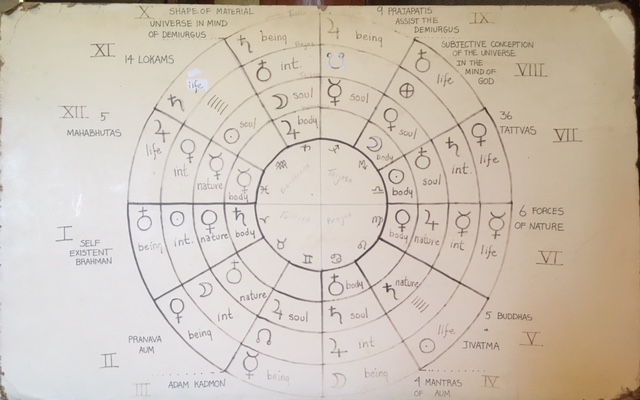
FIGURE IMG 2202-Posterboard Metaphysical Chart.
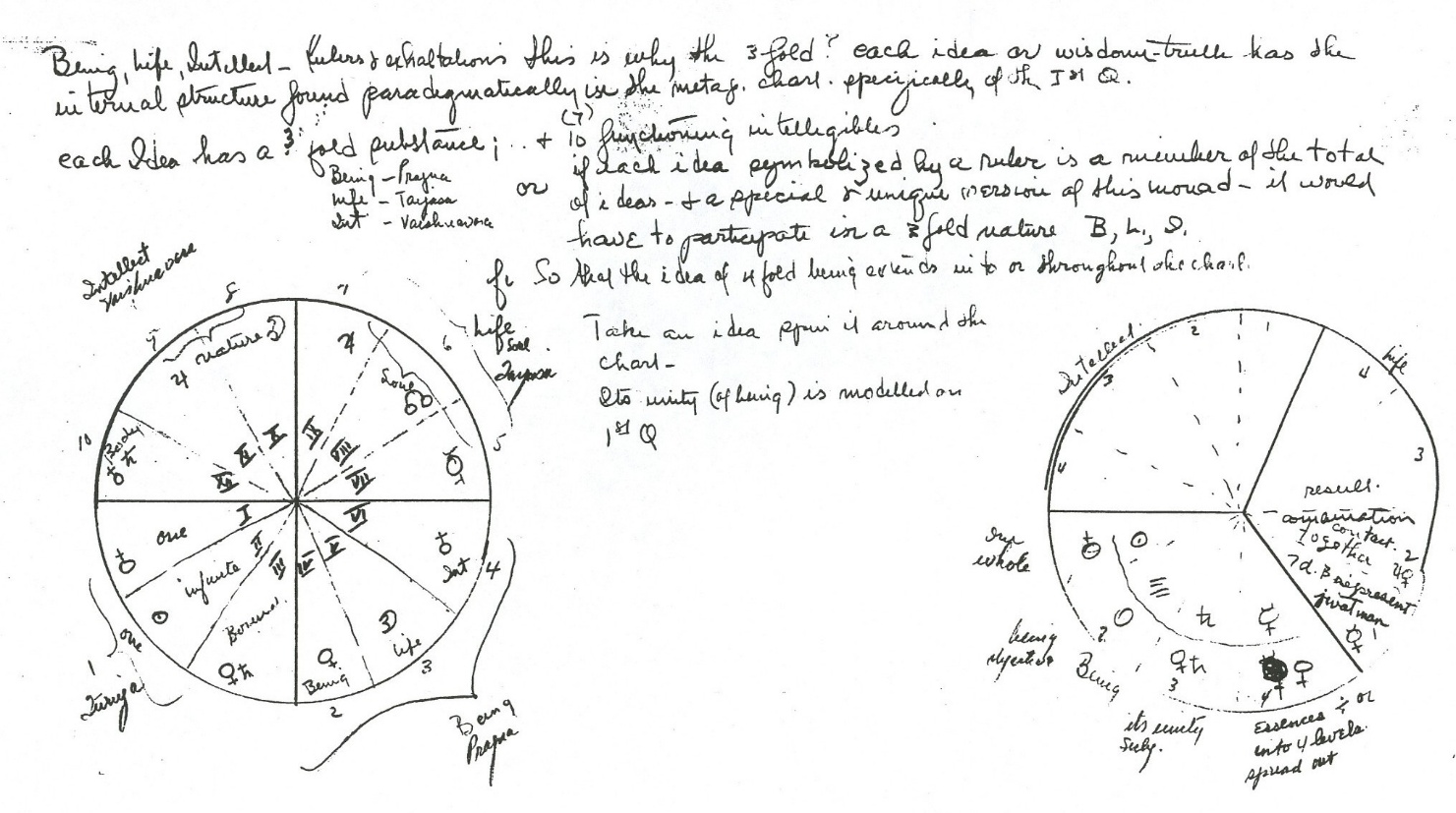
FIGURE AD_E_025. The Internal Structure of Each Idea as Found Paradigmatically in the Metaphysical Chart.
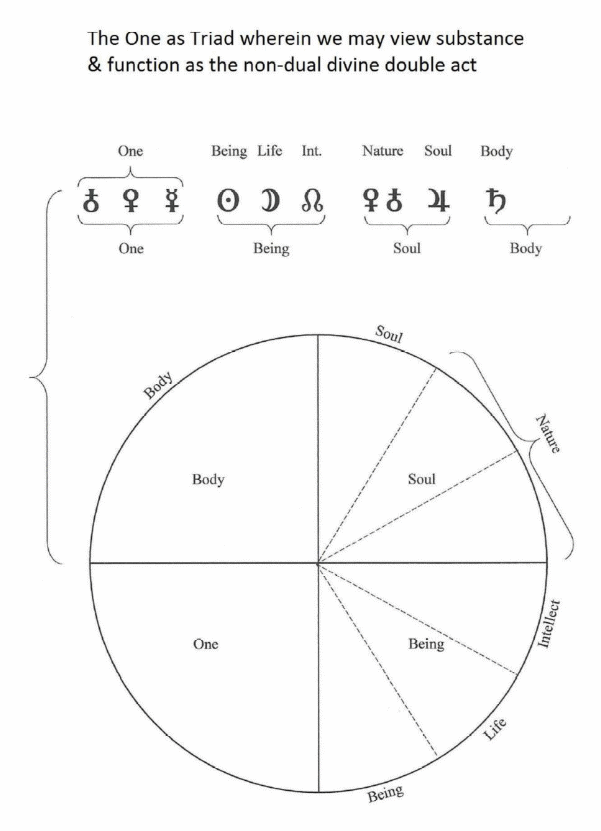
FIGURE AD Supp 202-digital. Triad, Double Act, and Circle.
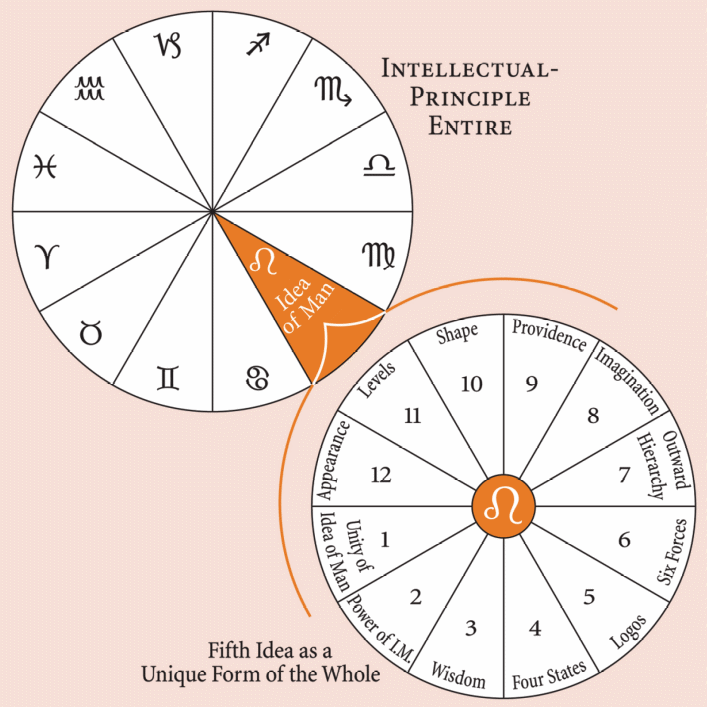
FIGURE 1981 0211-4. Fifth Idea as a Constituent of the Intellectual-Principle.
FIGURE 1981 0211-5. Fifth Idea as a Unique Form of the Whole.
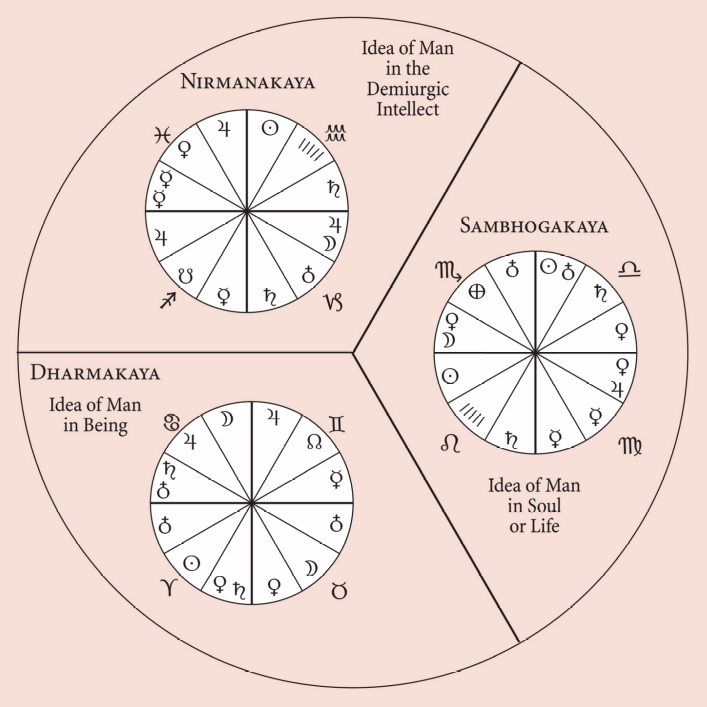
FIGURE 1981 0211-6. Twelvefold Mandalas for Each Level of the Idea of Man.
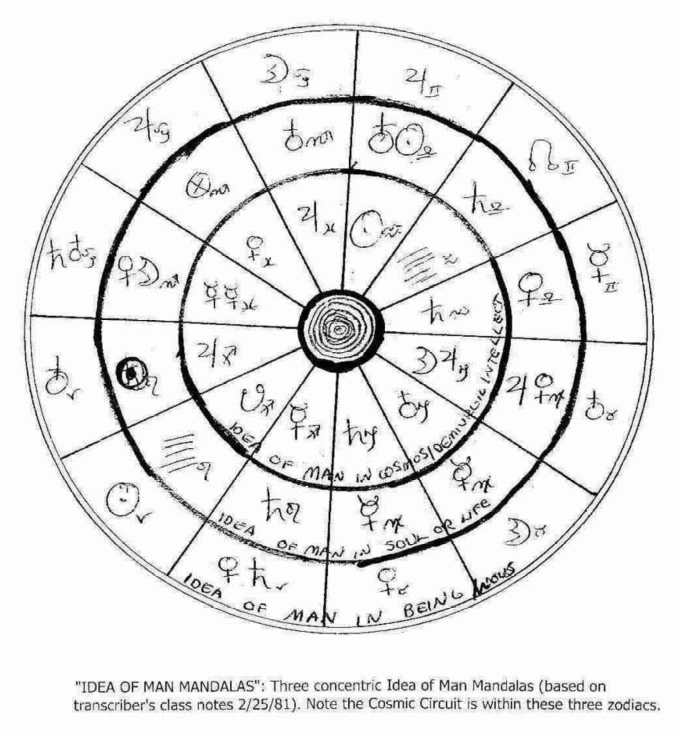
FIGURE 1981 0211-7-JF. Idea of Man Mandalas.
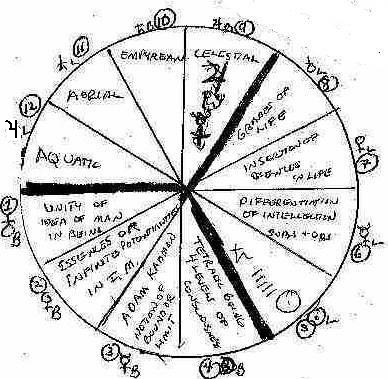
FIGURE 1981 0211-8-JF. 12-fold Idea of Man.
Other diagrams referred to are not with this transcript version.
NOTES:
This early 1981 class series on the Idea of Man was held on Wednesdays.
In these classes Anthony Damiani speaks about, among other things, the relation of Soul to Nous and Being, and to the Cosmos; perception; and "teaching the Soul." A large portion of these classes is devoted to Anthony Damiani's laying-out of the components of the three Idea of Man mandalas; herein we can see some of his metaphysical chart methodology. In these classes, one should remember that Anthony Damiani is working out his speculations in the metaphysical chart; therefore his symbolization of astrological and metaphysical chart concepts may not exactly match that in Anthony's later thinking or in Astronoesis.
For further reading on the Idea of Man in general, refer to Astronoesis pp. 147-165, the Editors' Extension on the Fifth Idea. Astronoesis pp. 114-117 is about "Each Idea is a Unique Form of the Whole." Astronoesis pp. 132-133 includes two Twelvefold Idea figures, to which the reader may also want to refer.
Previously printed, distributed 2003 as part of a set on the Idea of Man.
TRANSCRIBED by jf 2003 from Audio Cassette tapes; reformatted by jf 2018. In 2024, IT updates prefatory matter and footer, replaces tape markers with audio file markers, alters Topic and Subsubjects, completes Book List, adds Plotinus quotes section, corrects typos and some listening errors, adds new notes and alters some existing notes within transcript, adds six diagrams and references within transcript to these diagrams, replaces FIGURE 1981 0211-8-JF with corrected version, reformats to accord with new conventions. Readable edited transcript – V11r.
AUDIO FILES: 1981 0211a, 1981 0211b. [Note: "Tape" and "Side" refer to original audio cassette tapes that were later digitized into .MP3 Audio Files.]
1981 02/11 at Wisdom's Goldenrod
Metaphysical Chart; Idea of Man
[Audio File 1981 0211a Begins]
AD: Well, shall we proceed? We got a nice small group so maybe we could have a seminar instead. Good, look(ed) at your book, let's go. (someone laughing in background)
AS: I got everything I could find on Number.
AD: On Number? Well, you know what I thought maybe we could work out, because I think they might appreciate trying to figure this thing out with us. (drawing-on-blackboard sounds) You want to try working out something like this here? Try to see if we could evolve the method or the technique by which we translate an Idea, you know an Idea in Being, from the fourfold chart, you know, the metaphysical chart, to the ontological chart. You want to try it? (inaudible)
AS: We're starting with the paradigm of the One, (inaudible) put up the chart of Being.
[Note: See FIGURES IMG 2202-Posterboard Metaphysical Chart, AD_E_025 for the following.]
AD: And we'll put up the 12 houses alright, and we'll say well, we have over here the metaphysical chart [FIGURE AD_E_025, left side], okay, (drawing-on-blackboard sounds) we'll call this the One, okay. And we say the One has to exhibit Infinity and Bound, or it has two aspects, the Dyad. Then over here we would have-- this would be a number of possibilities, [1,] 2, 3, 4, 5, 6, 7, 8, 9, 10--we could think of it as 10 Ideas alright, that would be one way. You know what I'm talking about? Well, when we work with the metaphysical chart, the 12 houses, and we say that each Idea is a special and unique version of all the Ideas, we're speaking from the point of view of the World-Mind or the Intellectual-Principle [FIGURE AD_E_025, right side]. From the point of view of the One, alright, all that-- we don't worry or we're not concerned, with the Intellectual Ideas. But when we speak from the point of view of Being, the Second Hypostasis, and we say that in the Intellectual Realm there are many Ideas, each Idea is like a special version of the whole of the Intellectual-Principle. So that we should be able to take each Idea-- and this is a paradigm or a model-- that we should be able to take each Idea and apply this wheel and spread it out in the realm of Being [FIGURE AD_E_025, right side]. In other words, try to unfold the nature of the Idea that we're talking about. Now we already did that partially when we did this one here, when we took the Idea of Man, the Idea of Man would be the 5th house [FIGURES 1981 0211-4, 5]. (drawing sounds) We took this Idea okay, and we tried to understand this Idea in terms of Being, the Idea of Man in Being, then the Idea of Man in Soul, and the Idea of Man in Manifestation or Intellect, okay [FIGURES 1981 0211-6, 7]. So that we could say-- we could notice three things about this Idea-- that in some way it participates in Being, Life, and Intellect -- over here would be Being, over here would be Life, over here would be Intellect. It would be very difficult because there are a lot of subtleties involved here, translation into words is maybe unavailable. But if you feel like doing a little work and stop looking so stupid (student giggles) -- Simon says. So why don't we try it.
So first let me make one distinction, you know the difference between -- maybe it's just words, but they help me make a distinction between metaphysics and ontology-- you know the difference. In Metaphysics: you're speaking about the total, the Total, the Infinite, you're speaking about the One, and nothing but the One. And when he was giving you the lectures on the derivation of the Many from the One, you went into some sort of understanding of what the internal structure of the One is, and you try to make it available to you. Alright, but when we speak about Being or Ontology, you're not speaking about anymore about the One, but you're speaking about the next principle down, which is (supposedly)-- it's not infinite, it's determined Being, it's not Universal Being, but it's a determination within Being. It will be composed, of the way he speaks about the various Genera, that will constitute it. It will not be infinite, because Infinity properly applies only to the One. It will be composed of many parts, each part let's say is an Idea, each Idea has its own Power, its own Intellectuality, its own Life. So that you're really speaking about two very distinct things. So when I use the 12fold chart, or the metaphysical chart and I refer to that as the metaphysical [FIGURE AD_E_025, left side]. And I'll use this here to refer to it as ontological, this we have to find in Being [FIGURE AD_E_025, right side]. This is in Being. This [metaphysical chart] is not in Being, this is beyond-Being. So we can say that refers to Beyond-Being, this In-Being. Then there's a chart later on alright: After-Being, that would be like the third when we speak about the Soul in Matter. Alright, so that's just one distinction --so that you'll have to ask me because I'll just go on rambling in my own mind.
LC: When we did the 5th house, the Idea of Man, I thought that was an ontological--
AD: Yes, yes, that's ontological, that's in Being. You have to remember Being: I mean, the grandeur and the misery concerned with anyone who really tries to understand Being. It's enough to -- it could be upsetting like it's really Man's Grandeur -- even Hamlet remarked about that-- (student snickers) Go ahead, Louis.
LDS: Well, the only thing I would like to ask is clarifying what we're attempting to do. First, can we say that the proper sphere of Ideas is ontological? (AD inaudible) The proper sphere of Ideas themselves. But now what we're trying to do is watch or pursue the unfoldment of that Idea in terms of the metaphysical prototype chart. (AD: Prototype, yes.) But now but we have to keep in mind that because we're starting with an Idea, there will be no place, except in an analogous way, on that metaphysical prototype chart that we're going to unfold that Idea on, there's really true realm of metaphysics then. In other words, there would be an analogous One. (AD interrupts, inaudible) In other words, if we start in the first quadrant with an Idea--
[Note: See FIGURES 1981 0211-5, 8 for the following.]
AD: Alright-- Let's say we're taking this Idea, alright. Let's see-- 4, 5, okay-- we're taking this Idea. Let me start this way, Louis. (chalk-on-blackboard sounds) Here we have the 12 Ideas, alright. I don't know if I got 12 here, but it doesn't matter. We got 12 Ideas here. We're going to take one, one Idea, the 5th house Idea okay. And we're going to take this Idea and use this chart. So we would say the 5th house Idea, the Idea of Man, alright, fine. First house, if this is the One, if the 1st house is the One, then we have to take the 5th house Idea, the Idea of Man, think of that in-Being, not beyond-Being, but in-Being alright. But we're going to say this Idea is a Unity in itself, so we could correlate it with a One, okay. (LDS: Yes.) Alright, then we would say, if this is the Being of the Idea of Man, (drawing) okay, then we have to make a correlation-- Let's see, if we took the One, we know that the One can be halved or doubled alright, and we speak about this as the Dyad, or we speak about this as Infinite Substance and Unlimited Function. Or we could speak about this as Active Perfection and Passive Perfection. It doesn't matter, the point is that we can see that these two together, so to speak, are included in that. So in Shaivism they would say this is Parasamvit, this is Shakti, this is Shiva, Shiva and Shakti together give you Parasamvit. In other words, one would be like subjective and the other objective. But this would be the Unity of the two of them. So I'm taking this Idea, this 5th house Idea, and I'm saying alright, if that's the Being of the Idea, and this is a Unity-- but not THE Unity, not the One, okay-- take this here and say this is the Unity of the Idea of Man in Being. Now can I do the same thing, can I split it apart or try to conceive it that way?
LDS: So we're going to speak now of an ontological Unity.
AD: Yes, in other words, the Unity that we're speaking about now is a Unity in Being, something that IS -- We're saying this is something that IS, it has a Unity. Now you can't speak of The One as something that is, it's beyond Isness, it's beyond Being. Okay--
CDA: What about-- in the metaphysical chart, what's the difference between how we speak of the second quadrant-- (AD: How do we speak about the second--) What is the difference--is there any difference about how we speak of-- (AD: Any difference of what?) Being of the Intellectual-Principle in the second quadrant of the metaphysical chart and-- (inaudible)
[Note: See FIGURES AD_E_025, AD Supp 202-digital for the following.]
AD: The second quadrant of which chart-- this one here? Well, if this is the One, (drawing) this would be Being, Life, Intellect, all this would be Soul, this would be Nature, this would be Body. Okay. So there you would have one way of looking at it.
Another way would be to look at it this way-- this would be the One (drawing) okay, all of this here would be Being, all of this here would be Life, all of this would be Intellect. (CDA inaudible)
Now what I'm doing is very simple. I'm taking the Triad (drawing-on-blackboard sounds), and I'm calling this One-Being-Life-Intellect. Alright, that's a fourfold division. But at the same time it's seven. This is: One-Being-Life-Intellect-Soul-Nature-Body. When you refer to the 7 you're thinking of it doing something. Alright, when you refer to the 4, you're thinking of it as substance. Okay? (CDA assents) Put them both down here. So you can keep that in the background, don't bring it up now, because it won't help. The only way it helps is what you're doing. You get an insight into what you're doing.
S: And try and show the active and passive perfection of that--
AD: As soon as I do that, as soon as I show that you can talk about it as 4, or I can talk about it as 7, I'm showing on the one hand it could be function, and the other hand it could be substance. So, for instance, we could say that every Man, in some way or another, participates in 4 levels of consciousness, that would be the substance aspect. But then he has 7 different faculties that he works with, you could say thinking, imagination, etc. And they would reveal that substance. But they always have to be together, you can't separate one from the other. You won't *know* one without the other. So -- over here we're looking at it in a 7fold way and a 4fold way, both simultaneously.
CDA: So when you make a chart of the One, as you just did with the Triad, you're not at all considering the Ideas there? Is that correct?
AD: No, that's why I put the Primals. I put everything from the first quadrant. (CDA: Yes, okay.) And when we worked out the derivation of the Many from the One, alright, in other words, when we got the Intellectual-Principle from the One, alright, we were basing ourselves on *that* model to understand, otherwise we can't, can't understand what they're talking about. Go ahead, Laurie.
LDAm: I still don't understand that 3fold chart. (AD: The what?) The threefold.
AD: No, there's nothing to understand yet. You won't understand the 3fold chart unless you get every Idea and spread it out. Then you'll understand the 3fold. You won't understand it now. In other words, as we take every Idea, and we see that it has a Being aspect, a Soul aspect or Life aspect, and an Intellect aspect, and you do that with each Idea, then you'll begin to--you'll get some idea of why it has to be 3fold. Because if you take, if you take your rulerships (drawing), if you take the 1st house Mars, the 7th house Venus in Libra, okay here the Idea, and here's the substantialization of the Idea, you could do that with all 12 of them. Alright. But this would be Being, the four of them [rulerships] would be Being, four of them would be Life, and four of them would be Intellect. Alright. So every Idea, if it's truly an Idea, will be spread out in those three realms, and it's going to look like a chart divided up like this here. But it's not really that. It's just -- like I put one chart here, I say the Idea of Being is here, the Idea of Soul is here, the Idea in Intellect is here. But I mean, this chart is only a visual aid.
LDam: (inaudible)
AD: What?
LDam: The Idea of the One isn't included in that chart--
AD: No.
LDam: That's why (inaudible).
AD: No. I'm going to stay away from that because I want to concentrate on the transliteration of the Ideas from a ring structure to a quadrant or vice versa. But more important than that, I want to try to explicate and bring out the full contents of one Idea, then another Idea, then a third Idea. And in discussions on Being, alright, the word Being becomes after a while-- what do they say?-- like a password. You know everybody uses it and no-one knows what the hell they're talking about. So if you take philosophy courses they talk about Being endlessly, and if you pin one of them down and tell them "give me some examples" and you'll see it's impossible. I want to avoid that. Later on, when we study or when we get into some Buddhism, and they start talking about denying Being, you're going to see my horns come up. Because the most immediate object of the Intellect is Being. See, I'm absolutely the opposite way. I'm coming from a totally different perspective. They say that the immediate object of the intellect, alright, is-- (snaps fingers) is an existent object which has no self-inherence or something like that. We'll get into that-- (student laughter) I hope I get a little humility by the time the Dalai Lama comes around again. If I have to spend 20 years trying to understand something or a little bit about Being-- You know, it's really, it's a direct confrontation, because like in Platonism we try to understand, as I understand Platonism, we try to understand how a thing could be the Same and Other. Now they would take that to show that the thing can't be. Whereas I'm taking that, as that's exactly the Problem! Don't tell me it can't be, it is! Something revolves on its axis, something stands still, and the other thing revolves about it. Don't tell me Sameness and Difference are not simultaneously operating. Do you see where I'm coming from? That's totally off the wall compared to them. They're going to say there's nothing there, and I'm going to say "You're crazy." There's something there, something very important, the cosmos, it's been around for a long time. So if you took the simple example of the axis of a globe or an earth, the axis stands still and the rest revolves; Plato would be discussing that in terms of Sameness and Difference. So ANY object, at one and the same time, it is and it isn't. That's the language they would break it down (into), and they would say you've got a contradiction. No, a thing is and it operates. There's no contradiction. My problem is to understand how that takes place. It's much easier to say it doesn't exist and walk away. Alright, so we get back to this here notion.
So we have the 12 Ideas around the circle. What I'm saying is that we take one Idea, and we give it that treatment. Now we did that with the Idea of Man, and I know that the reasoning is complex, we took the Idea of Man and we're speaking about the Idea of Man in Being. Now, you know what we're speaking about, don't you? When you say that the Infinite or God--I don't like to use that word but it's a good word--or the Good-- whatever term you want to use, you say it has a Wisdom, and this Wisdom is Truth-- Truth and Wisdom. And that among this or included in this Wisdom there are many Ideas, and one of them is the Idea of Man. There are many other Ideas but we're concentrating on the Idea of Man. So that this Idea of Man which is contained in God's Wisdom is going to be absolutely awesome. It is going to have to include within it the powers to actualize and effectuate everything that it contains. Now, if God's Idea doesn't have that power, it wouldn't be very much of a God. So statements like "man is made in the image of God" and things like that, really have to be worked over and not repeated like parrots-- you know parrots keep repeating it: "Man is made in the image of God" and you keep believing it after awhile. Then you're naturally going to imagine that God is a man with a beard, white or black, but that's what you're going to end up thinking. So if we work it out very briefly maybe we'll get the feeling alright-- You busy writing down there? Maybe you can take time out and join us.
[Note: See FIGURE 1981 0211-7-JF for the following.]
AD, cont: Alright, you remember what we did last week, we took this one Idea of Man, (drawing) and we said -- well, this would be the Idea of Man in Being. And we took the Idea of Man and we put it at the outermost ring. Then continuing with the Idea of Man in Soul and that becomes the next ring. This one here, the Soul ring. Then again, continuing the Idea of Man in Manifestation, becomes this ring here. And inside that ring we have the whole of the cosmic circuit. So that if we took that Idea of Man, we're doing something like this: over here we have the Being aspect, over here the Life aspect, and over here the Intellectual aspect. And over here, we said, (drawing) this produces, this realm produces the material manifestation of the Idea of Man. Now you could think of a single individual item, you and I, or could think of the whole universe as a Cosmic Man. This they call the Grand Man in the Kabbalah. And when we did it in terms of Proclus, this was called the Celestial Man, Gnostic Man, the Aerial Man, the Aquatic Man [FIGURE 1981 0211-8-JF], and then least, last, the very dregs, you and I, Terrestrial Man. So this would be like the Universal Man. This would be the Universal Man in the Soul, the living Man. And this would be the Idea of Man in God.
Now this is just one Idea, alright, just one Idea we took from here, the 5th house [FIGURES 1981 0211-4, 5]. And I'm saying I think it's possible we could work out all of the Ideas. And as you work out one Idea, and you begin to realize the implications in it, I don't know if you got any idea how long it took us to figure out this here-- you know the fourth quadrant, you know to understand, I guess it took us over a year and a half to figure it out, to get an idea, and we're not down on the ground floor, but that's how long it took, to get an idea of the notion of Man in Manifestation [houses 9-12].
Now we're beginning to work a little bit somewhat on this here, the Idea of Man in Soul, try to understand that the meanings that we project onto any situation, event, calamity, whatever, is coming from what we call the house structure, the 12 houses. (drawing) The meaning is coming from the house structure, and we equated that with the Soul. We equated this planetary part with the Body. Now, we're saying there's a deeper level of meaning which gives meaning to the Soul itself. We're saying that comes from the Nous, the Intellectual-Principle. So the Intellectual-Principle, alright, includes the Soul principle, the Soul includes the Body within it, alright, and if you have all the planets whirling around here and you put the Earth in the middle and you locate yourself someplace on that spot on Earth, alright, that's you there. And all this had to precede the possibility for your arisal. You have any questions on the Idea of Man because-- Go ahead, sure.
S: Um, this chart on the blackboard here, is that (inaudible)? (AD: I'm sorry--) Is it this chart that you were drawing in that Being triad there, in the threefold? (AD: This chart here?) Yes.
AD: Yes. (S: That's what you were drawing in that (inaudible)) Yes, when I did the threefold, (S: Yes.) alright, and I put the three circles here, okay, and I want to put the three circles together and I put them here. So that if I say that this is the Idea of Man, Being, alright, then I say this is the Idea of Man in the Soul, I put it inside that, this is the Idea of Man in the Body, I put it inside that. So that I have this as an underlie of this, this as an underlie of this here. You get a general picture of this here? Now we do suspect and some of the-- I mean we do suspect that it's possible (inaudible), we know that this is so. We could take various examples, which are in a way-- You know, like someone asked me what's PB (leaving)? I says, what do I know. I'll take a guess, July 19. July 19 PB leaves. Now I know that wasn't me, but I know it came through me, that there was an intelligence wider than mine that includes mine and as soon as I got out of the way, it can get through, and the message is delivered. So we're saying that there is a wider intelligence, much more comprehensive. So Plotinus speaks about that in a passage-- Avery, could you pick out a passage where he speaks about we are the Nous when we use it. [Note: See Plotinus, V.3.3, eleventh para.] It's passages like this that make me suspect this is what the meaning is to these things.
S: I think we just read that one the other day, V.3.4.
AD: Anyone you think of--
AS: Man becomes Intellectual-Principle--
AD: Yes, good. You see what he's saying, Man becomes Intellectual-Principle. (inaudible; then a few inaudible student comments, shuffling of papers, etc.)
Plotinus V.3.4 (AS reading): "Thus the self-knower is a double person: there is the one that takes cognizance of the principle in virtue of which understanding occurs in the Soul or mind; and there is the higher, knowing himself by the Intellectual-Principle with which he becomes identical: this latter knows the self as no longer man but as a being that has become something other through and through: he has thrown himself as one thing over into the superior order, taking with him only that better part of the Soul which alone is winged for the Intellectual Act and gives the man, once established There, the power to appropriate what he has seen."
AS: He says later on:
Plotinus V.3.4 cont. (AS reading): "Are we to suppose that all we can do is to apply a distinct power of our nature and come thus to awareness of that Intellectual-Principle as aware of itself? Or may we not appropriate that principle--which belongs to us as we to it--and thus attain to awareness, at once, of it and of ourselves? Yes: this is the necessary way if we are to experience the self-knowledge vested in the Intellectual-Principle. And a man becomes Intellectual-Principle when, ignoring all other phases of his being, he sees through that only and sees only that and so knows himself by means of the self--in other words attains the self-knowledge which the Intellectual-Principle possesses."
AD: Avery, let's discuss that (inaudible), okay?
AS: Well it's funny, in this whole Ennead here, he speaks about this principle of self-knowing, and how the Soul can come to know itself. And he seems to finally come to a conclusion that the soul through its own power, can't. That it's only through the Intellect that the Soul can really come to know itself. And only by turning itself over to the Nous which is its substrate anyway that he can actually become self-knowing.
AD: Let's read a couple lines at a time, Avery, start with the first one, a couple of lines. (AS inaudible) Now look, you had the opportunity to be with two of these people, don't be an ass, try and understand these things. Don't go over there and show how devoted you are and full of piety, that's not enough. They want you to come with some understanding, they don't expect you to be kids all your life. If you can get a grasp of this here, you can see what at least you get an idea of who and what you're dealing with when you see the Dalai Lama, and when you see PB. You don't always have to go around with a lollipop in your mouth. Sooner or later you get tired of it, no matter what it is: chocolate, orange, cherry, or anything else. Let's read the first two sentences.
AS: Let me start back (inaudible) this Ennead. It says:
Plotinus V.3.4 (As reading): "[W]e, too, are king when we are moulded to the Intellectual Principle.
"That correspondence may be brought about in two ways: either through laws of conduct engraved upon our souls as tablets or else by our being, as it were, filled full of the Divine Mind, which again may have become to us a thing seen and felt as a presence."
AD: Go ahead --
LC: Is this the two ways, that PB sometimes calls the Long Path and the Short Path? Or the Dalai Lama once said, if you once *think* the Divine Mind, if you just keep it-- PB said that too, keep it present like the Brother Lawrence exercise (AD: yes, the presence) Keep the presence--
AD: Keep the presence of God,
LC: Even though whatever you're doing you're doing, but as long as you keep recalling the presence of Mind, that eventually you'll (be filled with--)
AD: With its presence. And that's what it really is, a presence. It can be seen in the sense that it becomes a light that's overwhelming, you can't bear it. And if your mind, the little mind, the empirical mind, isn't functioning, the first moment or ripple in the mind, the first, as soon as you come out of it, usually an intuition is given to you, alright. Now that's the way the sage usually operates, from that inward faculty. And then when he presents something, he's coming direct from it, it's right there but -- like when he goes into the stillness nothing can be said. When he comes out of the stillness at that instant, (snaps fingers) the intuition is given to him and he presents you with a fact or a (bit of) knowledge.
LC: And this Divine Mind that they're talking about now, if we use the chart, is in that first part of the threefold, or do we skip over to the--
AD: Now look over to the circuitous reasoning we have to use. We say that the Idea of Man, alright, the Idea of Man in Being is one of the Ideas going around the whole circle. So it's one of the Ideas in the Divine Mind, okay. But insofar that each Idea is a special and unique version of the whole or, insofar that all the Ideas, the 12 Ideas or 10 Ideas, together form a Monad, one Idea alright, (snap) he says that's the Divine Mind. It isn't that you can only step into the Idea of Man and exclude all the other Ideas.
LC: Right. That's just one--
AD: So as soon as you reach that level, you're at the level of the Divine Mind and it can function through you. He calls it the 'King.' The King (inaudible, someone coughing) But that means the same thing like when they call Jesus the King, and he pointed out that you first have to deny your Soul if you expect to follow me. And of course, that will always kind of bother Christians, they want to save their Soul, and he says deny it.
LC: But--here he just said here that the power of the Soul and the power of the Soul is not enough to go up to the Divine Mind.
AD: Read it. You follow the logic of the reasoning I just used, though. That you can't get (inaudible). So its very possible the sage when he enters into these here realms, he could see universes forming like so many bubbles in a bath. His vision would be *sub species aeternitas* whereas ours would be restricted to the function(ing) of the body. Well, let's read a little more, try to get the import of the depth of some of these passages, the depth and the profundity that this man is operating from.
PFK: Anthony, I have a question. When you say that one has to deny one's soul, does that really mean going into the stillness?
AD: Well, that really means you, that really means that you have to go beyond-- If we say that the soul is a logoi [sic], a reason-principle, which is actualizing an Idea, then to know the truth of the soul's actualization, one has to stand behind or above it. So that means he has to identify with the World-Mind to see what these meanings are in the soul. Okay. So again that's why this chart here, that sort of indication. This would be like an indication of the Nous in us. This would be an indication of the Soul in us. And the other would the lower level.
S: Wouldn't this be like analogous to when you first realize that you're more than just the body, and that you realize that you are a soul too, and take that step, would be kind of analogous to like (inaudible)?
AD: (inaudible). Sure. It's quite a leap when someone realizes that he's more than the body.
Plotinus V.3.4 (LC reading): ". . .taking with him only that better part of the Soul which alone is winged for the Intellectual Act . . ."
AD: Well, what would be the better part of the soul, Leslie?
LC: I guess the higher part--the part--
AD: The highest part, the part which we referred to as Cognitive Isness, only that would be capable of (a flight) of this nature. (last part hard to hear) Because Cognitive Isness could relate to the lower as well as to the higher. But the lower parts of the soul that are concerned with manifestation, they can't make that trip. No way can they get up there, because there's no imagination up there. So the imaginative faculty, alright, the desire nature, all things are all useless up there. So only the higher part of the soul, what Plato calls the Governor of the Soul can take that trip. That's why even in Hinduism, they don't point it out, but it's hinted at enough times in Plotinus very clearly, you have to reach the Soul before you can speak about union with the One. And of course when one reaches the Soul, they think they've reached the union with the One because it's such a profound experience. The Overself, I mean. And to think that you can go beyond that, you know, it just blasts you out of your wits. But you don't have any left so (inaudible). (student laughter, comments) No wits are left at that stage, no. Let's read a little more, Avery. Just to give you a feeling, alright, and then we'll try following this process, because when we're working at our seminars sometimes we're handling half a dozen problems and don't know it, you know, we have to pull one out and try to clarify it, before we can see there are another five hanging below it waiting to be resolved. But it's only in the work that we find out. Read a little more. (AS starts reading) He's doing his homework. Hence our self-knowing--
Plotinus V.3.4 (AS reading): "Hence our self-knowing ensues because it is in virtue of this thing present that we know all other things; or because we know the faculty which discerns this principle of knowledge by means of the faculty itself; or because we become actually identical. . ."
AD: Let's stop there, stop here. You might recognize this, PB for instance in the *Wisdom* once makes the remark, something to the effect that it comes to this, ultimately the perceiver in you is the Intellectual-Principle. I don't know if you remember that quotation. But anyway listen to this.
Plotinus V.3.4 (AS rereading): "Hence our self-knowing ensues because it is in virtue of this thing present . . ."
AD: This thing present, the Intellectual presence.
Plotinus V.3.4, cont. (AS reading): ". . . that we know all other things; or [our self-knowing ensues] because we know the faculty which discerns this principle of knowledge by means of the faculty itself; or because we become actually identical with the principle."
AD: So in that last statement he's saying in connection we become identical with the Intellectual-Principle.
AS: It seems like those are the three-- it seems like those would be like three levels. You would say well, even at the lowest you could recognize that it is in virtue of the Nous that you have any knowledge, even in the body, let's say. But then the next step you could become aware of the faculty which discerns, this principle of knowledge would have to be the soul itself. So then it would be knowing at the level of the soul, the second ring. Or we could actually become identical with that principle of the Nous, that would be the highest one.
AD: It would be that kind of statement that shows us where Plotinus is coming from. And if you remember once, when they referred to his daemon, they called it the One. You could say that of a couple of others we know. But let's read a couple more lines.
Plotinus V.3.4 cont. (AS reading): "Thus the self-knower is a double person: there is the one that takes cognizance of the principle in virtue of which understanding occurs in the Soul or mind; . . ."
AD: Alright, stop there, try explaining it. That's one thing about Plotinus, you can't read more than a line or two. He re-educates you.
AS: I think that one would be like almost an indirect one. Like you know-- the first self-knower, is you become cognizant of the fact that the Nous IS that by which you understand. But you're not identical with the Nous. It's like operating, you recognize that's what's operating through the soul is the Nous. So you do take "cognizance of that principle by which understanding occurs in the Soul or [the] mind." But you're still Soul or mind, as it were, looking up to the Nous. Or recognizing that the Nous is working through the soul or the mind. And you're still the soul or mind. And then he says:
Plotinus V.3.4 cont. (AS reading): ". . . and there is the higher, knowing himself by the Intellectual-Principle with which he becomes identical . . ."
(Side 1 of original cassette tape digitized as 1981 0211a Ends; Side 2 Begins)
[Plotinus V.3.4 cont., not on tape: ". . . this latter knows the self as no longer man but as a being that has become something other through and through: he has thrown himself as one thing over into the superior order, taking with him only that better part of the Soul which alone is winged for the Intellectual Act and gives the man, once established There, the power to appropriate what he has seen."]
DB: --both as the indeterminacy which Saturn [in Leo] represents, that would be the first part of this, that you're speaking of soul as --
AS: (inaudible) No, that's what I was saying.
DB: Well, in terms of relating it to the chart it seems like the first part would represent the Saturn, whereas "the principle in virtue of which understanding occurs" in himself, that would be the Idea of Man. And that in itself would be knowing itself in terms of the Intellectual-Principle. I mean, that in a sense the Idea of Man, the Being of the Idea of Man, is in some sense in identity with the Intellectual-Principle itself.
AD: Do you want to try again, David?
DB: Well, I'm not sure I can say it very well. We start off with the notion that the self-knower is a double person, and speak of the Saturn, the soul, as having a vision of the Idea of Man let's say. So that there's-- in this notion there's a twofold character to it, the one would be the Saturn and it seemed to me that might correspond to the notion that would be-- the Saturn would be that principle which would be that person here that "takes cognizance of the principle in virtue of which understanding occurs in the Soul or mind." So the soul has a vision of the Idea of Man *there*. Okay. But the higher "knowing itself by the Intellectual-Principle with which he becomes identical" and "this latter knows the self as no longer man but as a being that has become something other through and through." So we're not speaking in terms of *A* man but rather the Idea of Man itself, that to realize --
AD: He's speaking as Nous.
DB: Yes. It would be that level at Nous. When the soul contemplates it even at that level it seems that it's in relation to a particular soul and a particular man. (AD assents) But the second part is universal.
AD: That would be the Nous in you that knows.
DB: Right.
AD: And knows the soul too.
DB: And that would be like the Sun in Leo as opposed to the Saturn.
AD: Well, again, we would be delimiting and circumscribing its meaning if we said that the Idea of Man, because he's equating it with the whole of the Intellectual-Principle.
DB: Yes, right, but from the standpoint of the Sun in Leo itself-- No, I see what you mean--
AD: Because that's one thing all the Ideas have in common -- Nous. A couple of more lines. There's only one way to read Plotinus, and that's to meditate on him, you can't read (him). And I often recommend to people, to memorize passages, take them into meditation, concentrate everything you've got -- just as intensely as some piece, work of art that you enjoy-- stare at it, contemplate it, and the meaning will come into you. And soon you'll have some faith in the Self (in you).
JC: Anthony, in the chart, I have a slightly different interpretation of the "self-knower is a double person". You're saying that: "there is the one that takes cognizance of the principle in virtue of which understanding occurs in the Soul or mind."
AD: Now, what would that be?
JC: I think that this one refers to the rational soul which is aware of the presence of Nous within it by which it knows anything. And yet sort of, it's knowing itself by knowing the presence of Nous within it, but it's not grasping the Nous directl --
AD: Read it once more, Jeff.
Plotinus V.3.4 (JC rereading): "Thus the self-knower is a double person: there is the one that takes cognizance of the principle in virtue of which understanding occurs in the Soul or mind; and [then] there is the higher, knowing himself by the Intellectual-Principle with which he becomes identical . . ."
JC: The second one, I'd say, this is the soul in its intellectual aspect, as one with--
AD: The Soul as Nous.
JC: The Soul as Nous. The other one, it seems, is more indirect. Like the rational is self-knowing, but it can't know-- it's real Selfhood is as intellectual--
AD: What you're saying is that the Understanding part of the Soul is aware of the Intellect of the Soul within it--
JC: And takes that to be the subject. And so it's self-knowing, but it's not knowing the Nous directly. Like we think, and because we're rational beings, we have some sense of subjecthood, of ourself as a subject. But we're not grasping that cognitive power directly in the rational process. It's only in the intuitive process, that we (contact it) directly. (last part hard to hear, coughing) Or the intellectual aspect, I should say, that you can grasp yourself directly, your Selfhood directly. In the rational process you can have an understanding of yourself, let's say, in various modes, but reason always wants to make objects of its cognition. And that's why they call it dianoia, in a more divided sense.
AD: Alright, if you think so, then I'll read it a third time.
JC: Okay. The double person.
Plotinus V.3.4 (JC rereading): "Thus the self-knower is a double person: there is the one that takes cognizance of the principle in virtue of which understanding occurs in the Soul or mind; . . ."
AD: Stop right there.
JC: So there's one person, who "takes cognizance of th[at] principle in virtue of which understanding occurs." Now the principle in virtue of which understanding occurs is the Nous. Isn't it? I mean, that's --
AD: Yes.
JC: (For that) you can understand anything, there has to be the intellectual life there--
AD: Yes.
JC: Present. So he's saying one person takes cognizance of that presence of Nous by virtue of which it--
AD: Is the lower person takes cognizance of Nous? (JC: Well--) You got a twofold knower, he refers to one as lower and one as higher, alright. I think we said that the higher is when the soul takes itself as Nous.
JC: Yes. Like Saturn in Leo, something like that.
AD: No. (JC: You want to go--) You take yourself as Nous. Not as Saturn in Leo.
JC: Well. But Saturn in Leo is directed towards grasping an intelligible, its intelligible content. Not as presiding over the lower activities.
AD: What we have to, I think, make clear here is that he's saying is that the higher knower is the Intellectual-Principle in you, that's what he's saying the higher knower is. Now what is the lower knower? You read the first part that you were referring to--
Plotinus V.3.4 (JC rereading): ". . . there is the one that takes cognizance of the principle in virtue of which understanding occurs in the Soul or mind; . . ."
AD: Okay, right there, now what does that refer to?
JC: Well, it would be interesting to know what the words are that he's translating. But when he says "understanding occurs in the Soul or mind"-- I think that when Plotinus uses the word 'mind' and understanding often he's referring to more, the rational processes.
AD: Okay. Now what's in you that knows that understanding?
JC: You're saying that it's the intellectual light in me (inaudible)?
AS: No, it's the Saturn, wouldn't it be the Saturn in Leo?
AD: (inaudible)
AS: The Cognitive Isness, isn't that (inaudible)--
JC: That would be the Intellectual light.
AD: That's the Intellectual Light. You see, he's referring to different parts of the Soul. But he's referring to the Saturn in Leo as identified with the contents of itself, alright, or identified with Nous. The higher knower is the Saturn in Leo but as identified with Nous. The lesser--knows the understanding and the rational soul.
JC: Knowing the lower aspects of the soul (AD: Yes) is the first self-knower.
AD: Go ahead, Willie--
WA: I guess I sort of, I don't see why Jeff's point is wrong.
AD: We just went though that, Willie. (WA: I know but--) We just went through that-- (WA: Well-- I--) You want to repeat it to me? (WA: I know what you went through--) Alright, repeat it.
WA: Okay. The principle by which the understanding--
AD: There's a twofold knower in us. Alright.
WA: A twofold knower. The first one that Plotinus speaks of is the Saturn in Leo.
AD: He speaks about a higher and a lower. We speaking about Saturn in Leo. (inaudible) a higher--
WA: You're saying that he's speaking about the lower as the Saturn in Leo or the soul, as knowing the Intellectual-Principle, or as knowing the Nous--
AD: And I'm --
WA: Or as knowing the Int--
AD: It can't know the Nous!
AS: It knows the rational processes.
WA: You're saying the Saturn in Leo is knowing the rational processes?
AD: Yes.
JC: It illuminates them.
WA: Oh, I see the principle of which-- okay--
JC: But reason reflects on the fact of -- the presence of that-- of that Intellection--
AD: Well, if that satisfies you, Jeff, you're welcome to it.
JC: I heard that-- Now this is-- just going the other way--
AD: Because this Saturn in Leo can understand and the reasoning processes, the whole of the rational soul is objective to it. (JC: Right.) Alright. But when the Saturn in Leo, or the Soul, is the Nous-- alright, no distinction now, you can't isolate the Saturn in Leo or the Unit Soul from the Nous-- now it knows, the Nous knows the Saturn in Leo. So there are really two very distinct levels of knowing that he's speaking about. As far as further down, he doesn't even deign to speak about it. He doesn't call that knowledge at all.
JC: You're saying the Nous knows the Saturn in Leo? I don't understand how you're using the Saturn in Leo--
AD: It's very simple. The Nous is the Self of your Cognitive Isness, of your 'I'. This (inaudible) I can yell at you. Go ahead--
JC: You mean, it's myself as a Real Being?
AD: It's the Real Self in you.
JC: A Real Being in me?
AD: It's the real Selfhood. You can't go beyond that. Read it again, Jeff.
Plotinus V.3.4 (JC rereading): "[T]he self-knower is a double person: there is the one that takes cognizance of the principle in virtue of which understanding occurs in the Soul or mind; and there is the higher, knowing himself by the Intellectual-Principle with which he becomes identical: this latter knows the self as no longer man but as a being that has become something other through and through: he has thrown himself as one thing over into the superior order, taking with him only that better part of the Soul which alone is winged for the Intellectual Act . . ."
JC: Okay. Now I would say that the Soul has thrown itself over into the higher order, and only that aspect of itself, its Intellectual power, is active now, and it's become identical with the Intellectual-Principle as it knows the contents of the World-Mind specifically-- perhaps one content would be for instance the way we said the Sun in Leo formulates a specific--
AD: Who would notice that Saturn in Leo as one of the logoi of the World-Mind, I mean of the Intellectual-Principle, that's the level of understanding he's bringing you up to.
JC: You said that the Saturn in Leo has a vision of what the Sun has formulated in it as its own version of the Idea of Man--
AD: So that would be a logoi, right? A logoi would be like the sum of a number, and the number as the whole, alright, would contain distinct units, each of these units, alright, unfolding the whole of the logoi, the reason-principle within it. Now what could know that? The soul can't know that because that's a logos itself. So it's the Nous that knows that. Now he's saying that when you're thoroughly identified or completely identified with the Nous in you, alright, then you know that the vision that the soul as Logos is operating with. But to get that part now, and say that you're just the Saturn in Leo, alright, the lower knowing would be all the reasoning which is unfolding the sum of units that compose this logos principle.
JC: The reasoning process is represented unfolded of that, say, integral Idea (AD assents) which would be in that intellectual realm. And you're saying Saturn in Leo lights that process up, with (inaudible) (unfoldment). (AD: Yes, okay.) Now I'm still not getting-- you're not saying that it's not Saturn in Leo now turning around and figuratively and looking into the intellectual world.
AD: No, no, there it doesn't know, it doesn't know the Nous. The Soul could be acquainted with some of its contents, and maybe even most of them, but it cannot know *itself*. The Cognitive Isness cannot know itself. It can only be, you might say, a content of the Nous. And so you must identify with the Nous in order to know the Cognitive Isness. Again , this is an incorrect mode of speaking.
JC: I thought that the Cognitive Isness was my very knowing power by which I might grasp the--
AD: I know, I know, I know what you're thinking, yes.
JC: But now you're saying that I know the knowing-- from the standpoint of Nous.
AS: But he says-- if you go back to his definition of knowledge where he says that the knowing of the thing must be identical with the thing, with the thing known. What's known is the Divine Ideas, if that's primarily what's known, then the knowledge must be primarily identified with that. (JC: Right.) So in order for the soul to have knowledge primarily it would have to become the Nous.
JC: I thought that meant that if--
AS: If it's not the Nous, it's not identical with the thing known and therefore-- (JC interrupting in AS comment)
JC: If you conjoin your intellectual power with the Nous and know the Ideas of the-- in a mode appropriate to your vision, to your particular vision.
AS: It's almost like saying that the Ideas are always self-known. (JC: Yes--) And there's a possibility that the soul could participate in that self-knowing which the Idea it has of itself. (JC: Right.) And then the soul too can have self-knowing since it itself is part of the content of the Intellectual-Principle.
JC: I understand what you're saying. I didn't think I was saying anything differently. You'd conjoining your intellectual power; looking into the World-Mind means conjoining your intellectual power with the self-knowing that the World-Mind or Intellectual-Principle has from the beginning. But I don't see how now Soul has transcended itself as Soul, and has become Nous, it has a Nous -- an aspect of the Soul is Nous, I thought, is what I understood up to this point. Saturn in Leo looks into the Divine Mind, it's an intellect, and has become conjoined--
AD: If you use that word-- rather than the word I told you to use, you're going to get into a confusion. (JC: Which?) The Saturn in Leo is a Logos. If you think of it as Intellect, you're going to be taking what he's referring to as the second or the higher knower. The lower knower is Soul as Logos; the higher knower is Soul as Nous. But in order for Soul to be Nous, it has to deny itself as Soul.
JC: Would one way to look at that be like, to say that Saturn is a Life principle, it's an unfolding, I know we talk of it as Indeterminate Life, do you mean Logos in that sense (AD assents) to unfold the contents of the Nous.
AD: Yes.
JC: What would you point to symbolically in the chart as the Nous aspect as not something-- I don't know what you--
AD: Well, you can use the whole Idea of Man, or you can use the entirety of rulerships, or you can use the whole second quadrant. But the whole of the Nous, (JC assents) it has to be the whole of the Nous.
JC: I mean, the individual aspect, where you put up the Idea of Man in Life, the 3rd house was the Saturn in Leo, and we said that was the unit soul. (AD assents) Now you're saying that's the Logos aspect, (AD assents) it's not the aspect, say, in the first triad of four houses.
AD: That's the Logos aspect, but that's not the combination of the Idea of Man in Being, with the Essences that comprise it. It is included in that.
JC: But does the Soul find-- I mean, you're saying it has an aspect in the Idea of Man as in Being, not only as-- (AD: It has an aspect?) Not only as in Life triad, as Saturn in Leo, but as in Being, in the first four houses. When you put the Unit Soul in the Life triad, now I'm trying to understand symbolically in your chart, where would you point to now when he's speaking of here as the Soul as Nous-- you'd have to go to the first triad.
AD: Yes. The Idea of Man in Being. That would be the Nous.
JC: So it loses its individuality there?
AD: Well, it depends upon what you mean by individuality.
JC: In becoming one with Nous, is its vision still--
AD: It becomes one with Nous temporarily, it's not a permanent thing. You have the Letter?
JC: Yes, I remember that passage.
AD: You remember the passage where he says this union is not permanent. You go into it, you come out of it. You are not the World-Mind. Don't worry, you won't be the World-Mind. So you won't lose your individuality, but when you're in union with the World-Mind, it's in abeyance.
JC: As we have said, that the Saturn in Leo gives its own vision of the-
AD: But (inaudible) you keep going around the same circle.
JC: But now you're saying that that is a lower aspect.
AD: That is a lower aspect, yes. The twofold knower--that's the lower aspect of the twofold knower. He's pointing out that the King in us is the Nous, not the Soul. I know it's difficult to believe, but that's what he's saying. He's not difficult for me to believe, from what I've seen.
S: Anthony, when you were saying before about the, the moment of calm silence and then-- (AD: The moment of what?) Calm silence. And then one comes back and then he says something after experiencing that One. That when he says something that would be like the Saturn? You know, what you were speaking about earlier?
AD: When you come out of the silence, when you're no longer identified with the Nous, and you are not the Nous, then at that moment you have knowledge.
S: Then you're reflecting on it--
AD: No, no, you reflect on it way down, all the way down in the cellar, the reflection. There's no reflection there.
TS: So is that double knower-- in terms of the chart would that be the Saturn in Leo as either the leader of the soul ring, being the lower phase or as being an intelligible in the Intellectual-Principle is the higher phase? (AD: Say it again, Tim.) That is, the lower phase, the lower knower--
AD: Would be the Jupiter, Mars, Venus, Mercury, Moon, Sun. [Soul ring planets from Jupiter in Virgo to Sun in Aquarius; see FIGURE IMG 2202-Posterboard Metaphysical Chart.]
TS: Well, as led by the Saturn in Leo.
AD: Yes. No longer now led-- denied would be better.
TS: Okay. And then the Saturn in Leo as an intelligible which is the functioning of the Intellectual-Principle as the second quadrant, then you would speak of it as the higher knower, the Nous knowing in us.
AD: Well, if you speak about the Saturn in Leo as a functioning intelligible, alright, and then you're speaking about it as a Logos--that's the definition of the thing. When you speak about it as the Higher Knower, then it isn't the Logos any more. It is the Nous, it is Nous itself.
TS: By Nous itself then, how would you symbolize that? (student laugher, comments)
AD: How would you symbolize the Intellectual-Principle?
TS: Well, I thought in this discussion here it would be as the second quadrant.
AD: Good, fine.
TS: Then, can I ask the question again?
AD: Well, if you mean by that, that the underlie of the substance in the second quadrant is all Prajna. And that there it shares a community of substance with all other intelligibles.
TS: Yes. So then the Saturn in Leo, insofar as it shares that community of presence of Prajna, is the Nous known. If you speak of the Saturn as functioning-- (AD inaudible) As a-- as having its own unity, as being distinguishable from the other intelligibles. (AD assents) As soon as you distinguish it from the other intelligibles, you're speaking of it as function as a logoi. (AD assents) As such it's--
AD: It's the lower knower.
TS: It's the lower-- (AD: Knower.) --lower knower.
AD: You're not in the realm of the Divided Line except the very top now. (tape gets noisy, hard to hear)
LC: (inaudible) begins in the realm of the soul. (AD: I'm sorry--) Knowing begins in the realm of the soul, there's a double knower, the soul as knower and--
AD: If that wasn't so, alright, how could you ever possibly have this knowledge which could be so accurate and precise. See, for the ancients there was never a problem, how could we know. They would laugh, they'd think you're crazy. Now in 20th century philosophy that's the major problem-- how could we know? Alright, and they go through all these somersaults, mental gymnastics trying to figure out how could we know something.
LC: And they're trying to do it in the --
AD: That's the first presupposition: We know because the Nous is in us that knows. So the problem doesn't arise. Of course, their problem would be different, to understand how from within all matter arises. Go ahead--
CDA: When you said that the logoi is the sum of the number--
AD: Alright, forget that, I'll go into that later. I'm going to go into a very lengthy inquiry into the notion of a logos, okay. I'm leaving that for Plato because Plato makes very extensive use of that. But -- you want to get on with this unless you have more questions-- Avery, would you read a little bit more?
Plotinus V.3.4 (AS re-reading): "[T]his latter knows the self as no longer man but as a being that has become something other through and through: he has thrown himself as one thing over into the superior order, taking with him only that better part of the Soul which alone is winged for the Intellectual Act and gives the man, once established There, the power to appropriate what he has seen."
(silence)
AD: Go ahead.
DB: Well-- Speaking about the better part of the Soul as being the Saturn, okay, which is the-- I believe the part of the soul which is capable of this assimilation-- Does the power to appropriate what the Saturn -- is this power to appropriate what it has seen that instant that you were speaking about previously?-- Where after coming out of the identity with the Nous--
AD: Yes. If you ask the sage a question, of course. He would appropriate that knowledge and translate or communicate it.
DB: Okay. But that appropriation seems to be something that is given to the Saturn, it's not something in the Nous, but it's, so to speak, a transformation of that Saturn to be able to function in this manner which previously, let's say, he couldn't do. (AD: Yes.) Is that so?
AD: Yes. His own (intelligizes) is in the Nous.
DB: The Saturn.
AD: Yes.
DB: Alright, Okay.
AD: Alright, should we go through another quote or do you want to -- do you have enough of a feeling for the underlie of that-- what I call the third layer? Of course we don't understand it in any depth, we just feel that it underlies the (inaudible) intelligence which is in the chart, but we have no inkling yet how to make those relationships.
CDA: If you put that in the chart, are you symbolizing Nous or the Sun in Leo as the Nous there? (inaudible)
AD: When I do it on the chart I'm symbolizing-- (CDA interrupts) This is a chart-- this is a piece of chart paper okay-- (CDA: Well, I meant this chart.) --this is a piece of chart paper, okay, alright. Can we imagine a dot there, and from it the rays (drawing-on-blackboard) in all directions? And not twelve of them, either. But let's say that space is completely qualified by Intelligence, that would be Shiva's hair. That would be the substratum on which you're going to-- the Soul would have that for its locus. So then now you could put the 12 houses. But underlying that you would have, let's say, this intelligized space. Now you put the 12 houses, alright, that would be the soul.
CDA: But that underlie would be the same for every soul, (inaudible).
AD: Yes. The Nous is universally pervasive.
LC: For every soul, for every Idea. (inaudible)
AD: Well, the Nous IS all the Ideas, considered in a homogeneous fashion. Now I'm -- I don't know what we've tapped-- assuming that we, you know, have put into it-- I would say in all probability what we've tapped would be the Idea of Man in Being. And not other Ideas because, you have to remember, there's a limitation -- (sighs) how could I put it? -- all the soul, the Intellect of the soul can ultimately get universalized, we'd have to remember that this is ultimately a gift, universalizing, it isn't so now, or now even when you reach that level. You have to keep a sense of proportion, you know. If you universalize the Intellect of the Human Soul, maybe you might get some nefarious or infernal twitchings, so stay humble.
S: I have a similar question, because you said before that all three levels, when you divide the circle into a threefold, all three levels are in a natal chart also.
AD: The blank white paper--
S: Would be the third (inaudible) okay.
AD: I can't put 180 lines under the 12 houses, because that would confuse all the astrologers, but I suspect that if it was possible to conceive of something like that, and that Number applied to those lines, in the variety of combinations of Numbers, it would be delivering, through the empirical personality, the knowledge that he's supposed to have at that time. But let's leave these problems alone because they have to be worked out, they're too vast.
S: Anthony, along the lines of how we're interpreting this higher and this lower knower, is that why in the passage where he says "our way is to teach the soul" that we say that that Saturn in Leo is being taught there? Because that's the lower knower that has to be made the higher knower, that has to be taught how the Intellect within us intelligizes?
AD: In that passage-- when he says "We must teach our soul," [Note: See Plotinus, V.3.6, seventh para.] who's the 'We' that teaches the Soul? What in you can teach the Soul?
S: The World-Mind.
AD (softly): (I assume that--)
S: So-- that vision that the Saturn in Leo has, that individual vision of the Idea of Man, in a sense it has to transcend even that, it has to--
AD: If it wants to be, if it wants to be identified with Nous, yes. We're back again to the same point that, whether made by Jesus or Proclus, you ultimately, if you want to be the Nous, you even deny the soul. Deny or negate the soul-- it doesn't mean that you're destroying it. So that when a person comes out of trance, he's Soul again. it's not that you can destroy it. But that, let's say, would be a permanent identity.
Alright, Avery, let's go back to our problem, because I think maybe we're heading away from. We said we were going to try if we can see the analogy. Remember what we did last week with the Idea of Man, the way we ran it around? We took the first quadrant, alright, and we ran that around, the second, and third, and fourth. And we called the Aries through Cancer, and we said that's the first zodiac. Go ahead, Dave--
DB: Well, if you don't want to get into this now--
AD: Well I'll tell you, go ahead--
DB: Okay. You know, when we established the quadrature, it's in terms of the fourfold from Aries to Gemini, then from Cancer to Virgo, and so forth. And that seems to be substantial, each quadrant has either turiya, prajna, and so on and so forth, underlying it. The other distinction that we have, one of the other distinctions, is the functional aspect, which is indicated by the intelligibles, okay. Now when we do this threefold, the chart of the Nous or an ontological chart, we break it into Aries up to Leo is its Being, and then Life, and then Intellect. Now is it that this distinction of Being, Life, and Intellect, represents the particular interrelationship of substance and function which is specific to True Beings, and that's what makes it to be ontological?
AD (hard to hear): (No.)
DB: Okay.
AD: Now that triadic structure would apply only to the 5th house Idea, it may not work with another Idea.
DB: Oh. Okay.
AD: That's why I wanted to proceed with another Idea, and see if we come up with a triadic structure in the circle there.
DB: Okay.
AD: So I figured I'd dump that on Avery-- Do you want to try the 4th house Idea, or the 7th house Idea -- any Idea, any one of them.
AS: (inaudible) I think the threefold is peculiar to the 5th house Idea. (inaudible)
AD: (inaudible) we expressed that (AS inaudible)-- That's fine. There's only one way we're going to find out, right! We know we're not omniscient; I know I'm not Minerva's owl; therefore the third possibility is get to work and find out. Alright. Fortunately I never got into Greek so I always feel ignorant. Let's get to work and find out. Take any one you like, Avery.
AS: Carol wants to do the 4th house.
AD: The 4th? Go ahead.
AS: Carol wanted to do the 4th house Idea. (some student comments in background)
CDA: No, I want to do it
LDS: Come on, Carol, you can do it. (several people talking at once)
AS: No. I want somebody else to do it.
SD: The hypothesis, let's say, that the threefold structure is peculiar to the fact that we're doing the analysis from the 5th house Idea. If that were so, does that mean that when the Intellectual-Principle is described in terms of Being, Life, and Intellect, is that only a description from the point of view of the Idea of Man?
AS: Maybe.
AD: We don't know, Severin, and there's only one way we're going to find out. When we do another Idea, and we find out that maybe an Idea doesn't have to manifest in the Intellect, we won't know until we do it. So let's do it. Avery-- let's do it, 4th house Idea.
AS: Well-- (silence, shuffling of papers) Well actually. So (inaudible), see it's interesting, I don't want to go through the 7th house one, but the 7th house Idea [36 tattvas; cf. Astronoesis draft, pp. 67-71 for this example] *did* seem to give a twofold division, as it were, where you have the pure ones [tattvas] from 1 through 6, and in the 7th, 7 through 12 you have the break seemed to be there. And with the Idea of Man also the break seems to be in terms of everything's that prior in terms of the metaphysical chart-- there is something interesting, because every time you put an Idea, you do have almost a natural division of the metaphysical chart between the prior ideas and, as it were, everything that follows. If you do that, this gives you the threefold. It seems interesting that the Libra, the big, real break in the 36 Tattvas ideas seems to between the first 6, the pure tattvas, and then the impure. Now with the 4th house Idea, too, Being, too, it seems that the big break is between what comes prior--
AD: Alright, does anyone have T. Subba Row-- the article?
AS: So you'd have a 3fold.
(various students commenting on T.S. Row whereabouts)
AD: Margie, read us the 4th house. Before we start.
AS: It seems we have a 4fold too.
AD: Let's see if can get an feeling of what that idea is. In Pythagoreanism it [number 4] was referred to as the Sacred Tetractys. They swore an oath on that, that they wasn't sure they wouldn't violate. So they must have had a very high opinion of that. Don't be bashful, you could read it. I know you can talk-- come on.
T.S. Row "The Twelve Signs of the Zodiac" (ME reading) (throughout the reading of the quote there are chalk-on-blackboard sounds on the tape): "Karkatacam. When the syllables are converted into the corresponding numbers according to the general mode of transmutation so often alluded to in Mantra Shastra, the word in question will be represented by / / / /. [...four empties, four lines] This sign then is definitely intended to represent the sacred Tetragram; the Parabrahmantharacam; the Pranava resolved into four separate entities corresponding to its four Matras, the four Avasthas indicated by Jagrath (waking) Avastha, Swapna (Dreamy) Avastha, Shushupti (deep sleep) Avastha, and Thureea (the last stage, i.e., Nirvana) Avastha (as yet in potentiality); the four states of Brahmam called Vyswanara, Thyjasa [ME asks: Is that taijasa?] or Hiranyagarbha), Pragna, and Eswara and represented by Brahma, Vishna, Maheswara, and Sadasiva; the four aspects of Parabrahmam as Stoolam, Sookshmam, Beejam and Sakshi; [AD: that's all Greek, isn't it? (inaudible)] the four stages or conditions of the Sacred wood [word] named Para, Pasyanti, Mathyama and Vykhari; Nadam, Bindu, Sakti and Kala." [Transcriber's note: Above proofread against the booklet version published by Wizards Bookshelf.]
(more chalk-on-blackboard sounds)
[Audio File 1981 0211a Ends]
[Audio File 1981 0211b Begins]
(chalk-on-blackboard sounds continue)
AD: Avery, maybe we can touch those lightly as to what they mean.
AS: Very lightly. The first four (inaudible). The four matras or the four states of consciousness: the waking, dreaming, sleepy, and turiya.
AD: They give the words turiya, prajna, vaishvanara, and taijasa to that. The next one--
AS: Well, the next one was the four states of Brahman-- It seems to be more of the cosmic, I don't know why they're vaishvanara, taijasa, and prajna again-- or Brahma, Vishnu, Mahesvara, and Sadashiva. It would be like the-- I guess Sadashiva the Absolute, Being, Life, and Intellect those would correspond to. Or the Soul-- Or if we did it this way, Brahma would be like the Demiurge, the Creator God; Vishnu the Soul; Mahesvara Being or their own Being; and Sadashiva the Transcendent. These four ones of Parabrahman-- well this still means gross, subtle, bijam or seed or causal, and I don't understand that, I'm not sure why saksin--
AD: Which one?
AS: This one. The Parabrahman one goes sthula or gross, suksham subtle, bijam the seed state would be causal, and then sakshi [saksin]--
AD: Power.
AS: Power, that's all--
AD: Power.
AS: No, witness doesn't make sense here--
AD: Next one--
AS: And then the four sages of Word-- Paravak I guess is the highest, right? And then pashyanti, majyama, and then vicara. So the lowest one would be the gross Word, and the highest one would be like Pranava Aum I guess. And in between would be the Word or the Ideas in Being, and then the Ideas in the Soul or (inaudible). [spellings of AS pronunciation above correspond to how he's pronouncing them.]
AD: Yes, the Idea or the Word (AS: The Word.) from Being all the way down to the word we speak. The words of course-- the Word always was spoken of as the logos, in Greek logos. Roughly that's supposed to be Cancer. Now I don't think Cancer is the right name for it astrologically, I think in the old traditions they used to refer to it as the Scarab-- not the Crab. (AS inaudible) Yes. In most of the old mythology I think it's a Scarab. And that was considered you know a divine symbol in Egyptian-- You get a picture of what they're saying here? That if we think of any one thing, we always have to approach it as having four aspects. No matter whatever it is, so when we speak about the Transcendent One, the first house, we can only understand it through these four approaches -- you can't understand the One in itself, ever. That you should know from your own psychology, that you can know a thing through sensory processes right, intuitive functioning, feeling, and thinking. And now at that's at the lowest level, obviously it's derived or suspended from the higher meanings. So we can say that if we wanted to posit a Transcendent One we can't understand the Transcendent One, the Mars, Sun-- When we say the Intellect of the One, the Being of the One, the Infinite Nature or Power of the One, and the Matter, the formless Matter of the One, we can't understand these things. But we have to try to hang on to some words to give us some insight. At any rate, this is the 4th house Idea. Now if we took this Idea and ran it around there, and I think it's going to be very difficult, we could have some enjoyable difficulties. Why don't we start? The first thing we'd have to consider that Idea, that would be like you'd have to consider it in terms of Being per se. Pure Being.
S: I'm not sure yet if I know what the 4th house Idea is-- (AD: I'm sorry--) I don't think I know what the 4th house Idea is.
AD: I don't think any of us know. If we took the example T. Subba Row offers us, I think it was in *Philosophy of the Bhagavad-Gita*, he speaks for instance, of the universe, the *total* universe. And he speaks about it as having a gross aspect, that you're aware of, okay. He speaks about it as having a subtle aspect, a causal aspect, and an absolute aspect. I can imagine that if the Greeks were to speak of it, they would speak about the universe having a Unity, having an Intellect, having a Soul, having a Body. So that's how I would imagine the way that they speak about it. So they would say that any entity which is truly an Authentic Existent Being would have this 4fold division within it.
So the most or the best that we can do right now is just work with that and see what we could-- This is the same thing like at a level of for instance a dream, someone tells you a dream, and you find out that in order to bring out the implications, you have to constantly amplify from a center, from the dream itself. Like spokes radiating out from that center in all directions. You try to amplify it through association, meaning, you know, symbolic or otherwise, you try to amplify it, enlarge it, and make it bigger and bigger so that it comes into view. So we have to do something similar like that. In terms of logic, we have to try to bring out these meanings, amplify them, make them more and more available to us. Now of course everyone that's very bright is going to tell you, well this is only taking place in your imagination. We know that. Your highest meditations are also imagination. It takes a long time to break out of the imagination. But still in the process of reasoning about these things, the imagination does become attenuated, gets thinner. And, at times you'll find yourself thinking although you won't know it, alright. You won't know it, you'll be thinking abstractly without any images and you won't know that you're thinking. It takes a little familiarity to realize that the thinking is going on but now that you understand it. I remember somebody here told me he had a momentary pause, a blankness. I couldn't tell him that he was in the depths of thought. So how could we approach this then? You put this in the 1st house.
TS: Do you want to see this thing as a threefold?
AD: Well, if we put it in the 1st house-- I don't how I'm going to see it, Tim, I don't know. Fortunately I don't have any predeterminations.
TS: Well, um, I'm trying to follow what you had spoken about as trying to apply something-- We'd done the Idea of Man and found it to be a threefold there, having, that is to say, one of the premises there was that any Idea as an Idea would be threefold due to the underlying structure of the metaphysical chart. I thought that was something you said about the Idea of Man?
AD: Yes. Threefold in the sense that whenever you think of the rulership ring, you have Being, Life, and Intellect. So it would seem that a threefold nature will always underlie an Idea. In terms of its manifestation-- although again, this is incorrect -- in terms of Being, in terms of Soul, in terms of Intellect or Body-Manifesting-the-World. But I don't know-- and I usually, I work the thing out and see what the results are that come out. You know, you put the money in the slot and see what comes out. Over here you put (in) some thinking, make some effort at thinking, and maybe we'll get something out of it.
So if we took the Fourfold Idea, alright-- Now take the Fourfold Idea, Cancer, and we say this is the metaphysical chart. We say the 1st house represents the Unity, out here metaphysically it would be the One, alright. But we're not talking about The One, we're not in about metaphysics, this is ontology. So we have to think of this as some kind of Being; you have to conceive of this Being as a Unity. (S inaudible) Yes. The Idea. Just like we said the Unity of the Idea of Man in Being, now we're saying the Unity of the Idea of Fourfold or Quadratic Being. We have to see that as a One-in-itself (knocks on blackboard). And then the next thing is to make a Dyad, make a Dyad out of it or split it in half and try to see its, the two halves that constitute it, in other words Unlimited Substance and Unlimited Function. Or take the 1st and the 2nd and combine them and see if you get the third. Go ahead--
DB: I was wondering if you couldn't-- I mean each one of these divisions is in terms of a fourfold okay, but if at the same included within that fourfold is going to be all of the various possibilities which are going to unfolded in that fourfold manner, all of-- all possible beings will have this fourfold distinction within it. But the Idea in itself seems to contain both those possibilities. On the one hand, it's going to guarantee that every being is determined in this fourfold manner, and yet at the same time, anything which is going to be spoken of in this fashion, at least in reference to manifestation, is going to be contained within it, within the Idea--
AD: Alright, that's good for a pair of openers-- Now, back to the idea, 2nd house--
DB: Right. That would be the Infinitude, well, I don't know whether to speak of it as an Infinitude, but certainly a tremendous plurality of entities or beings which are going to be determined in this fourfold way. Okay. That anything that is going to be, is going to be fourfold. But that plurality of beings would be coming from that 2nd house aspect of--
AD: So here we're using like the Second Hypothesis of Plato, right. You have Being. Now Being never deserves the One, One never deserves Being. So therefore, if you take Being, and you speak of it as having parts, each of the parts will have what you might call a part of Being, and also a part of the One. So we're saying that Being, per se, the 1st house, alright, is made of many parts, a plurality of parts, each of these parts alright, will also, let's say, have a unity.
DB: Yes, right, they'll be unit--
AD: Now can we correlate this with the metaphysical chart: the 1st house the One, the 2nd house [Pranava] Aum, the 3rd house Adam Kadmon? [Note: See FIGURE IMG 2202-Posterboard Metaphysical Chart.]
DB: Well, to the extent that each one of these beings is going to be an unfoldment of the Unity of that Idea, you know Pranava Aum being the--
AD: Each one of these beings would have to be, what you might call a possibility.
DB: Yes, right. And insofar as that possibility has the Power to be actualized, it would actualize itself, I don't know how you could speak of it at that level. But insofar as it has that possibility, the Power aspect, would that not refer to the 2nd house idea, the Pranava Aum? I mean each one of those beings is, in virtue of the fact that in some respects it has this Power, or is this Power to manifest--
AD: Well, if we say it's a possibility, that would be an eternal and immutable possibility. Alright? (DB: Okay.) And if we think of one of these or a number of these possibilities, then the two of them combined, the 1st and the 2nd-- I'm just speculating-- the two of them combined should restrict the scope of that particular being from other particular beings. And that would give us the 3rd house or what we refer to as Bound, Limit. Go ahead.
DB: Would the Restriction that we're speaking of in reference to this Idea be insofar as its Limit was in some sense a fourfold?
AD: No, that wouldn't be the Limit. (DB: Okay.) The Limit that we're saying is that Being A is different from Being B. (DB: Yes.) A and B are eternal possibilities. (DB: Right.) Alright. And the 3rd house would be a combination of one of these eternal possibilities with Being. So you'd have an eternal possibility combined with the fourfold character, the unity of the fourfold character of Being, and you'd have one being, alright. Now the 4th house is where the One-Being is going to be divided in a fourfold way.
DB: Oh-- so that the Limit, the distinguishing factor is still prior, the differentiating factor is still prior to this fourfold determination, okay.
AD: So you see what we've been doing, we've taken this Idea, alright, we consider this Idea a Unity-- one thing-- we put it here analogous to the notion of the One itself, the Idea of the One, we're saying this is one, alright. But Unity or One and Being are not the same. Unity is one thing-- the way that Plato very beautifully expresses it, "to be is not to be one." Alright. To Be is quite a different category from Oneness, the Unity Itself. So we're taking the Unity of the Being of this Idea, and putting it here, combining it with the eternal possibilities which are to be found in Aum, combined with certain possibilities, then we would have individual beings here. (S inaudible) Adam Kadmon.
Now after you have this (knocking on blackboard), then you spread it out over, let's say, fourfold nature. We're just speculating-- it's wild, but we'll go on speculating. You see what comes out here is very strange. And it's one of the reasons why I have such respect for Plato. The mystery of Number (sounds like is writing on the blackboard). For Plato there was only 10 numbers, everything else was only an endless repetition. But 10 was all the numbers he was concerned about. My suspicion is that Numbers arise from the Ideas. The relationship of numbers, I mean of the Ideas to each other and within themselves gives rise to Number. There are Numbers, like Proclus says, when he finds Jupiter, you know the Intellect, as the plurality, there's no number yet. I don't think Number arises until all the Ideas and the interrelationship of all the Ideas to each other can be worked out. And then the meaning of Number will come out. Numbers-- if you ever ponder about it, it's the most mysterious thing that you could think about, one of the most mysterious things that you could think about. Mathematicians of course are going to be the ones that, you know, could talk to us about numbers. But I think for most mathematicians the mystery and the wonder of numbers is gone. Familiarity breeds contempt!
CdA: Are you thinking of the 2nd-- when the 2nd house in whatever Idea you put around there, is that still going to be eternal possibilities that are going to be same--
AD: Well, there's two ways of looking at it, right-- This is what I think you're getting at. If we take the metaphysical chart, the 2nd idea, the 2nd-house Idea is Aum. That means of the Totality of All Possibilities. Look, when we're speaking about the 4th house Idea, we're not speaking about the totality of all possibilities, but only those possibilities that can be, let's say, conjoined *with* the Fourfold Being. So those are the possibilities that, let's say, you'll pull out of the total of possibilities, combine it, combine it with Fourfold Being, to produce Beings.
TS: Would those possibilities be Leo through Scorpio?
AD: I don't know, Tim. I would suspect that the possibilities would be from the 1st house to the 12th. By possibilities we mean Ideas.
TS: So all 12 of them-- when you say that all 12 of them are Ideas are needed to understand the specific possibilities for this fourfold Being?
AS: For any of them--
AD: Why don't you argue that point? It's for (inaudible)
AS: It's for any Being. I think it's for any Being. (AD: Then argue that--) I think any Being would have to have those-- Because it seems that by saying that these first two houses are prior to what to distinguishes one Idea from another-- it's almost like saying that's what's in that 2nd house of any one of the Ideas that we do-- the Essences-- that can associate with an Idea, those Essences have to, in some way, come from all the 12 Ideas. In other words, it's almost like you're saying, if you're going to define the Idea, in that 3rd house here, that's going to be the definition or the uniqueness of that Fourfold Being as an Idea. And the Essences that combine with its Unity have to be almost from all the 12 Ideas, or from the whole Divine Mind. So like a certain portion of them would go with the Tetradic Being. But a certain portion from all of the 12--
TS: Why would it be? I don't quite get it yet-- why would it be from all 12? Isn't that--
S: The fact that we have the ring structure, that there's a fourfoldness to all the signs?
AS: No, I'm not doing it that way. I'm saying, take any Idea, we could do this one in particular, we say like the Idea of Man that we did or this one--
TS: -- it's through the Idea of Man, because then (inaudible; AS: Any one.) associated with Taurus from the point of view of the Idea of Man with Cancer, Leo, and Virgo.
AS: No, but the Essences that go with the Idea of Man, don't those Essences as it were, doesn't it have to participate in some way with those essences that have to do with all of the 12 Ideas. (TS: Yes.) You (can't?) leave some of them out.
TS: Certainly it would have to participate in all the Ideas, but does it participate in all the Ideas as its infinite possibility, the Infinite Possibility of the Ideas? (AS: Yes. Yes that's--)
TS: Or, is its own participation in Infinite Possibility, is that a peculiar collocation and grouping of these other Ideas?
AS: Well, I tried to look at it that all 12 have to be represented here, because that's the way in which these two are prior to its uniqueness. I mean if this is its Unity unified with the Nous, then this would be in some way, the Essences which comprise it, would be like determined out of-- which could go with this Idea of M-- no, we're doing the idea of the Tetrad. The Unity of the Tetrad would be conjoined with certain of these Infinite Possibilities. Now those Infinite Possibilities would have to come, as it were, or be associated with, from all the Ideas--
TS: Now that's the part I don't see--
AD: Well let me see--
AS: A Tetrad in its definition would have to include a Unity, and so on. I mean--
AD: Wait, let me see if I understand you, Avery. (drawing) If we say that out here we have the metaphysical chart, and we have Aum [2nd Idea], okay, over here okay. (AS: Right.) And you're saying that Aum, would be, let's say, *all* the Ideas, alright, all the Ideas of Aum, okay. (AS: Yes, right.) Now, would all the Ideas-- now we're just speculating -- would all the Ideas or parts of all the Ideas--
AS: --go into every one of the Ideas--
AD: Or will it only be certain Ideas or certain possibilities which will combine with that Idea?
AS: There are only certain essences-- certain ideas, certain essences, but it seems to me that it would be essences from all 12 of the Ideas. In other words, I'm saying this is like there's 144 in here, almost symbolically, there's 12 by 12, just symbolically. And each Idea --the essences which go into -- the essences that are possible for each Idea have to come from all 12. And the other possibility is that the essences only come from some of them.
TS: Avery, insofar as when you did the Idea of Man-- (AS: Yes.) -- and you said that in terms of the Idea of Man in Being, you associated it with the Taurus with the second quadrant as it were.
AS: Associated with Taurus? Okay, because it's Essences but here it's--
AD: If I follow what Avery's doing which-- I mean-- we're just trying to understand this-- if we say ALL the possibilities, then that wouldn't be the Idea or the Unity of Fourfold Being. (AS: Yes.) Because that would be the Idea of the Infinite, the One and All Possibilities. Alright, but he's saying a selection from all of them.
TS: I want to say a selection from some of them--
AD: From some of them--
TS: Or all of some of them.
AD & AS: All of some of them.
AS: Now that I can't follow at all-- it can't be all of some of them because it can't be say all of Leo and Virgo because then what about Leo? Can't all-- the notion of all or some is almost-- I mean it's, it's almost like a quantitative view to say all or some of them. (S: Avery--) I'm just trying to say it's got to be a unique form somehow of all of them. And it seems to me that it means that-- Well, are you going to say, are you going to combine the unity of Tetradic Being with only a unique, with only some of the essences? I--
TS: Only those which are needed to specify--
AD: The Fourfold Being.
TS: Fourfold Being. (AS: Right--exactly.) And those Essences which are needed are specifically those of, let's say, Leo, Virgo, Libra, and Scorpio-- (inaudible)
AD: I don't think that can be worked out until we do all that the Ideas--
AS: That's what I don't follow, it's only certain of the essences but coming from the all 12, why don't you need-- I don't understand that, (why do) you only need the essences from Leo, Virgo, Libra, and Scorpio to give you--?
TS: The meaning of Taurus.
AS: To give you the meaning of Tetradic Being?
TS: No. The meaning of Taurus from the point of view of Tetradic Being, not just-- I'm not saying that you need Leo through Scorpio to understand the Idea of Tetradic Being-- but you said, what I picked up on was you were speaking about-- first of all you have to apply the Idea of Unity to Tetradic Being, and speak about Tetradic Being as having a Unity. (AS inaudible) I --
AS: That would be Aries, Taurus, Gemini, and Cancer.
AD: Why don't we leave this unresolved for now? (AS: I see what you're saying--) Why don't we leave this unresolved, okay? But leave it, I mean leave it up, you know leave it like a sword. In either case, then, if we combine the Idea of Fourfold Being with certain of the possibilities, what would the 3rd house be? It would be the Unique Individuality of Fourfold Being, wouldn't it? This is equivalent to, or analogously, or in translation, what we mean by Adam Kadmon, or Limit, or Bound. Go ahead, go ahead, Anne?
AK: When we started with Leo, we said we ended up with an ontological chart with a threefold division, and within each threefold division we had a fourfold chart [FIGURES 1981 0211-5, 6]. With Tetradic Being, wouldn't we start out with a fourfold division and within each fourfold a threefold chart of Being? (AD: I don't--) What Tim's talking about is, if you have a-- if you were taking that fourfold chart from the first quadrant of the Being chart that we used for the Idea of Man, then you would end up with Taurus as those three houses of the second quadrant. But shouldn't we end up with Taurus as Being, as the second four houses instead of the second three houses? (silence)
AD: If I follow you, this whole thing here is Aries, alright. When we did Man, alright, the Idea of Man, this one was Taurus, (AS: Right) Gemini, Cancer.
AS: Doing these four, Aries, and then Taurus, and then Gemini. (S & AS inaudible)
AD: Go ahead!
AS: I just, I don't know where you're coming from. I'm not disagreeing with that, I'm just saying I don't think that's what --
AD: Go ahead, Avery. Do you want to add to that? I know you disagree. It's almost like we're doing something like this: 1, okay, 2, 3, 4, 5, 6, 7, 8, 9, 10, alright, but this one is very peculiar, this has to be broken up, so to speak, into three segments, this one would have to have a triadic nature. If we want to compare it analogously to the One.
TS: My question is: from the way I'm thinking here, when you speak of it in a triadic nature, does that triadic form shift somewhat when you change perspective from the Idea of Man to the Idea of Tetradic being? Now it still remains a threefold underlie, but now it's a--
AD: You have to be more explicit, I don't follow you--
TS: (inaudible) It's almost like saying that the--
AD: I could say offhand here something like this-- I prefer working this way until I get finished, because what I'm sliding, working at is to translate all the 10 intelligibles, which we find in the 2nd quadrant, to be able to translate them into a ring structure or into a quadrant structure. That's why I'm working like this, to see if I can accomplish that. What time is it, by the way?
TS: Quarter of ten, something like that.
AD: Well, we'd better let you people go home. Because this will take all night.
TS: If you take say that the Unity of the Idea of Being, if you speak about Being as having a fourfold nature, that this Idea of Being is Tetradic, is Fourfold, and that you say that as Being, the Unity of Beings is also-- there's a unity to each *part* of the Unity of Being. Then it seems warranted in some way right there, to say that to identity the Idea of Unity to the Idea of Tetradic Being, to speak of four distinct unities.
AD: No, that wouldn't be the idea. If you think of the four sections of Tetradic Being, and each one containing a unity, you're in the 4th house, I mean the 4th quadrant. Not only that, it wouldn't be the Unity of Being per se, Being has homogeneous, the Idea is homogeneous.
RC: It seems that there's a little bit in Santayana that might be--
AD: No, Santayana can't help here.
RC: I was thinking of that chapter on Pure Being.
AD: No, he can't.
TS: So you're saying that Fourfold Being--
AD: That would apply to the underlie of all the Ideas. Pure Being in that sense would be Universal Being, and he can't handle that topic at all. Go ahead--
AS: If anything, that second one would be Cancer and Leo and Virgo--
TS: You're saying that the distribution of the Idea of Man and the distribution of the Idea of Tetradic Being is identical, Avery?--
AS: No, no, I'm sorry I didn't mean that, I wasn't doing it that way-- I take that back. (TS: Because that would be the--) No, that's not what I meant.
AD: Well, at any rate I find it difficult. I have to accept the homogeneity of the Idea, or the Being of the Idea of Man, the same way that I have to work with this Idea, it has a homogeneity, and I have to work with that homogeneity as the Unity which I find in the 1st house. Before I either turn it into a Dyad, or multiply it or divide it or double it.
TS: Let me see if I understand, Are you not yet trying to look at how each sign can be seen as from the point of view of the Idea of Tetradic Being, if you're presently looking only at how Tetradic Being would--
AD: All Tetradic Being is twofold. How it is, on the one hand, homogeneous, and how it is heterogeneous.
TS: As homogeneous--
AD: That's the 1st house.
TS: Only?
AD: Only.
TS: Now by 1st house, does that include the four dignities in the 1st house?
AD: Yes.
TS: In a distinct way.
AD: Yes.
TS: And are all four distinct each from each other? (AD: Are all four--?) Dignities in the 1st house, from the point of view of homogeneous Being, distinct?
AD: Yes.
TS: As opposed to where we spoke of the Idea of Man, where we had just the rulership, the exaltation, and the detriment and the fall were held together. That the Nature, the Infinite Nature and the Difference were bound together, for the Idea of Man.
AD: Yes.
TS: Now here for Being, will they still remain bound together?
AD: I don't know, I would have to work that out. I would imagine, I suspect that that's possible but I don't know. But the first thing we have to grasp, is can you see the notion that I'm working with, that Being is twofold, homogeneous and heterogeneous? It's the same problem that I just spoke about before -- a thing is and a thing can do. This is the fundamental split that I have, for instance, with the whole Buddhistic notion, that if a thing is, if it's an entity, alright, then it can't be doing something. And my whole understanding, is well then, what is it, what are you talking to me about? If a thing is, it's operative. If it's not operative, if Being isn't twofold, what are we talking about? Anything that I come across is twofold. The very fact that there's a variety of aspects to an object assures me that that's what the nature of the object is, and not according to the idea that I have that an object is a self-enclosed encapsulated entity. I'm coming from the whole Platonic tradition. Sameness and Difference are Identical. That if you weren't at the same time identical with yourself, the knowledge that you have would be utterly meaningless. Sameness and Difference are included in the Same entity, in the One Entity. Oh we'll have some fun later on, go ahead, go home. Well I think you're getting an-- Try to get a little of the idea the way I'm going to try to work with each of these Ideas. Some of these Ideas are hard, some are very difficult. (student laughter)
(class seems to be breaking up)
S: Some are hard and--
JC: What about the impossible ones? (more laughter)
AD: Some will be impossible, yes, some will be impossible.
AS: Wait-- wait till we hit Scorpio.
(sounds of people milling around; background AD and student talking)
[Audio File 1981 0211b Ends]
1981 02/11 V11r: CLASS: Metaphysical Chart; Idea of Man. Copyright 2024 Wisdom's Goldenrod p. v