APPENDIX: AB CLASS NOTES FOR 1981 0228
[Classnotes AB 1981 0228 Begin]
2/28/81
Forms in soul (Proclus - Euclid) reside in second zodiac. [Typist's note: Proclus, Glenn R. Morrow (tr.), A Commentary on the First Book of Euclid's Elements.]
Position of planets within cosmic circuit (zodiac 3) is geocentric.
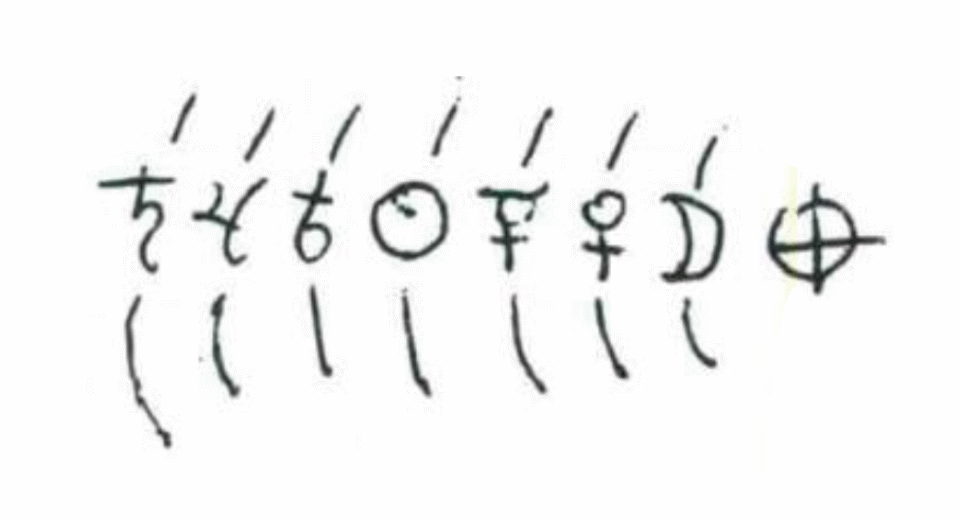
[FIGURE 1981 0228-5-AB. Geocentric Cosmic Circuit. Facsimile scan from AB class notes.]
Forms in soul and forms in imagination -- Kepler speaks of a tertium quid -- third viewpoint outside both which knows them -- (this is incorrect) be careful when Kepler uses the word soul.
p. 167 [Typist's note: C.G. Jung and Wolfgang Pauli, The Interpretation of Nature and the Psyche.]
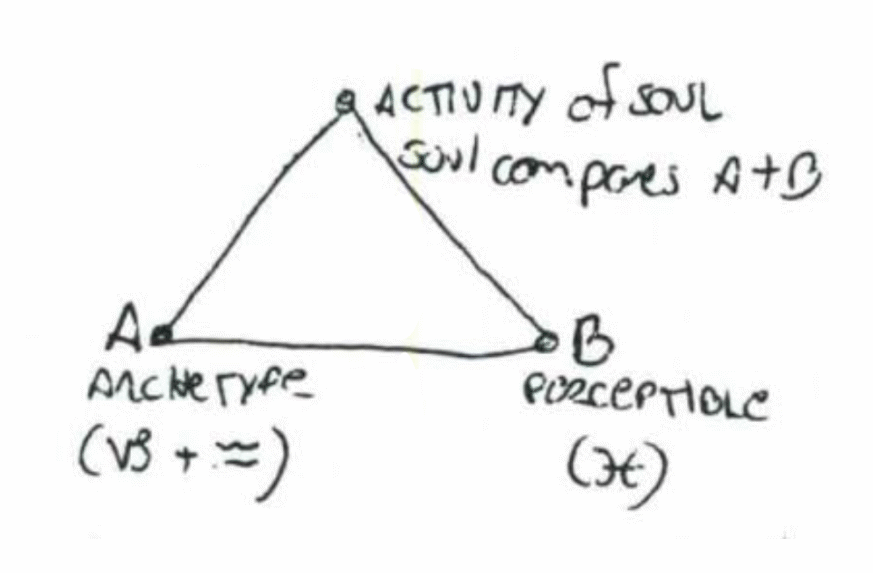
[FIGURE 1981 0228-6-AB. Kepler's Theory of Knowledge: Activity of Soul compares Archetype (Capricorn, Aquarius) and Perceptible (Pisces). Facsimile scan from AB class notes.]
Soul from second zodiac compares A & B within cosmic circuit.
Kepler experienced the compulsive nature of the archetype and had to live it out. His misunderstanding of Plato (through Proclus) led him to misapply his basic theme (of the spherical) and apply the Platonic elements to astronomy. He was disappointed to find that the orbits were actually elliptical.
p. 161
Our mind is part of the cosmic soul and is objective.
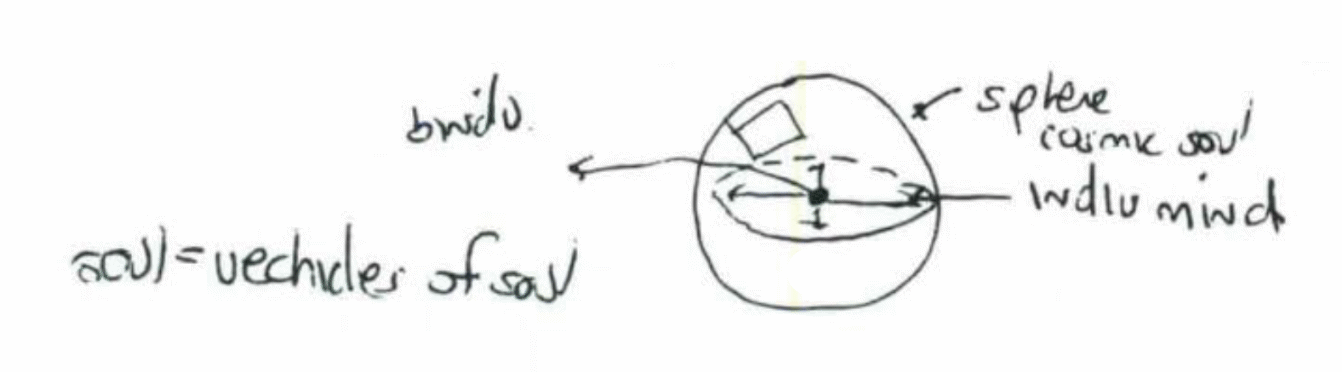
[FIGURE 1981 0228-7-AB. Cosmic Soul and Individual Mind, Sphere and Point. Indiv = Individual. Facsimile scan from AB class notes.]
Symbolism of Cross p. 127
A center or point within the cosmic circuit (space) could represent or be a determination of the soul but is not the soul itself. Soul itself = a principial, non-spatial point.
Superimposing the cosmic circuit on the soul gives you a point (center) within the circuit where the soul is. Or points = your planets. The meaning derived from experience comes from the soul (house structure) and imparts to it (the points) something of itself. (pp. 127-8)
Kepler and Pauli look for the solution in the cosmic circuit (the bridge, p. 152) but Guenon suggests the bridge or tertium quid is the second zodiac or soul. The superimposition creates space -- space is a modality of the soul's presence in the world. To Guenon, a point is not the center of a circle, the center is on a different level.
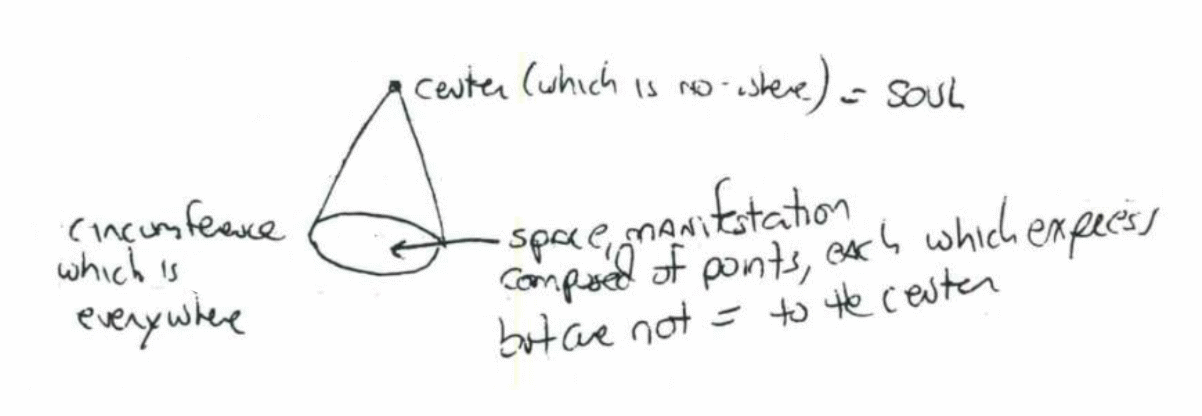
[FIGURE 1981 0228-8-AB. Center and Circumference. Facsimile scan from AB class notes.]
The interval between two points creates space. The ray of light between the two points = space.
Fludd speaks of soul as Plato or Plotinus does (subjective).
Kepler speaks of soul after its insertion into matter (objective).
[Classnotes AB 1981 0228 End]
Class
Saturday, February 28th, 1981
Edited transcriptClick the series name to view more
CLASS at Wisdom's Goldenrod, Hector, NY
with Anthony Damiani (AD)
February 28, 1981
PHYSICS; KEPLER
with Appendix: Classnotes AB 1981 0228.
TOPIC: Physics
SUBJECT: Kepler
SUBSUBJECTS: Soul, Epistemology, Idea of Man
CONTENTS:
Kepler's conception of relationship of Divine Mind and human mind represented symbolically by relation of sphere to circle
Kepler's theory of knowledge: 1) comparison of external perception and innate ideas; 2) inner ideas as pre-existent forms within soul
Three zodiacs: Idea of Man in Nous, soul, cosmos; correlates in natal chart to 360 degrees, twelvefold house structure, planets
Forms in soul in second zodiac; soul asleep when working with cosmic circuit knowledge, awake when working with internal forms
For Kepler, existential world (heliocentric system) an image of geometric ideas in Mind of God; these ideas also innate within us; how to correlate?
Demiurgic Ideas involved in world production are also subjective reason-principles we operate with; latter directly accessible, former have to be extracted
Limitations in Kepler's theory: 1) lack of distinction between soul in and outside of Nature; 2) archetypes as cosmic structuring principles; 3) Christian God as Demiurgus
Kepler's cosmological application: 1) geometrical analogy of Triune God; 2) Sun as symbol of Divine; 3) misapplication of Platonic solids
Pauli: Kepler's symbol as mandala; absence of quaternity
Sun displacing earth as center indicative of unconscious in center, ego circling
Basic extroversion in Kepler's thought
Kepler's concept of soul: emanates from point and is influenced by planetary rays; is fabricative and inhabits what it fabricates
Guenon: center or point within cosmic circuit (space) could be a determination of soul but is not soul itself, which is a non-spatial point
Illustration: house structure (soul) as plate of light; cosmic circuit as opaque plate with pin-holes; superimposing cosmic circuit on soul gives you a point (center) within circuit where soul is
Pin-holes = your planets; all meaning from soul (house structure), not from cosmos
Guenon, Samkhya: space as combination of points/cosmic forces; modality of soul's presence in world; ray of light between points creates space
Circumference is everywhere, center is nowhere
Appendix: AB class notes
Forms in soul in second zodiac
Position of planets in third zodiac is geocentric
Kepler's theory of knowledge: soul from second zodiac compares archetypes in Capricorn/Aquarius and perceptible objects in Pisces
Kepler misunderstood Plato, misapplied Platonic elements to astronomy
Our mind is objective, part of cosmic soul
Point within cosmic circuit is a determination of soul but not soul itself, which is a non-spatial point
Superimposing cosmic circuit on soul gives you a point (center) within circuit where soul is; meaning comes from soul (house structure)
Kepler and Pauli look for solution in cosmic circuit; Guenon suggests bridge is soul (second zodiac)
Space as modality of soul's presence in world
Guenon: point not center, center on a different level; ray of light between two points creates space
Fludd: soul as subjective; Kepler: soul as objective
BOOKS READ FROM OR REFERENCED:
W. Pauli, "The Influence of Archetypal Ideas on the Scientific Theories of Kepler" (in C.G. Jung, W. Pauli, The Interpretation of Nature and the Psyche)
Plotinus, The Enneads (MacKenna translation, 4th ed.)
Proclus, Glenn R. Morrow (tr.), A Commentary on the First Book of Euclid's Elements
Rene Guenon, The Symbolism of the Cross
Rodney Collin, The Theory of Celestial Influence: Man, the Universe, and Cosmic Mystery
Plato, The Seventh Epistle
Julian (Emperor of Rome), Thomas Taylor (tr.), "Hymn to Apollo and the Sun" in Two Orations of the Emperor Julian; One to the Sovereign Sun, and the Other to the Mother of the Gods
PLOTINUS QUOTES READ OR REFERENCED: I.1.7
DIAGRAMS embedded in and appended to this transcript:
FIGURE 1981 0228-1. Kepler Relation of Circle and Sphere; Line, Plane, Sphere. (embedded)
FIGURE 1981 0228-2. Threefold Idea of Man (in Nous, Soul, Cosmos). (embedded)
FIGURE 1981 0228-3. AD's View of Kepler's Theory of Knowledge. Absolute Soul and Fourth Quadrant Dignities. (embedded)
FIGURE 1981 0228-4. Kepler's Image of Soul. (embedded)
FIGURE 1981 0228-5-AB. Geocentric Cosmic Circuit. (appended)
FIGURE 1981 0228-6-AB. Kepler's Theory of Knowledge: Activity of Soul compares Archetype (Capricorn, Aquarius) and Perceptible (Pisces). (appended)
FIGURE 1981 0228-7-AB. Cosmic Soul and Individual Mind, Sphere and Point. (appended)
FIGURE 1981 0228-8-AB. Center and Circumference. (appended)
RETYPED AND REFORMATTED by IT 2022
NOTES:
RETYPED PARTIAL TRANSCRIPT (hence V10). From 1981 0228-08R17.PDF. THERE ARE NO AUDIO CASSETTE TAPES EXTANT.
AD began to edit this partial transcript into a paper. His handwritten edits/additions are noted below.
There is a note that seems to be in either AD or CdA handwriting at the top of the scan that reads "if pencil corrections &/or additions A.D."
Diagrams in the original partial transcript are by CdA.
AB Classnotes have been appended because they contain information and diagrams that the partial transcript does not have and thus help round out the class. Retyped from Classnotes AB 1981 0228 to 1981 0315.PDF. All capitalization and punctuation corrected, all abbreviations and some numbers spelled out in AB Classnotes.
All spelling and capitalization errors have been corrected, most numbers spelled out, all quotes corrected.
1981 02/28 CLASS at Wisdom's Goldenrod
Physics; Kepler
[File 1981 0228-08R17.PDF Begins]
If pencil corrections &/or additions A.D. [handwriting looks like AD's in upper-right corner of the page]
2/28/81 [handwritten, but not by AD]
The relationship of the Divine Mind and the human mind is, for Kepler, represented symbolically as the same relation of a sphere to a circle, the spherical surface being an image of the triune God with the Father as center.
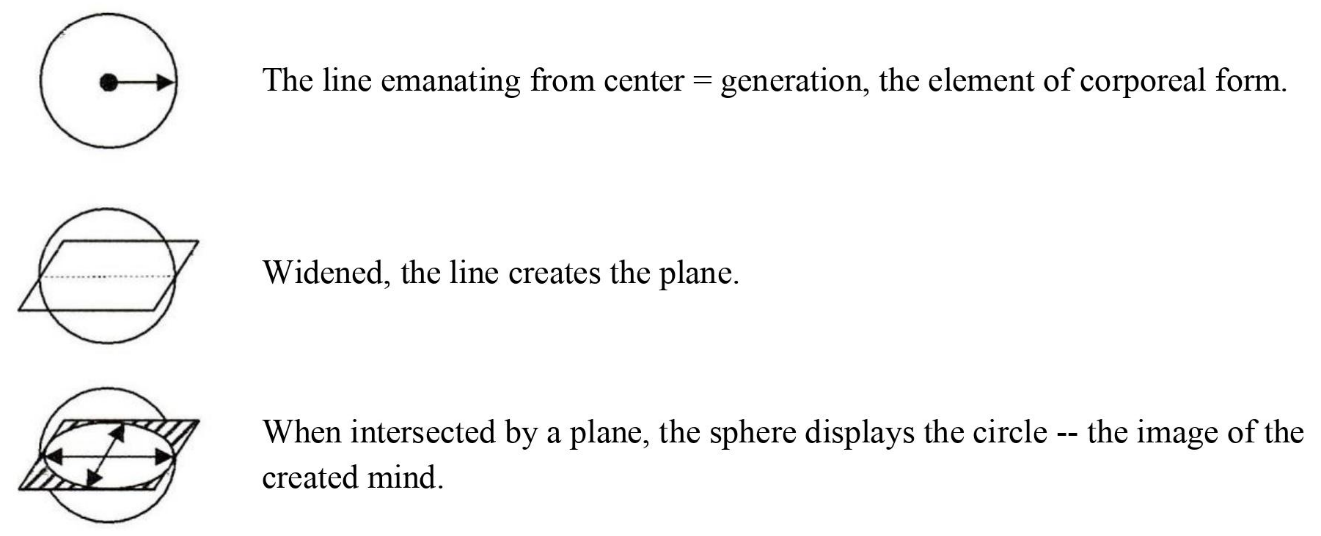
[FIGURE 1981 0228-1. Kepler Relation of Circle and Sphere; Line, Plane, Sphere. Computer generated by NT from 1981 0228-08R17.PDF.]
Kepler's theory of knowledge is that of a matching, a comparison of the externally perceived object with innate Ideas [AD handwrites '(system of beliefs)' above 'innate Ideas'], and the judgment upon this comparison. These inner ideas are for Kepler pre-existent forms within the Soul, and when [AD handwrites 'this is gradual'] awakened, knowledge becomes available to us. These forms are not received discursively, but are intimate possessions of the Soul.
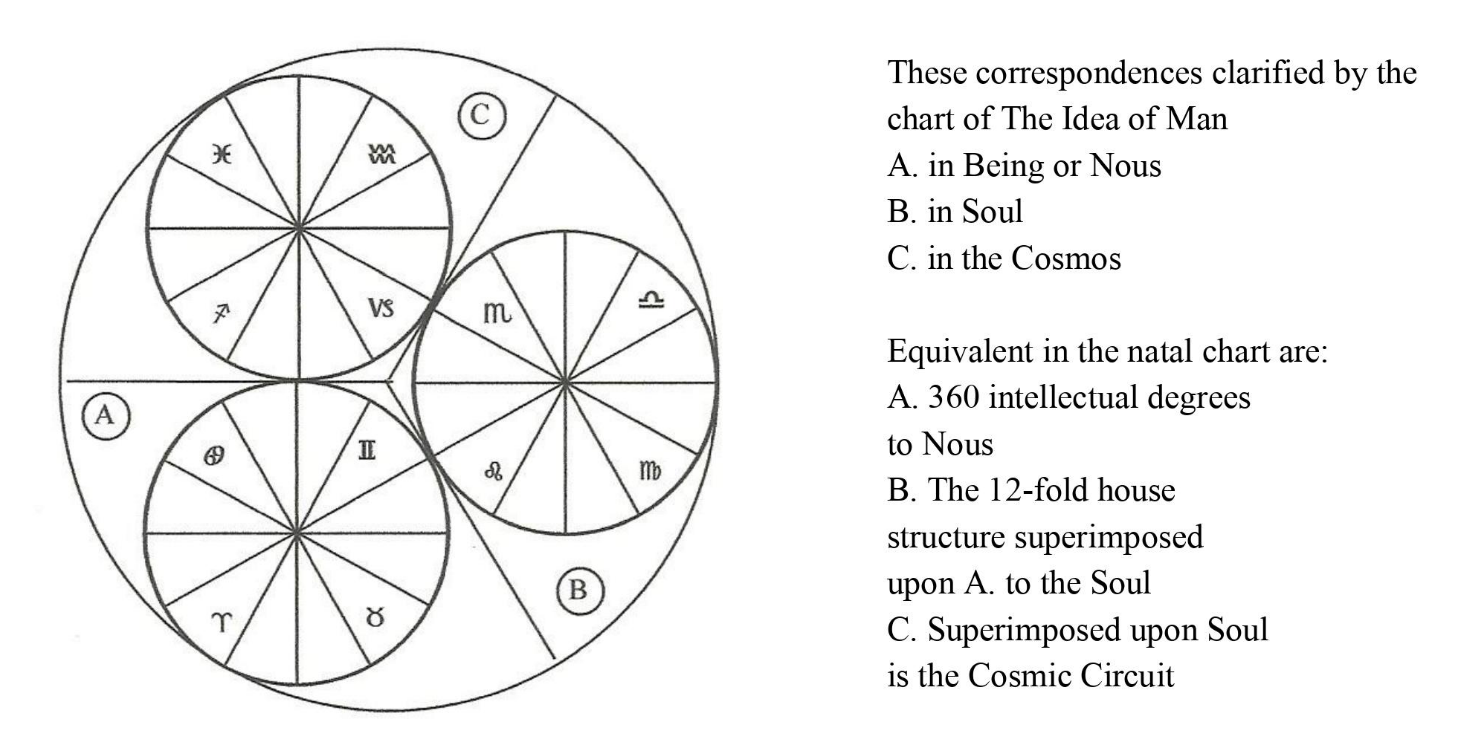
[FIGURE 1981 0228-2. Threefold Idea of Man (in Nous, Soul, Cosmos). Computer generated by NT from 1981 0228-08R17.PDF. Note: Cf. Astronoesis p. 328, Fig. 152, and pp. 328-29 accompanying text of "Mandala of Idea of Man in the Soul."]
This is to say that the knowledge of the Nous underlies the Soul and the Soul underlies the Cosmic Circuit. Thus the natal chart is of the most profound symbolism. [AD handwrites [For it must be included "], with the ditto marks falling under the word 'chart'.]
All the forms in the Soul are located in Circle B. [AD handwrites '(life)' above 'Circle B.'], and the Soul is considered asleep while it works only with the knowledge given by the Cosmic Circuit, but is awake when working with the forms within itself.
For Kepler, the existential world [AD handwrites 'heliocentric system' above 'existent world'] is an image of the geometric ideas (Archetype of the World) in the Mind of God (not distinguished from the Demiurgus). On the other hand, these ideas are innate within us, and he raises the problem of bringing about a correlation between them.
We would explain this by the ideas of the Demiurgus involved in the production of the World, and the same set of ideas being also the subjective Reason Principles that we operate with. With this example it shows that the latter are directly accessible to us, and the Reason Principles informing matter are secondary, as they have to be extracted. (This extraction is the Scholastic's view of the senses as entrances of knowledge.)
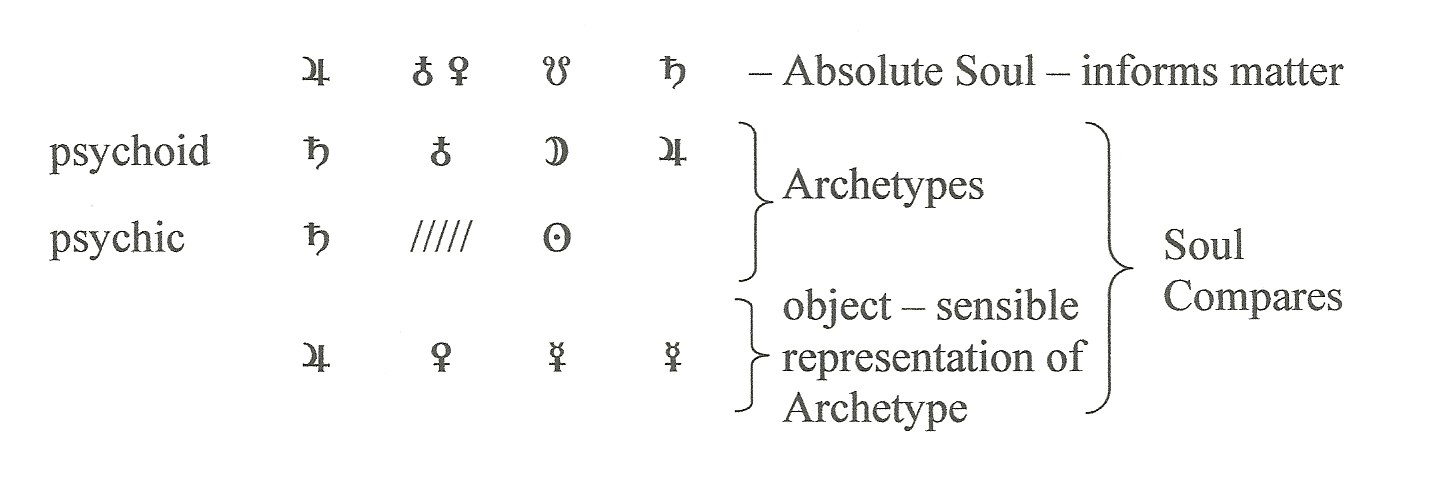
[FIGURE 1981 0228-3. AD's View of Kepler's Theory of Knowledge. Absolute Soul and Fourth Quadrant Dignities. Computer generated by NT from 1981 0228-08R17.PDF.]
Kepler states that this comparison is the activity of the Soul itself, but if so it cannot be included in that realm. Here Kepler's lack of distinction between the Soul in Nature and the Soul outside of Nature becomes evident. Kepler's Archetypes are, as Jung's, the structuring principles of the Cosmos, and it here becomes clear that Kepler's Christian God is not other than the Demiurgus.
To further explicate his theory of knowledge on a cosmological level, he used his geometrical analogy of the Triune God. The physical sun became a symbol of the Divine, and he organized his scientific data according to this heliocentric view -- an archetypal idea he held with religious fervor. Among other things, his application of the Platonic solids to his cosmological theory proved wrong in the end and showed a basic misunderstanding of Platonic philosophy.
Pauli notes that Kepler's symbol, which is equatable as a mandala because of its spherical form, contains no hint of the quaternity (a fact which will be of importance in Kepler's conflict with Fludd). [Note: See W. Pauli, "The Influence of Archetypal Ideas on the Scientific Theories of Kepler" in C.G. Jung, W. Pauli, The Interpretation of Nature and the Psyche.]
With the advent of Kepler's ideas, the sun displaced the earth as center of the universe, indicative of placing the unconscious in the center with the ego circling around it. Implicit in Kepler's thought is a basic extroversion -- symbolized in his image of creation by the line. But, according to Pauli, this expansion is basically static -- movement from the center is caught up by the outer surface. (It was not until Einstein that the fourth dimension was brought into scientific thought.)
Kepler says the Soul has the structure of a point -- a bindu, which is analogous to the heart center, from which the Soul emanates and pervades the Cosmos. He states further that "the soul itself is hidden within, rooted in its fixed point whence it goes out into the rest of the body by a semblance of itself." (Pauli, p. 179) This is as Plotinus says, Nature provides an organized body and the soul imparts a light to it, and this light spreads outward in all directions. (Plotinus, I.1.7) Kepler says this going out from the point is in a straight line -- "being itself both light and flame… It goes out, [then], to the exterior of the body according to the same laws by which the surrounding lights of the firmament come in…" (Pauli, p. 179)
The Platonists describe the point as the rational nature and the line as the irrational, vital nature of the Soul projected into corporeality; irrational means to move away from self-centeredness. We must keep this in mind, for when they speak of the point generating the line, it is the line that converts the concept to the percept -- the in-between domain from the unmanifest to the corporeal. Also, insofar as Kepler's Soul is light and flame, the indication would be that of Taijasic light.
In our interpretation, in that our mind is part of the Cosmic Soul, it is objective. This is not Soul proper, but rather the Soul's association with the vehicles -- as Plato says, the Soul inserted in body.
The human Soul, according to Kepler, "flows at birth into a pre-existent form, which is shaped on earth by these rays of light from the stars" (planets). This was referred to the motions of the spheres being in the celestial ether, and this pervading and organizing the lower four elements, and could be thought of as the medium by which the formative forces that the planetary configurations represent, and through which are conveyed the actual organization of the elements of the body, i.e., the ordering of the vasanas.
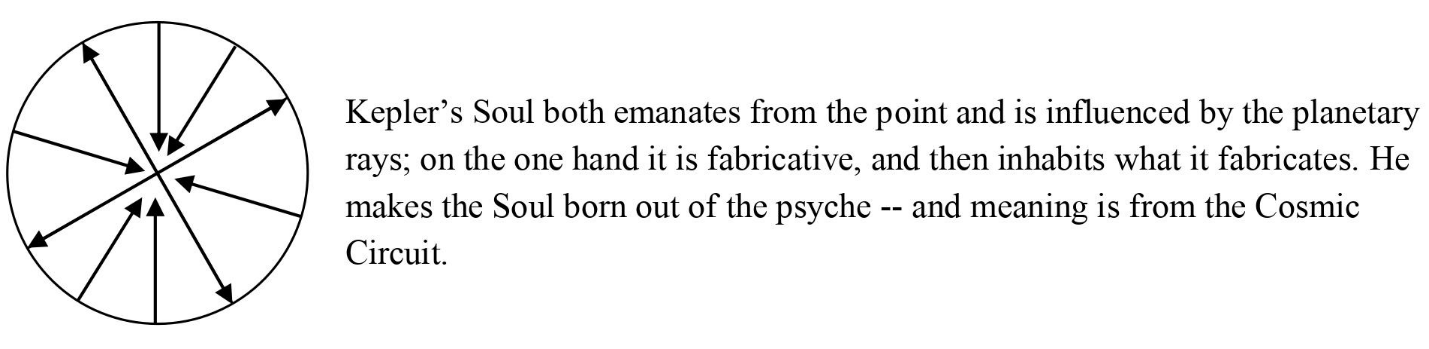
[FIGURE 1981 0228-4. Kepler's Image of Soul. Computer generated by NT from 1981 0228-08R17.PDF.]
In his Symbolism of the Cross, Guenon presents a view in contrast to that of Kepler.
In order to have a spatial representation of a being, we have to place it in the Cosmic Circuit. Any number of points taken together, representing planetary configurations, can be considered as this spatial representation. Potentially, any point can be the locus of this spatial representation. When a center has been established, i.e., when space has thus been determined, it follows that all points in space are not equal. This point, as determined, may be the point Kepler is referring to, but which clearly cannot be Soul. Guenon says this point can spatially represent the Soul, but is not Soul.
The principle point, or Soul, is for Guenon, not anywhere, not subject to spatial condition; but a determination of that point can contain all the possibilities of the spatial condition.
If we speak of the psychic self as the totality of psychic functioning, then the Soul has to be omnipresent. In that analogy, the circumference is the totality of psychic processes, and the radius then becomes the intermediary. Thus the Soul as incorporeal is omnipresent, but in its association with manifestation it appears to be spatially everywhere.
To illustrate: imagine the Soul chart, as the 12-fold house structure, as a plate of light; imagine the Cosmic Circuit as an opaque plate with various pin-holes in it. Superimpose this on the Soul; where the light comes through, Guenon calls a mode of the Soul's being. The Soul thus appears to be omnipresent corporeally.
Think of the pin-holes as the planets in the natal chart -- the presence of the Soul is indicated by its illumination of these intellectual meanings -- and in that sense the Soul is immanent in these meanings. But, insofar as the Soul itself cannot be spatialized, the Soul is integral in each. So the house structure as Soul, imparts from itself its own nature, and therefore "frees these points from the spatial condition." This is to say that the matter is dematerialized when the essence is grasped by the Soul. All meaning is from the Soul, not from the existential facthood experienced in the Cosmos.
The meanings in the Soul are universal -- are not tied to the conditions of manifestation, and thereby free experience here from the material occurrences which bring them about.
Thus for Guenon, any combination of points in the Cosmic Circuit will produce space. Similar to this view is Samkhya, which describes space as the actual combination of the cosmic forces. So space is a modality of the Soul's presence in the World. It is the interval (ray of light) between points that create space -- not the points themselves. So a point for Guenon is not the center of a circle. The light of the Soul is integral, it cannot be divided up, is prior to cosmic manifestation, is non-localized and transcendent. Therefore the circumference is everywhere and the center is nowhere.
Note: Guenon is coming from the perspective of metaphysical unity, but must be interpreted from the point of view of Soul.
[AD handwrites "Theory of celestial influence."]
[AD handwrites "7 Epistle. Hymn to Sun"]
[File 1981 0228-08R17.PDF Ends]
1981 02/28 V10: CLASS: Physics; Kepler. Copyright 2022 Wisdom's Goldenrod p. iii