DIAGRAM FOR 1981 0320b
Paper
Friday, March 20th, 1981
Summary of a published workAnnotated Abridgment of Hans-Georg Gadamer's "Dialectic and Sophism in Plato's Seventh Letter"
by Anthony J. Damiani
Book Notes with Typist Edits V09BN
3-LETTER CODE: PLA
TOPIC: Plato
SUBJECT: 7th Epistle
SUBSUBJECTS: Theory of Knowledge, Dialectic
ORIGINAL LOCATION & FILE NAME (of PDF used for typing): AD SUPP 1271-1286 PLA 7th Epistle AD Paper P.PDF
CONTENTS:
Plato quote from Seventh Epistle: example of circle to illustrate difficulty in understanding and communicating philosophic knowledge/intuition
Unlike mathematics, philosophy can't compel understanding. Why?
Four components integral to knowledge of a thing: name, definition, image, knowledge; thing itself is distinct from these four as the fifth component
Circle as intermediate between sensible and intelligible; propaedeutic function for philosophical thought; training tool for pure thinking
Application of the four means; knowledge closest to the thing itself but still part of becoming
Weakness of the four means: each asserts its own reality while trying to represent something else
As signs, words depend on convention and are ambiguous; definitional statements aim to overcome word ambiguity but still contain uncertainty; interweaving of ideas militates against defining ideas in isolation
Process of understanding requires passing back and forth between all four means; not a simple ordered ascent
Weakness of the fourth means implied through "bad upbringing" of the soul; obstinacy in discussion
All means trapped in copy/image relationship; inessential nature of means leads to error, creates confusion and uncertainty
Function of examples: serve as paradigms; make visible what is meant
Example of truth-telling: asserting the necessity of truth for human communication requires evidence; no means to compel seeing the truth if one doesn't want to see it
Knowledge of the fifth thing (thing itself) endangered by weakness of the logoi
Affinity for the thing itself required beyond intellectual gifts
Socratic dialogue avoids being talked out of Truth, Beauty, Goodness
True understanding requires understanding of the falsity and truth of the whole of reality; indissoluble unity of the whole as foundation of insight
Single ideas not knowable in isolation; web of ideas necessary for understanding
Dialectic of One and Many establishes finite limits of human discourse and insight
Dialectic as perpetual movement between means of knowing; preserves direction toward what is meant; remains proximate to truth without final arrival
Purpose is to make one more "dialectical" and educate vision for the thing itself; all four means required
Dialectic as the skill of developing consequences of opposed assumptions
BOOKS / MAGAZINES QUOTED FROM OR REFERENCED:
Hans-Georg Gadamer, Dialogue and Dialectic: Eight Hermeneutical Studies on Plato, "Dialectic and Sophism in Plato's Seventh Letter"
Plato, Epistle VII, L.A. Post transl. in Edith Hamilton & Cairns, eds., Plato: Collected Dialogues
Shrine of Wisdom, Part II of "Extracts from Thomas Taylor's Dissertation on the Platonic Theory of Ideas," 7th Epistle extract
DIAGRAM appended to this paper:
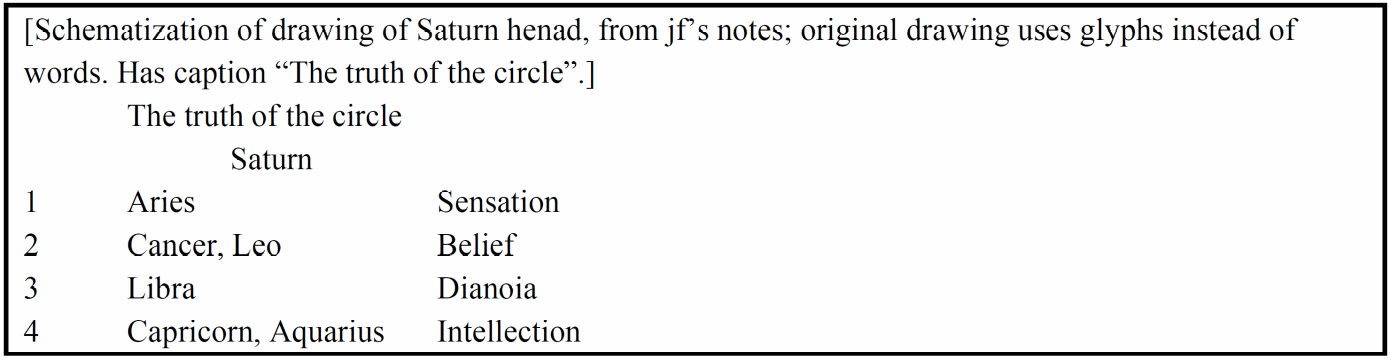
- FIGURE 1981 0320b-1-JF. The Truth of the Circle: First Quadrant; Saturn Henad.
AD HANDWRITING: Typewriter typed, extensive AD and student edits
COMPLETENESS: Full Paper, annotated abridgment of a chapter from a book
PUBLISHABILITY: No, already published
ALTERNATE VERSIONS: Plato's 7th Epistle paper as read in WG Class 1981 0320a
DATE ASSOCIATED WITH THIS PAPER: 1981 0320
RETYPED, REFORMATTED, AND PROOFREAD by IT, JF, HP 2023
NOTES:
RETYPED BOOK NOTES presented in class (V09BN).
This is 1981 03/20b, Plato; 7th Epistle Book Notes, and the second entry associated with this date. 1981 03/20a = Plato; 7th Epistle Class.
This is an annotated abridgment of "Dialectic and Sophism in Plato's Seventh Letter," by Hans-Georg Gadamer, with a few minor alterations by AD.
JF remembers helping Carol deA. transcribe Anthony's tape for it in winter, in the early months of 1981. This matches the date of audio, and Blue Book and Events Master info and AB class notes. JF thinks Anthony's tape-recorded version of this paper (the one in AD's Notes & Papers, AD Supp) may have him reading from another, lost, previous version.
This paper is read and discussed in WG Class 1981 0320a.
All spelling, punctuation, and listening errors in this retyped version have been corrected to conform to the Gadamer book by IT. Words in [square brackets] are insertions by IT from the book.
Blue Book indicates 10/25/78, 1/10/79 may also have commentary on Plato's 7th Epistle.
Annotated Abridgment of Hans-Georg Gadamer's "Dialectic and Sophism in Plato's Seventh Letter"
[Note: Plato quote read at the beginning of WG Class 1981 0320a Plato; 7th Epistle included here for context.]
"For everything that exists there are three classes of objects through which knowledge about it must come; the knowledge itself is a fourth, and we must put as a fifth entity the actual object of knowledge which is the true reality. We have then, first, a name, second, a description, third, an image, and fourth, a knowledge of the object. Take a particular case if you want to understand the meaning of what I have just said; then apply the theory to every object in the same way. There is something for instance called a circle, the name of which is the very word I just now uttered. In the second place there is a description of it which is composed of nouns and verbal expressions. For example the description of that which is named round and circumference and circle would run as follows: the thing which has everywhere equal distances between its extremities and its center. In the third place there is the class of object which is drawn and erased and turned on the lathe and destroyed--processes which do not affect the real circle to which these other circles are all related, because it is different from them. In the fourth place there are knowledge and understanding and correct opinion concerning them, all of which we must set down as one thing more that is found not in sounds nor in shapes of bodies, but in minds, whereby it evidently differs in its nature from the real circle and from the aforementioned three. Of all these four, understanding approaches nearest in affinity and likeness to the fifth entity, while the others are more remote from it.
"The same doctrine holds good in regard to shapes and surfaces, both straight and curved, in regard to the good and the beautiful and the just, in regard to all bodies artificial and natural, in regard to fire and water and the like, and in regard to every animal, and in regard to every quality of character, and in respect to all states active and passive. For if in the case of any of these a man does not somehow or other get hold of the first four, he will never gain a complete understanding of the fifth. Furthermore these four [names, descriptions, bodily forms, concepts] do as much to illustrate the particular quality of any object as they do to illustrate its essential reality because of the inadequacy of language. Hence no intelligent man will ever be so bold as to put into language those things which his reason has contemplated, especially not into a form that is unalterable--which must be the case with what is expressed in written symbols.
"Again, however, the meaning of what has just been said must be explained. Every circle that is drawn or turned on a lathe in actual operations abounds in the opposite of the fifth entity, for it everywhere touches the straight, while the real circle, I maintain, contains in itself neither much nor little of the opposite character. Names, I maintain, are in no case stable. Nothing prevents the things that are now called round from being called straight and the straight round, and those who have transposed the names and use them in the opposite way will find them no less stable than they are now. The same thing for that matter is true of a description, since it consists of nouns and of verbal expressions, so that in a description there is nowhere any sure ground that is sure enough. One might, however, speak forever about the inaccurate character of each of the four! The important thing is that, as I said a little earlier, there are two things, the essential reality and the particular quality, and when the mind is in quest of knowledge not of the particular but of the essential, each of the four confronts the mind with the unsought particular, whether in verbal or in bodily form. Each of the four makes the reality that is expressed in words or illustrated in objects liable to easy refutation by the evidence of the senses. The result of this is to make practically every man a prey to complete perplexity and uncertainty." (Plato, Epistle VII, 342a-343c, L.A. Post transl. in Hamilton, Cairns, Collected Dialogues)
[Plato's Letter continues; Anthony liked this version of Thomas Taylor, as found in the Shrine of Wisdom, Part II of Extracts from Thomas Taylor's Dissertation on the Platonic Theory of Ideas, p. 176, on the following passage from the 7th Letter of Plato, 344b: "For a thing of this kind … cannot be expressed in words, like other disciplines, but by a lasting familiarity and conjunction of life, with this divine object, a bright light on a sudden, as it were leaping from a fire, will illuminate the soul, and there preserve and nourish its splendour."]
[File AD SUPP 1271-1286 PLA 7th Epistle AD Paper P.PDF Begins]
[Note: The first two paragraphs crossed out on p. 1271 of AD Supp but are here restored because necessary to the discussion.]
A simple example is used in the Seventh Epistle to illustrate the general notion that the means in, and by which an intuition is miscarried in delivery and because of that does not compel or enforce one to understand. For instance, in geometry, we can bring together proofs enough which by virtue of their logical cogency compel everyone to recognize their validity. But this does not seem to be the case in the realm of philosophy. Why does the possibility of compelling someone to understand the way mathematics does, for example, why doesn't this exist for philosophy?
Plato attempts to communicate something of the difficulty involved in the soul's attempt to understand and communicate. He distinguishes three components integral to any piece of knowledge which we might have about a thing. To these three he appends a fourth, namely, the piece of knowledge itself produced by the first three. Thus we have four factors through which the thing may be said to be available to us. The knowledge of the "thing" which is under consideration is distinct from all these. It is the fifth in the series. Now the four means of communicating the thing are as follows: 1) name or word of the thing; 2) the explanation or conceptual determination, a definition; 3) the appearance of the image, for example the figure itself; and finally 4) the knowledge of [Note: Gadamer has 'knowledge or'] the insight itself.
Plato asserts that all these four provide no certainty of themselves that the thing will come to be known as it truly exists. The circle, what Plato calls an idea, in the strict sense of that concept, belongs to the category of mathematical constructs, which constitute a kind of intermediate behind or between the sense perceived and the intelligible. Such mathematical intermediates or entities as the circle are especially suited to illustrate the transition to pure thinking or thinking without accompanying phantasms. And this is the way to true or scientific knowledge (now). Even he who has not seen all the metaphysical implications of the concept of pure thinking but only grasps something of it in mathematics will realize the possibilities for knowledge. In a manner of speaking one looks right through the drawn circle and tries to keep the "pure thought" of the circle in mind. Thus the example Plato chooses is one of those entities which according to him have a propaedeutic function in regard to philosophic thought and like in yoga etc. They school and steady one's vision for that which is unwavering purely thought and raise the soul, as it were, to the level of pure thought in that they turn it away from all that is encountered in sense experience or conversations in which mere opinions are bantered about. Now obviously the circle is an instance of the knowledge of all those things which one can know through form alone. [Note: 'Form alone' top of AD Supp p. 1273 crossed out in scan. Gadamer has 'thought alone'.]
Now with this example in mind it can easily be shown that one cannot communicate knowledge unless one has a name for it and is able to explain the word by which one names it and formulates a conceptual definition [Note: Gadamer has "unless one knows a name for it and is able to explain the word with which one means it by means of a conceptual determination"]. The word comes first, of course, and obviously various words give linguistic characterizations, associations of the circular, round, curved, circle, etc. The clarifying conceptual determination or definition Plato provides--"everywhere on the periphery equidistant from the center"--says exactly what a circular line actually is.
The example shows us precisely what Plato means by the logos: not just any statement at all but the essential determination, the statement which defines. [Note: The following sentence is bracketed in scan.] [But here, there is no reflection on the logical structure of determination, i.e., the differentiation according to genus and species elaborated in the well-known doctrine of dihariesis, which Plato again and again calls the core of the art of dialectic.]
The third on the list is a figure, and indeed the mathematical example chosen involves something of this sort. All these may be thought of as symbols. Plato's point of departure here is the circle one sketches in the sand or erases. In any case the model is destructible; the circle itself cannot be destroyed. The phenomenon given to the senses in which one cognizes something and the illustrative example are thus essentially different from what becomes discernable in them. But there is something else which they have in common. Despite their difference from the circle itself, the circle is somehow present in both these forms [of eidola] just as it is in the word and the concept.
Now fourth on Plato's list is knowledge, insight, true opinion, and found neither in sounds nor in the body of tangibles but in the soul. And this fourth is different from the other three. Nevertheless it too is not the thing itself. For the circle itself is not in the soul. It is something distinct in the soul. It is one thing identical with itself and different from everything which occurs in the soul. In the soul many things occur. Seen in this light, it makes sense to place the insight together with the other three means of acquiring the knowledge [Note: Gadamer has "means of communication"]. Insights too do not belong to true reality, but to becoming. They are part of the intellect's stream of life. So our grasp of a mathematical theorem in our thought is not independent of our intellect. It is part of it and it is not certain that I can reproduce the theorem in my thought, even if I do 'know' it. Like any thought, it takes part in coming-into-being and the passing-away and in being other than itself. Unlike the thing itself, science in the soul is not timeless. Closest to the thing itself is obviously and only [Note: Gadamer has "that moment of"] insight in which suddenly everything which contributes to the intelligibility of the internal relationship of the thing to itself is present to me all at once: the steps of the proof, the name or word, the auxiliary construct, which is so hard to find, the model, etc. all that leads onward to the insight. More than anything else, this evidentness, which makes one to say, "I've got it!," is [Note: Gadamer has 'contains'] the intrinsic relationship of mathematical structure as such. And Plato calls this evidentness nous. Quite rightly he distinguishes it from the science which I have attained when I master mathematics. Despite all the differences among these four there is something common to all which makes it possible to put them together. They must all play a part if one really wishes to grasp the thing. They all make a thing present to us [Note: Gadamer has 'in'] some way or another; [in the word], the concept, the illustration, and, above all in the luminousness of an insight which comes to us out of all of these, the circle itself [is there]. Thus besides these four which "are" the circle, the circle itself isn't there [Note: Gadamer has "the circle itself is the fifth"]. Plato's simple enumeration of all these things apparently so diverse is not without its justification.
These four are indeed indispensable. But they are of such a nature that if one avails oneself of them, one can never grasp the thing itself with complete certainty. One can never be sure that with these means the thing itself is displayed in its full "disconcealed" intelligibility. And this is the basic experience in every philosophic endeavor, in every philosophic discussion: words, words, words--[Note: Gadamer has "and nevertheless these words"] which are just words are not supposed to be mere empty talk. They should be capable of constructing the thing meant in another person, erecting it so that it is there in him.
What is the reason that the means, whether taken individually or all together, are actually incapable of compelling someone to understand? What is their weakness?
We must keep clearly in mind that Plato's exposition of this weakness is designed for those with no previous education in philosophy. Each of these four means has a tendency to bring a reality of a specific sort to the fore instead of the reality of the thing itself which is supposed to be displayed in word or discussion, example or the knowledge [Note: Gadamer has "intuition or insight"]. They all have an intrinsic distortion-tendency, so to speak. The elements involved in the process of bringing something else into view or manifestation assert themselves as whatever particular thing they are. In other words, they all are something besides the thing they are presenting. They all have a reality of their own, a character which differentiates them from that thing. The word circle is not the circle itself, nor is the statement which defines what a circle is, nor is a circle which is drawn. And even my insight into that which a circle is, is not the circle itself. All these are means and assert themselves as whatever they are, and in pushing themselves to the fore, they suppress that which is displayed in them.
Now we assume that the intelligibility of a sign lies in the fact that it points away from itself, does not assert itself as an independent reality but merely serves its function. Nonetheless, Plato's argument is still valid. The fact that the sound of a word can bring something else to the fore which does not represent the thing meant, (example) results from precisely the fact that, insofar as it is a sign, it depends upon a particular convention. The possibility of renaming demonstrates that the sound by which the word names a thing does not carry its meaning in itself unambiguously. What Plato has in mind is obviously that this ambiguity of words allows a word to let something else be there instead of presenting the thing--the thing meant. [Note: The following three sentences are bracketed in the scan.] [Again, this applies also to the next step, what he characterizes as the definitional statement, because it is made up of words. Now clearly the ambiguity of a word is reduced directly by its positional value in the context of what is spoken. Having seen that, one might well proceed to a critique of the [whole] idea of an unambiguous coordination of sign and thing designated. The assumption that a perfected instrument of designation exists by which everything that one means and thinks precisely could be designated, (and of course this would be ideal logical language)] is a nominalistic prejudice, the untenability of which has been, I think, demonstrated by Wittgenstein's investigations. One might think that the transition from single words to the whole of speaking would suffice to overcome the weakness which lies in naming. One would like to believe that Plato's dialectic does justice precisely to this consideration in opposing the logos, as the blending of ideas, to the fruitless undertaking of defining things atomistically. As a matter of fact it seems to me that here we have the answer to the question of why Plato rejects the definitional statement with the same argument which he used against the single word. The weakness of the word as such is overcome by the logos. [It is] in fact its purpose, as the clarifying conceptual definition, to transcend the artificiality which lies in the ordinary use of language with its mere naming things. By determining the concept, it lets the thing itself be present as it is determined. Insofar as one has established the definition, one seems to be beyond mistaking any one thing for another.
Now [Note: Gadamer has "As", with reference to Parmenides.] in the Seventh Letter, no logical insight is presupposed which one could have attained only at the end of some [Platonic] course of instruction. Rather the point of departure is the dialectical experience which everyone has from the start. If one wants to describe the dialectical experience of thought, one may not just presuppose this systematic doctrine of classificatory concept formation. Instead one must display, or show how the procedure of conceptual definition itself contains something arbitrary and uncertain, for the genus under which a thing is to be subsumed obviously lacks singleness of meaning. We see something of this in Plato's doctrine against that possibility. The interweaving of the highest genera in the Sophist and, even more, the dialectical exercise which the young Socrates is put through by the elder Parmenides leads only to the negative insight that it is not possible to define an isolated idea purely by itself, and that very interweaving of the ideas militates against such a positive conception or definition.
Now only if one has an immediate and fundamental dialectical experience in mind does one understand what Plato means when he describes the ultimate possibility of knowledge as a lingering with all four of these means--a lingering which passes back and forth from one to the other. All attempts to read an ordered ascent into this series of means, a graduation of them which would correspond to the ascent of the soul over the whole system of knowledge up to the idea of the Good, would be [Note: Gadamer has 'are completely'] mistaken.
The weakness of the first three are pointed out in detail in the discussion of the weakness of the logoi, there is no mention of the weakness of the fourth, of the state of the soul when it recognizes or knows. And the state of the soul which we call scientific knowledge or insight into the truth must also be of such a nature that it asserts itself and thereby conceals the thing itself. It seems to me that the demonstration on this point is not given for the sole reason that it is implied to a certain extent throughout the whole exposition. For when there is mention made in what follows of the "bad upbringing" of the soul, when the helplessness of the individual soul in confrontation with the dialectical techniques of the opponent is described, and when well-intentioned refutation and uncontentious questioning and answering are called for, an indirect indication is given for what Plato has in mind. In knowledge and insight there is distortion too. In argumentative discussion the distortion, which any knowing implies, and which can push to the fore, is the obstinacy which makes us refuse to acknowledge that someone else might be right. For what is that obstinacy other than the opinion which I have advocated, that which constitutes my reason, asserting itself as my own position to such an extent that I am no longer able to follow the objective counterargument of the other person?
To sum up, if one stays with the phenomenon, the thing itself, one can see that the weakness of all four is the same. All four means are trapped in the dialectic of the image or copy, for insofar as all four are intended to present the thing in and through themselves they must of necessity have a reality of their own. That which is meant to present something cannot be that thing. It lies in the nature of the means of knowing that in order to be means they must have something inessential about them. Then this is the fundamental source of our error, for we are always misled into taking that which is inessential for something essential. What occurs here is a sort of falling away from what was originally intended, i.e., from the orientation of all these four means towards the thing itself. And Plato says expressly that this happens to all of us and that it fills us with confusion and uncertainty. One must constantly keep in mind that from the first to the last word this so-called theory of knowledge in the Seventh Letter refers to the community which exists among people speaking to one another. It raises the question as how an insight can become comprehensible and present for me and for you, or, put another way, how a thing can be there in what is said in such a way that it is truly there: disclosed and not to be confounded by any objections. The Greek experience [Note: Gadamer has "Greek culture in the age of sophism"] had gone through the eerie feeling [Note: Gadamer has 'experience'] that in discussion any insight could be confounded and lost--and even mathematics could be discredited by the sophists' shadowboxing.
Let's take an example. Examples, of course, are one of the necessary media in which true knowledge is presented. They belong to the class of images, synonyms, and they correspond in a certain way to the figures we have in mathematics. They themselves are not what is meant, but that which is meant becomes visible in them. They are what one points to in order to make clear what is actually meant. They are, in other words, paradigms.
Let's take an [Note: Gadamer has 'Now the'] example. He who asserts that truth must be spoken [Note: Gadamer has "promises must be kept"], for that is the [moral] precondition for us as human beings to communicate and live together. [Note: AD handwrites 'presupposes' after 'together'. This is shorthand for "This is presupposed" based on AD's reading of this paper in WG Class 1981 0320.] Now he who seeks to justify this assertion must certainly present evidence concerning the validity of this assertion [Note: Gadamer has "evidence concerning the order of human society…"].
So that it may be possible to penetrate to the depths in which human communication [Note: Gadamer has 'obligation'] has its foundation in this requirement and in respect to which all pragmatic concerns are secondary. Even so there is no means of compelling someone to see the truth who does not want to see it. Not only is it possible for him to point to what "everybody" says or does, i.e. disregards this need for truth in order to obey this unpleasant obligation. He can justify his evasion theoretically by placing the whole of truth as a question [Note: Gadamer has "by placing moral obligation as a whole in question…"]. For instance, what Hitler might have done as to what is truth. Now he who has no sense of propriety, from whom no response is drawn when recourse is had to these concepts, will never understand what they are about. He will in fact be of the opinion that he knows better than anyone else and will seem to be the one who sees through the naivete of all those inhibited by such 'morality'. It is for this reason the knowledge which we require of one another of the fifth thing, the thing itself, is constantly endangered, and it is one of the most marvelous insights of Plato when he says this danger has its source in the weakness of the logoi.
Now the example makes it clear what is meant when the text says that he who is himself supposed to get a vision of the thing itself or he who would engender that vision in another must have an "affinity" for the thing besides having the intellectual gifts of comprehension and memory. And the purpose of the Socratic dialogue [Note: Gadamer has "Socratic art of conversing"] was to avoid being talked out of the fact that there is such a thing as the Truth [Note: Gadamer has 'the Just'], the Beautiful, and the Good. What is sought and made available in the epistle [Note: Gadamer has "in the back and forth of proper discussion"] is much more. Plato maintains that he who would understand what is truly good and truly bad must at the same time understand the "falsity and truth of the whole of reality." It does not mean an intact whole of any specific thing being talked about. Rather, this all-inclusive expression is meant to point beyond single opinions about any one thing. The movement of thought had long since passed beyond the specific example from which it had taken its departure, i.e., the true circle. It had made a transition from the mathematical virtue which in all speaking of the circle aims at the circle itself, to true virtue and vice in general, and it had thereby uncovered the indissoluble unity of the whole as the foundation of its insight. Thus true knowledge can never be reached in anything partial.
[As the] Parmenides shows, a single idea by itself is not knowable at all, and here is the source of the error which the young Socrates makes. In any insight an entire nexus or web of ideas is involved, and Plato's actual questioning is in regard to the constitutive, organizational, structural principles of this interconnectedness of the ideas. Just as the exemplary system of the mathematical sciences provides a unified continuum extending from the number to the point, the line, the plane, and the solid…so too the ascent and descent, oneness and multiplicity, the merging of what is disparate into an astonishing and transparent unity of many far-reaching implications, is the law which in fact governs progress in philosophic insight within the whole of discourse, the whole of the logoi. It gives the appearance of rigid schematizing when one takes the numbers, the One and the Two, to be the generative principle of all insight and the structural principle of any discourse which properly reveals things under discussion. And this appearance of rigidity may be the reason that Plato thought it ill advised to put this doctrine down in writing. What this doctrine actually describes, I contend, is the felicitous experience of advancing insight, the euporia which the Philebus says (15 c) happens to the person who proceeds along the proper path to the solution of the problem of the One and the Many--the way of discourse which reveals the thing being discussed. It is this very dialectic of the One and the Many which establishes the finite limits of human discourse and insight.
Plato describes how insight can still be attained, even within the given limitations and finitude of our human existence. The shared inquiry which never ceases in its effort to more sharply define one word, concept, intuition, in respect to another and which willingly puts all individual opinions to the test while abjuring all contentiousness and yielding to the play of questions and answer--that shared inquiry should make possible not only insight into this or that specific thing, but, insofar as it is humanly possible, insight into all virtue and vice and the "whole of reality". What Plato describes here as the untiring movement back and forth through the four means of knowing is in fact the art of dialectic--a perpetual passing from one thing to another which nonetheless preserves in the single direction of what is meant and which, for want of cogent and deductive proofs, remains in proximity to what is sought without ever being able to reach it.
In just this way, for instance, the old Parmenides forces Socrates back and forth, up and down, from the single concept to its conceptual implications, drawn on as they are by ever-recurring visions of the truth, in order then to allow the One to submerge in the Many and the individual thing in the whole. Thus Socrates' "leading" in discussion, his "guiding" talk as the earlier dialogues portray it, and the dialectic of dihariesis presented in the later dialogues, have the identical purpose. And so does the dialectic displayed in the Parmenides, the unfolding provisional theses and countertheses without knowing the "what" of what is being talked about [(Aristotle)]. For they all serve to make one more "dialectical," to educate one's vision for the thing itself, which of course is not this particular thing, the circle. All four means of presentation are required for this education and in all of them lurks the same danger of producing sophisms.
It is a thinking that is based on contradictions or rather, let's refer to this as electic [sic: eclectic] dialectic, the skill of development--the consequences of opposed assumptions--even while one is ignorant of what one is talking about.
[File AD SUPP 1271-1286 PLA 7th Epistle AD Paper P.PDF Ends]
1981 03/20b V09BN: BOOK NOTES: Plato; 7th Epistle. Copyright 2023 Wisdom's Goldenrod p. iii