DIAGRAMS FOR 1981 0418a
Class
Saturday, April 18th, 1981
Edited transcriptClick the series name to view more
CLASS at Wisdom's Goldenrod, Hector, NY
with Anthony Damiani (AD)
April 18a, 1981
NEO-PLATONISM; IAMBLICHUS;
GODS, ARCHANGELS, DAEMONS…
TOPIC: Neo-Platonism
SUBJECT: Iamblichus
SUBSUBJECTS: Experience of Gods, Angels, Archangels, Daemons, Fire, Light; Foreknowledge & Free Will
CONTENTS:
Plato lectures on Good
Dictionary of Angels
Reading of Iamblichus: difference between Gods, archangels, angels, daemons, heroes
Heroes like bodhisattvas or sages
Bad daemons
Daemons, health of body
PB, "the cure", medicine
Many invisible forces in our lives
Plato Laws & atheism
Jung & archetypal influences
Mrs. Ybor, variety of mystical experiences
Discrimination of mystical experiences helped by study
Powers, higher & lower
Need knowledge, otherwise "these wild beasts" will inhabit human vessels
Experience of World-Soul as fire
Never can get to end of Logos of Universe
Release of intelligence hidden in matter
Experience of Augoeides as fire
This fire NOT a visualization
Fire experience distinguishable from light experiences
Experiences of light; of fire
Light & these entities
Embodied rational soul subservient to these powers
Their hierarchy
Zen: keep going, otherwise Soul becomes like metaphysical wanderer
The experience, and afterwards
Liberation: one life or many
Experiences of Gods, archangels, angels, etc.
Experience of daemons is *desire*
Quality of your inner being draws various entities
Can't tell by surface personality (Gurdjieff story)
Rulerships
Daemons which effectuate fate
Possibility of seeing compulsions coming into you
Heroic souls
Archangels impart truth specific to circumstances, etc.
Karma
When inferior daemons pretend to be of higher orders
Séances
Statements by sages
Inferior orders
Questions and secrets
Ouija board
PB & going beyond these powers
Effort & necessary concause
Buddhist mandalas and rituals
Plotinus, appearance of his God
Ritual and Gods
"Transcendental physics"
Don't experiment
"Energizing intellectually" = no images
Divine proportion in shrines, buildings
Appearance of dreams, mandalas, etc. continuous with person's inner being
Likewise symbols, rituals, continuous with Gods
Proportion in art
Nyaya logicians, universals and particulars
Scientific attitude vs. mythological consciousness
Writing the real history of humankind from viewpoint of consciousness
Experience of light: being it vs. knowing it
Knowledge by identity and difference
Where is foreknowledge?
Chart example, London Fire
Foreknowledge only in Gods
Knowledge in Soul piecemeal
Foreknowledge in Nous, Gods
Karma
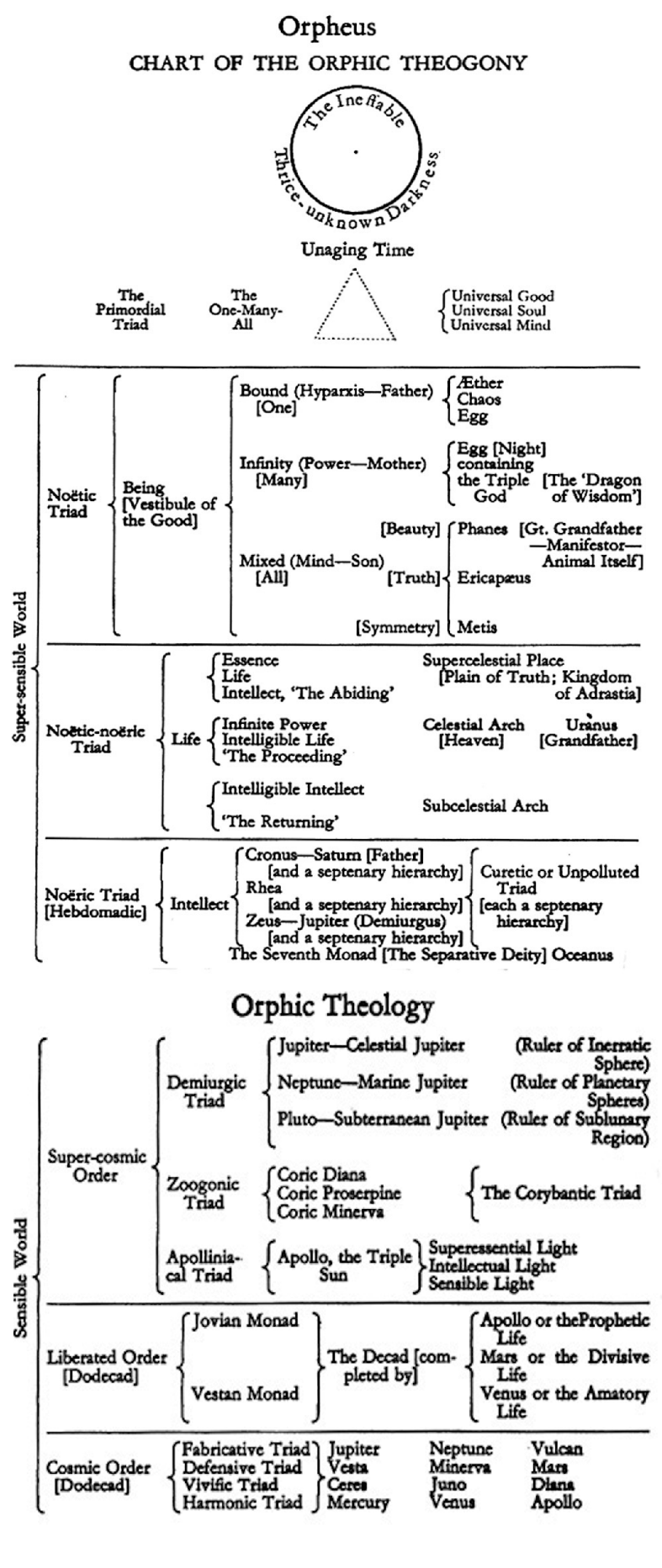
Adrastia, Night (Orphic theology)
Answers, intuitions from the Stillness
Interferences in transmission of knowledge
Accounts for variety of answers
Foreknowledge in Nous vs. Free Will
Inner life predetermined
Soul's destinies
Astral bodies
Foreknowledge from Nous, all the Gods
All events, inquiry about future contained in Nous
Spinoza's definition of free will = conformity to God's will
Bondage = following impulses vs. conformity to universe's will
Attitude, identification, and freedom
Compulsions & losing them = not freedom per se
Only the Self is free, nothing in world
Your question may be answered practically not theoretically
Sleep & astral realm
"Separated from all body" = from all vehicles
Steiner
Freedom is Cognitive Isness, not imaginative forces
Freedom from all vehicles
Divided Line & Soul
Dream interpretation from viewpoint of cosmic circuit vs. Nous
"Liberated energies" of Soul
Psychological projections
Iamblichus may be helpful to Buddhist studies
BOOKS READ FROM OR REFERENCED:
Iamblichus, Thomas Taylor (tr.), Iamblichus on the Mysteries of the Egyptians, Chaldeans, and Assyrians
Gustav Davidson, A Dictionary of Angels: Including the Fallen Angels
Plato, Republic, Laws
W. Pauli, "The Influence of Archetypal Ideas on the Scientific Theories of Kepler" (in C.G. Jung, W. Pauli, The Interpretation of Nature and the Psyche)
Vyasa, Bhagavad Gita
Plotinus, The Enneads (MacKenna translation, 4th ed.)
Julian (Emperor of Rome), Thomas Taylor (tr.), Two Orations of the Emperor Julian; One to the Sovereign Sun, and the Other to the Mother of the Gods
G.R.S. Mead, Orpheus
PLOTINUS QUOTES READ OR REFERENCED: III.1.8, IV.3.11, IV.4.6, IV.4.7-8, VI.7.2
DIAGRAMS appended to this transcript:
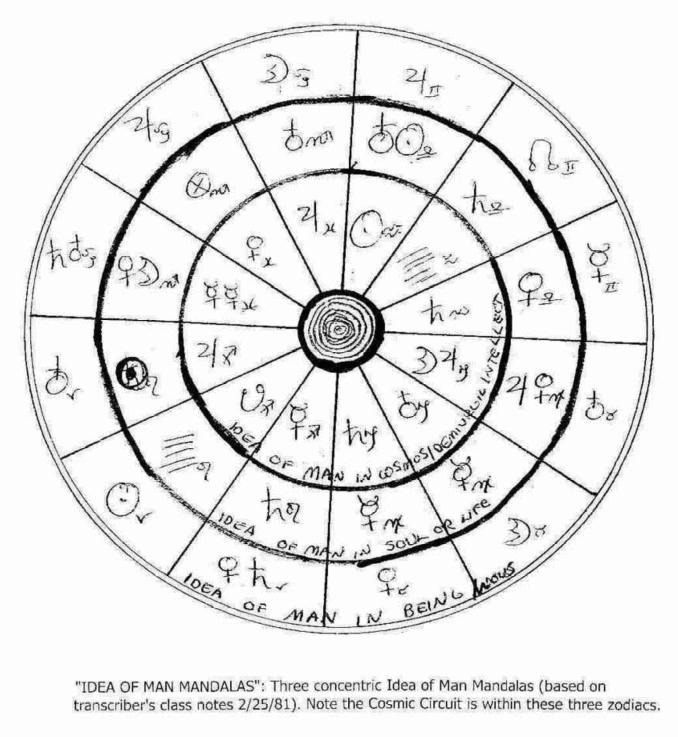
FIGURE 1981 0418a-1-JF. Idea of Man Mandalas.
FIGURE 1981 0418a-2. Chart of the Orphic Theogony.
NOTES by JF:
This is 1981 04/18a, Neo-Platonism; Iamblichus Class, and the first entry associated with this date. 1981 04/18b = Metaphysical Chart; Number Seminar.
This class was part of a 1981 Saturday morning series on Iamblichus: 04/10 (Friday eve); 04/11; 04/18; 04/25; 05/16; 06/06; 06/13. The class date sequence shows gaps; however, other Saturdays in this time period are on Number or the Kabbalah.
Other 1981 class topics, immediately prior to PB's death, appear to have been cosmology, the Idea of Man, the problem of knowledge, Kepler, alchemy, subtle physiology, Tibetan Buddhism and tantra, Kabbalah, the history of Platonism.
On Some Terminology in the Iamblichus classes: The Cognitive Isness can be considered to be synonymous with the Individual Soul principle, the Atman, the Saturn in Leo. "Drops" of light are often referred to. As far as I understand them, these subtle "congealed reason-principles" are coming from the third or Soul quadrant down into the embodied individual; further references to drops may be found in Tibetan Buddhist subtle physiology. "Genesiurgic" is a word used in Thomas Taylor's translation of Iamblichus; Anthony speaks of "genesiurgic tendencies" as being the planetary influences.
Previously printed, distributed 2003.
TRANSCRIBED by jf 2003 from Audio Cassette tapes; reformatted by jf 2018. In 2024, IT updates prefatory matter and footer, replaces tape markers with audio file markers, alters Topic, expands Subsubjects, completes Book List, adds Plotinus quotes section, corrects typos and some listening errors, adds new notes within transcript and alters an existing note, adds one diagram and reference within transcript to this diagram, reformats to accord with new conventions. Readable edited transcript – V11r.
AUDIO FILES: 1981 0418a, 1981 0418b. [Note: "Tape" and "Side" refer to original audio cassette tapes that were later digitized into .MP3 Audio Files.]
1981 04/18a at Wisdom's Goldenrod
Neo-Platonism; Iamblichus; Gods, Archangels, Daemons...
[Iamblichus. On the Mysteries of the Egyptians, Chaldeans, and Assyrians. 3rd ed. Tr. from the Greek by Thomas Taylor. London, Stuart & Watkins, 1968 [1821]. [Italicized quotes in text, between *"..."*, are Porphyry's questions being addressed by Iamblichus; square brackets in quoted text are in published version unless otherwise noted; minor variations read on the tape restored to text version in printed book. Pp. 1-16 of the book are the text of Porphyry's letter.]
[Audio File 1981 0418a Begins]
(noises, shufflings of papers; then a short discussion about having classes Saturday mornings; then a 'gap')
AD: --91, 92. I was reading last night that when people went to the Plato's lectures on the Good, on Numbers, that they were all very, very disappointed. (student laughter)
VM: Who said that?
AD: Some commentary by one of Aristotle's followers. You have the book of angels?
CdA: Dictionary?
AD: Dictionary, (yes). [Note: See Gustav Davidson, A Dictionary of Angels: Including the Fallen Angels.]
CdA: It's up in the library.
AD: Huh?
CdA: It's up in the library (inaudible).
S: I think David's (inaudible).
S: David has (the--)
AD: Someone has the Dictionary of Angels? David? Bo?
S: Of Angels?
CdA: It's up in the (inaudible).
AD: Dictionary of Angels. No, it's not in the library.
CdA: Oh it's not there?
AD: No.
S: Where is that?
AD: Did you see me go there this morning? (CdA inaudible) Alright, alright. It's too late now, you can't look these things up now. Let's start with page 93. Avery, would you read the first paragraph?
Iamblichus, pp. 93-4 (AS reading): "Moreover, that which purifies souls is perfect in the Gods; but in archangels it is anagogic. Angels alone dissolve the bond of generation. Daemons draw souls down into nature; but heroes lead them to a providential attention to sensible works. Archons either deliver to them the government of mundane concerns, or the inspection of material natures. And souls, when they become apparent, tend in a certain respect to generation. [silence on tape; then AD: Go on.]
"Farther still, consider this, also, that you should attribute everything which is pure and stable in the visible image to the more excellent genera. Hence, you should ascribe to the Gods that which in the image is transcendently splendid, and which is firmly established in itself. That which is splendid, but is established as in another thing, you should give to archangels; but that which remains in another to angels. To all these, therefore, you should oppose, that which is rashly borne along, is unestablished, and filled with foreign natures, the whole of which is adapted to inferior orders.
"These, also, may now be divided according to the difference of commixture. For mundane vapours are mingled with daemons, and are unstably borne along, contrary to the motion of the world. Genesiurgic compositions of pneumatic substances are mingled with heroes, about which substances, also, they are moved." [AS to AD inaudible; AD: Chapter VI {Sect. II} (inaudible)]
Iamblichus, cont., p. 95 (AS reading): "Moreover, the gifts arising from the manifestations are not all of them equal, nor have the same fruits. But the presence of the Gods, indeed, imparts to us health of body, virtue of soul, purity of intellect, and in one word elevates every thing in us to its proper principle [AS reads 'vehicle' here]." [then more silence on tape; note from about this point onward, tape is noisy, places hard to hear, sounds like possibly air conditioner may have been turned on]
Iamblichus, pp. 95-6 (AS reading): "And that, indeed, in us which is cold and destructive it annihilates; that which is hot it increases, and renders more powerful and predominant; and causes all things to accord with soul and intellect. It also emits a light, accompanied with intelligible harmony, and exhibits that which is not body as body to the eyes of the soul, and through those of the body. The presence of archangels imparts likewise the same things, except that it does not impart them always, nor in all things, nor does it bestow goods which are sufficient, perfect, and incapable of being taken away; nor is their appearance accompanied with a light equal to that of the Gods. The presence of angels imparts divisibly still more partible goods, and the energy through which it becomes visible falls very short of comprehending in itself a perfect light. That of daemons renders the body, indeed, heavy, afflicts with diseases, draws down the soul to nature, does not depart from bodies, and the sense allied to bodies, and detains about this terrestrial place those who are hastening to divine fire, and does not liberate from the bonds of Fate. The presence of heroes is in other respects similar to that of daemons, but is attended with this peculiarity, that it excites to certain generous and great undertakings."
AD: The last sentence -- brought back (inaudible). So he says heroes inspire in us that peculiarity to undertake certain great works or important works, the heroic souls. You could probably think of them as bodhisattvas or sages. The sentence before that: daemons render "the body, ... heavy, afflicts with diseases, draws down the soul to nature." And perhaps that might be the compulsiveness we feel when we're urged to do certain things that our more rational part would fail to acquiesce to. It makes life very complicated if we look at it through these couple of pages, wouldn't it.
S: (inaudible) daemons, he doesn't refer to the good daemon, just the bad daemon. Well, it looks that way because they--
AD: Well, insofar that they're administering the law of--
S: It may be that (inaudible) rather than (inaudible).
AD: Um, It's your karma. (S inaudible) They start bringing in the morality that we operate with. I suppose the beginning of Chapter VI {Sect. II} where he says, "the gifts arising from ... manifestations". In other words (inaudible) the presence of the guardian imparts to us health of body and etcetera. I suspect that would be -- that's why PB is so insistent on seeking the cure, very often what he calls the spiritual cure. And he's always been preoccupied with that, trying to find a cure regardless of the source of the (illness) whether it's -- (snaps fingers) -- well, not regardless, but in other words (inaudible) regardless of any other alleopathic [sic] medicine, there's always (inaudible) the cure, and sometimes, you know, he would recommend spiritual healing of various kinds, once you try those. I suppose the basis of the uncertainty of that would be because of your asking for the help of the higher or the spiritual beings: "the presence of the Gods ... imparts to us health ..., virtue of soul, purity of intellect, and in one word elevates everything in us to its proper principle." It sounds very (good). But he seems to complicate our lives (inaudible). I said it seems to complicate our life, you know, one would have to start taking cognizance that there are very many invisible forces around us all the time. In the page, on 111, (pages turning) in that middle paragraph he says:
Iamblichus p. 111 (AD reading): "Accept, therefore, this, which is said indeed incidentally, but is a sufficient reply to the whole of your conception concerning the theurgic art. Those assertions, also, of yours pertain to the same thing, in which you say, *"that the science of the Gods is sacred and useful, and call the ignorance of things honourable and beautiful darkness, but the knowledge of them light; and also add, that the ignorance of these things fills men with all evils, through inerudition and audacity, but the knowledge of them is the cause of all good."*"
AD: So his opinion is that the lack of knowledge concerning these forces is the source of evil and ignorance. And if you remember, in the Laws Plato even had these people execute the sacrilegious. He wouldn't permit them to spread their atheism. Remember-- remember that? It's very severe (about this). (inaudible) today. Um--
VM: May I ask a very naive question? (AD: Okay.) (inaudible) But when for example, Jung speaks about archetypal influences and so on, it sounds like he's covering some of the same ground or, maybe at a lower level, than these discussions do. In other words, when we speak about the daemons being in part that comprehensive force that seems to make you act out certain kinds of activities, that calmer moments or a more rational life would say that it's inappropriate to do and so on, psychologists would have a different explanation for these things. Are the two studies overlapping and one of the higher (roots) of what the psychologists would consider archetypal influences, that these are appreciating the roots of these archetypal influences?
AD: Well, I think there is a lot of overlap. As a matter of fact, this is a jungle, that, you know, I said that we will find it very difficult -- and that we'll have to proceed in a peculiar way. First we'll get like a general idea. One of the things that I did want to do was to try to get Mrs. Ybor [elderly mystic residing in cottage at WG] to speak to the group one night about her experiences, you know. And the variety, the variety of those experiences. On the one hand she might be visited by mighty angels, you know, and on the other hand, by lower daemonic forces, and her inability to discriminate-- which is which-- (except that) the sense [of] that reaction: she's frightened by some and -- but he said like the intelligible harmony is a bliss that is associated with them, and you go towards them, and absorb them, or they absorb you. One of the things I had in mind was-- which means I would have to sit with her for awhile-- was to make a little outline, but it's very hard to sit with her a little while. But if I could do that so that the variety of these experiences -- the way he's presenting them here, she has the same problem. [Note: See WG Interviews 1981 0318, 1981 1015, and 1982 0106b for Mrs. Ybor's accounts of her mystical experiences.]
Now to schematize, classify, organize these experiences at various levels will really be an undertaking. But we'll have to do some of it, because very often people in meditation get up and walk away and think they've been visited by the mighty angel itself, whereas all they had was a psychic experience which isn't even worth the trouble considering (inaudible). I don't mean it in a negative way. But it doesn't have the value that you think it has. And it's soon enough forgotten and you go on to other things. But they do elaborate, they do make these things into big productions, but they're not worth it. So that a discussion about this to some extent will help people to put these things into a perspective, what experiences are worthwhile, and what experiences one should ignore. Also a certain maturity-- I mean, I didn't admit that and I cannot help that we get a visitation, or an experience or a vision, the very nature of the compulsiveness of that vision is such that we have to live it out. I admit that. I submit to that. But we could try to understand these things too. So that when it's over, you could try to grasp something of what happened. At any rate, as I said, this is a survey, it introduces us to the enormous complexity of the world, the world-- not the sensible world which is only an effect -- but it introduces us to an infinity that we can't really comprehend. You would balk at the number of various powers that are governing the world, and the souls in the world. There's no neat, you know, classification, it's only a general idea that we could work out. That I hope to do-- but as far as a neat fertile classification, it's out of the question. (S inaudible)
But still we can get some idea that, for instance, in the exercises that are done in bhakti yoga, you know, where one tries to draw these higher (influences) down into himself, the value of these things-- So we'll have to work slowly. What we want to do is to pick out some main ideas, elaborate them a little bit. The Kabbalah is even much more tricky. And I think they try to (name) as many angels as you could work with, think about. You know, like on the bottom of page 98 he says:
Iamblichus, footnote by T. Taylor, p. 98 (AD reading): "These are terrestrial daemons, to whom the Chaldean oracle alludes, which says,"The wild beasts of the earth shall inhabit thy vessel," i.e. as Psellus [AD substitutes: someone] explains it, the composite temperature of the soul."
AD: And if you look around, and you see what's been going on in the world, and you will tend to agree with that statement, that these wild beasts are inhabiting the vessels (of humankind). And their insistence on not having any understanding of these higher powers or the lower powers really delivers them right into them. The man who doesn't believe in evil, in the sense that there are powers to be reckoned with, sooner or later will brought to his knees. On the top of that he says, this is on page 97:
Iamblichus, pp. 97-8 (AD reading): "[AD adds: The] Good daemons permit us to survey, in conjunction with themselves, their own works, and the benefits which they impart; but avenging daemons exhibit the species of punishments [which they inflict]; and such other daemons as are depraved are surrounded by certain noxious, blood-devouring, and fierce wild beasts."
AD: One would never want to antagonize such (daemons). Um--
Iamblichus p. 98 (AD reading): "With respect to soul, if it ranks as a whole, and does not belong to any particular species, it presents to the view a formless fire, extended through the whole world, which is indicative of the total, one, indivisible, and formless soul of the universe ..."
AD: Now there are experiences in meditation, when one is identified with that fire, the Soul of the World is a fire, and one thinks he is on fire, and one experiences himself as these burning embers everywhere, any place he looks it's everywhere. And that's your soul identified with the World-Soul. So in that case he's given an experience, he's talking about an experience evidently--
VM: Who was it of the Greeks who said "the world is all on fire"?
AD: Heraclitus.
VM: Heraclitus. Is that, you think, an expression of (inaudible)?
AD: And he also made the remark that no matter how far you traverse you will never be able to (go over) the limits of the Logos, where he is referring to the World-Soul. But you can go to the ends of the world, and you'll never go beyond that -- that as far as the Logos of the universe, and the medievalists used to speak about the World-Soul, they called it the Nous but it's really the World-Soul, when it's embedded in matter, and you try to release it from that matter. You remember the Kepler article where he says the adept tries to transform himself by releasing the intelligence which is hidden in the matter, and the release of that intelligence hidden in the matter transforms the adept. [Note: See W. Pauli, "The Influence of Archetypal Ideas on the Scientific Theories of Kepler" (in C.G. Jung, W. Pauli, The Interpretation of Nature and the Psyche).] Something of that nature occurs when a person has this kind of experience, where he sees his soul. But it's not what we'd call the higher soul, it's the soul--it's the Augoeides, the body that's present with the whole World-Soul, in every direction. And the experience of that body is usually in the form of a fire, formless flame, and you won't get burned physically. I mean it isn't that if you put your hand in a fire that burns, it's not that but, it's enough to scare you the first time.
BB: Well, I guess I'm having trouble visualizing and understanding what you mean by this fire. Is it, you know, like you visualize fire in a fireplace, or is it that-- (AD: No.) --that something (inaudible) I'm not really sure I understand what you're--
AD: Yes, of course. It's not real fire that you experience on earth, you know, that's why I said (inaudible)--
BB: Well I mean-- in terms of the visualization of the--
AD: It's not a visualization. See, visualization would make you think that you're looking at something. This is the experience of your own soul as flame or fire, formless. (BB: Is this distinguished--) It's not a visualization.
BB: Is this like distinguished from light? or is it--
AD: Yes, it's distinguishable from light. Very distinguishable. The point that I think that he's making here is the one we just brought up. He says that there are so many varieties of different lights, so many gradations, there's light, for instance, you know, roseate light, which is blissful, there's another light which is piercing and burning, it's so bright, it makes you think of that statement from the Gita where they speak about a million suns on fire, you know. It could-- the variety is so awesome, there's so much of it that it's really almost impossible to classify them. But I imagine it can be done to some extent. But it's not a visualization, Robert.
BB: Um, maybe that's a bad word. But it's like the-- (inaudible) talking about fire here, it almost sounds like something of the less, than maybe like light or something like that.
AD: No. These things are very distinct from each other. Very distinct. One cannot mistake them. One cannot mistake the different experiences of light that he may have, the varieties, the, let's say, the influences and the feelings that that they impart, or when you're identified with them, each one is utterly distinct from every other. And you really can't -- in terms of what we understand of light here-- which is almost monotonous in comparison to the lights there. We have a more of a uniform, homogeneous kind of light, when we think of the term light. The light there is so varied, there's such, there's so many infinitesimal gradations within it, each one bearing its own impress or diversity of (snaps fingers) --diversity of feelings, blisses, they're all quite different from each other. (A whole) world, by itself.
JC: Could you say that every one of these higher beings has a specific activity, and that this light, in the body or vehicle--
AD: He would call that the energy of that entity. The light that we see. Not its power, not its essence, he calls that the energy. And he communicates with you through that. And one can identify with that light.
JC: The quality of the light would be corresponding to the type of energy.
AD: The various grades, the various powers, of the energies that he's using. And I think I made the remark last week that to resolve these all back into emptiness is really a meaningless statement and gesture on the part of the tantrics. That's a very dangerous-- I think for Westerners-- a very dangerous (pose). Their deeper mode of being may be emptiness or their reality may be the Intelligible World, but don't think of them as emptiness in the sense that they don't have the power.
VM: The illusion of the individual is more potent there so that--
AD: Yes. Yes.
VM: The powers--
AD: Yes. Yes that's the very thing I want to avoid, that anyone should have that notion. It's alright, you know, for those spiritual giants, but not (for-- for us).
JL: How does this-- the soul stand in relationship to these power (inaudible) I mean as the entity?
VM: Are you asking a hierarchy John?
JL: Yes.
AD: Gee, that's too vast a question.
JL: I mean the individual.
AD: I'm sorry?
JL: The individual.
AD: Well, I would be I think quite-- say 75, 80 percent right if I said that we're subservient to these powers. And this results most of the-- the--
JL: You mean the powers of that-- of (inaudible).
AD: Those-- that hierarchy.
VM: You say the rational soul is subject to those.
AD: No, *we, here* the rational soul embodied (VM: Yes.) is subject to those. That's why very often, I don't know if you read some of the literature in Zen, you know, like when people get some of these visitations and they get carried away, the masters come over and just whack them and tell them, "Keep going. That's not what you want, you want more than (inaudible)." This would be-- this can be an absolute diversion from the goal as far as the Zen masters are concerned. The soul becomes like a metaphysical wanderer, goes everywhere, sees this, sees that. (silence) On page 101 like he says "In the last place":
Iamblichus, p. 101 (AS reading): "In the last place, the dispositions of the soul of those that invoke the Gods to appear receive, when they become visible, a liberation from the passions, a transcendent perfection, and an energy entirely more excellent, and participate of divine love and an immense joy."
AD: That's when it *happens*. Because then when you come out of it, your old personality can reassert itself very-- sometimes with twice the strength from before. You know, it comes back. But in the experience itself, this is so. One (does) feel when he comes out and saying and declaring and (prophesizing) and saying: "I'm God, I'm God". Very (inaudible). (S request to re-read)
Iamblichus, p. 101 (AS rereading): "[T]he dispositions of the soul of those that invoke the Gods to appear receive, when they become visible, a liberation from the passions, a transcendent perfection, and an energy entirely more excellent, and participate of divine love and an immense joy."
AD: And so we forget, in the experience, we forget that we're participating in *their* perfection, and so we think that we are that perfection. Then when we come back and you're Tony again or Vic again and we see that swirling mass of vasanas -- just *eat* them. Well, we do get the flavor after awhile, but still something has happened and this brings about a transformation of the personality, gradually. I have to apologize to the Buddhists, I don't believe you can get liberated in one life.
GA: I don't think they really buy it either.
CdA: One life after 20,000 of them. (student laughter)
AD: After 20,000, it happened in *that* life. (laughter; S inaudible)
GA: Somebody asked the Dalai Lama about that, and he said he thought maybe one life would be like one aeon. (AD: What?) He said that maybe one life is like one aeon. (student laughter)
AD: Alright, you want-- Avery.
Iamblichus, p. 101 cont. (AS reading): "But when archangels appear, these dispositions receive a pure condition of being, intellectual contemplation, and an immutable power. When angels appear, they participate of intellectual wisdom and truth, pure virtue, stable knowledge, and a commensurate order."
AD: Now, up to here, you can see that we have like three categories: On the one hand, we're speaking about when Gods appear, and when archangels appear, and then when angels appear. And you see that there's three classifications right here present. And the accompanying result or influences that accrue to the individual who has these experiences. Alright. (AD/AS inaudible)
Iamblichus, p. 101 cont. (AS reading): "But when daemons are seen, they receive the appetite of generation ..."
AD: Now what would that mean?
VM: Desire--
AD: Yes! Unadulterated. (VM inaudible, student snickers)
JL: The other three forms, would they correspond with the Intelligible, the Intelligible-Intellectual, and the Intellectual [Gods]?
AD: No, no. See, we're not ready to do this yet, John. To make a correspondence with the schemata that we worked out. I don't think we're ready for that. Because he may be speaking, he may be speaking in terms of just our world, and I don't know.
JC: Could you also say (inaudible), the person -- in reference to the quality of his aspiration, the type of aspiration he has-- will evoke certain types of beings. Not just when he sits down to meditate, but it is in your whole life style, his--
AD: Yes. It's the quality of your inner being that draws them to it. I think he makes that remark on page 109. He says-- Would you read that passage on p. 109?
Iamblichus, p. 109 (AS reading): "For, let *"ignorance and deception be error and impiety,"* yet it does not follow that, on this account, things which are offered to the Gods, and divine works, are false. For a conception of the mind does not conjoin theurgists with the Gods; since, if this were the case, what would hinder those who philosophize theoretically, from having a theurgic union with the Gods? Now, however, in reality, this is not the case. For the perfect efficacy of ineffable works, which are divinely performed in a way surpassing all intelligence, and the power of inexplicable symbols, which are known only to the Gods, impart theurgic union."
AD: Alright, I think the point we're making, Jeff, is here-- he's saying you can't kid them. You know, you could pop out the finest philosophic statements, you know, go around believing that you're a philosopher in earnest, and yet you might be quite different. But the point he's making here is that if our thoughts were capable, we would have all been liberated with the first thought about these things. But evidently it doesn't work that way. Conceptions, thoughts, and reflective thoughts, you know, and all that. It's the quality of the being, of a (man). I think I mentioned to you the story about Gurdjieff and two people, they came to see him, and one was speaking very profoundly, and you know, and using practically a forbidden language, and the other one was very quiet and modest. And Gurdjieff performed an experiment, he hypnotized them. And the one who was hypnotized who had spoke so profoundly he asked for a piece of bread and jelly. And the other one who was very modest, started asking very secret questions. (student ahhs, laughter) So we have to be careful with the surface personality. Alright, so when, going back he says:
Iamblichus, p. 101 (AD reading): "But when daemons are seen, they receive the appetite of generation and a desire of nature, together with a wish to accomplish the works of Fate, and a power effective of things of this kind."
AD: Does that feel pretty obvious? What was it the Greeks used to say? "For look not upon Nature, for her name is Fate [sic; fatal]". And some of the Pythagoreans were so cautious that when they cut their nails they wouldn't even look back at them, cut them off and (inaudible). (S: Oh.) Anything that belonged to the body they tried to immediately disown. Whereas most of us will look at the nail, cut it off and, "Oh gee."
S: Not anymore. (bit of laughter)
CdA: Does that mean that they are effectuating the powers of the spheres? (AD: Yes, yes.) --that they are--
AD: Yes.
CdA: So when you speak of people that have a lot of rulerships that they always do without knowing what they're doing, and there's a kind of-- some form of intuition with which they're functioning with. How is that related to these daemons that effectuate Fate?
AD: Well, they exercise that compulsive nature. (CdA: So --) So, you know, you operate according to the destiny that is yours, they're leading you on. (CdA: So in terms of--) But it doesn't have to be in terms of rulerships. It could be in terms of any thing in the chart--
CdA: Well, what I'm asking then is that-- the kind of psyche that you have would just be the way that you would experience this working out of the daemons, this effectuating of your fate--
AD: Yes--
CdA: You know what I'm asking--
AD: Yes. You can do something like this-- you can try this for an experiment. Whenever you feel, let's say, inclined to very deep study and you feel a real (s)urge (of) energy, and you could manage to get off for awhile by yourself, and really concentrate very intensely, you can see that the light when it first comes into you-- I mean, the idea before you, before it becomes something objective in your psyche and another thought-- just prior to that, you can see it's a light entering into you and (snaps fingers) just a minute later you can see it, you can see it becoming something that (you're thinking). And this light, alright, contains within itself this compulsive nature, that you have to do it. So when the thought comes into you, you know, it contains this compulsive nature that it's *your* thought, is (inaudible). Hopefully some of these things maybe will be experienced as we go along, and intensified (inaudible). But how often a person thinks he had the correct intuition and is just led on by the nose to do the wrong thing completely, thoroughly, and absolutely.
SD: Anthony, if you could feel it as a light coming in, would that still, would that be early enough to catch it? (inaudible) to avoid living that out.
AD: Well, it's generally (delivered) if it's part of your destiny to live it out. And most of the times we do.
SD: Once it's a fully formed thought, of course it's too late. But--
AD: But the closer you get to the source, alright, then the less desire there will be or compulsion to live it out. And of course if you get beyond it completely, (the universe,) you will experience it [universe] as light. Alright, then you don't have to, there's a certain freedom from the compulsion. You have to try it--
Iamblichus, p. 101 (AD reading): "If heroes are seen, they derive from the vision other such like manners and many impulses, which contribute to the communion of souls."
AD: Now obviously here, heroic souls are going to help us work towards, you know, harmony.
Iamblichus pp. 101-2 (AD reading): "But when these dispositions come into contact with archons, mundane or material, motions are excited in conjunction with the soul. And, together with the vision of souls, the spectators derive genesiurgic tendencies ..."
AD: That would be astral influences due to the influences of the planets.
Iamblichus, p. 102 cont. (AD reading): "... and connascent providential inspections, ..."
AD: A kind of understanding of that will occur simultaneously with it.
Iamblichus, p. 102 cont. (AD reading): "... for the sake of paying attention to bodies, and other such peculiarities as are allied to these."
AD: So it's kind of encouraging, he goes on, and--
Iamblichus, p. 102 cont (AD reading): "... the manifestation of the Gods imparts truth and power, rectitude of works, and gifts of the greatest goods; but the manifestation of other powers is appropriately accompanied by such things as are commensurate to their several orders. Thus the manifestation of archangels imparts truth, not simply about all things, but definitely of certain things; and this not always, but sometimes; nor indefinitely to all, or every where, but with limitation, in a certain place, or to a certain individual."
AD: So you can see this very precise delineation of what is communicated to an-- a soul if he contacts an archangel. It isn't that he's-- You remember the notion, people used to say well if a Buddha's omniscient, you know, then he should know everything and so Sid was very disappointed when the Dalai Lama says, "No, I don't know everything." And the same with PB, you'd ask him a question, he may have to just stop everything for a minute and maybe give you an answer, maybe not. A specific time, place, locality, certain (truth). It isn't that you become the World-Mind and now you know everything but you know what is needed precisely for that moment, that time, that place, that person.
PF: I hope this isn't presumptuous but would a Buddha or a sage, when they turn inward or whatever, do they make contact with these different levels? Say a question was asked about that--
(Side 1 of original cassette tape digitized as 1981 0418a Ends; Side 2 Begins)
AD: --reaches the power or the-- you know, the entity that's supposed to answer that question. It isn't that, you know, throws out the answer to the question, (or is it) the World-Mind, the totality of the World-Mind is involved in it. This is the way I understand it so take it with a grain of salt. As a matter of fact, a big bunch of salt.
Iamblichus, pp. 102-3 (AD reading): "In a like manner it does not impart a power effective of all things, nor always without distinction, nor every where; but a power which is effective sometimes, and in a certain place. But the manifestation of angels, in a still greater degree than that of archangels, provides, in imparting good, the circumscriptions which are always defined by them in more contracted boundaries. Again, the manifestation of daemons does not impart the goods of the soul, but either those of the body, or goods pertaining to the body. And they impart these when the order of the world permits them."
S: Read that over again.
Iamblichus, pp. 102-3 (AS rereading): "But the manifestation of angels, in a still greater degree than that of archangels, provides, in imparting good, the circumscriptions which are always defined by them in more contracted boundaries. Again, the manifestation of daemons does not impart the goods of the soul, but either those of the body, or goods pertaining to the body. And they impart these when the order of the world permits them."
AD: In other words, karma permits it.
JC: When you have the right aspects, then the genesiurgic daemons become active at that time, and they can energize the (inaudible/accordingly).
AD: Yes, that's what we mean by karma. You know, like someone who's got a ticket, I told him, just accept it, it's part of our karma. (inaudible)
JC: Did he have Mars on Jupiter?
AD: Hm? (JC: Did he have Mars on Jupiter?) He had Mars on Jupiter. Inflated, heh? Speeding along at 90 miles an hour.
JC: Skip the daemon. (lots of student laughter)
AS: He should have (inaudible). (various inaudible student comments about miles an hour)
AD: Would you read 103, I mean--yes. "For you say that to speak"-- it goes to 104.
Iamblichus, pp. 103-4 (AS reading): "For you say, *"that to speak boastingly, and to exhibit an adumbrative phantasm, are common to Gods and daemons, and to all the more excellent genera of beings."* But the thing is not as you apprehend it .… For a God, an angel, and a good daemon, instruct men in what their proper essence consists; and never use an addition in their language which transcends their power, or their appropriate good. For truth is coexistent with the Gods, in the same manner as light with the sun. And, at the same time, we say, that divinity is not in want of any beauty or virtue which it is possible to add to him through language. Moreover, angels and daemons always receive truth from the Gods, so that they never assert any thing contrary to this, each of them being essentially perfect, nor can they add any thing to it for the sake of commendation.
"When, therefore, does the deception mentioned by you *"of speakingly [AS reads just: speaking] boastingly"* take place. For when a certain error happens in the theurgic art, and not such *autoptic*, or self-visible, images are seen as ought to occur, but others [AS adds: occur], instead of these, then inferior powers assume the form of the more venerable orders, and pretend to be those whose forms they assume; and hence arrogant words are uttered by them, and such as exceed the authority which they possess."
AD: You follow what he's saying there? Well, it's quite a common thing, too. But (inaudible) he said, he makes it very clear, these powers, the Gods, the daemons, good angels, and all that, they never assume a boasting or arrogant attitude. Such that, if any of you ever go to a séance -- which I don't recommend -- you'll see that very often the inferior daemons or orders that are really psychic corpses, I would say, things like that. They will speak through the medium, and they really amaze you as to how arrogant and conceited-- and you say, really, nothing has really changed, you know -- the man is the same here, I mean there, as he was here. But they will assume such airs. A good example would be in the case of someone like Ramana or PB or any these sages, you see they never say a word extra. There's never superlatives added, there's nothing, there's always just a very frank statement of what is being said, what is meant, no more no less. And sometimes you'll ask for further explanation and they don't, they won't want add to anything that they've already said. For he says, For the truth is connascent with them--
Iamblichus, p. 104 (AD rereading): "For truth is coexistent with the Gods, in the same manner ... that they never assert any thing contrary ..., each of them being essentially perfect, nor can they add any thing to it for the sake of commendation."
AD: Alright, but then he points out that sometimes in the practice itself, in theurgic practice, or the evocation of the Gods, something wrong is done, and now you get-- now a boomerang takes place. What the evocation brings about, or what is brought about is an inferior order who *assumes* that higher, and, you can get quite a surprise. They'll make statements, they'll say things which-- Like some people will tell us what the future is, you know, and they got it on very authentic grounds, so they think. But they've been misled by these things. Because there are questions that we can ask. One could always in their presence feel a sense of propriety, whether a question will be answered or not. There are some questions that are not going to be answered, there's secrets, they belong to the higher Intelligence and they're not just going to be bandied about and given to any official or unofficial lama, guru, teacher or anything. They get-- you know, they get carried away (inaudible). So be careful with rituals.
Iamblichus p. 104 (AD rereading): "For when a certain error happens in the ... art, then inferior powers assume the form of the more venerable orders, and pretend to be those whose forms they assume; ..."
AD: And they can trick you, don't kid yourself. They can provide you with a lot of good information in the beginning and hook you, and once they hook you, then you submit to (their) species of absurd ideas and thoughts.
VM: Anthony, this may be a totally inappropriate question: (inaudible)--
AD: Just like a lot of people, you know, take the Ouija board as a plaything, they don't know what they're asking for.
VM: I think you mentioned several times, and (inaudible) how a certain sage was asked to give up all his occult powers and all his communications with these various entities and so forth, and he said that he had to think about it for awhile, and then he gave up his-- and then when he finally decided to do so and he said it was very strange, his meditation became so foreign/boring and (inaudible).
AD: Yes, that's what many people here are looking for when they sit down. Some exaltation, some beautiful experience.
VM: But then he said something better happened, I don't want to leave that part out--
AD: Well, something better does happen. But this preoccupation with pleasurable things to happen--
VM: The question was though, was he-- when you say things like that-- but do you think he was referring to experiences or traffic with these various levels of Gods or daemons, or is this impossible to answer that?
AD: When he had to give up that (image). (VM inaudible) Sure, it's communication with higher powers. Yes, he was more or less looking to them for guidance and finding his way on the path through these kind of powers. And after he threw all that overboard, then he was completed by the grace of the Highest, not anything else. Whatever it brought him, he accepted. But we're not at that level (inaudible). (student snickers)
VM: So PB doesn't have traffic with these anymore or does he? I mean--
AD: Oh, they can appear to him, they can appear to him.
VM: But he doesn't, I guess, willfully see them now.
AD: Yes, that's the thing, that's what everybody wants. It's like -- what do they call it? -- name dropping?-- "I know so and so and I am in contact with them" -- and then you get preoccupied with that. I think Vedantism, especially the kind that PB studied, is very severe-- almost cold-blooded -- he cuts *everything* off, everything, no matter what it is. On 109, if you will continue this "For, let ignorance and deception--"
Iamblichus, pp. 109-10 (AS reading): "For, let *"ignorance and deception be error and impiety,"* yet it does not follow that, on this account, things which are offered to the Gods, and divine works, are false. For a conception of the mind does not conjoin theurgists with the Gods; since, if this were the case, what would hinder those who philosophize theoretically, from having a theurgic union with the Gods? Now, however, in reality, this is not the case. For the perfect efficacy of ineffable works, which are divinely performed in a way surpassing all intelligence, and the power of inexplicable symbols, which are known only to the Gods, impart theurgic union. Hence, we do not perform these things through intellectual perception; since, if this were the case, the intellectual energy of them would be imparted by us; neither of which is true. For when we do not energize intellectually, the synthemata (footnote by Taylor: i.e. The inexplicable theurgic signs or symbols) themselves perform by themselves their proper work, and the ineffable power of the Gods itself knows, by itself, its own images. It does not, however, know them, as if excited by our intelligence; for neither is it natural that things which comprehend should be excited by those that are comprehended, nor perfect by imperfect natures, nor wholes by parts. Hence, neither are divine causes precedaneously called into energy by our intellections; but it is requisite to consider these, and all the best dispositions of the soul, and also the purity pertaining to us, as certain concauses; the things which properly excite the divine will being [AS adds: the] divine synthemata [AS substitutes: theurgic symbols] themselves. And thus, things pertaining to the Gods, are moved by themselves, and do not receive from any inferior nature a certain principle in themselves of their own proper energy."
AD: Alright, let's talk about this (a little bit).
AS: Well, he made the point before first that the um, having a theoretical conception of the Gods is not going to actually deliver their power. Otherwise, the first time you talked about or studied any of these things, you'd be liberated. But the other point is more interesting, to say that the um, I don't want to take him wrongly-- I don't think he's saying that it doesn't require *any* act on our part, in order to, let's say, gain this divine providence, and so on. But he is saying that when we do make the effort, in the end it's-- that effort is just a concause, it's just a necessary condition, but it itself is not what's efficacious, it's the Gods themselves that are efficacious of their providence. The fact that no matter what we do, our intellectuality or our purifications and so on -- all of the things and acts that we actually might perform to, so to speak, invoke them, is just a concause, or a necessary condition, but it doesn't-- it doesn't really provide the (inaudible/providence).
AD: Well, (inaudible) I think that was the question that Jeff was speaking about: he says it's a certain veneration or a quality of the inner being, that's a necessary concause. But-- what do you think this symbol or sign--
AS: Theurgic symbol.
AD: --signifies?
AS: He says these "themselves perform"--
AD: What do you think, Gabriel, any ideas?
GA: Um, I guess you could probably use the analogy of the way we used the [metaphysical] chart, that there's, say, a subtle or an intellectual form which when, in a material way, is put on the [black]board, helps to deliver a certain union with these ideas.
AD: Well-- I won't disagree with that, but I don't know how much I'd agree with it, but in terms of the Buddhists that you've been -- (GA: Oh--) their ritual and necessary (inaudible).
GA: I don't know much about it but it certainly seems that they put an awful lot of effort into these mandalas, and the particular shapes of these deities, and --
AD: They have to be done in a precise manner.
GA: Yes! They have to be done just right! The monk could get kicked right out of his order. Yes, it's grounds for expulsion, if he doesn't do it right, or he doesn't put the mantra in the right place or-- it's taken very seriously.
AD: You have to look up some examples of this in these rituals, you know. And perhaps some exact case histories to illustrate these things. Because the implements that they use are very precise and organized, to make that contact possible, you know, in the way they set up an altar (GA: Yes.) or the way the ritual (inaudible) is made, or the way they used to attend these meetings. We would call them a séance, like when your read um -- like when Plotinus went to that temple of Isis, they call that a séance meeting, but they don't know what they're talking about. The commentators are saying, the skeptical few, their attitude towards these things. But I would imagine that when the priest took Plotinus there and you remember he points out, that there appeared a mighty daemon, and he looked at Plotinus with veneration. Because this mighty God was attending upon Plotinus. We have to do some, a little research on that because that will be interesting.
BB: You know like it sounds like there's kind of like a consistency or a constancy, I guess would be the word, of like some of these energies or forces or something like that. In other words, it's like in one respect, you know, like when we talked about essences or Santayana or what I kind of got from that, is that you never really can recapture that same essence, you never can recapture that same force, or something like that. Whereas here we're talking about something that's --
AD: Here, he's [Iamblichus is] telling Santayana, you don't know what you're talking about.
BB: There's a constancy of certain forces that you could invoke that--
AD: As a matter of fact in Plotinus, if you remember that Plotinus makes the remark that if you perform the ritual *precisely* the way it is prescribed, it *inevitably* must work. Because of the laws that are involved in that ritual, in that symbol. You remember the passage? [Note: Possible reference to Plotinus, IV.3.11, first paragraph.]
AS: Yes, -- invariably, I'm not sure I could find it. But he seems to be saying, I guess from what he's saying is, that these, the ritual and so on, like the precise mandala, is efficacious not because of anything that the person is doing to do the mandala, but that mandala is really connected to the God, it connects the other way. It's not that you performed the rite correctly, it's that *that rite, once correctly done* is in fact in continuity with the God, the God's appearance. On in the other place we read earlier, he said these Gods have certain allotments, in terms of parts of the heavens, even in terms of a certain visual statue, say, or even in terms of a certain mandala. And that allotment they preside over, seems to be in absolute continuity with their essence. You could put it that way. And that invariable concomitant seems to be what he's saying--
AD: Yes, it's an invariable concomitant.
AS: Yes, it's not even like the thing is making the God appear. It's almost like that is the God, that is in some way, that mandala is a part of that God.
GA: Yes.
AS: Because otherwise you'd have to say that if the Gods weren't essentially productive, but just acted out of whim or something like that.
VM: Sounds like the laws of physics in the subtle realm.
AS: That-- it almost-- I mean--
VM: Reproducible experience if you do them right.
AD: Oh yes. They call that transcendental physics.
AS: Well-- (laughter)
S: Who's they? (more laughter)
AD: I just--
AS: Well-- that--
VM: That's just what it sounds like, I mean--
AS: That would have to be so, if you said that the Gods ruled over even the generated world, and they would have certain fixed correspondences with the world, and if you knew the proper correspondences--
AD: Now you've seen, now you've seen the picture on folders where they have a magician calling or evocating a God, and he has to do it according to a certain precise ritual and all that. Don't experiment with it. (student snickers) Go ahead, Willie--
WA: When he says that energizes intellectually, it's starts out it seems to be talking about a conception, but probably using the term -- being distinguished, say from the idea-- of inwardly --you're energizing intellectually could be used in the sense of um, of your own higher self. Is this communication with the Gods being distinguished from more inner--
AD: 'Energize intellectually' means that you've gone beyond the realm of imagery, you don't use it. (AS inaudible)
WA: I guess that's what I was trying to ask.
AD: When they say 'energize intellectually' you know, to the modern ears it would mean sitting down with a very difficult text and reasoning it out step by step, and concentrate-- they mean quite different -- Stop all that, erase every thought from your mind: this is energizing intellectually.
WA: So, is he saying in this passage--
AD: I can't convince Mrs. Ybor she's energizing intellectually. (bit of laughter) Because it's *so ingrained* that intellectuality means memorizing all these names, knowing the names, you know, the concepts, the ideas, the theories, in a conceptual way, that I can't convince her, that intellectual energizing means precisely to *get rid off all that* -- alright, and so you become this pure energy of the Intellect. The pure energy of the Intellect, no images.
WA: Okay I just want to make sure I'm following this right because he's saying that these systhemata appear when you are *not* energizing intellectually.
AD: I'm sorry?
WA: That the systhemata, the inexplicable theurgic signs or symbols he's saying appear when you are *not* energizing intellectually.
AD: Where you at?
WA: I'm on page 109-110.
BS: The last sentence on 109.
Iamblichus, pp. 109-10 (BS rereading): "For when we do not energize intellectually ..."
AD: Yes?
Iamblichus, pp. 109-10 (WA rereading): "For when we do not energize intellectually, the synthemata themselves perform by themselves their proper work, and the ineffable power of the Gods itself knows, by itself, its own images."
AD: Then, the question, though--
WA: I'm trying to understand the distinction between he's making between the appearance of the systhemata of the Gods and their energizing intellectually. Is he saying that that is a *concause*? or--
AD: No, I wouldn't say that that is a concause. No, one doesn't have to be in a state of, you know, of intellectual, of the intellectual act, for the pure intellectual energy to perform these ceremonies. The example that we used from Plotinus when they went there, these three people went there, and they performed the ritual and all that, they weren't into intellectualizing energetically without dianoia, they were (inaudible).
WA: I guess that's what I was asking, they were distinguishing this from--
AD: No, he's saying that the effects that these symbols in themselves will produce, the effects, the manifestations of the Gods. I think there was another passage, you remember where he speaks about these symbols as the actual energies of the Gods, do you remember that passage?
S: Could I add to your question? (WA: Sure--) It seems that these symbols or images or rites and so forth or rituals, I guess that's what you're saying-- well, maybe energizing intellectually it would seem these symbols or rituals that he used to perform the same function, and of course in that case (they're both) dependent upon the ritual. And if they're essentially different, that would imply that the (inaudible). I was wondering (inaudible).
MW: I have a section here from the Emperor Julian, a footnote.
AD: One minute, go ahead.
The Emperor Julian's Oration to the Mother of the Gods, footnote by Thomas Taylor (MW reading): "To believe that the statues of the Gods, such as they were fabricated by the ancients, participated of the divine influence, as much as the substances from which they were composed is capable of admitting, must appear ridiculous to every one who is ignorant that the construction of these statues was the result of the most consummate theological science, and that from their apt resemblance to divine natures they became participants of divine illumination."
AD: There's something similar for instance, in India, and in the West in the traditional cultures, whenever they-- (snaps fingers) whenever they actualized, let's say, a shrine, or a building, like in India, that there was what they call the divine proportions. That the building was to be constructed according to this formula, and no other. And the very proportions, symmetry that was used, the influx of the Gods could take place. Because on this-- that's the page that Bob-- "that being thus generated"--
Iamblichus, p. 72 (AD reading): "I say, therefore, that the visible states of the Gods originate from divine intelligible paradigms, and are generated about them. But being thus generated, they are entirely established in them, and being also extended to [AD emphasizes 'to'], they possess an image which derives its completion from them. These images likewise fabricate another order; sublunary natures are in continuity with them [AD emphasizes phrase], according to one union; and the divine intellectual forms, which are present with the visible bodies of the Gods, exist prior to them in a separate manner."
AD: If we took a very meager example in psychology for instance, that the appearance of a mandala, let's say in a drawing, you know, or in a dream or in a vision, it's like the *continuation* of your inner being. The manifestation of that inner being-- let's say you have a vision of the unus mundus, alright, the continuation of your inner being is that mandala that you're looking at, or that unus mundus. It isn't different or separate from that, but it's in union with that higher being. So very often, psychologists, by looking at a mandala, a drawing of some people can tell what the inner Self of the person is attempting to do, through the mandala or through the drawing that that person is doing. There has to be an identity or a continuity between the inner being and that outer manifestation within the drawing. Now, assuming that that is so, the psychologists would be working on the premises that this mandala or this drawing or that mandala is revealing something about that inner being. And if you did find out what it is revealing and work with it, that person will be restored to some kind of balance again, you know, or some kind of conformity with his inner being. Whereas his neuroticism is because of an alienation from that inner being. So he's working on the principle that that drawing, that manifestation, alright, will help him to realign the personality according to the inner being of that person. So that the symbols at a much higher level will also be the same thing. Whether these are symbols in terms of rituals, ceremonies, actual invocations, they *are* in continuity with whatever the spiritual entity is doing. So if that symbol is there, then that God would be present. At least be available through that symbol.
CdA: (inaudible) I was reading a biography of Leonardo, and there was this one day, and they dig up this ancient statue of Venus. And he spends like a whole day making these drawings (following) measurements of this statue, (inaudible) they called him calculating, he would do-- he was measuring the finest, finest, you know, I think there was one remark, 1/232's of an inch was of great value (inaudible).
AD: I think John [art history professor] could tell us about that, because he's been writing on the notion of proportion in medieval art, and how exacting they were in their demands. Most traditional cultures operate that way, we can see where they're coming from, that this at one time was knowledge which was traditional among all (these civilizations) that believe in these things. And it's not (outward). The Buddhists, of course, still have that tradition very strong. I'm not saying that everything they say is so, or proper, or true, but it's still there, enough of it is there, to ensure us. And if you read about the mythological societies, the way that they would perform certain rituals or ceremonies, the way they had to be *precisely* duplicated, the way it was done in primeval times, they had to continue that. And if you get into that you can see that you would then, in that way, participate-- this is the way I refer to it-- you would participate in that mythological consciousness of what the myth is about, and you would experience a state of consciousness which is quite different than the conceptual mind, that we ordinarily operate with. Let's go on with it, this-- (S inaudible) there's some really (inaudible) this Iamblichus. I don't know if you've ever read any historical commentaries on him-- the 'mage' they call him-- but you can imagine what it must be for us to read a book like this. Yes--?
S: There's one more line here that I thought was applicable to this last section.
Emperor Julian, footnote by T. Taylor cont. quoting Sallust (S reading): "'As the providence of the Gods is every where extended [S adds: a certain providence], a certain habitude or fitness is all that is requisite in order to receive their beneficent communications.'" [AD: To receive?; S repeats last phrase]
AD: No, we're discussing these things, for instance, in a philosophic, dry, academic, rotten way (student giggles), like you speak about the universal in the particular. But-- the Thursday class (student laughter, CdA inaudible) Well, this is the way it's done today! This is exactly the point-- what the Buddhists-- I'm sorry-- what the Nyaya logicians were speaking about the particularity, the universal, and the, what was it? (inaudible/AS inaudible)
AS: Yes, the inherence--
AD: Yes, the inherence. When they speak about these three, alright, which are *not* in existence or bhava, alright, but *inhering in* an object, alright. And then the Buddhists come around and say, you know, these very special reasons that you're giving, or these clinical hypotheses-- (laughs, followed by student laughter) And you can see that they're speaking about the same thing, the way the universal is present in something, that something, of course, must provide the condition in order for it to be present. So cowness will appear in a cow if the conditions are met. So you have this very dry, academic way of presenting what these people are speaking about in a mythological way, that the Gods will extend themselves and be present to anything that it is appropriate and can receive their influence, alright. In the same way, a certain matter will be receptive of a certain form and it becomes a horse. If it's not receptive of a certain form, it can't become a horse. But in academia they got to say it in this *rotten* way, you know, it's what I call the attitude of the ascetic denial, which the scientists always must operate with. He's got to show that he's superior to belief and unbelief. Which is a lot of bunk! If they believe in anything, it's themselves, you know. Like the old saying is "Love thy Neighbor". And they say, "Why? He loves himself enough, why should I love him?" (student laughter) But anyway-- Isn't it true? (inaudible student comments) But anyway, you see the point I'm making, Louis, you can see that from a mythological consciousness where these things were *felt realities*, they become now dry concepts. The life has been squeezed out of them. And so if I can't take a philosophical discussion and bring it back to that, alright, I feel like I've lost the link, the connection. I often used to think that someday perhaps a work, a history of man will be written, but it will be from the point of view of the development of his consciousness: from an archaic, you know, consciousness, let's say to a mythological consciousness, to a rational, to a rational, mental consciousness. This is the *real* history of mankind. Not the wars, that's not history. Page 111, you go back to that? Would you read "Nevertheless"? On the top--
Iamblichus, p. 111 (AS reading): "Nevertheless, efficacious union [with divine natures] is not effected without knowledge; yet knowledge does not posses a sameness with this union. So that neither is divine purity obtained through right knowledge, as neither is purity of body procured through health; but divine purity is more undefiled than knowledge, and is more transcendently united. Hence neither this, nor any thing of the like kind which is in us, and is human, cooperates any thing to the end of divine actions."
AD: I know, perhaps one of the ways that we could put this, is that in the experience of light there's this very paradoxical situation, where you're identical with the light, and yet your knowledge of it is different from that identity. And I think that's what he's speaking about here. And when one has the feeling of being this light, and nothing but this light. But he *knows* it, and that's not the same as being the light. So there's that paradoxical situation in the experience itself.
BB: Doesn't that kind of alternate a little bit, or something? In other words, is one part, is there one part where there is that identification and another part which is more reflective? In other words, (inaudible)--
AD: No. It's not reflective, it's not reflective in that sense. We're speaking about a state of consciousness, a person who has introverted, alright, and introspecting into himself, and then he achieves a certain identity with the light, there is presents simultaneously with the experience, the knowledge, alright, the knowledge of that experience, which keeps it distinct from that experience. When you come out of it, that's what you bring with you. The experience is over, the identity's over but the knowledge that you bring back is *other* than that. If that did not persist, alright, you wouldn't even have the notion that you had the experience. Now this is *knowledge by otherness* which I-- from what I understood, it seems to always be present, even when there's knowledge by identity. I don't understand it so don't--
S: (inaudible) the virtues, they talk about it being divinely-- a divine dispensation, because that knowledge is (inaudible, someone coughing)-- knowledge being virtuous, the virtue of divine, divine knowledge --
AD: No, that's not-- that's entirely different. Go ahead, David.
DB: In regard to the experience that we were just discussing, this knowledge that one has which is not the same, as identity with the light, that knowledge doesn't seem to be any kind of thought, I mean it's--
AD: No, it's not (a kind of thought).
DB: No. But would it be like the intelligible counterpart to what we have as a thought here? I mean, because it is a specific bit of knowledge, there's a certain intelligibility there but it's not like a mental activity.
AD: I can't answer, I don't know.
BB: Is just-- I don't know, I don't know whether I'm not (inaudible) but I just want to make sure I understood what was said there, that by saying that the knowledge and that light are concomitant-- In other words, there are-- I don't know how to explain it -- that while that light persists there is something inherent in it that you know that that there's some kind of knowledge of that light at the same time that there's that identification with it? In other words it's kind of a-- in other words, it's not as if it's separate, it's kind of simultaneity there?
AD: Yes, there's a simultaneity there of knowledge which is otherness and the identity of the light, identity with the light. And these two seem to be coexistent. One of them, the notion of the knowledge of the experience, seems to be of an inferior order of the actual identity with the experience. And I don't understand it, and there's nonsense talking about it as far as I'm concerned.
BB: Okay I was just trying to draw out of it what was (inaudible; AD/BB inaudible)
AD: If those things aren't given to me, I'm not going to worry about it. (silence) Alright, let's start with Chapter I in Section III.
AS: Should I start from the beginning of it?
AD: Yes, please.
Iamblichus, pp. 112-3 (AS reading): "In the first place, therefore, you ask me to explain to you distinctly, *"what that is which is effected in the foreknowledge of future events?"* Immediately, however, that which you endeavor to learn is impossible. For, according to the meaning of your question, you think that foreknowledge is something which is generated, or subsists in becoming to be, and pertains to things which have a natural subsistence. It is not, however, one of the things which have their existence in becoming to be, nor is it effected after the manner of physical mutation, nor is it invented and devised as something useful for the purposes of life, nor in short, is it a human work, but is divine and supernatural, and is supernally sent to us from the heavens. It is also unbegotten and eternal, and spontaneously has a precedaneous existence.
[on tape but not on Audio File] "The greatest remedy, therefore, for all such doubts is this, to know the principle of divination, that it neither originates from bodies, nor from the passions about bodies, nor from a certain nature, and the powers about nature, nor from any human apparatus, or the habits pertaining to it. [AD: Continue.] But neither does it originate from a certain art, externally acquired, about a certain part of such things as are subservient to life. For the whole authority of it pertains to the Gods, ..."
[Audio File 1981 0418a Ends]
[Audio File 1981 0418b Begins]
[not on tape, but, from the discussion that follows, this portion of the text was most likely read:] Iamblichus, p. 113: ... and is imparted by them; it is also effected by divine works, or signs; and it possesses divine spectacles, and scientific theorems. All other things, however, are subjected as instruments to the gift of foreknowledge transmitted from the Gods; viz. such things as pertain to our soul and body, and such as are in the nature of the universe, or are inexistent in particular natures. ...
AS: Well, maybe if you use that-- the analogy, the astrology example, and you say, well, you have a certain natal chart, say, and somebody reads it.
AD: And somebody (let's say in) the future is going to happen, alright.
AS: Yes, and it's-- Like when we way well this-- there's a guarantee-- in some ways, there's a guarantee there that certain things will happen. Not-- maybe not the particular events so much but certain results, say, will come about, could be seen from the natal chart. And, he's trying to un-- I guess the question is mostly as to how that's possible that you could look at this natal chart and get some indication.
AD: You know, we used the example of-- who was it, Lilly predicted the London fire (AS: The fire, yes.) (inaudible) (years) before it occurred, the most devastating fire that London had, and Parliament even brought him up to examine him I think. Wasn't that so?
AS: Yes, they accused him of causing it.
AD: Yes, maybe he started it. (student laughter)
AS: To make the prediction come true.
AD: Now, he's saying here, does this foreknowledge exist in the sensible world itself? What is he saying here? (AS: Well, no obviously--) It doesn't belong to that sensible world.
AS: Yes, so-- I mean you could look at the chart, the chart as a symbol. It's not anywhere in the sensible that you'll find it, but it's in the Gods, the Gods have an eternal knowledge in some way or a perpetual knowledge of what--
AD: It wouldn't be in the soul, either, would it?
AS: No.
AD: If we said that the house structure which underlies cosmic--
AS: I don't think so. Because the soul-- because the soul too, in a sense, would have to be in some kind of motion. The soul would be perpetually generating that eternal knowledge, but they always say it can't receive that knowledge, totally all at once, it has to--
AD: Do it piecemeal.
AS: Do it piecemeal. So according to this, that knowledge is only in the Gods. But--I mean-- possibly the Mundane Gods, too.
AD: Alright, so then, when we put underneath the 12-house structure, we say that the Nous is underneath that, [Note: See FIGURE 1981 0418a-1-JF.] I think that what he would be saying here is that this foreknowledge of an event is something which is coming from the Nous. And if the astrologer can intuit that, alright, then he has a foreknowledge. But it's really something that's given to him by the Gods, whether they're mundane or higher, or whatever. I think this is what he's saying in this passage.
AS: Yes, well, it seems to be. Yes, Plotinus also has this whole section on whether there's-- whether you can attribute memory to the Gods. [Note: See Plotinus, IV.4.6 (last three paragraphs), IV.4.7-8.] Well, he says, there's no need for memory there, since everything-- they have this knowledge. It's not like they have to remember what happened previously or in some kind of sequential way. Otherwise, you'd say they're remembering what's going to happen in the future and that's what you contact. Whereas, rather it seems they have this knowledge in some way eternally, and--
CdA: There's something that's kind of confusing to me, I can't quite grasp how say a-- (AS inaudible) say, a karmic event, you know, of an individual in the cosmos. It's in the Nous, you know, in the Nous as we-- as my limited conception of it is, of the Ideas that are eternal and immutable, you know that these events here that seem quite small, you know, would be known there.
AS: Well, when he says in Plotinus that the Ideas contain in themselves all the particular, all the possible particular details that are going to evolve from them. And if they weren't there first, they couldn't be here. [Note: See Plotinus, VI.7.2.]
CdA: But if-- so--
AS: But even-- I mean that's part of it.
CdA: Well, I mean--
AS: Part of the explanation.
GA: Can you imagine if everything were an amorphous--
CdA: No, no, no, it's-- I guess I'm just asking for-- (even these--)
AS: The question is, what are the consequences of that? The question is not why is that so, but what are the consequences of that? I mean, that has certain consequences. (CdA: Yes.) You know, if it is theoretically possible, you know, if you contacted the Gods, the knowledge in the Divine Mind, you would have a vision of the whole, of the so-called karmic unfolding. And the word Necessity or Adrastia becomes much more-- that means it's a conformity to what's already, that means a conformity to the Nous.
AD: Well, why shouldn't that be so? Why shouldn't it be if the Nous contains the intelligible paradigm of the sensible world, wouldn't it stand, wouldn't it logically follow, that foreknowledge of what the sensible world will be in the future, 20 years from now, is contained in that paradigm and that it would know that, that small it may seem. Because even the fire of London is a pretty small thing in comparison to the world.
AS: But still, if it isn't there, if it isn't in that paradigm, then how could it possibly get here?
AD: See that's why I don't like the word 'karma' because it never tells us anything. But if we say the gnostic activity of the Ideas or the Intelligible Gods, then we begin to get a feeling this is what they mean by 'karma'. So karma doesn't-- I mean it's not that we could do away with it but at least we begin to have some rational comprehension. I say rational, alright, advisedly, that these things are the way they are rather than use the word 'karma' which always has a kind of mysteriousness about it, which I don't want to take away but which at the same time I don't want it to stop us from understanding rationally what's going on. And if we say that the whole of the sensible world is intellectually prefigured in the Nous, then you want to go to the Nous when you want a straight answer. Because even the soul may fluctuate and not be certain. True, the soul will have to receive that knowledge from the Nous and then transmit it down. (AS: Yes. In that orphic--) A couple of times that I really wanted an answer I had to *ask* through an intermediary, right from the highest. Nothing else would do. No mistake here.
AS: Yes, in that Orphic Theology, Adrastia, the word Adrastia I think is somewhat correlated there -- it's in the Intelligible World.
AD: Yes.
AS: The fact of being Adrastia means the Judgment or the Laws of Karma or Fate, so right at the highest principle of that is in the Plain of Truth, which's part of the Intelligible. [cf. FIGURE 1981 0418a-2 of Gods; Astronoesis *draft* pp. 82-4; also works on Orphic Theology such as G.R.S. Mead, Orpheus]
JC: I think Plotinus says--
AD: Isn't Night outside and Adrastia inside?
AS: Yes. They have the--
AD: And Night is beating a drum, announcing the Truth, [note on CdA notes in AS handwriting: Reversed!] (AS: Yes.) and one must go into the cave to find out what the truth is, and even Jupiter had to go to Night, (AS: Yes (inaudible).) to the Goddess Night, to find out.
AS: The Night Gods Phanes is supposedly within the cave; and Night guards or is the Guardian there of Phanes and then Adrastia.
AD: That's a very beautiful name, the Night Goddess, you have to go through the Night Goddess, to get to Adrastia, you have to go through the Absolute Silence, to get an answer from within us. Yes, Jeff--
JC: In reference to what you just said, when (inaudible) was asking-- Adrastia --maybe Avery remembers too -- is the summit of the Intelligible and Intellectual, the Phanes is the next God above that, (AS: Yes.) and isn't Night at the same level as the summit of that Intelligible-Intellectual?
AS: I think Night in the same place as Adrastia. (JC: Right.) I mean it's in the same order of Gods.
AD: It's the same spiritual level of reality (inaudible). And (inaudible) prior to it, says you have to go through Night to get to Adrastia.
S: You mean the question has to be brought into the Nous for this to happen?
AD: For what to happen? To get an answer? (AS inaudible) Well, that's what we mean by intuition. (AS inaudible) A man gets very, very still, very very quiet, and he enters into the stillness, and then when he comes out if the intuition is fast enough he'll get the answer. If answer there will be forthcoming, there may not always be an answer. And so I would say that very often great-- and not only astrologers, but very often prophets seem to have that faculty of a very swift intuition, that could-- when they're coming out of the silence, to get the answer, pick it up, and (translate it into/inaudible, someone coughing), dress it up mentally, verbally.
BB: It seems like from what we've talked about so far there really is a kind of-- I guess that's the reason in some respects that I'd like to understand more about it-- is that it seems to be various levels of what, of ways you would apprehend these things-- in other words, you know in one respect, he talks about like Gods and archangels and angels or whatever, and he talks about a connotation of some kind of light. And then recently here we've been talking about like an intuition, which in a way we don't think of it in terms of any kind of-- like contact with the Nous, in which there's a kind of an intuition or an insight or something like that. And it's not clear to me what the-- I don't how to explain it-- maybe like the difference, in other words, what is it, if both of them in a way are kind of, of the same stuff, why is it that it's perceived differently? Why is one experienced more, you know, in one respect illuminating with more clarity, and the other one is, you know, clear in one respect but then (elusive/illusive)? I don't know exactly how to explain it any more than that. But it's like it seems like they're coming from the same place but yet our perception of those two things is somehow different. Um -- we're realizing differently or something.
AD: I don't think I followed you. What (inaudible) were you referring to?
BB: Well, in one respect he talks about light here, you know, the Gods impart a certain light, and a certain knowledge or a certain whatever, that is-- comes in terms of, or is understood by a person in terms of like light. Then we've just been talking about, something like an intuition where, like you got to go to the Nous or something like that, or an insight or whatever, and that seems to, not in terms of a experienced (road to) light or something like that, but more in terms of a total picture or something, that somehow or another that you could interpret. But it's not really a picture that you see, it's kind of a force that comes in. And what I'm trying to understand is: what is the difference between the two: why do we perceive the two things differently, they seem to be coming from the same place, the Nous.
AD: You see two things-- what two things?
BB: The light and this intuition, or insight.
AD: Oh, oh. You didn't take that paper very seriously that I wrote (inaudible) the way the gnostic functions interfere with the apprehension of truth. [Note: Reference to paper on Plato's 7th Epistle discussed in WG Class 1981 0320a, retyped as 1981 0320b V09BN. Plato - 7th Epistle (AD Supp 1271-1286).
BB: Is that what it is, is that-- would the highest then be-- then be--
AD: In your apprehension of what the truth may be, the very vehicle or means that you use to apprehend it, will also be an interference. Sometimes so much so, alright, that because they are in a certain sense realities themselves, they deposit themselves and not what they're talking about or they're trying to deliver. So that the infinite and various gradations of the vehicles or the transmission of knowledge is what's interfering. Except in the case of a sage, of course.
BB: So that would account for the variety of-- (AD inaudible) Even though it's coming from the same place--
AD: Yes!
BB: --and the same (inaudible) is somehow being--
AD: Yes, yes. It's very obvious, isn't it. Wouldn't it be that the means of apprehension which are going to interfere with the thing which is apprehended. And even at times take the place of the thing which is apprehended. And that this would apply all the way up to the top, all the way up to the highest level.
BB: If you were apprehending it, from, say, from the highest gnostic vehicle, or something like that, it would always appear for example as light and that would-- or in some gradation of light?
AD: There will always be an infinite variability because the means that the soul uses to apprehend an intelligible truth. You're thinking that everyone's intuition, for instance, has the same uniformity of operation and of Being, and consequently you're going to go on to the next conclusion of thinking that everyone is going to get the same answer, that that vehicle isn't going to interfere. That's not true. If that was true then all these books would have the imprimatur of the One in them.
BB: I have to think about that but thanks for-- I-- you know-- something the way that (inaudible) on through.
JC: Anthony, in this question of foreknowledge that you're talking about, I think I read in Plotinus where he discusses the question of Fate, that on a certain level, it seems like the soul because it's an incorporeal essence and it's above, let's say, the animal essences or functioning, it can have some influence in directing the course of the world and it seems to have some free will. [Note: See Plotinus, III.1, esp. III.1.8.] So as we exercise our reason, we can alter the functioning of this irrational part of ourselves. That when he says, that the soul raises to the Nous the recognition of the eternal order of things, in the Nous is contained -- there's no free will, in other words, from the standpoint of the Intelligible World. But soul, because it's a self-motive essence when it's operating within itself, and not having returned to its Intelligible cause, it has a-- it seems as if it has some freedom in regards to the lower, in terms of nature. So, --
AD: What was that freedom that he had?
JC: Well, by exercising the reason, he can use certain judgments to guide the functioning of the irrational forces that are working in the animal nature and thereby maybe alter slightly the course of something. But to say that I alter the course of events, is misleading in a sense, because you're not seeing the Nous. There's a foreknowledge, that this is the course of everything that follows, so free will is like an intermediate stage in the development of the entity, taking greater and greater control of his animal nature.
AD: See I don't-- well I hope you're right but I believe otherwise. Because I think that it's just a theoretical possibility, the notion of free will, I don't look at it as (inaudible).
JC: Well that's what I'm saying, from the standpoint of the Nous, it would be that there's no-- I think that's what Plotinus points out in this because he does sometime speak of--
AD: If we think, if we think of the whole of the planetary spheres' functioning, alright, and that whether we take a point of view of temporality or simultaneity we could say already prefigured is the totality of everything that's going to be manifested, how, where, and when. If we say that that's already prefigured *now*, as well as in the future, alright, and then some soul inhabiting some body, alright, wants to change the order of things, I don't think it can, that that order is already preordained. The only thing it really can change is its way of looking at things. (JC inaudible) But-- yes. But even that I tend to be a little skeptical because-- I think our inner life is more highly determined than even our outer life. (AD laughing, inaudible student comments)
JC: Soul-- the Soul essence is above the spheres even. (Even though) the spheres are organized in a certain way, (AD: Yes.) Soul is telling that what to do, Cosmic Soul.
AD: Yes.
JC: But-- so it would seem that in reference to the world, that soul, or *a* soul, an individual soul, could have some small influence. (Like) (inaudible) (said) we have to take care of our body, Cosmic Soul takes care of the whole world.
AS: Yes but who tells the Soul what to do?
JC: That's what I'm saying. From the Nous' standpoint, even the relationship of soul to body is already prefigured in this knowledge. So all our inner motions, our acts of knowledge even, why we could come to understand something (inaudible) would be prefigured in the Nous' or this Plain of Truth or whatever we want to call it.
AD: That's why, you know, I speak about the incarnation of the soul here like a pre-organized system of destinies, that the soul inhabits a certain body and acquires with that body a destiny that's already been formulated. And even to the point where the reactions we have, the feelings, the subjective-- in other words, if we think of the-- remember the way we spoke about the body as composed of the substance of the earth, the soul from the astral elements of the stars and (unity) from above. And if we think of the astral element of our own soul(,) of this body, we would have to say that that's an organized system of-- or an organized system of concepts. And then when we get into that we're going to experience that. And the intimate feeling that these are *our* thoughts, *our* concepts, prevents us from the objective, seeing that we're being *led* through this, we're being forced through this understanding. The point is that we wanted to get to the foreknowledge here. Now, if there is a foreknowledge of future events, I don't think it could be found in the soul. I think what he's saying here is it has to come from the Nous.
JC: The Intellective and Mundane Gods maybe, something like that.
AD: But that would be-- You see the point I was trying to make before is that, I think-- I'm a little confused about this myself-- but when I say the Nous, I think of all the Gods. The aggregate of all the Gods. The Intelligence of these Gods, alright, I call that the Nous. Now that sounds very strange, because you say well, gee, you know you got the Nous in the second quadrant, and here you are talking about the Gods in the 11th house as the Nous. That's too much (inaudible).
JC: I mean, you wouldn't have to include all the Gods in terms of how the world's being caused or unfolded. And the reason I mentioned the Mundane Gods is because that I think it's through them, that we get to that totality. So we're suspended from certain daemons that are connected with certain Mundane Gods, and it's probably that through that God that we're led into the Intelligible World. I don't know if that's--
AD: You're speaking about the Mundane Gods, suspended from the (inaudible, someone blowing nose), from the Supermundane, and they from the Intellectual--
JC: But you're saying all the Gods are involved in--
AD: Yes, I'm saying that they're all-- That's how I understand the Nous, that's how I understand the Nous.
DR: Could you say then that the way that these events are contained in the Nous, is along with all the other imputations of the relations with all the other events, that they may be connected with it. And that would include the actual inquiry itself. (AD: The what?) --the inquiry.
AD: Yes. Yes. That would include even the question.
JC: Another reference to this, is that (inaudible) refers, that the sage knows one thing to do at each moment, he knows exactly what has to be done. So in a sense that's free will, there's no decision.
AD: Yes well that's what Spinoza would say free will is, absolute conformity to the Gods. Alright. Free will is *not* subservience to, let's say, our instinctual nature. Every time an impulse comes up, follow it. They say that's not free will, that's bondage, bondage of the worst kind. Because every time an impulse comes up, you jump around like a monkey. Whereas this free will is this constant conformity to the will of the-- of what the universe itself is and you act in conformity with that and they call that free will. And of course when Spinoza first announced that, boy they-- they shot him. They actually wanted to execute him. You know, free will and conformity to the God. No, free will meant I'll do good or I'll do evil, now I'll choose which one I'm going to do. That's why the poor criminal is condemned the moment he's born. Go ahead--
BB: If things are in a way foreordained, that in a way we're not really masters of our destiny, ah, in other words, that we're here right now, doing that which we're supposed to be doing, and yet sometimes I hear that, it's like you can accelerate whatever the progress that you're making or something like that, through certain means or whatever. How is that possible? (student snickers)
VM: That must be your destiny. (more chuckles, inaudible comments)
AD (hard to hear): Let's not talk about the free will. (more chuckles, comments)
S: (inaudible) free will. Assuming-- that the only thing that seems to be possible, seems for us to be possible to effectuate, would be a certain attitude or a change of attitude, let's assume that it's predetermined. Do you mean that it's possible to consider that, also the level of -- well, first I say it's difficult for me to think that you could foretell something actually and down to the exact minute. But it may be possible for us to -- it's difficult for me to understand that. Could it be, it all depends on your level of attention? Is that what you mean by attitude? You're not referring to elimination of desires--
AD: I don't think I understand your question. And it seems to be about free will although (inaudible).
S: Well, I asked this before-- No-- not freewill, wherever I am, the circumstances or that, but that there could be many attitudes or levels to circumstances. That's what I'm trying to bring out.
AD: Well, that's like saying attitude is something you carry in your pocket like you carry a bunch of keys. You say, I have this key, or I have this attitude. And your theory here is that you *are* the attitude, you don't have it.
S: Yes, that's what my question was, was what did you mean by attitude? you are the attitude, so wherever you are those are the circumstances that--
AD: Well attitude in a fundamental way that you can identify with that or not. If you identify with what you think you are, these psychical essences, or not identify, but that's where your freedom lies. But that doesn't mean that what you have to go through will be avoided. There's no way of trying to have a person understand that the compulsive feeling which we're operating with is got-- when one is released from that there's no way to get the person the idea of what that means. Now you could only, you know, indicate it in an analogous way. Like, let's say, you have a passionate love for a certain hobby and after a year or two years, you've been collecting stamps and (snaps fingers) all of a sudden you've lost all interest in it. And there's no compulsion anymore. That's an approximation, alright, where one sees that he transcends the psychical attitudes. But it's only an approximation because the loss of the compulsive feeling that you've got to collect stamps, alright, the loss of that feeling is also something happening in the psyche, alright. So it's part of what you're going through to lose that compulsiveness about collecting stamps. That's why I say, it's only an analogy. But what I'm really referring to is that one actually removes himself or -- transcends is the wrong word-- but perhaps an approximation that these psychical activities go on within one, and yet there's no longer a compulsion to live them out. And that's-- that doesn't give a person free will, though. And if by 'will' we mean, you know, he wants to do this or do that, that doesn't give him that freedom to do this or do that, because he's transcended this psychical attitude or psychical essence.
S: To transcend or effectuate-- (AD: Hm?) To just follow through what you're saying, and the way you're saying it: If you transcend those psychical essences--
AD: Yes, those compulsions that you're born with, alright. It doesn't mean that a person now has free will, but it does mean that the person is *free from those compulsions*. That's a whole different-- I mean, even the discussion of free will is ridiculous. The only thing that's free is the Self, nothing else can be free. How can anything in the world of conditions and causes be free? Alright, let's not go on, because this is an indeterminable subject. (student laughter) And it's really a big chess game. Because if you ever have the audacity to argue with the higher powers, I think you'll (inaudible). (student chuckles, snickers) Page 118 in chapter III [Section III]. "The wise, therefore, speak as follows". Again, let me remind you that everything I've been saying here, take with a grain of salt, a big bunch of salt, a hundred pound bag of salt.
S: I could say that there's no escape from the (inaudible) primordial image and within that; (student laughter)
VM: (inaudible) free will like the rest of us. (more laughter)
AD: Sorry, I didn't hear that but that's okay. The primordial image--
S: I say, I speak according to the (inaudible). But that's because I could generalize with my own understanding and say that we can't speak of any determination, within the (inaudible) body, circumstantial (inaudible). You can take one part of it and call it 'free' and the other part 'bondage' -- but it's all one and the same thing. From that point of view-- Now I'll drop it, no questions.
AD: Alright. Why don't we read 118, page 118. Let me also remind you that very often some of the questions you ask won't answered theoretically but they will be answered practically-- later-- sooner or later. Why don't you read that 118? Anybody?
Iamblichus, pp. 118-19 (SD reading): "The wise, therefore, speak as follows: The soul having a twofold life, one being in conjunction with body, but the other being separate from all body; when we are awake we employ, for the most part, the life which is common with the body, except when we separate ourselves entirely from it by pure intellectual and dianoetic energies. But when we are asleep, we are perfectly liberated, as it were, from certain surrounding bonds, and use a life separated from generation. Hence, this form of life, whether it be intellectual or divine, and whether these two are the same thing, or whether each is peculiarly of itself one thing, is then excited in us, and energizes in a way conformable to its nature. Since, therefore, intellect surveys real beings, but the soul contains in itself the reasons of all generated natures, it very properly follows that, according to a cause which comprehends future events, it should have a foreknowledge of them, as arranged in their precedaneous reasons. And it possesses a divination still more perfect than this, when it conjoins the portions of life and intellectual energy to the wholes from which it was separated. For then it is filled from wholes with all scientific knowledge, so as for the most part to attain by its conceptions to the apprehension of every thing which is effected in the world. Indeed, when it is united to the Gods, by a liberated energy of this kind, it then receives the most true plenitudes of intellections, from which it emits the true divination of divine dreams, and derives the most genuine principles of knowledge. But if the soul connects its intellectual and divine part with more excellent natures, then its phantasms will be more pure, whether they are phantasms of the Gods, or of beings essentially incorporeal, or, in short, of things contributing to the truth of intelligibles. If, also, it elevates the reasons of generated natures, contained in it to the Gods, the causes of them, it receives power from them, and a knowledge ..." (sounds of turning pages though nothing of p. 120 was read at this time)
AD: Well, let me ask a question, alright-- just throw it out-- He says, when you're asleep, alright, you're conjoined with the higher intellectual nature. Could you see if this, for instance-- can you contrast this, for instance, when a person goes to sleep and goes on an astral trip, is this what he's talking about? (JC: No.) You said no, Jeff, Why?
JC: In the astral you're still conjoined with a body, and he wants to raise you above that, and you're still working in very much of the irrational nature (inaudible).
AD: So you see a distinction in what he's saying, for instance, and between what the modern occultists speak about-- that when one is free from body, he doesn't get involved more deeply in the astral world and caught up and all that. He's saying something entirely quite different. (JC: Right.) Can you pick out the passage where he's showing that?
JC: Um-- (AD: This is--) Well, it's right in the beginning.
Iamblichus, p. 118 (JC rereading): "The soul having a twofold life, one being in conjunction with body, but the other being separate from all body; ..."
AD: From ALL--
JC: "From all body."
AD: Can you explain that? Separate "from all body" would mean it's separated from all its vehicles.
JC: Yes, except I would want to make a distinction here which would be incorrect-- that um when we're awake we're aware of the gross, whereas when we're in an astral experience (inaudible), we're aware of the astral body. But when you sleep I think you return to the heavens, the heavenly body does remain there, sometimes they don't even want to call that a body, they call it a plane as opposed to more of a like a-- more like a three-dimensional type of existence.
AD: Well, then what would you say, if you read in Steiner, that when you go into the astral world you get clairvoyant powers and you see the truth of things more truly than, you know, in the wakeful consciousness.
JC: I think you're just seeing the precursors of waking experience in terms of the imagination. But you're not um, you're not returning to the planetary spheres, is what I wanted to say. (AD: Yes.) (inaudible)
AD: To Iamblichus, that's the thing to avoid.
JC: Right, you want to avoid these imaginative forces that are already unfolded. But if you want to get a true understanding you have to return to the spheres to see what is motivating this--
AD: To the spheres, or to something higher than the spheres?
JC: Well, that's where I wanted-- that's what I-- I don't know that in sleep I can be with well-- maybe in sleep you're opened up more to the soul itself, um, because it has its primary connection with the celestial vehicle, and so a communication of knowledge can take place there.
AD: But isn't he speaking here -- and again, we're just speculating-- isn't he speaking here of the soul free from all body--
JC: Well, that's why I'm making a distinction between --
AD: Wouldn't it be like speaking about the-- you know the way we referred to the soul as underlying the cosmic circuit? (JC: Okay.) Distinct from the cosmic circuit? In other words, the Cognitive Isness?
JC: Yes, I would agree that from that point of view that's (inaudible).
AD: So then he's really, I think, bringing in a distinction here which many of the occultists don't follow. They think that being free from the physical body and now you're released into the astral world, that this is what he would be talking about. And I think he's saying something really quite different. When one is free from *all* bodies, that means he'd have to do a little bit of transcending, then he's free from all the vehicles, subtle, gross, and causal. I think this would agree with the Buddhists too.
JC: Do you think that this is a common experience of mankind?
AD: No-- very uncommon.
JC: Right, that's-- see I was trying to limit it to when most of us go to sleep, you go back into a state where we're not aware of where we are, I mean it's not-- it's only when the imagination starts working in the astral that we say, Now I'm experiencing something. But that sleep state, which is common to mankind, I think, is concomitant with the planetary world, which is operating in the heart center. But if you talk about transcending all bodies, you're talking about some man who's transcended all body, and now contacted--
AD: (inaudible) the Cognitive Isness.
JC: And at least the purely rational and beyond that.
AD: Because-- Here again like when Plato points out, he says, you know, thinking about the Divided Line, Plato points out that if the Soul -- and he uses the word 'Soul' -- I don't know if you remember the passage -- when it looks down into the realm of generation, where everything is dark and obscure, it loses its way, but when it looks up to the Intellect which is above it, alright, then it finds its way, it knows how to go about it. [Note: See Plato, Republic, Book VI, 508d.] And I think Plato would be saying, and Iamblichus (inaudible, someone coughing) would be saying when the soul, alright, divorces itself from all bodies, alright, now it's that middle realm between the Nous on one side, from underneath, and the cosmic circuit on top of that say, alright. So the soul looking-- Let's reverse the symbolism-- put the Nous on top and the cosmic circuit-- Looking above, it will direct its life according to the Nous. Looking below, it gets lost in the-- Read the passage again, would you, just some of the leading parts--
Iamblichus, pp. 118-19 (JC rereading): "The wise, therefore, speak as follows: The soul having a twofold life, one being in conjunction with body, but the other being separate from all body; when we are awake we employ, for the most part, the life which is common with the body, except when we separate ourselves entirely from it by pure intellectual and dianoetic energies. But when we are asleep, we are perfectly liberated, as it were, from certain surrounding bonds, and use a life separated from generation. Hence, this form of life, whether it be intellectual or divine, and whether these two are the same thing, or whether each is peculiarly of itself one thing, is then excited in us, and energizes in a way conformable to its nature. Since, therefore, intellect surveys real beings, but the soul contains in itself the reasons of all generated natures, it very properly follows that, according to a cause which comprehends future events, it should have a foreknowledge of them, as arranged in their precedaneous reasons. And it possesses a divination still more perfect than this, when it conjoins the portions of life and intellectual energy to the wholes from which it was separated."
JC: I guess this must be the Nous.
AD: Alright, then, going down to the "Indeed".
Iamblichus, p. 119 (JC rereading): "... Indeed, when it is united to the Gods, by a liberated energy of this kind, it then receives the most true plenitudes of intellections, from which it emits the true divination of divine dreams, and derives the most genuine principles of knowledge."
AD: Now that's probably one of the most interesting things I've ever seen, was to see a dream interpreted by myself, or by a psychologist, then to have to listen to PB to give me a hint as to what it meant. WOW! It's like the psychologists and myself were interpreting the dream from within the realm you know, within the cosmic circuit realm, in terms of the understanding of the cosmic circuit, but he was giving a hint as to what it meant as far as the Nous is concerned. And here's-- here's-- when he says--
Iamblichus, p. 119 (AD rereading): "Indeed, when it is united to the Gods, by a liberated energy of this kind, ..."
AD: What you have to understand here is that when the soul is dissociated from the bodies, all the bodies, then the energies that the soul uses or employs in building those bodies and maintaining those bodies, that energy released from doing that is now available to the soul for a proper understanding of the higher intellection. Whereas when that energies-- when those energies are involved in the building of the body, it then has to ooze out through those bodies in order to get some understanding. By that time a great deal of deformity has taken place, obscurity, and everything else. So "liberated energy's" a very specific technical term in PB and Platonism, freed from-- Just like when they speak about the Liberated Essence, the Liberated Gods, alright. The same way, the soul's energy's liberated from the world, these energies are available, you know, for itself. In a similar way, psychologically, when the energy is, let's say, not projected out in some sort of a complex and returned to one, then that energy is available to the psychological personality to work on himself. But of course that won't persist very long, you'll project it out again because you've been doing this for couple of short lifetimes and now he's in the habit of doing it. So he goes out into the world and the glamour of the world attracts it, the energy goes right out and he goes after it. That energy is not liberated, that energy is chained, bound to those, you know, the wheel.
JC: Say that same life energy of the soul which we normally project into the body to fabricate it or (inaudible) workings of the imagination or--
(Side 1 of original cassette tape digitized as 1981 0418b Ends; Side 2 Begins)
[The following three points not on tape, from JF's personal class notes]
--The Soul has to repeat the activities that make it happy. . . .
--So as a person gets older it gets more rational. . . .
--Heraclitus: "The death of the body is the life of the Soul."
AD: --of the Gods and all that. And I think this should help us in, you know, making that transition to Buddhism when we're going to understand their devas, devatas and all these things, that we have something to work off analogously and get some glimpses of what they're talking about. And also-- now, don't say this to anyone, alright, because they might think I'm being critical-- also, to perhaps become observant enough to see when they're just talking about invention. In other words, when they're making things up. Because that happens a lot, more than you know. It's a little-- We'll continue tomorrow.
(couple inaudible student comments)
[Audio File 1981 0418b Ends]
1981 04/18a V11r: CLASS: Neo-Platonism; Iamblichus. Copyright 2024 Wisdom's Goldenrod p. vii