DIAGRAMS FOR 1981 0425
Class
Saturday, April 25th, 1981
Edited transcriptClick the series name to view more
CLASS at Wisdom's Goldenrod, Hector, NY
with Anthony Damiani (AD)
April 25, 1981
NEO-PLATONISM; IAMBLICHUS; SOUL
TOPIC: Neo-Platonism
SUBJECT: Iamblichus
SUBSUBJECTS: Two Souls, Soul-Nature-Body Connection, Mercury in Sagittarius, Drops, Gods, Fate
CONTENTS:
Paracelsus/Hartmann on alchemical electrum magicum & magic mirrors
Snow White
Iamblichus' two souls quote crucial
Lower soul & what constitutes it
Archetypal functioning in lower soul
Forms imparted to matter (Paracelsus)
Liberation & freedom from higher soul; no freedom in lower
Reason is interpreting
Purusha reflected in psychic realm
The connection(s)
Spirit as unity, Idea of a human being, etc.
Spirit, soul, body of creatures
Purusha & Soul
Body, Soul, Spirit
Light imparted by soul to a living body, drops of light
Higher soul
Drops & lower soul as twofold, illuminating & interpreting
Sun & light, connecting forms in matter
The mystic & light
Fate & higher soul, lower soul
Physical suffering from cosmic circuit
Animal & astral soul
Drops from higher soul into celestial fabrication
Channels seen in the subtle body
Light is the reason-principles, can be overwhelmed by 'tendencies'
Soul-cosmos connection problem in almost all traditions
Plotinus quote
Keats' recognition of the drops
Experience of the caduceus in spinal column
The Mercury/Bodhicitta
Traces of life (vasanas) versus congealed reason-principles
Jung's archetypes = vasanas
Different numerical divisions for Soul
Soul, its light, & meaning from experience
Actualization of individual soul & its reason-principle
Cooperating with & knowing in the cosmic circuit, evolution of lower soul
"Our way is to teach our soul": purpose of teaching soul to individualize it from All-Soul
Intellectual-Principle's vision of itself = sensible world
Two orders of Fate
Lower soul & Fate; higher soul & Providence
Link between higher soul & lower soul is through drops
To experience yourself as that Mercury is to know difference between fate and what isn't
Reincarnation: bodies which soul inhabits, disjunct, belong to cosmic circuit
Period between incarnations indeterminate
Continuity in reincarnation isn't through bodies; yet Soul needs specific vehicles to evolve
Soul of highly evolved people can "ride over" body
Cognitive Isness capable of being united to Gods
Supercelestial realm = above mundane
Gods & mystical experience
Aspects (Gods) both bind & liberate from fate
Soul going into & out of generation at proper times
Free will theoretical
It'll all be worked out, at right time
Gods help us to liberate ourselves
Cooperation of Gods & events prefigured in natal chart, beneficent
Knowing the natal daemon: Zanoni
Twofold Soul
Liberation = free from all body & jivanmukta
Liberation in deep dreamless sleep
Twofold soul, in Life & Intellectual
Soul presides over generation of all animals
Reverse Darwinism, ape from human
Higher kind of fate
Intellect, Soul, and divination
Knowledge of chains of Gods
Knowledge of future events from Soul's contact with higher Gods
Astrologer contacting that knowledge
Divination in sleep, dreams
Soul as 'We', higher & lower
Higher can have contact with Gods, lower can pictorialize that knowledge
Phantasms will be more pure
Mrs. Ybor's beautiful mystical experiences; versus most people's which are mixed
Egyptian symbolism
Meaning, pictorialization, & numinosity from higher soul
The Idea of the Holy
BOOKS / ARTICLES READ FROM OR REFERENCED:
Iamblichus, Thomas Taylor (tr.), Iamblichus on the Mysteries of the Egyptians, Chaldeans, and Assyrians
Franz Hartmann, The Life and the Doctrines of Philippus Theophrastus, Bombast of Hohenheim, known by the name of Paracelsus
Plotinus, The Enneads (MacKenna translation, 4th ed.)
Julian (Emperor of Rome), Thomas Taylor (tr.), Two Orations of the Emperor Julian; One to the Sovereign Sun, and the Other to the Mother of the Gods
Richard P. Benton, "Keats and Zen," Philosophy East and West, Vol. 16, No. 1/2 (Jan. - Apr., 1966)
Edward Bulwer-Lytton, Zanoni
Rudolf Otto, The Idea of the Holy
PLOTINUS QUOTES READ OR REFERENCED: I.1.7, III.8, IV.4.23, V.3.6
DIAGRAMS appended to this transcript:
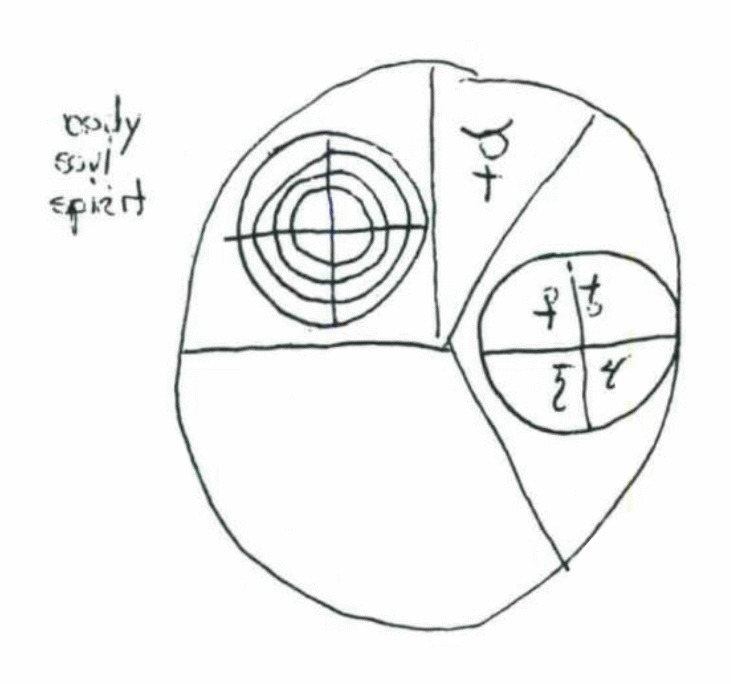
FIGURE 1981 0425-1-AB. 2nd Idea of Man Zodiac, Mercury in Sagittarius, and Body Soul Spirit in Fourth Quadrant.
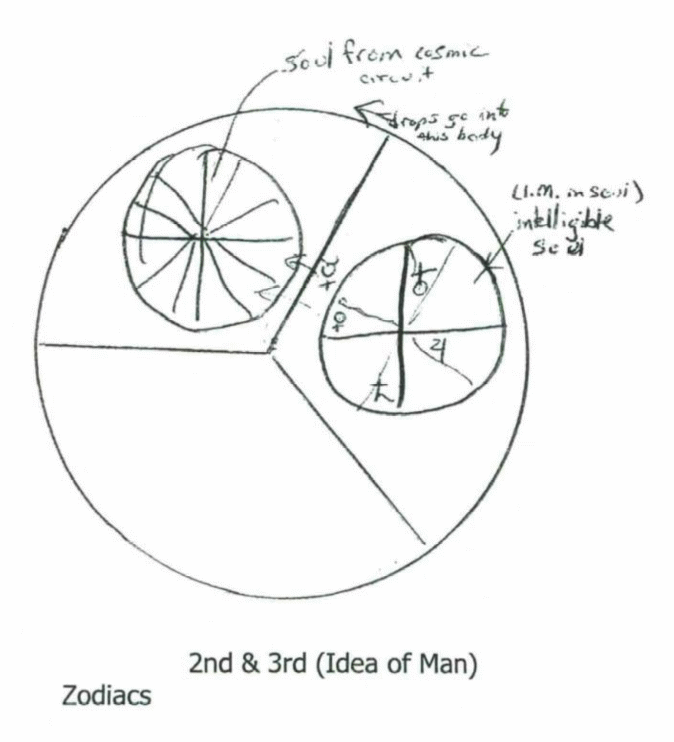
FIGURE 1981 0425-2-JF. 2nd & 3rd (Idea of Man) Zodiacs.
Other diagrams referred to are not with this transcript version.
NOTES by JF:
This class was part of a 1981 Saturday morning series on Iamblichus: 04/10 (Friday eve); 04/11; 04/18; 04/25; 05/16; 06/06; 06/13. The class date sequence shows gaps; however, other Saturdays in this time period are on Number or the Kabbalah.
Other 1981 class topics, immediately prior to PB's death, appear to have been cosmology, the Idea of Man, the problem of knowledge, Kepler, alchemy, subtle physiology, Tibetan Buddhism and tantra, Kabbalah, the history of Platonism.
On Some Terminology in the Iamblichus classes: The Cognitive Isness can be considered to be synonymous with the Individual Soul principle, the Atman, the Saturn in Leo. "Drops" of light are often referred to. As far as I understand them, these subtle "congealed reason-principles" are coming from the third or Soul quadrant down into the embodied individual; further references to drops may be found in Tibetan Buddhist subtle physiology. "Genesiurgic" is a word used in Thomas Taylor's translation of Iamblichus; Anthony speaks of "genesiurgic tendencies" as being the planetary influences.
Previously printed, distributed 2003.
TRANSCRIBED by jf 2003 from Audio Cassette tapes; reformatted by jf 2018. In 2024, IT updates prefatory matter and footer, replaces tape markers with audio file markers, alters Topic, expands Subsubjects, completes Book List, adds Plotinus quotes section, corrects typos and some listening errors, adds new notes and alters an existing note within transcript, removes one diagram and adds one diagram from AB class notes and references within transcript to this diagram, reformats to accord with new conventions. Readable edited transcript – V11r.
AUDIO FILES: 1981 0425a, 1981 0425b. [Note: "Tape" and "Side" refer to original audio cassette tapes that were later digitized into .MP3 Audio Files.]
1981 04/25 at Wisdom's Goldenrod
Neo-Platonism; Iamblichus; Soul
[Iamblichus. On the Mysteries of the Egyptians, Chaldeans, and Assyrians. 3rd ed. Tr. from the Greek by Thomas Taylor. London, Stuart & Watkins, 1968 [1821]. [Italicized quotes in text, between *"..."*, are Porphyry's questions being addressed by Iamblichus; square brackets in quoted text are in published version unless otherwise noted; minor variations read on the tape restored to text version in printed book. Pp. 1-16 of the book are the text of Porphyry's letter.]
[Audio File 1981 0425a Begins]
(shuffling around, noises, etc.; AD begins at 0:01:00.0)
AD: Well, we'll continue with Iamblichus, you know, somewhat introduction, you know, elementary introduction into (inaudible) and try to (inaudible) a sort of survey, we'll go-- we'll circle though it once before we try it twice. But, I thought you might like to hear this little-- it's a little fairy tale from Paracelsus. And I thought maybe we'd just read it 'cause it show something about what (inaudible) talks on.
AB: This is from the Hartmann book on Paracelsus in the section--
AD: These are quotes from Paracelsus.
AB: The section is called the "Electrum Magicum".
[Franz Hartmann. The Life and the Doctrines of Paracelsus. (1891, NY: John W. Lovell Company; 1963, Health Research Reprint.) Pages 300-302. Minor variations read on tape restored to printed text version.]
Paracelsus, p. 300 (AB reading): "The Electrum Magicum is prepared as follows: Take ten parts of pure gold, ten of silver, five of copper, two of tin, two of lead, one part of powdered iron, and five of mercury. All these metals must be pure."
AD: Now you have to imagine you're an alchemist, alright.
Paracelsus, p. 300, cont. (AB reading): "Now wait for the hour when [AB adds: the planets] Saturn and Mercury are in conjunction, and have all your preparations [AB substitutes: everything] ready for that occasion; have the fire, the crucible, the mercury and the lead ready, so that there will be no delay when the time of the conjunction arrives, for the work must be done during the moments of the conjunction. As soon as it takes place, melt the lead and add the mercury, and let it cool. After this has been done, wait for a conjunction of Jupiter with Saturn and Mercury (student snickers), melt the compound ..." (more student laughter, inaudible comments)
AD: Sometimes they wait 20 years. [Transcriber's comment: Jupiter-Saturn conjunction is approx. 21 years.]
Paracelsus, pp. 300-1, cont. (AB reading): "... melt the compound of lead and mercury in a crucible, and in another crucible the tin, and pour the two metals together at the moment of such conjunction. You must now wait until a conjunction of the sun with either one or both of the above-named planets takes place, and then add the gold to the compound after melting it previously. At the time of a conjunction of the moon with the sun, Saturn, or Mercury, the silver is added likewise, and at the time of a conjunction with Venus with one of the above-named planets [AB substitutes: these], the copper is added. Finally, at the time of a conjunction with Mars, the whole is completed by the addition of the powdered iron. Stir the fluid mass with a dry rod of witch-hazel and let it cool.
"Of this electrum magicum you may make a mirror in which you may see the events of the past and the present, absent friends or enemies, and see what they are doing. You may see in it any object you may desire to see, and all the doings of men in daytime or at night. You may see in it anything that ever has been written down, said, or spoken in the past, and also see the person who said it, and the causes that made him say what he did, and you may see in it anything, however secretly they have been kept."
AB: And the footnote:
Paracelsus book, Hartmann's footnote p. 301 (AB reading): "That is to say, it may come *en rapport* with the astral light which is the sensorium of the world, and in which the"memory" or impression of everything is preserved."
Paracelsus, pp. 301-2, cont. (AB reading): "Such mirrors are made of the electro magicum, ... of the diameter of about two inches. They are to be founded when [AB substitutes: at a time of] a conjunction of Jupiter and Venus takes place, and moulds made of fine sand are used for that purpose. Grind the mirrors smooth with a grindstone, and polish them with tripoly, and with a piece of wood from a linden tree. All the operations made with the mirror, the grinding, polishing, etc., should take place under favorable planetary aspects, and by selecting the proper hours three different mirrors may be prepared. At the time of [AB substitutes: When there is] a conjunction of two good planets, when at the same time the sun or the moon stands on the house of the 'lord of the hour of your birth,' the three mirrors are to be laid together into pure well-water, and left ... there for an hour. They may then be removed from the water, enveloped with a linen cloth, and preserved for use."
Paracelsus book, commentary by Hartmann, cont., p. 302 (AB reading): "Nothing in nature is dead, and alchemy does not deal with inanimate things. The old alchemists were believers in the possibility of spontaneous generation, and by the action of psychical powers they created forms in which life became manifest. They could generate living beings in closed bottles, or by the Palingenesis of plants or animals, cause the astral form of a plant or an animal to become visible again, and to resurrect [AB adds: it] from its ashes. One of the greatest secrets, however, is the generation of beings like men or women, that were generated without the assistance of a female organism, and which were called Homunculi."
AB to AD: Do you (understand) that?
AD: I was wondering if this was where Snow White and the Seven Dwarfs came from. You remember she had a mirror on the wall? (student laughter, inaudible comments)
S: She had Saturn in Capricorn. (more inaudible comments) It would be a good time to do it now, (inaudible) Saturn and Jupiter are closest. (inaudible student comments about the Saturn-Jupiter conjunction, the DR-70, etc.)
AD: If we turn to page 308. (sounds of pages turning)
Iamblichus, p. 308 (AD reading): "You say, therefore, *"that according to many of the Egyptians, that which is in our power depends on the motion of the stars."* But the truth, however, is respecting this, it is necessary to unfold to you from the Hermaic conceptions [AD reads: Hermetic doctrine]. For man, as these writings say, has two souls. And one, indeed, is derived from the first intelligible, and participates of the power of the Demiurgus; but the other is imparted from the circulation of the celestial bodies, to which the soul that sees God returns. These things, therefore, thus subsisting, the soul that descends to us from the worlds follows the periods of the worlds; but that which is intelligibly present from the intelligible, transcends the genesiurgic motion and through this a liberation from fate, and the ascent to the intelligible Gods, are effected. Such theurgy, likewise, as leads to an unbegotten nature is perfected conformably to a life of this kind."
AD: Now we read this before, and I'd like to see if we can follow and understand this. Because some of the chapters require that this is understood. Otherwise -- why don't we have a little conversation about that? (silence) A little? Go ahead, David.
DB: Well, the Intelligible Soul, that first one, he speaks of-- (AD: You have to speak up, David.) There's the Intelligible Soul I think which is the first soul he mentions, which I would guess corresponds to the Saturn in Leo, as we've spoken of the higher soul, which is--that's the first soul. The second is, I believe, the product of the circulation of the planets and so forth, which this-- higher soul descends from association with. I think he's speaking about the fabrication of the Demiurgic planets, I mean, the Cognitive Soul is --um-- making a kind of soul, which I guess would correspond to the vehicles or sheaths of the soul, that we've spoken of. But there's a question that I'm not so clear on-- that is, if that analysis is correct where he (speaks) of the descent of the secondary soul to us, um, or is he speaking of something else there?
AD: The descent, the descent of the secondary soul?
DB: Yes.
AD: Where are you referring to?
DB: Um, It's about half or two-thirds of the way through the--
AD: Read it.
DB: Um, let's see--
AD: "And the other is imparted--"
DB: Yes, um-- (mumbles to himself) (S: "These things, therefore--") Right.
Iamblichus, p. 308 (DB rereading): "These things, therefore, thus subsisting, the soul that descends to us from the worlds follows the periods of the worlds; ..."
DB: That, I think, is the secondary soul.
Iamblichus, p. 308, cont (DB rereading) "... but that which is intelligibly present from the intelligible, transcends the genesiurgic motion and through this a liberation from fate, and the ascent to the intelligible Gods, are effected."
DB: So it sounds as if this secondary soul, I mean the intelligible soul here, is that "which is intelligibly present" refers to the intellectual portion of the soul. Whereas this-- the soul that subsists, and "descends to us from the worlds" is the fabrication of the mundane and liberated orders.
AD: And what was your point?
DB: Well, Um, the soul that descends to us -- now by us I assume he means the embodied intelligible soul -- I might be wrong-- but insofar as it's spoken of as it 'descends' it seems to be the development of the rational soul within the context of the embodied intelligible soul. I might have this all--
AD: No, I don't follow you. Maybe we could try to make a diagram of it?
(drawing sounds; see FIGURES 1981 0425-1, 2 for the following)
AD: And we're speaking about a soul here which is part of the intelligible-- (DB: Yes.) --and he's speaking of a soul here which is from the cosmic circuit. (DB: Right.) (more drawing sounds) So--go on--
DB: Well, okay, you've made the distinction between the two, and he says that this second soul which is imparted from the circulation of the celestial bodies, is the one that descends to us--
AD: Well, don't hang on the word 'descend'--
DB: Okay. Alright, but let's say it's 'provided', it is fabricated.
AD: It is provided for us, yes.
DB: Okay. And, that which is intelligibly present" (which is from) the intelligible, transcends this activity. Okay. It transcends the movement of the planets and returns to the Intelligible Gods. And he speaks about that as the "liberation from fate". So the secondary soul is that-- is the fates, I mean, it's the--
AD: Yes, and what would it mean here by 'fate' now?
DB: Fate? Well, I think it's the-- (S inaudible) It's the functioning of the planets, the activity of the cosmic soul, or the Demiurgic activity. But the--
AD: We have to make it a little clearer. We would say like in this realm here, alright, we do have a body, a soul, and we'll call it a spirit. (drawing-on-backboard sounds; see FIGURE 1981 0425-1-AB) And then over here again we're speaking about soul (drawing-on-blackboard; refer to houses 5-8 of FIGURES 1981 0425-1, 2) And this soul he says is attached to or is part of the Intelligible, alright; and this soul here, alright, is part of the cosmic circuit. Is that what he's saying?
DB: Yes. (several people trying to ask a question at once) I don't know if it's worth pursuing, but it seems like this notion of the secondary soul--
AD: Now say which soul, the higher or the lower--
DB: The lower. Okay, the lower soul is actually within the context of the vehicles that are provided for the higher soul by the cosmic circuit, um, it's almost as if this soul is not given to the (mumbles to himself) the lower soul isn't given to the higher soul in-- in (inaudible/a totally) (accomplished) fashion, that it's that development which makes it possible for the higher soul to ascend from the (inaudible) fate (inaudible).
S: Yes. It isn't clear which soul--
AD: I really, I really would like to try to clarify what we're talking about. What do we mean by the lower soul?
S: A fabrication of planetary spheres--
AD: Yes, what do you mean by that?
LR: You mean, how much of the 'man' would you mean by that? like the body, (AD: Yes, what would you mean?) the intellect--
AD: Yes. What do we mean by the lower soul, or the soul of the-- that's given, that's part of the cosmic circuit?
LR: The mind-body complex.
AD: Yes. (Let's) try to amplify what we mean by that. The Soul is used in both versions. So we want to distinguish what we mean by those two--
S: (inaudible) the sensitive soul --the sensitive soul.
AD: Well, could I have more than one-liners, you know, two words or three words, could I have a paragraph?
JC: The motions of the heavens impart a certain type of light, to the animal soul, a certain essence, that has its activities entirely in the body, and these activities consist of sense, and imagination, and the appetites, the various motions called passions. It works with the imagination a lot in terms of the images we experience, it really (resides) there, in the primal sense. Um, that when you said that that was given by the heavens, that's because it's-- well-- lead me a little bit, will you? -- (student giggles; several people making inaudible comments)
AD: Well, it's only a conversation, a speculation-- we're trying to distinguish what the higher soul is from the lower soul, and (inaudible)
LR: Everything that isn't the Cognitive Isness.
JC: That's not true. (student laughter)
AD: Another one-liner.
LR: Well, I mean you could-- (AD inaudible) we've been talking 10 years about what that is! That if you say-- if you start with the higher soul, and say that's the pure soul that's united with the Idea of Man, and that provides the consciousness for all the vehicles and all the bodies within the individual, then that pretty much leaves everything else to what they're calling 'lower soul'.
AD: And what might that include, the lower soul?
S: The rational part?
LR: The rational (powers/part)--? (S: The rational functions--) The irrational parts?
JC: The five sense faculties. (AD: The five sense faculties.) And the imagination.
AD: The imagination. (JC inaudible) The five sense organs.
JC: Those would be the gnostic powers. And the five sense organs would be connected with that.
AD: All the non-sensuous perceptibles.
JC: All the mental states of anger, desire, all that list of mental states that the Buddhists give. Many of them would fall within the functioning of that lower soul.
AD: So then all the wishes, impulses, volitions, desires, all these things are part of the lower soul?
JC: Yes.
SD: Wouldn't that also include the archetypes, the psychological archetypes?
AD: Go on. Go on.
SD: It's that whole system of the functioning of the mind that builds up over countless eons of evolution. Everything that could be put in that sense of time-frame, the past vasanas, the traces of prior life functioning, all that would have to be part of this lower soul.
AD: Then you would be saying all the functioning which is based on the archetypal nature of the person-- that's the lower soul functioning?
SD: But I think the meaning that that archetypal functioning has--
AD: The interpretation of it--
SD: Yes. The meaning that that has for the experiencer, I mean, but not in any outwardly pointable way in terms of a reaction or something like that, that would belong to the vehicles-- but that inner meaning that gives it its real value, that would be coming, I would think, from the higher soul. That would be provided-- it's not just the light of consciousness which is in (inaudible).
AD: Yes, so it is difficult here to disentangle-- on the one hand, like the previous writers refer to the archetypes as the bridge that connects the sense perception with the concepts, from the interpretation of those concept. So we do have the problem. But if we just, if we-- without expecting too great a precision or accuracy, then you're saying that the lower soul, or the soul that belongs to the cosmic circuit, has all these various functionings, volitions, impulses, desires. And this is the soul that has to be very carefully distinguished from the higher soul.
LR: Could I ask something about the text? (AD: Go ahead.) Um, the division, when you said the other-- he said the one is derived from the first intelligible, and participates of the power of the Demiurge, so that's the higher soul? And then he says the "other is imparted from the circulation of the celestial bodies". And my problem is the rest of the sentence "to which the soul that sees God returns." It seems pretty clear that the division in terms of that-- unless he means by God like the World-Soul.
AD: Well, first: "the other is imparted from the circulation of the celestial bodies"--
LR: That would be the Sun in Aquarius and everything that--
AD: If we used the example about Paracelsus that would be the forms that are imparted to the matter. In other words, when there was the Saturn-Jupiter conjunction, an certain impress is made on the matter, a form is embodied, and this form is going to operate through that matter. Something like that perhaps? "The other is imparted from the circulation of the celestial bodies". So when the Cognitive Isness inhabits this body, soul, and spirit, it's almost like the soul of that Cognitive Isness, the lower soul that we're speaking about is, in a sense, really quite alien. (inaudible) it's not your soul. (LR: No?) It's not really your soul. Because you're going to have to work through that because that represents something about the karma that's being worked out-- or (inaudible)--
LR: But that's not my question.
RG: But isn't the second part of that sentence referring to the first soul? "The soul that sees God"-- the first soul returns to embody itself in (inaudible) (LR: Oh-- returns back.) Yes, in the secondary-- (then several people talking at once; LR: Oh, I didn't--)
AD: I'm sorry, repeat that.
RG: "The other is imparted from the circulation of the celestial bodies" that's the second soul to which the first soul which sees God returns to embody itself in the --in life. (S: It almost sounds as if the--)
LR: I didn't see it that way-- I was going down, coming in .
AB: You could also, it's probably (inaudible)-- The soul that sees God would return its celestial vehicles back to the cosmos, the God which created it. Now that it--
JC: Another way of looking at that is that: when the soul proper, the higher soul, is energizing rationally, you really think that the imaginative soul, the sensitive soul, returns to the heavens, because it's only with a purified body, the Augoeides, that reason filters in to it, okay, the imagination has to return to the spheres, in order to receive the impress of reason from the higher soul. And um--
AD: But suppose that wasn't so. Suppose that the lower soul, alright, does have according to this theory that we've spoken about, does have these drops fall into it (S inaudible) from the higher soul.
RG: That seems to be the-- (AD: That seems to be what?) Also from the other passage where he says "that which is intelligibly present from the intelligible, transcends the ... motion and through this a liberation from fate, and the ascent to the intelligible Gods". I mean both souls are present, and it's the higher soul that presides over the liberation of the lower soul from its fate.
AD: So then what Severin was saying is that these drops or the reason-principles which illuminate and interpret what's going on in the lower soul, alright, it's right there and then that one achieves liberation from the fate which the lower, alright, insofar that must operate with the impress of the planetary made by the planetary soul, must work out its destiny. In other words, if it's in union with the mundane spheres, and it's part of the mundane spheres, then there's no freedom for it, it simply is a result of all the prior activity, causes, and conditions. So that there's no freedom in that lower soul, it must operate according to the planetary spheres. So if you have an aspect--Saturn-Moon--you-- the astral soul must, by definition, become depressed, or let's say, be subject to those moods.
JC: When you talk about the astral soul becoming depressed by this mood, is that what you're saying when these reason-essences are injected into that animal soul?
AD: Well, the reason, the reason-essences injected into that are interpreting that astral functioning, or that astral soul.
JC: I see. So that's the connection to the higher.
AD: Yes. So that the reason, the reasoning, would be interpreting those prakritis, if we can use that term, because these-- the soul which is an astral formation, or a formation of the higher (inaudible), and which must function according to its very nature, only the higher soul through reasoning about it, can disengage or disentangle it, itself from it. But as long as we are identified with that astral soul we must, so to speak, experience our fate.
JC: But our understanding is bound to the functioning of that astral soul. Um, in reading this, I mean, he's interpreting this conjunction of the higher with the lower, it seems to me that the higher soul, the rational soul, the subjective soul, is connected with the cosmic circuit, mainly or primarily at the level of the circulation of the spheres, and from the spheres is--
AD: Well, then if I follow you-- you're saying that the Purusha or Cognitive Isness can only come into association at the psychic realm.
JC: Yes, that's the primary (inaudible).
AD: The Purusha can only be reflected in the psychic realm. Not in the body, but in the psychic realm.
JC: Yes. Primarily in that ether, they speak of the ether at that level. The light that's associated with the substance which is the celestial realm. The purified body which is connected with the (inaudible).
AD: Well, let's speak about the ordinary, unpurified, soul.
JC: See-- That's the point though. The animal soul, like when you wake up, the animal soul comes into activity at that moment. In the celestial realm that animal soul is not--um, the genesiurgic motion, the bonds to generation are broken at night when you go to sleep. And when you wake up that animal soul comes into activity again, and now you have-- your personality becomes operative, and your subtle desires become present in your consciousness once more, and you see-- There's two connecting points between the celestial soul and the animal functioning in the astral soul, and the rational soul with the heavens. (AD: I don't follow you. You say there's two connections--) There's two connecting places. There's the primary one which is the psyche itself, the higher soul with the--
AD: What we just referred to as the astral--
JC: Well, no, I was saying with the celestial spheres.
AD: Can we agree on one term? (JC: Okay.) The common sensorium of the world.
JC: When you put spirit up there, (inaudible) it is called spirit.
AD: It is called spirit.
JC: That's the celestial level. You could call it the common sensorium, that's fine, too.
AD: No, no, we better stop, because I mean something else by spirit, and I have to understand what you mean by spirit.
JC: Okay.
AD: I was thinking of the spirit more like the unity, which is presiding over the, let's say, the lower soul that is being built. I mean--
JC: (As immanent to) the higher and the lower.
AD: The immanence of the inerratic in the planetary. (JC inaudible) Yes. Because an animal or any creature that's built would have to have some unity presupposed. I mean it isn't that in the soul of a creature there could be any impulses, of any kind-- I mean there's a fabrication that is going on according to an Idea. So when an animal or a human being or anything is fabricated, it is within certain bounds. And these bounds, the totality of these bounds, are suggesting (inaudible, someone coughing) the unity of the inerratic spheres which is provided for man. So that the soul would be something less than that.
JC: You mentioned an animal per se doesn't have a vehicle that exists in the heavens. Its life is imparted from the heavens, and it exists in a pneumatic sort of vehicle, called the gross. Now are you saying that the motions of the spheres are determining what forms will be imparted that will inhabit or will constitute this animal?
AD: The soul of this animal.
JC: The soul of this animal. And I think that's what you're saying.
AD: We're saying that the idea of the creature in the inerratic spheres, the soul of the creature from the planetary spheres, and the matter of the body of that creature from the sublunary elements in the realm. And so you were saying that the point of contact between the higher soul and the lower soul would be at the level of the soul, planet.
JC: Correct.
AD: In other words, the Purusha could only be reflected in psyche or the soul. That's where the, if you want to say, contact or union between the Purusha and the lower soul is taking place.
LR: Where did you say that was, that contact?
AD: We're saying that that contact would have to be in the *soul* of the creature, not in the *unity* of the creature.
LR: The psyche meaning the planetary spheres?
AD: Yes.
LR: In the 12th house?
AD: Yes. You could use either example. 12th house, then you'd have to have the inerratic sphere, planetary spheres, and sublunary sphere.
LR: Or the vesica.
AD: Or you could think of the 11th, 12th. But in either diagram-- one is paradigmatic of the other-- in either diagram what I think we're trying to say is that-- and what we're trying to distinguish, is that the creature which is fabricated in the universe and is part of the universe has these three things or three constituents supplied to it, alright. A body of matter which comes from the very planet that he lives on, alright. The impress of the circulatory systems into that matter, alright. And the organization of all that by a prior principle, the inerratic sphere. So that you'd have some sort of Salt, Mercury, and Sulphur combination. Or body, soul, and spirit.
S: Are you saying what you've just described, describes the content of the higher soul with the lower soul?
LR: No.
AD: No, I'm trying to see where the higher soul makes a connection with this. What we're calling what's going on in the cosmic circuit. In other words, this soul here, alright, in this realm here is associated with the cosmic circuit, and the entity that's fabricated for it. Now the entity that's fabricated, the creature that's fabricated in this realm here, is a part of the destiny of this whole cosmic circuit. I mean it has an origin, it has a period of time, and that would apply to all of them. Alright, and you remember, we spoke about these as fabricative and gnostic, (drawing on blackboard) okay. So over here the creature is supplied. In other words Plotinus would say this is the 'organized body', alright, the organized living body. And then a light is imparted to that body by the soul. [Note: See Plotinus, I.1.7.] And this emanation of light from the soul in no way diminishes the soul, reduces it in any way. But this light which is imparted, alright, to this creature here. Now this creature, we're saying, is supplied with these things.
S: The vehicles.
AD: Yes, these three, okay. (LR starts to say something)
S: Excuse me, Linda-- Well, there's a line here we skipped, which is that the higher soul "participates of the power of the Demiurgus".
AD: Yes, well what about that? (drawing on blackboard sounds)
S: Well, what I was wondering there, does that imply that that higher soul in some way is organizing those vehicles along with the Demiurge? In order to, let's say, provide--
AD: That may be so, but I don't think it's relevant right now. In other words, you're saying that the soul cooperates with the Demiurgic powers to produce its own body. Or it could be accompanying that. Yes. That may be so but that-- that's not what we wanted. What I want to work on is the distinction between these two.
LR: Are you still maintaining that the higher soul is just the pure light?
AD: Well, we said that these drops go into this body, alright-- and-- (LR: Um--) Go ahead.
LR: I don't know what you mean. When you divide, when you separate off the higher light from the Purusha--
AD: We didn't separate it. We said that it never was like that.
LR: And you distinguish it. (AD: Distinguish?) Distinguish it from the lower soul. What you're describing is the higher. Is it the pure consciousness alone?
AD: No. No. We would have to think of these here. (a few more drawing sounds) The light which is imparted by the soul to an organized body. Now this is an organized living body, created or fabricated by Nature. This light or these drops of light go into that vehicle. This vehicle we said was constituted of that. So that these drops would have to be dropped into that.
LR: Where-- You're talking about the Mercury?
AD: (assents)
LR: Then you're saying that's part of the higher?
AD: I didn't say it was part of anything. If you notice its peculiar situation--
LR: Yes, it's in-between.
AD: Yes.
LR: And we've spoken of it before as the evolution of the highest point from the universe.
AD: We're speaking of this here as the drops of light that go into this body.
LR: My question is about--
AD: Into the subtle body.
LR: Okay. But my question is about the higher, in this two fold--
RG: It's at least Jupiter, Saturn, Mars, and Venus [detriment planets of Leo through Scorpio; refer to 2nd third of FIGURES 1981 0425-1, 2]. In the diagram. In the soul ring that we're talking about. In the second third.
LR: And what would you include in that?
RG: That's the constitution of the higher soul in this.
LR: No, instead of telling me the planets, I mean, what would you include in that?
AD: That would be the Cognitive Isness, the Six Demiurgic Forces or Powers that are going to (make) Nature, and the Essences combined with that, and its participation in the Conception of the Universe [Ideas 5-8]. That would be the higher power of the higher soul. But we're not talking about that, I don't want to talk about that. I want to talk about the lower soul. I want to recognize within myself, that when a mood arises within me, that only these reason-principles, these little bubbles, these little drops of light, they drop into the subtle body and explode into this infinite light, into the subtle body, illuminate, alright, and get either colored by the subtle body's contents, or interpret the subtle body's contents. And that's what I want to concentrate on. I'm interested in, also, you know, trying to get us some background into what we have to do in Buddhism. Otherwise these drops will be like Ehrlich's magic bullet -- the cure for everything. (student snickers) Go ahead, David.
DB: Well. The last sentence that we were working with, when he speaks of this "liberation from fate, and the ascent to the intelligible Gods is effected." Is that liberation that he's speaking about from the point of view of the second soul, the lower soul? That through the transcendence of the higher soul to um, the "genesiurgic motion," that there's a liberation from that motion, of the secondary soul?
AD: Yes, that's what we're talking about. (DB: Yes, so--) But I'm more interested in seeing if we have some feeling for what this lower soul is.
LR: Are you saying that there's a twofold action of that Mercury in this point of view. That at one and the same time it illumines the fabrication of the contents, but spinning off of the wheel of fate. And at the same time it brings back the meaning from that? I mean it drops-- (AD: Go on-- ) Well, it, I thought you were saying it has a twofold purpose, of illuminating the whole lower nature, so that one could have any experience (of the universe).
AD: The lower soul.
LR: Yes. And it also interprets the experiences of (that).
AD: Alright, now these are two aspects of one thing. The light permeates the whole of the subtle body, and it's interpreting that subtle body.
LR: Right.
AD: Interpreting in the sense that these drops of light are embodied reason-principles. (LR: Right.) Now, again this may sound a little fantastic but, what the hidden properties of light are is something like for instance-- Remember when we were discussing the Hymn to the Sun, and he speaks about the Sun as concreting the forms in the matter? [Note: See Julian (Emperor of Rome), Thomas Taylor (tr.), Two Orations of the Emperor Julian; One to the Sovereign Sun, and the Other to the Mother of the Gods.] In that discussion there, you get a feeling that in the light, intrinsic to the light, constitutive of the light, alright, are these essences, alright, which, when they reach, let's say, the Earth, they do--
(Side 1 of original cassette tape digitized as 1981 0425a Ends; Side 2 Begins)
AD: --(instances) of light and they become more and more stronger and intense. So that through concentration, so to speak, very intently or intellectualizing dianoetically, you grasp the reason-principle of something, you return to this light. It is this light we're talking about. You have the Shrine of Wisdom with you anyone? Robert? (S inaudible) Alright, never mind. But you could read the quotation for yourself, we read it enough times, I mean you should be practically memorizing the (language).
CdA: (inaudible)
AD: I'm sorry?
CdA: Which one?
AD: Avicenna.
CdA: Avicenna.
AD: You'll also find it in his metaphysics, a more extended discussion about that. But also we discovered that when we were speaking about the appearances of the Gods in mystical states. These ideas, which, if we trace the origins of these ideas they-- it will take us back into this light. If one thinks that that's it he's, you know-- well, let him stay there. But if he *goes on* with that, he will eventually come to what they call the Pure Light, the transcendent Light, which is *nothing* like the light that you reach(ed) when you go back to the reason-principle. But anyway, that's all irrelevant right now. I assumed that you kept that in the back of your mind for the past few months. And we're saying that these drops which are dropped into the subtle body, or into the soul, can 1) either conform to the fate which is prescribed for it by the celestial heavens, or the movement of the celestial heavens; in other words, that's it, as far as that soul is concerned he's submerged completely in that identification with this body soul and spirit. Or [2)] he could start distinguishing himself from that, begin to feel like the Cognitive Isness, the Soul that's within, is *other* than the moods, the feelings, the appetites, and all these things that come about. And if we can see this, you've seen a capital point. I mean if you could see that when you look at the ephemeris and you got Moon on Saturn conjunction you're going to be depressed, and you're going to say "Well that will be the nature of these prakritis to operate this way. I don't have to identify with them by the"I" and (remain) the illuminating consciousness of that situation. So the *higher soul is not subject to fate* even though if it's going to break its leg that day it'll break its leg. Because he's cut the root identification off. There will be a fate for the body which cannot be avoided, not for the soul.
CdA: But how, if that identification isn't broken, how is fate going to affect the higher soul anyway?
AD: If it isn't broken?
CdA: Yes, if its identification with the lower soul is not broken, how would the fate of circumstance affect the higher soul? Anyway--
AD: How will it affect your soul?
CdA: Well, you said that if the, if this identification is broken that--
LR: That identification?
CdA: Pardon?
LR: I think he just means that identification, in other words you choose to identify or not.
AB: But Carol was saying if you *do* identify, does that affect the higher soul?
CdA: The effect on the higher soul. If the-- which is the state most of us are in, you know. Is there an effect upon the destiny of the lower soul and the higher soul?
S: The higher soul would still be free from fate. It doesn't ever descend completely.
CdA: But that's what I'm asking.
S: But you wouldn't have the benefit of--
AD: That's all theoretical.
CdA: Wait you just implied that it's all-- the only reason I asked--
AD: Yes, but that's all theoretical. What would be the result of identifying with the body, soul, and spirit which is provided the planetary circuit?
CdA: Well the result is that there's ignorance, that there is no--
AD: In one word, wouldn't you say suffering? (student chuckles) And if there is an increased, an increasing detachment from that, alright, then let's say there would be an elimination of mental-- not necessarily physical because physical -- you can't jump over that -- but there certainly would be a decrease of the mental anguish. So if I have to go to the dentist tomorrow morning to get a tooth pulled, I don't have to be concerned and worried about it for the next 12 hours and be in mental anguish, if the physical pain takes one minute. Alright, then, I don't know if we see the distinction between the higher and the soul but it's one that you're going to have to conceive more and more carefully and think about very-- you know.
JC: Anthony, this question. Something that's still not very clear in my mind, I could see that the motions of the planets in a way determine, well, they determine the types of moods you have-- Are you saying that the motions of the planets impart the drops into the animal soul--
AD: The motions of the planets?
JC: Yes. You said before the motion of the planets is what-- (that) is determined by-- (concerned) constructing the soul, the animal--
AD: Yes.
JC: The animal soul.
AD: Let's say the astral soul, okay?
JC: The astral soul, good. Um, now what I'm wondering is, the motions of these sphere, the planets, are dropping--
AD: Uh-uh.
JC: They're not-- you don't want to say those are the drops?
AD: No. No, the drops are coming from the higher soul.
AB: Into that sphere.
AD: Into that celestial fabrication.
JC: Yes, that's what I mean. Into the celestial pre-- well see-- That's the point I'm not clear on because, if you say the celestial fabrication, the celestial motions, are determining moment by moment the activities of the animal-- of the astral soul, then there's got to-- there's a connection there, I mean--
AD: There's a connection there with the body, yes. Yes, of course. Fine.
JC: No, there's a connection with the animal-- the astral soul.
AD: 'Cause the astral soul and that animal body are connected, yes.
JC: Yes. And what's governing the activities of that astral soul are the motions of the planetary--
AD: Yes.
JC: Okay. So there's some communication there.
AD: Oh definitely. Definitely.
JC: (There's) certain aspects form and then the astral soul reacts in certain ways, or--
AD: Uh-hm, and vice versa, okay, yes.
JC: Now, aside from the planetary motions there's also the Cognitive Isness (AD assents) that's connected with this process going on.
AD: And that connection is provided through--
JC: You're saying through these drops. (AD assents) To me, that ordered sequence of drops going into this astral soul would be the concretion of the intelligence of the stars forming that astral soul.
AD: Well, alright, that's your interpretation. That's not mine.
JC: Okay, but I'm saying those drops are ordered by the given set of the heavens at any moment.
AD: Yes, that's your interpretation.
JC: Okay.
AD: In other words, in other words, when you put together the copper with the other metals, you're saying that there's drops going into it.
JC: Yes, there's some (inaudible).
AD: And I'm saying no. No, the drops are coming from the *Cognitive Isness* into the already fabricated body, soul, and unity of them. (JC: But-- Okay (inaudible).) In other words, in other words what I'm saying is that the-- that Nature gives the soul a body that is *already organized* in terms of its matter, in terms of its vital functions, and in terms of the unity of the idea which is presiding over it. This is what Nature gives you. This is incorporated and in union with the planetary system. This is *not* the Cognitive Soul. The Soul now has to insert those drops into it to reveal to itself the experiences that that body is going through. Either through reasoning, you know, in which case it interprets what is going on, or submits to what is going on.
JC: Now, I would say that that connection of the Cognitive Isness is primarily at the celestial-- at a level of the planetary circuit, that that's the level, there are drops (inaudible)--
AD: Yes, we are saying that-- I am saying that the drops enter into the realm of the psyche. The connection of the Cognitive Isness is through the astral soul. Because these drops are drops that are going down into the astral body. When one meditates he sees these channels, he localizes them and thinks of them as in some part of the body. They are not in the body, they are in the *subtle* body. Which is [sic] already been granted to us by the System. You follow? (LR assents) Okay. You can interpret it your way, but this is the way I'm interpreting it so--
JC: (inaudible)
AD: Hm?
VM: I don't understand, I would love to hear it all again. I'm sorry, Anthony, but-- I know this is an important point, it seems like I missed it. (inaudible student comment) I mean you've been very (inaudible).
(inaudible student comments)
AD: Well, we're not going to go through it again. (inaudible) (students shuffling around, inaudible comments) Yes.
PF: You said before that the light coming from the reason-principles, that the--
AD: The light *is* the reason-principles.
PF: Was the reason-principle, okay, you said that that can even be overpowered by the subtle body (AD: Yes.) or can conform-- well (inaudible).
AD: And in which case, alright, it acquiesces to the content of the subtle body. So if your subtle body is overwhelmed, let's say, by certain tendencies, alright, that light submits to them. Look, everybody knows that they can rationalize. Okay? The light has submitted.
PF: Correct. If-- what determines-- is there anything in particular that determines whether this-- how this will go, I mean whether this light will be overpowered or (inaudible)?
AD: Yes. You want to speak to someone else. Alright, we'll go-- (several people trying to talk at once) I think it's relatively simple, it'll get more complicated.
PF: I didn't understand (inaudible)--
AD: When we get into more detail.
PF: --meditating and perceiving certain channels and stuff, I missed all that.
AD: Well, what we're saying is that this soul here, the higher soul, the Cognitive Isness, alright, has a body prepared for it by the cosmic circuit. This body is going to include the substance which comes from the sublunary spheres, or the earth itself, alright. The soul, over here, the soul would be, let's say, a portion of the common sensorium, which is applicable and meaningful for that body's functioning, alright. And the spirit would be the unity that is manifested through these two. Alright, now in terms of these three here, we're saying that this would constitute the creature which is fabricated by the cosmic circuit. Now, the higher soul, the soul which is not subject, (someone coughing) which is not subject to fate, this higher soul, the relationship of this higher soul to this soul here or to this creature here has always been a bone of contention. You remember, you asked the Samkhyans, well what do you mean, the Purusha is reflected? And they give you the triple reflection theory, the double reflection theory, and the single reflection theory. But the problem is like left unexplored; they don't want to go into it or those who know maybe don't want to write about it. And I think you'll find that this is a problem in almost every tradition. What is the connection between these two and how does it take place? Now Plotinus gives a hint. He speaks about the emanation -- I don't remember the quotation, do you remember it? -- any of you?
CdA: A light--
AD: Well, that was I.1.7, but there was another quotation (S inaudible) where he speaks about the soul emitting, alright, from within itself, a power or a-- and that this power in no way diminishes or decreases or affects in any way the authenticity of the soul. It doesn't so to speak now become this creature here. There were two or three quotes? (S inaudible) You know it?
S: About the intermediate?
AD: The intermediate.
RG: Yes. We read this last night. (AD assents) (S inaudible)
Plotinus IV.4.23 (RG reading): "... for the Soul is immune from experience; there must be a third, something not thus exempt; and it is this intermediate that accepts the impressions of shape and the like."
AD: No, that wasn't it. That's alright. (LR inaudible) That's one of them but-- the one that really packed a lot is where he speaks about the emanation coming from the soul, and he speaks about it in a certain-- in such a way that you know it's the drops he's speaking about. I think Carol was telling me she was reading the article of Keats on Zen where he had the recognition of the drops. [Note: See Richard P. Benton, "Keats and Zen," Philosophy East and West, Vol. 16, No. 1/2 (Jan. - Apr., 1966), pp. 33-47.]
CdA: It was (inaudible) (AD: Huh?) (inaudible)
AD: You know, think of a puddle, a pool of water, okay, and you drop a pebble in it and it ripples throughout the pool, alright. Think of the puddle as dirty or clean, alright, and accordingly that's the way it's going to be interpreted by those drops. But anyway, to get back to the point, so this here, the drops here, and usually, this is very beautifully represented as the caduceus, you remember. (CdA inaudible) And this is always a (bulb), it's a combination of the positive and negative forces which is achieved here, alright. This is an actual experience, I mean you actually see the positive and negative forces combined in you, the male and the female, and one now thinks he's an androgyne. So that symbolic of this here, alright, because these drops do travel through that [central] channel, these channels here. That's why they refer to the spinal column as a reflection of the whole universe, takes place in the spinal column. That's why I call this a television tube. (student giggles) If there's any damage done to this here, you're in trouble as far as-- I mean if you wanted to develop any occult powers. So, like you could break spine or the neck or something and from then on there's a malfunctioning in you. But at any rate we're saying now these drops here, alright, get inserted into this area of the entity. Because if we think of this as a light, as a light principle, if we think of the reason-principles as light, the thing that it could be most closely associated to would be the functioning of these, of the system here.
LR: Anthony, one more question about this. Before-- (inaudible) but, for a while we were speaking about the Mercury [in Sagittarius] as the culmination or the purification of the subtle vehicles. In other words you were seeing it not only the way you are now, which is coming from the higher soul. Right now it seems like you're speaking of the aspect of it as representative of the higher soul, putting reason-principles into the lower. Right?
AD: Yes.
LR: You've also spoken-- and I don't know if this is a change--
AD: You have to remember sometimes it's a submission too that's enclosed in those light drops. I mean someone, a person has to go through the experience of being a criminal, (LR: Oh.) and the drops of light will see to it in that direction. Because we're saying that these drops of light are ultimately like congealed or precipitated out of his participation in the subjective vision of the soul and--
LR: And that would be the true carrier of the fate. (AD: Huh?) That would be the true bearer of the fate. But, I mean, no matter what you're doing if the particular reason-principles that are allotted to you are of a specific nature then that's the true bearer of the fate, I mean (inaudible).
AD: Yes because ultimately-- ultimately the way you interpret what's going on in the cosmic circuit is from there.
LR: Okay. That wasn't exactly what I was asking you, can I repeat that (again)?
AD: Yes.
LR: You're also speaking of an aspect of the Mercury as the Bodhicitta or the refinement of the subtle bodies, the culmination of work done on the lower vehicles (inaudible) or those refined vehicles coming from the other direction, coming from the lower towards the higher soul. Could you still describe that--
AD: I'm sorry, I don't understand that, coming from the lower to the higher.
LR: Um, see, I think I've missed a portion of this (discussion) that led to this definition of the Mercury. What I remember (inaudible) is that the Mercury as a refined vehicle of the soul, or the lower soul. But once the lower nature is really converted to a certain amount or degree of rationality, that result is a purified vehicle, what they call the Bodhicitta-- and that is represented by the Mercury.
AD: No-- the Mercury, as far as I understood it, is the Bodhicitta. (S: That's what she just said.) No. I don't understand it that way, I'm sorry. (student laughter) I got good excuses today, Tim, right? Astrologically, yes. You want to say it again? (LR: No.) Try.
LR: No. No that's fine. You think that's the bodhicitta? Alright, one more time. (student giggles)
AD: Go ahead.
LR: Does this Mercury going through the-- can this Mercury be seen as coming from two directions? One from the higher soul representing the messenger which brings the reason-principles down into the lower vehicle.
AD: Yes.
LR: That's one.
AD: The lower soul, yes.
LR: The other is as a purification of the lower vehicle into a subtle-- into a refined vehicle known as the Bodhicitta.
AD: No. You don't reverse the process.
LR: So the Bodhicitta, you're saying, is not a result of refining that lower?
AD: It's not the result of refining the lower, no it's not.
LR: It's something brought from the higher.
SD: Anthony, then what do they mean by the "arisal of bodhicitta"?
AD: You ask them [Buddhists].
LR: No, well no, in that case-- I mean, either way it can make sense, it's just (inaudible) like this-- in that case, the arisal of the Bodhicitta would a recognition of the higher once the lower was somewhat disciplined. It just wouldn't be a result of the lower.
SD: I see, it's not like it's the transformation of the lower but simply the lower was gotten out of the way so that you could see that the Bodhicitta (LR: Yes.) has always been there.
S: Uh-hm.
AD: She did ask them.
VM: Anthony, it's difficult for me to make a distinction between, let's say, the traces of life lived, the vasanas, the psychic structures in the lower soul and these congealed reason-principles. Somehow I don't see a clear distinction between those. (AD: Say it again.) It's not easy for me to make a clean distinction between, let's say, these traces of life, whatever you want to call them, archetypes or vasanas or psychic tendencies, I can't in my mind distinguish clearly that from these congealed reason-principles (inaudible).
AD: Yes, but the congealed reason-principles are ordered, let's say, by the fabricating soul. (VM: Which we--) The vasanas, or the traces left in life, alright, these in themselves have no rationality in them, it's the reasoning principles that orders and structuralizes not only their functioning, but (to what ends) that functioning is to take place. So the vasanas or traces of life-- you're speaking simply about-- (VM inaudible) --you're speaking about the functioning of protoplasm. In itself, in itself, there's no rationality inherent in it, from what I understand. Whereas it is reason-principles that do interpret it. So if we say that the archetypes are like the traces of all of humanity's prior functioning, alright, and they're left behind in the common sensorium, and then they're used again to fabricate the soul of an entity, these in themselves are not capable of interpreting what's going on. That doesn't mean that they don't function, they do function. I mean, the reactions, instinctual or otherwise, would be just as natural. But whether it's *rational*, alright, it's not in their domain. And that's why I didn't agree, I didn't agree with Jung, you know, about that. Because I didn't think that the ultimate arbitrators of human destiny were the archetypes. But the soul determines and reads off those archetypes.
VM: He would invest the meanings right in those vasanas or those archetypes.
AD: Yes, not only that. Also from what I understood of Jung, and it's-- I have difficulty changing my mind about it because every time I read him it just goes on getting more and more (concerned). But I'm hoping to get disillusioned. And that was that the-- when he speaks about a subject, it's nowhere in the 5th house. We're speaking about a subject in that fourth quadrant. It's always a psychic subject. (VM: Yes, sure, yes.) And this is no subject to me. (VM inaudible) Alright. And if this confusion could exist there, I think it's obvious that, you know, unless we make it very clear what he's talking about in Chapter VI with Iamblichus [p. 308 on the two souls, read above] we may be confused or think that he doesn't know what he's talking about, and I think he does. Now of course you've heard other versions like seven souls, you know, some day a history of seven souls will be written. Well that will be like speaking about the human being as composite of all these sheaths, you know. That would be a different way. Or sometimes a tripart division of the soul, and that would be like one, two, and three, that way. Or sometimes the tripart division of the creature. So every time that they use a number, you know, don't take for granted that they know what they're saying or that you understand what they're saying until you tear it down. I've learned not to accept anybody anymore. I just become a weary (spectre). (S inaudible) (student assents) Alright, let's continue to the next chapter, okay?
AOC: Can I-- could I ask a-- If the higher soul is [sic] not submit to the (inaudible), and were to gain like the meaning of each experience, would it be that it would-- it would be like the same light that it would draw back, or would it be that contained in the light would be sort of an unembodied meaning for each experience? It would be like experiencing that particular meaning of the-- whatever experience it was. Like the reason-principles are-- that are carried in the light, the light is like one unified, um, well, substance, for lack of a better word. (AD: Alright, go ahead.) And would it be that being in that position of the higher soul, that it would just draw back into the same substance or would it be that with each experience there's a particular-- I can't speak of a part of the light but particular essence within the light?
S: No.
AD: I'm sorry, still don't understand Amy, go ahead.
LR: Amy's asking, if, when a soul puts its light into -- she's asking the converse, going in the converse direction, when the soul enters the higher soul, something of the higher soul enters and brings the reason-principles, it doesn't get stuck there. But even if it did it really wouldn't matter. What does it take back with it, from its experience there? Does it remain uncontaminated totally and does it remain in the unified light, or is there actually something from the lower that it takes back?
AOC: When you're talking about-- in some ways when you're talking about interpreting the experience, and I'm not sure what you interpret, what the interpretation is, I mean it obviously goes through the experience, whether-- it doesn't have to go through mental anguish, but that there is some meaning, some particular meaning that is contained within those reason-principles.
AD: That there is some interpretation of the experience in the cosmic circuit which is divided by the reason-principles. I understand that part.
AOC: And that this, the detachment from like, getting like submerged by it-- (AD: Yes.) --that if you could take the higher perspective, um, what is it of the reason-principles that you're experiencing? Is it just the realization that you are the soul?
AD: Well, you would *approach* the realization or actualization of soul proper. In other words, the more in conformity to the reason-principles from the soul, the more conformity there is to those reason-principles, then supposedly the closer the approach to the higher soul. It's possible, but the reverse wouldn't work if we deviated further and further away from the reason-principles interpreting what is going on and our refusal to accept that. Then we get further and further away from the realization of ourselves as soul.
AOC: You mean, so that the reason-principles, say for each particular soul, like there was one, that there was one particular reason-principle presiding over each individual soul, if you were more in conformity with your own reason-principle, then it would be sort of um--
AD: It would be like there would be more *presence* of the soul in you while you're operating here. But a rejection of that would be less presence of soul.
AOC: So that would be like what in that letter, we talked about cooperating with the-- cooperating with the (inaudible)-- really living your own life in accordance with your own reason-principle.
AD: But you have no choice, you're going to cooperate with the cosmic circuit.
AOC: No, but one would be getting, one would be getting pushed around by it, one would be going through experiences and getting knocked around. So that you would be (inaudible). And one would be like a knowing.
AD: That you're getting pushed around. (student laughter)
AOC: Knowing or knowing (inaudible) like a meaning. (laughter continues, inaudible student comments) He wouldn't be getting pushed around, he wouldn't be--
AD: Oh, yes, a sage could even have very unfortunate and unhappy experiences. Unhappy in the sense as, you know, to the comfort and discomfort of the body and life in the cosmic circuit.
AOC: Oh yes, I don't mean that it would be all happy but I mean it seems like it would be a *knowing* that that was-- like there's some kind of intelligence in what happens.
AD (hard to hear): (Not true.)
S: (Is that all?)
AOC: Yes, I (inaudible).
VM: Can we understand if there's any evolution or growth of this higher soul or is it all the growth and evolution only occurs in the lower soul?
AD: No, when we say growth or evolution of the soul, what we're meaning is this actual-- the realization of the Self.
VM: Realization of the higher in the lower. (AD assents) So when Plotinus says "Our way is to teach our Soul," the teaching is the lower soul. (AD: Yes.) We're teaching the lower soul?
AD: No--
VM: I couldn't help it to bring it in. (LR inaudible) I think it's in part what Amy asked, I'm not sure. And if it's a bad question--
AD: No, no.
VM: Would it be that the higher soul--
AD: Would you quote the whole thing?
VM: No, I don't have my-- (several people talking at once)
Plotinus V.3.6 (LR & VM reading; several people parroting phrases of the quote when it's being read): "Our way is to teach our Soul how the Intellectual-Principle exercises self-vision; the phase thus to be taught is that which already touches the intellective order, ..."
VM: So it already touches the intellective order-- (S inaudible; S: The whole phase--)
AD: I think what we said was that the purposes of the experiences of the soul in the cosmic circuit is to precipitate it out or to differentiate it from the All-Soul, so that it becomes individualized in its own right. So if we don't teach it, alright, that it must act in accordance with the vision that the Intellectual-Principle has of itself, that is, the sensible world, then it certainly isn't going to approach its own heights, or be differentiated out from the souls. It's really (inaudible) nobody (inaudible).
S: The vision that the Intellectual-Principle has of itself, you said is the sensible world?
AD: Yes. The Intellectual-Principle has a vision of itself. That vision of itself is the sensible world. Where have you been with the Plotinus class? Remember -- he, it goes through a series of steps where ultimately he says that Nature in contemplating the sensible world drops off (inaudible, someone coughs) its contemplation. Alright, and then you have to bring up the soul. And then you have to bring up the soul to the Intellectual level. [Note: See Plotinus, III.8.] But when the Intellectual-Principle vision-- envisions itself, or has a vision of itself, we don't say that right there and then the sensible world springs into existence, but through this series of logoses [sic] that it comes into being.
S: Oh, that's that you mean--
AD: No, that's what Plotinus means, that's not what I mean. But it always has to be through this ordered sequence of hypostases. Nothing can-- in the Platonic system, things just can't happen any place, any time, any way. Read from the chapter, would you?
S: Ten?
AD: I thought we'd get through the book. Go right where we left off and continue. (RG: I have one more--) Go ahead, go ahead. We all have a problem, one more, one less.
RG: Now I don't understand this liberation from fate any more, because now there are two fates we've talked about. There's the fate given by the objective soul, and then there's the fate that's unfolded through your own, from the reason-principles, through these drops of light. Right? (S: Say it (inaudible).) Well, that's what your soul is unfolding, it seems.
AB: I think it's clear from the context that the "that which is intelligibly present ... transcends the genesiurgic motion ... and through this a liberation from fate, and the ascent to the Gods." And so the destiny which is imposed upon you from within the cosmic circuit does not affect the higher soul in anything.
AD: I think that what Richard is saying, is that it seems that you have two orders of Fate here, (RG assents) there's the one in the cosmic circuit, and there seems to be an ordering interpreting what's going on in the cosmic circuit from the reason-principles (inaudible).
RG: Yes. And also the unfoldment of certain experiences, it seems, is from, as you said, from these drops, (that are these) congealed reason-principles.
AD: Yes, that's interpreting that cosmic circuit. But the experience of the drops is not as Fate.
RG: No? But even if you don't experience-- aren't--
AD: It's not like Fate. In the cosmic circuit there's always the experience of a certain compulsion, the experience of something 'other' forcing you do to these things, okay. But the other one is not like that at all, there's no compulsiveness. (RG inaudible) There's an absolute, you know, accord with it.
RG: But that's not fate--
AD: That's not Fate. It is pointed (inaudible); from another point of view, a higher point of view, you could say that that is a kind of Fate. But not the way that Fate was generally spoken of.
RG: Yes, so in this article, deliberation--
AD: You can experience that-- sometimes. I'm not free, now I gotta do what he wants. It's very peculiar. Until you can see that that's the only possibility. Alright! Let's read the next chapter! (Read.)
Iamblichus, pp. 309-10 (AB reading): "Hence that of which you are dubious is not true, *"that all things are bound with the indissoluble bonds of Necessity,"* which we call Fate. For the soul has a proper principle of circumduction to the intelligible, and of a separation from generated natures; and also of a contact with real being, and that which is divine. *"Nor must we ascribe fate to the Gods, whom we worship in temples and statues, as the dissolvers of fate."* For the Gods, indeed, dissolve fate; but the last natures which proceed from them, and are complicated with the generation of the world and with body, give completion to fate. Hence we very properly worship the Gods with all possible sanctity, and the observance of all religious rites, in order that they may liberate us from the evils impending from fate, as they alone rule over necessity through intellectual persuasion. But neither are all things comprehended in the nature of fate, but there is another principle of the soul, which is superior to all nature and generation, and through which we are capable of being united to the Gods, of transcending the mundane order, and of participating eternal life, and the energy of the supercelestial Gods. Through this principle, therefore, we are able to liberate ourselves from fate. For when the more excellent parts of us energize, and the soul is elevated to natures better than itself, then it is entirely separated from things which detain it in generation, departs from subordinate natures, exchanges the present for another life, and gives itself to another order of things, entirely abandoning the former order with which it was connected."
AB: I think that applies to the discussion we were just having about fate and what is subject to fate, as he's using it here.
RG: I don't see that that passage doesn't refer to all levels of fate. (AD: Speak louder.)
AB: Well, when he quotes from the letter [of Porphyry] *"that all things are bound with ... Necessity,"* and he seems to disagree that in saying that the higher soul is not bound by necessity, and that through aligning itself with the energy of the Gods, it transcends the imposition of the cosmos.
RG: But I don't also see that it doesn't also refer to the imposition of reason-principles from the soul.
AB: You're saying that you could read it 'Fate' either way.
RG: Yes.
AB: But could you transcend the higher fate? (RG: I don't know.) Like I thought then, that you transcend the lower fate is really when you have to do what the higher one is telling you.
S: It seems like the injunction that he's giving there is to precisely avoid what you're saying. He clearly distinguishes Fate or what's going to be determined strictly as a natural process subject to the planetary spheres, and um, I think he's saying that the higher can't be perfectly fate, and you'd have another term, you'd call it Providence.
RG: Yes. Though it depends on how you read the higher soul. That, I mean, "through which we are capable of being united to the Gods, of transcending the mundane order, and of participating ... [in] the energy of the supercelestial Gods." How would you interpret that? At what level is that union happening? (S inaudible) Of transcending the reason-principles, or not?
S: Well, my suspicion is (inaudible) I say it could be the level of the rational soul. But it would be the rational soul, as following the distinctions that we made before. He said, that either-- let's say, it's on the side of interpreting the way those reason-principles are manifesting according to fate rather than being colored by them, that you would be following the higher soul. I think the operative level for the individual would be would be the rational soul, (and go right to the) completely transcending. So it might in some way still be subject to um, you know, let's say what's in the fourth quadrant, but it wouldn't be, subject to fate in that way (inaudible).
VM: I think that he's trying to build on the previous distinction of their being a higher soul and a lower soul. And the lower soul is the one subject to fate, the higher soul is the one that has the capability of being--
AD: --subject to Providence.
VM: Subject to Providence, if you want to use that word, freedom from generation and the compulsion of the circulation of the planetary spheres, is through *that* soul that eventually one can make contact with the Gods or the Intelligible principles. And what I got here is that the Gods, there's two levels of Gods, if you like, although in some ways, they would say they're unified, but the Gods that we worship in temples, those are the lower orders of the Gods, and they in fact are the completion of fate, let's say they would be the principles which would work through the planetary spheres and force the spiritual.
CdA: He's saying no. He's saying no to that.
S: He's saying (inaudible) dissolve it.
VM: Well wait.
AB: Wait, he says--
VM: I'm not sure of that.
S: (inaudible)
S: Go ahead.
VM reading Iamblichus: "*"Nor must we ascribe fate to the Gods, [VM repeats last phrase] whom we worship in temples and statues, ..."*"
S: This is tangled up here.
JL: This is from the letter [from Porphyry].
AB: Yes but--
VM: Well--
AB: But if you go to the end of the paragraph, the Gods that you're worshipping transcend the mundane order and are supercelestial. So I think you could make the point that the lower fate is exercised through the planetary motions and therefore the Mundane Gods and the--
VM: The Mundane Gods are the executors of Fate. (AB: But--) The higher Gods are the ones that help liberate the--
SD: Transcend.
VM: That's what I'm trying to get at, that's the other (phase).
RG: But according-- according to that interpretation, if the fate is only unfolded in the planetary spheres, and the planetary spheres are purely the objective soul, what link is there for the subjective soul? Then what--
AD: I'm sorry, what link?
RG: What link is there to the subjective soul? I mean, each person's experience--
[Audio File 1981 0425a Ends]
[Audio File 1981 0425b Begins]
RG: --or the body.
AD: The organized body.
RG: What link is there to the individual entity who is being unfolded through that-- in that experience?
AD: What link is there (RG: Yes.) to the individual soul?
RG: To the subjective soul. In the sense that these are his experiences and they're being unfolded. Yes in an objective way, but they have some meaning to his subjective development it seems.
AD: Yes.
RG: Okay? So I don't understand why--
AD: Yes but I still didn't-- I still didn't get the point that you're trying to make. It might be more subtle than we both recognize. What is the link between the subjective soul or the higher soul and that fate which is prepared for him in the lower realms?
RG: Right. I mean it seems--
AD: Well, I think that we discussed that it is through the drops that that link takes place.
RG: Right. True.
LR: Well, you don't-- that he-- that-- that one-- he said he didn't want to discuss this now, but at one point there was a possibility that the lower soul or the body-mind complex was not just a fabrication of the Demiurgus but also has some-- was a response, was due to the higher soul as well. That the higher soul in some way was (responsible for) that fabrication, not just the Demiurgus--
AD: That would still be Fate.
LR: Well I know you didn't want to go into that now, but--
AD: But that would still be Fate.
RG: Well that is okay if fate is what is--
LR: No!
RG: --if it lends itself in some way--
LR: --the possible link--
RG: --to the subjective soul.
LR: There's a possible linkage there which you hinted at. That you may not want to get into now, but you have hinted at that linkage. So it doesn't completely sever the connection. (inaudible)
AD: I'm sorry, I still don't follow-- I thought that Richard was trying to make a point but I fail to see it.
RG: That was the question--
LR: He wanted (inaudible).
AD: Not necessarily.
LR: Well what is? I mean, he had a real-- he had a question.
AD: Well, then, could you tell me?
LR: Well, you wouldn't understand if I (inaudible). (student snickers)
RG: Avery-- (S2: Avery's not here so (inaudible).)
LR: He was trying to answer the particular connection between the lower-- Was there any particular connection between that lower soul (AD inaudible) --maybe fate-- and the higher?
AD: Well, we already spoke about that connection. We went through that--
LR: It's through the Mercury--
AD: Yes.
LR: But that wasn't quite-- I mean, the Mercury is providing these drops, these reason-principles--
AD: Yes, the Mercury is the connection, yes.
LR: Is that enough for you, Dickie? (S inaudible)
AD: I mean to experience yourself as the Mercury there, or this uncontaminated light, and to experience that light in the body-- you'll *know* the difference between the fate and what isn't.
LR: Wait. But prior to the higher soul's connection with that body--
AD: Prior to the higher soul's connection?
LR: If you, if you can conceive of such a thing, okay-- The particular body which that higher soul is going to inhabit, okay -- this might be a clear way of saying it-- The particular body and vehicles which that higher soul will inhabit cannot be arbitrary, it has to have some peculiar connection to that higher soul, it's not just that the soul--
AD: Yes. That's an opinion.
LR: That's a question--
AD: That's an opinion.
LR: No, it's a question, Dickie's question.
AD: Okay. I don't think that was his question. But you're trying to say, well, there is, there is a sort of continuity between one body and another body, and that link is provided, so to speak, by the soul. And I'm saying, No--these bodies which the soul inhabits are disjunct entities, they all belong to part of the cosmic circuit, they don't belong to the soul.
LR: Fine. Now when it's time for that soul to incarnate, it takes whichever one happens to be passing by--
AD: Not whichever one-- (lots of student laughter)
LR: No? That's the question.
AD: It would have to be meaningful for that soul. (LR interrupts: Good!) Yes. (LR inaudible) There could be a number of bodies that could provide the possibilities for that soul's experience. (LR: Okay.) That's another reason why I don't believe in this notion, you know, that when you die that there is a period of seven days and then you reincarnate, that's absolutely indeterminate. A person might come back in a year, might come back in a hundred years. In my case a thousand, I want to sleep longer.
LR: Okay, but (inaudible), there may be--
AD: No, no. I think the point I'm trying to get across here, is to try to see that these bodies are part of the cosmic circuit; they're part of a world, they are not, so to speak, intrinsic to the nature of the soul.
LR: Yes. You made that point very clear many times. (student laughter)
VM: How come we still don't understand it--
LR: That there are certain questions which arise: Mainly does it choose any body which happens to be floating by, and it's not-- (student laughter)
AD: (inaudible) particulars, you have to ask the laws of karma and not me.
RG: No, no, but you've made the distinction so clear and so--
AD: That you think there's a hiatus.
RG: Yes. Not--
AD: Of course there is-- (student laughter, inaudible comments)
RG: You've made that clear.
AD: Otherwise the term jivanmukta would be meaningless.
RG: Yes.
AD: You'd never be able to get free of a body. (LR inaudible) Go on.
RG: You've made the hiatus clear and it's easier to understand it from the way out. But when you try to (put back) the process of how the soul now unfolds its experience, it's hard given this hiatus.
AD: How it unfolds--?
RG: Unfolds the reason-principles that are inherent in it through the objective soul.
AD: Well, why is that hard? (LR: Here's another way--) How much diversity is there in human experiences, alright, that you need bodies of such varied description? It's really quite limited, the human experience is limited, and the soul that comes back and has to incarnate chooses among the bodies that it possibly can inhabit. The one that's closest -- the one that most closely approximates to its needs. (RG assents) But it isn't that there's a continuity of body after body. Because we all like to have this animistic notion of what reincarnation is. "I'm John Smith, I'll be coming back as John Smith, but it'd be a different name-- Harry Something, you know but it's really *John Smith* coming back." No, that's not what, that's not what the linkage is at all. The linkage isn't through the bodies. (RG inaudible) Well anyway, it doesn't really matter. (student laughter; VM inaudible)
LR: And yet, if each particular soul's vision is different and distinct and unique, and the purpose of incarnation is to *really* individualize or discover that, (AD inaudible, seems to assent) to differentiation that particular vision, then it is going to need a very peculiar set of vehicles, not just any, in order to do that.
AD: Granted, I'll grant you that. A soul that's highly evolved is not going to evolve, is not going to continue its evolution by inhabiting a primitive body. The time, place that you're born is something that--
LR: Would you say that that's a particular allotment of daemons-- a particular order of daemons that provides for that connecting with the proper vehicles--
AD: I don't know. But I did hear a talk once about Lords of Karma determining the body, and the body that is suitable to the exercise of reason as you performed it previously, and that very often it's not exactly the body that is-- you know, there isn't a Virgo or one-to-one correlation but it's about as close as it can-- that's available for that soul's evolution. Then again, the soul's evolution through the body, very often the soul rides over the body, the body's memories, the body's tendencies, and all that. And we see that particularly so in the case of really evolved people who are almost indifferent to the body's functioning. They know to push right through it. How may weaklings have we seen that turned out to be giants in spite of deformities and the difficulties that the body presents them, because there the soul is overpowering. Alright now, you might as well finish this, just a section-- Chapter VIII?
CdA: (inaudible) I'm-- Could we discuss Chapter VII? (AD: Sure.) He's talking about at least two orders of Gods here. And it's just unclear to me. There's the Mundane Gods who he's ascribing to fate. And (there's the next) statement that "in order that they may liberate us from the evils impending from fate, as they alone rule over necessity through intellectual persuasion." Now there it seems he's talking about the Liberated Gods, (inaudible).
AD: Could you go on, tell me what you--
CdA: Well, I'm just confused, because then after that he goes on: "But neither are all things comprehended"--
AD: I mean, I'm trying to understand what your question is.
CdA: Well my question, before I couldn't really have asked the question, because I needed to see the distinctions that he's making, but there's a relationship, I think he's speaking about-- of the higher soul to the liberated order of Gods. Or--I don't know what he means-- he says supercelestial Gods later on. But there's a relationship of the higher soul to these Gods, and that it seems that he's saying that once the soul is liberated from its fate in the lower, in the planetary spheres, then it can, then it's functioning in a accord with these Gods. And it seems further that he's implying that this functioning in accord with these higher Gods, that the reasoning in the soul is going to be, is going to be -- the drops or the reason-principles are going to then have the freedom to be explicated now. Does that make sense?
AD: Maybe. But not to me. Maybe others could tell me what you're saying.
CdA: Well, I think we really need to go through this.
AD: Well. Alright.
Iamblichus p. 309 (AD rereading): "[I]n order that they may liberate us from the evils impending from fate, as they alone rule over necessity through intellectual persuasion. But neither are all things comprehended in the nature of fate, but there is another principle of the soul, which is superior to all nature and generation, and through which we are capable of being united to the Gods ..."
AD: There he will be saying that we're speaking about the Cognitive Isness, alright. Now this is capable of being united to the Gods. (CdA inaudible) Yes, and--
Iamblichus, pp. 309-10 (AD rereading): "... of transcending the mundane order, and of participating eternal life, and the energy of the supercelestial Gods."
AD: Now 'supercelestial' is not a technical term. It simply means the Gods above the mundane sphere. So I don't know which Gods he would be referring to but it could very easily be any one of them -- Intellectual, Supermundane-- but he does seem to be saying here that the higher soul can unite itself with the other Gods, the higher Gods, alright, and there, from these Gods, alright, participate in, let's say, the celestial realm or the Nous, or whatever you want to call it, the Intellectual-Principle.
AB: I think that's what he goes through in the next section. The distinction between the two orders of Gods.
AD: Alright, then, let's read it. By the way it is so arranged-- I mean, those of you who have listened to some of the others or read some literature, the experiences that a mystic [under]goes reveals that there is a certain order that is followed in the unfoldment and the development of the-- in the life of the mystic. He is first led by a certain order of experiences. The term 'experiences' here would refer to let's say certain celestial beings or supernatural beings which are guiding his development. And then there's higher and higher Gods that come in to bring him up. Because he makes the point that without these Gods, we cannot reach that which is superessential, the Superessential One, it is through the medium of their--you know, knowledge and providential insight. Let's read the next chapter.
Iamblichus, pp. 310-11 (AB reading): "What then, is it not possible for a man to liberate himself [from fate] through the Gods that revolve in the heavens, and to consider the same [AB adds: Gods] as the leaders of fate, and yet as those that bind our lives with indissoluble bonds? Perhaps nothing prevents this from being the case. For if the Gods comprehend in themselves many essences and powers, there are also in them other immense differences and contrarieties. Moreover, this also may be said, that in each of the Gods, though such as are visible, there are certain intelligible principles through which a liberation to souls from mundane generation is effected."
AD: Now, if we could stop here-- I mean, one could see in a chart aspects that are both-- I mean, aspects that are binding us to our practical activities, and aspects that are taking place that are releasing us from, you know, a bondage to those things. So these Gods could effect both.
RG: Okay. But if there are aspects also releasing us, again I mean-- (AD: Yes, again--) The-- If the cosmic circuit is just the objective soul and is the governor of fate, then in what sense is it also liberate, are the aspects the liberators from fate?
AD: Well, if you think of the Mundane Gods, if you think of them as suspended from a superior order, (RG: Right.) --then the superior order could be operating through the Mundane.
RG: Right, and telling the Mundane and ordering the aspects.
AD: Yes, and insofar that that's going on and you participate in the knowledge of the higher aspect of the God you're being released from certain aspects and perhaps being bound in certain others. I mean, you can't have, you know, a complete open-and-shut thing, these things are all going on all simultaneously.
RG: Right. But, so there is-- I mean, so there is that link in the objective soul to other parts of the subjective which are ordering the unfoldment of the experience.
AD: Yes, that's the point that, you know, like when we take the chart and we say we have-- the second part of the chart is like the Intellectual, the second quadrant, alright-- alright, but the Mundane Gods in the 12th house are going to be directly suspended from those Intellectual Gods. Now it seems that many people make a very diehard classification-- the Mundane Gods bind us to-- they also free us! I mean, they have to do both. And we've seen in the charts of many sages, that if certain aspects [are going on] -- (snaps fingers) boom! there's a freedom, they're free! And we can tell by the aspects of those Mundane Gods that something-- the same way like when we say that the soul concretes these essences -- these essences that it could concrete, that it concretes, are at various different spiritual levels, it isn't that a person (traverses) one level of essences.
RG: Okay.
Iamblichus, pp. 311-12 (AB reading): "But if some one leaves only two genera of Gods, viz. the mundane and supermundane, the liberation to souls will be effected through the supermundane Gods. ... [AB adds: This is] discussed in our treatise [AB omits: Concerning the Gods], ... in which it is shown who are the anagogic Gods, and according to what kind of powers they are so; how they liberate from fate, and through what sacred regressions; and what the order is of mundane nature, and how the most perfect intellectual energy rules over this. So that what you add from Homer,"that the Gods are flexible," it is not holy to assert. For the works of the sacred ceremonies of religion have long since been defined by pure and intellectual laws. Subordinate natures, also, are liberated through a greater order and power; and when we abandon inferior natures, we are transferred into a more excellent allotment. This, however, is not effected contrary to any original sacred law, so as to cause the Gods to be changed, through a sacred operation being afterwards performed; but from the first divinity sent souls hither [AB repeats phrase], in order that they might again return to him. Neither, therefore, is any mutation produced through a reascent of this kind, nor do the descents and ascents of souls oppose each other. For as generation and this universe are suspended from an intellectual essence; thus, also, in the orderly distribution of souls, the liberation from generation accords with the care employed by them about generation."
(silence)
AD: Now it seems to be pretty straightforward. (more silence) No questions on it?
LC: It seems that (inaudible) is saying that souls come forward from divinity and return to divinity, and in some way, it is in no way affected by the bodily activity. However, with liberation from generation, from continually being forth to a body, can be broken only by the activity of the body. He said (like that): "the liberation from generation accords with the care employed by them about generation." (AD inaudible) But, how-- the "liberation from generation" that means that the soul is liberated from further embodiment, is that what liberation means?
AD: Yes, that's what it means.
LC: Um, this accords, this happens, "accords with the care employed by them about generation."
AD: Well, could you say that in this chapter he's saying that there's a proper time for the soul to get into generation, and at a proper time when it will be released from generation, and that all that-- we do talk about offering the Gods reverence and worship and all that, to help us get free from the-- it seems that he's saying, well, we're operating with the notion, with the theoretical notion that we have free will to do these things. But actually it's only a theory. That these things seem to be very highly determined: the ascent, the descent, the experiences, all this seems to be very highly organized.
LC: Right, right, it's all organized and-- right.
AD: And that he-- What it comes to then ultimately is that we get a description, you know, you get a description of the organization and the various facets in that process that's going on. I mean, I get the feeling after reading this here that--
(silence)
S: Go on.
AD: I just get the feeling.
RG: Hm.
S: Yes.
LC: That it doesn't matter what you do, I mean--
AD: No, not that way, that--
S: Still have a say.
S: (inaudible) that's part of what he's saying.
AD: Yes but a kind of a faith, you know, that ultimately it'll all be worked out, that at the right time the right things will appear to encourage me, the wrong things will appear to encourage me. (a student laughs)
LC: I guess I would say that I don't understand the last part of that last sentence: "the liberation from generation accords with the care employed by them about generation."
SC: Isn't that the activity-- it's not the activity itself that liberates you from generation, but it's the *care* for it, and the way in which you approach that activity, the attitude you take towards it. (S inaudible)
AD: It's so obvious. If the generation in this universe is suspended from an intellectual essence, what else do you have to worry about? (VM: You're in good hands.) You're in good hands, yes.
VM: I thought as far as the phrase before what Leslie was saying, that: "thus, also, in the orderly distribution of souls, the liberation from generation accords with the care employed by them about generation." In other words, just as all the details are worked out by the souls invested in matter, so too these details are worked out how the soul will be released from matter, or released from the cosmic circuit. What I don't understand, Anthony, is that it would seem to be say that it's the action of this higher soul and these congealed reason-principles, let's say, breaking the--sort of the-- blind identification of this light with the souls involved in the cosmic circle--circuit-- which makes it possible to make this ascent. But I don't understand exactly the role of these *Gods* in this. (S inaudible) I didn't say it very well, let's back up a little bit. In the previous few pages that we read: we say it's through the activities of this higher soul and the reason-principles which are invested in or emanate from that soul, (inaudible, someone coughing) and lose themselves in the cosmic circuit. (AD: Yes.) But it's through the activity of that soul that one is able to-- um-- I'm (inaudible) using the chart, but let's say to ascend, to know the Intelligibles directly. But now here he talks about Gods which help liberate the soul. What is their exact activity? That they must be working in conjunction with these reason-principles, are they the order of these reason-principles, I'm not sure who's doing what particular operation.
AD: Well, the Gods help us to liberate ourselves.
VM: Yes. And I mean, if you say it's the soul's activity, that the higher soul's activity which eventually leads itself from detachment from the lower, that's fine. (AD inaudible) But now it needs extra help.
AD: But wouldn't that require the cooperation of the higher powers?
VM: Yes. And now I guess my question is precisely what is that cooperation-- maybe that question is premature.
LR: Maybe not. When we were doing the stuff on the Gods, the soul was the interrelation of the energy to the Gods. It wasn't anything-- (AD: I can't hear you, and I'm next to you.) The question is really--
AD: How the Gods will operate with the soul in liberating itself--
VM: Yes. What is the form of that cooperation?
AD: I thought maybe you might be able to observe it quite often.
DB: I mean isn't it the fact that the Gods set up circumstances that are (inaudible) (for this) activity?
AD: 'Set up' would probably be the word but included within their providential knowledge that's already there. Well, if-- let's say that some auspicious event was to take place in your life, okay, at a certain age, and that this can be indicated by looking at the natal chart when the person is born, alright, then that means already that the providence or the knowledge, the, you know, it's (inaudible) the totalistic knowledge that the Gods operate with have already included, made provisions for that auspicious meaning or event or circumstance to take place at a certain time. (VM: That sounds like (inaudible).) Wouldn't that be their cooperation?
VM: I guess so but it sounds like what you've done by this kind of description is you include all the functioning of the cosmic circuit within the higher Gods.
AD: What's wrong with that?
RG: Yes.
VM: Okay, yes.
AD: I mean they arranged it. They even arranged for you missing a boat because it's going to sink. (S: (inaudible) sinking.) I don't see that as a problem at all that the Gods cooperate.
VM: It's a problem that I don't cooperate.
AD: Their cooperation is always going on. And especially, you know, when people do get into (inaudible). If their cooperation and their beneficence isn't available, we're in a lot of trouble. I mean--
AB: Isn't that what you meant when you were saying that Julian was killed? Because (of his debt to them)?
AD: (inaudible) Alright, now let's resume where we left off with these things. Although I like this next thing where this gentleman wants to know if he could-- if he could know the daemon that rules him. [Note: This is covered in detail in WG Class 1981 0613.]
Iamblichus, p. 315 (AD reading): "... *"that he is happy who having learned the scheme of his nativity, and knowing his proper daemon, is thus liberated from fate."*"
AD: Remember Zanoni-- when he got to know his daemon he was really embarrassed by his fate. (student comments, snickers) Wait until we (inaudible). (sounds of turning pages, inaudible student comments) I think we were reading pages 118, 119, 20-- (more sounds of turning pages) Alright, why don't you start reading it? Vic, do you want to read?
Iamblichus, pp. 118-19 (VM reading): "The wise, therefore, speak as follows: The soul having a twofold life, one being in conjunction with [VM adds: the] body, but the other being separate from all body; when we are awake we employ, for the most part, the life which is common with the body, except when we separate ourselves entirely from it by pure intellectual and dianoetic energies."
VM: Shall we continue or-- (AD: Well if its--) Stop there? (AD: Yes.)
VM: Well, this seems like a direct reference to the two souls that we spoke about. The soul has a twofold life, let's say the life that's given to it by the higher soul, as well as the life imparted by the circulation of the planetary motions. The latter, the one involved with the planetary motions, is in conjunction with body. But the other, the higher, is separated from all body-- and I would assume that all body would mean -- any of the productions of that cosmic--
AD: Any.
VM: Any of the productions.
AD: So that means being free, even from the astral body.
VM: Yes-- but there's a last point here, he says though: for the most part we use this lower body but "except when we separate ourselves entirely from it by pure intellectual and dianoetic energies." So it seems while-- this is the idea of jivanmukta, while still being alive, in the sense of having a body that's a production of this cosmic circuit, it's still is possible to be separate from it by energizing with the higher soul. By functioning, I guess, maybe more in conformity with those reason-principles that are congealed, the form-bearing light.
AD: Alright, continue-- "but when we are sleep, we are perfectly liberated".
Iamblichus: p. 118 (VM reading): "But when we are asleep, we are perfectly liberated, as it were, from certain surrounding bonds, and use a life separated from generation."
AD: We said that what we're referring to here is that the energies of the soul are not invested in the functioning body, that those energies have withdrawn, soul could use them for--
VM: I don't understand that but-- He's certainly not-- but when he says "we are asleep" he really means deep dreamless sleep. Isn't that right, because he's talking about a kind of sleep which is a perfect liberation from surrounding bonds so it can't be a type of sleep where you get into an astral realm or subtle realm and travel around visiting friends and so on. Isn't that--
AD: Yes.
VM: Should I continue?
AD: Please.
Iamblichus, pp. 118-9 (VM reading): "Hence, this form of life, whether it be intellectual or divine, and whether these two are the same thing, or whether each is peculiarly of itself one thing, is then excited in us, and energizes in a way conformable to its nature. Since, therefore, intellect surveys real beings, but the soul contains in itself the reasons of all generated natures, it very properly follows that, according to a cause which comprehends future events, it should have a foreknowledge of them, as arranged in their precedaneous reasons."
AD: Now stop there.
VM: I guess he's saying something like true foreknowledge comes from a contact with the soul, with the higher soul's understanding, or the higher soul's reason-principles, because it's in contact with the Nous.
AD: Yes. In other words, on the one hand, the soul seems to be part of the Intellectual-Principle; on the other hand it seems to be part of the life-- (VM: impart) as a life-principle. So it could work in both directions. The soul could invest itself in the life or in the Intellectual.
Iamblichus, p. 119 (AD rereading): "Since, therefore, intellect surveys real beings, but the soul contains in itself the reasons of all generated natures, ..."
AD: The reasons of *all* generated natures (VM: Yes.) going down. Also, you would see that it would contain the forms of all the animals. The soul could preside over the generation of all animal.
VM: Oh I see, that's what you used to mean when you say hold on, the animals came from me.
AD: Yes.
VM: You take reverse Darwinism so--
AD: Oh yes. (students assent) The ape came from me, I didn't come from the ape. (VM: Okay, fair.) I used to tell my teacher that maybe he came from an ape but I didn't. (VM laughs, other student laughter)
RG: What did he say? (laughs)
AD: Said "Excuse me." (more laughter) But I think I was closer to the truth because he did look something like (it). (lots of student laughter) Look if anyone tells me I come from an ape I'm going to tell him the reverse. I'm going to tell him, you came from an ape, you know. If we're going to call names, I'm going to call you names too. (student laughter) I don't care if it comes under the guise of scientific knowledge. It's ill-mannered, (slight pause) scientific knowledge.
VM: Certainly is.
AD: He says there:
Iamblichus p. 119 (AD rereading): "... all generated..., it very properly follows that, according to a cause which comprehends future events, it should have a foreknowledge of them, as arranged in their precedaneous reasons."
AD: It seems that this is the point like Richard was making before, it seems that we're subject to one fate or another kind. (S inaudible) Alright now, this seems to be a higher kind of fate. If one understands all the forms in the soul and the life experiences that are stretched out, it seems to be a fate. But like I said, it's really not. There's complete acquiescence here.
Iamblichus p. 119 (AD reading): "And it possesses a divination still more perfect than this, when it conjoins the portions of life and intellectual energy to the wholes from which it was separated."
AD: Why don't you try it? (VM: Try interpreting that?) Interpreting it, yes. See if you want to-- if you want to force--
VM: Something about knowing the Gods (inaudible).
AD: If you want to force the higher understanding down into the lower mind you have to keep trying to interpret and understand these things.
RG: In the first place, when the soul "contains the reasons of generated natures" it's not in intellect, because it's not surveying real being. I think, in the second place, it conjoins itself back to intellect, and those, those are the Gods in intellect, from which the generated natures are produced.
VM: I agree. But isn't that all in the previous sentence, which stops with 'precedaneous reasons'.
RG: No, no, I think the 'precedaneous reasons' are the reason-principles in the soul, and aren't-- he isn't talking about the intellect surveying Real Being.
VM reads: "Since, therefore, intellect surveys real beings,"
RG: Right, but the soul contains something else.
VM: Okay, which soul-- (RG: Either.) --are we talking about?
RG: We're making a distinction between intellect and soul, the higher and the lower. In this view intellect is prior to either.
AB: Maybe even what "intellect survey[ing] real beings" would be, would (be) divination which is more perfect--
VM: That's what I mean-- (RG: Yes, right.)
AB: But that the middle one always--
RG: But the soul can reach to that intellect.
AB: If it returns the life into the intellectual energy which it was given from the Intellectual-Principle, rejoins it, then it would have the higher divination.
RG: So that's true intellection, then the soul could have true intellection. (VM: (inaudible) Say it again--) He starts with the premise that the soul contains "the reasons of ... generated natures," which isn't the content of intellect, because "intellect surveys real being". (VM: Fine.) Okay. But yet the soul, then he goes on to say that the soul, though, can have a more perfect divination when it *transcends* the reasons of generated natures, and gets back to the source of those generated natures which are in intellect.
AB: Alright, and it does that by reason, by turning its light and intellect, or rejoining it back into the whole of which it was a part. (VM: Right.)
RG: To realize its life and intellectual energy are suspended from the Intellect, from it.
AD: Would you continue reading, Alan?
Iamblichus, pp. 119-20 (AB reading): "For then it is filled from wholes with all scientific knowledge, so as for the most part to attain by its conceptions to the apprehension of every thing which is effected in the world. Indeed, when it is united to the Gods, by a liberated energy of this kind, it then receives the most true plenitudes of intellections, from which it emits the true divination [AB reads: divinations] of divine dreams, and derives the most genuine principles of knowledge. But if the soul connects its intellectual and divine part with more excellent natures, then its phantasms will be more pure, whether they are phantasms of the Gods, or of beings essentially incorporeal, or, in short, of things contributing to the truth of Intelligibles. If, also, it elevates the reasons of generated natures, contained in it to the Gods, the causes of them, it receives power [AB reads: powers] from them, and a knowledge which apprehends what has been, and what will be; it likewise surveys the whole of time, and the deeds which are accomplished in time and is allotted the order of providentially attending to and correcting them in an appropriate manner."
AD: You know, we might bring out this point now, just to try to take advantage of seeing what the chart helps us understand. It's like they say that when the soul is in communion with the Gods, that it can have knowledge of future events or past even, because sometimes I think the past is more in the future than the future is. But, if we took like for instance, if we strung any one of the unities of the Gods, alright, and we take the substance point of view of a God, alright, we take Jupiter Gemini, Jupiter in Cancer and all that, and one could see like a direct filation, you know, they're directly descended one from the other. And yet they're interconnected with all the others. Then one could say that if one has a-- let's say, is in contact with one of those Gods, then that knowledge which is included in the God, alright, and which extends from the highest to the lowest, alright, he would be participating in that whole knowledge of this God. So that the soul can, when it comes into contact with the Gods, know these things. So I think you could see that in terms of the Unities of it makes (it constitute--)
(Side 1 of original cassette tape digitized as 1981 0425b Ends; Side 2 Begins)
AD: You may go into a samadhi(s). And, there's telescoped into that whole-- there's telescoped into his imagination the order of events and the unfolding of, let's say, life he has to go through or part of the life and experiences and learning that he has to go through. And he can get that, and one wonders how is that possible. (S: Yes.) Well one has to see the connection between, let's say, what we call the cosmic circuit and the higher Gods which are suspended from that. So the knowledge that exists in the Gods of the fabrication of the universe and the order of the unfolding of that universe is included in them. Soul's contact with that is what gives us the knowledge of future events. The soul's contact with the cosmic circuit will not do that. Now, intuitively an astrologer very often, (snaps fingers) you know, can apprehend something of what's going to happen in the future. And I think what they mean by intuition is precisely that they're participating in the Gods' knowledge. I don't think it's that they're participating in the knowledge that's in the chart, 'cause there isn't any there. It's just black and white marks.
Iamblichus, pp. 120-21 (AB reading): "And bodies, indeed, that are diseased it heals; but properly disposes such things as subsist among men erroneously and disorderly. It likewise frequently delivers the discoveries of arts, the distributions of justice, and the establishment of legal institutions. Thus in the temple of Esculapius, diseases are healed through divine dreams; and, through the order of nocturnal appearances, the medical art is obtained from sacred dreams. Thus, too, the whole army of Alexander was preserved, which would otherwise have been entirely destroyed in the night, in consequence of Bacchus appearing in sleep, and pointing out a solution of the most grievous calamities. The city of Aphutis, likewise, when besieged by King Lysander, was saved through a dream sent to him by Jupiter Ammon. For afterwards, he most rapidly withdrew his army from thence, and immediately raised the siege.
"What occasion, however, is there to be prolix in mentioning every particular of [AB adds: the] things which happen daily, and which exhibit an energy superior to all language? What, therefore, has been said concerning divine divination in sleep is sufficient to show what it is, how it is effected, and what advantage it affords to mankind."
VM: Anthony, I'm confused here though, he talks a lot about dreams, and getting certain ideas of proper actions to take in the future and (certain) knowledge of the future and so on but then at the beginning of this passage he says here, oh, for example, that those are "being separate[d] from all body," so on. And then he says, "But when we are asleep, we are perfectly liberated, as it were, from certain surrounding bonds, and use a life separated from generation." Now it sounds like that "life separated from generation" is not exactly the one that you would think of as employed in dreams. On the other hand, maybe the dream life or the dream body is the most receptive form of the lower soul to these higher radiations of soul. There really isn't a difficulty.
AB: Yes.
S: (inaudible)
AD: Could you try (reading) 'cause I can't stand.
AB: Yes, well-- In the beginning he just says the soul has a twofold life: one in conjunction with the body and the other separate from all body. "When we are asleep, we are perfectly liberated, ... from [AB adds: all] generation." So Vic's question was, I think, if you're having these prophetic dreams when you're asleep, how could you be completely free of all generation? So his dreams would in some sense come through the, you know, (VM: Generated (natures), right.) subtle spheres. But then I think-- I--
AD: Well you have to take the concept of the soul as a "WE" here, including the higher and the lower.
VM: Let's say the knowledge comes from the higher, the reception's in the lower or something like that.
AD: Yes. I mean the-- if you think of the soul just functioning free of the body, alright, then the concept of the soul as a "WE" won't be available to you. But if you think of the soul as a "WE" which contains the higher and the lower, alright, you could have contact with the Gods at the higher level, but then that knowledge is communicated via the medium of the imagination and pictorialization of it takes place and you know what you saw when you were up there.
VM: I guess the important thing is to appreciate that this true knowledge is not a production of the cosmic circuit, but that its roots are in the higher soul.
AD: Soul, yes, but the only way that the soul I think can communicate to us, (VM: Is through the imagination, yes.) our own higher soul, alright, is through the pictorialization of these ideas.
AB: Later on he just said that if you are in contact with the higher soul then your phantasms will be more pure and then you will receive, you know, what's going on more clearly.
AD: I don't know if you remember in the-- when Mrs. Ybor was speaking, and she was speaking about many of the experiences she had and the beautiful pictorializations that were taking place, it was like almost with a rarified and very ultimately refined kind of imagination where the beauty of what was taking place in the Intelligible World was being pictorialized in this very highly and beautiful artistic form. [Note: See WG Interviews 1981 0318, 1981 1015, and 1982 0106b for Mrs. Ybor's accounts of her mystical experiences.] Whereas most of us, if we get any of those images, they're usually pretty sordid, you know, mixed in with a lot of other things. So that's like the *edges* of the imagination, almost like the imagination is soaked in doubt that it's practically transparent and if she sees a golden casket or you see, you know, some sort of symbolism like that, it's a portrayal in the imagination of an intelligible, and in the best possible way that that could be interpreted, I mean pictorialized. So that even looking at the golden casket there's such a numinosity and a feeling of bliss coming through that you know it's the soul's production, it's not the lower imagination that could do those things. So that very often the symbolism in mystic's visions are symbols of actual realities, as close as they can be approximated. And I think in (inaudible) of Egyptian hieroglyphics you see that very clearly, the way they portraying the soul, you know, the pyramid and the casket within it, the heart is the center of that, and there you rise to the top. They have about the closest symbolism that approximates these (sorts of) experiences about as well as-- But when you read it in a text it's so desiccated, you know, dried up, it's so meaningless.
JC: You're saying that this higher soul's experiences, it impresses those in the imagination--
AD: Yes.
JC: --of-- So, the images are coming from the higher soul's activity, the point I'm trying to understand.
AD: Yes, the images are ultimately derived from the higher soul's intelligible function.
VM: You say the *meaning* of the images maybe is from the higher soul.
AD: Also the pictorialization.
VM: The actual pictorialization?
S: Yes.
AD: Yes.
S: Because you're not going to get at the meaning.
AD: Because, like the-- let's say the golden disk, you know, which has this numinosity of it, well you may say the circular form of a golden disk and all that, alright, is coming from the lower matter, you know, material functioning. But the refinement of that symbolism and its permeation of the qualities of the soul, you know, it's really right in there. If-- the next step will be the actual grasping of the Intelligibles by the soul itself without the use of any intermediaries. But nonetheless it has all the-- all the-- what does he call it? --the tremendum fiersum [mysterium tremendum] and the awe of such an experience. (S inaudible) What did he call it, you remember? (AD/S inaudible) In *The Idea of the Holy*, he [Rudolf Otto] speaks about this. (S: Oh, luminosum) Yes, luminosum. Alright, I think we'll call it quits, I can't see.
DB: Anthony?
AD: (inaudible) Yes?
DB: Were we going to discuss today the question of today's meditation after the class?
AD: Yes. We're going to discuss--
[Audio File 1981 0425b Ends]
1981 04/25 V11r: CLASS: Neo-Platonism; Iamblichus. Copyright 2024 Wisdom's Goldenrod p. vi