DIAGRAMS AND POSTER FOR 1981 0516

Class
Saturday, May 16th, 1981
Edited transcriptClick the series name to view more
CLASS at Wisdom's Goldenrod, Hector, NY
with Anthony Damiani (AD)
May 16, 1981
NEO-PLATONISM; IAMBLICHUS;
MYSTICAL EXPERIENCES
TOPIC: Neo-Platonism
SUBJECT: Iamblichus
SUBSUBJECTS: Gods, Daemons, Mystical Experiences, Soul's Vehicles, Soul-Nature-Body Connection, Mercury in Sagittarius, Drops
CONTENTS:
Dianoetic reasoning
Imagination & reasoning (& divine light)
In mystical experience, Gods themselves (not vasanas) inspire the imagination
Mrs. Ybor's beautiful mystical experiences
Divine inspiration, imagination, & generation in body
Sleep & a "life separated from generation"
Meaning of 'generation'
Prior to all body = prior to all vehicles, realms
Phantasms & imagery becoming more pure
The 'We' as integral; direct perception of intelligibles & sensible perception
Divine light comes into contact with attentive power & reason
Misprint on Iamblichus page 152
Mystical visions' compulsive power
Mystical images themselves (specific deities, Virgin Mary) from personal associations; but images aren't arbitrary
Inspiration & form aspect of vision, form secondary
Compulsive nature of inspiration, the contact
Two modes of contact: light of the God & the God's power
Iamblichus a background for mystical experiences
Modern skeptical view
Possession by Gods
Immobilization of the personality
Divine Fire
Imperfect daemons assume forms of higher ones
People who are "possessed"
Lower orders of daemons, distribution of justice
Guardian of the Threshold, Zanoni
Purification by initiation, separation from body, etc.
A popular absurd book
Aleister Crowley example, obnoxious entities
What happens consistent with your inner nature
Eduction of light
Platform-of-light mystical experience
Kinds of divination
Gods produce, premanifest signs
Jung's synchronicity versus Iamblichus' view
Premanifestation in natal chart
Omens: birds
Buddhist six constituents
Two kinds of pranas
Experiences with birds
Iamblichus' Gods versus Jung's unconscious
Drops & partible/impartible essences
Experience of drops as globes, etc.
Interpretation of these experiences: simultaneous or after
Light experience overwhelming
You begin to learn not to react
Sparks of light, conceptual life
Sparks as drops, from Individual Soul, partible/impartible
Sage sees drops
Drops: complicated issue
World also receives reason-principles drop by drop
These reason-principles/drops are not the originals of Saturn in Leo cognitive vision
Sage can see drops, have foreknowledge through heart as organ of perception
Drops & astrological aspects
Drops: specific or more universal?
Drops & metaphysical chart, Leo through Sagittarius
Drops and jar confirmation
Soul, Intellectual, manifestation, & drops in the heart = the problem
Intellectual-Principle common organ for objective & subjective
Question: how drops inserted into body?
Subtle physiology, drops & jar
Drops: in toto or successive?
Where do drops come from?
PB: seed-thoughts from heart to brain, etc.
World as primal image, then world in reflective act
Vedic soma as drops (not mushrooms)
Tail & Moon
Discussion, drops: planetary & inerratic
Back to mushrooms
Keats' reference to drops
Drops in different traditions
23rd Psalm "anointed my head with oil" & pineal gland
BOOKS / ARTICLES READ FROM OR REFERENCED:
Iamblichus, Thomas Taylor (tr.), Iamblichus on the Mysteries of the Egyptians, Chaldeans, and Assyrians
G.R.S. Mead, The Doctrine of the Subtle Body in Western Tradition
Plotinus, The Enneads (MacKenna translation, 4th ed.)
Bible, Acts (2:1-4), Psalm (23:5)
C.G. Jung, Memories, Dreams, Reflections
Padmasambhava, revealed by Karma Lingpa, The Tibetan Book of the Dead
Edward Bulwer-Lytton, Zanoni
Paul Brunton, A Search in Secret Egypt
Paul Brunton, The Wisdom of the Overself
Franz Bardon, 3 volumes on Hermetic Magic
Edward Gibbon, The History of the Decline and Fall of the Roman Empire, 6 volumes
Thomas Taylor (tr.), The Hymns of Orpheus
Rig Veda
John Keats, "Ode on a Grecian Urn" [poem]
Richard P. Benton, "Keats and Zen," Philosophy East and West, Vol. 16, No. 1/2 (Jan. - Apr., 1966)
Raymond Panikkar, "The "Crisis" of Madhyamika and Indian Philosophy Today," Philosophy East and West, Vol. 16, No. 3/4 (Jul. - Oct., 1966)
PLOTINUS QUOTES READ OR REFERENCED: I.4.10, III.7.11, IV.3.5, IV.3.30, V.3.3
DIAGRAMS and POSTER appended to this transcript:
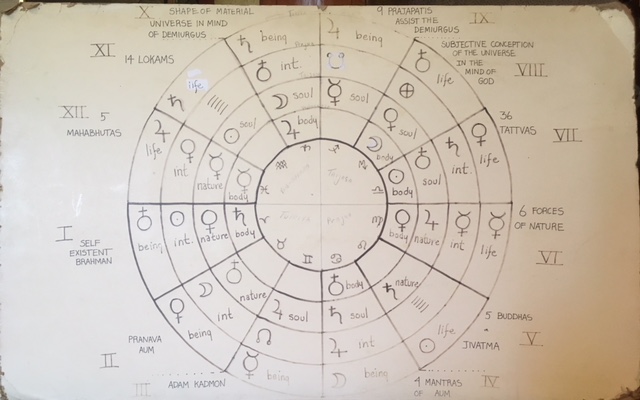
FIGURE IMG 2202-Posterboard Metaphysical Chart.
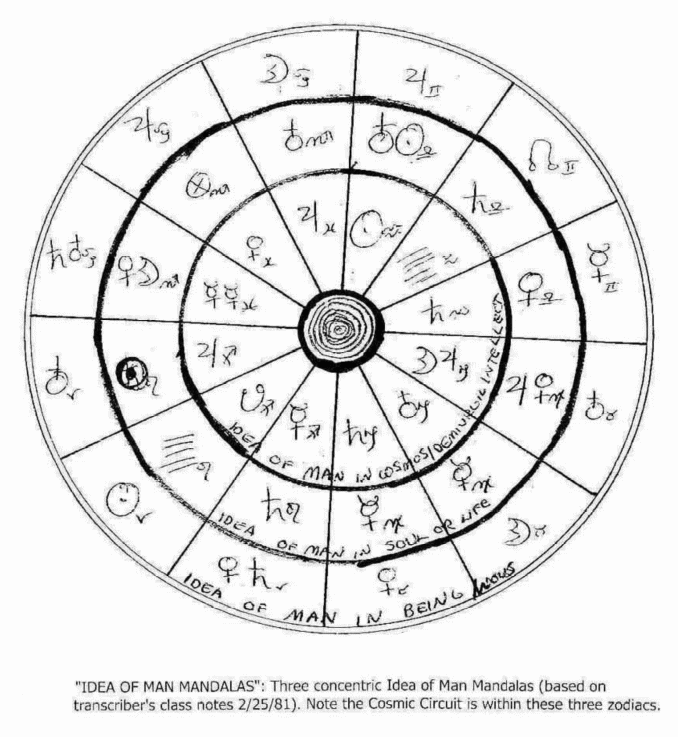
FIGURE 1981 0516-2-JF. Idea of Man Mandalas.
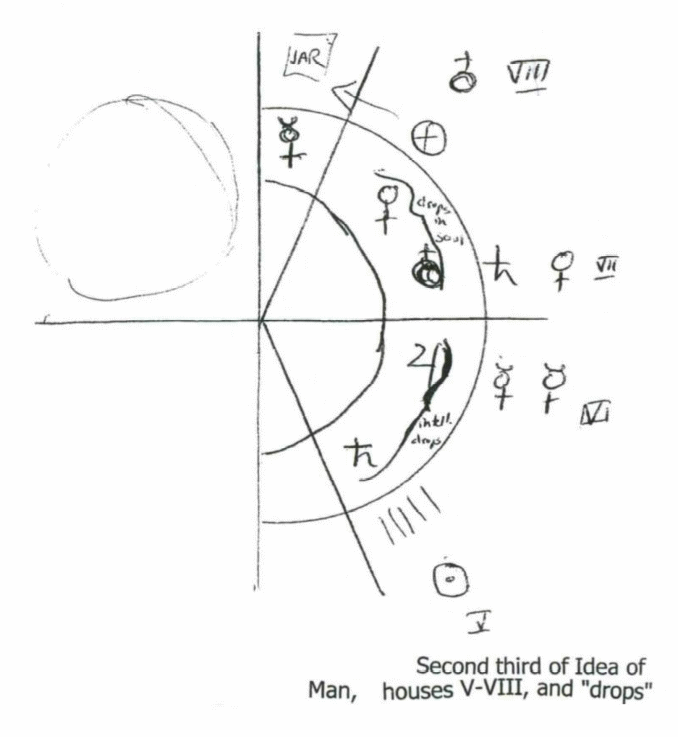
FIGURE 1981 0516-3-JF. Second third of Idea of Man Mandalas, Houses V-VIII, & "Drops".
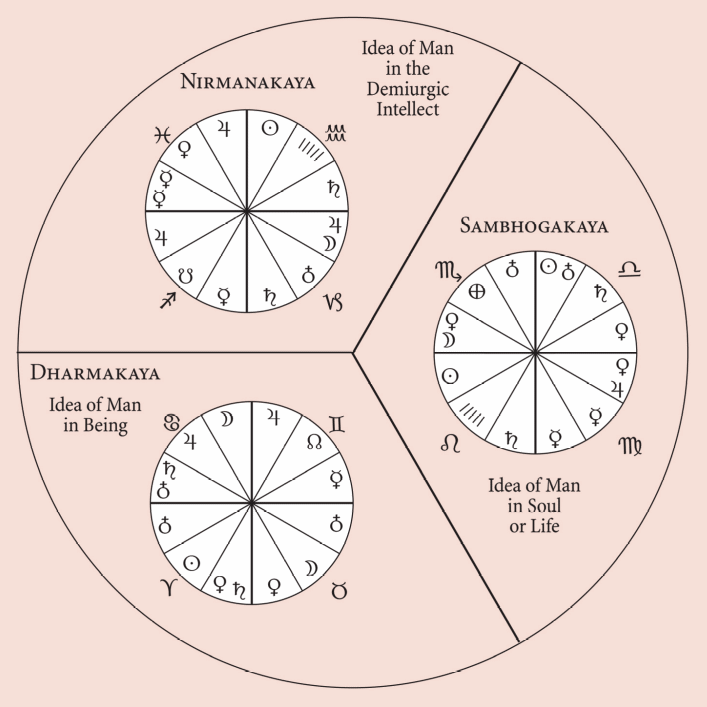
FIGURE 1981 0516-4. Twelvefold Mandalas for Each Level of the Idea of Man.
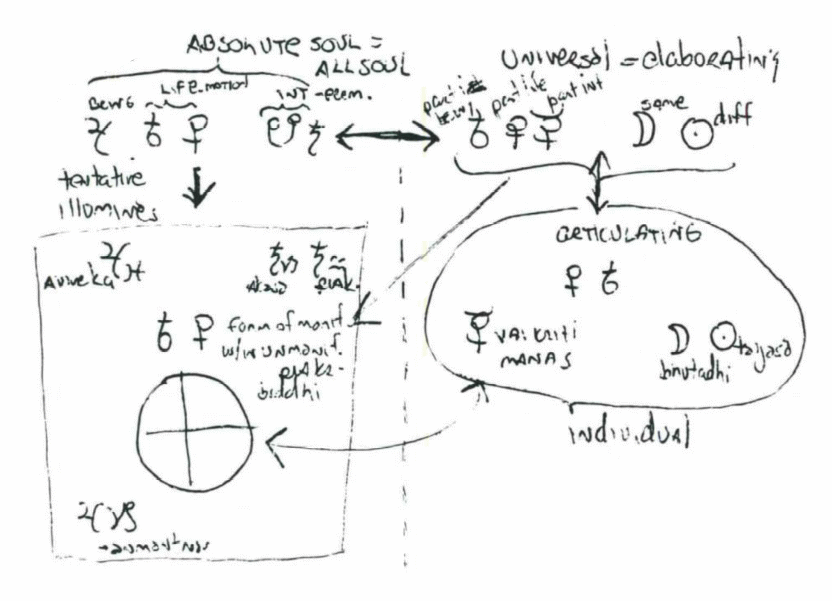
FIGURE 1981 0516-5-AB. Absolute Soul and Elaborating Soul in Third and Fourth Quadrants.
FIGURE 1981 0516-6. Polar Bear Poster.
NOTES by JF:
This class was part of a 1981 Saturday morning series on Iamblichus: 04/10 (Friday eve); 04/11; 04/18; 04/25; 05/16; 06/06; 06/13. The class date sequence shows gaps; however, other Saturdays in this time period are on Number or the Kabbalah.
Other 1981 class topics, immediately prior to PB's death, appear to have been cosmology, the Idea of Man, the problem of knowledge, Kepler, alchemy, subtle physiology, Tibetan Buddhism and tantra, Kabbalah, the history of Platonism.
On Some Terminology in the Iamblichus classes: The Cognitive Isness can be considered to be synonymous with the Individual Soul principle, the Atman, the Saturn in Leo. "Drops" of light are often referred to. As far as I understand them, these subtle "congealed reason-principles" are coming from the third or Soul quadrant down into the embodied individual; further references to drops may be found in Tibetan Buddhist subtle physiology. "Genesiurgic" is a word used in Thomas Taylor's translation of Iamblichus; Anthony speaks of "genesiurgic tendencies" as being the planetary influences.
Previously printed, distributed 2003.
TRANSCRIBED by jf 2003 from Audio Cassette tapes; reformatted by jf 2018. In 2024, IT updates prefatory matter and footer, replaces tape markers with audio file markers, alters Topic, expands Subsubjects, completes Book List, adds Plotinus quotes section, corrects typos and some listening errors, adds new notes and alters some existing notes within transcript, adds four diagrams and references within transcript to these diagrams, reformats to accord with new conventions. Readable edited transcript – V11r.
AUDIO FILES: 1981 0516a, 1981 0516b. [Note: "Tape" and "Side" refer to original audio cassette tapes that were later digitized into .MP3 Audio Files.]
1981 05/16 at Wisdom's Goldenrod
Neo-Platonism; Iamblichus; Mystical Experiences
[Iamblichus. On the Mysteries of the Egyptians, Chaldeans, and Assyrians. 3rd ed. Tr. from the Greek by Thomas Taylor. London, Stuart & Watkins, 1968 [1821]. [Italicized quotes in text, between *"..."*, are Porphyry's questions being addressed by Iamblichus; square brackets in quoted text are in published version unless otherwise noted; minor variations read on the tape restored to text version in printed book. Pp. 1-16 of the book are the text of Porphyry's letter.]
[Audio File 1981 0516a Begins]
(air conditioner hum in background, so some places hard to hear)
AB: --the lower physical sheaths that you would be talking about as being separated from.
VM: On the other hand, when you get to the next page, 119, you start speaking about it seems to me the Cognitive Isness conjoining itself with the Intellectual wholes in the second quadrant. [Note: See FIGURE IMG 2202-Posterboard Metaphysical Chart for this and all other references to Metaphysical Chart throughout the class.] So, that may not be inconsistent with what you said, Alan, I just--
SD: Also, Alan, I mean, (when he comes up to the) dianoetic energies, one would have to think that that means not just the physical body but also any form of imagination, any sheath that employs reason.
AD: He says over here:
Iamblichus, p. 119 (AD reading): "Since, therefore, intellect surveys real beings, but the soul contains in itself the reasons of all generated natures, it very properly follows that, according to a cause which comprehends future events, it should have a foreknowledge of them, as arranged in their precedaneous reasons."
AD: Well it seems that as far as knowing what the reason-principles are (of) an entity, there it employs dianoetic reasoning, alright, which is without any sort of imagery. But he goes on, he says:
Iamblichus, p. 119 (AD reading): "And it possesses a divination still more perfect than this, when it conjoins the portions of life and intellectual energy to the wholes from which it was separated."
AD: Now he's putting it in the second quadrant (S assents) and he was speaking about a pure intellectual energy that it could work with. And there of course (it's) basically a different kind.
JC: Could we say there's a distinction between, well, in terms of what Alan was saying, that reasoning which is based on imagery, and reasoning which has an outflow into the imagination of the person posterior to that reasoning energy. So that in a divine dream, he may be exercising the rational energy, pure imagination, but as you-- (AD: Embody it.) as you come back out or, I don't know, just wake up or--
AD: What did you say, a divine dream?
JC: Well, I'm saying a--
AD: No, just repeat what you said.
JC: If you have a divine dream, I'm trying to say is, where a knowledge is communicated from either the Nous or something about the subjective Soul, and it gets portrayed in the imagination, but it's not that the reason is working off of the imagination. It's just that later you wake up, you're going to interpret what happened but, um-- Well the point I was trying to make was that, in reference to what Alan was saying, there could be a rational energy which has an outgrowth in terms of the imagination, or has a representation in the imagination, but it's not like you're reasoning according to the imagination. Like you say, we could have certain mystical experiences and they get portrayed in the imagination as globes or whatever but that experience itself is beyond the imagination. So a real prophetic experience would be portrayed in imagination but not of it.
AD: Turn to page 152, read the first paragraph. (sounds of papers shuffling; JC inaudible)
Iamblichus, p. 152 (JC reading): "And this takes place in a twofold manner, either from the Gods being present with the soul, or imparting to the soul from themselves a certain forerunning light; but, according to each of these modes, the divine presence and illumination have a separate subsistence. The attentive power, therefore, and dianoia of the soul, are conscious of what is effected, since the divine light does not [Transcriber's note: See later in this transcript.] come into contact with these; but the phantastic part is divinely inspired, because it is not excited to the modes of imaginations by itself, but by the Gods, the phantasy being then entirely changed from human custom."
AD: Try to explain that.
JC: I want to read it (inaudible). (AD: Alright.)
Iamblichus, p. 152 (JC rereading): "And this takes place in a twofold manner, either from the Gods being present with the soul, or imparting to the soul from themselves a certain forerunning light ..."
JC: I think this part refers to the fact that the Gods are imparting to the Soul a certain knowledge, precognitive, what we would call precognition (inaudible).
AD: So they impart to the Soul either through their presence or by means of light some of this knowledge--
JC: Right, I wouldn't know how to distinguish between those two, being present with the Soul, and imparting the forerunning light.
AD: Well, you can (be aware of them) in meditation, there's quite a difference between the presence of a God and the light that emanates from it. But going on "The attentive power"--
Iamblichus, p. 152 (JC reading): "The attentive power, therefore, and dianoia of the Soul, are conscious of what is effected, since the divine light does not come into contact with these ..."
AD: Now he's saying here that--
JC: That the divine light, is above the rational powers, maybe it's purely intellective.
AD: At any rate, it doesn't reach the attention or the reasoning, it doesn't go that far down.
JC: He says the discursive energy of reason, so maybe he means reasoning which is working with the imagination, or working post hoc rather than immediately? Or does he just mean that reason by its own nature is discursive, on any level?
AD: On any level, yes, it's discursive (inaudible). (JC: Okay.)
Iamblichus, p. 152 (AD/JC reading): "The attentive power, therefore, and dianoia of the Soul, are conscious of what is effected, since the divine light does not come into contact with these ..."
AD: Now the next part, he says the imagination--
JC: He says:
Iamblichus, p. 152 (JC reading): "... but the phantastic part is divinely inspired, because it is not excited to the modes of imaginations by itself, but by the Gods, the phantasy being then entirely changed from human custom."
AD: So usually when we have dreams or our imagination functions, it depends on these previous experiences-- you know, perceptions, the memory of which can provoke imagery, alright. But he's saying here that something else happens.
JC: He says that the Gods themselves--
AD: --can inspire the imagination. (JC inaudible) And it works in an entirely different way. So that in the instance where Mrs. Ybor was speaking about some of her experiences, you can see that they wouldn't be experiences that were dependent upon vasanas, if I could (inaudible). [Note: See WG Interviews 1981 0318, 1981 1015, and 1982 0106b for Mrs. Ybor's accounts of her mystical experiences.]
JC: Personal history.
AD: Yes, the personal history. It was irrelevant, alright, but there was a sort of inspiration which the imagination worked up into these beautiful, you know, (inaudible).
VM: Anthony, wouldn't you say that that the actual images themselves are also something which is from this level, or is it that the images are from the divine level or from the intellectual level-- (AD inaudible) --these actual symbols--
AD: Even the imagery is so transformed, that nothing there resembles things here except in a very meager way.
VM: So it's not the vocabulary even but that the message is not taken from the personal history of the normal world. Even that too, aside from the meanings which is deeper.
AD: They're taken from the higher intellective phase, so that the interpretation of the images can be very profound there.
AB: But when he says that the divine presence and this illumination as having separate subsistence, isn't he saying that the illumination which you receive subsists in your imagination, which has a different substantial basis, than the actual substance of the Gods. So that there is a difference. But that because this imagination is so pure and free from the normal operations we do get a correct (appearance).
AD: Alright, let's go back to that one, 119.
JC: Another thing I'd like to mention is: I've read that it's the celestial vehicle which can be affected in this way. So that the level above the astral Soul is the vehicle that corresponds with the heavens, that can be inspired from the rational or intellectual forces above it. In other words, it can respond to-- when we really reason abstractly, we're trying to-- we're working with that part of the imagination, that the astral Soul, the astral body is responsive to sensible impressions from without or probably also impulses from within. But it's only the-- when he says, liberated from certain surrounding bonds to the astral body, that the higher part of the imagination is free to work, free from the lower impulses and sensible impressions, and capable of responding to reason-principles more directly.
AD: We also came across that in the article by Mead, if you remember. [Note: See G.R.S. Mead, The Doctrine of the Subtle Body in Western Tradition, Ch. 2, "The Spirit-Body".] (silence)
AS: Well, with reference to what he was saying here. This one, he's saying that, we speak about separation from body here. Do we speak about imagination being separated or freed from its-- or being tied to this bondage to the body, and say that the illumination by the Gods-- would that fall under when he says that the Soul has a twofold life? [cf. Iamblichus p. 118] The one "in conjunction with body, but the other being separate from all body." Um--
Iamblichus, p. 118 (AS reading): "[W]hen we are asleep, we are perfectly liberated ... from certain surrounding bonds."
AS: Is this part of, is he putting that divine inspiration, say, the imagination being divinely inspired, are you putting that on the higher side? Or is he also going to put that-- is he also going to consider that also, that the light in conjunction with body, it's the imagination in some kind of a body.
LR: Doesn't it (inaudible) separated from generation?
AS: Yes, but still-- (LR: Where would you put that?) Well, suppose you have a divinely inspired vision, or a divinely inspired dream. Now, are you going to say, Is that light separated from generation? The inspiration is separated from generation, but insofar as it's imaged in the imagination, isn't there still something of generation?
LR: But he doesn't say when we're dreaming-- he says that when we're asleep that we're perfectly liberated.
AS: Yes, yes. I'm just try to say-- "When we are asleep, we are perfectly liberated, as it were, from certain surrounding bonds, and use a life separated from generation." We use a life separated from generation. It's almost like this form of life, in other words, the intellectual or divine, is then excited in us and energizes in a way conformable to its nature. I mean, if you're speaking of something-- if the imagination is free from the vasanas, then it has the use of the divine powers. And certainly the divine powers are free from generation. But will you say this form of life, or he uses a life separated from generation, so that, for example, he refers to the imagination as being freed from generation or free from the vasanas. And that the divine inspiration is using this -- it's said, it's maybe now the imagination is within the body but it's one of the higher vehicles.
JC: 'Generation' is used technically, but it has (inaudible) entering into generation, (inaudible) generation?
AS: I don't know-- That's the same problem we were having the other night, too, though, with the Buddhist class-- I mean I think it's the same problem right?-- Are you speaking of the generation of the sublunary world, or are you speaking of generation as everything being below the Sun in Aquarius, say, or are you speaking of the realm of generation as the whole fourth quadrant? And really, there's-- I think you could (JC inaudible) bring in passages depending on which way you're meaning, because in a way the whole fourth quadrant is generated, is generation.
LR: Well would it be maybe according to vaishvanara consciousness, taijasa consciousness, and prajna consciousness? In other words that the inspiration would come from, say, prajna, but the dream itself would be unfolded in taijasa, and when he says we are awake, that would be vaishvanara. Maybe (inaudible) there's that kind of distinction going on.
AS: Well, I guess what I'm trying to say is, I think he says that when we are asleep, I think he would still say that you're not liberated when you're asleep, you're still conjoined, say, with a permanent, a certain celestial vehicle and so on.
JC: And I think that's the reason he says it's still generated, because it always is, it's perpetual, (AS assents) it's not born, and then dies at some point. (AS assents) It's generated certainly in the sense of being embodied, but--
LR: What are you referring to?
JC: "Use a life separated from generation." I'm trying to (inaudible) more of what level of the person or (inaudible)--
LR: What aspect of generated are you referring to?
JC: The astral and the gross.
AB: The celestial vehicle you were referring to is not generated, although it's a vehicle.
VM: But it's a body, though.
AB: It's a sheath of the soul.
VM: Well insofar as it's a body then it seems that the other being separated from ALL body. Now, I don't know, maybe I'm making too much of the word 'all'. But-- see the only reason that I suggested it initially was that the phrase 'all body' meant everything prior to the Soul ring to the 4th quadrant. On the next page he starts discussing -- it seems to me like the Cognitive Isness grasping the intellectual principles [sic] directly. Now just on the basis of trying to be consistent, between those two it would seem that you were speaking about liberation from, perhaps the whole Sun in Aquarius, but maybe that's too big a leap.
AD: So (inaudible) your conclusion should be that when he speaks about liberation from the body, he's speaking about the falling drops, (inaudible). And then-- (AS: The falling light is imparted.) --the light is imparted--
AS: That would be this light, separated from generation.
AD: Yes. So then this certainly seems to be above the astral realm, and all the realms that we talk about.
AS: All the six realms [of existence or samsara, in Buddhism].
AD: The six realms.
AS: Yes, I mean, from what Vic's saying, and following that line, we speak about this light which is conjoined with the Soul like the Mercury in Sagittarius, something like that, before it's actually-- between lifetimes, and before it's actually inserted into that body. That that would be a life which is separated from generation. That's what I think what Jeff wanted to say also. That's like-- it's not that it's not a vehicle, but that it's not in generation, it's above the 4th quadrant, (VM assents) it's an eternal vehicle.
VM: See, what he speaks of, right at the top of [page] 119, Avery, it seems like he making a reference, something like this:
Iamblichus, p. 119 (VM reading): "Since, therefore, intellect surveys real beings ..."
VM: Let's say, that's discussing something in the second quadrant.
Iamblichus, p. 119, cont. (VM reading): "... but the Soul contains in itself the reasons of all generated natures ..."
VM: I was trying to understand that as the Mercury in Sagittarius that, let's say, contains all those reason-principles which then would, say, manifest in the form of these condensed reason-principles, these drops, in the 4th quadrant, it very properly follows.
AS (VM is trying to say something throughout): Actually, you really have three levels here. It seems he starts off, he's saying there's a twofold life [cf. p. 118], but there really seems to be three levels. One is the conjunction with the body, but you wouldn't jump from there right into the intellectual. (VM assents) And he certainly would want to distinguish between Being in the Soul and the Reasoning which is free of generation as it were, and Being in the Intellectual per se. (inaudible)
AD: And then the part, Avery, where he says:
Iamblichus, p. 119 (AD reading): "But if the soul connects its intellectual and divine part with more excellent natures, then its phantasms will be more pure, whether they are phantasms of the Gods, or of beings essentially incorporeal, or, in short, of things contributing to the truth of intelligibles."
VM: Yes, that seems to be the divine dream that Jeff is referring to in a way. In other words, if the inspiration is really from the intellectual, from the divine part of the Soul, and the phantasms can express this but in a very pure and elevated form. And so, to go back to Mrs. Ybor's experiences, although they are eventually portrayed in the imagination, they're clearly of a superior--
AD: Of a higher order.
VM: --superior order.
AD: At a cognitive level.
S: I don't see how the imagery can come from them, (inaudible) (AD: I'm sorry--) I don't see how that imagery could come from that level.
AD: He says the attention and the dianoetic energy gets inspired. And it is inspired to portray, you know, in terms of the imagination, these intelligible truths.
S: Yes. But even then it's within the imagination. I mean, the imagination is a level not of the intellectual order. It seems that you could say that, the imagination has taken us as close as possible relation to the intelligible, I mean the imagery is, it approximates as close as possible the intelligible. But, and that if it's the most transparent imagery possible to reveal the meaning from the intelligible, but that the image itself is still within the imagination.
AD: Yes, that's fine, that's what he said. I mean if you want to keep, intact, the 'We' that we call the Soul--not truncate it, like say that there's part in the 4th quadrant and the rest is in the second, but if you want to keep intact the integrity of the human soul, then on the one hand, one part of it could directly perceive the intelligibles, alright, whereas the lower part could be inspired, the imagination could be inspired, and portray those intelligibles, which let's say, the higher part of the Soul had perceived intellectually.
LR: So then you're saying that (inaudible) could cause someone like Mrs. Ybor to perceive Minerva, and possibly the Tibetans to perceive a Tibetan deity.
AD: Yes.
LR: And it could be the same one.
AD: Yes. The difficulty, like he pointed out, is that we usually go from one side to the other. (inaudible) We either are sensing, what we are perceiving, or we're-- what is that Plotinus says-- (LR inaudible) It's either our attention is either to the intelligible realm, the way we perceive directly and intuit the intelligibles. Or to the so-called imaginal realm where it perceives the imagery. [Note: See Plotinus, IV.3.30, last paragraph; also V.3.3, second to last paragraph.] And to perceive both of them requires something of what we spoke about as the higher knowledge of the sage. Which also, by the way, has limits. Yes--
JL: On page 152 it says that the light affects only the phantastic part of the Soul, not the dianoetic? But that the dianoetic is conscious of that?
Iamblichus, p. 152 (AD reading): "The attentive power ... and dianoia [AD substitutes: reason] of the Soul, are conscious of what is effected, since the divine light does not come into contact with these; but the phantastic part is divinely inspired ..."
AS: (inaudible) He says it is "conscious of what is effected" he says because "the divine light does NOT come into contact".
S: Maybe we are not conscious--
AS: --ARE conscious of what is affected--
Iamblichus, p. 152 (AD rereading): "The attentive power ... and dianoia [AD substitutes: reason] of the Soul, are conscious of what is effected, since the divine light does not come into contact with these; ..."
AS: Yes, you'd have to leave out the "not". (AD/S inaudible)
AD: Yes. It touches these--
AS: Yes. (S inaudible)
VM: It looks like a misprint.
AD: It must be. [Note: "Not" crossed out and noted in her copy of Iamblichus text.] If that were in the Soul, there would be no communication with that higher knowledge. So there is a direct contact.
AS aside: Good question, Jeff!
S: Scratch out the 'not' in that sentence.
VM: It changes the meaning rather drastically. (student comments, questions, clarifications on which 'not' to cross out; see below]) The sentence that starts [Iamblichus p. 152]: "The attentive power, therefore, and dianoia of the Soul, are conscious of what is effected, since the divine light DOES come into contact with these." If it didn't come into contact with them then it would be impossible for them to be conscious of what is effected.
AD: It's when the light of the Gods does contact the dianoetic energy, you know, the reasoning phase of the Soul, that the imagination is inspired to portray these things in the very beautiful way it does, for instance, in many of the mystical visions we have. Which, by the way, have a very compulsive power.
VM: But couldn't we return though to the question that I asked, and that also Linda asked-- Before you said that the images themselves actually -- and Linda asked this too-- that the images themselves are this divine or, let's say, this higher aspect of the Soul. But if that were so, and let's say, when we speak about the higher aspect of the Soul, the part of the Soul which is not simply conditioned by just this incarnation -- if that were the case it would be difficult to understand why a Tibetan would see a certain Tibetan deity or a Greek would see Minerva, or a Christian might see angels or the Virgin Mary or something like this. So it seems like the images themselves, the actual vocabulary that the inspiration clothes itself in must somehow be connected to the personal level of the soul, that the experiences that that individual has had in *this* life, are then used this as a means of conveying this inspiration.
AS: Yes, but, you know what though-- (VM: What?) that seems reasonable except for one thing-- what about those people-- (VM inaudible) I mean, it seems there must be cases of people who have had these visions and have never even seen any pictures of these Gods or anything. So when you say it's part of the personal unconscious-- (LR inaudible)
RG: It doesn't mean that its from this life--
AS: Right, what I'm saying. (people talking at once, inaudible) Of course, if there is no image in the realm of the Intellectual, then the image itself, it's not like there was an image in the Intellectual and it came over into that. But I think in those other passages, where we said-- you know, earlier where he says like, "the statue of the Gods" it must be conjoined with the exact right form. Even in the imagination, it seems to be connected to that God. So they're not arbitrary in that sense. (VM: Oh no.) In that sense they are-- they are in a sense communicated by that divine power. It would have a proper image that was associated with it and would evoke the proper image, I suppose.
VM: I thought Anthony said to Linda (AS: Yes--) the same impulse might appear as a Tibetan deity with certain kinds of detailed visual appearance, and to somebody else it might be Apollo or something like this.
AS: But within that--yes-- that seems right, but then it seems also you could say that deity will appear in that Tibetan, like that deity will appear with certain mudras and so on, I mean there will an appearance of that deity, there won't be an appearance of another deity. When Minerva appears, Minerva isn't going to appear as some other God--
VM: It's not the same impulse.
AS: No--
AD: We got sidetracked -- (inaudible; then inaudible students) I think you're actually discussing the *form* aspect of the vision, and not the inspirational aspect of the vision.
VM: Well, I'm just trying to distinguish between-- I'm sorry--
AD: So if there was a correspondence, let's say, a Tibetan sees a certain type of God, let's say, that corresponds to Minerva, but he would see a Tibetan version of that, right, it would be dressed in Tibetan garb and all that, and a Greek would see Minerva dressed the way a Greek would understand it. This is absolutely irrelevant to the transmission is taking place. Because--that's why I made the point-- this is because of the compulsive nature of the vision, that indicates what has happened-- whereas you're falling back on the personal, falling back on the memory, of the, let's say, the cultural mores, that that personality, that is involved in-- Let me try this way-- If you get inspired with a beautiful melodic line, alright, can I portray it in the Indian scale, as well as the Western scales? You know, I'd be using the Western scale, which would be, you know, a tonic scale system, and not a 22-note scale [system]. Wouldn't the inspiration be the same? (Students: Yes.) The same thing being communicated? (S: Yes.) That's what's happening, that's what's being communicated. If you're thinking of the dress a person wears, the tuxedo, or a gown--
AS: And yet-- it's not-- I guess it's not important point the other way-- but you could also say that there is -- when that melodic, suppose this immaterial melodic line is going to be portrayed, it will have to be portrayed in the proper--
AD: That's secondary, (AS: Yes.) that's secondary. Take this example now: Imagine you're in the mantric heaven, you're inspired, alright, and you come down and you're schizophrenic and you write (it out in) both systems, a Hindu system and a Western system? (student laughter) What's the difference?
AS: (inaudible) I follow what you're saying, I was just--
AD: That's what I mean by the compulsive nature of the inspiration, the form that it's going to clothe itself in is really quite secondary. She [Mrs. Ybor] had, let's say, you know, a vision [of] the pyramid and the base and the sarcophagus, and the Cosmic Christ arising within it, alright.
AS: The image really is irrelevant, it's the power that--
AD: It's the power of the imagery, the compulsion which brings about the transformation.
AS: Yes, right, I guess-- I guess I-- there was (inaudible) yes.
AD: That's just like this fellow was telling me, no, Scriabin sounds like Chopin. So I told him, "Why don't you put your head in a bucket of water twice?" (lots of student laughter, inaudible comments by students and Anthony) I'm saying, you know, what you're both talking about sounds the same-- well sure, we're using the same words. And we mean entirely different things. (more laughter, inaudible comments) It's so easy to get caught up in the form. I mean--
VM: I thought what we were trying to do was to distinguish just that, I thought what we were trying to do was to precisely make that distinction, to separate the form from the inspiration. So I guess--
AD: It's the inspiration that's the contact. (VM inaudible) That's the contact. (VM: Okay, I don't want to get into that.) There's never a denial of that. The trouble is that the mind immediately interprets the experience, it, it immediately gets caught up in it. And then of course you recognize there was an incorrect perception of the intelligibles, the mind is still functioning. Yes, Anne?
AK: He seems to be using something of a double negative here, which is why it appears to be--
AD: A double positive, you mean. (AK: Well--) I don't use negatives, (inaudible).
AK: He says: "it takes place in a twofold manner, either from the Gods being present", and later on in the sentence either from "the divine presence" or by "a certain forerunning light ... the illumination have a certain [AK substitutes: separate] subsistence". So what he seems to be saying is that dianoia and the attentive powers are an actual contact with the *subsistence* of the Gods themselves, and can't (inaudible).
AD: Comes into what?
AK: The contact with the subsistence of the Gods. But that they can't come (inaudible) into contact with the subsistence of the light, that comes forth from the Gods. So he's really not saying that they don't come into contact, he's making a distinction between the subsistence of the God and the subsistence of the light which streams forth from the God. So he's talking about two ways that the Soul can contact this divine presence.
AD: Yes. One way, one way--alright, we'll ignore the text -- one way is in meditation, you become aware of light, various kinds of light, each different from each other.
AK: (inaudible) that would be only in images.
AD: They're not really images, that's the way they present themselves, even to the reasoning part of the Soul, they present themselves. You remember the quotation, that (inaudible) was pointing out that when a man is inspired and there's these light particles or sparks of light that appear, and the more concentrated he gets, the more persistent-- and he didn't go on, but to go on would be that the light which is appearing in the manifestation of the God, or let's say, the outward-facing hypostasis of the God, that's the first level. The second level is when you've gone beyond that, and then they're an actual presence, that presence doesn't require any light, they are experienced as *power*. There's a variety, there are different kinds of power that they are experienced as. But doesn't (even need) the light. Sometimes they're both together. You could experience the light manifesting, and the power, the presence of their power. Right there. So you would have both of them together.
AS: That's the twofold distinction he's making here.
AD: Yes. (AS inaudible) And this is not double negatives. Or positives. These people are speaking in a very positive objective way.
AK: (inaudible) terrible conception from before. (S inaudible)
AD: Alright, then let's go back to (inaudible), what was the (inaudible). We don't want to go through every single thing here but the important passages that-- Perhaps someday, you know, you may get into mystical experience, and you can go through in a couple of months a tremendous amount, you can go through in a week a tremendous amount, I mean there's no-- So, to have some background, some preparation in this is to prevent complete turmoil when you come out of the mystical states and have some understanding of what is happening so you could arrange-- arrange more wisely, and use more wisely, you know, the meditation. I don't know that there's any more in this chapter. (The rest of course, there's) many instances of these things that have happened actually in ancient Greek time. Of course the moderns with their skeptical mode would say well this was just in their imagination, they were pre-logical, things like that, but we'll just ignore these people. I can't understand how a man could spend all his life writing about what he believes to be falsities. I can't understand that. The next part, 121, where he says:
Iamblichus, p. 121 (AD reading): "I wish, therefore, here to point to you the signs by which those who are rightly possessed by the Gods may be known. For they either subject the whole of their life, as a vehicle or instrument to the inspiring Gods; or they exchange the human for the divine life; or they energize with their own proper life about divinity."
AD: Well, we have an example of that [PB]. Well, let's turn to p. 124, chapter VI. (noises of pages turning) Why don't you read?
Iamblichus, pp. 124-6 (VM reading): "That, however, which is the greatest thing is this, that he who [appears to] draw down a certain divinity, sees a spirit descending and entering into someone, recognizes its magnitude and quality, and is also mystically persuaded and governed by it. But a species of fire is seen by the recipient, prior to the spirit being received, which sometimes becomes manifest to all the spectators, either when the divinity is descending, or when he is departing. And from this spectacle the greatest truth and power of the God, and especially the order he possesses, as likewise about what particulars he is adapted to speak the truth, what the power is which he imparts, and what he is able to effect, become known to the scientific. [VM: Should I continue? AD: Yes, continue.] Those, however, who, without these blessed spectacles, draw down spirits invisibly, are without vision, as if they were in the dark, and know nothing of what they do, except some small signs which become visible through the body of him who is divinely inspired, and certain other things which are manifestly seen, but they are ignorant of all the most important particulars of divine inspiration, which are concealed from them in the invisible. But to return from this digression: if the presence of the fire of the Gods, and a certain ineffable species of light, externally accede to him who is possessed, and if they wholly fill him, have dominion over and circularly comprehend him on all sides, so that he is not able to exert any one proper energy, what sense, or animadversion, or appropriate projection of intellect, can there be in him who receives a divine fire? [VM: Well, that's all one question. AD: And next, is a question, too. VM: Okay this is a question, too.] What human motion, likewise, can then intervene, or what human reception of passion or ecstasy, or of aberration of the phantasy, or of any thing else of the like kind, such as is apprehended by the multitude, can take place? Let such, therefore, be the divine indications of true inspiration from the Gods, which he who attends to will not wander from a right knowledge concerning it."
AD: So you won't be going around uttering phrases like the mediums do. Announcing knowledge when they are super ignorant. Obviously what he's saying here is that any participation on the part of the divine Gods results in an immediate immobilization of the personality.
VM: Anthony, what is this-- I'm quite mystified by this reference to fire. "But a species of fire is seen by the recipient, prior to the spirit being received, and sometimes becomes manifest to all the spectators" either when the spirit is coming or going. Is this species of fire some intelligible fire, or how do we understand it? He makes reference to it again on the next page too.
AD: Read the next reference.
VM: Um-- I thought there was another reference to it.
Iamblichus, p. 125 (VM reading): "But to return from this digression: if the presence of the fire of the Gods, and a certain ineffable species of light, externally accede to him who is possessed [VM: and so on] ... so that he is not able to exert any one proper energy ..."
VM: So as you say, he's immobilized, he's completely filled with this divine inspiration. But I was wondering if there was-- I mean, I don't think he's being metaphorical, is he, when he talks about lot-- fire here?
AD: No. Metaphorical in the sense that it's not actual fire.
VM: Oh the fire-- you can't cook your potatoes on it.
AD: Yes. (student laughter and inaudible comments)
AS: It's funny, there were certain reference (to this) in the Bible, weren't there? [Note: Bible, Acts, 2:1-4.] I mean this is one example. I feel like some of these peo--
(Side 1 of original cassette tape digitized as 1981 0516a Ends; Side 2 Begins)
(people speak softly at beginning of this side, hard to hear)
CdA: --the light above your head.
AS: Oh, well (inaudible).
CdA: Do you know the light? The Holy Ghost, the descent of the Holy Ghost. Yes, yes.
VM: Yes. Yes that's what I thought of when he spoke of descent of spirit. (AS inaudible)
AD: You ever see-- you ever see PB with that?
VM: Sometimes I would see him, it would sort of seem like he was bathed in a kind of a golden light but I didn't know if that was a--
AD: Yes that could-- that could get elaborated until you reach fire. I remember a painter was painting and looking at him and all of a sudden he saw this fiery form, a flame, backed away from it, got scared. Go on to the next chapter. (student laughter)
S: Does anyone here know what the word 'animadversion' means? (inaudible student comments: I don't know... dictionary ...)
AB: Wouldn't it be some kind of movement, or movement in the Soul? (S: Passion.) Passion, right. (sounds of shuffling papers)
VM: Also, Anthony, this fire, this may be a whole other issue but, remember when Jung was in the hospital, he said that when he had that big vision, and the nurse saw that great light surrounding him, and she said she often saw this around people who were about to die. [Note: See C.G. Jung, Memories, Dreams, Reflections.] Is that a whole other issue?
AD: Yes, that's a whole other thing altogether. (sounds of papers) There's a footnote on 130, 131, you could read that by yourself. (inaudible) Let's turn to chapter XIII [Section III], 146. (more sounds of turning pages, etc.) First we turn to page 148, read the footnote, read the footnote, the first footnote would you? (VM inaudible) Page 148, read the first footnote.
VM: Proclus in the commentary on the First Alcibiades of Plato.
AD: Yes.
Iamblichus book, T. Taylor footnote, p. 148 (VM reading {rereads first part after error}): "Proclus, in his MS. Commentary on the First Alcibiades of Plato, observes,"that in the mysteries some one of the more imperfect daemons assumes the appearance of one that is more perfect, and draws down to himself souls that are not yet purified, and separates them from the Gods.""
S: That sounds difficult.
AS: (Just) the book of the-- in the *Tibetan Book of the Dead* they say that also, that first they have these appearance-- before the actual God there'd be these horrific (VM: Tempters.) or other ones, or the tempters, yes, and, you know, you go for that and lead you away from the actual-- I mean is that similar to what he--
AD: Yes. How could we put it more prosaically?
S: Distracting? (AS: Yes.)
AD: Huh? Distracting thoughts, distracting habits. Let's see, instead of studying tonight I'll do like that polar bear does, I'll lay down until it passes away. [Note: A poster at WG with a polar bear lying down, see FIGURE 1981 0516-6.] (student laughter, inaudible comments)
VM (laughing): Temptation (inaudible).
AS: (inaudible) And it poses-- and it even poses as a divine inspiration.
AD: Oh, yes. (AS inaudible) Oh yes, you've seen how many 'divine inspirations' we have here, people coming here? Remember (the) 62 you'll find the truth? (laughter) [Note: Reference to a visitor who came to WG once and went off on a diatribe about the number 67. See last couple of pages of WG Class 1979 1125a.]
S: Was it 62?
S: 67.
VM: 67. (more laughter)
AD: Oh page 70, oh I'm sorry. Page 70.
S: Whatever. (more laughter, student talking)
AD: As a matter of fact I think if you just go back in your mind you'll see that there were quite a few people that were possessed. They were *possessed* --that's the word.
VM: In fact, there's this lovely story that Saint Francis tells that one of his disciples was told by Christ on the cross to forget it, you're damned, and listening to Saint Francis is just going to get you in further trouble so don't even bother telling him about this. (student laughter) And, here the guy was in torment. (inaudible) and that Saint Francis had this intuition (was a whole lot of) trouble.
AD: Well the most obvious function of the lower order of daemons, which is not a vile or an evil act on their part --don't misunderstand because the daemons are a higher order than human soul-- is simply the distribution of justice. A person is not prepared, he's not permitted, not allowed, all-- you know, with all-- regardless of how much intensity (inaudible) his own will.
VM: The (inaudible) speaks of the 'Guardian of the Threshold', he frightens you or (inaudible). Would this be an example of what Proclus is speaking about here? Or--
AD: The appearance of that.
VM: Yes. The appearance of that sort of startles, frightens a person into a whole re-examination of their values and so on.
AD: (assents) I think in the novel *Zanoni* Bulwer-Lytton tried to show that if a person isn't prepared he will have that experience. The unpleasantness will come to him. (inaudible) So I think what they're very simply saying is that you're not permitted entrance into the higher realms, unless you're prepared for it. At any rate, if you read that, I think he makes the point that unless the body has been initiated-- Would you read the first footnote? Read the whole-- (VM: Continue?) --paragraph.
Iamblichus book, T. Taylor footnote quoting Proclus, cont., p. 148 (VM reading): ""Hence, in the most holy of the mysteries [i.e. in the Eleusinian mysteries], prior the manifest presence of the God [who is invoked], certain terrene daemons present themselves to the view, disturbing those that are initiated, divulsing them from undefiled good, and exciting them to matter. On this account the Gods [in the Chaldean oracles] order us not to behold them, till we are guarded by the powers imparted by the mysteries. For they say, ... It is not proper you should behold them till your body is purified by initiation."" [Note: Not sure where Proclus ends in book, as there is no closing quotation mark.]
AD: That would correspond to the first separation in the Buddhist. (S: The jar--) What do they call it, the separation from the body. Then the separation from speech, and the separation from the mind, (inaudible). If the first separation hasn't taken place, um, then that won't happen. In other words, they won't permit it, the Guardians of that world, they won't permit, it wouldn't simply happen.
AB: It seems two different things are being said: one is that, insofar as these daemons are distributing justice, if you are not prepared for a certain experience, they will not allow you to have it, they will lead you away into something else.
AD: If you don't come prepared.
AB: Right.
AD: Or (don't come) purified.
AB: Right. If you're not purified.
AD: And that means you've (inaudible) the separation from the body.
AB: And gone through a certain development. On the other hand, we were also saying that if you allow yourself to be distracted, you know, (you are led by/inaudible) these passions or these impulses, will pull you down from your development. And let's say you really should be doing this, and you allow yourself to be led off by something irrelevant. So it seems to be very different operations that are going on. (AD: They wouldn't be identical.) But in one case it would be bad if you had the experience because you're not purified enough, but in the second case you allow yourself to be distracted so you don't go through the purification that you need.
AD: I still don't see the contradiction.
AB: Maybe I had a misunderstanding but--
AS: But if you're not ready for a certain experience, these daemons which mete out justice, they will not let you see it because it would disrupt you, it would be inappropriate. So that is--
AS: But if you're ready and purified, they won't be able to distract you. Which is actually the same thing. Yes. It's catch-22. I mean, they won't distract you, they're just there, I mean in a sense (AB assents) it's your karma or whatever. If you're ready to not be distracted, then you will have the will, the power or whatever to not let yourself be distracted. So--
AB: Well, I guess it has to do more with your own will. Because some people can force something that they're not ready for, and it has bad repercussions. Or some people can allow themselves to be led away from something that they would have been ready for, and miss a good opportunity.
AD: Oh yes but you're in the realm of theory.
CdA: It seems though if you-- if you're actually--
AS: Because in actuality that's your karma too.
CdA: It seems if you're actually isolated from the body that it-- like the body is--
AD: You took an abstraction for a reality. (S: Which is a reality, their resistance or their--) No--what's going to be. No, what's going to BE. There's no theory about that.
VM: Continue?
AD: No, reread the-- (VM inaudible) No, re-read the whole paragraph.
VM: There's actually another piece which we haven't-- (AS inaudible; student giggles) Yes, they got me.
Iamblichus book, T. Taylor footnote, p. 148 (VM re-reading): "Proclus ... observes,"that in the mysteries some one of the more imperfect daemons assumes the appearance of one that is more perfect, and draws down to himself souls that are not yet purified, and separates them from the Gods.""
AD: So if you're at the bar, you're supposed to be, you're where you're supposed to be. (inaudible student comments)
Iamblichus book, T. Taylor footnote quoting Proclus, cont., p. 148 (VM rereading): ""Hence, in the most holy of the mysteries [i.e. in the Eleusinian mysteries], prior the manifest presence of the God [who is invoked], certain terrene daemons present themselves to the view, disturbing those that are initiated, divulsing them from undefiled good, and exciting them to matter.""
AD: Now remember, we pointed out that the daemons insinuate themselves into our consciousness as impulses, thoughts, volitions, etc, okay. (VM assents) They're not going to announce themselves. (VM: Here I come.) Here I am. They're not going to-- And we also pointed out that the aspects are a good place where you can watch and observe that. If you could move over in introspection towards the psychic fringe, you can see where these impulses are coming in and taking over. So the Chaldeans, of course, remark that if-- unless you've gone through the initiation of the body purification-- Body purification in a sense means that a person-- Remember the way we were speaking Sunday, we pointed out in the Buddhist, first-- the very first step is the body initiation, separation from the body. And that has to happen consciously. It's not an unconscious thing. One actually feels he is not the body, alright, and that qualifies one to go on to the next thing. But usually what they do, they try to make that feeling much more pervasive than just a glimpse. One experiences that (blind) too, he is not the body, comes back and there's a whole different attitude that he's operating with. Alright, the second footnote? Don't read the Greek, just the English.
VM: Okay, (inaudible) Greek.
Iamblichus book, T. Taylor {later in} footnote, quoting Proclus {Plat. Theol.}, pp. 148-9 (VM reading): ""As in the most holy of the mysteries, they say, that the mystics at first meet with the multiform and many shaped genera [i.e. with evil daemons], which are hurled forth before the Gods, but on entering the interior parts of the temple, unmoved, and guarded by the mystic rites, they genuinely receive in their bosom divine illumination, and divested of their garments, as they would say, participate of a divine nature ...""
AD: Garments here aren't the clothes. (VM: No.) Though in the Eleusinian mysteries they did use that symbolically, you know, taking off your clothes, but over here you would be stripping yourself naked, you know in terms of your vehicles, your bodies.
AB: When PB was in the Pyramid, he talked about that experience, would that be an example of this, when first encountered this noxious terrifying, you know, layer of daemons and entities, and then he had to push through that until he really could experience the-- you know, like the secrets of the Pyramid? [Note: See Paul Brunton, A Search in Secret Egypt.]
(silence)
VM: It's so funny.
AD: We won't bother with it. (VM: It's so funny, isn't it?) This is (inaudible). But I have to agree with him because I read that. It's a three-volume set called *The Divine (Negation)* by Lord [Franz] Bardon. [Note: Franz Bardon wrote three volumes on Hermetic magic called Initiation Into Hermetics, The Practice of Magical Evocation, and The Key to the True Kabbalah. I am not able to find anything called The Divine Negation.] And, (VM inaudible) it is filled up with all kinds of absurdity, it's one of the most absurd books I've ever read in philosophy.
VM: It's just such a transition, you know, he's speaking about such exalted beautiful things, and then all of a sudden the (inaudible) tiger comes out.
AD: (Well) in his time the book-- in his time it was a very popular book, *The Divine Negation*, very popular. So you probably-- Alright, so let's go back and read the chapter. (shuffling of papers) Begin chapter XIII.
Iamblichus, pp. 146-7 (AS reading): "Let us, therefore, now direct our attention to another species of divination, which is not public, but of a private nature, concerning which you say, *"that some become enthusiastic by standing on characters, as those that are filled from the intromission of spirits."* This species, therefore, through those who badly use it, cannot easily be comprehended in one definition. But it is obvious and superficial, and known to many, and employs a falsehood and deception which are not to be endured; nor is it at all attended with the presence of a certain divinity, but it produces a certain motion of the soul, which is adverse to the Gods, and attracts from them an obscure and adumbrative representation, which through the evanescent nature of its power, is usually disturbed by daemoniacal depraved spirits."
AD: Well, that's the part we can ignore. Aleister Crowley's a good example of that. The use of drugs, of certain incantations, which bring about certain kinds of really obnoxious entities. Alright--
Iamblichus, pp. 147-8 (AS reading): "That, however, which is truly a representation of the Gods, is in other respects genuine and pure, immutable and true, and is inaccessible to, and unimpeded by, spirits of a contrary nature. For, as darkness is not adapted to sustain the splendour of the glittering light of the sun, but ... becomes totally invisible, entirely recedes, and immediately vanishes; thus, also, when the power of the Gods, which fills all things with good, abundantly shines forth, no place is left for the tumult of evil spirits ...; but, as if it was nothing, it departs into nonentity, not being able to be at all moved, when more excellent natures are present, or to disturb such natures in their illuminations."
AD: And in the rest (of this), he points out that it's not enough just to practice the ordinances or the proper rituals--you know-- to attract the Gods, but also a certain kind of life has to be led accordingly. And we don't have to bother with that [Transcriber's note: as it should be obvious].
AB: Anthony, (inaudible) before. Let's say if you allowed yourself to be taken up by one of these impulses, then you could actually say you weren't really ready to have this higher experience, and in that sense it was ordained, (someone sneezing) because if you would have that and you were still be (inaudible/ruled) by the lower passions, then it would cause you problems (inaudible).
AD (softly, hard to hear): Well, if the lower passions are still appealing to you, then they haven't been de-evaluated, you would have to wait for a time until they are(n't) (inaudible) around, and then one would reach up, and of course have the experience.
AB: So then the appropriate thing that would happen would be consistent with your inner nature.
AD: Yes, yes. That's why I say that it's not-- and also it's talking theory (inaudible), they don't mean anything. I think in chapter XIII you will see enough of that. (AS: Continue on p. 151?) Yes, p. 151. (inaudible) mark.
Iamblichus, p. 151 (AS reading): "The whole of this ... divination of which you now speak, since it is multiform, may be comprehended in one power, which may be called the eduction [sic; AS reads 'education' on tape, but see below] of light. [S & AS clarify it's 'education' & where on p. 151.] But this illuminates with divine light the etherial and luciform vehicle with which the Soul is surrounded, from which divine visions occupy our phantastic power, these visions being excited by the will of the Gods. For the whole life of the Soul and all the powers that are in it, being in subjection to the Gods, are moved in such a way as the Gods, the leaders of the Soul, please."
S: What's 'eduction' mean?
AD: To draw out. (silence) There's a footnote there, (inaudible) footnote: the Platonists.
Iamblichus, footnote to 'eduction of light' by T. Taylor quoting Psellus (ad Nazianzenum), p. 151 (AS reading): ""The Platonists ... assert that light is spread under divine substances, and is rapidly seized, without any difficulty, by some who possess such an excellent nature as that which fell to the lot of Socrates and Plotinus. But others, at certain periods, experience a mental alienation about the light of the moon.""
AD: (inaudible) wrote that. (student snickers, comments about 'howling at the moon') It's contrary, maybe that's why it's here. (silence)
AS: Oh, I see, yes, the eduction of light. He's saying there the light which bring out the meaning or whatever, in the case of Plotinus and so on, the Gods. But in others, it might be the light of some other--some lesser light, the light of the moon may bring something out in him. I don't know.
AD: Okay, well-- (silence) Sometimes this light which he calls the light of the Gods, sometimes this light draws out or-- (inaudible) But sometimes when a person is meditating, in some mystical experiences of meditation, (present) stillness, and one feels this-- let's say the-- what we would call the pranamaya kosha, the body-- the life body, the life vehicle. And then there appears under it like a platform of light, actually like a platform of light, and the whole thing is raised and you're raised in the abode up high, alright, or I should say you're raised and brought inward, inwardly deeper and deeper. And I think-- I'm not sure that this is what he means but, when that is happening, then that part of the Soul, the prana part, pranamaya kosha, is like subjected to the *work of the Gods*, they're doing something to that body. I can't say any more because I don't know any more. But something is actually-- And it actually feels as though you're on this platform of light that surrounds you, alright, but it seems to be more underneath this pranamaya kosha and you're brought up, alright. And then of course you feel that something is being done, then he's brought down. That's the only way I can understand this here. I'm going by-- Perhaps he-- The next page we read. Without, you know, being vulgar, it's almost like saying that they come and fetch you with their light. Let's go to 154 right away. Read that, read Vic.
Iamblichus, pp. 154-5 (VM reading): "Let us, therefore, pass on to the mode of divination which is effected through human art, and which possesses much of conjecture and opinion. But concerning this you say as follows: *"Some also establish the art of the investigation of futurity through the viscera, through birds, and through the stars."* And there are, indeed, many other arts of this kind, but the above are sufficient to exhibit the whole artificial species of divination. Universally, therefore, this art employs certain divine signs, which derive their completion from the Gods, according to various modes. But from divine portents, according to an alliance of things to the signs which are exhibited, art in a certain respect decides, and from certain probabilities conjecturally predicts. The Gods, therefore, produce the signs, either through nature, which is subservient both generally and particularly to the generation of effects; or through genesiurgic daemons [AD adds: planetary daemons; VM repeats: planetary daemons], who preside over the elements of the universe, partial bodies, and every thing contained in the world, conduct with facility the phaenomena, conformably to the will of the Gods. But these signs symbolically premanifest the decrees of divinity and of futurity, as Heraclitus says, "neither speaking or concealing, but signifying;" because they express the mode of fabrication through premanifestation. As, therefore, the Gods generate all things through forms, in a similar manner they signify all things through signs, impressed as it were by a seal. Perhaps, likewise, they render by this mean our intelligence more acute. And thus much has been said by us in common concerning the whole of this kind of human art."
AB: Well, a few weeks ago you read the quote from Paracelsus, [Note: See WG Class 1981 0425.] could you say that what he and the other alchemists were concerned with were reading these seals or impressions of this, you know, activity, as they were in nature, and then using those energies?
AD: (inaudible) they would have a knowledge of that. But specifically, yes. This chapter here-- it's pretty straightforward.
Iamblichus, pp. 154-5 (AD rereading): "The Gods ... produce the signs ... through nature, which is subservient both generally and particularly to the generation of effects; or through ... daemons [AD adds: planetary daemons], who preside over the elements of the universe, partial bodies, and every thing contained in the world, conduct with facility the phaenomena, conformably to the will of the Gods."
AD: Is there any difficulty there?
LCG: I mean, simply because they express the mode of fabrication through pre-manifestation. The pre-manifestation means the symbol? What does that sentence mean?
AD: They express--
LCG reading: "… the mode of fabrication through premanifestation."
AD: They indicate what's going to happen, alright, prior to the actual happening, through some sign. So in another chapter he speaks about like when they take a bird and examine its entrails or something and they find that the bird doesn't have a heart, or the liver doesn't have a head, and the indication is already a negative one. And, in many of the writings of the ancients, and even Gibbon's *Fall of the Empire* -- actually those are the way these people did exercise, and they'd go by these signs and portents. I mean if you pick on a bird who doesn't have a heart, there's something obviously, alright-- really is premanifestation of something that about-- is about to happen. Jung speaks about it in his way, remember, about synchronicity? He has this fancy terminology of coincidence of meaning or sign. But he's [Iamblichus] saying that this is the fabrication of the Gods. Jung is saying a little bit but here it's something a little different.
VM: But he's even speaking about astrology here though.
AD: Yes, astrology too.
VM: I mean -- through viscera, or through birds-- or the chart. So you could see something coming up in the chart, and that's a pre-manifestation of things that will actually occur.
Iamblichus, p. 155 (AD rereading): "[T]herefore, the Gods generate all things through forms, [AD adds: and] in a similar manner they signify all things through signs ..."
AD: And we're all looking for signs, yes. (VM: Give me an omen.) Give me an omen, yes, give me an omen. (inaudible student comments). In the next chapter he speaks about that, would you read the next chapter?
VM: This is chapter XVI.
Iamblichus, pp. 155-6 (VM reading): "Descending, however, to particulars, the soul of animals, the daemon who presides over them, the air, the motion of the air, and the circulation of the heavens, variously change the viscera, conformably to the will of the Gods. But an indication that they are so changed is this, that they are frequently found without a heart, or deprived of the most principal parts, without which it is not at all possible for animals to be supplied with life. With respect to birds, likewise, the impulse of their proper soul moves them, and also the daemon who presides over animals; and, together with these, the revolution of the air, and the power of the heavens which descends into the air, accord with the will of the Gods, and consentaneously lead the birds to what the Gods ordained from the first."
AD: Could we stop there for a moment? You know there's two pranas?
AS: Yes, "the impulse of their proper soul moves them," that would be one, and then "the power of the heavens which descends into the air".
AD: See, now this is a distinction we have a lot of trouble locating. When the Buddhists speak about the 6 constituents of the person, they speak about fire, water, earth -- not air, they speak about the winds. (AS: Yes, the winds.) And then the channels and the drops. Those are the six constituents, alright. Now, to what realm do the winds belong, are they from the subjective Soul or are they part of the cosmic circuit? Now, my understanding is you're going to have two sets of pranas whether you like it or not. There is the Nature which organizes a living body which means that it has its own set of pranas instilled into that body or injected into that body. And then there is going to be the subjective Soul inserted into that body which has its pranas PLUS the knowing pentad which (VM assents) is moved with that or together with that interprets the modifications in the body. Now this man mentions both. I haven't seen this anywhere. Let's read it over again.
Iamblichus, pp. 155-6 (AD rereading): "[They] variously change the viscera, conformably to the will of the Gods. But an indication that they are so changed is this, that they are frequently found without a heart, or deprived of the most principal parts, without which it is not at all possible for animals to be supplied with life. With respect to birds, likewise, the impulse of their proper soul moves them, and also the daemon who presides over animals; and, together with these, the revolution of the air, and the power of the heavens which descends into the air." [AD emphasizes last phrase]
AD: He's got two pranas there. And this may not be important for you people but it's-- alright-- you ever have the experience when you're driving and the bird dives right into your car? (several students saying they had that experience)
VM: I had that experience. No, (it) actually came in the window. And I was actually struggling over something of a personal nature, couldn't make a decision. And I was driving down the road about 50 miles an hour, and a little bird *shot* right in the window *inside* the car, bounced off the inside of the windshield. I pulled over and stopped, the bird got out. I decided not to do what I was going to do. (student laughter) And it was a good decision.
AD: How often she [Mrs. Ybor] gets attacked by birds.
VM: The woodpeckers want to get in there and get darshan.
AD: (Remember the house on) Fausold Road, you remember, this woodpecker, this robin would be coming in the window, and pecking at the window. (inaudible student comments about birds, laughter) But they have a strange affinity for, you know, for practicing mystics. They're supposed to be associated with the airy element, (of all the) elements.
[Transcriber's note: Upon returning to the Center (Sunday, 9/30 evening) after seeing the Dalai Lama in Middlebury, VT, right before Anthony Damiani died, I discovered that a bird -- I think it was a starling -- had fallen down the furnace pipe and was banging around inside. With difficulty we enticed it out; the bird then flew around the Center, creating a sooty mess, before it finally was gotten outside.]
Iamblichus, cont., p. 156-7 (AD reading): "Of this the greatest indication is, that birds frequently precipitate themselves to the earth, and destroy themselves, which it is not natural for any thing to do; but this is something supernatural, so that it is some other thing which produces these effects through birds."
AD: Alright, read the next paragraph.
Iamblichus, pp. 157-8 (VM reading): "Moreover, the lations of the stars approximate to the eternal circulations of the heavens, not only locally, but also in powers, and the irradiations of light. But these are moved comformably to the mandates of the celestial Gods. For the most pure, agile, and supreme part of the air, is adapted to be enkindled [i.e. is most inflammable], so that when the Gods assent, it is immediately set on fire. And if some one thinks that certain effluxions of the celestial bodies are imparted to the air, his opinion will not be discordant with what is frequently effected by the divine art. The union, also, and sympathy of the universe, and the simultaneous motion of the most remote parts, as if they were near, and belonged to one animal, cause these signs to be sent from the Gods to men in the most luminous manner, primarily, indeed, through the heavens, but afterwards through the air.
"From all that has been said, therefore, this becomes manifest, that the Gods, employing many instruments as media, send indications to men; and that they also use the ministrant aid of daemons and souls, and the whole of nature, and of every thing in the world which is willingly obedient to them, they being the primordial leaders of all these, and transmitting the motion which descends from them wherever they please. Hence, they being separate from all things, and liberated from all habitude and coarrangement with things in generation, lead all that generation and nature contains, according to their own proper will. This explanation, therefore, of divination accords with the doctrine of the fabricative energy and providence of the Gods. For it does not draw down the intellect of more excellent natures to sublunary concerns and to us, but this intellect being established in itself, converts to itself signs and the whole of divination, and discovers that these proceed from it."
AD: Well, you can have your choice, the Gods or the unconscious.
VM: You know, there's not a-- I mean there's a real distinction.
AD: Then what I'm saying is something like this. But for instance the Greeks were in trouble and they asked the oracle what they should do, and they were told to build a wall of wood, a wooden wall to protect them. And it took one of their leaders to see that what was meant by this oracle was that they should build a fleet. (VM: Oh. Ships.) And that-- yes, the fleet, yes, ships, and they were made of wood. Naturally that was the wooden wall that was to preserve and protect them, the Greeks, from the invasion and destroy the enemy. So that the interpretation of the oracle required, you know, a person of insight, you know. But the point here is that there is that knowledge in the Gods which can be revealed to you is through signs. I think the most obvious example is PB. (inaudible) and you'd see these signs all the time, all around. Sometimes even things would disappear and show up the next day. I don't think they were taken away physically, I think you're just prevented from seeing them. And he's not going to attribute any of this to the unconscious, he's going to directly lay it at the door of the Gods, I mean to the intelligences, and not to the psychoid realm, because they will manipulate the psychoid realm and the psychical realm and the so-called physical realm, they will manipulate them. So he's not going to refer to this as the -what could we say-- to the archetypes, if by archetypes we mean the traces of life functioning in matter, he's not going to-- He's saying no, that's not what is doing that, that's the intelligences, the celestial intelligences, the higher intelligence. Um, turn from [sic] page 174, would you?
S: (mostly inaudible, only the word 'gods' made out)
CdA: He's saying that when the Gods appear to the light, the light is enkindled fire, I mean the air, that they enkindle these fires. What level do you think that is, is that-- Is he talking about the Liberated Gods, say in the 11th house? And that that air that's being enkindled will be the bhutic air-- bhutic element of air or the--
AD: Well, I don't know what you mean by that, bhutic air. (CdA: Well I don't know where (inaudible).) I understand that very simply to mean that the life-giving prana is put into the air. The enkindling or the vitalization of the air is what I think he's talking about. It's not the air that sustains life, it's not the oxygen, but those are mounts for that pranic energy. And the prana I'm not going to identify with the vehicle that it uses to get that-- what we breath in. How about the middle of page 174, does Vic (in any way--)
VM: "Some therefore prior to it ..."?
CdA: Yes.
AD: Yes.
AS: Yes.
[Audio File 1981 0516a Ends]
[Audio File 1981 0516b Begins]
[Iamblichus, p. 172, read by VM, but not on tape:] Is, therefore, what you add in the third place most true; viz. *"that there is a certain mixed form of hypostasis, consisting of our Soul and divine inspiration externally derived?"* Consider this then more accurately, lest we should be deceived by it, ...
Iamblichus, pp. 172-6, on tape, cont. (VM reading): "... being impeded by its plausibility. For wherever one thing is effected from two, this one thing is wholly of a similar species, nature, and essence. Thus the elements which concur in the same thing, produce one certain thing from many, and many souls coalesce in one total soul. That, however, which is perfectly exempt, can never become one with that which departs from itself;* [Transcriber's note: * = footnote read below] so that neither will there be one certain form of hypostasis with the soul and divine inspiration. For if divinity is unmingled, the Soul will not be mingled with it, and if he [VM adds: I assume the divinity] is immutable, he will not be changed through a concretion into that which is common, from the simplicity of his subsistence. Some, therefore, prior to us, were of the opinion that certain small sparks excite in us divine forms. It is impossible, however, that these sparks, whether they are physical, or in some other way corporeal-formed, should be transferred from things of a casual nature to things which are divine. But in what is now asserted by you, the soul is said to be a concause of the divine commixture; and it is evident, this being admitted, that the soul becomes of an equal dignity with the Gods, that it gives a certain part to them and receives a part from them, and that it also affords a measure to natures more excellent than itself, and is itself bounded by them. That likewise follows which is asserted by some, and is most dire, that the Gods precedaneously subsisting in the order of the elements, are inherent in their effects, and there will be a certain thing produced in time, which will contain the Gods in itself. What, likewise, is this commingled form of subsistence? For if it is both [soul and divine inspiration externally derived], it will not be one thing consisting of two, but a certain composite, and a coacervation from two things. But if it is as something different from both, eternal natures will be mutable, and divine natures will in no respect differ from physical substances in generation. And as it is absurd to admit that an eternal nature is produced through generation, it is still more absurd to suppose that any thing which consists of eternal natures can be dissolved. Neither, therefore, is this opinion concerning divination by any means reasonable; and besides this, it is also paradoxical, whether it is considered as one supposition or as two."
VM: Can we say, Anthony, that he's saying--
AD: Read the footnote too. (VM: Oh, read the footnote?) Page 172. (VM: Here again Gale?) Yes.
VM: From not understanding he opposes Iamblichus, but he says: that nec hoc sequitur. (student laughter; S: What page is that?; inaudible student comments) I just thought I'd throw a little Latin at you. Let's see, where does the real language begin? Ah-- But neither--
AD: (It's on) page 173. (VM: I'm sorry-- oh yes --ah, yes, this one is important.)
Iamblichus book, p. 173, footnote * by T. Taylor (VM reading): "This assertion, that the nature which is perfectly exempt can never become one with that which departs from itself, is opposed by Gale, who says that man is composed of soul and body, and yet the latter is far inferior to, and less excellent than, the former. But in adducing this instance, he clearly shows that he does not understand what Iamblichus says. For the human soul being a medium between a certain impartible and partible essence, so far as it partakes of the partible essence, has a certain alliance with body, and is not perfectly exempt from it."
AD: That's the need for the drops.
VM: That's the lower, the fourth quadrant Soul.
AD: Yes.
VM: Right.
LR: Excuse me, that's the what of the drops?
AD: That's the need for the drops. When you have a partible and impartible essence, the only way to (LR: Oh, to connect--) speak about the partible-- to connect them. (VM assents)
Iamblichus book, p. 173, cont., footnote * by T. Taylor (VM reading): "But this is not the case with divine inspiration and our soul: for the former in a perfectly exempt manner transcends the latter. Let it, therefore, be granted him that, as Psellus says,"hypostatic union conducts different essences or natures to one hypostasis," yet such a union can never take place between two things, one of which has no habitude, proximity, or alliance to the other. Gale was led into this mistake by not properly attending to the words *perfectly exempt,* [Transcriber's note: Greek words in text not on tape.] which are here employed by Iamblichus. [VM comments: Oh, yes, well, Mr. Gale's taking a beating now. He's a "master of grammar, not a philosopher".; AD: 'From what has been said'--] ...
"From what has been said, the absurdity, also, of their opinion is immediately obvious, who fancy that the divine essence can be mingled and united with the mortal nature. For if such a union were possible, it would benefit and exalt the latter, but injure and degrade the former. Just as in the union of the rational soul with the body [Transcriber: not read on tape: (as Proclus beautifully observes in Tim, p. 339),]"the former, by verging to a material life, kindles indeed a light in the body, but becomes herself situated in darkness; and by giving life to the body, destroys both herself and her own intellect [in as great a degree as these are capable of receiving destruction]."" [Transcriber note: Proclus quote continues on p. 174.]
AD: There again he speaks about (putting) the light in the body.
VM: That sounds like the subjective soul, it really does. So Anthony, what he's basically saying here is very simply, is that if there's divine inspiration that's going to occur, it isn't going to be that the lower Soul that makes contact with these, although it may eventually get expressed there. But the real divine inspiration must come through this higher element of the Soul, perhaps the second quadrant Cognitive Isness, and it's that which really contacts the divine, even if there are phantastical expressions of this in a lower Soul, the real contact is made between two like natures, that is, say, Saturn in Leo and other intelligible wholes in the second quadrant.
AD: This is-- that we have to retrace, trace back, this light which is enkindled in the Soul. We have to use that there, follow that one back to ourselves.
VM: Right.
AD: So in the meditation when these so-called drops become observable, or at least when a person, if he sees the drops-- they're not necessarily drops, you know, if I say drops, (VM inaudible) (they're not like) drops of water-- the appearance could be like a globe, a huge globe coming down, you know, it's just a shining globe, and then when it comes into you, like you become all light. It isn't that you experience a drop coming into you. (S inaudible) Huh? (student laughter) I'm sorry--
S: (inaudible) coming into you? (VM inaudible)
AD: That's because we're getting some confusion from the Buddhists. And I'm not quite sure that I understand what they're talking about half the time. We're going to be struggling with their conceptions for awhile before we can (inaudible). Coming from this point of view, these drops, these so-called drops or globes of light when they come into you, and expand or amplify themselves, and they become this light which you think is infinite, um, (inaudible) is the-- it's like the mind before it gets differentiated into the particular thoughts that you have. Then the mind, which consists of these particular thoughts that you have as a state, after that, when the light is expanded, one experiences these thoughts, that's this globe of light coming into you. Now again and again they all keep saying and in various places we keep reading, that it's these drops so-called that connects us here in the body with the realm beyond the body. And that is the intermediate. That's why these things are important. And they speak about them as drops of congealed reason-principles, you know, such terms. Go ahead.
LR: (I have a) question that doesn't exactly relate to that. Can you-- When you talk about these experiences which can be had and are quite common in mysticism, it seems like what one of the common factors that you always add is --um-- it seems to be infinite or it seems to be this or it appears to be that -- but actually it's not, it's (inaudible).
AD: No, it's the interpretation.
LR: Right. And you're always pointing out the discrepancy between what seems to be the meaning of the experience, and what really is, that seems to be the one of the keynotes in your description of this.
AD: Yes. One feels that he is that light which is infinite, but one, through the understanding, knows that he is *not* infinite-- (LR: Right.) The same thing is presented there, the same problem, you have to understand these experiences and not be taken over by them. (inaudible)
LR: That's why we're trying to study this. But-- In that there's always such a discrepancy -- no, not always I shouldn't say, but so often a discrepancy between that appearance and that understanding. What I wanted to ask was: Is the understanding actually available as the experience, or does it always have to be gotten in a-- does the experience always have to incur the understanding either--
AD: Follows--
LR: --follow or--
AD: Or is simultaneous, or precedes.
LR: Can one actually have these experiences with a simultaneous understanding of what's going on? Or is that very rare?
AD: That's very rare. That's the direct perception of the Intelligibles. (LR: Right.) Usually we're locked up in the mind, so we get caught up in the interpretations that the mind is offering. You know, it's only the sage that really sees these things in the perspective that they are. And that's why we have to follow their advice when we're going through these things, and not assume that we know better than he does. But the feeling that you are infinite, when the light, when that globe of light just takes over and bursts into you and gets amplified in that way. The feeling, the identity of being infinite is so overwhelming that it completely pushes aside any rational understanding, that, no, you're not infinite, it just doesn't permit it. But the development of the mystic leads eventually to a very still mind, that whatever happens, there is *no reaction* in that realm. The same way that we react here in this realm, alright. When we first go into the mystical realm, then we react in that realm. And gradually we have to eliminate those reactions, then go to the next one.
LR: And that would make the knowledge of that experience accessible.
AD: Yes. Accessible. And clear.
LR: And would the knowledge actually accompany the experience?
AD: Yes.
LR: That it would actually occur as simultaneous?
AD: Listen-- in the same way that we were speaking yesterday, Plotinus tries to point out that the immaterial knowledge accompanies the sensible object and is there with it. [Note: Possible reference to Plotinus, I.4.10.] Also in those realms, the immaterial knowledge accompanies the mystical experience and is there with it. But because of our interference we can't really directly apprehend it. It (requires our participation) to allow the thing to happen (a few times/ inaudible). And you'll see that the first time you have an experience, you're overwhelmed by it. By the third or fourth time-- it's only that the experience is similar, you begin to gain a little more control over it and, you know, not get overwhelmed.
LR: One more thing-- Wouldn't the grasping of the understanding or the knowledge that puts it in that experience imply that there were no images to the experience?
AD: Well, if you speak about true understanding (inaudible). Right then and there, there's no images, there's no-- The act of Soul is immediate, you know, the present, the knowledge is immediately involved or embodied, in some sort of mental dressing. It's all immediate then, but it really takes an inside-kind-of operation to separate them, keep them apart. They're not that fast. But what do you think he means when he says:
Iamblichus p. 174 (AD rereading): "Some, therefore, prior to us, were of the opinion that certain small sparks excite in us divine forms. It is impossible, however, that these sparks, whether they are physical, or in some other way corporeal-formed, should be transferred from things of a casual [AD reads: causal] nature to things which are divine."
AD: Do you have any idea what that means?
VM: Is that causal appearance? (AD & LR: Casual; inaudible student comments; silence) Why couldn't this be a reference to the Avicenna quote? And be some expression of that mode of transference from the-- let's say, the divine realms to the discursive thinking? He doesn't (see) a development much, he just makes a reference to it and goes on, but, I think what he does say, is that these, um, sparks, certainly can't be "corporeal-formed", because then it would be making the higher depend on the lower.
AD: So then you would interpret that to mean that these sparks, are coming from the divine?
VM: I think that would be the only way that would be allowable in his understanding, because he gives the hint here, he says: "It is impossible, however, that these sparks, whether they are physical, or in some other way corporeal-formed, should be transferred from things of a casual nature [VM comments: accidental nature, let's say] to things which are divine." So my understanding is, if these sparks are let's say messengers of the Gods, then they can't be of a corporeal nature.
LCG: What kind of sparks are you talking about?
VM: Well, there's this quote that we read a lot, not too much recently, I don't think, about the (chain) of philosophy, if one really studies philosophy with great intensity and so on, gives certain illuminations which are like sparks, and then they grow as his understanding, as his concentration grows, until eventually this continuous stream of intuitions is clothed in this light.
LCG: That's not something that he sees (inaudible). (VM: Yes.) Or he does?
LR: Isn't it metaphoric, or isn't it possible that you can think of the light as always being unbroken, and always being (inaudible, VM inaudible/separated)? But you or your mind is not capable of seeing light, and so the mind is like a kind of cloud or darkness, so all that's capable of being seen are these sparks of light, and that they do get more refined and maybe-- eventually-- you know, get more pervasive. But isn't that a possible interpretation of what the sparks are? That the person, the dense person, the denser person that can only admit of a very small portion of the light and that appears as sparks? An indication that the light is much vaster but the mind only is receiving a portion of it, so that it appears as sparks of light, because of the portion of the light which has been able to penetrate the mind?
JC: Isn't he saying-- don't confuse these sparks with divine illumination, that seems to be the trend from (inaudible) (AD: Go ahead, Jeff.) He says, for if the divinity is unmingled-- He's talking about the incompatibility of natures which are very different--
Iamblichus, p. 174 (JC reading): "For if divinity is unmingled, the Soul will not be mingled with it, and if he is immutable, he will not be changed through a concretion into that which is common, from the simplicity of his subsistence. [JC adds: And he says:] Some, therefore, prior to us, were of the opinion that certain small sparks excite in us divine forms."
JC: So he's saying, No these sparks that come into us are not divine forms. (LR begins to say something)
AD: In other words, they're from the Intelligible.
JC: Right. (LR: Yes.) This is a much lower nature, this is the concretion of the soul into the body in terms of, maybe the origination of our opiniative life. The life of the, you know, the lower act, the lower (noises on tape). These give rise, to, I think, like the conceptual life and experience.
LR: I don't think-- I didn't--
JC: These sparks that come into the body--
LR: Where does he say they're from the body? He says, some I think they're from the body.
JC: He says: "were of the opinion" -- I think he's disagreeing with that. But the point is that he's disagreeing that they're divine, he's talking about the incompatibility of the divine with the soul above. (LR: Right.) It may not be physical or, say, corporeal-- granted, but I think that that's the incompatibility that he's trying to bring out.
AD: Do you follow that now?
JC: Could I ask that again, Anthony, because I don't really understand that. These sparks that come into the body, are those the basis of our conceptual life?
AD: Ultimately, yes.
JC: We make, they get expanded as our understanding of the world, but that's what they mean by opinion, isn't it? The Soul working off--
AD: Well, it'll be opinion as it works its way through the vehicles, it's not opinion there.
JC: Oh, you're saying like--
AD: There the sparks are the reason-principles. You know, like you could think of water as a-- or better still, think of steam, alright, condensing into a drop, you could think of light condensing into a drop. Now instead of a drop of water you have a drop of light, it's a congealed reason-principle, and they're calling that a spark, they're calling that a globe, they're calling that a bubble, they're calling that a drop, alright. But whatever we call it, the point is that that is the reason-principle congealed, it is that which comes into us. Now as that comes into us, alright, it traverses various layers of our being, and as it reaches the lowest, the lower part, alright, it becomes opinion and other things. But at the higher part it's still very closely associated with reason-principles. But the point that I think you're making and I which I agree with, is that this does not come from the Intellectual-Principle, but this comes from the Individual Soul. This is the means by which the Soul can be both partible and impartible. [Cf. Astronoesis, "Soul Powers" and diagrams for context for following; see also FIGURE IMG 2202-Posterboard Metaphysical Chart] That part of it which is impartible, like we'll say, you know, the Saturn and Jupiter in the second quadrant. The part which is partible let's say would be the Mars and the Venus and the Mercury in the third quadrant. The Mercury would represent the medium through which, let's say, the Mars and the Venus can bind together. You remember we spoke about the Venus [in Scorpio] as being the Soul's participation in the Subjective Conception of the World, that would be the Reason, alright; and the 7th [Mars, Libra] was the Tattvas. Those two combined together would be the reason-principles that congeal themselves into this drop of light which we're calling the Mercury. And which descends all the way down into the body.
JC: Would you say, then, that the drop is what can be communicated by the rational Soul--
AD: --the higher Soul--
JC: --the higher Soul, that's what I meant, okay because you used that (term). From the higher Soul, to various types of embodied experience? Like it could inform the imagination on one level, it could be conceptual at another level, but whatever gets communicated from the subjective Soul --
AD: --is through the medium of those drops.
JC: --that drop. That's what I think, when you say you could work on different levels of the body. A proper, a true conception would be--
AD: I mean it would mean one thing if you were to be in the astral (realm).
JC: Astral, right.
AD: It would mean another thing if you were lower down but would mean nothing if you were higher. But a sage, of course, he would see that the meaning, the derivation, of the meaning at the ultimate end, and the distortions that occur, and its primal condition or its clear condition at the beginning. And the recognition for instance, like if you see the drop transforming itself into various images, he can actually see that. Very often the emotions are indicated by the various animals that are prefigured in those drops. It's a very complicated affair, nobody's telling us the truth, nobody's telling us enough of the truth.
LCG: Excuse me Anthony, I don't understand how you just related the sparks and the globes and the drops all similarly, whereas it seems from what you've been saying the globes and the drops are these all-per-- this all-pervasion and this feeling of infinity whereas the sparks certainly didn't seem like that, there's a difference in the feeling there it would seem.
AD: You see again you're getting hung up on the word, you read the word 'spark', alright, and you're thinking of a little spark like when you strike a match.
LCG: It's true, I guess I assume things (inaudible).
AD: But if you read that "certain small sparks excite in us divine forms", certain small drops within us excite divine forms, certain small globes within us excite divine forms. What's the word got to do with what we're talking about? (LCG inaudible)
JL: I think in the following sentence he's just denying that, that it comes from a casual origin, but that they are divine, isn't he? They're not of a lower nature, I mean they don't, they don't originate in the physical, or from the physical. (inaudible) (AD: Again--) That the reason-principles do come from a higher source. And although they may be experienced as a visual thing, they don't originate in, from the physical side.
AD: Well, it seems that he's saying that they're not coming from the physical side. But is he saying that they come from the divine? (JL inaudible) No, I don't think so. And perhaps the last sentence on that page:
Iamblichus, pp. 174-5 (AD rereading): "That likewise follows which is asserted by some, and is most dire, that the Gods precedaneously subsisting in the order of the elements, are inherent in their effects, and there will be a certain mixed thing produced in time ..."
AD: He's saying there again, that, that that's not the way the Gods are, they're immutable. You can't separate them off from each other, or pieces of them.
JL: So when you're speaking of these drops or sparks or whatever, they're really derived from the Cosmic Soul, then?
AS: No, from the Individual Soul. (JL: From the individual Soul). From the light of the Individual Soul. He says it imparts the light to the body. The pure Soul imparts a light, and so that would be from the Individual Soul. (JL: Which phase?) The light of the Individual Soul. (JL: Which phase?) (inaudible) How else, it's got to be present. Which phase? The middle phase, like the reasoning phase. It becomes divisible, he also says it become divisible in bodies, so that reasoning becomes divisible when it's congealed into these reason-principles, sparks, drops, or whatever, present in the body, and that's what interprets, that's what the subjective meanings (are going to) interpret your experience.
AD: They apply that to the world, too, you know. There's a remark made somewhere that the world cannot receive the whole, (VM: Right; inaudible student comments) it must receive it drop by drop. [cf. Astronoesis, p. 236, first margin note, quote from Thomas Taylor (tr.), The Hymns of Orpheus, p. 129]
CdA: You mean the Cosmic Soul?
AD: No, the world. (AS: The world.) The World cannot receive the whole of the reason-principles at one time, but must receive them drop by drop.
AS: So there would be a correlation there.
AD: So, in other words, the relation of the World-Soul to the World is through this medium of drops.
AS: Just as for the individual Soul, (inaudible) vehicle would be (inaudible).
AD: Through these drops.
AS: He also says the World-Soul stored with reason-principles, not the originals. (AD: Yes). He has a line that, he says--
AD: Same way, like the drops would contain our reason-principles but not the originals, not the vision, the cognitive vision of the Saturn in Leo. Now this is how basically the sage, for instance, through the heart as an organ of perception, a gnostic organ of perception, has a foreknowledge very often of what is required of him, and he has this available to him. (silence)
JC: Anthony-- (AD: Yes.) would you say that that light or these congealed reason-principles which are descending to the Soul, they conjoin with the various modes of life that are in the cosmos, and um, take on or well-- we're not going to get at this-- the reason-principles in the Soul that are congealed in these drops, could you imagine this in terms of, something about the total content of the reasoning of the, the total content of the Soul, its reason-principles, being present in that drop, but depending on the motions, the way that generation is being measured out, and so on, um, certain of those reason-principles will become our knowledge, but it depends on the various motions that are in place in the world. Like when we spoke last night about the various aspects and so on that are taking place in certain experiences which are happening, there would be something about those experiences would evoke the intelligence inherent in those drops, so that those experiences would be interpreted correctly. But--
AD: I think I follow you--
JC: --but I'm trying to say that the drop would contain the universality of the Soul--
AD: I don't think it contains the universal vision that the Soul has--
JC: Not of the divine, but (inaudible).
AD: But the interesting problem is to try to connect the notion of the drops with the aspects in the chart.
JC: Because he does have them happening variously at various times. Now would you say that the Soul presents-- you walk into a room and you have the potential to understand what's there-- but depending on what's present, you will derive certain ideas--
AS: But the question you're asking seems to be: Are the drops the total potential of the Soul, or are they the actual reasoning that is present in the situation?
AD: And going on then.
AS: And going on right there. Because if it's the latter, then those drops are specific.
JC: --are specified--
AS interrupts: --they are, almost, the constitution of the drop almost would be what's specified by the planetary configuration, or is indicated or correlates with what's indicated. Or if you think of the drops as being these all-encompassing type reasons, then it doesn't seem-- then again you're going to have to introduce a medium, okay, but then you would need another medium between this all-encompassing reason and this actual knowledge-situation that we're in. So it seem the drops really are specific, if they are to be that linking they have they seem to have to have some kind of a specificity. They are--
JC: I mean, yes. (AS inaudible) I was trying to say-- but-- say these drops are intelligent, some type of intelligence-- (AS: Well maybe--) Yes, but the specific understanding that arises would be due to cosmic, due to the particular structure of the cosmic circuit at any moment. That to understand what's evoked from you, I mean in the drop, would be dependent on the condition of the world.
AS: Yes, the drop itself also depends upon the conditions of the cosmos. (JC: Well, is it?) I don't know--
JC: Is it specified? Is it only a certain aspect, of the rational Soul present in that drop? (AS: I would--) That corresponds to the moment, that's taking place in the universe. And the structure of the drop--
AS: Well, that seems to be kind of the question. (JC: That's what I'm trying to understand--) That seems to be the question of how exactly the correlation between the reasoning given off the by Soul and the cosmic circuit, how they're correlated. Is it-- it seems--
JC: You could see it either way--
AS: Yes. One way seems to be to say that yes, those drops are in some way structured or conformed to or are this particularized kind of reasoning that's necessary for that cosmic situation.
JC: But it must carry, these drops must carry something of the individual, became it is that which-- you get individuated, you know, what is that which makes-- what is this peculiar--
AS: It's the individual, it's from the subjective side that correlates to what's going on--
CdA: Isn't that all how, couldn't you think of that all as the subject, the Soul's participation in the Subjective Conception? That prior to the drop coming from the Mercury, there is the soul's participation.
AS: Yes.
S: Yes.
AD: The Soul--
CdA: And--
AS: The Soul's participation. In the 8th house.
CdA: Participation in the 8th house, and somehow they're-- it seems that that's where some concomitance could take place, between--
AS: Yes, that's right!
CdA: --between the individual's (inaudible) the cosmos.
AD: Well we have to-- we have to refer to the (inaudible).
AS: That diagram! That's the diagram where in one sense the Cosmic Soul is going across objectively in fabricating the world, and in the other case, you would have that it's actually, the third quadrant, the Cosmic Soul there, the Universal Soul is providing the subjective with certain reason-principles. I wonder if you could, it seems you could say there's this correlation, happening right there.
(sounds of drawing on blackboard in background = FIGURE 1981 0516-3-JF; see also FIGURES 1981 0516-2, 4)
CdA: That's where you were speaking on Sunday about how the Soul, once it was making its ascent, that it would be able to build the Nirmanakaya, you know, fabricate a Truth Body [cf. Astronoesis p. 327] through its coordination with the 8th house.
AS: But it's also that quote, where Plotinus says that the Soul is a certain logos of the Intellectual-Principle. You know, Anthony, where he has that quote in Plotinus, where he says that the Soul is a certain logos of the Intellectual-Principle. [Note: See Plotinus, IV.3.5, last two paragraphs.]
AD: Yes. Now that would have to be explaining this here. You have all these ideas here: 5, 6, 7, and 8: these are the Ideas, alright. [Note: See FIGURE 1981 0516-3-JF of "Idea of Man in Soul, Leo through Scorpio" for following discussion's context.] This is the Intellectual-Principle, and this is the Soul. Now we imagine the transmission going on, in each one of these realms. So that over here, if we say that this is the Subjective Conception of the Universe, not in the Demiurge, but in the Mind of God, and this is the peculiar life-quality needed, now, to comprehend or to include or be identical with that Subjective Conception, alright. Then the Venus [in Scorpio] would represent, let's say, that actual feeling, that congealing of feeling in the Soul. Again, over here we would have included in the Mars in the Libra would be like the different essences that constitute the human being. And these two would have to be like *one thing*. If we're to make-- By 'one thing' I mean the participation in the Idea of What the Universe Is All About, has to be accompanied by the necessary prerequisite means to understand that Idea and that would require the 36 Tattvas. So these two are like one thing, alright. Now if we could think of this here-- this is the element Water, I think, yes-- water and air [Scorpio and Libra], these two would become the drop. And a drop, of course, if you ever looked at a drop, it's reflective, you could see reflected in a drop of water sometimes the whole surrounding environment or your face in that drop. So this drop would somehow be the reflection of these (three) things. You have to keep in mind that over here you have the division, so this would be in the intellectual realm, and this would be in the realm of Soul, alright. So that on the one hand you have the Soul with its powers, you know, all the powers, and then over here you would have *in Life*, in Life itself, that understanding. The understanding and the Life are like two aspects of one and the same thing. This is what becomes the drops here [see FIGURE 1981 0516-3-JF]. And that I think can also be referred to as the Jar Confirmation [Consecration] [need ref. from Buddhism], but here I'm really spreading myself thin because I don't understand the Buddhists-- but the Jar Confirmation is that all the drops -- to follow up on what Jeff is saying are contained (in that) enclosure, that all the drops are contained in this jar. And that when they spill over, alright, they go into the lower bodies.
LR: And how-- I think I just missed it-- How do those drops have a correlation with the cosmic circuit?
AD: We just said, this is the Subjective Conception of the Universe in the Mind of God (LR interrupts: not in the Demiurgus--) --and this is the cosmic circuit. This cosmic circuit is going to be a reflection of that Subjective Conception. This is the Individual Soul's participation in that. So this would be the subjective reason-principles within the Individual Soul. This would be the subjective reason-principles of the cosmos. [Cf. FIGURE 1981 0516-2-JF Idea of Man Mandalas, in which the Scorpio of the Idea of Man in Soul underlies the Pisces of the Cosmos.] Because there has to be a correlation between these two. (AS inaudible) That's why I don't believe in Maya.
AS: Even that Jupiter [in Sagittarius] diagram that we had which in one case the Universal or Absolute Soul in the 3rd quadrant is informing the matter, is illuminating the matter objectively, but also subjectively going down, it's providing the reason-principles through which the pure Soul is going to be able to be present in the body. [Note: See FIGURE 1981 0516-5-AB for an example.] So it seems right there you have that split, which is really a split of the one thing, of the reasons in this 3rd quadrant, and both of those are coming from the same--
AD: See we're getting to? We're really getting to the kernel of the problem, it's the kernel in the sense that it is studied, it is studied by the various traditions, a studied obscurity and a studied avoidance -- make sure, whatever you do, you don't talk about this. As you go through the various texts, they'll very deliberately and very carefully avoid this. Or-- many texts, many people simply don't know about it. Alright, it's one of those two alternatives. I would imagine-- Like in PB when there was the corrections made, you remember the corrections he made on the heart? (S inaudible) And he had to make corrections there because that's the most difficult problem of all. Where he tries to speak about the Soul, it implants itself with God, and implants itself in the heart, and the heart is where these drops come down into, become (inaudible) infinite light. We're too slow to recognize it unless we become aware of it as a thought. Or, the secondary manifestation of that light which is bursting out within. So this is really the kernel of the problem. Because unless this is understood, it's almost like you can't make the connection between the Soul and the 4th quadrant, you can't make the connection between the Intellectual and the empirical. (S assents)
JC: Anthony, are you saying that the Intellectual-Principle both is, ultimately giving direction both the fabrication of the world and to the conceptions that will arise-- let's say--
AD: Well, we would say that the Intellectual-Principle is the common origin for both. (JC: For both.) The reason-principles that are within the Soul and the reason-principles that, let's say, the cosmic Demiurgus is going to use to build a universe. And so there would be a coincidence of those things, alright, in our experience. The more accurately one understands experience, like let's say a sage, alright, he would immediately read off the reason-principles that are embodied in the thing, so that his subjective conception would correspond with that is objectively going on. And not of the opinion of Santayana that thought by definition *excludes* matter (JC assents) and could not possibly understand matter but could only be a species of poetry describing matter. (S inaudible) That would make a quack of every alchemist that ever lived. Alright, so I don't know if you're following, I mean you really are following a labyrinth--
JC: So could you say, reasons that are being activated in the subjective Soul, in its vision of the divine, become transformed into the drops? And, you know, the peculiarity of the drop ultimately will derive from the particular activation of certain reasons in the Soul at any-- (AD: Yes.) you have any given-- But when he-- Plotinus says of the successive intelligizing of the Soul moment by moment which is time, [Note: See Plotinus, III.7.11.] each of those intelligizings of the subjective Soul is going to eventually result in the drops that-- peculiar nature of the drop which would be imparted to the body.
AD: Body. But you see there's still a lot of mysteries connected with this and all we're doing is getting an approximate outline of what's going on. Because then the next problem would be, is how are these drops inserted into the body. Is it via the taijasa element, you know, via the Sun's functioning? Alright?
VM: What is the actual medium of unfoldment to these drops, is that what you're asking? (LR: What do you mean?) When you say how are they inserted, do you mean like what medium do these seeds grow in or something?
AD: Well, yes, try to pictorial[ize]--
(Side 1 of original cassette tape digitized as 1981 0516b Ends; Side 2 Begins)
AS: --and then that's all like prior to our experience. Even as PB says, the image is first. It would be in that that this-- that the reasoning--
AD: That the transmission of the drops is taking place.
AS: It seems (there/that), because also when we said the individual mind is conjunct with the World-Soul's fabrication, it's right there, in the World-Soul's fabrication of that thought, that the insertion of reasoning could take place. Then, as in the next instant as it were, when the individual's experience unfolds by means of these, this reasoning is becoming exfoliated. But that seems to be prior. (inaudible) PB, a lot of times, he said, when people asked him about that, those quotes on the brain, and he would say, well, of course I mean the subtle brain. (inaudible) He was really talking about some subtle physiology, even though he never used the word subtle physiology, he seems to be hinting that he was speaking of something (inaudible).
SD: When you speak of the container of those drops? (AS: Yes.) Is that the Tail [in Sagittarius] that that you were referring to, that the Demiurge has?
AD: No. No, the container of the drops, they speak about a causal body, as containing the totality of all the reason-principles which will become our understanding of what the world is. Now there's two theories here: one says that the jar contains all the drops *in toto*, alright, and that they're dropped out one at a time. Then that is the perpetuity of our experience, our reasoning and understanding of our experience, I should say. The other theory, the other theory is that that's not so, that the-- all the reason-principles which will become manifested, etcetera, later on are *not* contained all in the jar *in toto* but are being given to the jar, you know, in succession, from the prior Soul. Yet in experience, the mystic has spoken about the jar being--
VM: --flowing over--
AD: Yes. --flowing over or being dumped, alright, and they all flow out. That's supposed to be the end of the person's incarnations. The reason-principles will just flow out and there's no need for this successive understanding anymore. I don't follow that, because even the sage has a successive understanding.
VM: You mean his understanding grows--
AD: Not that it grows, not that it grows, but that it accords with the circumstances or the situations that he finds himself in. So I don't understand that other interpretation.
LCG: Anthony, would you mind going over what you said before about the subtle body, (inaudible) and the primal image and that--
AD: We're trying to understand the connection, right there, between the Mercury in Sagittarius, and how those drops are communicated all the way to the physical body. Now you don't see drops around. (inaudible student comments) So what we're trying to understand is something taking place behind the scenes. Behind what scene? Behind the scene of wakeful consciousness, as we understand the world in our wakeful consciousness, are the drops so to speak in that realm, you might call it a subtle realm, you know, the realm of taijasa consciousness where one recognizes that everything is psychical in nature. Now if you get there-- I mean, like if you operate with what you'd call an astral body-- would you see the drops there? And I'm almost willing to say, absolutely not, no, they're not there either, you won't see them there. Well then how are these drops which come from the Mercury in Sagittarius, how are they, and through what various dimensions or sections of reality do they traverse? That's the problem.
VM: You know, when PB speaks in the *Wisdom* about these tiny seed-like thought-forms, this is actually below the drops, the way you're understanding it, or is that synonymous with the drops?
AD: I'd say it's synonymous with the drops.
VM: Any tiny seed-like thought-form--
AD: Coming into the heart.
VM: Comes into the heart, and then up to the brain--
AD: Yes. Remember he says that. He says then they go from that heart to the head, and the brain acts a transformer and a magnifier, and you become aware of the world. But prior to that they're in the heart. But there you won't know them as the world, you'll only know dreamlike images. So the reference seems to be that the drops in the heart are in the realm or are manifesting in the realm -- I'm using the word (inaudible) there --are manifesting in the taijasa world, which we just referred to as the primal image. The world that exists as a primal image before we become aware of it. *Before we become aware of it, that's the primal image.* When we become aware of it it's through a reflective act, which is no longer that world now. It's like you see things in a mirror. But that means you're not seeing them directly. Although a lot of people like to see things in a mirror, rather than look at them directly, do you ever notice that?
VM: You don't shave the mirror. (inaudible student comment; AD: Go ahead.)
AS: This problem came up before, remember how we were talking about the Active Intellect (coming from) the lunar sphere? (AD: Yes.) Okay. They do speak about the drops, (inaudible) in the Vedas, (inaudible) section (inaudible), there's a whole section of the Rig Veda where they speak about the soma. And there's one poem, he didn't understand it I'm sure, but the whole thing was about the drops coming down and being lodged in the heart, as being the nectar of immortality and so on. (AD assents) You speak about those drops as coming down from the Moon and (inaudible).
AD: There you're not thinking of those drops as mushrooms.
AS: I couldn't believe it. It was incredible. The whole thing was incredible, I mean, (inaudible) whole/holy poem, describing exactly what the Buddhists--
AD: Well that's supposed to be the drink of immortality, the amrittri [sic; amrita].
AS: Yes. And it says that it's become that when those drops get caught and reside in the heart, then it pervades the whole body, and so on. It was pretty obvious he was speaking about the same thing.
AD: Now, now if you take the Tail of Rahu, if the--
AS: The Moon, he gets cut off--
AD: If the head gets cut off, or if the body gets cut off from the head, evidently those drops, alright, stay here. (AS assents) They can't go up to the head.
AS: There's something very (inaudible), the whole metaphysics is concerned with that.
AD: Alright, you can see how everything is conversion to that one problem. Go ahead, David. [class seems to be breaking up, tape noisy to end of class]
DB: This is just speculative, but speaking of the distinction between the primal image and the objectified experienced world that we're familiar with, and I was just wondering if it couldn't be-- the distinction made, we have the experienced world which is the sublunary, and that this (inaudible) body, (the astral body), the astral form, would be coordinated with the function of the planetary system, the movement of the planets itself. But the drops being inserted, so to speak, in that would be functioning of the fixed stars, there world be some kind of coordination between the drops going from that level, the fixed stars into the astral form. You couldn't see from the point of view of the astral that these drops would be inserted. I was just wondering if that wasn't the functioning of the--
AD: Well but I can't see those relationships.
DB: Well-- but it also, I mean, from our point of view in just ordinary dream experience, we're not aware of the fabrication of the dream.
AD: But you see, there again-- we've strung words together, but I don't know what they mean. The drops coming from the inerratic sphere, I don't know what it means.
DB: Well, see it seems to me that there-- I don't know (inaudible) --it seems to me that the functioning of the inerratic sphere is qualitatively different from that of the planetary spheres, because the planetary spheres are moving *within* the inerratic, interpreting or providing a vehicle for the expression of meanings from the inerratic.
AD: Well, alright, why don't we leave the problem rest until tomorrow. We'll (resume) tomorrow. (student chuckles) We'll be hitting it from the Buddhist point of view, trying to see what they're saying. But it is *the* problem now for us as a group, this problem that must be worked out and resolved. Um, you know, some of the bizarre interpretations of this here, is (inaudible) call the sacred mushrooms, they thought that what the Hindus were speaking about as the essence of immortality was a reference to eating mushrooms! (inaudible) (tape getting very noisy & hard to hear)
AS: And that's like even this guy--
VM: Which guy?
AS (inaudible) (VM: inaudible/he subscribes to the same view (inaudible).) It's okay to have that view, but not even to mention the other view that--
VM: That's the one that's easier to understand because (that) she can taste the chemicals.
AS: Oh but this poem was *really* obvious, it wasn't even-- I mean it was-- he was lit-- I mean it was literal, it wasn't even talking about mushrooms or anything.
AD: And she gave us-- she gave us the quote, you remember, from Keats. Remember the quotation, you remember how it went? But Keats himself describes these drops very carefully.
LR: Oh yes? "Ode on a Grecian Urn".
CDA: No, actually in the same book that the article came out from about "The Crisis in the Madhyamika," [Note: See Raymond Panikkar, "The"Crisis" of Madhyamika and Indian Philosophy Today," Philosophy East and West, Vol. 16, No. 3/4 (Jul. - Oct., 1966), pp. 117-131.] there was an article in "Keats and Zen". (LR: Do you know what (inaudible) it was?) And-- No, it didn't say, it just had these extracts from-- But it's in the *Philosophy East and West*, whatever issue that was. [Note: See Richard P. Benton, "Keats and Zen," Philosophy East and West, Vol. 16, No. 1/2 (Jan. - Apr., 1966), pp. 33-47.]
AD: We'll try to get a copy of it but Randy found it while he was rambling around the library, it was on the-- Keats does speak about--
LR: Mere accident.
AD: Yes, mere accident, sure. Well we'll try to continue with that, we'll probably-- we'll have to find you-- we'll have to find complementary information in the Vedic tradition, the Buddhist tradition, the Platonic tradition, because once these three traditions do certified speak about this, then there's some probability that, you know, it is a very-- Well-- well look at the Vedic tradition, I mean they actually go out of their way to disfigure it, the notion of the drops, they go out of their way to make sure you *do not* understand it.
LR: Do you think it has anything to do with--
AS: I was surprised, that was literal. This-- I--
LR: --on the 23rd Psalm, (CdA: You should bring it.) (inaudible) say "anointeth my head with oil" and "cup runneth over"? [Note: Bible, Psalm, 23:5.]
AD: No that's something else, that's when the pituitary and the pineal gland start functioning, an oily substance comes out of the pineal gland which refers to the anointment.
LR: That's actual, the oi-- it comes out from there?
AD: Yes that's actual, yes, yes. The pineal gland starts functioning and an oily substance comes out and it starts permeating the brain, spreads out over the brain. Then the buddhi in a person is active. Alright, we'll continue tomorrow.
VM: Sounds good.
[Audio File 1981 0516b Ends]
1981 05/16 V11r: CLASS: Neo-Platonism; Iamblichus. Copyright 2024 Wisdom's Goldenrod p. vii