DIAGRAMS FOR 1981 0905
Class
Saturday, September 5th, 1981
Verbatim, unedited transcriptCLASS at Wisdom's Goldenrod, Hector, NY
with Anthony Damiani (AD)
September 5, 1981
PLATO; TIMAEUS
TOPIC: Plato
SUBJECT: Timaeus
SUBSUBJECTS: Cosmology, Matter, Samkhya, Metaphysical Chart, Demiurge, Ratios, Four Elements
CONTENTS:
Reading from Thomas Taylor's translation of Timaeus regarding the paradigm used by the Demiurge in fabricating the world
Jupiter in Sagittarius as the Demiurge; two aspects: 1) leader of the third third; 2) leader of the third quadrant
Exploring possible locations of the paradigm; discussion of different diagrammatic representations
Analysis of quote on the Demiurge receiving disordered motion; question whether this is metaphorical or literal; possible reference to gas/dust particles left behind in pralaya
Reduplication of principles of manifestation (houses 9-12) in twelfth house
Samkhya scheme and matter analysis (houses 10-12): unmanifest prakriti, gunas, and manifest tattvas; comparison of Saturn-Jupiter monad acting together
Saturn in Aries as possible source of secondary matter
Discussion of whether prakriti has separable aspects (substance and function); atomic structure not fixed for all time, leaves traces of its prior functioning
Question of whether the Demiurge views something that never had his involvement; matter and Demiurge both eternal
Clarification that what the Demiurge creates is "that which is always in becoming and never truly is" (twelfth house)
Reading continues with Timaeus explaining why the Demiurge created the universe; world described as "animal endued with intellect"
Possible reference frames for "world" - universal manifestation or our Earth; needs further investigation
Relativization of frameworks in modern astronomy; loss of human scale and relatability; disparity between Ptolemaic sense-based view and modern astronomical view; modern view inconceivable
Debate about meaning of "assimilative reason" (probable reason vs. Demiurgic assimilation of reason-principles)
Intelligible animal (Phanes) not partial but contains all the Ideas; zodiac as its image
Inferential vs. familiar nature of scientific objects
Only one world because only one paradigm animal; discrepancy with modern astronomical pluralism
Reading continues with four elements passage
Geometric proportions explained regarding fire, air, water, and earth
Multiple forms of analogical statements demonstrated: 1) A is to B as C is to D; 2) A is to C as B is to D; 3) basic geometric proportion demonstrated with 2:4::4:8
Relationship to the divided line; discussion of the golden ratio; analysis of how the middle sections are equal in certain proportions
Analysis of why solids require two mediums (not just one)
Square numbers vs. cube numbers in proportions; mathematical reason why air is closer to fire and water closer to earth
Demonstration of how the A:B::B:C pattern maps to rulerships, exaltations, detriments, and falls
Meaning remains elusive despite mathematical comprehension
Question about the hierarchical nature of elements; speculation on how these mathematical principles relate to cosmology; reference to Wachsmuth's theory of ethers and the Earth organism
BOOKS READ FROM OR REFERENCED:
Thomas Taylor (tr.), The Timaeus of Plato: A Dialogue on Nature (in The Cratylus, Phaedo, Parmenides and Timaeus of Plato)
Benjamin Jowett (tr.), Timaeus (in The Dialogues of Plato)
Francis MacDonald Cornford, Plato's Cosmology
Plato, Republic
Plotinus, The Enneads (MacKenna translation, 4th ed.)
T. Subba Row, A Collection of Esoteric Writings, "The Twelve Signs of the Zodiac"
Krishnachandra Bhattacharyya, Studies in Philosophy, Vol. 1, "Studies in Samkhya Philosophy"
Owen Barfield, Worlds Apart: A Dialogue of the 1960's
Guenther Wachsmuth, The Etheric Formative Forces in Cosmos, Earth and Man
PLOTINUS QUOTES READ OR REFERENCED: IV.4.9, IV.5.3, V.1.2, V.1.3, V.9.8, VI.7.7
DIAGRAMS appended to this transcript:
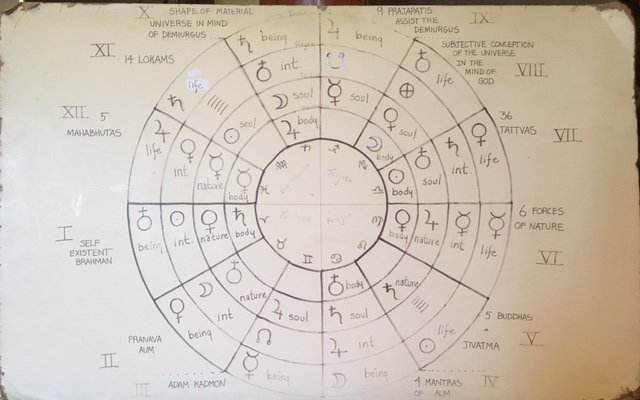
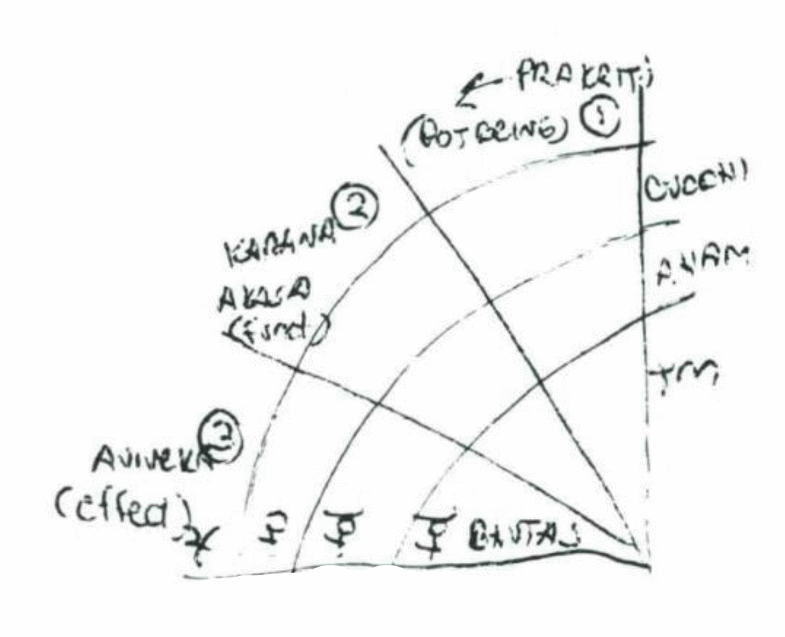
FIGURE IMG_2202-Posterboard Metaphysical Chart.
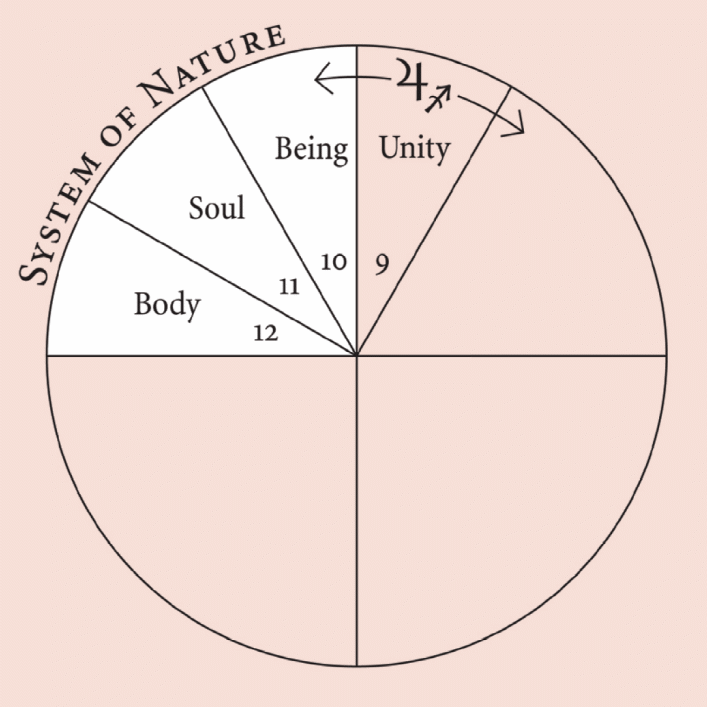
FIGURE 1981 0905-2. Twofold Zeus.
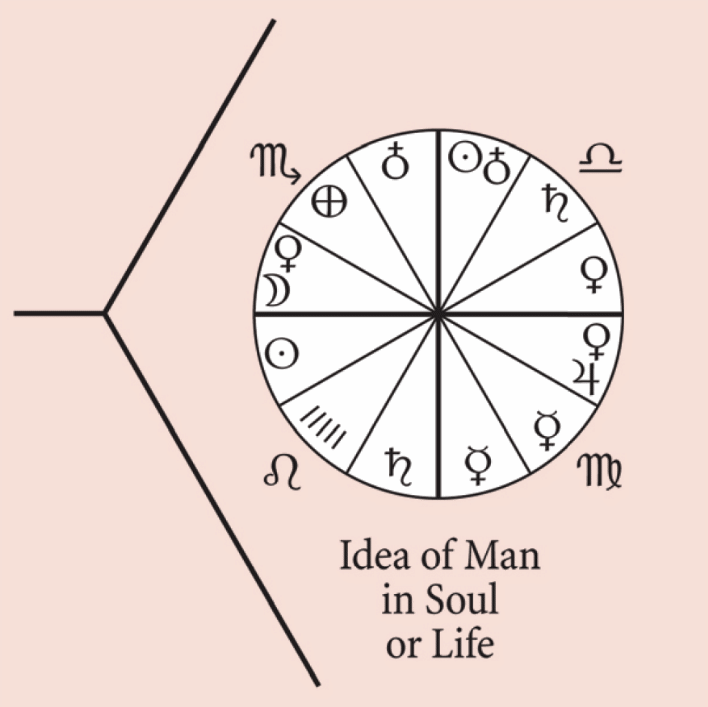
FIGURE 1981 0905-3. Idea of Man in Soul.
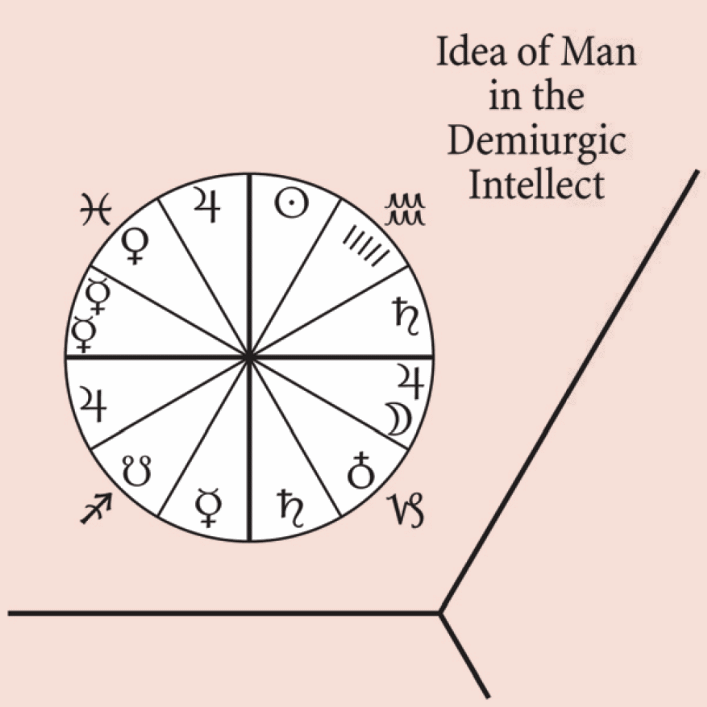
FIGURE 1981 0905-4. Idea of Man in the Demiurgic Intellect.
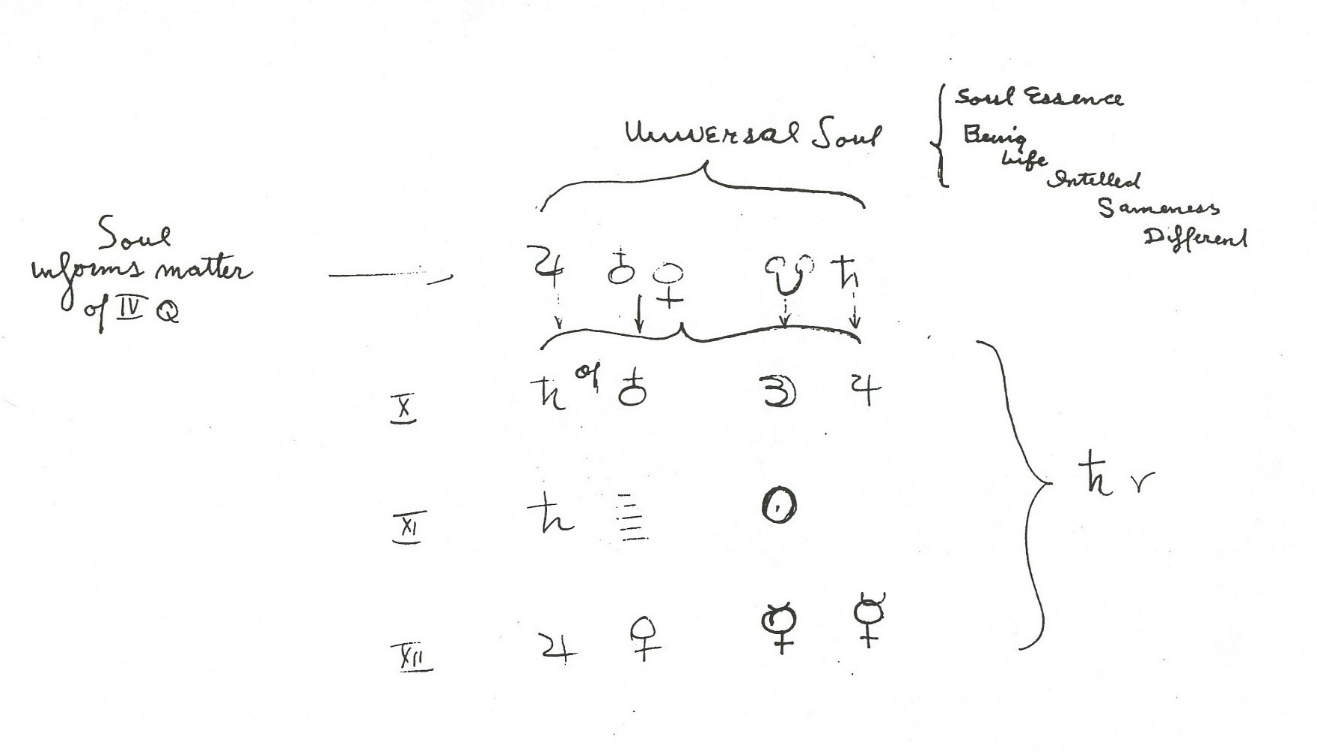
FIGURE 1981 0905-5. Universal Soul informs Matter of Fourth Quadrant.
FIGURE 1981 0905-6. Henad of Jupiter.
FIGURE Gnostic-Fabricative-1. "The Grid" – Gnostic and Fabricative.
FIGURE 1981 0905-8. Three Hypostases and Two Levels of Cosmology Mapped onto Metaphysical Chart.
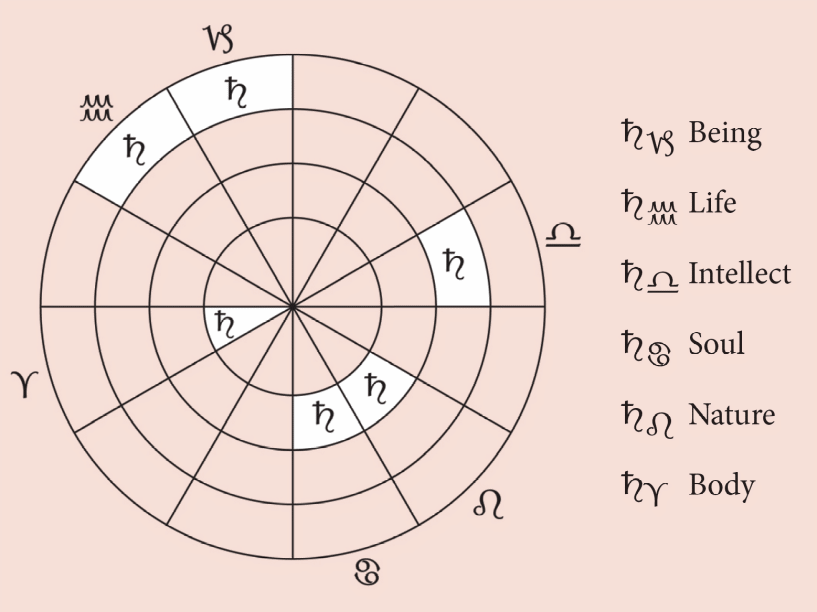
FIGURE 1981 0905-9-AB. Samkhya Scheme, Houses 10-12.
FIGURE AD_E_002. Universal Soul and Fourth Quadrant Dignities.
FIGURE 1981 0905-11. Henad of Saturn.
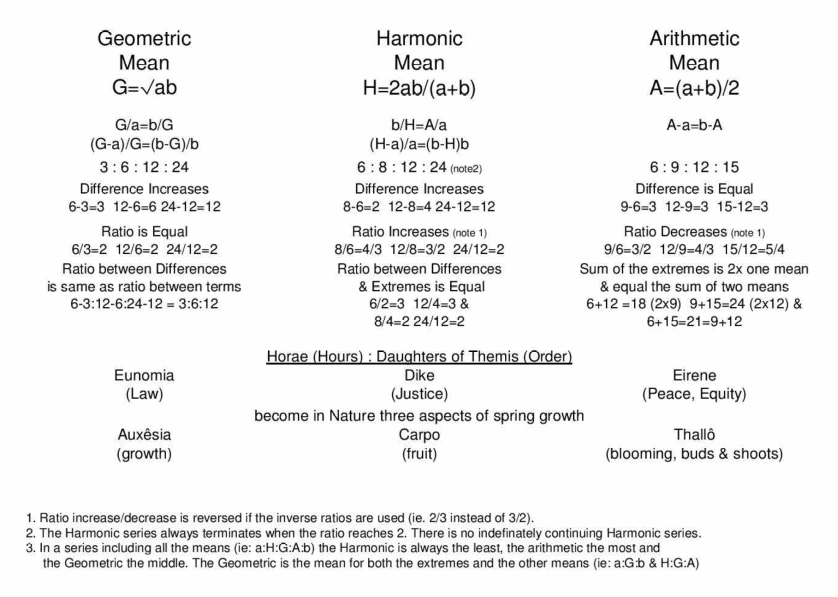
FIGURE 1981 0905-12. Three Means (Proportions).
FIGURE 1981 0905-13. Divided Line.
Other diagrams also referred to are not with this transcript version. [Transcriber note: [diagram] means the speaker is referencing a diagram as he or she is speaking. If someone is drawing or writing, with audible sounds of chalk on a blackboard, I indicate this by [drawing] or [writing].]
TRANSCRIBED Verbatim by IT prior to 2018, reformatted by jf 2018. In 2023, IT updates prefatory matter, footer, and audio file name, alters Subsubjects to make more accurate, completes TOC, fixes/completes Book List, adds Plotinus quotes section, fixes errors/typos, adds new notes within transcript, adds twelve diagrams and references within transcript to these diagrams, reformats to accord with new conventions. Archival verbatim transcript – V12a.
AUDIO FILES: 1981 0905a, 1981 0905b. [Note: "Tape" and "Side" refer to original audio cassette tapes that were later digitized into .MP3 Audio Files.]
1981 09/05 at Wisdom's Goldenrod
Plato; Timaeus
[Audio File 1981 0905a Begins]
VM: --in translation.
AS (simultaneously): Depends on what page it is and then--
AD: Well, no, in terms of [one word inaudible]
LR: It's just from the [one word inaudible] [AS simultaneously: We're just--] the part about the paradigm.
VM: It's just the beginning.
AS: What you want--
LR: The problem of what's the paradigm.
AS: [one/two words inaudible]
[Transcriber note: I am using The Cratylus, Phaedo, Parmenides and Timaeus of Plato, translated from the Greek by Thomas Taylor, London, 1793.]
Thomas Taylor (tr.) [The Timaeus of Plato: A Dialogue on Nature, p. 456, AS reading]: "Again, this is to be considered concerning him, I mean according to…"
AS: Yeah, Tim.
Thomas Taylor (tr.) [The Timaeus of Plato: A Dialogue on Nature, p. 456, AS reading]: "…I mean according to what paradigm…"
AS: We did a little of this (right now).
[flipping pages]
VM/S(?): This (paragraph)--
AS: We did-- we did this before.
VM: The unchangeable or-- or the "that which created," right at that line you mean?
AS: No, when we did the-- we did the whole paragraph. [few seconds of shuffling about, background student talking, flipping of pages] And most people just [one/two words inaudible] talking about last week was the paradigm and the (Demi/many)--
[38 second pause with flipping of pages, shuffling about, faint background student talking]
[tape break]
AS: Say it again.
Thomas Taylor (tr.) [The Timaeus of Plato: A Dialogue on Nature, pp. 456-457, AS reading]: "…I mean according to what paradigm extending himself, he fabricated the world. Whether towards an exemplar, subsisting according to that which is always the same, and similarly affected, or towards that which is generated. But indeed if this world is beautiful and its artificer good, it is evident that he looked towards an eternal exemplar in its fabrication. But if the world be far from beautiful, which it is not lawful to assert, he necessarily beheld a generated instead of an eternal exemplar. But it is perfectly evident that he regarded an eternal paradigm. For the world is the most beautiful of generated natures, and its artificer the best of causes. But being thus generated it is fabricated according to that which is comprehensible by reason and intelligence, and which subsists in an abiding sameness of being. [And] from hence it is perfectly necessary that this world should be the resemblance of something. But to describe its origin according to nature is the greatest of [all] undertakings. In this manner then we must distinguish concerning the image and its exemplar. As words are allied to the things of which they [are the] interpreters, hence it is necessary, when we speak of that which is stable and firm, and intellectually apparent, that our discourse [AS reads: reason] should be in [AS adds: a] like manner stable and immutable, and as much as possible irreprehensible, with every perfection of a similar kind. But [that] when we speak concerning the image of that which is immutable, we should employ only probable arguments, which have the same analogy to the former as [a] resemblance to its exemplar. And indeed as essence is to generation, so is truth to faith. You must not wonder, therefore, [AS reads: And therefore you must not wonder] O Socrates, since many things are asserted by many concerning the gods and the generation of the universe, if I should not be able to produce the most approved and accurate reasons on so difficult a subject. But you ought to rejoice if it shall appear that I do not employ reasons less probable than others: at the same time remembering that I who discourse, and that you who are my judges, possess the human nature in common; so that you should be satisfied if my assertions are but assimilative of the truth."
[short pause]
AD: Well how'd yous make out? Well, let's do it.
AS: Ok, well, (bit of laughter) I'll give you-- I'll give you-- Want the Plato, Tim?
TS: [couple/few words inaudible]
S: Yeah.
AS (aside): Watch out [one/two words inaudible]
CDA: It's [AS simultaneously: Well--] up there on the--
VM: Up there (and) on the left [one word inaudible]
CDA: Toward you.
[short pause]
[Note: See FIGURES IMG_2202-Posterboard Metaphysical Chart and 1981 0905-2, Twofold Zeus, appended to this transcript for the following. FIGURE 1981 0905-2 is from Astronoesis, p. 237. The Metaphysical Chart is referred to throughout the class.]
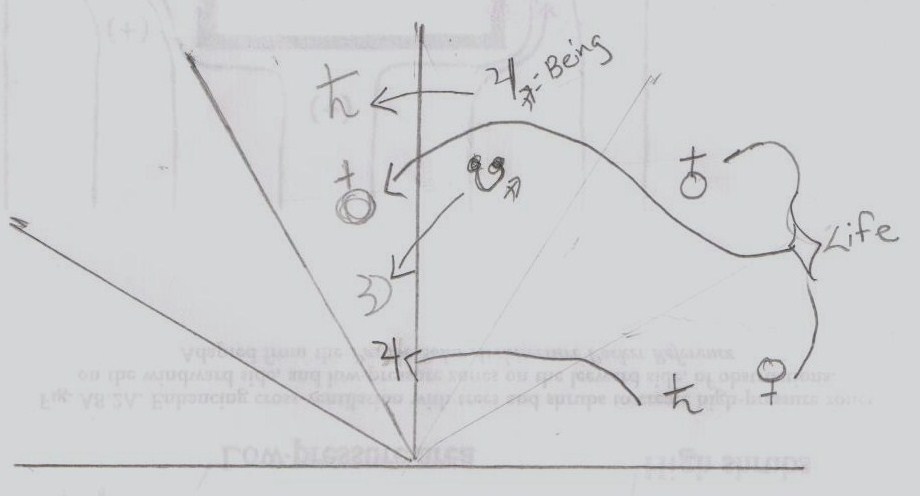
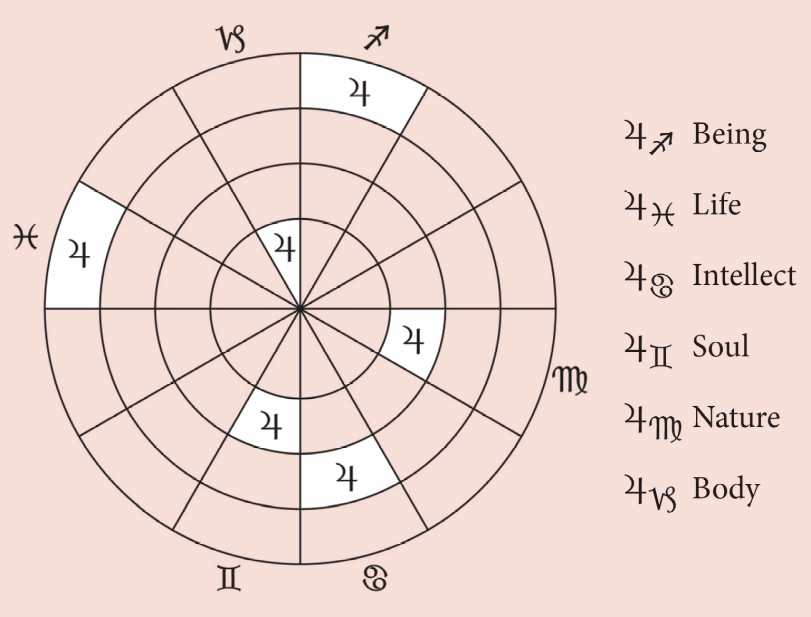
AS: Well, we just-- we-- we reviewed first before we had reviewed what he had done the previous week, ok, he speaks about the divided line, that there's no-- And, first discussion was into the nature of the Demiurge, which I think we are more or less agreed up to it, that the-- Well we should-- We-- we were using the model of the Jupiter in the Sagittarius [diagram] as the Demiurge. [S: Which we thought--] And therefore, he says, "according to which paradigm he extended himself." So-- Ok, well then there's the other-- there are three things he's talking about, the Demiurge, heaven or the world, and the paradigm, you know. There seemed to be also-- there seemed to be two views of what he means by the world. [drawing] Actually maybe more but-- If we put the Demiurge here in the 9th house [diagram], then one possibility, we said, is that by the world means the whole of the last four houses, so this whole thing here is the world [diagram]. And therefore-- So we have this twofold Jupiter. He looks to the paradigm. Now that would be Jupiter considered as looking back-- well-- When he-- when he's concerned with creating the world, which we'd say the last four houses, then we're considering this [drawing] view of Jupiter [diagram] (or/where) we're considering the Demiurgic Intellect. So the whole world is within the Demiurgic Intellect, last four houses or the last part of it [AS indicates on diagram]. Ok? And then when he looks to himself, that would be-- [drawing] one possibility is if we say Jupiter is also the leader of the 3rd quadrant [diagram]. And Jupiter would be-- have to be looking to the paradigm, which he says is this living animal. Now that seems like he could be looking to-- well-- I think what we tried to say is that the eternal-- the paradigm that he looks to, the living animal, could be conceived of as these four houses back here which are in Life [diagram]. And maybe a way to symbolize that-- one way we symbolize that [drawing] is by taking this view, where you had the Jupiter ring, you had the Sun ring [diagram]. [Note: See FIGURES 1981 0905-3, Idea of Man in Soul, and 1981 0905-4, Idea of Man in the Demiurgic Intellect, appended to this transcript. These diagrams are from Astronoesis, pp. 328, 329.] You say that this-- when he talks about the paradigm, the eternal paradigm, the living animal, maybe it's possible that he's speaking of this Idea which is in the Soul-- in the Soul [diagram]. And, you'd say it like that.
VM: I don't know what those two rings are, the one that leads off [AS simultaneously: Yeah I'm sorry.] with the Sun and one that leads with Jupiter? Which rings are they again?
AS (simultaneously): Ok, let me--
CDA (faint): Idea of Man in Soul [couple/few words inaudible] [student assents] image.
S: Yeah.
AS: Let me stay here.
S (very faint): (Go ahead.)
AS: Ok.
[15¾ second pause]
AS (faint): You just forgot.
TS (very faint): I see. [one/two words inaudible]
AS (faint): Well--
[28¾ second pause with very faint background student talking]
AD: Well do you remember the quotation in Proclus on the twofold Zeus?
S: [couple/three words inaudible]
AD: I mean-- ok?
AS: Yeah. We used that. That was the first thing we spoke of.
AD: Would you say that that's twofold?
AS: Well this is-- when we spoke about the twofold Zeus, one aspect of this Jupiter was as leader of the third third [diagram], leader of the cosmos, and the other aspect of Jupiter [drawing] was as the leader of the whole 3rd quadrant [diagram]. Ok, so you have Jupiter, Venus, Mars, and so on [diagram].
[14 second pause while AS draws]
AD: Is he saying that the paradigm is in those-- in that [AS simultaneously: One--] rulership exaltation [one word inaudible]
AS: Yeah, that's-- One view-- one possible view of the paradigm is that-- well that was what we were struggling with, and really struggling, I mean I-- what do-- what does he mean by the paradigm, the eternal paradigm. I mean it's clear that if this is the Demiurge [diagram], then this is [drawing] the world that he fabricates [diagram]. That's fine. But the question is, if this is the Demiurge in himself [diagram], which we've talked about as this Universal Soul, the Royal Soul, and then this is the Demiurgic Intellect [diagram] going the other way. Right, I mean this is ju-- [couple/three words inaudible] (bit of laughter)
AD: Well, you better cro-- erase this board, write on (this).
[student assents]
S (very faint): Yeah Avery, your thoughts.
AS/S(?): That's (Timaeus).
AS: Ok, let me try again. We notice that this Jupiter [drawing] has two different positions [diagram], right, I mean this was the point, this twofold Zeus. And he says one is as the Life of the universe [diagram], ok, as manifesting the universe. (And/In) the other view, he says, when we consider the Jupiter in himself, his inward aspect. And then we would consider Jupiter this way as the leader of the whole 3rd quadrant. This is Jupiter in Being, [drawing] which is the leader of the whole 3rd quadrant [diagram]. Now this way [diagram] he's manifesting the universe. But this universe he manifests is an image of an eternal or an intelligible paradigm, [student assents, very faint] as he says. So the question is, where would we find the paradigm? It would have to be associated with Jupiter's inward aspect, with Jupiter's-- with the other aspect of the twofold Jupiter we spoke about. [VM: Right.] Namely considering Jupiter as the leader of the 3rd quadrant for example. Now that means, [drawing] it seems, that the paradigm he uses, possibly-- I mean this is one possibility, these are the 36 Tattvas [diagram], and this is the Subjective Conception of the Universe [diagram]. And possibly the paradigm for his creation over here is contained in the 36 Tattvas and the Subjective Conception of the Universe.
LR: But then the question arises, could you say the universe would be limited to those Ideas? Or would-- would it have to be--
AS (simultaneously): No. See that's why it seemed-- Well, anyway, the pro-- the question is, the question we kicked around is what is the-- where-- how could we diagram or schematize this eternal paradigm that he looks to. Now the other view, the other way of schematizing it, [drawing] (Rudy should know), the other one we did. If we say that this is the creation aspect of the Demiurge, his outward aspect, where we have say all the Prajapatis represent his creative aspect here [diagram]. And if we symbolize that as the Jupiter ring, the Jupiter [FIGURE 1981 0905-4]. So this would be Sagittarius and so on. Ok?
AD (faint): Alright.
AS: Then, it could be that [drawing] what these look to as their paradigm-- he speaks about this fourfold living animal. And is it possible that what they look to same as-- See if this is the Idea of the Man in the cosmos [FIGURE 1981 0905-4], then this would be the Ideas in this Universal Soul, or in Life [diagram], the way he speaks about a living animal. So this would be Leo, which is the Life-- first Life rulership and so on, and then the next Life rulership in Virgo, and then in Libra, Scorpio [diagram]. So this living animal that he looks to could be this paradigm here, and that would put it not just in these two houses but in the previous four.
SD: Also he speaks of the paradigm as being fourfold.
AS: Yeah.
SD: As [one/two words inaudible]
AS (simultaneously): As-- yeah, he does that later on, the paradigm as fourfold. Also, if we say that this is really-- the Demiurge in himself is like [drawing] these-- the dignities in this quadrant, the rulerships and exaltations here [third quadrant], then on the one hand he's related to the second third going this way [diagram], but on the other hand he's related also to the third third, to the cosmos [diagram]. So in some sense you almost get this thing (of/off)(,/--) you know, one going this way [diagram] and the other part-- wait-- going this way to the second third [diagram].
SD: I think we thought of it as two ways. Insofar as the paradigm could be considered as a prior reality which he then interprets as the cosmos, then we were speaking of it as those four houses of that second triad. But insofar as the paradigm is something within the Demiurge himself, then we were thinking more of the 3rd quadrant.
LR: Why?
SD/S(?): Hm?
LR: Why isn't [SD simultaneously: Well the Demiurge--] the other within the Demiurge?
SD: The Demiurge in [couple/three words inaudible] in the 3rd quadrant is not actually in those four Life--
LR: But [AS simultaneously: Well there's another--] why don't you speak [one/two inaudible SD words simultaneous with LR] of the other as being within the Demiurge?
BS (simultaneously): Didn't you have another possibility up there?
[Note: See FIGURE 1981 0905-5, Universal Soul informs Matter of Fourth Quadrant, appended to this transcript for the following.]
AS: Yeah there's another slightly different possibility [drawing] which we did a lot before. If we take these rulerships and the exaltations as in the 3rd quadrant [diagram]-- We did this once before. We spoke about the tentative illumination from the Demiurge. Then this would-- this-- we could say that the paradigm is in here [diagram], that this is the paradigm of the universe, and that the illumination, ok, would be going from the 9th hou-- from this 3rd quadrant to the 4th quadrant [diagram]. So these would be the Demiurge [diagram] containing this paradigm. And these [diagram] would contain the paradigm of the universe. So that Jupiter himself would contain the paradigm of the organization of prakriti [diagram], this would be the paradigm of the causal or buddhi [diagram], say, this would be the paradigm of the subtle [diagram], and then this would be the paradigm for the gross aspect of the universe [diagram].
[short pause]
LR: But even they would have to have-- contain the paradigm from some other place, I mean if you spoke of the-- wouldn't they?
AS: Yeah.
LR: If you spoke of the Mars, Tail, and Saturn [diagram], they would have to be given.
BS: You had another one too, I think you did, (bit of laughter) where three [AS simultaneously, faint: We had a couple.] Ideas, the last three houses would be the paradigm also.
AS: The last four houses.
BS: Four houses. The Ideas.
AS: (Yeah Vic?)
[short pause]
SD/S(?): Or none of the above.
AS: Or none of the above.
VM: Right. (VM laughs a bit)
[12¾ second pause]
AS: Huh.
VM: Why not follow the [AS simultaneously: I don't know.] Jupiter series [diagram] backwards too. [Note: See FIGURE 1981 0905-6, Henad of Jupiter, appended to this transcript. This diagram is from Astronoesis, p. 333.]
SD: Why?
AS (simultaneously): Well that was another suggestion.
VM: I mean to go all the way back to Jupiter in the 3rd house [diagram]. Then the [AS simultaneously: Yeah well, we--] six holy forces [diagram]. I don't know, maybe that's just going too high to approach it that way.
DR: Well if you do that why not just make the Jupiter in Pisces [diagram] the Demiurge?
VM: Yeah? Could do that too I suppose if--
AD: I'm sorry?
AS: [few words inaudible]
VM (simultaneously): David suggests if you're going to talk about the Jupiter series, make the Jupiter in Pisces the Demiurge, talk about worlds below that as the creation [diagram].
AD: Yeah, that's another possibility [VM simultaneously: That was another possibility.] [couple words inaudible] That would be this--
AS (simultaneously): That was one, that was another one, uh-hm.
AD: That would be the image.
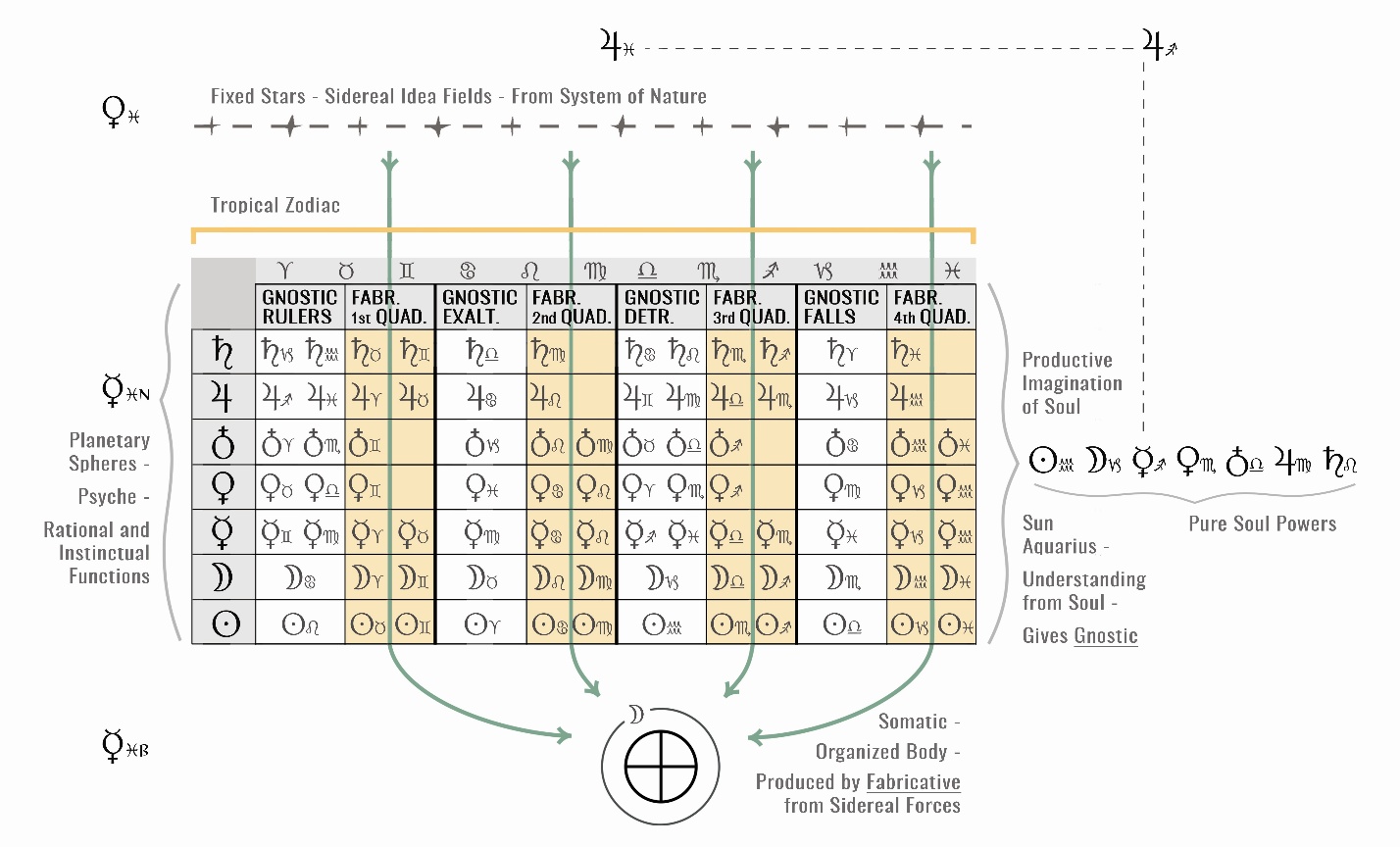
VM (simultaneously): You know, that would fit in with the way we're using the grid [diagram] lately and so on. [Note: See FIGURE Gnostic-Fabricative-1, "The Grid" -- Gnostic and Fabricative, appended to this transcript.]
AD: Yeah. It also would be an image of the paradigm, the sensible world is an image of the paradigm.
AS: Yeah but they're not the image, they're not a paradigm. But that was just--
AD (simultaneously): The 12th house would be the image.
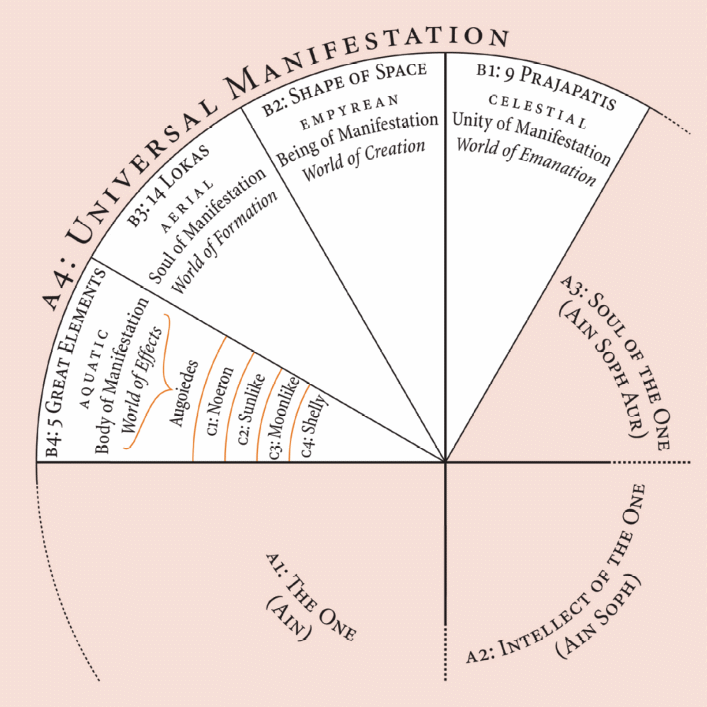
AS: Yeah. Well that was the other-- the whole other scheme is that it seems that-- See this is another-- this is another possibility which I thought of but I don't-- Suppose you say [drawing] this is the paradigm [diagram]. [Note: See FIGURE 1981 0905-8, Three Hypostases and Two Levels of Cosmology Mapped onto Metaphysical Chart, appended to this transcript. This diagram is from Astronoesis, p. 236.]
AD: Uh-hm.
S (very faint): Yeah.
VM: The Ideas of the houses you mean?
AS: Yeah, this-- that was-- that was what Bert-- what Bert brought up, [VM assents] which we had suggested.
BS (simultaneously): Well, why not?
AS: If you say this is the paradigm itself [diagram], [drawing] this is the Grand Man, then the image would have to be, as you just said, here's the paradigm [diagram], and here is the image [diagram]. And we did this a lot, we said well, this [diagram] is really an image of the Demiurge. The inerratic sphere [diagram] is an image of the 10th house, this [diagram] is an image of Aquarius, and then this [diagram] of course, the body itself is an image of the whole of the ele-- of the sublunary world.
VM: But what about the Idea of Pisces, isn't it-- [AS simultaneously: No but look--] is that a legitimate Idea (or not)?
AS (simultaneously): Yeah but look, that's-- [drawing] we got two views, we have a sequential and we have a simultaneous view. In one view these are all real Ideas [diagram]. See this-- what suggests this is the fact that, if we're doing the metaphysical chart these should be real Ideas, they're eternal.
VM (simultaneously): Yeah, correct.
AS: That was the point we made about that. These are eternal Ideas, and therefore this is paradigmatic, it's not fabricated. Demiurge [SD simultaneously: Fine, fine.] doesn't fabricate these Ideas. But then if this is the paradigm [diagram], the image, the actual image is just this [drawing] sensible world here [diagram] is what he's speaking of. And that could be the world
VM: What if you took the point of view, you said look, each Idea is in every other Idea or, you know-- in other words, the 12th house Idea [diagram] is a unique and special version of the Intellectual-Principle. Say that's the paradigm, the Jupiter looks to that and then manifests [student assents] the created world.
AS: But I'm take-- I'm still trying to keep [drawing] Jupiter as [couple inaudible student words simultaneous with AS and VM] [VM simultaneously: Oh I see, uh-hm.] the Demiurge.
S (faint): Look (at me).
VM: Well I'm going to (BS) because I'm not making any sense.
AS: No, go ahead.
VM: But, let's say that each-- as we've said over and over again, each Idea is a unique and special vision of the entire Intellectual-Principle, it contains all [AD simultaneously, faint: Uh-hm, yeah.] the Ideas in its own special form. [Note: See Plotinus, V.9.8, third para.] [students assent] Let's take the 12th house then as the paradigm for the created world, 12th house Idea. [AS(?), faint: We did that.] And then say that Jupiter-- I mean I'm trying to take it all the way down, Jupiter [student assents] in Pisces now is [AS assents] the Demiurge [diagram] [student assents] that then looks to the 12th house Idea for its structuring principles, its paradigm, to then create the world of, let's say, appearance that ultimately occurs in the last Mercury [diagram]. And the whole grid [FIGURE Gnostic-Fabricative-1, Nature Mercury in Pisces] is used to actualize that paradigm and bring forth the world that we know. I don't know, it's just [AS simultaneously: No, I follow all that.] another of the many possibilities.
AS: No I would agree with the grid actualizing the world and so on. Um--
MW: Just instead of saying the paradigm is Sagittarius, Capricorn, Aquarius, and Pisces, you're just saying the paradigm is Pisces.
AS: Just the 12th house.
VM (simultaneously): Well but-- but by saying that way, the paradigm includes all the 12 hou-- all the other eleven too.
AS: Yeah. That's true.
VM: So that has perhaps that virtue. It's hard to know where to-- [AS: Well see--] to come down though.
AS: Well the thing is if-- [short pause] But it seems that the one-- the most clear analogy we made-- or I don't know, maybe it isn't, but it seems the most explicit analogy we had is between those last four houses and the image in the 12th house of that [FIGURE 1981 0905-8].
VM: Right. Well we have a lot of machinery [AS simultaneously: So I mean even if you--] that's developed to appreciate that [AS simultaneously: Well I mean--] point of view, I agree.
AS: Yeah. Even if you say that, well, the process we're [drawing] talking about of creation is taking place in here [diagram], [VM: Right.] of which I would basically say I-- I would agree with that, that it still seems that the paradigm is not just specifically the 12th but you would have to look-- look at the [one/two faint inaudible AD or student words simultaneous with AS] whole of the Demiurgic [VM simultaneously: I appreciate what you're saying, yeah.] Intellect. 'Cause it does seem-- Well, I don't know.
S: Well look.
VM: I mean it must be complementary views, I don't think it's a question [AS simultaneously: Yeah. (I don't know.)] of one's entirely right and the other one entirely wrong.
AS: See [drawing] even if you do this, even if-- (four/or) rulerships there would be like-- this would be the Demiurgic Intellect maybe [diagram]. And that-- [AS knocking on board] that Demiurgic Intellect would have these Ideas [diagram] [VM simultaneously: As its access, yeah, uh-hm.] as its eternal paradigm. And that would all then be imaged in--
[1 minute 8 second pause, flipping of pages]
AD: You have an abundance of Demiurges.
VM: Yes. (VM laughs)
AS: Yeah. I'm not sure we're getting [one/two words inaudible]
VM (simultaneously): Demiurge on every corner. (bit of laughter)
[student assents, very faint]
AS: I think the last thing we did was (ok). The image at the 12th house and the paradigm for it being the last four houses. [aside] It's somewhere there.
LR: Can I just ask something? When he says--
AS (simultaneously): Seems to be what he's talking (to/through). Yeah.
LR: When he says how he found the world was in confusion and disorder and had to [S, faint: Bring order to it, yeah.] bring in order, is that just in the-- is that used almost metaphorically to show the distinction between form and matter or-- which is the only way I can understand, I mean he doesn't really mean that he ca-- he actually observed the world of cha-- [VM simultaneously: The random motion (one word inaudible)] of disorder and then brought order into it, does he?
S (very faint): I think so.
AS: (Talking to him.) You mean this line, this a little later on?
VM/S(?): Yeah.
Thomas Taylor (tr.) [The Timaeus of Plato: A Dialogue on Nature, p. 457, AS reading]: "…hence, receiving every thing visible, [and] which was not in a state of rest, [LR assents] but moving with confusion and disorder, he reduced it from this [AS reads: the] wild inordination into order, considering that such a conduct was by far the best."
LR: Well that really confused me when he did that.
[short pause]
AS: Because?
LR: Because of what I just said. Because, if he means that somewhat metaphorically to point out what the Demiurge is actually-- what he's pulling from himself--
AS/S(?) (simultaneously): [couple/three words inaudible]
S: Yeah.
LR (simultaneously): Well I don't-- then does that mean there was a world prior to the Demiurge as bringing order into it?
AD (faint): Uh-huh.
AS: Well you know when Plotinus speaks about this tentative illumination, [Note: See Plotinus, VI.7.7, third para.] and how-- But, it seems-- well if we can-- first there it seems that you could speak about-- again, we have (three) possibilities. (AS laughs a bit) What would you think that wild-- what would you think then inordination is before there was some order imposed on it?
LR: Well he says "receiving every thing visible".
AS: Could that be like the traces? I mean, it seems like there you say-- suppose we speak about those vasanas or those traces of life functioning in the 12th house, conceiving of that as prior to this order being imposed on it.
LR: Then you're conceiving of a world, I mean--
AS (simultaneously): But it's not a world.
LR: I know but--
AS: It's not a world yet.
LR (simultaneously): But where do the traces come in now?
AS: From prior worlds.
LR (simultaneously): Prior activity.
AS: That's ok.
LR: And insofar as it would be prior activity there would have already been an order such that traces could have been made on them.
AS: But the traces themselves as residue are like this potentialities, potencies. I mean could you look at it that way?
BS: Well, why would traces be visible?
LR: Well, visible for the Demiurge, what does that mean?
AS: Visible means--
LR: What's visible for the Demiurge--
AS: Capable of being--
LR: I mean--
AS: [one word inaudible] vis-ed.
LR (simultaneously): It's the Demiurge who's looking, I don't know [S, faint: How does--] how far he-- (I is--)
BS (simultaneously): Yeah but I'm reading. (laughter) Visible.
LR: Yeah but, [couple inaudible student words simultaneous with LR] he's not talking about you. He's talking about the Demiurgus.
BS: Well then it's the wrong word. (I'm still reading.)
AS (simultaneously): By visible-- no, no. By visible here I think he means as opposed to intelligible.
BS: Ok. As [AS simultaneously: I think he's--] opposed?
AS: Yeah. As opposed to intelligible. You know, he's doing his division again of the line. He's speaking about all that which is visible conceived of as prior to having an order imposed on it. That which is intelligible wouldn't be able to receive prior to order 'cause it's always ordered [BS: Yeah.] in that sense. But the world he says becoming to be has--
[19¾ second pause]
S: Anthony--
AS: Anthony, [BS simultaneously: Well this would further be known.] should we do the Aristotle, the Aristotle quote where-- where he speaks about body as-- and he speaks there about being a conjunction of this matter with the form which is [student assents] coming from this life essence [student assents, faint] from the Demiurge. Seems that right there he's-- "every thing visible, which is not in a state of rest, but moving with confusion" seems to be the matter that Aristotle is speaking of. And the imposing of order, his first imposing of order, seems to be that first-- that essence of life that the Demiurge is imposing on it, which is the very first vestige of form. And that the result of that is in fact body or the universe. That's-- that's similar thing that he's speaking of here, that Aristotle is referring to. The Demiurge is what gives the life, which is this ordering or reason, to matter, the conjunction of those is body. Conceiving of matter prior to this life that the Demiurge gives it, this ordered life, is-- it's completely unordered, wild inordination, moving with confusion and so on. I mean if-- if you're going to describe the nature of, say, unadorned matter here, and that may be what he's speaking (of).
AD: So what do you think, Spider? You think the disordered motion will be equivalent to something like the gunas? [10¾ second pause] You know, and it was mentioned last night that these bits of matter, each has their own motion, like each atom, you know, has its own kind of activity. But they're all random, there's no order imposed on them yet. So that if we say astronomically what we were saying last night, that the-- the hypothesis about gas or dust particles which are left behind in a pralaya, and this would be the disordered motion that's there.
S: Right, it's completely random.
S (very faint): Yeah.
AD: Because evidently, as we were saying, we only need three things, we need matter, we need the Demiurge, and we need the Ideas. [S, faint: Ok.] So, the matter then would be what we just spoke about as this residue of past activity, disordered motion.
AS: And before-- and that's also a good reason why before he can even speak about soul, we first have to speak about that disordered motion, those dust particles or whatever, being tentatively organized into at least something that soul could work on, at least being organized into some, you know, ordered-- some ordered whole. The first thing he has to do is make the whole of this universe into a-- into an ordered whole before he could even speak about any elaboration or any [one word inaudible] building up [one word inaudible]
S (simultaneously): Some order.
AS: Yeah, (an ordered) form.
AD: Well we seem to be working then off the 12th house I think.
S: Uh-hm.
AD: The 12th house Idea is going to be the image [student assents] of the paradigm.
AS/S(?) (faint): [couple words inaudible]
AS: You know, again--
VM (simultaneously): Jupiter is still the Sagittarius--
AS: Yeah but-- yeah that's what I was going to say, the pa-- if we say that's the image, I think it would also fit with the paradigm if you say-- you could say paradigmatically 10th house prakriti is being ordered [S simultaneously: Ordered.] [VM assents] by the 9th house Demiurge [Jupiter in Sagittarius] the way we showed the forms [students assent] there being imposed on the gunas of prakriti, substantial aspect of prakriti in the 10th [Saturn in Capricorn]. And that would be the model. And then in the 12th house you'd have the same thing going on, these disordered life traces, those traces of dust particles, the first thing that happens is his life essence will order them into a whole. And so it seems you-- it would-- it would be analogous. And then the paradigm, what the result of that would be in pa-- in the paradigm the result would be the Shape of the Material Universe in the Mind of the Demiurge [diagram], which is what T. Subba Row calls it there. [Note: See T. Subba Row, A Collection of Esoteric Writings, "The Twelve Signs of the Zodiac".] Or, in here, in this view it seems you could say it's-- I don't-- the inerratic sphere [diagram] would be the whole of the-- the whole image of that would be the image if-- I think is what he's going to speak of as this total ground.
[student assents, faint]
S: Image or the Demiurge is intellective or--
S: Skip it.
[short pause]
S (very faint): (For sure.)
AS: Would be the whole of his realm.
JA: I don't understand--
AS (simultaneously): The other thing is that he's--
JA: --what you're saying, are you saying that the 12th house Idea is a metaphor or the paradigm is in the 12th house?
AS: Well I guess I was trying to say that the image was the 12th house. [JA assents] I'm still trying to work the image, what he's actually talking about is he's fabricating there is in the 12th house and the paradigm is the 9, 10, 11 and 12.
JA: Taken together.
AS: Well, I'm just saying if you look the way we worked it at times, you could see that as a paradigm. The 9th house Demiurge illumining 10th house matter would give you that-- just that shape of the material universe, no-- there wouldn't be any particularized forms as-- as such yet. Just be the imposition of the Demiurgic-- the Ideas in the Demiurge on the prakriti. Similarly now the image of that when talking about the sensible cosmos is you're talking about this life essence from the Demiurge which is ordering disordered particles that are left over from previous universes to form the one whole universe within which now you're going to speak about the elaboration. And again the paradigm, the next one would be the 11th is going to elaborate that, and in this paradigm-- in the image what's going to elaborate that is going to be the solar system or the planetary spheres and so on.
JA: Talking about 12th house as an image.
AS: I'm just trying to see-- he's talking about the 12th house or the world as the image of the paradigm, the paradigm being the last four houses, the image being all of the fabrication within the 12th house. The paradigm for that is the Idea that the Demiurge has, which is the last four houses.
JA: Are you taking the last four houses or--
AS: Metaphysical.
JA: --last four as meta-- metaphysical?
AS: Yeah.
JA: So the 12th would also be(--/.)
AS: Right, but the nature-- but the metaphysical-- but, the metaphysical nature of that 12th house is to be an image.
JA: Is that it's generated.
AS: Yeah, that's-- I mean if you-- if you ask what its-- what its peculiarity is, it's to have this generated essen-- to have this eternally generated nature.
BS: By-- by image you mean the fourfold nature of the 12th house [diagram] representing the fourfold of the four houses (this/as) World-Idea?
AS: Well, I was-- yeah, I-- I mean-- I was even thinking about that.
BS: Like, those Ideas would get [AS simultaneously: (Right.)] embodied within the (Idea of Life).
AD: Yeah, if you don't mind, help him to put up the Samkhya diagram, [AS or another student assents, faint] the Samkhya, how they do it. [short pause] We'll try to work off (for/the) comparison. Put Samkhya (in/and) 10, 11 through 12. [16¾ second pause while AS draws] (And--)
[23¾ second pause]
S: Avery?
AS: Yeah?
S: While you're doing that there was-- there was one thing that I looked up and it was-- [AS drawing] and I was curious about whether there was just a translation or what and the word that he uses, that he translates as "visibles," [AS: Yeah.] is used very often in Platonism and it literally means "able to be seen" or visible.
AS (simultaneously): That's what I said, able-- able to be vis-ed.
S: Yeah, able to be vis-ed and Plato uses it quite often in conjunction with another word that means, you know, tangible or able to be touched.
AS: Right. Oh that is the same thing. [S, very faint: Tang-ed.] Oh good.
S: Yeah, so I-- yes, able to be tang-ed, right. (bit of laughter)
AS/S(?): Yeah but--
S: But that's the literal meaning of those words, [AS drawing] I mean there's nothing equivalent in translation.
AS: Yeah I mean that seems--
[student assents, faint]
[11 second pause while AS draws]
AD: I think you're going to work off the house and-- [S: Yeah.] You don't have enough of a background to attack the-- (the 9th/tonight).
[12¾ second pause while AS draws]
AS: And this isn't prakriti.
[18¾ second pause while AS draws]
AD: And the other problem, we don't know if he's referring to our-- our world or universal manifestation.
AS: Yeah, well that--
VM (simultaneously): We just don't know what level.
AS: That would-- that would throw the whole thing out [couple words inaudible]
AD: Alright, let's work with a big one.
S (faint in background): Give it to [one/two words inaudible]
[12½ second pause while AS draws]
[Note: See FIGURES 1981 0905-9-AB, Samkhya Scheme, Houses 10-12, and IMG_2202-Posterboard Metaphysical Chart appended to this transcript for the following.]
AD: Most of you remember this, don't you, Samkhya version of the-- how to interpret. If you think of the Bhattacharyya article you-- you'll work out something like this too. [Note: See Krishnachandra Bhattacharyya, Studies in Philosophy, Vol. 1, "Studies in Samkhya Philosophy".] [short pause while AS draws] So the Saturn [in Capricorn] for instance, we refer to it substance or matter. And then the-- the next Saturn [in Aquarius] (you refer/he referred) to as-- the Saturn [one/two words inaudible] he referred to as potential being and actual function. [short pause] So that would be equivalent to saying that within matter there are the traces of life and these traces of life can function. That would be the whole top line, the rulership [diagram]. [23½ second pause while AS draws] Now that's-- that's going to have to be a paradigm for a while.
[15¾ second pause]
LR: Avery, why did you write 'manifest' there?
AS: Below that?
LR: Next to the buddhi on the [one/two words inaudible]
AS: No all-- all this below here. These three are the manifest tattvas [exaltation, detriment, fall rings in houses 10-12]. These are unmanifest [rulership ring in houses 10-12].
LR: Oh, ok, I see.
AS (simultaneously): I thought that would help (him) somewhat in what he was saying here.
S: It's just separating the rulerships from the rest of the house.
LR (simultaneously, faint): Go ahead.
AS: Yeah. Unmanifest prakriti. See, they would say exactly the same thing, that thing about visible. They would say, yes, when-- when the world actually appears, what does appear, what's actually experienced, is the unmanifest prakriti, the gunas. And so, these gunas are visible. They are what actually become-- what is actually seen and known or experienced. These-- the-- the other tattvas are like the forms through which this unmanifest prakriti is going to be manifest. But the forms themselves are not what is seen as the external universe, rather it's prakriti itself that appears.
S: What are you referring to as the gunas in there, in that [possibly one word inaudible]
AS (simultaneously): The gunas [few inaudible student words simultaneous with AS] would be in the unmanifest prakriti.
S: Ok, the three [one/two words inaudible]
AS (simultaneously): Ok, the gunas [drawing] and the life-- the life traces which are left behind in [S simultaneously: Ok.] those gunas, the-- their peculiar motion say.
S (simultaneously): Ok, fine.
AS: And they-- they would even-- they would say that same kind of thing. And they're disordered. They-- there's no-- the first level of order is in the buddhi. In fact buddhi means manifestation so-- And manifestation means the beginning of some kind of order on that prakriti. And they even say too that that prakriti, the equilibrium of the gunas somehow-- the gunas somehow go-- as-- as the world unfolds or gets manifested the prakriti goes along with it. Unmanifest prakriti is like the background for the whole thing. So when you have the visible world what actually appears is prakriti, through-- through these forms.
[short pause]
[Note: See FIGURE AD_E_002, Universal Soul and Fourth Quadrant Dignities, appended to this transcript for the following.]
AD: Avery, on the other side now, on the other side, on the other board, can we put also the other diagram that we use. [AS drawing] Remember the Saturn Jupiter monad acting together [diagram]?
S (faint): (Yeah/Hm).
[12½ second pause while AS draws]
AS (quietly to himself while drawing): Maybe it was something like--
AD (faint): Where you had 10th house. [AD/S(?): Yeah.] 11 and 12. [17½ second pause while AS draws] Yeah I suppose that's Saturn [diagram], alright, that's the matter aspect.
AS: [drawing] [one/two words inaudible]
AD: And the top would be the Jupiter [diagram]. [AS drawing] Bracket that whole top. That would be the Jupiter. Then you-- Now within the Jupiter the Ideas-- let's say within Jupiter, the Ideas are within Jupiter [diagram].
[short pause while AS draws]
AS: Seems like he has the reason-principle--
AD: Has them [one/two words inaudible]
AS: [couple/three words inaudible]
[AS draws while AD speaks]
AD: And then below that line, alright, you have the matter [diagram]. So there you would have the three ingredients that Plato insisted upon, the Demiurge, the Ideas, and matter. [17¼ second pause, AS draws a bit] Well, I see we're going to have a lot of work (to be--/today.)
[13¾ second pause]
AS: Ok, the other-- and-- other suggestion, this other thing with the par-- the disorderly motion, you may be right but we once spoke about this matter coming ultimately from the Saturn series or from [AD: Yeah.] prakriti itself. [Note: See FIGURE 1981 0905-11, Henad of Saturn, appended to this transcript. This diagram is from Astronoesis, p. 342.] Mulaprakriti even. And if you say that that's what the Demiurge receives, you could see there clearly why the Demiurge doesn't provide the matter of the universe. And that's given to him, if we go all the way back and say it's from the Saturn [diagram].
AD: Do you follow that?
AS (simultaneously): Was another suggestion.
[student assents, very faint]
AD: Do you follow that?
AS: That's another--
AD: In other words, if you think of the Saturn in Aries [diagram], [student assents, faint] and we say that that represents the body of the transcendent One, now "body" here would be, you know, equivalent to the manas or equivalent to space. So space would be the-- the body of the-- of the transcendent One. Now what kind of (matter) is it [one/two words inaudible] we can't understand but, as it comes down into the 4th quadrant, alright, it's going to be transformed or it's going to be the underlie of the whole of manifestation. [AS assents, faint] And that's referred to as prakriti, alright.
AS: Yeah, it seems in that view then, the first thing that would have to happen is that space would be limited to universal mani--
(Side 1 of original cassette tape digitized as 1981 0905a Ends; Side 2 Begins)
AS: --universal manifestation.
AD: And they call that secondary matter.
AS: Right, that's already-- what he said is it's already ordered to some extent.
AD: Uh-huh.
AS: And it also-- I mean, T. Subba Row used that same thing, that same idea for the 10th house, the Shape of the Material Universe in the mind of the Demiurge [diagram]. I think-- I mean that's exactly what he's describing here [couple words inaudible]
LR: Can you repeat the last thing? Not the [AS simultaneously: Yeah.] last sentence but the one before that?
AS (simultaneously): No, no, I-- The Saturn in Aries we spoke about as its-- they speak about as absolutely prime matter inde-- absolutely indeterminate and so on. It's not really the matter of this cosmos, [LR assents] you know, it's not matter of the universe. It's what he-- I would suppose you'd say that's his-- completely dis-- disorderly motion, which comes directly from the One as it were. Now, within that the first thing that has to happen is somehow we'd say that that has to be limited to secondary matter, [LR: To be a universe.] or to the matter of universal manifestation. And that already requires that the Demiurge impose some kind of limitation on it. It's no longer absolute unlimited lower mind [LR: So then the Demi-- the--] of the One, now it's matter within the mind of the Demiurge. This matter [diagram] is outside of the mind of the Demiurge.
LR: So then the Demiurge--
AD (simultaneously): Yeah you [AS simultaneously: The mind of the One.] remember when-- do you remember in the Kabbalah when they speak about the way the infinite Ain restricts itself? And by a series of steps it restricts itself until finally it becomes Ain Soph Aur or the primal point? Remember?
LR: Well but then the Demiurge, in looki-- looking at things visible which are cha-- chao-- chaotic and disordered, would be looking at the Saturn in Aries.
AD: Yeah.
LR: Which seems a bit strange if you're putting the Demiurge way down--
AD: Well he's speaking about diso-- disordered motion so it wouldn't be the Saturn in Aries.
LR: But you just said that when it constricts(,) that-- the Dem-- according to the quote it seems as if the Demiurge looks on the world and he sees disordered motion. And into that ejects or super-projects the form of his own being or something [AD assents, very faint] like that. Now, [short pause] from what you ju-- it didn't-- I don't know-- what you-- what you just said seems as if the prime matter, or the matter of the One, so to speak, or the Saturn in Aries, is totally indeterminate, space totally indeterminate. [AD, faint: Uh-hm.] And that that gets limited in some way and becomes the universe. But--
AD (simultaneously): The matter of the universe.
LR: The matter of the universe. But in doing so takes on the forms of the Demiurge.
AD: Well it would [one/two words inaudible] it will take on (a/the) form(s), yeah.
LR: What is the Demiurge seeing when he sees-- you know, that's why I asked is it metaphorical, because does he actually view something prior to any form or is it metaphorical that there is this separation of form and matter and that seeing here--
AD (simultaneously): No, I lost you.
LR: Ok. Is there ever a time-- is it really the case that the Demiurge could view universal matter which is totally unformed and then project his forms onto it? Or is that--
AD: But the quote doesn't say that he looks at unformed matter.
LR: No it doesn't, it says--
AD (simultaneously): It says he looks at the disordered motion.
LR: Right.
Thomas Taylor (tr.) [The Timaeus of Plato: A Dialogue on Nature, p. 457, LR reading]: "…hence, receiving every thing visible, [and] which was not in a state of rest, but moving with confusion and disorder…"
AD: So then-- so then the Demiurge is perceiving what you would call prakriti or the traces of matter-- the traces of life left in matter. That's what he's perceiving.
S: It's visible, so wouldn't it have to be in the 4th quadrant?
AD: (No.)
[short pause]
LR: Then why do you bring in the thing with Saturn in Aries? What's the purpose of speaking of that?
AD (simultaneously): We're just-- we're just tracing the genesis of where that form ultimately comes from, I mean where that secondary matter ultimately comes from.
LR: Ok, all I'm saying is, I guess-- If you call it the traces of life in matter, that matter's already been formed matter. At one time--
AD: At one time, yes.
LR: Ok.
AD: Yeah, well--
LR: So, in some way to speak of the Demiurge introducing form and order there is-- [AD/S(?), faint: Yeah.] it's not-- [AS simultaneously: But-- but think of--] it's not like a sufficient or a complete enough explanation because-- because you've already begged the question by saying well that matter already was formed and now it holds these traces.
AS: But--
LR: Do-- do you see what I'm saying?
AD: No, I don't see what you mean.
S (faint): Yeah.
AS: But Linda, once universal manifestation--
LR/S(?) (simultaneously): And neither do I.
S: I see what you're saying.
S (very faint): I do too.
AS: Once-- even in Samkhya, once this manifestation has withdrawn back into the unmanifest prakriti, say withdrawn the influence of that order, back in the unmanifest prakriti what kind of order can you speak of? You could say, [LR simultaneously: Agree.] ok, it's the traces of order. But is the traces of order equivalent to order? Or is it just--
LR: No, I agree, I mean I see the-- I see--
AS: I see your question, yeah I think you're right 'cause what he looks at then-- you-- I think the point you're making is that what the Demiurge assumes as matter is not the Saturn in Aries but the Saturn in Capricorn [diagram] say. It's already-- it's the gunas, it's already secondary matter. It's not absolutely prime matter. Ok? And you would say--
LR (simultaneously): I guess I'd never thought about prakriti as life traces of prior universes.
AS: Well, see--
LR (simultaneously): I guess that's my problem.
AS: I guess, and then you-- you might have the problem and say, well, there had to be a first-- you know, at some time [LR simultaneously: What do you mean, you can't--] we had to have unmanifest prakriti. Well no, there's-- it's a-- there's no-- it's beginningless process. You can't-- you can't posit a first universe where there first began to be life traces in prakriti.
SD: But Avery, I [LR simultaneously: No but all I'm saying--] thought we always distinguish between the matter and the life traces in a sort of substance and function distinction. Because the life traces were one thing, [LR or another student assents, faint] they were, as it were, the [AS simultaneously: Pisces.] disordered motion. But there is that matter which suffers the disordered motion and that's the substance.
LR: Yeah, I mean why else distinguish--
AS (simultaneously): He says the prakriti is never without-- [LR simultaneously: Why else--] it's never-- there is no-- at least in Samkhya.
LR: But, the way we draw the [AS simultaneously: There's no unmoved (matter/Saturn).] chart we've got the Sat-- we've got the Aquarius as being traces of life functioning [diagram] and we've got Capricorn as being prakriti [diagram]. Right? So--
AS: Substantial, he says prakriti [LR simultaneously: Substantial and (one word inaudible)] is substantial as the gunas. And those gunas too are always-- they're never without motion.
LR: Ok, that's alright, motion's ok.
AS: Well, I'm-- I'm just saying, so when he says here-- what does he say, motion-- "moving with confusion and disorder"--
AD: I don't s-- I still don't see your problem, uh--
LR: Well-- I can't help it. (some laughter)
AD: Well, you gotta articulate more what your problem is.
LR: Articulate more?
AD: Yeah, what your problem is. (laughter)
S: It would be a pleasure. (bit of laughter, student words)
VM: Well let me just ask a question [couple words inaudible]
AD (simultaneously): I mean it's just like-- let's hear it, one minute.
VM (simultaneously): I'm sorry.
AD: That's like insisting that the atoms always have the same structure.
VM: Yeah I think so.
AD: Yeah well [AS simultaneously: Yeah, that's (the whole/a good) point.] what do you think we're talking about?
LR: Wait, who's insisting atoms always [VM simultaneously: You are.] have the same-- I am? (bit of laughter)
S: Yeah.
AS: Yeah. (laughter)
VM: Well aren't you doing something like this Linda, [AS simultaneously: Right.] you say-- somebody says where do you-- how do you make a car? Say well you take steel. You say oh no, that's not a sufficient explanation, you gotta go back before steel, you gotta go back to some absolutely indetermined matter. I don't know if that's what you're saying or not, I'm trying to understand this. You're saying that it's not a complete explanation to start with secondary matter which already has some structure?
AS: I think what she's doing is taking a view of matter that's some kind of [one inaudible student word] indestructible-- No I think she's trying to say that matter has these two separable aspects, [VM assents] namely it's those traces of motion and also some stuff if you want to call it. When he says prakriti is substance [student assents] and function, but unfortunately I think he would-- they would say in the Samkhya that those aren't-- you can't separate those two. You don't have some kind of-- when he says prakriti is substantial and also has functioning, that-- that function is its-- is the motion of the prakriti. I mean, it's not some static stuff that he's-- I think.
LR: Yeah, no, I don't-- I'm not-- [one/two inaudible AS words simultaneously with LR] I'm not insisting on static anything I don't think. I just--
AD: Well then what are you talking about?
AS: I'll try again, [possibly another student: try].
S: Go ahead.
LR: I-- all-- I wanted to know [couple/three words inaudible] what the Demiurge viewed when he viewed utter chaos (bit of laughter) and brought order onto it. Now, you say what he's viewing is traces of prior functioning.
AD: Yeah. So, if you-- if you take--
LR (simultaneously): I don't see that--
AD: Let's take, let's take a more physical analogy, if you [couple inaudible AS words simultaneous with AD] took an atom, alright. [AS/S(?): You got it.] And it has a certain structure in this-- in this period of time. In another period of time that structure might be completely altered. And we would say that there's traces of its prior functioning left behind. But you don't have anything there except matter or a thing and its activity. And that doesn't give you any kind of order. That's a disordered motion. Or if you can conceive of the vasanas or traces of your memory in the unconscious, figuratively speaking or poetically speaking, alright, it would-- there would be disordered motion there. It isn't symmetrically placed in various areas of the unconscious and labeled, and you said this is-- this memory, that that and that. It's a disordered motion. I don't see what your problem is.
LR: I know. That's obvious. That's alright, I don't have one.
AD: Well anyway let's resume, let's see if we could see what-- what the Demiurge is working with.
AS: Back up. (laughter)
RC: I think [LR simultaneously: Oh God.] I understand her. There seems to be two ways of considering (the World-Idea), we're saying whether in-- in terms of the image in time or in terms of principle. In terms of the image in time you can say there was a former universe and now those traces have been inherited and they're being (recapped/recast). But in terms of principle you'd say there was never any motions in matter except as the immediate effect of what the Demiurge is in principle. Like later on in there he says this is mythical, that there really was never any body apart from the activity of soul.
AD: Yeah well what I-- what I think he means by mythical is not what the commentators think.
VM: Yeah.
AS: Not that it's illusory.
AD (simultaneously): I think he means by mythical is you won't grasp this concept unless you work with a mythological consciousness, if you [RC assents] work with a conceptual consciousness you won't grasp it.
RC: Right. [AS/S(?) simultaneously: Like (one/two words inaudible)] But I think what Linda's saying is that in principle you can't talk [S simultaneously: In--] about the Demiurgus having to encounter something that wasn't before-- that was before he was.
S (faint): Yeah.
S (faint): Yeah.
AD: That it--
LR (simultaneously): Thank-- thank you Randy.
RC: I mean, in principle you can't talk about the Demiurgus having to encounter something--
AD (simultaneously): To what?
MW: Encounter.
RC: Encounter something that was before he was.
AD: Well yes, in both instances, [AS: Sure.] on the one hand you have the eternality of matter and on the other hand you have the eternality of the Demiurge. [student assents, faint] These are all simultaneous.
[student assents, faint]
RC: And I think that what Linda's trying to say is that whatever forms you do find in matter are a consequence of activity that the Demiurgus is-- [LR: Purpose.] are--
AD: But those are not forms.
S (very faint): Very good.
LR: Traces.
AD (simultaneously): There are no forms.
LR: Whatever traces.
AD (intensely): Yes but that-- that's the disordered and random [LR simultaneously: Exactly.] activity that's not a form.
LR: But the [RC simultaneously: Right.] traces point to a prior activity of the Demiurgic mind within that matter.
RC: Yeah.
[student assents]
LR (simultaneously): Therefore he never views anything that he had no--
AD: Wait, wait, wait, wait, wait. Traces [LR simultaneously: The traces that he--] of the prior functioning in matter--
LR: Yeah.
AD: Yeah.
LR: Point to a prior Demiurgic activity or involvement with that matter.
AD: Yes, and do you remember when Plotinus [LR simultaneously: Therefore--] speaks about that if the-- if the Demiurge was urged to give a number of how many universes he constructed, do you remember what was the reply?
LR: No.
AD: He lost count. (laughter) [Note: See Plotinus, IV.4.9, second para.]
LR: Yeah so? So that mean-- don't go (that way).
AD (simultaneously): So that means that the eternality of the Demiurge and the matter are the two postulates he's working with.
LR: But therefore it's impossible that he views something of which he never had a part.
AD: Well you-- no, you can't say that he never had a part.
LR: It is impossible to view something of which he never had a part.
AD: You mean that he wasn't [S simultaneously: Right.] associated with.
AS: Hm.
S (faint): Yeah.
AD: But what's the point there? Again [LR simultaneously: Yeah, I'm putting--] you're coming back-- you're coming back to the fact that you have two eternal principles, that the universe was not [sounds like LR assents] created out of nothing.
LR: Therefore he could never view something-- That's why I said it's metaphorical--
AD: Look, suppose you're-- [LR simultaneously: --witnessing.] suppose you're playing on the beach, alright. (bit of laughter, student assents) Suppose you're playing on the beach [student assents] and you build a little mud castle.
LR: Ok.
AD: Ok? And then the water dissolves it and you go back to the sand and you make another mud castle, alright. And you keep doing that for a few hundred years and finally the sand sometimes seems to have a form. But it hasn't. It's only now that it's almost ready to do what you want it to do. (some laughter) It has a certain tendency now to act in a certain way.
LR: Because you've been there before.
AD: Yes. You've been there before. You haven't been there, you've always been! So has the sand always been.
S (faint): [couple words inaudible]
LR: Come on [AD simultaneously: The--] Anthony, you're holding this on purpose. (bit of laughter)
AD (simultaneously, intensely): The point, the point here is to understand the indestructibility [student assents] of matter. [LR: That--] Matter [AS simultaneously: That's what he says.] is not destroyed. [LR simultaneously: That's--] What is [AS simultaneously: Seen that before.] destroyed are the forms that were functioning in it.
LR: (What/No it) isn't. (some laughter)
AS (amidst laughter): What's that Linda? (AS laughing)
LR/S(?): [couple words inaudible] (more laughter, student words)
AD: Well come on, let's-- let's get on with it.
RC: Yeah but you weren't-- I mean the way Avery's doing this, he's got both of them in there that-- in the paradigm, that the encounter of the Demiurge [AS assents] is with the matter, is [AS simultaneously: But sure.] included right within the paradigm.
S: But is the [one word inaudible]
AD: No, no, it's not included in the paradigm.
AS: The matter part is not part of the paradigm.
RC: Well you had matter--
S: Wait a minute, what are you referring [couple inaudible student words simultaneous with S] to by the paradigm?
AS: No, no, no. (bit of laughter)
S: That paradigm?
LR: [couple words inaudible]
AD: No.
S: We don't know. (bit of laughter)
LR: You sure?
S: Maybe Linda.
AD (simultaneously): Alright [one word inaudible] (sense). (laughter) I'd rather remain irritable. (laughter)
S (possibly part of background): Thank you.
AD: No, the [few inaudible AS words simultaneous with AD] eternal paradigm, the eternal paradigm is outside the sketch now. [S: The eternal--] [AS simultaneously: Yeah.] I mean, when he looks to an eternal paradigm, [AS: Now we're out of-- yeah.] he can have any of these choices that we gave him, we're going to put that aside for now.
AS: Yeah. Actually--
AD (simultaneously): And until we-- until we zero in a little more and then we [AS simultaneously: Yeah.] can see what paradigm he's referring to.
AS: If we use the model of the last four houses as the cosmos, then you-- then you're outside of the view that these are the paradigm too, then the paradigm would have to be totally outside of that.
RC: Well in any case the-- the paradigm would have to include the Demiurgic activity. Otherwise he'd have nothing (to do).
[student(s) assenting, very faint]
S: Hm.
RC: Like in looking to the paradigm [AS simultaneously: Sure.] he also looks to the principle of his own [possibly one word inaudible]
AS: But it doesn't include matter.
S (faint): Right.
[short pause]
AS: But Randy, but, he's not speaking of looking to the paradigm here. He's looking to that which is visible. That's not the-- I mean I think-- I don't think he was saying that but that's-- he's not looking at the paradigm there. He's looking at that third thing that Plato brings in, he's looking at the disordered motion or the matter. He's looking to that. Inwardly he has this vision of the paradigm. And what he's going to bring to order is this third thing, the matter.
RC: Yeah, I was just saying-- the last thing I was just saying was that all the consequent steps have to be included within the paradigm itself.
AS: All the order, yeah. I would agree. But the-- this particular thing, this one thing is what he has to assume as not part of the paradigm.
AD/S(?) (faint): Uh-hm.
AS: (So on.)
AD: See that whole question of the paradigm, the paradigm could be the whole of the Intellectual-Principle or it could be one of the Ideas which is a special and unique version of that. Now Proclus speaks about the paradigm in that grandiose way as though it's the whole thing. I'm-- I'm afraid to take it up that high.
S (very faint): Why is that?
AD: Because I still haven't found out whether Plato is referring to our world and limiting himself to our world or whether he's speaking about universal manifestation. I don't know. And I don't think we're going to find out until we work at it somewhat.
S (possibly part of background): Yeah. When you're done.
AS: Tim, do you--
TS: I just wanted to try to put together some of the discussion. I thought that from the preceding passages that what the Demiurgus created was that which was always in becoming and never truly is. So-- and I thought that then-- and what he looks at to create that is the paradigm and also matter. So I thought that if-- if the Demiurgus-- what the Demiurgus creates is only that which is in becoming and never truly is, how could that be anything other than the 12th house?
AD: Of course, yes. Of course.
S: Yeah.
TS: And then when he look--
AD (simultaneously): Because it's only in the 12th house where you have that flow of non-Being.
S: Uh-hm.
S (very faint): Ok.
TS: So the matter that he looks at-- the matter upon which he unfolds the paradigm would be this substance of prakriti in Aquarius, of these-- the vasanas in Aquarius and the prakriti of Capricorn. That's the substance upon which he u-- he unfolds this vision of the paradigm to create now the 12th house [AD: Yeah.] manifested [student assents] world. That paradigm itself seems to be contemplated by the Jupiter in Sagittarius and what that paradigm is seems yet to be decided.
AD: Yeah, it can be-- [TS assents] it can be, like we said, the variety, it can be the 6th house Jupiter where we have the six powers of Nature. There you would have a special and unique version as left in the depo-- or deposited in the functioning of those six powers. That could be one version of the paradigm. There could be one in the 3rd house where Jupiter and-- and Mercury are coordinated by-- I wanted to leave that question alone(--/.)
TS (simultaneously): I just wanted to follow given (a track).
AD (simultaneously): I wanted to follow a bit until I began to see more precisely, you know, what he's referring to, our world or universal manifestation.
TS: But so far it's-- you would agree that when he says that what is being created [student assents] is the 12th house, it's not--
AD: Yeah, the quotation you just read. He's creating an image of the paradigm and this image is always in the process of becoming and never is.
AS: Right, but-- that may be true but still it doesn't mean that what he's speaking about here is the 12th house necessarily.
TS (simultaneously): No, no, I didn't say it was.
AS: Right. 'Cause [few inaudible TS words simultaneous with AS] here he's speaking about what [S simultaneously: (Capricorn.)] comes prior.
TS: Yeah, no. [AS simultaneously: Yes but--] It seems as though-- not the-- the paradigm is not the only thing that comes prior to that which never truly is.
AS: Right.
TS: Because that which is visible still could have some being.
AS: Yeah, and in fact that was a good-- yeah, exactly what you're saying, that the matter itself also has a prior subsistence to the generated image. And that that's something other than the paradigm and therefore it does make sense, say, to put it in Capricorn and-- yeah.
SD: But if the 12th house is the only thing that actually experiences becoming--
AS: No I'm not-- [TS simultaneously: No.] it's not what Tim said exactly.
TS: Only-- it only has becoming and never truly is. See--
AD: And is the image. And you have to remember that, [TS simultaneously: Oh yeah.] it is the image. You have no images in the 10th and the 11th house.
AS/S(?): Right.
AS: See in Samkhya we spoke about that 12th house as the appearing, whereas in 11th house it was a real becoming, a real combination and change. And the 10th house, substance. But the actual appearance of the universe only happened when you st-- that-- spoke about the non-causal appearing function [student assents, faint] which had to do with the aviveka.
SD: So-- [AS, simultaneously: This is like he's getting ready to--] so the appearing or the image is what's in the 12th house, one can speak of becoming or change in the 11th. 'Cause otherwise the-- that those [AS simultaneously: Change, sure.] traces of previous functioning, I couldn't see that he had explained that.
VM: Sure, they get frozen.
AS: But Tim's point was good, he says that which is only becoming and only generated. And that's exactly with Samkhya, they have those three ones too, they have that which is only-- only an effect, that which is both causal and caused, and that which is causal only. By the effect, by putting in the word 'only,' he means that which is only caused.
S: Where-- where is the--
AS: And therefore he's referring to the 12th house. That was Tim's-- And it was good.
SD (simultaneously): Where are you [one/two words inaudible] finding the word 'only'?
AS: 10 and 11 are caused and cause. They're both caused and they in turn cause further effect.
SD: Which part of the (effect) are you referring to there?
TS: Well I thought it was--
AS (simultaneously): All the way back.
TS: --back on page 191 of the--
S: Well the--
TS: 107 or--
Thomas Taylor (tr.) [The Timaeus of Plato: A Dialogue on Nature, p. 454-455, AS reading]: "…that [is] which is generated indeed, or consists [in a state] of becoming to be, but which [AS adds: it] never really is."
AS: Yeah.
SD: Oh I see. So in-- or always becoming and is never real. Yeah, that's nice. So the-- the qualification of always becoming and never real is what limits it to the 12th house you think?
AD: Yeah, just the way T. Subba Row said, the 5 Mahabhutas as they are dissolved in the universal alkahest. Universal alkahest would be the Life of the-- of Jupiter.
SD: Whereas in the 11th house we may say that there's a becoming but we wouldn't say that it's never real.
AD: It's a becoming you won't even know about. [short pause] Just tentatively hold on to the bifurcation.
S (faint): Yeah.
[9¼ second pause]
AS: Do you want to go on or--
AD: Yeah, please.
AS: Ok. Well then he says-- I think we're up to about after Socrates answers again.
AD: [one/two words inaudible]
Thomas Taylor (tr.) [The Timaeus of Plato: A Dialogue on Nature, p. 457, AS reading]: "Soc. You speak excellently well, Timaeus… …proceed therefore with the subsequent disputation [AS paraphrases: We must proceed]."
AS: And Timaeus says--
Thomas Taylor (tr.) [The Timaeus of Plato: A Dialogue on Nature, pp. 457-458, AS reading]: "Tim. Let us declare then on what account the composing artificer constituted generation and the universe. The artificer indeed was good: but in that which is good envy never subsists about any thing which has being. Hence, as he was entirely void of envy, he was willing to produce all things as much as possible similar to himself. If therefore any one receives this [AS reads: the] most principal cause of generation and the world from wise and prudent men, he will receive him in a manner the most perfect and true. For as the divinity was willing that all things should be good, and that as much as possible nothing should be evil; hence, receiving every thing visible, and which was not in a state of rest, but moving with confusion and disorder, he reduced it from this wild inordination into order, considering that such a conduct was by far the best. For it neither ever was lawful, nor is, for the best of causes, to produce any other than the most beautiful of effects. In consequence of a reasoning process, therefore, he found that among the things naturally visible, there was nothing the whole of which if void of intelligence could ever become more beautiful than the whole of that which is endued with intellect: and at the same time he discovered, that it was impossible for intellect to accede to any being, without [the] intervention of soul. [AS adds: And] Hence, as the result of this reasoning, placing [AS adds: the] intellect in soul and soul in body, he fabricated the universe, that thus it might be a work naturally the most beautiful and the best. [AS adds: And] In this manner, [therefore], according to an assimilative reason, it is necessary to call the world an animal, endued with intellect, and generated through the providence of divinity."
[10¾ second pause]
S: Yeah.
SD/S(?): Would you read it over?
AD: Well do you see any particular problem in that passage?
S: Don't know.
AS: Just that-- when he says-- we went over part of this. But this part when he says-- where is that--
Thomas Taylor (tr.) [The Timaeus of Plato: A Dialogue on Nature, p. 458, AS reading]: "…nothing the whole of which if void of intelligence could [ever] become [AS reads: be] more beautiful than [the whole of] that which is endued with intellect…"
AS: And then he says which requires a medium of soul in order for intellect to accede to body. And so he says in this manner "he fabricated the universe, placing the intellect in soul and soul in body." Now I'm--
VM: When he says the world, [AS simultaneously, faint: Yeah.] are we-- [S, faint: Where?] where are we now? I mean, it's not just the 12th, right?
AD (simultaneously): We don't know Vic.
VM: Oh. So you're saying the appearance [AD simultaneously: We don't know.] is not the world necessarily.
AS: Well--
VM: The image is not necessarily what he's referring to as the world.
AD: No. What I'm saying is we don't know whether he's referring specifically to [AS/S(?) simultaneously, faint: To our world.] our world or the cosmos.
VM: When we say that the image is the 12th house, is that our world? Or would you say our world occurs within that?
AD: Within that. See but I don't know, I have to work it out.
VM: No but I'm just trying to understand the way you're using the 12th house.
AD (simultaneously): Because-- because the image, the image of the world might be something that only we get when we're on this planet.
AS: Might be right (there/here).
AD: I mean I'm not working with your as-- you know, your astronomy.
VM (simultaneously): No, no, no, no, no, I'm not either.
AS: The Earth world. Our Earth.
AD: He might be talking simply about our planet [AS simultaneously: (Our) Earth (one/two words inaudible)] where we live and the images that we have here.
AS: So, is he saying then that if our world is to participate of the Intellectual-Principle, let's say the Demiurge, then it must be an ensouled world. I mean is he saying something more than that when he says he has to put intellect in soul and soul in body? He's just saying [one/two inaudible student words simultaneous with AS] that in order for these reason-principles to-- to actually be present in governing the universe, in order for there to be a-- an ordered world, you know, like the Earth, there has to be a soul which pervades that-- which pervades that world. Like the Earth has to have a soul, it can't be just [couple words inaudible]
AD (simultaneously): Yeah but, more specifically then, we're speaking, let's say, our-- our planet, alright, our Earth, which is a body, which has a soul, and which has an intellect, [AS assents] he may be speaking about only that.
AS: That's what I just said, this Earth has [student assents] a soul and has a body, [student assents] or you could say the universe as a whole has a soul and it has an intellect.
AD: But I don't know if he's doing that.
VM: But see there's [AS simultaneously: Well, ok.] one thing that helps nail that down and that is the sentence where he says, just in the end of the next paragraph, at least in this translation, I don't have my other one here, he says--
[Transcriber note: I am using The Dialogues of Plato, Vol. III, translated by Benjamin Jowett, Clarendon Press, Oxford, 1892.]
Benjamin Jowett (tr.) [The Dialogues of Plato, Timaeus, p. 451, VM reading]: "In order [then] that the world might be solitary, like the perfect animal, the creator made not two worlds or an infinite number of them; but there is and ever will be one only-begotten and created heaven."
AS: Yeah but--
VM: Primarily before he said heaven or world are synonyms for it, maybe that's not correct.
AS: You know, in one place I found Plotinus referred to this business and he made the point, he said well, but-- I couldn't believe he said it, he said-- now what about if there were other-- he says, what if there are other universes outside of ours? How would they have [S simultaneously: No.] communication with each other? [student assents] He even brings it up at one point. [Note: See Plotinus, IV.5.3, sixth para.]
VM (simultaneously): I don't think it's possible.
AS: Well that's-- he says, well is-- he just [VM simultaneously: (Yeah.)] has a one liner, he says, well, could we-- we could even ask the question how could they communicate, there being-- them being perfectly [S simultaneously: Yeah right.] spherical and so on, or would they have no communication at all. In which case by being singular-- (bit of laughter)
VM: Well--
AS: I don't know. But he even-- he even mentions [couple inaudible student words simultaneous with AS] that in there in ref-- and I think he was referring to this passage-- to the-- to the whole Timaeus here.
BB: But (when/what) he says there about the intellect and soul and body there, that he talks about something related to the most beautiful and best, I don't know how if you looked at the lower aspect of that that it can be described as beautiful-- most beautiful and best.
AS (simultaneously): It's the best image.
VM (simultaneously): Well, like every man thinks his wife is the most beautiful and best.
AS: No, no, no, he--
VM (simultaneously): If he doesn't he wouldn't be married to her.
AS: It is, it's the best that could be imaged. Given-- given the conditions, given that you have this matter and you have to have a sensible appearance in order for this to be worked out, this is the best possible world [VM simultaneously, faint: I agree.] that could be manifested. How could it be better?
S: Don't feel [couple words inaudible]
S (simultaneously): Could be better.
AS: No, he would say if it could have been better he would have made it better.
VM: Yeah, given what he had to work with this is the best he could do, yeah. (bit of laughter)
AS: That's what he said.
VM: No I mean, that's what he said, given this matter and so on this is the best possible world.
AS: Well--
AD: You see what I'm suggesting, what I'm suggesting is that we approach this work with a minimum of presuppositions which we're loaded with because of our education [VM: Yeah.] and, you know, the cultural milieu that we are found in.
VM: I guess I'm very anxious 'cause I don't know where to put my foot down.
AD: I don't either, (bit of laughter) and so you just live suspended.
VM/S(?) (faint): Ok. (some laughter)
SD: Anthony, when-- when you pose the alternative, that it-- it could refer to this-- this planet, this Earth, or it could refer to the cosmos that-- to the entirety of possible worlds, would you place both of those in terms of the chart within the 12th house as one being a restricted view of the 12th house and one being a more general view--
AD: Uh-hm, sure.
SD: Ok, but both are within that 12th house image, [AS or another student assents] you're not stepping outside of that.
AD: No. Yeah, and if you remember Vic, for Santayana, how many worlds would there be?
VM: Well, he said it's not even possible to speak intelligently about another world.
AD: But yet he supposed that there would be--
VM: There could be, [student assents] there could be but [student assents] you would never know about having any possible contact among them. Because it's impossible to think of-- well I mean, I--
AD (simultaneously): Yeah, he-- yeah.
VM: Same idea.
AD: Alright so--
AS: You want to go on?
AD: Let's keep our mind free for a while and-- and not bring in, you know, this-- You see, one of the things about 19 and 20th century science, astronomy in particular, is they completely relativize all frameworks. You have no place to come from. You think you're a citizen of the universe. I suspect that you're a citizen of lunacy. (bit of laughter) No, just think for a minute. The me-- middle-age man-- I mean the medieval man-- maybe middle-age man too, (laughter) alright, he had one universe, he lived in one world, [VM: Yeah that's--] alright. And then they brought in all these other worlds, these galaxies upon galaxies, alright, and they brought all this in so that that framework was completely demolished, alright. Now, you try to be rational in that set-up. [AS simultaneously: I didn't even know (couple words inaudible) store (few words inaudible)] If they've taken away-- if they've taken away your framework and given you this universal relativization, where are you coming from?
VM: Well--
AD: Yeah.
VM: No I-- I have a hard time understanding that.
S: Vic--
VM: I mean I--
AD: Why?
VM: I don't want to get involved Anthony, I don't want us to get going. (bit of laughter) Unless you want to get involved with me.
AD (simultaneously): No I-- (laughter) what I'm saying is, when-- [VM simultaneously: Then I go--] when you're trying to understand the Timaeus, won't you be coming from that standpoint? Which is not a standpoint.
VM: I claim it is a standpoint but I don't-- I don't want to argue.
AD: Well, you tell me what a billion light years means.
VM: How-- what units would you like it in, well how would you like it [one word inaudible]
AD (simultaneously): Well just tell me. (laughter)
VM: Well I'll change the units on you.
S (simultaneously): Me, me.
AD (simultaneously with VM and S): Any way you want to tell me, tell me, what does it mean.
VM: I can give it to you only quantitatively. I-- you want me to tell you how many cups of coffee you drink on the way or what? (loud laughter)
S (amidst laughter): Well, what is it?
S (amidst laughter): [couple words inaudible]
AS (amidst laughter): A billion light years of coffee.
VM (amidst laughter): I mean, how could I (remember)?
S (amidst laughter): [few words inaudible]
AD (amidst laughter): (Come on.) (AD laughing, more laughter)
VM (amidst laughter): I'm sorry. I-- I (jest). But you know, when you ask a billion light years, (are going to) go a billion light years from here to the Sun. You know, how do you relate to it, you say it was eight light minutes. Well, what is that? Then you say well, light goes around the Earth in one second seven times or something like that.
AS: No but--
VM: That's still no way to relate to it.
AS (simultaneously): --but Vic-- You can't relate to it I think is the point.
VM (simultaneously): I'm telling you you can't-- I agree, I say I can only [AS simultaneously: Eight--] give it to you quantitatively [AS simultaneously: Eight billion light years is inconceivable.] and that's not enough for you. You have this-- you want a more subjective or experiential point of view.
AD (simultaneously): Alright, let me ask you this, let me ask you this here.
LR: So how many cups of coffee?
VM: I'll figure it out and tell you tomorrow. (laughter)
LR: If you say a cup of coffee [three/few words inaudible]
VM: Yeah, I'll figure it out and then-- (some laughter)
AD: Here is the principle: [someone drawing] if we had a line, would it be infinite?
VM: I don't think that's meaningful when you say [AD simultaneously: Why?] a line in the [AD simultaneously: Why?] Intellectual-Principle. Because it's a geometric thing you're taking from the space-time world that I draw on paper and ha-- trying to have me transpose it to the Intellectual. I don't-- I can't relate to that.
AD: Yeah, but why can't you relate to that?
VM: Because the jux-- you're juxtaposing two principles inor-- unlawfully, to use the buzzword of Platonism. (laughter)
S (amidst laughter, faint): [few words inaudible]
AS: (Now/Well) look [one word inaudible] (more laughter)
VM (simultaneously): Isn't it true, I mean, to try and speak spatially, metaphorically, straight [AS simultaneously: No, no, no.] lines and to transpose [AS simultaneously: But you s--] (that/back) to the Intellectual?
AD (simultaneously): Alright, [AS simultaneously: No but you speak about the idea of a line.] now do that, now do that in terms of the two frameworks that we're almost required to work with, the one that has been ingrained in us, you know, through the senses, and the one that modern science has come up with.
VM: I'm sorry, I didn't understand the last question, say it again please.
AD: To me the disparity between the Ptolem-- Ptolemaic system [VM: Ptolemaic.] and the-- the one that we have now has that kind of disparity between them.
VM: I see. [student assents] Ok.
AD: I mean, with the-- with the universe that I'm-- I'm familiar with, I could work off of that model. I cannot work off the model that I'm presented with astronomy. It's inconceivable. And I'm using the word precisely, it's inconceivable.
VM: I love that world, I think it's a beautiful world. I'm serious, the laws of physics allow you a great deal of unfoldment of the-- the principles of it. There's lots of ways of verifying the internal self-consistency of that picture. You can make observations, test them against your theory. And I grant you it's inhumane in a sense to think of light years and billions of years and so on. But nonetheless there's a-- a certain very high form of poetry there and it-- it has beauty and meaning for some. But, this is a question or discussion which I'm afraid is leading us away from the Timaeus and I'm happy to return to it.
AD: Well, alright, very good.
VM: Some day I'll tell you big bang cosmology or something.
S: Uh-hm.
AD: I'm think I'm familiar with big bang.
VM: My version of big bang. (bit of laughter) [short pause] Please let us return Avery, I'm--
AS: (Should/Shall) we go on?
AD: Alright, let's read [AS simultaneously: You want more?] some more and see if we could--
AS/S(?): Ok.
[student assents, faint]
Thomas Taylor (tr.) [The Timaeus of Plato: A Dialogue on Nature, p. 458, AS reading]: "This being determined, let us consider what follows; [and], in the next place, after the similitude of what animals the composing artificer constituted the world. Indeed…"
S: What's--
AS: Yeah.
LR: Alright, I have a question about the previous paragraph.
AS (simultaneously): Yeah.
LR: Could I ask it or-- What does he mean when he says "the most beauti--" "In this manner, according to an assimilative reason, it's necessary to call the world an animal"?
AS: Assimilative reason?
LR: Yeah.
SD: Assimilative reason is just his version of probability. I'm saying it's [AS: Ah, yeah.] probably true.
AS: Assimilative, yeah.
RC: Isn't that the lowest [one word inaudible] (in/of) the divided line?
AS: Yeah.
[student assents, very faint]
RC (faint): It's one of the translations that Taylor uses for the--
AD: Louder.
S (very faint): Yeah.
RC: Assimilation is one of the translations that Taylor uses for the subjective function at the bottom of the divided line [diagram].
SD: At the bottom?
AS: Yeah. Assimilation.
[student assents, faint]
LR: You think that's what he means?
BS/S(?): [few words inaudible]
AD (simultaneously): So in that sentence, how would you translate that sentence for colloquial [one word inaudible]
AS (simultaneously): It's a likely story.
RC: Yeah, let's try to imagine what this could be.
AD: No I don't think it's likely story, I think he's saying there that the Demiurge, alright, [AS simultaneously: That--] is fabricating this model of the examplar through assimilative reason, that means that he assimilated reasoning, [AS simultaneously: I see.] the reason-principles, and based on those reason-principles he's making this exemplar-- or I mean he's making the-- this model.
AS: So you're not using assimilative in that way that we were just speaking about.
AD: Uh-huh.
AS: Using assimilative as he's assimilating the universe to the paradigm.
AD: Yeah.
AS: He's making the universe according to the paradigm which he has.
AD (simultaneously): Paradigm within him.
AS: So, "according to an assimilative reason, it is necessary to call it an animal." In other words, you're calling the universe an animal because its paradigm primarily is the animal itself.
AD (simultaneously): Yeah, is Phanes.
AS: And that's-- that leads into the-- I see.
SD: Yeah, I think if we were to correlate it with the divided line we should really put it with a third-- you know, the-- next to the bottom, because that's the exact function in terms of the-- the building is that--
AD: I don't-- I don't think we ought to get involved in [AS: Well that--] what kind of divided line the Demiurge works with right now.
AS: Yeah, that's actually the problem.
LR: So he's speaking about--
AS (simultaneously): And that's the question we left open, remember, the last time.
LR: So he's speaking about the way in which-- he's only speaking about participation in a way then.
AD: In the what?
LR: He's-- [AS: Yeah.] he's speaking about the way in which--
AS: The universe participates in the paradigm.
LR: Because-- see I'm looking at Plotinus where he says--
Plotinus [V.1.3, LR reading]: "[Thus] its substantial existence comes from the Intellectual-Principle; and the Reason within it becomes Act in virtue of [its] contemplation of that [LR reads: the] prior…"
LR: So he's speaking of the way in which the world is an outflow, he's just said that the Intellectual-Principle is in soul and soul it's in the body. And that's what he means by the assimilation? He's just spoken of the paradigm.
[short pause]
AS: They're actually just saying the same thing, that the universe is assimilated back to its paradigm.
Plotinus [V.1.3, LR reading]: "…reason uttered is an image of the reason stored within the soul…"
AD: Yeah.
S (faint): Right.
LR: That's what he means? Therefore, he says, "according to an assimilative reason"--
AS (simultaneously): Or-- or assimilative reason means the reason that the Demiurge has assimilated.
LR: "…it's necessary to call the world an animal…"
S: Well-- now I'm-- Severin was right-- right in the beginning, I mean, [AD simultaneously: Read it.] it's probable reason. I mean if you go back to the original.
SD: If you look at any of the other translations, like this one has "likely account" instead of "assimilative reason".
LR: Well, so-- which-- how do you know which one's right?
AS: Yeah.
S: No, I-- I looked up the original, it's 'probable'. It means 'probably'. You know, according to a probable reason.
AD: You think the Demiurge has probable reason? (bit of laughter)
S: No, I think [VM simultaneously: No.] he's talking about our conclusion.
SD: That our account of it is likely, therefore by the most likely account.
AD: Well, [LR simultaneously: Could-- just--] can you read that-- read that line again, Avery?
AS: Ok, well this is from Taylor, maybe somebody should read the--
AD: It doesn't matter.
AS: Ok.
Thomas Taylor (tr.) [The Timaeus of Plato: A Dialogue on Nature, p. 458, AS reading]: "In this manner, therefore, according to an assimilative reason, it is necessary to call the world an animal, endued with intellect, and generated through the providence of divinity."
AD: And you think that he's referring to our reason?
VM: Heck yes. Yes. Yeah, [S simultaneously, faint: (That's what I think.)] I mean look it's a metaphor, you don't think of the world as some big animal with horns and this and that on it.
AD: Yeah.
VM: It's a metaphorical [SD simultaneously: No but--] way of speaking, symbolic language.
S: Being a whole endowed with-- with intellect and soul. You know, it's kind of along the same lines as an animal.
AS: No, it really takes-- it really-- Spider though it really depends on the sense in which you take this. If you take it one way then you're speaking about the Demiurgus as reason. [student assents, faint] According to an assimilative reason-- why do we call the world an animal, it's call-- it's an animal because of an assimilative reason, because of the reason which the Demiurge has assimilated, which is the living an-- the paradigm.
AD (simultaneously): Because it's the translation in sensible [AS simultaneously, faint: Paradigmatic animal.] terms of what reason-principles are so it would have to be a living thing.
S: Yeah.
AD: But I don't see why-- why we're bringing in that it's a probable reason.
S: Well, [few inaudible student words simultaneous with S] the only way to read by itself(--/.)
S: Oh.
AS/S(?): Well the other way to--
AD (simultaneously): No, I don't see that he means that by assimilative. I have no-- I have no, you know, one definition for a word.
RC: So you're thinking of it more as like our reasoning is forced to rethink the very thought that-- that presented us with the object that we're reasoning. And in that sense our reasoning is being assimilated to that atmosphere.
[14 second pause]
AD: Well, to me it still refers to the Demiurge. (bit of laughter)
S (very faint): Yeah.
S: It's fine.
S: Yeah.
AS/S(?): Oh yeah.
[short pause]
AD: Once more Avery.
AS: Read that again?
AD: Yeah.
Thomas Taylor (tr.) [The Timaeus of Plato: A Dialogue on Nature, p. 458, AS reading]: "In this manner…"
LR: Start with "Hence", yeah.
S: Yeah.
AS (simultaneously): "Hence"? Ok, I'll read the previous sentence. And we should get the--
S: [one word inaudible]
Thomas Taylor (tr.) [The Timaeus of Plato: A Dialogue on Nature, p. 458, AS reading]: "Hence, as the result of this reasoning…"
AS: See now, this reasoning here is-- is eq-- [S simultaneously: Is Demiurgic (one/two words inaudible)] is the Demiurgic reasoning.
S: Right.
AS: He, the Demiurge--
Thomas Taylor (tr.) [The Timaeus of Plato: A Dialogue on Nature, p. 458, AS reading]: "…placing intellect in soul and soul in body, he fabricated the universe; that thus it might be a work naturally the most beautiful and the best. In this manner, therefore, according to an assimilative reason, [AS: According to the reason he just spoke about.] it is necessary to call the world an animal, endued with intellect, and generated through the providence of divinity."
AD: Alright, each one could accept his own interpretation, let's go on.
Thomas Taylor (tr.) [The Timaeus of Plato: A Dialogue on Nature, p. 458, AS reading]: "This being determined, [AS: Or indetermined. (some laughter, student words)] let us consider what follows…"
AS: At least he doesn't have all these guys saying "Right Socrates." (laughter, student assents)
Thomas Taylor (tr.) [The Timaeus of Plato: A Dialogue on Nature, p. 458, AS reading]: "…let us consider what follows; and, in the next place, after the similitude of what animals the composing artificer constituted the world. Indeed we must by no means think that he fashioned it similar to such animals as subsist in the form of a part, or have a partial subsistence…"
AD: I'll call--
[Audio File 1981 0905a Ends]
[Audio File 1981 0905b Begins]
Thomas Taylor (tr.) [The Timaeus of Plato: A Dialogue on Nature, p. 458, AS reading]: "[Indeed] we must by no means think that he fashioned it similar to such animals as subsist in the form of a part…"
AS: Well, I'm sorry.
LR: Does he say-- does he speak about it as living?
AD: In other words, [AS simultaneously: He will, yeah.] even if you think of the species or the Idea of Horse, the universe is not modeled after that. Let alone a particular horse.
SD: Yeah the-- the other [few inaudible student words simultaneous with SD] translation says that--
[Transcriber note: I am using Plato's Cosmology, The Timaeus of Plato translated with a Running Commentary by Francis MacDonald Cornford, Routledge and Kegan Paul Ltd, London, 1937.]
Francis M. Cornford [Plato's Cosmology, p. 40, SD reading]: "We must not suppose that it was any creature that ranks only as a species…"
AD: Uh-hm. [student assents] But that would be an obvious inference, wouldn't it? He's making it very clear, it's not modeled on any of its parts, any part within the universe. Continuing.
AS: Ok so--
Thomas Taylor (tr.) [The Timaeus of Plato: A Dialogue on Nature, p. 458, AS reading]: "[Indeed we must] by no means think [that] he fashioned it similar to such animals as [subsist in the form of a part, or] have [a] partial subsistence: for if it had been assimilated to an imperfect animal, [it] certainly would not have been beautiful. [But] we should rather establish it as the most similar of all things to that animal, of which other animals, both considered separately and according to their genera, are nothing more than parts."
AD: So then this paradigm that he's asking us to try to conceive of will be the totality of all the living Ideas in combination.
AS: Yeah, (their presence), yeah.
AD: Or unity.
AS: Now, you know, it's-- I don't know, maybe it's-- If we follow that 12th house model, you could almost say that the zodiacal belt that you have below the-- if we started with that Jupiter vasanas [diagram], the next one would be the zodiacal belt [diagram], which you could say the living-- [Note: See FIGURES IMG_2202, Gnostic-Fabricative-1, and 1981 0905-8 appended to this transcript.]
AD (simultaneously): Yeah, which they also call the an-- the belt of the living animals.
AS: And you could almost say that that is the image of the intelligible animal [AD assents, very faint] that he's speaking of now. And that would be a completely--
VM (simultaneously): Where do you put that-- where you do you put that zodiac in this diagram?
AS: In the Ven-- in the 12th house, in the second ring down.
AD (simultaneously): The exaltation.
VM: Oh yeah, in the exaltation, you say [AD/S(?) simultaneously: Yeah.] those 360 degrees, that's a--
AS: Yeah, I mean that--
VM: These embedded essences which are a manifestation of the paradigm, yeah.
SD: Again, are you putting it there in terms of paradigm or image?
AS (simultaneously): Image.
VM: Image, [S simultaneously: Image.] image.
SD: Ok.
VM: Sensible-- [AS simultaneously: That's the image.] sensible representation.
AS: Yeah.
SD: Uh-hm.
AS: "We should establish it as similar--"
AD: You remember the ancients all saw animals up in the sky?
VM: Yeah. Hard to find them now though. (bit of laughter)
AD: You're not working with a mythological consciousness.
S (simultaneously): That's (true).
VM: That's right. I see red giants, white dwarfs [one/two words inaudible] (laughter)
AS (amidst laughter): There you go. You see animals up there.
VM (simultaneously): Different mythology, that's all.
AS: Just different--
AD: You don't see the dwarfs and you don't see giants. You see specks of light. That's an inference.
VM: I understand, and that's what I said.
AD (simultaneously): Yeah, you're speaking about an inferred nature which I'm going to hold you to later on.
S (faint): Which is the inferred?
VM: Yes, I--
AD: Sooner or later you're going to have to explain to me the distinction between inferred and familiar nature.
VM: Well-- Maybe you can-- to take the time sometime to define those terms a little bit and then I'll try.
AD: You know what I mean (by that).
VM (simultaneously): I don't know what the familiar nature means, is that something you experience directly?
AD (simultaneously, intensely): The one that you know. When you look up you see specks of light.
VM: Yes.
AD: And when you start saying anything about it then you're inferring from those specks of light.
VM: Yes.
AD: I don't care if you do use instruments.
VM: I guess.
AS: He's saying there's--
AD: So you're going to have two kinds of nature you're going to talk to me about, one that you're familiar with and one that you're inferring.
AS: It's the same as analyzing atoms at the other scale and seeing that there are these subatomic particles. Again you're inferring at the other end in a similar way.
VM: Sure.
AS: With those two. Ok. So, says--
Thomas Taylor (tr.) [The Timaeus of Plato: A Dialogue on Nature, p. 458, AS reading]: "[But] we should rather establish it as the most similar of all things to that animal, of which other animals, both considered separately and according to their genera, are nothing more than parts. For this [AS: this paradigm, this animal] indeed contains all intelligible animals comprehended in itself; just as this world contains us, and the other animals which are the objects of sight."
AS: So is he-- he's again doing that divided line, there's the intelligible and-- and then there's the sensible. By intelligible he means the Ideas of all the ani-- of all creatures, the Idea of Man, the Idea-- the archetypal Idea of Horse and so on would be contained in the intelligible paradigm. Whatever-- whatever he's speaking of that as. Again, it really does seem you could say in our-- in the image, the first image of that would be the whole zodiac itself would be the first image of that entire, of the-- of this intelligible animal as a whole.
AD (simultaneously): Yeah, you're saying the zodiac is supposedly an image of Phanes.
VM: Yeah, that's what he says I think in the next sentence here.
AS/S(?): Yeah.
Thomas Taylor (tr.) [The Timaeus of Plato: A Dialogue on Nature, pp. 458-459, AS reading]: "For the divinity being willing to assimilate this universe in the most exquisite degree, to that which is the most beautiful and every way perfect of intelligible objects, he composed it one visible animal, containing within itself all such animals as are allied to its nature. Do we therefore rightly conclude that there is but one universe; or is it more right to assert that there are many and infinite? But indeed there can be but one, if it be only admitted that it is fabricated according to an exemplar. For that which comprehends all intelligible animals whatever, can never be the second to any other. For another animal again would be required about these two, of which they would be parts…"
AD: Yeah the third-- third man [student assents] objection.
AS: So there's only one intelligible animal, therefore there's only one [LR: But--] best paradigm-- image of it.
LR: I had a question about that.
AD: The astronomers would say there's how many galaxies? How many millions of universes?
VM: Big number.
AD: Yeah, a big number.
VM: Forgot.
LR (simultaneously): I-- my question about that is, it's-- I-- the reason I don't (unders--) follow that argument yet is if you say each separate soul lives by soul entire, [Note: See Plotinus, V.1.2, fifth para.] why couldn't you say each separate world lives by [AS simultaneously: By world entire?] Intellectual-Principle entire?
VM/S(?) (simultaneously): Yeah.
S (faint): Uh-hm.
LR: And not have any contradiction. I mean he's saying well then you'd have to divide up and have a part for this world and then you'd have to have another and then you'd have to have a whole that included the part. But what's the-- what's the matter with saying in the same way that you say each separate soul lives by soul entire?
AS: Look, if the Demiurge fabricated--
LR: Why couldn't each world?
AS: If the Demiurge fabricated the world according to this model, [LR simultaneously: Architectural?] and he wanted to make it as much similar to the model, to its paradigm, and if the paradigm was one, then the best thing he could do is to make one world. 'Cause if there were more than one world it wouldn't be as similar as if there were just one world.
SD: Let me try to rephrase that. (AS laughs a bit) In other words, to argue by another example, one would say ok there's-- [AS simultaneously: (Right.)] there's one Idea of Man [LR: Exactly.] but there's-- there's many men. And what's-- what's the difference, I mean there seems to be a discrepancy that, [students assent, faint] although there's one Idea of Man there's many men, [LR: Yeah.] each embody it.
AS: Oh because men are partial but the world is not.
SD: Exactly.
AS: That's the [SD assents] point. He doesn't say he makes man as much as possible similar to the exemplar but the universe as a whole must be as similar as possible.
BS: You almost get the impression, would you, that the Demiurgus is the world itself that's being created?
AS: No. Not that the Demiurge is the world that's being created.
BS: Or the Jupiter we're referring to.
AS: (How much--) why do you say that?
BS: Well the eternal paradigm, that would be internal to the Demiurge. And the assimilative reason would be within the Demiurge itself and the world would be his product.
AS: Oh within the De-- I could see you say the world is within the Demiurge.
[student assents, very faint]
BS: Yeah.
AS: That-- I mean, sure, now-- you know, spatially you wouldn't say he creates something [BS: Well within--] outside him but-- I don't know why you say the world is the Demiurge.
[11 second pause]
VM/S(?) (faint): Why don't we go to recess?
BS: Well if the world is known--
AS/S(?): What?
BS: That would be the [one/two words inaudible]
[short pause]
AD: Hey Vic, did you ever read Barfield's book called Worlds Apart? [Note: See Owen Barfield, Worlds Apart: A Dialogue of the 1960's .]
VM: No, but I think I should read it.
AD: Yeah.
VM: Do you have a copy?
AD: Yeah, somewhere.
VM: Well, if you want to cross it out. Or you could steer me in the right direction. Is it worth reading?
AD: Yeah.
VM: Barfield?
AD: Uh-hm. He's a lawyer. (bit of laughter)
VM: See, let me just--
AD (simultaneously): (Barfield.)
VM: I don't see why(--) [AD/S(?) simultaneously, faint: Everything you're going to do (today), anything.] we're going to talk to me, but obviously you're not getting off on it, I don't want to get off either. (bit of laughter)
S: You know, you--
AD (simultaneously): Well, we want to get to Copenhagen some day.
VM: I hope so, yes, I'm still thinking about Copenhagen. You know, you say, well the Earth-- there's many continents. But I still consider it one Earth.
AD (faint): Uh-hm.
VM: Ok? Or you could say the state of New York is many cities but I still consider it all one unity in a sense, state of New York. I like the idea of continents better. The Earth has seven continents or how many Earth has, but I still all consider it one planet. Now I can't see why you can't do the same thing and say well however many galaxies there are, (how) many stars, (how) many galaxies and planets around the stars and so on, why can't you consider that one world? Now, you may say, oh because there's different consciousnesses associated with each and every planetary system. But still, there's-- I mean so what-- what prevents you from conceiving of the thing as an entirety, as one universe(--/?) That one could be one unique universe, never be enough. And it could be eternal too. That would fit in with the scientific point of view, it's not a-- it's not a--
AD: Not eternal, perpetual.
VM: Alright, perpetual, yes, no I don't want to use eternal like you'd use it for the Intellectual-Principle. But you don't-- you say there's something incorrect in that view or it's not the way you understand it.
AD: Something smelly about it. (some laughter)
VM: Alright, well then we won't go off into it. Well as long as I know that-- (laughter) I can't get around to that.
AS (simultaneously): Just follow your nose, you'll get to the truth. (AS laughing, laughter)
S: You'll get to the universe, right. (S laughing)
AD: Alright, let's go on a little more. (bit of laughter)
AS: Um--
S (faint): So stick to the--
AD: We're trying to stick (to/the) Plato's text now and not bring in too much of the others, you know, Proclus or anyone else.
AS: So anyway he says--
Thomas Taylor (tr.) [The Timaeus of Plato: A Dialogue on Nature, p. 459, AS reading]: "That the world, therefore, from its being singular or alone, might be similar to all-perfect animal--on this account the artificer neither produced two nor infinite worlds; but heaven, or the universe, was generated and will be one and only begotten."
S (very faint): Again reread it.
SD: [couple words inaudible]
AS: What? Could we read it(./?) (bit of laughter)
Thomas Taylor (tr.) [The Timaeus of Plato: A Dialogue on Nature, pp. 459-460, AS reading]: "But since it is necessary that a corporeal nature should be visible and tangible--[and] since nothing can be visible without fire, and nothing tangible without something solid, [and] nothing solid without earth--hence the divinity, beginning to fabricate, composed the body of the universe from fire and earth. But it is impossible for two things alone to cohere together, without the intervention of a third; for a certain collective bond is necessary in the middle of the two. And that is the most beautiful of bonds which renders both itself and the natures which are bound remarkably one. But the most beautiful analogy naturally produces this effect. For when, either in three numbers, or masses, or powers, as is the middle to the last [AS reads: as the middle is to the last], so is the first to the middle; and again, as is the last to the middle [AS reads: as the last is to the middle], so is the middle to the first: then the middle [AS adds: term] becoming both [AS adds: the] first and last, and the last and the first passing each of them into a middle position, they become all of them necessarily the same, as to relation to each other. But being made the same with each other, all are one. If then it were necessary that the universe should be a superficies [AS: That means a surface.] only, [and] have no depth, one medium would [indeed] be sufficient, [both] for the purpose of binding itself and the natures which it contains. But [now] it is requisite that the world should be a solid; and solids are never harmonized together by one, but always with two mediums. Hence [the] divinity placed water and air in the middle of fire and earth, and fabricated them as much as possible in the same ratio to each other; so that fire might be to air [AS reads: so fire is to air] as air to water; and [that as] air [is] to water so [AS reads: as] water [might be] to earth. [And] from this conjunction and composition he rendered the world visible and tangible. [AS adds: And] Hence from things of this kind, which are four in number, it must be confessed that the body of the universe was generated through analogy, conspiring into friendship with itself from their conjunction, and so aptly cohering in all its parts, as to be indissoluble except by its artificer, who bound it in this union and consent."
S (faint): Yeah.
S: Yeah.
S: What?
TS: I'm all ready for it.
S: Uh-hm.
AS: Severin will explain simply--
VM: Oh the geometric meaning.
AS: --the geometric meaning [couple/three words inaudible]
SD (simultaneously): The translation is quite different here.
AS: But I think it's pretty clearly the same.
VM (simultaneously): (There's still a couple minutes), yeah, even though-- that's-- that's what I think.
SD (simultaneously): Yeah, they talk about geometric proportion. From the last beginning--
VM (simultaneously): Well, do it on the blackboard.
SD: Yeah.
S: (It/If)--
SD: What should I erase?
VM (simultaneously): Anyway you can contrast it with the other kind of (theme/thing).
AS (simultaneously): Just erase the whole paper.
[erasing, background student chatting, 21¾ seconds]
[Note: See FIGURE 1981 0905-12, Three Means (Proportions), appended to this transcript for the following.]
SD: So the example is given that for instance between two numbers 2 and 8, you want a number [S simultaneously, faint: 2 and 80.] which relates them insofar as that as 2 is to this number, so this number is to 8.
LR: Going too fast Severin.
S: What? (laughter)
SD (amidst laughter): Ok.
VM (amidst laughter): Well it's your turn Severin, I did this already. (laughter)
SD: Ok.
VM: Hang in there Linda.
LR: Sorry. Just--
AS: Oh forget the analogy.
S (faint): Right. (bit of laughter)
SD: Um--
AS: Put them all together.
SD: Now when we reason--
MW: He might just do fire, earth, air, and water. (MW laughing)
LR: Just go [AS simultaneously: Don't use (the) numbers.] slow, it's alright.
SD: Ok I'm just--
LR (simultaneously): It's not [one/two words inaudible]
AS (simultaneously): That's a trick. Don't use numbers.
SD (faint): Don't use numbers. (laughter)
S: No, use number.
LR: Use numbers, just go, just--
S (simultaneously): Severin go, go.
VM (simultaneously with S and LR): Oh no, use the numbers.
S (simultaneously): Come on Severin.
SD (simultaneously): Ok. No, the idea of analogy is you're saying that as one thing is to another-- [LR simultaneously: Another lead--] as--
DR: Use letters.
SD: As A is to B [writing] so C is to D.
LR: Right.
SD: That's your standard form of analogy. And in particular, the geometric proportion is when you have the same quantity here and here [diagram]. So for instance, as 2 is to 4 [writing] so 4 is to 8. Ok, the relationship here is 1/2 and the relations here is 1/2, it's the same relationship. And this is a geometric proportion. Now, in the relationship, as 2 is to 4 so 4 is to 8, if we consider how the numbers 2, 4, and 8 are related, any expression that can be made this way can be rewritten in a variety of fashions. So if it's true that as 2 is to 4 so 4 is to 8, then it's also true that [writing] as 8 is to 4 so 4 is to 2. Ok, if this is 1/2 of that, the same relationship here, we can reverse it and say this is twice that and the same relationship will hold here. Or we can say this way, [writing] that as 4 is to 2, so 8 is to 4. Alright? We can reverse it and say if 2 is to 4 as 4 is to 8, then reversing 4 is to 2 as 8 is to 4. Now, that's where the middle one becomes beginning and end and the first one becomes the middle or the end, or the last one becomes the middle or the first [SD indicating on diagram]. And in that sense they're all bound together, that's just very simply what he's saying. That in a geometric proportion, the things related are related in such a way that each can be placed in any position here with a slight rearranging of the rest.
S: Ok, now put two media in.
SD: Two.
AD: Would you-- would you go over that again because there's something hidden.
S: Uh-hm.
VM: Yeah.
SD (simultaneously): Yeah, there is.
S (simultaneously): [few words inaudible] (bit of laughter)
VM (simultaneously): It is trivial [SD simultaneously: Um--] but the idea behind it is not.
AD (simultaneously): Just wait, just wait.
SD: What--
VM: Just go slow, go through it again.
SD: Ok.
AD (simultaneously): We want to get a feeling of what that binding relation is.
S: Yeah.
AD: That bond.
VM/AS(?): That's the point.
TS (simultaneously): Why did you leave out as 4 is to 8 so 2 is to 4?
SD: Oh I didn't [writing] do that intentionally but yes, you can--
TS: And is that--
SD: No, no.
TS: Do you need all four of those to explain it?
VM: I don't think you do, I think that's really [AS simultaneously: Yeah.] the first one over again, isn't it?
CDA (simultaneously): Yeah it is.
AS: No, no.
S (simultaneously): Do you have 12?
AS: Well I mean but-- but Tim's--
S (simultaneously): Well they're all just the first one [S simultaneously: No (they're all--)] all over again but just rearranged.
SD: These two [diagram] are rearrangings just straight flipping each side. And then-- let's see--
S: The others you flipped a side of the analogy.
S: That's right.
SD: Let me do it with [S simultaneously: Letters.] letters, it [S simultaneously: Do it.] might be simpler.
S: Well, they're just [AS simultaneously: Severin (one word inaudible)] symmetries [S simultaneously: That's fine, that's fine.] about different-- different axes.
AS: Those are the only four.
SD (simultaneously): Because, you see--
AS: They're four, they're really different, yeah.
SD: It's called a geometric proportion for the [writing] following reason. Because if you have a certain geometric figure, let's say a rectangle with a certain ratio-length of its sides, and then you have the exact same shape, no-- no change whatsoever in shape but you do change the size, now you haven't changed anything essential. What you've changed is size and therefore it might be termed a more quantitative change. But certainly not in terms of the quality. It doesn't have to be a rectangle, it could be a triangle, any figure whatsoever. And then if A and B are the sides of this rectangle, and if C and D are the sides of that rectangle, then the corresponding sides, they're not equal, but they have the same ratio and this is where you get the proportion that A, [writing] the short side here, is to C, the short side there, as the long side here, B, is to the long side there, D, ok, and that's why it's called a geometric proportion. Because it's re-- it's used in geometry in re-- it's the relationship that geometric shapes of the same shape have when their size is very-- when they're similar but not exactly identical. And here we see-- I think you get more of a feeling for how these are slightly different from each other. Here we're saying that the corresponding part here is to the corresponding part there as this corresponding part is to that. But when we reverse it you'll see that it really has a different flavor to it. [writing] A is to B as C is to D, we're saying that within this figure the relationship holds. The short is to the long within the short-- the small figure as the short is to the long within the large figure [diagram]. Ok?
LR (simultaneously): That's ok too, is-- I mean--
SD: Right. And then of course we can reverse, we can say instead of A is to C we can say [writing] C is to A as B is to D, this is to that--
LR (simultaneously): But you didn't do-- what you just did, comparing A to C, B to D, and then comparing A to B, C to D--
SD: Yeah, these are slightly different in their--
LR (simultaneously): You didn't do that with your numbers.
S: Yes he did, yes he did.
SD (simultaneously): Well it's complicated here by the fact that [LR simultaneously: Did you?] there's the same number 4 [diagram], you see?
LR: Oh.
SD: The number 4 here-- what we're saying is like [LR, faint: Oh yeah.] 2 and 4 [writing] would be the sides of this figure, [student assents] and then 4 and 8 would be the sides of this figure. [LR, faint: Write it all out.] And so that the same number which is the short end of this one [LR simultaneously: Is the large end but you don't see it in (one word inaudible)] is the large end of that one [diagram]. And that's--
S: Ok.
VM: That's important.
SD: Yeah, it's very important.
LR: Ok.
VM: It's very important because it would be a different idea that he was getting across if he didn't do it that way.
SD (simultaneously): Well, to give you an example, if these were any sizes whatsoever, there'd be an indefinite [VM: Yes, yes.] relationship here. 'Cause these could be of any size. Whereas in this form-- I mean if we had this the same as that number [diagram] we wouldn't have different sizes at all, it wouldn't be really relating two things. But by making the short side here equivalent to the long side there we get a unique relationship. There's only one rectangle that you can draw here where this piece is going to be that piece [diagram], it's like carrying the extension. 2 is related to 4 by the shape of the rectangle and then 4 is related to 8 by the same shape and therefore that relates 2 to 8 [diagram].
S: Like image to paradigm, I mean is that what that--
SD: Well-- I don't think so. Although one can use it that way because [AS simultaneously, faint: No I don't think so.] he's relating fire to earth here and presumably those are both within either the image or the substrate of that image. But he does later say that when we speak-- when he goes back to the elements, he does say that the-- when we speak of fire we really can't identify it with the-- the matter itself, that there must be some-- some intelligibility for us to even speak of fire, so I don't know, maybe it is possible, maybe-- And when he-- Yeah that's right because at another point when he says the fourfoldness of the paradigm, he relates that to the four elements. [students assent, very faint] So, I don't-- yeah, it could be. When certainly, whenever one's using analogy, and to say that the-- that the model is (in/a) likeness of the paradigm, one has to be using that kind of analogy.
LR: So you just come up with two there and then reverse-- and then just [SD: Right.] reverse the terms, [SD: Yeah.] is that--
SD: Uh-hm. We-- exactly, there are two. There's one relating within each. [LR: Yeah.] That they have the corresponding ratio. Or relating each to its corresponding part in the other figure.
VM: And that's really all there is to it, you know.
LR: Yeah, and then [student assents, faint] the reverse is-- is a repetition.
VM (simultaneously): The other-- the others seem like a trivial extension. I don't see them as on the same level, you know what I'm saying?
S (simultaneously): The thing is, if you [TS simultaneously: Yeah.] take those basic two, you know, A is to B as C is to D, and A is to C as B is to D, with the mean-- with the means equal, they're exactly the same, there is no other expression of it. [TS assents] They're all exactly the same, 2 is to 4 as 4 is to 8.
SD (simultaneously): Yeah, if we put-- exactly, if we put the numbers in here we get the exact same thing, 2 is to 4 as 4 is to 8.
S (simultaneously): 2 is to 4 as 4 is to 8 and 2 is to 4 as 4 is to 8, I mean it doesn't change it at all.
VM: I didn't get your point, say it again Spider?
S: If you go-- you have the two basic ones where you relate within the figure, A is to B as C is to D. And then when you relate to the corresponding side of the second figure, A is to C as B is to D. And [student assents, faint] when the numbers are equal, there's no difference in them.
VM: I agree, right.
SD: No, there is something else involved because he places great emphasis on the fact that what is first becomes last. That's not so if you keep it to here [diagram]. A is first in both of these, D is last. All that happens, you switched B and C in the middle. [VM assents, faint] Ok, so the middle remains middle. And of course when it's the same number then you really have no change whatsoever, it's just the middle. The rewriting of them is in some fashion important in showing that any one of them can stand at the beginning. But I'm not sure--
VM: That's not so for the [one/two words inaudible]
SD (simultaneously): I mean, in mathematical terms the order of them is to some extent irrelevant, you know, the-- there's no u-- the fact that this is the beginning does not stand as a unique mathematical fact.
VM (simultaneously): No, I agree.
SD: But clearly it's being-- the ways he's using a geometrical proportion here, the beginning has a very big importance, the end has another very big importance, the middle has a different nature. And the fact that each of these numbers appears in any one of those places is what binds them so harmoniously.
[VM snaps fingers]
VM/S(?): I thought we said--
AS/S(?) (simultaneously): You saw something.
SD: That's good.
VM: I won't tell you though.
BB: Could I try another (some laughter) figure? If you drew a s-- a square, just a square--
SD: Um, you can-- yeah, it's going to be harder to work with a square.
BB (simultaneously): Yeah, I just (realized), forget it, just try an idea here. I don't know if it works or not.
S: Ok.
S (faint): Yeah but look--
VM: You know, let me just speak with this-- on this issue Avery. See the thing that I was discussing with Anthony, (bit of laughter) just to warn you though.
JG (faint): It's Severin.
VM: The thing--
AS: That's Severin.
VM (simultaneously): I'm sorry. (laughter) I'm tired.
AS (faint): Doesn't matter.
VM: Severin, Avery, it doesn't matter, I'll talk to both [S simultaneously, faint: (Read it.)] of you. The thing that--
BB: And if you were looking at this in terms of your three right here-- (laughter)
S (amidst laughter): What is that!?
BB (simultaneously, amidst laughter): In other words towards there, that would be your three to your four [couple words inaudible]
BS (simultaneously, amidst laughter): What, what? Say it again? [to someone else] Where are you going?
S: What is that?
S: Right. (laughter)
AS (amidst laughter): That's intuition.
VM: That's an Escher drawing (in my mind). (laughter)
[9 seconds of laughter, clapping, student words]
AS: What was that one you had there, the [S: Huh.] he-- the--
VM (simultaneously): Wait a minute. [couple inaudible student words simultaneous with VM] Can we go back to that, Robert [possibly one/two words inaudible] (laughter)
AS (amidst laughter): Dodecahedron, the icosaheptad?
VM: I just wanted to make clear--
AS (simultaneously): The icosaheptad. (laughter, student words) It's an icosaheptad. (AS laughing, bit of laughter) You gotta say more Bob. (laughter)
BB: Well, uh--
AS: I didn't get it. (AS laughing)
S: What is that?
BB (simultaneously): Well it was something I-- it was just that-- the biggest problem it seems to me is trying to bring all these-- like a 1 through 6 together and taking this idea of a threefold and taking it into a fourfold. And, it looked to me like you start out with a-- a concept of a one or a concept that brings together all the forms into one figure. And then secondly you have something that is going to separate out those-- some-- that form into some kind of meaningful relationship. And thirdly, that you have a relationship that's going to [couple words inaudible] a threefold and a fourfold. And it seems the-- the crux is the threefold and fourfold which you put on the board in kind of a symbolism there: 2 is to 4 as 4 is to 8. Or-- and there's three ways of-- of looking at that. So that-- but you've got to come up with some kind of power or some kind of converting. And that power or converting is like uh-- a-- I was thinking of it like an optical illusion, for example. If you have a-- a threefold, you can look at that either as a threefold or a fourfold. You know, optically they'd keep-- the fourfold will look like it's on top at one point and the threefold on the bottom or the threefold on top and the fourfold on the bottom, [VM simultaneously, faint: I see three.] you know, you keep reversing. You'll also see there other things like a fivefold if you looked at the outer dimensions. And you can see a sixfold [AS simultaneously, faint: That's nice, yeah.] there relating to the square coming down onto the triangle, you know, that-- in a multidimensional form. [S, faint: That's pretty good.] In other words, I think in that figure you can see a 1 through a 6 and it's going to relate the three and the four of what they're talking about there. The power is the optical illusion, it's the-- it's the effect of flipping from one thing to another. And flipping from C (is/as) a 1 or a 2 or a 3 or a 4 or 5 or 6.
VM (faint): Far out.
SD/S(?): Where do you get 6?
VM: That's very nice (Bob).
AS (simultaneously): 6 outside circles. (Thinking/Speaking) of 6. Well let me-- [student assents, faint] I'm not sure if you're s-- you're saying something like this, you have three terms [writing] that you're relating, you have a 2, a 4, and an 8. Right? And you're saying--
BB (simultaneously): You can do it that way, yeah.
AS: Well I'm just trying to see if this is [BB simultaneously: Yeah.] what you're saying. There's your three and you're trying to say that in order to see the relation between them you have to put them into a fourfold relationship.
BB: That's right.
AS: You say one-- like what we've used, 2 is to 4 as 4 is to 8.
BB: Right.
AS: And you keep flipping back and forth between seeing the relation between them [BB simultaneously: That's right.] and seeing the separate powers?
BB (simultaneously): And that's the third-- in a way that's a-- that's the power aspect of it. The power aspect is that which is the intermediary between the flip-flop, [student assents] essentially. But you've got to symbolize that flip-flop some way or another, and to show how it works you set up an optical-type illusion.
S: Uh-hm.
AS: Well--
BB: But one that'll incorporate six different facets.
[12¾ second pause]
AS: Go ahead Severin.
S: Yeah?
VM: What are you going to do now?
SD: I really don't know. (bit of laughter)
VM: Doesn't (he/it) remind you of Escher?
AD: And what was your bright idea Vic?
VM: No I didn't have any bright idea.
AD (simultaneously): Oh.
VM: I was just-- see, when I look at those A is to B, C is to D and so on, I set it up quickly in terms of a fraction. I say, well you wrote it down once, that's the end of it. That's a very quantitative point of view. [SD assents] Right? And that's like everything is in that one set of ratios and it doesn't-- it's trivial, right in a different way because it's all the same. But that's a much too quantitative point [student assents, faint] of view, it's-- [SD simultaneously: Exactly.] and it misses what Plato was trying to get at in a sense that he is very keen on having you see, although it is the same in a certain sense, when you write it in a different way that unity is unfolded in terms of a fourfold nature.
SD: Yeah, and I think that-- I've-- I've been doing some work with the mathematics and--
VM: I realize, good.
SD (simultaneously): I-- this is sort of coming in the middle, I'd like to maybe have a class with just trying to build some of the background of-- [VM: Good.] of the-- [one inaudible LR word] the proportions that are used, especially we're going to get to the-- to putting the ratios in the soul. But--
VM: Yeah, see, I try to grasp them analytically once quick and I just say well, that's it, but-- and I never get what he's after because he's a-- he wants that qualitative overlay and that's the part that I keep missing.
SD: I think that within mathematics, if it can be used as a-- as a tool to get a higher understanding, then it also ha-- it has that qualitative side, it also has a quantitative side and it's very hard for us to extricate because, you know, we've seen it from a very quantitative point of view.
VM: That's right, that's just the-- but [SD simultaneously: And--] in part the basis of the argument that Anthony and I are-- not argument but confusion [couple inaudible student words simultaneously with VM] that I have when he talks--
SD: It'll be the same thing in math (bit of laughter) as there is in science, that what has happened to it over the course of centuries has been a very fundamental reversal of point of view about the nature of what's understood there. But I think that to get a feeling for the qualitative aspect of that, looking at it at numbers we then have to think of it in terms of an analogy. And it certainly has a different flavor to it when instead of numerical terms we say something like the human mind is to human thoughts as the Divine Mind is to Divine Thoughts. If we reverse that and say if the Divine Mind is to its Thoughts as the human mind is to its thoughts, there's a difference. The fact that-- it's the same-- the same terms, you know, it would be algebraically equivalent but the reordering of which one comes first places a different [VM simultaneously: Very important, very important.] emphasis, a very different emphasis. [VM: Right.] In fact there might be times when we'd say one of them is true and the other one is [possibly VM: false]. Um--
VM: Well, just like [couple words inaudible]
LR (simultaneously): 2 isn't always to 4 as 4 isn't always to 8.
SD: In other words, one can say that the-- the lower is modeled after the higher but it would be false to say that the higher is modeled after the lower. And that rearranging of the terms might imply that. It would be something like when-- in Bhattacharyya when we say that the [VM: Exactly, what's--] presentation is object but object is distinct from presentation. So that the rearrangement of things does put a different qualitative emphasis. [student assents, faint] And, if we put it-- you know, substitute for the mathematical terms in the same format of other terms, then I think we can get a flavor for how those really are, at least in some aspect, different.
S: Another point is that this is exactly the same type of analogy that Plato uses in the Republic of the divided line, that it-- some proportions of the divided line are equal. [Note: See FIGURE 1981 0905-13, Divided Line, appended to this transcript. This diagram is from Astronoesis, p. 129.]
SD: Uh-hm, yes.
S: And they're all constructed in the same ratio.
AS (simultaneously): That's a very good point (you're talking about).
VM: That's right, that's right.
LR: I-- I'm sorry Vic, I was [couple words inaudible]
S (simultaneously): In-- [VM: Yeah.] in the Republic where he starts the divided line--
VM: Yeah, why (aren't you doing that now)?
S (simultaneously): --it's exactly the same analogy, [LR simultaneously: Wait.] it's a relationship-- you know, he divides it once. And that part is in the same relation to the second part as the second divisions are, you know, amongst themselves and the two central portions are equal [diagram].
SD: Yeah there--
AS: Except it's one further thing, he-- one further condition he throws on it, [SD simultaneously: Yeah, that it has to be in a golden--] but it is a geometric relation.
SD: They're in a golden ratio there, that's the difference. [S simultaneously: (That was) clear.] In other words, we could've picked any ratio, I picked 2 to 4 which is the ratio of 1/2.
S: Right.
SD: I could've picked 1 to 5 as 10 is to 50.
S (simultaneously): Square root of 5 minus 1 over 2.
SD: Ok? Whereas-- So, I mean, the particular ratio here, the geometric proportion will hold, no matter what the relationship of those numbers we can then find another pair of numbers to match that whereas in the divided line he's using the golden ratio which means that he's dividing so that the ratio of this side is to that in such a way that-- we call this part A and this part D, [writing] that the intelligible part is to the sensible part as the total, A + B, the entire line together [S: Is to A.] is to the large part as the large is to small [diagram].
S: Right.
SD: That's, you know-- And that ratio has wonderful properties of its own, which is what--
S (simultaneously): Right. Then B is to-- same ratio (laid/A) upon A--
SD (simultaneously): And then the same ratio is used to subdivide A [writing] and the same ratio is used to subdivide D, and that's how it falls as a consequence that this piece is equal to that piece [diagram].
S: Right.
VM: It wouldn't happen if it weren't the golden ratio.
SD (simultaneously): No, if it weren't the golden ratio that wouldn't be so. If it was let's say a 3-to-1 ratio, if this was three times as big as that, and then inside it [drawing/writing] this piece was three times as big as that and this piece was three times as big as that. If you did it that way then these two pieces would not be equal to each other [diagram]. If you chose any ratio--
AS (simultaneously): See there it's self-generating.
VM: Yeah.
AS: Any other (ratio) it's not.
SD (simultaneously): So that's something different, I mean-- It-- what's similar is that he's also using ratio and-- we'll see it again when he-- when he puts the numbers into the-- [VM(?) simultaneously, faint: Soul, right.] into the soul, that they're most concerned with ratio, with the property of multiplication and division much more so, let's say, with adding and subtracting. I think-- what I'm seeing as I look at it more is that there's a very big difference qualitatively between multiplication and addition in terms of what kinds of mathematics they represent.
VM: Well I look forward to your session.
AS (simultaneously): No I--
S: Severin, as a matter of fact those two central portions will always be equal.
SD: Always?
S: Yeah.
AS: He means in a-- if you have a geometric ratio.
S: Yeah. But it's still-- it won't be the [SD simultaneously: Hm. Hm.] golden mean, I mean, the thing is B is the section that's laid off as the large portion on A [diagram], you know, and so on and so forth.
AS: If you have a geometric ratio and you lay it off on a line, the two middle parts [couple/three words inaudible]
S (simultaneously): There'll always be those two central portions [SD simultaneously: Hm.] and it will always be equal.
AS (simultaneously): That's what you mean, the two means are equal.
S: But-- but the na-- neat thing about this is that this part over here is B [diagram] and so forth.
AS: Well also the other peculiarity, if you start with those two numbers A and B, to get a geometric ratio you want a third number. And this is the only case where you can get the third number from those two.
S: Just add them together.
AS (simultaneously): It's just A + B.
S: Right.
AS: Like if you do 1, 2, 4: 1 + 2 is 3. 1 is to [student assents] 2 as 2 is to 3 doesn't work.
S: Right.
AS: There isn't any-- there are no other ratios.
S (simultaneously): Or you could subtract them and still-- and get the proportion going the other way.
AS: Yeah.
S: It still works.
AS: Right. But I'm saying there's no other ratio that you can relate the given two numbers to get a third that has a geometric ratio, [S: Right.] that has a geometric proportion. That's the only one.
SD: Ok, there's one more thing. He said why I would have to have two means and not just one. [AS: Yeah.] If we started with 2 and 8, then only one number [writing] was needed in between. And, it won't be true for any numbers, you see(--/.) And starting with 2 and 8 is in some ways misleading, you know, well I happen to pick a number that worked out fine. I mean you could easily see that--
VM: 1 and 7.
SD: Yeah [writing] [one/two words inaudible] at like 5 and 7.
VM (faint): That would work.
SD: There's no number you can pick, certainly no whole number. Um--
S (simultaneously): No whole number. There is a number you can find that'll work.
SD (simultaneously): Yes but-- but the point is, I mean, if one-- if one were look--
VM (simultaneously): It's-- but it's probably irrational though.
SD: If one wishes to work with-- yeah it is irrational, ok, and in your--
VM (simultaneously): Right.
SD: There's no number such that 5 is to that as that [writing] number is to 7. Well the only number between 5 and 7 is 6 and clearly it doesn't work, 5 is not to 6 as 6 is to 7. The ratio here is 5/6 and the ratio here would be 6/7. To be precise, when can we pick two numbers and find a single mean in between-- The simplest is when those two numbers are squares. It'll always work if these two numbers are squares. Like this is square of 2, 2 to the second power. And this is the square of 3, 3 to the second power. We'll always be able to find a single mean between two squares by simply saying, alright, this is the square of 2 and that's the square of 3, and we'll just take 2 once and 3 once. 2 x 3 are 6. And that works. Ok. Or in general, if this is A2 and this is B2--
VM: You know Severin, I'm [S simultaneously: Just getting (couple words inaudible)] just going to warn you (some laughter) that uh-uh--
S (simultaneously): Well that would mean you're [couple words inaudible] ability [three/few words inaudible]
VM (simultaneously): I know it's hard to believe but you're losing people. (some laughter)
SD: Ok. No I-- no the reason-- I'll go over-- [S simultaneously: This is-- this is great (one word inaudible)] over this again but, the reason it's important is that he's talking about the Earth and he's going to asso-- associate that with solid numbers. And--
VM (simultaneously): Don't misunderstand, I know it's important.
SD: Ok. No I was [three/few inaudible student words simultaneous with SD] planning to go over that again.
VM: And because it's important I think you should do it with, you know [one/two words inaudible]
SD: When we have 4 and 9, because they're square numbers-- And square numbers will be associated with two dimensions. And cube numbers with three dimensions. And since he's talking about a manifest visible tangible world, he's going to have to work with 3-dimensional numbers. And he's talking about the elements fire and earth, he's referring to three dimensions. So, let me start first and see what-- show you what it is with two dimensions. If we have a square number like 4 and another square number like 9, we'll always be able to find a mean in between. [VM: Uh-hm.] Namely, we take that which takes-- this is 22, so we take 2. [writing] And this is 32 and we'll take 3. And 2 x 3 are 6 as a required mean. Ok? [students assent] 4 is to 6, that's 2/3, 6 is to 9, that's 2/3, same ratio. Ok, we found the mean.
LR: Why did you multiply them together?
SD: Well this is 2 x 2.
AS (simultaneously): That's the way you get it.
SD: [writing] This is 3 x 3. Ok? And so if we take one of one and one of the other, 2 x 3, we'll get the required mean.
AS: That's what works.
VM: Or multiply the two together [SD assents] and take the square root of (a/uh)--
S: Well, but that's [AS simultaneously: Yeah.] something that's part of the [few words inaudible]
SD (simultaneously): In other words, [writing] if one of the squares is-- if one of the numbers is A2 and the other number is B2, then A X B. Because the transition from here to here [diagram] is you drop off one A and replace it by a B. And that's exactly the transition from here to here [diagram], you drop off one A and replace it by another [B] and that brings you to B2. It's in between as having one of these two and one of these two [diagram].
AS: It's got something-- See in your analogy here it has something of the nature of both of them.
SD: Uh-hm.
VM: Uh-hm.
SD: Exactly.
S (simultaneously): Yes.
SD: It has something (of/with) the nature of both.
AS (simultaneously): Now the-- You know, I-- does that apply to his e-- [S, faint: Yeah.] [LR simultaneously: Is that the third?] his example too?
SD: That's the third, that's the-- [AS simultaneously: That's the mean that you're looking for.] the mean, the single (one).
S: Right, the single mean.
AS (simultaneously): You take two things and it's like you have to find a way to take [S, very faint: Oh I see.] a part of each of those two things-- a harmonious part of the two things that you're talking about in order that it'll form this bond between them.
SD: And Linda, the reason why we--
AS (simultaneously): It will have some common element that they have that'll relate the two almost.
SD: The reason why we multiply 2 and 3 to get 6 and don't add them let's say to get 5, besides the fact that 5 wouldn't work, (laughter) [VM simultaneously: Small detail.] is the fact--
AS: Which is a good enough reason in itself.
S: The whole thing is based on multiplication.
SD (simultaneously): Exactly, it's all multiplication, when we're talking about ratios, we're talking about proportions here, addition doesn't enter into the scheme at all.
VM (faint): No.
SD: Ok? This is all multiplication.
S: And some division.
SD: Ok, so, if you take--
AS: That's what the golden ratio does, it relates addition and multiplication.
SD: That's right.
S: Ah-hah!
SD/S(?) (simultaneously, faint): That's-- that's pretty good.
S: Good.
AS: That's what it-- see that-- [SD simultaneously: That's really good.] I mean that's what it's doing mathematically if you could figure out what those mean.
SD: That's beautiful.
S (faint): Right.
S: Say those again?
SD: [one/two words inaudible]
LR (simultaneously): Would you stop [few inaudible student words simultaneous with LR] sitting there saying nothing [couple words inaudible] (laughter)
AS: I didn't say it, he said it.
VM: Avery--
LR: What's so beautiful about that?
VM: No they're talking about something else, esoteric knowledge.
SD: No, uh-- when I get to discussing--
AS (simultaneously): The golden ratio relates addition and multiplication.
S: (Uh-hm.)
LR (simultaneously): What's so beautiful about that?
VM: It's golden.
AS: What are you talking about? What do you mean?
LR: That it relates addition and multiplication?
VM: Ay yai yai.
AS (simultaneously): Of course.
[student assents, faint]
SD: Oh you'll see what that [AS simultaneously: You'll see what it means when (one word inaudible)] means when I discuss addition and multiplication. (laughter)
AS: In his next paper when he--
S: Because in this thing, for instance, addition has nothing at all to do with it.
MW (simultaneously): Must be math-- mathematics [one word inaudible]
S (simultaneously): But (with--/if) you have a golden ratio in between there, then addition does have something to do with it, you can add the parts and get the third-- [few inaudible MW words simultaneous with S] third portion of the-- [AS simultaneously: And--] of the ratio.
AS: And also [S simultaneously, faint: Yeah but he also leaves (couple words inaudible)] when he constructs the soul, he's going to be using one ki-- this-- see this kind of ratio is based on multiplication.
SD: And when he constructs the soul--
AS (simultaneously): He's going to use another one [student assents] that's based--
SD: Yeah he-- he uses a varie-- he uses three different types of means in the-- [VM simultaneously: Yeah? What's the third?] in construction.
S: Harmonic.
SD (simultaneously): The harmonic.
LR: Harmonic?
SD: Which also [S simultaneously: Harmonic, yeah, that's (couple/three words inaudible)] relates to the-- which also relates multiplication and addition. Lauren?
LG: Just I'm--
SD: Ok.
LG: When he's talking about-- again about fire earth air and water and using these four terms and calling air and water the middle terms between two-- calling those--
SD (simultaneously): Yeah, I haven't gotten to that yet.
S (simultaneously): We haven't gotten there yet.
SD: See I'm still working on two dimensions. You gotta understand the plain single mean before you can see the double means, ok? With square terms, with numbers like 4 and 9 and getting a single thing, you get one proportion. When he builds, he's going to get-- make two proportions, he's going to say [writing] that fire is to air [LG assents, faint] as air is to water as water is to earth. [LG assents] That's not one proportion, that's two, ok? He's got one proportion here and then another proportion there [diagram]. 'Cause he starts with fire and he starts with earth. [LG assents] He needs two intermediate natures. Air to relate it to water and then water to relate it to earth. But before we can see that we have to see one thing that-- you know, and so with square numbers you can always get a single-- a single intermediate term.
(Side 1 of original cassette tape digitized as 1981 0905b Ends; Side 2 Begins)
S: --(must be shared) between powers of the same number, I mean between this and--
SD: Yes. Well you see that's-- that's why 2 and 8 works.
S (simultaneously): That's how you get the 2 and 8, right.
SD: 2 is not a square number, 8 is not a square number. The reason it worked is because--
VM: 8 is the cube of 2.
SD: Yeah. Because, in effect, it was the relationship 1 to 4. 1 is to 2 [writing] as 2 is to 4. These are both square numbers.
S: Right.
SD: And if I just multiply everything through by whatever number I want I can still get a proportion.
S: Right.
SD: I multiply this by 2, this by 2, [writing] this by 2, and this by 2 [diagram]. So 2 is to 8 as, in some ways--
S: Same thing but it just--
SD: But the basic-- you have to start-- it can be a multiple of something like this but this is your basic pattern where both the numbers at the beginning and at the end are perfect squares. Any proportion that you can get between whole numbers will either have the beginning and end be square terms or will be a multiple of a proportion that's like that. If you divide everything through by a common number, like for instance in 2 is to 4 and as 4 is to 8, if you divide everything through by 2, 2 goes into everything, you-- you can reduce it to this proportion where the beginning and end are square numbers. So it'll always either be starting and ending with squares or it can reduce down to that. So any two squares, any-- you can pick any others that you like, for instance if you wanted, well, 25 as a square number. [writing] Right? That's 52. [VM simultaneously, faint: 49 is a good one.] And 49 is a square number, that's 72. So what we do is we take one 5 and one 7 and multiply them and get 35. And the arithmetic is a little tedious but it does work, that 25 is to 35 as 35 is to 49.
S: 5 to 7.
VM (faint): Yeah.
SD: And reduce it to 5 to 7. Ok now, supposing we want to relate cube numbers. These are square numbers. If we have cube numbers, like for instance 8 and 27, [writing] 8 is a cube number, it's 23, 2 to the third power, 2 x 2 x 2. And 27 is also a cube number. It's 33, 3 x 3 x 3. Now we can relate these but we need two numbers in between. Now remember what we did with square numbers. Put that up here to compare it. With square numbers, when we had A2 and B2, the middle-- the mean that we found between them was AD. We took one of these and one of those. And the reason that it worked is that the transition from A2 to AD is that you drop off one of those A's and replace it by a B, and then by the same process you can get from AB to B2. Drop off an A and replace it with a B. If we were to do it here, if we have A3 and B3, we can do it but it'll have to take two steps. The first time we drop off an A and replace it with a B, then we again drop off an A and replace it with a B. And then finally, if we drop off an A again and replace it with a B we end up with B3. [VM simultaneously: Colon.] We just have to do the process twice.
S: Colon.
SD: Oh colon. [writing] Ok?
LR: Do it again please.
SD: Alright. When we have square numbers, since this [writing] occurred twice, two steps of rep-- of replacing the A by a B [LR: (90.)] got us to our conclusion. Now since A occurs three times, it'll require three steps of dropping off A and replacing it by a B and therefore two proportions. [S simultaneously: Alright. Now do it (couple words inaudible)] Ok? From A3 we go to A2B. From A2B we go to AB2. And from AB2 we go to B3. So therefore, taking 8 and 27 as examples, if we drop off a 2 and replace it by a 3, right, we've got 8 as 23. So now we've got 22 and single 3, that's 4 x 3 or 12. Ok? We took one of the 2's out of there and replaced it by a 3.
LR: I'm sorry, I was--
SD: This 8 is 2 three times. Now I'm going to have 2 only twice and 3 once. [student assents, very faint] [writing] Ok? Now the next time I'm going to replace one of these 2's again so now I'll have only one 2 but there'll be two 3's, yeah, and so I'll have 18. And that should do it. 18 is to 27. Now let's check. 8 is to 12, you'll notice that this number is 2/3 of that. Ok. This is two 4's and this is three 4's. This number is 2/3 of that, this is two 6's and that's three 6's. And this number is 2/3 of that, this is two 9's and this is three 9's. Ok? Which gives us some understanding also of what those middle terms are. That the first middle term is closer to this in nature. Ok? The A2B has two A's and one B. And so it's not exactly between the beginning and the end. It's closer to the A3. And the next one, AB2, has two B's and one A and therefore it's closer to that. So we can say that air is of a nature closer to fire than to earth, and water is of a nature closer to earth than to fire. And that the relationship at each stage is the same relationship. From fire to air, from air to water, from water to earth.
VM: You know, I'll bet you if we looked at in the same kind of analytical way or let's say mathematical way the quintuplication process that they talk about in the East, we might also understand why they rearrange things in a different order.
SD: Hm. Why they have air above fire you mean.
VM: Yeah.
S: [couple words inaudible]
VM: Maybe not, [SD simultaneously, faint: Well, I don't know.] but I don't know.
S: You work on it.
SD: Ok, well anyway that's I think all the mathematics that he was saying.
S: Yeah.
VM: Nice, nice talk. (But--)
S: It shows I think.
S (faint): Yeah.
SD: Very good.
LR: Severin, what was the very last thing you said about the earth?
SD: That the intermediates [LR: Yeah.] are each somewhat closer related to the extreme that they're-- they're closer to [LR simultaneously: Uh-huh.] in that picture, right? Air is closer to fire in nature, mathematically that's expressed-- than to earth, ok. You need two means. If you-- if you drew a line for instance and had one end and the other, the two means in between, one's going to be closer to one end, one's going to be closer to the other. But, you're going to have-- divide it into three, let's say, equal spaces between those four quantities.
S (very faint): Severin?
[19¾ second pause]
AS: Well I asked Linda, Linda can understand it better. (laughter) I know that it's [one word inaudible] Linda, you almost seem(ed) like you were following it for a minute.
LR: What a shock, huh?
VM: No, I disagree, I think a lot of people are in Linda's place and Linda has the courage to say, I mean--
AS (simultaneously): Right. That's what I mean.
VM: That's the difference.
[short pause]
AS: Well you know, there is a lot of mathematics in some of the things he does and, you know, even if we can't get to the meaning right off the bat, at least, you know, Severin doing the mathematics [couple words inaudible] 'Cause I think a lot of people have some concrete example [one/two words inaudible]
VM (simultaneously): But that's completely I think in the spirit though, [AS simultaneously: Do it.] isn't it, of the way it's done. I mean the mathematics is not quantitative science in this discussion but it's a means of leading you to the-- to the idea.
AS: It should be, yeah.
S (faint): Yeah.
VM (simultaneously): You know? And in the same way perhaps Severin's mathematical approach will lead us into a deeper understanding of what he's after, I mean, it already has for me to see these laid out.
SD: One thing that's stressed over and over again in the various commentaries is that this is an extremely compressed account that-- I mean the people in his Academy were all very familiar with the astronomy of the day, the mathematics and so forth, and a passing reference was sufficient. So that the text--
VM (simultaneously): Just like you say 12th house.
SD: Without-- without being--
VM (simultaneously): [couple words inaudible] to see.
SD (simultaneously): Exactly, right, and you would go trying to explain to somebody else, even if they were really sincere in understanding they won't know what we're talking about. So it has to be unfolded, it has to be-- when you look at a text without any explanation of the mathematics, just what he's saying, let alone what it means, is unclear.
VM: Yeah.
JA: When he's talking about the-- needing one medium, if you're talking about mediums [couple words inaudible] (or/where) the world is this superfice.
SD: Yeah.
JA: And two mediums if you're going to talk about in terms of a solid. You're talking with a, what, the difference between the appearance and--
SD: Well, superficies I think, it refers-- [S: Plane.] I think there he's using a technical term for surface. [JA assents, very faint] Of course now surface has a meaning, you know.
JA (simultaneously): Yeah I think he is too but maybe(--) [SD simultaneously: But yes, right.] I was going to get beyond [few words inaudible]
SD (simultaneously): In terms of interpreting that-- I don't know, I really don't know how to interpret what 2-dimensional geometry means as opposed to-- I mean 3-dimensional geometry seems to refer pretty well to the-- to the actual experiences, although I think that according to the Pythagoreans, the actual bodies of the world come after three dimensions. But that's a separate step. You've got one dimension then two dimensions then three dimensions. And then you have actual bodies.
VM: Right.
SD: Yeah well, [students assents, faint] something got brought in.
VM (faint): And that's the body if you were in the world.
SD: I don't know if it's time as-- as much as the fact that in 3-dimensional figures you still have perfection of form and exactness. I'm not sure what-- what's the difference.
AS/S(?): Two.
SD: But-- but [S simultaneously: Well--] even if one accepts that 3-dimensional objects refer to the experienced world, I don't know how to interpret what 2-dimensional o-- you know, geometry refers to within that. Whether it's something lower and less or whether it's something higher in sense of being more primal and less evolved out, I don't know. Or principial, I really don't know.
AS: See I-- the three dimensions here, we once spoke about like the 10th house, the Shape of the Material Universe, as just having this notion of extensionality. And it seems that there is where you would bring in-- prior to even talking about the manifestation of the sensible universe, you would have to talk about the structure of these elements which go into it. And maybe there he's talking about the-- you know, like you speak of this tentative illumination or you speak about just the dimen-- the extensionality of space would have to be in these three dimensions. And maybe-- you know, what Severin was mentioning is before the-- before the sensible universe is actually manifested, it would have to have this shape of s-- the structure of space itself would have to be this 3-dimensional structure. Or when he says the structure of the whole world when he thinks of these elements, [SD: But then it would--] it would have to be according to this--
SD: Yeah. So if we put that, let's say, tentatively something like in the 10th house is where a solid geometry would really refer to it. What plane geometry, I just don't know whether that's in a lower or higher or the same.
JA: Wouldn't you say--
AS: I think it would have to be higher.
JA: --with the divided line--
AS: With reasoning.
JA: --it's [couple words inaudible]
S: Hm.
SD: Excuse me?
JA (faint): Would you say with the divided line that it's that golden mean or is that--
SD: Yes, with the divided line that-- except no, that it seems within it, actually you end up with four terms in the divided line, right, there's four--
AS: No, she meant is it-- is-- it's a plane, it's the same analogy as a plane, right? It's two-- it's one medium between two terms.
JA (simultaneously): Yeah.
AS: The straight geometric mean, the first one (actually).
SD: Except that when you then redivide it-- Oh, oh, I see, [AS simultaneously: No, no, no, can you see what I'm saying?] oh because those two middle pieces [S simultaneously: Two middle pieces are equal.] are equal, right, right, right. [student assents] Uh-hm.
AS (simultaneously): Yeah, it's A is to B as B is to C.
SD: Right.
AS: You can't do three, you can't do A is to B as B is to B 'cause B-- that doesn't work.
SD: You're right. So--
AS: It seems to-- I--
TS: Now that A is to B as B is to C, do you work that-- that four variables out such that you want to go from A is to B as B is to C to C is to B as B is to A. And you take that-- if you go through all the steps what you end up with is exactly the same proportions as you do if you take the rings and quadrants. So you-- you have a line one way of-- like the Mercury line would be the A-- following A from the first to the last [diagram] and Saturn is like C [diagram] which it would be in and comes to the beginning.
AS: Do it.
S: Oh, the spirals.
S: Yeah I don't get it.
S: Do it.
AS: Do it.
S: Yeah.
LR (simultaneously): Oh the surface.
S: Spirals, (I'm not) used to do that.
TS: Well, it's just--
LR: It's three circles, four quadrants.
[short pause]
TS: Well, [writing] A is to B-- A is to B as B is to C. Then B is to A as C is to B. And B is to C as A is to B. And C is to B as B is to A. Those are your four possibilities.
AS: Yeah.
TS: So you get A, A, A, A [TS indicates on diagram].
AS: Oh I see what you're-- if you line them up like that.
TS (simultaneously): [writing] C, C, C, C [diagram].
AS (simultaneously): Uh-huh. And now--
TS (simultaneously): Ok? Then if you do that then you could say that this is [writing] Mars [in Aries], Venus [in Taurus], Mercury [in Gemini] [FIGURE IMG_2202-Posterboard Metaphysical Chart, rulerships].
S: Let me see [couple/three words inaudible] (VM laughs a bit)
TS: The Venus--
S (simultaneously): It's Jupiter Saturn [diagram]. Oh yeah.
TS: Now this is [writing] Moon, Sun, Mercury, then this is Venus, Mars, Jupiter, Saturn, Saturn, Jupiter. Alright, then this is the Sun [in Aries]. Ok this is exaltations-- rulerships, exaltation, detriment and fall.
VM (simultaneously): I don't see what you're doing there Tim.
TS: Well already--
S: [few words inaudible] yeah.
S (simultaneously): Far out. (SD laughing) Far out.
TS: Mars--
VM (simultaneously): Well, I can't-- when you started [TS writing] with the planets I can't see--
S (simultaneously): Wait, wait, wait, wait, [TS simultaneously: Here, I'll do it.] just look at with me, he's going to do it.
[TS drawing/writing]
MW: [one/two words inaudible]
TS: Mars, Venus, Mercury--
VM (simultaneously): Oh you're doing the quadrants, right.
TS (simultaneously): Moon, Sun--
MW (simultaneously): [three/few words inaudible]
VM: Ah yeah.
TS (simultaneously): Mercury--
S: Right.
MW/S(?): [few words inaudible]
TS (simultaneously): [writing] (Moon) [couple/three words inaudible, possibly another student]
S: Put the Head in there.
TS: No, no, this is the rulerships straight across [diagram].
S (simultaneously): The rulership line, (huh?/up.)
[TS drawing/writing]
VM: Yeah.
TS: Ok, see it?
VM (simultaneously): Well and then you put down the exaltation(s).
S: Yeah.
S: And then comes the falls.
TS: Sun, [writing] [S: Sun Moon.] Moon, Head, Jupiter-- [12¾ second pause while drawing/writing] Well you know what it is.
S: Yeah.
TS: So, you remember this diagram (Vic).
VM: Yeah, yeah, now I know [S simultaneously: Yeah.] what you're up to, yeah.
TS (simultaneously): Ok?
S: The Saturn goes one way and Mercury goes the other way [diagram].
TS (simultaneously): So the-- you get your Saturn going this way just like you got that proportion there and the Mercury line this way [diagram] coming down to--
S: Hm.
S: And all the rest of them sort themselves out and--
TS (simultaneously): Yeah. And it's [AS simultaneously: All the rest would be--] the same order. This follows the same order too, I mean it's the same, [student assents, very faint] you know-- Mars, Sun, Venus, Saturn, Mars, Sun, Venus, Saturn [diagram]. [LR simultaneously: You got some planets that are going to be equals?] A B B C, A B B C [diagram].
S: No, even if you use four terms for that it'd still work. You still follow the analogy. That's interesting.
LR: Tim, you got some planets in the equals spot?
TS: No, no. Taking these as groups.
VM: Each one of those is A or B or C.
TS: Yeah.
S: Quite a punch.
S: That's neat.
TS: (Right.)
S: That's nice.
SD (simultaneously): The other-- just when you wrote it that way Tim, the other thing that you get from the diagram, just like you get the A chain going one way and the C chain going the other way, the B's-- the positions of the B's form a circle.
TS: Oh I know, yeah.
S (simultaneously): Oh yes, yes, yes, yes.
SD: I think that's irrelevant. (student assents, SD laughs)
TS: Oh this is the same-- I mean A is to B as B is to C, A is to B as B is to C [diagram], you know.
AS: Oh yeah.
TS: 3 is to 6 as 6 is to 12.
SD: Yeah.
S (faint): Yeah, that's right.
TS: And so I wanted to see if that works. Gemini is to Virgo as Virgo is to Pisces. (some laughter)
S: Wait a minute.
VM: Be careful how you may offend someone there. (laughter, student words)
LG: I thought another possibility might be the difference between the 4th quadrant and the-- and the last four houses. You speak about the 4th quadrant and you got three terms and you speak about the last four houses and you get those two middle terms, which would bring in the Life-- the Soul aspect, which would make it 3-dimensional rather than the cube. The difference between the 4th quadrant and the last four houses, you speak about the last quadrant, you're speaking about 2-dimensional because there's-- you don't have those-- you have one relation and you don't have the double relations. So (as) if you bring in the last four houses, which would bring in the Jupiter being the Soul or the Life, it would bring in that-- you know, that cube, the three dimensions, because you'd have the two inner-- the two relations in the middle [diagram].
SD: I'm not sure, I mean 'cause-- 'cause like Mike's pointed out he-- here when you have a one relationship you can take it-- you know, look at 2-dimensions and then you can take it up to this level, you can use a divided line.
LG: Yeah I-- I'm not sure I understand what Tim has put on the board so--
VM: It's just-- it's just the same thing.
S (simultaneously): It's just a picture.
LG (faint): [possibly another student: Ok, but] I just don't get the relations for that. It's just another possibility.
[12¼ second pause]
AS: Well-- And unfortunately the n-- the main problem I always have with it-- this Timaeus is that after you've figured out what he's saying in terms of the mathematics and (bit of laughter) understand somewhat the mathematics, the question is what is he talking about. (AS laughs a bit)
S: Lucky guess.
[student assents, faint] (bit of laughter)
JA: It's about time Avery.
AS: No I'm just saying.
LR: You can't ask for too much.
AS: Yeah, I know. (AS laughs a bit)
TS: I thought that that proportion might have something to do with trying to understand how the paradigm became inverted in-- through being manifested.
AS: Yeah that-- that makes some sense.
TS (simultaneously): And it's that-- I thought that's what the point of this-- this proportion was, is that the-- that there was an-- an a-- only one order through which that would happen and you could get some idea of what would be the ordering of the i-- the-- the-- where the Demiurgus ought to be in order to be able to look at the paradigm and then-- and then invert it. And unfold it.
AD/S(?) (faint): Ok.
S: Yeah.
TS: How is that-- how is that paradigm A turn out to be that which is fully manifested as an image in the last one, C, B, D.
AS: Yeah. See I'm still having-- [TS/S(?) simultaneously: B.] I'm still having a little trouble just with the-- you know, when he says "nothing can be visible without fire, and nothing tangible without earth." Now, we're not saying that the fire is the paradigm and the earth is the image. I mean-- although we might be. But it seemed like he's not saying that.
S (faint): [few words inaudible]
AS: I mean, he starts off, he says, "nothing can be visible without a fire, nothing tangible without earth," ok. So he began to fabricate composing the universe from fire and earth. And then he puts in these two bonds actually, he's going to put in these two-- these two mediums. But it's not-- Are you saying Tim that the fire would be the paradigm and the earth the image, well--
TS: Yeah, I see what you're saying.
AS: I don't see that.
TS: Well it's not--
AS: The analogy, the ratio or the bonds between them seem to be-- the purpose of it seems to be to compose the universe one whole. And that he's trying to explain the way in which these four elements-- Like even in the 12th house, if we took the four elements that are there and tried to say that the whole zodiac, that this whole animal that he described, was composed of all four of the mahabhutas, I don't know, leaving out the ether. Unless the ether was that relation between them, that unity of them. Then in what way are these four of the mahabhutas, you know, get combined to make a whole, to make the universe a whole. (That would be-- I don't--) [S: Yes.] I don't know if that's what he's talking about but it-- again it seems that it's-- that's one view, that it's on one level, although the-- the notion of the geometric mean does really seem to have to do something about how a paradigm is a s-- how an image is assimilated to its paradigm. That's true also. That really seems-- But again, maybe that model of how a paradigm is assimilated to-- how an image is assimilated to its paradigm is being used to structure those elements. Because A is to B as B is to C, that's a-- I mean that's almost--
TS: Maybe the paradigm is to the Demiurge as the Demiurge is to the image.
AS: Yeah.
TS: And the image is to the Demiurge as--
AS: Now what does that mean putting that between the-- the so-called-- the elements? I mean, are they hierarchical?
S: Well, I think [one/two words inaudible] here.
AS: I mean are the-- are those elements hierarchical in that way, fire, air, earth, and water, is there a hierarchy he's describing or implied?
S: I would say so.
SD: Yeah, it seemed that--
AS (simultaneously): You know, I mean, you know like sometimes he'll say that the heavens are mostly of fire and the-- and the earth [one/two words inaudible]
S (simultaneously): Earth mostly of earth.
SD: Yeah. There seem to be two-- two conclusions to be drawn. One is that-- that there does seem to be an ordering from top to bottom, fire, air, water, earth. But it also appears-- and this may just be putting a wrong temporal frame on it, that earth is in some fashion prior to air and water. In some fashion fire and earth are the more [AS or another student assents] primary. And then you get air and water.
AS: Well then you'd have that diagram we had of the four houses, the-- I mean it's--
SD (simultaneously): Fire and earth.
AS: The fire--Sagittarius, the earth--Capricorn, [S simultaneously: Capricorn.] and then air, and then water, you'd be going that way.
BB: Right.
SD: I mean we have to account for the fact that we have that ordering there which is not the normally understood hierarchical ordering. [AS, faint: Yes, I--] And, it seems to come out here insofar as fire and earth are the first two and then the others are added-- placed between them and so you get the other ordering but coming after and so you get the ordering in the chart.
AS (simultaneously): Yeah you('d) think.
VM: That's very good, yeah.
AS: I agree, this--
TS: It could be that he's talking about two different levels too, that when he starts out by saying-- speaking about fire and then earth it could be that he's speaking about the Demiurgus and Capricorn is in that-- [S simultaneously: That's what he said Tim.] Sagittarius is to Capricorn, right.
S (simultaneously): That's what he's saying.
TS: Right.
S: Yeah.
TS: But then-- then when he goes into the second half, would you say that the-- that the fire is to air as air is to water, that would be like Sagittarius is to Aquarius as Aquarius is to Pisces, and Aquarius is to Pisces as a whole as Pisces as a whole is to the manifested earth.
AD: What does this mean, what does this mean?
S (faint): Uh-hm, yeah.
S (faint): Uh-hm, yes.
AS: That's the question.
S: We have to work out the relationship first.
SD: Why do you just skip over Capricorn when we're doing that?
AS: What?
S: It doesn't work [one/two words inaudible]
AD (simultaneously): I come out with a flat zero. In spite of all the mathematics.
AS: That's right. Well I think-- I don't know. Anthony, it seems that the first problem is where-- just as in the problem of the universe, we don't-- it's not clear if he's speaking about the last four houses or within the 12th house. It seems here also the first place maybe to start is, what-- what do you think he means-- where is-- what reference frame is he speaking of here? Does he mean by the elements here the mahabhutas in the 12th house?
S (faint): (That's how/I thought) you said.
[student assents, faint]
AS: In the-- For example. [27¼ second pause] [one/two words inaudible] well-- Like the other-- like is one example like Wachsmuth? [Note: See Guenther Wachsmuth, The Etheric Formative Forces in Cosmos, Earth and Man.] I mean can we use that for an example of what he's speaking of? You know where he speaks about the earth as a whole. Just to go back to the earth example. Say there's the-- he has the-- the earth and then the water sphere and then the air ether and the fire ether, all of which compose this whole living organism of the earth that he speaks of. [student assents] And then he begins to speak of how at certain times, you know, what makes the earth rotate is that one of the ethers gets pulled out of place to a different, you know-- by these forces and it's-- there's a-- there's a-- there's a tendency for the-- for the ethers to return to their proper position and so on. And it's through this that the m-- the actual motion of the Earth organism takes place, its breathing and all its life principles are through this. Now, are these ana-- are these ratios he's doing here describing that inherent relation of the Ear-- within the Earth organism of its-- those four ethers. And that any disruption of that will tend to revert back to this-- this initial geometrical-- what he's calling a geometrical structure. You know like, would that be an example at that level if we just refer to the Earth organism? [11½ second pause] I was just--
S (very faint): (Interesting.)
AS: Hm?
[27 second pause]
AD: Alright, we gotta end. [couple/three words inaudible]
AS (simultaneously): Well maybe we should stop there. It's 12:30.
AD (simultaneously): Severin you go over the whole thing next week, quickly, you know, on the record, precise. [couple inaudible student words simultaneous with AD] Gotta go over the whole thing.
[few seconds of background chatting till end of audio]
[Audio File 1981 0905b Ends]
1981 09/05 V12a: CLASS: Plato; Timaeus. Copyright 2023 Wisdom's Goldenrod p. iv