APPENDIX: 1981 1002 PARTIAL TRANSCRIPT
[File 1981 1002-10R15.PDF Begins, p. 1]
Notes -- Plotinus 10/2/81
A summary of the derivation of the many from the One.
We will start by basing our symbolic - concept on a sensible representation of the Universe we live in, the Ptolemaic conception of the Universe, of which [is] one of the many presentations. If we locate ourselves there and take the world as reproduced in our reflective or reproductive imagination, as our starting point--we shall then try to trace our way back to the origins of this Universe in terms of the principles thus represented, i.e., [the] astrological mandala, the original of our pictorialization (which takes place in thankas, etc.).
But Plotinus is much more available if we start from the top and work down all the way. So in Plotinus we have the Unity of the One, and the Dyad's reaction or action with the One to produce the Triad. From the Triad we have the production of the Intellectual-Principle, or Being, Life, Intellect, including the Separative Intellect. Then the third Hypostasis he refers to as Soul. Soul is divided: the Demiurge has one aspect where he rules over the super mundane; another aspect where the intellect of the Demiurge fabricates the Universe. The first is Absolute Soul, next is Universal Soul. Then we locate particular Souls within that Universe, and finally show their relation to it.
We used an outline of Plotinus by the Shrine of Wisdom editors many years ago. It would be instructive to go back and apply the knowledge we have gotten to that article.
This is really a bird's eye view of the whole -- not the details which we have been involved in. We will go through the quotes and use these as an outline, starting with the One itself.
(as Plato suggests in the Republic--)
[File 1981 1002-10R15.PDF Ends, p. 1; continues with Plotinus quotes and Anthony's comments from the verbatim transcript above]
DIAGRAMS FOR 1981 1002
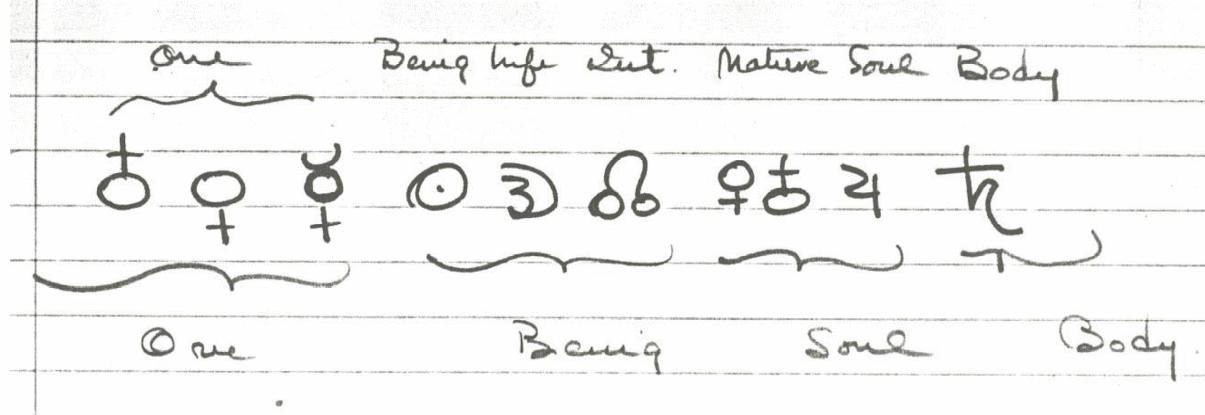
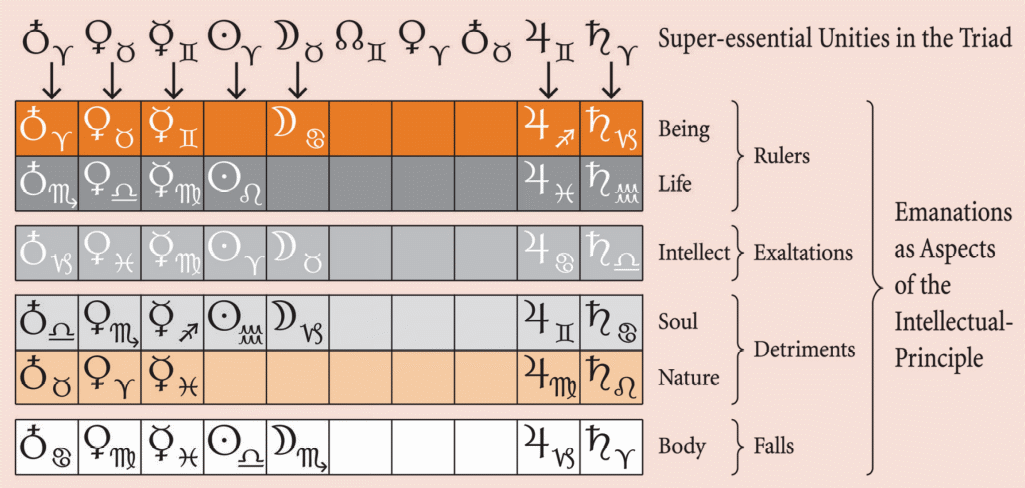
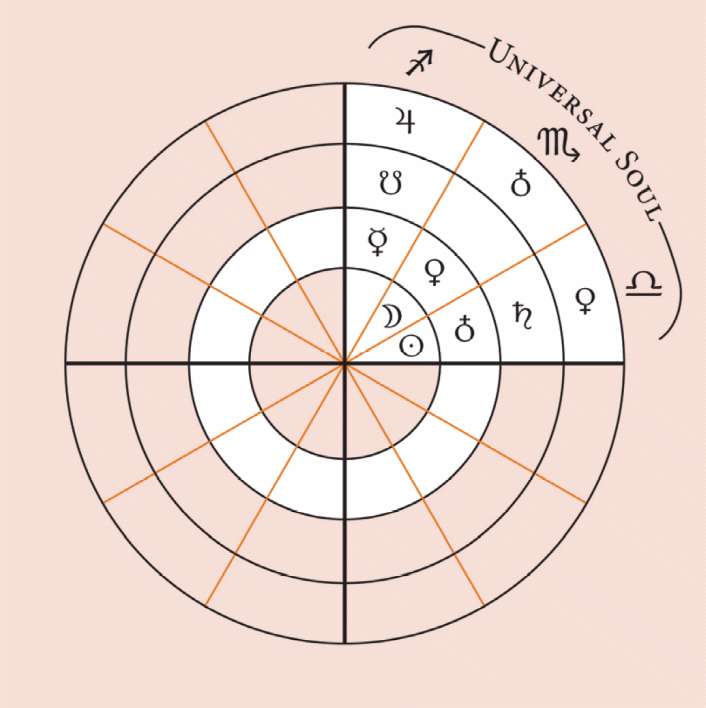
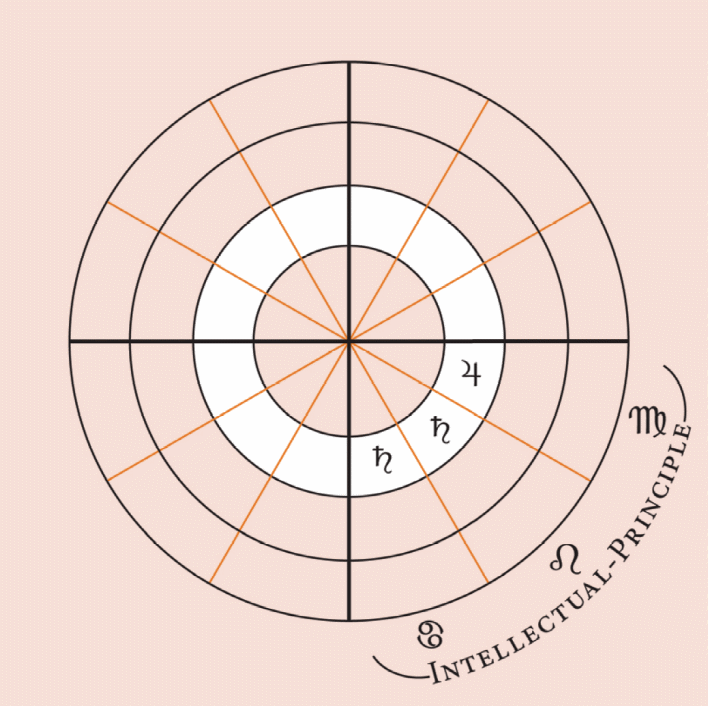
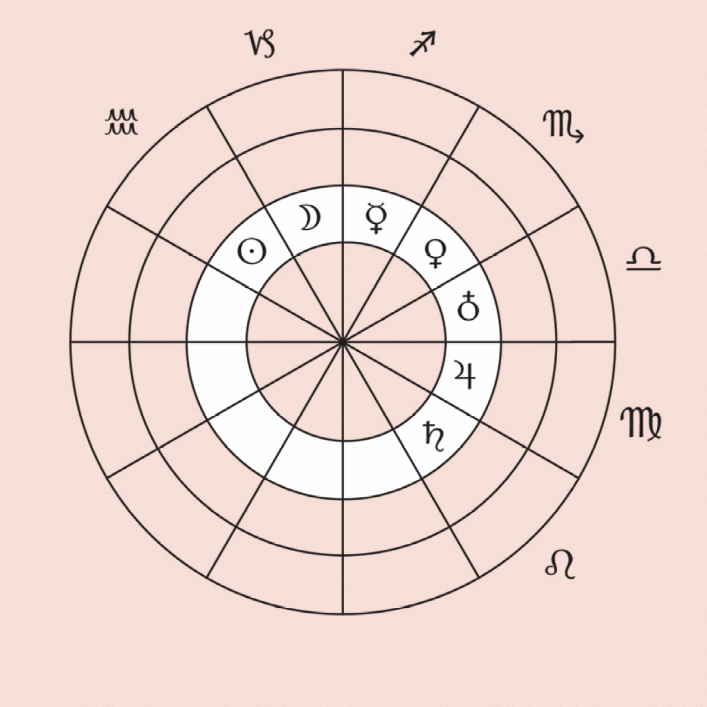
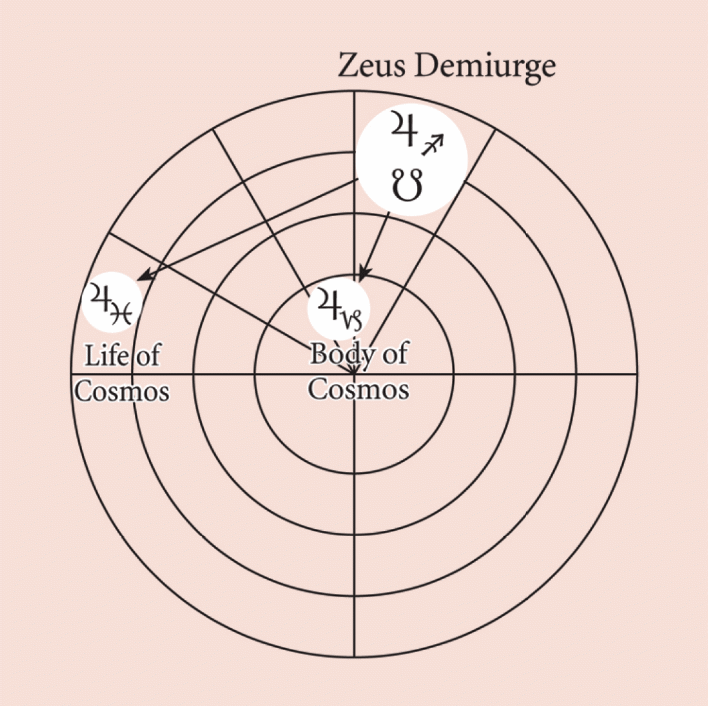
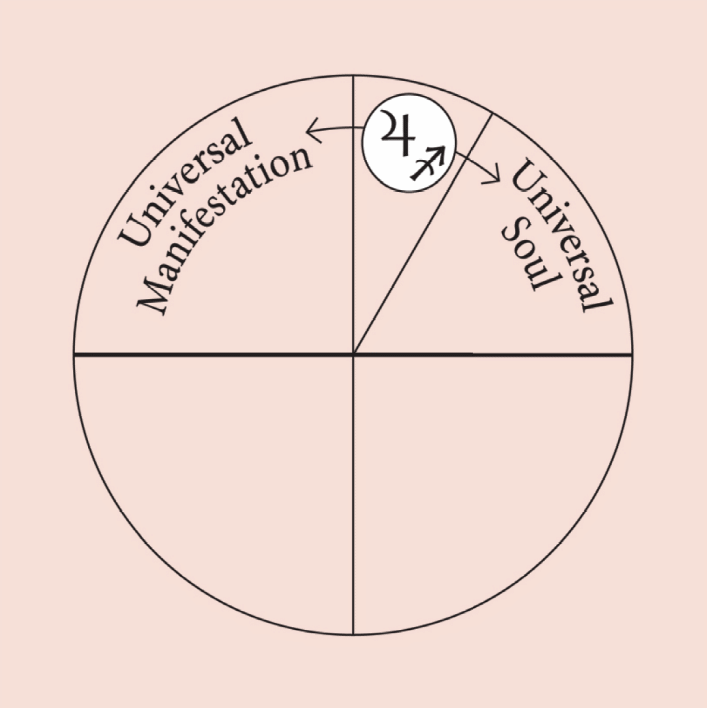
Class
Friday, October 2nd, 1981
Verbatim, unedited transcriptCLASS at Wisdom's Goldenrod, Hector, NY
with Anthony Damiani (AD)
October 2, 1981
PLOTINUS; OVERVIEW
with Appendix: 1981 1002 Partial Transcript (p. 1).
TOPIC: Plotinus
SUBJECT: Overview
SUBSUBJECTS: One, Dyad, Power, Triad, Number, Intellectual-Principle, Soul, Twofold Zeus
CONTENTS:
Approaching metaphysics from the sensible universe vs. from the top down
Mystery of the One
Brief overview of Plotinus' system
V.5.4 and the leap to the One
Double act and symbolizing it
One, Power, Dyad, Triad
Numbers 1-2-3
Everything in the One
Symbolism of the metaphysical chart in general
The doctrine of Plotinus
Top down vs. bottom up methodology
Ennead V.1.10 and the 4 Hypostases
V.1.8, Primals, Secondaries, Tertiaries
Astrological symbolism
Transition from the One to the Intellectual-Principle difficult
Being and Number, VI.9.6
Third house source of all principles, beings
Achievement of the state of unity
Third house, ocean of possibilities
The Head in Gemini and Number
Four levels of Number
Double Mercury in Virgo
V.3.11 and Intellectual-Principle's successive impressions as infinite universes
Knowledge is dialectical
Each Idea is a special and unique form of the whole
Rulers, dignities are power of Intellectual-Principle
Soul as Hypostasis after Intellectual-Principle
Absolute Soul, Universal Soul (Demiurge, Twofold Zeus), Jupiter in Pisces, universal manifestation
Appendix: 1981 1002 Partial Transcript (p. 1)
BOOKS READ FROM OR REFERENCED:
Plotinus, The Enneads (MacKenna translation, 4th ed.)
John N. Deck, Nature, Contemplation, and the One: A Study in the Philosophy of Plotinus
Swami Nikhilananda, The Mandukyopanishad with Gaudapada's Karika and Sankara's Commentary
Rene Guenon, The Multiple States of Being
PLOTINUS QUOTES READ OR REFERENCED: IV.1.1, IV.4.9, IV.4.10, V.1.4, V.1.5, V.1.7, V.1.8, V.1.10, V.3.11, V.4.2, V.5.4, V.5.5, V.9.5, V.9.8, V.9.14, VI.6.8, VI.6.9, VI.6.15, VI.7.9, VI.7.35, VI.7.36, VI.7.40, VI.8.16, VI.8.18, VI.9.6
DIAGRAMS appended to this transcript:
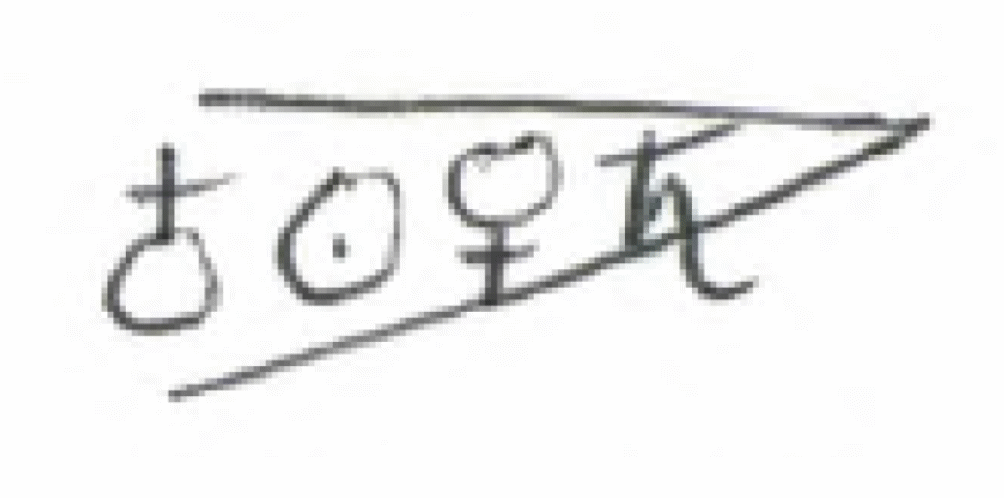
FIGURE 1981 1002-1. First House: One-Only.
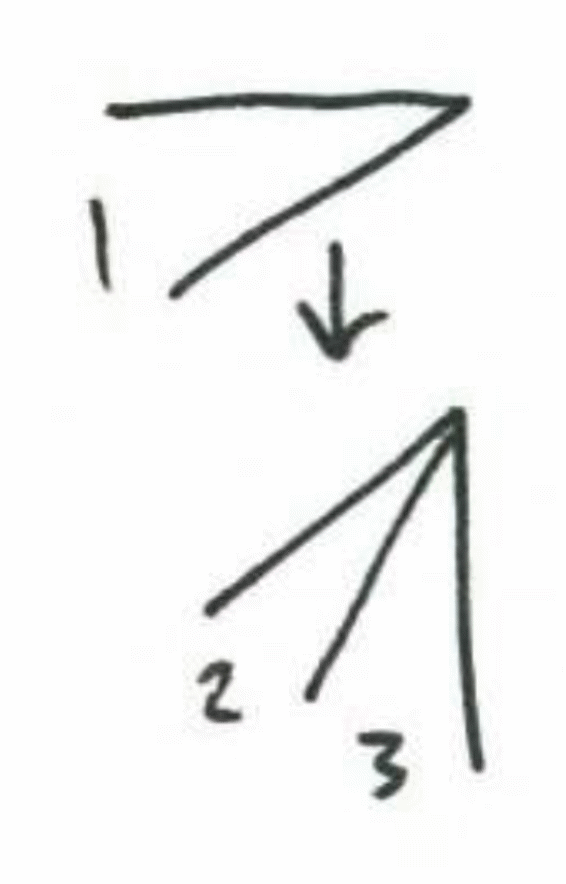
FIGURE 1981 1002-2. First House Exhibiting 2nd and 3rd: Double Act Substance View.
FIGURE 1981 1002-3. First House Fourfold Precontaining 2nd & 3rd House Dignities: Double Act Function View.
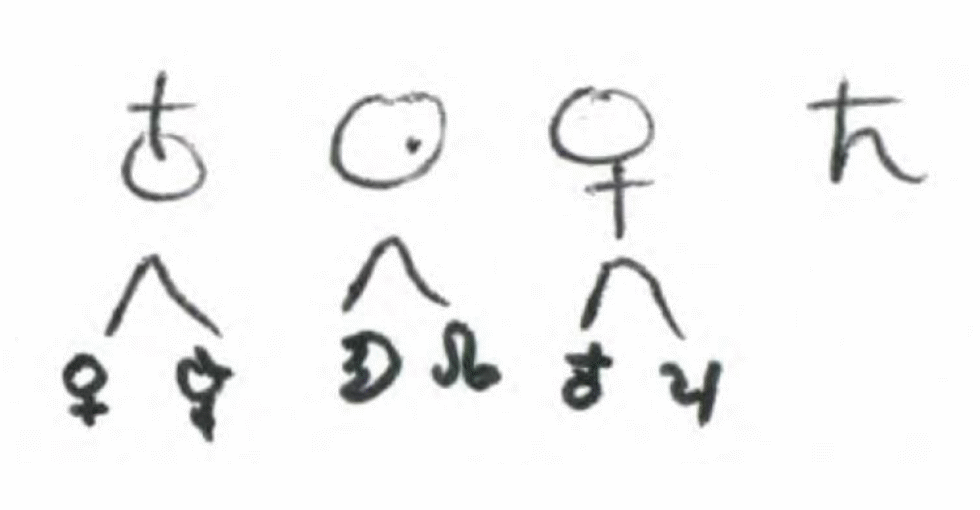
FIGURE 1981 1002-4. One, Dyad, Triad.
FIGURE 1981 1002-5. The One and the Double Act.
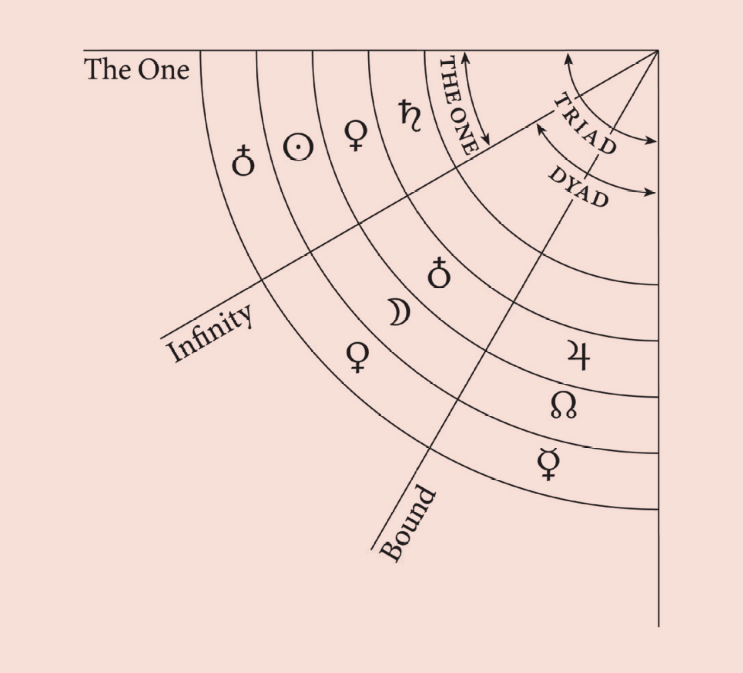
FIGURE 1981 1002-6. Fourfold Quadrant View of Three Hypostases with System of Nature and Material Order.
FIGURE 1981 1002-7. The Central Sun and the Levels of Pisces.
FIGURE 1981 1002-8. Fourfold Ring View.
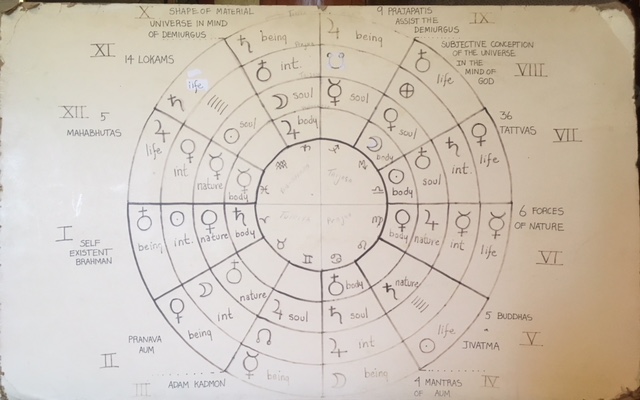
FIGURE IMG 2202-Posterboard Metaphysical Chart.
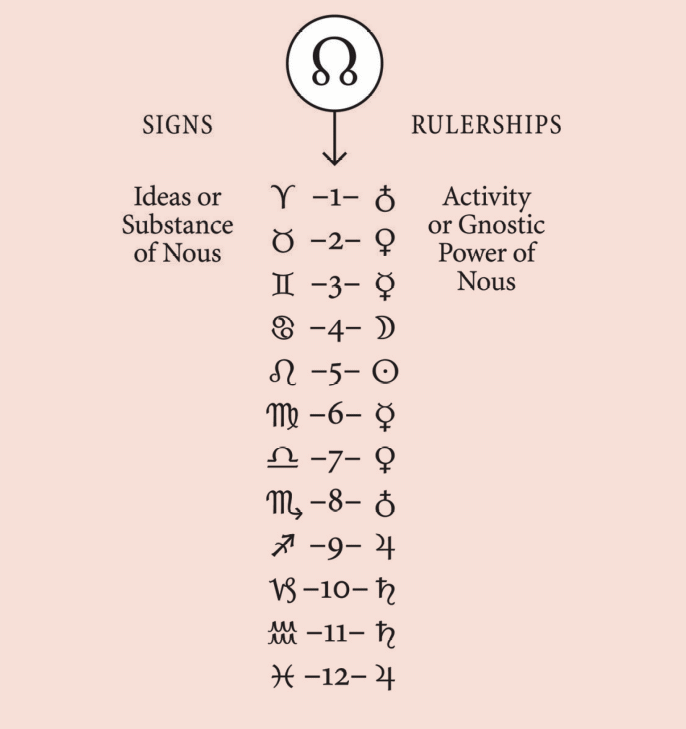
FIGURE 1981 1002-10. Ten Unities and Twelve Rulerships.
FIGURE 1981 1002-11. Number correlates Substance and Function.
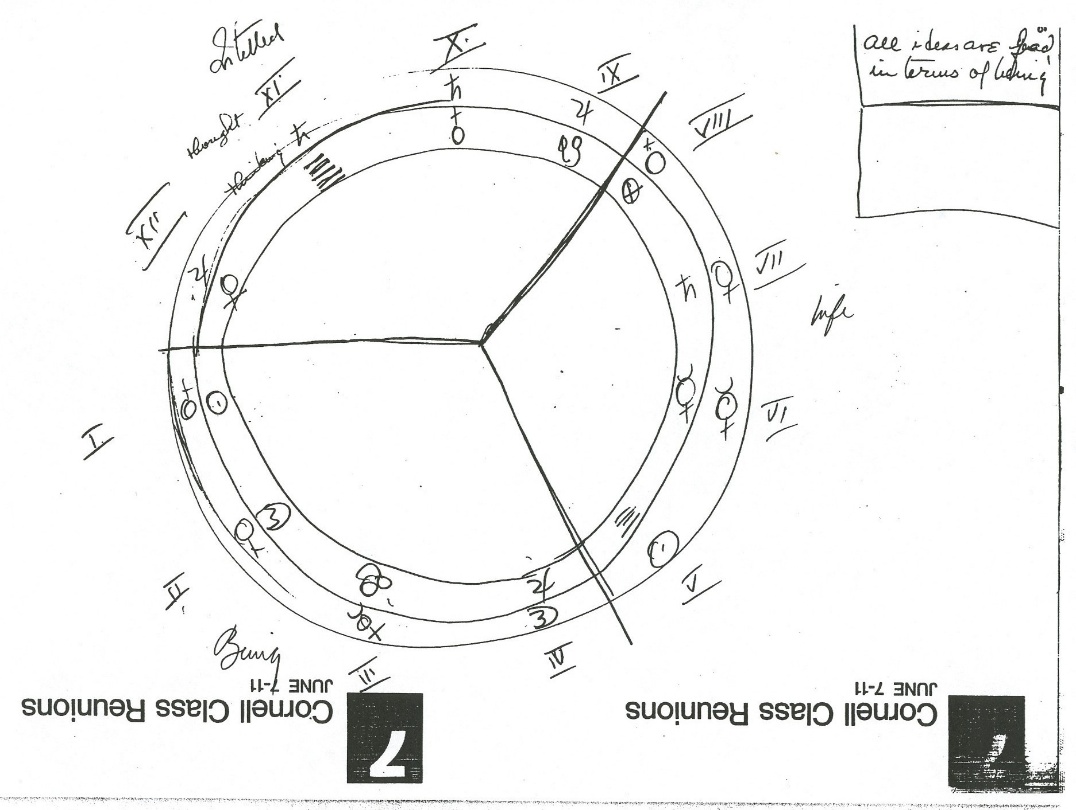
FIGURE AD_E_010. Intellectual-Principle as Being Life Intellect.
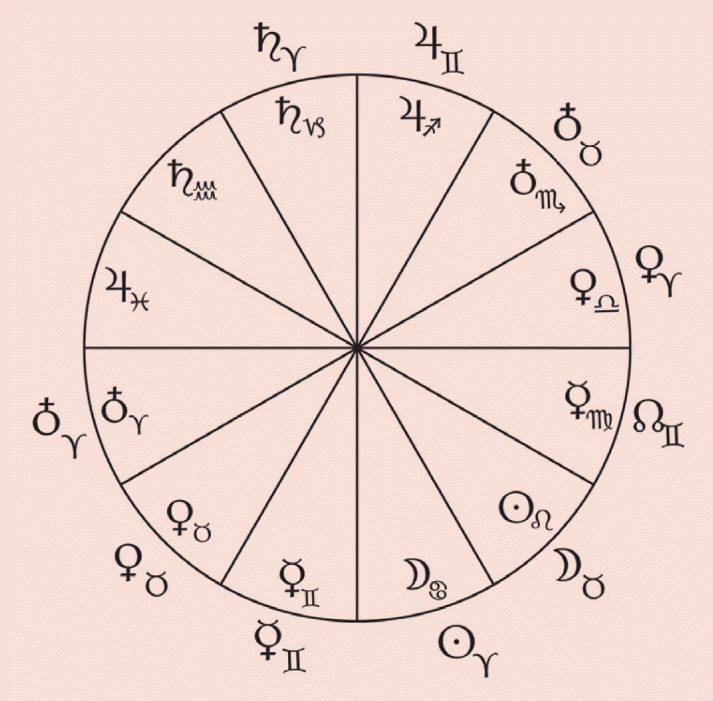
FIGURE AD_I_202, AD Mandalas, detail. AD Drawing of Dignities in the First Quadrant.
FIGURE 1981 1002-14. Triad and Intellectual-Principle; Henads and Monads.
FIGURE 1981 1002-15. Universal Soul.
FIGURE 1981 1002-16. Absolute Soul.
FIGURE 1981 1002-17. Particular Soul.
FIGURE 1981 1002-18. Demiurge as Life and Body of Cosmos.
FIGURE 1981 1002-19. Twofold Zeus.
If someone is drawing or writing, with audible sounds of chalk on a blackboard, this is indicated by [drawing] or [writing].
NOTES:
Older partial transcript, Scan File 1981 1002-10R15.PDF, exists. The first page of this partial transcript, incorporating Anthony Damiani's handwritten edits, and scans of diagrams therein, are appended.
This class series on Plotinus was held on Fridays.
Previously printed, distributed 2003 as part of a set.
TRANSCRIBED by jf 2002 from Audio Cassette tapes; reformatted by jf 2018. In 2024, IT does two more passes, corrects listening errors and makes verbatim, updates prefatory matter and footer, replaces tape markers with audio file markers, alters Subject and Subsubjects, completes Book List, adds Plotinus quotes section, corrects typos, adds new notes and alters some existing notes within transcript, adds thirteen diagrams and references within transcript to all appended diagrams, reformats to accord with new conventions. Archival verbatim transcript – V12a.
AUDIO FILES: 1981 1002a, 1981 1002b. [Note: "Tape" and "Side" refer to original audio cassette tapes that were later digitized into .MP3 Audio Files.]
1981 10/02 at Wisdom's Goldenrod
Plotinus; Overview
[Audio File 1981 1002a Begins]
AD: --as five unities, but of the whole system. Because we've been working with so many details that perhaps we lose sight of the forest but save the tree. So we're going to try to just (go around) [one/two words inaudible] and spend tonight showing the-- from the One derivation of the Dyad, and then from the combination of those two the Triad, then Intellectual-Principle, [S simultaneously: Is that what you wanted to do?] Soul derived from there.
RG: All today?
LR: Small review?
AD: Just a review.
LR: Just do a review. We've been through this many times before.
AD: Yes you have.
LR: Should be easy.
AD: May-- you remember, we're basing ourselves-- we're basing ourselves on the system, the sensible representation of the universe we live in, the world we live in, we're basing ourselves on that system. In other words, the Ptolemaic conception of the universe can also be heliocentric. The geocentric and heliocentric system combined. So if we locate ourselves like in the center of the s-- the world we live in, and we take the sensible representation of that world we live in as the representation, the imaginative representation-- I'm using the term 'imaginative' here in the primal sense of the word, and we try to trace our way back. By the functioning of the imagination we try to trace our way back through the symbolism of the universe back to its origins, we're going that way. That's what we're doing basically, we're working over that. But, Plotinus is much more available if we start from the top and work down all the way.
So in Plotinus, we would have the Unity of the One, the Dyad's reaction or interaction with the One which produces the Triad. From the Triad we had the production of the Intellectual-Principle -- both Being, Life, and Intellect including the Separative Intellect. And then the third Hypostasis he refers to as the pure-- as a Soul. Then Soul gets divided up. You remember the Demiurge has one aspect where he rules over the supermundane, another aspect where the intellect of the Demiurge fabricates the universe. And then within that we locate particular souls in that universe.
Now, those of you who remember many years ago, two or three years ago, we used a-- we used a-- an outline by-- by the editors of the Shrine of Wisdom, right? You go back and look at it now and see what you understand and what we've done. So we'll start very briefly, alright, because all we want is a birds-eye view. If we get stuck into details, you won't get a birds-eye view. So we'll start with the notion of unity of the One. And Avery has the quotations listed, you can copy them for yourself. [short pause] So we can outline it that way, right? Let's do that, let's-- Remember the first few quotations, you got a list?
AS: I got them, yeah.
AD: Alright, le-- First let's read the all-- all the quotations that pertain to the One, [AS: Ok.] that we're working with. You won't be able to read them. Because if we read them we'll get stuck on the second one and we'll never get done.
LR (simultaneously): You should just list them out for--VI.8.6 [sic; VI.9.6]. (laughter)
AD (amidst laughter): Yeah.
S: Go ask them. Are they going to read--
VM (simultaneously): Just do the numbers.
LR: Is that going to be the review, just reading off?
S: Yeah. (laughter)
S: Get out of here.
AD (faint): [couple words inaudible]
S: (In a--)
VM: Is it?
S (simultaneously): VI.8.6. (laughter)
AD: I want to use the class.
S: Hi
AS: Ok? You want this-- you want to just do the list of them first [few words inaudible]
AD (simultaneously): Yeah, just the list, yeah.
AS: Ok, you want-- do you want to start with the four-- the one with the-- do you want to start with the four or just the One?
AD (simultaneously): On the One.
S: Start here.
AS: Just the One per se?
AD: On the One.
S: (Oh I see.)
AS: Ok. On the One.
AD: The quotes we used.
AS: Or, some-- VI.9.6. (laughter)
AD: Go ahead.
AS: V.5.4.
AD: [writing] Are these in order?
AS: V.5.5, yeah. Oh yeah.
RG: Ok.
AD: You think I'm kidding?
AS: No, no.
AD: Oh go ahead.
AS: Well I didn't-- you didn't tell me you were going to do-- VI.8.16.
AD: [writing] See nobody's stopping me now.
AS: Well yeah, they all know them.
LR (simultaneously): I got all--
S (simultaneously): I'm copying them. (laughter)
S: Very good.
AS: They got [one/two words inaudible]
S: For posterity. (S laughing)
AD: Go ahead.
AS: I'm not sure they're writing, they may just be [one word inaudible]
AD: Well, [LR simultaneously: (one/two words inaudible) I actually--] you better open your notebook.
AS: I don't-- I didn't bring my notebook.
AD: You didn't bring your notebook?
AS: [couple words inaudible] gonna be [one/two words inaudible] The next one is V.4.2. [AD writing] And then there's VI.8.18, V.1.5, and then VI.7.40.
AD: And I know what she's going to notice.
S (simultaneously): Yeah, that was Paul. (bit of laughter)
AS: What? Well that-- that takes through the Dyad and then the double-- the double act is also--
AD: That takes us through the Dyad?
AS: Yeah. Up to the Triad. Through the Dyad or Triad.
VM: That was exhausting.
AS: Yeah.
AD: Huh? (laughter)
VM: That was a lot of work. (lots of laughter) Wow.
LR: It's for a review though, (right)?
VM: [couple words inaudible] might review. I especially liked the way you summed it up as VI.7.40. (more laughter)
AD: Alright now, got your text with you?
VM: I think so, yes.
AD: Turn to this V.5.5. Read it off and explain it, Vic.
VM: Well-- (laughter) (I'm sitting) vicinity here.
S: That's right. You open it (up--)
RG: And now-- (RG laughs, more laughter)
S: Open it up, Vic.
AS: Ok, that's an easy one, there is just one line.
[short pause]
AD: Be quiet, don't tell him. I want him to pick out the line, I want to see if he knows the quote.
VM: I don't even have my book here, this is-- this is my wife's book, just a library book.
AD (simultaneously): Oh, [S simultaneously: Just an excuse.] here you are. (some laughter)
AS: Ok, that was Plotinus.
VM: Maybe this has more columns but-- [few seconds of background student talking] Oh yeah.
S: It's the second column.
[few seconds of background student talking/whispering]
AD: He's cheating and I'm-- I'm helping him.
[short pause]
VM: Geez, a lot of nice things and yet--
AD: But, it was a very specific quote that I use.
VM: Well, this could be it, I'm not sure. It seems to be talking about the Dyad, which I don't think you want right now.
S (very faint): But it's very important.
[10 second pause]
JfL: Isn't it just the first line, Vic?
VM: Well--
Plotinus, V.1.5 (VM reading): "Number, Quantity, is not primal: obviously before even duality, there must stand the unity."
VM: That may be a place to start, I don't know.
AD: V.5.5, Avery.
VM: Oh I'm in-- sorry, I'm in the wrong place. (laughter) It's a lot harder when you don't have the right page.
RG (simultaneously): (Wait here.)
AS: Page 407.
VM: Ah yes.
Plotinus, V.5.5 (VM reading): "... [The] First remains intact even when other entities spring from it."
AD: That was the quote, yes.
VM: So this is the sort-- the total self-sufficiency and unity in the One is maintained no matter what sort of manifestation you're discussing, what kind of productions may ensue.
AD: That brings up the complications right away.
VM: Of course, because [AD simultaneously: First--] if you have this enormous unity and yet you acknowledge there's production and the Intellectual-Principle with all the worlds which can manifest from it, then you have to worry about how you can somehow unite these principles or what's the relative status of the world versus the One. The One-Many question begins right here.
AD: How the many [one/two words inaudible] [VM simultaneously: (I guess.)] can come from the One and still [VM simultaneously: Yes.] remain the One.
VM: Yes. Then the whole question of participation of Ideas, I mean there's lots of problems which spring from this.
AD: How about you doing this first one? Yes, you. I'm not giving the class, you people are giving the class.
JfL: VI.9.6?
AD: VI.9.6, yeah.
[few seconds of shuffling of papers, noises, background student talking]
AD: You comfortable Dave? [few more seconds of shuffling sounds] You know, the people that are quiet and silent are not wiser, profounder than the ones that talk, although sometimes they may try to give the impression by being silent they're wise. I don't buy it.
JfL: Well this is the third paragraph.
AD: Now, read the quote.
Plotinus, VI.9.6 (JfL reading): "Think of The One as Mind or as God, you think too meanly; use all the resources of understanding to conceive this Unity and, again, it is more authentically one than God, even though you reach for God's unity beyond the unity the most perfect you can conceive. For This is utterly a self-existent, with no concomitant whatever. This self-sufficing [JfL reads: self-sufficiency] is the essence of its unity."
AD: Would you repeat that? Yeah. "This--"
Plotinus, VI.9.6 (JfL rereading): "This self-sufficing is the essence of its unity."
JfL: Do you have this memorized? (laughter)
Plotinus, VI.9.6, cont. (JfL reading): "Something there must be supremely adequate, autonomous, all-transcending, most utterly without need."
AD: What would you comment on that?
[10½ second pause]
JfL: Well, um, this is more properly an introductory quote. This gives you the feeling of the awesomeness that we're tackling here, because no matter how great that you think of it, he's saying here you're going to think, you-- you have to think past the Intellectual-Principle, you have to think past what the greatest we can think of, because this is past that. The Unity we're looking for is greater than we-- than we might originally think.
AD: So he's presenting us basically with the incomprehensible mystery of the Unity. And, it almost would seem that we are presumptuous in thinking that, you know, we can derive the many from this awesome prior, this Unity he speaks about. Nonetheless that's exactly what he does. We followed all these quotes and we saw how he did that. So that, we're working on the assumption that the doctrine that's being revealed in the text is basically the point-- coming from the point of view of a man who's had the experience or at least takes his poise or stance in the Intellectual-Principle. He is speaking from there. He's not speaking from his humanity. So if we keep that in mind, then the text, you know, a revelation scripture. Why don't you try another quotation? How about you? V.5.4. [one word inaudible]
[18 second pause with shuffling paper sounds, faint background talking]
S: Hm?
AD: Go ahead.
[19 second pause with shuffling paper sounds]
Plotinus, V.5.4 (RG reading): "This purely One, essentially a unity untouched by the multiple, this we now desire to penetrate if in any way we may.
"Only by a leap can we reach to this One which is to be pure of all else, halting sharp in fear of slipping ever so little aside and impinging on the dual: for if we fail of the centre, we are in a duality which does not even include The authentic One but belongs, on both sides, to the later order. The One does not bear to be numbered in with anything else, with a one or a two or any such quantity; it refuses to take number because it is measure and not the measured; it is no peer of other entities to be found among them; for thus, it and they alike would be included in some container and this would be its prior, the prior it cannot have."
AD: Well (Dick) the very first sentence. I just want you to say a sentence or two to-- It'll give me an indication of whether to start at the very beginning all over again, you know, go back four years and start all over again or to proceed.
RG: Well, "This purely One, essentially a unity untouched by the multiple" is similar to the quote in V.5.5.
AD: Yeah.
RG: The One remains a unity again no matter what flows from it or what proceeds back into it, it itself is unity and is the unity by which all else can exist at all, it's the unity of all things.
AD: The next sentence.
Plotinus, V.5.4 (RG rereading): "Only by a leap can we reach to this One ..."
AD: What do you think he's referring to here, a leap? I hope you don't think it's a leap in your imagination.
S (faint): (Well a leap.)
RG: We have to transcend the imagination to do that, I mean I don't know--
AD: Alright, so then that's out. So then what would a leap mean here?
S (faint): (Leap.)
VM: I would say this--
S (simultaneously): [couple words inaudible]
VM: I would say [S simultaneously: It's soul.] it's a leap beyond humanity, [student assents] beyond the soul.
AD: Isn't there somewhere where he says for instance that ultimately through the grace of the World-Mind or the Intellectual-Principle it becomes possible for me to reach that unity? In which case that would mean a denial, a negation of the being of the soul, complete negation of the soul.
VM: That's right.
AD: Maybe that's what he means by a leap.
VM: Seemingly a denial of humanity.
AD: Yeah. It's not the kind of leap that modern philosophers would ask you to make.
VM: No, a leap of faith or any of that business, no.
AD: None of that. He's talking about the real thing. You're in meditation and that leap is a leap. I mean the complete denial of one's own being is not something-- that's taking quite a leap. But nonetheless, that's what he's speaking about.
AS: It's in VI.7.30.
AD (simultaneously): Alright so-- So there-- we're bringing in this quote because he's speaking about something that is done and has to be done if one wants experience of Unity. You were saying, Avery?
AS: That's-- that quote is VI.7.35, the one [AD simultaneously: Good. (Alright.)] where he talks about that. He says--
Plotinus, VI.7.35 (AS reading): "As for soul ..."
S (faint): What page?
S (faint): What page is it on?
AS (simultaneously): It's on 589.
S (faint): VI.7.35.
AS (simultaneously): This is one.
AD: Go ahead, go ahead.
Plotinus, VI.7.35 (AS reading): "As for soul, it attains that vision ..."
AS: He just talked about the Intellectual-Principle
Plotinus, VI.7.35 cont (AS reading): "... it attains that vision by--so to speak--confounding and annulling the Intellectual-Principle within it; or rather that Principle immanent in soul sees first and thence the vision penetrates to soul and the two visions become one.
"The Good spreading out above them and adapting itself to that union which it hastens to confirm is present to them as giver of a blessed sense and [AS reads: sense of] sight; so high it lifts them that they are no longer in space or in that realm of difference where everything is rooted in some other thing; [for] The Good is not in place but is [the] container of the Intellectual place; The Good is in nothing but itself.
"The soul now knows no movement since the Supreme knows none; it is now not even soul since the Supreme is not in life but above life; it is no longer Intellectual-Principle, for the Supreme has not Intellection and the likeness must be perfect; this grasping is not even by Intellection, for the Supreme is not known intellectively [AS reads: intellectually]."
AS: This is where he goes on to say this is the "grand learning".
AD/S(?): Read it to them slowly now.
AS: Says--
Plotinus, VI.7.36 (AS reading): "Knowing of The Good or contact with it is the all-important: this--we read--is the grand learning, the learning, we are to understand, not of looking towards it but attaining, first, some knowledge of it."
[short pause]
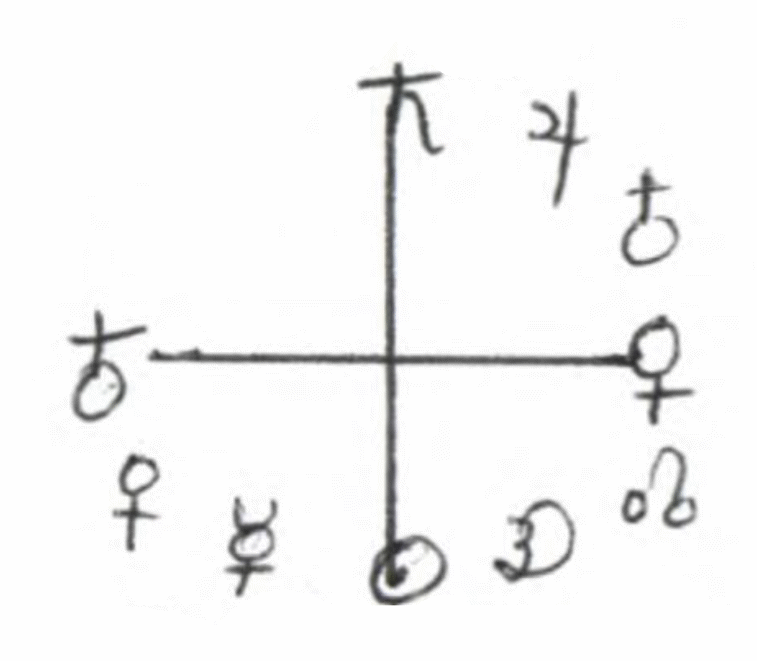
AD: It's difficult for us to recognize that a veritable Sage is speaking through these texts. But as we study it I think it becomes more and more obvious. And so we try to symbolize, we try to symbolize it-- [10¼ second pause] And we do symbolize it in this way. [drawing] But, that is the transcendent One, so-- [Note: See FIGURE 1981 1002-1.]
S (faint): [couple words inaudible]
AD: Let's pick up a few quotes now concerning the relation of the One to itself, and of course you can see how utterly absurd language is. The One and the Dyad?
AS: Yeah.
AD: So Avery, suppose you pick out the first one.
AS: We had them there, V.4.2.
AD: V.4.2.
AS: VI.8.16 and V.1.5. The first one we read was VI.8.16. We can read (V.4 also).
AD (simultaneously): Yeah VI.8.16.
AS: That's where he just speaks about the One and then he speaks about the double act and so forth. VI.8.16?
S: What's that?
AD: The double act?
AS: This is the first place where you-- where he mentions [couple words inaudible] last paragraph on 609. [short pause] Says--
Plotinus, VI.8.16 (AS reading): "That his being is constituted by this self-originating self-tendance ..."
AD: Now we're talking about this here [FIGURE 1981 1002-1], "that his being". The term being here has to be analogically transposed, it's universal, it's universal being.
Plotinus, VI.8.16 (AS reading): "That his being is constituted by this self-originating self-tendance--at once Act and repose--becomes clear if we imagine the contrary; inclining towards something outside of Himself, He would destroy the identity of his being. This self-directed Act is therefore his peculiar being, one with Himself. Thus, He created Himself because his Act was inseparable from Himself. If [then] this Act never came to be but is eternal--a waking without an awakener, an eternal wakening and a supra-Intellection [AS reads: super-Intellection]--He is as He waked Himself to be."
AS: Then he says this is above Being, before Intellectual-Principle, and so on.
AD: Alright, the-- the double act, the phrase the double act.
AS: V.4.2?
AD: Yeah.
AS: Ok. So that one just pointed out the double symbolism in the first house, the house and the dignities. In V.4.2-- [9 second pause] Says, at the top of page 402--
Plotinus, V.4.2 (AS reading): "[But] if something arises from an entity which in no way looks outside itself, ..."
AD: Now this is the entity [FIGURE 1981 1002-1] which in no way looks outside itself.
Plotinus, V.4.2, cont. (AS reading): "... it must arise when that entity is in the fullness of its being: ..."
AS: Which again is super-being.
Plotinus, V.4.2, cont. (AS reading): "... stable in its identity, it produces; but the product is that of an unchanged being: ..."
AS: Ok, and then he says-- He's talking about this double act, and he says--
Plotinus, V.4.2, (AS reading): "So it is in the divine also: [or] rather we have there the earlier form of the double act: the divine remains in its own unchanging being, ..."
AD: That would be the first house, the divine remains in its own unchanging being.
Plotinus, V.4.2, cont. (AS reading): "... but from its perfection and from the Act included in its nature there emanates the secondary or issuing Act ..."
AD: Now if we stop there, alright, we would have to take this here and imagine it split up. On the one hand, [drawing] let's say it splits up into the Ideas, or the substance point of view, [Note: See FIGURE 1981 1002-2.] and on the other hand it splits up into the function point of view, and we'll place them here, you know, the dignities in each house. [Note: See FIGURE 1981 1002-3. Cf. Astronoesis, Fig. 15.] So you have one version of the double act. You're dealing with metaphysical infinity, therefore no matter what the arrangements, combination of the variety of possibilities within metaphysical infinity, nothing new is going to come out of it, it's all within that total affirming idea. Let's read.
Plotinus, V.4.2, cont. (AS rereading): "So it is in the divine also: or rather we have there the earlier form of the double act: the divine remains in its own unchanging being, but from its perfection and from the Act included in its nature there emanates the secondary or issuing Act ..."
AD: Which we would call this whole Triad, the issuing act. [Note: See FIGURE 1981 1002-4.] So from within the first house, if we think of this as the metaphysical infinity, and which we divide in terms of substance and function, the function part being [drawing] represented by the dignities, and the substance part represented by the Ideas.
S: Uh-hm.
Plotinus, V.4.2, cont. (AS reading): "... from its perfection and from the Act included in its nature there emanates the secondary or issuing Act which--as the output of a mighty power, the mightiest there is--attains to Real Being as second to that which stands above all Being."
S (faint): Uh-hm.
[15 second pause while AD draws]
AS: So, again the main thing seems to be you see the One as the first house, you see the One as the first quadrant. The indetermination of those two seems to be symbolizable as this double act. The previous one he said that it's "at once Act and repose", so the first-- the One as the-- the One, the first house, "remains in its own unchanging being". But then we've symbolized also the Act and repose-- then we've symbolized also the perfection and Act which it exhibits as the whole first quadrant. So you have the double act. You can do it according to the houses or according to substance, and you can do it according to function. Each of those will have these two aspects, remaining in the first house or the first quadrant. And then again in the first house you'll have substance versus function, and in the first quadrant you'll have the signs-- the houses versus all the dignities. Alright.
AD: Remember we also worked with the numbers, 1, 2, 3. [AS: Yeah.] They'll be right there. Do you have them on you?
AS: No they're (at the house).
AD: Well, you remember, we used the number theory, and the number theory is a simpler way to try to understand this. The One represented the Unity, and we said that we have to ultimately derive all the numbers from that 1. So 2, 3, 4, going up to 10, all the numbers have to be derived from that. So the problem would be, how do you derive 2 out of the 1, 3 out of the 1, and we'll stop there, because that'll accompany what we're saying here. And do you remember how we derived 2 out of the 1, what kind of reasoning was used? [short pause] You remember?
DB: (It either) concerned the interaction of the One with its Power? Power considered in some sense as being distinct from it, and then within that interaction, the third or individuated-- of the possibility of individuated principles beyond-- following the [one word inaudible] certain [one word inaudible]
S: David?
AS: That's good.
AD: Yeah, you're on track.
AS: There's also one point you made was-- seemed interesting, that in just looking at the One and the Two, or the One and its Power, the Power isn't other than or separate from that One. You even used that example of 1 times 1 equals 1. The One and its Power--you're not really saying two different things there even. Unless-- unless you bring in the third house, the 3, you can't really see the Dyad or the 2 as distinct from the 1.
AD (simultaneously): Well, what justification did we have to speaks of the One and its Power, you remember?
AS: You mean [S simultaneously: (VI.17.)] from Plotinus?
AD: Yeah, from the text.
LR: The same one you just [couple words inaudible]
AS (simultaneously): Oh. Well the same one we just read.
AD (simultaneously): Huh?
LR: The same one you just read.
AS: VI.8.16.
S: VI.7.17?
LR (simultaneously): Where he says the One is infinite depths of power.
AS: Yeah, that one also. 16, 6.
AD (simultaneously): So the One basically was characterized by this [AS: Power.] Power, infinite Power. Now Power, as he just said, this Power belonged to the One, and yet at the same time it's the Power which imparts let's say aseity to all the other forms or Ideas. So, we've seen that the very nature of Power is this sheer indeterminacy. But then that would correspond to what most of the Platonists refer to as the Dyad, the Two--indeterminate, feminine, material. Now of course the commentators when they interpret 'material' here they don't know what the hell they're talking about. The Power of the One has this indeterminate nature to be both simultaneously, belong to the One and yet impart to each of the forms their peculiar characteristic or aseity, uniqueness, what makes them to be One, alright. So this intermediate notion, Power, is equivalent to the 2, and we symbolized that by the second house. So the number 2 is being derived from the 1 if you follow the kind of logic (we're) [one word inaudible] I don't know what'd you call it but--
LCG: Anthony, could you go over that one more time, please?
AD: The One is the same as metaphysical infinity. Power the-- the Power characterizes this above all else, and he speaks about this Power as infinite. The depths of Power is what characterizes the One. Now it is this very Power which the One uses to impart, later on of course, to impart the characteristic uniqueness to each of the forms. Now this Power, this Power at the same time, remains with the One, as well as imparting to the forms each their characteristic unity. Now insofar that Power could do that, it is absolutely indeterminate. It has to be indeterminate. Because if it had any form, any determination, alright, then it cannot impart aseity to any form. Alright, now, the importance of this is because in other traditions, when they-- if they dare to, from my point of view, if they dare to reduce the world to maya or illusion, that would be equivalent to striking down the Power of the One. That I refuse to do. The Power of the One is such that it establishes the levels of reality and these levels are not going to be transgressed by any human thinking, any even intellectual thinking. That Power is immutable, it is an eternal Power that belongs to the One. The point that we want to get to though is that it is the very nature of Power to be indeterminate, absolutely indeterminate. Now, that's the meaning of the number 2. And they speak about it as capable of infinite division.
LD: So it would-- it would-- it would change, I mean it-- it would-- It doesn't have any form in itself, but it would-- in that it can impart these (peculiar) characteristics to whatever, it has all the forms, but it's not a form.
AD: It's not a form.
LD: Right, but it [one word inaudible]
AD (simultaneously): So that means that inside of this realm, inside the notion of metaphysical infinity, alright, you have to leave it inside the One, it belongs to the One. Now, he's speaking here about this relationship of the-- of the One to its own Power. This is what he's speaking about in this quotation. Now anything that is accomplished, alright, (it's/is) already assumed. In other words, all the-- the totality of every possibility in here is already accounted for by the presence of this Power. They won't manifest here. There won't be no actualization here. But every possible variety and combination is already contained here. Because, when we get to the, you know, universal manifestation, and we realize that no matter how many universes are born and no matter how many perish, and the infinite variety of universes, that they cannot exhaust this Power. So, ultimately that Power is what upholds everything. At any rate, the point, to get back to the point, was that this was the meaning of 2, if we try to derive the numbers from the unity. How about 3?
LR: The Three, just picking up what Avery said, if you speak of the 1 and the 2 you can't speak of it as either separate or exactly the same. And in-- in that the 2 is so indeterminate and represents the metaphysical Power, you know, all the possibilities within the One, you can't define any thing until you have the 3, where through the combination of Power with the substance of the One, you can have a discrete entity. When you speak of 3, you can speak of a definition. Before that there's [one word inaudible] there's only indeterminacy. The 3 would be the limitation of that Power into a-- [couple/three words inaudible] The 3 would be the first determination of that Power into a set of specific possibilities, what we speak of as Universal Being.
AD: I'd like to have a little more added to that.
49.1-[pause]
VM: We say it's the first number in the sense that it's the principle of distinction. And only after this principle has been achieved can one really speak about distinctions within the One, which are still integrally a part of the One but this is the first place the distinction can be made. If you're going to speak about the unity of the Ideas in the One and so on, only after this principle has been, let's say, articulated by the interplay of the Unity and its Power can you begin to speak about distinction.
AD: Yeah.
AS: One could say-- and the interaction of the Unity and its Power in a sense gives you the "ones," or you have the One and the Power gives you the ones. You could speak about these now as ones. Now you could speak about everything being rooted in the One. Before that it seems you can't even speak that way, just-- it's not even a possibility of speaking of it participating.
AD: I think we-- we're getting around to saying that. So then that would-- that would amount to the One and its Power which produces ones, all the possible ones that could be, alright. So then 3 would be the first number in the sense that it produces these ones. And all these ones in their totality would revert back to the One. [VM assents] In other words, if this is the principle of principles, and this is each principle itemized, and if you summed all the principles up they should give you back the principle of principle. [AS: I see.] We say something like that? So then this 3 becomes a principle like a principle of ontology, principle of non-manifestation, principle of the void.
S: Right.
AS (simultaneously): In fact, could you also say something like we've-- he has there these two views of the One presented, the One remains intact, it's inparticipable, unknowable and so on. In the other view, the One is the source of all. You know, it seems the One-as-the-One, the first house is the first One, intact; the One as the Triad seems to be the One as the source [AD simultaneously: Source of all.] of all particularly. And then the Dyad is seen as the indetermination of these two views of the One. It must be of such a nature to be this indet-- have this indeterminate nature.
AD (simultaneously): So then unlike, unlike someone else, [three inaudible AS words simultaneous with AD] he would say that Two is the principle which is the balance or the symmetrical relationship between the One and the Unities that are produced within that One.
AS: Yeah, rather than saying the 3 is the [couple/few words inaudible]
AD (simultaneously): Rather than saying the 3 is.
LR: But we have his-- also speak of it as the product of the Dyad and the One being-- not changing (level) in any way.
AD: Yeah.
LR: And the pro-- like he says, the product is that of an unchanged Being.
AD: So, we'll stop here with the derivation of numbers from the One, alright, because that would be concomitant with just the first quadrant, and we're just concentrating on the nature of the One a little bit. Alright, then we went on.
AS: Yeah, (there was 120--) Well then we had a couple-- talked a little more about the Dyad and the-- the interaction of the One and the Dyad, and the way-- and the prefiguration of the Intellectual-Principle in the One.
AD: Would you get the [AS simultaneously: A few of those--] quotation where he speaks about the Intellectual-Principle is in the One, prefigured in the One, Nous and Being is in the One.
AS: Yeah. That particular phrase was Deck, but he says VI.8-- in VI.8.18, p. 611, that's where he talks about it, but MacKenna didn't quite use that phrase but I'll just read it.
AD (simultaneously): Use that [one word inaudible] in the back.
AS: Yeah I don't have it.
AD: You don't? Alright, we got it.
AS: It's [three/few words inaudible] [short pause] For example-- Well here he says--
Plotinus, VI.8.18 (AS reading): "What is present in [AS adds: the] Intellectual-Principle is present, though in a far transcendent mode, in the One: ..."
[short pause]
AS: And he says--
[short pause]
Plotinus, VI.8.18 (AS reading): "[The] Supreme is the cause of the cause: it is cause pre-eminently, cause as containing cause in the deepest and truest mode; for in it lie the Intellective causes which are to be unfolded from it, author as it is not of the chance-made but of what the divine willed: ..."
AD: Avery, there's the Deck.
S: No.
AD: [few words inaudible]
S: You recognize it [one/two words inaudible]
AS: [three/few words inaudible]
S: Here it is.
[short pause]
AS: Ok, thank you.
S (faint): You're welcome.
[13¾ second pause]
AS: Um, well, ok, this is what he says here. Says--
[Transcriber note: I am using John N. Deck, Nature, Contemplation, and the One, University of Toronto Press, 1967.]
John N. Deck, Nature, Contemplation, and the One, p. 19 (AS reading, referring to VI.8.18, not a translation): "There is in the One a sort of intelligence which is not the Nous. The One is the centre; from it radiate being and Nous. Being and Nous, as they are poured forth from the One and depend on its intellectual nature, bear witness to the fact that there is knowledge in the One."
AS: That's his translation of VI.8-- of part of VI.8.16 [sic; VI.8.18, and not a translation].
AD: Alright.
VM: Where's the one where he talks about super-knowledge?
AS: Well, he also has that here.
VM: Because that's Deck's translation, right, [AS: Yeah.] 'super-knowledge'.
AS: He says-- it is even--
John N. Deck, Nature, Contemplation, and the One, p. 19 (AS reading): "The wakefulness is beyond being ..."
AS: Oh.
John N. Deck, Nature, Contemplation, and the One, p. 19 (AS reading): "... an eternal super-knowledge ..., it will be in the way it is awake."
AS: That's that VI.8.16.
VM (simultaneously): We already did that, right?
AS: Yeah, we already did that one. But here he seems to make more explicit this thing about the prefiguration.
John N. Deck, Nature, Contemplation, and the One, p. 19 (AS reading): "Being and Nous, as they are poured forth from the One and depend on its intellectual nature, bear witness to the fact that there is knowledge in the One."
John N. Deck, Nature, Contemplation, and the One, p. 19 (AS reading): "There is in the One a sort of intelligence which is not [the] Nous.… from it radiate being and Nous."
AD: Now in comparison to Guadapada or Shankara, when they speak about undifferenced knowledge or the turiya state of consciousness, and they deny any kind of subjective consciousness or objective consciousness, or both combined. Those of you who studied Guadapadan Karikas to Mandukya, if you remember, that's a negative definition. What he-- what he tries to-- he keeps saying "Not this, not this, not this" all the way through, and, it's a valid approach, I mean, any approach is valid, get some glimpse of the nature of the One.
But Plotinus here is using a positive approach. He's trying to say that everything is in it, everything is, so to speak, not only in it, but he has a knowledge of-- it has a knowledge of everything in it. But here everything is in an undifferentiated or homogenized state. [AS: Well--] And yet the One, let's say, like is pervasive of the whole state. So that it has a knowledge of its contents, but the knowledge of its content is not separate from itself, and he refers to it as a "pure awakener [sic; awakening]". There isn't an awakening-- an awakener, there isn't a subject in this realm. And that's equivalent to, let's say, we used another quotation in Guenon, The Multiple States of Being, where he speaks about metaphysical infinity also in the same way, it's a combination of these two aspects. [Note: See Rene Guenon, The Multiple States of Being, p. 33 in 1984 Larson Publications edition; also Astronoesis, p. 29.]
Now, no text could possibly-- I mean it's-- it's just out of-- It remains a mystery no matter how we try to describe it to ourselves, no matter what glimpses or insights we try to provide. It is here where, again, if we could translate [few words inaudible] (states) of mind, alright, and then, then we would-- we would be able to understand the passage that Dickie read when he says you have to make a leap here. The leap that's required here is out of Being. All Being is negated and transcended. So-- (the passage) of course (out of it). But, after all there's nothing more enjoyable than present your mind with a paradox. And if the Zen people are looking for a koan, this is a good one, the best. Alright, let's continue. [11 second pause] Would you read that passage, I think it was on 19, 20, about how everything is in it and as it and--
AS: Yeah. He-- he's paraphrasing-- no he's trans-- he's translating the part of V.4.2 that we didn't read. In fact that's exactly to the point that Anthony just made about everything being in it as opposed--
(Side 1 of original cassette tape digitized as 1981 1002a Ends; Side 2 Begins)
John N. Deck, Nature, Contemplation, and the One, p. 20 (AS reading, translation of V.4.2): "... and its self-knowledge is itself, a self-knowledge by a kind of synesthesis [AS reads: synthesis] being in eternal stasis and in a knowledge otherwise than knowledge according to the Nous."
RC (faint): The word's not 'synthesis'.
AS: Hm?
RC: That word isn't 'synthesis'.
AS: It's-- You're right, it's synesthesis [has difficulty pronouncing].
S: Whew.
AD: Synesthesis.
AS: Synesthesis.
AD: What was the meaning of that term, Randy?
S (simultaneously, faint): Synesthesis.
RC: It had two roots. It's sort of like a kind of aesthetic perception.
AD: It's not a synthesis.
RC: No it's not a synthesis.
AS: Uh-hm.
AD: And it's important to keep that distinction in mind because you could be misled there [S: Right.] if you interpret it.
RC: Yeah it would tend more toward like rapture than synthesis.
S (faint): Yes.
S: Ok.
S: (You) tend towards rapture?
S: Yeah (rapture).
AS: Yeah I think that is the one at the bottom of 401.
S: Yeah.
S: Could you explain it?
S (faint): What?
AD: Alright, so we symbolize, and we try to symbolize these things that he's been saying with the chart, to help us, you know, penetrate into the words that are being used. We use this here. We also use this other when we do this here. [drawing] And we'll take these here and put them here like I think we did this. Alright? We considered this the One [FIGURE 1981 1002-1], that was another way of doing it. And then if we said that each has a double act [FIGURE 1981 1002-3], ok, then over here you would put the Mars and Venus, and Moon Head, Mars and Jupiter, ok, so that the One could be portrayed this way. [Note: See FIGURE 1981 1002-5.] Then of course this is important because it's going to give us a lead into what the meaning of this Head is which is always baffling and has baffled us. [student assents, faint] [14½ second pause]
We'll stop for a couple of minutes and open for discussion. Just, you know, anything specifically you-- And remember this is general, I don't want to go into too many details, I'll argue details some other time but just as a general picture. Alright then, shall we use the next quotation where he speaks about the three Hypostases and the system of Nature?
AS: V.1.10? [short pause] Yeah, this picture.
AD: Alright and then we're continuing elaborating or trying to corroborate the text with the symbolism.
HS (faint): I got a general question (before you--)
AD (simultaneously): Yes, please.
S: (Why don't) you ask it?
HS: What we sought to establish up to this point would be-- in terms of the symbolism, you sought to establish the prefiguration for the rest of the chart in the symbolism up to this point? Is that where you're going?
AD: I'm sorry, Herbie.
HS: When you relate the text to the symbolism in the manner that you relate-- in the way that we do it, ok, what we-- what we're actually doing is trying to establish in the One in terms of symbol that we're using--
AD: Well first we try to establish or try to understand something about the nature of the One in the limited mode that we begin, right. The internal constitution of the One, so to speak, if we could use that. And, keeping in mind that there is a homogeneity in that nature, and that can be referred to as undifferenced knowledge, metaphysical infinity, unlimited substance, infinite function. All these are synonyms, alright. Nonetheless we have to try to get some insight into the nature of the One and we're using the symbolism of the chart to give us an idea of what the internal structure of the One is in spite of the fact, alright, that here, in this realm [of the One], it will be of one consistency, [HS: The One.] homogeneous.
S (faint): Yeah. You said that.
HS: Could you-- you say the symbol is ade-- well--
AD: Well--
HS: It's the only way to do that.
AD: I think, I think what happens when we use the symbolism is that as we read the passages, you know, text after text, tractate after tractate, the obscurity of the text becomes somewhat illuminated by the fact that you're able to make distinctions which before would have just boggled the mind, I mean the-- the mind would be incapable of grasping all the distinctions and holding on to them. Because one of the things that Plotinus required of his auditors was that they knew the teaching. It isn't-- it isn't that he says, "Well I'm going to start you off here, and as we go along, you know, I'll inform you." It's like you walked in into his lecture hall or into his room where he was lecturing, and he would be talking, and he could pick up any subject, and it would always be expounded from the total doctrine. He had that complete command that no matter what the topic was, he could expound it from the point of view of the doctrine completed. So it was almost like you had to know it. Now I think what would happen is, if we read the text through and we use this kind of symbolism, we would have an acquaintance with that doctrine.
Now, I think it was some time ago, I remember we were-- I think it was Randy that called us when PB had made the remark that he had been going through the Plotinus and he said that-- that this was the highest teaching and that it was equatable with any of the Eastern doctrines. I think that-- I think it's an easier way for us to get into it than trying to get into it through Sanskrit terminology or Tibetan terminology or Chinese terminology. This is our own tradition. And even though it's been distorted by 1000 years of Christianity, and practically destroyed, nonetheless we have enough texts to get back to the original.
HS: So, if I follow you, that sometimes in the symbol is actually more than itself, I mean it's-- it's actually pointing--
AD: Well, yes, you remember-- you remember in one of the notes PB made the remark that there were three ways of communicating. And he referred to words, then he referred to symbols, then he referred to sound. Now, if we can combine-- if we can combine the words and the symbols, we would have the advantage of [sic; over] just using-- just using words. And the symbols are always provocative because there's always something of the unknown about them, I mean you can't-- you can't reify them into an object and put boundaries around, there's always a certain element or a certain depth which the intellect, I mean the conceptual intellect, can't grab and include in its understanding. That by definition symbol would always carry that connotation. It prevents you from making a closed system out of this.
HS: The ungraspability, [AD: Uh-huh.] or--
AD: And if we were to say that it's like dealing with a-- if we think of the World-Mind or the Intellectual-Principle as a huge computer, alright. And some ways [one word inaudible] Well, a computer that transcends anything that we could-- (laughter)
VM: Doesn't crash, does it? (VM chuckles)
S: Yeah it doesn't--
[short pause]
AD: Any other questions?
DR: Ok, well I don't know--
AD: Sure, go ahead Dave.
DR: Don't know if it's appropriate but in the beginning when you start out, you say that you're basing your exposition on the sensible universe. I don't exactly understand what it is that you're saying, or you're (meaning).
AD: Well, I think when we're done it would be more available, I mean, when you come to the end of the, you know, progression. But it would be something like this, that in the same way that an analyst by studying very carefully your dreams, and the manifestation of the hidden complexes that are operative are picked up little by little. I mean the complex doesn't present itself in a dream and say, "I'm the complex, look at me," alright. There's only a sensible manifestation of that complex, and you have to trace back the genesis, you have to try to trace back the origin of the sensible manifestation through the indications of certain meanings that are resident right in the sensible appearance. [DR assents] And that's why I'm using the astrological symbolism, to trace back. If we say that the whole of the sensible order is nothing but a transcendent symbol, let's say a symbol of the transcendent order, let's put it that way, then we would have to use the symbolism that the sensible universe presents us with to get back to that which it is symbolizing. That's a very simple way of looking at it. And you do it all the time, right? You get a flat and you say, "Does this mean I don't go to work today?" (a few student chuckles) Not you, David. You'd fix the flat. (bit of laughter)
DR: I guess if-- I guess in some ways I have a clunky notion. When you put everything into the One like that, I mean obviously you're starting the exposition from the One. And it seems that the basis on the sensible is that there is a wealth of meaning and form in what we're presented with. To put that all into the beginnings of your exposition it seems appropriate just exactly how it is that it's a One. On my part it's always-- it's never quite a reason-based position as much as a beginning, and I-- I've heard it, and I see that everything has to be put together.
AD: Well if we start at the other end, David, which we can't to begin with because we simply don't have the empirical data necessary. But if we start at the other end where we pick up a hundred million astrological charts, alright, and try to make correlations and try to trace them back, how each and every person is in some way or another participating in the forms and ideas which ultimately could be traced to the Intellectual-Principle, which ultimately could be traced to the One, we would be stopped at the very beginning. Because we simply don't have that kind of information available. The statistical information or knowledge as to what Jupiter at 18 Aries means in any and every case.
So, this way I think it would be easier, starting from the top and go down. And I don't have the illusion that, you know, like the Westerners who try to show in their-- in a way that they reason everything out and they come up to the conclusion, and they say "See this is the conclusion from all this reasoning." Because I always have the suspicion that they had the conclusion to begin with. And so I prefer to be like the Easterner and say look, this is my intuition and I'll pull everything out of it rather than say here's all the information and now here's my conclusion. And I'll make out I'm an artist working my intuition.
Alright, so, we saw that we could represent the symbolism this way, we saw that we could represent it this way. There's a couple of ways that we could represent the nature of the One and the internal constitution to ourselves. Now remember, we always have to-- the way Plotinus says, we're doing this to accommodate our mental processes, you're not-- [Note: See Plotinus, VI.9.6, first para.] There's nothing about the One that the One doesn't know so-- So then from this here he speaks about the derivation of the many from the One, alright. The very next thing that is to be derived has to be the Intellectual-Principle. But he gives us a general hint when he speaks about that. Would you get [the one about] the three Hypostases? This is a very general way he speaks about it and it's really quite straightforward. [33¼ second pause] You got it, Avery? Would you read it?
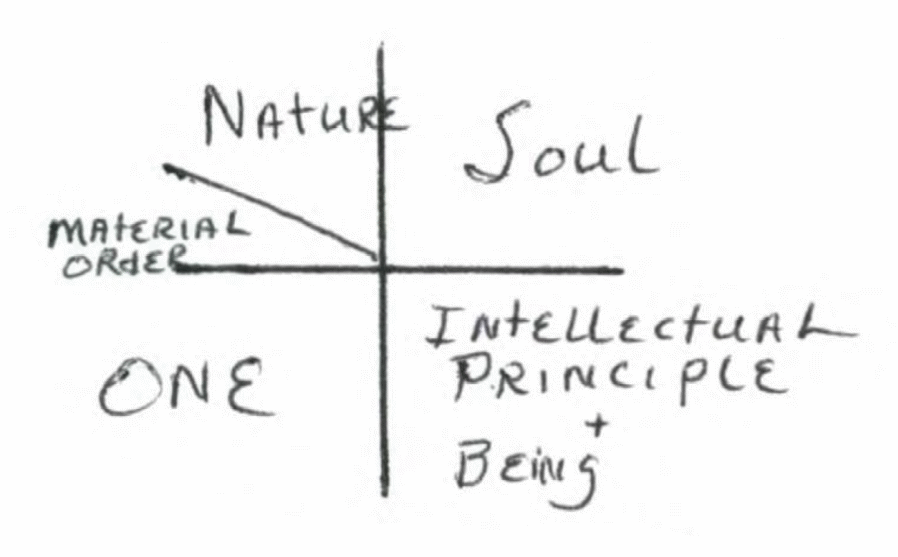
Plotinus, V.1.10 (AS reading): "There exists a Principle which transcends Being; this is The One, whose nature we have sought to establish in so far as such matters lend themselves to proof. Upon The One follows immediately the Principle which is at once Being and the Intellectual-Principle. Third comes the Principle, Soul.
"Now just as these three exist for the system of Nature, so, we must hold, they exist for ourselves. I am not speaking of the material order--all that is separable--but of what lies beyond the sense realm in the same way as the Primals are beyond all the heavens; ..."
AD: Alright. How would you interpret that? I mean, would you say that I'm following what he's saying? There's the One, principle which follows upon the One, and then Life. And then he speaks about the system of Nature. He says now I'm not referring to the material order which is beyond all that. So all of this here is like beyond the material order. This would be the material order, the 12th house, the realm of manifestation. [Note: See FIGURE 1981 1002-6.] Try once more reading.
Plotinus, V.1.10 (AS rereading): "There exists a Principle which transcends Being; ..."
AD: Alright, put that in the first quadrant.
Plotinus, V.1.10, cont. (AS rereading): "... this is The One, ... Upon The One follows immediately the Principle which is at once Being and the Intellectual-Principle. Third comes the Principle, Soul.
"Now just as these three exist for the system of Nature, so, we must hold, they exist for ourselves."
AD: For the individual.
Plotinus, V.1.10, cont. (AS rereading): "I am not speaking of the material order ... but of what lies beyond the sense realm in the same way as the Primals are beyond [all] the heavens."
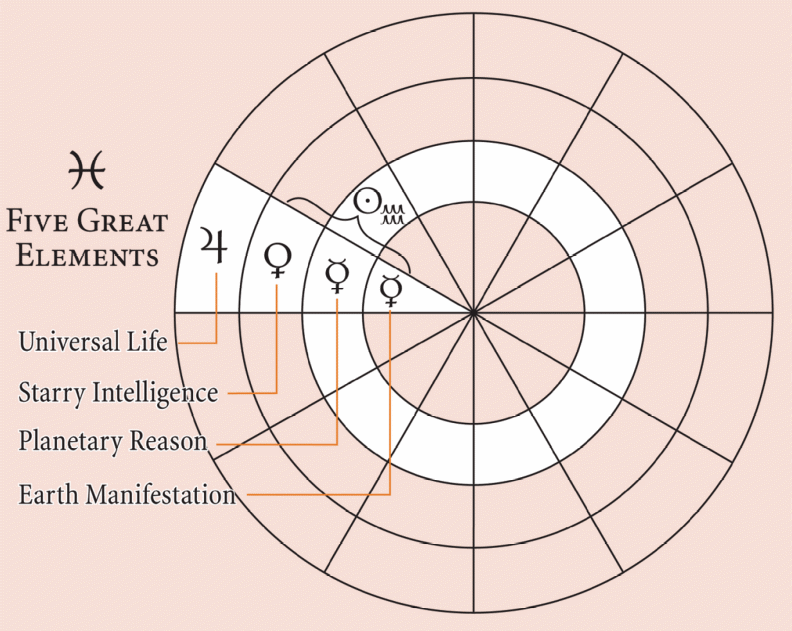
AD: Ok? That's a kind of rough sketch he starts out with. This is the system of Nature which is beyond the sensible world. It's even beyond the primal heavens. So when we put the Sun in Aquarius here we say that within that is the whole of the sensible order. [Note: See FIGURE 1981 1002-7.] Now, we're representing it this way, and we also represent it the other way, if you remember, I made the-- I made this diagram. [Note: See FIGURE 1981 1002-8 for the following.]
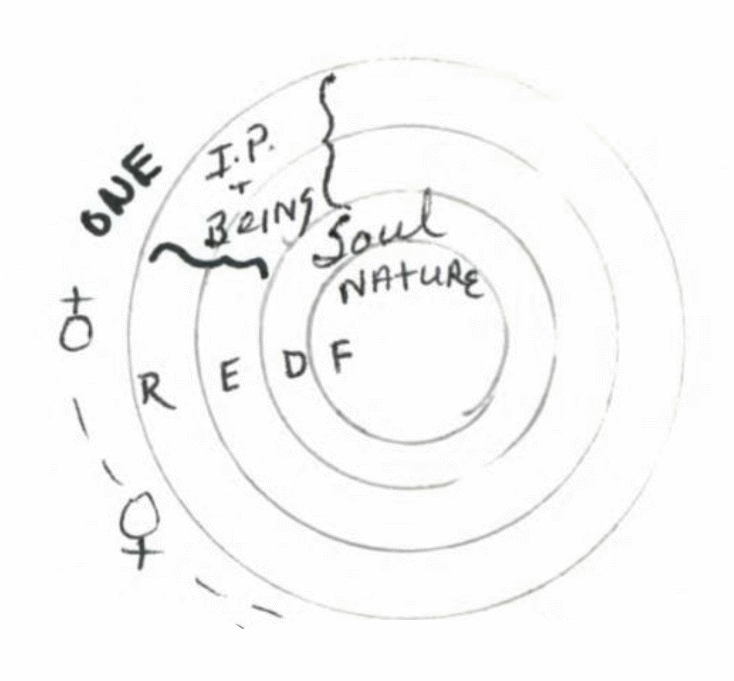
Now another way of representing that would be to say if this is the One, which we took from here, and we take this whole-- all the dignities here and here, first and second ring. If we take this to be a One, outside, alright, then these will be Being, the next one will be Soul, and the next one will be Body, so that we would have these two representing the Intellectual-Principle-- I'm sorry, this representing the One, this the Intellectual-Principle, this representing Soul, and this representing the system of Nature. [VM assents] So that we could use these two structures at the same time. He can use a quadrant structure, think of it this way, or we could think of it as a ring structure. The two have to be collapsed together, they have to be considered as two aspects of one and the same thing that we're dealing with.
Now, confusion. [S: Right.] Because what you did was to bring about, to prevent the possibility of combining any of these things in a closed system. No one can close it. The thing could be substantial, could be function, could be a combination, to the end of these things. [AS assents] Then he continues on the next page. It's another quotation.
AS: You want the one about the secondaries and tertiaries?
AD: Yeah.
AS: Ok on the previous page actually, 8-- V.1.8, where he says--
Plotinus, V.1.8 (AS reading): "This is the explanation of Plato's Triplicity, in the passage where he names as the Primals the Beings gathered about the King of All ..."
AD: This is the King of all, the beings gathered about the King of All. [Note: Reference to first quadrant dignities in FIGURE 1981 1002-9.]
Plotinus, V.1.8, cont. (AS reading): "... and [AS adds: he] establishes a Secondary containing the Secondaries [AD drawing] and a Third containing the Tertiaries."
AD: We'd have to do the same here, all the dignities here, alright, would be the Secondaries, all the beings here would be the Tertiaries. [Note: Reference to second and third quadrant dignities in FIGURE 1981 1002-9.]
[short pause]
S: Did you read?
AS: [couple words inaudible]
AD: I'm sorry, I mean, (repeat both of them).
AS: Ok. So you don't speak--
Plotinus, V.1.8 (AS rereading): "... names as [the] Primals the Beings gathered about the King of All and [AS adds: he] establishes a Secondary containing the Secondaries and a Third containing the Tertiaries."
AD: Alright, you could use both diagrams, [drawing] you could use the circle that I just erased, alright. This would be the One, the beings gathered around the One, [Note: Reference to first quadrant dignities in circular form, as in FIGURE 1981 1002-5.] the Beings gathered around the Secondary, [Note: Reference to rulerships and exaltations in FIGURE 1981 1002-9.] the Beings gathered around the Tertiary, [Note: Reference to Soul dignities in detriment ring in FIGURE 1981 1002-9.] so that you'd have the two ways of working.
AS: He also makes that further line where he says--
Plotinus, V.1.8 (AS reading): "[AS adds: As in] The Platonic Parmenides ... [AS adds: where] the distinction is made between the Primal One, ... a secondary One which is a One-Many and a third which is a One-and-Many; ..."
AD: There it would be the same as saying One, Intellectual-Principle, One-Many, One-and-Many would be Soul. [13 second pause] Alright, now, the transition from the One to the Intellectual-Principle was a problem that was particularly difficult, and if you remember we had to ultimately deal with the nature of Number. So, if we're going to derive-- either way we use the symbolism, if we want to derive the Intellectual-Principle from the One, there is a very organized way that it has to be done. And I think in the tractates dealing with Number he lays out precisely that derivation of how Number correlates the Intelligibles, alright, and the Idea, so that you get the Intellectual-Principle. Do you have the ordering that was done? Alright. Suppose we read a few of them. This is especially difficult.
AS: [few words inaudible]
AD: Especially difficult. It's kind of hard to follow but let's give it a try. First quotation.
AS: First one is VI.6.9.
[24½ second pause]
AS: Says-- Well I just stick to the quote.
VM: Yeah, no sense [one word inaudible] interacting with--
AS (simultaneously): [few words inaudible] Yeah you're just-- this is-- we're skimming the outline. You could read previous parts but I think the main part here is--
Plotinus, VI.6.9 (AS reading): "[But] if Number thus preceded the Beings, then it is not included among them?
"The truth is that it [AS adds: Number, it] existed within the Authentic Being but not as applying to it, for Being was still unparted; the potentiality of Number existed and so produced the division within Being, put in travail with multiplicity; Number must be either the substance of Being or its Activity; ..."
AD: I'd change that, "substance and activity". [cf. Astronoesis, p. 107]
AS: And Act-- Right.
VM: They're close (enough).
Plotinus, VI.6.9 (AS rereading): "... Number must be either the substance of Being or [AS substitutes 'and'] its Activity; ..." (student giggles)
VM: Leave 'either' out.
AS: Leave 'either' out. Don't leave 'either' out.
AD (simultaneously): I don't pay attention to grammar, I pay attention to meanings.
VM: No, nonetheless there's a substance of the [one word inaudible]
AS: But that-- ok.
S: Louder.
AS: Well, one of the things I think-- say that here Authentic Being is being used in the way that we used 'Being' previously, as referring to the principle of Being.
VM: Universal Being or something--
AS (simultaneously): Or Universal Being. Where you're beyond the conception of determined Being. So, you're talking about just as within the One is prefigured Nous and Being, you also have there the Unity of Numbers. Or you have numbers as within the One but not applying to Being, and so not producing any divisions or distinctions there in the One. Ok, but he says--
Plotinus, VI.6.9, cont. (AS reading): "... the potentiality of Number existed and so [AS adds: it] produced the division within Being, put in travail with multiplicity; Number must be [either] the substance of Being or [AS substitutes 'and'] its Activity; the Life-Form as such and the Intellectual-Principle must be Number. Clearly Being is to be thought of as Number collective, while the Beings are Number unfolded: the Intellectual-Principle is Number moving within itself, while the Living-Form is Number container of the universe. Even Being is the outcome of the Unity and since the prior is unity the secondary must be Number.
"Hence it is that the Forms (Ideas) have been described as Henads and Numbers. This is the authentic (essential) Number; the other, [the] 'monadic', is its image. The Authentic is that made manifest in the Forms and helping to bring them to be; primally it is the Number in the Authentic Being, inherent to it and preceding the Beings, serving to them as root, fount, first principle."
AD: Herbie, what do you think of that?
HS(?): (But can I) [couple words inaudible]
S: Avery--
AD: It is one of the most difficult pass-- passages, I didn't want to work on Numbers till we really did a lot of Plotinus. But--
HS: But there was one, where he says Being-- Being comes from unity and because it come-- and as such it's Number? That's up there, right, (the Being-- it is up there).
AD: Well could you try in fifth-grade colloquial English to (give) back what he said?
S: Yeah.
HS: You have this one principle, this principle of the One, and it's [one word inaudible]
AD: Within this undifferentiated knowledge there's a principle included which he's calling Number.
HS: Number. And it's given to Number to-- it's given to Number to unfold, so to say, the rest of-- of the--
AD: The contents which are within it.
HS: Within the One.
AD: Yeah, alright. So that means it has to correlate--
HS: It has to correlate both-- all the-- the (set of) two principles that were laid out, substance and function. It has to somehow relate Nous and Being [one/two words inaudible]
AD (simultaneously): So that it has to like assign-- it has to assign, let's say, a certain intelligible to an Idea. It isn't any intelligible that manifests an Idea but certain intelligibles that manifest it. So it has to coordinate the activity of these. So then Number becomes a sort of guiding principle that, in order for manifestation to take place, in order for certain Ideas to let's say get manifested, certain intelligibles are involved in manifesting that Idea. So there has to be a coordination between these two notions.
HS: Yes, and-- also Number is definitely-- it's given a hierarchy like closer to the One or (the/to) Number, I don't--
AD: Well the principle of Number is included as part of that undifferenced knowledge.
HS: Of the One.
AD: So that's why in the-- if we take the dignities in the first quadrant, the Head represents that.
S: Well--
HS: But that's the One. [couple/three words inaudible] is the Head is coordinating the Jupiter and the Mercury [should be reversed], the Ideas and the dignities. That's one way you spoke of it.
AD: Go ahead, Louis.
LdS: Well, I was going to ask, in this notion of Number, we're saying that the Being-- this principle of Being and Number are the same before the multiplicity or before the Beings are differentiated. Then would he there be talking of Being as we would speak of the third house?
S: I think.
LdS: The principle of Being? If-- in this quote that Avery just read, he's speaking of Number and Being as-- oh, Number inherent in this Being before the beings.
AD: Yeah, Number inherent in this Being would be in the One.
VM: Well that's a [couple words inaudible]
LdS (simultaneously): So that would be in the third house.
AD: Yeah.
VM (simultaneously): That's a reference to Authentic Being.
LdS: Yeah.
LR: Wouldn't you also have to say that the first number is the third house? 3.
AD (simultaneously): Yeah, and they do start, they do say that 3 is the first number.
LR (simultaneously): 3 is the first-- So that-- I mean in a way we're repeating what we said about the 3, that from the contemplation of the Dyad on the One--
AD: The interaction of the Dyad--
LR: The interaction of the Dyad with the One produces the first possibility of a definite-- a definition, and that's what we're calling Number (I think). The principle of that definition--
AD: Well that would be one of the principles. Number would be one of those principles.
LR (simultaneously): One of the principles, [AD: Yeah.] but number would be-- I don't know, just--
AD: Number would be one of those principles, just like Being would be another one of those principles.
LR: Ok but Number-- if you're saying that Number is that which makes possible beings from Being--
AD: Being from beings.
LR: No. The passage Louie just referred to.
AD: Well read it. [AS: Uh-huh.] We're speaking about the differentiation of the contents of Being, and Number presides over that.
LR: I heard you. Be-- [short pause] Avery, which page is it on?
LdS: He speaks about Being and Number inherent--
AD: Avery, would you read the passage please?
LR: Oh, here it is.
AS: Ok, you got one?
LR: Well--
AS: Well, you had a specific part of it. You found it? Read it.
Plotinus, VI.6.9 (LR reading): "... Being is [to be] thought of as Number collective, while the Beings are Number unfolded: ..."
LR: Now it's not till the Intellectual-Principle I think that you have the beings unfolded. Before that you have Being collective. Now-- that's why I said beings from Being. It seems--
AD (simultaneously): Well beings collected would be Being.
S: Yeah.
LR: Now it seems that the way he's speaking of Number, Number is responsible here for making possible the distinc-- differentiation of beings from this collective Being.
AD: It differentiates Being, yeah. But now suppose, suppose that we put the principle of non-manifestation in the third house too. Wouldn't Number also have to preside over what beings do get manifested, what cannot by their nature get manifested.
AS: Yeah. See--
AD: So what I'm trying to say is, Number is a principle, Being is a principle. Now if we-- if we put all the principles, itemize the principles in the third house, the first house is the principle of principles. What we're doing is taking the principle of principle and itemizing it in the third house. So that the third house is the source of not only the principle of manifestation, that is Being, but any other principle which would be on the same level, let's say, as ontology. Being is the highest concept we can work with, we have none higher. But that should not, so to speak, close our mind to the possibility that there are other principles of which we're totally unaware. If you want to remain truly metaphysical. If you want a closed system, say that there's only a principle of Being, alright, and there are no other principles, then you got a closed system. Then you have the One, then you have so-to-speak Being in this very narrow sense, alright. Because how could you refer to Voidness [as the third house is sometimes spoken of] as Being, or non-manifestation as Being, let alone-- let alone the aseity of each Idea. Alright, we're in the stratosphere now, I know that.
LdS: Well--
AD: Go ahead.
LdS: If I can ask one more. You're saying that this third house is where the-- we spoke of this before, it's where the-- at least some of the possibilities inherent in the One are hypostatized. [S: Yeah.] I mean, so to speak--
AD: Yeah. If we take, if we take for instance a scale, alright, and we imagine the One on one side, the Power as the middle being, alright, and the other scale as the totality of all the individual principles, then the Power will be, so to speak, the equilibrium between the two. Alright. Now all these principles and the One, alright, are the same as speaking about the first quadrant. In the first house you see the One as transcendent with no aspects. When you think of the quadrant, the whole first quadrant, then you're trying to conceive of that One with aspects. Alright but it still remains undifferentiated. Try to understand, we're just trying to accommodate the-- the curiosity of our intellect.
S: Yeah.
LD: Well lo-- wouldn't-- wouldn't you say that in that framework of the first quadrant that the Power would differentiate some of these aspects of the first house out, I mean--
AD: But we said that the power belongs to the One.
LD: I know.
AD: Alright? So how would you differentiate it out?
LD: Well-- I don't mean the--
AD: You see, all I want you to do is to conceive of all these principles as integral or homogeneous with the One. So when I speak about the first quadrant I'm speaking about the One as having aspects, when I speak about the first house, no aspects, absolutely transcendent.
LD: Right. Right, the third house would represent the-- certain aspects of the One although not apart from the One. And the Power would represent that which could--
AD: Let's say connect the-- these ones with the One.
S: I don't understand that. What do you mean connected, aren't they part of it, why do you need a connection?
AD: Well that's only a metaphor, it's not liter-- literary accurate-- literally accurate. We have to think that way because if we don't, we don't conceive of unities within the Unity, then we would have trouble deriving the many from the One. You won't be able to.
LD: Without Power.
AD: No, without the distinctions in the One itself, [LD simultaneously: Oh, ok, yeah.] but these distinctions exist in a distinctionless way in the One.
JfL: Laurie, I don't think the distinctions are less in the One, that's the catch. Otherwise it would be sep-- wouldn't be the same.
LD (faint): Well, I don't mean [couple words inaudible] that's out of the One.
S: Yeah.
LD: I-- maybe I was headed (there).
JfL: But when you're distinguishing it you're not taking a part of the first house. Right? You're not taking any part of the first house.
LD: You're not taking it away-- anything away from it, but you're just trying to understand that there is a structure to it in some sense.
JfL: No, the third is a--
LD: (Am I/My) thinking right or--
AD: I can't hear you.
LD: I was just saying that when you think of the third house as these principles, you're not taking anything-- I didn't mean to take anything away from the One in saying that it was different from that, but just trying to understand that the One does have some kind of a structure. It may not be the kind of structure that our minds, you know--
AD: Alright so, like, if we try to be more precise, if we say the third house represents the idea of the universe, an idea which is prior to existence, prior to ideation, alright, and we insert it, and we say that it's included in the nature of the One, now in order for us to speak about an-- the idea of the universe which is pre-ontological and pre-existential, alright, we have to make these distinctions because, we're saying it's ultimately included in the nature of the One, alright. So we're making these artificial distinctions in the nature of the One so that we can see how it derives all the other principles from that. Alright, basically that's what we're doing. And that's what I think he does too. [student assents] Yeah, David.
DB: Well I was just going to mention that that last quote really emphasizes that because he says that within the Authentic Being, Number exists but as not applying to it, and the only application that you could speak of with these distinctions is to something which is posterior or which follows upon it.
AD (simultaneously): After and upon it, yeah.
DB: That what-- In a sense if they were to-- if they were to in some way distinguish the One itself, they couldn't possibly even be, I mean--
AD: Well try looking at it this way, in the first quadrant you have universality, Universal Being, unlimited infinity, alright, it's infinite there.
DB: Right.
AD: Anything after that is going to be a form of Being, Being in some way organized into shape, form, etc, it has some characteristic, alright. So anything that's within the first quadrant cannot be conceived of in this distinctive way, the way things are conceived of in Being. So if you say that the unit soul in the second quadrant, alright, has no shape, form, etc, in the sense that the unit soul is absolutely pervasive of all space, alright, it's omniscient, not in the sense that it knows everything but it is pervasive of everything, then the distinction between that and something that in the first quadrant is unavailable. Because we can't even s-- I mean all logical language is going to fall apart here. To return-- return it to the One just-- (is) just (be out of the) [one word inaudible] So we have to follow our guide very closely here. Let's reread that passage, Avery. It is difficult. And if you have any ability to meditate, it's one of those passages that you have to memorize and take into meditation and go over it and over it and confront yourself with the paradox. Because that's the only way reality is revealed is through its paradoxical nature. In itself it will never be revealed.
Plotinus, VI.6.9 (AS reading): "... it [AS reads: Number] existed within the Authentic Being but not as applying to it, for Being was still unparted; the potentiality of Number existed and so produced the division within Being, put in travail with multiplicity; Number must be [either] the substance of Being or [AS substitutes 'and'] its Activity; the Life-Form as such and the Intellectual-Principle must be Number. Clearly Being is to be thought of as Number collective, while the Beings are Number unfolded: the Intellectual-Principle is Number moving within itself, while the Living-Form is Number container of the universe. Even Being is the outcome of the Unity and since the prior is unity the secondary must be Number.
"Hence it is that the [Forms] (Ideas) have been described as Henads and Numbers. This is the authentic [(essential)] Number; the other, the 'monadic', is its image. The Authentic is that made manifest in the Forms [and] helping to bring them to be; primally [AS reads: primarily] it is the Number in the Authentic Being, inherent to it and preceding the Beings, serving to them as root, fount, first principle."
[10 second pause]
AD: So then this idea, this notion of Number, is what's going to provide us with the means or the necessary connection from which the Intellectual-Principle spring. Let me say this here in retrospect. I'm doing this in a little-- a little differently than Plotinus. I mean I'm adding things here about the third house as containing many-- many principles which in their totality would be the principle of principle. I'm doing this because, although it has been left unsaid in Plotinus, I would say that the highest experience that man is capable of is reaching that Unity.
[11¼ second pause]
S: Go ahead.
[13¾ second pause]
AD: Well, just take it as a koan. [14 second pause] If I were to say, if I were to say that the identification or the achievement of let's say that state of Unity, or possibility of being a companion to that Unity or a friend of that Unity, it might sound like something conclusive. It might sound like a limit. Whereas by leaving it this way, alright, I've left open the doors of unlimited vistas and conception. In other words, let's say you reach the Unity which we're speaking about in the third house, and there's many other unities -- there's a whole ocean of possibilities. Whereas if I say you achieve Unity and now that's it, alright, you have a very closed conception of what these people are talking about. Plotinus doesn't make that point. I'm making it. I'm making the distinctions in the third house that you have a plurality of principles.
SD: Anthony, are you saying then that the experience of Unity that is ultimately attainable for a human is something that would be conditioned as it were from a third house point of view?
AD: [one word inaudible] isn't that so?
SD: But the particular approach-- approach to Unity.
AD: It's a particular kind of experience in a sense in comparison to the Unity itself. We'll leave this discussion, someday we'll get into it in the Vedanta. Alright, it's the stratosphere, let's go on.
DB: Yeah, just with reference to the Numbers, they constitute and unfold and determine, organize Being and the Intellectual-Prin-- and Intellectual-Principle. Is there any way to distinguish that within the Numbers themselves?
AD: Is there any way to--
DB: To distinguish that within the Numbers themselves as coming from the Power aspect of the One as opposed to the Unity aspect of the One in terms of that unfoldment?
AD (faint): I don't think I understand you yet.
DB: Well, just, you say that from the point of view of the third house the Numbers would-- will unfold Being and Intellectual-Principle, and the Ideas, will constitute them. And, the Numbers at that level, in the third house, seem to have an aspect, on the one hand, as being unities, completely, and on the other as having this differentiated-- not differentiated but this Power. It's from the Power that they have that the Intellectual-Principle is unfolded. But it's from the unities that they are or represent that the Intellectual-Principle isn't chance--
AD: It's from the unity [couple words inaudible] Number?
DB: It's from the unities that each Number has or is that the Intellectual-Principle is constituted the way it is. Is that-- I--
AD: I think what you're trying to say is the--
[Audio File 1981 1002a Ends]
[Audio File 1981 1002b Begins]
AD: --idea or form in the One. So naturally, everything which is (in) principle participates in that Unity will also have that power. So, the power of Number will prevail insofar that it organizes the Intellectual, the Intellectual or Principle, also insofar that it organizes the souls in the Intellectual-Principle, also insofar that it organizes the definition of the soul, or the Logoi included within the soul. And in each case they would call Number differently, they would call one Divine Number, the next one Essential Number, the next one-- I don't remember, do you remember the four classifications of Number, Avery?
AS: The third one would be Ideal Number I guess, [AD: Ideal Number.] and the last one, Monadic.
AD: Monadic Number. So that Number, these four different divisions of Number preside over different divisions which we find in Reality. [short pause] Alright. So, Avery we got the-- we got the principle by which the Intellectual-Principle will be produced from the One.
AS: There's also one more place in here in VI.6.15 where he seems to also make clear that it's-- Well, he says--
Plotinus, VI.6.15 (AS reading): "... even in Intellect Number is not present primally; its presence There is the reckoning of the Acts of [AS adds: the] Intellectual-Principle; ..."
AD: So so far he's saying there that in the Intellectual-Principle you won't find Divine Number, you would find Essential Number. Is that correct? What else did he say?
AS: That was-- that's just that one line. "In Intellectual--"
Plotinus, VI.6.15 (AS rereading): "... in [AS adds: the] Intellect Number is not present primally; its presence There is the reckoning of the Acts of [AS adds: the] Intellectual-Principle; ..."
AS: Now, seems like, maybe one thing this is-- I mean if we diagrammed it, maybe we could point out here the distinction between the Head becoming the double Mercury [in Virgo]. And the double Mercury would be "the reckoning of the Acts of the Intellectual-Principle", the distinguishing of each Idea from the other, whereas in the Head--
AD (simultaneously): Show us. How would you do that?
AS: Whereas in the Head, you would say, when he says Number primally-- "Number is not present primally" in-- just using the one diagram that you had of putting these around the circle, putting the Triad around the circle, [drawing; see FIGURE 1981 1002-10, including for this example both the Ruler and Exaltation Mercuries in Virgo] and that problem comes up of-- [S: I'm sorry.] If you put the dignities in the first house around as we've done, Mars, Sun, Venus, [sic; Mars, Venus, Mercury] Sun, Moon, Head, but here you would have Number primally just the way we spoke about it here in the first quadrant. But it seems in some way that that Primal Number becomes within the Intellectual-Principle this double Mercury, in the 6th house, where we also spoke about those forces. But now instead of this unity of Number, it seems now we have the Number which he seems to be referring it--
Plotinus, VI.6.15 (AS rereading): "... There is the reckoning of the Acts of [AS adds: the] Intellectual-Principle; ..."
AS: Perhaps there that double Mercury represents the differentiation within the Intellectual-Principle, or the power within the Intellectual-Principle that can distinguish one Idea from the other, [LR: But--] and distinguish all the Ideas as unique peculiar properties as some--
LR (simultaneously): But I thought we said "its presence There is the reckoning of the Acts of the Intellectual-Principle", There would [AD simultaneously: Ok.] mean there in the first quadrant.
AD: Louder, Linda.
AS: Yeah.
LR: I was reading 'There' as [couple words inaudible] Inte-- he's trying to point out that [AS assents] Number exists before the Intellectual-Principle, right?
AS: Right.
LR: So he says "its pres--"
AS: No. Ok, (as you say).
Plotinus, VI.6.15 (LR rereading): "... even in Intellect Number is not present primally; ..."
LR: It's present before Intellect in other words, and then he says--
Plotinus, VI.6.15 (LR rereading): "... its presence There is the reckoning of the Acts of [LR adds: the] Intellectual-Principle; ..."
LR: I took that to mean that There in the third house it determines the acts which will be found in the second quadrant.
SD: It will continue [couple words inaudible] you'll see.
AB (simultaneously): Read the sentence before.
AS (simultaneously with SD and AB): No, I didn't take it that way.
LR: No?
AB: Read the sentence before, he uses 'There' doesn't require the [one word inaudible]
LR: Oh 'There' doesn't mean--
AD: The 'There' would refer to Number as Essential, it is within Being that [AS simultaneously: In Being, yeah.] Number arises. [CdA simultaneously: In Being?] So that's Essential Number, that's not Primal Number; it's not Divine Number.
AS (simultaneously): Yeah, in-- in-- in the previous lines, Linda.
Plotinus, VI.6.15 (AS reading): "Similarly, the Intellectual-Principle by its very nature contains all [AS adds: the] intelligences as severally members within itself [AS reads: it]."
LR: Uh-hm.
AS: So that's what he was speaking of.
Plotinus, VI.6.15 (AS reading): "Now all this means Number There."
AS: The 'There' clearly means Intellectual-Principle.
Plotinus, VI.6.15, cont. (AS rereading): "Yet even in Intellect Number is not present primally; its presence There is the reckoning of [the] Acts of Intellectual-Principle; ..."
AS: This whole passage seems to be about Intellect. Ok, and the reason it's not present primally seems to be exactly this line--
Plotinus, VI.6.15 (AS rereading): "... its presence There is the reckoning of [the] Acts of Intellectual-Principle; ..."
AS: Its presence there isn't the primal subsistence of Number which is as Divine Number referring to itself. So here it seems he's-- he seems to be discussing somewhat the distinction between Number prior to Being and determining Being itself, and Number as within Being and conforming to this differentiating act in the Intellectual-Principle. [AD drawing] Or, (at some point).
AD: So-- so now we have the Head presiding. [16¼ second pause while drawing/writing] And if we think of each of these here, [short pause while drawing/writing] and we say each one is an Idea, so we have the fifth house Idea, the sixth house Idea, the seventh house Idea. So the Idea, alright, is on the one hand let's say this side, and it is in a way essentializing. By that I mean that if we think of this as substance, this has to be the power of that substance or the functioning aspect. So this would be the function, this would be the substance. Now the correlation between these two, let's say, bet-- alright, is presided over by Number. [Note: See FIGURE 1981 1002-11.] The Idea which is being-- let's say, essentializing-- you cannot say 'manifested' here because there is no manifestation-- but the Idea which is being essentialized by the Ruler, alright, it gives us an indication, alright, of these 12 houses with the intelligibles that are be-- are essentializing that. And we can say, not only the Rulers but we can also do that with the Exaltations because that's the Separative Intellect. And so these-- these all together would represent the Intellectual-Principle. And Number presides over all of that. The assignment of a-- let's say an Intelligible to an Idea, the correlations between Idea, the combinations by-- Number presides over that. But in this realm it would be Essential Number. Now, what presided over this whole arrangement was Number Primal [Head]. It was the Number in the Triad that determined and coordinated all these together. So then that means that we would have-- [short pause while drawing] So this would be the Intellectual-Principle: the Ideas which we put on the outside, and the Rulerships and Exaltations, this would be Being-Life-Intellect, and this [Exaltation ring] would be the Separative Intellect. [Note: See FIGURE AD_E_010.]
All that represents the Intellectual-Principle. Now, I'm-- the remark I made was that this is where I think Plotinus takes his stance, the same way like Eckhart, or any of the really great mystics who take their stand in the Nous, and they talk to us from that point of view. They're not talking to us from the point of view of human understanding, or the realm of knowledge between Ideas-- between the Ideas and the lower, they're not-- they're coming from the realm of-- the intuitive realm, because that's the only communication that we-- that they have with that realm, through intuition.
HH: Anthony, when you say that Number presides, are you referring to Number as represented like-- as representative, it is like some type of an entity?
[short pause]
AD: 'Entity' wouldn't be the word, would it Harold? Number There is a real Authentic Existent, more real than anything here. It's an actual spiritual Being. Now the word 'number' is like the word 'dog'. Remember the way Santayana made that remark? When you speak about a dog and when you speak about dog-star, the only relation between them is D-O-G. The way Number is being used here, of course, is nothing that you've learned when you were in school. Would you get to the notion where he speaks about Number as force, substance, power? Remember that quote?
AS: Yeah. Do I? I think.
AD: You can't treat Plotinus lightly, you might as well put it down. [AS: It's funny (one/two words inaudible)] But you make an extreme effort to push the inquiry all the way through, if it takes 10 years, 20 years, it's alright.
AS: Well Linda knows where that is.
AD: Maybe it's marked in my book, Vic. On Number. [11 second pause, flipping of pages] No, not here because-- [17¼ second pause] Anyone find the quote? He speaks about Number as force, substantial being. [32½ pause with flipping of pages, some student words] How can I-- of course I'm aware Harold that the contemporary mentality will take this to be some kind of superstition. But I'm really not concerned with the contemporary mentality. As a matter of fact, more new books get published, the more of the old books I read. [short pause] Alright, don't worry about it, I'll find it (in--) I got it marked down in another text.
S: Tony?
CS: Well here it is. Page 547.
AD: Read it to them.
CS: You want Real Being is Number.
AD: Hm?
CS: About Real Being is Number.
AD: Real Being is Number, yes, would you read it?
[short pause]
CS: Ah, this is VI.6.8.
Plotinus, VI.6.8 (CS reading): "Thus it is clear that Number cannot be dependent upon the Living-Form since unity and duality existed before that; nor does it rise in the Intellectual-Principle since before that there existed Real Being which is both one and numerous."
CS: It is all before that too.
AD: Vic, would you read it again?
VM: Same quote?
AD: I like something very forceful [one/two words inaudible]
CS: I can be forceful. (laughter, joking around)
AD: Alright, try again. (more laughter)
S: Come on, don't let us down.
CS: I won't. (more laughter)
AD: Go ahead.
LR: Go ahead, alright already. (bit more laughter)
CS (faint): I didn't [one word inaudible]
S: Same one? Read it.
AD: Huh?
CS: Same one?
AD: Same one.
S: Absolutely. (some laughter)
AD: Even if you got to get up and stamp with your feet.
CS (simultaneously): No, no, no [couple words inaudible] (bit more laughter) Alright--
Plotinus, VI.6.8, 9 (CS rereads): "Thus it is clear that Number cannot be dependent upon the Living-Form since unity and duality existed before that; nor does it rise in the Intellectual-Principle since before that there existed Real Being which is both one and numerous.
"[9.] It remains then to consider whether Being by its distinction produced Number or Number produced that distinction."
AD (simultaneously): Ok stop. No that wasn't the passage.
CS: Alright. There's a whole lot before that though, Anthony.
AD (simultaneously): No.
[short pause, flipping of pages]
LR: I don't think it's on the one on Number.
S: I know but--
VM: No I don't think it is either.
AS: No, it's somewhere else.
VM: It's later on in the--
AS: Somewhere else.
S: Yeah.
AS: But I don't know where.
LR (simultaneously): It's in the "Multiplicity".
CS: What?
S (very faint): Oh yeah.
VM: I think it's in the "Multiplicity of Ideal-Forms".
S: Yeah.
AD: Alright. Alright, [couple inaudible AS words simultaneous with AD] I'll have to go find it.
LR (faint): Oh that's right.
S (simultaneously): Oh right here.
S (faint): Oh, they're a little [one word inaudible]
LR: Good try.
[short pause]
AD: Yeah. That wasn't the passage but there again you can see where he speaks about it as the source and actuality of Being, so it must have Authentic Existence in itself. And I'll-- even in the sense of the superior, the Soul. So if Soul is an Authentic Existent and an eternal reality, and Number is above that, you can see what he's talking about is quite different than what we understand by numbers. What we call numbers they would refer to as monadic, quantitative. That has nothing to do with these things, they're the ultimate-- the ultimate participant in the notion (of Number).
LR: Now here's an interesting thing on that, this isn't what you were looking for either, but I remember when we read this you referred to Number as being responsible for this statement, which says--
Plotinus, VI.7.9 (LR reading): "... Intellections ... cannot be identical: there must be different lives, distinct intellections, degrees of lightsomeness and clarity: there must be firsts, seconds, thirds, determined by nearness to the Firsts. This is how some of the Intellections are gods, others of a secondary order having what is here known as reason, while others again belong to the so-called unreasoning: but what we know here as unreasoning was There a Reason-Principle; the unintelligent was an Intellect; ..."
LR: It goes on. And I remember you saying that Number deci-- is responsible for that apportionment, allotment.
AD: Alright. [S simultaneously: Laurie--] We'll proceed. Because we still want-- we want to try to finish it, it's almost 9:30. Avery, then when we derive the-- the Intellectual-Principle from Number, alright--
AS: V.3.11.
AD: Then he went through a whole--
AS: V.3.11 I think.
AD: V.3.11.
AS: Where he says-- it's-- I think this is the one 'cause he says-- the one about successive impressions? I don't know if you-- if that was the next one you wanted. Maybe I'll-- what did-- what did you have in mind?
AD (simultaneously): Alright, go ahead, read your quotations.
AS: I'm sorry, [AD simultaneously: V.3.11.] you had something else in mind.
AD: No, that's alright, fine. [9½ second pause] Again, this would be an example, Dave, where we're trying to follow the meaning of the text. But when you read a passage like this it's almost impossible to understand it, except in a kind of vague way. Read the quote.
Plotinus, V.3.11 (AS reading): "The Intellectual-Principle, in the act of knowing the Transcendent, is a manifold."
AD: Alright now this whole thing here [FIGURE AD_E_010], which we said is the Intellectual-Principle, all the Ideas and their essentialization, we're saying is a manifold. Alright, go on.
Plotinus, V.3.11, cont. (AS reading): "It knows [AS reads: It knows-- The Intellectual-Principle knows] the Transcendent in very essence but, with all its effort to grasp that prior as a pure unity, it goes forth amassing successive impressions, so that, to it, the object [the Transcendent] becomes multiple: thus in its outgoing to its object it is not (fully realized) Intellectual-Principle; it is an eye that has not [yet] seen; in its return it is an eye possessed of the multiplicity which it has itself conferred: ..."
AD: Alright, now the first thing he says is that the very essence of the Intellectual-Principle is a transcendent One. Now, there would be only one way that I-- I would be able to understand that, and that is that if we saw that the Head presided over this whole arrangement, then the Head would be the principle of this arrangement. And the Head is included in the order of the transcendent One, in that level of reality, then the very essence of this whole thing is the Head, which is part of the One, and therefore this knows the One in its very essence. Now you try-- try to see if you can see that in a different way without using a diagram.
S: Could you say that all over again, [S: Uh-hm.] I mean--
S (faint): Uh-hm.
AD: We said-- we said that the-- the Head presides over the whole arrangement-- [short pause while drawing/writing] that this Head here presides over the arrangement of the entire Intellectual-Principle, ok. [Note: See FIGURES 1981 1002-11, AD_E_010.] Now, he says in that passage that the Intellectual-Principle knows the Transcendent in its [S simultaneously: Very essence.] very essence. [student assents, faint] This is the essence of this whole arrangement. So it knows the One through its very essence. Ok? Then he goes on. Avery?
AS: Then he says--
Plotinus, V.3.11, cont. (AS rereading): "... with all its effort to grasp that prior as a pure unity, it goes forth amassing successive impressions, ..."
AD: Alright, now, it tries to grasp the nature of the One, alright, through its very essence. What happens is [writing] this is Being-- this is One-Being-Life-Intellect-Soul-- [S, faint: Nature, Body.] Nature-Soul-Body. From this arrangement here, this here, every effort to understand the nature of the One, alright, there's produced a successive impression. [Note: See FIGURES AD_I_202, 1981 1002-14.] Now successive impressions here could be universe after universe. Don't get carried away of thinking of one image after another that you think. In the effort-- insofar that the Intellectual-Principle-- now you remember we said that the Intellectual-Principle represents the Divine Ideas, the Ideas in the Divine Mind. And that an infinite plurality of worlds can come out of that. You can't exhaust those Ideas, no matter how many worlds manifest, you can't exhaust it. Alright then, if that's the nature, if that's the nature of the Divine, alright, the Divine Mind, insofar that the Divine Mind is trying to grasp the nature of the One, the infinity of the worlds is proceed-- proceeds out of that grasp-- attempt to grasp the nature of the One. If we think of this Being-Life-Intellect-Soul-Nature-Body, then the entirety of manifestation, universal manifestation, will be dependent upon these unities. So this is the big connection. The Head has always been very mysterious in the chart, right?
S: Especially if you change it.
AD: Hm? Especially what?
S: I said especially if we keep changing it (on us). (bit of laughter)
AD: Well don't worry, the real Head is never changed.
DR: When you say the Intellectual-Principle is attempting to grasp the One, and before you said Divine Mind in its attempt to grasp the One, [couple inaudible AD words simultaneous with DR] and that's not-- that's not the Head trying to grasp the One, is it?
AD: This would be the Intellect, wouldn't it? This is One-Being-Life-Intellect-Nature-Soul-Body [FIGURE AD_I_202]. So it would be the essence of the Intellectual-Principle which is prefigured in the One is what, so to speak, contains the possibility of all worlds.
[short pause]
DR: I mean is this--
AD: This at a pre-ontological level, by the way.
DR: This whole statement here.
AD: This whole statement. Read it again.
S: Read it, read.
DR (simultaneously): So that-- so that it's somewhat metaphoric, I mean there's some flavor that one has to get, it's not really any kind of effort.
AD: It's not metaphoric. I think it's the most accurate statement that I've ever come across in metaphysics as to the infinite nature of the Divine Mind, in the sense that you cannot in any possible way exhaust it. And if we think of that Supreme Mind or Divine Mind-- and by the way PB doesn't even make the distinction between that and the One half the time, he says it's absurd for us to do that. But, nonetheless if we do it for the sake of following Plotinus, alright, this is grasping-- the essence of the Intellectual-Principle or the prefiguration of the Intellectual-Principle is the very essence of it, then it is this here where the successive impressions-- Read that passage.
Plotinus, V.3.11 (AS rereading): "It knows the Transcendent in very essence but, with all its effort to grasp that prior as a pure unity, it goes forth amassing successive impressions, ..."
AD: So this here goes forth amassing successive impressions of what is contained in its prefiguration which is in the One.
DR: When I said metaphoric, I meant those terms 'grasping' and 'effort', that doesn't seem to be-- I mean in some ways it was misleading me, I mean you're speaking about a-- the Intellectual-Principle as--
AD (simultaneously): Well, it-- certainly it's not a pair of metaphorical hands stretching out and grasping the contents of the One.
DR: It's almost like in a way he's dividing off that section of-- you know, of-- well, the way we put the third house, that many principles in a principle. And he's saying this one principle, the Intellectual-Principle, this is the Intellectual-Principle's exfoliation of what the One is, just continuously unfolding worlds upon worlds.
AD: Remember the-- one of the quotes in PB where he speaks about the One, and then he speaks about the Intellectual-Principle, and he says use the comparison or the analogy of a-- of the sky and a cloud floating in the sky. Now the Intellectual-Principle would be the equivalent to a cloud in the sky, the One would be the sky. So, in a way we have to do the same thing here, we can use that kind of analogy. In comparison to the One, the Intellectual-Principle, which is the Divine and August Mind, he still refers to it as a secondary. This of course also defines everything later on, everything from here down in the sense that the dialectics-- that knowledge will always be dialectic is already pre-established here.
DR (faint): But I think that's--
AD: It'll always involve subject-object, always, because it starts from here. You have the Ideas, the Intellectual-Principle, and its object. Alright so, if we can pick on that quote where he speaks-- speaks about it as a--
AS: Duality-in-unity?
AD: The ultimate, yeah. A duality-in-unity.
AS: Ok. V.1.4 he does it, he's-- he does that in a couple of places but I think this is the one we've used the most.
AD (simultaneously): Well, if we pick one, because we just want to-- [AS simultaneously: Yeah, I--] we want to try to finish the outline.
AS: I think this is the one we've used most of the time. Says-- V.1.4, get to the point.
Plotinus, V.1.4 (AS reading): "... this is pure being in eternal actuality; ..."
AD: Now he's referring to this here, this realm here, the Ideas essentialized by the dignities [FIGURE AD_E_010], alright, he says "this is pure being in eternal actuality".
Plotinus, V.1.4, cont. (AS reading): "... its entire content is simultaneously present in that identity: ... everything, in that entire content, is Intellectual-Principle and Authentic-Existence; and the total of all is Intellectual-Principle entire and Being entire. Intellectual-Principle by its intellective act establishes Being, which in turn, as the object of intellection, becomes the cause of intellection and of existence to the Intellectual-Principle--though, of course, there is another cause of intellection which is also a cause to Being, both rising in a source distinct from either.
"Now while these two are coalescents, having their existence in common, and are never apart, still the unity they form is two-sided; there is Intellectual-Principle as against Being, [the] intellectual agent as against the object of intellection; ..."
AD: Alright, you got the drift there, ok?
AS: [few words inaudible]
AD: The immensity of this conception he's working with. And it's not a conception, for him it was experience. Would you also get the other quotation where he speaks about each Idea--
AS: Yeah, V.9.8.
AD (simultaneously): Now, this quotation just blows your mind right out of space. (laughter) Now he speaks about each Idea as an eternal and unique version of the entire. So any one of these Ideas, (knocking on blackboard) alright, I could turn into the circle and say that's my ontological chart, I'm going to work with just that Idea, throw out all the others.
AS: It's in V.9.8, and also a little before that he says that--
Plotinus, V.9.5 (AS reading): "The Intellectual-Principle … is itself the authentic existences, not a knower ... foreign ..."
AS: And then in [V.9.] 8 he says the Intellectual-Principle-- Ok, he says--
Plotinus, V.9.8 (AS reading): "What, then, is that [AS reads: its] content?
"An Intellectual-Principle and an Intellective Essence, no Idea distinguishable from [the] Intellectual-Principle, each actually [AS emphasizes next word] being that Principle. The Intellectual-Principle entire is the total of the Ideas, and each of them is the (entire) Intellectual-Principle in a special form."
AD: And then we went ahead and took each Idea-- well we didn't, but we took some of them--
VM: (Well we did one stack.)
AD: And we worked the whole thing out, the whole chart, from one Idea and say well, now you got an Intellectual-Principle just from this one Idea. Remember, you're speaking about the wisdom of the One, you're speaking about the Ideas-- By the way, I-- you don't have these Ideas, don't ever think that they're in your head. They're not notions, they're not concepts. So try to keep that in mind, these Ideas can be experienced when one goes into very advanced mystical states. As presences. But they in no way are Ideas as you understand, I mean, you never have the Idea but the Idea always has you. You're contained within the Idea, never the other way around.
I'd like to mention to some of the Buddhists, this is a difference between a positive metaphysics and this constant negation and refusal-- Well, I'm speaking to all of us--this constant negation and refusal to deal with positive metaphysics. I don't want emptiness every other word! I don't want that. I want someone to deliver what he found. [AS: Well, (go ahead).] The age of secrecy is over, [LR simultaneously: Found it?] this is 1983 [sic; 1981].
AS (simultaneously, to LR): This is the one on Number (he's) [one word inaudible]
AD: It's over. There is no more such thing. And if you can't say precisely what you mean, then I have the right to become suspicious. Alright so, there again in that quotation you could see when he's speaking about each Idea, the special and unique version of the whole, he just multiplied that by infinity, he multiplied infinity by infinity, or one times one.
LD: I don't understand what was meant when you say the Idea is being essentialized by the Ruler. I'm sorry to have to go back to that, I'm trying to understand it.
AS: Think that-- but wasn't that the-- Laurie, you know the one we just read, the V.1.4? No, you don't know that. The one we just read that said, the two are coalescents. Oh here.
Plotinus, V.1.4, cont. (AS reading): "Intellectual-Principle by its intellective act establishes Being, which in turn, as the object of intellection, becomes the cause of intellection and of ... Intellectual-Principle ..."
LD: Yes.
AS: Well of course, it seems that there he's talking about both. You can't-- you can't-- seems he's saying it won't have an Idea as part of Intellectual-Principle unless you have that act of the rulership. On the other hand you can't speak about just the activity of the rulership without speaking about that Idea in which it's-- in which it's rooted, to which it's united. Or si-- that duality of intellection and being, [LD simultaneously: Wait (one word inaudible) that's--] whichever one you want. You won't ever have one without the other.
AD (simultaneously): You see, you already had the paradigm-- you already had the paradigm the way Avery's trying to indicate, that the One has Power. Now each Idea has power. The power is symbolized by, let's say, the rulers or the dignities. The Idea is distinct from that. So if you have in the 7th house 36 tattvas, alright, and Venus essentializes that. Otherwise it's unavailable. [LD: Oh.] So the Idea has its power. That power is represented by the essentialization that these dignities indicate that. Remember, this is just a visual aid. It's just to help you understand and manipulate symbols so that you could perceive with thinking.
LD: So that--
AD: Later on, of course, at a much lower level, you'll see these very things operating in your chart and you wonder what-- what am I participating in, what is being manifested here? [short pause] Let's quickly proceed to the production. He speaks about that the contents of the Divine Mind is Soul, alright, and go to Soul.
AS: You wanted to go right to that one?
AD: Yeah.
AS: Ok.
AD: So we have-- we do-- we now worked through two Hypothesis-- Hypostases. Now the difficult of [sic; difficulty with] these Hypostases is like, for instance, in the question of the third Hypostasis we can see it more clearly. For instance we speak about Life and they try to define Life as that which is self-motive. But we never (see/seen) anything like self-motive. We only see something in motion. Now if you can take out or abstract from the body that which moves it, and if you can conceive of that in itself, this would be the principle of Soul. That's why he refers to it as a pure Hypostasis. Once it's involved in the fourth quadrant or in the system of Nature, it is no longer a pure Hypostasis, but, so to speak, involved in manifesting or let's say in moving some thing. But prior to that, that is, the 1st, 2nd, and 3rd quadrants, they're pure Hypostases.
AS: I'm sorry, what--
LD: It'd be like that undifferentiated Life that you're speaking of.
AD: It would be like that principle of Life which is not associated with any thing. It's a principle in its own being, it's a principle in its own right, it's a principle sui generis. That's the definition of Soul or Life which is given by the Platonists. Self-motive. [short pause] So, [AS simultaneously: Oh, which one is that?] he speaks about-- he speaks about in one of the quotations, where he speaks about well the contents of the Divine Mind is Divine Soul.
AS (simultaneously): Yeah. IV.1.1.
Plotinus, IV.1.1 (AS reading): "In the Intellectual Cosmos dwells Authentic Essence, [with the] Intellectual-Principle ... as the noblest of its content ..."
AS: It's IV.1.1?
AD: Uh-hm.
Plotinus, IV.1.1, cont. (AS reading): "... but containing also souls, since every soul in this lower sphere has come thence: that is the world of unembodied souls ..."
AD: Alright? So the content now of Intellectual-Principle is Soul. And he speaks about Soul in three different ways. He speaks about Soul as Absolute Soul, Universal Soul, and particular souls.
AS: Ok. That's what he says. "Before the particular S--" V.9.14.
Plotinus, V.9.14 (AS reading): "[And] before the particular Soul there is another Soul, a universal, and, before that, an Absolute-Soul, which is the Life existing in the Intellectual-Principle before Soul came to be and therefore rightly called (as the Life in the Divine) the Absolute-Soul."
[short pause]
AS: So there-- [short pause] So there we'd seem to distinguish the particular souls starting in the fourth quadrant and reaching all the way back to the Intellectual-Principle, and the Universal Soul as the second quadrant soul, Universal Soul also reaching back to the second quadrant-- third quadrant. [S simultaneously: Third quadrant.] [Note: See FIGURE 1981 1002-15.] I keep saying second quadrant.
AD: So we have-- we have the--
AS (simultaneously): It's the second of the ones we're talking about.
AD (simultaneously): We have the Absolute Soul here. [drawing; see FIGURE 1981 1002-16]
AS: And the Absolute Soul in the second quadrant.
AD (simultaneously): Alright. And then the Universal Soul we said was this whole [third] quadrant here, [drawing] with all the dignities in it, alright. And then the particular soul will be Nature of soul [Saturn in Leo], and all-- the ring that follows upon it. Over here he gave an indication, Saturn in Leo going all the way down to Sun in Aquarius. [Note: See FIGURE 1981 1002-17.] Ok? But, before we get into that entire, we're tracing the genesis and I got 10 minutes left. (student chuckles) Union guru.
S: Even better.
VM: That's right. (laughter)
AD: Stop it. (bit more laughter) He speaks about-- he speaks about the Demiurgic Soul, alright. So now he takes Soul and he divides it. Now this is crucial, because from here on in all the trouble begins in every metaphysics. These people make a very sharp distinction, they speak about Soul as Demiurgic Soul, which had-- he calls it a Royal Soul and an Intellectual Soul [IV.4.9]. And we refer to the Jupiter [in Sagittarius] as that Soul. You got the quote on the--
AS: Says--
Plotinus, IV.4.9 (AS reading): "[But] Zeus--ordering all, governor, guardian, [and disposer], possessor for ever of the `kingly soul' and [the] 'kingly intellect', ... [AS adds: and] unfolding the periods of the Cosmos, ..."
AS: Ok. Says [IV.4.9], could Zeus "have memory of all the periods, all their number," and so on. He says, well we have to recognize that--
Plotinus, IV.4.10 (AS reading): "The ordering principle is twofold; there is the principle known to us as the Demiurge and there is the Soul of the All; we apply the appellation Zeus sometimes to the Demiurge [and] sometimes to the principle conducting the universe. When under the name of Zeus we are considering [AS reads: we consider] the Demiurge we must leave out all notions of stage and progress, [and] recognize one unchanging and timeless life."
AD: And that would be like the Absolute Soul.
Plotinus, IV.4.10, cont. (AS reading): "But the life in the Cosmos, the life which carries the leading principle of the universe, [AS adds: this] still needs elucidation; ..."
AD: Now the life [drawing] that's in the cosmos, alright, we refer to as this Jupiter here, the rulership, this Jupiter [in Pisces] here, alright, which includes all the Jupiters by the way. And he says that that's the Life of the cosmos. Over here it's going to be in rulership. [Note: See FIGURE 1981 1002-18.] If we think of this as Being-Being-Being-Being-Life-Life-Life-Life-Being-Being-Life-Life [rulership monad designations through the 12 signs, see FIGURE IMG 2202-Posterboard Metaphysical Chart], you can see that this-- the Life of Jupiter is the substratum of universal manifestation. So he's referring to this Jupiter here. [cf. Astronoesis, pp. 237-241 and diagrams for discussing of Jupiter in Pisces, Jupiter in Sagittarius]
Now, there's a-- the division of the Soul here, one part of the Soul, of Divine Soul, contemplating eternally the Ideas which are in the Divine Mind, the other-- the other aspect of Jupiter is fabricating the world. [Note: See FIGURE 1981 1002-19.] Now, what he fabricates is the objective portion of the world, the reason-principles that are invested, alright, into the objective portion of the world. That's the actual fabrication of the universal world, Universal Man. [Note: See Astronoesis Endnote 45, pp. 339-341.] This here other part of Zeus we-- of Zeus we say is contemplating the Ideas. Now this is the one that gives us all the trouble because he, on the one hand, fabricates, or let's say, presides over matter, informs matter with the Ideas which are going to structuralize the world, alright, and on the other hand he's going to provide the individual souls with the reason-principles by which to understand those Ideas which are in matter. So that the arguments that are taking place, whether one should believe in subjectivism or objectivism, is based on this crucial point here.
VM: Depending on what they want to emphasize.
AD: Yeah. Now, when I say that this is like the substratum of the world, some people would tend to think of, well there's an underlying universal substratum, then I come along and I superimpose on that some kind of understanding, some interpretation. That would be one way of interpreting it, I think the Greeks would do it that way. The Mayavadins, I think PB, probably the Buddhists, I'm not sure about them-- There you can conceive, so to speak, of this projection of the substratum of the universe operating through every individual finite center of consciousness. [VM assents] So that it is present in each and every center of consciousness, there will never be a time when there could be a center of consciousness without that substratum as the underlie of the-- his experience of the world. So I could interpret it that way and I could be perfectly satisfied and I could say I'm a Mayavadin. I don't want to say I'm a Mayavadin, I don't want to be anything. Let's continue. We have this Jupiter operating, alright, help. (Well) explain it. Go ahead. I was only going to repeat, go ahead.
LR: Well I just-- I just came across this other quote about the split in Zeus which we don't read very often.
AD: Please.
LR: Do you know which one it is, Avery?
AD: Read it.
LR: He says--
AS: [few words inaudible]
Plotinus, V.1.7 (LR reading, simultaneously with AS above): "... the offspring of the Divine Intellect, perfect within itself, is Soul (the life-principle carrying forward the Ideas in the Divine Mind). The perfection entails the offspring; a power so vast could not remain unfruitful. ...
"Yet the offspring of the Intellectual-Principle must be a Reason-Principle, that is to say, a substantial existence ... identified with the principle of deliberative thought (in the Timaeus): such then is that (higher Soul) which circles about the Divine Mind, its light, its image inseparably attached to it: on the upper level united with it, filled from it, enjoying it, participant in its nature, intellective with it, but on the lower level in contact with the realm beneath itself, or, rather, generating in turn an offspring which must lie beneath; of this lower we will treat later; ..."
AD: Your point?
LR: I thought that-- I thought--
AD (simultaneously): That seems to expand even more.
VM (simultaneously): Yeah, it was a nice quote.
AD: Yeah, that seems to elaborate this notion.
LR: That-- that quote on--
AD (simultaneously): You see, if we think of Zeus in any anthropomorphic term, that quotation will correct us because he's really speaking about it as almost an office.
LR: Yeah.
AD: It's a principle.
LR: It's [one/two words inaudible]
AD: He uses-- Plotinus very seldom uses these anthropomorphic terms, he prefers to avoid them but now and then he does begrudgingly, you know, speak, well this is what we mean by Zeus. But at any rate there again, that notion was amplified. [student assents] So we have the Demiurgic Intellect which is now going to fabricate the world, the universe, alright, and then the [drawing] souls which are, let's say, injected into that universe are going to be provided with the reason-principles to understand what is going on here. And briefly, briefly that-- that's about a rough summary.
Then the hard part comes in the fourth quadrant, to put all that together in here, where we speak about this here as the Idea of the Universe or the I-- the Shape of the Material Universe in the Mind of the Demiurge, the Seven Lokas and Talas which exist within this Demiurgic Mind, and the sensible world or the sensible cosmos which can be located [drawing] at any one of these seven levels, alright. [Note: Reference is to houses 10, 11, 12, see FIGURE IMG 2202-Posterboard Metaphysical Chart.] So like for instance, we could say just jokingly, our Sun is located at the third level, the level of kama rupa. So our Sun has an evolution to go up up up, evolve, but so do all the creatures within it, the inerratic sphere, [drawing] planetary spheres, and we down here somewhere. Alright, we'll let it go for now, that's about it.
But it's-- it's a rough outline, and I think, I think if you-- you know, you worked with us a little bit and you saw the amount of detail understanding that's involved to pull out all these meanings, you begin to suspect that perhaps one of the hidden assumptions, or perhaps it was avail-- they knew it among themselves but didn't speak about it, was the very nature of the universe itself was included as axiomatic in their understanding. Or let me put it this way: the symbolism seems to fit so perfectly with what they're saying that I don't regard it as a coincidence. Either they knew about it and didn't say, or they didn't say, we're going to have to say it, and bring it out into the open. But I'm quite sure this was expounded in Alexandria. Alright. We'll try to continue from here. This is where all the trouble is, the vesica. Arrivederci. Buona sera. Good night! Scram! (bit of laughter, background student talking)
[Audio File 1981 1002b Ends]
1981 10/02 V12a: CLASS: Plotinus; Overview. Copyright 2024 Wisdom's Goldenrod p. v