DIAGRAMS FOR 1981 1024a
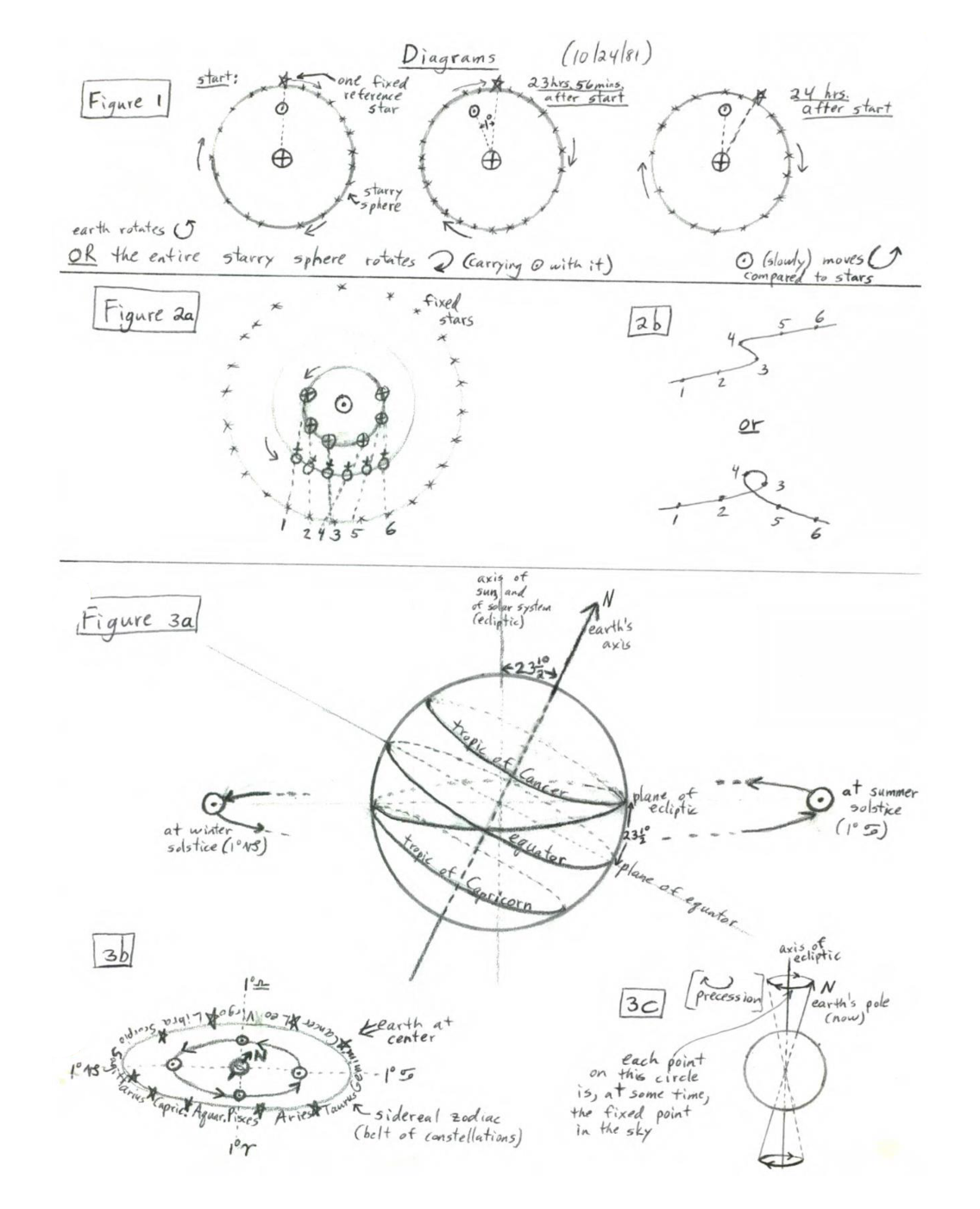
FIGURE 1981 1024a-1. (Figure 1). Earth's rotation and solar day.
FIGURE 1981 1024a-2. (Figure 2a). Retrograde motion: Mars as seen from Earth.
FIGURE 1981 1024a-3. (Figure 2b). Retrograde motion, apparent.
FIGURE 1981 1024a-4. (Figure 3a). Plane of Equator, Tropics of Cancer and Capricorn, and Solstices.
FIGURE 1981 1024a-5. (Figure 3b). Sidereal zodiac and signs.
FIGURE 1981 1024a-6. (Figure 3c). Precession and axis of ecliptic.
These diagrams are a facsimile scan from 1981 1024-07R21.PDF.
Class
Saturday, October 24th, 1981
Edited transcriptCLASS at Wisdom's Goldenrod, Hector, NY
with Anthony Damiani (AD)
October 24a, 1981
PHYSICS: ASTRONOMY
TOPIC: Physics
SUBJECT: Astronomy
SUBSUBJECTS: Timaeus: Motions of Same and Different, Tropical Zodiac, Sidereal Zodiac, Precession
CONTENTS:
Three basic observable celestial motions; precession of equinox as fourth motion, more difficult to observe; motions of Same and Different in Timaeus
Sidereal day; solar day
Merry-go-round analogy to compare motions of Same and Different
Planetary orbits according to Plato
Retrograde motion; includes up/down movement due to orbital plane variation
Precession of the equinox: relationship between Same and Different motions; solar motion patterns; sidereal and tropical Zodiacs
Earth's axial precession: mechanics; causes; mechanical model vs. ensouled model
Modern astronomical perspective: galactic context; delayed observation of stellar events
Universal expansion: continuation of Big Bang; no central point of expansion; balloon analogy
Science approaches mysticism: unity/Void as real center
Galaxy and solar system integrity despite expansion
BOOKS READ FROM OR REFERENCED:
Francis MacDonald Cornford (Translation and Commentary), Plato's Cosmology: The Timaeus of Plato
Plato, Republic, Epinomis
DIAGRAMS appended to this transcript:
FIGURE 1981 1024a-1. (Figure 1). Earth's rotation and solar day.
FIGURE 1981 1024a-2. (Figure 2a). Retrograde motion: Mars as seen from Earth.
FIGURE 1981 1024a-3. (Figure 2b). Retrograde motion, apparent.
FIGURE 1981 1024a-4. (Figure 3a). Plane of Equator, Tropics of Cancer and Capricorn, and Solstices.
FIGURE 1981 1024a-5. (Figure 3b). Sidereal zodiac and signs.
FIGURE 1981 1024a-6. (Figure 3c). Precession and axis of ecliptic.
RETYPED AND REFORMATTED by IT 2022
NOTES:
RETYPED PARTIAL TRANSCRIPT (hence V10). From 1981 1024-07R21.PDF. THERE ARE NO AUDIO CASSETTE TAPES EXTANT.
Unsure who did original transcript and diagrams, but JF thinks it was maybe BC (Robert "Bo" Carlson).
This was part of a series of classes autumn 1981/early 1982 when Anthony was exploring physics in relation to the astrological cosmos and System of Nature.
1981 10/24a was the Saturday AM class. 1981 10/24b was the afternoon Seminar on Nature, Sun in Aquarius, Orders of Gods, as related to "The Grid".
Vic is Victor Mansfield, member of Wisdom's Goldenrod, professor of physics and astronomy, Colgate University. See https://www.paulbrunton.org/victormansfield.php.
All spelling and capitalization corrected, all abbreviations and some numbers spelled out.
1981 10/24a at Wisdom's Goldenrod
Physics: Astronomy
[File 1981 1024-07R21.PDF Begins]
Astronomy -- Saturday 10/24/81
(presentation by Vic, plus some comments and contributions by others)
When one studies the heavens with the naked eye three basic motions can be seen fairly easily. First there is the daily rotation of sun, stars, and all the rest around the earth (or, alternatively, the earth's daily rotation on its axis). Next, the motion of the sun, and the other planets, along the ecliptic (zodiac) against the background of the fixed stars. The third is the occasional retrograde motion of the planets except the sun and moon. A fourth motion, the precession of the equinox, is harder to see without instruments or long periods of time. The first and second motions are what Timaeus refers to as, respectively, the motions of Same and of Different.
A sidereal day is one complete rotation of the earth, or of the starry sphere as seen from the earth. It takes 23 hours 56 minutes and is measured by some fixed star returning to the same place in the sky (like directly overhead from the observer). As the starry sphere revolves, it carries sun and planets with it. But they have their own (and much slower) motion around the earth, in the opposite direction. So after one sidereal day the sun is not back to where it was before, having moved 1 degree counterclockwise. Four minutes later the clockwise motion of the heavens has carried the sun that extra 1 degree. This is the solar day, 24 hours, and measured by the sun returning to the same place in the sky (see Figure 1) [1981 1024a-1].
To compare the motions of Same and Different, imagine a merry-go-round moving clockwise so all the horses fixed on it (the fixed stars) are going at 100 mph. Seven people (the planets) are walking or running in the opposite (counter-clockwise) direction: the moon, say, at 20 mph, sun at 6 mph, and so on till Saturn at 1 mph. The faster a person is going counter-clockwise the longer it takes for the merry-go-round to carry him once around clockwise. Therefore, to an observer at the center (Earth), the moon is seen as going clockwise 80 mph (100 minus 20), the sun at 94 mph, and Saturn at 99 mph. Thus we read in the Timaeus (section 39A-B) [Cf. Francis MacDonald Cornford, Plato's Cosmology: The Timaeus of Plato, p. 112.]: "So, by reason of the movement of the Same, those which revolve most quickly appeared to be overtaken by the slower, though really overtaking them. For the movement of the Same…made the body which departs most slowly from itself [transcript reads: from the Same]--the swiftest of all movements--appear as keeping pace with it most closely." The planetary orbits are given by Plato (in the Timaeus, Republic, and Epinomis) as, from Earth: Moon, Sun, Venus, Mercury, Mars, Jupiter, and Saturn (followed by the inerratic sphere). Sun, Venus, and Mercury are treated as one group, with the same average speed but with Venus and Mercury going sometimes faster and sometimes slower.
Retrograde motion can be compared to the experience, when traveling in a car, of the telephone poles seeming to "move" backwards as compared to distant hills. In Figure 2a [1981 1024a-2] we see six successive positions of Earth and Mars. They are connected with lines of sight, and the numbers on the inerratic sphere show the apparent positions of Mars, seen from Earth, as mapped against the fixed stars. Because all the retrograding planets have orbits that vary somewhat from the plane of the ecliptic, and therefore also travel, somewhat, "up" and "down", the observed motion is not seen as a moving forwards and backwards along a track, but appears as shown in Figure 2b [1981 1024a-3].
To understand precession of the equinox we need to remember that the motions of Same and Different are not only, as described above, in opposite directions, but also in different planes. The ecliptic, the plane of the sun's orbit around the earth (or Earth's around the sun), is at a 23½° angle with the equator, as shown in Figure 3a [1981 1024a-4]. The sun's yearly motion, the Different, is counter-clockwise along its orbit in the ecliptic plane. But each day the sun, and all the heavens, are seen to rotate clockwise parallel to the equator (the ecliptic plane itself is rotated in this direction) in the dominant motion of the Same. Figure 1 [1981 1024a-1] was a simplified version, for it was looking "down" from a point of view above the North Pole, so the two planes appear superimposed. Figure 3a [1981 1024a-4] gives a more precise picture by looking at it from the "side". Tilting this diagram so that the equator is horizontal we see that the sun is "above" the equator half the year, and "below" the other half. Each day, wherever the sun is in its orbital path, it will make a circle around the earth, parallel to the equator. The resulting motion is a spiral. At the summer solstice the circle is directly overhead at the tropic of Cancer, then it moves down little by little until, at the fall equinox, the sun's circle is at the equator. It continues to spiral slowly southwards until, at the winter solstice, the circular track is at the tropic of Capricorn. It then spirals up again, about 183 windings, to come back to the tropic of Cancer. When the North Pole points, by any amount, towards the sun (i.e. when the sun is that amount above the equator), then the northern hemisphere has a day longer than night and the southern has a night longer than day (the difference between the length of day and night increases as you go closer to the poles, and is larger when the pole points more directly towards the sun). Similarly, when the north pole points away from the sun, the nights are longer in the north and the days in the south. Only the equator has equal days and nights, except that the entire Earth has these during the spring and fall equinoxes, when the pole points neither towards nor away from the sun (i.e. the sun is "on" the equator). The band of stars which form the background for the sun's yearly path, i.e. which lie on or very near the plane of the ecliptic, is the zodiac (shown in Figure 3b) [1981 1024a-5]. This is the sidereal zodiac, the actual constellations (shown in the diagram with names and not symbols), and this is the zodiac that Hindu astrology uses. Western astrology uses the tropical zodiac, the same belt but considered as beginning at the spring equinox. That is, the cusp of Aries in the sidereal zodiac is a particular star or point in the beginning of the constellation Aries, but in the tropical zodiac the cusp of Aries is defined as that point in the zodiac belt which marks the position of the sun on the day its path crosses the equator going north. That point is not always the same but slowly precesses (moves backwards) along the zodiac at 50 seconds of arc each year.
If a top is spinning, its spin axis will be seen to rotate slowly. The tilt of its "equator" then will also rotate slowly, so that the place where it is closest to the ground gradually changes direction. The earth's spin axis also rotates slowly, describing a cone (see Figure 3c) [1981 1024a-6]. That means that gradually the pole star (currently Polaris), the only non-revolving point in the sky, starts to move and another part of the sky becomes the fixed point. So one pole star replaces another, and the series of points in the heavens that become, at some time, the fixed point, form a circle (Figure 3c) [1981 1024a-6] whose center is the axis of the ecliptic (which is also approximately the sun's spin axis, whose own precession is negligible). The North Pole takes 25,000 years to complete that circle. As the pole moves (clockwise, i.e. reverse from the direction the sun travels through the zodiac), so will the tilt of the equator slowly rotate. The ecliptic, having nothing to do with the earth's spin, remains fixed, so the places where the two planes intersect, the equinoxes, move slowly backwards. This can best be seen in Figure 3b [1981 1024a-5]. If the earth's axis precesses, rotates clockwise, a few degrees, then the place that used to be the cusp of Aries will no longer be the place that the North Pole neither points towards nor away from (it will in fact point slightly towards it). That neutral point, the spring equinox, will now occur a few degrees earlier, and this place will now be the cusp of Aries. Even easier to see is the cusp of Cancer; this is the part of the zodiac directly faced by the North Pole, and clearly this will also have moved back by a few degrees. So the entire tropical zodiac precesses, each tropical degree placed at stars earlier and earlier in the sidereal zodiac, until the whole circle is gone through in 25,000 years. By "Age of Aquarius" is meant that period, somewhat over 2000 years long, during which the tropical cusp of Aries is at a point somewhere in sidereal Aquarius (similarly for the age of Pisces, etc). The tropical and sidereal zodiacs perhaps correspond to the Different and the Same.
What causes the earth's axis to precess? The spinning top precesses because gravity, pulling down on it while its bottom point is fixed against the floor, gives it a torque. (A torque is a force that tends to impart a spinning or twisting motion.) Similarly, the moon's gravitational pull on the earth gives the spinning Earth a torque. If the earth were a perfect sphere of uniform density then the moon's pull on all the parts of the earth would add up to a pull only on the earth's center (all variations would cancel out). There would then be no torque, and therefore no precession. But because the earth has uneven mass distribution, bulging somewhat at the equator, the moon's pull is stronger on some parts of the earth than on others, and a torque results. This explanation of the earth's precession shows the strong contrast between the way the ancients saw the world and the viewpoint of science, especially of classical Newtonian mechanics. The difference is between an ensouled model and a mechanical one. To the Greeks the motions of a planet were (or manifested) its vitality, its soul, and the order in these motions was its intellect. From such a viewpoint, gravity may not mean anything like what it does to the scientist, and the above explanation of precession may therefore be questioned.
To modern physics, all the motions discussed so far are only local affairs in one insignificantly minor corner of the universe. Our entire solar system is itself revolving around the center of our galaxy, and our galaxy is in mutual revolution with another galaxy. Many galaxies form one "local group". There are billions of galaxies, each containing (on the average) millions of stars. All these galaxies and stars are moving, albeit slowly. So when 25,000 years pass, and Earth's North Pole again points to where it does now, Polaris, having moved significantly from that spot in the sky, will not again be the pole star. In even half of a precessional cycle the stars of the Big Dipper will each have moved enough, and in different directions, to make the overall shape of the constellation dramatically different. Stars also die, and come to birth. Since their distances from us are measured in light-years (the distance traveled by light, at 186,000 miles per second, in one year), sometimes in millions of light-years, there may be stars we now see in the sky that died ages ago--their light is still en route to us!
The main overall motion of the galaxies is away from each other and is a continuation of the big bang. The farther apart two galaxies are, the faster they're moving from each other. What's especially interesting is that there is no center to this outward movement of the big bang. Any point in space can be considered as the "center", in that all the galaxies will be observed to be moving away from that point with velocity proportional to their distance from that point. A two-dimensional analogy would be the surface of a balloon with pennies (galaxies) stuck on it. As the balloon expands, each penny will get farther from every other, at a rate proportional to their distance apart, and every point on that balloon's surface will have an equal claim to being the "center" of this motion. (The center of the sphere is not applicable, as it goes outside the curved two dimensions of our analogy). Here science approaches mysticism. One could say that the unity behind all the apparent centers is the real center. This understanding is like a mystical experience of the void in which traces of the ego remain, so it can speak about it later. Also of interest in the balloon analogy is the use of pennies for galaxies. Marks on the balloon would not do, for galaxies do not expand as they fly from each other. Our solar system also remains the same size despite the big bang effect. There seems to be an integrity of these units in astronomy.
[File 1981 1024-07R21.PDF End]
1981 10/24a V10: CLASS: Physics: Astronomy. Copyright 2022 Wisdom's Goldenrod p. ii