DIAGRAMS FOR 1981 1031
Class
Saturday, October 31st, 1981
Edited transcriptCLASS at Wisdom's Goldenrod, Hector, NY
with Anthony Damiani (AD)
October 31, 1981
ASTROLOGY; THEORY
TOPIC: Astrology
SUBJECT: Theory
SUBSUBJECTS: Sidereal Zodiac, Tropical Zodiac, Precession of the Equinoxes, 12th House
CONTENTS:
Two zodiacs defined: 1) sidereal: stars on ecliptic plane, belongs to the sun as cosmic soul; 2) tropical: created by earth's axial tilt and vernal equinox point
Each planet has its own tropical zodiac as interpretation of sidereal "given"
Modern physics: matter as localized force fields
Via media: soul mediates between uniform fields and particular phenomena; seven planetary spheres transform sidereal forces to form Earth's "soul" (psyche)
Tropical zodiac as Earth's psyche (not subjective soul)
11th house: Sun in Aquarius with 7 soul powers and 12 liberated gods; 12th house: hierarchical layers; tropical zodiac as dragon/imagination around Earth
Western astrology (tropical): subjective meanings; Hindu astrology (sidereal): objective events; both necessary
Seers contact sidereal forces behind tropical degrees; readings become outdated through precession; new symbols required as degrees shift
Tropical zodiac as accumulated Earth psyche tropes; individual development mirrors species evolution mirrors Earth evolution
Precession drives spiral evolution - different eras produce different forms; souls may need to go elsewhere when forms don't suffice
Tropical zodiac as reflected knowledge built from sidereal; Steiner's light/eye example
Nomenclature problem: why same names for tropical/sidereal signs?
Zodiac width: three views - line, globe, or 14° belt (correct based on planetary motion limits)
BOOKS READ FROM OR REFERENCED:
- Rudolf Steiner, Macrocosm and Microcosm
DIAGRAMS appended to this transcript:
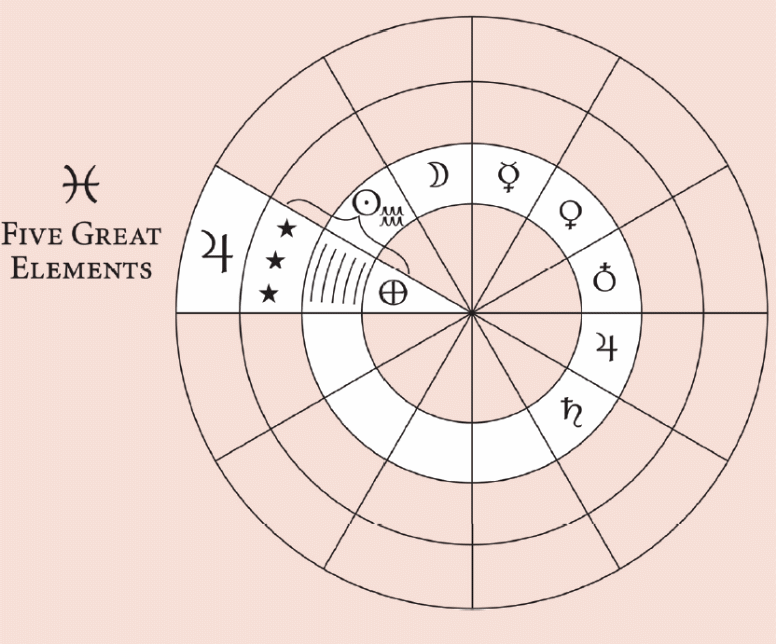
FIGURE 1981 1031-1. Ring Diagram of Universal Soul and the Levels of Pisces.
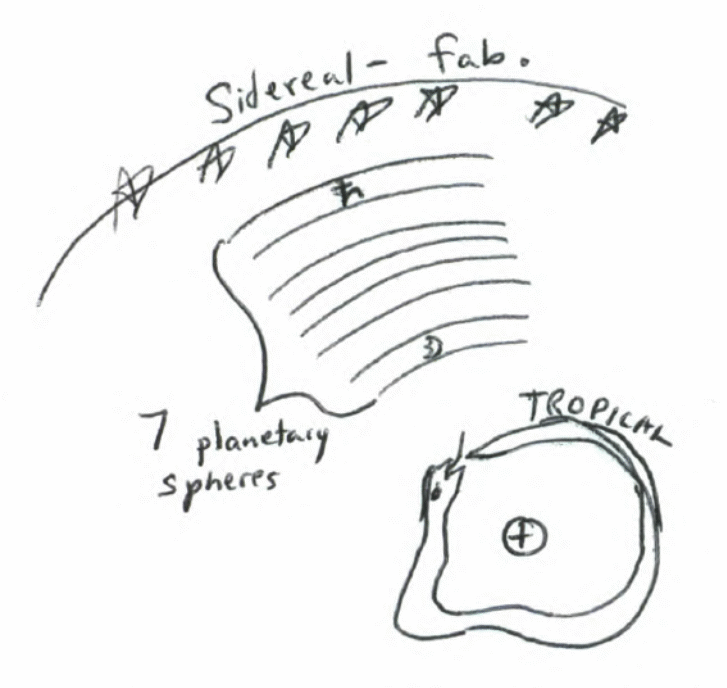
FIGURE 1981 1031-2. Sidereal, Planetary, Tropical.
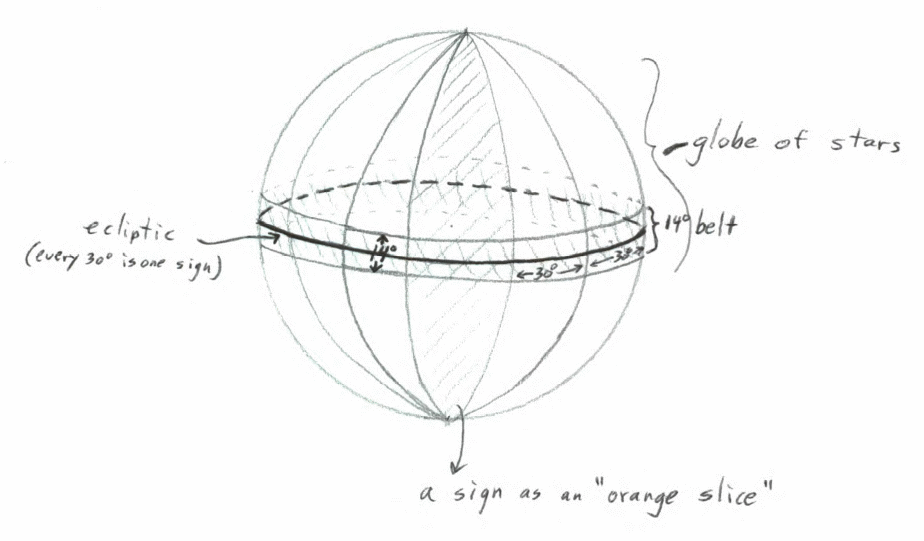
FIGURE 1981 1031-3. Zodiac Width: Three Views.
RETYPED AND REFORMATTED by IT 2025
NOTES:
RETYPED PARTIAL TRANSCRIPT (hence V10). From 1981 1031P1-05R14.PDF. THERE ARE NO AUDIO CASSETTE TAPES EXTANT.
1981 1031 was a Saturday.
This event is among those in later 1981/early 1982 when Anthony was exploring Astrology/the Zodiacs, Cosmology, Physics, Astronomy, Soul, Nature, and The Grid: Gnostic and Fabricative.
For more on The Grid: Gnostic and Fabricative, please see the Appendix to WG Seminar 1981 1016a.
All spelling and capitalization corrected.
1981 10/31 CLASS at Wisdom's Goldenrod
Astrology; Theory
[File 1981 1031P1-05R14.PDF Begins]
The Two Zodiacs (Saturday 10/31/81)
The actual processes that define the tropical and sidereal zodiacs give an indication of what these zodiacs mean. There are three stages: the entire globe of fixed stars, the sidereal zodiac, and the tropical zodiac. The sidereal zodiac consists of only those stars that are on or near the plane of the ecliptic. This plane, from the earth-centered view, is the one defined by the sun's orbit around earth. But it seems more appropriate to define the ecliptic as referring primarily to the sun and only secondarily to the earth. For, from the sun as center, the ecliptic can be defined as the plane of any planet's orbit around the sun (the orbits of the various planets are not in exactly the same plane, but the variations are small). What's more, the sun also rotates, and its spin axis is approximately the same as the axis of the planetary orbits. In other words, the ecliptic can be defined as the sun's equatorial plane, with no necessary reference to any of the planets. The sidereal zodiac, then, belongs to the sun, the primary being of our solar system, the Soul of this cosmos. In similar fashion, other suns would determine belts of stars appropriate for their solar systems. If the stars represent force fields, Ideas embedded in matter, then each solar system could work with only some particular set of these. The stars in our sidereal zodiac are the given "x" that this solar system has to work with. Within that, the earth is what determines the tropical zodiac, by the tilt of its axis and the consequent tilt of our equator. That tilt creates the vernal equinox point (as where the ecliptic crosses the equator on its way north), which is the starting place for the tropical zodiac. From that spot one goes around the ecliptic, marking off 30° sections. Each planet in our solar system has its own tropical zodiac, determined by how its axis tilts, and the consequent location of its vernal equinox as the starting point. All these tropical zodiacs, each placed around the sidereal but from a different starting point, are like so many different individual interpretations of the same given "x". All these planetary beings exist within the field of possibilities, the sidereal zodiac, provided by the sun. So our tropical zodiac is the way the Earth entity assimilates the sidereal.
In modern physics, matter is understood to be a local formation, or concretion, of force fields. The entirety of the field is present to each particle. The problem is how a uniform field exhibits a particular body -- in other words, how the Ideas get arithmeticized to produce particular phenomena. The via media must be Soul, but this is what is usually left out of the account. We can consider the sun as a localization of the sidereal force field. The 7 planetary spheres, as images of Soul powers, mediate these sidereal forces to form the Earth "soul". The tropical zodiac is not the subjective soul of the Earth, but its psyche (the "second soul" that Iamblichus speaks of). It is built up as a trope; "tropical" and "trope" come from the same root, meaning "to turn". One could take any planet as the center, as the psychic entity (tropical zodiac) being built up by all the other planets going around it and delivering the sidereal forces to it.
[Note: See FIGURES 1981 1031-1, 2 for the following.]
In the 11th house we have the Sun in Aquarius (containing in itself the 7 Soul powers from the ring) together with the 12 liberated gods. In the 12th house, below the Jupiter, we first have the sidereal zodiac, coming from the liberated order. Then, within that, we have the planetary circles, coming from the 7 Soul powers. Inside the last circle is the tropical zodiac, and Earth within that. Placing the tropical zodiac just outside the Earth, like an Auric envelope, emphasizes that it is really a projection outwards from the Earth entity, and not to be confused with the actual stars that lie beyond the planetary orbits. It is the dragon circling the Earth, the imagination, slain by the hero (interestingly, the dragon is one of the symbols belonging to Minerva of the liberated gods). It is all the forms of our understanding. From it come our subjective interpretations of the objective events that are given by the sidereal. Both, the interpretation and the events, must he present. Western astrology, using the tropical zodiac, emphasizes the subjective meanings. Hindu astrology, using the sidereal zodiac, emphasizes the events. But neither factor can really be left out -- it will come in through the back door. For instance, consider the degree symbols in the tropical zodiac. The seers who give us these symbols say they are contacting the sidereal forces behind that tropical degree. That is why the readings go out of date when precession slides that degree along to line up with different stars. New symbols then have to be written.
If the tropical zodiac is the accumulated tropes of the Earth psyche, the traces of previous environmental forces acting on it from the sidereal, then we are within that. Our psyche will operate with the forms that it provides us. Similarly, our body is an image, or selection, of these tropes. All of them go into the making of our body and psyche, but only some will get manifested in our experience. The development of the individual organism (ontogeny), in its various stages as a fetus, recapitulates the evolutionary development of the species (phylogeny). The fetus experiences this multitude of life forms to build up images for the understanding. For if the ontogeny of the individual entity mirrors the phylogeny of the species, that in its turn mirrors the ontogeny of the Earth entity, the tropical zodiac. As precession takes place and the tropical zodiac gets exposed to a different arrangement of the sidereal, the Earth soul evolves and brings forth different animal forms. Modern science puts evolution in a spiral pattern. This spiral evolution, in bodies and psyche, moves with the precession. All forms cannot be manifest all at once, and it is the placement of the vernal equinox in different positions on the sidereal zodiac that indicates how different images, species, civilizations will come and go in the Earth soul. A soul may evolve to the point where the forms available here do not suffice -- it then has to go elsewhere, to a different world, to get the vehicles it needs.
The tropical zodiac is a reflected knowledge. Built up from the sidereal (knowledge as entrance) it is reflected back out (knowledge as exit). This is like Jung's statement (which we would correct to refer to the psyche and not consciousness) that the psyche is both a transformer and is transformed. Or, one could apply the concept from Steiner about the way that light itself forms the eye organ, which will then grasp that light, perceive it by holding it back. [Note: See Rudolf Steiner, Macrocosm and Microcosm, Lecture Eight.]
One problem we have is why the signs in both zodiacs carry the same names. For instance, why a tropical Aries and a sidereal Aries? After all, the tropical Aries faces all 12 sidereal signs at some time or other, is built up, as it were, from all 12. Then why does it have a particular connection with sidereal Aries more than the other 11 -- or does it? Perhaps just as each Idea is a special version of the totality, the Arian age, for example, would be an elaboration of the presence of all 12 signs in Aries? (The tropical zodiac would here be analogous to the elaborating soul).
In both tropical and sidereal zodiacs, there is no unanimity among the astrologers as to how wide (north-south) the zodiac is. [Note: See FIGURE 1981 1031-3 for the following.] At one extreme, the zodiac is just the circle of the ecliptic itself, a pure line with no width. At the other extreme the zodiac covers the whole globe of stars, and the signs are like orange slices, 30° divisions that extend from pole to pole. A third, middle view would make the zodiac a belt, l4° wide, around the ecliptic. This last view seems to be correct. To treat a star near the pole as belonging to a zodiacal sign is to ignore the boundary concepts necessary to define events, even in science. In theory, any event sets up a causal chain that stretches to infinity, but there are limits, beyond which no effect is actually felt, and past which it becomes absurdly theoretical to speak of an influence. In this instance, the key is the motion of the planets. They do not stay on the ecliptic, but vary from it; however, the variation is slight. Mercury's is the greatest among the Chaldean planets, moving as much as 7° north and 7° south of the ecliptic. (The moon is next, with 5° variation each way.) Hence, if the planets are the via media, the transformers that grade down the stars' forces to a range assimilable by the tropical zodiac, then the zodiacs should be thought of as 14° belts.
[File 1981 1031P1-05R14.PDF Ends]
1981 10/31 V10: CLASS: Astrology; Theory. Copyright 2025 Wisdom's Goldenrod p. ii