Class
Saturday, November 7th, 1981
Edited transcriptCLASS at Wisdom's Goldenrod, Hector, NY
with Anthony Damiani (AD)
November 7, 1981
PHYSICS: FORCE FIELDS
TOPIC: Physics
SUBJECT: Force Fields
SUBSUBJECTS: Planets (motions of, different historical periods), Maxwell's Equations
CONTENTS:
Historical perspectives on planetary motion: 1) soul as agent of motion; 2) gravitational force; 3) gravitational field; 4) curved space-time
Newton's impact and philosophical concerns; question of action at a distance; clockwork universe concept
Understanding fields: 1) initial concept: force maps; 2) evolution from maps to entities; fields as intermediaries rather than just maps
Electricity and magnetism relationship: 1) interplay between fields; 2) practical demonstrations
Maxwell's equations and field theory: 1) impact on Newtonian physics; 2) new type of physical law; made field the basic reality
Wave properties of fields; light as electromagnetic wave; no material medium needed; speed of light propagation
Fields as primary reality, particles as localized eruptions within it
Scientific challenges: 1) how discrete particulars arise from uniform field; 2) unified field theory
Are fields sidereal reason-principles?
Properties of fields vs. particulars (Kunz's analysis); suggests a view of fields as Ideas
Fields creating particles parallel to thoughts creating things
Challenge of transition from universals to phenomena; role of planetary spheres
BOOKS / ARTICLES READ FROM OR REFERENCED:
Plato, Timaeus
Albert Einstein, Leopold Infeld, The Evolution of Physics: The Growth of Ideas from Early Concepts to Relativity and Quanta
F.L. Kunz, "The Reality of the Non-Material" (in Nature, Man, and Society, Henry Margenau, Emily B. Sellon, N. Hays)
Paul Brunton, The Hidden Teaching Beyond Yoga
DIAGRAMS embedded in this transcript:
FIGURE 1981 1107-1. Gravitational Field.
FIGURE 1981 1107-2. Magnetic Field.
FIGURE 1981 1107-3. Electric Field.
FIGURE 1981 1107-4. Magnetic Field Generated by Moving Charged Particle.
FIGURE 1981 1107-5. Light Wave.
FIGURE 1981 1107-6. Table of Fields vs. Things & Creatures, from Kunz article.
RETYPED AND REFORMATTED by IT 2022
NOTES:
RETYPED PARTIAL TRANSCRIPT (hence V10). From 1981 1107-08R21.PDF. THERE ARE NO AUDIO CASSETTE TAPES EXTANT.
Unsure who did original transcript and diagrams, but JF thinks it was maybe BC (Bo Carlson).
This was a Saturday AM class, part of a series with presentations by VM (Vic Mansfield) on Physics, and part of series of classes autumn 1981/early 1982 when Anthony was exploring physics in relation to the astrological cosmos and System of Nature.
Victor Mansfield was a member of Wisdom's Goldenrod, professor of physics and astronomy, Colgate University. See https://www.paulbrunton.org/victormansfield.php.
All spelling corrected, some numbers spelled out.
1981 11/07 at Wisdom's Goldenrod
Physics: Force Fields
[File 1981 1107-08R21.PDF Begins]
Force Fields -- Saturday 11/7/81
The motions of the planets have been explained differently at different times. Roughly speaking, there are four historical periods, each with its own account. These interpretations, in order, are:
(1) soul as the agent of motion
(2) gravitational force (action at a distance)
(3) the gravitational field
(4) curved space-time
From the ancients up through the Renaissance the predominant view was that the planets moved because they were ensouled. Plato asserts this position, in the Timaeus and elsewhere. This living cosmos was replaced by a purely mechanistic world view when Newton formulated his laws. He stated that between any two bodies, for instance the sun and a planet, there is a gravitational force pulling them together. What's more, he gave a simple formula, F = Gm1m2 ÷ r2 with which one can calculate the size of that force (F) knowing a certain constant (G), the masses (m1 and m2) of the two bodies, and the distance between them (r). Knowing the size of the force acting on the planet, and its mass, Newton's other laws will then tell you how it will move in response to that force. The philosophical problem is how an object "there" can exert a force on another object "here" with nothing in between. How does an inert material object, not guided by mind, respond precisely to the existence of some other material object that isn't even in contact with it? Philosophers like Leibniz and Berkeley fought against the advent of the Newtonian view but lost out (in the short run) because whatever philosophical problems it entailed it was strikingly successful from a practical standpoint. Not only could planetary motions be accurately predicted, but the application of Newton's laws even led to the discovery of previously unknown planets (Uranus, then Neptune). Newton himself expressed strong philosophic misgivings about the de-souled world view that now bears his name, but it ruled the 18th and most of the 19th century. Other forces (electric, magnetic) were also held to act at a distance, like gravitation. Many phenomena, terrestrial and celestial, were thus described, and a clockwork universe emerged, a self-sufficient machine. When Laplace, a wholehearted Newtonian, was asked (by Napoleon) why his book on the cosmos had no reference to God, he replied "I had no need of that assumption".
Of the four views listed above, the second (action at a distance) is furthest from Greek philosophy. The transition from this to the idea of a field is a move away from mechanism and materialism, and this movement continues with the arisal of the notion of curved space-time. The field (classical, not quantum) is the topic of this class, and the space-time view will be dealt with in the next weeks. A good, and accessible, description of fields (and much else in physics) is available in The Evolution of Physics by Einstein and Infeld.
Fields were first conceived of as force maps. The forces were considered to act in the Newtonian manner and the maps were only a convenience, a representation of how a small test particle (small so that it would itself exert little force and thus not complicate the picture) would move. For example, the gravitational field is shown at right. (see below)
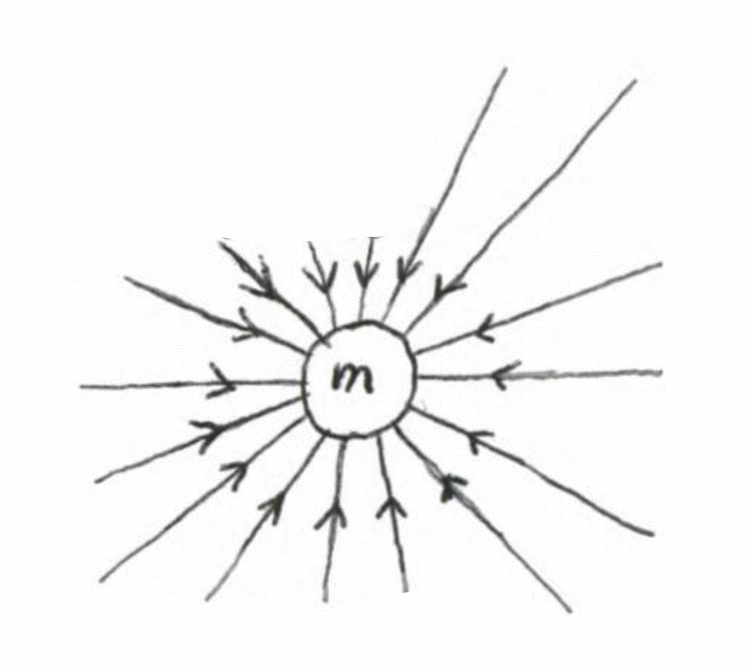
[FIGURE 1981 1107-1. Gravitational Field. Facsimile scan from 1981 1107-08R21.PDF.]
The map shows the gravitational forces exerted by an object of mass m. The arrows indicate which way the test particles would move, and the strength of the force exerted in a region is proportional to how closely the lines are packed in that region. So we see that the gravitational force gets much weaker as we increase distance from the object. Similarly, using a small compass needle as the test particle, one can map the magnetic force exerted by a bar magnet.
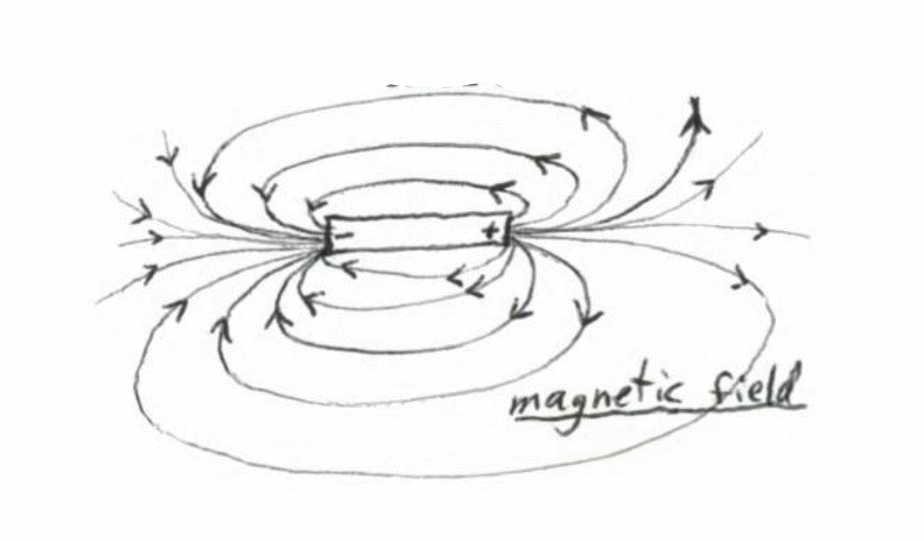
[FIGURE 1981 1107-2. Magnetic Field. Facsimile scan from 1981 1107-08R21.PDF.]
An electric field is generated by an object charged with static electricity (the test particles are small "+" charges). If the object is charged "+" then the field looks like at right. (see below)
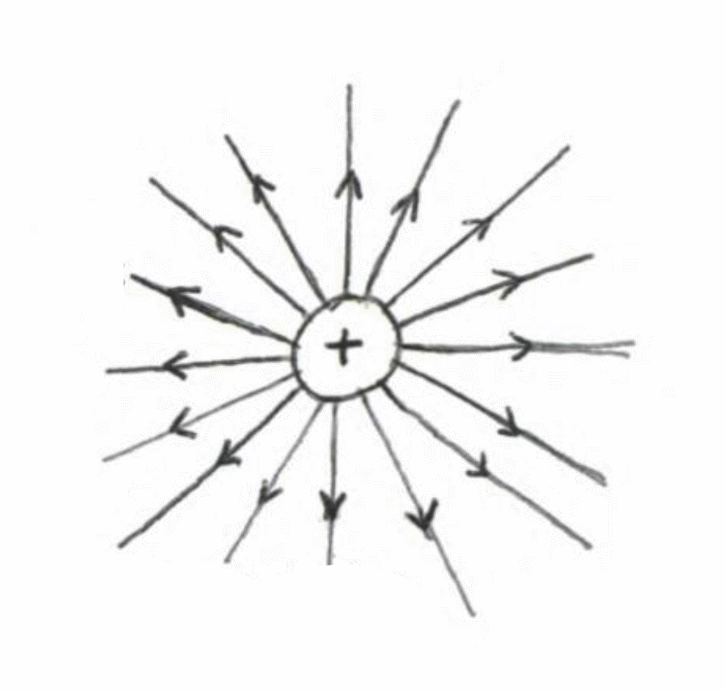
[FIGURE 1981 1107-3. Electric Field. Facsimile scan from 1981 1107-08R21.PDF.]
If the object is charged "–" then the field has its arrows reversed, so it looks just like the gravitational field. So far, in all three types of field, we have only a map of Newtonian forces. But if we take an electrically charged particle and move it, we have a current, and it turns out that a current generates a magnetic field, as shown in the diagram.
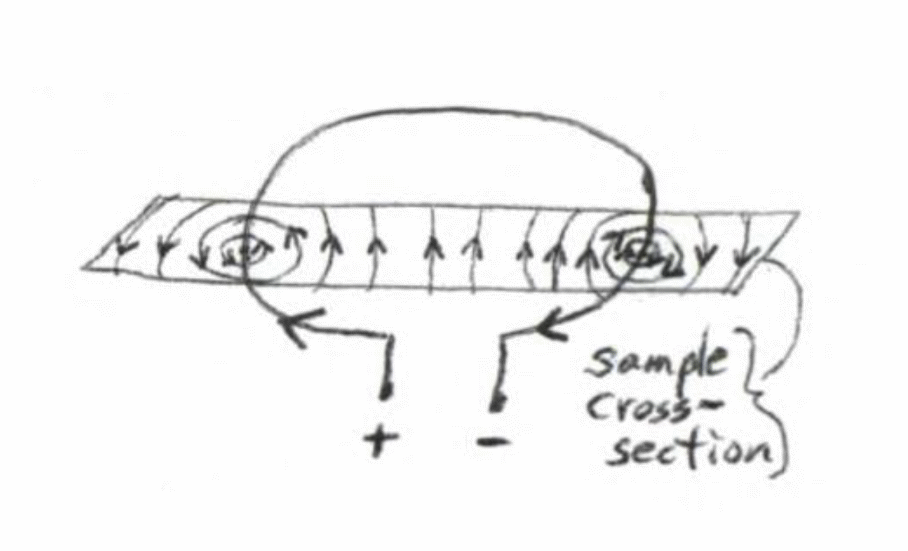
[FIGURE 1981 1107-4. Magnetic Field Generated by Moving Charged Particle. Facsimile scan from 1981 1107-08R21.PDF.]
Even more striking, if we take the electric wire and bend it in a spiral, we have a solenoid, whose magnetic field is identical to that of a bar magnet. In other words, two very different physical objects give us an identical force map?? The magnet and the solenoid are undoubtedly very different, materially, but with our test compass needles it would he impossible to distinguish them. From the Newtonian "action-at-a-distance" viewpoint this is a real puzzle. A strictly Newtonian account could still be given, but would be contrived. What is suggested by this is rather that the field is an entity of its own, existing in space, and it itself is what acts on the test particle. A field is not a map of how the object affects the particles at a distance, but is rather something generated by the object and serving as the intermediary. But the field itself is not material!
The field's independent existence is further suggested by the relation between electricity and magnetism. A moving electric field, we have seen, generates a magnetic field. (This is regardless of who is moving -- if we have a stationary charge then we have no magnetic field, but if the observer now moves, say, towards the charge, then he experiences the electric field moving, changing, and his test compass will show a magnetic field.) This can be generalized to state that a changing electric field causes a changing magnetic field (from zero to something being one type of "changing"). A simple experiment of moving a magnet towards a loop of wire (with no current in it) will show that a current is induced by this motion. Or, in general, a changing magnetic field causes a changing electric field. Now, electric and magnetic fields are not identical -- they affect different objects and have somewhat different structures. But they do seem complementary in that a change in either one produces a change in the other. This mutual effect is why, when the cord from a toaster is pulled out of the wall socket while the toaster is on, a spark occurs. The pulling out of the cord stops the current, and this in turn ends the magnetic field caused by that current. But when the magnetic field drops to zero it is changing, and therefore generates an electric field, which affects the electric charges in the wire and causes the discharge. This illustrates dramatically that fields store energy and momentum. (This fact is further exemplified by the phenomenon of radiation pressure, such as solar sails, where the energy in the field is harnessed.) No mere map could do that, so the field, again, must be seen as an entity in its own right.
Maxwell's Equations, in the late 19th century, marked the end for the Newtonian viewpoint in electric and magnetic fields. Even in gravitation, the field viewpoint was better, but a staunch Newtonian could still have claimed that his approach could account for any fact, that the field was still no more than a convenience, a descriptive device and not an actual existent. It was with general relativity that Newtonian physics got the death blow, for then even gravitational fields were seen to behave in ways not explicable by (or even contradictory to) Newtonian laws. But this state of affairs had already arrived, with regard to electro-magnetic fields, upon the formulation of Maxwell's equations. These represented a really new type of physical law and made the field the basic reality, independent of test particles, loops of wire, or any physical props. Maxwell took the limit, as the size of a wire loop approaches zero, and as the time interval of any change also approaches zero, and expressed his laws as differential equations. The local field at any point is considered to affect only the next differential in space and time; that then affects the next, and so on, the effect spreading out like a wave. Thus we no longer have one object affecting another at a distance. The object affects the space immediately around it, and the effect (the change in the field) moves out from point to point, instant after instant. The second object, then, doesn't need to "know" somehow about the first object, with which it has no contact; it simply responds to the state of the field immediately surrounding it. Thus the field acts as the real force affecting the object. Moreover, the field exists in space regardless of whether there are any objects there or not for it to affect; but if an object is in fact there, it will respond to the field. This contrasts with the strange discontinuity in the Newtonian view, where the attracting force was considered to suddenly appear when an object appeared for it to affect, since Newtonian forces are zero if one of the two masses is not present (m2 = 0).
That fields are waves is shown when a current is sent through a wire -- the magnetic field is not created all at once, but travels out from the wire, at the speed of light. (Although the field is generated point by point, the net effect of all the differentials can be mathematically summed up so that the strength and direction of the field at any given point can be calculated.) Similarly, if the current ceases, the magnetic field does not disappear all at once, the change again traveling out at the speed of light. In fact, light itself is an electromagnetic wave; that is, a changing electric field producing a changing magnetic field and vice versa. Each of them is changing in a sine pattern so that as one of them is maximum (crest of a wave) it is instantaneously not changing (making the other field zero), and when one of them is zero (crossing the axis) its change is most rapid (making the other field a maximum).
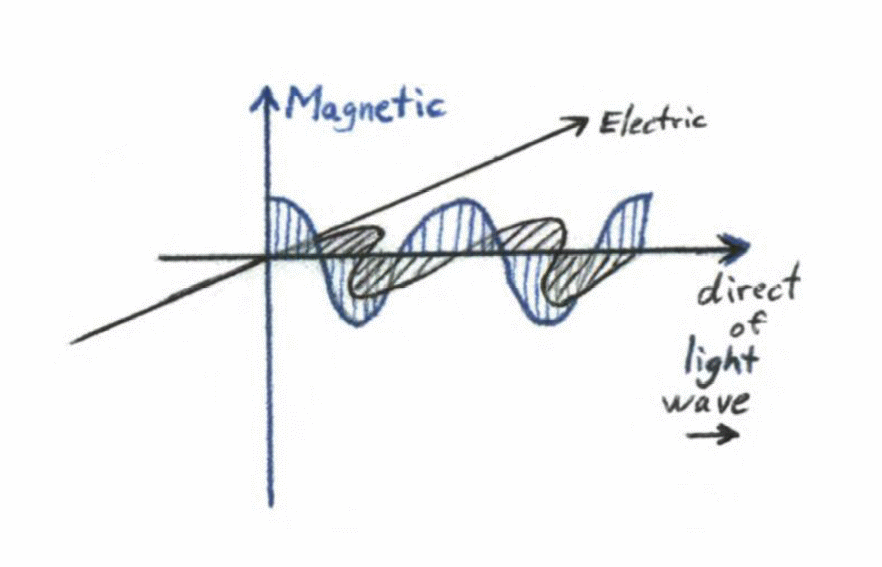
[FIGURE 1981 1107-5. Light Wave. Facsimile scan from 1981 1107-08R21.PDF.]
(The diagram also shows that the electric and magnetic fields are perpendicular to each other and mutually perpendicular to the direction of propagation of the light wave). In short, the electric and magnetic waves feed on each other, and the combination, the light wave, is thereby self-sustaining as it travels. Most strikingly, the waves do not need matter as a medium! The waves we see in water are fluctuations of that water; similarly, sound waves also have a medium (usually air) in which they travel, which they are fluctuations of. But electromagnetic waves need none -- or, one could say their medium is pure (empty) space.
The field started out as a visual summary of Newtonian force interactions. Then it was seen as something capable of storing energy and of producing effects that could not simply be referred back to some object as the cause. Finally, with Maxwell's equations, the field is a wave in space, free of any measurable material agents. The field has become the main reality, and the particles are seen as localized eruptions within it. The objects are necessary in order to experience the field, but the field is primary in all calculations. One major problem is how discrete particulars arise from the uniform field. Classical fields are continuous, vary smoothly from place to place. This is not true for quantum fields. In the 20th century Maxwell's equations were adapted to quantum theory, while keeping the same form. This quantization deals with how a photon appears from the uniform field and is considered a major accomplishment. But other quantizations have proven much more intractable. Another challenge to scientists is the unified field theory. There are now four types of fields known: gravitational, electro-magnetic, and two types of nuclear cohesive forces. A unified field theory, which science has not yet accomplished, would explain how these are all manifestations of one field.
What are some of the philosophic implications of the fields? Are the fields the sidereal reason-principles with the planetary spheres as the missing via media to produce sublunary particulars? Or maybe the chart can be thought of as the localization of seven fields. In Nature, Man, and Society, the article by Kunz ("The Reality of the Non-Material") lists the properties displayed by fields and particulars; the list strongly suggests a view of fields as Ideas, which get arithmeticized to produce the sense particulars.
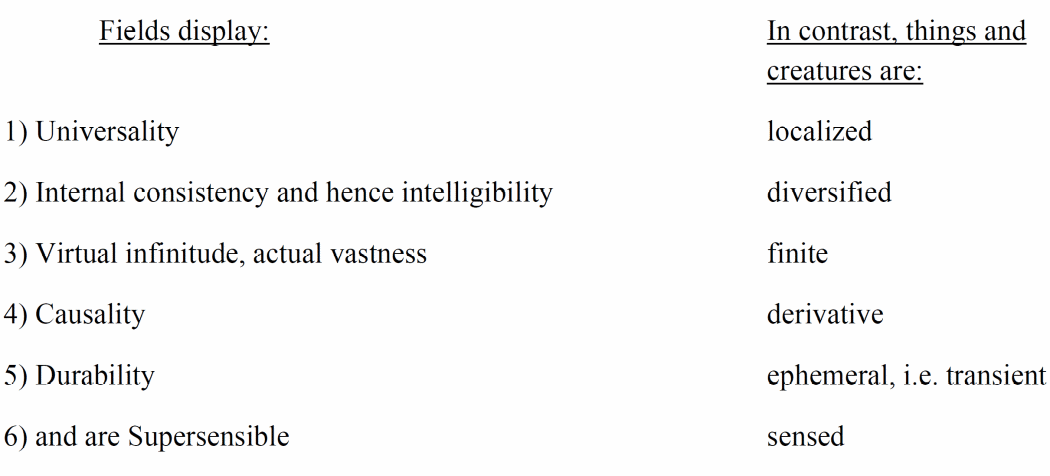
[FIGURE 1981 1107-6. Table of Fields vs. Things & Creatures, from Kunz article. Digital reproduction of typing in 1981 1107-08R21.PDF.]
The fields' universality refers to their pervasiveness throughout space. By contrast, a Newtonian mass is spatially localized. The objects are diversified because different phenomena can result from one field pattern. Each object can be seen as the localization of all the fields, hence derivative from their causality. The field's durability is not a static maintaining of the same amount of force, but the persistence in kind, the quality remaining untouched by the flux of quantity (a tree can decay or be burnt till it is no longer a tree, but the magnetic field is always itself, no matter how much or little of it is present at any given place). The field is not itself perceived, only its effects are perceived, hence it is supersensible.
When scientists say that the field waves require no matter, no medium -- they're really describing the mind! The mind introspecting into its own functioning requires no medium. Matter, in fact, is now considered by physics as being itself secreted out from the fields, from the graininess of space-time. In the Hidden Teaching there comes a point in the argument where a sudden flip is made in one's understanding: one now sees that thoughts create things, not vice-versa. This same pattern occurs when science now declares that fields create particles rather than vice-versa. In both instances one starts with the seemingly obvious, materialistic view and the very logic of the situation, reasoning on those premises, forces one to arrive at the opposite view as the conclusion. So the field is not a property of the object, but is constitutive of it.
For science, as for philosophy, the big difficulty is in the transition from the universals (fields) to the phenomena (particles). "This being…that appears." The Buddhists don't put in those dots, but the hiatus is nonetheless there -- unacknowledged, unexplained. From the sidereal field forces to the sublunary world, the connection must be the planetary spheres, but how? The word "instantiation" comes from "instant", the differential of time (as in Maxwell's differential equations). Perhaps this is the point instant, the differential of a planet's motion.
[File 1981 1107-08R21.PDF Ends]
1981 11/07 V10: CLASS: Physics: Force Fields. Copyright 2022 Wisdom's Goldenrod p. ii