DIAGRAMS AND CHARTS FOR 1981 1210
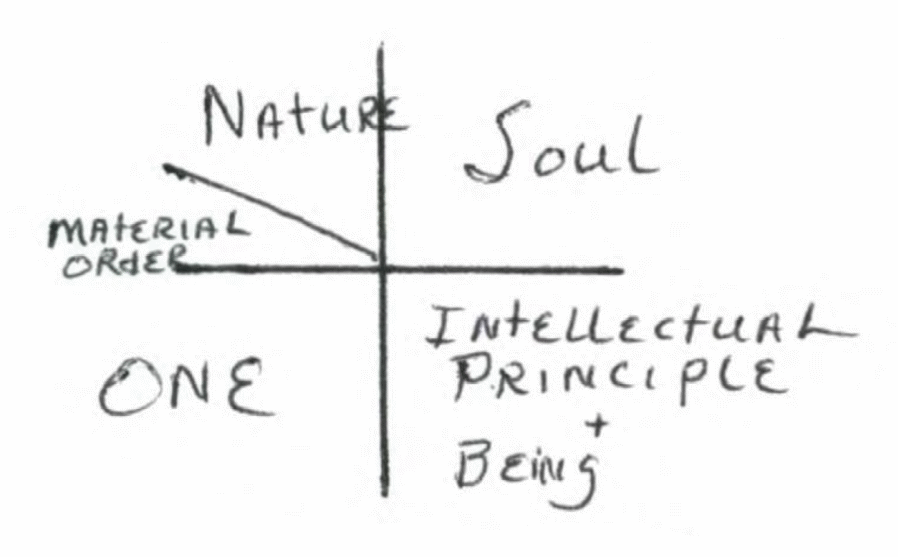
Class
Thursday, December 10th, 1981
Verbatim, unedited transcriptClass Held in Columbus, Ohio
with Anthony Damiani (AD)
December 10, 1981
Plotinus; Soul & Nature
TOPIC: Plotinus
SUBJECT: Soul & Nature
SUBSUBJECTS: Metaphysical Chart, Astrology, Animate, Soul Powers, Embodied/Unembodied Soul, Fate/Free Will, Reincarnation, Body as System of Nature for Soul, Felt Body, Witness-I, Vasanas, Hua T'ou, Mars Amputates Base Matter, Ego, Epistemology, Deck ("Is Nature Real for Plotinus?")
CONTENTS:
Reading/discussing quotes from Plotinus, III.2.18, III.3.1
Reason-principles engender and don't create; give object its form
Universal reason-principles as Liberated Gods in 11th house; an offspring of Universal Soul in third quadrant; an organized system of relationships which produces 12th house cosmos; are the categories of understanding which make thinking possible
360 degrees are a harmonious unity but when unfolded sequentially through transits can produce chaos and strife
Nature is a pure imagining act which operates below sensation and knowledge
The hidden meanings implicit in Plotinus's philosophy can only be made explicit by the symbolism of the astrological wheel
Human mind constituted by a limited number of unit meanings; all philosophies are some combination of these basic meanings
Soul is universally pervasive; represented by Leo zodiac; Sagittarius zodiac and cosmic circuit within Leo zodiac and pervaded by it; ultimate perceiver in you is Intellectual-Principle
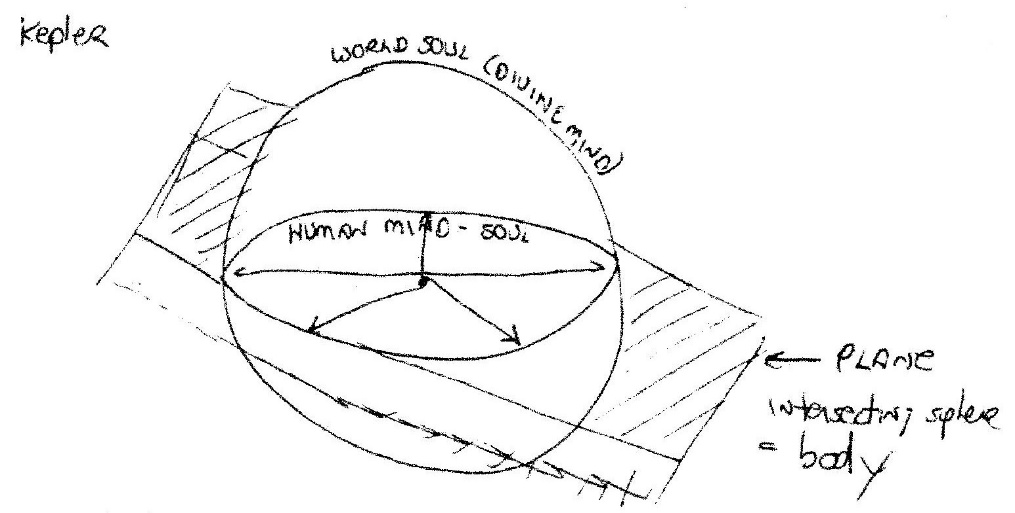
Kepler's attempt to geometrically locate the soul with diagrams of spheres and planes; unnecessary because soul is omnipresent
Individual on Earth participates in the Earth's aspects/knowledge; this is the Infinite Mind you thank for the food to sustain your body
All planets in solar system are powers of the Sun but each can also be thought of in its own right, with its own fourfold structure and tropical zodiac
Sun in Aquarius: last of the unembodied powers of the World-Soul and your soul; also Nature, or the power that works with Reason-Principles to produce manifestation
First soul (pure soul powers) and second soul (grid) and their relationship; first soul interprets modifications in second soul; second soul/body subject to fate, first soul remains impassive
Reading from Plotinus, I.1.7, on Animate and perception; light of soul reads off and understands impressions made on the body
Soul as one substance with many functions; Mercury in Sagittarius (Augoeides) as connecting link between soul in and out of universe
Jesus's statement about denying one's soul to follow him: deny the lower soul (grid)
Each natal planet has two aspects, psychical and somatic; Saturn as self-apperception a reflection of Saturn as cognitive-isness; one perishes, the other never
Destiny of physical body preordained; soul's reaction to experience not preordained; even a Sage is subject to bodily fate but his happiness unaffected; soul's karma determines body it inhabits
Next Manvantara, the same bodies/destinies will again be reproduced for use by different souls
Free will in soul's choosing to identify with body or deeper meanings; soul could choose easier or harder incarnation
Reincarnation speeded up once Quest is begun in earnest; conscious choice increases as one advances on the Quest, have to choose to abide by ethics of higher soul
Venus as soul's power of aesthetic perception, evolves through experience
Different phases of soul can be dominant; reasoning phase dominant in AD; intellectual phase dominant in Sage but can identify with all three
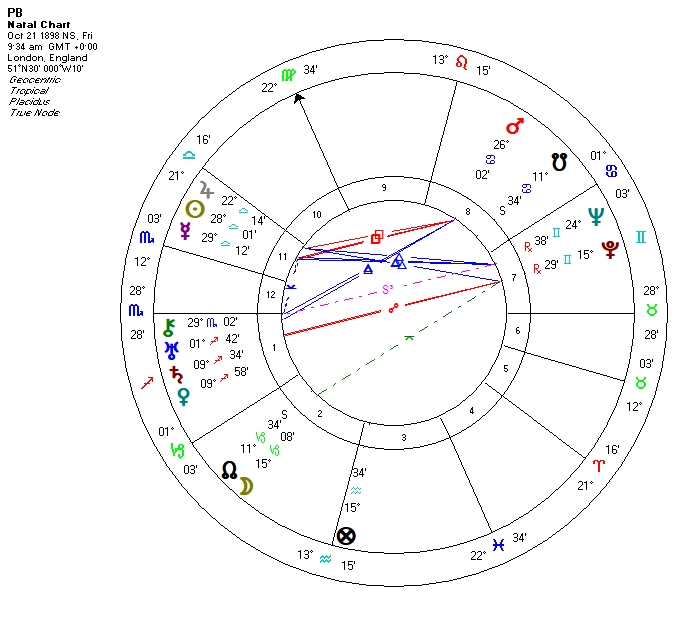
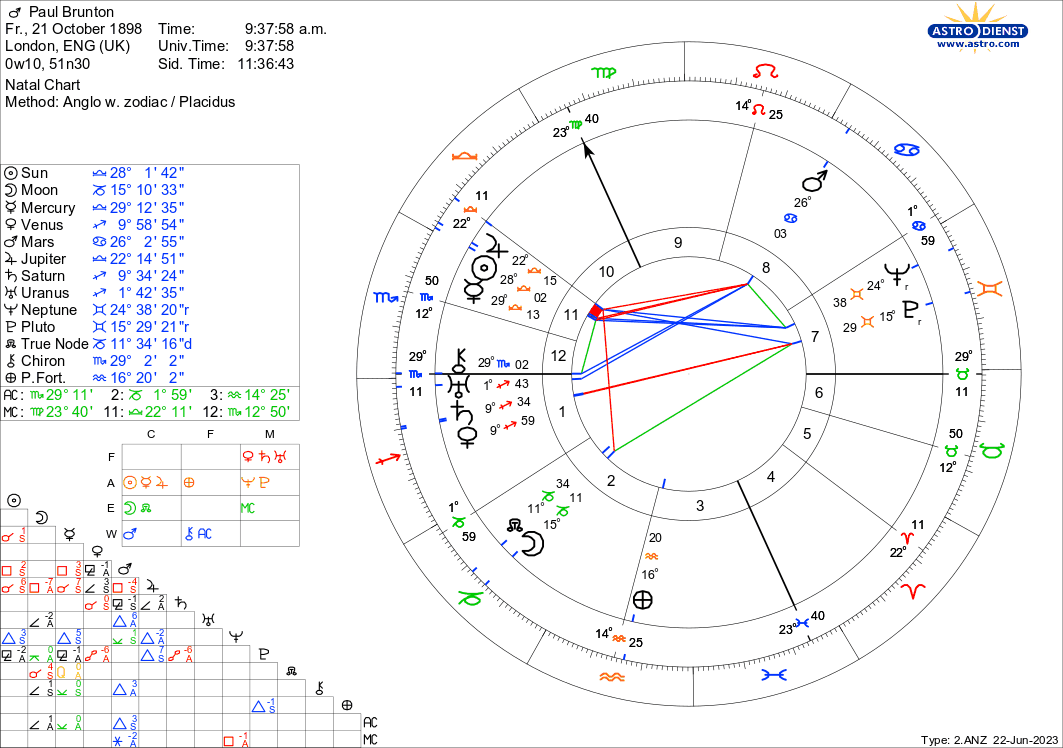
PB's chart: Uranus Saturn Venus conjunction intercepted in first house; emotional nature under control; direct connection to higher Self, can control the situation
Saturn Venus conjunction: marriage as social obligation/duty; AD interested in reading a chart from viewpoint of soul
Psychosomatic has a feeling/energy aspect which can mislead the soul; soul has to direct it properly; body returned to cosmic circuit at death
Medical astrology (H.L. Cornell); soul is learning to manipulate forces of Nature through being embodied; AD's experience of seeing secrets of universe locked up in body
Premature insight can provoke bodily resistance; body has to be in receptive and accepting mood to take in the understanding; AD's process of walking, sitting, and laying down when thinking
Felt body affected by transits; example of Mars going into Capricorn; soul has to come in and interpret/direct properly
Seeing the mechanical nature of reactions evoked by transits; try to become an observer
Don't react; Eliade on vasanas as instigators of our behavior patterns; Hua T'ou exercise; Mars has to amputate base matter; great holy war is within ourselves
Ego; has to be refined and then surrendered; something of ego left behind, no absolute merger
Soul gives warnings; AD doesn't like competition, doesn't encourage it in himself
Complexity of conditions for knowledge in the astrological scheme
Reading from Satprakashananda, Methods of Knowledge, on five steps of visual perception in Advaita Vedanta; similar to Thomas Taylor's description of light from the eye piercing objects
Knowledge arises through formal identification of mind and object; Platonist view that knowledge of forms is innate in soul
Example of Uranus conjunct Pars Fortuna precipitating insight; the conditions for the arisal of knowledge were present
Correlating Vedantic article to astrological scheme, with grid as vritti connecting subject and object consciousness; when aspects align, true knowledge of object in subject
Object-consciousness as tenth house dignities organized by third quadrant rulerships and exaltations; these also inform third quadrant detriments or individual and World-Soul; in knowing an object, soul recognizes the forms it already contains
Reading/discussing Deck, Nature, Contemplation, and the One, "Is Nature Real for Plotinus?"
Plotinus's view that sensible objects exist but are not true being; semantic clarification of "existence"
For Plotinus, contemplation is knowledge and more real than material things; example of dream snake as less real than subconscious mind's contemplation of fear-complex which produced it
Hierarchy of contemplation: Intellectual-Principle on itself and the One, Soul on Intellectual-Principle, Nature on Soul
World of true being identical with true knowledge; where things are eternal and self-identical
Dream snake not identical with fear complex; sensible man a pictorialization of Idea of Man
BOOKS READ FROM OR REFERENCED:
Plotinus, The Enneads (MacKenna translation, 4th ed.)
W. Pauli, "The Influence of Archetypal Ideas on the Scientific Theories of Kepler" (in C.G. Jung, W. Pauli, The Interpretation of Nature and the Psyche)
T. Subba Row, Esoteric Writings, "The Twelve Signs of the Zodiac"
Thomas Taylor, "Introduction to the Timaeus" (Vol. 2), in The Works of Plato, viz. His Fifty-Five Dialogues, and Twelve Epistles
Howard Leslie Cornell, Encyclopaedia of Medical Astrology
Krishnachandra Bhattacharyya, Studies in Philosophy, Vol. 2, "The Subject as Freedom"
Mircea Eliade, Yoga: Immortality and Freedom
Swami Satprakashananda, Methods of Knowledge, Perceptual, Non-perceptual, and Transcendental according to Advaita Vedanta
Plato, Republic, Meno
John N. Deck, Nature, Contemplation, and the One: A Study in the Philosophy of Plotinus
PLOTINUS QUOTES READ OR REFERENCED: I.1.7, I.4, III.1.9, III.2.18, III.3.1, III.8, IV.1.1, IV.2.1, IV.3.6, IV.8.1, V.1.10, VI.4.14, VI.7.7
DIAGRAMS and CHARTS appended to this transcript:
FIGURE 1981 1210-1. Nature: Capricorn, Aquarius, and Pisces with Grid.
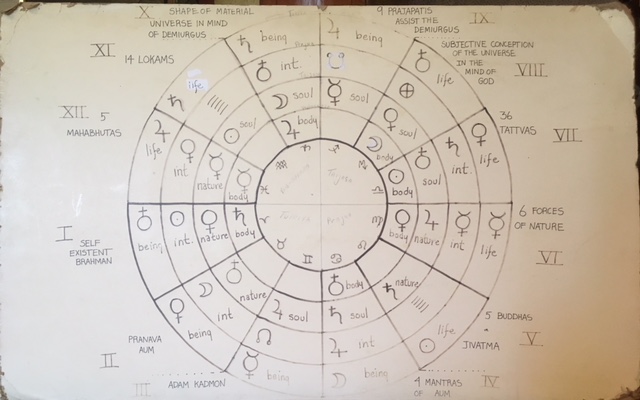
FIGURE IMG_2202-Posterboard Metaphysical Chart.
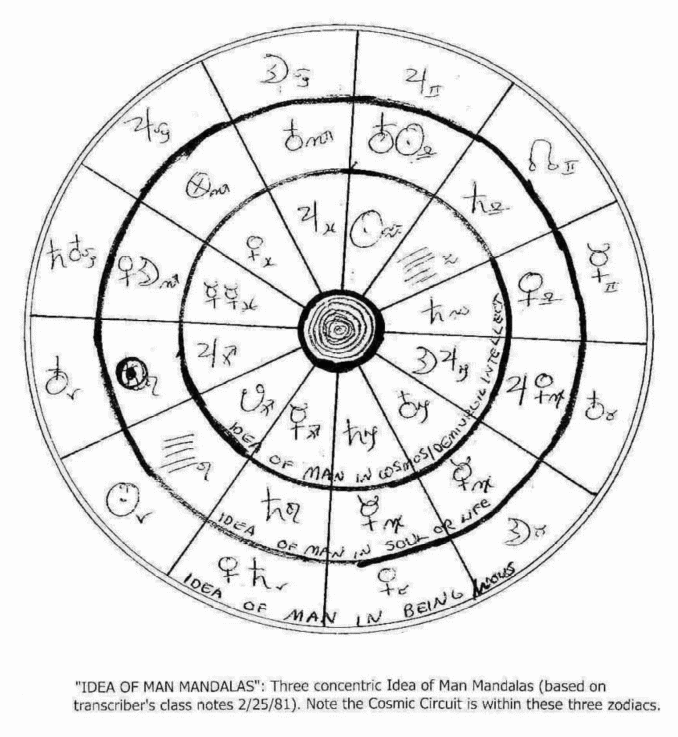
FIGURE 1981 1210-3-JF. Idea of Man Mandalas.
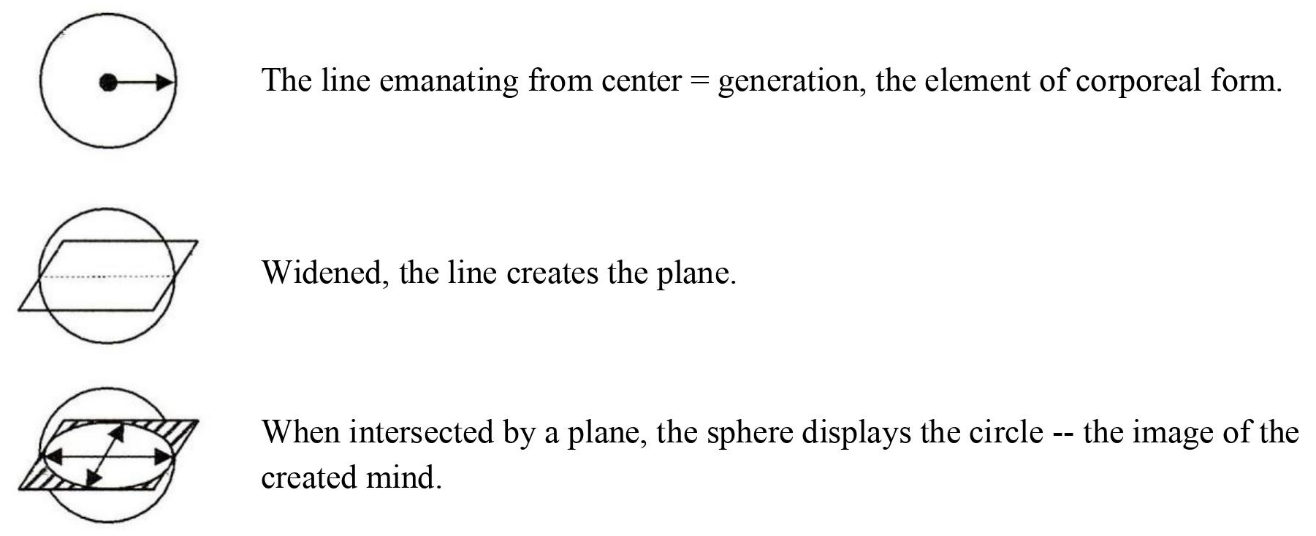
FIGURE 1981 1210-4. Kepler Relation of Circle and Sphere; Line, Plane, Sphere.
FIGURE 1981 1210-5-AB. Kepler Relation of Human Mind and Divine Mind.
FIGURE Gnostic-Fabricative-1. "The Grid" – Gnostic and Fabricative.
FIGURE 1981 1210-7-AB. The Grid and Divided Line.
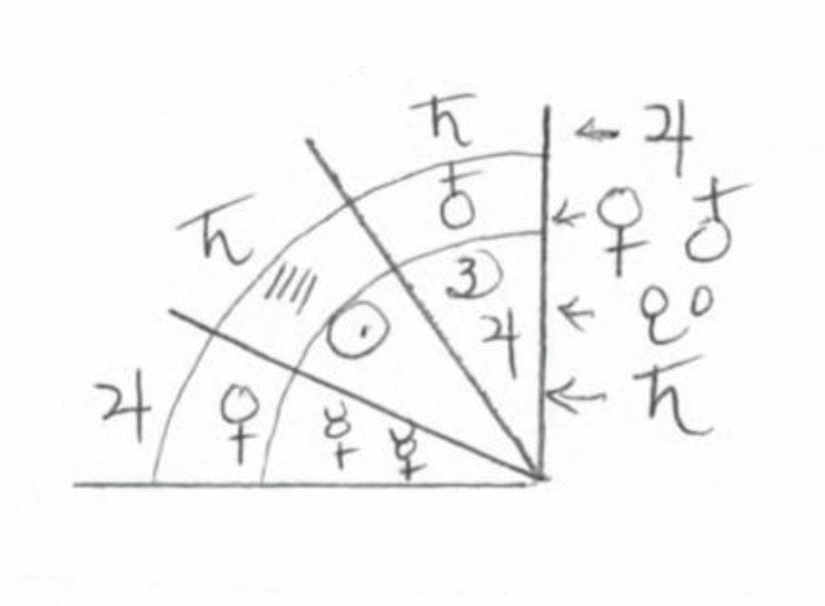
FIGURE 1981 1210-8. Universal Soul and Fourth Quadrant Dignities.
FIGURE 1981 1210-9. Fourfold Quadrant View of Three Hypostases with System of Nature and Material Order.
FIGURE 1981 1210-10. Paul Brunton (PB) Natal Chart ("official").
FIGURE 1981 1210-11. Paul Brunton (PB) Natal Chart (TS rectified).
Other diagrams also referred to are not with this transcript version. [Transcriber note: [diagram] means the speaker is referencing a diagram as he or she is speaking. If someone is drawing or writing, with audible sounds of chalk on a blackboard, I indicate this by [drawing] or [writing].]
NOTES:
12/10/81 is a Thursday.
AD refers to "yesterday" a number of times throughout the transcript so we are missing audio files for 12/9/81. We are also missing the rest of the audio for 12/10/81, as Audio File 1981 1210c cuts off abruptly, and anything following.
TRANSCRIBED Verbatim by IT 2022. In 2025, IT completes TOC, adds some new notes within transcript, replaces some diagrams and makes relevant changes to diagram references within transcript. Archival verbatim transcript – V12a.
AUDIO FILES: 1981 1210b, 1981 1210c. [Note 1: "Tape" and "Side" refer to original audio cassette tapes that were later digitized into .MP3 Audio Files. Note 2: We only have two audio files for this class, we are missing the rest. Note 3: Sound quality is not great.]
1981 12/10 Class Held in Columbus, Ohio
Plotinus; Soul & Nature
[Audio File 1981 1210b Begins]
S (faint): [one/two words inaudible]
AD: Yeah.
S (faint): (To me.)
S (very faint): (Uh-hm.)
[9¾ second pause]
AD: You want to read the quote from Plotinus? I can show you just the principle, the way I'm working. I don't want to go through all these quotes because they're endless. But I would take a quote from Plotinus and try to substantiate the insight I-- that I'm working with.
RW: You would rather not do I.1.7?
AD: No, I don't want to do I.1.7, that's the Animate, I don't want to do that, that's-- We've gone over that so many times.
RW: Ok. Where are we stuck?
[few seconds of background student talking]
S: How about IV.2.1.
AD: IV.2.1 is what?
S (faint): I don't know.
S (faint): [few words inaudible]
S: Absolutely.
S: There's nothing there.
S (faint): IV.2.1 is there.
AD (faint): Yeah.
S (very faint): Uh-hm.
[13 second pause with background student talking, flipping of pages]
S: IV.2.1's right here.
[9¼ second pause]
AD: Don't you want to read it out loud so I can tell you (the--)
RW: Oh (us achievers) real present. Ok. Here's a question leading into the third tractate which is Providence, and he asks--
S: Are you-- where are you now?
Plotinus [III.2.18, RW reading]: "…What motive could lead the Logos to produce evil?
[RW: Plotinus could only say--] "The explanation, also, would take away all power in the Universe from souls, even those nearest to the divine; [RW adds: and] they would be all mere parts of a Reason-Principle.
"[And], further--unless all Reason-Principles are souls--why should some be souls and others exclusively Reason-Principles when every one of them belongs to a Soul?"
RW: And he goes on to get [one word inaudible]
[short pause]
AD: Go ahead.
Plotinus [III.3.1, RW reading]: "All events and things, good and evil alike, are included under the Universal Reason-Principle of which they are parts--strictly 'included', for this Universal Idea [RW reads: Reason-Principle] does not engender them but encompasses them."
S: Move?
S (faint): I can't (see that).
Plotinus [III.3.1, RW reading]: "The Reason-Principles are acts or expressions of a Universal Soul; its parts (i.e., events good and evil) are expressions of these Soul-parts.
"This [RW reads: The] unity, Soul, has different parts; the Reason-Principles, correspondingly, will also have their parts, and so, too, will the ultimates of the system, all that they bring into being."
AD: Uh-hm. [short pause] Well--
RW: Then, the other one.
AD: That's-- that's hard, because you can see there what he's talking about, you-- we can try it if you want.
RW: No, I'll just get winded.
AD: See there he's working with both and it's quite beautiful, he's pointing out how the Reason-Principles engender and don't create. Now that would be equivalent to what I was saying. Reason-Principles will be prajna consciousness. They are the substratum of the object which they engender. They don't-- then-- they don't create the object, they-- they give it a form. Now when-- when the soul comes into contact or the substratum of the subject-consciousness comes into contact, he comes into contact with that. Not until you know what the Reason-Principle is that constitutes a thing and makes it to be what it is do you really know what an object is and that's what he's talking about there. [RW simultaneously: Yeah, he's talk--] But then he brings in the plurality of the parts of the Soul, alright, he brings that in too. It's very complex.
RW: Yeah. Yeah, you can see he's talking about Reason-Principles as you say in World-Mind.
AD (simultaneously): Well read it again, go ahead, let's read again, huh?
RW: I'm really winded out.
S (simultaneously): But where [AD simultaneously: Oh, ok.] are you reading from?
RW: Page 178.
S (faint): It isn't just--
S: I know but is it-- which one?
RW (simultaneously): Oh, it's III.3-- [S: 1.] 1. [short pause] Somebody else read.
S: "What is our answer?", is that it?
RW: Well I read the-- (yeah/the) [S simultaneously: Yeah all of them.] two sentences prior to that.
S: You read--
S (faint): Well three [S simultaneously: But--] (in my) [one word inaudible]
S: Where do you want me to start reading? I'm glad to read but--
AD: Go ahead.
S (very faint): Oh no (no).
S: [one word inaudible]
RW (simultaneously): Just start with "What is our answer?"
Plotinus [III.3.1, S reading]: "What is our answer?"
"All events and things, good and evil alike, are included under the Universal Reason-Principle of which they are parts--strictly 'included', for this Universal Idea does not engender them but encompasses them.
"The Reason-Principles are acts or expressions of a Universal Soul; its parts (i.e., events good and evil) are expressions of these Soul-parts.
"This unity, Soul, has different parts; the Reason-Principles, correspondingly, will also have their parts, and so, too, will the ultimates of the system…"
AD: Alright, let's start again now and-- and maybe I could point out. Go ahead, start reading.
Plotinus [III.3.1, S reading]: "What is our answer?"
"All events and things, good and evil alike, are included under [the] Universal Reason-Principle…"
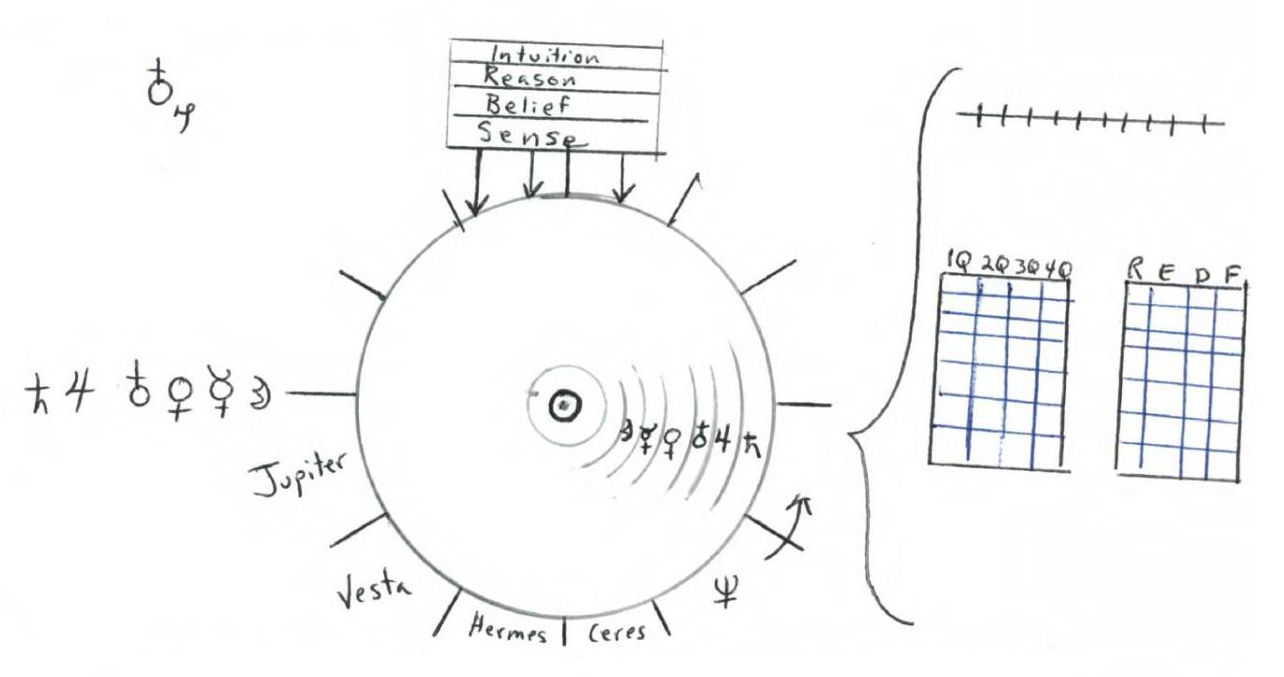
[Note: See FIGURE 1981 1210-1, Nature: Capricorn, Aquarius, and Pisces with Grid, appended to this transcript for the following.]
AD (simultaneously): Alright, now, Universal Reason-Principles here are what we refer to in the eleventh house as the twelve Ideas [Jupiter, Vesta, Hermes, etc. around circle]. [student assents, very faint] Everything in our universe in the twelfth house is the result of those Reason-Principles, [student assents, very faint] or the combination thereof in a variety of different ways, alright. We could call that an organized system of relationships which can always be relied on to produce the same phenomena given the same causes and conditions. And read just slowly, a little bit more. "These Reason-Principles…"
S: Go on.
Plotinus [III.3.1, S reading]: "All events and things, good and evil alike, are included under the Universal Reason-Principle…"
AD: Alright, you remember, we took the twelfth house, sublunary, planetary, and inerratic sphere [FIGURE 1981 1210-1, right side; diagram doesn't show sublunary]. All events, all things there, are the product of those Universal Reason-Principles which we put in the eleventh house, Jupiter, Vesta, Hermes, and the way they're combined by the Separative Intellect [intuition, reason, belief, sense above circle] to produce everything in the twelfth house. Continue.
Plotinus [III.3.1, S reading]: "…of which they are parts--strictly 'included', for this Universal Idea does not engender them but encompasses them.
"The Reason-Principles are acts or expressions of a Universal Soul…"
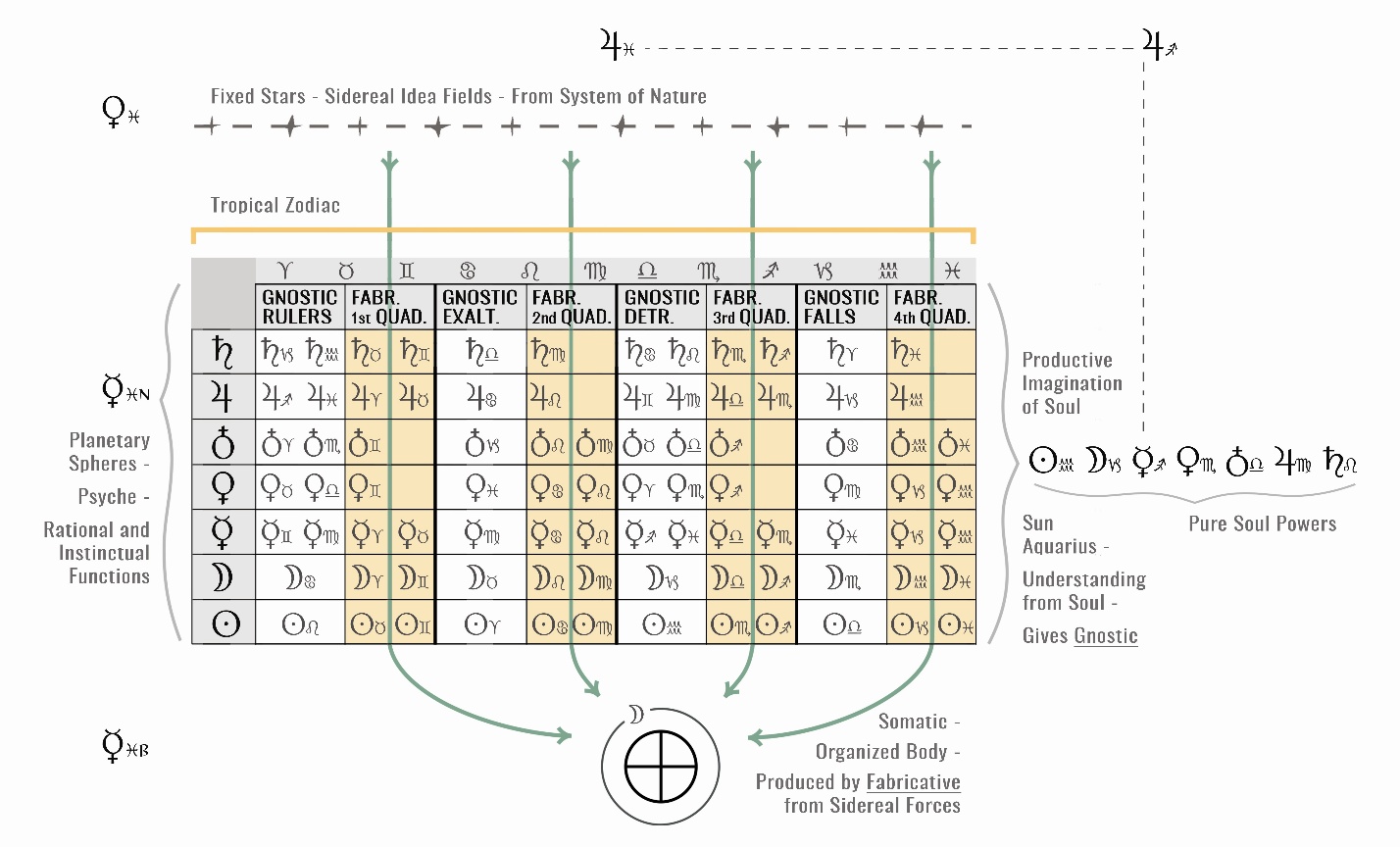
AD: Now, we took those twelve Reason-Principles which we put in the twelfth hou-- I mean the eleventh house, and we say-- we're saying that they are the offspring of the Universal Soul which is the whole third quadrant, the Jupiter, Mars, Venus, Tail, and Saturn, alright. [Note: See third quadrant rulerships and exaltations in FIGURE IMG_2202-Posterboard Metaphysical Chart appended to this transcript.] That's-- that's what we call the Logos of the Universe. Now the twelve Reason-Principles in the twelfth [sic; eleventh] house are the offspring of that Universal Soul.
Plotinus [III.3.1, S reading]: "…its parts (i.e., events good and evil) are expressions of these Soul-parts. [AD: Yeah.]
"This unity, Soul, has different parts; the Reason-Principles, correspondingly, will also have their parts, and so, too, will the ultimates of the system, all that they bring into being."
AD: Yeah. So that you-- if you start at the eleventh house where those twelve Ideas are, twelve Reason-Principles, and the way they combine, everything in the universe would ultimately be dependent upon them. So vice versa too, anything here would be an embodiment of those Reason-Principles that are there. So even in the very act of thinking, alright, let's say you think a-- you have a certain thought, if you think of these Reason-Principles as the categories of understanding, let's say abstract space, abstract time, abstract duration, quality, relationship and all that, all of them combined together make it possible for you to think. The result is a particular thought, but those Reason-Principles will enter into every particular thought you have in various combinations. I don't know if you're following what I'm trying to--
S (simultaneously): Yeah, yeah.
S (very faint): (Well) yeah.
AD: These are the Reason-Principles, yeah.
S (very faint): Uh-hm.
Plotinus [III.3.1, S reading]: "The Souls are in harmony with each other and so, too, are their acts and effects; but it is harmony in the sense of a resultant unity built out of contraries."
AD: A good example is like if you look at all the degrees around there, alright, they're all contraries. I mean no degree is the same as any other degree and especially when they're in opposition, yet the whole 360 degrees represents a unity and a harmony. But if you-- if they happen sequentially or according to aspect, then there seems to be tri-- strife and chaos and all that, you know-- you know, good times and bad times, but that's all subsumed under the unity of the Reason-Principles. The whole 360 degrees is one thing.
Plotinus [III.3.1, S reading]: "All things, as they rise from [a] unity, come back to unity by a sheer need of nature; differences unfold themselves, contraries are produced, but all is drawn into one organized system by the unity at the source."
AD: Yeah. You see, that's what we were doing, when Avery and I-- After we got through explaining the first Hypo-- Hypostasis, the second and the third, you remember in that quotation he says now, these three syst-- these three pure principles also exist not only for the interior man but for the system of Nature, [Note: See Plotinus, V.1.10, third para.] alright, so then we had to try to understand how the system of Nature is an organized unity and how these three principles exist for the organized system of Nature as they do for the interior man and we went on from there. So Nature itself was an organized unity, an organized systematic unity, from which the whole world got unfolded and from which the whole world goes back into. And that is what he called "Nature, Contemplation, and the One", [Note: See Plotinus, III.8.] that's where he really goes into this lengthy discussion, how from Nature everything arises. And the strange thing, he says that Nature is below sensation and knowledge, it doesn't operate with that.
RW: Could-- say that again?
S (very faint): (He said what?)
AD: Nature is below sensation and knowledge. It doesn't operate with that. It is a pure imagining act that is always going on.
S (faint): Hm.
AD: In other words, like if we try to understand, if we try to understand, when a human being tries to understand some of the laws that are operative let's say in the growth, the form, the significance of an-- a creature, the laws that are being embodied are not being consciously thought out the way a human being would think of it, alright. In Nature all this is going on unconsciously. There's no deliberation involved. It's a knowledge that's below conscious human knowledge, alright. And he makes that point over and over again. But there again, that is a difficult passage and nonetheless, I think if you follow it even superficially the way I presented, you can see the-- the way I'm working the diagram, always corroborating with some quote that he's working with.
And when you get finished going through (with their take), let's say on the One, on the Intellectual-Principle, on the Soul, on the system of Nature, on-- on the sensible world, and-- and then you look at the whole canvas, you could see that what he-- what we've been drawing out of Plotinus is a very hidden kind of knowledge, alright, which is implicit in his philosophy and which can only be made explicit by the symbolism of the astrological wheel. Otherwise it remains always in the background and you can't see it. It's like you need that kind of water to go over the invisible writing and you bring it out. You know, that kid secret stuff, what is it, 007? You write and you can't see anything, then you spread some liquid on it and it-- you see it? Well what we've been doing is something like that. We go over these passages very clearly and after a while you can see what was implicit get expressed, come out, almost like the image, "Ah, that's cosmic soul, oh, that's the cognitive-isness, wait a minute, this is the rulership." You begin to see it coming out.
Now, what I'm s-- the-- the further thing that we're saying is that insofar that the human mind is constituted by a-- a limited number of ideas that it works with, all philosophies will ultimately be coming from there, these, let's call them unit meanings, and you can combine them in so many ways and no more. You follow?
S: Uh-hm.
AD: So that after a while, when you read this philosophy and you read that philosophy, you begin to see the same unit meaning here and the same unit of meaning there and then there and then there, then you begin to recognize, look, there's only 20 unit meanings, no matter how I combine them, the total number of philosophies will only equal 20 x 19 x 18 x 17 (and) going down. That's it. You have no more than that. So that's-- that's where I'm coming off. And when a philosophy says that it is unique and special, that it-- it expresses the ultimate truth, I don't buy because they all say that. But they're only expressing, alright, in their way, their combination of these 20 units of meaning. Another system would express it a different way. It would still be basically just as true the two-- in the two systems. That's-- that's where we're coming from. I don't think they're going to like this. But then again it doesn't matter. What do we care? Besides, I won't be around. Plotinus is.
RW: You're going to reincarnate right in the [couple/three words inaudible]
S (simultaneously): That (and a) [one word inaudible]
S: Almost [couple words inaudible]
S (simultaneously): Ayatollah.
S: If you don't take [RW simultaneously: You could see their role.] care of it in this lifetime you get in a bigger mess the next one.
AD: Well, in that case, I'll be seeing you PB, (AD laughs) because you'll have to come down and start doing some work on your--
[tape break]
AD: You better erase it.
S: Well, it's obviously dirty.
S (faint): You better clean it up.
S: Well I just-- you know, I'm just going to get it out and then we can go back. I have-- one question is, the-- the aspects that connect the underlie of the subjective soul to the objective soul, are-- are those-- is that prajna consciousness, that light that comes through?
AD: I think so, I think so. Maybe-- maybe we can first-- first of all let's review this way. You remember-- you remember in here where he has that Vedantic ep-- you know, epistemology?
S (very faint): Uh-hm.
RW: I got it.
AD: Do you remember it? I don't want you to talk Red so-- [short pause while erasing] 'Cause we come to a good agreement, Red and I. He's going to keep his cold (bit of laughter, AD laughs) [S: Do you want me to talk (one/two words inaudible)] and sore throat and not give it to me.
[short pause while AD erasing, some student words in background]
S: I-- I want to ask about the signs, if you--
AD (simultaneously): Probably-- probably Monday soon as I get off the plane in Ithaca I'll have it.
S: Uh-hm.
S: Those signs that you just erased going around there, are they the connection from one zodiac to the other? When you-- when you put the signs of the zodiac around there, what connects one zodiac to the other? We--
AD (simultaneously): Like the Leo zodiac with the Sagittarius [student assents] zodiac? [short pause] Um-- In any description, in any description that they have of the-- Good morning Mr. and Mrs. Price.
S: (Only) [one word inaudible] guys.
AD (simultaneously): Pleasure to see you. (some laughter)
S: (We'll list it.)
S: How so? (bit of laughter)
S: Could I sit there now?
AD: If you had waited tomorrow I'd be in Pittsburgh. (laughter)
S: You want to come back with us?
AD: Well I'm going to Pittsburgh.
S (faint): Is this [few words inaudible]
RW (simultaneously): Can meet him at the airport tomorrow and have coffee with him while he waits.
S: That's right. Is that a seat taken from you?
RW: Uh-hm.
S (faint): He'll show you around [couple words inaudible]
S (simultaneously, faint): Is this seat taken?
S (faint): Yeah, take whatever it is.
S: You want to sit here and I'll sit over there?
S: No it's good.
[few seconds of faint background student talking]
S: Third question. (bit of laughter)
S: Yeah, I got to get these out [one/two words inaudible]
AD (simultaneously): No, no, we'll get them out, I mean because-- [9½ pause with background student talking] We'll just give them a minute to get settled in there.
S: This is a-- clean the air.
AD: What's that?
S: This is an air filter.
AD: Oh, [S simultaneously: Clean the air.] oh, clean the air.
S (simultaneously): And I forgot it yesterday.
S (simultaneously): Oh, great.
AD: That's alright, very nice.
S: And I thought that would help all our runny noses and--
S (possibly same S as above): Get down here.
S (faint): Do you hear that?
S (very faint): No.
S (faint): I do.
S: It's very quiet.
AD: [one/two words inaudible] that's alright.
S (simultaneously): Will that be--
S (possibly same S as above): Pick that up?
RW (faint): Does it work?
S: The microphone? I don't think it will, it's pretty quiet.
S (faint): Who said that?
S: (I/He) brought it from my office and I can survive in warm air.
RW (simultaneously): I'm going to go put that on.
[20¾ seconds more of background student and AD talking]
[tape break]
S: Yeah.
[Note: See FIGURE 1981 1210-3-JF, Idea of Man Mandalas, appended to this transcript for the following.]
AD: --with any of the vehicles that it uses to, let's say, express itself or (bind) itself. So that we could think of consciousness as something universal. And then Plotinus goes on to say that we are present in the universe. [Note: See Plotinus, VI.4.14, last para.] You remember the quotation we used yesterday? He says we are present there in the universe. It isn't that the alien who tries to foist himself on the soul has to go up into the Intelligible World to find it. But insofar that the soul or cognitive-isness or pure consciousness is universal, it is present everywhere. Now, this is a very abstract way of trying to understand but it may lead you to it. So then that the-- the consciousness of the soul is universally pervasive in the universe, when there arises, let's say, and there is fabricated on the planet Earth a body, a vehicle that the soul can use, it is present right there, and the act-- the love-- the love that the soul has is where the soul is present. So you could be somewhere in, you know, Milwaukee and because of your intense love let's say for your son, your soul will be present with your son and not with where your body is. So, if you-- if you keep that in the background, call that the Leo zodiac, alright. So, when we draw the [drawing] Leo zodiac [second circle starting with the Sun], like I said, this is just a visual aid. It's nothing like that.
You know, like I tell the kids, when you get into the Intellectual-Principle or you find the Intellect of the soul, you're not going to see a sign, street sign saying "That way to the One and that way to the Intellectual-Principle." None of that is there. I mean, we can hardly, from what I understand, we can hardly distinguish when we're there between the soul, the Intellectual-Principle, and the One. Those distinctions are not valid there. They're only here, we verbalize those distinctions here but they don't exist in that realm. So the soul can even-- cannot even, so to speak, when it is there, you know, hardly say, "Well, this is soul and that's the Intellectual-Principle" because the very substance of the soul is the Intellectual-Principle.
So then let's say we use a circle because the circle is a symbol of the Divine, alright. And, if we think of it as, you know, a point which is nowhere but its circumference everywhere, and then within that, within that consciousness [drawing] we locate-- we locate the Sagittarian zodiac [third circle starting with Jupiter] where we start with Aries, you know, and go (about) Libra. Ok? So like the cognitive-isness, the consciousness, the pure consciousness that everyone in these philosophies speak about is-- is a universal which is universally per-- universally pervasive and it isn't localized. You can't say "There it is." All those image you have.
Alright, then within that, if you take the whole-- [drawing] if you take the whole of the inerratic sphere, you know, from Aries to Pisces, alright, and you think-- you think of that as universal, and then you take the grid or the planetary scheme which is within that [concentric circles in the center] and then living in one particular planet in that planetary skit, you can see that this would be like the outer circle, this consciousness is universally pervasive [diagram]. Your body appears here [diagram]. That consciousness doesn't have to go anywhere, doesn't have to lo-- I can (use you). I-- It can't-- it can't, so to speak, restrict itself to this one point [AD indicates on diagram], although in operating [drawing] it would seem as though consciousness, all the powers of consciousness are coming from this one point which they would call the bindu in some cases. So, if we take that outer circle and call it simply the Leo zodiac, it's just a symbolism.
S: No, Leo.
AD: There i-- there is [S simultaneously, faint: Leo.] no such thing. And you say now this is the outer [couple inaudible student words simultaneous with AD] circle, [S, very faint: Yeah.] this is the consciousness which is pervasive of the whole two circles. And then inside that you put-- [9¾ second pause while drawing] Let's say these are the planetary-- the planetary scheme. And we put the Sun in the middle [diagram]. And we put the Earth somewhere here [diagram], it doesn't matter where you put it. And we put the other planets around, Saturn, Jupiter, Mars, alright, and Venus, Mercury, and Mo-- Moon [diagram], whatever, doesn't matter, ok. Then we can say that the underlie or-- or the substratum or that your consciousness is underneath the whole thing. Ok? And there won't be no need to-- The interesting question would be like Plotinus, PB, and all the others ask. Remember the quotation from Plotinus where he says, "How often I found myself out of the body and could not understand how I got into the body," [Note: See Plotinus, IV.8.1, first para.] you remember-- [few inaudible RW words] [S, very faint: Uh-hm.] It's a very beautiful one. Everyone who has the experience of the soul has that experience, that when-- when they come back into the body, they simply can't understand how that had happened. [short pause]
There was another quotation. Um-- [short pause] There's a quotation which was really quite to the point. He said-- Plotinus says something like this. The soul is in the Intellectual Realm, in the Intellectual-Principle, and the substance of the Intellectual-Principle is the Nous. On the one hand, the soul, a unit soul is distinct from all other souls. On the other hand it's the same as all other souls because the very stuff or the very substance of the unit soul is the Intellectual-Principle. [Note: Possible reference to Plotinus, IV.1.1.] So your true Self is the Intellectual-Principle. Just like PB says that the ultimate perceiver in you is the World-Mind. That's the ultimate perceiver in you. When you actually enquire who ultimately is the knower in you, you have to realize that it's the Intellectual-Principle in you.
Well, either way, whether you speak about it as the soul or you speak about it as the Intellectual-Principle, you can see that it's a universal and it's pervasive of every thing there. Ano-- another way would be to locate the entire universe within the soul, just like you would locate the body within the mind, you wouldn't locate the mind within the body. Alright, if we do that, then we can see that there won't be no need to make any sort of connections, you know, like have a channel running from the soul into the cosmic circuit. Because the soul is present wherever the body is. There isn't any place that you can go, so to speak, where the soul would not be. The limits of the universe, alright, are not the limits of the soul. The soul is even more pervasive than that. I don't know, you have the-- if you read-- who was it? There was a small little book by Jung. In the back of it there was "The Archetypal Influence of--" "The Influence of Archetypal Structures on Copernicus"? [Note: W. Pauli, "The Influence of Archetypal Ideas on the Scientific Theories of Kepler" in C.G. Jung, W. Pauli, The Interpretation of Nature and the Psyche.] Ok.
S: Um, ignore--
S (very faint): Because--
AD: Well, it's a little book. It was called "Synchronicity", [S: Oh.] and in the back-- in the back he has a discussion, that Pauli discusses the influence that archetypes had on the thinking of Copernicus [AD misspeaks, means Kepler] and Fludd. And--
S (simultaneously): We read that.
S: Yeah.
S: She got it xeroxed.
AD (simultaneously): Yeah. In the back, in the back there's a very beautiful section where Coperns-- Copernicus [AD misspeaks, means Kepler] speaks about that the only way we can understand the soul is by locating it at a certain point. So, what did he do, he did something like this. He takes a circle, [drawing] imagine a sphere, this is a sphere [diagram], and then he locates the soul, the human soul, as-- What'd he do? If you could think of this as a plane within a sphere, I can't do it but, it would be like a square, let's say, or a rectangle within it. Or if you think of a sphere and you slice it, each diagonal within that he considered a soul. [Note: See FIGURES 1981 1210-4, Kepler Relation of Circle and Sphere; Line, Plane, Sphere, and 1981 1210-5-AB, Kepler Relation of Human Mind and Divine Mind, appended to this transcript. See also Kepler series, WG Classes 1981 0221, 0228, 0307, 0314, and 0321, for more details.] And if you followed this discussion, he was trying to somehow connect the soul into the material world and he was going through all these [three words inaudible] geometrical things that will never work. We have to go back to Plotinus I think or some of the others. Any luck with that, (Red)?
RW (simultaneously): Yeah I know it when I'd see it and I-- I'll find it (somewhere).
AD: Alright, if we do that then, Bob, if we do that and we think of it that way, then you would say that the soul is universally present anywhere here [diagram], ok. And if-- if you take-- take the planet Earth, alright, [drawing] and you did that [diagram], anyway, you could distribute it this way, see, if you take this here, then you can see all the aspects that the Earth has, the individual on the Earth will participate in those aspects. In other words, the individual on the planet Earth is participating in the aspects that the Earth has [AD indicating on diagram]. So tell me Barbara, when you thank the Infinite Mind for the food (to) sustain your body, which Mind are you referring to?
S (simultaneously, very faint): (Well you explained that.)
S (faint): But I guess there's only one.
AD: Huh?
S: A Nous. Nous?
S: Really? [AD hits board with chalk]
S: To the-- oh the Earth.
AD: To the Mind of the Earth.
S (faint): The Mind of the Earth.
S (very faint): Oh, ok.
AD: You sit down and say, [S simultaneously, faint: Is the (one/two words inaudible)] "I thank you for this food to sustain my body and persevere on the Quest and--" You're thanking--
S: Yeah, PB say "Oh Mind the World".
S: Yeah.
AD (faint): Mind of the World, yeah.
S (simultaneously, faint): Yeah.
S (faint): Uh-hm.
AD: So your participation in the knowledge that the Mind of the World has is what's going on in this example.
S (faint): Uh-hm, yeah.
AD: So when-- when you thank the Infinite Mind of the World, it should be much more immediate to you. It won't be something out there, you know. It's something that you recognize is going on right here in your very mind, your mind is a participation in the Infinite Mind of the World. Well, it's like an intimacy springs up. You see what I'm [student assents, very faint] getting at?
S (very faint): Uh-hm.
S: Now you don't mean the World-Soul. You do-- you'd mean the World-Mind.
AD (simultaneously): Well if you think of-- if you think of-- Let's go back again yesterday, we said that this is the Body of a God [diagram]. [student assents, very faint] And then that this Body, the planet, has a Soul, and then that that Soul has an Intellect, and that that Intellect-- that that Body not only has a Soul and an Intellect, it also has a Unity. Then you realize that each planet, alright, is the lowest manifestation of the Unity of that God.
S (faint): I see.
AD: It doesn't have to be the Earth, you could take a planet out here, let's say Venus. The same thing would apply, you could make the same twelvefold division. And you remember we said now, the zodiac of this planet, alright, would be different from the zodiac of this planet.
S (very faint): Uh-hm.
AD: Each planet has its own life forms, it's-- a belt of life which surrounds it and on which it relies to, let's say, fabricate the creatures which it spawns. And the whole point here is like let's say-- let's say you got Venus in Cancer, alright, and-- [student assents, faint] Let's-- I-- let's say Saturn is in Cancer in your chart, and in terms of the chart of the world Saturn is in Libra. Then you would have natally an opposition to what's going on in the World's Min-- in the World-Mind chart.
S (faint): Square, uh-hm.
S (very faint): Yeah right.
AD: Square, whatever it is, ok. So that after a while you begin to see you're participating in the World-Mind's knowledge. What you know, alright, is like a minute participation in that knowledge that the World-Mind has. That aspect would show you--
S: We (followed) that vasana though my only question was-- that that thing that threw me was when you said the World-Mind and I-- I just wondered what--
AD: I always make a distinction, Philo. If I say the Intellectual-Principle [S simultaneously: Yeah, I was--] and if I say the World-Mind.
S: Now we learned-- I mean, I'll have to get this out of my head then, that everything comes from the Sun. What relation is the Sun then just what you were saying about this Earth? [S, faint: Yeah, right.] You'd know that the Su-- that the Sun (or/are) [couple words inaudible]
AD (simultaneously): Yeah, Philo, there's-- there's a variety of ways of thinking about this, and I'm sure you've already begun to get frightened at the immensity and the complexity of this. But, you could think of the whole solar system-- like you could think of the planets in the whole solar system as different powers of one and the same entity, the Sun. Therefore all the planets [S simultaneously, faint: I see, I see, alright, I--] belong to the Sun and they are powers of that. [student assents, very faint] Now, there's another way. You could think of each planet as an individual in its own right, and that it would have a Body, a Soul, an Intellect, and a Unity.
S (faint): Ok.
[Note: See FIGURES IMG_2202-Posterboard Metaphysical Chart and Gnostic-Fabricative-1, "The Grid" -- Gnostic and Fabricative, appended to this transcript for the following.]
AD: You know what I found out? That the Egyptians, for instance, in their astrology, thought-- made that point. So the-- what we're saying is that in the same way, you know, like when we take the Sun in the eleventh house and we say well this could be the last of the unembodied powers [student assents, faint] of the pure Soul, it could be your last power. In other words, your soul has this power too. The World-Soul has this power too. So there's-- you can't restrict the meanings that we're working to because at one and the same time I could say that that Soul-- I mean that that Sun in Aquarius is your imaginative power and it belongs to the unembodied soul, your unembodied soul. [student assents, very faint] I could also say at the same time that it is the power of the imagination that belongs to a World-Soul. [student assents, very faint] Ok? I could also at the same time say that that Sun is the power which works with the Reason-Principles to produce universal manifestation and therefore that is part of the Demiurgic Intellect. You remember, we did that yesterday. [student assents] So the symbolism always demands that you keep in mind the context and the frame that you're-- you're speaking. So if I refer to the Sun in the eleventh house as Nature, then you have to keep it distinct from-- from it being at the same time the imaginative power or the faculty, the sensitive soul that your soul works with. You have to keep them distinct.
S (simultaneously, very faint): Yeah.
S: Now there's another thing that just-- just brought a question to my mind. When you speak of my embodied soul, and you also spoke that--
AD: Speak of your embodied soul?
S: Yeah
AD: Yeah.
S: Yeah you made it the point of saying that my embodied soul. And just a few minutes ago you spoke about a quote from Plotinus that said that our-- where our knowledge comes from is the Intellectual-Principle. Now, is our embodied soul this Intellectual-Principle? This part in our soul that is a part of the u-- of the Intellectual-Principle that we all have access to if we refine our--
AD: Try again, try again.
RW (faint): Uh-hm, uh-hm.
S: Let me get the sentence here. "The ultimate perceiver in me is the Intellectual-Principle."
AD: No, the World-Mind.
S: Well, they're-- yeah, the World-Mind, alright. Is that saying the same thing as saying my embodied-- my own embodied soul?
AD: When you say that the-- No, let me rephrase or restate the question. When you say-- if-- if my soul is part of the Intellectual-Principle, when I say that the ultimate perceiver in me or when I speak of the ultimate perceiver in me I'm referring to that Intellectual-Principle which is operative in me.
S: And you called it the unembodied soul.
AD: Yeah.
S: And that's-- you're speaking of the same.
AD: Uh-hm. Now, if we take that unembodied soul, alright, and the unembodied soul would-- Well, more clearly. You say this unembodied soul-- [short pause while drawing] Alright? That was the unembodied soul [diagram].
S (faint): Uh-hm.
S (faint): Ok.
AD: Leave this out because that would be the Sun here [diagram]. [student assents, very faint] Ok? [student assents, very faint] Now the same way that this applies to the Sun, the actual physical Sun that we see, this applies to the actual physical Sun that we see, this also applies [drawing] to the World-Soul. This also applies to our individual soul. But here's-- here's the-- the difference. If-- if we look at our sensible Sun, we would say that's the Body of that soul that we're speaking about, this [drawing] World-Soul, ok. And we would say that this World-Soul, we would say that this World-Soul, that it has a substance [Moon in Capricorn], alright, that it has aesthetic perception, that-- No, I'm sorry, (wrong set). This would be a sort of reflective awareness [Mercury in Sagittarius], this would be aesthetic perception [Venus in Scorpio], this would be all the virtues that belong to the soul [Mars in Libra]. This would be the six powers that belong to the-- that soul [Jupiter in Virgo]. This will be the pure cognitive-isness of that soul [Saturn in Leo], ok. Then you say, "Well what about a human being?" Exactly the same. Except that the human being is not universalized. In other words, this soul [diagram] got there first and made the world. [student assents, faint] And Plotinus even makes the remark, that's why you didn't make the world. This soul got there first and made it and now provides the environment for you, for your individual soul. [Note: See Plotinus, IV.3.6, sixth para.]
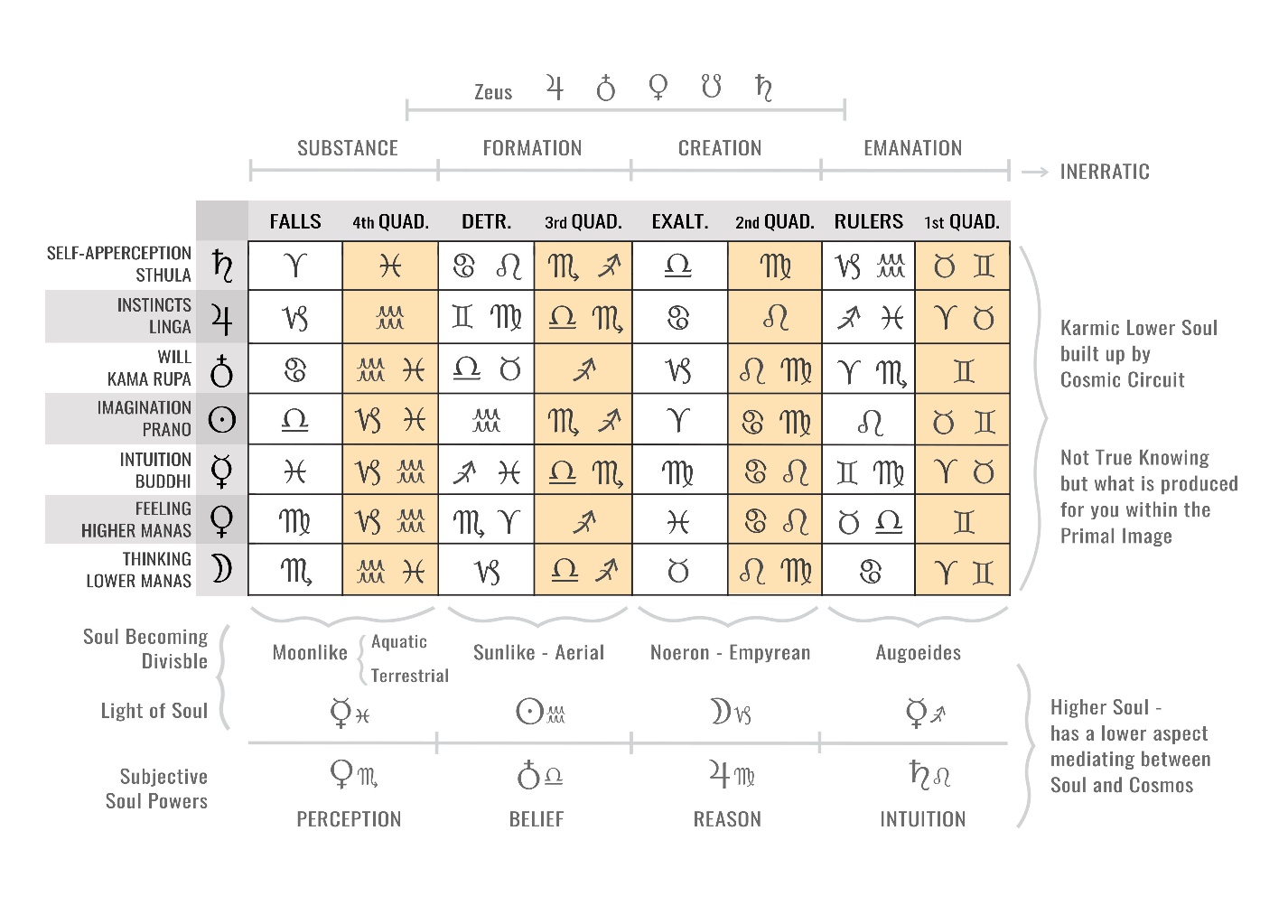
Now here again is another complication. When we-- when we speak about-- you remember what we did yesterday? We put the seven planets in the chart. When you look at your natal chart [drawing] and you have the seven planets, ok, and we said that this-- [couple words inaudible] Well he said Mercury (reflects) [one/two words inaudible] [Note: See FIGURES Gnostic-Fabricative-1, "The Grid" -- Gnostic and Fabricative, and 1981 1210-7-AB, The Grid and Divided Line, appended to this transcript for the following.] We said now, this here [drawing] was what Iamblichus called the second soul [diagram], [student assents] alright. When-- when you look at your chart and you're looking at all the-- when you're looking at the configuration of aspects, now that soul is not the same as this soul [diagram]. That's the second soul, all the things you find in your chart. Alright? That's what Iamblichus called the second soul. That is returned back to the planetary spheres. Whereas your soul, this soul [diagram], is not returned back to the planetary spheres, this is always you. But when it gets embodied, alright-- In other words, now over here we have to put a little man here [diagram], imagine him on the surface of the Earth, and this soul gets embodied here, this remains distinct from the embodied soul. Now let's say, let's say that a body is created for you and this organized system of living functions is brought together, made into a body, and it's working, alright. Now this soul has to use that body and interpret what that body is doing. So like for instance let's say there's a modification of the eyeball, alright, and an object is perceived. It is this soul that reads off the modifications that are taking place in the body and tells you what's-- what's there. You follow that?
S: Yes, I think so.
AD: Now, one more point. Then that means that the modifications that are going on in the body, let's say the vitality or the feelings which unfold from the very functioning of the or-- organism, alright, that is what you would call the psychosomatic organism. That is not the soul. The soul coming in and looking at the modifications that are taking-- taken off, you know, taken off the body, it interprets that, and all your understanding is based on the soul interpreting what's going on there. Now let's say the organism dies. The soul doesn't have an or-- a vehicle to read off modifications. You follow?
S: Yeah, yes.
AD: Alright, that's the second soul that Iamblichus is talking about. That's-- this here soul, alright, [drawing/writing] this here soul is the one that he calls the second soul and this is subject to fate. This is the one that you look at the chart and you say, "Oh, heavens, I got Saturn Moon conjunction tomorrow, I'm going to be depressed." [S, very faint: (Ok.)] Alright? That's what you're reading off. But it's the soul that's reading off the depression that's going on there. The soul itself isn't depressed. The soul remains impassive.
S: Yeah.
S (simultaneously): [three words inaudible] get (we can have).
S: Yes.
S: This is the unembodied soul, the second soul. No.
AD: This is the unembodied soul [diagram].
S: That's the other soul.
RW (simultaneously): Well, that's the first one.
S (faint): That's the first one.
AD: In other words, you would have to look at this here [diagram] and you'd say this is [drawing] the unembodied soul. This is the last of the powers of the soul. You might call this the productive imagination. [Note: Sun in Aquarius.] [S, very faint: No (one/two words inaudible)] And this fabricates all of this [twelfth house], right?
S: Yes.
AD: But this remains distinct from the embodied soul.
S (faint): Yes, right.
AD: So this is the called the second soul [diagram] and this is the real unembodied soul [diagram]. Turn to I.1.7.
S (faint): Yeah, that's right.
[short pause]
AD: I know it's intricate, but believe [S simultaneously, faint: I thought that (was) (one word inaudible)] me, I did not arrange these things.
S (simultaneously, faint): Yeah, ok.
RW (faint): This is I hope.
S (very faint): Yeah.
AD: Oh yeah. [couple inaudible student words simultaneous with AD] "The Soul's Descent into the Body", (in) these notes that PB has, he has quite a bit on this.
Plotinus [IV.8.1, AD reading]: "Many times it has happened…"
AD: Barbara [one word inaudible] this is your question.
Plotinus [IV.8.1, AD reading]: "…lifted out of the body into myself; becoming external to all other things and self-encentered; beholding a marvelous beauty…"
(Side 1 of original cassette tape digitized as 1981 1210b Ends; Side 2 Begins)
Plotinus [IV.8.1, AD reading]: "…which, even within the body, is the high thing it has shown itself to be."
AD: So you see, if you think of a connection, like a channel to get into-- you're off the point because of the very nature of the soul to be the universal that it is. To think of it as attaching itself to a body is to miss the point. Anyway. We go back to your question, Philo.
Plotinus [I. 1.7, AD reading]: "The truth lies…"
AD: This is I.1.7.
Plotinus [I. 1.7, AD reading]: "The truth lies in the consideration that the Couplement subsists by the virtue of the Soul's presence.
"This, [however], is not to say that the Soul gives itself as it is in itself to form either the Couplement or the body.
"No; from the organized body and something else, let us say a light [AD adds: from the Soul], which the Soul gives from itself, it forms a distinct Principle, the Animate [AD reads: a distinct Principle is created and he calls it the Animate]; and in this Principle are vested Sense-Perception and all the other experiences found to belong to the Animate.
"But the 'We'? How have We Sense-Perception?
"By the fact that We are not separate from the Animate so constituted, even though [AD adds: there are] certainly other and nobler elements [AD reads: powers]…
"The faculty of perception in the Soul cannot act by the immediate grasping of sensible objects, but only by [the] discerning of [AD reads: the] impressions printed [AD reads: imprinted] upon the Animate…"
AD: Now do you follow the way he's doing?
S (simultaneously): Yeah, uh-hm.
AD: You see-- In other words, the soul cannot have experience of the sensible world. In order to have that it must have a body. But this body in itself has to be animated or this light co-- goes from the soul into that body, and now this light in that body is what reads off and understands the impressions that are being made on the body.
S (faint): Ok.
AD: Ok? And it's really quite to the point in-- in regard to this diagram. [Note: See FIGURE Gnostic-Fabricative-1, "The Grid" -- Gnostic and Fabricative, appended to this transcript.] If we do this here, if we say well here's your body and there's a light [drawing] streaming in from your soul into this body which is organized by the planet Earth and all the influences that are, you know, pouring into that, streaming into that, alright, then this body is an organized product of all these forces, and then into that organized product your soul injects a light. Now you don't see that light except perhaps in mystical development when all of a sudden you can stop the thought, alright, and then the light shines, alright. It's like the thought is res-- is refunded back into the light. That doesn't mean that that's-- that's it, because that means simply you've reached here [AD indicates on diagram]. Then you have to keep going back, alright, and these are different levels of mystical development that take place as you go along, to reach this here which is in Leo [diagram], right, and this is in the second quadrant which is part of the Intellectual-Principle. Ok?
S (very faint): Uh-hm.
AD: Alright, so then you can see what we're doing here in the sense that over here the organized body is brought into being and then the light enters into that organized body. Now, this body is subject to the fate that is prescribed or proscribed by the planet-- the whole circuit-- the whole cosmic circuit. If that body is going to break a leg when it is 25 years old, it will break a leg because that is included in the scheme of the way this body has been organized. But the soul that inhabits that body will say, "Ouch, that's a broken leg." It'll interpret what's going on, alright. But you can't break the leg of the soul.
S (very faint): I understand.
AD: Ok.
S: Tony, could I ask a question? As you're going back through, after you turn different degrees or signs there up towards the top of the World-Soul, different degrees of light is it?
AD: Over here [diagram]?
S: Yeah, I'm at a loss for vocabulary. Is it a form of consciousness that comes? Is it an understanding or an awareness or identification or-- How is the light u-- is the light used as a-- as-- as consciousness expanded? As you go through those different signs, what does the soul acquire?
AD (simultaneously): First of all, first of all, let me try to understand your question.
S: What does the soul acquire?
AD: [hitting board with chalk] As it's going back--
S: Yes.
S (simultaneously, faint): Uh-hm.
AD: --this way [diagram]?
S: In terms of-- is-- is the light (come to the) vehicle?
[short pause]
AD: I still don't understand the-- what does the soul--
S (simultaneously): Ok, as the soul is going back through those signs, the medium it is going through is receiving light. And as the soul is receiving this light, are there incorporated in the light, (I mean--)
[Note: See FIGURE 1981 1210-7-AB, The Grid and Divided Line, and Soul Ring in FIGURE IMG_2202-Posterboard Metaphysical Chart, appended to this transcript for the following.]
AD (simultaneously): Well the soul isn't receiving the light, the soul is giving forth the light. Now if you trace that light back to its origin, you would eventually end here in Saturn [in Leo], ok. But in that-- in that process, you know, of going all the way here, [drawing] ok, going back step by step, you get acquainted will all these different parts and faculties of the soul [diagram]. These are all, so to speak, parts of the soul.
Let's try this way. The soul is composed of one substance, alright, let's say the prajna which is the Nous, the substance of the Nous. It is composed of one substance, but it has different functions, that one substance has different functions. So, over here, we could say that over here the function is pure intellection [Saturn in Leo] [diagram], that is, you understand what the Ideas are in the World-Mind. You don't understand it through concepts by the way. That's all out. There the understanding of the Ideas is in terms of their presence is felt immediately, and the power that they have is felt and discerned through intuition. You can't-- you can't conceptualize there. [student assents, faint]
When the soul for instance is identified with this realm [Jupiter in Virgo] [diagram], these are the six various powers that the soul has and each one of them, I think in the T. Subba Row he gives a short excerpt. [Note: See T. Subba Row, Esoteric Writings, "The Twelve Signs of the Zodiac".] He speaks about Parashakti, Gnanashakti, Kundalinishakti, Mantrashakti, all these various powers, alright, they're-- of which they speak of six and that's-- they're called the Six Holy Forces of Nature. The soul participates in them or let's say it has its share of those powers. So a Sage, alright, let's say a Sage enunciates something, believe me it carries all the power, you know, that the Intellectual-Principle can exert and it can-- That's what I meant yesterday when I said the soul tries to convince us through persuasion by reasoning, but the Intellectual-Principle by compulsion. [student assents, very faint] When the World-Mind says "This is it, this is what you're going to do," you can't do anything to refute that, there's no way. Whereas if it wanted to convince you through reasoning, well it'll ex-- ex-- you know, explain again and again through process of reasoning and then you finally get convinced, "Yes, this is true," ok.
Again, this power here, the Mars [in Libra] [diagram], which let's say would-- would be all those virtues of the soul that we can call courage, fortitude, perseverance. Mars represents them. Mars-- I-- I mean like if you have a bad habit and you want to cut it off, you'll see that all the courage that you-- you-- you have to exert, they would call that the Mars principle. [student assents, very faint] And Mars is always portrayed with a sword. And that simply means that he's capable of cutting off base matter from the higher reason-principles. It's a kind of slaughter, yes, but-- You know, like if you watch a Sage and you see him automatically cut off a vice or something, and you say, "My God," you know. You tried it and-- you tried it a hundred times, you never-- and you see the Sage do that, you know, then you begin to realize why they call this courage. This is powers of the soul.
The same thing with Venus [Venus in Scorpio]. Like Venus is the way you can aesthetically appreciate something beautiful, you can say, "My God, the Idea of Beauty is right there in that object." It's that higher vision of the soul that could look into a sensible object and see the form of beauty in it. Those are powers of the soul. That's why very often great art could, you know, fill you with ecstasy, alright.
The same with Mercury [in Sagittarius], that would be like-- This is the connection [AD indicates on diagram]. This connects, so to speak, through intuition, the higher soul from the soul that's caught up in the universe. Because these will be in the universe [Moon in Capricorn, Sun in Aquarius, Mercury in Pisces] [diagram].
S (very faint): Uh-hm.
S: Is Mercury what they call the Couplement?
AD: In other words like-- yeah, yeah, that's the connecting link. [drawing] You could see that like this here [diagram], if we think of this here-- Yeah. Am I right? No here [diagram]. Wait a minute. This chart right?
RW: Yeah, that's ok. (Moon) here [diagram].
RW/S(?) (faint): It's [one word inaudible]
AD (simultaneously): Alright, let's say Mercury, Moon, Sun, [in Sagittarius, Capricorn, Aquarius, respectively] alright. These are involved in the universe, ok, whereas these [Leo through Scorpio] are not even in the universe. They're not in the universe at all. And this would be equivalent to the Augoeides body [Mercury in Sagittarius] [diagram], like if you lived in a star, that would be the bo-- kind of body you would have in a star, ok. This would represent the substance that the soul will have over and over again whenever it's involved in manifestation [Moon in Capricorn] [diagram], alright. So these represent the powers of the soul. These are eternal, immortal. It's one substance but with various powers. There shouldn't be no difficulty understanding. And he has a quotation there where he speaks about the unity of the soul and its many parts. This is of course something that frightens most people because they-- they have a very simplistic notion of what the soul is. But, to get back to you Philo now, do you see the distinction between this is the [drawing] unembodied soul [diagram], [S simultaneously: Yes, yes.] alright, and this is the soul which is [student assents, faint] fabricated by the planets [diagram], alright.
S (simultaneously): Yes, yes, I was not (that) [one/two words inaudible] I was going to use this one-- I was going to use that one-- I was going to leave-- leave the-- leave that one out 'cause you can't talk about it and call that one this one and then the embodied, the-- I mean the embodied soul would've been the (end).
AD: No.
S: So I was I guess out of-- yeah.
AD (simultaneously): I think-- I think you can understand Iamblichus now when he speaks about [S simultaneously: Yeah.] two souls. [S: Right.] One is divine, [student assents, faint] and the other is subject to the fate.
S (very faint): Uh-hm.
S: And the second one is the grid [diagram].
AD: Yeah, the second one is the grid. [Note: See Appendix of WG Class 1981 1016a for more on the Grid.] You remember when Jesus said that you cannot follow me unless you deny your own soul. That's the one he's talking about. In other words, let's say Venus goes over Mars and you have a tremendous desire to go flirt with that man, ok. That's like the lower soul. Those are just natural forces that are always operative. And the higher soul comes along and interprets that and says, "Now look, you have to understand what this is about," and it explains to you, but, you know, in a very subtle way, gives you an intuition, "Don't do that," and then you reason it out and say, "Oh yeah." So you're denying that soul. That's what Jesus meant. Unless you deny your own-- your soul you cannot follow me. He didn't mean that you could deny this [AD indicates on diagram]. You can't. This is you. Cognitive-isness is you. So that's what he was referring to and that's why the poor preachers have a, you know, trouble--"How could I deny my own soul?" Unless they understand this elementary scheme that-- you know, of soul.
S: They usually interpret that as Self, not soul. Is-- is this--
AD: You just try that. (bit of laughter)
S: You'll see.
AD: That's even worse.
RW: Uh-hm.
S: That's what-- I'm just telling you, that doesn't (mean I believe it).
AD (simultaneously): Yeah, I mean, that's even worse because you can see that Selfhood, I mean in order for me to deny it I'm affirming it. As soon as I say I don't exist, I've made it twice as obvious that I do. (laughter)
S: Is that also what they'll refer to as embodied soul, this-- the psychosomatic organism as (Moon)?
AD: Yeah, that's the embodied soul. Now the strange thing is-- Here's a nice correlation. I'm going to get to that coffee but--
RW: Go ahead.
AD: You know, if you think of these here, I think maybe Tim worked some of this stuff out with you but just to refresh you. [Note: See FIGURE 1981 1210-7-AB, The Grid and Divided Line, appended to this transcript for the following.] Like he called this [writing] self-apperception, alright. It's good. I like the term. The point of sensitivity in your chart. I think you've noticed that, any aspect to Saturn you right away, "Uh oh, something's wrong," ok. So that's self-apperception or the sensitive point in your chart and it also represents the gross body. You have Mars squaring your Saturn you get a broken knee. I mean something really happens to the body. Alright, you could do that with each one of these planets. It seems that they have two aspects. One aspect is like the somatic aspect and the other aspect is the psychical aspect. Ok?
S: (We do use) that.
AD: You could do that with any one of them. So like for instance you can call the Sun the imagination. But you can also call it the reproductive imagination, because it not only images forth the world, alright, but also it includes the self-reflection of that image. Take a dream. You imagine the dream and you appear in the dream and then in the dream you reflect. So it is both, it imagines the dream and then it reflects back on that. So that would represent-- all these would represent these various powers. Now the point I'm trying to get at is that there is a correlation between the Saturn here [diagram] and the Saturn here [diagram]. If we say that this is pure self cognitive-isness and you say this is some kind of self-apperception, you could see there's a correlation. [student assents, very faint] That's why you got be a real dummox not to understand the Saturn (point). You got to be a blockhead when you don't see what it's telling you. Because that's you! And you could do that with all the planets. So, what are we doing? It's like this here, [drawing] these here, are reflected somehow in there [diagram]. Ok? But still, this is only a reflection. This-- this will perish; that never.
S: Anthony, you were talking about how if a person was going to break their leg when they were 25 years old, it was clear it was in the soul. Somehow it was--
AD: I'm sorry, that a person at 25--
S (simultaneously): I mean, somebody's going to break-- break their leg at (25).
AD (simultaneously): Yeah, was included in the plan of the body.
S: Of-- that would be the second soul?
AD: Yeah.
S: So by-- apparently by creating channels to the first soul-- You said that the Sage would have the courage to give up a vice but somebody else would try over and over and over again. Now by a certain amount of self-development, you're going to be able to change things.
AD: Yeah.
S: Ok, so it's not like it's completely preordained, there's no [one word inaudible]
AD (simultaneously): No, what's preordained, what is preordained is the destiny of that material body. That cannot be changed. I know that Aurobindo and Ramdas and a few others make the remark that they play football with the planets. I don't buy that. There is a certain destiny that everything on this planet has, and that destiny cannot be changed. What could be changed is the soul's reaction to that.
S: So the body is going to go a certain experience-- through certain experiences anyway and it's just a matter of like raising consciousness to the point where the understanding is more clear?
AD: Yeah, let's say-- let's say I-- One man has an experience, he falls in love with a woman, and this woman for some reason or another, he can't get to her, ok. So he goes into depression, you-- for years and years, he's, you know, miserable and all that. Another man, that turns him into an introvert and he seeks to find the Higher Self, alright. The experience, alright, is the same. The reaction to the experience is different. So your freedom lies inwardly and not in the external. And even the Sage, if his body is ordained to go through something, it will go through it.
S (very faint): Alright.
AD: Now I know-- I know I sound like a fatalist and I am. I mean [couple/few words inaudible]
S (simultaneously): Well that is not fatalistic.
AD: Yeah.
S: I mean the experiences, the form it has, sounds that way but it's actually-- like it-- it's sort of like your-- it's not limiting your consciousness to [few words inaudible]
AD (simultaneously): No, it's not. As a matter of fact Plotinus has a passage where he speaks about in spite of the difficulties that the Sage may have to encounter and go through, it does not alter the state of happiness that he's in. [Note: See Plotinus, I.4.]
S (faint): Uh-hm.
AD: Ok, it can't. But that doesn't mean that the Sage goes looking for grief. I mean, let's not be naïve, huh?
S: Yeah it do-- you know, it sounds like that you're saying that the plan with the result is laid out. The details as to how that comes about are subject to change because it's the internal reaction or-- that counts.
AD: Let me try this way. (And) I-- If we take this to be the planetary spheres, ok, all the planets revolving around, and you locate the 360 degrees, alright, everything that is going to happen is already in a mathematical way prefigured. Every aspect that will ever occur, alright, every conjunction. So that what we're saying is that all the bodies which are (wholly/only) like partials, you know, when the Earth fabricates a body, that body which it fabricates already belongs to the Earth that fabricated him, ok. And, anything that will happen to that body is already included in the plan, because as the Earth makes certain locomotions and all the planets, all these aspects, you can mathematically predict what aspects are going to be, I mean you take (and) compu-- a computer and you can figure out what the aspects are going to be 2145. So that means that all that, all that has already been prefigured in the very functioning of the cosmic circuit. What is not prefigured is the way the soul is going to react to that happening which takes place in the body. That's not (prefigured). So you say well what about--
S (simultaneously): Now it's this soul we're talking about, the unembodied soul.
AD: This unembodied [drawing] [student assents, faint] soul here [diagram]. You cannot predetermine how this soul is going to react to something that's already preordained. But you can also see that this soul will inhabit the kind of body that its destiny earned for it. That's where karma comes in. You get the kind of body that the soul already earned. You're not going to inhabit a body, alright, which you didn't-- you don't have the right to.
S: Uh-hm.
AD: So that means that there will be a tremendous variety of different kinds of organisms which are constantly being prepared for different souls to inhabit. All those-- all that is already laid out. Now, it's a little fatalistic and I-- I admit that. Not only that, I'll say something like this. When this whole scheme is fully unfolded and every aspect has been worked out and you-- you have the end of a-- of an era, the end of a Manvantara, and then let's say the whole thing starts all over again, you'll have the same production going on, the same bodies [AD hits board with chalk]-- same bodies will be again reproduced. The same system of organized experiences. So like when I leave 1A and I go into 2A, alright, there's still a 1A for others to come into and go through. Then I go into 3B and they come up into 2A, someone will be coming into 1A. Souls will be, so to speak, getting the experiences they need at the 1A, at the 2A, at the 3A (too). But that means that the 1A and the 2A and the 3A are all organized already. So that the plan-- the curriculum is already planned as to what experiences the soul will go through.
S: Tony, would free will be the option that you have that when you go through an experience how much choice you can make towards it?
AD: That's where the free will. The free will does not-- Now again this is conjecture, please don't take me seriously, these are my thoughts on it. The free will is just only in the sense that the soul can identify or not identify with that, can interpret it from the point of view of a larger meaning, alright, or can interpret it according to what it's identified. So if the soul says, "I am this body," alright, then the interpretations will follow naturally. Anything that happens to the body is going to be, you know, very unkind. On the other hand, if the soul says "Well, what is the lesson to be derived from this experience?" and operates with that point of view, then the free will is possible.
S (faint): Uh-hm.
AD: But in the organized system of destinies themselves, there is no free will.
S (faint): No.
AD: The kind of body a person in-- inherits already determines a lot of, you know, what's going to happen.
S: Well is it based on a free will (the/that) kind of body [S simultaneously: No.] by which [couple words inaudible] deserves? Is it like a--
AD: No the body itself is not based on any kind of free will. It is this--
S (simultaneously): Yeah but here's a body that we deserve. There's like a--
S (faint): (Uh-hm.)
AD (simultaneously): Look, let's take a dog. And you want to breed a special characteristic of the dog, ok, let's say you want to develop his sense of smell. Now the inheritance of one's dog, you know, the next generation, the next, that is genetically determined by what's going on in the body. You cannot alter that. So that when let's say, we're speaking grotesquely, let's say the soul of a dog comes into this body, alright, that body's already been developed to function in a certain way, you can't alter that. All he could do is, if he-- if it was a-- a soul that could think, would be to interpret things differently. But that body's already preordained as to its functioning.
S (very faint): Ok.
AD: No way around that as far as I can understand.
S: Well--
AD: There was many beautiful quotes that we picked out about that, I don't know if Avery gave them to you. They have to do with the astrology that Plotinus speaks about. Did he ever give you those quotes?
S (faint): (Not me.)
RW: We have them but I don't have them here.
S (simultaneously): Now, isn't it po-- isn't it still possible though, now this-- this body is already organized and set up and we-- the soul has to live through that vehicle. But, isn't it the re-- the reaction, the-- of that soul, doesn't it ha-- then it does influence that body as it evolves in a lifetime?
AD: Oh yeah.
S: Ok, alright, I just--
AD: You-- remember, we're speaking about the basic structure of the body. We're not speaking [S simultaneously: Yes, ok.] about the modifications that the soul could bring on it.
S: Ok.
AD: Let's not be, you know, Virgonians, make everything, you know, the nut and the bolt have to fit precisely. There's always a little--
S: I (do) want to misinterpret. I wanted to--
S: Anthony? Our soul does choose though the body that it comes into to work out the-- the plan?
AD: To work out its own plan.
S: Right.
AD: Yeah. But that means that you're choosing right now.
S: Yes.
S (faint): Uh-hm.
S: But then, doesn't that mean (then) also between lives new choices are being made? When you are out of the body (the) new choices are being determined for what's going to be for the next life. Isn't there a lot of work being done on that plane when you're in between lifetimes too?
AD: Uh-- Again that's very complex. I don't know that I could answer that. I would say this much, it seems, it seems that a soul could take on a heavier burden when it incarnates to work out more problems, and-- or it could take on an easier incarnation. It seems to have some choice there. [student assents] And, not only PB but you could read it in the Platonists, they speak about the soul's vision before it incarnates and it's acquaint-- it's made a-- it's acquainted with the destiny of that body and it has a choice, it can take that body or take one where more severe or more difficulties are worked out and it does seem to have some choice. That's why I was-- I was trying to point out to some of the Buddhists, if you believe that you're going to incarnate in 49 days, you will. But if you believe that, like me for instance, now I want to take a couple of years rest, 50, 100 years. (bit of laughter) I don't-- I don't believe in 49 days, I want to rest for a 100 years. (laughter)
S: Well you know, PB said when he was here, [S simultaneously: We (one/two words inaudible)] when we had dinner with him, we were talking about reincarnation and he said-- he said more like two, three hundred years. You remember that? He seemed to put it in the hundreds of years more than the [AD: Yeah.] few days.
S (faint): I don't remember that.
AD: Yeah but, [S, very faint: (I don't.)] you know, as you get on the Quest and it gets faster. You don't give yourself a couple of hundred years, you come back soon.
S (faint): I bet.
AD: Yeah. Because you're-- the momentum of the soul is starting to work out its problems because it wants to reach that state so it deprives itself little by little, rests longer and makes them shorter and shorter. So that there's very often instances where people are reborn within let's say ten years, five years.
S: I've heard that, that you could maybe be back within the year. Well--
AD (simultaneously): I'm sorry?
S (faint): [couple words inaudible] according to what [one word inaudible] (says), you could be back [one word inaudible]
AD (simultaneously): Well yes, you may have chosen to do that, [student assents] sure, you may choose to do that. I would only point out is that of course that you have to be careful not to introduce dogma here because a pers-- the soul should have the freedom to think over very carefully (and no superstitions), and abide by that. And once you go on the Quest, it's like you're bringing in the conscious factor of what's going on and you start making choices. When you're on the Quest in the beginning, it's like you're protected somewhat, to some extent, from the-- our own naiveté. But as you start growing, more and more responsibility's thrown on you, you have to more and more choose what to do. So like let's say in the-- a previous incarnation, a man might have, let's say, harmed his wife or his family or something because of troubles in the family, then when he becomes a quester, that's not permitted no more. Now he has to say "No, I-- I understand what's going on and I'm not going to let the lower soul determine." In other words, that soul, I'm not going to let it determine how I'm going to act. This is what's going to determine, so you're operating from a higher principle, higher understanding, and that kind of act, ethics, is thrown out, you can't go back to it anymore.
S (very faint): Uh-hm.
AD: So that means that the soul has actually taken on speeding up its own evolution.
S (faint): Uh-hm.
AD: Yeah. If you didn't find it, don't-- There are many many passages where you can see the tremendous astrological significances that Plotinus brings to bear (in/on) what he's saying. I thought Avery had given you them.
RW: I don't know if we got specifically astrological.
S (faint): [couple words inaudible]
S: I can bring the next one.
S: [few words inaudible]
S (simultaneously): I don't think we got specifically astrological, I don't ever remember.
S (faint): (Uh-uh.)
S (faint): Yeah. I don't remember.
S (simultaneously, faint): That's the only list that I--
AD: Well that's alright then.
RW: Go, finish.
AD: As you go through it, [few inaudible student words simultaneous with AD] I'm sure you'll-- you'll recognize them.
S (simultaneously): Red got mad at me.
RW: I did.
S: He (didn't/did).
RW: Yeah.
S: You bring the paper?
RW: Uh-hm.
S (very faint): Yeah.
S: When you said-- say as you said that when the Venus-- as an example when we-- the-- an individual looks at something beautiful and says this is the Venus principle, reason-principle being actualized here, when he says that, where is he standing, what-- when he sees that principle, as opposed to when a person says, when he looks at a work of art, I am communicating with the mind of the artist who conceived this, the state of inspiration that the artist was in.
AD: I don't follow your problem Barbara. The-- they eye of the soul can perceive or can be led to perceive the same inspiration that the artist [S: Right.] perceived. And we refer to that as the aesthetic sensibility or the aesthetic perception.
S: Yes. But that is different, I'm just asking, from saying that that is the reason-principle of Venus?
AD: Well, I-- I see, you're calling this here a reason-principle. I'm calling that a power of the soul, ok. [S, faint: (Yeah.)] These are all powers of the soul.
S (simultaneously): Alright, a power (of) the soul.
S (faint): A power of the soul.
AD: Now, it is this power of the soul that can perceive the beauty that's in an Idea that's sensibly manifested.
S (faint): Uh-hm.
S: And that's the same thing. Are you saying that's the same thing as-- as the aesthetic sensibility?
AD: Yeah, that's the same thing.
S (very faint): Uh-hm, yeah, (alright).
AD: Yeah, I-- You know, like Jones refers to Venus as acquisitiveness, and I could never understand that. Venus (to/for) me is beauty. Even if it's down at the lowest level where a man worships a woman's body or something, he's seeing beauty there. [student assents, faint] But it certainly can and will evolve through experience and he can see more and more divine Idea embodied. So that the aesthetic sensibility that a person works with is something that, you know, determined evolutionarily, (so to speak).
S: Tony, is there a-- maybe this is a silly question, where is male and female, feminine and masculine [couple/three words inaudible] is there an area where that is [one word inaudible]
AD (simultaneously): The soul is neither.
S: Pardon?
AD: The soul is neither, [possible aside] thank you. Soul isn't male or female, thank heaven.
RW: Here's some of Avery's astrology (laughter) quotes.
AD: That's why sometimes you can love another man, you know. Soul doesn't care about the body, said, "Oh look at that, beautiful." Soul is shining through that body. Astrology? Turn to III.1.9, let me just take a guess. [18 second pause with very faint background student talking] Oh, by the way, the other thing I would say, Barbara, would be that whatever phase of the soul is dominant in-- in us, that's what is our [one word inaudible] So, if the phase of the soul which is dominant in us is identified with the body, then the soul is the body. If, on the other hand, the soul is, let's say, preoccupied with reasoning, you know, metaphysical reflection, things like that, then the dominant phase of the soul in us is the reasoning phase.
Now you take someone like a Sage, alright, PB and Ramana, the dominant phase of the soul is identified with the intellection of the soul, so that's what he's identified with. But that doesn't mean that because the Sage is pri-- primarily dominated by that phase of the soul that it excludes the bodily phase too. It's just that the emphasis is more on this rather than that. So, whatever the dominant phase the soul is identified with that's (all/what) we think we are. The Sage is one who can-- I think PB is a perfect example, he can identify with all these phases. The body has to have food and he goes through a proper inquiry into what food is proper for it and he follows that up. The body has to-- I'm sorry, the soul enjoys art, alright, and-- I mean you can see by his face it was a very highly developed faculty. All of these faculties are brought to a balance and perfection. And-- and you could see the Sage operating that. Whereas, you know, like the unbalanced person like me, I would be predominantly preoccupied with the reasoning, with the discursive phase of the soul. And, you know, well, the body, well, "Feed it some coffee, shut up, more." (AD laughing, some laughter) And then of course the body says, "Oh yeah? I'll straighten you out." [short pause] Now--
S: Does that show up, that tendency, can you read that in a individual chart?
AD: What, the-- what phase?
S: Yeah.
AD: I think sometimes there is an indication. But again, it's difficult because like I said, our astrology is so fragmentary, so undeveloped. And because people have been so preoccupied with the mundane, they've let go the real meaning of astrology and I'm hoping that some of the people in the group will continue the work in detail, you know, now go after the details. But I would say something like this, you know, you look at a person's chart. Like you take PB's chart, alright, Uranus, Saturn, Venus intercepted in first house, and they're conjunct. [Note: See FIGURES 1981 1210-10, 11, Paul Brunton (PB) Natal Charts, appended to this transcript.] And you could say, very private person, you know? He can step out, do what he has to do, and then go back into himself. But, like if you see the Venus conjunct Saturn you would know automatically this man has got the emotional nature under control, alright. And then he's got the ego-complex under control because Uranus is there. So the Uranus Saturn Venus conjunction shows like a direct (filiation/filation) from the Higher Self all the way down to the lower mind, alright, that he's in control of the situation and he manipulates it. So there will be a kind of revelation or a kind of understanding to say this soul, alright, is a mature soul and it's manipulating, ok. But until you see the person, you can't tell. I can't.
S: But you're talking about a highly evolved soul, you could look at a Saturn Venus conjunction and say this person is like very inhibited and can't express their feelings too (and then) don't we--
AD: Well, you see, I don't interpret it that way. [S simultaneously, faint: Really?] I would say Saturn Venus conjunction is indicating that this person has to recognize that marriage is a duty and not an illusory romance.
S (faint): Uh-hm.
S: But you wouldn't-- you wouldn't interpret like that--
AD (simultaneously): It's being brought to his attention, to his soul, that this is what it means.
S: Ok, but if you saw it in a-- in a-- a person that wasn't as highly evolved as PB, you wouldn't interpret it [AD simultaneously: (No/Yeah).] that way at all, you wouldn't say that--
AD: Well, I would say in general if a person has a Saturn Venus conjunction, that he's-- he's going to be forced to recognize that marriage is a social obligation on the one hand, it's a duty on the other hand, and that the illusions about it should be [student assents] removed. So that, let's say a person, you know, very romantically inclined, has all kinds of illusions, that Saturn Venus conjunction is going to straighten him out. Now of course it may be like-- like I have a case, you know, my Saturn is now approaching Venus. My progressed Saturn is almost or more than-- no, less than two degrees away. So any illusions I have about romanticism are being just removed. [students assent, faint] Now I could interpret it, I could interpret it to mean that I'm inhibited emotionally. (laughter) I'm going to be inhibited emotionally! (AD laughing, laughter) I'm going to learn to bring it under control and recognize it for what it is. That doesn't remove love, if it's really love. It's removing my illusions about what love is.
S: So it brings you to a purer form of love rather--
AD: Oh sure.
S: Ok.
S: Ok, I'm just seeing (that) [few words inaudible]
AD (simultaneously): First-- I mean, you recognize your obligations to your wife, your children, and you perform them, alright, and after a while you begin to see that, "Oh, this is what I'm supposed to be doing. I'm not supposed to be chasing every girl I see. Oh, that's what it's about." Alright?
S (simultaneously): Well I've seen good astrology books interpret it otherwise.
AD: Yeah but you see, you see Mickey, the problem I'm working with is also the milieu in which we're operating where the psychologist thinks that the reign of, you know, the primal scream [student assents, faint] should be given actualization, and my astrology says, "No! That's exactly what has to be brought under control." [student assents, faint] It doesn't say destroy it, it says bring it under control. Transform it. Show a real concern for the other person. [student assents, faint] And that means that I don't love her because I love my feelings about her but I love her because I've begun to recognize her as a-- an individual in her own right.
S (faint): Uh-hm.
S (faint): Well (I guess I just) feel--
AD (simultaneously): That's a hell of a growth.
S: I can see that, I've had progressed Saturn on Venus and that was when I got involved in this group in philosophy and [AD, faint: Yeah.] a lot of things in my personal life fell away, just very naturally [AD simultaneously: Yeah.] fell away, so I can see. That makes sense when I was like (saying/standing) from that point, that, you know, there is a confusion because astrologers just want to interpret it in [one/two words inaudible]
AD (simultaneously): Well-- Exactly Mickey, and that's why I'm so very cautious about when an astrologer explains something [student assents, faint] to me, you know. He reads it one way. And like Tim come over and says, "I don't understand how you read a chart." [S, faint: Right.] And I told Tim, I said, "You'd first have to go through psychology to the point where you see that these people have stood everything on their head. They made it upside down and then interpret it that way." It is, it is difficult to read a chart.
S (faint): Uh-hm.
AD: That's why, you know, I-- I respect (him/Tim) because he really puts a lot of work into trying to understand what's going on. And I know, I know that I'd want to-- I want to stay far away from it until I really penetrated to some extent what the experience means from the point of view of the soul. I don't know if you remember the quotation where-- no, we didn't read it but there's a quotation in Plato, he says, "When the soul looks downward into generation, it loses its way. But when the soul looks up to the Nous, then it understands what's going on down there in generation." [Note: See Plato, Republic, Book VI, 508d.] So the same situation is now applicable. I'm trying to understand what the soul should understand those experiences to mean. But that means I would have to turn my direction up above to the Nous and understand it. Whereas if my soul is identified with the body, then it interprets things in terms of the body, and it lo-- it'll get lost. [student assents, faint] So, this is what I'm interested in seeing astrology learn, how to read a chart from the point of view of the soul, what experiences it is supposed to understand, extract from those experiences and build into itself, so that the soul gets actualized.
S: So when you say body, you're talking about psychology too then.
AD: Yeah.
S: Ok.
AD: Yeah because-- [S, faint: (Psychology?)] Mickey, that's a very important point Mickey, [student assents, faint] because this is exactly what we're saying, right? [drawing] All this-- all this is-- Let me try to repeat. You have various life systems organized into a body, the circulatory system, alright, the regulation of the amount of protein in the blood, the breathing. All these systems are combined. Now if you take one system in itself, alright, it has not only a somatic aspect, it has a feeling-tone to it. Ok? [student assents, faint] That is the psychosomatic being. You don't have the soul yet in there interpreting what those feelings are. When the soul goes in there, alright, and interprets the functioning, but doesn't interpret the gross functioning but interprets the feelings that are arising out of that life system, alright, then it could be deluded as to what they mean.
S (faint): (Ok.)
AD: That's a very tricky thing because, what I'm really saying here is [drawing] like there is no such thing as two aspects, there's only the body. And this is an highly organized system of life functions. And that, your feelings, like for instance-- Maybe you've noticed that sometimes you feel very energetic, ok, feeling just seems to start coming out strong, alright. That belongs all to the psychosomatic organism. That's not the soul, because the soul would come in and say, "Now let's see, we got all this energy, where should we go? Let's go to the bar." Or it'd say, "No, let's go home and study," alright. That's where the soul comes in and in-- and tries to direct this organism.
S: So that guy, (that the rational), try to raise to the entire spiritual thing of study, that you would call the soul?
AD: Yeah, that's coming in and trying to take advantage of this functioning.
S (simultaneously): Ok, ok.
AD: Whereas a soul that's not evolved and identified with the body would say, "Hey, look, we got all this energy," [chalk on board sounds] you know, "let's go do something good," [student assents] and will do something bodily, identify with that and work with that. [students assent] But it's really tricky. It's very tricky.
S: I thought the grid made up the second soul. You were [RW/S(?) simultaneously: Right.] saying only if you're identified with it?
AD (simultaneously): Yeah but you understand what I'm-- the point I'm making is I'm trying to give you an insight into what that second soul is.
S: Oh, I'm seeing it as not the grid. I was confused about that (whole thing there).
AD: I'm trying to point out that what the grid, when-- when these planets and the Earth together, in their togetherness, produce a body, alright, it's not only this organized life system, it is the feelings that are right in that system.
S (simultaneously): Right, yeah.
AD: Alright? That's the second soul.
[Audio File 1981 1210b Ends]
[Audio File 1981 1210c Begins]
S: [one/two words inaudible] that through a feeling [one word inaudible] of a body. And once that body leaves the Earth and dies, what happens--
AD: It's returned. It's returned to the system.
S: Ok. Alright, now that aspect--
AD: In other words, the functioning of your kidneys and the regulatory-- the regulatory principles that are operating [S simultaneously: Right.] in there, let's say that that belongs to Venus because Venus has a--
S: Ok.
AD: Alright? What happens when it's no longer functioning? Well it's always been under Venus's functioning, because if you watch a bad aspect to Venus going on you get kidney stones. You say, "Wait a minute, what's happening here," alright, and you look at your chart and you see progressed Venus being afflicted. And you'll see-- this is something I haven't got into but it's really marvelous. You could read that man Cornell, Medical Astrology. [Note: See Howard Leslie Cornell, Encyclopaedia of Medical Astrology.]
RW: Uh-hm.
AD: It is fantastic. He can pinpoint-- This is not an explanation. I mean, we don't know what's going on. [S: Right.] But we know a certain aspect come and you suffer a certain illness or you go through certain bodily modifications. The aspect leaves and it's over. So then, you can't-- of course you can't say, "Well look, this is Venus's problem, not mine." [student assents, very faint] Do you see what I mean?
S (simultaneously, very faint): Uh-hm.
S (very faint): Uh-hm, oh yeah.
AD: Because the soul, the soul is learning how to manipulate the forces of Nature. You're getting all the forces of Nature in this one little body and that's where the soul is learning everything about the world. Because the operation of the regulatory system through the kidneys, alright, let's say is an offshoot or spawned by Venus. And if you could regulate that and control that, then that means your soul is learning how to control that force which is coming from that planetary sphere. So little by little you're learning to manipulate the forces of Nature.
S (faint): What-- (bit of laughter) what (am I)?
AD: No, don't you see-- (bit of laughter)
S: Yes, Anthony, but he says (Venus) is the twelfth house [couple words inaudible] And he'll go by Mars in the twelfth house and that was in Pisces with Mars in Cancer in the twelfth house. And, who was this [couple words inaudible] last year [inaudible] It is so complex [few words inaudible] I just--
AD (simultaneously): And he's quite good, um--
S: Yeah, I [couple words inaudible]
AD (simultaneously, faint): He's quite good.
S: I was amazed that, you know--
[few students at once, mostly inaudible]
S (simultaneously): [inaudible] the one about-- I-- I meant I wasn't there, just a little more.
RW: What was it they were saying, secrets of the entire universe are locked in the barrel?
AD: Yeah, I was looking at this-- my grandson, you know? And, I was just amazed at-- it came like a force of revelation how all the secrets of the universe are locked up in that body. Well, I should think about my body 'cause-- It was, you know, externally, you know, imposed upon me. Just stunned, you know? How many times I read that, how many times I understood this. This was the first time I understood. I think he has something like that in here but, this isn't my book, it's not marked up, it's not (clear) colored.
S: (Yeah.)
AD: If Avery was here he'd know the page. (AD laughs)
RW: And the paragraph.
S (faint): No, he--
AD: You think he goes home and memorizes these things?
RW: Uh-hm.
S (faint): Does he what?
S (very faint): (He likes to) go home.
RW: He cheats.
AD: Well, I'm surprised you have so many, I don't know.
S (faint): (Oh my God.)
S: When you-- when you mentioned like if the vitality or the feeling-- feeling soul is really good and then-- then the essential-- the souls function to respond to that by you just mentioned doing something just physical, go out and have a good time or a party or study or whatever, is-- is that the way in which the soul is learning to manipulate Nature through this [AD: Yeah.] operation on the animal or on [AD simultaneously: Yeah.] psychosomatic organism.
AD (simultaneously): Yeah and that's-- that's of course what all philosophers are ultimately engaged in, but the alchemists peculiarly so. They really wanted to understand how to manipulate those forces.
S: Well there's some forces that you cannot manipulate in your lifetime, within that one particular lifetime but you're presented with them all the time.
AD: Oh sure. Most of us are preven-- presented with forces that take us a hundred lives to be able to bring some, you know, exercise some control over. But we've got a lot of time.
S: Yeah, I have had a really peculiar thing happen, and I've just realized that it's happened to me before, and I-- it's like that-- do you think that-- that I probably am always going to be the one (who/to) just-- Because I have a Pluto Moon conjunction natally, when I start really getting excited about reasoning or thinking, I will have some physical-- I break out in hives or break my leg or something happens--
AD (simultaneously): (Like) [one/two words inaudible]
S: Yeah, something will happen like that and it-- it really-- you know, I've-- I've realized that it's something I've got to strengthen in myself to understand that it's going to really cut in on the body.
AD: Pluto Moon conjunction?
S: Uh-huh.
AD: What sign is the Moon?
S: Cancer.
AD: Cancer, well--
S: Yeah?
AD: Huh?
[short pause]
S: Yeah.
[short pause]
S: Now I have a big conjunction going on right now, Jupiter on Mercury, and the same thing happened, you know, I got really excited and I-- next thing I know I was itching all over, and I've had-- and I was just, you know, I was like automatically sick. [short pause] But there is a trine there.
AD: Yeah, try to understand Barbara. [S: You mean like--] It does seem, it does seem that the body is offering resistance, [S: Yeah.] and-- and that the wise thing is to do it in a very calm way.
S: Well I do try to be doing it in a calm way.
AD: I've noticed very often that if a person gets an insight prematurely it will have-- it-- it will have-- it will be troublesome. It seemed that the body almost has to, you know, be in a receptive and accepting mood to take in that understanding. But I don't understand yet. Pluto transits are-- Pluto aspects are very difficult.
S (faint): Oh, I know.
AD: But they do seem to affect the body, and of the course the Moon in your chart. Sometimes-- that it's got to show up, it's got to show up.
S (simultaneously): That's right, got to show up. [student assents, faint] But you would think that there would be control there, maybe just a little bit.
AD: But maybe that's one of the things that's being brought to attention, [student assents, faint] that the enthusiasm which dianoia can bring about is harmful to the reasoning itself and that it has to be-- Let me try this way. You've seen Rodin's "The Thinker"?
S (faint): Uh-hm.
AD: Don't think like that.
S (faint): Uh-hm.
AD: Think like that, (with--) The deepest thoughts require a body that is serene, passive, you know, quiet. And if there's excitement, you end up like Rodin.
S (faint): Yeah, (alright).
S (faint): Uh-hm.
AD: I found that to be (true).
S: Uh-hm.
AD: The deeper I get, the more quiet the body becomes, I stop walking, because I usua-- I like to pace. But that's to bring the will up. But once I get very concentrated then I got to slow down, I got to stop, and I got to sit and then after a while lie down. And then the deeper thoughts come in without any [one word inaudible] Those people are external [couple words inaudible] And I (think) [one/two words inaudible] (necessarily).
S (simultaneously): It's nice to know. You know, it's nice to know what you're faced with so that you can [one/two words inaudible] I find that one of the things in the chart.
AD: Well it's nice to have a couple of good (nights), huh?
S (very faint): Uh-hm.
AD: They bother you?
S: Well--
AD: I mean do they physically affect you?
S (faint): Uh-hm.
S: Yes.
AD: Yeah?
S: Yeah I had hives.
AD: Last night too?
S (simultaneously): See my body. [student assents] This is [one/two words inaudible]
AD: Yeah well I-- I won't come no more, Barbara. (laughter, student words)
S: See that's-- I am over them, I want you to know.
S: She drank too much coffee yesterday. She's got to.
AD: Alright, (we'll) [couple words inaudible] that.
RW: Don't let Philo get her.
S (faint): We got her.
S: No, I'm over it, I just wanted to know if it was that Pluto.
S (faint): Mm.
S: No it was--
S (faint): [one/two words inaudible] (has) gone there.
S (faint): Great.
[few seconds of background student talking; continues for a while as class continues]
S: Will you bear with me for a second?
AD: Sure.
S (faint): Actually, there is no (objective) soul or there is (no) [inaudible] and when you try to talk about it you'd call it the [S simultaneously, faint: Unembodied soul.] unembodied (soul).
AD: Right. Yeah, exactly. So let's say-- let's say you're asleep, you get up in the morning, and let's say the Mars went into Capricorn. Ok? And you get up and right away there's an intense desire for some kind of activity. Something which your felt body, alright, is interpreting, or let's say because that Mars went into Capricorn there's a certain amount of activity going on in your felt body and by felt body I mean the subtle body which is perva-- which is pervasive. Alright? And then you interpret it conceptually. You say, "Oh, I got to go hit Plotinus because last night I was…" Alright? So that this-- it's the soul coming in here and directing that activity which is initiated by the-- the Mars going into Capricorn. But that very first instant when you awoke and you felt this surge of activity, that's the second soul. In the book that you're reading now, that would be the body as felt. Bhattacharyya speaks about it that way. Not the body as perceived but the body as felt. [Note: See Krishnachandra Bhattacharyya, Studies in Philosophy, Vol. 2, "The Subject as Freedom".] And that would be like the-- the body as felt is that part of us which we're calling the second soul and which is the-- which the fluctuation of the planets reveals itself in that felt body, and it's only experienced as the vitality of the body.
And again, I'll come in again and repeat. The interpretation is the soul coming in and interpreting that modification that's going on. If you watched it very carefully, you can see that after a while you can experience an aspect before it happens. Or let me put it this way--that you can almost taste the flavor of an aspect before it get-- your conceptual interpretation take place. I got it even better than you, you know. Any bad aspects to my Mercury, I mean to my Virgo, the increase in the hydrochloric acid in my system gets to about 100cc's an hour. Ok? So there's the physiology working. I don't have to interpret it. And I could-- I, you know, I say wait a minute, what's aspecting my Virgo planets? And sure enough, it never fails. Like I had Mars coming squaring the Moon. I says, "Oh boy. This is a long weekend," but fortunately it was over Friday.
S: Uh-hm.
S (very faint, possibly part of background): Did you break your leg too?
AD (simultaneously): But, Wednesday, Thursday, Friday before we start, I always take care of that, you know, and I also-- (hence) it's-- it's Plotinus classes.
AD/S(?): But--
S (faint): You know, I had an experience Friday morning, I woke up and-- and I know that a lot of it is a-- a real commitment to my work and I-- there's some mornings that I have to be careful not to be consumed by it. And I woke up [inaudible] And I woke up and I was really angry I missed it and it was totally my fault, I had to-- I had to go over it all over again. But I was moody. And I knew [AD simultaneously, faint: Yeah.] that I was and I said "Step back from it" and it was almost a-- I suppose [few words inaudible]
AD: Did you look up your [S simultaneously, faint: It's happening up there.] aspects, did you look up your aspects? I think--
S (faint): No.
AD: You know, that's something that I don't have the stamina tonight or the interest, but it really would be-- when you see things like that, go to the ephemeris and look at the planets. Try to understand what's going on in terms of, you know, the ephemeris, the planetary fluctuations, and you can almost after a while begin to see how mechanical it is. Like when the 100cc's of acid fall down, after a while I see how mechanical it is. And if I take it personally, I'm not going to get anywhere. I'm going to assume a cosmic responsibility.
S (faint): I knew [couple words inaudible] that I can set-- I can look at it negatively if it gets to that point and [couple/three words inaudible] But it was just-- I could see what was happening. [AD simultaneously: But you see the--] (It would be) to me [few words inaudible]
AD (simultaneously): Yeah. But you see now what happened, how this here, let's say, became identified here and said "I am this" [diagram] and then the malfunctioning was experienced. Whereas if this drew back-- That's why PB's pointed out in some of the notes, he makes this remark that it would be-- be really worthwhile for students to get the experience of the Witness-I even a couple of times so that they could see more precisely and impersonally how these very mechanical things, alright, could really throw us off, (alright).
S (very faint): Yeah.
AD (faint): Yeah.
S: Would you say in a sense--
S (simultaneously): (Not me.)
S (faint): Excuse me.
S: (Well) go ahead.
S (faint): Judy, go ahead.
S: On the grid, I'd like to understand a little bit more how that is then with the 360 Gods of the inerratic sphere.
AD (simultaneously): Alright, we'll get to that later. That's something more involved. What--
S (simultaneously): Tony, you could say then in a situation if you could just sort of adopt a neutral situation, become an observer as opposed to a participant?
AD (simultaneously): Observer, yeah, yeah. Try to become an observer.
S (simultaneously): Take like one quick second to say, "Hey let's step back a little bit and look at (the/this) situation"?
AD: Yeah but don't even say it, Bob. You know, like Paul says, "Don't let the right hand know what your left hand is doing." Because as soon as you say it and your ego is going to make out it's stepping back and the whole thing is to step back and look at the ego.
S: (You do that quick), I--
S (simultaneously): Say that again. (laughter) My ego got in the way.
AD: I'm saying, if you're going to do that, if you're going to do it, don't say it, just do it. As soon as you say you're going to do it, then the ego says, [one/two inaudible student words simultaneous with AD] "Alright, I'll stand back and take a look." (bit of laughter) And the whole thing is-- is knocked out.
S: Let me give you an example. I was going on Interstate South the other day with my boss, 71 South, and I wanted to take a right on Mound Avenue. I found out later that there was a car coming off of Rich Street on-- he had access to Interstate 71 to go south and I wanted to go right. So I honked my horn, and he was going straight because he was going to do anything but I finally cut in front of him and he went to the right same exit as I did. So I waved (him up) to thank him. And he thought that I gave him a wrong signal, the opposite signal that usually takes place in cars. (bit of laughter) And my boss was with me. And this kid was mad. And he (had a) [one word inaudible] in his hands but he evidently just had a (silence) at the (L & K). So I thought the thing to do is not to get involved so I-- I didn't even participate in what he was doing. And he cut me off three times, you know, on the Interstate, and I just completely neutralized the whole situation and didn't participate in it. And then all of a sudden the car turned right and zipped right off the exit just like that. And I figured, I won't even look into the behavior pattern and I just kept right on going. But I felt as though I had done the right thing.
AD: Yeah. No you-- you withdrew, yeah.
S: I just somehow didn't get involved in the situation, didn't even predict the thought-processes.
AD (simultaneously): You didn't-- you didn't permit yourself to react.
S: Exactly.
AD: Oh yes, that's the technique.
S: But it seemed as though, and I'm looking hindsight now, that somehow I-- my consciousness couldn't participate in his activity. I mean, I was aware of it but I wasn't going to exercise any kind of action.
AD: Yeah, well that's what I mean.
S: It's difficult to explain but--
AD: No, that's what I mean, when you do not-- you do not react, that's quite a feat.
S: And yet I knew it was the right thing to do although I just-- I didn't know the outcome of that way.
AD (simultaneously): That's always the right thing to do.
S: But it seems as though it was a situation that was--
AD: Bob, that's always the right thing to do, not to react. When you react you're caught in the trap. [student assents, very faint] Suppose she comes over and says, "You're a SOB", ok? I react. Then the wheel keeps turning, samsara gets fulfilled, alright. If I just remain indifferent to that, nothing can happen.
S: Uh-hm, uh-hm.
S (simultaneously): Where is (Abel) all that time? (bit of laughter)
S (very faint): Uh-hm.
S (very faint): (Assisting), yeah.
S: Trying to push his way in. (some laughter)
S: Then we are reacting.
S: Going--
S: Yeah, yeah.
S: Where--
S (faint): That's alright.
S: That's a very good question.
S: Can I add something else to [S simultaneously: (No kidding.)] that? Now let's say that some external situation came in that would indicate harm to me. Would I wait till that harm actually took place or would--
AD (simultaneously): I'm sorry, again.
S: Let's say the car was-- actually did hit my car when he was weaving in and out, would that be a portion of what was supposed to happen in that situation and how would I react to that? Then I would have to get involved in it. Or am I interjecting points there that aren't necessary?
S (faint): I would think now you should call the police.
S (faint): Uh-hm.
S (faint): Yeah, right.
AD: No, again, if you persisted in the attitude of not identifying with it and prevent reaction, that would still be the right course.
S: Still be the right thing to do.
AD: Still be the right thing. Sure. That's the hardest of all things to accomplish. That's why, if you remember, I recommended that you read very carefully the-- get the book by Eliade called Yoga: Immortality and Freedom, [Note: Mircea Eliade, Yoga: Immortality and Freedom.] and there's a section devoted to the nature of vasanas or the nature of memory traces. And, that it is really important to understand that because those are the instigators or let's say-- yeah, the instigators of the pattern of behavior that we work with. And if we permit the pattern of behavior to work in its own way, then one reaction follows upon the other and they're almost predetermined, whereas a refusal to identify with a vasana, with a memory trace, is to destroy it right then and there. It's also the basis of the Hua T'ou exercise, alright. The Hua T'ou exercise for instance, you know, you've seen-- you've seen a snake-- I mean a worm pop its head out of the ground, ok. The same way your mind is generally-- Imagine your mind still, alright, and all of a sudden a thought is manifested. And the idea is to catch the thought before it manifests, before the head pops up. You cut the head right off. You prevent that vasana from exploding into a manifested state of consciousness. Then you don't have the problem. Identify with it, [AD snaps fingers] and you're caught up in the reaction pattern.
S: And is the second soul sort of like the vasanas, and then the-- the real soul would be that which would cut them off, that wasn't--
AD: Well, your soul, your soul would have to come into play to cut if off.
S (faint): Yeah, ok. [one/two words inaudible]
AD (simultaneously): But the vasana or the memory traces that are in the body have a mechanical and-- way of operating, and they're-- they're based on stimuli and the stimuli just brings them out, you know. And the whole idea is of course that you get caught up in the stimuli reaction pattern. Now, the point here is that the soul refuses to identify with that, not that is it-- it-- not that it doesn't take cognizance, but it refuses to identify with that. That means you prevent yourself from getting caught up or getting into it or identifying with it and the whole pattern, so to speak, becomes objective. It's out there, it's no longer you. If someone calls you an SOB, [AD snaps fingers] if there's the slightest movement towards that, you're caught, and you're dragged into it. Whereas if you stop, stay back, you're free of it.
S: But Anthony, even though we're dragged into it, by the recognition of the pattern eventually can't we get on top of it?
S (very faint): Yes.
S (very faint): Uh-hm.
AD: Yes. In the beginning there has to be the recognition that this is what's going on so that you can gradually go back from it. And then there may be experiences in life where you say, "Look, I'm not going to live this way. Somebody calls me an SOB why should I get red in the face and take a knife out and want to stab him? It's only a word." All my associations have-- have given it a compulsion which they don't have in themselves. Yeah. But that's difficult. As a matter of fact, in reading that notion about the test of the disciple, that's exactly what happens. That vasana comes in with a fury and a force and a compulsion that actually makes you stagger. [student assents, faint] And ultimately, this is what has to bring control, I mean the Mars, alright. That's what the Greeks mean when they say that Mars cuts off or amputates reason from base matter. Just [one/two words inaudible]
S (simultaneously): Amputates reason?
S (very faint): From base matter.
AD: From base matter.
S (simultaneously): From base matter.
AD: Uh-hm. So let's say-- let's say you have a happy go lucky Mars, you know, who likes to whistle at every girl, alright, all of a sudden you get a couple of aspects to the Mars. Pluto sits on it and Neptune rides over and Uranus is opposite. [one word inaudible] every time a girl passes, you don't even want to see it. It's over. It's like-- it's like it's been cut off. [couple inaudible student words] Well, he wants (an issue).
S (faint): Tony?
S: It's the butter.
[few seconds of background student talking; continues for a bit as AD speaks]
AD: But those-- those are things, those are things that you people could read about on yourself, you won't have no trouble understanding it. It's the-- it's the-- it's a very famous theory in Hinduism, you know, samskaras, vasanas, very very important. Jung calls them archetypes [couple words inaudible] They're-- they're basically-- Santayana of course had a very beautiful way of putting it, he said that these are tropisms. This is the functioning of-- of life left behind in matter. And then when that matter is reassembled and recycled to constitute another body, it still functions the same way. Ok? So they become built into the bodily organism and they're determinative of our behavior. But this is the problem that the psychologists always have trouble in understanding--the soul could redirect that.
So let's say-- let's say my wife is going out with another wo-- man, I (could/should) have said another woman. (laughter, student words) Now, it's built into the organism itself, you know, like an animal, to go after and destroy that other man. Then the soul comes in and says, "You're not allowed that no more. You can't-- you're not an animal, you're not a body," alright. Then the whole pattern has to change, and that's a struggle that may be very long drawn out, but eventually it has to be done. So you know, you read about some of these noble men that their wife falls in love with someone and they even go present their wife, "Here, you have her, goodbye." (some laughter) You say how the hell could he do that? But they're mature. You remember Wang Yang-ming? The night of his wedding? He got married, it was his wedding night, and he was discussing with a Sage all night some of the problems in philosophy. His wife was waiting for him there. Can you imagine how much maturity that soul had?
S (faint): No.
S (faint): In his (voice)?
AD: You know what you and I are going to do on our wedding day.
S (simultaneously): Yeah, really. (laughter)
[few seconds of background student talking, laughter, AD laughing]
AD: I want to look at it that way! (AD laughs, laughter, student words) Now that's what you call chauvinism, huh? [S, faint: Right.] Going to a man's point of view.
S (simultaneously): Yeah that's what I said [few words inaudible]
[few students at once, few words mostly inaudible, some laughter]
S: Well, a lot of times when you run into these-- these-- these challenges like this, [few inaudible student words simultaneous with S] you can feel the adrenaline coming and the anger rising immediately, before you even have [AD simultaneously: Yeah, yeah.] a thought, it's just automatic. Like you read somebody's nasty letter and you're three sentences into it [couple inaudible student words simultaneous with S] and all of a sudden the adrenaline is going.
AD: Yeah.
S: Can you still try that? (laughter) And I'm sure we can [few words inaudible]
AD (simultaneously): No. The point I'm making is once the reaction pattern starts, it's over, you're caught up. The whole point is that like there's a sentinel or a guard posted in your mind who's always looking at what the mind is doing, ok. And that's what I was saying has to be developed in us. It's like there's a part of us that's always introverted, looking into the mind. This is why the Hua T'ou exercise is so important and that's why I practiced it for a long time. After that, there's like one eye is turned inside, ok. I know you think it's looking out there but one eye is always turned inside looking at the thoughts that the mind is, you know, constantly manufacturing, ok, and it's almost like a sixth sense develops in you and you s-- you-- you know that that thought that's coming up, destroy it immediately. Don't let it arise, alright. If it arises, then you got all hell broke-- broke out. Yeah. Because, it's almost like-- it's the point that you're saying and the adrenaline is rising, sure, because that fellow knows. Do not ever underestimate the understanding of the ego. The more you advance, the more subtle it becomes. It is impossible to comprehend. It is so clever. And that's what PB meant you remember in the notes we were reading. The enemy is within us. The great holy war is with ourselves, our lower self, not with the world.
S: How could you live in the world without it, would you--
AD: Live in the world with-- without what?
S: Your ego.
S (faint): Sure.
S (faint): But you see how.
S: Isn't there a limit to how-- how much you discard?
AD: Doesn't Ramana live in the world? PB is a perfect example. [short pause] It won't be easy, Philo, and it's very difficult.
S: I know.
AD: You know, I used to be with PB in some [S simultaneously, faint: I'm an old lady, (I've been) (one/two words inaudible)] places. Like an official would, you know, be so nasty, you know, mean to him. And I just watched this man with the-- the expertise, you know. The ego wasn't going to answer back to that man. He was always manipulating not only the situation but his ego, although he was 50, you know, it's really dominant in him. I know if it was me, a fist would have come out (laughter) looking at this [one word inaudible] (AD laughing, more laughter)
S (laughing): More than likely.
S (simultaneously): Well, it sounds like then what we're talking about as far as the ego goes it is that part that just reacts or is impulsive or identifies with any of those--
S (very faint): Right.
AD: Yeah.
S (faint): Right.
AD: Yeah the ego is-- is really-- You know the way PB says, he says it's all that we have done, all that we are and have been in the past is now present as this ego.
S: Well isn't that the same as the second soul that you're talking about, is it something else [AD simultaneously, faint: No.] that--
S (faint): (Yeah right/Alright).
AD: I don't know if it's the same as the second soul, I would say that [S simultaneously: Is that the vasanas?] that second soul is certainly symbolical and representative of that.
S: The vasanas and it's [S simultaneously: Well--] your psychology and--
AD (simultaneously, faint): Yeah.
S: Yeah but it's just like the body, it's not--
AD (simultaneously): I-- I'm [S simultaneously, faint: Yeah.] not identifying with it because I'm not sure in my own understanding. It's very very smart. If I say, if I say it is the second soul it gives me a lot of reasons why it's not. [student assents, faint] (some laughter) You know, it's like the game of microphysics. In microphysics if you know the velocity of the particle, you don't where it is, and if you know where it is, you don't know the velocity. So it's the same thing, like if I examine the ego very very microscopically, I don't know where it is. And if I know where it is I don't know where it's going. (AD laughs, some laughter)
S (faint): That was very good. That's a really good example, I never thought of it that way. (S laughing)
AD: Oh.
S: Anthony, suppose-- I don't know whether I can [one word inaudible] like I feel but-- but, suppose I say to myself-- how about suppose-- well, just, suppose somebody lets all the air out of your tires or something, (alright). You have the opportunity really go do the same thing [student assents] now to-- to them. And you say to yourself, or this small voice says to you, "Well, now, you think that's a-- but you think that's the wrong thing to-- to do and you go and do the same thing then you are taking yourself right down on that same level."
AD: Yeah.
S: So if you do that, then you are-- you are just really better than that. Now, isn't that my ego?
AD: If you do that--
S: Isn't that my ego?
AD: When you say, "If I don't do that, then I'm better than that person"?
S: Well, better than--
AD (simultaneously): Yeah, sure that's your ego.
S: Yeah.
S: Well, but it's still the right thing not to do it.
AD (simultaneously): It's still the right thing to do, yeah.
S: So the ego, the ego has good things.
AD (simultaneously): The ego isn't absolutely evil.
S: Good. I was (hoping). (laughter)
S (very faint): I agree [couple words inaudible]
S (simultaneously): I mean, you're supposed to go (through this) [one word inaudible]
AD (simultaneously): But, you-- you remember the remark I-- I quoted from PB, he says, "We have to refine the ego. We have to bring it to a-- the-- the best possible expression of ourself."
S: But it's still ego.
AD: Wait. And then surrender it to God. [student assents, very faint] Don't give to God a dirty, soiled, misanthropic, disfunctioning, stupid, lazy ego. Give Him something that's worthwhile. If you're going to give him a gift of your ego, make sure it's something like God.
RW (simultaneously): Uh-hm.
S: But you can work (it).
AD: So you can see that the ego takes, you know, eons of time to be brought to that perfection.
S (faint): Ok, this puts [couple words inaudible]
AD (simultaneously): And, PB points out that you do have an ego, even the Sage has it. He says it's only 2½ percent but it's there. If it wasn't there, you wouldn't be here, you'd be dead, alright. And even Ramakrishna points that out. He says, "Well there is absolute merger." And then someone says, "Absolute?" He says, "Well not like the Vedantists. There's something of the ego which is left behind which can be of service to others." So-- so it's not an absolute evil, I mean don't-- But don't underestimate its propensity towards evil.
S (very faint): I knew I had (something to do with it).
S (very faint): [few words inaudible]
S: Anthony, [S, faint: No.] if we-- if we feel discomfort in situations, would-- could I more or less interpret that that would be my soul urge not willing to go into that situation and therefore for me it wouldn't be a good one?
AD: Yes, very often we're warned: don't get involved because you won't be able to handle it.
S (faint): Ok.
AD: Uh-hm. And very often-- I-- I think that most people here-- I would say all people here, there is an intuition that will arise. Your soul will come in. I saw this so clearly in the past year with a few people and myself. Very clear warning: don't do that. "Oh, I know better. You trying to tell me?" (Who had) macerated, chopped up in little pieces.
S: (Was it you?)
AD: And the soul says, "Ok. Alright, you want? Go ahead." And stunning, I (wasn't) [three/few words inaudible] [S: Anthony--] So sometimes it's the-- it's the-- what-- what do they say, it's-- it's a wiser thing not to do battle with something until you're ready to do it, you know, otherwise you'll get--
S: To do battle would mean to go into the situation?
AD: Sometimes it's wiser not to go into battle. (AD laughs, bit of laughter) Run like a coward!
S: Yeah.
S (simultaneously, very faint): Yeah but it's pretty hard to run away [S simultaneously, faint: Yeah but--] once you [couple/three words inaudible]
S (simultaneously): In our society today, is there any validity in teaching children to be competitive or encouraging offering that at all? I could see it (as--)
AD: I don't know, I'm too prejudiced to answer that.
S: If a tiger, you know, taught its cubs to be passive [one word inaudible]
AD (simultaneously): I could never get into sports because of competition. I'd be playing a game, I see I win-- I'm winning, I just back off and let the other guy win.
S (very faint): Uh-hm.
AD: Hey I-- I personally don't like co-- com-- competition. I [one/two inaudible student words simultaneous with AD] think if people [S simultaneously: I--] play a game they should do it for the sport and the enjoyment. But as soon as it becomes a game of one-upmanship, I don't want anything to do with it. I don't want it. Now, it may be legitimate for football players, I don't care, I'm not interested. I don't want to encourage that in me.
S: The competition in this community is just unbelievable, you know. They compete over everything.
AD: I think it's [S simultaneously: That's everywhere.] in every community, [S simultaneously: Everywhere, yeah.] I [S simultaneously: That's everywhere.] think it's everywhere honey. I don't [few inaudible student words simultaneous with AD] think that you have the privilege. I don't think you're privileged here.
S: That's the society we live in.
[couple seconds of background student talking]
S: But there [S simultaneously: But--] is, but there is certain--
AD: Can you imagine longshoremen competing as to who's going to work in a hole?
S: Or who's going to take more people?
AD: I couldn't believe it, you know. I said, "These people got to be crazy." And then I found I was doing the same thing. I'm crazy too. No, it's everywhere. At all levels, at all levels, it's everywhere.
S: But it-- but then the conclusion we're saying, we'll listen to a professional football player who (happens to remind us), and it's very often the lesson that they learn from it is that it really wasn't-- it wasn't worth it even though it gave them immediate reward. They did learn from it.
AD: Yeah.
S: And they say-- and they change--
AD (simultaneously): Maybe they have to go through that experience.
S (simultaneously): Yeah.
S (very faint): Get Linda.
S: So, they're in--
AD (simultaneously): I can only, you know, from my point of view say I don't want it. I'm careful. I remember once the coach in high school come over and said, "I don't want you on the swimming team," you know, with the (way he said). He says, "Hey, do you know why?" I says "I think so." He says, "You could've won that! Why didn't you?" I said, " I (don't) want to." [few words inaudible] around my teeth, "Out!" (AD laughing, laughter)
S: That wasn't right.
AD: I don't want to. And he was justified, he was right.
S (very faint): Uh-hm, Charlie [one word inaudible] was here.
S (very faint): Uh-hm.
AD: Well let's get back now to this interesting and intriguing problem which we went over yesterday, ok, and which I think is worth repeating because now it may start making sense. If we looked at this diagram and we have these signs here and you imagine the planets going around here [diagram]. [Note: See FIGURES Gnostic-Fabricative-1, "The Grid" -- Gnostic and Fabricative, and 1981 1210-7-AB, The Grid and Divided Line, appended to this transcript for the following.] And, identify yourself with the Earth, alright, and there's these aspects going on, and you see some planets in rulership, some planets in detriment, some in fall, alright. We pointed out yesterday that this is-- this is-- we-- so fantastically complex that the whole notion of epistemology became-- Well, (hold onto--) yeah, Al-Ghazali, alright, who was in a cave ten and eleven years, and he came out screaming, "Knowledge is mysterious," he was pulling his hair out. (laughter) [couple inaudible student words] And you know, it was at that-- it was at that time that I was so involved in these things that I so sympathized with him, and I says, well if he spent ten years in a cave and he came out screaming that knowledge is mysterious, you know, where-- how-- how much better off will I be? He gave up the problem. And I felt, no, let me try at it, I mean, it won't be-- it won't be exactly a loss even if I don't find out. So I went into a (stage), you know, and, you know, for years I've been trying to understand something about the nature of knowledge.
And I think in this scheme I could at least come up with what the conditions-- what conditions are necessary in order for the possibility of knowledge to arise. So at least I came up with that. It's not all hopeless. I began to see that insofar that you remember we spoke about-- we spoke about Saturn, it has its fall in Aries and that related to the sensation function; its detriment in Leo and Cancer and that would refer to the belief function. In Libra it's exalted and that refers to its reasoning aspect; and in Capricorn and Aquarius it was in rulership and that referred to the intuitive function. Now, multiply that by seven planets, all of them, alright, and you could see, one planet could be in its fall, another planet could be in its exaltation, a third planet could be in the fabricative aspect, and then we have to combine all these things to see the kind of knowledge or the input that's taking place as far as the Earth is concerned. And then we could-- and then to make it even more complicated, our chart participates in that, and then we begin to get an idea of the complexity of the conditions which have to first prevail before knowledge can (then/come)-- can arise within us. So now, if I could-- [short pause] if I could just quote this man. Richard here or--
RW: 120.
AD: Huh?
RW: You mean from the five steps?
AD: No. I was thinking of the-- when he speaks about the subject-consciousness goes out to the object-consciousness and there's a temporary identification. [short pause] I think I sh-- I think just read it.
[32¾ second pause]
RW: (Can I--)
AD: Yeah here it is, here, read.
RW: There is a lead up to it.
AD: Uh-hm.
RW: You (gave) the first line here. Can you do the first (line/one)?
AD (very faint whisper): Oh yeah, first line.
[short pause]
S (very faint): [few words inaudible]
AD (faint): Would you mind reading it, Barbara, or someone read a little (bit more), starting with the-- "…Advaita-siddhi sums up…"
[Transcriber note: I am using Methods of Knowledge, Perceptual, Non-perceptual, and Transcendental according to Advaita Vedanta, by Swami Satprakashananda, Advaita Ashrama, Calcutta, 1974.]
Swami Satprakashananda [Methods of Knowledge, "Perceptual Knowledge," pp. 101-102, S reading]: "…his [S reads: the] Advaita-siddhi sums up the cognitive process of external perception: 'It is the consciousness underlying the object which being manifest and related to the jiva (the percipient) by the mental mode manifests the object to him.'"
S: And again read it?
AD (simultaneously): Now, now, now go into it, yeah. Now, let me make a little diagram just so maybe it might help us understand something. There the-- I think he's going to do something like this. [drawing] Here's an object, ok, and let's imagine the consciousness which underlies the object is-- is this here [diagram], ok. And let's think of the mode as a thought, a vritti, which envelops this object [diagram], ok. And let's think of this as belonging to a percipient [diagram], ok. Now, the-- the object is pervaded by ignorance, the subject is pervaded by ignorance. It's going to take something to relate these two to-- so that the jiva or the ego can have knowledge of the object. I-- I just want-- I want to eliminate the difficulties of their terminology. So he's going to try to explain. This is the Advaitic understanding of how perception takes place, alright, how we see an external object, how do I see that tree, what's involved in the process.
Swami Satprakashananda [Methods of Knowledge, "Perceptual Knowledge," pp. 101-102, S reading]: "…'It is the consciousness underlying the object which…'"
AD (simultaneously): Yeah.
Swami Satprakashananda [Methods of Knowledge, "Perceptual Knowledge," p. 102, S reading]: "'…which being manifest and related to the jiva (the percipient) by the mental mode manifests the object to him.'"
AD: Go ahead, keep going. [drawing] That's the consciousness underlying the subject, ok. Go ahead.
S: Ok. You mean you want me to (go over) that (again)?
S (simultaneously): Read that [AD simultaneously: Yeah, go on.] part of this again.
S (simultaneously): Read--
AD: Oh, read it again.
S: Read that again where it [AD simultaneously: Read it again with my--] says it's the consciousness that's being manifest. Is that what it says?
S: Yeah.
Swami Satprakashananda [Methods of Knowledge, "Perceptual Knowledge," pp. 101-102, S reading]: "…'It is [S reads: It's] the consciousness underlying the object which being manifest and related to the jiva (the percipient) by the mental mode manifests the object to him.'"
S: Doesn't say anything about what consciousness is underlying the percipient.
S (very faint): Oh.
S: What?
S: I said it doesn't say anything about what consciousness underlies the percipient, the jiva.
S: Read it again.
Swami Satprakashananda [Methods of Knowledge, "Perceptual Knowledge," pp. 101-102, S reading]: "…'It is the consciousness underlying the object which being manifest and related to the jiva (the percipient) by the mental mode manifests the object to him.'"
S (faint): What is the inference?
S: So he's saying the conscious that underlies the object is what--
S (simultaneously): Right.
Swami Satprakashananda [Methods of Knowledge, "Perceptual Knowledge," p. 102, S reading]: "'…which being manifest and related to the jiva…'"
(Side 1 of original cassette tape digitized as 1981 1210c Ends; Side 2 Begins)
S: It's section 8 in mine.
S (very faint): Can't find it.
AD: Um--
S (very faint): Anyone know where it is?
AD (faint): Yeah just read this for now.
S (very faint): Ok.
S: [one word inaudible]
Swami Satprakashananda [Methods of Knowledge, "Perceptual Knowledge," p. 102, S reading]: "[8.] The knower (pramata), the object known (prameya), the knowledge (pramiti), and its means (pramana) are the manifestations of the same underlying Consciousness.
"Thus the whole process of visual perception consists of [S reads: in] the following steps…"
AD: Now listen to the steps. Ok.
Swami Satprakashananda [Methods of Knowledge, "Perceptual Knowledge," p. 102, S reading]: "(1) The mind conjoined with the organ of vision reaches out to the object and coincides with it.
"(2) The mental mode removes the veil (the darkness of ajnana)…"
AD: The di-- the distinction between the two, separation means-- yeah.
Swami Satprakashananda [Methods of Knowledge, "Perceptual Knowledge," p. 102, S reading]: "…hides the object from the percipient.
"(3) Consciousness underlying the object, being manifest through the mental mode, illumines the
object."
AD (simultaneously): You see what he's saying there? The consciousness underlying the object is like intrudes into the mental mode itself. The thought that goes out and grasps the object, the light which is underlying the object, alright, illuminates the object and, so to speak, reflects itself in that mental mode.
Swami Satprakashananda [Methods of Knowledge, "Perceptual Knowledge," p. 102, S reading]: "(4) The mental mode associates the object-consciousness with the subject-consciousness."
AD: The mental mode [S simultaneously: Associates.] identifies, alright, is identified with the subject.
S: Uh-huh. And--
Swami Satprakashananda [Methods of Knowledge, "Perceptual Knowledge," p. 102, S reading]: "(5) The subject perceives the object."
AD: Yeah. Ok. [short pause] Do you follow the process?
RW: Uh-hm.
S (very faint): Uh-hm.
AD: I-- and I said well, that's-- that's quite good but I mean it's so abstract, alright, that it really will take a tremendous effort.
S: Yeah my feeling is--
AD: Still the logicians were-- the Vedantic logi-- logicians are-- they're really quite amazing (and) their precision, their accuracy is something that always, you know, will overwhelm a person if he studies them real carefully.
S: Anthony? Am I hearing that we don't really-- it's not really that we see the object is that we pick up from the life-force from the object that is our perception of it? Its life-force--
AD (simultaneously): If you have a knowledge of the object what you really have is that object is illumined-- is illumined by the consciousness and what-- what your mind picks up is that illumination which the consciousness which underlies the object, alright, is infusing with the stream of light which is your mind going out to it. (You/They) have a very similar thing. Do you-- I-- I don't know if you remember, well maybe the-- in the Platonist, was it in the Timaeus or was it in where Thomas Taylor speaks a ray of light from the eye goes out to the object, pierces the object. You remember that? [Note: See Thomas Taylor, "Introduction to the Timaeus" (Vol. 2), in The Works of Plato, viz. His Fifty-Five Dialogues, and Twelve Epistles.]
RW: Remember hearing you say that.
S (very faint): Yeah.
AD: Well that's not enough. You got to remember the page and the quote.
RW: I (don't/know).
S: [couple/three words inaudible]
S (faint): Uh-hm.
S (very faint): Uh-hm.
S: Maybe Avery remembers it.
S (simultaneously): Right. (S laughs a bit)
AD: Linda, Linda.
S (simultaneously): You mean that's the Thomas Taylor from that where?
S: [couple words inaudible]
AD (simultaneously): I think it was in the "Introduction" in Timaeus.
S: That's good.
S: (Well/Yeah) the California Sun [AD simultaneously: Hm?] got (to him).
S (faint): [one word inaudible]
S (very faint): It was amazing.
S: Even if you read it, I don't understand the reasoning.
AD: Hm?
S (very faint whisper): Well whose reasoning?
S (very faint): Uh-hm.
[19¾ second pause with faint background student talking]
AD: And in fact if I paraphrase the argument it goes something like this. A light from the eye exudes out. And this light from the eye conjoined with the light which is everywhere pierces and penetrates into an object, goes right through the object, and coincides with the form of the object. At that moment that it coincides with the form of the object, there is a formal identification between the subject's mind and the object. So that knowledge arises because there is a formal, not existential, identity between the mind, the forms in the mind, and the object. So that the mind could take the form of any object, and in the moment that it coincides with the form of any object at that moment there arises in you, the subject, an understanding of what that object is. So for instance, if we took a man. The Idea of Man is already contained in the soul of man. When that mind, the antahkarana the Hindus call it, when that-- we-- we would call it taijasa consciousness, exudes out through the orifices, the eyes in this case, and conjoins that object, the Form of Man, the Idea of Man which is in the soul, when it coincides with that object, picks out that form or knows what that form is and says "That's a man." Now the Platonists would say if the Form of Man, the Idea of Man, is not in the soul, you will never know that object, what it is, no matter how many times you see it. The empiricist comes along and says, "If a man isn't there, you will never know a man." So, this is the controversy that's been going on a long time. The fact remains that what the outer object does, what-- if you remember, those of you who read the Meno, where Socrates takes an uninstructed boy and teaches him geometry and all the answers come out from within the boy. Did you ever read the Meno?
S (very faint): I think so, yeah.
AD: Then there's-- that's what the Platonists are coming from, that all knowledge is already contained within the soul and it's recognition, re-cognizing, ok, what's there, and that comes from the soul. This is the way the Platonists basically work. Now, there is some similarity be-- between the two, ok. Now, I'm going to try this way. In this-- in this diagram here, we said the outer circle [FIGURE 1981 1210-3-JF, second circle starting with Sun], which includes everything within, you know, the whole of the cosmic circuit, is equivalent to the consciousness which we refer to as the unit soul of man, the cognitive-isness which underlies the whole thing. And, insofar, insofar that a man's consciousness is identified with the body, now there's a restriction, there's a restriction in this consciousness to operate through that point, that-- the organism of that man. And if an object appears, and we're taking this as detailed from that, ok. And, instead of-- this example, it's too difficult, but let's say-- let's say that an idea, [drawing/writing] alright, some kind-- a piece of knowledge arises within him, a piece of knowledge, ok, a piece of knowledge, just like a piece of pie. [students assent, very faint] It's supposed to arise within him.
Now, remember yesterday we were working on the notion that when a few of the people had Uranus on their Pars Fortuna, the Part of Fortune, we pointed out that the empirical world is presented, the presentation of the world was there. But at the moment that there was that conjunction, Uranus on the Part, from that every-- everyday presentation of the world, the empirical world is presented, it seemed as though there precipitated out of that a certain piece of knowledge. We looked to the Part and we saw that Uranus was on the Part, and we recognized that given the conditions for the arisal of the knowledge were there, then the knowledge arose. All of a sudden the person said, "Oh, this is what I have to do," alright. Now it wasn't that there was any real basic alteration in the presented world the day before, the day before that, alright, although there may have been but we wouldn't notice it. What we're saying is that this aspect occurred and this piece of knowledge arises or (event occurs). And all I'm saying is, and I'm not going beyond this point, all I'm saying is that the conditions for the arisal of the knowledge was there. I'm not saying that the knowledge was there. [student assents, faint] Because to say it was there wou-- it would be like saying it's some kind of material thing and it's not, you know-- it's nothing like that. So, when those aspects were favorable and this knowledge arose within him, they-- the aspects could be unfavorable and error will arise. They could be favorable and, let's say, the correct knowledge arises. And if we based ourselves on that, we could see to some extent the backdrop that is necessary to understand epistemology. Ok? That's the claim I'm putting forth.
Alright, now, if we continue, just a little bit more, alright. [Note: See FIGURE Gnostic-Fabricative-1, "The Grid" -- Gnostic and Fabricative, appended to this transcript for the following.] Could we say something like this in reference to the Vedantic article, that over here we have the subject-consciousness. [Note: Transcriber thinks reference is to pure soul powers on right, Saturn through Sun, and possibly also including Nature Mercury in Pisces, see below.] [drawing] Ok? We say this is the subject-consciousness. [S, faint: That's (true).] And let's say that would be this here [diagram], ok. And then let's say that it is possible-- Let's also say that the object is over here [diagram], whatever the object may be. [Note: Transcriber thinks at level of Earth/somatic.] Now is it-- is it possible to see that the subject-consciousness going out through the orifices or through that bodily organism, the-- the antahkarana will be equivalent to one of the powers of the soul. [Note: Transcriber thinks reference is to Nature Mercury in Pisces per earlier transcripts, e.g., WG Class 1981 0103.] It must go out through that organism to reach that object. So if we say that the soul's consciousness, the lowest aspect of the soul's consciousness, one of its lowest powers, goes out through the orifices, makes contact with an object, alright, then if the aspects are favorable he will know the object, if the aspects are unfavorable he-- he'll be misinformed about the object. Could we try to make this relationship between this here [diagram] and the whole of the cosmic circuit and say that the aspects which are going on here, [Note: At level of grid/Nature Mercury in Pisces.] alright, is equivalent to what they're referring to as a vritti. This would be the subject, alright, this here [diagram]. This would be the object which has to be located here [diagram] and that object would be, let's say, something on the surface of the planet or some sort of-- I think you could do it (in a picture). Because, I'm doing the same thing they're doing, but I'm saying when the-- the substratum of the subject-consciousness, alright, and the substratum of the object-consciousness is brought together by the vritti, alright, and I'm saying the vritti in this case is the whole planetary functioning, the whole of the cosmic circuit, then there is an identification of knowledge.
Now, this would be the difficult part where I think if you wanted to follow it in some depth. We understand that this will be some sort of consciousness [diagram]. [RW: Ok.] Alright. Now, what about the object? What kind of consciousness could underlie the object? Let's go back to this. [Note: See FIGURES 1981 1210-8, Universal Soul and Fourth Quadrant Dignities, and IMG_2202-Posterboard Metaphysical Chart appended to this transcript for the following.] If we take the tenth house, [drawing] we have the Saturn, Mars, Moon, and Jupiter [diagram]. And if you remember, in the Samkhya system or any system, this will be formless matter [Saturn in Capricorn]. [RW assents] This will be the organization of that formless matter [Mars in Capricorn], ok. The individuality of that organization from other organizations [Moon in Capricorn]. So the matter which underlies one object is different from the matter which underlies another object. The organization of that-- of the matter which underlies one object is different from the organization which underlies another object. So that there would-- there's the distinction. The organization of matter and the individuals to whom it applies, ok. And then this would be the four states of matter, fire, earth, air, and water but in a tanmatric form [Jupiter in Capricorn].
Now, let's go back. Now, this is the crucial part. If we take the soul-- [short pause while drawing] This will be difficult because this is-- This is the consciousness underlying the object [diagram]. Let's say this is the matter of the object, this is what an object is constituted of, these four levels of tanmatra or four states of matter, fire, earth, air, and water, alright, the individuality of that thing, the organization of the formless matter, and the formless matter itself [AD indicates on diagram]. We say this is the underlie of the object, ok? The-- the material underlie, the substratum of the object. But, we said, this organizes-- you remember Plotinus says, it is the Soul which organizes and tentatively plans the sketch of the universe in matter. [Note: See Plotinus, VI.7.7, third para.] And we pointed out [drawing] this is what's doing it. [Note: Jupiter in Sagittarius organizes Saturn in Capricorn.] Remember that? Universal Soul makes a tentative sketch of-- in matter of the universe. [RW assents] So, you remember we said these two [Venus in Libra, Mars in Scorpio] organize-- was the underlie of the buddhi-linga [Mars in Capricorn]. [RW assents] The matter that you work(ed) with in the past would be this here [Note: Tail in Sagittarius organizes Moon in Capricorn.]. This here would be that division of matter into these four states [Note: Saturn in Libra organizes Jupiter in Capricorn.]. Alright, now, what we're saying is something like this, I think what we're saying is something like this. Just coming from the-- from the third quadrant, [RW assents] alright, what we're saying is that the Soul, the Universal Soul is organizing the matter, and consequently the presence of the Idea or the informing of matter by the Idea, this is it, is the substratum of the object. You follow that? [Note: See WG Class 1980 1107-08-09 for more details on how third quadrant rulerships and exaltations organize dignities in the tenth house.]
RW: Yes.
AD: Then that's what the soul comes into contact with when there is perfect knowledge. Let me try this way. The individual soul, the individual soul, when it has a perfect understanding of an object, understands the forms that are in the soul. It's the identity of the forms which are in the-- in the individual soul with the forms which are in the Universal Soul. That's what they're talking about.
S (very faint): (Uh-hm/Ok).
S: Hm.
S: When you say the individual souls are each-- wasn't that second soul or are we talking about foundation of second soul in the world?
AD (simultaneously): No, we're talking about the-- they're talking about this Soul [diagram].
S: Ok.
S (faint): Uh-hm.
S: All three of us.
AD: This-- in this Soul here-- well-- I don't want to draw the whole thing. [Note: See Third Quadrant Dignities in FIGURE IMG_2202-Posterboard Metaphysical Chart appended to this transcript for the following.] If we say that this is the individual soul here or the World-Soul [third quadrant detriments], it doesn't matter what you're speaking about. Now these are the Ideas out here [seventh, eighth, and ninth house Ideas], ok. This is Being per se [third quadrant rulerships]. This essentializes the Ideas. And then each of the Ideas, alright, is separated from all the Ideas by the Intellectual-Principle [third quadrant exaltations]. Now, that would mean something like this. Let me make one more step. Now, if we think of this as the individual soul [third quadrant detriments], this individual soul here participates in the universality of the Ideas because they would be located in the Separative Intellect [third quadrant exaltations]. So the soul has within itself the image of the paradigm of the Ideas which is in the Intellect. That's why the soul can understand an Idea-- [short pause] The soul can understand an Idea which is out in-- in the sensible world, let's say, because the form of the soul is already-- I mean the forms are already contained in the soul. If the idea of the circle isn't already within my soul, I will never be able to understand a circle out there. Not only that, the circle out there is subject to correction. My soul can correct it and point out what makes a circle to be what it is. There is no sensible circle that will ever define itself or tell me what a circle is, it must be from within. So what I'm saying is in that exposition that the Vedantists are doing, alright, this seems to be much more complete in pointing it out, that the only way that the soul can understand or come into identity or have knowledge of an external object is because it already contains the form of that object within itself and it recognizes the form of the object which is within itself when it's sensibly manifested outside so-- So the Demiurge fabricates the universe, and in fabricating the universe he has to give everything a certain form, alright, or a combination of various forms. But since the soul already has within itself, the individual soul, already has these forms within itself, it can understand what is being externally produced.
S (very faint): Uh-hm.
S: Ok, when you say the individual soul you're talking about the second quadrant [diagram]?
[students assent, very faint]
S: I'm just trying to tie that together, ok.
S (simultaneously, faint): Yeah, well, [RW simultaneously: (First/Sure).] it's very hard to do.
S: Ok.
RW: It's like the-- the vas-- well the-- in universe in paradigmatical form and then it-- it's carried in the soul which is there and there's knowledge.
AD: Yeah. When they're connected, [RW: Yeah.] then the soul recognize.
RW: Well, it's really (existence) [AD simultaneously, faint: The soul--] at a higher understanding of what the-- we first started with, with-- you were using this because-- the apparent subject and the object, raise that up higher and then you (have/had) to try and (remove that).
AD: Alright, let's try now, let's try now, we-- we were doing this yesterday, let's try now, I don't know if-- Again (you--)
S (very faint): Yesterday?
S (faint): Right.
AD: We did this once before. Maybe-- maybe the second time it'll-- um--
S (faint): The tree quote.
AD: The tree. Substitute thinking, ok. (AD laughs a bit) Yeah, we got it marked out, ok.
RW: All my ignorance is in there.
AD: Well, if you're patient we could read this slowly, alright. And, it is a very wonderful (way). This man, Deck-- He died by the way [few words inaudible] we tried to get in touch with him. I consider him a pioneer in Plotinian studies. And he's a real student of Plotinus whereas the others are hacks, they're hacks. Anytime these people think that they can talk down to a Sage they got a lot to learn. Now, you can't let Red speak because his throat is pretty bad. So if you could read a page or two and then just pass it around but read very slowly because this is the way Plotinus would handle the problem. If you follow this, then your weekend was worth it.
S: (Uh-hm.)
S (very faint): Yeah.
S (faint): My weekend was--
[Transcriber note: I am using Nature, Contemplation, and the One: A Study in the Philosophy of Plotinus by John N. Deck, Burdett: Larson, 1991.]
John N. Deck [Nature, Contemplation, and the One, "Is Nature Real for Plotinus?", pp. 81-82, S reading]: "The closely textual presentation of Plotinus' treatment of contemplation and production, in which the sensible world has been seen as a product of Nous and/or nature contemplating, must be supplemented by an attempt to understand more profoundly the import of what Plotinus is saying.
"If we wish to treat Plotinus as merely an historical curiosity, it is enough for us to repeat what he himself has said in somewhat similar language, bringing together the texts from various places and letting them stand on their own. If, however, we wish to take him seriously as a philosopher, as someone who can speak to us intelligently and enlighteningly about the world in which we live and with which we are confronted, we must go a step further and try to"make sense" of his account for ourselves. And that means we must find our way from the world we experience in our non-philosophical moments to the world as it is described in the Enneads; we must find an illumination of our world in his account. Otherwise his dicta remain for us so many "interesting" statements that bear little or no relation to the world we want to understand philosophically.
"With Plotinus, finding that way has its own particular difficulties. For when he tells us that"nature" is a "contemplation" and that contemplation is what "produces" the sensible universe, he seems far from describing the everyday world; he seems, at best, to have got everything upside down. In this and the following chapter I wish to show that this impression is mistaken.
"The"nature" that Plotinus is treating is, according to his own account, the nature in plants, that is, the nature in growing things. Now, what Plotinus knows about trees and about plants generally is what anyone knows. He knows that plants grow, that they produce seeds. He knows that, to common observation, plants are living, and material things below the level of plants are non-living [(cf. VI, 7, 15, 16-21)]. He knows that all material things, including plants, are extended, separate from one another, and impinging upon one another. In general, it would seem that Plotinus senses the material world as we do, and that his uncriticized, pre-philosophic intellectual conception of this world is basically the same as anyone else's.
"Does this mean that Plotinus considered the sensible universe to be real?"Real" is not a Plotinian term. Plotinus does speak of "being," by which he means the veritable being in the Nous; if we consider "real" as an adjective co-ordinate with "being," the answer to the above question is at once "no." In the technical Plotinian sense the sensible universe as sensible is non-being. But our present question is not answered this easily, because we are not asking whether the sensible universe is "being" for Plotinus, but whether it is real for him. If we distinguish, therefore, Plotinus' naïve, original view of trees and plants from his philosophic evaluation of them, it is clear that since his everyday world is the same as ours, trees and plants are real for him. They are observable. They may be technically "non-being," but they are never called "nonexistent.""
AD: Which is something like the Easterners like to do and Plotinus would throw that out the window. There's a very beautiful page by PB on that. He says let's get this nonsense out of the way. To say that the world is non-existence is not only semantic stupidity but inability to express yourself. I had this fight for two months with these kids on the Buddhist-- I couldn't believe it. The guy was actually telling me this doesn't exist. I couldn't believe it.
S: Well don't the Buddhists say there's the relative truth and there's an ultimate truth, and then the relative truth is real?
S (possibly same S as above): You know, that exists. In the (Middle Way) [few words inaudible] does exist.
AD (simultaneously): The argument was over the question of existence. Does this thing exist? Yes. Ok? I said now the next way to say it is that does it have permanent existence? No. Don't tell me it doesn't exist. Even-- even if it existed for a moment, that's enough. That's enough.
S: Is that permanent?
AD: That's not permanent.
S (very faint): Ok.
AD: That's not permanent. [student assents, very faint] But the very definition of the word 'existence' carries with it the implication that's not permanent. Because 'existence' the word means that the principle is outside of itself, 'existere'. When I use 'existence' and when anyone uses the term 'existence' it means that it does not have abiding reality [AD hitting board with chalk to emphasize his point]. I say you exist, alright. I mean by that you're not permanent. I'm not going to see you like this all time but that you appear now, here, at this moment like this, that I must admit. When anyone tells me that pain does not exist, I just walk away, I have nothing to do with the person, I consider him psychotic. (some laughter)
S: O but-- (more laughter)
S: How [one word inaudible]
AD: Can you imagine after ten years I got to go through that again? (bit of laughter)
S: Yeah.
S (faint): Uh-hm.
S: [couple words inaudible]
S: Well let me-- let me just stay here for a minute. I mean you did say earlier though that like Henry is going to materialize (with) [one word inaudible] not the same body and same set of--
AD: No, no, no, no, no.
S: No?
AD: You don't grasp.
S: I misunderstood you.
AD: All we're saying that if something appears, it exists. [S simultaneously: And then--] If it didn't exist, it wouldn't even appear.
S: If something appears, it exists.
AD: Yeah. And it could ev--
S (simultaneously): And that's not just for me, it's for you too.
AD: Yes. [S, very faint: Wait.] Becau--
S (simultaneously): It would appear for both of us.
AD: Here look. You say a dream is illusory.
S: Yeah.
AD: But does that mean that it doesn't exist? If it doesn't-- if it didn't exist you can't even speak about it as illusory.
S (faint): Right.
AD: It exists.
S (very faint): Ok.
AD: It's a very very important point which if you lose sight of you go into semantics-- semantic difficulties from which you never could extricate yourself. Plato said the same thing. How could we say that that is real which we no sooner say (it) is, it isn't.
S (very faint): (Right.) Uh-hm.
S: Because it's not the same as it was.
S: Yeah.
AD: The next moment it's something else. Eckhart was the best example--every hello is goodbye.
S (very faint): Uh-hm.
S: Yeah.
S (very faint): And who was that?
AD: Heraclitus--[couple inaudible RW words simultaneous with AD] you can't step in the same river twice. And I would say if you run fast enough you can. (laughter)
RW: The chart (would) emphasize that, the planets are always moving. But the aspects are changing. [AD simultaneously: And I--] Your body is being formed by the aspects [AD simultaneously: Constantly.] and the body is constantly changing by the instant here.
AD: Now what the Buddhists mean, of course, is that anything that exists is dependent upon causes and conditions which in their totality constitute an organized system of relationships and this is what causes the thing to be. Yes, that's invariable concomitance. [RW assents] You know what I mean, invariable concomitance? Given those causes and conditions, that will always appear. [RW assents] If that wasn't so, all science would be utterly useless. Utterly, [student assents, faint] alright. So, you see why I'm making Vic give physics classes? You go tell a physicist [AD mispronounces as 'physics'] that doesn't exist and he'll just call Willard [Note: "Willard Asylum," psychiatric hospital in Willard, NY, now closed and mostly abandoned.] and say, "Take this guy away." But you see, it isn't the Buddhists, 'cause I can't blame them, the Tibetans are trying to translate things into English and they don't have a mastery over English. I'm not going to blame them. I'm going to blame the people who know English and can't make a-- allowances for that.
RW: Uh-hm.
S: But Anthony, I don't understand, it seems like the Buddhists do accept the existence of things, you know, that--
AD (simultaneously): Of course they do!
S: And is that-- isn't Plotinus saying the same thing as (them)?
AD: Of course they do.
S (faint): Why--
AD: But the point is that the students at the class were trying to tell me that they say there-- there is no such thing as the existence of a thing.
S (very faint): [few words inaudible]
S (simultaneously): Ok, ok.
S (faint): Oh no.
AD (simultaneously): They got caught up in the words.
S: Well I thought you were arguing Buddhism against [AD simultaneously: No, no.] Plotinus. It sounded like you were saying [AD simultaneously: Uh-uh, uh-uh.] they're (just saying), that's all I'm saying. Ok.
AD: For Plotinus in this quotation, he's saying look, for Plotinus that tree that I look at and he looks at, exists. It's a sensible tree, and Plotinus would admit to that the same way that I would. But that is not a philosophical piece-- a philosophic understanding of what we mean by a tree. Now, he's going to dig into, what does it mean for something to be. And if we follow his argument closely, I think Deck did a marvelous job. But, it's going to take a couple of pages before you get into the gist of the matter, and if Barbara is patient and if we can be attentative.
John N. Deck [Nature, Contemplation, and the One, "Is Nature Real for Plotinus?", pp. 82-84, S reading]: "They may be technically"non-being," but they are never called "nonexistent." They are not unreal, nor fictitious, nor, prephilosophically at any rate, mental or ideal.
"But when Plotinus says, philosophically, that the nature of plants and trees is a contemplation, is he not making them out to be less than real? Is not"thought" less real than "things"?
"The objection that thought is not as real as things probably means nothing more than that human thought is less real than material things. Now the contemplation which, for Plotinus, is nature (a) is not thought, (b) is not human, (c) is for him more real than material things. Let us examine these points one by one.
"First of all, for Plotinus as for Aristotle, any contemplation is knowledge… Plotinus does not view it as consideration, or [S adds: a] mulling over. For this reason it is a mistake to take"contemplation," as he uses it, to be "thought," if by "thought" we mean a mental process or act which is not in firm possession of its object. The contemplation which is nature is an obscure knowledge, indefinite in the sense of being not fully aware, perhaps not aware at all, but not indefinite in the sense of not being in possession of its object. Nature does not reason, or seek knowledge; nature has knowledge, it is a knowledge.
"But nature is not an act of human cognition. The properly human cognitive act is, for Plotinus, discursive reasoning, what he calls logismos or dianoia [(cf. V, 3, 3, 31-39)]. In discursive reasoning, the object is not yet possessed, it is being thought. Thus discursive reasoning is not yet knowledge. Since Plotinus holds that nature is always in firm, though obscure, possession of its object of knowledge, he cannot mean that it is an act of properly human cognition.
"For the same reason nature cannot very well be a figment of, or a projection of, human discursive reasoning. Similarly it cannot be an act of, or a figment of, or a projection of, sensation. For Plotinus, as for almost any philosopher, sensation is not from the outset in possession of its object. Sensation, like discursive reasoning, involves a seeking and a reception.
"Plotinus, rather, thinks of nature as being, in itself and in its own way, an obscure act of knowing. Its relation to sensation and to discursive reasoning seems to be that it can be an object for these human cognitive functions.
"Plotinus takes the contemplation which for him is nature to be real--more real than material things. This does not mean that material things are less than real, but rather that whatever makes them real is possessed in a higher fashion by contemplative nature.
"[S adds: So] What do we mean by"real" in the present connection? Something like this: The same "quality" which anyone finds in material things, present in something which might be regarded as ghostly, ephemeral, epiphenomenal. We might say that Plotinus' psychological reaction to contemplation is similar to our reaction to something solid, something "substantial" in the popular sense. Contemplation is, for Plotinus at least, what we would call a "thing.""
S: A what?
S: A thing, [S simultaneously: A thing.] a thing.
John N. Deck [Nature, Contemplation, and the One, "Is Nature Real for Plotinus?", p. 84, S reading]: "But as we have seen, contemplation is knowledge, and therefore the reality of contemplation is the reality of knowledge. The point, then, is that Plotinus took knowledge to be real, more real than"things." How is the reader likely to understand this? Perhaps that Plotinus was introverted, lost in his own thoughts, which in time he believed more "substantial" than the real world around him. Plotinus, it is true, was an intellectual's intellectual, very much aware of the value and solidity of knowledge. He regarded no knowledge as ghostly or ephemeral. But it would be idle to pretend to say to what extent this disposition of his influenced his ultimate philosophy--there would be practically no evidence to support any conclusion. As a matter of fact, it is probable that the disposition itself is consequent upon the philosophy. He presents well-reasoned arguments which show that knowledge is more real than sensible, material things…"
AD: Could we stop for a minute? You follow what he's doing?
S (simultaneously): Yeah.
S: Uh-hm.
AD: You see for Plotinus how important contemplation is. In contemplation he said that the object is possessed. If we could use an example, an easy one. If we think of the dreams we have, ok. Now, in the dream that we have, let's say that you're subject to some kind of feeling, alright, you see a snake in your dream. Now, that would be the effect of contemplation, the snake that you see in the dream would be the effect of contemplation. Whose contemplation? Well you would have to think of the subconscious mind which contains the complex of fear and these two as constituting one thing. So the subconscious mind and the complex, fear, alright, is not only its content but is its possession. Now, by the subconscious mind's contemplation of this complex, fear, alright, there's produced incidentally in that contemplation a snake in your dream. Now the sensible snake that you see in the dream is less real than the contemplation of the subconscious mind's possession of the fear. That is the real thing. The snake that you see is only going to be an arbitrary picture, pictorialization of that. It'll throw--
To Plotinus, contemplation is what's real, and Nature contemplates all these complexes, all these Ideas. And in its contemplation of all these Ideas, they are more real in that act of contemplation than the product, the sensible world that we perceive. This is where Plotinus is coming from. Now there are acts of contemplation which are higher than Nature's contemplation. There's the contemplation of the Soul on the Intellectual-Principle. Then there's the contemplation of the Intellectual-Principle on its own content, and there's the contemplation of the Intellectual-Principle on the One. Insofar that the Intellectual-Principle contemplates on the One--you remember the way he put it?--it goes on gathering a series of impressions one after the other, and these are creative in the sense that they manifest universes. So the Intellectual-Principle in contemplating possesses the One in its essence, but by reflex it produces Soul. Soul, by contemplating the Intellectual-Principle in its e-- in its essence, possesses it, but by reflex produces the sensible world. But before it produces the sensible world, this is the point we were making, what it produces is Nature. Now Nature contemplating Soul by reflex produces the world. And that's why I use(d) the chart in that way, you know.
RW: Uh-hm.
AD: I use the chart in that way. [Note: See FIGURE 1981 1210-9, Fourfold Quadrant View of Three Hypostases with System of Nature and Material Order, appended to this transcript for the following.] This is the One [diagram], this is the Intellectual-Principle [diagram], [RW assents, faint] this is Soul [diagram]. This is Na-- Nature [diagram], this is the material world [diagram]. There's an act of contemplation going on all the time. Well if we followed that road, that's just a preamble because now he comes in with a punch. It's the most extraordinary, I mean-- this man Deck really has wonderful insight. Let's read him now.
RW: Come on.
John N. Deck [Nature, Contemplation, and the One, "Is Nature Real for Plotinus?", pp. 84-85, S reading]: "He presents well-reasoned arguments which show that knowledge is more real that sensible, material things--these are more worthy of consideration than would be his dispositions.
"But the knowledge which for him is more real than material things is not properly human knowledge, and [it] is not, primarily, the knowledge which is contemplative nature; rather it is superior to both. For Plotinus, there is a world of true being,"above" (to speak metaphorically) the sensible, material world which is the world of imitation being; that is to say, for him there is a more real world "above" this real world. Now the more real world, the world of true being, is identical with true knowledge. True knowledge, the knowledge which is most real, is the knowledge possessed by the Nous, often called the "divine intellect." It is the knowledge which is true being.
"Let us, as Plotinus himself does, give a crude description of the world of true being, which can be refined subsequently. The world of true being appears to duplicate the sensible world… There are trees, plants, earth, etc. in the world of true being. There are, however, these differences between the world of true being and the material, sensible world: everything in the world of true being is eternal and immutable, and everything is identical with knowledge of itself. For example, the tree in the world of true being is identical with the knowledge of tree.
"Why must there be [a] true-being tree? Why must there be a more real tree? Is Plotinus despairing of explaining the real world, and taking refuge in a heaven of ideas? And, even supposing for a time that there is a tree in a world of true being, why must it be identical with knowledge of tree?
"Plotinus' answer to this question would compromise the following two points: (a) the tree in the world of true being is tree, that is to say, it is self-identical. It is true being, true tree because it is self-identical. And (b) identity with knowledge is necessary for self-identity, or, more properly, self-identity is, exactly, knowledge of self. Let us discuss both arguments.
"The"beingly" tree is self-identical. This is comprehensible but seems tautological. A thing is when it is itself. "Of course," one might say, "but is not the sensible tree also itself? When is a thing ever not itself?" There would seem nevertheless to be cases in which a thing is not itself. A tree in a dream, or a tree in a mirror, is not a tree. Plotinus uses precisely these instances to illustrate his meaning. For him, the sensible tree is like a tree in a dream or a tree in a mirror--not, however, in the sense of being unreal, but in the sense of not being identical with tree."
AD: Let's stop there, ok? [S, very faint: Yeah.] You want to talk about that one? [short pause] This very tree that I'm looking at, this sensible tree that I'm looking at, why isn't it self-identical with itself? Maybe we could approach that easier if we use the dream analogy because that gives you like the position of the Witness-self, you know? You're looking at a tree in a dream, ok. Or let's go back to the-- you're-- you're looking at the snake in a dream. Now why is this snake not self-identical with itself? Why isn't it a real true beingly snake? Well we said before that insofar that the subconscious mind is identified and possesses the knowledge of fear, the complex fear, that that would be self-identical with itself. The complex of fear is self-identical with itself. The portrayal of that complex fear in a picture, that picture is not identical with the complex of fear. So that the image of the fear in the dream is not self-identical with itself and it is not the true being of fear. Now he's going to do the same thing with the tree. The sensible tree that you see is not the Idea of the tree which is in the Intellectual-Principle but a pictorialization, an imitation of the true Being of the tree which is in the Intellectual-Principle. That has eternal and authentic Being.
Now change that, instead of saying tree say man, because that will help you understand it better. The man that I see in front of me, this sensible man, is not the authentic existing Man, the Idea of Man in the soul, but a pictorialization. Here pictorialization, alright, is not, you know, any kind of literature. When the soul creates this body, it's a combination of all these vast systems of life. So that, when we say that this is an imitation being, don't think of it as made of cardboard. Ok? It's not a drawing. But it is still a pictorialization and an imitation of the Real Man, let's say, who's in the Intellectual-Principle, the Idea of Man. What your soul is there, alright, gets portrayed here as this physical being. So now he would say, well is this man that I see in front of me real, self-identical with the knowledge of himself? Is his being and his knowledge identical? No. Therefore, this is not as real as that. He doesn't use the word 'illusion'. He uses "degrees of re--"
[Audio File 1981 1210c Ends. We are missing the rest.]
1981 12/10 V12a: CLASS: Plotinus; Soul & Nature. Copyright 2025 Wisdom's Goldenrod p. v