APPENDIX: 1981 1211 PARTIAL TRANSCRIPT
[File 1981 1211S1-07R14.PDF Begins]
ASTROLOGICAL FRAMEWORK FOR EPISTEMOLOGY 12/11/81
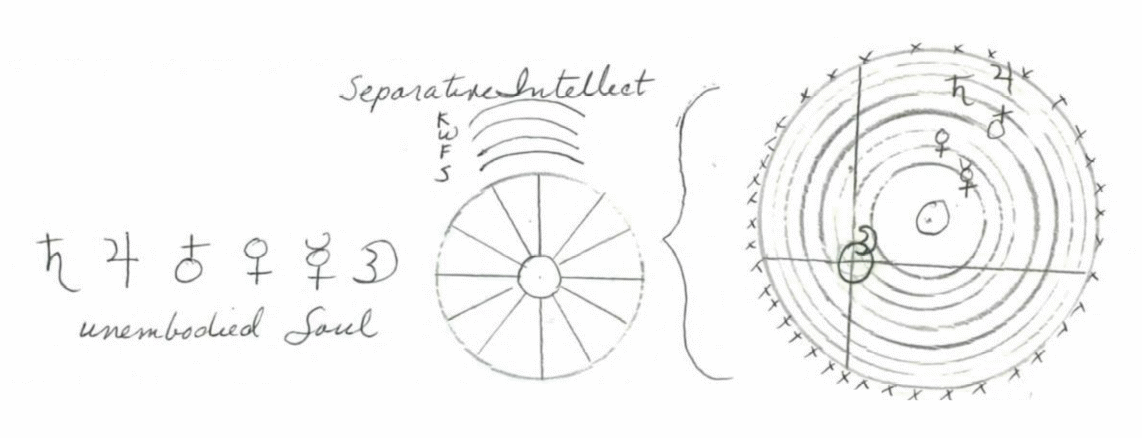
(Note: the Inerratic Sphere and down is a product of Soul. See III.4.6 on the subordination of forms.)
The Inerratic Sphere is the image of the Reason Principles in the eleventh house, which have been combined by the Separative Intellect (//// in Aquarius as K, W, F, S (knowing, willing, feeling, sensing) or the Pure Bhavas of Buddhi) in a fourfold structure corresponding to the R, E, D, and F [rulership, exaltation, detriment, fall] of the planets in the twelfth house. (These correlations do not go so far as the natal chart.) The Planetary Spheres are an image (image = imitation being) of the unembodied powers of the Soul; in this sense they are gnostic, both in themselves and as vehicles for the individual Soul's powers. In the same passage (II.3.9, second to last para) Plotinus speaks of the planets as also agents, and we are here interpreting that as their fabricative aspect in the production of bodies.
These powers are imparted by the Soul as a light (reason-bearing light) and inserted into the organized body, the two of which together compose the animate. The cosmic circuit is producing an organism which symbolizes or makes possible the exercise and expression of those powers which the Soul wants to exhibit in that incarnation, and in reference to the aspects, at that precise moment.
Within the Tropical Zodiac (see notes 11/5/81), the aura of the Earth, is the entire biological field. Here are the organized living systems out of which evolved, through instinctual responses, the psyche. Thus the psycho-somatic organism is located within this realm. The light of the Soul is inserted into this organized body, and a human being is born. The natal chart is the Earth's aspects at that moment of birth, the degrees are the images or tropes of the Earth's psyche. The individual entity thus participates in the Earth's psyche, the Earth's aspects, in that knowledge the Earth is experiencing. This is how knowledge comes into us. (What the Hindus call the Antahkarana, that which we function with, participates in that, and we can already point out the imaginary status of this Antakarana -- it dissolves when the body dissolves.)
So when the Soul wants to know something of the object that the cosmic circuit has produced, it does so through the medium of the animate. Normally the psyche is operating at the Earth level to reveal something of the object at the lowest levels of the divided line, sense and opinion. If we say an aspect is going on for the Earth and you participate in that, at that moment and only at that moment, the precise conditions for knowledge being there, the Soul illuminates or gets a revelation of the essence or Reason Principle underlying the object or the objective event. In other words, the animate becomes as a mirror and the Soul sees itself in that instant. For that moment the Soul is in direct contact with the planetary spheres, its powers are no longer bound to functioning with the animate, and it contacts the Reason Principle directly. So the aspects are as a channel for the Soul's knowledge.
In the dream analogy we first postulate the person having the dream as the reality. Then there is the dream scenario. Not until certain circumstances and events are so aligned or coordinated could the meaning which is in the dreaming person become present in the dream subject. So the wakeful person that you are penetrated into the dream and reveals to the dream subject what is really going on. How does he penetrate that? What is the medium? The light of the Soul shines all the way through into the subject and at the moment when there is a real recognition of what the object is, it is a moment that the animate is a mirror for the Soul. Let the aspect change and you are back in your primal ignorance.
When there is a significant aspect to a part there is some significance that is given to a perceptual image which it did not have before, there is a light being shed on it, a light which is coming from within you. The aspect in itself is only the possibility of the arisal of knowledge, it is not the knowledge itself. Insofar as the conditions of knowledge are prepared, the light can shine through and something significant arises. I can't say it is something coming from the cosmos because it's something arising within me. There could be a variety of meanings these images could have, why one meaning rather than another? It would have to be the peculiarity or the individuality of the Soul for whom that meaning is significant and the others not so. So we have to give it an interpretation from within. We are not asking how do I know a tree, but rather something profounder -- How does meaning come in?
So this reason-bearing light from within the Soul illuminates the objective image, but this is dependent on the moment of the aspect's occurrence, thus the cosmos is forcing your attention on that. Each planet has R, E, D, and F's [rulerships, exaltations, detriments, and falls], the four gnostic functions. Our Soul is being impressed with these gnostic functions of the planetary spheres, and gradually they are built up to an extent that we recognize we have these functions. In this way the potential is made actual in the embodied person. This is the pivotal point. The individual Soul conjoined with an organism. This organism participates in the aspects that the Earth has. This participation is the Antakarana which has the four functions of certitude, appropriation discriminative knowledge, and sensation. Jung also has four functions, and also Platonism. Over and over it comes up as a crucial point -- and we are beginning to see we are talking about the way we are participating in the Earth's knowledge, which is a constant process of informing the Soul. The movement of thought in the mind which is constantly going on is really a cosmic impulse. The next question is how is that actualized? Is it through the breathing-in process that a thought appears moment after moment?
Epistemology
Vedanta -- Methods of Knowledge and Indian Psychology
We are not examining the distinctions of the various schools, but how they explain perceptual knowledge. "The knower, the object known, the knowledge and the means to the knowledge are the manifestations of the same underlying consciousness." (Pure Intelligence) This is to say the Subjective Wisdom consciousness and the Nous are in identity in the Intellectual Principle. This is real knowledge. This is the extremist Vedanta view, which is not an epistemology. They explain knowledge thus and then talk of visual perception here. So there is a huge hiatus in their explanation. (Prasangika does the same thing.) Given knowledge in the Divine Mind, you have the whole problem of explaining not only the means by which there is brought about a split between the subject and the object, but all the intermediary steps in-between, and the way the unity which is in the Nous is revealed in the sensible.
The light of the Soul is conjoined with the psyche (the subtle organs) and that goes out and takes the form of the object, which is part of the cosmic production. This 'going out and taking the form of the object' is the vritti. So they are saying that the psyche has to be modified into the form of the object or the Soul can't know it. The Soul can't know the objects directly except through its own psyche. Because the mind or psyche takes the form of the object, now the ignorance that obscured the object is removed; namely, now there is a form of that object in your mind for you to know. The intelligence underlying the object, being manifested through the mental mode, illumines the object. We would say the intelligence underlying the object is the reason principles that have gone to constitute that object, and now those reason principles shine through the object.
When they say that the subject consciousness through a vritti contacts the object, the depth of penetration here is all important. If it penetrated just one level of the object it is sensible knowledge; if it penetrated another level you get to the actual sensible object, the reason principle behind it. So what we are saying is when the Subject consciousness penetrated into the object consciousness and the substratum of the intelligence of that object is shining through, then you know the immaterial reason principle of the object (which is beyond the twelfth house). So they are speaking of Divine Knowledge.
Question: What in the mind's grasping of the object is material?
We start with the mahabhutas; you penetrate deeper in you knowledge in the tanmatras, then what constitutes the individuality of the object, then deeper into the Subjective Conception, then what Tattvas are involved in formulating that object, and even deeper you get to formless matter itself. Finally you get to the Ideas that are informing that formless matter and guiding its manifestation all the way to a sensible object. These are the levels that determine knowledge. So when someone asks for proof of what you're saying you have to establish the scale of perception, what does he consider proof? What is the tree, the intelligible tree or the sensible tree? Plotinus doesn't discard the sensible and say its illusory, but that it is less real; he searches for what the tree really is. Until you get back to the Idea in the Nous you don't have knowledge of what the tree really is.
Question: What is this veil of ignorance? Does this correspond to a coarser level of matter that must be penetrated in order to grasp the reason principle?
That is part of it, the other part would be that insofar as you have two centers of consciousness encapsulated (in the sense they are restricted by what encircles them) then you could say that between these two there would be a veil of ignorance or more simply, an interval between these two. What connects these two would have to be some modalization of the knower's mind. The more subtly attenuated the mind, the deeper it can penetrated into what the object is. All these levels or grades are left out in their explanation. If we approach it in this way we can appreciate the differences of man's knowledge.
If we take the example of the Buddhist Logicians who speak of direct and indirect knowledge -- indirect knowledge would consist of the images of the Earth's generic mentality (tropical zodiac). Direct knowledge would be the knowledge of the reason principles that constitute the object independent of the images that you form of that object. This would be without the intermediary of the animate. So too, the Platonists say that true reason must operate without images. So the animate is necessary for sense perception, but not for perception by reason. (A satori itself cannot be historically located -- all we can locate is the incident of that happening to a particular space/time creature.)
The Scholastics speak of the concept in the thing, the concept in the mind, and the concept in itself. The concept or universal or essence in the thing is the reason principle constituting the actual object. The universal in the mind would be the form in the individual psyche. The universal in itself would be the reason principle which gets bifurcated as the idea in the object and the idea in the subject's psyche. This is what the Sautrantikas call pure perception. At the level of the planetary spheres you have a pure perception of the universal in itself. Insofar as the cosmocrators have fabricated the object, the reason principle is in the thing. The Scholastics say that nothing is in the mind that is not first in the senses. So all the ideas in the mind are derived from the essences which constitute the object.
Plotinus IV.4.23 -- The reason principles in the inerratic sphere which have produced those bodies and now those bodies are producing some object (the elemental, the organization of the elements on Earth) that is the external object. What elemental medium could be both the object known and the subject knowing the object? This would have to be the animate. What constitutes the Earth psyche or the tropical zodiac would be the common medium. That can be modified and receive modifications. An object that is the product of the animate is produced by the aspects going on.
Prior to experience in the cosmos, the soul only has Intellectual knowledge, knowledge of the Ideas or the Forms. But in the end this becomes a determinate perception through a modification of the animate. The first thing the soul would know of an object is that it is (isness is a form), then that it is a living form. In order for it to know that sensible man there must be the animate which could take the impressions. If the immaterial knowledge is present with the sensible object then you can say that both indeterminate and determinate perception are both taking place simultaneously.
[File 1981 1211S1-07R14.PDF Ends]
DIAGRAM FOR 1981 1211
Class
Friday, December 11th, 1981
Verbatim, unedited transcriptCLASS at Wisdom's Goldenrod, Hector NY
with Anthony Damiani (AD)
December 11, 1981
EPISTEMOLOGY; ASTROLOGY THEORY
with Appendix: 1981 1211 Partial Transcript.
TOPIC: Epistemology
SUBJECT: Astrology Theory
SUBSUBJECTS: Vedantic Epistemology, Plotinian Epistemology, Buddhist Logicians, Scholastic Epistemology, Soul Powers, Tropical Zodiac, Animate, Gnostic and Fabricative, Aspects, Arabic Parts
CONTENTS:
Soul's powers require a body capable of expressing them (90 IQ/damaged brain examples)
Body fabricated by the cosmic circuit; soul's light imparted to and operating through it
Plotinus V.3.6 — which part of the soul is taught?; the dianoetic/rational part — developing rationality as the immediate step
Laying the astrological framework before epistemology
Structure: sidereal zodiac → planetary spheres → tropical zodiac → Earth creatures
Tropical zodiac as Earth's aura; as greater personal equation interfering with perception of reality
The greatest knowledge already given to mankind; discovery as rediscovery
Participation in the Earth's knowledge
Vedantic epistemology I — the underlying consciousness (Satprakashananda, Methods of Knowledge); identity in the Nous defines true knowledge but is no epistemology
Core difficulty (Vedanta and Prasangika): explaining the via media — the split between subject and object, how the unity in the Nous is revealed in the sensible
Vedantic epistemology II — the five steps of visual perception
AS's diagrammatic translation: light of the soul conjoined with the psyche, taking the object's form; underlying intelligence = the reason-principles constituting the object
Depth of penetration determines level of knowledge — sensible → reason-principles; true divine knowledge penetrating beyond the inerratic sphere to immaterial reason-principles themselves
Critique of the Vedantic account: formulas as clichés; twelfth-century dogma unhelpful in 1981; Plato's intermediate realm between divine knowledge and shadow-perception left unaccounted for
Student question — what corresponds to the material element in the Vedantic account?
Levels of penetration; proof requires establishing a scale of perception
Plotinus's tree (via Deck): sensible tree less real, not illusory; search for the Idea in the Nous
Veil = coarser matter plus interval between two encapsulated centers of consciousness
Vedanta Paribhasa tank-and-canal analogy; subtler mind penetrates deeper
Reducing all back to the Nous ≠ an epistemology; Prasangika's refusal to offer one
"Intelligence" preferred over "consciousness" (PB's recommendation)
Under an aspect, precise conditions of knowledge → the soul gets a revelation; the moment becomes a mirror, the soul sees itself
Real open channels = the planetary spheres/aspects, not the tank metaphor
Plotinian epistemology I — I.1.7 and the animate
AS's mapping: organized body + light of the soul = the animate; parallel to Vedanta's "mind conjoined with the organ of vision"
Individual psyche as part of the Earth's psyche, continually modified by the cosmic circuit
Plotinus's threefold distinction: soul per se (powers) / light given off (images of soul powers) / organized body (vehicle)
Dream parallel: without the soul's light, no dream subject — no dream at all
Student question — what is the precise relationship between subjective reason-principles (meaning from within) and objective structuring forces (transits)?
Arabic Parts research: planet hits a part → the ordinary perceptual scene suddenly "lit up" — meaning illuminated from within by the light streaming out under the aspect
Böhme's pewter illumination — light from within illuminating the perception
Image-bearing light → reason-bearing light
Animate as biological field; feelings from living systems vs. the soul's interpretation via reason-principles
Dream analogy pressed
Buddhist Logicians — direct vs. indirect knowledge
Indirect knowledge: images, the Earth's evolved generic mentality (tropical zodiac); direct knowledge: reason-principles without images or animate
PB's "intuition" impersonalized: the light going through the animate, arriving as a feeling
Gnostic faculties at different levels; faculties arise from different levels of reality but operate here and now
144 parts = 144 fixed images; aspect to a part sheds new significance on a perceptual image; aspect is only the possibility of the arisal of knowledge, not the knowledge itself
The real epistemological question: not "how do I know a tree" but "how does meaning come in?"
Student question on I.1.7; the faculty of perception cannot act until embodied in the animate
Plotinian epistemology II — IV.4.23, the intermediary
The intermediate: assumes the object's modifications, midway between sense and intellectual, akin to both knower and known
Common denominator of subject and object: the animate — Earth's psyche/tropical zodiac as the common stuff of every object
Indeterminate to determinate perception: soul self-centered knows only Ideas/pure Forms; detail requires the intermediary — parallel to the vritti
What the soul first knows: that the object is (isness as form), then that it is a living form — not the sensible detail; this is not mentalism
Immaterial knowledge present with the sensible object → both perceptions at once
Appendix: Partial Transcript
Astrological framework for epistemology
Epistemology by school
BOOKS READ FROM OR REFERENCED:
Plotinus, The Enneads (MacKenna translation, 4th ed.)
Swami Satprakashananda, Methods of Knowledge: Perceptual, Non-Perceptual and Transcendental According to Advaita Vedanta
Jadunath Sinha, Indian Psychology: Cognition
John N. Deck, Nature, Contemplation, and the One: A Study in the Philosophy of Plotinus
Dharmaraja Adhvarindra, Vedanta Paribhasa
Thomas Taylor, "Introduction to the Timaeus" (Vol. 2), in The Works of Plato, viz. His Fifty-Five Dialogues, and Twelve Epistles
PLOTINUS QUOTES READ OR REFERENCED: I.1.7, II.3.9, III.4.6, IV.4.23, V.3.6
DIAGRAMS appended to this transcript:
FIGURE 1981 1211-1. Unembodied Soul, Sun in Aquarius with Separative Intellect, and Three Levels of the Cosmos.
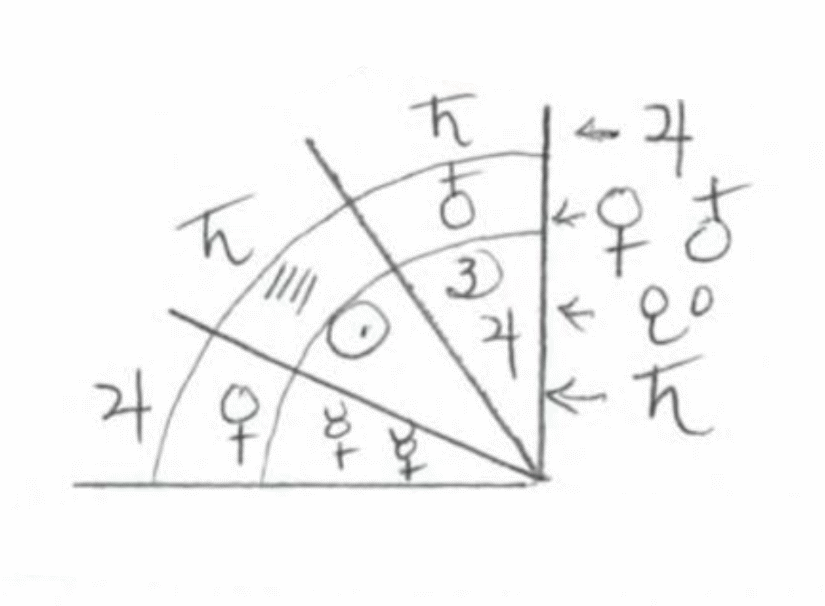
FIGURE 1981 1211-2. Universal Soul and Fourth Quadrant Dignities.
Other diagrams also referred to (not with this transcript version) [Transcriber note: [diagram] means the speaker is referencing a diagram as he or she is speaking. If someone is drawing or writing, with audible sounds of chalk on a blackboard, I indicate this by [drawing] or [writing].]
NOTES:
A partial transcript of this class exists (Scan File 1981 1211S1-07R14). It includes a diagram and contains no AD edits. The transcript takes the form of a summary rather than a verbatim, chronological record. Because the audio for the beginning and end of the class is missing, the entire partial transcript, including the diagram, is appended here for the sake of completeness. Spelling and punctuation have been corrected throughout, and all numbers spelled out.
This event is among those in later 1981/early 1982 when Anthony was exploring Astrology/the Zodiacs, Cosmology, Physics, Astronomy, Soul, Nature, and The Grid: Gnostic and Fabricative.
TRANSCRIBED Verbatim by IT 2026. Archival verbatim transcript – V11a.
AUDIO FILES: 1981 1211a (formerly 1981 1211b), 1981 1211b (formerly 1981 1211a). [Note: We are missing audio for the beginning and end of this class.]
1981 12/11 at Wisdom's Goldenrod
Epistemology; Astrology Theory
[Audio File 1981 1211a (formerly 1981 1211b) Begins]
[Note: See FIGURE 1981 1211-1 for the following.]
AD: When I really know I know nothing then I know I should see it. But, [AS simultaneously: Well, if you-- looks like you--] the question, the ques-- when you ask a question it's going to demand that you formulate your understanding. That's why I consider questions important. It means that you have to formulate what you understand about these things. So don't be-- Go right ahead, no, please, let me continue. We're-- you say that-- from what I understood that, let's say the powers here [unembodied soul], let's say you've got a [writing] 90 IQ, ok. And, you got to have a body that can express that 90 IQ. (laughter)
AS: [few words inaudible]
AD: I mean they can't-- If you imagine a soul trying to express itself, and let's say it gets a body that has a-- a damaged brain, you know, or something that-- it's not going to work. Then that body is not going to give expression to these powers which the soul wants to first of all op-- make operational, actually, you know, use. So, when you see a person-- when you see a person here for instance with tremendous powers of memory or thinking or something, you know that he's expressing something from the soul [unembodied soul]. That's what you're looking at. That's what you're dealing with. But that has to be inserted into a body, that has to be a light [planetary spheres] imparted to the body [sublunary] and functioning through that body. What we're saying is that body is fabricated by the cosmic circuit [planetary spheres]. Then when that body's fabricated, let's say that that light is imparted to that body. And that light must operate through that body. That's all we're saying. But the body has got to be in some way appropriate enough for this to operate through it. Now, there could be another way of looking at it is that the body-- I'm sorry, that the soul is involved in the production of the body the same time that the cosmic soul is doing it too, but I don't think that's-- that's important right now because even Plotinus points out, you know, that we're, so to speak, inserted into the cosmic act-- cosmic circuit and from there on we take over operation over a body or the rule over a body or the sub-- submission to a body.
S: Tony?
AD: Go ahead.
S: When Plotinus says, the quote about "Our way is to teach our Soul how the Intellectual-Principle exercises self-vision," that one, in that quote, is he implying that the soul does not completely know itself until it manifests itself through the body, that there's not a complete self-knowledge until it gains knowledge in all-- in-- in all realms, not only its own realm so it would have to manifest through the-- through the body and know itself that way in that realm too, or more consciously. And is that the right idea?
AD: Yeah but, what would be the Intellect here? I mean, what part of the soul is being taught in the quotation?
S: It would be [one word inaudible]
AD (simultaneously): It was to teach our soul.
S: Well, I think it would be the soul in the-- in that realm over there on the right [diagram]. Doesn't seem like it would be the-- the soul-- the-- I'm not-- I don't know.
LR: Well, you have to read the rest of the quote then.
S: I'm not sure.
AD: Yeah, but you can't work with partial memory here.
S (very faint): [couple words inaudible] [student assents, very faint] maybe.
AD: It won't help to work with fragments of your memory.
[short pause]
SS: He calls it the Intellectual soul.
S: Yeah.
AD: Yeah. Would you read it? Because they're not going to read it, they're just going to, you know, get images.
Plotinus [V.3.6, AS reading]: "Our way is to teach our Soul how the Intellectual-Principle exercises self-vision; the phase thus [AS reads: phase that is] to be taught is that which already touches the intellective order, that which we call the understanding or intelligent Soul, indicating by the very name (dia-noia) that it is already of itself in some degree an Intellectual-Principle or that it holds its peculiar power through and from that Principle."
AD: Now what part of the soul would you be teaching? Come on Linda, you had the right answer a long time ago.
LR: What was it? (laughter)
AD: He says the dianoetic part of our soul.
RG: Rational.
AD: Huh?
RG: Rational part.
AD: Yeah, the rational part. So the immediate step ahead for all of us would be to develop our rationality, and that that shouldn't take more than a thousand lives to develop. (student laughs)
S: Yeah. (AS laughs)
[AD drawing/writing]
VM: And some time (below that).
AD: Here we are.
VM (simultaneously): [couple words inaudible] notation, you save a lot of zeros that way.
AD: Yeah, that's why I like it, I like that idea, I'm going to copy it.
S: Yeah.
VM: What I like is you did it in a very original way, most people write 1010 and they're satisfied with that. But to write (as--) to write 103 is equivalent to 1030 which is fine.
AD: Well that gives you a feeling that you're eternal.
S (faint): Yeah but, it's not quite eternal [couple words inaudible]
VM: I'd like to ask an epistemological question.
AD: Yeah, well I want to get into that but the reason I wanted to put off just for a few minutes the epistemology because what I hope to do is examine the Platonic epistemology, Vedantic epistemology, [VM: Good.] you know, one at a time. But, what I'm trying to do is lay the framework in which this epistemology can be spoken of now. Now, we're all the way down to the twelfth house [on right], we're right into the sublunar realm, alright. We know that [drawing] we have well-- Let's put them over here [diagram], alright, the degree symbols, alright, which we can-- we can think of that when they get triggered off, alright, certain meanings become operative in us which weren't before. So I want to lay everything out in the twelfth house. Over here we said this is the sidereal zodiac [outermost circle on right]. Over here we have the planetary spheres, ok. Then surrounding the Earth, alright, we have the tropical zodiac [Moon], alright. And then on the Earth we have creatures growing up from the Earth. These creatures that are fabricated from the very, let's say, unconscious of the Earth, (and we want) the traces of memory of all the lives that have gone before, alright, have to operate within that tropical zodiac. They are creatures made by it. They're produced from it and they dissolve back into it so that this here is kind of important to me.
Now, I may be imagining all this but even at the level of an ordinary human being, alright, when I get close enough to Dickie, for instance, I'm going to get his aura interfused with my aura. That-- that's primary, before I even communicate, talk to him. That has already set up, you know, a kind of way of relating to each other of which we may both be unconscious. Let me say he'll be unconscious. (laughter) But it's-- it's immediately operative, and we all have to operate through that. Or let me give this example. We say the soul goes into a body and this body is its immediate environment, it must operate through that. Alright, I'm saying this [Moon, tropical zodiac] is [drawing] its immediate environment and the Earth must operate through that.
Now it doesn't mean that the Earth is unaware of what it's doing, far from it. It could-- it could very well have a-- you know, a sufficient knowledge. And that's why to some extent even in terms of your science I'm a little skeptical that, you know-- They speak about making allowances for the personal equation, I wonder if they know what and how far that extends, that personal equation. You know, is it possible that your black hole is somewhere over here [Earth/Moon] and not out there? (bit of laughter) I'm not saying that it's so but I'm-- I'll find a black hole up here [diagram]. (laughter) I'll buy it, I'll buy it. But, I think that the same way they discovered that the personal equation interferes with our perception of reality that there is another and a greater personal equation which interferes with it.
VM: Yes I-- you can say all of science is a playing out of the personal equation of man, of the tropical zodiac.
AD: Right. Yeah, until I begin to realize that.
S (faint): Ok well--
AD: Alright now, if we located all the [one word inaudible] here, so we say-- if we say for instance there is [drawing] a square or whatever, a triangle, you know, in between Jupiter and Mercury, alright, then what we're saying in effect is that this here, this trine-- doesn't look like a trine-- alright, is the Earth's knowledge of what's going on. We participate in that.
S (faint): [one/two words inaudible]
VM: (Just think), like most people talk so much about the Copernican revolution and all that business. At a certain level--
AD (simultaneously): They don't know a real revolution if it came over and bit them in the teeth.
VM: No, no at a certain level (laughter) it doesn't matter-- it doesn't matter whether you talk about the Sun-centered solar system or Earth-centered. Still, insofar as the playing out of, let's say, the structures in the sidereal-- in the tropical zodiac, it's all anthropocentric, I mean [AD simultaneously: Yeah, yeah.] it's all man spinning out his own structure.
AD (simultaneously): But-- but that wasn't-- that wasn't meant humorously. I say that [VM simultaneously: No.] the greatest revolutions have already been given to mankind a long time ago. When they discover it then they think it's a great revolution. They're speaking about themselves but all the greatest knowledge has already been thrown there, it's all there. It's we who have to find it. When we find it we think that it's a great discovery. But it's been there all along. And I mean that, the greatest knowledge has already been given to mankind. All you have to do is study some texts and you begin to realize how infantile mankind still is in regard to that knowledge.
But, here's the point we want to get to. We're getting to this point here where we say there's [drawing] a creature here living on the surface of the Earth. The Earth has a Jupiter trine Mercury, alright. They're in the sky. We are participating in that knowledge which the Earth, so to speak, is experiencing. That's the important point. Your chart is, so to speak, hooked into the chart of the Earth, alright, and you're relating to that. This is how you know. So that when there is an aspect going on, you say some sort of knowledge arises, a piece of knowledge becomes available to you. Now what we're going to do is taking off from that, we're going to try to examine each of the epistemologies and put it in the context or a-- Let me put it this way. I think we can understand what they're saying if we keep this as a background. And-- and their abstractness disappears. They're-- it-- it is very clear what they're talking about and what they're saying. So we could take each one of the schools, alright, we could take each one of the schools and do that-- and work it out and see what their epistemology is. So, do you have any preferences or should we try to start with an easy one to get the ball rolling?
VM: Start easier one.
AD: Avery? It's too late to make notes now.
AS: No I-- yeah, uh-hm.
AD: Besides--
AS (faint): Enough about [couple words inaudible] essay.
AD: Come on. Or was it this one here, which one do you want to do? I don't care which Vedantic text you take.
S (faint): Start with this one here because it's special.
[couple seconds of faint background student talking]
AS (faint): This-- I think this one's the easy one.
AD: Alright, give the easier one.
AS/S(?): Besides [few words inaudible]
AD: Now you have to recall-- you have to recall what you learned about the Vedantic epistemology, try to recall it. It's really-- I can understand that they're tongue-twisters and they're words that could mislead but I think that the diagram will be able to understand each one of these school in terms-- good.
AS: Tim-- And this-- this is in Satprakashananda's Methods of Knowledge According to the Vedanta. Or from Sinha, Indian Psychology: Cognition.
AD (very faint): Let me see that.
AS: Doesn't matter very much I think. Since we're not examining the distinctions of the various schools, just the main way that they talk about the perceptual knowledge. But this is on perceptual knowledge. He says, "The whole…" You want-- you want that line first about the underlying--
AD: Yes, yes, yeah. Gabriel around?
TS (faint): Yeah.
AS: Says--
[Transcriber note: I am using Swami Satprakashananda, Methods of Knowledge, Perceptual, Non-perceptual, and Transcendental according to Advaita Vedanta (Calcutta: Advaita Ashrama, 1974).]
Swami Satprakashananda [Methods of Knowledge, "Perceptual Knowledge," pp. 101-102, AS reading]: "The following remark of Madhusudana…sums up the cognitive process of external perception: 'It is the consciousness underlying the object which being manifest and related to the jiva (the percipient) by the mental mode manifests the object to him.'
"8. The knower [(pramata)], the object known [(prameya)], the knowledge [(pramiti)], and its means [AS reads: and the means to the knowledge] [(pramana)] are the manifestations of the same underlying Consciousness."
AD: Would you repeat that last sentence so that they--
Swami Satprakashananda [Methods of Knowledge, "Perceptual Knowledge," p. 102, AS reading]: "8. The knower [(pramata)], [S: Yeah.] the object known [(prameya)], the knowledge [(pramiti)], and its means [AS reads: and the means to the knowledge] [(pramana)] are the manifestations of the same underlying Consciousness."
AD: Let's say pure intelligence. [short pause] Ok?
S (faint): That pure intelligence.
AS: Uh-hm.
AD: Now pick it up from there Avery, how would you go about that? That sentence there.
AS: That sentence, I mean-- So he's back in saying that the subjective wisdom-consciousness and the Nous are identical, in identity back in the Intellectual-Principle, for example. The same [AD: Do you follow the--] pure Intelligence.
AD: You follow what he's doing?
AS: And that-- that's the extremist Vedantist views. But--
LR (simultaneously): And that's no explanation of epistemology.
AS: Well-- yeah, no [AD simultaneously: Precisely.] that's saying this is what knowledge is, now we'll talk about visual perception. [student assents] Now that we've defined what true knowledge is, the conjunction of the subjective-con-- wisdom-consciousness with the Nous or pure Intelligence, now we'll talk about perception or vrittis of things. But that's all after the fact.
AD: So if you think of the Saturn in the Nous or the cognitive-isness in the Nous, alright, there you have real knowledge, true knowledge. There the subject, the object, the means of relationship, so to speak, are all manifestations of the Nous. That's fine. Prasangika does the same thing. Ok. How about the problem down here? See? And their major difficulty, and this I think applies to the-- to the two big schools, Vedanta and the Prasangika, is that given-- given knowledge in the Divine Mind, you got the whole problem of explaining not only the via media, the means by which there is brought about a split between the object and the subject, all the intermediary steps in between (them), and the re-- the way, the way that unity which is in the Nous is revealed in the sensible. Now, I want you to listen to this very carefully and you tell me if this is an epistemological explanation or just something that they, so to speak, you know, carry on for about a thousand, two thousands years [one/two words inaudible] about, yeah. About a thousand years. You tell me if that's an explanation. [9¼ second pause] Go ahead, Avery.
AS: So all of these are manifestations of the same underlying Consciousness. That's this-- the section heading. And then he's-- then--
Swami Satprakashananda [Methods of Knowledge, "Perceptual Knowledge," p. 102, AS reading]: "…are the [AS reads: all] manifestations of the same underlying Consciousness.
"Thus…" (AS laughs a bit)
AD: "Thus"--isn't that cute.
Swami Satprakashananda [Methods of Knowledge, "Perceptual Knowledge," p. 102, AS reading]: "Thus the whole process of visual perception consists of the following steps:
"[AS adds: Step] (1)…"
AS: But then he's got-- [someone drawing/writing] Mind goes out.
S: [couple words inaudible]
AD: Go ahead, [AS: "(1)…"] Vic, read it.
Swami Satprakashananda [Methods of Knowledge, "Perceptual Knowledge," p. 102, AS reading]: "The mind conjoined with the…"
AS: Let me read them all.
Swami Satprakashananda [Methods of Knowledge, "Perceptual Knowledge," p. 102, AS reading]: "The mind conjoined with the organ of vision reaches out to the object and coincides with it."
AS: Or envelops it or takes its form or any of those ways.
Swami Satprakashananda [Methods of Knowledge, "Perceptual Knowledge," p. 102, AS reading]: "[(2)] The mental mode [AS: of this mind] removes the veil…"
AS: Or effects some kind of conjunction.
Swami Satprakashananda [Methods of Knowledge, "Perceptual Knowledge," p. 102, AS reading]: "…removes the veil…that hides the object from the percipient."
AS: Taking this form.
Swami Satprakashananda [Methods of Knowledge, "Perceptual Knowledge," p. 102, AS reading]: "(3) [AS reads: Third.] [AS adds: The] Consciousness [AS emphasizes following word] underlying the object, being manifest through the [AS reads: this] mental mode, illumines the object.
"(4) The mental mode associates the object-consciousness with the subject-consciousness. [AS rereads:"The mental mode associates object-consciousness [someone drawing/writing] with the subject-consciousness."]
"(5) The subject perceives the object."
S (faint): Would you read this over again, it's--
S: The whole thing.
AD (simultaneously): [few words inaudible] let's try.
AS: What?
VM: Maybe you could do them all again Avery, just [couple inaudible AS words simultaneous with VM] read through all of them.
Swami Satprakashananda [Methods of Knowledge, "Perceptual Knowledge," p. 102, AS reading]: "(1) The mind conjoined with the organ of vision reaches out to the object and coincides with it.
"(2) The mental mode removes the veil (the darkness of ajnana) [AS reads: (of darkness)] that hides the object from the percipient.
"(3) Consciousness underlying the object, being manifest through the mental mode, illumines the
object.
"(4) The mental mode associates [the] object-consciousness with [the] subject-consciousness.
"[AS adds: And] (5) The subject perceives the object."
[short pause]
AS: Or (added/add it) to the question, (come in).
AD: I see you're tired?
AS: Hm? Am I tired?
S (very faint): Yeah.
S: You're never tired.
S (faint): Save the energy.
AS: But, he's a [one word inaudible]
S (faint): Yeah, I just got lost-- I got lost in definition of the mental mode and how it--
AS: Ok. Now we'll try and explain it.
AD (simultaneously): Well think of it as a thought.
AS: A mental mode is psyche-- you know, is a thought, psyche, the individual mind.
S: Ok well I'll listen [AS simultaneously: No go ahead.] to your explanation and then (if you have) [one word inaudible]
AS: Mental mode? A thought, a mi-- you know, a thought-- thought about something.
S (faint): Ok. Ok.
AS: In the picture here, remember we have this cos-- this whole [drawing] cosmic circuit [planetary spheres], and in here you have the Earth. Ok?
S: Uh-hm.
AS: And all these modifications of this cosmic circuit are producing some object and of course also you, your psychosomatic organism.
S: Uh-hm.
AS: And you have a psychosomatic organism which your soul is going to, well, work through.
S: Uh-hm.
AS: Inhabit. Plotinus says too the soul gets identified with this vehicle, with a psychosomatic organism, a mind and a body, a psyche and a body. [Note: See Plotinus, I.1.7, IV.4.23.] And there's the soul. So we got the soul, subjective soul [unembodied soul], we got-- he's got a psyche and a body, and there are other objects also produced by this cosmic circuit, ok, you got all these other things there too. It's not a mentalistic framework we're working with. So, he wants to get to know about this object. The soul, his soul, wants to know about this object, which is a production of this cosmic intelligence which has produced it. [student assents, faint] And his psyche, [drawing] ok, is participating in this cosmic production. So he says--
Swami Satprakashananda [Methods of Knowledge, "Perceptual Knowledge," p. 102, AS reading]: "The [AS emphasizes following word] mind conjoined with the organ of vision reaches out to the object and coincides with it.
AS: So you could say your psyche--
AD: I-- the term you used was the light of the soul.
AS (simultaneously): The light of the soul, yeah. The light of the soul is conjoined with your psyche, your subtle organs of vision and so on, and that goes out and takes the form of this other object which is part of that whole cosmic production.
VM: But Avery, isn't that going out and taking the form vritti itself in a way?
AS: Exactly, yeah.
VM: So it's funny that they should say then they speak about the vritti. [student assents] I mean it seems like the whole going out process and the vritti are indistinguishable, if not the same--
S: Is a vritti the mental mode there?
AS: The vritti is the form.
VM (simultaneously): Yeah, the vritti-- mental disturbance that we call thought.
S: I think [AS simultaneously: The whole--] that's where I got confused.
AS: Well, ok, we--
S: No, keep [AS simultaneously: We'll do it.] going [few words inaudible]
BS (simultaneously): Or does a vritti refer to a certain level of knowledge within this?
AS: Well let's wait and we'll see I think. The vritti means a modification. Plotinus says the animate gets modified. [Note: See Plotinus, IV.4.23.] These guys say your psyche-- your psyche has to be modified into the form of the object or your soul won't know it. Your soul can't directly-- he's saying your subjective soul can't directly know [drawing] these other objects except through its own psyche. So the soul sends out a light. The light from the soul gets conjoined. That's this mind. The mind conjoined with the organ of vision I was reading as the light from the soul conjoined with the soul's psyche reaches out to the object and envelops it, coincides with it. Now, that's ok [drawing] because they're both part of the same living organism here, the Earth entity.
Swami Satprakashananda [Methods of Knowledge, "Perceptual Knowledge," p. 102, AS reading]: "[(2)] The mental mode removes the veil (the darkness of ajnana) [AS reads: the veil of ignorance] that hides the object from the percipient."
AS: Namely [AD, faint: Or--] because--
AD: Or connects you with the object.
AS (simultaneously): Yeah. Because your mind or your psyche takes the form of that object, now the ignorance that it obscured the object is removed. Namely now there's a form of that object in your mind. Your mind coincides with the object and so there's a form there for you to know.
S: Avery? Sc-- so then the first and second step are actually the same.
AS: The fir-- they're pretty close.
AD: They're not steps, it's just-- it's going through--
AS (simultaneously): They're just--
S: They--
AD (simultaneously, faint): They're going [AS simultaneously: Yeah.] the process.
AS: Yeah I mean--
AD: Goes on in a flash.
AS: Goes on pretty-- pretty quickly. So anyway now your psyche with the light of the soul is conjoined with the object, whatever that object is, it's taken the form of it. Now--
Swami Satprakashananda [Methods of Knowledge, "Perceptual Knowledge," p. 102, AS reading]: "[(3)] [AS adds: The] Consciousness underlying the object, [AS: Or say the intelligence underlying the object.] being manifest through the mental mode, illumines the object."
AS: Now, I think we would say that the intelligence underlying the object is the reason-principles that have gone to constitute that object. And now those shine right through that object, ok. There's actually some intelligibility to that object.
S: But--
S: Does the object come from the underlying consciousness or is it-- (it is definite) character come from the psyche?
AS: Well, I thi-- I think whereas in this-- in this view-- see they're not really explicit about that but here I think we're saying, the production of all this cosmic circuit, the whole cosmocrators is producing this object. And what it's-- what is underlying that object, what it's producing it out of if you want, you say is certain combination of these reason-principles or sidereal forces, this intelligence [outermost circle on right].
AD: Let's try to go back. Will you excuse me for a minute?
AS: Oh yeah.
[Note: See FIGURE 1981 1211-2 for the following.]
AD: Let's try to go back to the difficulties, alright. Just momentarily. You remember we said if we think of this as the tenth house, [drawing/writing] and we have the Saturn, Mars, Moon, and Jupiter, and this represented tanmatra [Jupiter], ahamkara [Moon], buddhi linga [Mars], and prakriti [Saturn]. So that you have the seven prakritis right here [Saturn in Capricorn]. And we said that the Jupiter, Mars, and Venus, [AS: Tail.] Tail, [AS: Right.] and Saturn [third quadrant rulerships and exaltations], that this was, so to speak, this kind of relationship going on here, like for instance, the Subjective Conception of the Universe [ruled by Mars in Scorpio] and the 36 Tattvas [ruled by Venus in Libra], these were organizing the matter to become this matter of an individual [Mars in Capricorn], whether it's an individual object or an individual subject, it doesn't matter. And-- in other words we said that the highest part of the soul or Providence informed or tentatively made a sketch of the universe to be in the matter, alright. And then we pointed out, over here you had the reason-principles, [drawing] the twelve reason-principles [in eleventh house; see FIGURE 1981 1211-1, circle with twelve house divisions], alright. These by themselves, the reason-principles combined with the matter, gives you the form and the matter, and over here you have the-- the object produced. Now, when they say that the subject-consciousness through a vritti or a mode contacts the object, and the depth of penetration is all important here because that would give us the idea of how far your knowledge has penetrated. If it penetrates just one level of the object you can say it's the sensible, if it penetrates another you can say you're getting to the actual sensible object, the reason-principles behind it, alright. But, then I would have to extend this because these two are combined. So what we're saying is that when the subject-consciousness penetrates into the object-consciousness and the substratum of the intelligence of that object is shining through, then you'll [drawing] know the reason-principles of the object. This is what they're talking about. They're talking about divine knowledge. Anything else is going to be a caricature.
AS (simultaneously): Yeah. ('Cause) symbolically in-- if you stay in the twelfth house picture you could say these reason-principles are in the inerratic sphere, ok, the-- [AD: Yeah.] the sidereal.
AD: But in way, in a way-- I'm not-- I'm not sure here, I'm jumping, but in a way I would say that, if you got to the truth-- if we conceived of the inerratic sphere like field forces, you know, which are universal, pervasive, you know, and all that, alright, I think, I think that the true divine knowledge goes even beyond that, penetrates into the [AS: Oh.] actual reason-principles [AS simultaneously: Yeah. No I would say--] themselves which are immaterial. [AS assents] So, that will be the substratum that your-- the subject-consciousness comes into contact with, and then there's a case of true knowing. But the way they present it here, I don't know what they're talking about. So you have to forgive me for editing them a little bit. Go ahead.
S: Yeah.
AD: I don't know what you remembered of Vedanta, you studied it for a while. When you read this here does it-- this explanation, does it follow, does it make any sense?
VM (faint): It's like just slogans or--
AD: Yeah, they amounted to clichés. And what we're saying is that this is 1981 and the repetition of formulas and dogmas of the twelfth century don't help us. They may be true, and they may be true for the people then--but they don't help us.
LR: So aren't you saying that the-- that the knowledge they discover isn't empirical knowledge?
AD: Well, [LR: What we know of--] if there's an identity between the subject-consciousness and the object-consciousness, doesn't that take you right back here [Saturn in Leo/Intellectual-Principle]?
LR: Yeah. So it's not--
AD: But in between-- wait. In between, there's not only this kind of knowledge, but there's also that whole realm that Plato speaks about between the so-called divine knowledge and the so-called perception of shadow, you have this whole realm of knowledge, what do we do with that? So what we're saying is that the account has to really be fortified and amplified somewhat and, you know, illustrated, try to illumine what they're saying instead of just having these formulas. Now I know he's a Swami and he-- he's reciting what he's been handed down and what they've been handed down and down, you know. I mean, I just stop. I say no, I don't want it. I don't know what you're talking about. And if I spoke to this person in person, and I've done that with some people, I'll get the same things. I told you my experience with these people, over and over again they give me-- And I tell them, "Look, I read the book the same way you did, can you tell me what you mean?" And out comes again the parrot. Go ahead, Dave.
DB: In their description of the epistemological situation, what-- what corresponds to the material element in-- in their analysis? Would it be the veil or would that be what they consider--
AD: What corresponds to the--
DB: Well, I mean, if the world that we live in is a combination of form and matter, they speak of an object and then they speak of the consciousness or intelligence underlying that object. But, what there corresponds to the material aspect? The fact that it's project--
AD (simultaneously): What there, I mean--
DB: Well, given what they present as given, you know, insofar as the mind is going to go out and grasp something, what in that something is material?
AD: Well, as I pointed out over there you'd start off with the lowest level, the Mahabhutas, and work right away through. You penetrate deeper in your knowledge to the tanmatra [Jupiter in Capricorn]. [DB: Right.] Penetrate deeper into what constitutes the individuality of this object [Moon in Capricorn]. [DB: Ok.] You penetrate deeper, you get into what the Subjective Conception and what tattvas are involved in formulating that object [Mars in Capricorn], you get-- you get even deeper you get to formless matter itself [Saturn in Capricorn].
DB: Well, so then, when you speak of getting deeper--
AD: And if you get deeper then you'll find out the Ideas that are informing that formless matter and tracing it or let's say guiding its, you know, manifestation all the way to a sensible object.
S (faint): Uh-hm.
DB: So--
AD: So your level of knowledge, alright, at what level you're operating at, this is what you're going to call knowledge. So when someone asks me or you, for instance, I want proof of what you're saying, you have to establish the scale of perception, what does he consider proof.
DB: So, so--
AD: Do I have to penetrate right to the reason-principles that are informing the matter, is that what constitutes proof?
[short pause]
S: Well, depends what you mean.
DB (simultaneously): I mean like the--
VM: What do you mean by proof?
AS: Yeah, well, depends on the level. For s-- for some levels it's adequate to just talk about, you know, opinion or logical (knowledge) and so forth in everyday affairs but if you want to get the real or the deeper knowledge [couple words inaudible]
AD (simultaneously): In other words, if you want to get to the knowledge for instance when Plotinus was speaking about a tree. [Note: See John N. Deck, Nature, Contemplation, and the One, Chapter 8 ("Is Nature Real for Plotinus?").] What is the tree? Is it the intelligible tree or the sensible tree? And he doesn't discard the sensible tree, he doesn't say it's illusory, doesn't say it's unreal. He just says it's less real. And then he starts searching for the Idea of the tree. Until you get back into the knowledge of what the tree is in the Nous, you don't have real knowledge of what that object is. Go ahead.
DB: So-- so then when you speak of this penetration into the subtler and subtler realms of this manifested object, if you get to the reason-principles, would like-- the way they talk when they say the object-- or the subject-consciousness in this vritti removes the veil of ignorance that is obscuring the object, then this veil, I mean would this correspond to the-- the subtler-- to the, say, a coarser level of matter that you have to go through in order to grasp the-- the reason-principles at a more subtle stage?
AD: Yes, that will be part of it and the other part would be that insofar that you have two centers of consciousness encapsulated between an-- encapsulated in the sense that they're restricted by what encircles them, then you could say that between these two there will be a veil of ignorance. Or, more simply put there will be an interval between these two. What connects these two would have to be some mode or modalization of the knower's mind in order to, you know, get rid of the separation, make the contact. The example they give in the Vedanta Paribhasa [a 16th-century Advaita Vedanta text by Dharmaraja Adhvarindra], (or as) they say imagine a tank, alright, full of water, and there's another tank over there. And you construct a little canal between this tank and that tank, and then the water from this tank flows into that tank and takes the form of that tank and now the water, so to speak, you know, has got the shape of that tank and they give this as an analogy of how the-- the mental mode or the vritti, by taking on the form of the object, alright, informs the subject what that object is. Now, if we did that, instead of saying water you say mind, alright, the mind you work with, but suppose-- suppose you wanted to penetrate deeper into the meaning of an object, well then the mind that you work with is not going to be enough, you're going to have to develop a very refined, you know, attenuated mind. The more subtler the mind is, the deeper it penetrates into what the object is. Now all these grades or all these various levels are left out, they-- they have these blanket statements and it's nothing like life is.
AS: One size fits all.
AD: Yeah, one size fits all, that's right, yeah.
S (very faint): [few words inaudible]
AD: So that, if we approach it this way then we could give to-- be able to appreciate the differences that exist between one man's knowledge and another. And, you would be hesitant in saying that the other man's knowledge isn't true because it is, for him it is. If he says then only the knowledge the way it exists in the Divine Intellect then that's another story. If that's your standard of reference, ok, then we know what you're talking about. But basically I think what you s-- I think you see what they're doing here is really quite simple and straightforward. You gotta reduce this here's substratum consciousness [drawing] to this, right? [S, faint: Yeah.] And this here, the substratum or the Intelligence to this. Because this is located in the Nous, alright, in the Intellectual Realm. So by reducing it all back to here, ok, they think that they have an epistemology. I say they don't.
VM: They start from [couple words inaudible] theory, that's all it is.
AD (simultaneously): Yeah. And I think you're going to see that that's exactly why the Prasangika Buddhists don't want to speak a-- don't want to come up with an epistemology. They're afraid I think that they're going to be criticized. And rightly so. [students assent, very faint] Those of you who have an interest in Buddhism hold onto it because maybe by Sunday we'll be able to understand what they're talking about despite verbiage that they throw at you, you know? You want to go over that or you want to try another one?
VM: Let's do another one.
S (faint): Right. (bit of laughter)
AD: Give them another one.
VM: Come on, let's do another one.
S (simultaneously): I'm ok.
DB: Well, it's just-- it seems to me-- I don't know if this-- if it's really worth getting into because I can-- and I can see the connection bringing both the object and the subject back to the Nous. I guess what-- what I'm finding difficulty with is, on the one hand, if you use consciousness from the point of view of the subject--
AD: Well let's use the word "intelligence."
DB: Ok, alright. But then-- I mean that makes-- makes a little bit more sense because I just don't understand consciousness as objective.
AD: No, it's better to use the term "intelligence." As a matter of fact PB told Randy that that would be much better and that unfortunately this word "consciousness" got into the game and they don't want to let go of it. Over here, like he recommended most philosophers take a course in semantics. I-- I have to agree with that one hundred and twenty-five percent. Now, just as an addition to that there. If-- if we say-- if we say that there's a certain aspect going on in your sky, alright, let's say conjunction Jupiter Mercury, very favorable towards-- and you're hooked into that, alright. That's your input, your chart in-- participates in that. Then what we're saying is that at that moment, and only at that moment, the precise conditions of knowledge being there, the soul illuminates or gets a revelation. In other words, this becomes a mirror, [drawing] and the soul sees itself in that-- in that-- in that instant.
VM: You say that channel between the two tanks is open, to continue that metaphor?
AD: Yeah. Only I don't like that metaphor, [VM simultaneously: Me neither, it's too crude or--] it's from Vedanta Paribhasa. That's fourteenth century. What I'm saying is the channel that's open is here [FIGURE 1981 1211-1, planetary spheres]. The channels are open here [diagram]. The aspects make it possible for the soul's knowledge to go right through. [S, faint: Because it's open.] And considering, you know, if you keep in mind, if you keep in mind that these [drawing] do represent the powers of the soul, then you would be able to see well that's how I know, that's why I gave the example about Richard having a dream, alright. And then Richard, dream Richard is pondering a problem in the dream. And let's say he gets the solution, alright. And I ask you, who is it that really knows, at that moment that you really know something. And if you had the experience you'd say it's a heartfelt experience. What do you mean by that? Soul knows. It's now the soul that knows, has seen itself reflected in the mirror of which she doesn't want this mirror developed. [drawing] Because after all I'm a Buddha. [short pause while drawing] Let's try-- You try one, Avery. Any of the epistemology (of choice). Which one you like Avery, which one you want to do now?
S (very faint): I want to see more.
AS: Doesn't matter. Doesn't matter.
AD: Huh?
AS: Doesn't matter.
VM: If you want to do more detail on it.
AD (simultaneously): Alright. Any one.
RG: What are the choices?
S: Hold on.
VM: What do you got for us? Give us the choices.
AS (simultaneously): I got ten more of them.
VM: Ten more.
AD: Well you got-- you got the Samkhya, right? You got the Nyaya, [AS simultaneously: Nyaya, Nyaya.] you got the Buddha-- the Prasangika Buddhists, the Sautrantika Buddhists.
LR (simultaneously): How about the Sautrantikas?
S: Uh-hm.
S (simultaneously): [couple words inaudible]
S (very faint): Uh-hm.
RG: Do Samkhya.
VM: (Let's/Just) do Plotinus.
TS(?): Scholastics.
AS: Scholastics.
S: Material.
VM: I don't want to see the jukebox.
RG(?): Right.
AS/VM(?): But I guess do them all.
AD (simultaneously): Well do an obvious one that they could see much easier.
AS: Ok, I might as well do Plotinus.
AD: Go ahead. Go ahead.
AS: Much easier.
S: It's easier.
S: It's hard to see Plotinus. (RG laughs)
AS: He's got all those-- all those (parts) [couple words inaudible]
S (faint): Yeah.
VM: Most inclusive case of the (One).
AS: Ok, you want to do the Taylor one, the light goes out through the eyes and then-- [Note: See Thomas Taylor, "Introduction to the Timaeus" (Vol. 2), in The Works of Plato, viz. His Fifty-Five Dialogues, and Twelve Epistles.]
S (simultaneously): Oh no.
AS: I like that one.
S (very faint): Come on, Avery.
AS: Or the Authentic.
S (simultaneously, very faint): [couple words inaudible] (bit of laughter)
S (faint): (Oh yeah.)
S (faint): Oh yeah?
AD (faint): I didn't hear what (you said).
LR: Listen, why don't we spend the next hour deciding which one we're going to do?
AS(?): Ok, well--
S (simultaneously): I don't think that's a good idea.
AS: We'll do the Plotinus (one).
S: Let's read the Taylor before.
S: Read that again.
AS: Well, this one I think we know, it's-- Rita, they're not this--
S: [couple/three words inaudible]
AS: Yeah, there's one-- there's about five or six places where he talks about epistemology. I'm sure I had a list of them. But I don't have it now. Yeah.
S (faint): You had it and then you went-- you said we can--
S: Uh-hm. You said it before.
S: Just read.
AS: And now-- And he brings in these two views which we really have to distinguish. In I.1.7-- in I.1.7 and in a couple of other places like IV.4.23 he says that the soul can only know the object through a medium, ok. Like in I.1.7 it says--
Plotinus [I.1.7, AS reading]: "…the Couplement subsists by [the] virtue of the Soul's presence.
"This, however, is not to say that the Soul gives itself as it is in itself to form [either] the Couplement or the body.
"No; from the organized body and something else, let us say a light, which the Soul gives forth from itself, it forms a distinct Principle, the Animate; and in this Principle are vested Sense-Perception and all the other experiences found to belong to the Animate.
"But the 'We'? How have [AS adds: the] We Sense-Perception?
"By the fact that We are not separate from the Animate so constituted…
"The faculty of perception in the Soul cannot act by the immediate grasping of the sensible objects, [but] only by the discerning of impressions printed upon [AS reads: on] the Animate by sensation: [AS adds: and] these impressions are already Intelligibles, while the outer sensation is a mere phantom…(of that in the Soul) which is nearer to Authentic-Existence as being an impassive reading of pure Ideal-Forms.
"And by means of these Ideal-Forms, [AS: Yeah, and--] by which the Soul wields [single] lordship over the Animate, we have Discursive-Reasoning…"
AS: And so on.
AD: Well he went over that passage [one word inaudible] now.
S (very faint): Yeah, right, uh-hm.
AS: (And) the soul. Says this in several places.
AD: Uh-hm. Yes.
AS: So, I-- (And in) the diagram, we used a picture. Seems we would say that the organized body, we talked about the-- the body-- the psyche and the body, the psychosomatic organism which is organized and part of the cosmos there. That's your vehicle. And the soul gives off a light from itself to form this principle of the animate. This principle of the animate, this light of the soul conjoined with the organized body and the psyche, and is similar to what Vedanta spoke about as that mind that goes out and takes the form of the object. Or--
AD: Mind conjoined to the organ of vision. [possible aside] Not now.
S (faint): Yeah.
AS: In this example the mind is conjoined to the org-- the subtle organs. [AD, very faint: Yeah.] And here he's saying that the light of the soul-- now here's the pure soul here [FIGURE 1981 1211-1, unembodied soul], but that soul gives off a light from itself to form this animate.
VM: (Where) he put a tropical zodiac, would you call that whole business within the tropical zodiac the animate?
AS: Yeah, within the-- within this tropical zodiac, your-- here's your psyche [drawing] and your body, which is continually being modified by the cosmic circuit. Conjoined with your psyche is this light from your soul, ok, so that he's saying that now when the soul here now wants to get so-- to know something about the object that the cosmic circuit has produced, it does so [drawing] through the medium of its animate, ok, of its vehicle which is getting modified because it participates in that. So your psyche is basically part of the Earth's psyche which is having all these aspects, getting modified.
[21 second pause with background noises]
[Audio File 1981 1211a (formerly 1981 1211b) Ends]
[Audio File 1981 1211b (formerly 1981 1211a) Begins]
RG: So that's what you say the Jupiter Mercury in the zodiac is the light that's being emitted from the soul.
SD: You're taking the example of that trine there, right? You're not using--
RG (simultaneously): Yeah.
AS: No but, um-- The light-- let's put it this-- the light of the soul is present there in that aspect.
RG (simultaneously): Ok. Alright, well then--
AS: But the power of the soul that actually knows might be coming from the pure soul power itself. Because he says-- you know, he says then--
Plotinus [I.1.7, AS reading]: "The faculty of perception in the Soul cannot [AS reads: can't] act by [the] immediate grasping…but [AS reads: it's] only by [the] discerning of [AS reads: the] impressions printed upon [AS reads: on] the Animate…[RG: Hm.] these impressions…"
AS: Ok. So it reads off that.
RG: Right.
AS: In other words, I think he's-- he-- he usually is distinguishing these three things: the soul per se, the subjective soul per se, if we say these powers here [unembodied soul], the light given off by this soul, [RG assents] which is these images of its soul powers [planetary spheres], [RG assents] and then the third thing is the-- the vehicle, the or-- what he calls the organized body.
RG: Ok, and if you equate the light with the images, [AS: Yeah.] and just call the images the Jupiter Mercury in the-- in the Earth, in the Earth's zodiac--
AS: But those images also represent pure powers.
RG: That's what I'm saying. That's its-- that's right, they--
AS: So it's through that. That's right, yeah. Ok, right.
RG (simultaneously): But you just said they were the light.
AS: Right, and through that that this animate is akin to the pure soul. And it's through the vehicle part that it's akin to--
RG: To the--
AS: Produced object.
RG: Right. If it wasn't the light [couple inaudible AS words simultaneous with RG] then there would be no link back to the soul powers.
AS (simultaneously): Right. Oh yeah. Yeah, yeah, that's-- that-- I [one word inaudible] that's important, in his epistemology here this animate has also within it this light of the soul. I think it's like saying without the light of the soul, in a dream example you'd have a dream going on but no dream subject. There wouldn't be an apparent dream subject which is in the dream. And without the apparent dream subject in the dream, the person who's actually having the dream won't-- you know, won't be able to partic-- won't be able to have the dream at all.
BS: How are you using the images [one words inaudible] Avery?
AD: That's the reality. That's the sensible reality.
AS/S(?): It's sensible, (alright).
S: Hey David--
AD (simultaneously): In other words, those planets are images of the soul powers.
AS: But images got--
AD: (Yes), the reality. [AS: That--] [one word inaudible] that's-- that's reality.
RG: Images here are the light.
AD: Don't [RG(?): Well--] think of images like the fantasies that go on in your mind. [S: Ok.] When they speak about images they're speaking about imitation being.
S: [three words inaudible]
S: (How/I) would--
VM: We played with this a little last night and I wasn't clear on it at all but, let me take this very dualistic stand. Maybe that's the root of my problem, I don't know.
AD: It could also be very mentalistic, Vic.
VM: Ok well--
AD: If you're coming from the Saturn in the Nous then everything could be very mentalistic.
VM: No I wanted to come from the other way.
AD (simultaneously): But mentalism is alright for the intuitive faculty. [VM: I want to come from the bottom.] Not for the intellectual faculty.
S: Right.
VM: Ok. Let's say you take the animate, this organized body with a subjective soul sort of imaged in it or irradiated into it, and this-- this animate is, let's say, stimulated or some way energized by these objective forces, primarily cosmic, objective in Nature, ok? So there's some structuring principle, some objective structuring principle coming in and stimulating that animate. Ok?
AD: You can say the animate is the entire biological field.
VM: Fine, fine. And let's say if you want to call them transits, whatever they are, they really are-- have an objective character about them, otherwise you're in a [AD assents] solipsistic kind of situation. Now, these objective forces stimulate or structure or excite the animate, whatever words you like. And then, through the-- let's say the vehicles, the subjective soul brings meaning to that experience. It's drawing on its own inherent reason-principles. Ok? The question I always have difficulty is, what is the precise relationship between the subjective reason-principles that come from within, that bring meaning, that bring significance, that brings structure, personal str-- you know, [AD simultaneously: Yeah.] individual structure to this event, what is the relationship between those subjective reason-principles and the objective structuring forces which we can also call reason-principles although they're-- you know, they must have [AD simultaneously: Well--] some differences. So, very short, very crudely, what is the relationship between those subjective reason-principles which come from the subjective soul, bring meaning to these [AD simultaneously: Yeah, I follow you.] objective occurrences [AD: Ok.] which also are structured by objective reason-principles. I can't get those guys together. And if I can't get them together then I-- what does it mean to have knowledge? If you say they're identical, then that's fine and that's true knowledge I guess we'll--
AD: No. No, what we-- I think the way we would put it was something like this. We used a couple examples, we really didn't work on this too much yet. But we had a couple examples in one night here, one night here where we were investigating the parts. The planets hit a part. Now the perceptual scene prior to that conjunction was not in any way radically different from the day before, the day before, ok. The-- the persons were living their ordinary routine. But on the day that they had the conjunction, it seems on that part, alright, it seems that the image was, could we say illuminated? Lit up. Now, that-- that makes it sound as though it's something going on outside but what I'm saying is no, it's something coming from within, whereas that meaning which was buried in the image or let's say possibly was contained in the image is like almost illuminated, the meaning is-- is illuminated.
VM: From within.
AD: Yeah, by that light streaming out. And that was because there was those aspects going on at that time.
VM: But Anthony, when you speak like that, it sounds like the objective occurrence is almost accidental. In other words, let's take a couple of well-known examples like there's-- you know, I'd like--
AD: It's not accidental.
VM: Wasn't is Jacob [AS simultaneously: He had an aspect going on.] Böhme or whatever it is, he saw a little shining thing on the pan and he got a great illumination?
AD: But that was the whole point, that the light came from within him and [VM: Yes.] illuminated that perceptual usage that was going on.
VM: But-- but he could've been looking at the bottom of the pan, into a well, up at the sky. Like the objective occurrence [one word inaudible]
AD (simultaneously): But, you're saying the same thing we just said. The people who had the part, the-- the Uranus on the part, the routine experiences were the same day to day, there was hardly anything different or noticeable, alright. They had the conjunction, boom. The picture that was there the day before now all of a sudden acquires a significance which it didn't have the day before. Now, what was it? Is it that the understanding is in the object? If it is, fine. Nothing wrong with that. But why is it that on that day it means something to me? And again I'm asking you you have to have recourse to the light coming from within the soul which means that it becomes meaningful for you that that thing gets illuminated at that time. That meaning now stands out for you. So I'm saying the cosmos is forcing your attention on that.
VM: The cosmos or my subjective soul is forcing my attention (on that).
AS: But you had an aspect. Didn't you have an actual aspect? I mean that's not a subjective illusion, it's going on, you could look at the chart, look at the ephemeris. Bam, the guy has got an aspect. By objective you don't mean that-- yeah. The planetary spheres, that's objective too.
VM (simultaneously): Yes, I couldn't agree more.
AS: The relation of the soul is objective too.
AD (simultaneously): It's almost, it's almost like you have all these pictures on the wall, you know. And there they are in this very dim light. And all of a sudden from your light comes an i-- you know, like make out you're a caveman, [couple inaudible VM words simultaneous with AD] you know, the light comes. And, there's the image right there and all of a sudden that image be-- is meaningful. So it's the light that makes it meaningful. That light means that it's carrying something of the reason-principles from within your own soul. Wait, let him-- let--
S (faint): (I go back) [couple words inaudible]
VM (simultaneously): I think I understand you, Anthony, but maybe I'm-- maybe I don't because it's some-- somehow it doesn't seem like you've answered the question.
AD (simultaneously): Did you ever have these-- Again and again you must have had this experience where you've gone over something over and over again--
VM (simultaneously): Yeah, a thousand times in one day.
AD: And then, all of a sudden at one time some-- some meaning comes out which never was there before. What happened?
VM: The veil of ignorance, you know, was sundered, something came through.
AD (simultaneously): [couple words inaudible] might say that something of the light of the soul at that moment illuminated it for you. It was there all the time!
VM: Ok. But then again, what is--
AD: That-- that light could be like a-- you know, instead of calling it an image-bearing light, think of it as a reason-bearing light.
VM: Yes. What is the relationship between those-- that reason-bearing light, those reasons and that objective occurrence. It's clearly not meaningless. I mean as Avery points out, it's those transits which allow that particular illumination to come through. So the objective is connecting in some kind of intelligent or reasonable way with the subjective.
AS: Yeah but, those are-- can I--
S (faint): Yeah.
AD: Go ahead.
AS: Can I try, I don't--
VM: You go ahead Avery, I'm sorry to pester you on this one, I was--
AS: Well I-- I may not understand this either so it would be good to get it out but I-- By those transits I think one of the things in what we just did is that your soul too is-- That's right. Keep talking about objective, that these tra-- you keep trying to say that the transits are just fabricating an object but I thought we ha-- we're speaking of the gnostic aspect of these transits too. So that transit is not only indicating the objective situation but a big transit or something happens and that triggers off your own soul's power. It triggers-- it-- it's indicating the soul's operation as well as the objective circumstance. When you say objective event and you talk about the co-- the planets on-- aspects, I thought the point of this here was that it's not just indicating the so-called fabricative but it's indicating also this gnostic function.
[short pause]
S: Is the gnostic function totally contained within the soul then? Is that intelligence when it-- where that illumination occurs and that object becomes increasingly intelligible at that time, more intelligible than usual, is the light solely coming from within the soul or is there al-- also an-- like an increasing vivification from the objective angle? That's-- I think I'm stuck in the same place.
AD: It could be either way, could be either way, it could be some-- it could be imposed upon you by the cosmos [AS drawing] or the soul could be reflecting it through the cosmos to remind-- remind you of what it's about, it could work either way. A-- an event could come-- become a crushing event where all your ego defenses are torn away and it just pierces right through. Or it can be something inward that's so strong that regardless of the outer it would go through. But you don't have to take sides, all that we're asking now is to see one side of it. [AS: Yeah, I just--] The one side we're talking about is that that light which is coming from the soul, alright, when the aspects are together, now that light goes right through and you feel that some knowledge has arisen within you at that moment. I don't see why that's a problem.
AS: That-- the other way we talked about--
AD (simultaneously): If you think-- if you think of what we just said is the animate is the biological field within which the psyche arises, alright, the living functions, or if you think of the biological field as these physiological processes, built into them this feeling which unfolds, this is all that you are aware of, this is all that, let's say, we know independent of the soul's superimposition on that and interpreting it. I'm using the dualistic framework basically so that I keep these things distinct in my mind. The one hand, the organized body or the gathering together nec-- many living systems, alright, which have a certain energy content which, you know, three o'clock in the afternoon you feel isn't there, seven o'clock in the morning you think it's there, alright, these feelings that are coming from the actual living systems themselves, these are not the soul's interpret-- I mean the soul isn't interpreting that, that's just going on. It's a localization, let's say, of the field force of life. But when we start wanting to understand what that means then you're bringing in reason-principles from the soul. Alright. And that's all we're saying, that at a certain time some of these reason-principles become very prominent. And it's very obvious. And if you look at the chart you'd see that there's aspects going on at that time. Go ahead, yeah.
AS: No I-- I was trying to say with this diagram that normally [drawing] you're in here, this image [diagram].
AD: Ok.
S (faint): Ok.
AS: And, like we were doing, [S: Yes.] [drawing] and your psyche is always operating to reveal something of that object at this level of image, like the lowest levels of the divided line. Now if some aspect, some big aspect goes on, say, it's like now for a while you're participating in-- and not even to go up to-- well this is unfolded. But, say, for a while you're participating in the-- in the knowledge of this-- of the cosmic circuit.
S (very faint): Right.
S (faint): I don't understand.
BS (faint): Who's that?
AS: (Well then) just say it. Just don't say it.
AD (simultaneously): Well then, your participation is direct into the reason-principles.
AS: Yeah, I-- I mean I thought one of the things in this view that we were doing now is that the subjective soul too has put itself [drawing] into contact with the planetary spheres [diagram]. And so now if some aspect is going on, it does indicate-- [drawing] it does indicate your soul's knowledge of those reason-principles through the planetary spheres.
S (faint): You're not making sense.
AS: You're not-- you don't follow what I'm saying. Well--
AD: Look, we have to go back-- I want to emphasize this analogy because it's the only way I think we can see it. The dream analogy. You're having a dream, alright. The dream subject knows something. Now, we first postulate the person who's having the dream as the reality, ok. Then there's a scenario in front of him where these creatures are, alright. Not until circumstances and events are so aligned or coordinated could the meaning which is in the-- the dreaming person become present, its light become present in that dreaming subject.
VM: I think I understand that Anthony but forgive me for being dogged on this issue. If I can just take the dream analogy, let me stay with that example. Let's just modify it slightly. You have heavy bedclothes, you know, we've used that.
AD: Uh-hm.
VM: They're, let's say, analogous to the objective forces in the cosmos. They're clearly independent or somehow objective to the individual. They give rise to a dream. And the dream is a boa constrictor or something is wrapping you around, or wrapping around your body. Now the boa constrictor is more like a subjective meaning unfolding and the heavy bedclothes are more the objective. In that particular example, maybe a badly chosen one, but in that particular example, they're really not terribly meaningfully connected, you know, it could've been anything else.
AD: But I don't see-- I don't see that that's an analogy that's going to help, that's going on all the time.
VM: But I am asking, what's the nature of the relationship, if any, between the objective essences or subjective essence.
AD (simultaneously): But, let's say at the moment you recognize that it's not a boa constrictor in the dream but your bedclothes. What happened at that moment?
VM: Oh, then there's a meaningful relationship between the objective occurrence and the subjective occurrence.
AD (simultaneously, intensely): Then, the wakeful person that you are (has) penetrated into the dream and revealed to the dream subject what's really going on. How does he penetrate that? What is the medium?
[short pause]
VM: Well, the medium is a transcendence of that particular moment of functioning.
AD (simultaneously): That's not helping. I know it's a transcendence. But how did that person that's having the dream penetrate the dream and get into the dream subject and tell him that's not a boa constrictor, those are clothes?
VM (simultaneously): I don't know how he does that.
AD: Well, that's what you're asking! And the closest explanation that we can come up with is the light which is shining through shines all the way through that down into the subject, alright, and at the moment that there's a real recognition of what the object is, it is a moment when that soul is-- [AD hitting board with chalk] this is the mirror and it's just mirroring the soul. Let the aspect change a little and you're back in your primal ignorance. Now you think that the boa constrictor is the boa constrictor. But the whole point here-- here is that we're saying it's this light which seems to be-- the soul seems to be immanent in that light, and through that light, alright, is revealing to the empirical subject, oh he found out something. He knew something at that moment. And we would even call that an intuition many times, won't we? [short pause] But, if we took the example-- one minute. If we took the example of the Logicians, for instance, the Buddhists, you know, who speak about direct knowledge and indirect knowledge, and I think if he works it out you'll see the same thing. Indirect knowledge, alright, would consist of anything that's going on in here [FIGURE 1981 1211-1, Moon/tropical zodiac], images. That is the images which have been evolved, the generic mentality of the Earth. This is all that you know, this is indirect knowledge. Then what will be direct knowledge?
VM: Well, it would have to be some sort of meanings coming from the subjective soul.
AD: Well-- well then [VM simultaneously: They still come through (your soul).] wouldn't that mean like to know the reason-principles [VM: Yeah.] that constitute an object independent of the images that you form of that object. This will be direct perception for them. And then they will be-- they would have access directly to that without going though the intermediary of the animate, whether the Earth's psyche or your own.
AS: And I think that's exactly what you were saying happens with that aspect you were talking about. For an instant the guy sees the reason-principles that actually constituted the object. [student assents, very faint] And if he sees it it has to be a soul power. And why can (that happen), because the soul pow-- because these planets are a vehicle for the soul power as well as the agents. That was that other quote. [Note: See Plotinus, II.3.9, second to last para.] [RG assents] They're the vehicles for the soul power but only under certain-- Maybe the planetary spheres are always vehicles for their soul power but your images in your psyche isn't always a vehicle for your higher soul powers, sometimes it's just agent. In fact most of the time it's just an agent for lower powers. But that aspect goes on and now your-- that planet actually becomes a vehicle for those higher soul powers to know the reason-principles. It's like the divided line, you know, the-- whatever the level of the object is has to be coincided with by a level of subjective powers, so you're operating in the realm of imagination and knowing images, and all-- the only function that's operating is the imagination.
AD: Archimedes is a perfect example.
S: Yeah, that's good.
AD: The insight into the nature of reality of that particular problem was a direct insight. The images were left behind and he was really-- for a moment he had direct knowledge. Now, if you remember, the Logicians speak about this knowledge as knowledge of a particular, of a unique, it's momentary, instantaneous because-- alright. And if you think of all the things that they said about true knowledge or direct perception, you can see that that I think will be a grasp of the reason-principles directly without the use of any intermediary. And the Platonists insist that ultimately real reason will operate without images. And must.
AS: I mean he makes the point of this-- this animate is necessary only for sense-perception, but not for-- not for perception by reason. [Note: See Plotinus, I.1.7.] So the gener-- so he's-- the-- in the Sautrantika, this whole animate would be concerned with the generic mentality or the psyche. The lower psyche would be concerned with-- with the images, the-- all these images would be part of what they call the build up of this generic mentality in your organism.
AD: Yeah, I'm even trying to be more specific than PB for instance is in his notes when he speaks about an intuition coming from the soul. I'm trying to be more specific in the sense that I'm saying this intuition coming from the soul, in other words, coming from here [diagram], this intuition coming up, ok, and in through here [diagram], and he speaks of it primarily as a feeling, if you remember. It's almost like it has to go through the animate and finally get to you. Remember? Alright, now I'm speaking about this intuition not as intuition. I'm trying to impersonalize it and say it's that light going through. It's the soul the way it speaks to you, and it's usually light. Alright, and the only way we're going to get that intuition after it makes all this journey and goes through the animate is going to be some feeling.
LR: But, Anthony, why-- This may be off the point, just get off it, but it seems like from what you're setting up, the gnostic faculties each really do belong to a different level. From the quote that we just read of Plotinus it seems like sense-perception or sense-- the faculty of sense belongs to the animate. Intuition [AD assents] belongs to a much higher part of the soul. And that you can't put all four gnostic faculties in the same place on the diagram. In other words, down in the little picture with the man and the tree down there [diagram], that's where you would put the gnostic faculty of sense. Opinion would come from a different layer, just like you were speaking of the four levels of the object and the different penetrations by different levels of [one word inaudible]
AD (simultaneously): But look, isn't the example of Archimedes an example that took place in the empirical realm whether he-- the reason of what made a thing to be what it is was revealed right to him in the empirical world.
LR: Sure. The-- the location of the intuition could be anywhere but I'm speaking about the actual (transit).
AD (simultaneously): Alright. It will be the same like saying I had a satori and, you know, he had a satori July 14th, nine-- at 2 pm in 1984. [LR, faint: Yeah.] This is the example. Now the satori itself, alright, the satori itself cannot be historically located. All we can locate is the incident of that happening to a particular space-time creature at that time he had it so you-- you're speaking about the space-time creature. You're not speaking about the state of enlightenment. So at this particular point where Archimedes, alright, gets an insight into what constituted a specific sensible object, alright, the reason-principle is not part of the space-time world, [LR assents] the imaged, the perceived world, it's not a sensible thing. Yes. But it's taking place right here so we're going [LR simultaneously: Maybe--] to speak about-- I'm going to speak about the-- these four faculties operative right here and now in this person.
LR: Yeah, but that's a differentia, where they take place from where they come from or when-- from whence each faculty arises. I'm just saying that each faculty would arise from a different layer of the-- different level of the mind.
AD: Of reality, yes.
LR (simultaneously): Reality. And that--
AD (simultaneously): But no, I'm not objecting to any of that.
LR: Ok.
AD: I'm not objecting to any of that.
LR: No it seems like that statement--
AD (simultaneously): The intuition that-- that is operative in a person is coming from a much higher level of reality, no one will disagree with that. But the intuition is taking place right now, this moment in this-- in this room. And so as historically conditioned, alright, I can speak about it at this time, place, alright. If I speak of it as part of the universal knowledge with which it has innermost connections with, then I can't put it in time and space.
LDS: But--
S: Were you talking about the parts as the link to-- to time and--
AD: No. We were talking about the parts because we feel that-- There's 144 parts, that's a hun-- a lot of images. That's 144 images. They're fixed. So it seems to be that the significances that you're dealing with in your life seem(s) to be dependent upon those parts in some way or another. And the reason we're taking a look at the parts is because again and again when a-- there's a significant aspect, alright, to a part, there is some significance that is given to a perceptual image which it did not have before. And the way I would look at it will be say as though there's a light being shed on it, a light which is coming from within you. And here's a person living an ordinary routine life, having the same everyday kind of routine existence and all of a sudden it has a different meaning than a few moments before. Why? It has an aspect. Well the aspect in itself is only the possibility of the arisal of knowledge, it is not the knowledge itself. So what we're saying is that that-- the-- insofar that the conditions of knowledge are prepared, now that light could shine through and something significant arises. Now, I can't say, not because I'm mentalistic, I'm not, but I can't say that it's coming from the cosmos because it's something arising within him.
VM: I'm going to get Anthony, I'm sorry.
S: It just seems like there's some kind of vehicle like within [S, faint: Each--] each [one word inaudible]
AD: You see, he's going to make this kind of a connection. He's going to say that the idea of the square underlies this-- let's say, this object in front of me. I have these bricks and they're in square form. And he's going to say that the idea of the square is coming into me. So, the meaning-- he would be saying that the meaning that the images have, alright, are coming into me. But I would-- I would ask him, there could be a variety of meanings that these images have, why one meaning rather than another? And it would have to be the peculiarity or the individuality of the soul for whom that meaning is something significant and the others are not. So I have to give it a-- an interpretation from within and not from without.
S: So really at that moment there are no images at all.
AD: Sorry?
S: I think at the moment that the meaning arises, there are-- it seems like there are no images at all.
[short pause]
AD: Well let's say that-- let's say that your attention shift focus from the sensible to the immaterial, but not that the sensible got cancelled out or disappear(ed).
S: No, but all of the surrounding--
AD (simultaneously): It's just a shift of focus. It's like turning the eye inward instead of looking at the object. [short pause] But again, you see how-- how this mechanism is going to provide, as far as I'm concerned, the means of understanding these epistemologies. And I think this is where epistemology's real. Because I'm not asking how I know a tree. I'm asking something profounder: how does meaning come in? The tree doesn't mean anything. Meaning is what determines, "That's a tree."
S (faint): Ok.
AS: Ok.
AD: Alright, let's try another, let's-- let's read another quote or two that you have. Continuing Plotinian [S simultaneously: (You want to do it), yeah?] epistemology, huh?
CDA: Could I ask a question about I.1.7 before you go on? In the beginning he says the faculty of perception cannot act until this animate is formed.
VM: In other words, sense-perception.
AD: Yes.
CDA: Yeah. What does he mean by the faculty of perception cannot--
AD: That's a disembodied power of the soul. And unless it's embodied in some thing, it cannot act.
CDA: Well, 'cause it kind of seemed that he was saying that it wasn't really embodied, that first there was the light that went forth and conjoined with the organized body. [AD, faint: Uh-hm.] And then now--
AD: Now--
CDA: Now the faculty of perception can work.
AD: Well that's what I just said. That until the faculty of perception or the sensitive faculty is enjoined to a-- an orgas-- organism, there cannot be a work of--
CDA (simultaneously): Ok, so the light going forth is the same as the faculty of perception in the soul.
AD (simultaneously): Yeah. That's unembodied.
CDA: That's unembodied.
AD: When it gets embodied, then it could work. What's the problem?
CDA: Well, it just-- I just read-- when I read it I-- I just questioned whether the faculty of perception was what was the-- was the very light that was embodied or not.
AD: Well, again, that light would be more than just a faculty of perception. [S simultaneously, faint: The (what/light)?] Because if you're going to claim that you have [CDA simultaneously: Yeah.] aesthetic perception, you got prudence, virtues of the soul, alright, alright, that light is going to carry the semblance of all of those things. Avery, you got another quote?
AS: Yeah, I have this one, IV.4.23, this is very similar.
AD: We're tired because we've been working two days on this. But go ahead.
Plotinus [IV.4.23, AS reading]: "A [AS reads: The] first principle is that the knowing of sensible objects is an act of the Soul, or of the living conjoint, becoming aware of the quality of certain corporeal entities, and appropriating the Ideal-Forms present in them. [S, faint: Yeah.] [AS: The sensation.]
"This apprehension must belong either to the Soul isolated, self-acting, or to Soul in conjunction with some other entity?
"[AS adds: But] Isolated, [AS adds: and] self-acting, how is it [AS reads: this] possible? Self-acting, it has knowledge of its own content, and this is not perception but intellection: if it is also to know things outside itself it can grasp them only in one of two ways: either it [AS: The soul.] must assimilate itself to the external objects, or it must enter into relations with something that has been so assimilated. [short pause]
"Now as long as it remains self-centred it cannot assimilate: a single point cannot assimilate itself to an external line… Even Nature, the soul-phase which brings man into being, does not come to identity with the man it shapes and informs [AS read: forms]: it has the faculty of dealing with the sensible, but it remains isolated, and, its task done, ignores all but the intellectual as it is itself ignored by the sensible and utterly without means of grasping it.
"Suppose something visible lying at a distance: the Soul sees it; now admitting to the full that at first only the pure Form [AS adds: or Idea] of the thing is seized--a [AS reads: the] total without discerned part--yet in the end it becomes to the seeing soul an object whose complete detail of colour and form is known: this shows that there is something more here than the outlying thing and the Soul; for the Soul is immune from experience; there must be a third, something not thus exempt; and it is this intermediate that accepts the impressions of shape and the like. [AS: And then it goes on and says--]
"This intermediate…[AS reads the following out of order, it belongs later in the sentence, after the word 'states' below: must be of the one elemental-stuff]…must be [AS reads: is] able to assume the modifications of the material object so as [AS reads: and] to be an exact reproduction of its states…[AD, faint: Keep going.] it, thus, will exhibit the condition which the higher principle is to perceive; and the condition must be such as to preserve something of the originating object, and yet not be identical with it: the essential vehicle of knowledge is an intermediary which, as it stands between the Soul and the originating object, will, [similarly], present a condition midway between the two spheres, of sense and [the] intellectual--linking the extremes, receiving from one side to exhibit to the other, in virtue of being able to assimilate itself to each. …it cannot be identical with either the knower or the known: but [it must be] apt to likeness with both--akin to the external object by its power of being affected, and to the internal, the knower, by the fact that the modification it takes becomes a Form."
AD: You want to tackle that now?
S (very faint): Sure.
VM(?) (very faint): It's not--
AS: Yeah, you want to--
AD: Yeah, let's tackle.
AS (simultaneously): --go back over the whole thing? So, he's talking about a-- similar to I.1.7 'cause he wants to talk about how the soul can know anything which is not its own content. And-- and the example I think we would take some production of the cosmic circuit, some-- some actual factual object there.
AD (simultaneously): So, it's almost like saying, it's almost like saying, the reason-principles here [diagram] which have produced those bodies, and now those bodies are producing some object. We're talking about the lunar, I mean the elemental, ok? The organization of the elements on the planet Earth.
AS: Yeah.
AD: Ok.
AS: That's what-- that's the object.
AD: That's the object that's going to be known.
AS (simultaneously): The external object. And he says the soul cannot directly grasp it but must come into relation with something that has been assimilated to that object.
VM: So it shares the nature of both. Otherwise the conjunction--
AD (simultaneously): [couple words inaudible] can't be brought together.
AS: And then it shares the nature of that produced bodily elemental object and also the nature of the soul.
AD/S(?): Right.
[short pause]
AD: Now what would be the common denominator?
VM: What would be the common denominator between--
AD: Yeah, between let's say that tree there and then this subject here.
VM (simultaneously): --the objective world and the subjective world.
S (very faint): [one/two words inaudible]
S (very faint): Yeah, uh-hm.
S (faint): Uh-hm.
AD: What thing, alright, what elemental thing could be both? The object known, the subject knowing the object. I mean by here the medium, what is its stuff. I would say it had to be the animate, whether you speak about the cosmic animate or-- In other words, I'm g-- I'm saying that what constitutes the Earth's psyche or the-- what we refer to as the tropical zodiac, any and every object would be constituted of that. So that would be the common medium between two things. That could be modified and receive modifications. Alright then, an object, let's say an object which is the product of the animate is brought about or produced by the aspects that are going on. Read the next sentence now. Yeah?
LDS: Well I was just going to say, the way that is the medium, the animate, is that it's-- that the animate itself is a compound. It's a body produced by Nature and that makes it of the same stuff as the objects that are going to be impressed or that are going to impress it with. But it's like the soul or has this connection with the soul insofar as-- as--
AD: As the light of the soul is present in it.
LDS: Yeah.
AD: So this could-- could be both, these both ways.
LDS: And that's-- that's the way (he spoke of it).
AD: He's calling that the animate, whether you call it the cosmic or the individual animate, doesn't matter. [short pause] You want to read a little bit again? It's a very complicated passage but really quite to the point.
Plotinus [IV.4.23, AS reading]: "…as long as it remains self-centred…"
AS: Ok. The soul to know the object must be assimilated or as--
Plotinus [IV.4.23, AS reading]: "…must assimilate itself to [AS adds: something that has been assimilated to] the external object…
"[Now] as long as it [AS reads: the soul] remains self-centred it cannot assimilate [AS adds: anything]…"
AD: Yeah. So if the soul remains there it can't assimilate anything going on here, fine. If the soul wants to know something going on over here, alright-- Go on.
AS: Ok. If it wants to know that it must become assimilated to something.
Plotinus [IV.4.23, AS reading]: "[AS adds: Now] Suppose something visible lying at a distance: the Soul sees it; [AS: Sees.] [now] admitting to the full that at first only the pure Form of the thing is seized--a total without discerned part--yet in the end it becomes to the seeing soul an object whose complete detail of colour and form is known: this shows that there is something more here than the outlying thing and the Soul; for the Soul is immune from [AS adds: this kind of] experience; [AS: Detailed objects, sensible objects, etc.] there must be a third, something not [thus] exempt…"
AD: Now, then what is he saying? He's saying that the soul only has Intellectual knowledge, that is, the knowledge of the Ideas or the Forms.
AS: The Idea, pure. But in the end this knowledge becomes a very particular kind of knowledge of the detail of the object, the color, (form), and so on.
AD (simultaneously): Now how does it become, alright, again philosophically, how does it become a determinate perception now?
AS: By a modification of what you call the animate.
AD: Yeah.
AS: Hence, that's what's given this determined-- indeterminate knowledge. So it-- it has both. I mean it has some idea of the thing beforehand, you could say that, but it isn't at all determinate. It's just the Idea in-- what he called the Idea in the Intelligible, and through that he can't know directly the particularities of the sense object. Even though that sense object itself may ultimately be derived from that Idea too. It still won't help it to know the particularity so-- In order to do that, in order for this thing in the end to become an object whose complete detail of color and form and so on is known, it must have been assimilated to this intermediary which accepts the impressions of shape and the like, and this is-- this is-- Then he says--
Plotinus [IV.4.23, AS reading]: "This intermediate…must be able to assume the modifications of the material object…"
AS: You see, that's exactly like the Vedanta when they speak about the mind takes on this form of the object, gets modified into the form of the object--
Plotinus [IV.4.23, AS reading]: "…so as to be an exact reproduction of its states, [and] it must be of the one elemental-stuff…"
AD: Go ahead, Dave.
DB: Is the-- is the distance he refers to in the beginning of that an Intellectual distance?
S (faint): (Uh-hm.)
S (faint): [couple words inaudible]
VM (simultaneously): Something physical.
Plotinus [IV.4.23, AS reading]: "Suppose something visible lying at a distance…"
[short pause]
AD: Go ahead, Dave.
DB: I unders-- that's-- that's the problem I had. Now I mean he start-- he starts out, he says the soul grasp-- the first thing that the soul can grasp of that is a-- is an interval-- intelligible [AS: Because--] totality.
AS: Right. In other words, the soul itself without this intermediary only knows Ideas, pure Forms.
DB: Right, ok.
AS: No matter what, even if there is an object which has been produced by the cosmic circuit, and, I mean--
DB (simultaneously): Right, now there's an object produced in the cosmic circuit. Now that's presented to--
[short pause]
S: That's presented to the--
RG: To a seer.
S (simultaneously, faint): Soul.
RG: To the percipient.
DB: The high part of the soul.
AD: Now--
RG: (In the) [one/two words inaudible]
S (simultaneously): [couple words inaudible]
AD: No, first to the subject, [S, faint: Low.] [RG: Right.] the recipient, the animate.
DB: Oh, now, the soul's first knowledge of that physical object lying at a distance--
AD: No, the soul's first knowledge is of its own Ideas.
DB: Right. Yeah, ok. Now, the passage that follows-- See, I thought he had said that the soul's first knowledge of-- of that was the to-- the totality of it, the complete whole, alright, so, I mean the distinction--
AD (simultaneously): I don't think so.
S: We can't follow (you).
DB: Right.
S (faint): Yeah.
DB: You'd have a visible object. Then you have the total knowledge of the soul of that. And then after that, you have following the detailed knowledge of it's--
AD (simultaneously): Would you read that?
S (faint): Ok.
AD: How could you have a-- how could the soul have a detailed knowledge of anything unless it come-- that detailed knowledge comes-- comes through the sense and the animate?
DB: Right, yes. I'm not-- I'm not disputing that.
RG: So what he means by a total without discerned part isn't that.
DB: Well, ok then. Now, then what-- what does he mean?
RG: He must mean the pure Form.
VM: But this-- I agree with Dave, it seems very funny to talk about that after you've already posited something lying at a distance from the physical body.
AD (simultaneously): There's something-- there's an object out there, ok.
VM: From the physical body. Is that [couple words inaudible]
AD (simultaneously): Yeah, at a distance, let's say you can't recognize it either, ok.
VM: Good but it seems like the pure form--
AD (simultaneously): What would be the first thing that the soul knows about it?
S: Its essence.
AD: Yeah, it is.
S: It's (an) [one word inaudible]
AD: It is. Yeah, that's the first thing it would have to know.
VM: That's not a pure form, that's almost like an insight into the (present).
AD (simultaneously): Isness is not a form?
VM: Yes but is it distinct form?
AD: Well then-- then the next thing, is it a living form?
VM: Could be in some cases.
AD: Yeah, well that's what-- that's what we're saying, that's what the soul would know. It would not know that man. That man (and) that sensible man. In order for it to know that sensible man, there must-- there must be the animate which can take in the impressions. This is not mentalism.
[short pause]
RG: It seems the first part is the part that agrees with the Vedantic explanation [AD assents] of this plan. The Vedantic explanation doesn't explain the second part that we read, how did this-- how the actual complete detail of the thing comes into (this/his) knowledge.
VM: If you say something visible lying at a distance, doesn't this already presuppose the animate has set up a spatial relationship?
RG (simultaneously): But aren't there the two things there? There's the animate and there's the sense-organs and there's also the-- [VM simultaneously: The sense-organs are already in the animate.] the soul directly-- directly knowing the-- the essence of the thing.
VM: You can't separate an interval between the animate and the sense-organs.
AD: But wait a minute. Do you mean to tell me that you can't make a distinction between indeterminate and determinate perception?
VM: Well I can verbally, yeah, sure.
AD: Well no, actually. Actually. You have indeterminate perceptions and it takes a little-- it takes-- it may take a very short time, a flash before they become determinate.
VM: Yes.
AD: But at the very first flash is when you really know the idea of the thing.
VM (simultaneously): Fine, fine. Yes but at that--
AD: It's only-- it's only when you start operating or working through the body that you're going to know the sensible details of that thing.
VM: Yes, yes, yeah.
AD (simultaneously): Now the process may be so fast that it escapes notice.
VM: Right. But the indeterminate perception which you speak of, this holistic vision, [AD: Uh-hm.] I don't see how you could speak about that in the context of a thing lying at a distance. I mean that seems very si--
RG (simultaneously): 'Cause the two-- both are going on simultaneously.
VM (simultaneously): Oh ok. You can use that simultaneous business here but it seems like there's a certain temporal order.
RG (simultaneously): It's not business, it's the-- No. For the one there is no temporality and for the other there's only temporality, there's no-- there can't be any order to it.
AD: It's the same thing like you're saying that the immaterial knowledge isn't there with the sensible object.
VM: No I don't want to say that.
AD: But if they're both there, if the immaterial knowledge is present with the sensible object, then you can say that both kinds of perceptions are taking place and he's making [couple words inaudible]
VM (simultaneously): A hundred percent, I agree with that a hundred percent. All I just want to do is-- all I don't understand is how you can refer to this indeterminate knowledge, this pure ideal form, in the context of something sep--
[Audio File 1981 1211b (formerly 1981 1211a) Ends]
1981 12/11 V11a: CLASS: Epistemology; Astrology Theory. Copyright 2026 Wisdom's Goldenrod p. v