DIAGRAM FOR 1982 0106a
Class
Wednesday, January 6th, 1982
Verbatim, unedited transcriptCLASS at Wisdom's Goldenrod, Hector, NY
with Anthony Damiani (AD)
January 6a, 1982
HINDUISM; K.C. BHATTACHARYYA; SYMBOLISM
TOPIC: Hinduism
SUBJECT: K.C. Bhattacharyya
SUBSUBJECTS: Symbolism, "The Concept of Philosophy," "The Subject as Freedom," Divided Line, Metaphysics, Reason-Principles and Reasoning, Language
CONTENTS:
Review of previous class material: four grades of theoretic consciousness/knowledge; correlation with grades of subjectivity and grades of speakables
Reading/discussing K.C. Bhattacharyya, "The Concept of Philosophy," stanza 29, on metaphysics and symbolism
Analysis of metaphysical concepts: cannot be understood without reference to subject/spirit; are symbolic meanings derived from spiritual experiences; not reached through inference or deductive proof
Metaphysical reasoning as systematic exposition of symbolic concepts enjoyingly believed; not based on logical deduction
Symbols attempt to elicit innate knowledge
Snake as symbol discussion; vital response to seeing a snake on a deeper level than variety of psychological reactions
Chinese ideographs and Egyptian hieroglyphics as examples of symbolic writing
Poetry can evoke symbols but words themselves aren't symbols, they're signs
Modern rational/scientific consciousness unable to function symbolically
More student discussion of stanza 29, metaphysical reasoning as exposition of symbolic concepts
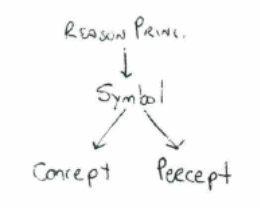
Explanation of diagram with reason-principle, symbol, concept, percept; symbol can take you further into mentality (concept-percept) or function as a bridge to reason-principle
In Plotinus, symbol is the best way of getting access to the reason-principle
Reason-principles are not unconscious but are internal to your empirical personality
Innate knowledge as organized reason plan of what is to be; can't be objectified
Words can't communicate innate knowledge
Innate knowledge as psychical knowledge of what makes a thing to be what it is; geometric forms as living; concept as ultimate residue of functioning of innate knowledge
Student experience of being hypnotized by a snake
Sage's writing/words can evoke a mood which is symbolic of the Overself for you; Plotinus III.8.6
Symbolic writing requires special training
Reading/discussing K.C. Bhattacharyya, "The Concept of Philosophy," stanza 30, on relationship between logic and metaphysics
Fundamental disputes in logic are unavowed metaphysical disputes; each metaphysical system has its distinctive logic
Partial views based on grasping part of innate knowledge; possibility of universal metaphysics transcending partial views
Reading/discussing K.C. Bhattacharyya, "The Concept of Philosophy," stanza 32, "The Philosophy of the Spirit"
Spiritual consciousness sees objectivity as symbol of real subject; "I am": 'am' as symbol of 'I'; enjoying understanding vs. objective knowledge
Introspection as enjoying understanding; requires giving up objective attitude; content understood neither as objective fact nor self-subsistent object
BOOKS READ FROM OR REFERENCED:
Krishnachandra Bhattacharyya, Studies in Philosophy, Vol. 2, "The Concept of Philosophy", "The Subject as Freedom"
The Secret of the Golden Flower: A Chinese Book of Life, Richard Wilhelm (Translator), C.G. Jung (Commentary); also found in C. G. Jung, CW 13, Alchemical Studies, "Commentary on "The Secret of the Golden Flower"
Plotinus, The Enneads (MacKenna translation, 4th ed.)
PLOTINUS QUOTES READ OR REFERENCED: III.8.6, V.8.6
DIAGRAM appended to this transcript:
- FIGURE 1982 0106a-1-AB. Reason-Principle, Symbol, Concept/Percept.
Other diagrams also referred to are not with this transcript version. [Transcriber note: [diagram] means the speaker is referencing a diagram as he or she is speaking. If someone is drawing or writing, with audible sounds of chalk on a blackboard, I indicate this by [drawing] or [writing].]
NOTES:
- This is 1982 01/06a, Hinduism; KCB Class, and the first entry associated with this date. 1982 01/06b (includes 0106–9, 0120–21, 0127–28) = Mrs. Ybor Interview; Mystical Experience.
TRANSCRIBED Verbatim by IT 2021. Archival verbatim transcript – V11a.
AUDIO FILES: 1982 0106a. [Note 1: "Tape" and "Side" refer to original audio cassette tapes that were later digitized into .MP3 Audio Files. Note 2: The second tape for this class is untranscribable due to poor tape quality; also, we have no audio file for it. Note 3: Parts of this audio file are very faint and hard to hear, especially where AD is talking. Also, there are many places where the tape gets speeded up and words are garbled, lost, or hard to hear.]
1982 01/06a at Wisdom's Goldenrod
Hinduism; K.C. Bhattacharyya; Symbolism
[Audio File 1982 0106a Begins]
AS: [tape speeded up, few words inaudible] from the last-- three weeks ago.
S (faint): Yeah.
S (very faint): Uh-hm.
AS: You better remember what we did.
S (faint): I think it was--
AS: Well--
HS: Could you review what you did up to now?
S (faint): Yeah. (bit of laughter)
AS: Yeah. Briefly?
HS: Yeah.
AD (very faint): (Go/Real) quick.
AS: Ok well briefly-- if we just do-- go back to these-- these two paragraphs laid out, one where he talked about the four grades of theoretic consciousness, ok. And then where he speaks about there are four grades of speakables. Ok? And he corresponds these, he calls these four grades of knowledge. He calls science, which is a knowledge of fact. And we spoke a little about that. And then he speaks about the philosophy of the object, which has as its content the self-subsistent object. Ok? And then third he talks about the philosophy of the subject or the enjoying consciousness, which has as its content what he calls reality, and what I guess we would call the soul, pure soul. And he also calls that spiritual subjectivity. And the fourth he calls the philosophy of truth, which has as its content truth.
And I think, although, I mean-- we went through that whole article on "The Subject as Freedom" and I think these grades correspond very well with the grades of subjectivity that he spoke of in there. Which was bodily subjectivity seemed to correlate with fact, and psychic fact, or the presentation or that which presents the appearance, seems to correspond with what he means by the self-subsistent object. And then spiritual subjectivity, you know, the next level, seems very closely with what he calls here the philosophy of the subject, ok, the enjoying attitude of the pure subject. And then he speaks about going-- even transcending that when he spoke about going beyond the personal "I", going beyond the "I" to what I think we spoke of as the Nous, if you imagine going beyond the individual soul to what he calls-- well to what he calls in there, beyond-- what does he call it in there? Beyond-- "The Subject as--" in-- in the last chapter on "The Subject as Freedom", then he speaks about the possibility of going even beyond the notion of "I" or subjectivity. And in this article he talks about truth as being beyond either the subject or object. Ok, so, that seems to be very closely correlated. And then someplace else he speaks about-- [hits microphone]
S (faint): Oh, ok.
AS: There's some place else he speaks about the truth, the highest grade, is only symbolically spoken, ok, and the next three grades he says are literally spoken but the grade of subjectivity is literally spoken as symbolized, 'cause you say "I", he uses the example you can say "I", ok, but that's only a symbol. That "I" in the speaking, it's literally spoken, you can speak "I". [student assents] But it's a symbol of that subjective enjoying attitude when you say "I", it's not the actual subjective attitude, you've expressed it, but it does symbolize the soul. And the next level down, the third level down, the philosophy of the object, the object is literally spoken as meant. You remember his whole definition, the object is what is meant. And the meant is just the object. And the object then has these two grades, that as meant which is self-subsistent object, and finally you have that which is spoken of, which he speaks of as information or fact or the appearance.
S (faint): Ok.
AS: Now, I don't know, maybe a rough-- you know, as a rough way of-- I'm sorry, do you have a question?
S: No.
AS: I'm-- maybe as just a rough way of distinguishing them now, there seems to be a big spread out way to look at all of them and then there's-- it would be nice to see them kind of in a more contracted way. The big spread out way it seems would be something like saying, the realm of fact is the realm of appearance, ok. The realm of the self-subsistent object would be, for example, all of the categories which-- and all of the principles which are presenting this appearance, ok, which are behind the appearance as it were, if we were to say something like reason-principles in the eleventh house [diagram]. And then the subjective attitude would have to be the soul per se, the pure soul. And at that level you would see that all of the objective manifestation, at least in Vedanta view, is a symbol for that soul, is projected by it. And then finally truth would correspond to the Nous, which is above the subject or the object.
But, the other thing is though he keeps talking about these four grades as possible ways of knowing, ok, four grades of knowing. And in some way it seems-- for example if we-- if we use the example of our chart, the chart, the actual chart, you should be able to see from that, or there should be some indication of which of these grades of knowledge is available. And it-- in other words, the-- spreading it out like that makes it sound like it's something really, you know, far off rather than something which is actually attainable, something which he could--
LC: Are we gonna do that?
AS (simultaneously): --experience. Well I don't know, I-- I thought to begin with maybe we should go over a little bit more of the article, maybe even try and finish it. Unless [couple inaudible LC words simultaneous with AS] you'd rather do the--
LC: Well, if you think you can correlate these four different ways of knowing to [AS simultaneously: No, I don't think but--] a chart--
AS: Well I don't know.
S: It seems like the way we talked about it the first two did seem like kinds of knowing that most of us are familiar with and the other two got more [AS assents, very faint] distant.
S (very faint): (That's the point.)
S: [couple words inaudible]
AS (simultaneously): Ok well let me-- before [one/two inaudible student words simultaneously with AS] doing that I wanted to read, I-- I don't really want it, I-- (AS laughs a bit) You already getting sick?
S (faint): (Ok/Uh-hm).
[short pause]
AS: We stopped at around paragraph 27. Ok, we were going through this one on the philosophy of the object. And there's a nice paragraph, 29. In fact it is just about where we stopped, right before that. But I think that this ties together his view, and also brings in this one other point that I thought was important. But I couldn't complete-- but I don't think he completely explicated it and that is this notion of symbol. He keeps using in the article the fact that one grade of his knowledge will symbolize the other grade, for example that at a certain stage you realize that the object is-- he says is taken as just a symbol of the Self. And he doesn't really say in what way the object, even the self-subsistent object, symbolizes the Self or is an expression of the Self or the soul. 'Cause that seems a lot of what we've been working at, to understand how what we were seeing in the chart, for example, is-- can be taken as a symbol of the Self. And then we'd have to understand what he means by symbol, you know. Does he mean just an image? No. Or does he mean it's actually embodied in that symbol? Is the subjectivity actually embodied in the symbol? How can the symbol actually convey something of that which it symbolizes? And so on. There may be different grades of this symbolizing that's going on here. Well anyway, he says in 29, and that's about where we left off, says--
[Transcriber note: I am using Studies in Philosophy, Vols. 1 and 2, by Krishnachandra Bhattacharyya, "The Concept of Philosophy," Progressive Publishers, Calcutta, 1956.]
KCB ["The Concept of Philosophy," stanza 29, AS reading]: "No metaphysical concept is intelligible without reference to the subject or spirit which itself goes beyond metaphysics."
AS: And metaphysical concept was his name for the second grade of knowledge, you know, after the first grade which was fact, the second grade was the knowledge of the self-subsistent, which we may call self-subsistent reason-principles say. And that he called metaphysical knowledge. He says--
KCB ["The Concept of Philosophy," stanza 29, AS reading]: "[AS adds: There's] No metaphysical concept [AS adds: that] is intelligible without reference to the subject or spirit [AS adds: or soul]…"
AS: I g-- I guess when he says subject I would use soul.
KCB ["The Concept of Philosophy," stanza 29, AS reading]: "…which itself goes beyond metaphysics."
AS: Now, you know, again, we had that problem, metaphysics we usually use slightly differently than the way he does. But by the soul going beyond metaphysics I think he means that you can't objectify it, I mean you can't obje-- you can't take the soul and make it a cont-- an objective content of-- of consciousness. Consciousness can't be an objective content of consciousness. You know, that whole-- that Vedantic thing. But also he seems right here to be laying out the Vedantic-- he seems to be coming from the Vedantic position. You can't-- there's-- you can't-- self-subsistence here means subsistence on the Self, you know.
KCB ["The Concept of Philosophy," stanza 29, AS reading]: "The characteristic abstractions of metaphysics which are supposed on [the] one hand to be of an 'extra high grade'…"
AS: No. See now I-- well--
KCB ["The Concept of Philosophy," stanza 29, AS reading]: "…and on the other to be only diseases of speech are really symbolic meanings which derive their whole value for belief from the spiritual experiences that they symbolise. There are no judgments, accordingly, in metaphysics and, paradoxical as it may sound, the metaphysical beliefs are not reached by inference."
AS: Ok, well-- Alright, try and say it.
KCB ["The Concept of Philosophy," stanza 29, AS reading]: "The elaborate parade of deductive proof in metaphysics is only a make-believe, unless proof is taken, as it is sometimes taken [AS reads: as it sometimes is taken], as the exposition of an unperceived tautology. Metaphysical reasoning is only the systematic exposition of symbolic concepts, concepts that are implicitly taken as symbols of contents that are enjoyingly believed."
AS: And now I-- I mean I-- (AS laughs a bit) That one just stopped me there because-- I mean he's saying-- he's using all the catch-phrases and-- and then he goes on.
S (very faint): Right.
RC: Well, isn't that--
AS: But let's--
RC: That has a nice correspondence with one of his other articles where he says, the business of philosophy isn't to challenge faith but rather to understand presuppositions.
AS (simultaneously): Yeah, unfold it, yeah. Yeah he s-- he seems-- that-- I think he's-- and also maybe we mentioned this before in another place it seems that, his view seemed to be in several places you can't get from fact backwards. That's not the way you derive-- these metaphysical concepts aren't like some abstractions or inferences from the realm of fact. You don't get there that way. Your metaphysical beliefs almost are-- they're part of the soul, I mean they're-- they're coming the other way.
RC: [couple/three words inaudible] to like said the whole system of the Hindu teachings was a-- a series of spiritual intuitions that came directly as a result of spiritual experiences, and that logic wasn't to be their judge, that they would get separated by deeper experiences and deeper intuition.
AS: Hm. Well--
RC: That seems to be the point of view he's coming from.
AS: Yeah. [flipping pages] Yeah. Ok well let's go-- we'll go back to this. So--
KCB ["The Concept of Philosophy," stanza 29, AS reading]: "No metaphysical concept is intelligible without reference to the subject or spirit [AS: The soul.] which itself goes beyond metaphysics."
AS: Now again, I'm kind of interpreting for now and this me-- the way he's using metaphysics is that whole structure or system behind the sensible manifestation. That which structures the appearance, manifests the appearance. Then you find yourself within it. That-- ok. System of reason-principles even.
KCB ["The Concept of Philosophy," stanza 29, AS reading]: "The characteristic abstractions of metaphysics which are supposed on the one hand to be [AS reads: supposed to be on the one hand] of an 'extra high grade' [and] on the other to be only diseases of speech are really symbolic meanings which derive their whole value for belief from the spiritual experiences that they symbolise."
AS: So-- And then--
KCB ["The Concept of Philosophy," stanza 29, AS reading]: "There are no judgments, accordingly, in metaphysics and, paradoxical as it may sound, the metaphysical beliefs are not reached by inference."
AS: And we also have that-- I think there was a-- oh what-- I think it was one view that-- a while ago. There was this question of-- you can't convince anybody. You can convince somebody of logical things, you know, and the question of 2+2. That's-- you can convince somebody 2+2 is-- [quick tape break] try and convince them of your own philosophical view or metaphysical view, let's use this notion here, and you find great difficulty. The Buddhist will keep his view no matter how many times the Vedantist hammers at him, and they will always be in a way complementary and they won't negate each other and they'll always have some validity. And it seems he's-- seems to be bringing up that view, that the validity of these metaphysics, if you will, is based on some ideas inherent within the subject and not-- they're not derived by some kind of logical reasoning, in fact he made the point earlier that the logic must be based on a metaphysic. And that the metaphysics here, whatever metaphysics or philosophy it is that you believe in, say you look at his chart and you see how certain reason-principles are operative there, and his metaphysics will have to be based on that, 'cause those degrees, they will symbolize, will be a symbol for the state of his soul. I mean I-- maybe I'm using these too highfalutin up in some stratosphere but, at least you say that there's some-- they're symbols (from/for) some kind of subjective reality, some kind of felt or enjoyed reality. And they are expressed in his own life and that's his meta-- that's gonna be his metaphysics, that's what it's based on and not the other way around. Now I don't know, I would-- I wonder if we could do it with say scientific concepts but that's quite a--
PD (simultaneously): [one word inaudible] (told me) if his notion of metaphysics here would be the-- what we would call the notion of psychology, [AS: Yeah, I get--] the realm of psychic essences [AS simultaneously: Ps-- yeah, that's what I was--] that are n-- that are [AS assents] the self-subsistent realm of Nature that are supporting and the grounds for appearances or experience.
AS: Yeah.
PD: Which would be, you know he-- kind of like a Jungian realm of archetypes, [AS assents] (the/that) whole notion of psychology, which [AS simultaneously: Ok.] are grasped in s-- as symbolic concepts.
AS: Yeah. Yeah some of-- well, before when-- before you come I was saying that it seems to be a correlation of this metaphysic realm with what he called psychic fact in the other article. That which actually presents the presentation, that which is actually responsible for presenting the sensible world. And you're saying something like the arch-- these archetypes in Jung. Is that what you're saying Paul? [PD simultaneously: Yeah.] That they would be like what he's calling the self-subsistent.
PD: Self-subsistent object.
AS: Uh-hm.
PD: Or like the astrological degrees.
AS: Yeah, that-- that's what I was just-- And-- so he says--
KCB ["The Concept of Philosophy," stanza 29, AS reading]: "The elaborate parade of deductive…"
AS: Well let's see.
KCB ["The Concept of Philosophy," stanza 29, AS reading]: "Metaphysical reasoning is only the systematic exposition of symbolic concepts, concepts that are implicitly taken as symbols of contents that are enjoyingly believed."
AS: That's a great line, I-- some example.
AD (faint): Then you'd have to get into the meaning of symbol, symbolism.
AS: Symbolism, yeah. I know. (bit of laughter) Well that, as I said, I mean that's the problem, he says it, and there's-- you know, it is a nice catch-line word but how does that-- how exactly-- yeah, well what is the meaning of a symbol and how does a symbol actually express, as he says, a content that's enjoyingly believed and then expressed as this symbol.
RC (faint): Positive bridges perhaps.
AD (faint): Speak louder, would you?
RC (faint): Didn't Jung talk in terms of the positive bridges of perception-- of projection towards the external world? [AS: Yeah but--] And then eventually those-- if you turn around to those positive bridges--
S (very faint): [one/two words inaudible] yeah.
AD (faint): Well, I don't know about Jung but what he's saying here seems to be, more or less, he's saying that there's a realm of knowledge, perhaps you might even call it innate knowledge, but you (can/can't) do that. Try to make it (formed, you're taking the whole out of it). It's within us, it's total, it's a whole, and that our symbols are simply trying to convey that knowledge which we have within us.
AS: Yeah. And-- yeah. And that's-- and if they have-- and if these symbols have meaning it's because they are an expression of that inner-- inner reality, which we have. I think it really is the reverse of Jung. I read that thing again over in the-- like in the Introduction to Secret of the Golden Flower. And he really is saying there almost the opposite, he's saying like it's the psychology which has the reality and the metaphysics is all within the psychology, all your metaphysics, rather than saying that it's the metaphysics which is really the larger realm and his psychology is only an expression of that. It seems-- it seems to be a reversal of view-- of the view. [RC simultaneously: No I didn't mean (couple words inaudible)] Well it seems similar on the face of it.
PD (simultaneously): But see what I was referring to was the fact that they'll speak of the-- the realm of Nature, the unconscious or the realm of Nature, as raw material that is building up a subjective center of consciousness. It's this objective functioning of Nature which is precipitating a subj-- a subject, the individual conscious mind. So that's a self-subsistent realm of imagery and symbology that the unconscious build-- uses to build an individual subject. It's not the spirit or the soul, it's-- this is at the level of psychic.
AS: Right, yeah. But then even those contents--
AD (simultaneously, very faint): [couple words inaudible] Yeah, we call that realm the realm of (seed).
AS: No.
AD (very faint): (We/I) call that the realm of innate knowledge.
AS: Innate knowledge, yeah.
AD (very faint): That would be the System of Nature (building up) the thing, and they could have a knowledge of that.
S (faint): Interesting.
AD (very faint): If someone-- if someone contacts the sidereal. You know like, let's say you read-- you read a book or you see a-- a painting with the Buddha drawn and (a) snake, just the cobra's above him, alright. Now why-- why a snake, why a serpent?
AS: Yeah. That's the question.
AD (simultaneously, faint): What is there in that symbol, alright, that would draw out of-- out of that innate knowledge that you have some kind of vital response on your part? If you think of a snake, they're very shrewd, you know. He can climb up a tree without legs. (bit of laughter, student words) He can hear without ears. He can mesmerize his subject so that they're actually paralyzed, and then swallow them (in) his [one word inaudible] (some laughter) I even-- I even knew one person who told me when he was hypnotized by a snake. And when the snake was shot he felt as though he was shot.
[students assent, very faint]
S (faint): Yeah, interesting.
AD (faint): The way the snake could, you know, make a bird feel-- make a [couple words inaudible] you know, a bird, a bird that could fly. Now you think you could walk fast. A snake will outrun you. [one/two words inaudible] now I'm [PD simultaneously: But-- but those are all images, that's what I'm saying.] just gi-- I'm just giving a suggestion, I'm-- Now all his-- all these--
PD (simultaneously): That is the nature of psychic images or psychic facts.
AD: Yeah but you see the point we're getting at is, I use the symbol-- I-- an actual snake, you see an actual snake or use a symbol, a picture of the snake, alright, and there's an unconscious vital response on your part that knows about this snake. [AS assents] It doesn't know it-- about it in terms of concepts, it knows it vitally from within.
S: Symbolically.
AD: No. The point is, the point is that the symbol is the only way that we could express that content of our innate knowledge. So that the symbol elicits that knowledge from within us.
PD: But, using the four levels that Avery referred to before of fact, psychic fact, the enjoying soul, and spirit or Nous. Is this knowledge of the snake coming from Nous or soul or is it coming from the realm of objective psychic facts?
AD: Well let's-- I refer to it as vital. So therefore it will be coming from the realm of the-- the psychical.
PD: The objective psychic [AD simultaneously: Yeah.] facts.
AD: And again I would say that there is an innate knowledge of that in all of us, and that a symbol can evocate-- an evocation takes place through a symbol. It's true that the picture of a snake may not do that no more because we've become like corpses. So we would have to take a real snake, so you better [couple words inaudible] anyway, better still go to the zoo. Or look at a 30-foot python, you know. And I think you'll get an idea of what I mean when I say there will be an evocation of a certain knowledge that you have about snakes from within. Now, could you read that sentence again, Avery, about symbol?
AS: Sure.
KCB ["The Concept of Philosophy," stanza 29, AS reading]: "[AS adds: The] Metaphysical reasoning is only the systematic exposition of symbolic concepts…"
AD: Stop there. Metaphysical reasoning is only a systematic exposition of symbolic concepts.
AS: Yeah. In the way he's using "metaphysical reasoning".
PD (simultaneously): 'Psychic facts', is that another term for symbolic concepts?
AS: No, I don't know why you say particularly psychic facts.
PD: Of psychical images?
AS: Well I think he means just-- like what we would be doing with-- with the symbols, for example, or the example of the snake as a symbol.
PD: Yeah, so psychical images are the grounds for the function, the conceptual formulations that are gonna come out of that are what's based on these operative images in consciousness.
AS: Yeah. Well maybe you're saying, you can't say-- you can't directly get at your-- or you would like to get at the numinosity that underlies the world, you want to get at the numinosity of these-- this whole system, this whole realm of reason that lies beneath the surface say. In order to evoke that, you need to use these symbols, with the hopes or the belief that these-- if they're the right symbol it will evoke this innate knowledge. And the question always becomes, what is that relation of that symbol to that innate knowledge that the symbol should be able to have that efficacy? And that--
S: I hesitate to say this but--
AS: Why?
S: When different people react differently to different things, wouldn't you say that the symbol is within the person-- s-- personality, not in their-- the depths of their being? For example, I've seen people react extremely differently to snakes. Now, it may be that in their natal chart they are not as evolved or as-- have not come to the point where they see a snake as a-- as a symbol of wisdom, just as a creature to be afraid of and little boys who handle them, and-- I mean, you know, they just--
AD: It's not what I'm talking about.
AS: Yeah.
S: I know what [S simultaneously: Oh yeah?] you're talking about, but what I'm saying-- I think I know what you're talking about. But what I'm trying--
AD (simultaneously): See what you're speaking about, what you're speaking about is the-- is the differentiation or the variety of psychological make-ups that go into making an entity [S simultaneously: Yes, that's what I'm saying.] what he is. Whereas what I'm speaking is a response which comes from a deeper level of the person and I refer to that as the vital aspect of the personality. That is where the innate knowledge lies. That is indifference-- indifferent to the psychological reactions that varying individuals would-- would have to one and the same snake. [AS assents] That is innate knowledge.
S: I-- yes, I know, I know that's what you're saying. But I'm--
AD (simultaneously): Which nobody believes in by the way.
S: Well, that may be. But what I'm saying is that that would-- [AS laughing: Yeah but--] wouldn't this differ in the evolvement [AS: No but--] that s-- the chart of a person, the-- the certain symbols or the certain degrees that they have promised [AS: Yeah but--] in their chart?
AS: But Terry, see, I think maybe-- in his terms, he would say the metaphysical object or what we're speaking of the innate knowledge, is-- for him that means-- the knowledge of that is a knowledge of an object as it would be to any subject. It's like-- it's like--
LDS: It's beyond psychologists.
AS (simultaneously): It's be-- yeah, it's beyond--
S: I know this. [AS: And if--] I know I can(--/.)
AS: Ok but I think he would say too-- he would say that-- in your example you say well I could have different reactions to a snake. Then that snake is not a sym-- is-- doesn't have a symbolic function in the way we're speaking of symbolic function. It has a symbolic function if it really can kind of get you to penetrate to a [S simultaneously: Ok, yeah.] certain level, and if not then it's just stopping at the psychological level, then you're just bringing up your psychological associations and so on with [student assents] snake, and it's not functioning as a symbol.
S: I would certainly [AS simultaneously: And--] agree. And the reason it wouldn't be functioning [AS simultaneously: Yeah.] as a symbol [AS: Is--] is here's a person as a-- hasn't reached that depth of-- of-- I just don't think it would [AS simultaneously: Oh I see.] be there in somebody who wasn't a well developed entity yet.
SD: You could take the opposite too, that regardless it would be there. It may be not so much that a person hasn't reached that level as it has been overlaid by so much else that they can't find it.
S (simultaneously): Perhaps, yeah, ok. Yeah.
S: Uh-hm.
AS: Randy (did you--)
RC (faint): Yeah, I was [S simultaneously, faint: No.] thinking certainly. I was just thinking, part of it might come across in terms of just-- talk in terms of people falling in love with each other. It-- not everybody evokes that kind of erotic consciousness. It really involves that vital participation of the subject to the object.
AD: (Tim), that's not what I mean by vital.
AS: No. (AS laughs) That's-- [short pause, AS laughing] Maybe you should--
RC (very faint): That's not what you mean.
AD (simultaneously, faint): Perhaps-- perhaps if you think of the-- the Chinese ideographic-- ideogram language or Egyptian hieroglyphics, we could get there an idea that writing was based on eliciting-- the writing is basically symbolic and it's concerned with eliciting a response on the part of the inner being. [AS assents] It is-- it is not-- That's quite different than let's say writing, English writing, you know, (bunch of grammar), where say you have grammar, syntax, etc. You don't have that in pictorial ideogram. And the intention there is to evoke in you the principles that went to make a picture what it is and-- like an example of a snake. A certain-- a certain understanding, an innate understanding, of what these principles are is brought to your attention. And, the symbol is efficacious (or glimpsed). [AS: Anthony?] It's not like it wants, [AS simultaneously: In--] you know--
RC (faint): I didn't-- I didn't mean like the mere erotic polarity between the sexes. I mean the more differentiated human status where not just any man or just any woman but this individual precipitates that kind of-- becomes a symbol of it.
[short pause]
AD (very faint): Ah, you're referring to [one/two words inaudible] reason-principles. [students assent, very faint] [one/two words inaudible] [AS simultaneously: But--] yes. (AS laughs a bit)
DB (faint): Anthony, does this-- this innate knowledge that's in (me), would it be correct to speak of-- of the particularities of this innate knowledge as the (qualitied form/qualities formed)?
AD (very faint): [couple words inaudible] Nobody [one/two words inaudible]
DB (faint): So that, if there's an-- if there's an image say for the Egyptian hieroglyph, there's a-- there's a specific [one word inaudible]
AD (simultaneously, faint): It cannot be objectified in any way.
DB (faint): No, I don't mean that it's objective, ok. I mean only--
AD (faint): (Look), I'm trying to answer your question, that you can have a particular knowledge of it. And I'm trying to point out that it cannot be objectified in any way because then it wouldn't be innate knowledge.
DB: I'm just trying to distinguish between the notion of a-- of an innate knowledge as some kind of homogenous principle.
AD: Principles.
DB (faint): Ok, right, that's what I mean, that's-- that was what I meant by differentiating the two. It's what I was trying to speak of as particular, ok but the-- insofar as there are plurality of these principles, is there actually-- would it be fair to speak of them as living presences, something like that? So that when it is evoked, it's a very-- is theoretical, it's not conceptual. It's not even--
AD (faint): Well actually you can think of it here (a) concept (but--) of the presence [one/two words inaudible] what he speaks of a God. And they can only be symbolically distinguished. You've been doing it for years.
AS (faint): Uh-hm.
LR: In fact, isn't-- isn't language itself on a different-- entirely different level from what you're speaking of as the-- The place where a symbol-- the place which a symbol affects almost precludes or denies the use of language here. Language in some way has to deny--
RC (simultaneously, faint): I think any poet would just turn right around and disagree with that. That's the whole thing he's trying to do. He's trying to make words capable of functioning as symbols for (a/our) time.
LR: Is it the wor--
AD (simultaneously): Words can't-- can't [RC simultaneously: Symbol.] symbolize that area.
LR (simultaneously): No, no.
RC (faint): Well we just went over this.
LR: No-- no, no. I don't think so. Because what he--
RC (faint): It's in thy scripture.
LR (faint): No but-- Randy, wait a second. I-- I hate to-- I mean I don't mean to assault you.
S (faint): [couple words inaudible]
RC/S(?) (faint): (Me either.) (RC laughs)
LR: But I-- I think in what you're saying about poetry, if the symbol is evoked it's no longer the words that you're reading.
RC: No, I would say the words have become the symbol.
LR: No, I don't think so. I don't think the words be-- I think the s-- well, I started out saying I think the words preclude or limit the contact which the symbol makes with the being. And in poetry you're trying to go the other way. If the poetry actually evokes a symbol it's not-- [short pause] I don't think it would be the words per se which would be doing that. [RC, faint: Yeah.] I think once the symbol was evoked the words would disappear entirely [one/two words inaudible]
RC (simultaneously, faint): It would seem that it's its capacity to function as a symbol that would qualify it as poetry. Otherwise it wouldn't be (fun/poem).
AD (very faint): And therefore?
RC: Wouldn't be poetry.
RG (faint): Uh-hm.
BS: Why would a picture do it and not poetry? [S, faint: It would be--] [RC simultaneously: Well--] (I/I'd) ask the same question.
AD (faint): Poetry-- [S simultaneously: Not (one word inaudible)] yeah but poetry will evoke the symbol and then the symbol does the rest.
S (very faint): Yeah.
S (faint): Yeah [couple words inaudible]
BS (simultaneously): A picture of a snake is the symbol?
AD (faint): Yeah if you look at a snake, that's a symbol. And the picture of course would stand for that symbol. [student assents, faint] But, the rational consciousness no longer functions that way. So I would suggest you go back to the original snake [one word inaudible] But the point Randy's making here is that words are used in poetry to invoke a symbol and that symbol is what reacts or triggers off within you an understanding which transcends your mentality. But words in themselves are no longer symbols.
S (faint): Oh no.
AD: Words can't be symbols, [BS: No but--] [student assents] 'and', 'the', 'but', 'table', 'chair', how are they symbols? [PD simultaneously: But I thought--] They're signs.
S (very faint): Yeah.
S: Which--
PD (simultaneously): But as a part of the context of the poetry itself the words are part of that symbolic framework.
AD (simultaneously): They-- they evoke that symbol.
S (faint): Yeah.
AD: [couple/three words inaudible]
PD (simultaneously): They can't be separate from that symbol [one word inaudible]
RC (simultaneously): Usually [couple words inaudible] said some other way and get the same response.
AD (faint): Yeah.
RC: Usually it couldn't be said any [LR simultaneously, faint: That's right.] other way and get the same response. [LR simultaneously: Yeah like haiku, you think--] That's what really makes it a frozen-- I mean it makes it capable of being a symbol. It delivers a particular slice of the Intelligible World.
AD (faint): Well, it's the symbol that the words have to-- if you-- if you gather enough words together in a certain way, you know, like when inspired (meaning), they do become symbolic, alright. This is the point we're getting at. Once they become symbolic, let's say a certain mood is aroused or a certain image is brought, a certain-- then through that symbol you're connected back to that innate knowledge. [S, faint: Innate knowledge, yeah.] It isn't that the words are going to connect you to the innate knowledge.
LR: Yeah.
AD (faint): Same problem exists for the twentieth century mentality, especially coming up from the scientific point of view. They can't function symbolically, they don't know how symbolific functioning is.
S: No, I was just reading PB's book that-- on this exact thing about words, about how you have to be so very careful with these words and he says it's not only words, because the words are the same in every language and in many-- in many instances. But it's the way we say them and we give them our-- our delivery of the way we [AS simultaneously: The way they're put together.] use words become-- that's how that-- the meaning comes through.
AS: Actually that's-- I-- it would almost seem that that's what you're saying is that the meaning is what's the symbol. [S simultaneously: Yes.] The words in themselves are just signs but they ha-- it's the meaning which they evoke that's really the symbol.
LR (simultaneously): But it's not-- supposedly it's the-- it's the actual form, I mean, in a haiku form it's not-- you can't look at the words and get [AS: Yeah.] any--
RC (simultaneously, faint): You couldn't devise it, you couldn't translate it.
LR: So-- Yeah right. So it's [S simultaneously: He said it's that the words point--] not really-- it's not the words which--
S (faint): So don't look at the [couple words inaudible] the-- the word, [AS assents] but look beyond [one/two words inaudible]
LR (simultaneously): No, it's the actual form, the thing underlying it which--
RC: Well, I mean, to me that's no different than saying that David isn't the marble.
LR: What?
S (faint): I (drew it). (laughter, student words)
RC (faint): Say it's like (a soul). I mean it's really equivalent to saying that a sculpture (is a piece of) [one word inaudible] [S, very faint: Yeah.] Give Michelangelo a block of marble and a thing comes articulate [couple words inaudible] But, certainly not if you give it to me.
AD (faint): Then if we go back to that passage of Bhattacharyya, what is he saying here? Avery, could you read it once more?
AS: Sure.
KCB ["The Concept of Philosophy," stanza 29, AS reading]: "Metaphysical reasoning is [only] the systematic exposition of symbolic concepts…"
[short pause]
RC: It would seem that there you'd be talking about some individual who's had a series or at least a few experiences and he's chosen or been compelled to phrase according to certain concepts. And when he tries to systematize those concepts, each one of them is still loaded for him with feeling-tone and the-- the insight value of the experience itself. And so he tries to structure them together into some systematic way. And he has a system of concepts which for him are all still luminous, they're all still symbolic. And so the system as a whole becomes a larger and larger symbol for him.
PD: I think this second half of the sentence kind of confirms your meaning there Randy, where he continues.
KCB ["The Concept of Philosophy," stanza 29, PD reading]: "…concepts [PD: Referring to the symbolic concepts.] that are implicitly taken as symbols of contents that are enjoyingly believed."
RC (faint): Yeah, he's not speculating. He's labeling [PD simultaneously: The--] some things that are already there.
PD: So he's unfolding the symbolic contents of his experience that may not even be consciously available to--
LR: That's-- yeah and that's precisely why people could believe in scientific data and not believe in any metaphysical data, other than psychic-- psychological-- I mean the fact--
AD (simultaneously): What would be the-- what would the-- be the difference, why?
LR: Like just that fact about symbol, what you just said about how twentieth century man cannot function with symbols anymore. There's-- because of that I would say and also because the way he describes the other kind of knowledge, it's dependent upon a subject, whereas most people believe that science is independent of any subject. And because it's based on so-called fact it has no sym-- no symbology [AS assents] involved.
AS: Yeah. In fact his first division there between--
LR: I mean that's what-- that's [AS simultaneously, faint: I'm sorry.] what believe-- that's what people believe in is something which doesn't carry that kind of enjoy-- symbolic enjoyment.
RC: I'm thinking Richard would probably disagree.
LR: Well, new physics is coming around to it, I mean, modern physics is coming around to some of the same points but that's--
S (very faint): Yeah.
AD/S(?) (very faint): [couple/three words inaudible]
LR: Oh, you're saying that-- that science does have that symbolic--
RC (faint): Yeah I think for some, definitely, they--
LR: Well-- [few inaudible student words simultaneous with LR] no, I'm not talking actually about the person who's working on it because his own symbolic contents would have to come out of something that-- Most of the people who speak would say that philosophy's ok but science is really more advanced, it's a-- it's evolved philosophy. Now in science they're actually coming up with proof of what maybe philosophers have always said but they'll-- they'll put the-- the weight on the science as having, you know, something more real, 'cause it's no longer in that slightly numinous realm of symbol.
LDS: No but aren't you saying that it's a-- in modern times here in the West it's a matter of introversion-extroversion, a value on-- the value has been placed on extroverted knowledge or ways of operating as opposed to introverted ways of operating. The attention is valued in terms of its going out and checking data out or confirming things objectively as opposed to confirming anything subjectively or-- Well he's saying [AS assents] here that it's the subjective element, the truly subjective, that is-- is being elaborated or confirmed in this-- in this conceptual metaphysical reasoning.
AS: Well I don't know it's so much subjective, I thought what Linda was getting at is that in the one case, when the scientist is dealing with words say as signs and not as symbols, that would be the-- his first level of fact. In the level of fact in fact he makes the point that they-- the perception of the object is completely cut off from any kind of further-- you know, deeper meaning and it-- at that level of trying to operate with these words, they just are a reference to signs, they're just signs. 'The', 'and', you know, 'man' and so on. You say 'man', it means the man in the street. 'Man', what do you mean by 'man'? It doesn't have any deeper meaning. And sy-- as far as symbols go, all-- the only symbols you have there are some kind of diagrams on a-- on a Descartes Cartesian coordinates which don't refer to anything beyond themselves. Whereas to see-- you know, more modern views, science seems to be tying back into the realm of philosophy, they are taking what they're doing as symbolic, you know, they have some recognition that these forms that they're coming up with are really symbols of some deeper reality behind the phenomenal world. And they're not just, you know, say what they are as-- in terms of signs, they do point beyond themself. Now-- you know, I'm not even-- that's why originally I was wondering about that question of science because there it wouldn't be just that they-- that they're pointing to some subjective meaning, it's-- it's a univers-- you know, not subjective so much as--
LDS (simultaneously): Well I meant subjective in the sense of the soul, you know, reason-principles.
AS: Yeah.
LDS (faint): That the soul (is/as) really knowing that [one word inaudible]
AS (simultaneously): Yeah, subjective there is-- 'cause sci-- even modern scientists would still want to say that they are getting at something about the objective universe.
LDS (very faint): Yeah.
AS: But of course they're-- I say by subjective you mean int-- in-- internal.
LDS (faint): Yeah.
S (very faint): Yeah.
RN (faint): Avery? Avery?
AS (faint): Yeah. Go on, Richard, please.
RN: If we could try to keep straight the way Bhattacharyya is classifying these, [AS: Ah, doesn't matter.] which might not be the best view [couple words inaudible] but, [S: Well--] I think when he says in this sentence that they're enjoyingly believed, [AS: Yeah.] that is as a-- you know, that's like-- that is a sign for his words, that's the subjectivity. In other words, he's [AS simultaneously: Yeah.] saying that [AS simultaneously: Ok.] in-- [S simultaneously: Yeah.] in the second realm, in the metaphysics, which is-- which has to do with expositions of concepts which is already above science, that right there that experience will force the person going through it when he realizes that he's only dealing with something that's pointing to the subject, he's only dealing with symbols, that will-- that will lead him up to this-- the subjectivity that's going to be the next chapter. So-- I mean, wait till-- I-- you know, like in everything we do with Bhattacharyya there's the same little structure but when Linda's talking about going from science to the next realm, that's not exactly what he's talking about in this sentence, even though it might be valid and maybe even more worth discussing.
AS: Uh-hm, yeah.
RN: I--
AS: Yeah, go on.
RN: And so I think maybe we could use si-- sign as something of-- within the realm of fact, within science, and a metaphysical meaning as within the second level, but symbol as pointing to the third.
SD: Doesn't-- I may be mistaken but I was under the impression at an earlier point he had the first level, the fact of the world as having a symbolical significance to get you to the second and that that's being repeated.
AS: No actually [S simultaneously: Uh-hm.] I think I-- well, I mean I think in his view that they don't. His level of fact is not symbolic at all, the other ones are. [SD: No but (what/once) you get--] That's his point, you can't get back. Right or wrong I mean he says that there's no bridge. [short pause] To-- to try and understand the facts of science symbolically-- I mean, you could take those same facts of science as it were, the same investigation, and take that symbolically. And then I think you would be operating at his second level here, metaphysical reasoning. [short pause] But then that wouldn't be his--
AD (simultaneously, faint): Symbolism is a whole interesting field all by itself.
AS: Yeah. That--
S: Avery?
AS: Yeah, Louis, let me see.
S: Do you think [AS simultaneously: Yeah. Huh?] this is a good definition of metaphysics?
AS: Do I think it's a good (AS laughing) definition of metaphysics?
AD (very faint): Going to have to get into it at some point.
AS: Well, you know-- do I think it's a good definition of metaphysics? You know, I thought about that a little bit. But I-- I mean it just depends what you mean by that.
S (very faint): Well, you--
AS: Well let me give you an example, I don't know if you want to bring this up here, I-- it's not completely relevant but-- You know, some of those notes PB speaks about these grades that go-- leading up to philosophy, philosophy as being the highest and most encompassing. And below that he seems to have two kind of complementary things, one he would call say the mystical grade and complementary to that would be a grade which-- I don't think he calls it metaphysical but he calls it--
AD (faint): But he does start with religion, right?
AS: Yeah, well that would be-- that would even be below that. He had--
AD (faint): He speaks about religion, mysticism, metaphysics, [AS: Yeah.] and philosophy.
AS: Right. And I was trying to see that here in this-- in this article, it's very si-- the mysticism that he speaks of would be similar-- I was trying to see if you could say that the mysticism that PB speaks about is similar to what he calls the philosophy of the spirit. What he calls metaphysics would be similar to what Bhattacharyya calls metaphysics. And what Bhattacharyya calls the philo--
(Side 1 of original cassette tape digitized as 1982 0106a Ends; Side 2 Begins)
S (faint): [one word inaudible] Yeah.
AS: In other words it's-- when you went beyond the-- I mean it-- at least in hi-- in this exposition, he would say after the meta-- after this metaphysical understa-- after the symbolic understanding, that there would be a possibility of an actual enjoying experience of that, of what the symbol pointed to. You couldn't objectify what the symbol was pointing to, you couldn't objectify those reason-principles but there could be an enjoying experience of them. And that that would be at his grade, you know, above-- above the meta-- [LC simultaneously: Could he saying--] above that second grade.
LC: Isn't he saying the enjoying comes first? I mean you have this enjoying or you have this knowledge, this knowing of something that can (only) at best be symbolized. And you get this-- you get a symbol of it and then somehow try to communicate it and that's where metaphysics comes in by the unfolding of the symbol. You got--
[Note: See FIGURE 1982 0106a-1-AB for the following.]
AS (simultaneously): It can go that way but I thought that in terms of being, being and knowledge go opposite ways. In terms of being, the symbol-- the metaphysical reasoning is on a symbol of that in-- of that internal knowledge but-- Well I'm not saying this right. You know, if-- if you say well-- Here you have [drawing] whatever this cont-- these reason-principles are the contents of the soul. And they're symbolized.
S: Right.
AS: You may have these-- you may have these reason--
AD (simultaneously): Remember the symbol breaks up into concept and percept.
AS: Yeah. That's-- [drawing] there's a-- there's a break-up there, [LC: Right.] concept, percept.
LC (simultaneously): Right. And that's--
AS: You're here, you're within the empirical situation here and you-- you can't break out of it directly to get to the reason-principles which are structuring the whole subject-object situation that you're in. But, you don't have direct access. In point of view of being, you could say yes, your soul has these reason-principles inherent it.
LC: Right.
AS: But in point of view of knowledge, you're here trying to get to these reason-principles. And the bridge to them is this symbolic knowledge, which is pointing to something which could be enjoyingly experienced, [LC simultaneously: Ok, I thought that--] but you wouldn't necessarily have the experience of this first.
LC: Like somehow I took it-- [AS simultaneously: Well they (one/two words inaudible)] I see that I took it real differently in that somewhere, somebody did-- what-- did have the symbols of those reason-principles, like peop-- [AS simultaneously: Sure, sure.] somebody like the Buddha or like Christ, who then was able to--
AD (simultaneously, faint): No, you better go back [AS simultaneously: But the-- you--] to much more primitive stuff.
AS: Yeah, even further but--
AD (faint): You got to go back to China, [AS: The Vedas and so on.] Egypt. [AS: Yeah.] You'd have to go back to where mankind first started using ordinary, you know, ideograms, pictures.
AS: Pictures, yeah.
LC: And that-- and those pictures were-- they were the metaphysics, right? Or are you calling them symbols? Those pictures are the symbols? And if it-- (AS laughs a bit)
AD: The picture was the symbol, [AS: Yeah.] yes, but the symbol can go two ways. A symbol can go up to the reason-- take you back to the reason-principle or it can take you further into mentality, which will be a division between the perception and the conception, the conception being subjective, the perception being objective. [LC: Would it--] If you continue, if you continue down, alright, the way we're doing, you know, in the twentieth century, there's further differentiation, exploration, of the conceptual realm, [AS: Yeah.] not of the symbolic realm.
AS: Right. [LC: Right.] The conceptual realm is what we would call the word, that's where we'd actually get into words, people write paragraphs about these things and so on. No, really, I mean you-- I mean in-- like in Plotinus' the symbol is the best way of getting access at this internal reason-principle, [Note: See Plotinus, V.8.6, first two paras.] we have to use words because we've come down to a level where the symbol-- even the s-- it's like just-- I think what Randy said was good. We're using the concepts to get at a symbol which in turn would get us at the reason-principle itself. And, you know, even to get at the symbol requires a lot of words and concepts, to even elaborate the symbol to a point where it's now a useful bridge to a reason-principle.
AD (simultaneously, faint): And that's why I prefer Plotinus because of the accuracy of the symbols that were produced.
AS: If it doesn't evoke a good symbol--
LR (simultaneously, faint): Symbol would be at the level of the presentation? Is that what we're saying now?
S (faint): (Uh-hm.)
AD (very faint): Symbolism.
LR (faint): Prior even to the presentation?
AD: Unless you're saying presentation is a kind of [one word inaudible]
AS: Yeah, the pri--
LR (simultaneously, very faint): (Stay with) the presentation.
AS (simultaneously): Yeah that's the-- yeah in this--
LR (simultaneously, faint): That's the-- wouldn't that be the same level?
AS (simultaneously): Like in that picture.
LR (faint): Before the bifurcation there.
AD (faint): (What'd I say?) That's what the ancients symbolized, I mean that's what their language-- And you can't properly call it language because it wasn't language, as I said before, they had no syntax form. It was, properly speaking, ideograms.
AH (faint): What is meant by internal, this internal knowledge?
AD: You mean [S, faint: What do you mean?] concepts?
AH (faint): No. This-- the reason-principle is referred to as internal. Do you mean unconscious?
AD: No I don't mean unconscious, you're unconscious.
AS (laughing): Yeah.
AH: But what does it mean though--
AD: Reason-principles aren't unconscious.
AH: What is it internal to?
AS: To everything.
AD (simultaneously): To your empirical personality, it's something within you, you have to dive…dive…and dive again, go deeper and deeper to get to the reason-principles. So, internal again is just a metaphor. But they're inside you. (And it's not) [one word inaudible] (on a bigger context).
AH (faint): It's not considered unconscious, (why?/fine.)
AD (faint): I re-- I regard that as the most ridiculous (AS laughing) kind of [couple/few words inaudible] exposition of understanding, to call these things unconscious.
AH (faint): (Why don't) you object to connotation of the word 'unconscious' but [couple words inaudible]
AD: You bet your life I do.
AS (laughing): Yeah.
S (very faint): Yeah.
AH (faint): Well you spoke of it earlier in the class as being some sort of vital knowledge that is absolutely non-objectifiable.
AS: Yeah, (very good).
AD (faint): Yeah, it's an organized-- it's the or-- organized reason-principles in their totality which try to-- let's say, a prior plan of what will happen. Now if you speak about objectifying them, you-- you might as well think of yourself as, you know, some sort of deity.
AS: Yeah. Objectifying them in the real se-- I mean of getting to them, in the sense of actually getting to those reason-principles.
AD: There's no way that they could be objectified.
AS: In fact he do-- in-- like in the Samkhya article they almost do speak of them that way, as the-- as the knowledge of a deity, buddhic knowledge or something, you know, would be known.
AH: So the notion of internal is simply a meta-- metaphoric, you see. We're really not speaking of [AS simultaneously: Well--] it being internal to anything, it's just a way of speaking about--
AS: Well internal to you though, I mean, in the sense that if you wanted to understand which direction or path you'd have to go in to get at them. You wouldn't go, you know, examining putting together all of your-- you know, all of your descriptions of trees, say, to get at the reason-principle of a tree. [AD, very faint: Oh no.] You wouldn't go around collecting a lot of [AD simultaneously, faint: Take a trip.] empirical facts.
AD (faint): Or take a trip looking for them, ok.
AS: Yeah, I mean you'll go all o-- you'll go here, you'll go there and try and find reason-principles. Let me see where are there-- or even looking in a book, I mean-- They may help you get there but eventually as the-- the Sages or whatever say, you will have to go internally to find them. Although there may be things in the outer world that will point to them. And in fact the symbols would be the-- symbols, if you could get at true symbols they would be the best but--
AH (faint): When you speak of internal you're speaking of the-- the mind as the context.
S (faint): Right.
AD (faint): Then I would have to know what you [couple/three words inaudible]
AS (simultaneously): Mind is a funny word.
AD (faint): Any-- any time you use that word I'm going to ask you what you mean by it.
[students assent, very faint]
AS: Yeah mi-- I mean, some people will limit mind just to where the circle of concept and percept is, just to empirical mind. And then the reason-principle is structuring that empirical mind, and in that context you'd have to say, no that the mind can't get at the reason-principles because it itself is being organized and structured by the reason-principles.
AH (faint): But I'm just [AS: But I--] curious though, you'd say there's no bridge between this vital knowledge and the symbol that expresses that.
AS: No. No I-- I didn't say that.
AD (simultaneously, faint): The s-- the sym-- the symbol, the symbolic is a bridge to that [AS simultaneously: It is a bridge.] innate knowledge. [S, very faint: Pictures mostly.] But the bridge is not made of more words.
AS: Yeah.
S (very faint): How about Bhattacharyya?
AS: No Bhatt-- Bhattacharyya often had made the point of saying, if you're in the empirical, you can't get from concepts and abstract your way back to the reason-principle. And I think that was a point Anthony just said just now. It-- you can get back but not through more concepts. I mean-- yeah.
AD: That's why [S simultaneously: Anthony--] I told you to go look at a 40-foot python. You people think I'm kidding, I mean it in dead-- dead earnestness. When you look at one, if you could just that first instant before you psychologically react, you'll see you know more about that python than any book you could read it.
AH (faint): Well that's really-- that was really the base of my question, Anthony. That example you just-- seemed to me very much like the way Jung is speaking of the unconscious, collective unconscious.
AD (very faint): No.
AH (very faint): [couple/three words inaudible] yesterday, example of the rattlesnake.
AD (faint): I was-- I was using-- I-- (laughter) The rattlesnake he was using [AS: Whole other--] was in relationship to [AS simultaneously: That was something else.] epistemology which was very close to the Sautrantika, [AS: Yeah.] was that you will pick out of the storehouse of your unconscious an image which would correspond to the rattler.
AH (faint): That's not what we're talking about.
AD: That's not what I'm talking [AS simultaneously: No.] about, no.
S (faint, possibly part of background): I'm about to go.
AS: Yeah, see that-- that example was used in a whole other way. In that case it-- it's not symbolic-- the fact that a rattle evokes the image of a snake is not symbolic. You-- you know what I mean? It's--
AD (simultaneously, faint): You have to learn to distinguish between what a sign is [AS simultaneously: It just significant.] and what a symbol is. And, I'm trying to make this distinction which may be (arbitrary distinction), dictionaries. A symbolic meaning like I told you is when you looked at that python and before you have any psychological reaction, it can be a symbol. It can tell you something very important but what it tells you won't be with more words. There won't be more concepts because then you'd be back, so to speak, down at the empirical level.
AH (faint): Say Anthony--
AD: It's what makes the bridge between the two halves of your brain.
AH (very faint): Yes, could you say anything at all about what ha-- what-- what the python tells you before [couple words inaudible] (laughter) What-- what would it tell us about [few words inaudible] [AS simultaneously: I get it.] Say any more about--
AD: When you drink the Mississippi in one gulp I'll tell you. (bit of laughter)
LC: Ah.
AD (very faint): Ok? Thank you.
AS: Monty Python. Andrew ok? Do you want to-- Andrew you want to persist?
AD (faint): I mean you're asking a question that I can't answer and I give you a problem that you can't answer. (AS laughs a bit)
S (very faint): How about you start with Seneca Lake.
AS (simultaneously): Yeah let-- let's--
AH/S(?) (very faint): [couple/few words inaudible]
AS (simultaneously): He didn't [one word inaudible] these.
AD: Seneca Lake is alright too.
S (laughing): [couple/three words inaudible]
AD: In one gulp.
DB (simultaneously, faint): Well, it's just hard to say, I'm--
AH (very faint): Just one more question. For a minute identify [three words inaudible] in the case of Brother Lawrence, is that tree you [one word inaudible] (AS laughs a bit)
LC (faint): That's right. You're right. That dead tree for Brother Lawrence, was it (for the--) [student assents, faint] He-- no, isn't-- wasn't that his self [one word inaudible]
S (simultaneously, very faint): Well, that's not entirely true.
S: You're really-- (S laughing)
S (very faint): [couple/three words inaudible]
AD (faint): Well, it can be, yes but, we're not-- we're not talking about that, you know, you have to obs-- see, observe Nature for yourself or things around you. That-- that was the first requisite, seeing. And the second is observe. [few words inaudible] is to leave your ego out of it. You'll get indications as to what that innate knowledge is. But it cannot be communicated, that's why you have to use the symbols to try to point in the direction of that innate knowledge. But to tell you what it is, I've brought it down to the level of concept and percept. And then it's become-- become an effect, it's a false, it's not living anymore, it's not that living knowledge that he's speaking about that he says the soul enjoyingly believes. I would not use the word 'believes'. I would use the word 'enjoyingly knows'. [student assents, faint] Because belief [AS assents] would be at the level below.
AS: Yeah, right.
S (faint): Yeah.
PD: Like the [couple inaudible AH words simultaneous with PD] example of a snake. Is that at the level of psychic realm or is that at the lev-- level of spirit where there is knowledge of truth, you know, in a technical sense? Would you say that there's true knowledge of snake or is-- or is there psychic knowledge and imagination of snake?
AD: No there wouldn't be-- there would be knowledge of snake, the-- the knowledge-- the psychical knowledge of what constitutes snakes, [AS: Yeah.] what makes snake to be what it is.
PD: That would be at the level of opinion, right?
AD (faint): No, no. [AS simultaneously: No.] That's quite real knowledge.
PD: Yeah. I mean in a technical sense, like opinion includes sensible knowledge of the world.
S (very faint): It's not opinion.
AS: No but here you're talking [PD simultaneously, very faint: Explain (to--)] about-- Yeah but I think even in a technical Platonic sense that would be reason. That would be contacting-- if you could contact the reason-principle that was structuring the sense world and now if you turn the other way without reference to the sense world, then you would be reas-- you would have a reason, I mean, it would be reason. Not opinion.
LR (faint): No but Paul's referring to the description of the second gnostic faculty which is the actual reason-principle stretched on the object.
PD: In the object.
AS: That are actually in the object.
OG (very faint): [one/two words inaudible] was a knowledge of the circle or sphere but then they have--
AS: No I--
OG (faint): You get [AS, faint: Well--] the same kind of knowledge you are talking about or it's different?
AS: Say it again Om?
OG: How does the knowledge of circle--
AD (faint): They're part of you.
AS: Yeah that would be good, I-- I think that--
OG (faint): Because here we are discussing [AS simultaneously: Yeah.] not only the emotion but also [AS simultaneously: Ok. But--] [three/few words inaudible]
AS: But that-- that may be an answer to--
AD (simultaneously, very faint): [couple words inaudible] 240 lines make a circle and without any straight line?
AS: I--
S/OG(?) (very faint): Maybe it's behind it, I don't know.
AD (faint): Well you can see it, I think there's quite a few illustrations of that. And, the straight line is-- you'd have to regard is inert, you know. When you put them together in a certain way, you come out with an actual (ground/round) mandala. And you begin to see a life in that straight line which before you didn't see. And the same with the circle. No they're living forms Om, [OG assents, faint] they're not-- they're not inert, uh-- When you talk like that you're talking like the mathematician who's reduced all his understanding of mathematics to the left side [diagram] where it says concept and concept [couple words inaudible]
OG: Yes but the concept-- that reduction of the concept does not solve the problem that knowledge is not the same like (this/its) concept alone. However are-- one might conceptualize but there is something always remains like-- You go to a mathematics class and the guy will give examples and definitions and-- And then the guy sees, "Oh yeah, it clicks now. Now I see."
AS: Right. That was--
OG (faint): The next thing you see is innate knowledge. [AS: Yeah.] Concepts (not) below that knowledge [couple words inaudible]
AS (simultaneously): But he made that point Om. I'd--
OG (very faint): But there are the schools who don't believe in the knowledge there (though).
AS: I think he made that point in his-- I agree.
AD (simultaneously, very faint): (You see, for instance), like the (innately) [OG assents] description.
OG (faint): The concept of--
AD (simultaneously, very faint): That's-- that's a living (being/thing).
OG (faint): Picture. This concept that is like glasses, but they won't deliver that.
AD (faint): Well the concept would be the ultimate residue of that functioning of the innate knowledge. You can't get any further down.
[short pause]
LR (faint): Anthony, this maybe is something you don't want to get into it right now but remember a long time ago when you were trying to [one word inaudible] ultimate level of emotion [couple words inaudible] on emotion. And, I think you had it in four different-- [Note: See WG Classes 1978 0412a (and associated paper 1978 0412b), 0418, and 0426 for more on this topic.]
AD (very faint): Yes.
LR: Is that this vital that you're speaking of which contains the innate knowledge, is that the same way in which you're speaking of emotion?
AD (faint): Refer to knowledge as having four levels--according to Aristotle.
LR: Well I was-- not only to emotion.
AD (faint): I mean emotion with the four-- There was four quarters in emotion.
LR (faint): Right. So I don't actually watch what I'm speaking of but it seemed like one of the ways we're speaking of-- spoke about the motion of the soul in a direction from the reason-principle to the symbol at those-- at the level of the symbol we're trying to get in.
AD (very faint): (That's the one we may not need.)
LR (faint): 'Cause I was hoping you would help.
[short pause]
AD (very faint): You still have it?
S (very faint): Yeah.
[10¼ second pause]
AD (faint): Someone going to answer?
AS (faint): Yeah.
AD (faint): Going to tell her what the instrumental reason or (force/thoughts) is?
S (faint): Yes sir.
AD: Hm?
S (simultaneously, faint): Did (you/she) ask a question?
S (very faint): [few words inaudible]
RC (faint): You're saying the symbol is the instrumental cause?
AD (faint): (Well that can be one day.)
LR: Well one--
AD: Would that help you?
LR (faint): That the symbol is the instrumental cause? [short pause] The symbol is the instrumental cause [one/two words inaudible]
AD (simultaneously, faint): Yeah (and/in) referring to that and then the last, the concept and percept, the effect. Let's get back to Bhattacharyya. Hopefully we should have a few lectures on symbolism soon.
AS: Uh-hm.
AD (faint): Go ahead, David.
DB (faint): Yeah this is just-- all this discussion about snakes has brought to mind the last time I had to make do with one. And, it was a couple years ago. (bit of laughter)
AD: It was just a symbolism.
DB: Right. And, (laughter) there was a symbol on a-- down there by the guest house and I was-- (laughter) stopped the lawn mower, I was looking at it, (some laughter) and-- No, it-- there was a real point behind it, because as I was looking at it, a single, (well/um)-- (laughter, student words) And, the point of-- the point I want to make is, if I didn't-- had-- for the time it got back to where it started, I had no thoughts, there were no thoughts going on there, there was no conception, I'm wi-- I didn't go, "Wow that snake is about to bite me. Oh it's bitten me, oh," you know, it did hurt but-- The point was that this experience then-- you know, I was completely overwhelmed. It was pretty--
AD (simultaneously): You were hypnotized.
DB: Well yeah, but, at that moment, at that moment, there was-- there was no like discursive thought whatsoever, there was just the [AS simultaneously: How do they do that, snakes?] [one/two words inaudible] of that snake or that-- that innate knowledge. I mean that--
AD (faint): I can say you were hypnotized. (laughter)
DB (very faint): Obviously. (more laughter)
S: That's not [one word inaudible]
AS: A what? (laughter)
AD (faint): Have you ever watched them hypnotize a bird and swallow it?
DB: Frog.
S (simultaneously): No.
MB (very faint): Dave just had a [one word inaudible]
AD (simultaneously, faint): [one word inaudible] a frog.
DB: Yes. Well, but that wasn't-- (what's/wasn't) the distinction between-- [AS: A frog and a bird.] between--
AD (faint): Well you think [few words inaudible] you know.
DB: Right.
AD (faint): And then think about it and see if you can come up with a kind of innate feeling of what a snake is. It can run faster than you, it can climb up a tree without legs and hear without ears, it can hypnotize you. What else do you want?
DB (faint): Well that was-- I mean the experience was just of a-- a raw power, just as having that, you know [few words inaudible] I didn't really think about it 'cause I could see both (pictures) have so many (faults) in that.
AD (faint): Certainly investigation is--
S (very faint): This is very different from--
AD: Huh? (So Shamans) [one word inaudible] Buddhists, they all have it in them. [couple/three inaudible student words] You mean you look at a-- a picture of a snake waving his head over the Buddha and you say, "Hm, how pretty"? You don't want to know "Why do they use a snake all the time?" Or Narayana sleeping on the waters of infinite space and they had all the cobra heads all around. Or even if you went into Buddhism, you know, Nagarjuna.
AH (faint): Yeah.
S (faint): Uh-hm.
AS: Swallowed (many) [one word inaudible] (AS laughs a bit) Pythagoras.
S (laughing): God!
AS: How about Pythagoras?
S (laughing): (Oh God!)
AS: Pythagoras.
S (very faint, possibly part of background): He was (doing something).
S (faint): What do you do with a snake [one/two words inaudible]
AS (simultaneously): Python, that's his name.
S (very faint): Python.
AD: Well anyway, let's get back to Bhattacharyya.
AS: Ok?
AD (very faint): Let's face it now.
[11¾ second pause with faint background talking]
AS: Leslie, did you have a question?
LC: I had just thought that that sentence that we've been reading, that metaphysical reasoning being systematic exposition in symbolic concepts would be something that everybody could understand because I'm sure everybody's experience. If you start--
AD: You have to speak louder Leslie, I can't hear you. And I-- [AS simultaneously: Yeah.] I (can't) hear you.
LC (simultaneously, faint): I don't want you to hear.
AS: Well that's what we've been doing for years is a systematic [LC assents] exposition of symbolic concepts.
LC: Right. And that it seems like you could take-- you should-- it should be able to be taken [few inaudible AS words simultaneous with LC] into experience, into one's own experience [AS assents] and that everybody has had the experience of knowing, period, you know, of knowing and yet-- and it can be in many different-- it could've been-- it could be in many different ways. And, that knowing can never be put into words. And one gets a sym-- one gets a feeling or you call it a symbol-- you know, it becomes symbolized in you as something and then what--
AS (simultaneously): I think what you're saying, I would agree, is that you won't have the symbolic knowledge if you didn't actually have those [LC assents] reason-principles within the soul. Yeah, I mean I-- It's just that in point of view-- in-- in the actual sequence of the experience it seems, mostly you have-- you go the other way, you're in the conceptual framework, you try and get up to the symbol which hopefully will give you an experience of the reason-principle, it-- Unless [LC assents] you're the fellow who actually expo-- expounded the symbol, you-- it goes both ways, I mean, the reason-principle gets symbolized--
LC (simultaneously): It has to go both ways and it has to go both ways in every person, otherwise we could never understand [couple/three words inaudible]
AS (simultaneously): Well, goes by-- well-- Yeah but I'm just saying most of the time you're going the other way, you're at the le--
LC (simultaneously): Yes, yes, most of the time yes.
AS (simultaneously): You're not the one who's unfolding the symbol most of the time.
LC (simultaneously): Right. That's I-- I'm not saying you are but that's the way to understand what that symbol is is that one time or the couple of times that one can remember having known, and then not be able to translate it into words because it doesn't have words.
AS: May-- or you remember the time that the symbol did get you [LC simultaneously: Or a time that the symbol did get you.] back to that-- to some kind of innate knowledge.
LC (simultaneously): Or, like Randy used the example of poetry because some people just dedicate their lives trying to bring that symbol in communic-- to others, to-- [S simultaneously: Could you--] And that's what-- that's what art is too.
S: Could you call-- could you call the Overself the symbol for that? The symbol for this-- the soul or the objective-- objectified or-- or let's say the vision that that soul has? That the Overself would be like the symbol in there as it gets differentiated.
S (very faint): It wouldn't (appear to you).
AS: Yeah I don't-- You mean the-- you mean the metaphysical concept of the Overself is a symbol? Or you mean the-- I don't follow. I don't think this is the same--
CDA (faint): No, that symbol.
S: I could ask it in reverse. (AS laughs) I could even ask--
AS: I didn't even understand it before when-- (some laughter) You know, the converse is not necessarily the same as the--
CDA: Could you say that the symbol is the form of the World-Soul? The form of the World-Soul's knowledge.
AD (simultaneously, very faint): [few words inaudible]
CDA: No?
AS (simultaneously): No. No.
S: But then (the form) would be--
AD: What form does the (World-Soul/word 'soul') have?
CDA: His knowledge. The way we're talking about it's pr-- you know, that--
AD: No. You see what you're saying is something entirely different. You're saying the word 'Overself' in PB, well PB's got (twelve/four) different concepts.
S (simultaneously): No I didn't say that.
S (very faint): Yeah.
AD: The both of you. (laughter)
S (amidst laughter): I didn't say that here! (more laughter)
AD (faint): [few words inaudible] it's not only conceptual [one/two words inaudible] And that meant an organization of these concepts, an organization which is, let's say, well, suggested by a higher power. He brings him to a certain mood. And this mood might be symbolic of the Overself but not the words.
[short pause]
LC: I have a question. If on-- [short pause] if the reason-principles are eternal, and they are true, and anybody-- any person who then has the experience of the-- of the reason-principles and-- will they-- this-- different people are going to have experience of the reason-principles but the symbols are not going to be the same for every individual. Is that true?
AD (faint): Yes I think so.
LC: Ok. So is that where it-- is this then the level where religions begin to splinter? I mean, people who have started religions, who've been at the front of religious whatever they are, like Buddha, like Christ, well they ju-- they had-- they have the experience of the reason-principle and then they use the symbols that are compatible with--
AD: Well again the same thing will apply to you, they use words that will evoke a certain symbol who--
LC (simultaneously): They used words and-- But don't they-- isn't the symbol first? Don't they have a symbol within themselves and that we--
AD (simultaneously): They have more than the symbol.
AS: They have the actuality.
LC: They have the actuality, but the actuality-- they have the actuality, the actuality, in order to be expressed in words, is first some-- is first felt as some kind of symbol.
AS: No.
AD (simultaneously, faint): (But) it's not the symbol.
AS: No you remember this quote where he says--
Plotinus [III.8.6, AS reading]: "The Sage, [then], has gone through a process of reasoning when he expounds his act to others; but in relation to himself he is Vision: such a man is already set…"
AS: He's-- he has the--
LC (simultaneously): Ok. He has the vision.
AS: Yeah, maybe-- I mean maybe we could use that and [LC simultaneously: His vision is--] relate it to that. [LC: Is--] He has the vision in relation to himself. The process of reasoning is only when he tries to expound it to others [LC simultaneously: Right and that's a matter that's not-- it's a matter--] and the process of reason-- well the process of reasoning is to evoke within you a symbol, is to evoke the proper symbol, or even to evoke the actual experience but let's say first to evoke the proper symbol within you.
LC: Well now you're saying that a person like the Sage who had the experience of the reason-principle just comes right out with the words, that there isn't this bridge of the symbol that precedes the words?
AD (simultaneously): But listen, I just pointed out that he uses the words, he organizes words so that they deliver certain concepts. When these concepts are organized so that they deliver a certain meaning, he brings you closer to the sym-- symbol for you.
[students assent, very faint]
LC: But they will not-- but how-- then the symbol is not--
AD: He has no need for a symbol.
AS/S(?): Let him go.
S (very faint): Yeah, uh-hm.
AS (faint): Got to say.
AD (faint): He knows the innate knowledge. And he doesn't know it symbolically, he knows it [LC: He knows it--] truly and veritably. He is that symbolic knowledge. So what need does he have for a symbol?
LC: The need that he-- and only [one/two words inaudible] saying he has a symbol is to translate it for others.
AD: Well, like I said, the need for a symbol arises because like PB would want to communicate that knowledge to you, and so he has to use the words to bring about a-- a (moving) that would, let's say, be symbolic to get you to what he wants you to get to. But he doesn't go around making symbols. They don't write symbolically any more. Besides that would (need) very special training.
S (very faint): (Yes it would.)
LC (simultaneously): But the word-- the word--
AD: Symbolic writing is special training, Leslie. You want to test yourself, go read alchemy. Or go read the hieroglyphic, read in the-- in the tomb.
[student assents, very faint]
MB/S(?) (very faint): You said he is the symbols, you said?
AD (faint): I can't hear you.
MB/S(?) (very faint): You said he is the symbol(s)?
AD (very faint): I just said [couple/few words inaudible]
S (very faint): Yeah.
AD (very faint): I didn't say he is a symbol. [few words inaudible] (bit of laughter)
AS: Symbol. [short pause] Ok?
AD (faint): Alright, well we'll get into a lot of symbolism later on, they're going to start the-- we're going to let the (scientific or) start with symbolism. (AS laughs a bit) What's the matter Leslie?
S (very faint, possibly part of background): Yeah.
AS: Yeah let's leave without--
[short pause]
LC: When PB writes and he has rules for a certain handful of-- it doesn't have meaning for everybody, you know, it has incredible meaning for us.
AD (faint): Yeah. That meaning [LC simultaneously: That--] is the symbol [couple/few words inaudible] That's why he organizes words [couple words inaudible] You got a bridge (to meaning) [one/two words inaudible] symbol. [12¾ second pause] Uh, Friday night Vic is going to try to give us one point of view of the-- those symbolic forms. Going to give us Cassirer so maybe-- [short pause] It seems-- write my name on it.
AS: Well, it wouldn't really be that hard, you could-- [student assents, faint] The last two sections are just on the soul and the Nous and-- (some laughter)
S: Twenty minutes, you can do it.
AS (simultaneously): No but-- but I mean you could-- this-- there's not really that many hard points, he-- he's said the last two sections a lot (of that/about) in the-- in the Subject as Freedom, especially the one on "The Philosophy of Spirit" is very, very similar to the way he spo-- spoke about spiritual psychology in The Subject is Freedom. You know, from introspection he brings in a lot of the points of introspection and then the subject as freedom. And, "The Philosophy of Truth" is good too but-- well, we read some more. There's this other-- there's one other point in this section on-- on the philosophy of the object where again he brings in this distinction of logic and metaphysics. At the bottom of-- the end of paragraph 30. If it-- I mean if there are no--
S (very faint): Yeah, go.
AS: Says--
KCB ["The Concept of Philosophy," stanza 30, AS reading]: "Logic presents a system of speech-created forms of meaning. There may be alternative systems, for logic presupposes metaphysic [AS reads: metaphysics] which presents alternative theories. The fundamental disputes in logic are unavowed metaphysical disputes. Apart from the question of accidental inconsistency within a logical system, whether one logical system is better than another is settled not by logic but by metaphysic. Metaphysical dispute, however, is not settled by logic, for apparently every metaphysical system has its distinctive logic."
AS: So I just thought, for example, the first-- that first part, where he says "The disputes in logic are unavowed metaphysical disputes." I-- I don't know, I took logic here as the structure of the appearance. If you say that the realm of metaphysics, the second level, the self-subsistent is above the appearance, logic seems to be the aspect of it which is structuring the appearance, whereas the metaphysical per se seems to be referring to that realm above it per se or in itself.
SD: What did he mean by a [AS simultaneously: But--] logical system?
AS: Well I was going to take an example like different epistemologies. I was trying to use it like the fundamental disputes in logic are unavowed metaphysical disputes. Again there's these different-- different arguments about epistemology, how you know, what's the structure of the empirical knowing. And they're taken to be at that very level, just within the realm of how a s-- an empirical subject knows an object, how the me-- how knowledge happens. Whereas actually they're really not-- they're not opposed epistemologies so much as they are just-- have different metaphysical or say ontological suppositions. They're different-- they're di-- they're coming from a different point of view, they have a different supposition and the apparent disputes in logic as to how the subject is related to the object for example is really a dis-- is really a, well-- not a dispute, but is really an argument or a discussion at a different level. Or involves understanding what level or what context to put the logic in. Otherwise, you know, you'll say well this epistemology, this guy's talking about a subject-object relation, it seems is different from his view, you know, if we take logic to be the structure of that subject-object relation, the empirical subject-object relation. So-- and then he says--
KCB ["The Concept of Philosophy," stanza 30, AS reading]: "Apart from the question of accidental inconsistency within a logical system [AS reads: within it], whether [AS adds: the] one logical system is better than another is settled not [AS reads: isn't settled] by logic but by metaphysic."
HS: I think they have a logic of [one/two words inaudible] sense is settled-- settleable at all. (student laughs, assents) If you-- if you-- right? I mean if you're saying that [AS: Yeah.] the-- a logic is unfolded metaphysical, that each metaphysics has its own logic. I'm not sure.
AS: Settleable I don't think means that one wins.
HS: Well I-- I [couple words inaudible]
AS (simultaneously): Settleable means that they're put in perspective with each other so that they can both be understood as not contrasting.
HS (simultaneously): Not relating one to the other.
AS: Yeah. But as complementing.
AD: The other possible alternative, Herbie, is that the-- if we think of innate knowledge as one and homogenous, alright, depending upon the (tentative) that a person can grasp or let's say has an intuition, an insight into a certain aspect of that innate knowledge, and another may have a different as-- a grasp of a certain part of that innate knowledge, their premises will both be coming from the innate knowledge. But the selection of what part of that innate knowledge to use will determine the kind of logic that they're going to follow through. So it may not necessarily be that there are many metaphysics.
HS: It might very well be that there's one metaphysic and--
AD: And that--
HS: There are different system(s) of (meditation there).
AD: Uh-hm. [HS: You have to--] Yes, because of the inherent presuppositions in the psychology of the person.
AS: Well, I mean, I would-- I think I would agree with that exce-- in his view though he does take the view that there are many metaphysics, and I don't know what that means. But I was thinking of that more in-- I think he was using it on a lower level than the way we would use like a unified reason-principle. He seems to be using metaphysics not at the level of a unified reason-principle here but at the level of your reason-principles. Say your chart has certain reason-principles. So he's already at a level down where your individuality has actualized certain of-- certain aspects of that one reason-principle. And so his notion of metaphysics is already below that.
AD (simultaneously): (So you're going right from/in) your psychical essences into metaphysics.
AS: Into a metaphysics. That's what I think he's doing.
AD: But this is exactly what Jung says we all do.
AS: Then I-- then he would agree with Jung, (AS laughs) I think, in that sense. I mean he does-- he does state that a lot.
AD (simultaneously): Well-- well your philosophy is nothing but an extroversion [AS assents] of the archetypal essences that constitute [student assents] you. [AS: Yeah then he--] And therefore every statement you make is simply a manifestation of those psychical essences [AS simultaneously: Then--] that constitute you.
AS: Yeah. Then in that-- in that case I would say then I was wrong before, he really does agree with Jung in that sense.
PD: I think the distinction is that Bhattacharyya considers that philosophy just philosophy that any objective mode is based on that. Philosophy that is not aware of the soul or spirit [AS: Right.] is what he's calling philosophy of metaphysics. [AS simultaneously: Right ok.] Metaphysics is not aware of soul and spirit [AS simultaneously: Ok but the--] but just the realm of objective [AS: Yeah.] archetypal essences constituting [AS, faint: Yeah.] as the realm of psyche and Nature.
AS: You were just saying that for Bhattacharyya you could transcend that view whereas for Jung you can't [PD simultaneously: For Jung that's (one word inaudible)] get beyond the view of the psyche. And he would say, well yeah, you could get above these different metaphysics by having that enjoyed experience of the soul.
HS: And onto the spirit.
AS: Yeah, I mean I--
HS: When you-- but then in that case then you'd still leave-- see, would then leave out or precludes the possibility of a somewhat objective metaphysics, right, for Bhattacharyya?
AS: I don't know, maybe-- maybe that is--
JA (simultaneously): I think so, I mean I think that he seems to be limiting, that it leads to the realm of the imagination [couple words inaudible]
PD: That's why I used the term 'psychology' before, but what he's using 'metaphysics' for seems to be what we mean when we say psychology.
AS: Yeah, I--
PD: You know, and-- rather (than--) 'cause when we say metaphysics, we mean it as the broadest term. [JA assents, faint] And he's using it as a-- in a very specific framework.
AS: Well-- Although it's-- it-- it would seem if his def-- if the self-subsistent object is the object as known or as could be known by any subject, it's hard to see why that couldn't include the possibility of knowing of-- you know, of knowing the reason-principle as it was, as not with reference to an individual psychology.
PD: But that's just what Jung would say in terms of an archetypal psychology is the ground-- or collective unconscious or-- an archetypal psyche is the ground for individual psyche.
AS: Yeah unfortunately every psyche is infested with different archetypes.
PD: Well, he'd say that the-- he'd say there's different ones opposite and the-- and the ground is common.
AD (faint): To all of them.
PD: To all of them.
AS: Yeah.
AD (faint): But then, those that are included in this individual are a little different than those included in other individual(s). [AS simultaneously, faint: Yeah. It has to.] And that there could be a perspective, you know, that's different, two people-- two people that have a different perspective.
S (faint): Yeah.
S (very faint): That's true.
AD (faint): Now, what I've been trying to say is that there is some validity in this because each person is entitled to the world-view that let's say he's born with. I said there's another possible way of looking at it. [AS: Yeah.] And that is that the totality of reason-principles do form a homogeneity, alright, which implies (the/a) truly universal kind of metaphysics and would include all the others. So I'm saying all the others may be just partial points of view. [AS: Right.] So the idealists and the realists, alright, they may be arguing for centuries, alright, and all they're arguing about is not the truth but about the relative validity of their point of view which can be included in the truth.
AS: Right. Yeah. Maybe in-- maybe in his view he would say you'd have a-- even in this view, would you say-- to get to that univers-- to that more universal metaphysics you really would have to be at the position of the soul, the higher soul.
AD (simultaneously): Well, we said that.
AS: Yeah. I think that's-- that's where he would bring that in at the next level and say well that's only known as-- in other words, to see that universal nature of metaphysics you have to see that whole of that as a symbol of the Self, or of soul, which you would know as objective from the next level.
AB: Avery? [S: Hold on.] Isn't the way Bhattacharyya's using the term 'metaphysics' is analogous to the partial view. Because you could have [AS simultaneously, faint: But-- yeah.] different systems of metaphysics [one/two words inaudible]
AS (simultaneously): Yeah that-- that's what I was kind of arguing [one/two words inaudible]
AB: It's (almost) a different logic there.
AS: Right. But then the other view that Anthony's presenting is that there-- there is a view of metaphysics, and properly speaking it's different logics that unfold that.
AD (simultaneously): You employ different logics in different geometries, don't you?
AB: In different geometries?
AD: Yeah.
AB: I-- I'm not sure.
HS (simultaneously): [few words inaudible]
AD: I'm sorry?
AB: Oh, you mean in a different system of geometry, [AD simultaneously: Yeah.] like Eucli-- yeah you would, wouldn't you?
VM/S(?): Not really.
AD (simultaneously): Does it mean that you have many systems of geometry? Or does it mean that they're only-- all of these are only partial aspects?
AB: Right, they would be partial aspects.
AD: I-- I'm just-- I just want to leave it open, that's all, I don't want to solve it.
AS: Yeah. Ok. But-- yeah and let's-- let's-- it doesn't pay to pursue the subject as to whether Bhattacharyya means by that what he does, I mean-- I mean I--
S (very faint): Definitely not.
AS: It's so sh-- I mean the-- one of the problems with the article, it's real good but it's so brief and terse anyway that-- anyway, it's just like to unfold discussion.
S (faint): Yeah.
AS: Right. Ok, the next section then. Maybe we could-- "The Philosophy of the Spirit". And here he brings in in 32 the main point.
KCB ["The Concept of Philosophy," stanza 32, AS reading]: "The suggested distinction of [AS adds: a] self-subsistence and reality is explicitly verified in the spiritual or enjoying consciousness of objectivity as a symbol of the real subject. As already pointed out [AS adds: before], in"I am," [AS adds: the] am meaning [AS adds: a] self-subsistent being as understood in the objective attitude is the symbol of I as understood in the subjective attitude. Enjoying understanding of a content in fact is the consciousness of it as symbolized by an objectively contemplated meaning."
AS: Let me read that again.
KCB ["The Concept of Philosophy," stanza 32, AS reading]: "Enjoying understanding of a content [AS: As opposed to an objective knowledge of a content.] is the consciousness of it [AS reads: of this content] as symbolized [AS adds: Is the consciousness of the understanding as symbolized] by an objectively contemplated meaning. Without such a symbolism, the subject would be enjoyed but not enjoyingly understood. It is…"
AS: Yeah. Well let me just finish what-- (whatever).
KCB ["The Concept of Philosophy," stanza 32, AS reading]: "It is not only understood like the self-subsistent in necessary reference to the speaking of it: it is understood further as symbolized by its spoken form. This enjoying understanding is what we mean or should mean by introspection. [AS adds: And the] Introspection proper is a form of the theoretic consciousness [AS: It's one of those grades of knowledge.] that implies an abjuration [AS reads: a giving up] of the objective attitude. [AS: So it-- And--] Its content is not understood as objective fact nor [AS reads: or] even [as] self-subsistent object."
AS: But he would say its content is understood as symbolizing the Self. Ok?
PD: You know, one thing that seems easier to understand or process, when one's listening to let's say music as the enjoying self-reflectiveness [couple words inaudible] mood or reverie more than as a theoretic consciousness of--
AS: Yeah, through some-- through what he would call val-- you know, value or [PD assents] feeling rather than understanding it in terms of the knowing attitude which is the point of view of this article. Yeah. But--
AD (faint): I think, I think you'd have to add to that, Paul, is that the enjoying of the content and the subjective enjoyment are a unity.
AS: Ok.
PD (faint): (I don't follow you) [one word inaudible]
AD (faint): There seems to be an objective audience when you're listening to music, alright. You think that you're listening to something outside of you, ok, and that there's a subject that is enjoying that external thing. Now, if you can have--
[Audio File 1982 0106a Ends]
1982 01/06a V11a: CLASS: Hinduism; K.C. Bhattacharyya; Symbolism. Copyright 2021 Wisdom's Goldenrod p. i