APPENDIX: AB CLASS NOTES FOR 1982 0124a
[Classnotes AB 1982 0124 Begin]
1/24/82
Empty body - empty of matter = apparitional body
Six isolations: 1) Body 2) Speech 3) Mind / 4) Illusory 5) Light 6) Union
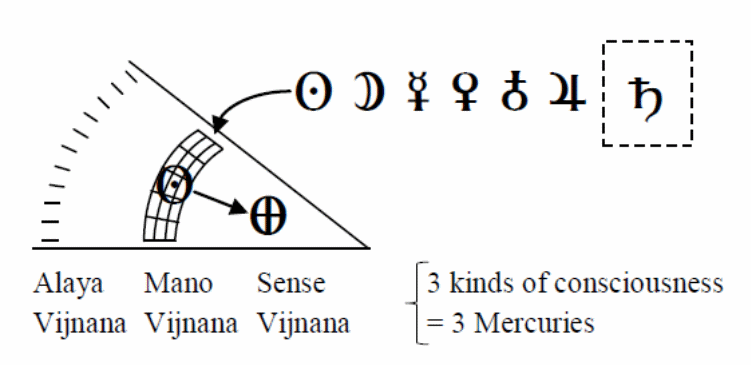
[FIGURE 1982 0124a-4-AB. Threefold Mercurius and Three Kinds of Consciousness. Computer generated by NT and IT from Classnotes AB 1982 0101 to 1982 0207.PDF.]
It is the unit of life which is projected from the Overself which ultimately becomes a Buddha (=bodhicitta).
1) Is bodhicitta power of the soul, with Saturn in Leo cognitive isness or, 2) is it what is inserted in the grid? An emanation of the Divine Soul (fundamental mind).
If the first four skandhas = the dignities, what does the consciousness refer to?
Three Mercuries not = unit soul which is distinct from them.
Reason-principles uniting [one/two words illegible], aspects, elements = Anima Mundi = Tathagatagarbha = womb of the world in which the unit life is inserted.
Kalachakra deals with how a unit soul goes through experience and grows.
Three schools of Tantra
1) Father -- tries to shut down lower functioning -- Guhyasamaja.
2) Mixed -- (Kalachakra) -- you participate in the same power as the production of the world.
3) Mother -- works with bodhicitta's identification with the productive imagination and tries to isolate the light from the imagination. (Analogous to Sufis.) Work with the active imagination -- you try to identify with the productive imagination within you. Chakrasamvara. PB's exercises on mind between thoughts.
3) Creatively visualize the image of [one word illegible]. Find the consciousness between thoughts. Analogous to Yogacara.
Father says you must stop the six senses to manifest light. Mother and Mixed don't require this.
1) In Vaibhashika all the dharmas are cosmic except consciousness (bodhicitta).
2) In Sautrantika only the form dharma is cosmic.
3) In Vijnanavada the whole production is from within the bodhicitta, which identifies with it.
4) Madhyamika -- Dharma functioning is empty of the intelligibility provided by the consciousness. Bodhicitta is empty of the organized structure provided by the dharmas.
3) The world which the bodhicitta projects is an apparition (i.e. empty) of the essences which it contains.
In 1 and 2, bodhicitta is inserted in cosmic process and grows through it.
In 3 and 4, the cosmic process is within the bodhicitta.
A) Alternative Kalachakra (secret) -- deities (degrees)
B) Inner Kalachakra = unio mentalis -- elements, channels, drops -- subtle form
C) Outer Kalachakra -- planets, signs, houses
A, B, C = your chart.
[Classnotes AB 1982 0124 End]
Class
Sunday, January 24th, 1982
Edited transcriptClick the series name to view more
CLASS at Wisdom's Goldenrod, Hector, NY
with Anthony Damiani (AD)
January 24a, 1982
BUDDHISM: TANTRA
with Appendix: Classnotes AB 1982 0124.
TOPIC: Buddhism
SUBJECT: Tantra
SUBSUBJECTS: Kalachakra, Epistemology
CONTENTS:
3 Yogas of Kalachakra
3 Tantras – Father, Mother, Mixed
4 Epistemologies as related to the subtle body
3 Forms of Kalachakra, Inner, Outer, and Alternative
Appendix: AB class notes
BOOKS READ FROM OR REFERENCED:
- Dalai Lama I, Glenn H. Mullin (trans.), Bridging the Sutras and Tantras: A Collection of Ten Minor Works
DIAGRAMS embedded in and appended to this transcript:
FIGURE 1982 0124a-1. Threefold Mercurius: 1=Sublunary; 2=Inerratic; 3=Planetary. (embedded)
FIGURE 1982 0124a-2. Subjective States and Cosmic Imagination (7 and 4). (embedded)
FIGURE 1982 0124a-3. Three Levels of Twelfth House from Geocentric View. (embedded)
FIGURE 1982 0124a-4-AB. Threefold Mercurius and Three Kinds of Consciousness. (appended)
RETYPED AND REFORMATTED by IT 2021
NOTES:
RETYPED PARTIAL TRANSCRIPT (hence V10). From 1982 0124-08R16.PDF. THERE ARE NO AUDIO CASSETTE TAPES EXTANT.
This is 1982 0124a = Buddhism: Tantra class at WG. 1982 0124b = Metaphysics; AD Unity (Unity Church in Columbus, Ohio), possibly misdated.
JF not sure who typed original transcript or drew diagrams; possibly Gabriel Aiello.
AB Classnotes have been appended because they contain information and diagrams that the partial transcript does not have and thus help round out the class. Retyped from Classnotes AB 1982 0101 to 1982 0207.PDF. All spelling, capitalization, and punctuation corrected, all abbreviations and some numbers spelled out in AB Classnotes.
Spelling and grammar have been corrected where obvious; where not obvious put [sic]. 'Anthony' and 'Gabriel' have been spelled out. Dalai Lama quotes have been supplemented with the actual quotes from the book.
1982 01/24a at Wisdom's Goldenrod
Buddhism: Tantra
[File 1982 0124-08R16.PDF Begins]
1/24/1982
Buddhism
[Note: Gab. typed in upper right corner = Gabriel Aiello probably typist of original partial transcript.]
Outline:
3 Yogas of Kalachakra
3 Tantras -- Father, Mother, Mixed
4 Epistemologies as related to the subtle body
3 Forms of Kalachakra, Inner, Outer, and Alternative
The yogas are applied as various ways of getting at the B.C. [bodhicitta], or fundamental mind. The Dalai Lama speaks of this mind as pure, luminous, uncreated. It is from within this nature that all phenomena appear.
There are three different kinds of bodies that will get precipitated out of the three matters dealt with by these yogas. 1) Deals with the matter more akin to the vitality that forms and organizes the elements. 2) The 'matter' is more akin to the ideas or R.P.'s [reason-principles]. 3) This yoga deals with the imaginal essence itself which can work in either direction.
We found a similar threefold with the Mercurius of the Alchemists. None of these three levels implies a Bodhicitta or unit soul function. They are referring to an objective functioning.
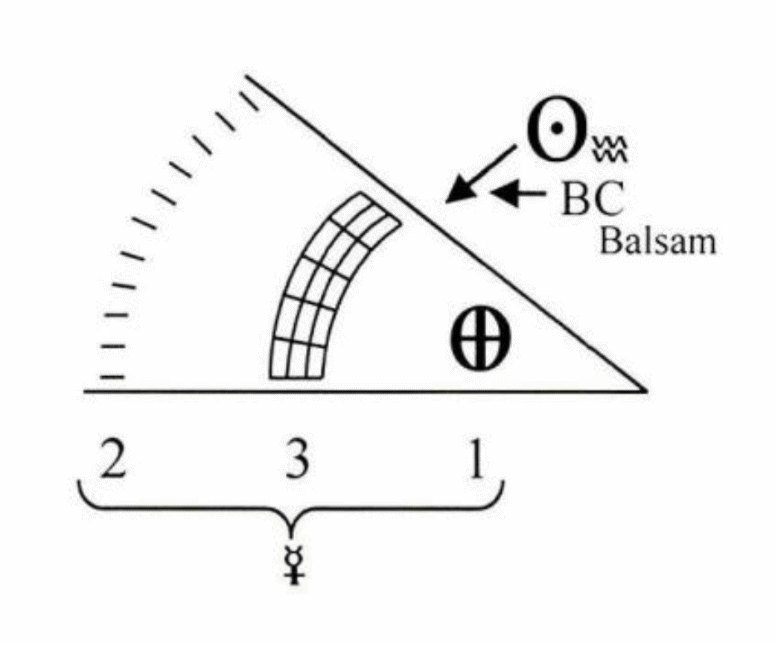
[FIGURE 1982 0124a-1. Threefold Mercurius: 1=Sublunary; 2=Inerratic; 3=Planetary. BC = Bodhicitta. Computer generated by NT from 1982 0124-08R16.PDF.]
The object of the purification of these levels is for the B.C., but the practices in themselves are not the function of the B.C. itself.
The Buddhists speak of three Tantras.
1) Father. In this tantra all the sense and mental functions must be shut down to get to the fundamental mind. They deal with the manipulation of the vitality in the body, and of the purification of the astral body. They say that there are traces of the fundamental mind's functioning left in the astral body and these are to be extracted.
2) Mother. The attempt is made in this tantra to isolate the factor of the fundamental mind directly. They are dealing with a subtle thought process rather than the vital energies that run through the body. [Typist's note: In the left margin is handwritten "mother or mixed?" with an arrow pointing up to the word "body". Unclear whose handwriting it is; it is not AD's.] The Sufic schools have a similar concept when they speak of producing through the active imagination the apparitional body which can contact the individual's Lord.
3) Mixed. The aim is participation in the powers that create the world, or identification with that power.
There is a point of agreement between the Mother and the Mixed tantras in that they both say that you don't have to stop the six consciousnesses to manifest the subtle mind, i.e., you don't have to be in a trance state.
"The yogas are a methodology and neither alone nor together do they constitute the truth."
*******
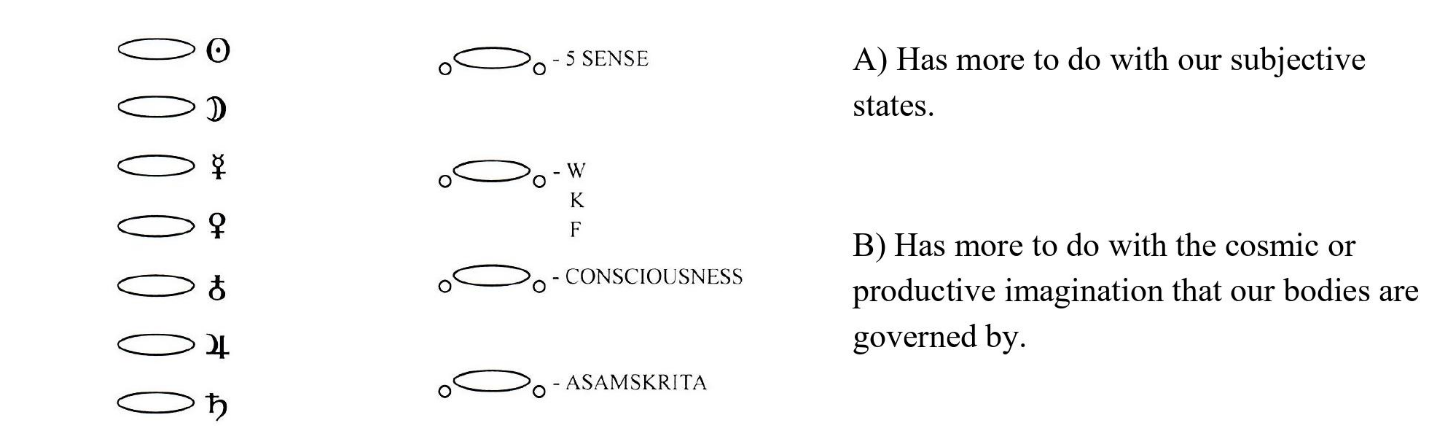
[FIGURE 1982 0124a-2. Subjective States and Cosmic Imagination (7 and 4). W K F = Willing Knowing Feeling. Computer generated by NT from 1982 0124-08R16.PDF.]
We will find differences in the epistemology of the four schools depending on if they are coming from the point of view of the productive or reproductive imagination, or both at once. Can we see these two levels in relation to the possible two levels of the subtle body?
. . . . . . . . . . . . . .
12th house
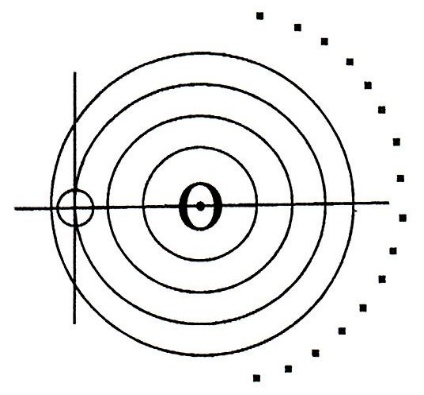
[FIGURE 1982 0124-3a. Three Levels of Twelfth House from Geocentric View. Computer generated by NT from 1982 0124-08R16.PDF.]
The Vaibhasikas. This school seems to be dealing with the diagram from the point of view of the productive imagination. They posit a simultaneity of the object consciousness with the sense organs/consciousness which apprehends them. They hold an identity between the state of the individual and the cosmic production. There is no interval between them, i.e., the cosmic and individual. All the dharmas are seen on one level, as described from the waking or gross state of consciousness.
The Sautrantika. They will posit an individual body in conjunction with a generic mentality of its own through which the macrocosm reveals itself by a miniature replica or duplication. From its own storehouse of images it selects the appropriate image necessary to understand the object that has been presented. For the Sautrantikas there is an individual but the rupa is seen as a cosmic functioning or product. Here in this school we can begin to see the split between the productive and reproductive imaginations. In one moment the object is "given" or appears in the ken and in the next moment the reproductive imagination brings in the appropriate images to allow the object to be known.
Chittamatra. There is no real difference between the subject and the object in the school. They will not leave the rupa in the possetion [sic] of the Cosmic Soul/Mind. They incorporate not only the vijnanas but also the rupa in the functioning of the alaya. They are saying that the mind objectifies its own forms.
They speak of eight vijnanas or consciousnesses. Each one is a separate dharma. Is one of those vijnanas the bodhicitta?
It does not seem so, because the alaya is usually spoken of as a storehouse of seeds going in and out of manifestation. Although Michael had found a passage where they spoke of the alaya as the actual force that enters and leaves the body.
There are two levels of Yogacara. One of which has a higher transcendental meaning and the other as the vijnana as imaginatively constructing the universe.
Anthony: "This sounds similar to the way in which the Platonist will speak of the soul in two manners. One is the fabricating principle and the second concerns itself with what has been fabricated. The higher provides the ontology and the lower with the modus operandi.
Which supplies the B.C.? The ontological stance is that the soul remains in itself. Then we would speak of a seed or light which goes out from that in which is contained the S-O [subject-object] constituents. This seed is the B.C. The difficulty is in conceiving the seed as containing in itself everything that will unfold.
This school is ignoring the objective to unfold the subjective. Their concern is not so much on the cosmic production but on the unfoldment of this individual seed."
They (the Sautrantikas) were concerned about the problem of the continuity of the individual through trance states. They didn't think that the other schools accounted for that.
We would say that the B.C. is the subject through all those states, what they call it is the alaya vijnana.
They seem to be saying that the macrocosm is a production of the microcosm . . . how can this be?
We could say that each person has a chart or mandala which will show his experience of the macrocosm, the common denominator being the World-Mind's functioning. We would say that each and every B.C. contains within it the whole of the intelligible world. This would mean that the experiences that each B.C. has is the projection out of itself, the intelligible world. This world has now become accessible because it has gone through a cognitive apparatus. Again, each B.C. encompasses the entire diagram (8).
Anthony: If we say that the twelfth dharma = B.C., we would be saying that all the other 71 dharmas are subsumed under the consciousness.
Is this what is meant by Mind-Only? B.C. only?
Anthony: Every thing comes from the seed, and the seed is the B.C., and all we know is the unfoldment of the B.C. Then we would not place the B.C. in the world but the world in the B.C.!
Madhyamika. This school wants to speak about the nature of the dharmas more than positing a particular epistemology.
For them the whole of diagram 8 is dharma functioning. Conventionally they will associate the vijnana with it. All states, trance, cessation, space are dharmas. They are the objects of consciousness. What is this consciousness? It must be the B.C. but they won't say that all this functioning is found within the B.C. They will say that this dharma functioning is empty. Empty of what we ask. Empty of the intelligibility provided by the B.C. The B.C. is empty. Empty of what? It is empty of the organized world provided by the dharmas.
Anthony: If we say that what the B.C. projects out from itself is an apparition of the essences contained within it, I can understand, setting aside agreement or disagreement. If you say I project a Mayic body or illusory body I can't understand. Those bodies do exist and are not illusory.
The conventional truth is apparition, it is like an illusion but is not an illusion . . . better? Now, what is it an apparition of? The Madhyamika would claim it to be the fundamental clear light.
*******
Anthony: "It seems that in the earlier two schools the consciousness is something that is getting inserted into the diagram and working through it. The later two schools seem to be saying that the diagram is to be placed within the B.C.
From the point of view of the later schools we would say that within the B.C. of each individual is the cosmos in an intelligible form. This gets projected out through the organized body as the manifestation of the interior states. Is this the link as to why there is a need for that subtle realm which separates the sense material world from the archetypal world?"
*******
The Buddhists speak of three Kalachakras--the Outer, Inner, and Alternative or Secret.
Outer K[alachakra], quoting the Dalai Lama, "…means [book reads: 'comprises'] the outer world, which is the vessel supporting [the] living beings. Thus it includes the planets of this solar system, as well as the sun, moon, [stars], and so on."
Inner, again quoting the D.L. [Dalai Lama], "refers to the living beings of the world, such as humans or those [book reads:"such as human beings, who are"] born from a womb and possessing [book reads: "and who possess"] the six elements. There the bases [book reads: "Here the basis"] to be purified includes the aggregates, spheres of perception, channels, mystic drops and so forth…" "One meditates on [book reads: 'upon'] these two Kalachakras in order to be free of [book reads:"in order to free them from"] obscurations." Before you practice the generation stage, the inner and outer Kalachakras must he purified.
The D.L. spoke of these as the inner, outer, and secret. The outer referred to the houses, signs, and planets, the inner to the elements, channels, and drops and the secret referred to the deities that arranged the other two. (degrees?)
Anthony: "These three Kalachakras are referring to your natal chart and the constituents that make it up. It is the wheel of your time."
What are the channels in the chart?
Gabriel: The channels are formed by the aspects that go on during the formation of the fetus. The winds are the processes of nature that are organizing, they are the elements. When you have an aspect there are two sides of it. One is the intelligible side corresponding to the drops that have taken residence in the channels (B.C.) and there is a wind or motility which is the angle. The angle will relate to the motility and the degrees to the bodhicitta's involvement.
Anthony: It is the activity of the subtle realm which affects the atmosphere that we breath in, which in turn we respond to. Those responses are the winds within us. The channels are a result of the winds at one time operating in you during the pre-natal epoch. These channels are fixed at birth.
Anthony: Although the outer Kalachakra is last in the order of existence it is first in the order of understanding, or of our knowledge.
Alternative From the point of view of the alternative Kalachakra only one mandala is needed, the mind mandala. This mandala includes all the dissolutions and projections of the lower mandalas of body and speech.
It seems that the mind mandala would be the mandala of the B.C. At the beginning stages of the Alternative K[alachakra] one uses the two other mandalas but the main practice is on the mind mandala. D.L.: "One should use either a complete mandala of body speech and mind or one such as the mind mandala, which incorporates symbolism using [book reads: 'revealing'] all stages of evolution and dissolution of the bases [book reads: 'basis'] to be purified."
[File 1982 0124-08R16.PDF Ends]
1982 01/24a V10: CLASS: Buddhism: Tantra. Copyright 2021 Wisdoms Goldenrod. p. ii