DIAGRAMS FOR 1982 0205a
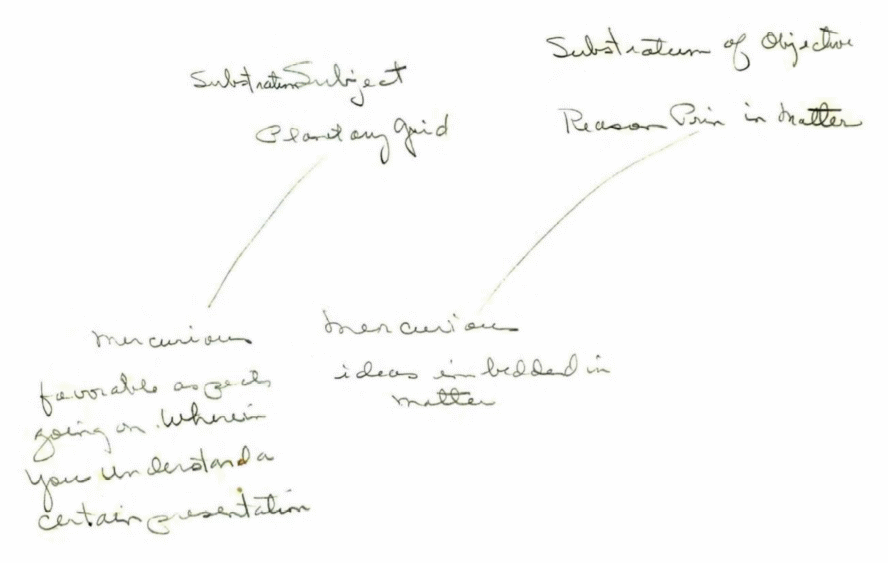
Seminar
Friday, February 5th, 1982
Verbatim, unedited transcriptClick the series name to view more
SEMINAR at Wisdom's Goldenrod, Hector, NY
with Anthony Damiani (AD)
February 5a, 1982
ALCHEMY; JUNG; MYSTERIUM CONIUNCTIONIS
TOPIC: Alchemy
SUBJECT: Jung
SUBSUBJECTS: Mysterium Coniunctionis, Three Conjunctions, Kalachakra, Buddhism, Bodhicitta, Ether, Quintessential Body, Man of Light (Light Body), Mercurius
CONTENTS:
Convergence of different traditions in twelfth house; alchemy traces back to Platonism; investigates light imparted to body mentioned by Plotinus
Light of soul imparted to three levels of twelfth house (salt, sulphur, mercury); these correlated with three levels of Kalachakra; three aspects of each level (gross, subtle, causal)
Detailed breakdown of each level and their sublevels
Alternative Kalachakra refers either to reason-principles or light of soul, unclear; bodhicitta must evolve through experience to become perfect mirror for first soul
Connection of salt and sulphur levels seems to be through subtle aspect
Two views: 1) soul as one of the reason-principles (favored by Jung and Franz); 2) light of soul as distinct from reason-principles
More discussion of whether Alternative Kalachakra refers to reason-principles or subjective soul
Review of the three conjunctions
Unio mentalis (first conjunction): unification of psyche and Eros; can occur in meditation or dream state; initiates process of individuation; requires love/aspiration for higher soul
Reunion with body (second conjunction): application of wisdom to life
Union with unus mundus (third conjunction): Sage operating in conformity with archetypal plan of universe/World-Idea
Reading/discussing Jung, Mysterium Coniunctionis, "The Conjunction," on quintessence
Quintessence needed for uniting unio mentalis with the body; heavenly substance indirectly hidden in human body; consists in image of God
Proclus quotation on divine imprint
Debate about nature of quintessence/image of God; possible identification with bodhicitta, heart atom
Dorn quote on production of caelum; is this a reference to substance of Sun in Aquarius involved in its own production?
AD commentary on Dorn quote: rotary movement in meditation that separates pure from impure; eventually leads to golden light extracted from body; followed by experience of zodiac and planetary spheres within you
Reading/discussing Atwood, A Suggestive Inquiry into the Hermetic Mystery, on ether
Ether contains whole plan of an entity's evolution; equated with bodhicitta and image of God
Reference to active and latent minds in Wisdom is to bodhicitta getting projected into and withdrawn from manifestation by cosmic soul
Debate about whether production of quintessence initiates process of reunion with body or is its end-product
Development of quintessential body through assimilation of reason-principles in experience; becomes basis for mystical development of body of light; final stage: ecstatic love where bodhicitta identifies with first soul and becomes its vehicle
Development of quintessential body a continuous process, doesn't start or end with first conjunction; process guided by image of God; experiences which don't conform to image are rejected
Continuing to read from "The Conjunction"; Jung's psychological interpretation of alchemy; Mercurius as dual nature spirit; extraction of hidden sparks
Mercurius as Soul of the World/planetary grid and reason-principles embedded in matter; Jung as unconscious astrologer
Importance of Dorn's statement: man must know "what rather than who he is"; philosopher knows what the world is, who he is, and their interrelationship
Jung fails to properly distinguish individual soul from anima mundi; Buddhists keep bodhicitta distinct from world process
Look to esoteric schools for details of mystical development only hinted at in Plato/Plotinus
Final recommendation: read "The Journey through the Planetary Houses"
BOOKS READ FROM OR REFERENCED:
Guenther Wachsmuth, The Etheric Formative Forces in Cosmos, Earth and Man: A Path of Investigating Into the World of the Living
C.G. Jung, CW 14, Mysterium Coniunctionis, "The Conjunction", "The Journey through the Planetary Houses" (in Chapter III)
Oxford English Dictionary (O.E.D.)
Kathleen Raine, George Mills (eds.), Thomas Taylor, The Platonist: Selected Writings
Plotinus, The Enneads (MacKenna translation, 4th ed.)
Mary Anne Atwood, A Suggestive Inquiry into the Hermetic Mystery
Paul Brunton, The Wisdom of the Overself
Paul Brunton, Notebooks
R.A. Schwaller de Lubicz, Symbol and the Symbolic: Ancient Egypt, Science, and the Evolution of Consciousness
G.R.S. Mead, Thrice-Greatest Hermes, Studies in Hellenistic Theosophy and Gnosis, 3 volumes
G.R.S. Mead, Pistis Sophia, The Gnostic Tradition of Mary Magdalene, Jesus, and His Disciples
PLOTINUS QUOTES READ OR REFERENCED: I.1.7, IV.3.13
AD NOTES read in this transcript:
- AD handwritten notes in back of his copy of Mysterium Coniunctionis
DIAGRAMS appended to this transcript:
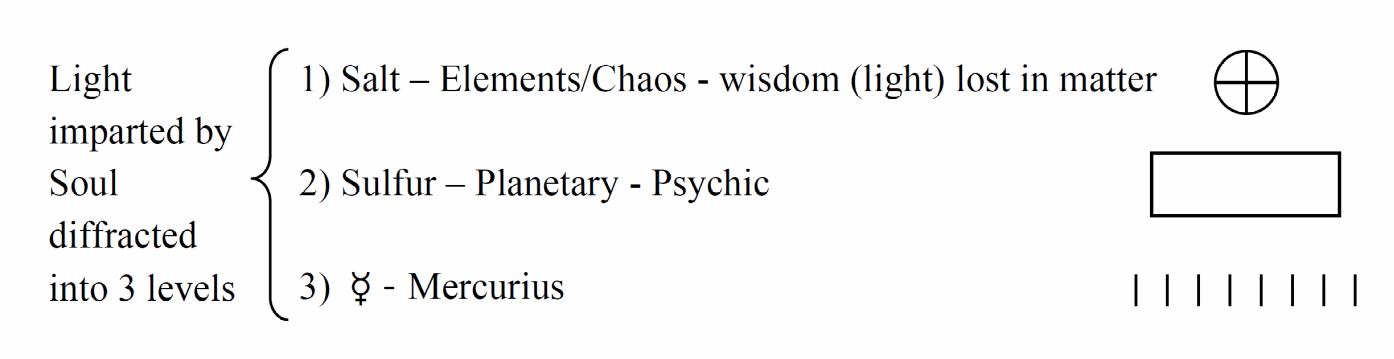
FIGURE 1982 0205a-1-AB. Three Material Worlds: Salt, Sulfur, Mercury.
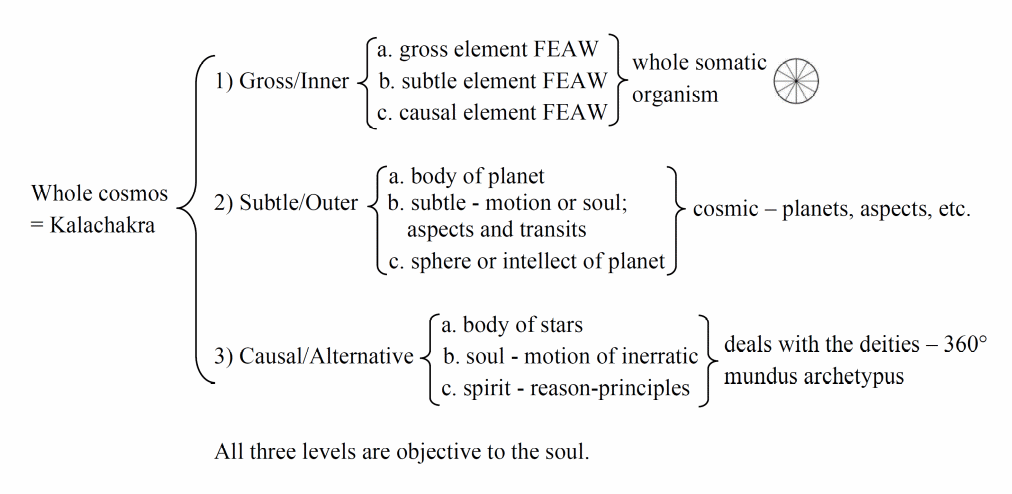
FIGURE 1982 0205a-2-AB. Three Levels of Kalachakra.
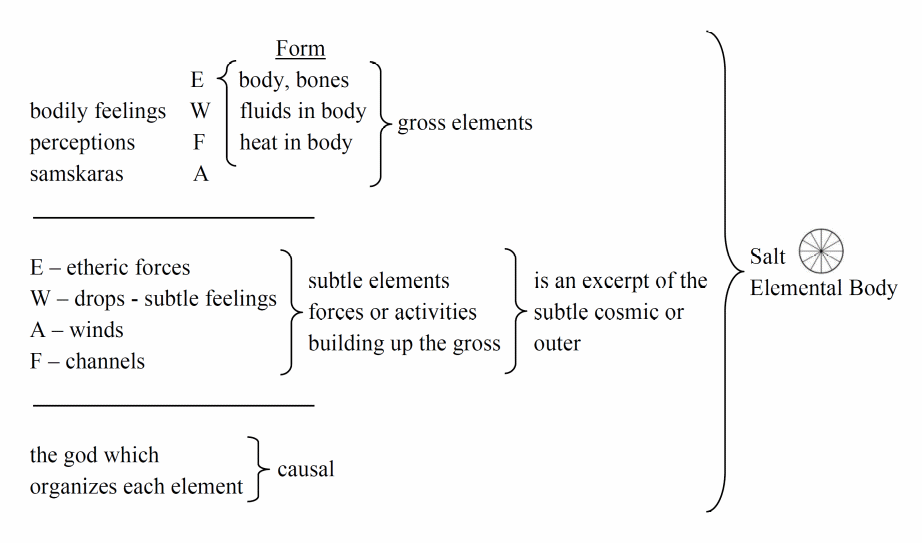
FIGURE 1982 0205a-3-AB. Three Levels of Elemental Body.
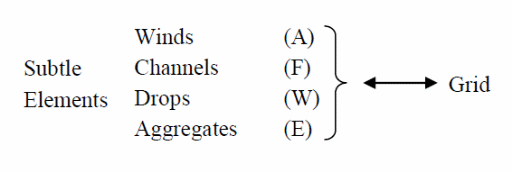
FIGURE 1982 0205a-4-AB. Grid and Subtle Elements.
FIGURE 1982 0205a-5. Double Mercurius and the Arisal of Knowledge.
Other diagrams also referred to are not with this transcript version. [Transcriber note: [diagram] means the speaker is referencing a diagram as he or she is speaking. If someone is drawing or writing, with audible sounds of chalk on a blackboard, I indicate this by [drawing] or [writing].]
NOTES:
This is 1982 02/05a, the Alchemy Class, the first entry associated with this date. 1982 02/05b = Quantum Mechanics, for which we have no audio, just JF notes — might refer to something misdated. 1982 02/05c = "Columbus" — might refer to something misdated.
We have two identical partial transcripts for this class, Scan Files 1982 0205-06R17.PDF and 1982 0205 ALC F06. Scan File 1982 0205 ALC F06 has handwritten AD edits in it. These are noted in the present transcript. Partial transcript originally typed by CdA.
AB notes for this class are dated 2/6/82. However, since both the Audio Files and Scan Files are dated 1982 0205, I am leaving this class as 1982 0205.
February 5, 1982 was a Friday.
TRANSCRIBED Verbatim by IT 2021. In 2025, IT completes TOC, expands Subsubjects and Book List, corrects minor typos/errors, adds new notes within transcript, adds four diagrams and references within transcript to these diagrams. Archival verbatim transcript – V12a.
AUDIO FILES: 1982 0205a, 1982 0205b. [Note: "Tape" and "Side" refer to original audio cassette tapes that were later digitized into .MP3 Audio Files.]
1982 02/05a SEMINAR at Wisdom's Goldenrod
Alchemy; Jung; Mysterium Coniunctionis
[Audio File 1982 0205a Begins]
AD: We'll briefly review some things. Please don't interrupt, huh? It's a review. Got to go over it in my mind. Don't start asking questions. Wait till the review is over. Avery is going to try to go over some of the things we've done. This is not a class, this is a seminar, this is-- this is-- So, we want to review because there's some sort of convergence taking place and it seems to be aiming in that way. There's convergence, there's many-- there's many traditions tying in together over here. And it would have to be that way. There is no choice, we all live in the same world, even if you want to call part of it East and the other part West. So that if these traditions do converge into the twelfth house [diagram], that shouldn't surprise you. [short pause]
We're trying to bring out some of the basic assumptions that underlie most of the traditions. Alchemy is one of them, Buddhism is another. This alchemy seems to be-- be a-- we're-- it seems that we're able to trace it back to Platonism. And as a matter of fact he-- the hints that are dropped by some of the great Platonists are where the alchemists and the early Neo-Platonists pick up on them and expand them and expound them. So that when we read from Plotinus the tractate I.1.7, and he says a light is imparted to the body, and we go on reading as though we understood what he meant, some of the old-- some of the old philosophers would stop right there and question that. This light which is imparted to the body is where they pick up from and they follow that and search that out. And that involves-- that involves them in some very secret studies which they only leave-- They don't leave traces. I think they-- I think they take all the street signs and turn them around the wrong way. (AD laughing, VM laughs) So I'm going to let Avery do a little reviewing just-- [16 second pause] And if this keeps, well I'm sure we'll all forget our English. Alright, we might as well start (now).
AS: Ok I-- I'm not really sure where to-- where to start.
AD (faint): Well, walk around a little and find your way.
S: Right.
AD (very faint): [few words inaudible]
AS: Ok. Ok well-- Maybe that was (it). [short pause] Well at the beginning they spoke about this light being immersed, as we're just saying, a light immersed in body and the light immersed in the twelfth house. But they seem to speak about three different levels of this twelfth house, ok, which they call-- And maybe-- There's this light part, [drawing] which they speak about the light imparted by the soul. But then the light seems to be imparted to three different levels. At the lowest level we spoke about the elements realm, the elements. And the original state of affairs in which there was this chaos, that-- that the light was so immersed in, conjoined with the body and with all the affects and emotions that it was hard to distinguish it out from that and was-- they say it's complete-- this wisdom is lost in matter and it has to be extracted again and brought up to a level where it's made consciously available. So they-- they speak about these three levels. Seems like they speak about three levels [drawing] of involvement of this light with the cosmos, which they give these names something like [writing] salt, sulphur, and mercury [FIGURE 1982 0205a-1-AB]. [short pause] Ok? Where salt corresponds to the level of the elements, sulphur basically to the level of the planetary or psychic, and then mercurius or mercury to the level of the inerratic. I guess we could do something like that. And then they s-- he speaks also about mercury itself having these three aspects or mercurius. Which also seems to correspond to these three levels. Mercurius or this intelligence embedded in the elements and then extracted or brought up to the level of the sulphur or planetary and then finally to the level of the inerratic.
And one-- although it wasn't clear in Jung or in Franz, it seems that a real distinction had to be made between these three levels [AS indicates on diagram] of the twelfth house or of vehicles and of the light [drawing] which was coming from the soul itself, ok. And this light which was coming from the soul itself and was immersed in this matter and had to be extracted from it through this alchemical process, they have various names for. The balsam, stone, and in Buddhism they spoke about it I think as bodhicitta, which was this fragment from the first soul or light given off from the first soul, which had to evolve through all this experience to eventually become a double or perfect mirror for the higher soul. Ok? Now, do-- do you want to go over the thing with the three levels of each one? Ok. [AD simultaneously, very faint: (Go ahead.)]
Well, it then seemed that there was also a correlation to the Buddhism--we should go over that--where they spoke about this whole thing here it seems, [drawing] this whole twelfth house, the whole cosmos they spoke about as being a-- being Kalachakra. And this Kalachakra had three different levels to it, just the same way as this--the elements, planetary, inerratic--and they called them [writing] Inner, Outer, and Alternative [FIGURE 1982 0205a-2-AB]. Although again, the Alternative gets unclear whether it's-- which is the Alternative, if the Alternative is the highest level here [diagram] or if the Alternative is coming from the light, if the light was from that. But anyway we tried to make the distinction.
And then they spoke about each one of these three had three aspects. So like the elements. And they speak about this in Platonism too. The level of the elements there are three levels. There's a gross level of the elements, a subtle level of the elements, and a causal level of the elements. I mean-- [drawing] so you got three by three basically--salt or Inner-- This could be spoken of as the gross [diagram]; this is the subtle [diagram]; and this is causal [diagram], the fixed stars, it's the inerratic sphere, and beyond. Ok, and this is the [drawing] planetary grid [diagram]. And each one of these causal, subtle, and gross also in addition has three levels to it, which he'll try and just make a little bit clearer. But this whole thing is like-- is objective to the light of the soul.
And then they will speak about successively this light originally identified all the way with [drawing] the elements, being gradually extracted and associated with higher and higher levels or subtler and subtler levels of what is really objective. But of course at every stage, what's-- what seems to be subjective is really a subtler level of the objective and then when the light is extracted from that level of the object and is associated with the next subtler level of the objective vehicle, it seems like-- seems like something is extracted. Um-- Ok.
So, at each one of these levels there's three-- there's a gross, a subtle, and a causal level. [Note: See FIGURE 1982 0205a-3-AB for the following.] For example, the elements. Let's start with that one. [short pause, then drawing] We call the elements, there's the gross, subtle, and causal for each one of these elements. [10 second pause while drawing] And this would be your whole somatic organism, ok, so-- Well, terminology. Should I use the-- Ok. I don't know if you want-- do you want to go into any of the details or just--
AD: Just a little bit. Just a little bit.
AS: Ok, so for example, if you look-- [drawing] Your gross physical-- earth would represent-- on its gross aspect would represent your gross physical form; actually your actual physical body say, you have certain-- like-- [drawing] Within that say you have a solidity, ok, your bones and so on. So you have earth element. You have blood and bile and so on and that would be water. Then you have certain airs, you know. You breath in and out and so on and that would be air. A certain heat, digestion and so on which digests your food, and all that would be your gross body. So there would be a fire, earth, air, and water on a gross level composing your form.
But now the forces which run that body, the subtle forces which are behind those elements would be the subtle level [drawing] of the earth element. And that would correspond for example to the etheric forces that we spoke about in Wachsmuth [Note: The Etheric Formative Forces in Cosmos, Earth and Man by Guenther Wachsmuth.]--coagulation, heat, light. In other words, all of the subtle-- the subtle counterparts or the soul of those elements, the activity that as actually building up that body, which is not the corpor-- the appearing, (is--) it's not the sensibly appearing body but the forces that are behind that. Ok?
And then behind that would be a [drawing/writing] causal level of those earth element, which for example might be the God which is-- or the emissary of that God which is responsible for governing or organizing the earth element. Ok? So your corporeal form would have a gross sensible aspect, it would have subtle aspect, that would be the forces behind that gross aspect, and then it would have a causal aspect would be-- which would be like the intelligence organizing the whole thing. Ok? And then the next-- [drawing] next element. Now all of this, all this whole business here [diagram] is-- I-- is conceived of as the lowest level or what they call salt, ok, and within each of the elements of salt there's a salt, sulphur, and mercury aspect, there's a gross, subtle, and causal aspect of each one of these.
So for the next-- maybe do one more. Like the next one would be [drawing] feelings. Ok, now this is other than the gross sensible form of your body. These would be the actual feeling states that you experience. But now, what's subtle to those, the motions and activity that's causing those feeling states would be an aspect of your subtle body. It's not perceptible. You don't normally know it unless, you know, you might get somewhat concentrated and get to the basis of those feelings, you would find that (they) were certain state of your subtle body. (In) Buddhism [drawing/writing] they'd call this for example probably something like drops. Ok? And then, if you even got further you'd find that there was an intelligence inherent in those subtle activities which would be some kind of a God. Ok?
And then we had these other ones. The next one, air, now I don't know if this is right but samskaras or vasanas or tendencies or thought-- you know, habitual thought patterns. And the basis, the subtle basis of those would be some kind of winds Buddhism would say. And then of course there's some God which rules over that. And for fire you'd have your perceptions, which would be based on certain channels or subtle nerves. Not the normal nerves but the subtle nerves which are the channel for the mind to go out, take a certain form. And then of course some Gods would rule over that.
Now this is-- if-- if you put all this together, it could be the organization of your vehi-- your salt or gross vehicle, your elemental body. And that includes the gross-- the actual gross form with all the manifest feelings, thoughts, perceptions; the subtle body which underlies that or is modifying that, subtle forces; and finally the intelligence which is inherent in that body. So all of that would be what they would call the salt level, or this first level. And that's the level where say this light from the soul is originally immersed in all that. [students assent, faint] And is experiencing all the forms, the feelings, the perceptions that are going on. And at the first level of this alchemical process they talk about trying to free the light from the functioning of this body. At least to recognize that it's something which has been inserted in that.
Now the next-- the next whole level they call sulphur, which is basically we equated with the planetary spheres. And that also will have three levels, a gross, a subtle, and a causal level [FIGURE 1982 0205a-2-AB]. Ok, in other words that's for example now-- [drawing] Here's your body and it's really your subtle body, particular, is part of the cosmos. You look at the ephemeris, you see transits and so on and they're having an effect, they're modifying your subtle body [FIGURE 1982 0205a-4-AB]. So all the planetary aspects and planetary motions and vitality are having an effect on your body. Ok, thi-- [drawing/writing] Buddhists call this the Inner [Note: the salt level]. [S, faint: Right.] And they call the next one the Outer or the cosmic, the planets and all their positions in the signs and their aspects and so on are having an effect on your subtle body, which are causing all these modifications in your subtle body, which then results in your sensible experience. And they say that this Outer, planets, has three aspects also. [drawing/writing] There (were/was) [one word inaudible] planet, Jupiter, Mars. All the planetary spheres. And each one of these planets itself has a gross aspect or a body. And it has a subtle aspect, which is the motions or soul of that planet. And that would really be concerned with all the transits, aspects and so on, progressions, all of the aspects that the planets would make to each other. And finally, each planet also would have a causal aspect. The Platonists speak of it as the whole sphere of the planet, or the intelligence of the planet or the intellect of the planet. [short pause while drawing/writing]
And, it just seems [couple words inaudible] that primarily the way that the Outer or the cosmos is having its effect on you is [drawing] through the subtle level of the cosmic. In fact, the more-- when we looked at it, it almost seemed that your subtle body was a participation in the subtle level of the Outer. The subtle level of the Inner was in fact an excerpt. In fact when you die, the subtle level, these winds, channels, drops and aggregates which compose your vehicles will be returned, or actually never left, are really a part of the cosmic subtle body. So if there's a motion here [diagram], your subtle body-- although your physical form is restricted to this body six feet high or whatever, your subtle body is not so restricted but is in a sense co-extensive with the whole universe. In other words, your subtle body is in a way co-extensive with the subtle body of the stars, the planets. So if there's an aspect going on, you immediately feel it. And that immediately-- and that becomes your actual experience. Ok, well-- [short pause] Next (part). So-- ok, so anyway then under sulphur there's also a salt, sulphur, and mercury aspect. And again this isn't the light of the soul, we're speaking all-- this is all in terms of the cosmos, you know, the cosmic-- the cosmocrator, this description.
Ok and finally they had a third level called [writing] mercurius. [student assents, faint] And that would have to be-- and in the Kalachakra description they describe that third one as dealing with the deities [FIGURE 1982 0205a-2-AB]. And the deities would seem to be the 360 degrees, the reason-principles. [drawing] And in alchemy they talk about the mundus archetypus, the archetypal world or the one world of intelligence that the whole universe, or the whole cosmos anyway, [drawing] which we might-- I guess we could symbolize as the 360 reason-principles or degrees. [students assent, faint] And that would have three aspects. Now that one is harder. But I guess you could say the stars themselves would have a body. You look up and you see the stars. Each star itself would have a certain material component, constituent. And that would be its body. And it-- it has a motion also. In fact the whole inerratic sphere has a motion. And they also speak about the motion of each of those stars or their total interrelationship even. That would be its subtle aspect. And the causal or intellectual aspect of the fixed stars would have to be the reason-principles in themselves. They also did speak about-- in Platonism about three levels beyond Saturn, they spoke about the inerratic-- (or) the fixed stars, the zodiac and the prime mobilum. So that would be another possibility for the salt, sulphur, and mercury of what they call mercurius. [short pause while drawing]
Now, one thing-- now alchemy seems speaks about these two [diagram], in the condition we first find ourselves, this wisdom and-- Well we already said that this activity here, the motions of the soul, of the planets, [drawing] of the Outer, is already inherent in your vehicle as the modifications of the subtle body. Ok, so you know about those activities of the cosmos through the motions or modifications in your subtle body. And supposedly you also have embedded in your vehicle the wisdom of the stars. Ok, they spoke-- that's where they spoke about like Sophia. Ok, they spoke about the Nous being present right in the elements. Now maybe that's because of the reference to this causal level of the elements. You say there's an intelligence actually embedded in your vehicle also. So that would be a mirror of the fixed stars, which again you don't know directly, but originally are immersed in the elements. And at least that aspect of the alchemical process seems to be drawing out from this body all of these higher-- these two higher levels of constituents that are embedded in it. That's one thing that goes on. But the other thing that seems to be going on is, immersed in this [drawing] whole threefold system, each of which is threefold, is this light of the soul, which it seems to be something totally other than any of this. We spoke about--
AD (simultaneously): But the o-- but the other alternative, Avery, [AS: The alternative, yeah.] that one of these here may be the soul.
AS: Yeah. That was the-- the other al-- the other possibility for what they call the Alternative Kalachakra is in fact that it is-- they are speaking about the light of the soul. And that maybe the Outer includes the degrees also. I mean maybe their Outer Kalachakra includes the planets and the degrees, and then their third Kalachakra we would have to say refers to the light of the soul, the bodhicitta. (Ok) that-- I guess that wasn't really clear from the meager descriptions that we have of it. But anyway there is a distinction being made certainly between this whole [drawing] threefold system which we made a lot, and the light coming from the subjective soul. And one of-- and the main alchemical process seems to be freeing that light which is originally immersed in here, and not so much-- Yeah, ok, freeing it or individuating it or differentiating it to a point where it can be a true mirror of the first soul which emanated. I think that's the way we spoke about bodhicitta as this fragment or light or emanation from the first soul which has gotten, you know, caught up in this whole round-- realm-- round of cyclic existence in order to eventually build itself up into a suitable individuated vehicle which could reflect the first soul, or could mirror the first soul. And that that seems to be a main thing that the alchemical process is talking about, freeing that light.
AD: Yeah briefly, with some omissions probably, that's about where we-- where we got. I don't know if-- I don't know what the outcome is going to be but I do think-- I do think that we penetrated in some of the obscurity of the Buddhist doctrine when they speak about the 72 dharmas or the five skandhas. We're leaving out the fifth one, consciousness, here because that's going to require treatment all by itself. But, I re-- I-- I think that that somehow penetrates into the obscurity of the Buddhist doctrine, and the-- when they speak about the act-- the form, rupa, and then they speak about the feelings and the samskaras and perceptions, alright, that seems to be just the most-- the outermost layer of the person that we're, let's say, confronted with. And, the next level, the subtle level, seems to be-- be what's manipulating that outer form. Seems that at the subtle level there's a connection with this realm here [diagram]. [12 second pause] Alright? We'll try to go ahead a little bit.
S: I have a question.
AD: Sure.
S: Are the dharmas the breakdown of the skandhas?
AD: Yeah.
AS (faint): Yeah.
AD: Yeah when they-- when they speak of the 72 dharmas or the 108 dharmas, what we did was to-- well, the way they-- they put them in five columns, and those five columns would-- are equivalent to the five skandhas. So that those 72 dharmas are one time and you-- and, in the attempt to understand the Vaibhashika school, we saw that they were speaking about the-- what do they call it, dependent origination or the-- the totality of factors which combine and in their very combination produce the experienced world. Now, we can try again. But I think what we have to do, we have to bring in one more thing here, Avery. We suggested-- we're suggesting that the-- This part seems to be mysterious. We're suggesting that the soul may be one of these reason-principles coming from a [AS simultaneously: Oh yeah.] star, ok. And the soul that we're speaking about here is the second soul or that soul which is an emanation from the soul which is in heaven. And the other possibility is, we're thinking of just this light, you know, which is projected from soul proper and somehow gets involved in this process, and in this case we would not be considering that as one of the, let's say, degrees.
AS: Right. But if-- in that first case though, you said if the-- considering the soul as coming from a star, um, seemed to be saying that then the light of the soul is already-- like he sometime-- they sometimes say that when the soul enters the cosmos it first comes through the Milky-- through the stars--
AD: Yeah, through the Milky Way.
AS (simultaneously): --or star, and then through the planetary spheres and then all the way down embedded into the elements. So you're saying that light of the soul which is embedded in the elements in a way is already conjoined with some intelligence from the cosmos. Or it already had a-- a certain star.
AD (simultaneously): Yeah that's one alternative. That seemed to be the alternative that was favored by Franz and Jung.
AS: Yeah that would certainly-- Then, in that case, that may be why they wouldn't make the distinction between the light of the soul and the intelligence [AD or student assents, faint] from the Nous, the Sophia, because they would say well it's-- it's conjoined.
AD (simultaneously): It's part of Sophia.
AS: Yeah, it's already conjoined there.
AD: But if I remember something about Platonism, they refer to all these reason-principles or degrees as a unity, as a monad, the Anthropos, Universal Man. And, again I would have trouble thinking or breaking off or separating a m-- a soul from that unity. [AS/S(?) assents, faint] Alright, the problems will probably start multiplying as you go along, but--
AS: That might be-- oh yeah, I hope not.
AD: Do you have any questions?
AS (faint): That might be [couple words inaudible]
AD (simultaneously): Or we can try again.
CDA: Could you just, um-- when you say you would have trouble seeing the soul separate-- separate from that unity? I don't quite see how you would-- why you would have to think of it that way, why-- why the-- why the soul's-- the light of the soul couldn't be related to that realm af-- in some way that-- posterior to the unity, like at-- You know, on the highest level it's a monad but-- but there is an activity of-- of this intelligence that-- there is a power in this intelligence. You know, it's not just a monad--
AD (simultaneously): I-- I don't-- Well what else is it?
CDA: Well it's also the power of the m-- it's the manifested world, the whole thing, you know.
AD: It's-- it's what?
CDA (simultaneously): I just-- [short pause] The Ideas have power, and this power is ultimately manifesting the world. I couldn't understand why you would-- why you would stop at-- in saying that at-- because the Ideas are a monad, that you couldn't conceive of the soul being related to them in that way.
AD: Well, I didn't say you can't, you can. I-- evidently that's the way Jung and Franz have been handling it, they say that the soul is one of these reason-principles which is immersed in matter.
CDA: Oh, is one of the reason-principles. Well then what's the difference between it being-- descending through? There's some difference then as being one of the reason-principles or as the light of the soul descending through the inerratic sphere.
AD: Well, that's exactly what we're doing.
CDA: That's the difference you're making.
AD: Yeah, that's the difference I'm making.
CDA (simultaneously): Ok, ok.
AD: The reason-principles are going to be vehicles in which the light of the soul gets involved with but that they're [CDA simultaneously: Ok.] not the reason-principles. So that-- Let me try this way at a much lower level where we can speak analogically. The experiences that you go through when various planets are sitting on various degrees are experiences that some entity is having. He is not that which he is experiencing, although it is possible that for the purpose of learning those reason-principles he may have to compulsively identify with them. But after that is over, then those reason-principles, or the meaning that he has assimilated from those reason-principles, are distinct from the soul that is gathering that experience.
CDA (simultaneously): Yeah. No I'm-- well--
AD: So you-- you know, when you look at a chart and you go through all these experiences, whoever the native is, whoever the subject is, seems to be, in my opinion, distinct from the-- the reasons that he's experiencing embodied. Now I'm just saying, we hold on to the two alternatives as we go along. One of them is bound to show up as contradictory. [student assents, faint] [short pause] Any more questions?
AH (faint): Yes, what are the two possibilities for the Alternate that Avery mentioned? Go over that please. You say there's two alternatives for the Alternative.
AS: I think the two alternatives very briefly correspond to the two distinction-- two distinct ways we just had of talking about the soul. One is viewing, saying that the Alternative is talking about just the rea-- the reason-principles. It-- ok?
AH (faint): Ok.
AS: The co-- in-- in the inerratic, and the other is perhaps the Alternative really does refer to the light of the soul itself. And that-- then we'd have to group the reason-principles as objective under the Outer Kalachakra say. And maybe they're-- when they speak about the Alternative Kalachakra they really are speaking about the subjective soul, you know, the light of the soul, bodhicitta, bodhi.
AH (simultaneously, faint): Avery, what's the [one word inaudible] a reference?
AS: It wasn't clear though.
AH (faint): That the Alternative consolidates or combines the (other two)?
AS: Yeah, but that could be thought of in two ways.
AH (faint): I thought so.
AS: Because, again, the Nous-- the reason-principles would consolidate the Outer and Inner, looking at it objectively, or you could say what consolidates the Outer and Inner is the subjective soul.
EMD (simultaneously): Can you please speak louder when you talk?
AS: Yeah.
EMD: We don't hear you back here.
AS: Andrew? You see?
AH (faint): Yeah ok.
S (faint): Right.
AS: Yeah.
AH: But that this part is on the side of this [diagram] now.
AS: Yeah. Andrew asked about, they-- they s-- there's this line from the Alternative that the Alternative Kalachakra, the third one, combines or unites the other two. But that could be thought of two ways, as the reason-principles from the Intellect combining the Outer and Inner or running through the outer world and the inner man, or you could say that, no, it's the soul, the subjective soul which unites Outer and Inner, the light of the soul. Now I-- It just wasn't-- there wasn't a very much of a quote there.
AH: Did you equate that light of the soul, Avery, with bodhicitta or with--
AS: Yeah.
AD: Then it will be a distinct principle from those reason-principles.
AH (faint): The bodhicitta.
AD: Yeah.
AH (faint): A distinct soul.
AD: And-- yeah, [AS simultaneously: Yeah.] distinct from the reason-principles and not be identified with them. Although like I said, it may experience whatever, you know, you're called upon to experience insofar that a certain situation or event occurs where the reason-principle is embodied in that and you experience that even to the point of identifying with it. But then you distinguish yourself from that. And again, the question is, well who is the subject here?
AH (faint): That seems-- that question, Anthony, it seems that-- honestly the second point of view, that the Alternative Kalachakra is the view of that subjective soul, rather than the first one (there). (I mean/Meaning) the subject, the bodhicitta, light of the soul, is-- is in some sense distinct ultimately.
AD: Is some what?
AH (faint): (That) some ultimate sense distinct from--
AD: From that, from the reason-principles. Because if we think of the reason-principles as the prefiguration or the-- the realm of ideation as far as the universe is concerned, then we would be saying that those reason-principles is the substratum which is guiding and manifesting itself in the universe as a sensible universe. And so be-- behind the appearances of the world that we live in, there are reason-principles behind that. And the consequence of that would be that in any situation, event, circumstances or whatever, that they are being assimilated by the soul. So, it-- to me it sounds contradictory to say that the reason-principles are experiencing themselves. So we'll just leave it open like that and as we go along, maybe we'll get more information on the matter. I think we were at the second section? [38¾ second pause, flipping of pages]
Now he does speak of three conjunctions that take place according to the alchemical theory. And, the first one where there was a unification of the psyche and Eros, or the-- the celestial part, the soul. And he speaks about that and he says that's the first conjunction. And in that fusion of Eros and the psyche, there's brought about a certain maturity, a potentiality, the whole process of individuation is started, or the mystical path. And then the second-- the second conjunction-- Oh that also referred to the separation from the body. Insofar that there's a unification of the psyche and Eros, there's also a separation from the body when that conjunction is experienced. He says that that-- that that was experienced in the medium of the Self, and, I don't know what that means.
S: Oh.
[flipping of pages, faint background student talking]
AD: Well, if you remember he says that the medium of the self there he referred to as the totality of all the psychic processes. So the assumption here is that this conjunction, unification of the psyche and Eros, is taking place in the psychic realm. And it's distinct and separated off from the body. And then the next point he makes is now the philosopher, or the alchemist, takes-- takes this combination or this conjunction, and it is inserted into the body or brought back to the body or combined with the body again. And then the third conjunction was that the philosopher unites himself with the unus mundus. Now the unus mundus would have to be the archetypal plan of the universe, not in its sensible form or in the form in which it appears to us because that would not be the archetype, the archetypal universe, but the entire-- the entirety of the plan of the universe as it is prefigured at an ideational level. And he's saying the philosopher must combine with that. And that would be the third conjunction and he goes on to say that he doesn't know of anyone who's succeeded.
Now, in another way, perhaps another way of trying to explain that would be that when the mystic has achieved the first union, I mean the second union, in the second union where he is learning from the first union of unity of the psyche and the soul, now he brings that knowledge to bear-- when he come-- when he brings it back into the body, now he brings that knowledge to bear in a very practical way, that is, the philosopher has to live out, the alchemist has to live out this knowledge in the ordinary and everyday details of life, if I remember. And he said that was the second conjunction.
The third conjunction is-- would be a complete alignment of the alchemist with the plan which is in the unus mundus or is the unus mundus. In other words, the prefiguration of the universe or the archetypal plan of the universe, the alchemist aligns himself or is in union with that. So that we could think of the Sage or the philosophic Sage as a person who is orientated in his activities by the actual plan of the universe and works in accordance with that and not with his-- any personal im-- idiosyncrasies that let's say his personality gives rise to. So I think there-- they would be referring-- the third conjunction would be referring to that. And from what we understand of philosophic Sage, it is exactly the person who coordinates his activity or whose-- or whose activities are an outflow-- let's say they're an outflow of the World-Idea's version, I-- the World-Mind's I-- Idea of what the world is to be. So the Sage would operate strictly in accordance with that. He would just, you know, do what, let's say, the unfolding of the World-Idea calls for. And I think that's what the alchemists refer to as the third conjunction.
Now I don't consider this in any way peculiar, I mean this seems to be obvious in all traditional teachings, that the Sage acts in conformity with the World-Idea. That's what we think of a Sage. And his-- his beneficence and compassion very often consist in redirecting us, or at least pointing out to us where we strayed from our own inner nature and try to direct us back to it and flow with that inner nature. I think that was about that, no?
S (very faint): Uh-hm. Is that the (second--)
AD: I can't hear you.
S (very faint): I don't-- I don't understand the second-- the second conjunction.
AD: You don't understand the second-- The second conjunction we said was, after having had the first conjunction, alright, which was a unification of the psyche with the celestial soul or at least (with that/about) higher, the second-- you know, that soul which is emitted by the Intellectual soul, now, these two are in union. So he has-- he has an inner knowledge, he has an inner knowledge. This knowledge has to be actualized. So when he comes back into the body or when he resumes identity with the personality, now he puts into practice, he puts into practice that knowledge which he has. And he calls that-- In other words, the application of the wisdom which has been given to him in the first union, the application of that wisdom to the everyday details of living.
S (faint): So would that be something like trying to-- of being sort of true to your inner guide?
AD: Yes.
S: And then the step beyond that, the third conjunction would be--
(Side 1 of original cassette tape digitized as 1982 0205a Ends; Side 2 Begins)
AD: If that knowledge is not used, you know, it can be infectious. So the application of that understanding, the actual living out of the philosophic life, is the second conjunction. It's as simple as all that. The third conjunction is when there's a complete conformity to the prearranged-- or let's say the prearranged plan of the world to be, and your cooperation with it or (you're giving/your given) expression to it or you're conforming to it. I think, I think this is a way of stating these things, you know.
S (very faint): Uh-hm.
S: So then the difference is really like in the second one you're still-- you're still trying to actualize the store, inner context trying to express itself.
AD: Yeah.
S (faint): And the third one is then, there's no effort and you're (effectively) aligned with that World-Idea.
AD: Uh-huh. So you may-- you may, let's say, learn of reason and understand-- and build your understanding up but then the application of the rational processes to the actual everyday living is a whole different ball game. And until that's achieved, the third conjunction won't take place.
AH (faint): Anthony, could I ask-- well could I ask a question about the first conjunction? You spoke of that as unity of psyche and Eros but also spoke of that as the separation of the light from the body.
AD: Yes.
AH (faint): I don't understand how that unity could result from the separation of light from the body.
VM: Twice.
[short pause]
AD: Well it would be very ha-- it would be very difficult to have any kind of mystical experience while you're preoccupied with, let's say, bodily appetites.
AH: Then-- then the body becomes the cause of (deception/perception).
AD (simultaneously): No the-- the very simple thing here is that you have to sit down and meditate. And in the process of sitting down in meditation, you know, where you try to eliminate awareness of the body or preoccupation with the body, and if you succeed and if you knock out of gear the whole of the sense apparatus, alright, then you're invaded by light. That can't happen, that is you can't-- cannot have the experience of light while your senses are functioning. So, [AH: I understand.] at that moment there is a separation from the body.
AH (faint): How is that a union of psyche and Eros?
AD: Well, it would-- it would require tremendous aspiration, let's say to bring about what you might call satori, experience of the divine within you, um-- [short pause] That would be a separation from the body. I'm sorry. What was it you said?
VM (simultaneously, faint): Union with Eros.
AD: Huh?
VM (faint): Union with Eros. Why is it union Eros.
AD: Oh yes. [short pause] Andrew, [AS simultaneously: I--] it's very simple: you gotta love it. Or it won't take place.
AS: We made the point of the Eros was to-- this influx from the higher soul. He said as long as you're concerned with the affects and so on of the body also and not aspiring towards the higher soul, then it's not going to answer that aspiration unless the love-- the intensity of love and aspiration for it is great enough to evoke that influx of Eros.
[short pause]
AD: Well, alright?
AH: I was looking specifically for the connection between the unified state where psyche and Eros are unified and how that results in the separation of light, I think I understood that (point now).
AD: That-- how that results in the separation from--
AH: This light from the body.
AD: How that results from the separation up? No not(--) [AS simultaneously: Not results in but results from.] the light from the body. The light gets separated from the body.
AH: Yes.
AS: It's the re-- or a glimpse.
AD (simultaneously): But it would be out of the question, I mean you simply can't have a mystical experience without putting the body out of commission. It could last a minute, could last weeks, could last a day. But it's only at that moment that the separation of the body makes possible to have the experience of the higher. Now, that would mean that if you're not the body at that moment, then that means you're more mind than you are body, that's when the unification between the mind, what you refer to as the mind, and the love for the soul, the soul comes in or is brought into o-- into activity, that the combination takes place so that now what they refer to as the mental-- the mental being conjoins himself or embraces the principle of Eros which is in his soul and that union, alright, is what reorientates the man completely from then on. He is now more concerned with that than he would be about what the body wants. But there must take place a separation. If you remember-- if you remember the classical one, Saint Paul, when he had the conversion. He didn't know where it was, on Earth or in heaven, in the body or out of the body. That's separation from the body.
So, those were the three conjunctions they speak about and he-- I-- I think he intends to go into more detail but-- The interesting remark he makes is that it's-- that's when the process of individuation takes place, when there is that union. I mean-- Then it truly takes place and u-- until that time, one is only aspiring towards it. The other remark we made is very often it could take place for instance in a state-- in a dream state where you're unaware of the body. And very-- it could be that you could have a very luminous-- numinous experience and it's taking place in the dream state. In a dream state you're separated from the body and you're more identified with the mental being but it's almost like becoming awake in the dream state, and, again that conjunction could take place in that realm too. But, it goes without saying and it's an absolute perquisite, there must be a separation from that body for that union to take place.
AH (faint): When you speak of that as an absolute prerequisite (to the--) that that should happen once or that state should be maintained as a-- as a part of this personality like through the second conjunction?
S (faint): Uh-hm.
AD: Yeah.
AH (faint): Which? Does it have to be maintained? (bit of laughter)
AD: It has to be maintained and furthered and actualized, otherwise the second conjunction will be out of the question. We said the second conjunction was in actualizing that realization that you got in meditation. Most people who do get a glimpse usually do the reverse. [student assents, faint] They run the other way. The negativity comes out. But all that's really to show them what-- what they're like, and if they deal with it, if they try to handle it, then of course something worthwhile would come out of it. But not to accept the discipline that's being imposed on you when you have that first conjunction is a refusal. It's a negation. And sooner or later you're brought to heel, you know. [short pause] I think he says that on 466 but-- Where were we at, what page does he--
CDA: 4. But the last paragraph we did was 679, page 476.
AD: Oh we got that far? [10¾ second pause] Can we look at 476? I think there was some things we left out here.
S (faint): Go ahead.
AD: Well, paragraph 679--
C.G. Jung [CW 14, Mysterium Coniunctionis, "The Conjunction," p. 476, paragraph 679, AD reading]: "The second stage of conjunction, the re-uniting of the unio mentalis [AD reads: unified mind] with the body, is particularly important, as only from here can the complete conjunction be attained--union with the unus mundus. The reuniting of the spiritual position with the body obviously means that the insights gained should be made real. An insight might just as well remain in abeyance if it is [AD adds: simply] not used. The second stage of conjunction therefore consists in making a reality of the man who has acquired some knowledge of his paradoxical wholeness."
AD: Now the next question--
C.G. Jung [CW 14, Mysterium Coniunctionis, "The Conjunction," pp. 476-477, paragraph 680, AD reading]: "The great difficulty here, however, is that no one knows how the paradoxical wholeness of man can ever be realized. That is the crux of individuation, though it becomes a problem only when the loophole of"scientific" or other kinds of cynicism is not used. Because the realization of the wholeness that has been made conscious is an apparently insoluble task and faces the psychologist with questions which he can answer only with hesitation and uncertainty, it is of the greatest interest to see how the more unencumbered symbolical [AD reads: philosophical] thinking of a medieval "philosopher" tackled [AD reads: of medieval "philosophers" tackle] this problem."
AD: So the question is, having realized to some extent that the pro-- a process of individuation, that the wholeness or the integration of the personality is something to work towards, he says that this is really an insoluble task because, in a sense I think that would-- that would refer to-- How does a man integrate or incorporate the variety of experiences that he-- are forced upon him, whether inwardly or outwardly, and make a whole out of this? [13½ second pause] Further down in the-- he says--
C.G. Jung [CW 14, Mysterium Coniunctionis, "The Conjunction," p. 477, paragraph 680, AD reading]: "One has only to think what it means if in the misery and incertitude of a moral or philosophical dilemma one has a [AD reads: the] quinta essentia, [a lapis] or a panacea so to say in one's pocket! We can understand this dues ex machina the more easily when we remember…"
AD: He goes on there. But, it seems, it seems that, for the psychologist anyway, there will be difficulty in realizing this wholeness. But when I-- when I think of others that are not psychologists, you know, philosophers let's say, how would they bring and incorporate all of that to produce an integrated personality, a whole personality that's not fragmented? [short pause] Any ideas?
CDA: Could it be anything other than a Witness consciousness? Could it be anything below that level that there could be an-- this integration?
AD: No one could hear you. How would you bring the integration about?
S: You have to live your ideals.
AD: With your what?
S: You have to live. You have to live your ideals.
S (very faint): What?
S: You have to live.
AD: Well everybody lives. Bugs, ants, rats, mice, mites.
VM (simultaneously): Live the ideal.
S: Live the [student assents] ideal, your ide--
AB: Before you mentioned that a Sage [AS simultaneously: You have to understand alive.] helps to bring you in [S simultaneously: Yeah Michael. (bit of laughter)] alignment with the-- with the reason-principles that are within you so those would be active and those would order the structure of the personality.
AD: So you're saying that the panacea is understanding.
AB: Understanding the self.
AS: Having experience.
AB: Yes. And bringing that understanding [one word inaudible]
AD: That understanding would-- would be basically philosophic understanding that would be able to bridge over, let's say, the gap between what we are and what we want to be.
S (faint): Uh-hm.
CDA: But--
AB: It would be like from beyond the psyche and-- in the diagram.
S (faint): Right.
AD: From beyond the psyche? I think somewhere he-- he points out that Dorn-- at least Dorn points out that it's from the spirit that the soul gets the guidance necessary to work out these problems.
AS: Right.
AD: But, right now he-- he leaves it as a question and he goes on, so--
AS: The balsam.
C.G. Jung [CW 14, Mysterium Coniunctionis, "The Conjunction," p. 477, paragraph 680, AD reading]: "One has only to think what it means if in the misery and incertitude of a moral or philosophical dilemma one has a quinta essentia…"
[short pause]
AD: Down at the bottom of the page he says--
C.G. Jung [CW 14, Mysterium Coniunctionis, "The Conjunction," pp. 477-478, paragraph 681, AD reading]: "Thus, he knew that even the wise man could not reconcile the opposites unless"a certain heavenly substance hidden in the human body" came to his help, namely [the "balsam,"] the quintessence, the philosophic wine," [AD: On and on.] [a "virtue and heavenly vigour"]--in short, the "truth."
AD: In short. (laughter)
S (amidst laughter, faint): In short.
S (simultaneously, faint): Yeah but then you explain it. (laughter)
AH/S(?) (amidst laughter, very faint): (Then you could) do over again.
S (very faint): Oh, I know.
VM (faint): This summer you do it over.
S (faint): Yeah.
AS: Yeah that was good. (AS laughs a bit)
S (faint): Right.
S (faint): (I know.)
DB: Anthony?
C.G. Jung [CW 14, Mysterium Coniunctionis, "The Conjunction," p. 478, paragraph 681, AD reading]: "It is only indirectly hidden in the body, since in reality it consists in the imago Dei [AD reads: image of God] imprinted in man. This imago [AD reads: image] is the true quintessence and the"virtue" of the philosophic wine."
AD: So now we get-- now we get to what this-- it seems what the solution is that the philosopher would use.
S (faint): (Yeah/Right).
AB: Anthony? Didn't we also speak of this theoria or this practice that is the appropriate way of extracting this essence?
AD: Yeah.
AB: So that would also be the means of bringing about the psychic wholeness, you have the right theoria or medicine.
AD: Uh-hm.
[short pause]
DB (faint): Anthony?
AD: Yeah, sure.
DB: I'm sorry but--
AD: Please, don't apologize, just give me the question.
DB (simultaneously): Well, he starts out there with this-- speaking of this heavenly substance that's hidden in the human body and then the next sentence he says that it's only indirectly hidden in the body since-- I mean, is it-- I mean, this-- we've spoken of this balsam. Now he's equated it with the [one word inaudible]
AD: That's the problem, David.
DB: I know, that's why I'm bringing it up.
AD (simultaneously): That's the problem.
S: What is the problem?
DB (simultaneously): I mean is it-- is it-- basically, is the body within which this is hidden understood to be like the subtle level of this-- of the salt?
AD: We don't know, do we? All we know is that he says that there's an image of God. There's an image of God within us, [DB: Right.] and that this image of God they're saying is in the body. And, if you remember previously they said that it's a kind of heavenly substance, but it is a substance.
DB: Right. Yes. Now--
AD: Remember-- do you remember the image of God which we found in Proclus? Remember that quotation? He says the signature--
AS: The Father of all has implanted within everything the impress-- the-- this original impression of what he was in the Intelligible.
S (faint): (Problems that you don't need.)
AS: Well, and-- there was a--
AD (simultaneously): Robert, do you have The Platonist?
AS: I think--
AD: Would you get it please?
AS (simultaneously): I think you have to quote exactly.
AD: Because this is-- this is the interesting point here, and I think this is the solution that we have to try-- try to work at. I mean this probably is the solution. They have various names for it. They have so many names for it that it's easy enough to-- On the next page for instance he says--
C.G. Jung [CW 14, Mysterium Coniunctionis, "The Conjunction," p. 479, paragraph 682, AD reading]: "The caelum therefore is a heavenly substance [and] a universal form, containing in itself all forms, distinct from one another, but proceeding from one single universal form. Wherefore, he who knows how individuals can be led on to the most general genus by the spagyric art…"
AD: What is the meaning of that word, Tim?
AB: Alchemical.
TS(?) (faint): But--
S: Right.
AD: Will you look up that quotation?
TS (very faint): Where is that?
S (faint): Yeah.
AS (faint): Where is that?
S: Spagyric means alchemical.
S (faint): We don't know.
S (simultaneously, faint): No.
TS: Go ahead.
AD: Alchemical?
S (faint): That's what this last dictionary (says/said), that--
AD: Then that's not the dictionary we want to--
S: Yeah.
S (faint): Ok, and then you can have anonymous--
AD: Tim, you remember?
TS (faint): Well, in the-- in the new O.E.D. it says it's made up by Paracelsus. (bit of laughter)
AD: Yeah but what does he say it means?
HE (simultaneously): And what? (some laughter)
S: It's made up by Paracelsus.
TS (faint): Alchemical or magnum. [student assents, very faint] [couple words inaudible] Jung gives some kind of definition in here, he says--
AD: Heavenly.
TS (faint): Yeah.
S (faint): What was it?
[short pause with faint background student talking]
TS (very faint): Well, why--
AD (simultaneously): But here's where-- here-- here's where we have to pounce.
C.G. Jung [CW 14, Mysterium Coniunctionis, "The Conjunction," p. 478, paragraph 681, AD reading]: "It is only indirectly hidden in the body, since in reality it consists in the imago Dei [AD reads: image of God] imprinted in man. This imago [AD reads: image] is the true quintessence and the"virtue" of the philosophic wine."
AD: You found it? Would you read that quotation please?
AS: Yeah this--
AD (simultaneously): This is from Proclus.
AS: This is on page 157 in The Platonist, the footnote. Says-- I'll read the whole thing.
[Transcriber note: I am using Kathleen Raine, George Mills (eds.), Thomas Taylor, The Platonist: Selected Writings, Bollingen Series LXXXVIII, Princeton University Press, Princeton, NJ, 1969.]
Kathleen Raine, George Mills (eds.) [Thomas Taylor, The Platonist, p. 157, footnote 10, AS reading]: "This inward eye is no other than intellect, which contains in its most inward recesses, a certain ray of light, [Partial transcript:"…a certain ray of light…" is underlined and a line drawn from it to the word 'Bodhicitta', which AD has handwritten.] participated from the sun of Beauty and Good, by which the soul is enabled to behold and become united with her divinely solitary original. This divine ray, or, as Proclus calls it [AS reads Greek as: synthema], [AS adds: or] a mark or impression, is thus beautifully described [by that philosopher, (Theol. Plat. p. 105)] "The Author of the universe, [(says he)] has planted in all beings impressions of his own perfect excellence, and through these, he has placed all beings about himself, and is [Partial transcript: The rest of the sentence is underlined and AD has a question mark off to the right side of the underlining.] present with them in an ineffable manner, exempt from the universality of things. Hence, every being entering into the ineffable sanctuary of its own nature, finds there a symbol of the Father of all. And by this mystical impression, which corresponds to his nature, they become united with their original, divesting themselves of their own essence, and hastening to become his impression alone; and, through a desire of his unknown nature, and of the fountain of good, to participate him alone."
AD: Well that doesn't sound like something that could be hidden in the body.
[short pause]
AS: Well--
S (faint): Does that refer to the bodhicitta?
AS: Well that's a question, what is it a reference to? Implanted in all beings--
AD (simultaneously): Yeah. What is the [AS simultaneously, faint: What is-- yeah.] image of God a reference to?
VM: It's [AS simultaneously: Yeah.] got to be the bodhicitta.
S: Bodhicitta.
DB: Why wouldn't it be the Idea of Man?
AD (simultaneously): Well, again, that's-- you know, [AS simultaneously: Yeah.] that's a nice word. (laughter)
VM (amidst laughter): (It's) the divine fragment that PB talks about.
S (faint): But it--
DB (faint): Wouldn't it be the Idea of Man? [S, faint: No.] (Give him more) buzzwords.
AD: What? Well, supposedly it would be the Idea of me.
DB: The Idea of you.
AD: Yeah.
DB: Well, insofar--
AD: I'm certainly [DB simultaneously: Yeah.] not going to become the Anthropos.
DB: No, but I mean it would be a participation in that Idea, [AS: Oh.] and that would be the Idea of you.
AD: But you see, you're st-- you're still up in the air.
DB: No well--
AD: They're speaking about it as a substance, a material thing.
AS (simultaneously): Yeah, right, (yeah).
AD: And also a heavenly thing, it's spiritual and it's material, now--
DB: Well insofar [AS simultaneously: Is--] as it's material, wouldn't that go to constitute the-- I mean, that would be responsible for the structure of the body that we have?
S (very faint): [couple words inaudible] (we have).
S (faint): Yeah.
[short pause]
DB: I mean even if-- you know, if it's just the specific characteristic of a human brain which differentiates it from the (animal) brain, something like that?
[short pause]
AD: You feel any closer?
DB: Why?
S: (Uh-huh.)
S (faint): Yeah.
[short pause]
AD: Any more ideas, Avery?
AS: Well, I mean I don't-- I didn't have a specific idea on that but I just remembered another quote that's similarly obscure. When Plotinus speaks about every soul is near to the ima-- in the Intelligible realm every soul is near to the image of that which it's going to become. He says there's no need for, you know, planning or whatever because every soul there is already near to the image of what-- whatever being it's going to become when it's in the Intelligible, it has very close to it. [Note: See Plotinus, IV.3.13.]
S (faint): (Jim), do you know if the-- what [couple words inaudible] reference that he gives [couple words inaudible] reference?
AS: No.
S (faint): Somewhere he says that, doesn't he?
AS: No, it's in [S simultaneously, faint: Right.] IV.3.
S (very faint): IV.3?
AS: Yeah. It's in IV.3.12. (laughter) Or something like it. (more laughter) I mean--
S: Or if at all.
S: It's everything.
S: Uh-hm.
AS: But in-- See to say it's bodhicitta really isn't-- it doesn't help because--
AD (simultaneously): (No/Now), it's not--
AS: On the one-- because one thing, again this-- this problem-- I mean we'll-- the light of the--
AD (simultaneously): No we have to amplify, we have [AS assents] to amplify, otherwise we won't-- we won't know what that means.
AS (simultaneously): Because the same problem is going to come up again as the one we discussed originally I think. Are we speaking about just this fragment of the soul or are we speaking of something that's given by God as it were. Or is that-- or is there a difference.
CDA: Can I--
AS: And it--
VM (simultaneously): This is probably [CDA simultaneously: Can I--] the-- [S simultaneously: Well--] the issue of whether or not the Alternative [AS simultaneously: The reason-- yeah.] is the reason-principle or the archetypal Idea. In other words--
AS (simultaneously): Or is that spark in the body already something which contains that reason-principle of what you're to become, you know, what level does he speak.
CDA: Can I--
AS: I mean that's a--
BS: It's like--
AS: That seems to be a possibility, saying something like that light--
VM (simultaneously): Could you say the Demiurge takes the--
AS: Well-- he gives you this--
VM: That gives you the right vehicle.
BS: You could bring in a fabricative-- fabricative and gnostic faculties, or construction of your own world. In other words, possibly you're given a sense-organ like the eye and if the eye could see what is there, what is there is really simultaneously (blue) to it. And in some sense that would be an image.
AS: I don't know if it's an image so much-- you know, it's possible that he's being very literal, you know, like when those references in PB to the heart atom, the indestructible heart atom, Anthony, you know, that goes [AD simultaneously: Yeah.] from life-- life to life. That it's actually s-- you know, literally-- it's a liter-- literally present, not just in terms of some vague organization of the eyes and so on but an actual-- an actual impression, an actual presence of an indestructible substance.
BS: Yeah but--
AS: Now I don't know what--
BS: Coordinate with that. Can you think of that by itself? I suppose you could.
VM (faint): I don't know.
AS: Yeah I mean-- Sometimes they say that that would contain the plan. I mean there are two views of that. One is that it already pre-contains somehow the plan of this whole evolution you're going to go through and that's a certain wisdom. The other view is that no, the wisdom is built up as you go along. And there seems to be at least one view that says that this immortal essence given by the Demiurge or something is like this indestructible atom and it-- it has in-- contained in there the plan of the whole of the evolution that this bodhicitta will go through. And if you were to contact that, then that might, you know, begin to-- once that began to get activated it might actually begin guiding you. If that wisdom were somehow locked up in that atom. (I don't know.)
AD (simultaneously): You think he's making any sense?
CDA: Yes but, I'd like to-- I think--
S (faint): [couple/three words inaudible]
AD (simultaneously): Let me finish the paragraph. Speaking about the virtue of the philosophic wine.
C.G. Jung [CW 14, Mysterium Coniunctionis, "The Conjunction," p. 478, paragraph 681, AD reading, brackets Jung's unless indicated]: "The latter (brackets mine) [is] therefore an apt synonym, because wine in the form of a liquid represents the body, but as alcohol it represents the spirit, which would seem to correspond with the"heavenly virtue." This, although divided up among individuals, is universal; it is one, and when "freed from its fetters in the things of sense" it returns to its original state of unity. "This is one of the secrets of nature, whereby the spagyrics have attained to higher things." The "wine" can be prepared from grain and from all other seeds. The extracted essence is reduced to its "greatest simplicity" by "assiduous rotary movements," whereby the pure is separated from the impure: [AD: And then a quotation.]
[quoting Dorn] "Then you will see the pureness floating to the top, transparent, shining, and of the color of purest air. . . . You will see the heretofore spagyric [i.e. secret] heaven, which you can bedeck with the lower stars, as the upper heaven is bedecked with the upper stars. . . . Will now the unbelievers, who have imitated the Physicists, [AD: The Phy-- Physicists? Yeah.] marvel that we handle…"
AS: The unbe-- I thought the unbelievers were the physicists. (AS laughs, laughter)
AD: Times have changed. (more laughter)
S (very faint): (Andrew), you might have that one? (some laughter)
AD: Well, he's sitting next to you. (some laughter)
VM: You get tired of the same old bait.
AD: You mean [couple inaudible AS words simultaneous with AD] the fish after a while knows that it's a [couple/three words inaudible]
VM (simultaneously): I don't want to bite (this). (laughter) I've seen that plastic lure before.
JL (faint): [few words inaudible] before you know it.
VM: I know.
AD: He goes on.
VM (simultaneously): He's definitely the person that (reflects).
C.G. Jung [CW 14, Mysterium Coniunctionis, "The Conjunction," pp. 478-479, paragraphs 681, 682, AD reading, quoting Dorn, brackets Jung's unless indicated]: "Will [AD reads: We] now the unbelievers…marvel that we handle in our hands the heaven and the stars? . . . For us, therefore, the lower stars are all individuals produced by nature in this lower world by their conjunction with [AD adds: the] heaven, like [the conjunction] of the higher with the [AD reads: higher and] lower elements. Now I hear the voice of many raging against us…
"The caelum therefore [AD reads: Therefore the caelum] is a heavenly substance and a universal form, containing in itself all forms, distinct from one another, but proceeding from one single universal form. Wherefore, he who knows how individuals can be led on to the most general genus by the spagyric art, and how the special virtues, one or more, can be impressed upon this genus, will easily find the universal medicine. . . ."
AD: Well, they said it's easy so let's try.
S: That's ok.
VM: I thought--
AB: There's a confusion between the third level, the mercury, and the light of the soul here because he says that when he sees it, every-- it's universal, everyone's soul returns to that same?
AD (simultaneously): Yeah. Yeah that-- that's what-- that's the distinction we made before. I don't know if you follow this point Alan just brought up. What he is saying is it's one of the reason-principles coming from above or some combination of those reason-principles is that heavenly substance. And that is this when it is freed from the limitations which are imposed upon it reascends and unites with the-- its prior, you know, the-- the whole of the inerratic sphere. Now we said we'll keep that in mind, alright, we'll keep that in mind and also have the alternative, the one that was suggested that there is something which is maybe distinct from that. [Partial transcript: AD has handwritten here "? In each particular Soul there is a paradigm of the Father of All".]
CDA: What-- One thing that seems to be left out, and just-- just explicitly left out probably but-- is that all of this-- all of these levels we speak about as the production of the cosmic soul. And, we speak about the individual soul as producing this world right along with the cosmic soul, and that is what we call our productive imagination or the Witness consciousness. And it's-- and that-- that imaginal essence goes all the way down, and is-- is-- is turned around into the reproductive imagination. Why-- why don't we speak about that? It's the same substance, you know, of the-- the repro-- that-- it's that image-making power of the mind, it's-- is the same on the lower level as it is on the higher level. And I just-- I like to pose that as a question, that-- that-- that it's this-- that's the substance. And that--
AS/S(?): I don't follow. Can you do that again?
CDA: That we speak about the soul--
LR: There are people back here.
AS: Where?
CDA: I'm just very insecure. (bit of laughter)
AH/S(?): Talk louder.
S (faint): Who said?
CDA: Me.
S: Somebody's talking.
AD: Don't you have a social security number? (laughter)
CDA (amidst laughter): I haven't used (to showboat).
[short pause with background student talking]
AH: Carol what were you proposing is the substance?
CDA: Um--
AD: She's saying cosmic soul, what we call the Sun in Aquarius, is what is producing that whole twelfth house [diagram], it's a projection in that twelfth house. The individual soul is in conjunction with that cosmic soul, alright, and it too, in conjunction with it, is producing. Now she's saying is it possible or is it conceivable that the production of the cosmic soul-- I'm sorry, that the individual soul in conjunction with that cosmic soul, insofar that it produces, that the-- the very substance of its being is what the alchemists are referring to as the caelum.
AS (faint): Have an answer?
CDA: The very-- what do-- wait, what do you mean--
AD (simultaneously): Very substance-- In other words, the cosmic-- the Sun in Aquarius or the last powers of the soul, [CDA: Yeah.] is what's producing the whole of the [CDA assents] twelfth house, alright, inerratic, planetary down, ok. Now that very projec-- that very projection of that universe requires that the very substance of the soul [CDA: Yeah.] is involved [CDA: Yeah.] in its production. [CDA: Yeah.] Now is that the substance [CDA simultaneously: Yeah.] that they're talking about.
CDA (faint): Yeah.
[short pause]
AS: Well you know, in-- in conjunction with that, this quote here, I-- I won't-- is this literal when he says "The extracted essence reduced to its"greatest simplicity" by the "assiduous rotary movements""? I mean it sounds very suggestive of the process we spoke about as all these transits, the progressions and so on, [AD simultaneously: No.] are pulling out of-- I mean this might be a--
AD (simultaneously): No, (well this is a--) This is what happens when a person gets into very deep meditation. What happens is there's a rotary movement that goes on within. It culminates in the head and there is a-- a golden light which gets separated from the body. And that is what he's referring to as the pure which is separated from the impure.
AS: Ok I was just su--
C.G. Jung [CW 14, Mysterium Coniunctionis, "The Conjunction," p. 478, paragraph 681, AD reading, quoting Dorn]: "Then [AD reads: And] you will see the pureness [AS simultaneously: Yeah.] floating to the top, transparent, shining, and of [AD reads: and with] the color of purest air. . . ."
AD: It would look like-- or let's say a white fog. It would correspond to the first step that we spoke about last week in terms of the building up of the--
AS: Right those lights, the light stages.
AD: The first-- the first step in the experience when the light starts. First it's a very-- it's like a black stuff in front of you like-- almost like tar. And if you succeed-- I mean if you persist and go on meditating, then-- Remember, this is not dogma, it doesn't have to happen [AS assents] this way. But, what happens is then that this sphere or this blackness in front of you starts getting like a silvery lining. And then it's almost like the disc of a moon. And then it starts getting whitish, and then it becomes like white cloud. That's the first step in the building up of the man of light, the body of light.
AS (simultaneously): But, you're saying there is-- there isn't a macrocosmic analogy?
AS/S(?): (Right.)
AD (simultaneously): There may be.
AS: I mean I would just--
AD: But--
AS: I mean--
AD: But, I-- the reason I'm bringing this here is because, when he says "The extracted essence is reduced to its"greatest simplicity" by "assiduous rotary movements," whereby the pure is separated from the impure", this is an actual medi-- [AS: Yeah.] meditational experience that a person goes through and he feels this whirling going on within him, and then finally it descends to the head. Then there's like a-- well it's described variously like a wiggling golden light, you know, like a thread and it starts going up. That's [AS assents] extracted from the body and that's going to be-- I think that's--
AS (simultaneously): And that's what he calls the caelum.
AD: Yeah.
AS (faint): Yeah.
S (faint): Yeah.
S (faint): Uh-hm.
DB: Anthony?
S: Uh-hm.
AS: Now again, I-- yeah.
S (faint): Hm.
AD: Ok.
AS: And he says--
C.G. Jung [CW 14, Mysterium Coniunctionis, "The Conjunction," p. 478, paragraph 681, AS reading, quoting Dorn, brackets Jung's unless indicated]: "You will see the heretofore spagyric [i.e. secret] heaven…"
AD: Now what happens after that there's-- [AS simultaneously: Con-- that lower process.] there's the-- the experience-- there's the experience of the heaven within you, [AS: Right.] what we refer to as the zodiac and the planetary [AS assents] spheres are now experienced within you.
AS: Ok but then if-- if you're saying that that's roughly equivalent to what he calls the caelum, that sounds like saying that your soul too ori-- has within it an Intellectual Cosmos, just [AD simultaneously: Uh-hm.] as the World-Soul. I mean it's similar to what Carol was saying. That it contains in a sense the archetypal world within it. But it's buried, it's-- it's not available. And that this process is making available that wisdom which the soul has in it. And it's se-- and it is an analogy to the macrocosm. The whole-- the whole zodiac is within-- within your soul as well as external. I mean I don't--
S: No.
AD (quietly): Alright, you could think that way if you want.
AS: You're saying something different though.
AD: No, I don't-- I don't think it's different, you're just wanting to translate it macrocosmically and--
AS: No, I wanted to say that the ma-- the microcosmic-- the experience would be of what they abstractly call the idea of the universe is within the soul. You're saying that that's actually experienced in what he's saying here. That within your soul there is this idea of the universe.
AD: Well--
AS: Only the idea-- you're saying that about the universe.
AD (simultaneously): Within that-- within that process that we spoke about where there's the separation of the pure from the impure, when this substance is extracted from the body, we-- we'll put quotation marks around substance, [AS: Right.] and you see this golden light which is like a thread almost, you know, and it starts leaving you, alright, what we're saying is that this is produced by the rotary movement within you. [AS assents, very faint] And all I want to do is stick to this paragraph because there's things in here that I don't know to what extent Jung understood them but, the extra-- when he says "by assiduous rotary movements," you could even see diagrams for instance in [one word inaudible] or Leadbeater, the books where they speak about this movement that goes on within when a person starts meditating, he starts reaching up-- he feels this upward pull, this ascension. And, when he does reach-- and very often it's marked by seven rotary movements, and when he does reach the eighth, then this golden stuff seems to separate itself from the body. Just like sometimes if you take a liquid and you keep stirring it, like a foam gathers on the top. And if you could think a little bit more further, then that foam separates itself from the liquid and just floats up, alright.
AS: What's that? I mean is [AD simultaneously: Now--] that at all related to what--
AD (simultaneously): Well, wait.
AS (simultaneously): Yeah.
AD: Now, now if we read this, um--
C.G. Jung [CW 14, Mysterium Coniunctionis, "The Conjunction," p. 478, paragraph 681, AS reading, quoting Dorn, brackets Jung's unless indicated]: "You [AS reads: He] will see the heretofore spagyric [i.e. secret] heaven…"
AD: Yeah.
C.G. Jung [CW 14, Mysterium Coniunctionis, "The Conjunction," p. 478, paragraph 681, AS reading, quoting Dorn]: "…which you [can] bedeck with the lower stars, [AS adds: just] as the upper heaven is bedecked with the upper stars. . . ."
AD: Uh-hm.
AS: And I'm saying that now would that--
AD (simultaneously): Now you see the inner.
AS: That's what I'm saying, would that [AD simultaneously: Yeah.] correspond to the inner idea? Like-- says the soul has within it this idea of the universe. Now this is the inner.
AD: Well, could we leave that now for a [AS simultaneously: Ok.] question mark? Just leave that there. [AS simultaneously: Uh-hm.] I'm not disagreeing, just leave that there.
AS: Ok.
AD: But you see what he's saying here. You follow?
AS: I don't know.
RC (faint): And I'm a little confused [AS simultaneously: I'm not sure.] about whether-- Sometimes you talk in terms of gold and sometimes in terms of silver, silver and white.
AD: No, it's usually gold and yellowish.
RC (faint): Well, would that be--
AS: That's--
RC (faint): (--the) number one [couple words inaudible] But she's saying that-- it sounds like what is being spoken of is that the same substance that (is fabricating--) with which the Sun in Aquarius is fabricating--
AD: Now I'm not saying that. I'm just-- the implication here was that the soul which produces, alright, whether cosmic or individual, the two of them conjoined, that their very production involves something of the very [Partial transcript: The rest of this sentence is underlined, AD puts question mark below the underlining.] substance of that soul. And that very substance of that soul, let's say, is implanted in the body. Now through this process of meditation and intense introversion, a rotary movement takes place within the person. The culmination of this is to separate within you what you might call a lower and a higher or a pure and impure. The pure is this golden light or this substance that seems to come up at the top of the head and-- And the-- the impure is the body remaining there the way it is. Then the next point is that at this junction you will see what the alchemists call the heaven-- the heavens within himself. This is the experience of the zodiac and the planetary spheres within you.
RC (faint): And it seems to be-- to me there seems to be two possible places to try to apply that or schematize that symbol appropriately. Like sometimes we talk about [one/two words inaudible] point of view that the soul is just one substance and this-- this seems to be one approach. The other seems to be that, in terms of the imagination as a substance, that it seems to do a little bit different thing, that there (is--) the imaginative substance would be like more directly connected to the-- to the Sun of the system that you're in.
AD: No.
AS: Sometimes the latter.
RC (simultaneously): I'm trying to see if that distinction is there or (someplace else).
AD (simultaneously): No we-- we're working on the latter notion, [AS/S(?) assents, faint] that this very stuff which is projected out is the quintessence. That-- that is the quintessence, now I don't know. We'll [AS: Uh-hm.] give it a little more before we--
RC: I mean, that second one I could easily I think understand how that could be said to be hidden in the body, the physical body, because everything in this universe is made out of that light. So, if I look at the form of the body then it's hidden. But if I look at the stuff of the body, then it's-- it's quite a different matter.
AD: What would that stuff of the body be?
RC: Well to me that would be the substance of the Sun.
AD: That's coming from the soul, yeah. And they're referring to that as quintessence or quintessentia.
AH: Is it important to make a-- the idea of a distinct principle? We spoke about earlier today (distinctive) reason-principle--
AD: Well, [AH, faint: Isn't he--] as far as I am concerned, yes it's important to maintain that, otherwise-- otherwise--
[short pause]
AS: But which are they speaking of here? You're saying they're speaking of the distinct principle here?
LR: Don't they have to be speaking about both and not distinguishing (them/though)?
S (very faint): Yeah.
S (very faint): Yeah.
AS: Well, I don't know, I just find, you know, Andrew--
AH (faint): Well it's not-- [AS simultaneously: That this--] if it's not distinguished, it's not going to have a distinct principle. But as soon as it-- it seems this-- that the sense or the quintesse-- what is it?
S: Essential?
S (faint): Uh-hm.
AH (faint): This substance, it seems that would have to remain that distinct principle or it would be apart from the-- distinct from the fabrication of-- of the body. I mean how could it be made separate if it's not distinct? Ultimately distinct.
AD: So can we leave it like that?
AS: Yeah.
AD: We'll leave it like that and go on for my-- [short pause] Well I don't know if we got any further or at least if we got any clue as to what this quintessence is. Well--
AH: Well he seems to speak of it-- especially the quote that Avery read, seems very much like the Buddhist idea of bodhicitta.
[Partial transcript: AD has written here "(Imaginal Essence) Ether is it also equal to Bodhicitta? Yes".]
[Audio File 1982 0205a Ends]
[Audile File 1982 0205b Begins]
[Transcriber note: I am using A Suggestive Inquiry into the Hermetic Mystery by Mary Anne Atwood, Belfast: William Tait, London: J.M. Watkins, 1918.]
M. A. Atwood [A Suggestive Inquiry into the Hermetic Mystery, p. 78, VM reading]: "…its all-pervading essence and perfective power: in it they place the providential regulation of nature; it was the very life and substance of their theosophy, in which from the highest to the lowest confines of existence, from Jove to the last link in the infernal monarchy, all were inhabiting the ethereal world; for, as Virgil says, it lights and nourishes the innermost earth as well as the air [VM reads: earth] and starry heavens."
[short pause]
VM (faint): Well, we should continue?
AD/S(?) (very faint): (No/Yeah).
S: What-- what is that from?
S: Atwood.
S (faint): [couple words inaudible]
[short pause]
RC (faint): Can you do that again?
AD (faint): Can you do it again, sure.
VM: Randy wants it again. Should I read it again?
AD: Yeah.
VM: Ok.
M. A. Atwood [A Suggestive Inquiry into the Hermetic Mystery, p. 78, VM reading]: "It is well known, that the [VM reads: It is well known to] Greeks and eastern sages derived all things in common from a certain pure and hidden fire; Stoics, Pythagoreans, Platonists, and Peripatetics vie [VM reads: they vied] with each other in celebrating the occult virtues of the Ether; its all-pervading essence and perfective power: in it they place the providential regulation of nature; it was the very life and substance of their theosophy, in which from the highest to the lowest confines of existence, from Jove to the last link in the infernal monarchy, all were inhabiting the ethereal world; [for, as Virgil says], it lights and nourishes the innermost earth as well as the air and starry heavens."
VM: Then there's another quote on the next page.
AS/S(?) (faint): Oh, uh-hm.
[short pause]
M. A. Atwood [A Suggestive Inquiry into the Hermetic Mystery, p. 79, VM reading]: "The chemist, Homberg, indeed, with Boerhaave, Boyle, and others eminent of that period, [VM reads: Many hold-- in this period, many] hold with the alchemists, that there is a distinct substance universally diffused, though sensible [VM reads: through sensible-- though sensible]…"
VM: So-- let me start again.
M. A. Atwood [A Suggestive Inquiry into the Hermetic Mystery, p. 79, VM reading]: "…there is a distinct substance universally diffused, though sensible only in its mixed forms and powerful effects; that it is the alone pure and active source of all things, and most firm bond of the natural elements, giving life to all bodies, penetrating and sustaining all things, and enlivening all; that this mighty Ether moreover is always at hand, ready to break forth into action on predisposed subjects; fermenting, producing, destroying, and governing the total course of nature. Bishop Berkeley, too, in his Siris, contends learnedly in favor of the same universal material, which he likewise calls ether, and a pure invisible fire -- the most subtle and elastic of all bodies pervading all, and considers that it is from thence, and not from any mingled property, that the air has its power of sustenance and vitalization."
VM: And I think it's to the credit of the physicist that they dis-- disabuse people of a very materialistic notion of this ether.
AD (whisper): Yeah.
VM: Because it's clearly not the kind of mechanical thing that it became for some.
AS: This one too.
[11¾ second pause]
S (faint): Right.
[20¾ second pause]
AD: Would you read this here? Just do a few sentences here in this little short--
VM (simultaneously): Then that poem?
AD: Yeah (but--)
AS/S(?) (faint): Uh-hm.
[9 second pause]
M. A. Atwood [A Suggestive Inquiry into the Hermetic Mystery, p. 80, VM reading]: "…and we pass it now to continue our research concerning that elder Quintessence of the magi which they introduce [VM reads: introduced], not as a being of speculation merely, but of experimental science; not perceptible only in mingled forms, in the common air or elementary water, but as an essence compact and tangible without heterogeneity; in which pure estate, the Kabalists, also describing [VM adds: it], call it, Lumen Vestimenti, the Vehicle of Light; and the Greeks, [Note: Greek word] the Free Ether, that is to say, freed from the prison of gross matter, and able to work of itself intimately by the virtue of its own included light."
[short pause]
VM: There's a little poem here that is-- is worth reading here.
M. A. Atwood [A Suggestive Inquiry into the Hermetic Mystery, p. 80, VM reading, quoting Euripides]:
"The light of life; the vital draught
That forms the food of every living thing,
And e'en the high, enthroned, all-sparkling eye
Of ever-mounting fire; th' immense expanse,
The viewless Ether in his genial arms
Clasping the earth; Him call thou Lord and Jove."
VM: That's from Euripides.
S (very faint): (Let's go.)
S (very faint): Vic, what was that word again?
AS: Yeah.
VM: Well, purpose.
AD (simultaneously): Got any ideas [S simultaneously: Draught?] what the ether is?
VM: A force maybe?
AS: Well--
AB: Draught.
VM: Draught, you know, a--
AS: You know, it brings up this association we-- when we did the Jupiter and Vesta. And he even calls it the vestibule but, he spokes about-- speaks there about the--
VM: No that's a veil.
AS (simultaneously): No! No, no, I think it's the-- vestment, [VM simultaneously: Vestment.] vestment.
VM: Yeah.
AS: And he means that, when he spoke about the fire in the middle of the Earth. Remember how that quote said Vesta, [AD simultaneously: Yeah.] the hearth, it refers-- and this fire in the middle we spoke about as what is implanted by Jupiter, the fire of life or taijasa [AD simultaneously: Uh-hm.] consciousness which is buried within that Earth. And--
AD: Can you tie that in any way with the image of God in you? We're-- [AS simultaneously: Right. Unless you say that's what--] we're saying that this ether seems to be some sort of primal essence within which is contained or prefigured the entire-- the entirety of-- how can we say, the growth of a thing, its maturation, and then its reduction back into non-being. But, this ether itself is what, if it's placed in matter, guides or if placed in a body, guides that body to its full prearranged or prefigured form. So that it's a sort of guiding reason-principle which when placed in a body causes that body to-- to become what that reason-principle contains. Now, if we multiply this-- if we multiplied and amplifli-- amplified it to mean that in the-- in this quintessence of an individual, alright, the whole of his peregrinations, the whole of his metamorphosis and metaphysical wanderings is being im-- in that ether, alright-- Now, see it said this imaginal essence which the cosmic soul projects out and that becomes the projected world. And what we're saying is that in call-- instead of calling it imaginal essence if now we more precisely say that this ether which is projected contains within it the whole plan of that evolution of that entity. [AS simultaneously: Yeah (three/few words inaudible)] Instead of saying the bodhicitta, you know, a-- the thought or the germ of enlightenment. [Partial transcript: The following sentence is underlined.] Which would seem to be by implication if it's the thought or the germ of enlightenment, it will contain within itself all that is necessary to bring it to that stage where it becomes a double of the soul. [AS: Yeah.] Then we'd be saying that when the soul, or the cosmic soul projects this imaginal essence or this quintessence, it contains and is the image of God within you [AS: Yeah.] which will transpire.
AS: And by G-- see and then, I could tie that in with when they say the Demiurge imparts the immortal essence. And that would be that first house in that vesica [diagram], the Demiurge, Jupiter. That would be that immortal spark, that spark of life. We're saying the World-Soul is imparting that. I think that's what they mean by God here.
AD: Yeah.
AS: And that that would implant it. And then that would be buried in Vesta. That would be-- that Vesta would guard that essence, buried-- Guarded by Vesta would be the essence of what you're to become, the whole plan of your whole evolution of the spark of the soul through this-- through the soul cycles of reincarnation and so on. This would be all contained there. You're saying that that's what they're calling ether. Or that the ether contains that plan.
AD: Yeah.
AS: That subtle [one word inaudible]
AD (simultaneously): That is the-- the heavenly substance.
AS: Yeah. And I-- it seems like that would-- would really tie in with what they did call the heart atom, I don't know if that helps, that maybe it would be con-- that's where that would be contained. Now I don't know if that's-- you know, if that's a proper reference or not.
RC: Anthony, would you tell me if this is a-- an artificial distinction and I'm just making a problem for myself with-- When PB talks about in the Wisdom how there's no time that individual minds didn't exist and either they're active or they're latent [one/two words inaudible] But he does talk in terms of how the actualization process is a process determined by the World-Mind, that whether a certain individual mind is active now or not active now. And there seems to be like a real difference between whether this individual mind is conceived as active or as latent. It seems to me that this substance which is being spoken of here is the one which must be present in order for that individual mind to be conceived as active. Like, not what makes it persist per se but what actually makes it a living mind, a living and active mind.
[short pause]
AD: I don't understand you. You want to try again?
RC: I guess where I'm stuck on is that the notion between individual minds persisting, either active or latent, one or the other, like even if an individual mind is not active now, in this time period, if it's not coordinated with the manifesting process, it's said that it still exists. It doesn't cease to-- to be.
AD: Go on.
RC: But now, conceiving that mind as being brought into coordination with the manifesting process, and now it's a living mind, an active mind, it's not existing latently but it's existing actively, it seems that something other than the substance of that mind, that individual mind, determines that it should become active, that it should go into the active phase.
AD: Yeah. That would be the World-Soul, yeah.
RC: Ok. And it seems that it's that one, that second one, what makes it active, that's being spoken of as this substance here, you know, rather than what makes it persist. It's al-- I don't know like an analogy but (see/say) the room is still there whether the light's on or not.
AD: See what you've been calling the mind there, whether active or latent, alright, is what we're calling the bodhicitta. And that that gets projected into manifestation and withdrawn from manifestation. And I think what the alchemists are saying is that e-- that's the bodhicitta, that's the-- that's what you're calling your mind. [RC, very faint: Ok.] And that is projected into manifestation or withdrawn from manifestation [AS assents] by the cosmic soul or the-- the World-Soul. And that guides and places it in various periods of time for its evolution.
RC: Well this-- when-- when it's spoken of as this thing with the-- the gold flowing (light/like--) would you say that that's present with this mind even when it's not (most active)?
AD (simultaneously): I'm sorry, I-- Try again.
[9½ second pause]
RC: It seems to me that there's a difference between whether this mind is conceived as active or latent. And I'm trying to see whether this phase of the golden-- this golden phase that is being spoken of applies specifically to the active.
[10¾ second pause]
AD: Well, I don't know that I would express it that way. When-- when you see it as golden, it's just a question that it's being separated from the bodies. It's being separated from the body when you have the experience of that golden light or the alchemists speaks about it. You could only speak about it when it's separated from the body. To speak about it as active or latent I don't think is to the point here. [student assents, faint] But when you speak about it as separated from the body and that you-- in-- in that very process of separating it from the body, then the experience of the heavens as within yourself becomes available to you, this would be the track I'd want to follow and not whether it's active or latent. It is true that no reincar-- no reincarnation is possible without its presence. But, nonetheless even assuming that there is (reincarnation), it would have to be present in the body. [AS assents, faint] You want to refer to it as the Nous atom, without the Nous atom there, you don't have an incarnation.
RC: If it's-- [AS/S(?) assents, faint] I guess that's the trouble that I'm having is--
AS (simultaneously): It's active all the time.
RC: --of trying to distinguish between speaking of the Nous atom as one thing and speaking of the-- the-- the vitalizing power of the World-Soul as something a little different.
AD: I'm sorry, speaking about the Nous atom and--
RC: Is the Nous atom as one-- is speaking of one thing, one-- one notion. And that would persist, I mean if we're talking about something which is basically eternal.
AD: That's the way we're speaking about the ether.
AS: Yeah. And wouldn't that Nous atom when we spoke about that the plan of your whole development or the wisdom of this whole development, is that what you're speaking of as this Nous atom that would contain the whole plan of all the-- you have all the incarnations theoretically that this soul is going to go through? I mean is that what-- I mean is that what you're speak-- [short pause] I'm sorry, (2 o'clock).
AD: Alright, let's go onto the section four now.
[16 second pause with faint background student talking]
C.G. Jung [CW 14, Mysterium Coniunctionis, "The Conjunction," pp. 482-483, paragraphs 686, 687, AD reading]: "[Thus] Dorn describes the secret of the second stage of conjunction. … …Dorn involved himself in a discussion of the ways and means for producing the quintessence, which was evidently needed for uniting the unio mentalis with the body. One naturally asks oneself how this alchemical procedure enters into it at all. The unio mentalis is so patently a spiritual and moral attitude that one cannot doubt its psychological nature. To our way of thinking, this immediately sets up a dividing wall between the psychic and [the] chemical process. For us the two things are incommensurable, but they were not so for the medieval mind. … [short pause]
"The free-ranging psyche of the adept used chemical substances and processes… If Dorn, in order to describe the union of the unio mentalis with the body, reaches out for his chemical substances and implements, this only means [that] he was illustrating his fantasies by chemical procedures. … [Thereby] the mixture acquired the property not only of eliminating impurities but of changing spirit into body, and in view [AD reads: viewing] of the proposed conjunction of the spirit into [AD reads: in the] body this seemed a particularly promising sign. To be sure, the"sweetness of the earths" was not without its dangers, for as we have seen [(n. 81)] the honey could change into a deadly poison."
[short pause, flipping of pages]
AD: Let's go back and see what-- if we can make some sense out of it, ok?
C.G. Jung [CW 14, Mysterium Coniunctionis, "The Conjunction," p. 482, paragraph 686, AD reading]: "…the secret of the second stage of conjunction. … [short pause] …Dorn [AD reads: he] involved himself in a discussion of [the] ways and means for producing the quintessence, which was evidently needed [AD reads: which is needed] for uniting the unio mentalis with the body."
AD: Let's try.
AS: Well, I uh--
CDA (simultaneously): Why-- why would--
AS: Yeah I-- I get some confusion. On the first stage we spoke about a mental unity. And here he's saying that after that, now you have to first produce the quintessence or extract it in order for the second stage to occur. In other words, that this-- the production of the quintessence, or what we just spoke about before, is being extracted from-- you know, this quintessence being extracted from the body of this golden light and so on, is something which is other than what went on in the first stage. Well, maybe I'm not saying this right. In the first stage we spoke about the union of the-- of Eros with the psyche.
AD: Uh-hm.
AS: The psyche gets unified, the mind is unified through the influx of this Eros. [short pause] But now (you're) saying in order for the second stage, in order for that unified mind to be conjoined back with the actual experience or to actualize, to actually bring that unified mental bo-- mental-- unified mentality or unified mind back into his experience, that it's required to extract this-- the quintessence now that he speaks of.
AH (faint): Is that quintessence--
AS: So apparently that quintessence is something other than the unified mind and is other than the constituents of that unified mind, it seems to be now speaking about something which is-- which is distinct from those.
AD: He's saying [AS simultaneously: I don't know, maybe--] you have to-- you have to [AS simultaneously: (Better have something special.)] first have a unified mind before you could produce the quintessence. [AS simultaneously, faint: Well, that's what he seemed to call--] And when you produce the quintessence then you could rejoin the body.
AS: Yeah. Well I mean simply that [CDA simultaneously: So--] seems to be what he's saying, I-- [AD simultaneously: Alright.] I guess part of the problem is we have so many-- and I'm not complaining that-- that's-- that's just the way it is.
AD: Well, you can complain, it's alright.
AS: But in other words, we s-- one way we spoke about what's extracted from in the first process, the unified mentality you spoke about, there's a separation from the body. Of what? Well somehow some-- this light which has been conjoined with the motions, the acti-- affectivity of the body has been somewhat freed from it and is now conjoined with the mind through this intrusion of Eros [AD simultaneously: Uh-hm. Yeah.] which has unified (your) mind. But now is--
AD (simultaneously): Alright, we've-- we've repeated that enough times, now--
AS: Right, but now we're speaking about something else which is extracted.
AD (simultaneously): Now you have to produce the quintessence!
AS: Right.
AD: How do you produce the quintessence?
AS: Well-- how do you produce the quintessence?
BS (simultaneously): Does that come from the body before?
AS: By now applying this-- seems like now you have to start applying this unified mind to your experience. As you said [AD simultaneously: Ah.] there's some kind of understanding.
AD: Now you have to apply it.
AS (simultaneously): Before you went through, before you just went through your experience. She said you lived your life, but that's not enough. Everybody lives their life.
S: You said you live your ideals.
AS: [Partial transcript reads: "Could we say this unified mind is a power of understanding? Now you have to bring this understanding to your actual experience, and through this the meaning of your experiences can be extracted, which will ultimately culminate In the quintessence." This is underlined and corresponds with the following five sentences.] Yeah, [S simultaneously: (one word inaudible) uh-hm.] but living the ideals-- yeah, that would mean specifically, now you have to bring this understanding-- let's suppose we say this unified mind is some kind of power of understanding that you now have. Maybe we could use it-- and now you have to bring this understanding to your actual experience. And it's through bringing that understanding to the experience that the quintessence or essence or meaning of your life is going to be extracted now. You live a mean-- you can at least try to begin living the life in some kind of a meaningful way, really extracting the meaning from it. You say that would be the process of beginning to extract this quintessence. It's only through that understanding that you can [AD simultaneously: What do you think of that?] produce the second conjunction.
You know, PB had this quote where he says, all the circumstances around you, everything-- you know, he says, everything around you, the people you're confronted with, all these crummy situations, they're all there for a reason. [Note: PB Notebooks, V3, 2:4.24.] They're your own-- and they have to be understood. They have to be meaningful because that's your very-- that's what's going to teach you. Now it seems that these experiences can't teach you what they have to unless you first have a unified mentality. You won't be able to get-- you won't be able to extract this quintessence from your experience.
CDA (simultaneously): So--
S (simultaneously with AS and CDA): It's kind of like--
CDA: So the quintess-- so does that imply that the quintessence is-- is really the-- [short pause] Is it objective, actually?
AS: Well I-- Is it ob--
CDA (simultaneously): No, that's not correct, no.
AS: Objective-- I think I know what you mean by objective.
LR (simultaneously): See there's two ways of reading that, Avery.
TS (simultaneously, faint): What?
AS: Yeah.
LR (simultaneously, faint): One of them is the quintessence is needed for going about [AS assents] bringing together the u-- the union with body. And the way it stated it, it's not clear, you s--
AS: I know. But I was reading it-- you first need to have this unio mentalis in order to begin [LR simultaneously: Yeah, that's clear, that's (one/two words inaudible)] the second conjunction process.
LR: But--
AS: Yeah.
LR: But after the first stage he says--
AS: Well then the-- yes.
C.G. Jung [CW 14, Mysterium Coniunctionis, "The Conjunction," p. 482, paragraph 686, LR reading (simultaneously with AS above)]: "…the ways and means for producing the quintessence, which was evidently needed for uniting [LR: The quintessence (student assents) is needed for uniting] the [LR reads: this] unio mentalis with the body."
AS (simultaneously): Right, and I looked at the quintessence as the end of the second process. In other words, now you have this understanding you begin extracting this meaning from your experience, and ultimately that culminates in the quintessence. You don't have that quintessence yet.
AH (faint): But Avery, that--
AS: But once you did, then-- then there would take place a conjunction, the second conjunction. The first conjunction, now you've got this tool like, you've got this unified mind. You've got this light of understanding. Now you can begin understand-- now you begin understanding your experience. Now you can begin deriving this meaning from your experience which ultimately will culminate in the quintessence. That would be the end of the second conjunction. Now when you finally have that quintessence, you would become--
CDA (simultaneously): Is that the body-- is-- is the quintess-- if you're saying the meaning is-- if you're saying the extraction of meaning-- that after the first conjunction you're able to actually truly understand your experiences, and we spoke about that this extraction of meaning is building up the body of light. And it's--
AD (simultaneously): Can't hear, Avery, I [AS simultaneously: Yeah.] don't know what she said.
AS: Ok.
CDA: Well--
AS: Yeah. It's something like that.
CDA: I-- the way--
AS (simultaneously): The first union you wouldn't yet have this archetype-- If we said-- this wisdom which is inherent in this-- you know, in the soul, you wouldn't necessarily yet have it after that first conjunction. You wouldn't know the whole plan of your who-- of everything-- you wouldn't yet have all that wisdom. Now you have a means to start attaining that wisdom though. Where are you going to attain the wisdom though? He seems to be saying you have to attain it right from your experience. Now you've got a tool through which you can attain that wisdom.
CDA: So--
AS: You don't have it yet though.
CDA: So would I-- would I want-- was asking was that we've spoken of this many times as-- we've spoken of this many ti-- this extraction of meaning as being the building up of the body of light. And, that-- that this building up is not only-- that-- that it's the-- this extraction of the reason-principles actually illumines and empowers the second soul. So I wondered if that was what this quintessence was, it's-- it's-- it's-- it's that, you know, building up of the subtle body. But it's not-- it's the-- the reason-principles of the Nous that are illumining and the-- the vehicle. So I'm wondering, is it just that illumination of the reason-principles or is it the two combined building the subtle body, the quintessence? Does that make sense?
AD: No.
CDA/S(?): No?
AD: Let's go back to what we said last week, ok. Avery, in the back of my book there's some notes written in the Mysterium Conjunction.
AS: Yeah. Want to read them?
AD (faint): And we spoke about the man of light-- of light. And uh-- and that [couple words inaudible] was the mystical-- [short pause] in the mystical experience there was this stages on the way with various lights indicating a developed progress [AS: Yeah.] that the mystic was going through. I don't know if it's too long. Read parts of it anyway, just to refresh our memory, mine in particular.
AS: Ok. One-- one (quick) question, this general stage you're speaking of, these lights yous-- I think you said was after this unio mentalis.
AD: Well, [AS simultaneously: Right? I mean that--] the point I'm trying to make here is that, in-- in the mystical stages where the various lights come out from-- come out and there's the apperception of a subject functioning and the perception of that function is really a kind of self-knowledge, he is getting to know something about himself. But now what he's getting to know-- [Partial transcript: The rest of this sentence is underlined.] the self that he's getting to know here is the totality of meanings that are inherent in the body of light. [AS assents, faint] But this body of light was built prior, [Partial transcript: 'built prior' is underlined.] alright, by the assimilation [Partial transcript: 'assimilation' is underlined.] of the reason-principles which went into making him what he is. Now that all these have been assimilated, now when he gets involved in mysticism and there's projected forth from within himself these various lights, and the various stages on-- on the way indicate the-- the-- not only the level of progress but the unfolding of knowledge within him, alright, then you would be able to tie this up with what we've just been speaking about. On the one hand, you have the assimilation of the reason-principles, a building up of the-- of the quintessential, alright. And then, when you meditate, that gets projected out and all that you've assimilated now becomes the property of your understanding and your self-knowledge.
AS (faint): Uh-hm.
CDA: I don't-- I just-- I'm not following.
AD (simultaneously): Alright, (fine). So we'll repeat some of the things now.
S (very faint): Yeah.
AS: Should I just read it or--
AD: Well, it's-- it's really very fragmentary. If you can read it, try.
AS: Um-- [short pause] Ok, well the first point here was that--
[Transcriber note: AS is reading AD notes written in the back of AD's copy of Mysterium Coniunctionis by Jung. I don't have access to this, needs to be checked.]
AD [Notes, AS reading]: "These degree meanings or archetypal images give a sense to your experience. They make known the manner of being of the specific human presence, and they fundamentally orientate it."
AS: Ok? So they represent some kind of orientation of your experience, or orientate you in the world.
S (very faint): Too fragmentary.
AS: Uh--
AD (faint): Too fragmentary.
AS (faint): (And we) we start anywhere. Um--
AD (very faint): (Say/Send) it.
AD [Notes, AS reading]: "An acquaintance with this has nothing to do with the universals of logic. And this orientation is beyond the eight spheres. This is where the forms are."
AD: Let me try to-- let me try to talk it, give them so that-- You know, we said be-- beyond the inerratic sphere is where the world of archetypal images reside and they're-- they're basically what is governing manifestation. They're inherent in matter. They produce the world, and these reason-principles are in the very world that is being manifested. Now within that world-- let's say there is an individual placed in that world. Some individual, let's call it the second soul, we could call it bodhicitta, whatever. And he goes through a series of in-- of incarnations. And in the process of going through these incarnations, he assimilates from the understanding a certain amount of intelligence and then he seeks out-- he seeks out-- he seeks a higher path, alright. And, that takes him to mysticism. Now, in the development that we spoke about last week where there was these seven colors, [Note: See WG Class 1982 0130.] the mystic as he proceeds on his path, alright, comes into contact with various colors, they're projected out from within himself and I forgot the order I gave them to you, they're-- they're not fixed, I mean, there's no linear development here. It isn't one, two, three, four. But at any rate, for the sake of uh-- um-- [short pause] sake of convenience, we'll-- we'll imagine it's a linear development. I think I got it here.
AS: Do you want the one you have?
AD: We said the first was white, second yellow, dark blue, then green, azure blue, six was red, and seven was black. And in the sixth for instance there was the-- theosophical knowledge was coming out. In the fifth there was firm assurance. In the fourth there was a pacified soul, you-- if you remember we went through all that, ok? Now, this body of light, the mystic sits down and this starts happening to him. Now, what I'm asking you to consider is you have to go prior to that, alright. Before all this can come out, it had to be put in. So he had to go through this-- this tremendous amount of experience. And through all that experience he assimilated the reason-principles that are in the world and he builds up through that assimilation of these risen-- reason-principles that are in the world, he builds up this quintessential body.
CDA: Now, isn't-- is this-- is this the subtle body, or is this the-- the man of light? Or this is something prior to that.
AD (simultaneously): Well, this is not the man of light because you don't know [CDA simultaneously: Ok.] the man of light yet. Now, as you are now, you're building [CDA simultaneously: Ok.] up this quintessential body, [CDA: Ok.] with all kind of understanding, [CDA: Ok.] incarnation upon incarnation. [CDA, faint: Ok.] This assim-- this assimilated understanding, alright, becomes the-- what you might call a subtle part of your body, subtle body. [CDA, very faint: Ok.] When the man goes and finally becomes a mystic, now, he has this tremendous background of experience within him which he has assimilated. This background of experience that we're speaking about, we're speaking about reason-principles that have been assimilated that are now part of him, just like-- Well, you know, you could live without food for a few days. You can't live without perception for-- for a minute. Ok? So you're constantly putting that into yourself, alright. This becomes that whole body of knowledge which later on the mystic draws on, and when it gets projected out as various colors of light, they indicate the various levels that he's traversing through his own understanding. So it's like a theophany, a project-- a projecting forth, an epiphany of what's contained within this quintessential body. [Partial transcript reads: "When one reaches the last stage, of ecstatic love, that is when the Bodhicitta completely identifies with the primary nature of the first Soul and becomes the vehicle for it." This is underlined and corresponds with the following two sentences.] When he reaches the last stage, we pointed out that was ecstatic or rapture or passionate love. That's where-- that's where this bodhicitta now completely identifies with the primary nature of his soul, first soul, and becomes the vehicle for it. Now, this is just a general, you know, kind of thing. You have to see, you have to see there has to be an input into the soul, and that's what the world provides for him, all these experiences necessary to assimilate the Nous, and then the projection of that Nous within his own body. Can you see that?
CDA: So the projection-- this--
AD (simultaneously): In spite of what Jung says, alchemy is still a mystery.
CDA: This projection is then-- like prior, prior to the mystical experience, the light-- the light itself is not freed in this quintessentia body, in this-- it's--
AD (simultaneously): I don't follow, I don't understand what--
CDA: Pri-- at s-- at some point we speak about the light being trapped within--
AD (simultaneously): Prior to him becoming a man of light or getting into [CDA simultaneously: Yeah.] the mystical experience, that light is still contained within him.
CDA: Yeah, it's [AD simultaneously: Yeah, uh-hm.] still-- it's still imprisoned in-- in the-- in the matter.
AD (simultaneously): Yeah. Uh-hm.
CDA: So-- so when-- when this light is freed-- all-- it seems that that's-- that is the quintessential body that is being freed now for-- [AD simultaneously: Yeah.] for-- for the-- it's-- it's already the basis now, that further development for this-- the building up of the man of light to proceed now.
AD: Uh-hm. Yeah.
CDA: Ok.
AD: That's the way I understand alchemy. Avery, you were saying something?
AS (faint): Oh yeah.
LR: Which of the conjunctions that you're speaking of here is the--
AS: Yeah.
LR: --is the-- [AS simultaneously: Thanks.] a man of light, which is the building up of the man of (light)?
AD (simultaneously): Louder Linda.
AS: She wanted to know how-- that whole process you just spoke of, starting from these stages of-- the first stage of light, and we've already built up this e-- store of experience, which conjunction is he speaking of that as? Is that--
LR: How does that fit in with the stages of conjunction I'm asking.
AS: Yeah.
AH: Well wasn't the first conjunction spoken of as separating the light from the body? The unio mentalis is also a way of speaking about-- union of psyche and Eros is also a way of speaking about light separate from the body.
LR: But Andrew, the next stage is bringing it into the body.
AD: Well--
AH (simultaneously, faint): (Right.) So that--
AD: Linda, you're referring to the passage, "Dorn involved himself in a discussion of the ways and means for producing the quintessence, which was evidently needed for uniting the unified mind with the body"?
LR: Well, that passage--
AS: Yeah.
LR: There are two quintessences used in the first conjunction as well as the second conjunction.
AD: I don't know what you're saying.
LR: What I'm saying is, in the first conjunction where you spoke of it as the mind being infused with Eros, or the separation of mind from body, [AD simultaneously: Yeah.] they speak about that as a quintessence too.
AD: Where?
AS: No, that was a question I asked before, Linda, that this is now speaking of something else. The quintessence is other than--
LR (simultaneously): I know, that's right, quintessence has been-- being used in more than one sense.
AS: No, the quin-- well, [LR simultaneously: And I--] that may be.
AD (simultaneously): You have to show me where.
AS: I thought we s-- we were saying that--
LR (simultaneously): On page 478.
C.G. Jung [CW 14, Mysterium Coniunctionis, "The Conjunction," p. 478, paragraph 681, LR reading]: "This imago [LR reads: image] is the true quintessence and the"virtue" of the philosophic wine."
LR: The production of the quintessence.
AS: Yeah but, Linda, that's already speaking-- he's already speaking of the second-- what's needed, the balsam, the quintessence. I think the philosophic wine is already now speaking of what's needed for the second conjunction. Isn't it?
LR (simultaneously): But the question is, is that--
AD (simultaneously): Yeah.
LR: --prior to the second conjunction or is that the end result of the second conjunction.
AS (simultaneously): Oh. [S simultaneously: But that--] Well, I think [LR simultaneously, faint: 'Cause (one/two words inaudible)] it's other than the unio mentalis.
LR: The sentence Anthony just referred to, it could be read either way.
AD (faint): Well just--
LR: It could be read as being prior to-- in other words, you have to distill that essence, that quintessence before you can then come and bring it into the living body, the body which experiences. Or it can be read as the way you read it which was it's the product of the activation in body.
AS: Well not-- well I didn't-- the product of.
LR: In fact--
AH: Linda, I don't see why--
AS (simultaneously): See it makes it sound like quintessence is all just one blup, you know, like it's a thing, that's it, an event, and I-- [LR: Well obviously (couple words inaudible)] the way Anthony was speaking of it it sounds more like it's a process of development of this quintessence rather than a-- I don't know, I mean I--
AD: Yeah, yeah.
AS (simultaneously): It's-- it's this-- it's a process, so the whole second s-- the whole second stage of the conjunction, from the time that the unio mentalis experience or from the time of this first conjunction to this final uniting with the body seems to all be talking about the development of the quintessence. That whole second stage seems to be the extraction of this quinte-- producing this quintessence. In order to produce it, you first need this unio mentalis, you need a unified mind, and then you have this whole long second process which is the production of the quintessence. That's if I-- you know, if [AD simultaneously: Yeah. Yeah.] I'm following what we were saying.
AH: Doesn't that quintessence make its-- make its initial appearance at the level of the first conjunction? That's the light that's separate from the body. [AS simultaneously: Well--] There's [S simultaneously: (No.)] no (end of) the quintessence but it has to be [AS simultaneously: Right.] distilled or it goes through this evolution.
AS: That's-- seems like a possibility.
AD (simultaneously): Well that's involved in the process of producing the quintessence but don't stop there and don't [AS assents] cut it off there. [AS simultaneously: Well--] It's a contin-- it's a continuous ongoing process. Like I just tried to explain, alright, that when the person is incarnated and he goes through these experiences, alright, he is producing a quintessential body. Then when there's the unio mentalis and there's a separation from the body, a recognition of reason, rationality of the soul and the guidance by that, there is still a process of the quintessential body being produced, this keeps going on. If you-- if you-- if you like think of it in a-- in terms of a monolithic block, that wouldn't be the quintessential body, that-- that has nothing to do with this process. Otherwise you'd be thinking of it like a little stone, you know, an emerald stone placed somewhere in here.
AH (faint): But you know, Anthony, the-- the term quint-- quintessential, it--
AD: Means what?
VM: Fifth essence.
AH (simultaneously): It means that this--
AD: How come five essences? You only have four in a chart, isn't that so? [AS assents, faint] You only have fire, earth, air, and water. What would be the fifth one?
AS (simultaneously): (One, two, three), four.
TS (faint): But it's the ideas in [one/two words inaudible]
AD (simultaneously): Huh? [S simultaneously: What'd you say?] You have to speak louder Tim. (laughter)
TS (very faint): Maybe (I could think it). (more laughter)
AS: Or think louder.
AD (simultaneously): What would be the quintessentia, there's no such thing in a-- in a chart.
AS (simultaneously): Think louder.
AD: Is there? I mean you don't see a fifth essence, a fifth element.
RC (faint): I think there is.
AS: Thirteenth [AD simultaneously: There is?] house is composed of it.
RC: In terms of the numerical relationships of all those [TS: The aspects.] things in your chart.
TS: I was thinking that the aspects--
RC (faint): Same thing. (bit of laughter)
S (faint): They'll indicate it.
AD: You're thinking of the aspects. Do you know them to stop? Then it's a process you're talking about. You're talking about something constantly going on. So if you think of all the parts, all the meanings and everything that's being assimilated as you're going through life, that's the quintessentia. That's the quintessentia body, but of course soon as you say "body" you-- you immediately amalagate [Note: AD possibly means 'relegate' or 'amalgamate'.] it to, let's say, a stone or something, you know, permanent, durability, you know. No, think of it this way as a process that's constantly going on. Even now as we're talking to each other, the quintessential body is being built up.
RC (faint): Well, like I'm really talking now about the [couple/three words inaudible] the actual unfolding of your (very) nature, like a very fluid thing that-- Like when we speak of these moving aspects or these changing relationships and flows of meaning and continual-- it seems that over and over again we're talking in terms of that Vedantic epistemology where the substrate of an object or the substrate of the subject can [couple words inaudible] so--
AD (simultaneously): You can bring that in, that will confuse people. The Vedantic epistemology is worthwhile here because there it's made very clear that we only have true knowledge when we get to the reason-principle of a thing and we assimilate that, then we really know the thing. That would be the building up of the quintessential body but I'm quite sure the Vedant-- the Vedantist would say, let's leave all that symbolism out.
RC: Well that one thing that Avery read about how this is the kind of knowledge which is different than logical construction seems that actually you are talking in terms of-- to derive that through observation rather than through discursive reflection there's-- there's a very natural penetration.
AD: And sometimes, sometimes it's more than observation. Sometimes it's living the thing. But do you-- the very simple point we have to keep here is, Dorn is pointing out that we're building up-- we're building up this quintessential body. And I tried to give you just a very short brief outline of what's happening. On the one hand--
(Side 1 of original cassette tape digitized as 1982 0205b Ends; Side 2 Begins)
AD: --Bushman and ask him to start practicing one-pointed concentration. (bit of laughter)
RC: But it is the-- it seems very definitely that it's something that has to be acquired rather than something that's intrinsic because-- Like I can have a vision of the ideal I want but-- but I lack the power to live it. And (in/then) the whole process of (fighting ego--)
AD (simultaneously): Yes but that was-- that-- that was the whole purpose of my disagreement with the Vedantists in referring to the universe as illusory. Because the whole approach here is that existence is to be-- the-- the philosophy here enhances existence, shows you what its value is, and not something to be discarded. What's valuable about it? Well I'm learning something. What are you learning? I'm assimilating reason-principles. Ultimately this becomes a quintessential body. Then with the quintessential body I can become a good Vedantic mystic. (laughter)
VM: (You) finally got it though. (laughter)
AD: Well, actually the Vedanta goes beyond even that because it doesn't-- it's not even concerned with the-- the mystical experiences but-- [few inaudible AS words simultaneous with AD] If Vedanta holds to its truth, you know, then it goes beyond even mysticism and combines-- combines it with the other thing.
AS: That should be concerned with the third conjunction.
RC (simultaneously): Yeah, in that sense [few words inaudible] philosophic views is really appropriate. Like he says he's objectifying his fantasies on these chemical substances but, it seems no, that he's actually trying to penetrate into what the nature of these substances are.
AD: Yeah, then Da Vinci was also an alchemist 'cause he'd stay in front of a fire and look at it for four, five hours at a time.
RC: Think that thing you read from de Lubicz in terms of the symbolic thing where he has to burn with fire and [AD: Uh-hm.] so on, that the state of the object is actually reproduced in the substance of the subject, that the knowledge is communicated on that level. [Note: See R.A. Schwaller de Lubicz, Symbol and the Symbolic: Ancient Egypt, Science, and the Evolution of Consciousness, pp. 10-11. See also WG Class 1982 0109, where this quote is read.]
AD: Yeah.
RC: And it seems like it's really a-- I'm at a loss for a better word than like really-- like a-- an amplification of the-- the power in the-- in the substance of the subject, that he's actually acquiring something that-- the intensity of concentration that he's capable of.
S (faint): Andrew.
AH (faint): It's hard to think that he's acquiring it. It's like it's already-- he already has that power [one word inaudible] and tries to bring it out.
RC: See I'm saying just the opposite. I'm saying he doesn't have it, and he has to produce it.
AH (faint): He has to produce the bodhicitta?
[short pause]
JfL: You know, what does this quintessence look like, what is the shape of it? I mean really, I mean-- I mean it's not-- I mean does it have some directions that it's-- that it knows how to accumulate these things?
AD: I'm sorry Jeff, try again, what does the quintessence look like?
JfL: I mean it's-- it's not-- I mean is what Andrew and-- Andrew just talking about, it's not-- it's not produced out of nothing. It's not-- who-- who is-- who's-- who's guiding it, who's guiding the-- the experiencing and who is collecting it and developing the body?
AD: Who's guiding the experience? And, try not to throw a dozen questions at me at a time. Let's start with one at a time, huh? First one?
JfL: It seems that the quintessence here is being developed through experience. The individual, through living his life, will develop this-- the body that we're talking about, to be revealed later. It would be after the conjunction. Does this-- does this thing have a shape that-- does it have a form that-- that permits it to be-- build up or something like that in--
AD: I really can't answer that because that varies. At different-- at different times it appears variously. Sometimes if you-- it appears like a-- a big cloudbank. And as the process progresses it becomes more, let's say, structuralized, until at the very end it becomes what they might refer to as like an emerald diamond. That won't help you long. Let's go to the next question.
[short pause]
JfL: I think it's based on the same dilemma.
AD: Yeah, alright, go on.
[short pause]
JfL: Does the-- I guess my problem is that I think that this quintessence is-- even though it's not developed, it seems like it has in itself as a reason-principle a certain fullness that-- a certain full shape that has to be filled as it's going along the way you're describing it. What is this library of information it's collecting?
AD: What is this--
JfL: The collection of-- of experiences that it's amassing and sort of producing or making this body. Right?
AD: Yeah.
S (simultaneously): Uh-hm.
JfL: I don't want to sound-- sound too mechanical but--
AD (simultaneously): No, go, go.
JfL: --what are the structures that permit it to collect things the right way or whatever if there's no guide or if it doesn't have an idea to begin with that's guiding it?
AD: Well, we did mention that the-- the ether for instance had imprinted within it the signature of the soul, the higher soul. And that the-- what it took into itself, what this soul took in, in other words, its receptivity to experiences, it was not only an outflow, it's also an inflow. When we think of what is out there and it's got to bring into itself, and, I think what you're asking now is, what's guiding that.
JfL: Uh-hm.
AD: Well, there are some general indications as to, you know, the direction that the soul is to follow in assimilating experiences, but many of the experiences that are assimilated, a great number of them are thrown out after a while, the [AS simultaneously: They're irrelevant.] soul just rejects them. They're no longer of any use. So they don't go into the building of the quintessential body. Only those things that the soul thinks it will use--
JfL: That the soul thinks it will use. What soul--
AD (simultaneously): Yeah. But we said that that thinking that the soul will have in regard to the experiences was already the imprint-- the imprint or the image of God within which decides what would conform to building up its image and what will not conform to the building up of that image.
JfL: So then what is the image versus the soul that's doing this guiding?
S (faint): Right.
AD: No distinction.
JfL/S(?) (faint): There's no distinction.
AD: The image of God we're saying practically is like that ether which takes in experiences according to a prearranged structural mode, arranging those which it wants and the rest discarding, alright, and vice versa. Very often from within itself, it will understand what's going on outside. [Partial transcript: The following sentence is underlined.] In other words, it isn't only a question of taking in reason-principles but also projecting them out and acting according to the projection that's going out.
S (very faint): Alright.
S: So--
AD: I'm sorry all these concepts are so fluid and you can't really make a blo-- a boundary around a concept and say I got it now. But it's the same thing that those of you who are trying to find out last night. I think Euclid was the first to prove that there are an infinite number of prime principles-- prime numbers, isn't there.
AS: Uh-hm.
VM (faint): [few words inaudible] though.
AD: An infinite number of souls, each one integral in its own right. It can't be broken down into something further. Go ahead.
AS: It seems like something we said before about the soul-- I don't know if you're saying this, the soul has a vision of the Nous. And this vision of the Nous isn't actuated and it's got to get activated or actualized or individuated through this whole process. And it's like that vision is providing the blueprint. That's its impress of God, God's impress on it. And so it has this blueprint or this force field but it hasn't been actualized with all the meanings which it's going to extract from experience. And these meanings will have to con-- conform or be put into the place of this innate pattern some way, this innate vision that it had. And that's what's going to actualize this whole thing.
AD (simultaneously): [Partial transcript: The following two sentences are underlined, though in the partial they are combined into one sentence.] Well, yeah, that's one of the greatest laws of occultism, that what's within gets projected out, what's without gets introjected. Because that's the way the evolution of the in-- the entity takes place.
CDA: Could you further s--
AD: Go ahead.
S: When you said that after a while this-- this soul will reject a certain experience or pull it out because it doesn't need it any longer to build up this quintessential body, so what the exact [one word inaudible]
AD (simultaneously): No, no, [S simultaneously: Oh.] no, because it projects out a reason-principle doesn't--
S: No, not-- [VM simultaneously: No, well--] no, no, that's not what I'm saying.
AD (simultaneously): I'm sorry.
S: You told Jeff [AS simultaneously: Oh.] that after a while the soul won't need a certain experience anymore. Let's say it's already gotten what it needs from that particular experience to build up the quintessential body so it rejects it.
AS: No it doesn't re-- I thought he said doesn't reject the ones--
S (simultaneously): Well he used it-- well he used the word 'reject'.
AS: Not but it doesn't reject the ones it's used to build up the quintessential body, it rejects the ones it doesn't need.
S: Any longer.
AS: No, not any longer, [S simultaneously: Oh, (alright).] the ones that it doesn't need to build up that quintessential [S simultaneously: Ok, that's what I (confused).] body it rejects 'cause they're not in conformity.
AD (simultaneously): Yeah, for instance it would-- it would [S simultaneously: That's what--] reject animality because that's not going to be incorporated into the image of itself that it's-- it's working towards.
S: That was my confusion, I just asked Richard.
CDA: Could-- could you make a distinction with-- you say the soul is trying to build this mirror for its vision, that insofar as the whole twelfth house is a projection of the cosmic soul, that the-- the planetary spheres become the supersensory organs, and the reason-principles, the-- the extraction of meaning in the world becomes this quintessentia body, that in some way you can't-- in-- in actuality or probably in the experience you-- you can't really distinguish the two but that that's the-- that-- that's the distinction we're making here?
AD: I'm sorry, I didn't follow you. Did you follow, Avery?
CDA: It [S simultaneously: Go ahead.] seems that--
AD (simultaneously): (Do you) mind?
CDA: It seems that the-- that this building of the quintessentia body is quite-- is being quite limited to the soul's relationship to the Nous in the twelfth house. And whereas--
AD: Limited?
CDA: Well, as opposed to the way we spoke last-- the last few weeks about-- about the building of the organs of-- of the body of light which we equated to the-- the chakra system or the-- the-- this supersensory organs.
AD (simultaneously): Yeah, leave that out. I mean what-- what's your question now?
CDA: That-- that-- that it's the soul's relationship to the Nous. The quintessentia body is-- is the soul's relationship to the Nous and the-- the-- as-- I'm just making that distinction of the organs of that body of light. If that was too simplistic of a distinction--
AD (simultaneously): I'm sorry. I don't follow you. You follow her?
AS (faint): I don't know.
LR: Carol, I think it has to be all of them, I don't think you can isolate those processes. In other words, the [AS simultaneously: Well--] subtle organs there have to be built up at the level--
CDA (simultaneously): Why-- no I know, no I know, I know that but it seems that when they talk about the quintessentia as opposed to, um-- [short pause] as opposed to the conjunctions themselves, as opposed to the actual [AD simultaneously: I was--] processes of--
AD (simultaneously): I-- why is it opposed?
AS (simultaneously): I think-- yeah, it's-- no, the thing-- That's was the whole point in fact, when he said you have to unite the unio mentalis with the body, it seemed that was literally the building up of these organs, these-- when you talk about these seven levels of light and so on, these subtle organs, that was exactly what was going on.
CDA: But the actual--
AS (simultaneously): The extraction of the quintessentia is the building up of this body of light which is these subtle organs.
CDA: And the meaning(s). Ok.
AD (simultaneously): Well unless you build up [AS simultaneously: Well that's--] those organs first you won't get to those [CDA simultaneously: Right.] meanings.
CDA: Right.
AD: Yes but--
CDA (simultaneously): Thank you.
S (very faint): Welcome.
CDA: It's really very simple what I'm trying to say (CDA laughing a bit) but it's probably off the wall.
AD: Well it's-- the troubles is is in saying it, we've--
CDA (faint): Uh-hm.
AD: So in that sentence there you see that the-- you know, the simplicity of these sentences are something that you're to question very seriously when you try to understand these alchemists. When he says--
C.G. Jung [CW 14, Mysterium Coniunctionis, "The Conjunction," p. 482, paragraph 686, AD reading]: "…Dorn involved himself in a [AD reads: the] discussion of [the] ways and means for producing the quintessence, which was evidently needed for uniting [AD reads: producing] the unio mentalis [AD reads: unus mentalis]…"
AD: I mean he's saying there, he's saying volumes there, alright, and we've gone through a lot of work trying to understand, you know, in astrology when you have aspects and planets have certain parts and you're extracting meaning, and this meaning-- I'm-- I mean you're not going to put it in a glass vase, you know, and put it up on your living room fireplace, I mean, there's c-- there's a value in these things that are going on. And so the question(s) should lead us, well, you know, if a person goes to an astrologer and the astrologer tell him "Well, you'll understand something." The person could very well, you know, fundamentally say "Well, what the hell for, what am I going to do with it? (bit of laughter) What do I do, put it in a safe now that I understand? So what?" (bit of laughter) So, if the astrologer's good he says "Well, when you get a lot of the stuff, alright, then you'll have something to work with." (He's--) [AS/S(?): Ok.] "Build another body!? I got-- I got enough with this one!" (bit of laughter)
AS: Well, I put it in my notes, it's ok. (AD laughs a bit)
AD: Go ahead.
AS (simultaneously): (It's already) filed away. (bit of laughter)
AD: Go ahead Linda.
LR: Just a question about the alchemists in general, do they-- is (there--) I'm saying, were they ascetics? Did they attempt to--
AD: It depends on which one you're talking about.
LR (simultaneously): Yeah [S simultaneously, faint: Yeah, sure, uh-huh.] [couple/three words inaudible] I mean, here's what I'm asking. Obviously people in that time with all this-- this business of life was going to go on whether they like it or not [couple words inaudible] But, I wondered if their approach was to try to cut off the outer-- the living out of it in the outer way so that the extraction would be a totally inner process by and large or wouldn't one have its own way of doing it. In other words, they are trying to get to the business, the meaning, the distilled meaning of all life experience.
AD: So your question?
LR: I think that's-- I wondered if the way they live in any way was dictated by that. In other words, were they trying to cut off the expression of those aspects or whatever and concentrate only on the inner process, do they have a way of living their lives in general to [couple words inaudible] around here.
[short pause]
S: Yeah.
LR (simultaneously): It really wasn't a complicated question.
AB: Is there a common spiritual discipline that they engaged in to find the source. Is that-- if they [one/two words inaudible] to certain practices?
S (very faint): Uh-hm.
S (very faint): Well I can see that.
S (very faint): (Yes it is.) Find the symbol.
AB/S(?) (faint): Not yet.
[17¼ second pause with faint background student talking]
AD: Let's go on to another section. [23¾ second pause] Alright. You want to read more?
AS: Where? Next section five?
AD: Yeah, we start with that.
AS: "The Psychological Interpretation of the Procedure". Um-- hm.
C.G. Jung [CW 14, Mysterium Coniunctionis, "The Conjunction," p. 487, paragraph 694, AS reading]: "…the adept produces a system of fantasies that has a special meaning for him. Although he keeps within the general framework of alchemical ideas, he does not repeat a prescribed pattern, but, following his own fancy, devises an (AS laughing) individual series of ideas and corresponding actions which it is evident have a symbolic character."
AS: That's it Linda, that was--
C.G. Jung [CW 14, Mysterium Coniunctionis, "The Conjunction," pp. 487-488, paragraph 694, AS reading]: "He starts with the production of the medicine that will unite the unio mentalis [AS reads: unified mentality], his spiritual position, with the body. The ambiguity already begins here: is the [AS reads: this]"corpus" [AS: This body.] his human body or the chemical substance? Apparently it is, to start off with, his living body, which as everyone knows has different desires from the spirit. But hardly has the chemical process got under way than the "body" is what remains behind in the retort from the distillation of the wine, and this "phlegm" is then treated like the subtle body of the soul in the purgatorial fire. Like it, the residue from the wine must pass through many subliming fires until it is so purified that the "air-coloured" quintessence can be extracted from it."
[10 second pause]
AS: Well, he says this--
C.G. Jung [CW 14, Mysterium Coniunctionis, "The Conjunction," p. 488, paragraph 695, AS reading]: "[AS adds: And] The same is true of the unquestionably psychic unio mentalis, which is at the same time a substance-like"truth" hidden in the body, which in turn coincides with the quintessence sublimed from the "phlegm."
[short pause]
AD: Alright, let's read a little more, we'll go back to the al-- the chemical processes.
AS: Next paragraph?
AD (simultaneously): Next paragraph, yeah.
C.G. Jung [CW 14, Mysterium Coniunctionis, "The Conjunction," p. 488, paragraph 696, AS reading]: "All projections are unconscious identifications with the object. Every projection is simply there as an uncriticized datum of experience, and is recognized for what it is only very much later, if ever. Everything that we today would call"mind" and "insight" was, in earlier centuries, projected into things, and even today individual idiosyncrasies are presupposed by many people to be generally valid. The original, half-animal state of unconsciousness was known to the adept as the nigredo, the chaos, the massa confusa…"
S: Hm. (laughter)
S (amidst laughter): One [one word inaudible]
AS: In other words-- (laughter)
S (amidst laughter, faint): For all you do, you got a new (voice).
C.G. Jung [CW 14, Mysterium Coniunctionis, "The Conjunction," pp. 488-489, paragraph 696, AS reading]: "…an inextricable interweaving of the soul with the body, which together formed a dark unity (the unio naturalis) [AS reads: a dark unio, in other words, the natural unity, unity of nature]. From this enchainment he had to free the soul by means of the separatio, and establish a spiritual-psychic counter-position--conscious and rational insight--which would prove immune to the influences of the body. But such insight, as we have seen, is possible only if the delusory projections that veil the reality of things can be withdrawn. The unconscious identity with the object then ceases and the soul is"freed from its fetters in [AS reads: to] the things of sense.""
AD: Go on.
C.G. Jung [CW 14, Mysterium Coniunctionis, "The Conjunction," p. 489, paragraph 696, AS reading]: "The psychologist is well acquainted with this process, for a very important part of his psychotherapeutic work consists in making conscious and dissolving the projections that falsify the patient's view of the world and impede his self-knowledge. He does this in order to bring anomalous psychic states of an affective nature, i.e., neurotic symptoms [AS reads: neuroses], under the control of consciousness. [AS: Haha. (bit of laughter)] The declared aim of the treatment is to set up a rational, spiritual-psychic position over against the turbulence of the emotions.
"Projections…"
AS: Should I go on? Go on?
AD: Yeah.
S: (It's funny.)
C.G. Jung [CW 14, Mysterium Coniunctionis, "The Conjunction," p. 489, paragraph 697, AS reading]: "Projections can be withdrawn only when they come within the possible scope of consciousness. Outside that, nothing can be corrected. Thus, in spite of all his efforts, Dorn was unable to recognize the--for us--blatant projection of psychic contents into chemical substances and thereby dissolve it."
AS: Do you want to go on? [short pause] Do you want--
AD: Yeah.
AS: Ok.
AD: "Thus it is…"
C.G. Jung [CW 14, Mysterium Coniunctionis, "The Conjunction," p. 489, paragraph 697, AS reading]: "Thus it is that the psychic sphere representing the body miraculously appeared to the adept to be identical with the chemical preparation in the retort. Hence he could believe that any changes he effected in the latter [AS: The retort.] would happen to the former as well. [AS: His own body.] Significantly enough, one seldom hears of the panacea or lapis being applied to the human body. As a rule the carrying out of the chemical procedure seemed sufficient in itself. At any rate it was for Dorn, and that is why his [AS: this] chemical caelum coincided with the heavenly substance in the body, the"truth." For him this was not a duality but an identity; for us they are incommensurables that cannot be reconciled because, owing to our knowledge of chemical processes, we [are able to] distinguish them from psychic ones. In other words, our consciousness enables us to withdraw this projection."
[flipping of pages]
AS: And then he goes into a list of the ingredients to be mixed with the caelum.
AD: Alright, 699 and 6-- and 700, and then we'll stop.
AS: Ok. Um-- After he does that--
C.G. Jung [CW 14, Mysterium Coniunctionis, "The Conjunction," pp. 490-491, paragraphs 699-700, AS reading]: "I must agree with Dorn, and no doubt with the reader too, that this statement is"vix [intelligibilis]." [AS: Not intelligible?] [S: (He forgot.)] I can explain this only as a result of the extraordinary intellectual difficulties we get into when we have to wrestle seriously with a mind that could make no proper distinction between psyche and matter. The underlying idea here is that of Mercurius, a dual being who was as much spiritual as material. In my special study of that [AS reads: the] subject I [have] pointed out that outwardly Mercurius corresponds to quicksilver but inwardly he is a "deus terrenus" and an anima mundi--in other words, that part of God which, when he "imagined" the world, was as it were left behind in his Creation or, like the Sophia of the Gnostics, got lost in Physis [AS reads: Nature]. Mercurius has the character which Dorn ascribes to the soul. He is "good with the good, evil with the evil," and thus occupies a middle position morally. Just as the soul inclines to earthly bodies, so Mercurius frequently appears as the spirit in matter, in chthonic or even [AS adds: in] [Note: Greek word] (underworldy) form, as in our text. He is then the (non-human) spirit who holds the soul captive in Physis [AS reads: Nature], for which reason it must be liberated from him.
"In a psychological sense Mercurius represents the unconscious, for this is to all appearances that"spirit" which comes closest to organic matter and has all the paradoxical qualities attributed to Mercurius. [AS: The unconscious.] In the unconscious are hidden those "sparks of light" [(scintillae)], the archetypes, from which a higher meaning can be "extracted." The "magnet" that attracts the hidden thing is the self, or in this case the "theoria" or the symbol representing it, which the adept uses as an instrument. The extractio [AS reads: extraction] is depicted figuratively in an illustration in Reusner's Pandora: a crowned figure, with a halo, raising [AS reads: raised] a winged, fish-tailed, snake-armed creature (the spirit), likewise crowned with a halo, out of a lump of earth. This monster represents the spiritus mercurialis [AS reads: spirit mercurius], the soul of the world or of matter freed from its fetters; the filius macrocosmi [AS reads: filius microcosmi], the child of sun and moon born in the earth, [AS adds: it is] the hermaphroditic homunculus, etc. Basically all these synonyms describe the inner man as a parallel or complement [AS reads: couplement] of Christ."
S (very faint): Complement.
AS: Oh, compel-- complement. Complement of Christ. And read further in Aion, Psychology [and] Alchemy.
[22½ second pause, flipping of pages]
AD: (Ok?) Let's try. [53 second pause, flipping of pages] Any ideas on this?
AS: Well, this mass of confusion, that's-- (AS laughs a bit)
S: This-- [AS: But--] in this one part where he talks about Mercurius being-- having characteristics though which Dorn ascribes to the soul, I don't know what Dorn says about the soul but it seems that he's only talking about that very lower part of the soul that descends into matter and not about [AS simultaneously, faint: Yeah. Not of the higher soul.] anything that's at all higher about the soul. Is that right?
AD: Well, we really don't know, do we, he--
S: Well he's talking about the soul that inclines to earthly bodies.
AD: Which paragraph (did you reference)?
S: At the end of 699.
AS (simultaneously): (693/696)?
AD (simultaneously): 96?
AS: Right, 699?
S (simultaneously): The middle to the end. Page-- starts [AS simultaneously: Oh.] at the top of 491. Page 491.
AS: Oh yeah.
[short pause]
C.G. Jung [CW 14, Mysterium Coniunctionis, "The Conjunction," p. 491, paragraph 699, AS reading]: "…that part of God which, when he"imagined" the world, was as it were left behind in his Creation…"
AS: It was-- got lost in Nature.
S: Well, uh, [AS simultaneously: And has the character--] let's start with the sentences previously.
AS: Oh.
C.G. Jung [CW 14, Mysterium Coniunctionis, "The Conjunction," p. 491, paragraph 699, AS reading]: "Mercurius has the character which Dorn ascribes to the soul."
S: Uh-huh.
C.G. Jung [CW 14, Mysterium Coniunctionis, "The Conjunction," p. 491, paragraph 699, S reading]: "He is"good with the good, evil with the evil," and thus [S reads: and he] occupies a middle position morally."
AD: And you were saying, uh--
S: I'm saying that that's-- that it seems to me that they're talking about a very lower part of the soul, that part of the soul that's-- that identifies itself with earthly existence but-- but not any of the higher. Not the higher part of the soul. I'm trying to figure out. Mercury it-- I don't know, somehow I thought of Mercury as being sort of an intermediary between a higher and lower realm. But here he's talking about how Mercury "is"good with the good and evil with the evil," occupies a middle position morally." I just-- I guess-- I'm asking a question about what this means.
C.G. Jung [CW 14, Mysterium Coniunctionis, "The Conjunction," pp. 490-491, paragraph 699, AD reading]: "The underlying idea here is that [of] Mercurius, a dual being who was as much spiritual as material. In my special [AD reads: In the] study of that subject I have pointed out that outwardly Mercurius [AD reads: Mercury] corresponds to quicksilver but inwardly he is [AD: What?] a"deus terrenus" and an [AD reads: an earth god and the] anima mundi [AD: Soul of the world.]--in other words, that part of God which, when he "imagined" the world, was [as it were] left behind in his Creation…"
AD: Now let's see if we could try to understand that. Is an earth god, that is-- If it's a god in earth, then would that correspond to that [diagram]?
AS: Yeah, the God of Earth [three words inaudible]
S (faint): Uh-hm.
S (faint): Uh-hm.
AD: Is this what he means?
AS (simultaneously): It's a certain level of the elements.
[AD drawing]
AD: The god in the earth. Now if we're talking about this here [diagram], alright, we're saying that the idea which is in the aggregates which become the form of the body, that this would be Mercurius.
AS: Yeah, salt, sulphur, mercury, that's the mercury aspect of the elements [FIGURE 1982 0205a-3-AB, causal].
S: So it's like the intelligence of (body).
AD (simultaneously): He is inwardly an earth god, (chthonic/chronic--) and an anima mundi too. So now, he's the anima mundi and there we'd have to identify him with the Soul of the World. And again, what would you-- will we say that [drawing/writing] he's related to this here [FIGURE 1982 0205a-2-AB, subtle/outer] which in turn relates to the subtle level of this here [gross/inner]. In-- in other words, if we think of Mercury identified with the anima mundi, that would mean the Soul of the World, then if we identify with the Soul of the World and let's say that this is the Soul of the World [diagram], alright, then he could also be identified with what's in the matter of these beings. So he has a dual nature here. Could be here [diagram] or it could be here [diagram]. You know, Devon.
RC (simultaneously, faint): He's given-- seems you decide both the substance and the function roles for the [AD/S(?): Yeah.] manifestation of the world.
AD: What does he mean when he says that he's-- he was left behind in God's creation? God left him behind in Creation, what would--
AS: Well--
S (very faint): Uh-hm.
AS: In terms of--
VM (simultaneously): You could say that the traces of [student assents, faint] intelligibility [AS assents] in matter are this lower Mercurius.
S: Uh-hm.
AD: Yeah. [student assents, faint] That sounds good, sure.
VM (simultaneously): And in fact what's nice about that is that this-- if you believe that point of view, then it's not so strange that the alchemists wanted to manipulate material things in the laboratory and so on. Despite what Mr. Jung says about well we now have such a superior understanding of chemistry and so on, we know better than to try and do these things, maybe the alchemists were able to work at-- at a sufficiently subtle level that they could actually perceive this lower Mercurius in-- in the elements.
AD: Yeah he says--
C.G. Jung [CW 14, Mysterium Coniunctionis, "The Conjunction," p. 491, paragraph 699, AD reading]: "Just as the soul inclines to earthly bodies, so Mercurius frequently appears as the spirit in matter…"
VM: Right.
AD: So he's saying that--
C.G. Jung [CW 14, Mysterium Coniunctionis, "The Conjunction," p. 491, paragraph 699, AD reading]: "…as [the] spirit in matter, in chthonic [AD reads: earth] or even [AD adds: in] [Note: Greek word] (underworldy) form [AD reads: underworld forms]… He is then the (non-human) spirit who holds the soul captive in Physis [AD reads: Nature], for which reason it must be liberated from him."
S (very faint): [couple/three words inaudible]
S (faint): What?
AD: So then he goes on and he says, "In the unconscious…"
S (simultaneously): What's [one word inaudible]
AD: Wait, I just want to [S simultaneously: Ok.] complete the thought.
C.G. Jung [CW 14, Mysterium Coniunctionis, "The Conjunction," p. 491, paragraph 700, AD reading]: "In the unconscious are hidden those"sparks of light" [(scintillae)], the archetypes, from which a higher meaning can be "extracted." The "magnet" that attracts the hidden thing is the self…"
AD: Go ahead.
S: I just-- I'm trying to follow your reading for the--
AD: 700, paragraph 700.
S: Oh ok, where-- where the-- where he-- he holds the-- he holds-- Where is that part, he holds the--
RC: At the end of 699.
S: Holds captive the--
C.G. Jung [CW 14, Mysterium Coniunctionis, "The Conjunction," p. 491, paragraph 699, S reading]: "…holds the soul captive in Physis [S reads: Nature], for which reason it must be liberated from him."
AD: Yeah.
AS: Yeah. That's what--
S (simultaneously): It-- it all sounds to me like this is the-- that idea of the lower soul that we've talked about in [AS: Well--] the Greeks, is that--
AS: Well here what he says, I thought says holds the soul captive, we said or-- the original beginning of this-- maybe not the original beginning but the light of the soul is caught up with the-- with the elemental body. And it's held there, it's held in Nature by this what he's calling Mercurius. And we said the first process of alchemy deals with having to extract the soul from its captivity in the elemental, in the elements. From this original state of chaos, some kind of order has to be made and the soul has to be extracted, the light of the soul has to be extracted from it.
S: But, it seems on the one hand you're trying to liberate the soul from Mercury but on the other hand if I understand this right, he's the liberator.
AS (simultaneously): You have to free Mercury.
S: He's the-- he's--
AS (simultaneously): He's the liberator and he's what's liberated.
S: He's the connector.
AD: Well how is he both, how is he-- how is he the liberated and that which is being liberated?
AS: The liberator?
S: The way I see the-- the liberator is it's that part that connects the highest part of our body to the Soul of the World or--
S: No.
S: No, that's-- maybe that doesn't work, maybe that's not a (liberator).
[Note: See FIGURE 1982 0205a-5 for the following.]
AD (simultaneously): Well, if we [AS simultaneously: Right, unless maybe the reason that's embedded in there.] do it this way. [S: That's not a liberator.] If we think of this as Mercurius [diagram], alright, [S: Yeah.] and we think of this here [diagram] as the experiences that we're having in the body, ok, [S: Yeah.] on the one hand you have, let's say, favorable aspects going on wherein you understand a certain thing that is being presented in the situation. So on the one hand you have Mercurius, alright, presenting you with decent aspects so that you can understand something, and on the other hand you have Mercurius, the ideas which are embedded in matter or in the circumstances, alright. So this one [diagram] is liberating or helping you to see and understand what's going on in a situation. So on the one hand, he's captive in matter and on the other hand he's liber-- liberating himself from matter. [Partial transcript: The following sentence is underlined.] But the feeling I keep getting is somehow, he keeps leaving out the soul.
AS: Yeah. (AS laughs a bit)
AD: He's speaking about like a cosmo-- a cosmic process that's going on and where one part of the soul which is in the universe, alright, is embedded in matter, another part of it which is not embedded in matter is releasing that, and the individual is not in-- seems-- seems to be involved in here. You have to remember that I consider Jung in some ways pretty much of an unconscious astrologer. I say unconscious because-- Here (look). Let me give you an idea.
C.G. Jung [CW 14, Mysterium Coniunctionis, "The Personification of the Opposites," p. 214, paragraph 283, AD reading]: "The throne of God seems to be no unworthy reward for such trials. [For] self-knowledge--in the total meaning of the word--is not a one-sided intellectual pastime but a journey through the four continents, where one is exposed to all the dangers of land, sea, air, and fire. Any total act of recognition worthy of the name embraces the four--or 360!--aspects [AD reads: degrees or aspects] of existence." (AS laughs)
AD: I could show you passages after passage where he's unconsciously an astrologer and making use unconsciously of astrological symbolism. Didn't tackle the problem, I guess he had his own-- you know, he wanted to work it out in a psychological way. So I-- There's another part, you know, "The Journey through the Planetary Houses", if you want to read that. As a matter of fact I suggest you read that. "The Journey through the Planetary"-- I don't know, it's around page 220, 223. [Note: Page 224.] Go ahead.
AS (faint): Well--
S: So what you were saying before this, all this is taking [AD simultaneously: But--] place in the-- in [S simultaneously, faint: The vehicle(s).] that-- in the vehicles, right, in the-- in this objective part of the-- the vehicle(s).
AD (simultaneously): Well, we're saying it's happening on the planetary grid, ok. Unless a person-- a person has a-- let's say, you know, aspects that are decent in the sense that they help him to perceive what's going on, when he does perceive what's going on, then what he's perceiving is the reason-principle underlying. That was the point that Randy made before. [Partial transcript: The following three sentences are underlined, though in the partial they are combined into two sentences.] In Vedantic epistemology, they say that you only really know when the substratum of the subject consciousness is identified or almost identified with the substratum of the object consciousness, then there arises the knowledge of the object, alright. But, according to this here the substratum of the object consciousness is the reason-principles in matter. The substratum of the subject consciousness is the planetary grid, alright. And the proper perspective makes possible the arisal of knowledge. But who is this all happening to? And that's why in one of the previous parts where Dorn says this here, and I think it-- I think it passes by. On page 481 Dorn says--
C.G. Jung [CW 14, Mysterium Coniunctionis, "The Conjunction," pp. 480-481, paragraph 684, AD reading, quoting Dorn]: "But no man can truly know himself unless first he see and know by [zealous] meditation…"
AD: Now, this is very important.
C.G. Jung [CW 14, Mysterium Coniunctionis, "The Conjunction," p. 481, paragraph 684, AD reading, quoting Dorn]: "…what rather than who he is…"
S (faint): Uh-hm.
AD: It's-- it's what makes the philosopher. The philosopher is one who knows what the world is, who he is, and the interrelationship between them both from a higher point of view. And I'm saying, I'm saying, and I-- I keep trying to avoid it, but it keeps coming up over and over again, that Jung could not properly distinguish the soul from the anima mundi.
VM (faint): Individual soul.
AD: Individual soul. [VM assents, faint] And that there's that constant-- there's that constant amorphous thing taking-- Whereas in the Buddhist(s) they speak about the Kalachakra, they speak about the Father Tantra, the Mother Tantra, the combination of this here, the projection of the sperm into the universe, which is the womb of the Buddhas, and the evolution of that bodhicitta into a Buddha. So they keep distinct, alright, the individual soul, even though they say they don't believe in soul. They keep the bodhicitta distinct from the whole world process. He does not. He does not, or at least the way I understand him up to now he does not. Well, it's alright, it's only a beginning.
I know-- I know that this may sound peculiar but, like I said at the beginning, what-- what we're doing is that the hints were dropped by the Platonists, and the mystery schools of Platonism were not-- I mean, they just didn't tell you these things. So what happened strangely little by little is, like I said, these little hints were picked up and gradually employed by the mystics of those times and followed through and there evolved the popular. Now, some of these people who call Thrice-Great Hermes [Note: Thrice-Greatest Hermes, Studies in Hellenistic Theosophy and Gnosis by G.R.S. Mead.] or the Corpus Hermeticum popular version of Platonism, [S, faint: Yeah.] I know they don't know what they're talking about. Because in the Thrice-Great Hermes are details of the process of how to get to these ontological truths that the Platonists are speaking about. Now I find it easy to go through abs-- you know, the abstract portions of Platonism. Then the concrete part, the concrete part you'll find in Hermes Trismegistus or works of that nature, where they go through the details of mystical development but it's in a language that you'll just go by it, you know, like when you're on a bus and you-- you don't see anything, you just keep going by. There's all these signs and one of them is saying "Who am I?", you know, and you just think it's another advertisement. (bit of laughter) So they're very very cautious.
So that's what we're doing. And that's why I said, I'm not-- we haven't dropped Plotinus. Far from it. Now what we're trying to do is make Plotinus the-- the more empirical aspects of Plotinus, we're trying to work out the meanings. You won't find them in Plotinus. But you might find them in Basilides or Valencius [Note: It seems AD might have meant to say Valentinus.] or Pistis Sophia, [Note: Pistis Sophia, The Gnostic Tradition of Mary Magdalene, Jesus, and His Disciples by G.R.S. Mead.] you'll find it scattered in all these esoteric schools that were, you know, around at that time. Well we'll stop for now. You get a chance, read "The Journey through the Planetary Houses". It's not too long, it's only what, eleven pages? Read it through.
AS: He has-- I mean-- Plotinus doesn't mention although he has this wisdom-knowledge, he wouldn't-- he must have at some point--
[Audio File 1982 0205b Ends]
1982 02/05a V12a: SEMINAR: Alchemy; Jung; Mysterium Coniunctionis. Copyright 2025 Wisdom's Goldenrod p. iv