DIAGRAMS FOR 1982 0212a
Class
Friday, February 12th, 1982
Verbatim, unedited transcriptClick the series name to view more
Class Held in Columbus, Ohio
with Anthony Damiani (AD)
February 12a, 1982
Alchemy; Kalachakra
TOPIC: Alchemy
SUBJECT: Kalachakra
SUBSUBJECTS: Man of Light, Chakras, Astrology, Jung, Three Conjunctions
CONTENTS:
3 material worlds in 12th house, 3 levels each–salt, sulfur, mercury or gross, subtle, causal
Developing through 3 material worlds correlated with developing through 3 levels of Kalachakra–Mother (inner/subjective), Father (outer/objective), Alternative (Mandala of Beings)
Discussion of inner Kalachakra/elemental sphere–3 levels of elements and how they might be indicated in astrological chart
Gross and subtle physiology and their connection
Causal or sub-atomic element level and its connection to the subtle and gross element levels that evolve from it
Discussion of etheric and quintessential body–how etheric body is distilled from experience and how quintessential body/man of light/maya body is distilled from etheric body
Description of mystical experience of etheric body
Evolution of 7 supersensory organs of man of light
These organs correlated with 7 progressive stages in meditation where the 7 lights are seen
Discussion of these stages of meditation
These lights an organization and projection of etheric body
Cosmic North as subtle world, this correlated with the central channel in man and in Earth
10 bhumis
Correlation of natural, ghostly and Divine lights with manas and 5 senses, manas vijnana and alayavijnana
Man of light necessary to function in subtle world, examples
Correlation of 7 bhumis with 7 lights
Development of 7 chakras correlated with development of 7 supersensory organs
Full development of man of light is what connects you with outer Kalachakra/Mind of the World/7 planetary powers–now your quintessential body coincides with the Mind of the World
Discussion of revelation given out by World-Mind concerning future of humanity
Shambhala
Discussion of 3 levels of planetary functioning/outer Kalachakra–gross, subtle, causal
Correlation of planetary functioning with living systems in the body
Connection of inner and outer Kalachakra seems to be through the subtle aspect
Man of light being built in the throes of daily life–beauty of this doctrine
Development of 7 supersensory organs as a means to investigate 7 degrees of existence
Distinction between 7 lokas/talas and 4 consciousnesses (Turiya, etc.)
Discussion of Alternative Kalachakra/Inerratic sphere– distinction between Ideas at inerratic level and ideas at planetary level
Connection between inerratic and planetary is through subtle/sulfur level of each one
Possible meanings of the word 'alternative'
Correlation of direct and indirect parts to inner and outer Kalachakra
Why translators need to learn to translate
Symbolism of Cosmic Stupa
Jung, Mysterium Coniunctionis, discussion of the 3 conjunctions: 1st is experience of Eros/Love from Higher Soul, 2nd is developing man of light through rational living, 3rd is union of your mind/quintessential body with planetary functioning/unus mundus
Discussion of Bodhicitta–what is it, where does it fit into scheme of 3 material worlds/3 Kalachakras
Distinction between inner and outer reason-principles
Discussion on Robe of Glory/Body of Starlight and how to evolve it–going back to your star
Redefinition of 2nd conjunction as union with planetary spheres and 3rd conjunction as achievement of Robe of Glory/Augoeides Body/Buddhahood
Having a celestial address
Significance of the number 8 in Buddhism
Discussion of Sophia as wisdom buried in matter of our world
Neters
Animals as living embodiments of Ideas
Parts, projection, and introjection
Distinction between archetypes in common sensorium and inerratic
BOOKS / JOURNALS READ FROM OR REFERENCED (Note: Editions used for transcript quotations are those available in 2017, not necessarily those read from in 1982):
Guenther Wachsmuth, The Etheric Formative Forces in Cosmos, Earth and Man
Franz Hartmann, The Life of Philippus Theophrastus Bombast of Hohenheim, known by the name Paracelsus
Sangharakshita, A Survey of Buddhism
Garma C.C. Chang, The Buddhist Teaching of Totality: The Philosophy of Hwa Yen Buddhism
Franz Pfeiffer, Meister Eckhart, Volume 1, trans. C. de B. Evans
Thomas Taylor (tr.), The Timaeus (Vol. 2), in The Works of Plato, viz. His Fifty-Five Dialogues, and Twelve Epistles
Paul Brunton, Notebooks
C.G. Jung, CW 14, Mysterium Coniunctionis
Mircea Eliade, History of Religions (article not found)
Bible, Matthew (24:36), Mark (13:32), 23rd Psalm, Proverbs 8 (and 9-11)
H. P. Blavatsky, Collected Writings
Paul Brunton, The Hidden Teaching Beyond Yoga
Iamblichus, Thomas Taylor (tr.), Iamblichus on the Mysteries of the Egyptians, Chaldeans, and Assyrians
Giuseppe Tucci, The Theory and Practice of the Mandala
Shashi Bhusan Dasgupta, An Introduction to Tantric Buddhism
Henry Corbin, Creative Imagination in the Sufism of Ibn 'Arabi
T. Subba Row, Five Years of Theosophy: Mystical, Philosophical, Theosophical, Historical and Scientific Essays Selected from "The Theosophist"
C.G. Jung, Analytical Psychology: Its Theory and Practice (The Tavistock Lectures)
C.G. Jung, CW 18, The Symbolic Life (The Tavistock Lectures)
C.G. Jung, Aniela Jaffe (ed.), Memories, Dreams, Reflections
Plotinus, The Enneads (MacKenna translation, 4th ed.)
John N. Deck, Nature, Contemplation, and the One: A Study in the Philosophy of Plotinus
PLOTINUS QUOTES READ OR REFERENCED: I.1.7
SABIAN SYMBOLS: Virgo 1, 17
DIAGRAMS appended to this transcript:
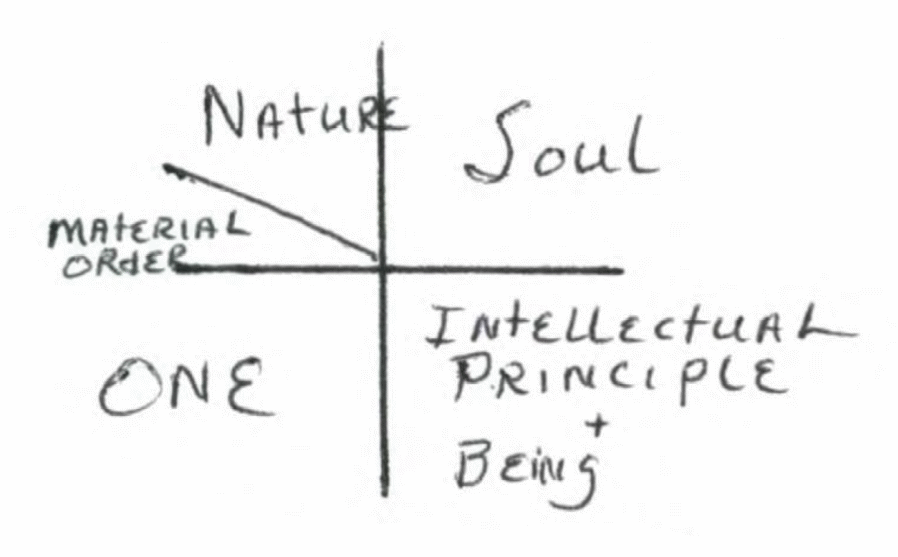
FIGURE 1982 0212a-1. Fourfold Quadrant View of Three Hypostases with System of Nature and Material Order.
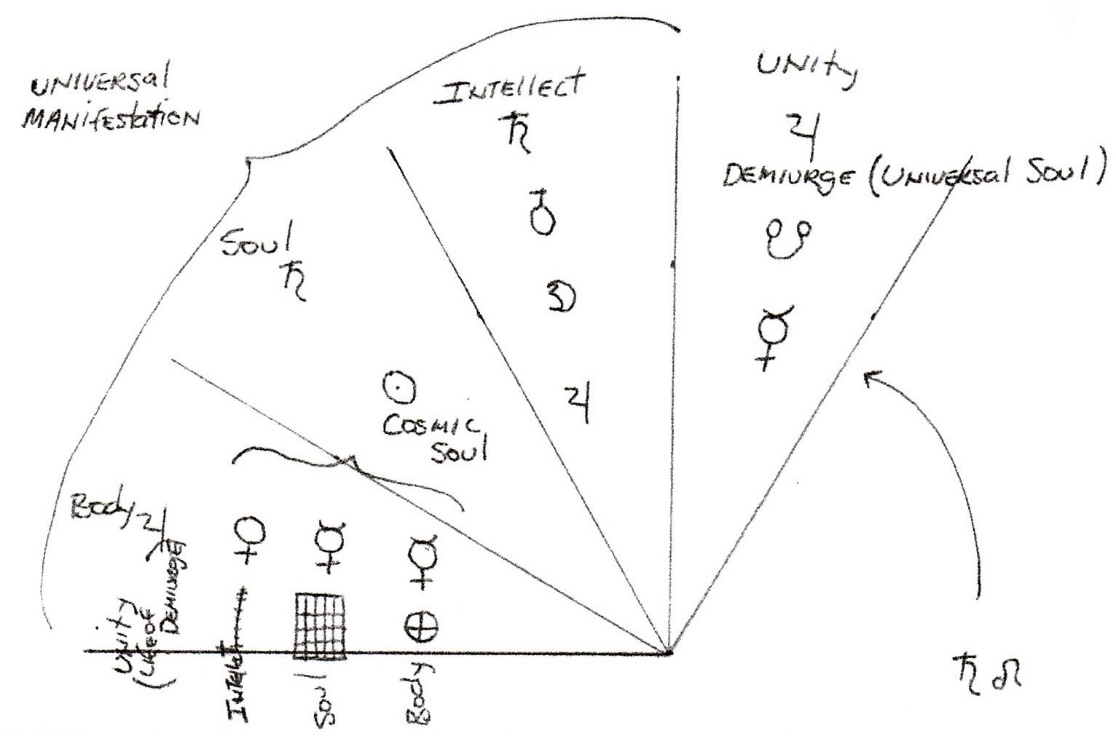
FIGURE 1982 0212a-2. Saturn in Leo, Houses 9-12, and House 12 Levels.
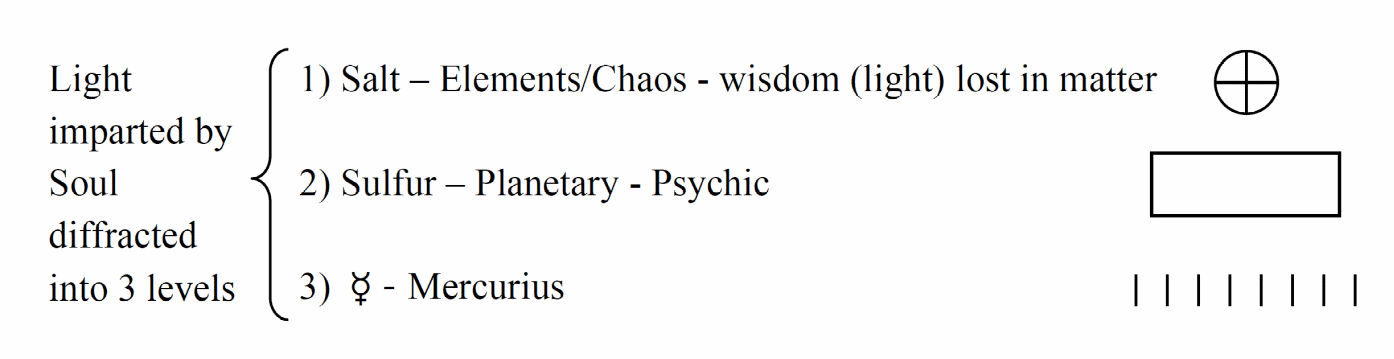
FIGURE 1982 0212a-3-AB. Three Material Worlds: Salt, Sulfur, Mercury.
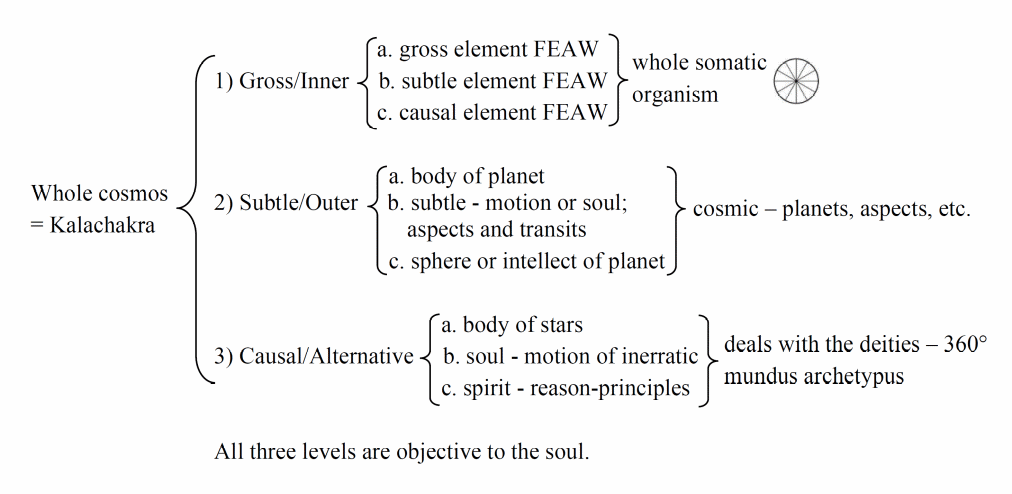
FIGURE 1982 0212a-4-AB. Three Levels of Kalachakra.
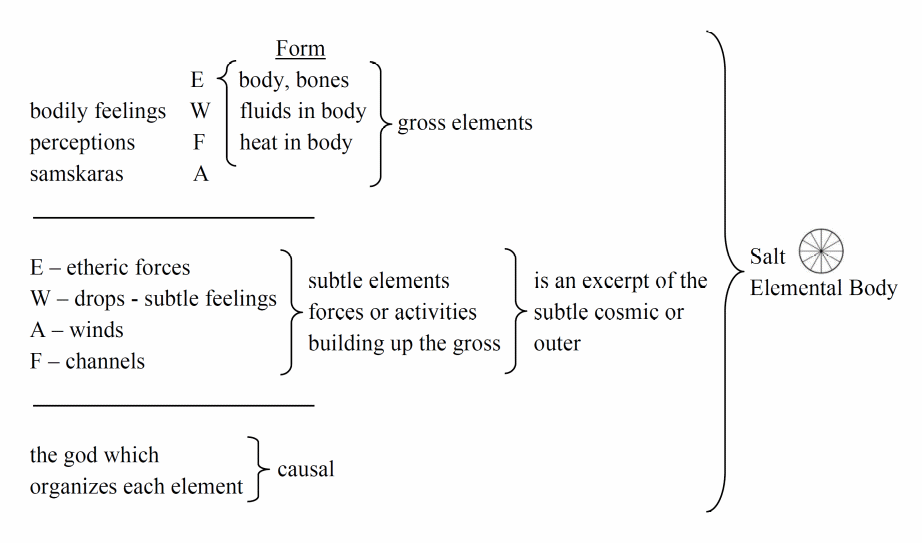
FIGURE 1982 0212a-5-AB. Three Levels of Elemental Body.
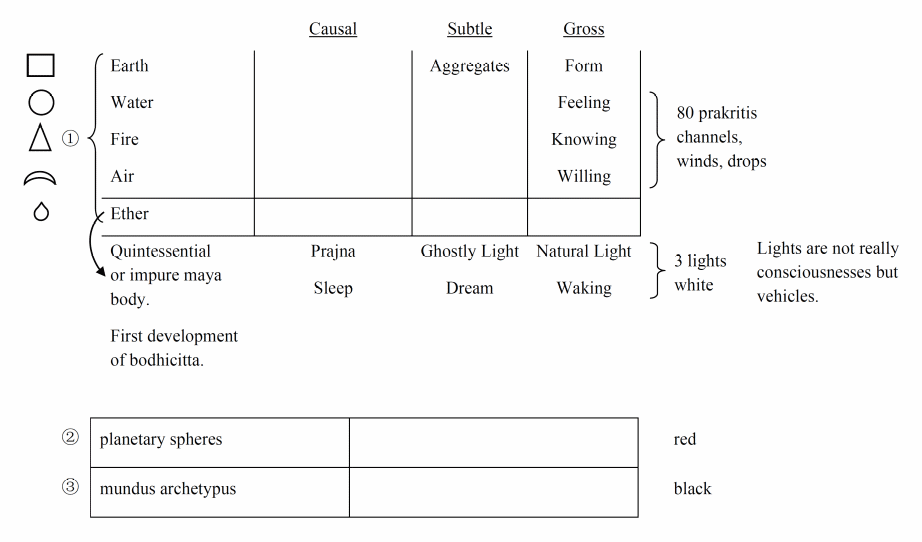
FIGURE 1982 0212a-6-AB. Channels, Winds, Drops, Lights, and Elements in Tantra correlated with Twelfth House Levels, States of Consciousness, and Skandhas.
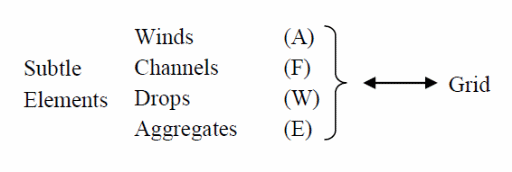
FIGURE 1982 0212a-7-AB. Grid and Subtle Elements.
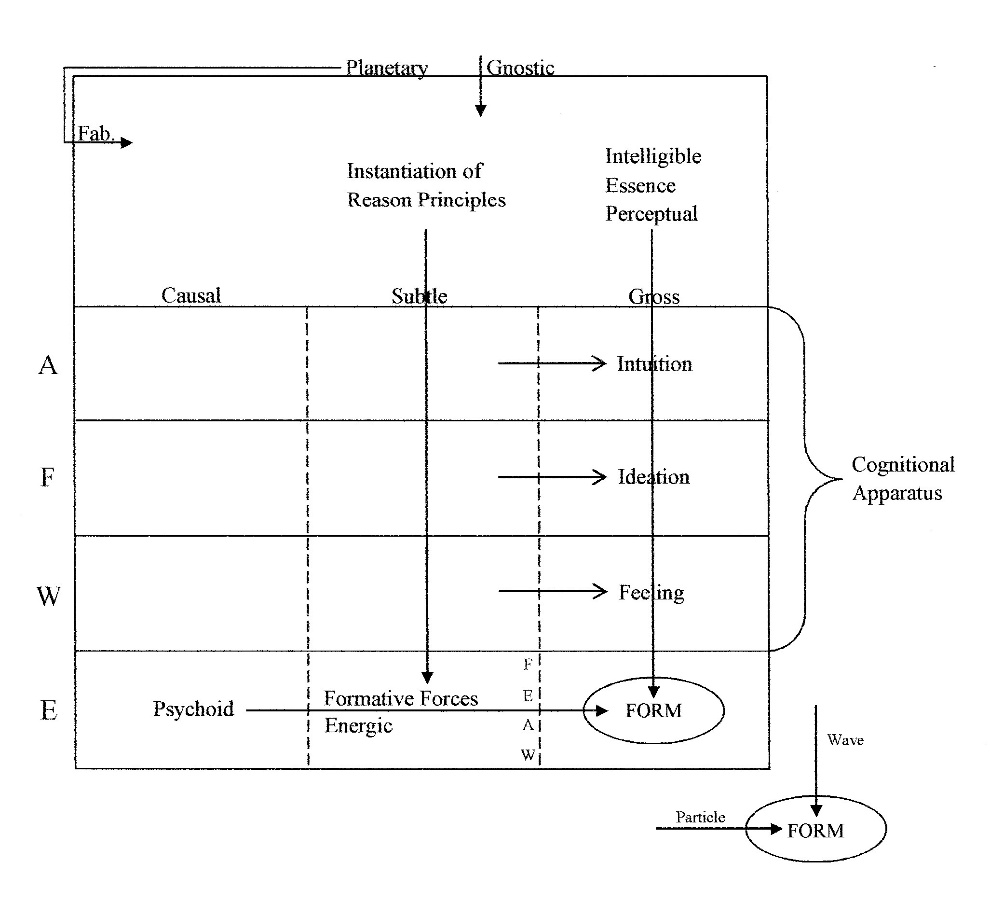
FIGURE 1982 0212a-8. Grid of Gnostic and Fabricative Planetary Powers, Wave and Particle, Perceptual Functions and Elements. Earth Level: Psychoid, Energic, Form.
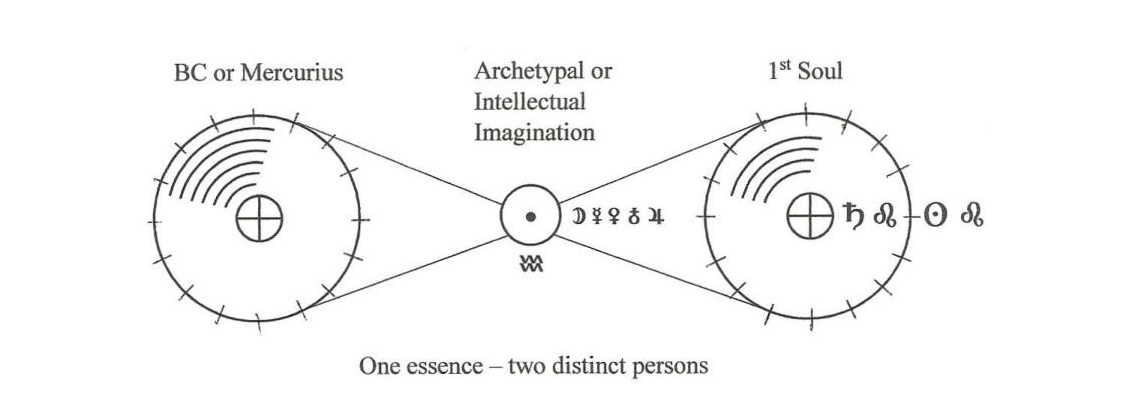
FIGURE 1982 0212a-9. Bodhicitta, Imagination, 1st Soul; One Essence–Two Distinct Persons.
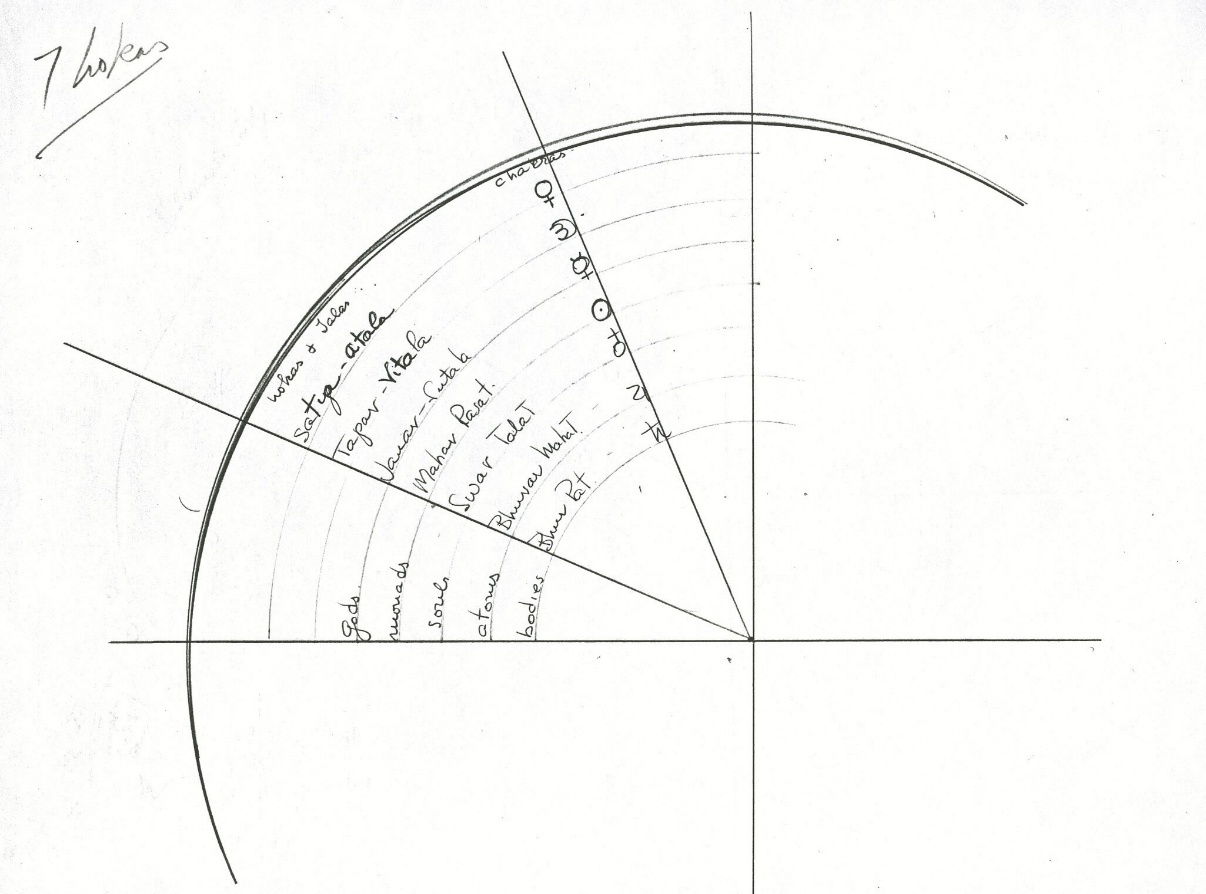
FIGURE AD_D_017. Seven Lokas and Talas, Chakras in Eleventh House; Gods, Monads, Souls, Atoms, Bodies in Twelfth House.
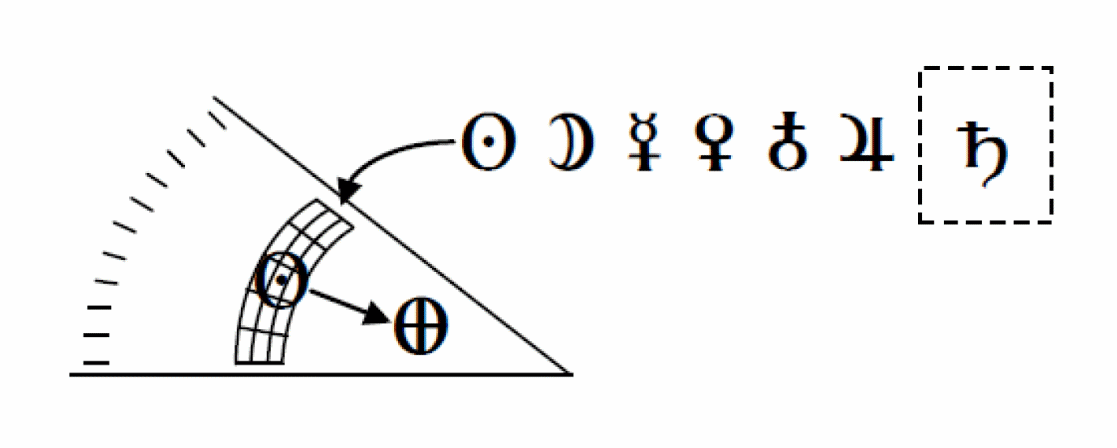
FIGURE 1982 0212a-11-AB. Soul Ring Planets, Three Levels of Twelfth House, Bodhicitta in Grid.
Other diagrams also referred to are not with this transcript version. [Transcriber note: [diagram] means the speaker is referencing a diagram as he or she is speaking. If someone is drawing or writing, with audible sounds of chalk on a blackboard, I indicate this by [drawing] or [writing].]
NOTES:
This is 1982 02/12a = Alchemy; Kalachakra, and the first entry associated with this date. 1982 02/12b (includes 0212, 0219, 0225, 0226) = Physics: Quantum Mechanics.
The phrase "what we spoke about/referred to yesterday" is mentioned a few times, so there's probably a day or so of tapes missing for this class in Columbus. Feb. 12, 1982 is a Friday; jf thinks existing tapes, which seem to be from Saturday, may be misdated. Date info corroborated with AD Blue Book, etc.
Paragraph breaks in AD commentary added by jf. Edits for readability: cuz = because; gonna = going to; gotta = got to; yeah = yes.
TRANSCRIBED Verbatim by IT prior to 2017, reformatted by jf 2017. In 2024, IT updates prefatory matter and footer, alters Topic, Subject, and Subsubjects, expands Book List, adds Plotinus quotes section, corrects errors/typos, adds new notes within transcript, adds eleven diagrams and references within transcript to these diagrams, reformats to accord with new conventions. Archival verbatim transcript – V12a.
AUDIO FILES: 1982 0212a (formerly 1982 0212e), b, c, d. [Note: "Tape" and "Side" refer to original audio cassette tapes that were later digitized into .MP3 Audio Files; "tape break" refers to hiatus in audio; tape recorder apparently turned off for a meal, etc.]
1982 02/12a Class Held in Columbus, Ohio
Alchemy; Kalachakra
[Audio File 1982 0212a (formerly 1982 0212e) Begins]
AD: We've heard and we've spoken of having three-- in the 12th house [diagram], the three material worlds. [Note: See FIGURES 1982 0212a-1, 2, 3.] And they refer to them as the inerratic sphere, the planetary spheres, and elementary spheres. So you have these three worlds. [Note: See FIGURES 1982 0212a-4, 5, 8 for the following.] Now, the elements-- the elemental sphere, the realm of the elements, fire, earth, air, water, ether, what we perceive of these things, you know, you can call it cohesion and motion, you don't have to think of them as fire, earth, air, and water. What we see of these here are really the gross manifestations, we don't see fire, earth, air, and water but only the way they're manifested sensibly in combination. But the ancients used to think something like this, that insofar and we-- as we think of the elemental sphere where you have the elements, fire, earth, air, and water, they think of everything as having a threefold aspect and the alchemists would speak about the lowest aspect as salt, the middle aspect as sulfur, and the higher aspect as mercury. So you'd have like-- the elements would have the aspect of, let's say, gross, subtle, and causal. The gross part is the part that you perceive. Here's a body, it's made out of substance, you know, material substance, and this watery substance is like water column, you know, the lymphatic system, blood system and all that. You have the air column. And then you have the fiery would be like the juices, the digestive processes that go on. They considered that the lowest, the gross aspect, the one that is perceptible and the one we handle. But, to that aspect which-- they call that the salt aspect. They have another aspect which they call the sulfur aspect. So, in the sulfur aspect of a material thing, it's more like what they call the soul of the element, the soul of fire, the soul of water, the soul of earth, and that's in the subtle domain. These-- There's a very interesting book written on that by Steiner [Note: Wachsmuth, not Steiner] called the Etheric Formative Forces. [Note: Guenther Wachsmuth, The Etheric Formative Forces in Cosmos, Earth and Man.]
S: And what was the name of it, the--
AD: The Etheric Formative Forces and it's written by a gentleman by the name of Wachsmuth. I don't think you can get the book. We have a copy at the Center, and it might be-- it might be interesting to xerox it. It's a very enjoyable book. It deals with-- it deals with the formative forces at their subtle level and it tries to deliver some understanding of what these formative forces are, and he calls them like a chemical ether, a life ether, the warmth ether, alright, he gives them those names. What he means by that is that at this level these forces are the very forces that manipulate the sensible qualities. They're behind the sensible qualities, they manipulate the sensible qualities. Then the third aspect which they call the mercurius aspect is a causal-- the causal aspect of the thing. So that you could think of, let's say, the intelligence which is guiding the formative forces to manifest in a sensible way these elements in combination and proportion. So, if we think of everything as having a threefold aspect, a gross, subtle, and causal, this is how the ancients would speak. They speak about that in this way. And they would do that with everything, they would say that, for instance, the planetary spheres-- now not the elemental part of the planetary sphere, in other words, not the material, the body of the cosmocrators that you see, not that, but insofar that you speak about the planetary sphere, the bodies would represent the salt aspect, the gross aspect. The motion of the planets, their vitality, would represent the subtle aspect. And the intelligence that is being manifested or guiding that motion, they would refer to as the mercurius aspect. And they would apply-- they would apply the same idea to the inerratic sphere. Now the inerratic sphere would represent to us, in terms of our understanding, the intelligence of the universe. They're the embodiment of the Ideas. The Ideas are embodied in the constellations. And again they would speak about that as having a threefold aspect. They would speak about-- they would speak about the inerratic sphere or each star, insofar that it has a body, contour, shape, material, an actual thing there, alright, they speak about that as the salt aspect of the inerratic sphere. Insofar that each star has motion, moves on its own axis and moves, so to speak, in a circuit, they would call that its soul aspect or sulfur aspect. [student assents] And insofar that it embodied an Intellectual Idea, they would call that the Intellect or the mercurius aspect. So, we could do something like this. [drawing/writing] The elements. The-- [43½ second pause while drawing/writing; background student talking; heater turns on] And you could do that with each one of these [diagram], alright. [10 second pause, some more drawing]
Let me read you a little quote from Paracelsus and I think most of you have heard of Paracelsus. It's a nice little book. It's too bad it's such a terrible-- [12½ pause] There's another one by Franz Hartmann. This is not the one. They-- [flipping pages] You did something to this, there's parts missing.
[short pause]
S: Wasn't Hartmann supposed to be the reincarnation or something--
AD: Hm?
S: Was Hartmann supposed to be the reincarnation of Paracelsus?
AD (very faint): I can't hear you.
S (very faint): That's what PB said.
AD: Who?
S (very faint): PB.
AD/S(?) (very faint): (Oh yes.)
[short pause]
AD: He certainly does a very fine job in this little book, Hartmann. He's written a few books, one on Jacob Boehme. He was another Theosophist but he only worked on his own. Well he's interesting. Anyway, he goes-- he says--
[Transcriber note: I am using The Life of Philippus Theophrastus Bombast of Hohenheim, known by the name Paracelsus by Franz Hartmann, London, George Redway, 1887. The following excerpts are from Chapter VIII, Alchemy and Astrology.]
Franz Hartmann [Paracelsus, p. 162, AD reading]: "Everything in Nature has a threefold aspect. The highest aspect of alchemy is the transformation of vices into virtues by the fire of love for the good…"
AD: Uh-- [14¾ second pause] This book has been tampered with. [very faint] I can't enquire. [short pause with very faint background student words] Alright.
Franz Hartmann [Paracelsus, p. 166, AD reading]: ""All things [(man included)] [AD: This is a quotation right from Paracelsus.] are composed out of three substances…""
AD: That's been set down, ok, the philosophy of the Athenians [couple/three words inaudible]
Franz Hartmann [Paracelsus, pp. 166-167, AD reading]: ""All things (man included) are composed out of three substances, and all things have their number, [their] weight, and [their] measure. … These three substances are called sulfur, mercury, and salt, and they are acted upon by a fourth principle, which is life. These three substances are not seen with the physical eye, but a true physician should see them, nevertheless, and be able to separate them from each other.""
AD: Well-- [25¾ second pause, flipping of pages] No, no, this book has been-- the parts that I'm looking for are missing.
S: The ones that help?
S (very faint): That help?
S: Please (don't).
AD: No I-- I don't--
S (very faint): What happened?
AD: I'd have to search. See, my copies are marked up, I'd have to search. But it is in the philosophy of the Athenians, philosophy directed to the Athenians. At any rate, I can go without. So he speaks about-- he speaks about these-- the three aspects of anything that exists in Nature. Now, as we said, the inerratic and the planetary and the elemental sphere, they all have these three aspects. Now, if we-- if I want to understand or at least I try to understand what the Kalachakra is all about, the Dalai Lama in one of his papers threw a-- a sentence that went something like this. The inner Kalachakra is the-- the body, the elements; the outer Kalachakra is the planetary spheres; and the third Kalachakra, which he referred to as the alternative, is the Mandala of the Beings [FIGURE 1982 0212a-4-AB]. Now, the inner Kalachakra has to be the body because he's referring to it as subjective. So, the notion here is that if I work with just the elements, alright, and I say that the elements, the fire, earth, air, and water, the body, has these three aspects, that would be called the inner. I would-- I would refer to this here as the inner Kalachakra [diagram], [writing] this the outer Kalachakra [diagram], and this the alternative Kalachakra [diagram]. [short pause while writing] So we-- I certainly only work with one Kalachakra at a time, let me try to understand what they refer to as the inner Kalachakra. Now the inner Kalachakra or the body, the individual body of an entity, would have these three aspects. My body would have a gross aspect, a subtle, and a causal aspect. The gross-- the gross one is the one that is perceptible. I'm disagreeing with that remark that he makes of them (the invisible/being visible). And that [diagram] would be almost like speaking about the-- [couple very faint inaudible student words] [possibly a student: yes--] this-- the-- the realm of matter which we could refer to as the psychoid realm, the realm which-- [short pause] that domain of matter, and we are only using the word figuratively, that domain of matter where the laws of subatomic physics are operative, and you can call that the psychoid realm. That realm would underlie the two which come from it which we would call the psychical and the physical, so that the body and the qualities that the body operates with, psychical, come from that realm, the psychic-- the psychical and-- and the physical come from the psychoid realm [FIGURE 1982 0212a-8]. Now, how-- how we could proceed now? If we say that this-- this is what we're referring to when we speak about the-- the inner Kalachakra, we're speaking about the empirical, physical, psychosomatic organism of a man, and we restic-- restrict ourselves to that, then something like this I think would show up. [10 second pause, erasing]
When you look into a ch-- you know, when you look at a natal chart, you have the fire, earth, air, and water, you know, on your chart. You know, in terms of the 12 houses you'll see the distribution of 4 elements. So-- [9¼ second pause while drawing] Let's say you have this kind of arrangement, fire, earth, air, water [diagram]. [short pause while drawing] Alright. So everyone-- everyone, of course, has his distri-- has his share of fire, earth, air, and water and-- and if you don't have a planet in a-- one of the s-- one of the elements doesn't mean that you lack one element, all-- As a matter of fact, when he says-- my suspicion is that that is the basic chart. The elements represent the basic chart, the composition of the psychosomatic organism, the material constituents that go into that psychosomatic organism. So if we look at the-- if we look at the chart from that point of view we would say, well we have to find in those elements, we have to find those three things. We have to find the gross, the s-- subtle, and the causal aspect. Now most of us what we do is when we look at-- I mean, this is one way of looking at it. I'll show you. Alright? You look at the elements and you say that represents the body. You look at where the planets are, configuration of the planets, angular configuration, and you say that's the psychical aspect, and you look at the-- where-- the degrees that they're sitting on and you call that the causal aspect and you say these three in conjunction or these three together is what the native represents or what the native is. I mean, am I running ahead?
S: No you're-- say those again.
S: Yes.
AD: When you look at your chart, alright, you think of the elements in a chart as referring to your body, alright, [student assents] it's the bodily constituents, the fire, earth, air, and water. You look at the-- the planetary configurations and you say that represents the psychical aspect. And where the planets, the degrees that they're sitting on, those degrees would represent what we would call the causal or the intellectual. [student assents] And that's the way we like to look at a chart because it seems that the three aspects of our being, you know, is-- the three aspects of our being, the material aspect, the psychical aspect, and the intellectual aspect, are covered by those three. Now the approach-- the approach I'm asking you to consider now is different. That only within that realm, we're not going to go to the planetary sphere, and we're not going to go to the inerratic spheres or degrees to understand meaning. We're going to stay in the realm of matter, the so-called elements, and out of the elements we got to evolve what we know of as meaning. So that means in the elements we have to-- we have to see the gross aspect of the native, this chart we're looking at, we have to see the psychical, and we have to see the intellectual in terms of just the elements, without, you know, referring to the planets, as constituting the psychosomatic organism. Alright, if we follow that idea up, then that means that we have to try to see three aspects, alright, there. You see what I'm doing here? [student assents] In other words, in terms of the elements, o-- and only in terms of the elements, we have to try to understand how a man is composed, what constitutes him. And we shouldn't go to the planets or to these degrees, the stars. [RW assents] Because, as we said, we said that everything is composed of three aspects, [writing] and the elements, the planetary grid, and the inerratic sphere [diagram]. And each one of these has three aspects, alright, but we're only-- we're going to insist on explaining man only in terms of this here [diagram], [S: Ok.] within this realm, we're not going to leave that realm. Alright then, if that's so, if that's so, what-- what would give us an indication of the subtle aspect of the elements? And what would give us an-- an insight into what the causal aspect of the elements are?
S: Well, if there are three-- three divisions, you could divide the circle three ways, I think, can't you? I mean didn't you [few words inaudible] degrees into each sign there?
[students assent]
AD: Well if [S simultaneously: I don't know.] I could just repeat myself. We said that in those elements there has to be three levels. [student assents] There has to be a-- the salt, sulfur, mer-- mercurius aspect [S: Right.] in the elements themselves.
S (very faint): Uh-hm, (right/yes), [AD, very faint: (Yes/Right).] uh-hm.
[student assents, very faint]
S: But could that be the decans?
S: (Uh-uh/Uh-hm).
S: No?
AD: Well the decans would refer to the constellations, wouldn't they? I'm not saying you're wrong, I just don't follow. [S simultaneously: You just don't follow (one/two words inaudible)] I won't beat you up.
S: You don't want to get out of the 12th house at all then?
S: [few words inaudible]
AD (simultaneously): No, all this is in the 12th house.
S: Yes, I know, but we're not to look outside the 12th.
AD (simultaneously): All this is in the sublunary sphere in the realm of the elements.
S: With the decadents, is that a division of the degrees?
S: Each family.
S: Each family, ok.
S (simultaneously): Each sign that I-- I can barely [couple words inaudible]
AD (simultaneously): But, how would-- how wou-- how would that tell us that you have i-- that you're dealing with the subtle aspects of the elements?
S: I just always divide the chart into-- in those three sections with each having fire, earth, air, and water aspect to them.
AD: Uh-hm.
S: Now we've often spoke of those as in a-- in a way of causal and subtle and gross.
AD: So like for instance you would say the fire of Aries is the causal, the fire [student assents] of Leo is the subtle, and the fire of Sagittarius is the-- is the gross aspect. That would be one way, that-- that would be one way to go. And perhaps if we-- if we could try to conjure up and say well, what would a subtle aspect of the elements be, what would the soul-- what would indicate the soul of the elements, alright. I think there's some validity when we say the angular relationship that planets have, like Saturn squares Mars and Saturn is in water and Mars is in fire, something like that. I mean it seems that there what's being suggested is that the planets somehow govern and are directing the way the el-- the gross elements are going to be manipulated. So that perhaps that angular relationship is giving to us or indicating that that's what we're referring to when we speak about the subtle aspect of the gross-- of the-- of the elements. That might be another way. But we wanted to leave out the planetary spheres. Remember? We wanted to leave [student assents] that out because you-- we didn't want the threefold aspect of the elements to bring in the planetary spheres, but yet somehow they seem to be intimately connected. Could it be possible that when we speak about the configuration of planets, could it be possible that this-- this indicates the-- the s-- the subtle aspect of planets and the way they're being manipulated? In other words, that the-- the aspects that the planets have with each other, these aspects are always in terms of planet to another planet and if they're sit-- if there's an angular relationship that brings in a relationship between, let's say, fire and earth or water and air, alright, it always connects those realms. [short pause] What Mary suggested, I think, was this here. When we-- In another instance, [drawing] when we spoke about the-- [short pause] what was it, we were referring to in the Greeks, they refer to this here as the intellectual [diagram]. This order of Gods was intellectual; this order-- order was psychical [diagram]; and this order was physical [diagram]. And the Gods that dealt with this here, if you remember, was Jupiter, Vesta, Hermes, and Juno, and they were called the intellectual Gods. And the Gods here [diagram]-- I think over here was Neptune, Minerva, [RW simultaneously: Minerva, Venus--] Venus, [student assents, faint] and uh--
RW: Juno or Rhea.
[student assents, faint]
AD: Juno.
RW: Juno.
AD: Yes. And then over here, over here was [drawing] Vulcan, Mars, [RW: Apollo.] Apollo [RW simultaneously: Jupiter.] and Diana [diagram]. Now this realm here, alright, referred to the sensible, these Gods work in the sensible. These Gods here work on the-- on the psychical. And these Gods here worked on the intellectual. You remember that?
RW: Uh-hm.
AD: So then, then in a sense what I'm trying to understand is, what I'm trying to understand is like, if this corresponds to the psychoid of matter [diagram], this corresponds to the subtle of matter [diagram], the elements, and this to the gross of the elements [diagram], alright, I'm trying to understand these elements [AD indicates on diagram] in terms of that. And Mary's idea was that if you think of the [drawing] fire s-- if you think of Sagittarius, alright, Sagittarius would be under the rulership of Vulcan, alright. If you think of earth, this would be under the rulership of Vesta. I'm asking you to join me in thinking and not just come-- Because, like Red said, the thing to do is for me to meditate for the next three hours.
RW/S(?): Red [one word inaudible]
S: Did you say that Red?
AD: Well, I'm so-- my mind's so quiet I could sit down for three hours and not budge. So, if you want some results you better annoy me. (some laughter)
S: That's fine.
S: Even then.
AD: You getting the drift of what we're trying to think? I'd like you to try to join me in thinking this and not just sit down there, you know. [short pause] In-- within this body which is 6 feet or, you know, 5 feet or-- in height, alright, remember?, the Buddha said there is the way to deliverance, the way to the end of the world, the way to the end of suffering. So that this physical body is really important. And if you remember, PB referred to himself as a materialist. But not the way we understand it. So the body is very important. And we're saying that the body, the matter of the body, the organization of the body, all these things are in the elemental realm. So that means that our analysis of the body, and even of the subtle aspects of the body, have to be made-- made in terms of the elements.
S (very faint): Uh-hm. I see what you're saying.
S: Like states of matter is what you're speaking of.
AD: Yes, yes, they're states of matter--gross states, [student assents] subtle state, causal.
S (simultaneously): Like ice and water and--
AD (faint): Uh-huh.
S: So maybe each of those elements has-- has a state. Like water has ice and vapor.
AD: Yes, so if you think of fire, alright, it has a state which they call the etheric fire. And then there's a state beyond that which they call intelligible fire or let's say the causal intellect fire. And we have to stay there to build a body, we can't get out of it. In other words, what we're do-- what we're doing is we're coming through the body. We're going to first build a body out of these three component materials, the three aspects of the elements. Then on top of that we're going to try to build the-- or understand something about the planetary soul, alright, and then on top of that we're going to try to understand the inerratic sphere. And that-- and one is on top of the other, so to speak. Let me try this here. [11¼ second pause while erasing] [Note: See FIGURES 1982 0212a-5, 8 for the following.] This is a-- [13½ second pause while drawing] earth, water, fire, air, ether [diagram]. [14½ second pause while drawing] Let's put over here the gross body [diagram], ok. And the Buddhists, the Buddhists refer to this as rupa, which is made up of the five element-- the four elements, fire, earth, air, water. Remember that, huh?
S: Uh-uh.
AD: This is the water element [diagram], [drawing/writing] alright--feelings. [short pause] The fire element--what could we refer to it? Volitions, impulses [diagram]. The air element--ideas, ideations [diagram]. [10½ second pause while writing/drawing] This would be the gross aspect [diagram]. Now, you've heard of these here, haven't you?
S: Skandhas.
S (simultaneously): Uh-hm.
AD: The skandhas, right? [student assents] [short pause, AD drawing] Now, if we look at the skandhas, alright, we look at the gross body, the rupa--I think we have some notion of what that is. But under the skandhas we also have feelings, impulses, ideation, ok. Those are skandhas. [9¾ second pause] Now, when we have a feeling or when we have an impulse or ideation and we classify it under the gross body, the question comes up, well, "You mean there's something subtler besides the feelings, the volitions, the ideations?" So the Buddhist would come along and say, "Yes, there is." This comes from-- if we-- subtle. [writing] Prior to the feelings, they speak about this-- they have a kind of subtle physiology and they speak about drops, winds, channels. You remember? [student assents] You ever come across that?
RW (simultaneously): Uh-hm, uh-hm.
AD: And so, if we did something like this, if we say these are the feelings, what's prior to the feelings? It would be coming from the subtle. Well, [drawing/writing] let's say that this is the realm of the drops [diagram], ok. The volitions, the impulses--channels [diagram]. Ideation--winds [diagram]. [short pause] I'm trying-- I'm trying to think this out so I have no answers, I've-- as I'm going along I've been working it out.
[short pause]
RW: What's their word for the consciousness then?
AD: Well they refer to the consciousness-- when they speak about the 72 dharmas or the five skandhas, the first eleven skandhas, I mean the first eleven dharmas are the ayatanas.
RW: Right (then).
AD: And the 12th one is consciousness.
RW: Mm.
AD: I'm just putting it there [diagram] and letting it be for now, but that would be the-- Within this here-- I don't-- I don't remember, but it goes something like this. You have 11 ayatanas [diagram], 12 consciousness [diagram], 44 non-perceptible tangib-- intangibles or what we would call feelings [diagram]. You have a certain number of ide-- ideations [diagram]. This would be the 44 concomitants [diagram], mental concomitants. Yes, I'm sorry, this one here [diagram]. And so they distribute the 72 skandhas in these various ways--11 here [diagram], one here [diagram], I forgot how many here [diagram], 14, and over here so many [diagram], and over here so many [diagram], so that they all add up to 72 dharmas, but-- [drawing] I mean 75 dharmas altogether. But, they also make this kind of division [diagram] and refer to it as the five skandhas. [short pause] Now, the part that we have to try to understand is that subtle a little bit. [18½ second pause] Could-- could we say that, for instance, insofar that we're in this gross column [diagram] and we think of the body, the psychosomatic organism, alright, and the first, the gross body, is the somatic organism and the next four are the psychic s-- organism. The two of them together constitute the psychosomatic organism. In other words, if you analyze the psychosomatic organism, you come up with these 75 dharmas which they divide them-- they say you could divide into five skandhas, which is another way of arranging those 75. And we said that this is all gross, the ideation, volitions, impulses, feelings, and the body which is sensibly manifested, all is all gross, alright. That's relatively simple. So that would be the salt aspect of the body, ok, alright. Now we want to understand the sulfur aspect of the body. I hope you don't mind me bringing in terminology to throw it around. Now, the subtle aspect of the body, if we think of, for instance, the channels-- Let's think of the cerebrospinal nervous system and it has these three main channels, the central channel, the three nerves going around it, and that from the heart, there-- there spreads out what they call the 72,000 nadis, nerves, ok. [16½ second pause while drawing/writing] Now, when we're speaking about the nadis, the-- the nerves themselves are like very fine filaments and they got a-- a hollow tube inside, but they're very, very airlike, not noticeable. And the Buddhists claim that through these nadis or through these nerves, there flows what we would call the manas principle, mind. It manifests itself in two ways, heat and light, coming through the nadis, alright. And these 72,000 nadis are also-- they're visible to us. Under the microscope we could look at the nerve tissue and we see that-- the nerves, all the nerves, and you could call those the channels, alright. And those channels-- through those channels there's going to be conducted or flow through them, there's going to be transmitted this manas principle, which is heat and light. It comes through that, alright. So then the 72,000 nadis which are very, very subtle, we'll refer to that as causal. The resultant actual physiological nerves that we see, the spinal column, the two nerves that go-- intersect around it, right, we'll call that the channel. And the result of that, let's say, would be the kind of impulses that arise in a physical psychosomatic organism. Uh-- [short pause] He didn't say it was [one/two words inaudible] and manas [few words inaudible]
[30 second pause]
S: Well what was the function again of the nadis, channels, and volitions?
AD: Yes. [22 second pause] It's a little sneaky what I'm doing. I mean it really is-- [10¼ second pause] It's something-- I know, I can smell I'm on the right track, you know, like a bloodhound, I know it. When that-- when I came across that quotation, and it was the only meaningful quo-- quotation on the Kalachakra which was given out by anybody. Because I've looked at quite a few books on Kalachakra and most of it is all mumbo jumbo, nobody knows what they're talking about, as far as I'm concerned, because if they could they certainly be able to communicate some ideas instead of formulas. But when the Dalai Lama said this, that the inner Kalachakra represented the empirical person, the outer Kalachakra represented the planetary spheres, etc, I knew. That was-- that was it, I knew. My nose got twice as long and after it. So, I've been working on that for some time. I don't know how-- how accurate it is but it's coming, it's-- [11 second pause] Unfortunately, Sidney was too anxious, he want-- he wanted to xerox this and he did, made a copy to bring to the Dalai Lama. I wanted to wait until I was finished with the whole thing. [short pause] So I think this is going-- this is going to give us the ground that we've been looking for, the ground that I've been looking for, I mean a ground that we could share in common and have a means of communication, because the way they write, I can't communicate nor are they communicating. Every person I've tested who read these books, and I pin down for an explanation, all they can come up with is a memorized, you know, jingle jangle. I'm not interested in that. I could memorize too and perhaps even better than they do but I'm not interested in it. What we're saying, what we're saying is something like this. [short pause while drawing/writing] Let me put it down. This is equivalent to what they call form [diagram]. This is equivalent to what they call the aggregates [diagram]. [15 second pause while drawing/writing] (Trends) [diagram]. [quietly, to himself] Is that right? 72,000 [one/two words inaudible]
[23 second pause while writing]
S: What is the first word that you re-wrote?
AD: Bija, bija seed, b-i-j-a.
[short pause]
RW: Is that-- what's that word under 'winds'?
S: [one/two words inaudible] winds.
AD: Bindu.
RW: Bindu, oh.
AD: Yes.
RW: Ok.
AD: And that's nada.
[short pause with background student talking]
RW: Bindu's like the point.
AD: Yes.
RW: Winds are like a point?
[Note: See FIGURE 1982 0212a-8 for the following paragraph.]
AD: Well no, um-- If-- I would have to start over here [diagram], alright. This is the causal realm [diagram], alright, and that simply means the vibratory nature of the psychoid realm. And when we say the vibratory nature, if you think of the world of sub-atomic particles, you can't even think of them as particles or things of any kind, they're really proclivities or tendencies or a matrix of possibilities which is in-- which hasn't come to any definitive form. This would be the definitive form [diagram], it comes to a point. When it comes to a point you can speak about a particle, alright. And when it manifests, alright, as a bija, it is the seed of the thoughts that you're going to have. Alright so, we would be going from the psychoid realm, that is, the sub-atomic field of particles which are this matrix of possibilities, the vibratory nature. When they crest, alright, a point is produced. And this point is like a focus in which the unmanifested goes through and becomes manifested. So, this is the-- this is the realm of transmission [diagram], this transmit-- it transmits the causal realm--
(Side 1 of original cassette tape digitized as 1982 0212a (formerly 1982 0212e) Ends; Side 2 Begins)
RW: --the 12th house?
AD (simultaneously): I've got to put-- I've got to put everything right here on this planet.
RW: Ok.
AD: So--
RW (simultaneously): Be-- because in that Wachsmuth book, when I read that, I was impressed with the fact that he was talking about the causal realm being almost 10th house realm, and you've taken all that and you've got it all in the 12th house now.
AD: Yes, I got to put it there.
RW: Ok. Just so I--
AD (simultaneously): You remember, you remember what we-- what we're doing is something like this. The aim of our analysis, even though it starts up at the very highest level, the three Hypostases, alright, then the System of Nature, [RW: Yes.] which projects from within itself-- the cosmic soul projects the universe, and that that universe which is projected by the productive imagination will have to contain and embody all of the principles that we studied prior to that. [Note: See FIGURES 1982 0212a-1, 2.] So, if we say, if we say that the inerratic sphere would represent the Intellect and the planetary the Soul and the elements the Body, alright, now, a further condensation, within the elemental sphere I'm going to have what you would call body, soul, and spirit. [RW assents] Within the planetary sphere I'm going to have the same thing and within the inerratic sphere. [Note: See FIGURE 1982 0212a-4-AB.] I'm condensing everything, I'm trying to get everything into manifestation, into the world we live in.
RW: Uh-hm.
AD: Now that doesn't mean I can't go back and trace causal laws prior to it [RW: I see.] but I want to find them in here [diagram]. That's what's going to make everything very complicated.
RW: Uh-hm.
AD: Nonetheless, if-- if we-- if-- you remember that story that the Platonists speak about? They say that the soul descends like dew from the Milky Way. [RW assents] It comes all the way down, goes through the Milky Way, through the inerratic sphere, and through the planetary spheres, and it ends on Earth. [RW assents] And it's like the dew which ends on Earth, gets buried in the Earth, and now it has to evolve from that condition and go all the way back to where it came from. So that means that out of the Earth, number one, the first thing it has to do is create-- or a body has to be created, and this body is going to be, so to speak, the-- a vehicle through which that soul is going to evolve, this body and all the other bodies, alright, but one body at a time is enough. This-- the soul working through that body and evolving that body, alright, from a, you know, primitive to a very advanced-- In other words, it goes through all the kingdoms of Nature. It starts out as an amoeba and ends up as a man. This body here will basically be composed of the very substances that are found on the planet Earth, with the very forces that are found on the planet Earth, and with the very intelligence that is of the planet Earth. [RW assents] So that this body arises out of the planet Earth.
RW: Uh-hm.
AD: I don't want to go-- I don't want to go anywhere, I want to stay right here now. [RW assents] So, this body that we're speaking about, the psychosomatic organism, must derive everything from the planet Earth. Not only-- not only in the sense of the gross skandhas, gross body, feelings, volitions, ideations, and consciousness is all there, alright, but the subtle aspect is coming from the Earth too, alright, and the causal aspect is coming from the Earth too. So that when finally the psychosomatic organism is completed, alright, now you have an organism that's got all the necessary ingredients to evolve further. In what way? Well it can't evolve physically any-- anymore. Physically it-- let's say it represents the total manifestation of the macrocosm in the microcosm, of the world in a man. [student assents] Then the next way it must grow is the way we were indicating yesterday, is by evolving an inner life, a man of light, it evolves that. The evolution of the man of light or the interior man is the next step in the evolution. But that will take us into the second realm, the planetary spheres, [RW assents] alright. So that when the man of light is fully evolved, he will in a way-- now I'm speaking about the man of light, I'm not speaking about the psychosomatic organism, [RW assents] when that man of light is fully evolved, he will embody in a microcosmic way the macrocosmic principles, the principles that the seven planetary spheres stand for. Ok?
RW: Uh-hm.
S: Yes.
AD: In the man of light, what we were speaking about yesterday, he evolves the seven-- he evolves supersensory organs and they're made up of the very substance of light. Now this substance of light, alright, is the distillation of the experiences which are left behind in him and which we refer to as, you know, little pieces of wisdom. In one life you'll get a little learning, the next life a little more, and the total-- the totality of all that experience distilled into wisdom or into, let's say, an organized, or unorganized, system of meanings, is going to be the very means by which he's going to build this body of light. Can we go over that or you follow it?
RW: Yes, we could. I just-- this is just a new concept [AD simultaneously: Oh yes, this is--] to-- to bring it down and I've got to just change my thinking from the [AD simultaneously: Yes don't--] 4th quadrant to the 12th house. And you-- what you've done then is-- Let me be sure I understand where you are so-- If you were to take the [RW drawing] 4th quadrant, 12th house, you got Jupiter and you got Venus and you got Mercury, Mercury [diagram]. [Note: See FIGURE 1982 0212a-2.] You're talking about this ar-- area right here [diagram].
AD: Yes.
RW: You're not including that [diagram].
AD: No.
RW: Ok.
AD: This area here, this area here, this would correspond to the sublunary elements [Mercury Pisces Body], this to the planetary grid [Mercury Pisces Nature], [RW and another student assent] alright, [RW simultaneously: To the inerratic sphere.] and this to the inerratic [Venus in Pisces].
RW: Yes.
AD: Ok? This is part of the Intellect because it's part of an exaltation [Venus in Pisces]; this is part of Na-- Nature [Mercury Pisces Nature], [RW: Yes.] and this is part of Body [Mercury Pisces Body]. This is all [drawing] we're talking about, that's right. [RW: Ok.] And we're going to stay there. Not only are we going to stay there, over here [diagram], but we're going to stay in-- on the Earth and as creatures of the Earth.
RW: Yes.
AD: Because in the analysis of experience that the Buddhists work with, they start right here with this body.
RW: Yes.
AD: They don't go into any footnotes on the categories of the understanding and the, you know, heavenly spheres. They're going to start right here. They're going to say this is what you're made of. You're made of these here elements, and these elements and these various three-- the three aspects of these elements. Alright, now if we go back. We said, the body gets evolved as a psychopsych-- as a psychosomatic organism. It reaches full manifestation physically. [RW assents] The next step in evolution, the next step in evolution would be-- would have to be on a different plane altogether. Because physically what could evolve, pointed ears?
RW: Yes.
AD: I mean, how else physically can he evolve? Not that there can't be refinements into-- [RW simultaneously: I understand.] that goes without saying, but basically the next step in evolution would have to be mental. This is the big hiatus, this is the big break. Let's do this here.
S: Anthony, excuse me, could I just-- Red brought this up and I was under the impression that what we were talking about was the Body Mercury [diagram], period, and three aspects of that. That's not correct, right, we're talking about--
AD (simultaneously): Yes. No, that's right.
S: Well Red said we were just talking about here Mercury Mercury Jupiter [diagram], or [RW simultaneously: No, he--] Mercury Mercury Venus [diagram], [S simultaneously: No he (wasn't/didn't).] and I'm [student assents] saying now we're just-- in what you've drawn here with the five skandhas and everything, we're talking about the Body Mercury, right?
AD: Here [diagram]?
S: Am I correct?
AD: Yes.
S: No now, [S: All--] that whole chart is just Body Mercury, period.
AD/S(?): Yes.
RW (simultaneously): It's really even the Body-- Like you said, it's almost like there is a-- [RW drawing] it's that [diagram] off the Body Mercury almost. You know, it's within the Body Mercury but you're talking about the elemental earth is where we're going to start, which is the lowest aspect that you could even talk about the Body Mercury. [possibly one word inaudible] he's talking about the earth, like you-- this [RW stomps the ground].
S (simultaneously): Right, yes, I understand, but I just wanted to make sure because when you put those other two planets in then that just confused me, I just want to know we're just-- this is where we are and we're talking about three aspects.
AD (simultaneously): Well then just ignore that remark [S simultaneously: We're talking about three aspects, alright.] and stay with what you-- stay with what you have.
S: Alright.
AD: It's not necessary to always follow someone.
S: I find sometimes that my confusion comes from where-- not knowing what level we're working so I was [AD: Yes.] trying to make sure.
AD: Yes, that's always the greatest problem. [student assents] You remember I pointed out a long time ago that I said something like this, the scale of perception determines the reality that you're dealing with. [student assents, very faint] And this is very true of every moment. I mean if I ask you to go measure something and you come back and you say it's 16 cubits, I don't know what the hell you're talking about. You say 16 inches I'll know what you're talking about. So I've got to know the framework you're dealing with, and the point that we're making here is that all this is taking place on the planet Earth, [RW assents] the very matter of the Earth. When you go out and step into your-- [AD stomps floor] into the dirt in your garden, alright, you're talking about that. From that is going to arise the psychosomatic organism, as strange as it may sound. You say there's only-- there's only this stuff, this dirt here. How-- well what do you mean it builds up the psychosomatic organism? Well where else-- where does it come from? If you watch the embryology of any fetus you would see that everything would have to come from the material components of the mother. I mean where else is the child going to get furnished, you know, with the necessary ingredients that whole period of [one word inaudible]
[short pause]
S: When [AD/S(?) simultaneously: What--] you're referring to, as you said, the Body Mercury [one word inaudible] that whole, are you referring to the bhutas?
AD: Yes.
S: Ok.
S: Yes.
AD: Well, it depends, of course, on what school. Some schools call it the mahabhutas. 'Mahabhutas' I think is more correct than the bhutas because the bhutas are imperceptible in most of the classical Samkhya philosophies, but there's some schools don't think so. But my understanding is that the bhutas are quanticized ions-- ions and they really have nothing perceptible about them, it's only when they're collected in a mass that they become perceptible and then they're called the mahabhutas. So--
S: Ok. That's what I thought.
[Note: See FIGURE 1982 0212a-6-AB for the following. This diagram is not from this class, correspondences may not be exact.]
AD: Let's do something like this, ok. Here's your body. [drawing] These are various components, alright, of your personality, ok. You have feelings, you have volitions, impulses, you have thoughts. You go through experiences and you assimilate a certain amount of meaning, alright. Let's say you go through a heartbreaking situation or a joyful one, whatever the case may be, and there's distilled from that experience a little bit of meaning. And at the end of the life, alright, you've piled up quite a bit of it. But the alchemists put it in a retort and they distill it and they just take out the essence, the most important-- So then over here [diagram] we could say-- What-- what we get over here is some kind of [drawing] conceptual understanding, or let me say cognition and non-cognitional understanding. You know what I mean by that? Not everything is understood with concepts. Sometimes your feelings understand something that, let's say, your head can never perceive. You understand with the heart as well as with the head, sometimes with the head and not the heart, sometimes with the heart, not the head, sometimes both. But basically some kind of meanings are gathered. I use the word 'meanings' to cover both the cognitive and the non-cognitive. And when I say non-cognitive I don't mean that knowing isn't taking place. If you're ever caught up in a situation, let's say you love someone very much and you're parted or something, meaning comes to you. It doesn't necessarily have to be conceptual. It is meaning though, it is a real meaning, alright. You don't have to look at your child and say, "Well I think I love the child," you know. (AD laughs a bit) Your heart tells you you love the child, period, alright. So, from all that, alright, we'll say that some sort of cognition and non-cognitional meanings are derived, alright. Let's put-- let's put 'em here [diagram]. [drawing] Now let's say these meanings are distilled even more. You really extract the essence of the meanings, alright, and the extraction of the essence, alright, of the meanings, let's put it over here [diagram]. [drawing] Let's call that "etheric body" or "mind" or-- anything you want to call it. But basically, basically what we're saying is that when all is said and done and you're finished with it and your time is past, you've subtracted from your experiences in life, alright, this kind of understanding which life after lifetime builds and builds and goes on building, alright, and a person rich in experiences has this etheric, let's call it body, alright, this etheric body. Ok? And it seems to be the depository of the experiences he's had.
Now, what kind of stuff is it, what kind of-- what's the nature of the stuff that this is we won't go into now because I think that's really complex but, I think in mystical experience you would see it as a-- a-- a vast-- like if you've ever seen a fogbank, you know, clinging to the Earth, and it seems to be foamy and wavy and-- It's wet yet not to the touch. Imagine it, it's some sort of stuff like that, ok? [short pause] Alright then, in that-- in that etheric mass, in that etheric body, there is contained the essence of the experiences that you have gone through for eons of time. It is from that etheric body that the man of light evolves. If you go-- if you go to a young soul, and this is only a caricature, you go to a bushman or Zulu warrior, alright, his experiences are kind of meager, he hasn't had a richness of lives, you know, where-- and the person, he won't be ready-- You-- I don't think you have to go that far, I think if you go into-- out in the streets. (laughter)
RW: In this room. (more laughter)
S (simultaneously, amidst laughter): (80/90) percent [couple few words inaudible]
S (simultaneously): In this room. (some more laughter)
AD: You wouldn't advise a person to start practicing meditation and studying philosophy because(,) you know(,) the man is more interested or the person is more interested in dating or drinking or sports or whatever because he hasn't-- he hasn't reached a culmination or his thirst for life hasn't, you know, come to a point where it wants to understand what it's doing but it just wants to do, not concerned with understanding. But, after a certain point, a person reaches a level where he doesn't care anymore to do anything. He wants to understand what is this, all this that he's done. That's the turning point. That's when a man starts getting introverted. And, in that process, alright, of introversion, let's say he gets involved in meditation and he starts meditating. It is-- it is at that point, it is at that point when, let's say, through-- in meditation, that he finally, after much effort, succeeds in seeing the white light. The light comes into him and inundates him or pours him-- pours into him, whatever. This is the first step. There are five or six other steps beyond it but this is the first step. Then he continues his practices and let's say he sees a blue light, alright. And then he sees a red light, alright, he goes on these stages. Now, what we're saying is that the man who is meditating and evolving this body of light, I should say in-- in his-- in his meditation where he sees these various colors, the apperception, the visionary apperception of these colors indicates, as we said, indicates the various stages of progress that he's going through. What he perceives in these apperceptive visions is the content of his own etheric body, but being organized and being, so to speak, projected out. And it is a knowledge that is being projected out, it is a knowledge of who he is or let me-- better still, of what he is. That projection of his etheric body in light, in terms of light, and that apperception, alright, is the process of mystical growth. We could take another one, we could take sound and go through seven levels of sound but color is I think more-- more organized into a knowledge, a body of knowledge among mystics, and much more available.
Well anyway, if we continue this-- this story, alright, and this is a fairy tale too, I want you to remember that, you can see that when he goes through these seven levels and he is developing this-- a body of light with supersensory organs, that is he becomes clairvoyant, clairaudient, and all that, and he investigates the world within, the world within that he's approaching is what we might call the subtle or the cosmic North, the vertical. [RW assents] Our development up to that point has been on a horizontal level. You have this experience, we have that experience, we have the next experience. It's all on a horizontal level, alright. But when the man develops mystically and from the point of view of meditation, then he starts going in a vertical level. He starts ascending, if we can use that term. So you have on the one hand the vertical development of man, I mean the horizontal development of man which we said took [student assents] place physically. Nature sees to it that he evolves a physical form, alright. But then the evolution or the ascent and the development of the inner man of light is an entirely different kind of evolution. It's coming from within. He has to do it. Not that he's not guided.
S: Are you talking about-- is this the path of the Bodhisattva to the Dhyan Buddhi [Note: Dhyani Buddha] Mandala?
AD: This is the path of the mystic. [S simultaneously: But the colors--] It's been the path of the mystic before Buddhism was around.
S: Ok, but the colors you seem to talk about apply to the Dhyan Buddhis and the-- transcending the skandhas into the higher aspects of transcendental Buddhism.
AD (simultaneously): Well, let me work-- let me work my way up (for/toward) the Dhyan Buddhis. It's quite difficult. Because the Dhyan Buddhis are not to be located in the inner Kalachakra. The Dhyan Buddhis are located in the outer Ka-- I'm sorry, in the alternative Kalachakra, in the Mandala of Deities, [student assents] of which there are 360 supposedly.
S: Well, let me just clarify. Is-- would you say it's inaccurate then to apply these-- this mystical path of the man of light to-- to the Dhyan Buddhis, to the-- [AD simultaneously: Would I apply--] or to the path of the Bodhisattva I mean, to the path of the Bodhisattva, the stages of the Bodhisattva path? Or is it part of the stage-- if you're going to correlate it with Buddhism, I know you're not wanting to limit it to that point but--
AD: Yes, you could-- you could correlate it to the seven levels or the seven bhumis.
S: Ok, so that would-- that pretty much correlates too.
AD: You know what the seven bhumis are?
S: Um [couple words inaudible]
AD (simultaneously): Did we bring that Survey of Buddhism? [Note: Sangharakshita, A Survey of Buddhism.] No?
TS (faint): I don't think so.
AD: You don't have one, do you?
S: (Uh-uh/No).
[students chatting for 18½ seconds]
AD: Then I'll read (him/them). I'll take a look and see if I can find it. Let's see if I can (find it).
[AD looking for quotes, 2 minutes 12¾ seconds of background AD and student chatting, air conditioner on]
[tape break]
AD: --feeling that I'm [RW: Uh-hm.] correct. [short pause] 'Bhumi' means earth, doesn't it?
S (faint): Uh-hm.
RW: I think it does, yes. (bit of laughter) Yes I believe it does.
AD: Yes, means earth. And they refer to the ten stages or the ten powers or the ten stages of enlightenment. Now the first stage of enlightenment for ins--
[Transcriber note: I am using The Buddhist Teaching of Totality, The Philosophy of Hwa Yen Buddhism by Garma C. C. Chang, The Pennsylvania State University Press, University Park and London, 1971.]
Garma C. C. Chang [The Buddhist Teaching of Totality, pp. 34-35, AD reading]: "The individual who reaches this stage is said to behold, for the first time, the holy nature [(shen hsin)] through his pure Wisdom of non-distinction. Having eradicated the dichotomy of subject and object, he is able in great measure to benefit himself and others in various ways. A Bodhisattva of this stage is said to be extremely joyful at all times; [he is] unusually generous, [and] nothing pleases him more than to be asked for charity."
AD: Ok?
Garma C. C. Chang [The Buddhist Teaching of Totality, p. 35, AD reading]: "The Second Stage─[The Stage of] Spotless Purity
"The individual who reaches this stage is said to be able to keep perfectly the Bodhisattva's discipline. He is immune from the slightest transgression of the percepts. He is by nature free from hatred, malice, grudges, [and] impatience…"
AD: Etc. Ok?
Garma C. C. Chang [The Buddhist Teaching of Totality, p. 35, AD reading]: "The Third Stage─[The Stage] of Illumination"
AD: Now, this is the Buddhist version, ok?
Garma C. C. Chang [The Buddhist Teaching of Totality, p. 35, AD reading]: "One who reaches this stage is said to master many Samadhis, to perform [many] miracles, [and] to acquire heavenly vision; [whereby], he sees clearly the karmas and incarnations of many sentient beings. He develops a superb intelligence and memory…"
AD: Alright? Fourth stage. I'm not going to read, just extracts.
RW (simultaneously): Uh-hm.
Garma C. C. Chang [The Buddhist Teaching of Totality, p. 35, AD reading]: "One who reaches this stage will be able to eradicate the clinging of [AD adds: the] body, of self, of"I" and "mine". A glowing Wisdom arises in him [with which] he burns away all desires and passions. [He] practices all the ten Paramitas…
"The Fifth Stage…(Invincible Strength)
"The individual who reaches this stage can achieve the most formidable task…he conquers the"cleavage between insight and concept.""
RW: Uh-hm.
AD: Fifth stage it takes.
Garma C. C. Chang [The Buddhist Teaching of Totality, pp. 35-38, AD reading]: "He thus unifies the mundane intellect of distinction with the transcendental Wisdom of non-distinction, and causes both of them to arise simultaneously without obstruction. …
"[The] Sixth Stage─[The] Stage of Direct Presence
"…in deep contemplation, observes that all things are devoid of substance [AD reads: matter], are imminently pure, transcending all"playwords," [and] are like phantoms, dreams, reflections…[he] comes to the realization of the great equality, and reaches the Sixth Stage. …
"The Seventh Stage…
"…
"…he can [then] enter the infinite realms of sentient beings; enter infinite Buddhas' Lands and Wisdoms; enter infinite varieties of dharmas, kalpas, [and] sentient beings' [faiths]… [AD: Alright?]
"[The] Eighth Stage…
"…
"…has thoroughly practiced both the Dharma of Wisdom [and] the Dharma of ingenuity, stored with spiritual provisions, equipped with [the] great vows, blessed by the power of the Tathagatas [AD reads: Buddhas]… … He sees that all things are of Suchness, equal in the past, present, and future. He realizes [that] this is a realm of non-distinctive Wisdom, unreachable by the mind and its acts. He is then detached from all thoughts and discriminations."
AD: And he goes on.
Garma C. C. Chang [The Buddhist Teaching of Totality, p. 41, AD reading]: "[The] Ninth Stage─The Stage of Meritorious Wisdom
"…
"He…unmistakably knows all the good, bad, and neutral acts…the pure and [the] defiled acts, the worldly and [the] transcendental acts, [and] those of the Sravakas, of the Bodhisattvas, and of the Tathagatas [AD reads: those of the Hearers, those of the Solitaries, those of the Bodhisattvas]…."
AD: And then this-- the tenth stage they call The Stage of Assembling the Dharma Clouds. That's the ultimate stage. Now, now, they call these the ten bhumis, alright, ten stages on the path of in-- and complete enlightenment of the Buddhahood. Now, if we go over in our mind these-- these things that we were referring to, where would they take place? I mean, isn't that exactly what we're referring to or in a sense suggesting is mental evolution? [RW assents] (But/That) that realm there [diagram], what we call the etheric body, it is that that is being converted, alright, and that these various stages indicate-- We said on the one hand that the color he sees is an indication of the level of progress he's making. But, when we say the level of progress, then we're saying at what stage or at what bhumi he's at. Can-- do you see the connection there?
[student(s) assenting]
AD: So, you would take someone, let's say-- let me take a guess, you would take someone like the Dalai Lama, alright, and I would place him at the eighth level or the ninth level, the one of power. [short pause] What page was that?
S: 28.
S: 28, uh-hm.
AD (very faint): I see.
[faint background student talking, 17 seconds]
AD: We'll just continue Totality. And it's also not a [one word inaudible] book, A Survey of Buddhism. [sound of book hitting table] It's in there too, he has a nice description. In that book it's even better in some ways because in that book you could almost make-- you could almost see that what we're talking about is a person here on Earth who-- who, so to speak, [drawing] is working in this realm here [diagram], ok, is working in this realm here [diagram], in the etheric realm, alright, and this process is going on all the time but he's developing this body, alright, this etheric body. Let me-- let me add something, this might help. You know, in Yogacara they speak about three consciousnesses. They speak about manas and the five senses. Let's put that here [drawing]--manas and the five senses [diagram]. Then they speak about manas vijnana. Let's put that here [diagram]. And then they speak about alayavijnana. Let's put that here [diagram]. And before we talk a little bit more about it, let me see if I recollect. You r-- I don't know if you read Dionysius the Areopagite or Meister Eckhart. And, Meister Eckhart is very good. Dionysius the Areopagite is wonderful.
S (faint): What are you looking for?
S (faint): You're looking for Meister Eckhart?
AD: Eckhart. Thought I saw a copy.
S: [couple words inaudible] right?
AD: No, no, you sit down, sit.
S (simultaneously): Yes. That was here.
[6¼ seconds of background student chatting while looking for book]
RW: Here's Eckhart right here.
AD: Can you look in the index and see if you see-- if they have the-- if he has-- not in the index, I mean in the-- the table of contents, [students assent] the three lights. [student assents] And they speak about three lights. Maybe Charlie you'll remember, I think you mentioned it once. The three lights that they speak about, they speak about a natural light. Let's put that here [diagram]. [drawing] This is the Christian now, alright, so you begin to see the correlations that are taking place. They call this the natural light. Then they call this here the ghostly light [diagram]. And they call this here the Divine Light [Prajna in FIGURE 1982 0212a-6-AB]. [student assents] I think you'll find that in Eckhart, you'll find that in Dionysius, you'll find it in Proclus, you'll find it in the whole Neo-Platonic and the early Christian tradition, alright. Now, natural light, I think you can understand that, right? The manas and the five senses. The light that you ordinarily work with when you, let's say, see the objects in the world or when you reading something you understand. The natural light, that's the natural light. What would they mean by the ghostly light? Well, that would not be light that belongs to this world, [S: Ok.] alright. That would be the light of the subtle world. That would be for instance--
Oh, this is not a good example but it may be provocative. Remember kidding around we spoke about, well you take a person, let's say PB in his early years, and you'll read this in his notebooks or you'll come across some things. He speaks about going to school, and the school that he goes to is in the realm of the subtle consciousness. And he goes to bed, he puts his body to sleep, alright, and he goes to a lecture where a lot of-- a few people are learning or where they get private and personal instruction. But his body's in bed, asleep. And something else goes away, goes off. He goes to Shambhala, if I could use that term, ok? [S: Ok.] Now evidently, he must have some-- some organism that he could project to where he wants it to go, and study, then come back, alright, bring into his brain consciousness what he's-- what he's learned, alright, because if he doesn't do that then the trip was wasted. (AD chuckles a bit, bit of laughter) And when he wakes up he has-- he's retained that, alright, and he-- he might write it down or not depending upon it. Now, the light there that's working there, the light there you might call the ghostly light. It's not a light that belongs to this world. It's a light that belongs, let's say, to that realm where we put the soul of the elements. And they call that the ghostly light. They refer to it, for instance-- You might ha-- you might have had the experience, for instance, when you were asleep and you dreamt, and you dreamt you (were/was) somewhere, alright. But when you got up, you can't recollect, you can't put it together. That's because we don't have the training to be able to bring it down into our brain consciousness, into the lower mind which is in the body, and there, you know, hold on to it. But, if you could think of-- Well no, if you don't remember, then you wouldn't-- (RW chuckles, student assents)
If you-- if you could think, for instance, of a dream, alright, where in a dream it seems that you can go anywhere, do anything, alright, and yet, although there's no sunlight, there's no natural light that belongs to the world, there is a light that illumines the dream and sees what's going on, alright. You could think of it that way, that's a ghostly light, ok. Not quite, but still it's en-- it's provocative enough to show you that there's a light which belongs to the world of Nature; there's a light which belongs to this inner being; and then there's a Divine Light which we'll talk about in a little while. So that, if we take the Yogacara school, and they speak about manas and the five senses. Well, my mind and the five senses I need to operate in this world and the light that makes it appropriate for me to operate in this world. Now, in Platonism-- I'm bringing in all these correlations because I've got to reinforce every step of the way. In Platonism, you remember they speak about a light which comes out from the eye and goes to the object, [Note: See Thomas Taylor, "Introduction to the Timaeus", in Volume 2 of The Works of Plato, viz. His Fifty-Five Dialogues, and Twelve Epistles.] and they speak about that in Vedanta. This light which comes from the eye, I think they refer to it in the Vedanta as the antahkarana. A ray shoots out and grasps the object and then you can perceive it. Now you say, "Well yes, ok." But in the ordinary experience that ray goes out in all directions so that you're perceiving the world in that way. [student assents, faint] The Platonists say the same thing. Now that-- that ray which comes out has to conjoin with the light, the sensible light in the world and then the object can be perceived. Now, in this second realm, there isn't any natural light. There's just this light that comes out from within you and that's the ghostly light. The Yogacara school refers to that as the-- they refer to that as the manas vijnana. Actually the first experiences with it is just sheer inundation of light.
Now it's a strange thing like I pointed out yesterday, what we call light here, the mystics call darkness. And what to us is their darkness is real light, because it is in that darkness-- It seems like darkness to us, but if you get into it it's-- it's light. And that's where the advanced students, advanced initiates, get a lot of their learning, in that realm. So, in order then, in order-- in order for us to do that then you would see that in order for that to be possible for let's say an initiate to do these things, he would have to have a pretty organized, highly organized body. Because if he's going to send that body somewhere, alright, and it's going to, let's say, listen to a lecture or get instruction, that means that the totality of the man's essence, I'm-- and by essence I mean here not his elbows and his knees but his understanding is what's going to go over there and understand what's being said (it can/and) come back. Well then, that would be-- that would be the body of light, the man of light that we spoke about, alright, who, in this process, as he's developing the inner being, this inner man of light is developing, he develops certain organs by which he can function in that world and whatever knowledge he acquires from that world, alright, he can bring back with him and insert it back into-- let's say, into his empirical personality. We're getting a feeling a little bit of that second realm?
S (simultaneously): And I did it-- yes, now, you mentioned the horizontal growth or the horizontal position and then when you get into the lights or the etheric man that there is this development of the vertical.
AD: Yes, that's a vertical evolution, that's a vertical development.
S (simultaneously): Alright, now what my question is, even though we are still where we are, in the Mercury Body [diagram], is this the beginning of the subjective? You know, I assume we're talking now-- right up until now we've been talking about the objective realm and manifestation.
AD: We've been talking about the subjective, [S: Yes.] it's the inner Kalachakra.
S: That's what I-- we were talking about the la--
AD: The subjective--your [S simultaneously: You mean this whole--] body, my body, his body.
S (simultaneously): --(is/his)-- Alright, well maybe I'm-- my terminology is (off).
AD (simultaneously): Well the terms aren't-- the words aren't important but the way the or-- the way the Buddhists speak about it is they speak about as the inner Kalachakra. This whole realm [FIGURE 1982 0212a-5-AB] is the inner Kalachakra. This is the empirical man who has a physical, alright, a psychical, [student assents] and a causal [diagram], or a psychoid, phys-- psychical, and a physical [diagram]. [student assents, faint] Those would be Jung's terms, the--
S (simultaneously, faint): But it would have to be something like that in order to be(--/?)
AD: S-- say it louder?
S: Now, well now wait [one word inaudible]
S: Oh I just thought maybe she was--
S: No, I'm using subjective and objective within the inner Kalachakra. It's [couple words inaudible]
S (simultaneously): No my question was, if I can get it out, in some of the studies that we've had [AD drawing] we've talked about (the/this)--
AD: No, no, don't go back to anything we've done.
S: No, I-- we'll I'm not trying to except I just-- my question is is just to clarify where we are, I-- I will try to ask it without bringing it in. This-- the vertical growth, I want to know is this-- how can I do it without using the term(s)?
AD: Alright then go ahead. Go ahead, use any terms you feel.
S: Well I can't if I'm going to get you-- you'll get mixed up.
AD: [drawing] No, no I won't get mixed up. (laughter) I can't be more mixed up than I am now honey.
S: Mm-hm. (bit more laughter)
S: Alright, I just have to-- this'll just be quickly so you know where I'm coming--
RW: Use your words.
S: The-- the way that we have talked about the 4th quadrant and the 12th house be the objective-- in the objective realm, in the material objective realm, and then the other side of that would be the subjective coming from the Saturn. Now I'm just trying to-- I want to know if this vertical growth that you're talking about, is that the beginning [S: Of the Soul ring?] of-- yes, of that subjective Soul ring. Now I-- [AD: No.] that's where I'm getting mixed up and--
AD: No, you will get mixed up. You insist on doing something I don't want you to do. Look, when we do Plotinus, alright, [drawing] we do something like this, we start-- we start over here, we speak about the One [diagram]; then we go here, we speak about the Intellectual-Principle [diagram]; [student assents] then we go here we speak about the [student assents] Soul [diagram], ok; then we go here, we speak about the System of Nature [diagram], [student assents] alright; then we go into the inerratic sphere [diagram], the planetary grid [diagram], and the elemental [diagram], [student assents] alright? [Note: See FIGURES 1982 0212a-1, 2.]
S: Uh-hm.
AD: Now, this, what I'm doing now, is the complete opposite. I'm going to start here [Mercury Pisces Body], [S: I understand that.] work here [diagram], [S: Yes.] work here [diagram] [S, faint: Yes.] and go back [drawing].
S: I-- alright now, I understand that but my-- so my question is, this vertical part where we're starting way back here is at the [AD simultaneously: I'm sorry.] beginning of going back.
AD: The men(--) I'll have to-- The vertical part I don't follow.
S (simultaneously): Lights.
S: When you were talking [S simultaneously: Ten steps.] about the lights you said, you know up until now everything has been horizontal but when we start talking about the growth of the etheric man and the-- in the mystical man and the man of light, that this is the beginning of the vertical.
AD: Yes.
S: Now my question is, is I don't w-- I'm not trying to get you to go anywhere but where we are, is that beginning, is that our home, is that our what's within us that leads us back to this-- I don't want you to go, I just want to know if that's the beginning, [student assents, faint] if that vertical part what leads us back to the Saturn in Leo. Is that what we're talking about?
AD: You're never going to get to the Saturn in Leo.
S: We're never going to get to the bird on the branch?
AD (faint): No. (bit of laughter)
S: Everything's going to be right here in the 12th house.
[student assents, faint]
AD: The point here, if you remember the fairy tale, is that that bird that descends and goes into manifestation is an eternal radiation from the Saturn in Leo or the Soul in Heaven, [Note: See FIGURE 1982 0212a-9.] and that what happens is this light which is emanated from it evolves first physically and then mentally and then spiritually so that it beco--
[Audio File 1982 0212a (formerly 1982 0212e) Ends]
[Audio File 1982 0212b Begins]
S: --the develop-- development.
AD: Well, what I mean by vertical, Joan, would be something like this, alright. And that was that I pointed out that the development that takes place first is all physical, alright, you're evolving from the level of a protozoa [student assents] all the way to the level of the human being. And that evolution, it's like whatever soul is inhabiting the amo-- amoeba and then goes through various kingdoms of Nature, alright, that's like a horizontal development. [student assents, faint] There's-- there isn't a spiritual development going up, alright, but it's all horizontal. [student assents] So, if I was a cow, you know, and I'm looking forward to my next incarnation where I'll be a dog or a monkey, something more highly evolved, or an elephant, I don't know, an elephant is supposed to have great memory. Poor guy is getting close to having an ego. But, that's all vertical [AD misspeaks]. [student assents, faint] Now let's say that the physical evolution is over, that's as far as he can go, he's reached the end. In man, you have a microcosm and like a replica, a miniature replica of the whole cosmos, alright. When he reaches that level, he can't go further, physically. There's only one way and that's inwardly. I'm referring to that inward development taking place as a vertical axis. That's all.
S: Alright.
AD: Now that-- that inward development that takes place, the vertical axis, means that he starts climbing up the ladder of spiritual growth. [S, faint: Alright.] Now the point is that we said that this was a body of meanings [diagram]. [short pause while writing] And that extracted from that, extracted from this body of meanings was what the alchemists would call the quint-essentia [diagram]. [Note: See FIGURE 1982 0212a-6-AB.] Quintessential body. Let's call it a body of light to distinguish it from a body, let's say, of meanings, alright, a body of light. [short pause while AD writing/erasing] You see, we're moving away a little bit from metaphysics but we're applying the metaphysics or whatever metaphysics we've understood, and we're going to apply it to the development, the (mystery) development of man. So then when we reach this point here [diagram] and we speak about this as a body of light, and we pointed out that there are these-- [drawing] this man of light develops and goes through seven successive stages, not necessarily linear. You know what I mean? It isn't one, two, three, four. Like sometimes you say well the fi--
The first thing is always pure white light. That's the first thing that triggers off the development, alright. The second thing-- the second light that you should see is a blue light and then the third one, let's say, a red, the fourth one, azure blue, and then green, then mauve and then black, alright, that's-- But it could sometimes get reversed. I mean you could see the emerald vision when you're in your second stage, and you say "Well the process is completed," because once you see the emerald vision it's over, you've seen the heavenly twin. But that's not so. You'll-- you'll fall back and you'll go through the other developments, alright, until you reach the seventh or the black light. Now, these first seven stages would correspond to the seven bhumis that the Buddhists speak about. Now if-- if something like that is taking place, let's say over here we'll be developing [drawing] the muladhara [diagram]. Over here we'll be developing this-- what do they call it, the svadhisthana [AD pronounces: svastihana] [diagram]? Over here the manipura [diagram], ok, over here the anahata [AD pronounces: anhanata] [diagram]. You see what we're doing?
S (faint): That's chakra systems.
AD: Yes. Now the chakras, the chakras, are not physical although they have their representation in the physical body from what I understand. So the-- the ganglion of plexus which is scattered throughout the body from the brain to the secret place represent these various chakras or-- let's say that the physical manifestation of these powers is represented with-- they represent those supersensory powers, but that the chakras themselves are not physical, alright. So if you develop a supersensory organ, it's not physical. First of all, you wouldn't be able to come around, I mean-- for most people, I mean they have the physical organ, alright, but they don't have the corresponding supersensory organ. That has to be developed. They have to do that in terms of going through a mystical process. Now, you could say, don't be concerned about it, I mean, because in a sense when that happens the guidance comes from within what to do, most of the time, unless there's some peculiar quirk. Now-- I forgot before, what was I going to do? Oh, this was the heart chakra [diagram], then the-- after the heart, the throat [diagram], [S simultaneously: Throat.] [drawing] [student assents] then the forehead [diagram], if I remember right, [student assents, faint] (in/and)-- and then the head [diagram], ok, this sahasrara [AD pronounces: sasahara], thousand-petalled lotus. So, the supersensory man of light is developing those supersensory organs, alright. Now-- what was the point of this drawing? Oh yes. Above here, above here [diagram], you know, you put the-- what we ha-- what I erased, put it up there, ok.
S (faint): Ok.
AD: Now, over here [diagram]-- See, this is-- this I haven't figured out, when I-- You want to trade peace for work?
S (faint): Yes.
AD: No, I won't. (bit of laughter, student words) [short pause] If you took a look at that, what do you think's happening? Is that-- is that what's going to connect us to the outer Kalachakra?
S (simultaneously, faint): Yes, uh-hm. That's what I thought.
AD: Huh?
S: That's what I thought. Seems like it's going kind of in division.
[10¾ second pause]
AD: In other words, in other words, could we do this here then, Barbara, is this possible? What we're really doing is this here? [27 second pause while AD draws] Is that what we're doing?
[12½ second pause while AD draws]
S (very faint): Uh-hm.
S (very faint): Uh-hm.
RW: Hm.
AD: I don't expect you to jump-- jump up and clap your hands with joy. But I certainly did when I saw it. [short pause] So then-- so then what we're talking about is that that etheric-- that body, the man of light, will, insofar that he develops those chakras, alright-- Let me take the Moon [drawing], put it over here [diagram], ok. Let's imagine that this is the Moon, alright, but I'm going to put it-- the sign of the Earth there, ok. Could we do this here? [short pause while AD draws] That's your chart [diagram]. You're living here, that's your chart. [short pause] Can you see what happens Red?
RW: I'm-- it's-- I'm going to take--
AD: It's-- don't-- don't get-- don't get carried away the way I do because then you can't think. [11¼ second pause] This is the man of light [diagram]. Right? This is that quintessential body that you [RW assents] have evolved through eons of time and suffering, [RW assents] this is the-- Now you develop this body [drawing] so that it has these seven powers [diagram]. [RW assents] Ok. Now, these belong to the subtle realm, the quintessential body. [RW assents] It is the man of light operating with these seven supersensory organs, alright, and you correlate them with the planetary spheres. You're located here [diagram], alright. That-- that would mean that you or your quintessential body or let's say your mind, your higher mind, coincides with the Mind of the World. The Mind of the World, this here [planetary spheres], this whole thing here, the Mind of the World and the mind of that individual who has developed this here, is one and the same mind.
[short pause]
RW: So we're not going to have two different charts then, we're not going to have a chart for the Mind of the World and a chart for the person there.
AD: Well when you speak about the Mind of the World, [RW: Yes.] alright, what are you speaking about? You see, isn't this-- isn't this planetary functioning there going on, isn't that the Mind of the World?
RW: Yes, right.
AD: Alright. And your chart is a participation in the Mind of the World.
RW: Yes.
AD: In other words the [AD snaps fingers] moment you were-- you're born, alright, your chart indicates that at that moment of time this is the chart that the world had, [RW: Right.] so that your mind is part of that, alright, and as the transits go on, progressions and everything, it's included in this overall knowledge, [RW: Yes.] in this knowledge of-- that belongs to the World-Mind. Now if your mind coincides or let's say is coordinated to the World-Mind, then you only will think the thoughts [drawing] of the World-Mind.
S: Is [RW simultaneously: Hm.] that Shambhala?
[student assents, faint]
AD: It might be.
S: Well you mentioned the ghostly light in connection with Shambhala at one time but I wasn't clear whether you were making it synonymous with it or [RW: Hm.] a related term to it.
AD: Well you can relate it to Shambhala.
S: Well I-- the Kalachakra-- you know that it-- Khenpo Rinpoche said that in-- in 150 years there will be this period of great war, and there will be no spirit--
AD (simultaneously): In what?
S: In-- within a-- in 150 years there will be a period of great war.
AD: They're optimistic. (some laughter)
S: Perhaps. And he said at the time there will be no spirituality or Buddhism left and then he said in a few hundred--
AD (simultaneously): That's one of the-- that's one prophecy, and that's the point of view, it's only a point of view, where the World-Mind says, "Now, if communism takes over and I prevent a nuclear holocaust for a couple of hundred years, there will be the lack of organized religions and spiritual retreats and things like that. If I do it this way, and socialism and communism and materialism takes over the world, alright, in a couple of hundred years the spirituality will re-emerge because it's built into the very organism. But, on the other hand," the World-Mind's thought is, "if I don't do this, if I permit the nuclear holocaust, alright, then what?" So they don't know either because that's just an-- that's a thought that was given out by the World-Mind.
S: Well this is the connection with the Kalachakra but they say, you know, to participate in the Kalachakra initiation you are making some sort of a link because after this 150 period-- 150 years passes, the war continues for 50 to 100 years and then there is this Shambhala, there is-- perhaps this re-emergence you were talking about. You know, if they talk about--
AD: (Nicki), that's all garble. I'm trying to-- I'm trying to set you straight.
S (simultaneously): Yes, I understand it's garble but I'm just trying-- I've been wondering what Shambhala is, is all and--
AD: No, Shambhala is that level of functioning in which the man of light participates. It's an inde-- it's an intermediate realm, it's a subtle realm. It's not knowledge of this (gross) world, it's not in the gross world. It's only a person of-- an initiate, a person who has evolved a mind that he can project-- a mind which contains the essential characteristics and attributes and understanding of that person, and by projecting that mayic body, they can gain the experience of different realms that they want to. That-- that intermediate realm, that subtle realm, is what they refer to as Shambhala. Now, it is also true that that realm is indeterminate and consequently one would have to have directions as to where to go to get there. "Where"-- "where" would be misleading because you would think of it spatially. It's not spatial. It's a-- it's a qualitative interest that would bring you there. But the point I'm trying to get at is, the Tibetans have made these remarks and my objection is that-- is this here. Now you have to listen carefully. That thought was expressed by the World-Mind as a prophetic thought, that there will come a period of crisis in the cultural history of mankind where there will be two alternatives set. One would be to resist the materialism which is sweeping over the world and that would bring about a nuclear holocaust, the consequences of which are unforeseeable and unpredictable and unknowable. We do not know what would happen to the subtle body, for instance, if there was such a holocaust. On the other hand, the other alternative which is an oracular-- oracular statement, said was that there-- this other alternative was to let materialism sweep through, gain and preside over a culture for a couple of hundred years, but eventually, in the life which is inherent in the psychosomatic organism, which is built into that, will re-emerge and reappear as a spiritual drive and in that way overcome materialism. To take sides on this issue I regard as bombastic. [following sentence said with emphasis] No one knows; including the Dalai Lama, including the Sages. There are certain mysteries that it is, in my opinion, presumptive of a human being to try to understand.
S: Uh-hm.
AD: Now you have to forgive me for being so forceful and skept-- skeptical. But, you know, it's like a 50/50 thing, you know, it could go this way, it could go that way, you can take sides. [student assents] But I found that the wiser alternative is when I don't know, I don't know. And that too is a position. Now I take the position that when I don't know that is a piece of knowledge. It isn't nothing, it's something. And at least I know where I stand. Whereas to take a side, alright, is to lead me into a course of action-- like for instance, if you think about a nuclear holocaust, you can't live with that. Your life would become dread. It wouldn't be a life, it'd be dread, anxiety. So, you know, I try, anyway, to live with a positive attitude that the best solution will be worked out and I try to go with that. But there is a statement in the Bible I think somewhere, I forgot where, I think it was Luke, it says "The day and the hour thereof only the Father knows." [Note: See Bible, Matthew 24:36, Mark 13:32.] I agree with that.
S: I want to ask you one more question. If this idea of Shambhala being like-- Shambhala will reign or something, I don't know how it's placed, would that indicate though that if, after this period of war, there would be like a higher state of consciousness that would prevail in the lives of all people, you know, that it wouldn't be just an individual inner experience of a certain few but that the actual evolution of the people on the planet would have evolved considerably from where it is now, is that the implication?
AD: Yes, that seemed to be one implication [S simultaneously: Ok.] certainly of tragedy like that.
S: Ok that's-- that was what I'm trying to understand, how is this Shambhala going to be and--
AD (simultaneously): Yes I-- there's-- there's even, in one of PB's notes, there's even the remark that mankind is being forced, whether he likes it or not, to leave adolescence behind and reach up to adulthood, and that this is going to be something that he will decide and this decision will decide whether he makes further advance spiritually or not. [Note: See PB, Notebooks, V9, 13:4.248, 13:4.344 for example.]
S (faint): Hm.
S: Is he talking there about the need to do the work of that evolution, the turning inward as a-- as part of a corner to be turned and that--
AD: Yes.
S: I understand.
AD: Yes, that's the crucial turning point in mankind's history. If he makes that turn inward, then he would apply the right solution to problems. If he doesn't, it's the wrong because further extroversion, further amplification and externalization is only-- is only going to aggravate the problem. And he also points out that this is something that only individuals can do. No group can do it. You remember Emerson's remark, "Souls aren't saved in bundles." Each one has to do it for himself. To some extent you'll get help, but he has to do it himself. And this is where our maturity will come out into the open, [phone ringing] will we be willing to turn inward and turn away from the direction that we've taken in the past 100 years.
S: Well if that's the path that evolution intends us to take, wouldn't that imply that further progress along the outward turning is going to just meet with more and more suffering and problems and that it would eventually end in a kind of an extinction or a dead end to the-- the ones at least who aren't prepared to turn around.
AD: Yes, and that's-- that's what they think. And yet it seems that-- it seems to be going in that direction, yes.
[student assents, faint]
S: Anthony, are you equating this materialism with-- simply with communism or with another spiritual form?
AD (simultaneously): Well, any theory, any theory that evaluates our bodily existence above our spiritual existence. It doesn't have to be communism [student assents] although communism is one that says, "Look, this is what counts, your body." There may be others that claim to be spiritual, but when you really get to know them, you see that they're not. [student assents] So I'm-- I'm just trying to be as general as possible but I think you've met people that are basically orientated materialistic and go to Church every day and some that are atheists and s-- you know, just don't believe in God and yet go out of their way to do good in every possible way. So, you got to go by what they do and not by what they say.
S (faint): That's true.
AD: But, this is probably, this is probably the most interesting connection of all now. Because, what we're doing here and what we're coming up with, is what we're saying is, this seems to be the connection or the link that when a man evolves the supersensory [drawing] body of light, alright, that this is what connects him with the World-Mind. I--
RW (simultaneously): It's interesting [S simultaneously: (Maybe.)] that they would call that the outer Kalachakra when you really are--
AD: Well, use the word "objective".
RW: Yes.
AD: Use the word "objective". And use-- and use "subjective" to represent your body.
RW: Uh-hm.
AD: There's always that danger that we hang ourselves by words, you know. [RW and another student assent] And that's why we have to try to get to the meaning and then find the words that at least for us will help explain. But you know, when you think of this here [diagram], alright, and you say well, now, this here has three aspects, [drawing] ok. This realm has three aspects the way we pointed out that salt has three aspects [FIGURES 1982 0212a-4, 5]. Remember we pointed out there's a gross, a subtle, and a causal.
RW: Uh-hm.
[Note: See FIGURE 1982 0212a-4-AB for the following.]
AD: Now this has also three aspects, [RW assents] right, and the gross aspect [drawing/writing] we're familiar with. You know, we look at the actual cosmocrators, the actual body of the planets, and that would be the gross aspect, ok. The subtle aspect of this realm here would be the actual motion of the planets, the vitality of the planets, [RW assents] in other words, that motion going around. And you remember the way Plato pointed out, he said that motion is soul, soul is motion, that when we speak about soul, we're speaking about motion. Nothing will move without soul. If a thing is-- lacks soul, it's inert, it don't move. If it has soul, it'll move, alright. So, that would be the subtle aspect of the planets. So that the motions of the planets, all their motions, and I-- I'm speaking not only of the motion, [drawing] for instance, this way but the motion that a planet has around its own axis, which by the way is invisible. The axis of the Earth is invisible, no one would see it. The only time you'll see that is in this realm [diagram]. In other words, when a person goes into mystical meditation and he feels he's being drawn up and up and up, you know, he's going like to the cosmic North. You-- you've heard the expression, ex oriente lux, the light comes from the East. Now if you look for it on the map, you won't find it. They want you to look within yourself and by "oriente" they mean up North, cosmic North, the vertical shaft that goes through you. Now if you think of the Earth, alright, it has an axis. If you think of the human being, it has an axis. The cerebral-spinal column is its axis. The head here [diagram] would represent like Mount Meru, alright. So the axis of the Earth, the axis of an individual, in the mystical contemplative exercises come together, they get conjoined. Now-- But that's-- we won't worry about the mystical right now. So, we have another aspect to this here and that would be the causal [diagram], [drawing] alright, the planetary spheres. Now, we said that this is-- this realm here, over here this was salt [diagram], ok, and it had three aspect. This was sulfur and it has three aspects [diagram]. And we see the three aspects would represent the physical body, the motion of the planets. What would the causal be?
S (faint): The de-- the degrees on (it).
AD: The degrees?
S: Yes, intelligence, uh--
[student assents, very faint]
S: It'd be the only thing missing.
[short pause, faint background student talking]
AD: I don't know myself, honey.
S: Oh. (AD laughs a bit) You sure?
AD: I'm simply asking you to think with me. I think you people are mature enough now to join me when I do something and not sit back and expect, you know, that I'm going to counsel you. I'd much rather-- much rather you participate in the thinking that I'm doing and watch, you know, as I think, try to follow me. Not that I want you to think like me. I don't want that. I don't want another ten Anthonys around, it's so boring. [RW simultaneously: Hip-hip.] But, once you learn to think then you could do it for yourself and I don't care, then a dialogue could t-- could take place and there-- and very often in Center, you know, there's arguments that go on for hours before we come to any conclusion and we don't come to the conclusion because somebody's stronger than the other but because he actually sees what the other person says and sees that that's right. And then, you know, we drop what we believe and just go, follow it up. And if you can participate in that kind of thinking then after a while you won't need me, you'll tell me, "Stay home, don't come here. You bother me."
S: Ok.
S: You are including then the ether in that-- the outer Kala-- Kal-- Kalachakra.
AD: I'm sorry.
S: You're including the ether in-- the ether in the outer Kalachakra?
AD (simultaneously): Well, you-- yes, but do you see the way it seems to be the intermediary?
S (simultaneously): It-- ok both.
AD: It can-- it can on the one hand be the inner Kalachakra and on the other hand be the outer Kalachakra. Now is the same thing happening here?
S: With the degrees you mean?
AD: Yes. [student assents, very faint] On the one hand it's part of the outer Kalachakra, on the other hand it's part of the alternative Kalachakra. What would the degrees represent? We said that the degrees represented the Ideas. At the highest level, alright, the inerratic sphere would represent the Ideas, the Idea of Man or whatever Idea, Idea of a horse, lion. Whatever living creature you can think of, its Idea is up there. Now, that Idea, the Egyptians used to call it the neter. It was the neters. Yes, uh-hm. That was nice, I'm sorry I-- I should've looked up the Egyptian thing. At any rate, they were the principles through which or the intermediary through which the Ideas as they existed in the archetypal realm, they were the medium that transposed and translated those Ideas-- and translated those Ideas into the actual embodied creature that we see on Earth. So that the neters were embodied in the thing. And in the-- in Egyptian occultism of course the symbol was very important. I mean if-- if you carried the King's scepter, for instance, you'd get executed. That's how important the symbol was for those people.
But, let's get back to this here. Well, let's try that Mary. If we say then the degrees would represent the causal aspect of the planets and it's the intermediary between the alternative a-- Kalachakra and the objective Kalachakra, if we did that, would-- it would to some extent satisfy our demands to have a threefold aspect to the planetary system, ok. So then we would be saying something like this. The body would represent s-- the salt aspect, the cosmocrator, the actual body of the planet represent the gross or the salt aspect. The motion of the planet, the vitality, represented the sul-- subtle, or the sul-- sulfur aspect. And the degrees would represent the intellectual aspect. But the intellectual aspect cannot be the same, alright, cannot be the same as the Ideas exist in themselves. In other words, the Ideas as they are embodied there, if you put 360 degrees around there [diagram], alright, any one of those spheres, so to speak, draws on those degrees for its own use. But then there has to be also a level of understanding where the degrees or the Ideas are in themselves and not, let's say, divided into seven different aspects. So that would be the alternative Kala-- Kalachakra. Again, if I follow, when we have the degrees as represented in the planetary spheres, those degrees are images, images-- living images. Not pictures. Living images. Let's say the formula of how a certain Idea is embodied in a-- in a-- a vital principle. Hey that's good. (laughter) That's what I was looking for. That would be the same as what we refer to as the innate knowledge. Anyway. We'll try that again? We know on Earth that there's a multiplicity of forms, that is, dog, cat, horse, monkey, alright. Any living thing embodies an Idea. But not the way the Idea is in the pure Intellect but the way the Idea is embodied in terms of vitality, in terms of a living system in the motion of that planet. So as a planet sweeps it makes a certain orbital motion, and that vitality which is, so to speak, that motion, within that vitality there are images of the Idea. Now when I say an image of an Idea, I'm not thinking of a picture of something, but like I was trying to say, a formula of how to organize, which is not yet done, but how to organize the substance which we find in the inner Kalachakra, alright. The substance that we find on the world, the formula there is a formula that organizes the matter on the Earth into a living creature. So the vitality that the planets have, included in that vitality is the formula for the organization of various living systems into, let's say, an embodied creature. And they are always there. Not that they're always manifested, they're always there.
So then, let me see if I could try again. If we think, for instance, of our various living functions in the body, whether you think of the circulatory system, the regulatory system, the lymph system, if you think of any functioning of the organs, alright, you have to go back to the way they are in the planetary spheres. We're saying something like this but later on I'm going to say now forget it all because of (a/the) certain reason. So, we'll say for instance, you get a square, Sun Sa-- Saturn, Sun Mars, you get a heart attack. [student assents, very faint] Alright. What does that mean? Well the Sun let's say represents the functioning of the heart, ok. Mars squaring that would represent a blockage, some kind of blockage is brought out, inflammatory or increased blood pressure, things like that come into operation and a heart attack is produced. And that shows that those planets are correlated with the living systems which in their totality is the body.
S (faint): Yes.
AD: You follow? So then that's the algebraic formula which is in the planetary systems, alright, manifested here on Earth, alright, as a body, there seems to be a connection between that functioning there and this body here which is the material corporealization of what's in the planetary sphere's functioning but in an abstract way. It isn't the body yet, and it-- The regulatory system of the kidneys, for instance, alright, is in, let's say, the sphere of Venus. But there it is abstract. In my body it is concretized, the actual regulatory system of the kidneys, alright, the balancing of the blood system and all that, that is the Venus function immanent in the body. But how does it exist in the planetary sphere itself? Well certainly not the way it exists in my body. So the abstract principle of that functioning is in the planetary sphere, my body is a materialization or corporealization of that formula. The body as a totality would represent all of that, would represent all the planets with all the images, the various life-systems combined together to materialize body. Now, the point is this here. I better take some more coffee. The point is this here. Where is the connection between the inner and the outer Kalachakra?
S (very faint): Ok.
S: Is-- are we still in the 12th house?
S: Uh-hm, uh-hm, we are.
AD (simultaneously): Oh yes, we're not going to leave the 12th house. I'm going to stay in this world, I'm going to keep coming back until I understand this. And then probably when I understand it I won't want to leave.
[student assents, faint]
S: Sure.
S (simultaneously): Well, yous-- it sounds to me like you're talking-- somewhat like last night when you were talking about the reason-principles inserted into-- to unformed matter and then later on we-- you explained about the [AD simultaneously: Yes.] body as an extension.
AD: Yes, you're following, but let me ask you this (Nicki). Where would the connection be, if we think of the outer Kal-- the inner Kalachakra, alright, which has a gross, a subtle, and a casual realm, alright, and then we think of the outer Kalachakra which has a subtle, gross, and causal dimension, what realm would connect the two of them? In other words, let me try this way.
S (very faint): Ok.
AD: You remember we spoke about-- we said that the-- the soul of the elements is the subtle realm of the gross manifestation. So this physical body, alright, is manipulated by subtle forces. If the physical body is manipulated, the actual physical perceptible body, what I can see, touch, taste, and smell, if that's manipulated by subtle forces, where are they coming from? They're coming from the planetary realm. But then the connection, the connection would be the subtle realm of the planetary, [drawing] alright, connects with the subtle realm of the ou-- the inner Kalachakra. [Note: See FIGURES 1982 0212a-5, 7, 8.] Well, I can see there's no smiles, (AD laughs, some laughter) let me try again.
S (simultaneously): Hey!
S: So the(n) motion of plants--
AD: Yes.
S: Are you-- are you getting to the aspects?
AD: No, no not really.
S: Ok.
S: That line--
AD: Although, although they'll be involved Barbara, but the point I'm saying is-- We're saying [drawing/writing] the gross body of a person, alright, is divided into the salt, sulfur, and mercury [FIGURE 1982 0212a-5-AB], ok. And then we're saying that the subtle-- that the subtle realm-- This is the salt realm or the gross realm [diagram], the manifested realm; this is the subtle realm [diagram] or what they call the-- The reason I'm using these terms, salt, sulfur, mercury, alright, is because when we do the My-- The Mysterium Conjunction, I want you to be familiar with these terms, alright. Now this has a [drawing] gross realm, ok, a subtle, and a causal [diagram], ok. Now, just looking at these two, let's ignore the third for now, where would the connection come, where would the connection be? Isn't this here [diagram] manipulating this here [diagram]?
RW: Yes, right.
S: Oh.
AD: Isn't the subtle realm of the planetary spheres what's manipulating the elements? Because we cannot make the division, and I don't think I can, between the subtle realm over here [diagram] of the planets, ok, and what we call the soul of the elements because that's in the subtle realm too. So it's what's manipulating this here [diagram]. If we give an example. Like for instance-- You remember, we had the chart up and one of the-- one of the skandhas was feelings. I wake up one morning, alright, and I'm raring to go. That's the example I use. Mars went into Capricorn. Now that's-- that's a feeling I get, you know, like-- it's like I arise, I got to go do something, alright. Mars moved into Capricorn. Now I don't know that in a gross way. Right? I only know it in this subtle way, my feeling-- my feeling body, not the perceived body, but the feeling body is actual-- activated to do something and then I interpret that activation and say, "I got to go do this," in a gross way. So the-- the aspects, in this case Mars moving into Capricorn, alright, is manipulating the Mars within me and I'm forced into some sort of activity. So it's a subtle realm of the planetary spheres that somehow seems to transmit or regulate or control or manipulate, I don't know term they use, the subtle realm of the empirical world, the salt, the world of gross matter. That's where the connection is…I think. Remember, this is all speculative, I haven't-- I got no certainty about these things yet. I should've wrote a novel. (some laughter)
S: Fairy tales.
AD: Fairy tale.
[student assents, faint]
S: Well then, I guess, that would mean there is a continuous connection between those two subtle worlds that are--
AD: Yes.
S: Operations in the planetary sphere would influence the other one. [AD simultaneously: The operations that are going--] Well then can't you-- well then can't you work the other way? But if they--
AD (simultaneously): Can it work the other way?
S: If they're-- if those two subtle realms are impinging on one another in some way.
AD: Well, I don't know how to answer that Charlie. I could say something like this--maybe they're not two subtle realms, they're one subtle realm, you know, and that the subtle realm of the gross world is a participation in the subtle realm, period. That might be one way, alright. The other way might be of course that they're two-- entirely two different realms and distinguishable. I really haven't thought that out, I haven't seen an answer except the one I just gave you. Because, as we were saying when we were discussing the inner Kalachakra, we said we had to think of everything on this planet here, alright, and work from here. Now, there is the gross matter that is on the Earth, alright. Then there is a subtle realm of that gross matter. But is that subtle realm of the gross matter the same as the subtle realm of the planetary? If it is, then the subtle-- the subtle realm of the gross matter here participates in some way in the subtle realm, period. So that the soul of the elements here is being ma-- manipulated by the subtle realm of the planetary spheres. Now that's as far as I've gone, I mean, that doesn't mean that it-- it can't be broken down and, you know, worked out over again.
[few very faint inaudible student words, possibly part of background]
S: (Are you using--) to assume that there would be this one subtle realm. Otherwise how could there be a connection if there were two subtle realms?
S (faint): I wonder what connects the two subtle realms.
AD: But you see, again, if we take-- if we go back to our classification, the elements represent one realm, alright. Orbital motion or planetary motion represents a second realm. The inerratic represents a third realm [FIGURE 1982 0212a-3-AB]. And we could think of the inerratic as the Intellect, we could think of the planetary spheres as the Soul, and we think of the elements as the Body. Now you have three distinct realms, alright. Now we take each one of those realm, divide it up into threefold aspect, and it would seem like the connection is in the subtle realm. It would seem that way. And yet at the same time we have to keep distinct the elemental from the soul realm, we have to keep them distinct because we can't confuse them. You know what? Let's leave it there just for a few minutes and we'll-- let me stop. Ok? I just, you know, rather (throw out) and drink some more coffee. (bit of laughter)
S: Can I ask if you answer real quick?
AD: Sure. (bit of laughter)
S (faint): It's ok.
S (simultaneously): No.
RW: No. (laughter)
S: Is it-- is-- would you make the connection there with the inner Kalachakra would be sort of-- that's [one word inaudible] a sort of no [one word inaudible] that's embodied in matter and the outer Kalachakra would be the higher soul's-- the space connected to the Divine Intellect. Would the (expla--)
AD (simultaneously): Well, you got something there but I'm not sure I'm following. Let me see, because this is-- this is quite Egyptian, you know.
S: Well you have the bird that sits on a branch.
AD: Yes, not-- (bit of laughter) not now. [student assents, faint] There's the soul which is embodied in the physical, the ps-- the psycho-physical organism, ok, that's the lower soul. There's the soul which belongs to the planetary spheres. That's the higher, ok. Is that the one that gets close to the heavenly twin or is it the soul which is part of the psycho-material constituents? Now the Egyptians would say no, the one that's embodied in the psycho-- What would the Egyptians say? The one that's embodied in the psychosomatic organism is the soul that perishes when the body dies, that's no soul [couple words inaudible] The soul that is connected to the planetary spheres, alright, that's-- that's being built up. That becomes the higher Ka or-- that becomes the double, the twin.
S: I guess I just--
(Side 1 of original cassette tape digitized as 1982 0212b Ends; Side 2 Begins)
AD: --process of experiences, I mean, I think everyone at some-- at some times has experienced moments of illumination where he felt he really understood something. That becomes part and that is parcel-- [S simultaneously: That immediately has--] part and parcel, yes, of that quintessential body and that is what has the continuity. I don't say-- I-- I'm not saying it has self-identity because that would make it always what it is and never alter. But insofar that we're living day by day and going through experiences and eventually some-- some-- some of the meaningfulness of our experience becomes part of that quintessential body, that is what's constantly transforming, alright, enlarging, growing and getting to the size where finally it begins to recognize-- If you take the person, you know, you take a genius that's born, at the third, fourth, fifth year he's doing extraordinary things. You say, "How the dickens?" It's that quintessential body which is there with him. But the other part, the psychosomatic organism, with its gross, subtle, and causal aspect, that perishes.
[student assents, very faint]
S: Well, I was thinking the transfer of experience and distillation is really [one/two words inaudible]
AD (simultaneously): That's going on right here and now.
S: Yes.
S (faint): Ok.
AD: One of the beautiful things about this here is that one begins to recognize that in the throes of actual suffering and living, the day-by-day joys and things like that, that he is building that body. It's right there with him, it's-- it's accompanying him. And that to me is one of the great thrills about, you know, these kind of discoveries. And that's what I was trying to tell Joan last night. It is you, it is here, now, the one who's asking me the question. And that puts you immediately on the short path. Because you wouldn't be here listening to these things unless that body was already somewhat sufficiently organized and receptive. Let me see, there was one other thing I wanted to mention in regard to what you just said. [short pause] I don't know, I d-- I don't think I see any harm in it, I-- and I think in some ways it's a glorious conception. Ultimately this quintessential body which is evolving and it refuses to take into itself, let's say, evil qualities, to that extent one can say, "Thank heavens for that," so that at least the body that's evolving, this quintessential body that it's evolving, is embodying only the noblest that my soul wants and the ugly is going to be left behind, the evil and all that will be left behind. That doesn't mean we won't go through these things, we will. But the soul can reject them and will only assimilate those things that approximate its own qualities, its own divinity. Now, I think you can take the next step. Then you can see that this quintessential body can be evolved to such a point that it perfectly reflects the Soul in Heaven; but not until it reaches that real development where it reflects those qualities of the Soul in Heaven. That's what the Egyptians call the higher Ka, the immortal twin. And that goes on forever. And my objection, if you remember yesterday, was, to think that you can put a finis to this is absurd, or to think that it's going to be absorbed. From my point of view, from a philosophic point of view, it would be absurd. I mean why go through all this then if you're going to be taken back into the-- into the Logos? So, at one and the same time it seems that what I said or the implications of what I said is something like this. And I like that fairy tale. Some-- it goes something like this, uh-- I need more coffee. (some laughter) Oh.
That Plotinus certainly seemed to be the most accurate of people or Sages that I've studied who pointed out that the soul is both self-identical and other, and that the-- the clash or the conflict that we find in some schools of Vedanta and some schools of Buddhism is really unnecessary, and this notion that the soul must be either only functional or only substantial, either or, is-- is not so. It can be both. I don't have to buy "either or". And if you can give me a reason why it can't be both, I'll listen. But you know, if you read the Vedantists, they absolutely refuse to take the functional point of view. And if I were to ask a Vedantist, "The world is an illusion?" "Yes." "What am I doing here?" "Well you want to realize your self-identity." Isn't that a contradiction? How can I realize my self-- my self-identity in an illusory world? [student assents, faint] And to the Buddhist I would-- I would say the same thing. "I'm going to-- I'm going to be annihilated? Then why worry about being good?"
S (faint): Yes.
S (faint): But then the question come(s)(--/.)
S: You're going to [AD simultaneously: That's good.] have us [couple faint inaudible student words simultaneous with S] fighting with everybody now, (laughter) Buddhists, the Christians, the Vedantists.
AD (simultaneously): I don't want you to fight with anyone, I just want you to think these things. Ask yourself, does it make sense that your God, Psalm 23, "The Lord is my Shepherd," that Lord is not the One, that Lord is your soul. "The Lord is my Shepherd, I shall not want. Makes me walk in green pastures, he leads me besides still waters." Remember that?
S: Uh-hm.
AD: That's your Overself, your Overself. That isn't the One. "He puts me in the paths of righteousness for His name's sake." Take that for meditation for a week or two, yes.
[student assents, very faint]
[6¼ seconds of faint background student talking/whispering]
[tape break]
S: --copies with.
S: Oh I know.
S: Could be Islam.
AD: We're still playing word games.
[11½ second pause with background student chatter]
AD: I-- I think-- I think you'll-- if you can go over this, I think you'll see a certain beauty and a certain subtlety come out, a significance that's really so well-hidden in the ordinary natal chart, it's just un-- [short pause] Like someone I was talking to, he was going through such agony and pain, and-- I mean I personally felt his pain as though it was mine and he couldn't understand why he was being put through such pain, the experience was so-- And if I were to tell him, "Well it was to differentiate your feeling function, to become aware that you're a feeling being, that you have emotions," would have been like-- it would have been a slap in his face. Whereas the response on the part of my own vitality which was sympathetic to what was going on was what he was seeking. The rest was (immature). What he wanted was that vital response that communicated and showed us that we had a common ground. And that was-- that was it.
S: You can't respond to one function with the other.
AD: Yes, it's like a simple consciousness, it's so superficial, you go over and you-- you pat someone and you say a few words, you-- I know-- I know we mean well but the fact is that what the person wants is that vital response on the part of the total man and not just a little part of his head saying something which he feels is incongruous or weakness. And even though I could've said in a conceptual way many things that were to the point, they would've been irrelevant. At that time they would have been irrelevant. The vital response was all important and that's what I had to go by. Later on when he was able to, then there was some conceptual discussion, some meaningfulness was coming out of it, he began to see it. But when he went through these things, it's none of that, it's-- it's just not possible. We're not built like that, unless we're Sages. Well certainly, at least in the seventh bhumi. It's a-- it's a very simple desire on my part and that is to organize a-- a schemata, a symbol, vast enough to comprehend within itself the variety of different traditions without evaluating, you know, or putting down any of them. It's to see the value of all of them. There was a note in PB's notebooks that scared Avery. (student assents, bit of laughter) I think I mentioned it to you. He says, "The main lines of mentalism have been laid down." He says, "But others will follow…"
RW: Oh yes. (RW chuckles, bit of laughter)
AD: "…that will pro-- provide all the details." [Note: Possible reference to PB, Notebooks, V8, 12:4.5 & Persp., Ch. 12, #21; see also 12:4.23, 24.] I think Avery collapse. (AD laughing, some laughter, student assents)
S: What's that?
[few mostly inaudible student words in background]
AD: One of the nice things that was in the notebook when he said that there was a school going on in America where they were teaching and learning and studying impartially all the various traditions and they're not committing themselves to any one. [Note: See PB, Notebooks, V8, 12:6.76, third paragraph, last sentence.] I think [S simultaneously: (one word inaudible) well that is--] he was referring to us. [student assents] [S, very faint: Maybe.] Because that was the big fight about the Kalachakra. It wasn't that I didn't want them to go see the Dalai Lama, far from it. It was just the demand that they were making which was like ten years against the work I was doing, that they should grow up independently and that there should be no priest between them and their own soul, and when I say priest I mean everything a priest stands for, the dogma, tradition, religion, all of that. None of that should be in between him and his own soul. And boy I can tell you, when the time comes, you're alone. The sangha doesn't help, those (mats/maps) don't help, the monasteries don't help, you're alone. So alone that you can't believe it.
[short pause]
S (faint): Hm.
RW: PB says that in these notes somewhere, he says-- I forget how he builds up to it but it's beautiful, but at the end he says, "And you alone will go to God." [Note: Possible reference to PB, Notebooks, V2, 1:2.179.] Yes.
AD: No baggage.
RW: That's right, it-- It was a chilling effect.
AD: On the way and in between, you know, there's friends we meet and people that we call guides and helpers, teachers. And one takes advantage of them, you know, [RW assents] and he even leans on them and uses them for a crutch. But I have-- I have found out that that's very true and that when I needed help-- and there was one time when I really, you know, yelled, I wanted help. It turns out that these people, you know, do come and they do help. Because the more advanced the spiritual-- the person is spiritually, the more he's willing to help the others. Because he knows the forces that are antagonistic to our development and he'll step in and help you. And naturally the same is expected of you, although that would always be left to your individual discretion and judgment. But I-- I know-- I know and I've been a recipient of that help and I know how important it is. So we can't put those things down or aside. But when it really comes the wire, you're alone with God. It's the only way you're going to get there. [10¾ second pause] [one/two words inaudible] hasn't experienced that when they've gone through pain, they can't give it away, can't give it to anyone. (AD laughing) It's theirs, all theirs. (AD laughing, student words) [short pause] Well now, there's something interesting going on here too, you know? Although I really shouldn't jump ahead. Nonetheless, if we put over here-- Over here we had the natural light [diagram], over here the [drawing/writing] ghostly light [diagram], and o-- over here the Divine Light [diagram].
[15 second pause]
AD: Can we put this down, can we put this down? Can we say that this is [drawing/writing] wakeful consciousness [diagram], dream consciousness [diagram], turiya con-- prajna consciousness [diagram]? If we do that, alright, then over here we had 1, 2, 3, 4, 5, 6, 7, alright. We have 7 levels [diagram]. And if you remember, the 11th house Idea said something to the effect that there was 7 lokas and 7 talas, 7 degrees of existence. [Note: See FIGURE AD_D_017.] Now I'm-- I'm almost being led by the nose here. It seems, it seems that the 7 organs that are being developed in the supersensory body will be the very means to investigate those 7 levels or degrees of existence.
S (faint): Those organs which are being developed in a supersensory--
[RW assents, faint]
AD: In other words, if we think of, in the world, in the 12th house, alright, there-- there is-- universal manifestation occurs in the 12th house. [Note: See FIGURE 1982 0212a-2; 12th house included in Universal Manifestation.] Now, within universal manifestation, that is, within the very world that this is being manifested, there are 7 levels of 7 degrees of manifestation. That is, there could be a planet right next to us and we won't see it because in terms of a loka it's in a different loka. You see what I'm-- In other words, it's in an entirely different framework or, should we say, dimension. It's not perceptible to us. And unless we develop the necessary se-- supersensory organs, we won't have knowledge of that place. So the man of light who develops these organs is developing the very means of acquiring experience on 7 different levels of existence.
S: Nice.
AD: I think the Hindus classify those 7 different levels, they start off, the very top was Satya-loka, Jana-loka, Tapa-loka, Mahar-loka [AD says: Mana-loka], Svar-loka, Bhur-loka, Bhuvar-loka, and [AD repeats] Bhur-loka. Remember them?
[students assent, faint]
AD: Each one represents 7 levels, 7 different statuses or degrees of existence ontologically distinct from each other. And if that's so, those 7 organs are the very means of investigating those different levels of existence. But, accompanying those organs would be a consciousness which is peculiar to the supersensory man. You follow that? The consciousness that accompanies that is being referred to either as the ghostly light, taijasa consciousness, dream consciousness, you know, to make it available to us, whereas vaishvanara consciousness and the prajna consciousness are being left aside, although it may be that a combination of prajna and taijasa are necessary to penetrate into other realms or degrees of reality, sensible reality that is. At any rate, the point I'm trying to get to is something like this. There is a distinction to be maintained, and I think it's not maintained in most of the texts that I've read, that the 7 levels of this-- of existence is going to be the contents of knowledge, whereas the consciousness that accompanies them is distinct from the contents of knowledge. Now generally when you read, at least what I've read so far and what I understand so far, mistaken it may be, is that that is consciousness. They're dividing consciousness into 7 levels. Now when-- I-- I remember PB had told someone that there are 7 different consciousnesses and I couldn't for the world follow what he was talking about. It wasn't me, because if it was I would've inquired further.
Now there's, as far as I know, 4 levels of consciousness--the wakeful, the dream, the sleep, and the Turiya. And even if you subdivide them or multiply them by 4 you'll get 16. If you multiply that by 4 you get 64. If you multiply that by 4 you get 128. But there's always divisions, so to speak, of these 4 basic consciousnesses that they will speak about, wakeful, you know, Turiya-- Turiya, prajna, taijasa and-- The division of that has always been pretty steadfast in most of the tradition. So then when PB was saying that there's 7 levels of consciousness, I can't understand that. So I got a problem there. Unfortunately it wasn't me, you can't-- And, I'm annoyed that I wasn't there to ask him. But the way I understand it is not that there's 7 levels of consciousness, but there are 7 lokas and talas, 7 degrees of existence. The entity that experiences those very degrees of the existence has a different consciousness accompanying them. Let me give you a-- an ordinary example. I'm sitting here and I'm, let's say, daydreaming, ok. And the dream is going on, it's a fantasy going on by itself. Now, I'm in the realm of taijasa consciousness. Correct?
But there's something peculiar about that fantasy. If I interfere or if I intrude on it and bring in an active reaction-- In other words, I see this woman walking to the end of a bridge and she's going to jump off, and if it's a passive fantasy I just let it happen. If it's an active fantasy, alright, I imagine myself as one of the creatures in the fantasy grabbing her by the hair and pulling her out. That would be an active fantasy. But the latter shows an intrusion of wakeful consciousness. The former showed a lack of that wakeful consciousness.
So in a vision there's a combination of two types of consciousness, a wakeful and taijasa or dream consciousness. Let me take another example. A Sage is looking at something, alright, and he's fully aware and fully awake at what he's looking at and he has immediate insight of the reason-principles that constitute this thing and make it to be what it is. There you have a combination of prajna consciousness and wakeful consciousness. You see what I'm getting at? So, there's a variety of these consciousnesses always going on. So let's do this. If you put the pristine pure consciousness-- well not pure, but like a prajna consciousness, if you locate that in the navel, and then you locate over here dream consciousness-- [first part of sentence almost to himself] No, sleep consciousness, dream consciousness, and wakeful consciousness, then whenever I'm operating with wakeful consciousness, there's also an intrusion of the pristine awareness with that, because everyone to some extent or another, whether he knows it or not or realizes it or not, accompanying his wakeful consciousness and coincident with it is the prajna consciousness or pristine awareness. It's right there. Don't mind me, I'm talking to myself. [15¾ second pause] In-- in the left hand place where there's wakeful consciousness [diagram], alright, the body will be functioning, he'd be awake and he'd be aware. But let's say he puts his body to sleep and he enters into the subtle realm--there would be dream consciousness. The content of that dream consciousness I'm not discussing, what I'm discussing is that taijasa consciousness is what he's functioning with. Now that taijasa consciousness, let's say he's able pro-- to project this quintessential body and visit a realm and acquire understanding of that. If he acquires understanding of that, then that means that the prajna consciousness is accompanying that taijasa consciousness. Alright?
RW: Uh-hm.
AD: So there would be a combination of these two things in the-- in the subtle realm. [10 second pause] That's the only way to go. Because the wakeful consciousness has to be left beside and behind. Now the interesting thing is that the different consciousnesses can be separated from one another. I can function with taijasa consciousness and ignore the wakeful consciousness. But, I cannot, I cannot take an aspect of my personality, which is constituted of those seven, and separate it from the whole personality. In other words, if I think of Saturn as self-apperception, alright, Jupiter as libido or (efem), you know libi-- libidinal energy, and Mars as desire and the Sun as imagination and Mercury as reflective intuition, etc, alright, those cannot be separated one from the other, unless you want to bring death on. But the consciousnesses can be separated from one another. When I go to sleep, I don't operate with wakeful consciousness, alright. But my personality, which is composed of those 7 factors, remains intact. So I can't tear those apart but I can tear-- I can separate these two [diagram]. So that means [AD knocking on board] that this here realm [diagram] can be separated from this here [diagram] and operate just with this here [diagram].
RW: Uh-hm.
AD: That-- Now I see the problem.
[12¼ second pause]
RW: When you're operating in prajna consciousness, are all of those seven aspects active in prajna consciousness too?
AD: Yes.
RW: And then they'll be active in wakeful consciousness, they'll be active in taijasa too.
AD: You see, even, let's say, I go to sleep, [RW: Yes.] my body is kept intact, the [RW assents] sthula aspect of the whole personality is not in any way detached. In other words, there's always an attachment to [RW assents] the body, ok. [student assents] So that these seven aspects of the personality are kept intact. These can be separated [diagram]. Now your question--
RW: Well ok, what I'm saying is then that there's 7 levels of consciousness occur in wakeful, dream, or sleep. Although you can separate wakeful, dream, and sleep, [AD: Yes.] you cannot separate the 7 from the one that you happen to be in. And because you're in prajna consciousness does-- doesn't mean that you're in the other two main categories, [AD simultaneously: Yes, let's say wakeful.] but you're always in the 7 des-- distinctions.
AD (simultaneously): Yes. But the point here is that those 7, I would not call them consciousness. I would call them contents of knowledge. In other words, the knowledge-- Let's say I visit the Bhur level, that's the lowest of the 7. [RW assents] That would be everything that exists on our fr-- in our framework, in our dimension, [RW assents] alright. If I visit the Bhuvar level that's another dimension altogether, alright. If I vis-- visit the Svar level, that's another dimension altogether. Now what I'm trying to say is, if I go to the Svar level, alright, with this consciousness, with the ghostly consciousness, alright, I acquire knowledge of the contents of that level. I don't acquire consciousness. I acquire the contents of the knowledge that exist at that level of existence.
RW: Are you sure that what he said was accurately reported?
S: Well that's what I was wondering because people probably typed--
AD: I know that's-- that's always [couple words inaudible]
RW (simultaneously): He's-- he's impossible to accurately report.
AD: I know, that's-- that's always one of the big problems. Do you have T. Subba Row?
RW: No.
S (simultaneously): "Signs of the Zodiac"?
S: Uh-hm.
AD: No. No, the book.
S: I'm pretty sure [one word inaudible] we can look.
S: I think we should have it.
S: That's here [couple words inaudible]
S: There's Esoteric Writings, there's [AD simultaneously: Yes] Philosophy of the Gita.
S: It was xeroxed Anthony, it would probably be to your left.
[24 second pause while looking for book, student chatting, AD says "Yes"]
AD: See, this is the way to have a class, you see. You're working on a problem and you're forced to inquire and look up and research.
RW (simultaneously): Was that reported within the last year?
AD: Yes. Tim told me that. And Tim told me that PB told him to write to someone in the Jain community in India, that they have a lot of information on these 7 planes.
[18 second pause while AD looks for quote]
AD: [following sentence spoken to himself] Through seven [one word inaudible] Well of course what this re-- you see this also requires I mean that you did a little bit reading in your life and you can go back and look up things that, you know, you can grab and you say, "Wait a minute, I think there's information in that volume or that volume."
[AD continues flipping through pages]
RW: Show him where you found it there Cleta.
AD: I'm sorry? (some laughter)
[49 second pause, post laughter, AD looking for quote]
S: Yes this is good.
RW: Uh-hm.
[phone rings]
[tape break]
[Transcriber note: I am using H. P. Blavatsky, Collected Writings, Volume VII, "Classification of"Principles"", Theosophical Publishing House, Madras, India, 1958.]
H. P. Blavatsky [Collected Writings, Volume VII, "Classification of"Principles," p. 298, AD reading]: "…the three upadhis [AD adds: or vehicles] of [the Taraka] Raja-Yoga are, as Mr. [Subba] Row explains [in his little article],"Septenary [AD reads: The Sevenfold] Division in Different Indian Systems," "the best and [AD adds: the] simplest"—but only in purely contemplative Yoga. [And] he adds:
"…..Though there are seven principles in man, there are but three distinct Upadhis [AD: Vehicles] (bases), in each of which his Atma may work independently of the rest. These three Upadhis [AD reads: Vehicles] can be separated by an [AD reads: the] adept without killing himself."
AD: That is, those three can be separated without killing himself.
H. P. Blavatsky [Collected Writings, Volume VII, "Classification of"Principles," pp. 298-299, AD reading]: "He cannot separate the seven principles from each other without destroying his constitution. [Five Years of Theosophy, p. 186. [Also The Theosophist, Vol. V, p. 225.]]
"Most decidedly he cannot. But this again holds good only with regard to his lower three principles—the body and its [(in life)] inseparable prana and linga sarira. The rest can be separated, as they constitute no vital, but rather a mental and spiritual necessity."
AD: [quietly to himself] What's she saying here? [30¼ second pause] Give me a piece of chocolate, would you please? Do you use chocolate? My kama rupa is coming out. (bit of laughter)
S (simultaneously): There's some chocolate over by the--
AD: Oh I know, I like hers.
S: Uh-huh.
[short pause]
AD: They both mistake at the problem. They're both wrong. [student assents, faint] They were-- they were so interested in arguing that they forgot what they were arguing. [short pause] If we take an ordinary adept, an ordinary man-- I mean an ordinary adept. (some laughter)
RW: I was going to say, is there-- [S simultaneously: Just your everyday variety.] little contradiction there. (laughter)
S: That's right.
S: They're going to take what, an adept?
AD (simultaneously): Yes, we're talking about someone who's (experimented/experimenting).
RW: Ok.
AD: Puts his body to sleep. And with that body going to sleep the breathing goes on and the linga sarira or the model body stays with that. Then he separates his mind and leaves the body. [student assents, faint] [short pause] No, he doesn't. There's always a connection to the body. Blavatsky's wrong, they cannot be separated. Because if he breaks that connection with the body the body will perish.
RW: Uh-hm.
S: You have to do it before.
AD (simultaneously): He'll die right there and then. So you cannot separate the four higher vehicles from the three lower ones and s-- expect to survive. Why does she make that remark? [S, very faint: Yes.] It don't make sense. [student assents, faint] Well, let's try to continue a little bit. We've got as far as saying now that the subtle realm of the subtle realm is connected to the subtle realm of the gross realm.
RW: Uh-hm.
AD: Now what would be what he calls the alternative Kalachakra? He says that the alternative Kalachakra is a mandala of the Deities, Gods.
[50¾ second pause]
S (very faint): That's what sounds like the degrees (Kalachakra), I'm trying not to say it again.
AD: I'm sorry? Louder [one word inaudible]
S (simultaneously, faint): (That one/That's what it) sounds like the degrees to me, that degrees were brought up in this other realm of the [few words inaudible]
AD: Yes, but you remember-- you remember, we said that these degrees, that the degrees we put here, [drawing] we said the way that these degrees existed in the planetary spheres, and any planet could be sitting on-- on this degree, remember? The way that the degrees exist in the planetary realm, the idea the way it exists in the planetary realm, was as an image in the soul of an organized living system. Now, let's take [drawing] one of these degrees and say, well here's the 360 degrees in the constellations [diagram]. These degrees over here, each-- each one would represent an Intellectual Idea, but the way the Idea exists here, alright, is-- the way they-- the way they speak of the Ideas there is that there are-- they are eternal paradigms, immutable, and forever self-identical with themselves. They never become something else. Over here, [drawing] alright, let's say this degree [diagram] currenc--coincides with this degree [diagram]. It's the same idea, alright, but the Idea here [diagram] is a pure potentiality. The idea here [diagram] is the idea as organized into a living system. Ok? Can you see that distinction? The Idea of horse here [diagram] and the idea of horse here [diagram]. Over here [diagram] like for instance the idea of horse would have to be-- the World-Mind says, "We need all these systems combined in a certain way, all these living systems, alright, combined in a certain way," and this would give us the actual horse that we're going to produce over here [diagram]. Over here [diagram] the Idea of a horse, alright, is quite different than [AD taps on board or draws] the organization of living systems here [diagram].
Let me try another way. [short pause] Among a-- somewhere in the readings with the Greeks, they made this remark. They said that the Supermundane Gods provide the form. The Liberated Order of Gods provide the visible qualities. And the Mundane Order of Gods organize the material into a body. Now, if I fall back on that definition, that would mean that what we would find in the inerratic sphere, which is where the Mun-- Supermundane Gods, alright, project themselves-- In other words, the stars and the constellations represent the bodies of the Gods, alright. Those bodies of the Gods are visible representations of the Idea, well, whatever the Idea, horse, whatever, ok. And what they're saying is that that is where the form of the horse comes. In other words, you see a horse, it has a certain shape, a certain form. You see a man, it has a certain form. They're saying the form is coming from there. They're saying what instantiates that form comes from the planetary realm, the soul, alright. And what gives it actual actuality in the sensible world comes from the Mundane Gods, that is, the cosmocrators.
So, if I-- if I use that, then I would be saying something like this. The body of the planet-- I mean the body of a star represents the salt or the gross aspect. The motion of the star, and it-- it has its own motion, you know, circulates on its own axis, it moves around, alright, that would represent the vitality of the Idea. Instead of vitality here, you'd have to use the notion of the power of the Idea. And the Idea itself would be the mercurius aspect or the Intellectuality, the Intellectual Idea itself. [Note: See FIGURE 1982 0212a-4-AB.] So that we would have those three realms, alright, I mean, we'd have the three aspects of that one realm, the causal realm, the inerratic sphere. Now, the body of the Gods, right, we'll leave that aside because that's the same level as the elements. But the soul of the Gods, the subtle, is what I think is being imaged by the soul. In other words, if we say there's an image of the horse in the-- in the soul rin-- in the planetary soul, right, that image of the Idea, alright-- If-- if you could look at it this way. Over there [inerratic] is the-- the plan of the horse. Over here [planetary spheres] would be that plan qualified, that is, in-- qualities will be added to that plan. Here's the form of the horse that the Ideas provide [diagram]. These are the qualities [diagram] that are necessary to implement that Idea. So over here you would have the living image [diagram]. Over there you would have the form [diagram]. So what I'm trying to say is that the subtle realm of the stars is what is imaged in the planetary's-- [short pause] [quietly, almost to himself] And if I go one step further-- [20 second pause] Talk, talk. Alright. [9 second pause] Mercury is retrograde, I can't help it.
S: Venus is direct, [S simultaneously: (What's that?)] was direct today.
AD: Direct today?
S (simultaneously, very faint): No excuse, no excuse.
RW (simultaneously): No excuse! (laughter)
S: Venus is plain.
AD: Who's-- who's got a--
S (faint): Ephemeris?
AD: An ephemeris.
S: I looked at it this morning [S simultaneously: Did you look today?] and Saturn went direct today.
AD: Get it down, come on.
S (faint): Oh well that would be (Margie's/Mercury). I don't know, it just shows it's direct.
S (simultaneously, faint): [possibly one/two words inaudible] retrograde-- retrograde [few words inaudible]
AD (simultaneously): There goes my excuse.
S (simultaneously with S): Yes, right. (S laughs)
S (faint): What? (S laughing)
S (simultaneously with S prior to AD): Well maybe it isn't quite.
S: We don't know what-- [couple faint inaudible student words] [S simultaneously: What time it (starts).] we don't know what time already. (bit of laughter)
RW: An [S simultaneously: I can get--] hour from now.
S: Where we are it probably went direct last night. (laughter, student words)
S: You worked at 7 o'clock.
S: Yes because it correspond--
AD (simultaneously): Et tu, Brutus. (laughter)
S: Maybe something else went retrograde [few words inaudible]
S: Everything else is so--
S (faint): I'm sure there's--
S: That's the problem.
S: Do you think-- rethink all this.
S: Mercury can't handle it all by himself.
[short pause]
AD (faint): (Done with the drawings.) [student assents, very faint] The alternative--
[short pause]
S: It's quincunx the Sun though.
S (faint): Uh-hm.
S: Mercury in Aquarius. Would that have quincunxed your Sun?
AD: No, my Sun can't be.
S: Quincunx(ed) in Aquarius? Sun anywhere, can't it? Mercury in Aquarius can quincunx.
AD: Yes but my Sun is peculiar. (bit of laughter) I mean it has to be a real tight aspect for me to-- [student assents] [three inaudible student words simultaneous with AD] It's a free-wheeling Sun I've got, you know.
S: What degree is your Sun?
AD: 1 [S simultaneously: 1.] degree Virgo.
S (simultaneously): What's [one/two words inaudible] one degree(./?)
AD: Huh?
S: [few words inaudible]
S (simultaneously): He doesn't have any aspects to his Sun so--
AD: Yes, but I have no aspects to my Sun, my Sun is a nice free wheeler. [short pause] Even when I have an aspect like, you know, I have an opposition to the Sun, I can still pretty well think a thing, oh I think. It's a karmic debt. (RW chuckles a bit)
S: Yes.
[18½ second pause]
AD: So what would the alternative chatna-- Kalachakra be, Joan?
S: What would the alternative be?
S: Um-- [short pause] It's the inerratic spheres, but that's not [AD simultaneously: No.] what you want to hear, right?
AD: Well they call one the outer, the subjective, one they call the objective. So you have the subjective and the objective Kalachakra. Now the alternative Kalachakra they refer to as the Mandala of the Gods, of the Deities. Alternative here seems to be-- seems to be inter-- one can interpret it in two ways. It's neither this or that or it's both this and that.
RW: Can-- what's the "this" and what's the "that"?
S: Yes.
AD: Well, the degrees, alright, the alternative Kalachakra, the degrees are operative in matter and they're operative in the planetary spheres.
RW: Uh-hm.
S (faint): Uh-hm.
AD: And the-- the degrees in themselves subsume both(--/.)
[Audio File 1982 0212b Ends]
[Audio File 1982 0212c Begins]
AD: --planetary spheres, [RW assents] and they would be in juxtaposition to each other. Now, what I suspect is that by alternative Kalachakra they must mean that the ideas are in God, the ideas are in the soul, and the ideas are in matter, and this is the meaning of the alternative Kalachakra; that these degrees can manifest in terms of the outer and in terms of the inner Kalachakra. [11½ second pause] So when we take a look at a chart, take a look at an ordinary natal chart, alright, you got 360 degrees, then you got the distribution of the elements, then you got the distribution of the planets and their angular relationship to each other, ok? And if you take the-- the-- each of the planets like parts, alright, and we say you end up with 144 parts. [short pause] And that-- that probably-- that probably relates to the meaning of parts in terms of direct and indirect. When we say a part is direct and when we say a part is indirect, one of them would refer to the inner and the other one would refer to the outer. One would-- would refer to objective circumstances, the other would refer to subjective circumstances. So, we'd be able to say something like the direct parts directly are coming from within, the indirect parts are coming from without. Well that-- that must be the connection. [short pause] That's-- that's the connection. (Do you have any/You're having) feelings? (You want to sit next to me?)
S (very faint): It's hard.
S (faint): It's hard.
[31½ second pause]
AD: Yes. It's in Dorn.
C.G. Jung [CW 14, Mysterium Coniunctionis, "The Conjunction," p. 470, paragraph 670, AD reading]: "For a man of those times there was no intellectual difficulty in postulating a"truth" which was the same in God, in man, and in matter."
AD: Now, "…which was the same in God".
S (faint): Uh-hm.
AD: Just change the word to the inerratic sphere because that is the Intellect of the universe.
C.G. Jung [CW 14, Mysterium Coniunctionis, "The Conjunction," pp. 470-471, paragraph 670, AD reading]: "…the same in the Intellect, in man, and in matter. With the help of this idea he could see at once that the reconciliation of hostile elements and the union of alchemical opposites formed a"correspondence" to the unio mentalis which took place simultaneously in the mind of man, and not only in man but in God ("that He may be one in All"). Dorn correctly recognized that…"
AD: [slams book shut] That's it! That's it. See what he's saying there? The ideas which are here [diagram], alright, the ideas which are here [diagram], connect this to man [diagram]. Or, the ideas which are in man [diagram] connect him to the planetary spheres [diagram] which connect him [diagram]. So, the ideas are in three places--in matter, in man, and in God. That's pretty good. [some student clapping, bit of laughter] Yes. That's the alternative Kalachakra. I didn't work it out, I didn't understand it. Yes, what the-- what the Buddhists do is they symbolize, they--
RW (simultaneously): Why did they pick the term "alternative"?
AD: I don't know. I don't understand Tibetan language. That's not English. The most bizarre expressions come from the Tibetans when you read their books. You wonder, what the hell are they talking about? Alright. Well I'm not saying they're wrong, I'm just saying that [RW simultaneously: No.] the way that things are translated are (misleading).
RW (simultaneously): It may be Jeffrey Hopkins too.
AD: Well, in the discussion I had with Jeffrey Hopkins, I told you, I realized the man had no vocabulary of Western philosophical terminology, and I warned him that he's going to get in-- he's going to get into difficulty. Now some of the others who are translating some of the Tibetan works fall back on an almost literal translation and so they translate-- the word in Tibetan would be "alternative" and if you use the term in English the connotations are so different that it just doesn't mean anything to us.
RW: You know, you can [few inaudible student words simultaneous with RW] almost see them saying that the alternative is you could take the ideas there or there or there [diagram]. It--
S: If you don't like the first two, try the alternative or something?
RW (simultaneously): No, well, you have the alternative of the three or it-- some crazy thing, it--
AD: No, I-- as a matter of fact there was a long article, I have it xeroxed, but I didn't send it off yet but it was in The History of Religions, a magazine put out by Uni-- University of Chicago, Eliade. And he had there a very long article on the Tibetan translations, translations of Tibetan works. [Note: Not clear which article AD is referring to.] And he really lays into them. I mean, I thought it was just me, you know, objecting. But Eliade is no fool, I mean if you know Eliade he's got a dozen books and [RW assents] they're quite good, I mean the man has done tremendous detail work in mythology and [RW assents] anthropology and all that. And he says if these people do not learn how to cor-- correctly translate, they're just going to make a mish-mosh of these Tibetan masterpieces.
S: But do you think maybe it's a matter of time, [AD simultaneously: Hm?] that as the Tibetans [AD simultaneously: Yes probably.] are in this country for awhile and begin to understand our culture-- I don't think-- I don't think if I were to go to Tibet that just within a few years I would understand Tibetan culture [couple words inaudible]
AD (simultaneously): Did you ever-- did you ever try reading Guenther?
S: No for very long. (laughter)
AD: Did you ever-- Now there's a man who's an expert at Tibetan.
S (faint): Uh-hm.
AD: He's an expert. I mean when he was twelve years old, he knew Sanskrit, Chinese, Tibetan, Mandarin, and all those languages. He writes on Tibetan Buddhism and it's the most obscure-- it's the greatest example of obscurantism that I've ever come across.
S: Yes but it sounds like it's like a conceptual thing for him, there's not a real actual feeling of the culture that's (here/there).
AD (simultaneously): You know when he came to the Center? (I came to meet--/I can't even eat.)
S: Yes, Avery said that he's not even into Buddhism anymore but he's into science or something, that he seemed like uninterested or something in Buddhism. Is that so?
S: Anthony, in figuring this out, I feel like there's one part that's--
AD: Oh, there's a lot of parts.
S: No. (bit of laughter)
S: No, no, I mean in fig-- figuring out-- I don't feel like--
AD (simultaneously): You should see the holes I see.
S: --the I-- Ideas, the houses, I feel like somehow-- doesn't that fit in any-- in here anywhere in connection with the houses themselves, the Ideas, the 12 Ideas and the houses? You know, we talk about the degrees being a connection, but what about the underlie, the house structure? Does that have no connection?
AD: That probably does Joan. I know that that has to be pretty important. The first thing we lay out is of course the quadrant, you know.
S: Uh-hm.
AD: But, if you-- if you take those 12 houses out, well you can't, you take 4 out, alright, and there's a distribution of the elements and the degrees there, it seems that the houses in some way or another [short pause] is the way the-- [short pause] it's the particularization, in other words, the way an entity on Earth gets differentiated from another entity on Earth, and consequently the experiences that both natives will have would be determined by our house structure. Because if you have an aspect going on between the 2nd and 8th house let's say, an aspect-- or that-- that aspect let's say going on between another pair of houses, alright, the experiences are quite different [couple words inaudible] [student assents, faint] quite-- quite different so, I'm quite sure that the houses have a lot to do with structuralizing the (particular/particularly) specificity of experience for an individual.
S: Could-- could the alternative Kalachakra have to do with that at a certain point there is a choice whether to become a Bodhisattva or to go on to--
AD: No, that's your choice now.
S: Do you think alternative means--
AD: That's-- that's something you decide. [couple inaudible student words simultaneous with AD] You remember the way we did this here? We said now, if you think of these-- all these planets [diagram], ok, and if you think of the rulerships, alright, if you think of each planet as having rulerships-- well, you remember, the dignities. [student assents, very faint] Now if you do that, then you would have-- you would have there the-- the gnostic functions, right?
S: Uh-hm.
AD: You-- [drawing] you would have intuition [diagram]. Right? You'd have dianoia or thinking [diagram]. You'd have feeling [diagram]. [short pause] You see where I'm going? Take those 7 planets.
RW: Uh-hm.
AD: Let me do this.
RW: Oh, you're-- ok, you're going off by the divided line all seven.
AD: Well, if you want to do the divided line, how else can you do it?
RW: Yes, I see it.
AD (simultaneously): Keep this in the back of your mind, ok, so that [erasing] I could erase it.
RW (simultaneously): Uh-hm, yes.
[11 second pause while AD draws]
AD: Saturn in Aries [diagram]. [short pause while writing/drawing] Right?
RW: Uh-hm.
AD: [writing/drawing] Saturn in Cancer and Leo [diagram]. Saturn in Libra [diagram]. [short pause while writing/drawing] Saturn in Capricorn, in Aquarius [diagram]. [11¼ second pause while writing/drawing] Ok?
RW: Uh-hm.
AD: [writing/drawing] Jupiter in Gemini [diagram]. Let's see, how would we start? The fall of Jupiter is what?
S (very faint): I think it's Capricorn.
S (faint): Yes.
AD: [writing/drawing] Capricorn? Is that right?
S (very faint): [few words inaudible]
AD: The detriment of Jupiter-- [drawing]
S (very faint): Gemini.
S (very faint): Gemini.
AD: Huh?
S (very faint): Gemini.
AD: I'm sorry?
S: Gemini.
S: Gemini.
[student assents, very faint]
AD: [drawing] Exaltation of Jupiter?
S (faint): Sagittarius. No the [S simultaneously: Cancer.] [one word inaudible] is Cancer.
AD: [drawing] Rulership of Jupiter?
S (faint): Sagittarius.
S (faint): Pisces.
S (faint): Sagittarius.
AD: Do it all the way down.
S: Right.
[short pause]
AD: We started here, ok, in here [diagram]. You go-- In other words, in other words what I'm saying is, [drawing] over here [diagram], don't we have the skandhas?
RW: Yes.
S (very faint): Yes.
AD: They're skandhas when they manifest in the inner Kalachakra. [RW: Then they're (one word inaudible)] They're gnostic functions where they're part of the planetary spheres. [short pause] What you got will take you couple of months to really get into it.
S: Whew.
[39¾ second pause, few background student words]
[tape break]
AD: --but, as far as I'm concerned, and I think I've studied a great deal of the history of philosophy both East and West, I've acquainted myself with many esoteric teachings and doctrines. And a long time ago I-- I had to promise that I was going to get this thing straightened out once and for all, if for nobody else but for me. A couple of years ago someone showed me the 17 degree Mercury Virgo and it says a-- an astrologer holding his head in his hands, (bit of laughter) pondering a chart.
[student assents, faint]
S (faint): Don't you love that?
AD: I should have read that more carefully.
S (faint): Yes.
AD: Yes. But it can-- it can organize and it has organized for me a tremendous variety (already) and it's put it into perspective, you know. A Virgo gets a good feeling when he-- things are in the proper box, [student assents] proper vibe.
S (very faint): That's funny.
AD: I think we ought to stop and meditate.
S: Let me ask you one question.
AD: Sure.
S: You said-- you (have here) about the essence of an element, when you're back on the elements, but I didn't hear you say what's up there and what isn't.
AD: No, there are people who say you have no planets in earth, [background student talking simultaneous with AD] [S simultaneously: Right.] water, fire. [S: Right.] I think that's absurd.
S: Yes, but what does it mean with the elements?
AD (simultaneously): When you have no--
S: Have a planet(s) [couple words inaudible]
AD (simultaneously): That's not possible. There's [S simultaneously: (Why?)] always-- there's always some planets that have something over-- to say over the way these planets are being-- gives the element, the soul of the elements are being distributed. Because if you keep in mind, remember the way I told you that you cannot have one planet functioning [background student talking, continues until tape break] only in terms of, let's say, intuition, and the other three functions aren't operating. It isn't that a planet operates like us with separative, alright. In other words, the planetary functioning gnostic faculties is not separative but it's a continuous whole. If-- if you think of the human [few words inaudible] function developmentally [one/two words inaudible] then you think of a planet, they're all simultaneously [few words inaudible] alright? So it isn't that [one/two words inaudible] person becomes [couple/few words inaudible] a person becomes a [couple words inaudible] Insofar that our [couple words inaudible] the-- you know, our world, this motion [few words inaudible] So, you have no planet in the 8th house, alright, the ruler of the 8th house is still functioning, still operating. That 8th house is still going to manifest [couple words inaudible] the rulers.
S (very faint): Are you talking about the (astral) planets?
S (simultaneously): So just as-- as you stated, there are no planets in the elements.
AD (simultaneously): It doesn't mean anything (to me), and it doesn't mean anything when you say I have no planets in this house, that doesn't-- that's meaningless.
[tape break]
[AD drawing]
S: I was thinking about that. (student laughs)
AD: You understand the cosmic stupa now? [Note: See FIGURE 1982 0212a-6-AB, geometric shapes on upper left are upside down cosmic stupa.]
S: I was thinking about that right when you were [few words inaudible]
S: Hm.
AD: That's the etheric body [AD taps on diagram].
S: Uh-hm.
AD: So, if you think of-- if you think of this here, alright, we put down here-- if we put down here, you remember, the first one, [students assent] [drawing] the earth [diagram], over here the water [diagram], over here, what was it, I forgot.
S: Fire.
S: Fire.
AD: Fire [diagram]. [drawing] Here the-- the ether [diagram]. Now, if you go this way you can see that this is what it's leading to, this etheric body [diagram]. [student assents] Do you notice it looks like a tear drop? [students assent, faint] So the world is the veil of soul-making. [S, very faint: It looks (couple words inaudible)] That was one of the great intuitions Keats had. Who by the way also saw the drops.
S (faint): What is a drop?
S (faint): I don't know.
S: What's a drop?
S: A container.
S: You mean drops?
[short pause]
AD: You know they have that design practically in every Buddhist country, [S simultaneously: I was thinking of that Buddha--] symbolism of it which used to drive me up a wall.
S: Yes I was thinking of that image from that Tibetan art group by Lao.
AD (simultaneously): Yes, the big one.
S (simultaneously): When you were talking this afternoon I just got that page in my mind of a heart.
AD: Yes, now you can see, now you can see the immensity of this symbolism. [Note: See FIGURES 1982 0212a-5, 8 for the following.] Because over here we put earth [diagram], [drawing] right, we put over here the form or the rupa [diagram], alright. Beyond that we put the s-- the soul of the elements [diagram], alright, and beyond that we put the psychoid realm [diagram], which, let's say, is the subatomic free matter where the (Ideas/ideas), alright, inform the matter, alright. So you go this way [diagram] all the time. And this is-- this here [diagram] is the meaning of Man, but you got to understand all the symbolism. Water-feelings [diagram], which comes from the development of the subtle body, if you remember we put channels, drops, etc [diagram], which comes from [diagram], which [diagram], so to speak, again [diagram]. What we know is the last effect. In other words, what we know is a perceptible body. We don't know the soul of the elements, we don't know the psychoid realm, alright. This is all we know, over here [diagram]. In the analysis of breaking down of the symbolism-- See, those to me are the three great studies. In philosophy I would-- I would divide philosophy or say it has three aspects--mysticism, symbolism, numbers. [10 second pause] And we're like-- we're like children on a beach picking up a pebble and think we've seen them all.
[short pause]
S: Could you repeat that one more time (and then answer)?
AD: Hm?
S: Could you repeat that one more time [couple/three words inaudible]
AD: (Well I/Why) concentrate on that, you know?
S (very faint): I do see--
[short pause]
AD: Well, we could use a-- a little meditation now.
S (faint): Uh-hm.
S: Yes.
[tape break]
AD: --planets and [student assents, very faint] the alternative was the Mandala of the Beings, I mean, the vision immediately (apprehended) were the same as far as I'm concerned, not as far as they're concerned. And that vision is usually much more accurate than anything my brain cooks up and, you know, figulates or puts into a form, into some kind of reasonable form. But it makes it very [one word inaudible] because if you start from the point of view that-- we start from the point of view of the planet Earth, if you start as a creature on the planet and that the body which is being evolved must grow-- you know, has to have these three aspects of causal, subtle, and gross, and restrict that all on the planet Earth, that the evolution of the-- of the generic mentality is-- is assured, I mean-- And this is the-- this is pivotal because if the generic mentality doesn't evolve in this ontogenetic and phylogenetic development, there'd be no possibility of the introduction of a higher stage of evolution. So, it was immediately apparent what they were talking about. Now generally until that-- until that level of the quintessential body is developed so that a person can operate under his own steam, you know, his own [one word inaudible] until that time, alright, to speak about philosophy is a waste of time. Any higher-- any higher spiritual values (the meaning wasn't brought down). [17 second pause] It's that quintessential bo-- body which makes possible for the subject to enlarge, become comprehensive, and become encompassing because the possibility of the knowledge that can be delivered by the Soul of the World is immensely, (you know/yes), multiplied. Many of their statements will also come-- become meaningful, become meaningful in the sense that the enlightened man can reflect the Mind or the Soul of the World. [short pause] And then, the other thing that can be added, or at least the perspective is there, is that the innate knowledge is within that Mind. [14¼ second pause] I think probably it would have to be continued, detail worked out, but the basic principles I think available to us now.
[short pause]
RW: You said to me some time ago that when you were praying to the World-Mind, you're praying to this World-Mind and that's-- this is the World-Mind [AD simultaneously: Yes, this is the World-Mind.] which you were telling me about then. It was very difficult for me to-- You know, I had a conception of what that was and I-- the conception stayed with this world, but this makes the conception much more clear. It really makes your prayerful attitude, when you're talking about praying to the World-Mind, much more significant.
AD: And the immediacy-- One could almost say that he is included in the World-Mind, [RW: That's right, yes.] and he could see that his knowledge is a participation in that knowledge of the World-Mind's knowledge. And that the-- the notion of how and what are the possibilities or the conditions that make knowledge possible, the way the academicians try to work at it, whether it's Kant or David Hume or any of these people, becomes utterly absurd.
RW: Uh-hm.
AD: They thought that they were going to find that in more words. To me, the sensible universe, the sensible world we live in is the backdrop, the actual theater (or) platform in which these things are being-- are operative. And so if I want to understand something about categories of thought, I'm not going to look into Kant's categories. I won't find there. I'm going to look to another a-- astrological textbook before I do that.
[short pause]
RW: The thing that's amazing for me to compare with where we were last fall [one/two words inaudible]
AD(?) (simultaneously): Where were we?
RW: Well, where I understood we were, we were talking about categories in the 11th house and we were talking about s-- you know, I was-- I think of Wachsmuth's book and I think of how I was-- I had everything in the 10th house and now all of a sudden everything's down here in the-- in the world. And, it almost becomes more--
AD: Accessible.
RW: Yes, that's the word. It's-- it all of a sudden, that textbook becomes more accessible, the-- the ideas become more accessible.
AD: Well--
RW (simultaneously): Have you moved all of the Buddhist-- the bija seeds and everything, that's all down here [diagram] now?
[short pause]
TS: Hm.
[20¾ second pause]
RW: Did you ever get Vic to read that book?
AD: Which one?
RW: Wachsmuth.
AD: Well he read part of it. He read parts. But, I'm going to force him not to read anymore. [short pause] He couldn't understand how there could be that relationship. I told him why is it that when I have a Uranus aspect on my Mercury I turn the key the car doesn't-- the ignition doesn't work? (You) should leave these things on the fire. I'll go back the next day when the aspect is over, turn the key, and the car will go. And I know you're going to tell me there's natural explanations. And I'm saying mine is more natural than yours. (AD chuckles, bit of laughter) [short pause] Anyway, if you don't have any questions on that--
RW: Mm. (bit of laughter)
S (faint): She's got one.
[short pause with very faint inaudible student words in background]
AD: You will?
S (very faint): As time goes by.
AD: As time goes by?
S: As we get into it too at least we're going to ask more questions I hope. Please, we're only hearing this.
AD: Well it's not brand new, it's been around ever since the world has been around. (bit of laughter) [short pause] The one nice thing about these things is you never feel like they're yours. [short pause] You can't take any personal responsibility for it or any personal ownership. Whereas if I work or write a novel and get a Nobel Prize, then we become very inflated. No, this way is better. Go ahead.
S (faint): I have a question. Do the alchemists go all the way [one word inaudible] up to the (inerratic) sphere?
AD: No, they knew about the soul very well. I mean, if you read Paracelsus he points out that the divine knowledge could only come from the soul, whereas the other knowledge, the mental knowledge, is coming from Nature, and the ghostly knowledge is coming the planetary spheres [few words inaudible] And-- and they were aware. At least Paracelsus was.
[14¾ second pause, very faint background student talking]
AD: Well let's open-- open to the conjunction first. You got yours marked up?
TS: Yes.
[flipping through pages]
AD: With crayon, pencil, ink, or what?
TS: Pencil.
AD: Yes? They're not sure when it's in pencil but they're sure it's in ink.
[23 second pause, very faint background student talking, flipping through pages]
TS: Yes.
AD (faint): Uh-huh.
RW: What page does it start on?
AD: 457.
[28 second pause, flipping through pages]
AD: Why don't we try to do the whole chapter, you'll be here till tomorrow morning. [15 second pause, more flipping of pages] Red, would you read some extracts? (bit of laughter, RW laughs)
RW(?): Alright.
AD: Turn over the page, start, you know, reading from there.
TS: In here?
AD: Yes, anywhere in here.
TS: Anywhere in (here/there).
AD (simultaneously): Just pick out the extract(s).
TS: [couple words inaudible] we got some. [short pause, more flipping of pages] Yes. [short pause] Here's where he started with what he said, started by this also.
C.G. Jung [CW 14, Mysterium Coniunctionis, "The Conjunction," pp. 457-458, paragraphs 654, 655, TS reading]: "The union of the"natures" which "embrace one another" was not physical and concrete, for they were [TS adds: of] "celestial natures" which multiplied "by the command of God." …
"It is therefore not surprising that the adepts, as we have seen in the previous chapters, piled up vast number of synonyms to express the mysterious nature of the substances… Like all numinous contents, they have a tendency to self-amplification, that is to say they form the nuclei for an aggregation of synonyms."
TS: Ok? And he lists all these synonyms. Ok. Let's see.
C.G. Jung [CW 14, Mysterium Coniunctionis, "The Conjunction," p. 459, paragraph 655, TS reading]: "The opposites are usually derived from the quaternion of elements [TS reads: the four elements]…"
TS: You want (to go) [three words inaudible]
AD: Alright then.
C.G. Jung [CW 14, Mysterium Coniunctionis, "The Conjunction," p. 459, paragraph 655, TS reading]: ""Thus the fire began to work upon the air and brought forth Sulphur. Then the air began to work upon the water and brought forth Mercurius [TS reads: Mercury]. The water began to work upon the earth and brought forth Salt. But [the] earth, having nothing to work upon, brought forth nothing, so the product remained within it. Therefore only three principles were produced, and the earth became the nurse and [TS adds: the] matrix of [TS reads: for] the others.""
AD: You want to read that?
C.G. Jung [CW 14, Mysterium Coniunctionis, "The Conjunction," p. 459, paragraph 655, TS reading]: ""Thus the fire began to work upon the air and brought forth Sulphur. Then the air began to work upon the water and brought forth Mercurius The water began to work upon the earth and brought forth Salt. But the earth, having nothing to work upon, brought forth nothing, so the product remained within it. Therefore only three principles were produced, and the earth became the nurse and matrix of the others.""
AD: Tell them a little bit because-- let me see where you are.
TS: Yes.
AD: When he paints that Mercury.
TS: Uh-hm, uh--
C.G. Jung [CW 14, Mysterium Coniunctionis, "The Conjunction," p. 459, paragraph 655, TS reading]: "Together they bring forth [TS: Together Salt, Sulphur, and Mercury bring forth] the"incorruptible One," the quinta essentia…"
TS: And the s-- and he says--
C.G. Jung [CW 14, Mysterium Coniunctionis, "The Conjunction," p. 459, paragraph 656, TS reading]: "The separation of the hostile elements corresponds to the initial state of chaos and darkness. From the successive unions arise an [TS reads: the] active principle (sulphur) and a passive principle (salt), as well as a mediating, ambivalent principle, Mercurius. This classical alchemical trinity then produces the relationship of male to female as the supreme and the central opposition [TS reads: position]. Fire…"
AD: Could we leave that out?
TS: Well, I can but it seems like he changes later on. I mean here he's saying that-- it seems like he's saying that sulfur would be the spiritual or intellectual principle, mercury the subtle or psycho-- psychic principle, mental, or mind, and salt would be the physical or elemental principle.
AD: So he's saying intellectual, psychical, and elemental.
TS: Yes, he makes that threefold division and he says-- It seemed like when-- I don't know what you-- I would imagine what you did this afternoon, but that it corresponds to three levels of the elements there, that's what the elements are, the subtle or the gross and the causal or intellectual level. And he's-- I mean he's speaking of them all coming out of these four elements here. So it would seem like this is still-- like the Kala-- inner Kalachakra's working from the bottom up, working from-- from-- from matter.
AD: Fire works on air?
TS: Fire works on the air and that brings forth--
AD (simultaneously): Air?
TS: On water.
AD: Uh-hm, [TS simultaneously: On water.] air works on water. Water works on earth. Each one of them becomes a principle except the last one.
TS: Earth alone, earth-- yes, earth alone, which he says-- or which this other-- the alchemist says that the earth is the nurse and the matrix of the others.
[short pause with very faint background talking]
S (possibly part of background): Ok.
[14½ second pause while AD erasing]
AD: [drawing/writing] Fire works on air, and then air works on water, and water brings on earth [diagram]. This one can't do anything, it's the-- the nurse. And we're saying this is intellect, this is soul, this is body [diagram].
TS: Uh-hm.
AD: Is that what he's saying?
TS: Yes.
[22 second pause]
AD: Alright, go on, read some more, go ahead.
C.G. Jung [CW 14, Mysterium Coniunctionis, "The Conjunction," pp. 459-460, paragraph 657, TS reading]: "The alchemical description of the beginning corresponds psychologically to a primitive consciousness which is constantly liable to break up into individual affective processes--to fall apart, as it were, in four directions. As the four elements represent the whole physical world, their falling apart means dis-- dissolution into the constituents of the world, that is, into a purely inorganic and hence unconscious state. Conversely, the combination of the elements and the final synthesis of male and female is an achievement of the art and a product of conscious endeavor. The result of the synthesis was consequently conceived by the adept as self-knowledge, which, like the knowledge of God, is needed for the preparation of the Philosophers' Stone. Piety is needed for the work, and this is nothing but knowledge of oneself. …it is said that a perfect knowledge of the soul enables the adept to understand the many different names which the Philosophers have given to the arcane substance. The"Liber quartorum" [TS reads: Another book] emphasizes that there must be [TS adds: the] self-observation in the work as well as of events in due time. … Sometimes it seems as if self-knowledge brought about the union, sometimes as if the chemical process were the efficient cause."
TS (faint): Um-- I don't think [couple words inaudible]
AD: No, just pick out selections because they-- they don't have to go through (the whole), you know.
TS: Do you want to go over that passage or go on?
AD: No, I'll-- I'll do it in one swoop.
TS (faint): Ok.
C.G. Jung [CW 14, Mysterium Coniunctionis, "The Conjunction," p. 461, paragraph 658, TS reading]: "The conjunction does not always take the form of a direct union, since it needs--or occurs in--a medium…"
TS: Well you disapprove-- Oh bother.
AD: Get to the-- get to the thing that he calls the three conjunctions.
TS: Yes.
AD: Yes.
[short pause]
TS: Ok.
[short pause]
C.G. Jung [CW 14, Mysterium Coniunctionis, "The Conjunction," p. 465, paragraphs 663, 664, TS reading]: ""We conclude that meditative philosophy consists in the overcoming of the body by a mental union [TS adds: the] [unio mentalis]. This first union does not as yet make the wise man, but only the mental disciple of wisdom. The second union of the mind with the body shows forth the wise man, hoping for and expecting that blessed third union with the first unity, [i.e., the unus mundus, the latent unity of the world]. May Almighty God grant that all men be made such, [and] may He be one in All."
"It is…"
AD (very faint): Tim [couple words inaudible]
TS (faint): (Uh-hm.)
C.G. Jung [CW 14, Mysterium Coniunctionis, "The Conjunction," p. 465, paragraph 663, TS reading]: ""We conclude…""
TS: This is Dorn, this is a quote from Dorn.
C.G. Jung [CW 14, Mysterium Coniunctionis, "The Conjunction," p. 465, paragraph 663, TS reading]: ""We conclude that meditative philosophy consists in the overcoming of the body by mental union [unio mentalis]. This first union does not as yet make the wise man, but only the mental disciple of wisdom. The second union of the mind with the body shows forth the wise man, hoping for and expecting that blessed third union with the first unity [i.e., the unus mundus, the latent unity of the world].""
AD: Alright up to here? We follow the-- the conjunctions he's speaking about? Alright.
[short pause]
TS (faint): Oh this is the good one.
AD: There's some more passages.
TS: Ok yes, he's--
RW: What page was that on?
TS: 465.
C.G. Jung [CW 14, Mysterium Coniunctionis, "The Conjunction," p. 465, paragraph 664, TS reading]: "It is significant for the whole of alchemy that in Dorn's view a mental union was not the culminating point but merely the first stage of the procedure. The second stage is reached when the mental union, that is, the unity of spirit and soul, is conjoined with the body. But a consummation [TS reads: consumption] of the mysterium coniunctionis [TS reads: mysterium conjunction] can be expected only when the unity of spirit, soul, and body is made one with the original unus mundus."
AD (very faint): Uh-hm.
TS: Uh-- [short pause] He says that this begins with a purely and-- this-- these stages begin--
C.G. Jung [CW 14, Mysterium Coniunctionis, "The Conjunction," p. 466, paragraph 663, TS reading]: "…with a purely intra-psychic unio mentalis of intellect or reason with Eros, representing feeling. Such an interior operation means a great deal, since it brings a considerable increase of self-knowledge as well as of personal maturity, but its reality is merely potential and is validated only by a union with the physical world of the body."
[short pause]
TS (faint): All this stuff with the Virgin Mary.
C.G. Jung [CW 14, Mysterium Coniunctionis, "The Conjunction," p. 467, paragraph 665, TS reading]: "The adepts strove to realize their speculative ideas in the form of a chemical substance which they thought was endowed with all kinds of magical powers. This is the literal meaning of their uniting the unio mentalis with the body. For us it is certainly not easy to include moral and philosophic reflections in this amalgamation [TS reads: amalgamations], as the alchemists obviously did."
TS: Goes on. Um--
S (faint): [couple words inaudible]
S: Yes.
AD: Do you have this text? Alright. He's saying the first union, he speaks about it as the union of the mind with the feelings or the psyche with Eros. And here, if you're interested, you read the story about the tale of Cupid and Psyche. You remember that story, where Eros makes love to the Psyche but Cupid doesn't see who Eros was. You have to read the story. It's very enjoyable. But it's-- it's the way the Greek philosophers were speaking about the 1st conjunction or the first step in the-- in the mystical development that they were concerned with, and that was that the psyche was and combines with Love or Eros. This would take place, let's say, in meditation. Through tremendous aspiration or love, that union with soul, there comes upon a per--
(Side 1 of original cassette tape digitized as 1982 0212c Ends; Side 2 Begins)
AD: --in the story. And this is maturity, you know, this mystical state, the mystical person, the inner being who knows in his own being, and who is expressing and living through the body, has combined himself with the body, living out in actuality with the body what he has found out. The third step is where he speaks in-- when he speaks about the 3rd conjunction, is that that combination of the unison with the-- they experience soul through the body, that combination now tries to coordinate itself completely with the unus mundus. Now, the unus mundus, if you remember, is-- we speak of the unus mundus in this way: it's like a prefiguration of the-- of the world, the world as it exists prior to its manifestation. So naturally if you look at the planetary spheres, and you say well there there's an indication that everything that is going to get manifested is already prearranged, predetermined, prefigured in the planetary spheres. And what-- what the adept tries to do is to have a union with that, alright. Follow that? With that prearranged plan of the universe. He like directly coordinated or aligned or in unison with it. And these are the three conjunctions that he speaks about in this first section of that chapter. Now, just very briefly you can-- you can do something like this. In meditation, in meditation when an intense aspiration takes over and one does feel a real contact with the heaven, with his soul, with that, that's always experienced as a tremendous love, alright. That love and that psyche together combined, alright, this is the first union. Then you bring that back into the body. Now, if we think of it as something, you know, that you do overnight or in a minute, that's not the way to look at it. You look at it in the sense that now the body must be brought under and dominated by reason. The rational life is what you have to live now. That's what they mean the conjunction of the soul and spirit with the body. Reason now dominates that person's life. He lives the rational life, alright. You follow? Following, no?
S: How does that correlate though with the story of Eros and Psyche? [AD simultaneously: How does what?] Isn't there a separation? After the union [AD simultaneously: Well--] is there a separation? Like--
AD (simultaneously): I'm sorry? Go ahead.
S (simultaneously): Is it-- isn't this the story of Amour and Psyche or Eros and Psyche where after the woman sees the man she's banished? Isn't that the right-- same story?
AD/S(?) (faint): Uh-hm.
S (faint): Uh-hm.
S: Ok, you're using that as a-- an analogy, Eros and psyche, that union. Is that where the correlation or analogy stops at that point or do you--
AD (simultaneously): No, d-- no, do you remember after that the story goes on that she was subjected to the rule of Venus and that she had to fulfill many many tasks.
S: Yes.
AD: That's the part of the conjunction, that's the 2nd conjunction--the spirit and the soul now in conjunction with the body. That means now it must rationally live out in the body, and that takes a whole series of tasks. [student assents, faint] So Venus' task-- I mean all the tasks that Venus imposed on psyche were the application of reason to the-- to the everyday life, in the everyday living. So rationality is brought into operation.
S (faint): Uh-hm.
AD: It's the same like instead of putting it in that picturesque language you could think of one of the seven disciplines which says reason must master emotion. Remember that one?
S (faint): Uh-hm.
AD: From The Hidden Teaching? [Note: Paul Brunton, The Hidden Teaching Beyond Yoga.]
S: Uh-hm.
AD: Reason must master emotion. [student assents] That's a conjunction, the 2nd conjunction, in the sense that the spirit and the soul have now got to apply rationality to the everyday life-- life. And the way it's put forth in the book, alright, means that-- it sounds like something you do in a-- a minute or something, you know. Conjunction [AD snaps fingers] takes place in a minute. But it's not that at all, it's the constant application of a rational understanding to the everyday life. That is the 2nd conjunction. That is also the way of the Sage. The Sage is the person who imposes on his everyday life a balanced rational operational view. For instance, he wouldn't think that his wife has to sleep in bed with him, he'd tell his wife "Get your own bedroom and sleep by yourself," alright. A passionate man would say, "What kind of insanity is that man practicing?" A rational man would say, "That man's irrational," alright, right. This is a clumsy example but it's quite to the point. The application of reason to our life would make us see things without all these illusions that the irrational man operates with. This is the 2nd. All you need to do is apply it all the way through in every aspect of his life. [aside] Will you stop aiming that thing at me?
S: Who me?
AD: And those of us who were fortunate enough to see this, like I saw this with PB before his enlightenment, alright, I saw with him how reasoning was what was constantly applied in every situation. Ok? That's the 2nd conjunction. Now, I would suspect that it might take twenty years, forty years, (sixty/sixteen) year. But you know, when you read it in a text like that, it sounds like it happens overnight. [student assents, faint] Ok. Try to remember, I'm a little suspicious of Jung. Most-- most of my suspicions I think are based on something sound but I'm sure-- Now the 3rd one is-- the 3rd-- the 3rd conjunction is when this man has achieved a solidity, that is, his life is an embodiment of a rational life-- you'll find this in Plato for instance, by the way, (in full). And, you know, he points out that, what was it Socrates [one word inaudible] remember? The unexamined life is not worth living.
S (simultaneously): Worth living.
RW: The what?
Couple students at once: The unexamined life.
RW: Oh. (bit of laughter) You're whispering away from me here.
AD: You got that thing at me. I figure you'll--
S: He does, it's--
AD: Remember that though anyway, the a-- that would be the 2nd conjunction. The important one is the 3rd one. Now this person has completed or let's say is actualizing the rational life day in and day out. It becomes natural. It is this person who is capable of aligning himself with what? He calls it the unus mundus. If I could use a diagram again-- [drawing] Alright, you got the 7 planets [diagram]. You call this the World-Mind, the Mind of the World. Here's little Timothy [diagram], he's been applying the reason-principles to his life. All of a sudden, this is his Mind [diagram]. That's the 3rd conjunction. [short pause] He is coordinated and he's united with the functioning of the World-Mind, this world's Mind, this World-Mind. He does what's go-- what he's told to do, he lives in-- In other words, his thoughts aren't his thoughts. They're the thoughts of the World-Mind. That's 3rd conjunction. Now, let's look at the mess Jung makes out of this.
TS: I was going to jump to the section--
AD: Hm?
TS: Let's see here. Yes, you'll like this part. (sighs)
S (faint): Uh-hm.
TS: You want me to read some of the stuff you criticized here?
S (faint): Yes.
AD: It doesn't matter, whatever you want. I'm letting you lead, please.
TS: Uh--
RW: You only have a short time to give this to us so don't give us too much confusion.
TS: Ok.
AD: Are you confused now?
RW: No, no. [AD simultaneously: Did you follow this?] That all made sense, yes.
AD: Ok.
TS: Ok then.
RW: Going to use it next week. (laughter)
AD: Don't make no diagrams Red. (more laughter)
TS: Yes.
S: Don't push your luck. (more laughter)
TS: They have stakes for people like that. (bit of laughter)
C.G. Jung [CW 14, Mysterium Coniunctionis, "The Conjunction," p. 471, paragraph 670, TS reading]: "Dorn correctly recognized that the entity in which the union took place is the psychological authority which I have called the self. The unio mentalis, the interior oneness [TS adds: with] which today we call individuation, he conceived as a psychic equilibration of opposites"in the overcoming of the body," a state of equanimity transcending the body's affectivity and instinctuality. The spirit (animus), which is to unite with the soul, he called a "spiracle [spiraculum] of eternal life," a sort of "window into eternity" (Leibniz), whereas the soul is an organ of the spirit and the body an instrument of the soul."
TS: Um-- Let's see here.
C.G. Jung [CW 14, Mysterium Coniunctionis, "The Conjunction," p. 471, paragraphs 671, 672, TS reading]: "But, in order to bring about their subsequent reunion, the mind (mens) must be separated from the body--which is equivalent to"voluntary death"--for only separated things can unite. By this separation (distractio) Dorn obviously meant a discrimination and dissolution of the "composite," [TS adds: that is] the composite state being one in which the affectivity of the body has a disturbing influence on the rationality of the mind. The aim of this separation was to free the mind from the influence of the "bodily appetites and the heart's affections," and to establish a spiritual position which is supraordinate to the turbulent sphere of the body. This leads at first to a disassociation of the personality and a violation of the merely natural man.
"This preliminary step…is indispensable for the differentiation of consciousness."
TS/RW(?): (Hm.)
AD: Do you follow that?
S: [few words inaudible]
RW (simultaneously): I got a little lost with that.
S (simultaneously): Yes, I did too.
S: Is that what was taking place in the 1st conjunction?
AD (simultaneously): 1st. This is the preliminary conjunction, the 1st conjunction. And what he's saying is sim-- he's saying something to this effect. Look, you want to start the process of individuation. And the first thing you do of course is try to organize your life, start meditating, alright, and separate your mind from your body. And when you sit down and meditate and try to get very very quiet, very very still, that's one of the criteria. You-- you're so still, so utterly quiet, that there's a momentary death that comes. It's like you're actually free of the body, disassociated with the body. At that moment, when you knock the senses-- the mind and the senses out of gear, at that moment there's the experience of death. That's a violation of the natural man, the natural man doesn't want that. He wants to go climbing trees, you know, chasing woman, drinking vodka, whatever he wants to do, paint pictures. Whatever it is that the natural man wants to do, when he undertakes this here, it's in a violation, it's against his grain, right, and that's obvious, ok.
But let's say he persists in it and there is this momentary success, that is, a disassociation of the mind. A person is meditating, so still that the stillness is complete and in that-- in that inner silence there's a separation and he feels himself to be just mind and nothing else. And of course that's accompanied by a sensation of lightness, experience of [few words inaudible] That's not important. The important thing is, that moment he dies. He dies to the natural man. He gets inundated with light. There is-- there is this tremendous joy in reaching out and feeling the love that the soul, you know, sends out to you. Eros is like the higher soul, you know, the immortal soul, and that love that it sends is Eros. Plotinus refers to it as Celestial. And that's what you experience in that momentary conjunction. At that-- at that time, or shortly thereafter, you come out of mediation. You know that something of significance has happened. You feel a potentiality that you are and its demand that you become what that potentiality is. And so you try to live up to your ideal, and living up to this ideal means to apply-- to live out the ideal and apply the reason. Alright. The 2nd step-- like the 1st step-- there are no-- there are no punch cards in this here, you know. I mean it isn't you can punch in at 8 o'clock and come out 5 and that's it, you did it, alright. Or like my friend who took the summer off, and I was stupid enough to believe it. What I'm saying is a person could sit down and meditate and it could take a month, it could take six years, it could take twelve years, there's no way of determining what that can be.
But regardless of what and how long it takes, when that happens, when that 1st conjunction takes place, there is an absolute assurance on the part of the person, [AD banging on something to emphasize point] "I am an individual. I am in my own right. I've got to go my way." Now sometimes it doesn't necessarily have to take place in meditation, it could take place at sundry moments, moments of, let's say, utter relaxation, or in dream states, because in dream states you are disassociated from the body too. And a tremendously numinous dream could show that that happened in that realm too. So we have to keep in mind not to be too much Virgo in our occupation of these things. So, we're saying that at that stage, when a person has that experience, he then tries to live out his highest ideals and this is that long drawn-out affair where he applies reasons, the highest ideals he has, and tries to live them out actually. [student assents, faint] That's building up towards the 2nd stage, that's the conjunction. Now ordinarily you'd say "Well a conjunction ought to take maybe a minute." No it doesn't take a minute. Takes a long time. Unless for Mahatmas, Sages, Ramakrishnas, or Ramana. But for most of us it's a long drawn-out process. That's the 2nd stage.
Now we could-- 3rd stage is when that man so completely identified with a balanced rational way of living, every aspect of his life is covered by that and included under that. "Rational" here does not mean that feelings are destroyed. It does not mean that. To live a rational life, I mean, certainly doesn't deny a person the right to be affectionate towards his family, patriotic, or any of that thing, alright. But, within them-- within their proper bounds. Yes. Do you remember the sweet lesson PB taught me about that? So that will be the 2nd. Now, when he's really has lived out the life like that, then the possibility of the 3rd conjunction takes place where he is reintegrated and his mind and the World-Mind are not distinguished and that would be the 2nd-- that 2nd stage goes into the 3rd stage, there is that unification of the-- this unified mental being, his u-- that unified mental being now, so to speak, is identified with the total world-process, what we're referring to as all the knowledge of the planetary spheres. He is coordinate with that knowledge. Remember Iamblichus saying something like that? [14¾ second pause] I think they're over here. Did I see an Iamblichus here? [Note: See Iamblichus, Thomas Taylor (tr.), Iamblichus on the Mysteries of the Egyptians, Chaldeans, and Assyrians.]
S: I think so.
RW: It might lead-- let's wait.
[13½ second pause]
AD: Beautiful.
AD/S(?): Right, sure.
AD: Did you ever read this? Or you just xeroxed him?
S (very faint): We've read that.
RW: We've gone over some of it.
AD: Well I--
RW: Not all of it.
AD: Huh?
RW: We've gone over some of it but not all of it.
AD: Yes. [14¼ second pause] Alright, those are the three and I try to show them in immediate fashion in terms of that chart right away, that they're not so impossible to understand. [RW in background: Here it is.] As a matter of fact, if the alchemists are obscure, Jung is obscurer.
RW: Uh-hm.
[9½ second pause]
AD: What are you people, having coffee?
S: [few words inaudible]
S (simultaneously, whisper): Yes.
AD (simultaneously with S above RW): What's going on here?
RW: Now all of a sudden everybody's leaving.
S: I know. Do you want some coffee?
S (faint): Do you want some more coffee?
S: I'd love some.
S (faint): Go make some more.
[12½ seconds of background student chit chat]
S: Anthony has it. (bit of laughter) Remember what Anthony said last night about slavery?
S (faint): Oh you do now.
S: [one/two words inaudible]
RW: Serfdom, not slavery.
S (simultaneously): Obviously.
AD: Oh no, we're working towards freedom. (RW laughs)
S: Very slow I might add. (some laughter)
AD: Well I said it took about 2500 years already since Plato first brought the idea to the West. [short pause] You know. Well, the thing is not to rip it and I'll open the page [couple words inaudible] Alright, so those are the three stages that-- or the three conjunctions that he speaks about, ok? Let's go on and just read his description about it a little bit.
TS: Ok. Um--
RW: That was-- before you go on, is there a-- I guess I'm not familiar enough. In Iamblichus is there a place where he talks about the three conjunctions?
AD: No. No, there's a place where Iamblichus speak about the wise man whose mind reflects the Heavens and doesn't differ from them. There's also a passage in Chinese philosophy that PB quoted which is the same, in one of his notebook, where he speaks about the Chinese philosopher who says that his mind, insofar that it reflects the Heavens, is not different from the Heavenly Mind, they're one and the same. [Note: Possibly a reference to PB, Notebooks, V15, 23:1.18.]
RW: Uh-hm.
AD: And that these-- these are the people, so to speak, you know, who bring order into our lives, alright. You remember the interesting thing when PB was at the Center, and they were talking to him at lunchtime--he was having lunch with them--and he was telling them that they didn't have rain for such such and such a long time, six weeks or eight weeks or whatever it was. And he was nodding his head and listening. Before dinner was over, it was raining. You remember?
[students assent, faint] (bit of laughter)
RW: That's like Randy leaving the apartment. [TS in background, flipping through pages: Oh, I see.] He was-- it was a very calm, beautiful day and PB said-- and the weather report was that everything was going to be that way. And PB said to Randy-- if I've got this wrong Tim, correct me, but "I think you should be leaving now because there's going to be a change in the weather." And Randy just barely got off the bus or something and a cloudburst hit. (AD laughs)
[short pause]
AD: Alright, let's read some more on it.
TS (simultaneously): Ok. The one about chronic duals?
AD: The what?
TS: The chronic dual, you know.
C.G. Jung [CW 14, Mysterium Coniunctionis, "The Conjunction," p. 472, paragraph 673, TS reading]: "Since the soul animates the body, just as the soul is animated by the spirit…"
AD: Now, the soul animates the body, [RW assents] alright.
C.G. Jung [CW 14, Mysterium Coniunctionis, "The Conjunction," p. 472, paragraph 673, TS reading]: "…just as the soul is animated by the spirit…"
AD: The spirit animates the soul.
TS: Now by "spirit" here we're taking it to mean Mercury or the Intellect, right, we're not meaning the light of the soul, right? I mean he's doing spirit, soul, and body here. The body is the body to spirit-- or soul is the-- the psyche or the-- the subtle body and the spirit is the Intellect within the 12th house.
[Note: See FIGURE 1982 0212a-5-AB for the following.]
AD: Yes but, if-- if we-- if we go back to our version of the Kalachakra, ok, [AD erasing] if we go back to this notion of the subjective. [16¼ second pause while drawing] And see, this is the rupa form [diagram], [TS assents] this is the soul of the elements [diagram], and this is the psychoid realm [diagram]. And then the water (is to) feelings [diagram], ok. Um--
TS (simultaneously): The drop.
AD: I'm sorry?
TS: Drops.
AD: [drawing/writing] Drops. You remember what was here [diagram]?
TS: Well we's put a-- one of the five Dhyan [Note: Dhyani] Buddhas there I thought.
AD: No, (this is/so) the Dhyan Buddhas would be here [diagram], [drawing/writing] [students assent, faint] and they'd build up all the way down, alright. That will be the psychoid realm. And over here we had--
TS: Perception.
AD: Perception [diagram].
TS: With-- with that fire you had perception.
AD (faint): I'm lost.
TS: Feelings, perception. Air is samskara, impulse.
AD: [drawing/writing] This was volitions [diagram].
TS: Yes.
AD: [drawing/writings] Then this would be ideations [diagram]. I want to use the Greek easier word.
TS: Hm.
[student assents, very faint]
AD: Over here, ideations, you would have [drawing/writing] the channels [diagram], [TS: Channels.] and over here the drops [diagram].
TS: No, winds.
AD: [drawing/writing] Winds [diagram]. Ok. And over here you have the appropriate Dhyan Buddhas [diagram], alright. Now, read the passage again.
C.G. Jung [CW 14, Mysterium Coniunctionis, "The Conjunction," p. 472, paragraph 673, TS reading]: "Since the soul animates the body…"
TS: So you're talking about that middle one [diagram].
AD (simultaneously): Is he talking about this here [diagram] [drawing] animating the body? [student assents, faint] Or is he talking about-- is he talking about the soul with planetary spheres animating a body, let's say, which is located on the Earth [diagram]? Do you know? Does he know?
TS (simultaneously): Not-- not from-- well-- hm.
AD: Yes.
TS: "No" to both questions.
AD: Let's read some more.
TS: Let's see here.
C.G. Jung [CW 14, Mysterium Coniunctionis, "The Conjunction," p. 472, paragraph 673, TS reading]: "…[TS: soul] tends to favour the body and everything bodily, sensuous, and emotional. She lies caught in"the chains" of Physis and she desires "beyond physical necessity." She must be called back by the "counsel of the spirit" from her lostness in matter and the world. This is a relief to the body too, for it not only enjoys the advantage of being animated by the soul but suffers under the disadvantage of having to serve as the instrument of the soul's appetites and desires. Her wish-fantasies impel it to deeds to which it would not rouse itself without this incentive, for the inertia of matter is inborn in it and probably forms its only interest except for the satisfaction of physiological instincts. Hence the separation means withdrawing the soul and her projections [AD erasing] from the bodily sphere and from all environmental conditions relating to the body."
TS: Oh dear. Um--
[AD drawing]
C.G. Jung [CW 14, Mysterium Coniunctionis, "The Conjunction," pp. 472-473, paragraph 673, TS reading]: "In modern terms it would be a turning away from sensuous reality, [TS adds: with] a withdrawal of the fantasy-projections that give"the ten thousand things" their attractive and deceptive glamour. In other words, it means introversion, introspection, meditation, and the [TS reads: a] careful investigation of desires and their motives. Since, as Dorn says, the soul "stands between good and evil," the disciple will have every opportunity to discover the dark side of his personality, his inferior wishes and motives, childish fantasies [TS: and so forth]…in short, all those traits he habitually hides from himself. He will be confronted with his shadow, but more rarely with the good qualities, of which he is accustomed to make [a] show anyway. He will learn to know his soul, that is, his anima and Shakti… He attains this knowledge, Dorn supposes, with the help of the spirit, by which are meant all the higher mental faculties such as reason, insight, and moral discrimination. But, in so far as the spirit is also a "window into eternity" and, as the anima rationalis, immortal, it conveys to the soul a certain "divine influx" and the [TS reads: a] knowledge of higher things…"
AD: Now, which soul is he talking about?
TS (simultaneously): That one [diagram].
AD: Yes, he's talking about that one [diagram].
TS: Yes.
AD (very faint): Come over (here/there).
[short pause]
RW: So that's Jung or Dorn?
TS: This is all Jung explaining Dorn.
C.G. Jung [CW 14, Mysterium Coniunctionis, "The Conjunction," p. 473, paragraph 673, TS reading]: "This higher world has an impersonal character that consist on the one hand of all those traditional, intellectual, and moral values which educate and cultivate the individual, [TS: Oh yes, this business.] and, on the other, of the products of the unconscious, which present themselves to consciousness as archetypal ideas."
TS: This is this business where he seems to have two levels of the archetypes, those which are embedded in matter and those which are from the Intellect. I guess it seems like Jung here is, in a few places, sticking the two things together into one.
S (faint): Yes.
AD: Like patching them up.
TS: Yes, and he's-- he's talking about the-- the planetary-- fixed stars as being the archetypes and then right alongside of it he says that the images embedded in the matter of a body [AD simultaneously: Are the archetypes.] are archetypes too.
AD: Yes.
TS: So he's got that which is prior to the soul and posterior to it are-- as being in the same realm.
AD: So, we have the archetypes or the ideas embedded in the matter, alright, and we have the archety-- the Ideas or the archetypes as they are in themselves, that is, in the inerratic sphere. [student assents, very faint] Now he's-- he-- the problem is going to arise here as to which ones are which. But, let us go back to the problem here. Remember when we were doing the Kalachakra and we said that there are degrees in matter and these ideas in matter manifesting or actualizing themselves as the psycho-somatic organism. And then we said that there were ideas which were in the planetary spheres and there the-- the image of the idea, a living image of the idea was to be found in the planetary spheres. Then we said that in the inerratic sphere was to be found the Idea as it exists there in an Intellectual way, which would mean that it was paradigmatic, that-- that is, the concep-- a model for everything else, that is was eternal and immutable, ok, and that that would be, so to speak, the understanding of what the Idea would be there. Now, in all the discussion, in our discussion when we spoke about the-- we spoke about the inner Kalachakra or the psychosomatic organism; we spoke about the planetary Kalacha-- chakra or the objective; and we spoke about the inerratic sphere as the alternative; did you notice anything missing? [12¾ second pause] Good, good. Very good. (bit of laughter) Very good.
RW: Really blew it, didn't we? (bit of laughter)
AD: Pretty good. [short pause] [AD asking different students] Did you notice anything missing? Did you notice it?
S (faint): Yes.
AD: You notice it?
S (simultaneously): Are you speaking of the prime vehicle? I mean you're not speaking [few words inaudible]
S (simultaneously): [few words inaudible]
AD (simultaneously, faint): Yes go ahead. Go ahead.
S (simultaneously, very faint): I'm speaking of a point of view.
S (faint): [one word inaudible] those birds.
AD: No?
S: I'm afraid to say.
AD: Say it, [RW simultaneously: Just say it.] say it, [S simultaneously: Say it!] say it, [S simultaneously: No.] [RW: Bodhicitta.] say it, [pleading in joking way] please, [S: No.] please! (some laughter)
S: No more. Please Anthony, [AD simultaneously: Please?] go away. (laughter)
AD (pleading in a joking way): You must have noticed something missing? (some laughter)
S: What is it Red's trying to tell you [S simultaneously: What?] about (cheetah/citta)? (more laughter)
S: Bodhicitta is missing!
S: Oh Tim told Red. (some laughter)
S (faint): Honestly, oooh.
AD: Yes.
S: I knew it, he didn't get to me. (laughter)
AD (amidst laughter): (No.) (laughter)
S: [one word inaudible] I blew it for you. I (sent/send) in one you didn't.
S (simultaneously): (Right.) (laughter)
AD: And by Bodhicitta we mean your soul.
S: Oh well that was-- that's what [AD simultaneously: The soul was missing in this whole diagram.] I was going to say except I was afraid you were going to scare me.
AD: We spoke about the psychosomatic organism, [student assents] alright, and we spoke about the planetary-- the objective organism and we spoke about the inerratic. But n-- never did we speak about your soul.
S: Uh-hm.
S: When you were speaking of the subtle aspect of all three of them was that a planet or--
AD (simultaneously): When--
S: When we were speaking of the subtle aspect or the soul aspect in all three of those realms, that is not--
AD: Not your soul.
S (simultaneously): --our soul.
S (faint): Yes.
AD (very faint): Uh-huh.
S: Well that was my question. (some laughter)
S: Right Joan.
RW: That was [S simultaneously: The response (couple words inaudible)] Joan's question earlier today was [S: Yes.] how do you hook up the subjective and the objective.
S (simultaneously): And that was what I wanted to know, if you-- yes, that's why I was afraid to say anything because I thought you'd yell.
AD (simultaneously): Well, the subjective, the subjective here isn't your soul, alright, that's the psycho-somatic organism, that's [S simultaneously: Right.] a vehicle.
S: Uh-hm.
AD: Alright?
S: Yes.
AD: And the objective isn't your soul because that-- you're speaking about the soul of the world [student assents] or the [RW assents] planetary spheres. And the inerratic stars, the inerratic sphere with the stars and the Ideas, that's not your soul, [student assents] ok. Then where is the Bodhicitta, where does it fit into this whole scheme?
S: That was my question. (bit of laughter)
AD: Good. Well if that was your [S simultaneously: You missed it the first time.] question, that's exactly-- that's exactly the difficulty that we're faced with here. In all this discussion that we've done, alright, we haven't brought in the subjective soul, [students assent] the Bodhicitta, that emanation, that ray which is a reflex from the Soul in Heaven and which has an eternal quality. [flipping through pages] I don-- I don't remember, maybe one of you might. All these-- all these books are quite useless. Here. You look up Bodhicitta in this one. You look up Bo-- Bodhicitta in this one. You look it up in that one. [looking through books] Maybe there's something in here? Maybe there's something here? [short pause] I come here for rest, R and R.
S (simultaneously): [couple words inaudible]
[Transcriber note: I don't know the sources of the following two quotes, quotes need to be referenced.]
[RW reading]: "Wisdom mind."
RW: That's it. Two words.
AD: Two words, "wisdom mind".
S: More in here.
AD: Bodhicitta? Look in the index, there's nothing there.
S (faint): Oh.
S (faint): Yes.
S: It says--
[S reading]: "The desire for the Supreme Enlightenment."
AD: Is that the best? That's all?
S: That's what's in here.
AD: Anything there Red?
S (faint): Not really.
RW: Not really, just--
AD (simultaneously): Just that?
RW: Just a glossary word. There's no index--
AD: There's no index?
RW: No.
AD: And there's no index there?
S: No.
AD: Oh [one/two words inaudible]
S: There's an index but it doesn't mention Bodhicitta. (some laughter)
S: Terrible books.
AD: Anything there?
S (simultaneously): It says--
[Transcriber note: I am using The Theory and Practice of the Mandala by Giuseppe Tucci, Dover Publications, Inc., New York, 2001.]
Giuseppe Tucci [The Theory and Practice of the Mandala, p. 15, S reading]: "It is, then, the bodhicitta, the thought of Illumination which is not only the goal of total reintegration but also the point of departure."
AD: Say that again Joan.
Giuseppe Tucci [The Theory and Practice of the Mandala, p. 15, S reading]: "It is, then, the bodhicitta, the thought of Illumination which is not only the goal of total reintegration but also the point of departure. It is our interior reality…"
AD: It is what?
Giuseppe Tucci [The Theory and Practice of the Mandala, p. 15, S reading]: "…our interior reality…"
AD (simultaneously): --terior reality?
Giuseppe Tucci [The Theory and Practice of the Mandala, p. 15, S reading]: "…a logos spermatikos which underlies everything and which we should find once more, luminous and splendid, in the midst of the darkness into which we have fallen."
AD: That's Tucci.
S (simultaneously): Tucci.
S: Uh-hm.
AD: Well that's pretty good for an aristocrat.
S: Here-- here it has several references.
AD: Go ahead.
S: Uh--
[short pause]
[Transcriber note: I am using An Introduction to Tantric Buddhism by Shashi Bhusan Dasgupta, Calcutta University Press, Calcutta, 1950.]
Shashi Bhusan Dasgupta [An Introduction to Tantric Buddhism, p. 47, S reading]: "Bodhicitta is said to be the producer of knowledge [S reads: It is said that the Bodhicitta produces knowledge] in all the Tathāgatas; but this Bodhicitta remains neither in the body nor in the word nor in the mind; and [S reads: now] what is in not in these three elements cannot be produced. The function of the three elements [(trai-dhātuka-kriyā)] is like the dream, resembling the dream and originated in the dream. Thus all the Tathāgatas, all the Buddhas of the ten quarters, all the Bodhisattvas and other beings—all are to be understood as in the dream."
S: There's several. There's a whole list of them.
AD (simultaneously): Ok.
S: [flipping through pages] One--
Shashi Bhusan Dasgupta [An Introduction to Tantric Buddhism, p. 57, S reading]: "In initiating a disciple to the mystic cult for the attainment of the Bodhicitta the preceptor should first of all see that the disciple has a benevolent mind, and the Guru instructs the disciple to perform all the practices only for the benefit of the beings."
AD: Well you see, he says right there, alright, he says right there, and I have to ask him, what is this Bodhicitta?
S: It's the innate kno-- innate knowledge that you were speaking of before?
[short pause]
AD: "Thought of enlightenment" in one place, "germ of enlightenment" in another place, an eternal radiation from the soul.
S: Germ of reality, underlies everything.
S: Yes.
AD: Go ahead. If you were living at the time when Plotinus was giving class, and when he says that the light coming from the soul, alright, is projected out, the soul in itself remains impassive, but it radiates this light. Alright, this light, it's coming from the Divine Nous, alright, because the soul is in the Nous. It radiates this light, this outward-facing hypostasis. Right? Would that be fragment of the Divine Essence? Well if that's a fragment of the Divine Essence, alright, and by Divine we mean eternal, immutable, always-- then when that gets projected out, it always remains Divine. Could we call that Bodhicitta? The thought of enlightenment, the germ of enlightenment, the underlying, the interior reality. After all, he points out, he says this light combines with the organism and you have the animate, the living animate. [Note: See Plotinus, I.1.7.] So then it's this light, alright, which is all the knowledge that that-- that entity had. So the Bodhicitta is that light. They call it Bodhicitta, Plotinus calls it the light. Alright, we got that far. How would you see it in the chart?
S: It would still have to be in the 12th house.
AD: Alright, assuming it's in the 12th [S simultaneously: Two things.] house but in terms of those understandings or those frameworks that we elaborate, where did you see it there?
S: Doesn't it melt into that body of light that you were [couple words inaudible] about?
AD (simultaneously): This is relative to the body that it is combined with. But in terms of the chart, do we see it at all?
S (very faint): (No/Uh-hm).
[short pause]
AD: I mean we know that there's-- we know that there's the ideas in matter, alright, and we know that there's the ideas in the soul or the planetary sphere, we know there's the Ideas in the-- in the inerratic sphere, alright. [student assents] Now, the light, let's say, coming from the inerratic sphere and penetrating right through into the Earth, gets captured by the Earth, that light gets captured, it gets embodied, alright. That light which tries to free itself from matter, would that be the Bodhicitta?
S (faint): Yes.
S: That light which tries to free itself from--
AD (simultaneously): No. In other words, we say that this Intellectual Idea is coming from the inerratic sphere, penetrating or let's say is organized by the planetary soul, and then becomes the creature that we see embodied in the world, alright, if he come down, alright. We could say in a way that that light, that Idea coming from the inerratic sphere is being embodied in the creature. But we would say those are the objective reason-principles. [student assents] That's not the subject. [student assents] And we wouldn't say that the-- the body which is composed of those three realms, you-- could we say that that's the soul? Could [TS simultaneously: No.] we say that that's the light which is emanated?
S (very faint): No.
AD: Well, where are we going to-- where are we going to find this Bodhicitta?
[short pause with student whispering in background]
AD: Su-- [S simultaneously: Are we to--] suppose we do something like this, just-- [short pause] Remember in the Plotinus that-- by the way, I'm as confused as you are.
[AD erasing]
S: Yes.
S (very faint): Couldn't be confused [few words inaudible]
[Note: See FIGURE 1982 0212a-11-AB for the following.]
AD: You know, we're coming from the Saturn in Leo [drawing] over here [diagram], ok, and we're going all the way over to the Sun in Aquarius [diagram], ok. And then we said that the Sun in Aquarius, which is the cosmic soul, projects the inerratic sphere, alright, the planetary spheres, [RW assents] ok, and the sublunary sphere [diagram]. [RW and another student assent] Ok? [student assents, faint] So that this here [diagram], which is part of that soul, a light coming from this soul, [drawing] is what gets projected, alright, and they're going to call that the Bodhicitta, whatever that light is. But, if we call this the inerratic sphere or the Ideas as represented sensibly [diagram], the planetary grid [diagram], where does the Bodhicitta get into all this, how does it get into all this?
S: Comes from the Sun.
RW (simultaneously): Bodhicitta would have to come into the planetary spheres. And when you drew-- the original drawing [drawing] you just drew off where you had the-- the-- the planetary spheres and this is the mind-- here [diagram], the mind of Timothy on the Earth, and then the soul [diagram] and what's [AD simultaneously: Uh-hm.] this other soul? Ok, I would say that that soul out there [diagram] is where the Bodhicitta is going to come.
AD: It comes in through the planetary grid?
RW: Yes.
S: Does it have anything to do with-- you said from the etheric body the man-- the body of-- man of light evolves.
[student assents]
S: What (are we/were you) [AD simultaneously: But--] going to put there?
S: Is the Bodhi--
AD (simultaneously): I'm sorry.
S: From the etheric body that the man of light evolves.
[Audio File 1982 0212c Ends]
[Audio File 1982 0212d Begins]
S (faint): Does it go through this also?
AD: Well, in a way it goes through the variety of all the experiences, (and/if) anything comes out, that is the interior reality. That seems to be the continuity of let's say the reincarnation, and so reincarnating-- the reincarnating entity would be the-- say in some ways that that is the personal representative of the Atma.
S (possibly background issue): Oops [couple/few words inaudible]
AD: You're quite right, you're quite right. (students assent, laughter)
S (amidst laughter): That scared me.
S (very faint): Me too.
RW: I thought I was enlightened. (some laughter)
S: I knew I wasn't.
[couple seconds of student chit chat]
RW: Ok now, I know this isn't going to be right but let's go back to what we used to talk about.
TS (faint): Alright.
RW: If we're talking about the-- the-- the soul ring in the-- there have been times when we've called this the Bodhicitta [diagram] and we've called this the Bodhicitta [diagram], and because this is-- we thought then you were leaving the whole quadrant to realize the Bodhicitta. Now we're talking about realizing the Bodhicitta in the 12th house rather than leaving the 4th quadrant. Ok, if that's true--
AD (simultaneously): Red, Red, I'm sorry, I'm confused, say-- tell me again.
RW (simultaneously): Ok, there have been times in the past when this has been identified as the Bodhicitta [diagram].
S (faint): Yes.
AD: The Mercury. [Note: See FIGURE 1982 0212a-2, Mercury Pisces Nature.]
[student assents, faint]
RW (simultaneously): Yes. Ok. Now, if that is within the soul ring and we're talking about coming down through the soul ring, the subjective soul, and it's going to come into the 12th house here, you're talking about coming in through the planetary spheres which is represented by the Nature Mercury [diagram]. So, you know, if what we've done in the past--
AD (simultaneously): Well what we said there, what we said there isn't necessarily wrong or-- or correct. If we think of the Sun as the last of the soul powers, ok--
RW (simultaneously): Ok, and what's the Sun-- where does the Sun power go? It goes through the planetary spheres.
AD (simultaneously): Well, if we say that the Sun is the last of the soul powers, that would be the productive imagination of the soul, [RW: Right.] alright, that would be the last of the powers. And it is through the productive imagination or through the cosmic soul, the Sun in Aquarius, that this light gets projected out. Alright?
RW: Uh-hm.
AD: Now, as it gets projected out and it's going to-- let's say that's the Bodhicitta. It's going to have to, let's say, evolve from the lowest, the elements, all the way up to the highest. Now, if you remember the Greeks, the Greeks said something like this, that when the soul comes into incarnation it is-- it comes down through the galaxy, the Milky Way, alright, and then the galaxy, then it comes in through the inerratic spheres, floats down through the planetary spheres, it's a long trip, but then it gets down to Earth, alright, and buried in the matter of the Earth. This light is buried in the matter of the Earth and then it has to re-ascend all the way back, go all the way back up to the inerratic sphere and discover its Heavenly Twin. So it would seem, it would seem that this light which is coming through the galaxies, alright, through the inerratic sphere, [RW assents] is that light which is going to be embedded in matter and is going to work its way back or out through the matter and reach back to the source of its being. [student assents, faint] And if we do this, then we would be saying that-- we would be saying something to the-- to that effect, that this light is buried in the matter, will find its way back, will evolve from the lowest kingdom to the highest kingdom, evolve the man of light and then go beyond that till it reaches its source or at least becomes a vehicle for reflecting it. Ok?
RW: Ok.
S (simultaneously): Uh-hm.
AD: What would be the difference between that point, we said that, and the reason-principles embodied in the Earth? [9 second pause] That's one of the difficulties I have.
RW: Now are we still talking about reason-- you know, I'm so far behind in what we used to talk about and what we're talking about now I'm probably going to use wrong terminology but, are we still talking about reason-principles that are objective and subjective and are we talking about gnostic and fabricative aspects of these?
AD (simultaneously): No, no. No, we're speaking about-- we're speaking about soul, alright.
RW (simultaneously): Ok.
AD: Now if we're speaking about the soul, it is something subjective [RW assents] and we're not going to confuse it, let's say, with a reason-principles-- with reason-principles that are going to constitute some object.
RW: Ok.
[student assents, faint]
AD: Right. They're-- [RW simultaneously: So--] they're different in a sense that the reason-principles, there's outer reason-principles and inner reason-principles.
RW: Ok.
AD: Um--
RW: And you're asking then are there inner reason-principles that are buried in the Earth?
AD: Buried in the matter, alright, and [RW simultaneously: In the elements.] would they be-- would there-- would that be the Bodhicitta.
S (faint): (Yes.)
RW: I don't think so. I think f-- to be-- you know, to get in touch-- ok. [to himself] Well let's see, to get at-- [10¼ second pause] What we're getting in touch with when we get in touch with that is something that is subtle to what we know as the physical-- this elemental Earth. And where is the first place that this occurs? This occurs in the subtle realm which is in the realm of the planetary spheres. Now it doesn't say that that's the end of it. It just sounds like that's the first time that we're in touch with it.
AD: Yes, you would be taking the position of the Sy-- Samkhyans. They say that the soul can only make a connection to the body through the psychical realm. In other words, the identification is first psychical before it can become physical. So if you think of the light coming from the Sun and projected into the planetary grid, it is there where the identification of the soul takes place with the psychical realm.
RW: Yes, that's the way I've understood it.
AD: Yes. [RW: I'm--] Then that would descend into a body [RW: Right.] and get incarnated as a body. Now, the other-- the other way that we're saying is, and that's coming from here [diagram], is that these reason-principles are coming from the inerratic sphere, going all the way down into the matter, get embodied in the matter of the Earth, and then evolving their way out. Now, the way they evolve their way out is they first have to develop the subjective, [RW assents], the inner, [RW assents] alright. [student assents] The body gets evolved out of that. So we would have to think of a psychoid realm or the subatomic, intra-atomic realm. And then that Bodhicitta evolves into the next realm, the s-- and then into the third. Now let's say it's-- that light has worked its way out from the psychoid realm into the psychical and physical and now it's become a psychosomatic organism.
RW: Uh-hm.
AD: Alright? Then we said that the next thing that it has to do is to evolve into a man of light or into a being of light.
RW: Uh-hm.
AD: That would be the next evolution, that meant the-- the growth of the quintessential body.
RW: Uh-hm.
AD: The growth of the quintessential body is still that light working its way out.
RW: Uh-hm.
S (faint): Uh-hm.
AD: It evolves a quintessential body, alright, a body of light, and this body of light now becomes the organism or the vehicle by which it's going to penetrate into the various levels of knowledge that the chakra system seems to indicate.
[short pause]
RW: Ok, now-- So you're saying that the reason-principles that have descended into the body are really Bodhicitta. Even when they're in the body they are Bodhicitta.
AD (simultaneously): Yes, yes.
RW: Alright. I'm not disagreeing with that, I'm just saying that we don't come in touch with that.
AD: But aren't you that?
RW: Yes, but we don't know that, I don't think.
AD: You'll only know that when you have the experience of the light.
RW: And to have the experience of the light, don't you have to have it in a--
AD (simultaneously): Then you would know that that's you and--
RW (simultaneously): Yes ok. But don't you have to have it at the planetary sphere realm-- don't we really have it at that realm when we have that experience of light? Don't we have it in a subtle-- in a subtle realm? When we're living right here in this gross realm, we're not having--
AD: Well wouldn't-- wouldn't that experience of light be what we would refer to as the residue of all your experiences which has been transmuted and translated into a body of meanings, from which is extracted the essence of those body of meanings, and that, so to speak, that is the quintessential body [RW assents] and the inundation by light is the recognition that that body, that body of light, is you. That is you. That is that light embodied in the Earth which has worked its way up now to the mental level.
RW: Right, I agree with that. I'm just saying that to come in touch with that, we don't really come in touch with that, we don't even know that that's our Bodhicitta, until we have come in touch with it at the subtle realm.
AD: Well--
RW (simultaneously): Then we know that what we had originally but--
AD (simultaneously): Yes but, we said-- yes, we said that that Bodhicitta was like in between. It was in between the planetary sphere and in between the ps-- psychosomatic man. It's like an in between point. Remember the way we did it? [student assents, faint] We did something like this. [Note: See FIGURE 1982 0212a-6-AB for the following. This diagram is not from this class and thus does not have all the detail that AD is discussing.] This realm here, over here, would be the etheric [diagram], alright, and we said [drawing] here's an organized system of concepts which results from the experience we have [diagram], [RW assents] alright. From this is extracted the quintessential body [diagram], [student assents] alright, and that it was this realm here, this quintessential body, alright, which was going to connect us to this here, to this realm here [planetary spheres].
RW: Uh-hm.
AD: Correct?
S (faint): Uh-hm, yes.
RW (simultaneously): I see. And you're saying there's where it happens then.
AD: [drawing] Well, this [diagram] seems to be a transition point [RW simultaneously: Yes, yes.] from the psychosomatic organism to the objective realm.
RW: Uh-hm. Ok, I was making this [diagram] that connection. I wa-- I was jumping from there [diagram] to there [diagram] rather than--
AD: You remember this diagram?
S: Uh-hm.
RW: Yes.
S: [one word inaudible]
AD: Let's-- let's do it like this here, we had-- [erasing] w-- the way we had the diagram before-- Alright, instead of taking these four realms [diagram], we'll just take the 5th realm, the ether [diagram], ok? [drawing/writing] And if you remember, we pointed out that the-- the earth was a square [diagram], alright. This was a circle [diagram], ok, and this was the ether [diagram], ok. So that you had the earth element, the water, the fire, the air, and the ether [diagram]. Now, this is the ether here [diagram], we're at this realm here, ok?
RW: Uh-hm, ok.
AD: [drawing] And we said one part of the ether, alright-- let's say these were the concepts [diagram] or, how did we put it, the non-cog-- the cognitive and the non-cognitive meaning that we extracted out of our experiences in life, alright. That was this realm here [diagram]. [student assents, faint] Now from that is extracted this body of light. Alright, so this was the body of light [diagram]. [short pause while drawing/writing] And this body of light developed, alright, developed the supersensory organs [diagram]. [short pause while drawing] Right?
RW: Yes.
[student(s) assenting, faint]
AD: And so this was the muladhara [diagram], this was the sahasrara [AD pronounces: sasahara] [diagram]. These organs, [drawing] alright, would say correspond to the planetary spheres. So this [diagram] would correspond [RW assents] to that [diagram], ok. So, here's-- this is the connection, this body of light [diagram] is the connection to the objective world or the objective Kalachakra. Remember that? [students assent, faint] And this isn't [student assents] enough to-- [short pause] I could almost tape myself. [13¾ second pause] Now if that quintessential body develops the supersensory organs and becomes a body of light, alright, that body of light we said would eventually coincide with that whole-- with the Soul of the World or the Mind of the World.
RW: Uh-hm.
AD: Remember?
[students assent, faint]
RW (simultaneously): Yes, I remember that.
AD: Now, wouldn't we say that there seems to be a progression taking place, that this light which at one time was identified with a protozoa, [RW assents] alright, and went up through all the kingdoms of Nature, [RW: Yes.] evolved into the human kingdom, now is evolving into a body of light. Isn't in a way this light freeing itself from matter? [students assent] Because now you're no longer this body, alright. You're identified more with this man of light. You think you're more that than you are this physical body.
RW: Because the light-- it's not that the light is being freed by natural evolution, but the light really is the prime mover of that evolution that's causing the actual freeing of itself.
AD (simultaneously): Yes, uh-hm.
RW: Ok, that makes sense.
AD: Alright now, it would seem, it would seem that the next step after that, alright, [RW: Yes.] would be an identification with the Intellect, with the inerratic sphere.
RW: Right. I agree with that.
AD: That would mean that this body of light which gets amplified to include or to think of itself or identify itself with the whole-- the Soul of the Earth, alright, now will identify itself with the Intellect of the Earth; [RW assents] the Intellect of the Earth being where the Ideas are in the inerratic sphere. [RW assents] That means you make the next motion or you go towards whichever star you came from. [student assents, faint] [short pause] Do you follow that?
RW: You lost me there because I would've thought that that Intellect of the Earth would have been a multiplicity of stars rather than a star, I guess.
AD: Well, [drawing] let's say you have all the constellations here [diagram], ok, these are all the stars, the constellations that surround [RW: Ok.] the whole of the planetary sphere. Now, you came [drawing] from all of them?
RW: Ok.
AD: Or did you come from one of them or let's say [drawing] a couple of them [diagram]? Remember we said that for the Platonist, the soul came in-- for the Platonist, not Samkhya, they said the soul came in through the inerratic sphere, the-- [RW: Yes.] first the Milky Way, [RW simultaneously: Ok.] then our galaxy, [RW: Yes.] then it descended through our inerratic sphere, through the planetary spheres, and got dropped down here as a bit of light em-- embodied in matter. Now this light has to work its way back. It does so. It goes through all these [RW simultaneously, faint: I see, yes.] stages, reaches the [drawing] man of light, alright, which means it identifies with this here [diagram]. Now it has to reach its home, where it came from. You remember this or--
RW (simultaneously): I think [couple/three inaudible student words simultaneous with RW] I thought-- I think I saw it not coming-- I didn't see the soul as coming through just there [diagram], I guess I think I saw the soul as coming through there [diagram].
S (faint): Yes.
RW: That's-- I guess that's what I--
AD (simultaneously): Alright. So then that would be the descent of the Bodhicitta or the-- [RW simultaneously: Yes.] the radiation of the Bodhicitta from that soul, that Divine fragment of the soul which descends all the way into matter and then has to climb out and out and evolve until it reaches its home, one of the stars. Then it stays there, alright. Then when it re-embodies it comes down again, assuming you're a Sage. If you're not [RW simultaneously: This supports the argument--] a Sage, you wouldn't go up there, you're going to stay down here, stay on-- on the-- let's say in the atmosphere of the Earth. You're not going to go up there.
RW: This supports what I told you the other day, that-- that the paleontologist and botanist Winner [sp?] had talked about how everything is a natural evolution in plants and the animals and everything else and it would be ridiculous to think that the soul did not evolve the same way. And that's what you're saying, that there-- there is a natural evolution both physically and spiritually. It's happening--
AD: Yes but-- here's the point I would ask the paleontologist, the biologist, and the evolutionist. What is it that is evolving? Are the forms evolving? Is the form of the horse evolving? Is the form of the lion evolving? Is the form of an animal that no longer exists and which can reappear if the conditions warrant it, is that evolving?
RW: Well, in that evolution they would say that these things become extinct when that evolution passes them by but that is not what's happening to the soul. The soul is evolving-- it has an evolution of its own. It's just following the natural laws of evolution.
AD: Alright. So then the kingdom of Nature, alright, includes these various species within itself, [RW: Right.] one after the other, and that the soul will follow or climb that ladder. [RW: Right.] And eventually, like we said, when it reached the level of man then it had to evolve the man of light and then it had to coincide with the-- with the understanding or the completion of the Soul of the World and then it had to, from there, take the next step and evolve into-- evolve a body of light which is-- which they call the Robe of Glory. And that is a-- what do the Greeks call it now? The Augoeides, yes.
RW (simultaneously): Augoeides.
S (very faint): Yes.
AD: And that comes from the star, and that returns to the star.
RW: Uh-hm.
AD: So that would be-- it would seem that that's what the alchemists are speaking about here.
S: Uh-hm.
AD: Ok?
S: Anthony, why, going back to the ether and to the quintessential body, why did you choose the subtle realm rather than the causal realm to be the connection? It would seem that the divine light would be greater-- the light-- You know, you have the natural light and the ghostly light and the Divine Light. Why is it the subtle realm that makes the connection rather than the causal? What is the purpose of the causal realm in the-- in the gross physical-- as you were doing, in the inner Kalachakra, what is the--
S (very faint): I don't follow.
S: What is that and the purpose of the Divine Light, the alayavijnana--
AD: Keep talking, Joan.
S: Well, alright, I-- my-- it just seems as-- if there is such a thing as a progression from the natural light which we see to the ghostly light, it would seem to me that the Divine Light would be where the connection would be to the next realm rather than in the subtle realm. I'm just asking why is it the subtle realm.
AD (simultaneously): You're saying the Divine Light is the light that we would need in order to re-ascend into the inerratic sphere.
S (simultaneously): That would be my feeling. It would be-- to me that would be the highest point of the-- of the gross physical body would be this Divine Light. So why would it not be the connection rather than the-- the ghostly light or the subtle realm? Am-- am I making sense?
AD: Let me see if I follow you.
S: Well this is-- I could show you just up to here.
[Note: See FIGURE 1982 0212a-2 for the following.]
AD (simultaneously): If we say, if we say, think of this as the 12th house [diagram], ok, [S: Yes.] leave out Jupiter, ok. [S: Alright.] That would be Turiya. [drawing] This would be prajna [Venus in Pisces], alright, this would be taijasa [Mercury Pisces Nature], and this would be vaishvanara consciousness [Mercury Pisces Body], [student assents] ok. And what we're saying is, this is equivalent to the natural light [Mercury Pisces Body], the ghostly light [Mercury Pisces Nature], and the Divine Light [Venus in Pisces]. Now, when you evolve-- the man of light evolves a body, alright, then it is functioning in the taijasa consciousness [diagram], alright. [student assents] Now, it has to evolve a-- from out of the taijas-- taijasa consciousness, there has to evolve a prajna consciousness. [student assents, faint] It is with this kind of consciousness [drawing] that it would live in this realm [diagram], this kind of consciousness in this realm [diagram], this kind in this realm [diagram].
S (very faint): Right.
AD: Ok? Now, your point?
S: Well, my point would be that when you said, you know, how is-- where is this light, you know, in the physical body or wh-- or where are we finding this light, and we've been just talking about it being in the quintessential body, right, in the subtle realm.
AD (simultaneously): But look, over here we put-- over here we put [writing/drawing] wakeful consciousness [diagram], [S: Right.] dream consciousness [diagram], [student assents] alright, and prajna consciousness [diagram]. [student assents] So then this here [diagram] you would need in order to live in the natural world, [S: Yes.] this here [diagram] you would need in order to live in this world [diagram] or the subtle domain, and this here [diagram] you would need in order to live in the inerratic sphere [diagram].
S: Alright, but so then my point being then why is-- because that's-- Let's see here, I'm trying to do-- If you were-- I guess I want to do it by a progression I was just trying to make in my mind. If we were this light, we are trying to free this light and we're going from the lowest to the highest, you know, I mean I would start with the earthly light and then the ghostly light and then I would think, then the-- the next thing would be, the next step, if there is such a thing, would be the Divine Light and then you would from there go on up into--
AD: Well, I think the question you're asking is that assuming that the taijasa consciousness or the ghostly light is the light that is being used by the man of light and he's in that consciousness, alright, out of that he has to evolve an even more refined vehicle and that vehicle is going to be the bearer of the prajna consciousness. I think that's what you're saying? Yes?
S: Well then-- then where-- just then s-- say it one more time. Then the prajna consciousness-- You know, I have this feeling that if I'm going to do it this way, I have this feeling like if I'm back here [diagram] and I want to get up there [diagram], then I'm going like this [diagram], you know, it's like you're on a board here and you-- then I'm going like this [diagram] and I'm just completely leaving that [diagram] out because I'm-- I'm going to go--
AD (simultaneously): No, we didn't get to that Joan.
S: Well will we-- how will we get--
AD (simultaneously): We'll-- we wouldn't-- we didn't get to that. We said that this here [diagram], alright, this is the-- [student assents] [drawing] the ether, you remember? [Note: See FIGURE 1982 0212a-6-AB.]
S: Uh-hm, uh-hm. Uh-hm.
AD: [drawing] We said that this was the cogn-- cogni-- cognition [diagram].
S: Uh-hm, it's the [one word inaudible]
AD: In other words, the cognitive and non-cognitive understanding of our experiences, [student assents] and this is going on right here as, let's say, we're discussing and going through certain experiences, [student assents] alright.
S: Uh-hm.
AD: [drawing] The totality of the experience that we had is going to be transmuted into this here [diagram], [student assents] alright, into the body of light. [student assents] And, we would assume that this here [diagram] is going to be used to understand this realm [diagram], just like this [diagram] is under-- is needed to understand this [student assents] realm [diagram], alright. It would seem that this [diagram] goes this way [diagram] too and--
S: Oh, alright.
S: Because see, I just had the feeling that once we went like this [diagram] and we caught-- finally got to this point [diagram] and then we were a part of the Mind of the World, then this-- I just didn't understand what was [three words inaudible]
AD (simultaneously): No, we just didn't get to this yet, [S simultaneously: Alright.] we didn't get to this realm [diagram]. See the point she's making?
[students assent, very faint]
AD: So that the essential body, the quintessential-- the quint-essentia body will have these three aspects, just like we pointed out that everything else has three aspects. So the quint-essentia body will be composed of cognitive and non-cognitive meanings which are extracted from our-- from the totality of experiences that we ever had, alright, and from that eventually evolves a body of light. Because when you extract the essence from that it becomes this vast mass of light substance, alright, and that is what's going to become the man of light and it is that man of light that, let's say, is going to be identified with those spheres. Now, if those spheres represent the rational soul, alright, the rationality of the cosmic soul, then that second realm, that mid-- middle realm, alright, is where the 2nd conjunction takes place.
S: Ok.
AD: Ok?
S: Yes.
AD: And there you can speak about the 2nd conjunction.
S: Right.
AD: Now, the 3rd conjunction, alright, this man who's living the rational life in an irrational body, ok, has got to evolve a further body, and with this further body he would be able, so to speak, to live in the inerratic (sphere). He would have a celestial address. [student assents, faint] He would be coming from one of those stars and he returns to those stars when he passes on. When he reincarnates he must descend from there and come all the way down here. So that third aspect, I have no ideas on how to evolve that. How the Robe of Glory evolves I-- I don't know.
RW: The Robe of Glory?
AD: Yes, that's what the Gnostics called it.
RW: I'm sorry, I'm not sure where the Robe of Glory--
AD (simultaneously): The same as the Augoeides.
S (simultaneously): It's Divine Light.
RW: Oh, ok, ok, ok, ok.
AD (simultaneously): The same as Augoeides. The Augoeides means also light, doesn't it? [student assents, very faint] Starlight?
[student assents, faint]
RW (simultaneously): Yes, right.
[short pause]
AD: You got any ideas how the body of the Augoeides is evolved?
TS: Takes the stars.
AD: Go ahead uh--
[9½ second pause]
TS: What I thought was-- let me write this there. Maybe this is following but, I mean-- I thought that in-- even in the inerratic sphere you could subject that to a-- a threefold division, I see how to do it, the fixed stars as the body of the-- the inerratic sphere and the zodiac as the soul or su-- sulfur aspect of it and their prima mobila would be the, alright, pure-- the mercury level or the Intellect of that sphere. And the arrangement would be-- ok. I mean it would be in terms of the actualization of the reason-principles which are represented by the fixed stars, that an organization or synthesis of those would bring about the building up of that Robe of Glory. That in other words, that then if the functioning in that second level were to incorporate into himself a series of reason-principles as the body of those stars, that there would be a synthetic (act), a building up of some vehicle there in the fixed stars, of those reason-principles, let's say-- let me say of the Divine Light.
AD: Alright, slow down and just keep it going.
TS: Um-- From-- from developing with the participation or a-- or an identification with the World-Soul [AD: Now--] or the Earth Soul, that wouldn't separate--
AD (simultaneously): First, first, let me-- let me state this, alright. You're going to start from this realm here [planetary spheres]. We're-- we're a man of light, alright, you're a man of light. You have developed the 7 chakra systems. You have the-- the supersensory organs evolved and developed, alright. And, like for instance, if a certain situation arises, you can penetrate into the reason of that situation and you can see that it's, let's say perhaps, a hidden temptation to steer you off the path or to cause your downfall, ok. That'd be one way of looking at it. And that's because you have the supersensory organs that could penetrate into the subtle realm. Ok, now, let me try a little bit more. [short pause] That means, that would mean that a person that's functioning like that, that his re-- reflective consciousness, what he knows in his reflective consciousness is absolutely aligned or realigned with the production of the-- with the projection or the production in the cosmic soul. In other words, the productive imagination produces the imaged world and the mind of a man of light corresponds with that production. There is no interference from the lower personality intruding on that and distorting that alignment which the man of light has, alright, so to speak, with the productive imagination. Now we got to start from there and see how this man of light can evolve higher vehicle, the Augoeides, the body of light, starlight. Ok.
TS: Well I thought that, say through-- through the accumulation of the-- those penetrative experiences of seeing like what-- what the intent of those events, ok, that there would be a pen-- an accumulation of-- See--
AD: Go ahead Tim.
TS (simultaneously): [couple words inaudible] a participation in the reason-principles themselves which underlie that productive imagination or which that productive imagination is bringing into life, and by that participation in those reason-principles there would be a gradual building up of an identification with those-- with that-- with the Nous [AD, very faint: Uh-hm.] or the in-- inerratic sphere, right.
AD: Ok, now--
TS (simultaneously): So he would-- he'd select about himself--
AD: Yes, go ahead Tim.
TS: He would select about himself this-- [AD drawing] say a grouping, like a constellation of reason-principles which would provide him with a-- a body within the-- of reason-principles which he had actualized in his-- in his living. And there in-- it seems to me that in a-- that the body of light, there would be a way of seeing those in life but here in the body of the starlight there is a-- an identification with those reason-principles prior to the living them out or prior to the inqu-- discovering of them. So that, for example, his planets-- he would be working [S: Right.] coincident with the planet-- the planetary functioning in the body of light and with the-- in the realm of Ideas in the inerratic sphere he would be working with a participation and a-- and a fragment of the Nous and a fragment of the-- of the st-- those fixed stars which would be the-- the selected reason-principles involved in that particular manifestation.
[short pause]
AD: Well, you see what's lurking in his mind? (bit of laughter) Can you pull it out? (some laughter, student words) You're [S simultaneously: Careful.] on. [TS simultaneously: Well--] You're on. See, basically what he's working with is something like this, I think, ok. The intuition that you're working with is-- We spoke about this man who has achieved the ma-- a body of light, we call him the man of light. He is functioning so to speak now with an imagination that is the correlate of the archetypal realm of images and he carries on a reasoning process which does not depend on images, ok, doesn't depend on images. And this reasoning process that he's working with, alright, is, since it's not dependent on images, he is building now a much more refined vehicle because the-- the material, the matter that he's working with--
TS: Is the reason-principles.
AD: Is the reason-principles themselves. And with this he builds what they call the Robe of Glory or the bo-- the Augoeides.
TS: It's like the wisdom in this-- the reasoning process establishes for itself.
AD: Now, you remember, I-- I don't remember, I don't particularly remember the article by Burckhardt, you know, on the [RW assents] mystical theology, but I do remember-- it's a strange thing, I find Ibn 'Arabi clearer than I find Burckhardt so let me go to Ibn 'Arabi. [Note: See Henry Corbin, Creative Imagination in the Sufism of Ibn 'Arabi.] When Ibn 'Arabi speaks about the throne of God, alright, and that would be the realm just outside of the zodiac, outside [RW assents] of the spheres of the stars, he says that's the realm of the archetypes. Beyond the stars is the realm of the archetypes, that's where all the Ideas are. [TS assents] And these Ideas, like we said, are in the Intellect, they're part of the Nous. They're not really the Nous but they're part of the Nous. In the same way, in the same way that we are an emanation of the Nous, so are those reason-principles. So they're not identical with the Nous, otherwise they'd be in the 5th house.
TS: Uh-hm.
AD: Alright. So what-- the strange thing that's coming up here, and I don't know if you can follow or see how beautiful this is, you-- you first-- you work with the reflective imagination the way you have it now, alright, you think things and there's confusion, there's misunderstanding, and you have to work your way through that whole argumentative rational mentality, alright, and get to a point where the reflective consciousness that you operate is completely coordinated with the reality of the world. Then the next thing to do, insofar that the world is-- is a production, is an imaging of the productive imagination, which is the last of the soul powers, the productive imagination of the soul imagines the world. Now, if you could bring your mind, coordinate it with that production, you'd see things as they are--you don't come around and tell me it's an illusion because I'm not a Vedantist--but the way-- the way things really are, that is, as part of the primal image. That means that you've brought your lower reflective imagination in line with the primal image. Now the next step is to bring that further on, to see the reason-principles that are embodied in that primal image and to see them not as imaged. [student(s) assenting, very faint] In other words, you're looking directly into the reason-principles which are abstract potentialities that will make the presentation or the primal im-- image what it is. That's the direction we have to go. So that means now you're heading towards the inerratic sphere. [student assents] You're coordinating, you're coordinating the-- the understanding that you're working with, with those archetypes that are in that realm. [student assents, faint] I'm sorry this is difficult.
S (faint): Yes.
AD: Do you have the-- any of you read the Creative Imagination in Ibn 'Arabi?
TS(?) (faint): I think it might be here.
S (simultaneously, faint): Well, not yet.
AD: Well let me-- let me suggest that you read that very carefully, the second part. [S simultaneously: Second half.] The second half of it is extraordinarily beautiful. [short pause with student whispering, bit of laughter] Now Ibn 'Arabi-- or Corbin tries to explain what I-- Ibn 'Arabi's talking about. And Bin 'Arabi is trying to get a person to realize or at least to understand that when his mind, when he's not lo-- no longer thinking the way we think here and his mind is simply let's say reflecting the Heavenly Mind or the World-Mind, it is only from that position that he can understand the Ideas that went into making the image, ordering, structuralizing, the images in the imagination. Let me-- let me try this very simple way. You imagine in your mind, alright, a square box. Now, you try to go-- you try to penetrate deeper. You imagine just the square with none of the sensible qualities. That means you're just contemplating the form of the square, alright. No longer are you thinking of the square as embodied in the box but what square is in itself, what squareness is in itself. Alright. You don't stop there, you go on further and you-- you can see that in that archetypal realm there's only these Forms or these Ideas which are going to organize the imagination, alright, and the pictures that appear in the imagination, the primal imagination, are based on those Ideas. You follow that?
S (faint): Uh-hm.
AD: If you followed that, then you followed a great deal. Because this is-- this is the way that light which was buried in the Earth, alright, goes up level by level, evolves into a man of light, then evolves a starlight body, the Augoeides. Now it has come as close as it can to its Heavenly Twin. The story-- the little [student assents] fairytale about Gemini. It has to reach all the way up there, ok. [student assents, very faint] And so if-- those of us who were interested would ask PB what his address was and he said, "I got a celestial address." That's what he meant. That was his home, up there, and I think he referred to it, he even referred to the star he came from. None of us know the stars we came from. I probably came from a black hole. (laughter)
S (faint): Super nova.
RW (simultaneously): You came-- you came from the original big bang. (some laughter)
TS (faint): It was a star devoted to coffee.
RW: Yes. (RW laughs)
AD: Huh?
TS: Was it a star sacred to coffee or--
AD: Well you remember when I played the Coffee Cantata everybody got delirious? (some laughter) Asked me what I'm playing, I says "Coffee Cantata". They all got hysterical! (some laughter, AD laughs)
TS (very faint): Those were [couple words inaudible]
AD: I thought they would all like it. (bit of laughter, students assent) It's by Bach, it's a-- it's a really great cantata. (student assents, laughter) And he was writing the music before coffee was known in Germany.
[student assents, faint]
S: Right.
RW: He knew it was going to be known. (some laughter)
TS: That's right.
AD: Do you follow what we did?
TS: They all wanted to ask you one thing. In terms of-- or possibly in [one/two words inaudible] in terms of the elements, earth, air, fire, and water, and I think they have a-- a gross level which is the skandhas and a subtle level which is those winds, channels, drops, [AD: Uh-hm.] and this, this, and the other thing. Ok?
AD: Yes.
S (faint): Say that again?
AD: Go ahead.
TS: Ok. It seems to me that the reason-principles of-- in-- in-- or the-- the tropes, the traces left in-- in the matter would be that level, that subtle level which we-- the elements. That would be the traces left behind in that-- those elements so it'd be the reason-principles would be like the (drux) or something like that, that it would be in the subtle level of the elements. And, it seems to me that these-- I was wondering if this-- the Bodhicitta as em-- embedded in matter might be the intellect level or the mercurius level of the elements, that that would be there that there would be-- in other words, (the/that)-- yes.
AD: Yes, yes. [student assents, very faint] When you speak about the psychoid realm, for instance, [TS: Yes.] that's where the Bodhicitta is first embedded [TS: Embedded.] and must work its way all the way out [TS: Uh-hm.] through the three levels, then the next level and then the next, yes. Now, if you could find some passages where they speak about the alchemist thought or-- you know, when he speaks about Sophia, the way she's embedded in matter and the way she's considered a whore or a prostitute by some of the Gnostic schools. Do you think--
TS (faint): Yes, (I could/ok). Uh-- [short pause] Something [couple words inaudible] adaptation. There's this crazy thing of [one/two words inaudible] Uh--
AD: I know that Mercury is retrograde but do you follow any of this?
[students assent]
TS (simultaneously): Stationary, right? It's stationary, right?
S: He says-- Oh, it's stationary?
AD (simultaneously): It's stationary now? (bit of laughter)
S: We're both right.
AD: How's your migraine?
S: Good, thanks.
AD: Oh it should be over tomorrow. I'll get it instead.
TS: Um, ok. [to himself] There we are.
AD: You ever correlate that astrologically when you get the migraine?
S: Oh, I've tried. Listen, I would do charts in the middle of [few words inaudible]
AD (simultaneously): There wouldn't be no correlations?
S: Uh-uh.
[short pause]
TS: Maybe we should look at my chart. (AD laughs, laughter)
RW: I-- when he was just going to make that first--
AD (simultaneously): Wait a minute, wait a minute, she's got the migraine, she told me she had one before.
S: Yes, three years old.
AD: It started very young. Unless you think she have pre-knowledge.
TS: Could be she was just getting used to the--
(Side 1 of original cassette tape digitized as 1982 0212d Ends; Side 2 Begins)
C.G. Jung [CW 14, Mysterium Coniunctionis, "The Conjunction," p. 490, paragraph 699, TS reading]: "…statement is"vix intelligibilus.""
TS: Which means scarcely to be understood.
AD: All the way over there.
C.G. Jung [CW 14, Mysterium Coniunctionis, "The Conjunction," p. 490, paragraph 699, TS reading]: "I can explain this only as a result of the extraordinary intellectual difficulties we get into…"
TS: Blah, blah, um-- Ah--
C.G. Jung [CW 14, Mysterium Coniunctionis, "The Conjunction," pp. 490-491, paragraph 699, TS reading]: "…I have pointed out that [outwardly] Mercurius corresponds to quicksilver but inwardly he is a"deus terrenus" [TS: Out of Earth, I guess.] and an anima mundi--in other words, that part of God which, when he "imagined" the world, was as it were left [TS reads: was left as it were] behind in his Creation or, like the Sophia of the Gnostics, got lost in Physis. Mercurius has the character which Dorn ascribes to the soul."
TS: And so forth. [flipping through pages] There's this thing where he pulls this creature out of the Earth. [almost to himself] That little thing is soul of Plotinus. [12½ second pause while TS looks for quotes] [to himself] What about soul? [17 second pause while TS looks for quotes, faint background student talking] [to himself] Correlates this on the way out. [13½ second pause, flipping through pages] Well I don't--
[short pause]
AD: This is selection from the Bible. It's the Proverbs 8. And this is what the alchemists did. They took passages like this. Alright?
Holy Bible, New World Translation [Proverbs 8, AD reading]: "8 Does not wisdom keep calling out, and discernment keep giving forth its voice? On top of the heights, by the way [AD reads: ways], at the crossing of the roadways it has stationed itself. At the side of the gates, at the mouth of the town, at the going [AD emphasis] in of the entrances it keeps crying loudly:
""To you, O men, I am calling, and my voice is to the sons of men. O inexperienced ones, understand shrewdness; and you stupid ones, understand heart. Listen, for it is about the foremost things that I speak, and the opening of my lips is about uprightness. For my palate in low tones utters truth itself; and wickedness is something detestable to my lips. All the sayings of my mouth are in righteousness. Among them there is nothing twisted or crooked. All of them are straight to the discerning one, and upright to the ones finding knowledge. Take my discipline and not silver, and knowledge rather than choice [AD reads: choicest] gold. For wisdom is better than corals, and all [AD adds: the] other delights themselves cannot be made equal to it.
""I, wisdom, I have resided with shrewdness and I find even the knowledge of thinking abilities. The fear of Jehovah means the hating of bad. Self-exaltation and pride and the bad way and the perverse mouth I have hated. I have counsel and practical wisdom. I--understanding; I have mightiness. By me kings themselves keep reigning, and high officials…""
AD: I don't know if you're familiar with this. (I am--) you ever read it?
RW: Yes, we talked about that.
AD: You see what it's referring to? The wisdom that is buried in the very matter of our world is crying out to be heard, understood and respected and followed up. This passage, for instance, 8,9,10, and 11, from the Proverbs, among the alchemists they knew it by memory, they knew by it heart. Because all-- they refer to this wisdom which is buried in matter as Sophia or the Wisdom of God. The Ideas which are in the Intellectual realm, alright, are buried in the very matter of our body, of the Earth, anything that's living. It is this wisdom which is buried in the Earth which is trying to gather or force its attention upon us and force it to recogni-- force us to recognize that the wisdom that we're seeking is within ourselves. We are that wisdom, alright, but a wisdom evolving, a life freeing itself from its embodiment in matter. So this wisdom which was involved in matter, alright, they refer to as Sophia, they called it a whore-- a whore, you know, because she deserted the higher principle and came down. But the alchemists, of course, had a different view about this altogether. And they tried to point out that this was our salvation, that this wisdom, this Sophia, and that's where they're coming from there. But you'll never get it from reading the Bible.
RW: Uh-hm.
S: Uh-hm.
AD: You'll only get it from very deep meditation, you'll understand passages like that. So, what we're getting-- what we're getting at now I think you're beginning to see. I think-- I think, Tim, we've come down to Valois, huh? All the way down. [student assents] When you look at your chart and you see all the parts, alright, you see all those parts, 144 parts, and seven or ten planets going over each part, and you don't see that that is extracting from the very situation, events, relationships, persons, things, whatever they are, that you are extracting that light, that ve-- wisdom which is buried in these things, situation, events, persons, etc, if you don't see that then you don't understand Proverbs 8, 9, 10, 11, etc. [AD slams book shut] [9½ second pause] So you see what astrology is about? And that's why the ancients used to call it "The Royal Art". An art, not a science, because it's too vast, it could never be-- it could never be Virgo-fied. And our knowledge of it is so fragmentary that it's embarrassing. That doesn't mean we can't use the little we do know, that would be foolish. I can't wait-- I can't wait for our knowledge to be complete. But we-- [S: Yes.] we'd never get there. (AD laughing, student assents) Or it's like my statement, "If I knew now what I knew twenty years ago, I wouldn't know what I know now." (laughter, AD laughing) [very quietly] It'll come.
[short pause]
RW (simultaneously): You know, that is so--
S: I was going to say, [RW simultaneously: Go ahead.] is it important to understand the parts? I have-- I have absolutely no knowledge [couple words inaudible]
AD (simultaneously): Well we're not ready for that but pretty soon, I'm waiting for him. Tim has been pretty sick for a month and a half or so and we were going to start a class on the parts but I figured I'd wait. And, I think very soon we'll start and I-- that's going to be awfully empirical. I mean there's no one, or there's very few, maybe one or two people, that have kept a diary. Without a diary you can't do anything.
S (faint): Right.
AD: And so you've got to go around and we're thinking of taking a couple important people that are well known, you know, like Jung-- we're going to take Jung, Wagner, a couple of people that are well known, where we have a lot of biographical details, and we could watch the planets going around, alright, and see if we could intuit the kind of meanings that were pulling into the personality and how he worked with them. So that's going to be tremendous work, yes.
S (simultaneously): But I mean in the meantime, are there any books to read? I'm just-- I've been [couple/three words inaudible]
AD (simultaneously): If you know any, let me know.
S: Oh. (AD laughing a bit)
TS: There's a great one in Latin.
AD: In Latin?
S (very faint, possibly part of background): That's a mistake.
TS: (In Latin) [couple words inaudible]
AD: No, no, they were so cautious, they were so cautious these medievals. I mean they weren't going to tell you anything. Even Plato made it very clear--"You want to know? You're going to work for it." So Jung takes one of the examples, the example of (the/a) cave and says, "Look how awkward Plato expresses his theory of cognition." Now, we're speaking about 300 B.C. when these things were kept within mystery schools, they were not to be divulged. This is 1982, I think, yes. And now, I think it's time for these things to be delivered. And so they are coming out, you know, you look around and you see knowledge explosion taking place. But that doesn't mean that every book that comes out on astrology is any use. Maybe one out of ten might be useful or one out of twenty. One thing is for sure, that a lot of garbage is coming out with the knowledge and it's going to require a very discerning mind to find a book that is respectable. He was telling me the-- the last book of Marc Edmund Jones was supposed to deal with numbers but he only found one page. And it cost you 17 dollars? (AD laughs a bit) So, there's no material available. So that means for us it's going to be scratch, from scratch, and I'd rather have it that way than take anybody's word. So, we will be working on parts and when he's about ready to start we're going to make one night a week we're going to just devote to that. But before we do that, I wanted to get the whole system from the top to the bottom, alright, and all from the bottom to the top. In other words, I want an elevator that can go up and down. So if I want to come down, alright, I take the Plotinian point of view and I work myself all the way down. If I want to think of going up I take for instance the Buddhist analysis starting with the inner Kalachakra and work myself all the way up. Once I have that access, once I have that clearance, then I feel free to investigate empirically because I have the principles to work with. Before that I don't. And I-- if I don't have a principle I don't want to work with it. I don't want to bother. I've got to understand the principle of a thing. Now that might be a-- an Egyptian heritage, you know, I got to know the neter before I'm concerned with the manifestation.
RW: Makes sense.
AD (simultaneously): You have a neter too. Yes, I think it makes [S simultaneously: Minimum.] sense now.
S: [one word inaudible]
S: Yes. (S laughing)
S (simultaneously): Yes.
RW: What's a neter?
S: What's neter?
S: He spoke of that this afternoon.
RW: Yes, what's the word, I'm not-- [S simultaneously: N-e-t-t-e.] I don't even--
AD (simultaneously): N-e-t-e-r?
RW: I don't know the word. [S simultaneously, faint: Neter.] I know you mentioned it today but I--
AD: The reason-principle of a thing.
RW: Oh.
S (faint): Uh-hm.
AD: So if you look at a certain animal, you say what's its neter, alright, that is what principle is it chiefly embodying more than any other and that would be its neter. And we would-- we would today say it a little differently. If you take a look at the variety of species that are on the Earth of all the different creatures and you would say, "Well what Idea does it embody more than any other?" alright, and that animal which embodied that Idea will give you more of an understanding of what that Idea is than any amount of theoretical reading in any book. Because that animal is a living embodiment of that principle, alright. So, you know, if you study the habits of some creatures-- I was afraid, I wanted to buy a 6-volume set on animals, their habits, their habitat, the way they live and all that, I was-- I was hesitant to buy it because people would think I'm, you know, going back to my childhood. But now I'm convinced, there's no two ways about it, I got to get it. Because the only way I can understand the-- the way an Idea's embodied is by looking at the animal that embodies that Idea. That's the way I'll understand that Idea, I will not understand any other way. So, if I watch the habits of certain creatures I really get kind of intimacy of that animal. And then also there springs up a kind of vital reaction to that animal, alright. That's the knowledge I'm (aiming) for. And that gives me an idea of what-- or let me say a notion of what the Idea that is being embodied. That's why I said to you that--
S (simultaneously): You mean each species is embodying--
AD: Huh?
S: Each species [AD: Yes.] is embodying an Idea.
AD (faint): Yes.
RW: In that-- you can really work with an individual and [S simultaneously: Yes.] tell the individual what their neter is.
AD: I can't, but I-- I would assume that each individual has (its/his) own neter. You see, [RW simultaneously: It sounds like it.] each man is a species unto himself, [RW: Yes right.] whereas animals are species, [RW simultaneously: Right.] alright. So, a-- one horse, horse A or horse B, is all included under species of horse but a man all by himself is one species. [RW: If we--] Another man is not in that species.
RW: Yes.
S: Hm.
RW: If we were perceptive enough to have understood what PB was saying in our private interviews we may have heard what our neter was.
S (very faint): Right, right.
AD: Oh yes, he practically-- he practically reverberated your neter.
RW: Yes.
S (very faint): Yes, uh-hm.
AD: Oh yes.
S: Uh-hm.
AD: Well aren't you people going to ask questions or are-- you want to--
S: One thing about the parts, you know, when-- when you were talking about them, I don't know if anybody-- I haven't talked to anybody else about them but there were just correlation after correlation when I looked at mine with other people's charts that I knew, you know, like where a part was, and [student assents] what we've-- Like I have the part of understanding at 1 Virgo and, you know, it's just like that, I don't know how many I saw.
AD: Yes, that's why when Tim used to tell me that there's a lot of these astrologers who invent all kinds of new houses and new planets and-- to bring in-- And all they have to do is look at the parts. You say, "Well gee, there was no aspect going on that day," or "How come this happened?" Well you cluck, look at the parts. When a planet goes over some of my parts, it's worse than a planet going over another planet--in some instances, because they're so important they carry so much weight. In some-- in some instances, of course, it's more the planets that-- but-- The parts will require a very acute and subtle analysis, like almost a microscopic vision. You know, you go throughs-- you go through the day and you say "Well nothing important happened," alright. But something did happen and it's because we lack that microscopic scrutiny and look into what's-- what's, you know, we're taking in, what we're absorbing from the outside or what we're projecting from within on outside, because we lack that microscopic scrutiny, we don't see something important going on. But if you take it to someone, let's say an analyst who is professional, you know, really interested, then he might see something that you-- you thought was nothing. You have a dream, you say, "Ah, it's nothing." You tell them-- you tell the analyst, "Wow, wow!" you know, he gets all excited. He's got a real thing he can-- something is going on.
Just like me, if I wake up and I have an image of a person, [AD snaps fingers] he triggered off my complex. I got to figure out what in me is responding to that. And I usually don't know until I, you know, have some experience, watch the day or the second, the third day go by, then I get an idea what-- what's going on. But, this is because we lack-- we lack this, you know, profound insight that-- and sensitivity that a Sage operates with. And we probably could be aware of every degree in the zodiac except that we're so insensitive and we lack that inward receptivity of the heart that can take things in and not put a fence and say "I'm going to stop that right there, I'm not going to let it in," you know. When you're with a Sage, for instance, that's exactly what you want to do, you want to knock all your fences down, let his influence come into you. Look him right in the right eye. Let it come right into you. But most of us put up these big fences all around and we only will allow to come in, you know, we look through that keyhole, (laughter) "That can come in, ok, that agrees with me. (AD laughing) Shut it, the other thing doesn't." But here's-- here's something that T. Subba Row-- he thinks this is so important. He makes this remark about it. [short pause while flipping through pages] I probably won't find it but, if I don't then it'll force me to remember it. He calls it-- he calls it one of the most important occult laws that we can deal with and he-- he says something to the effect that whatever is internal must be projected out and what is external must be introjected within. I don't know if you come across that. Who was it-- Didn't Jung say something like that, didn't we read something like that in Jung just recently?
S (faint): Yes.
S (faint, possibly part of background): [few words inaudible]
TS: I thought this [one word inaudible] (would have it).
AD: When he gives a-- Come on, we just said it--yesterday, today, last week. Oh, here it is.
[Transcriber note: I am using Five Years of Theosophy: Mystical, Philosophical, Theosophical, Historical and Scientific Essays Selected from "The Theosophist", "Brahmanism on the Sevenfold Principle in Man" by T. Subba Row, Second and Revised Edition, London, Theosophical Publishing Society, 1894.]
T. Subba Row ["Brahmanism on the Sevenfold Principle in Man," p. 110, AD reading]: "There is a great law in this universe which consists in the reduction of subjective experiences to objective phenomena and the evolution of the former from the latter [AD reads: and the evolution of the objective phenomena to subjective phenomena]. This is otherwise called"cyclic necessity." Man is subjected [AD reads: subject] to this law if he does not check and counterbalance the usual destiny or fate, and he can only escape its control by subduing all his terrestrial attachments completely."
[more flipping of pages]
RW: What page?
AD: 302. [short pause] But somewhere else when Jung wanted to give a definition-- Oh, that was in that--
RW: Oh yes.
AD: You have it with you?
RW: No, it's at home.
AD (simultaneously): That book, Analytical Psychology, you remember what he says?
RW: Um--
AD: He says, "What is the-- what is the meaning or the size of the"I"?" And then Jung went into this tirade and he says, "Now look, don't start throwing these words around because they're very difficult to understand." [RW assents] He says, "Now, now, now Mr. Jung, let's get to the truth of the matter that you're discussing. What you're saying is that the"I", alright, is the introjection of the world and the world is a superimposition from the part of the "I". The combination of these two is what I'm calling Self." [Note: See C.G. Jung, Analytical Psychology: Its Theory and Practice (The Tavistock Lectures), Lecture II (Discussion), and CW 18, The Symbolic Life, Lecture II (Discussion), p. 60, paragraphs 117-120.] That's the same as Kant's theory of self-apperception. There can't be no subject without an object, there's no object without a subject. But, that is a consequence of this law, whatever is within gets projected, whatever is out there gets internalized. And that's why it's so important to use symbols because the only way-- the only way you could schematize our understanding is by seeing it out there as a, you know, a symbolic form, and you make it-- In other words, let me put it this way. I understand something and I'm trying to explain it to you, so I draw these symbols up there. At one and the same time I'm objectifying my interior understanding by splashing it out there, ok, I've objectified what's within me. I can now relate to it, alright. That's why the need for symbolization is so valuable. On the other hand, let's say if I'm looking at something, reading something, studying something, and it's very difficult, as I'm working inwardly, I'm schematizing, I'm making a diagram of it within my mind. So algebra would correspond to the s-- schematization, geometry to symbolization. Now, let's see if you follow the next step. If I schematize with-- inwardly, if I have a certain theory about numbers and I cannot symbolize it, there's something wrong with my schematization because if manifestation prevent-- is-- if the theory I have about numbers cannot be geometrized, manifested, this isn't right. Because if it's a valid theory about numbers I should be able to manifest it symbolically. Ok, that was just to finish the comment that I was making to you.
RW: Well you have said before to us as a group that if you can't explain this in simple enough terms to make it understandable or if you can't draw pictures to make it understandable, you don't understand it yourself.
AD: (Yes), and that comes from Aristotle, he says a man only half understands unless he could explain to others what he understands. He only half understand. And so the need-- the need to externalize our understanding and objectify it becomes-- is of value. It isn't an ultimate value but one can see that unless he does that, he's not going to know if he understands.
RW: And this is why I got to ask you, any more of those drawings to put up? (bit of laughter) Everybody can come for the drawings. (You know/Yes), the symbol is what they're-- is something that they can relate to.
[student assents, very faint]
AD: I think I can come up with-- with very simple ones, [RW simultaneously: Good.] but not these here. You have to remember, I'll talk to this group about these things but I won't talk to foreigners, aliens. (bit of laughter) I consider other people, and I do consider that people who just walk in and walk out, I consider them aliens.
RW: Yes.
AD: They don't belong here. I'd rather sit down and talk with two, three peoples and discuss this thing than have a hundred fifty people who think I'm somebody, I'm nobody. I'm not what-- even concerned about that, that is my last concern. I had an argument with PB about that too. He wanted me to go to college and, you know, get a degree. "No, that's not my way." [AD parodying] "Why do you have to do the hard way?" "I want it that way." This way is better, as far as I'm concerned. You remain anonymous, you don't have to get caught up in these ridiculous things like Gerald Heard versus PB, which of course was ridiculous from the very beginning. Can you ima-- can you imagine--
RW (simultaneously): Yes but look how many-- look how many aliens you went through--
AD: Look at that nincompoop, Gerald Heard? God, I can't believe that a man could be so blind. No more coffee, class is over! (bit of laughter, someone clapping)
S (whisper): Yes.
S (faint): Yes.
AD: (That's it.) Oh no, it's early.
S: Uh-hm.
S: Tony?
S: Anthony?
S: Shall we make some more coffee? (some laughter)
S (simultaneously): Yes, come down tomorrow.
AD: I mean, now you're getting personal. (some laughter)
S: [few words inaudible] (S laughing)
AD: Move closer. (laughter)
S (very faint): Cleta [couple words inaudible] (laughter)
AD: Please, Cleta! (laughter, student words)
RW: Her face is as red as my hair, look at! (RW laughing)
S: Because Anthony, I've been waiting for this, thank you.
S: Can we tell him, Cleta, what you said before you start? Do you realize that the last time you were here we [one word inaudible] laughing because Cleta was trying to sit next to you because it'd be easier to hear you and every time she sat down right next to you, you got up and walked away.
AD (simultaneously): And walked away! (laughter, AD laughing)
S (amidst laughter): Yes, and we kept juggling, playing musical chairs just to get her to sit next to you and you kept moving. Now this time you said--
AD: Now this time it's reverse.
S (simultaneously): I can't get what (I want)! (S laughing, laughter)
S (simultaneously, amidst laughter): Yes [one word inaudible] (laughter)
AD: Well that's because you made [S: Fettuccini.] spaghetti alfredo. (laughter)
S (simultaneously): I know, I know. (laughter, student talking)
AD: I mean, don't get [S simultaneously: (Not at all.)] any ideas. (AD laughing) [S simultaneously: I found (few words inaudible)] I just want to make it good for the next time. (more laughter, student words)
RW: Now she's [S simultaneously: No I'm--] got a question. (RW laughs a bit, bit of laughter)
S: Our-- when you were talking about the animal kingdom, it made-- in what you called the animal kingdom-- [S: Yes.] I forget what triggered it but I thought about the show, "The Elephant Man". I don't know if you-- did [AD simultaneously: No, I didn't see it.] you see that?
S: Uh-hm.
S: Maybe there's [AD simultaneously: Was it a comedy?] something-- there's something to-- Oh no.
S (simultaneously with S and AD): [few words inaudible] It was-- it was-- the symbolism in the beginning I-- it was very very low and I had a hard time hearing exactly what they were saying but at the time of this man's birth, it's bizarre, the mother heard an elephant trumpet, [student assents] and it was all this symbolism. Like the clouds swirling in or they-- it was almost like-- I don't know, what was your impression, I--
S (simultaneously): Yes, that's-- that's good, that sounds--
S: But he was born and he got elephantitis [sic; elephantiasis], this-- the disease, [S simultaneously: It was just grotesque.] and so his body was so grotesque and he-- he had the most hideous experiences in life that you can imagine. He became a-- a freak in a side show and was exploited by these people and finally this-- this doctor got a hold of him and they thought he had no mark--
[tape break]
AD: That's where, let's say, our whole bodily apparatus, you know, comes out of. [student assents, faint] It's based on it, the functioning of the body is based on that common sensorium. So those would be the instincts, so to speak, and the archetypes operating at the instinctual level that Jung speaks about. But what about the archetypes operating at the Ideational level? Would you find them there too? No. Ok?
S (faint): Uh-hm.
AD: When he speaks about--
RW (simultaneously): So there are two sets of archetypes.
AD: Huh?
RW: So there are two sets of archetypes.
AD (simultaneously): There has to be.
S (very faint): There has to be.
AD: There has to be.
RW: And the alchemist is saying it, that that's-- he's calling that the Dragon that's the set of archetypes that are in the bod-- in the--
AD (simultaneously): In the common sensorium, yes.
RW (simultaneously): Common. Oh, ok.
AD (faint): Yes.
RW: What's the alchemist calling--
AD: And the alchemist is also going to call th-- those that come from above archetypes. But they're going to-- [RW simultaneously: Ok.] they're going to give them different names.
RW: Ok, we've got archetips-- archetypes at-- from above, we have archetypes at the common sensorium, and we have archetypes in the-- in the elemental Earth, then. So there's three sets essentially.
AD (simultaneously): Well actually, actually, the archetypes which you're speaking about in the common sensorium, alright, are in the psychoid realm. That's the psychoid realm.
RW: Ok, so that's what you're talking about in the Earth then.
AD: Yes.
RW: Ok.
AD: I haven't come across the distinction in Jung, I think I've read all of Jung's works and I don't remember coming across that distinction. Although there's times, there's hints at it. [TS assents] But I've never seen that made very clear. So, I'll just assume that he knows about it because he's very learned man. But there is a difference, a real difference.
RW: Uh-hm.
AD: The I-- a-- archetypes that are found in the realm of the productive imagination, that is, beyond the starry spheres, and are the-- and there are the archetypes that are found in the common sensorium or the atmosphere which surrounds the Earth. [student assents, faint] The archetypes which are in the common sensorium which surrounds the Earth and which is referred to as the Dragon is the-- is incorporated or built into our bodies.
RW: Uh-hm.
S (faint): Right.
AD: That is one whole set of vasanas that the body carries within it. So that in this body there's, let's say, the whole phylo and ontogenetic development of life on this planet, ok, and the cerebrum is the last of the evolutions of that, alright, you have a brain that's below that and a brain that's below even that. So that you have three brains really that operate in you. Now, if you base-- if we base-- if we realize that our instincts are coming there, when Jung says that the archetype, when it swings over to the red, alright, that's the instinctual nature. The archetype swinging over to the ideational, alright, that-- that can't be in the common sensorium, that has to be in the inerratic sphere. But I don't think you'll see this clarification in his writings.
RW: Uh-hm.
AD: I consider-- consider the man quite good, I mean he's really-- you know, he can get you into a lot of depth. The only thing that I regard as childish is this tirade against philosophy. I think it's based on the fact that he doesn't recognize these distinctions. See, if a man understands what he-- we were just reading, alright, if he understands that, then he could-- he should be able to realize that when a man, let's say a philosopher, can come from an ontic level and in imaginal terms speak of metaphysics. On the other hand, most men don't come from that level, they're coming from the instinctual level, that is, the way the Ideas are manifesting to the instinctual reasoning that they think is reasoning, and in-- insofar that they're doing that they're only pouting their archetypal nature, ok. But there's a distinction here to be made. And if he understands what he wrote, then he should realize that there are men who function without imagination but when they want to convey the reality that they touch have to use imagination to convey it to you.
RW: Uh-hm.
AD: You see the difference?
RW: Yes.
AD: Ok. [short pause] You could have a lot of fun with that chapter and it's very enjoyable. What we could do is send you, as we work it out, you know, we can send you the rest of it, try working it out. Unless you wanted more of it, you're welcome to it. What do you think he means by the male and the female? [short pause] Same thing like the Tibetans, father and mother. Father Kalachakra, the Mother Kalachakra. You see, this is mythological language--"Father Kalachakra". [RW simultaneously: (Enlightenment.)] I'm devoted to my father, you think he'll tell me about the Kalachakra? (RW chuckles)
[short pause]
RW: What's the context of the use of the term there?
AD: That's--
TS: Um--
S (faint): Well, it's the mother that grows stuff.
S: [one/two words inaudible]
TS (faint): Is it [one/two words inaudible]
AD (simultaneously): What does the mother represent?
TS: Appearance.
S: Nurturing.
AD: Nurturing.
S (simultaneously): Sustaining.
AD: What would you say Earth, wouldn't you say [S simultaneously: The Earth.] "Mother Earth"?
S (faint): Yes I would.
AD: Then would you say that the Mother Kalachakra is what gives birth to the inner?
RW: Inner.
S: Uh-hm.
RW: Um--
AD: The Father Kalachakra is what gives birth to the outer. The copulation or the marriage of these two results in the Augoeides?
S (very faint, possibly part of background): Well I think [S simultaneously, faint: Uh-hm.] it's the objective.
S (very faint, possibly part of background): Yes.
AD: In other words, the combination of these two, alright, will-- we're talking about the way the Bodhicitta is evolving from-- it's nurtured by the Mother, alright, it's the Mother that builds up the physical organism and the subtle part of that physical organism, alright. Then it's ready for the Father, ok. Now it expands and becomes the Father Kalachakra, coincides with the Mind of the Earth. That's the Father aspect. Combination of these two, alright, now these two are working together, 3rd has to result--the birth of a Buddha, the Tathagata, the Robe of Glory, the Body of Resurrection, the symbol that you see of the Buddha when they put 8 strokes on him. You know the wheel of the Buddha, the Dharma, [RW and another student assent] you see 8? Why 8? Because you've gone beyond the 7 planetary spheres.
RW: Hm.
TS: Would you say that the Mother and the Father, the way he uses it here, represent the 1st and 2nd conjunction?
AD: Yes. Yes that's the way I'm thinking of the Mother and Father. The-- before you have the 1st conjunction though, you have to have the building up of the body and it's the Mother that does that, it's the elements at the Mother, they're doing all that, alright. And, when that's done, then you have the 1st conjunction or the Mother. The 2nd one will be when the second ray-- man of light is built up.
TS: And that would be like the Father and then [AD simultaneously: Yes.] hierosgamos would be the-- the 3rd one.
AD (simultaneously): The combination of the two.
[student assents, very faint]
TS: Does it-- ok. I--
AD (simultaneously): These visitors are utterly [one word inaudible]
TS (simultaneously): He sort of jumbled them for my reason. I couldn't make heads or tails out of the part of the stuff on the mother and father.
AD: I think you'll have a lot of difficulty in-- in that book because I went through that book, and as far as I understand he brings in-- sometimes he brings in passages that are utterly irrelevant to the continuity of [TS simultaneously: Yes.] (a/the) thought. [TS: Yes.] I said, "What the hell are you doing?" It's just like when I read those Tibetan texts. All of a sudden out of nowhere something absolutely irrelevant (AD laughing a bit) starts being said, you know. [TS, faint: Yes.] And-- and if you're in a concentrated state of mind you see right away, it's like somebody just gives you a punch.
TS: It's like potholes [couple/three words inaudible]
AD (simultaneously): Yes, potholes, you're driving, "Oh, pah!" (bit of laughter, student words)
S: It makes me wonder where Jung got his--
[possible tape break]
AD: Sayer [sp?] criticized him mercilessly and the Hindus sometimes [one/two words inaudible] But Jung was a very serious student when he studied. And he told PB and Subrahmanya [AD pronounces: Subrama] Iyer when they went to visit him in Europe, he says, "Look, I've got to say things in such a way that they're acceptable in the academic circles. If I were to say what I did know, they'd throw me out." And when he wrote his Dreams, Reflections, you-- you know that book? [Note: C.G. Jung, Aniela Jaffe (ed.), Memories, Dreams, Reflections.] [students assent, faint] Most of his disciples and people that are close thought he went berserk. They thought he was schizoid. [short pause] And I find men like, you know, Titus Burckhardt, Schuon, especially Burckhardt, who are so critical of Jung, I find them kind of pompous. They think they're enunciating the ultimate truths. And they're not. And they're not Sages. But they write as though that they knew everything and they don't know everything. As a matter of fact, they don't know anything! (bit of muffled laughter) Speaking of knowing the way I'm understanding it, where Being and Knowing are the same. But yet, you know like Schuon made a criticism about Plotinus that I thought was, you know, kind of nefarious, stupid, and here's a man who's a-- practically a saint. I mean he's saintly, Schuon is a saintly man, a very, you know, intellectual man too. But boy, sometimes some of the things he said about Plotinus just made me realize, he didn't read Plotinus, he didn't study Plotinus. He was just, you know, like the newspaper critics that go to the concert, and after five minutes of music they run out and write their report. [students assent] So, at the premier of Sibelius' Violin Concerto, alright, in New York, Olin Downes sat down next to me and he was there five minutes and he ran out and wrote his review. And the next morning I read the review in the-- "Sibelius Violin Concerto was a monstrosity, an aberration," blah, blah, blah, blah. And I really wanted to-- I wanted to call him up, I had the urge to call him up and say, "Next time, why don't you stay there and listen to the whole thing?" [student assents] See, but that's the way people are. The pen-- the word has become something that, you know, it-- you have to regard with extreme caution. Don't assume because the word has been written that it means any.
S: Uh-hm.
S: Anthony, have you ever heard of Scott Buchanan?
AD: Yes.
S: Is-- is anything he's done worth reading? In Plato and the Serpentine Process (there's (someone/some)--)
AD: I only read a-- a very little bit Joan and I didn't find that it-- that it had any depth. As a matter of fact, there are very few people that have any depth in the Platonic studies, that I know of. If you read a man like A.E. Taylor who writes this huge work on Plato, I mean, here's one of the most learned professors of philosophy of the last century and he-- the man is so putrid, you know. [student assents] He just made me vomit. On the other hand you get that little book by Deck on Plotinus [Note: John N. Deck, Nature, Contemplation, and the One: A Study in the Philosophy of Plotinus.] and you see his real devotion, his real insight.
S: I think they [few words inaudible]
AD: No, not yet.
S (faint): Oh.
[Audio File 1982 0212d Ends]
1982 02/12a V12a: CLASS: Alchemy; Kalachakra. Copyright 2024 Wisdom's Goldenrod p. v