APPENDIX: 1982 0304-06 ALCHEMY PARTIAL TRANSCRIPT
Atwood p. 98-9, 455, 94, 188-90
Macrocosmically, Proteus is the 'power of Pan', the medium of the World Soul's manifestation of forms. Microcosmically, it is the imaginal essence, the astral light, the imagination needing to be purified, stripped so that the mind can conform to things as they are. The imaginal essence of a Sage is virginal and is like a magnet attracting [Partial transcript: AD replaces 'attracting' with 'sensitive to'] whatever is around it. But ours is full of superfluous images from the past which we constantly project out. Thus the multiplicity of images we experience are intrinsic to the [Partial transcript: AD replaces 'the' with 'our'] imaginal essence. The lower astral, the 'Brazen Wall' refers to that psychic belt which is around the individual as well as the world. The zodiacal degrees are outside of the imaginal essence, but manifest through it. As the planets continually return and aspect the natal degrees, the activities become more and more efficient. The imagery is reduced and interferes less and less with the planetary functions. So it is the planets, the faculties of the soul that will be subjected to the discipline, the purifying process which is ultimately to be free of images. [Partial transcript: AD adds "& efficient functioning without self-cons."]
The purification entails returning the images into the very substance of the astral realm; a proper method being the Hua T'ou exercise: before the image or thought gets the opportunity to manifest, you cut them off at the point [Partial transcript: AD adds "just prior to"] where they arise. We have to conceive that all the images in the imagination are being cleansed so that what gets fixed is the imaginal essence in its purity. [Partial transcript: AD changes last part of sentence to "so that the imaginal essence gets fixed in its purity."] You begin to see it more and more as a 'thing' to deal with. Before you can understand the powers [Partial transcript: AD adds '& ideas'] that are manifesting themselves in this flow of sensory imagery (the presentation) the images have to be made fluid, flexible [Partial transcript: AD adds "deprived of our preferences"]. You have to restore the world you perceive back into a matrix of possibilities before there can be a communication and an identity between the inner reason and what nature is trying to manifest. [Partial transcript: AD adds "to your inner sense"] The instantiation of the sensible world is a concretization of the Intelligible World within, and if kept flexible one can understand the reason principles manifesting as the sensible object. So the beginning of the work is to make the energies dominant in your mind absolutely flexible and to fix the imaginal essence [Partial transcript: AD adds 'in transparency'].
This is not the Bodhicitta or Nous Atom per se, but that which is emanated or projected out, the causal light or vital principle -- Mercurius. P.B. speaks of the heart atom as being the origin of Being, Consciousness and Activity. The vital principle has it origin or genesis from that atom. This vitality which has developed over eons of time both phylogenetically and ontogenetically will always tend to go back and recapitulate past ways of operating until it is consciously directed by the will. The Alchemists said that this energy has to be captured and bottled, and the container or bottle is the will. Mercurius escaping from the vessel is like a renegade monk, fleeing from the discipline of the will back to the old ways, among the most noticeable is the tendency towards sexuality and emotionality.
The imagination is very volatile; influences continually flow through it and it wanders everywhere with them; it has to be continually brought back, over and over again through an effort of will. Generally the will would let it go off where it wants, so in this [Partial transcript: AD adds 'disciplinary'] process the will is being purged. It is not a repression but a suppression of this energy; it will take all the conscious understanding you have to do it. Every vital impulse is Mercurius personified. It is such an intimate thing that is going on all the time, you can hardly distinguish yourself from that operation. So the ultimate task is the purgation of the will.
In the Alchemical scheme, Mercurius is not only the projection of the vital principle from the heart atom, but also the introjection of reason principles from without. An image is presented to you and it seems that a meaning goes right into you. We would call that image the presentation or your astral soul. So it seems that the meanings are coming from without to within. On the other hand it can be reversed; there is something out there and you project something from within on to it. Whether you call it introjection or projection, in both cases it is Mercurius. Psychologically this is what Jung calls the anima function -- that which is projected out onto circumstances as well as being the rapport one has with the circumstances in order to assimilate the meaning. This mysterious quality is associated with the mysterious quality of our attention. What is the meaning of attention?
The angular relationship of the planets in the natal chart represents the unadorned powers of the soul (as a set of numerical combinations), the causal light that is being fixed. [Partial transcript: AD adds "or the initial identification of the Nous atom with a specific quality of energy of the moment"] The houses represent the body, the signs represent the mind, i.e. together the body-mind complex. The causal light is thus here embodied and immediately there will arise the process of projection and introjection of [Partial transcript: AD replaces 'what' with 'the task'] the soul powers have to accomplish. They go through the double process of getting refined and manifesting the reason principles buried in the matter [Partial transcript: AD puts single quotes around 'matter']. The body is the medium for the manifestation of the reason principles which are not to be conceived as static, but as functional. Your body is part of, is included in the world body, and is a very specific organized destiny. The soul has to learn certain lessons according to the body it is inserted in. Or, if we use a mentalistic framework we would say the Nous Atom contains the whole Intelligible Cosmos and projects that out (including the body) and then identifies itself with that body; then that material body is the product of the soul's faculties, which means that the level of development of the soul's faculties determine the kind of body it is going to have.
Upon perishing, the gross and subtle bodies return to the elements, and the residue -- the bits of wisdom extracted, remains in the causal body. So the causal body is not a tabula rasa, it carries with it all the development of prior soul functions. [Partial transcript: AD writes in left margin: "here it seems causal body is = to quint. Body…?"] This is what KCB refers to as the Vijnanamaya Kosa -- a body of will-seeds -- where the entity remains between lives. We can call the causal body the abstract ego, and say this ego is the result of all previous egos. In other words, it is not a static conception.
If we think of the individual soul not only as the moment of the first breath, but as the whole ongoing process from birth to death, all the transits and progressions, we see it as a constant radiation of light associated with the planetary configurations. This is what the Buddhists refer to as the mind continuum; at each incarnation the process is continued. Are we to think of this mind continuum as that incessant operation of the projection of the causal light [Partial transcript: Student adds "from the Bodhicitta,"] or are we to think of the Bodhicitta as a substantial entity which is inserted into manifestation, remains and never leaves?
The Buddhist view of the mind continuum is one of continuity without [Partial transcript: AD adds 'excluding'] identity. There is a continuous stream, yet thought A is not thought B. They deny the possibility of a self identical substance, their position is the constant motion of the planetary spheres. Their mind continuum is quanta, granular in structure; moment by moment it is 'shooting out' but is one entity in the sense that it is one mind stream and not another.
For them the Bodhicitta, the Thought of Enlightenment, is part of the mind continuum and is therefore in ever becoming. Their intent is to give the mind continuum a direction so that all the experiences are organized toward the goal of achieving Bodhisattvahood. Buddhahood would be the ultimate outcome of this where the entire world process is comprised within the mind continuum. So there is for them a continuity of thought, the prior thought has some effect or modification on the thought which follows. But the person perishes and is reborn, and they claim it is the same mind continuum, but there seems to be breaks between incarnations. This strictly functional view doesn't explain this. And, if it is just a mind, where is the subject? [Partial transcript: AD writes in margin to the right of the last two sentences: ?]
We have described the Bodhicitta as the spark from the Soul in the Intellectual Principle, which is radiated out and gets immersed in manifestation, [Partial transcript: AD adds 'or'] "inserted into" an organized body. Does this Bodhicitta remain self identical with itself? As we have just stated, the Prasangika-Madhyamikas say no, and refer to it as continuity [Partial transcript: AD or student crosses out 'without identity']. From the mentalistic point of view the entire cosmos is internal to the soul, as Plotinus speaks of each soul containing an intellectual cosmos. [Note: See Plotinus, III.4.3 (last para), III.4.6 (sixth to last para).] This spark then has an eternal immutability, it always remains self identical with itself. The continuity of the projection of the Intelligible content is the mind continuum; it becomes the perceived world which is in constant flux, i.e. the transits and progressions.
Both views have to be combined for a workable thesis. In the sensible world there is reduplicated [Partial transcript: AD puts single quotes around 'reduplicated'] that which is in the Intelligible World. In the Intellectual Principle the Intelligibles are eternal authentic existences and because of the power they embody they radiate out an outward facing hypostasis. Reality must reveal itself in this paradoxical complementarism. On the level of the soul this polarity exists between its eternal contemplation of the Idea of Man and the actualization of that eternal vision in the perpetuity of time. If you say the soul's vision of the Idea of Man is the reality and don't include the actualization, only half the truth is revealed. So unless the Intelligible within is projected out, and the Nous Atom experiences in terms of a subject-object duality under the intensity of waking consciousness, it will not become actualized, fully aware of itself. Thus this pure intelligence has all the elements necessary to project the world, the ideas and the power necessary to instantiate the ideas in a sensorial way. This power can be manifested in two ways – nada or the wave formation and bindu or the particle. [Partial transcript: AD puts the last sentence in parentheses.]
Where is this Nous Atom located in the chart? The chart is a symbolical representation of your entire sensible world. The chart therefore has to apply to a certain Nous Atom otherwise it would be meaningless. But the Nous Atom itself can not be seen in the chart, there is no way to symbolize it. [Partial transcript: AD adds "except that it refers to one –"]
The Nous Atom contains the whole of the Intelligible World, which is not to be restricted to this sensible manifestation or that portion which you perceive. Insofar that the world gets projected from the Nous Atom and then you are located in that world, then the Nous Atom has to be in that body, and that body is the field in which it gains experience.
It is the problem of the simultaneity of the subtle and gross realms. You cannot speak of the one without the other being present. The Nous Atom is a very subtle entity located in the heart, but if we say the physical heart we would be wrong, although, when you experience it, you infer that it is within the heart. As with the experience of kundalini, there is no correlation between the dimensions of the body and the experience of that pillar of [Partial transcript: AD adds 'fire &'] light. There is no geographical topology in the subtle realm [Partial transcript: AD adds "that we could point to"].
The Alchemists used the chemical processes in order to make contact with and fix the volatile subtle forces. When the subtle processes are projected onto a substance (the body) there is an amalgamation of the subtle and the physical; this is the chemical wedding and results in what we experience in our outer consciousness as thoughts and feelings. In the chemical process, for example a metal getting oxidized, there is a combination of two things -- iron and oxygen -- and something new is produced. In the same way, when the subtle combines with the physical body from within [Partial transcript: AD or student adds a comma] a third thing is produced, [Partial transcript: AD adds 'ultimately'] the quintessential body. Eventually there comes a recognition of this process and you begin to play a conscious role in [Partial transcript: AD adds 'directing it']. So it may be that the Alchemists were using those processes the same way we use the chart. For on the one hand, we have a subtle understanding working its way out, and on the other hand, we have to fix it, so we turn it into a diagram or symbolical representation resulting in a fixity of conceptual understanding; it becomes more and more a body of content with structure and organization.
The ego of the next incarnation will be the result of all understanding previously acquired. The quintessential body thus continues with the Nous Atom life after life. When we say the planets signify the powers of the soul it means this wisdom is accumulated life after life, [Partial transcript: AD or student crosses out 'and each incarnation,'] each chart would be a moment fixed as representative of this accumulated knowledge of the soul. And this is what is meant that the ego itself is the causal body. In this way the angular relationship of the planets precisely describes the level of the soul's evolution. At this moment, all the degrees and parts that the soul will have to assimilate are also fixed. So when you look at a natal chart and you try to see what experiences you are going through and what they mean, they have to be in the context of the quintessential body. It [Partial transcript: AD adds 'represent'] the ether, [Partial transcript: AD adds "which is not included in the symbolism"] that is why you do not see it on the chart.
When the quintessential body has been fully developed, the next step is the development of the body of light. Through the mystical experience of the lights the wisdom previously extracted is projected out and becomes the body of light. The man of light projects from within himself his contents, which are reason principles. So he experiences the quintessential body of wisdom that he has built up through eons of time. Plotinus is referring to this level when in III-8-6 he says:
The Sage, then, has gone through a process of reasoning when he expounds his act to others, but in relation to himself he is Vision: such a man is already set, not merely in regard to exterior things but also within himself, towards what is one and at rest: all his faculty and life are inward bent.
Before this evolution, what is projected as the world is not really his. The Nous projects it from within him. But now what he projects is his own wisdom or quintessential body. The Intelligible World is projected and your role in that requires that you become a self-conscious participant thereof. This is what it means to have your own erector set. [Partial transcript: AD changes last sentence to: "Is this what it means to have your own erector set?"]
[File 1982 0304-05-06 alchemy 10p F10.PDF Ends]
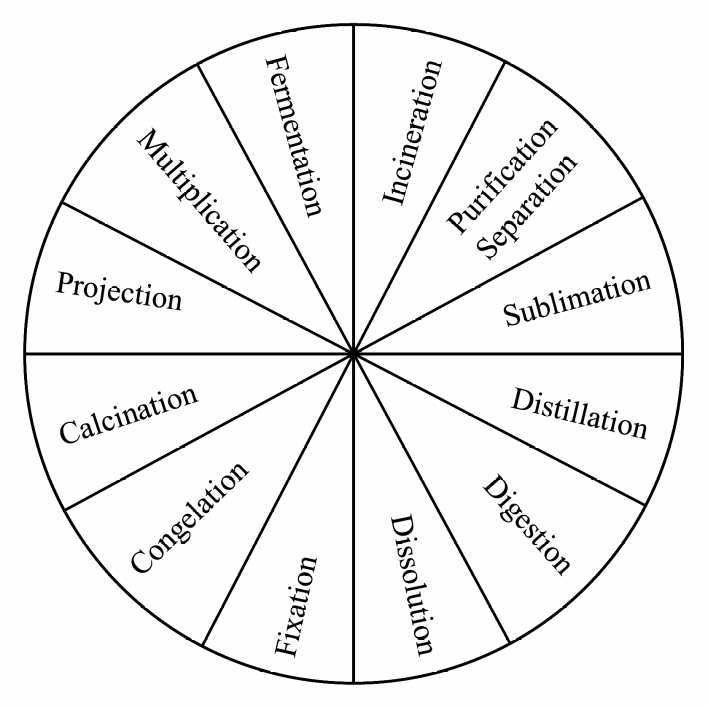
DIAGRAM FOR 1982 0304
Seminar
Thursday, March 4th, 1982
Verbatim, unedited transcriptClick the series name to view more
SEMINAR at Wisdom's Goldenrod, Hector, NY
with Anthony Damiani (AD)
March 4, 1982
ALCHEMY; MERCURIUS
with Appendix: 1982 0304-05-06 Partial Transcript.
TOPIC: Alchemy
SUBJECT: Mercurius
SUBSUBJECTS: Astrology, Imagination, Hua T'ou, Purgation of Will, Projection and Introjection, 12-fold Alchemical Process, Bodhicitta, Nous Atom, Causal Body, Ego, Mind-Continuum, Quintessential Body, Body of Light
CONTENTS:
Dual nature of Mercurius: operates through introjection and projection
Life of soul effectuates movement of meaning between inner and outer; anima as psychological correlate
When Mercurius escapes, he relapses into old ways (sexuality, emotionality); Franz Liszt example of cyclical discipline and release
Need to capture and bottle Mercurius (vitality) to prevent escape; energy has to be consciously directed; purgation of will; distinction between suppression (conscious) and repression
Nous/Heart atom as source of vitality
Atwood's language convoluted but techniques and methods obvious
Mercurius connected to mystery of human attention; has to be directed by the will
Seven planets (aspect pattern) as Mercurius; their placement in houses/signs as soul powers embodied in mind-body complex, making projection/introjection possible
Body as principle means for manifestation of reason-principles
Organization of body includes/embodies reason-principles; these extracted through inhabiting and using body
Mysteries of the body as first level of spiritual mysteries; laws/processes of cosmos reflected microcosmically in body
Body as part of the world body with specific organized destiny; level of development of soul's faculties determine the kind of body it can build
Planets operate according to house meanings over time
Twelvefold alchemical process begins when causal light inserted into body
Dual transformative process: 1) refinement of soul powers/psychic functions; 2) purification of astral imagery, manifestation of reason-principles buried in body-mind
Question of whether process belongs to causal light or is externally imposed by cosmos
Debate about what constitutes the causal body in which the soul's evolutionary gains are retained; ego as potential candidate; abstract ego and "seeds of will" (vijnanamaya kosha)
Is there one continuous light or a new one each life?; Buddhist concept of mind-continuum vs. substantial entity views
Appendix: 1982 0304-05-06 Partial Transcript
Macrocosmic function of Proteus as medium of World-Soul's manifestation of forms; microcosmic function as imaginal essence/astral light needing to be purified
Sage's imaginal essence: virginal, magnetic, sensitive to surroundings; ordinary imaginal essence: filled with superfluous images from the past
Brazen Wall concept: psychic belt surrounding individuals and the world
Planetary functions and their evolution: increasing efficiency through repeated aspects to natal degrees; progressive reduction of interfering imagery
Hua T'ou as purification technique: cutting off images/thoughts at their point of arising; imaginal essence fixed in its purity
Depriving images of our preferences; restoring perceived world to matrix of possibilities; establishing communication between inner reason and natural manifestation
Mercurius as causal light/vital principle; originates in heart atom; has natural inclination to recapitulate past operational patterns; need for conscious direction by will
Alchemical metaphor: capturing and bottling this energy; will as vessel for Mercurius; escape from vessel like renegade monk fleeing discipline
Volatility of imagination; will's role in discipline; will itself being purged through disciplinary process; distinction between suppression (conscious) and repression
Mercurius as dual function: projection and introjection; anima as psychological correlate; connection to mystery of attention
Planetary angular relationships as initial identification of Nous atom with specific energy quality; houses and signs as body-mind complex; immediate arising of projection/introjection processes
Double process of soul powers getting refined and manifesting reason-principles in matter
Body as medium for manifesting reason-principles; as part of world body
Return of gross and subtle bodies to elements at death; retention of extracted wisdom in causal body
Causal body as body of will-seeds; as abstract ego
Is bodhicitta a mind-continuum or a substantial entity?
Buddhist view: bodhicitta as ever-becoming mind continuum with organized direction toward Buddhahood; question of breaks between incarnations; problem of subject
Alternative perspective: bodhicitta as spark from Intellectual soul
Mentalistic view: cosmos internal to soul; eternal immutability of the spark
Necessity of combining both views
Reduplication of Intelligible World in sensible world; polarity between eternal contemplation and temporal actualization
Impossibility of directly symbolizing Nous atom in chart; body as field within which Nous atom gains experience
Problem of simultaneity of subtle and gross realms; experiential inference of heart location; absence of geographical topology in subtle realm
Chemical wedding as combination of subtle processes with physical body; results in production of quintessential body
Alchemists' use of chemical processes paralleling chart usage to fix understanding
Continuity of quintessential body with Nous atom across lifetimes
Each chart as fixed moment representing accumulated soul knowledge; experiences interpreted in context of quintessential body (ether)
Next evolutionary step: development of body of light; projection of extracted wisdom, mystical experience of lights; reference to Plotinus, III.8.6
Shift from Nous projecting through the individual to individual projecting own wisdom/quintessential body; having one's own erector set
BOOKS READ FROM OR REFERENCED:
Mary Anne Atwood, A Suggestive Inquiry into the Hermetic Mystery
Paul Brunton, Notebooks
Krishnachandra Bhattacharyya, Studies in Philosophy, Vol. 1, "Studies in Vedantism"
Plotinus, The Enneads (MacKenna translation, 4th ed.)
PLOTINUS QUOTES READ OR REFERENCED: I.1.7, I.1.9, III.4.3, III.4.6, III.8.6, IV.4.23
DIAGRAM appended to this transcript:
- FIGURE 1982 0304-1-AB. Alchemical Twelve-fold Wheel.
Other diagrams also referred to are not with this transcript version. [Transcriber note: [diagram] means the speaker is referencing a diagram as he or she is speaking. If someone is drawing or writing, with audible sounds of chalk on a blackboard, I indicate this by [drawing] or [writing].]
NOTES:
We have two partial transcripts for this class with identical handwritten AD edits, Scan File 1982 0304 and 05-06 ALC 08R17.PDF and Scan File 1982 0304-05-06 alchemy 10p F10.PDF (both formerly misdated 1982 0305-06-07). Original transcript typed by CdA.
Scan File 1982 0304-05-06 alchemy 10p F10.PDF has two extra pages at the end of it with student handwriting and diagrams that the other version doesn't have. Both the handwriting and the diagrams do not belong to this class and are not appended here.
Since the partial is a summary of three days of classes (3/4, 3/5, 3/6), the AD edits don't fit neatly into the body of the verbatim transcripts and are not included there. Instead, I append the full partial with all AD edits to all three transcripts.
TRANSCRIBED Verbatim by IT 2021. In 2025, IT expands Subsubjects and Plotinus quotes section, completes TOC, adds new notes within transcript. Archival verbatim transcript – V12a.
AUDIO FILES: 1982 0304a. [Note 1: "Tape" and "Side" refer to original audio cassette tapes that were later digitized into .MP3 Audio Files. Note 2: We are missing the first audio file for this class.]
1982 03/04 SEMINAR at Wisdom's Goldenrod
Alchemy; Mercurius
[Audio File 1982 0304a Begins]
AD: --certain symbols. And if you project onto it certain [couple/three words inaudible] is again what I'm pinning down and saying that's Mercurius. So that that Mercurius seems to operate in these two ways, introjecting or projecting. And that it's very slippery. In other words it delivers-- it delivers the so-called outer reasons and helps-- helps them become subjective, or it delivers the inner reasons and helps them become objective. So that's the Mercurius.
JC: You mean, the one that's going from the inner to the outer, (you) say that something about the reason-principles inherent in the light of the soul would be getting projected into the experience to transform that or mold it according to its own inner structure?
AD (simultaneously): Or superimpose on it its own meanings. Yeah, ok.
S: Yeah.
JC: So like [AD simultaneously: Now, what effectuates--] soul can express itself.
AD: Yeah, what effectuates that transposition of a meaning which is within to a situation which is outside?
JC: It would have to be what we're calling Mercurius I think [few words inaudible]
AD (simultaneously): Yeah, if you-- if you don't think of it as Mercurius, alright, and if we try to think of it, you know, like with bare knuckles, what is it?
JC: Well, seems my imagination.
S (faint): Yeah.
AB: Isn't it like this transforming power?
DB: It's the life of the soul then. [short pause] The actual identity that is-- or the identification--
AD (simultaneously): Life of the soul. I'm sorry, the life of the soul.
DB (simultaneously): (It's) the life of the soul which is caught up in this identification with this imaginal essence which provides the medium for this transference? I mean because--
AD: Yeah.
S (simultaneously): Yeah.
DB: We speak of ourselves as identified with that-- with the body. [student assents, faint] And there's-- there's this interpenetration that-- it would seem like it's the life of the soul, that fragment, which provides the medium of exchange.
[short pause]
S (faint): Maybe so.
JC (simultaneously): And Plotinus speaks of the imagination as being an agent, right, and-- I mean the-- the medium in which the planets effectuate themselves. And I mean is that body? I don't know what could be more tangible than that as the medium that-- which becomes the images.
AD: Yeah, we wouldn't disagree with that. Right now I'm just trying to see if I could pinpoint your attention on this men-- very mysterious agent, alright, which is transferring inner meanings to outer circumstances and vice versa.
AS: I think-- and that's just-- Actually Plotinus, he called it the understanding which he says reconciles the inner and the outer. [Note: See Plotinus, I.1.9, second to last para.]
AD: Yeah.
RG/S(?) (faint): [couple/three words inaudible]
LR (simultaneously): Well what is that in terms of the chart? Would that be in the chart, that mechanism, would that be--
S: [couple words inaudible]
AD (simultaneously): Well before we worry [one/two inaudible student words simultaneous with AD] about the chart what-- what do you see as in you?
AS (simultaneously): What is it in your experience.
AH: Anthony?
LR: Well, the reason I say that is it seems to be effectuated or triggered off by certain-- some magical--
AD (simultaneously): You remember Jung makes a point that when Mercurius, who is so volatile, escapes, he relapses back [AS simultaneously, faint: Goes right back.] into his old ways of being and among the most noticeable was a tendency towards sexuality, emotionality, etc. [student assents, faint] Remember that? Now--
PD: Well psychologically what you-- I mean I-- I follow what you're saying is what he-- what Jung calls the anima function, which is what in man is projecting-- projects something from within him onto circumstances, as well as in a positive function of being the rapport you have with circumstances in order to assimilate the (meaning/meeting) or relate to the meaning.
AD: You're saying psychologically he would call it the anima and the alchemists would call it the Mercurius.
S (very faint): Yeah.
PD: Well I'm not-- I'm-- I'm not saying that about the Mercurius but what you're speaking about is this ability, or this function which expels what's within and relates you to what's without. Psychologically it [AD simultaneously: Yeah, it's the anima.] sounds very similar to the anima, yeah.
AD (simultaneously): Anima function, yeah. But now the alchemists then would-- wouldn't call that the anima, they-- they had their own names, Mercurius.
AH: Anthony, if its function is to-- is to bring the inner to the outer and vice versa, what does it mean for Mercurius to escape? How-- I mean it seems that all possi--
AD (simultaneously): That's interesting. That's rea--
AH (simultaneously): All possibilities are included--
AD (simultaneously): That's really interesting.
TS/S(?) (faint): Yeah.
AD: Let's try to figure that one out.
AH: Well it seemed that-- I mean the point of view of Mercurius escaping would be from the point of view of the outer becoming the inner.
AD: Well it doesn't matter, he could escape either way, but let's say he escapes from within, ok. Probably a good example would be to think of a renegade monk.
LR: Isn't that the fascination [S simultaneously, faint: (Exactly.)] with the Dragon? (some laughter) That-- that escaping, isn't that the fascination with the (imagery/images)?
AD: I-- It might be.
S (simultaneously, faint): (They) just have to really (think hard), uh-hm.
S (simultaneously): Yeah.
AH/S(?): I wonder about--
S (laughing): Yeah.
TS (simultaneously): Yeah. (TS laughs, some laughter)
AD: That's exactly what a renegade monk would answer. (student laughs) I'm fascinated with the imagery. Never mind this 4 o'clock [one word inaudible] and 5 o'clock meditation. I want to go out-- You remember Franz Liszt, he went to a monastery? And for six months he used to be a good little boy, write organ concertos and music for the Psalms and then six months he'd go out and get drunk and whoop it up. (AD laughs) Then six months back into the monastery. (AD laughing)
DB: He was balanced.
S: Yeah, (I agree). (laughter)
AD: (Well), yeah. Yeah, keep balanced! (AD laughing)
DB: No but, [few inaudible student words simultaneous with DB] wouldn't that-- wouldn't that be the point. I mean in-- you know how he--
AD (simultaneously): Wouldn't what be the point, when he ran out?
DB: No, no.
AD: When he ran out of the monastery, that Mercurius escaped?
DB: Well yes but-- but, the point I was trying to make is that, whether you speak of the Mercurius escaping one way or the other, it's a question of not having a balance being established.
S (faint): No.
AD: No, no, no. The Mercurius escapes. He outwitted you.
AH: They worried about that, like they don't want it to get out of the bottle or something. Like, Mercurius can get out--
AD (simultaneously): No, you don't want it to get out of the bottle. (AD laughing) A trouble-maker when he gets out of the bottle.
AH: But what's the bottle-- [AS, faint: (He's) totally (bringing) (one/two words inaudible)] the bottle?
RC: Yeah.
S (very faint): Right.
S (faint): Yeah. (some laughter)
S (amidst laughter, faint): Don't you see (it Tony)?
S: So you have--
AD: Canadian [one word inaudible] (more laughter, student words)
S (laughing): He heard.
GA/S(?) (amidst laughter, faint): That's right.
PD: So is that-- is that-- when they [VM simultaneously: No.] try to work with the Mercurius and-- you know, working through imagery here, when they work with Mercurius at-- in-- in that attempted controlled environment, in the retort or in a hermetic vessel, they're trying to activate the life principle within them, you know, just again doing psychologically, to activate this soul function, and yet keep it in a controlled environment so it doesn't get dispersed into a panorama of circumstances or imageries.
AD: Yeah I'd agree with that, sure. But the interesting thing that this gentleman said, he said that Mercurius was the projection of the life of the soul. [AH: Are (we--)] But I didn't know if he knew what he was saying but I'd be interested to find out.
DB: Well, I mean, it seems that-- it seems that--
AD: You better give me a cigarette. By the time you get finished with that sentence I could-- I could have it smoked. (bit of laughter)
S: Definitely. Here you are.
DB: I mean, it's not an abstract thing we're talking about, I mean--
AD (laughing): No, it isn't!
DB: That's-- that's part of the problem.
AD (simultaneously): It gives you more trouble than you can--
DB: But it-- it is actually in some sense when we speak of a-- when we speak of the soul acquiesce in-- acquiescing to certain vasanas or-- or impulses or whatever, what's actually being acquiesced is the life that the soul has. I mean, it's in a-- a real vital living activity that takes place.
AD (simultaneously): It's the vitality which is projected from that soul. And the word 'vitality' I think would be correct. Or that life, alright. But that vitality which is projected from the soul and we spoke about as ontogenetic and phylogenetic development, will always tend to go back and recapitulate past ways of operating. Now most of us I think are familiar with the way that life likes to operate. But the point is that the alchemists said that has to be captured. That not only has to be captured, it has to be bottled. Because that attention can-- I don't know if the word 'attention' is right, but if that energy is not directed and the controls are not kept on it, then it does go wild and it tends to resort to former ways of operating, former ways of being, which of course would be go to the bar Friday and Saturday night, right? What's the matter Alan, don't you agree?
AB: No I-- I was going to try an example.
AD: Go ahead.
AB: Like going to the bar, no. Like when Jung speaks about psychic libido, and you're damming up libido and that naturally seeks its own level. It's like if you don't have this theoria or this discipline to channel that libido or damn-- damn up that psychic energy, the water-- they use water as an example for Mercurius, it just seeks its own level, it just flows out into the old grooves or the patterns that were traced out before.
AD: Yeah. [short pause] Well, I don't know, that Mercurius is still mys-- mysterious.
AH: I would like to ask further question about the bottle. (bit of laughter) I think like all this discussions that happen-- Paul did you intend to imply that like the bottle is actually the su-- subjective sphere of experience?
PD: Well the bottle I-- I-- the-- You can't suppress Mercurius. But you-- you work-- you can activate it and work with it in a controlled environment.
S: Yeah.
AH: Now that environment or that--
TS (simultaneously, faint): And it seemed like within the body.
AD: In other words, what he's saying is it has to be trained.
PD: See that's like Franz Liszt running into the monastery for six months and then the next six months it blew up.
AH: I-- I've always been interested what this alchemical vessel is. Is it the subjective sphere?
PD: I think the discipline. I think there's-- that is a proper discipline, some type of structured activity.
AD (simultaneously): It has to be contained.
AH: Within what? Certainly not the world of our experience.
AD (simultaneously): Well, think real hard now.
AH: Contained within [AS simultaneously: By your will.] circumstances or [AS simultaneously: No, by your will.] contained within the subjective stream?
AD: Wouldn't you say it's the will?
S (faint): That's right.
AS (faint): Uh-hm.
AH: The bottle is the will?
AS: Yeah, by your will, contained in your will. That--
AH (simultaneously, faint): Yeah, yeah.
AS: Your, you know-- that free energy is contained by your will. You have to develop the e-- they say develop the will to curtail it. [couple words inaudible]
AD (simultaneously): Here's this energy pouring into you from the vital principle, alright. And that's one of its characteristics, that it is the principle of life. You remember the way PB speak-- speaks about the heart atom as being (the/this) origin of Being, Consciousness, and Activity? Or as being Life and Activity, I don't remember. [AS simultaneously: As Being, Consciousness and--] But, if that's the origin of it, if that vit-- vital principle has its origin or its genesis from-- from that atom, alright, and that energy's pouring out from it, and this energy's always been used to running around every Friday and Saturday to the bar, in your case Monday, Tuesday, Wednesday, Thursday, Friday and Saturday. Not in my case. (AD laughs a bit)
S (faint): Yeah.
AD: You get the point?
S (faint): Yeah.
AH: Yes I-- I think I could [couple words inaudible]
AD: See, it's almost like a purgation of the will. In order to keep that Mercurius from wandering out, alright, they say you got to bottle it. That means that you really have to will the energy into that direction constantly. If there's a lapse in the will, Mercurius runs-- runs wild. Resorts to his old ways of operating, whatever they may have been in the past. They don't necessarily have to be the bar, it could be circuses, I don't know.
AH: Anthony, see--
AD (simultaneously): Every Mercurius has his own attachment.
AH: It seems that what we're saying it's-- is it's simple way of stating this Mercurius could be that it's like psychological repression.
S (very faint): Yeah.
S (very faint): Uh-hm.
S: Mm, no.
AH: How--
AD: Suppression would be more to the point.
AH: Suppression.
AD: Suppression. [AH simultaneously: Wouldn't it--] 'Cause it's going to take all the conscious understanding you have to do it and that means suppression. Repression means you don't even know what you're doing.
AH: Repression means that Mercurius--
AS: [few words inaudible]
AD (simultaneously): In other words when a person doesn't know that he's a sexual animal, alright, he doesn't know that, and so whenever the-- the urge comes up he violently represses it, alright, that's repression. But when a person knows he's a sexual animal and knows what it's all about, and says "Well I gotta stand up to it and I gotta confront it and organize it and have it act the way I want it to act," then you have suppression.
AH: Distinction being suppression [AD simultaneously: Yeah, you know--] implies consciousness.
AD: Implying [AS simultaneously, faint: (You understand.)] consciousness, understanding, will, yes.
JfL: How is the discipline there distinct from-- is it like subjective and objective but it's disciplined by the world(,) going around the chart or--
AD (simultaneously): Could be either way. You know, some people might be--
AS (faint): (Most likely willful.)
AD: It might come to you in an objective wor-- way, you know.
JfL: No, you were talking--
AD: Somebody might put you in jail, ok, and you have to practice it. Or you may of your own free will from within decide that that's necessary to your development. Could be either way. But the point here is, what is this Mercurius? And you're going to have to like grow another pair of eyes, you know, [S: Yeah.] but inside the head to watch it operate. Every vital impulse is going to-- is going to be that Mercurius personified, and his operation is something that is such an intimate thing that's going on all the time, [S: (Ok.)] you can hardly distinguish yourself from that operation. Anyway--
JC: Anthony, I don't understand that the vitality of the soul should be identical with the animal urges.
AD: Well how is it manifested in the past two and a half million years?
S (faint): Ok.
JC: But it's--
AD: Saintly?
JC: It's conformed with it.
AD: It's conformed with biological necessities.
JC (simultaneously): It's conformed to that because the Mercurius is caught up in the projections.
AD: Yes. That's why I-- that's why I included its phylo and ontogenetic development. In other words, we're speaking about the way it's operated in the past and that's what it'll tend to repeat. And so, if you ever undertook for instance to learn an art, a trade or whatever, you'll notice that the new techniques that are taught to you, you have to cons-- constantly reassert and emphasize until they become, you know, automatic. But, assuming that they become automatic, you'll notice every now and then there's a possibility of a lapse or a relapse back to the way you used to be. [JC assents, faint] Well that would be Mercurius.
JC: I guess what I'm saying is I don't understand-- you're saying it's the vitality of the bodhicitta working in the Mercuriu-- Mercurius and it's imagined--
AD (simultaneously): Well its-- its projection forward, that emanation from it, is what we're referring to as Mercurius right now.
JC: The projection being like the life, the vitality of [AD simultaneously: Yeah.] the soul.
AD: Yeah. If you say that the heart atom is the origin from which there emanates Being, Consciousness, Life, alright, you're speaking about the way that Life has manifested itself in the past and the way it's trying to do so now. As soon as you consciously bring in the will and try to direct it, alright, you're trying to put it in a bottle. [11 second pause] That's-- Don't be a dope, I'll put it that way. [short pause] You people have been complaining that you can't read Atwood. You're not going to read it unless you really put this thing through your head. Because her language is obnoxious. The-- the techniques and the methods are pretty obvious. But, let's say-- let's say that I was a painter, you know, and I wrote a book on how to paint, alright. Now, if I keep the-- if I keep the content of what I'm going to say in my mind very clearly but then I start messing up the words and using synonyms, you know, along the way, now I write this whole book on painting and you don't know what the hell I said. But yet what I'm talking about you as a painter would know immediately soon as I pointed it out to you. [short pause] You got another quote?
TS (faint): [few words inaudible]
AD: Well-- [RC simultaneously, faint: This is still mys--] let's go back to the question then.
S (faint): Uh-hm.
RC: This is still mysterious.
AD: Huh?
RC: This is still myster-- I mean despite the words like 'anima' and 'vitality' and-- it--
AD (simultaneously): It's still mysterious?
RC: The withinness and the withoutness.
AD: Well that's because you haven't reached [S simultaneously: Yeah.] your second Saturn birthday. (some laughter)
S (amidst laughter, faint): Yeah.
S (faint): Yeah.
AS: Now once you get there then there's a [one word inaudible]
RG: You have to wait for (that there).
AD: It gets cleared for you at the second Saturn birth.
S (simultaneously): Really?
RC: Is it this Saturn that you're talking about as what experiences withinness and withoutness with respect--
AD: Is it [S simultaneously: Yeah.] the what?
RC: This very Saturn, ok, experiences the vitality as within or without. Like it seems that to a soul it's-- it's not going to be within or without.
AD: Well, I ha-- I have to hear more.
RC: The question of Mercurius being within or having escaped seems to be hinged up with the extent to which I as a-- as a-- as an individual am able to direct the creative vital flow of my attention, or the extent to which I'm passive to its appearance in circumstance. In both cases it seems that the life is the life of the soul. [student assents] But the withinness and the withoutness seems to have something to do with the extent to which I feel as if I can direct it or I feel as if I'm passive to it, being manipulated by it.
AD: Alright, you stated it, ok. Yeah.
RC: So, the issue of withinness and withoutness in the body and so on and so forth.
AD: Well I thought that within and without was like when the Mercurius is projected from within. And the second was when Mercurius gets projected, let's say when the imaged world, alright, let's say there's an image, alright, and it projects a meaning into you. [student assents, very faint] Now this is arbitrary, this isn't exact, this is just a means to get to where I want to get. So an image is presented to you, the circumstances of that situation. And it seems that a meaning from that situation goes right into you. Now, we would call that image presentation, we'd call that your astral soul.
S: Right.
AD: So it seems as though the meaning is coming from what-- without to within. Now on the other hand the-- it can be reversed. [RC assents, faint] There's something there and you project something onto it and it seems that it's coming from within and going without. And, whether you call it projection or introjection, the point that is being made here is in that both cases, that's Mercurius. [RC assents, very faint] And the mysteriousness about it I think is also associated with the mysteriousness about our attention. What seem-- what is behind or-- what is the meaning of attention when you, you know, really pin [RC simultaneously: It turns on the light.] yourself down. What do I mean when I speak about attention, what (happened)?
RC (simultaneously): Yeah. Yeah. Like when we're asleep we don't speak about attention.
AD: Yeah.
RC: But--
AD: Like for instance, we're having a class and we're talking, and you notice all of a sudden your attention is wandering off somewhere else. And you bring it back and you stop and you ask yourself: "Well why did it go away?" Alright, it seems like, you know, in the beginning you constantly have to keep him there, you know, like almost a-- an effort of energy is applied. It keeps going away, it wants to go where? Oh, dream about something. I'll be sailing in June somewhere, you know, something like that, it keeps running away. So you have to keep bringing back. Now the whole mystery here is attention.
AB: Seems that the attention like the imagination is very volatile [AD simultaneously: Yeah.] or permeable, all these influences flow through it.
AD: And that's why I said that it seems that the only thing that can contain that would be the will. [student assents] I mean when it goes away and you bring it back and you keep bringing it back, it shows that, you know, your will is operative. At the same time your will is being purged. Because generally your will would let it go off and do what it wants and just accompany it. But now the whole process is reversed, the will, alright, is being purged in the sense that it's saying "No, I'm going to not permit that. You have to come here and we have to listen."
AB: That's the point to how-- Andrew made the point about them working in harmony, that as you exert control over the imagination it's also purifying these soul powers. Like the will orders that.
AD: Yeah well, the will is certainly going to be purged, there's no two way-- That is the ultimate task. And, when all is said and done that's the ultimate task, the will has to go through a purgation.
S (faint): Yeah.
AS: In fact that-- she calls that, in "The Gross Work" she speaks about that as the first operation has to be done manually she says, with the hands. And she says that-- that's a reference to the fact that it has to be a wi-- the first process has to be a willed process. And that it's through the will that the greatest-- that this purgation can take place.
AD: There's a [AS simultaneously: You know--] remark made by PB somewhere in his notes where he says, it may come to you as an event, a person, a book, etc., you know, going down. [AS: Right.] But, when all is said and done, you have to say yes. Or it don't work.
AS: Yeah. He's speaking about (the/that)-- that Grace doesn't come unless he--
AD: Anyway, let's take this for granted, ok, we don't have to-- [DB: Well--] Yeah, go ahead Dave. Go ahead Dave.
DB: Yeah, I was wondering about-- about the will, if-- it seems that in some sense when we bring in this principle which is going to try to direct the flow of this energy or restrain it, that we're speaking about-- I don't know. But it almost sounds as if it's with reference to this body of wisdom that has been distilled from experience where-- wherein there's a perspective where one would say, "Well, this is disadvantageous to continue in this way and let's try to do this." So, it-- would-- would it be a function--
AD (simultaneously): Yeah but you see, that won't be enough, you also would have to bring in Mars.
S: Right.
DB: Ok, now--
AD: Because Mars would be the a-- the-- the act of courage or prudence or civility, all the characteristic virtues that they think of as Mars.
DB: Uh-hm.
AD: So you'd have the power of the soul, the wi-- the Mars which represents all these things, alright, and a necessary amount of wisdom and understanding. So the two of them would have to be employed.
TS: Well it really seems that what's being spoken of here might be that cookie-cutter, that that-- by [AD simultaneously: Well--] itself, the--
AD: What do you the mean the cookie-cutter?
TS: The angular relat--
AD (simultaneously): Angular relationship?
TS: The angular relationship in itself.
AD: We went through so much trouble to-- picking up angular relationship and you-- (student laughs)
PD/AD(?) (faint): The cookie-cutter.
S (faint): The cookie-cutter.
TS: (Yeah) well, when-- in other words, if you take the angular relationship and it's not referred to the signs or the houses but it's left to run free by itself, it seems to me that's like the Mercurius spilling out. We can be-- if it refers to something like the houses or the signs or it seems to be that idea of projection and introjection of these powers of the soul. Something is projected or-- and I don't know about which is which but there is a reference to an ordered and given content. But if you take like just the planetary aspects each to itself without any idea behind it either by house or by sign, that seems to be where things get in trouble. And that the way-- it's that-- that pattern working on itself which is the-- the containment, that it doesn't just take the will but it takes the [one word inaudible] and the ethics or the values, the Venus function, you know, the--
AD: I don't know about that. I'd like to leave that open now, Tim.
MB/S(?) (very faint): Yeah.
TS: I just wanted to put it out as a suggestion.
AD: Yeah I-- I'd like you to just keep that in the back of the mind and we'll get to that again because that's a whole-- it's a whole big thing. I think it's possible for a person to have a highly developed-- what you might call a courageous Mars and a very weak Venus.
TS: Yes, I agree. But I'm saying that if-- if the planets are taken outside of their-- like you might have a Mars Venus square, ok. Now if that's in-- if those two planets are in dignity by sign, when they're functioning with the quality of the sign and(--) in them, then they work with a certain-- they will come to a certain maturity inexorably. But if the person just tries to divest it from any qualitative mode of operating, just uses the will-- a certain willfulness, an undifferentiated willfulness, an undifferentiated sense of attachment, say Mars and Venus in a very naïve functioning, then-- then there-- there-- therein lies the trouble, therein lies the kind of the spilling out of that Mercurius, it has-- the ego can do what it wants with it. I don't know if I can get my idea across.
AH: Tim are you suggesting that just the exercise of the will does not contain Mercurius.
TS: No, what I-- I'm trying to suggest is something that-- if you take a planetary pattern in the chart and you look at it in itself without any reference to house or sign, that's like the Mercurius. Now, the process of introjection or projection that we spoke of has to do with the way in which that planetary pattern or angular relationship refers to either the way it's manifest in the houses or manifest in the signs. And it's that process of introjection or projection that contains the--
AD: Tim, do you get it?
RC (very faint): Yeah.
AD: He hasn't got it out yet.
S (very faint): Well we don't have it.
AS: I--
AD: Well, go over it again.
AS (simultaneously): He's talking about looking at the angle pattern two different ways.
TS: Three different ways.
S (faint): Yeah.
AS (faint): Three different ways. Yeah that's-- I was trying to look at it in terms of those two ways of [one/two words inaudible]
TS: I know. See I'm--
AS (simultaneously): You're talking about the relation of the s-- to the signs and the houses.
TS: Yeah, [AS simultaneously: Wasn't (couple words inaudible)] before-- yeah.
AS: In itself.
TS: In itself.
AS: Yeah.
TS: In itself it's the Mercurius, it's the reflection of the second soul.
AS (simultaneously): Well, it could be either way.
TS: But the-- it's a reflection of the-- the maturity of the soul.
AS: Yeah.
TS: But that maturity of the soul isn't fixed. You know, it's not come into being in itself. It has to be--
AS (simultaneously): Right, we talked about that as potential, you know, like that original angle pattern was just the potential and it had to develop through this whole process.
TS: And I'm saying that what it developed, the process it needs to develop through is the houses and the signs. It gets conjunct the houses and the signs. Now when it's looked at in terms of-- I-- when it's looked at in terms of its meaning, in terms of like-- You take Mars in its-- in Scorpio, and then say, what would it be-- uh-- opposite Venus in Taurus, they're both in dignity, now there's a certain fixation of the-- of the function of Mars and Venus by virtue of their being gnostic. Ok? But if you talk about just the Mars Venus opposition, one certainly could speak of them as just opposing each other outside of assigned meaning. And therein seems to be when there-- they function in a more destructive fashion.
RC: I think Blake might be an example. He blew it because he got into the energy part. Any expression of that soul energy to him was a delight. It didn't have to be tied in with anything intelligible.
TS: Yeah. That's what I'm trying to get at, that you could just function within the planets themselves as it were, just the functions without any reference to any content, any intelligible content or objective content.
AH (faint): Who (do/did) you use as an example Randy, I didn't--
RC: Blake.
AH: William Blake?
RC: Yeah.
S (very faint): Oh.
RC: And for him [TS: No, Charles. (bit of laughter)] energy, that expression of energy is eternal delight, it doesn't really have to be about anything intelligible. He was just as happy to take his clothes off and go sit in the garden as he was to meditate. And he didn't really get fixed in to-- he really revolted against people like Newton. (Hagen.)
AH: So Blake would be the planets in your discussion, Tim? He'd be like expression of those planets now?
TS: Just the-- the aspects. 'Cause you can look at an aspect, you can look up in a cookbook astrology book, you know, what does it mean to have a Mars Venus square, ok. [student assents] Now there's a certain kind of difficulty in containing the passions or disciplining the attachments that that would have, a Mars Venus square. But you stick those in dignities and it's not going to be the same trouble as it is if they're both in non-dignities. Ok? [S, faint: But--] Of course if you get them both in non-- in dignities, you gotta find [one word inaudible]
AB: Tim, is--
JB: If they're square, then possibly.
TS (simultaneously): Yeah. And--
PD (simultaneously): But, let me see if I follow. We spoke of Mercurius as the attention. Now, normally in a chart, the attention is dispersed throughout all the activities of the psychosomatic organism which represents the grid and the body.
AD: Go ahead.
TS/S(?) (simultaneously): Well--
PD: Now, when the alchemist speaks of containing Mercurius into the retort and distilling him into the retort, that's like distilling your-- or bringing together your life forces into a point of attention so they aren't controlled by Nature.
TS: Yeah.
PD: Ok.
TS: So, that if you say that the life forces of that soul is represented by say the seven planets, there's a differentiation of that life force. And it's not-- it's not a-- when it's not contained in itself but it's just let to operate as functions, there's no difference-- Maybe this would be a way to say it, that there's no-- just as simply it recognizes functions with no specific reference to content, you can't separate those functions from being those which are found in Nature, the function of Mars in Nature, the function of our Earth Soul or something like that. But if you-- if it's referred to specific degrees that they're on, specific house, circumstances it's tied to or ought to be operating in, then-- then the-- that individuality begins to be contained. You say well you have, you know, the problem with the will, you-- What house is it in, that tells you where your will has to be disciplined. Well-- (TS laughs a bit) I could see this is a great idea. (TS laughs, bit of laughter)
S (faint): It makes some sense.
AD: Alright, it's alright Tim. I don't know, maybe I didn't follow you. But, if I did, this is the way I understand what you're saying and if I'm wrong, you know, don't hesitate. [short pause while drawing] 1, 2, 3, 4, 5, 6, 7. This is your cookie-cutter?
TS: Yeah. Avery's got [one/two words inaudible]
AD (simultaneously): Right, you got angular relationships with all these here [diagram]. [drawing] They would represent the seven soul powers.
TS: Correct.
AS: Right. When they say the causal light must be fixed, it seems that would be the causal light [couple/three words inaudible]
AD (simultaneously): That's the causal light that's being fixed, ok. Now, we do this here. [short pause while drawing] You put the twelve houses here. Ok? As you put the twelve houses in, you're inserting that causal light in the body. And as you put your signs in, you're inserting it in the mind. Right?
TS: Yeah.
AD: Now what arises?
TS: Well that's when that Mercurius seem-- the fixed becomes--
AD: No, not-- no. What arises immediately? This is the field, right, the battlefield.
AS (simultaneously): (Of) experience. That's your experience.
AD: That's your battlefield.
TS (faint): Right. (laughter)
AD/S(?): [couple words inaudible]
S (laughing): Right.
AS: See now you can talk about planets on certain degrees. Now you could say that those degrees are like the imaginal essence, all those degrees that are going to have to be purified through the-- through the whole process of, you know, this life.
AD: Well what your husband said.
S: Getting better and I can (prove/improve) him tomorrow at breakfast. (bit of laughter)
AD: What, while you're driving?
S: Yeah.
TS: Had to drive, eat oatmeal, and talk astrology all at once.
AD: Well, yeah.
TS: Sometimes we end up in Elmira. (bit of laughter) [student assents, faint] Well--
AD: He gets an intuition once in a while.
S: Thank you.
TS/S(?) (faint): But Plotinus said--
AD: It's a way of looking at it that I think is very helpful. We took this-- the cookie-cutter, seven planets, try to think of them not in houses or signs, alright. Those represent the unadorned powers of the soul. But, these powers of the soul are going to be embodied. In what? In the body and a mind. Alright, soon as you put that-- the twelve houses and the signs accompany them, you've inserted these powers of the soul in a mind-body complex. Now immediately there's going to be projected or introjected the problems that-- that this soul had, the soul powers have to accomplish.
TS: Yeah but as long as it's referred to a hou-- a sign or a house there's the possibility of that process of projection or introjection taking place.
AD (faint): Uh-hm.
TS: But if the planets just refer to, as it were, so-called pure or undifferentiated functions, then it's like this filling out of it, it'll-- there's a--
AD (simultaneously): Yeah. This is next weekend now, since you've improved. Alright, let's get back to our problem now.
[short pause]
AB: Well, there's like no experience if it's unadorned soul.
AD: Louder?
AB: There's no experience for this unadorned soul because it isn't assimilating--
AD: Well that's exactly what Plotinus said, right? In order for the soul to have experience of the sensible world it must become embodied. And, when it gets embodied then it could have that experience of the sensible world. [Note: See Plotinus, IV.4.23.]
[short pause]
JA: But isn't it embodied in some--
AD: Louder Jeannie.
JA: Isn't it embodied in the elements?
S (faint): Louder.
AD: Well--
AS (simultaneously): As soon as you got twelve signs you got the elements.
JA: Yeah. But that wasn't mentioned. [student assents, very faint] [one/two words inaudible]
AD (simultaneously): No, I mean I-- [AS simultaneously: Well--] I just didn't say it but as soon as you put houses and signs up, got to have the elements.
JA: Well, it should get some mention.
AD (simultaneously): One is air, water, fire, [S simultaneously: It'll get some.] earth and then-- they never-- they never alter. Life is always there.
S: Except for the fact that when you said body you said houses. I mean it's--
S (faint): Yeah.
S (very faint): Could be there.
AS: But the mind.
AD (faint): Yeah.
AS: But-- [S, faint: Yeah.] but why does that only go with the elements? The way we've been doing elements, the whole [TS simultaneously: They should be though, yeah.] mind-body complex is what we called [TS simultaneously: They both have elements.] the elements before.
TS: Why shouldn't the houses have elements too?
S: Well--
JA: But then I think of--
S (simultaneously): (There/They) are-- they are the four elements.
JA: But couldn't you think of the activity?
TS (simultaneously): Perhaps.
GA/S(?) (faint): Go on.
JA: What becomes volatile is the essence, the-- embodied in the elements and then he speaks of the-- or that there is this conflict in the elements, a natural--
AS: Well by conflict in the elements the conflict I think is more like the vasanas that are in the elements than the elements themselves. I mean I don't think you could insert-- it doesn't seem like you could insert those soul powers straight into elements. It would have to be, you know-- you know, somewhat organized elements.
GA (simultaneously): In other words, there-- there would be no perception.
AS: Be-- yeah there wouldn't be any experience of pure element(s).
GA: They would just be pure-- there'd be formless-- [S simultaneously, faint: You said before--] it'll be formless [AS: That--] experience. If just it was inserted in the elements it would be [couple/three words inaudible] (else) though. [AS simultaneously: But I--] If it's inserted into like a--
S (simultaneously, faint): What-- what are you talking about?
AS: I-- I think the question once you do that is [S simultaneously, faint: What did they say?] really how to-- how to speak of this-- now how to speak of this twelvefold alchemical process taking place [FIGURE 1982 0304-1-AB]. Suppose you have this-- these powers inserted into this mind-body complex. And now he begins this whole-- you know, this whole process. How can we symbolize that process? There seem to be several possibilities of talking about this-- this alchemical process which is going to evolve these psychic functions, or, on the other hand, complementary to that, purifying this astral-- the astral imagery. Both things are going on. Once that-- I think Tim's saying, once that angular relation is inserted or that light a-- causal light is inserted into this mind-body complex, then the light can begin to be extracted or come to the surface and the mind-body complex or the images can now begin to be-- get transformed.
LR: Would you say like the nidana [AS simultaneously, faint: That vesica.] process refer to the houses and [AS simultaneously: Well and that--] alchemical to signs or vice versa and-- well--
AS: See there-- that's where there seem to be several-- several possibilities. I have one conjecture.
S: What was that-- [AD/S(?): Just one?] Linda, what was that your question again?
LR: That-- that the nidana referred to the houses and the alchemical to the signs, or vice-- I'm not sure [S simultaneously: I see, yeah.] which is which but one of them refers to the containment by body, but by body will--
AD: In that case then, when you speak about that causal light getting corporealized, then-- that is, being inserted into a mind-body complex, it would have-- it would be in terms of the very body itself that the-- the reason-principles would-- would get manifested.
S (very faint): (I agree with that.)
AH: I don't understand that at all.
AD: Well, like we said, if we-- if we go back to this diagram you think of those seven angular-- the angular relationship between the seven planets. If you think of them just as the powers of the soul, then you insert them into houses, signs, and elements, alright. That means you're inserting these powers of the soul into a body. Then the body would be the principle-- principle medium-- the principle medium for the manifestation of the-- of reason-principles which are buried in matter.
AH: Is that to say Anthony that the body is actually a product of those reason-principles buried in matter?
AD: Well--
S: Yeah.
AH: Or the result of?
AD: Yeah but-- Yeah, we could say that the body is the product of reason-principles, I mean, it certainly isn't a haphazard of atom. So it is the result of reason-principles but I'm not going that way. The way I'm going now is that the unembodied soul powers are being corporealized, that is, being inserted into a body-mind complex. That would be equivalent to saying that the light of the soul being inserted into a body will now come to grasp or deal with reason-principles that are buried in the matter of the body. And matter here does not have to be, you know, atoms. I'm not talking about--
AS: Yeah, I thought some of those quotes we read before where she says that-- on Proteus being somewhat purified, these-- this matter-- she talked about this magnet or that light would be like now a mag-- that light is inserted into the body. That light is some kind of magnet that's actually going to draw out of the body these rea--
AD (simultaneously): The reason-principles buried in the body.
AS: Yeah. And the more it was purified of--
AD: You see now--
AS: --the more it would be able to (match) in conformity.
AD (simultaneously): You see what she's telling you? That's why you have to use your brain.
S (faint): Yeah.
S: Anthony, you said it's the-- it's the-- it's the principle medium for the body-- principle medium for the manifestation of--
AD (simultaneously): Yeah, because--
S: Are you thinking-- is it-- are you thinking-- what could be a secondary? I mean, you had mind a second ago.
AD (simultaneously): Well, secondary insofar that once you have the body then the world could be revealed to you through the body. But if you don't have a body no world could be revealed to you. So, if you're a-- if you're a materialist, alright, you can-- you'll go along with me. And if you're a mentalist you'll go along too, it won't matter.
S: That body being psycho-somatic.
AD (simultaneously): The body is the means, the principle means by which the manifestation of reason-principles can take place for any individual soul.
S: Yeah.
AD: So that means that the way the body is organized, the organization of the body includes these reason-principles. And that these reason-principles get extracted when the soul lives in a body because, in making use of the body, the very reason-principles that went into making the body get manifested in your operation, whatever your operations may be.
AH: What do you mean making use of the body, like just the normal functions of the body like walking around or [one/two words inaudible]
AD: Sure, that's perfectly alright. Talking, [AH simultaneously, very faint: But--] eating, sleeping.
AH: Well it seems the body has a restricted sphere of activity.
AD: It has a what?
S: Still--
AH: It has like a-- I mean compared to the mental life, the body seems to have a restricted sphere of activity.
AD: Why, you think you understand your bodily function(s)?
S: Hm.
AD: It's true that in comparison to the soul it may be restricted but the first of the mysteries I think they refer to as the mysteries of the body, the second are the mysteries of the soul and the third are the mysteries of the spirit. Now, we can't get to the mysteries of the spirit except by or through the body. So the first reason-principles we're going to get acquainted with is the mys-- the body itself. But the body is built according to a plan, according to certain ideas. So when you start inhabiting--
(Side 1 of original cassette tape digitized as 1982 0304a Ends; Side 2 Begins)
AD: --pumping out Being, Life, and Intellect to the rest of the solar system. So you get acquainted with that cosmic principle through a microcosmic manifestation.
AH: You're not-- so you're not speaking of the body as subtle. You're speaking of the body--
AD (simultaneously): No, I'm speaking about it as gross. You know, every time something go-- every time I get a bad aspect to some planets, I have an experience of the body. My ulcer.
TS/S(?): Ok.
AD: It's like clockwork. Right Timothy? You're a Virgo, oh Virgos. (student laughs) I think 90 percent of them have ulcers. (AD laughs)
S: That's the massive body [one/two words inaudible]
TS (simultaneously): The other ten percent are Libras.
S: Yeah, exactly. (S laughs)
S (faint): Cosmic principle (I would say/obviously). (bit of laughter)
AD: Well you know they got this attitude, you know. Remember that sign? The Virgo who was saying, "Nature, next time don't be so sloppy, make everything correct, you know, do it the right way." (AD laughing)
S (simultaneously): Exactly, same thing.
AD: Yeah, let all the grass grow the same height and-- you know. Well that's the way Virgos are. (TS laughs) Nothing's right.
TS: Well that part I understand, the grass [student assents] growing evenly. (TS laughing)
AD: You-- we get the point here?
S (faint): (Ask) your turn.
AD: That it is the insertion of the angular relationship of the planets which we're calling the causal light gets inserted into a body. Or even if it's concomitant with the body at the moment that it is born, it experiences these reason-principles, not in a static form but as functional. The form of the human body, the functions in the human body, all these things are reason-principles.
JC: When we spoke the other night about the-- like a-- somebody that's a pianist gets a certain kind of body, certain degrees go, (you know), of the-- the belt that's right around the Earth or the tendencies that compose the body get built into that body and then that soul exper-- has a body that is suited for piano playing.
AD: Yeah.
JC: Ok. You would be saying those-- those are the kinds of reason-principles that would go to compose a vehicle of-- I mean a physical body [AD simultaneously: Uh-hm.] from which--
AD: In other words, there was reason-principle presiding over the matter which included vasanas of previous life activity and gathered them together to procure that body necessary for the manifestation of this soul's powers. But the important thing here is, I-- and I think it's really worth-- worthwhile to keep in mind, is that the insertion of that principle, the causal light, into the house, signs, and elements is the insertion of the soul into a mind-body complex. Operating through that mind-body complex it must experience the reason-principles that are going to manifest. [S: Ok.] And the strange thing about the body of course is that it is like part of the whole. Your body-mind and anyone else's is like included in the body, the whole body, the world body, it's-- it's part of that. So that comes under very, you know, specific and-- very specific organized destiny.
AH (faint): But Anthony--
JC: So the soul has to learn certain [AD: Has to.] lessons based on the kind of body that it's been [AD: Yeah.] inserted in.
AD: Or that it-- if we don't want to say inserted in, the only kind of body that the soul can build. If we want to say that the soul, the individual soul is-- from out of the individual soul is oozing out this material body, then that material body can only be the product of the soul's faculties. Which means that, depending on how highly they're developed or not, that's the kind of body that it's going to have.
TS: That's the thing I've noticed in-- again in looking at the charts of someone who's accomplished their life, like going through the life of Jung or Coleridge or someone, you see three planets in the ninth house and when they're 25 they are not there. But, before they're gone, before they're done, those are operative. In other words, by the house organization, those planets will come to operate according to that-- those house meanings. They may not start out that way. But they'll end up that way.
AD: Well yes. I've noticed that too, that there's an age, there's time for those things to function. They just don't kick off right away.
TS: No.
AD: But they may have been incipient or (they/there) may have been involved in the building of the body and the time that they'll be-- they'll come into operation.
TS: Yeah well-- yeah, that would seem to have to do with that angle pattern again but the-- In other words, I'm saying that in the houses which re-- you were saying-- suggesting might have to do with the body, that it's there that the kind of specific and organized sense of destiny seems to be revealed, not immediately, not all at once but it's-- those meanings are sort of inexorable whereas the meanings of the planets in the signs seem to be those meanings which are more amenable to maturation, growth, perfection of some kind.
AD: So now if we-- if we have that for a background, now if we think of the alchemical process, I think the context has been laid.
AH: You speak of that first step as separating the light from the body, does that-- does that separate-- What does that mean in the context of what we're saying tonight?
AD: Well is that the first step? Separate the light from the body?
AH: Yeah.
S (faint): What does that mean?
AH: Wasn't that so in one tradition?
AB: First conjunction you mean?
AH: The first conjunction, yes.
S: Each alchemist has a different first step.
AH (simultaneously): No, no, it's not the first conjunction.
TS: Yeah.
AH: Or the first step in the process perhaps.
DB: Well, it depends on whose process-- The one that Avery started off reading tonight it was the transformation of-- from the green dragon to the toad to whatever it was. That's really-- (some laughter)
S (very faint): [couple/three words inaudible] too.
DB: I think, but what we were talking about from Dorn and the Jung quotes, I thought that was--
AD: No, don't bring them in now.
AS: I think talking about this process, [AD simultaneously: No.] the twelvefold process.
AD: Jung-- Jung didn't even engage himself in this problem, he doesn't even know the existence of this problem.
AH: Well, the question was Avery, what-- how does this discussion relate to alchemy?
AD: Yeah.
AS (faint): Well that's what I--
TS (faint): [three word inaudible]
AH: The reason-principles that we have in the body in the way that we've described. I thought one of the implications of that, the necessity of extracting them from the body in some sense.
S: I can--
AS: But they're going to-- [DB simultaneously: And I thought of one example.] I thought specifically that it-- just talking about how you would see this twelvefold process, calcination, congealing, fixation [FIGURE 1982 0304-1-AB] [AH: Or--] as being those transforming that causal light and also it's purifying the-- the imagery that that light is associated with, if you could see it that-- those two ways. Or-- or, how once the light, the causal light, maybe you could say it, once-- how once the causal light is associated with a mind-body complex that this alchemical process can now begin to function. And that's what-- that seem-- that is what's brought into play. That-- it's almost like chemical-- like a chemical reaction takes pla-- I mean maybe it's not, it would-- This chemical reaction can take place once you have these two ingredients, the causal light and the body. Once you bring them together into some kind of association then this whole alchemical process begins to happen, just as chemically if you bring two chemicals together, a certain chemical process begins to happen.
AH: You say that Mercury-- Mercurius is-- [DB/S(?): Yeah.] is-- is the result of that process.
AS: Or that Mercurius is that process. You know he says Mercurius is both the transformer and what's transformed. When you bring those two together, the light from the soul and that organized body or the light, the causal light and the mind-body complex, that the inter-- what happens is this-- I mean, chemical reaction, alchemical reaction. That reaction is the Mercurius.
AH: But I thought Mercurius emerged out of other elements though.
AS: Well in a sense we're saying that it emerges in the relation of this light with the body.
AH: So what maybe--
AS: That's where-- then the pro-- now the process can go on, the so-- in other words, the soul by itself, just the angle pattern itself, you can't talk about a transformation. And if you just talked about the elements, or the images by themselves, the body by itself, you can't talk about a transformation. But if you put the two of them together, now it seems it makes sense to talk about some kind of a transformation process which involves both of them.
TS: But it would seem that [AS simultaneously, faint: I mean that was the--] the-- the transformation process, I mean--
S (very faint): I know I (did that).
TS (simultaneously): That the alchemical processes which are presiding over this transformation is one thing, [AS assents] and the effect of that process, what it's working on and what it's working towards is another. Seems like what it's working on and towards is that-- that insertion of the light in the mind-body complex. But it seems like the process itself is something like [AS simultaneously: I--] the transits or something like that, the side that's--
AS (simultaneously): Oh I was just-- I wasn't-- yeah I was just asking the question, [S simultaneously, faint: Yeah.] what is this. Where would you put that process.
CDA: Could we just talk--
AD (simultaneously): Where you would what?
AS: Where would you put-- I mean, where would you put this process? I mean, is it-- [LR simultaneously: What's the--] (is/does) this process belong to the causal light, is it something which is being externally imposed on the situation or--
LR (faint): It would have to do with once the [one word inaudible] the light which (was variable) or entangled in that [S, faint: Yeah.] element (body).
AS: (You're right.)
LR/S(?) (simultaneously, faint): Yes, ok?
[short pause]
AS/S(?) (faint): Uh-hm.
AH: You want to know what the process itself--
AS: Well I mean I'd like-- I mean-- well, maybe I'm just going in the wrong direction, I thought it would be nice to see the process itself happening, (you--)
GA: Can I try and make those distinctions for myself (Amy)? We talk about the light that's-- that's entangled in the body or that's buried in matter. Try to distinguish which light it is. It seems that-- and if we speak of let's say the light of-- of the Gods or the cosmocrators that in mythology sacrifice themselves, so-- so to speak, for us by embodying their essences in this matter, ok. So for the moment I'm speaking of this light as their essences, ok. Now, our light, insofar as it's buried in matter, it's not light. It isn't-- we aren't-- our essences aren't perfected. Our causal light is as Linda said entangled, it's not really sacrificed or buried in matter, it's not there as essence. So when an essence is released from matter, we're speaking of that essence that these cosmocrators or these Gods have buried [student assents, very faint] in the matter. [student assents, faint] [couple/few inaudible AS words simultaneous with GA] And it-- and when that essence is released, we come to recognize, that's-- the releasing of that essence is the fixing of our own. In other words when that essence is released by this alchemical process, we then draw out our own essence. We draw our causal, so to speak, into life.
LR: Or have to recognize it.
GA: Or recognize it, ok. [student assents, faint] And the price for that is then to work at drawing the rest of that essence out of matter. So, the bringing in of our essence is part of an alchemical process that had to do with the bringing out or the release from matter of the essence of the cosmocrators. [LR simultaneously, faint: It's a difficult (thing).] So there's-- so there's--
AS: Yeah.
GA: So I'm trying to distinguish which essence is which. One is buried in matter and that belongs, [AS simultaneously: I think that was what--] so to speak, to the Gods. [AS simultaneously: Yeah but--] The other which is being brought from within or--
AS: But I think that's what we said, that the-- that that which is brought from within the soul we spoke about as one thing, and the essences buried in the body which are going to be extracted are-- are something to be distinguished from it. The essences buried in the body or in the body-mind complex that your-- your soul is em-- embodied in, those essences are put there by the World-Soul say, [AH simultaneously, faint: But--] in your example.
GA: Uh-hm, right.
AH (simultaneously): If you think of those-- I think--
AS (simultaneously): They're objectively placed.
AH: Perhaps we think of those two essences as two-- two energies that are operating in-- in the system. The alchemists are talking about-- I think talking about using those two energies in some sort of compatible way. Like to just follow your point a little further, Chip. You want to know which light it is that's extracted from matter.
GA: Yeah, well first I was just trying to distinguish for myself which light was which.
AH: I think you both-- somehow they work with both of those lights.
GA: Yeah.
AH: And that's the mystery for me. Like in the Chinese tradition I could-- that's the part of it I couldn't understand is how those two lights are used in a compatible and almost synchronous way to produce this elixir, this--
[short pause]
LR: What could make-- maybe you don't have to decide what this process-- what is it (now), like what went in-- well, is this-- to what is this process referring, to which stage, [GA/S(?): Well--] or on what, I mean I don't--
AS: See I was trying to be more a little more specific but--
LR: Well what-- what was your question? [short pause] I think that'll clear up-- if we can answer that it'll clear up some of these other questions.
[short pause]
AS: Well--
DB: Is it possible that--
AH (simultaneously): Process-- process it is or where it is is a combination of those two lights. That's just like speculation. It's not-- if that was Avery's question, you say where is this process. Was that your question Avery?
AS: Well as I said I was trying to be a little more specific than that but--
AD: Go ahead.
S (very faint): Maybe [couple words inaudible]
S (faint): Go ahead, Avery.
AS: Again there seem to be two things going on, on the one hand you're speaking about-- you take any-- applying it to these two, I thought there were two things. On the one hand take any one of these planetary functions like self-apperception, like the Saturn, right, and you spoke about that psychic function going through this process-- like any of them, Saturn, Mars, any of the planets, functions going through this twelvefold process, calcination, congealing, eventually it's going to be brought from an inefficient state of functioning to an efficient state of functioning psychologically.
S: Or?
AD: Yes?
S (very faint): Uh-hm.
AS: Now, at the same time though what seems to be happening, we also had this [drawing] other picture where we spoke about these degrees, ok, the planets are on certain degrees. And those degrees didn't just have a meaning at the Earth level but they might have a meaning in any of these three-- at any of these higher levels which are parallel, for example, (um/uh)-- As these images are getting purified, [drawing] let's say these images where these planets are are part of your imaginal essence, as they're getting pur-- as that imaginal essence is getting purified, these higher and higher meanings could be available to the person. Or equivalently here I thought you would say a higher and higher level of meaning could be extracted or-- yeah, ok, extracted from his mind-body complex. And we say the mind-body complex has all of these essences embodied in it and the light or causal light from the soul is going to extract it or these planetary functions are going to extract that meaning from that vehicle. That on the one hand the planetary functions are going through this process of getting more and more refined, and on the other hand, at the same time as they're functioning, getting more refined they're-- the-- the imagery is getting purified to the extent that higher and higher meaning can come through that vehicle. Maybe I'm not clear.
AD: Yeah, so far, ok.
AS: Well, does the-- is this-- would you say this alchemical process is concerned with both of those things like simultaneously?
AD: With the refinement of its own functioning?
AS: Yeah of its-- yeah, now when you said its own functioning, you-- when you first put this up, you put this twelvefold process in the soul itself. Maybe that's another way to ask it. Is this twelvefold process, would you put this in the soul? Or would it be a function of-- I mean if you take these, [drawing/writing] like calcination, and congealing. This objective or subjective? Is this a process which is part of the soul itself in its own transformative-- transformative power, that light from the-- or the bodhicitta itself?
AD (simultaneously): No, I was thinking of it as objective.
AS: As objective. Uh-hm. [short pause] I mean it's almost like before like with Tim's example, you have a certain natal configuration, let's-- or say you have one natal planet on a degree. That just indicates a certain potential functioning. But through all the transits and so on, progressions going on, that planetary function is eventually brought to a certain level of operation through the functioning of the cosmos on it. Now, are you saying that like this [drawing] alchemical process is the functioning of the cosmos on this-- could you say it that way, that through all his experience-- Well, I forgot. Through the funct-- the functioning of the cosmos to-- to-- on this--
TS: Through that planet's participation of certain alchemic processes.
AS: What?
TS: How about [student assents] that way?
AS: Say it again, I didn't hear it.
TS: Through that planet's participation in certain alchemic processes, that it's released.
AS: Well, ok. [short pause] And that the alchemic-- this process is really the functioning of the cosmos bringing his soul powers into conformity with it. If that's-- I mean, put it that way.
TS: Ok. Now, [few inaudible AS words simultaneous with TS] and that-- and that process is in Nature or something.
AH: I would think that that would--
AS (simultaneously): I mean, maybe we're going the-- well, maybe this isn't--
AH: The diagram that might be [AS simultaneously: Well--] helpful would be that one you used to do with the sidereal and the tropical zodiac superimposed on each other as a means of talking about the process. Unless I'm coming from left field.
TS (very faint): Well let's (fix) that.
S (faint): Uh-hm.
AS: Is this a-- are we going off somewhere?
AD: We recapitulate. The seven pow-- the seven planets represents the soul powers. Alright?
AS: Uh-hm.
AD: These soul powers, insofar they get embodied in a mind and body, that is in the houses, the signs, and the elements, go through a process of 1) getting refined, 2) bringing out or manifesting the reason-principles buried in the mind and body.
AS: Right.
AD: Now, if we think of an [AS simultaneously: This is it. (drawing)] individual soul, if we think of the soul not only as the moment that he is taking his first breath, but if we think of the soul as a-- that whole ongoing process [student assents, faint] from the time of birth till the time of death, alright, all the transits, progressions that are going on in his chart, we would say that these are-- this is what the soul powers is going through, this is what they're manifesting in their evolvement, ok. [AS assents, faint] Upon perishing, alright, let's say the body perishes and the mind with it, the-- what we call the psychosomatic organism perishes. The residue is where?
AS: Have to be in the soul.
LR/S(?) (simultaneously): The astral.
S (faint): Yeah.
TS (faint): No, what's the astral?
S (faint): (Yeah.) (bit of laughter)
AS: Well, by soul I mean the-- [AD simultaneously: Yeah these--] yeah, the mind-body complex is destroyed as it were, then it must be the eternal vehicle that the soul has that retains that. We'd call-- we'd spoke about it as the quintessence.
DB: You didn't pin it down to houses?
AS: Well, I mean he wanted that--
AH/S(?) (simultaneously): Those two in one.
AS (simultaneously): What do you mean by that though?
AH: Is it--
DB: Well that's those-- that represents the historicity so--
AS (simultaneously): Ok, I would say no.
AH: There's two kinds of residue.
AD (simultaneously): (We know--/Well no.)
AH: There's a [AS simultaneously: Ok, because--] residue that goes back to the astral. There's a residue that becomes the quintessential and the al-- the alchemical processes up there. Doesn't the residue normally go back to that astral belt and remain as images? But in the case of-- in case of the alchemic pro-- alchemical [AD simultaneously: Yeah, uh-hm.] process, [AS simultaneously: Yeah he (couple words inaudible)] there's a different kind of reside which is called the quintessential.
AS: Right, there's two-- there's two sets of vasanas.
AD: Yeah but obviously the gross and the subtle body both return to the elements from which they came.
AS (faint): Right.
AD: Alright. So now you say the causal body, it remains in a causal body. [S, faint: (I hope.)] What is that causal body?
LR (faint): The [one word inaudible]
[short pause]
AS: If-- if these soul powers are getting refine-- are getting refined, but they went through all this business for nothing, I mean that would of course be ridiculous. Some-- somehow, whatever process of refinement went on in one way, in the next life that must have had some effect on it.
AD (simultaneously): It should-- it should continue, right?
AS: Yeah, it's just more or less where you-- or, you know, after a certain number of years he recapitulates his former-- former development and then goes on from there, so something of it is-- is retained, something of the soul's-- something of the-- the refinement of these [drawing] soul powers is actually retained. And not in the mind-body complex, not in terms of those residues in matter but in terms of the soul. Or--
RC: Can you tell me what you're calling causal body into the scheme here anywhere? Suppose--
AD: That's what I'm-- that's what [AS simultaneously: Yeah.] I'm trying to understand, what is the causal body.
AS: What this-- if these soul powers retain this degree of refinement-- tell-- you know, we always bring in, they always speak about as eternal-- the--
DB (faint): Well that's alright.
S (very faint): (Go ahead.)
S (very faint): Uh-hm.
S: (What would) be--
DB: It would-- could it be the-- that fragment of life, the organization that that fragment's history has made possible for it? Couldn't that be considered as the causal body? [short pause] I mean, if we take it-- if we take it to the level of the inerratic spheres? [short pause] The inerratic sphere level?
AD (faint): Make a--
AH: Perhaps oversimplification to look at it this way but, certainly if you talk about an individual going (from/through) one life to another, he doesn't take everything with him by way of his experience. A lot of the experiences--
AD: Is charged to miscellaneous.
AH: Is charged to miscellaneous. But that is what--
AD (simultaneously): And we go on-- and we have the causal body with only those things that are kept or retained.
AH: And the Buddhists talk about building a diamond body. Well certainly don't build it in one life. It's built up slowly over many lives. And the aspect of the experience that constitutes or works towards the building of that diamond body I think is what we mean to speak of a causal body.
AD: Yeah what-- where or how is the causal body illustrated?
AS: Yeah, how-- how would you find out-- how would you find that in (the chart)? [S, very faint: In a chart.] In other words, even if you said-- you look at his chart, that somehow in this whole-- you'd say-- speak about the whole ongoing process from the birth to death. It should be indicated in there some-- not only just the vasanas and so on but something of the wisdom he's going to get out of this life. [one/two words inaudible]
AD (simultaneously): You know, what he brings with him from the past.
AS: Yeah, or even what he--
AD: What he brings with him from the past-- what he brings with him from the past.
AH: What-- what was--
AS (simultaneously): Wouldn't it be the Head and the Tail?
S: No.
AH: Wouldn't it be that aspect of the imagination that had been purified?
S (very faint): Not really.
AS: (Well look.) See we're speaking, Andrew, like imagine that causal light comes in again into the mind-body complex. It's not just tabula rasa type causal light. That light would have to carry with it all of the development of those soul functions that had gone on before.
TS: Well see that's just not--
AS: Something must be indicated of the li-- even-- But isn't that what you were speaking about before, of the level of development of [TS simultaneously: Yeah, it seems like it's the angular relation.] that causal light would be indicated by the angular relation.
GA: Not yet.
TS (simultaneously): Because in-- very-- and implicit [LR/S(?) simultaneously: No.] in the angular relationship is the timing-- the whole of the timing of the life. I mean the progressions, the transits are only spirals out of that. And, in a sense they really only serve to reveal what that intrinsic pattern is. It's only after they've gone a few things of-- you know, circled around a few times that you begin to catch on to [couple/three inaudible AS words simultaneous with TS] planets that are in square and not in trine or whatever, and that the-- it-- it seems as though that-- what is finally revealed that-- you know, in the most difficult precision would be that the-- the precision of holding all of those angles together.
LR (simultaneously): I thought PB would manage it just with the last (aspect).
TS (simultaneously): Yeah, just the aspects, when he-- when he spoke of these people, he-- he only used the aspects. Um-- Because in-- built into them is the whole epoch and the time of the person, you know. And it seems that the-- I don't know if this would be-- the only other thought I could add to that was the fixed stars.
AH: The question is--
AD: You know how far apart we are? I'm thinking of the causal body as the ego and you're thinking of it as the fixed stars. (bit of laughter)
AH: Right. We spoke of the causal light, say.
TS: Causal light is the ego.
AS: Yeah the way-- in [GA assents] the quote that we use Plotinus.
S: Wouldn't the natal-- the whole--
LR (simultaneously): Wait, wait.
TS: Wait. (bit of laughter)
AD: Oh finally.
S (faint whisper): Finally what?
GA: [few words inaudible] like the--
S (very faint): Wait, wait.
AD (simultaneously): I'm just led to that, there's no way out of it.
GA: The causal body's (definitely--)
AD: Is the ego.
GA: --the seeds for the future vehicle of the soul.
AS: Yeah, uh-hm.
TS (simultaneously): Causal body's the-- wh-- the causal body is the ego.
LR/S(?): Anthony, what do you mean?
PD: Bhattacharyya speaks of the vijnanamaya kosha as a body of will seeds.
AD: Of what?
PD: Will seeds. Will, w-i-l-l seeds, [AD simultaneously: (Well/No) that's-- that is--] will seeds of action, which are precipitates from experience and go to form future-- [AD, faint: Uh-hm.] He speaks of that in "The Studies in Vedanta". [Note: See Krishnachandra Bhattacharyya, Studies in Philosophy, Vol. 1, "Studies in Vedantism".]
AD: Yeah that's right. I remember that.
PD: The vijnanamaya kosha as not the-- as where the entity remains between lives. It's-- it's (a) seed conditions of-- units of will.
DB: Would another way of saying that be like the-- the level of reflective consciousness that you manage to attain in a previous life would remain?
[18¾ second pause]
AD (quietly): Seeds of will.
S: What do you mean?
PD: Well if you got a body in one life you find [one word inaudible]
AD (simultaneously): No, no, no, that's-- [S simultaneously, faint: No.] I follow, I remember that.
AH (faint): I think in the Buddhist tradition they would speak of it as energy patterns, eddies of energy.
[short pause]
AD: So then the abstract notion of the ego or seeds of will would be the causal body.
AS: I think you're using ego the way that we've been using it in that quote from PB. Like those-- that the ego that's-- that goes through this whole development. [Note: See PB Notebooks, V16, 26:4.257 & Perspectives, Chapter 26, #49.]
AD: If we say that, you know, in this incarnation or this ego is the result of previous egos and that the result of the one before, alright. In other words, don't have a static conception of ego. Don't have a static conception of causal body. If it's not a static conception of causal, alright, then the ego would certainly represent the casual body, especially if we say the abstract ego.
AS: But, I may, I-- Well it's just-- I think that's just exactly-- I may be wrong but, that whole-- if you-- if you ask, well look, look at that whole structure of that angular relation of those pla-- of those seven planets. That would be the ego. And it's the way you're using it it seems, that that would be more or less equivalent to--
LR (faint): (Think a) specificity there.
AS: Well--
AD (faint): (What does that mean?)
AS: Yeah I'm just wondering if that isn't the same-- you know, like the structure that's inherent in that life. [student assents, very faint] On the other hand--
[short pause]
TS: 'Cause that structure changes. I mean it changes with the next life. [AS simultaneously, faint: Yeah, even within this one.] It's good for one-- one ride only.
AS: Even within this one if you got a progression or--
TS: No but those progressions are dependent upon the original--
S (very faint): You're right.
S (very faint): Uh-hm.
AH: You have a causal body, you have a light. The light doesn't change but the causal body does. Causal body's like a principle of transition from one life to the next. The light must remain itself, is that the-- [14 second pause] Speak of the light as the bodhicitta and it must remain essentially itself.
[11 second pause]
S: So now you move the moment of attention of the soul to manifestation? And that moment of attention would be dependent on all the prior-- what would catch its attention would be dependent on where they've gone through before. So the structure of that shows right there.
[38 second pause]
AD: What he said that the soul gives a light from itself to the animate, [Note: See Plotinus, I.1.7.] would you say that that was an eternal light which was radiating or emanating from the soul or would you think of it as a one shot thing?
S: Yeah.
AS: I didn't think it was just a one shot the way (we've been doing).
AD: You think of it as continuous.
AS: The way we were speaking of it it seems like you would have to say that's-- that's-- say that light was going through the whole-- all of these lives. It seems like [GA: Yes.] the way Plotinus would put it.
GA: But if-- there might be another way to think of it in the sense that those--
GA/S(?) (faint): And from which point of view was that?
GA: When that light is emanated at the beginning of a life, it is like a one-- it's as if it's emanated into the organized body, and it's-- it's been there for the whole life and it doesn't really return in a-- in a sense and-- and returns in a moment of-- there's a sense in which it doesn't really return to the bodhicitta till the life is over.
AD: Go ahead, [S, faint: Yeah.] go ahead.
AS: So what about the next life?
GA: So, would that [couple words inaudible]
AS: You talk about a different-- No, the point was I think the next life you talk about a different light.
GA (simultaneously): [couple words inaudible] is it a different light.
TS (faint): Or is it the same.
AS (simultaneously): Or is it that-- still, as it were, the same light now with the experiences of that light that it just went through.
TS: I could see that.
AH: It's the same-- same light but different relationship with the causal body.
[10 second pause, someone drawing]
TS (faint): You get a different light.
AS (faint): Yeah well that's the question.
[11¾ second pause]
DB(?): Well--
[10 second pause]
AD: Well we think of this here [diagram] as the soul giving off a light, ok. And let's say you-- there-- you have a position of all the planets here at the moment you're born, alright, now the soul is giving off this light. And the moment that you're born, let's say, that configuration represents your natal chart.
AS: Planets stamped (and pressed) on his (life/light).
AD: The whole of your life, the whole of your life is not only this point here, but also the endpoint, your termination. That would be this constant radiation of light, alright, and associated with these planetary configurations. Now, the person who perishes, passes away, alright, and this-- this soul which is emanating a light, alright, like it isn't-- it stops now, alright. It is part of the next incarnation that the soul will again-- the individual soul will again reincarnate-- I mean, will project a light on another angular relationship of the planets. [AS: Right.] And again this would represent the soul as embodied, [AS: Right.] alright.
AS: Animates another-- another life.
AD: Well this is too Buddhistic, I don't like it.
DB: Could-- couldn't we speak of that light being with-- withdrawn at the end of a life but not being withdrawn back to the level of the Sun in Aquarius [diagram] but rather held at the level of the inerratic sphere. And that it doesn't go beyond that until complete maturity is reached. So that in one sense the fragment which is going to be incarnated is put into the universe and remains there whether it's on Earth or at a-- at a-- at a causal level, but it remains within that structure until it is liberated, that is until it can completely reflect the-- the higher soul. But, it would-- the causal body would be with reference to the-- its existence at the inerratic level. You know, what they talk about as the-- what is that, Augoeides?
[short pause]
JC: I'd say it's the moment of projection of the causal that is determining the structure for the life that has to be lived, it's not-- you don't have to go back to the bodhicitta. That could remain with the causal but it's the-- at the moment when it's projected into a physical body or a lower vehicle of any sort that that structure gets-- the cookie-cutter hits more. That's when-- what it's going to carry forth from the causal.
AD: From the?
JC: From the causal, from its causal body of will seeds or whatever you want to call it. That is going to get structuralized in terms of the way it's going to operate at the moment at which it's projected into a body by the prevailing planetary configuration. I don't see that you have to detach the bodhicitta from the causal body between each life. It remained there. But what is-- the lessons that are going to be made available to it-- to the bodhicitta will be determined at the time when that causal body's drawn into manifestation.
[10 second pause]
AD: Alright. 11 o'clock, we better call it quits.
TS: See that--
JC: Also, might have to mention when the Vedantists speak of beginningless ignorance, [AD: Yeah.] the avidya that you're attached to and then you withdraw in the sleep state, they say you experience avidya in the sleep state. I think that's what they're referring to is the causal body unre-- unpurified and that's what you remain attached to until, I don't know, I guess it is purified and becomes clear, is no longer muddy, what they want to call this ignorance.
TS: Also, I wonder if-- one time--
AD: I can't grasp anything, I know-- I know they say that but I can't grasp it. I don't know what it is that I'm grasping when I'm sleeping.
[9¾ second pause]
AH: I think this way of presenting the thing provides for a true individual, you know. Like there is a-- once this process has begun and there is the-- the beginning of this-- of the building of the diamond body or however you choose to describe it, there really is a continuity of individual from life to life apart from this psychological ego that's experienced in each life. There's a-- a thread of individuality or a thread of egoity.
AD: Yeah the Buddha said you-- the Buddhists would say you can experience that also the other way too. Every incarnation there's a new configuration set up and the projected life from the soul is resuming from where it left off.
TS: You know, the greatest specificity and freedom would be in placement of the parts by house. That no matter what the planetary--
AD: Tim, you're moving away from the difficulty. We have to try to understand what we're talking about. If we use the terms bodhicitta, mind-continuum, or the embodied soul, we-- we have to now pin it down.
TS: Well, I'm trying to make a suggestion to that [AD, faint: Yeah.] question, that-- Well maybe I'll start off-- I would think that the organization of the reason-principles retained in that bodhicitta might be indicated by the parts as much as anything, that the specific degrees--
AD: But granting you that, where's the bodhicitta, what-- what can [AS simultaneously: Well--] we point to?
TS (simultaneously): Would you--
AS (simultaneously): Well, also-- also I think the question is, is there a distinction, and I think there is, between what we call bodhicitta and what you're calling this causal body that's being built up. I mean I-- I look at it that-- that there was a distinction, that what you called the second soul consisted of the bodhicitta or the light from the soul and what we'd call this causal body. Because I don't know if that's a possibility or not, that there is some distinction.
S (very faint): Yeah.
GA: Sure.
AS: I mean that's one-- yeah there seemed to be two-- see, that's the question I'm asking, is the-- is there a distinction between the bodhicitta or the light of the soul and the-- what you're calling the causal body where all the essences which are retained from life-- from-- distilled wisdom or whatever you want to call it. [student assents] But subjectively (if you have) to abstract it from the light.
AD (simultaneously): You see like for instance, when they speak about-- [S, faint: Uh-hm.] when the Buddhists speak about the mind-continuum, alright, now the diagram that we had before, the way we said that at every birth, alright, there's a certain configuration of planets and the entire ongoing process till the end, alright, is mind-continuum. And then, let's say, another incarnation and that is continued, that process is continued. Now, are we to think of a mind-continuum as that kind of incessant operation going (out), the life being projected from the soul continuously, picking up incarnation after incarnation? Or are we going to think of the bodhicitta as some kind of substantial entity which is inserted into manifestation, remains in manifestation, never leaves it?
AS (faint): Yeah (I know/no) but-- [S, whisper: Yeah.] that's (the point). I thought though the question would have to be answered first slightly further back though. I [AD simultaneously: Yeah.] was thinking of trying to answer it from further back, that it-- it was too hard to answer it here. That's why I was asking those que-- I-- I (would/was)--
[Audio File 1982 0304a Ends]
1982 03/04 V12a: SEMINAR: Alchemy; Mercurius. Copyright 2025 Wisdom's Goldenrod p. v