DIAGRAMS FOR 1982 0319a
Class
Friday, March 19th, 1982
Verbatim, unedited transcriptCLASS at Wisdom's Goldenrod, Hector, NY
with Anthony Damiani (AD)
March 19a, 1982
PLOTINUS: SOUL & NATURE
TOPIC: Plotinus
SUBJECT: Soul & Nature
SUBSUBJECTS: Astronoesis Working Draft Outlines (Soul, Nature), Five Genera, Intellectual-Principle, Matter, Nature, Alchemy, Bodhicitta
CONTENTS:
Reason-principles start in Divine Mind, transposed by Soul into Nature which embodies them in the world; divine reason-principles as substratum of ordinary life
Provides rationale behind possibility of cosmic consciousness; theoretical vs. mystical immediacy of World-Mind
Reading of Astronoesis Working Draft Outlines of Soul and Nature; rereading and discussion of Soul Outline
Third Hypostasis (Soul) as an authentic essence constituted by five genera, primarily characterized by Life; vs. Intellect for Being
Soul as one substance with many functions
Question about how Soul can be one if constituted by five genera; 'constituted by' only an analogy, it is a principle sui generis
Soul's manyness could also refer to many souls
The many souls in the Intellectual-Principle are ontologically distinct entities but all comprised of the substance of Nous
Plotinus says desire distinguishes one soul from another; AD interprets this as each soul having its own vision of Authentic Man
Ring structure suggests continuity/identity, house structure discontinuity
Cognitive-isness (unity) latent in the many states of consciousness you experience
Individual soul as individual contained in, but distinct from, Absolute Soul
Each unity an eternally self-caused principle, not reducible to any other unity; otherwise can't explain participation
When soul is spoken of as one and many, the oneness being referred to is at an ontological level; in order to reach Unity you have to negate the Self
Soul regarded in three different ways: as Absolute, Universal, individual; species analogy
Universal Soul in-forms/organizes formless matter with Ideas, provides tentative sketch
Absolute Soul as the activity of all the Ideas in the Intellectual-Principle; absolute stillness of the Void, no motion, no distinctions
Plotinus's description of Being comes from mystical experience of the Void, Proclus's from the rational soul
Form and emptiness as identical in Intellectual-Principle but not here; reference to Fa-tsang's Essay on the Gold Lion; power elicits from within pure intelligence the different grades of reality
For Plotinus, the principle of non-Being is in-formed by the Ideas in Universal Soul; for the materialist, everything comes out of matter; magnet analogy
Individual cosmic soul elaborates groundwork laid by Universal Soul, can't work with prime matter
Individual human soul can become just as universal as cosmic soul; you get your own erector set, start producing your own world
Soul produces living images of its powers; applicable at individual and cosmic levels
Nature as intermediary between cosmic soul and three material worlds; as projected imaginal essence/light which works though an individual Sun; investigated by the alchemists
Rereading of Astronoesis Working Draft Outline of Nature
Nature contains the seminal totality of manifestation and the prefiguration of soul's unfolding
Bodhicitta as Nous atom; contains within itself the whole Intelligible World; basis of mentalism
360 degrees in natal chart an indication that the Intelligible is within you
BOOKS READ FROM OR REFERENCED:
Anthony Damiani, Astronoesis
Plotinus, The Enneads (MacKenna translation, 1st and 4th ed.)
Fung Yu-Lan, A History of Chinese Philosophy, Volume 2, "Fa-tsang's Essay on the Gold Lion"
Heart Sutra
Paul Brunton, The Wisdom of the Overself
PLOTINUS QUOTES READ OR REFERENCED: III.4.3, III.4.6, III.7.5, IV.3.6, V.1.3, VI.7.7. See also Soul and Nature outlines in Astronoesis, pp. 170-171 and pp. 226-229, for more Plotinus quote references.
DIAGRAMS appended to this transcript:
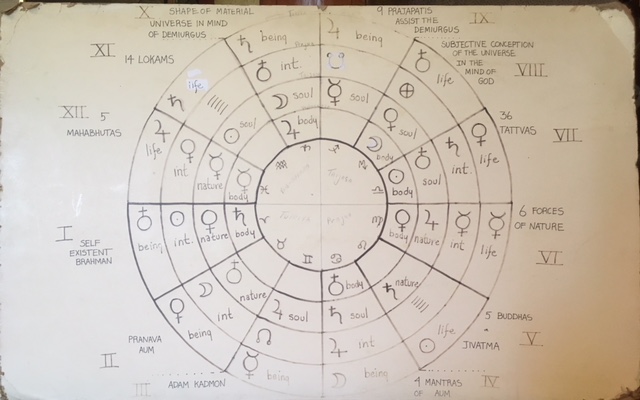
FIGURE IMG 2202-Posterboard Metaphysical Chart.
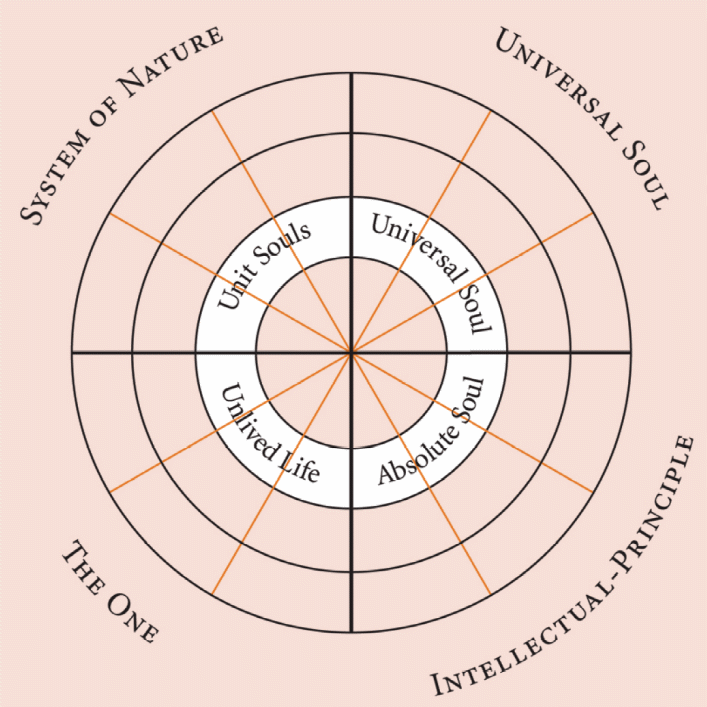
FIGURE 1982 0319a-2. Levels of Soul.
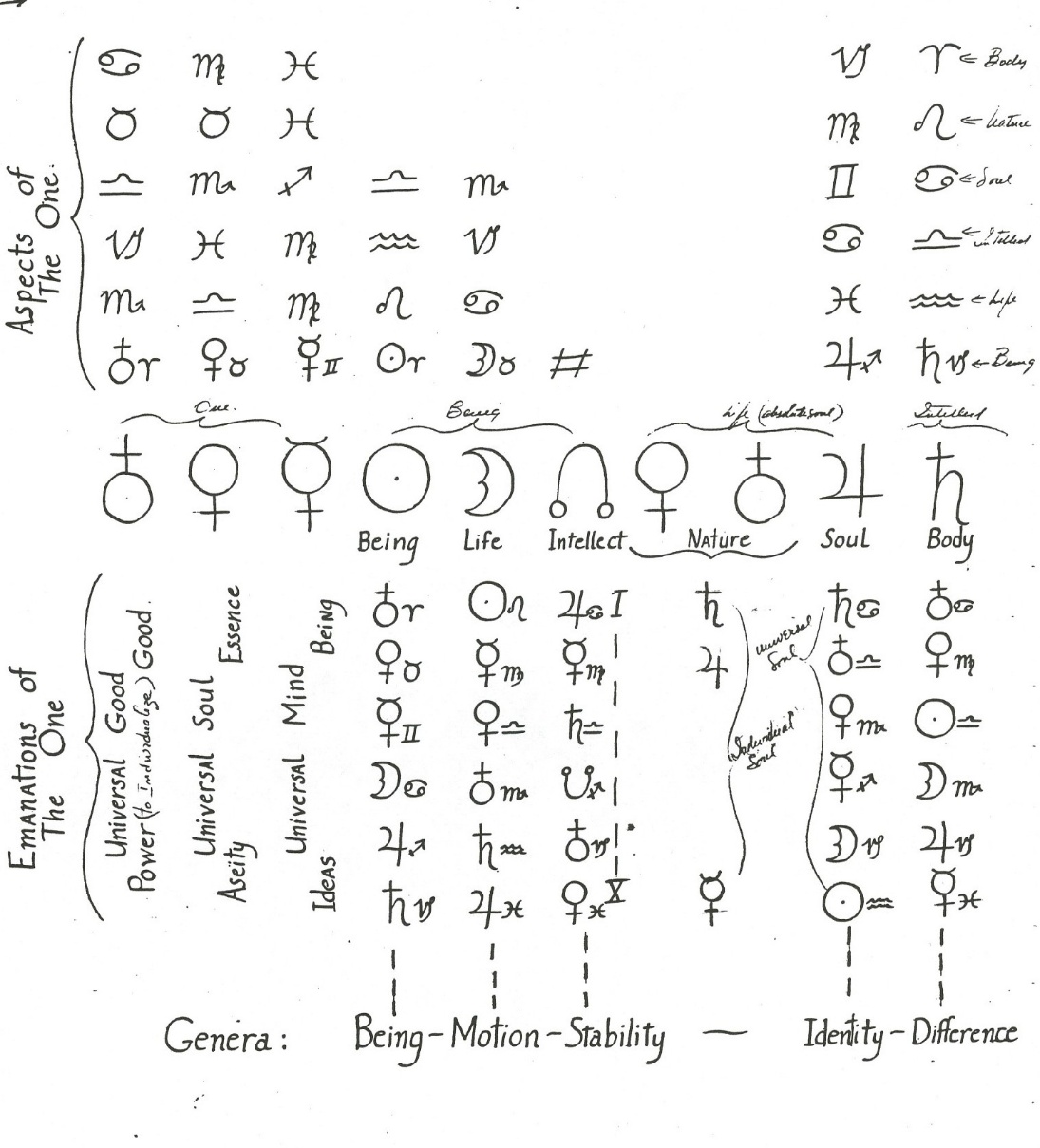
FIGURE AD_G_007. Aspects of the One; Emanations of the One; Genera.
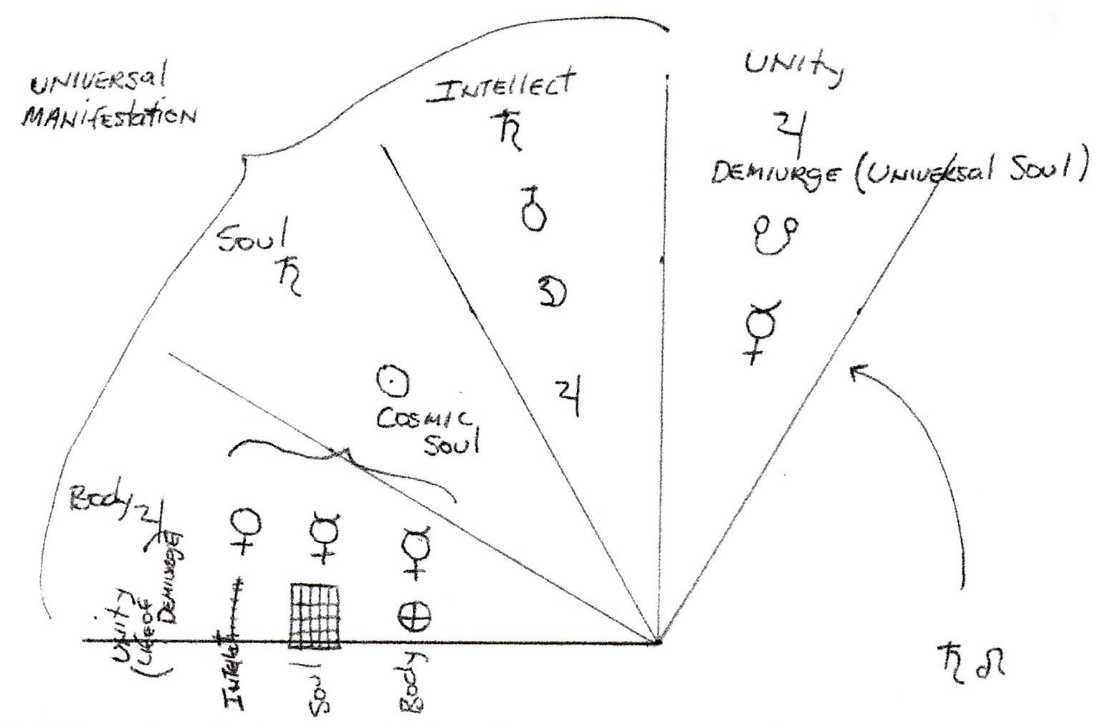
FIGURE 1982 0319a-4. Saturn in Leo, Houses 9-12, and House 12 Levels.
[Transcriber note: [diagram] means the speaker is referencing a diagram as he or she is speaking. If someone is drawing or writing, with audible sounds of chalk on a blackboard, I indicate this by [drawing] or [writing].]
AD PAPERS read in class:
- Astronoesis Working Draft Outlines of Soul and Nature. The working draft outline of Soul is found in Scan File ASN MASTER SOUL 151-171.PDF (pp. 169-171) and has AD edits which had not yet been incorporated into the version read in class. It has been retyped as ASN Soul - Outline V09MP and the version read in class has been retyped as 1982 0319b V09MP. Astronoesis - Soul - Outline. The working draft outline of Nature as read in this class has no Scan File associated with it and exists only as embedded. It has been retyped as 1982 0319c V09M Astronoesis - Nature - Outline.
NOTES:
This is 1982 03/19a, a class on Plotinus: Soul & Nature, and the first entry associated with this date. 1982 03/19b = Soul Outline. 1982 03/19c = Nature Outline.
Partial transcript (Scan File 1982 0319-06R15.PDF) exists.
See outline of Soul in WG Classes 1982 0312a, 1982 0402a, and outline of Nature in WG Classes 1982 0326a, 1982 0402a for comparison. See also outlines for Soul and Nature chapters in Astronoesis, pp. 170-171 and pp. 226-229.
The discussion of Nature is continued in WG Class 1982 0326a Plotinus: Nature.
This was a Friday Evening Plotinus class.
TRANSCRIBED Verbatim by IT 2021. In 2025, IT completes TOC, expands Plotinus quotes section, fixes errors/typos, adds new notes within transcript, adds four diagrams and references within transcript to these diagrams, updates audio file markers to match new REP audio. Archival verbatim transcript with AD Papers – V12ap.
AUDIO FILES: 1982 0319a, 1982 0319b. [Note 1: "Tape" and "Side" refer to original audio cassette tapes that were later digitized into .MP3 Audio Files. Note 2: In 2024, REP Studio separates off Tantra class fragment from file b.]
1982 03/19a at Wisdom's Goldenrod
Plotinus: Soul & Nature
[Audio File 1982 0319a Begins]
AD: It's this one. And then we re-- we went over it again and we did the first two, we didn't get-- So we'll continue where we left off, the Soul, the Third Hypostasis. We go on to Nature.
S (very faint, possibly part of background): [few words inaudible]
LC: Do I have to start it?
[55¼ second pause]
AD: Then when we get-- when we get to Nature, and we follow the flow of the discussion, I think we'll be able to see that the actual reason-principles that start out in the Divine Mind or the One, the Divine Mind--
EMD (simultaneously): Tony, can you please speak louder?
AD: The actual reason-principles that start out in the Divine Mind transposed by the Soul into Nature and then Nature, so to speak, embodies them in the corporeal world-- [short pause] So that would mean that-- that would mean that the ordinary everyday life that you live has for its substratum this universal intelligence of the divine reason-principles. [short pause] And, to some extent that would be the rationale behind the possibility of cosmic consciousness. In other words, if a person has an experience of cosmic consciousness, there's a recognition that underlying or the substratum of the world and-- substratum of the world he is this universal reason. [short pause] To bring it-- to bring it that close in-- in verbal form is one thing, to bring it that close mystically is another. Now the-- the cosmic consciousness or the vision of the cosmic as this universal intelligence, I think this would give you the rationale behind it but, it can't give you the experience. [short pause] But if anything, theoretically at least-- [short pause] theoretically, the immediacy of the World-Mind should be obvious. [short pause] If you understood that, you can go home now. You read it now. Third Hypostasis, Soul.
[Transcriber note: Astronoesis Working Draft Outlines for Soul and Nature follow below. I transcribe them as read, including any alterations made on rereading.]
AD [Astronoesis Soul Outline, AS reading]: "[1.] The Third Hypostasis is also an authentic essence, Real Being, and similarly constituted by the five genera peculiar to Soul, that…"
AD (simultaneously): One minute, one minute. Did you follow what I said Dickie? I'm picking on you, doesn't ma-- it--
AS: He didn't go home so-- (laughter)
AD: You people follow what I just said?
S (very faint): Yeah, yeah.
S (very faint): Uh-hm.
AD: Even if it's just a theoretical grasp.
S (very faint): Yeah.
AD: I mean the whole rationale of why you're reading the chart, what you're looking for, it's all there. Everybody keeps placing the Intellectual-Principle somewhere beyond, you know, the empyrean. Alright. Let's start again.
AS: Should I (put) fifth house in here?
S (very faint): Read some more.
AD [Astronoesis Soul Outline, AS reading]: "[1.] The Third Hypostasis is also an authentic essence, Real Being, and similarly constituted by the five genera peculiar to Soul, that is, characterized primarily by Life."
"[2.] It is said to be both a one and a many.
"[3.] In Plotinus Soul as a generic term may be regarded in three distinct ways. Nonetheless in all three its essence or principle is said to be Life. He distinguishes: a) Absolute Soul or the Principle of Life in the Nous, also called Rhea, in Greek Theology; b) the Universal Soul as an outraying of the Absolute Soul toward the manifestation of the fourth Plotinian principle, the system of Nature and the objective world; and c) the Individual Soul which also is rooted in Absolute Soul, in the Divine Mind, but reaches down to its association with bodies. In this last category he places planetary souls, star souls, and the cosmic soul as well.
"a) The Absolute Soul is the unity of soul in the Intellectual-Principle, and in this are rooted both Universal and Individual Soul. It is the principle of Life, or matter for the Intellectual-Principle in which all the forms are simultaneously reflected.
"b) The Universal Soul is spoken of as two-fold. It is the Providence which presides over the whole of manifestation, and illumines matter with its reason-principles. It is the One Life of the Universe and that is its outer aspect or fate. Its other aspect is its inner conjunction with Absolute Soul. Thus Plotinus tells of the Royal Soul and Royal Intellect which belong to Zeus.
"c) Because of the prior activity of Universal Soul, the groundwork, it now becomes possible for an Individual Soul which can be cosmic in its sweep, to elaborate what is to become the objective manifestation, and for the Individual Souls that are conjoined with various bodies within that cosmos to participate therein. These Individual Souls are not produced by the Universal Soul--they too spring from Absolute Soul and in this unity are in continual contemplation of the Divine Mind. In this contemplation the indeterminate life of Soul is eternally conjoined with a vision of the Idea of Man as in our case. This is the Authentic Man, a true essence, a permanent possibility in the Intellectual-Principle. The tendency of Souls toward secession must be with a desire toward a fuller self-realized vision of this Idea.
"[4.] Through their association with bodies, they are individuated and eventually taught to be self-conscious of their divine origin in the Nous.
"[5.] Each soul is a permanent unity.
"[6.] It is also an outflow of graded powers and life, to unfold what it contemplates in the Intellectual-Principle. It is a logos or transmitter of the Ideas to the cosmos through its multiple powers.
"[7.] Summing up then, for Plotinus, the Individual Soul must be of such a nature--a unity and a multiplicity, divisible and indivisible. At its highest--in the Divine Mind--it is a unity but it has phases and powers which unfold through various levels down to the sensible world. But even in its association with body, with the universe which has been illumined by the Universal Soul, it remains impassive. Soul is entire and indivisible even where its distinct powers are operative.
"[8.] Soul gives from itself a light conjoined to body to the formation of living entities, and thus produces living images of its powers. These images, seated in the animate principle, coupled with body, bring about the relation of Individual Soul to the Cosmic Soul."
[short pause]
MB (very faint): (Could/Would) you read that last sentence again (for me)?
S (very faint): Yeah.
AD [Astronoesis Soul Outline, AS reading]: "These images, seated in the animate principle, coupled with body, bring about the relation of Individual Soul to Cosmic Soul."
[14¼ second pause]
AS: Hm. This one's-- starts Nature.
AD [Astronoesis Nature Outline, AS reading]: "[1.] The entirety of universal manifestation is under the providence of the Universal Soul."
AD: We're on the fourth one so--
AS (faint): Oh, sorry.
S (faint): What?
AS: Nature.
AD: Nature.
AS (simultaneously): This begins Nature.
AD: This is complex.
AS: [flipping through pages] Oh, ok.
AD [Astronoesis Nature Outline, AS reading]: "[1.] The entirety of universal manifestation is under the providence of Universal Soul. The Universal Soul is an eternal contemplation of the Ideas. This is an abiding wisdom which is translated into the Logos or Unitary Reason-Principle of the universe.
"[2.] The unity of the Logos principle within the Demiurge has also a Being or Intellect, a Soul, and a Body.
"[3.] The impression of the Ideas upon the principle of non-Being or formless matter by the Demiurge constitutes the Material Intellect, or Being, of universal manifestation.
"[4.] The form or soul of the universal manifestation is the entire system of living images of reason-principles. These are the outward-facing system of the Ideas that Universal Soul has contemplated.
"[5.] The living images of reason-principles…"
S (faint): Slower everything.
AS: Sorry. Should we back up?
S: Uh-hm.
AD (simultaneously, very faint): Better [S, faint: Uh-hm.] do it again.
AS: Ok, I'm trying.
AD [Astronoesis Nature Outline, AS reading]: "[2.] The unity of the Logos principle within the Demiurge has also a Being, a Soul, and a Body.
"[3.] The impression of the Ideas upon the principle of non-Being or formless matter by the Demiurge constitutes the Material Intellect, or Being, of universal manifestation.
"[4.] The form or soul of universal manifestation is the entire system of living images of reason-principles. These are the outward-facing system of the Ideas that Universal Soul has contemplated.
[short pause]
"[5.] The living images of reason-principles, combined with the matter which has been informed by the Demiurge, are the conditions imposed on the World-Soul.
"[6.] As associated with the Demiurge, the World-Soul's imagination is stored with these living forms. As a subjective soul rooted in the Nous, it also has a series of unembodied powers, the last of which is the productive imagination in which the others are embedded.
"[7.] The outflow of this productive imagination of Soul toward the manifestation of the sensible cosmos is Nature.
"[8.] This essence or image-bearing light of Nature or Mercurius is an image of Soul organized by the soul powers and containing a compound of the reason-principles and illumined matter.
"[9.] This…"
MB (simultaneously, very faint): What do they mean [couple/three words inaudible]
AS (simultaneously): Yeah.
AD [Astronoesis Nature Outline, AS reading]: "[7.] The outflow of this productive imagination toward the manifestation of the sensible cosmos is Nature.
"[8.] This essence or image-bearing light, Mercurius, is an image of Soul. It is organized by the soul powers and contains a compound of the reason-principles and illumined matter.
"[9.] This imaginal essence projected by Soul extends downwards as far as the vegetable kingdom.
"[10.] We must remember that this Nature has the spark or fragment of the Divine within it, which is the organizing or individuating principle of any body, star, planet, or so on.
"[11.] It is this light that is projected by the sensible Sun to the circumference of its being and which combines the elements or bhutas into bodies.
"[12.] Functionally we may say that Nature is the whole system of the cosmocrators. Again these are the vehicles of the higher soul powers and are the agents in the fabricating of bodies.
"[13.] Nature itself becomes the medium through which our soul, or rather a light from our soul, is associated with the various vehicles in the cosmos. Our personalities are thus bound up with the stars.
[11 second pause]
"[14.] Nature is the totality of all combinations of reason-principles and matter, containing everything in a seminal form, and operates even below our conscious knowledge."
[16 second pause]
AS (faint): (You got--) alright.
AD: In a few pages there we have a kind of thumbnail sketch of the Plotinian doctrine. The details are so many that unless we have a general outline as brief as possible, we'd get lost in the details. Last week we spoke about the second principle, right?
S (very faint): Yes.
AD: Today we could speak a little bit about the third and the fourth before we go into the actual gymnastics of geometry. Right? So we'll start with the third. Follow the-- see if you follow what-- what it's all about in the third. Well, start with the third, read a couple lines and then see if they--
AS (simultaneously): Read a line and then--
AD: Yeah. You can [AS simultaneously: And (then/the)--] see if they want to discuss it a little bit. [AS simultaneously: You can discuss it.] I want to stay away from the chart, I want them to deal with it abstractly.
AS: Ok. This-- this line follows on the last line of the previous outline where it says that any Idea or Real Being is constituted of the five genera. So--
AD [Astronoesis Soul Outline, AS reading]: "[1.] The Third Hypostasis is also an authentic essence, or Real Being, and is similarly constituted by the five genera which are peculiar to Soul, that is, characterized primarily by Life."
[short pause]
AS: Should we read it again?
S (faint): Uh-hm.
AS (faint): Let's read again.
AD [Astronoesis Soul Outline, AS reading]: "[1.] Soul, the Third Hypostasis, is also an authentic essence, or Real Being, and is similarly constituted by the five genera which are peculiar to Soul, that is, characterized by Life."
AD: You remember the discussion about the five genera of the-- of Being? Well, if-- the same five genera are going to be constitutive of Soul. But the emphasis in-- in Soul would be that Life is-- Life characterizes Soul more than anything else, whereas Being is characterized my-- more by Intellect or the Ideas. But if you remember I think it was isness, sameness, difference, identity, permanence, five categories. And he says this constitutes Being, is constitutive of Being and is synonymous with Being. Now he's saying the same thing about Soul, it also is constituted by these five genera with the emphasis more on motion or Life. [9¾ second pause] That would be its hyparxis or it's the summit, its principle, Life would be the leading principle in a discussion of the genera that constitute Soul. Next sentence.
AD [Astronoesis Soul Outline, AS reading]: "[2.] Soul is said to be both a one and many."
[19½ second pause]
AD: You follow that no problem?
S (faint): Not really. (bit of laughter)
RG: Yes sir.
AD: The Soul is one and many?
RG (faint): If it says it I-- (What's) the next couple sentences about (then)?
AD: Well, I think [AS simultaneously, faint: Yeah.] you can easily conceive of Soul as a certain substance, alright, which has many functions. So if you-- if you conceive of Soul as one you'd have to think of it in terms of substance, if you think of it as a many you'd have to think of it as the functions that it has. The many functions it operates with. Go ahead.
AB: Since the Soul also contains all these reason-principles, could you conceive of the manyness of the Soul in terms of the reason-principles, or [AD simultaneously: No.] would you say that--
AD: No.
JfL: Well does he say that the powers that the Soul looks [one/two words inaudible]
AD (simultaneously): Well, the phases of power or graded powers would be the many functions that it could operate with.
JfL: And the one is its unity.
AD: Uh-huh.
JfL: And the one is its unity.
AD: Yes but--
JfL (very faint): The one would be its unity.
AD: The one would be its unity but you'd have to think of some thing, alright, some thing. And then you would have to think of the activity of that some thing. So, you'd be able to say, insofar that it is this thing, you would say it's a unity. Insofar that it performs many activities, alright, it's a many. So, if we think of-- if we think of the Soul as being constituted of a certain substance or by a certain substance, the five genera, or if you wanted to make-- if you wanted to come from a Vedantic point of view, it's constituted of prajna consciousness, alright, but this prajna consciousness could operate in a variety of ways and it could be, so to speak, manifested at different levels or through various koshas. So that you would have many functions that it could perform, alright, but itself always remains self-identical with itself so it's a one insofar that it's always self-identical with itself, it's a many insofar that its activity is so broad. This is a real crisis in Indian philosophy, you know.
S (very faint): Yeah.
RG: Yes but, he just said that its substance is constituted by the five genera, I don't see that you could really call that its oneness part.
AD: The five genera are not different than the term 'Soul', they're synonymous.
RG: Ok and that doesn't mean-- that doesn't qualify it to be a one then.
AD: Why not? I mean it's not taking it apart if we say that--
RG (simultaneously): But it's already constituted by--
AD: No, constitutive here is only an-- an analogy.
RG: Well what word would you want?
AD: I'm sorry.
RG: What words would you use, I don't care. [one word inaudible]
AD (simultaneously): Synonymous.
RG: Ok synonymous. Still it's a multi-structured synonym. I mean-- Is that what they mean when they mean one and many?
S (faint): I don't--
AD: No, I don't think so.
JfL: Isn't it more that it's a description of it rather than parts of it?
AD: Well they're definitely not parts. We just said that these five terms are synonymous for the term 'Soul'. In other words when I say Soul, alright, or I say the five genera, alright, I'm saying one and the same thing. I'm-- I don't have five-- five things here. I have just one-- one substance that I'm des-- describing as having these different aspects.
JfL: That's what I mean, they're describing, they're not parts of it.
AD (faint): No, they're not parts.
JfL: Just in several ways this sounds like a smaller version of the description of the one and many, an effect [student assents, faint] of the One. It's the same problems we had with describing or imagining the One.
EMD (simultaneously): Can you speak louder please?
JfL: The problem that we had describing the One sort of concentrated and sort of in repose as being possibly the four planets as the first house [FIGURE IMG 2202-Posterboard Metaphysical Chart]. That's that same problem of how do you descri-- you know, how is it really not parts of it. Likewise the many aspects of the Soul is more like the power of the One looking outside is likewise the-- it seems that the Soul looking-- the multiplicity part of it is like the powers, but then the whole thing sort of looking down. Isn't it?
AD: Well I don't particularly care for the analogy that you're making with the One. Uh-uh. [short pause] We're-- we're bound to get confused follow-- if we follow that way.
S: Tony? When you think of the unity of Soul, can you think of it as just pure undifferentiated-- I know you're always saying about (saying) [one/two words inaudible] of just pure Life, just Life in itself, just the-- like kind of a life current, that which-- you know, you speak about the forms in the Intellectual-Principle and then you speak of the Soul giving the forms Life. Well that power that the Soul has to enliven the forms to make them-- to make them living for us, could you think of that as its unity? That pure Life?
AD: The life current?
S: Yeah, something--
S: Uh-hm.
AD: Yeah, alright, you could do that. If you-- if you think of Life per se, its own principle, and from there say that it is-- it is. And from there say that it is self-identical with itself, that it has motion. You could say all these things but you would have to start off with the notion that there's a Life principle per se, [student assents, very faint] it is a principle sui generis, self-cause. In which case, once you do that, then you can also say it has these various aspects, there's (a) sameness, difference etc. But you would have to start off with the notion that Life is a principle sui generis, self-caused, and in contradistinction to the Intellectual-Principle where you speak about the genera of Being where the principle there, the principle would be-- that is self-caused would be Being. It wouldn't be Life. So we're speaking of--
S: Yes.
AD: Yeah. So then if you say that in the Intellectual-Principle you have the-- the-- that which constitutes or is synonymous with the Intellectual-Principle are these five different ways of looking at it with the emphasis on, let's say, Being or Intellect depending upon which one-- in what context you're speaking, same way with Soul, if you think of Soul as a principle that's self-caused. If it is eternal it has to be self-caused. Anything that is not eternal is not self-caused. So therefore Life is an eternal principle in its own right, and a principle sui generis it can be described or spoken of as having these various aspects to bring out or further amplify the meaning of what this principle sui generis is. But you're not speaking about something other than that principle.
S: Right.
AD: Alright(./?)
S: When you're speak-- speaking of the multiplic-- multiple form(s), (I'm) sure. But when you're speaking about the different aspects of Life that's just exemplifying kind of that pure-- it's exemplifying many different ways it has [one word inaudible]
AD (simultaneously): Yeah. Yeah it's trying to amplify that principle.
S: Yeah.
AD: If-- if you say, if you say that Life is, alright, motion, that's which primarily characterizes, that's the principle sui generis, and then you say it has permanence, if you think of-- if you think of permanence, isness, and the other characteristics, if you think of them as distinct from that principle, you would be saying that Life is constitutive-- constituted by these five forms.
S (faint): And then they would be different.
AD: That wouldn't be the bo-- [S, faint: Right.] that wouldn't be what we're talking about. It wouldn't be a principle sui generis anymore.
S: Right, you have to think of the five differentiations as the Life.
S (faint): [couple words inaudible]
AD (simultaneously): Yeah, as the Life [S simultaneously: As identifying--] itself, an amplification of its meaning, that's all. It's like if we say this person here, he walks, talks, eats and sleeps. We're not speaking about four different people, we're speaking about this peo-- this particular person here and we're just trying to bring out some of the characteristics of this supposed unified person. And at any rate, go ahead.
AS: I was just-- a comment maybe that would apply to the other end, the manyness, that might help with the oneness. From the point of view oneness, the Intellectual-Principle is a one and so is Soul a one. They're both constituted of these five genera which the manyness is not the five genera, they're not the many parts, they are-- But the manyness seems to point out the difference more. 'Cause the Intellectual-Principle I think they say is a one-many, and the Soul is a one and many. It seems to be there that the manyness in the Intellectual-Principle, if (you thinks you have) the many Ideas, that's the one-- that's the manyness of the one-many but there each Idea is the whole Intellectual-Principle in a special form. But the manyness in Soul seems to be different. The many powers, each power doesn't seem to be the whole of Soul. Like if you just take one of those powers of that manyness, it won't be the whole of Soul. Like reason-principle-- [student assents, very faint] like reasoning say, that power. The oneness of Soul may remain what it is but that reasoning power couldn't be said to be the whole of Soul. Whereas with the manyness in Intellectual-Principle, each Idea could be said to be in a way the whole of Intellectual-Principle. So they would say it's a one-many. But with Soul that doesn't happen, there really does seem to be a more differentiated view of the soul powers. It's a one and a many. It may be one but at the same time the ma-- it's many and each of those many is not the whole Soul. It's distinct, couldn't equate them.
LDS: Avery? I had a question about that very notion that you spoke about. Would you say then that the manyness is-- it is in terms of the powers of the Soul. You're s-- you're trying to maintain the fact that that manyness is ontically of the same status of its oneness which is not-- Or would you have to think of the-- the manyness as only after these powers have been actualized?
AS: Well, I think [couple inaudible LDS words simultaneous with AS] he would say that the manyness is inhe-- inherent in its-- in its very constitution or definition or essence. The Soul isn't the One. Anything that isn't the pure One is-- as soon as you speak about Soul there's implicit in or explicit in it is also its manyness. I was wondering also if the manyness might refer to the fact-- to the many Souls, just as the many of Intellectual-Principle referred to the many Ideas. It's a one-many.
AD: Well it could be both.
AS: Yeah.
AD: Why restrict yourself?
AS: Yeah, that's what I [AD simultaneously: Could be both.] was saying, that it could--
LDS (faint): Well, I don't follow.
AD (simultaneously): So one and the same soul could have many powers, aesthetic sensibility, intuition, reasoning, prudence, courage, all these powers belong to that soul and you could say they're many powers but they all belong to that one soul or that one soul can relate to many of these powers, you know, operate through many of these powers.
LDS: But Anthony, my question was like, if--
AS (simultaneously): Yeah, and then even if it doesn't actualize them.
LDS: These-- the substance is what makes Soul one, that is, the Intellectual-Principle underlying this principle of Soul makes it a one. Then to speak of its manyness, you have-- don't you have to im-- implicitly imply that the soul has sort of [AS: Actualized?] exercised its-- or left the Intellectual-Principle. In other words, it's begun to actualize its-- its individual powers. You know what--
AD: Well, it [S simultaneously, very faint: Both.] does both, if you remember, Louis. We speak about the soul is unadorned, that is, is its powers unembodied. And the exercise of these powers takes place when it imparts a (light/life), alright, or sends forth an emanation of itself and then embodies these powers, alright, and then we speak about the soul actualizing these powers. And so both points of view are necessary. And again many-one, many and one.
LDS: See I-- I guess all I'm saying, I asked you is, is the many of the same status as the one?
AD: I don't see--
LDS (simultaneously): (You'd/You could) speak of many in the Intellectual-Principle is what I'm saying, many souls in the Intellectual-Principle.
AD: Are the many souls in the Intellectual-- yes, [student assents, very faint] yeah. They're onto-- [few faint inaudible student words simultaneous with AD] ontologically distinct entities but comprised of the same substance. So they're-- [LDS simultaneously: Ontologically distinct from what?] they're-- the substance, the substance of all souls is Nous.
LDS (faint): Yeah.
AD: But they're all ontologically distinct one from another and they include one another.
LDS: Well the distinction is based on its powers.
AD: The distinction [LDS simultaneously: Between s--] of one soul from another [LDS: Is based--] he said was based on desire. What distinguishes one soul from another is desire, [student assents, very faint] if you remember.
LDS: See that al-- that borders--
AD: I [LDS simultaneously: Well I'll--] interpret it differently so that I feel better. (some laughter)
LDS: In other words you want to (distinguish them).
AD (simultaneously): I interpret it as each has their own-- [LDS: Yeah.] their own--
AS: Vision.
AD: --vision of Authentic Man.
S (very faint): Yeah.
AD: Go ahead--
RG (simultaneously, faint): (That--) I don't--
S (very faint): Well, go ahead.
RG (faint): I don't know how you want to proceed here but--
AD: Wait, Robert is in agony.
BB (faint): I-- one thing I've been wondering is, well we talked about, you know, One, you know, Intellectual-Principle and Soul, you were talking about the three Hypostases and something about the nature of each one of those Hypostases. And, in the paper you talk about the-- how the Soul kind of emanates into matter the manifestation of forms. My question is is how does the Soul emanate from the Intellectual-Principle. In other words, what is the nature of that (emanation).
AD (simultaneously): It doesn't.
BB: Huh?
AD: You mean leave the Intellectual-Principle?
BB: Yeah. In other words, you got--
AD (simultaneously): It never leaves the Intellectual-Principle.
BB (simultaneously): Huh?
AD: It never leaves the Intellectual-Principle.
[Note: See FIGURES IMG 2202-Posterboard Metaphysical Chart, 1982 0319a-2 for the following.]
BB: Yeah, if you have the-- you have (the) Intellectual-Principle in terms of Absolute Soul and then you have-- we talk about-- you know, coming out of the Absolute Soul that something along the Soul ring there [diagram], you know, the powers of the Soul. We also talk about the-- the second and third quadrants. And what I'm wondering is is that there seems to be a-- you know, something happens kind of that what, you know, we talk about as a substrate or we talk about it as a, you know, different, kind of separate Hypostases or something, there seems to be-- it seems to me a-- there's got to be something related to a flow or a power or something that's-- that's making the distinction there. And I-- I wondered if there-- you know, in terms of some connective or whatever, I guess I'm looking at it from the standpoint of that sixth house and I-- that sixth and seventh house [diagram] and in terms of connecting that differential.
S (faint): Yeah.
AS: No.
S: No (attribute).
BB (simultaneously): The difference between--
AS (simultaneously): There's no-- no [S simultaneously: No (attribute).] chart up here.
BB: Huh?
S (faint): No it's ok.
AD: See I'm [BB simultaneously: Stop?] trying to avoid these charts [AS simultaneously, faint: Yeah.] for a little while, Robert, so that you can discuss abstractly.
BB (simultaneously): No, it's the only way I can try to get across what I'm trying to say.
AD: Yeah but don't you see-- (laughter)
AB: Why the-- why don't you do it?
AS: Robert, are you just simply asking again the distinction between Soul as a principle and Intellectual-Principle?
BB: No, uh, [AS simultaneously, faint: Well, maybe just--] what I'm asking is, you know, not the nature of it but how the two relate. In other words, why, you know-- there seems to me that there's got to be-- you know, we use the Soul ring as kind of a flow in terms of the top-- from Absolute Soul down to, you know, Sun in Aquarius and so forth. But, I wondered if there was more that we might consider on that (than) just that particular interpretation, is there more. In other words, is there a connective type of thing. You know, when we talk about the Demiurge and relating Universal Soul into matter, can we do the same thing relative to the Intellectual-Principle and Soul.
S (very faint): Yeah.
AS: (Oh), I don't know [one/two words inaudible]
BB (simultaneously): You know I don't know that. (laughter)
AD (very faint): Go ahead.
AS: You grant to me an omniscience [S simultaneously, very faint: I got it.] which is not really (geared) to my-- suitable [one word inaudible]
S (simultaneously): But (why are there) so many details that you want to work out though, and this--
AD (faint): Now you're so used to working with the chart that you try to explain with the chart, ok.
BB: Well I just wanted to know how you get from the sixth house to the seventh house or from the second quadrant to the third quadrant [diagram].
AD (simultaneously, faint): But there's-- you're not going to get-- get on a train and go to the second quadrant? (laughter)
BB: Yeah, yeah. Yeah. In other words, we have-- we have those two distinctions, we have a thing called the Intellectual-Principle and you have a thing called a Soul. [student assents, very faint] And we've got-- you can call it a second quadrant, (you/we) can call it a third quadrant.
AD (simultaneously): Yeah so you're saying-- are you saying something like this, if I look at the Soul unity running from the Intellectual-Principle (it all goes) in [BB: Right.] fourth quadrant [diagram], it seems to spread from Intellectual-Principle down into the realm of manifestation.
BB: Right.
AD: Exactly. That's what Soul is.
BB: Ok. But what I'm saying is is--
AD: But it's always rooted in the Intellectual-Principle, it never lets go.
BB: Alright.
AD: So that part we don't worry about.
BB: Alright.
AD: Ok. So then the part that you worry about is what about all the rest of it that's hanging or suspended from it.
BB: Yeah, there's-- there seems to me that you're not just talking about a limitation of the Soul ring but you're talking-- you know, we've got other rings there too like the rulership and exaltation ring [diagram]. They must be doing something similar in a-- in (that uh--) in some kind of way.
AD: Well wouldn't you say that the ring structure suggests some sort of continuity whereas if you look at a house structure it represents discontinuity?
BB: Yeah.
AD: So why don't you look at it as a ring structure representing continuity. There's a continuity of substance or an identity of substance running from the Saturn in Leo all the way to the Sun in Aquarius [diagram].
BB: Right.
AD: And this is what I mean when I say the substance of Soul is self-identical with itself, it always is what it is. But it does different things in different quadrants.
BB: Right. What is the ru-- the rulership and exaltation, do they have some kind of--
AD: But-- but that's not approaching the problem. You have to work the same way.
BB: Yeah but see you're running those also through the-- from the Intellectual-Principle through the Soul quadrant, (from) the Intellectual-Principle quadrant to the Soul quadrant. [student assents, faint] And I've never understood how you do that.
S: Uh-hm.
AD: Well, why don't you wait till we get to apply these principles to the chart. What I wanted to do was to try to discuss these things very abstractly so that when we start [one word inaudible] in other words, the next paper will show how we're applying these bare abstract things, how we'll try to geometrically illustrate them, alright. But I did want to make a distinction, I did want to make a division right now between trying to understand philosophy in this abstract way without any [BB assents] diagrams, no pictures, alright, and then when we start writing the next column we'll try to show how these abstract principles are illustrated by the diagram.
BB: Right, you know, I understand it, I just-- what I was looking at was a-- you know, I basically discussed a lot and you could-- it seems to me that, you know, what you did here relative to-- to this paper and so forth is fine and-- and it seemed there's plenty-- you know, the-- the nature of Absolute Soul and so forth, but what-- and going down-- and, you know [one word inaudible] its way down. But, what I was wondering is, you know, in terms of Soul also you have a higher level if you're relating like the-- I'm sorry to go back to the chart but the ring structure in terms of rulerships and exaltations. It seems to me to start with some kind of continuity there, you know, along analogously to the Soul ring, and relating it somehow or another to that. Maybe you did that already and I didn't understand.
AD (simultaneously): Yeah, we did that a long time ago and we were going to go over that, we're going to do that again.
BB: Ok. Drop back in?
S (faint): Yeah.
S (faint): Uh-hm.
S (very faint): Yeah.
AD: Alright Richard.
RG: Yeah I just had a simple question. When-- when you say "one" do you mean unity or not? One and many, do you mean unity or do you mean that whole--
AD (simultaneously): Is the Soul a unity?
RG: Is that what you mean by one, is that how am I [AD simultaneously: Yeah.] to understand it?
AD (very faint): Oh yeah.
RG: Then I don't understand what you-- what you-- you've been saying about it. If one in-- is meant to mean unity, then I don't understand the way you've been talking about the u-- the oneness of the Soul as its substance.
[short pause]
AD: You can't conceive of cognitive-isness as a unity?
S (very faint): Yeah.
S (faint): Why not?
RG: As a unity. I mean if it's just a (unity).
AD: And if you can conceive of cognitive meaning-- cognitive-- cognitive-isness as a unity, then why can't you also conceive of it as having many functions?
RG: I can conceive of it as a unity.
AD/S(?) (very faint): Uh-hm.
AD: With many function. What is to-- what is to stop cognitive-isness from relating to any-- any realm of manifestation?
RG (faint): Nothing.
S (very faint): Ok.
AD: Then why do you object?
JfL (very faint): Only 'cause you ask.
S (very faint): Uh-hm.
(Side 1 of original cassette tape digitized as 1982 0319a Ends; Side 2 Begins)
AD: --whoever would get up the next day, you know, wouldn't have pro-- it would have problems. (bit of laughter)
S (faint): Right.
AS: Right.
S (very faint): Uh-hm.
AD (very faint): Right.
S (very faint, possibly part of background): [few words inaudible]
AD: So cognitive-isness is latent in these states of consciousness that you experience, alright. Even though one is different from the other, there is an underlying cognitive unity that's operative.
RG: Granted. And in what realm-- and in what ontic or non-ontic realm does that unity of the (cosmic)-isness is knowing? In the Intellectual-Principle or transcendent to it?
AD (faint): Oh for sure. It's part of the Intellectual-Principle. You wouldn't define cognitive-isness.
RG: And not transcendent to it.
AD (very faint): No, not transcendent.
S (very faint): (How about its unity?)
RG: But then you go on to say later that there's a unity of Soul that does seem to reside in the-- in the One.
AD: A unit of Soul that resides in the One?
RG: But (of) the Absolute Soul.
S: Yeah.
AD: As soul, individual soul as individual soul is included in Absolute Soul, [RG: Right.] contains its individuality in Absolute Soul.
RG: Right. And the Abs--
AD (simultaneously): And--
RG: And that the unity of Absolute Soul is in the Intellectual-Principle or transcendent to it?
AD: Unity of Absolute Soul is in the Intellectual-Principle, it's the lowest stage of the Intellectual-Principle, it is the matter with which the Intellectual-Principle works with.
S (faint): Go ahead.
AD: If we say, if we say individual souls are all part of Absolute Soul, then you would be defining or denying what we just referred to when we said Soul as a principle sui generis is self-caused. So if we said that, alright, we would be ny-- we would be denying that principle.
RG (faint): Yeah, I know that.
AD: I-- I know, I know it's enough to make us balk when we think of the infinity of souls that would be encompassed by Absolute Soul, I mean, you know, monistic tendency to swallow them up all in one Universal Soul or one Absolute Soul. But there's no need to do that. It is true that Plotinus doesn't go beyond that point when he speaks about the archetype of the individual, doesn't go beyond that point. Beyond that point there is no archetype of individuals anymore, of anything.
RC: Can-- can you say a little more about just how to understand how on the one hand you could say that Soul is a principle sui generis and on the other say that it's grounded in some other being?
[14¼ second pause]
AD: If you refer to the unity from which Soul is suspended, would it be a principle sui generis?
RC (faint): Would the Soul or the unity?
AD: The Soul. Which we said is chiefly characterized by Life. If we traced it back to its origin, to a unity, it would be unity of Life. [RC assents, very faint] If we traced Intellect back to its unity it would be to the unity of Intellect. So these-- when we say for instance that we have a number of unities, each one is a-- what we would refer to as an eternally self-caused principle. It's a principle in its own right and it's discontinuous. You cannot reduce it, alright, to anything else. That's as far as you can go. The only time that we try to reduce it, and that's the mistaken, what I call the incorrect way, is when we trace them all back to the Unity itself, the Unity of unities. But, the proper way is to come from the One, say the One imparts to each of the forms or the Ideas their characteristic aseity, suspend from the characteristic aseity all these principles, alright, so from the principle of Being, Life, Intellect, Soul, Nature, Body, from each one of these principles you would suspend, alright, the whole column that followed under all those principles that follow under [FIGURE AD_G_007, Emanations of the One]. So, Life, if you-- if you took the column Life, that would be a principle sui generis. It can't be reduced to Being. Because then in that case you would reduce everything to Being, alright. And there would be no such thing as unities. Then there could be no possibility of explaining participation at any level, any level, from Intellect down.
RC: Ok. So, does it seem like-- like Soul's unity-- again in the question of the oneness and the manyness of it, that its unity comes directly from Life per se.
AD: It's suspended from that principle, its hyparxis would be the unity which is called Life.
RC: Now, its manyness, when we talk of it in terms of being a many, you wouldn't trace that back to Life per se, would you?
AD: No, then you-- then-- then you'd run vertically. Instead of-- I'm sorry, horizontally instead of vertically [diagram]. Because when you start tracing all its various powers it's participating in other powers.
RG/S(?) (faint): Right.
RC: So could-- could it be said that its manyness comes about from the fact that some type of relation to the Intellectual-Principle is actually a part of what Being and Soul mean?
AD: Some part-- some part? I don't follow.
RC: Well you say we distinguish souls by their vision-- either by desire or by their vision.
AD: That they're ontically distinct in the [RC assents] Intellectual-Principle, yeah.
RC: So if we said that it's that vision, the fact that each soul has a sense of vision that allows us to speak of any soul.
AD (simultaneously): To speak of soul's desire.
RC: And it (seems/seemed) that the manyness part of soul comes through its participation in the Divine Mind rather than directly from the Life principle itself.
AD: Can you repeat the last sentence?
RC: It seems that the manyness aspect of soul, when we say that-- that it's both one and many, that the manyness aspect seems to come from the fact that there are different ways of participating in the Intellectual-Principle.
AD: But if you do that, you see, then, like for instance, all the powers are inhe-- inherent in the-- in the principle per se, Soul-- Soul itself, and you reduce all of them to the Intellectual Realm, then there would be no need to understand Soul per se, Soul in manifestation per se. The powers that are needed in the realm of manifestation, alright, have to be distinguished and separated, distinguished not separated, from as they exist (potentially) in the Intellectual-Principle. I really can't understand why you people have difficulty understanding that something is and it has many activities.
RC: I think that's-- that's not difficult to follow. But when it is-- when it--
AD: Well, wouldn't that be the same as saying the Soul is one and has many graded powers, [RC, faint: Yeah.] powers which are like in a hierarchy, certain powers are employed in fourth quadrant or in manifestation, certain powers are employed in reasoning or, you know, Soul itself, and certain powers are employed in the Intellectual (of course).
RG: But that's the question, the relation of one with the other.
RC (faint): Yeah that's the question.
RG: Which we often don't do.
AD: The relation of one--
RG: To "is". Here you're saying "one" equals "is", and often you say "one" doesn't equal "is".
AD: Go slower please.
RG: By saying that can't you understand that something is and has many powers is an analogy from ontology and cosmology and it's easier to unders-- and it's relatively easy to understand. When you say that something is one and many, if you-- if you want to say that the isness represents the oneness, and the powers represent the--
AD: What would be-- what-- what would represent the oneness here would be Life, not isness.
RG: Ok, but Life if--
AD (simultaneously): What characterizes this principle is Life, not isness.
RG (simultaneously): Ok. But it's still [one word inaudible]
AD (simultaneously): But that do-- that's not going to exclude Life, you can't-- if you say Life, you must also say it is.
RG: Right, ok. So the analogy-- so-- so here we'd say the one equals the principle of Life rather than the principle of isness.
AD: Yeah, that it's dominant. Life is the dominant characteristic.
RG (simultaneously): Ok. But we often have a question about the meaning of one to the meaning of any ontic principle. Now, if you want to define any ontic principle here as a one and not deal with the question of its unity, then there's no problem. But if the question of its one and manyness reverts back to the question of its unity, then there does seem to be a question as to where that unity resides, whether in the object level or transcendent to it. And that's the difficulty, it may not be a problem but that seems to be the difficulty.
JfL: Dickie it almost sounds like you're saying that the oneness of it is the fact that it's particular.
RG: No.
JfL: No?
RG: No, its u-- No. No, I'm not saying-- I'm just-- that's just the question, I don't really know how to do.
JfL: No wait (do--) wait, were you saying that-- Well could I repeat it? Or what I was thinking while you were saying it. That the oneness of the Soul or-- is the fact that, let's say there are several souls in the Intellectual-Principle.
RG: That's its oneness?
JfL: I was asking if (this--)
RG (simultaneously): Oh no, no, that's not what I was asking. No.
VM/S(?) (simultaneously): (Oh, oh), that's not (how it goes).
RG: I don't-- I--
S: See it's like a semantic thing, when you say something is and has many functions it sounds different than saying a one and a many. Say something is and has many functions is [S simultaneously: Well--] different than saying the one--
RG (simultaneously): It's more than just sounds different. I mean we--
S (simultaneously): Well it's different than saying there's a one and many.
RG: The question is there-- I mean is there a real--
S (simultaneously): Well I-- yeah I'm saying. [RG simultaneously: I mean how we speak it--] We express it the other way.
RG: Right.
[10¼ second pause]
AD (faint): (Well), [one word inaudible] anybody want to offer (anything)?
AS: Yeah Richard, you know, if you say the Intellectual-Principle is a one-many, let's do that.
RG (simultaneously): Right, right.
AS: Now, are you referring that oneness to the One, back to the Unity itself? I don't think so. That's not the sense in which you're saying Soul is a one-many. So it [RG simultaneously: Well, right.] has to be in ontology. [RG assents, faint] The One-- I think the One-- the way that the Soul is one-many that you're speaking of here that we're characterizing it is a-- is a juxtaposable position of a one and a many, [RG assents] which to the-- it's not-- the oneness here is not characterizing it as within the One as that way, as a unity in the One. It may be borrowed from that but I think it is at an ontological level.
RG: Yeah that-- I mean that was the question. But on the other hand, you'll-- you would-- I mean-- well, [AS simultaneously: Which is not to deny that there's--] (I'll ask it) more quickly.
AS: Which is not to deny that there's a unity of Soul, a unit-- a principle, like the unity of Life in the One. I'll leave it at-- what were you going to say?
RG: No I'm just saying if you looked at-- if you look at the Absolute Soul, there is an aspect of it that is in the-- in the One.
AS (simultaneously): Oh I know what you're getting at.
RG: And you can either refer to that relationship of its unity in the One to its powers as a one-many, or start at the-- or start at the ontic level and I don't know what you're meaning.
AS: Ok. I think that-- what I was trying to say is, if you take this to the level of One, you're not going to distinguish any principles by the relation of or non-relation [RG simultaneously: Well no but--] of their unity to-- Because they all have the same relation. There's no distinction between unity of Life in the One and whatever manifests from it and unity of Intellectual-Principle and whatever manifests, or unity of Being and whatever--
RG: Oh we're certainly-- well, right.
AS (simultaneously): There there's no-- there you won't be able to make these distinctions I think.
RG: That's for sure, from [AS simultaneously: So I think--] the unity side, but we're not only-- we're looking at it [AS simultaneously: No but--] from the one and many side.
AS: No. No, no, no, the one and manyness here I-- I just-- I don't think it's that oneness that we're speaking of as a one and many. We're speaking of Soul, not the principle of Soul, not the unity of Soul in the One--
RG (simultaneously): (But we're always) speaking of the principle of Soul, we're speaking about--
AS (simultaneously): I think you're speaking of Soul as a third Hypos-- as a--
RG (simultaneously): As a third Hypostasis.
AS: As a distinct Hypostasis, not Soul as a unity in the One, that's dealt with within-- within the thing on the One.
RG: Well--
AS: In that sense it's-- it's all one. Not all [RG simultaneously: No.] one in the sense of homogenous one but in the sense of there's no distinguishment of principles if you stay in the One. There's all the unities, even if we put up the whole Triad, all the unities, there wouldn't be this-- you wouldn't be able to make a distinction based on that.
RG: Granted. We're not making a distinction from there, otherwise we'd stay in the One. But once we have the three Hypostases, and we're looking at the Soul from what is its one and-- we're asking, what is its one and manyness.
AS: Yeah.
RG: But from within the many you could ask what is its oneness.
AS: But I-- but this is the One in Being, I think. I mean I-- I might--
RG (simultaneously): Ok I'll look into that, yeah, I mean that's the discussion.
AS (simultaneously): I mean maybe it's wrong but I think that the oneness here is speaking of-- the one and many is on the level of an-- of an ontological and-- ok, so an ontological principle.
RG (simultaneously): Ok it just gets confusing later on I think a few paragraphs [AS simultaneously: Well--] later when you discuss--
AS (simultaneously): I don't think we ever used Absolute Soul in terms of the unity in the One. I think in every single one of these it says Absolute Soul has its unity in the Intellectual-Principle.
RG: I know and that's (appropriate).
AS (simultaneously): Absolute Soul or principle of Life in the Nous, Absolute Soul is unity of Soul in the Intellectual-Principle, and so on. And this is the way we're using the-- and the way he seems to be using Absolute Soul is it's the highest you can speak of Soul as Soul. Look, can you speak of Being in the One? Can you real-- I mean can you really speak of Being? Even if you say the unity of Being is [RG simultaneously: Yeah.] in the One, that's not the same thing as talking about Be-- if you want to talk about Being, you have to characterize Being.
RG (simultaneously): Well, if you use Being, of course, of course.
AS: And if you say it's a one-many, you don't mean the oneness in the sense that it's-- exactly in the sense that it's a unity in the One.
RG: Fine, well I [one/two words inaudible]
AS (simultaneously): And you won't-- I just-- I don't-- I see--
RG: That's ok but then you just have to make sure we understand that.
DR: I'm sorry, Avery, I have either a confusion or a disagreement.
AD (faint): Alright.
AS: Alright.
DR: If you-- if you speak about the Absolute Soul [one word inaudible]
AS (simultaneously): The way we're using Absolute Soul here.
DR: Alright.
AS: Which maybe is bad terminology.
DR: It gets even more confusing if you say there's yet another Soul beyond that.
AS: No. And that's right, and we're saying no there's not yet another Soul beyond that.
DR: That's right, this Absolute [AS simultaneously: This--] Soul that you're speaking about you're saying is a principle's self-- what was the word, sui generis?
AS: Right. It is Soul.
DR: It can't-- it's not reduced to something else.
AS: But it's not the principle of Soul in the sense [DR simultaneously: Yeah, well--] that it's something which isn't the Soul, it is Soul. Now if you go to a unity of Soul in the One or a unity of Being, it isn't Being or it isn't Soul.
DR: (Even) the principle is self-sufficient in its own right--
AS: Yeah.
DR: If this Absolute Soul is self-sufficient in its own right--
AS: Yeah.
DR: --what further distinction are you going to make?
AS: No-- what do you mean what further distinction?
DR: What further Soul are you going to push back to [AS simultaneously: Not-- none.] in the metaphysical, are you [AS simultaneously: No.] going to push back to.
AS: No, none. This is-- this-- that's why we call it Absolute Soul.
RG: Yes, but I guess we're going to have to re-ask (Bennett's) question then, what happens to the S-- to the Soul suspended from--
DR (simultaneously): I thought that was [S simultaneously: But--] already answered.
RG: No then you're going to have something else-- Didn't we call it Jup-- Jupiter in Gemini [FIGURE IMG 2202-Posterboard Metaphysical Chart] is what's suspended from the principle of Soul?
DR: We're leaving [S simultaneously, faint: No.] the Jupiter [AS simultaneously: No.] in Gemini out [S simultaneously: No.] but suppose [AS simultaneously: I--] you-- suppose you consider it just this way. And suppose you start off-- I mean this was the third Hypostasis.
AS: Yeah.
DR: Suppose you take the order of events, I mean as we read them. The Intellectual-Principle was established from the One in this strange notion of participation which really doesn't separate it off as cleanly as we would like to with a-- in a little while. Somehow its connection to the One never really makes that giant leap that makes it something completely other. I thought in the same way the establishment of Soul here as springing in Intellectual-Principle was also not having that giant dividing line that makes it something wholly other where you then, after you establish all three, have to find out how those later two came out of the first one, I thought we just did that.
AS: Uh-hm, I think I follow.
RG: Uh-hm.
DR: Well if that's the case then what's the difficulty of trying to find another unity somewhere?
AS: Maybe I don't-- I don't follow your last--
DR: Well Dickie wants to find another unity to Soul that's rooted right in the One. I thought that this description was the description of how these things are rooted or come out of the One.
RG: He seems to be saying no, [S simultaneously: No.] that it--
DR (simultaneously): Who's saying no?
RG: Anthony and Avery, that they're rooted-- that the discussion [couple words inaudible]
AS (simultaneously): Well let's say me. I'll-- Leave it to me.
DR (simultaneously): Well [few words inaudible]
AS: I'm interpreting.
DR: You can't just say it's rooted in the One. If you keep rooting everything in the One, then you'll-- you won't have three Hypostases.
RG: I don't.
DR (simultaneously): If you don't proceed this way, how are you going to have Intellectual-Principle and Soul?
S (very faint): Yeah.
AB: Well, you speak of each Hypostasis from its own point of view.
S: Yeah.
RG: That's right.
AB: So we're speaking of Soul from the point of view of Soul and then we're asking all these questions of-- from the point of view of One or Nous and trying to inject that into the point of view of Soul, it's like confusing levels.
RG: No, no but you've already done it when you--
AB (simultaneously): It's different definitions of Truth.
RG: You've already said that one and many, the one refers to its residence in Intellectual-Principle, you've already done that by a-- by talking to its prior. [student assents, faint] So you're not-- you're avoi-- you're--
AS (simultaneously): Well that's ok. And we do that with each principle.
RG: That's right. But-- so you're not just on a level of Soul, you're speaking for the Intellectual-Principle as its prior or its oneness. Well--
AS (simultaneously): There's a way to speak kind of in that way also, that the Intellectual-Principle we found its origin in the One.
RG: Right.
AS: And we're finding the unity of what we're calling Soul, or the first Soul, the Absolute Soul, in the Intellectual-Principle.
S (very faint): Yeah.
RG: Now I understand clearly the depth that you're speaking of.
AS: Yeah I think that is. I'll-- I'll read it-- I mean I-- well that's-- that's the way all of these are spea-- And he does-- he uses that-- that terminology. Maybe we should get the quote.
S: Could I just-- I mean-- You're speaking of the unity of Soul in-- as in the Intellectual-Principle (where) the unity of Soul seems to be a complexity.
AS: That's right, [S simultaneously, very faint: I'm just--] it's not a pure-- it's not pure one, it's not pure unity. [S, very faint: Right, ok.] It's a one and a ma-- Just as Intellectual-- It starts-- it's an authentic essence, a Real Being. As soon as you say Being, you know it's not the One. (Yeah.)
S: So how is it a principle in itself? I just lost you.
AS: How is it-- then how is it a principle in itself?
S: If you-- if you're pushing it back to Being, you-- you're also (pushing--)
AS (simultaneously): Oh no no no, are-- Yeah. Go on.
S (faint): Uh-hm.
S: (No), I just-- well, I'm misunderstanding something. On the one hand you're saying--
AS: Well that was the funny thing about Intellectual-Principle when he says Intellectual-Principle is the totality of the Ideas, or is the totality of the Beings. Each Being is self-constituted and yet it's in essence identical with the Intellectual-Principle. There's a funny thing, that's why-- that was the peculiarity of Intellectual-Principle. [S: Ok.] It's a one-many. All of the Beings or all the Ideas, all the Real Beings are in a sense identical in essence and we said the essence of Soul is identical with Nous. But on the other hand each one is-- is self-constituted. In other words, the Intellectual-Principle arises as the totality of Beings and doesn't in a sense produce them. They arise with it. They are like its-- its eternal Ideas or its eternal Thoughts, eternal Beings. And Soul is one of those. And it seems like a hard-- Otherwise you always have that it's produced and not a self-- That self-- well I--
RG (simultaneously): No but-- or you [AS simultaneously: Yeah.] go that its unity [AS simultaneously: Is in the One.] is transcendent to the Intellectual-Principle.
AS: Ok. But-- yeah.
AD (simultaneously): No, no, no. No. You're-- you're talking nonsense now.
RG: Haven't-- I mean--
S: Yeah.
RG: But haven't you often placed the unity of Soul there?
AS: See the way we're--
RG: I underst-- I know, I [AS simultaneously, faint: Yeah it's--] understand (it Avery).
AD: That's why I wanted a discussion without the chart.
RG: Fine.
AS: Like I think by saying that the unity-- Let's put it practically, not as this-- I mean practically, not practically, mystically, practically, I don't know. I think he's saying that you can't-- you as an individual, you take-- you know, you find your highest-- your highest unity, you can't go back further than that, [RG: Fine.] you-- and still be Soul. You'll dissolve. Right? So, what do you mean by saying that you have a unity in-- in the One?
AD (simultaneously): (He) make very clear that to reach unity you have to negate Soul itself.
AS: Yeah. So, there may be unity but not Soul. And I don't know.
AD: Unity seems to be a problem, huh?
S (very faint): I didn't know it was a problem.
AD: Alright, let's read another sentence or two. It's alright, just discussion.
AS: Ok. The next point?
AD: Yeah, go on with a couple of sentences.
AD [Astronoesis Soul Outline, AS reading]: "[3.] In Plotinus Soul as a generic term may be regarded in three distinct ways. And nonetheless in all three its essence or principle is said to be Life."
AS: Maybe we should just read through these three 'cause [couple words inaudible]
AD (simultaneously): Ok, go ahead.
AD [Astronoesis Soul Outline, AS reading]: "He distinguishes: a) Absolute Soul or the Principle of Life in the Nous, called also Rhea, in the Greek Theology; b) Universal Soul as an outraying of the Absolute Soul toward the manifestation of the fourth Plotinian principle, the system of Nature and the objective world; c) the Individual Soul which also is rooted in Absolute Soul, in the Divine Mind, but reaches down to its association with bodies. And in this last category he places planetary souls, star souls, and cosmic soul likewise."
[31¾ second pause]
AD: No discussion? [S, faint: (Why?)] Go ahead, yeah.
AB (simultaneously): Avery, could you read [one word inaudible]
ME: I just have a question. He also use(d) the term called 'All-Soul'. But that doesn't mean the cosmic soul?
AD (simultaneously): Yeah, uses All-Soul, he uses Soul entire. [AS simultaneously, faint: Soul (few words inaudible)] They have a vari-- a variety of words but, I have found not to pay attention to that but to go by the context in order to find out which Soul they're talking about. I will not take for granted any longer that the pub-- you know, the translator knows. I thought that they did, they don't. Because I'll show you again and again where they use the same word but they're two different contexts.
AS: Yeah.
AD: So evidently he has the same problem understanding principle of Soul which is a principle, as we said, in its own right, that we have. And of course, you know, we make these sharp distinctions, Absolute Soul, put it in this box, Universal Soul in that box, individual souls in that box. Going to need a big box for all the individual souls, one box for the Absolute Soul, Universal Soul I'm not sure of. [VM simultaneously: Yeah that's (good).] If you approach that way then the whole notion of the principle of Life is-- is unavai-- it (will/would) be unavailable. Go ahead, Dave.
DB: If-- it seems that in speaking of these three-- three forms of Soul that they're not distinguishable by essence but only in terms of the-- you know, their functioning. Would-- would that be so?
AD: Yeah, the scope or the degree of power.
DB: Ok. Now, then-- then you would say that what it is that makes them all to be capable of being considered as Soul is that they are Life, I mean that-- trying to say that they are living because they are the Life which, you know, down here is-- is lived, something like that. Um--
AD: But basically, you see, you're still speaking about Soul, you-- you would have the same problem for instance in the pro-- of species, alright. If you take a species, let's say you have three dogs or three lions. Each one of those lions, alright, would embody species, lion, in its totality. There can't be a part missing. Isn't that so?
DB: Right.
AD: So the-- the numerical qualification, one lion, one horse, alright, one dog, could mislead you into thinking you're saying something. Because when you say one lion, alright, the one refers to the quantity of matter that is embodied, alright, and individualizes the species. But species itself cannot be individualized.
DB: Yes.
AD: You-- you follow that?
DB: I think so.
AD: Alright. Try it with Soul.
DB: Well, it seems like the-- that--
AD: Soul is like one species, right?
DB: Well, we-- if we speak of it that way.
AD: Yeah. Well, we're speaking about it in this analogous way.
DB: Ok. Then it would seem that what would distinguish it as a species could be perhaps considered as being its capacity for reflecting the Intellectual-Principle or contemplating the Intellectual-Principle. That in so doing, whether we talk about (it) [one/two words inaudible]
AD (simultaneously): But wouldn't it be easier and more to the-- to the illustration if you said Soul, let's say that that's a species. Absolute Soul would refer to this species, alright, in itself or as the matter of the Intellectual-Principle. [DB, faint: Ok.] Universal Soul would refer to the species, not so much in itself but as it informs matter. [DB assents] A third aspect of the same species will be Soul as individuated by its association or identification with body. But you can't bring in the notion of number to Soul. You can't say I got four different species here when I look at a lion. I got one species, four individuated lions.
DB: Yes, right.
AD: Alright, the same thing with Soul. [DB simultaneously: Yes I got--] Same thing with Soul.
DB: I think I follow it, but the--
AD: So you could have-- you could have these three different ways of looking at Soul. Soul as matter for the Intellectual-Principle, alright, Soul as informing the matter of the universe, Soul as associated with that matter which will individualize it.
DB: Ok, now, I-- but that-- that would all be in terms of the-- the functional aspect of Soul. Would it-- would it not?
AD: No, it's both. I'm showing how species is both, substance and function. But, that's-- that's not to the point here. What we're discussing here is the possibility of making distinctions within species, alright, and retaining the universality of the notion of species.
DB: Yes and I-- I guess what I'm-- I guess just the question I'm asking then would be how-- how best to understand the characterization of that species which all these three participate in. One is individuated insofar as associated with body, two as informing--
AD: I don't follow you, how to understand the characterization of the species.
DB: Right.
AD: I don't-- I don't-- I don't understand.
DB: Well, we speak of Soul, we distinguished it from the Intellectual-Principle [AD: Yeah.] in terms of its [one word inaudible]
AD (simultaneously): And what distinguished it from the individual-- from the Intellectual-Principle?
DB: Right. And at-- what distinguishes it?
AD: Yeah.
DB: It seems to be a predominance of motion or Life.
AD (simultaneously): Motion.
DB: Ok.
AD (simultaneously): Alright. Then that's how you distinguish it from the Intellectual-Principle, alright, fine.
DB (simultaneously): Right, ok. Now, when we-- when we try to distinguish it, well-- if we discuss Soul as a species as opposed to some other form (or) species that you get, how-- how should we understand that-- that characterization? Yeah (then we) have species lion, species--
AD: Well, the other species would be Intellectual-Principle and the One, and we just said that we'll-- what-- what characterized one species from another you just said in the-- in the question of Soul it would be Life.
DB (faint): Yes.
AD: That characterizes it as different from the Intellectual.
DB: Right. As different from the Intellectual-Principle [AD simultaneously: Uh-hm.] as totality.
AD: Would be characterized by Being and Intellect.
DB: Right. Ok. Now, I'm-- I guess what I'm just trying to do is fill in like in my understanding of what this Life means or if I see some other way of understanding what this [one word inaudible]
AD (simultaneously): I can't-- I can't do that for you. If you can't introspect into the activity of Life within yourself and recognize it as a-- as a sample of that principle, there's no way I could help. [short pause] It's the power that drives the whole machinery. And it's something that you'll go out of your way to preserve at any cost.
DB: So-- so then that there really-- there is no other way of understanding what-- what the essence of Soul is that these three levels of Soul participate in.
AD: Well I-- There's no other way of understanding-- repeat.
DB: What this essence of Soul is other than as this Life.
[short pause]
AD: Well, if you point out to my insufficiencies as far as being able to describe it, [DB simultaneously: No it's-- it's not--] probably so.
DB: No I-- I don't mean to be doing that.
AD: But then what-- what would you want-- what would you want as a description or a characterization of Life when it's the most intimate thing that you deal with? [short pause] And besides it's getting away from the point here which, if we can get back to, alright, was the notion that within one and the same species there could be made distinctions with it. At this level here we'll make quantitative distinctions. But at the level of Soul they would have to be qualitative distinctions. The distinctions that we're making between Absolute, Universal, and individual were descriptions in terms of the way we could understand, that is, in what they relate to. And we said Universal Soul would be informing the matter with the Ideas, in-form, and here you hyphenate in-form because the Ideas that are in the Soul and cannot, so to speak, be put into matter. So in-forming, if you hyphenated, it'll be more or less the understanding that will-- should come out of that is that the matter is formed according to the Ideas but the Ideas are not in the matter. And the other one was that the Soul is associated and identified with bodies. [short pause] Shall we try to elaborate more on what description to give to Life?
DB: (An--/Yeah) Anthony, could it-- could it be spoken of in this way, that what we mean, what could be spoken of as-- as Life here [S, very faint: Oh.] is--
S: Go ahead.
DB: What?
S (very faint): You didn't see me.
S (very faint): Yeah.
DB: Yeah I know. But if, at the level of Absolute Soul will-- where it's spoken of as being the Life of the Intellectual-Principle, that would allow for a certain reflection or interrelationship of the Ideas and that the-- the Life of the-- at the level of Universal Soul, the Ideas, insofar as they're being instantiated in matter, the-- the Ideas are, so to speak, moving outwards from the Intellectual-Principle and at the level of the individual soul the relationship of the Ideas is, so to speak, contained within-- predominantly contained within the individual soul itself. [short pause] I mean, is it possible to speak that way of the relationship of these reason-principles or three different ways and that-- and if that's how to distinguish the Soul, these three aspects of the Soul?
AD: Yeah we said-- you said that the first one was that it was the matter of the Intellectual-Principle, [DB assents, very faint] that the totality of the Ideas get reflected in this-- in this Absolute Soul. In the second, it's not a question of instantiating, we said in-forming matter. [DB, faint: Ok.] There Universal Soul informs matter. We would be able to say something like this, that in-- when we say it in-forms matter, the matter that is referred to here is what Plotinus referred to as formless matter. So out of prakriti, it would inform the matter, non-Being. This principle of non-Being would be invested with what, you know, they refer to as the organization or the intellectuality of that matter. That has to be injected into it. The-- the division for instance into the four tanmatras or the four subtle levels of matter, that is informing this formless matter with the reason-principles that are in the Universal Soul. And that was what he referred to as a tentative illu-- sketch of the universe which the individual soul will-- will elaborate. [Note: See Plotinus, VI.7.7, third para.] [short pause] Well, you people are not every adjustable without a chart, huh? (bit of laughter) It's become a real crutch.
HS: But when you speak of Soul as being informed by the Intellectual-Principle, then you-- it's not-- then you say it's used as matter?
AD: Again Herbie?
HS: Well, you're saying the Soul is matter to the Intellectual-Principle.
AD: Yeah.
HS: So in the past there's been a differentiation. Is that actually the matter of the Intellectual-Principle itself?
AD: Well matter here is just a metaphor.
HS: Or it's-- oh.
AD: It's-- when they speak of the Absolute Soul as the matter of the Intellectual-Principle there's-- there's no reference here to any kind of substance. You could say that the power that Life represents is molded by the Intellectual-Principle, alright, so that you don't use the word 'matter'.
HS: Yeah.
AD: So this-- this power or this activity, this operationable-- operation that Life represents, because it does represent activity. But this activity is being molded by the Intellectual-Principle in a c-- in a certain form and into a certain form. And, we add one more thing, we say that all the forms, alright, are simultaneously reflected in that one activity. So that if we think of Life, the Absolute Soul as the Life of the Intellectual-Principle, all the activity of the Ideas is reflected in that Absolute Life.
HS: Uh-hm. And that would-- could be called the Absolute Soul at that point?
AD: That's-- that's what the Absolute Soul is.
HS (faint): The reflection?
AD: That it contains in an active mode, alright, all the Ideas. [HS, faint: When you s--] The activity of all the Ideas in the Intellectual-Principle is Absolute Life.
S: I thought the Dyad (first).
AD: No, no, no, no, no. No.
S (simultaneously): I-- and then the Intellectual-Principle.
AD (simultaneously): No, no, no. No.
HS: Well that it contains this Absolute Life or as the activity of the Intellectual-Principle.
AD (simultaneously): The entire activity of the Ideas in the Intellectual-Principle we can symbolize by saying it's Absolute Life.
AS (simultaneously): (It's) Absolute Soul. Yeah or Absolute Soul.
AD: I-- Absolute Soul.
AS (simultaneously): Yeah. He-- he sa-- says some place--
AD (simultaneously): Can't we get more direct?
AS: He also-- he does-- he even has a line like that, that it's like, if you consider the total outpouring of Life from the Intellectual-Principle, total activity and outpouring of Life, he calls that Soul. [Note: See Plotinus, V.1.3, third para.] He says Soul is the total outpouring of Life from the Divine Mind, one--
AD (simultaneously): And, there's one other thing. Don't think of it as any kind of, you know--
AS: Temporal.
AD: Activity or motion in the Intellectual-Principle is not something moving.
S (very faint): Yeah.
AS: (Ok.) He has another one there, he says it's a Life instant--
HS (simultaneously, faint): But, it indicates that which can pour forth, is that the [one word inaudible]
AD: Hm?
HS: It indicates that it has a capacity to pour forth?
AD: Well the [AS simultaneously: It doesn't go anywhere.] pouring forth or activity is not any kind of [AS: No.] activity as you understand it here. To experience motion in the Intellectual-Principle there's nothing moving.
S (very faint): There's nothing moving.
AS: He said--
S: Could you (describe that)?
AS (simultaneously): He says somewhere that it's a Life instantaneously infinite. [Note: See Plotinus, III.7.5, last para, MacKenna translation, 1st edition.]
RG (faint): Say it again Avery.
AS: Alright but--
AD (simultaneously): Instantaneously infinite would be the same as experiencing the Void, there isn't any moving. It's absolute stillness. Don't look around for one horse-- for horses to reach the-- the wire. Oh you people have been having a real kind of self-delusion about your understanding of Plotinus then. No more board, no more charts. You've got to understand this abstractly now.
OG (faint): Very good. (laughter)
AD (amidst laughter): Huh?
OG: I never understood that chart for past thirty years.
AD: Did you understand that? (laughter, student words) Good. Then you can understand-- understand directly, right? (more laughter)
AD: (Om?) I got one on my side.
AS: He's got the One on his side?
AD (simultaneously): (You) notice that too.
AS: I-- there's another-- just one question.
AB (simultaneously): I was just going to ask if you could back up--
AD: Go ahead, sure.
AB: --and then go ahead.
AS: Excuse me (I--)
AB: I was just going to ask if you could back up to beginning of the Soul and read [AS: Sure.] without any questions up to where we got to tonight Avery.
AS: Well, it's just three sentences.
AB (simultaneously): You have [one/two words inaudible] and that-- (some laughter)
AS: You need-
AB: Wasn't asking too much.
AS: No. That the--
AD: Well-- well PB's language refers to the Intellectual-Principle as the Void. It's-- there's nothing going on there. There's no bells ringing.
OG: But that's in knowledge when you-- There are no bells ringing but we-- I don't understand [few words inaudible] consciousness knowing, [AS simultaneously: (one/two words inaudible) I got (him/it).] (that/the) consciousness that emanates actualize the--
AD (faint): The consciousness knowing--
OG (faint): Yes, the differentiation for others is there.
AD: No that's not there.
S (very faint): No.
OG: No? This differentiation does not (coexist) in that sense but the-- so-called the awareness of differentiation, awareness of maya, and that's the [one/two words inaudible] that you are calling that is a women, but a woman in that sense you call knowledge [one word inaudible]
AD (simultaneously): Well that-- and that only-- that only speaks when you come out, not when you're in it.
OG: Right. Well--
AD (simultaneously): In the universal, in the Mind itself, in the Intellectual Being, alright, there is no distinctions made.
OG: Sure, then--
AD: The only distinction, if you want to speak of a distinction, you (could/would) experience yourself as pure Being, alright, and the presence, so to speak, of Intelligible Objects, which the Buddhists for instance will refer to as emptiness.
OG: Yeah but that's better that Intelligible Objects is not known there.
AD: No, it's not known.
OG: Yes. But (at/in) the same (time frame--)
AD: It's only known when you come out, [OG assents] then that distinction gets made for you.
OG (faint): Exactly.
AD: But in that realm there isn't. So, if you s--
OG (simultaneously): In that realm the-- (make all/they call) distinctions between knowledge of the Intelligible principle and Life itself also--
AD (faint): Well--
OG: --only when you come out [AD: So--] (within) that.
AD: Well, coming out would mean you're coming into Soul, alright, [OG assents] and further down. But the interesting thing is like for instance if you follow this much, that when he speaks about the five genera that constitute Being, alright, and let's say like in the case-- like in one case Proclus insisted upon, let's say, saying that each one, alright, (tentatively--) He considered Being to be these five genera and Plotinus says no, they're synonymous with Being. That would-- that would show that the difference between Plotinus and Proclus lies in their experience, alright. In other words, Pro-- Plotinus had the experience of the Universal Mind and knows that what constitutes the genera of Being are not these five items. Whereas Proclus was coming from the rational soul, making explanations which only are from below, these distinctions only are from below. In the Intellectual-Principle there are no five distinct (entities), ok?
OG: Right.
AD: So, what we're say-- then what it would amount to would be in this awareness of pure Being when you're in the Intellectual-Principle, and no distinctions. There are none there. When we come out of it we make the distinctions. That was immediately one of the things that pinned Proclus down to me, that he did not have that experience, whereas with Plotinus that experience was very obvious, he knew what he was talking about, he had the experience. That activity or motion in the Intellectual-Principle, there's nothing there moving around.
S: Right.
OG: But there's no-- nothing going in and out also, they're always there if it's-- And the example I like most (back) was couple of weeks ago (that) the alchemists (gave/give). And, she gives the example of the--
[Audio File 1982 0319a Ends]
[Audio File 1982 0319b Begins]
AD: --find that form and emptiness are the same in the Intellectual-Principle. They are not the same here. [15½ second pause] (Well uh--) Let me put it this way. If you take black and white, alright, grains and you mix them together you've got gray. If I make you as small as an ant and you walk through that gray substance there is no gray. There's only black and white. The gray, alright, doesn't exist for you. When you're in the Intellectual-Principle these distinctions do not exist between the form of the lion, alright, and the gold. These distinctions aren't there. They're only here. You have to establish a standard, a framework, in order to make these distinctions. Alright, that's enough.
AS/S(?) (faint): I know. (bit of laughter)
AD: I'm surprised you remember the Golden Lion. [Note: See Fung Yu-Lan, A History of Chinese Philosophy, Volume 2, Chapter 8, Section 3, "Fa-tsang's Essay on the Gold Lion". See also WG Classes 1971 0331, 0407, 0409.]
S: I (replayed it) again. (laughter)
AD: Well Fa-- (Hua/Wang) Yang was coming from the Intellectual-Principle and he was trying to say-- The same thing like in the Buddhist Wisdom books, alright. They speak about form is emptiness, emptiness is form in the Heart Sutra. That is not true! Except in that realm. In the Intellectual-Principle you say form is emptiness, emptiness is form because there's nothing to distinguish there! You're speaking about a universal Void. But I can't say that here the form of the lion and the gold are one and the same thing or non-distinguishable because they certainly are.
[short pause]
OG: Yeah, but I--
AD (simultaneously): Now, the difficulty is going to be when Plotinus gets a hold of these three principles [OG, faint: Yeah.] and inserts them into universal manifestation. Then you have set up all these standards of reality, alright. Now reality for him is less-- is not Being, alright. So you have degrees of reality for Plotinus. You can go from a more reality to a less reality, alright. He doesn't say all that reality is illusory.
OG/S(?): Yes.
OG: But let me go back to that, what [couple words inaudible] (It's/Just) a question of talking whether exists. Like you gave the example of the gray, the gray. Different perspective, an ant would have different perspective for her. He would just call it black or white. But--
AD: But for you it would be gray.
OG: Right. So all these are simultaneously existent. It's a question of the awareness. That's a question of--
AD: No, it's not a question of awareness, it's also a question of how the power elicits from within pure intelligence the different grades of reality. We're different kinds of Vedantists, Om.
OG: But then we do not even bother to explain how the many came from One.
AD: Through power.
OG: But then--
AD: Power is what establishes the many.
OG: Yes. But then there will be--
AD: And the power belongs to the One, right? [OG assents] And if you said-- if you said that the power is-- is creating something which doesn't exist, well, what's it doing?
S (very faint): Yeah.
OG: The power creates many out of One [few words inaudible] like power here already-- Like when we say One, we-- we just lost al-- already, like there are (already) many. But as soon as we said power (there are already) many--
AD (simultaneously): No, no, if you say-- if you say One, if you say One, alright, and you're a true Vedantist, you'd say this silently.
OG: Yes sir. They're already One.
AD (simultaneously): Because unity-- unity by definition precludes knowledge or any distinctions.
OG: Right.
AD: You can't have distinctions.
OG (simultaneously): But same, as soon as we say power, you already said many.
AD: Yeah. That takes us back to the first paper where we speak about what distinguishes or what brings out the unities within the One is power, the indeterminate Dyad which can be identified with Brahman or could be extended out of Brahman and consequently establishes the degrees of existence. Yes. Good. Read some more on the Soul. We're doing everything but discussing the Soul. Go ahead. Read some more.
AS: Ok, um-- Oh. Somebody wanted to read the whole thing but, I don't know.
AD [Astronoesis Soul Outline, AS reading]: "[3.] In Plotinus the Soul as a generic term may be regarded in three distinct ways. And nonetheless in all three its essence or principle is said to be Life. He distinguishes: a) Absolute Soul or the princ…"
AD: The next three. We've al-- we just read that.
AS: Yeah, somebody wanted it reread.
S (very faint): Yeah.
S (faint): Oh.
AD (faint): Oh, ok.
S (faint): Right, yeah.
AS: I could skip it though. Ok. So, he distinguishes these three that we just spoke of, the Absolute Soul, Universal Soul, and the individual soul. Let me go back more.
AD [Astronoesis Soul Outline, AS reading]: "a) The Absolute Soul is the unity of soul in the Intellectual-Principle, and in this are rooted both Universal and Individual Soul. This is the principle of Life, or matter for the Intellectual-Principle in which all the forms are simultaneously reflected."
[short pause]
AD: B?
AS: Uh-hm. The second one?
AD [Astronoesis Soul Outline, AS reading]: "b) The Universal Soul is spoken of as two-fold. It is the Providence which presides over the whole of manifestation, and illumines matter with its reason-principles. It…"
AD (simultaneously): Now matter you have to remember is one of the Ideas we-- Plotinus speaks about, the principle of non-Being. [short pause] Well if you want you can use the term 'prakriti' if that, alright, helps you. But the principle of non-Being is illuminated or informed by the Ideas which are in the-- in the Universal Soul. So that the distinctions that arise-- In other words, when Samkhya says that buddhi comes out of prakriti, ahamkara comes out of buddhi, alright, tanmatra comes out of ahamkara, well, how does it do this? What does it got some kind of a winding mechanism? You wind it up and one comes out at a time? Whereas in this explanation Plotinus is saying no, it's-- it's the Ideas which are in Providence which is informing that principle of non-Being and making the necessary distinctions within it. Then you can speak about tanmatra, buddhi and all the others. In his-- in his scheme you have to remember principle of non-Being (as/has) nothing intelligible. Formless matter for him is utterly devoid of intelligence, power, life, anything. There isn't anything in that formless matter. We're speaking about for Plotinus. For the materialist, whether Samkhya or any other version, modern or ancient, they would be saying everything comes out of matter. Of course we have a problem understanding what this matter is to begin with.
S: So, then, I don't think I've ever really understood what informing matter means, in other words, do these reason-principles which inform matter lend it its essence or something like that? I don't [AD: No.] know what you mean.
AD: They organize it.
S: Organize.
AD: Like for instance you could think of--
S: They organize what? What is there to be organized?
AD: Well, this formless matter which-- We-- we have to leave that topic alone. We have to wait till we get to it, the nature of matter in Plotinus. But we could say something like this, if you think of a magnet, alright, it has certain force fields, and you have a lot of iron filings, alright. And you put the magnet by those filings and they make certain shapes and designs, alright. Now it isn't that the magnet is in the iron filings. It's that the iron filings organize themselves, alright, to accommodate let's say the force fields that are coming from the magnet. Take the magnet away there's no more force field. So if you think of the Universal S-- the presence of the Universal Soul in the principle of non-Being, then that matter gets organized according to the Ideas in that principle. That's why I said in-hyphenate-form. It isn't that the Ideas go out of the Universal Soul into the matter. Take four bricks, make a square out of them. Is the square in the bricks? In-forming the matter. Because that matter can all be returned minus all the Ideas that at one time informed it back into mulaprakriti. In other words, it can return back into primal matter. Non-Being.
S (faint): It sounds like you're saying that it's in a way-- that the Ideas need-- they're organizing themselves in a way.
AD: The Ideas are organizing forces that are organizing this matter that we're speaking about.
S (very faint): Organizing forces.
[short pause]
AD: No? Well keep at it. Ask a little more.
S: Ok. I just don't see what it is that's being organized if it's-- it's-- it's not the Ideas themselves, or if the Ideas need-- they can't--
AD: The Ideas need to be organized?
AS: They-- they are what organize.
AD: Intellectuality?
AS: They do the organizing. The question is what is it that they organize.
S: Yes, right, right.
AS (faint): That's (a good) [one word inaudible]
S (faint): I mean maybe that's not [one word inaudible]
AD (simultaneously): Well we said this formless matter, and I asked to leave that discussion [S simultaneously: Ok.] till we get to-- to the notion of matter. Because it is the most difficult of all Ideas, in the sense that it has nothing intelligible about it so we can't even speak about it in a meaningful way. You can only speak about something when there's an Idea involved, it has some kind of value, you can't speak about something which is utterly devoid of any intelligibility, any kind of meaning. You can't. Try it. [short pause] Alright, a little bit more. I was [AS simultaneously: He didn't--] wondering why you people were so quiet last week. I got my answer this week. Let's read some more.
AS: Um--
AD [Astronoesis Soul Outline, AS reading]: "b) This Universal Soul is spoken of as two-fold. It is the Providence which presides over the whole of manifestation or universal manifestation, and illumines or in-forms matter with its reason-principles. It is the One Life of the Universe and that is its outer aspect. Its other aspect is its inner conjunction with Absolute Soul. And thus for example Plotinus tells of the Royal Soul and Royal Intellect which belong to Zeus."
[9½ second pause]
AD: Alright, pick the third one [one/two words inaudible]
AS: Third. This on-- on the third one, the individual soul.
AD (simultaneously): Yeah, individual soul.
AD [Astronoesis Soul Outline, AS reading]: "c) Because of the prior activity of Universal Soul, the groundwork, it now becomes possible for an Individual Soul which can be cosmic in its sweep, to elaborate what is to become the objective manifestation, and these Individual Souls are conjoined with various bodies within that cosmos and participate therein."
[short pause]
AS: Go on a little?
AD (very faint): Well, go on.
S (faint): Well go ahead.
AD: Go ahead.
LDS: So, you say this individual soul, after the work of the Universal Soul, can begin then to elaborate. What do you mean by elaborate, to articulate what's being given to it or make meaningful its experience? Assimilate? Is that what you mean by elaborate what's-- the cosmos?
AS (faint): Yeah.
S (very faint): Yeah.
AD: If you think of what we just said, the Universal Soul differentiates the matter, alright, implants [AS/S(?): Yeah.] certain Ideas in the matter, so that this matter has some sort of properties. Only after this matter has some sort of properties can an individual soul come in there and elaborate or let's say take these individual properties and build something with it. So the individual soul comes in after the Universal Soul has elaborated matter somewhat. The individual soul evidently cannot work with the prime matter.
LDS (faint): Right.
AD: It seems that a higher grade of Soul is required for that. So if we take the Universal Soul gives this matter certain properties, then you bring in the individual soul and here it could be cosmic soul, alright, or the soul of our cosmos, and that takes that matter, let's say these particles, dust particles, you know, which go into the formation of a nebula [AD pronounces: nebuli], it takes those particles and now it starts working them into some sort of cosmos gradually. And so the individual cosmic soul will elaborate on the matter which has been worked over by Universal Soul.
LDS: Ok, so you-- when you say--
AD: At the same time, there could be a subject soul like you [LDS: Yeah.] involved in that.
LDS: Ok that's what I was asking.
AD: Yeah, you could-- your-- you as a soul could be conjoined to that cosmic soul, alright, and, so to speak, he would-- he would present the material in which the individual soul at a lesser grade than, you know, like the-- in the same way like the cosmic soul depended on the Universal Soul, the individual soul is now going to depend on the cosmic soul. So you'll be conjoined with the cosmic soul.
LDS: But the difference between now the individual soul and the cosmic soul in terms of elaboration would be that the individual soul is not fabricative in the same way that the cosmic soul would be.
AD (simultaneously): Yeah.
AS/S(?) (faint): Yeah.
LDS: Is that one distinction?
AD: Yeah that-- that would be-- The distinction would be the scope and power of the cosmic soul in comparison to the individual soul. [LDS: But--] From our point of view, from a point-- Plotinus actually would say there really is [AS simultaneously: No.] no difference between the individual soul, like your soul, and the soul of the cosmos. [LDS simultaneously: And the matter--] And the reason, the reason why you're in its world is because it got there first and made the world first. [Note: See Plotinus, IV.3.6, sixth para.]
S (faint): That's right.
S (very faint): That's amazing Lou, (I think).
LDS: It's got to-- it's got to--
AD (simultaneously): Well, what he's-- what he's really suggesting is that the individual soul can reach levels of universalization, can become just as universal as the cosmic soul. Because, you have to remember, for him there are no essential distinctions in Soul, [CDA simultaneously: So--] whether it's Absolute, Universal or individual.
CDA: So-- [AS simultaneously: I think als-- wouldn't--] so when you say there are no distinctions--
AD: Essential distinctions.
CDA: Essential distinctness-- distinctions, so that if the individual soul became universalized, it would not be of the-- still it would never be of the scope and power of the cosmic soul.
AD: Except remember you get your own erector set? [AS: Yeah right.] You start making your own world.
AS: But there's another view--
CDA (simultaneously): (But does) that mean you're [AS simultaneously: But there's another view, Carol--] saying [one/two inaudible student words simultaneous with CDA] that you would have the same power? I--
AS (simultaneously): There's another view, Carol, that the cosmic soul or the soul of the world is an individual soul.
S: Uh-hm.
CDA: Well I know that.
AS (simultaneously): Of the same status as--
CDA: No I know that. You know, it's just so huge to grasp that though.
AD (simultaneously): You start out as an atom and you'll end up as a solar system, don't worry about it.
AS: Right.
S (very faint): I think I'll be [couple words inaudible]
AS (simultaneously): But, there's also a minor-- (bit of laughter, student words) the other-- the other minor point, I don't know if it's relevant, seems to be that--
AD: It won't blow your mind because you're not supposed to have a mind if you understand this.
S (faint): Right. (laughter, student words)
S (amidst laughter): Well, everyone--
S (faint): Yeah but you don't have a mind.
LR/S(?): Go ahead.
AD: Go ahead, uh--
AS: But, let me just say, the other minor point that-- is even the way-- in the condition our souls are now conjoined with body, we too are-- are elaborating the cosmos to some extent. It seems that the soul can't have experience in the cosmos without elaborating it and participating in it in that elaborating process. That's the whole thing--
LDS (simultaneously): Well what do you mean by your [one word inaudible]
AS (simultaneously): In the very process of your soul projecting your experience for you, [LDS: Yeah, ok.] your-- you are elaborating that illumined matter, I mean that-- on the basis of that given-- the given, as PB says, the World-Mind gives matter and we provide the form, we're elaborating it all the time for ourselves. [Note: See Paul Brunton, The Wisdom of the Overself (2015 edition), "The Birth of the Universe," pp. 50-51.]
LDS (simultaneously): Insofar as you're making meaning, you're s-- projecting [one/two words inaudible]
AS (simultaneously): Insofar as you're having experience.
LDS: Yeah.
AS: That experience involves some interrelation with the cosmos and you too are an agent to some extent at least in elaborating the cosmos. The cosmos is what it is at least in part because of the actions that you take I mean on a very mundane level, you have to include that. And that's because you're a soul, not because you're a body. Yeah, David (has--)
DB: Yeah. Is it then it's a distinction between the cosmic soul and the Universal Soul is that the Universal Soul would [AS simultaneously: Cosmic and Universal.] lay out space within which the cosmic soul [AS simultaneously: Would work.] would function?
AS: That seems to be one that, for whatever reason I don't understand really, the Universal Soul seems to have the power to elaborate or to illumine the ba-- the abs-- almost absolute pure matter so that then as you're saying prepares a space or-- within which the cosmic soul can then manifest a universe.
DB: Right [couple words inaudible] Al-- [AS simultaneously, faint: I mean but--] it's always been hard for me to understand the-- [AS simultaneously, faint: I don't know.] the distinction between the tentative and what gets elaborated the-- would be the-- so that would be a material quadrant. Understand it.
AS: Yeah. I mean that-- I don't know, the only other tradition like from the Platonist tradition it's like the Demiurge, [DB: Yeah.] the Demiurge function. And then he-- there they say the Demiurge actually receives the pure formless matter directly from Night, and that it from that--
DB (simultaneously, faint): And so within that provides form, the coordination of the [AS assents] extension and so forth, (ok).
AS: Yeah then he says then within its vast belly as it were the whole manifestation proceeds.
LDS: The Demiurge would be correlate with the Universal Soul?
AS (simultaneously): Universal Soul.
AD: Alright, these things I think we discuss.
AD [Astronoesis Soul Outline, AD reading]: "[5.] Each soul is a unity.
"[6.] It is also an outflow of graded powers… It is a logos or transmitter of the Ideas to the cosmos through its multiple powers."
AD: Let's read.
AD [Astronoesis Soul Outline, AD reading]: "[7.] Summing up, Individual Soul must be of such a nature--a unity and a multiplicity, divisible and indivisible. At its highest--in the Divine Mind--it is a unity but it has phases and powers which unfold through various levels all the way down to the sensible world. But even in its association with body, with the universe which has been illumined by Universal Soul, it remains [AD: Soul, that is, remains] impassive. Soul is entire and indivisible even where its distinct powers are operative."
AD: Alright, now-- Insofar that, you know, we're trying to bring tomorrow and tonight into some kind of focus, I mean what we do on Saturday and what we do Friday night, I want to bring them into focus. That's why I'm working at this. When he says--
AD [Astronoesis Soul Outline, AD reading]: "[8.] Soul gives from itself a light to the formation of living entities, when conjoined…"
AD: I'm sorry.
AD [Astronoesis Soul Outline, AD reading]: "[8.] Soul gives from itself to light when conjoined to the body…"
AD: (The--)
AS (simultaneously): I better read that. Want me to read that, it's a little--
AD: Yeah you read it.
AS: I'm sorry, that sentence got--
AD [Astronoesis Soul Outline, AS reading]: "[8.] Soul gives from itself a light conjoined to body to the formation of living entities, and thus produces living images of its powers."
S: One more time please.
AS: Oh yeah.
AD [Astronoesis Soul Outline, AS reading]: "[8.] Soul gives from itself a light to the formation of living entities when it is conjoined to body, and thus produces living images of its powers."
LDS (faint): [few words inaudible] and-- (World) powers [few words inaudible] will be a reflection of the powers of the Soul ring.
AD: (Like) for instance, you work with reason, prudence, courage, all these powers that belong to the unembodied soul. But also in the same way, you could say that the planets, alright, would represent the powers of the cosmic soul. Alright so, when you think of each of the planets they would represent-- each one would represent a certain power of the cosmic soul. Alright, so at all levels this can be applied.
CDA (faint): (But I) was thinking that was confusing in that last-- the last passage on-- It was the order-- [AS simultaneously: Sentences (are--) well the--] the ordering of the relationship of the soul to the body and the living images, that was confusing.
AS: Soul gives off a light. [CDA assents, faint] That light is conjoined with bodies, [CDA assents, very faint] the conjunction forming a living entity. The conjunction of that light with body. [CDA, faint: Ok.] That gives you a living entity. [CDA, faint: When you--] Invested in that are all these soul powers. That light itself carries with it an image of all the soul powers.
CDA: Oh I see, so it's a que--
AS: And so those soul powers get-- operate within body.
CDA: Ok. It's just different than the way we speak about the living images within the planetary spheres. And--
AS: Why?
CDA (faint): It's a little confusing (to me/here).
AD: Well that's something different. That's something different.
CDA (simultaneously, faint): Yeah I know and it's confusing the way it's worded.
AS: Oh I know. You mean like the other day when we're-- when we were doing the diagram with all the living images and--
CDA (simultaneously, faint): Right and you speak about-- [AS simultaneously: I see, yeah.] and I was confusing that word.
AS: No I think here the point was that in that light are contained an image of the higher soul powers, are being conveyed-- now present in body.
[short pause]
AD: Alright, this is what we really want to get to and that's the notion of Nature, which is really so im-- so important for the study of alchemy because that's what alchemy goes after and tries to understand and work with. Would you read them over slowly?
AS: Ok.
AD: One at a time?
AS: Just stop me if you want.
AD: Uh, maybe just well [AS simultaneously: (one/two words inaudible) yeah.] help them a little bit.
AS: The diagram would help.
[Note: See FIGURE 1982 0319a-4 for the following. This diagram is from WG Class 1982 0326a but is close enough to help follow along.]
AD: Yeah. (Well--) If we think of the metaphysical chart-- I just want to locate you in a framework, alright. If you think of the metaphysical chart, alright, that's the entirety. That's not only-- [drawing] over here we would say that this is universal manifestation [diagram]. In this twelfth house is where we located the world we know so you have the inerratic sphere here [intellect in twelfth house], alright, and the sublunary sphere [body in twelfth house]. Now, this would-- this is similar to the Kabbalistic notion, this would be the World of Emanation [ninth house], the World of Creation [tenth house], the World of Form [eleventh house], and the World of Effect [twelfth house]. Same thing. But, when we speak about universal manifestation, we're speaking about much more than the inerratic spheres, planetary spheres [soul in twelfth house], alright. Even if you expand this to mean the entirety, you know. No matter how far away you look into the galaxies, you know, there's billions of galaxies, this would still be under the realm of Body [diagram], alright. So universal manifestation is like one thing. But it would have a Unity, it would have Being or Intelligence, it would have Soul, and it would have Body.
The whole point is that in the Body of universal manifestation, we-- we're going to have to locate what he speaks about as Nature. This whole thing is not Nature. Nature is in this realm here [twelfth house]. In other words, between the [drawing] cosmic soul, between the cosmic soul, alright, and let's say the inerratic sphere, the planetary spheres and the sublunary elements, alright, Nature is to be located between these two. So it's going to be a little tricky to catch on to. But this is-- this is what the alchemists are preoccupied with, this realm here [diagram]. [short pause while drawing]
You remember the example I use, I tell you like if you think of the whole of the-- if you look up in the heavens the sphere of the stars, and behind that-- the sphere of the stars there's what we call the cosmic soul. That cosmic soul, it's like these stars are pinholes in the sky and the light of the cosmic soul is coming through those pinholes, alright, and that would give you an idea of that cosmic soul, the vast, the grandeur. Whereas this here [Nature] would be something that is going to be its-- a projection from it. And, this projection coming from the cosmic soul, like through the individual Sun of our system, that projection would be coming through the individual Sun of our system, that-- that imaginal essence which spreads out everywhere and which the alchemists try to deal with, try to understand. They call that Nature. So, just in a few minutes and then we'll call it quits, just read through the--
AS: Ok. This follows now--
AD [Astronoesis Nature Outline, AS reading]: "[1.] The entirety of the universal manifestation is under the providence of Universal Soul. The Universal Soul is an eternal contemplation of the Ideas. This is an abiding wisdom which is translated into the Logos or Unitary Reason-Principle of the universe.
"[2.] The unity of the Logos principle, and therefore also the universal manifestation, within the Demiurge has also a Being or Intellect, a Soul, and Body.
"[3.] The impression of the Ideas upon the principle of non-Being or formless matter by the Universal Soul constitutes the Material Intellect, or Being, of the universal manifestation.
"[4.] The form or the soul of universal manifestation is the entire system of living images of reason-principles. These are the outward-facing system of Ideas that Universal Soul has contemplated.
"[5.] The living images of the reason-principles, combined with the matter which has been informed by the Demiurge or Universal Soul, are the conditions which are imposed on the World-Soul. [AS: Or any World-Soul.]
"[6.] As it is associated with the Demiurge, the World-Soul's imagination, productive imagination, is stored with these living forms. But as a subjective soul rooted in the Nous, it also has a series of unembodied powers, the last of which is the productive imagination in which the other powers are embodied or embedded.
"[7.] The outflow of this productive imagination of Soul towards the manifestation of the sensible cosmos is Nature.
"[8.] This essence or image-bearing light, Mercurius, is an image of Soul. It is organized by the soul powers and contains a compound of the reason-principles or forms and the illumined matter.
"[9.] This imaginal essence projected by Soul extends downward as far as the vegetal kingdom.
"[10.] We must remember that it has, this imaginal essence has the spark or fragment of the Divine within it, which is the organizing and individuating principle of any body, be it a star, planet, or individual.
"[11.] It is this light that is projected by the sensible Sun to the circumference of its being and which combines the bhutas or elements, corporeal elements, into bodies.
"[12.] We may speak functionally of Nature…"
AD: Through which that Mercurius manifests itself. He organizes the bhutas into a body and manifests through that. That's why the alchemists are after.
AD [Astronoesis Nature Outline, AS reading]: "…through which bodies-- and through which bodies it manifests itself."
AS: Let me read that again.
AD [Astronoesis Nature Outline, AS reading]: "[8.] This essence or image-bearing…"
AS: Oh, I see now.
AD [Astronoesis Nature Outline, AS reading]: "[11.] It is this light, this image-bearing light, is projected by the sensible Sun to the circumference of its being…"
AD: In other words, to the realms-- you know, all the way out.
AD [Astronoesis Nature Outline, AS reading]: "…and combines the bhutas or corporeal elements into bodies through which it itself manifests. [short pause]
"[12.] We may speak functionally of Nature as the whole system of cosmocrators. These are the vehicles for the higher soul powers and are the agents in fabricating bodies.
"[13.] Nature is the medium through which our soul, or rather a light from our soul, is associated with various vehicles in the cosmos. Our personalities are through this bound up with the stars.
"[14.] Nature is the totality, combination of reason-principles and matter, contains everything in a seminal form, and it operates below a conscious level of knowledge."
AD (faint): Alright, we'll try to continue from that point, we'll try to pick it up here tomorrow.
[short pause]
S (very faint): [couple words inaudible] (all) these soul powers [couple words inaudible] as being provided [couple words inaudible]
AD (very faint): Well, no.
S (very faint): [couple/few words inaudible]
[couple seconds of faint background whispering]
S (very faint): Is that [one word inaudible]
S (very faint): (Maybe.)
AD (faint): Go ahead.
S (faint): Then from there to this-- to the Soul ring, Saturn, Jupiter, Mars, Venus, [AD assents, faint] Mercury, Sun-- Moon, Sun, all those powers the-- [AS simultaneously: Are unembodied.] those planets represent are embodied in the Sun, [AD: Yeah.] which is transmitting through the-- through the medium of Nature these powers.
AD: No. Stop there. You're right up to this point. All the powers of the Soul, from Saturn [in Leo] to the Sun [in Aquarius], alright, are unembodied. The Sun is where these powers get embodied, because that's an imagined-- that's productive imagination. So the Sun in Aquarius [diagram] would represent the embodiment of all the powers of the Sun in-- all the powers of the Soul by-- in this imaginal essence, in the productive imagination. Now this productive imagination is what produces or projects from out of itself, alright, a world which is going to become the sensible world. But prior to it becoming the sensible world, alright, it-- the medium or let's say the light which is thrown out, projected out of that, is this imaginal essence which contains all these-- you know, everything that's to be in this form. So that is Nature. In other words, Nature is in between the sensible world and the productive imagination of the cosmic soul. It's the realm between these two.
S: How-- and that's unembodied. Unembodied (you--) You're calling it a light?
AD: No, it's not embodied. It's not embodied.
S (simultaneously): Right, I said it's unembodied.
AD: It is a unity in itself. Nature is a unity in itself. If you want you could think of the totality of all-- the entirety of the imaginal essence in a condensed form but also it has to be in a seminal physical way, semi-physical way.
S: It has to be returning (that) to the Mercurius.
AD: Yeah, that's the Mercurius, [student assents, very faint] alright. Now, in that is going to be what we're later on going to call the bodhicitta.
S (faint): Yeah.
AD: Ok, and through that it's going to work out. We'll try to organize this into something very coherent in a cou-- within a couple of weeks.
LDS: You're not equating the bodhicitta with that-- you aren't equating the bodhicitta with that Mercurius. You're saying it works through that.
AD (simultaneously): Well, if you think of the cosmic soul there, you see this is the whole problem, and he says the soul throws out or emits a light from itself, this light would have to contain-- this-- this light, alright, would be a product of the cosmic soul, or the individual soul, alright. So the Soul here, the last power of the Soul, which emits from itself this light, condensed in this light would be all the powers of the Soul in that light. That light would be the bearer or the carrier and the prefiguration, the entire prefiguration, of the way the Soul as embodied in that is going to turn back to itself and rediscover itself. So in the bodhicitta is going to be included a prefiguration of the total destiny, the possibility of that entity coming to a self-realization. So what we're saying would be that in-- in that bodhicitta would be the whole 360 degrees, the planetary schemes, the zodiac, alright, everything.
LDS: But it seems-- I don't know if you want to keep going but, it seems like that bodhicitta refers strictly to a subjective soul coming from that. In other words, the subjective--
AD (simultaneously): But why should you restrict yourself, why can't it apply also to a planet, to a cosmos?
LDS: As having a bodhicitta?
AD: Yeah. As having a principle.
LDS: Well that would still be in a-- in a subjective center.
AD (simultaneously): Because, if you speak about a-- if you speak about a planet, right, you're speaking about something embodied.
LDS (very faint): Yeah.
AD: Then that wouldn't be the unembodied Soul.
LDS: And a planet can have, I mean-- we speak of the planet as having (this) intelligence.
AD: Yeah.
LDS: So, in a sense you're still speaking subjectively. It's just you're not speaking subjectively in a human, [AD: Yeah.] (necessarily/necessary) human soul.
AD: Yeah we don't-- you don't want to restrict it to human although we-- we're-- we're forced to do that. So what we would be saying is our soul, alright, the-- all the powers of the soul, get embodied in the-- in the last of the powers of the soul, the ima-- the imagination, alright. So the last powers of the soul makes like a duplicate of itself in this imaginal essence and projects it, throws it out, alright. Now included in that imaginal essence is the totality of all the reason-principles that will manifest and organize its destiny. [LDS assents, very faint] Look, the-- the point was given when they said-- even the Buddhists, when they say that the bodhicitta is the germ or the thought of enlightenment, a fragment from the Divine Mind, then that fragment must contain in its own way the entire Intelligible World. And that Intelligible World, alright, is what it will gradually manifest through him. So that the entirety of-- let's see, how could I put it. This is where mentalism really is strong. It's all coming from within. If you say it's all coming from within, you're speaking of this entire thing that we're studying is all coming from within our own bodhicitta. Because within our own bodhicitta is that divine knowledge. That means all the reason-principles, alright, all the animals, the functioning of the soul powers, all the way down the line. That's why I refer to it as the Nous atom. It will participate in all the qualities that is in the Intellectual-Principle, it will have them in its own miniature way. And I think you remember even Plotinus made the point that the soul bears within itself the whole of the Intelligible World. [Note: See Plotinus, III.4.3 (last para), III.4.6 (sixth para from end).] And I think if we get this connection then we'll be able to go from the One all the way down into the-- into your natal chart, you look at your natal chart and you see you (have/had) 360 degrees, and what you're talking about is the Intelligible within you. Alright, that's enough, we'll continue tomorrow.
[Audio File 1982 0319b Ends]
1982 03/19a V12ap: CLASS: Plotinus: Soul & Nature. Copyright 2021 Wisdom's Goldenrod p. iv