DIAGRAMS FOR 1982 0326a
Class
Friday, March 26th, 1982
Verbatim, unedited transcriptCLASS at Wisdom's Goldenrod, Hector, NY
with Anthony Damiani (AD)
March 26a, 1982
PLOTINUS; NATURE
TOPIC: Plotinus
SUBJECT: Nature
SUBSUBJECTS: "Six Levels of Awareness" paper, Astronoesis Working Draft (Nature Outline, Introduction), Universal Manifestation, Matter, Light/Imagination, Alchemy
CONTENTS:
Reading of "Six Levels of Awareness" paper; levels range from Nature to the One
Intelligence immersed at level of Nature is unconscious; self-awareness progressively increases moving up the levels
Student challenges idea of Nature's consciousness being below that of sense-perception
Nature as consciousness immersed in matter; principle of rest and motion in bodies; no subjectivity or understanding at this level; operates as a habitual pattern or activity
True subjectivity only emerges at level of Nous; lower faculties like sense and imagination also lack true subjectivity
Reading and discussion of Astronoesis Working Draft Outline of Nature
AD emphasizes the importance of understanding Nature for approaching alchemy
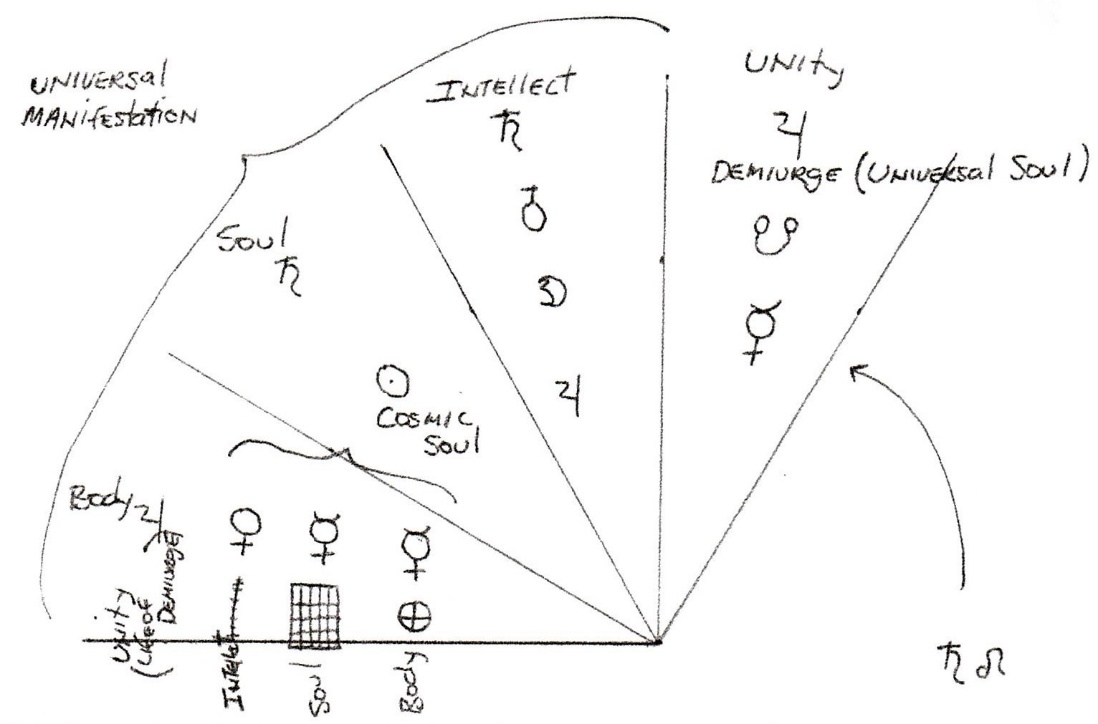
Diagram: four levels of Universal Manifestation (houses 9-12) reduplicated in twelfth house; Nature principle as soul of twelfth house (Nature Mercury)
Nature planets as operational; activity differs with quadrant; entirety of third quadrant subsumed under Nature as the activity of the One
Cosmic soul (Sun in Aquarius) combines tenth house illumined matter with eleventh house living images (systems) to produce the germinal form of an entity which is injected into the imaginal essence (Nature Mercury)
Imaginal essence as light; organizes bhutas into bodies
Entirety of space surrounding a solar system is permeated with Nature; also called Akasa; totality of physical reason-principles
Adept works with the forms already existing in Nature; can separate and recombine forms and matters to produce effects; can't alter the forms, only change the matters
Student seeks clarification on presented schema; whole schema reviewed
Stratification of matter into four grades an operation of Universal Soul (Plotinus), doesn't happen on its own (Samkhya)
Living images in eleventh house are the Ideas existing in the mode of Life; are the living processes (circulation etc.)
Student seeks clarification regarding the notion of Universal Manifestation; perpetual rather than eternal; its unity the predetermined plan or Idea of the entirety; has a being, soul, body
AD thinks Platonic theories apply all the way down to the level of science
Experiences undergone by hylomorphic entity also organized by Demiurge
Distinction between Nature and System of Nature
Man has a faculty of reaching the very roots of selfhood which Nature doesn't have
Mentalism: everything coming from within Bodhicitta; no "out there"
Reading of draft Introduction to Astronoesis
Explains the intention to use astrology as a symbolic model; distinguishes philosophy and astrology; introduces the quadrant/concentric circle diagrams; concludes with the aim to correlate Plotinus's ideas to the astrological model
BOOKS READ FROM OR REFERENCED:
Anthony Damiani, Astronoesis
Plotinus, The Enneads (MacKenna translation, 4th ed.)
Thomas Taylor (tr.), The Commentaries of Proclus on the Timaeus of Plato, in Five Books
R.G. Collingwood, The Idea of Nature
PLOTINUS QUOTES READ OR REFERENCED: III.3.4, III.8.8, IV.4.8, IV.4.10, V.1.8, V.1.10, V.3.4, V.4.2, VI.7.7, VI.7.35, VI.8.16. See also Nature outline in Astronoesis, pp. 226-229, for more Plotinus quote references.
DIAGRAMS appended to this transcript:
FIGURE 1982 0326a-1. Saturn in Leo, Houses 9-12, and House 12 Levels.
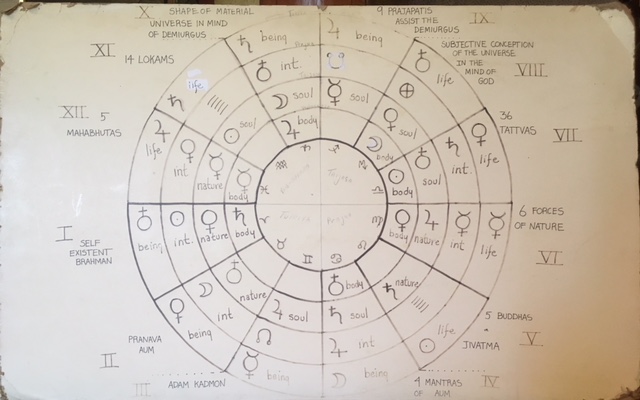
FIGURE IMG 2202-Posterboard Metaphysical Chart.
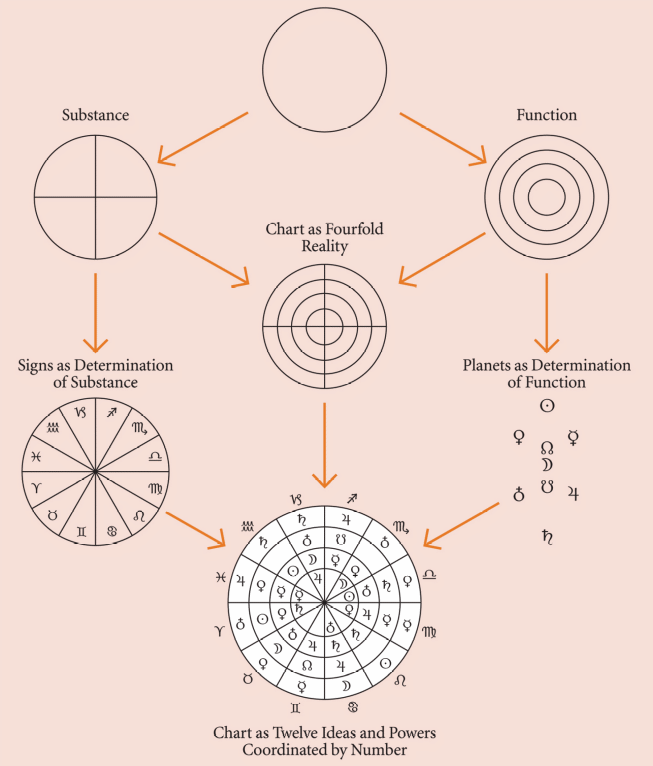
FIGURE 1982 0326a-3. Construction of Metaphysical Chart.
Other diagrams also referred to are not with this transcript version. [Transcriber note: [diagram] means the speaker is referencing a diagram as he or she is speaking. If someone is drawing or writing, with audible sounds of chalk on a blackboard, I indicate this by [drawing] or [writing].]
AD PAPERS read in class:
"Six Levels of Awareness". Retyped as 1982 0326c V09MP. Plotinus - Soul - Six Levels.
Astronoesis Working Draft Outline of Nature. The working draft outline of Nature is found in Scan File ASN MASTER NATURE 1-25.PDF (pp. 1-5) and has AD edits which had not yet been incorporated into the version read in this class. The Scan File has been retyped as ASN Nature - Outline V09MP and the version read in class has been retyped as 1982 0326d V09MP. Astronoesis - Nature - Outline.
Astronoesis Working Draft of Introduction. The working draft of the Introduction as read in this class has no Scan File associated with it and exists only as embedded. It has been retyped as 1982 0326e V09M Astronoesis - Introduction.
NOTES:
This is 1982 03/26a, Plotinus; Nature Class, the first entry associated with this date. 1982 03/26b = "Consciousness in Plotinus" Book Notes. 1982 03/26c = Six Levels of Awareness Paper. 1982 03/26d = Nature Outline. 1982 03/26e = Astronoesis Introduction Paper. 1982 03/26f = Astrology, Classifying the Types, for which there is no audio or notes — might refer to something misdated.
We have a sixteen page partial transcript for this class, Scan File 1982 0326PC-16R15.PDF. The first two pages are the "Six Levels of Awareness" paper which is read at the beginning of class. The two pages following are "Consciousness in Plotinus" Book Notes, dictated by AD to jf (retyped as 1982 0326b V09BN. Plotinus - Soul - Consciousness in Plotinus). They are not read in class and are a precis of a portion of an article by Edward W. Warren in Phronesis, Vol. 9, No. 2 (1964), pp. 83-97, published by Brill. The next three pages are a summary of the discussion that follows the reading of the "Six Levels of Awareness" paper. The next two pages are an Astronoesis Working Draft Outline of Nature and the rest of the partial is a summary of most of the rest of the class but doesn't include the last few minutes of the class where AS reads the Astronoesis Working Draft of the Introduction. This partial transcript does not distinguish between AD and student comments.
This class continues the discussion of Nature started in WG CLASS 1982 0319a.
See outline of Nature in WG CLASSES 1982 0319a and 1982 0402a for comparison. See also outline for Nature chapter in Astronoesis.
See Introduction in WG CLASS 1982 0402a for comparison. See also Invocatory Prelude and The One: Symbolization chapters in Astronoesis.
TRANSCRIBED Verbatim by IT 2021. In 2025, IT updates prefatory matter, completes TOC, expands Plotinus quotes section, fixes errors/typos, alters/adds some notes within transcript, adds one diagram and references within transcript to this diagram, removes appended "Six Levels of Awareness" paper, which now stands alone, updates audio file markers to match new REP audio. Archival verbatim transcript with AD Papers – V12ap.
AUDIO FILES: 1982 0326a, 1982 0326b. [Note 1: "Tape" and "Side" refer to original audio cassette tapes that were later digitized into .MP3 Audio Files. Note 2: In 2024, REP Studio separates off Emperor Julian class fragment from file b.]
1982 03/26a at Wisdom's Goldenrod
Plotinus; Nature
[Audio File 1982 0326a Begins]
AS: I'm first going to read this brief two page summary of the levels of awareness in Plotinus and in partial answer at least to-- to Richard's questions of last week on a kind of-- on the kind of awareness or the kind of consciousness which was associated with the Nature principle. And this briefly goes through the var-- six-- basically six levels of awareness, from that which is even below sensation to that which is above the highest of the four gnostic faculties, that is, some kind of awareness in the One. Ok so let me-- let me read it through first and then we could read it more slowly, but I think it's pretty-- should be pretty clear.
S (faint): What is it about though?
AS: Excuse me?
S: What is it?
S (very faint): What?
S: What are you reading?
AS: What am I reading? Um-- this is a-- and an outline of--
AD/S(?) (very faint): What paper?
AS: Oh, oh, you mean where did it come from. (AS laughs)
S (faint): Yeah.
AS: We-- I have these new notes. This-- this is a reply of-- by Anthony to-- to the point that Richard brought up last week on the question of the awareness which accompanies Nature or the type of consciousness in Nature. Well-- Ok. Um--
S (very faint): Read it.
[Transcriber note: The following paper is the first two pages of the partial transcript, Scan File 1982 0326PC-16R15.PDF, and has AD and AS handwritten edits. AS incorporates most of these into his reading. I transcribe the paper as read, including any alterations made on rereading. This paper has also been retyped as 1982 0326c V09MP. Plotinus - Soul - Six Levels.]
AD Paper ["Six Levels of Awareness," AS reading]: "Man's selfhood, or pure intelligence, reaches downwards to the depths of Nature (Physis). There in Nature it is unconscious to itself. If the Atman functions only as Nature, we can say that it is only that, it would not know of the higher and the very highest powers of the soul. All of these would be unconscious to it.
"(Now) the second level, there is brute sense experience, the pathos in the living body, experienced by animals primarily. This principle is again unaware of the higher soul powers. This is an instinctual understanding without general ideas. It is only slightly distinguished from the material world and reason can never be known in this mode. This is a fleeting consciousness with dreams for memories and fleeting premonitions of subjectivity.
"At the third level, there is the apprehension of thoughts, the activity of discursive reason due to recollection of ideas. This is generally the level of man and human reflective self-consciousness. The ideas of reason become conscious to the imagination which links both sides of his nature, and he is usually identified with this imaginative activity. There are many powers which are available to the imagination, some higher and others lower. Here man can engage in habitual activities which are unconscious following his dispositions which become stronger than his conscious part.
"The limited attentive power of soul here can only attend to one thing or at best a few things at a time. Man can thus be unconscious of what passes in one part of him while consciously attending to another which attracts his attention.
"At the fourth level Plotinus points to a higher activity unattended by the imagination, that is, without the accompaniment of any image. When we are intensely concentrating for instance, in reading, we do not reflect on the fact that we are reading. Man cannot act courageously if he knows no fear and he cannot be virtuous without knowledge. In this level, he is exchanging one kind of awareness or attention, an imaginative one, for another or unimaginative one. Here he tends to identify with dianoia or pure reason, which is above the pseudo-self-consciousness of imagination.
"At a fifth level, level of pure self-consciousness is reached when he is the knower. The subject and object are existentially united and here the self has its experiences determined by its membership in the Nous. It knows the rest of the Nous from its own particular viewpoint. These experiences are self-directed. It knows itself through the Nous. The self is here not unconsciously but intensely alert and contemplative, and having left behind all the lower powers.
"And sixth finally the Self or experience of One, and this contemplation of the One is by a power which is the root of the Self."
AS: You (hear me though right)?
AD Paper ["Levels of Awareness," AS reading]: "Finally is the Self's experience [AS: quote] of One, this contemplation of the One is by a power which is the root of the Self."
[short pause]
AS: Want to read it again. Does that answer your question?
S (faint): Uh-hm.
S (faint): No but you also created more.
AS: Ok. (bit of laughter)
S (very faint): Yeah.
AS: Yeah maybe (it) could be elaborated some.
S: Would you read that last sentence again?
S (faint): Uh-hm, (say it again).
AS (simultaneously): Yeah, I'm-I'm sorry, I-- [9 second pause] Ok.
AD Paper ["Levels of Awareness," AS reading]: "The final level we're speaking of is the Self or the experience of the One, and this contemplation of the One is by a power which is the root of the Self."
AS: He often speaks of that as even annulling the Intellectual-Principle, ok, in this contemplation in which he-- he's not even soul, even soul is merged into the One. Ok? So-- I mean basically we're doing the six-- like he could do these six or seven levels. I'll do them one at a time. [Note: The top of the fifth page in the partial transcript has the following list. I number them here also, both to correspond to the partial and to make the discussion that ensues easier to follow.] The one-- the lowest one, we should put it down here, [writing] is 1) that contemplation which is alone in Nature and then 2) sense, and passion. And then the next one up I guess what they call 3) imagination, and opinion. This is similar to the divided line. Imaginative reasoning. [9 second pause while writing] He would bring in this. 4) Dianoia, pure reason. And then-- and the 5) Intellect. [12¾ second pause while writing] I guess call the top one kind of 6) union, that's almost here. [short pause while drawing] These you may recognize of course.
JfL: Can I ask a-- a quick question before we-- before you repeat them?
AS (faint): Sure.
JfL: The difference between the five and the six, is that the difference when he's talking about-- the five would be where the Sun-- the-- it's like the Saturn is viewing the Intellectual-Principle [diagram]. It's like it sees it on its own grounds, and then the sixth is where-- What is this, is this V.3.4, is that what you're at?
AS: Hm? I wasn't at any place, no. This is [one word inaudible]
JfL: And is the-- is the sixth one where you've-- you have to annul the soul?
AS: Yeah I think-- I think that [JfL simultaneously: Is that the--] that-- the fifth one was where the soul remains just self-contemplative in the-- within the Nous, ok, has a vision just of the Ideas, remains [JfL simultaneously: Ok, it has the--] totally in the Nous.
JfL: Ok.
AS: And the s-- the sixth one is where he speaks about you have to even go beyond the Intellectual-Principle, of course through the Intellectual-Principle's aid, into a union with the One in [JfL simultaneously: So is that where--] which there isn't even any soul.
JfL: Ok is that then where they say that the Intellectual-Principle knows-- Oh, ok.
AS: Yeah, for example he says--
Plotinus [VI.7.35, AS reading]: "[As] for soul, it attains that vision by--so to speak [AS reads: so to speak by]--confounding and annulling the Intellectual-Principle within it; or rather that Principle immanent in soul sees first and thence the vision penetrates to soul and the two visions become one."
AS: There he's speaking about, you know, attaining the union with the One.
JfL (simultaneously): The sixth, right.
AS: The sixth one.
S (faint): Where was that passage?
AS: VI.7.34. [Note: VI.7.35.] Well let me read this again. Let me-- I-- I don't know, maybe this is off the point but let me read this one short passage also from III.8.8. Just a general-- his-- he has this general principle in "Nature, Contemplation, and the One" where he says--
Plotinus [III.8.8, AS reading]: "In the advancing stages of Contemplation rising from that in Nature, to that in the Soul and thence again to that in the Intellectual-Principle itself, the object contemplated becomes progressively a more and more intimate possession of the Contemplating Beings [AS reads: Being], more and more one thing with them; and in the advanced Soul the objects of knowledge, well on the way towards [the] Intellectual-Principle, are close to identity with their container."
[15¼ second pause]
AS (faint): And he also has this-- well, [S, very faint: Yeah.] ok.
AD (faint): Go ahead Avery.
AS: Go on (Vic).
S (faint): You want to push that?
AD (faint): Yeah, stop, sure, for a few minutes, it's alright.
RG: I think it's a beautiful description of the gnostic faculties and as what Nature looks like to the gnostic faculties from the point of view of the gnostic faculties. But I don't particularly see, maybe I just missed the whole thing, that it's a-- that it's a description of Nature's principial consciousness to itself, not in it from ours-- our faculties. Now maybe either that's impossible or you resort just to symbolic pictures to describe that. But still putting it in-- in the framework of that I don't-- I don't get it.
AS: You mean at-- I think you have (to--)
RG: In-- in other words-- and-- and even--
AS (simultaneously): Yeah I know. These are-- [drawing] you're saying these as the human gnostic faculties [diagram].
RG (simultaneously): Right. And even in the quote you read he said at-- at a certain level of soul, it kick-- you know, the-- I-- I could-- I would even accept that the human soul in certain aspects has higher principles in it than the principle of Nature. But to make all of the gnostic faculties prior to the level of Nature's consciousness in itself seems to me arbitrary. I don't see why our own sense or--
AD (simultaneously, faint): (How about psycho-telepathy), alright?
RG: Ok, but what?
AD (faint): If uh-- if we're just working with the notion of [couple words inaudible] and [couple words inaudible] of intelligence that (well) underlies (this) level, and this very same consciousness when it is buried in matter at the minerals, alright. We're not speaking about gnostic functioning or anything like that, we're just trying to see how when consciousness or pure intelligence is immersed in the material realm, alright, there is no activity of a self that we can speak of anymore. It's like when you were reading in Jung about Sophia buried in matter. He calls out for its liberation from the matter, alright. At that level it has to operate in this peculiar way. When it takes a step upward, alright, and becomes sensation that the animal experiences, that's consciousness identified at that level. And if you go up, alright, as he pointed out, the unity of the subject and the object gets closer and closer. But when you reverse the process, there is no subject down at that level. So those sense-- is that right, the next to the bottom?
AS: Yeah.
AD: [one word inaudible] that you?
AS: Sense and passion, yeah.
AD (faint): Yeah, if you think of that--
AS: Animal.
AD (faint): And the next one was Nature. So when you ask yourself what is the principle that we can use to explain or try to understand the rest and motion that we find in bodies, and (the--) you know, they usually refer, the Greeks refer to that as Nature. It's a principle of rest and motion. They-- they didn't conceive of it as having any kind of self-consciousness, any kind of subjectivity or anything of that nature. And even when he moved up to the next realm it still didn't have that subjectivity.
RG: Ok, I'm coming the--
AD (simultaneously, very faint): [couple words inaudible]
RG (mostly faint): Ok. So in the descriptions (to--) your words, of Nature as having an intuitive power of its own content and a certain kind of recognition, which admittedly is at a lesser level of intensity than soul, now, what kind of knowing is that, what kind of knowledge? I can't-- I mean I can't conceive that it's below the level of human sense-cognition in terms of consciousness.
AD (faint): Well that's because you have-- I think basically misunderstanding the way Plotinus conceives the sensitive faculty as inferior to the faculty [one word inaudible] (below).
RG (faint): Obviously. I mean that-- I mean that-- I still don't get it.
AD (simultaneously, faint): Well, that's why I (did--) had this arrangement this way to show you a stratification of and the (grading) of consciousness according to what it is associated with.
RG: Ok let me ask you-- let me ask it another way. We speak of Nature's contemplation of contents (in/of) the soul. And in that vision Nature has of the soul, in that contemplation it verily produces the sensible world. [AD simultaneously, very faint: Alright (few words inaudible)] It produces the-- the sensible world.
AD: But it doesn't know it.
RG: Now I cannot understand--
AD: But you followed me.
S (faint): Uh-hm.
AD: It doesn't know it.
RG: It doesn't know it in the way we imagine knowing could do (it).
AD (simultaneously): It doesn't know it.
RG: I don't know what that-- well you have to clarify then.
AD: You don't have a subject-object relationship.
RG: Granted but you don't at higher levels of knowledge also. It's not clear that because it doesn't qualify on a lower level it doesn't--
AD (simultaneously, faint): Subject-object relationship right up to the Nous.
RG: But why don't you have the subject-object-- object relationship of Nature to soul, I mean--
AD (faint): Nature receives the forms that are in the soul. Or he speaks about it as a contemplation of the forms that are in the soul. Maybe if we-- if you think of it this way. You think of an unconscious activity which is constantly going on, alright, and you think of that activity as having some sort of consciousness, whatever sort it is but let's leave (the lights on), alright. That-- that's what we're talking about.
RG: But then why use words like con-- what does it mean then, in that sense, contemplation? How would you speak of an unconscious activity contemplating its prior and--
AD (simultaneously, faint): Contemplation is unconscious.
RG: It is?
AD/S(?) (faint whisper): But yeah.
S (very faint): Uh-hm.
AD (faint): You don't know when you're contemplating. You only know it after the fact.
RG: But you-- you would never use the word-- I mean, you would-- you would harangue Jung forever if he-- for using the word 'unconscious' when-- when he-- the [AD simultaneously: Well, what we're saying-- what we're saying is--] natural-- when the archetypes which are in Nature are--
AD (simultaneously, faint): What we're saying is that there's no self when contemplation is going on.
RG: If Nature is a Real Being, you-- we admit that.
AD: Semi.
RG: Semi-real Being. How could a Real Being not have some semi-- semi-kind of self? I mean, if you admit that it's a semi-real Being, then we have-- then I don't know what Real Being means anymore. If it has no entityhood, if it has no selfhood, if it has no consciousness, what do we mean by Real Being?
AD (faint): I didn't say it doesn't have no consciousness.
RG: You just said it (doesn't).
S (simultaneously, very faint): (Does not.)
AD/S(?) (very faint): Never mind.
AD: We said consciousness immersed in that kind of activity has no subjectivity. There is no awareness of a self doing something. There is the activity but there is no one there who's aware that he's doing something. And this is the way Nature has to be understood. If it's the principle of rest and motion, why say it's a he or she?
[10 second pause]
RG: I'm--
AS: Mm, uh-hm.
RG/S(?) (simultaneously, faint): I don't get it.
AS: There are-- there are specif-- there's like-- there's at least one specific passage where he talks about the imprint which Nature is capable of being below sensation.
RG (faint): Yeah, there's one here, there's a quote like that.
AS: There are quotes that say that.
RG (simultaneously): Yeah, and there are quotes that seem to say otherwise too. But, apart from the quotes I-- I don't--
AS: You don't see it, yeah.
RG (simultaneously): I don't under-- I don't see it, I mean--
AS: You mean how it could be--
RG: If you'd show it to me I could--
AS (simultaneously): Well perhaps he's-- perhaps the poi-- I'm not sure but perhaps the point is--
AD (simultaneously): Actually, actually you understand what we're getting to, that there really is no subject till you get to the Nous.
AS (faint): Yeah.
S (faint): Oh.
RG: Well if you want to go that way that's fine.
AD (faint): I-- it's not the way I want to go, it's the way it is. (bit of laughter)
RG: Fine.
AS: Yeah.
AD: That's why I kept referring to pseudo-subjects.
AS: Yeah [one/two words inaudible]
AD (simultaneously, faint): Like we live in the imaginative realm, we see images, alright, these images are supports for our thinking. But in the images there's, let's say, like the possibility of recollection of an Idea or the Ideas, and we become aware of a sort of subjectivity. But that's really not the subject, we have to go to the next stage where we reason dianoetically without images, but you still don't have a subject. You don't come to a subject until you get to the Nous. [student assents, very faint] So, even if you could think of Nature as really having-- you know, having a subjectivity, [MB, faint: But isn't--] beside the point. Go ahead Myra.
MB (simultaneously, faint): The reason you call them this (is) if you talk about the gnostic functions, for example, and you have these different levels of functions, you said (you quoted in) subjective and an objective pole at each level of the function. Because it doesn't seem right to say-- if you're going to talk about a particular content, for instance those-- those-- content like an image [one/two words inaudible] you can't-- it doesn't seem right to say that it's the Nous that knows that image. The kind of knowledge that the Nous has is not an image kind of knowledge. It has-- so that's why we posit a subjective pole at that level so that there's somebody or some faculty that has that image of this knowledge, even if it's always pseudo-knowledge of-- of a subject.
[short pause]
AD (faint): Try it again, Myra, in one sentence.
MB: Well, maybe I'll--
AS (faint): Uh-hm.
MB (faint): See that's a different question. Who? [couple inaudible AS words simultaneous with MB] On level three that you talked about, the level of thoughts and images, ultimately the Nous is the knower, there's only one knower. But, you don't say the (Nous--)
AD (simultaneously): I didn't say there's only one knower, I s-- I said only the Nous is the knower.
MB (faint): Only the Nous.
AD: And so the knower, in other words, of this soul or that soul, it would have-- his selfhood would be the Nous.
MB (faint): So, does that Nous know those images at level three [one/two words inaudible]
AD: Well tell me, what is it in you that knows, when it truly [AS simultaneously: Nous.] knows?
MB (faint): Only the Nous [S, very faint: Right.] that truly knows but-- but does that-- is that Nous knowing the--
AD: Would there be knowing when there [AS simultaneously: How could it not?] was the sense-perception? And if there is, what would there be a knowing of?
RG: Good point. Only-- only of the-- of the sense images.
AD: Which would include what we're referring to as the subject.
S: Yeah.
RG: Yeah.
AD: Ok.
RG: But then why do-- why-- why do you put that--
MB (simultaneously, faint): So you're making the subject into an object? You're saying that the subject is expressed?
AS/RG(?) (simultaneously): No.
AD (faint): No.
MB (faint): I don't really (get it).
AS (simultaneously): No he's saying that the true subject is never an objective content.
RG: I agree with that. But then why do you include-- We would certainly say the low-- wouldn't you say the lower aspect of the divided line don't qualify for-- for true subject? I mean you wouldn't say the sense faculty is a true subject. You wouldn't say that the imaginative faculty is a true subject. Insofar that there's any real knowledge in the-- in those faculties at all it's based on the Nous.
S (faint): Uh-hm.
AS: Right and wouldn't that apply to Nature also.
RG: Yes.
AS: Even as far as Nature.
RG: Fine. Then why claim--
AS (simultaneously): But-- but that puts--
RG: Why claim that the know-- that the so-called knowledge of sense and imagination, which is no knowledge at all, splits up into an apparent object and an apparent subject and takes itself to be an apparent su-- a real subject is on a level that's higher than the level of Nature [AS simultaneously: I'm not.] which doesn't take itself to-- even to be a su-- a-- doesn't, let's say, make the mistake of taking itself to be a subject.
DB: It's not that it doesn't, it can't.
RG: Well that's--well-- [couple inaudible AS words simultaneous with RG] But why ask-- why-- I don't get it.
AS: I think in this scheme the relation of that-- the pure intelligence, you-- just what you said, I mean I thought that answered the question. In-- the pure intelligence in all of these lower ones is not self-realized as it were until you're at the level of the Nous. It's immersed in these other faculties or in these other principles, all the way down to being immersed in the actual production where it's almost completely lost its own self-awareness. At least at these here there's at least the beginnings of some self-awareness. We're just getting closer and closer to some kind of true self-awareness. But at the lowest level of Na-- Nature, that self-awareness or-- or pure intelligence has gotten completely immersed into its production. Which is not to negate the other point, as you say if you were to look for a pure intelligence that is operating even in Nature you would say it is the pure intelligence. [RG simultaneously: But I don't see--] But now they're immersed in Nature. So that means that the grades-- I mean if I understand this it means that the grades are not the grades of intelligence so much as the grades-- the grades being brought about by the different grades of appearances or the modes of-- of production or knowing. But the intelligence itself, could that be said to really go through grades? So from the intelligence side, [RG: Yeah.] you know, you-- you would have to just say that the coverings of it are more-- are-- are less and less as you go up the scale, or the immersion of intelligence is more and more as you go down the scale.
RG: But doesn't in some ways Nature have a lot more intelligence within it than the sense faculty? I mean it produces everything the sense faculty works on and understands, I mean--
AS: But does that mean it has more intelligence in that way? Does it have more of the selfhood in it? Can Nature have more of a selfhood-- does Nature have more of s-- more selfhood than say an individual exercising sense-perception or imagination [RG simultaneously: I--] or dianoia.
RG (simultaneously): My claim is yes, that insofar that Nature is a-- is a semi-real Being, and insofar as the sense faculty is just the sense faculty's cognition of appearances, in that relationship--
AD (simultaneously, faint): Faculties still are higher though.
AS: But it's the soul's sense faculty.
AD (simultaneously, faint): Sense faculty is higher than Nature.
AS: Yeah, it's the [S simultaneously: Oh I hear what you're saying.] soul's, and so is the di-- so is imagination and dianoia the soul's.
RG: Yes.
AS: So insofar as those are the soul's faculties through which intelligence is working, [AD simultaneously, faint: Maybe (couple words inaudible)] those are higher than the na-- than the one-- than the intelligence operating in physis or right in matter itself.
AD: Just think of the degrees in fire, earth, air, and water.
LR: Yeah. But he has trouble with that too.
RG: Yeah, well, you know-- What about them?
AD (faint): Well what would that represent to you?
RG: The degrees?
AD: Like you have the degrees in fire, earth, air and water in astrology now.
RG: Uh-hm.
AD: Does that mean anything? It's an activity, you know it's an activity.
RG: Don't they mean something?
AD (faint): Hm?
RG: Yeah, I would say they mean something. They don't? They don't mean anything.
AD (faint): No not unless the graded powers of the soul are operating on it.
RG: But you come up with a meaning even though--
AD (simultaneously, faint): Yeah, but you're speaking about the way knowledge is [one word inaudible] in a certain way, matter is organized and structuralized. And this is a routine activity on the part of Nature. And this is all that he's talking about (as/is) Nature. And this will repeat itself endlessly unless interfered with by the soul. [11 second pause] Well that's alright, we'll try again next week. (some laughter)
[short pause]
AS: Yeah, I mean-- It's funny but you're right, I mean this implies and it seems to be true, that in a way even the lowest faculties of sense, even sense-perception itself, is in some way a higher grade than Nature, I know-- I--
RG: Yeah I see that.
AS (simultaneously): Because it--
RG: I have a hard time understanding how we can really claim [AS simultaneously: It implies soul.] to-- to know what the consciousness of Nature is. I-- How do you know that?
AD: Not the consciousness of Nature.
RG: In Nature.
AD (faint): In Nature or associated with, or the intelligence buried in Nature.
RG: The intelli-- yeah, the intelligence of the Na-- Nature principle.
AD (faint): That's the activity per se. That's the activity of the intelligence per se.
RG: Ok but it's not devoid of intelligence, is it? How could it-- I mean--
AD: Well no, we didn't say it's devoid of intelligence, when you go below a certain line it's-- the reason-principles of matter are not devoid of intelligence.
RG: But I mean isn't the--
AD (simultaneously): Otherwise how could you say reason-principles in matter?
RG: That's right.
AD: But there is, there is no understanding.
RG: Ok, but, is it better to be healthy or know that you're healthy? (bit of laughter) I mean is it better that the principle--
VM/S(?) (simultaneously, faint): Oh come on.
S (faint): Oh. (bit of laughter)
RG: Is it better that the principle operates in a-- in a-- in a way that--
AD (faint): Some people would say it would be better to know truly.
RG: You never said that. (some laughter) It's a bad example, (RG laughing) but, um-- Ok, I would-- Yes, to know truly but then we would go-- we would go much higher on the diagram.
AS: Yeah but where (do--) you jump? I mean, I-- you have a funny circuitous route of doing that. You say well you jump-- you-- it's like you're saying well, where would you go? You jump from here [diagram] and you'd say well we jump up to intellection.
RG: Somewhere in there.
AS: And where do-- where does that put all these--
RG: As faculties of the human soul, but insofar that Nature is a-- is a principle-- I mean--
AS: But what about the World-Soul, doesn't it too have imagination and reason? And you would put the World-Soul's imagination below Nature?
RG: No.
AS: Certainly it would be above it.
RG (simultaneously): No I think there's a-- well I think there's a difference between--
AS (simultaneously): Well doesn't the human faculty-- Oh but--
RG (simultaneously): I think there's a difference.
AS: I-- according to the way we've done Plotinus before the difference is not one of kind. The World-Soul and the individual soul are not distinct in their kind, in fact all the powers of one are also in the other. I mean where are you going to-- I mean suppose you fo-- follow the-- This may not be to the point but--
RG (simultaneously): Or wouldn't you say that Nature is one of the powers of the cosmic soul?
AS: Actually, in a-- in a way yes but in a way no, it's below all the ones that he speaks of as strictly being powers. It's below even imagination.
DB/S(?): Yeah.
AS: Certainly.
AD (faint): As a matter of fact is these powers in the sense that the graded powers of the soul combine the reason-principles with the matter and inject it into this imaginal substance which is then received by Nature.
[short pause]
AS (faint): The wax seal.
AD (faint): Well I think-- I think-- I think you have to tr-- try just for a moment, one moment. Think of consciousness immersed in matter. Or think for instance of the activity of an animal or molecule. That would be the principle of rest or motion for that object. Now if you want to speak about a consciousness that it operates with, fine, alright. But it has to be restricted to a certain kind of consciousness, consciousness which, so to speak, doesn't apprehend its own activity, has no images. Consciousness which does have no understanding because when you say it has these things you're ascending up the ladder of consciousness.
RG: Is this the same principle that let's say orders the motion of the planets? Is that Nature as a principle, the way you're using it?
S (very faint): Oh no.
AD (faint): Yes you'd have-- you'd have to say that.
RG: Ok. (Well/No), I just--
AD (simultaneously): So, it's like a habitual pattern, isn't it?
RG: Yeah but I-- I don't know.
AD (simultaneously): Did you notice-- do you ever notice how when you do things habitually you lose consciousness of doing it? And that if it persists after a while you don't have to pay attention at all? [students assent, very faint] And it just goes on by itself?
S (very faint): That's--
RG: Yeah.
S: Right.
RG (faint): Yeah.
AD: Well that's-- that's Nature.
[short pause]
RG: So the consciousness that is keeping the planets going around in an ordered way doesn't know that it's doing it, doesn't know that it's doing it.
AD (simultaneously): It's what you speak about as Nature.
AS: [couple words inaudible]
RG: And it has no idea of what it's doing.
AS (faint): See--
AD: Well it wouldn't be the cosmocrators that would have any idea what they're doing, I mean the planet, the stones, the statues made of stone.
RG: No, no, but the intelligence that is working to order the movements of the planet(s), that-- (you) still allow that to be Nature.
AD: Do you think-- do you think your muscles when they contract and expand, you know, have a notion of what they're doing?
RG: Do they have notion, of course they don't have a notion.
AD: Well then why should you expect the planets to have a notion what they're doing?
RG: I don't mean to say that they have any kind of co-- imagery like we have.
AD: Well then what kind of-- what kind of understanding would they have?
S (simultaneously): Yeah.
RG: It would have to be some sort of--
AD: If they-- if it has no imagery and if it's not dia-- donat-- di-- (dianoetic/dianoia), then what kind of understanding is it?
RG: Some di-- kind of direct understanding that doesn't use any intermediaries.
AD: (But) what kind is that?
RG: That's what we're asking.
AD: No that's what I'm asking. [few inaudible student words simultaneous with AD] Because you refuse to accept the activity of the intelligence in matter, alright, unless you bifurcate it in some way, and I'm telling you to leave it as it is, an innate knowledge.
AB: If you [one word inaudible]
RG (simultaneously): I'm happy to accept it as an innate knowledge.
AB: It's so direct that you can't call it an understanding.
VM: I would s--
RG: Ok but there are two levels on the-- on the diagram that have that innate knowledge, one is way below the gnostic faculties and one is at the height of it.
AD (faint): I'm sorry.
RG: When you speak of the innate knowledge, there are two places you can look at. One is below any of the gnostic faculties. In other words, you go below the level of sense and you have this--
AD: No, innate knowledge will be what constitutes the sensible object. The principle of rest or motion in a body. [student assents, faint] And the sensible would be the archetype of the conjectural or the phantasy, the lowest. [10¼ second pause] Think it over this way, the way we just spoke about it. What kind of intelligence is it that goes on in the habitual patterns or functions in an animal, in Nature, anywhere that we can speak of something that's not made by the skilled craftsmanship (or/of) the work. What kind of consciousness is that?
RG (faint): I don't know.
AD (faint): Well, you can call it Nature. Alright, try some more next week [one/two words inaudible] Maybe-- maybe if we get a bigger picture of Nature (we go better) [one word inaudible]
[short pause]
AS: You know, he has a really nice passage on that in IV.4.8. I don't-- it's probably not worth reading now but he speaks about the planet's journey.
AD (faint): Well, go ahead.
AS: He says--
Plotinus [IV.4.8, AS reading]: "[So it is with the stars.] They pass from point to point, [but] they move on their own affairs…"
AS: Well, he can read that, I don't know.
S (faint): You read it.
Plotinus [IV.4.8, AS reading]: "…the vision of the things that appear on the way, the journey by, nothing of this is their concern; their passing this or that is of accident not of essence… … [Or we] may take the comparison of the movement of the heavenly bodies to a choral dance…"
[9½ second pause]
AS (faint): Yeah. [short pause, flipping of pages] So on.
S: Avery?
AS: Yeah.
S: Um--
AS: I'll read it.
S: In the metaphysical chart, [AS simultaneously: Yes, (go on).] some of the principles in the Soul ring are termed under Nature [FIGURE IMG 2202-Posterboard Metaphysical Chart]. And is this--
AS: Not the same thing.
S: Not the same Nature.
AS: No I put-- well--
S (simultaneously): I just want to get clear what-- you know, what the distinction [AS simultaneously: No.] is between the Nature that's being--
AD (faint): Well that's maybe what this paper will do, let's read it. Read those two (pages).
AS: Read it again? Oh which--
AD: No, no, the-- (the one outline).
AS (simultaneously): Oh the (main/new)-- the outline. Ok. Ok. So-- Now we'll go back to the outline on Nature. Um-- I think part of that discussion was to at least try and make clearer the nature of Nature. But maybe just in following the order of the-- you know, the progression, [student assents, very faint] (we'll/will) also make clear the status of Nature except it's less in terms of consciousness. Ok well-- Remember we did those-- the three previous outlines on One, Intellect, and Soul. [Note: See WG Classes 1982 0312a, 0319a, 0402a.]
[Transcriber note: Astronoesis Working Draft Outline for Nature follows below. I transcribe it as read, including any alterations made on rereading.]
AD [Astronoesis Nature Outline, AS reading]: "[1.] Following the discussion of the three primal Hypostases, we will find that these also exist in and for the system of Nature. Plotinus is speaking here of the entirety of universal manifestation to which he applies the principles of Unity, Intellect or Being, and Soul.
"[2.] The unity of universal manifestation is found in the Logos principle within the Universal Soul or Demiurge. The Universal Soul contemplates the Ideas in the Nous and the assimilation of these Ideas by Soul is an abiding wisdom. This is the Logos, the Unified Reason-Principle of the universe.
"[3.] The"in-forming of matter" by these reason-principles, or more precisely their reflection in the mirror of non-being results in the stratification of grades of matter into various levels."
AD (faint): Divided into various grades.
AS: Yeah, I'm sorry, but--
VM (simultaneously): Could you read that again?
AS: Yes.
S (faint): But slowly.
S (very faint): (One more time.)
AS: Yeah. I can-- (Should we--)
AD [Astronoesis Nature Outline, AS reading]: "[3.] The"in-forming of matter" by these reason-principles, or more precisely their reflection in the mirror of non-being results in the stratification of matter into various grades. [short pause] Plotinus refers to this as the "tentative illumining of matter," the tracing in matter of the Idea of the cosmos. [Note: See Plotinus, VI.7.7, third para.] This corresponds for the universe to the second Hypostasis. It is the Intellect of Universal Manifestation, the Being of Non-Being.
"[4.] The soul or principle of animation of the universe is the system of living images of reason-principles. These living images in the soul reflect the immutable Ideas in Intellect. The graded powers of Soul combine these forms within the appropriate grades of illumined matter to produce various hylomorphic entities. [short pause]
"[5.] The living images and the informed matter are combined by and in the intellectual imagination of the World-Soul, and this elaborates the work of the Universal Soul or Demiurge and images forth the corporeal world.
"[6.] Now in this Body of universal manifestation, we will also find a reflection of the three prior principles. This material world is divided into the inerratic, planetary, and sublunary spheres, corresponding to its intellect, soul, and body.
"[7.] It is the life of the Demiurgic Soul which is the unity of universal Body, or the Body of the universe. The abiding life of the Demiurge provides these unified life-fields of the cosmos into which the material worlds-- or in which or onto which-- on which the material worlds are manifested."
AS: Read that again.
AD [Astronoesis Nature Outline, AS reading]: "[7.] It is the life of the Demiurgic Soul which is the unity of the Body of the universe. The abiding life of the Demiurge provides the unified life-fields of the cosmos on which the material worlds are manifested.
"[8.] The cosmic soul, through the last of its series of graded powers, the intellective imagination, projects forth from itself into these life-fields the inerratic sphere which is a subordinate image of the living form or Idea of Man within soul. The inerratic sphere is the Intellect of our sensible cosmos.
"[9.] The imaginal essence projected forth by the World-Soul containing an image of its powers is the Soul of the sensible cosmos.
"[10.] This living system is Nature, the last of the creative powers above the sensible cosmos, reaching down to the vegetable kingdom.
"[11.] Nature, offspring of Soul, is in contemplation of Soul, and this contemplation is a production.
"[12.] The cosmocrators in the system of Nature are the vehicles for the higher soul powers, and are the agents in the fabrication of bodies. They organize the elements or bhutas into bodies, the last effects.
"[13.] Thus Nature can be conceived as an intermediary between the lowest phase of Soul, the intellectual imagination, and the corporeal sensible world. It may be referred to as an imaginal essence, or image-bearing light, as it receives the seminal essences made of the substance of the imagination. It is this spark or fragment of the divine in Nature which is the organizing and individuating logos of any body--star, planet, and so on.
"[14.] Nature becomes the medium through which our soul, or rather a light from it, is associated with the various vehicles in the cosmos. Our personalities are thus bound up with the cosmocrators or star."
[short pause]
S: Would you read that last sentence again please?
AD (faint): Maybe-- maybe Avery would put up the last hour houses so we get some--
[Note: See FIGURE 1982 0326a-1 for the following.]
S (very faint): Ok.
AD: (We'll) make an allowance.
AS: Make an allowance, yes. [AD simultaneously, very faint: (Yeah, this is--)] I know, it's really-- it's kind of difficult.
AD (simultaneously, very faint): This is-- this is kind of (difficult).
AS: Yeah.
AD (faint): The whole notion of Nature is so important (for) what we're doing on Saturday that if it's not properly understood, you won't know what the alchemists are speaking about (and this way we got) something tangible, something that they're working on. Got to be really understood what Nature means here.
[short pause]
S (very faint): Yeah.
AS: I'll try. I'll use as little symbolism as possible, just use the--
AD (very faint): Ok.
AS: Ok, we s--
AD: The whole of it is [AS drawing] universal manifestation.
[10 second pause while]
AS: What? [drawing] The whole of these last four, universal manifestation, are under the providence of the Universal Soul, the Demiurge and so on. Ok? And just as-- and he has this line where he says the system of Nature has also its unity-- [Note: See Plotinus, V.1.10, third para.]
(Side 1 of original cassette tape digitized as 1982 0326a Ends; Side 2 Begins)
AS: --black, [drawing] which we just spoke of as the illumined matter, ok, and the Soul or animating principle as the whole system of living forms or reason-principles. [drawing] And these [diagram] when combined with this [diagram]-- well-- well (ok). So we have Unity, Intellect, and Soul of universal manifestation, and fourth will be the Body of universal manifestation. Now, in order to speak about the manifestation of the sensible universe, or the Body of universal manifestation, we talk about the illumined matter and these forms being combined by the [drawing] World-Soul now. So we have these two souls, the Universal Soul, which is illuminating this whole thing and which is organizing the four levels, and then we have the cosmic soul or World-Soul and its productive or intellective imagination which is going to elaborate that illumination and manifest the-- the various grades of the material universe, the sensible universe. So, through this focal point, through this imagination of the World-Soul, this illumined matter and the forms or living images-- [drawing/writing] Just say Intellect equals illumined matter.
AD (faint): Peculiar thing you gotta remember about that, remember the way Plotinus expressed it? It has a Being of non-Being.
AS (simultaneously): Non-Being.
S (faint): Uh-hm.
RG (faint): Which does?
AD (very faint): That help?
AS: [drawing] That just depends on the--
RG/S(?) (simultaneously, faint): Being of non-Being.
AD (faint): Tenth house matter. Prakriti.
RG (faint): Oh, yeah.
AD: Formless matter.
AS: So-- Has some lines on that.
AD: Obviously you can see it's mind boggling.
S (faint): Yeah.
S (faint): Uh-hm.
[short pause while AS draws]
S (faint): Avery what's the difference (informed/in formed) images in the eleventh house and the informed-- the forms that are coming from the Demiurge into the tenth house matter?
AD: Reason-principles informing matter are not living images.
AS (faint): Right.
S: The life is coming from the Soul?
AS: Yeah, this fifth house is-- Yeah, I think over here [tenth house] you would just speak about it as the stratification of matter, ok, which is going to be the substratum. But the actual livingness is-- if you want to put it that way, is going to be in the eleventh house. And those are going to be combined with the illumined matter. But well-- In other words, one distinct-- like the substance view, the substantial view, and the functional or activity view or life view (maybe) from Samkhya. They speak about these principles as being substantial and also having an activity. Ok that activity here is really the enlivening by Soul [eleventh house]. Whereas over here I think you could [drawing] conceive of them as just the substantial matters [tenth house]. And we said that each-- any-- no. These reason-principles in the eleventh, these living images have-- do have associated with them certain grades of matter. For example we had seven-- seven planes of existence here [eleventh house], each one [drawing] of which would have all-- would have seven grades of matter. So within each plane of existence you'd have seven levels going all the way down. The other thing-- See--
S (faint): (Uh-hm.)
AD/S(?) (faint): Uh-hm.
AS: I think the other thing is, here in-- in the Demiurge, the way they speak about the Demiurge or the Universal Soul would have the unified-- like its vision of the Nous would result in its assimilation of the Ideas but in a unified way. Now, in the soul, [drawing] in the cosmic soul which is going to do the work of elaborating that reason-principle, these images are found in a living way, in a more heterogenous way. [S simultaneously: And it always still has a--] They're distributed, broken up.
S: --is the system of Nature and it has a Unity, [student assents] Intellect, Soul, and Body, it's all--
AS (simultaneously): Yeah, universal manifestation. Nature itself though I think would be-- we're going to say is [drawing] just below-- is below the imagination of the World-Soul. In fact it's that which is projected forth by the imagination of the World-Soul to produce the whole sensible cosmos. See that quote is funny, the quote that says so it is with the system of Nature, it has its Unity, Intellect, and Soul, you could take that as saying that it has a Unity, Intellect, and Soul as its prior principles. Or you could try to say that it has within it a Unity, Intellect, and Soul. That was the preposition you didn't like there. These exist in and for the system of Nature. Because, [LDS simultaneously: Avery--] I think reduplicated [drawing] here, the sensible world itself, is going to have a Unity, an Intellect, a Soul, and a Body [AS points out on diagram]. Within the sensible cosmos itself. And that Nature principle will be like the Soul of this sensible universe, (the) productive principle. Well I don't know.
S (very faint): [couple words inaudible]
AS (simultaneously): But maybe I should read over.
JfL: Oh I see, you're saying that that's why that-- that's confusing.
AD (simultaneously, faint): Louder Jeff.
JfL: You're saying that's why it's confusing, the Sun in Aquarius and the Nature principle always seems to be confused because they're corresponding let's say with the ninth, tenth, eleventh, and twelfth as they are with the four levels in the twelfth house. [AS simultaneously: Yeah. In other words, the quote about--] That would be the corresponding aspect of Nature.
AS: Yeah the quote-- if you notice I think in going through the outline we went through that business twice, we did Unity, [drawing/writing] Intellect, Soul, and then the whole Body of universal manifestation. And within the Body of universal manifestation there's an image of the prior Unity, Intellect, and Soul again, which we went through. The Unity of this is going to be the life of the Demiurge, we had symbolized it by Jupiter [in twelfth house]. The Intellect, the inerratic sphere [diagram]. You notice, here we have illumined matter [tenth house] and here we have the inerratic sphere [intellect in twelfth house] which is [drawing] the life-fields here or matter in the tenth-- the twelfth house which is illumined by these reason-principles. Here we have the living images in the Soul [eleventh house], and here we have the living images in the planetary sphere going with it [soul in twelfth house]. So there is an analogy here--within the Body of the cosmos there's a reflection of 1, 2, 3, 4 [diagram]. Again, the Unity of this whole Body here we say is the life, Plotinus says is the life of the Demiurge, which is the living principle in the universe, in the sensible world. Well, this life of the Demiurge corresponds to Unity back here [ninth house], ok. [JfL assents] And again they all go down, the inerratic corresponding to illumined matter in which you have all the living forms of the planetary sphere which correspond to this, and the sublunary [body in twelfth house], where it gets reduplicated.
S (simultaneously): Is Nature only the production from that un-- from that Soul, the Universal Soul, or will we find an intelligible and cosmic principle that represents Nature?
AS: Um, I'm-- say it again.
S (simultaneously, faint): Is-- is it a production here or is it-- of the Soul or is it something that's found in the Intellectual-Principle, the principle of harmony. And where (is that).
AS: Well the Nature principle is funny, the way we've been doing it. I think the way we've been speaking now is that there are various-- like there are five planets we call Nature [FIGURE IMG 2202-Posterboard Metaphysical Chart]. But they don't seem to have a common essence the way say Soul. Remember in the paper on Soul we said Soul is a real Hypostasis [S simultaneously, very faint: (I see), right.] constituted of the five genera and it's uniquely characterized as Life. [Note: See WG Classes 1982 0312a, 0319a, 0402a for Soul outline.] [student assents, very faint] Intellectual-Principle has a unique characterization, it's also constituted of the five genera. Nature-- when we use the word 'Nature', it doesn't seem to have this unified essence. It seems to mean different things for different-- in different places. It's like if you say Nature here [diagram], this Nature here-- and maybe I'm misunderstanding, seems to be peculiar just to this here. [S, very faint: Ok.] It's just-- in the way we're using it, it's peculiar to this intermediary of soul and the sensible world. There may be a Nature in the second quadrant and in the first quadrant also. The Nature there would mean something entirely different.
S (very faint): Ok.
AD (faint): Well not entirely different, [AS simultaneously: No, no.] Avery, because they have one similarity, they're all operational.
AS: Yeah.
AD: If you speak of Nature in the fourth quadrant, third, or even the first quadrant, when [AS simultaneously, faint: It's (operative).] you think of Venus [in Aries] as the Nature [diagram], it's operational. So, some thread.
S (faint): But the substance that it would be working with would be different, is that what you--
AD: What?
S: Would it be the substance that it was working with that would be different?
AD: No its activity is different. The activity of Nature in the first house is the spanda of the Transcendent One. Or, what you might call the power of the Transcendent One. The Nature in the twelfth house wouldn't be the spanda of the-- or the power or the energy of the One, of the Transcendent One. There it would be the-- a power or the energy of the intellectual imagination. But what they would both have in common would be that they're operational. So, when you think of the five planets representing Nature, or those five that refer to Nature, the unity is going to be very difficult to conceive. What is the underlying unity of Nature.
S: (Would it) be a difference between--
AD (simultaneously): But, I don't want to get into that now. What I want to hammer away at now is the notion of Nature in the twelfth house. That's where we want to hammer away.
AS: There's all-- um--
AD: Right?
S: Is there a difference in operation and activity?
AD: Between--
S: Between the notion of activity and the notion of operation.
AD: No, the same thing, activity, operational. [S: Again--] (No/All) the same thing.
S: And you say that Soul like as activity it's usually Soul that's [student assents, faint] [one word inaudible]
AD: They wouldn't-- in a sense when for instance you got Saturn in the second quadrant [FIGURE IMG 2202-Posterboard Metaphysical Chart], you can speak about it as Nature and you do speak about but, it refers in different senses, like the Saturn in Leo refers to the Nature of Soul. Well what Nature does it have? That it has a tendency towards secession. What other Nature does it have? It's the Logos, it's the bearer of the Life of the Intellectual-Principle. So, there again the notion of operation, alright, is included. So Nature really means doing of some kind, and a doing that takes place in the first quadrant, doing takes place in the second when you speak about the Saturn or Jupiter, and doing takes place in the twelfth house. Now, strangely enough in the third quadrant you have no Nature. But, [S: Yeah.] you could subsume the entirety of the third quadrant under Nature. That would be the Nature of the One, the activity of the One.
S (faint): [few words inaudible]
AD (simultaneously): Now-- let me cut it off now because I want to get into Nature. [S, very faint: Alright.] Nature in the twelfth house is the Nature that you're going to have to deal with on Saturdays.
LDS: Could I ask--
S (laughing, faint): Yeah (Lou/do).
AS: Go ahead, go.
LDS: Can we think of this [few inaudible AS words simultaneous with LDS] Nature in the-- in the twelfth house? You spoke of it before as carrying the images from the cosmic soul. In other words, out of the cosmic soul comes the Nature principle with these images. Can-- can you think of the Nature principle as being a kind of matter to-- to that soul and its images but-- but once you s-- you've precipitated the twelfth house, you then speak of Nature as already tangled with or structured by-- by these images from the soul.
S (very faint): Yeah.
S: Go ahead.
LDS: It's like the medium-- it's like the medium for that soul's images that help-- to help that soul articulate or elaborate the images that it contains within it.
AS: Yeah but-- yeah.
LDS: And it's just another way of saying I think what you're saying. [short pause] But there's a-- there's like a matter aspect to Nature and there's-- there's this form aspect to Na-- to Nature. And it seems like both of those elements are coming from the source as the co-- the source would be the cosmic soul.
AS: Oh I see what you mean by a matter and a form aspect, you mean [drawing] both of them back here [diagram] are combined in this Nature(--/,) are combined in the imagination of the Sun, the form and matter both projected out.
LDS: Yeah, that--
AS: He says some place also that every reason-principle contains within itself the matter which it's going to elaborate, the matter which is used. [Note: See Plotinus, III.3.4, fourth para from end.]
S: Hm.
LDS/S(?) (faint): Ok.
LDS: But it-- but in the eleventh house you have the cosmic Sun there which is Sun in Aquarius. And you would speak of it as having all these images. Images of the reason-principles. But, those images must-- [AD: Now--] must have--
AS: Well--
AD (simultaneously): Louis now, listen very carefully. It went something like this. That the cosmic soul combines the grades of illumined matter with living images and injects them into the very nature of imagination. They are constituted, or let's say if you want to think of their substantial aspect, they would be sub-- substantially constituted by imaginal essence.
LDS: These-- these images? [short pause] These images?
AD: The combination of the images, the living images, and the grades of matter. Now I know I'm asking you to shake and rattle the head a little bit. For instance, if you think of light, alright, the sunlight which falls on the ground and the plants take-- take in the sunlight and they convert it through a process they call photosynthesis into chlorophyll. [students assent, faint] Well evidently there are some mysterious properties in light. These very mysterious properties which are intrinsic to this light or this imaginal essence, alright, is what we're talking about. It is this which becomes the orderer of the bodies, organizes the bhutas into bodies. Now if you understand that, then ask the question.
S (faint): Uh-hm.
S (faint): Uh-huh, yeah.
LDS: So, let me just sort of see if I follow you. When we speak of that cosmic soul as-- as containing all the--
AD (simultaneously): As the intellectual imagination which contains a totality of the forms within itself.
LDS: Ok. Now you're saying that those forms that it contains within itself already have been mixed with in a sense.
AD: They're going to be [LDS simultaneously: Are--] combined with the formless matter.
LDS: There's a simultaneous kind of happening there where these forms that it contains, these images, get mixed with the matters at [AD simultaneously: Matter.] the tenth house and then precipitate out this twelfth house.
AD: Yeah, and the whole point is that word 'precipitates'. It combines these two, [LDS assents, faint] alright, and the combination of these two is the intrinsic property of the light which gets projected out.
LDS: Ok.
AD: Now if you didn't understand that--
LDS (simultaneously): But, what you're saying then is the matter really isn't [S simultaneously: (No.)] coming [VM simultaneously: I don't see why you say (one/two words inaudible)] from that cosmic soul, it's-- [S simultaneously, faint: No.] it-- it's coming through the cosmic soul. The matter has to be mixed with the images.
AD (simultaneously): The matter is combined by the cosmic soul, yeah, but the-- the point here is you see, you're in the realm of light. When you say images here don't-- don't expect to see any images like you understand them.
LDS (simultaneously): No these are like dynamic living powers.
AD: Powers of-- or let's say patterns of energy. [student assents, very faint] And it is this which gets incorporated into the Sun, alright, and then gets projected out as your universe.
LDS: Now Nature was what I was trying to ask about.
AD (simultaneously): Well Nature will be the totality or the reservoir of this entire imaginal essence projected out. So the entirety of let's say the space surrounding the solar sphere, alright, the whole solar sphere, all the planets, [LDS, faint: Right.] alright, that's permeated with Nature. In other places they'd call it Akasa.
LDS: So-- ok.
AD: And another word for that might be space. And I'm asking you now to conceive that inherent in that space is this combination of form and matter, this imaginal essence, which Nature will convert, alright, organize bhutas into bodies and operate through those bodies.
LDS: So, another way of speaking of Nature is to say that Nature would be that principle that contains all the patterns and habits that have been given it or are being worked up through it from--
AD (simultaneously): Yeah. We could s-- we could say very simply the totality of physical reason-principles. [short pause] The totality of the physical reason-principles. They-- of course I-- I know most people are going to say well this-- this fellow's superimposing on Plotinus anything he wants. But if you notice the Platonists were working on that principle. Alchemy started long before Jung. [short pause] It's a working principle that they have, and the alchemists would work with whether in Egypt, China, India or anywhere else.
LDS: Is that-- the Nature principle is where the alchemists speak of or what they are speaking about when they say if they can-- if they could put an object, whether it be lead or some--
AD (simultaneously): No you remember-- do you remember the quotation where they refer to an adept who knows what forms exist in Nature and can organize those forms to take on the appearance of something that he wants.
LDS: Yeah.
AD: So then they have to-- they-- those forms have to be right in Nature that he's going to manipulate. He doesn't make any forms. They're already there in the Akasa.
LDS (faint): Uh-hm.
S (very faint): Yeah.
LDS: He also knows how to tear forms out of or break forms apart from let's say this medium, this-- this matter. He put--
AD (simultaneously): Or how to separate them.
LDS: He puts them-- as they speak of putting them in solution. If you put a thing--
AD (simultaneously): Yeah, how to separate the forms which are combined with the matter and re-allocate or re-apportion those forms with other matter.
[9¾ second pause]
LDS: Like you take the form of lead out of the matter. If you could separate the form, lead, from the matter that it's in, then anything goes. I mean you could bring--
AD: Not anything goes. [students assent] [LDS simultaneously: Whatever forms--] Only certain things go.
LDS: Yeah, certain things go if you-- if you want them to.
AD (simultaneously): Yeah then-- because you can't alter the nature of the species, in this case lead. You can only change-- you can only change the matter.
LDS: No the matter's what you're really working with.
AD: Yeah. So if you can change the matter, alright, then you can get going, according to their theory. But you can't alter the form of lead, it always [LDS simultaneously: No the lead--] is self-identical [LDS simultaneously, faint: No.] with itself. Now these are going to be some of the basic presuppositions that the alchemists are working with, whether you believe them or not.
DR: I'm way in the dark over here.
S (faint): Uh-hm. Uh-hm.
AD: Let's try for light.
S (simultaneously, faint): Always, go ahead.
AD (faint): Go ahead.
[couple seconds of faint background student words]
AS (faint): Yeah, now [couple/three words inaudible] (the room).
DR: You start off saying that the reason-principles of the Soul are reflected in matter as that-- those tenth house--
AD (simultaneously): Not reflected in matter. Now, you're not going to think this through unless there's an accuracy and precision in your-- in your thinking now. So let's try again, Dave.
DR: They're not reflected in matter. I thought you say that these forms in the tenth house, describe(d) them as having the Being of non-Being.
AD: No they're combined with matter which is of the nature of non-Being.
DR: Combined? I thought you said reflected off. When-- when the reason-principle--
AD (simultaneously): Every living system, every dynamic pattern of energy also includes a certain substratum, its matter.
DR (faint): I think [couple/three words inaudible]
AD: If you think of anything-- Here's our-- here's our problem, no matter what we think of, we could always break it down into two, alright, form and matter. No matter how far down you go or how far up you go, you always break it down into two, there's a form and there's a matter. Now what we're doing is theoretically in the tenth house we have the matter, in the eleventh house we have the form. We're separating-- we're separating form and matter from each other, which our thinking can't do.
DR: Ok, I was asking from one step back. Sorry but I don't know if it's appropriate. From the paper you just-- the One, the Intellect, the Soul, and now you're-- these same ideas which have been unfolding all along you first reflected in matter as universal manifestation. [short pause] Is that right or not? Those ri-- those reason-principles not from this cosmic soul but in the Soul as a Hypostasis. Now I'm not trying to get it away from all this and this--
LR (simultaneously): You're talking about Demiurgic Soul, right David?
DR: What?
LR: You're talking about Demiurgic, the Demiurgus, not the World-Soul, what you mean as matter.
DR: Yeah.
[short pause]
AD: Alright, start again, please do.
[short pause]
DR: These reason-principles are reflected in matter as universal manifestation, and the matter here has some kind of characteristic of being a mirror. These reason-principles are reflected off of it and characterize those forms as having the Being of non-Being. Place them in the tenth house. But somehow also the images in the eleventh house arose from that same reflection. And I'm a little lost. But then those things that don't seem to have much substantiality at all are then what's combined by the World-Soul to make yet something else. Do you see my confusion yet? (bit of laughter)
AD: Avery, I think he's asking you to go over it again.
AS: Yeah. That's what I thought he said.
LR: But-- (some laughter) but Avery one--
AS (simultaneously): Try it again?
S (faint): Yeah.
S: Right.
AS: Yes Linda?
LR (simultaneously): One thing--
AS: What?
LR: --is that it's not those same reason-principles which the cosmic soul is enlivening. I thought we've said that the co--
DR: No, not the same, those were-- they were reflected.
LR: No. I thought we said that the reason-principles that the cosmic soul was giving life to came from--
DR (faint): Reason-principles that what?
AS: Well I--
DR: That the cosmic soul is--
AS (faint): Yeah. (Maybe I should) stay out of it.
LR (simultaneously): The reason-principles which were being enlivened by the cosmic soul were the Ideas that it was contemplating from the Intellectual.
AS: Yeah but-- well--
DR: Oh now, yeah, I'm really lost. (bit of laughter)
AS: Dave I don't-- I think simply, maybe it isn't simply, we should just read this book, I think he's saying there's three-- there's the Ideas in the Nous, [AS hits board with chalk] ok, we start there, maybe that helps. There's the Ideas in the Intellectual-Principle. Universal Soul or the Demiurge contemplates those Ideas. Ok?
DR: Alright.
AS: That's that quote on the twofold Zeus. [Note: See Plotinus, IV.4.10.] It contemplates the Ideas and it assimilates those Ideas. So it contains these Ideas within itself. That's an abiding wisdom it contains. Ok?
DR: (Alright/Sure).
AS: So that-- in that [drawing] abiding wisdom is the unity of the plan for the entire universe.
DR: That you would call the reason-principles in the Soul.
AS: No that I'd-- well, which Soul? [drawing] It's-- that's the Logos principle or the abiding wisdom in the Demiurge. He now assimilates the Ideas. So, he ha-- I mean, speaking anthropomorphically I-- He-- that didn't follow?
DR: Yeah I follow.
AS (simultaneously): You know, from Platonism. Ok well now, with those Ideas-- with that Idea of the cosmos which he contains, he's first of all going to work up this formless matter into various grades so it can-- so it can hold or be the substratum for universal manifestation. It's too un-- undifferentiated. Undifferentiated matter or formless matter is not a suitable substratum for universal manifestation. So the first thing he has to do is to stratify [drawing] this matter, illumine the matter so it's a [DR simultaneously: Which--] suitable substratum.
DR: Where is-- where is its-- which matter is this?
AS: Prior to him receiving it it's formless matter.
DR: Alright.
AS: Now he illumines it into this-- he works it up in some way into these grades of matter.
DR: In what manner do you speak of him illumining that matter?
AS: I don't-- just the way we said, I mean just-- [DR simultaneously: Which is?] the matter gets stratified, you know how they speak about [drawing] seven prakritis or seven levels of matter? It's hard to conceive of stratified matter without putting some kind of form on it. That's why the-- you can't-- it's hard to see just the tenth without also all these [drawing] heterogeneous images of all these forms that he contains too. It's hard to see what that illumined matter is, I think that's the hardest one of the whole thing, what-- we tried to do that several times, what it means to talk about stratified matter without yet putting any kind of form qualification on it.
DR: So you have--
RC (simultaneously): (You think) that would correspond with the magic numbers that Vic talks about in quantum physics?
AS: Yeah I don't know, I think those [drawing] are even here in the twelfth house [diagram].
RC: (Let's trace them.)
AS: Yeah. I mean I don't know what-- I mean it's-- it's hard--
LR (simultaneously): Well we call it the Shape of the Material Universe.
AS: Yeah.
LR: And that's just another word but--
DB: But doesn't-- also [AS simultaneously: (That/But)--] doesn't it not appear to be individuated in any way or alive?
LR/S(?) (very faint): I don't know.
AS: Ok.
S: Avery, Anthony's example of the sun ray coming down and somehow caused-- the light causing photosynthesis, and that being traced, the transformation that happens in the plants, that energy that causes the photosynthesis, where does that resi-- where is that coming from?
AS: No that's all the way down here [diagram].
S: They're coming from tenth down.
AS (simultaneously): That's all the way from the (Sun/sub)-- we haven't even-- at this point of these two levels of the Unity-- you have three, of Unity, Intellect, and Soul of the whole of universal manifestation, we haven't even spoken about sensible world yet. We say that this-- first thing the Demiurge has to do is prepare the substratum for the sensible manifestation, work up this completely formless matter at least into stratified matter, whatever that means, you know, whatever that just bare tentative illumination is.
DR: Alright. You make it clear.
AS: Ok and that'll be--
DR (simultaneously): (This is just) a kind of bare illumination.
AS: Yeah, it's tentatively illumined matter, stratified matter, you know, in Samkhy-- I don't-- if I use Samkhya words it doesn't help 'cause it's just some other terminology. Ok. And also-- and now-- ok, we have to imagine [drawing] concomitant with that-- Now that's like a static concept also, almost, you know, a static or substantial concept of universal manifestation. And then you have to speak about those unitary-- the Ideas which it contains being broken up into a manner suitable to be manifested, for example being [drawing] broken up into living systems here in the eleventh house [diagram]. Ok? They have to be put into life or soul, ensouled, enlivened.
DR: What--
AS: Too unitary, it's too-- it's-- the Idea of the cosmos which the Demiurge contains has to first be broken up.
DR (simultaneously): Where-- where are you putting those now?
AS: In the eleventh house.
DR: Yeah I know but what-- what's the Demiurgus putting into them and if he's reflecting the first into matter or he's stratifying into matter, [AS assents] and now you have something with tendencies in this matter [student assents, faint] filled by (form there).
AS: Illumined matter, yeah.
DR (faint): In what are you putting these living images?
AS: In what?
DR: Well before you're putting it into matter. I mean if the Demiurge holds it (in) himself. Now he's putting something into matter.
LR: Why not think of the--
DR: What-- where's he putting the living images?
LR: No.
AS: Where-- where is the plan.
DR: Where in the chart.
LR (simultaneously): But David, why not think of it as-- instead of where-- what is he putting it into, it's saying that he has these immutable Ideas of the Intellectual-Principle, [student assents, very faint] the Demiurge, ok? In one sense he's illumining matter, in the other sense the World-Soul which is also quite a real principle is enlivening that.
AS: Have we got to the World-Soul (yet)?
LR: Well that's the Sun in Aquarius.
AS: I know but the Sun in A-- the Sun in-- in Aquarius is only going to come in now [chalk on board sounds] and combine those planes of existence with the matter.
LR: That's not what's enli-- enlivening the Ideas?
AS: I don't think so.
S (very faint): Now (you've/we've) got lots of trouble.
LR: Excuse me.
AS: Well if I understand, but I don't know.
S (very faint): (Right.)
DR: No, then-- [AS simultaneously: Within-- in the diagram I (one word inaudible)] then [one/two words inaudible] because (if) the World-Soul is taking those enlivened Ideas and combining them with that formless matter and out of that is [couple words inaudible] (so--)
AS: Look, what-- why don't you just say that, on the one hand these Idea-- on the one hand there's a reason-principle-- let's say on the one hand there's this [drawing] stratified matter, and on the other hand there's an organization, a splitting up of this unified Idea into various levels of existence, ok, into various grades-- into various living systems. [LR simultaneously: Would you--] The li-- why can't the life of it be the life of the Universal Soul also?
S: (You/To) call it [one/two words inaudible]
AS: In other words, when this Universal Soul contemplates the Ideas, it's going to-- it's going to get trans-- it's going to assimilate this notion of fourfold Being. And the way that it's going to manifest or produce the universal manifestation is according to this fourfoldness [DR simultaneously: Well then you say--] which it contemplates. In other [one/two inaudible DR words simultaneous with AS] words, it ma-- it ha-- it gives this universal manifestation a Unity. Unity is in itself. It need-- it knows that it needs to have some kind of Intellect for it or stratified ma-- which is going to be stratified matter. It knows that it has to have a whole system-- it has to break up this Idea, the twelvefold Ideas, into this heterogeneous system of living forms on seven levels and so on, [DR: Are you then--] seven lokas.
DR: Are you then saying that all those-- those four are the Soul that's being organized in that way?
AS: The Soul is organizing them.
DR: In itself, as itself?
AS: It's within-- I-- the whole of the thing, you know, he says in Jove's wide belly, it's all within the Universal Soul. [Note: See Orphic verses cited by Proclus in Volume 1, Book II, p. 263 of The Commentaries of Proclus on the Timaeus of Plato, in Five Books, translated by Thomas Taylor.] It's not outside of it anymore.
DR (simultaneously, faint): But-- so then [couple words inaudible] you have that little parenthesis that says universal manifestation you [AS simultaneously: Is within--] might as well say that (that's--)
AS (simultaneously): [drawing] Within the Demiurge.
DR: That is Demiurgic Soul.
AS: Or is within it. It's the outward-facing aspect of Demiurgic Soul. It's all within.
DR (simultaneously): Ok, so the stratified matter is-- is just a-- that's-- that's a notion of matter in Soul.
AS: Yes. I think we're saying-- Look I'm trying, I mean maybe we should just read through here. There's this absolutely undifferentiated, what do you call it, non-Being, you know, prime matter. Now that's-- where is that? That's from the One, say, or it's from outside this whole system. That matter is going to get stratified by this Demiurgic Soul. It's not usable in the form that it is. Ok?
DR (simultaneously): Is it the matter that's getting stratified or is it the Soul taking on--
AS (simultaneously): The matter. Matter is going to get stratified by the Soul, by the reason-principles in the Soul.
DR: I don't know Avery, I-- I don't really mean to be a difficult (knot) but [AS simultaneously: Uh-hm.] I can't see it, I mean I-- On the one hand [couple words inaudible]
AD (simultaneously): What differentiates, what differentiates out of prakriti buddhi, what differentiates ahamkara out of buddhi, [AS simultaneously: Well, well, let's-- let's use the Samkhya term(s).] what differentiates the tanmatras out of ahamkara?
RC: In different [one word inaudible]
AD (simultaneously): You can take the-- you can take the point of view of Samkhya and say it just happens. [AS: Right, well--] Or (we/you) can take the point of view of Plotinus, says no, this is an operation carried on by-- by Soul.
DR (faint): Are these divisions in matter or are these divisions in the Soul?
AD: These divisions are in matter.
AS: In the matter. [drawing] Or it was matter.
DR (simultaneously): Is the entire universal manifestation taking place in matter?
AD (faint): Well (it depends).
AS (simultaneously): (Oh no/There are none).
DR/S(?) (faint): Matter?
S (faint): Uh-hm.
DR: That's where my question (starts/started).
AD: We don't have to use the word 'matter' in the way that, you know, the modern twentieth century, say, uses it.
DR: I'm trying not to.
S (very faint): Yeah.
AS: See, the difference is these three Hypostases don't require any kind of matter as it were. But the fourth one, the universal manifestation, requires that you have this matter worked up in a form suitable to receive the universal manifestation. Now the pure formless matter is not suitable. I mean I-- I don't know why, it just-- you can't manifest anything onto absolute non-Being. It's just not-- And the only-- the only principle that's powerful enough or is suitable enough to do this is this Universal Soul, the Demiurge. The individual soul seems can't even do that. The Universal Soul or Demiurgus has to first work up this matter to a point where manifestation could take place.
DR: Ok now I-- So far so good.
AD: If you want to put it scientifically maybe you could say it is that principle which [AS simultaneously: I said it mythologically.] organizes the totality of force-fields.
DR: And that you'll still say is analogous to or it's the tenth house description?
AD: That would be closer to the twelfth house, [AS assents] where you have the totality of force-fields. [AS simultaneously: Force-fields.] But the matter itself, alright, which is structuralized and organized would be the Demiurgic.
DR: Alright and how about the eleventh house, those im-- those living images?
AD: Yeah, I can't help you. (bit of laughter) I mean I can't help you there. You-- those are things you have to ponder yourself.
RC: Is there anything--
AD: If you take-- I can tell it to you abstractly, alright, here's a mirror and you get reflected in the mirror, and the reflection is according to the mode and the being of the mirror. Right?
DR: Right.
AD: Whatever is reflected must be in that mirror in a mode and a manner of being of the mirror.
DR: Right.
AD: Alright, there's the Ideas in the Intellect. And this animating principle, Soul, which is a principle of animation, life, reflects those Ideas according to a mode and manner of its being.
DR: Alright.
AD: Ok.
DR: Now you say-- now what kind of substantiality, what kind of being do those images have?
AD: Well we just spoke about it as the principle of animation. We spoke about it as Life itself.
DR: Those images?
AD: Yes, those images would have to be according to the Life principle.
DR: But what-- what are they per se, I mean as-- as they are, it's already Life.
AD (simultaneously): What you want-- Dave, what you want from me I can't give you!
DR: I don't know why, I mean I-- (some laughter)
AD (amidst laughter): You want a mystical experience [couple inaudible student words simultaneous with AD] of what a living image--
DR (simultaneously): No, no, no. I'm not asking for a mystical experience, I--
RG/S(?) (faint): Why not?
S: Uh-- I am.
AS/S(?) (simultaneously, faint): [one/two words inaudible] (laughter)
AS (amidst laughter): Just as bad as Avery.
DR (simultaneously): Well I'm not. If those images are an image of Life, they--
AD (simultaneously): No, they are images of the Ideas. They're living images of the Idea. Go back to the analogy you just used. [DR simultaneously: When you s--] If you have a mirror in a li-- if you have a mirror, the image reflected in the mirror is according to the material of the mirror. If you have a principle of Life, a principle of animation, the Idea gets reflected in that living principle according to the mode of the being of the living principle itself. [24¾ second pause with faint background student talking] We won't be able to help you but we could try talking around it and about it.
S: [couple words inaudible]
RC (faint): Well it's analogous (from) what he's talking about-- is anything analogous with (these) two different levels of what turns up later as the distinction we met between organic and inorganic forms? Like ordinarily we don't think of a rock performing photosynthesis and in another sense, (as we know) even the rocks are alive.
AD: Well-- well probably when you say the rocks are alive you're referring to the fact that the material there is being informed by the Demiurgic Soul.
RC: Right.
AD: But when you start speaking about a living organism then you're speaking about the forms, the living forms that are inserted into that matter or combined with that matter.
RC: So that would correspond with what the Sun in Aquarius would be bringing.
AD: That's what the Sun in [RC simultaneously: So the living being.] Aquarius brings to that living-- to that matter which is organized to accept and receive life.
RC: Except if you go as far as [one/two words inaudible]
AD (simultaneously): This is important because later on you're not going to get to the point when they speak about-- when he makes the point and Avery can get you the quotation, each reason-principle has its own matter. So each individual, for instance, from within himself has the matter to instantiate the functioning of his gnostic functions and produce the perceived world.
RC: He won't bring--
AD: Did you follow that?
RC: Yes, a little (bit).
AD (simultaneously): Ok.
RC (faint): That it would seem that you could (put like--) you'd trace like all the laws of the-- the mineral kingdom back to the Demiurge. Or you-- everything from the vegetable kingdom up would be brought in through some type of (power)(--/.)
AD (simultaneously): Yeah, he makes the point that the Soul extends as far down as the vegetative kingdom.
RC (faint): And certain types of minerals might be appropriate for certain types of life, like when they do spectral analysis of certain planets and stars they inquire into whether it would support life, and they're thinking of the life as we know it, you know, to have the minerals that-- that we know life to require.
[short pause]
AD (faint): Well generally when we speak of the kingdoms, you know, they speak about Nature's kingdoms, they start at the point of, you know, or-- an organ (given/of given) knowledge. Below that there's-- they're sub-elemental. Below a certain level you don't speak about them as traces of life-forms in the matter. You only speak about an organization of matter. [short pause] Alright, proceed.
DR (faint): Well, if we-- if you don't mind pursuing it. If you call it an image, the i--
AD (simultaneously, faint): It's only a metaphor, Dave. [9¾ second pause] It's a copy. Can you say a copy?
DR: Alright, so if it's a copy then isn't this what truly is alive and not that?
AD: What truly is alive--
DR: If this is a--
AD: Isn't that image?
DR: When you say a living image, do you mean-- and even if the image is metaphor that-- that's fine but I would have to understand now. It sounds-- (a very) image you describe some kind of mirror as matter that mirrors off an Idea whether it's a-- a living Idea or something else. How do I then take that reflection-- even if it's metaphor I have a bit of-- better way to understand (this/it)-- if it's some kind of reflection, how is that what you would call living?
S (very faint): Uh-hm.
S (faint): Yeah.
LR (faint): Gets its life [couple/three words inaudible] It's not living prior to that.
DR (faint): It's not living prior to [one/two words inaudible] They say Soul is Life.
LR: Yes. Oh which Soul are you speaking about?
S (faint): Yeah.
DR (faint): Well tell me [few words inaudible] There was the One, the Intellect, and the Soul.
LR: Speaking Demiurgic?
DR (simultaneously): And now we're-- now we're up to Nature, to describe Nature we started with universal manifestation. That's taking place in matter. This is a reflection in matter. Granted it might be far above me and it might be, you know, arrogant to say that, you know-- well I-- I could question what these living images are. But coming from that point where we work down through Soul and now we're going to reflect into matter, in what manner is this reflection [LR, faint: In terms of--] if you could [S, very faint: Right.] call these things living images?
LR: But, I think you really have to be careful when you say Soul just to specify what Soul you're taking about. I thought we said that the Demiurgus has all these Ideas in a totally undifferentiated way through its contemplation. In order for them to be suitable for universal manifestation or the principle of Nature, they have to become enlivened. Now I thought--
DR: But you're going to make-- the way you're-- [LR simultaneously: They're not--] the way you're thinking now, that enlivening is taking place in the Demiurgic Soul, not in matter.
LR: No.
DR: If the De-- [LR simultaneously: Start again.] if the-- the Demiurgus Soul receives an undifferentiated Idea that I-- I don't [one/two words inaudible]
LR (simultaneously): Simultaneously with. It's not-- one thing is the illumination of matter, the stratification or this fitting up of matter for these, and the other thing is the enlivening of the Ideas. Those two things--
DR: Enlivening of Idea. Do you hear what you're saying, I mean you're saying like somehow the Ideas are dead somewhere and now you're giving them life.
LR (simultaneously): No. They don't have (the/a) life appropriate for this particular kind of manifestation.
AD (faint): David let's try. If we take an animal and we-- and we analyze it, we would have to say that it's constituted or seems to be constituted [three/few words inaudible] On the one hand, it brings into itself substance, matter, the world, ok. Alright? And on the other hand, it assimilates that matter, rejects certain portions of it and incorporates other portions of it. Now, the part that we're referring to as the substance part, the objective part, is matter, alright. Those processes, those living processes in the organism which go through a process of selecting and rejecting portions of the substance, assimilating it into its own being and rejecting other, those are living processes, aren't they.
DR: Yes.
AD: They're two different kinds of things we're talking about this one entity, that it has its own matter or substance and it has certain living processes. And now we go one step further, we try to abstract the notion of the living processes in matter--
[Audio File 1982 0326a Ends]
[Audio File 1982 0326b Begins]
AD: --just to that living process, alright. That's matter. On the other hand, we said that the living processes themselves can be conceived of in their own right. Circulatory system, alright, let's say would be the result of attraction and repulsion, of equilibrium between these two things. You can conceive of that without matter, can't you? That would be a living process. But it would be unavailable to you unless it's embodied in your circulatory system. Now you seem to have an objection that the Pl-- Platonists could abstract to that degree and find out that there are living systems, alright, which are organization of motion per se, alright, and that has to be combined with a certain matter, tenth house matter, to produce the germinal form of an entity which is going to come out of that.
[short pause]
DR: That really isn't my difficulty, I--
AD: Then what is the difficulty?
DR: The difficulty is in working down, starting at the very height and working your way down.
AD: Well we're starting with the Demiurge, right?
DR: Alright.
AD: I'm not going to go prior to that.
DR: I'm not asking you.
AD: Ok. We start with the Demiurge.
DR: Although in some ways, I mean I don't have to go back further than that except that I have to have the whole scheme in mind.
AD (faint): Yes.
DR: Not that I can.
AD: I would suggest that you try to have the whole scheme.
DR: I can't. I mean I-- you know, but I do have a notion of a separation between [AD: Yeah but you see--] what you call three Hypostases and what you call matter.
AD: Yeah. What we're calling the three Hypostases, alright, we discuss them over and over and over again to the point where we have some acquaintance with them.
S (very faint): Yeah.
AD: Not a personal acquaintance but some acquaintance, alright.
DR (simultaneously, faint): Well we just did it in the last couple of weeks, I mean, we reviewed.
AD (simultaneously): Well we've been doing it ten years. (bit of laughter) What are you talking about couple weeks, we've been doing this for years now.
DR: Well I mean, and, I'm just talking about in the last couple weeks. (laughter)
S: Enough.
DR: What-- isn't that-- isn't that the way the paper was proceeding, we do a little review of the One, a little review of the In--
AD (simultaneously): Well the paper-- the paper was just-- the paper was going to be just a review of the work we've done in the past couple years.
RG/S(?): Alright, now [couple words inaudible] (laughter)
AD: And-- and the pur-- the hope-- the hope was that as we went along you would say "Gee, I never understood that, maybe I better go over that," but-- The man Plotinus is a Sage and he is very-- to me very profound, as profound as anyone I've ever come across. And he's going to require a lot of diligent work. There's no two ways about it. But if we get back to the point, David can we start off with the Demiurge?
DR: Alright.
AD: Let's start off with that because otherwise you'd have to start all over from last week. You want to start over from the very beginning?
S (faint): Yeah.
AD: That reminds me like when I used to study a piano piece, you know, I used to know the first ten bars perfectly because I reviewed it so often. But I never got beyond it.
DR: I really don't see what's so difficult about what I'm asking.
AD: Alright, let's ask it again.
DR: See on the one hand it sounds like the way you answer my question is you-- you start from here and you-- [S simultaneously: Where the--] and you take-- You know, even if it's just by analogy here meaning in empirical world, and you abstract ideas out of it, living systems and matter, and I can grasp that.
AD (faint): (Ok/Uh-hm).
DR: It's probably only by that that I can understand anybody's notion of (I/i)deas at all. But somehow--
AD (simultaneously): (We know-- do we know--) Alright, go ahead.
DR: But somehow if you-- if-- if you work in unfolding of the supreme Hypostasis which-- which holds everything that could be called Intelligible, that could be called alive, or any kind of meaning that you ever give to anything you ultimately reside there and that's in some ways the way in which you can respect these notions of Soul and Intellect and the One. And it seemed as though you were actually unfolding a notion of the Ideas starting at the One all the way through Soul, and I thought we were going into Nature now.
AD: Yeah, I want to get right down, [DR simultaneously: Alright.] I want to get right down to the degrees in your chart.
DR (simultaneously): Now that jump, that jump after all the-- all--
AD (simultaneously): What jump?
DR: The jump from Soul into matter--
AD: No the jump [RG simultaneously: Soul to Nature.] from Soul into Nature. It's from Soul to universal manifestation, a description of universal manifestation as containing the three Hypostases, in other words, it has a Unity, Being, Soul and Body. [DR assents, faint] And then taking the Body of universal manifestation and show it too has the same three principles so that [DR simultaneously: But ans-- that's it.] we can get all the way down to Valois.
DR: That's the difficulty. Because if you go from Soul into Nature, and you interpose universal manifestation, and you say that you--
AD (simultaneously): No, I didn't interpose. Nature exists within universal manifestation.
DR: Alright. How do you go from Soul to Nature? Through universal manifestation.
AD (simultaneously): Well you first have to have universal manifestation.
DR: That's right. And universal manifestation is a reflection of all these Ideas prior to--
AD (simultaneously): Yes.
DR: The containment in [AD simultaneously: Yes.] Soul was reflected into matter.
AD (simultaneously): In other words, we're saying-- when you say that you have a One, an Intellectual-Principle, and Soul, alright, the quote tried to show that this now has to be applied to universal manifestation.
DR: Right. Now--
AD (simultaneously): Alright, that it will have Unity. Now I'm speaking about universal manifestation, I'm not speaking about a manifestation of the world here, a solar system. Because, if you start speaking about the inerratic sphere you're bringing in universal manifestation. You're bringing in the stars. So--
DR (simultaneously): Ok. Maybe-- maybe I don't want-- I don't appreciate the notion of universal manifestation.
AD: Well, it's worth-- it's worth an effort.
DR: When you say that-- when you speak of universal manifestation, is this something that subsists as eternally as these three Hypostases?
AD: Why, did you know a time when it wasn't?
DR: The time is not the point.
AD: Well, then you believe in the Christian Bible, that someday he got up and started making the world?
DR: No but I have a good point because we always differentiate between eternality and perpetuity.
AD: Alright, then it's been forever.
DR: But forever in a different sense than the Hypostases.
AD (simultaneously): Yeah, yeah, than the Hypostases.
DR (faint): Ok. Now the different sense is that it doesn't hold anything, (and) I don't really [couple words inaudible] but, it doesn't hold anything in any kind of fixed manner a-- in-- in any kind of abiding manner.
AD: You're saying that universal manifestation for instance doesn't have a principle of unity within it which is eternal but is perpetual.
DR: Which is eternal but perpetual.
AD: In other words, eternality would be in the pure Hypostases, it won't be in universal manifestation.
DR (faint): Right, right.
S (very faint): Yeah.
AD: Ok. You don't disagree. Ok.
DR: Of what-- of what nature is this universal manifestation, doesn't it have-- doesn't-- any time you can speak of a form that abides there, it's not really abiding.
AD: I'm sorry, I don't follow you. A form--
DR: When you try to describe the being of universal manifestation, [AD, faint: Yeah.] and we say it's perpetual, we also describe it as having a Being of non-Being.
AD: Yeah. But if you're speaking about universal manifestation you're trying to say that it's everlasting.
DR: Everlasting but yet it has this qua-- this-- it doesn't have any kind of abiding quality. The point seems to be that the abiding qualities are [one/two words inaudible]
AD (simultaneously): Yeah, you're thinking too concretely.
DR: Alright.
AD: You're thinking that some s-- that unity of universal manifestation refers to some, let's say, stone-like nugget which always is what it is for the entirety of universal manifestation whereas just the notion of universal manifestation already includes within it implicitly unity or you wouldn't even be able to speak of a thing. You cannot speak of anything if you don't first suppose that it is a unity. [student assents, faint] Try it.
DR: What's the (next) [one/two words inaudible]
AD: That's another question now. But try to speak about anything without first taking axiomatically that it is a unity. If I speak of a man, I must first think of man as a unity. "That is a man." So unity is almost included, axiomatic.
DR: Alright.
AD: Alright? So as soon as I say universal manifestation I'm saying the unity of universal manifestation.
[short pause]
DR: Now is this some kind of hypostasis?
AD: By definition. You can't even include it in your knowledge. When I say a man, am I including in my understanding the unity of this man?
DR (faint): Yes.
AD: Do you-- No, I'm not. I'm not.
DR: When you say a man?
AD (simultaneously): There is no possibility for me to grasp this man in the entirety of meanings that it contains. That's what we mean by unity.
DR: Yeah but when you say a man that's-- that's what you refer to.
AD: Yeah, I say I got a thousand dollars in my pocket, you can search all you want. (bit of laughter) The fact that I say that this is a unity doesn't mean that I understand the nature of the unity. And when we were discussing the One we were trying to understand the nature of the unity for months and months.
DR: Alright, alright. I don't-- I don't have to grasp--
AD (simultaneously): Alright, so universal manifestation. As soon as you speak about anything, you're automatically including the fact that it's a unity, otherwise you can't even speak of it.
DR: Alright.
AD: That's the very nature of knowledge, ok? Alright now, we're saying that that unity is the plan, the predetermined plan in a sense, the Idea of universal manifestation in its entirety. Now it's got-- it's got to be unfolded or manifested. So we start speaking about the various degrees within that manifestation and we'll speak about its unity, that it is, that it has being, that there's a certain intellectual organization within that, alright, that it is a living form, alright, and also that it has a corporeal body. Now we've been doing this for months. (Here/Yes). Whether we agree or disagree doesn't matter, the point is this is the way we've been going along. And I'm willing-- I'm willing to bet that these Platonic theories can go right down to the level of scientists. The same way I'm working right down these reason-principles right down into the level of your chart and I'm not going to stop till I get there. Otherwise your chart is utterly insignificant and we're playing a game of cops and robbers. Until I can see the reason-principles in your chart and understand what your life means to you as an individual, I have failed in what I'm going to do. Now reason-principles could be all the way up on the top, the predicates of the Divine Mind, alright, and they could also be right down the actualization of your life. I would-- I would take out "of your life" and say it is your life.
Now let's get back to the point that we wanted to get, the Demiurge, these are difficult propositions. On the one hand, and this is a problem for instance, I just read a paper, the (poet) couldn't understand the ontological position of Plotinus. Sometimes it's objective, sometimes it's subjective. He doesn't know what the Soul is. I don't blame him. He's been studying the Greek texts. We've been trying to understand the meanings. There's a big difference.
So, on the one hand the Demiurgic Soul could provide objective reason-principles for the organization of [one word inaudible] and on the other hand, alright, it can also supply the living forms. So we would be saying something like this. It seems that on the one hand what we're saying is this actual physical body which, when you come all the way down to the constituent matter of this, which is not matter, alright, but (four) fields of force, alright, these fields of force are organized by the Ideas in the Demiurgic Mind. And then again the Demiurgic Mind has certain life forms, alright, which incorporates the-- that matter so that you have a hylomorphic entity. By that we mean [AD taps on board] a compound. Something compounded. It's a metaphysical compound but it's a compound nonetheless. And then we go on further, alright, and we-- we have to see that not only is this going to apply to a human being or to any living creature, but it's going to even apply to the experiences you have. Otherwise it'd be totally valueless. What's the sense of going through all this trouble of putting together an intelligent creature and then he experiences meaninglessness? Come on David, let's go!
[short pause]
DR: Well, I suppose that really (is/isn't) my difficulty. Because that--
AD (simultaneously): Well that's everybody's difficulty. As soon as these--
DR (simultaneously): Well if that-- it sounds like what we're doing.
AD: You have to try to hold the whole picture in your hand as we've been elaborating and working it out.
DR: Right and all-- and for some reason [couple words inaudible]
AD (simultaneously): And I expect you to do it too, that's the worst of it!
DR: And all of a sudden I-- you know, I find that-- that there's a-- a tremendous--
AD (simultaneously): That it's not there.
DR: Well there's a hole.
AD: Yeah.
DR: There's still a tremendous hole between here and there. (laughter)
AD: Dave, I have-- I have no-- I have no suspicions that what we've been doing hasn't been a picnic. Anyone who's been able to endure this for half a dozen years has got to have something (on the ball). Or maybe not enough. (laughter, student words) It's hard, you bet your life it's hard!
S (faint): Show me.
AD: It's very hard. And it's going to get harder! Oh, I spoke prematurely? (laughter) It's going to get harder. And it's going to get subtler. Especially when you have to figure out what things mean in your life. It's going to get harder. (And what are/No wonder) these poor devils go around traveling to Tibet, Mongolia, North Pole, South Pole. (bit of laughter) They're not going to get it anywhere, they gotta get it out of here! (some laughter) No matter where they go, this is where it's gotta come out! Want to come back another time, build more log cabins? [short pause] Alright let's-- let's go over it, Dave, I mean Avery. Let's go over the Nature thing again. See that was one of the problems that-- that bothered me for a while because he refers to a system of Nature and then he refers to Nature. They're two different concepts. He does that very-- very often, these sneaky little changes of one or two words is enough to throw everything off.
S: Right.
DR: Yeah when (you/you've) done that you just-- you've added a whole nother realm in degree.
AD (simultaneously): Exactly. This is why I asked Avery to go over this, alright, because this was not the way we had seen it previously. We haven't seen it this way previously. In a similar way like when you get the Kabbalism, and I don't know if you remember where they speak about Ain, Ain Soph, Ain Soph Aur, alright. So you have three Hypostases there the same way. But they refuse to speak about the first two Hypostases. They only speak about the third. But the third Hypostasis, or the principle of Emanation, would be the same as the Demiurge, ninth house, and the World of Creation the tenth house, the World of Formation the eleventh house, and the World of Effects the twelfth house. So we got corr-- corroboration even from them. Universal manifestation is (corroboration/collaboration) in (then--) many of the Hindu doctrines. And the concept is really quite big (we working out this section). I mean, you're not talking about the world. Now, you can be-- you can begin to get an idea of at what level he is speaking about Nature when we have to locate it in the twelfth house and in-- in the space, so to speak, of our solar system or any solar system. That's what he's referring to as Nature. That's really bringing it all the way down now. And then some people have an objection, they want that to also be a Nous at the same time.
AD/S(?): Good.
AD: Nature in the twelfth house. They want it to have self-understanding. And they object because the man is superior to that! The man has a faculty of reaching the very roots of selfhood. They get mad.
RG: No!
AD: You don't get mad? (laughter) [couple words inaudible]
RG (simultaneously): That's not the aspect I get mad.
AD: [one/two words inaudible] the back of (you/your) [one word inaudible]
RG: No, no, that's not the aspect I get mad at, that's just the point.
AD: That is, that is astounding, that within man there's this capacity to reach the very roots of selfhood, that selfhood being him as a knower in the Nous.
RG: Right.
AD: And Nature can't do it.
RG: I know. I would agree a hundred percent with that. But the levels of man that can't-- that don't do that to me aren't necessarily superior to Nature. The parts that can I a hundred percent agree are superior, but the parts that can't I see no reason to talk about that way.
AD: Well--
S (simultaneously): Yeah.
AD: Uh--
S: Yep.
S (very faint): Yeah.
S: But--
AD: I just thought of a book, I'll look into it, it's called The Idea of Nature by Collingwood. I'll look into it. [Note: R.G. Collingwood, The Idea of Nature, Oxford University Press, 1944.] He was a good Greek scholar. Maybe he can give us some help. But you have to-- you have to be patient because sometimes a problem doesn't get worked out just because it's brought up. And then on top of all of this, after you get finished with this state, alright, and you get down to Valois, then everything has to be put inside. I assure you you'll start screaming then.
RG: Uh-hm.
DR: Put inside?
AD: Or in you.
S (faint): Uh-hm.
S (faint): [one word inaudible]
AD: [few words inaudible]
AS (simultaneously): [couple words inaudible]
AD: Huh?
AS: [couple/three words inaudible] (bit of laughter)
AD: No, if you believe in mentalism, it all has [student assents] to come from here [diagram]. [Note: Not clear what AD is pointing to, possibly Nature Mercury in Pisces.] Everything. That whole blooming booming confusion. (bit of laughter) The way the entirety of all knowledge is structuralized within by certain forces which we call Gods or Goddesses, doesn't matter, organize, structuralize, so that the knowledge which gets projected and which you perceive as your world is all coming from within you. None of that is out there. Because there is no out there. [short pause] And that's going to bring up the concept of the Bodhicitta which is practically insoluble under all the conditions we've been reading and studying. [short pause] Alright let's-- let's go over this paper. Or is it too late? Oh look, let's read the next paper.
S (faint): Oh. (some laughter)
AD: Let's read the next paper. There are no problems in the next paper.
AS: Go ahead. Next paper.
S: Next paper. (bit of laughter)
AS: Ok. After the outline comes the Introduction. I'll read the Introduction. (bit of laughter) And besides the outline has to be rewritten now, so-- (AS laughs a bit)
S: Is the outline the first thing you read?
AD (simultaneously): And I think the outline, it'll stand pat now.
RG (faint): Yeah.
AD: We might just be able to make more intervals, a few more steps in between but I think it stands pat now.
AS: Yeah.
AD: I worked you enough with it didn't I?
AS: Hm?
AD: I [AS simultaneously: Yeah.] worked you enough on it.
AS: Yeah I-- I just rewrote it a little bit though. (AS laughs a bit) Give me a few minutes, I'll rewrite it some more.
AD: Now, it's alright now. (bit of laughter)
RG (faint): Right.
AS: Not-- not after I just (did it). (bit of laughter) Ok. Next.
S (very faint): (Go ahead/Yeah).
AS: Ok, and this is much--
AD (simultaneously): And we could have some fun, read it out loud (now), [AS simultaneously: Yeah.] they-- they won't mind it.
AS: Yeah. Now this is much better, you'd-- much clearer, you don't have to do so much with the diagram. This follows-- following the outline is this Introduction. Ok? That's a little long.
RC (simultaneously): The outline's what, an itemized table of contents?
AS: What?
RC: The outline's like an itemized table [AS simultaneously: Yeah.] of contents?
AD: That's all that is, yes.
AS (simultaneously): Right. That's I think the meaning is clear. It's a table of contents, and this is the Introduction.
S (very faint): Uh-hm.
AS: To what you ask. (student laughs)
LR: Title. (laughter)
AS: The title?
AD: We don't have any title.
LDS/S(?): Oh you gotta have that. (laughter)
S (amidst laughter, faint): No you don't have to.
AS: We're not entitled to that.
LR (faint): How to go crazy [three words inaudible]
AS: We're not-- we're not entitled to that yet (though). Ok.
S (faint): Have a title Tuesday.
AS: Ok. Now this-- the Introduction really proposes to explain exactly what it is that we are doing.
[Transcriber note: Astronoesis Working Draft of Introduction follows below. In the published version of Astronoesis, the first half of it is found in the Invocatory Prelude and the second half in The One: Symbolization. I transcribe it as read.]
AD [Astronoesis Introduction, AS reading]: "We propose to begin where we are, in the sensible universe, more precisely, in this particular world that our minds and bodies reveal, where transcendental understanding has its humble origins in the empirical. Here we find the only phenomena adequate to the task our aspiration has assigned. It is sufficiently vast to provide a symbolism that can help us synthesize the seeming contradictions in various philosophic and religious traditions and it is sufficiently determined in its parts both to keep our understanding under reign and to spur it to its limits. We must restrict ourselves in the beginning to the scale of perception provided by this one particular world within the unique integrity of our own solar system. To do otherwise is to risk having our understanding completely relativized too early by the immensities of universal manifestation.
"And so we take as our model the geocentric world-view that has been made popular through the many diagrams of Ptolemaic astronomy. We accept and inquire into the nature and structure of the apparatus that creates our experience of this world in hopes of being led by it to a superior understanding, to a symphony of celestial suggestion that does not deny the anomaly of sense-perception but instead reveals something of the meaning implicit in the modifications our bodies and minds undergo. This model provides us with a symbolism that is adequate to make explicit many meanings that are hidden in the Enneads of Plotinus in particular, and in Neo-Platonic tradition as a whole. It allows us to juxtapose philosophy and astrology in such a way as to reveal that the sensible universe is a primordial living scripture that embodies the wisdom of primal principles that are beyond it. It allows us to reconcile the senses' thrill beneath the vista of the starry skies with the heart's awe at the mystery behind its ordered course.
"In the course of this juxtaposition, we will distinguish philosophy and astrology from one another, define the terms of each, while at the same time illustrating how they are mutually implicating elements of a single whole and are combined in manifestation. This method allows us to develop a sharp contrast, to conceptually bifurcate the indivisible in such a way that the intellect that can operate only in the realm of dualities can see how it itself is included or subsumed within the cosmic harmony and yet somehow to try and understand its role.
"We shall speak on the one hand then of immaterial knowledge, the pure Hypostases in themselves. This hierarchy of wisdom emanations exists in a distinctionless manner and constitutes a spiritual hierarchy of reality that is broader and more inclusive than any technical sense in which being may be understood. Their self-sufficing and eternally august nature, the grandeur of their authenticity, seems to loom before our undeveloped intellects as an inscrutable abyss and a blinding darkness.
"Yet, though an encounter with them may suffocate the unprepared, these are precisely what illuminate and permanently enlighten the proficient, the adept. They must be discussed separately or an approach to them must scale heights that are literally unimaginable. Their own proper subsistence constitutes a realm beyond the reach of any imaginative activity.
"Concomitantly with and parallel to the analysis of these principles we look also to their immanence in the realm of manifestation as it is portrayed through the astrological symbolism that operates in our world. Now this method allows us to further objectify our internal and abstract understanding and apply it to the levels of epistemology, analytic and empirical psychology, and the problems of everyday living.
"Though we here attempt to communicate something of the untouchable marvel, to express in word and metaphor something of the mystery that silently embraces our everyday existence, bringing into bold relief the intelligence that is the underlying ground of the experience of cosmic consciousness is really beyond our power. To do this requires a direct encounter without the aid of the imagination, with the reason-principles that underlie and produce our experience. Nonetheless, the illuminaries of mankind--whose noble generosity and compassion have guided us this far--will not fail us in our present need to sacralize the world and ourselves, to restore unity to thought and becoming.
"The conscious"reinstatement" of the purposive evolution in the divine scheme must be made available to us again at the most practical level. Our intention is to help reveal the verities we embody and that actualize our life within and around us. A philosophy that enhances existence with wonder and meaning may easily encompass many schools of thought that supposedly contradict one another. It may make available to the subtle thinker unlimited vistas of conception regarding the depths of man's being. A brief introductory glance at the symbolic method we mean to turn to this purpose should suffice for now to orient the reader toward the general framework of the chapters that follow.
"Many of us who try to penetrate deeply into Plotinus' thought find his vast web of ideas too difficult to grasp. We find ourselves transformed in the very process of trying to understand them. Some method had to be found to a) isolate principles from one another, b) to follow these same principles through the various interrelations that exist within and among themselves and go to form a network of previously non-existent degrees of reality, and c) to spread out the whole system in such a way as to provide a comprehensive view of the totality thus constituted. We had in mind a visual schematization that would somewhat stabilize the elusive nuances that anyone must face who wishes to have something more than a passing acquaintance with Plotinus. Among the many symbols in astrological lore that can help us we call first upon the circle. Considered by the Greeks as the most perfect of geometrical forms, it perpetuates many properties that will help to support our thought about the principles that Plotinus spreads out before us in his writings. Geometrically it resembles a Zero, and as such is reminiscent of the Buddhists' sunya or void. Mathematically it translates more appropriately into the number system as One. The many subdivisions to which the circle readily lends itself without abandoning in any way its own nature will help us to deal with the many difficulties that arise when encountering the incredible wealth of meanings that Plotinus develops.
"The tractate V.1.10 is a good passage with which to begin applying this symbolic system, a system that will evolve as we proceed. There he says:"There exists a Principle which transcends Being; this is The One, whose nature we have sought to establish in so far as such matters lend themselves to proof. Upon The One follows immediately the Principle which is at once Being and the Intellectual-Principle. Third comes the Principle, Soul. Now just as these three exist for the system of Nature, so, we must hold, they exist for ourselves. I am not speaking of the material order--all that is separable--but of what lies beyond the sense realm in the same way as the Primals are beyond all the heavens; I mean the corresponding aspect of man, what Plato calls the Interior Man."
[Note: See FIGURE 1982 0326a-3, Construction of Metaphysical Chart, appended to this transcript for the following. This diagram is from Astronoesis, p. 317.]
"If we take a circle and divide it into four quadrants and label these quadrants successively 1, 2, 3, and 4, we will generate a simple static representation of the meaning of this passage. The first quadrant will stand for the One, second for the Intellectual-Principle, and the third for Soul. The fourth quadrant will represent the system of Nature.
"We could also pictorialize this passage by means of four concentric circles, letting the largest ring represent the One as immanent, the second the Intellectual-Principle, which also contains the Separative Intellect, the third Soul, and the fourth the entire system of Nature.
"We take the first, the quadrant point of view, as the point of view of substance; the second image, that of the four rings, represents the dynamic or functional point of view. In themselves each of these two extreme points of view is a radical one, the"conflict" between them is concretely illustrated by the crisis that has occurred in Indian philosophy between the substantialism of Vedanta and functionalism of Buddhism. To insist exclusively on either position will lead to an incorrect and unbalanced view. Our method allows us to superimpose two images in such a way as to produce a symbol that contains both points of view, expressing the paradoxical nature of the One and the varying degrees of reality within it."
AS: This being the diagram with the four rings and the four quadrants together.
AD [Astronoesis Introduction, AS reading]: "This foundational diagram gives us a basic symbol that is adequate to begin an approach to one of Plotinus' most important initial premises--the Double Act, at once act and repose--of the One as represented in tractates V.4.2 and VI.8.16. Some of the advantages it affords will be elaborated in the chapter on the One.
"To complete our initial introductory correlation of philosophical and astrological schemas we refer to tractate V.1.8. Plotinus there reiterates Plato's position"in the passage where he names as the Primals the Beings gathered about the King of All and establishes a Secondary containing the Secondaries and a Third containing the Tertiaries…" We will associate the Primals with the first quadrant and the King of All about which they are gathered must be sought in the same locus. Similarly the Secondaries are associated with the second quadrant and Tertiaries with the third. The fourth quadrant will be used to represent those lesser agencies at work within the system of Nature.
"More precise astrological correspondences to these Primals, Secondaries, and Tertiaries can be provided by filling in the ring structure of the diagram with the rulerships, exaltations, detriments, and falls of the classical astrological wheel. The rulerships are assigned to the outer ring, exaltations to the second, detriments to the third, and falls to the inner. Those dignities that fall within the first quadrant correspond to the Primals, those found within the second correspond with the Secondaries, those in the third quadrant correspond with the Tertiaries. We now have at our disposal a chart that tries to illustrate the principles that are"constitutive" of the One and its divine outflowings."
AS: And this is the chart with the whole-- with all the dignities in the four quadrants in there.
[14¾ second pause]
AD: Alright, we'll continue with Nature tomorrow with the alchemist.
S (very faint): Uh-hm.
[short pause]
AD: So as-- as these people write up, alright, I say these people 'cause (I'm angry), as they write up they'll read it off the-- we-- we got a couple of [one word inaudible] editors here, and we'll probably need a couple more. But I-- I think you ought to-- if you talk to Avery you'll see that you (more/would) like to join the group. Hard task master. Thing has to be precise.
AS: Thank goodness.
AD: Thanks, Avery.
AS (faint): You're welcome.
[Audio File 1982 0326b Ends]
1982 03/26a V12ap: CLASS: Plotinus; Nature. Copyright 2021 Wisdom's Goldenrod p. iv