DIAGRAM FOR 1982 0326e
Paper
Friday, March 26th, 1982
PaperAstronoesis Introduction
by Anthony J. Damiani
Paper V09M
3-LETTER CODE: ASN
TOPIC: Astronoesis
SUBJECT: Introduction
SUBSUBJECTS: Cosmos as Symbol, One: Symbolization
ORIGINAL LOCATION & FILE NAME (of PDF used for typing): 1982 0326a V11ap. Plotinus - Soul - Nature.DOC & PDF
CONTENTS:
Starting point: the sensible universe
Geocentric world-view as model
Juxtaposition of philosophy and astrology
Two parallel approaches: 1) pure Hypostases; 2) their immanence in manifestation
Enhancing existence with wonder and meaning
Challenges in grasping Plotinus' ideas
Symbolic method for understanding Plotinus; goals of the method
Use of the circle as a primary symbol
Application of the symbolic system, starting with tractate V.1.10
Four-quadrant circle representation
Concentric circles representation
Substance vs. functional points of view
Double Act
Tractate V.1.8; association of Primals, Secondaries, and Tertiaries with quadrants
Association of astrological dignities with rings
Comprehensive chart
BOOKS QUOTED FROM OR REFERENCED:
- Plotinus, The Enneads (MacKenna translation, 4th ed.)
PLOTINUS QUOTES REFERENCED: V.1.8, V.1.10, V.4.2, VI.8.16
DIAGRAM appended to this paper:
- FIGURE 1982 0326e-1. Construction of Metaphysical Chart.
AD HANDWRITING: This retyped version only exists as embedded in the verbatim class transcript
COMPLETENESS: Full Paper
PUBLISHABILITY: No, already published in Astronoesis in a different form
ALTERNATE VERSIONS: Introduction rough drafts are found on pp. 596-652 of the following Scan Files: AD SUPP 596-615 ASN Originals.PDF, AD SUPP 616-635 ASN Originals.PDF, AD SUPP 636-655 ASN originals.PDF; see also ASN MASTER PRELUDE 1a-15.PDF; ASN MASTER PRELUDE 16-30a.PDF (pp. 27-30); ASN ALT Intro Handwriting.PDF; ASN ALT Prelude S.PDF (pp. 2-5); AD SUPPF 1-33.PDF; Astronoesis Introduction as read in WG Class 1982 0402a
DATES ASSOCIATED WITH THIS PAPER: 1982 0326, 0402
VERSION OF PAPER IN ASTRONOESIS: This is an early draft which is published in a different form in Astronoesis, the first half being found in the Invocatory Prelude and the second half in The One: Symbolization
RETYPED AND REFORMATTED by IT 2022
NOTES:
RETYPED AD PAPER presented in class (V09M).
This is 1982 03/26e, Astronoesis Introduction Paper, and the fifth entry associated with this date. 1982 03/26a = Plotinus; Nature Class. 1982 03/26b = "Consciousness in Plotinus" Book Notes. 1982 03/26c = Six Levels of Awareness Paper. 1982 03/26d = Nature Outline. 1982 03/26f = Astrology, Classifying the Types, for which there is no audio or notes — might refer to something misdated.
ASTRONOESIS INTRODUCTION
[Paper as read by AS in WG Class 1982 0326a Begins]
We propose to begin where we are, in the sensible universe, more precisely, in this particular world that our minds and bodies reveal, where transcendental understanding has its humble origins in the empirical. Here we find the only phenomenon adequate to the task our aspiration has assigned. It is sufficiently vast to provide a symbolism that can help us synthesize the seeming contradictions in various philosophic and religious traditions, and it is sufficiently determined in its parts both to keep our understanding under reign and to spur it to its limits. We must restrict ourselves in the beginning to the scale of perception provided by this one particular world within the unique integrity of our own solar system. To do otherwise is to risk having our understanding completely relativized too early by the immensities of universal manifestation.
And so we take as our model the geocentric world-view that has been made popular through the many diagrams of Ptolemaic astronomy. We accept and inquire into the nature and structure of the apparatus that creates our experience of this world in hopes of being led by it to a superior understanding, to a symphony of celestial suggestion that does not deny the anomaly of sense-perception but instead reveals something of the meaning implicit in the modifications our bodies and minds undergo. This model provides us with a symbolism that is adequate to make explicit many meanings that are hidden in the Enneads of Plotinus in particular, and in Neo-Platonic tradition as a whole. It allows us to juxtapose philosophy and astrology in such a way as to reveal that the sensible universe is a primordial living scripture that embodies the wisdom of primal principles that are beyond it. It allows us to reconcile the senses' thrill beneath the vista of the starry skies with the heart's awe at the mystery behind its ordered course.
In the course of this juxtaposition, we will distinguish philosophy and astrology from one another, define the terms of each, while at the same time illustrating how they are mutually implicating elements of a single whole and are combined in manifestation. This method allows us to develop a sharp contrast, to conceptually bifurcate the indivisible in such a way that the intellect that can operate only in the realm of dualities can see how it itself is included or subsumed within the cosmic harmony and yet somehow to try and understand its role.
We shall speak on the one hand then of immaterial knowledge, the pure Hypostases in themselves. This hierarchy of wisdom emanations exists in a distinctionless manner and constitutes a spiritual hierarchy of reality that is broader and more inclusive than any technical sense in which being may be understood. Their self-sufficing and eternally august nature, the grandeur of their authenticity, seems to loom before our undeveloped intellects as an inscrutable abyss and a blinding darkness.
Yet, though an encounter with them may suffocate the unprepared, these are precisely what illuminate and permanently enlighten the proficient, the adept. They must be discussed separately or an approach to them must scale heights that are literally unimaginable. Their own proper subsistence constitutes a realm beyond the reach of any imaginative activity.
Concomitantly with and parallel to the analysis of these principles we look also to their immanence in the realm of manifestation as it is portrayed through the astrological symbolism that operates in our world. Now this method allows us to further objectify our internal and abstract understanding and apply it to the levels of epistemology, analytic and empirical psychology, and the problems of everyday living.
Though we here attempt to communicate something of the untouchable marvel, to express in word and metaphor something of the mystery that silently embraces our everyday existence, bringing into bold relief the intelligence that is the underlying ground of the experience of cosmic consciousness is really beyond our power. To do this requires a direct encounter without the aid of the imagination, with the reason-principles that underlie and produce our experience. Nonetheless, the illuminaries of mankind--whose noble generosity and compassion have guided us this far--will not fail us in our present need to sacralize the world and ourselves, to restore unity to thought and becoming.
The conscious "reinstatement" of the purposive evolution in the divine scheme must be made available to us again at the most practical level. Our intention is to help reveal the verities we embody and that actualize our life within and around us. A philosophy that enhances existence with wonder and meaning may easily encompass many schools of thought that supposedly contradict one another. It may make available to the subtle thinker unlimited vistas of conception regarding the depths of man's being. A brief introductory glance at the symbolic method we mean to turn to this purpose should suffice for now to orient the reader toward the general framework of the chapters that follow.
Many of us who try to penetrate deeply into Plotinus' thought find his vast web of ideas too difficult to grasp. We find ourselves transformed in the very process of trying to understand them. Some method had to be found to a) isolate principles from one another, b) to follow these same principles through the various interrelations that exist within and among themselves and go to form a network of previously non-existent degrees of reality, and c) to spread out the whole system in such a way as to provide a comprehensive view of the totality thus constituted. We had in mind a visual schematization that would somewhat stabilize the elusive nuances that anyone must face who wishes to have something more than a passing acquaintance with Plotinus. Among the many symbols in astrological lore that can help us we call first upon the circle. Considered by the Greeks as the most perfect of geometrical forms, it perpetuates many properties that will help to support our thought about the principles that Plotinus spreads out before us in his writings. Geometrically it resembles a Zero, and as such is reminiscent of the Buddhists' sunya or void. Mathematically it translates more appropriately into the number system as One. The many subdivisions to which the circle readily lends itself without abandoning in any way its own nature will help us to deal with the many difficulties that arise when encountering the incredible wealth of meanings that Plotinus develops.
The tractate V.1.10 is a good passage with which to begin applying this symbolic system, a system that will evolve as we proceed. There he says: "There exists a Principle which transcends Being; this is The One, whose nature we have sought to establish in so far as such matters lend themselves to proof. Upon The One follows immediately the Principle which is at once Being and the Intellectual-Principle. Third comes the Principle, Soul. Now just as these three exist for the system of Nature, so, we must hold, they exist for ourselves. I am not speaking of the material order--all that is separable--but of what lies beyond the sense realm in the same way as the Primals are beyond all the heavens; I mean the corresponding aspect of man, what Plato calls the Interior Man."
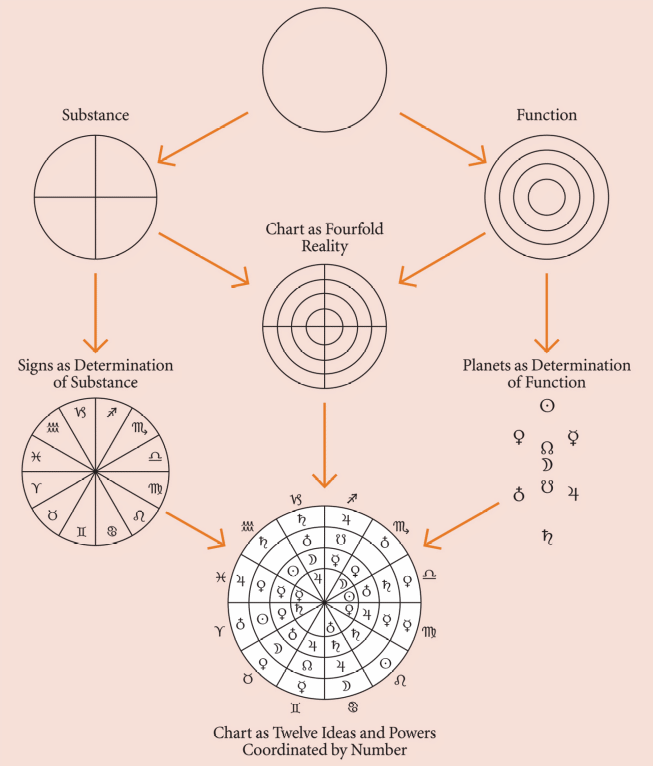
[Note: See FIGURE 1982 0326e-1, Construction of Metaphysical Chart, appended to this paper for the following. This diagram is from Astronoesis, p. 317.]
If we take a circle and divide it into four quadrants and label these quadrants successively 1, 2, 3, and 4, we will generate a simple static representation of the meaning of this passage. The first quadrant will stand for the One, second for the Intellectual-Principle, and the third for Soul. The fourth quadrant will represent the system of Nature.
We could also pictorialize this passage by means of four concentric circles, letting the largest ring represent the One as immanent, the second the Intellectual-Principle, which also contains the Separative Intellect, the third Soul, and the fourth the entire system of Nature.
We take the first, the quadrant point of view, as the point of view of substance; the second image, that of the four rings, represents the dynamic or functional point of view. In themselves each of these two extreme points of view is a radical one, the "conflict" between them is concretely illustrated by the crisis that has occurred in Indian philosophy between the substantialism of Vedanta and functionalism of Buddhism. To insist exclusively on either position will lead to an incorrect and unbalanced view. Our method allows us to superimpose two images in such a way as to produce a symbol that contains both points of view, expressing the paradoxical nature of the One and the varying degrees of reality within it.
This foundational diagram gives us a basic symbol that is adequate to begin an approach to one of Plotinus' most important initial premises--the Double Act, at once act and repose--of the One as represented in tractates V.4.2 and VI.8.16. Some of the advantages it affords will be elaborated in the chapter on the One.
To complete our initial introductory correlation of philosophical and astrological schemas we refer to tractate V.1.8. Plotinus there reiterates Plato's position "in the passage where he names as the Primals the Beings gathered about the King of All and establishes a Secondary containing the Secondaries and a Third containing the Tertiaries…" We will associate the Primals with the first quadrant and the King of All about which they are gathered must be sought in the same locus. Similarly the Secondaries are associated with the second quadrant and Tertiaries with the third. The fourth quadrant will be used to represent those lesser agencies at work within the system of Nature.
More precise astrological correspondences to these Primals, Secondaries, and Tertiaries can be provided by filling in the ring structure of the diagram with the rulerships, exaltations, detriments, and falls of the classical astrological wheel. The rulerships are assigned to the outer ring, exaltations to the second, detriments to the third, and falls to the inner. Those dignities that fall within the first quadrant correspond to the Primals, those found within the second correspond with the Secondaries, those in the third quadrant correspond with the Tertiaries. We now have at our disposal a chart that tries to illustrate the principles that are "constitutive" of the One and its divine outflowings.
[Paper as read by AS in WG Class 1982 0326a Ends]
1982 03/26e V09M: PAPER: Astronoesis; Introduction. Copyright 2022 Wisdom's Goldenrod p. iii