APPENDIX: 1982 0510 PARTIAL TRANSCRIPT
May 10, 1982 Freud
[Note: Sabian degrees are from Marc Edmund Jones, The Astrology of Concepts.]
Q: What is the continuing identity of the individual? How is it expressed in the natal chart?
--Planetary functions (Sun Moon Mercury Venus Mars Jupiter Saturn) in natal chart represent powers of the soul.
--360° represent Reason-Principles or the Ideas as reflected in matter.
--The combination (Pattern) of these 7 soul powers associated with specific degrees represent the continuing identity of the individual.
--i.e. the degrees (reason-principles) are organizing planetary functioning in a specific way and through this the native comes to understand these reason-principles.
Elaboration of the above premises along with the notion of the Ruler of the first house (and all planets within a 7° aspect to the ruler of the 1st) as the self-identity of the individual.
Example: Freud's chart
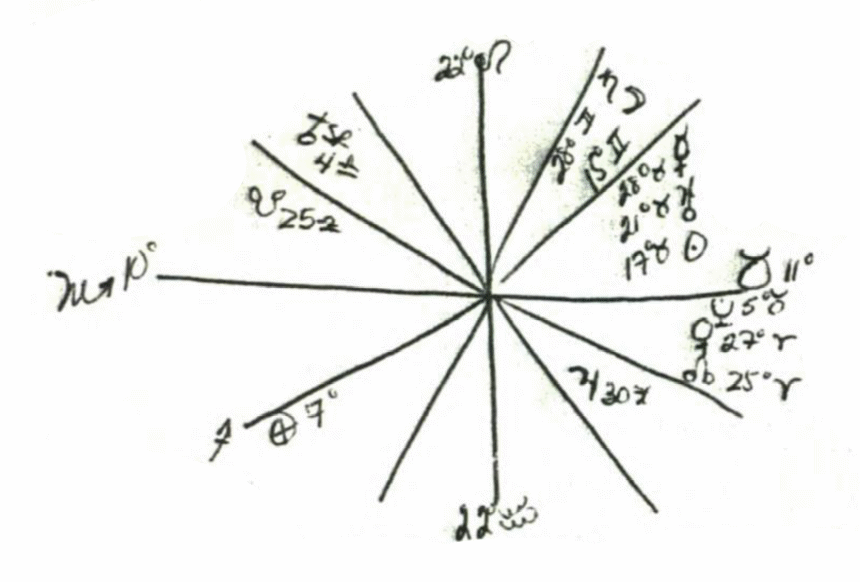
[FIGURE 1982 0510a-1. Sigmund Freud Natal Chart with 10° Scorpio Ascendant and 7° Sagittarius Part of Fortune. Facsimile scan from 1982 0510-04R07.PDF. Note: This chart mistakenly has 10° Scorpio Ascendant; it should be 11° Scorpio to match the Descendant at 11° Taurus.]
Mars is on cusp of 1st, Mars rules Scorpio; Mars in 11th house in Libra, i.e., Freud's identity was most aligned with this function.
Sabian symbol: 4° Libra -- A group of students of higher truth in summer conference are seated about a campfire in unconscious meditation.
Mars in Libra -- kama rupa -- this seems to be the cornerstone of Freud's psychology -- he reduced all instincts, desires and behavior to the level of body, specifically the sexual instinct.
Aspect[s] to Mars
Mars quincunx Pluto 2°
Pluto symbol: A youthful widow fresh and soul-cleansed from grief, kneels at a grave to receive the secret of eternal life.
Anthony: If this degree were favorably aspected he might have had an insight into the secret of life, but with the quincunx to Mars (quincunx denotes a strain of some kind) this was not the case. He was sidetracked by the Mars function and his obsession became the animal soul.
Preoccupation with death---tape unclear.
Reaffirmation of this libido as manifesting through instincts of life and death---tape unclear again.
Jupiter opposite Mars 4°
Jupiter symbol: Nathanial Hawthorne's conception of the Great Stone Face has been brought to fruition in a huge mountain carving.
Tape unclear.
Anthony: Jupiter represents instincts, instincts brought to fruition. There is a distinction made between Mars which provided the energy to operate the instincts and the instincts themselves (Jupiter). There is wisdom inherent in the instincts (though it is corporeal and not human wisdom) if left alone.
Anthony: The Jupiter obviously was not left alone due to the Mars opposition. Tape unclear… Freud's position is that a civilization exemplifies various levels of functioning at the lower instinctual level. He denies that the instincts correlate to higher levels of functioning. The Mars opposition does not permit him to see a higher meaning in this.
Linda: With this opposition there is an urge toward grasping the whole but the Mars (as principle of separation) constantly undermines the attempts of Jupiter to do this. Therefore a tendency towards grasping the principle is denied with this opposition.
Tim: Mars focuses on one instinct out of a multitude in Jupiter and tries to make a totality out of this one instinct, in this case the kama rupa. There is a tendency towards reductionism.
Anthony: Freud was so identified with his idea of all tendencies and behavior as body-based that he couldn't accept any revision or amplification of these ideas. When this occurred he would break with the person who did this and project the shadow.
Mars as shadow vs. Jupiter as hierophant -- he could not accept a teacher.
Anthony: Mars selected one instinct -- sexuality -- was assimilated by Mars in Libra (kama rupa), was identified with it and so turned it into a dogma, made a monument out of it (Great Stone Face -- 30° Pisces).
Tape unclear
Anthony: Mars in Libra -- the desire for the animal to continue in its existence. This will to live is identified with one instinct through the opposition to Jupiter and refutes the rest (of the instincts).
Tim in answer to a question about Jupiter being the instincts: The context of Jupiter as instincts are functioning of the planets with respect to the individual psyche. The perpetuity of the psyche provided by the nature of the instincts. What's going to unfold and grow from this point of view (Jupiter as auric envelope) is the wisdom inherent in the corporeality of the body.
Instincts have an intentionality -- a forward motion.
They can represent different levels, although for Freud this was not the case.
Q: Jeff -- Tendencies are built into psychosomatic organism's structure and Moon would be the basic organizer of these tendencies -- why wouldn't the Moon represent instincts?
Anthony: No, the Moon represents the receptacle of all the soul powers, not only the instincts. Physiological functioning is not identical with instinctual functioning. Instincts are not the totality of all physiological life, but are subsumed under it. Example: Process of formation of the sperm is a physiological function, it is not the sexual instinct -- it can be thought of as contributing to the arisal of this instinct.
Instinct can be conceived of as self-expression (corporealization of instinct as self-expression) or motivation.
Anthony: Body's deliverance of an image of instinctual occurrence produces motivation.
Q: Richard G. -- How can we understand Jupiter as the archetype of hierophant and relate this conception to Jupiter as the instincts?
Anthony: When one is aware of the knowledge that the instincts are trying to convey… Tape unclear.
Instincts are manifestation of the six forces (Jupiter in Virgo, i.e., as coming from the soul). They are elevated to their true origins as person refines himself tape unclear…
Instincts are lowest octave of the six forces.
Aspects to the Mars opposite Jupiter -- Saturn square Mars, Saturn square Jupiter
Saturn 28° Gemini
Sabian symbol: A man [is] leaving a courtroom with mixed feeling of relief and determination; he has just passed through bankruptcy.
Due to the Saturn squaring the Mars-Jupiter opposition, his identification with the sexual nature was not lived out physically, but in his theories. However, it is interesting to note that due to the effect of his theories on others they were forced to live it out. This is exemplified by the consequent breakdown of morality in the 20th century.
Q: On the meaning of 28° symbol.
Anthony: To Freud, the ego was nothing more than the development of stages of the sexual libido. His conception of it was cut off from any elevated notion -- when it was projected on others it was even more devalued.
Ego as phantasm of instinctual functioning. This is like a death because the ego's inner value is nullified. The Saturn in the eighth house indicated that this notion of the ego was coming from his past.
Tim: The square to Saturn might indicate that a bankrupt ego is viewed as a manifestation of the animal soul. (The square has been viewed as an aspect of manifestation.)
Tim: This Saturn, Jupiter, Mars configuration has been spoken of as the lower part of the soul -- Freud seems to have been identified with this configuration in his chart and his theories bear this out.
Q: Why did Freud become so popular?
He was attached to the personal unconscious and saw them (contents of it) as having a universal scope. Insofar as the contents were collective, they have an efficacy for popularity. (He was only interested in contents that were meaningful for him.)
Anthony: There was an unconscious identification with the animal soul -- this was universalized into his "philosophic scheme". If degree meaning structures planetary functioning then Mars on 4° Libra indicates an element of unawareness (unconscious meditation). I.e., he was unconscious of the fact that his identification was with personal unconscious -- animal soul -- sexual nature -- etc. and this was projected and universalized as a feeling of psychology.
Q: Are the progressed planets an elaboration of the natal reason-principles -- i.e., does the identity of the individual change as planets progress?
Anthony: Progressions are not incorporated into the structure of the identity -- it remains constant throughout life. Natal chart remains the identity.
Started Freud's Saturn Progressions --
[File 1982 0510-04R07.PDF Ends]
CHART FOR 1982 0510a
Class
Monday, May 10th, 1982
Verbatim, unedited transcriptClick the series name to view more
CLASS at Wisdom's Goldenrod, Hector, NY
with Anthony Damiani (AD)
May 10a, 1982
ASTROLOGY; HOROSCOPE-FREUD
with Appendix: 1982 0510 Partial Transcript.
TOPIC: Astrology
SUBJECT: Horoscope-Freud
SUBSUBJECTS: Native's Identity, Freud Mars and its aspects, Jupiter as Instincts, Six Forces of Nature, Freud Jupiter-Mars opposition, Freud Saturn (and its t-square to Jupiter-Mars opposition), Progressions
CONTENTS:
Distinguishing physiological processes and instincts (Jupiter): example: sperm formation vs. sexual instinct
Jupiter (instinct): as self-expression; as motivation; as hierophant
Instincts as embodiment of six forces of Nature
Aspects to Freud's Jupiter-Mars opposition
Jupiter opposite Mars: reductive view of instincts; notion of repression; inability to grasp the whole
Appendix: Partial Transcript
Native's identity as pattern of planets (soul powers) organized by degrees (ideas); as ruler of first house
Analysis of Freud's chart
Mars as Freud's primary identity
Mars in Libra (4): kama rupa; cornerstone of Freud's psychology; reduction of instincts to bodily/sexual level
Mars quincunx Pluto (Taurus 5): unfavorable aspect prevented insight into life's secrets, led to preoccupation with animal soul
Mars opposite Jupiter (Pisces 30)
1) Jupiter at Pisces 30: instincts brought to fruition
2) Mars as energy for instincts, Jupiter as instincts; non-human wisdom in instincts if left alone
3) inability to see higher meaning in instinctual functioning; inability to grasp principle; identified with idea of all tendencies/behavior as body-based; turned sex into dogma; couldn't accept teacher
Mars in Libra: animal's desire to continue its existence
Moon as receptacle of all soul powers, Jupiter as instincts; physiological functioning not identical with instinctual functioning
Jupiter as self-expression, as motivation; motivation as body's deliverance of an image of instinctual occurrence
Jupiter as hierophant: one is aware of the knowledge that the instincts are trying to convey
Instincts as embodiment of six forces of Nature
Saturn (Gemini 28) square Mars-Jupiter opposition: 1) theories lived out mentally rather than physically; 2) influenced 20th-century moral breakdown; 3) ego nothing more than stages of libido development; ego as phantasm of instinctual functioning
Saturn's eighth house placement indicates notion of ego coming from past
Reason for Freud's popularity: unconscious identification with animal soul which got projected and universalized as a feeling of psychology
Natal chart remains constant identity structure throughout life, not altered by progressions
BOOKS READ FROM OR REFERENCED:
- Marc Edmund Jones, The Astrology of Concepts
SABIAN SYMBOLS: Taurus 5, Gemini 28, Libra 4, Pisces 30
CHARTS appended to this transcript:
FIGURE 1982 0510a-1. Sigmund Freud Natal Chart with 10° Scorpio Ascendant and 7° Sagittarius Part of Fortune. [Note: See note below about mistaken Ascendant.]
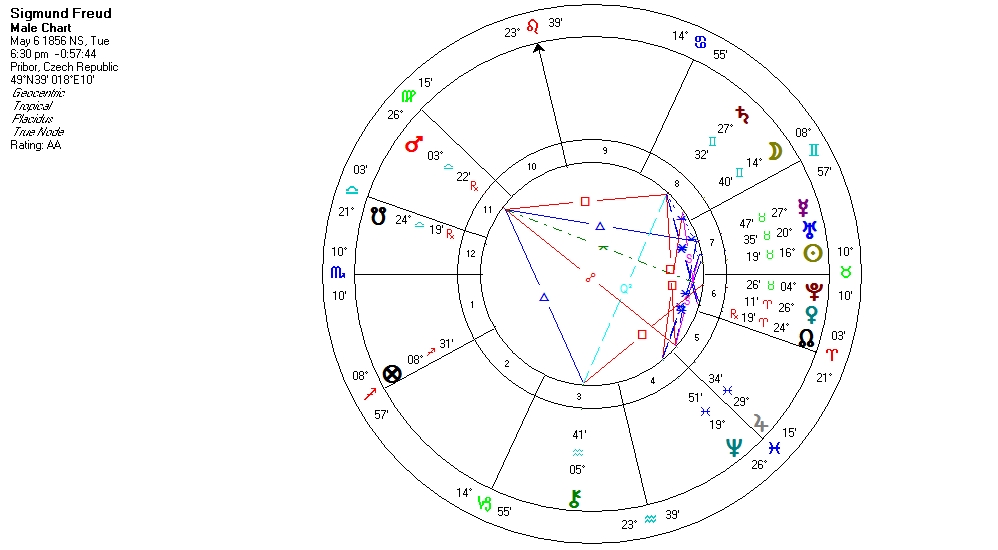
FIGURE 1982 0510a-2. Sigmund Freud Natal Chart with 11° Scorpio Ascendant and 9° Sagittarius Part of Fortune.
Other diagrams also referred to are not with this transcript version. [Note: [diagram] means the speaker is referencing a diagram as he or she is speaking.]
NOTES:
This is 1982 05/10a, Astrology; Horoscope-Freud Class, and the first entry associated with this date. 1982 05/10b = Plotinus: One Seminar, for which we have no audio files or scans, just JF notes.
This 21+ minute fragment on Freud is found on Side 2 of Audio File 1982 0521b (begins at 1:13:06:0) and is the only known audio for this class to date. This fragment is from somewhere in the middle of the class. We are missing the beginning and end of the class.
Scan File 1982 0510-04R07.PDF, the partial transcript for this class, has been appended for context and completeness. Spelling, capitalization, punctuation corrected, all abbreviations and astrological glyphs (except for degree) spelled out in appended partial transcript.
Anthony is Anthony Damiani (AD) in the appended partial transcript.
Also appended is the official birth chart for Freud, to complement the one in the partial transcript. The natal chart in the partial transcript mistakenly has 10° Scorpio Ascendant; it should be 11° Scorpio to match the Descendant at 11° Taurus.
TRANSCRIBED Verbatim by IT 2022. In 2025, IT updates audio file markers to match new REP audio. Archival verbatim transcript – V11a.
AUDIO FILES: 1982 0510a (formerly 1982 0521b). [Note 1: "Tape" refers to the original audio cassette tapes that were digitized to create the .MP3 files. Note 2: The sound quality is not great. Note 3: In 2024, REP Studio separates off Audio File 1982 0510a from Audio File 1982 0521b and tries to improve the sound quality.]
1982 05/10a at Wisdom's Goldenrod
Astrology; Horoscope-Freud
[Audio File 1982 0510a (formerly 1982 0521b) Begins]
JC: --not a-- an instinct per se, I mean the words we have are (instinctive or) [one word inaudible]
AD (faint): (Push me.)
S: (Right/Yeah).
JC: I would think that that fragment or process of bodily-- the body maintaining itself could be conceived of as something--
AD (simultaneously) Would you say the instincts-- now look, sexuality is a-- is an instinct.
JC: Uh-hm.
AD: Would you say the formation of the sperm in the body is an instinct?
S (very faint): Uh-hm.
RC (very faint) Even if it--
AD: Huh?
RC (faint) Even if it is [one/two words inaudible]
S: Yeah.
AD (simultaneously): No.
S (faint): That would--
S (simultaneously): No.
S: No.
JC (simultaneously): Would instinct organize [S simultaneously, very faint: No.] that process?
S (faint): No.
AD: Oh no.
S (faint): No.
BS: The instincts are a result of that?
S (faint): Sometimes Bert.
AD: The same thing. The way the body goes around-- all the processes that are involved to produce the sperm or the ovum, alright, is one thing. The instinct for sexuality is something quite different than that. (bit of laughter)
S (faint): Yeah but aren't they derived-- [LR simultaneously: Otherwise-- (LR laughs)] I think that they derive partially--
S: Well--
S: That's good.
JC: I mean the reproductive systems--
AD: I think basically that what we're-- what we're doing here unconsciously is thinking of ins-- the instincts as the totality of all physiological life in him.
S (faint): Uh-hm.
S (very faint): I don't think so.
S (faint): What?
S: No.
AD: There's only six.
S (simultaneously): (Dignity.)
S (very faint): Well--
S: Go on.
AD (simultaneously): You know how many processes are going on in the body at one time?
S: Ok. Go ahead.
JC (simultaneously): But we've broken-- you can break up the body into six or seven systems, [AS simultaneously, faint: I think--] right? And your body [AS simultaneously: Six.] (is moving) back to them. (But) there's-- there's a certain [S simultaneously: Well--] number of systems that are present, and you don't think that the reproductive system is also-- the intelligence present in the reproductive system is also in charge of the manufacturing of the sperm and the ovum?
LR (simultaneously): But we're not talking about the system.
JC: But I'm calling that an instinct, [LR: And what-- and he's not.] and the reproductive-- [S: That's right.] and whatever that intelligence--
LR (simultaneously): He's not calling the whole system the instinct.
AS (simultaneously): No, he's just-- he's talking about the embodiment of the-- he's talking about in-- the presence of the six forces in-- that's what he means by instinct.
S: Start with Jupiter [LR simultaneously: Exactly.] (and put) Virgo.
AS: Yeah. [S simultaneously: And you would put greater--] And if you reflect (through) that Jupiter in Virgo into Pisces [diagram] then--
S: (So let's call) that instincts.
JC (simultaneously): But I'm saying that in-- in the body, [AS simultaneously: That--] the reflection [AS simultaneously: No not in the body.] of that in the [one word inaudible]
TS (simultaneously): Why not understand an instinct that way? [RG simultaneously: Ok.] Why not go that way?
RG: If you explain it that way, then I follow.
AD (simultaneously): Ok, then let's stop. Your name for Jupiter.
RG: I don't have one.
TS: Uh-hm.
LR: Well then--
S: I just, I'm--
AB (simultaneously): Don't-- don't we call it self-expression? And isn't that really analogous to the way we're saying instinct is the-- that-- the way you express yourself is through these different instinctual activities? You don't express yourself through [few words inaudible]
AD (simultaneously): In other words you're saying that these instincts ins-- insofar that they corporealize themselves, it's the way you manipulate this-- the-- or self-corporealization of the instinct as self-expression, the way you manipulate those. Alright. But I still say let's stop, you give us your definition of Jupiter.
JC: I'd call it motivation.
S: Right.
AD (simultaneously): Well what's the difference? (bit of laughter) What's the difference?
S: You don't understand it. (some laughter, student words)
S: No, I'm sorry, I don't.
RG (simultaneously): Tim, I can-- I can see it that way.
[few student words in background]
AD (simultaneously): Well as a matter of fact, you've done a better job than we did.
RC: Yeah that was--
LR: That's exa-- yeah.
S (very faint): Herbie was [few words inaudible]
S (simultaneously, faint): Then let's hear it.
S: Yeah.
JC (simultaneously): Motivation [S simultaneously: The whole thing?] does not-- You may be motivated. Maybe--
AS (simultaneously): Enthusiasm? Sometimes they call it enthusiasm.
JC (simultaneously): Ok.
S (simultaneously): Yeah?
S: (And) intuitive.
JC (simultaneously): Ok.
S: [few words inaudible]
JC/S(?): Well--
[students assent, faint]
JC: Yes, I mean--
AD: How do you get motivated?
AB/S(?) (faint): I just am.
AD: What do you do when you get motivated?
JC (simultaneously): Well, I know you're saying I get hungry and that motivates me (to) go get food.
AD: Well, when you get hungry what happens? [S, very faint: I sweat.] The body delivers an image of that instinctual occurrence, [JC assents] activity. [student assents, faint] Now you're motivated.
S (very faint): (Yeah.)
S (very faint): Yeah.
JC: Except-- [student assents, faint] Yeah, the body delivers an image of that-- the [one word inaudible]
AD: If you think the body can't talk to you, you're deaf.
JC (simultaneously): It says, you know, there's a problem here, (laughter) you know, that needs solving.
AD: Now, now we're getting to what instinct is.
JC: Yeah, yeah.
S: Ok.
AS: Sure.
JC: Ok. But I--
AD: Now I have Saturn on Jupiter for a week and believe me, I had no energy. I literally had to drag myself out of bed. With a stupid and weak Mars to boot. (laughter, student words)
BS (faint) Stupid and weak what?
[few seconds of background student talking]
AD: Well anyway, motivation is good Jeff. I like that word too, that's very nice.
JC (faint): But-- (some laughter) ok but they-- they [couple/three words inaudible]
RG (simultaneously): Stand in the idea enough Jeff that--
S (faint): It should be [few words inaudible]
AS (simultaneously): And well--
JC (simultaneously with S above, faint): It's very distinctive with Jupiter in a particular (house).
S (faint): Yeah, right.
RG: So Jeff--
JC (simultaneously): Yeah but, you know, but if-- the motivation is an ex-- I see it more as an expressive-- as expression of the knowledge--
AD (faint): The knowledge of [couple words inaudible]
JC (simultaneously): Unfolding the knowledge that's say within the Sun, the basic core meaning that has to be unfolded into life, Jupiter is their organizer.
AD: No, because purpose-- the Sun could even run counter to that. The Sun could even override the instincts, the central purpose in life will make you deny your instincts.
JC: That's why I think-- that's why I would say motivation as-- you may be-- you may be motivated by your instincts the way you were just countering, and I could see that, but-- When I-- when I look at a-- you know, try to read a chart or look at Jupiter in my own chart, [LR simultaneously: It's conjunct the Sun.] I look for a [one/two words inaudible] of my chart. (laughter, student words)
AD: Ok, you have your own understanding of your chart you're coming from, sure, go ahead.
JC: The Greeks said Jupiter determined one course is better than another, and in that way you could deny your instincts. It goes for whatever is the good of the soul. And that could be a denial of the instinct. But is it-- it's a choice of one thing as being better than the other, and that's what I see as the basic motivation underlying that [one/two words inaudible]
TS (simultaneously): But that's why, see, Jung made that-- insisted on the difference (in) his-- his own understanding. When I use(d) the word 'instinct' I was referring to Jung's definition of instinct which includes in it [JC: The reflective.] re-- the urge to reflect, for example, the urge to be conscious he says is an instinctual drive. One instinctual drive may supersede another instinctual drive according to the particular personality. And that the-- the religious-- the-- the urge to be an ascetic would also be an instinctual drive or compulsion. A person who-- who undertakes an ascetic life, it's-- there's a drive in there which may or may not be one which is deliberate or conscious and--
JC: But this-- this instinct becomes like saying that knowledge is organized in the Intellectual-Principle and all you're going to do is act it out. And if it's going to include every function that the psyche is capable of [one/two words inaudible]
TS (simultaneously): No, he didn't-- no he didn't in-- say it includes every function. For example he said the-- you say if you take the instinct of asceticism or the religious instinct that Jung [JC assents] speaks about. The instinct may be there. You may have a strong compulsion to be interested in religion. But if Mars is not involved, they may not act on that compulsion. A person may feel [JC and other student students assent] a drive, "Oh, it's real important." But what are they doing? Nothing. Well, where's Mars? Ok.
S: A lot of people do that.
TS: Or, they may not understand it, ok, they may do it in a very, you know, very simple way and not in a very intellectual way, supposing the Mercury or Saturn is not aspecting that Jupiter. They may be very strong-- strongly religious, but it might-- might be that they join the March of Dimes, I don't know. (bit of laughter) I mean it's not, you know, a-- (laughter)
JC (amidst laughter): Well if you want to [TS simultaneously: So this--] make Jupiter-- if you wanted to make Jupiter instinct, I would say it's the religious instinct. [TS: No I was--] Because you-- you religiously live out certain meanings that are inherent in-- you know, in your life.
AD (simultaneously): Yeah like-- like eating-- like eating hogs as they're running, you know, that's an instinct, religious instinct for a-- for a fox.
JC: Eating I would put with the Moon.
S (very faint): What'd he say?
S: Well, with the Moon? Yeah, uh-hm.
S (very faint): Yeah.
JC: The-- hunger is a-- the basic lunar function.
TS: I mean, why [few words inaudible]
AD (simultaneously): The Moon is going to be everything, it's gonna [TS simultaneously: Yeah.] be the receptacle of everything. [JC simultaneously: Yeah but--] Even the intellects.
JC (simultaneously): Yes. Yes, but it has to translate them-- the Moon has-- it has basic-- it's basically related to vegetative functioning, it translated everything into that mode. [short pause with background student talking] [few words inaudible]
S: Yeah. (bit of laughter)
S (faint): What'd you say?
BS (faint): What'd you say? (laughter, student words)
AS (amidst laughter): Aren't these-- aren't these gods said to be all in all? You know you're going to see this-- I mean isn't that-- (AS laughing, background student talking)
TS: I mean you could say the libido is involved with instinct, or you gotta have all [AS assents] six to understand all six other planets, understand them.
JC (simultaneously): Well there's conveniently six instincts, maybe they correlate in some way with (the other planets).
AS (simultaneously): With the other planet(s). Jeff?
JC: What?
AS (faint): Because the other planets (would be).
JC: I mean Jupiter is commonly related to the Moon so, I mean there might be (an inference) the person holds as a-- an ideal goal or as something to strive for [one/two words inaudible]
TS (simultaneously): I-- Jupiter in dignity is [one/two words inaudible]
AS (simultaneously): Yeah, he's getting that [AD simultaneously, faint: Yeah.] from the Jupiter in dignity.
S (simultaneously): Well, [TS simultaneously: In Sagittarius.] he's got Jupiter in the ninth house.
RG (simultaneously): (Then/And) he will interpret it that way.
TS: No I know 'cause it's in Pi-- Pisces, not Sagittarius. So I'd say that there is that-- he thought of himself as a humanitarian or compassionate but not necessarily religious. The instinct there is-- is one of com-- of trying to be compassionate, trying to be of service to the world and all that but he--
JC: That was his religion [few words inaudible]
TS (simultaneously): No, I don't-- he certainly didn't see that as a religion, he saw it as himself.
JC: Well, [TS simultaneously: And he--] I mean you're calling it religion, he didn't see it as religion, he didn't believe in religion.
TS: No, well he saw that there was religious energy there, I mean Pisces is not Sagittarius. Usually when Pisc-- Sagittarius is taken as the sign of religion, that ninth house, the higher mind, religion. [student assents, faint] Pisces isn't the same as that, I don't think. Think it has to do, you know, with a certain compassion which needs to be brought into the world that's involved with Pisces, a love of Nature, stuff [student assents, very faint] like that. I mean just staying on that simple level. And it's gonna be different in different signs I think.
RG (very faint): Right. That's interesting.
TS: Interesting.
RG: One other question. You called it like the archetype of the hierophant.
TS: Yeah.
RG: How do you relate that to the concept of instinct in other words?
AD: That's when you know what the instincts are telling you (about).
S: Avery?
S: Right.
TS (faint): The teacher or the wisdom. [student assents] The guiding, growing kind of teacher.
AD (simultaneously): Because if you think of the six forces of Nature at the-- as embodied in the flesh, alright, it's like taking them at their lowest octave of operation. As they get escalated, alright, then they work psychically. In other words like, say that the reason-principles are obscured by Mars and as the matter of the organism becomes refined (into form), developed, then those instincts reveal more and more what, you know, their true origin.
S (very faint): Yeah.
JC: And this-- you're saying Jupiter-- because Jupiter is in Virgo in the big chart [diagram], it has something to do with the six forces of Nature? I mean is that correlation from the chart? Or that they're ultimately a wisdom from the Intellectual-Principle.
AD: Well I'm correlating the instincts with the six forces.
LR/S(?) (faint): Six forces, yeah.
AD: They're the manifestation of those six forces at (a) lowest level.
JC: Yeah but of-- we're talking about it because of Jupiter in Virgo.
AD (simultaneously): The Jupiter, yeah [couple words inaudible] yeah.
TS (simultaneously): And the Soul in Virgo [diagram].
JC: Ok. But, couldn't these six forces be seen in some way as an expression of six-- of the Chaldean planets? I mean--
AD: Sure, every planet [AS simultaneously, faint: Every, yeah.] is an expression [S simultaneously: Yeah.] of all the other six.
S (faint): What did he say?
JC: Ok.
AD: Oh, that goes without saying, all the gods are in each and each are in all. But that's not going to help us now. I'm-- I've got to read very specifically the chart of a man, alright, who's written a sum of twenty volumes. And in these volumes he's prescribing what is a cure for us.
S (simultaneously, very faint): Right.
S (very faint): Right.
S: Yeah.
JC: Oh I see what you're saying. So you're saying the other six are present in Jupiter, six are present in [one word inaudible]
AD (simultaneously): In other words, he's telling me what these six instinctual energies are all about. And I'm going to look at the chart and say, alright, that may be so, Jupiter in Pisces, alright. But there's that Mars in opposition to it, [student assents, faint] which is going to be equally expressed. Those two are going to be equally expressed in the psyche. What kind of aspects does the Jupiter have? I mean besides the opposition.
TS (simultaneously): He had a sextile--
AD: Huh?
TS: What? Its closest aspect is sextile the Mercury in Taurus. It's also square Saturn. And it has a wide-- well you don't like this. So that would be it coming from the chart because you--
S: Uh-hm.
AD: The square to Saturn is how [one word inaudible]
TS: Three. [student assents, very faint] It's--
AD: What is the Saturn symbol?
[short pause]
TS: 28 Gemini.
S (very faint): Uh-hm.
LR: Wait.
AD: And Saturn squares-- and it's conjunct the Moon?
S (faint): Uh-hm.
TS: Saturn is [S simultaneously, faint: No.] conjunct the Moon wide, 13 degrees, it's real wide. But it's square Mars.
AS (simultaneously): [couple/three words inaudible] the Mar-- square (the/to) Mars.
S (very faint): Yeah.
S (faint): [few words inaudible]
S (simultaneously): It's exactly [one word inaudible]
TS (simultaneously): No, it's close [AS assents, faint] square to--
S (very faint): Really?
AS: Well six-- six degrees, six--
S: Yeah.
RG (simultaneously): Right.
S: Yeah, go ahead.
RG: Yeah, it's a t-square, yeah.
TS: The t-square to Mars.
BS (faint): I'm sorry?
AD: What was that symbol?
TS: Um--
Marc Edmund Jones [The Astrology of Concepts, Gemini 28, TS reading]: "A man is leaving a courtroom with mixed feelings of relief and determination; he has just passed through bankruptcy."
[students assent, faint]
[short pause]
AD: Let's hold that in the back of our mind and let's go back to that other one, the Jupiter-- Jupiter opposite Mars. How would you interpret that then? I remember you saying that the Mars, that that's his self-identity. Alright, now how would you interpret it? The Jupiter is opposite of Mars.
RC (very faint): Well, part of him [one/two words inaudible] is that he-- I think he's saying that [couple words inaudible] If-- if you withhold the, you know [few words inaudible] that will give rise to [few words inaudible] call the identity (of this) individual and his instinctual [one/two words inaudible] But all you've got is what he (called the) [few words inaudible] natural [one word inaudible]
AD (faint): You want to repeat that Randy, again?
RC (faint): It seems that [couple words inaudible] that all the stuff that we call culture [one word inaudible] and so on (forces) [one/two words inaudible]
AD (simultaneously): Are manifestation of the various grades of [RC assents, very faint] the functioning of the instinct.
RC (faint): Yeah, it's really just a building up (of that) within the reflective consciousness.
LR: Saturn functions?
S (very faint): Yeah.
RC (faint): I mean, it brings into the reflective consciousness the images, dreams, higher values [few words inaudible]
AD (simultaneously): Well, we can leave out the reflective consciousness because that's one of the instincts too. Let's go over this. He's saying that a civilization or a culture is a manifestation of the various stages or levels on which instinct is-- is functioning. So, if in the-- in the process of growth, the explanation that he gave about the anal retention stage which leads to miserliness. Of course it doesn't lead to the fact that from a philosophic and impersonal point of view nothing should be wasted. It-- it doesn't lead to that, right?
AS: Not in his-- [couple inaudible student words simultaneous with AS] not in his (theory).
AD (simultaneously): No, not in his theory.
AB (simultaneously): But his theory was reductive. [student assents, faint] That's what Randy's saying, is what we would say [AD, faint: Yeah, go ahead.] would be higher impulses he was saying, well, it's really just a transformation and (the state) beneath [one/two words inaudible]
RG/S(?): Yeah, but what does that have to do with the opposition?
AD: Well, no, we're just doing the Jupiter now. Alright, so, that's the way that Jupiter should express itself in his chart.
RC (faint): Yeah, but that would tie in with the opposition (of/to) those (transits). Even if the libido was [couple words inaudible] of normal instinctual expression, the nature of the opposition is that this libido does not-- does not cooperate with either the-- with that [couple words inaudible] So as a result of the libido being withheld, I mean, [S: Is that right?] (functional) imagery or [couple/three words inaudible] (levels) arises in reflective consciousness. It isn't just like-- Again, all-- all you'll find reflective consciousness [one/two words inaudible] and so on [few words inaudible] libido.
RG: Yeah but Randy, aren't you interpreting from the point of Saturn now and not from the Mars Jupiter opposition [RC simultaneously: Yeah before, yeah.] when you talked about bringing the reflective consciousness?
RC: The removing of the libido from the (instinctive) part would be the opposition.
RG: No, not that opposition. [student assents, faint] From the square to Saturn that it's [couple words inaudible] (I think). I think it's that opposition that gave him the-- the flexibility to do that, to let the libido unfold.
AB: But wouldn't you say it's an opposition that a lot of times you flip back and forth between one and the other, you know--
AD (faint): Yeah.
S: Uh-hm.
AB: So like his whole concept of repression, you know, all this libidinal energy is going into repressing the instincts. And then you get thrown back into the instincts (and/when) they get expressed, you know, and [couple/three words inaudible] Then you repress them, I mean, would you say that that's that opposition just in terms of his theoretical position?
AD: Well then you're suggesting that the notion of repression that came up in his writings was due to that opposition.
AB: Right.
JC: I'd say that the Saturn square is repressing.
S: Yeah.
S: Can't.
LR: There's [JC simultaneously, faint: Right, I mean--] something in a Mars--
AD: Did you-- you know people with a Saturn square Jupiter?
S (very faint): Yeah.
AD: And what would you say typifies, or what is characteristic of that square? You say repression? [student assents, faint] Or would you say that they are eternally manifesting discontent?
JC: Yeah. It is dissatisfaction [couple/three words inaudible] the Saturn. [few words inaudible]
AS (simultaneously): Not repression. There's nothing [couple words inaudible]
AD (simultaneously): There's nothing repressed about that.
JC: The Saturn square Mars.
S (faint): Not going to repress [couple words inaudible]
AS (simultaneously): Then Ri-- Richard, what-- what did you talk-- what did you just talk about Randy's [couple/three words inaudible] I mean in terms of the opposition there, in terms of the blockage of the libido and so on, a rechanneling, I mean that seemed to be a, you know [few words inaudible]
RG (simultaneously): Yes, but I think (it's a) function of Saturn and not the Jupiter.
TS (simultaneously): Well let's understand the Mars Jupiter. Well do you understand the Mars Jupiter? What do you understand that to be then?
RG (simultaneously): I know, I'm trying to. What do you think that [three/few words inaudible]
LR (simultaneously with TS): Well let me s--
S (simultaneously): (Explain/Between) that.
S: Yeah.
LR: I've-- I've seen a lot-- when I've looked at Mars Jupiter oppositions, the-- the main-- the over-- and I'm being very-- well--
AS: Dickie, you have Mars in rulership too.
RG (faint): Well, you need Jupiter on it.
LR: Go ahead.
RG: Go ahead.
LR: That there seems to-- one thing that seems to be a problem with those two planets in opposition is the grasping of a whole idea, the formulating of a whole-- [S, faint: Ok.] It's like the urge is to grasp it through Jupiter to get the whole, the entirety of the thing, and the Mars won't let it happen, and there's almost a self-- self-hindrance towards getting the whole idea and it's-- it's completely splintered all the time. Yet, those two planets operate together in that way in the opposition, I-- I think. So, the grasping of an idea that would be Jupiter is splintered into so many different, you know, is interpreted by the Mars, it's never allowed to become-- unfold as a religious-- it's never-- that's it, it's never allowed to become a principle. I mean why not say that the inner fixation comes from a certain stinginess of the nature rather than vice versa, you know, I mean, what criterion of his is saying it's the o-- the one is the principle? And I think that's the interaction of the Mars and Jupiter, that-- that the-- the tendency towards the more whole or the more principial thing is constantly denied by the Mars and split up into so many [TS: Yeah, another way to--] lower fla--
[Audio File 1982 0510a (formerly 1982 0521b) Ends]
1982 05/10a V11a: CLASS: Astrology; Horoscope-Freud. Copyright 2022 Wisdom's Goldenrod p. iii