DIAGRAMS AND CHARTS FOR 1982 0517a
Class
Monday, May 17th, 1982
Verbatim, unedited transcriptClick the series name to view more
CLASS at Wisdom's Goldenrod, Hector, NY
with Anthony Damiani (AD)
May 17a, 1982
ASTROLOGY; HOROSCOPE-FREUD
TOPIC: Astrology
SUBJECT: Horoscope-Freud
SUBSUBJECTS: Natal chart principles, "The Astrological Mandala" paper, Freud natal chart, transits
CONTENTS:
PB quote on East-West philosophy (V8, 12:2.186)
Review of previous session's concepts: aspect pattern representing the native; trans-Saturnians as higher soul working on lower soul (Chaldeans); degrees representing intelligence/Nous
Houses as projection of soul's perceived world
Two-stage process: projection and re-assimilation
Compulsive nature of houses/circumstances; connection to sensible world through breath/birth
Reading and discussion of Anthony Damiani's paper, "The Astrological Mandala": soul projection and assimilation process; physical reason-principles; identity of knowing and being
Aspects as "imprinted" on soul at birth; organize psyche with compulsive functioning
Freud's chart analysis: isolating Chaldean planets and their aspect patterns; discussion of aspects by orb strength; Mars and Jupiter as dominant planets
Venus (27 Aries, 6th house) sextile Saturn (28 Gemini, 8th house): compensation for past devaluation of feeling function; once feeling function developed, helps define Saturn
Reading chart before projection
Mercury (28 Taurus, 7th house) sextile Jupiter (30 Pisces, 5th house): development from teacher relationships, body-focused insights
Mars activation: eventually attacking/rejecting the teacher; can't interpret Mercury without considering Mars-Jupiter opposition
Mars opposite Jupiter square Saturn (t-square configuration):
1) Jupiter at 30 Pisces: fixed conception of instincts; primitive notion of instinctual wisdom; desire for inertia; death instinct
2) Mars at 4 Libra: unconscious manipulation by libidinal forces; libidinal urge, life instinct
3) Saturn at 28 Gemini: insufficient ego structure; constant need to reaffirm value; dogmatism: extreme positions due to insecurity
4) Neurotic tension between life and death instincts; ego arising from this conflict
Unaspected Sun (17 Taurus, 7th house): fundamental choice between might and enlightenment; unaspected Sun gives freedom to choose
Philosophy rejection quotes (from Giovanni Costigan biography); Freud's statements show conscious choice of materialism over spirituality
Tchaikovsky: same Sun degree, expressed conflict in music; Brahms: same Sun degree, continued struggling for good until death
Freud wants to be the prophet for a new Judaism; possible messianic complex throughout life
Battle degree crucial when you find it in a chart; conflict continues to very end, but some choose enlightenment side
Trans-Saturnian transits to natal chart:
Uranus conjunct Mercury (age 1): younger brother died; broke his jaw
Neptune conjunct Jupiter, Uranus conjunct Moon (age 5): first year in Vienna
Pluto conjunct Sun (age 12): intense language studies; evidence of learned past life; involved in mystical past
Neptune conjunct Head (25 Aries) (age 16): return to birthplace; rendered speechless by girl; refused family business involvement
Opportunity to undo past harm and make amends; could have chosen conventional/collective life
Neptune conjunct Venus (age 17): inspired to become doctor
Pluto conjunct Uranus: World Fair visit, enamored of America
Neptune conjunct Pluto (age 20): nerve cell research
Pluto conjunct Mercury (age 24): investigation of nerve cells of crayfish
Neptune conjunct Sun (age 25): research professorship choice
Uranus opposite Neptune, Neptune conjunct Uranus: went into psychiatry; Uranus opposite Neptune always indicates a spiritual crisis
Uranus conjunct Mars: Paris, studying with Charcot
Neptune conjunct Mercury: hypnosis and private practice; Neptune on Mercury always shows an interest in other states of consciousness
Uranus conjunct Tail (age 33): rejection of Meynert, championing hypnosis
Neptune conjunct Moon: free association, infantile sexuality, Anna O. paper
Pluto conjunct Moon: began self-analysis; recognized that fantasies have meaning; got into the astral
Neptune conjunct Saturn: broke with Fliess; withdrawal of projected transference created ego inflation
Pluto conjunct Saturn: broke with Adler; most bitter of all his rejections
Uranus conjunct Neptune: movement breakdown; worldwide fame
Uranus conjunct Jupiter: Dostoyevsky analysis; celebrity visitors; worldwide acknowledgment of his work
Uranus conjunct Head: Ferenczi's madness/death
Uranus conjunct Venus: rejected by followers; wrote statements on religion and philosophy that expressed his materialistic values
Uranus conjunct Sun: forced out of Nazi-occupied Austria; sisters gassed; consequences of his materialistic beliefs were shown to him (Nazism)
Already incorporated into the natal Mars was a decision to serve the lower forces
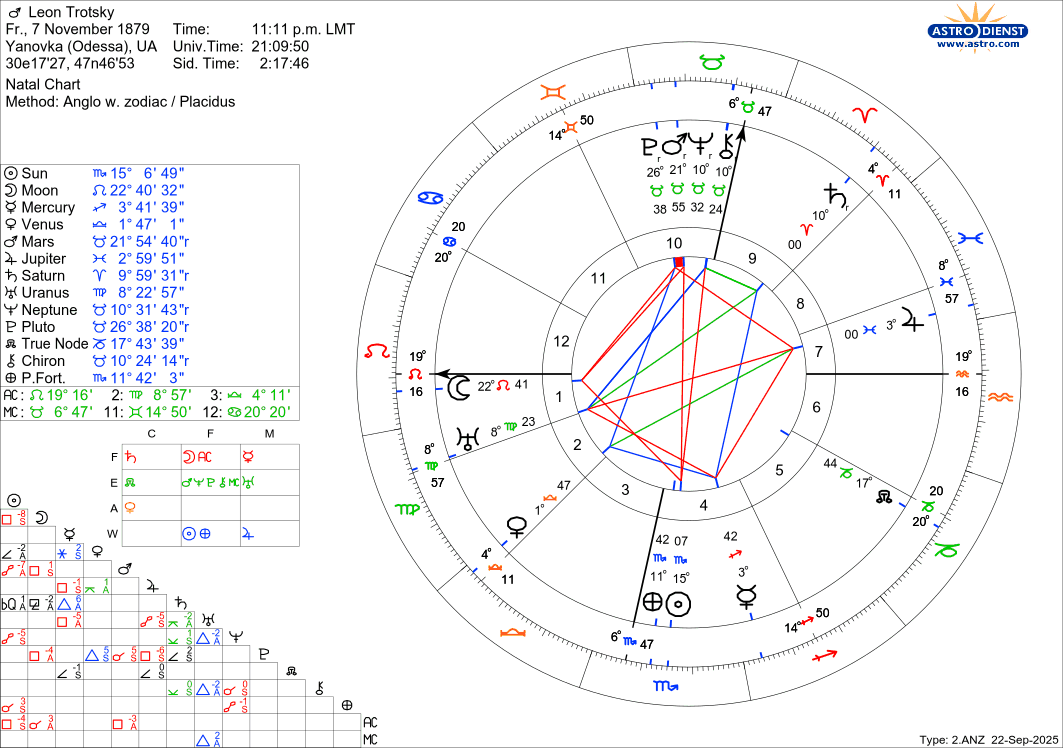
Trotsky: evil incarnation itself; Mars-Pluto conjunction in Taurus, 10th house
BOOKS READ FROM OR REFERENCED:
Paul Brunton, Notebooks
Plotinus, The Enneads (MacKenna translation, 4th ed.)
Robert Pelletier, Planets in Aspect: Understanding Your Inner Dynamics
G.R.S. Mead, The Doctrine of the Subtle Body in Western Tradition
Marc Edmund Jones, The Astrology of Concepts
Marc Edmund Jones, The Sabian Symbols in Astrology
Sigmund Freud, The Interpretation of Dreams
Sigmund Freud, On Dreams
Sigmund Freud, Totem and Taboo: Resemblances Between the Mental Lives of Savages and Neurotics
Georg Christoph Tobler, "Nature"
Sigmund Freud, Civilization and Its Discontents
Giovanni Costigan, Sigmund Freud: A Short Biography
Ernest Jones, The Life and Work of Sigmund Freud, 3 vols.
Ronald William Clark, Freud, the Man and the Cause
Sigmund Freud, Studies on Hysteria
PLOTINUS QUOTES READ OR REFERENCED: V.3.4
SABIAN SYMBOLS: Aries 25, 27, Taurus 17, 21, 23, 27, 28, Gemini 15, 28, Libra 4, Pisces 20, 30
DIAGRAMS and CHARTS appended to this transcript:
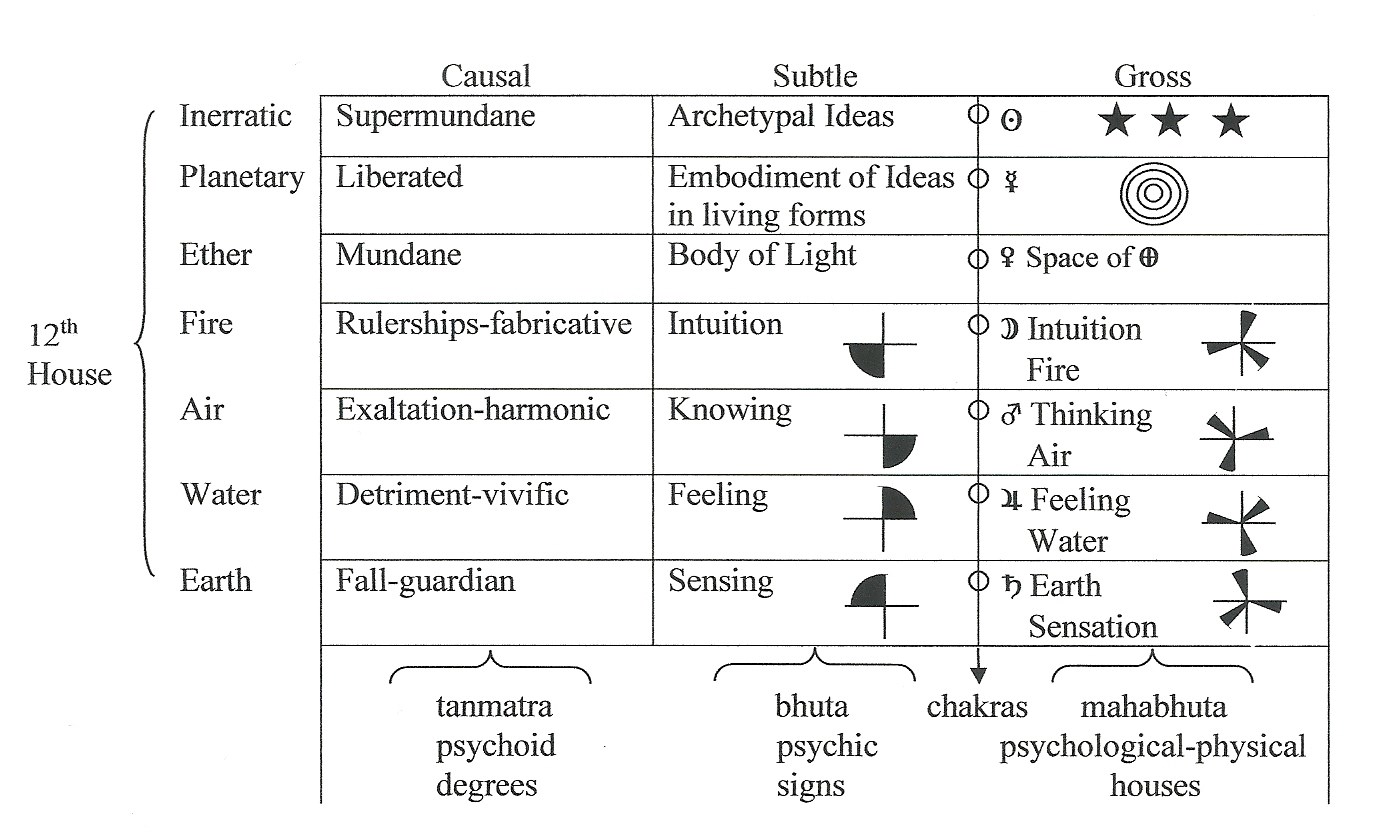
FIGURE 1982 0517a-1. Twelfth House 3 X 7 Diagram.
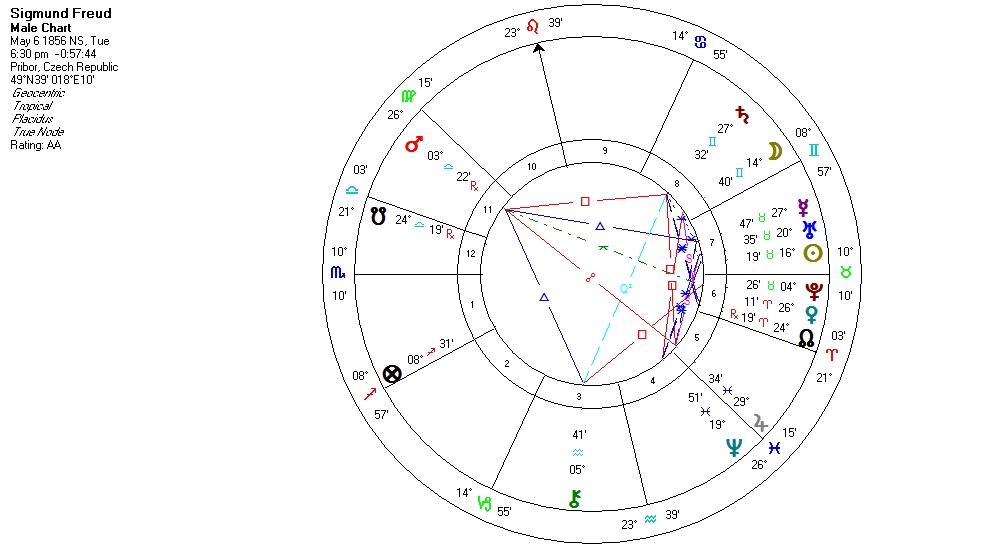
FIGURE 1982 0517a-2. Sigmund Freud Natal Chart.
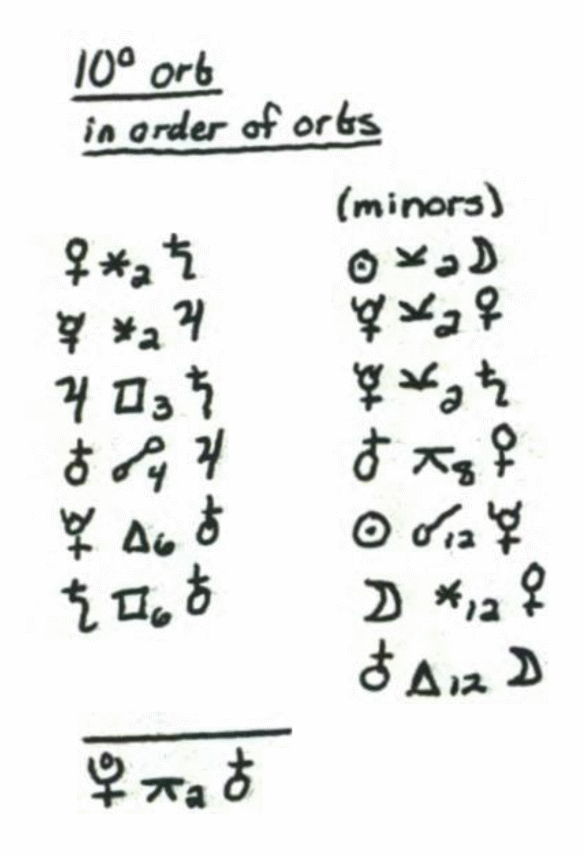
FIGURE 1982 0517a-3. Freud's Chaldean aspects in order of orbs.
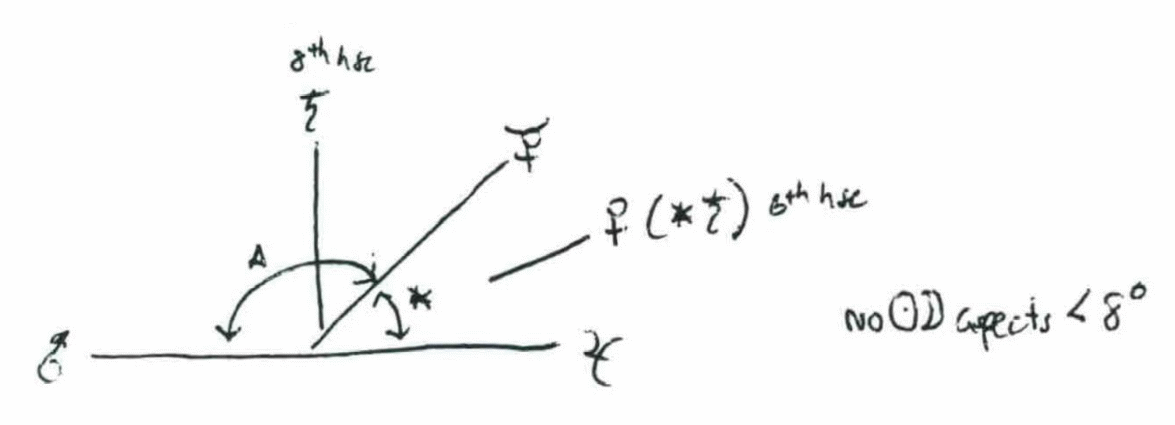
FIGURE 1982 0517a-4-AB. Freud's Jupiter, Venus, Mercury, Saturn, Mars aspects.
FIGURE 1982 0517a-5. Leon Trotsky Natal Chart.
[Transcriber note: [diagram] means the speaker is referencing a diagram as he or she is speaking. If someone is drawing or writing, with audible sounds of chalk on a blackboard, I indicate this by [drawing] or [writing].]
AD PAPER read in class:
- "The Astrological Mandala: Bridging Subtle Processes and Experiences in the Sensible World". Retyped as 1982 0517b V09MP. Astrology - Theory.
NOTES:
This is 1982 05/17a, Astrology; Horoscope-Freud evening class, and the first entry associated with this date. 1982 05/17b = The Astrological Mandala paper. 1982 05/17c = afternoon Astrology Theory seminar, for which we have no audio, just JF notes.
Earlier partial transcript, Scan File 1982 0517-05R07.PDF, also exists.
TRANSCRIBED Verbatim by IT, LCB 2025. Archival verbatim transcript with AD Paper – V11ap.
AUDIO FILES: 1982 0517a, 1982 0517b. [Note 1: "Tape" and "Side" refer to original audio cassette tapes that were later digitized into .MP3 Audio Files. Note 2: In 2024, REP Studio enhanced the sound quality of both audio files, though some sections remain difficult to hear.]
1982 05/17a at Wisdom's Goldenrod
Astrology; Horoscope-Freud
[Audio File 1982 0517a Begins]
LR: Well on Thursday, we talked a little bit about the houses.
[short pause]
AD: Here you are ma'am. 44.
RG (faint): That's extra [one word inaudible]
[9 seconds of background student talking]
AD (faint, part of background): Are you sure?
LR: On Thursday we talked a little bit about the houses and how the-- We're trying to get at the problem of what the identity--
AD: Wait, before you start talking, I got a-- I got a notebook from Randy, one of the-- I want to read it, it's really [LR simultaneously: Ok.] so good. I have to put her-- This is from volume 20, PB. And it goes like this.
PB [V8, 12:2.186 & Persp., Ch. 12 #19, AD reading]: "They alone will comprehend the purport of this volume who can comprehend that it does not only seek to present the pabulum of an ancient system for modern consumption but that it has integrated its material with the wider knowledge that has come to mankind during the thousands of years which have passed since that system first appeared. Consequently we offer here not only a re-statement but also an entirely new and radically fresh world-view which could not have been reached historically earlier.
"If we study the history of human culture we shall begin to discern signs of an orderly growth, a logical development of its body. Truth has had different meanings at different periods. This was inevitable because the human mind has been moving nearer and nearer to it, nearer and nearer to the grand ultimate goal. And when we watch the way knowledge has mounted up during the last three centuries we ought not to be surprised at the statement that the culmination of all this long historical process, the end of thousands of years of human search, is going to crystallize in the new East-West philosophy which it is the privilege of this century to formulate. Here alone can the relative interpretations of truth which have been discovered by former men, rise to the absolute wherein they merge and vanish. This means that although truth has always existed, its knowledge has only existed at different stages of development, that we are the fortunate inheritors of the results gathered by past thinkers, and still more that we are now called to complete the circle and formulate a finished system of philosophy which shall stand good for all time.
"All the conflicting doctrines which have appeared in the past were not meaningless and not useless; they have played their part most usefully even where they seemed most contradictory. They were really in collaboration, not in opposition. We need not disdain to illustrate the highest abstract principles by the homeliest concrete anecdotes, and we may describe them as pieces in a jig-saw puzzle which can now be fitted together, for now we have the master pattern which is the secret of the whole. Hence all that is vital and valuable in earlier knowledge is contained in the East-West philosophy; only their fallacies have been shed. A full view of the universe now replaces all the partial views which were alone available before and which embodied merely single phases of the discovery of Truth. Thus the analytic [AD reads: analytical] movement which uncovered the various pieces of this world puzzle must now yield to a synthetic process of putting them together in a final united pattern. Culture, on this view, is the timeless truth appearing in the world of time and therefore in successive but progressive periods. Only now has it been able to utter its latest word. Only now does philosophy attain its maturest completion. Only now are we able to reap the fruit of seven thousand years of historical philosophy. Only now have we achieved a world-system, a universal doctrine which belongs to no particular place but to the planet. Knowledge has grown by analysis but shall finish by synthesis."
S (very faint): Yes.
[short pause]
AD: Ok. Well pretty way to stop it, right?
S: You're right.
S (simultaneously): Where's that from?
AD: It's from volume 20 of PB's Notebooks.
[29 seconds of background student talking]
LR: Ok. If everyone remembers, we were trying to figure out what the identity of the native was, or how to find the identity of the native in the horoscope. And, also-- well, and we came up with primarily a consensus that said that the identity of the native would have to be the whole aspect pattern of the chart. And also that Uranus Neptune and Pluto, in other words, the trans-Saturnian planets, wouldn't be included in that but would be part of the higher soul working on the lower soul. The lower soul would be represented by the Saturn on down, seven planets. And that Uranus Neptune and Pluto would be actually aspects of a more cosmic element to the soul. We had also said that the degrees represented-- the degrees in the chart represented the entirety of the intelligence that was contained in the soul, of the Nous, and that that was what was projected out by the soul and then had to be re assimilated. Ok? Everyone remembers this, right? That's ok.
Having gotten that far, and speaking of-- we also spoke of-- of the real knower in the chart as being the Nous. And we read the quote about the twofold knower in V.3.4 from Plotinus, that the soul is a knower but that the ultimate knower in us is really the Nous, and that the Nous can be represented by those degrees and the intelligence within them. And then the question was raised, what do we do about the houses and what do the houses mean?
The degrees that we-- that we spoke of as the intelligence in the chart are contained in houses and some people have, you know, 30 degrees in a house and some people have a lot more and-- Each horoscope has its own particular system of houses. And, just briefly, 'cause we're going to go on to Freud, I think the general idea that was stated was that-- was quite a mentalistic point of view. And that was that it wasn't so much-- what I'm trying to say-- it wasn't so much that the soul was injected into a world which could be described as the houses, but rather that the houses too were part of the projection of the soul. That the intelligence of the inerratic sphere combined with-- which we call the living forms, combined with the archetypal forms in the planetary spheres, such as these species-- [students assent, bit of laughter] And that the combination produced something which Anthony was calling physical reason-principle, combination of the inerratic and the planetary spheres, ok. And these would then be inserted into the tropical zodiac in a body. And, the point is to see that it's all coming from the soul.
So that at the moment of birth, the idea was that the hou-- you don't have houses until the person's born obviously because that's the point which they determine. But the houses would be seen as that part of the soul which is projected as his perceived world. Well-- There wouldn't be a commonality to the houses in the sense that the houses would be something objective for all charts, but that each chart would have its own particular perceived world according to the configuration of its own soul powers. And that the body is part of the perceived world, and that would also be represented in the houses. And that from the reason-principle(s), we would have a subjective and objective element and a subtle and a gross element, and the subtle subjective part would be represented by the signs. And the objective part would be represented by the houses. But the point was to see that this was all primarily contained within the soul, that all that the soul knew was really what was in itself. [student assents] [13¾ second pause]
There seemed to be two stages in the process. And-- and the first stage was the projection by the soul of all of its content, the soul powers being represented by the planets. And that at the moment of birth that whole thing is projected, all the intelligence that was in the soul is projected outward, and at the first breath fixed as the particular atmosphere or the earth's atmosphere actually fixes that pattern into a sensible world. And that's the first part.
And then the second part is the soul obviously isn't self-conscious of that intelligence. And so the second part has to do with the way in which the intelligence which is operating now as the house-- the degrees in the houses begins to work on those soul powers and builds up its being and transforms its functioning, so that you see objective circumstances as reorganizing yourself. But the point was I think to see that those very objective circumstances were the contents of your own soul. And that there's twelve particular ways in which your soul will be able to reveal itself to you. And those are what we call the circumstances.
S: I'm not seeing that (in the chart).
LR: The body's included in that?
TS: I think we talked about the houses as-- you know, if you were to perceive the world, that there's a kind of knowing of the World-Idea that seemed to be more highlighted by the houses, and that the planetary pattern in the signs is more the individual being that was blocking or structuring that knowing had.
LR: And that the soul in contemplation of the ideas would be seeing the presupposition of both the houses and the signs.
TS: Yeah.
LR: Ok. One would be projected as the objective and one the subjective side of his makeup.
TS: Yeah it seemed that that was one-- we did that when we had that diagram years-- months ago, causal, subtle, and gross within the twelfth house [FIGURE 1982 0517a-1]. But the idea that on one-- on one hand the gross or the houses, the circumstances would be projected forth from the subtle. And at the same time that it arises together with the subtle from the causal organization of the individual. So that in a sense the psychic processes are the actual-- the planets and the signs would be prior to the houses or the circumstances and in another way it's concomitant with that.
LR: Oh yeah, and there's one other thing, that there-- that there's actually a compulsive nature to the houses. In other words, circumstances seem to have a more compelling nature than one's own will or choice seem to. And, that actually had to do with the-- that happened when the soul-- when the contents within the soul get projected or the first breath is taken, that something of the earth's atmosphere, a combination of the earth's atmosphere with what was coming from within the soul, brought-- I don't understand-- produced-- produces sensible-- the sensible world for that individual. That it's not really sensible up until then, it's a subtle world. And at birth, that's what becomes the sensible world, and that has an actual compelling nature which can be seen by the houses, which, if the soul weren't to do that would not be as concrete, it wouldn't be in that kind of consciousness, it would have a much more psychical or subtle nature. Is that clear?
S: Not really [couple words inaudible]
S (simultaneously): Seeing what way--
JA (faint): I didn't understand the last one, because I thought that-- that at the moment of birth that there was some sort of fusion that produces self-identity. A compulsion of self-identity. And I don't understand what--
S (very faint): Me neither.
LR: I didn't understand what you just said. I mean--
JA: Well, just say what you said.
LR: Let me try that again.
S (simultaneously): I shouldn't.
S: Ok.
S (faint): Uh-hm.
LR: Was it clear up to that point, [student assents, faint] what we're saying about the houses? That point was just fuzzy. Ok that's 'cause I'm a little fuzzy maybe. Anthony wrote a really good-- (bit of laughter)
AD: If you want to read it, it needs correction, I didn't edit it.
LR: Ok. This is really the basis. Some of these sentences might not make a little-- a lot of sense syntactically because they don't, but-- (bit of laughter)
S (faint): Oh yeah?
LR: But the ideas-- the ideas were really right in here and I-- I have to read it slow because it's pretty dense. Says--
[Transcriber note: The following paper, "The Astrological Mandala: Bridging Subtle Processes and Experiences in the Sensible World," can be found in ASN Master Prelude (p. 30a), with later versions appearing in "Reading a Chart" paper (paragraphs 2-4), AD Supp (pp. 646-650), and Astronoesis ("Astrology: The Topography of the Subtle World"). This paper has also been retyped and archived as 1982 0517b V09MP. Astrology - Theory.]
AD ["The Astrological Mandala," LR reading]: "It is our belief that the astrological mandala is a fragment of an archaic wisdom, devised by persons of sapiential dimensions. It is a rare instance and product of the [LR reads: an] archetypal imagination that can present the topography of the subtle world through the sensible becoming. [LR: Ok.] It represents a formulation by reason principles of a symbolical method through which those very reason principles are being manifested. Even more precisely we are stating that the totality of the categories of thought (reason principles), through the intermediary of the powers of the soul, are being arranged and combined in an indefinite variety of ways to produce the physical reason principles which are then 'inserted' into matter and evolve and develop into material species. These species will therefore inherently contain and manifest those very reason principles in its [LR reads: in a per-- into a] perceived world - which is the very understanding he must assimilate in order to become the [LR adds: true] knower. The astrological chart therefore attempts to conjoin the processes that are going on in the subtle realm with the experiences that are going on in the sensible world. These experiences have a compulsive nature that forces the individual's attention and cannot be avoided, and through this process the individual soul powers are developed and refined until a maximal understanding is reached. We are in effect saying that through this progressive and individual unfoldment the World-Idea is being manifested, alongside of the individual. The identity of those reason principles which are becoming the sensible being, which in turn is assimilating those reason principles, is for us an instance at this level of the identity of knowing and being."
S: Could you reread that?
S: Yeah, read that one over again.
LR: There's a--
S (very faint): Read that one again.
S (very faint): Uh-hm.
AD ["The Astrological Mandala," LR reading]: "The identity of those reason principles which are becoming the sensible being…"
LR: Ok?
S: Uh-hm.
S (very faint): Uh-hm.
LR: Well, cate-- yeah. "…which in turn…"
AD ["The Astrological Mandala," LR reading]: "…the sensible being, which in turn is assimilating those reason principles…"
LR: So he first projects them and then he has to assimilate them. Ok?
AD ["The Astrological Mandala," LR reading]: "…is…an instance at this level of the identity of knowing and being."
LR: Alright?
AD ["The Astrological Mandala," LR reading]: "Therefore what will be required will be the special advantages offered by the symbolical language of astrology, and the precise expression, [but] straightforward and plain [LR adds: of] philosophic language, in order to appreciate something of soul-making."
[12 ¾ second pause]
LR: Do you get it? There's a constant idea in all this of the contai-- the vessel holding a content which organizes the vessel and is projected by the vessel and then must be re-assimilated and there's a constant projection and re-assimilation and projection and re-assimilation from the highest level of the Saturn in Leo all the way down into this level. A containment of the reason-principle which are articulating that vessel, and their projection out which again reorganizes and must be assimilated and it just keeps-- well-- I don't know, Carol, you want--
CdA (simultaneously): You don't-- you don't-- you don't mean though that from the level of Saturn that there's any-- aside from the projection of the bodhicitta that there's only any of that new vehicle or-- [TS: You mean--] I didn't understand what you meant by all-- there is this--
S: Can I try?
LR: There's all-- there's a contemplation and then a production, and a contemplation and a production, all the way down and I-- I don't think this is-- I mean I only bring that in because I think that's the process that's meant to be described all the way down and I don't think we're talking on an ontic level here, I don't think Anthony is. I don't think he wanted to.
CdA (simultaneously): Yeah, and I (was) [few words inaudible]
LR: So I--
[short pause]
CdA: But the bodhicitta is determined by that. You can't speak of the constant [one word inaudible]
LR (simultaneously): Well we-- we tried to figure out was what-- could you see-- Remember we tried to talk about what the continuity of the native was in a chart?
CdA (faint): Yes.
LR: Do you remember what was said about that?
CdA (simultaneously): I don't-- I don't even know how you're doing it.
LR: Well--
CdA (faint): I--
LR: I mean I don't think we came up with a satisfactory answer for that, [CdA, faint: Not really.] you know, about finding the continuity and where it could be found in a chart. But we did seem to come to a sense that the angle pattern had something of the self-identity. [9¾ second pause] [student assents, faint] Anyone want to ask about any of this?
S (faint): Uh-hm.
LR: David?
DB (faint): [few words inaudible] Maybe I'm out of school but, it seems like the translation of the contents within the soul were developed by [one/two words inaudible] and projected into your experience, then being forced, that subtle vehicle being forced to understand its content which it couldn't have known other than as having been projected. That what's going on is a continual restructuring of the subtle vehicle through the medium of projection, and of the physical [few words inaudible] or the means whereby it's so-- it's so easy to [LR simultaneously: Determine?] become self-conscious (where) the subtle (means undetermined), the indeterminate, of that understanding that is [few words inaudible]
TS: Yeah I think if you said it was projecting-- the subtle was projected out of circumstances and not into circumstances--
DB: Oh yeah, right.
TS: --that would be more--
LR: Yeah.
TS: And that-- that as that projection in-- of the individual World-Idea, individual and the World-Idea within the individual, as its circumstances, that that is the very means of knowing himself and that-- and his own content. It's almost like [few words inaudible]
S (very faint): Uh-hm.
LR: Want to hear Anthony's paper again?
RG: Linda can stop you whenever they want.
LR (simultaneously): Yeah. Or we could stop him and just-- (bit of laughter)
AD ["The Astrological Mandala," LR reading]: "It is our [LR reads: Anthony's] belief that the astrological mandala is a fragment of an archaic wisdom, devised by persons of sapiential dimensions. It is a rare instance and product of the archetypal imagination that can present the topography of the subtle world through the sensible becoming."
RG: Uh-hm.
LR: Ok?
AD ["The Astrological Mandala," LR reading]: "It represents a formulation by reason principles of a symbolical method through which those very reason principles are being manifested. Even more precisely we are stating that the totality of the categories of thought (reason principles), through the intermediary of the powers of the soul, are being arranged and combined in an indefinite variety of ways to produce the physical reason principles which are then 'inserted' into matter and evolve and develop into material species. These species will therefore inherently contain and manifest those very reason principles in its [LR reads: into a] perceived world - which is the very understanding he must assimilate in order to become the knower."
LR: Stop?
S (faint): Yeah.
LR: The-- part of the (status) was stuff he wrote in-- oh.
RG: Well, (what is a proper) distinction between physical reason-principles and the (Saturn) reason-principles?
LR: Yeah, I think-- I'm not sure, but I think the idea was that there was the inerratic sphere which contained the living forms.
AD: Physical reason-principles are like the formula which you find in the-- in the sperm or the ovum. Those are the physical reason-principles, they arrange in matter, in the moist substance. [short pause] The physical reason-principles that are combined between the inerratic and the spheres, those are indivisible, intangible, incorporeal. It's like a formula how to arrange matter. And then the matter is arranged according to that formula, and that formula is inserted into matter, in your flesh and blood. [student assents] And that organizes that ethereal body according to growth, the formula that it [couple/three words inaudible]
S: Yeah.
S: So I think-- (and is) that a genetic coding is the physical reason-principles?
AD: Yeah, genetic coding is the physical reason-principle(s).
S: Could you repeat that again, Linda?
[10½ second pause]
LR: Um--
S: Starting just the word ('category').
AD ["The Astrological Mandala," LR reading]: "Even more precisely we are stating that the totality of the categories of thought [(reason principles)], through the intermediary of the powers of the soul, are being arranged and combined in an indefinite variety of ways to produce the physical reason principles which are then 'inserted' into matter and evolve and develop into material species. These species will therefore inherently contain and manifest those [very] reason principles in its perceived world - which is the very understanding he must assimilate in order to become the knower."
LR: His perceived world is the contents of his soul I think is what he's saying there.
RG (simultaneously): Yeah. Right. Ok, the first--
LR (simultaneously): It is that then which must be understood for the true knower to [couple words inaudible]
RG: Well, the first part is let's say the categories of thought, and interacting through the medium of the soul powers.
LR: Yeah the inerratic-- Just look at the twelfth house, the inerratic spheres. [student assents, faint] I mean, just think of it in the twelfth house, there's the inerratic spheres. That's what he's calling those reason-principles.
RG (simultaneously): The categories of thought?
LR: As those reason-principles. I don't--
RG: I don't know what that means.
S: Neither do I.
AD: Ok let's use a-- let's use an example. Take a dream example. Your mind is going to produce a dream for you, ok, and your mind, let's say, will have the-- the means that it wants to corporealize, or corporealize. [RG assents] And your mind will also have faculties by which it can combine those meanings and pictorialize them as a dream. Now, then there occurs in the dream a dream subject with a dream object. The dream subject is trying to understand what the situation, the experiences or events are all about. So that what the dream subject is trying to do, (to) try to get back the meanings that the mind had and which it pictorialized as the dream. That's the gist of it.
S: Yeah, yeah.
S: Yeah.
RG: I get the gist of it, I just don't get the particulars of it.
TS: Well--
AD (simultaneously): Well that's-- that's pertinent now, we don't have to worry about that. We don't have to. (bit of laughter) You go back to Proclus and you read the footnotes and it's all there. I just summarize it [couple words inaudible]
RG: So it doesn't matter what [couple words inaudible]
AD (simultaneously): No, it doesn't really matter 'cause I want to get on with astrology, I don't want to get on with philosophy.
[students assent, faint]
LR: Ok.
AD: It can be used as a model, alright, in the sense that here I am, I appear in this world, ok. And my basic assumption that I'm working with is this here, that the Witness-self or the permanent self, whatever you want to call it, which projects out-- which projects the world through-- through let's say the psychosomatic organism, that the psychosomatic organism and the world are concomitant, I mean they both appear simultaneously. And that the appearance of the-- of the sensible world as objective to the psychosomatic organism contains within it the reasons why that permanent self projected out the world and what it expects to learn from that.
Now, if the-- if I as a, you know, self-affecting conscious entity can get and understand what those reasons are that are trying to be, you know, conveyed to me and that I assimilate them, then to that extent the experiment, the production in other words from the prior permanent I or the Witness-I, is effective. If on the other hand I fail to understand what those reason-principles are and I don't assimilate them, then it's failure. Now the point would be here, would be something like this, I think this is a difficulty although we brought it up [few words inaudible] are going to tell me, that at the moment of the-- at the moment of birth-- [LR: Uh-hm, yeah.]
Let me start off with a prelude. I think most of us have, you know, looked at our chart and we've seen that certain aspects are going on and we felt this-- have this tremendous compulsion to do what those aspects are telling us, whether we like it or not, alright, almost like some irresistible force compelled us to go through those experiences. You remember that, most of you remember an instant like that? Ok.
Now, take the moment that you're born, take the moment that you're born, alright, and all the aspects that the planets are making at the moment of your-- that you're born, have that imprint on you. The soul is imprinted that way. So that every aspect has a certain compulsiveness and this is the way your psyche is organized to function. So if you could think of a lot of different feelings that a person could possibly have, and they're organized in such a way, alright, that they would produce a variety of a-- of a felt apprehension or a felt [one word inaudible] and this is what constitutes you psychically, this is what motivates you psychically. Now, if we-- if we understand that point, then can we do this here, can we take the seven Chaldean planets, now we're going to leave the other three out for now, but could we try to conceive or imagine that at the moment of birth, the nature of the organized-- the organization of the angular aspect (of) the (pattern), can we imagine an organization of this angular pattern of the planets in that compulsive way that we just saw in terms of transits, and come up with a single entity that's hanging over the fragment, the fragment. You follow-- follow what we're saying here? Alright. So Tim is going to try the experiment. Go ahead, Tim.
TS: Ok. [short pause] I'll put up Freud's chart [FIGURE 1982 0517a-2] again but-- See if I can [one word inaudible]
S (very faint): But--
[13¼ second pause while TS drawing]
AD: While he's doing that, we'll make a remark. Well we took this analogy of the dream, alright, and we said-- in the paper it said that Freud-- the external world or the world that's perceived, that's the house, those are the houses. If you take-- if you took-- if you look back into a dream that you have, alright, you can say the totality of the experience is simply being divided up into twelve way, it categorizes it, that's all. But the experience as a totality is without house structure. I mean if you were to experience it integrally. But insofar that-- insofar that you perceive it, alright, and we say this is-- these are my possessions, alright, this is my family, that's my business, we're taking that mo-- that total pattern of experience, alright, the totality of experience, and we're simply dividing it up into these twelve ways. You're cutting up a pie into twelve. You could-- you could cut it up into eight. I can-- I can conceive of it being cut up into eight, ten. [RG assents] Maybe even thirteen, Richard.
RG: Yeah [couple words inaudible] (bit of laughter)
[34¾ second pause while TS drawing]
TS: I have also-- if you copied this last time, the houses are a little different on account I put in the wrong Freiberg, so-- I finally found the right town that he was born in. So, apologize. Well, there are lots of Freibergs. So I think his midheaven was around 22 [Note: 24 Leo per astro.com.] [few words inaudible] [33 second pause while drawing] [Note: See FIGURE 1982 0517a-3 for the following.] Well-- What I've tried to do is isolate just the Chaldean planets, and look at the aspects that the Chaldeans make and try to see a picture based only on those aspects first, ok. The angle pattern, the peculiar set of aspects that are there. Now, see here, which one-- well-- I'll just list them here. The aspects [writing] in order of appearance would be-- so Venus sextile Saturn. Oh.
S: What is the order of appearance?
S: Order.
TS: Orb. I-- I didn't know how else to approach this so I decided I'd try it by orbs just to get some sense of relative intensity, of relative strength or something like that, because there's-- there's a plethora of ways of approaching it. Ok, Venus sextile Saturn. [writing] The second aspect would be Mercury sextile Jupiter. It's also two degrees. Then Jupiter square Saturn, which is three degrees, and Mars-- famous Mars opposite Jupiter, four degrees. And-- and Mercury trine Mars, which is six degrees, and finally-- let's see what we also have. Mars square Saturn. [writing] Yeah. Saturn square Mars. Now that's it. Those are the only aspects within an eight degree orb in the chart.
S (faint): [couple words inaudible]
S: There's some semi-sextiles.
TS: What? Well ok, there's some-- there's some minor aspects that I didn't bring in yet, ok. There's a-- [writing] a Sun Moon semi-sextile of two degrees. A Mercury Venus semi-sextile, two degrees, and a Mercury Saturn semi-sextile, two degrees. And also a Mars Venus quincunx, eight degrees. And there's some real wide conjunctions to the Sun. Sun Mercury also are-- well-- [writing] Sun Mercury conjunct, twelve degrees. Moon sextile Venus, twelve degrees. Mars trine Moon, twelve degrees. I didn't look at any of those guys, ok, because I was trying to follow Anthony's lead and just look at the aspects within an eight degree orb and the major aspects, ok, and see if I could begin to see a picture there first.
So, I tried to write-- tried to write out an analysis. [Note: See FIGURE 1982 0517a-4-AB for the following.] Also you could-- you draw out-- draw the connections out, there's a Mars Jupiter opposition. It's square the Saturn and it's-- the Mars is trine to Mercury. And the Mercury is sextile to Jupiter. So, [writing] there's this group of these four planets which are connected up and in a relationship with each other. And then the Saturn is independently sextile to the Venus, which leaves us only with the Sun and Moon which don't aspect anything in this-- in this organization. So I have some suggestions to make about that. And the two planets which are [writing] very involved would be the Mars and the Jupiter. They're not only in opposition but they each then aspect. And the Mars squares the Saturn and trines the Mercury. The Jupiter squares the Saturn and trines [sic; sextiles] the Mercury. So both of them are strong and dominant in the chart. [10 second pause] So I guess the thing I-- I have some ideas about what these aspects mean. Actually, you know what, I looked up in Rob Hand [sic; Robert Pelletier], my favorite astrologer, (some laughter) and I figured--
S: Who?
S: Robert Hand.
TS: Rob Hand. And read his definitions of these aspects. And maybe-- they were really--
S: Pertinent?
TS: They hit-- Freud deserves those interpretations. (TS laughs a bit)
S: He's a Freudian?
TS: What?
S: Is Hand a Freudian?
TS: I don't know, but, he certainly seemed to be writing to them. I thought I'd read a couple of the paragraphs. Because I think it's really almost very obvious. Well--
[Transcriber note: I am using Planets in Aspect by Robert Pelletier, Para Research, Inc., Gloucester, MA, 1974.]
Robert Pelletier [Planets in Aspect, p. 97, TS reading]: "Venus sextile Saturn. The sextile between Venus and Saturn shows that you know what you want and are willing to endure privation to get it. No sacrifice is too great if you know you can obtain your wishes thereby. Realizing that little is ever gained by wishing on a star, you accept your responsibilities as an investment in the future. You quietly go about your business, knowing that the benefits you gain will be worth the adjustments or concessions made earlier."
TS: Now, this the closest aspect in the chart, ok, among the Chaldeans. Now this is a guy that met his wife and decided he'd work until he had enough money to treat her in the manner in which she was accustomed and kept her waiting for five years. He's also the guy that took eight years to get his-- to graduate from college instead of five, took 17 years to get his degree as a professor because he was waiting till they came to him, he never would go to them. (some laughter) If I got out of-- And he wasn't a full professor until he was in his seventies, because he just never took the initiative, (he said), well you just serve in suffering till I got to it. Ok. And, I certainly could see that-- that certain interpretation there. I have my own interpretation but I thought I'd begin with this.
LR: Can I get the symbols before doing this (or what--)
TS: Oh, ok well, give me a sec. I was going to just go over the set of the aspects first and then bring in the symbol [few words inaudible] We've gone from a symbol (first).
AD: Well impression, what would that aspect first [couple words inaudible] You know what you want and you're willing to pay.
TS: Yeah. That's one of the things I was-- yeah. The other thing I saw in it, because this is--
(Side 1 of original cassette tape digitized as 1982 0517a Ends; Side 2 Begins)
TS: --ok, in therapy-- therapy-- People who are therapists tend to have fairly strong sixth houses. Ok? Now what I saw there was a valuing, Venus-- This is simple one plus one astrology, ok. Venus is the value function, Aries is ignorance, ok, so by Venus-- by valuing (some laughter) other people's ignorance and showing the therapeutic value of investigating their own ignorance, he began to formulate--Saturn--an intellectual theory of their desires. (laughter)
S (amidst laughter): Tim Smith astrology at its best, that's all.
S (amidst laughter): Blame the (Saturn).
S (simultaneously): [few words inaudible]
TS: What?
S: What's that mean?
S: [couple words inaudible]
TS: Yeah I know. (laughter) But there was a-- you know, there is that part of him. And that he did [couple words inaudible] Ok. His-- I would say this, that he-- he did define his-- his whole thought process, the Saturn, his effort to formulate his understanding of his own self-apperception with-- are determined by his values, what his ethics and values will be. And whatever his values were-- 'cause it's amazing. You know, one thing that-- and today I was going through his chart in the past few days and I began to realize, this guy was a real-- I know. He called himself a conquistador because he would get on a horse and he would run it until he got on some other horse and then he'd be absolutely for that. And depending upon whatever values he had, he would (come up) with some theory and begin to seek some kind of authority within that field, and he would-- he established himself in neuropathology, then he established himself in infantile paralysis and cerebral damage in children. And he would go one after the other, and each one with an absolute point of view, you know. Well, I thought that would be coming partly off of this. And then Mercury sextile Jupiter-- I mean certainly I felt that--
AD: Tim, could I add a-- You know that you-- You got that quotation about the shadow being projected?
[11¼ second pause]
[Transcriber note: I am using The Doctrine of the Subtle Body in Western Tradition by G.R.S. Mead, London: J.M. Watkins, 1919.]
G.R.S. Mead [The Doctrine of the Subtle Body in Western Tradition, pp. 59-60, LR reading]: "The image, or eidelon, is intimately connected with the irrational soul, which is poetically said to be the shadow cast by the shining of the rational soul on the body [(i. 1. 2)]."
AD: Ok. Now let me use that to take a-- The image of a soul power get projected, so to speak, and as we said, they are the manifestation of the reason-principle. The body's a manifestation of the reason-principle(s), ok? Now, push that aside, just keep it in the back of your mind, ok?
If we think of the sixth house as where some adjustment-- adjustment has to be made, then the other possible interpretation would be to look at the Saturn and the Venus, the connection between the Saturn and Venus, to look at it in a sense that since in the past you have de-evaluated the anima function to that extent, this is an act of compensation. In other words, if you don't project it out-- You see, when you project it out, then you're going to this-- you're going to impose on others what's your meaning. [student assents, faint] Your need. You're imposing your need onto others. Now what I'm saying is, that in this chart, in Freud's chart that is, the Venus was something, or let's say the feelings were something that he had de-evaluated considerably in the past. And now in compensation for it, [S: Yeah.] it is given a priority which it didn't have before.
[12¼ second pause]
TS: Ok, I could see that in a lot of different places in the chart. I mean the Venus is conjunct the Head too. So that's what's needed in terms of the direction he had to go in.
AD (simultaneously): He had to-- he had to evolve the feeling function, and the only way he knew how to do it was to see first that other people had to develop the feelings or let's say, you know, express them and give them their due value. This is the way it's going to ultimately be brought home for him. Anything in the sixth house is in need of readjustment. That's my way of looking at it. But that readjustment will only take place by an externalization or a projection of that. Let's say I need to-- I need to do something in-- in terms of my own development. I project it onto others--"They need to do it." Not me. They need to do it, before I realize that, if I ever do realize it, that it's my need, not theirs.
TS: Yeah, I could see that in this. It's curious 'cause, on the one hand, Freud as a-- as an analyst had-- it's amazing. He-- his original choice to become an analyst was primarily financial. He didn't do it out of any kind of feeling of compassion for the suffering of others, but it made more money than being a neuropathologist. And he needed the money for his family so he decided, ok, I'm going to go into psychotherapy, and he got interested in it but he-- his original choice to become a private practitioner or a therapist was financial. And he treated it-- he treated his patients as cattle, he talked about them as cattle. He said, oh, you know, it's boring. He couldn't-- that's why he did the thing with the couch where he wouldn't have to face them, (some laughter) he didn't want-- he really couldn't stand looking at these people. (more laughter) Yeah. On the other hand--
LR: Come on, really?
S: Later.
TS: What? That's what Freud said about it himself, I didn't--
LR: That's why he got the couch out? (laughter)
TS: That's why he laid-- he designed the couch so he didn't have to face them. He had people lie down so they'd relax but he started out by looking at them till he got sick and tired of looking at these people so he turned it around so he wouldn't have to look at them, he just [few words inaudible] (around). (laughter) Now, the other side of it is that he worked from eight o'clock in the morning until ten at night with a two hour break for lunch, nine at night, with a two hour break for lunch for thirty years with these people. And his schedule until World War II-- World War I interrupted him was-- I mean he was completely attached to it, it's like he was being forced to gradually establish-- I'm trying to see what you're saying Anthony, he-- he was grad-- he didn't begin with any sense of the value of these people or the problems, but he gradually by-- by being held to it began to get some sense of value and appreciation for these people, you know, 'cause his original valuing of them was very selfish. I mean there's-- in his letters there's these very blunt statements where what-- he needed to get somebody with a title, a Count or something like that, had to sign a document for him to get his assistant professorship. So he prolonged the Countess's therapy until he got her signature on his application. And once he got his acceptance, he pronounced her cured, you know. And he treated people that way in the earlier stages. So I could see that as this need for learning to value others, involve that sense of feeling.
AB: Remember the whole episode was portrayed in a way when he discovered [few words inaudible] and he would ask everyone [few words inaudible] he was totally-- you know, he felt totally oblivious to the apperception of it and wanted it to [one word inaudible] back to its value in terms of matter.
TS: Yeah. Well he-- well--
AB (simultaneously, faint): And that was the activation of it.
TS: Yeah I think that-- the Saturn-- well somewhere in the chart, I think it's partly in the Saturn as well as the Pluto degree, there is a drive for fame in him, it's really obsessive. And, he did that and yet he-- he did it with cocaine, he did it with another drug too when he found out some drug that-- some sulfa compound was a-- a healthy-- was a-- a cure. So he loaded people up with it and one of his patients died from an overdose as well. And he just kept going.
AB: (Experience.)
RN: Hey Tim, I don't really see how what you say is an illustration of projection of feeling or evaluative feeling. If you see-- see if you're making that strong case for the fact that he needed--
AD (simultaneously): No Richard, he-- Richard, I think it's the reverse, it shows [student assents] the lack of feeling.
RN: Right.
TS: I mean it was being adjusted.
AD (simultaneously): [couple words inaudible] a value adjustment has to come in.
S (very faint): Yeah.
TS: See but he-- I mean he didn't-- if he-- if it wasn't an inner need, I would think that, you know, he would've gotten bored with these people and he wouldn't have worked, you know, twelve hours a day, six days a week for thirty years doing it. I mean, something in him must have valued that interrelationship with those clients or he couldn't have done it. So I think, you know, that would be the projection of the soul holding his consciousness till he finally began to assimilate the lesson of valuing people and (using his ultimate) feelings.
AD: Go over the degree symbol for Venus.
TS: Um--
LR: I got it Tim.
TS: You got it?
Marc Edmund Jones [The Astrology of Concepts, Aries 27, LR reading]: "A panorama of blending events out of [LR reads: from] the past shows the regaining of lost opportunity through the imagination."
S (faint): Uh-hm. [couple words inaudible]
S (faint): Exactly.
S (very faint): Ok.
TS: It's almost like it's through that gradual development of feelings that that bankrupt ego began a different turn. [Note: "Bankrupt ego" is a reference to Freud's Saturn at 28 Gemini: "A man is leaving a courtroom with mixed feelings of relief and determination; he has just passed through bankruptcy."]
[short pause]
AD: See I-- part of-- part of what I'm seeing is like-- and I think it's important, but part of what I see is that his prior activities, prior living, was of such a nature to deprive the feeling function of its value. Imagine a person who downgrades his feeling function constantly. Ok? Eventually there's going to be a situation that calls for a readjustment. If we say that the anima is the feeling function or a function of value, I think you'll come across many ascetics who deliberately go out of their way to put it down. And if this is something that is continuously going on, there's going to be a damage done to the evaluative function. And I think this is what he came into the world with.
RG: But then are you-- are you saying particularly?
AD: I'm saying this very specifically.
RG: Specifically about Freud but, are you just seeing that or is there a way to in the chart-- are you just seeing it?
AD: No.
RG: In other words, you could claim that-- I mean the closest aspect in the Freud would represent an adjustment. And-- [AD assents, faint] So in that sense the whole chart itself is a-- being adjusted. [students assent, faint] But you seem to be saying something more.
AD (simultaneously): Well, I'm saying one thing, the past is going to be included in our present functioning, alright. [RG assents] And the eighth house certainly has to do with the past, I mean, eighth house has to do with inheritance, legal or (inherited). Any kind of inheritance. It's very often a mouthpiece for the unconscious.
RG: But you're saying more particularly it was a--
AD: But more particularly in this case because of that exact aspect, you know, the sextile, two degrees is usually very intense. And, also-- also the symbol of the Venus seems to refer to something in the past and it's well-- the symbol seems to suggest he's going-- he's got to undo something from that past. [RG assents, faint] And the sextile is a working towards a definition of something. I think of the sextile as like trying to arrive at a defining-- a defining of one of the functions or an understanding, (wherein) a sextile would seem to indicate precisely what we're saying right now, that the-- insofar that Venus in the sixth house was [one word inaudible] for adjustment, or a re-adjustment, of the evaluative function. Secondly, the symbol itself is suggesting that not all was well in the past and that the adjustment is-- has to be made. Thirdly, insofar that his sextile shows that that evaluative function is being defined-- I'm only working [RG assents] towards Venus, I'm not working towards Saturn.
RG (simultaneously): Yeah, yeah, yeah. He's also-- you got Jupiter right here.
AD: And the other remark I wanted to make was that, I'm trying to read the chart, or not-- I don't know if I could explain it, before it gets projected out. I'm trying-- I'm trying to stop it at the projection. [RG assents, faint] In other words, if we say that the body-- when the light goes in the body and then the light through the body gets refracted in various ways, well before that refraction process, before it spreads out and projects out, alright, it carries within the quality, it carries with it-- it carries out the qualities that were-- are within it. These qualities that are within it before they get carried out, if we could catch them right there, then we would be reading the interiority of the personality and not the way it projects itself outwardly. [RG assents] Because then as soon as it projects itself, a reversion takes place. You know, like a mirror, it--
RG: Yeah. But then aren't you saying you're trying to read the chart without the houses?
AD: No, no, I try to see it all together.
RG: But if you read it before there's a perceived world, according to [one/two words inaudible]
AD: Not before there's a perceived world, before there's an interpretation of the perceived world. [RG assents, faint] 'Cause the interpretation is already the image in the mirror reversed. But, this is only complimentary to what you were saying so don't let me stop you, let's continue.
RG: Uh-hm.
TS: Ok. Alright. [9 second pause] The other thing I thought on that degree, Anthony, was that, looking at it from the point of view of the Saturn, there's the-- his desire for mental self-recognition. I'm thinking of Saturn as the self-apperceptive mode of self-knowing, that in Gemini it's in terms of the mental processes or establishing himself as some kind of thinker, and there's a desire for that, ok. And that desire for it gradually did transform his values, and the values that he did put on people and on the kind of work that he was doing, that he's-- his need for mental authority, becoming-- no-- seeing himself as having some authority of presence gradually did bring that Venus into function, into play more and more.
SD: Tim, is it-- I-- do you have some evidence about him having developed that feeling function some, that it did evolve? You seem to be suggesting that the Saturn actually had an effect in bringing that feeling function out and evolving it.
[9½ second pause]
S: Can you try and do your question again?
SD: Well I guess Tim's suggesting that-- that the Saturn into aspect with Venus had the effect of evolving that feeling, or you're suggesting also that-- that that was the need [few words inaudible]
AD (simultaneously): No, it's not mine, that's not mine. I didn't say that.
SD: Well, I guess I misunderstood. I thought you said that-- that the feelings had been undervalued in the past and so [AD assents] there was this need now to evaluate it, to re-evaluate the feelings, to--
AD: To make the adjustment. To give it its due.
SD: And I guess what I'm asking is, did that in fact happen, did he-- in other words--
AD: I think he's saying it happened.
RG: But not necessarily through Saturn. And he equated [couple words inaudible] what did it.
S: (Carpool.)
TS: I didn't see-- how is it obvious that it happened? That he--
AD: That the evaluative function developed? Well what did he think himself or think of himself? [one/two words inaudible] per se. Whereas the symbol of Saturn itself stands for something quite contrary. So it seems that the evolution or the development of the feeling function or the-- you know, the evaluative function could be a better term, was reflected back onto that Saturn.
TS: Yeah I could-- that's what I'm trying to say in my clumsy way, that he gradually developed a faith in himself or a, you know-- Like compared to Jung who thought for himself practically from day one, Freud really didn't, you know. He latched onto somebody's ideas and clung onto it until his shadow got the better of him but he didn't really trust or believe in himself until very near the end, you know. I've got some-- I've got a-- well, when we get done I've got all the trans-Saturnian conjunctions to all his Chaldeans worked out, I've got some things to focus--
AD (simultaneously): Alright, we'll leave that for later but [TS simultaneously: And, I mean, let me not jump.] (somehow then) we're seeing [couple words inaudible] then the answer would be that once that evaluative function is developed and evolved, then it has to reflect back on the Saturn. It has to by definition because you say a sextile is a means of defining the characteristics of the various Chaldean planets. When you have a sextile, you're working with-- at a-- at defining something in a very specific way.
RG: But-- yeah, and in fact you could say with anyone, you could say that the Venus is what works on the Saturn.
AD: Ok, I-- this is a problem that's, you know, difficult, which-- which is going which way, you know.
RG: But then, I mean-- yeah, I mean even (like) you take the degree of the Saturn, it would be hard to imagine that it-- at that time the Saturn would really work on the Venus, but it's almost like the Venus (killed off) the concept of the Saturn.
AD (simultaneously): Yeah. Yeah. Especially with that symbol that the Saturn is.
RG: Yeah. 'Cause also Venus is the applying planet in the aspect.
TS: I'm sorry?
S: Yeah.
RG: Venus is the applying planet in the aspect.
AD: In the aspect? Uh-huh.
TS: Also the first one of the two-- in the order of the way things would move in terms of the zodiac, in other words Aries, Taurus, Gemini. I find that also gives the (quincunx). In other words, that's why I wrote it down. That's the way these aspects are written down is in that order--the first planet in the zodiac or the second one in the zodiac. That's the order in which things will naturally go.
RG: Uh-hm.
TS: Oh.
AD: Alright now, one of the things we have to do now, as we said this, we have to try to keep in mind that this-- that this quality, alright, was one of the qualities that was impressed on him at the moment of birth. We have to keep this in the back of our mind as we move on to another aspect. And then when we do all the six or seven aspects, you have to see if we can combine them into a unified personality, you know, [student assents] a metaphysical fusion of these various psychical impulses.
TS: And I think it will really become pretty obvious, yes, from that point, even just using this character and I found this pretty interesting. I'm going to read you the Mercury sextile Jupiter which is the other two degree aspect he has, ok. Now that's Mercury in Taurus sextile Jupiter in Pisces, ok. Do you want the Sabian symbol before-- before I--
AD: Yeah, just pick your [couple words inaudible]
TS: The Mercury is 28 Taurus.
S (faint): Little louder, we're not--
Marc Edmund Jones [The Astrology of Concepts, Taurus 28, TS reading]: "A woman in middle life stands in rapt sudden realization of forgotten charms, in unexpected recovery of romance."
TS: Now that's the Mercury degree in Taurus in the seventh house. And that's sextile Jupiter in Pisces.
Marc Edmund Jones [The Astrology of Concepts, Pisces 30, TS reading]: "Nathaniel Hawthorne's conception of the Great Stone Face has been brought to fruition in a huge mountain carving."
TS: Ok. Now let me read what Rob has to say about it now.
S: Uh-hm. (some laughter)
S: [couple words inaudible] (bit of laughter)
Robert Pelletier [Planets in Aspect, pp. 89-90, TS reading]: "Your Mercury sextile to Jupiter indicates that your mind is never at rest. You have a limited-- limitless-- [TS: Excuse me. (RG laughs)] You have a limitless thirst for knowledge and an awesome capacity to accumulate information. But you aren't satisfied with simply being informed; applying your knowledge constructively is as important to you as acquiring it in the first place. You have [TS adds: an] excellent reasoning ability and keen judgment. Because of your masterful command of language, you can speak and write convincingly. Truth is very important to you, and you will challenge anyone who makes a suspicious-sounding statement. [TS: About your truth I would add. (bit of laughter)] Leaving nothing to chance, you will persist until you discover whether the statement is correct. It truly bothers you when public speakers make irresponsible remarks on a subject about which they are totally misinformed [TS adds: like your theories]."
TS: Ok. I'm ready to-- Uh-- [10 second pause] A couple things that I thought about it were that, with the Mercury in Taurus, that he kept getting these deeper and deeper insights into the body, into the reason-principles that are in the body. He began, I mean-- I follow-- following out his development of his thought or his-- what kinds of-- well, his understanding, his ideas, first of all he began with nerve cells. He went from understanding nerve cells in crayfish to next becoming really excellent at being able to see the psychosomatic effects of lesions in the brain of a child. And he went from that to seeing the nature of hysteria and the marks of a hysteric on their physical processes. And finally he got into infantile sexuality and like that. And the last thing he got into was the death wish and the theory of-- was that the death instinct, ok. Now, excepting for the last one of those, each one of those ideas or insights came from a teacher of his. Ok. Each time he was working with someone in collaboration, and he got an insight into what their activity was, which then led him back to certain kind of faith in himself, in his own destiny, which I see as that Jupiter. You know, he began with some objective intuition which then was transformed by his own desire to make himself great [one/two words inaudible] the Jupiter, that-- the Great Stone Face [30 Pisces]. It's part of that aspect. He constantly was thrown back on his own faith in his own worldview. I think that would be that Jupiter in the fifth house in Pisces. He's-- And I'm thinking that the focus on the sex instinct would be not just the Jupiter but that it's in the fifth house and pleasure and [one/two words inaudible] I said here, wrote down some notes.
[TS notes, TS reading]: "His experience of others' ideas lead to a deeper view of his need to plunge ahead with his own belief in-- belief in his own understanding. And his pleasure of the world was limited by and defined by his intuition into his body and his personal experiences. Or his perception of the good in life was limited to physical pleasure through his experiences-- his compulsions and so on."
TS: I-- And those are kind of a problem. I noticed that Mercury in Taurus generally thinks only according to what it's experienced itself. [few words inaudible] (bit of laughter) But for example, the thing with the death wish, when he began to deal with the idea of death as a separate instinct, that didn't come up in his-- he didn't accept that until he was terminally-- he was diagnosed with terminal cancer 17 years before he died. And from that point forward, then he accepted this second instinct. Ok? And, you know, over and over again, I can see his intuition coming out of his own experience, the body was his own experience.
DB (faint): Excuse me Tim, are you saying that [couple words inaudible] the death instinct was the Jupiter or--
TS: Mercury.
DB (very faint): Oh.
TS: His own experience of his own body. In other words, he wasn't-- I mean people have been dying around him for some time but he didn't really take it as a-- a meaningful part of his worldview, of his theory of life or his understanding of the instincts until that experience came to him, you know. His daughter died of tuberculosis, his grandson died of rheumatic fever, and he got cancer of the jaw, upper jaw, all the same year. And at that point, he began to think seriously about this death instinct I think. Well but before that, the people who would come up with any suggestions of other instincts besides the sex instinct, he wouldn't hear from them. So it seemed like his own thinking was structured by his own intuition into his own experience.
DB (very faint): (You know), did he-- did he actually formulate this-- his notion of death as an instinctual process, I mean-- I don't understand it.
TS: Yeah. Yeah, he did that like-- he did that at the same time. I mean these-- these events and that theory came out of the same period of his life, about 1922.
AB (faint): Well, just to support that, many commented, just read his biography, the biographer will describe like what happened when he was 60 years old and then he will say, it's interesting to note that Freud's theory of such and such, you know, at age of 60 is very important, you can almost see how a lot of his [TS simultaneously: Oh yeah.] theoretical highlights parallel his own life development.
TS: Yeah. He said that all the major impacts on the child happened before the age of three. Well his family relocated at three to a new-- a new place and it was a big-- his first conscious memories were at three years old when he moved from a small town in Czechoslovakia to Vienna. And he said the next period of life from there till 18 or so isn't very important, and he can't remember anything himself from his life after that, so--
LR: You say that was from [one word inaudible] in Taurus?
TS: Well, I thought it came from this Mercury in Taurus sextiling the Jupiter, that by this sort of-- taking Mercury to mean intuition in the Jungian sense of seeing a presentation of understanding, and Taurus as the vasanas of one's own life, the experiences of one's own life, that that was objectifying, ok. And that was being-- Like he used that to define his sort of worldview or his sense of the wholeness of life, which would be that Jupiter in Pisces. And what he saw as the wholeness of life had to do with the instincts which he--
LR (very faint): In that sense, oh I see.
TS: I mean there's probably better interpretation of this.
AB (faint): I don't know if this would be (this certain) aspect, maybe it would be the Jupiter-- from the point of view of the Jupiter but, at the same time like a lot of his insights were very subjective. (Like) you pointed out about why he (moved) the couch 'cause he didn't want to (see) patients. At the same time, there was something very objective about it. Just for instance, not letting a patient see you is a very important cornerstone of the whole theory which has very important theoretical reasons that led to a whole (turn in) psychoanalysis. I mean it probably wouldn't-- if it had been completely subjective it wouldn't have been followed by this whole (impulse). So, it seems at the same time, on the one hand, he was kind of acting out his own psychology, through that was getting-- something else was getting acted out that had a deeper significance. I don't know how you'd see that in his aspects. [one/two words inaudible] you say well that would be the Jupiter bringing something in to the Mercury.
AD: Will you read-- would you mind reading the Jupiter degree? Do you have the book with you?
TS: Yeah. The--
AD: Anybody have the book?
TS: I don't have it, I have the large-- the-- the original.
AD (simultaneously, faint): No, I want to hear the book now. Would you read it please, (Anne)?
S: Starting--
LR (faint): Pisces [S simultaneously: 30.] 30.
[few seconds of faint background student talking]
AK: In the book it says--
Marc Edmund Jones [The Sabian Symbols in Astrology, Pisces 30, AK reading]: "The Great Stone Face. This is a symbol of human responsibility as an immortality of the soul, and of a way of living which has become a continual manifestation of its ideal and so a constant dramatization of its self-discovery to others as an encouragement to them in their own alignment to eternal reality. Each individual selects the image within himself to which he would shape himself outwardly, and this he comes to resemble as in Nathaniel Hawthorne's tale. Destiny is character as it most persistently constitutes itself. The keyword is DISCERNMENT. When positive, the degree is self-integrity in its irresistible impact on the course of events, and when negative, wholly inarticulate and ineffectual self-realization."
[18¼ second pause]
AS (faint): And-- and when you're [few words inaudible] of that [few words inaudible] there's this thing about Mercury [one word inaudible] a definition, that I would say the sextile which is defining. That again seems to have to do with that-- with definition of a planet having-- just going to one particular [couple words inaudible] which is the (things) you get, (no?), crystallizing it and [couple words inaudible] from the actual [inaudible] this thing called Mercury.
S (very faint): [one word inaudible] yeah Mercury.
S (very faint): [few words inaudible]
SD (very faint): 'Cause it's doing that but then, you know?
S (very faint): Yeah.
TS: It's a sextile.
S (simultaneously): (It's the mind.)
S: Does the Mercury come within the sex--
AS: The Mercury sextiles the Jupiter.
TS: But the thing is that--
AS: (Define one.) No I think that-- well I don't know if singles it out but-- but the sextile is some kind of definition.
S (faint): Yeah.
TS: I would say that he defined it in terms of the body, because of the Mercury in Taurus. The one thing that all biographers seem to say of him and even his critics is that his-- his case histories, his biological essays, his medical essays, are extraordinary documents of observation. The man was ex-- was really able at describing and documenting things in terms of the actual facts, the physical-- the physiological facts. You know, he was limited in that that's what he always saw, you know, he-- he always reduced-- like in his dream interpretations and so forth he reduced the dream to the-- what happened the day before, you know, oh you happened to be standing on the corner of, you know, Fourth Street and Vine or something, therefore you dreamt of vines with fours hanging off of it, (bit of laughter) but that, you know-- That he had a very reductive technique back to circumstances.
LR: It had to be facts. [TS simultaneously: It had to be very factual.] It had to be some sensible fact [TS: Yeah.] to accept it.
TS: And I think that-- I was seeing that as that Mercury in Taurus, [AS simultaneously, faint: Mercury in Taurus.] that he related the whole process of the psyche--
S (simultaneously, faint): No.
TS: No?
S: Who said that?
AD/S(?) (very faint): Mercury was not--
S: Wouldn't you--
S: First question. (laughter)
S: Then I gotta-- somebody else's.
S (faint): Mercury.
RG (laughing): That Mercury in Taurus. (bit of laughter)
S (faint): Yeah right.
S: I mean would you say that about Bhattacharyya for instance?
TS: Matter.
S: What?
TS: Samkhya?
RG (faint): We have to-- that was the content. I won't go into too-- doesn't seem to be the way that Mercury (worked). I mean I would say here-- I mean--
S: No, I mean, isn't it have to relate to what level the Mercury is operating on? For Freud it could be physiological. I mean, Mercury in Taurus could be in somebody else operating at a level with that completeness, that total memory recall that often occurs according to where the person is operating and where the person is interested, not necessarily limited to physiological.
TS: Uh-hm. [9¼ second pause] No, I wouldn't say it-- it would be an intuition into some level of the vasanas [student assents] or substance of a person which the most obvious or literal one would be their body. And that seemed to be what-- where he tried to translate things. I mean if you follow the development of his own ideas that's one thing that's very clear is that he did develop a-- a deeper and deeper investigation into the body. His ideas of the psyche are always tied to that. I don't think that's--
[short pause]
RN: But isn't it true-- It's only an idea but I don't know if-- if he wrote the [few words inaudible] but why, you know, let's say the-- that the reduction of everything to physiology or concern with the body or whatever. But then there's another thing which is that somehow there's the-- there's the generalizing from his own case to assume that everybody is like that or that that isn't the universal, you know. It's not so surprising to me that if Freud didn't have many memories from age six to eighteen that-- that his theories are not, you know, really to value those ages because he perfectly admits that the whole core of it is his own self-analysis and so if he didn't come up with much, he wouldn't-- there wouldn't be much. But-- but what is remarkable is that he would somehow have the-- you know, the-- the audacity or whatever to assume that if that's true in his case that that's somehow the universal human condition.
S (faint): Uh-hm.
TS: Uh-hm. Yeah that's-- the other thing I'm-- I guess I would say on that 'cause, the Jupiter Mercury sextile is some kind of facility in communications/intuitions also. And, it's interesting to me that in terms of his own writings, that his writings-- the most readable and most well-read of his writings are those which are written for the lay people and not for the psychologists. He wrote a thing called Interpretation of Dreams which is his technical-- he wrote a little essay called On Dreams, ok, which was a-- to popularize and explain it in simple terms for the simple mind. And, that thing is very readable and very understandable, and he made it-- his psychology accessible--on psychology of humor, on the psychology of everyday, you know, Freudian slips, ok. That kind of stuff he was able to communicate and show how the psyche functioned on a day-to-day basis and how it interfered with a sort of practical consciousness. And that he was able to do. But that when he tried to explain his theories, it got very wrapped up in this kind of biological language and--
LR: No, excuse me. I just think in considering the Mercury Jupiter aspect that it's impossible without bringing in the Mars to some extent. I mean that seems part-- that aspect I think should really be considered in light of the Jupiter Mars opposition, which is-- which is trine the Mercury-- I mean, the Mars is trine the Mercury and opposite the Jupiter. I mean I think that you-- I think a lot of what you're saying does already inherently bring in that Mars, what we said about it, what we said about the Jupiter [TS, faint: Mars (opposition).] Mars opposition.
TS: Anthony, what do you see in this aspect? Do you want some transits to it?
AD: (Uh-hm.)
TS: You want some transits to it?
AD (faint): No, I think you're doing great. [couple words inaudible] people.
RG: Well, I think I have some-- some similar (re--) In that Jupiter-- in the Jupiter Mercury sextile, let's say there's a certain audacity of expression where you don't question the beliefs that Jupiter's giving you. Now it seems that Mercury in Taurus could articulate it in such a clear manner that whether it was true or not, he could clearly articulate it in a very tenacious way.
TS: Oh yeah. That-- in other words, if you say that in the Jupiter there's a certain actualization, a belief in his own vision, ok, and that's one thing that would seem to be in that Jupiter. There was this compulsion to believe in his own vision of life, [RG assents] ok. And that that was something he tried to articulate and illustrate in some kind of practical way. [RG assents] And also, the thing I saw in the symbol, the way I see that symbol operate or reflected in his life, the woman in middle years, over and over again, he would start out in a partnership with a teacher, Jupiter representing the guru or the teacher. And he worked with-- you know, it's uncanny how many people he went through. He'd meet somebody, whether it was Charcot or Breuer or Jung, and he would take an idea-- like Jung even, he confesses in his notes to Jones that his Totem and Taboo came only out of Jung's interest in mythology, he himself had no real interest in-- in-- I mean he took Jung's interest and-- but then once he saw how that fit with his own vision, then he dropped the person and they became his shadow, over to the trine to Mars, [RG assents] you know. But he did-- it's like he would go along and at a certain point in trying-- and in being influenced by or rec-- or passive to another person's thought process, then all of a sudden his own vision would be reawakened and he'd be re-inspired to push after his own belief again. [RG assents] And that woman's hair being bobbed in middle years, [Note: TS is confusing 28 Taurus and 3 Leo, both refer to a woman in middle life/years.] it's like midway in these relationships he'd suddenly boom, he'd drop into his own perception again and start going his own way. But he'd always, you know-- What?
LR: Different symbol, the bobbing of hair [3 Leo].
TS: Isn't that a woman in middle years--
S (very faint): Yeah.
LR: Is rapt in forgotten recovery of romance.
TS: Yeah. I mean, I was thinking--
LR: Same thing that--
S (faint): (Different) symbol.
TS: Not the bobbed hair one, I know you're making fun of me, but that-- I was trying to figure out why it was those middle years or what was the whole sense of that and there's a sort of recognition, the romance of his own development, of his own worldview, his own beliefs. But he'd lose that. He'd get real doubtful of himself and then through somebody else's interest in what he was doing, he would start explaining it and deal with it and then all of a sudden he'd take something (for/from) them and then drop them and project the shadow on them. Ok. And he did that with, you know--
S (faint): Uh-hm.
JC: You could see the way that opposition works with the Mercury, I think that's what you're saying.
TS: Yeah, ok.
JC (simultaneously): The teacher has taken the Jupiter role initially. Then once he starts assimilating it, he can work off his own Mars and-- [TS: Yeah.] Mars Mercury [TS: Right.] to continue that, take the process along those lines by taking his own initiative.
TS: Yeah.
LR: That's-- what Jones said--
TS: And then he projects some of it.
LR: What Jones--
RG (simultaneously): I could see it. Go ahead.
LR: What Jones says about the symbol, the Taurus, the Mercury symbol is-- the negative aspect is--
Marc Edmund Jones [The Sabian Symbols in Astrology, Taurus 28, LR reading]: "…a tendency to lose heart and accept [LR adds: other] lesser things when greater ones lie [LR reads: are] at hand."
S (very faint): Right.
LR: But I don't know why he says that about that symbol but--
RG: You know, I agree with you, I think it's impossible to interpret the Mercury without the Mars Jupiter 'cause it's trine and sextile, and, I mean, I think that's just impossible.
LR: Yeah, the--
RG: Because it's articulating the opposition. It's not articulating itself.
TS: But then we would be-- Ok, that's a possibility but that-- The question I-- see I would ask is--
LR: (It's) six degrees.
TS: But is the-- if you're saying that a wider aspect is determining a narrower aspect.
RG: Well, yeah, well, I think in some case that's true, in a case of a core opposition like that I would [couple words inaudible]
JC (simultaneously): The fact that the Jupiter took the lead each time might be because it was two degree aspect, it was the closer one to the Mercury.
TS: And he began by that, he began with this wonderful relationship. He didn't begin by attacking the person, he began by wonderfully working with this older man who was his hero, this charming person. And he describes these people as all very charismatic.
S (simultaneously): (A) better [three words inaudible]
TS: And then-- and then after he gets involved with them and begins to pick up their understanding, then the Mars comes in and he says, what is this person crazy?
S (faint): Right.
RG: Ok no, I'm not saying which comes first but I-- you-- I mean the whole idea underlying this was that there was a knit fabric of the personality. [TS: Yeah.] And in this case I think the knitting of the Mars Jupiter Mercury is very knit and you can't quite separate it and that's-- I don't think you should [few words inaudible]
TS (simultaneously): Yeah, well see, the Saturn's going to have to be dealt into that mix too.
RG (simultaneously): Yeah. For sure. Then Saturn has to be dealt in 'cause that's in a t-square.
TS: So there seems to be an alteration as to whether he goes to the Mercury or goes to the Saturn in resolving that opposition. [students assents] Because he-- in his own sense of his own inability to think or his own ability to determine his own life direction or something, he did lean on these people very strongly and let circumstances feed him. I mean, why did he become a physician in the first place? Well, a very famous doctor came to his local town, read es-- Goethe's essay on Nature, and it so inspired him that he decided to become a physician. 'Cause (he) [couple words inaudible] [Note: "Nature" is an essay by Georg Christoph Tobler which is often incorrectly attributed to Johann Wolfgang von Goethe. It was first published in 1783 in the Tiefurt Journal. Tobler wrote the essay after repeated conversations with Goethe. Freud wrote that a public recitation of the essay, which he refers to as "the incomparably beautiful essay by Goethe," led him to study medicine. (Wikipedia, s.v. "Nature (Tobler essay)")]
[Audio File 1982 0517a Ends]
[Audio File 1982 0517b Begins]
S (very faint): Ok.
TS: [few words inaudible] [short pause] Where should we go back to?
AD (very faint): No, just keep doing it. Or we could stop doing it.
TS: Should I?
S: Yeah.
[short pause]
LR: Also, just to-- just one other thing that we said about the Jupiter Mars opposition was that there was an inability to grasp the totality of an idea, that it had to be fragmented in order to be expressed or grasped. So that the principal would be coming not from-- It's almost like very often the principal would get mixed up with the effects, and the effects with the principal. So that he could come up with a theory that psychological-- that all tendencies came from a biological source rather than that both the mental and the physical are coming from some hierarchical principle. You know, just like--
RG (simultaneously, faint): Are you sure that the Mercury [couple words inaudible]
LR: Because I think with that opposition-- Sorry Dickie, this is--
RG (simultaneously): Go ahead.
LR: Chart (must be) particularly interesting view. [RG assents] With that opposition I think there's a difficulty in see-- in grasping the pure principal. That the Mars-- the Mars really cuts into that ability to just see the whole. And so to say that, for instance, a whole long list of mental qualities would arise from say an anal fixation, the way we were talking last week, [Note: See WG Class 1982 0510a.] would be like reversing the effect and the cause, I mean-- The Jupiter and the Mars would constantly be I think getting in each other's way.
[15¼ second pause]
JC: (I--) something in what we're saying and I'm trying to understand it but I still don't see it clearly enough, that-- something about his rejection of a spiritual principle. Which I guess happened [one word inaudible] living in his life. It has to do with the Mars opposite the Jupiter and I would say nothing--
AD(?): Both.
JC: I mean, it just seems to be there in some way obviously. But I can-- I don't know how to formulate--
TS: I found a couple of very remarkable quotes that (display--)
[short pause]
JC: And just the way he related to the teachers, I mean, it was something-- it was like a guiding light for a while, you know, in a way a spiritual [LR simultaneously: Right.] teacher would be and then it seems that he--
LR (simultaneously): Then he could take on the authority, then the Mars would be projected. Yeah, the Mars would be the initial willing into the experience, if the Jupiter is projected. The intuit-- if the Jupiter's projected on the teacher, the Mars would be the willing towards that, that the-- there seems-- and what Tim was saying there seemed to be this constant flip-flop. So of course he could assimilate the meaning and express it for them and the Mars would get projected out on some person.
[short pause]
RG: But in fact in the end the Mars became the teacher.
TS: Yeah, see the way I would say it is some--
RG (simultaneously): The Mars became his guide.
TS: Yeah. Yeah but that's-- I mean that unconscious worship-- it's almost like he got-- he'd see somebody else's idea, ok, whatever it was, ok. Then he'd make that person his teacher, ok. That would be-- and then out of that scene-- 'cause he always saw, you see, he sought visionaries, whether it was Charcot or whoever, they were people who had some vision. And in that experience of the other person who has some vision then he began to see some vision himself or wanting to have that. He'd see-- he'd see the bankruptcy of his own development to date and he tried to-- then began to take it into himself. But because he quickly-- let me do the (one--) So because he couldn't think for himself very clearly, he didn't have a very strong rational process, it seemed like that's what he ended up in was valuing that Mars as the answer and like valuing the irrational. [LR assents, faint] And like he said, this is the solution, I mean, teach the doctrine of the value of the irrational.
RG: Uh-hm.
DB: Well [couple words inaudible] sure that-- It seems to me that, I mean [few words inaudible] people, you know, in particular people [few words inaudible] objective, especially because they embodied some quality of his own, and it would be-- it would be the idea that they were expressing, which would be-- and it would be attached to them because that idea corresponded to something within himself and [couple words inaudible] in any way.
TS: Right [one/two words inaudible]
DB: You see? And then in the process of assimilating the-- the idea furthermore, then the projection falls-- the (luminosity) of the idea, that projection would fall away from the individual and then he'd have it [couple words inaudible] And it started out [one word inaudible] you know, as an internal [couple words inaudible] It wasn't like a--
TS: Yeah I see what you're saying. You're saying that you take the image, the-- the interpretation of the symbol, the Great Stone Face becoming projected onto the mountain, that his interior understanding of that had to be projected out into the world and he had to find somebody who carried some part of that sense of himself. And first of all which would be a person who had some vision of-- some visionary quality. Ok? Well-- And then from there he moved to the Mercury in the sense that then as he would see through the projection onto the person, or the grand disillusionment, ok.
DB (simultaneously): Right, right, after assimilating the-- the idea.
TS: The idea.
DB: But, see, there's a reduction of quality for all of that re-assimilation or something [one word inaudible] I don't know [couple words inaudible] But it seems to me that it's the process of-- of re-assimilating the idea where the reduction can take place. You know, I mean like, the example of if he had accepted Jung's ideas more openly, it might've (led) to a dramatic change in his system of thought. But-- but he [possibly one word inaudible]
TS (simultaneously): Yeah. But he didn't accept anybody's ideas. The only people whose ideas he accepted were people whose ideas in no way referred to his own. [DB assents] Those people he could accept for a few years but, out of all of his followers, in fact, only Ernest Jones, who was his biographer, claims to have stayed with him. And that-- I mean the bitterness and negativity that he projected on his students was overwhelming, as well as-- even more than on his teachers, his students, you know, Adler-- I was reading Ferenczi. Ferenczi died insane. I think he committed suicide. He became homicidal at the end and he was-- Freud took off, you know. Sure he didn't understand, you know-- Adler-- everyone. He just completely devalued each one of them as soon as they didn't [one word inaudible]
AD (faint): I-- you mentioned I approach (them to) Mars and Jupiter opposition. That there's that tension there. They both have good aspects to Mercury. [LR assents] Trine and a sextile.
RG: Yeah but they both square the Saturn.
AD: Hm?
RG: Yeah.
S: Uh-hm.
RG: They're both at (45).
AD: Yeah well-- Ok.
S: Yeah there's a--
AD: Then you want to work with the Saturn [RG simultaneously: No, I don't care.] and the Mars Jupiter?
RG: No.
TS: You want to start with the Mars-- the Mars Jupiter [one word inaudible]
AD: Mars Jupiter opposition and then we bring in the Saturn. See if you can understand they're inter-related to one another. What do you think of the tension underlying that opposition of those planets?
[19¾ second pause]
S (faint): He employed [couple words inaudible] in a sense that you do (which is) always libido in relation to the-- the qualities [few words inaudible] between, you know, the structuring of Jupiter (square) Saturn [one word inaudible]
[9 second pause]
S (very faint): That's probably what he meant by that.
[12¾ second pause]
AD: Let's go back to what we said, we said that the planet sitting on a degree is organized by that degree and will function according to that meaning. Let's apply that to the Mars and the Jupiter. [TS, faint: Ok.] If we think of the Jupiter as the instinctual energy, alright. And, if you apply the notion of the Great Stone Face, what kind of interpretation (will) you get?
[short pause]
LR: It'd be a great value. Valuing-- I wasn't--
Marc Edmund Jones [The Astrology of Concepts, Pisces 30, AD reading]: "…Hawthorne's conception of the Great Stone Face has been brought to fruition in a huge mountain carving."
TS: Well then, a worshiping of that-- those instinctual processes. [S simultaneously, faint: (couple words inaudible) process.] (That's/As) complete adulation or aggrandizement of them.
AD: Wouldn't you say he had a fixed conception?
S: Yeah.
S (faint): Uh-hm.
S: Yeah.
TS: Yeah.
AD: I mean if we use the symbol.
S: Uh-hm.
AD: A great fixed conception as to what the instincts are?
S: Yeah.
S: Uh-hm.
AD: What did we say-- what did we say for Mars?
TS: That's the--
AD: That group in unconscious-- [Note: Libra 4, "A group of students of higher truth in summer conference are seated about a camp fire in unconscious meditation."]
LR: Yeah.
TS: Meditation.
AD: Huh?
LR: Yeah.
AD: What would that suggest to you? If you were sitting here in meditation, you were (plumbing) your own unconscious. What do you think you're going to get from there?
LR: Club over the head?
AD: Yeah because that would be true, right? Why?
S (very faint): [few words inaudible]
AD: Yeah, if you could be-- if you're unconscious and you go to meditate, you know, try to be unconscious of what you're doing, this is reverse of what we're aiming at. [student assents, faint] [TS simultaneously: But that seems to be--] [few words inaudible] concentrating, there is no point. But, if you're in unconscious meditation, then you would be subjected to influences that you're not even aware of or have any understanding of. So, let's just work on that speculation. It's that Mars, subjective influence, experiences of which-- the import of which he was unaware.
TS: You see that his adu-- his fascination with being initiator or being the leader of a cause in some way. The fascination was there but in some way it was always in him but never really something he could objectify that made him very passive to suggestions.
LR: Well, it's also like if--
AD: Well [few words inaudible]
LR: If you're out to lunch, something else takes over, I mean-- when you're-- No I mean if-- [TS: I could tell you.] you know-- if you're-- if you're unconscious, if the concentration or the focusing isn't there, there's only one thing that takes over. It's the instinctual operations, you know, I mean-- kind of-- [S, faint: I (think--/see.)] I don't know.
S (very faint): [couple words inaudible]
LR: If the mind isn't controlled, the instinctual--
AD: Well, 99 out a hundred times what would happen to a person if he-- if he became passive?
LR: The instincts o--
AD: He would be subject to influences that are not of the higher sort.
TS: Yeah.
S (faint): [couple words inaudible]
AD: Unless he had a very, you know, purified [one word inaudible] And that would be a big assumption.
AB (faint): Maybe we'll say that he unconsciously took the point of view of that libido or--
S: Yeah right. We already knew that but what--
AD (simultaneously): Exactly. (We) said last week.
S: Yeah, yeah.
AD: And now it's the end-- and you're saying that it's taking that point of view or is being used by [AB assents] a force-- that force, alright, and-- is using him as needed. Now, what-- what he was just saying Jupiter represents. Kind of stereotyped interpretation of life? [student assents] Kind of rosy fixed concept?
RG: Uh-hm. And what [couple words inaudible] in Taurus sort of represents too.
AB: It became the cornerstone of his conception of the unconscious.
S: Yeah.
AD: Now if you throw in the Saturn. A man that went bankrupt? Now you tell me, what are these three together, what-- I mean what's the seal on the mind?
DB (faint): It would seem like a philosophy of the lower self was very [few words inaudible]
[short pause]
S: Well--
S: [couple words inaudible] it see--
AD: The Saturn, the Jupiter, and the Mars, so three out of four.
AB: Couldn't you say that he defined himself in terms of that Mars and that Jupiter or at least he tried (through) that Mars and Jupiter? In other words, even though you said like the unconscious could've been-- he was unconscious-- something was using him--
AD: Yeah, let's say he was being manipulated by that unconscious meditation that was taking place.
AB: But then that was what he took himself to be.
RG: Uh-hm.
AB: It wasn't as if we start out with something that was confusing and I don't know what it is, he said [students assent] this is what I am and this is what my psychology is.
RG (simultaneously): It's like you say the ego arises out that relationship.
LR: Oh, in relation to Saturn.
AD: That would be the Saturn [students assent] that arises out of that? Now the Jupiter?
RG: I mean we said that Saturn arises out of that Mars-- almost out of that Mar-- the-- the conflict between the Mars and the Jupiter. It arises as that conflict, as a result of that. That was-- that's his place.
S: See--
S (faint): Yes he was on the-- the (root) of that threshold but he wasn't really that responsive personally [few words inaudible] and maybe that's the Ju-- the Jupiter Saturn.
AD (simultaneously, faint): Or Saturn-- or Saturn Jupiter.
TS: It's certainly such a-- an emphasis on the-- the lower nature, the desire nature, without any-- any--
AD: And he's confirming that, alright, by carving it in stone.
TS: By making it a dogma, and there's no reference to ethics or meaning or even personal phenomena, I mean he reduces it to the commonest element of human experience. There's nothing even indi-- of any unique individuality about that, about his perception of the human being. He's reducing them back to the--
LR: He doesn't have an idea-- Oh that's-- that's where that Saturn comes in.
TS (simultaneously): To the biological. 'Cause there's no real-- yeah.
S: There's no real [one word inaudible] uh-hm.
TS: There's no-- there isn't--
LR (simultaneously): 'Cause there's no set-- yeah.
RG: As reflecting anything higher. It (builds/spills) up out of the Mars Jupiter relationship.
TS: Yeah. And he's-- I got-- I found his statements about philosophy and religion and they're surprising.
LR: So then there wouldn't be an aim at say individuation or [RG: No, just (normally).] expression. In fact, it would-- if this all arises from sheerly communal libidinal energy [RG: Well his whole--] which is shared by everybody, then the whole idea of individuation would be ridiculous and that seems to be the bankruptcy symbol too.
RG: Yeah.
S: Yeah.
RG: But for him neurosis is just something to get rid of, not to see yourself as-- that that's [TS simultaneously: But there's no meaning.] just a part of yourself.
TS: Yeah.
AB: He also said that, you know, you'd always be at odds with society because [students assent] libido is always a-- (or hidden away).
S (simultaneously): Civilization and Its Discontents.
S: [few words inaudible]
RG (faint): Right.
S: So something-- some--
S (simultaneously, faint): In that sense, the society would be conditional for him, wouldn't it? That instinctualized drive, [S: I know.] fixed pattern of the instinctual behavior, isn't it obvious should be his libido? I mean that's-- it seems to me that's what can--
S: [few words inaudible] I think it would also be [one/two words inaudible] perhaps by it. I mean--
RG: But in that-- yeah.
[students assent]
TS: I don't know, he never really said there was a goal of his analysis excepting the analysis itself.
RG: But I think I-- he did say that the goal was to make somebody become normal, to be able to live in society. It's not--
AB (simultaneously): Yeah I think the goal was just to become normal and maladjusted and neurotic like everyone else. (bit of laughter)
RG: Right.
TS: But there's not--
S: So he's--
AD (simultaneously): But actually was indeterminate.
S: Yeah.
TS: Ok, he says himself, he never finished his own analysis of himself. It seems like he's taking that-- that lower nature, the Saturn Mars and Jupiter, and taking that as the-- and universalizing it through the Mercury. [RG: That's right.] There's no Sun and no Moon in this, you know, there's no light coming in, you know. [S simultaneously: No (one word inaudible)] The Venus is really [S: Yeah.] the only planet that seems to be getting gradually developed.
S (faint): Right.
AB: Why would you say that-- even though it was so conflicted it had sextile [couple words inaudible] had on the world (after that). I mean isn't that the way in which Anthony said something was unconsciously using him [S: Sure.] and that--
S (simultaneously): Uh-hm.
TS: Yeah.
S: Uh-hm.
TS: That was getting expressed through that. I think that the-- that that unconscious manipulation was something he was able to communicate in a practical way, it was accessible to everybody because of Mercury in Taurus, you know, that he was able to really articulate that.
AD: Yeah because that Mercury in Taurus was the defined articulated developed [one word inaudible] full-fledged function that [couple words inaudible] could employ. But what it was being employed for--
S (faint): Yeah.
TS: Yeah.
AD (faint): Which is I think the--
TS: Yeah he was a very adapted--
AD: And that has-- that's the only one that has the two good aspects, isn't it?
TS: Yeah. Yeah, it's the trine-- the trine and the sextile.
RG: Yeah, so the Saturn was built up out of the o-- the squares, but the Mercury articulated it very clearly, that opposition, that [one word inaudible]
LR (simultaneously): Yeah, so the [TS assents] articulation, the expression is not the problem.
RG: Right.
LR: But you know, it strikes me, especially since there's no Sun Moon aspect in this thing, it's not really a psychology per se that he-- I mean--
RG: Yeah but-- well-- I think you'd have to go to the trans-Saturnians really to see what-- why he had such influence.
LR: No I didn't mean that Dickie, [RG: Such--] I just-- I didn't mean that. I did too, I--
AD (faint): Think you'll have to go to the spirit of the age.
RG (faint): Yeah, yeah.
S (faint): Somewhat--
AD (faint): [one/two words inaudible]
LR: Yeah I agree, I agree.
AD (faint): So like the last onslaught of materialism was being-- gaining momentum [few words inaudible] which culminated with the war.
S: Yeah.
RG: Right.
LR: But what--
RC (simultaneously): Could you-- could you give an answer to that question about what was the core, in terms of the Mars Jupiter, what was really going on?
[33 second pause]
AD: Oh, you were asking me?
RC: Yeah. I mean it got dropped, I was wondering if it got answered.
AD (simultaneously): Oh. The Jupiter was expressing a stinking rotten interpretation of what the instincts are all about. (bit of laughter) Had the most primitive notion or understanding of instinctual wisdom. It could only see it as a kind of, well chauvineering, I don't know, lust for life. [TS simultaneously: I have two--] It couldn't see the intelligence that was involved in them. I think that was a-- that was part of his past too.
S: Yeah right.
RC: But that wouldn't come from Jupiter in Pisces per se.
AD: Yes, that would come from Jupiter in Pisces.
RC: Per se?
AD: Yeah, per se.
RC (simultaneously): Why would it rule Pisces?
AD: Yeah, look at-- look at [S simultaneously: Life.] the symbol. Look at the symbol.
RC: Yeah but I mean why would it--
AD: I didn't want my life to be turned into a stone. I'd rather it continue flowing.
RC: Wouldn't you want your life to be an actualization on a grand scale of a certain ideal [few words inaudible]
AD: Which never stops flowing.
S (faint): Yeah.
RC (faint): Ok.
S (faint): Read the Sun degree.
TS: Let me-- I had two quotes.
[few students at once, few words inaudible]
AD: No, it's almost-- it's almost like a solidification of the dissolution process that's going on [student assents] in Pl-- in Pisces.
RG (simultaneously): It's the last (of the degrees) [couple words inaudible] degree.
S: Uh-huh.
AS (faint): The last (one).
AD: Alright, now you contrast that with the--
AS: The fact that they're the dregs or the residue of all-- I mean as Richard's saying, the significance of dreg-- it is the last degree of the zodiac. It's almost like it's the dregs, all the residue that got fixed.
TS: Residue that was--
AS: Some kind of--
S (faint): Right but--
TS: It's a real belief in materialism.
AD: It's not-- Materialism isn't enough, I think we have to say it's a belief in the dissolution of the wisdom which is inherent in the instinctual function.
S (faint): Yeah.
AS: That's the-- that's all-- all that's left after you take away all the wisdom of those functions, it's just the dregs of them.
AD: Because, I mean, what's the net result of continuous cohabitation [LR: Passivity.] sexually? [short pause] And if you got the answer to that, then glorify it, put it in stone.
LR: You used to say it was utter passivity. (bit of laughter) It's not a joke.
AD: I didn't hear you.
S: Knowing her I don't think I need [couple words inaudible] (bit of laughter)
LR: That's what he used to say, it was utter passivity,
AD: The result is utter passivity?
LR: Yeah.
TS: The dissipation of Mercury.
AD: One step more.
S (very faint): Oh they like that.
AD (faint): Death instinct. [RG assents] What he calls the death instinct. The seeking, the urge, the desire to reach the stage of inertia, stage of rest.
S (very faint): [few words inaudible]
LR: That's why-- that's what I was trying to say a few minutes ago about--
AD: Ok, now conflict that to Mars.
S: Good luck.
AD: The life's instinct, the libidinal urge. And he come up with two instincts, life and death.
S (faint): But could you (put) this degree [few words inaudible] (laughter)
AD: That's the way-- it's the way I'll say it, alright, I'm s--
S (simultaneously): Yeah, I mean is it clear that it's obvious? (more laughter) Is it inherently negative [couple words inaudible]
TS (simultaneously in background): Some that I know it was cars parked [couple words inaudible] anything.
AD: You're talking about an opposition there.
S: Well, (particularly) before I think there's [few words inaudible]
AB: Yeah, that could be your Head degree (too). (laughter)
S: Well I don't, I just-- it just seems that for anybody that has that degree, you know, that (is--) (bit of laughter)
AS: Just so [S simultaneously: I don't know.] you know, I got 900 [one/two words inaudible] (bit of laughter)
S: What?
S (faint): But there could be some positive side too, couldn't it?
AD: It might even be my Head degree.
S (faint): Uh-huh, yeah.
LR: Is it?
S (very faint): Different kind of [couple words inaudible]
LR (simultaneously): But Anthony, the-- the thing I was seeing too was that what he-- this whole thing that we're seeing, it wasn't like he formulated a psychology. There's no psycho-- there's no-- it's not psychology where that--
S: My knowledge of it.
AD: Well, Linda--
AB (simultaneously): What's your definition of psychology?
RG (simultaneously): It is, it is.
LR: Well I-- nothing-- the living syst-- I mean-- It's almost like a formulation of the instincts as being-- the instincts as being the basis of everything else is not a psycho-- a--
AB: Well, it's not a complete theory of human being.
RG: You know, even Jung attempted to (claim) what he thought were [couple/few words inaudible]
LR (simultaneously): Well I don't care.
RG: No but it i-- I mean it's a--
LR: But you know what I mean, the Sun [RG simultaneously: What do you mean you don't care, come on, (Linda).] and the Moon aren't brought into this, there's no individual in here.
RG: Yes but in-- in that definition, you would only claim there was one psychology. There isn't--
LR: Well, wouldn't you-- Well I guess I'm thinking--
AD (simultaneously): Wait, let's leave that-- let's not get off on the side issue. Let's go back. What is the tension that is being formulated by this-- by the Mars opposite Jupiter squaring the Saturn? What is the tension being formulated? We said on the one hand, the Jupiter represented the dissolution of the instinctual energy until it reaches a state of absolute pass-- passivity, which we're going-- which will ultimately end in expressing itself as the death instinct. And the Mars we say he was in this unconscious meditation. [TS simultaneously: Could you say that--] He probably was manipulated by the libidinal forces that were becoming more and more prominent. And these two are brought into conflict with each other.
TS: Because you're saying that the--
AD (simultaneously): They were in opposition to each other.
S (very faint): That tension (what we call) the ego. That's the way it seems [few words inaudible]
AD (simultaneously): Well-- yeah but-- but that goes without saying, oppositions always generate tension. I don't think you ought to be concerned about that, it's different for everybody who's got oppositions. The closer the opposition, alright, the more the intensity, tension it gives you.
TS: Are you saying, let's see, that there was a deliberate attention to the irrational and a-- and a submission to the irrational components of his age in the Mars degree? And--
AD: Well, no, no. What I'm saying is this is what was being articulated in him. Insofar that it happened to be appropriate for the period of time that it was popular, alright, that's secondary. If he became popular and famous and all that, that's because at that time the spirit of the age was demanding that kind of explanation for, let's say-- explanation, an apology, or justification for its existence. I'm not concerned with that. I'm only concerned with reading the chart and seeing what constituted the psychical being that he was, the tensions, the way they were welded together.
RG: Couldn't you say-- I (mean) just trying to put a little [AD: Well--] light on it.
AD: As soon as I can I will.
RG: Wouldn't you say though that he did have an insight, he did have an insight that the unconscious-- there are forces in the unconscious that do motivate conscious behavior. And that they're--
TS: Yeah.
AD: Well tell me, in that case, why didn't von Hartmann [Note: AD misspeaks, says Franz Hartmann.] become as famous? [Note: Eduard von Hartmann, German philosopher, scholar, and writer, author of Philosophy of the Unconscious.]
RG: No, that-- the fame is secondary. He-- I mean--
AD: Well, why wasn't it picked up?
RG: (I have) no idea what that was. I mean, why-- I mean why Freud became famous and not everyone else who-- who's-- who had good insight at the time is very--
AD: No, the point I'm trying to make here, that the articulation that there are forces beneath the surface of consciousness of which we are unaware and are manipulating us was clearly articulated I would say by a half a dozen worthwhile men--Hartmann, Harris, Schopenhauer, I mean there's-- Schopenhauer was monumental.
S (faint): [few words inaudible]
AD: Yeah. Because everybody was looking for that.
RG: Ok but Freud brings connect-- let's say Freud connected it from the subtle.
S: Right.
AD: Yeah but did you notice-- you notice as you mention these names how we kept going down the scale?
RG: Ok so we have-- well-- Alright, yeah.
AD: Alright go ahead, [RG simultaneously: No, well--] I'm sorry, but we go back to your point. Let's-- [RG simultaneously: Well we--] let's find something positive.
RG: And you try to see what one structure in his psyche, I mean-- He did have a certain insight let's say or link up the images in the unconscious, maybe in a very primitive way, to conscious behavior. But it was a pretty unique link for the time I think, I mean, wasn't an everyday concept, I mean that fell out of the Vienna psychiatry convention, (Freud).
TS: [few words inaudible]
AD: Well I'm not justifying them.
RG: No, no, I know, but I'm saying he did have a certain insight, however primitive. It did open the door for Jung and everybody else to develop a psychology of the unconscious that became more and more complete.
AB (faint): No there's two-- there's two points, ok. One is, if you look at him for an interior point of view, what were the internal tensions that (would open)? If you look at it from the other point of view, you say what was the efficacy.
RG: Right and I think internally, [AB simultaneously: (few words inaudible) (formal) point of view.] the Mars Jupiter opposition in the square to the Saturn generated the requisite tension for him to recognize the forces of the unconscious that motivated his conscious behavior. Unfortunately, he formulated that opposition into his whole theory.
AD (faint): Ok.
LR: It was when Uran-- wasn't it, Tim, when Uranus hit the Mars that his own particular--
AD: Let's move on to another one. Let's not stick too long 'cause otherwise we'll get hung on this one. Let's try the Sun and Moon now. No aspect?
TS: Well, ok, he had no major aspects, no.
AD: Well which is the other major aspect?
TS: Uh-- well we did them. That's it. Mercury trine Mars.
AD (simultaneously): Let's do Sun Moon.
TS: Ok Sun and Moon are in exact semi-sextile to each other, but they don't as-- they take a while to get to anything else.
AD: Let's go back [TS simultaneously: Ok.] and read Sun Moon.
S: What are they?
S: [one word inaudible]
TS (simultaneously): [one word inaudible]
S: I don't know.
TS: Two degrees. Close.
S: Be loud.
LR: The Sun is--
Marc Edmund Jones [The Astrology of Concepts, Taurus 17, LR reading]: "An imaginative battle [is] under way between swords, the disciples of might, and torches, the disciples of enlightenment."
Marc Edmund Jones [The Sabian Symbols in Astrology, Taurus 17, LR reading]: "The keyword is RESOLUTION."
TS: I can imagine there's a story for that.
AD: Let's do the Sun. I'm sorry, let's read the Sun degree.
Marc Edmund Jones [The Astrology of Concepts, Taurus 17, LR reading]: "An imaginative battle is under way between swords, the disciples of might, and torches, the disciples of enlightenment."
[short pause]
AD: And the Moon?
Marc Edmund Jones [The Astrology of Concepts, Gemini 15, LR reading]: "Two Dutch children [LR adds: are] in their immaculate native costumes [are] studying their lessons together."
[short pause]
AD: Did you see now a particular way of-- you have (the good) aspects to see.
TS: Well, I see the Sun, I think I see the Sun in this way. The Sun's in the seventh house, which would mean it would have to do with relationships. And because it's not aspected I think that the Sun would be projected very strongly onto another. And that his-- he never saw anybody excepting as a friend or a foe, I mean-- Every rela-- every person who came into his life in a meaningful way was either on his side, the side of the cause, you know--
AD: Read the symbol again.
S (faint): Yeah.
S (faint): Yeah Tim.
LR: Yeah Tim.
Marc Edmund Jones [The Astrology of Concepts, Taurus 17, LR reading]: "An imaginative battle [is] under way between swords, the discip[les]…"
AD: Alright, now stop the projection. Don't let it go out into the 7,000, to the circumstances. What would that tell you?
S: That there was a-- seemed like there was a-- a conflict within himself [few words inaudible] within like the way he processes [inaudible]
[short pause]
AD: Ok, so we if we extend that then a little, wouldn't we have to say that it's a question of aligning the central meaningful purpose of his life to one side or the other.
TS: Yeah, either how--
AD (simultaneously): So it would be projected in terms of conceiving of everyone as friend or foe. No in-between.
TS: He saw everything as very black and white terms all the way along. And the liking and the positive side, he saw-- you know, in a few cases he saw very warmly, very-- his wife, Jung up to a certain point, Jones. But, it almost is an echo of the Mars Jupiter opposition it seems. And it is between the development of might or teaching, Mars as the principle of power or force in the chart and Jupiter is the growth and development, elaboration, teaching in the chart. That opposition is already prefigured in the Sun (earlier). That that's-- that's an old vasana to say it was some disorder.
AD (simultaneously): Isn't it strange that the Sun isn't tied into that?
TS: Yeah.
S (faint): Yeah.
TS: It-- I mean, I think that that, you know, allowed him that peculiarity of being able to see these processes in the psyche and these dynamics without seeking any meaning. You know, he said it's so mechanical, so boring, and so, you know, and-- There's never-- the question of meaningfulness was never really an issue. And that's almost-- that in itself is peculiar. And, for example, like-- and when he finally crack--
AD: Isn't it strange that he couldn't see them as moral conflict?
TS: Yeah. He never really had any sense of that. And he never had any sense of thinking about his own development or the own con-- yeah. He never looked over his own life and marveled at the thread of his own development, how peculiar it was that he began as a biologist and that that was dropped and he became a neuropathologist and that was dropped. And he never saw any continuity or thread or mystery to that-- that sort of pothole development, you know, I mean you could--
LR: So again, according to the thing of this-- of the-- of a planet which is not tied into an angular pattern as being both devo-- missing from his interpretation of his life as well as unavailable to himself.
AD (very faint): Exactly.
S (faint): There was no central point of view (here).
LR: But-- and yet, [TS: Yeah.] the-- because it was unavailable to himself, and yet the degree shows that actually his life must have had a lot to do with that, I mean there's the-- there's the reverse side too.
AD: Well wouldn't the degree-- wouldn't that degree exactly say that? Wouldn't the degree be saying you have to choose.
LR: But that-- then even the awareness of a choice was not-- was not conscious to him. I mean, I guess what I'm saying is the time-- the [one word inaudible] time in [couple words inaudible]
S (faint): (Sun.)
AD: Try again.
S (faint): Yeah.
S: Yeah.
LR: Of the Sun into, you know--
AD: But I'm saying just the reverse. Isn't it a fact that the Sun has an autonomy of that nature, [LR simultaneously: That he was unaware--] and gives him the freedom to choose. That that's exactly the meaning of that Sun degree in his chart. That it's for him to choose.
S (faint): But his whole life [few words inaudible]
AD: Uh-huh, (and embodied). At some point you see, (you know), an opportunity, you think it keeps coming around like a merry-go-round?
S: Yeah [few words inaudible]
AD (simultaneously): At some point you're going to make a choice and that's it.
LR: And I'm saying, yes but the very--
AD: But you want to excuse him because he's ignorant of the choice.
LR: No, no. I'm not-- there's no excuses here, I'm--
AB (simultaneously, faint): [couple words inaudible] and therefore-- Sun was unaspected, then the Sun had more freedom or latitude to imparting itself in a certain direction, in that sense he--
AD (simultaneously): Choosing a direction, yeah.
AB: He had a real choice but that was [couple words inaudible]
AD: It-- it is an instance where a man does have a choice and takes-- he doesn't take it.
S: [few words inaudible]
AD: Well, you know, I didn't want to go that far yet. You write [S simultaneously: Why?] something, you'll have to come-- you'll have to come to your own (conclusions).
TS (simultaneously): You know, it's peculiar that the trans-Saturnian tran-- conjunctions to his Sun-- The first one happened in 1868. When he was 12, Pluto hit the Sun. And at the time, that was when he became poly-linguistic, he flooded himself with language, studied a lot. Then in 1881 when he was 25, that's when he made his choice to become an MD, and he had this opportunity to become an MD.
AD (faint): What hit it then?
TS: That was Neptune.
AD (faint): Neptune, ok.
TS: But that he could have done. He would've been an extraordinary MD from-- In fact they say that his papers on neuro-- neuropathology of his time is what laid-- led later biologists to understanding the neuron functioning of the brain, and his ability to work with the brain was amazing.
S: You're saying he made his choice when (Neptune hit the Sun/he was in his prime)?
TS: Yeah. Well that was when he made his choice was the next year after this, he got into this thing where he was headed into medical research and then he decided that he wanted (to box) instead of the--
S (faint): Seemed like it was always the mother that [couple words inaudible] [TS simultaneously: And you see--] something else, I mean he had great potential for [one word inaudible]
TS: Uranus didn't hit his Sun until he was 82, two years before he died. So from the time he was 25 to the time he was 82 that-- that was that whole period where nothing seemed to disturb him originally. And, the vision of greener pastures. [Note: Reference to Neptune at 20 Pisces, "The window of the farmhouse yields its view of soft purple fields and the table is set for a quiet supper."] When-- when Uranus hit his Sun-- actually when Neptune hit his Sun was about the time that he moved into a-- his house in Vienna, Berggasse, whatever his house was, and he didn't move out of it until Uranus hit the Sun, he was forced to leave and to go to London. But he stayed in that same place for these 60 years. It seemed like that Sun was just doing-- But yet it's curious that-- in reading his life, Anthony, I could certainly agree with you that there was a great deal-- there were many crossroads in his life, and he had a great deal of choices to make one point to the next. You know, he had tremendous self-drive and he could've, I mean he-- he was very self-disciplined, he could ea-- and he could wait several years to do this, he was not, you know--
S (faint): Yeah.
LR (laughing): I'm sure he did, Tim.
TS: What? (some laughter) No, he did have a-- he did have a lot of self-discipline, but it seemed like he didn't ever-- he let his materialism or his-- or his drive for personal comfort and personal fame, his need for personal fame, always make his decision for him and he never-- he never saw any kind of purpose or questioning why was he around then, and he made a cause out of that.
LR: And the Moon, weren't we [couple words inaudible]
RG (faint): Well [few words inaudible] I-- I mean I don't-- I'm not sure if there's a choice in that degree.
S: (Louder.)
AB: It wasn't stifled by any aspects.
RG: Yeah but I-- just from the symbol, where is the choice?
S (simultaneously): [couple words inaudible] your life is always a state of war and you're one person. You can't really go through--
RG: No, no, but your life is that state of war.
S: Yeah.
RG: I mean if your-- if your Sun is on that degree--
AD (simultaneously): Richard, let's read this-- let's read the symbol again.
Marc Edmund Jones [The Astrology of Concepts, Taurus 17, S reading]: "An imaginative battle is under way between swords, the disciples of might, and torches, the disciples of enlightenment."
S: There's going to be a battle.
S: Yeah.
AD: Anyway, go ahead.
RG: I don't disagree there's a battleground, not necessarily [one word inaudible]
RC: Yeah but you can't-- I mean can you [couple words inaudible]
LR (simultaneously): But-- but don't battles get resolved one way or another?
RG (simultaneously): No, not-- this is not-- no, it has-- that's the quality of the degree itself, the battle.
LR (simultaneously): But Dickie, wait a minute.
AS: Yeah but if you're in a battle, I mean-- [RG: No but don't--] [couple words inaudible] battleground.
RG: Yeah.
AS: Can't be [one word inaudible] really like you're in the neutral ground [couple words inaudible]
RG (simultaneously): You're in the battle. You're not-- you're in the battle.
AS (simultaneously): But you're always on one side or the other [student assents] [couple words inaudible]
LR (simultaneously): Yes but you have to--
AS (simultaneously): You're in a battle.
RG: Yeah but you get both sides. That's the degree, don't take one-- you're-- you are the whole degree, you're not one side or the other.
AS (simultaneously): But is that (degree) a force? I mean if we were to go on along there may be the concept or tension but if there's an actual battle you have to take sides.
RG: What do you mean, like I don't--
TS (faint): It's inevitable.
AS: Once it-- once it-- once it's become manifested as a battle you have to take sides.
RG: But that's assuming there's some-- I think you're reading into the-- somebody in the degree. You are that degree.
AS: Yeah.
RG: You are the battle, both sides are fighting.
LR (simultaneously): That's true.
S: Right, and that's [one word inaudible] the conscious comment you're making [couple/few words inaudible] wouldn't do that, you know, he just wouldn't ever [RG: Yeah.] get to that point.
BS (simultaneously): Well just take the other side, if it's imagined, then how could he be in it? Wouldn't it be in a way that it's being imagined, not just [one/two words inaudible]
RG (simultaneously): I'm not getting that Bert. You're [three words inaudible] taking a partial-- parts of the degree.
S: Right.
LR: But if you take the--
RG (simultaneously): I mean, you know Tchaikovsky had the same Sun degree. [student assents] I mean he was ver-- I think he [couple/three words inaudible] up out of his whole life as that battle and he ended up-- Brahms had the same Sun degree too.
S (very faint): Uh-hm [couple words inaudible] there's something worth it.
LR (simultaneously): Right and we're saying that--
RG (faint): Right.
LR: This-- and something-- Ok, that's a good point because--
AD (simultaneously): What was-- what was it he said?
S: Carol?
[few students at once, few words inaudible]
RG: I mean--
LR: But that's--
RG (simultaneously): Tchaikovsky had a tortured soul, I--
AD: Yeah, he didn't possibly (pay his dues well).
RG: Right. But I-- see that's that--
AD (simultaneously): But what'd he do in his life?
RG: He wrote beautiful music.
S (simultaneously, very faint): [few words inaudible]
AD: He expressed that pathos and that conflict--
RG: He expressed that conflict in music.
AD (very faint): And his second movement in the Fifth Symphony.
S (faint): Yeah.
S (faint): That's right.
AD (faint): Which (gives) a spiritual inspiration that he was not interested in.
RG: But don't we give attention--
AD: He wrote--
(Side 1 of original cassette tape digitized as 1982 0517b Ends; Side 2 Begins)
S (faint): [couple words inaudible] Anthony was the power and the process?
AD (simultaneously): What were his remarks about philosophy?
S (faint): He wanted to tear it up.
TS: Let me read you, this is a direct quote. This is-- (AS laughs) Ok. You'll like-- there's two-- two direct quotes on philosophy I found. Let me read (a couple of them).
AD (simultaneously): We won't say what he said about Plato, [TS: Yeah.] or what he said about [TS simultaneously: I have-- I have that.] Socrates or people like that, alright, we won't bother with that.
TS: You don't want that?
AD (simultaneously): I don't (know) if it's even necessary.
TS: "Jung later maintained…"
AD (simultaneously): That would be automatic-- I would know that automatically by looking at his chart.
S: Yeah.
[Transcriber note: I am using Sigmund Freud: A Short Biography by Giovanni Costigan, New York: The Macmillan Company, 1965.]
Giovanni Costigan [Sigmund Freud: A Short Biography, p. 226, TS reading]: "Jung later maintained that 'it was a great mistake on Freud's part to turn his back on philosophy.' Freud's…"
TS: This is a [one/two words inaudible] (laughter)
AS (amidst laughter): But Jung [couple words inaudible] implied. (AS laughing)
AD: Well, the psychologists are crazy.
TS: Ok.
AD: You don't believe me.
Giovanni Costigan [Sigmund Freud: A Short Biography, p. 226, TS reading]: "Freud's rejection of philosophy, however, and especially of metaphysics, was deliberate. He considered such subjects a pitiable waste of intellectual power[s]."
TS: Um-- Let's see here.
Giovanni Costigan [Sigmund Freud: A Short Biography, p. 226, TS reading]: "'Other defects in my nature,' he admitted, 'have certainly distressed me and made me feel humble; with metaphysics it is different--I not only have no talent for it, but no respect for it either. In secret--one cannot say such things aloud--I believe that one day metaphysics will be condemned as a nuisance, as an abuse of thinking, as a survival from the period of the religious Weltanschauung.'"
TS: Um--
AD: That's-- that sounds like the Viennese circle [couple words inaudible] for philosophers. But you get the quote.
TS: This is a--
AD: Intellect's--
TS: Yeah.
AD: Yeah.
Giovanni Costigan [Sigmund Freud: A Short Biography, p. 245, TS reading]: "The final judgment of science on the religious Weltanschauung, then, runs as follows."
TS: That word means worldview.
Giovanni Costigan [Sigmund Freud: A Short Biography, p. 245, TS reading]: "While the different religions wrangle with one another about which of them is in possession of the truth, in our view the truth of religion may be altogether disregarded. Religion is an attempt to get control over the sensory world, in which we are placed, by means of the wish-world, which we have developed within as a result of biological and psychological [TS reads: physiological] necessities. But it cannot achieve its end. Its doctrines carry with them the stamp of--"
AD: Oh that's enough, thank you. (some laughter)
S: Yeah [couple words inaudible]
S (simultaneously): I have a question.
TS: Yeah, I mean there's no doubt that what he's saying about this man, that he's-- it's not [one word inaudible]
AD: All the Sages and thinkers of the past, great and small and middle are thrown out [S, faint: It's that Jupiter.] in one [one word inaudible]
S (faint): [few words inaudible]
AD: And you tell me he didn't have a choice? That he was the conflict? To me of course it's very obvious by the comments he makes.
AB (faint): When you say that he made his choice--
AD: Rather than followers of enlightenment, he was going to be a follower of might.
TS: Practically every biography I've read of him, by the titles of them, The Life and Works, [Note: Ernest Jones, The Life and Work of Sigmund Freud, 3 vols.] Freud and His Cause, [Note: Ronald William Clark, Freud, the Man and the Cause.] but, you know, Freud and his efforts in the world, there's always this sense of the cause, a man and his cause, and yet the cause is really--
AD: (Evoked) his nihilism. I'm telling you, you don't believe it. You got to bring Alan into the circle here, psychologist, go ahead. (laughter)
[few students at once, few words inaudible]
AB: Alright. When you say he had this choice, if you look at what he chose it had a phenomenal effect on the world. So it seems--
AD: For what? For good or bad?
AB: That's what I [couple words inaudible]
AD (simultaneously): No, that's the point.
AB: So it seems that what you're insinuating underneath is that here was a soul who had this choice to make or to have influence for the good of the world and he chose the [one word inaudible]
AD: No, you could see Alan, like if we had Dane Rudhyar's interpretation of Freud, you would see that one hundred and twenty percent we disagree.
TS: Well I'm trying, I'm trying. (laughter)
AD: Look at, that--
TS (simultaneously): You know, it's really remarkable that even Jones, Ernest Jones, not Marc Edmund, but his biographer says that the rarest gem that Freud provided was his techniques. His ability to establish case histories, record them, and his techniques of eliciting information was really so much superior in value than anything he had to do about his theories. His theories were really quite (crappy) compared to his-- his research techniques, and over and over again that--
AD (simultaneously): And that seems to show more the consequences of his scientific studies.
TS: Well they say that-- over and over again it seems like if he had chosen that way of staying with science and staying with medicine and ensuring the--
AD (simultaneously): Do you-- do you get the feeling, I don't know about you Dickie, but do you get the feeling that he sometimes wants to be the prophet for a new Judaism?
S (faint): Yeah. [few words inaudible]
AD: You think about it. That's what he really-- You don't have much time and we want to try to get a hylomorphic compound together. (some laughter)
TS: (Did amorphic.)
S: [few words inaudible] bio--
AD (simultaneously): Well [one/two words inaudible] (Tim), if you would tell me well I have to be impersonal and impartial, I can. Of course, I can try be impersonal and impartial, but it so happens that I have values. Now if you mean being impersonal and impartial means to get rid of all my values, alright, then I ask you who could do this? Even the materialist has values. So it's going to come down to that.
TS: Well I think there's-- yeah. I mean I think if we go back to seeing that the-- there are two things that he did develop in his life but it seems that there's-- the overall thread is really dark.
AD: That degree that he mentioned, that Dickie mentioned, is crucial when you find it in a chart. And you can see the conflict go right on to the very end. And I-- like I'm convinced Tchaikovsky drank that water with cholera deliberately and purposely, he had it, he didn't want no more. But up to that time he kept on struggling with it. [RG assents] Alright? And Brahms, even when he was dying, he says, "Oh, let me have a sip of that brandy I love." And he went on doing whatever good he could while he was he going on. They kept fighting for what they thought was good. The good isn't going to come to us naturally, it's going to be a struggle every step of the way. I don't think there's anyone here who doesn't know that now. Everyone who's had to-- I-- soon as he opens the door, there's negativity, 18 feet high right in front of him. (laughter)
TS: Strike! (laughter, student words)
AD: 6 feet high is pretty big. (some more laughter, student words)
AB: Would you-- would you say that he had a kind of messianic complex that was always [AD simultaneously: Yes.] [couple words inaudible]
S (faint): Well that comes (upon him).
TS: I think that's a-- that's what I was trying to see in that Jupiter degree, that there was an actu-- there was a drive to actualize that or become something in the Jupiter and the Saturn together.
S (faint): Yeah.
S: Isn't it the Saturn-- Saturn keeps looking beneath, (so) very greedy, you know, it like wants to appropriate all these things, to codify them, to give the ego a sense of much more than it's worth and give the legacy to society and humanity, just seems very greedy and, you know, from--
AD (simultaneously): You mean-- you're saying I think of like a sort of overcompensation for the way it was initially built?
S: If you want to say that. I don't know if it-- (S laughs)
AD: Well, I mean, if you read the symbol it would seem that-- it would seem that a person who has a structure, an ego structure of that nature [one/two words inaudible] self-apperceptive faculty of that would always overcompensate for it, [student assents] would always-- In other words, you-- It's the story of turning-- Give it-- give it (time). You see the mote in your brother's eye and not in your own all the time, and the insufficiency of his own ego structure, alright, demand that he constantly reaffirm its value in all the, you know, particulars. As a matter of fact, anyone who is extremely dogmatic to the point in a way he-- not in a way-- dogmatic to a point where he has to constantly reaffirm himself, always leads me to suspect that it's really all for that.
S: Greatly so, and I see it especially with that Jupiter square the Saturn. Howard Hughes had a one degree Saturn Jupiter square and look what an oaf he turned out to be. I mean, it's just-- it's a very tenuous grasp on life. [student assents] And, seeing it like that with a t-square, it's the Saturn (that's) only by attempt at grasping and appropriating all that experience and-- and trying to codify it in some way, make it almost a rational law fortification, that seems to me that's occurring in the chart and I keep looking at the Saturn.
TS: No I think it's-- I mean, from the point of view of the positive value of the chart, that there was a gradual sense of personal integrity, that by-- by not accepting the conflict and projecting that-- the conflict as a pol-- you know-- the polarization is between self and other than containing within himself, that Saturn did begin to be some kind of-- on the positive side, there was a certain sense of personal integrity that gradually came to birth in him. On the negative side--
S: [couple words inaudible]
TS: What?
RG: Yeah, super ego.
S (simultaneously): Super ego. [TS assents] I mean you could probably [TS assents] try and play around with those-- with--
TS: But on the negative side it would be that he did see himself-- He really wanted fame, you know, he wanted fame. He went after fame like a-- whenever he met somebody he took their ideas and headed straight for the goalpost with them. (laughter)
S (amidst laughter): [few words inaudible]
TS: Yeah.
S: And that's the complication.
S (very faint): But Tim? [few words inaudible]
TS: Yeah he did.
S (faint): He didn't write on his [couple words inaudible]
S: He's progressive. (laughter)
RG: What?
S: He's [few words inaudible]
S (simultaneously): Right. (student laughs)
AD: Well, thinking-- any-- any thinking is vicarious.
S (faint): No, I didn't ask you about him. I just think maybe that was Jung. They say that's a Freudian slip.
AD: That what?
S (faint): That's a Freudian slip.
RG: Wait.
S (simultaneously): [couple/few words inaudible] (laughter)
AD (amidst laughter): You did run away.
S (laughing): Did run away, you did.
TS: You did run away, yeah.
[few students in background, few words inaudible]
S: Yeah.
AD: Let's try the first one, Uranus--
LR: Didn't you?
TS: Didn't what?
LR: Oh.
AD: The-- What is that? What are degrees in Pisces?
S (faint): Neptune.
AD: Neptune? Let's try the first transit, the first transit to the-- aspect to the Chaldean. Let's try.
TS: The first-- the closest?
LR (simultaneously): Trans-Saturnian.
AD: The first trans-Saturnian aspect.
TS: By transit or natally?
AD: By transit. The trans-Saturnians--
TS: Yeah I've got the chart.
AD: If we imagine, if we imagine for instance those figures that you have, you have the Mars, the Saturn, and the Jupiter connected, [TS assents] alright. You have the Mars, the Mercury, and the Jupiter connected, the Saturn and the Venus is connected, but the Sun and the Moon seem to be unconnected [FIGURE 1982 0517a-4-AB]. [TS assents] Ok? Now if we watch the trans-Saturnians conjunct the Chaldean planets.
TS: Ok. Uh-- Well, ok, the first one that happened was if we bring them in-- let's see, you have Neptune here, uh-- I got [couple words inaudible]
AD: Not too many at one time now.
TS: Well, ok. Well, shall I erase the others?
AD: No just-- let's go over them, you know, verbally.
TS: Oh ok. Well-- see--
S (faint): [few words inaudible]
TS: Yeah. So the Neptune-- so the Neptune Uranus sextile would be exact-- closest aspect of the whole chart, but that doesn't aspect the Chaldeans, ok. So the first one that does aspect the Chaldeans is Pluto to Mars. Pluto--
AD: That was the first big aspect?
TS: Yeah, so it would be-- [writing] Pluto quincunx Mars two degrees. Ok, so that feeds into that. Ok?
AD: No, no.
S: Yeah change it.
AD: What I'm trying to say is, let's imagine that we have the pattern of the Chaldean planets.
TS: Ok.
AD: Ok? Let's forget the natal aspect of the Chaldean-- of the trans-Saturnian planets to the Chaldean planets, forget about that. Just go with the trans-Saturnian planet transiting.
TS: Ok, that's what I thought you were-- ok. That goes like this, um-- I always want to do something. Never able to understand. (laughter) Uranus hit Mercury, that was the first one.
AD: Yeah.
TS: Ok? But that was-- Uranus hit Mercury when he was one years old. You like that? Should I go through the whole list?
AD: No, just a couple.
TS: Ok. Uranus hit Mercury, his younger brother died. Uranus hit Mercury again, very interesting thing happened. Especially when Uranus hit Mercury the second time he got a blow to his jaw. He cracked his jaw open, which of course is later how he died because of jaw cancer.
AD/S(?): Right.
TS: And that was-- and [couple words inaudible]
AD: And again it was Uranus.
TS: And-- yeah, Uranus hit his Mercury, his sister Anna was born, his sis-- his brother Marvin or whoever [one/two words inaudible] (laughter)
AD: Oh [couple words inaudible] boys? (laughter)
TS: But his younger brother is born and dies when Uranus hit Mercury the first time and then a year later Uranus came back and hit Mercury again, his sister was born and he, in reaching for something on the table, fell out of his high chair, smacked his jaw on the edge of the table and messed it up and damaged it (first time. Say again.) The next aspect he had was Neptune on Jupiter which I don't have enough-- I don't have enough information.
AD: Alright. So do what you have, we can't--
TS: Yeah 'cause in the-- in his teen-- 9, 10, 11, there's no-- no nothing. He-- Pluto on Saturn--
AD: Uranus symbol was what, just refresh my memory.
S (simultaneously): Moving finger. [Note: Taurus 21, "A moving finger points to the significant passages in a large open book."]
AD: The moving finger, yeah, ok.
RC: Do you have a date on Neptune aspect?
TS: We-- I have. Yeah, I'll give you dates if you want them. Neptune hit Jupiter in 1861. He had Neptune on Jupiter and Uranus on the Moon, and that was when he was five years old. And that was the first year he was in Vienna but other than that I don't know anything. He moved to Vienna the previous--
AD (simultaneously): Neptune on Jupiter and Uranus--
TS: On the Moon.
AD: The Moon.
TS: Uranus-- that was the same year, Neptune hit Jupiter and Uranus hit the Moon. And that was in eight-- when he was five years old.
AD: So when he went to Vienna?
TS: Well he went to Vienna the year before, Anthony, so-- when he was four. But those are-- would've been the first year of his new life in Vienna. Actually he-- yeah.
S (simultaneously, faint): [few words inaudible] school, no?
TS: Well, he didn't go to school until he was eight.
S (very faint): Oh.
S (very faint): Why?
S: That's right. The best time of his life.
S (faint): Of course I knew.
S (faint): You're on the team.
TS: That was Uranus on Saturn when he went to school.
AB (faint): It always redeemed the whole period of his life [few words inaudible]
TS: Yeah. But he doesn't say anything particular about it since 51.
AB (faint): You're missing an opportunity of your life.
TS: Yeah. I think that's probably-- it would be helpful to try to get some information on it (or--/more.)
AD: Alright, just the one you have with you.
TS: Pluto on the Sun. That's when he was 12 years old. He spent-- he studied and very intently the--
AD: The languages.
TS: The languages. He (felt) Greek, Latin, he taught himself these languages.
AD: How-- was he very facile?
TS: Yeah.
AD: Think-- you think that may be something about his past?
TS: For sure.
AD: (Anyone?)
TS: I mean it would have to be.
AD: You know, like I even had trouble with English.
AB (faint): What about your past? (laughter)
[few students in background, few words inaudible]
S: He never had a past.
S: Yeah. (student laughs)
DB (faint): Wouldn't that-- I mean-- and the reason for him studying languages, like what-- And insofar as he was reading Latin and Greek, wouldn't that experience sort of expose him to any kind of philosophical tradition?
TS: Well--
RG/S(?) (faint): He clearly was reading.
TS: Cicero. College.
AD: Oh.
TS: Ok.
AD: But the-- but the point I'm making here is evidently he was no moron in the past.
TS: Yeah.
AD (faint): He must have been someone of some-- [student assents] some learning.
TS: He thought-- yeah, he--
AD: He was a man who was involved in a mystical past.
S: Why?
AD: Let's go on, you'll see.
TS: Neptune--
AD: You're not going to a confrontation with good and evil just (by accident). You asked for it. Otherwise you could've lived a collective life for a hundred thousand years.
TS: Neptu-- the next one was Neptune on the Head. And that was when he was 16. It was the only time in his whole life he returned to his birthplace after he moved there, moved to Vienna. And that was when he saw this girl and he saw-- It was very interesting, when he saw-- he saw this girl and he was rendered speechless by her. And then he never said anything to her.
AD: Let me hear what that Head degree is, please, I want to see if I can follow it. (laughter)
TS: The other thing he realized then, Anthony, was in that-- in that girl, he realized that his brother, who was 20 years older than he, and his father had set him up. They were trying to get him interested in becoming a tradesperson, marrying [S: A what?] of-- trade-- getting involved with a-- a cloth merchant.
AD: Oh.
TS: His father was a cloth merchant.
AD: A commercial merchant.
TS (simultaneously): Yeah. And so they wanted-- they send him back here. They were hoping that he'd fall in love with one of his cousins as-- second removed or whatever, and then join the family trade thing and he wouldn't have anything to do with it. And that was at this time as well, this event that was kind of romantic.
AD: What's the Head symbol?
Marc Edmund Jones [The Astrology of Concepts, Libra 25, HP reading]: "A little boy, rebellious against school, watches a fluttering autumn leaf that seems to spell out his lesson for him."
S: We did that.
S: Yeah.
S (very faint): Oh.
S: Go ahead.
S: Read it again.
S (faint): Read it.
S (faint): Yeah.
HP: 25. Oh that's the Tail, sorry, no.
S: That's not what we asked (for).
Marc Edmund Jones [The Astrology of Concepts, Aries 25, HP reading]: "A double promise is revealed by some suggestive event of both immediate or literal [TS: Yeah.] [and] sentimental significance."
AD (simultaneously): Let's read that double promise.
S: What is it?
Marc Edmund Jones [The Astrology of Concepts, Aries 25, HP reading]: "A double promise is revealed by some suggestive event of both immediate or literal [and] sentimental significance."
AD: Forget the immediate, forget the literal. That's a double promise.
AB (faint): Anthony, you would say as a result of his past, he had a double promise in the sense [couple words inaudible]
AD: You're given an opportunity to undo what you've done.
S (very faint): (What's that?)
AD: Let me do--
S: Go ahead.
S: The yin-yang brothers.
S: Right.
AB: Undid what he-- what he did in the past.
AD: You're given an opportunity to undo something from the past.
S (very faint): I think that's a--
S (faint): Yeah. Uh-hm.
AD: Most of the time that was what-- Harm that you might have done in the past, you're given an opportunity to undo it and make amends. [TS assents, faint] That's the way that symbol usually works.
TS: Ok.
S (simultaneously, very faint): [few words inaudible]
AD: No. Don't confuse it, I'm asking you what the symbol means, I'm telling you, this is what it means to me in this chart. Something he did in the past, alright, he is given an opportunity to undo it and make amends for it. Read the-- read the symbol again please.
Marc Edmund Jones [The Astrology of Concepts, Aries 25, HP reading]: "A double promise is revealed by some suggestive event of both immediate or literal [and] sentimental significance."
AD: Give me the book version, I mean the--
S: The description?
AD (simultaneously): The other version.
HP (faint): It's the same thing.
Marc Edmund Jones [The Astrology of Concepts, Aries 25, HP reading]: "A double promise is [AD simultaneously: Same thing?] revealed by some suggestive event of both immediate or literal and sentimental significance."
RG: Where are you? [one word inaudible]
AD: Leave-- leave out the literal and sentimental.
S: Yeah, it's just "A double promise."
AD: Double promise. It would seem he's got a habit of interfering with these images.
AS: But Anthony, but again-- but there was-- there's this other problem that's here with the Neptune. I mean that's not-- that Neptune degree [couple words inaudible] to one with the experiences of--
TS: Delightful rolling hills do not know anything apart.
AS (simultaneously): No. Yes, yeah.
AD: It was very peaceful, yeah.
AS: Very peaceful.
S (faint): [couple words inaudible]
AD: So? What's your point?
AS (faint): Why-- why-- why did he do-- why did he [one word inaudible] right through, I'm making it before--
AD: Repeat. It would've been, I think, much better for his soul to have accepted that than to have gone ahead and [couple/three words inaudible] that he did than what he did the rest of his--
S (faint): That's what he did.
AS: In other words, the Neptune you're saying is like the collec-- like his family's [AD simultaneously: Yeah, collective.] trying to get him-- it's the collective family, the--
AD (simultaneously): It's the normal collective life.
AS: I see, so that wa-- actually you're-- it's almost you're saying that's the way he could've made amends with the past, lived a collective life, develop his feeling function properly or whatever it was [student assents] that was going to happen.
TS: And he did that to some extent insofar as we-- [AS assents] He married and had six kids and raised them, he was ref-- he was-- children all were very warmly and lovingly of him as a father, he was very indulgent and generous as a father, he was very kind, supportive of them in their various paths in life.
AD: (Could be) that would've been any different if he married another person.
TS: No, I'm just saying that that-- that that-- that--
AD (simultaneously): Could-- you think that-- 'cause he wanted a heritage that he was brought up with, he--
S (faint): Yeah.
TS: No that-- I'm just saying that that-- that seemed to be that extent that he did fulfill some of that Neptune obligation to live a normal life, and he did support his father in his father's old age and so forth, that he-- he was a responsible person to-- to-- to some of the collective values.
S (very faint): He [one word inaudible] his sister-in-law.
TS: [couple words inaudible] (well/while) he was buried [few words inaudible] (laughter)
S: Right. (more laughter)
TS: Yeah.
S: No but, come on.
TS: [one word inaudible] it must be very significant [student assents] (in his life).
S (simultaneously): In his life.
[few students at once, few words inaudible]
S: He may have had an affair with his sister-in-law. This is the [couple words inaudible] scandal.
LR (simultaneously): I'm very tactful, did anyone notice? (laughter)
TS: Well--
S (faint): Sure (Linda).
S: [few words inaudible]
AB (simultaneously): That would've been Latin [few words inaudible]
[few students in background, few words inaudible]
TS: Ok well, let me do some more. Neptune hit his Venus the next year. And when it hit his Venus, it's when the [one word inaudible] read-- read out this-- Goethe's essay on Nature, [Note: See note earlier in the transcript regarding the authorship of this essay.] and that's when he decided he wanted to be a doctor. He didn't know what he was going to be, he was think-- he had this fantasy of being the greatest general in the world. He didn't (plan) well for that because he got drafted a few years later in the draft. Neptune hit Venus next and he decides to be a doctor by virtue of the inspiration, the-- Goethe's appreciation of Nature. Then, Pluto hit Uranus and he went to the World Fair in Vienna, and he was really enamored of the-- America at that time, and the modern age. He became really fascinated by it. Then Neptune hit Pluto--
AD (simultaneously): Pluto on Uranus.
TS: Yeah ok. The Neptune hit Pluto and he became a research scholar and he did a lot of research on nerve cells. In fact, he was the first person to develop a technique whereby you could look at nerve cells while-- of a living animal under a microscope. He figured a way to do (it) without destroying the animal. That was young, I mean he was 20 years old when he began doing that.
LR: Right.
TS: Pluto hit Mercury when he was 24 and he began his investigation of the nerve cells of the crayfish, which paper later led other people to understand that the processes of the neuron and the synapses in here. Then Neptune hit his Sun and that's when he made his choice to-- he-- well Neptune hit his Sun and he got a job as a full-time physiological research professor. And, even this guy who really adulates him and is very prejudiced says that that-- it's a shame he didn't follow that route because medicine lost a great scholar when he left that-- that development that was initiated that year. The next year is when he made his choice to go become a psychologist. Neptune hit Uranus opposite Neptune. And Neptune on Uranus. Uranus opposite Neptune, Neptune on Uranus. And that's when he-- he went into psychiatry and out of medicine.
AD (simultaneously, faint): [one/two words inaudible] it's almost like if you can appreciate the way I understand that Uranus Neptune opposition, it always indicates a spiritual crisis, you know.
TS: Ok. Then Uranus hit Mars, he went to Paris. It's interesting, that's what Jung did when Uranus hit his Mars too. (laughter)
S: [couple words inaudible]
[couple students in background, few words inaudible]
TS: So-- (laughter)
[some student comments amidst laughter, inaudible]
AD: Something to look forward to.
TS: Yeah. He became a professor also and he definitely studied with Charcot as Uranus hit his Mars, ok, and that was when he began to see the power coming from him. Neptune hit Mercury, and that's when he began to really delve into hypnosis and the powers of hypnosis.
S: Right.
TS: Ok. And--
AD: Neptune hit Mercury?
TS: Yeah. Also that's when he actually began his private practice. He got his license to do that so--
AB (faint): Well, it's just interesting that the way we're interpreting the Mars degree, that-- that hypnosis and all that other stuff was really (part of his impulse), you know [few words inaudible] suggestion.
TS: Yeah.
AB: Really--
TS: Ok.
RC: Yeah.
S (faint): Yeah.
TS: Yeah, see, (then/and) he had lots of Mars aspects right in here, he had Uranus on Mars-- actually, that year he had Uranus on Mars--
AD (simultaneously): Also with Neptune on Mercury, you'll always show an interest in other states of consciousness.
TS: I'll pray for that. (laughter) [Note: TS has natal Neptune Mercury conjunction.]
AD: I'll drink to that. (laughter)
S (amidst laughter): I'll just take a pass?
S (very faint): [few words inaudible]
AD: Go on. (some laughter)
TS: When Uranus hit his Tail, that was in 1889, he-- Uranus hit his Tail, he was 33 years old. That's when he rejected-- that's actually the-- the end of his (support). This guy Meynert was the guy who got him into psychia-- psychiatry. [Note: Theodor Hermann Meynert, German-Austrian psychiatrist, neuropathologist, and anatomist, born in Dresden.] And when Uranus hit his Tail, he rejected this man and he also began to champion hypnosis. It's the first time he really pushed something, and he saw hypnosis, that he was going to really show Charcot and this guy Meynert and there's another fellow what-- what they were doing wrong with hypnosis and he was really going to fulfill that-- be the leader of hypnosis. That didn't last too long.
AD: When Uranus hit the Tail.
TS: Then when Uranus aw-- well let's see, Neptune hit the Moon and he dropped all that stuff. He dropped hypnosis and that's when he-- Neptune hit the Moon and he developed the free association and discovered infantile sexuality and wrote the paper on Anna O. It was the Studies in Hysteria with Breuer. Ok. When Pluto hit the Moon, he began his own self-analysis and he really was forced to recognize that fantasies had a psychic factor to them, they meant something. Before that time they weren't really recognized as having any meaning, just (attempt). Also he said that he lived in a chronic hell with these-- his fantasies were demons and witches and-- He said he lived in a very hellish consciousness for that year.
AD (faint): Yeah, he got into the astral.
TS: Which he insisted on [one word inaudible] I won't go into what he thought was [couple words inaudible] but, the obvious. Neptune hit Saturn, he broke with Fliess. [Note: Wilhelm Fliess was a German otolaryngologist who practiced in Berlin.] It's the end-- and that was an interesting one. This guy here points out something very interesting that was-- He began his self-analysis with Pluto on the Moon and he began this intimate relationship with this guy Fliess and he wrote him all this stuff. When Neptune hit Saturn,he assimilated that own process of his own neurosis and suddenly [AD, faint: Broke off with Fliess.] broke off with Fliess. And he says-- this one biographer who suggests that that was his own transference, you know, his own-- and he broke--
AD: He transferred it all back to himself.
TS: Yeah. That that was a break-up. He was like-- had these fainting fits--
AD (simultaneously): What would that-- what would that result in?
LR (faint): Sounds like inflation, right?
TS: Yeah. Inflation.
AD (simultaneously): This is to answer her question. Richard? What would that-- what would happen? You know what a transference is.
RG (faint): You mean [TS: Yeah.] what would happen when he assimilated the transference?
AD (simultaneously): Yeah, instead of projecting the transference, suppose you-- suppose you return it to yourself.
RG (very faint): There'd be a tremendous infusion of power and [one word inaudible]
TS: Oh yeah.
S (faint): What?
LR (faint): [one/two words inaudible]
TS: Yeah, I--
AB (faint): Yeah [couple words inaudible] of his speaking of power [few words inaudible]
TS: Ok. I-- I--
AB (faint): So it's like concentrated in the subjective is all the power. Remember where-- always read that paragraph from Jung, that you drain all the power right off the projections.
TS: He came back. And he says at that time I am a conquistador, not a scientist.
AD (simultaneously): Yeah, yeah, that's exactly (what came in). It's almost divine pride.
TS: Yeah, well that was when he began to think of the--
AD (simultaneously): In this case it would be a different kind of pride.
TS: Just pride. Ok. Well--
RG: Neptune on Saturn?
TS: Yeah.
RG: There's evide-- evidence of that point?
TS (simultaneously): Yeah well--
AD: Some kind-- some kind-- some kind of notoriety is going to come up, yes sir, one way or another. But, if it's the-- the so-- if it's the withdrawal of a projected transference back to yourself, then there's this tremendous inflation that takes place which gives the ego an over-- an exaggerated value.
TS: It's interesting, he wrote On Dreams then. That's after-- on The Interpretation of Dreams, which-- he had printed like 1500 copies and-- and it took him nine years to sell 400 of them. And he had-- you know, he basically sold things but in that-- that book became one of his most popular books, but at the time it was not really popular. The next transit he had of trans-Saturnians and-- after Neptune on Saturn as far as conjunctions go was Pluto on Saturn 11 years later, which is when he broke with Adler. And, what he said about Adler was worse than what, you know, he said about Martin Luther.
AD (simultaneously): [few words inaudible] (we look) at the--
TS: Unbelievably vile, I mean he really-- It's even worse than what he said about Jung, I mean-- (laughter)
LR: Any guesses?
TS: What? No I mean it's really--
LR: Yeah.
TS: He projected his own problem.
AB (simultaneously, faint): You know [one word inaudible] what you're saying about the long story. It's really that like Adler and Jung actually brought (within) psychology a (far) more spiritual component than Freud, so the fact that he rejected them so intensely bears out what you were saying.
AD (faint): Yeah, (it's spiritual) to him. Adler of course believed in the power-drive, you know. Jung didn't believe in it. I think-- I think it's so appropriate that we do it now [couple words inaudible]
TS: Yeah and that seemed like the-- the actual relation of Freud's shadow because his attitude towards Adler was really far extreme, most bitter of anybody of all the people he was bitter about and he-- Even 20 years later (you could always) stay mad at (the image), and, you know, you don't believe in.
SD: Well it's interesting because it seems like in his own personal life power meant much more to him than money or (lifestyle).
TS: Yeah.
LR: In fact--
TS: In fact, he said-- yeah.
AD (very faint): He wanted (revenge).
AB (faint): But then, if you were to represent Mars (that way), was that he lived out his shadow? [few words inaudible]
S (very faint): Lived out his shadow.
RG (faint): I don't know.
AD (faint): Lived out the shadow-- Would you read that quotation again?
LR: Shadow's quite luminous.
AD (faint): [couple words inaudible]
LR: Even if he is out. Especially--
AD: You don't live out the shadow.
LR: Especially if you're talking about projecting the contents the soul, the whole chart is the shadow, (right)?
AD: The point is, what part of the shadow, I mean what part of that whole, you know, configuration (of) angular relationships is being so evident lived out in comparison to other parts of the (unit/human). It would seem like the idyllic relationship to his family and, you know-- On one hand we could see that that's-- you know, that's civilized, it's sculptured, it's mannered, but on the other-- from a higher point of view, one could also see that that's living out the shadow too.
AB: Well, but you can at least say that the soul has a choice. The soul can live the lower life in a way that is promoting the higher. Unless you choose to live the lower life in a way that (breaks it).
AD (simultaneously): May promote the lower. Yeah.
AB (faint): And he's saying-- he's saying it has to go the latter. [AD assents] And that's why I'm saying that's a shadow.
AD: Oh in that sense yes, I would say he lived out the shadow and insofar that you further the ends of these powers, that it's-- then you're aiming in a [one word inaudible] Let's have some more. It's pretty late.
S: Ok.
AD: Well, we better call it quits, it's 11.
TS: Ok.
AD: Just read a couple more.
TS: See [couple words inaudible] there's two or three more left.
AD: You want to do Wagner and Goethe next.
TS: Also [one/two words inaudible]
AD: And end up with about six charts that you got to get to know really well.
TS: I've done exactly the same thing I've done here for Jung.
AD: Ok.
TS: So-- and you might want to just even look them over, it's amazing the different-- There's similarities and differences. With Uranus on Mars they both went to Paris, Neptune on Mercury they both began private practice, but some of them are very big differences. Neptune on the Sun for Jung he [couple words inaudible] (German). Uranus hit Saturn he began to use the idea of archetypes, he discovered the idea of archetypes. The development is so much more filled with light in spite of Jung's own limitations, there's a part-- better, much more of a celebration than Freud. Ok, Uranus on Neptune. That was-- in Uranus on Neptune there was a tremendous breakdown within the movement. Jones was fighting with Ferenczi, Rank and [one word inaudible]
AD (simultaneously): Yeah, I know, everybody was fighting everybody.
TS: Ok. That was Uranus on Neptune. He also became world famous, he was asked by Samuel Goldwin to consult on Cleopatra movie, (laughter) and he even (hid/had) his own doubts that his-- [couple words inaudible] people followed his--
S: His theory. (some laughter)
TS: Uranus hit his Jupiter and he did his analysis of Dostoyevsky. And also he began to have-- he really was flooded with worldwide recognition, all these important people like Salvador Dali came to visit him. (laughter)
AD: And Gustav Mahler.
TS: And then Thomas Mann.
AD: Yeah.
TS: Well that was about-- Thomas Mann came the year before.
AD: We should read some of the analysis of people like Mahler and Thomas Mann. They're really a devil--
S: And that was (the) Freud [one word inaudible]
AD: Freud analyzed Mahler.
S: Oh.
S (faint): He was beginning to get carried away.
AD: Yeah.
S (faint): Should we [one word inaudible]
S: Yeah.
TS: No we should do--
AD: You always get eight more. (bit of laughter)
S: Cut that out [one word inaudible]
TS (simultaneously): We've only got three more, two more. This one I thought was really very telling Anthony in terms of the whole of what we said about this man. When Uranus hit his Head, that's when Ferenczi, his main student, went mad and became horrified and literally died-- died within a very short time. And he completely became deranged.
LR: And that was a double promise?
TS: That's-- well I think it was trying to-- giving him a (raw) response [couple words inaudible]
AD: I know another psychologist or an analyst. When Uranus hit his Head he committed suicide.
TS: Well he had several of his students do that. And he was also just a-- the so-called successful one in all things. The year after that he wrote how-- he had Uranus on Venus, and, every single one of his followers excepting Jones rejected him at that point. Not a single one was left excepting his biographer.
AD: [couple words inaudible] ok?
TS: And, that thing I read you about religion--
AD: [one/two words inaudible] first [one word inaudible] and rejection on second. (bit of laughter)
TS: Ah.
AD: Go ahead.
TS: That's when he wrote that thing on religion that I read, his own philosophy and his own values. It seemed like it was really pointing that out. And the last aspect he had was Uranus on the Sun, you know. He had that in-- the year before he died, which was when he was abruptly moved [AD: Out of Nazi, yeah.] out of Nazi Austria, occupied Austria, to London, to die in London. But he-- And it's interesting because when Uranus hit his Sun, he was moved out of Nazi occupied Austria. His-- all of his-- everybody in his family, their possessions and so forth were confiscated, and I don't know whether he knew this but-- because it happened very near the time of his death but all four of his sisters were gassed. His whole town was--
AD: Uranus on Sun?
TS: What?
AD: Uranus on the Sun. Ok.
TS: And that would be it.
AD: What was the Sun symbol?
TS: Light of--
LR: Swords and torches.
AD: What was the Uranus symbol?
TS: Moving finger.
AD: You think he-- you think we read this trip correctly?
[short pause]
RG: You can lead a horse to water.
AD: Huh?
S: He said--
S: Lead a horse to water.
AS (simultaneously): Lead a horse to water but you can't make him drink.
AD: No the whole point here was he-- he was-- the consequences of some-- of materialism were coming home to roost. What do you think Nazism is?
TS: It's strange that the-- the intense projection of these people on Jung as a Nazi is amazing. I mean, it's not even-- I mean, historically Jung-- I tried to do as much of an objective thing as I could to see-- to find out how much of a Nazi influence Jung had and so forth. But Jung-- even in the Freud--
AD: They both were Nazis, they were both authoritarians.
TS: Yeah.
AD: What are you talking about?
TS: Well I-- I mean--
AD: It's imaginary conflict.
TS: Of swords and torches. (laughter)
AD: I mean they were both of that caliber, they were intolerant, authoritarian in their outlook, they were fascist. You couldn't possibly have a discussion with Jung or Freud. So the argument is irrelevant but all we're getting at is look at what happened when Uranus completed the cycle and hit that Sun, and the consequences of his belief are being shown and demonstrated to him.
TS: At the end of his life as he knew it.
AD: Yeah. Because if this is what you think, if this is what you think human life is, a blob of irritable protoplasm, (bit of laughter) it has no value.
S: (I had) protoplasm.
S: Anthony, is there some point in his life where he-- you could say he became possessed by [few words inaudible] would that--
AD: I would say that was already built in the moment he [one word inaudible] within that Mars.
S (very faint): Built into it, built in. (laughter)
AD: Almost, that's very close. What was included in the organization of his psychical essences of a compound-- you know, a being compounded of all these (themes/things), that Mars, to me, was a danger.
S (very faint): [couple words inaudible] loaded.
AD: Yeah, it was loaded. Already incorporated into the structure of Mars I would say was decision to serve certain kinds of forces.
TS: That Mars was stationary retrograde, so it would seem to be--
AD: Do you know where Trotsky's Mars was?
S (faint): Yeah.
TS: I might have it here, yeah. Got [couple words inaudible] of a chart up ahead.
S (faint): Trotsky?
S: Yeah right.
AD: Evil incarnation itself.
S: Wow.
TS: John Travolta and [one word inaudible] (laughter)
S (amidst laughter): Right.
AD: What did he say?
S: John Travolta.
AD: Huh?
S (faint): John Travolta?
S: 9-- it's 9:08.
AD: John Travolta? (laughter)
S: (Next door?)
[few seconds of background student talking]
TS: I have Trotsky's chart (here) [FIGURE 1982 0517a-5].
S: No we have it.
HP: His Mars is-- it's 23 Taurus. [Note: Astro.com has Mars at 22 Taurus.]
AS: Yeah.
HP: Retrograde.
S (simultaneously): Mars Pluto.
S: What was his Pluto?
RC (faint): 23 Taurus or--
S: Yeah.
S (simultaneously): 23 Taurus. 22 [couple words inaudible] 22 change.
AS: Isn't his Plu-- what's his Pluto in?
AD (simultaneously): Pluto is 27. [few words inaudible]
HP (simultaneously): Pluto is 24-- 27.
AS: Yeah. He had-- he had Mars-- Mars and Pluto were very close in Taurus [one/two words inaudible]
AD: What degree is that, do you know?
S: (Magnificent) jewelry shop.
AD (faint): The what?
Marc Edmund Jones [The Astrology of Concepts, Taurus 23, S reading]: "A magnificent jewelry shop is revealed, containing every conceivable article of value or beauty."
TS: That's the Mars?
S: That's the first one here, I don't know.
AD (simultaneously): He was a bank robber too so he would have had both of them. [student assents, faint] Thanks a lot Tim.
S (faint): He was a bank robber?
S: [one/two words inaudible]
AD (simultaneously): Yeah. It's pretty late, we better [TS assents] let them go home.
S: Really?
AD: I think, I think a picture will formulate itself for you. Pretty sure now.
TS: I have tracked his chart [few words inaudible]
S (simultaneously): That's an agnostic for you.
AD: Gonna take a look at a few (of them). They've been having a lovely time. (laughter) They don't know what's coming.
S: Pluto and Mars in the tenth house in Taurus?
AD: Yeah.
AS: And Neptune.
TS (faint): Neptune in (the tenth)?
AS: Yeah.
[background student talking until the end]
[Audio File 1982 0517b Ends]
1982 05/17a V11ap: CLASS: Astrology; Horoscope-Freud. Copyright 2025 Wisdom's Goldenrod p. v