CHARTS FOR 1982 0621a
Seminar
Monday, June 21st, 1982
Verbatim, unedited transcriptClick the series name to view more
SEMINAR (morning) at Wisdom's Goldenrod, Hector, NY
with Anthony Damiani (AD)
June 21a, 1982
ASTROLOGY; HOROSCOPE-PUCCINI
TOPIC: Astrology
SUBJECT: Horoscope-Puccini
SUBSUBJECTS: Puccini progressions, transits
CONTENTS:
Brief discussion of Puccini's retrograde Venus in his early life; had to incorporate into his anima what he was going to deal with later in his operas
Italian vs. German opera; Italian opera's focus on human emotions and passions
Puccini's Mercury gave him a lot of trouble; felt hamstrung by libretti
Brief summary of transits for Madame Butterfly
Review of transits for auto accident; details of accident and aftermath
Review of transits for Girl of the Golden West
Review of transits, progressions for Gianni Schicchi; the one time Puccini was able to laugh at passion
Analysis of transits, progressions for the composition of Turandot
Began sketches with Tail (Virgo 2) conjunct Part of Fortune (Taurus 11); contrasting with past Part of Fortune at 15 Taurus
Fundamental dynamic in Puccini's life: shadow feeding the anima; working towards the elevation of the anima function
Revolutionary nature of Turandot: dominance of chorus and orchestra while maintaining lyricism; wild rhythms; comparison to Carl Orff's Carmina Burana
Potential for transforming opera genre if Puccini had lived longer; no one has yet picked up the clue he left behind
No such thing as history of art, transformations come through individual men; example of Beethoven's innovations in symphonic form
Continuing with transits for Turandot, first act
Transits for Liù's death; Uranus (Gemini 1) square Jupiter (Gemini 15): biotic force had to go through transformation; Uranus (knower) was always working in his chart even if he was unaware
Progressions for Liù's death; progressed Mars trine natal Venus (Sagittarius 18): humanization of kama rupa
Trine always something outside of the individual; directed by the higher power into a course of activity which helps him to assimilate more of the Idea of Man
All three trans-Saturnians involved in a great work of art; this is the case with Turandot
Neptune (Pisces 23) conjunct Saturn (Leo 12); progressed Saturn at Leo 7: now had an ego structure that could penetrate into the cosmic feeling of Neptune
Until we become human we can't appreciate the transcendental; Eastern schools rob you of your humanity, preoccupied with the Absolute; example of Schuon's book
Neptune sextile Jupiter; progressed Jupiter at Gemini 13; primal energies organized and defined to enable Saturn to penetrate into Neptune
Uranus conjunct Head (Pisces 2): inner knower recognizes value of primal energies; his soul knew, he didn't know
Jung wants you to live a symbolic life; AD wants you to live the real one
Progressed Sun on Head: soul's certification of his life purpose as opera composer; recognition of trials and tribulations as having been necessary for the elevation of his anima, etc.
Venus in Sagittarius will force an elevation of the anima function in a person's lifetime
Tail conjunct Pluto (Taurus 6, seventh house): inner past self brought up to date and into impersonal relationship with others
Transiting Chaldean opposite a natal trans-Saturnian can show a new potential
Jupiter trine Mercury (Capricorn 17): trouble with the libretto
Tail conjunct Uranus in 1919 while searching for libretto for Turandot; inner knower wanted him to write about himself, inner being had to be fully brought out
Uranus conjunct Mars (Aquarius 30) in 1919 also; saw value of the shadow
Progressed Venus conjunct Mercury: articulation of value of anima development
Natal Mercury degree showed lack of confidence in being able to find the right libretti; finger of God to Mercury telling him to trust his intuitions
Work as a means of soul growth and fulfillment
Review of Doria incident; progressed Head on Mars: confronting the consequences of unrestrained passions; didn't write Turandot until this transit passed, had to assimilate the meaning
Plans to compare selections of Puccini's operas to illustrate his development
Neptune opposite Venus: killed off Mimi; felt like he had lost his own child
BOOKS READ FROM OR REFERENCED:
Marc Edmund Jones, The Astrology of Concepts
Marc Edmund Jones, The Sabian Symbols in Astrology
Charubel, The Degrees of the Zodiac Symbolised
Nathan Haskell Dole, Famous Composers (4th edition)
Frithjof Schuon, The Transcendent Unity of Religions
SABIAN SYMBOLS: Taurus 6, 11, 12, 15, Gemini 1, 13, 15, Leo 7, 12, Virgo 2, Scorpio 10, 18, 22, 23, Sagittarius 16, 17, 18, 30, Capricorn 17, Aquarius 30, Pisces 2, 23
CHARTS appended to this transcript:
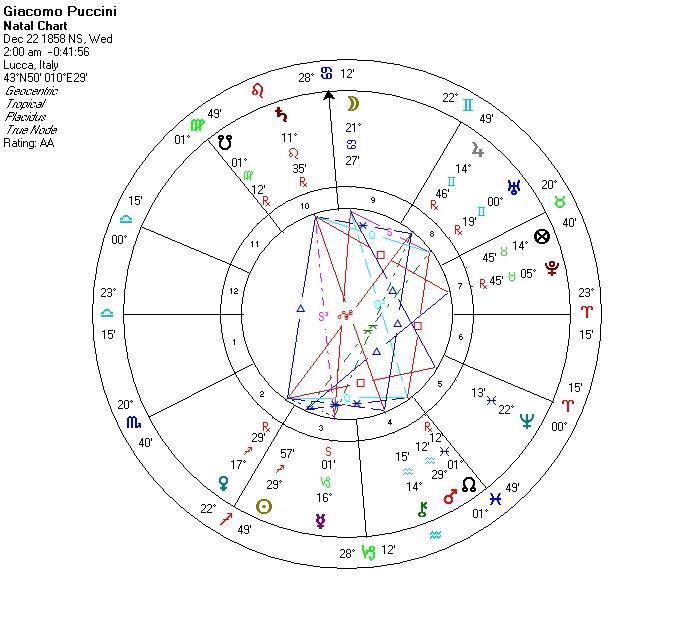
FIGURE 1982 0621a-1. Puccini Natal Chart.
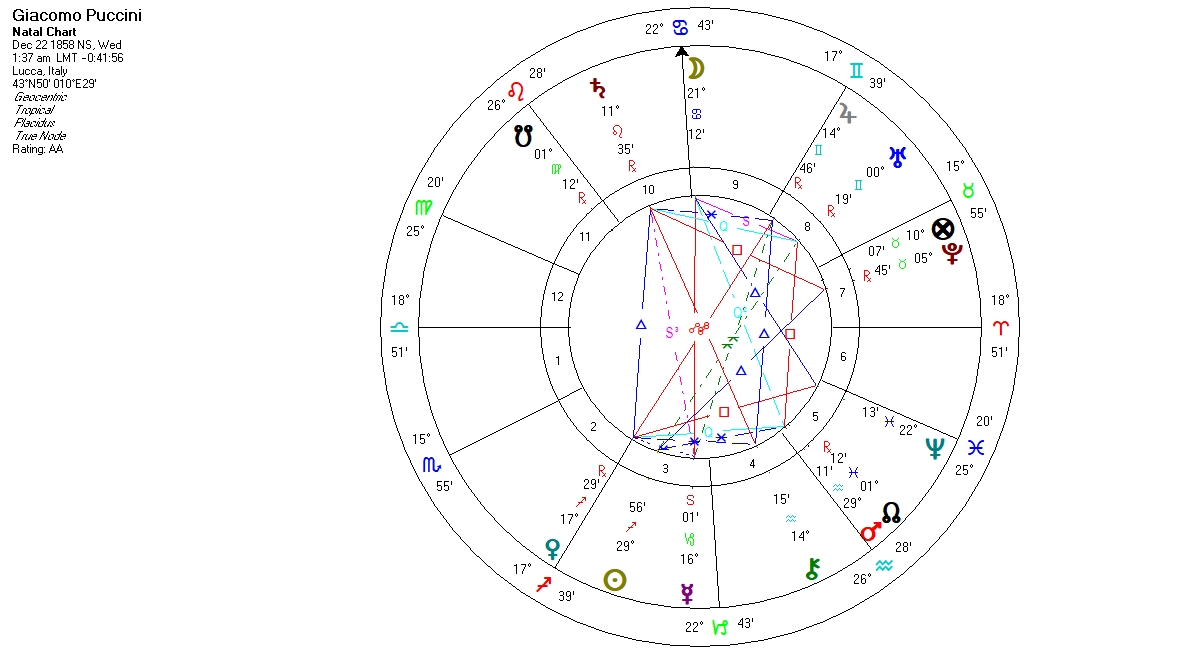
FIGURE 1982 0621a-2. Puccini Natal Chart with 19 Libra Ascendant and 11 Taurus Part of Fortune.
If someone is writing, with audible sounds of chalk on a blackboard, I indicate this by [writing].
NOTES:
- This is the FIRST SEMINAR EVENT of the day. There were three events on this day according to the Blue Book spreadsheet (and corroborated with JF's class notes).
MORNING SEMINAR 1982 0621a V11a (full transcript by IT, this transcript)
AFTERNOON SEMINAR 1982 0621b V10 (PUCCINI IIIa)
EVENING CLASS 1982 0621c V10 (PUCCINI III)
- Puccini-Astrology was also studied Oct 2-3, 1983.
TRANSCRIBED Verbatim by IT 2021. Archival verbatim transcript – V11a.
AUDIO FILES: 1982 0621a, 1982 0621b. [Note: "Tape" and "Side" refer to original audio cassette tapes that were later digitized into .MP3 Audio Files.]
1982 06/21a SEMINAR at Wisdom's Goldenrod
Astrology; Horoscope-Puccini
[Audio File 1982 0621a Begins]
Marc Edmund Jones [The Astrology of Concepts, Sagittarius 16, TS reading]: "[A peaceful scene is unfolded to] the view; a calm ocean, a single motionless ship, a few lazy soaring seagulls."
TS: I could see those. It is.
AD: And then the next one?
Marc Edmund Jones [The Astrology of Concepts, Sagittarius 17, TS reading]: "An Easter sunrise service is about to begin at the suggestion of dawn; darkness surrenders to the worshippers."
AD: Now you say he had that when his father died, right?
TS: Yeah.
AD (simultaneously): It was retrograding the first year. But then it came back to that symbol.
TS: It came back to the symbol 17 when he was 21, 2, 3, 4, 24. 1879, 1886.
S (faint): Oh.
S: Anyway--
TS: 1886 [three inaudible CDA words simultaneous with TS] Elvira had moved in with him, in 1884 she-- 1884 was the year there was an [couple words inaudible] Uh--
[short pause]
S: Let's see.
[short pause]
AD: Why would a planet go retrograde, I mean, what would it mean in terms of--
TS: I'm sorry, um--
AD: I mean [couple inaudible TS words simultaneous with AD] what do you think it means when-- when a planet is going retrograde, going back-- backward, (and), you know, sitting on those degrees? [9¾ second pause] For one thing we know that usually that means, you know-- most of the times it means that you get-- he's going to go through those things twice.
TS: Yeah.
AD (faint): Yeah.
S (faint): Yeah.
TS: So there is a-- So like those reason-principles are particularly important for that person, yeah.
AD: Yeah.
TS: Ok so-- I find that a retrograde planet has a certain autonomous quality to it. It's not nearly as accessible to the conscious personality's direction. It's not and it's-- you know, it seems to have a development of its own or whatever.
AD (simultaneously): (Yes.) Let (it/him) warm up. Yeah. He has it at 18 when he's born, alright, and it retrogrades back to 14 and then comes back again to 18 and by that time he's 24. [Note: Venus, Sagittarius 18, "Little children are playing on the sultry beach, but each is protected from the glare by a tiny sunbonnet."]
TS: Well, no, I'm sorry, it's at 17. You wanted to know when-- when it hit 17, the-- the degree it was in when his father died. That was when he was 24. That was-- it was-- it came back to its natal position when he was 29, [AD: Ok.] ok, which is when he did Manon. When the-- the degree at 17 was-- the first time it hit it was when his father died, the second time it hit it in-- was when Elvira bore him--
AD (simultaneously): Elvira moved in.
TS: No, when she bore him a son. She moved in in ei-- two years before, [AD simultaneously: Uh-hm.] but that point he felt that it would-- the responsibility hit him. I mean he--
AD: So she bore him a son when that--
TS: When he-- when it [AD simultaneously: When that Venus--] was at 17. When Venus was at 17 [AD simultaneously: 17.] Sagittarius, which is the Easter sunrise service. When it moved to 18 is when he was doing Manon Lescaut.
[19¼ second pause, flipping of pages]
TS: You don't have any biographies anywhere?
[short pause]
AD: Yeah then-- then I-- I think-- I think what I said is correct, [student assents, faint] that the retrograde-- the retrograde Venus, you know, had to incorporate into his anima-- it had to incorporate into his anima what he was going to deal with later on in his operas.
[19½ second pause]
TS: You know, I could see that just in terms of his-- his life a little bit, that-- one thing that seems to be that they-- they focus on in his operas is the-- the increasing up to-- to the last set, the increasing dimensionality of humanness in the people, that there's-- that his people were very real, [AD: Oh.] and, they became more and more real through Tosca and [one word inaudible]
AD (faint): (Yeah.)
TS: And--
AD: Well that's-- that's a distinction in Italian opera and the other operas, especially the German.
TS: Yeah.
AD: The distinction is basically that what the Italians want to write about are about human beings with their lust, their hatred, their jealousy, love and all that, which you won't find in Wagner.
TS: No.
AD: Uh-hm. You don't have human passions, human emotions. I mean you got the symphonic drama, yes, but you don't have this-- this level. I'm-- I'm not condoning, I'm not condemning, I'm not interested. [BC/TS(?) simultaneously: That's (a thing--)] But I know the making of a human being. There's a lot he's got to go through.
TS: And it seems like that-- those years when he was living in this small town in-- starving as a student and what not, that a lot of the-- like I know La Boheme was drawn out of those years [AD: Yeah.] directly, you know, and--
AD: Yeah that's why they're so intimate, the portraits, [TS simultaneously: Yeah of course.] you know, that he-- But this is-- this is quite unusual. We really do have to watch that Venus.
TS: I mean it doesn't seem as though the Mercury is so important then.
AD: No I think the Mercury is what gave him a lot of trouble, the whole libretti situation, you know. He used to feel so hamstrung by libretti.
TS: It's a strange thing, his Mercury retrograded all the way back and stationed on his Sun and then moved forward. [short pause] He had Mercury-- that was just-- that was the end of his student days.
LR: What was?
TS: Mercury stationing on the Sun. [short pause] Yeah see he died with all of his planets direct, excepting Saturn. Saturn didn't turn around but the-- Mercury turned around, Venus turned around, Jupiter turned around, Uranus turned around, Pluto turned around, they all went direct some time during his life. Ok.
AD: Let's see and if we tried-- if we try just summarizing briefly. The Pluto opposite Venus, Neptune opposite the Sun trine Mars and the Saturn conjunct the Sun, you say he was at that time writing-- the libretto was going through his (means), he was organizing libretto but (value--) Then you say when Uranus hit the Sun he started-- Uranus hit Venus he started the composition? [TS: Uranus--] That wasn't the part by the way. They left out the better part from that selection.
BC: Better part of the-- the duet?
AD: Yeah.
S (faint): Who is?
TS: Uranus is on Venus. Yeah. And, Ju-- well I don't know if you want little guys.
AD (simultaneously): We say it was there for about two years. Uranus Venus.
TS: Uranus Venus-- no, Uranus Venus is there for about a year.
AD: About a year.
TS: From the end of 1901 through the end of 1902. That was up to the time that he just-- he was writing the music, but then-- he was like working night and day just before the auto accident. Now after the auto accident I don't think that Uranus came back. (19--) just check. See if it was there in 1903.
AD: What do you think the auto accident [one word inaudible] Which one would you pin for the auto accident?
LR: Saturn on the Sun.
AD (faint): Saturn (on--)
TS (simultaneously): No, no, no, no, no, [LR simultaneously, faint: Pluto opposite Venus.] no. Those aspects were years before that.
AD: Yeah.
TS: The-- the auto accident-- Pluto opposite Venus, Neptune trine Mars, Saturn square Pluto, Jupiter square Uranus.
AD: Those last two you think?
TS: The Head on the ascendant, [AD: Yeah.] (of the) ascendant. Mars was trine Jupiter, square Mercury also. I guess the--
AD: Pluto square Saturn and Jupiter was square?
TS: Saturn was square Pluto. Should I write them up?
AD: No, no, Saturn was square Pluto.
TS: And Jupiter square Uranus. And Pluto was still opposite Venus. [14 second pause] Uranus was-- I see. That was 1903, Uranus is at 25 Sag. [11 ¾ second pause, flipping of pages] It's hard to see. I would think that-- I mean-- [short pause] Jupiter's in the eighth house squaring-- I mean I would blame it on the Jupiter Uranus square first of all, and the-- In the context of having Pluto opposite Venus as well that his-- generally speaking Pluto opposite Venus is going to force some kind of restriction in circumstances, some kind of-- I would think that the-- the ordinary ease of expressing his feelings would be stopped, would be forced to be internalized for a while. And, he did continue to write su-- within a few months, but he was-- it was very difficult for him for eight months. So--
AD: Yeah, it was a lot more protracted, yeah, [TS simultaneously: They had to re-break it.] recovery, yeah.
LR: Oof.
S (very faint): (Yeah/Uh-hm).
S (faint): (Go ahead/Uh-hm).
TS: Fellow had diabetes and all this.
AD: Yeah well, he was lucky they found out.
TS: He also found out he has-- his throat started up and-- uh, but--
LR: He was sick with a-- he was sick before the auto accident, he was sick with a real bad infection in the throat and everything and they told him not to go out but he decided to go out with the car. And he took his chauffeur but he insisted on driving. So the chauffer was in the back seat and escaped any injury and so did his wife and child it says. And--
TS: Seems to be conflicting stories. That what-- my biography says that the chauffer was driving and broke his leg. (AD and TS laugh a bit)
AD: No, the chauffer got away.
TS: Really?
AD: Yeah.
TS: Hm.
AD: He I think was the only one who got hurt.
S (faint): Uh-hm.
LR: And he almost died-- he almost got asphyxiated then, [TS assents, faint] that was the main thing, they couldn't get him out of the car.
AD (simultaneously): Yeah but he was pinned, wasn't he? Yeah [TS simultaneously: Yeah.] he was pinned.
LR: And then he-- do-- you know this whole thing where he had to be taken by boat somewhere and they had-- that's why his [AD simultaneously: Uh-hm.] leg-- They couldn't get him somewhere fast enough to really set his leg so, when it was finally set it was already knitted together wrongly. It was pretty bad.
TS: They took him by raft across a lake to his home.
LR: Yeah it says his friend, the Marchese somebody-- [Note: Marchese Ginori.]
[Transcriber note: I am using Famous Composers by Nathan Haskell Dole, fourth edition, Books For Libraries Press, Freeport, New York, 1968, ©1964.]
Nathan Haskell Dole [Famous Composers, p. 703, LR reading]: "…accompanied him. While on the lake several flocks of wild fowl flew over and Puccini, in spite of his cruel suffering complained only that he could not [LR reads: couldn't] shoot them."
S (faint): (Uh-oh.)
S (faint): (Oh/Awful). (bit of laughter)
[short pause]
AD: Let's try the next opera, I want to see that Venus.
TS: We-- he-- I-- did I mention that Neptune was opposite Venus when he wrote Tosca?
AD: Hm?
TS: Ok. The next opera is--
LR/S(?) (very faint): Tosca. (bit of laughter)
S (very faint): Yeah.
CDA/S(?): Maybe I should listen to that.
TS: No. (bit of laughter)
BC: Got two copies. (bit of laughter)
TS: The next opera was Girl of the Golden West, and that had a little interruption in the middle of it, uh-- That began in 1907. I'll have to check the transits for it. He saw the play in New York in January, in 1907. Pluto was square Neptune. Neptune was at 10. Well--
BC/S(?) (faint): [couple words inaudible] transit.
TS: Uranus was at 10 of Capricorn. (Not a--/Nada.)
LR: This is Girl of the Golden West, Tim?
TS: Yeah. Let's see. Saturn was at--
LR: 24?
TS: Yeah. Saturn was at 12 of Pisces. Saturn quincunx Saturn? He couldn't be right. Well, this is when it-- theoretically he saw it in-- Oh I just-- I see. He saw it in-- in January but he didn't decide to do it until June, so I'll have to look there. Um--
AD: He started working on it in June?
TS: Um-- He started working on the libretto in June of 1907 and the music in May of 1908. You want the music?
AD: The music, yeah.
TS: Ok. Um-- [flipping of pages] Pluto still square Neptune. Uh--
[short pause]
S (very faint): Ok Tim.
TS: Ok here we go. Uranus on Mercury? [short pause] Uh-- Means it was-- well it was semi-sextile Venus. Saturn was at 7 of Aries. So he had [couple inaudible LR words simultaneous with TS] Saturn square Pluto. No.
LR: Oh wait.
TS: Saturn's in Taur-- Pluto's in Taurus. Jupiter on Saturn was the other aspect he had. Jupiter on Saturn, Pluto square Neptune, Uranus on Mercury for that. That's when he began the--
AD: The score?
TS: The score. But, he was working on it through that year and then Doria killed herself, [AD: Uh-huh.] and that-- then he's got-- sort of tied up for a while. And from nineteen o-- through the-- a full year, it was a full year of interruption. And then he finished it in 1910.
AD: What was his Venus doing at this time? Nothing.
TS: But-- I can see it progressed. Let's see, that would've been 1907 would've been-- it was called-- [11¾ second pause] 49, ok. [short pause] His Venus (was/is) at 4 Capricorn. So his Venus, progressed Venus was trine his Pluto.
AD: Ok, let's go to the next opera.
TS: Ok, the next opera is La Rondine.
AD: The one after.
TS: Il trittico.
AD: The triple, huh?
TS: Yeah.
AD: Venus was where, in Capricorn still, right?
TS: Yeah, stayed in Capricorn. Now, he wrote Il tabarro in less than a year. He just-- he zipped through that thing. Then he wrote Suor Angelica.
AD: Gianni Schicchi was the next. Look that one up.
TS: Ok.
LR: February 19--
TS: Yeah February 1918 (he/it) started-- started Gianni Schicchi.
AD: Give me the-- give me the aspects.
LR: No.
TS: Ok. What?
LR: They were produced for the first time in December 1918. Oh I see.
TS: February he started scoring Gianni Schicchi.
LR: And then it was produced--
TS (simultaneously): He ripped right through these things.
LR (simultaneously): Yeah.
TS: February of 1918--
AD: You have Gianni Schicchi?
TS: I can't find it.
S: Yeah.
AD: Yeah.
TS: I got Il tabarro.
AD: [one word inaudible] (Gianni).
TS: Uh--
AD: Let's see if I could get it. I got a copy under the bed at the house. (bit of laughter)
LR: Love to hear it.
TS: He had the Head on the Sun.
LR: For which?
TS: Ok.
AD: Now I-- I know what I'm doing, go ahead, the next one.
LR: For which?
TS: Scoring Gianni Schi--
AD (simultaneously): He only-- he only could write with that Sun Venus. Go ahead.
TS: Neptune was square Pluto.
AD: Never mind. (TS laughs) Go on.
TS: I'm sure you got the same. (TS and RW laugh) It-- Well Pluto was sextile Pluto. Uranus-- [S, faint whisper: (one word inaudible) Aquarius.] Uranus is at 23 Aquarius. 24 Aquarius. Is that right?
S: Yeah.
TS: Oh, Uranus was-- well Uranus is quincunx the Moon, it's not--
AD: Uranus was what, 23 Aquarius?
TS: Yeah.
AD: What house would that be?
TS: 4.
LR: Semi-sextile Neptune.
AD: Fourth? Yeah?
TS: Yeah.
AD: Ok.
TS: Semi-sextile Neptune, yeah. Saturn on Saturn. Jupiter on Uranus. [short pause followed by laughter] Um--
AD: You know, Gianni Schicchi is quite different than--
BC (faint): [one/two words inaudible]
AD: Yeah. I mean it's nothing like Tosca, Butterfly, anything.
S (simultaneously): Yeah.
BC: Yeah.
AD: It's really happy.
BC/S(?): Oh really? Then I'll listen to that one.
TS: It was amazing. The Head on the Sun and progressed Sun on the Head.
AD: The Head on the Sun.
TS: And progressed Sun on the Head. Progressed Venus was at 14 Cap, which means it was quincunx Jupiter. Um-- He had big squares that year, (boy/oh).
AD (simultaneously): What was the Head symbol?
LR: Squirrel. [Note: Pisces 2, "Almost as if possessed with man's intelligence a tiny squirrel remains watchful on a limb hidden from the hunters."]
AD: Squirrel, ok.
TS: He had a progressed Mars Venus square that year, that's 18 [one word inaudible]
AD (simultaneously): He had a progressed Mars Venus square?
TS: Yeah.
AD: Oh no wonder he was comical. (TS, AD laugh)
TS: So what else can you do with a thing like that? (AD laughing)
LR: Progressed Mars and progressed Venus?
TS: Were in square.
S (faint whisper): Mercury is at 10 Aquarius.
TS: Progressed [AD simultaneously: Alright.] Mercury-- ah there it is, progressed Mercury sextile Venus.
[short pause]
AD: It's the one time he's able to laugh at passion.
BC: Hm.
S: Second Saturn return?
AD: And that never was a joking matter for him. (AD laughs) Alright, keep in mind the Head on the Sun the-- and the Sun on the Head, keep that in mind for that opera. You know, because in the meantime he was doing a lot of other things like living. The next opera.
TS: Ok the next opera is the last one.
AD: Yeah, [S simultaneously: Turandot.] that's the one I (want to) [possibly one word inaudible]
S (simultaneously): Turandot.
AD: That one is-- I want to see if [one/two words inaudible] is right. Turandot.
TS: Ok. What do you want for Turandot? He--
BC: Started to--
AD: When he started to write (that) and what the aspects were. Never mind the plays.
TS: Sketches (from) either July 28th-- July 1920, ok. [10 second pause] Tail on the Part of Fortune? If that's right, Tail was on his Part of Fortune.
AD: Alright. [TS: Um--] Part of Fortune, Tail. What's the Tail symbol?
LR: The Tail is the white cross on an imminent precipice, on a-- no, on a s-- on a commanding eminence.
Marc Edmund Jones [The Astrology of Concepts, Virgo 2, LR reading]: "A simple but impressively large white cross has been set up in splendid isolation on top of a commanding eminence."
AD: That's the eleventh house, huh?
LR: Tail on the Part of Fortune?
TS: Uh-hm.
AD: And the Part of Fortune is?
LR (simultaneously): I don't know. We changed that when we changed the ascendant, it should be 11.
TS: Yeah it's 11 Taurus now.
LR (simultaneously): 11 Taurus. Can I see the book?
Marc Edmund Jones [The Astrology of Concepts, Taurus 11, CDA reading]: "A woman, cool in [CDA adds: a] sunbonnet [and simple garments], is leisurely watering long rows of [CDA reads: is sprinkling rows-- full bloom-- (CDA laughs)] flowers in full bloom."
TS: Yeah.
TS/S (?): Uh-hm.
AD (very faint): Yeah.
TS: [couple/three words inaudible] (CDA laughs)
[short pause, flipping of pages]
LR: He [couple words inaudible] (with) this guy, doesn't he, Carol?
CDA: Uh-uh.
Marc Edmund Jones [The Sabian Symbols in Astrology, Taurus 11, LR reading]: "A woman sprinkling flowers."
Marc Edmund Jones [The Astrology of Concepts, Taurus 11, LR reading]: "A woman, cool in [LR adds: a] sunbonnet and simple garments, is leisurely watering long rows of flowers in full bloom."
S (very faint): Uh-hm.
AD: Which one was that?
LR: That's the Part of Fortune. (LR laughs a bit) Got a lot of symbol--
AD (simultaneously): Say it again, say it again.
LR: "A woman…"
TS (simultaneously): That's possible, right, that was what--
AD (simultaneously): Yeah.
S (faint): Uh-hm.
LR: Alright.
Marc Edmund Jones [The Astrology of Concepts, Taurus 11, LR reading]: "A woman, cool in [LR adds: the] sunbonnet and [LR adds: the] simple garments, is leisurely watering long rows of flowers in full bloom."
AD: Would you give me the one before and the one after?
LR: Uh-hm. The one after is--
Marc Edmund Jones [The Astrology of Concepts, Taurus 12, LR reading]: "A quite youthful young couple is walking down a busy street, stopping to peer into every window [with joyful glee]."
AD: Uh-hm.
LR: And the one before is--
Marc Edmund Jones [The Astrology of Concepts, Scorpio 10, LR reading]: "A fellowship supper is served to a group of men…"
AD: No, no, forget that.
TS: No Linda it's way off, (ok). The other one was 19, wasn't it, when we originally did it?
[short pause, flipping of pages]
LR: Well I don't have it.
TS: Don't have it? Uh--
[flipping of pages]
LR: Have it-- yeah, it was 15.
TS: 15?
LR: Oh he had 15.
AD: Let me hear it.
LR: (Uh-hm.) Um-- It's the man wearing his tophat rakishly. "A man muffled to brea--"
Marc Edmund Jones [The Astrology of Concepts, Taurus 15, LR reading]: "A man [AD simultaneously: Nah.] in evening clothes…"
AD: Yeah, that's not his part. [short pause] Go back to the original.
Marc Edmund Jones [The Astrology of Concepts, Taurus 11, LR reading]: "A woman, cool in [LR adds: a] sunbonnet and simple garments, [is] leisurely watering long rows of flowers in full bloom."
LR: I could see that one.
AD: Yeah, it's very lively.
Charubel [The Degrees of the Zodiac Symbolised, Taurus 11, TS reading]: "A scrawl or flourish of the pen."
LR: So he has the right feeling-tone to go along with the rest of the chart.
AD: Yeah because that's what he was I think doing basically in his life like I (tried/try) to mention. Remember? Shadow feeding the anima.
LR: Is it the Tail on the Part of Fortune, Tim?
TS: Uh-hm.
LR: So-- The little girls grew up-- little girls in the sunbonnets grew up and now they're watering all the flowers. (LR laughs a bit) Still wearing sunbonnets. [S: Yeah.] Yeah, certain--
AD: Well that-- that Venus I-- is really quite (important).
[10¾ second pause]
TS: When he was-- he started writing it in July but he didn't-- didn't really keep going until November from this-- this [one word inaudible] Uh-- That's when he was writing the first act music.
AD: Alright, the first act. Let's [TS simultaneously: Yeah.] have the aspects.
TS: Tail on Pluto, Uranus on the Head, Neptune on Saturn, Saturn on Ne-- Saturn opposite Neptune.
LR: Uranus on the Head. What's the next?
TS: Neptune on Saturn. So it means it's sextile Jupiter. Then Saturn opposite Neptune.
LR: Not Tail on Part of Fortune?
TS: Well this was four months later. The Tail-- When he-- he started writing the sketches of the music in July, but he didn't really start writing the whole music until November from the way Bert gave (his sum--) So, basically the whole-- from the very first time he started getting it, which was in the summer of 1920, he had Saturn on-- Neptune on Saturn, Uranus on the Head, those are the two [AD, faint: Yeah.] per-- pervading aspects. And I know the progressed Venus was somewhere in the picture too, 'cause I worked that out before. That was [TS misspeaks] 1849 when he did that.
AD: Yeah let's get the aspects for that, that first act.
TS: Ok, 1920. 20--
AD: In case you're interested Red, what we're trying to figure out is what are the reason-principles that is dominating this man's life. [RW assents] What's manifesting as his reason-principles.
[short pause]
TS: Progressed Venus on Mercury.
LR: Which time?
S: (Read it.)
LR: Oh. It didn't [couple words inaudible]
TS (simultaneously): (Well/Oh) right, the whole year he--
AD (simultaneously): First act. [TS simultaneously: First act (couple words inaudible)] First act, we're just interested in the first act.
TS: Yeah.
AD: That first act is like a whole new kind of music for him. And also, I mean it was (a/uh)-- it was like it was nearing the goal the way I understand it, that the escalation or the elevation of anima function was almost within sight.
TS: His progressed Jupiter changed Sabian degrees for the first time since he was 30. Which means all the way back to 189-- since Manon.
AD: Alright, get all the aspects, we gotta read all these aspects [LR: Wait.] on the first act.
LR: The-- all-- wasn't this when his progressed Sun changed again?
TS: Uh-uh. Progressed Sun changed with Suor-- Suor Angelica.
LR: Oh.
AD: That went into Pisces, right?
TS: Yeah.
AD: Yeah, Suor Angelica, alright, is a-- it's a-- it's an opera written only for females. I don't know whatever made Puccini, but you can see something was wrong. (AD laughs, bit of laughter) It's supposed to be a mystical opera. And, the progression into this-- into Pisces makes a lot of sense. In Pisces of course you can be a drunkard or a saint, you know, it's hard to tell. What's interesting here is that in the Turandot there's a-- an-- a revolution, as far as I was concerned, in opera. If this man had lived twenty years more there-- we would have a different kind of opera today.
LR: Say more.
AD: Well it was basically the choral opera, it was a choral opera. You've seen Greek plays, [LR: Yeah.] where the chorus is-- Like in Aeschylus, the chorus [LR simultaneously: Yeah.] is dominant, the characters are minor.
LR: Yeah.
AD: And he was doing the same thing, in Turandot the chorus became dominant. So much so, the chorus and the orchestra became so dominant, yet without losing the lyrical tendencies that Italian opera wants to stay with. He never lost sight of that. Whereas if Wagner had done something like this, it would've been swallowed up, it would've been-- the voices-- you know, the individual human passions would've been destroyed. But the way he did it, he-- he kept both. He had this enormous complexity of the orchestration and chorus. The strangest and wildest rhythms. The orchestration is absolutely bizarre. I mean the only man who came close to him was thirty years later. Carl Orff with Carmina Burana was able to take those rhythms. You've heard Carmina Burana? Remember the first act of Turandot? As a matter of fact, you get the feeling that Carl Orff bodily took some of the things out from Turandot. I don't think so because Carl Orff was quite original. But, let's say that they anticipated the same idea or something, which is very possible. But that Turandot is-- if he had lived twen-- another twenty years opera would have taken a different turn. Not even Verdi came to that. So, I think this first act is really a big thing. It hasn't been picked up since then. No one has picked up on the clue he left (in) his writing.
See 'cause the transformations in art styles, and I don't care to speak about a history of art because there is no such thing, you know, but the transformation(s) that they place in-- in the styles and all that, come through individual men. And, you remember Avery was speaking about Beethoven had some progression and he wrote the Third Symphony. And if you notice the Third Symphony is very peculiar. Usually they used to put a minuet there and he got the idea of the scherzo, you know. He just couldn't put a minuet no matter how many times he tried. I don't know if you remember the First and Second Symphony he has that kind of a movement. But in the Third when he couldn't-- he couldn't tolerate the minuet in there and he kept going through these cycles of anxiety and all that. And then the idea of the scherzo sprung up in his mind, you know, fully blown, fully grown thing, he knew this was it. And he altered the symphonic style a little bit that way. And that was-- he had a progression going on. And then--
LR (simultaneously): His Sun moved into a different sign.
AD (simultaneously): Yeah. His-- I think it was progressed Sun? It moved [TS simultaneously: Yeah.] to a different sign?
TS (simultaneously, faint): (It was progressed) Sun.
AD: So that, you know, he altered the symphonic style of writing. Now, Puccini did the same thing but no one followed-- followed him up because you don't find opera composers, you know, that level, they're very hard to come across. It's probably one of the most difficult things to do to write an opera.
LR: That's good. (Continued.)
AD: Alright let's go over the transits, let's see if we can see a little bit the transits for that occasion.
TS: Ok. Um--
LR: The Tail-- two-- two big Tail transits [TS: Well--] came up with that.
TS: There was the Tail in-- (it/he)-- He began the sketches with the Tail on the Part of Fortune.
LR: Yeah.
TS: And then he began the first act with the Tail on Pluto. Pluto is quite big in this thing. Um--
LR: Well and the Tail symbol is pretty amazing for Turandot too. The large white cross set on a--
AD (faint): [one/two words inaudible]
TS (faint): Within (this).
LR: [one word inaudible] You don't see that Tail in many other places in his music like that.
TS: What (do) I do with that?
AD: Let's have the aspects.
TS: Ok. Excuse me, the-- [LR simultaneously: You're a good boy, Tim.] I got to work with the Pisces again. Um, no. [short pause, flipping of pages] I [LR simultaneously: Tim--] want to-- I want to see what was happening in March of 1922. I want to be sure you're giving me the right transits Anthony 'cause I-- uh-- [short pause, flipping of pages] Some of these are Turandot. And not the important part of the music. Well, let's go. (TS laughs a bit)
AD: First act, just, you know.
TS: I know. Well, what I'm trying to see is the way he's written this down, he says-- he began-- he started working on the first act music in November of 1920, and then he has another note. In March of 1922 he began the orchestration of Act I.
LR: It's not in this book.
TS: So I don't know which of those-- what-- what he means [couple words inaudible]
AD (simultaneously): Well let's have them both.
TS: Alright. The first one is a Tail on Pluto, Neptune on Saturn, Uranus on the Head, Saturn opposite Neptune. And they go on. Jupiter sextile-- Jupiter trine Mercury.
AD: Alright now, the twen-- '22?
TS: Ok in 1922--
AD: See the orchestration means that he-- he has the basic melodic line. He writes down the sketch of the melodic line that's to flow through the whole opera. And-- and then they start orchestrating it. Now the orchestration is really quite secondary to the basic sketch of, you know, the [TS simultaneously: (Melodic, right.)] melodic line that he wants to follow through the whole first act.
TS: Ok. Uh--
TS/S(?) (very faint whisper): [one/two words inaudible] not in--
[short pause]
TS: Pluto sextile Pluto still. He's had that all this time. Neptune sextile Ur-- Neptune sextile Jupiter. Uranus-- Uranus quincunx Saturn. [student assents, very faint] There's something that--
AD (simultaneously): See that-- that looks like a mopping up.
TS: See-- Jupiter [AD simultaneously: (I don't--)] on the ascendant. There's no big-- there's certainly no big [AD simultaneously: Yeah.] fireworks going on.
AD (simultaneously): You see that's-- that's what you might call a mopping up. After he gets the melodic line down and then he starts orchestrating it, then it's a question of the man's professional technique, you know, if he's-- if he's capable. Usually, assuming that after having written so many operas he-- he does have a technique and he can-- it can zip along once he has the melodic outline of the first act.
TS: Ok. So the first-- what I have here is the melodic line for the first act, the second act, we have that, and also few-- one of the few times in his whole life he ever did it, he wrote the music for Liù's death before he got the libretto. He couldn't wait. And-- then he died pretty shortly thereafter.
AD: And, what were the aspects when he wrote [one word inaudible]
TS: Liù's death?
AD: No when he wrote Liù's-- Liù's death.
TS: Yeah. [S, faint: (Liù's.)] Um-- [22¾ second pause] Ok, Neptune was at 20 degrees. And, that doesn't do a damn thing. Amazing. Um-- Uranus square Jupiter, stationary direct.
AD: What does that mean to you? [13¼ second pause] He had to kill off Mimi, didn't he.
TS/S(?) (faint): Well--
LR: The life-- [TS simultaneously: It's a block (in--)] the life energy was really--
TS (simultaneously): Yeah, biotic-- the-- Unfortunately.
LR: It was his too.
TS: Yeah. But he had to do it.
LR: That's right when they discovered the malignancy.
S (very faint): Yeah.
LR: [one/two words inaudible] Apparently.
[short pause]
AD: You see, that whole biotic force had to go through a transformation. That Jupiter squared by Uranus was showing him, "This is-- this, you know, is what's being done now."
TS: Yeah.
AD: There is an actual I think escalation of, you know, that anima function.
TS: He had-- yeah, he had all-- Jupiter was opposite Uranus and Uranus square Jupiter at the same time. And he wrote that long before he got to the point in the opera [couple words inaudible]
AD (simultaneously): But-- but, yeah.
TS: 'Cause that's in Act III, isn't it?
BC/S(?): Uh-hm.
TS: Yeah. He wrote it before he was even done with Act II, he just stopped and [AD simultaneously: Yeah.] did it, you know.
AD: Yeah the same-- something like that, and we keep this-- keep this in mind, when we do Verdi, he wrote the-- the fugue to the third act, the first thing.
LR: The fugue to the third act of what?
AD (simultaneously): The-- of Falstaff.
TS (simultaneously): Othello? Falstaff?
AD: It's very-- it's a comical opera, you know. But the way it ends up it ends up in a fugue. So let's keep that in mind. 'Cause he wrote that before he did the opera.
TS: He wanted to be sure he got it out?
AD: Yeah, he-- it just came to him and he put it right down and he knew that this was part of the opera but he didn't know precisely how.
BC (faint): Hm.
S (faint): Uh-hm.
AD: Alright, we'll keep that in mind. In the same way like he had to write Liù's death before he even got the first act started.
TS: Yeah, he (has/had) Sun opposite Uranus, Jupiter opposite Uranus. You know, there's a whole pile of things right opposite Uranus as well as (Scorpio--)
AD (simultaneously): What was his Uranus symbol?
S (faint): Glass-bottom boat. [Note: Gemini 1, "A glass-bottomed boat drifts silently and easily over a constantly shifting panorama of marine wonders."]
LR (faint): It's 1 Gemini.
AD/S(?): Yeah.
TS: And the Jupiter is the two Dutch children. [Note: Gemini 15, "Two Dutch children in their immaculate native costumes are studying their lessons together."]
BC/S(?) (faint): Well yeah.
TS: And they finally-- let's see--
AD: Evident-- evidently the Uranus was working in his chart, the knower was always operating. Even if he was unaware of it. You know, 'cause these things are working through us, alright. And let's say that Uranus was trying to point out something about what was going on.
LR: You know, he says something interesting here, he says that Suor Angelica, he-- he-- his own words were--
Nathan Haskell Dole [Famous Composers, pp. 706-707, LR reading]: ""Yes, you will see some day that the score of Suor Angelica will be acknowledged as the best and the sincerest music I have ever written.""
AD/S(?): Interesting.
LR: And he's-- and they asked him about it and he says because his sister-- it's-- his sister was the abbess of the convent.
AD: Yeah, she joined the convent when he was younger.
Nathan Haskell Dole [Famous Composers, p. 707, LR reading]: ""…and into that score I have put everything that is finest and best of what she has told me about that life.""
S (faint): Yeah.
[short pause]
AD: Alright, let's get--
LR (simultaneously): It's like he was always aware of something else, even though he wasn't living that life he was--
AD (simultaneously): Yeah.
LR: He was aware of it, [TS: Hm.] it was in here.
TS: You know these progressions keep-- I keep running across it with these people who seem to finish their-- their life cycle. He had progressed Mercury on the nadir, progressed Mars on the descendant when he died. [S: Hm.] So it's always hit those angles.
AD: Yeah.
LR: (Yes./This--)
TS: And maybe-- I'm just trying to see what progressions he had when he was writing Liù, Liù's death. Six-- Sun was sextile Pluto by progression. Venus was on Mercury I said, uh--
[short pause]
AD: Venus was on Mercury?
TS: Yeah, progressed Venus is on Mercury.
AD (simultaneously): When he was writing the Liù's death chant?
TS: Yeah, with-- that whole year, [AD simultaneously: Uh-hm.] and, it seems like that he knew that Venus had finally gotten to.
AD: Yeah.
TS: Um--
AD: Mimi was dead.
TS: And Mars--
S (faint): 18.
TS: Mars-- progressed Mars, on the other hand, it finally got to the trine of the natal Venus. It made an eas-- it was making a trine to it. Unfortunately it was--
AD (simultaneously): Mars was trining the natal Venus?
TS: Yeah. [short pause] And Jupiter was at 13 of Gemini, it was--
[9¾ second pause]
AD: You see what the Venus trine Mars is?
S (very faint): Well, (let's try).
BC/S(?) (faint): Venus trine Mars, yes.
TS: You mean that the kama rupa was harmonized-- finally got [one word inaudible]
AD (simultaneously): Became fulfilled, was getting humanized. If you think of a trine and you-- you know, more of the Idea of Man coming into you, [TS simultaneously: Uh-hm, yeah.] it's fulfilling itself. [TS simultaneously: That's what I've been thinking, (uh-hm).] It's-- it's always outside the individual. The trine is always something coming from outside the individual.
TS: That that sort of directs him towards that higher Idea of Man. Yeah, there's a certain sophistication there or-- well, differentiation of-- of the I-- of the humanity of the person through the trines.
AD: Uh-hm.
TS: Yeah. Most of the time it's benefic. It's enjoyed, I mean--
AD: Alright, now let's go back to the first act, I-- I want to work out all the planets there.
TS: Ok.
CDA: What do you mean coming outside-- coming outside of the individual?
AD (simultaneously): Cosmic.
LR: Larger.
AD: It's not the individual's doing.
CDA: I mean-- let's say it's the higher soul's doing.
AD: Yeah, you could say the higher soul, Lords of Karma, you could say anything you want, but we know it's not the individual. Something has been arranged, organized so that the-- he benefits, you know. In other words, you're directed into a certain course of activity which ultimately would benefit you in-- in fulfilling the Idea of Man and that-- that's-- that's not something that man himself can do. That is, not do it all the way, you know, just try to cooperate with it. Let's-- let's have the first act aspects, alright.
TS: For when he did the music, right? Ok that's--
AD (simultaneously): No. The-- the music of the first act.
[short pause]
TS: Um-- This takes us back to 1920. Just to be sure I got all these little suckers. Pluto-- (Full Moon), it was November, yeah. [S, faint: (Neptune.)] [students assent, faint] Neptune. So he had [writing] Neptune on Saturn, which I think is so perfect with that, the Nep-- the Saturn degree is the Japanese lanterns. [Note: Leo 12, "Japanese lanterns, music from a string ensemble and an animated interweaving of colorful figures mark a garden party."]
AD: Uh-hm.
TS: And the orchestra and the ensemble playing. And the Neptune is the medium. [Note: Pisces 23, "A huge hulk of a woman medium has gone into trance and around her are entities continually forming and dissolving."] Ok? So Neptune was also in [writing] sextile Jupiter. Uranus on the Head. Tail on--
AD: Sun?
TS: Pluto.
AD: Pluto?
TS: [writing] And that the Sun was-- we lost that one. Ok that one goes to--
LR: Uranus on the Head, Neptune-- Neptune on Saturn sextile Jupiter, Saturn opposite Neptune.
TS: That was the Gianni Schicchi, that aspect for Gianni (Schicchi).
AD (simultaneously): Oh yeah I'm sorry.
TS: Uh-- So ok.
AD: It's fantastic, look at that. The trans-Saturnians, every one of them.
TS: [writing] Saturn gets in the picture too, you notice? Saturn was in the picture the last time when we did Butterfly. Saturn seems to-- pretty active. He also had this one. [short pause while writing] He had Venus progressed conjunct Mercury. Um-- [short pause] 1920, 1920. They died when he was 16.
AD: He died in [couple inaudible student words simultaneous with AD] '22, uh, '24.
(Side 1 of original cassette tape digitized as 1982 0621a Ends; Side 2 Begins)
CDA: Hm?
AD: Neptune.
TS: Transiting.
CDA: Mm, uh-hm.
S (faint): Chris [S, faint: Yeah.] return?
TS: Transiting.
LR (simultaneously): Transiting Uranus?
TS: Transiting Uranus--
BC (simultaneously, faint): Uranus conjunct Head.
TS: Was on the Head.
LR: Oh right.
TS: And progressed Sun was on the Head.
LR: Ok.
AD: Well, we got to go over all these symbols.
[short pause with faint background student talking]
LR: Progressed-- Tim, I'm sorry.
BC: The progressed Sun on the Head.
LR: Yeah I know, but it was-- it was transiting Uranus, not pro-- it was [TS simultaneously: Right, transiting Uranus--] transiting Uranus and progressed Head-- Sun on the Head.
TS: Right.
BC: I got it.
TS: Right. (BC laughs a bit)
LR: Progressed Sun, transiting--
[short pause]
TS: I don't know if you'd be interested in checking the progressed Head. I'd have to go get the computer.
AD: No.
TS: Oh I have it. Never mind, I do have it. Because I think it-- I think it was on his-- [couple words inaudible] fetch, uh-- It had been on his Mars most of his life, because it retrogrades. And I think it moved off.
[short pause]
AD: You got Turandot?
BC: Sure do.
AD: Let me get another one.
BC: Which one? (bit of laughter) Which part?
AD: First act.
BC: Chorus part?
CDA: Uh-oooh.
AD (simultaneously): What?
TS: Oh no. (CDA laughs) Well-- (bit of laughter)
CDA: Wake up.
S (faint): Yeah.
S (faint whisper): Yeah.
TS: I got four speakers in the house playing that now, it's great. (AD laughs)
AD: You have to remember, this is a lapsing for me.
S: Yeah.
TS: Well, it's long but (I did it). (TS laughs a bit)
S (faint): Uh-hm.
AD: One thing, one thing-- the conclusion I come too though, and it seems to be coming more and more obvious, is that those three trans-Saturnians, you know, the willing, feeling, and knowing that we speak about, certainly have to be involved in a great work of art. It seems that the three of them are needed. [student assents] And that if one of them is deficient there's a kind of lack in-- in the artwork itself.
TS: Yeah see this is-- it seemed like it's only in the latter ones that the Pluto starts really coming in, you know.
LR (simultaneously): What did you say, (Tony/Tim), the trans-Saturnians--
TS: Oh you know, that--
[Turandot plays for a few seconds in background]
AD: (Boy/Well), you don't know the record. (AD laughs) [Turandot plays for a few seconds in background] Good, good.
[Turandot plays for a couple seconds in background]
LR: What did you say?
[Turandot plays in the background while class continues; 0:52:12.0-1:06:03.2.]
AD: I'm coming to the recognition that it is-- any really great work of art shows the three trans-Saturnians operative. Now, in the other operas, the trans-Saturnians are operative, but there seems to be a dominance by one or the other whereas over here it seems that all three are being called into operation. All three are necessary. What was it he told Toscanini when he went to the hospital? Says take care of my beloved, Turandot, if anything happens to me?
BC: Hm.
S: Who-- who said that?
AD (faint): Toscanini.
S: Huh.
AD: So when he died Toscanini commissioned Alfan [Note: Franco Alfano.] to finish the opera. And told him "You stick to the notes he made. Don't try to be original." [listening to Turandot] So those were all the aspects when he was writing the first act, huh? I didn't realize how much was involved in the production of a work of art. That's Corelli isn't it?
S: Sure is.
BS: Don't like him, huh?
AD: What am I going to do with you?
BC: It was a person! (BC laughs)
S (very faint): Oh boy
TS: Yeah. (bit of laughter)
LR: Is this the part you're talking about?
AD: No.
BC: It's getting towards it.
TS: No.
[listening to Turandot]
AD: That's alright, you could leave it there Bo. You could leave it there. But you can turn on the speaker.
BC: (Well/No) I can't.
AD: Oh, it doesn't work now?
BC: Doesn't work. You should turn it up, I turned it down.
AD: No. [listening to Turandot] See these are the rhythms I'm talking about.
TS (simultaneously): Yeah.
LR: Yeah. Uh-hm.
[some whistling]
TS: Turn this up. Stop. [listening to Turandot] These are good. [listening to Turandot] It's amazing.
LR: [few words inaudible or singing along]
BC (faint): I turned it on upstairs too [one word inaudible]
AD (simultaneously): I'm really sorry you missed that performance. It was really quite good. Chorus was so-- That's what I ought to teach you about for (a year). [listening to Turandot] Very seldom they have such a good chorus in the opera, you know, they usually have a dozen singers. Here they had 120 singers round the back. (AD laughing) Once I saw Mahler's Resurrection Symphony--
LR (simultaneously): Don't tell me anymore! (LR laughing)
AD: --and they had two hundred people in the chorus. Even if you were sitting up in the bleachers you (weren't there). [listening to Turandot] [couple/three words inaudible]
S (very faint): (Right.)
[listening to Turandot]
LR: Harriet used to sing with them, you know?
AD: What?
LR: Harriet used to sing with that chorus.
AD/S(?): Oh yeah?
LR: When they lived in [one word inaudible]
AD: It was volunteer but (was amazing).
[listening to Turandot]
TS/S(?) (faint): Something got done?
[listening to Turandot]
LR: (Realized) you were missing something.
BC: (Yeah.) (BC laughs a bit)
[listening to Turandot]
AD: This is from Carmina. Burana has the same thing.
LR (faint): It's really [one word inaudible] [listening to Turandot] (Tim) what you had to listen to (for) last week?
TS: What?
LR (faint): Didn't you have to listen to (Carmina)?
TS: This?
LR (faint): Carmina Burana?
TS: Oh yeah.
AD: Alright, let's see how we (started) this.
TS (simultaneously): They got me in a lot of trouble.
AD: Let's go to Neptune Sat-- Saturn conjunction.
[listening to Turandot]
TS: Alright.
S: (Yeah, sure.)
TS (simultaneously): Now that he's doing that. (TS laughing)
AD: Oh shut it off then.
TS: No. Um--
LR (faint): What do you want?
TS: Neptune is the--
AD (simultaneously): Neptune, the symbol.
LR: The trance in-- the medium-- here it is.
AD: Ok, alright.
Marc Edmund Jones [The Astrology of Concepts, Pisces 23, LR reading]: "A huge hulk of a [AD simultaneously: Yeah.] woman medium…"
LR: (What--)
AD (simultaneously): And the Saturn was?
LR: The Japanese garden party.
AD (simultaneously): Yeah, ok.
Marc Edmund Jones [The Astrology of Concepts, Leo 12, LR reading]: "Japanese lanterns, music from a string ensemble and an animated interweaving of colorful figures mark a garden party."
TS: Saturn changed degrees.
AD: Read me the next degree.
TS: Ok. It retrograded, it was way back. It had just changed to 7 of Leo when he did this Turandot. So that'll probably be in there too and he--
AD: Let's read 7 degrees Leo.
[short pause, flipping of pages]
LR: Oh.
Marc Edmund Jones [The Astrology of Concepts, Leo 7, LR reading]: "The night heavens are seen in their wonder as on the desert when the moon is dark; the constellations are at play."
[9 second pause]
LR: That's where it was then?
TS: Uh-hm. Yeah I mean, both Jupiter and Saturn changed Sabian degrees this year for him. Jupiter moved to 13 degrees Gemini and Saturn to 7 Leo.
[31 second pause, Turandot playing in background]
LR: Keyword is Surety.
[23¾ second pause, Turandot playing in background]
AD: (Oh/Well) that's really quite beautiful. That (7/7th) first the-- the Neptune? It's really quite extraordinary. [short pause, Turandot playing in background] In other words, his ego had to progress to that degree.
TS: What was it at before, wasn't it the [couple words inaudible]
AD (simultaneously): The one degree-- look. The Saturn 7 degrees [AD misspeaks, means Saturn 12 degrees] was, you know, the Japanese lanterns and-- you know, the man-about-town, alright? But look at when it hit that one degree. Read that one degree and you see, it's like he had a kind of ego structure now that could penetrate into the Neptune.
TS: Yeah, I see, and was able to give us that access the--
AD: To the depths of meaning in the Neptune. Isn't that extraordinary? Read it again, the one degree.
LR: The inerratic spheres. (bit of laughter)
Marc Edmund Jones [The Astrology of Concepts, Leo 7, LR reading]: "The night heavens are seen in their wonder as on the desert when the moon is dark; the constellations are at play."
AD: Doesn't that give you the feeling that like-- like his ego was now capable of penetrating into that huge woman's hulk that was always transforming itself? You know, the mediumistic, what was it, the mediumistic--
LR: I'll read you the whole symbol.
BC/S(?) (simultaneously, faint): The great hulk of a woman.
Marc Edmund Jones [The Astrology of Concepts, Pisces 23, LR reading]: "A huge hulk of a woman medium has gone into trance and around her are entities continually forming and dissolving."
AD: Yeah.
TS (faint): Mimi, Manon.
AD: Yeah. Yeah, basically the Neptune is that feeling, you know, that was formulating these things for him, and his Saturn had progressed sufficiently, alright, in terms of understanding and growth. Because if you think of a progression, alright, you're thinking of, well I'm born with this degree and this kind of meaning built into it. And as it progresses, it's like it's assimilating more and more into itself, the Saturn-- the ego-complex is assimilating more and more. So that, it's like saying all this has been added to what you came into the world with now. And when the Saturn reached that degree, he had reached a maturity, the understanding, the depths of penetration, that he can now understand what that Neptune was about. To some extent of course, not-- But it's almost like he had x-ray vision into the feeling, the cosmic feeling that Neptune, you know, was working with. It's really quite a (magni--)
TS (simultaneously): Yeah it seems like-- that's (why/what) I was-- I've seen that as that there is this kind of complete identity of-- the ego is able [AD simultaneously: Yeah.] to identify itself with a cosmic feeling, that he did not-- that de-personalization, the way you're speaking about as being choral, that there's a-- there's something almost alien or other worldly.
AD (simultaneously): You see, basic-- you see how basic those Chaldean planets are in terms of the structure of the ego? It's almost like until we become human beings we can't really appreciate the transcendental aspects. You-- you don't know what you're talking about.
TS: Yeah he wrote that was-- I mean that he was-- only then, at this point in his career did he feel he was ready to take on a mythical or fantastical [AD: Yeah.] theme. He didn't feel he was mature enough before this point.
AD (simultaneously): You know, I was reading-- I was reading, who was it, Schuon, you know, in the preface to The Transcendent Unity of Religions. And he goes into this rap about how irrelevant and superficial human knowledge is and all that. I had to close the book. I had to put the book down because if I didn't I probably would've thrown it out towards the library. (bit of laughter) You see what I mean? And [couple inaudible student words simultaneous with AD] no respect for the Idea of Man. The preoccupation with the Absolute is-- is so prejudicial, you know, to understand Man at his-- at the level that he should be understood. They're always comparing him with God. [short pause, Turandot playing in background] Let's have the next one. Oh that's-- that's [TS simultaneously: Ok.] one of the things I can't stand in the Eastern school. They rob you of your humanity.
TS: Now, do you want the sextile to Jupiter in there as well?
AD (simultaneously): Yeah, oh yeah. Please, yeah.
TS: Ok.
AD: The Jupiter, yeah, what was the Jupiter doing.
BC/S(?) (faint): [few words inaudible]
S (very faint): (Right/Yeah). (some laughter)
AD: I'm going to be chauvinistic.
LR (faint): Jupiter?
Marc Edmund Jones [The Astrology of Concepts, Gemini 15, LR reading]: "Two Dutch children…"
AD: No, the progressed one.
BC/S(?) (faint): Could you say Jupiter [couple words inaudible]
Marc Edmund Jones [The Astrology of Concepts, Sagittarius 13, TS reading (simultaneously with BC/S(?) above)]: "A wistful young woman, dressed in black, is surprised into a warm companionship to which she has felt alien."
LR: Progressed Jupiter?
AD: Alright Tim. You're getting a feeling. Huh?
LR: No, no, Tim, that's a Sagittarius symbol.
TS: Oh. (laughter)
S (faint): Read [couple words inaudible]
AD (simultaneously): Alright, read the other one.
LR/S(?) (faint): That's not the one.
S: Oh.
AD: What degree is it on?
TS (simultaneously): It's the opposite degree.
LR: It's the opposite degree.
TS: That was the opposite degree, I--
AD (simultaneously): That's alright, that's alright. [TS simultaneously: It's still right. We got--] Wait till you read-- wait-- wait till you read this one, go ahead.
LR: Well he does that too much. We spend three hours talking about a degree and then he goes "Oops". (some laughter)
AD: Read-- read it.
RW (laughing): Oops. (AD laughing, bit of laughter)
Marc Edmund Jones [The Astrology of Concepts, Gemini 13, TS reading]: "The great artist, a world famous pianist, sits at his instrument on the stage of a huge auditorium."
TS: Oh I feel a little better.
AD: But what's wrong with this one?
Marc Edmund Jones [The Sabian Symbols in Astrology, Gemini 13, TS reading]: "A great musician at his piano. [This is] a symbol of individual artistry as the property of all, [with its] expression [TS reads: expressions] both its strength and [the] means whereby others are encouraged to like accomplishment. … [AD: Oh.] [The] keyword is ACHIEVEMENT."
LR: That was progressed Ju--
AD (simultaneously): We could do without his interpretation.
LR: Progressed Jupiter was at that degree (now)?
TS: Yeah, see just-- it just moved in, progressed Jupiter and progressed Saturn happened to change just as he--
LR: And that's 12?
TS: 13. [one/two words inaudible]
AD (simultaneously): Timothy, read it. Read the-- read up there! Sextile Jupiter!
S (very faint): What (does it) say?
LR (faint): Semi-(sec--)
AD: Look. Neptune on Saturn, what-- what-- what we just said about it.
TS: Ok.
AD: Huh?
TS: It was a transformation or a definition of the--
AD: This here [AD indicates on board].
TS: Yes.
AD: Like he really reached the-- the point of maturity where he can penetrate into this here, sextile the Jupiter. Sextile the Jupiter. [AD hits board with chalk] Could you have a better-- a better-- what could we say? Opening guns.
LR: For the paper you mean.
AD: Yeah, for the writing. For the-- for the music.
TS: Well I mean-- yeah to-- [Turandot stops playing in background] In that Jupiter is the creative-- the-- the actual creative function of writing the opera.
AD: Yeah. Well wouldn't you say that that was exactly mobilizing and defining the way those-- let's say that energy had to-- had to be worked on?
TS: Yes.
AD: Yeah.
TS: Ok now (it's/that's)--
AD: I mean, they're almost like necessary components in order for him to get into the music. The Neptune, the hulk of the woman, alright, or, let's say the mysterious quality of the feeling that Neptune could operate with, alright.
TS: Uh-hm.
AD: Then the Saturn mature enough now to penetrate into the depths and the profundity of this Neptune, alright, and the energies, the primal energies now organized and defined so that he could do it. Imagine having the set-up Neptune and Saturn without the energies at your disposal to be able to work that. Yeah, that's why-- those-- if you play a game of poker, right, Jacks are opening? That's the opening. (bit of laughter)
TS: And that's the opening to-- ok. That's the strength it gave him, that was the ener-- the energy--
AD: Everything like was a preparation for this.
TS: Well that seems clear all the way through the whole chart with the progressed Sun on the Head and-- and so forth. There was like a breaking through to that [AD: Alright now--] solar consciousness or the--
AD: Yeah. Let's try the Uranus Head. That's what I meant when I said now I'm beginning to see why the-- all the trans-Saturnians are involved in any great work of art. There not only has to be a feeling, there has to be a knowing, there has to be the will to do it too. And by will here we're talking about the, you know, ability to be able to work day by day.
TS: That seemed to be the one thing which is-- if anything that's inhibited a little that [one word inaudible] he didn't finish it, or he didn't-- It's hard to know if he finished it or not. (CDA laughing)
BC: He finished.
AD: Do you think the Unfinished Symphony of Schubert is unfinished?
TS: No.
AD: Ok.
[11 second pause]
LR: Ok, Uranus is the glass-bottom boat [AD: On the Head.] sitting on the squirrel. (bit of laughter)
AD: Sitting on the squirrel.
S (very faint): Um--
LR/S(?) (very faint): Ok, Virgo, Virgo.
LR: Would you like the whole symbol?
AD: What do you think it means?
LR: I think he saw that.
AD: He saw what?
LR: He saw the effectiveness of that squirrel, that it (gave him) [one word inaudible]
AD: In other words, the knower in him knew the value now of these primal energies which are symbolically [LR assents] represented by the animal? Yeah. Now, remember, we're saying that his soul knew it, he didn't know it. It was not conscious yet. It isn't, you know, like at a philosophic level he was doing these things. The soul was doing these things, almost disregarding the personality. "Oh, Mr. Puccini, you don't know what I'm trying to do but that's alright, we'll do it anyway."
CDA: It might hurt a little but-- (CDA laughs)
LR: (Only my) laugh.
TS: I think that that's-- and that feeling of him being shielded from his own--
AD: Intemperance.
LR: That's in the symbols.
TS: That seems to be there.
LR: He's protected with sunbonnets all the way through.
TS: Yeah. His-- his own-- the deeper level of--
AD (simultaneously): What was that, his own genius, the knower within him? I don't know but it certainly seemed that there was something shielding him from his own intemperance, his own, you know, extravaganza. And also that friendship he had with the-- Mrs. Seligman, which I think was a very fortunate thing for him and all the bunk about their physical relationship is besides the point.
TS: He had Uranus on the Sun when he met her, which I thought was I think sort of--
AD: For someone else it would be, you know, kundalini experience, for him it had to come through a woman. [short pause] They have a hell of a way of varieties of getting through to you one way or another. [short pause] The only trouble with doing this Tim is every time something happens people are going to believe it's a symbol of something. That's why I hate Jung. He wants you to live a symbolic life. And I think the one we're living is real enough without the symbols. I could never get over that. It's still my favorite joke. You know, these kids are in the car, and it's pouring rain, and the father is outside jacking the car up, taking the tire off. And he tell the kids, "No, I can't change the channel, this is the way it is!" (AD laughing) That reminds me of Jung. (bit of laughter) You know, the philosopher is trying to say, "Look at the reality." "No, look at the symbol," Mr. Jung says, "never mind the reality. Look at the symbol." [9½ second pause] Alright, let's have the next one, Tail Pluto.
BC: Alright, and the progressed Sun on Tail.
TS: Yeah, you want to do the progressed Sun on the Head as well as Uranus on the Head?
AD (simultaneously): Oh yeah, yeah, progressed Sun. What was the degree, progressed Sun?
LR: [one/two words inaudible] [TS simultaneously: Well--] well it had to be the squirrel.
BC: I think--
TS: It was on the squirrel.
AD (simultaneously): No, no, that was the pon-- pontifical--
LR: That's right, the sacerdotal [TS simultaneously: Pope.] pomp.
AD (simultaneously): We got-- yeah, ok. The Sun on--
Marc Edmund Jones [The Astrology of Concepts, Sagittarius 30, LR reading]: "[A] picture of regal and sacerdotal pomp and glory reveals itself…"
AD: Yeah and the Sun was on the Head.
S (very faint): Yeah.
S (faint): Uh-hm.
[13 second pause]
LR: Tim, usually (a) [one word inaudible] gives him a--
TS: It's right in there.
CDA: Yeah right in.
AD: What do you think the Sun on the Head meant?
BC: Sun on the Head--
[short pause]
AD: Who's your favorite opera writer?
BC: Well, Puccini.
S (faint): Uh-hm.
AD: Who do you think Puccini's favorite opera writer was?
BC: Puccini.
TS: Puccini.
AD: You got the point. (bit of laughter) The Sun on the Head? Didn't that certify-- give him-- make him absolutely sure this was the right thing for me to do, to live this kind of a life, to be an opera composer.
S: Mm.
[students assent, very faint]
TS: Good and you could say that there's a certification that something-- something about the way he developed his life led him to that innate knowledge that allowed him to write this 'cause--
AD: And also the unconscious realization, I say unconscious because, you know, from his point of view it would be unconscious but from the soul's point of view, the recognition, you know, as far as the soul was concerned, that the necessary trials and tribulations and whatever he had to go through was worth the-- let's say the betterment of the structure of his personality. The Venus, in other words, got escalated because of that. I would imagine some of the others did too and inevitably the Mars but-- It becomes so obvious that if the anima gets escalated or elevated in functioning, the others must follow. So I always regarded Venus in Sagittarius very cautiously. You cannot remain at the level you're functioning at with Venus in Sagittarius, what you're born into. You won't leave that way. It is a really strange thing (to have) in Sagittarius. [student assents, faint] You know, out of curiosity, when we do the Sages I'd like to see how many of them have Venus in Sagittarius.
S (faint): Yeah.
S (faint whisper): (Click, click, click on--)
TS: Um-- (bit of laughter) I think-- I think Ramana may have had it 'cause his Sun's in late Capri-- early Capricorn.
CDA (simultaneously): No, no. Well not according to the chart up there. Venus in Scorpio.
AD: And he probably [CDA/S(?) simultaneously: Ok.] had Uranus on Venus at the time he got liberated.
CDA: I don't know, I just rem-- recall the chart that was in PB's notes. He-- I know he had Venus in Scorpio.
AD (simultaneously): Well-- well don't go by that, that would be the Eastern chart. Make [CDA simultaneously: Ok.] it out Western style.
S: Right.
AD: PB had it in Sagittarius.
LR: Exact conjunction to his Sun.
AD: Yeah. Huh?
CDA: (Saturn.)
LR (simultaneously): Same degree as his Sun.
TS: No, Saturn.
CDA (simultaneously): Saturn, Saturn.
LR: I mean Saturn, sorry.
AD (simultaneously): Saturn Ju-- Uranus Saturn [TS simultaneously: Hardly.] Venus conjunction. [short pause] Let's move on to the next one, Tail Pluto.
TS: Tail on Pluto? So that's the large white cross on a-- a rocky eminence. And the Pluto is the bridge to Nature, that's the cantilever bridge, the delicate cantilever bridge. Tail on Pluto.
AD: What do you think that means?
LR: Yep, yep. I don't know. [short pause] Well that's the other side. [short pause] Maybe it did transform something in that image.
AD: The Pluto was the telephone connection?
CDA: No, it wasn't (connection).
Marc Edmund Jones [The Astrology of Concepts, Taurus 6, LR reading (simultaneously with CDA above)]: "A delicate cantilever bridge is in [LR adds: the] process of construction across a high narrow gorge."
LR: Delicate cantilever bridge being constructed across a high narrow--
[short pause]
Marc Edmund Jones [The Astrology of Concepts, Virgo 2, LR reading]: "A simple but impressively large white cross has been set up in splendid isolation on top of a commanding eminence."
AD: That was the Tail.
LR/S(?): Yeah.
AD: And the Tail is conjunct Pluto.
[12¾ second pause]
TS: You know one thing that seems to be characteristic of this opera is that-- a characteristic of the transits I think, [S, very faint: Go (on/ahead).] is there seems to be a withdrawal of his dependence on something outside of himself to drive him, to direct him and drive him in himself. I mean there was something that was coming more from within since would be-- I mean the Tail symbol seems to me a certain degree of isolation or individuality. I mean, and, Tail on Pluto I think that there is a-- a-- an experience of that individuality or that attachment or that-- that-- that got all the experiences in his life-- I'm sorry, a synthesis of the experiences in his life which led him to be able to be a-- an individual, an independent individual. 'Cause he always had to work with people, not only in terms of having these relationships with women along the way to get him going at times but, you know, his dependence on his wife, on [one word inaudible] and on his librettists, and you always-- seems like his feelings were always tied to all these people but here it seemed like he was really possessed with his idea of getting this opera out to the point that he-- he pushed them. And he was always pushing them.
S (very faint): (Uh-huh.)
AD (simultaneously): I think what you're trying to say and maybe I'm distorting what you're trying to say, but--
LR: It helps out.
TS: Straightening, yes. (TS laughs)
AD: No, I-- I think the hunch you have is that his inner being, whatever that was in the past, alright, is brought up to date and be-- becomes able to relate to others.
TS/S(?): Right.
AD: Look, like you said, [TS: Yeah.] there's something about the Tail which shows a kind of isolation that he lived. And I would assume that what-- that was in the past. The Tail is in the eleventh house. And if you look at that symbol, what does it give you a feeling of? It was a cross on the white pre-- eminent?
BC/S(?) (faint): Yeah.
TS: Well, (maybe). Exposed suffering, among other things. There was a certain kind of prominence there but there's also a cer-- a-- a feeling of harshness or suffering seems to be in that symbol.
S (faint): Uh-hm.
AD: Alright. Yeah, ok. We can say that, sure.
TS: Oops. [CDA simultaneously: I get--] But also (pre-Saint).
S (very faint): Oh no.
AD: No, no, that-- that's included in part of the meaning. That it seems that in his past, alright, he had to make some sacrifices in some way or another to achieve a point of prominence or a commanding view.
TS: Well that's the other thing, I mean there's like a--
AD: And that's brought into relationship I'm saying now, because it was on the Pluto in the seventh house, that's now brought into relationship with others on a much more impersonal level of understanding.
TS: What came into prominence was Pluto, the-- that-- yeah.
AD: Yeah it was making almost [TS simultaneously: Always like a (projective) consciousness.] like a bridge between his past and the present development.
LR: I think his character really went through huge transformations during this time.
AD: Well what was it, the last four years, wasn't it 1920 to 1924?
LR: And I haven't read anything that gives a flavor of how the man changed, you know, but I'm sure he-- he really did go through tremendous--
AD (simultaneously): Well, yeah, that there was a-- [S, faint: Yeah.] a great deal more despondency and things like that.
LR: Yeah.
AD: I-- I keep watching the ascendant for that, because that's very moody. A Libra ascendant is very moody. You'll have ups and downs all the time. But I don't know if you-- if that's what you're trying to say, Tim, that there's a kind of inner being, you know, from the past, alright, and this is what you see as individual in him, this individuality of his past, alright, which had evidently made some sacrifice in order to achieve a position of oversight or prominence, you know, to be able to see. And that's finally bought in-- brought into relationship with other people on a more impersonal level because-- Out of all this, you know, he learned to be himself but also learned to work with others. So that what was inside of him, you know, and he had to work with his librettists, alright, he had to be able to relate with them and bring it together. So that Pluto in the seventh house brought about-- brought that possibility about.
LR: Well there's a real loneliness in that symbol, a real isolation in that Tail symbol.
AD (simultaneously): Yeah. And it's in the eleventh house. So if you think of the eleventh house as the-- well-- well whatever we think of it, mundane, what do they think of it?
LR: Friends.
AD: Friends, hopes, [LR simultaneously: Development.] ambitions, wishes, alright, self-refinement, alright. If you think of that as the eleventh house, you put the Tail in there, then you're speaking about the way he was in the past. Alright? Now that Tail comes up to Pluto in the seventh house, conjuncts it, and that Pluto is that kind of greater understanding of how one is supposed to relate to others. But he has to bring that inner being that he has into relationship with these people present now with him and working out, you know, on the libretti-- In other words, he wanted to apply this-- this inner being that he was, he wanted to apply that to the libretti, alright. But in order to do so he'd have to work with people. Alright, that's the Pluto in the seventh house. (Here's) a strange understanding of your relationships, Pluto in the seventh-- Pluto in the seventh house.
S (very faint): Ok.
S (faint): Uh-hm.
LR: What do you mean by strange?
AD: Well more impersonal.
CDA: You got it, Linda. (CDA laughs)
LR: Yeah.
AD: Well you've got that there, Linda, huh?
S (faint): Yeah.
S (very faint): (PB.)
AD: PB had it there too. Didn't he?
CDA (simultaneously): Did he? Did he?
AD: Seventh house, yeah.
LR: He had it intercepted, didn't he?
TS: Yeah. [short pause] Might as well go play golf, kids. (TS laughs)
CDA: Might as well what?
TS: Go for the top, you know, there's nothing else in between. (TS laughing)
[short pause]
AD: Well, [TS simultaneously: You got it too.] there's many ways that-- [CDA: Yep.] The seventh house is marriage, ok. So you figure well you got Pluto in there your husband's going to disappear or you're going to disappear. Now (that's/there's) many ways that could take place, your husband could be a salesman and you never see him around. Alright, that's one way. There's another way, you understand the nature of the marriage relationship--
LR: Or your husband could have three planets in Scorpio. Same thing.
AD: Yeah, same thing. (laughter) Good girl. (laughter) Good girl. (AD laughing)
LR (laughing): The same as a traveling salesman. (Belong to the world.)
S (very faint): Yeah.
AD: Saturn conjunct Neptune.
TS: You know, I-- Ok, never mind, I'll go back to it.
S (simultaneously): Neptune conjunct Saturn and Saturn conjunct Neptune.
LR (faint): Yeah.
AD: The Neptune conjunct Saturn-- Oh, I'm sorry, Saturn opposite Neptune.
TS (simultaneously): Opposite Neptune. That's the other thing that seems to be necessary in these things is that it's reciprocal. That the Chaldean gets-- when the Chaldean is getting clobbered by a trans-Saturnian that the trans-Saturnian is also being known or being assimilated in some way, activated by the Chal-- the Chaldean. Like when he did-- I lost it here. The square to Uranus he did. That's Uranus square Jupiter. Butterfly he had Uranus square Jupiter and Jupiter opposite Uranus. Now he's got Saturn on Neptune and Neptune (on--)
AD (simultaneously): Do you notice how very often unless there is that, unless there is that opposition, they can't see clearly.
TS: I don't understand that but I notice it.
AD: It's like-- assuming that you have the planet in halfway decent-- I mean it's not really badly aspected. But, I-- very often I've seen this. When a person has a Chaldean planet opposite one of the trans-Saturnian, he gets to see a potential that he never saw before.
TS: Hm.
AD: Draws it out almost. But that's assuming that-- well his Saturn, I don't know how it was aspected. [TS simultaneously: It was pretty healthy.] But one thing-- one thing is for sure, it's a tenth house Saturn so it's not going to be a weakling.
TS: No. Well that's on--
LR (simultaneously): Well not only that it's-- I've noticed this again and again, it's detriment by sign and rulership by house.
AD: House.
LR: When you have it-- it seems like when you have a dignity both ways it's really a powerful thing.
AD (simultaneously, faint): Yeah.
LR: And I-- I've noticed that with Verdi too, I was just looking at Verdi. A lot of these guys the planet is not only [TS: Oh yeah, well he--] dignity by house [AD simultaneously: Uh-hm.] but by sign also.
AD: So that was [LR simultaneously: (It's/This)--] in the eleventh house, alright, opposite the Neptune. [short pause] And again it's ruler by house there. [short pause] Then the Jupiter trine Mercury, I think that's what gave him a lot of problems with the libretti. He would often go back to it and try to do it his own way, whatever it was.
TS (simultaneously): Yeah. Yeah this-- this one, he first wanted to do it as two acts, as--
AD: And then three and then back again. Yeah he had to change the scene around but, I think that was the Jupiter trine the Mercury that gave him an awful lot of trouble. He was interfering too much with the-- the libretto.
TS: Now I wanted to go back before he did all these, ok, when he was searching to find Turandot, I just happened to notice he had another pair of aspects that I think are connected to this. And that is that he had the Tail on Uranus, and Uranus on Mars. And that was-- the whole year of 1919 he went bananas trying to find something-- he knew he was looking for something totally different than--
AD (simultaneously): Well you look, Tail on Uranus.
CDA: But Uranus was also very close to Head then. Uranus--
AD: Yeah but look, look, don't-- don't run away, Tail on Uranus, what did that mean? What did we just say about the Tail?
LR: Past way of functioning in isolation.
S (very faint whisper): Yeah.
TS: And-- well something also being (determined for him).
AD (simultaneously): In other words, in other words, the knower within him wanted him to write something about himself.
S: Oh.
AD: At that depth of meaning, that his inner being, alright, had to be brought out fully. It wasn't-- it was no longer Mimi that he was working with.
TS: That's what I-- I guess that's what I was trying to say in my way earlier was that there's-- there's something very authentic about-- which is-- essentially that individual [LR assents] which seems to be in that music, that he-- it's not--
LR: It's an essence. It's [TS simultaneously: Yeah, something--] an impersonal essence [AD simultaneously, faint: Yeah.] or--
TS: Yeah.
AD: But, isn't that nice, the Tail on Uranus? It's like when the Tail got to Uranus, it made him aware that this is what he has to write about. The Tail in the eleventh house. His own past isolation and sacrifice of whatever it is that we don't know about, which gave him a position of strength, alright, of a rich inner life, alright, and that this was what he should write about. What was the other aspect?
TS: Uranus on Mars--the hunter of libretti, women, and ducks. (AD laughs, bit of laughter) [Note: "I am a mighty hunter of wildfowl, beautiful women and good libretti."--Puccini]
AD: What was the Mars symbol, come on, cut it out.
LR (simultaneously): The mystic moon-lit field. [Note: Aquarius 30, "A mystic moon-lit field near the site of a mystic and traditional Babylon has sprung into delicate white bloom."]
AD: Yeah. Yeah. The value-- the value of the shadow. The value of the--
LR: Tim, this was during what period of time?
TS: This was 19--
AD (simultaneously): This was while he was looking for the libretto to Turandot.
LR: Oh.
TS: He was absolutely in fever.
AD (simultaneously): You see what I mean when I say the trans-Saturnians all have to be involved to make-- to make a worthwhile work of art?
LR: What did you just say about Uranus on Mars, Anthony?
TS: Value of the shadow?
LR: Oh the val-- that's right, [AD simultaneously: Yeah.] he saw the value of the-- yeah.
[short pause]
AD: Now I feel like running in my car and go 80 miles an hour down 414.
BC: You do that anyways.
RW: Yeah. (CDA laughs)
[short pause]
AD: The next one was Venus progressed Mercury. What was the Mercury symbol?
TS: That's the surreptitious one?
LR (simultaneously): It's the surrept-- surreptitious--
AD: The woman?
LR: Woman.
Marc Edmund Jones [The Astrology of Concepts, Capricorn 17, LR reading]: "A mature but long repressed young woman is bathing surreptitiously in the nude and finding a release in spirit."
AD: Wow, there's hardly a need-- need for comment there. He has finally articulated to himself what-- what is--
LR (simultaneously): Why-- good God, that was the struggle the whole time.
AD: Yeah.
TS: Couldn't do his own (soul/solo) and his own feelings.
AD (simultaneously): Well you-- you have to remember that the so-called virtues and vices of the individual soul are not something that are done away with in a-- a month. Sometimes they take lifetimes, to get rid of one little lousy habit.
LR: Which one was this?
BC: Progressed Venus on the--
S: Yeah.
AD: Progressed Venus conjunct Mercury. When was that, the Sun--
BC: No we just-- [AD simultaneously: (Never mind.)] you've already done that one.
TS: Yeah. Progressed Sun on the Head.
AD: You got it. You got the chart now. Now, if you could try to condense it without-- condense it and put it in some sort of sequential order would be really nice.
S: We'll get it ready for tonight. (bit of laughter)
AD: Well you don't have to do every opera, you just do a couple little (itty) ones.
TS: No, I--
AD: The ones that are cheap. We pointed out that Manon--
LR (simultaneously): Bigger (one--) Butterfly.
BC (simultaneously, faint): (Butterfly.)
AD: Butterfly. Gianni Schicchi. [AD pronounces: Gianni Saki.]
TS: Schicchi.
LR (simultaneously): Schicchi. [TS and LR correcting AD's pronunciation.]
AD: Schicchi. [BC assents] What?
BC (faint): Gianni Saki. (BC laughs a bit)
LR: Gianni Schicchi.
AD: That's (alright).
LR: I have to tell you Italian?
AD: I forgot her name, you know. It was a long time ago I dated her. Go ahead.
LR: Is that a woman?
AD: Yeah.
LR: Oh, I thought that was a-- a-- Well that was the cloak I was thinking.
S: Yeah.
LR: Gianni Schicchi, which you said--
S (faint): Uh-hm.
LR: Go on. (The next one.)
AD (simultaneously): Then the next one was Turandot?
LR: Turandot.
TS: Do you know when-- Dor-- that-- that incident with Doria, do you think that was a turning point of any kind?
AD: Oh yeah.
TS: Because that we've blocked out of it, that was in the middle of The Girl of the Golden West.
AD: When-- when did that incident take place, what year?
TS: That was 1909.
AD: 1909.
TS: That was-- he had a Neptune opposite Mercury and Uranus on Mercury.
S: Neptune opposite Mercury.
TS: Neptune was opposing natal Mercury, [student assents] and Uranus was on the natal Mercury.
S: Oh ok.
TS: That was the Uranus Neptune conjunct-- opposition in the sky on his Mercury.
AD: What-- what did we speak about Neptune Uranus opposition?
TS: Spiritual crisis. Well it certainly-- that was an unbelievable confrontation.
LR: What do you get a-- what do you get-- what flavor do you get of his Pl-- completely-- thinking processes (TS laughs a bit) with that symbol? And I see [AD simultaneously: Which symbol?] the meaning of the symbol but not as a-- a past--
AD (simultaneously): Which symbol?
LR: The--
AD: The Mercury?
LR: The repressed young woman.
[Audio File 1982 0621a Ends]
[Audio File 1982 0621b Begins]
LR: You know, I mean I see it-- I see this-- what the symbol's done but I-- He's had the symbol-- it was in his chart his whole life, I don't--
TS: Was [S simultaneously: (Yeah.)] retrograde. I mean it took-- his Mercury didn't get back to its natal position, um, [short pause] till he was in his thirties, I mean it took a long time for it to-- it went way back to--
AD: Well, I think it was revealed-- I think the Mercury symbolism was revealing pretty clearly in his attitude, you know, when he-- the-- the attitude of such a dependence on the librettist.
LR: Yeah it was like it followed whatever-- it didn't have the lead. (It) didn't--
AD: There was that lack of confidence that, you know, he-- he would know a libretti. It would recog-- there was that lack of recognition, in other words, that he was capable mentally, you know, to be able to know what the right libretti was but once he began to feel his way through it and he knew what kind of libretti would make an opera for him. But I [LR simultaneously, faint: It's a--] would say in the beginning that that lack was very clear, you know, like the first three operas. It shows very clearly that he didn't know a good libretti, one that fitted him. Because, let's put it this way. Suppose I'm going to write, and, if I'm a-- a novelist or an artist of some kind, I can only write about myself, alright. But, in writing about myself or in trying to express myself through my medium, I have to have someone outside of me provide me with the medium about which I'm going to express myself on. You follow? So, if I'm writing an opera and I can only write music that's coming from my own inwardness, and I've got to look to someone else to supply me with the ideas on which I can superimpose or project my inner meanings, there's always going to be a problem.
LR: He had such a strange dependency, [AD simultaneously: Yeah.] it was really--
AD: And that's what that Mercury was about. That Mercury showed this almost absolute lack of confidence in being able to find the right ideas that would become a vehicle on which he could superimpose his music.
TS: You know, it's-- it makes a finger of God to the other two-- the Jupiter and Saturn.
AD: Jupiter and Saturn, uh-hm.
TS: Ok these guys are-- that-- that is that they're quincunx [TS indicates on diagram].
S (very faint): (Ok.)
TS (very faint): [writing] [few words inaudible] quincunx.
AD: Well then--
TS: I mean that's quite close.
AD: Yeah well then, from the point of view of reading the chart, you know, let's say from the point of view of the soul, alright, from the soul's point of view, what would that signify?
TS: From the soul's point of view?
S (very faint): Uh-huh, uh-huh.
TS: Well, could it signify that that Mercury, that faith in himself as a-- as a knower was--
AD: Wouldn't you say the finger of God is telling him to trust his intuitions? To learn to trust them?
TS: Well I was-- gradually it forced him eventually to.
AD (simultaneously): It forced him into that, yeah.
TS: Well I was thinking that before that-- he got to that stage too, it held him back to the point that there was [AD simultaneously: Yeah, yeah.] like a complete--
AD: Lack of confidence.
TS: Yeah well there was such a lack of-- well, yeah. I was thinking of trying to bring in the Saturn Jupiter symbols also, Anthony, that the-- remember the Saturn is the man about town kind of and the Jupiter is both the inner and the outer feelings or the-- that vitality of the Jupiter, that the Mercury is almost held back so that he would be forced to transform that-- that vital energy, and that the-- the pomposity of the--
AD (simultaneously): Ok, then you said it, right? The Mercury was ultimately-- from the point of view, the Mercury was going to articulate, was going to articulate to-- to him, alright, what the meaning of his experiences were if he would only take the trouble to look at them. Because, he didn't think that there was any meaning to life, I mean he never, you know, thought fundamental. I mean [TS simultaneously: No.] to him, what was it, fowl and woman and-- what was it?
RW: And librettos.
AD: Librettos.
BC (faint): Fowl, women, and--
TS: Fowl, women, and librettists? (TS laughs a bit)
AD: Fowl, woman and [one/two words inaudible] stop. (AD and RW laugh) I keep falling into these things! (AD laughing) It's alright, you understand me.
RW: No.
AD (simultaneously): I got the right [one word inaudible] (RW laughs) Fowl, woman, and librettist.
BC/S(?) (faint): (Wouldn't count 'em.)
AD: They should-- we really should say fowl, librettist, and woman.
RW: In order of important.
[short pause]
TS: You know, I was thinking, you know, that he-- he was quite prominent and he was quite a--
AD: Yeah, he was quite a cele-- celebrity.
TS: He was the most photographed man in Italy and, you know, [AD simultaneously: Yeah, that--] even though he [LR assents] had sort of a frustration I think, it-- you know, if I read this one biography, he s-- and they say that, you know, when Verdi died, he-- he became the successor. You know, he didn't want to be the successor, he wanted to be Puccini, you know.
AD: Yeah that's true but-- you know, there's quite a difference in these two men, Verdi was quite an introvert. In comparison Puccini was quite an extrovert. As a matter of fact, Verdi used to resent if people wanted to, you know, talk to him or interfere with his life. One guy stopped and he says, "What do you think, I'm some wild beast that you want my autograph?" (AD laughs) Oh, Verdi was quite different.
TS: But then Verdi-- and Puccini I was thinking that, it might have been this quincunx. That because he didn't trust his own thinking or intuition until his ego developed a little bit, he didn't end up an impresario or a-- you know, a-- a mercenary, and that he-- That Saturn Jupiter would be so easy for him-- that that sextile would be very easy for him to-- to be a leader and, you know, in the field of opera and also a prominent man in Italy, but with the square-- the quincunx to Mercury held him back from-- from totally being satisfied with that, that there was a need to-- he knew there was a weakness in himself that he was struggling with. 'Cause otherwise, I mean there's no sense of struggle with that Saturn degree, you know. So I was thinking that on the one hand the Mercury is being held back until he finally learned to trust his intuitions and recognize-- It's funny, he had the intuitions, you know.
AD: Yeah.
TS: But then he'd scramble them up once he got 'em, [AD simultaneously: Yeah.] you know [one/two words inaudible] [AD simultaneously: Stop--] from the rest of [one/two words inaudible]
AD (simultaneously): Stop [one word inaudible] and gave himself these stupid things, like trying to write an opera on the Buddha. Imagine him trying to pick up on the Bu-- (AD laughing)
TS: Detachment.
LR: But the progressed Venus did come to the Mercury at the end--
AD: Yeah and told him.
LR (simultaneously): --and he's very beautiful.
S (faint): Uh-huh.
AD: Yeah that's why I say that it was-- it was conscious-- it was consciously being articulated to him, alright, what the purpose of his life was, or one of the purposes of his life was, and that was to escalate or-- or make the anima a meaningful thing, and that it wasn't sordid, you know, the way we would ordinarily think of these things. Wouldn't you say that? That was really pro-- I think it--
LR (simultaneously): Well the anima isn't just the women, it's the whole thrust of life and the energy and--
AD (simultaneously): Yeah but-- but if you imagine the soul reading through, alright, and interpreting the experiences that he was going through and not him interpreting them, then the soul would come to a self-recognition that all this travail, you know, the soul-making, was worthwhile. And it became-- it became available to the soul itself when that Venus got to the Mercury. There was that combination or that fusion taking place. We would say the Venus, that degree symbol, that reason-principle, alright, was now being-- Ordinarily in a person's chart who understands we would say now he came to a recognition, a self-recognition of the value of his anima. But I don't think that that was conscious for Puccini. I think it was unconscious, and that would mean that the soul understood that but not him.
S (very faint): Yeah.
AD: Now if we could put some of these things in some kind of order I think you would see a sequence, alright, the way the work he did brought about-- You know, work is always for our benefit. So if we look at it that way the work he was doing, you know, in what way did it benefit him? Well in the sense that these developments went on.
TS: He went through-- it was a (benign) life in that sense, that I mean it was the-- a life that accomplished its tasks even if it wasn't re-- reflectively aware of those tasks.
AD: Yeah.
TS: I mean he had lots of-- progressed Sun on the Head, progressed Venus on Mercury, progressed Mercury on the nadir, I think all of those were like (fulfilling/fulfillment) aspects.
AD: I think now we got some material together on Puccini let's-- (I don't know).
LR (very faint): Yeah, I'm trying to.
AD: Yeah I think the Doria [AD pronounces: Dora] incident, you know, brought about an inner transformation but it wasn't something that was going to show up right away. Those things sometimes are too deep, you know, and they take time.
LR: He didn't even want to look at it.
AD: Yeah. And maybe after a period of a half a dozen years he began to understand something in a feeling way. But I think it was pretty important that incident. It may have, or may not have been a karma, we don't know but we do know that he really, you know, was upset by that whole thing, it was really something drastic. [couple inaudible TS words simultaneous with AD] To see an innocent girl kill herself because of his philanderer-- well, whatever you call it.
TS: It's almost like the reality of the passions that he always was working really--
AD (simultaneously): What their consequences are.
TS: --clobbered him.
AD: Yeah.
TS: You know.
RW: Briefly what was this incident? Well I'm not familiar.
LR: He-- he was-- he had a lot of affairs all over the world, and that was constant. But he also had a wife who stayed home and had hired a housekeeper who was an innocent peasant girl, just-- And his wife was always reprimanding him, getting after him because of his escapades. And she had quite a reputation (too/for it). And so his wife was sick and saw him from the garden.
AD: His wife was what?
LR: Sick.
AD: She had menopause.
LR: That was-- that's what was going on. His wife saw him in the garden with this servant girl [RW assents] which proved to be innocent and just made this hu-- it was just the (crowning) girl for him, you know, she was a servant girl.
AD (simultaneously): Yeah she was going through (her/a) menopause and that brought out traits, [few inaudible LR words simultaneous with AD] you know-- certain traits that she was unaware of and of course when they came out they got plastered on this girl Doria [AD pronounces: Dora]. So that was really quite--
LR (simultaneously): And she was quite innocent but there-- Puccini's wife made it quite unpleasant for her and the poor girl went home to her village and was--
AD: Ended up by committing suicide.
LR: Poisoned herself.
RW (simultaneously): Oh wow.
TS: His progressed Head hit his Mars, his progressed Mercury changed to Aquarius, uh-- this can't be.
AD (simultaneously): When that happened?
TS: Oh no, this can't be right, I got mostly the wrong person. No, that's the right person, ok. Um--
S (faint): Oh yeah.
AD: His progressed Head--
TS: Progressed Head was on Mars. It changed-- I mean it stayed there for quite a number of years.
AD: So, the Head was on the-- what was that Head symbol again?
LR: Squirrel.
AD: Squirrel?
TS: And the Mars was the mystic moon-lit field. Progressed Head hit Mars, it stayed there practically until he wrote Turandot. His progressed Mercury moved into Aquarius, and then where it stayed throughout the rest of his life. His progressed Venus is trine his Pluto.
AD: Yeah well then what do you think of that? The Head went on the Mars.
[short pause]
TS: Well the inner being or that innate knower was [AD simultaneously: Yeah.] telling him what the Mars was about, the kama rupa, it's like bringing that (out).
AD (simultaneously): Yeah.
TS: It's like--
AD (simultaneously): Yeah he saw-- he saw.
TS (simultaneously): Saw.
AD: I mean, at least the soul saw, [TS: What the--] that animal intelligence what it can do, you know, when it went on that Mars.
TS: 'Cause he hint-- I mean he was dealing with that kind of stuff in his operas but [AD simultaneously: Yeah, and--] it really--
AD: Yeah and he was doing it all-- [few inaudible LR words simultaneous with AD] all the time in his life, alright. And now with that progressed Head on the Mars, now he saw what the consequences of that was.
LR: And also what he could be doing with the energy rather than living it out. 'Cause the Head-- I mean the squirrel's using that energy.
AD: So that was quite a big aspect. Now you see he didn't write Turandot till it got off. Now what I'm saying is it took him that period of time for him to, you know, ingest and [TS simultaneously, faint: Assimilate (one word inaudible)] assimilate that meaning.
[short pause]
TS: He had a bunch of aspects then. His progressed Saturn moved it to the 8 degree, and it stayed in the 8 degree till he wrote Turandot, it was like a trauma that sort of held him to his courses for the next twenty years, or fifteen years.
[13½ second pause]
AD: (Tim is it) coming home or they are home?
LR: One or the other.
S: Ha.
S (faint): Right, uh-hm.
AD: Ok.
LR: Um--
[short pause]
AD: Do you have any-- do you have the recording?
S (faint): No.
LR: Well--
AD (simultaneously): It was some of the early music (or--)
LR: Of Puccini's early music?
AD (simultaneously): Was it?
TS: Um--
AD: I don't (know).
TS (simultaneously): Early music, you mean Edgar and Le Villi? Um--
LR: No, no, no.
TS (simultaneously): Jayne-- Jayne Demakos was going to try to get a-- I couldn't find it. I have Turandot, Boheme-- I have Turandot, a different recording. Now let's see, I have Turandot, Boheme, Tosca, Il tabarro. I have those-- and Manon, I have those at home.
AD: Yeah I'd like to take an aria from Manon and from Edgar or the Villi, you know, and [TS simultaneously: Yeah.] play them side by side to show you the difference.
TS: I've never heard of the other two. I mean (just--)
AD (simultaneously): And then take anything from that middle period and show it in contrast to Turandot.
TS: Yeah we'll bring one, Tosca and, you know [one/two words inaudible] have the [one word inaudible]
AD (simultaneously): No you don't have-- he's got-- he's got them.
S (very faint): Uh-hm.
BC: I got Tosca, Turandot, La Boheme, uh--
AD: You got the last scene from--
BC: Turandot.
AD: La Boheme?
BC: Sure, got the whole opera.
AD: Yeah I want him to pull out that quote when he had Pluto opposite Venus. And he was working all night and finally killed off Boheme-- Mimi.
BC: Mimi.
AD: And he said, "I felt like I lost my own child." Pluto went opposite his Venus.
TS: Was it [S simultaneously: Yeah.] Pluto or was it Uranus?
CDA: It was Neptune.
S: Neptune. (bit of laughter)
[noise or one inaudible student word]
TS (simultaneously): No, Neptune opposite Venus was Tosca.
CDA: I thought that's the [AD simultaneously: Take a look.] [one/two word inaudible] looking at the--
TS (simultaneously): I'm looking. Uh--
AD (simultaneously): I-- [CDA simultaneously: (Thought it was.)] take a look, see when it was. I think it was Pluto opposite Venus but take a look.
S: Uh-hm.
S (faint): Ok. That's (proper).
S (faint): Uh-hm.
S (very faint): Yeah.
LR (faint): Would you ever come to the [three words inaudible]
AD (faint): Would you-- no.
[faint background talking, following by tape break, following by more background talking, 37¼ seconds]
AD: You better get home to Joshua.
S (faint): I already called her.
S (very faint): He's always talking about (trees).
TS: Neptune was on Jupiter. Uranus trine Neptune. [12¼ second pause] No Venus aspects when he killed o-- unless I got the wrong year.
[10¾ second pause]
AD: When did he do that, does-- does it [TS simultaneously: Well, uh--] say when he wrote the--
TS (simultaneously): Yeah. Um--
AD: Did he finish the opera and now he finished (again)?
TS: December 1895 now fixed. Trying to make sure. It was either in 1895 or 1894. So he had two days to where he was in possession of the last score of the act finally. Working the last act in November of 1895, so I think it was December of 1895 that he-- So (when/then) he composed he has one-- and he composes the music (deep of) night and he drops it, you know [couple words inaudible] Can't bear to part from Mimi. And that was, I believe, Christmas Eve of that year, of 1895. I'll have to go find my other paper, but--
AD: No, 1895.
TS: See I looked at it right here. Sun sextile Pluto, Mercury sext-- Mercury-- Sun trine Pluto, Mercury trine Pluto, all kinds of things at 18 of Scorpio.
AD: 18 Scorpio?
TS: Yeah. 18 Scorpio is sextile his Mercury.
AD: What's 18 Scorpio?
TS: Ok. That's-- which one is that, that the parrot? No 18 is the-- [Note: Scorpio 18, "A winding quiet road, carpeted by the falling leaves, leads through an old fashioned woods rich in autumn coloring."]
[short pause]
AD: 18 Scorpio?
TS: Well let's see. He had-- yeah, 18 and 23 Scorpio. Uranus is at 23 Scorpio, which would be trine his Neptune and trine-- Yeah that would be the one I would think 'cause it was trine his Moon Neptune trine. It made a grand trine. Uranus was at 22 of Scorpio trine his Moon and trine his Pluto.
[short pause]
S: (Yeah) [one word inaudible]
AD: Hm? [TS simultaneously: Yeah.] 22?
TS: Yeah, 22 and change. 23 Sabian.
AD: 23 Sabian.
TS: 23 Sabian, I'm sorry.
Marc Edmund Jones [The Sabian Symbols in Astrology, Scorpio 23, AD reading]: "A bunny metamorphosed into a fairy."
AD: The one before, 22--
Marc Edmund Jones [The Sabian Symbols in Astrology, Scorpio 22, AD reading]: "Hunters starting out for ducks." (AD and CDA laugh)
TS: He must have had that degree somewhere. (TS and AD laughing) But there was no aspect to Venus. Oh well, yes there was. Neptune opposite Venus.
AD: Neptune opposite Venus?
TS: Yeah.
AD: Ok.
TS: God, he had Neptune opposite Venus for both that and Tosca. But it began with this and I guess it carried over for when he was writing Tosca. [AD/S(?): Uh-hm.] Pluto opposite Venus killed off Butterfly. (bit of laughter)
[Audio File 1982 0621b Ends]
1982 06/21a V11a: SEMINAR: Astrology; Horoscope-Puccini. Copyright 2021 Wisdom's Goldenrod p. iv