CHART FOR 1982 0710a
Class
Saturday, July 10th, 1982
Verbatim, unedited transcriptCLASS at Wisdom's Goldenrod, Hector, NY
with Anthony Damiani (AD)
July 10a, 1982
ASTROLOGY; THEORY
TOPIC: Astrology
SUBJECT: Theory
SUBSUBJECTS: Primal Image, Imagination, Sabian Symbols, Dreams, Clairvoyance, Reading a Chart, Aspects, Synesthesia, Mentalism, Dignities and Non-Dignities
CONTENTS:
Reading/discussing "Insighting into an Image" paper
Images cannot be accessed through ordinary sense perception, require "insighting" (seeing through or hearing into)
Dreams and images retrain the senses by confusing usual sense language, liberate senses from conceptual constraints
Imagination works behind, through, within the other faculties; prepositions as subtle joints articulating internal structure of an image
Initial confusion among students about prepositions and their role
Example of Scorpio 23; context and interrelationships between images are crucial
Taurus 11 example: what is written/drawn is the symbol, not the image; archetypal image underlies the sensory representation; analyzing components separately won't reveal the image
Theory: 360 degrees represent 360 different archetypal images; a planet (category of imagination) on a degree is organized according to that subtle image
Clairvoyants see meanings, translate them into verbal forms; no guarantee that the symbolism is correct; mind's interpreting activity can interfere
Sage could see the primal image/meaning directly in a person; would not need to use the chart or book of symbols
Reading/discussing "The Archetypal Dimensions of Astrology" paper
Astrology compared to dreams and myths; connects archetypal patterns to specific situations in time; qualitative associations versus linear (time-based) connections; comparison to I Ching as similar system of archetypal images
Debate about whether possible to read chart without knowing the person
Continuing to read/discuss "Insighting into an Image" paper
Discussion of prepositions as structure connecting elements in the image; example of astrologer sensing subtle meaning/aspects underneath sensible presentation
In imagining mind (fantasies, dreams), all functions operate as unitary functioning (synesthesia); upon waking (in reflective consciousness), functions become differentiated and distinct
Technique for accessing primal image/meaning: shut down psychological functioning, gaze at symbol, let meaning emerge; meaning will be specific to each chart
More debate on whether possible to read chart without knowing the person
Mentalism: the entirety of the Intelligible World is within your soul; I exist within you and vice versa; therefore possible to feel intimacy of the other person's existence; novels not as fictional as you think
Chart as mantic device; astrologer intuits Intelligible World within his soul; possible to use other mantic devices; astrology more rational way
Examination of double meaning of 'sense' - both physical sensation and meaning/direction; warning against both literalization and paranoid over-interpretation
Synesthesia as taijasic functioning within vaishvanara; mystical vision also
Unified mind's operation compared to animal consciousness or human states during extreme danger; step on the spiritual path, not the end
In many ancient languages (Chinese, etc.), prepositions left out; indication of a mythological consciousness; prepositions individualize it
Meaning of planet on a degree not available except through its relation to other planets; relativity applies up to Intellectual-Principle, only abolished in the One; AD emphasizes seeing chart as unified whole rather than isolated components
Questions about unaspected planets and how they function; AD suggests there is no truly unaspected planet in a functional psyche
Symbol attempts to express in best possible way the image which is multivalent; advantages and disadvantages of conceptual language
AD working to bring the details necessary to understand PB's statement that the higher mind is embodied in your tissue; astrology is the way the theory of mentalism will be worked out in all its detail
Question about whether individual is aware of ideas being lived out; you are the ideas; importance of conscious awareness in experiencing your life as the flowering of the ideas
Reading/discussing "Distinguishing the Functioning of Planets in Dignity and Non-Dignity" paper
Key distinction: in dignity, apprehension/knowing is primary; in non-dignity, being is primary
Example: Saturn in dignity - perceives meaning first, then determines being; Saturn in non-dignity - exists/does/lives in certain way first, knowing follows
Detailed exploration of distinction between knowing and being; struggle to articulate difference between rulership and exaltation
Examples using Jupiter and Saturn: Jupiter in Pisces (rulership) - willing meaning into life; Jupiter in Cancer (exaltation) - thinking meaning into being; Saturn in Aries (fall) - sensing meaning
Discussion about cognitive versus non-cognitive ways of knowing; in non-dignity, emphasis is on transforming the soul power itself
Contrast between Jupiter in Pisces (meaning willed into life) and Saturn in Pisces (ego-complex being dissolved)
Contrast between psychological approach and philosophy; Jung is biology, not philosophy, never truly met PB; living real versus symbolic life
BOOKS / ARTICLES READ FROM OR REFERENCED:
James Hillman, "Image-Sense" in Spring 1979: An Annual of Archetypal Psychology and Jungian Thought
Marc Edmund Jones, The Astrology of Concepts
Dante Alighieri, The Divine Comedy
I Ching
PLOTINUS QUOTES READ OR REFERENCED: VI.4.4
SABIAN SYMBOLS: Taurus 11, Scorpio 23
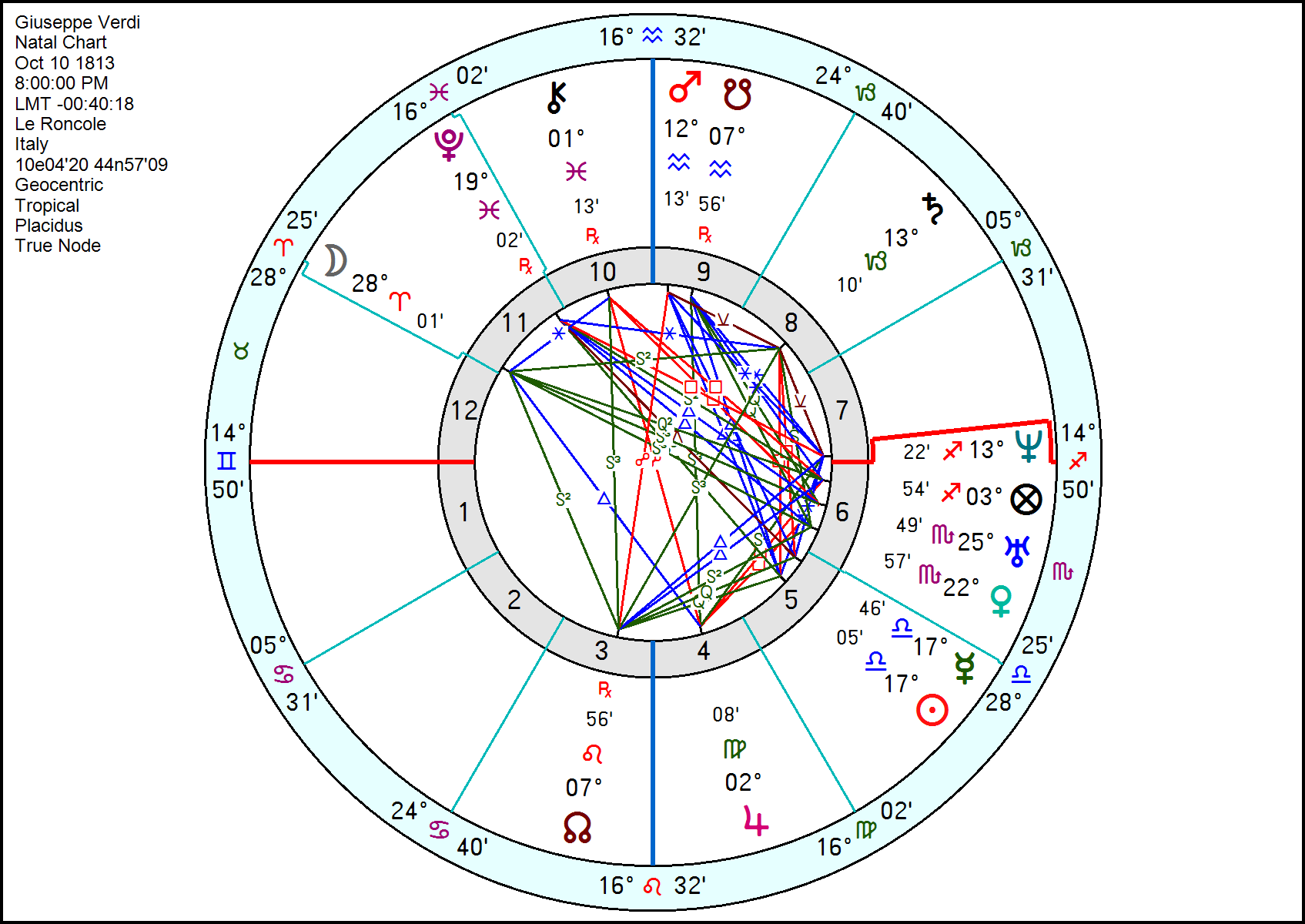
CHART appended to transcript:
- FIGURE 1982 0710a-1. Giuseppe Verdi Natal Chart.
AD PAPERS read in class:
"Insighting into an Image: An Annotated Abridgment of James Hillman's 'Image-Sense'". Retyped as 1982 0705b V09BN. Archetypal Psychology - Hillman - Image (Version 1) (AD Supp 276-279) and 1982 0705c V09BN. Archetypal Psychology - Hillman - Image (Version 2) (AD Supp 272, 274).
"The Archetypal Dimensions of Astrology". Retyped as 1982 0710b V09MP. Astrology - Theory (AD Supp 286).
"Distinguishing the Functioning of Planets in Dignity and Non-Dignity". Retyped as 1982 0710c V09MP. Astrology - Theory - Dignity and Non-Dignity.
NOTES:
This is 1982 07/10a, Astrology; Theory Class, and the first entry associated with this date. 1982 07/10b = Archetypal Dimensions of Astrology Paper. 1982 07/10c = Dignity and Non-Dignity Paper.
Older partial transcript also exists.
TRANSCRIBED Verbatim by IT (V12ap) in 2022 from Audio Files using V11a as a basis. V12ap has had another pass, has had listening errors corrected, much that was inaudible is now audible, has been reformatted to current standards, has updated prefatory matter including completed Book List, has updated notes within the transcript, has updated Verdi chart, has three AD papers read in class appended. In 2025, IT completes TOC and removes appended papers, which now stand alone, updates paper titles and notes within transcript, adds Plotinus quotes section, adds new note within transcript, updates front matter. Previous Transcription History: transcribed by IT prior to 2017; reformatted by jf 2018. Archival verbatim transcript with AD Papers – V12ap.
AUDIO FILES: 1982 0710a, 1982 0710b. [Note: "Tape" and "Side" refer to original audio cassette tapes later digitized into .MP3 Audio Files.]
1982 07/10a at Wisdom's Goldenrod
Astrology; Theory
[Audio File 1982 0710a Begins]
AD: Well we got a couple of things to read, we're gonna get into imagery because it's getting so fundamental maybe we ought to try to clarify very clearly what we're talking about. And we'll be making use of the Sabian symbols, you know, or any set of symbols. And I think we have to understand a few things to try to really work with them. I find very difficult to work with the symbols, the symbols that you read. But anyway, we got together a paper. We've been having a lot of discussions on Monday. Maybe we're getting closer to the ground, you know, their ground. So let's keep [couple words inaudible] [student assents] The weather calls for it.
S: Yeah.
[short pause]
S (faint): You could read [couple words inaudible]
AS: What? Ok, maybe we'll start with this-- the once read paper. Anthony? [Note: This paper was read at the beginning of WG Class 1982 0705a Astrology; Horoscope-Verdi.]
RC (faint): You read [one word inaudible]
AS: You want to start with the--
AD: Yeah, sure.
AS: --the once read paper? Think we could start with that.
[few seconds of background student talking, laughter]
LR: You mean the half (read/red) paper?
S (faint): No.
S (faint): No, the once read paper.
AS (simultaneously): The other half is black and white.
[couple seconds of background student talking]
AS: What-- ok, can we start? Start? Ok. What-- well, I'll read this. Gotta read through it first.
[Transcriber note: The following paper is an annotated abridgment of James Hillman's "Image-Sense", an article in Spring 1979: An Annual of Archetypal Psychology and Jungian Thought (pp. 130-143). We have two versions of this paper in AD Supp, one earlier and more complete and one later and less complete. They have been retyped as 1982 0705b V09BN. Archetypal Psychology - Hillman - Image (Version 1) (AD Supp 276-279) and 1982 0705c V09BN. Archetypal Psychology - Hillman - Image (Version 2) (AD Supp 272, 274). I transcribe the paper as read.]
AD ["Insighting into an Image," AS reading]: "What we are going to understand here…"
AS: Maybe do one paragraph at a time or--
S (faint): Maybe (that's-- you can) read the paragraph.
AS: You liked it better?
LR: How about finishing the sentence. (laughter, student words)
AS: (This is) very long.
LR/S(?) (very faint): How long is it?
AD ["Insighting into an Image," AS reading]: "What we are going to understand here by an image cannot be gotten to by sense perception, taken in the usual sense of empirical perception. Images are not optical pictures, even if they are like pictures. We do not literally see images or hear metaphors, rather we are speaking here of"insighting" which is a seeing through or hearing into, and these two appearing together as a single fact. Dreams and images are in fact retraining the senses themselves by confusing our usual sense language. That is, the dreams are liberating the senses from the conceptual constraints which are so decisive in their performance, and which even decide what the object must be. So the dream attempts to rearrange the senses' operation, to retrain our eye and ear out of their habitual modes of sense perceiving so that we can read the image and hear the psyche speaking, to give the senses the fluidity by which they can become a tool to get at the image. We are not talking about training in terms of knowing about images, but rather intuiting images. [short pause] [S, faint: Which we need.]
The senses and the mode of conscious understanding based on them are usually taken for granted. In psychology they are given new kinds of contents to work with, but the mode of perceiving the content, and this is all important, is left unquestioned. [11¼ second pause]
Dreams don't make sense because sense doesn't make dreams. Dreams are images made of imagination. To try to get at the imagination straight away through sense perception is incorrect. It would force the image into an illusion or lose it in an abstraction. We intuit a priori categories of the imagination and we make some sense of them without having to sense them in the simple perceptual meaning of sensation. [9 second pause]
Now imagination has no sense "language" of its own. Images do not present themselves as concepts, nor do concepts have images as their only reference. But a dream or image comes on its own terms, just as life does, and imagination can speak of itself without borrowed terms. And furthermore, the concepts are neither necessary nor sufficient for making sense of dreams. When the imagination does use language it must often twist it into a secondary sense and not speak in conceptual terms. For example the word "running" is a non-entity for us, it can become particularized into "running towards", "running away", and so on, but it can be used to hear meaning visually as in "the faucet is running". [short pause]
Now imagination as ordinarily understood may be simply different from the other faculties such as believing, thinking, and so on. But it is more likely an operation that works within the others, is found through the others, and perhaps is even their ground. So we never seem to catch imagination operating on its own, we can never precisely circumscribe a place for it because it works behind, through, within, or below. [10 second pause] A sensed image is a specific mood, scene or context, and the factors which help determine the mode of weaving these three factors together are called prepositions…"
S (very faint): Uh-hm.
AS: Pre-- yeah, preposition, the origin of preposition.
S (very faint): Preposition?
S (very faint): [couple word inaudible]
AS (simultaneously): That's sort of annoying. A connecting link.
FW: Would you read that sentence?
AS: Uh-hm.
AD ["Insighting into an Image," AS reading]: "A sensed image is a specific mood, scene or context, and the factors which help determine the mode of moving…"
AS: I'm sorry.
AD ["Insighting into an Image," AS reading]: "…the factors which help determine the mode of weaving these three, mood, scene and context, together are prepositions, [AS: These are the links.] or the aspects translated into language. [short pause] These prepositions specify the mode of relations, the linking and structure of the events; they are the subtle and invisible joints which are articulating the internal structure of the image, how it is woven together. The three factors mentioned above [AS: The mood, scene or context.] are held in a subtle net of the underlying primal image; they can be discovered substantially in things or in actions, but it is really these prepositions [AS: The links.] which subtilize the content of the image perceived by dissolving the substantial universality into a specific pattern or image in the primal sense."
S: Can you read the last two?
AS: Uh-hm. Sorry. There's three factors, the mood, the scene, the context of this sensed image--
AD ["Insighting into an Image," AS reading]: "…are held in a subtle net of the underlying primal image; these three factors can be discovered substantially in things or in actions, but it is really the prepositions or the links which subtilize the content of the image perceived by dissolving its substantial universality into a specific pattern or image in the primal sense. Now this is what is really important here--the shift in seeing--the shift from what is seen and heard, to the way what is seen and heard inheres in the intuiting of the image, that is, the shift to the working of the productive imagination. It is not what you see that is changing so much as the way that you see it. So this method of imagination must be conceived of as getting to the subtle sensing of the underlying prepositional relation among the events, objects, and so on. And of course these prepositions do not have to be written out in words."
AS: It doesn't have to be language, it could be music or any other--
S (very faint): (Music.)
AS: Maybe we should stop.
RC: Just let me see if I followed that. Like in the-- in the first mage, in the first presentation you had just running.
AS: Sorry, louder Randy.
RC (simultaneously): The first-- in the first presentation you have, there's just running going on, like say in this case it is a-- a person running. That what the preposition brings in is whether that running is towards something or from something, brings in that kind of a--
AS: Oh in the example, in the example of running. Hm.
S: I think it started with the universal and then the subtle-- the subtle image which arose also preposition and the prepositions being in the image.
RC (faint): How is it different from what I said?
S: It was the other way around. You start with the (contents/context) before we produce the image, anybody running.
AS: No I-- I don't think the running is a good example for the preposition thing. That was just-- that was just a-- maybe that was a side issue of how even when the imagination is gonna use language, which normally would be just straight--
S: What do you call it?
S: Connotative, denotative.
AS: Denotative, but normally just an actual-- that it might use a twist. If the dream, say, is going to use language or if your imagination, the poet, is going to use language, he may twist it around into secondary meaning to portray something of the image like "the faucet is running," and it's not the normal conceptual use of "running". Water can't run. I mean it doesn't literally-- it doesn't literally-- you're not thinking of the thing in a literal conceptual sense of running, you know, a guy running along. It's used imaginally. But the other-- this other example I thought the preposition would be like the connection. Maybe we have to give an example like we gave in the degrees.
RC: Well maybe I'm just taking it too literally but like "towards" and "from" are prepositions.
AS: Yeah.
RC: And they bring in--
AS: A relation.
RC: --like some kind of sense of purpose or meaning or whatever to an activity that's given.
AS: Ok, I think I see what you--
S: But if we take that prep-- preposition, I think the word would-- it dissolves the universality. When you start with the universal and then it becomes particularized through this preposition, then I think the problem might be that we're going to have to go from this particularized image through the preposition [couple words inaudible]
AS (simultaneously, faint): I know, that's what I was saying.
S (faint): And here [few words inaudible] too [couple words inaudible]
AS (simultaneously): Let's-- may-- maybe take an example from one of the symbols would be better. I think the point was that in the symbol you have certain symbols or symbolic images, as it were, you know, like a lion and a dog and there's a certain relation between them, two Dutch--
S (very faint): [couple words inaudible]
AS: Which one?
S (faint): Can we try 23?
LR: 23 Scorpio.
AS: Yeah, ma-- maybe we could do one with that, try and-- [RC: Ok.] try and see it.
S (very faint): Uh-hm.
RC (faint): I can write it down for everybody.
S (simultaneously, faint): (Write it.)
S (very faint): Uh-hm, yeah.
AS: Yeah.
S (very faint): Uh-hm.
AS: Yeah, well--
S (very faint): [couple words inaudible]
AS: That wasn't-- that wasn't the end of the paper. You want to read-- just read it? And I'll just make some--
S (faint): We're certainly getting confused.
AS: Oh, you like that? That was a good one, the one--
TS: I think, what was his--
LR: Venus, Verdi.
TS: Verdi's Venus, yeah. [Note: See FIGURE 1982 0710a-1, Giuseppe Verdi Natal Chart, appended to this transcript.]
Marc Edmund Jones [The Astrology of Concepts, Scorpio 23, TS reading]: "A little white rabbit rests contentedly in his cage; before the eyes he metamorphoses into an elf in a fairy glade."
TS: And it seems like when you have the image-- I-- this is what I made out of that, ok?
AS (simultaneously, faint): Oh of course.
TS: You have an image of a rabbit and you have-- the rabbit's in a cage, so the-- the pre-- preposition "in" is needed to situate or establish a relationship between a rabbit and a cage, [student assents, faint] you know, and then there's a-- an elf, ok, in a fairy glade. Now those are set little pieces or images and then you have-- besides that you have this-- the "into," they're metamorphosed "into", you know, and if it had been a-- another, like a conjunctive, like "and a-- an elf in a fairy glade," the feeling or sense of the image I think would be different. If it said, "A little white rabbit rests contentedly in his cage and an elf is in a fairy glade," [AS assents] you know, it's still the same scene, the same pictures are there, but the relation is different.
S: Yeah. Two of them are space relations and one of them is (like) some kind of a time relation, you can use that.
TS: Yeah, and also [one word inaudible]
S: But I mean in cases of continuity between discrete elements [student assents] of the presentation.
TS (simultaneously): Yeah, different element-- visual elements or conte-- I didn't quite understand all three of those things, there's a mood, context, and picture of something. Maybe we can go through the paper again and just [AS: Yeah.] ask about that.
S: Yeah.
AS: Well in-- for example in that one, the white rabbit, I mean, a symbolic method, you know, like the Jungians might take white rabbit and extract that one image, rabbit, "Now let's see, what does rabbit mean?" [RC assents] Well, it usually means, you know, fertility and all this and so on. I mean you could get certain meanings for each of the specific images if you go into it. [S simultaneously: Ok, and what does (it mean)?] But it seems that there they're taken out of context, really lose-- [RC assents] and the context seems to be all important, the interrelationship, the linking of these images seems to be what you really would have to trace to get to the primary image that the secondary image, that [RC assents, faint] the picture image is trying to convey, that the words [couple words inaudible]
RC (simultaneously): Yeah like a rabbit in a cage is very different than a rabbit next to a cage.
AS: Yeah, not that the rabbit is an unessential. I mean it would be different if there's a rabbit than if it was an elephant in a cage I suppose but-- (laughter) but that's--
DR: Well I'm a little-- I'm a little lost Avery, I mean, in that particular example isn't the metamorphosis what really gives the quality to the image rather than [AS simultaneously: Yeah.] the preposition?
VM: Or the [one word inaudible]
TS: Yeah.
AS: Well, I think that the word-- maybe I'm wrong but I think the word 'preposition' may be being used in a-- in wider sense, unless you think it's really specifically just to the English use of it, you'd-- Yeah.
VM: So just using it as a synonym for connective, connection, interrelationships?
AS (simultaneously): I think so. Not necessarily just the technical use of the English word 'preposition', is it?
S: No the [couple inaudible student words simultaneous with S] words are reflecting something [AD simultaneously, faint: Who?] of the real.
AS: Well I was just asking you.
AD: No, in the wider context.
AS: Yes.
LR: I think the wider [AS simultaneously, faint: Ok.] context would actually also include the life of (his), in other words, the motion of it. [AS: Yeah.] It's not just a static [AS assents] thing of "beside" but it's the way in which the life moves through that-- those, like you said, those symbolic kind of contents, so that here-- I mean I think David's right in a way, here the "metamorphosis into" is really all important, [AS simultaneously: Well (couple words inaudible)] and it kind of carries the life or motion of that life.
AS: I think there must be-- the relation. This line I think should be clear.
LR (simultaneously): But--
AD ["Insighting into an Image," AS reading]: "They specify the mode of relations, the structure; they are the subtle and invisible joints which articulate the internal structure of the image, how it is woven together."
LR: Yeah, well what I wanted to point out was that I think that that kind of motion or life defines a kind of state of consciousness, which maybe we would call taijasa, which would be the actual mode of apprehending the image [AS simultaneously: Good, ok.] and that that's what kind of underlies the whole static language of them.
AS: Good, that's a good-- that's a good example, that the image-- another distinction, that the image you have there is static whereas the underlying or primal image that this is trying to express is really fluid and dynamic, full of life. Yeah that's-- that's a-- I think that's a good point.
AH: Avery, if-- just in a general sense, we're discussing how language is inadequate ultimately to express this image or how lan-- how language is a means of expressing image?
AS: Oh yeah, I--
AH: What is this discussion on, image (as/and) the language?
AS (simultaneously): No, see, I think the-- the main point of the discussion probably is how to get at the image, you know, what do we mean by-- we read a degree symbol, what do we mean by seeing into the image. Now obviously this particular kind of imagery in the case of a degree is something written, ok, it's language. [AH assents] It could be poetry, I mean, it could be music, it could be any other expression, any other form of expression. In this case we're taking the symbols because we want to try and understand somewhat how to read into them. [S: And that--] And there is a literal way. I mean there are various ways of reading symbols. For example, there's a literal way, ok, conceptual way of reading language. You know, you begin-- the various levels of that too. You could begin taking apart the sentence structure. You could begin by taking it and trying to literally understand, oh a rabbit and a-- you know, and an elf and try and literally understand what each of those mean. Or you could do it even symbolically, understand what the symbolism of rabbit is, take that out, and there's the symbolism of an elf separately. But this is kind of trying to understand a different way of getting to that primal-- the primal image this is trying to express.
AH: Well that's really what I was wondering about, I mean, the poetic use of language, like the poet chooses words that have connotative value. He tries to put his words together to get outside the denotative, dictionary kind of literal value of the word, so the word has in some cases unlimited shades of meaning in terms of this connotative association. Now is that the way that we're reading these symbols? Like [few inaudible AS words simultaneous with AH] you either would read them literally or you don't, and if you read them poetically or you come to a connotative value, you can't keep referring back to a literal meaning in terms of a grammatical analysis.
AS: True, but I-- I'm not even sure it's what we would call a connotative meaning unless we understand by connotative something else that seems to imply a whole different way of seeing the symbol, a whole different way of trying to intuit the image which is behind the symbol. Now I don't know--
AH: But, that's really what I'm asking. Like in a poem, you know, you read a poem and you find that there's a kind of moving interior [AS simultaneously: Ok.] sort of experience.
AS: That would be-- that would be more like it, sure.
AH: And you're certainly not talking about the literal meaning, like that's [AS simultaneously: Right.] the vehicle that provides the access to the poem.
AS: I agree. Ok, if that's the way you're using "connotative". But not if you-- but not connotative in the sense that you would take each word and see what it separately connotes, but rather the interrelation of the words is what you have to trace and hold, I mean it's evoking within you [couple words inaudible] the case of a poem, evoking within you a certain mood.
JfL: Avery? Couldn't [AS simultaneously: Uh-hm.] the-- in the [AS simultaneously, faint: But--] equation that you've got of the-- the imagination with its subtle joints, the prepositions creates the image, couldn't the-- couldn't the imagination there be the symbol itself and then the image be the symbol in its-- in its entirety, instead of taking the prepositions to be the actual constituents of the sentence, of the image in that sense.
AD: Look, why [AS simultaneously: The model for all this is different.] don't we take-- why don't we take a symbol, write it up on the board, take a symbol, write it up there.
AS: Yeah, use an example.
AD (simultaneously): Take the Saturn that Vic worked with, alright, he's-- [couple inaudible AS words simultaneous with AD] he worked with that. Just write out the symbol, [TS simultaneously: Oh no.] I mean just write out the-- the degree symbol.
VM: For Sun?
AS: Yes I-- I think we really should do it with an example from (the--)
S (faint): That was the alchemy of an example.
S (very faint): It was?
AD: Would you read [S simultaneously, faint: It was what?] the symbol and write it up? Tim, would you write out the symbol on the board please?
TS: I don't have the [couple words inaudible] with me.
AS: I have it. (Just) the whole [one word inaudible] which one do you want?
MW: [couple words inaudible] the one with the sunbonnets.
[few seconds of background student talking]
AS: He also-- Herbert? Herbert, can you-- [few seconds of background student talking] And I-- I think part-- the model for this-- Well maybe we'll wait, Carol.
TS (very faint): [few words inaudible] long.
RG: No they did it.
[few seconds of background student talking as class looks for VM's Saturn degree]
MW (faint): It's 11, is it?
AD: It's 11, and I think this--
[1 minute 1¾ second pause with background student talking while symbol is written up on the board]
AD: Now we're going to say that this is the symbol, alright, not the image. This is the symbol.
S: What's the symbol?
RG: Can you just (go through that)?
AD (simultaneously): Well these-- we're taking the position that the image cannot be got at empirically. [RG simultaneously: But--] You can't see the image.
RG: But the symbol can be.
AD: But the symbol can be.
RG: Symbol's the actual picture.
AD: Yeah.
S: The static-- [TS simultaneously, faint: Right.] [AD: So--] the whole static image? I'm just wondering.
AD: Yeah, [AS simultaneously: The static picture.] you can call it a static image but let's call that the Aristotelian empirical perception, [S simultaneously: External.] ok? That you can see, alright. But underlying, underlying that is an image. Now the theory I think in astrology is that the 360 degrees represents 360 different images and these are the archetypal ground on which all our symbolical references are pointing to. So if we say that that's the symbol, then we know that underneath it there is the real image that we're trying to get to. So that's not the image, [S: No.] [S: Uh-hm.] alright. Now if we look at that sentence, alright, and since Dickie is good at words, I think, I think you can see that you have nouns, adverbs, adjectives. (some laughter) Alright? And if we take each word, if we take each word there, verb, noun, adjective, adverb, ok, and we examine them separately, alright, like you-- if you don't know what a sunbonnet is, you go look up in the dictionary of symbols and you-- you get the meaning of sunbonnet. And if you say with each word that you think this, you know, symbolical of something, alright, and you do the same with the verbs and everything else, what are you going to come up with? You're going to come up with more concepts. You're not going to come up with the image. So evidently that's not the way to approach the image. We want to get to what the image is.
AH: But it is possible to come up with what we refer to as a visual image, like a picture in the mind.
AD: Yeah but, again, that's not the image.
AH: That's not the kind of image that we're looking for.
AD (simultaneously): That's not the image, [S: No.] that's not the image that underlies-- In other words, when we're looking at the 360 degrees, we're looking as 360 images which we claim is equivalent to the mundus imaginalis, [AH, faint: Yes.] the world of archetypes.
AH: Now those are not images, Anthony, in any context of the sensory apparatus.
AD: Yeah, that-- you can't see them.
AH: It's possible to talk about auditory images, visual images, tactile images. Like through the senses, there's all these different ways of knowing images. Now this kind of image that's--
AD: 'Cause see--
AH: (It's/Is) divested of any sensory content.
AD: Yeah.
AH: You can't know it through touching or [AD simultaneously: No, no.] hearing or seeing or tasting or smelling.
AD: Exactly. Now that's the image we're talking about. That's the image that we say the 360 degrees is talking about. So that's the archetypal image beneath the sensory or let's say concomitant with the sensory, alright, and it's there but we can't see it, and we have to try to find a way to get to it.
AH: Alright or concomi-- concomitant with the sensory. If you read this and think about it, depending on the powers of individual imagination, (we/he) create a visual image, a picture in the mind's eye, of-- of this.
TS: Yeah.
RG: Well that's it.
AS: That is a visual--
RG (simultaneously): That is the picture in the mind's eye.
AS: Yeah.
AH: Yeah, but--
AS: A woman in the sun-- you know, you think-- you'll think of a woman in a sunbonnet with garments and so on, now that's the visual picture.
AH: We'll each come up with our own picture.
AS: Ok. But still if it's-- if-- if you just take it literally you'll come up with some visual picture, [AH simultaneously: Yes but--] you'll imag-- you'll try and think-- in the normal sense the way we use "imagine" you'll try and think of-- in your mind you'll try and think of a picture of a woman with a sunbonnet and all this.
AH: But yes Avery, but we'll each have our own-- [AS: True.] our own version. Now [AS simultaneously: Right.] concomitant with that individual version, there's the opportunity for this other kind of image [AS: Right.] that's not individual. Is that so?
AS: And which is not sensible, as you just said.
AH: Yeah.
AS: As you yourself just pointed out. If you take all-- away all of the five sensory qualities, you'll get to a subtle perception, mea-- a perception of meaning we would say, I mean [AH assents] just put it that way, perception of the meaning which is that primal image that's pervading. But since it's subtle, it-- you can't see it, you can't hear it, you can't taste it. So if you just have that seen, tasted, heard vis-- vision, the seen, tasted, heard picture, that's not gonna be the subtle meaning, the subtle image which has given rise to this, [S simultaneously: So (this--)] which is trying to be expressed through this picture.
JfL: So then the prepositions are the-- are in fact not the prepositions that he-- that are up on the board. They are the connecting link between that and the primal image, the reason-principle. Right, is that right?
AD (simultaneously): Well, could-- could [AS simultaneously: Well let's--] we slow down just a minute now?
AS: Yeah let's--
AD: Slow down just a minute.
AS: You could stay with the--
AD: Alright, so, we've come to that-- that much of an agreement that we're not going to get to the subtle image, alright. If we try to keep in mind like what we're speaking about here specifically is that this degree, Saturn is on this degree. And if we're thinking of Saturn as the senex, the category in the imagination, alright, the category of the imagination, what we're saying is that the way this category of the imagination is-- is structured and organized is according to the subtle image, not the one that you see but the subtle image. [student assents] So the senex, self-apperception, whatever you want to call Saturn, alright, is basically organized according to the subtle image, the image that we can't see but of which this is an indication and referring back to that image that we can't see, and the theory would be in astrology that this Saturn therefore is organized, structuralized, according to this subtle image. So if we directly go to the symbol and read off the symbol and think we're understanding the way the senex is organized, we're missing the point.
AH (faint): Yeah.
HS: Yeah, on the other hand, do you [student assents] have any other access to that-- to that real image than the symbol or your experience, you know, (of symbol)? May I ask?
AD: Well, there is, but that's not important now.
HS: It's not important.
AD: No.
HS: But I thought you--
AD (simultaneously): There's other ways get to the image than the symbol reading.
S (faint): Yeah.
AS: Is that--
AD (simultaneously): One could be aware-- one could be aware of a meaning, you know, without a symbol. But, we're not-- we're not going to go that way, we're going to go this way, we're going to say, alright, this is the only access we have to that image, through the symbol.
HS (simultaneously): Symbol. Ok.
AD: And so we have to have, and we do have many books that are, you know, what they call symbolic degrees, alright. They claim to give us a representation of these meanings which exist in the subtle world which are the actual products of the primal imagination, and that these would lead us to them if we know how to read them right or if we have a technique by which we can, let's say, approach the image, get to the image, so that we can understand how the Saturn or the senex-- the senex category of the imagination is organized. Because, according to the theory, the senex organ would be organized according to that image or that meaning.
HS: Which is prior to that word-picture.
AD: Well let's say prior or concomitant, [student assents] ok. Let's say prior, sure.
S: Is a subtle image another name for the reason principle? We used the term 'reason-principle' before. Is it on the same-- is it another word for that? You're saying images--
AD (simultaneously): Well, we're staying away from reason-principle because we want to--
AS: Too many level.
AD/S(?): Uh-hm.
S: Yeah.
AD: I mean that'll take us further deep. Like I say, let's take little tiny steps.
S: Ok I'm just trying to get to-- get where we are because I--
AD: I don't want you to-- to-- to do that, I mean, because you'll be positing the reason-principles and you-- you're not going to think it out.
S: Yes but there is a difference though in level.
AD: Yeah, there's a difference in level.
S: Ok.
AD: Go ahead.
AH: Anthony, when a clairvoyant provides us with these symbols, Sabian symbol(s), now what is it that they have access to? They don't have access to the image behind the symbol but they have access--
S (faint): Yeah, sure they do.
S (simultaneously, faint): Uh-hm.
RG: They have to.
S (simultaneously): Sure, they would have to.
RG: Otherwise [AH simultaneously: Well then how--] they wouldn't be [AH simultaneously: So--] related to it at all.
AS: But that's true but that's the-- but they're [AH simultaneously: Well--] trying to express that access that they have as--
VM (simultaneously): They pictorialize (the image/meaning).
AS: Yeah, they picto-- that's right, pictorialize the image. He pictorialize his clairvoyant access--
AH (simultaneously): Is that-- is that what the clairvoyant does, is that what the clairvoyant sees? The clairvoyant knows [AS simultaneously: Clair-voyant.] that image, [S, faint: The meaning.] he [AS assents] knows the image, and he has the ability to symbolize it for us, is that [one/two words inaudible]
AS (simultaneously): Yeah. That might be what "clair-voyant" (means). Clairvoyant (means clear seeing).
AH (simultaneously): Or did-- did clairvoyant actually see this picture of a woman cool in [AS simultaneously, faint: No, no.] sunbonnet and simple garments. [one/two inaudible student words simultaneous with AH] He doesn't know-- and doesn't know what it means but that-- do they care.
AS: Oh, I see your point.
S: I mean-- yeah.
AS: That's really a--
VM: Well you could think clairvoyant is something unconscious.
AD (simultaneously): (Well) you could have though-- clairvoyant could be a, you know, very [S simultaneously: It could be unconscious.] philosophically or le-- undis-- you know, orientated, and you could have a clairvoyant who has this function and doesn't [student assents] really have any necessary, let's say, learning to accompany it, to do it, to properly translate it and verbalize into a symbolic form what he's seeing. I mean, the point is that clairvoyant is exactly what we're talking about. A person who's clairvoyant, he sees meanings and perhaps the immediacy of the mind's interpreting activity translates it into a verbal form and he writes it down in that way and that's what he's doing for us. Whereas we don't have clairvoyant and we have to accept the verbalization of his clairvoyant perception. But you have to remember, clairvoyance in itself is no guarantee what he's saying is correct.
S: Yeah.
S: Well--
AD: There'll always be the activity of the mind interpreting and interfering with that.
AH: I was wondering, Anthony, if there's an intermediary realm between the realm of the symbol as we're dealing with it and the realm of the image as pure, not a sensory image. Is there a place in between the clairvoyant has access?
AD: Well, we-- you just said that the clairvoyant has access to that realm of meaning, [AH: Oh.] the realm of meaning.
AH: So all clairvoyants have access to the realm of reason-principle.
AD (simultaneously): Well they see directly the primal image. [student assents, faint] Well, by primal image we mean the-- the meaning, alright, which is not clothed with the, you know, language of our mind, verbalize(d).
AS: I-- I guess you would suppose that if you had a power of clairvoyance, you wouldn't-- that would be the other way, you wouldn't need this symbolic thing to get to that primal image or that meaning. You could drop-- you would be able to see it. Like if a Sage, you came before a Sage or something, he might see-- he'd see that meaning in you without having to read the book of symbols probably. And he could look at you and he'd say-- "Oh, I could even intuit," he's clairvoyant, he'd know what that meaning was that inheres in the psyche.
AD (simultaneously): Yeah, because present in the-- present in the sensory object is [AS simultaneously: That--] the meaning, but it is [AS simultaneously: Right.] an invisible meaning. [AS: Yeah.] I mean, it's not the sensible object.
AS: Right. But there the sensible object would play the role that the symbol does here. I mean, see-- you'd have to be there before him, you-- he'd see you sensibly but he'd see inhering in you the meanings or the reason-(principles).
AB: Right, he wouldn't see the symbol.
AS: No, but he wouldn't need to see the [student assents] symbol, but here we are doing this in terms of the symbol.
AH (simultaneously): You say the meaning is always concomitant with the sensory.
AS: Actually, I mean you would say [AD simultaneously: Well, yeah.] that in this case the meaning is concomitant with it, sure.
RG (simultaneously): It would have to be, if the symbols work.
AS: Right.
RG (simultaneously): I mean if they're working symbols, they would have to.
AH: But if he--
S (simultaneously): Right, in fact they wouldn't even be there [AS simultaneously: But they're just not--] if there wasn't a sym-- [couple words inaudible]
AH (simultaneously): But that would be so of all [LR simultaneously: No.] objects, not just-- [AS simultaneously: No.] that would be so of all objective--
AS: Oh, of all-- of all living things, but I mean you could write a sentence on the board that doesn't have a concomitant [RG: Right.] primal image to it. This is like the statue of that [S simultaneously: Particular essence.] primal subtle image, it's like its statue. You remember with that idea that this really is linked to that subtle image, that subtle meaning. [AH: But you--] It is an appropriate expression of it. And so (everything/anything) that's an appropriate expression of that will have it concomitant with it, but concomitant doesn't mean sensually.
AH: But the Sage doesn't have to look at the chart and then the degree symbol, he could look at a living entity, ok.
AS (simultaneously): Because the meaning is concomitant with him too.
RG: No, no, I know but--
AS (simultaneously): Like if this is Vic's-- if that's really Vic's degree, if that's a degree in Vic's chart, then if I really were clairvoyant, I looked at Vic, I would get to the primal image that that symbol represents. But since I'm not and I'd have to-- and I can't get it from looking at Vic, I'd have to get it from the symbol.
RG: Yeah but Andrew, these are very specific. It's not like just looking at a tree and getting-- getting the imaginal essence of a tree by symbolically seeing the tree. These are particular imaginal degrees that seem to structure our psyche, you know, they're ver-- they're very particular.
AH (simultaneously): How about-- [AS simultaneously: Yeah.] how about the rest of life?
RG: Well those you could [AS simultaneously: Well--] see by looking at Nature, I mean, you know, there are other ways to include those things.
AS (simultaneously): There may be other essences in there.
AD: But the whole rest of life, as-- as Dickie pointed out, if these meanings are what structures our psyche, [AH assents, faint] [S simultaneously: Then that's the meanings (couple words inaudible)] alright, then what you're talking about is already included in the way the psyche is structured.
S (very faint): Uh-hm.
TS: Yeah.
AH: So fundamentally we go to the psyche.
S (very faint): That would be smart.
AD: Because that's basically what we're saying, or that's what we're talking about. When we-- when we're talking about the symbolic degree, we're speaking about the way the psyche, the constituents of the psyche, let's say the seven or the ten categories of the imagination, are organized in such a way that the way you perceive is predetermined. So that's what we want to get to.
AH: The Sa-- the Sage or [S simultaneously: How do we do that?] the clairvoyant would have access to that just by being with you.
AD: But even the Sage himself is ps-- even the Sage's psyche [student assents] is organized [AS simultaneously: In a certain way.] to perceive in a certain way.
AS (faint): Yeah, he's clairvoyant.
HS: So when you say the way we perceive is determined and you point to this subtle imaginative nature that operates within us, what-- I don't-- where is that, so to speak?
AD: Where is--
HS: Where is that?
S (faint): Yeah.
AD: Uh--
LR (faint): It's in you.
HS: No, no, uh-- Like, when you have experience of--
AD (simultaneously): It's the concepts, it's concepts that dictate and determine causality and time. So your question is not relevant now.
HS (faint): [couple words inaudible]
S: So how can we take that [one/two words inaudible]
AD (simultaneously): It's only when you translate it into a verbal form that you-- you're putting-- putting it in time and in causality and now you can ask the question. What we're trying to do is understand what organizes the forms of the psyche which determine time and causality for us.
HS: And you're trying to understand it first by looking at this word picture and saying it represents the imaginative meaning?
AD (simultaneously): It represents a certain meaning and we have to get to that meaning.
HS: Ok.
AD: Now, if-- if we took a very specific degree, and the point that, again that Dickie made which I don't like to acknowledge-- (laughter) These are very specific. (laughter, student words)
RG: Next time, till next time. (laughter)
HS: Well I don't think these are accurate because I think the person's life is much more specific than any one of these degrees.
S: But then--
AS: Well--
S (faint): Well, just from the nature of what he said.
HS: But go on.
AD: There's a very highly organized and determinate relationship or nexus that exists between all the categories of the imagination, which in their totality will constitute your functioning as an entity. Now, I-- you can call these propositions-- prepositions, or you can call them aspects, doesn't matter right now. The point is-- the point is, try to-- let's follow this in a certain order because you're jumping around like grasshoppers.
LR (faint): Rabbits.
AS: Yeah.
S (faint): Uh-hm.
AD: Rabbits too. (bit of laughter)
HS: But I just asked [couple words inaudible] away.
AS: So, if we go back to this [S simultaneously: Can I-- can I ask a serious question?] example of the degree, maybe we could just-- maybe you can give an example--
AD (simultaneously): Wait, she wants to ask a question.
S (simultaneously, faint): Wait.
S: This is serious question, [MW simultaneously: No questions.] and it's got to do with [few words inaudible]
AD (simultaneously): Serious question. (bit of laughter)
RG (faint): Aren't most questions serious?
S: Who determines, Anthony, if this clairvoyant vision is authentic? You know, I assume it is because you're using it but I-- I'm just [couple words inaudible]
AD (simultaneously): No, most of the time, most of the time there is no criteria except empirical usage [one word inaudible] yeah.
[couple students at once, few words inaudible]
S: Is that--
S: What--
HS: A lot of the times it could be a [one word inaudible] or a street corner in California, like 1925 [student assents, faint] I think [couple words inaudible]
S: So you could get behind the symbol.
S (simultaneously, very faint): Yeah.
S (very faint): That's right.
AD: I think you're missing the whole point. I-- I think what you're missing is the fact of what I said, you know--
S: Well say it again.
AD (faint): Would you read that?
S: Out loud.
[Transcriber note: The following paper, "The Archetypal Dimensions of Astrology," is found in AD Supplementary Material, p. 286. It consists of one page handwritten by Anthony. Anthony modifies it a little as he reads. I transcribe it as he reads it. This paper has also been retyped as 1982 0710b V09MP. Astrology - Theory (AD Supp 286).]
AD ["The Archetypal Dimensions of Astrology," LR reading]: "Our interest archetype or imaginal daemon…"
LR: Is that the word you want?
AD (faint): No, I'm not reading it. (laughter)
S: Talk.
AS (very faint): "Dimensions of astrology."
S: Uh-hm.
AD: Now read this.
LR: Oh, oh, I got you.
AD ["The Archetypal Dimensions of Astrology," LR reading]: "Our interest archetype or imaginal dimensions of astrology -- the…"
AD ["The Archetypal Dimensions of Astrology," AD reading]: "Our interest is in the archetypal dimensions of astrology…"
AD ["The Archetypal Dimensions of Astrology," LR reading]: "Our interest is in…"
AD: I'm sorry, I [LR simultaneously: You forgot the propositions.] abbreviate, I abbreviate. (laughter, student words)
AD ["The Archetypal Dimensions of Astrology," AD reading]: "Our interest, the archetypal or the imaginal dimensions of astrology -- the whole web of interrelated archetypal imaginations underlie our world and these, the archetypal images, are the doorway that lead into the mundus imaginalis, just like dreams and mythologies. The astrological archetypes [AD: The degree symbols, in other words.] somewhat between the two. [AD: That is, between dreams and mythologies.] Dreams reveal more the individual relevance of an archetypal pattern or image at a given moment, and myths show the archetypal patterns in their own world, whereas when we consult astrology this enables us to connect the archetypal patterns underlying any specific situation in time. The link of imaginal elements with each other emphasize qualitative associations. The linear connections restrain or order them by time [and causality]. These constructions reflect the multivalent relationships in the realm of the imaginal."
AD: Now, this is almost basic in the premises that we're working with whether we, you know, are conscious of it or not. [student assents, faint] Now, if we-- if we conceive of it in this way, Herbie, if we say that underlying are the entirety of the 360 degrees or-- I mean that these hundred s-- 360 degrees represent the realm of the archetypes, and that the relationships that exist between all these archetypes with each other is really fundamental to an understanding of astrology. Unless we get to that, we will not understand astrology except in a superficial way. I think for instance this is the basis of the I Ching. You got there 64 hexagrams and each one is associated with a very certain image which is supposed to be archetypal. And when you flip coins or throw arrow sticks, alright, certain associations are (unqualitatively) made, alright, which bring up to mind what is appropriate for that moment.
Now, I haven't studied the I Ching but I would say that the same fundamental axiom is operative in astrology. When you look at a chart and you try to read a chart, what you're really trying to read, I think, is the association or the nexus or the pattern of relationships which is underlying the relationship between, let's say, the transits and the natal planets in your chart, and you're trying to see how these are associated together qualitatively on the one hand and also at what moment in time they're operative. So you're really trying to get to those fundamental archetypes which are underlying the sensible representations or the perceived world. Now, if we want to-- and I think this is what we want to do, we want to try to get a glimpse of what the archetypal realm is-- is like. Now, the only approach we have is to take the symbols, alright, and look at the symbol very carefully, and say now how in the world am I going to relate that to the category of the imagination, the organization of a certain specific function in the totality of psy-- of the psyche which we call the senex, how am I going to relate that to the senex consciousness?
HS: Ok, now, the category of the [few words inaudible]
AD (simultaneously): No, no, no, no, no, no, you listen for a while, ok? Now you take that symbol, Herbie, alright, you read that symbol, how are you going to relate it to the senex archetype that Mr. Mansfield has to operate with?
HS: I would look at Mr. Mansfield in operation. (some laughter)
AD: Then you're not going to help Mr. Mansfield very much. [HS simultaneously: Well I am.] Because he comes over to you and says-- is asking you, "What's wrong with the way I operate?"
HS: And I would say--
RG (simultaneously): And he'll tell him. (laughter)
[few seconds of joking and laughter]
AD (amidst student talking): Good. No. No these--
HS: But what-- but how-- [AD simultaneously: When you're--] wait a minute, wait a minute. You're saying take-- you-- don't you look at the life first? Is-- I don't understand your point there.
AD: Look, you're going to have the same pro-- you're going to have the same problem, I think Tim could verify this. You go to the astrologer and he's going to ask you certain questions [TS assents] and all you're going to do [TS assents] is present him with a lot of concepts. [TS, faint: With your life.] [HS: Ok.] And he's going to have to get behind those concepts and see again what's going on. That means he has to penetrate into the archetypal realm to see what you're talking about.
HS: So you're post-- are you saying that you could look at the (meanings--) this formulation, the Saturn on 11 degrees Taurus, that you don't even need the person in front of you for the real meaning to come through?
AD: Yes.
S (faint): That's right.
S (faint): Would you, Richard?
S: [few words inaudible]
RG (simultaneously): No.
LR (faint): So--
AD (simultaneously): Theoretically that's not only possible but I would say plausible because I'm sure Tim could give you examples of many astrologers who have to do that. Don't even know the person and read their chart.
S (faint): Right.
HS: And then [couple inaudible AD words simultaneous with HS] you could give a-- then you could give a general--
AD: You could give a pretty-- sometimes a pretty accurate description of what's going on.
S: But couldn't you have two people who have the same Sun degree and-- or degrees in their charts and have totally different lives and operate in different ways?
AD: First of all, nobody has two same Sun degrees. Again you misunderstand. You cannot have your Sun the same as my Sun because the aspectual relationships, the connections between the various subtle--
(Side 1 of original cassette tape digitized as 1982 0710a Ends; Side 2 Begins)
AD: --there and an opposition elsewhere, [RG assents] right?
AH: See the-- like we would talk about two levels. At the level of the image, the imaginalis or whatever you call it, to speak of relationship at that level is very different than speaking of relationship in a context of aspects in individual's chart.
AD: No, they're the same [TS simultaneously: No.] thing. [student assents, faint] That's what aspects are referring to. [AH simultaneously: The aspects--] Aspects are referring to the relationship and the association of qualities with one another.
AH: Anthony, at the-- at the level of the symbol where we-- you know, where we start, I mean we'd look at the symbol and try to have intuition of it, like it's possible at that level to speak of relationship because you're still dealing with images in the mind, conceptual image.
AD: Yeah.
AH: And that's what relationship means--
AD: Yeah.
AH: --in-- in terms of mental functioning.
AD: Doesn't relationship also mean-- or, for instance, when we speak about the s-- the laws in physics which determine an object, alright, and that these laws are relatively subtle in relationship to the empirical object, and isn't there a relativity of the laws, each, so to speak, operating on the other and together they produce what we would refer to as the universal relativity that underlies the physical world. That's our problem because we have to understand the universal relativity that underlies or is beneath the sensuous object [AH assents, faint] and relates the meanings to each other.
AH: But that's what I was trying to get you see. On the one hand you have this 360 degrees and they don't do anything. They just-- they just are. And the only-- in relation-- and then there's a relationship between that kind of almost static imaginalis with individuals. Is that so? Like this degree is working for Vic and for whoever else has planets there. Ok, and it only functions insofar as an individual with a planet on it? [S simultaneously, faint: (Well I mean--)] Then it's possible-- then it's possible to talk about relationship.
AD: Go on.
AH: Individual's relationship to the cosmos.
AD: I-- [AH: I--] I don't get your question.
AH: I think-- I think it-- I don't think it's a question, I think I understood what I wanted to-- It's not a question. Skip it.
MW: So is there a suggestion in this paper as a tech-- as to a technique?
VM: No Michael, this is a reason. (bit of laughter)
AD: Well, no, there's-- there's no actual technique but if we're made [RG simultaneously, faint: Become clairvoyant.] aware of what it is we have to do, alright, then per-- perhaps it becomes more available to us. And I'm trying to understand the technique too that's operative. So let's read a little bit more.
AS: Ok. Do you-- Should we go back and read it again or just keep going [few words inaudible]
AD (simultaneously): No, just keep going.
AS: Ok.
AD: Yeah they're just some ideas we sketched-- [AS simultaneously: Ok.] put down together.
AS: So-- ok. So we're talking about these prepositions. Let me go back one sentence. Ok--
AD ["Insighting into an Image," AS reading]: "So this is important--the shift in the seeing… … Imagination must be conceived of as getting to the subtle sensing of the underlying, prepositional relation… [AS: Ok, which we've also called the primary image.] … So it comes to this: we sense the subtlety of images by means of prepositions or aspects, their overtones and under-sense, and this is like looking behind, into, listening for, hearing through the empirical composite of the gross sensations that are represented by the symbol for example, the word."
S (very faint): Would you read that again?
AS: Yeah I [couple word inaudible]
AD (simultaneously): Alright, so if we-- if we just use an example now, let's start using examples as we-- as we go along. If, for instance, you see someone has a mother complex or what is described as a mother complex, you get a sense that there's something-- let's say an astrologer would say, I-- you know, he's got a Mercury squaring his Moon or something. (laughter) There's a preoccu-- (laughter) There's a preoccupation with that problem, alright. So he's sensing, he's sensing, underneath the sensible-- the actual sensible perception, he's sensing there the nexus or the (prepositions/propositions) that are connecting these two facets or let's say categories of imagination to each other, and the connection is a square, or you want to call it a preposition, doesn't matter, ok, and that that's what the astrologer's like is nose-- nosing in on. So he's-- he's actually getting to the subtle meaning. He's getting to the image which is primal, which is prior to the actual complex that he's having with his mother.
[students assent, faint]
S (very faint): I see.
HH: So the actual complex that he's having with his mother would be the symbol?
AD: Yeah, that would [HH simultaneously: The symbol that he's working with, ok.] be symbolic-- that would be symbolic of the archetypal--
HH: Ok, and the s-- the skeletal structure of the symbol would contain the meaning?
AD: Yeah. It should contain the meaning.
HH: Should contain the meaning. So [one/two words inaudible]
AD (simultaneously): It should give you some indication, in that degree there should be some indication.
S: Of what?
RG: But is-- is it in that degree or is it in the relationship between the square degrees?
AD (simultaneously): In the relationship. That's why I said, you have to get to the prepositions to get a feeling of how they're-- the, let's say the two planets and the houses they're in are juxtaposed. Because, I mean it is the preposition or it is the aspect that, so to speak, juxtaposes these two factors in a certain way rather than another way.
RG: Right.
AD: So then if you-- if you get to the preposition or you get to the aspect of these two categories, you're getting a feeling or a sense of what's going on underneath. Now, at the most all it is right now it's just a feeling, a sense, of what's going on underneath.
S (faint): Uh-hm.
S: But if you don't have a degree to work with, let's say you're working with the dream, and there's no aspect going on--
AD: No, no, no, well let's not complicate the problem. We'll do the dream after, and the mythology.
S: But I just (thought) the same thing with the image where all you have is the bare image, you don't have the aspect.
AD: You don't--
S: If you don't have an aspect to the degree, you just have the bare image or the bare picture, then how do you get back to it?
AD: I can't understand your question.
S (simultaneously): If in-- in some way, if the meaning is in the image, and you don't have a degree symbol to work-- I mean you don't have an aspect to-- between degrees to work with, you just have a--
AD (simultaneously): You don't have an aspect to that degree?
S (simultaneously): Well if you have-- if you have a picture that's a degree, you can kind of look at what's aspecting it and see the [AD simultaneously: Yeah.] relationships in that way, you can get at it. But if you just have a dream it's the bare picture. You don't have any aspects to work it out for.
AD (simultaneously): I'm quite sure if you were to look up when you're having the dream what the [S simultaneously, faint: The aspects (couple words inaudible)] aspects are you'll see that that dream is a manifestation of the relationship between those aspects.
S (faint): [couple words inaudible]
RG: And also-- but you'll never get to the image through the aspects, you'll only get to the problems, you'll only get to the practical complexes, you won't get to the specific meaning through the aspect I don't think, you still have to get to the image either way, whether you have a dream [S simultaneously: For what?] or you have a Sabian symbol. Yeah. It's the same technique. The aspects may help in describing the particular way it manifests psychically but to get to the essence of the degree you still have to do the same thing you would do with a-- a dr-- a dream image say.
S (simultaneously): But that's not (a degree/in the dream) then.
AD: Yeah, see that brings up the important point, Dickie's bringing up this important point, that even though prepositions and aspects are kind of showing the joints, the invisible joints, that are connecting everything together, un-- until you get and unless you get to the meaning of the degree, you will not know the specifi-- the specificity of your problem. But let's read another couple of-- Avery.
AS (simultaneously): What? Ok so--
AD ["Insighting into an Image," AS reading]: "So we can sense the subtlety of the images by means of these prepositions or aspects…looking behind…through the empirical composition… The composition is preformed by the prepositions or the aspects…"
AS: In other words, the empirical presentation is preformed by the aspects.
AD ["Insighting into an Image," AS reading]: "…when we leave the primal image, [AS: The underlying image.] then the psychological functions which were not inherently opposed to each other within that realm [AS: Within the realm of the image.] get differentiated."
HS: Could you ex-- could you explicate that a little [couple words inaudible]
AS (simultaneously): Yeah, let me read it again (now).
RC (simultaneously): Let's hear it again please.
TS (simultaneously with AS and RC): [couple words inaudible]
AS: Read again.
AD ["Insighting into an Image," AS reading]: "The composition [AS: The empirical experience.] is preformed by these prepositions, when we leave the primal image, [AS: The image we've been speaking about.] then the psychological functions which there were not inherently opposed to each other are going to get differentiated."
S (very faint): [couple words inaudible]
S (faint): Distinguish.
AS: Distinguish(ed).
S: So--
AH (simultaneously): If you say that the psychological-- it's-- it almost like-- it said-- said that the psychological function exists potentially at the level of the image?
AS: Yeah.
AD ["Insighting into an Image," AS reading]: "In other words, when we stay within the imagining mind, and its engagement with an image, then all of these functions take place together and as a kind of a unitary functioning or synesthesia."
AS: In other words, if you look at your chart, the way we were saying before, it can't-- you can abstractly or in his experience you begin to pick out this complex or this archetype and so on. But if you were to look at the chart as a-- as a whole, in fact, you would have to look at the chart as a kind of a wholeness to see what the primal image underlying it would be like. There everything is all interconnected, interwoven. Is that what we're saying, that that-- the real, you know, actual separateness or distinctiveness of all these factors only comes up in your experience when it's manifested. So--
AD (simultaneously): And Jung made a point, for instance, he pointed out that in fantasy, when you have fantasies, the functions, the psychological functions, are not differentiated one from another. You follow that? It's only when you come out of the fantasy that you have a differentiation of thinking from feeling and sensation from intuition. Let me use the example of a dream. In the dream, the psychological functions are undifferentiated--thinking, sensation, feeling--they're not distinguished or distinct one from the other. There's a kind of synesthesia going on. You say, for instance, when you think back, "Well I knew but I didn't know how I knew," alright, that's-- that's like they're all undifferentiated and homogenous and in terms of the entire context of the image. Now, when you wake up and you look back, alright, now, soon as you wake up out of that dream, now you have the psychological functions at your disposal. You think about what the meaning was, you remember the feelings that were aroused. But in the dream itself, all these are undifferentiated.
Now similarly, we're sleepwalkers in the sense that Plato referred to us as sleepwalkers. We go in a-- we operate in a sort of undifferentiated state of mind, alright. We're never quite sure whether we feel something or think it or intuit it or sense it. And gradually as these functions get developed, we begin to realize that we're thinking about something and we're not feeling it. You see the point here? Now, what we're-- therefore what we're saying is in a sense something like this. When you're merged in the perc-- the primal image, there is no psychological functioning going on. In the reflective consciousness or in the reflective awareness, the differentiation of these functions take place and you start distinguishing, you start isolating, you start almost daemonically insisting on an object for each of the functions that you're working with.
HS: Ok now, is this contrary to the understanding of the structuralization prior to it [one/two words inaudible] or is the reflective apparatus trying to--
AD (simultaneously): No, this is just a description, it's just a description.
HS: Ok but, description of how you could get to the primal image or prior to, so to say, symbolic-- you know, the symbol of life, you know, this symbol. [one/two words inaudible] right [one word inaudible]
AD: In other words, in order to get to the primal image we're saying that you have to stop the psychological functioning.
HS: That I've gotta stop.
AD: If psychological-- if there's psychological functioning going on then there's a world of objects and you have to relate to that.
HS: Ok and-- but-- and-- but-- but necessarily just to get to the primal image you're-- you're giving up a certain amount of differentiation?
AD: Yeah.
HS: And-- but there-- but you're heading, so to say, toward meaning.
AD: Yeah.
HS: And there's no necessity for like differentiation, reflective differentiation, when you're apprehending that meaning?
AD: No. No, because meaning in this sense here would have to be the totality of these functions or what we call synesthesia.
HS: Ok, then-- and then when you're looking for the meaning of a specific Saturn on a specific degree and yet, so to say, head towards this realm of meaning which is not necessarily differentiated, I lose-- well-- well do you lose the facthood--
AD (simultaneously): No, now you're getting close, now I think you're getting close to the meaning of that-- to the meaning of that symbol so that you can almost feel the way the senex consciousness is organized.
HS: You're feeling the-- you're feeling a specific senex consciousness on a specific degree but it's taken-- or in a totality?
AD: First you have to feel the meaning of that degree [student assents] to get an idea of how that senex consciousness is organized. Now don't turn it around.
HS (faint): Ok.
AD: Let's go over that. We said that there's a kind of lapsing of the psychological function, alright, [HS simultaneously: Yes.] and like we're-- we read a degree and we try not to think or, you know, become psychologically functional. We try to lapse. We try to just let our mind be, alright, and like we start submerging into a kind of gaze. There's no particular function going on. You're approaching the-- the only word I could use here is like a feeling of what that means. Now, that is-- that is an approach to the image or the meaning. The closer you get to that feeling or that meaning-- I mean the closer you get to that meaning through this feeling, alright, the closer you're getting to that primal image and that feeling of what that primal image-- the feeling that it arouses, let's say, then you can apply to how the senex consciousness is organized. [student assents, faint] And it has a very peculiar flavor which, like we pointed out, is very specific in each individual chart because each Saturn will be variously aspected, and each one will be on a different degree not variously aspect or a combination. You know how indefinite that could be. Are we getting a little closer?
S (very faint): Yeah, (little).
AD: If this-- it's very difficult to try to conceptually deliver what, [RG assents] you know, is not conceptual.
AH: That's why it seems so-- that's why it seems so difficult to talk about possibility of understanding Vic's Saturn without knowing Vic.
RG: Why?
AH: Because, any other-- any other approach to that Saturn is a conceptual one.
RG: No, no, [AD/S(?) simultaneously: Oh no.] it's an intuitive one, it's a more direct one. It's an immediate one.
S (faint): I know.
AS: That's right.
RG (simultaneously): Everything else is conceptual. If you take his Saturn and look at it and build up all your conceptual framework around the meaning of Saturn and its aspects and its trines and its house position, then you're getting a lot of conceptualization. But if you really penetrate the degree you've got it.
AD: As a matter of fact it's the other way around Andrew. The more conceptual you try to understand the chart, the more you-- removed you are from understanding. Whereas this approach almost gives you an intimacy with that-- with the native, whoever he may be, alright, which in rega-- like in regard to the conceptual formulation of that seems to me so foreign, so, you know, dead, it's a corpse.
AH: That's what I'm saying that, how could you possibly have insight into that degree without seeing its expression as manifest for an entity? They understand it [one/two words inaudible]
RG (simultaneously): Be-- because if you hold as a principle that its organization is--
AH (simultaneously): It's absolutely ridiculous to talk about having [S, faint: No.] access to that (degree).
AD (simultaneously): Did you ever-- did you ever see someone reading a music script for the first time and his eyes tearing?
AS: Hasn't even ever heard it.
S (faint): In his mind.
AD: Never [AS simultaneously: He never heard it played.] heard it, never heard it.
AS: And you say like there's the chart, here's Vic, and you'd-- Vic is playing with the chart.
AD (simultaneously): Why-- why-- why restrict your [VM simultaneously: (Jesus.)] understanding to such meager resources?
RG: Andrew, let's say--
AH: Now we don't need people, [AS: No.] all we need is charts, you know. (laughter, student words)
VM (amidst laughter): That's right. (laughter, student words)
AS (amidst laughter): But the chart is to help you get an insight into the person. We're not denying that the value of the-- reading the chart primarily is to get an insight into the person. But it just is (worth it) the other way around. If you can get an insight into the person, what would you need the chart for?
[few seconds of background student talking, laughter]
AB: Andrew, let's say-- wait. Andrew let's say you read Vic's-- you read the degree, right, and then you re-- really just concentrate in your mind on that one degree and on the meaning of Saturn, alright, [AH assents] and you don't think of Vic at all. You just try and get this symbolic, you know, experience from-- feel the image. And then you let go and you look at Vic, and you go "Oh, there it is," and then you see what in Vic is expressing that image. So, you got the person--
HS (simultaneously): They got you buffalo too.
VM: What's that?
HS: No you would trade-- Victor you would say that you're a co-- a composition of numbers on a board, on a piece of paper?
AS: Oh no.
RG: Oh stop it Herbie, come on.
AS: Herbert, nobody's saying that the chart is constituting you. Herbert, you really got to be kidding! (laughter)
S: [couple/three words inaudible] (laughter, student words)
RG: (You're aren't) numbers on a board Herbie! Come on, be serious.
AS (simultaneously): Herbert, you're not even on the board with that statement! (laughter, student words) No but seriously Herbert I think the point was that the chart-- we're not saying the chart is constituting Vic. We're saying [couple words inaudible]
HS (simultaneously): Oh, you're not saying that? Oh, oh, oh.
AS (simultaneously): No, of course not, that the reason-principles, whatever it is that's con-- that's the subtle Vic, that's the essence of Vic, is being expressed in the chart too and is a little harder to get to in him.
HS (simultaneously): [few words inaudible] right over there. (VM laughs a bit)
AS: Yeah but--
HS (simultaneously): Come on now.
AS: Wait a minute, Herbert, it's very hard to get at it from just looking at Vic. It's a tool to help you understand, to get an insight into Vic. Of course the whole value of it is to understand the person, not to understand the chart. You want to understand Vic!
S: Yes.
AB: Herbert, if you could understand Vic--
AS (simultaneously): Like if I took an x-ray of you. Ok, why does the doctor take an x-ray of you Herbert, why doesn't he just look into your lungs? "Oh, I see. We'll see what's wrong with you, we'll just take apart--"
HS (simultaneously): I think-- I think he takes an x-ray of me because he's a masochist, (bit of laughter) and he wants to--
AD (simultaneously): No, you have [AS simultaneously: No, but seriously.] to-- first of all, you have to remember, we're still in the realm of biology. We're speaking about the psyche and this is not the person. There's much deeper levels to the person. We're speaking about the way his psyche is organized, alright, that means the psychosomatic organism. And you may-- you may think that this is the person and Jung may think so, but I don't at all.
S: Uh-hm.
RG: Yeah but it exhibits the person.
AD: It's a vehicle, it's showing something of that soul's presence in the psyche, [RG assents] but that is not the person. So let's not jump ahead, I'm telling you, you take too many giant steps. You gotta-- you gotta--
HS (simultaneously): I'm going retrograde, I want to stay right here.
AD: You're retrograde? What are you talking about? You're making an assumption, you're making an assumption that the chart is not the person. We're not even-- we're not thinking that-- like that at all.
HS: Oh no, I did-- I was just following up Andrew's insight.
AH (simultaneously): If you took the extreme example, like let's say we're reading a chart in-- of a person that was absent, and you contemplated it and studied it and thought you had a real insight into that person. But then-- then you found out--
AD (simultaneously): The-- the basic-- yeah, alright, [AH simultaneously: Then you found out that person didn't exist.] let's take that-- let's take that theoretical question Andrew, alright.
AH (simultaneously): Then you found out that that person didn't exist.
AD: Andrew, let's take that theor-- theoretical question.
AH: Yeah.
AD: Alright? The first proposition and something which is axiomatic is that the whole of the Intelligible World is within you.
AH: Uh-hm.
AD: So that means that that other person that you talking about exists within you, as you exist within him. If we takes as-- if we take as axiomatic that the whole of the Intelligible World is within each soul, then you exist within me as I exist within you and when I project my world I will be-- be projecting the whole perceived or manifested world for myself the way you will do for yourself. So included in the perception of either or both is already the potentiality of my appearance and your appearance, number one. Number two, if that is possible, if, in other words, the entirety of the world exists in a potential form within my soul and gets projected out, then theoretically it should be possible for me to feel the intimacy of that person's existence even though I do not create that existence. So if you take a theoretical subject like a novelist who writes a novel, he has an inner perception of something that's going on somewhere, sometime, someplace. It's not really as fictional as you think it is.
AH: Ibsen used to hire characters, talk to his characters, ride around all day, visit with them. (bit of laughter)
AD: Well some don't need that. Some live purely in the abstra-- in the so-called imaginal world, they don't need a representation of that. But the point that we're getting here is-- the question that you really brought up is a question of what axioms or presuppositions I'm working off and I'm telling you, we've been doing that for years now. Mentalism is the doctrine that claims that the entirety of the Intelligible World is within your soul and that you will project that, and you will have an experience of a manifested world. That's axiomatic so I don't even want to discuss that point. I'm not saying it's right, I'm just saying that's axiomatic with me. (some laughter, student words)
RG: Alright, I know [one word inaudible]
AD: Alright Dickie, don't get smart. (laughter, student words)
AH: So Anthony what-- what's being-- what's being suggested then, if the astrologer is-- is good enough, by looking at a chart he would be able to understand all those reason-principles that constitutes that individual's manifestation, whether or not that individual [S, faint: Is there.] was manifest or not.
AD (simultaneously): As a matter of fact, you can even-- [S simultaneously, faint: Yeah.] you could even do that. I think you could read some novels, pick out a character, and almost astrologically delineate [student assents] the chart of that person.
[students assent]
HS: The chart of the person in the novel?
AD: In the novel.
S (very faint): In the novel?
S: Yeah.
AD: You're not going to make something up out of nothing.
RC: In fact, that would almost seem to be what-- like what would be qualified to call the person an astrologer instead of the psychic because a lot of the people that-- that do get information, it's really hard to see how they got it out of the chart and I'd be more inclined to call them psychics than astrologers.
AD (simultaneously): Well aren't they intuiting-- aren't they intuiting their inner world, [RC: Yeah.] the Intelligible World?
RC: Yeah.
AD: Yeah, [one/two inaudible RC words simultaneous with AD] that's where the astrologer's coming [RC simultaneously: Yeah. But-- but he's--] from, if he's-- if he's any good.
RC: Being able to get it specifically from the chart would be what would more characterize somebody as an astrologer.
AD (simultaneously): Well the chart would be like a mantic device to [RC assents] help him focus and concentrate on the specifics of a problem. But he's not going to get it out of the chart, he's going to get it from the Intelligible World which [RC simultaneously: Ok.] is within him. [RC: Right.] That's where he's going to intuit the truth of this situation.
RC (simultaneously): Ok, yeah. But I mean, would-- he gets it out of the Intelligible World by focusing attention on the chart, an astrologer--
AD: Somebody will use a crystal ball.
RC: Yeah.
AD: Yeah.
RC: She's not an astrologer.
AD: No.
RC: But she's contacting the same images.
S: Uh-hm.
S (very faint): Which is the point.
S (faint): Yes.
RC: And somebody would just look at me and contact those same images and he's not an astrologer either.
AD (simultaneously): Yeah, if there's one thing we know is that the variety of devices that have been used, alright, for-- well, to help a person focus on something so that he intuit what's happening, we know that they're innumerable, I mean, [RC assents] anywhere from pigeons and pestles to God knows what. [students assent] Astrology we say is the more rational way because if you remember one of the explanations we gave of it, it was a formulation of reason-principles by reason-principles exhibiting how they manifest themselves to themselves, [Note: See AD Paper, "Reading a Chart," for more discussion of this point.] and that's what the whole of the astrological chart I think sym-- symbolize, and that's why it requires a conscious effort, whereas a crystal ball or those other kind of devices lead you into unconscious, you know, into the depths of the unconscious which could be very misleading.
RC: Yeah. And so is just looking at someone. And you could be projecting something from yourself [AD: Yeah.] and the chart gives you a corrective.
AD: Yeah. It gives you a kind of objectivity. Now objectivity, right away a person's going to think the world out there, o-- objectivity to mean-- to me means precise insight into the-- your Intelligible World. So you can see when I talk with someone, you know, we're not talking. We're using the same words but we mean entirely opposite things by it. (laughter, student words)
VM (amidst laughter): You could tell from these classes. (laughter)
AD: You want an example of that Dickie and Vic, alright? You want an example of that?
RG: Sure.
AD: When they speak about vivarta, can it possibly apply to anything but the One itself?
RG: No.
VM: Only from that level does it make [RG simultaneously: No.] any sense.
AD: That's the only way vivarta makes sense, that any interior alteration within the One is a purely illusory [VM assents, faint] manifestation. [VM, faint: Sure.] Yeah. Don't apply that to the other principles. Yeah.
S: I see.
AD: So, you know, they say vivarta, I say vivarta, and we mean two different things.
VM: I say potato, (you--) (laughter, student words)
AD: I speak about illusory modifications of the One itself, its perfection cannot be altered in any way. They speak about illusory modifications of the One itself, alright. So to speak like the second principle and third principle emanating from that is an illusory modification of the One itself, which I don't understand what they're talking about. [student assents, faint] So if you see my hair stand up, don't be embarrassed. (some laughter)
S (faint): There you go.
S: But Anthony--
RG (simultaneously): But to-- just to answer An-- Andrew's questions then. I mean if, Andrew, in fact the Sabian symbols exist at all, and that these-- the people who got them got them without anybody there and they directly got a clairvoyant vision of them, then we have to allow that-- that it's possible for anyone to and then why not without the person there being able to intuit their essence?
AH: Yes, I realized a few minutes ago that-- like this all makes sense if we accept the absolutely mentalistic context in which it's being discussed. You know, of course the-- the Sabian symbol is available as a mental phenomena the same way that everything else.
S (very faint): Right.
RG: But it's not non-objective, it's not non-existent, it's a-- it's a very objective existent mental phenomena.
AH (simultaneously): Existent-- it's existent, it's a-- it can be objectified in certain kinds of ways just like-- it seems to me the-- this discussion can only be valid insofar as we're willing to accept the premises of an absolutely mentalistic--
RG: And isn't that true about any other discussion we've ever had here, [student assents, faint] Andrew?
AH (simultaneously): But I think it just dawned on me. (some laughter, student words) It just dawned on me.
AD: Well the machine is new but you'll-- you'll learn to (grab) it. (laughter) Let's read a little more, Avery. We're going to try as the-- get acquainted with these thoughts, we're going to try it in a couple of degrees and see if we can feel, alright, the way these things are organized, the way the various categories of the imagination are organized. We'll try that, but let's read a little bit more, let's get acquainted a little bit more with some of these crazy ideas.
AS: Um, so the last point was--
AD ["Insighting into an Image," AS reading]: "When we stay at the level of the imagining mind or the primal image, then all the functions take place together and throughout in a kind of synesthesia."
AS: At that level there was no separation of them.
S (faint): Uh-hm.
AD ["Insighting into an Image," AS reading]: "The imagination also remains in the world of sense, but takes this same world from a different angle. [AS: It is concomitant, in other words.] We can use our double understanding of the simple word 'sense' which means both the concrete and physical, to sense something, and also meaning, direction, invisibly mental."
AS: When you-- when you s-- you know, using the terms of the sense, to get the sense of what he's saying or something like that. In that case it would be something invisible or meaning.
AD ["Insighting into an Image," AS reading]: "So when you split the sense data from the meaning, then you are splitting perception from intuition, body from soul. Only a soulless psychology can speak of sense data apart from the image in which the data is presented. Whereas perception really does include the living breath of the soul."
HS: Which is the primal image that you're speaking?
AS (simultaneously): Yeah.
AD: Yeah. Or the invisible meaning.
AS: Yeah.
AD: So if we-- if we-- if we review that sentence, we have to apply it to that symbol that we got up there, right? [students assent] Would you re-read quickly, Avery?
AS (simultaneously): Sure. Um--
AD (simultaneously): And apply it immediately to that sense, alright. In o-- in one way you're reading, you're reading that degree, you sensibly perceive the words, alright, images, optical images are formed in your mind, and you have what you might call an empirical perception of that image, of that symbol. But underlying it, alright, and this is the confusing thing about sense, alright, there's an invisible mental meaning associated with that. And what we're saying is that that's what we want to get to in order to understand how the image organizes the senex or the anima or any of those categories.
HS: Ok, and you could say it's given in the perception of the visual.
AD: Yeah.
HS: Ok, it's part of that perception.
AD: Yeah. Reread please. Just the double meaning of sense.
AD ["Insighting into an Image," AS reading]: "We have here two meanings of the simple word 'sense' one of which means both-- means the concrete, physical, directly tangible, and also the other being meaning, direction, or invisibly mental."
AS: When you try and get the sense of this symbol rather than just sensing it optically, pictorially.
AD ["Insighting into an Image," AS reading]: "When you split the sense data from the meaning, [S assents] [AS: ok] you're splitting off the soul from the body, perception from the intuition. And only a soulless psychology can now speak of a sense data apart from the image in which the data is presented."
AS: So the data here, the sense data, is the actual pictorialization that the symbol is. The image in which it inheres is what you're trying to get to which he calls here the living breath of the soul. So I think (in/im)-- I think part of the point here too is that this image, the true image, the true perception, isn't really something that's completely apart from the image. [student assents, faint] It's also concomitant with it. And if it's not something that's completely apart from the sensible representation, it must be concomitant.
RG: Must be embodied in it.
S (very faint): Uh-hm.
AS: Yeah. And then the problem is to find a way to try and get to that unembodied or the meaning image through the pictorialization which is the symbol. So-- so--
AD ["Insighting into an Image," AS reading]: "Now these two meanings of sense can be distinguished as two, yet we can maintain them together in a single act so that there is a second sensing going on whenever your simple animal sensing is going on…"
AS: Catch the sense of what you're under-- of-- the sense or the understanding of what you're reading as well as actually pictorially [AD, very faint: Yes, uh-hm.] perceiving.
AD ["Insighting into an Image," AS reading]: "…both at once. … [short pause] In so far as everything manifest…"
AS: This is a hard thing.
AD ["Insighting into an Image," AS reading]: "In so far as everything manifest becomes suspect, a second sensing might also be possible, and the activity of sensing implications is the basis for this second sensing or image-making. And this act of second sensing or metaphorical insight is not paranoia, that is, (some laughter) this act does not dissolve what is there, [VM assents] that is, it does not dissolve this pictorial image into what is not there, the meaning. [AS: The meaning is there.] By keeping the significance or the meaning right within the sense data, then the second sense embedded in the first can be gotten at and we will avoid the literalization of meaning, or some systematic interpretation."
S: Uh-hm.
RG: Uh-hm.
AD/S(?) (faint): Uh-hm.
S (faint): [few words inaudible]
LR: Go over it, Avery. It's not the que-- it's not a question of putting something together with something else, it's pulling something out of what's already there.
AS: What's there.
AD: Yeah.
AS: Yeah.
LR: I mean, it's [AS simultaneously, faint: I think that's right.] not adding anything.
AD: No.
LR: Should be all available, right?
AD (simultaneously): And the converse is important too, that you're not going to dissolve the sensible into the [one inaudible LR word simultaneous with AD] meaningful or the unembodied.
RG: Uh-hm.
AD: So, I mean, a lot of people would get so carried away that no matter how trivial the incident they would always sense or suspect that there was some meaning. That's what I mean when I say [AS: Paranoia.] you can be paranoiac about these things. (some laughter, students assent)
LR: But also--
AD: But it is true, I mean, that there's always a hidden sense underlying what's going on.
LR: So it's not so-- it's not so ma-- much a matter of interp-- interpreting or adding to what's already there but it's a training of a particular mode.
AD (simultaneously): Of a way of seeing, yeah, of a way of seeing.
LR: The focus is on training that vehicle of perception and in-sighting maybe, if you want to (call it that).
AD (simultaneously): Right, yeah. That's why I tell people very often, try to see the problem. If you see the problem, that's half the solution. [LR: But--] But most people then open their eyes wider!
LR: Well that's what I was just going to say, I mean this is I think a very crucial point. When you say that, try to see, what exactly do you want to be focusing on? You-- like you said, opening your eyes wider to the physical sensing is not obviously going to do it.
AD: But we just said [LR simultaneously: And--] what to do, [S simultaneously: Yeah.] didn't we?
VM: Focusing on the interior world.
LR: Well--
MW: Stop the psychological function.
VM/S(?) (simultaneously): [couple/three words inaudible]
LR (simultaneously with MW): But at the same time-- yeah but it just varies. [student assents, faint] [VM: But--] I'm just saying at the same time you could see (that).
VM (simultaneously): But the symbol is only a support.
S (very faint): Yeah. (It's alright.)
AD (simultaneously): Well what was the technique, what was the technique then, Linda? We just spoke about it in a sense it was like to shut down the machine.
LR: That's right. And at the same time, I mean, that part seems clear when you-- when you say that, shut down all conception.
AD: Shut down the machine, yeah.
LR (simultaneously): Off, right. But at the same time, there's something of the o-- the intelligible object or the object that you're trying to see into or behind that you want to keep there. Otherwise, the-- the focus has to--
AD (simultaneously): Yes but you can get-- but you-- that's exactly what contemplation is. You gaze at the object, alright, and there is no activity going on.
LR: Ok. And gazing at the object--
AD: We've been doing this here.
LR: Now in this case you're speaking about the symbol.
AD (simultaneously): Yeah, let it tell you.
RG: Uh-hm.
LR: Oh.
AD: But how could it tell you if all the time you got [LR: No.] feelings going out here-- you know, it's like a huge defensive wall. You-- the first-- the first wall is your feelings, the second wall your thinking, the third wall your intuitions, these are all private attachments, and you got these four walls and that thing is trying to get through, it won't. [LR assents, faint] Occasionally sometimes the world will come crashing through all four walls and will get through whether you like it or not even though--
LR (simultaneously): And that's what we call a Pluto transit.
AD: That's-- yeah, that's a Pluto transit. (laughter, student words)
AH: Anthony, like when you-- in terms of this actual practice of letting the mind alone, and say it comes through that. At some point [LR assents, faint] the mind has to re-engage.
AD: Yes, after it comes through. Then I'll ask you, "Well what-- what happened?" Then you try to verbalize.
AH: That's where the trouble starts.
AD: Always. All the Sages are in agreement in samadhi, when they come out, (AD laughing) all the disagreements take place, (some laughter) [AH simultaneously: What--] and you have all these different schools.
AH: Why is that so, because--
AD: Can't be helped. (some laughter) If we are to be individuals, that cannot be helped.
AH: But when you speak of inspired work, is that what you're talking about perhaps, that the inspiration is-- is more clearly expressed in (there/it)?
AD: Yeah. Yeah I think-- I don't know if it was Tim or Randy who was speaking about the way the Sage has to be very precise in the way he articulates his understanding because it's subject to so much misapprehension, immediately, [AD snaps fingers] while he's still alive. Let alone when he's dead, you know, which-- then, of course, the schools multiply.
AB(?): Right.
MW: Anthony, getting back to-- to the paragraph that had to with the synesthesia. I was wondering if the suggestion was that the actual presentation of the symbol, if you try to view it as if-- as if say it had been a dream sequence or something, you're-- you're trying to have this attitude that the actual expression has already like limited the--
AD: The meaning?
MW: Yeah, it's limited the meaning and it's also limited all the functions that were operative. Like, let's say when you were having the dream, it wasn't clear whether you saw or heard or felt something. And afterwards when you're trying to describe it maybe you'll say "I saw the tree." But actually if you-- if you look really closely at what was happening in a dream, it's not clear that you saw the tree or you heard it or--
AD (simultaneously): Exactly. Exactly, that's-- that's what I mean when I say it's a kind of post hoc understanding, [MW: Right.] alright. The way you understood within a dream is quite different than the way you understand when you're out. What does synesthesia mean like, you know, you-- [MW simultaneously: It's when you hear--] some people, they hear a nu-- you tell them a number and they see colors and then he--
S (simultaneously): (Right.)
AD: Yeah, I-- [MW assents, faint] or other people-- it's like the-- all the senses, you know, the senses are variously [MW simultaneously: They switch. Right.] functioning, so one person-- who was it Scriabin, like you'd play chords and he sees colors, another one you talk about colors he'll hear sounds. Now, if we could imagine synesthesia in the sense that all of these functions, alright, can be combined in such a way that they're homogenous, alright, that there's no differentiated function going on but they're all homogenous together, then when you wake up out of the dream, you start saying to yourself, "Well I saw that and I knew this," but that's all coming out [MW: Right.] from the point of view of your psychological functions differentiated.
MW: Right, that's where you can see the distortion that comes in in the-- in verbalization.
AD (simultaneously): Yeah. And that's what they mean when they say that the-- the tendency of the intellect, of this kind of intellect, is to reify objects.
MW: Uh-hm. So when he speaks about this-- suspecting the image, (in/and) one sense you could apply suspecting to a symbol like this is that every part of the description, you have to realize that it's already been condensed or reified in some way. If it was more-- you know, if it says that something is being seen, well it wasn't just being seen, it was also maybe being heard or something is-- (or) every part of what's being described is incomplete.
AD (simultaneously): So, I think, I think what you're getting at Michael is that-- something like this, and this would be just a suggestion. That there is a way of understanding that symbol perhaps, alright, if-- if we could operate in the sense of synesthesia, alright, then in understanding that symbol we will be getting directly to the meaning, if we could operate like that. But since we can't operate like that, since our sense functioning is so differentiated and (subjective/subjected), in other words it's habitual in its way of seeing things, [LR simultaneously: But isn't that--] we can't really get directly to that meaning because it's almost like we got five prongs going out instead of one mind, you know, which-- where all the senses are undifferentiated within it. In this case we have to say the psychological functions too.
LR: But [MW simultaneously, faint: Right.] isn't that exactly the definition of say a vaishvanaric rather than taijasic-- I mean aren't you describing there is that synesthesia, it-- wouldn't that be a taijasic mode within vaishvanara of apprehending?
AD: Yes.
LR: And that--
AD: Yes.
LR: And you say you can't do that with the five senses because we haven't-- we're not operating with that imaginal consciousness, we're operating with the sense consciousness and that's what we mean by vaish-- vaishvanara?
AD (faint): Yeah. Alright, (even with/you can use) that, sure.
LR: So, we have to remain vaishvana-- but we have to remain awake, but within that wakefulness bring in that taijasic awareness.
AD: Yeah. But isn't that exactly also what vision is? When a person has a vision, there's a combination of these two states. In other words, there's the intrusion of this taijasa consciousness in your wakeful consciousness and you have a vision which will include something about your conscious attitude as well as something coming from the taijasa level and these two be-- are conjoined together is what we're-- what you would refer to as the vision--"This person, St. Hildebrand, had this vision," alright. That's-- that's what you're doing, alright. So we're moving closer to a way to approach these symbols that we're trying to read when we look at our chart. And we get rid of these naïve associations that if I look up in a dictionary 'woman', 'cool', 'sunbonnet', 'garments', 'leisurely', 'watering', 'long', 'rows', 'flowers', 'full bloom', that if I go to the dictionary and look up all of these things, [few inaudible LR words simultaneous with AD] I'll get to the image.
AS: And dictionary means ba-- basically your psychological associations with them.
AD: Yeah.
AS: I mean the dictionary you're actually gonna-- the degree.
S (simultaneously): What happens to the meanings when you juxtapose two meanings? You-- say you get to the image that's behind it's-- this particular symbol--
AD (simultaneously): Well that's too complicated, that's too complicated. [S, faint, possibly part of background: Of course.] Let's saying for one image, one meaning.
LC: So for an example, can you try to get to this image? We put it up [AD simultaneously: Yeah.] on the board, can we do that?
AD (simultaneously): Yeah. Sure, we can get to it.
LC (faint): So, let's do that [couple words inaudible] (some laughter)
S: I mean you can.
S: Good idea, Leslie.
VM: Finally you ask.
AD: Well, let's bring in as much more awareness of what the-- what is involved, what we're talking about, and then I think, [S simultaneously: Well said.] I think in, you know, like the astrology classes, as you start making the effort to see in this way, there'll arise within your understanding suddenly of how, let's say, your particular trickster category is, you know, structuralized. You'll see that, "Oh, this is the way it's always going to work. It's always going to work this way, no matter how I think." And then you could say-- well, you look at someone's chart and you get a feeling of the way his anima is organized, structuralized and you see it'll always work like that.
LC/S(?): Right.
AD: Then you begin to respect your limitations, maybe you'll, you know, get a little annoyed, but you'll respect them.
LC: But, I mean like right now, just very specifically, there we have an image on the board, a symbol rather, we have a symbol on the board and you want to get to the image. Can we work on that, I mean is actually (doable)?
AD (simultaneously): Yeah, yeah. This is-- the reason we're doing this here is so that the astrology class can start becoming more meaningful, rather than watching you go--
[Audio File 1982 0710a Ends]
[Audio File 1982 0710b Begins]
AH: In the approach to these-- ok, it's not-- you say the mind does not function or it's all the senses are fused into a unified function.
AD: But I'm sorry, I don't follow.
AH: Well, you talk about this-- the mental state required in order to--
AD: It's the same thing, Andrew.
AH: It's the same--
AD (simultaneously): I'm sorry. Same thing. Not functioning, you know, closing the machine down, and for-- for there to be synesthesia is one and the same thing.
AH: It's the same thing.
AD: It's like your whole mind becomes the organ of apprehension and it doesn't get differentiated into various channel.
AH: Is that an experience common to every--
AD (simultaneously): Every artist knows that.
S (faint): Yeah.
AH: Or sometimes in the case of extreme danger or something the mind is forced into that state.
AD: Yeah well then-- that again, that'll happen there because the whole man is functioning and not just part of him, just the head, let's say, but the whole man goes immediately into operation in [AH simultaneously: That--] moments of extreme danger.
AH: That's the functioning--
AD (simultaneously): And you experience it as like some-- some foreign entity has taken over. Because it's so unfamiliar you think it's somebody else. I'm sure everyone here has at some time or another faced a crisis, like you're driving and the car spins around and everything is taken care of and you think it's someone else taking care of it. It's you, but all of you working in unison together, alright, whereas if-- if you-- if you worked in the differentiated way this-- the eye seeing one thing and the mind feeling the other thing, then the collision is inevitable.
AH: Well that state is what they refer to in-- I think some of the tradition is, like that's the normal man.
AD: I'm sorry, the person--
AH (simultaneously): That's the norm-- that's the normal man's function, they refer to that as being the normal man.
AD: Who?
AH: They say that's our normal state.
AD: To operate in--
AH: In that unified way. It's a--
AD: That's not quite normal. (laughter)
MW: But it would--
AH: No but it--
MW (simultaneously): It'd be natural.
AH: And when we talk about going on the quest and attaining self-knowledge and understanding our chart, is the goal of it to be able to function in that way?
AD: Yeah, yeah. That's the s-- a step on the way. [AH simultaneously: To become--] Don't make that a-- don't make that an end. That's a step on the way.
AH: To become normal insofar as we align ourselves with something (greater) than our self?
AD (simultaneously): And like any animal would have this faculty (bit of laughter) in the sense they operate as a unified creature.
S: That's true.
AH: Yes if you're watching it like a-- watch an animal stalking its prey or something, you see that unified--
AD: Yeah, he's all there.
AH: Yeah.
AD: While he's stalking the prey, he isn't thinking of, you know, what to do tomorrow night. (laughter, student words) Alright, let's read some more.
S: Ok.
LC: At the beginning when you talked about these prepositions and they were called mood, context and scene, [student assents] weren't those the-- the prepositions that act--
AS (simultaneously): No, that's what the prepositions connected. Those [LC simultaneously: That's what--] were the-- those were the p-- that-- those were the contents-- a description of the various (contents that a/the) prepositions connected, the actual contents, the content of this symbol, like a certain--
LC (simultaneously): Is a preposition.
AS: No, no.
S (simultaneously): No.
S: No.
AS: It's not the way I--
LC: Is the connec-- is not the [one/two words inaudible]
AS: No, the contents are what he called the mood, the--
LC: And those contents acted as prepositions.
TS: No [couple words inaudible]
AS (simultaneously): No, those contents are connected by prepositions. Prepositions are the connections. I'm not sure-- Do you remember that, didn't it say that?
S: Should I read it?
AS: These--
AD ["Insighting into an Image," AS reading]: "…the mood, the scene or the context, and since it was these factors which help determine the mode [AS rereads: No,"the factors which help determine the mode] of weaving these [three together are the prepositions…"
S (very faint): Yeah.
AS: Prepositions are weaving together a certain mood--
LC (simultaneously): The prepositions weave together the mood, the content-- the content and the scene--
AS: Or scene.
LC (simultaneously): --the context.
S: And those demand an individual, 'cause if you're talking about in-between, behind, in front of, whatever, that's-- you're talking about spatial relationships. So as soon as you bring in those prepositions into that primal image you're talking about the individual, right? Is that what he means by when it's particularized?
LC: I don't (know), I thought the preposition [RG simultaneously, faint: No.] when it was going beyond [one/two inaudible TS words simultaneous with LC] a word, it wasn't just the English meaning of pre-- this [TS assents] word, I thought it was going beyond that word.
RC: Yeah it does [few inaudible TS words simultaneous with RC] but (even) words do in a language, I mean if you ever tried to learn another language and you get nouns and verbs and you don't have prepositions, you can't mean anything. (bit of laughter)
LC: But then we're going back to--
TS: But, the relational mode--
AD (simultaneously): And isn't that interesting now. For instance in Chinese the prepositions are precisely left out.
S: They were proposing--
AD: They're left out, [RC assents] ok? And there's many of the ancient languages the prepositions [AD pronounces: propositions] are left out. So it becomes applicable to the particular person at the time he's (reading/weaving).
TS: You fill in the meaning.
AD: Yeah. And you can see-- you can see now that that's a mythological consciousness, alright, and that the prepositions [AD pronounces: propositions] is what individualizes it.
LC: And so we ha--
SC (simultaneously): So--
S (faint): Go ahead.
[short pause]
SC: So if we talk about these relations, these propositions which really are creating the relationships-- (bit of laughter)
S (very faint): (Prepositions.)
S: Prepositions.
VM: Prepositions.
SC (simultaneously): Propositions, that's it.
S (simultaneously): Prepositions.
AD: That's alright, you could [couple words inaudible] (laughter, student words) Don't worry (Sam). Well, I like to know there's a few others that can't pronounce.
SC: You've got one here. When I-- when I think that way, it-- it makes me think of how the terms relate to each other. And again it's-- it sticks me in the-- some kind of definitive--
AD: Yeah, soon as I square-- as soon as I say, "Sun or Saturn square Moon," right away the association of horror comes up. (laughter) Whereas if I say, if I say, "Saturn Moon," don't mean (anything). (student assents, laughter, student words) So then you felt-- you felt the way the connection between these two is immediately determined the in-- the individual understanding.
SC: Right but it is individual, it's very concrete, so that wouldn't stand-- I wouldn't think that stood for what you're calling the primal image, that would stand for the actual manifestation in life.
AD (simultaneously): Well it works in two ways. On the one hand, it relates the primal image to the individually perceived world. That's one way it-- it connects them. And on the other hand, horizontally, it connects let's say in the perceived world one object to another.
SC: The one I have trouble with is the-- how it connects the primal image to the perceived world. I guess you're saying the primal image is found in the-- in the degrees themselves. And then when you talk about relation, there's a creation of-- of a world.
AD: Well let's say, let's say that you have a planet sitting on that degree, alright, [SC: Yeah.] and incorporating that degree, [SC: Yeah.] organized by that degree, [SC, faint: Yeah.] alright. Does it mean anything unless it is aspected to something else?
SC: No.
AD: Exactly.
SC: It is all aspect.
AD: Alright. So on the one hand, on the one hand--
S (simultaneously): What? Wait, wait.
S: Wait what?
AD (simultaneously): --connects the relationship with the primal image, on the other hand connects also the relationship to the perceived world.
[short pause]
S (very faint): Wait a second.
S (very faint): Can you go over that?
TS (faint): It's a concern about me.
S (faint): Yeah.
RG: Wait, wait. Tim-- Tim has a question. (laughter)
S (faint): Answer it.
AD: Go ahead, Tim.
TS: Would you actually say that the-- a planet on a degree has no meaning or that its meaning is not available excepting through its relations?
AD: The second one. Second one.
S (very faint): Second.
S (very faint): (What'd he say?)
S: Uh-hm.
AS (faint): [few words inaudible]
TS (simultaneously): It's through the relation.
AS: Through relation.
AD (simultaneously): You have to remember, relativity, like we pointed out, applies all the way up to the Intellectual-Principle. No idea can be understood by itself except in relation to other ideas. That's stri---- that's where I'm coming off. [TS: No idea--] So I always assume that you assume that too when I'm talking.
TS: But when you speak of like an-- an Intelligible actualizing an Idea, you speak about a planet in the metaphysical chart, you speak of a-- the planets in dignity as being the Intelligibles which bring into being and knowing the-- the Idea, that's a kind of relation also.
AD: Yeah.
TS: Now how would-- wouldn't that apply also to a planet on a degree?
AD (faint): Yeah.
TS: So there would be some relational awareness between just simple planet on a degree.
AD (simultaneously): Now, now, in the Intellectual-Principle they would say that there's-- it's only a logical distinction, that knowing and being there are almost in identity and the distinction is only logical, alright. Down here, in our chart, the distinction seems to be more than logical. I mean, one actually feels a distinction. One actually knows the distinction. One feels different from that distinction. And the-- let's say the separateness of the distinction, the knowing from the being or the being from the knowing, the wider that distinction, the more it is felt, so that some people actually feel as though they're alienated from the world, the world is utterly foreign to them. Other people feel such a-- an identity with the world that you can say the distinction is less and less. But all-- I always think in relative terms. Only when I speak about the One do I try to abolish all kind of relativity.
TS: So, what then is the-- the difference between the relative-- the relational mode of a planet on a degree and the relational modes of that planet to the other planets?
AD: What is the mode?
RG: What's the relational difference. Again the two-- the two steps, the dis--
TS (simultaneously): What is the status of those two forms?
RG (simultaneously): Right, it seems to be there's a different relation between a planet and the degree it's on and the planet and the other planets in the chart. In other words, [AD, faint: Yeah.] there's like a hierarchical distinction.
AD (faint): Yeah.
RG: In other words, you could theoretically contemplate the one planet on the degree and get to the essence of it and then interrelate them in the aspect pattern to get into the psyche.
LR: But [TS simultaneously: Or--] when you're relating one planet to another, you're already assuming that planet is-- is [S simultaneously: On the degree.] immersed in the degree.
RG: Right, right.
LR (simultaneously): Right? So the-- so that-- that's the first connection.
RG: Is the planet on the degree, right.
LR (simultaneously): The planet is em-- is embedded in a reason-principle or vice versa, [RG assents] reason-principle is flowing into a function [RG assents] and then that's-- that we take as a unit, right?
S (faint): Uh-hm.
RG: Uh-hm.
LR: So one's prior in the sense of a-- in the sense of relation, there's prior relations.
AD: Well I-- I still don't follow what-- what Tim was getting (at).
LR (simultaneously): Well first the-- first the soul gets imbued with meaning.
AD: Yeah, the soul power let's say is organized according to a reason-principle.
LR: And then we speak of those powers as inter-relational and forming the psychic organism.
AD: Uh-hm.
LR: And that's-- that would be one soul power to another within the realm of [couple words inaudible]
AD (simultaneously): Yeah, the relationship of one soul power to another.
LR: So--
AD: Now, I wanted to know what question Tim was asking.
LR (simultaneously): Tim was asking what is the difference in the relation of the soul power to the degree meaning and one soul power to another. But, I-- I don't know what [S simultaneously, faint: No.] your question was.
S (very faint): (Right now.)
AD (simultaneously): Is that your question, like what is the differentia between soul power and reason-principle?
TS: Not quite but I wouldn't mind--
AD (simultaneously): Alright, try again.
TS: That-- I guess I'm trying to ask something that-- When we speak about a planet on a degree, can we say that there is a hierarchical status between looking at a planet on a degree, alright, isolated, or unless we al-- unless in-- it always be in the context of the other planets on the other degrees.
AD: Yeah, always in that context.
TS: So there's not-- there's no-- see that hierarchy it seems is an artificial one, you can't say, when you're speaking about a metaphysical compound, you're speaking about a natal horoscope, it doesn't seem like you actually can speak of a degree, a planet on a degree, without bringing in at the same level the implications or-- of-- of its other relations. Whereas you could do that it seems metaphysically, that to unders-- well, assuming you could--
AD (simultaneously): I don't think you could do that metaphysically either Tim, if I understand something about the way Plotinus refers to the Intellectual-Principle. The discussion yesterday tried to show that since Number or Intellectuality was the principle which organized the entirety of the Intellectual-Principle, universal relativity presided, [S simultaneously: Symmetry.] and that [TS: Oh.] it would be not possible, for instance, to speak about the seventh house Idea without automatically implicating all the others at the same time.
TS: But, I mean, when you spoke about say the Venus as part of the ruler of the seventh house Idea, to understand that Venus we already bring in the whole monad of Venus [AD: Yeah.] and the-- the ring of the rulerships, so those would be--
AD (simultaneously): And also the monad of Venus in relationship to all the other monads, yeah, and [TS: Some--] with each one with the I-- yeah. That's why the presentation has to be in the form of a vision and in this case Plotinus, alright. It could not be something that, let's say, we logically build up. Go ahead.
AS: Ok I'm-- let me try to bring some-- Let's put it in other terms, psychologically say, this total aspect pattern we have, all these categories of the imagination, they're organizing this primal image. Now on the basis of that is going to be all your experience. And within that primal image there isn't a sharp distinct-- all this is like a unified whole, your subtle mind organizing this primal unified whole. And whatever meanings are going to be expressed in-- in my actual experience are going to be a result of that unified whole, the whole of that. So, I may have certain degrees and I could pick them out conceptually, say I have this degree, that degree and so on, but in the act-- you're saying in the actual manifestation of meaning in my life, that whole of that primal image is going to be involved. And so if I have s-- if I have 11 degrees Taurus, it's basically-- the presupposition is that in my psyche it is related to the cer-- six other degrees or nine other degrees or however many degrees I have other archetypes on. I mean, is that-- is that kind of what you're saying?
AD (simultaneously): Yeah, and number would be governing [AS: Right.] that--
AS: But-- but on the other hand, I mean, you cou-- but, I guess you also would have to say that it is 11 degrees Taurus, there's something in the degree too which is coming through but as modified by all the other degrees. In other words--
AD (simultaneously): That it's associated with.
AS: That it's associated with. I mean there is still something about the degree itself, 11 degrees Taurus. Now--
AD (simultaneously): Alright, so then we begin to see that it's a kind of relative emphasis that's going on, never, never, you know, except in abs-- in abstraction can we speak about a planet sitting on a degree, incorporated by a degree, and not modified [AS: Right.] by aspects.
AS: [one word inaudible] however that does bring an intere-- an interesting point of a relatively unaspected [S simultaneously: Right.] planet, [AP: Yes.] [S: Where you're having--] where it would be a partic-- there's a-- would seem to be a peculiar emphasis on that degree. If the de-- planet is unas-- relatively unaspected, it is kind-- seems to be kind of disjointed from the rest and maybe the meaning of that degree comes to a peculiar [one/two words inaudible]
AD (simultaneously): I don't think [AS simultaneously: You don't buy that.] so, I don't think so.
AS: Ok.
AD: I don't know enough but [S: Right.] my suspicion is that there is no such thing as an unaspected planet.
AS (simultaneously): Yeah, I thought you were going to say that. Let-- let me-- let me--
RG (simultaneously): Well it's unaspected in major aspects.
AD: Yeah, major aspects but what I'm saying is that there's a lack in our knowledge which shows how-- if we're speaking about a person that's not psychotic, alright, I mean, not dismembered psychically, I would say that there is some way that it is organized and integrated which just has escaped our observation. But I've seen charts where, let's say, a person has an unaspected Venus or an unaspected Sun and there's still quite a formidable person, I mean, [RG simultaneously: Well why-- I mean I don't--] in the sense, in the sense that this may be his private retreat, alright, a place that he could go to but he can certainly relate to everything else in the chart.
AB: Otherwise it wouldn't be a syn-- synesthesis the way [AD simultaneously: Yeah.] you've used that word, [AD simultaneously: Well--] it wouldn't be a whole [couple words inaudible]
AD: It wouldn't be-- it wouldn't be a psyche that you're talking about, but like talking about two persons. Not that this can't happen, you do have multiple personalities.
S: Uh-hm.
RG: But isn't that the tendency with unaspected planets, that that planet gets divorced?
AD (simultaneously): How many people here have an unaspected planet?
S: Uh-hm.
S: Didn't Wagner [S simultaneously, faint: Freddie.] have an unaspected--
S (very faint): Yeah.
RG: Yeah.
AD: Well they look alright. (laughter) I got an unaspected Sun.
RG: Right. Look at it.
LR: Doesn't make it non-operative, it makes it-- (bit of laughter)
RG: And it doesn't make it pejorative.
LR: Makes it more formidable in a sense.
AB: No but the point is it's integrated into the totality of the psychic being and it-- [LR: At what (level)?] it harmonizes [couple inaudible AD words in background to someone else] and rela-- relativizes with all the rest of them.
AD (simultaneously): Alright, we better stop. She'll get thirsty, let's keep reading.
AS (simultaneously): No, I'm sorry, I didn't mean to bring that up.
S: Not this boy.
AS: Can I ask-- can I just ask another-- I wanted to clarify one other thing that was connected with that. If I use that example of the primal image with all of these arch-- these categories operating together within it, ok, now in that-- in that example I can see the notion of preposition, the aspects, connecting all of these different functions. And in order to understand that-- that-- my psyche I'd have to understand all the joinings, the aspects and so on, these relations. Now that's talking about the primal image. Now if I restrict to just one-- one image, that's-- is that analysis still correct or am I misreading the paper? In other words, is the paper applying just to the primal image as the totality of all these jointings of various degrees, categories? Or is it also app-- is it applicable to one, as it were, one image, like the image that this degree--
AD: One image.
AS: Ok now then, I should be able to carry the analogy over--this is what I thought you were getting at but I still didn't quite see it--I should be able to carry the analogy over to one particular symbol and say that symbol represents an image, and what's important in the image is the interconnection, the inter-- the interrelations, the prepositions, and not just the separate pieces in themselves. Now, you are saying-- that is-- you are applying that to them. Ok, now--
TS: So within that image there's a certain vitality of meaning which includes certain, say, potential ways of being related to other meanings which would be peculiar to itself, but you--
AD (simultaneously): Yeah, yeah, now you can see, now you can see why it's polyvalent and multivalent, alright, that an image expresses in the best possible way-- I mean the [AS: Symbol.] [TS: Symbol.] symbol [AS, faint: Picture, uh-hm.] attempts to express in the best possible way that image which is multivalent in-- in terms of meaning. [AS simultaneously: That's (one/two words inaudible)] And there's a whole of bundle of meanings. If you take one of them, alright, if you take one of them, you annul the meaning. I think that's in the paper, [AS: Yeah.] alright, and the symbol attempts to leave the doors open so that many meanings can come through.
AS: I gue--
TS (simultaneously): And that's why Jones truncated his meanings, he truncated the images he said. In what-- there's one comment that he made in-- and, I don't know where-- where it is but it-- well I was speaking to someone who had worked with him, he said that the reason he truncated the meanings in the book was to make them more polyvalent.
S: Huh.
S: Tim--
AD: Yeah, whereas the longer they are, the more they run into conceptual language, the more they're subjected to time and causality, the more restrictive, alright, they become. The great advantage of conceptual language is that it offers precision. But at the same time it has a disadvantage that the things that we deal with very often cannot be, you know, so ac-- acutely circumscribed without giving up nine-tenths of what the-- the object is.
AS: Could I-- well, just continuing with it. You're almost saying like each of these degrees as a separate image, each of these degrees as a separate image symbolized by this, almost is like a minia-- a miniature psyche almost. I mean there are various [AD simultaneously: Yeah, yeah.] components in it, and it is an interrelationship of various meaning components [S: Pretty good.] and--
AD: And this is what for instance Guenon referred to in that chapter, what was it, 11 or 12, when he speaks about the higher individuality.
AS: Yeah.
AD: The higher individuality is the totality of these subtle meanings.
S (very faint): Uh-hm.
S (very faint): Uh-hm, yeah.
AS: Yeah.
S (very faint): (Subtle meaning.)
VM: Perhaps to maybe stretch an idea that we've used a lot in Plotinus, apply it to the way in terms of the e-- these explanations. You know how we say that each Idea is a unique and special version of the whole. It seems in a way you're trying to work towards that-- a reflection of that, let's say, in the horoscope. On the one hand you really claim that you can look at an individual symbol in isolation but the more realistic approach is to see it in terms of this whole network of relationships in his entire chart, so you could say well, in some sense, a particular Saturn has in it in its own peculiar way its relation to Mars, its relation to-- to the degree that the Sun is on and so on and so forth. So in some ways, I'm trying to get an aspect of what Avery was calling this overall primal image of the entire horoscope with all its interrelationships and so on, and you're trying to view it through one particular aspect, through one doorway, that sort of thing. That just reminded me of-- of the Plotinus [one/two words inaudible]
AD (simultaneously): So then, I think-- I think what you're trying to say-- Well, it's an application of that principle.
VM (simultaneously): That's what I mean.
AD: But I think what you're trying to say is something to the effect that what I'm working towards is to bring those details necessary to understand what PB meant when he says the higher mind [rest of sentence spoken quietly] is embodied in your tissue. [students assent, very faint] And he also said that the details (will/would) be worked out by others. Let's read a little more.
AS: Ok, there's just a little more and this was one more part of a paragraph.
AD ["Insighting into an Image," AS reading]: "For the image reveals certain aspects of reality which defy any other means of knowledge, and they are not irresponsible creations of the psyche; they respond to a need and fulfill a function, that of bringing to life the most hidden modalities of being. Images by their very structure are multivalent and the mind makes use of images to grasp the ultimate realities. The images as such are whole bundles of meanings and not any one of its meanings, nor one alone of its many frames of reference. To translate an image into a concrete terminology by restricting it to any one of its frames of reference would be to annul it."
AS: And that would be like, you know, taking a standard-- having a standard interpretation for a degree without taking into account the various other aspects [student assents, faint] in the chart and so on.
AH: That'd be the dictionary approach.
AS: Yeah. You know, you have a standard definition of the degree, and you have it so closed in or conceptually constricted that--
AD: Listen, you want to go on another twenty minutes, there's another page. Did we work out that page on dignities and non-dignities?
AS: Yeah, we went over it.
AD (simultaneously): Because it's a really gruesome problem.
RG (faint): It's pretty gruesome.
S: It's not that bad. (S laughing)
AS: [few words inaudible]
JC (simultaneously, faint): [one/two words inaudible] I don't know about that.
HS (faint): Just in-- in what-- in this you spoke before. You spoke before that each soul has a view of the whole Intelligible, it's own view.
AD: Yeah.
HS: And you would say that in that, if each soul has its own view, it has a view of all of the-- all the soul(s), has a version of all the souls. And so (it goes) an intimacy that-- is the intimacy between souls and existence, and you said you want to relate that potential, that intimacy, to an objective format, the objective format being the astrology. And-- Is that so? And--
AD: Yeah, yeah.
HS: 'Cause I'm just trying to--
AD: I think astrology is the way that the theory of mentalism will be worked out in all its detail.
HS: And the presupposition is-- and I don't about method really, the intimacy of souls in--
AD: In the Intelligible Worlds souls are-- are inclusive of one another. [HS simultaneously, faint: Ok, so up there--] You remember Plotinus making that remark? That there is no spat-- spatial distinction or separation between one soul and another, they're all included within one another. [Note: See Plotinus, VI.4.4, last para.] On-- on the planet here, on Earth, alright, souls, so to speak, as they are embodied, my body by definition has to exclude your body, so there will be distinction and exclusion [HS, faint: Ok.] in terms of one body from another. But, since the soul itself cannot be embodied, alright, we only properly can speak of the distinction, the exclusion, of one soul from another soul when we speak about them as embodied soul, [HS, faint: Ok.] not beyond that.
HS: Ok and-- and, so to say, when an individual now sets out to read, you know, to read (another--) a chart, as it were, you're reading the-- and you want to get like a reading of real meaning, you're reading your own meaning, you're reading the meaning that's contained in your own soul, [AD: Uh-hm.] as it were.
AD: Yeah.
HS: But it's-- at that point it's not particular, it's a universal meaning and it's findable in a chart.
AD: Yeah, it's universal in the sense that it's in the Nous, the meaning. That's what you mean.
HS: Yeah.
AD: Yeah.
HS: Ok then when Victor is talking about the--
AD: So an intuition then would be like getting or having access to that, that meaning which is in the Nous.
HS: Which is universal.
AD: Yeah. If it's a valid truth.
HS: And an intuition through the chart would be the same thing, wouldn't it (be--)
AD: Well, the chart, let's say, could be a support, an auxiliary support to help you get concentrated on a certain specific problem, but then you have to forget the chart. You won't find it by looking at the chart, they're only, you know, black marks on white paper. It may seem strange but there is no meaning there.
HS: Well it's not strange to me. (HS laughs) It's just strange to you (guys). But that--
AD: Well, you remember Platek always used to be astounded by the fact that you could read words, black marks on white page, and he says somehow they meant something?
S (faint): Uh-hm.
S (very faint): Yeah.
AD: Ok.
HS: He had his own problem(s). (bit of laughter)
[short pause]
S: Can I just do (it) a little more?
HS: You-- do you-- do you agree with that formulation that each of the degrees contains the entirety in that the way you speak of the Ideas all contain the--
AD (simultaneously): No.
HS: You don't agree with that.
S (faint): No.
HS (faint): Ok.
AD: Always come off of the fact that the metaphysics is too vast for any human being to try to encompass in a formula. So when we say that the entirety of each I-- the-- each Idea is a specific version of an entire Intellectual-Principle, that may be recapitulated in us but I would say in miniature form.
VM: Anthony, what-- what I thought I was trying to say was that each-- let's say you have seven or eight, ten degrees, whatever it is in your chart, that are particularly emphasized 'cause that's where you have your planets, and each of the meanings that are being represented by those symbols and those particular degree combinations, those planets and those degree combinations, in order to appreciate that horoscope or that individual, that in some way each of the other degrees are refle-- let's say that you can't see my S-- as we were saying before, you can't see the Saturn in isolation from the rest of the chart. So in some sense the way the Saturn embodies that meaning can only be fully appreciated by seeing the inter-relationship with all the other degrees.
AD: Yeah, the way I understood-- the way I understood what you were saying was that there was a mutual and reciprocatory [VM: Right, right.] elaboration in terms of the ideas with each other, yeah I-- I don't object, I don't object to that. It's-- it's that there's always a danger, you know, to extend it--
VM: To-- to all three sen-- 360 degrees and then all 12 Ideas in the metaphysical.
AD (simultaneously): Yeah. Because--
RG (simultaneously): But-- but not even that, I'm--
AD: The 12 Ideas are too immense.
VM (faint): Yeah.
RG: But, I mean, I don't-- don't even think he was saying that you could see the different degrees through one I think even from the degrees in your chart. I mean, would you allow for that? I don't [one/two words inaudible] Anthony?
AD: I'm sorry.
RG: Would you-- would you say that you could see seven of your de-- seven of the degrees you have in your one chart as within, let's say, the other degree? Let's say Saturn is on a degree and you have all the other planets on different ones, ok, would you say that you could see those other degrees on-- from the Saturn degree?
AD: Oh yeah.
RG: Yeah?
AD: Yeah. Thing I want to avoid is, you know, to re-- to reduce all the degrees to one degree.
RG: Right, right.
AD: I mean I want-- I mean, there's enough room in metaphysical infinity for a lot of meaning.
LR: But insofar as s-- also Dickie wonders, you're talking about Saturn, so insofar as Saturn is the structure of the psyche [RG: So we'll pick another planet.] or self-apperception, and it has to be (the--)
RG: Oh, so take another planet.
LR: I don't know if [VM simultaneously, faint: Sun.] it would be. I mean, it would have to work for Saturn, I'm not sure it would have to work for say [one word inaudible]
AD: You know, when we speak about 360 [LR simultaneously: Although--] degrees, just think about the soul powers, and you have to multiply that by seven. [RG assents] And then you have to multiply that by the indefinite number of aspects. So--
LR: And parts.
AD: That's what-- that's what probably gave Avery the idea of the ocean of possibilities. Avery? [AS simultaneously: What?] Let's do the next page, let's see if we could work that out in, oh, in twenty minutes.
AS: Ok.
AD: Because I'm sure everybody wants to go swimming, boating.
JfL: Anthony, I have a general question.
AD: General question?
JfL: Yeah, a general question triggered by an earlier conversation. If you're doing a chart and the person isn't there, let's say, like last week we were doing Verdi, the individual isn't there and-- and from even some things that were said in class, isn't-- well would you say that the individual is aware of the meanings that were being brought out then or the--
AD: That the individual is aware of the meaning?
JfL: Was Verdi aware of the-- you know, he did a piece of music, he had (the choices) and you drew out what the event was representing, let's say the music representing his life.
AD (faint): Uh-hm.
JfL: Was he aware of them? Did he know they were happening?
AD: Was-- could you be more-- was the astrologer aware--
JfL: No [one/two words inaudible]
RG (simultaneously): Was Verdi aware.
JfL: Yeah.
S: Find out if he's into astrology. (some laughter, student words)
JfL: No would he be aware of-- would he be aware of the-- of the idea that was trying to come in or that was coming in at that time?
AD: Would Verdi be aware of the idea that was trying to come into him at that time?
JfL: Yes.
AD: You-- you bet your life.
JfL: He was?
AD: You are that. It's like asking a question like this. This rose came out of a seed. Now is the rose different from the seed that it came out of? No, the rose is the amplification, alright, the manifestation of that seed.
JfL: So then--
AD: You-- Let me finish.
S (faint): Ok.
AD (spoken with intensity): You are that idea being worked out. You cannot have the idea, the idea has you, is you.
JfL: So then the idea will unfold through life inevitably.
AD: Uh-huh.
JfL: Then what meaning and what is our advantage on trying to draw out these meanings right now for us while we're living through the experiences if they are present to us-- if, let's say, we're not even conscious of it. Now maybe an artist is different because he has some way of [one/two words inaudible]
AD (simultaneously): Well, what would be-- what would be the advantage, for instance, in a person listening to music without musical training and a person listening to a great piece of music with musical training? Who-- who's appreciation do you think would be better?
JfL: Well I would say the person who's trained.
AD: Yeah I think [JfL simultaneously: Well--] so. So the greater self-consciousness and awareness that is brought into what's happening, alright, in your life will make it much more meaningful. [JfL: Ok--] You stop being a sleepwalker, you become more reflective.
JfL: Ok, you become more reflective, you bring it more into the conscious body, you can carry it with you, but what happens if-- I mean I don't know if you're going to take Verdi as a great person, and for the average individual where it's not made conscious? And we have transits going on all the time or aspects and-- and--
AD (simultaneously): Well that's the difference like being a sleepwalker and being aware where you're walking. I said on the one hand these ideas are actualizations and they are the very flower of a person's life, they are his life. But at the same time I didn't mean that therefore you don't have to try to bring in awareness into what's going on. The awareness of what's going on, to experience your life as an influx, a flowering of these, is-- is the whole point in philosophy.
AH: But Anthony, isn't that awareness--
AD: It's like a person eating ice-cream while he's sleeping. (students assent, some laughter) Or drinking coffee while he's sleeping. (laughter, student words)
JfL: What about the moments in between there, you took-- you take periods when, let's say, he was writing an opera, he was--
AD (simultaneously): He was very lonely. (bit of laughter)
JfL: But you'd have the aspects in between those that weren't discussed but at the point that he was writing an opera he had the fruit right there. What about the periods in between that were not-- you know, of course this is, you know [couple/few words inaudible]
AD (simultaneously): What do you mean about periods in between?
JfL: Well, when he was having transits and he would be integrating constantly those--
AD: Well the soul always is, whether you're participating in that knowledge or not is another story.
CDA: So what-- what is-- is there--
AD: How much are you aware during the day? Is it only when you're enjoying something or is it also when you're bored, when you're in pain? Are you trying to bring awareness there too?
LR: It's usually when you're not enjoying something.
S: Right.
AD: I'm sorry?
LR: It's usually when you're not enjoying something.
AD: That you become aware?
LR: Uh-huh.
AD: Alright, either way, (he has it./who hasn't?) The point-- the point is to bring about a full awareness for as much of the day as you can.
CDA (faint): But there must be a difference in the soul's experience when there is awareness here, right?
AD: Yes, of course there is, but the point is to try to participate in the soul's awareness of what's going on rather than going around without it. Now that doesn't mean we could do it all the time.
CDA: So, the soul's meaning-- you say the soul is aware of the meaning whether we are or not, [AD: Uh-hm.] but if we are aware, that brief-- the experience of the soul would be different, would be different, I'm asking, how--
AD: No, it wouldn't be different, I would s-- no, it wouldn't be different.
TS: But the content--
S (simultaneously): Yes [one word inaudible]
AD (simultaneously): But if a person persists in going through experience without understanding it, I mean it could be after a while annoying. (laughter, student words)
CDA: Well-- so it seems to be more implied in there, you know.
AD: The implication is very straightforward, to try to become aware of what's going on. The sooner the better.
CDA: But wouldn't that be saying like teaching our soul?
AD (simultaneously): But it's going to go on anyway.
CDA: I mean isn't this somehow that--
AD (simultaneously): Yes, that's what we're talking about, that's what we're talking about.
CDA (simultaneously): Yes. That when we speak of teaching our soul--
AD: Yes, means becoming aware.
CDA: It means becoming aware and it means--
AD: Of what it's doing.
CDA: Of-- of what the soul is doing.
AD (simultaneously): The soul is doing.
CDA: So-- so that means that our becoming aware, the soul is going to become aware also.
AD (faint): Yeah.
CDA (faint): Ok, I see.
AH: But the soul is already aware.
[many students at once, few words inaudible; continues for a few seconds as class continues]
AD: Let's go to the paper!!
VM: Oh [S simultaneously: Yeah. I know.] please, let's, let's, start reading.
HH (faint): Only have twelve minutes.
S (faint): Pardon?
S: Can't hear you [couple words inaudible]
AD (simultaneously): We got-- we only got twelve minutes according to Harold. Hurry up!
AS: Twelve minutes?
S (faint): Twelve minutes.
AD (simultaneously): Twelve minutes.
S (simultaneously): How much did he weigh today? (bit of laughter)
AS: Oh. Ok.
AD (faint): I don't think I could do [couple words inaudible]
AS (simultaneously): This is a little (shock).
AD (simultaneously, faint): He might be asleep in the [couple/three words inaudible]
[Transcriber note: The following paper, "Distinguishing the Functioning of Planets in Dignity and Non-Dignity," is typed as scan file ASL Natal Chart Dignity and Non Dignity P 3p.PDF. I transcribe it as AS reads it. This paper has also been retyped as 1982 0710c V09MP. Astrology - Theory - Dignity and Non-Dignity.]
AD ["Distinguishing the Functioning of Planets in Dignity and Non-Dignity," AS reading]: "The problem we addressed here is the distinction between the operation of a planet in dignity and in non-dignity."
AS (faint): (Then we) try and distinguish.
AD ["Distinguishing the Functioning of Planets in Dignity and Non-Dignity," AS reading]: "The distinction itself could be understood on two distinct levels of imagination, the productive and the reproductive or representational. As a background to the whole discussion, we were presupposing the inerratic sphere and the functioning of the rational powers of the soul. The cosmocrators or the planets themselves stand for the rational soul powers which are outside of the imagination. Within the imagination we are speaking of the psychic complexes which we call the categories of the imagination. The angular relation of these seven categories and the degrees which structure them is a unified whole which we can call our subtle mind. This pattern of categories is the way you are inwardly organized and it is the very mode of being and apprehending that you are. And these categories are themselves determined in their functioning by the degrees or intelligences embedded in them, determined to be and know in a specific way. Now all of our empirical experience is based on this primal image or the subtle imaginal mind, which includes as its very organization the combined functioning of these seven categories. So this primal image is determining the manifestation of our empirical or representative experience, which we could symbolize as the house structure."
AS (faint): That's the-- that's [one word inaudible] Ok--
AD ["Distinguishing the Functioning of Planets in Dignity and Non-Dignity," AS reading]: "Each single category or aspect of our individuality or subtle mind is…"
S (simultaneously): Slower please.
AD ["Distinguishing the Functioning of Planets in Dignity and Non-Dignity," AS reading]: "Each single category or aspect of…"
AS: I shouldn't use "aspect".
AD ["Distinguishing the Functioning of Planets in Dignity and Non-Dignity," AS reading]: "Each category of our individuality or subtle mind is itself manifested as a mode of being and of apprehending. That is, each category has an imaginal existence as a certain psychic energy complex and it has an accompanying mode of perceiving that existence. Both the existence of the complex or category and its apprehension may be structured by the degree. Both existence and apprehension are continually operative because to have experience means that we exist in a certain way, we have a certain imaginal personality, and we also have a mode of perceiving that existence. In other words, simplistically, I am, empirically I have an existence, and also I know, both myself and the world. So, this distinction of knowing and being is what's going to be the basis for distinguishing the function of dignity and non-dignity. For example, in the case of a dignity, the apprehension of meaning is primary. If we take Saturn in dignity for an example, the way the person with Saturn in dignity becomes aware of the meaning of the degree that his Saturn or senex is on is the way he perceives the world and subsequently this will determine his mode of being in the world."
AS: Let me read that again.
AD ["Distinguishing the Functioning of Planets in Dignity and Non-Dignity," AS reading]: "In the example of Saturn in dignity, the way that the person becomes aware of the meaning of his Saturn degree is the very way he's going to perceive the world and subsequently this will determine his mode of being in the world. In other terms, the way of being or existing of his ego-complex will have to conform to his self-apperception of his own nature. In a non-dignity case, [AS: an example of a non-dignity] the being is primary. The degree is primarily determining a certain mode of being in the world which he simply is or does or lives and his knowing of himself must conform to this way of being."
AS (faint): I'll read that (one) again.
AD ["Distinguishing the Functioning of Planets in Dignity and Non-Dignity," AS reading]: "The distinction in our experience of a way of being and of knowing and the relative…"
S (faint): Right.
S (faint): [one/two words inaudible]
AD ["Distinguishing the Functioning of Planets in Dignity and Non-Dignity," AS reading]: "The distinction in our experience of a way of being and knowing, [AS: Distinction of a way of being and a way of knowing.] the relative primacy of one or the other, can be traced back to the underlying structures of our experience which are these imaginative categories. Again, in the case of the dignity there is more emphasis on the meaning of the degree, which may be manifest through any one of the four modes possible (indicated by rulerships, exaltations, detriments, or falls). In the case of the non-dignity there is more an emphasis on the structuring of the existence of that category."
AS: Which of course is imaginal existence. Now, that's the main [couple words inaudible] There's one more speculation on that. Alright--
AD ["Distinguishing the Functioning of Planets in Dignity and Non-Dignity," AS reading]: "We may speculate [AS: I speculated.] that in the case of the dignity, the primary result of a lifelong operation is the incorporation or activation into the soul of a fragment of wisdom or meaning or idea or intelligence which the degree represents. In the case of the non-dignity the result is primarily the actualization on a deeper level or purification of the soul power operating through the category. The personality itself, after the life is over of course, is dissolved. The complex of these imaginal archetypes are resolved back to the collective imaginal store, supposedly also somewhat transformed through the individual's life experience."
S (faint): [one word inaudible] something about the life (experience).
LR: Last part's a repetition of what we said a little earlier.
AS: Yeah, yeah, we've s--
LR: It's not-- I mean it's not--
AS: So is the whole thing.
LR: No, no, I'm saying, you called it speculation but we tried [AS simultaneously: Yeah.] to go through that one.
AS: I know but I think it was still a speculation.
LR: Yeah.
HS: So could you just-- that's like the distinction between knowing and being that you're trying to [one word inaudible]
AS: Yeah, that seems to be the primary thing.
LR (simultaneously): That's the problem.
S: Yeah.
S: Awesome.
AH (faint): That's usually--
RG/S(?): Done.
LR: That's the pro-- [S simultaneously: Ok.] But also, but didn't we also equate being-- wasn't it helpful the other night to equate the being with the activity?
AS: Well, that's what I tried to say, a certain doing [LR: The idea--] or being, I [few words inaudible]
LR (simultaneously): That this-- that the non-dig-- Somehow it's hard to use the word 'being' and 'gnostic' because in the Intelle-- Intellectual-Principle--
AS: Well I tried to make that clear, I think that--
LR (simultaneously): --those weren't, you know--
(Side 1 of original cassette tape digitized as 1982 0710b Ends; Side 2 Begins)
AS: --I think right-- right in the specific example we've used.
RG: It just seemed to me that the description you were giving of Saturn was peculiarly of an exaltation [LR assents] and not of a dignity itself, and that [AS assents] that's-- and to me the slant of knowing comes from-- [VM simultaneously: Exactly.] in that example comes from [VM assents] the exaltation and not from the dignity.
VM: It was suggested, I guess you weren't here Thursday night, that-- that, [RG: I see.] let's say there's a certain kind of knowing but that knowing is then further differentiated into perhaps four different forms of knowing, through willing, through feeling, through the, let's say, thinking or cognition--
RG: I know, but it's-- it--
VM: --through the body.
LR (simultaneously): Dickie this is-- let me just before you go into this, this is-- (to/we) consider all four dignities as gnostic, and what kind of knowing feeling would be and what kind of knowing sensing would be we absolutely did not get into at all.
RG (simultaneously): Right, and what kind of knowing the rulership is.
VM (simultaneously): Yeah that--
LR: Yeah and the rulership, right.
VM (simultaneously): That's another level of detail.
LR: And--
RG: Oh but I think-- yeah, ok.
LR: And it's very important.
RG: But no, but insofar that the [AS simultaneously: No (couple words inaudible)] exaltation seems to be the prototype of knowing, it seems to be skewing the discussion [LR simultaneously, faint: Yes, I know.] already to the idea that the dignities are knowing when you're using the exaltation as the prototype.
AS (simultaneously): Ok, if I can answer that, if I could answer that. First I was careful in that example not to mention the word 'knowing'. I didn't use the word 'knowing' in the example of the Saturn, I think.
RG (simultaneously): Oh, yeah I know you didn't use the word [AS simultaneously: I was careful--] but the idea was the same.
AS: No but gnos-- I think-- maybe-- I-- you seem to keep have-- well-- My understanding is that it's a bias to say that apprehension of meaning has to be always through knowing, through the peculiar word you're calling 'knowing'.
RG: I agree.
AS (simultaneously): If you-- if you are equating knowing with the exaltations, then I'd have to say yes, then dignity means more than just what you're calling knowing. But I'm using all cognitive modes, we [RG assents] seem to have four-- no, 'cognitive', again I have to be careful.
RG: Fine.
AS: It's not because--
S (faint): Well--
AS: Yeah, four-- [LR simultaneously: Gnostic--] ok, four gnostic modes, four modes [couple words inaudible]
RG (simultaneously): I don't know, modes of awareness, I don't know.
AD: Cognitive and non-cognitive [student assents] ways of knowing, yeah.
AS: But that's ok.
RG (simultaneously): But feeling it-- well, alright, go ahead.
AS (simultaneously): But why-- but I think we're including all of those and saying all of those are distinct from a way of being. In other words, we're distinguishing any of those, willing, feeling, knowing, from a way of being or doing in the case of existing. [RG assents] It would be a kind of doing. As I tried to say, I think, in Vic's example, he does, is, lives-- he is a certain way because he is structured in a certain way. [RG assents] From that it follows that he is going to know, feel, will, or whatever, based upon that.
RG: Ok, and the difference let's say between that idea and a rulership where there's a willing involved or a doing or however word you want to use, I don't know.
S (very faint): Difference between--
LR: Something in the soul dictates the action might be a good way of putting it, and the-- the individual conforms to those actions and gets his knowledge from the way in which he acts.
RG: So is that dignity or non-dignity?
LR (simultaneously): That's supposedly non-dignity.
RG: I think that's a perfect illustration of a rulership.
LR (simultaneously): Of a rulership. [student assents] Alright. I know it.
RG: I'm sorry but I-- I don't get it.
LR: No, Dickie, I'm just trying to explain the view.
RG: I know, we've ha-- I mean I--
HS: So what's the view? Say some--
AS (simultaneously): Ok Herbert, (if you--) [LR simultaneously: View--] let me try-- Herbert, can I just try again?
HS: No tell me what the view is.
AS: Look, let's try this example where--
HS: Do I have to be a beggar?
AS: It's just this picture that's to the point. Try-- I mean-- that may be too much. You-- in order to have experience, you have a certain existent, you have a certain organism there, right? Now you could talk about that organism, the existence of it, independently of any knowing, willing, feeling through it. Theoretically. And then you could talk-- you could distinguish-- I'm just trying to get within our experience a distinction between knowing and-- and existing.
RG (simultaneously): And-- I know. Ok.
AS: Isn't there a distinction between knowing, willing, or feeling, and existing? In other words, between the existence of the organism or the vehicle and the meanings which are going to come through it.
RG: Ok, I'll-- yes.
AS: I mean [RG assents] maybe we could use that. There's a certain organism which has a certain existence. And it may be a psychic organism, we're not speaking here of physical organisms but the organisms we're speaking of are these imaginal complexes, like one of the archetypes, the senex or the anima or so on. It has a certain existence. It has a certain existent structure. Otherwise you can't use it as a vehicle. But on the other hand there's a certain meaning which is going to be-- which is going to come through it.
S: Avery?
RG: Yeah, ok, ok, ok.
HS(?) (very faint): Ok.
RG: Ok.
AS: That-- that is the theory--
RG (simultaneously): That's ok to start with.
S: Yeah.
AS: Is that a valid distinction?
HS: I don't know how you could distinguish between the-- an embodied archetype or an organized archetype and a meaning, I can't. It-- isn't that what's (giving/given) the meaning (and/in)--
AS: It gives meaning but it also has a certain exis-- you exist!
HS: Yeah, I exist.
AS: Yeah, I-- when I-- yeah, when I speak about existence, I think we're speaking here about you, you're-- we're saying that these, the existence of these seven categories is constituting your personality.
RG: Right, but as you never fail to point out on Wednesday night, that's embodying the meaning that's in your soul.
HS: Ok, and is that the knowledge part now?
RG (simultaneously): And that you can't speak of the existence apart from the soul's knowing, manifesting it.
AS (simultaneously): In the Intellectual-Principle [Couple students, simultaneously: Right.] or in the pure soul perhaps, but I think at the level of experience you do distinguish between-- In fact the further you come down into manifestation the more you do distinguish between the meaning of your experience and the actual--
VM: Living, yeah.
AS: Bhava-vritti, I mean if we go to the Samkhya analogy. There's a certain modification of the vehicle, of the organism. In this case the organism is a psychical complex, I mean it's an imaginal vehicle. [AH: But then you've really mis--] And there the distinction between that actual modification of it and the meaning.
RG: Ok. So in the case-- let's take this example then. In the case of a rulership where you have a willing, you're saying it's a wi-- an-- a cognitive-- the cognitive aspect is willing.
AS: That's-- [RG simultaneously: Ok.] that's what-- yeah.
RG: And in a non-dignity, the vehicle is being manifested, is manifested in some sense, right.
AS (faint): Oh they both are.
RG: They both are. Now what-- [couple inaudible AS words simultaneous with RG] what is the experiential difference you're trying to bring out? That's-- that I don't get. It's easy in a-- easier in an exaltation 'cause you're using that as your model. But in a rulership how do you-- how do you deal with it from the manifestation that you're trying to describe the non-dignity in?
S (very faint): Right, but you need this--
AS: Oh yes but you're saying that-- that the willing is implying that there's a certain manifestation of--
RG: Of a content--
AS: Of meaning.
RG (simultaneously): --which goes on-- Of a meaning which is embodied as a-- as a activity.
AS (faint to himself): Which is embodied as an activity.
LR: In other words, [AS simultaneously: Well why do you say that?] the rulership planet, the activity of the rulership planet, will have the person acting in conformity with--
RG(?): With what?
LR: The meaning of that reason-principle.
AS (simultaneously): Yeah, but not with his existence. And then his existence-- [LR: Isn't--] I would have to explain that his existence, where he is, will have to follow the willing activity of that rulership. Again I would have to say the willing would be primary, his existence would be secondary. If with a rulership he is in the right place in the right time, it's because his very existence has followed the lead of the willing, not because the [RG simultaneously: But it's certainly not an--] existence-- it's not turned around, it's not his existence that's going to tell him how to will. His very willing is going to tell him how to-- how his-- going to determine his mode of being.
RG: But experientially, and you were trying to--
AD: Dickie, aren't you using the term 'will' in the sense that Schopenhauer is using it?
RG (faint): I don't know.
AD: The world as will and representation? In which case it's not a gnostic function.
S: Right.
AD: In that case we can't even speak about it as a gnostic function.
RG (simultaneously): Ok, and well you're trying to use 'will' as how?
AD: A gnostic function.
RG: Is that the person knows?
AD (simultaneously): That the individual existence is conforming to that universal will which is manifesting itself.
RG: Right.
AD: Yeah, but you'd be-- the willing function that an individual has is not equivalent to that because, you say a person has rulerships in his planets, sure he has two, three rulerships. The others are not in rulership.
RG: Uh-hm, right. But I--
AD (simultaneously): But wouldn't-- wouldn't it show-- wouldn't it show up the difference between what you're referring to as will in this totally comprehensive way and willing as an individual faculty?
RG: Ok, and in a rulership how does that individual willing faculty work cognitively? That-- that's all I'm asking 'cause I don't understand it.
AH: It doesn't work cognitively.
RG: No, they're saying it does work cognitively, that's the-- their very-- that's their theory.
AH: Well then it's contrary to everything else we've said today.
RG: No, no, they're saying that the will in a-- in a dignity, in a rulership, works very cognitively to know what it's manifesting, right, to know to--
AH (simultaneously): Well then let's back up, let's back up and change what's been said in the last three hours.
RG: Well wait, let me-- let me just get to this point. What do you mean by will in a rulership then as a cognitive function? If not the manifestation of the wor-- of the world that the planet is embodied in, then what?
AD: Well, let's take an example, if you take a person who let's say had Saturn in Aquarius, alright.
RG (faint): Could-- alright, (go).
AD: I mean he has a rulership there.
RG (faint): Yeah. Yeah.
AD: Well let's elaborate, let's try to see what that would mean if we say that that's a cognitive function, not in a sense of thinking, just gnostic.
RG (simultaneously] Alright, could you just-- I-- could I ask you just not to use Saturn because-- it's harder for me to see Saturn 'cause it tends to be cognitive anyway, wherever it is, I mean, you talk about it as [LR simultaneously: Self (couple words inaudible)] self-apperception. Can you use the Sun or the Moon, [AD simultaneously, faint: Yeah.] I don't care.
AH: What's cognitive not in a sense of thinking?
S (faint): Wait, Andy.
AH: Yeah, yeah but I've-- I got a question.
LR: Well let's just [few words inaudible]
S (simultaneously): So what are you doing [one/two words inaudible] all the questions?
RG: What, yeah. I mean use-- I don't care-- use Jupiter in Pisces or Sagittarius.
AD (faint): (Pisces.)
RG: Alright but go ahead.
S: [one/two words inaudible]
AD: Jupiter in Pisces. Alright, that's in rulership. Now what kind of willing would go on with a person who has Jupiter in Pisces?
LR: Willing of life, in life?
[short pause]
AD: I'm sorry?
LR (faint): The willing to be in life, participate.
AD: The life is willing itself into a certain kind of activity?
[students assent, faint]
LR: I mean it would be defined, the life could be defined in that way. That in--
AD (simultaneously): I'm sorry?
LR (faint): In that-- that's a very good example to raise that point, now clears the confusion.
S: Could you talk louder Linda?
LR: Yeah. I'm on pretty shaky ground but, seems like with Jupiter in Pisces that is a life rulership and the person-- the person's understanding or cognition usually comes from the stream of life that he's embedded in, that's working through him in Pisces.
AD (faint): I'm sorry, well, I don't follow.
LR: The person with a Jupiter Pisces [AD, very faint: Yeah.] learned from ex-- life experience, from his imbibing of or actualizing, sinking into the experience of that.
TS: Or would you say--
LR: That seems to be the way that he extracts meaning.
DB (faint): As opposed to what?
VM: Tell me about it.
[couple students at once, few words inaudible, bit of laughter]
S: Isn't that planet the Jupiter--
LR: Well some people don't dive into life experience that way, David.
DB (faint): Beg your pardon?
LR: Some people don't dive into life experience in that way.
TS: Could you s-- could you add to that that a specific meaning is willed into life experience, that the person tries to through their-- [LR: Through their life.] through their idea of growth or teaching or whatever you want to call Jupiter, they try to will a certain meaning into their life. This being is to bring that specific reason-principle or-- or image into their life-- life experience.
LR: But the problem--
AD: How would-- how would that be distinguished for instance in an exaltation?
LR: Yes.
AD: Wait Linda. Go ahead Tim. Or suppose you have, you know, planet in exaltation, alright, Mercury in Virgo, Gemini, whatever.
RG: Good.
AD: Now, it also has a meaning. [RG assents, faint] But how is that meaning effectuated in-- in this case? We said in the case of the Jupiter rulership, it wills a meaning into the life, alright. Now, if we take a Mercury, you know, exaltation or rulership, exaltation, what does it do there? It doesn't will meaning into its life. Then how would it be operating? Does it think--
TS (simultaneously): You want a Mercury exaltation?
AD (simultaneously): Yeah.
S: Uh-hm.
AD: Or any exaltation.
RG: Well take the Jupiter exaltation, let's use the-- distinguish it from the Jupiter rulership.
LR (simultaneously): Take Jupiter exalted in--
TS: In--
LR: --Cancer.
TS (faint): Yeah.
AD: Would you say there that it wi-- it thinks meaning into life, or thinks--
TS (simultaneously): Oh I-- I would say that it thinks meaning into its own being.
AD: Into it's own being, that's better. Now, could we distinguish between these two? I mean, can we see the differentia between these two? Thinking a meaning into its own being or existence and willing a meaning into itself.
TS (faint): Into its life.
AD: We have to go a little further, a little--
[short pause]
RG: Yeah, I don't know (if/what) that description would do for Mercury, I mean thinking, what do you mean by that? How does that work?
TS (simultaneously): Think the being--
AD: It might be good for you to use Saturn here.
S (very faint): Of course not. (bit of laughter)
AD: Saturn has to think meaning into being all the time, or a Mercury in Virgo has to think meaning into being all the time. It doesn't will it, [RG: Right.] it thinks it, ok, but the Jupiter we said has to will it.
S (very faint): Uh-hm.
S (very faint): Oh I see now.
RG: Yeah. Now, it seems to me you were talking about--
AD (simultaneously): Now suppose we have Saturn in Aries, what would he be doing?
[short pause]
S (very faint): Sensing (all the time).
AD: We'd say then life has to be sensed all the time, wouldn't we?
S (very faint): Uh-hm.
TS (faint): What?
RG: I don't what that-- no, no.
AD (simultaneously): Well, we're exaggerating, now--
RG: I don't know what that means, Saturn in Aries, what-- you'd sense life all the time? I don't-- I don't know what that means.
AD (simultaneously): You're sensing, not sense life, [RG: Sensing.] you're sensing. You're trying to grasp and apprehend or put meaning into the sensing.
LR: Or think about it just this body. The meaning of life is perceived directly.
VM (simultaneously): You know, it would be a-- I think it would be a lot simpler if we could stay with either one planet or one sign. Somehow using all these various planets, I can't give you the example but I'm saying if we stay with, I don't care, stay with Aries or stay with [AD simultaneously: Alright Vic, let's do that, let's do that.] Aquarius or stay with Saturn, but somehow when you jump from sign-- you change too many parameters at once and I can't seem to follow.
S (very faint): Uh-hm.
S (very faint): Right.
AD: Well, that's because we're trying to find the most illuminating [VM simultaneously: Yeah. Well I know.] illustration and we may not always succeed.
LR: Well maybe we could at least just stick with one sign Anthony, Pisces or Virgo.
AD (faint): I don't need [one words inaudible]
LR: If you like those.
AD: I don't care (what we do). They're all nice. (student assents, laughter, student words)
RG (faint): Let's stick with Pisces.
LR: See but-- stick with Pisces. [S simultaneously: Well then they can go to Mercury in Pisces.] Can we go back to the Jupiter for a second?
RG (faint): Yeah.
LR: You said Jupiter in Pisces, there's a certain meaning which is willed into the life process. And it seems--
HS (simultaneously): Cognitive mode.
LR: Well wait, that's my-- that's the problem. It seems that the person with Jupiter in Pisces will get their meaning by actually [AS assents] having one experience after the other and through the experience gain cognition of what's going on in that way.
AD: Don't use 'cognition' here.
HS: Well, no, no.
LR (simultaneously): Well, you're calling it a rulership so that's why--
AD (simultaneously): Yeah but don't use 'cognition'.
RG: What, some understanding or--
LR: Some understanding.
AD (simultaneously): Yes, let's say some understanding, a neutral [S: Nice.] [LR simultaneously: Ok.] word, otherwise we'd have to say it's-- is-- it's extracting cognitive [LR simultaneously: Right.] and non-cognitive meaning, [RG assents] so that--
LR (simultaneously): But my point-- my point is this Anthony, that the person with Jupiter in Pisces who is extracting meaning through actually living these life experiences, it seems that what's primary there is the actual indulgence in these experiences and-- and then to get the meaning--
AD (simultaneously): Wouldn't it be the actual exercising of the willing?
[students assent, very faint]
TS: Yeah.
[students assent, very faint]
AS: It has to (be).
AD: That's the whole point.
AS: Yeah.
LR (simultaneously): But it's the ho-- but--
AD (simultaneously): Well, go over it again.
LR: Well now [RG simultaneously: I don't believe that.] elaborate what you said.
AD: Well let's go over it again, go over it again.
RG: I--
LR: Alright. I said that with the Jupiter-- the person with Jupiter in Pisces you're saying the soul is actually putting meaning into those life processes, and then they-- psychological being. Well we're using two different levels of subjectivity. The soul is im-- he is finding his life in certain meaning, willing meaning into the life processes, and the person, ex-- the experiencer, through indulging in the life, will be able to extract meaning from those experiences. Right?
AD: I think I got the general sense of what you're saying. We're taking Jupiter. It's on a certain degree in Pisces, alright. Now we're saying that it's a rulership and therefore it must will the meaning of this degree into the activity of life itself. [RG assents] More or less, Linda?
LR: Ok, that-- that it seems-- like it--
AD: And in this very exercise of willing a meaning is what we mean by the rulership. Does-- the exercise of the will, of the willing of meaning, alright, is what we're referring to as a gnostic function.
LR: Ok. But I'm trying to bring up a problem here. Maybe you don't want me to and that's why-- I'm trying to bring up a problem of confusion here.
AD (faint): Bring-- bring it up, go ahead.
LR: Ok. Yeah, this meaning is getting willed into the life. But generally people with Jupiter in Pisces will say that the experiencing of that-- of their mode of being or-- is how they understand meaning.
AD: No, you're coming from-- you're coming from one of the other functions then.
LR: Alright, there's a-- alright, let me put the problem a different way. Jupiter is in rulership in two signs, Pisces and Sagittarius. Jupiter is in dignity in Pisces as Life, as the Life rulership. Right? The other one's a Being rulership. And the Life rulership really seems to have to do this--just that, the living, moving experience of their being, of their being in terms of reason-principles embedded in the life.
RG: And the person doesn't seem to be aware of himself as willing, it seems to be given.
AS: That-- I don't see-- well that's--
AD (simultaneously): No, no, that's-- that's what I call willing, Dickie.
RG: Right but-- ok, but experientially the person usually is not aware that the wi-- he's not self-reflectively aware of the willing process. He's aware of the given as a result of prior willing.
TS: I think that depends on the--
AD (simultaneously): Is that how you experience your Venus?
RG: Usually, yeah. I think rulerships in general are that way, that the world gets manifested to you in a-- in a given way and you con-- and you conform to it.
AD: Can you recognize that that givenness is actually you willing it?
LR (very faint): Well that's true.
TS: Yeah, there's a certain intentionality.
RG (simultaneously): Yeah, but-- but only-- only after the fact. I mean, yeah I can rec-- I mean--
AD (simultaneously): Yeah, of course if it was before the fact you might not go through with it. (laughter)
RG (amidst laughter): Yeah. Right.
LR: But how does he [couple words inaudible] 'cause that's the point.
RG (simultaneously): But I think-- right, but in an exaltation you would have-- probably have the capacity to do it.
AD (simultaneously): But wouldn't the-- wouldn't the Venus have a primacy over the exaltation?
RG: Yeah, in term--
LR (simultaneously): But how does he learn that that's his willing?
AD: No, no, no, the learning is going to come somewhere else.
RG: Yes, in terms of-- well, primacy in what sense? In-- in manifesting a-- a given?
AD: First [S simultaneously: Yes.] of all, if you mean by learning the learning of the exercising of the will, then I would buy that. But if you speaking about learning in any other cognitive [LR simultaneously: No, that's what I--] mode I wouldn't buy it.
LR: No, I was-- I was thinking [couple words inaudible]
AD (simultaneously): So I'm saying that the exercising of this will [LR assents] to insert-- or let's say the life which is an activity is the activity of a certain reason-principle which is being injected by the Jupiter principle, then this experiencing of that activity of that principle is what we're calling willing. [LR assents] Now that would be the Jupiter, alright. But suppose now he has another planet which is not in rulership and doesn't operate that way, alright. Can we contrast the two so that we can see the distinction between what we're calling individual willing-- And individual willing is not empirical.
RG: Right, obviously.
S (simultaneously, very faint): That's what [AD simultaneously: Ok?] he's saying.
RG/S(?): Ok, I said that too.
AD (simultaneously): The em-- the empirical personality is going to feel it as something given.
RG: Ok. Take Jupiter in Aries, no dignity there. How would that-- how would that fun-- how would that differ now in terms of the manifesting of the-- of will? Isn't there a world being created around the Jupiter in Aries? I mean Jupiter is giving something there when it's a non-dignity.
VM(?) (very faint): I don't know.
AD: Well, that brings-- that brings up the point, then what would be the distinction, alright, between this non-dignity and the dignity?
RG: Yes, that's (the point).
AD: Alright, so let's say Jupiter is in Aries. Now let's see if we can understand what it means to speak about it. It's not in a dignity sign, ok? And we-- the claim we're making is that something else is coming about, something else is happening. I think briefly we could say that it is the Jupiter which is being emphasized and not the Aries. In other words it's the building up of the Jupiter. The emphasis is on the being of this soul power and not on the manifestation of the idea that it's sitting on. Not completely, I mean these are relative things.
HS: And isn't that the primary distinction in between knowledge and being, is the knowledge--
AD: Well--
HS: No, is that-- is that-- I'm just--
S (faint): Yeah.
AD: Let's-- let's clarify a little more.
S (very faint): Uh-hm.
RC: Would you [S simultaneously: Well--] say that the willing in the second case is-- is not--
AD: Well would there be willing in the second case or the Aries?
RC (simultaneously): No it-- well, there would be but it wouldn't be apprehended as emanating from the subject in any way, that that's just the way things are going. Whereas with the rulership it seems that you don't know why you have to will a certain thing but you do know that you have to will a certain thing. And it's in knowing that you have to will it. If you don't will it, it's not going to get done and you'd have to will it. [AD, very faint: Yeah.] You don't know why, where it's going and all that stuff but the energizing of the will is something that you know you have to do.
RG: Yeah, I disagree with [TS simultaneously: No.] that, I disagree with that, that's totally su-- post facto in a rulership, the knowing that you have to do it.
AD (simultaneously): Wait. Wait a minute, Dickie. Let's go back to this point. We're saying that if the Jupiter is in Aries or any planet is in non-dignity, what is being primarily emphasized is the building up or the existence of-- the existence-- the existence of that soul power.
RG: Yeah.
S (very faint): Exactly.
AS: Or of that senex, of-- I mean of the-- of that category or archetypal--
AD (simultaneously): Well, whatever the category is. But, very basically, what we're saying is that the Jupiter or any planet in non-dignity, that that particular soul power is-- is being built up or fabricated or more highly organized, but the emphasis is on bringing into existence the soul power.
S: Yeah.
RG (faint): But I-- ok well I'm being stupid but--
AD: No, no.
RG (simultaneously): In the Ju-- now in the Jupiter in Pisces you brought out the primary point is will-- the willing of the Jupiter. Now it seems that too is emphasizing the soul power, the Jupiter.
AS (simultaneously): No, the willing of the meaning.
RG: The willing [couple inaudible student words simultaneous with RG] of the meaning, which is a reason-principle.
AS (simultaneously): Yeah I'm sorry. I think you meant the-- yeah, the willing of the meaning, what's primary was that that meaning was being willed. And meaning could be thought, meaning could be felt, meaning can be sensed. In this case it was the meaning being willed. In the other case it seems the thing that's primary is the operation, transformation, and restructuring of that soul power, the Jupiter itself, the Hiero. I mean even in that example of Jupiter in Pisces, we barely even mentioned the Hiero. We [AD simultaneously: Let's--] mostly mentioned that the degree was being willed into (existence).
S (simultaneously, faint): Jupiter [few words inaudible]
AD (simultaneously): I think a better contrast is the Jupiter and Saturn both in Pisces, alright, I mean, [RG simultaneously: Ok.] I think the contrast would be really there. What is a Saturn in Pisces? What's going on there? Is the manifestation, for instance, primarily of the idea? Or is the manifestation primarily of the way the ego-complex is being dissolved, broken down, dismembered, whatever. What is primary?
RG: Say it's the dissolution of the-- of the-- of the ego.
AD (simultaneously): Let's say that the dissolution or the dismemberment is taking place of the ego-complex.
RG: Ok.
AD: Would-- would you call that a gnostic function?
S (faint): No.
S (faint): But then--
S (faint): That's the point.
S (very faint): Yeah.
AS(?): Would that be--
RG (simultaneously): I would-- I wouldn't necessarily call it a building up of the soul power either.
AD (simultaneously): And, not only that, being-- being situated on a certain degree, the Saturn being situated on a certain degree, I would say more than just the ego-complex is being broken down but whatever meanings have been associated with that ego-complex are being broken down.
S (faint): Yeah.
RG: So that-- alright. So that doesn't sound like a building up of a soul power.
AD: Well it-- in this case it's not, it's the reverse. [LR simultaneously: It's the breaking down of the soul power.] But basically, basically, it's-- it's the [AS simultaneously: Transforming of it.] existence of the ego-complex which is being emphasized. Whereas the Jupiter would be the reverse. One will be-- what-what do the Hindus refer to, pravritti and nivritti?
S (faint): Yeah.
AD: Nivritti?
AS: I mean, you could say just some transformation of that soul power, one way or the other going [couple words inaudible]
AD (simultaneously): Alright, transformation. But destruction has to take place before transformation.
RG: Right, so you're saying in the dignity the planet is fairly irrelevant to the-- to the-- to the-- to the gnosticizing of the substance, the gnostic relationship to the sign, and in the non-dignity--
AS (simultaneously): I don't-- I don't think it's irrelevant.
RG: No, no, but it's not-- [LR: Secondary.] it's secondary. And in [AS simultaneously: To the meaning (one/two words inaudible)] the-- and in the non-dignity of the planets that the soul power or the planets are what's primary in terms of what gets built up?
AD: Uh-hm.
LR/S(?): In fact that's very--
AS (simultaneously): I think that way. But both are [S simultaneously: But it's the person.] happening, I mean-- In the case of the gn-- or maybe this is going too far but in the case of the non-dignity, the Saturn in Pisces, so that Saturn function is being dissolved and that's primary. Still if that Saturn is on a degree, through the dissolution of that-- it's through the dissolution of that ego-complex that something of the meaning then will be able to come into him. So there will be also secondarily, determined by the existence, will be the-- the knowing, the knowing of that degree. In the other case, it seems through the willing in the Jupiter case, there's a willing of that degree. Through the willing of the meaning of that degree into its life, then he will [couple words inaudible]
AD (simultaneously): Alright, we better call it quits.
S (very faint): Yeah.
S (faint): Uh-hm.
LR (faint): [couple words inaudible]
AD: I'm sorry I'm going to take you through this psychological diatribe because that's what it amounts to. But I think it'll be necessary, I think you'll see the beauty of philosophy in contrast. (laughter)
VM: Be happy to get back to it.
AD: I'm not saying that this is irrelevant but I'm just saying then we could make a real-- I think you'll see my point of view when I say Jung is biology, it's not philosophy, has nothing to do with philosophy, he never met PB even when PB went to see him. I can't put it more forcefully. Philosophy's a whole different ball game. I am not going to live a symbolic life, I'm going to live the real one. And I think this will make us see precisely what we're talking about. But you sweated it out now, let's--
[Audio File 1982 0710b Ends]
1982 07/10a V12ap: CLASS: Astrology; Theory. Copyright 2025 Wisdom's Goldenrod p. iv