DIAGRAMS AND CHARTS FOR 1982 0911
Class
Saturday, September 11th, 1982
Verbatim, unedited transcriptCLASS at Wisdom's Goldenrod, Hector, NY
with Anthony Damiani (AD)
September 11, 1982
ASTROLOGY; THEORY; TRANS-SATURNIANS
TOPIC: Astrology
SUBJECT: Theory
SUBSUBJECTS: K.C. Bhattacharyya ("The Concept of the Absolute and Its Alternative Forms"), Three Levels of Subjectivity, Trans-Saturnians, Knowing Willing Feeling, Chart Examples
CONTENTS:
RG reading and expounding K.C. Bhattacharyya, "The Concept of the Absolute and Its Alternative Forms"
Philosophy starts in reflective consciousness and tries to formulate the relation between modes of awareness and their objects
There are three different modes–knowing, willing, and feeling
Knowing knows the object as distinct from the knowing of it, the content/object is absolutized, the absolute for knowing is truth
Willing consciousness is aware of itself as being free to create any form, the consciousness/subject is absolutized, the absolute for willing is freedom/reality
In feeling, there is a merger between the subject and object, neither the subject nor object is absolutized, absolute is seen as transcending subjective feeling states and felt objects yet embodying itself in both; absolute for feeling is value/beauty
KCB is standing in reflective consciousness in this article, not taking point of view of the absolute, not trying to merge these three into an undifferentiated unity
Ego as matrix of thoughts correlated with natal chart; not consciousness but an object of consciousness
Within natal chart there is a relation of content to content; consciousness is at the level of Uranus, Neptune, Pluto
In between Dragon and trans-Saturnians is reflective consciousness/rational soul, represented by transiting Chaldeans
Discussion of reflective knowing; unreflective knowing inside Dragon
Example of Jupiter at 2 Aries and its opposite at 2 Libra
More reading/discussion of reflective knowing
AD: Uranus is knowing act and its content is ego/degrees in natal chart; RG: content of knowing act is Ideas in the Nous
You are the transcendental knower all the time; gets lost in reflective consciousness and then Dragon
Is the idea of relativity in natal degree/ego structure or in knower or in both?; other possibility is Uranus' natal degree is content of its knowing act
Example of Uranus Pluto on AD's Mercury (17 Virgo); AD became preoccupied with astrology at this time; is idea in ego-complex? in Uranus/Pluto degrees?
To understand ego-complex reflectively, you have to position yourself in rational soul
Reflection can't understand how the knowing is truly consciousness and can be in its own right
Reading Plotinus, 5.3.4, on double knower; the knower is the Intellectual-Principle within us; reflective knower is not the knower
If idea of relativity is included in the ego, the ego becomes enormously valuable; this goes against all traditional teaching
More discussion on what the absolute for knowing is–contents in Nous or in Dragon?
Uranus is truth consciousness that allows objects to shine in their own right, whether ego or Uranus' own constitutive degree
Uranus is universal knowing but modalized by its natal degree
Other examples of people with 17 Virgo and how different meanings were brought out in each case, depending on the modalization of the natal Uranus
Development of ego parallel to abandonment of it; transcendental subject is restoring the original meaning to the vasana
More discussion of reflective knowing; two interpretations
Ego becomes invaluable vehicle for the development and actualization of the soul without which it cannot take place; this is contrary to all traditional metaphysics
You are Uranus, Neptune, and Pluto and ego is what Uranus, Neptune, and Pluto are going to work through to reveal itself to itself
When Pluto and Uranus sat on AD's Mercury, a limitation was imposed, the kind of reading AD was doing narrowed down; a bondage is imposed through which freedom is gained
Now is the time for synthesis
Reading and discussion of KCB on three levels of feeling; example of Neptune on Jupiter at 2 Aries is used
In reflective feeling you can distinguish felt content (Jupiter at 2 Aries) from feeling (Neptune); you become aware that the feeling and value is coming from Neptune and that Jupiter at 2 Aries is the object being felt
AD suggests an experiment: in moments of art appreciation, watch aspects being made to Neptune or to any planet your Neptune aspects; your mode of appreciation will be considerably deepened, you will recognize a value
More student discussion/reading of KCB on feeling
Student suggests that the absolute for feeling feels the value of soul's functions in themselves, lifted off from the degrees
Student suggestion: correlate Uranus with Saturn in Leo, Neptune with Jupiter in Virgo, Pluto with Mercury in Pisces
Fusion of knowing, willing, feeling is insight
Question as to whether the ideas are in the Dragon or in the knower or both remains unresolved
Some ideas are so fertile and provide so much growth and exploration that you don't want to resolve them
BOOKS READ FROM OR REFERENCED:
K.C. Bhattacharyya, Studies in Philosophy, Volume 2, "The Concept of the Absolute and Its Alternative Forms"
Plotinus, The Enneads (MacKenna translation, 4th ed.)
Plato, Republic
Paul Brunton, Notebooks
Marc Edmund Jones, The Astrology of Concepts
Isidore Kozminsky, Symbology of the Zodiacal Degrees
PLOTINUS QUOTES READ OR REFERENCED: I.3, I.6, V.3.4
SABIAN SYMBOLS: Aries 2, Virgo 17, Libra 2, Scorpio 26, Pisces 13
DIAGRAMS and CHARTS appended to this transcript:
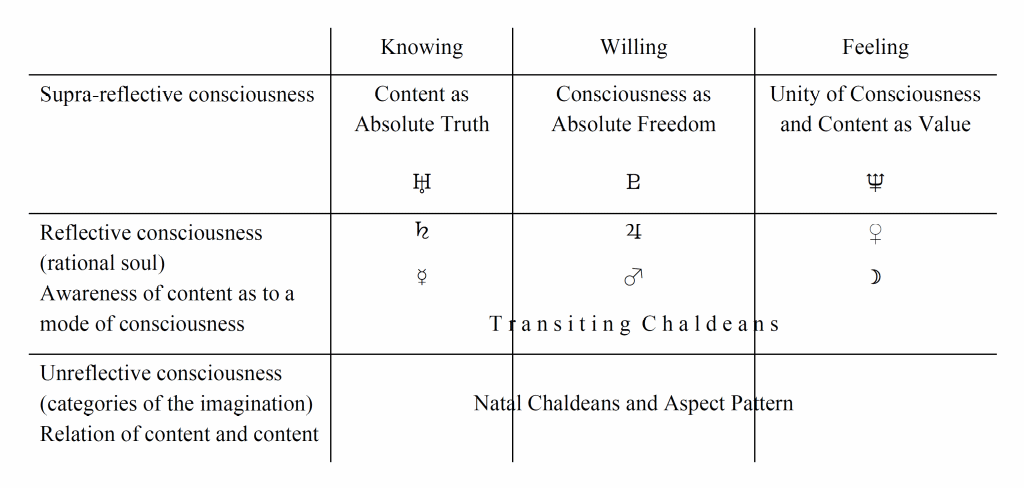
FIGURE 1982 0911-1-AB. Three Levels of Knowing Willing Feeling.
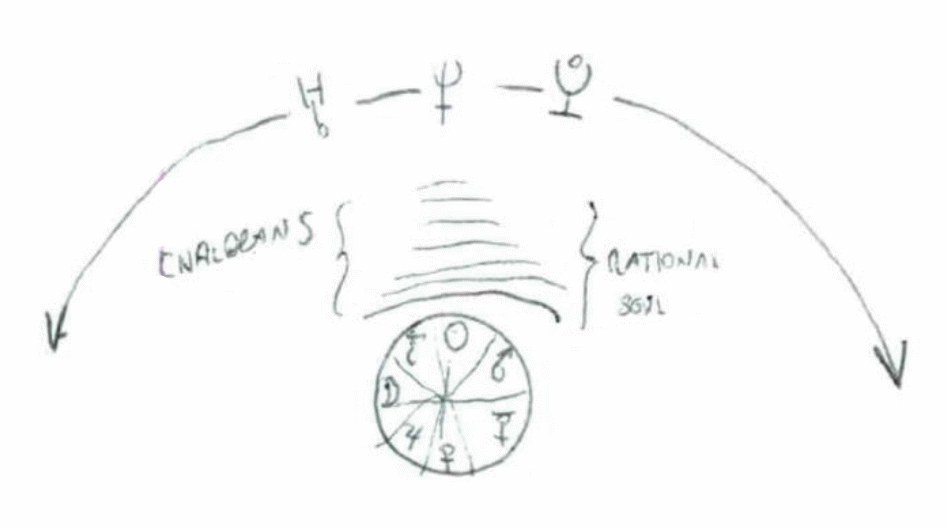
FIGURE 1982 0911-2-AB. Three Knowers: Ego, Rational Soul, Trans-Saturnians.
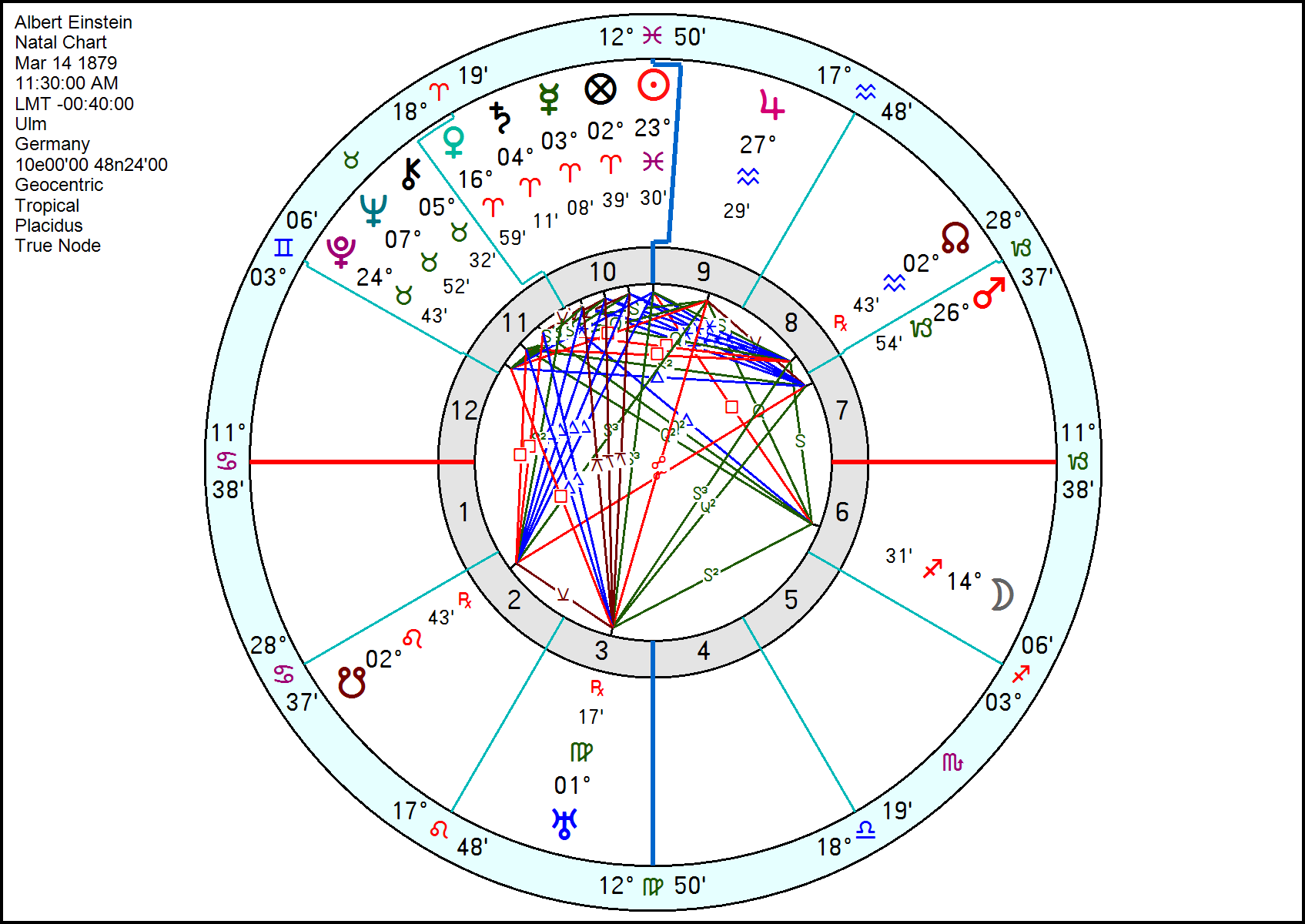
FIGURE 1982 0911-3. Albert Einstein Natal Chart.
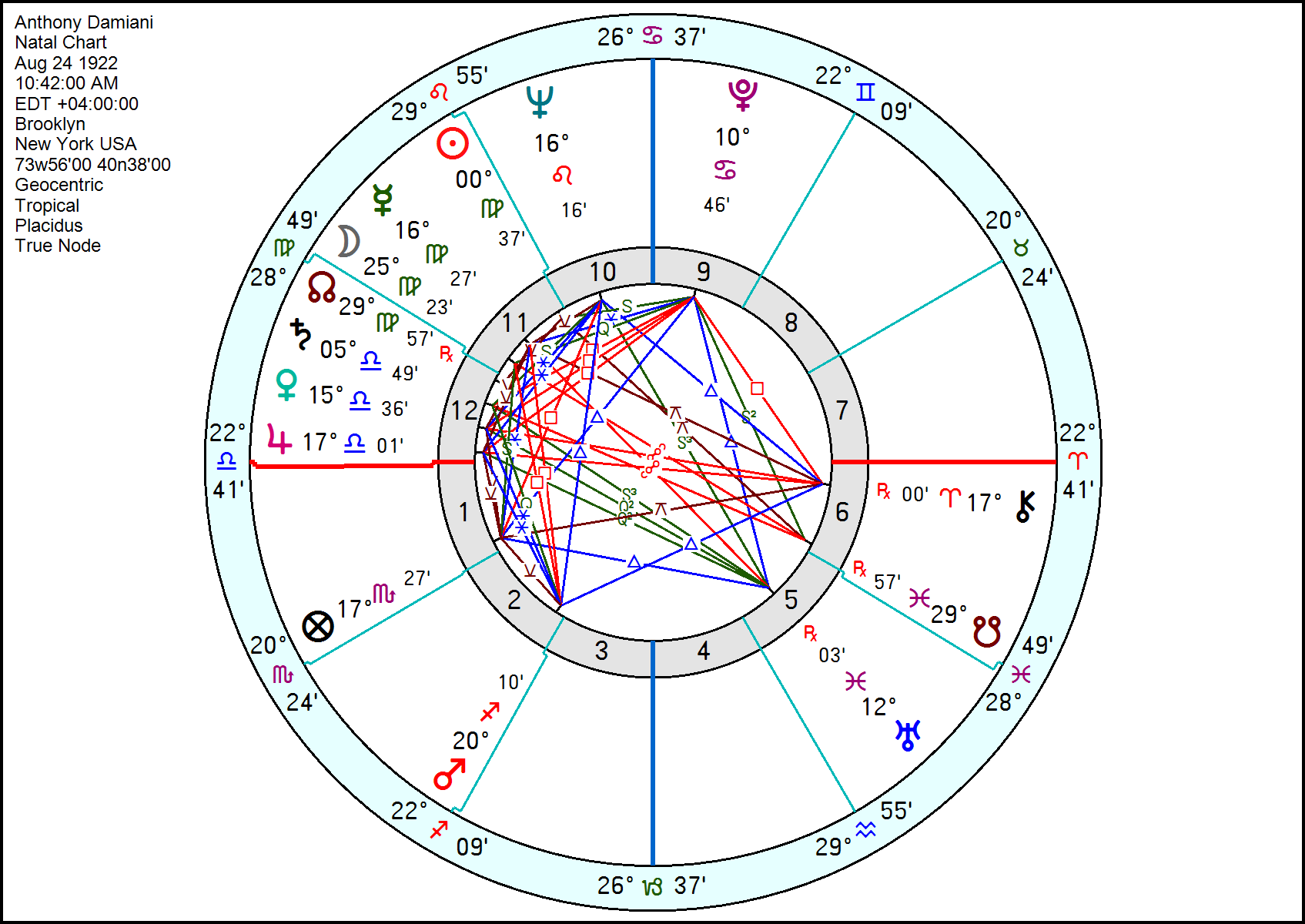
FIGURE 1982 0911-4. Anthony Damiani Natal Chart.
Other diagrams referred to are not with this transcript version. [Transcriber note: [diagram] means the speaker is referencing a diagram as he or she is speaking. If someone is drawing or writing, with audible sounds of chalk on a blackboard, I indicate this by [drawing] or [writing].]
NOTES:
- This is a Monday night class – usually Astrology – although in this class KCB essay used to develop theory on Uranus-Neptune-Pluto Knowing-Feeling-Willing.
TRANSCRIBED Verbatim by IT prior to 2018, reformatted by jf 2018. In 2023, IT updates prefatory matter, footer, and audio file name, alters Subject and Subsubjects to make more accurate, completes Book List, adds Plotinus quotes section, fixes errors/typos, adds new notes within transcript, adds two diagrams and references within transcript to these diagrams and to appended natal charts, reformats to accord with new conventions. Archival verbatim transcript – V12a.
AUDIO FILES: 1982 0911a, 1982 0911b. [Note 1: "Tape" and "Side" refer to original audio cassette tapes that were later digitized into .MP3 Audio Files. Note 2: In 2025, REP Studio cuts dead air from file a.]
1982 09/11 at Wisdom's Goldenrod
Astrology; Theory; Trans-Saturnians
[Audio File 1982 0911a Begins]
[Transcriber note: I am using Studies in Philosophy, Vol. 2, by Krishnachandra Bhattacharyya, "The Concept of the Absolute and Its Alternative Forms," Progressive Publishers, Calcutta, 1956.]
K.C. Bhattacharyya ["The Concept of the Absolute and Its Alternative Forms," stanza 1, RG reading]: "1. [Philosophy starts in reflective consciousness. Reflection is the awareness of a] content as to a mode of consciousness. The phrase 'as to' means some relation and it is in reference to this relation that the concept of the absolute has to be understood."
[Note: See FIGURE 1982 0911-1-AB, Three Levels of Knowing Willing Feeling, appended to this transcript for the following.]
RG: If we could understand this paragraph we'll [one/two words inaudible] basically understand the thrust of the whole article. [short pause] He's saying a couple of thing-- he's trying to bring out a couple of things here, and there are three basic relations-- three basic relations or three basic functions we're going to deal with. And there are-- the three basic levels of consciousness he's dealing with here are the level of the relations between contents and contents, let's say contents in the world; the relation between contents and to the mode of awareness that-- that is aware of those contents; and the third level is the-- the peculiar essence or the essential nature of that relationship to be seen as a concept of the absolute. And these three relationships differ depending on whether the consciousness is a knowing consciousness, a willing consciousness, or a feeling consciousness.
And his claim is, is that we have to formulate the concept of the absolute in one of these three ways from within reflective consciousness. And that's the job of philosophy, philosophy starts there. Philosophy starts in the formulation of the relationship between modes of knowing--and I won't saying knowing because that'll confuse us--modes of awareness and their objects. And they basically have three-- three different modes. In knowing, we take the object as completely distinct. We know the tree. And what we mean by knowing is that the thing is independent of our knowing of it. We believe it to be there when we don't see it. Now, we'll come a-- we may come along with a mentalistic analysis and say, well, in fact what we formerly thought was the part of the tree that we-- that we took to be unique and not related to my knowing was not known. In other words, all of our own cognitive functioning manifested the form of the tree, yet we inherently know and believe when we know something that part of the-- that there's an essence there that we know and we know that that essence is independent of any of our knowing. That's what it means to know something. If we didn't-- if we didn't experience it in that way we would not call it knowing.
In fact if we-- when we believe that we create the thing entirely, we-- hi-- he's going to claim that's a willing consciousness. When you're aware of your consciousness creating content, and seeing that the content unfolds from one's own consciousness, let's say an act of the will, or even in a form of thought, even-- let's say when you could see that the-- the perceptive world is a manifestation of your consciousness, that's-- that's a willing type of consciousness. And when experience is approached in that way, the concept of the absolute doesn't become truth as it does in knowing where you're trying to find out the object in itself, it becomes freedom, or reality he says. Freedom? Freedom that consciousness can take any form, create any form, and in that sense the content is in a sense subservient to the consciousness, it's a manifestation of the consciousness, while in knowing the content is what's taken to be absolutized and the mode of consciousness is only revelatory, it's revealing it. So in knowing the content, the objective aspect takes predominance, and in willing, the subjective aspect takes predominance.
Now there's another way and that's through feeling, where experience is given as a sort of unity between the subject and the object. There's a mer-- a-- a merger between the subject and the object and one can't really distinguish between which part is the subject and which part is the object and a-- and a unity is created. You become one with the thing. You identify with it. And when that absolute-- and-- so that's-- that's the approach through feeling of whose absolute he calls value or we could call beauty or the beautiful. And, in that-- in that state, the absolute is tried to be seen as that which transcends the particulars but is-- hovers over it and sort of embodies itself as both the subjective feeling state and the object which is giving a manifestation of that feeling state.
And he traces in great detail each of those processes to get us to try to understand these three modes very particularly and very precisely, and how all of our-- our kno-- our awareness and cognition takes place [student assents] through these three modes and at these different levels. So, that's the general idea. (Ok.) Now, does this-- everybody follow that part? [student assents, faint] I mean it's a very simple way to understand it but it really-- I mean it's the basic idea, the other-- you know, the--
VM: So the idea that the word 'concept' is in the title is because you're trying to grasp the absolute starting from reflective consciousness and in this relational way [RG assents] giving an approach to it.
RG: That's right. And he's not interested, and he has a line in here, and I should read it because it really-- he's-- he doesn't want to take the point of view of the absolute in this article, he-- he definitely wants to stand in re-- reflective consciousness [VM assents] or in the rational soul. And he warns against trying to take that point of view too quickly. And let me just read paragraph 9 where he-- he defines this a little better.
K.C. Bhattacharyya ["The Concept of the Absolute and Its Alternative Forms," stanza 9, RG reading]: "9. The concept of the absolute in any form is taken to belong to a supra-reflective consciousness. The possibility and nature of this consciousness have to be understood in reflection as a necessary problem. … The absolute accordingly has to be problematically understood within reflection as meaning not an identity but only a completely definite distinction of content and consciousness. [student assents] It may be that the supra-reflective consciousness in which the implication of content and consciousness is turned into a non-implicatory distinction is itself consciousness of identity in a symbolic or metaphorical sense. But in any case identity as a logical relation [RG: Or identity as within reason or within reflective consciousness.] has to be definitely denied between content and consciousness before this mystic identity can be appreciated."
[student(s) assenting, faint]
RG: Like another famous line we hear a lot is, I mean we distinguish in order to unite. I mean, he's trying to make these concepts so s-- distinct and so clear that you don't merge them in an all in one type of understanding but really approach them through the particular function which dialecticizes with them. I mean and that's important, the whole-- I mean the whole text of the article is that process of making these concepts extremely distinct, painfully distinct. And then one other thing.
K.C. Bhattacharyya ["The Concept of the Absolute and Its Alternative Forms," stanza 10, RG reading]: "…in the reflective stage… Knowing, feeling and willing will then each have their [one word inaudible] [RG rereads] Knowing, feeling and willing will then each have its own formulation of the absolute--viz., truth [RG: for knowing], value [RG: for feeling] and reality (or freedom) [RG: for willing] respectively… In the reflective stage these absolutes or formulations of the absolute will be found to be un-unifiable and to be in a sort of alternation. Whether a mystical identity of the absolutes can be reached in the supra-reflective consciousness does not concern us. Our problem is to show how reflection demands a specific absolute in each case."
[short pause]
[student assents, very faint]
S: (Tony?)
RG: So he's really standing in our-- in our-- well I think he's trying to stand in the rational soul or in reason and-- even within the rational soul I mean the particular soul powers we talk about seem to demand, when they look up, they have to look up in a certain way and that looking necessarily formulates the absolute appropriate to that mode of looking. And that's-- that's important to understand. I mean and we s-- I mean we see that, we have different transits and different aspects and they formulate our experience entirely differently than another planet or funct-- function. And I think he's just trying to make that-- this clear.
[short pause]
S: Is--
S: You know in Plotinus it talks about the three-- three approaches to the-- to the absolute? [RG assents] There's the lover and [RG: But, I mean--] philosopher and--
LR: That's in Dialectic. [Note: See Plotinus, I.3.]
RG: Yeah, it's in Dialectic. [S simultaneously: Dialectic, right.] Yeah, same idea.
S: Same idea.
RG: And we come across this in every tradition, I mean every tradition, I mean e-- you know, formulates the abs-- it seems they have to formulate the absolute in a triple way.
LR: You know, Anthony's comment the last time when-- when we read that paragraph, I remember him saying, in a mystical state there's even more of a distinction, see, not less, where here he says whether they're identical in the mystical state is not the question. But his comment was, you can see them even more clearly as distinct in a mystical state than you would even here. [RG assents] So that seems to imply that those distinctions or triplicity has a real ontic-- an absolutely ontic (existence).
RG: Uh-hm.
[students assent, faint]
LR (faint): Well now I'm just rambling.
S: Keep rambling.
S: Mercury.
RG: Ok, um-- Well--
[short pause]
AD: Let's repeat what we-- some of the things (we/you) learned on Wednesday when PB was speaking about the ego as a matrix of thoughts. Remember the way he speaks about the ego? And, if we-- if we-- if we, let's say, correlate the ego with everything within the seven Chaldean function(ing), we would have to ask ourselves something like this. Is the ego per se consciousness? No. Then it is an object, it is a content of consciousness. [Note: See FIGURE 1982 0911-2-AB, Three Knowers: Ego, Rational Soul, Trans-Saturnians, appended to this transcript for the following.] So, in the diagram over your-- over your head here, alright, if we take everything within that circle [diagram], we have the seven Chaldean planets and the opposites, and let's say there's an ideal relationship, and we-- we could think of that as the ego, you know, a complex of contents. Opposite point there'd be a subject soul power enmeshed in an idea, functioning, and its functioning you have the objective side of it, ok. Now if we think of everything within that as the con-- the-- the series of thoughts which we can refer to as an ego-complex, and we call that the content. Now within that, alright, within that there could be a relationship of content to content, alright. Now, the mind boggling thing that is being presented here is that consciousness is really upstairs where you have the Uranus, Pluto, s-- alright, the trans-Saturnian. That's where consciousness is. And that in between-- in between the two we'd have the reflective-- the Chaldeans or the rational soul is the reflective consciousness. Let's-- this is sheer speculation. Could we try a paragraph and see if the analysis works.
RG/S(?): Sure.
RG: Sure. Also I just-- I mean I think what I put up here relates to the same thing as-- that he has these three relations. There's the relation of content and content. Within, let's say, the categories of the imagination is related within the Dragon. And these would, you know, we s-- we s-- oh, oh-- well (let's not) talk 'em-- about them as the natal Chaldean ch-- the natal chart, the Chaldean chart with your aspect pattern, etc. And then in-- in the reflective consciousness the-- or the rational soul aspect would talk about that as the transiting Chaldean. And those soul powers would represent the different modes of knowing, willing, and feeling as formulating the concept of the absolute as well as formulating empirical experience. And then we have the super-reflective, which would be Uranus, Neptune, and Pluto. But I think he's saying not only is consciousness up there but-- but every-- but the priors of all three modes are up there. Content is-- is ultimately traced back to the Nous and consciousness is traced back to the super-reflective stage as well as the unity-- the unity of them both. And I think we could see that as we read some paragraphs.
[short pause]
S (very faint): [one/two words inaudible]
S (faint): Ok.
RG: Yeah, uh-hm, sure. Ok. Paragraph 14.
[short pause, noises, faint background student talking]
K.C. Bhattacharyya ["The Concept of the Absolute and Its Alternative Forms," stanza 14, RG reading]: "14. Reflective knowing is consciousness of the known object as distinct from the knowing. Reflective willing is consciousness of the act willed as being distinguished by the willing from itself. Neither is consciousness primarily of the distinction itself [RG: The distinction between content and consciousness.] or the distinguishing. Reflective feeling is primarily consciousness of the distinction [(or the distinguishing)] of content and consciousness."
RG: I don't know (if we should start it).
S (very faint): Yeah.
S (very faint, possibly part of background): [couple words inaudible]
RG: Uh--
VM: Could you read that again?
RG: Yeah.
K.C. Bhattacharyya ["The Concept of the Absolute and Its Alternative Forms," stanza 14, RG reading]: "14. Reflective knowing is consciousness of the known object as distinct from the knowing."
S: As distinct from the knowing?
RG: As distinct from the knowing of it, you could a-- you could add "of it" to complete it. Now there's a real paradox in there. Does anyone see the paradox in that idea?
K.C. Bhattacharyya ["The Concept of the Absolute and Its Alternative Forms," stanza 14, RG reading]: "14. Reflective knowing is consciousness of the known object as distinct from the knowing."
VM: Well it's an [S simultaneously: (couple words inaudible) yet.] object presented to a subject yet is distinct from the subject so the tension is always there.
[student assents, very faint]
RG: Right.
AD: I'm sorry, would you s-- go over it?
S: Sure.
RG: I'm reading now paragraph 14.
K.C. Bhattacharyya ["The Concept of the Absolute and Its Alternative Forms," stanza 14, RG reading]: "14. Reflective knowing is consciousness of the known object as distinct from the knowing. Reflective willing is consciousness of the act willed as being distinguished by the willing from itself. … Reflective feeling is primarily consciousness of the distinction [(or the distinguishing)] of content and consciousness."
AD: You want to try applying them? Let's try, try.
RG (simultaneously): Yeah, sure. Ok. Now, we take unreflective knowing as being the state in the-- in the Dragon.
AD: Inside the Dragon.
RG: Inside the Dragon, based on the relationship of content and content. We take reflective consciousness as based in the rational soul powers. So if we take let's say one planet that we could all agree on has something to do with knowing. Mercury would do it. Now, it seems we should be able to understand when Mercury is functioning unreflectively and when Mercury is functioning reflectively, say, what the difference is and how the Mercury, let's say, in reflective knowing is aware that the known object is distinct from its own functioning. But that's a real paradox, [LR: Yeah.] because anything is prese-- every known object is presented as known. The paradox of knowing is that you're denying the knownness, you're denying the presentation in order to assert the reality of the thing. In other words, we only know something because it's given in our consciousness, but what you mean by knowing is that it's completely distinct from your consciousness. Now how do we ever know that?
AD: Let's try now. How would-- how would we do that on the board? Let me erase this, uh-- [to student] Stay there, stay there. Let's erase this here. Now we're s-- now we're saying that there's some sort of functioning going on.
RG: Uh-hm.
AD: If we take-- we take a planet at a degree, alright, [drawing/writing] [RG: Right.] this Jupiter here, [RG assents] and it has an opposite here [diagram], [RG assents] ok? It doesn't matter now, [RG simultaneously: No.] 2 Aries, alright, [RG assents] and Libra. [RG assents] And this is the content. There isn't consciousness in here, alright. But in reflective knowing, it seems we're saying, that these things are available to us in reflective knowing. Reflective knowing seems to be aware of both sides of this here.
[student assents, very faint]
RG: Not-- right, not on-- and not only both sides as content but it's aware of its special relation to knowing-- to the knowing function. So in other-- let's say you have Saturn transiting and Saturn comes on the Jupiter. Let's [AD simultaneously: Yeah.] take Saturn as a knowing function. It seems what he's saying is that when you have Saturn on the Jupiter, you have the possibility of being aware that the contents in those degrees and the functioning of the Jupiter is known particularly through this mode of consciousness we're calling knowing, and you have a chance, let's say, to become aware of the underlying essence that's embodied it from above, from Uranus. Now--
LR: Isn't it also saying Dickie [AD drawing] that knowing does not connect the subject to the object in some ontic-- in some epistemological way, it's not knowing-- In other words, if you posit the object as separate from the knowing, [RG: Right.] then in some implication of that, [RG: Right.] it isn't knowing [student assents] which--
[short pause]
RG: See, that's the problem. That's why reflection can't--
LR: In reflection it's knowing which posits the relation between subject and object. Not posits. In reflection it is through knowing that there is a relation of subject and object.
AD: Now what do you mean here by subject, what do you mean here by object?
LR: Ok, in reflection I mean the polarity of subject and object.
AD (more intensely): What do you mean subject, what do you mean by object?
LR: Ok. By subject I mean the ego--
AD (simultaneously): Point to the board.
LR: I mean that-- the ego-complex within the imagination.
AD: No.
RG: No, [VM simultaneously: That's not the subject.] no.
AD: No.
RG: It seems those are both contents in [AD simultaneously: Those--] [LR simultaneously with RG and AD: Yeah--] this understanding.
AD: Exactly.
LR: No, I'm-- that's what I'm speaking of, I'm speak--
AD (simultaneously): This--
RG: Go ahead.
AD (simultaneously, with emphasis): This is the subject [diagram]. [LR: And--] This is the consciousness, this is the we-- awareness. [students assent] I don't care if you people don't agree with that. (bit of laughter)
S: Ok [couple words inaudible]
LR (simultaneously): Wait a minute, can I just finish what I was going to say?
AD/S(?) (very faint): Uh-hm.
LR: I was saying ordinarily we take the subjectivity to be in the imagination and in that sense the knowing is the opposite pole of that, just like in the-- I don't know, natal chart.
AD: Look. Let me follow you up again. Read the sentence again.
LR: I'm never reading. It's not working.
AD: Re-- put on your thinking cap, read the sentence again.
S (faint): (Ok.)
K.C. Bhattacharyya ["The Concept of the Absolute and Its Alternative Forms," stanza 14, RG reading]: "14. Reflective knowing is consciousness of the known object as distinct from the knowing."
AD: Once more. Reflective knowing--
K.C. Bhattacharyya ["The Concept of the Absolute and Its Alternative Forms," stanza 14, RG reading]: "14. [Reflective] knowing is consciousness of the known object as distinct from the knowing."
AD: Now, could you isolate every term he's using there and use the diagram?
RG: Yeah.
AD: Try, go ahead.
RG: Reflective knowing as in the rational soul, if you take a planet, let's say Saturn, "is consciousness of the known object". Now I would break the known object into two parts.
AD: Yeah.
RG: The known part of the object which is seen as manifested in-- within manifestation, but the object part of it takes you back up to Uranus. Because he's saying that the known object is distinct from the knowing. Now if it was only the object that appeared, it wouldn't be distinct from the knowing because the appearance is always tied to the knowing, but the part of the known object that is distinct from the knowing is the absolute part of the object and that is the-- its transcendent part. And in re-- in philosophy or in reflective consciousness, it's that very paradox that's formulated, that the content that's known is transcendent to the knowing of it.
S: Sure (Dickie).
LR: You're saying the knowing is the Uranus and the content is (within) that.
RG (simultaneously): No, I'm saying the content in knowing is the Uranus because of this peculiar-- you see-- Anthony, I would just have to say that not only is the consciousness found up there but the content and the value are found up there. And the formulation of knowing absolutizes the content, not the consciousness. It's the formulation of willing that absolutizes the consciousness. So to put consciousness up there is to look from Pluto, is to look from the willing consciousness and absolutizing the freedom of the will. To look from Uranus, if we're going to keep to that as knowing, we absolutize the content. And to look from Neptune is to absolutize feeling or the value.
AD: I think I'm going to disagree here if for no other reason than to clarify.
RG: Ok.
AD: Can we take one example, one of the paragraphs where he deals with one of the consciousness or one of the awarenesses?
RG (simultaneously): Sure.
VM: It's worth it.
RG: Ok. Let's do 12 because 12 is-- goes into knowing and it's pretty clear.
VM/S(?): Yeah.
K.C. Bhattacharyya ["The Concept of the Absolute and Its Alternative Forms," stanza 12, RG reading]: "12. The content of a knowing act is unconstituted by the act."
AD: Alright, how would you translate?
RG: I would say that the content of knowing is independent of the knowledge-- of the knowledge situation. It's known to be independent.
AD: Alright so, I would say that the content here is the Dragon, alright. The knowing act is constituted by the Uranus.
TS: You're saying that Uranus doesn't constitute the Chaldean mold of the Dragon or the ego structure but simply, in the knowing act, m-- has that for its object.
AD: Has that for its object. In other words, the ego is the object of the knowing act. That's what I'm saying and I want that amplified or disagreed with or--
RG: Ok. But in that-- well--
AD: The position I'm taking basically is this, Dickie. You are the transcendental knower.
RG: I agree, yeah.
AD: And all the time, not now and then, all the time.
RG/S(?): Planets.
AD: And that gets lost, first in the reflective consciousness and then [students assent] in the content insofar that consciousness gets identified with that content.
RG: Right, I agree with that.
AD: Alright.
RG: And I think the article agrees with that, but I have one question here. There's a dis-- there's a differentiation of three modes of how the absolute is taken, not just as the knower.
AD: Yeah, I-- I'm-- I-- that's why I say, let's work at one at a time.
RG: And I'm just say-- the absolute for the knower is not-- is not c-- is not, no, is not from knowing. What's the absolute for knowing is the object which it knows and the absolute for the knower is consciousness as the freedom to know anything or as through willing.
AD: Repeat, repeat.
RG: That the absolute, and I could pull out all--
AD: No, no, no. No, just repeat.
RG (simultaneously): The abso-- the absolute for knowing is not the knower.
AD: Not the Uranus itself but its content.
RG: Yeah.
AD: The absolute--
RG: For knowing.
AD: --for-- for knowing, for the Uranus, is the content which we find within the Dragon, [RG simultaneously: No, no, the con--] or I--
RG: Is the content of the Nous which is manifested in the Dragon. But the absolute for the content is its reality in the Nous.
[student assents, faint]
AD: Uh-hm.
TS: But why does it have to disagree with saying that the content of the Dragon is also the-- an object to that knowing act?
RG: It doesn't.
TS (simultaneously): It doesn't because he says(,) just to say that the knowing act of Uranus has for its content the Dragon doesn't say the same breath that that's the absolute for that knowing act. But that when that knowing act seeks to em-- know the absolute rather than will it or feel it, that there the absolute appears as either transcendent as prior to it, as its object, which would be in the Nous or say the degrees. [RG: Ok.] And I don't see that it the-- that the two have to be connected always.
AD: You see what the fundamental problem is that I think is in the back of my mind?
RG: Go ahead.
AD: It's this here. If you take a degree in the natal chart, alright, and it's aspected by a trans-Saturnian, what I'm trying to understand, is the idea, for instance, of relativity in the very structure of the ego or is it in the knower?
S: Yeah.
S: Yeah.
S (faint): We would say (that's both).
AD: Is the idea-- for instance, take Einstein's chart, alright, is the idea of relativity in the complex, the ego-complex, or is it in the knower? [Note: See FIGURE 1982 0911-3, Albert Einstein Natal Chart, appended to this transcript for all references to Einstein's chart.] Or, is it a combination of both? Let's say that there has to be a modalization of universal knowing so that that content which is in the ego becomes available to it as an object. The other thing that you're saying is not wrong either because I don't know. Is it the modalization of that universal knowing in Uranus which is its content, [RG: Right.] which is the absolute for-- [RG: Right.] for knowing. [RG: Right.] I don't know.
RG: Ok.
S: Yeah.
AD: You understand the problem?
[students assent, very faint]
RG (faint): Ok.
[student assents, faint]
AD: If you don't, you go over it because you won't know what we're talking about.
S: Please go over it, I don't understand.
AD: Go ahead Dickie.
LR: We could use the example of Einstein.
RG: Go ahead Linda then.
AD: We're saying something like this. The ego-complex is an organization of various constituents, alright. Uh-- Let me try this here, this-- this will be a practical example but don't hold on to it. In-- in my chart, Virgo, Mercury's on Virgo. [Note: See FIGURE 1982 0911-4, Anthony Damiani Natal Chart, appended to this transcript for all references to Anthony's chart.] In one reading it's called the astrologer, alright, he's looking at a natal chart and pondering. [Note: See Isidore Kozminsky, Symbology of the Zodiacal Degrees, Virgo 17, "An astrologer seated at a desk, his head resting on his left hand, judging a nativity."] There comes the Uranus Pluto conjunction on that for a few months and from then on I'm preoccupied with the idea of astrology, all the implications in astrology. Now, is the idea in the ego-complex, my ego-complex? If it is, why wasn't I occupied with it when I started out, you know? On the other hand, if it's not in the ego-complex or let's say that-- let's say it's not in the ego-complex but it was in the Uranus Pluto conjunction, when the two of them came together and sat on it, alright, then the idea was forced out through the ego-complex. Now, would the idea be in Uranus Pluto degrees? Go ahead.
S: Well why isn't it both?
RG (simultaneously): Ok, one-- well, yeah, one formulation [AD simultaneously: Or both, yeah.] would be that the form of the astrologer let's say comes through the Mercury degree. But the fact of the type of astrology that you do which tries to find the transcendental components in it comes from the Uranus and Pluto. In other words, anyone could have that astrologer de-- degree and just do any kind of astrology but the particular kind of astrology and what you're trying to symbolize in your astrology I think comes from the Uranus and the Pluto. You're trying to find what is the content in the astrology that's completely independent of any human knowing, and what-- what is its truth.
S (faint): Uh-huh.
VM: Yeah.
S: (You're making use) of everything the Pluto aspect of it and the content would be something from the Nous [one/two words inaudible] knowledge, the U-- the Uranus aspect.
RG (simultaneously): Well after that's Uranus aspect. The Uranus is the content aspect.
S: Yeah. It sounds [RG simultaneously: I see.] opposite that Uranus [few words inaudible] function was to substantiate sort of (thing of) Nous. [RG simultaneously: No, no but-- but it's not--] And the Nous is in-- insofar as it's knowing and being and it's [RG simultaneously: Right, it's one.] in dynamism it would be that efficacy so that then the content in the ego would be an effect of that knowing and not the [RG assents] object known, uh-hm.
RG: Yeah, but I think you could hold both points of view, that the transcendental part is from the Uranus [student assents] and that the formal part, the way it's known-- As he says in that two words, "the known object". The known part comes through the ego-complex but the real objectivity of the thing comes from-- if you really get to the objective part of what's known you have to come from the Nous. Otherwise you're only coming from the known part, what appears, and if you really got to what's underneath the known, the reality of it, then you would come from-- from the Uranus, from the transcendental knower.
LR (simultaneously): Yeah but-- but the 17 Virgo would have an-- yeah.
RG: Oh, I'm saying, it's the form of the-- it's the form--
LR (simultaneously): [couple words inaudible]
RG: Go ahead.
LR: To what you just said.
RG: Yeah.
LR: 17 degrees [RG: Right.] would have an other than imaginal reality, and the reason-principle as well. [RG: Right.] In other words, that would be a self-lumen or self-standing content also.
RG: Yes, within the rational soul.
LR: Well, wherever, [RG simultaneously: Or wherever.] the inerratic sphere.
RG: Right, but until he had the Uranus go over there, (if) it didn't light it up in the same way, [LR: I know.] Uranus and Pluto.
LR: I know it. But-- that the question is, what is the content, where is the content [RG assents] coming from and I'm saying you could make just as good a case in saying that the 17 degrees, which is symbolized within the imagination and therefore not actually self-luminous, [RG: Yeah.] was lit up as self-luminous or drawn up to the level of Uranus when [couple words inaudible]
RG: Well we'd have to read the Uranus degree, you know.
LR (simultaneously): So that it would be a con-- do you see what I'm saying?
RG: I'm saying-- I'm sa-- I'm saying they're both contents, I'm just trying to distinguish the two types of contents.
LR: Right.
RG: But I think they're both contents.
LR: The Uranus degree and the--
RG: And the Mercury degree and they fuse and they merge and in that experience there's a fusion of the transcendental content into the empi-- into the ego-com-- the contents of the ego-complex.
LR: Yeah, and in a sense I guess I'm saying that the reason of not seeing in ordinary day-to-day experience now is that it's-- it's got the same quality as everything else in the imagination, it's taken on that-- the veiled quality. But that with the trans-Saturnian transits (of) Pluto, [RG assents] something of the imaginal degree is lifted up to the-- shines as its re-- as the reason-principle that it really is, [RG simultaneously: Yeah. I think both go--] outside of the ego-complex. And that-- that's why it could still be that degree but now in-- as it is as a real reason-principle.
RG: Sure, I think both-- both could go on.
LR (simultaneously): Yeah, yeah.
RG: Anthony, could we do-- can we read paragraph 42 for a minute first, just so we can get-- I mean I-- I think we could get real bogged down (with/in) terms.
AD (whisper, possibly part of background): Yeah.
S: Uh-hm.
RG: Oh.
[short pause]
AD: Read.
K.C. Bhattacharyya ["The Concept of the Absolute and Its Alternative Forms," stanza 42, RG reading]: "42. The absolute may be generally defined from the standpoint of reflection as what is free from the implicational dualism of content and consciousness."
S: In reflection.
S: Yeah.
RG: Right, from reflection, [student assents, faint] from reflective consciousness.
K.C. Bhattacharyya ["The Concept of the Absolute and Its Alternative Forms," stanza 42, RG reading]: "There are three ways in which this freedom can be understood. The content may be freed from its reference to consciousness, i.e., from its contenthood."
RG: This is the example I think we're discussing now, [AD simultaneously: Uh-hm.] which-- ok?
K.C. Bhattacharyya ["The Concept of the Absolute and Its Alternative Forms," stanza 42, RG reading]: "Or consciousness may be freed from its reference to content, in which case it ceases to be conscious of anything beyond itself. Or the implicational relation itself may be freed from its terms as a definite self-subsistent unity. The known that is free from its contenthood is known as the content that need not be content, [is] the self-evident is, just what we call truth--the absolute for knowing. Consciousness that is free from its content (in the sense that it solely constitutes its content, makes the content a content, creates its distinction from itself) is freedom of the will--the absolute for willing. The implicational relation of content and consciousness that is freed from their distinction as a unity is value in itself--the absolute for feeling."
[short pause]
S (very faint): Can we go over it again?
RG: Sure, sure. Now-- And this is the crux of the whole thing. [student assents] Alright--
K.C. Bhattacharyya ["The Concept of the Absolute and Its Alternative Forms," stanza 42, RG reading]: "42. The absolute may be generally defined from the standpoint of reflection as what is free from the implicational dualism of content and consciousness."
RG: What do we mean? Well we just gave an example. When you know something, you know something as having to be utterly distinct and independent of your knowing of it, and yet you c-- we can't know anything unless we know it. [students assent, faint] I mean, there's an implication that when you know something that the content is independent, but without the consciousness of knowing, there would be no content that we could know. [student assents, faint] That's what he means by this implicational dualism. And when re-- when-- when reflective consciousness formulates this problem, it says to itself, well how can we get to the object that is without-- that we don't need to know about? And reflective consciousness say, "I can't, because I'm in reflective consciousness. I have to get out of reflective consciousness in order to know the thing, in order to know what the real content is. Otherwise, I'm intruding the particularity of my knowing act onto that content and I don't really know the content. I may be willing the content and I may be feeling it but I'm sure not knowing it because something of my own cognition is entering in to the-- to the knowledge of the content. So how do I do that?"
S: Yeah.
S: So what-- is what you're saying that you have to try and get to the content without the images that you-- without your im-- without those images.
RG: On the-- yes, on the first-- on one level the images, but even without images, some-- the entire function has to be wiped out almost, you have to s-- completely silence that cognitive function, even-- you know, you could say images in a wide sense, to really get to the Nous. Any images in the soul you would say have to be quieted in order to perceive the content that's in the Nous. And then you would have the-- then you would be the content, you would be one with it. But as long as there's a dualism between knower and known, we won't really have the content.
RC: Could you say like, as I become reflective within my natal chart, you might become aware that everything I think is bound up with my thinking it and I have no certitude whatsoever that it goes any deeper than my own thinking, it has any grounding deeper than my own conceiving of it up to a certain point, which can become a dilemma for you.
RG: Well--
RC: I can get to the point like where Jung (gave was) is that the philosophical systems that people lay out are really just-- it's your psychology, you're just letting it out.
RG: Ok, alright, but I-- let me-- I don't [RC simultaneously: Well I was just--] think that-- go ahead Randy, yeah.
RC: That I could get that far within reflection (and then--/I mean.) Because there is a real knowing function in me, that real knowing function would get reflected right in my reflective knowledge as a demand to get out of that situation.
RG: Right.
RC: But within the reflective situation I'm not out of it, I'm just really aware of the situation.
RG: Right. But in reflective knowing you're not just aware that it's your thought. You know that there's a reality to it. You wouldn't say like Jung that all philosophy is a manifestation of arch-- You would know that there's a direct-- that there is an isness to it.
RC: Within reflective knowing?
RG (simultaneously): Yes, oh yes, [VM: Yes.] that's pa-- that's [VM simultaneously, faint: Yes.] the problem. Otherwise, you'd be in a willing consciousness. [VM simultaneously: Right, the fact that (couple words inaudible)] If you're aware that you're creating all the forms of your thought you'd be coming from reflective willing as your consciousness is creating it but when [student assents] you know that there's a real content but you can't get to it because you're thinking or you're reflecting about it, that's what happens in reflective knowing.
RC: Ok, now say that Uranus comes over--
AD: One minute. Let's see if you understand this point because this is really-- this is really sticky, you know, it's like the-- the bear (in tar vein). This is reflective consciousness over here [diagram], alright? [student assents] Let's think of the rational soul, ok. This is the ego-complex [diagram]. Anything that goes on within here [diagram], alright, is not reflectively known. [student assents] In order-- in order for us to understand this functioning here, we're positing ourselves or let's say we're locating ourselves within the rational soul. Now within the rational soul or within reflective consciousness we know that there is-- within this [AD indicates on diagram], we know that there is an association or an identity between let's say this and this content here [diagram].
RG (simultaneously, faint): Yeah, right, right.
AD: Alright, now you see how sticky the whole thing is going to be [S simultaneously: What?] because it's within [AD indicates on diagram] rational consciousness that you recognize this here and this here [diagram] together, this is the content of this knowing awareness [AD indicates on diagram].
RC: We know that that has to be but we don't reflectively understand how it can be.
AD: How this can be.
RC: Ok.
AD: We can't reflectively understand how, let's say, the knowing, alright, is truly consciousness [AD indicates on diagram], [RC assents] alright, and could be in its own right and this could be [AD indicates on diagram] completely disregarded.
RG: Uh-hm, right.
AD: As a matter of fact, there is a quote in Plotinus, I don't know, maybe-- maybe I can find it, where-- [short pause] I think it was the double knower. Do you remember where that was in that volume, remember?
S: (They--/Dave.)
S (faint): Yeah [one/two words inaudible]
S (very faint): V.3.3, wasn't it?
TS: I don't know.
RG: V.3.4.
TS (faint): I don't remember.
S: (V.2.3.)
RG: Did people get the problem, I mean what he's trying to drive home as the problem in [S simultaneously, faint: I did.] reflective consciousness?
S (faint): No.
AB: Dickie, the rational soul knows the implicational dualism [one word inaudible] I'm using his terminology.
RG: But what does that mean, the impli-- what is the implicational dualism? The implicational dualism is, is that you have to know, you-- the only way to get to the content is to know it.
LR (simultaneously): Dickie? When he says that the object is independent of any knowing act, [RG: Right.] is it--
AD (simultaneously): I-- the problem here is it could be two, [LR: I know.] you see.
LR: That's--
AD: It could be the content within the ego-complex which is independent of any knowing, or it could be what Dickie is suggesting, it could be the Ideas in the Nous which is [LR assents, faint] the [RG: Yeah.] absolute for knowing.
RG: But I-- [LR: Yeah.] yeah, and I don't think he would ever suggest-- I mean he's too much of a mentalist to ever suggest that anything that's known in the e-- that anything is independent of a knowing in the ego-complex. I mean you may not say it's consciousness but I don't see how you would ever say that what's presented in the ego is not known. It may not be the consciousness but we would certainly have to allow that if it's experienced it's known, I mean that's his whole-- [AD: Uh-hm.] that's his whole point. That's why, when he says independent of the knower, he-- I--
VM: Can't be the (Intellect).
RG: It can't-- it can't be the content in the manifested world 'cause that's only known and he makes such a big point of it, twenty-five paragraphs, that the-- the manifestation is the known part and what's independent is trying to get back to the-- the Nous or the-- or the truth of the thing.
[student assents, faint]
LR: But, is it independent of the knowi-- of the soul in the Nous or is it independent of the knowing as we usually use the term?
RG: Certainly as we usually-- we usually use the term.
LR (simultaneously): I know, I know.
RG: Well I don't know if-- he certainly seems to want to say that the content has to be free from any reference to knowing, and then I would have to say there must be a-- an identity with the content as we speak of it-- you know, if you want to speak of the soul in the Nous I mean I don't, you know-- I'm sure we-- you know, we could accept that for now, I don't know the difference between that and the Nous in the Nous, you know, but for-- in any event, certainly neither the ego-complex nor what we normally think of as rational, rationality.
LR: And isn't-- wouldn't you say that the knowledge or the reason-principles within the Nous is the only place that an object would stand completely self-luminous?
RG: Yes. Yes, that's a--
LR: And that anywhere else it would have to be revealed through a knowing?
RG: Yeah.
LR: And I think that's where Anthony and me-- I didn't--
AD: Listen to this quote, ok?
LR: That's what he's disagreed with.
AD: It is V.3.4.
Plotinus [V.3.4, AD reading]: "4. But we, [too], are king when we are moulded to the Intellectual-Principle.
"That [AD reads: This] correspondence may be brought about in two ways: either through laws of conduct engraved upon our souls as tablets or else by our being, as it were, filled full of the Divine Mind, which again may have become to us a thing seen and felt as a presence.
"[Hence] our self-knowing ensues because it is in virtue of this thing present that we know all other things; or because we know the faculty which discerns this principle of knowledge by means of the faculty itself; or because we become actually identical with the principle.
"Thus the self-knower is a double person: there is the one that takes cognizance of the principle in virtue of which understanding occurs in the Soul or mind; and there is the higher, knowing himself by [the] Intellectual-Principle with which he becomes identical: this latter knows the self as no longer man but as a being that has become something other through and through: he has thrown himself as one thing over into the superior order, taking with him only that [AD reads: the] better part of the Soul which alone is winged for the Intellectual Act and gives the man, once established There, the power to appropriate what he has seen."
S (very faint): [couple/few words inaudible]
RG (faint): Uh-hm.
AD: To him, the knower is the Intellectual-Principle in us.
S: Yeah.
RG: Yeah.
AD: So, like the-- the reflective knowing, alright, he considers of an inferior order and he doesn't even consider it the knower.
RG: Right.
S (faint): Uh-hm.
AD: So the knower is that higher part that we're identifying [RG assents] with the transcendent.
RG: Right. Uh-hm, right, yeah, I agree. You know, Anthony, I just have to say that when you say the content is a manifestation and the knower is the higher, he will agree with you there too but that's the formulation through the will and not through knowing. When you see the [student assents] content--
(Side 1 of original cassette tape digitized as 1982 0911a Ends; Side 2 Begins)
AD: --because, let's say, the idea of relativity is included in the way the ego-complex, [student assents] alright, is organized, you see what's going to happen?
S: Uh-hm.
AD: The ego becomes an enormous value. And, you know, that's against all traditional teaching. The ego is a lot of, you know garbage.
S (very faint): Right, yeah.
RG: Yeah.
TS: See, I think, Richard, are you saying that-- that it's from the knowing act that that ego-complex becomes known as an instantiation of something in the Intellectual-Principle? Could you see it as an instance of the Intellectual-Principle from knowledge?
RG: Uh-hm.
TS: Whereas it wouldn't be known at-- as, say, the ego-complex(,) (at least/is) the functioning psyche from the knowing act, but say from the point of view of the will there would be some awareness of the ego-complex as the functioning psyche?
S: Yeah.
VM: The productive.
TS: As being a product of that will [RG assents] and as-- hence manifest as-- as in the image?
RG: Uh-hm.
TS: So that the same content could be known a-- on three-- in three different grades, [RG assents] ok, and through the feeling consciousness there would be a knowledge of the ego-complex as the potential rationalization of the soul.
RG: Uh-hm.
TS: Is that possible, [RG simultaneously: Yeah, yeah.] first of all, that--
RG: Yeah I think so, yeah. You would definitely have to look at the content, that's his whole point, that we're forced to look at from one and he's trying to make us conscious of the ways we're looking. So when we're looking now, well which way are we looking? Are we looking that consciousness is prior, are we looking at content in the Nous as prior, are we looking at the unity of both as prior? And I think that if we do the article, you know, if we try to understand it, we have to keep making conscious our presuppositions this way and of seeing which way we're looking. So we could take eith-- any of the ways and I think that, you know, that's great. So, let's do-- let's go back to paragraph 12 and do knowing because knowing is the one that he really does. Knowing is the easiest one to do anyway. [S simultaneously: Ok.] Well, in some sense.
S: No, it's certainly the hardest.
RG: Yeah.
S: I think try reading.
[short pause, background student talking, noises]
K.C. Bhattacharyya ["The Concept of the Absolute and Its Alternative Forms," stanza 12, RG reading]: "12. The content of a knowing act is unconstituted by the act."
TS: And what are you going to say the content is?
RG: Well here I'm going to say it's in the Nous, I don't ca-- if you want Uran-- I don't know if it's Uranus [student assents] or Pluto any more but I certainly think it's above the rati-- the content here is the transcendent because you're absolutizing the content as knowing, [VM assents, faint] as we just read in 42. I'm coming from-- when we do this we're saying, [RG paraphrasing stanza 42] the content may be freed from its reference to consciousness and it is the self-evident is, the content, what we call truth, the absolute for knowing. That's where he's coming from, I think, that's my claim, from content.
K.C. Bhattacharyya ["The Concept of the Absolute and Its Alternative Forms," stanza 12, RG reading]: "The particular act of knowing discovers and does not construct the object known, even if the object be admitted to be constructed by some knowing."
RC (faint): Uh-hm.
RG: Well, some cosmic mental factor.
K.C. Bhattacharyya ["The Concept of the Absolute and Its Alternative Forms," stanza 12, RG reading]: "Knowledge would appear to mean that the object known is in some sense independent of it [RG: The"it" here mea-- meaning the knowing.] though it may be a question whether what we ordinarily claim to know is properly said to be known and to be independent of the knowing. Where the object is coloured by the particularity of the act of knowing, it may be said to be only empirically known but it is still taken to be known so far as it is believed to be independent of it [students assent, faint] [RG: of the knowing]."
VM: In fact, the way Bhattacharyya's using these words you'd almost say that the knowing function is what accounts for the validity of the realistic position.
RG: Yes, he says that. [students assent, faint] Uh-hm.
VM (simultaneously): Whereas the willing in some ways gives validity to the mentalistic notion that [students assent] [RG simultaneously: Yes, and so does-- yes, yes.] the thought is fir-- thought is creative of the object.
RG: Right. Now his realism is very different, and [VM simultaneously: Of course, of course. No, no.] he goes into that and says but in some sense the realistic position has its validity through knowing, [student assents] more so than the idealist in an ultimate sense because we trace back-- because in fact the i-- the content of knowing is real, it's independent of the knowing, and he certainly doesn't mean-- So that's why, when he says "independent," he seems to very carefully distinguish it from the empirical knowing that we normally say and we have to keep shaving away the cog-- cognition that we impose on the object to get to the real content. Let's go over it, you want to go over it?
K.C. Bhattacharyya ["The Concept of the Absolute and Its Alternative Forms," stanza 12, RG reading]: "12. The content of a knowing act is unconstituted by the act [RG adds: of knowing]."
TS: Uh-hm. If you took-- he's saying you take Uranus as the knowing act or one of the trans-Saturnians per se?
RG (simultaneously): No, I don't think either of them-- no, I don't think-- any of the trans-Satur-- I would say the rational soul is the knowing act in knowing and that the content is the transcendent because the knowi-- the content is unconstituted by the act, the content is independent of the knowing act.
S (faint): Right.
S: How about [couple words inaudible]
AS (simultaneously): Well, but another poss-- sorry, go ahead.
TS: Well, if I follow what was being suggested, the reflective knowing would be the rational soul [RG assents] but the knowing act would actually be prior to it.
S (faint): Yeah.
RG: Then we'll have to read the sections on willing.
S: (Right.)
TS (simultaneously): Yeah. I'm trying to--
AS: No, but why can't you allow-- I mean, it's-- you're right, on the face of it, it seems like he's saying you just have a content which shines. But, if you really consider it, you don't just have a-- I mean i-- we keep imputing that therefore it's unintelligent or there is no awareness of it.
RG: Not at all.
AS: Whereas in ano-- No, but I think that's what Tim is trying to point out, that in this absolute for knowing even, as a self-shining content, there is an awareness. That--
RG (simultaneously): Of course.
AS: No [couple words inaudible]
RG (simultaneously): Of course, but not awareness of [AS simultaneously: But, what do you mean "of course"!?] the content. But it's not what he means here by the knowing act. [AS simultaneously: No, no but--] The content is (like/I--) knowing and being are one at that level.
AS: Ok, all I'm trying to say is that the Uranus is a type of function, a type of awareness, that allows any idea to stand out in a self-subsistent way. The-- ('cause/'tis)-- that the Uranus is a type of awareness, the awareness functioning or awareness consciousness or truth consciousness, that allows the object to shine without any interference by itself. It just reveals it as what it is.
RG: Ok.
AS: Now, I think the whole [student assents] problem before is, whether that's directed towards the ego itself as a reality, as a self-standing reality, or whether that truth consciousness is directed towards its own constitutive idea, in either case you could say that the Uranus is-- Uranus type of consciousness or truth consciousness is going to reveal the object as what it is.
RG: Good, yeah, (right/uh-hm).
AS (simultaneously): And I think if it's turned towards the ego and is sitting on one of the natal degree-- natal planets, it might reveal the truth of that object.
RG: Yeah.
AS: On the other hand, if it's compl-- if you're identified with Uranus completely as beyond even the rational, then it might reveal something in the Nous itself.
RG: Yeah, I agree.
AS: But in either case I don't--
AD (simultaneously): I just (want to/wanted)-- I just wanted to add one thing now, I don't know if this is going to complicate it [one word inaudible] I think of Uranus and the content, in other words, Uranus and the degree it is sitting on, I don't conceive of them as two distinct things, [VM and RG assent] but I conceive of knowing, in a [AS simultaneously: It's modalized.] sense, as a modalized-- the knowing that is taking place here is a universal knowing but nonetheless modalized.
RG: Uh-hm, but-- uh-hm.
TS (simultaneously): Yeah, in other words, that the--
AS (simultaneously): I think that there is--
AD (simultaneously with TS and AS): In other words, (it would) be that.
RG: Yeah, I--
TS: The peculiar degree that Uranus is natally on gives that particular ac-- knowing act a certain modality or coloration or [AD: Yeah.] intelligence. [student assents] And that kind of intelligence inherent in the knowing is what is going to be--
AD: Is going to see that content [TS simultaneously: Is going to--] in [AS simultaneously: According to itself, yeah.] the way it does.
TS (simultaneously): Yes.
RG: Yeah.
AS: Yeah.
TS: So, and a content here, one way of looking at it at least would be that the content it sees would be the natal, say, a natal Chaldean planet and its degree, [AS assents, faint] ok, and that combination, but here it would see it, perhaps that as the way in which it is some instantiation of a-- of an idea or reason-- some kind of say reason-principle and not just as a psychological functioning. That's-- I thought that's one-- what you were saying.
AD (simultaneously): So if we-- if we try to be down on this level we'd be saying something like this. Let's say Uranus is conjuncting one of your Chaldean planets. Now, instead of saying that I am the universal knower, I could say I am the knower but this universal knowing is focused on a-- in a certain way on that content that the ego has. It is the slant, it is the way it focuses on it, alright, which is one and the same thing, the Uranus and the degree is one and the same thing.
TS: Yeah, so there [AS assents] would be a particular kind of universalization or-- of that content. It wouldn't be-- so, if two different people had say Mercury at 17 Virgo, they might both become interested in astrology when Uranus hit that, but in different ways according to the natal con-- natal degree of Uranus--
[student assents, very faint]
AD (very faint): Uh-huh.
RG: Uh-hm.
S: Uh-hm.
RG: Yeah.
TS: That happens to be the case by the way.
S: Tim--
AD: What?
TS: I know an as-- we know an astrologer, Norween Leipzig is a-- a-- an astrologer we know who has Mercury at 17 Virgo. And I think that's about when she got interested in-- (Anyways, and--)
AD (simultaneously): Well, I think it was Dotty who was telling me she knows a doctor who's got a 17 degree and when he had that aspect, that conjunction, he was concerned more with discovering ways through-- how (energy--) how the energy flows through the organism. What was his name?
S: Doctor Goodheart.
S (simultaneously): Doctor Good--
AD: Goodheart. [S: Yeah.] So he would be concerned-- he was more interested-- he was more interested in the volcano meaning, you know, the mobilization of energy [students assent] and how it flows through. [Note: See Marc Edmund Jones, The Astrology of Concepts, Virgo 17, "A vast display of cosmic force is seen in the eruption of a volcano with dust clouds, flowing lava, earth rumblings."] Now what we're saying is that the basic way that that Uranus is characterized-- in other words, it's an aspect of universal knowing, that's the way-- that's the way that contenthood gets illuminated and understood.
RG: Uh-hm.
S: Uh-hm.
TS: But the-- but [RG simultaneously: Right.] the kind of-- the level of that content as illuminated is now [sounds like RG assents] some content to-- [short pause] is no more taken as a psychic functioning but is take-- is now the-- the essential idea that the soul is trying to know through that degree and planet is now made available to-- to the subject.
AD: Say it again.
TS: Yeah, I can see this (point).
RG: Yeah.
S (faint): Yeah.
RG: I think he's trying to say that-- let's say, let's say-- you're saying the contenthood gets illuminated. What does that mean? It means that the-- the s-- the degrees are realized as instantiations of the Nous.
TS: Yeah.
S: Yeah.
RG: That's what it means to know-- say the contenthood is illuminated.
S: Uh-hm.
AS: Right.
BS: Which degree, the degree that it's resting on?
RG (simultaneously): The natal one.
S: [couple words inaudible]
TS (simultaneously): Our natal degree.
RC: Yeah.
TS: The one [SD simultaneously: The one-- not the Uranus degree.] which the rational soul is going to instantiate.
RG: Right.
AS: Well, you're saying the Uranu-- to make-- to make the "which degree" clear, the Uranus sits on say that 2 degrees [RG assents] Jupiter, [RG assents] it's the 2 degrees Jupiter that becomes the self-shining content [student assents] to which the truth consciousness of Uranus modalized as it is [RG: Right.] [TS simultaneously: (By-- it's your light.)] [RG simultaneously with TS and AS: (one word inaudible) right, and because Ur-- right.] it's going to reveal.
RG: And because Uranus [AS simultaneously: Yeah.] is sitting on there, it's bringing in the fact that the degree itself is an instantiation of the Nous.
[student assents]
AD (simultaneously): This almost brings about the remark that was made Wednesday when PB was speaking about the development of the ego is parallel to the abandonment of it.
RG: Hm, right, yeah, uh-hm.
VM: What we were talking about the mental and spiritual development of it.
[student assents, faint]
S: [couple words inaudible]
RG: But co-- can we go over it, let me just-- [AD simultaneously: Go ahead, yes, please.] let me just summarize that. So, you're sitting in-- let's say you-- you have Jupiter at 2 degrees Aries and the Sabian symbol is functioning at a certain psych-- psychic level, say, and Uranus comes on it. Uranus is bringing in a transcendental knowing in some sense. What it's doing then is revealing the fact that the 2 degrees Aries is really manifesting an essence that's from-- [student assents] from within the Nous, and that's what Uranus is-- is revealing, the fact-- If you-- if you had a tran-- a Chaldean transit, it would bring in maybe the rational nature of this-- of the image. But with the Uranus there it's bringing in the fact that that content really is free of any reference to the psyche [VM assents, whisper] and that it's exper-- it's known that way. And in that sense it's illuminating the-- really illuminating the degree. The reason-principle is seen as an emana-- as a manifestation of the Nous.
AD (simultaneously): So you're saying the transcendental subject is restoring the original meaning to the vasana.
RG: Yeah, uh-hm, uh-hm.
VM: How-- what was the role of the-- the degree that Uranus is on natally?
RG: Well the qual-- well as we said, I mean, Mercury's 17 degrees Virgo, two different astrologers, I think Uranus would bring in the transcendental nature or the type of [student assents] astrol-- let's say the type of astrology with a vision of what the astrology is doing, of what that-- of what the knower in the person is really bringing about.
S: But--
VM: Wait a minute, I missed it Dickie, I was asking the question, maybe you were answering it but I didn't-- I didn't hear it.
RG (simultaneously): About the Uranus degree.
VM: I was asking, what is the-- how does that Uranus degree itself, [RG assents] let's say, color or particularize [RG assents] the (truth).
RG (simultaneously): Because if Uranus goes on 17 Virgo, the person isn't going to necessarily start to unearth the-- the cosmic significance of the mandala symbolism of astrology. They may just do very practic-- you know, they may do other forms of astrology. We have to look to the Uranus and Pluto degrees to see the-- the-- what transcends-- transcendental qualities are being brought in to that astrology archetype.
S: Yeah and--
VM (simultaneously): Or they may no-- do no astrology at all.
S: Right.
RG: Well we were taking [AS simultaneously: Well but--] the example of two astrologers [VM: Oh ok.] with Mercury at 17 Virgo.
VM: Ok.
RG: Yeah.
S: But Dickie--
LR: In this particular case, the sword in the museum revealing the [couple words inaudible] future. [Note: See Marc Edmund Jones, The Astrology of Concepts, Pisces 13, "In a still corner of the museum are weapons of long ago and in a glass case by itself is a single venerable sword."] You know, and-- [RG assents] I mean it would be a pre-occupation with some kind of--
S: Traditional.
[student assents, very faint]
LR: Well not [couple inaudible student words simultaneous with LR] just traditional but actually going through--
AD: Bringing the past to bear on it, yeah, [RG assents] bringing all of the past to bear on it.
[student assents, faint]
RG: Terry?
S: Yeah, for example, you brought up the 2 degrees Aries. Now that is the degree of a comedian entertaining his friends which is my Uranus. [Note: Aries 2, "A comedian entertaining a group of his friends."] And when I can see the humor, the absolute humor in something, it's just-- it's just really very enlightening. And I can take the most mundane things and I see the humor in it and I-- I get a completely-- a different view of things. It's-- but I'm not real sure whether it isn't the Uranus-- I mean that Pluto too working, [RG assents] the really nice part.
[students assent, very faint]
S (faint): When was KCB born?
RG: What, July-- May 12th 1875, two months before Jung was born I think. He was still pretty [one word inaudible]
AB: [couple/few words inaudible] best that I don't know how to put into your paradigm. Ok, basically what you're saying is that in knowing, the object of knowing is independent of the knowing. [RG assents] So in the case of a-- a person that has a certain degree meaning, when that trans-Saturnian is revealing that degree, it's known as originating from outside the ego-complex, and that's the knowing, [RG assents] ok. But we also said, like we use the case of Einstein, for the knowledge to be revealed, there has to be a modalization within the ego-complex which conforms to or makes available [student assents, faint] the knowledge that was inherent in it. You know, like say-- say you know, with Pluto and Ura-- Uranus on Mercury there had to be a [RG assents] certain restructuring of the ego to bring that knowledge to-- about.
RG: Right.
AB: Now where do you bring that in terms of [AS simultaneously: Well--] Bhattacharyya?
AS: Well, he would say, I mean sure, that your reflective consciousness and the empirical consciousness operate immediately afterwards. The instance of true knowing isn't going to continue forever.
AB: Right.
AS: And I think that's what Anthony was bringing up about the quotes on the two-- the two-- relation to the ego. [AB simultaneously: Right, the (equation).] On the one hand, there's an illumination by the Uranus and that has-- that's just a cutting off of the ego functioning altogether. But on the other hand, the result of that is some development of the ego function, namely the ego function being that natal Chaldean planet. So [AB assents] both things are happening, if not simultaneously [students assent] at least within that Jup-- within the transit there's an instance of an insight [RG simultaneously: But wait, that-- no I agree--] through consciousness and it's also the development of the ego.
RG: And there's no-- [three inaudible AS words simultaneous with RG] but in case-- right.
AB (simultaneously): But in Bhattacharyya he doesn't [RG simultaneously: There's-- he doesn't--] seem to bring into his analysis of knowing the fact that there's this remodalization of the U--
RG (simultaneously): Well yes-- well here it is, the particular-- the parti-- it's right here, "The particular act of knowing discovers and does not construct the object known." That would be where in Ein-- we would look at the other functions in Einstein's chart and see how his particular knowing functions unfolded this tran-- this content that was being revealed, let's say through the Uranus or whatever. And there's no hiatus, I mean all the forms of knowing, I mean, when we say we don't-- we know the tree and then we shed off the appearances and the forms that we impose on it, and then the-- it doesn't negate the forms that we initially started to get to know the tree through. There's a continuation in Nature of-- of what's in the soul.
[short pause]
JC: The last sentence in that section, where he talks about the object being colored by the particularity of the act of knowing [RG assents] is sort of what you're talking about it. Could you amplify a little bit where that would be applicable or the [RG simultaneously: Well, I think--] type of colorations he's talking about?
RG: Oh, well, I think in the Dragon it's certainly applicable to we-- As the knowing gets more and more particular and less and less universal, it becomes less and less truthful.
JC: Sure, more and more subjective.
RG (simultaneously): And yet we still believe it to be known. And it's only by ascending back through the rational soul where the knowledge becomes less particular, and then to the transcendental part where it becomes universal, that then we could say we really have a-- we're experiencing a true content, not colored by our particular cognitional structures or the categories of the imagination.
[student assents, faint]
TS: Or is there even-- this is fairly wild but it-- could you say that as the rational soul evolved that there could be some-- come some objective awareness of the peculiar coloration of the natal Uranus, and as that was be-- became through reflective knowledge known as distinct from the content of knowledge, which is the natal Chaldean planets, that then there would be the potential for a universalization of that content?
RG: Uh-hm, yeah.
AD (simultaneously): Let's try 14, let's [RG simultaneously: Ok.] try paragraph 14.
TS: Alright.
K.C. Bhattacharyya ["The Concept of the Absolute and Its Alternative Forms," stanza 14, RG reading]: "14. Reflective knowing…"
AD: So that means we're located in the rational.
RG: Right.
K.C. Bhattacharyya ["The Concept of the Absolute and Its Alternative Forms," stanza 14, RG reading]: "…is consciousness of the known object as distinct from [the] knowing."
AD: So in reflective knowing in the rational consciousness we recognize the distinction between the content which is an ego, which is part of the ego or part of the Dragon, as distinct from the Uranus.
TS: Yeah.
S (faint): Yeah.
RG: No.
S: (Uh-hm.)
AD: No. Alright, go ahead Dickie, come on.
RG (simultaneously): (No) I'm not-- I--
TS: (Good.)
AD: Come on now, we're only going to get to the bottom of this here by discussion, not by [RG: Ok.] taking sides.
RG (simultaneously): The kno-- when he says "the consciousness of the known object is known as distinct from the knowing," it seems to me that anything known within the ego-complex is not distinct from the knowing, it's part of the knowing, it is the knowing. There's no unknown part, I mean, what's in the ego as ego is only that way because it's related to the ego as known.
AS: Yeah but-- ok but, can't you make a distinction between what's known within the ego, the ego-- what the ego knows and the knowing of the ego. The ego itself, the whole complex, [RG assents] has a reality, a level of existence. [RG assents] Now normally in the empirical split you don't know that reality of that ego, you're knowing the imagery or you're knowing the s-- you know, you're know-- you're knowing it empirically. But the whole business as a level of existence could be a know-- could be a content which is known as unknown, [RG: Yes.] known as not split up into the subject-object, [RG simultaneously: Ok, sure.] and that within reflection you come to an awareness that this could be a possible knowledge [RG simultaneously: Ok.] but you-- it's not available yet.
RG: Yeah, that's fine, I mean any-- yeah, that's fine.
AS: I mean you yourself brought it up, I mean, [RG simultaneously: It's fine.] in that case then those degrees would be known not as within this empirical subject-object relation but known as the true-- some true wisdom knowl-- I--
RG (simultaneously): That's true, I think-- I think it's very open-ended and you could say any object that's known to-- that has to be known as distinct from a knowing. I mean if you want to say, yes, ok, here's the ego-complex and it has a reality that's independent of the particular functions that I'm engaged in now and we have to get to know that ego-complex independent of it, that-- that would be ok, or any other content.
AD: You better stop to see if they-- if they're following.
LDS: Dickie, I-- I don't know if you're saying this but-- or if he's saying this but, isn't he establishing his own limitation, [AD, faint: Yeah.] or elaborating a limitation of reflection in saying that reflection must, by its very being and by the way it's constituted, take something as distinct from its knowing? That doesn't establish the validity of what it took to be an object. That only-- [student assents, faint] that only says or speaks to the point that it believes in the objectivity. Now-- so it's presented to itself this dilemma that, you know, I must know things distinct from myself or from my knowing, and there is the possibility then that I can entertain that in a transcendent mode I could establish the validity of the object [RG assents] as objective, [VM: In-- independent.] [RG: Yeah.] independent, [RG assents] but I can't really establish that in reflec-- in reflection.
RG: Well, I think he's going to try to show us that reflection can establish the existence of it in knowing but not-- can't become it. That through this process, reflection-- philosophy can establish that there are true contents [student assents] but that reflective consciousness itself can't grasp them, can't become one with them. But I don't think he's saying-- he's not, he's not being very-- [VM simultaneously: Agnostic.] an agnostic here, [AD or student assents] he's saying the meaning of philosophical reflection is to see this dilemma and yet establish through knowing the fact that there are realities that have to be known. It's just that reflection can't know them. That's the dilemma, not that you don't believe-- not that you may believe they don't exist, you adamantly believe that they exist, [student assents] and therefore it re-- is this very isness that he's speaking about is the real content. There's no question that we-- that we aren't going to get to know them. It's just that from within reflection we don't know it. We know that they exist.
LDS (simultaneously): Well I-- I think there must be-- if the dilemma is a true dilemma for reflection, then there must be the-- [student assents, faint] the question or the-- [RG assents] the doubt of whether it's [one/two words inaudible]
RG (simultaneously): That is not the dilemma. [AS simultaneously: Yeah (couple words inaudible)] That isn't the dilemma, that's another dilemma, but that isn't his dilemma here. (RG laughs, bit of laughter)
S (faint): Yeah.
LDS: But--
RG: The-- that isn't the dilemma. The dilemma is, how do you get to know it, you-- He goes through this major process of establishing the-- these-- the products of inference, and how in an inference you ultimately know that there's a reality there but you just can't get to it. [student assents] When you're in knowing, there's no doubt. Now maybe from willing and feeling there are doubts. But from within knowing there's no doubt that there's a real.
[student(s) assenting, very faint]
LDS: But are you saying that he's-- what's becoming obvious is his presupposition that-- you know, before he even starts about the problem or the dilemma in reflection, he's already presupposing the possibility or the definite experience of true objectivity, [AS: No, I--] and--
RG: Yeah.
LDS: And then within reflection, he comes to, by inference and by-- by reflection, by an-- analysis, he comes to the very formulation of this possibility and then makes the leap and says, ok, this-- this is going to require a transcendent mode of knowing but it's got to be.
RG: Yeah.
AS: But it-- but also I think he's saying that the demand comes from within the reflection itself, [student assents] in other words, just to have that reflection indicates in some way the presence of the self-subsistent object, [LDS simultaneously: But the ideal is--] that in the refle-- no I'm s-- I think he's coming from that way, he really-- he really believes I think that you can lead up to the-- to this demand, that the demand itself within the reflection shows that already there is an undeniable belief in the self-subsistent object and an undeniable presence (there).
LDS (simultaneously): Well see, wouldn't the idealist always be able to [S: Yeah.] stop him or counter him in saying that you can't-- you can't establish that objectivity in reflection, you can only entertain it as a possibility.
LR: Yeah.
S: Yeah.
LDS: You know, wouldn't-- wouldn't a Yogacarin or any idealist always be able to pull the ground out from under him?
RG: No, because he's going to show the Yogacarins that they're coming from willing and not from knowing. [student assents] To create a completely mentalistic universe is a will consciousness and not a known one. He's got a-- I mean, [VM simultaneously: He's got it too.] he's going to-- he's going to hammer them right home, he's got-- he'll take any of the-- those points of view and show them where they're coming from. He'd say, yeah, sure, that's one side of it, that's the idealistic side but you're going to tell me that your experience is unreal? Let, I mean--
LDS: No, they wouldn't say it was unreal, I mean--
RG: Or that it-- or that it's only known? He's going to say that's nonsense that things are only known, that there's not a reality to be-- to be given. I mean, he just wouldn't accept it.
RC: Dickie, it seems you're saying that his basic point here is that within reflective consciousness you rationally come to understand within the knowing function that in order to fulfill that function you have to go beyond the way it's operating now. And that that's a rational conclusion reached within reflection.
[student assents]
RG: Well, I certainly think he thinks the pro-- yeah, the process goes on [RC assents] rationally, now(--/.)
RC (simultaneously): And then-- then jnana would have a reality. If you didn't come to that conclusion you wouldn't want to do jnana.
RG: Uh-hm.
AD(?): Uh-hm.
LR: Now, something else about the example. Insofar as the Uranus is transiting, seems to be activating the rational soul. So it's possible in that example that it's the rational soul qualified by the Uranus which is viewing the self-luminosity of the 17 degrees Virgo, which would be the inerratic, self-standing, whereas the rational soul, insofar as it's the realm of transiting-- [RG: Yeah.] transits, although coming from the inerratic, is actually activating the rational soul.
RG: Uh-hm.
S (faint): Yeah.
RG: Ok, we're-- we're supposed to do paragraph 14.
S: (You're not sure?)
RG: Um--
JC: Ok, Richard, could I summarize the first sentence and see if it [one/two words inaudible]
RG (simultaneously): Yeah, please do. (RG laughs)
JC: I think he's saying the reflective knowing is a mode of knowing which distinguishes the content from the knowing itself. The knowing itself would be like Uranus, the reflective knowing is the modalization of it in the rational aspect, and the content is-- I think in this sense we consider to be part of the Dragon.
VM: Nope. Dickie doesn't accept that formulation.
RG (simultaneously): Well we have-- alright, we have two positions. [JC simultaneously: You have any (few words inaudible)] (I do) understanding or the [one word inaudible] so we can leave them and go-- and go on. That's one understanding. The other understanding is that the content, the object part, the consciousness of the object is distinct from the knowing, that the focusing on the object is the transcendental, is the Nous aspect, and that that has to be isolated from any-- from a-- from any particular act of knowing. And it becomes a known in itself, fused with a knowing consciousness of course 'cause being and knowing are identical there, and that would be the Uranus consciousness, that knowledge of the thing in the Nous, not a con-- not-- I would say the known part of the object is in the Dragon but the object part of the object is not.
S: Ok.
TS (faint): The known part is not.
VM: Yes, the instantiation if you like of that-- of reason-principle in the Dragon is what I think Dickie's calling the known part. Its objectivity however comes from the Uranus or from the transcendental knowing. [RG assents] See, that's the funny thing, I mean, he's certainly insistent, but to think-- to relate knowing primarily to objectivity is-- I think it's where a lot of us are.
RG (simultaneously): Well we can-- we can change (the) [VM simultaneously: I know we can change the word but I'm just saying.] [one word inaudible] because, I mean-- but don't you think-- when knowing-- but it's really the way-- I mean knowing, knowledge, always posits a content as-- [VM assents] as independent, I mean that's what [VM simultaneously: Yes, I agree.] we mean by knowing.
VM: I agree.
RG: And I think in the view of content I--
VM (simultaneously): But we've been doing mentalism for so many years [couple words inaudible]
RG (simultaneously): But I think the view of mentalism is more what he's calling [VM simultaneously: Willing, I agree.] willing and--
LR: Yeah, and Dickie, I'd like to ask those who-- who are ex-- ex-- are expounding the view that what's known is the ego-complex, [RG: Yeah.] I mean, there are experiences in which the ego-complex is seen as-- as completely objective, or is seen as not part of the self. But how could you explain the ego-complex in this definition of knowing as being completely self-dependent?
S (faint): Self-dependent?
VM: Self-subsistent you mean?
LR: Self-subsistent.
AD (faint): Because it's a product of the (World-Idea).
LR: It is a product of the Dragon but it's not going to appear without-- well-- the subject could not stand completely aside of it or there would be no life to that particular ego-complex. Its life depends on the life of your Overself, I mean-- From what-- from everything we've been reading in PB, the [VM simultaneously: No, I would say it's knowing but--] the object-- but the object [AS assents with VM] to knowing-- See, I'm not saying the ego is-- the ego is not an entity. What I'm saying is, you take away the subjective component [VM simultaneously: It just collapses.] and it doesn't have a life, you don't speak of it as having a life.
TS: But you're not [VM simultaneously: I don't know.] taking away the subjective component, you're simply looking at it from one of the three modes of subjectivity. That is to say, through the act of knowing it is-- its self-subsistent nature is what is available. But it would be through the act say of feeling that its dependence upon that i-- higher subject for its vitality would be experienced. You know--
AD: I think we ought to really leave aside right now the question of the mentalism because [AS simultaneously: I (would--)] it's not-- it's not the issue. [AS: Yeah.] The soul underlies all three of [AS simultaneously: Yeah, all of them.] those aspects so we could [AS simultaneously: Ok, yeah.] leave that aside now. What we really have to understand is the relationship between the higher subjective consciousness and the ego-complex, alright, [S: Yes.] [S simultaneously: (Ego.)] and the intermediary which makes everything impossible to understand. (bit of laughter)
RG: Ok good.
AD: Because you know, like Plato says, when the rational soul looks below or into the ego-complex, it gets lost. When it looks above, it is guided by the reason-principles and understands from the point of view of the higher subjectivity. [Note: See Plato, Republic, Book VI, 508d.] So, I really want to focus in on what's going on. Because my contention is, or my doubts (AD laughs), the doubt that I'm working with basically is, that if I understand this right, then the ego becomes an invaluable vehicle for the development and actualization of the soul without which it cannot take place. So the ego becomes a very big thing here. Now this is contrary to all traditional metaphysics. And I'm not about to go against that right now. (bit of laughter) But here I am faced with the fact that no ego, no Tony. (bit of laughter)
RG: Could I-- could I just--
AS: Yeah on one-- just that, I mean, I don't-- didn't think Linda's question so much to the realism and idealism but just to the fact that you're taking position of the ego as a-- as an-- as it's based on this whole Dragon or whatever you want to call it, as an existential fact.
RG/S(?): No.
AD: Yeah, as [AS simultaneously: And it has-- it has a facticity.] a depository-- as a depository in a ps-- [AS assents] whether in ps-- in-- a [AS assents] depository in a psychical way of the Ideas which came from the Nous.
RG(?): Right [couple words inaudible]
AS (simultaneously): And it may be independent of an-- an empirical subject. And that's what I think the knowing would reveal, the knowing consciousness would reveal its independence of a subjective empirical consciousness, but of course that doesn't deny its subsistence within the soul. I mean that's actually a-- [AD simultaneously: Yeah.] that's her question in fact.
AD (simultaneously): Yeah, that-- that I don't even care to get into right now.
LR: No, I'm not arguing.
RG (simultaneously): Yeah, fine, but--
AD: Ok?
RG: Yeah, yeah, yeah, ok, (yeah).
S (simultaneously): So--
AD (simultaneously): The basic contention I'm coming off is that you are that higher consciousness, [student assents] you are the Uranus, Neptune, Pluto. You are not the other thing but the other thing is what that Uranus, Pluto, and Neptune is going to work through to reveal itself to itself.
RG: Right.
AD: Ok?
RG: Right.
AD: So that becomes very important automatically.
RG: Ok, can-- now could I read a passage that I think speaks to that [AD simultaneously: Go ahead Dickie.] kind of understanding?
S (faint): What paragraph?
RG: It's in paragraph 31.
[short pause, flipping of pages]
K.C. Bhattacharyya ["The Concept of the Absolute and Its Alternative Forms," stanza 31, RG reading]: "The willed content, as has been pointed out, is constituted by willing in the sense that apart from willing it is nothing at all."
AD: Where are you?
RG: Paragraph [S simultaneously: 31.] 31.
AS: 31, where are you?
S (simultaneously): Paragraph 31.
RG (simultaneously): I'm sorry, I-- We're in paragraph 31.
S: Read it-- read it slower Dickie.
RG: Ok.
AD: Go ahead, ok.
RG (simultaneously): Right, I'm three-- three or four lines down.
K.C. Bhattacharyya ["The Concept of the Absolute and Its Alternative Forms," stanza 31, RG reading]: "The willed content…is constituted by willing in the sense that apart from willing it is nothing at all. Yet the constituted content as definite in itself appears as a limitation to the constitutive willing: willing appears to be necessarily the willing of what is foreign to itself. In the reflective stage the willed content is appreciated as real through the willing but yet as its limitation, not as its self-limitation. It is not apparent at this stage that the will limits itself to realize itself, freely commits itself to a being to annul it and become freer. Reflection demands that the limit that is necessarily constituted by willing should be realized as self-limitation in this sense."
AD: Alright now, Dickie why don't you try to explain it your way, alright, [RG simultaneously: Ok I just-- I think this-- I--] I-- in terms of the diagram, use-- use--
RG (simultaneously): No, no, I think it was just what you were saying before, that the ego is taken as real and as a vehicle in which the higher s-- the higher soul can manifest itself in order to manifest itself through the ego in order that it can become-- become free and realize itself.
S: Yeah.
RG: In other-- and here the consciousness is taken as the-- as the Uranus, Neptune, and Pluto, the higher consciousness, the content in this example is clearly the-- is the ego but it's re-- in reflection the ego is realized only as a limit but not-- it's not realized that the higher soul is actually manifesting the ego in order to realize itself. [VM assents, faint] To realize that would be to realize the freedom that the higher power is manifesting itself directly in order to realize itself. That's the--
AD (simultaneously): Yeah, yeah.
RG: Ok?
AD: Now that's the way I understood it because when Pluto and Uranus [RG assents] were on Mercury, alright, [RG assents] a limitation was imposed on me, alright. Instead of being the omnivorous kind of reader where, you know, I'd want to read on eighteen [one word inaudible] at one time, it started narrowing down, there's an imposed limitation.
RG: Right, right, yeah.
AD: And, one could say, well that's a bondage. Yes, but it was a bondage in a sense-- it was a restriction and a limitation and through that limitation it was going to free itself.
RG: Yes, right. Now, I just read this because I think this is in more the flavor of the way you're talking about the consciousness and the content [student assents, faint] rather than the other way, which is fine, but I--
AD: Well let's try-- let's try one for feeling, ok, [RG simultaneously: Ok.] pick out a passage for feeling.
RG: Ok.
AD: It's obvious that this man scraped-- is scraping the bottom of the barrel.
S: Right, yeah.
AD: I mean he's got his hand down there, you know. He may not s-- he may not be able to see that, what it is, but he's bringing it up.
[short pause]
RG: Ok.
AD: This reminds me in a way too of what PB had said, that now has come the time for synthesizing all this multifarious ana-- an-- analysis that's been going on for 5,000 years. Now let's put it together. [Note: See Paul Brunton, Notebooks, V8, 12:2.186.] It's just like science, they got a mountain of facts and they don't know what the hell it all means. You got one on [RG: Yeah.] feeling? Let's try that Dickie.
RG (simultaneously): Paragraph 35.
S (simultaneously): Neptune.
[13¾ second pause, flipping of pages]
K.C. Bhattacharyya ["The Concept of the Absolute and Its Alternative Forms," stanza 35, RG reading]: "35. In reflective feeling there is the definite consciousness of an indefinite distinction of the content felt and the feeling of it. The content felt is not definite in itself like the known or willed content and is understood in reference to this indefinite distinction definitely appearing to reflection as though it were a unity. We say 'as though', because the unity does not appear as a definite self-subsistent unity from which its constituents are distinguishable. The implication of content and consciousness would be resolved in the sphere of feeling, if a unity of this kind could be apprehended. In the feeling of two contents together, we can reflectively apprehend a self-subsistent unity. Reflection accordingly demands such a unity of felt content and feeling but cannot itself understand it."
S: (Tell us.)
AD: You read quite good. Let's try it, let's try.
LR: Dickie, would you say in some way that that's-- that's what we're attempting to achieve when we read the degree symbol and try to see how it is a mode of consciousness or the subject-- a part of the subjectivity is modalized by that symbol? I mean aren't we trying to fuse the subjectivity with that idea and try to see how they stand as this unified [couple words inaudible]
AD (simultaneously): Yeah let-- let's try, let's try [RG simultaneously: Yeah, yeah.] the example of what you're saying, let's try the example of what you're saying. Ok? [student assents, very faint] Yeah. That's exactly what I want to do.
VM (simultaneously): How about when you try and apprehend--
AD: Take your Neptune on a degree, if you remember Neptune on any of your planet, because that's really going to be illuminated.
RG/S(?): Ok.
S (very faint): Right.
AD: Obscurage.
S: [couple words inaudible]
LR: [three/few words inaudible]
K.C. Bhattacharyya ["The Concept of the Absolute and Its Alternative Forms," stanza 35, AD reading]: "35. In reflective feeling…"
AD: Alright, we located that between where the Dragon is and the sub-- the awareness [diagram].
RG: Uh-hm.
K.C. Bhattacharyya ["The Concept of the Absolute and Its Alternative Forms," stanza 35, AD reading]: "35. In [AD adds: the] reflective feeling there is the [AD reads: a] definite consciousness of an indefinite distinction of the content felt…"
AD: That would be the planet sitting on the degree.
K.C. Bhattacharyya ["The Concept of the Absolute and Its Alternative Forms," stanza 35, AD reading]: "…and the feeling of it."
AD: Which would be the Neptune feeling what that means. Get Neptune on a planet, just think of Neptune on a planet and see if you could figure out what it meant. (bit of laughter)
K.C. Bhattacharyya ["The Concept of the Absolute and Its Alternative Forms," stanza 35, AD reading]: "The content felt…"
AD: That is, let's take the 2 degree, Jupiter is on 2 degrees Aries and Neptune is on that, alright.
K.C. Bhattacharyya ["The Concept of the Absolute and Its Alternative Forms," stanza 35, AD reading]: "The content felt is not definite in itself like the known or willed content…"
AD: Alright, obviously when Neptune is sitting on the 2 degrees Aries, alright, and Jupiter is there, the content is felt as not definite. You can't-- you can't make a-- an outline of what's going on, you can't make a picture, alright. It's out of that domain. You-- it's a feeling more than anything else.
[students assent]
K.C. Bhattacharyya ["The Concept of the Absolute and Its Alternative Forms," stanza 35, AD reading]: "…[AD adds: it] is not definite in itself like [the known or willed content] [AD reads: either known or willed] [and] [AD adds: it] is understood in reference to this indefinite distinction definitely appearing in reflection as though it were a unity."
AD: So in our reflective consciousness, the Neptune sitting on the Jupiter feels as though it were a unity.
S: Yeah.
K.C. Bhattacharyya ["The Concept of the Absolute and Its Alternative Forms," stanza 35, AD reading]: "We say 'as though', because the unity does not appear as a definite self-subsistent unity from which its constituents are distinguishable."
[short pause]
RG: Uh-hm.
AS: Yeah, I mean I think you can see how it's this one and the other two in this-- in the relation of the transiting trans-Saturnian, depending on which one it is, with the--
AD (simultaneously): No, no, stick to Neptune, [AS simultaneously: Yeah.] stick to Neptune. Neptune is on that 2 degrees Aries where your Jupiter is sitting, ok? [AS simultaneously: Yeah, I thought--] And we saying, and he's saying the unity does not appear as a definite self-subsistent unity from which its constituents are distinguishable. Go ahead.
TS(?): Right.
AS: Ok well, I'm just saying, in relation-- I wanted to put it in context of the relation to the other two. Because in the Uranus one there's a definite awareness of that content as distinct. In the Pluto there's a definite awareness of the content as having been freely put forth-- put forth by the Pluto. And in this one there is some-- an indefinite awareness of the uni-- the unity of the Neptune, of the feeling consciousness with the felt content, [AD simultaneously: Content, yeah.] the felt content being [S simultaneously: I thought--] the natal-- the Chaldean planet.
LR(?) (simultaneously): I thought the degree was the content.
TS(?) (very faint): Yeah.
AS: [one word inaudible] ok, I'm taking the content as the natal planet with its degree.
VM: With its opposite [AS simultaneously: And--] as well.
TS: And the feeling.
AS: Yeah, and [couple inaudible student words simultaneous with AS] the feeling consciousness--
S: Wait but-- but so Anthony's-- Anthony's--
RG (simultaneously): Alright, but to put-- but to put it on-- wait a minute (here).
AD (simultaneously): No, the Jupiter has to-- the Neptune has to be on the 2 degrees [student assents] where your Jupiter is.
RG: Yeah, (it has to).
TS: [couple words inaudible]
AS (simultaneously): And the Jupiter at the 2 de-- I'm just trying it this way, saying--
AD (simultaneously): On that degree.
AS: Trying the [TS assents with AD] Jupiter on the degree as the felt content, the Neptune the feeling consciousness. If it was Uranus it would be a knowing consciousness and there would be some objectification of that planet Jupiter on Aries as a-- as a distinct.
RG: But you didn't get to the [S simultaneously: What--] transcendent part yet in your analysis.
AS: No [couple words inaudible]
TS (simultaneously): [few words inaudible]
RG: But you have to.
VM: And you do.
TS (simultaneously): Page 30-- 38.
RG: Um--
AS (simultaneously): Not yet, but I mean in here he's not-- in here [S simultaneously: Where's Lenny?] there's still an indefinite-- there's still an indefinite unity of the Neptune(--/.)
RG (simultaneously): Yeah but-- but that's why I don't think it applies to Neptune yet. Because in the other two examples we were using the transcendental one to point out the-- the dis-- the ultimate disti-- the-- where the distinction comes from. In other words, Uranus brought in this idea that there was an ultimate content. Pluto brought in this idea that there was an ultimate consciousness and Neptune is bringing in the idea that there's an ultimate value that's independent of the content or the consciousness. [AS assents] So it seems when you have Neptune on the 2 degrees-- on the Jupiter, it would have to bring this idea that the value or the feeling-tone was totally independent of either the subject or the object or [few words inaudible]
AS (simultaneously): Ok, then you do it, then where-- then you do where-- where is the indefiniteness of the content and consciousness before it's raised to the absolute va--
RG (simultaneously): I think it's on the Jupiter and the symbol, the Jupiter and the degree you could say is that there's an indefinite mergence of the function and the symbol which can't be differentiated and Neptune comes along and tries to extract the essence, [AS: Ok.] let's say.
VM: Or how about [S simultaneously: What about--] if you said that there was a--
AD: Well wait, wait, finish the sentence please. Go ahead Dickie, over them.
RG: That-- I mean I thi-- I think-- this paragra-- it's a little unclear.
AD (simultaneously): You can talk faster than I see so talk slow.
RG: It's a little unclear because we have these two levels, we have the unreflective feeling and then we have the reflective feeling. Now, in the unreflective feeling we're going to-- there's this appearance of a unity of content and consciousness. So we could understand Jupiter on 2 degrees A--
[Audio File 1982 0911a Ends]
[Audio File 1982 0911b Begins]
RG: --is a value or a feeling that is independent of the subject and the object. And it seems that that's what Neptune would bring in when it came in and sat on the degree, that value, either in terms of the Jupiter or the degree or both, that you could either get to the soul function-- the soul power of Jupiter as a value independent of the knower, the content or the consciousness, or you could get to the symbol aspect as the value that sort of imposes itself on the-- on the content or the consciousness, and in either case there would be an idea that the value is transcendent to the particular manifestation.
TS: But, I don't think that-- I mean you've switched the use of-- of 'unreflective' here, because when we spoke about unreflective knowing we said that that unre-- the-- the simple knowing act is this-- the transcendent subject in knowing the--
RG (simultaneously): You did, I didn't. I never agreed to that.
TS: Well--
RG: But-- well, I mean I don't-- well, I'm going to say what I understand, not what I don't agree with. Go ahead.
TS: Suggesting a more appropriate [RG simultaneously: Go ahead.] interpretation, (some laughter) that here in reflective feeling he's speaking about the rational soul's awareness of the Neptune on the Jupiter degree, ok, and in there the-- where he's-- there is a-- an awareness that it is one subject which is at once its content and its-- and that subject-- and its modality as consciousness. So, where he says, "We say 'as though', because the unity does not appear as a definite self-subsistent unity from which its constituents are distinguishable," (stanza 35) that the unity of the-- the Neptune and the Jupiter, he knows that this-- the-- there is an awareness that that's no real unity, ok, in reflective knowledge, [RG or another student assents] in the rational soul. But over here when you go to 38, paragraph 38, I think he's talking about the actual mode of the Neptune itself, ok, where the value is known and the value is-- is referred to the known object that is distinguishable from it.
RG: Right, but if you already use-- alright, so how would you use that in the example, if you're already (bringing/bring in) Neptune to talk about the mergence in unreflective feeling, what are-- what is left [TS simultaneously: Well--] to talk about-- or how to get to the value in terms of how we talked about getting to the known content in terms of Uranus and the willed [LR simultaneously: Right, I--] (construct/content).
TS: Ok well, to answer you I'd say that when you-- when we talk about reflective feeling, we're-- we're not simply talking about say Neptune on Jupiter but we're involving some third-- say a transiting Chaldean where we have-- because that's we've talked about as the-- being the reflective level. I mean, and from the perspective of the rational soul the transit of Neptune on Jupiter would appear a certain way or would be experienced a certain way. From the sim-- from the direct condition of Neptune on Jupiter itself I think there the value in the-- the Jupiter would be revealed to the Neptune and there might-- there I would agree, that it seems from, as best I can understand it, that there would be in that Neptune's function the capacity to distinguish the Jupiter from the degree and the-- there would be an ability to begin to be aware of that degree as other than the function or the function as other than the degree. It seems to be that that relation would be revealed to the Neptune itself. But to reflective knowing, to re-- to reflective feeling, [RG assents] there-- the-- what Neptune is doing or what the Jupiter is doing would not be so clearly distinguishable.
RG: Uh-hm.
AD: Could we try paragraph 38 maybe to [RG: Sure.] further work these out? Let's try 38.
RG: Ok.
K.C. Bhattacharyya ["The Concept of the Absolute and Its Alternative Forms," stanza 38, RG reading]: "38. Taking value, the unity of felt content and feeling, realistically as objective, we are reflectively aware of the value as referred to the known object that is distinguishable from it."
AD: So then in the reflective awareness, we can distinguish the 2 degree Jupiter from the Neptune which is sitting on it.
RG: Uh-hm.
AD: Ok.
S (faint): Can I (do that one)?
S (simultaneously): (Uh-hm.)
AD: In reflective awareness or in-- in the rational soul, we can distinguish between the content, the [student assents] felt content, ok, which is [AS: Jupiter on the degree.] the Jupiter on the degree, from the feeling which is the Neptune on that degree. [TS simultaneously: Now are you s--] We're distinguishing the Neptune which is feeling awareness from the content, the felt content, which is the 2 degrees Jupiter on Aries.
LR: In what kind of awareness now? (Do it again.)
AS: Reflective feeling.
RG: Reflective feeling.
AD (simultaneously): In the reflective awareness.
LR: Oh, in reflective feeling?
AD: Reflective awareness, in the rational soul. [S: Wait.] Within the rational soul you're making this distinction between the feeling awareness, Neptune, and the felt content, the Jupiter on 2 degrees.
AS: Right.
S: Well [one word inaudible]
RG (simultaneously): Right, right, and the Neptune is experienced or seen to be-- it's demanded in reflection, not that it-- maybe not experienced but, there's a demand that the value or the essence of the Jupiter 2 degree Aries be abstracted from the particular and experienced as value-- let's say as value in the Nous, as prior to its manifestation as Jupiter 2 degrees Aries. Right?
LR: Say that again Dickie.
AD: Well not [LR simultaneously: It's (you).] yet, not in this sentence.
RG (simultaneously): Not yet. Ok, ok.
K.C. Bhattacharyya ["The Concept of the Absolute and Its Alternative Forms," stanza 38, RG reading]: "38. Taking value, the unity of felt content and feeling…we are reflectively aware of the value as referred to the known object that is distinguishable from it."
RG: Well here the known object is the whole Jupiter 2 degree Aries, right?
AD: Yeah.
RG: Right, and the value is the Neptune.
AD: Yeah.
RG: Ok.
K.C. Bhattacharyya ["The Concept of the Absolute and Its Alternative Forms," stanza 38, RG reading]: "We feel the object as known to be not the value…"
RG: So you realize that the 2 degree Jupiter Aries is an object and that when Neptune comes on it, that it's really the Neptune that's bringing in-- bringing in the feeling and the experience that's being revealed through the known object as the 2 degree Aries but the value is in-- is in the Neptune consciousness.
AD: Ok.
K.C. Bhattacharyya ["The Concept of the Absolute and Its Alternative Forms," stanza 38, RG reading]: "This is feeling the distinction of the object from the value of it and it is thus that the value tends to appear distinct in itself by having the object distinguished from it."
RG: So in other words we-- we become aware that there is a transcendental aspect of beauty that transcends any particular manifestation. Right?
AD: Yeah.
RG (aside, faint): (Take that.)
S (faint): Uh-hm, yeah.
AD: So--
K.C. Bhattacharyya ["The Concept of the Absolute and Its Alternative Forms," stanza 38, RG reading]: "So also if we take the value as an impersonalized feeling rather than as an objective character, in understanding it as expressed in the object we may feel the knowing of the object as somehow inside the impersonal feeling, involved in it without being confused with it, much as the image in a mirror shows the mirror to be unaffected by it. Thus we may be said to be aware of the felt object as well of the individual feeling as distinct from their unity."
AD: So, you get the feeling that [student assents] he's really giving the Neptune the function of value and that when that Neptune sits on that 2 degrees, alright, value is [S simultaneously: Uh-hm, value.] brought into that object which let's say can be known, alright, but not felt, [RG assents] but now it can be felt, the value of that object, that 2 degree Aries, is now felt, alright. Now, the combination of these two, you remember, he says we can distinguish them in reflective feeling, in the rational soul. I should have read this here in 1945. (some laughter)
S: It's how I remember.
LR: What I don't get from this is the way he speaks of the unity of subject and object. I didn't get that quality from what we just read.
AD: The unity of subject and object? [LR simultaneously: Yeah, I thought--] I didn't follow you.
S: That what?
LR: I thought that in the absolute for feeling, the subject couldn't be distinguished from the object, that there was something in the merging which was the value and [few words inaudible]
RG (simultaneously): No, no, it's in the unreflective level that there's a mergence. That's [student assents] where we take off from. [student assents, faint] Like you're listening to a piece of music and your consciousness flows in and out with the piece and you can't distinguish let's say the objective embodiment of the qualities in the piece from your own-- from your listening to it.
LR: Right.
RG: Right, they're merged. But he's saying that for reflective fee--
LR (simultaneously): That's unreflective feeling?
RG (simultaneously): That's unreflective feeling.
AD (simultaneously): That's unreflective.
RG: In reflective feeling, you become aware that there is a value, that there is something coming through that's independent of both your subjective feeling and the objective instantiation of the feeling in the piece of music. Reflective feeling knows that that's coming through but can't quite get to it.
VM: Right, it alternates.
AS (simultaneously): And he says because it can distinguish alternately [VM: Yeah, which-- I'm sorry.] the object from the value and the subjective state from the value but can't distinguish the value from both of them at the same time [couple inaudible VM words simultaneous with AS] so--
RG (simultaneously): Right, right, so you flip back and forth. At one moment you may feel the value in yourself, in the other moment you may feel, "Wow, this piece of music is totally beautiful i-- you know, irrelevant of me," but there's this constant alternation. And reflective feeling can't get out of that alternation but it demands the absolute for feeling to see the value as pervasive of both.
S: Hm.
S (faint): Yeah [one word inaudible]
LR: I don't--
VM (simultaneously): And as distinct from both too.
RG: Go ahead Linda.
LR: Just you have to repeat to me what the absolute--
AD (simultaneously): You have to go slow. You have to go slow.
RG: What the absolute is. Well, he said-- ok.
S (simultaneously): Yeah.
LR: Because-- and here's where I'm getting stuck because for the other two you could see where the awareness was coming from. But for this one it doesn't seem that your description is of Neptune awareness but rather awareness of Neptune.
AD: No, no, no, no, no, it's Neptune awareness.
RG: Nep-- ok.
AD (simultaneously): Neptune [LR simultaneously: That's Neptune awareness(--/.)] is really a [RG simultaneously: Nep--] feeling awareness, think of it as a feeling awareness.
LR: Yeah.
RG: It's the feeling awareness that the transcendent is independent of its manifestation.
[student assents]
LR: But that's willing.
S (simultaneously): Uh-hm.
RG: But that's what?
LR (simultaneously): That's the absolute for willing.
RG: No, no, [TS simultaneously: No.] but it's the absolute, period. This is approaching it in a feeling mode. It's through the idea of value or the beautiful where beauty is now experienced as transcendent to any particular embodiment, [student assents, faint] alright, but the--
S (simultaneously, faint): You are beauty.
TS: And yet ins-- isn't it also [S: Tim--] that it's through this feeling awareness, transcendent feeling awareness that the specific embodiment is seen as having value as being the embodiment of [RG: Yes.] the-- the Idea.
RG: Yes.
AD: Well I could tell you a little experiment you could perform, alright? [S simultaneously, faint: Yeah, (have the experience).] In your moments of appreciation of art, any kind of art, you try to watch the aspects that are being made, for instance, to Neptune or to any planet that that-- your Neptune aspects. Let's say your Neptune aspects Saturn, alright, and you have an aspect going onto Saturn or to Neptune, you'll see that your mode of appreciation is considerably deepened. You become of recogn-- recognition-- you recognize a value whereas if there's n-- those aspects aren't there, you won't.
S (faint): Yeah.
RG: Uh-hm. Yeah. [students assent, faint] Linda, maybe going through 39 a little bit I think brings out that point. We should-- I mean it is hard, the-- to get to the feeling one is very hard.
VM: It seemed so simple.
TS: Can I just see [RG simultaneously: Sure.] if I followed so far? [RG assents] That to absolute feeling, there is an awareness of the value of the, say, ego-structure as the manifest form of some Idea in the Nous, ok, and the relation between those two is what is revealed to the absolute-- through absolute feeling. But to reflective feeling, there is a difficulty in recognizing a distinction between that consciousness of that value and the feeling function itself, the Neptune. So that you couldn't tell the-- whether the degree meaning of the Neptune and the Neptune was the value or the degree mea-- degree meaning say of this Jupiter and-- was the value. So that you would be-- it would be difficult to establish some distinction or relation between those two in reflective feeling.
RG: Yeah. I see-- I could see it that way. And that-- yeah, that's an interesting [AD simultaneously: Wait.] way to see it.
LR: But Dickie I--
AD (simultaneously): Now look-- now look, could I ask [RG simultaneously: No, it is, it is.] you a question before we go a little further on? Can you begin to see how paramount the trans-Saturnians are in terms of feeling, willing, and knowing? That if-- if you want to claim your subjectivity you have to look to-- there, you have to look there.
RG: I mean, yeah, it's enormous. (RG laughs a bit)
AD: Alright, we're-- we're just focusing.
RG (faint): Ok.
LR: Tim, I didn't understand a word you said.
RG: Let's read 39 then we'll have Tim say it again, maybe it'll be clearer.
AD: Alright, read.
RG: Ok.
K.C. Bhattacharyya ["The Concept of the Absolute and Its Alternative Forms," stanza 39, RG reading]: "39. So far the relation of felt content and feeling appears to be similar to the relation of two contents of the same feeling."
LR: Read slow Dickie.
RG: Ok, I'm not getting-- I'll just read slow when I get to the part that we want to look at. (laughter, student words) Ok.
LR: By then we--
RG: Ok.
S (simultaneously): [couple/few words inaudible] yeah.
S (simultaneously): Our brains are scrambling trying to read. (S laughing)
RG: Alright.
S: Slow down honey.
RG: Five lines down.
K.C. Bhattacharyya ["The Concept of the Absolute and Its Alternative Forms," stanza 39, RG reading]: "In appreciating a beautiful object where we feel the object as a whole as well as the parts, the parts that appear neutral are together felt to be distinct from the whole that appears beautiful. The beautiful object as beautiful thus appears in feeling as a whole isolated not only from other objects but also from its own knowable parts and thus shines as a self-subsistent something in the air. We cannot understand such a thing about the unity of content and consciousness called value. The felt content and the feeling consciousness are only alternately distinguished from the value that is their unity. The demand is for them together to be feelingly distinguished from value so that it may shine in isolation as a self-subsistent unity. To put it more correctly, the demand is for the concept of a value that is independent of valuation, of its reference to a known object. Reflection understands the problem but does not see the solution."
AD: Richard, you get all his works. (AD laughs a bit, RG laughs) Even if they're in Sanskrit. (bit more laughter)
LR: Dickie, could you-- did you see this word 'value,' could you-- could you substitute the word 'meaning' or import something of that?
S: Uh-uh.
S: Uh-uh.
LR: Because-- well value, it-- it's like you could be looking at an object over and over and over and over and nothing would hit you and you'd see an object that's there and you're feeling something from the o-- the (known/knowing). You said in the experience of this transcendent knowing-- feeling--
RG: Yeah, I think you can.
LR: --there's an actual-- it's almost like there's a (life/light) given that that-- that you can't quite pin on the object and you totally forget about the subject, and you just see almost self-standing [RG assents] unity which I think he's calling value.
RG: Yeah.
LR: And if you-- if you try to reduce it to a-- [S: Right.] the material object in some way, it could never be done.
RG: Uh-hm.
VM: A little bit--
LR (simultaneously): It's like there's a-- there's an actual life give-- one sees the thing as standing in this richness of life or meaning and not knowing where it's coming-- it's certainly not coming from you strictly or that object.
S: Well, it's a--
S (simultaneously): Yeah, but meaning is [couple words inaudible] eliminate the knowing or let's say you can (keep) the sensation.
LR: Well, [couple/three inaudible student words simultaneous with LR] I'm not [few words inaudible]
RG (simultaneously): Yeah, but I know how she means it, I can see how [BS simultaneously: How does she use it?] [couple words inaudible] [S simultaneously: Well--] (that word).
S (faint): Yeah.
AD (simultaneously): Well, Richard read it again, you do it with such feeling. Read it again. (some laughter)
VM: [couple words inaudible]
S (faint): Get him.
S (faint): With a trans-Saturnian.
BS: Can you pinpoint this, Richard?
K.C. Bhattacharyya ["The Concept of the Absolute and Its Alternative Forms," stanza 39, RG reading]: "In appreciating a beautiful object where we feel the object as a whole as well as the parts, [the] parts that appear neutral are together felt to be distinct from the whole that appears beautiful. The beautiful object as beautiful thus appears in feeling as a whole isolated not only from other objects but also from its own knowable parts and thus shines as a self-subsistent something in the air. We cannot understand such a thing about the unity of content and consciousness called value. The felt content and the feeling consciousness are only alternately distinguished from the value that is their unity. The demand is for them together to be feelingly distinguished from value so that it [RG reads: value] may shine in isolation as a self-subsistent unity. To put it more correctly, the demand is for the concept of a value that is independent of valuation, of its reference to a known object."
TS: It seems that he's saying that the process of value is to distinguish the functions of the soul from the Ideas in like-- in the Nous which those functions are actualizing and to become feelingly aware of those functions of the soul in themselves as value without reference to their proce-- their function(--/.)
AD (simultaneously): Yeah, it's a prescription-- it's a prescription, how to live in bliss.
RG: Uh-hm.
TS (faint): Well that's not what--
LR: So it's just like the Plotinus thing on beauty too, [S: Religious.] [RG assents] where you take the beauty-- you constantly keep trying to remove the beauty from the material or physical thing until you-- [Note: See Plotinus, 1.3.1-2, I.6.]
TS: But see--
AD (quietly): Well you just try.
TS: What I was trying to suggest or ask is that to the-- to the re-- to the knowing act it seems that what is known is something of the Nous, something of the Ideas in the Nous which are being instantiated through the soul, the functions of the soul. What is experienced through the feeling act is the soul's functions themselves as the value of-- or as the life value to that individual independent of its act as instantiating any-- any noetic content. So that there's a pure experience of the soul functions themselves in the feeling act. That's the value. Like the Neptune assimilates the Jupiter to itself and not the degree that either Neptune is on or the Jupiter is on.
RG: But see, in order to do that would-- are you saying you would have to experience the soul functions-- the soul in the Nous to do that?
RG/S(?) (faint): [couple words inaudible]
TS (simultaneously): Or the rational soul. I don't know if-- that it would have to be in the Nous but it would be not as the empirical or manifest.
RG: Uh-hm.
TS (faint): Ok.
RG: And there's one more line we should read in 40, the last sentence which sort of adds to the [couple words inaudible]
K.C. Bhattacharyya ["The Concept of the Absolute and Its Alternative Forms," stanza 40, RG reading]: "In the case of feeling, value should be understood but cannot be reflectively understood as the definite self-subsistent unity of felt content and feeling, but there is the consciousness of its possibility in the reflective appreciation of a beautiful object as what 'never was on sea or earth', isolated from its knowable relations not only to other objects but also to its own parts."
VM (faint): Ok.
TS (faint): So the unity of soul is [couple words inaudible] or the [student assents] basic value for himself.
RG (faint): Uh-hm, yeah, I could see that.
S: What did he say? Say that louder Tim. Tim? You there?
TS: Yeah.
S: What did you say? (bit of laughter)
TS: Well I said that I was thinking that that meant that the-- might mean that the unity of the soul would be the basic value in experience to the-- to the subject. The unity of the soul is its own harmony or its own beauty and that would be what is known as not-- "never on sea or earth" and also as isolated from its knowable relations, that that would be the beauty or value of the soul itself.
RG: And then I would say that would have to be in the Nous. To [TS assents] keep it on the level with the absolute of the other two you'd have to say that it's found in the Nous.
TS (simultaneously): Be the soul in the Nous, yes.
S: Well, I don't see as isolated from its own parts there, I can see the i-- isolation [TS simultaneously: Atman is--] from other objects but to its own parts is a--
TS (simultaneously): Unknowable relations.
RG: Yeah, there's no known object there, it's-- there's no manifest, it's just the essence of the soul.
TS: And it's not that it's isolated at all.
VM: Let's say the parts would be the imagery in the broad sense.
AS: Yeah, Richard--
RG: Go ahead.
S (faint): Yeah.
AS: I mean maybe this is off [RG: Yeah, go ahead.] the point but I just-- it seemed to me that there's a slightly different way of looking at it but this whole thing seems to tie in with our correlations with the Saturn [in Leo], Jupiter [in Virgo], Mercury [Nature Pisces] in that-- in the Soul ring [diagram] [RG assents] [TS: (couple words inaudible) yeah.] [RG simultaneous with TS: Go ahead.] in that the-- just this one to hit it off but you say that the Mercury is the free putting forth of the manifested universe and that's the way-- that's the absolute for-- for-- for willing.
RG: Uh-hm.
S (very faint): Yeah.
AS: And here he's saying that the absolute for feeling, this indefinite unity made definite, is like the unity of the soul powers the way Tim was trying to [S simultaneously: Is Jupiter.] say, [student assents, faint] would be the Jupiter, [RG or another student assents] not so much the unity essence but the relational nature or the animating nature of that Jupiter soul power, [VM: Synthetic (one word inaudible) yeah.] [RG assents] the powers of Nature. And then of course the knowing would be the making perfectly distinct of the content of the Nous.
RG: Yeah.
AS: And I'm just saying, so it does seem to fit-- to tie in-- [RG: Right.] to give some validity to the correlation of [RG assents] Saturn, Jupiter, Mercury. [RG assents] There it seems you can see it somewhat more clearly although hierarchically, rather than here it seems to be non-hierarchical in a way. [RG simultaneously: Right. Well, I guess (you're right then).] [couple words inaudible] Uranus, Neptune, and Pluto it's not [few words inaudible]
RG (simultaneously): And reflected in Uranus, Neptune, and Pluto working on an individual soul that isn't hierarch-- it doesn't come out hierarchically.
AS: Right, but from there-- working on an individual soul means there all three of these are working on the ego. [RG assents] You can see all of them in the relation of the higher consciousness to [RG assents] the embodied ego structure, [RG simultaneously: Ok, so if we take that idea--] but their paradigms would be in those three-- three aspects of the soul, three phases of the soul.
RG: Ok, so to follow up on that--
AS: I don't know, I'm just [one word inaudible]
RG (simultaneously): No, no, I agree. So--
LR (simultaneously): How do you not take that hierarchically?
RG: But-- wait. How do you not take Uranus, Neptune, and Pluto hierarchically?
LR: No, no, in-- in the-- [S: Saturn.] [S simultaneously: Correlation where Jupiter is.] the Saturn, Jupiter, and Mercury.
AS: In here it's not hierarchical, in terms of the manifestation, because all three are present. You don't follow [couple words inaudible]
LR: No, I didn't follow what you said, just-- I'm sorry, (do it again).
AS: Well, [RG simultaneously: What--] because in--
RG: Go ahead, no, I just want to-- go ahead, explain it to her.
AS: I don't know, I was just suggesting that in-- insofar as we-- on the one side they're all-- no, we're doing on the other side-- on the other side, all three of them are applying to this manifested ego. They're all three modes of that consciousness in its relation to developing this-- the whole ego-complex. So in there as present they're non-hierarchical and you could see--
LR (simultaneously): Oh, that I understand better.
AS: Here. But over there-- well over there it seems there is a view-- you would view them hierarchically, in one way.
LR: I mean in the Saturn, Jupiter, Mercury, it seems that [S: Well is that--] there's a definite placement in the chart as in the Soul ring.
AS: Yeah, ok, forget about the hierarchy now [RG assents] [few words inaudible]
RG: Ok. [few inaudible student words simultaneous with RG] So but, you know, it's interesting though, if you-- if you say that the Saturn, Jupiter, and Mercury there represent the absolute and this article is dealing with the concept of the absolute, then it's almost like it's through the Uranus, Neptune, and Pluto that you get the idea of those [AS: That's what (one/two words inaudible)] in the chart.
AS: That's what it seems [RG assents] like he's saying, yeah.
RG: And that's--
AS: Yeah. Uh-hm, for-- and obviously for this guy, this embodied individual, it's through those, those Uranus, Neptune, and Pluto are almost a channel for the absolute in these three ways.
RG: Hm.
AS: You say they're not the absolute per se.
RG: Right.
AS: Because that's where I think he would say, well if we even got beyond those there might be some synthetic insight. And there it would just be like pure-- pure intelligible [couple words inaudible] Intellect.
AD (simultaneously): Well that's exactly what PB would say, [RG assents] that the fusion of these three will be equivalent to insight.
[student assents]
AS (simultaneously): Yeah, it's pure insight. [TS(?): I go--] Even when Plotinus says the unity-in-duality of the Intelligible with the Intellect. [RG: Right.] And there you couldn't distinguish either the knowing mode, the willing, or the feeling mode, it would just be a unified [one word inaudible]
LR: So if you say that the Uranus, Neptune, and Pluto constitute the concept of the absolute, [students assent, faint] but you could speak of the absolute in terms of the soul--
AD: Yeah.
LR: Yeah.
AD: Yeah.
LR: And that the Saturn, Jupiter, and Mercury would be describing three aspects of that soul. One is putting forth a cosmos, one is standing with its own powers, and one [S simultaneously: (From Brahman.)] is contemplating the Nous. That-- that you have to have an understanding of all three of those aspects to have a full appreciation what soul is.
S (faint): Yeah.
LR (faint): I could deal with that.
AD: When he s-- when he speaks about absolute it's not necessarily the One.
RG: No. Right.
S (simultaneously): [couple words inaudible]
RG: Yeah because--
AD (simultaneously, faint): No [couple words inaudible]
RG (simultaneously): No, just because of-- yeah, I don't think [AS simultaneously: He would agree.] he is 'cause he's saying that the concept [LR simultaneously: Mercury.] of it [AS simultaneously: Yeah, he would just agree.] is not it.
AD (faint): Don't-- you won't have to remember one. (AS laughs)
RG: But you know, he has a real nice--
LR: [couple/three words inaudible]
AS: Yeah.
S: Yes he is.
RG: He has a real nice line in here though, he says--
K.C. Bhattacharyya ["The Concept of the Absolute and Its Alternative Forms," stanza 43, RG reading]: "It is meaningless therefore to cognitively assert that there are three absolutes or one absolute. The absolute has, however, to be formulated in this triple way. Each is absolute but what are here understood as three are only their verbal symbols, they themselves being understood together but not as together."
AS: Yeah, so in the soul you-- it's all the one life essence. [student assents] But as expressed here it's expressed in this three-- this threefold mode.
AD: Yeah, you'd like to the formulation truth, beauty, goodness.
RG: Uh-hm.
S: What number is that Dickie?
RG: Hm?
S: What-- what number was that?
RG: 43, yeah.
[short pause]
AD: Well how'd you people make out, did you follow ok?
VM: Yeah.
[students assent, very faint]
AD: You see why you have to go over these things over and over again? There's no way of deepening our own consciousness unless we repeat ad nausea till we find out what it mean(s).
LR: I'd like to see some of the astrology now, 'cause I think--
AD: No I think (we--) we'd-- we'll see that when we work empirically.
VM: You need the practical application now to, [student assents] yeah, test it.
RG(?): Well we tried numerous--
AD (simultaneously): Yeah when in the middle of the night Puccini kills off Mimi and he says "I lost my own daughter," and what was the aspect going on Tim, Pluto opposite Venus?
TS: I think so, yeah. I've got them here.
AD: Or when [TS simultaneously: In '41.] Uranus was septiling Einstein's [S simultaneously: In October of (one word inaudible)] Mercury S-- what was it, [AS simultaneously: Saturn.] Mercury Saturn, [VM: Yeah.] and he knew the-- and he knew what the general theory of relativity was about. I mean the whole-- the whole game that we're playing here now is to really zero in and see what part of us is that higher consciousness and what part is the lower and what part is the lowest. (bit of laughter)
VM: Anthony, I still don't feel that-- that there's been, at least in my understanding, a resolution of this question that you posed earlier.
S: Yeah.
AD: No, no, not yet, no.
VM (simultaneously): Ok, well I was just wondering if I'd missed it somewhere along the line.
AD (simultaneously): But it's so fertile [VM simultaneously: Ok, it's a good question. (VM laughing)] that I don't want to resolve it.
VM: Yeah good, we don't want to go-- prematurely [three/few words inaudible]
AD (simultaneously): You know, there's some ideas that, as long as they remain unanswered they provide, you know, [VM assents] so much growth and (some laughter) exploration that you almost want to avoid getting an answer.
VM: Yeah, [S simultaneously: (one word inaudible) the answer.] it's like coming to the end of a good book, you don't want to get there so you--
AD/S(?) (simultaneously): Uh-hm.
S (simultaneously): Right.
TS: He had Pluto opposite Venus.
S: Yeah.
AD: Huh?
TS: It was Pluto opposite Venus.
AD: Yeah, so he started crying in the middle of the night, say "I killed off Mimi," started crying. But there it was his appreciation, you know, the way he experienced that beauty that's neither on land or sea.
TS: He start-- well never mind.
S (faint): Go ahead Tim.
TS: You know, I don't know if you'd want to try a pair of them but Wagner and Ver-- Verdi-- yeah, Verdi and Wagner's Uranus degrees were the same degree, same Sabian degree. [Note: Scorpio 26, "A group of American Indians are making camp; as if by magic the teepees are erected and home comfort established."] [student assents, faint] They were only born a few months apart. It's the only degree that I believe they have in common, I just checked but-- [student assents, faint] We could perhaps take that and see when Uranus hit Venus for both of them and-- or Uranus hit a Chaldean, the same Sabian--
AD (simultaneously): Well we'll be going over all these charts, we're-- [student assents] we just first going to build up a repertoire, you know, and maybe a dozen, fifteen charts. You won't get anywhere unless you really go back over and over and over. You won't get anywhere. You can't look at these things in the superficial way that your education has imposed upon you and think you're going to get anything out of it. You actually have to gonna vomit it up, eat it again, vomit it up and eat it again.
S: Ugh. (bit of laughter)
TS: That sounds like the short path. (some laughter)
S: Yeah.
AD: Well Dickie, thank you very much, it was really very enlightening today. [VM simultaneously: He's polite, Dickie.] For me anyway.
[students getting up to leave, background talking]
VM: I think it's--
TS (quietly to someone): I think if you take the conjunction it would be reflective knowing, the transiting Chaldeans would be-- There's two possibilities in the sense that a transiting conjunction would give you knowing; the transiting no aspects would be reflective willing; the transiting--
[Audio File 1982 0911b Ends]
1982 09/11 V12a: CLASS: Astrology; Theory; Trans-Saturnians. Copyright 2023 Wisdom's Goldenrod p. iv